Cambridge IGCSE English - First Language 0500 — 2010 Oct/Nov Paper 2 · Variant 1
0500/21/O/N/10 · 50 marks · ≈56 min
The question paper and its mark scheme, free to read here and free to download. This is Cambridge’s own paper, exactly as it was sat.
Question paper8 pages


Mark scheme9 pages
Answers below. Sit the paper first if you are practising.
Paper as text
Question paper, page 1
This document consists of 5 printed pages and 3 blank pages. DC (CB (SD)) 24570/2 © UCLES 2010 [Turn over UNIVERSITY OF CAMBRIDGE INTERNATIONAL EXAMINATIONS International General Certificate of Secondary Education * 0 0 2 6 6 6 0 3 2 2 * FIRST LANGUAGE ENGLISH 0500/21 Paper 2 Reading Passages (Extended) October/November 2010 2 hours Additional Materials: Answer Booklet/Paper READ THESE INSTRUCTIONS FIRST If you have been given an Answer Booklet, follow the instructions on the front cover of the Booklet. Write your Centre number, candidate number and name on all the work you hand in. Write in dark blue or black pen. Do not use staples, paper clips, highlighters, glue or correction fluid. Answer all questions. Dictionaries are not permitted. At the end of the examination, fasten all your work securely together. The number of marks is given in brackets [ ] at the end of each question or part question. www.XtremePapers.com
Question paper, page 2
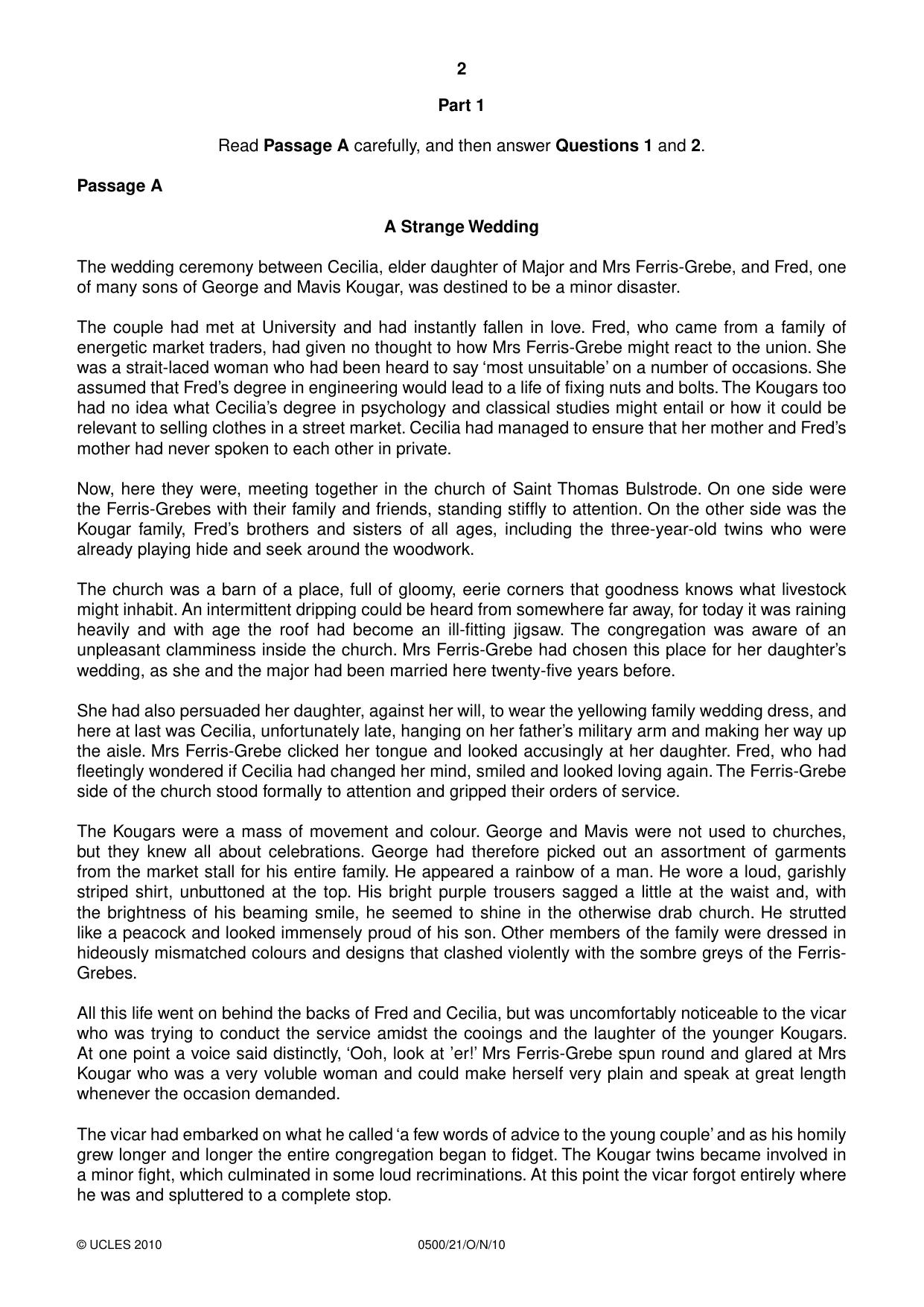
2 0500/21/O/N/10 © UCLES 2010 Part 1 Read Passage A carefully, and then answer Questions 1 and 2. Passage A A Strange Wedding The wedding ceremony between Cecilia, elder daughter of Major and Mrs Ferris-Grebe, and Fred, one of many sons of George and Mavis Kougar, was destined to be a minor disaster. The couple had met at University and had instantly fallen in love. Fred, who came from a family of energetic market traders, had given no thought to how Mrs Ferris-Grebe might react to the union. She was a strait-laced woman who had been heard to say ‘most unsuitable’ on a number of occasions. She assumed that Fred’s degree in engineering would lead to a life of fixing nuts and bolts. The Kougars too had no idea what Cecilia’s degree in psychology and classical studies might entail or how it could be relevant to selling clothes in a street market. Cecilia had managed to ensure that her mother and Fred’s mother had never spoken to each other in private. Now, here they were, meeting together in the church of Saint Thomas Bulstrode. On one side were the Ferris-Grebes with their family and friends, standing stiffly to attention. On the other side was the Kougar family, Fred’s brothers and sisters of all ages, including the three-year-old twins who were already playing hide and seek around the woodwork. The church was a barn of a place, full of gloomy, eerie corners that goodness knows what livestock might inhabit. An intermittent dripping could be heard from somewhere far away, for today it was raining heavily and with age the roof had become an ill-fitting jigsaw. The congregation was aware of an unpleasant clamminess inside the church. Mrs Ferris-Grebe had chosen this place for her daughter’s wedding, as she and the major had been married here twenty-five years before. She had also persuaded her daughter, against her will, to wear the yellowing family wedding dress, and here at last was Cecilia, unfortunately late, hanging on her father’s military arm and making her way up the aisle. Mrs Ferris-Grebe clicked her tongue and looked accusingly at her daughter. Fred, who had fleetingly wondered if Cecilia had changed her mind, smiled and looked loving again. The Ferris-Grebe side of the church stood formally to attention and gripped their orders of service. The Kougars were a mass of movement and colour. George and Mavis were not used to churches, but they knew all about celebrations. George had therefore picked out an assortment of garments from the market stall for his entire family. He appeared a rainbow of a man. He wore a loud, garishly striped shirt, unbuttoned at the top. His bright purple trousers sagged a little at the waist and, with the brightness of his beaming smile, he seemed to shine in the otherwise drab church. He strutted like a peacock and looked immensely proud of his son. Other members of the family were dressed in hideously mismatched colours and designs that clashed violently with the sombre greys of the Ferris- Grebes. All this life went on behind the backs of Fred and Cecilia, but was uncomfortably noticeable to the vicar who was trying to conduct the service amidst the cooings and the laughter of the younger Kougars. At one point a voice said distinctly, ‘Ooh, look at ’er!’ Mrs Ferris-Grebe spun round and glared at Mrs Kougar who was a very voluble woman and could make herself very plain and speak at great length whenever the occasion demanded. The vicar had embarked on what he called ‘a few words of advice to the young couple’ and as his homily grew longer and longer the entire congregation began to fidget. The Kougar twins became involved in a minor fight, which culminated in some loud recriminations. At this point the vicar forgot entirely where he was and spluttered to a complete stop.
Question paper, page 3
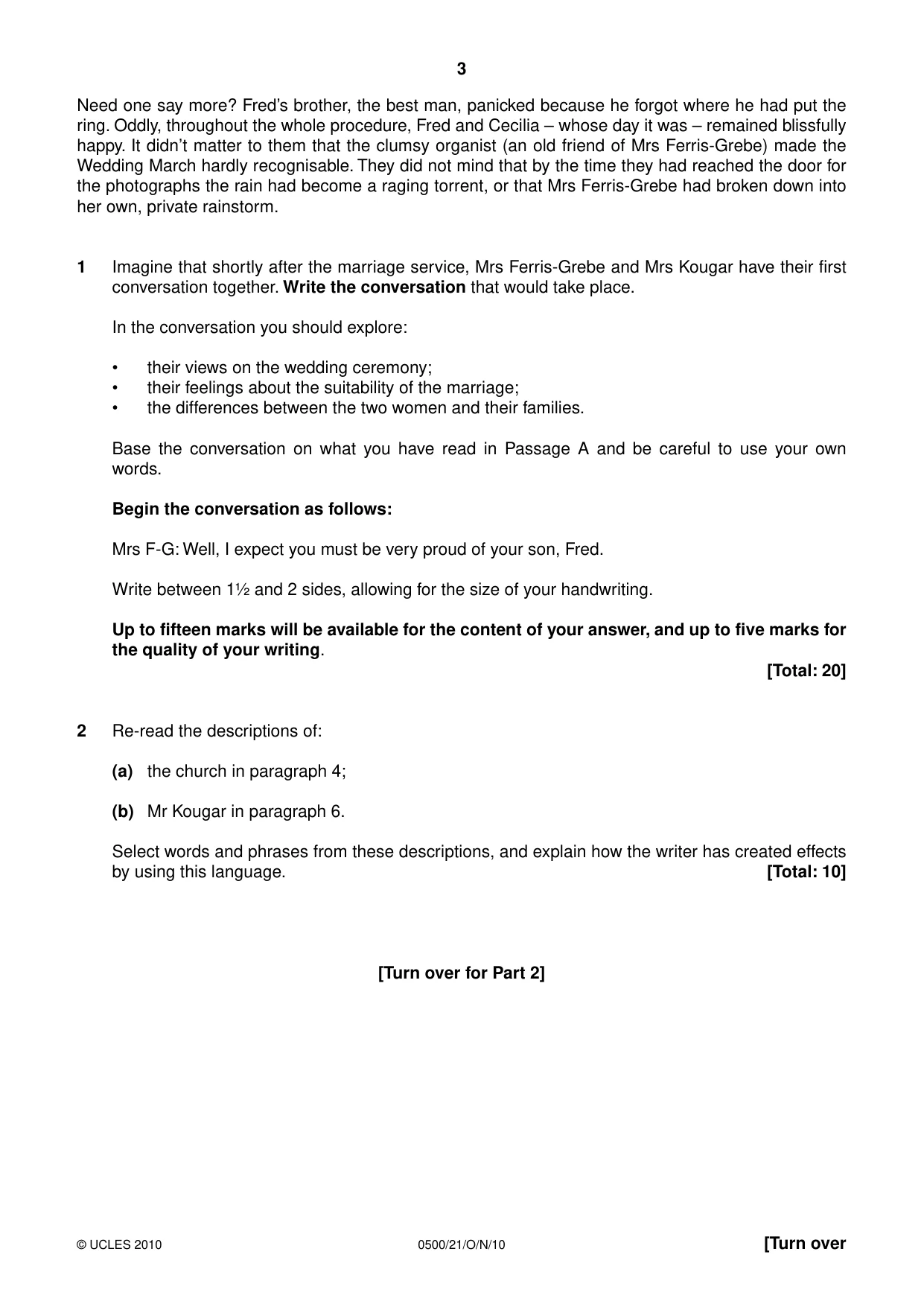
3 0500/21/O/N/10 © UCLES 2010 [Turn over Need one say more? Fred’s brother, the best man, panicked because he forgot where he had put the ring. Oddly, throughout the whole procedure, Fred and Cecilia – whose day it was – remained blissfully happy. It didn’t matter to them that the clumsy organist (an old friend of Mrs Ferris-Grebe) made the Wedding March hardly recognisable. They did not mind that by the time they had reached the door for the photographs the rain had become a raging torrent, or that Mrs Ferris-Grebe had broken down into her own, private rainstorm. 1 Imagine that shortly after the marriage service, Mrs Ferris-Grebe and Mrs Kougar have their first conversation together. Write the conversation that would take place. In the conversation you should explore: • their views on the wedding ceremony; • their feelings about the suitability of the marriage; • the differences between the two women and their families. Base the conversation on what you have read in Passage A and be careful to use your own words. Begin the conversation as follows: Mrs F-G: Well, I expect you must be very proud of your son, Fred. Write between 1½ and 2 sides, allowing for the size of your handwriting. Up to fifteen marks will be available for the content of your answer, and up to five marks for the quality of your writing. [Total: 20] 2 Re-read the descriptions of: (a) the church in paragraph 4; (b) Mr Kougar in paragraph 6. Select words and phrases from these descriptions, and explain how the writer has created effects by using this language. [Total: 10] [Turn over for Part 2]
Question paper, page 4
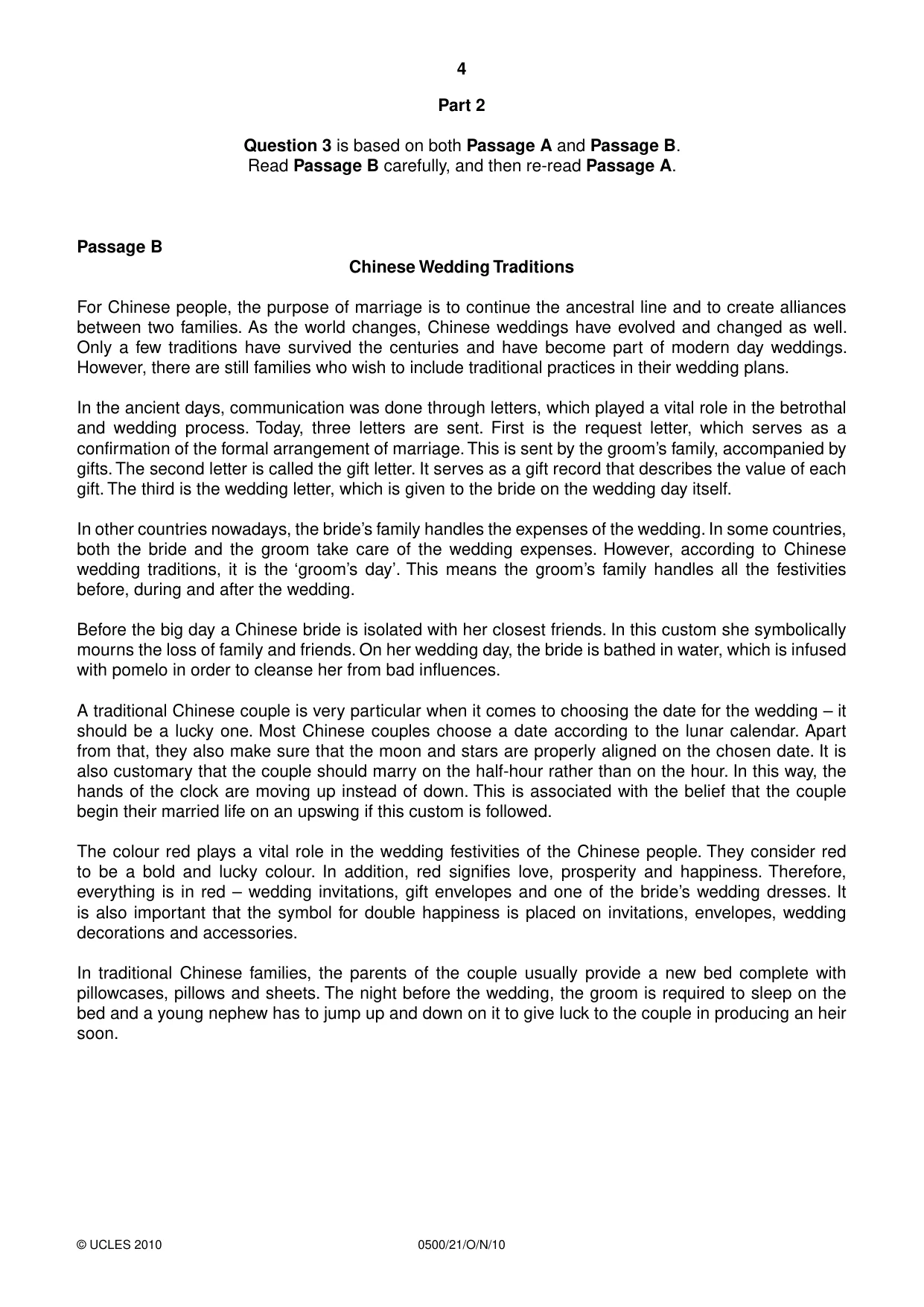
4 0500/21/O/N/10 © UCLES 2010 Part 2 Question 3 is based on both Passage A and Passage B. Read Passage B carefully, and then re-read Passage A. Passage B Chinese Wedding Traditions For Chinese people, the purpose of marriage is to continue the ancestral line and to create alliances between two families. As the world changes, Chinese weddings have evolved and changed as well. Only a few traditions have survived the centuries and have become part of modern day weddings. However, there are still families who wish to include traditional practices in their wedding plans. In the ancient days, communication was done through letters, which played a vital role in the betrothal and wedding process. Today, three letters are sent. First is the request letter, which serves as a confirmation of the formal arrangement of marriage. This is sent by the groom’s family, accompanied by gifts. The second letter is called the gift letter. It serves as a gift record that describes the value of each gift. The third is the wedding letter, which is given to the bride on the wedding day itself. In other countries nowadays, the bride’s family handles the expenses of the wedding. In some countries, both the bride and the groom take care of the wedding expenses. However, according to Chinese wedding traditions, it is the ‘groom’s day’. This means the groom’s family handles all the festivities before, during and after the wedding. Before the big day a Chinese bride is isolated with her closest friends. In this custom she symbolically mourns the loss of family and friends. On her wedding day, the bride is bathed in water, which is infused with pomelo in order to cleanse her from bad influences. A traditional Chinese couple is very particular when it comes to choosing the date for the wedding – it should be a lucky one. Most Chinese couples choose a date according to the lunar calendar. Apart from that, they also make sure that the moon and stars are properly aligned on the chosen date. It is also customary that the couple should marry on the half-hour rather than on the hour. In this way, the hands of the clock are moving up instead of down. This is associated with the belief that the couple begin their married life on an upswing if this custom is followed. The colour red plays a vital role in the wedding festivities of the Chinese people. They consider red to be a bold and lucky colour. In addition, red signifies love, prosperity and happiness. Therefore, everything is in red – wedding invitations, gift envelopes and one of the bride’s wedding dresses. It is also important that the symbol for double happiness is placed on invitations, envelopes, wedding decorations and accessories. In traditional Chinese families, the parents of the couple usually provide a new bed complete with pillowcases, pillows and sheets. The night before the wedding, the groom is required to sleep on the bed and a young nephew has to jump up and down on it to give luck to the couple in producing an heir soon.
Question paper, page 5
5 0500/21/O/N/10 © UCLES 2010 On the day of the wedding the couple serves tea to parents, family and guests. In return they are presented with jewellery and money placed in red envelopes. There will be three different dresses for the bride. The white dress with veil is worn during the wedding ceremony. The second wedding dress, the traditional red wedding dress, is used at the banquet. The last dress is called the bride’s going away dress and is worn after the bride leaves the banquet. A post wedding ritual happens the day after the wedding. The bride should wake up early to honour her ancestors. On this day the bride is formally introduced to the groom’s family, relatives and friends. 3 Summarise: (a) the traditions that Chinese families often follow, as described in Passage B; (b) the things that went wrong at the wedding ceremony described in Passage A. Use your own words as far as possible. You should write about 1 side in total, allowing for the size of your handwriting. Up to fifteen marks will be available for the content of your answer, and up to five marks for the quality of your writing. [Total: 20]
Question paper, page 6
6 0500/21/O/N/10 © UCLES 2010 BLANK PAGE
Question paper, page 7
7 0500/21/O/N/10 © UCLES 2010 BLANK PAGE
Question paper, page 8
8 0500/21/O/N/10 © UCLES 2010 Copyright Acknowledgements: Question 3 © Chinese Wedding Traditions – Marriage Customs; http://www.983wedding.com/chinese/ 1/8/2009. Permission to reproduce items where third-party owned material protected by copyright is included has been sought and cleared where possible. Every reasonable effort has been made by the publisher (UCLES) to trace copyright holders, but if any items requiring clearance have unwittingly been included, the publisher will be pleased to make amends at the earliest possible opportunity. University of Cambridge International Examinations is part of the Cambridge Assessment Group. Cambridge Assessment is the brand name of University of Cambridge Local Examinations Syndicate (UCLES), which is itself a department of the University of Cambridge. BLANK PAGE
Mark scheme, page 1
UNIVERSITY OF CAMBRIDGE INTERNATIONAL EXAMINATIONS International General Certificate of Secondary Education MARK SCHEME for the October/November 2010 question paper for the guidance of teachers 0500 FIRST LANGUAGE ENGLISH 0500/21 Paper 2 (Reading passages – Extended), maximum raw mark 50 This mark scheme is published as an aid to teachers and candidates, to indicate the requirements of the examination. It shows the basis on which Examiners were instructed to award marks. It does not indicate the details of the discussions that took place at an Examiners’ meeting before marking began, which would have considered the acceptability of alternative answers. Mark schemes must be read in conjunction with the question papers and the report on the examination. • CIE will not enter into discussions or correspondence in connection with these mark schemes. CIE is publishing the mark schemes for the October/November 2010 question papers for most IGCSE, GCE Advanced Level and Advanced Subsidiary Level syllabuses and some Ordinary Level syllabuses. www.XtremePapers.com
Mark scheme, page 2
Page 2 Mark Scheme: Teachers’ version Syllabus Paper IGCSE – October/November 2010 0500 21 © UCLES 2010 Note: All Examiners are instructed that alternative correct answers and unexpected approaches in candidates’ scripts must be given marks that fairly reflect the relevant knowledge and skills demonstrated. Question 1 Imagine that shortly after the marriage service, Mrs Ferris-Grebe and Mrs Kougar have their first conversation together. Write the conversation that would take place. In the conversation you should explore: their views on the wedding ceremony, their feelings about the suitability of the marriage and the differences between the two women and their families. Base the conversation on what you have read in Passage A and be careful to use your own words. Write between 1½ and 2 sides, allowing for the size of your handwriting. Up to fifteen marks will be available for the content of your answer, and up to five marks for the quality of your writing. [20] This question tests Reading Objectives R1–R3 (15 marks): • Understand and collate explicit meanings • Understand, explain and collate implicit meanings and attitudes • Select, analyse and evaluate what is relevant to specific purposes AND Writing Objectives W1–W5 (5 marks): • Articulate experience and express what is thought, felt and imagined • Order and present facts, ideas and opinions • Understand and use a range of appropriate vocabulary • Use language and register appropriate to audience and context • Make accurate and effective use of paragraphs, grammatical structures, sentences, punctuation and spelling. General notes on likely content A basic answer will give information, perhaps in the form of an undeveloped list, about the wedding ceremony and the suitability of the marriage. The more the material is adapted to the question, the higher the reading mark. The best answers will bring out the characters of the two women. For writing, remember to reward varied and appropriate language for the two characters. The final mark is based on the quality of the answer.
Mark scheme, page 3
Page 3 Mark Scheme: Teachers’ version Syllabus Paper IGCSE – October/November 2010 0500 21 © UCLES 2010 Candidates may use the following ideas: A Views on the wedding ceremony Mrs Kougar is not used to such ceremonies in church but knows a good celebration when she sees one. She may ask questions about aspects of the ceremony and may hint that it was not much fun. Mrs Ferris-Grebe will need to justify herself on the choice of church, the wedding dress and the organist. Comments about the different dress styles of the two families are relevant. Good answers may widen this section to discuss such things as standards and traditions. There will be matters such as the rude comment heard during the service, the behaviour of the children and the fumbling over the ring. Mrs Kougar might have comments about the sermon and she may have noticed Mrs Ferris-Grebe’s breakdown at the end. Mrs Kougar will have enjoyed the service more. Reward barbed comments and point scoring. B Suitability of the marriage There is a good opportunity for original thought here. Basically Mrs Ferris-Grebe will think that Cecilia is marrying beneath her. Mrs Kougar might think Cecilia to be posh, but University was a leg-up for the family and could be seen as the great leveller. The important point is that they love each other. There is a lot to be cleared up as to what they do with their degrees. Both mothers are blinkered. Mrs Kougar will be quite happy to welcome Cecilia to her big family and if she becomes a grandparent there will be little gap in ages (see the twins). C Differences between the two women and their families Responses should develop Mrs Ferris-Grebe’s stiffness and formality and her wish to be in control (plenty of details in the passage). Mrs Kougar lets ‘everything hang out’, except when she gets annoyed or has an opinion. She can make herself very plain, at great length and she is voluble. Any response which can manage this is likely to be rewarded high marks. The size of the Kougar family is a point in itself and the amount of discipline administered in each family is clearly different. Note that Mrs Ferris-Grebe’s attempts to control Cecilia meet with limited success.
Mark scheme, page 4
Page 4 Mark Scheme: Teachers’ version Syllabus Paper IGCSE – October/November 2010 0500 21 © UCLES 2010 Marking Criteria for Question 1 A CONTENT (EXTENDED TIER) Use the following table to give a mark out of 15. Band 1: 13–15 The answer reveals a thorough reading of the passage. A good range of well- developed and equally weighted ideas is applied to all parts of the question. There is an appropriate amount of supporting detail, which is well integrated with the conversation, contributing to a consistently strong sense of purpose and approach. Characters are clearly indicated. Band 2: 10–12 There is evidence of a competent reading of the passage and evidence of adaption of some of the text to the question. Some ideas are developed, but the ability to sustain content may not be consistent. All parts of the question may not be equally weighted. There is some supporting detail throughout. There is some attempt to convey differing characters. Band 3: 7–9 The passage has been read reasonably well, but the answer may not reflect the range and detail of the original. There may be some evidence of a mechanical use of the passage. There is focus on the task and satisfactory reference, but opportunities for development are not always taken. Some supporting detail is used, but not consistently. Hints at characterisation are few and may not be clearly presented. Band 4: 4–6 Some reference to the passage is made without much inference or more than brief, factual development. Answers may be thin, lack original thought, or in places lack focus on the text, but there is some evidence of general understanding of the most important details of the passage. Band 5: 1–3 Answers are either very general with little specific reference to the passage or a reproduction of sections of the original. Content is insubstantial and there is little realisation of the need to modify material from the passage. Band 6: 0 There is little or no relevance to the question or to the passage.
Mark scheme, page 5
Page 5 Mark Scheme: Teachers’ version Syllabus Paper IGCSE – October/November 2010 0500 21 © UCLES 2010 B QUALITY OF WRITING: STRUCTURE AND ORDER, STYLE OF LANGUAGE (EXTENDED TIER) Use the following table to give a mark out of 5. Band 1: 5 The language of the conversation has character and is consistently appropriate to the two speakers. Ideas are very clearly expressed and developed in a wide range of effective and/or interesting language. The conversation has an effective overall structure and may have an interesting ending. Band 2: 4 Language is mostly fluent and there is clarity of expression. There is a sufficient range of vocabulary to express some ideas strongly and develop them with some subtlety. The candidate attempts to write appropriately for the two speakers. The conversation is mainly well structured. Band 3: 3 Language is clear and appropriate, but comparatively plain, and rarely strong or subtle. Individual points are rarely extended, but explanations are adequate, although they do not give evidence of a wide range of language. There may be little shape to the conversation as a whole. Band 4: 2 There may be some awkwardness of expression and some inconsistency of appropriate style. Language is too limited to express shades of meaning or differences of outlook. There is structural weakness in the presentation of material. There may be some lifting. Band 5: 1 There are difficulties with expression and structure. Language is weak and undeveloped. There is little attempt to explain ideas. Language communicates general meaning, but is only adequate. There may be frequent copying from the original. Band 6: 0 Sentence structures and language are unclear and the work is difficult to follow.
Mark scheme, page 6
Page 6 Mark Scheme: Teachers’ version Syllabus Paper IGCSE – October/November 2010 0500 21 © UCLES 2010 Question 2 Re-read the descriptions of: (a) the church in paragraph 4; (b) Mr Kougar in paragraph 6. Select words and phrases from these descriptions, and explain how the writer has created effects by using this language. [10] This question tests Reading Objective R4 (10 marks): • Understand how writers achieve effects. General notes on likely content This question is marked for the candidate's ability to select effective or unusual words and for an understanding of ways in which the language is effective. Expect responses to provide words that carry specific meaning, including implications, additional to general and to ordinary vocabulary. Alternative acceptable explanations should be credited. Mark for the overall quality of the answer, not for the number of words chosen. The following notes are a guide to what good responses might say about the words they have chosen. They can make any sensible comment, but only credit comments that are relevant to the correct meanings of the words and that have some validity. Responses could score full marks for excellent comments on comparatively few words from each part of the question. Do not take marks off for inaccurate statements. It is the quality of the analysis that attracts marks. (a) The church in paragraph 4 Responses may give a simple but appropriate overview that the church was old and ill-kept, perhaps with an air of mystery about it, certainly not an appropriate place for a wedding. There are two images, which should be explained properly by responses achieving the top mark band. Barn is the first image. Responses should relate it to a farmyard and then draw the comparison of size and emptiness, possibly of lack of comfort. It certainly has gloomy, eerie corners that suggest a lack of light leading to a sense of the mysterious, even of fear of the livestock. This is a conveniently wide term to cover anything from flies to bats or worse; it suggests that the church was poorly looked after and that parts of the building were a sort of ‘no go’ area. Reward responses which demonstrate knowledge of what intermittent dripping means. The ill-fitting jigsaw needs explaining as an image. With time the pieces of a jigsaw become worn and holes at the corners appear; similarly the church has many small holes although the pieces may still be there. Clamminess suggests a kind of atmosphere and links well with gloomy.
Mark scheme, page 7
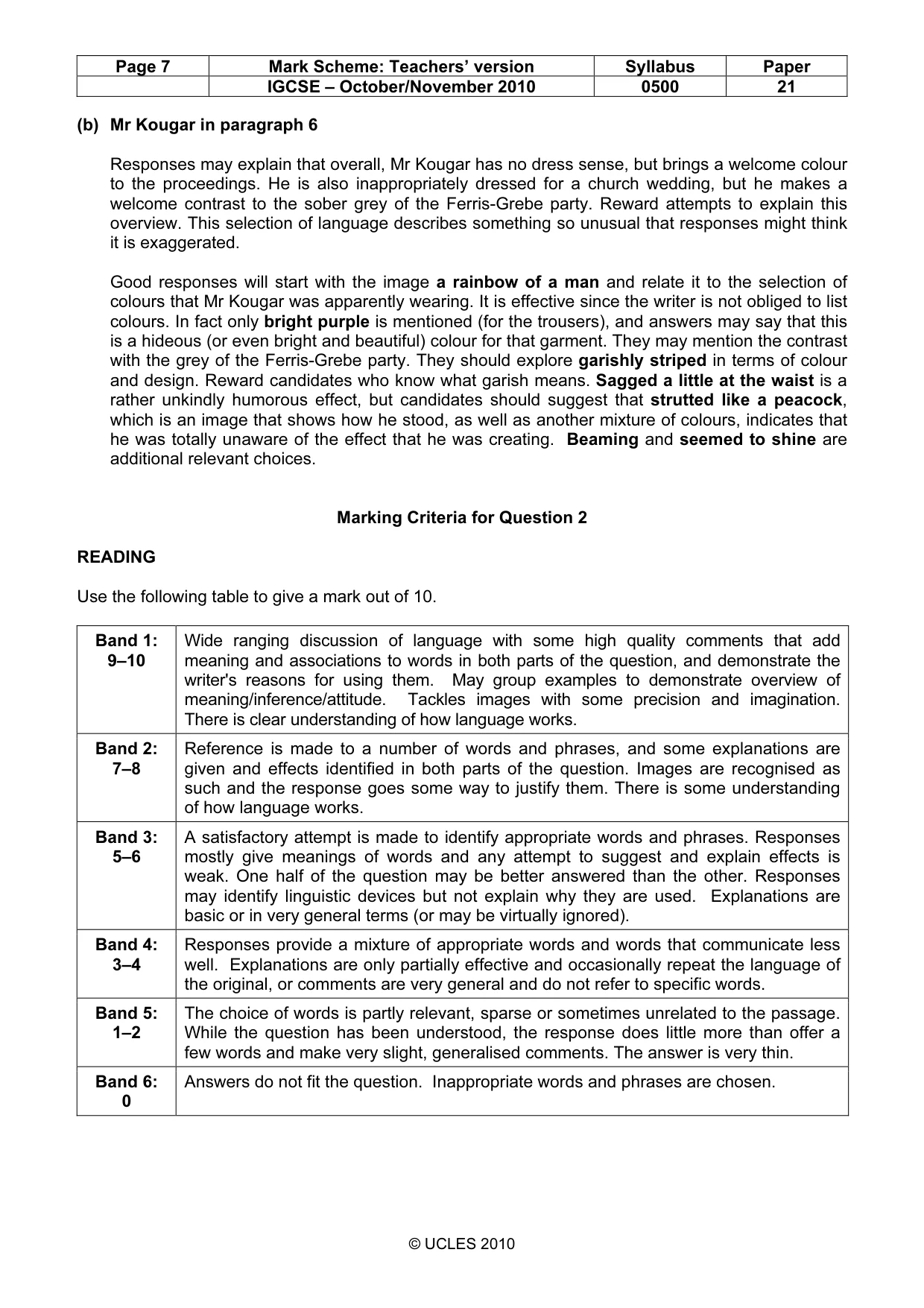
Page 7 Mark Scheme: Teachers’ version Syllabus Paper IGCSE – October/November 2010 0500 21 © UCLES 2010 (b) Mr Kougar in paragraph 6 Responses may explain that overall, Mr Kougar has no dress sense, but brings a welcome colour to the proceedings. He is also inappropriately dressed for a church wedding, but he makes a welcome contrast to the sober grey of the Ferris-Grebe party. Reward attempts to explain this overview. This selection of language describes something so unusual that responses might think it is exaggerated. Good responses will start with the image a rainbow of a man and relate it to the selection of colours that Mr Kougar was apparently wearing. It is effective since the writer is not obliged to list colours. In fact only bright purple is mentioned (for the trousers), and answers may say that this is a hideous (or even bright and beautiful) colour for that garment. They may mention the contrast with the grey of the Ferris-Grebe party. They should explore garishly striped in terms of colour and design. Reward candidates who know what garish means. Sagged a little at the waist is a rather unkindly humorous effect, but candidates should suggest that strutted like a peacock, which is an image that shows how he stood, as well as another mixture of colours, indicates that he was totally unaware of the effect that he was creating. Beaming and seemed to shine are additional relevant choices. Marking Criteria for Question 2 READING Use the following table to give a mark out of 10. Band 1: 9–10 Wide ranging discussion of language with some high quality comments that add meaning and associations to words in both parts of the question, and demonstrate the writer's reasons for using them. May group examples to demonstrate overview of meaning/inference/attitude. Tackles images with some precision and imagination. There is clear understanding of how language works. Band 2: 7–8 Reference is made to a number of words and phrases, and some explanations are given and effects identified in both parts of the question. Images are recognised as such and the response goes some way to justify them. There is some understanding of how language works. Band 3: 5–6 A satisfactory attempt is made to identify appropriate words and phrases. Responses mostly give meanings of words and any attempt to suggest and explain effects is weak. One half of the question may be better answered than the other. Responses may identify linguistic devices but not explain why they are used. Explanations are basic or in very general terms (or may be virtually ignored). Band 4: 3–4 Responses provide a mixture of appropriate words and words that communicate less well. Explanations are only partially effective and occasionally repeat the language of the original, or comments are very general and do not refer to specific words. Band 5: 1–2 The choice of words is partly relevant, sparse or sometimes unrelated to the passage. While the question has been understood, the response does little more than offer a few words and make very slight, generalised comments. The answer is very thin. Band 6: 0 Answers do not fit the question. Inappropriate words and phrases are chosen.
Mark scheme, page 8
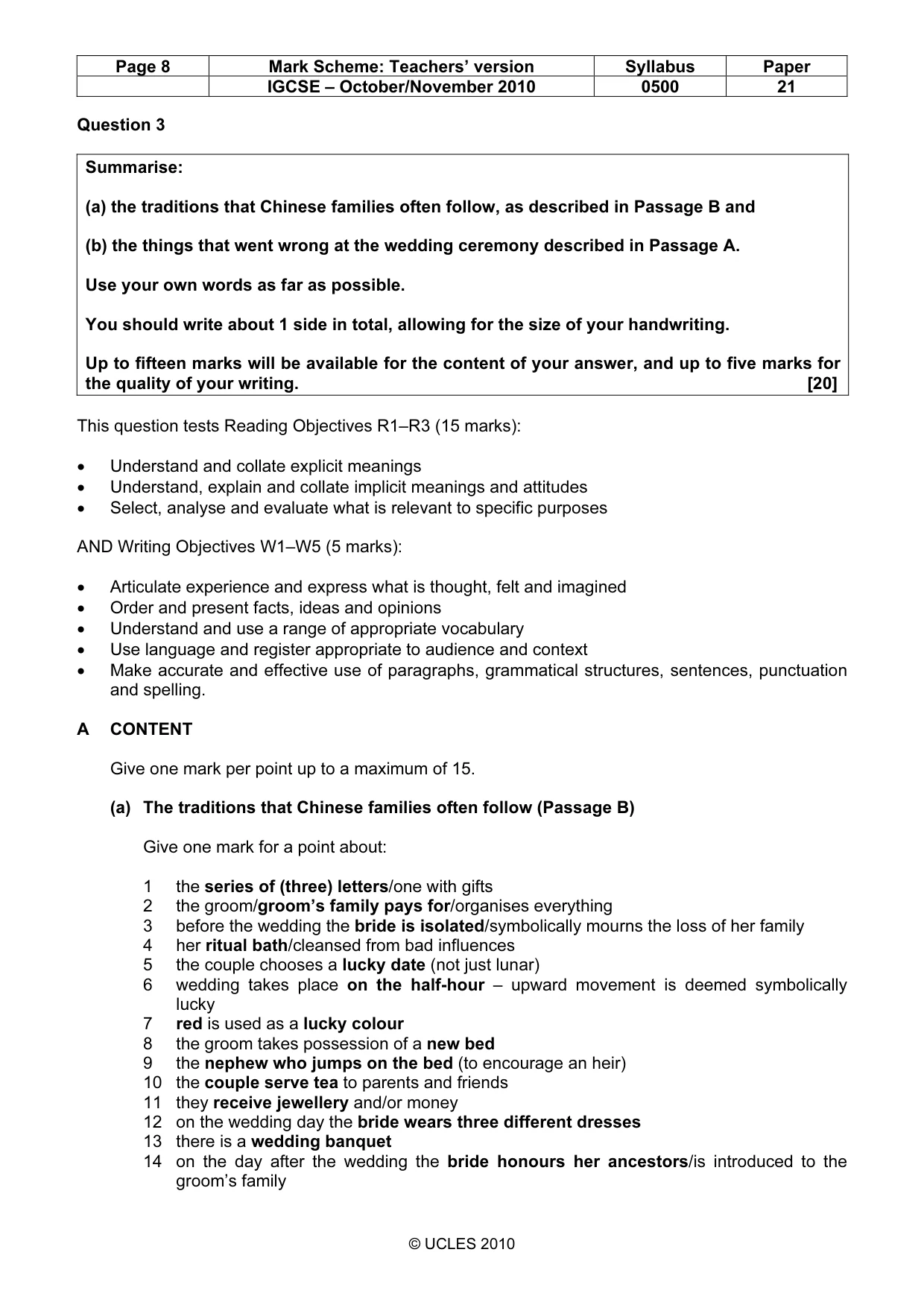
Page 8 Mark Scheme: Teachers’ version Syllabus Paper IGCSE – October/November 2010 0500 21 © UCLES 2010 Question 3 Summarise: (a) the traditions that Chinese families often follow, as described in Passage B and (b) the things that went wrong at the wedding ceremony described in Passage A. Use your own words as far as possible. You should write about 1 side in total, allowing for the size of your handwriting. Up to fifteen marks will be available for the content of your answer, and up to five marks for the quality of your writing. [20] This question tests Reading Objectives R1–R3 (15 marks): • Understand and collate explicit meanings • Understand, explain and collate implicit meanings and attitudes • Select, analyse and evaluate what is relevant to specific purposes AND Writing Objectives W1–W5 (5 marks): • Articulate experience and express what is thought, felt and imagined • Order and present facts, ideas and opinions • Understand and use a range of appropriate vocabulary • Use language and register appropriate to audience and context • Make accurate and effective use of paragraphs, grammatical structures, sentences, punctuation and spelling. A CONTENT Give one mark per point up to a maximum of 15. (a) The traditions that Chinese families often follow (Passage B) Give one mark for a point about: 1 the series of (three) letters/one with gifts 2 the groom/groom’s family pays for/organises everything 3 before the wedding the bride is isolated/symbolically mourns the loss of her family 4 her ritual bath/cleansed from bad influences 5 the couple chooses a lucky date (not just lunar) 6 wedding takes place on the half-hour – upward movement is deemed symbolically lucky 7 red is used as a lucky colour 8 the groom takes possession of a new bed 9 the nephew who jumps on the bed (to encourage an heir) 10 the couple serve tea to parents and friends 11 they receive jewellery and/or money 12 on the wedding day the bride wears three different dresses 13 there is a wedding banquet 14 on the day after the wedding the bride honours her ancestors/is introduced to the groom’s family
Mark scheme, page 9
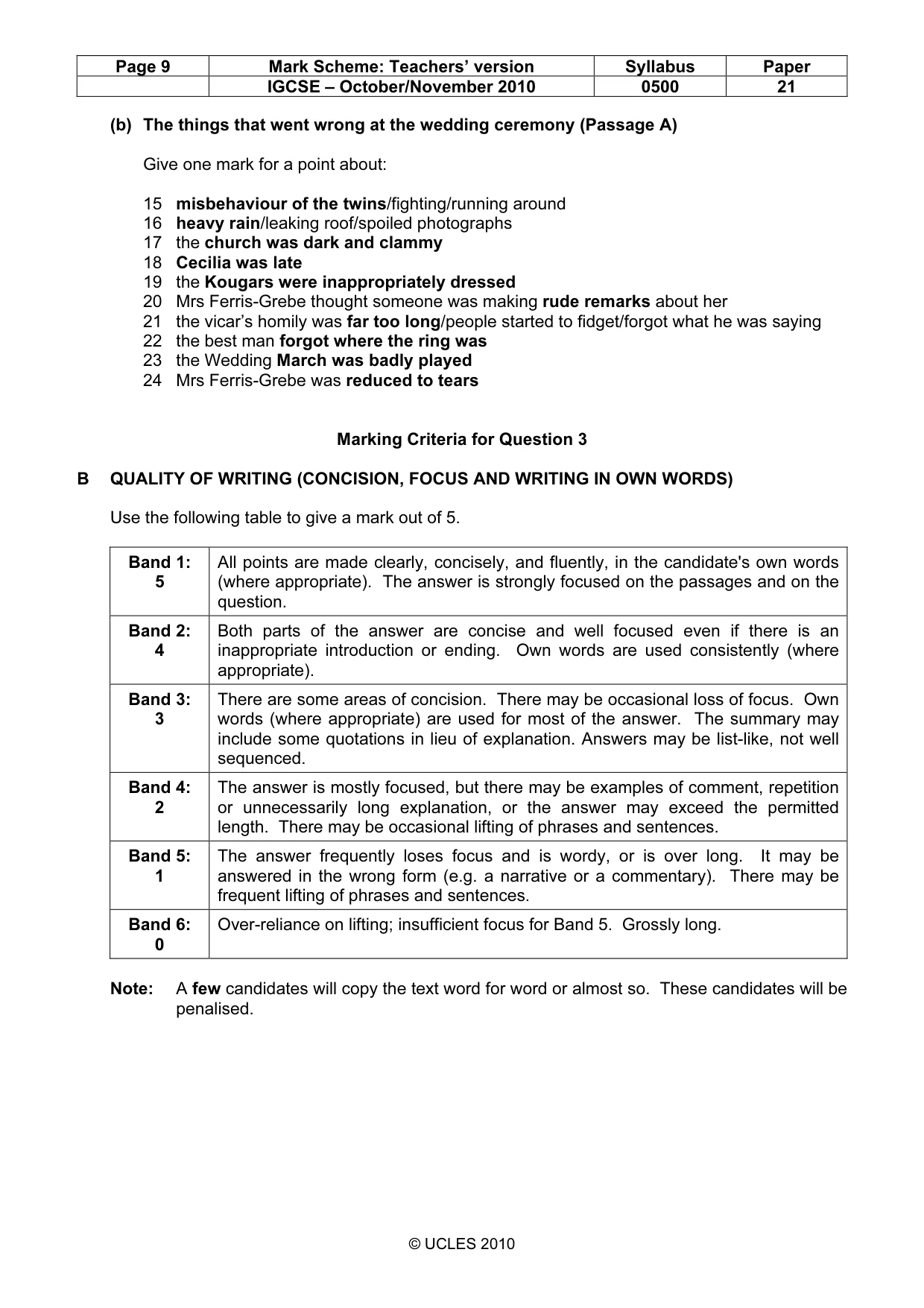
Page 9 Mark Scheme: Teachers’ version Syllabus Paper IGCSE – October/November 2010 0500 21 © UCLES 2010 (b) The things that went wrong at the wedding ceremony (Passage A) Give one mark for a point about: 15 misbehaviour of the twins/fighting/running around 16 heavy rain/leaking roof/spoiled photographs 17 the church was dark and clammy 18 Cecilia was late 19 the Kougars were inappropriately dressed 20 Mrs Ferris-Grebe thought someone was making rude remarks about her 21 the vicar’s homily was far too long/people started to fidget/forgot what he was saying 22 the best man forgot where the ring was 23 the Wedding March was badly played 24 Mrs Ferris-Grebe was reduced to tears Marking Criteria for Question 3 B QUALITY OF WRITING (CONCISION, FOCUS AND WRITING IN OWN WORDS) Use the following table to give a mark out of 5. Band 1: 5 All points are made clearly, concisely, and fluently, in the candidate's own words (where appropriate). The answer is strongly focused on the passages and on the question. Band 2: 4 Both parts of the answer are concise and well focused even if there is an inappropriate introduction or ending. Own words are used consistently (where appropriate). Band 3: 3 There are some areas of concision. There may be occasional loss of focus. Own words (where appropriate) are used for most of the answer. The summary may include some quotations in lieu of explanation. Answers may be list-like, not well sequenced. Band 4: 2 The answer is mostly focused, but there may be examples of comment, repetition or unnecessarily long explanation, or the answer may exceed the permitted length. There may be occasional lifting of phrases and sentences. Band 5: 1 The answer frequently loses focus and is wordy, or is over long. It may be answered in the wrong form (e.g. a narrative or a commentary). There may be frequent lifting of phrases and sentences. Band 6: 0 Over-reliance on lifting; insufficient focus for Band 5. Grossly long. Note: A few candidates will copy the text word for word or almost so. These candidates will be penalised.
What you needed in this session
Cambridge’s own grade thresholds for 2010 Oct/Nov, Paper 2 · Variant 1. A higher threshold means an easier paper — the bar moves with how the cohort did.