Cambridge IGCSE English - First Language 0500 — 2010 May/June Paper 2 · Variant 3
0500/23/M/J/10 · 50 marks · ≈56 min
The question paper and its mark scheme, free to read here and free to download. This is Cambridge’s own paper, exactly as it was sat.
Question paper8 pages



Mark scheme8 pages
Answers below. Sit the paper first if you are practising.
Paper as text
Question paper, page 1
This document consists of 5 printed pages and 3 blank pages. DC (SM) 21129/2 © UCLES 2010 [Turn over UNIVERSITY OF CAMBRIDGE INTERNATIONAL EXAMINATIONS International General Certificate of Secondary Education READ THESE INSTRUCTIONS FIRST If you have been given an Answer Booklet, follow the instructions on the front cover of the Booklet. Write your Centre number, candidate number and name on all the work you hand in. Write in dark blue or black pen. Do not use staples, paper clips, highlighters, glue or correction fluid. Answer all questions. Dictionaries are not permitted. At the end of the examination, fasten all your work securely together. The number of marks is given in brackets [ ] at the end of each question or part question. FIRST LANGUAGE ENGLISH 0500/23 Paper 2 Reading Passages (Extended) May/June 2010 2 hours Additional Materials: Answer Booklet/Paper * 0 7 5 0 1 1 7 6 3 0 * www.XtremePapers.com
Question paper, page 2
2 0500/23/M/J/10 © UCLES 2010 Part 1 Read Passage A carefully, and then answer Questions 1 and 2. Passage A This is a fragment from an autobiography in which the writer, then aged 17, remembers a time when new neighbours moved into the house next door. In October, the Riveras moved out of the house next door to us. They had been like our extended family and, as mothers said tearful goodbyes, the brood of Rivera children jostled for position on the back seat, bodies contorting to see us for the last time. Their faces froze with panic when their mother’s car door slammed, the engine purred, and took them out of our lives forever. We all knew it was the end of something special, something good. Next door the now empty house shifted, groaned and settled in the quiet night. In the still twilight of the morning, mother woke us up with tantalising aromas of baking. There would be a cake to give to our new neighbours. Although the sadness of the previous day lingered, there was also a tickle of excitement about meeting new friends today. Suddenly there was a squeal of brakes and an almighty bang exploded in the street outside. We rushed to see what had caused it. The morning air was now thick with dark plumes of exhaust clouds blowing, cartoon style, out of the back of a wreck of a van. An irate, hairy little man jumped out of the driver’s seat and danced around the back of it to give it a good kick. Then he opened the passenger door to release two lanky teenage boys dressed in faded T-shirts and dirty, torn jeans. These surly boys, their skin seeped in the grey pallor of neglect, punched and slapped each other as they made a dash for the empty house next door. That day signalled the demise of peace and quiet, the ruination of one of the most pleasant and tidy gardens in the avenue, and a rush of ‘For Sale’ notices in the vicinity. We watched spellbound that first day as the contents of the battered van were unloaded and then heaped into the middle of the lawn. Strangely, there were fewer items taken inside the house than the assortment of tools and garden junk that was left outside. Although the boys looked like strangers to a decent meal, they had been completely indulged when it came to play stations, stereo systems with speakers the size of wardrobes, an identical pair of drum kits, amps and electric bass guitars. They ignored our wan smiles and limp waves as we retreated back into the warmth of our home, where it was safe and quiet, for now. It was ominously quiet for the next couple of days. However, on the third day, in what seemed like a dawn raid, all three were back with enough weaponry to defeat a small country. A huge cement mixer, churning up the lawn, was accompanied by pneumatic drills, steel rods and bags of sand. The noise was intolerable. Mother marched briskly round to ‘have a word’, only to retreat, upset and pale, five minutes later. Over the weeks, as the drilling and noise increased, mother took to her bed, getting up only to make us an occasional meal and to take yet another little yellow pill. That winter we all felt trapped, twitchy with anger yet resigned without mother to take charge. Other neighbours, who usually said ‘Hello’ or enquired about our well-being, now passed by on the other side of the street. Our miserable faces didn’t endear us to anyone, lack of sleep held us back at school, but the main cause of our concern was mother.
Question paper, page 3
3 0500/23/M/J/10 © UCLES 2010 [Turn over Suddenly, one Saturday in spring, we realised that there was a new sound from next door: silence. The covers hiding the cause of the noise had gone and the true scale of the new ‘development’ was revealed. Pride of place was a murky pond, deep and dark, with globules of cement fashioned into lumps around its edge. From its depths a pump struggled to make the scummy surface move. The sheer amount of gaudy, plastic, aquatic creatures surrounding, or indeed on top of the water, resembled the fantasy lands in little children’s television programmes. Large, green alligators with lolling tongues and distorted fangs, and lopsided fuchsia flamingos up to their knobbly knees in concrete, basked in the early sunlight amidst tubs of plastic plants placed randomly on an uneven cement floor. As a light wind eddied down the avenue, the ‘garden’ sang: a cacophony of high pitched whining from the manic spinning windmills and a jangling of steel from the wind chimes. The little children shrieked and laughed and even I realised that I was smiling. Looking around I saw mother in her dressing gown gaping at this spectacle. As though in some zombie film, other neighbours slowly approached, curious but then enraged. They then began talking all at once and, craning their necks to get a better view, each became more incensed than the other until the rallying cry of ‘They have gone too far!’ was heard. 1 As a result of the dispute between neighbours, a public meeting has been called. At this meeting, in turn, the writer’s mother and the father next door are given the chance to present their views. The chairperson of the meeting asks the mother the following question: “Can you explain why you and other people in the neighbourhood believe that things have ‘gone too far’?” The chairperson of the meeting asks the father next door the following question: “Can you explain your position and views on this matter?” Write the words of the public meeting. Base your response on what you have read in Passage A. Write between 1½ and 2 sides, allowing for the size of your handwriting. Up to fifteen marks will be available for the content of your answer, and up to five marks for the quality of your writing. [Total: 20] 2 Re-read the descriptions of: (a) the arrival of the new family in paragraph 3 (“Suddenly there was a squeal … house next door.”); (b) the new ‘garden’ in paragraph 8 (“Suddenly, one Saturday … wind chimes.”). Select words and phrases from these descriptions, and explain how the writer has created effects by using this language. [Total: 10]
Question paper, page 4
4 0500/23/M/J/10 © UCLES 2010 Part 2 Question 3 is based on both Passage A and Passage B. Read Passage B carefully, and re-read Passage A. Passage B Marcia Gomez lives in a flat in Lima Towers, which is a housing project in Lima city, Peru. Although she is 80 years of age, she still has enough energy to help her neighbours in many different ways, and she holds an important position within the community. December 4 – Lima, Peru Problem with your pipes? Ask Marcia. Need to know when the next bingo night is? Ask Marcia. Where’s your newspaper? Ask Marcia. At Lima Towers, Marcia Gomez, president of the residents’ association, is the definition of a good neighbour. Marcia has lived for more than seven years in this housing complex for the elderly and those who are disabled. For much of that time, she has served as the association president. ‘When I first came in they wanted me to run for president, but I felt I was too new. I ran as vice president and three months later the lady who was president lost her temper and walked out,’ Marcia says, before giving a throaty laugh and a smile. Marcia, 80, twice widowed, has two sons, three grandsons and three great-grandchildren, and many of them are scattered around the country and the world. ‘This is my family,’ she says, gesturing to the residents who walk by and say hello. ‘This is a city within a city. There are 200 apartments here. If you need to go to the doctor, the hospital, if you need something cooked, we will help you. It’s the same as any other family, just on a bigger scale.’ Marcia serves on the executive committee of the Allen County Democratic Party and is a helper at a local medical centre. She was a nominee for this year’s Lima-Allen Good Neighbour Award. A few years ago, The Lima News needed a new distributor for the newspaper in the Towers and approached the managers who recommended Marcia. Now, she and other volunteers deliver the newspaper at 5am, up and down seven floors. Marcia has never taken a cent from the enterprise, however. The residents’ association donates any profit made to an activities fund for residents. This fund has recently paid for trips to shopping outlets and to the city zoo. Last week they chartered a bus and went to a special restaurant for lunch, and they often go on trips to museums and art galleries. The group also has a monthly movie, game and bingo night. ‘I just want to give back to my community and help people do some things they wouldn’t otherwise be able to do,’ Marcia says. ‘It’s a joy to do it.’ Marcia’s friend and the association secretary, Maria Angelo, exclaims, ‘Marcia is everywhere! She’s unbelievable. She does everything. She’s a good, good friend and never lets you down.’ A little woman in stature, Marcia is always on the move. She moves quickly, showing off the laundry room and talking about a grocery store to be open on Thursdays, and a food donation programme. She helps with it all, and even serves as an advocate for residents when they have concerns to raise with management. Marcia isn’t bragging, but will convince you she’s up to the job. ‘All I need are my good strong legs and the power of speech,’ she says, laughing again.
Question paper, page 5
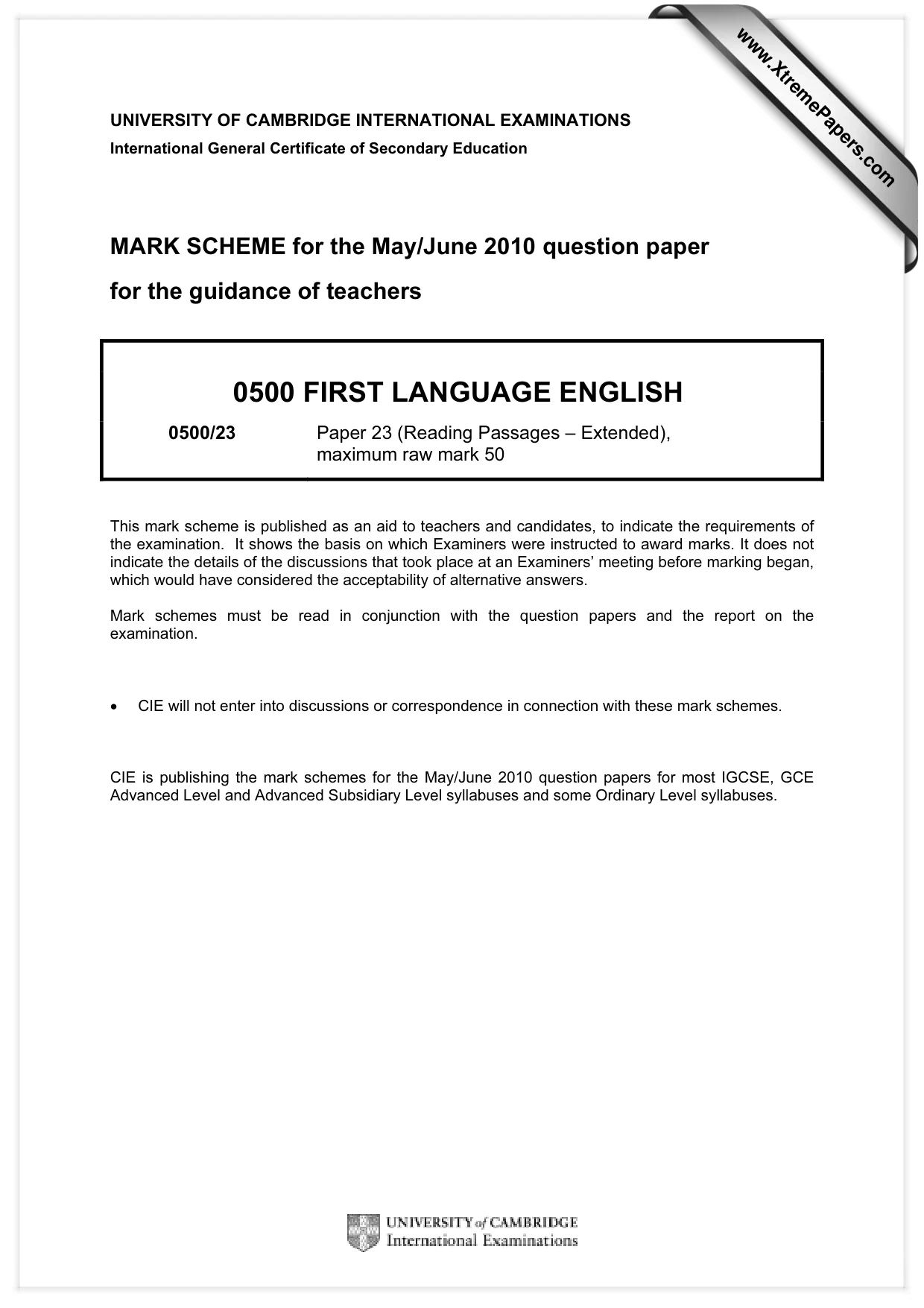
5 0500/23/M/J/10 © UCLES 2010 3 Summarise: (a) the benefits of having Marcia Gomez as your neighbour, as outlined in Passage B; (b) the annoying aspects of living next door to the new neighbours, as described in Passage A. Use your own words as far as possible. You should write about 1 side in total, allowing for the size of your handwriting. Up to fifteen marks will be available for the content of your answer, and up to five marks for the quality of your writing. [Total: 20]
Question paper, page 6
6 0500/23/M/J/10 © UCLES 2010 BLANK PAGE
Question paper, page 7
7 0500/23/M/J/10 © UCLES 2010 BLANK PAGE
Question paper, page 8
8 0500/23/M/J/10 © UCLES 2010 BLANK PAGE Copyright Acknowledgements: Question 3 © Heather Rutz; Dornick, definition of good neighbor, Lima News; www.accessmylibrary.com/comsite; 4 December 2006. Permission to reproduce items where third-party owned material protected by copyright is included has been sought and cleared where possible. Every reasonable effort has been made by the publisher (UCLES) to trace copyright holders, but if any items requiring clearance have unwittingly been included, the publisher will be pleased to make amends at the earliest possible opportunity. University of Cambridge International Examinations is part of the Cambridge Assessment Group. Cambridge Assessment is the brand name of University of Cambridge Local Examinations Syndicate (UCLES), which is itself a department of the University of Cambridge.
Mark scheme, page 1
UNIVERSITY OF CAMBRIDGE INTERNATIONAL EXAMINATIONS International General Certificate of Secondary Education MARK SCHEME for the May/June 2010 question paper for the guidance of teachers 0500 FIRST LANGUAGE ENGLISH 0500/23 Paper 23 (Reading Passages – Extended), maximum raw mark 50 This mark scheme is published as an aid to teachers and candidates, to indicate the requirements of the examination. It shows the basis on which Examiners were instructed to award marks. It does not indicate the details of the discussions that took place at an Examiners’ meeting before marking began, which would have considered the acceptability of alternative answers. Mark schemes must be read in conjunction with the question papers and the report on the examination. • CIE will not enter into discussions or correspondence in connection with these mark schemes. CIE is publishing the mark schemes for the May/June 2010 question papers for most IGCSE, GCE Advanced Level and Advanced Subsidiary Level syllabuses and some Ordinary Level syllabuses. www.XtremePapers.com
Mark scheme, page 2
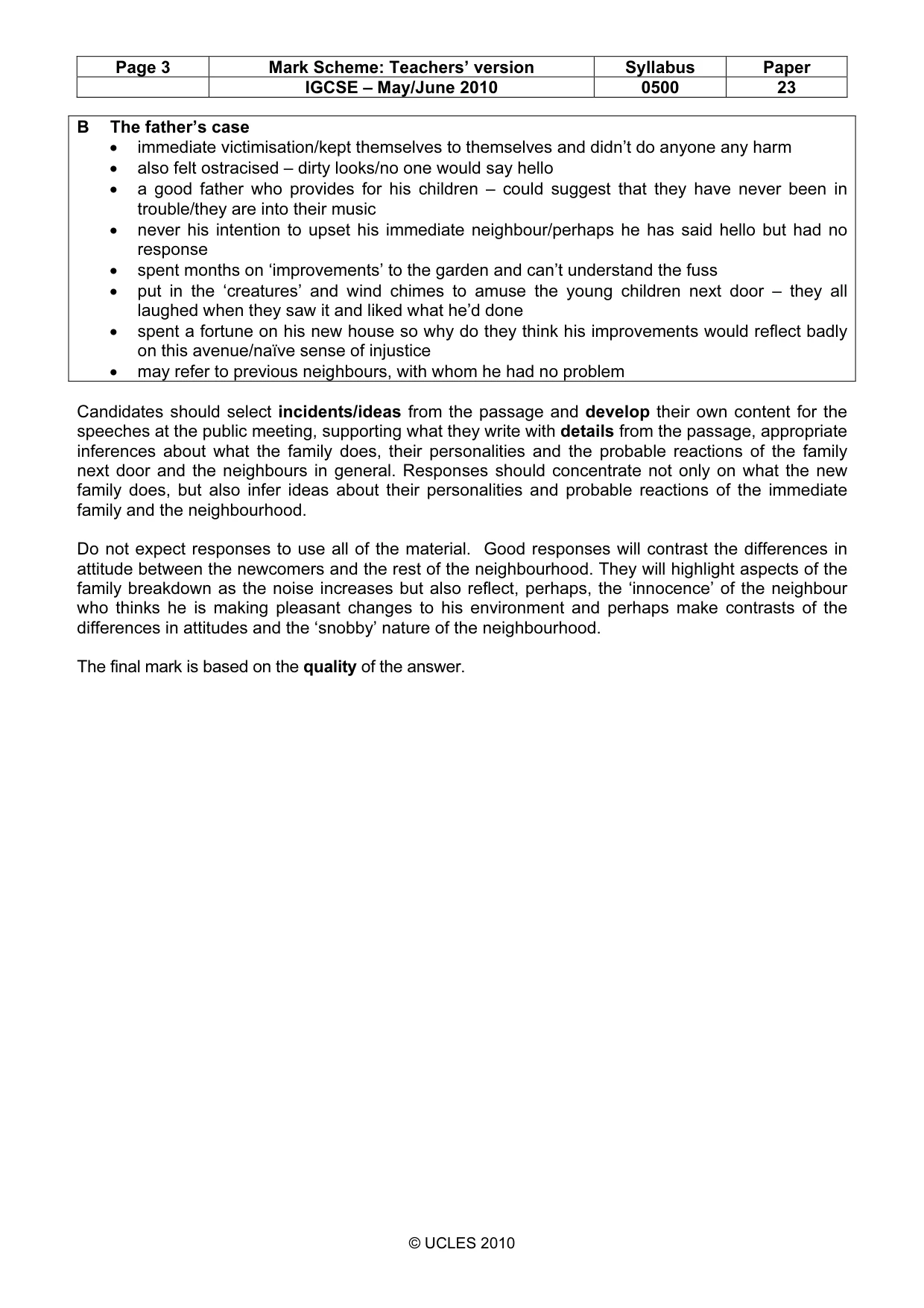
Page 2 Mark Scheme: Teachers’ version Syllabus Paper IGCSE – May/June 2010 0500 23 © UCLES 2010 Note: All Examiners are instructed that alternative correct answers and unexpected approaches in candidates’ scripts must be given marks that fairly reflect the relevant knowledge and skills demonstrated. Question 1 As a result of the dispute between neighbours, a public meeting has been called. At this meeting, in turn, the writer’s mother and the father next door are given the chance to present their views. The chairperson of the meeting asks the mother the following question: “Can you explain why you and other people in the neighbourhood believe that things have ‘gone too far’?” The chairperson of the meeting asks the father next door the following question: “Can you explain your position and views on this matter?” Write the words of the public meeting. Base your answer on what you have read in Passage A. Write between 1½ and 2 sides, allowing for the size of your handwriting. Up to fifteen marks will be available for the content of your answer, and up to five marks for the quality of your writing. [20] This question tests Reading Objectives R1–R3 (15 marks): • understand and collate explicit meanings • understand, explain and collate implicit meanings and attitudes • select, analyse and evaluate what is relevant to specific purposes AND Writing Objectives W1–W5 (5 marks): • articulate experience and express what is thought, felt and imagined • order and present facts, ideas and opinions • understand and use a range of appropriate vocabulary • use language and register appropriate to audience and context • make accurate and effective use of paragraphs, grammatical structures, sentences, punctuation and spelling. General notes on possible content: A The mother’s case – personal • no problems with previous neighbours/made close friends • early attempts to ‘get on’ with the father snubbed • the noise pollution made her depressed/act out of character/taking to her bed – also could include the noise of the boy’s drumming and music • unable to look after her family/resorting to having to take pills to control stress/tiredness debilitating • children’s lives affected/health issues/missing meals/schoolwork neglected/again tiredness/ could develop idea that the eldest girl has had to take over and the stress that has put upon her • being ostracised by the neighbours • no peace and quiet for anyone in the avenue/perhaps there have been comments made? • ‘ruination’ of the ‘look’ of the neighbourhood/perhaps reflecting on the cheap nature of the new ‘garden’ • falling house prices • inability to sell up and leave the neighbourhood • inconsideration of this new neighbour who has made all their lives ‘hell’ • the state of their vehicle also causing pollution and noise • implicit snobbish view of the family’s way of dressing and taste in general • concern that the teenagers next door are being neglected
Mark scheme, page 3
Page 3 Mark Scheme: Teachers’ version Syllabus Paper IGCSE – May/June 2010 0500 23 © UCLES 2010 B The father’s case • immediate victimisation/kept themselves to themselves and didn’t do anyone any harm • also felt ostracised – dirty looks/no one would say hello • a good father who provides for his children – could suggest that they have never been in trouble/they are into their music • never his intention to upset his immediate neighbour/perhaps he has said hello but had no response • spent months on ‘improvements’ to the garden and can’t understand the fuss • put in the ‘creatures’ and wind chimes to amuse the young children next door – they all laughed when they saw it and liked what he’d done • spent a fortune on his new house so why do they think his improvements would reflect badly on this avenue/naïve sense of injustice • may refer to previous neighbours, with whom he had no problem Candidates should select incidents/ideas from the passage and develop their own content for the speeches at the public meeting, supporting what they write with details from the passage, appropriate inferences about what the family does, their personalities and the probable reactions of the family next door and the neighbours in general. Responses should concentrate not only on what the new family does, but also infer ideas about their personalities and probable reactions of the immediate family and the neighbourhood. Do not expect responses to use all of the material. Good responses will contrast the differences in attitude between the newcomers and the rest of the neighbourhood. They will highlight aspects of the family breakdown as the noise increases but also reflect, perhaps, the ‘innocence’ of the neighbour who thinks he is making pleasant changes to his environment and perhaps make contrasts of the differences in attitudes and the ‘snobby’ nature of the neighbourhood. The final mark is based on the quality of the answer.
Mark scheme, page 4
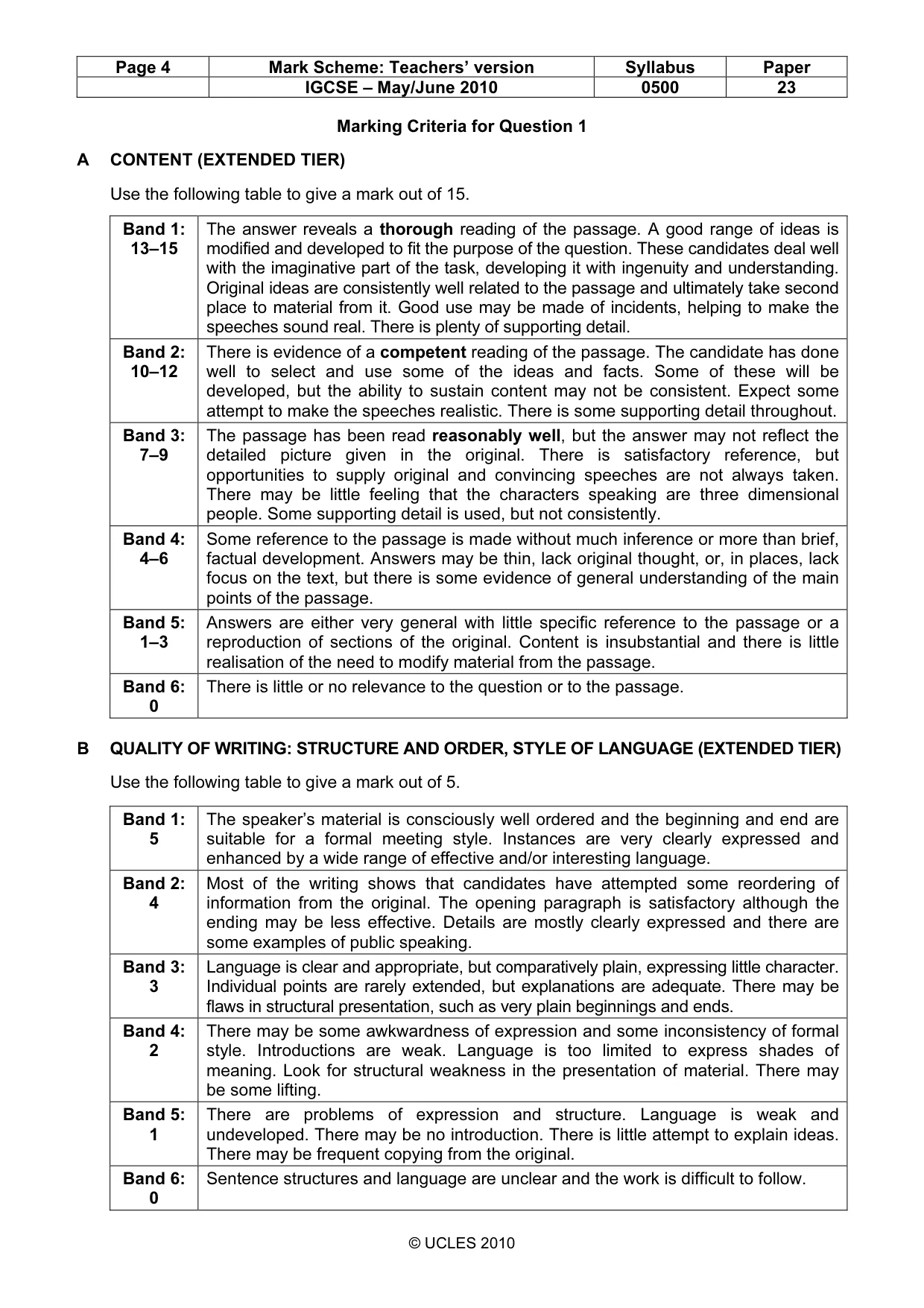
Page 4 Mark Scheme: Teachers’ version Syllabus Paper IGCSE – May/June 2010 0500 23 © UCLES 2010 Marking Criteria for Question 1 A CONTENT (EXTENDED TIER) Use the following table to give a mark out of 15. Band 1: 13–15 The answer reveals a thorough reading of the passage. A good range of ideas is modified and developed to fit the purpose of the question. These candidates deal well with the imaginative part of the task, developing it with ingenuity and understanding. Original ideas are consistently well related to the passage and ultimately take second place to material from it. Good use may be made of incidents, helping to make the speeches sound real. There is plenty of supporting detail. Band 2: 10–12 There is evidence of a competent reading of the passage. The candidate has done well to select and use some of the ideas and facts. Some of these will be developed, but the ability to sustain content may not be consistent. Expect some attempt to make the speeches realistic. There is some supporting detail throughout. Band 3: 7–9 The passage has been read reasonably well, but the answer may not reflect the detailed picture given in the original. There is satisfactory reference, but opportunities to supply original and convincing speeches are not always taken. There may be little feeling that the characters speaking are three dimensional people. Some supporting detail is used, but not consistently. Band 4: 4–6 Some reference to the passage is made without much inference or more than brief, factual development. Answers may be thin, lack original thought, or, in places, lack focus on the text, but there is some evidence of general understanding of the main points of the passage. Band 5: 1–3 Answers are either very general with little specific reference to the passage or a reproduction of sections of the original. Content is insubstantial and there is little realisation of the need to modify material from the passage. Band 6: 0 There is little or no relevance to the question or to the passage. B QUALITY OF WRITING: STRUCTURE AND ORDER, STYLE OF LANGUAGE (EXTENDED TIER) Use the following table to give a mark out of 5. Band 1: 5 The speaker’s material is consciously well ordered and the beginning and end are suitable for a formal meeting style. Instances are very clearly expressed and enhanced by a wide range of effective and/or interesting language. Band 2: 4 Most of the writing shows that candidates have attempted some reordering of information from the original. The opening paragraph is satisfactory although the ending may be less effective. Details are mostly clearly expressed and there are some examples of public speaking. Band 3: 3 Language is clear and appropriate, but comparatively plain, expressing little character. Individual points are rarely extended, but explanations are adequate. There may be flaws in structural presentation, such as very plain beginnings and ends. Band 4: 2 There may be some awkwardness of expression and some inconsistency of formal style. Introductions are weak. Language is too limited to express shades of meaning. Look for structural weakness in the presentation of material. There may be some lifting. Band 5: 1 There are problems of expression and structure. Language is weak and undeveloped. There may be no introduction. There is little attempt to explain ideas. There may be frequent copying from the original. Band 6: 0 Sentence structures and language are unclear and the work is difficult to follow.
Mark scheme, page 5
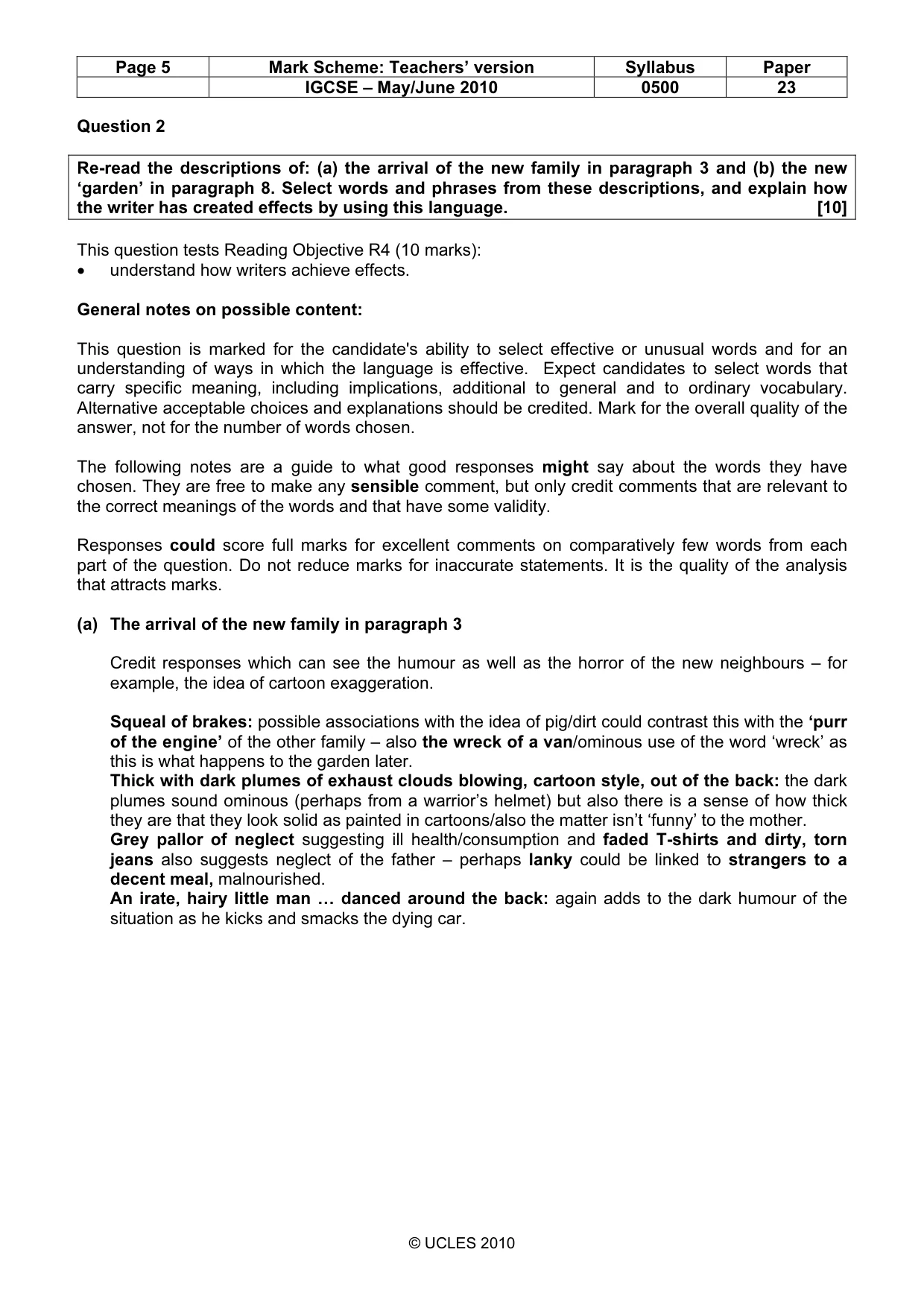
Page 5 Mark Scheme: Teachers’ version Syllabus Paper IGCSE – May/June 2010 0500 23 © UCLES 2010 Question 2 Re-read the descriptions of: (a) the arrival of the new family in paragraph 3 and (b) the new ‘garden’ in paragraph 8. Select words and phrases from these descriptions, and explain how the writer has created effects by using this language. [10] This question tests Reading Objective R4 (10 marks): • understand how writers achieve effects. General notes on possible content: This question is marked for the candidate's ability to select effective or unusual words and for an understanding of ways in which the language is effective. Expect candidates to select words that carry specific meaning, including implications, additional to general and to ordinary vocabulary. Alternative acceptable choices and explanations should be credited. Mark for the overall quality of the answer, not for the number of words chosen. The following notes are a guide to what good responses might say about the words they have chosen. They are free to make any sensible comment, but only credit comments that are relevant to the correct meanings of the words and that have some validity. Responses could score full marks for excellent comments on comparatively few words from each part of the question. Do not reduce marks for inaccurate statements. It is the quality of the analysis that attracts marks. (a) The arrival of the new family in paragraph 3 Credit responses which can see the humour as well as the horror of the new neighbours – for example, the idea of cartoon exaggeration. Squeal of brakes: possible associations with the idea of pig/dirt could contrast this with the ‘purr of the engine’ of the other family – also the wreck of a van/ominous use of the word ‘wreck’ as this is what happens to the garden later. Thick with dark plumes of exhaust clouds blowing, cartoon style, out of the back: the dark plumes sound ominous (perhaps from a warrior’s helmet) but also there is a sense of how thick they are that they look solid as painted in cartoons/also the matter isn’t ‘funny’ to the mother. Grey pallor of neglect suggesting ill health/consumption and faded T-shirts and dirty, torn jeans also suggests neglect of the father – perhaps lanky could be linked to strangers to a decent meal, malnourished. An irate, hairy little man … danced around the back: again adds to the dark humour of the situation as he kicks and smacks the dying car.
Mark scheme, page 6
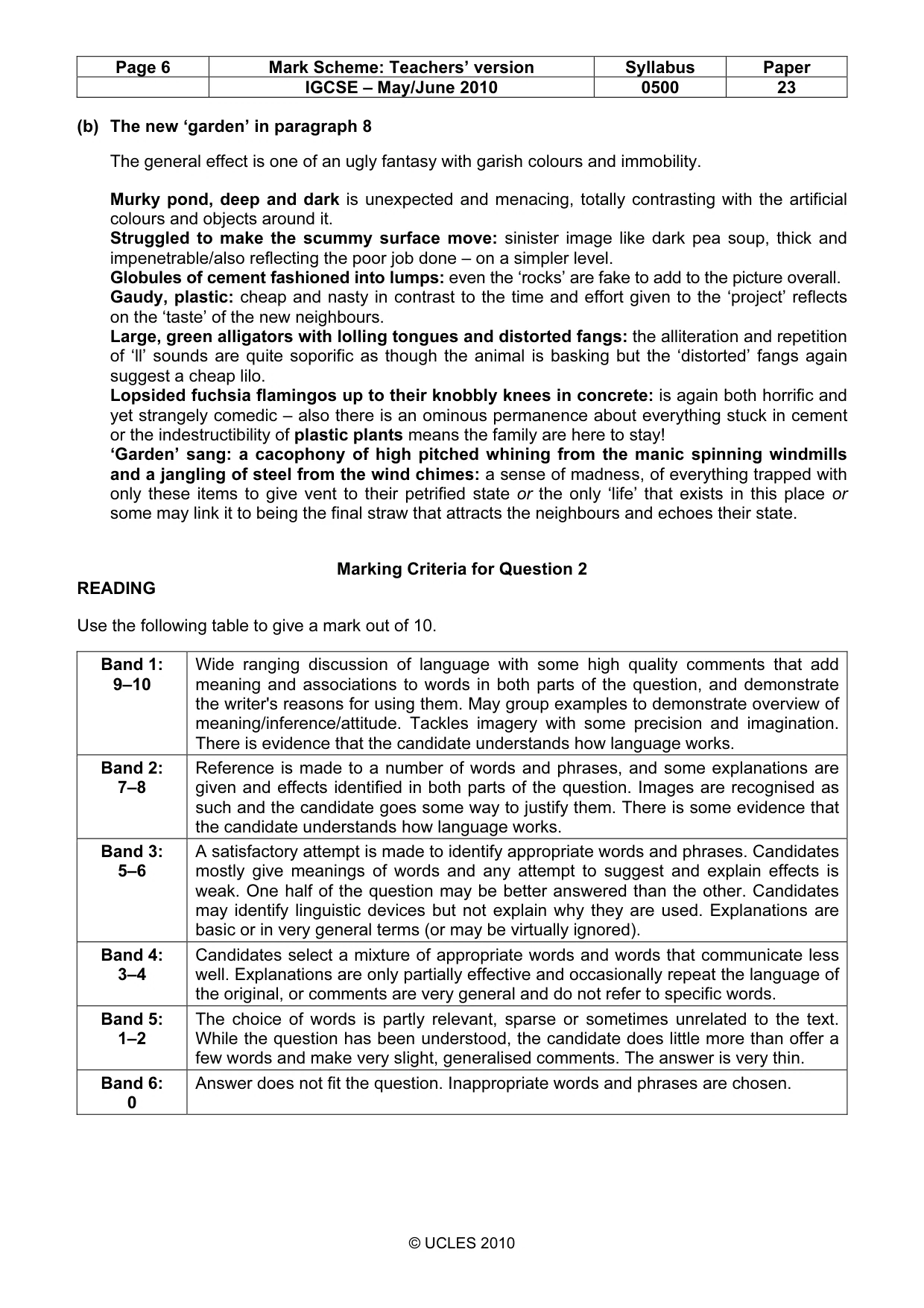
Page 6 Mark Scheme: Teachers’ version Syllabus Paper IGCSE – May/June 2010 0500 23 © UCLES 2010 (b) The new ‘garden’ in paragraph 8 The general effect is one of an ugly fantasy with garish colours and immobility. Murky pond, deep and dark is unexpected and menacing, totally contrasting with the artificial colours and objects around it. Struggled to make the scummy surface move: sinister image like dark pea soup, thick and impenetrable/also reflecting the poor job done – on a simpler level. Globules of cement fashioned into lumps: even the ‘rocks’ are fake to add to the picture overall. Gaudy, plastic: cheap and nasty in contrast to the time and effort given to the ‘project’ reflects on the ‘taste’ of the new neighbours. Large, green alligators with lolling tongues and distorted fangs: the alliteration and repetition of ‘ll’ sounds are quite soporific as though the animal is basking but the ‘distorted’ fangs again suggest a cheap lilo. Lopsided fuchsia flamingos up to their knobbly knees in concrete: is again both horrific and yet strangely comedic – also there is an ominous permanence about everything stuck in cement or the indestructibility of plastic plants means the family are here to stay! ‘Garden’ sang: a cacophony of high pitched whining from the manic spinning windmills and a jangling of steel from the wind chimes: a sense of madness, of everything trapped with only these items to give vent to their petrified state or the only ‘life’ that exists in this place or some may link it to being the final straw that attracts the neighbours and echoes their state. Marking Criteria for Question 2 READING Use the following table to give a mark out of 10. Band 1: 9–10 Wide ranging discussion of language with some high quality comments that add meaning and associations to words in both parts of the question, and demonstrate the writer's reasons for using them. May group examples to demonstrate overview of meaning/inference/attitude. Tackles imagery with some precision and imagination. There is evidence that the candidate understands how language works. Band 2: 7–8 Reference is made to a number of words and phrases, and some explanations are given and effects identified in both parts of the question. Images are recognised as such and the candidate goes some way to justify them. There is some evidence that the candidate understands how language works. Band 3: 5–6 A satisfactory attempt is made to identify appropriate words and phrases. Candidates mostly give meanings of words and any attempt to suggest and explain effects is weak. One half of the question may be better answered than the other. Candidates may identify linguistic devices but not explain why they are used. Explanations are basic or in very general terms (or may be virtually ignored). Band 4: 3–4 Candidates select a mixture of appropriate words and words that communicate less well. Explanations are only partially effective and occasionally repeat the language of the original, or comments are very general and do not refer to specific words. Band 5: 1–2 The choice of words is partly relevant, sparse or sometimes unrelated to the text. While the question has been understood, the candidate does little more than offer a few words and make very slight, generalised comments. The answer is very thin. Band 6: 0 Answer does not fit the question. Inappropriate words and phrases are chosen.
Mark scheme, page 7
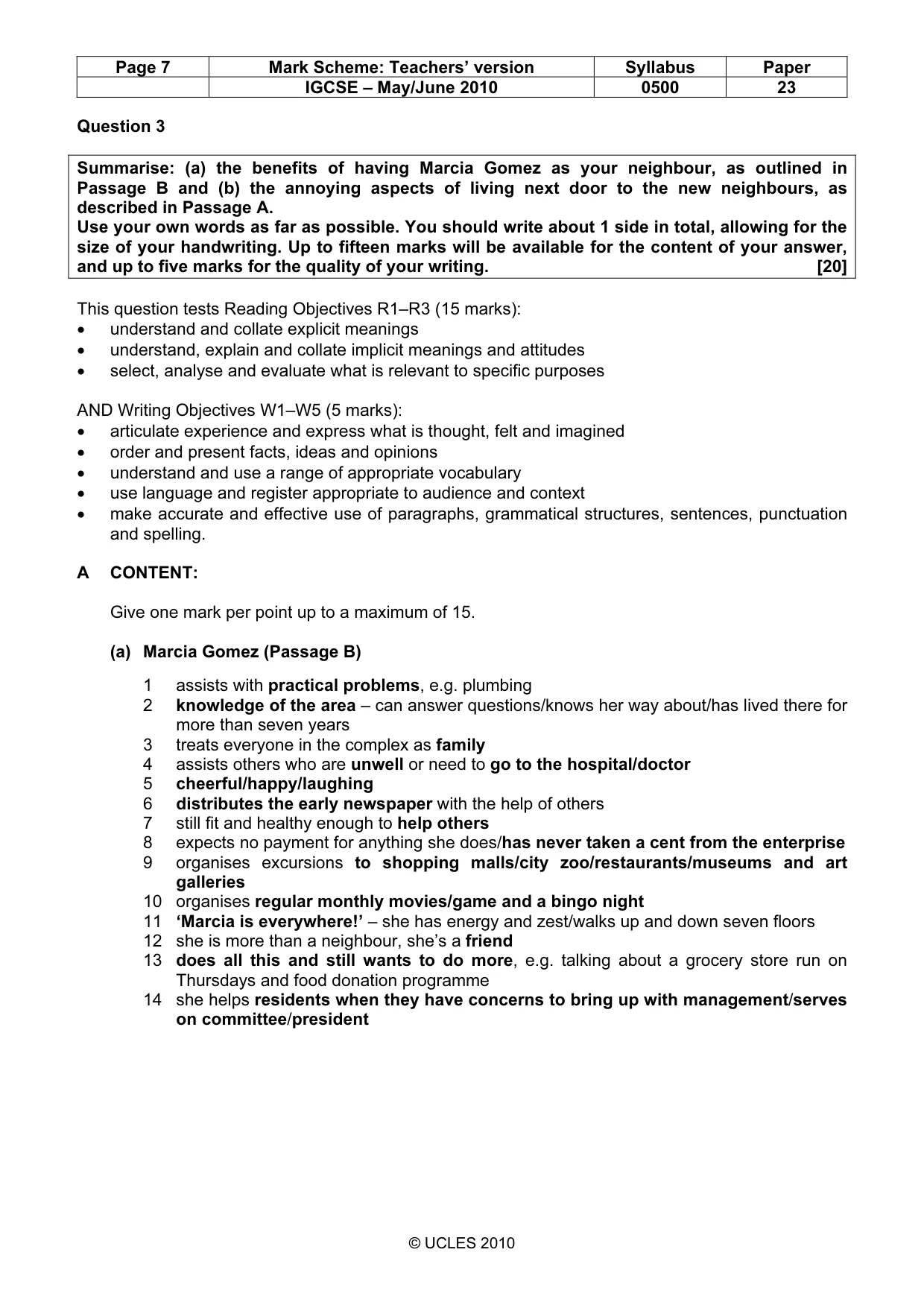
Page 7 Mark Scheme: Teachers’ version Syllabus Paper IGCSE – May/June 2010 0500 23 © UCLES 2010 Question 3 Summarise: (a) the benefits of having Marcia Gomez as your neighbour, as outlined in Passage B and (b) the annoying aspects of living next door to the new neighbours, as described in Passage A. Use your own words as far as possible. You should write about 1 side in total, allowing for the size of your handwriting. Up to fifteen marks will be available for the content of your answer, and up to five marks for the quality of your writing. [20] This question tests Reading Objectives R1–R3 (15 marks): • understand and collate explicit meanings • understand, explain and collate implicit meanings and attitudes • select, analyse and evaluate what is relevant to specific purposes AND Writing Objectives W1–W5 (5 marks): • articulate experience and express what is thought, felt and imagined • order and present facts, ideas and opinions • understand and use a range of appropriate vocabulary • use language and register appropriate to audience and context • make accurate and effective use of paragraphs, grammatical structures, sentences, punctuation and spelling. A CONTENT: Give one mark per point up to a maximum of 15. (a) Marcia Gomez (Passage B) 1 assists with practical problems, e.g. plumbing 2 knowledge of the area – can answer questions/knows her way about/has lived there for more than seven years 3 treats everyone in the complex as family 4 assists others who are unwell or need to go to the hospital/doctor 5 cheerful/happy/laughing 6 distributes the early newspaper with the help of others 7 still fit and healthy enough to help others 8 expects no payment for anything she does/has never taken a cent from the enterprise 9 organises excursions to shopping malls/city zoo/restaurants/museums and art galleries 10 organises regular monthly movies/game and a bingo night 11 ‘Marcia is everywhere!’ – she has energy and zest/walks up and down seven floors 12 she is more than a neighbour, she’s a friend 13 does all this and still wants to do more, e.g. talking about a grocery store run on Thursdays and food donation programme 14 she helps residents when they have concerns to bring up with management/serves on committee/president
Mark scheme, page 8
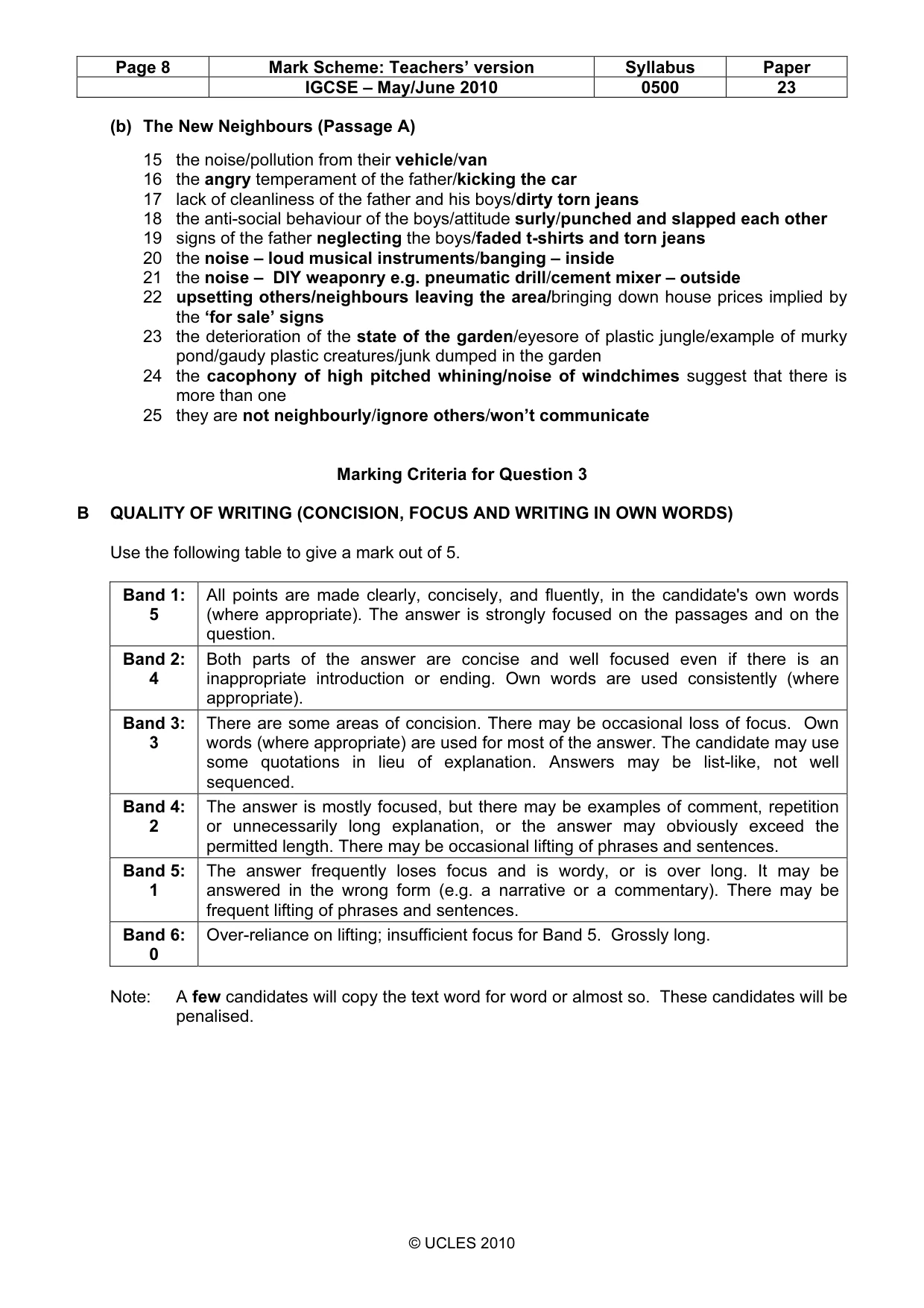
Page 8 Mark Scheme: Teachers’ version Syllabus Paper IGCSE – May/June 2010 0500 23 © UCLES 2010 (b) The New Neighbours (Passage A) 15 the noise/pollution from their vehicle/van 16 the angry temperament of the father/kicking the car 17 lack of cleanliness of the father and his boys/dirty torn jeans 18 the anti-social behaviour of the boys/attitude surly/punched and slapped each other 19 signs of the father neglecting the boys/faded t-shirts and torn jeans 20 the noise – loud musical instruments/banging – inside 21 the noise – DIY weaponry e.g. pneumatic drill/cement mixer – outside 22 upsetting others/neighbours leaving the area/bringing down house prices implied by the ‘for sale’ signs 23 the deterioration of the state of the garden/eyesore of plastic jungle/example of murky pond/gaudy plastic creatures/junk dumped in the garden 24 the cacophony of high pitched whining/noise of windchimes suggest that there is more than one 25 they are not neighbourly/ignore others/won’t communicate Marking Criteria for Question 3 B QUALITY OF WRITING (CONCISION, FOCUS AND WRITING IN OWN WORDS) Use the following table to give a mark out of 5. Band 1: 5 All points are made clearly, concisely, and fluently, in the candidate's own words (where appropriate). The answer is strongly focused on the passages and on the question. Band 2: 4 Both parts of the answer are concise and well focused even if there is an inappropriate introduction or ending. Own words are used consistently (where appropriate). Band 3: 3 There are some areas of concision. There may be occasional loss of focus. Own words (where appropriate) are used for most of the answer. The candidate may use some quotations in lieu of explanation. Answers may be list-like, not well sequenced. Band 4: 2 The answer is mostly focused, but there may be examples of comment, repetition or unnecessarily long explanation, or the answer may obviously exceed the permitted length. There may be occasional lifting of phrases and sentences. Band 5: 1 The answer frequently loses focus and is wordy, or is over long. It may be answered in the wrong form (e.g. a narrative or a commentary). There may be frequent lifting of phrases and sentences. Band 6: 0 Over-reliance on lifting; insufficient focus for Band 5. Grossly long. Note: A few candidates will copy the text word for word or almost so. These candidates will be penalised.
What you needed in this session
Cambridge’s own grade thresholds for 2010 May/June, Paper 2 · Variant 3. A higher threshold means an easier paper — the bar moves with how the cohort did.