Cambridge IGCSE English - First Language 0500 — 2010 May/June Paper 2 · Variant 2
0500/22/M/J/10 · 50 marks · ≈56 min
The question paper and its mark scheme, free to read here and free to download. This is Cambridge’s own paper, exactly as it was sat.
Question paper8 pages


Mark scheme7 pages
Answers below. Sit the paper first if you are practising.
Paper as text
Question paper, page 1
This document consists of 5 printed pages and 3 blank pages. DC (CB) 29412/3 R © UCLES 2010 [Turn over UNIVERSITY OF CAMBRIDGE INTERNATIONAL EXAMINATIONS International General Certificate of Secondary Education READ THESE INSTRUCTIONS FIRST If you have been given an Answer Booklet, follow the instructions on the front cover of the Booklet. Write your Centre number, candidate number and name on all the work you hand in. Write in dark blue or black pen. Do not use staples, paper clips, highlighters, glue or correction fluid. Answer all questions. Dictionaries are not permitted. At the end of the examination, fasten all your work securely together. The number of marks is given in brackets [ ] at the end of each question or part question. FIRST LANGUAGE ENGLISH 0500/22 Paper 2 Reading Passages (Extended) May/June 2010 2 hours Additional Materials: Answer Booklet/Paper * 1 8 1 3 8 3 1 1 4 0 * www.XtremePapers.com
Question paper, page 2
2 0500/22/M/J/10 © UCLES 2010 Part 1 Read Passage A carefully, and then answer Questions 1 and 2. Passage A A visit to a gorilla sanctuary In this passage, the writer recounts his visit, with his friend Lary, to a gorilla sanctuary in the Republic of Congo, which is run by Yvette Leroy. A young man sprawled in a wicker chair. A small chimpanzee, wearing a nappy, clung to his chest. ‘Hi,’ he said, somnolent with motherhood. ‘Yvette is expecting you. I’m Mark and this is Max. He’s a young pygmy chimp.’ Max, hearing his name, detached a long black right arm from the hugging position and, with the delicate fingers of a dark-brown hand, tousled Mark’s hair. ‘This is the first pygmy chimp I’ve ever seen,’ said Mark, easing Max’s thumb out of his ear. ‘They’re very rare. They live only in Zaire, south of the river. He was brought in by the Forest Service. Someone was trying to sell him as a pet in the market. It’s the babies we get – almost always gorillas. The hunter in the forests kills the mother and takes the baby back to his village for the children to play with. Very occasionally one is rescued and is sent to us, but it’s hopeless. They arrive with machete wounds, dehydrated with dysentery, their stomachs full of earth they’ve scraped up in the village because they’re starving, parasites of all kinds. And gorillas are sensitive, full of emotion – they’ve watched their mothers die in front of them, they’re traumatised, and if they don’t die of disease, they die of grief. They just lose the will to live, they refuse to eat. Twenty- seven gorillas have arrived in the last two years and only four are still alive.’ ‘And pygmy chimps?’ asked Lary. ‘Do they die of grief?’ ‘Not yet,’ said Mark, putting one arm round Max and stroking his back with the other. ‘I’m treating him for parasites, but otherwise he’s in good shape. He seems much more intelligent even than a common chimpanzee, an ordinary chimp of his age, much more sociable. Very little’s known about pygmy chimps.’ ‘Are you a zoologist?’ asked Lary. ‘No, but I’d like to be. I’m here to set up a new gorilla orphanage for a friend in the grounds of Brazzaville zoo. We’ll have a proper vet, everything. We’ll establish a breeding colony and then release them somewhere safe.’ Mark stood up. ‘We must find Yvette. This is the one day of the week when she has enough staff to let Magne out of his cage. He’s her three-and-a-half-year-old gorilla. He’s lively.’ He paused, extracting Max’s right foot from his shirt pocket. ‘See – pygmy chimps have a web between their second and third toes, they weigh twenty per cent less than common chimps, their hair is blacker, their faces are rounder, their ears are smaller and they don’t go bald.’ Mark opened a steel-grilled door and we entered a room full of couches and cushions; children’s toys were strewn across the floor. A Bantu girl in a red dress lay on a bed in a corner, watching a television on the shelf opposite her; a very small, very still gorilla snuggled against her stomach. ‘This is Albertine Ndokila,’ said Mark, introducing us. ‘She looks after one very sad, sick gorilla, eighteen months old’. 5 10 15 20 25 30
Question paper, page 3
3 0500/22/M/J/10 © UCLES 2010 [Turn over The inner door swung open and Madame Yvette Leroy swept into the room with two baby gorillas hanging from her. ‘Quick!’ she said. ‘Bring some chairs! The guards are about to release Magne in the garden. He’s lively! Sit quietly, stay in your chairs and – whatever you do – don’t look into his eyes. Gorillas never stare at each other. It’s a threat.’ There was the sound of a bolt being drawn back, the clang of a cage door, a short, sharp, barking scream, a rumbling noise on the concrete, and round the corner came Magne on all fours, in a hunched, scooting gallop. Big and grey, Magne slapped Yvette on the back, detached the two screaming baby gorillas, roughed them up a bit, banged his chest, tore at the grass and with a sideways glance moved towards the newcomers, us. ‘He’s jealous,’ said Yvette, still out of breath from her blow on the back. ‘He’s jealous of my new babies.’ At that moment Magne’s knuckles arrived on my thighs, followed by his big black man-like feet, as his hands moved up to grip my shoulders. ‘Good boy,’ I said, made stupid by the weight, the solidity of him, the rank musk of his bristly chest- hair. I put both hands up and pushed with all my strength against the surge of muscle; without effort he pressed closer, brought his shiny black face close up to mine and opened his mouth. I was conscious of two upper canines, as big as marlin spikes, a pink cavern and tongue, grinders, spit, a smell as sweet as cow’s breath; and then he bit my ears, carefully, first one side and then the other, growling maniacally the while, a growl which varied in pitch and tempo, as though he were engaged in a very fast, aggrieved conversation with himself. Satisfied that he had improved my manners and taught me not to stare, Magne paused and looked about his kingdom. 1 Imagine you are the writer’s friend, Lary. Write a letter to a member of your family after your visit to the gorilla sanctuary. In your letter you should: • make the chimps and gorillas sound interesting and lovable; • give your impressions of Mark and of Madame Yvette; • persuade your family to support the work of the sanctuary. Base your answer on what you have read in Passage A. You should write between 1½ and 2 sides, allowing for the size of your handwriting. Up to fifteen marks will be available for the content of your answer, and up to five marks for the quality of your writing. [Total: 20] 2 Re-read the descriptions of: (a) the sounds as Magne approaches the room and his behaviour when he enters, in lines 39 to 43; (b) the writer’s impressions of Magne in lines 48 to 54. Select words and phrases from these descriptions, and explain how the writer has created effects by using this language. [Total: 10] 35 40 45 50 55
Question paper, page 4
4 0500/22/M/J/10 © UCLES 2010 Part 2 Question 3 is based on both Passage A and Passage B. Read Passage B carefully, and re-read Passage A. Passage B Deforestation and the Orang-utan Borneo is the world’s third largest island and home to one of the oldest, most precious tropical rainforests. The World Wildlife Fund is taking action now to protect a large area, the Heart of Borneo, from being destroyed. We need your help to make this happen. Over the past ten years, more than 360 new species of plants and animals have been identified – and we know there are many more still waiting to be discovered. Unless we step in, these species could be lost forever. Deforestation is sweeping across this incredible island and threatening its jewel, the Heart of Borneo. Commercial logging – much of it illegal – and clearance for agriculture and palm oil plantations cause most of the damage. Fires, deliberately started to prepare land for the plantations, are also a serious and recurrent hazard. Why is it so important to protect the Heart of Borneo? Thousands of the species are unique to the island, making their extinction a real possibility. The forests are also home to a rich diversity of plant species that could provide future treatments and cures for diseases. Lastly, the region is home to 500,000 people, plus a dwindling population of the ‘man of the forest’, otherwise known as the orang- utan. The only great apes found outside Africa, orang-utans once roamed freely around the islands of Borneo and Sumatra. They spend most of their time in the treetops, feeding and sleeping. If the trees are removed, the orang-utans lose both their home and their food source. Female orang-utans usually give birth to one baby, before taking care of it for up to six years. Orang- utans have the slowest reproductive cycle of all great apes, an average of eight years between births. Sadly their slow reproduction cannot keep the population from declining because of the impact of deforestation and poaching. Palm oil production is very profitable. It is a main ingredient in all kinds of everyday products such as ice cream. The climate and landscape of Borneo make the island a magnet for plantation developers, but to get to the soil they have to clear the trees. Being exotic hardwoods, the trees themselves are also valuable. In 2001, the World Bank predicted that all unprotected Sumatran rainforest would disappear by 2005; this happened. In 2005, the World Wildlife Fund predicted an uncertain future for the remaining rainforest in Borneo. Without protection, by 2020 the rainforest could become too fragmented to ensure the long term survival of the orang-utans. Scientists believe that up to half of the orang-utan population has been lost over the past ten years. If their annual death rate increases by just two per cent, orang-utans face extinction in the next thirty years. Despite legal protection, there’s a thriving underground market for orang-utans as pets. Up to three a day are taken for this reason alone. Orang-utans are also killed for their meat.
Question paper, page 5
5 0500/22/M/J/10 © UCLES 2010 By building roads into the rainforest, the illegal loggers make it easier for poachers to hunt and kill one thousand orang-utans each year. In nearly every case the poacher has to kill the mother to capture the baby. This means that for every baby kept as a pet, at least one adult is lost. Clearly the first problem to tackle is deforestation. If we halt the logging and tree clearing, it will not only protect the habitat but help save the orang-utan. 3 Summarise: (a) the dangers that exist for orang-utans, according to Passage B; (b) the care and understanding demonstrated by Yvette Leroy and her staff for the pygmy chimp and the gorillas in Passage A. Use your own words as far as possible. You should write about 1 side in total, allowing for the size of your handwriting. Up to fifteen marks will be available for the content of your answer, and up to five marks for the quality of your writing. [Total: 20]
Question paper, page 6
6 0500/22/M/J/10 © UCLES 2010 BLANK PAGE
Question paper, page 7
7 © UCLES 2010 0500/22/M/J/10 BLANK PAGE
Question paper, page 8
8 0500/22/M/J/10 © UCLES 2010 BLANK PAGE Copyright Acknowledgements: Questions 1, 2, 3 © Redmond O’Hanlon; Congo Journey; Penguin; 1997; 0140121390. Question 3 © The Heart of Borneo Programme; Leaflet P/OTL/1107; World Wildlife Fund. Permission to reproduce items where third-party owned material protected by copyright is included has been sought and cleared where possible. Every reasonable effort has been made by the publisher (UCLES) to trace copyright holders, but if any items requiring clearance have unwittingly been included, the publisher will be pleased to make amends at the earliest possible opportunity. University of Cambridge International Examinations is part of the Cambridge Assessment Group. Cambridge Assessment is the brand name of University of Cambridge Local Examinations Syndicate (UCLES), which is itself a department of the University of Cambridge.
Mark scheme, page 1
UNIVERSITY OF CAMBRIDGE INTERNATIONAL EXAMINATIONS International General Certificate of Secondary Education MARK SCHEME for the May/June 2010 question paper for the guidance of teachers 0500 FIRST LANGUAGE ENGLISH 0500/22 Paper 22 (Reading Passages – Extended), maximum raw mark 50 This mark scheme is published as an aid to teachers and candidates, to indicate the requirements of the examination. It shows the basis on which Examiners were instructed to award marks. It does not indicate the details of the discussions that took place at an Examiners’ meeting before marking began, which would have considered the acceptability of alternative answers. Mark schemes must be read in conjunction with the question papers and the report on the examination. • CIE will not enter into discussions or correspondence in connection with these mark schemes. CIE is publishing the mark schemes for the May/June 2010 question papers for most IGCSE, GCE Advanced Level and Advanced Subsidiary Level syllabuses and some Ordinary Level syllabuses. www.XtremePapers.com
Mark scheme, page 2
Page 2 Mark Scheme: Teachers’ version Syllabus Paper IGCSE – May/June 2010 0500 22 © UCLES 2010 Note: All Examiners are instructed that alternative correct answers and unexpected approaches in candidates’ scripts must be given marks that fairly reflect the relevant knowledge and skills demonstrated. Question 1 Imagine you are the writer’s friend, Lary. Write a letter to a member of your family after your visit to the gorilla sanctuary. In your letter you should: make the chimps and gorillas sound interesting and lovable; give your impressions of Mark and of Madame Yvette; and persuade your family to support the work of the sanctuary. Base your answer on what you have read in Passage A. Write between 1½ and 2 sides, allowing for the size of your handwriting. Up to fifteen marks will be available for the content of your answer, and up to five marks for the quality of your writing. [20] This question tests Reading Objectives R1–R3 (15 marks): • understand and collate explicit meanings • understand, explain and collate implicit meanings and attitudes • select, analyse and evaluate what is relevant to specific purposes AND Writing Objectives W1–W5 (5 marks): • articulate experience and express what is thought, felt and imagined • order and present facts, ideas and opinions • understand and use a range of appropriate vocabulary • use language and register appropriate to audience and context • make accurate and effective use of paragraphs, grammatical structures, sentences, punctuation and spelling. General notes on possible content: Note: there are three parts to a complete answer and good candidates will answer all three well. A: Interesting and lovable The pygmy chimp is like a baby, wears a nappy, has attractive features, is more intelligent and sociable than other types of chimp. Note the additional paragraph that gives information about pygmy chimps – e.g. that they are not bald. Magne has a strong character, is more loud than really harmful and shares human characteristics such as need for affection, jealousy and pride – and he is ‘lively’, (good candidates may give a gloss on this). B: Impressions of Mark and Yvette Candidates will comment on Mark’s quiet courteousness and contrast it with Yvette’s energy and sense of the dramatic (‘swept’ into the room, and the way she talks). Credit any legitimate ideas. C: Work of the sanctuary Good candidates will persuade by making the work sound worthwhile, i.e. saving the animals, identify hunters’ cruelty. Support would be commitment. Giving money might sponsor an animal and go some way to providing personnel for one-to-one care and providing veterinary assistance. Candidates may mention promoting schemes to return the animals to the wild, or even the cost of nappies! The final mark is based on the quality of the answer.
Mark scheme, page 3
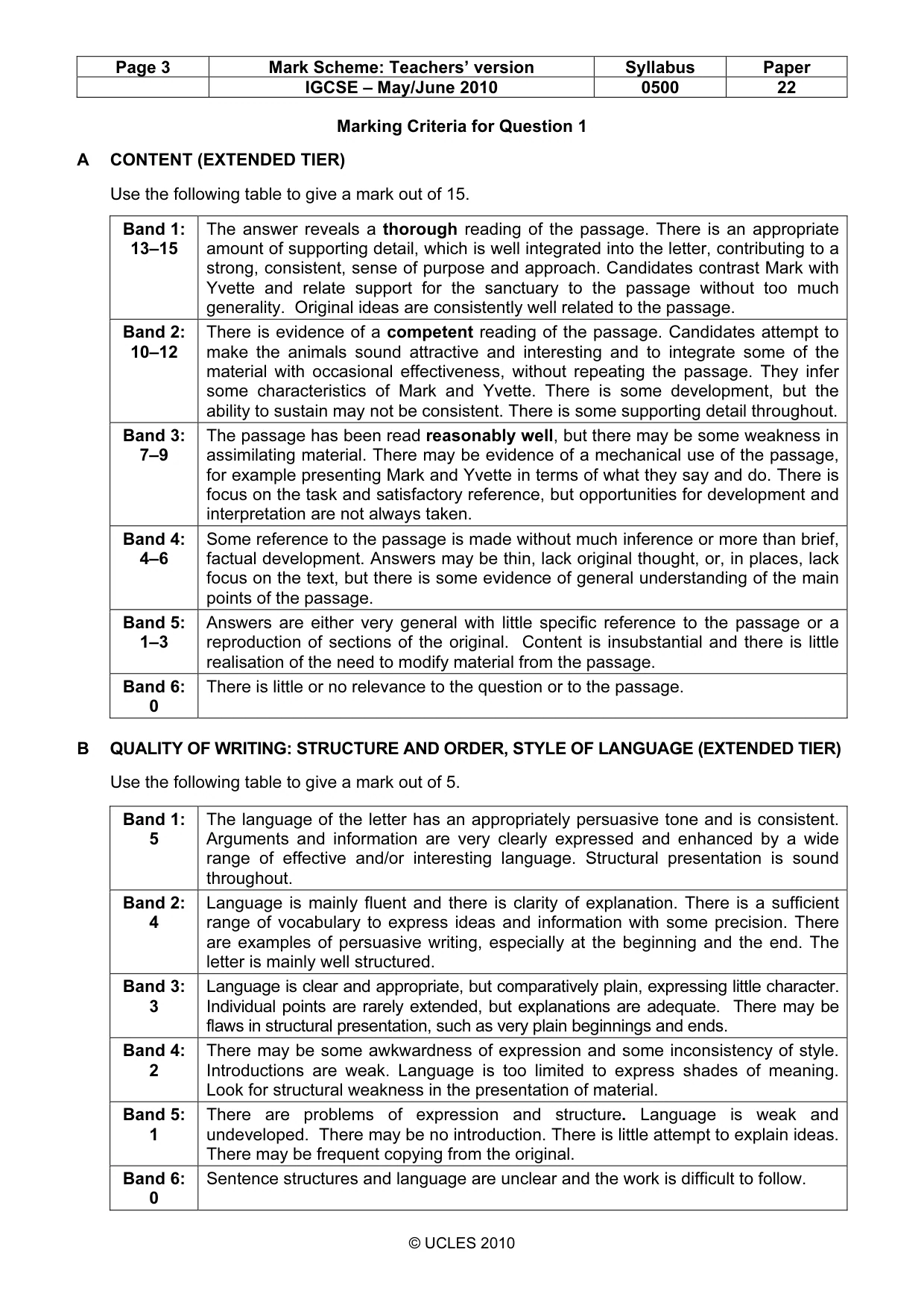
Page 3 Mark Scheme: Teachers’ version Syllabus Paper IGCSE – May/June 2010 0500 22 © UCLES 2010 Marking Criteria for Question 1 A CONTENT (EXTENDED TIER) Use the following table to give a mark out of 15. Band 1: 13–15 The answer reveals a thorough reading of the passage. There is an appropriate amount of supporting detail, which is well integrated into the letter, contributing to a strong, consistent, sense of purpose and approach. Candidates contrast Mark with Yvette and relate support for the sanctuary to the passage without too much generality. Original ideas are consistently well related to the passage. Band 2: 10–12 There is evidence of a competent reading of the passage. Candidates attempt to make the animals sound attractive and interesting and to integrate some of the material with occasional effectiveness, without repeating the passage. They infer some characteristics of Mark and Yvette. There is some development, but the ability to sustain may not be consistent. There is some supporting detail throughout. Band 3: 7–9 The passage has been read reasonably well, but there may be some weakness in assimilating material. There may be evidence of a mechanical use of the passage, for example presenting Mark and Yvette in terms of what they say and do. There is focus on the task and satisfactory reference, but opportunities for development and interpretation are not always taken. Band 4: 4–6 Some reference to the passage is made without much inference or more than brief, factual development. Answers may be thin, lack original thought, or, in places, lack focus on the text, but there is some evidence of general understanding of the main points of the passage. Band 5: 1–3 Answers are either very general with little specific reference to the passage or a reproduction of sections of the original. Content is insubstantial and there is little realisation of the need to modify material from the passage. Band 6: 0 There is little or no relevance to the question or to the passage. B QUALITY OF WRITING: STRUCTURE AND ORDER, STYLE OF LANGUAGE (EXTENDED TIER) Use the following table to give a mark out of 5. Band 1: 5 The language of the letter has an appropriately persuasive tone and is consistent. Arguments and information are very clearly expressed and enhanced by a wide range of effective and/or interesting language. Structural presentation is sound throughout. Band 2: 4 Language is mainly fluent and there is clarity of explanation. There is a sufficient range of vocabulary to express ideas and information with some precision. There are examples of persuasive writing, especially at the beginning and the end. The letter is mainly well structured. Band 3: 3 Language is clear and appropriate, but comparatively plain, expressing little character. Individual points are rarely extended, but explanations are adequate. There may be flaws in structural presentation, such as very plain beginnings and ends. Band 4: 2 There may be some awkwardness of expression and some inconsistency of style. Introductions are weak. Language is too limited to express shades of meaning. Look for structural weakness in the presentation of material. Band 5: 1 There are problems of expression and structure. Language is weak and undeveloped. There may be no introduction. There is little attempt to explain ideas. There may be frequent copying from the original. Band 6: 0 Sentence structures and language are unclear and the work is difficult to follow.
Mark scheme, page 4
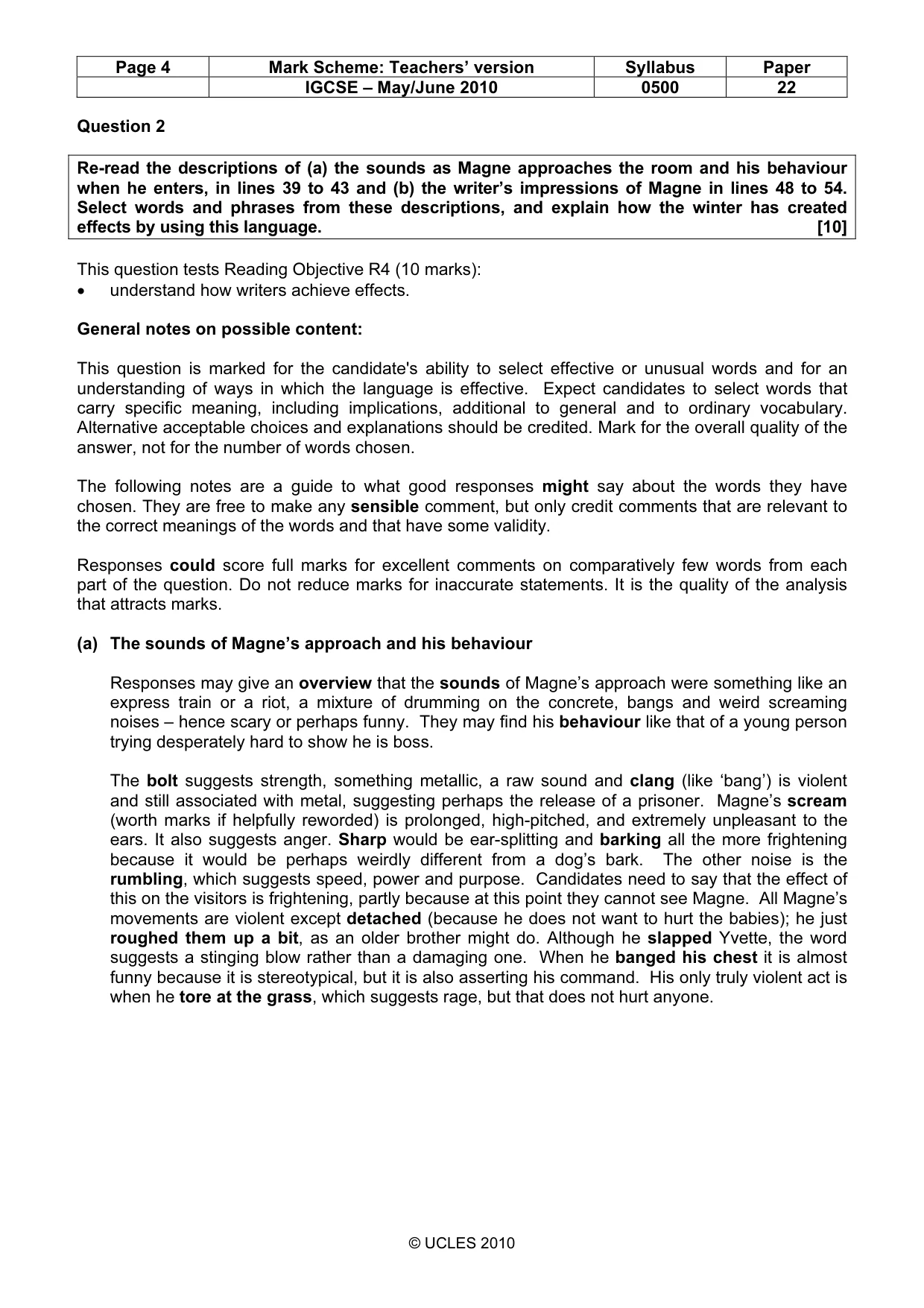
Page 4 Mark Scheme: Teachers’ version Syllabus Paper IGCSE – May/June 2010 0500 22 © UCLES 2010 Question 2 Re-read the descriptions of (a) the sounds as Magne approaches the room and his behaviour when he enters, in lines 39 to 43 and (b) the writer’s impressions of Magne in lines 48 to 54. Select words and phrases from these descriptions, and explain how the winter has created effects by using this language. [10] This question tests Reading Objective R4 (10 marks): • understand how writers achieve effects. General notes on possible content: This question is marked for the candidate's ability to select effective or unusual words and for an understanding of ways in which the language is effective. Expect candidates to select words that carry specific meaning, including implications, additional to general and to ordinary vocabulary. Alternative acceptable choices and explanations should be credited. Mark for the overall quality of the answer, not for the number of words chosen. The following notes are a guide to what good responses might say about the words they have chosen. They are free to make any sensible comment, but only credit comments that are relevant to the correct meanings of the words and that have some validity. Responses could score full marks for excellent comments on comparatively few words from each part of the question. Do not reduce marks for inaccurate statements. It is the quality of the analysis that attracts marks. (a) The sounds of Magne’s approach and his behaviour Responses may give an overview that the sounds of Magne’s approach were something like an express train or a riot, a mixture of drumming on the concrete, bangs and weird screaming noises – hence scary or perhaps funny. They may find his behaviour like that of a young person trying desperately hard to show he is boss. The bolt suggests strength, something metallic, a raw sound and clang (like ‘bang’) is violent and still associated with metal, suggesting perhaps the release of a prisoner. Magne’s scream (worth marks if helpfully reworded) is prolonged, high-pitched, and extremely unpleasant to the ears. It also suggests anger. Sharp would be ear-splitting and barking all the more frightening because it would be perhaps weirdly different from a dog’s bark. The other noise is the rumbling, which suggests speed, power and purpose. Candidates need to say that the effect of this on the visitors is frightening, partly because at this point they cannot see Magne. All Magne’s movements are violent except detached (because he does not want to hurt the babies); he just roughed them up a bit, as an older brother might do. Although he slapped Yvette, the word suggests a stinging blow rather than a damaging one. When he banged his chest it is almost funny because it is stereotypical, but it is also asserting his command. His only truly violent act is when he tore at the grass, which suggests rage, but that does not hurt anyone.
Mark scheme, page 5
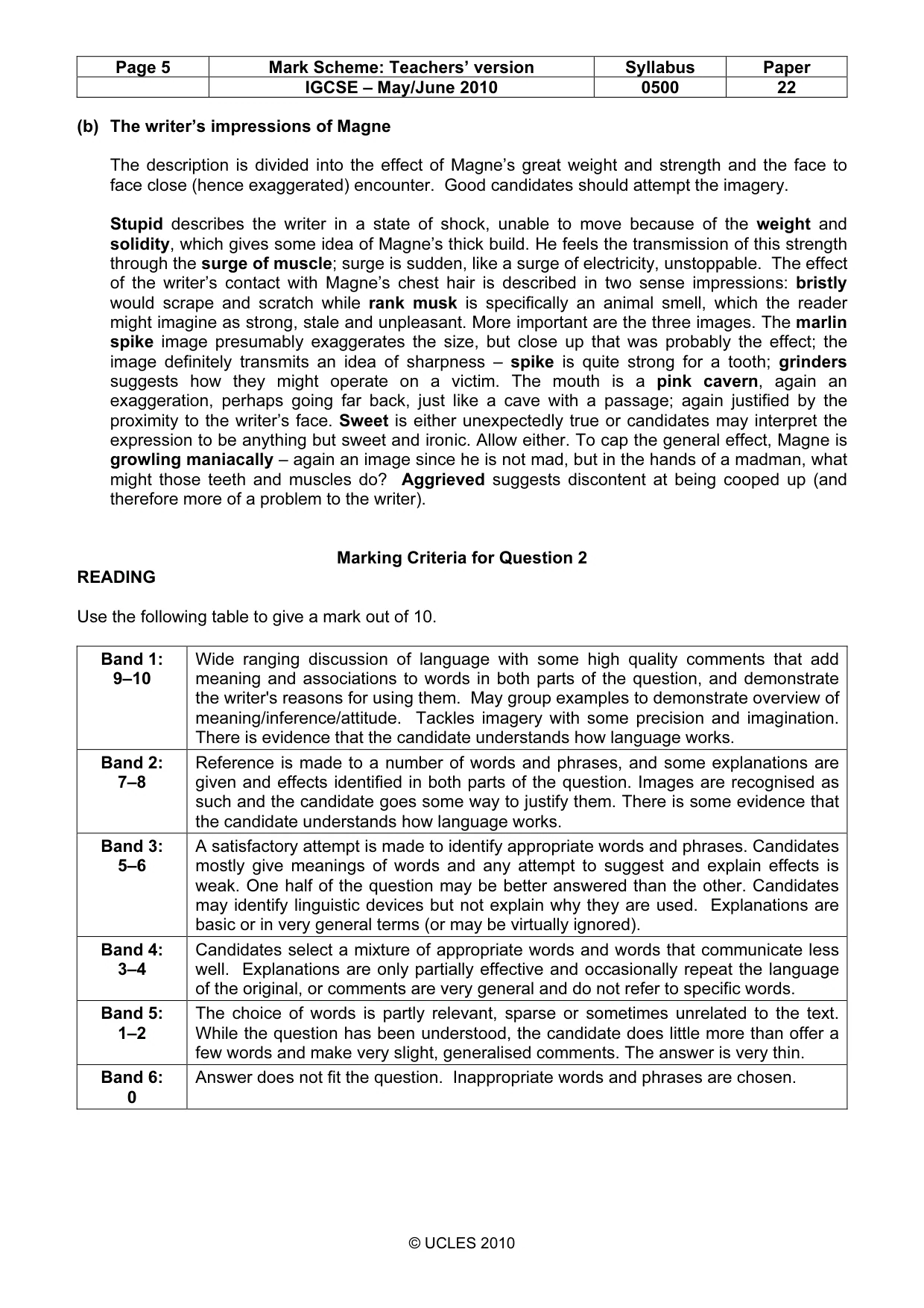
Page 5 Mark Scheme: Teachers’ version Syllabus Paper IGCSE – May/June 2010 0500 22 © UCLES 2010 (b) The writer’s impressions of Magne The description is divided into the effect of Magne’s great weight and strength and the face to face close (hence exaggerated) encounter. Good candidates should attempt the imagery. Stupid describes the writer in a state of shock, unable to move because of the weight and solidity, which gives some idea of Magne’s thick build. He feels the transmission of this strength through the surge of muscle; surge is sudden, like a surge of electricity, unstoppable. The effect of the writer’s contact with Magne’s chest hair is described in two sense impressions: bristly would scrape and scratch while rank musk is specifically an animal smell, which the reader might imagine as strong, stale and unpleasant. More important are the three images. The marlin spike image presumably exaggerates the size, but close up that was probably the effect; the image definitely transmits an idea of sharpness – spike is quite strong for a tooth; grinders suggests how they might operate on a victim. The mouth is a pink cavern, again an exaggeration, perhaps going far back, just like a cave with a passage; again justified by the proximity to the writer’s face. Sweet is either unexpectedly true or candidates may interpret the expression to be anything but sweet and ironic. Allow either. To cap the general effect, Magne is growling maniacally – again an image since he is not mad, but in the hands of a madman, what might those teeth and muscles do? Aggrieved suggests discontent at being cooped up (and therefore more of a problem to the writer). Marking Criteria for Question 2 READING Use the following table to give a mark out of 10. Band 1: 9–10 Wide ranging discussion of language with some high quality comments that add meaning and associations to words in both parts of the question, and demonstrate the writer's reasons for using them. May group examples to demonstrate overview of meaning/inference/attitude. Tackles imagery with some precision and imagination. There is evidence that the candidate understands how language works. Band 2: 7–8 Reference is made to a number of words and phrases, and some explanations are given and effects identified in both parts of the question. Images are recognised as such and the candidate goes some way to justify them. There is some evidence that the candidate understands how language works. Band 3: 5–6 A satisfactory attempt is made to identify appropriate words and phrases. Candidates mostly give meanings of words and any attempt to suggest and explain effects is weak. One half of the question may be better answered than the other. Candidates may identify linguistic devices but not explain why they are used. Explanations are basic or in very general terms (or may be virtually ignored). Band 4: 3–4 Candidates select a mixture of appropriate words and words that communicate less well. Explanations are only partially effective and occasionally repeat the language of the original, or comments are very general and do not refer to specific words. Band 5: 1–2 The choice of words is partly relevant, sparse or sometimes unrelated to the text. While the question has been understood, the candidate does little more than offer a few words and make very slight, generalised comments. The answer is very thin. Band 6: 0 Answer does not fit the question. Inappropriate words and phrases are chosen.
Mark scheme, page 6
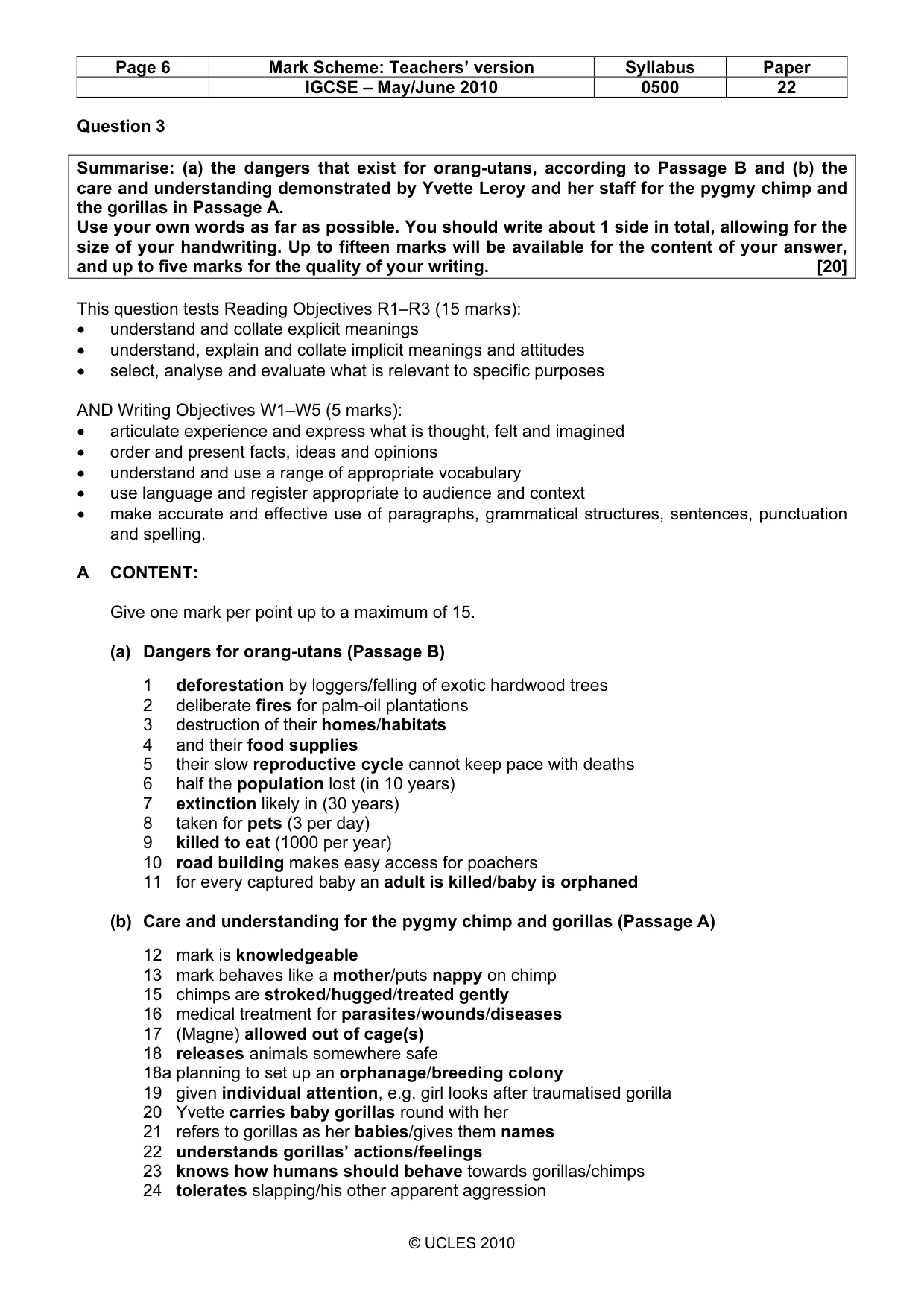
Page 6 Mark Scheme: Teachers’ version Syllabus Paper IGCSE – May/June 2010 0500 22 © UCLES 2010 Question 3 Summarise: (a) the dangers that exist for orang-utans, according to Passage B and (b) the care and understanding demonstrated by Yvette Leroy and her staff for the pygmy chimp and the gorillas in Passage A. Use your own words as far as possible. You should write about 1 side in total, allowing for the size of your handwriting. Up to fifteen marks will be available for the content of your answer, and up to five marks for the quality of your writing. [20] This question tests Reading Objectives R1–R3 (15 marks): • understand and collate explicit meanings • understand, explain and collate implicit meanings and attitudes • select, analyse and evaluate what is relevant to specific purposes AND Writing Objectives W1–W5 (5 marks): • articulate experience and express what is thought, felt and imagined • order and present facts, ideas and opinions • understand and use a range of appropriate vocabulary • use language and register appropriate to audience and context • make accurate and effective use of paragraphs, grammatical structures, sentences, punctuation and spelling. A CONTENT: Give one mark per point up to a maximum of 15. (a) Dangers for orang-utans (Passage B) 1 deforestation by loggers/felling of exotic hardwood trees 2 deliberate fires for palm-oil plantations 3 destruction of their homes/habitats 4 and their food supplies 5 their slow reproductive cycle cannot keep pace with deaths 6 half the population lost (in 10 years) 7 extinction likely in (30 years) 8 taken for pets (3 per day) 9 killed to eat (1000 per year) 10 road building makes easy access for poachers 11 for every captured baby an adult is killed/baby is orphaned (b) Care and understanding for the pygmy chimp and gorillas (Passage A) 12 mark is knowledgeable 13 mark behaves like a mother/puts nappy on chimp 15 chimps are stroked/hugged/treated gently 16 medical treatment for parasites/wounds/diseases 17 (Magne) allowed out of cage(s) 18 releases animals somewhere safe 18a planning to set up an orphanage/breeding colony 19 given individual attention, e.g. girl looks after traumatised gorilla 20 Yvette carries baby gorillas round with her 21 refers to gorillas as her babies/gives them names 22 understands gorillas’ actions/feelings 23 knows how humans should behave towards gorillas/chimps 24 tolerates slapping/his other apparent aggression
Mark scheme, page 7
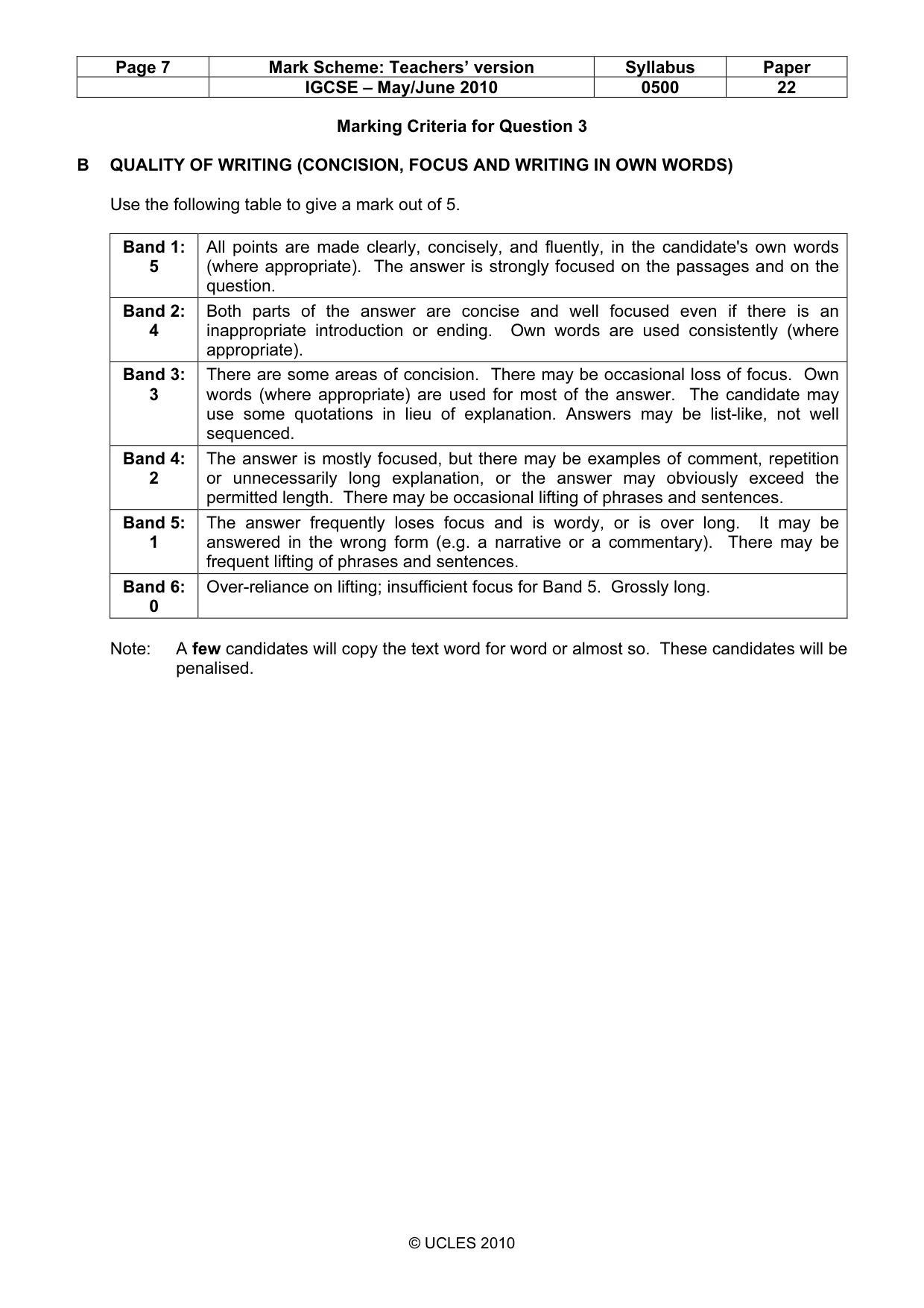
Page 7 Mark Scheme: Teachers’ version Syllabus Paper IGCSE – May/June 2010 0500 22 © UCLES 2010 Marking Criteria for Question 3 B QUALITY OF WRITING (CONCISION, FOCUS AND WRITING IN OWN WORDS) Use the following table to give a mark out of 5. Band 1: 5 All points are made clearly, concisely, and fluently, in the candidate's own words (where appropriate). The answer is strongly focused on the passages and on the question. Band 2: 4 Both parts of the answer are concise and well focused even if there is an inappropriate introduction or ending. Own words are used consistently (where appropriate). Band 3: 3 There are some areas of concision. There may be occasional loss of focus. Own words (where appropriate) are used for most of the answer. The candidate may use some quotations in lieu of explanation. Answers may be list-like, not well sequenced. Band 4: 2 The answer is mostly focused, but there may be examples of comment, repetition or unnecessarily long explanation, or the answer may obviously exceed the permitted length. There may be occasional lifting of phrases and sentences. Band 5: 1 The answer frequently loses focus and is wordy, or is over long. It may be answered in the wrong form (e.g. a narrative or a commentary). There may be frequent lifting of phrases and sentences. Band 6: 0 Over-reliance on lifting; insufficient focus for Band 5. Grossly long. Note: A few candidates will copy the text word for word or almost so. These candidates will be penalised.
What you needed in this session
Cambridge’s own grade thresholds for 2010 May/June, Paper 2 · Variant 2. A higher threshold means an easier paper — the bar moves with how the cohort did.