Cambridge IGCSE English - First Language 0500 — 2010 May/June Paper 2 · Variant 1
0500/21/M/J/10 · 50 marks · ≈56 min
The question paper and its mark scheme, free to read here and free to download. This is Cambridge’s own paper, exactly as it was sat.
Question paper8 pages



Mark scheme7 pages
Answers below. Sit the paper first if you are practising.
Paper as text
Question paper, page 1
This document consists of 5 printed pages and 3 blank pages. DC (CB) 12973/3 © UCLES 2010 [Turn over UNIVERSITY OF CAMBRIDGE INTERNATIONAL EXAMINATIONS International General Certificate of Secondary Education READ THESE INSTRUCTIONS FIRST If you have been given an Answer Booklet, follow the instructions on the front cover of the Booklet. Write your Centre number, candidate number and name on all the work you hand in. Write in dark blue or black pen. Do not use staples, paper clips, highlighters, glue or correction fluid. Answer all questions. Dictionaries are not permitted. At the end of the examination, fasten all your work securely together. The number of marks is given in brackets [ ] at the end of each question or part question. FIRST LANGUAGE ENGLISH 0500/21 Paper 2 Reading Passages (Extended) May/June 2010 2 hours Additional Materials: Answer Booklet/Paper * 2 4 1 7 8 8 2 2 4 0 * www.XtremePapers.com
Question paper, page 2
2 0500/21/M/J/10 © UCLES 2010 Part 1 Read Passage A carefully, and then answer Questions 1 and 2. Passage A A Great Conductor This passage describes a series of three sequences in a television programme about a great orchestral conductor. These sequences trace the course of some very unusual events. In the first sequence, the elderly Signor Alessandro sits at a table in a restaurant. Tonight he will conduct Beethoven’s powerful Fifth Symphony yet again. Tomorrow he will conduct the much gentler Sixth Symphony. At least he thinks they are in that order. His memory frequently fails him these days. Already in his mind he hears the magnificent opening chords of the Fifth Symphony and sees his own powerful gestures as he drives his orchestra forward. He smiles. Great conductors instinctively know which gestures best communicate with the players. His chicken curry arrives. Always a chicken curry before a concert. His excuse is that it helps the adrenalin to flow. This curry has been cooked to perfection. The aroma tickles his nostrils and the chicken – ah, so succulent – tempts his taste buds. The chillies excite all the senses as he takes the first heavenly mouthful. It is indeed fit for the gods – it is Heaven. Da-da-da DAH ring out the first notes of the Fifth Symphony. Like all great conductors, Signor Alessandro knows all his music by heart and he never even glances at the music on the stand when he conducts a concert. Thus his eyes are free to control his players and to show them exactly what he wants. In the second sequence we see him in a taxi. He always travels to a concert in a taxi, even though he owns a limousine and employs a chauffeur. It is so much a habit that one suspects he feels that everything would go wrong if he arrived by any other form of transport. He claims it reminds him of his humble origins in the olive growing regions of Southern Italy, but Signor Alessandro has reached the age where, unfortunately, humility has given way to arrogance. Now he is thinking of how he teaches his students to become great conductors like him – no, they must never move their feet, only their arms and the upper parts of their bodies. He smiles as he commands them never to talk too much during a rehearsal. At this point he realises he is caught in a traffic jam. Looking ahead he sees nothing but a sea of metal roofs. The noise is terrible, a symphony of motor horns – no, the very opposite, a ghastly discord, like the most experimental of contemporary music. Drivers lean out of their windows staring vacantly into the motionless… Signor Alessandro feels the need to close his eyes, to drift into his own thoughts. Soon the sounds become soporific. After all there is still time, and great conductors never panic. They are essentially in control and, here he smiles again, they never, never commit the ultimate rudeness of tapping their sticks to start a rehearsal. We see the third sequence through the eyes of two members of the audience who have brought their twelve-year-old daughter to hear Beethoven’s Sixth Symphony for the first time. The concert should have begun fifteen minutes ago, so the audience is irritated and the little girl is restless. The players look quizzically at the chief violinist, the leader of the orchestra, who shakes his head. After all, great conductors are always on time. Suddenly there is a banging and a thumping, a door is flung open and Signor Alessandro strides on to the stage. His hair flows behind him and his bow tie, only half tied, hangs down (how are they to know his strangest habit of all, fixing his tie one minute before he begins a concert?). As he mounts the podium, he nearly stumbles and the leader moves forward to prevent the possibility of an accident. There is muted applause. Signor Alessandro immediately raises his arms and brings them crashing down in a grand gesture appropriate to the beginning of Beethoven’s Fifth Symphony.
Question paper, page 3
3 0500/21/M/J/10 © UCLES 2010 [Turn over There is total silence from the players. The orchestra and the audience look dumbfounded and the leader places his violin to one side, moves to the podium and points authoritatively to the music on the stand. Although great conductors always rely on and respect their orchestral leaders, this leader shows little in return for Signor Alessandro. The little girl looks accusingly at her father. ‘I thought you said that Beethoven’s Sixth Symphony was all about the countryside and had a very quiet beginning. Is that why I can’t hear anything?’ she asks cheekily. 1 Immediately after the sequences that you have just read about, Signor Alessandro gives a TV interview. The interviewer asks three questions: • Some people say you are an eccentric man whose behaviour is odd at times. Are they right? • Can you explain the unexpected happenings that took place at the beginning of your Beethoven concert? • Do you think that the time has come for you to retire from conducting? Write the words of the interview. Base your answer on what you have read in Passage A. Begin the conversation as follows: Interviewer: Some people say you are an eccentric man… You should write between 1½ and 2 sides, allowing for the size of your handwriting. Up to fifteen marks will be available for the content of your answer, and up to five marks for the quality of your writing. [Total: 20] 2 Re-read the descriptions of: (a) Signor Alessandro’s enjoyment of the curry in paragraph 1; (b) the traffic jam in paragraph 3. Select words and phrases from these descriptions, and explain how the writer has created effects by using this language. [Total: 10] [Turn over for Part 2]
Question paper, page 4
4 0500/21/M/J/10 © UCLES 2010 Part 2 Question 3 is based on both Passage A and Passage B. Read Passage B carefully, and re-read Passage A. Passage B Awfully Good This article is about some adults who are passionate about playing musical instruments together, and so have formed an orchestra. Unfortunately, none of them can play well. There is a band of hopeless players that has become so popular that the leader has had to stop recruiting new members of what amounts to little more than a group of musical illiterates. It is called The Really Terrible Orchestra. All this awfulness began twelve years ago as a parents’ revenge. So fed up with their constant ferrying of talented children to and from music lessons, choirs, rehearsals and concerts, a group of parents decided to start up some of their own music making. The fact that they hadn’t touched an instrument in decades, and could only read the music if it did not include any very high or low notes, did not deter them. So they enlisted the help of their children’s choirmaster, Richard Neville-Towle, who was not convinced there was much merit in their plan: ‘I really did not want to do it. The idea is to make music beautifully, and that wasn’t going to be possible with them.’ However, the first gathering turned out to be so much fun that they made it a regular meeting. The Really Terrible Orchestra was born. Soon doctors, lawyers, bankers and teachers were dusting off instruments from the attic to join. ‘There was a sheer delight in playing music with other people, which by rights we should not be entitled to do, not having the musicianship to justify it,’ says Alexander, who owns over thirty wind instruments but can barely play any of them. Since auditions were not appropriate, there was never going to be any balance in the orchestra – whatever instrument you played was welcome. ‘If I decided that I was giving up the piano and going to come in one day with an accordion, I could still sit somewhere and have a go,’ says Margaret, an orchestra member. The RTO now has sixty ‘squawkers’, and ten ‘terribles’ have to be turned away each month because there is no room for them in the orchestra. In the tradition of all esteemed conductors, the players have bestowed an honorary knighthood on their conductor. Sir Richard, as he is affectionately known, is the key to their ‘success’. His witty comments keep everyone entertained and he treads the fine line between nurturing the little skill they have and letting them enjoy the experience. ‘My job is to make it fun for the players,’ he says, adding wryly, ‘if you put pressure on them they get flustered and play even worse, so getting them to practise something again is counter-productive.’ You only have to witness them in rehearsal to hear what a job he has on his hands. The speed of the music is decided by what they can play, not by the music itself: as Neville-Towle admits, ‘The music is merely a guide; it is by no means something we adhere to.’ ‘We’ve had other guest conductors, but the serious ones don’t work out so well because they get frustrated. We are very frustrating,’ says Susie, the percussionist. ‘Alexander, for example, refuses to play anything with C-sharp in it, and it’s not uncommon for members of the orchestra to be playing the wrong piece without noticing.’ Ever resourceful, however, the orchestra has developed a system where members can ask others in their sections to play tricky parts that they cannot manage themselves.
Question paper, page 5
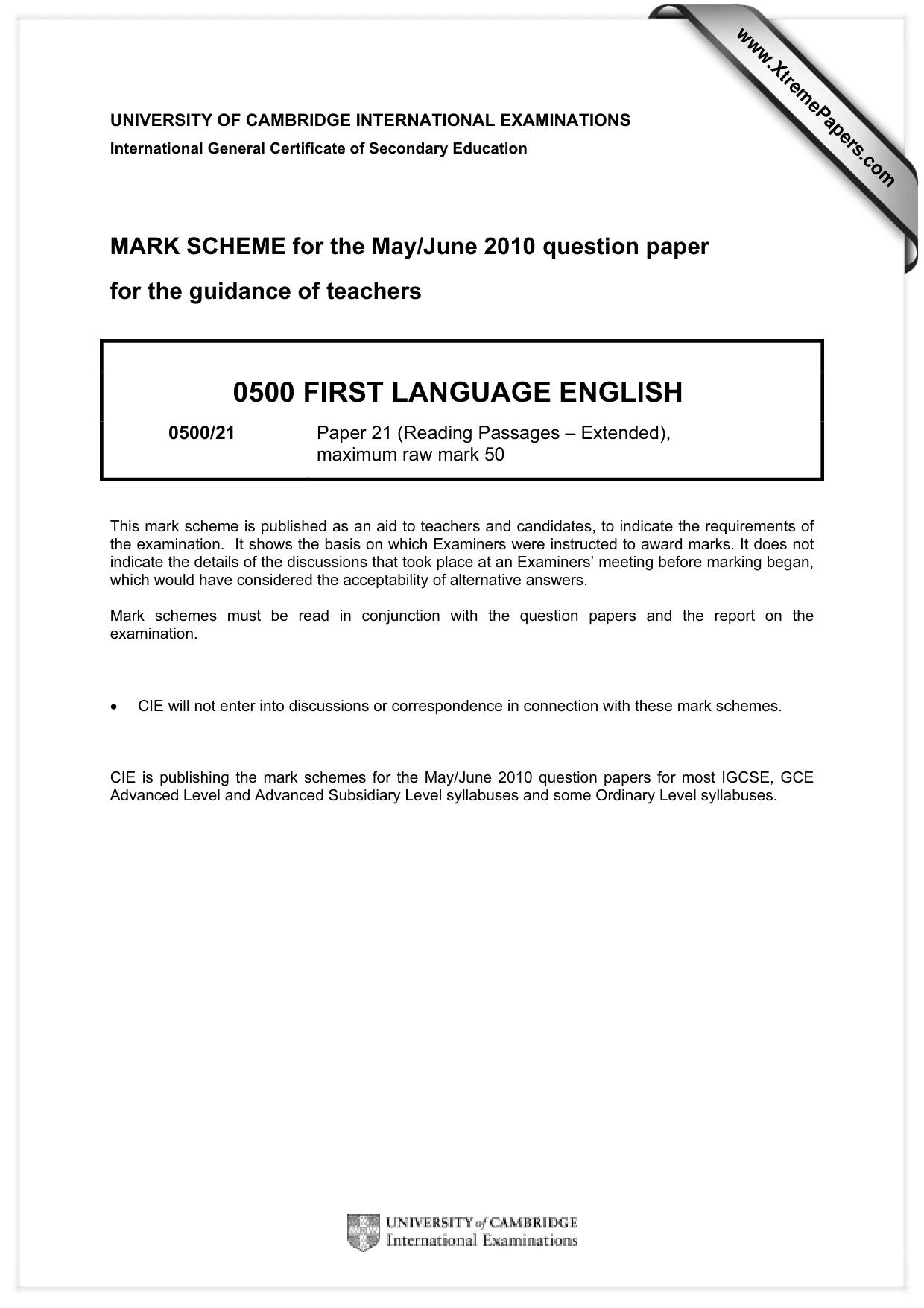
5 0500/21/M/J/10 © UCLES 2010 Finding the right music for the group has often been difficult, but it’s not for lack of offers: eight different composers have been persuaded to write for them, with varying degrees of success. ‘Competence is not a word in our vocabulary. If the music is too hard for us, we just sulk!’ 3 Summarise: (a) the evidence that the orchestra described in Passage B is ‘really terrible’; (b) what Signor Alessandro thinks are the qualities of a great conductor, as described in Passage A. Use your own words as far as possible. You should write about 1 side in total, allowing for the size of your handwriting. Up to fifteen marks will be available for the content of your answer, and up to five marks for the quality of your writing. [Total: 20]
Question paper, page 6
6 0500/21/M/J/10 © UCLES 2010 BLANK PAGE
Question paper, page 7
7 0500/21/M/J/10 © UCLES 2010 BLANK PAGE
Question paper, page 8
8 0500/21/M/J/10 © UCLES 2010 BLANK PAGE Copyright Acknowledgements Question 3 Passage B © Nina Large; Awfully Good; BBC Music Magazine. Permission to reproduce items where third-party owned material protected by copyright is included has been sought and cleared where possible. Every reasonable effort has been made by the publisher (UCLES) to trace copyright holders, but if any items requiring clearance have unwittingly been included, the publisher will be pleased to make amends at the earliest possible opportunity. University of Cambridge International Examinations is part of the Cambridge Assessment Group. Cambridge Assessment is the brand name of University of Cambridge Local Examinations Syndicate (UCLES), which is itself a department of the University of Cambridge.
Mark scheme, page 1
UNIVERSITY OF CAMBRIDGE INTERNATIONAL EXAMINATIONS International General Certificate of Secondary Education MARK SCHEME for the May/June 2010 question paper for the guidance of teachers 0500 FIRST LANGUAGE ENGLISH 0500/21 Paper 21 (Reading Passages – Extended), maximum raw mark 50 This mark scheme is published as an aid to teachers and candidates, to indicate the requirements of the examination. It shows the basis on which Examiners were instructed to award marks. It does not indicate the details of the discussions that took place at an Examiners’ meeting before marking began, which would have considered the acceptability of alternative answers. Mark schemes must be read in conjunction with the question papers and the report on the examination. • CIE will not enter into discussions or correspondence in connection with these mark schemes. CIE is publishing the mark schemes for the May/June 2010 question papers for most IGCSE, GCE Advanced Level and Advanced Subsidiary Level syllabuses and some Ordinary Level syllabuses. www.XtremePapers.com
Mark scheme, page 2
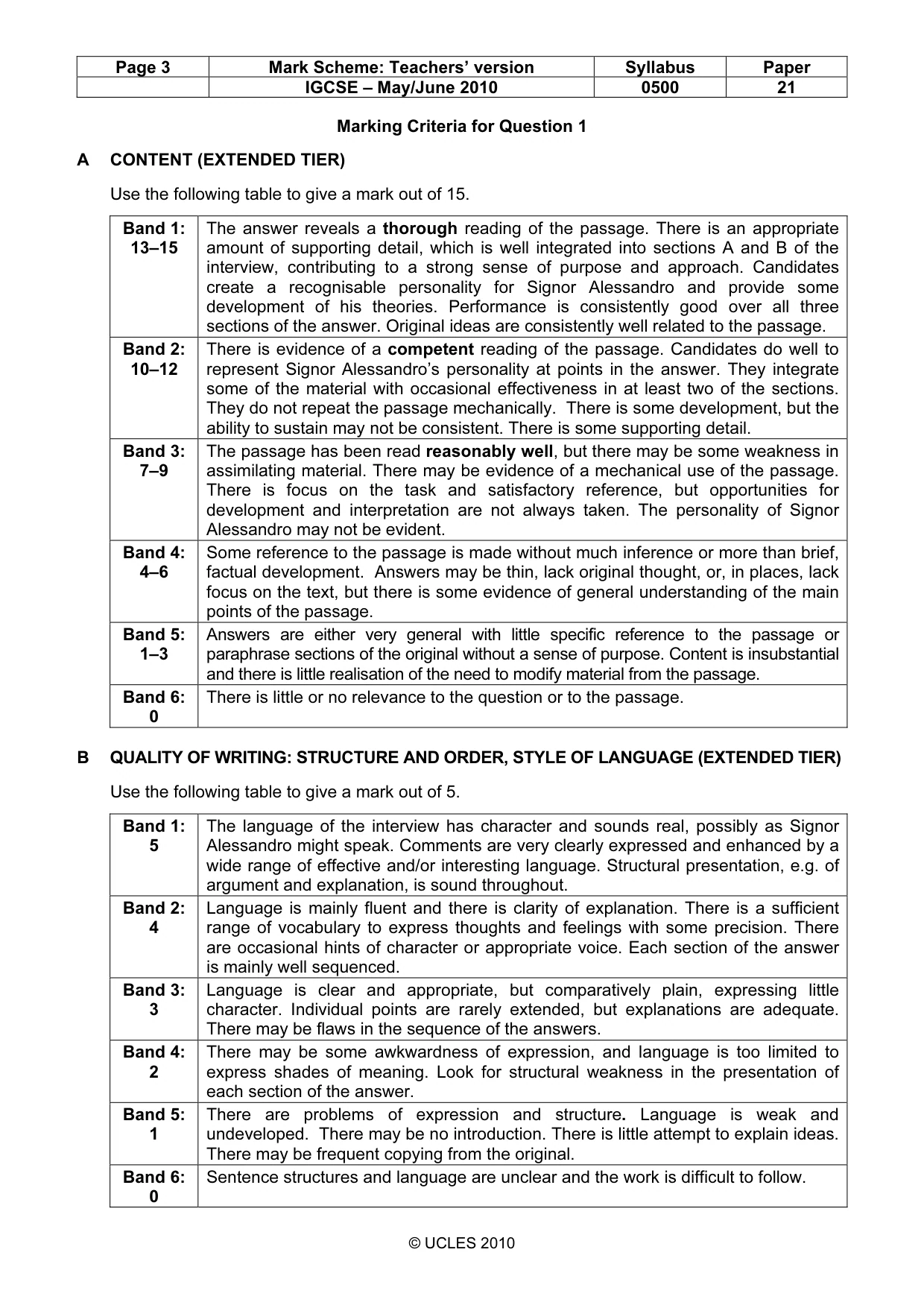
Page 2 Mark Scheme: Teachers’ version Syllabus Paper IGCSE – May/June 2010 0500 21 © UCLES 2010 Note: All Examiners are instructed that alternative correct answers and unexpected approaches in candidates’ scripts must be given marks that fairly reflect the relevant knowledge and skills demonstrated. Question 1 Immediately after the sequences that you have just read about, Signor Alessandro gives a TV interview. The interviewer asks three questions: Some people say you are an eccentric man whose behaviour is odd at times. Are they right? Can you explain the unexpected happenings that took place at the beginning of your Beethoven concert? Do you think that the time has come for you to retire from conducting? Write the words of the interview. Base your answer on what you have read in Passage A. Write between 1½ and 2 sides, allowing for the size of your handwriting. Up to fifteen marks will be available for the content of your answer, and up to five marks for the quality of your writing. [20] This question tests Reading Objectives R1–R3 (15 marks): • understand and collate explicit meanings • understand, explain and collate implicit meanings and attitudes • select, analyse and evaluate what is relevant to specific purposes AND Writing Objectives W1–W5 (5 marks): • articulate experience and express what is thought, felt and imagined • order and present facts, ideas and opinions • understand and use a range of appropriate vocabulary • use language and register appropriate to audience and context • make accurate and effective use of paragraphs, grammatical structures, sentences, punctuation and spelling. General notes on possible content: Note: there are three parts to a complete answer and good candidates will answer all three well. A: Eccentric/odd behaviour? Candidates should make Alessandro refer to the curry and the episode in the taxi, perhaps making some comment about old age and memory. They may extend excuses for his habitual, perhaps superstitious behaviour. Some may even question some of the advice that he gives to young conductors or comment on his arrogance. B: The unexpected happenings? A basic answer explains why he was late; a good answer makes excuses for his clumsiness, hair and tie, and connects playing the wrong symphony to his not using the score and his poor memory. C: Retire from conducting? This will help define the good candidates who will use his notions of greatness and the loss to the public. These candidates may make him sound arrogant and pompous. There is room for creative thought in this answer, but not creative writing divorced from the probability of the passage. Credit responses which reflect the passage and its chief personality – Alessandro may come across as remorseful or arrogant. Give credit to responses which present an overview of either or both and which go beyond a mechanical reproduction of parts of the text. Also give credit for not using the same material to answer more than one of the interviewer’s questions. The final mark is based on the quality of the answer.
Mark scheme, page 3
Page 3 Mark Scheme: Teachers’ version Syllabus Paper IGCSE – May/June 2010 0500 21 © UCLES 2010 Marking Criteria for Question 1 A CONTENT (EXTENDED TIER) Use the following table to give a mark out of 15. Band 1: 13–15 The answer reveals a thorough reading of the passage. There is an appropriate amount of supporting detail, which is well integrated into sections A and B of the interview, contributing to a strong sense of purpose and approach. Candidates create a recognisable personality for Signor Alessandro and provide some development of his theories. Performance is consistently good over all three sections of the answer. Original ideas are consistently well related to the passage. Band 2: 10–12 There is evidence of a competent reading of the passage. Candidates do well to represent Signor Alessandro’s personality at points in the answer. They integrate some of the material with occasional effectiveness in at least two of the sections. They do not repeat the passage mechanically. There is some development, but the ability to sustain may not be consistent. There is some supporting detail. Band 3: 7–9 The passage has been read reasonably well, but there may be some weakness in assimilating material. There may be evidence of a mechanical use of the passage. There is focus on the task and satisfactory reference, but opportunities for development and interpretation are not always taken. The personality of Signor Alessandro may not be evident. Band 4: 4–6 Some reference to the passage is made without much inference or more than brief, factual development. Answers may be thin, lack original thought, or, in places, lack focus on the text, but there is some evidence of general understanding of the main points of the passage. Band 5: 1–3 Answers are either very general with little specific reference to the passage or paraphrase sections of the original without a sense of purpose. Content is insubstantial and there is little realisation of the need to modify material from the passage. Band 6: 0 There is little or no relevance to the question or to the passage. B QUALITY OF WRITING: STRUCTURE AND ORDER, STYLE OF LANGUAGE (EXTENDED TIER) Use the following table to give a mark out of 5. Band 1: 5 The language of the interview has character and sounds real, possibly as Signor Alessandro might speak. Comments are very clearly expressed and enhanced by a wide range of effective and/or interesting language. Structural presentation, e.g. of argument and explanation, is sound throughout. Band 2: 4 Language is mainly fluent and there is clarity of explanation. There is a sufficient range of vocabulary to express thoughts and feelings with some precision. There are occasional hints of character or appropriate voice. Each section of the answer is mainly well sequenced. Band 3: 3 Language is clear and appropriate, but comparatively plain, expressing little character. Individual points are rarely extended, but explanations are adequate. There may be flaws in the sequence of the answers. Band 4: 2 There may be some awkwardness of expression, and language is too limited to express shades of meaning. Look for structural weakness in the presentation of each section of the answer. Band 5: 1 There are problems of expression and structure. Language is weak and undeveloped. There may be no introduction. There is little attempt to explain ideas. There may be frequent copying from the original. Band 6: 0 Sentence structures and language are unclear and the work is difficult to follow.
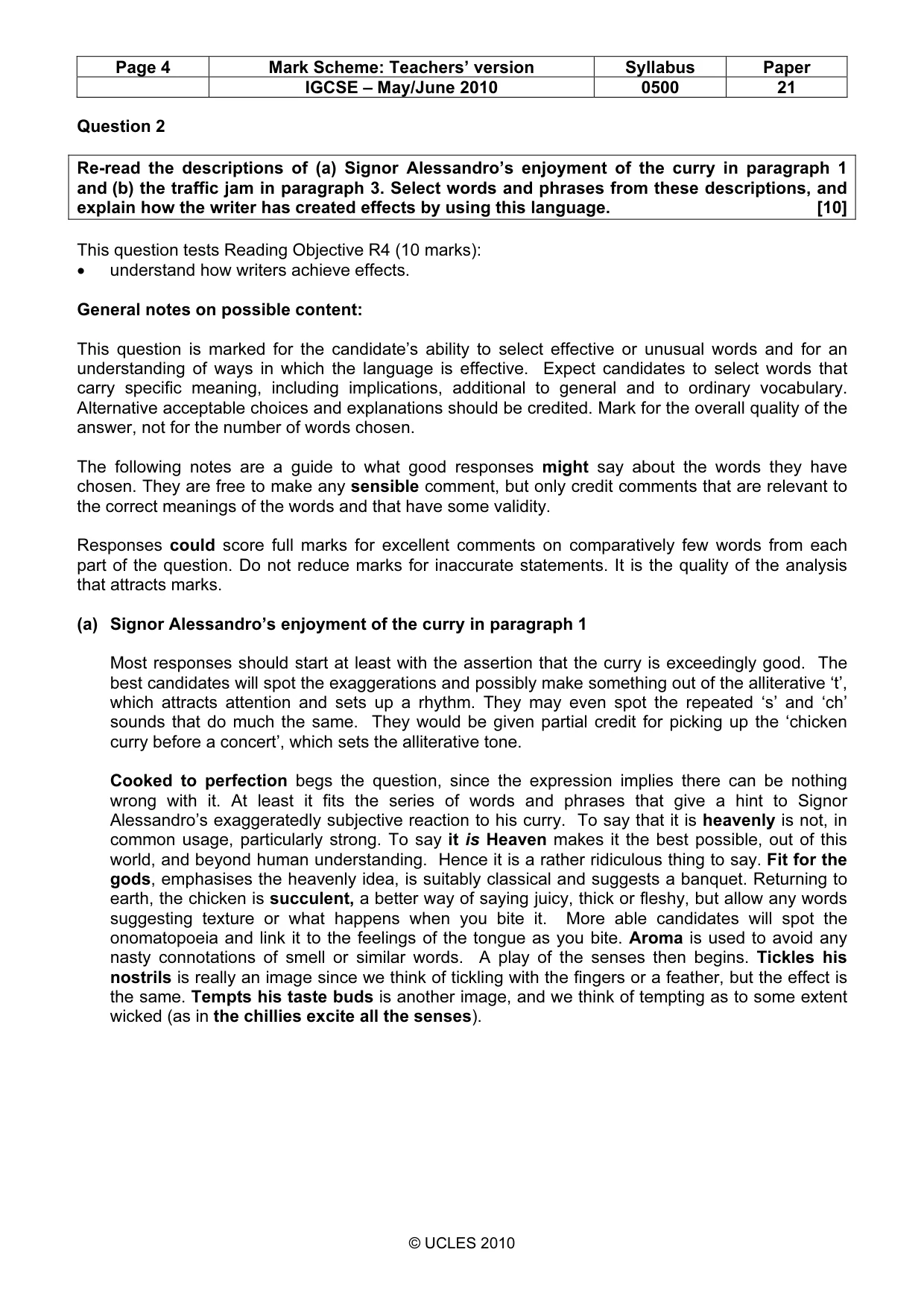
Mark scheme, page 4
Page 4 Mark Scheme: Teachers’ version Syllabus Paper IGCSE – May/June 2010 0500 21 © UCLES 2010 Question 2 Re-read the descriptions of (a) Signor Alessandro’s enjoyment of the curry in paragraph 1 and (b) the traffic jam in paragraph 3. Select words and phrases from these descriptions, and explain how the writer has created effects by using this language. [10] This question tests Reading Objective R4 (10 marks): • understand how writers achieve effects. General notes on possible content: This question is marked for the candidate’s ability to select effective or unusual words and for an understanding of ways in which the language is effective. Expect candidates to select words that carry specific meaning, including implications, additional to general and to ordinary vocabulary. Alternative acceptable choices and explanations should be credited. Mark for the overall quality of the answer, not for the number of words chosen. The following notes are a guide to what good responses might say about the words they have chosen. They are free to make any sensible comment, but only credit comments that are relevant to the correct meanings of the words and that have some validity. Responses could score full marks for excellent comments on comparatively few words from each part of the question. Do not reduce marks for inaccurate statements. It is the quality of the analysis that attracts marks. (a) Signor Alessandro’s enjoyment of the curry in paragraph 1 Most responses should start at least with the assertion that the curry is exceedingly good. The best candidates will spot the exaggerations and possibly make something out of the alliterative ‘t’, which attracts attention and sets up a rhythm. They may even spot the repeated ‘s’ and ‘ch’ sounds that do much the same. They would be given partial credit for picking up the ‘chicken curry before a concert’, which sets the alliterative tone. Cooked to perfection begs the question, since the expression implies there can be nothing wrong with it. At least it fits the series of words and phrases that give a hint to Signor Alessandro’s exaggeratedly subjective reaction to his curry. To say that it is heavenly is not, in common usage, particularly strong. To say it is Heaven makes it the best possible, out of this world, and beyond human understanding. Hence it is a rather ridiculous thing to say. Fit for the gods, emphasises the heavenly idea, is suitably classical and suggests a banquet. Returning to earth, the chicken is succulent, a better way of saying juicy, thick or fleshy, but allow any words suggesting texture or what happens when you bite it. More able candidates will spot the onomatopoeia and link it to the feelings of the tongue as you bite. Aroma is used to avoid any nasty connotations of smell or similar words. A play of the senses then begins. Tickles his nostrils is really an image since we think of tickling with the fingers or a feather, but the effect is the same. Tempts his taste buds is another image, and we think of tempting as to some extent wicked (as in the chillies excite all the senses).
Mark scheme, page 5
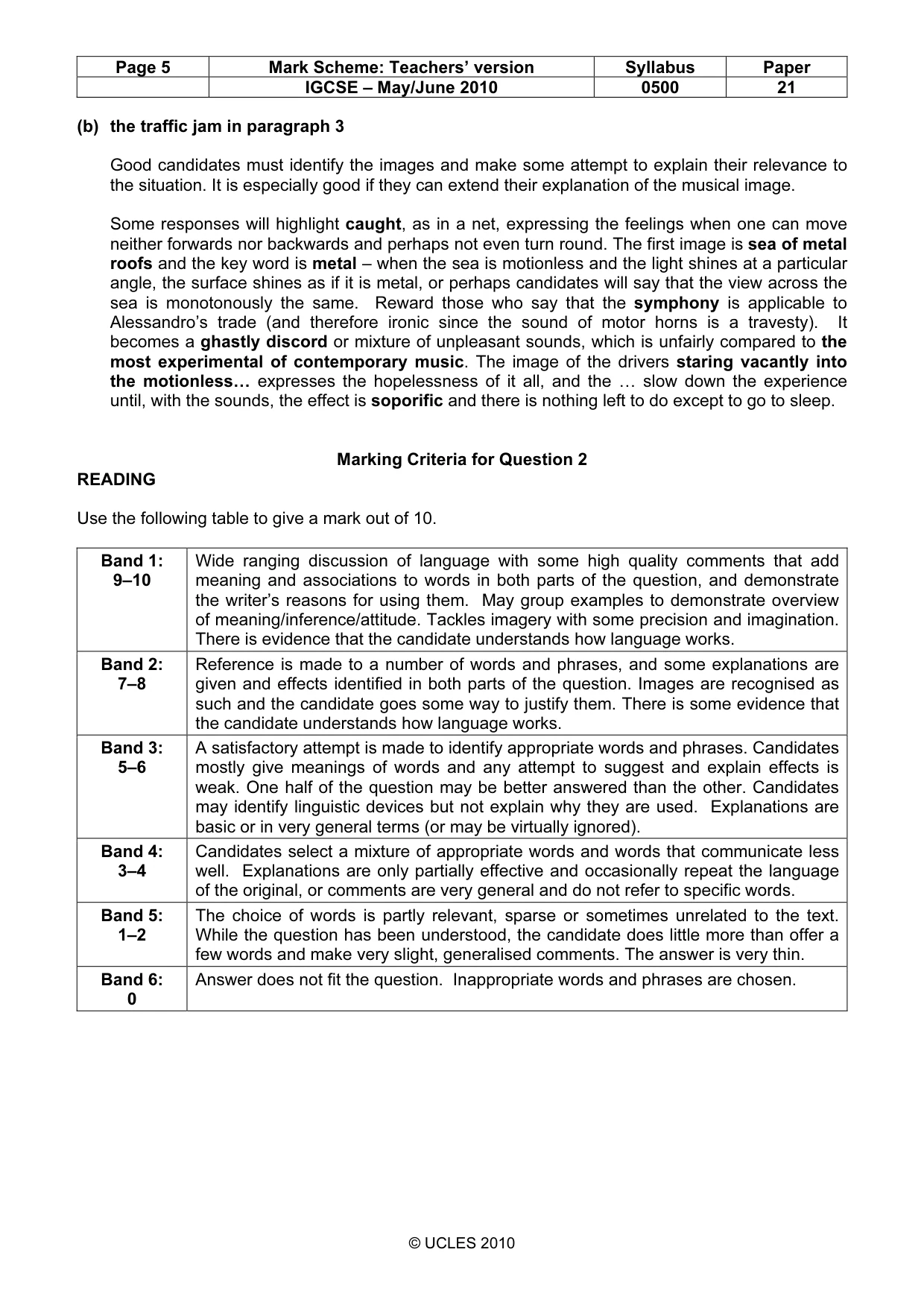
Page 5 Mark Scheme: Teachers’ version Syllabus Paper IGCSE – May/June 2010 0500 21 © UCLES 2010 (b) the traffic jam in paragraph 3 Good candidates must identify the images and make some attempt to explain their relevance to the situation. It is especially good if they can extend their explanation of the musical image. Some responses will highlight caught, as in a net, expressing the feelings when one can move neither forwards nor backwards and perhaps not even turn round. The first image is sea of metal roofs and the key word is metal – when the sea is motionless and the light shines at a particular angle, the surface shines as if it is metal, or perhaps candidates will say that the view across the sea is monotonously the same. Reward those who say that the symphony is applicable to Alessandro’s trade (and therefore ironic since the sound of motor horns is a travesty). It becomes a ghastly discord or mixture of unpleasant sounds, which is unfairly compared to the most experimental of contemporary music. The image of the drivers staring vacantly into the motionless… expresses the hopelessness of it all, and the … slow down the experience until, with the sounds, the effect is soporific and there is nothing left to do except to go to sleep. Marking Criteria for Question 2 READING Use the following table to give a mark out of 10. Band 1: 9–10 Wide ranging discussion of language with some high quality comments that add meaning and associations to words in both parts of the question, and demonstrate the writer’s reasons for using them. May group examples to demonstrate overview of meaning/inference/attitude. Tackles imagery with some precision and imagination. There is evidence that the candidate understands how language works. Band 2: 7–8 Reference is made to a number of words and phrases, and some explanations are given and effects identified in both parts of the question. Images are recognised as such and the candidate goes some way to justify them. There is some evidence that the candidate understands how language works. Band 3: 5–6 A satisfactory attempt is made to identify appropriate words and phrases. Candidates mostly give meanings of words and any attempt to suggest and explain effects is weak. One half of the question may be better answered than the other. Candidates may identify linguistic devices but not explain why they are used. Explanations are basic or in very general terms (or may be virtually ignored). Band 4: 3–4 Candidates select a mixture of appropriate words and words that communicate less well. Explanations are only partially effective and occasionally repeat the language of the original, or comments are very general and do not refer to specific words. Band 5: 1–2 The choice of words is partly relevant, sparse or sometimes unrelated to the text. While the question has been understood, the candidate does little more than offer a few words and make very slight, generalised comments. The answer is very thin. Band 6: 0 Answer does not fit the question. Inappropriate words and phrases are chosen.
Mark scheme, page 6
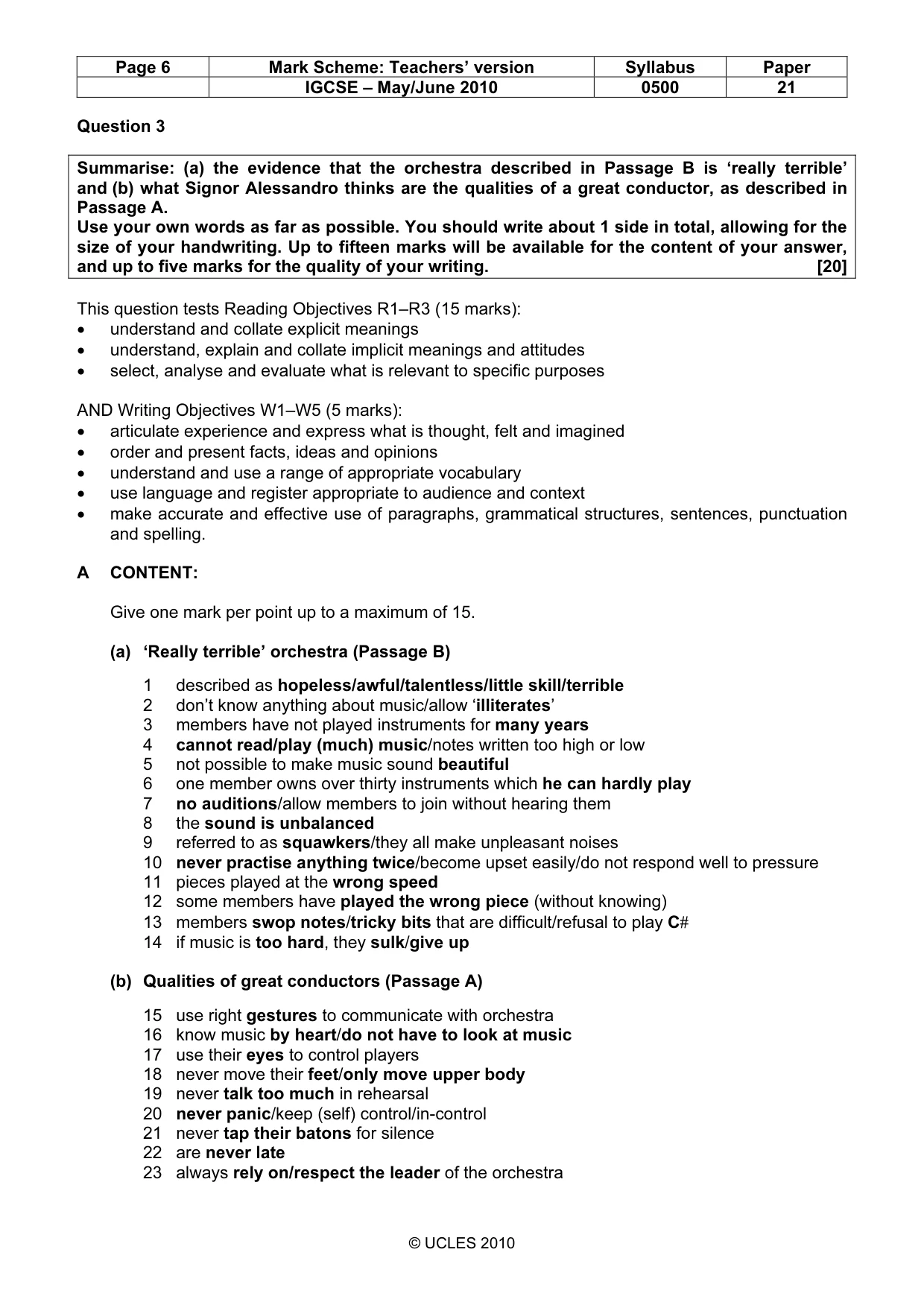
Page 6 Mark Scheme: Teachers’ version Syllabus Paper IGCSE – May/June 2010 0500 21 © UCLES 2010 Question 3 Summarise: (a) the evidence that the orchestra described in Passage B is ‘really terrible’ and (b) what Signor Alessandro thinks are the qualities of a great conductor, as described in Passage A. Use your own words as far as possible. You should write about 1 side in total, allowing for the size of your handwriting. Up to fifteen marks will be available for the content of your answer, and up to five marks for the quality of your writing. [20] This question tests Reading Objectives R1–R3 (15 marks): • understand and collate explicit meanings • understand, explain and collate implicit meanings and attitudes • select, analyse and evaluate what is relevant to specific purposes AND Writing Objectives W1–W5 (5 marks): • articulate experience and express what is thought, felt and imagined • order and present facts, ideas and opinions • understand and use a range of appropriate vocabulary • use language and register appropriate to audience and context • make accurate and effective use of paragraphs, grammatical structures, sentences, punctuation and spelling. A CONTENT: Give one mark per point up to a maximum of 15. (a) ‘Really terrible’ orchestra (Passage B) 1 described as hopeless/awful/talentless/little skill/terrible 2 don’t know anything about music/allow ‘illiterates’ 3 members have not played instruments for many years 4 cannot read/play (much) music/notes written too high or low 5 not possible to make music sound beautiful 6 one member owns over thirty instruments which he can hardly play 7 no auditions/allow members to join without hearing them 8 the sound is unbalanced 9 referred to as squawkers/they all make unpleasant noises 10 never practise anything twice/become upset easily/do not respond well to pressure 11 pieces played at the wrong speed 12 some members have played the wrong piece (without knowing) 13 members swop notes/tricky bits that are difficult/refusal to play C# 14 if music is too hard, they sulk/give up (b) Qualities of great conductors (Passage A) 15 use right gestures to communicate with orchestra 16 know music by heart/do not have to look at music 17 use their eyes to control players 18 never move their feet/only move upper body 19 never talk too much in rehearsal 20 never panic/keep (self) control/in-control 21 never tap their batons for silence 22 are never late 23 always rely on/respect the leader of the orchestra
Mark scheme, page 7
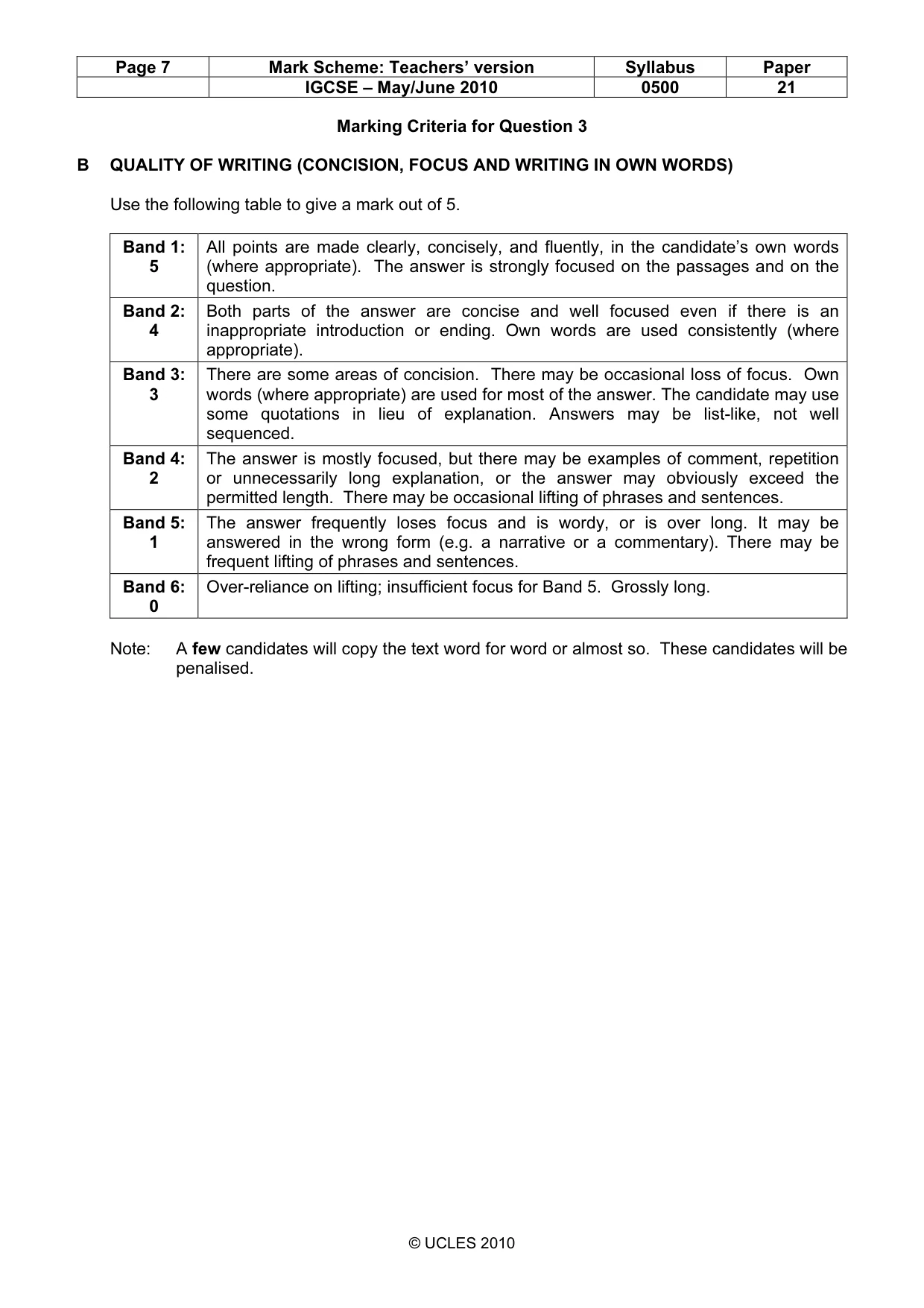
Page 7 Mark Scheme: Teachers’ version Syllabus Paper IGCSE – May/June 2010 0500 21 © UCLES 2010 Marking Criteria for Question 3 B QUALITY OF WRITING (CONCISION, FOCUS AND WRITING IN OWN WORDS) Use the following table to give a mark out of 5. Band 1: 5 All points are made clearly, concisely, and fluently, in the candidate’s own words (where appropriate). The answer is strongly focused on the passages and on the question. Band 2: 4 Both parts of the answer are concise and well focused even if there is an inappropriate introduction or ending. Own words are used consistently (where appropriate). Band 3: 3 There are some areas of concision. There may be occasional loss of focus. Own words (where appropriate) are used for most of the answer. The candidate may use some quotations in lieu of explanation. Answers may be list-like, not well sequenced. Band 4: 2 The answer is mostly focused, but there may be examples of comment, repetition or unnecessarily long explanation, or the answer may obviously exceed the permitted length. There may be occasional lifting of phrases and sentences. Band 5: 1 The answer frequently loses focus and is wordy, or is over long. It may be answered in the wrong form (e.g. a narrative or a commentary). There may be frequent lifting of phrases and sentences. Band 6: 0 Over-reliance on lifting; insufficient focus for Band 5. Grossly long. Note: A few candidates will copy the text word for word or almost so. These candidates will be penalised.
What you needed in this session
Cambridge’s own grade thresholds for 2010 May/June, Paper 2 · Variant 1. A higher threshold means an easier paper — the bar moves with how the cohort did.