Cambridge IGCSE Drama 0411 — 2015 May/June Paper 1 · Variant 2
0411/12/M/J/15 · 80 marks · ≈90 min
The question paper and its mark scheme, free to read here and free to download. This is Cambridge’s own paper, exactly as it was sat.
Question paper4 pages

Mark scheme19 pages
Answers below. Sit the paper first if you are practising.
Paper as text
Question paper, page 1
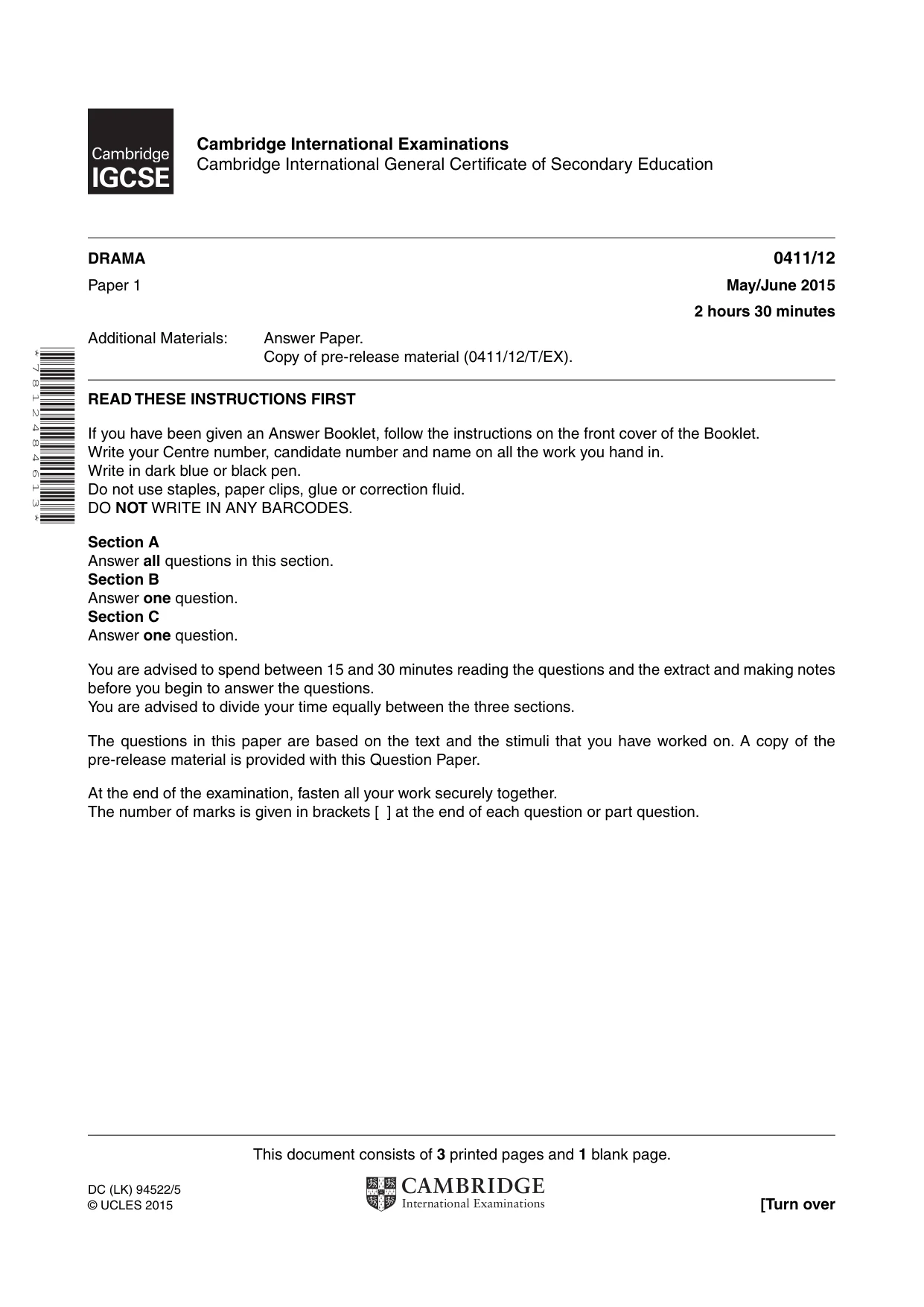
This document consists of 3 printed pages and 1 blank page. DC (LK) 94522/5 © UCLES 2015 [Turn over * 7 8 1 2 4 8 4 6 1 3 * DRAMA 0411/12 Paper 1 May/June 2015 2 hours 30 minutes Additional Materials: Answer Paper. Copy of pre-release material (0411/12/T/EX). READ THESE INSTRUCTIONS FIRST If you have been given an Answer Booklet, follow the instructions on the front cover of the Booklet. Write your Centre number, candidate number and name on all the work you hand in. Write in dark blue or black pen. Do not use staples, paper clips, glue or correction fluid. DO NOT WRITE IN ANY BARCODES. Section A Answer all questions in this section. Section B Answer one question. Section C Answer one question. You are advised to spend between 15 and 30 minutes reading the questions and the extract and making notes before you begin to answer the questions. You are advised to divide your time equally between the three sections. The questions in this paper are based on the text and the stimuli that you have worked on. A copy of the pre-release material is provided with this Question Paper. At the end of the examination, fasten all your work securely together. The number of marks is given in brackets [ ] at the end of each question or part question. Cambridge International Examinations Cambridge International General Certificate of Secondary Education
Question paper, page 2
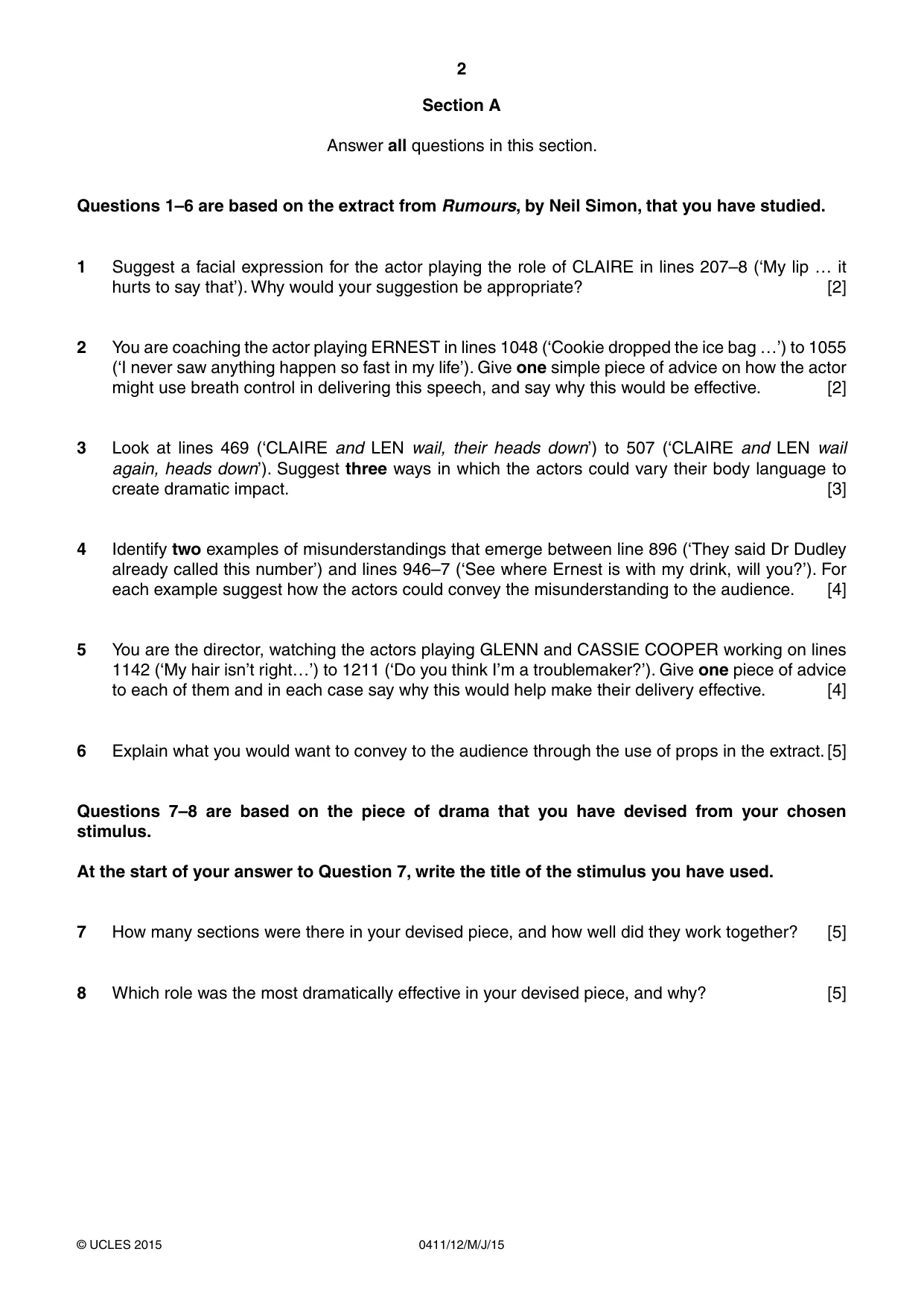
2 0411/12/M/J/15 © UCLES 2015 Section A Answer all questions in this section. Questions 1–6 are based on the extract from Rumours, by Neil Simon, that you have studied. 1 Suggest a facial expression for the actor playing the role of CLAIRE in lines 207–8 (‘My lip … it hurts to say that’). Why would your suggestion be appropriate? [2] 2 You are coaching the actor playing ERNEST in lines 1048 (‘Cookie dropped the ice bag …’) to 1055 (‘I never saw anything happen so fast in my life’). Give one simple piece of advice on how the actor might use breath control in delivering this speech, and say why this would be effective. [2] 3 Look at lines 469 (‘CLAIRE and LEN wail, their heads down’) to 507 (‘CLAIRE and LEN wail again, heads down’). Suggest three ways in which the actors could vary their body language to create dramatic impact. [3] 4 Identify two examples of misunderstandings that emerge between line 896 (‘They said Dr Dudley already called this number’) and lines 946–7 (‘See where Ernest is with my drink, will you?’). For each example suggest how the actors could convey the misunderstanding to the audience. [4] 5 You are the director, watching the actors playing GLENN and CASSIE COOPER working on lines 1142 (‘My hair isn’t right…’) to 1211 (‘Do you think I’m a troublemaker?’). Give one piece of advice to each of them and in each case say why this would help make their delivery effective. [4] 6 Explain what you would want to convey to the audience through the use of props in the extract. [5] Questions 7–8 are based on the piece of drama that you have devised from your chosen stimulus. At the start of your answer to Question 7, write the title of the stimulus you have used. 7 How many sections were there in your devised piece, and how well did they work together? [5] 8 Which role was the most dramatically effective in your devised piece, and why? [5]
Question paper, page 3
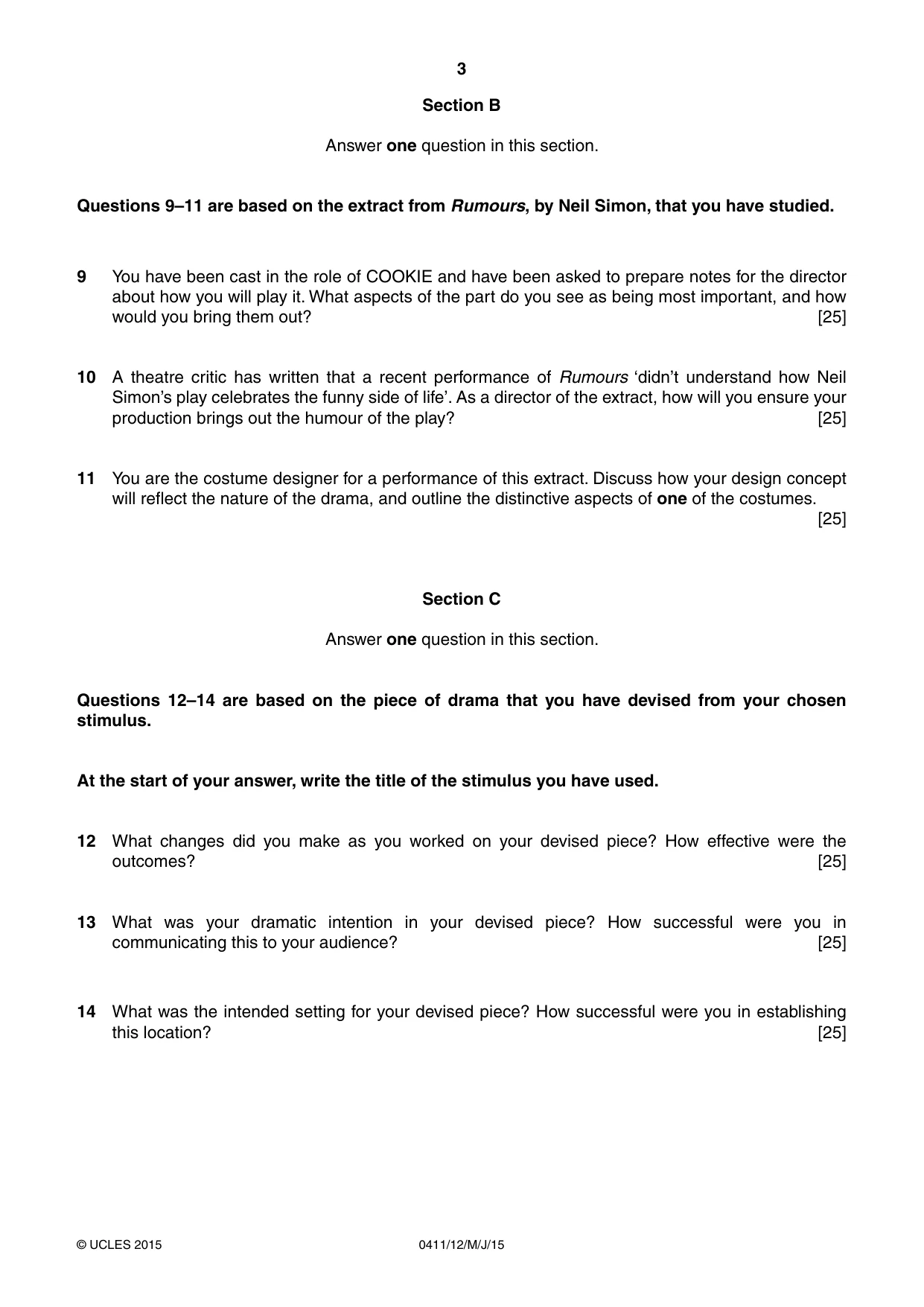
3 0411/12/M/J/15 © UCLES 2015 Section B Answer one question in this section. Questions 9–11 are based on the extract from Rumours, by Neil Simon, that you have studied. 9 You have been cast in the role of COOKIE and have been asked to prepare notes for the director about how you will play it. What aspects of the part do you see as being most important, and how would you bring them out? [25] 10 A theatre critic has written that a recent performance of Rumours ‘didn’t understand how Neil Simon’s play celebrates the funny side of life’. As a director of the extract, how will you ensure your production brings out the humour of the play? [25] 11 You are the costume designer for a performance of this extract. Discuss how your design concept will reflect the nature of the drama, and outline the distinctive aspects of one of the costumes. [25] Section C Answer one question in this section. Questions 12–14 are based on the piece of drama that you have devised from your chosen stimulus. At the start of your answer, write the title of the stimulus you have used. 12 What changes did you make as you worked on your devised piece? How effective were the outcomes? [25] 13 What was your dramatic intention in your devised piece? How successful were you in communicating this to your audience? [25] 14 What was the intended setting for your devised piece? How successful were you in establishing this location? [25]
Question paper, page 4
4 0411/12/M/J/15 © UCLES 2015 BLANK PAGE Permission to reproduce items where third-party owned material protected by copyright is included has been sought and cleared where possible. Every reasonable effort has been made by the publisher (UCLES) to trace copyright holders, but if any items requiring clearance have unwittingly been included, the publisher will be pleased to make amends at the earliest possible opportunity. To avoid the issue of disclosure of answer-related information to candidates, all copyright acknowledgements are reproduced online in the Cambridge International Examinations Copyright Acknowledgements Booklet. This is produced for each series of examinations and is freely available to download at www.cie.org.uk after the live examination series. Cambridge International Examinations is part of the Cambridge Assessment Group. Cambridge Assessment is the brand name of University of Cambridge Local Examinations Syndicate (UCLES), which is itself a department of the University of Cambridge.
Mark scheme, page 1
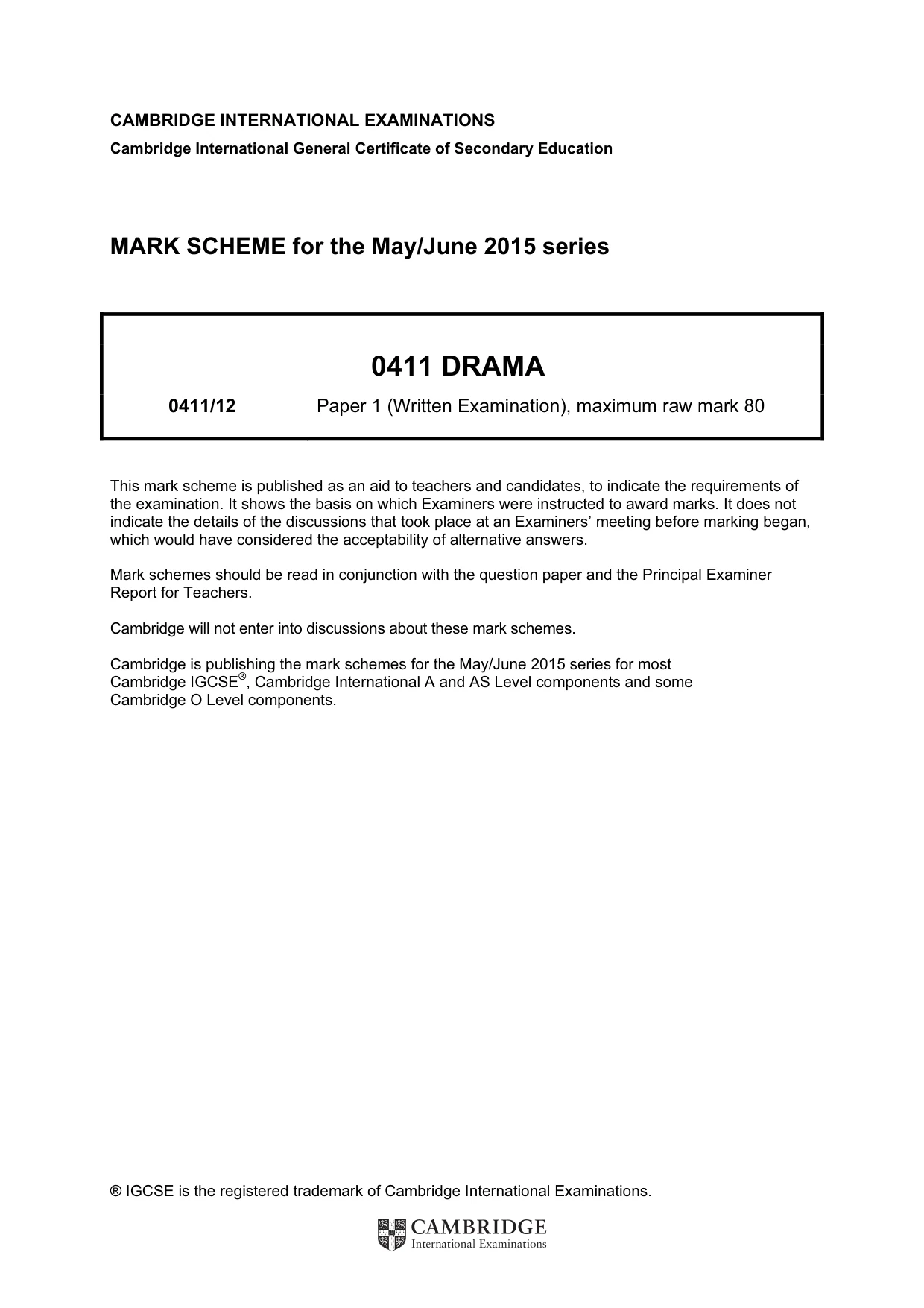
® IGCSE is the registered trademark of Cambridge International Examinations. CAMBRIDGE INTERNATIONAL EXAMINATIONS Cambridge International General Certificate of Secondary Education MARK SCHEME for the May/June 2015 series 0411 DRAMA 0411/12 Paper 1 (Written Examination), maximum raw mark 80 This mark scheme is published as an aid to teachers and candidates, to indicate the requirements of the examination. It shows the basis on which Examiners were instructed to award marks. It does not indicate the details of the discussions that took place at an Examiners’ meeting before marking began, which would have considered the acceptability of alternative answers. Mark schemes should be read in conjunction with the question paper and the Principal Examiner Report for Teachers. Cambridge will not enter into discussions about these mark schemes. Cambridge is publishing the mark schemes for the May/June 2015 series for most Cambridge IGCSE®, Cambridge International A and AS Level components and some Cambridge O Level components.
Mark scheme, page 2
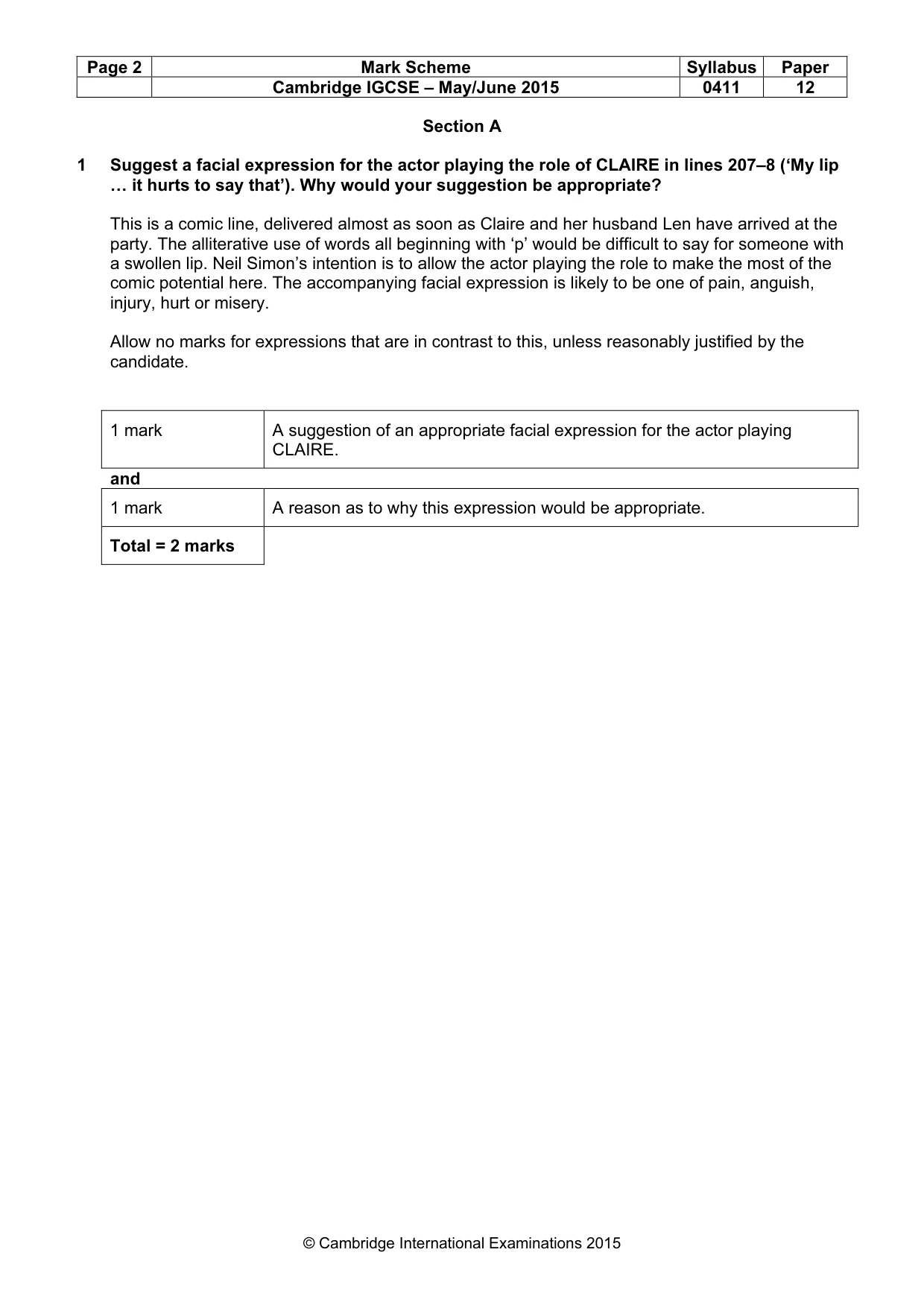
Page 2 Mark Scheme Syllabus Paper Cambridge IGCSE – May/June 2015 0411 12 © Cambridge International Examinations 2015 Section A 1 Suggest a facial expression for the actor playing the role of CLAIRE in lines 207–8 (‘My lip … it hurts to say that’). Why would your suggestion be appropriate? This is a comic line, delivered almost as soon as Claire and her husband Len have arrived at the party. The alliterative use of words all beginning with ‘p’ would be difficult to say for someone with a swollen lip. Neil Simon’s intention is to allow the actor playing the role to make the most of the comic potential here. The accompanying facial expression is likely to be one of pain, anguish, injury, hurt or misery. Allow no marks for expressions that are in contrast to this, unless reasonably justified by the candidate. 1 mark A suggestion of an appropriate facial expression for the actor playing CLAIRE. and 1 mark A reason as to why this expression would be appropriate. Total = 2 marks
Mark scheme, page 3
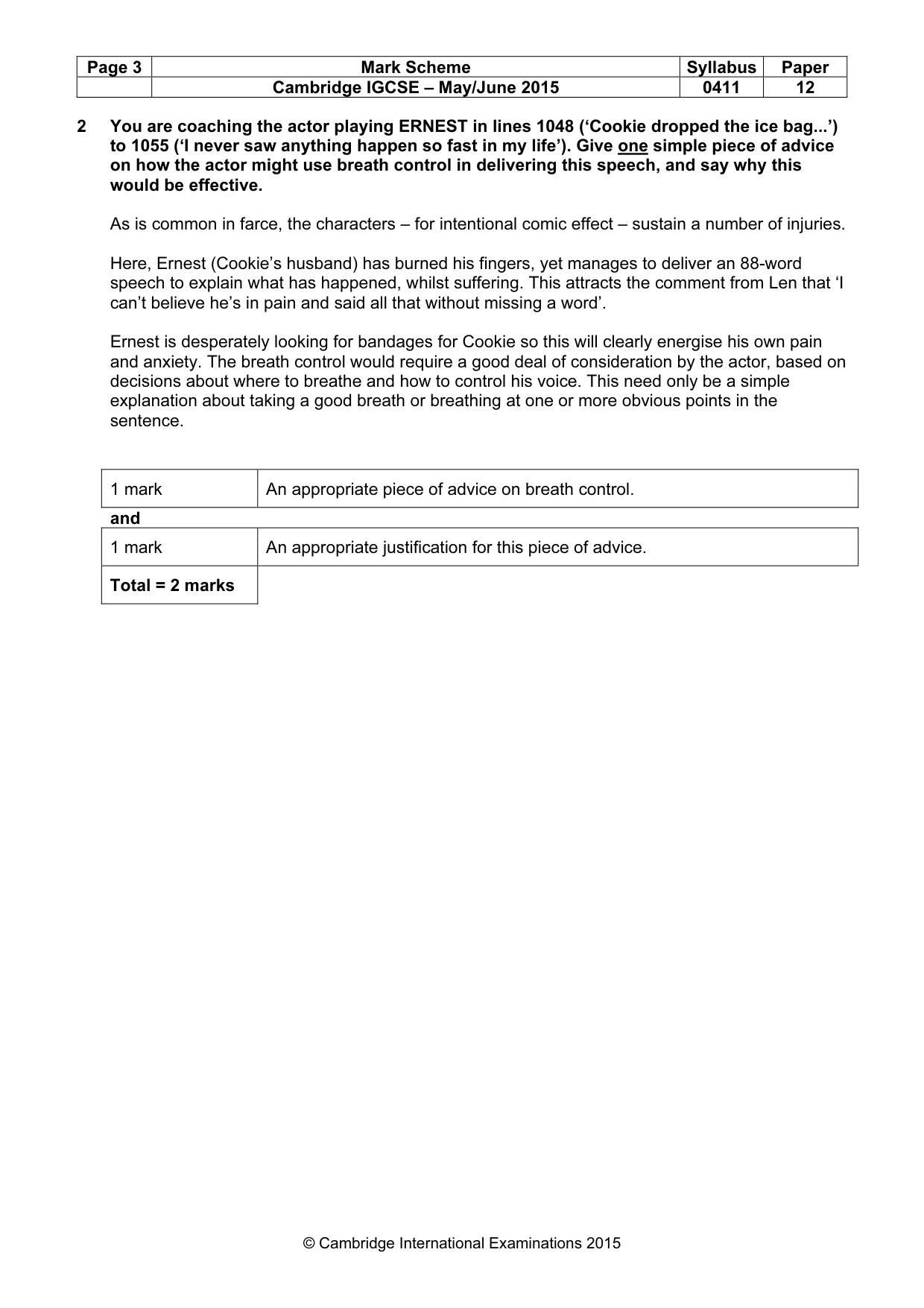
Page 3 Mark Scheme Syllabus Paper Cambridge IGCSE – May/June 2015 0411 12 © Cambridge International Examinations 2015 2 You are coaching the actor playing ERNEST in lines 1048 (‘Cookie dropped the ice bag...’) to 1055 (‘I never saw anything happen so fast in my life’). Give one simple piece of advice on how the actor might use breath control in delivering this speech, and say why this would be effective. As is common in farce, the characters – for intentional comic effect – sustain a number of injuries. Here, Ernest (Cookie’s husband) has burned his fingers, yet manages to deliver an 88-word speech to explain what has happened, whilst suffering. This attracts the comment from Len that ‘I can’t believe he’s in pain and said all that without missing a word’. Ernest is desperately looking for bandages for Cookie so this will clearly energise his own pain and anxiety. The breath control would require a good deal of consideration by the actor, based on decisions about where to breathe and how to control his voice. This need only be a simple explanation about taking a good breath or breathing at one or more obvious points in the sentence. 1 mark An appropriate piece of advice on breath control. and 1 mark An appropriate justification for this piece of advice. Total = 2 marks
Mark scheme, page 4
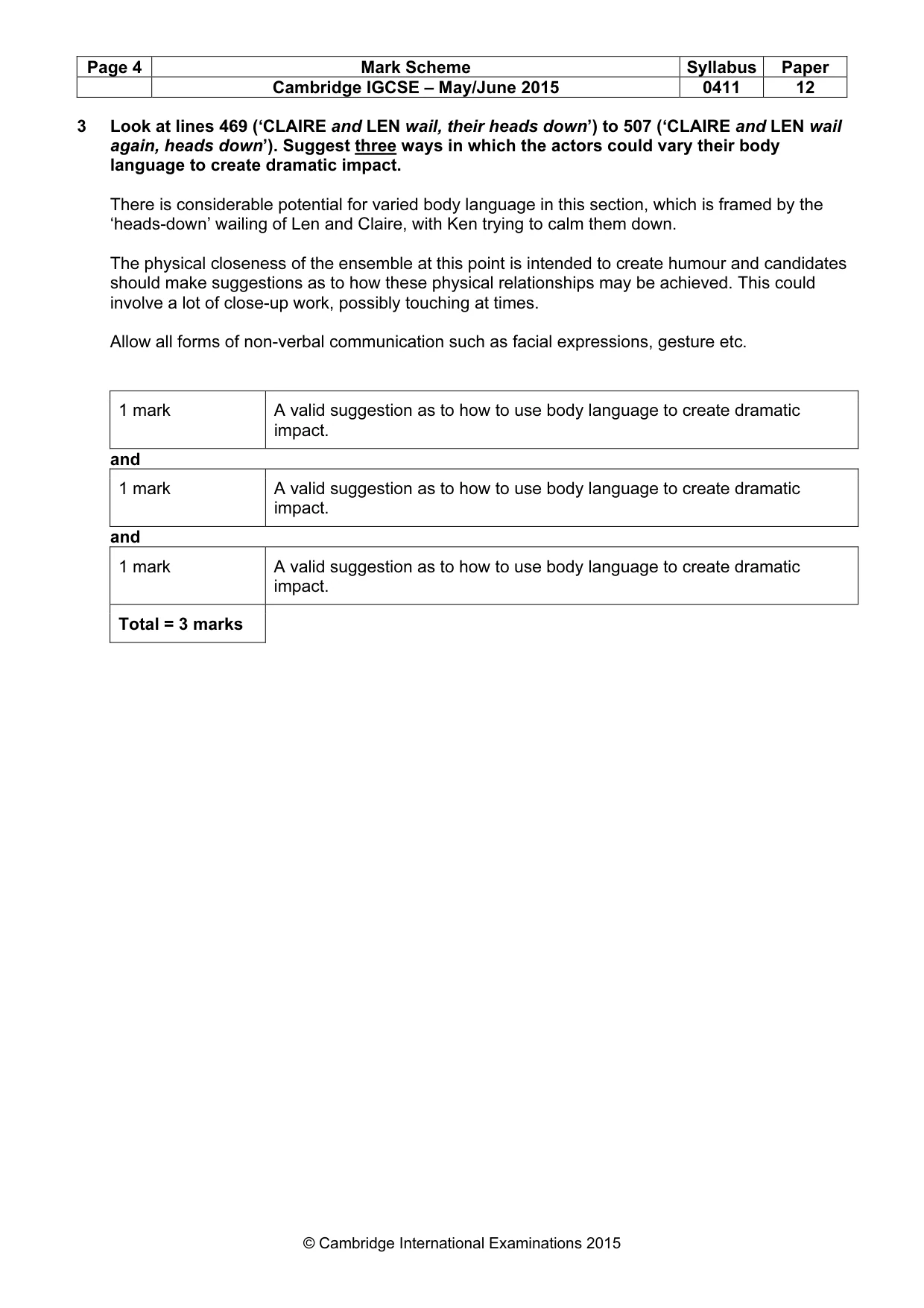
Page 4 Mark Scheme Syllabus Paper Cambridge IGCSE – May/June 2015 0411 12 © Cambridge International Examinations 2015 3 Look at lines 469 (‘CLAIRE and LEN wail, their heads down’) to 507 (‘CLAIRE and LEN wail again, heads down’). Suggest three ways in which the actors could vary their body language to create dramatic impact. There is considerable potential for varied body language in this section, which is framed by the ‘heads-down’ wailing of Len and Claire, with Ken trying to calm them down. The physical closeness of the ensemble at this point is intended to create humour and candidates should make suggestions as to how these physical relationships may be achieved. This could involve a lot of close-up work, possibly touching at times. Allow all forms of non-verbal communication such as facial expressions, gesture etc. 1 mark A valid suggestion as to how to use body language to create dramatic impact. and 1 mark A valid suggestion as to how to use body language to create dramatic impact. and 1 mark A valid suggestion as to how to use body language to create dramatic impact. Total = 3 marks
Mark scheme, page 5
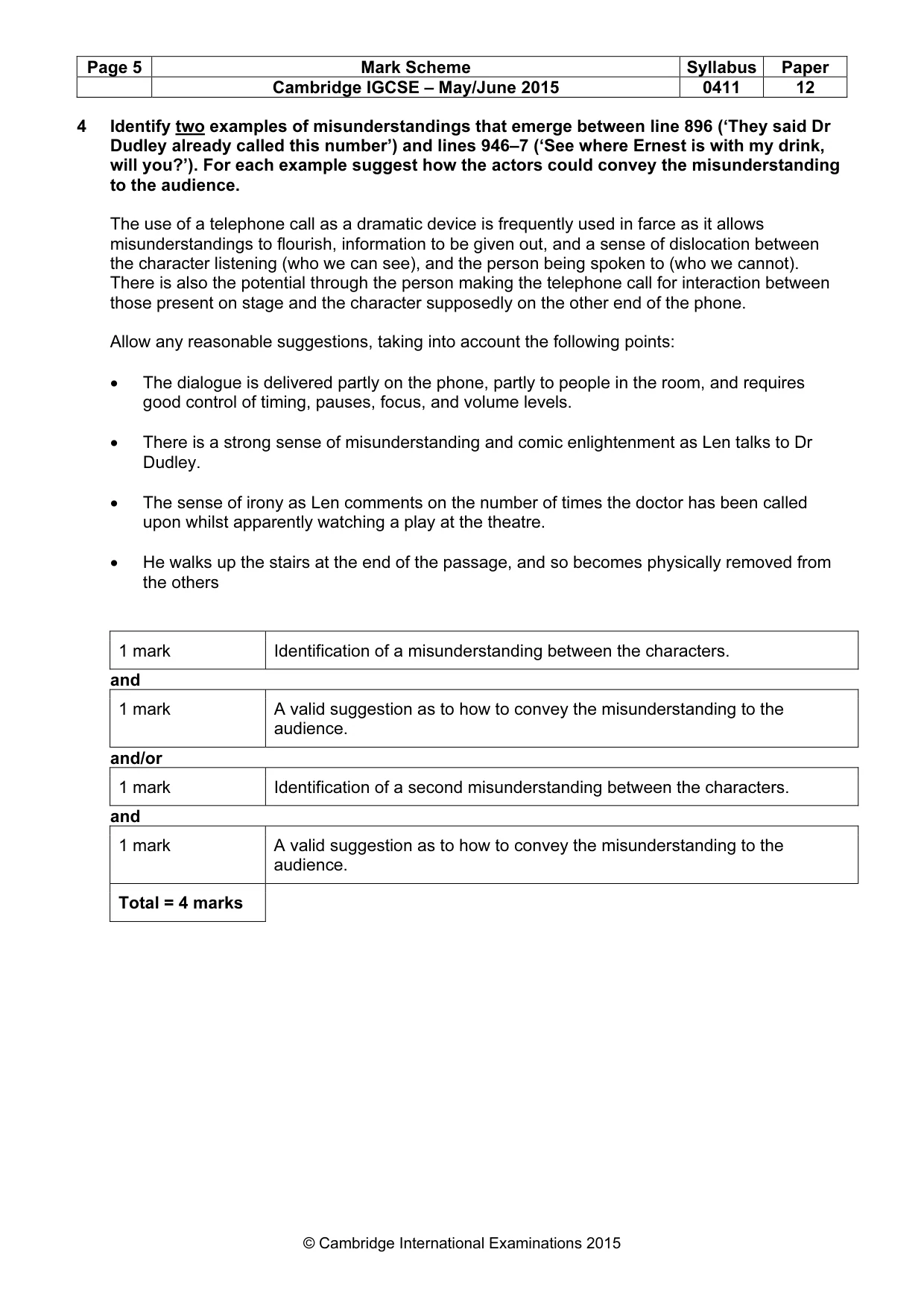
Page 5 Mark Scheme Syllabus Paper Cambridge IGCSE – May/June 2015 0411 12 © Cambridge International Examinations 2015 4 Identify two examples of misunderstandings that emerge between line 896 (‘They said Dr Dudley already called this number’) and lines 946–7 (‘See where Ernest is with my drink, will you?’). For each example suggest how the actors could convey the misunderstanding to the audience. The use of a telephone call as a dramatic device is frequently used in farce as it allows misunderstandings to flourish, information to be given out, and a sense of dislocation between the character listening (who we can see), and the person being spoken to (who we cannot). There is also the potential through the person making the telephone call for interaction between those present on stage and the character supposedly on the other end of the phone. Allow any reasonable suggestions, taking into account the following points: • The dialogue is delivered partly on the phone, partly to people in the room, and requires good control of timing, pauses, focus, and volume levels. • There is a strong sense of misunderstanding and comic enlightenment as Len talks to Dr Dudley. • The sense of irony as Len comments on the number of times the doctor has been called upon whilst apparently watching a play at the theatre. • He walks up the stairs at the end of the passage, and so becomes physically removed from the others 1 mark Identification of a misunderstanding between the characters. and 1 mark A valid suggestion as to how to convey the misunderstanding to the audience. and/or 1 mark Identification of a second misunderstanding between the characters. and 1 mark A valid suggestion as to how to convey the misunderstanding to the audience. Total = 4 marks
Mark scheme, page 6
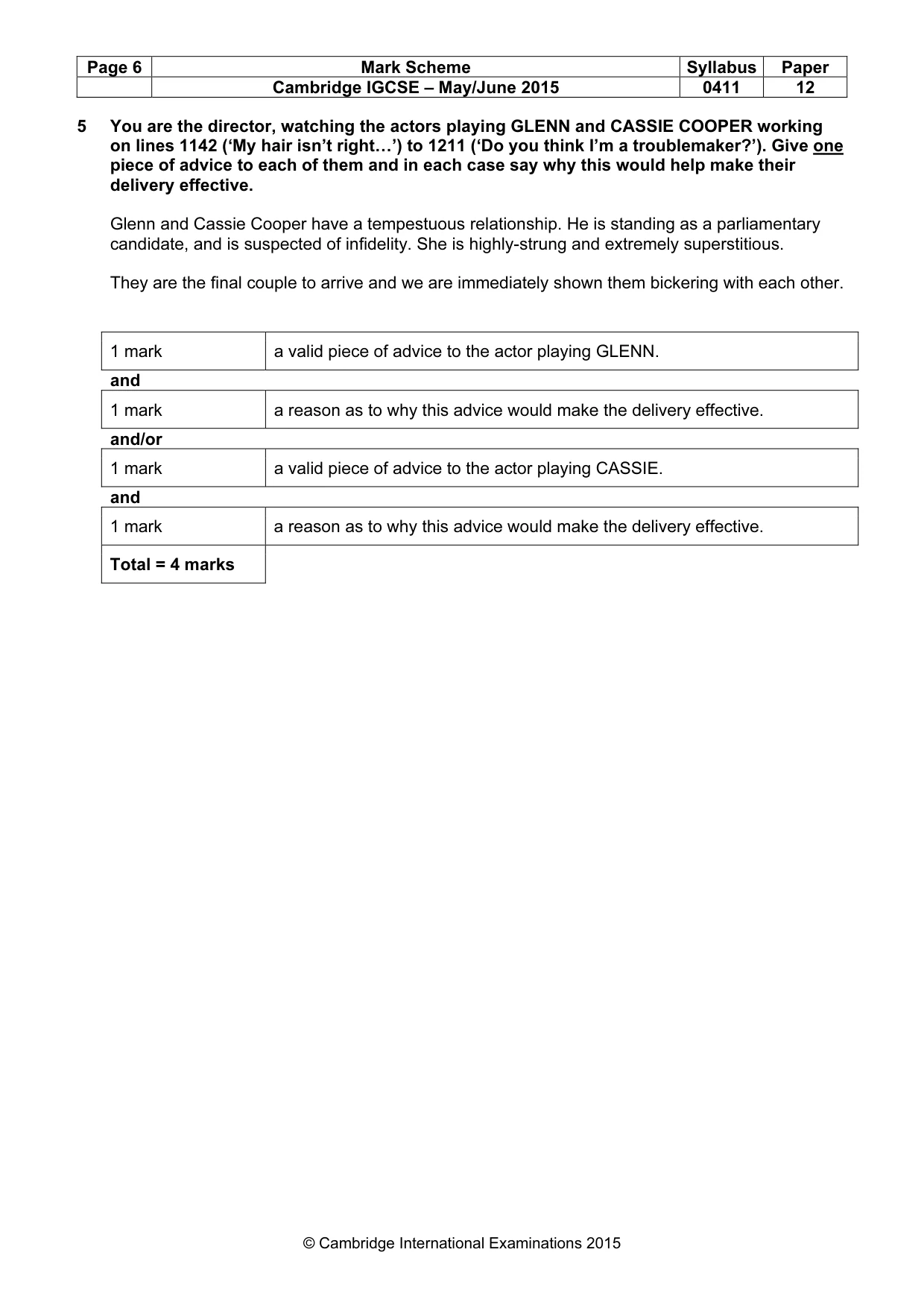
Page 6 Mark Scheme Syllabus Paper Cambridge IGCSE – May/June 2015 0411 12 © Cambridge International Examinations 2015 5 You are the director, watching the actors playing GLENN and CASSIE COOPER working on lines 1142 (‘My hair isn’t right…’) to 1211 (‘Do you think I’m a troublemaker?’). Give one piece of advice to each of them and in each case say why this would help make their delivery effective. Glenn and Cassie Cooper have a tempestuous relationship. He is standing as a parliamentary candidate, and is suspected of infidelity. She is highly-strung and extremely superstitious. They are the final couple to arrive and we are immediately shown them bickering with each other. 1 mark a valid piece of advice to the actor playing GLENN. and 1 mark a reason as to why this advice would make the delivery effective. and/or 1 mark a valid piece of advice to the actor playing CASSIE. and 1 mark a reason as to why this advice would make the delivery effective. Total = 4 marks
Mark scheme, page 7
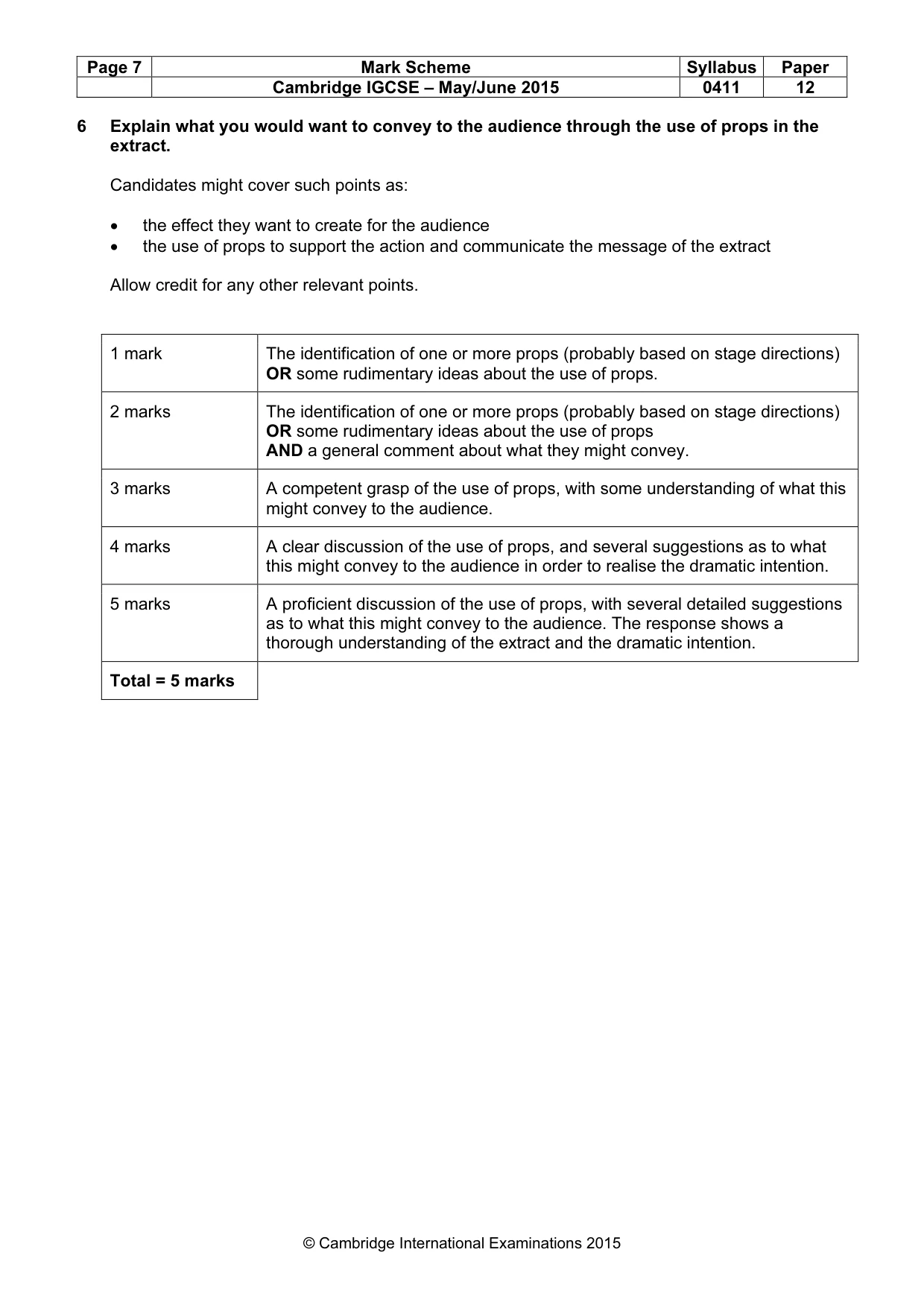
Page 7 Mark Scheme Syllabus Paper Cambridge IGCSE – May/June 2015 0411 12 © Cambridge International Examinations 2015 6 Explain what you would want to convey to the audience through the use of props in the extract. Candidates might cover such points as: • the effect they want to create for the audience • the use of props to support the action and communicate the message of the extract Allow credit for any other relevant points. 1 mark The identification of one or more props (probably based on stage directions) OR some rudimentary ideas about the use of props. 2 marks The identification of one or more props (probably based on stage directions) OR some rudimentary ideas about the use of props AND a general comment about what they might convey. 3 marks A competent grasp of the use of props, with some understanding of what this might convey to the audience. 4 marks A clear discussion of the use of props, and several suggestions as to what this might convey to the audience in order to realise the dramatic intention. 5 marks A proficient discussion of the use of props, with several detailed suggestions as to what this might convey to the audience. The response shows a thorough understanding of the extract and the dramatic intention. Total = 5 marks
Mark scheme, page 8
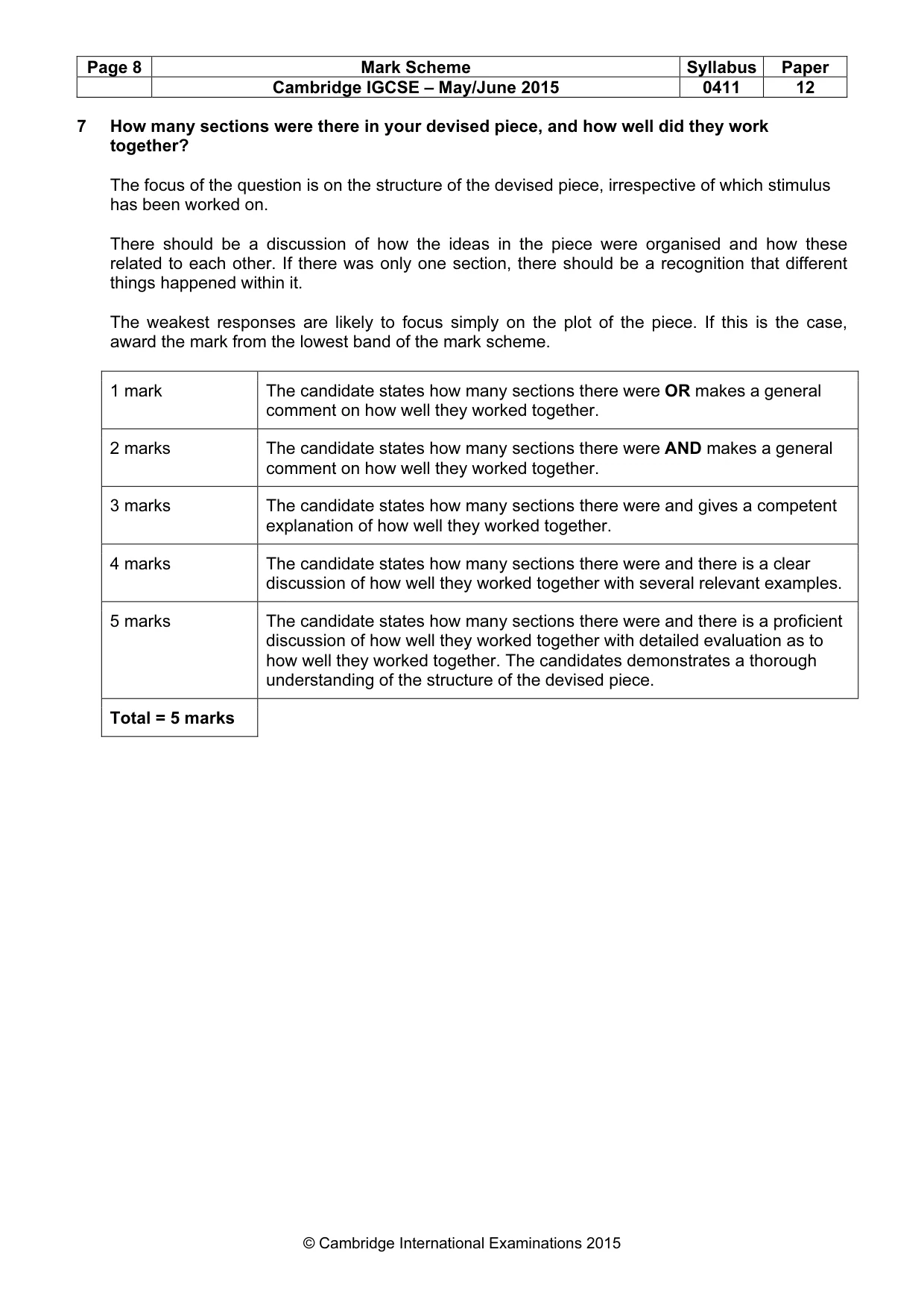
Page 8 Mark Scheme Syllabus Paper Cambridge IGCSE – May/June 2015 0411 12 © Cambridge International Examinations 2015 7 How many sections were there in your devised piece, and how well did they work together? The focus of the question is on the structure of the devised piece, irrespective of which stimulus has been worked on. There should be a discussion of how the ideas in the piece were organised and how these related to each other. If there was only one section, there should be a recognition that different things happened within it. The weakest responses are likely to focus simply on the plot of the piece. If this is the case, award the mark from the lowest band of the mark scheme. 1 mark The candidate states how many sections there were OR makes a general comment on how well they worked together. 2 marks The candidate states how many sections there were AND makes a general comment on how well they worked together. 3 marks The candidate states how many sections there were and gives a competent explanation of how well they worked together. 4 marks The candidate states how many sections there were and there is a clear discussion of how well they worked together with several relevant examples. 5 marks The candidate states how many sections there were and there is a proficient discussion of how well they worked together with detailed evaluation as to how well they worked together. The candidates demonstrates a thorough understanding of the structure of the devised piece. Total = 5 marks
Mark scheme, page 9
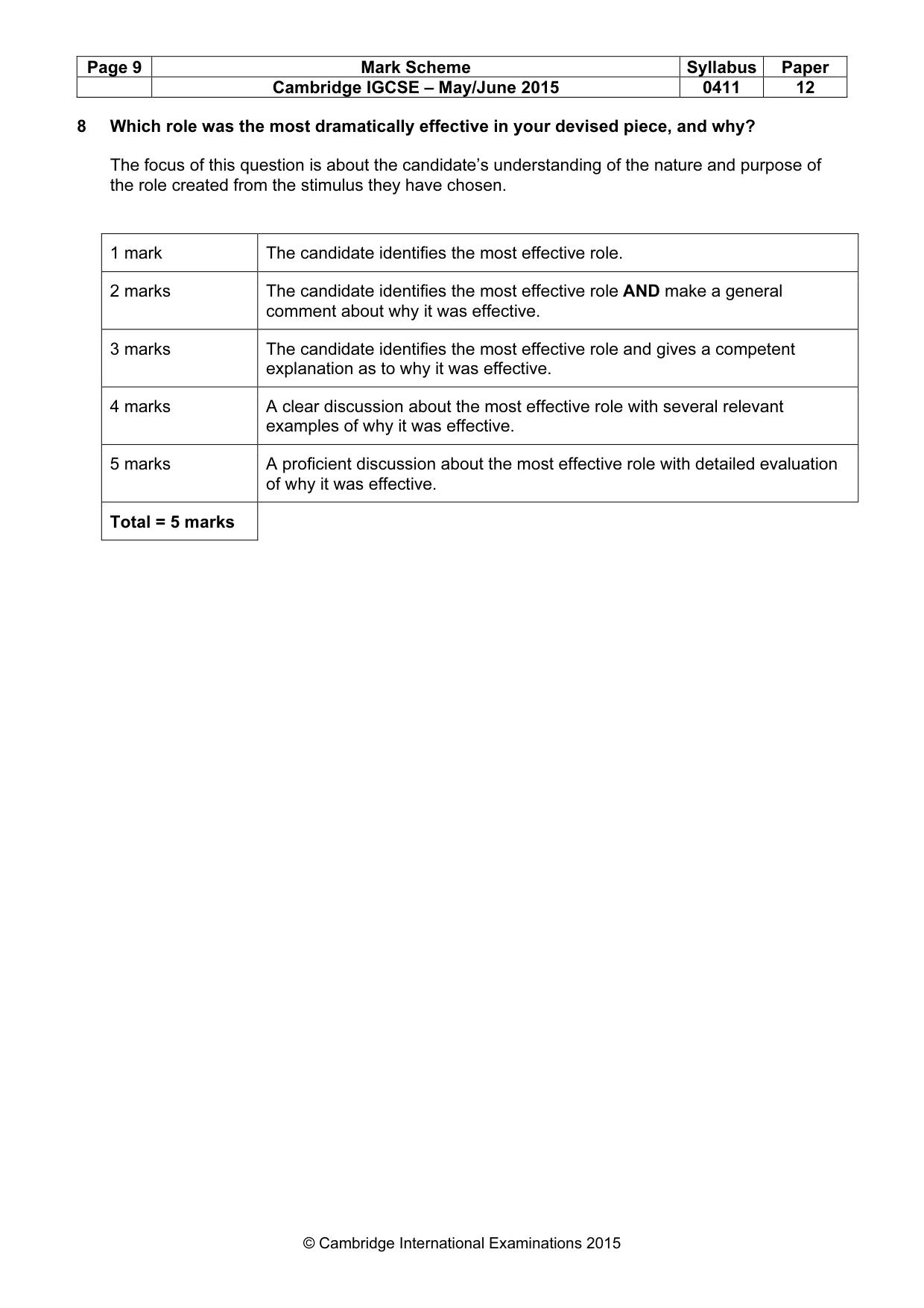
Page 9 Mark Scheme Syllabus Paper Cambridge IGCSE – May/June 2015 0411 12 © Cambridge International Examinations 2015 8 Which role was the most dramatically effective in your devised piece, and why? The focus of this question is about the candidate’s understanding of the nature and purpose of the role created from the stimulus they have chosen. 1 mark The candidate identifies the most effective role. 2 marks The candidate identifies the most effective role AND make a general comment about why it was effective. 3 marks The candidate identifies the most effective role and gives a competent explanation as to why it was effective. 4 marks A clear discussion about the most effective role with several relevant examples of why it was effective. 5 marks A proficient discussion about the most effective role with detailed evaluation of why it was effective. Total = 5 marks
Mark scheme, page 10
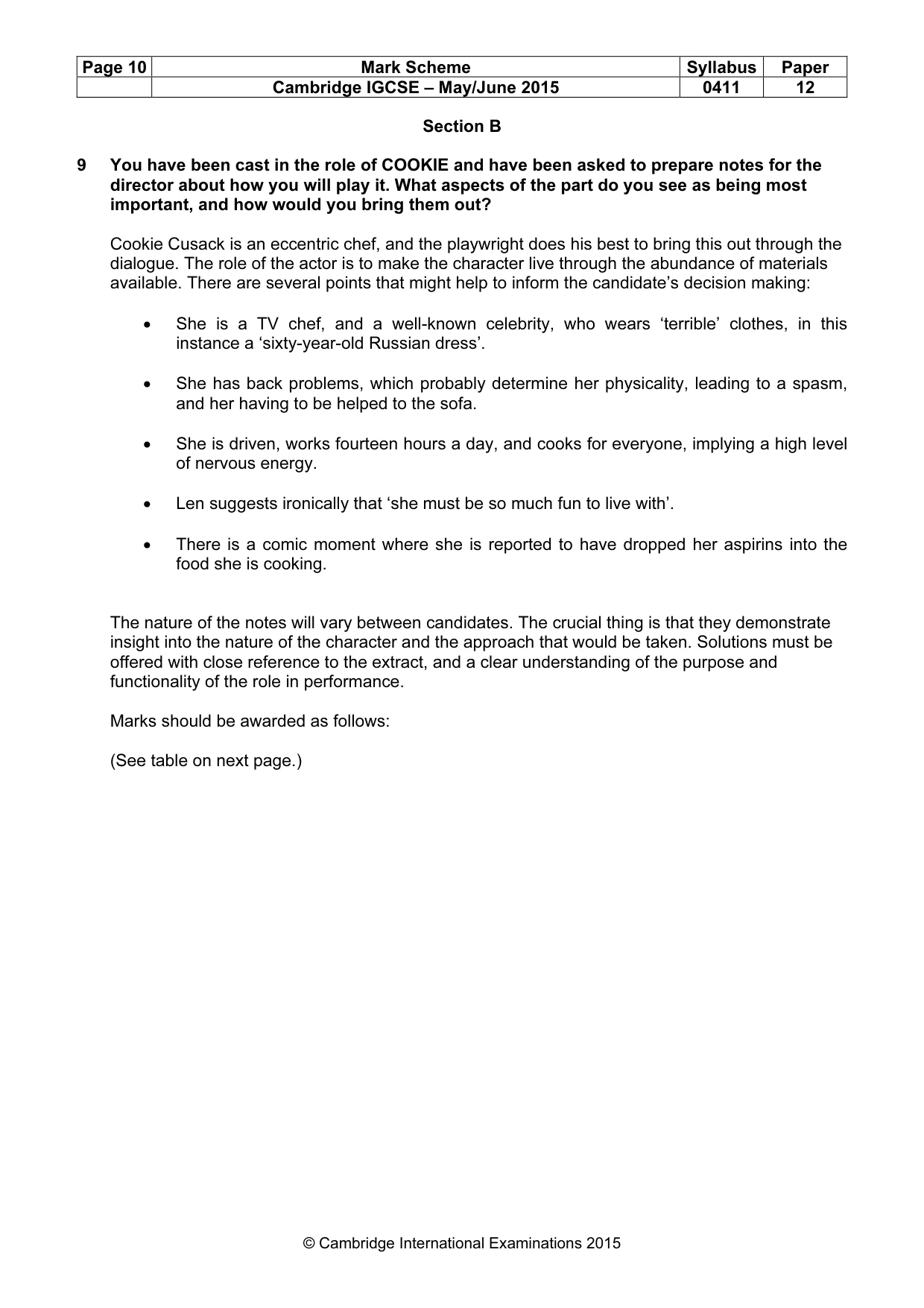
Page 10 Mark Scheme Syllabus Paper Cambridge IGCSE – May/June 2015 0411 12 © Cambridge International Examinations 2015 Section B 9 You have been cast in the role of COOKIE and have been asked to prepare notes for the director about how you will play it. What aspects of the part do you see as being most important, and how would you bring them out? Cookie Cusack is an eccentric chef, and the playwright does his best to bring this out through the dialogue. The role of the actor is to make the character live through the abundance of materials available. There are several points that might help to inform the candidate’s decision making: • She is a TV chef, and a well-known celebrity, who wears ‘terrible’ clothes, in this instance a ‘sixty-year-old Russian dress’. • She has back problems, which probably determine her physicality, leading to a spasm, and her having to be helped to the sofa. • She is driven, works fourteen hours a day, and cooks for everyone, implying a high level of nervous energy. • Len suggests ironically that ‘she must be so much fun to live with’. • There is a comic moment where she is reported to have dropped her aspirins into the food she is cooking. The nature of the notes will vary between candidates. The crucial thing is that they demonstrate insight into the nature of the character and the approach that would be taken. Solutions must be offered with close reference to the extract, and a clear understanding of the purpose and functionality of the role in performance. Marks should be awarded as follows: (See table on next page.)
Mark scheme, page 11
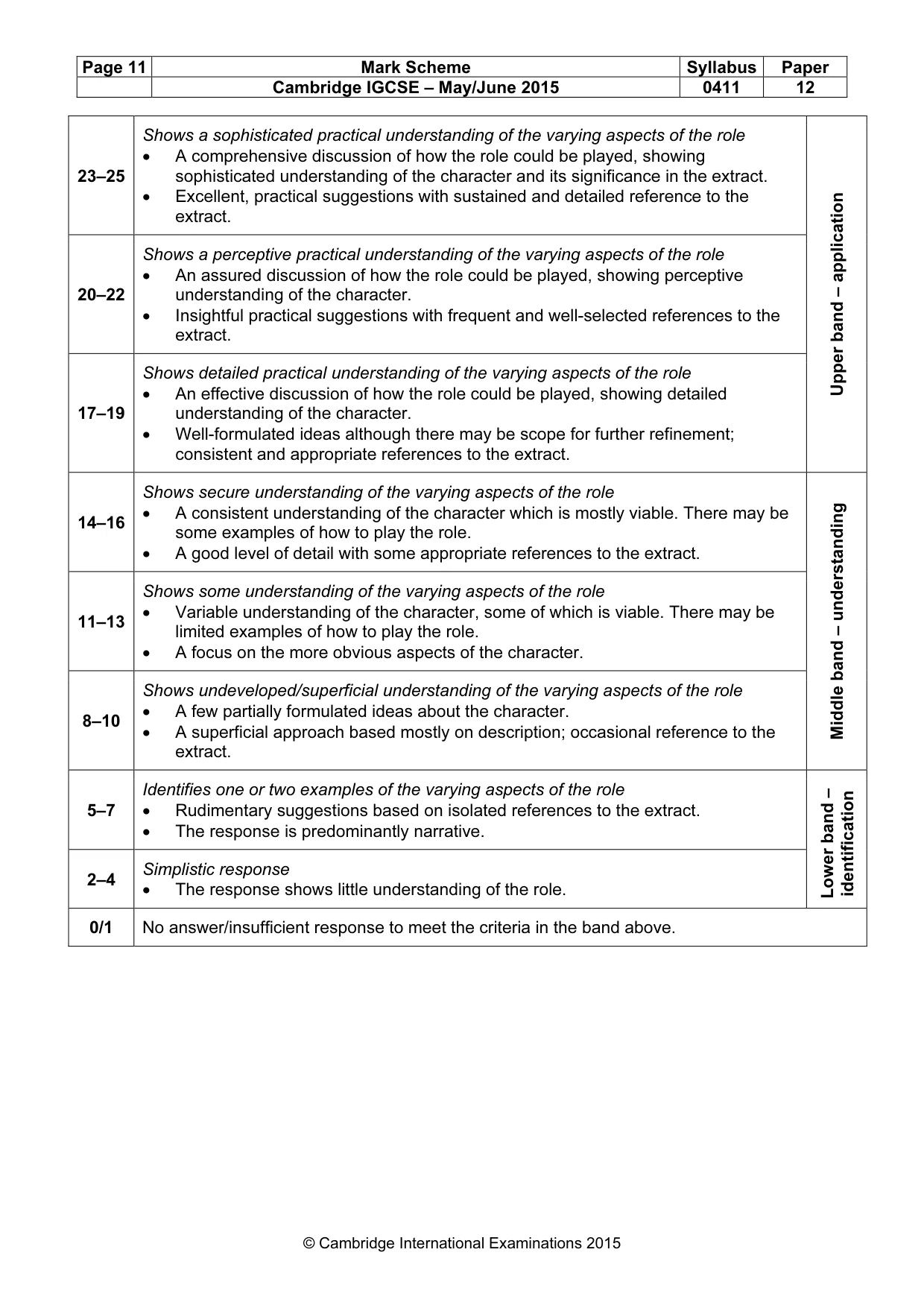
Page 11 Mark Scheme Syllabus Paper Cambridge IGCSE – May/June 2015 0411 12 © Cambridge International Examinations 2015 23–25 Shows a sophisticated practical understanding of the varying aspects of the role • A comprehensive discussion of how the role could be played, showing sophisticated understanding of the character and its significance in the extract. • Excellent, practical suggestions with sustained and detailed reference to the extract. Upper band – application 20–22 Shows a perceptive practical understanding of the varying aspects of the role • An assured discussion of how the role could be played, showing perceptive understanding of the character. • Insightful practical suggestions with frequent and well-selected references to the extract. 17–19 Shows detailed practical understanding of the varying aspects of the role • An effective discussion of how the role could be played, showing detailed understanding of the character. • Well-formulated ideas although there may be scope for further refinement; consistent and appropriate references to the extract. 14–16 Shows secure understanding of the varying aspects of the role • A consistent understanding of the character which is mostly viable. There may be some examples of how to play the role. • A good level of detail with some appropriate references to the extract. Middle band – understanding 11–13 Shows some understanding of the varying aspects of the role • Variable understanding of the character, some of which is viable. There may be limited examples of how to play the role. • A focus on the more obvious aspects of the character. 8–10 Shows undeveloped/superficial understanding of the varying aspects of the role • A few partially formulated ideas about the character. • A superficial approach based mostly on description; occasional reference to the extract. 5–7 Identifies one or two examples of the varying aspects of the role • Rudimentary suggestions based on isolated references to the extract. • The response is predominantly narrative. Lower band – identification 2–4 Simplistic response • The response shows little understanding of the role. 0/1 No answer/insufficient response to meet the criteria in the band above.
Mark scheme, page 12
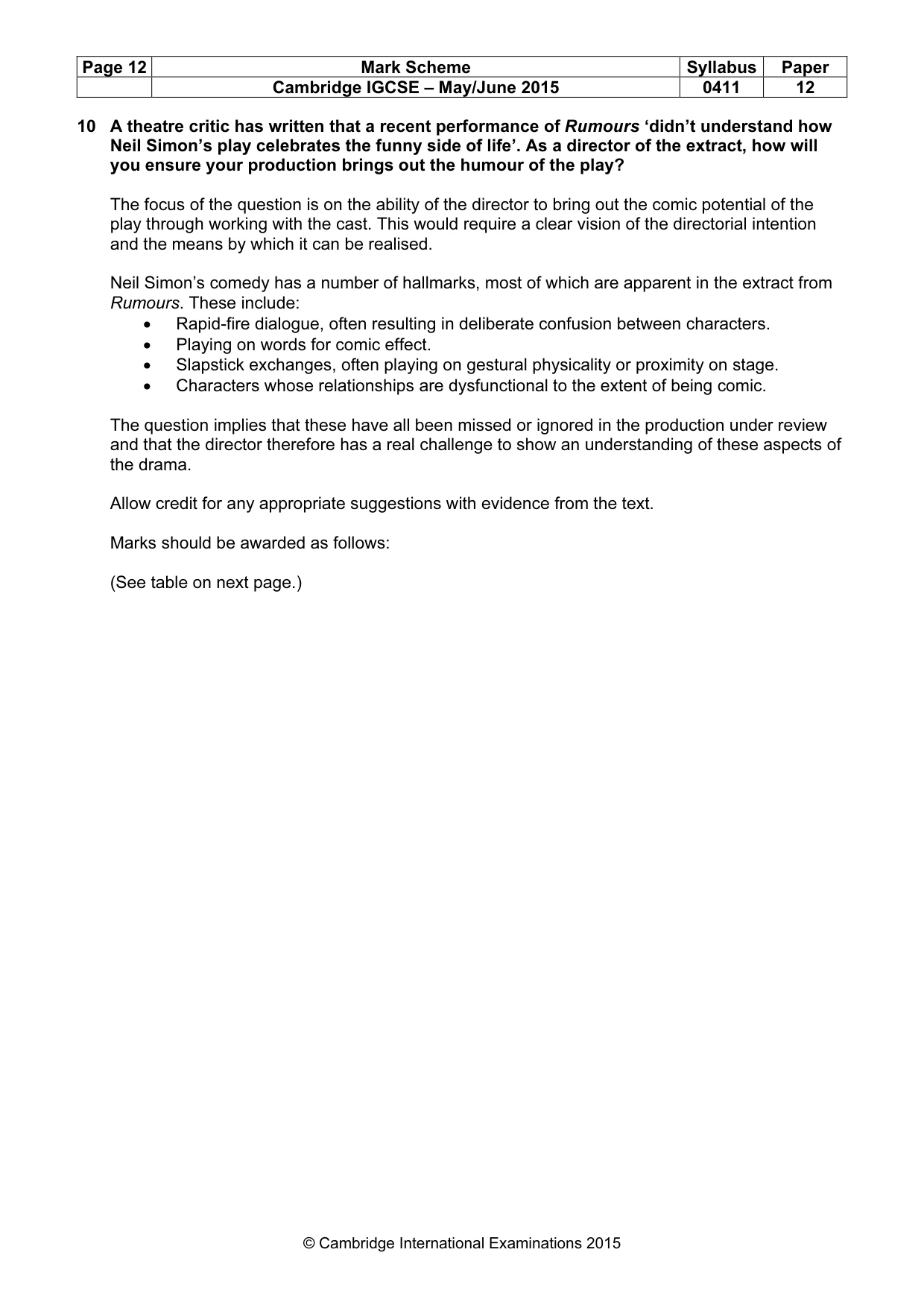
Page 12 Mark Scheme Syllabus Paper Cambridge IGCSE – May/June 2015 0411 12 © Cambridge International Examinations 2015 10 A theatre critic has written that a recent performance of Rumours ‘didn’t understand how Neil Simon’s play celebrates the funny side of life’. As a director of the extract, how will you ensure your production brings out the humour of the play? The focus of the question is on the ability of the director to bring out the comic potential of the play through working with the cast. This would require a clear vision of the directorial intention and the means by which it can be realised. Neil Simon’s comedy has a number of hallmarks, most of which are apparent in the extract from Rumours. These include: • Rapid-fire dialogue, often resulting in deliberate confusion between characters. • Playing on words for comic effect. • Slapstick exchanges, often playing on gestural physicality or proximity on stage. • Characters whose relationships are dysfunctional to the extent of being comic. The question implies that these have all been missed or ignored in the production under review and that the director therefore has a real challenge to show an understanding of these aspects of the drama. Allow credit for any appropriate suggestions with evidence from the text. Marks should be awarded as follows: (See table on next page.)
Mark scheme, page 13
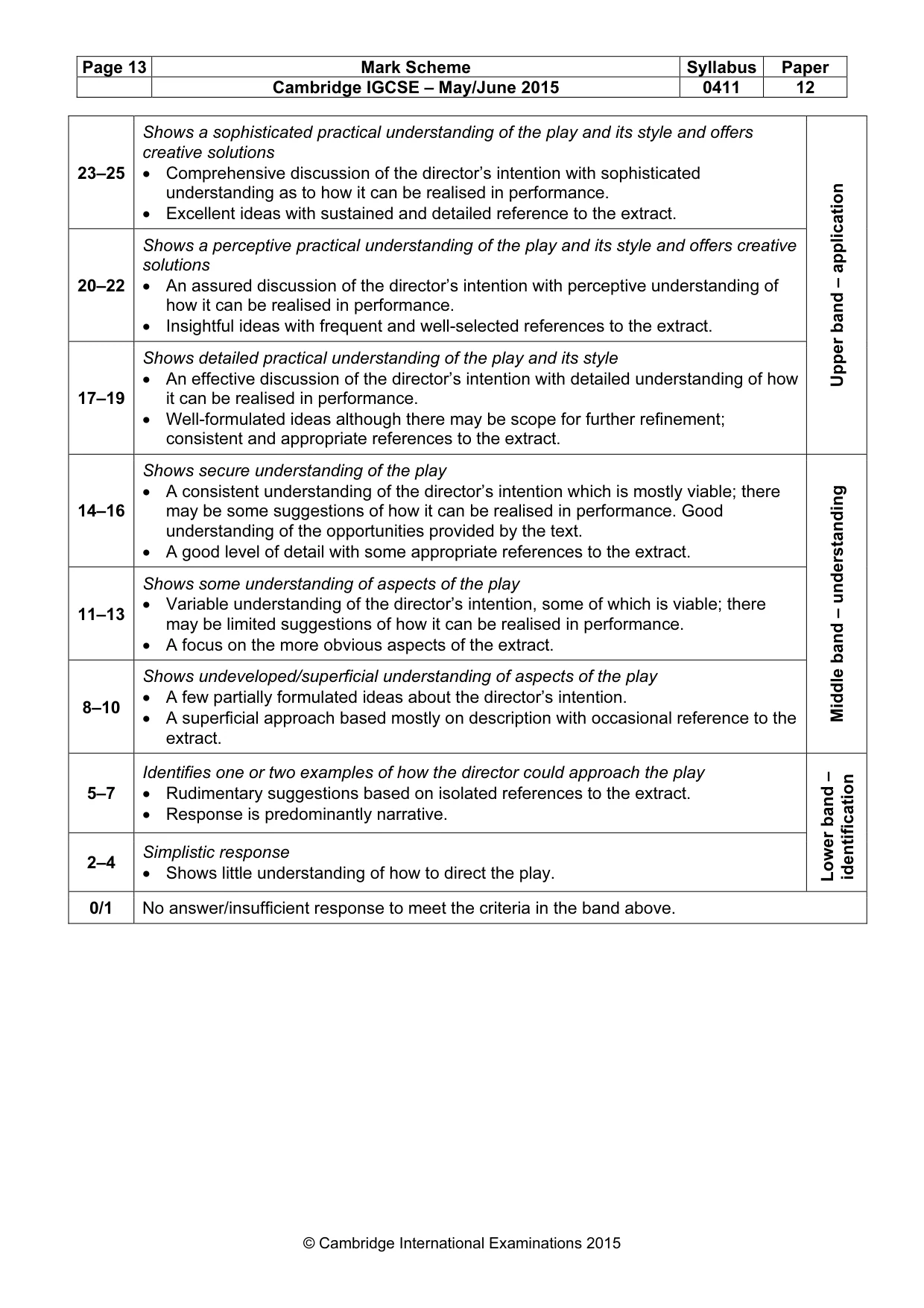
Page 13 Mark Scheme Syllabus Paper Cambridge IGCSE – May/June 2015 0411 12 © Cambridge International Examinations 2015 23–25 Shows a sophisticated practical understanding of the play and its style and offers creative solutions • Comprehensive discussion of the director’s intention with sophisticated understanding as to how it can be realised in performance. • Excellent ideas with sustained and detailed reference to the extract. Upper band – application 20–22 Shows a perceptive practical understanding of the play and its style and offers creative solutions • An assured discussion of the director’s intention with perceptive understanding of how it can be realised in performance. • Insightful ideas with frequent and well-selected references to the extract. 17–19 Shows detailed practical understanding of the play and its style • An effective discussion of the director’s intention with detailed understanding of how it can be realised in performance. • Well-formulated ideas although there may be scope for further refinement; consistent and appropriate references to the extract. 14–16 Shows secure understanding of the play • A consistent understanding of the director’s intention which is mostly viable; there may be some suggestions of how it can be realised in performance. Good understanding of the opportunities provided by the text. • A good level of detail with some appropriate references to the extract. Middle band – understanding 11–13 Shows some understanding of aspects of the play • Variable understanding of the director’s intention, some of which is viable; there may be limited suggestions of how it can be realised in performance. • A focus on the more obvious aspects of the extract. 8–10 Shows undeveloped/superficial understanding of aspects of the play • A few partially formulated ideas about the director’s intention. • A superficial approach based mostly on description with occasional reference to the extract. 5–7 Identifies one or two examples of how the director could approach the play • Rudimentary suggestions based on isolated references to the extract. • Response is predominantly narrative. Lower band – identification 2–4 Simplistic response • Shows little understanding of how to direct the play. 0/1 No answer/insufficient response to meet the criteria in the band above.
Mark scheme, page 14
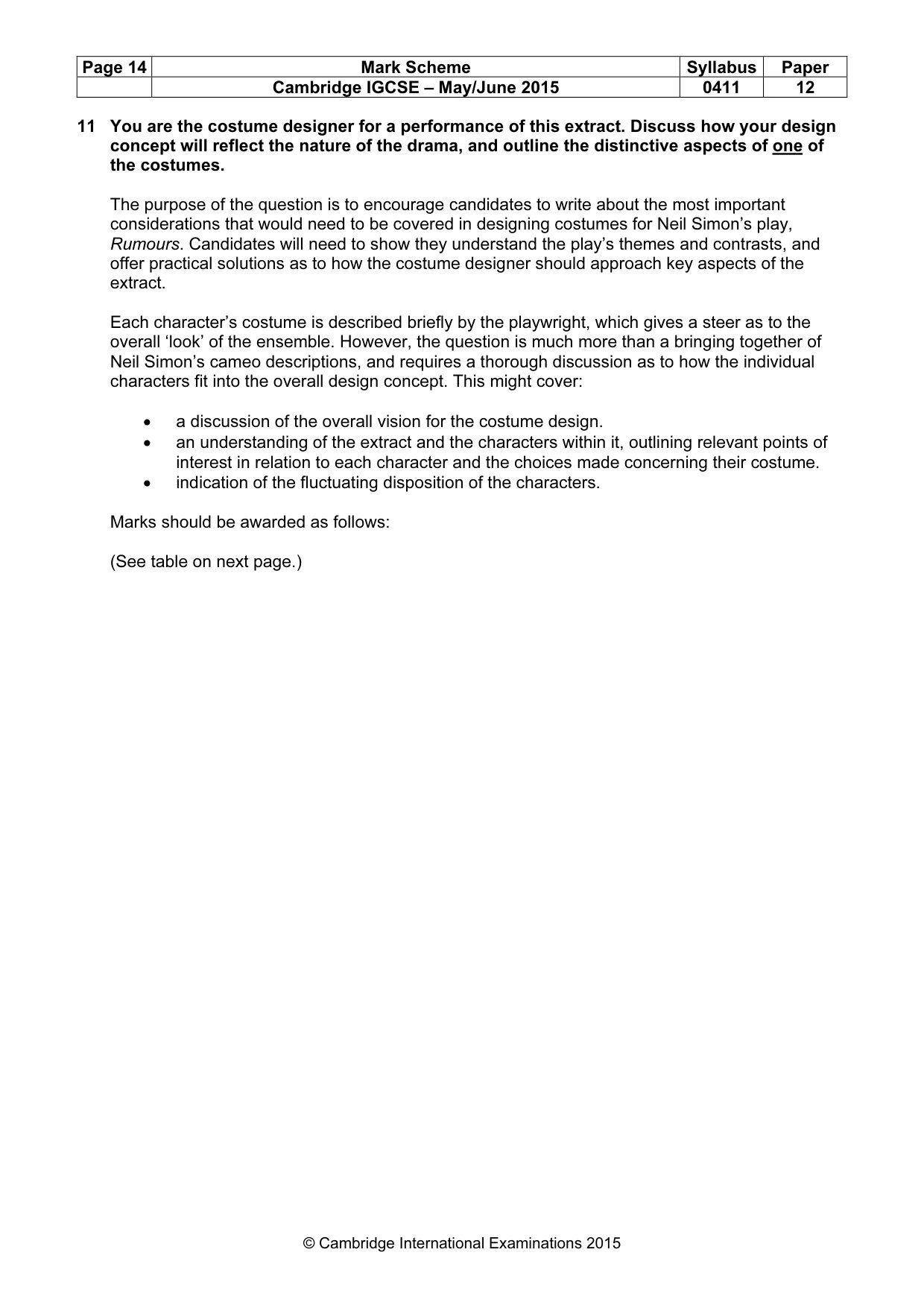
Page 14 Mark Scheme Syllabus Paper Cambridge IGCSE – May/June 2015 0411 12 © Cambridge International Examinations 2015 11 You are the costume designer for a performance of this extract. Discuss how your design concept will reflect the nature of the drama, and outline the distinctive aspects of one of the costumes. The purpose of the question is to encourage candidates to write about the most important considerations that would need to be covered in designing costumes for Neil Simon’s play, Rumours. Candidates will need to show they understand the play’s themes and contrasts, and offer practical solutions as to how the costume designer should approach key aspects of the extract. Each character’s costume is described briefly by the playwright, which gives a steer as to the overall ‘look’ of the ensemble. However, the question is much more than a bringing together of Neil Simon’s cameo descriptions, and requires a thorough discussion as to how the individual characters fit into the overall design concept. This might cover: • a discussion of the overall vision for the costume design. • an understanding of the extract and the characters within it, outlining relevant points of interest in relation to each character and the choices made concerning their costume. • indication of the fluctuating disposition of the characters. Marks should be awarded as follows: (See table on next page.)
Mark scheme, page 15
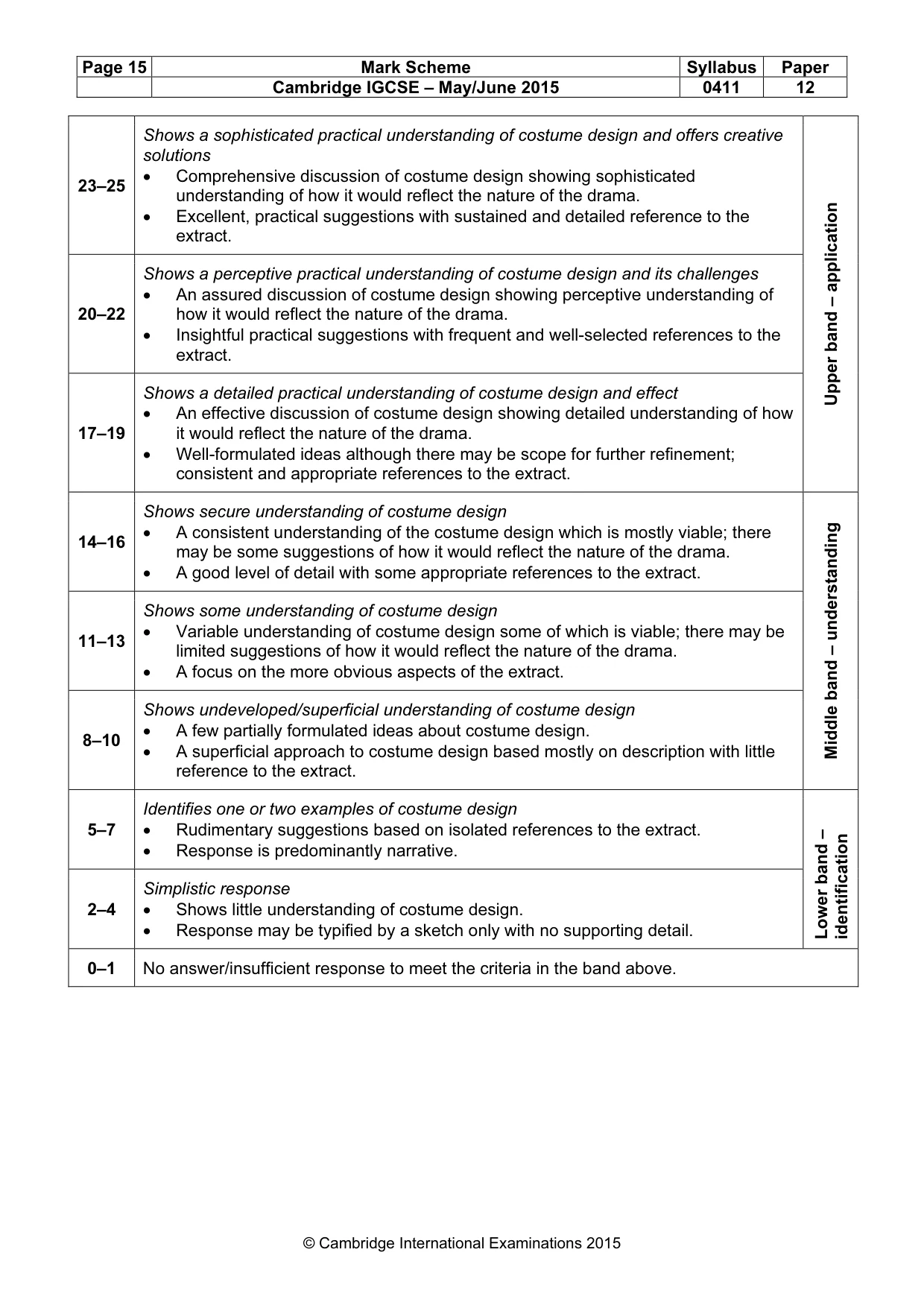
Page 15 Mark Scheme Syllabus Paper Cambridge IGCSE – May/June 2015 0411 12 © Cambridge International Examinations 2015 23–25 Shows a sophisticated practical understanding of costume design and offers creative solutions • Comprehensive discussion of costume design showing sophisticated understanding of how it would reflect the nature of the drama. • Excellent, practical suggestions with sustained and detailed reference to the extract. Upper band – application 20–22 Shows a perceptive practical understanding of costume design and its challenges • An assured discussion of costume design showing perceptive understanding of how it would reflect the nature of the drama. • Insightful practical suggestions with frequent and well-selected references to the extract. 17–19 Shows a detailed practical understanding of costume design and effect • An effective discussion of costume design showing detailed understanding of how it would reflect the nature of the drama. • Well-formulated ideas although there may be scope for further refinement; consistent and appropriate references to the extract. 14–16 Shows secure understanding of costume design • A consistent understanding of the costume design which is mostly viable; there may be some suggestions of how it would reflect the nature of the drama. • A good level of detail with some appropriate references to the extract. Middle band – understanding 11–13 Shows some understanding of costume design • Variable understanding of costume design some of which is viable; there may be limited suggestions of how it would reflect the nature of the drama. • A focus on the more obvious aspects of the extract. 8–10 Shows undeveloped/superficial understanding of costume design • A few partially formulated ideas about costume design. • A superficial approach to costume design based mostly on description with little reference to the extract. 5–7 Identifies one or two examples of costume design • Rudimentary suggestions based on isolated references to the extract. • Response is predominantly narrative. Lower band – identification 2–4 Simplistic response • Shows little understanding of costume design. • Response may be typified by a sketch only with no supporting detail. 0–1 No answer/insufficient response to meet the criteria in the band above.
Mark scheme, page 16
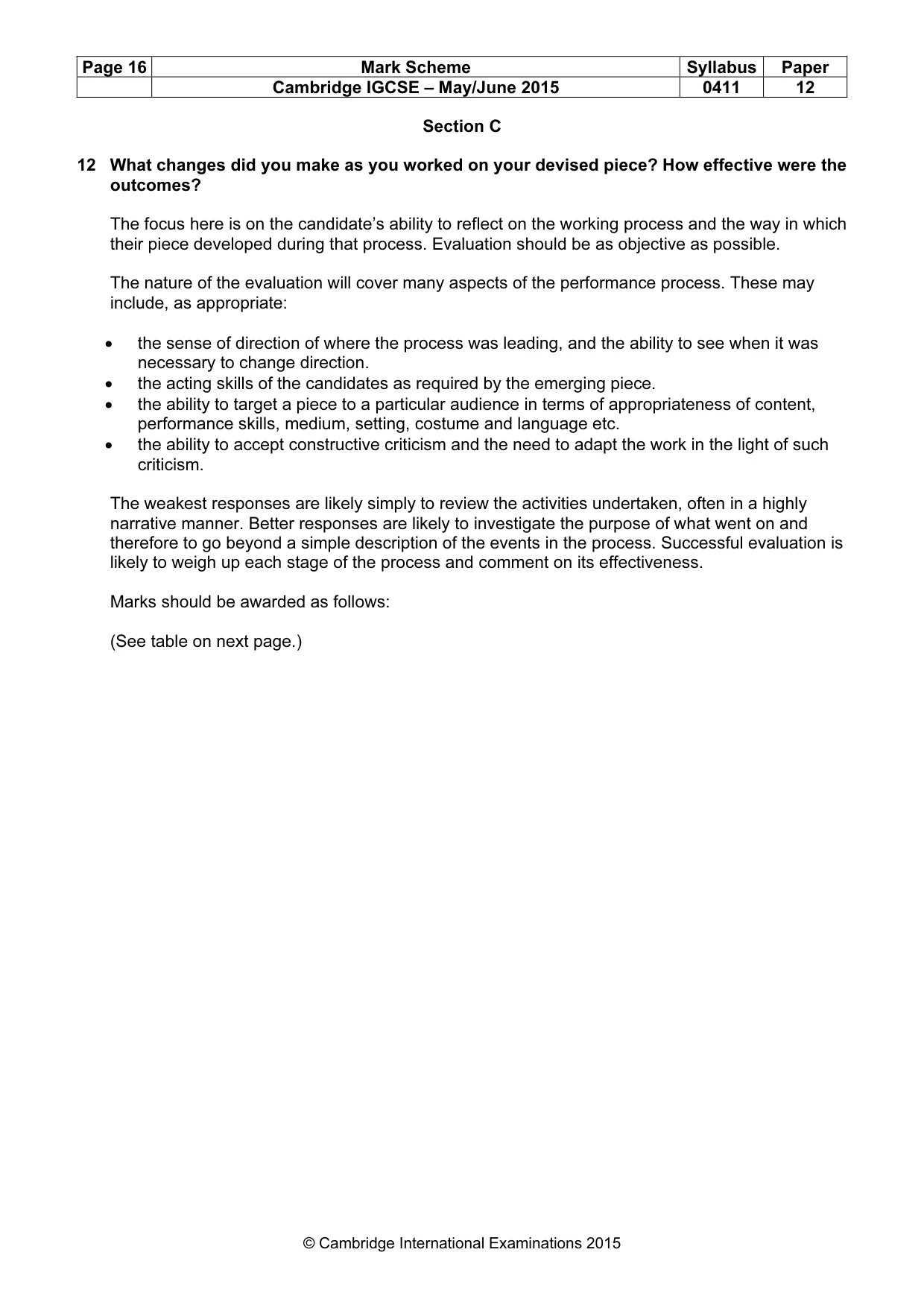
Page 16 Mark Scheme Syllabus Paper Cambridge IGCSE – May/June 2015 0411 12 © Cambridge International Examinations 2015 Section C 12 What changes did you make as you worked on your devised piece? How effective were the outcomes? The focus here is on the candidate’s ability to reflect on the working process and the way in which their piece developed during that process. Evaluation should be as objective as possible. The nature of the evaluation will cover many aspects of the performance process. These may include, as appropriate: • the sense of direction of where the process was leading, and the ability to see when it was necessary to change direction. • the acting skills of the candidates as required by the emerging piece. • the ability to target a piece to a particular audience in terms of appropriateness of content, performance skills, medium, setting, costume and language etc. • the ability to accept constructive criticism and the need to adapt the work in the light of such criticism. The weakest responses are likely simply to review the activities undertaken, often in a highly narrative manner. Better responses are likely to investigate the purpose of what went on and therefore to go beyond a simple description of the events in the process. Successful evaluation is likely to weigh up each stage of the process and comment on its effectiveness. Marks should be awarded as follows: (See table on next page.)
Mark scheme, page 17
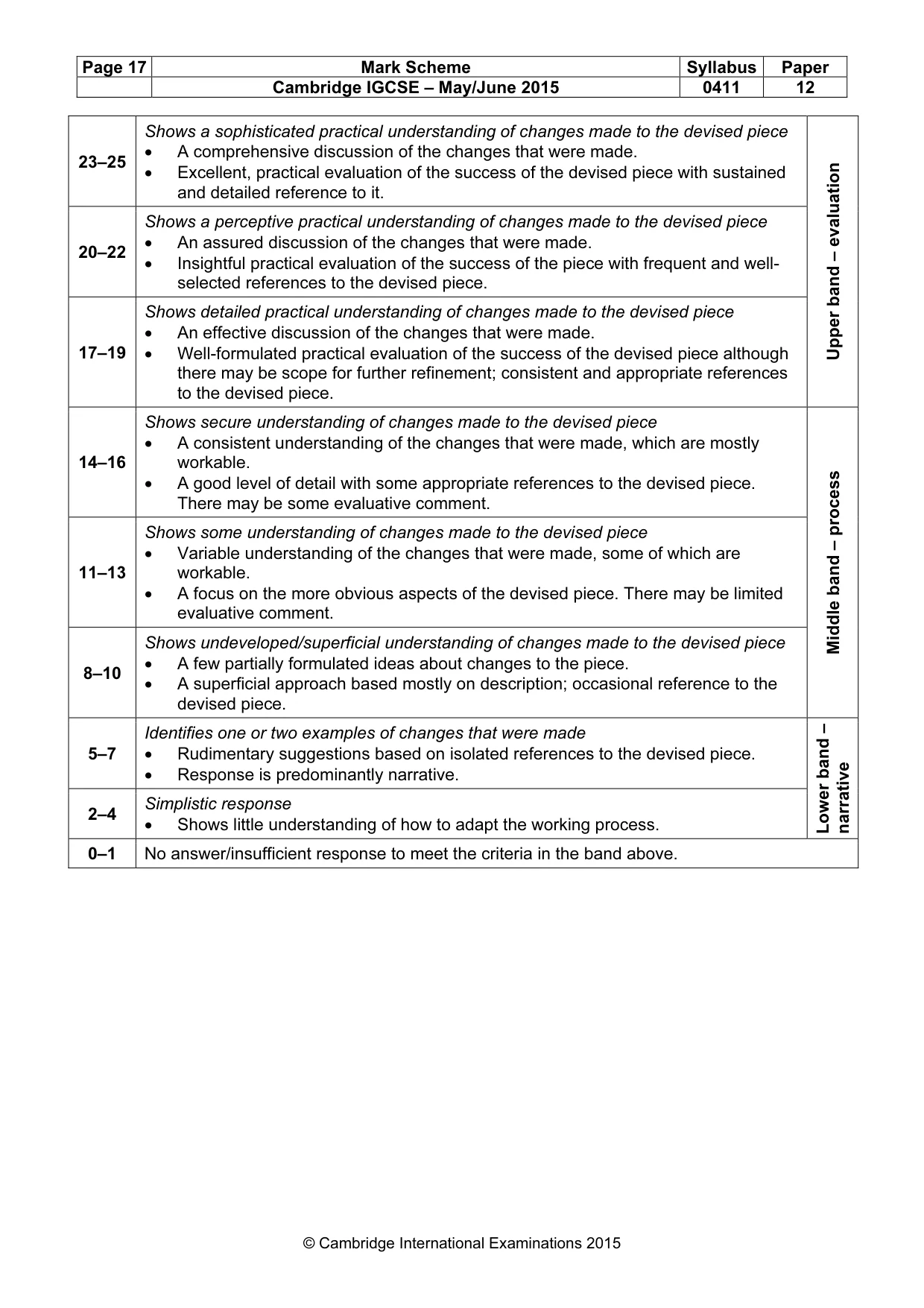
Page 17 Mark Scheme Syllabus Paper Cambridge IGCSE – May/June 2015 0411 12 © Cambridge International Examinations 2015 23–25 Shows a sophisticated practical understanding of changes made to the devised piece • A comprehensive discussion of the changes that were made. • Excellent, practical evaluation of the success of the devised piece with sustained and detailed reference to it. Upper band – evaluation 20–22 Shows a perceptive practical understanding of changes made to the devised piece • An assured discussion of the changes that were made. • Insightful practical evaluation of the success of the piece with frequent and well- selected references to the devised piece. 17–19 Shows detailed practical understanding of changes made to the devised piece • An effective discussion of the changes that were made. • Well-formulated practical evaluation of the success of the devised piece although there may be scope for further refinement; consistent and appropriate references to the devised piece. 14–16 Shows secure understanding of changes made to the devised piece • A consistent understanding of the changes that were made, which are mostly workable. • A good level of detail with some appropriate references to the devised piece. There may be some evaluative comment. Middle band – process 11–13 Shows some understanding of changes made to the devised piece • Variable understanding of the changes that were made, some of which are workable. • A focus on the more obvious aspects of the devised piece. There may be limited evaluative comment. 8–10 Shows undeveloped/superficial understanding of changes made to the devised piece • A few partially formulated ideas about changes to the piece. • A superficial approach based mostly on description; occasional reference to the devised piece. 5–7 Identifies one or two examples of changes that were made • Rudimentary suggestions based on isolated references to the devised piece. • Response is predominantly narrative. Lower band – narrative 2–4 Simplistic response • Shows little understanding of how to adapt the working process. 0–1 No answer/insufficient response to meet the criteria in the band above.
Mark scheme, page 18
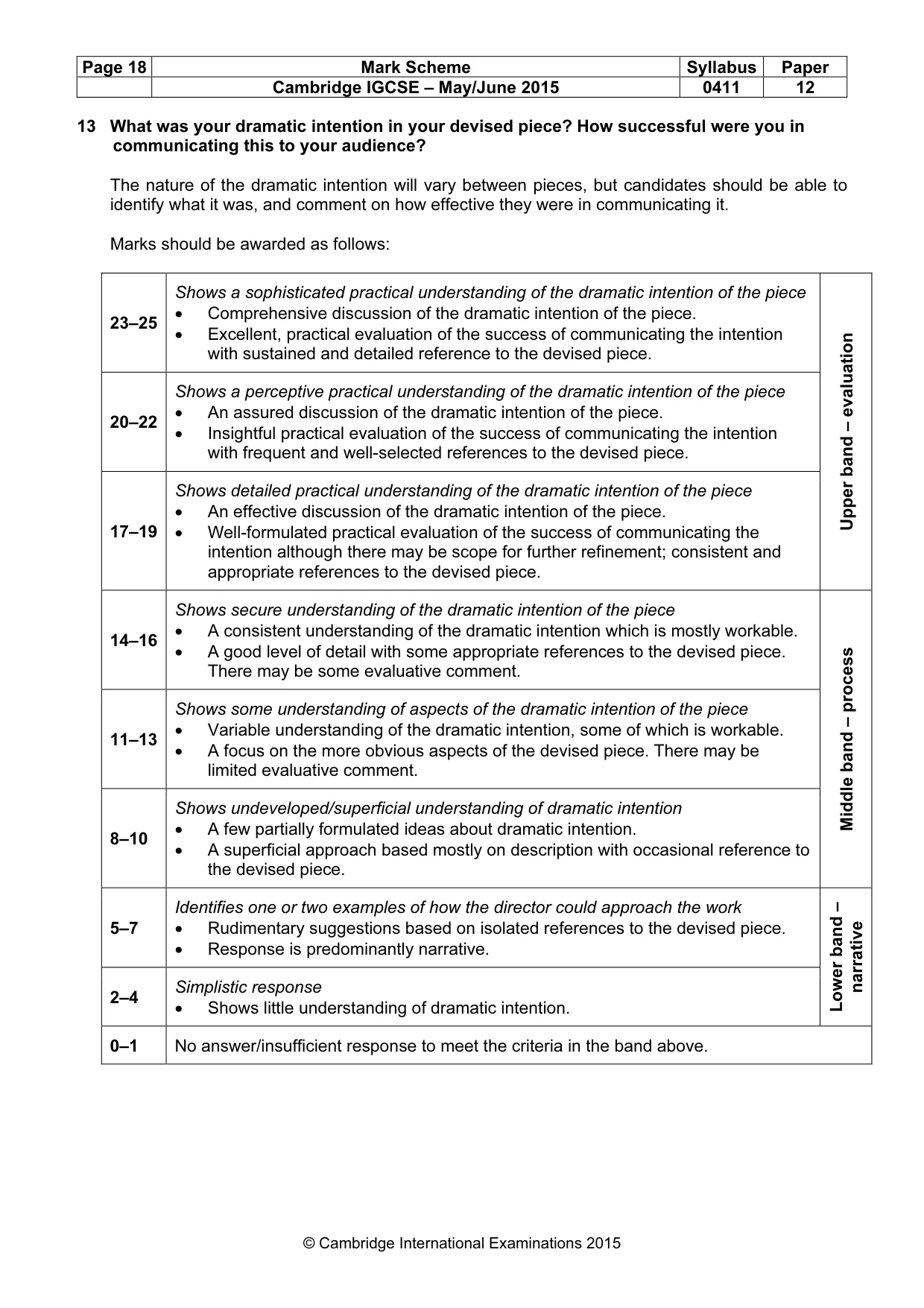
Page 18 Mark Scheme Syllabus Paper Cambridge IGCSE – May/June 2015 0411 12 © Cambridge International Examinations 2015 13 What was your dramatic intention in your devised piece? How successful were you in communicating this to your audience? The nature of the dramatic intention will vary between pieces, but candidates should be able to identify what it was, and comment on how effective they were in communicating it. Marks should be awarded as follows: 23–25 Shows a sophisticated practical understanding of the dramatic intention of the piece • Comprehensive discussion of the dramatic intention of the piece. • Excellent, practical evaluation of the success of communicating the intention with sustained and detailed reference to the devised piece. Upper band – evaluation 20–22 Shows a perceptive practical understanding of the dramatic intention of the piece • An assured discussion of the dramatic intention of the piece. • Insightful practical evaluation of the success of communicating the intention with frequent and well-selected references to the devised piece. 17–19 Shows detailed practical understanding of the dramatic intention of the piece • An effective discussion of the dramatic intention of the piece. • Well-formulated practical evaluation of the success of communicating the intention although there may be scope for further refinement; consistent and appropriate references to the devised piece. 14–16 Shows secure understanding of the dramatic intention of the piece • A consistent understanding of the dramatic intention which is mostly workable. • A good level of detail with some appropriate references to the devised piece. There may be some evaluative comment. Middle band – process 11–13 Shows some understanding of aspects of the dramatic intention of the piece • Variable understanding of the dramatic intention, some of which is workable. • A focus on the more obvious aspects of the devised piece. There may be limited evaluative comment. 8–10 Shows undeveloped/superficial understanding of dramatic intention • A few partially formulated ideas about dramatic intention. • A superficial approach based mostly on description with occasional reference to the devised piece. 5–7 Identifies one or two examples of how the director could approach the work • Rudimentary suggestions based on isolated references to the devised piece. • Response is predominantly narrative. Lower band – narrative 2–4 Simplistic response • Shows little understanding of dramatic intention. 0–1 No answer/insufficient response to meet the criteria in the band above.
Mark scheme, page 19
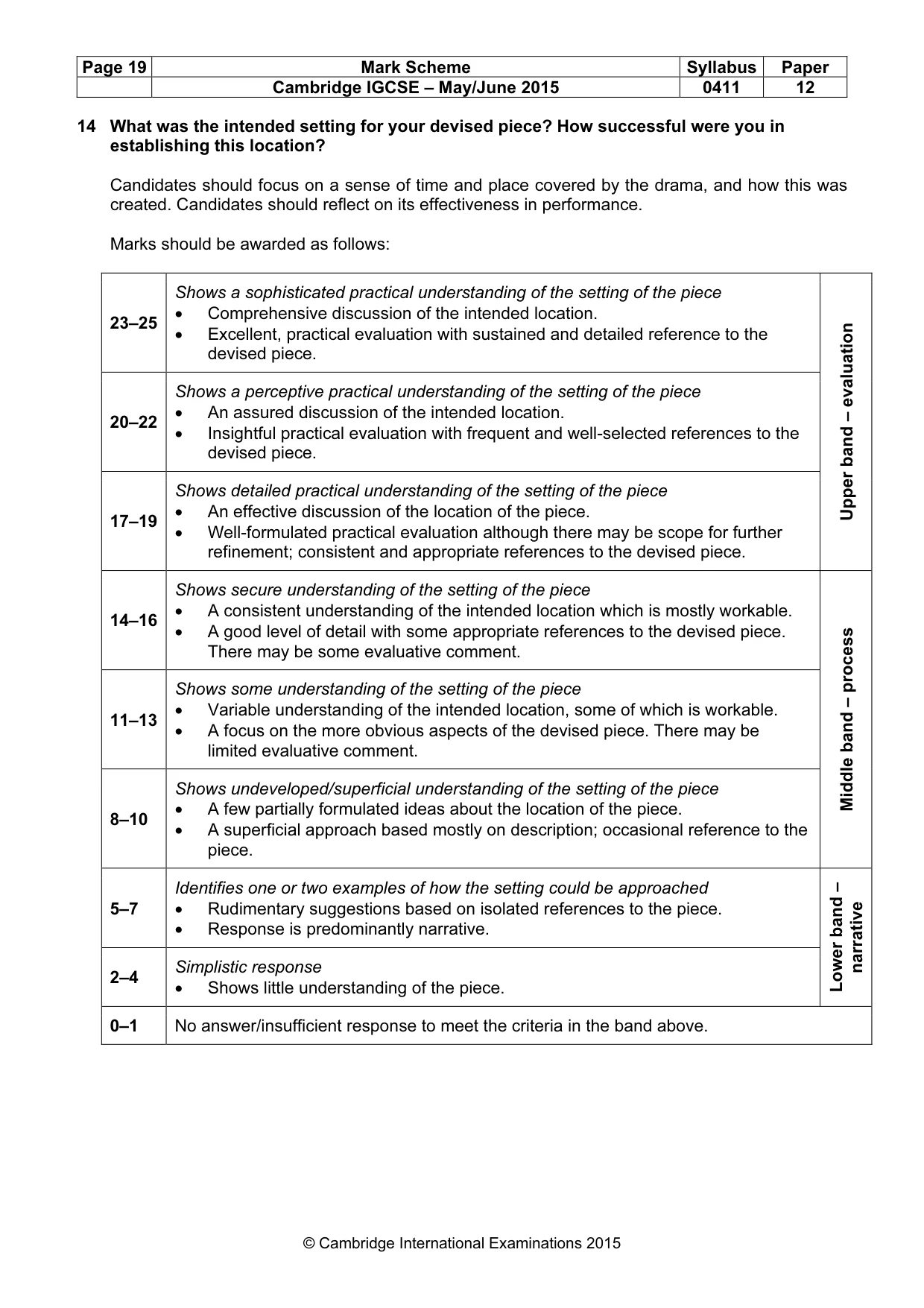
Page 19 Mark Scheme Syllabus Paper Cambridge IGCSE – May/June 2015 0411 12 © Cambridge International Examinations 2015 14 What was the intended setting for your devised piece? How successful were you in establishing this location? Candidates should focus on a sense of time and place covered by the drama, and how this was created. Candidates should reflect on its effectiveness in performance. Marks should be awarded as follows: 23–25 Shows a sophisticated practical understanding of the setting of the piece • Comprehensive discussion of the intended location. • Excellent, practical evaluation with sustained and detailed reference to the devised piece. Upper band – evaluation 20–22 Shows a perceptive practical understanding of the setting of the piece • An assured discussion of the intended location. • Insightful practical evaluation with frequent and well-selected references to the devised piece. 17–19 Shows detailed practical understanding of the setting of the piece • An effective discussion of the location of the piece. • Well-formulated practical evaluation although there may be scope for further refinement; consistent and appropriate references to the devised piece. 14–16 Shows secure understanding of the setting of the piece • A consistent understanding of the intended location which is mostly workable. • A good level of detail with some appropriate references to the devised piece. There may be some evaluative comment. Middle band – process 11–13 Shows some understanding of the setting of the piece • Variable understanding of the intended location, some of which is workable. • A focus on the more obvious aspects of the devised piece. There may be limited evaluative comment. 8–10 Shows undeveloped/superficial understanding of the setting of the piece • A few partially formulated ideas about the location of the piece. • A superficial approach based mostly on description; occasional reference to the piece. 5–7 Identifies one or two examples of how the setting could be approached • Rudimentary suggestions based on isolated references to the piece. • Response is predominantly narrative. Lower band – narrative 2–4 Simplistic response • Shows little understanding of the piece. 0–1 No answer/insufficient response to meet the criteria in the band above.
What you needed in this session
Cambridge’s own grade thresholds for 2015 May/June, Paper 1 · Variant 2. A higher threshold means an easier paper — the bar moves with how the cohort did.