Cambridge IGCSE Drama 0411 — 2015 May/June Paper 1 · Variant 3
0411/13/M/J/15 · 80 marks · ≈90 min
The question paper and its mark scheme, free to read here and free to download. This is Cambridge’s own paper, exactly as it was sat.
Question paper4 pages

Mark scheme18 pages
Answers below. Sit the paper first if you are practising.
Paper as text
Question paper, page 1
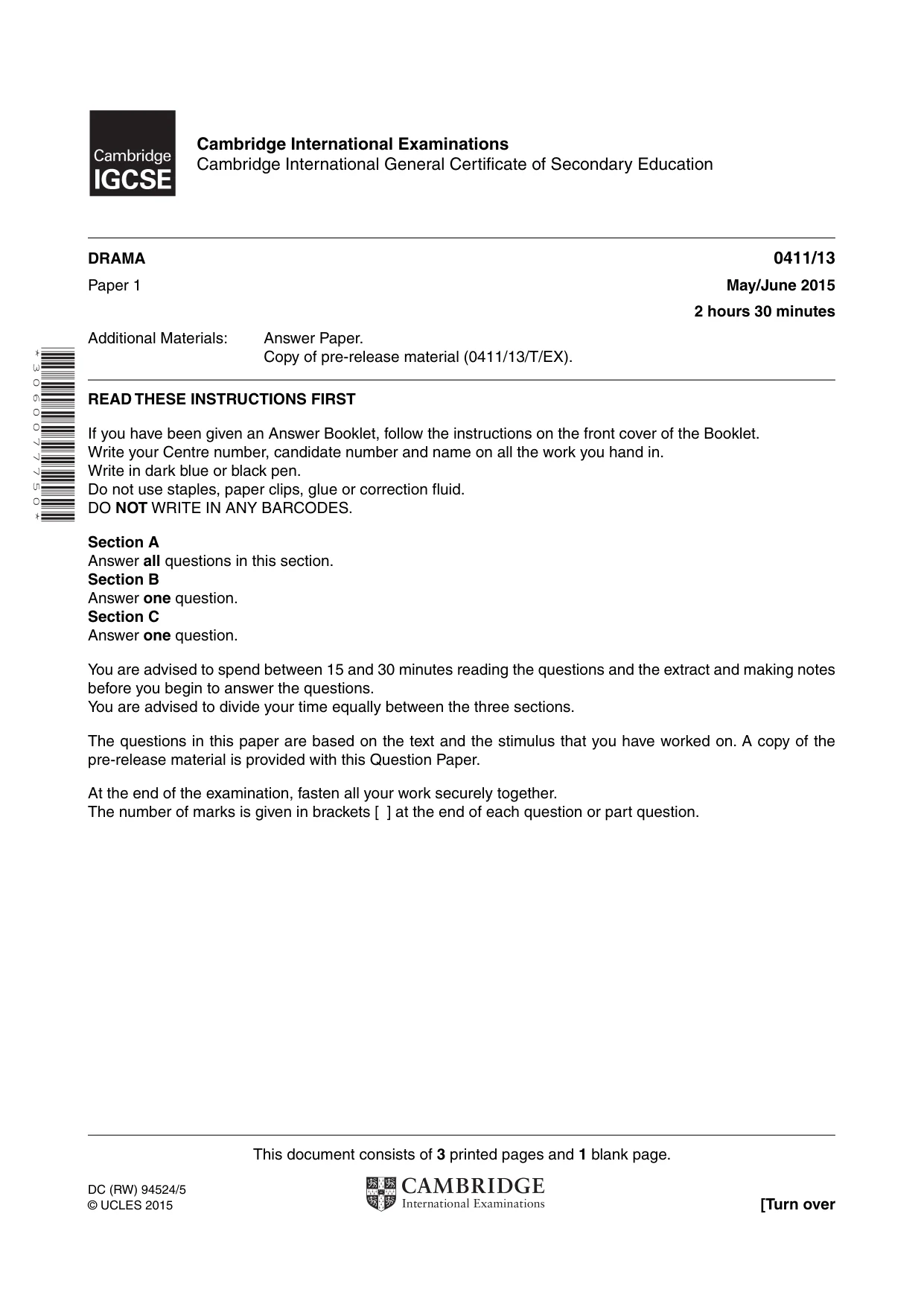
This document consists of 3 printed pages and 1 blank page. DC (RW) 94524/5 © UCLES 2015 [Turn over Cambridge International Examinations Cambridge International General Certificate of Secondary Education * 3 0 6 0 0 7 7 7 5 0 * DRAMA 0411/13 Paper 1 May/June 2015 2 hours 30 minutes Additional Materials: Answer Paper. Copy of pre-release material (0411/13/T/EX). READ THESE INSTRUCTIONS FIRST If you have been given an Answer Booklet, follow the instructions on the front cover of the Booklet. Write your Centre number, candidate number and name on all the work you hand in. Write in dark blue or black pen. Do not use staples, paper clips, glue or correction fluid. DO NOT WRITE IN ANY BARCODES. Section A Answer all questions in this section. Section B Answer one question. Section C Answer one question. You are advised to spend between 15 and 30 minutes reading the questions and the extract and making notes before you begin to answer the questions. You are advised to divide your time equally between the three sections. The questions in this paper are based on the text and the stimulus that you have worked on. A copy of the pre-release material is provided with this Question Paper. At the end of the examination, fasten all your work securely together. The number of marks is given in brackets [ ] at the end of each question or part question.
Question paper, page 2
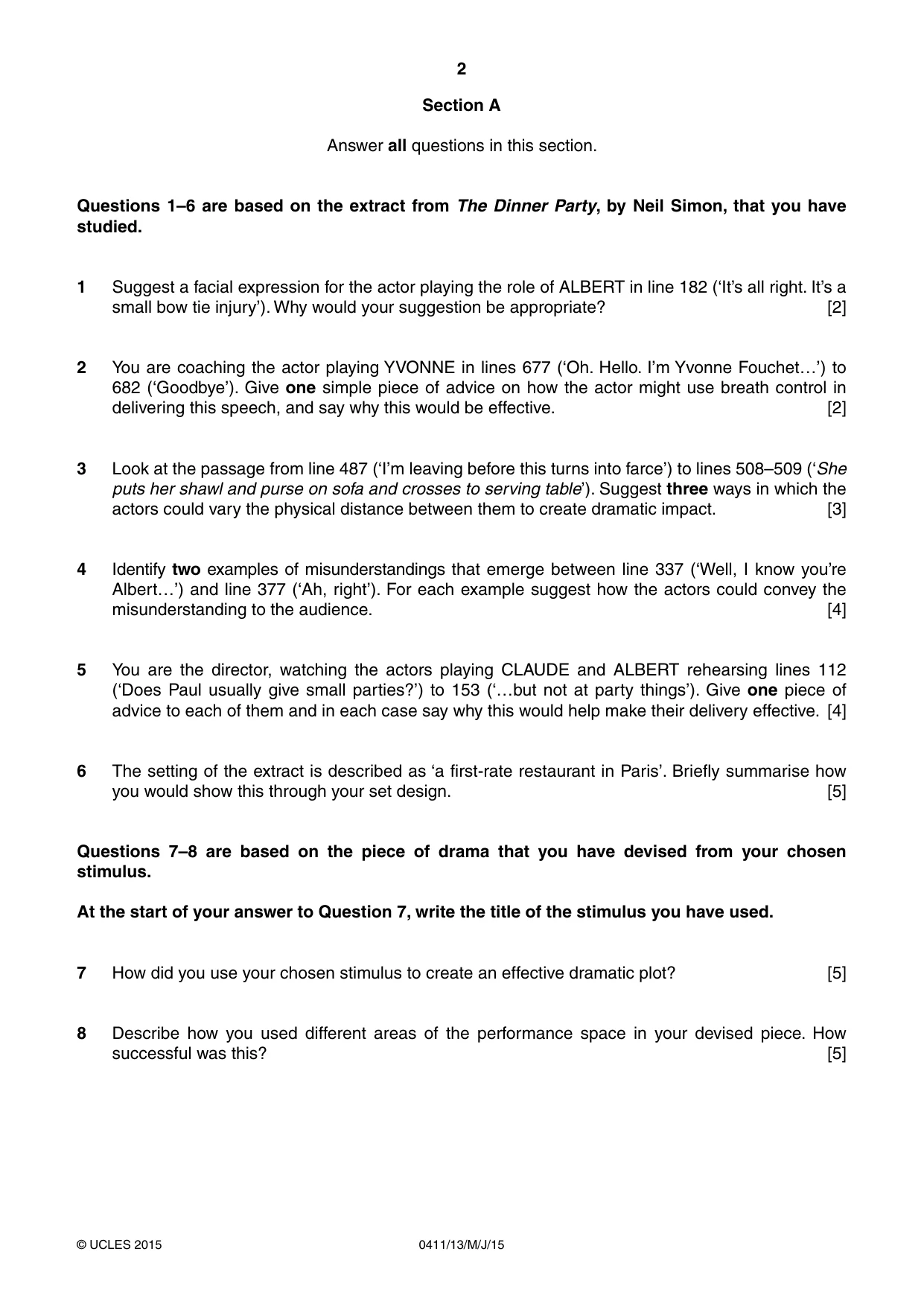
2 0411/13/M/J/15 © UCLES 2015 Section A Answer all questions in this section. Questions 1–6 are based on the extract from The Dinner Party, by Neil Simon, that you have studied. 1 Suggest a facial expression for the actor playing the role of ALBERT in line 182 (‘It’s all right. It’s a small bow tie injury’). Why would your suggestion be appropriate? [2] 2 You are coaching the actor playing YVONNE in lines 677 (‘Oh. Hello. I’m Yvonne Fouchet…’) to 682 (‘Goodbye’). Give one simple piece of advice on how the actor might use breath control in delivering this speech, and say why this would be effective. [2] 3 Look at the passage from line 487 (‘I’m leaving before this turns into farce’) to lines 508–509 (‘She puts her shawl and purse on sofa and crosses to serving table’). Suggest three ways in which the actors could vary the physical distance between them to create dramatic impact. [3] 4 Identify two examples of misunderstandings that emerge between line 337 (‘Well, I know you’re Albert…’) and line 377 (‘Ah, right’). For each example suggest how the actors could convey the misunderstanding to the audience. [4] 5 You are the director, watching the actors playing CLAUDE and ALBERT rehearsing lines 112 (‘Does Paul usually give small parties?’) to 153 (‘…but not at party things’). Give one piece of advice to each of them and in each case say why this would help make their delivery effective. [4] 6 The setting of the extract is described as ‘a first-rate restaurant in Paris’. Briefly summarise how you would show this through your set design. [5] Questions 7–8 are based on the piece of drama that you have devised from your chosen stimulus. At the start of your answer to Question 7, write the title of the stimulus you have used. 7 How did you use your chosen stimulus to create an effective dramatic plot? [5] 8 Describe how you used different areas of the performance space in your devised piece. How successful was this? [5]
Question paper, page 3
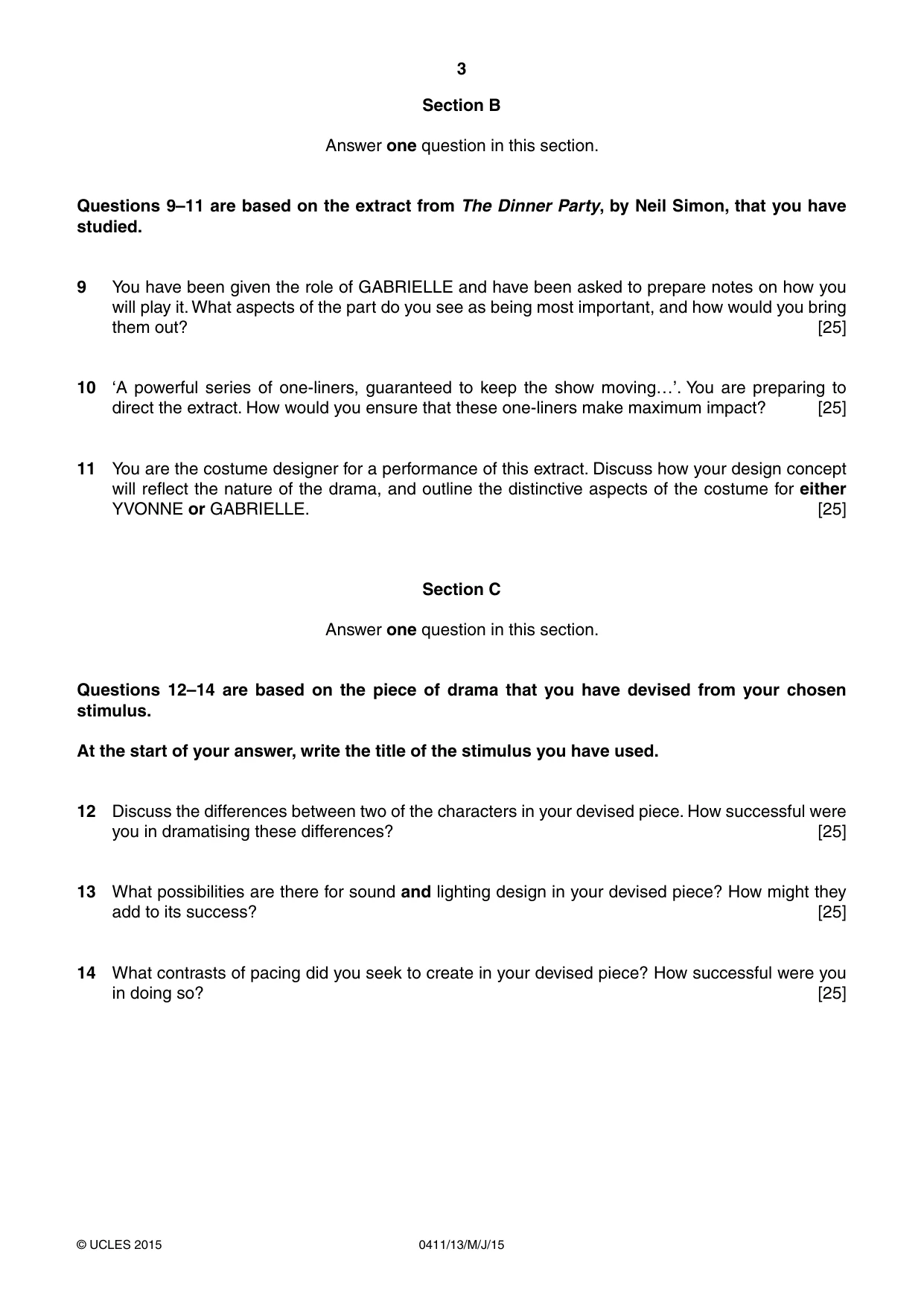
3 0411/13/M/J/15 © UCLES 2015 Section B Answer one question in this section. Questions 9–11 are based on the extract from The Dinner Party, by Neil Simon, that you have studied. 9 You have been given the role of GABRIELLE and have been asked to prepare notes on how you will play it. What aspects of the part do you see as being most important, and how would you bring them out? [25] 10 ‘A powerful series of one-liners, guaranteed to keep the show moving…’. You are preparing to direct the extract. How would you ensure that these one-liners make maximum impact? [25] 11 You are the costume designer for a performance of this extract. Discuss how your design concept will reflect the nature of the drama, and outline the distinctive aspects of the costume for either YVONNE or GABRIELLE. [25] Section C Answer one question in this section. Questions 12–14 are based on the piece of drama that you have devised from your chosen stimulus. At the start of your answer, write the title of the stimulus you have used. 12 Discuss the differences between two of the characters in your devised piece. How successful were you in dramatising these differences? [25] 13 What possibilities are there for sound and lighting design in your devised piece? How might they add to its success? [25] 14 What contrasts of pacing did you seek to create in your devised piece? How successful were you in doing so? [25]
Question paper, page 4
4 0411/13/M/J/15 © UCLES 2015 BLANK PAGE Permission to reproduce items where third-party owned material protected by copyright is included has been sought and cleared where possible. Every reasonable effort has been made by the publisher (UCLES) to trace copyright holders, but if any items requiring clearance have unwittingly been included, the publisher will be pleased to make amends at the earliest possible opportunity. To avoid the issue of disclosure of answer-related information to candidates, all copyright acknowledgements are reproduced online in the Cambridge International Examinations Copyright Acknowledgements Booklet. This is produced for each series of examinations and is freely available to download at www.cie.org.uk after the live examination series. Cambridge International Examinations is part of the Cambridge Assessment Group. Cambridge Assessment is the brand name of University of Cambridge Local Examinations Syndicate (UCLES), which is itself a department of the University of Cambridge.
Mark scheme, page 1
® IGCSE is the registered trademark of Cambridge International Examinations. CAMBRIDGE INTERNATIONAL EXAMINATIONS Cambridge International General Certificate of Secondary Education MARK SCHEME for the May/June 2015 series 0411 DRAMA 0411/13 Paper 1 (Written Examination), maximum raw mark 80 This mark scheme is published as an aid to teachers and candidates, to indicate the requirements of the examination. It shows the basis on which Examiners were instructed to award marks. It does not indicate the details of the discussions that took place at an Examiners’ meeting before marking began, which would have considered the acceptability of alternative answers. Mark schemes should be read in conjunction with the question paper and the Principal Examiner Report for Teachers. Cambridge will not enter into discussions about these mark schemes. Cambridge is publishing the mark schemes for the May/June 2015 series for most Cambridge IGCSE®, Cambridge International A and AS Level components and some Cambridge O Level components.
Mark scheme, page 2
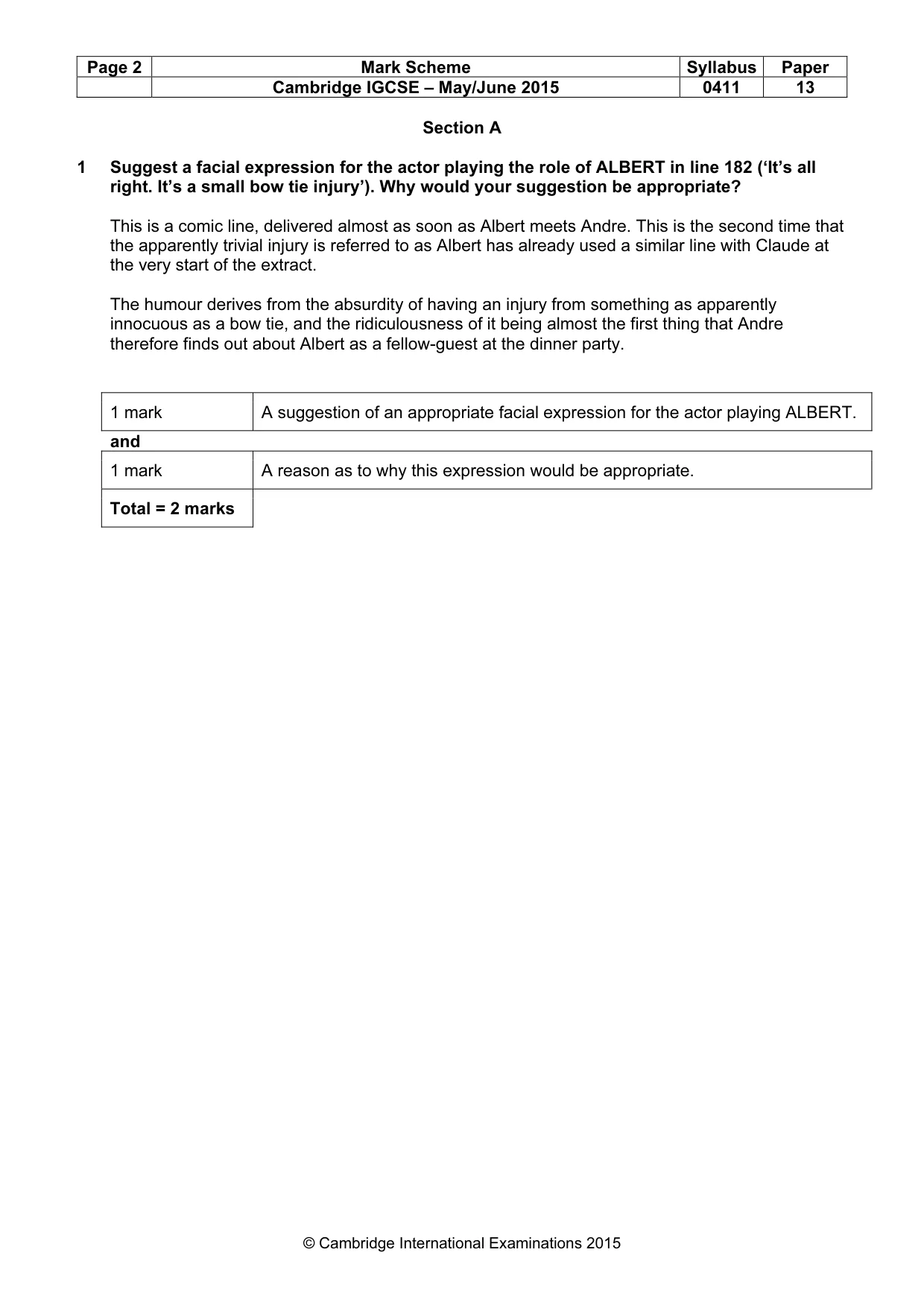
Page 2 Mark Scheme Syllabus Paper Cambridge IGCSE – May/June 2015 0411 13 © Cambridge International Examinations 2015 Section A 1 Suggest a facial expression for the actor playing the role of ALBERT in line 182 (‘It’s all right. It’s a small bow tie injury’). Why would your suggestion be appropriate? This is a comic line, delivered almost as soon as Albert meets Andre. This is the second time that the apparently trivial injury is referred to as Albert has already used a similar line with Claude at the very start of the extract. The humour derives from the absurdity of having an injury from something as apparently innocuous as a bow tie, and the ridiculousness of it being almost the first thing that Andre therefore finds out about Albert as a fellow-guest at the dinner party. 1 mark A suggestion of an appropriate facial expression for the actor playing ALBERT. and 1 mark A reason as to why this expression would be appropriate. Total = 2 marks
Mark scheme, page 3
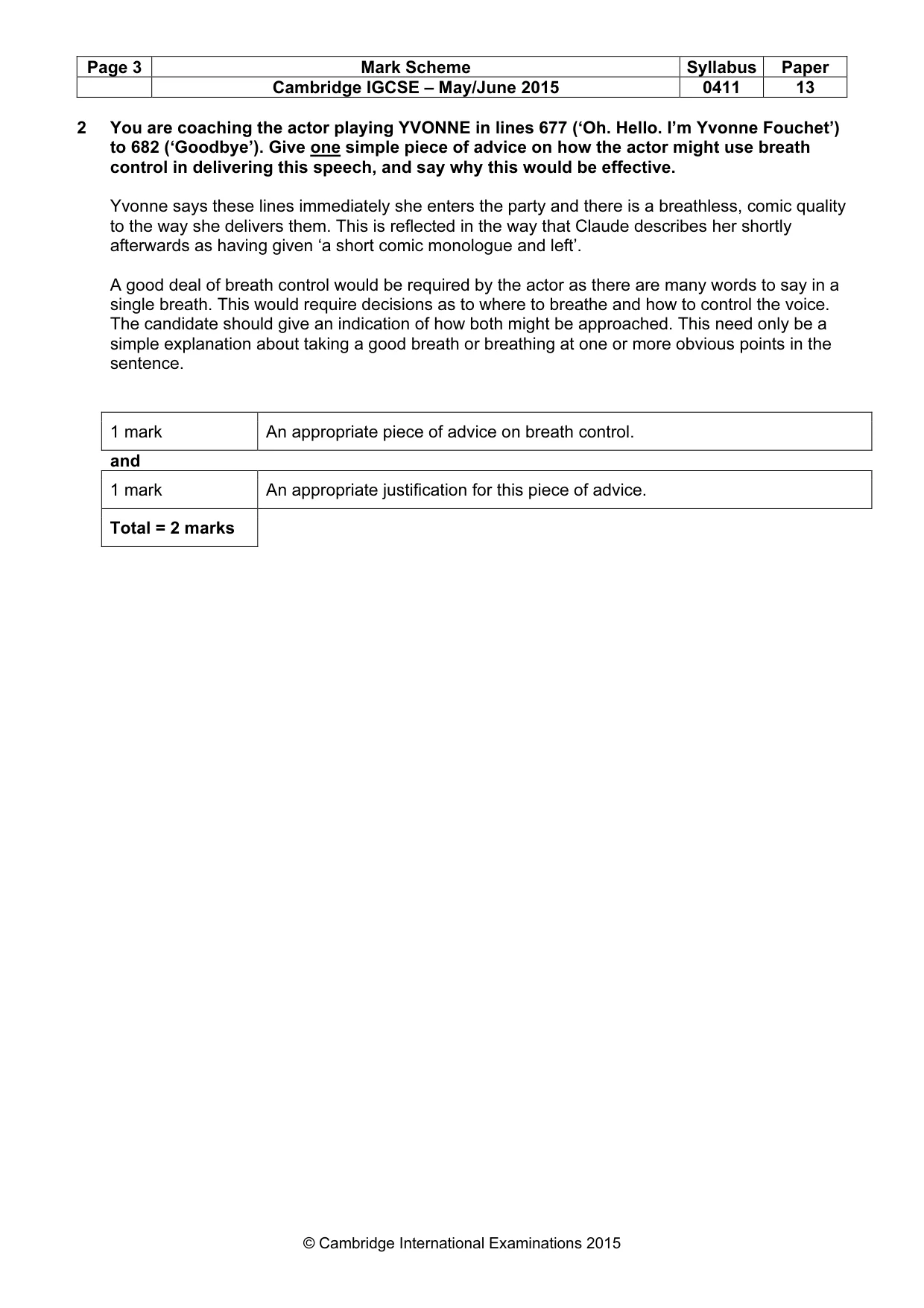
Page 3 Mark Scheme Syllabus Paper Cambridge IGCSE – May/June 2015 0411 13 © Cambridge International Examinations 2015 2 You are coaching the actor playing YVONNE in lines 677 (‘Oh. Hello. I’m Yvonne Fouchet’) to 682 (‘Goodbye’). Give one simple piece of advice on how the actor might use breath control in delivering this speech, and say why this would be effective. Yvonne says these lines immediately she enters the party and there is a breathless, comic quality to the way she delivers them. This is reflected in the way that Claude describes her shortly afterwards as having given ‘a short comic monologue and left’. A good deal of breath control would be required by the actor as there are many words to say in a single breath. This would require decisions as to where to breathe and how to control the voice. The candidate should give an indication of how both might be approached. This need only be a simple explanation about taking a good breath or breathing at one or more obvious points in the sentence. 1 mark An appropriate piece of advice on breath control. and 1 mark An appropriate justification for this piece of advice. Total = 2 marks
Mark scheme, page 4
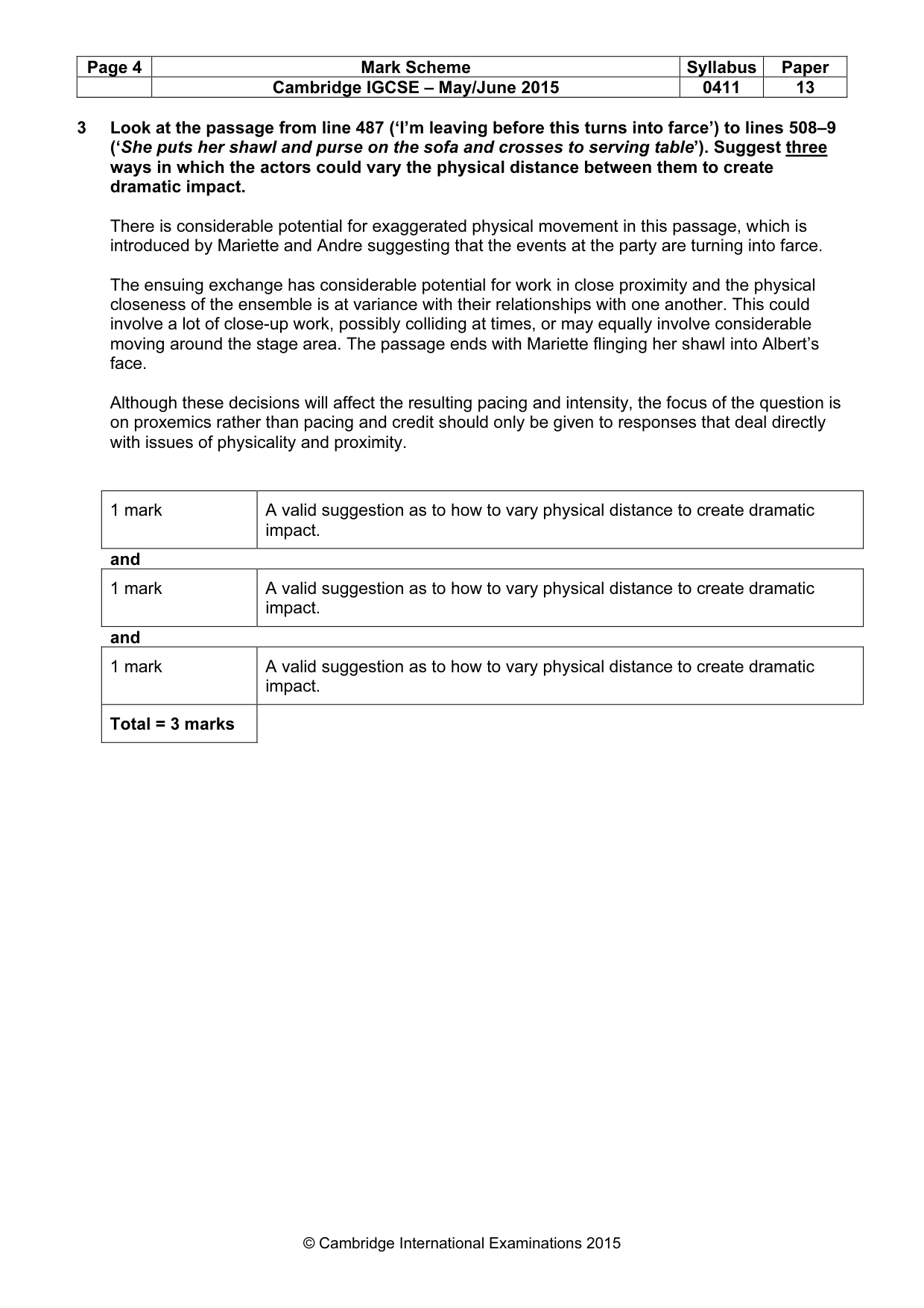
Page 4 Mark Scheme Syllabus Paper Cambridge IGCSE – May/June 2015 0411 13 © Cambridge International Examinations 2015 3 Look at the passage from line 487 (‘I’m leaving before this turns into farce’) to lines 508–9 (‘She puts her shawl and purse on the sofa and crosses to serving table’). Suggest three ways in which the actors could vary the physical distance between them to create dramatic impact. There is considerable potential for exaggerated physical movement in this passage, which is introduced by Mariette and Andre suggesting that the events at the party are turning into farce. The ensuing exchange has considerable potential for work in close proximity and the physical closeness of the ensemble is at variance with their relationships with one another. This could involve a lot of close-up work, possibly colliding at times, or may equally involve considerable moving around the stage area. The passage ends with Mariette flinging her shawl into Albert’s face. Although these decisions will affect the resulting pacing and intensity, the focus of the question is on proxemics rather than pacing and credit should only be given to responses that deal directly with issues of physicality and proximity. 1 mark A valid suggestion as to how to vary physical distance to create dramatic impact. and 1 mark A valid suggestion as to how to vary physical distance to create dramatic impact. and 1 mark A valid suggestion as to how to vary physical distance to create dramatic impact. Total = 3 marks
Mark scheme, page 5
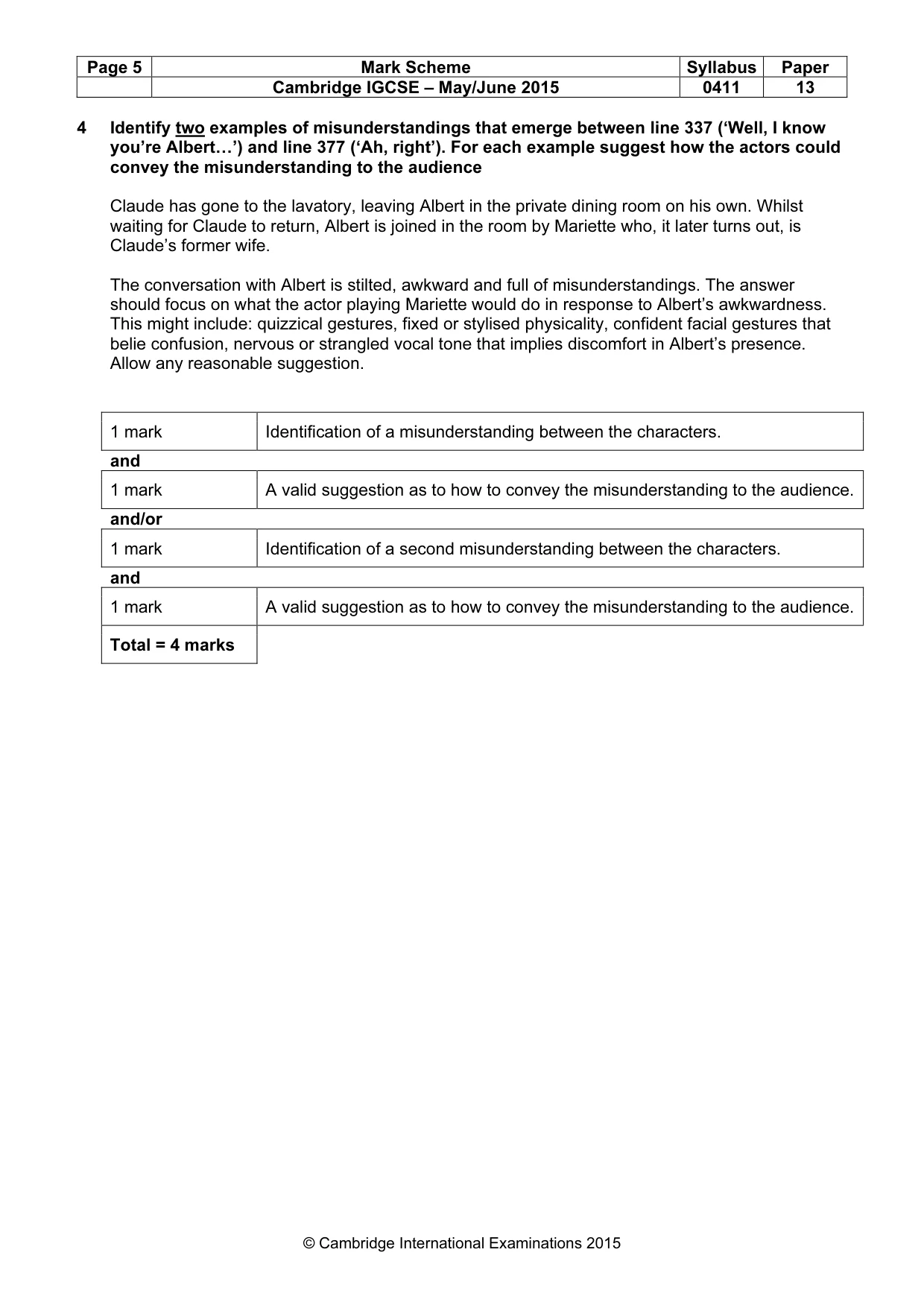
Page 5 Mark Scheme Syllabus Paper Cambridge IGCSE – May/June 2015 0411 13 © Cambridge International Examinations 2015 4 Identify two examples of misunderstandings that emerge between line 337 (‘Well, I know you’re Albert…’) and line 377 (‘Ah, right’). For each example suggest how the actors could convey the misunderstanding to the audience Claude has gone to the lavatory, leaving Albert in the private dining room on his own. Whilst waiting for Claude to return, Albert is joined in the room by Mariette who, it later turns out, is Claude’s former wife. The conversation with Albert is stilted, awkward and full of misunderstandings. The answer should focus on what the actor playing Mariette would do in response to Albert’s awkwardness. This might include: quizzical gestures, fixed or stylised physicality, confident facial gestures that belie confusion, nervous or strangled vocal tone that implies discomfort in Albert’s presence. Allow any reasonable suggestion. 1 mark Identification of a misunderstanding between the characters. and 1 mark A valid suggestion as to how to convey the misunderstanding to the audience. and/or 1 mark Identification of a second misunderstanding between the characters. and 1 mark A valid suggestion as to how to convey the misunderstanding to the audience. Total = 4 marks
Mark scheme, page 6
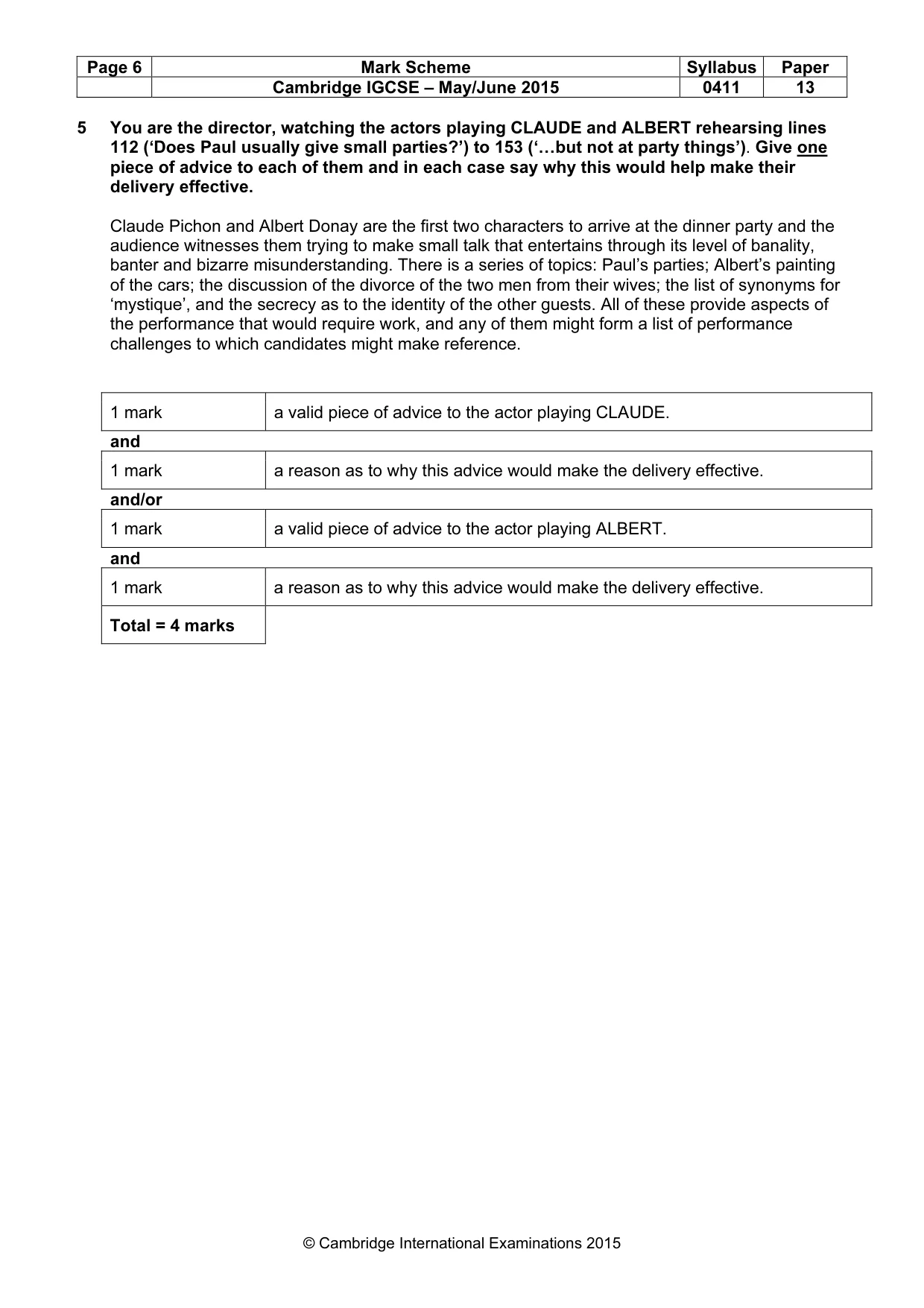
Page 6 Mark Scheme Syllabus Paper Cambridge IGCSE – May/June 2015 0411 13 © Cambridge International Examinations 2015 5 You are the director, watching the actors playing CLAUDE and ALBERT rehearsing lines 112 (‘Does Paul usually give small parties?’) to 153 (‘…but not at party things’). Give one piece of advice to each of them and in each case say why this would help make their delivery effective. Claude Pichon and Albert Donay are the first two characters to arrive at the dinner party and the audience witnesses them trying to make small talk that entertains through its level of banality, banter and bizarre misunderstanding. There is a series of topics: Paul’s parties; Albert’s painting of the cars; the discussion of the divorce of the two men from their wives; the list of synonyms for ‘mystique’, and the secrecy as to the identity of the other guests. All of these provide aspects of the performance that would require work, and any of them might form a list of performance challenges to which candidates might make reference. 1 mark a valid piece of advice to the actor playing CLAUDE. and 1 mark a reason as to why this advice would make the delivery effective. and/or 1 mark a valid piece of advice to the actor playing ALBERT. and 1 mark a reason as to why this advice would make the delivery effective. Total = 4 marks
Mark scheme, page 7
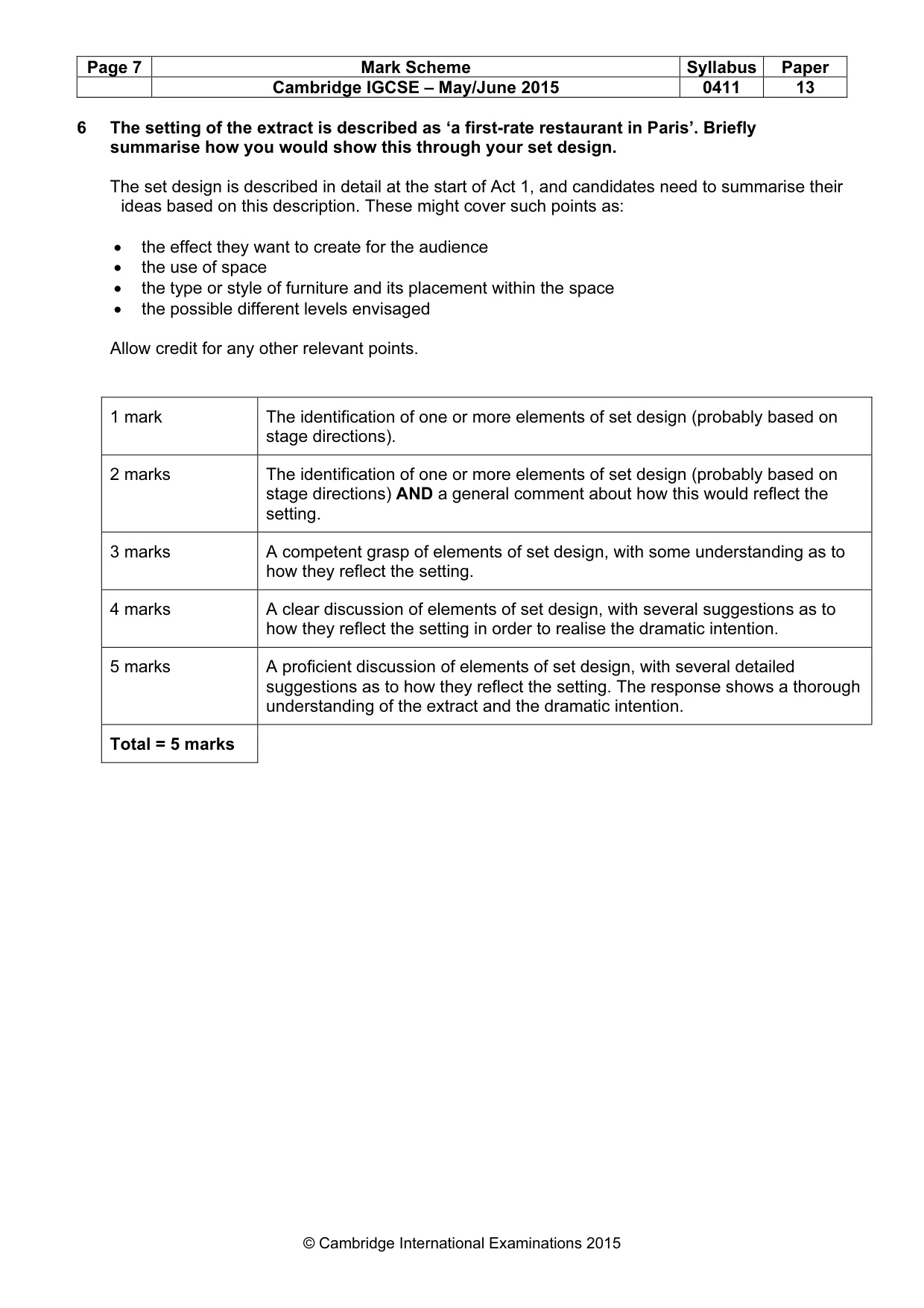
Page 7 Mark Scheme Syllabus Paper Cambridge IGCSE – May/June 2015 0411 13 © Cambridge International Examinations 2015 6 The setting of the extract is described as ‘a first-rate restaurant in Paris’. Briefly summarise how you would show this through your set design. The set design is described in detail at the start of Act 1, and candidates need to summarise their ideas based on this description. These might cover such points as: • the effect they want to create for the audience • the use of space • the type or style of furniture and its placement within the space • the possible different levels envisaged Allow credit for any other relevant points. 1 mark The identification of one or more elements of set design (probably based on stage directions). 2 marks The identification of one or more elements of set design (probably based on stage directions) AND a general comment about how this would reflect the setting. 3 marks A competent grasp of elements of set design, with some understanding as to how they reflect the setting. 4 marks A clear discussion of elements of set design, with several suggestions as to how they reflect the setting in order to realise the dramatic intention. 5 marks A proficient discussion of elements of set design, with several detailed suggestions as to how they reflect the setting. The response shows a thorough understanding of the extract and the dramatic intention. Total = 5 marks
Mark scheme, page 8
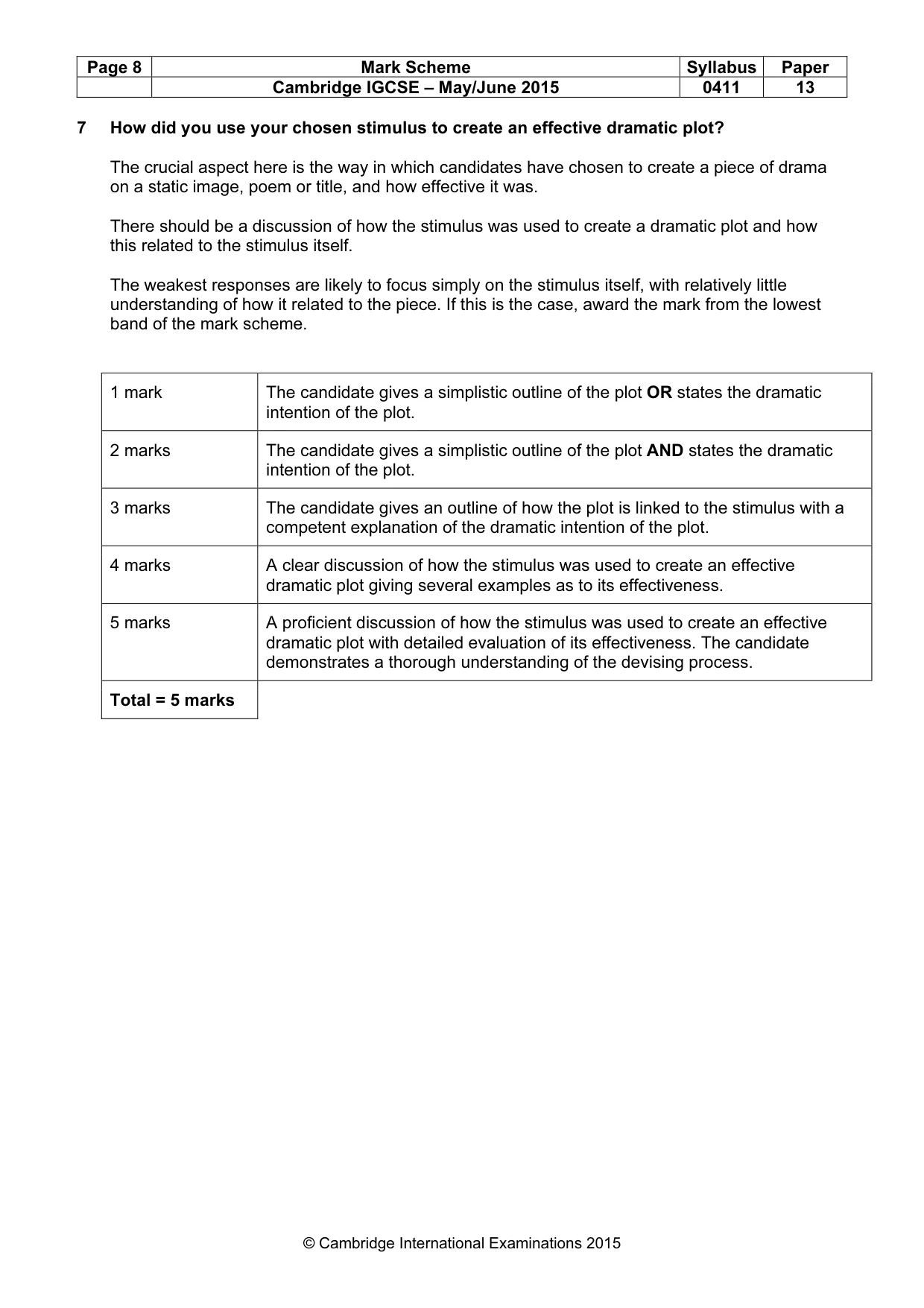
Page 8 Mark Scheme Syllabus Paper Cambridge IGCSE – May/June 2015 0411 13 © Cambridge International Examinations 2015 7 How did you use your chosen stimulus to create an effective dramatic plot? The crucial aspect here is the way in which candidates have chosen to create a piece of drama on a static image, poem or title, and how effective it was. There should be a discussion of how the stimulus was used to create a dramatic plot and how this related to the stimulus itself. The weakest responses are likely to focus simply on the stimulus itself, with relatively little understanding of how it related to the piece. If this is the case, award the mark from the lowest band of the mark scheme. 1 mark The candidate gives a simplistic outline of the plot OR states the dramatic intention of the plot. 2 marks The candidate gives a simplistic outline of the plot AND states the dramatic intention of the plot. 3 marks The candidate gives an outline of how the plot is linked to the stimulus with a competent explanation of the dramatic intention of the plot. 4 marks A clear discussion of how the stimulus was used to create an effective dramatic plot giving several examples as to its effectiveness. 5 marks A proficient discussion of how the stimulus was used to create an effective dramatic plot with detailed evaluation of its effectiveness. The candidate demonstrates a thorough understanding of the devising process. Total = 5 marks
Mark scheme, page 9
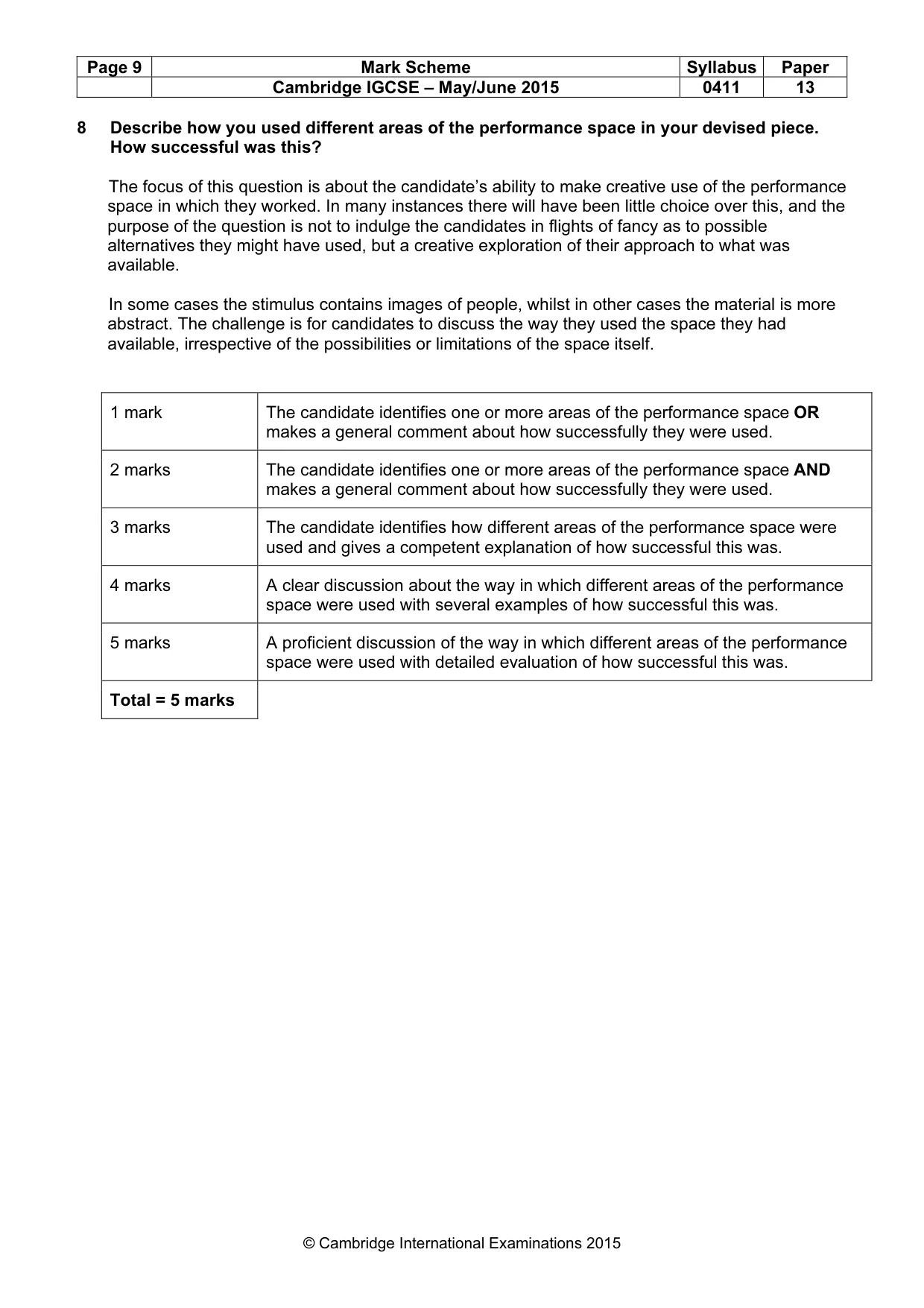
Page 9 Mark Scheme Syllabus Paper Cambridge IGCSE – May/June 2015 0411 13 © Cambridge International Examinations 2015 8 Describe how you used different areas of the performance space in your devised piece. How successful was this? The focus of this question is about the candidate’s ability to make creative use of the performance space in which they worked. In many instances there will have been little choice over this, and the purpose of the question is not to indulge the candidates in flights of fancy as to possible alternatives they might have used, but a creative exploration of their approach to what was available. In some cases the stimulus contains images of people, whilst in other cases the material is more abstract. The challenge is for candidates to discuss the way they used the space they had available, irrespective of the possibilities or limitations of the space itself. 1 mark The candidate identifies one or more areas of the performance space OR makes a general comment about how successfully they were used. 2 marks The candidate identifies one or more areas of the performance space AND makes a general comment about how successfully they were used. 3 marks The candidate identifies how different areas of the performance space were used and gives a competent explanation of how successful this was. 4 marks A clear discussion about the way in which different areas of the performance space were used with several examples of how successful this was. 5 marks A proficient discussion of the way in which different areas of the performance space were used with detailed evaluation of how successful this was. Total = 5 marks
Mark scheme, page 10
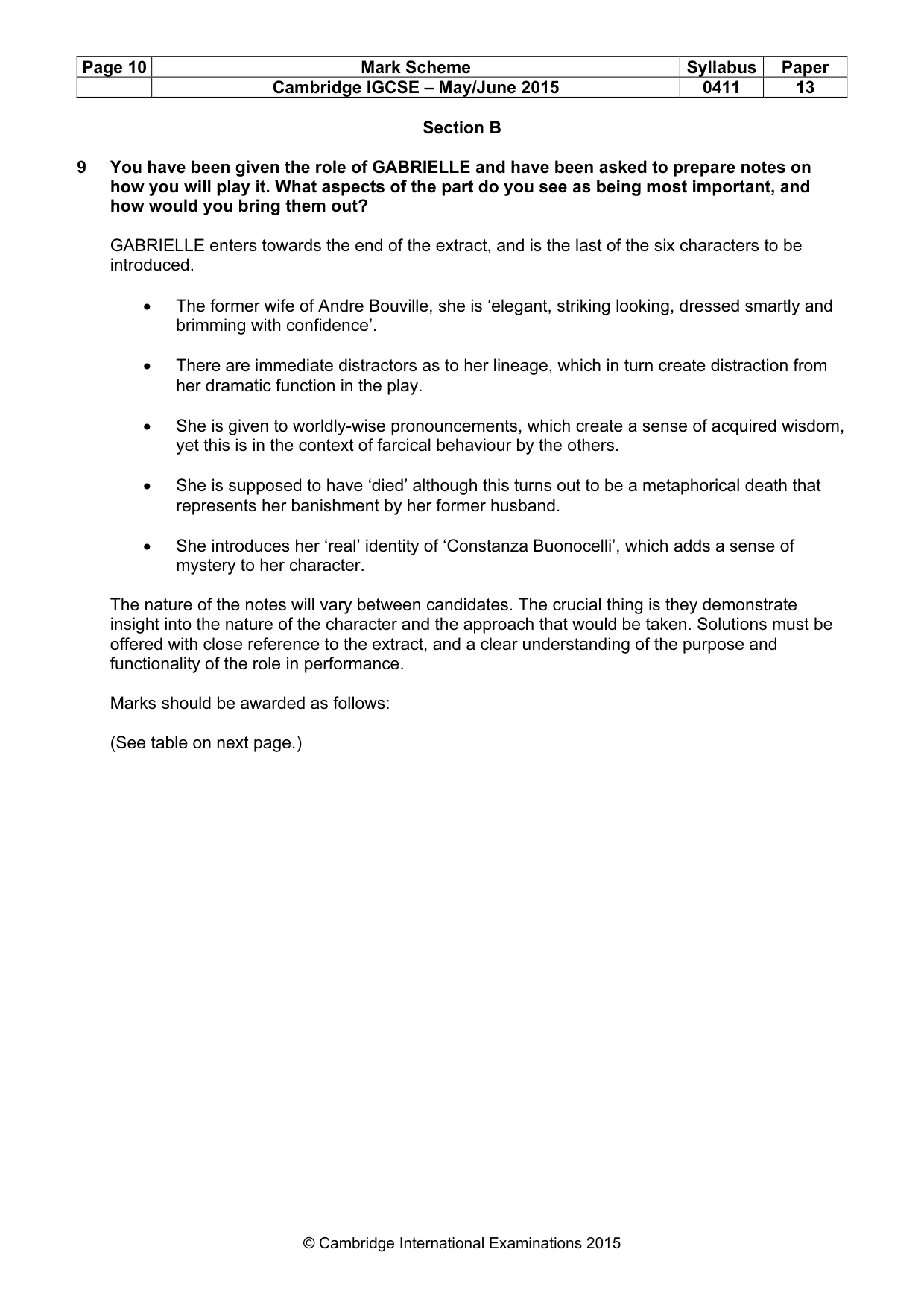
Page 10 Mark Scheme Syllabus Paper Cambridge IGCSE – May/June 2015 0411 13 © Cambridge International Examinations 2015 Section B 9 You have been given the role of GABRIELLE and have been asked to prepare notes on how you will play it. What aspects of the part do you see as being most important, and how would you bring them out? GABRIELLE enters towards the end of the extract, and is the last of the six characters to be introduced. • The former wife of Andre Bouville, she is ‘elegant, striking looking, dressed smartly and brimming with confidence’. • There are immediate distractors as to her lineage, which in turn create distraction from her dramatic function in the play. • She is given to worldly-wise pronouncements, which create a sense of acquired wisdom, yet this is in the context of farcical behaviour by the others. • She is supposed to have ‘died’ although this turns out to be a metaphorical death that represents her banishment by her former husband. • She introduces her ‘real’ identity of ‘Constanza Buonocelli’, which adds a sense of mystery to her character. The nature of the notes will vary between candidates. The crucial thing is they demonstrate insight into the nature of the character and the approach that would be taken. Solutions must be offered with close reference to the extract, and a clear understanding of the purpose and functionality of the role in performance. Marks should be awarded as follows: (See table on next page.)
Mark scheme, page 11
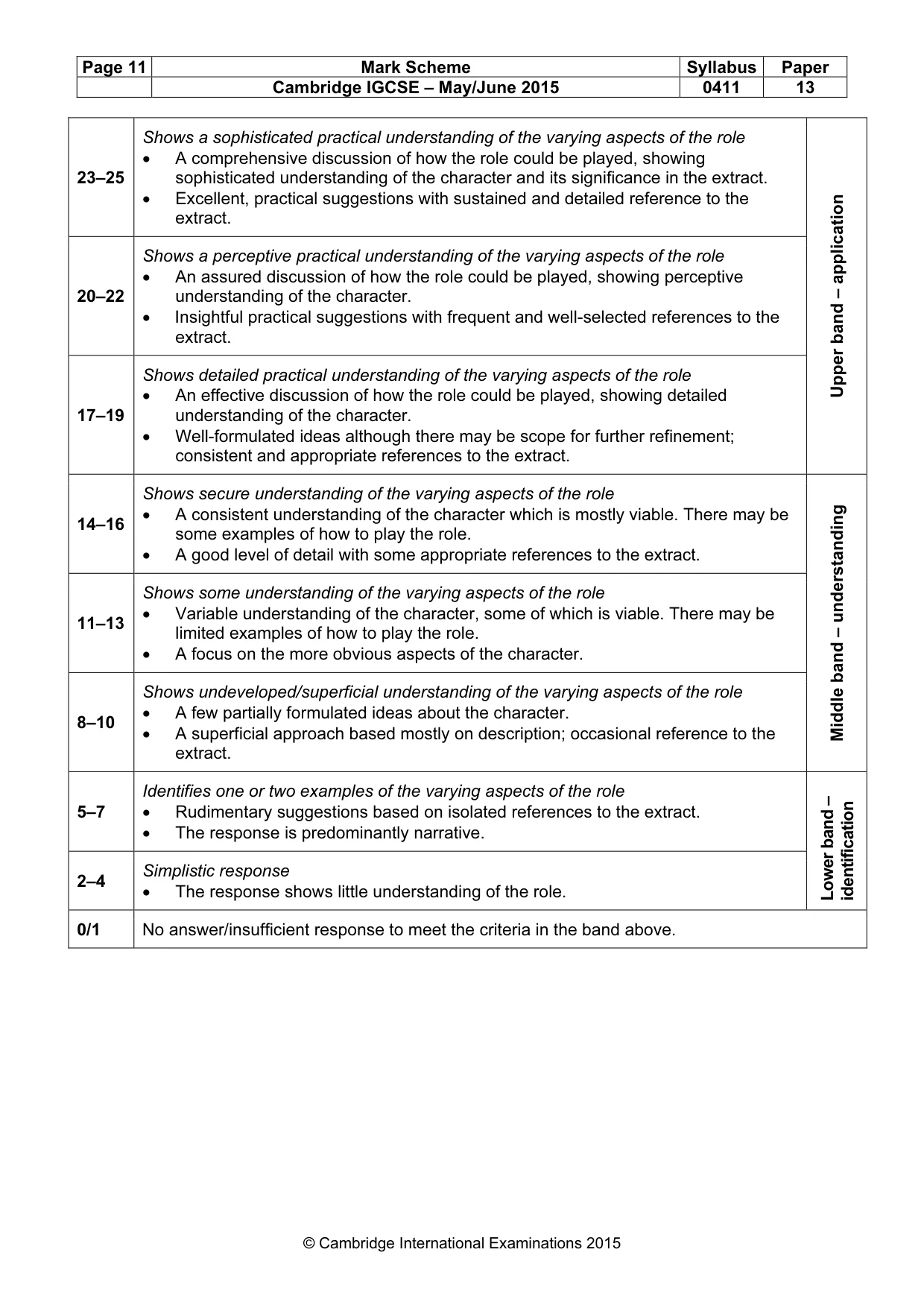
Page 11 Mark Scheme Syllabus Paper Cambridge IGCSE – May/June 2015 0411 13 © Cambridge International Examinations 2015 23–25 Shows a sophisticated practical understanding of the varying aspects of the role • A comprehensive discussion of how the role could be played, showing sophisticated understanding of the character and its significance in the extract. • Excellent, practical suggestions with sustained and detailed reference to the extract. Upper band – application 20–22 Shows a perceptive practical understanding of the varying aspects of the role • An assured discussion of how the role could be played, showing perceptive understanding of the character. • Insightful practical suggestions with frequent and well-selected references to the extract. 17–19 Shows detailed practical understanding of the varying aspects of the role • An effective discussion of how the role could be played, showing detailed understanding of the character. • Well-formulated ideas although there may be scope for further refinement; consistent and appropriate references to the extract. 14–16 Shows secure understanding of the varying aspects of the role • A consistent understanding of the character which is mostly viable. There may be some examples of how to play the role. • A good level of detail with some appropriate references to the extract. Middle band – understanding 11–13 Shows some understanding of the varying aspects of the role • Variable understanding of the character, some of which is viable. There may be limited examples of how to play the role. • A focus on the more obvious aspects of the character. 8–10 Shows undeveloped/superficial understanding of the varying aspects of the role • A few partially formulated ideas about the character. • A superficial approach based mostly on description; occasional reference to the extract. 5–7 Identifies one or two examples of the varying aspects of the role • Rudimentary suggestions based on isolated references to the extract. • The response is predominantly narrative. Lower band – identification 2–4 Simplistic response • The response shows little understanding of the role. 0/1 No answer/insufficient response to meet the criteria in the band above.
Mark scheme, page 12
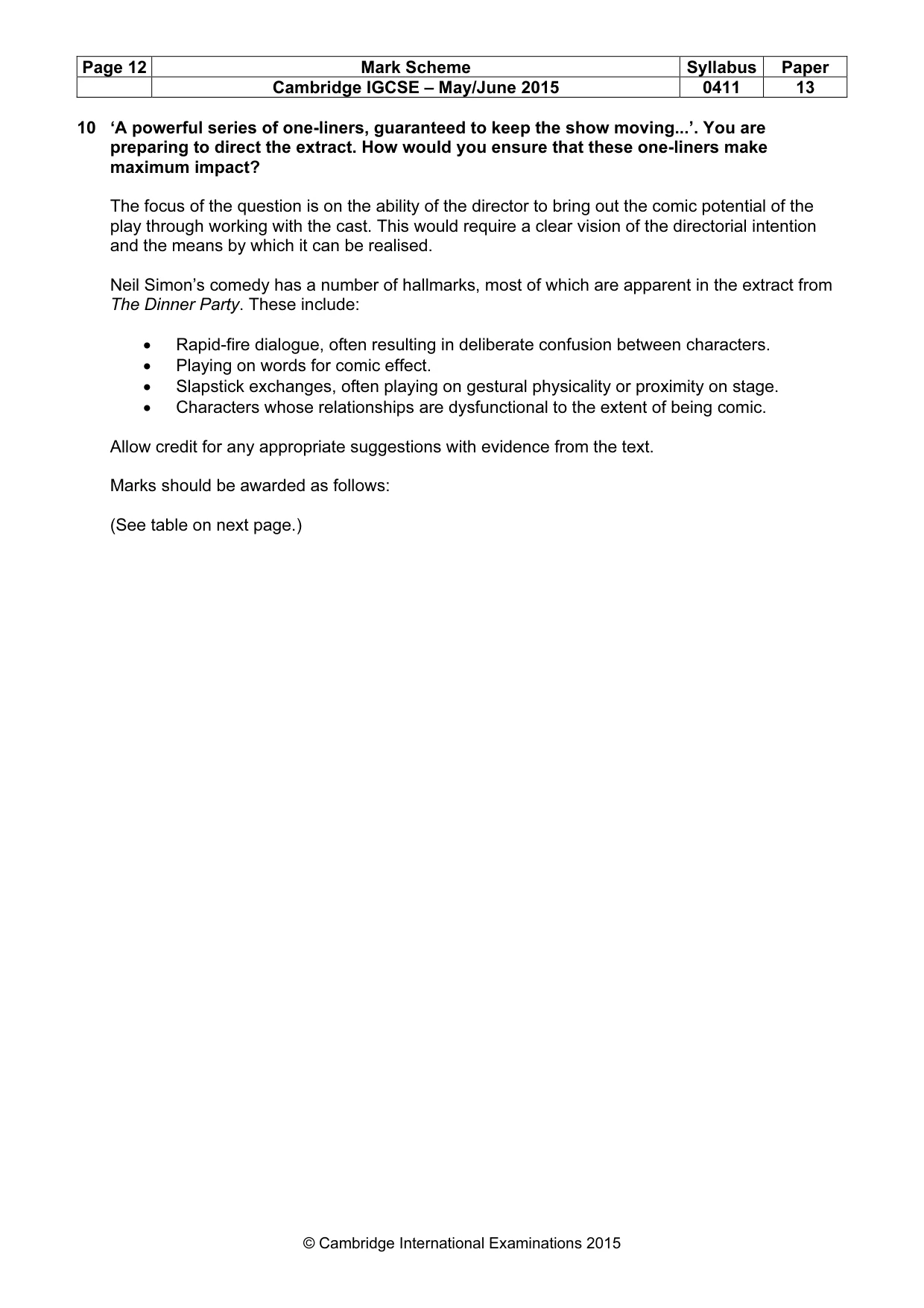
Page 12 Mark Scheme Syllabus Paper Cambridge IGCSE – May/June 2015 0411 13 © Cambridge International Examinations 2015 10 ‘A powerful series of one-liners, guaranteed to keep the show moving...’. You are preparing to direct the extract. How would you ensure that these one-liners make maximum impact? The focus of the question is on the ability of the director to bring out the comic potential of the play through working with the cast. This would require a clear vision of the directorial intention and the means by which it can be realised. Neil Simon’s comedy has a number of hallmarks, most of which are apparent in the extract from The Dinner Party. These include: • Rapid-fire dialogue, often resulting in deliberate confusion between characters. • Playing on words for comic effect. • Slapstick exchanges, often playing on gestural physicality or proximity on stage. • Characters whose relationships are dysfunctional to the extent of being comic. Allow credit for any appropriate suggestions with evidence from the text. Marks should be awarded as follows: (See table on next page.)
Mark scheme, page 13
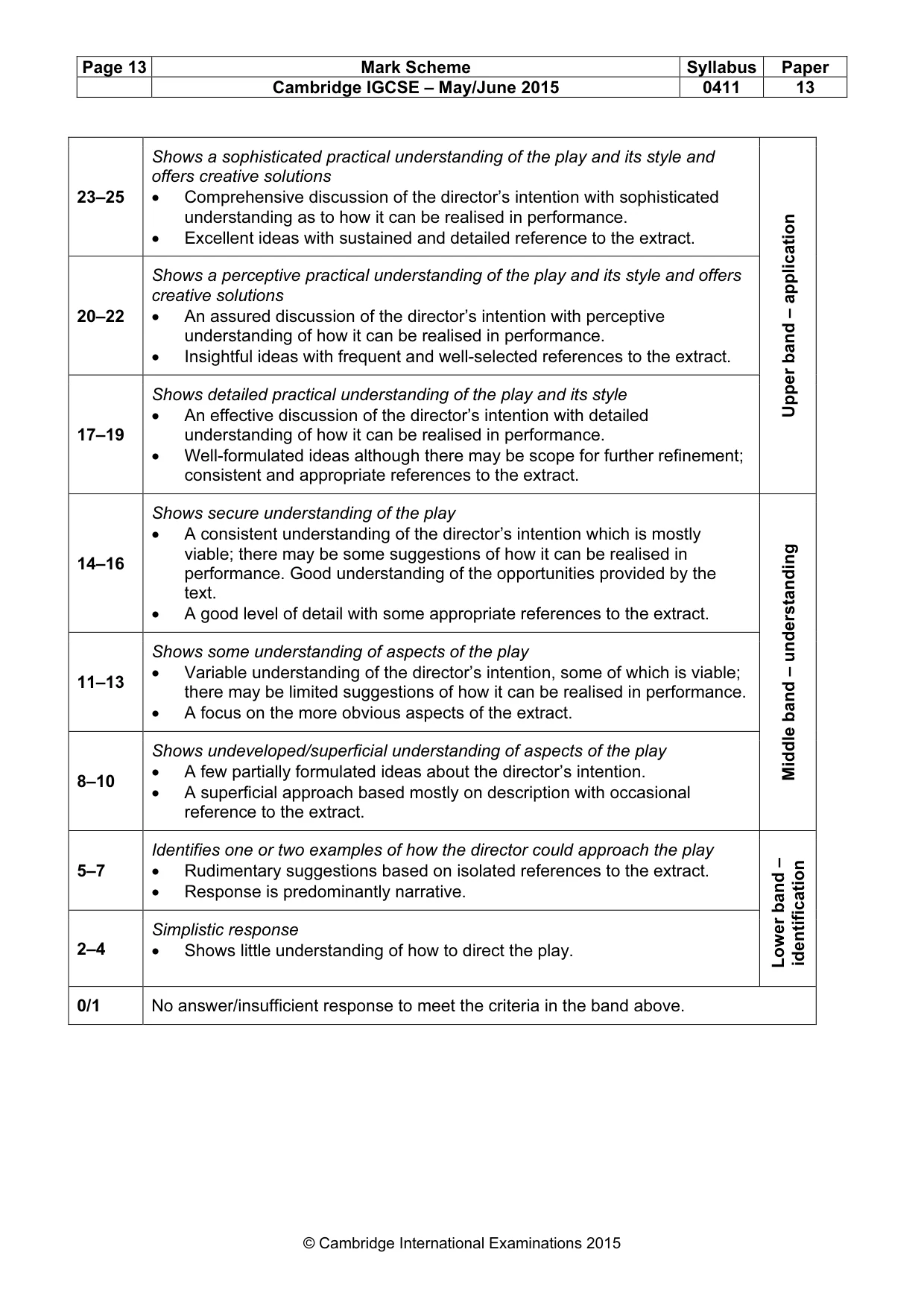
Page 13 Mark Scheme Syllabus Paper Cambridge IGCSE – May/June 2015 0411 13 © Cambridge International Examinations 2015 23–25 Shows a sophisticated practical understanding of the play and its style and offers creative solutions • Comprehensive discussion of the director’s intention with sophisticated understanding as to how it can be realised in performance. • Excellent ideas with sustained and detailed reference to the extract. Upper band – application 20–22 Shows a perceptive practical understanding of the play and its style and offers creative solutions • An assured discussion of the director’s intention with perceptive understanding of how it can be realised in performance. • Insightful ideas with frequent and well-selected references to the extract. 17–19 Shows detailed practical understanding of the play and its style • An effective discussion of the director’s intention with detailed understanding of how it can be realised in performance. • Well-formulated ideas although there may be scope for further refinement; consistent and appropriate references to the extract. 14–16 Shows secure understanding of the play • A consistent understanding of the director’s intention which is mostly viable; there may be some suggestions of how it can be realised in performance. Good understanding of the opportunities provided by the text. • A good level of detail with some appropriate references to the extract. Middle band – understanding 11–13 Shows some understanding of aspects of the play • Variable understanding of the director’s intention, some of which is viable; there may be limited suggestions of how it can be realised in performance. • A focus on the more obvious aspects of the extract. 8–10 Shows undeveloped/superficial understanding of aspects of the play • A few partially formulated ideas about the director’s intention. • A superficial approach based mostly on description with occasional reference to the extract. 5–7 Identifies one or two examples of how the director could approach the play • Rudimentary suggestions based on isolated references to the extract. • Response is predominantly narrative. Lower band – identification 2–4 Simplistic response • Shows little understanding of how to direct the play. 0/1 No answer/insufficient response to meet the criteria in the band above.
Mark scheme, page 14
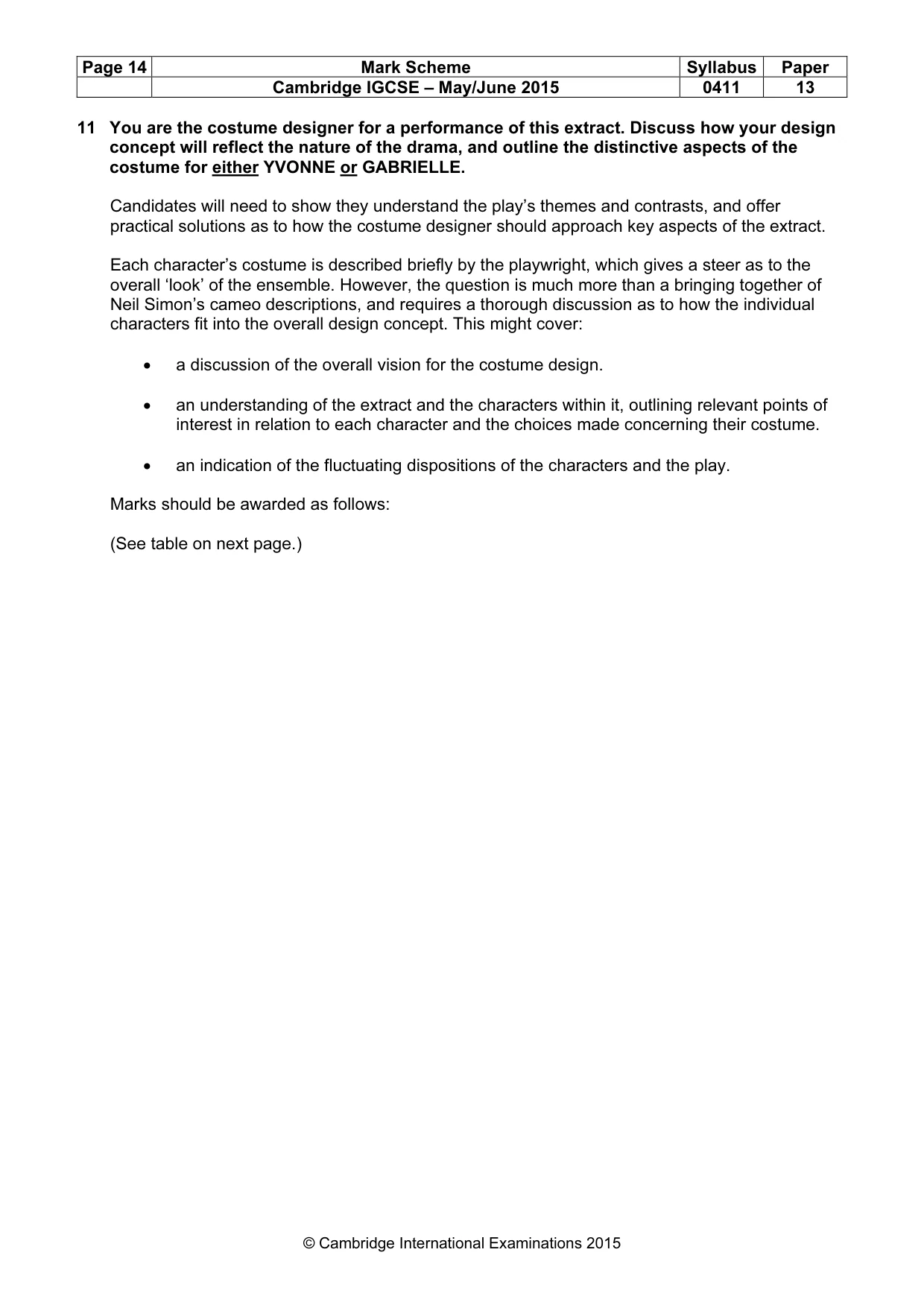
Page 14 Mark Scheme Syllabus Paper Cambridge IGCSE – May/June 2015 0411 13 © Cambridge International Examinations 2015 11 You are the costume designer for a performance of this extract. Discuss how your design concept will reflect the nature of the drama, and outline the distinctive aspects of the costume for either YVONNE or GABRIELLE. Candidates will need to show they understand the play’s themes and contrasts, and offer practical solutions as to how the costume designer should approach key aspects of the extract. Each character’s costume is described briefly by the playwright, which gives a steer as to the overall ‘look’ of the ensemble. However, the question is much more than a bringing together of Neil Simon’s cameo descriptions, and requires a thorough discussion as to how the individual characters fit into the overall design concept. This might cover: • a discussion of the overall vision for the costume design. • an understanding of the extract and the characters within it, outlining relevant points of interest in relation to each character and the choices made concerning their costume. • an indication of the fluctuating dispositions of the characters and the play. Marks should be awarded as follows: (See table on next page.)
Mark scheme, page 15
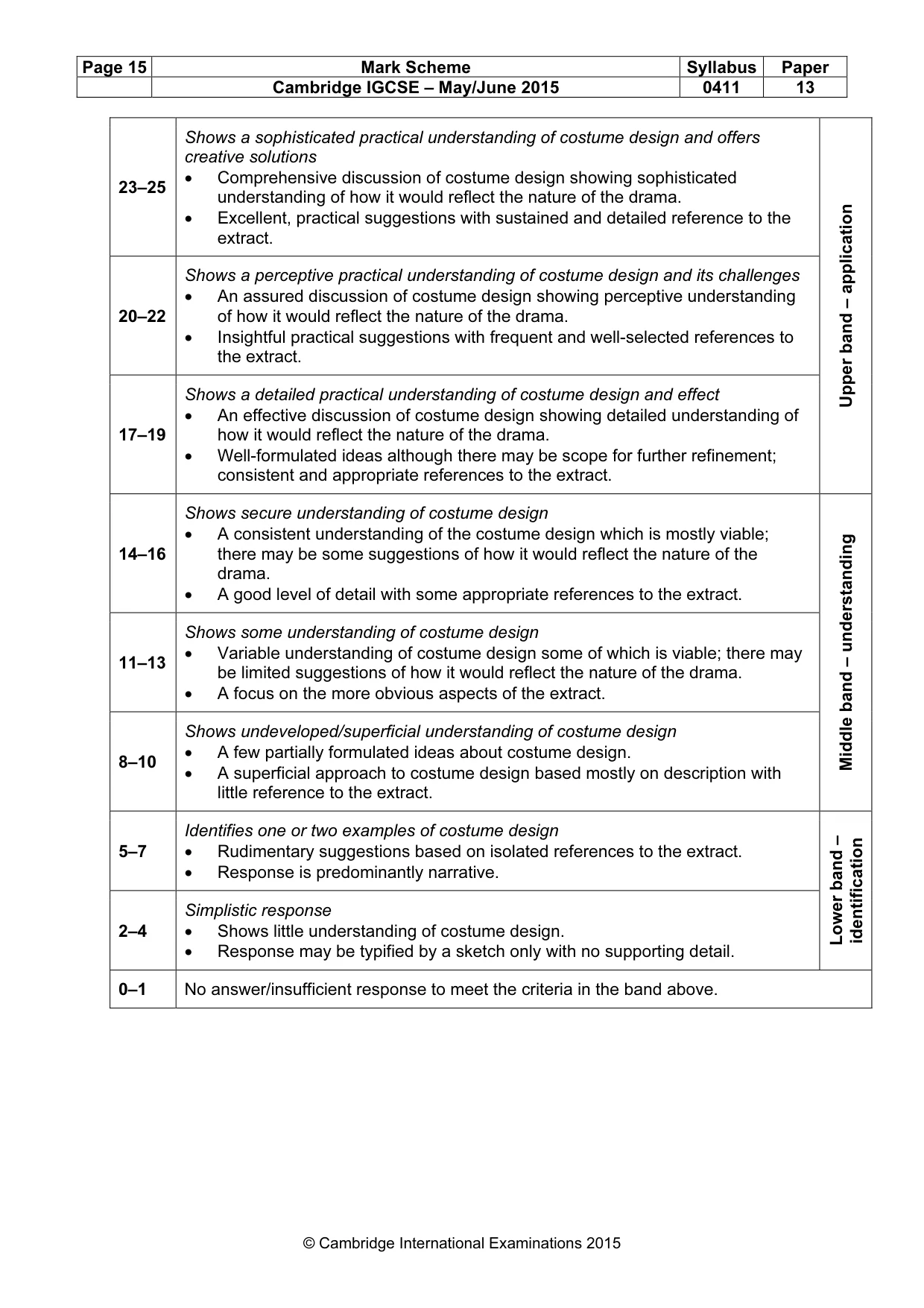
Page 15 Mark Scheme Syllabus Paper Cambridge IGCSE – May/June 2015 0411 13 © Cambridge International Examinations 2015 23–25 Shows a sophisticated practical understanding of costume design and offers creative solutions • Comprehensive discussion of costume design showing sophisticated understanding of how it would reflect the nature of the drama. • Excellent, practical suggestions with sustained and detailed reference to the extract. Upper band – application 20–22 Shows a perceptive practical understanding of costume design and its challenges • An assured discussion of costume design showing perceptive understanding of how it would reflect the nature of the drama. • Insightful practical suggestions with frequent and well-selected references to the extract. 17–19 Shows a detailed practical understanding of costume design and effect • An effective discussion of costume design showing detailed understanding of how it would reflect the nature of the drama. • Well-formulated ideas although there may be scope for further refinement; consistent and appropriate references to the extract. 14–16 Shows secure understanding of costume design • A consistent understanding of the costume design which is mostly viable; there may be some suggestions of how it would reflect the nature of the drama. • A good level of detail with some appropriate references to the extract. Middle band – understanding 11–13 Shows some understanding of costume design • Variable understanding of costume design some of which is viable; there may be limited suggestions of how it would reflect the nature of the drama. • A focus on the more obvious aspects of the extract. 8–10 Shows undeveloped/superficial understanding of costume design • A few partially formulated ideas about costume design. • A superficial approach to costume design based mostly on description with little reference to the extract. 5–7 Identifies one or two examples of costume design • Rudimentary suggestions based on isolated references to the extract. • Response is predominantly narrative. Lower band – identification 2–4 Simplistic response • Shows little understanding of costume design. • Response may be typified by a sketch only with no supporting detail. 0–1 No answer/insufficient response to meet the criteria in the band above.
Mark scheme, page 16
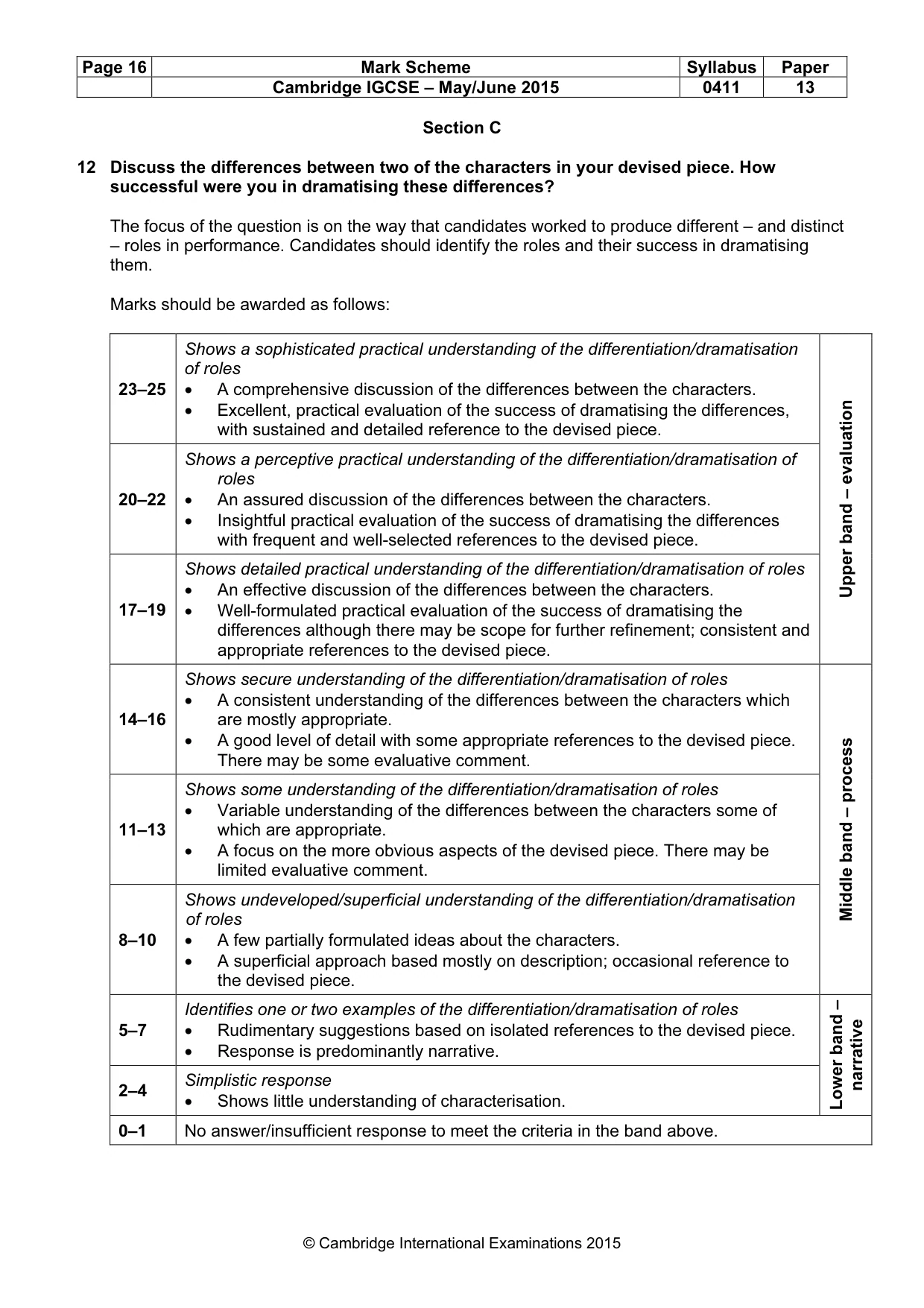
Page 16 Mark Scheme Syllabus Paper Cambridge IGCSE – May/June 2015 0411 13 © Cambridge International Examinations 2015 Section C 12 Discuss the differences between two of the characters in your devised piece. How successful were you in dramatising these differences? The focus of the question is on the way that candidates worked to produce different – and distinct – roles in performance. Candidates should identify the roles and their success in dramatising them. Marks should be awarded as follows: 23–25 Shows a sophisticated practical understanding of the differentiation/dramatisation of roles • A comprehensive discussion of the differences between the characters. • Excellent, practical evaluation of the success of dramatising the differences, with sustained and detailed reference to the devised piece. Upper band – evaluation 20–22 Shows a perceptive practical understanding of the differentiation/dramatisation of roles • An assured discussion of the differences between the characters. • Insightful practical evaluation of the success of dramatising the differences with frequent and well-selected references to the devised piece. 17–19 Shows detailed practical understanding of the differentiation/dramatisation of roles • An effective discussion of the differences between the characters. • Well-formulated practical evaluation of the success of dramatising the differences although there may be scope for further refinement; consistent and appropriate references to the devised piece. 14–16 Shows secure understanding of the differentiation/dramatisation of roles • A consistent understanding of the differences between the characters which are mostly appropriate. • A good level of detail with some appropriate references to the devised piece. There may be some evaluative comment. Middle band – process 11–13 Shows some understanding of the differentiation/dramatisation of roles • Variable understanding of the differences between the characters some of which are appropriate. • A focus on the more obvious aspects of the devised piece. There may be limited evaluative comment. 8–10 Shows undeveloped/superficial understanding of the differentiation/dramatisation of roles • A few partially formulated ideas about the characters. • A superficial approach based mostly on description; occasional reference to the devised piece. 5–7 Identifies one or two examples of the differentiation/dramatisation of roles • Rudimentary suggestions based on isolated references to the devised piece. • Response is predominantly narrative. Lower band – narrative 2–4 Simplistic response • Shows little understanding of characterisation. 0–1 No answer/insufficient response to meet the criteria in the band above.
Mark scheme, page 17
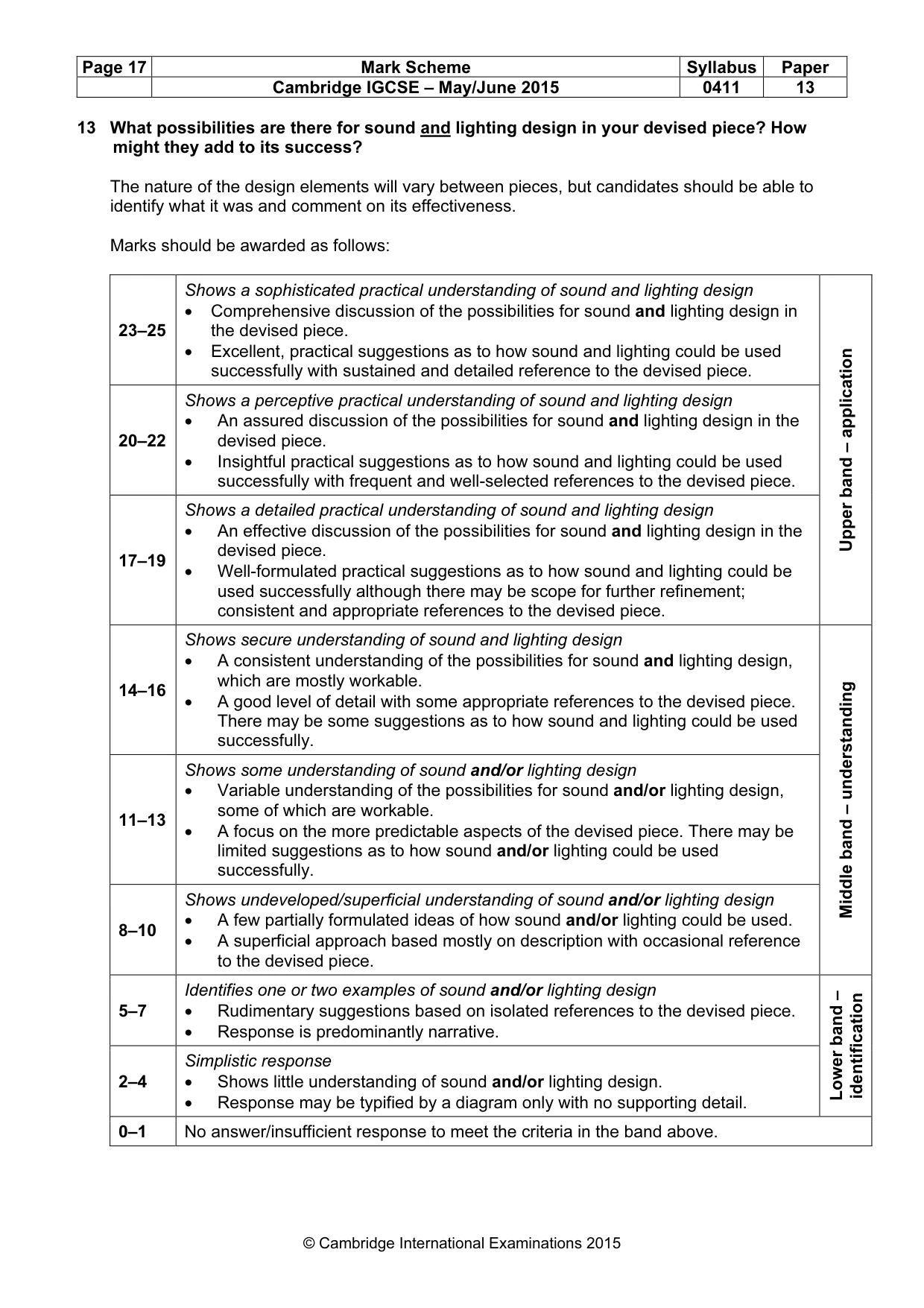
Page 17 Mark Scheme Syllabus Paper Cambridge IGCSE – May/June 2015 0411 13 © Cambridge International Examinations 2015 13 What possibilities are there for sound and lighting design in your devised piece? How might they add to its success? The nature of the design elements will vary between pieces, but candidates should be able to identify what it was and comment on its effectiveness. Marks should be awarded as follows: 23–25 Shows a sophisticated practical understanding of sound and lighting design • Comprehensive discussion of the possibilities for sound and lighting design in the devised piece. • Excellent, practical suggestions as to how sound and lighting could be used successfully with sustained and detailed reference to the devised piece. Upper band – application 20–22 Shows a perceptive practical understanding of sound and lighting design • An assured discussion of the possibilities for sound and lighting design in the devised piece. • Insightful practical suggestions as to how sound and lighting could be used successfully with frequent and well-selected references to the devised piece. 17–19 Shows a detailed practical understanding of sound and lighting design • An effective discussion of the possibilities for sound and lighting design in the devised piece. • Well-formulated practical suggestions as to how sound and lighting could be used successfully although there may be scope for further refinement; consistent and appropriate references to the devised piece. 14–16 Shows secure understanding of sound and lighting design • A consistent understanding of the possibilities for sound and lighting design, which are mostly workable. • A good level of detail with some appropriate references to the devised piece. There may be some suggestions as to how sound and lighting could be used successfully. Middle band – understanding 11–13 Shows some understanding of sound and/or lighting design • Variable understanding of the possibilities for sound and/or lighting design, some of which are workable. • A focus on the more predictable aspects of the devised piece. There may be limited suggestions as to how sound and/or lighting could be used successfully. 8–10 Shows undeveloped/superficial understanding of sound and/or lighting design • A few partially formulated ideas of how sound and/or lighting could be used. • A superficial approach based mostly on description with occasional reference to the devised piece. 5–7 Identifies one or two examples of sound and/or lighting design • Rudimentary suggestions based on isolated references to the devised piece. • Response is predominantly narrative. Lower band – identification 2–4 Simplistic response • Shows little understanding of sound and/or lighting design. • Response may be typified by a diagram only with no supporting detail. 0–1 No answer/insufficient response to meet the criteria in the band above.
Mark scheme, page 18
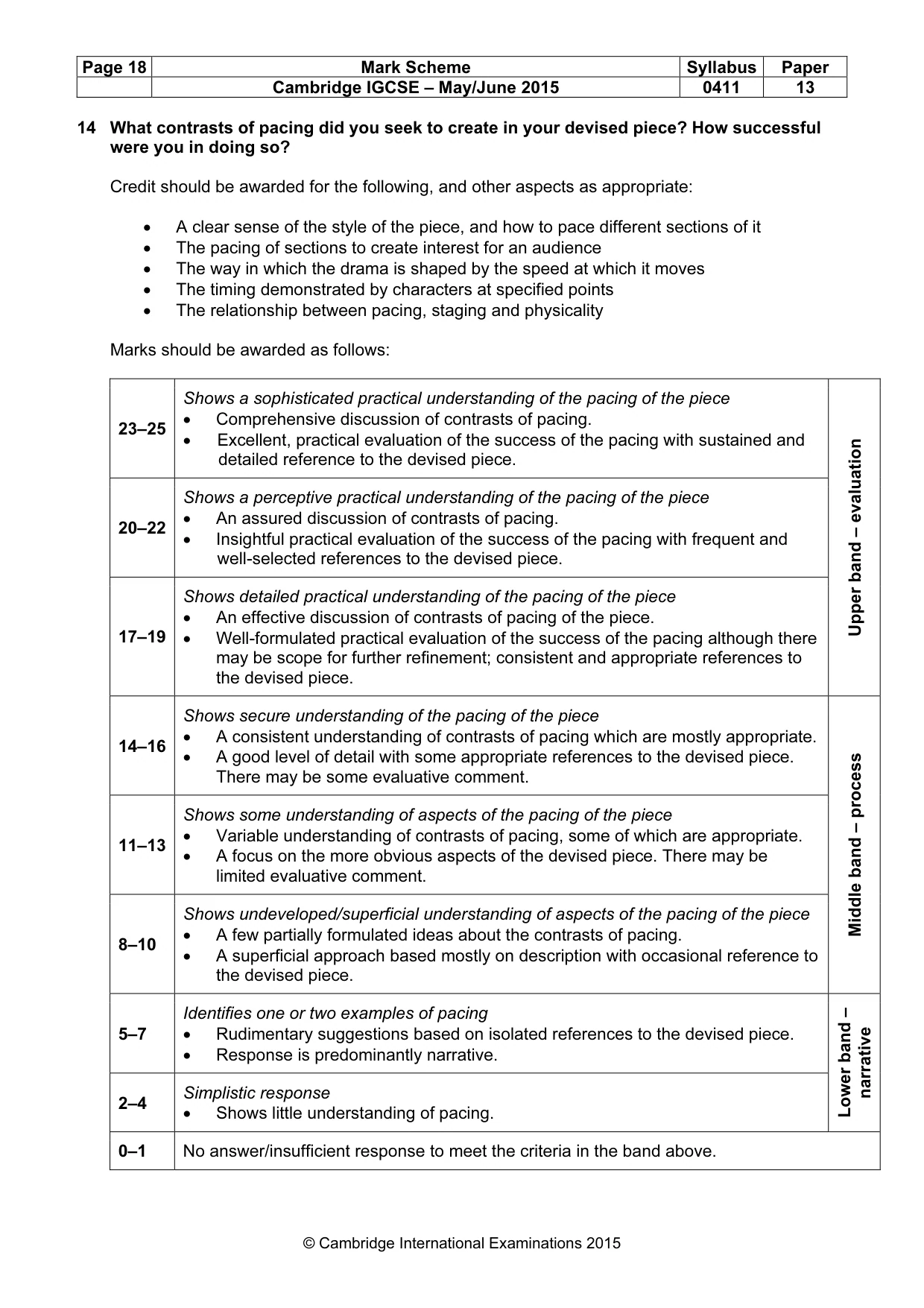
Page 18 Mark Scheme Syllabus Paper Cambridge IGCSE – May/June 2015 0411 13 © Cambridge International Examinations 2015 14 What contrasts of pacing did you seek to create in your devised piece? How successful were you in doing so? Credit should be awarded for the following, and other aspects as appropriate: • A clear sense of the style of the piece, and how to pace different sections of it • The pacing of sections to create interest for an audience • The way in which the drama is shaped by the speed at which it moves • The timing demonstrated by characters at specified points • The relationship between pacing, staging and physicality Marks should be awarded as follows: 23–25 Shows a sophisticated practical understanding of the pacing of the piece • Comprehensive discussion of contrasts of pacing. • Excellent, practical evaluation of the success of the pacing with sustained and detailed reference to the devised piece. Upper band – evaluation 20–22 Shows a perceptive practical understanding of the pacing of the piece • An assured discussion of contrasts of pacing. • Insightful practical evaluation of the success of the pacing with frequent and well-selected references to the devised piece. 17–19 Shows detailed practical understanding of the pacing of the piece • An effective discussion of contrasts of pacing of the piece. • Well-formulated practical evaluation of the success of the pacing although there may be scope for further refinement; consistent and appropriate references to the devised piece. 14–16 Shows secure understanding of the pacing of the piece • A consistent understanding of contrasts of pacing which are mostly appropriate. • A good level of detail with some appropriate references to the devised piece. There may be some evaluative comment. Middle band – process 11–13 Shows some understanding of aspects of the pacing of the piece • Variable understanding of contrasts of pacing, some of which are appropriate. • A focus on the more obvious aspects of the devised piece. There may be limited evaluative comment. 8–10 Shows undeveloped/superficial understanding of aspects of the pacing of the piece • A few partially formulated ideas about the contrasts of pacing. • A superficial approach based mostly on description with occasional reference to the devised piece. 5–7 Identifies one or two examples of pacing • Rudimentary suggestions based on isolated references to the devised piece. • Response is predominantly narrative. Lower band – narrative 2–4 Simplistic response • Shows little understanding of pacing. 0–1 No answer/insufficient response to meet the criteria in the band above.
What you needed in this session
Cambridge’s own grade thresholds for 2015 May/June, Paper 1 · Variant 3. A higher threshold means an easier paper — the bar moves with how the cohort did.