Cambridge IGCSE Development Studies 0453 — 2021 Oct/Nov Paper 1 · Variant 0
0453/10/O/N/21 · 80 marks · ≈90 min
The question paper and its mark scheme, free to read here and free to download. This is Cambridge’s own paper, exactly as it was sat.
Question paper16 pages






Mark scheme
No mark scheme is in the library for this paper.
Paper as text
Question paper, page 1
Cambridge IGCSE™ This document has 16 pages. DEVELOPMENT STUDIES 0453/01 Paper 1 October/November 2021 2 hours You must answer on the question paper. No additional materials are needed. INSTRUCTIONS ● Answer all questions. ● Use a black or dark blue pen. You may use an HB pencil for any diagrams or graphs. ● Write your name, centre number and candidate number in the boxes at the top of the page. ● Write your answer to each question in the space provided. ● Do not use an erasable pen or correction fluid. ● Do not write on any bar codes. INFORMATION ● The total mark for this paper is 80. ● The number of marks for each question or part question is shown in brackets [ ]. * 2 8 9 7 3 3 2 7 3 6 * DC (CJ/FC) 192958/2 © UCLES 2021 [Turn over
Question paper, page 2
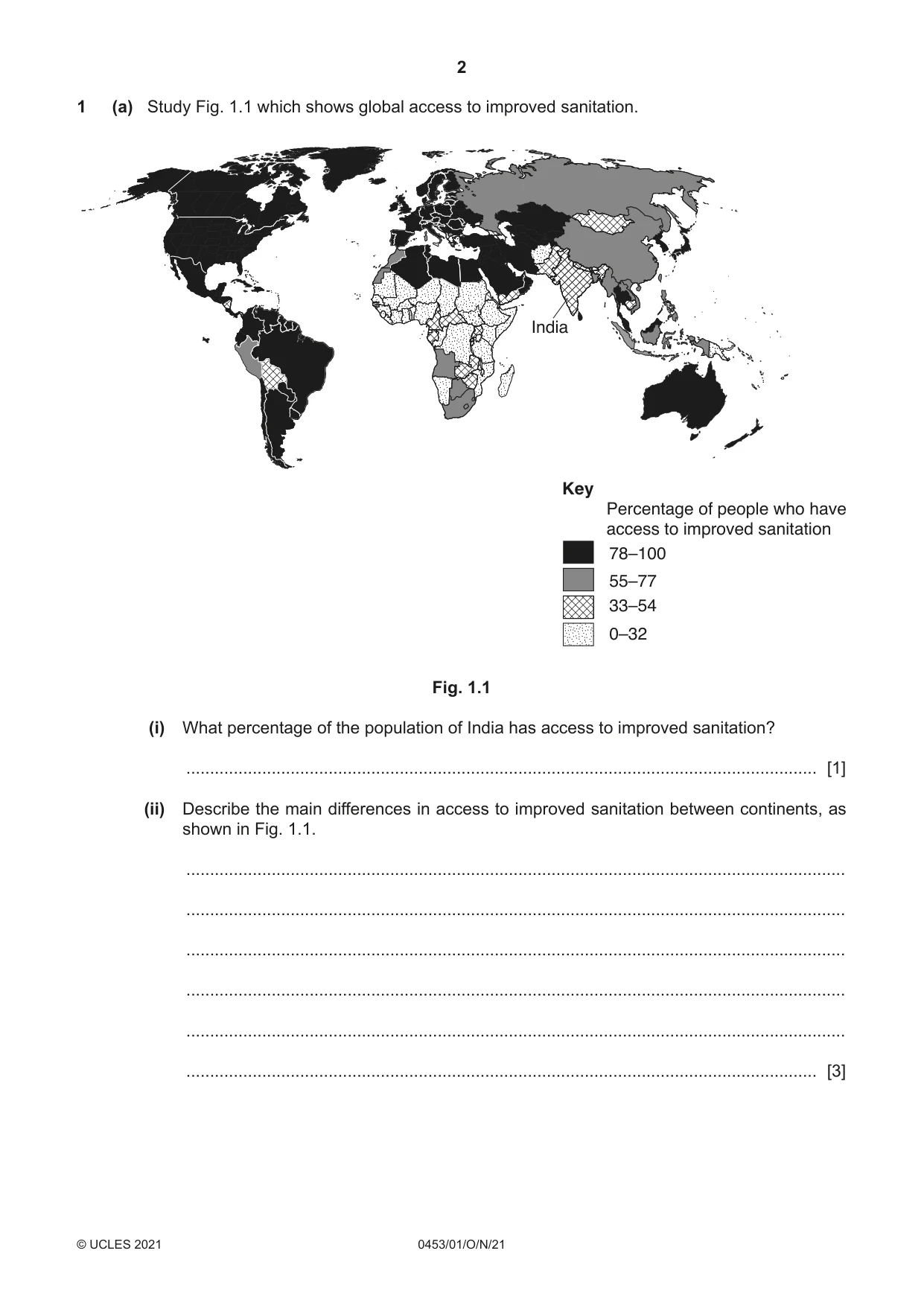
2 0453/01/O/N/21 © UCLES 2021 1 (a) Study Fig. 1.1 which shows global access to improved sanitation. India Key 0–32 33–54 55–77 78–100 Percentage of people who have access to improved sanitation Fig. 1.1 (i) What percentage of the population of India has access to improved sanitation? … [1] (ii) Describe the main differences in access to improved sanitation between continents, as shown in Fig. 1.1. … … … … … … [3]
Question paper, page 3
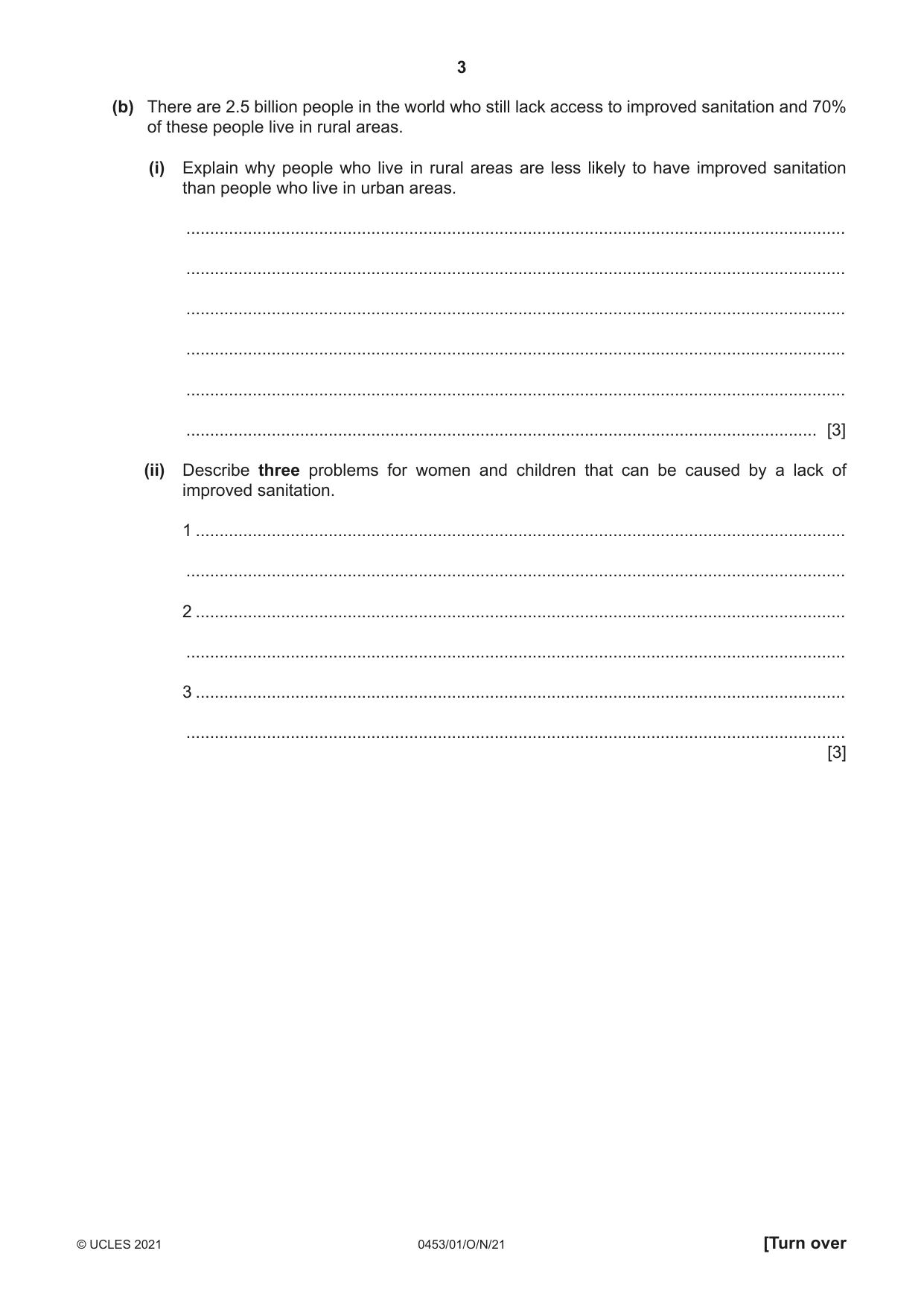
3 0453/01/O/N/21 © UCLES 2021 [Turn over (b) There are 2.5 billion people in the world who still lack access to improved sanitation and 70% of these people live in rural areas. (i) Explain why people who live in rural areas are less likely to have improved sanitation than people who live in urban areas. … … … … … … [3] (ii) Describe three problems for women and children that can be caused by a lack of improved sanitation. 1 … … 2 … … 3 … … [3]
Question paper, page 4
4 0453/01/O/N/21 © UCLES 2021 (c) In many rural communities women are often left to look after farms and they may suffer from gender discrimination. Explain how a government could make women’s lives easier and enable them to increase food production. … … … … … … … … [4]
Question paper, page 5
5 0453/01/O/N/21 © UCLES 2021 [Turn over (d) Explain how access to small health centres in rural areas might help to reduce maternal and child mortality rates. You should develop fully the points you make. … … … … … … … … … … … … … … … … … … … … … … … … [6] [Total: 20]
Question paper, page 6
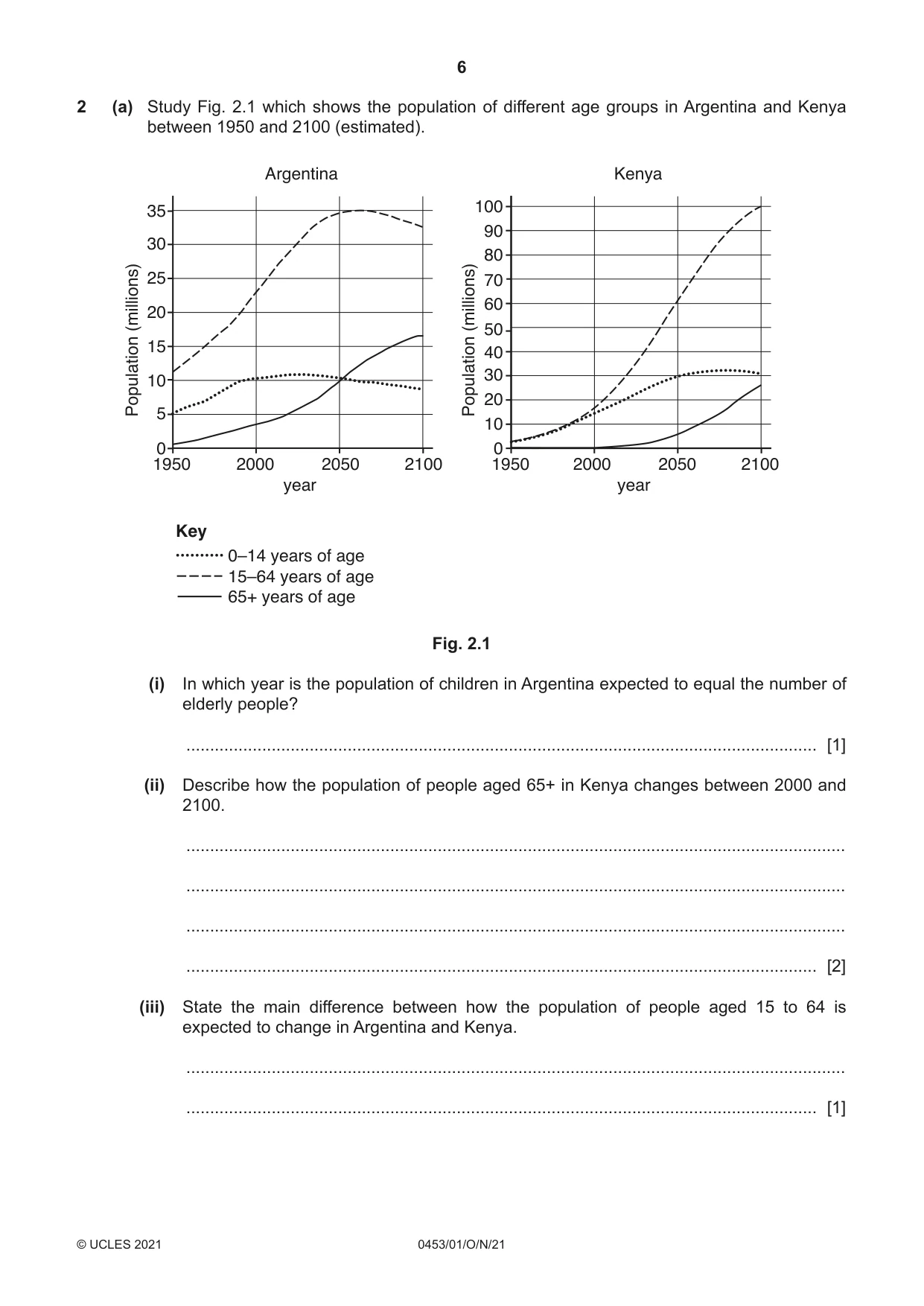
6 0453/01/O/N/21 © UCLES 2021 2 (a) Study Fig. 2.1 which shows the population of different age groups in Argentina and Kenya between 1950 and 2100 (estimated). 0 0 10 20 30 40 50 60 70 80 90 100 5 10 15 20 25 30 35 2000 year Key year 2050 2100 Population (millions) Argentina 1950 2000 2050 2100 Population (millions) Kenya 0–14 years of age 65+ years of age 15–64 years of age 1950 Fig. 2.1 (i) In which year is the population of children in Argentina expected to equal the number of elderly people? … [1] (ii) Describe how the population of people aged 65+ in Kenya changes between 2000 and 2100. … … … … [2] (iii) State the main difference between how the population of people aged 15 to 64 is expected to change in Argentina and Kenya. … … [1]
Question paper, page 7
7 0453/01/O/N/21 © UCLES 2021 [Turn over (iv) What is meant by the term ‘dependent population’? … … [1] (v) What is the dependent population estimated to be in Kenya in 2050? … [1] (b) Explain why it is important for a government to know the changes that are likely to happen to a country’s population as it develops. … … … … … … [3] (c) Explain why a country might have a high population growth rate. … … … … … … … … … … [5]
Question paper, page 8
8 0453/01/O/N/21 © UCLES 2021 (d) As countries develop, their populations often contain a larger proportion of older people. Describe the problems this may cause and suggest solutions to these problems. You should develop fully the points you make. … … … … … … … … … … … … … … … … … … … … … … … … [6] [Total: 20]
Question paper, page 9
9 0453/01/O/N/21 © UCLES 2021 [Turn over Question 3 begins on page 10.
Question paper, page 10
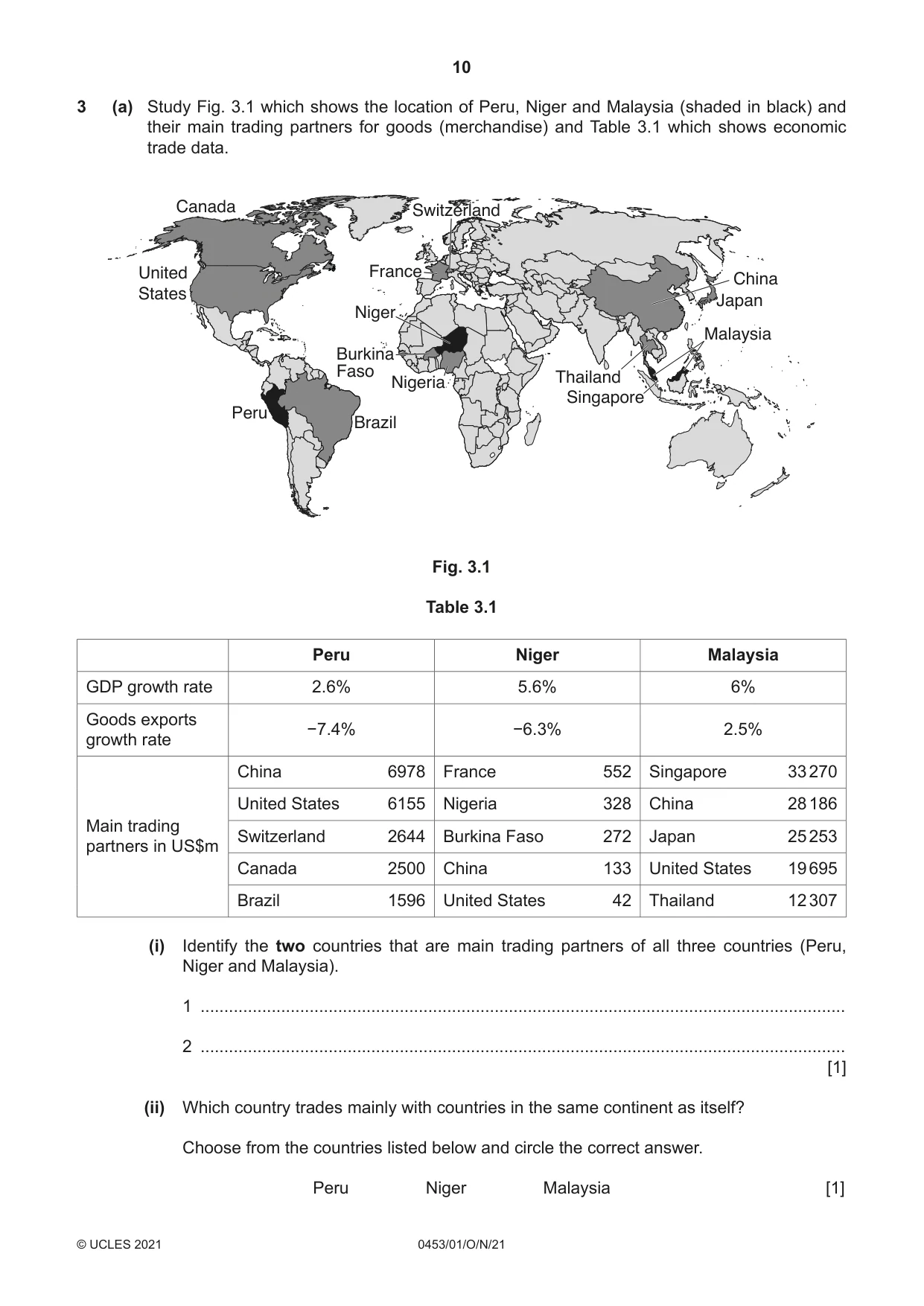
10 0453/01/O/N/21 © UCLES 2021 3 (a) Study Fig. 3.1 which shows the location of Peru, Niger and Malaysia (shaded in black) and their main trading partners for goods (merchandise) and Table 3.1 which shows economic trade data. Malaysia Thailand Niger Nigeria Burkina Faso Peru Brazil Canada United States China Japan Singapore France Switzerland Fig. 3.1 Table 3.1 Peru Niger Malaysia GDP growth rate 2.6% 5.6% 6% Goods exports growth rate −7.4% −6.3% 2.5% Main trading partners in US$m China 6978 France 552 Singapore 33 270 United States 6155 Nigeria 328 China 28 186 Switzerland 2644 Burkina Faso 272 Japan 25 253 Canada 2500 China 133 United States 19 695 Brazil 1596 United States 42 Thailand 12 307 (i) Identify the two countries that are main trading partners of all three countries (Peru, Niger and Malaysia). 1 … 2 … [1] (ii) Which country trades mainly with countries in the same continent as itself? Choose from the countries listed below and circle the correct answer. Peru Niger Malaysia [1]
Question paper, page 11
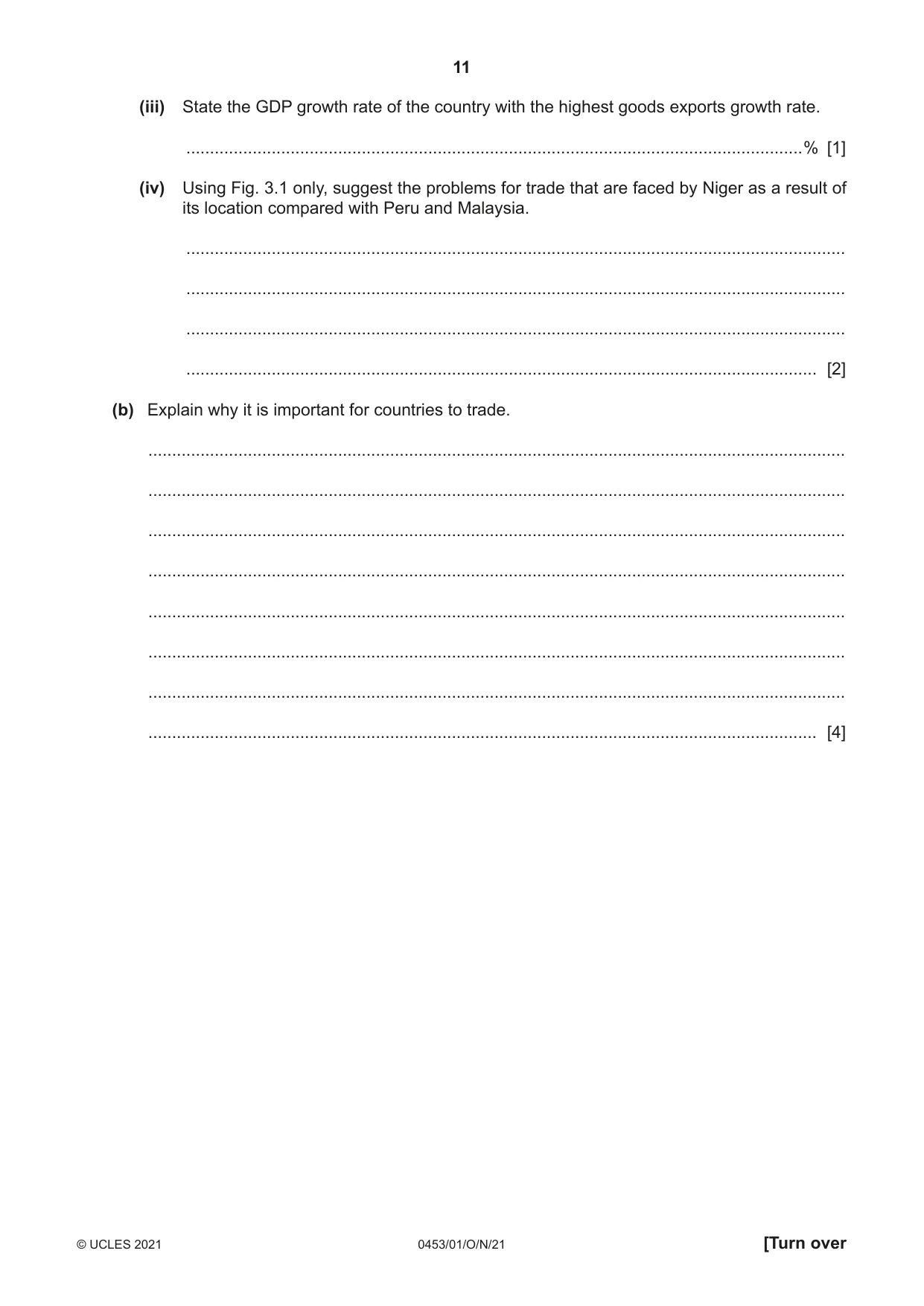
11 0453/01/O/N/21 © UCLES 2021 [Turn over (iii) State the GDP growth rate of the country with the highest goods exports growth rate. …% [1] (iv) Using Fig. 3.1 only, suggest the problems for trade that are faced by Niger as a result of its location compared with Peru and Malaysia. … … … … [2] (b) Explain why it is important for countries to trade. … … … … … … … … [4]
Question paper, page 12
12 0453/01/O/N/21 © UCLES 2021 (c) Explain the problems that might be faced by farmers in developing countries who rely on the growing of crops for export. … … … … … … … … … … [5]
Question paper, page 13
13 0453/01/O/N/21 © UCLES 2021 [Turn over (d) Explain why multinational companies (MNCs) set up industries in developing countries. You should develop fully the points you make. … … … … … … … … … … … … … … … … … … … … … … … … … [6] [Total: 20]
Question paper, page 14
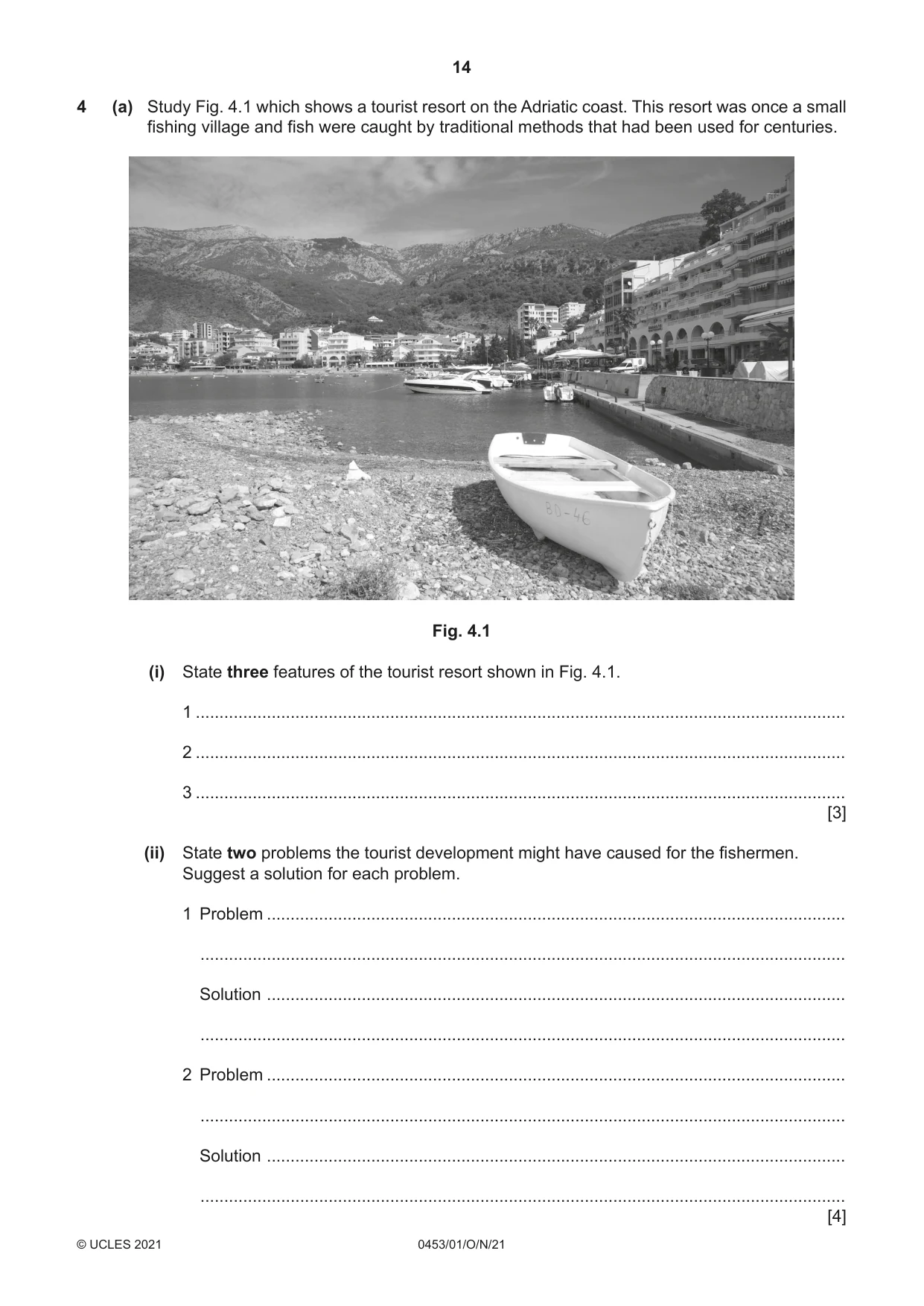
14 0453/01/O/N/21 © UCLES 2021 4 (a) Study Fig. 4.1 which shows a tourist resort on the Adriatic coast. This resort was once a small fishing village and fish were caught by traditional methods that had been used for centuries. Fig. 4.1 (i) State three features of the tourist resort shown in Fig. 4.1. 1 … 2 … 3 … [3] (ii) State two problems the tourist development might have caused for the fishermen. Suggest a solution for each problem. 1 Problem … … Solution … … 2 Problem … … Solution … … [4]
Question paper, page 15
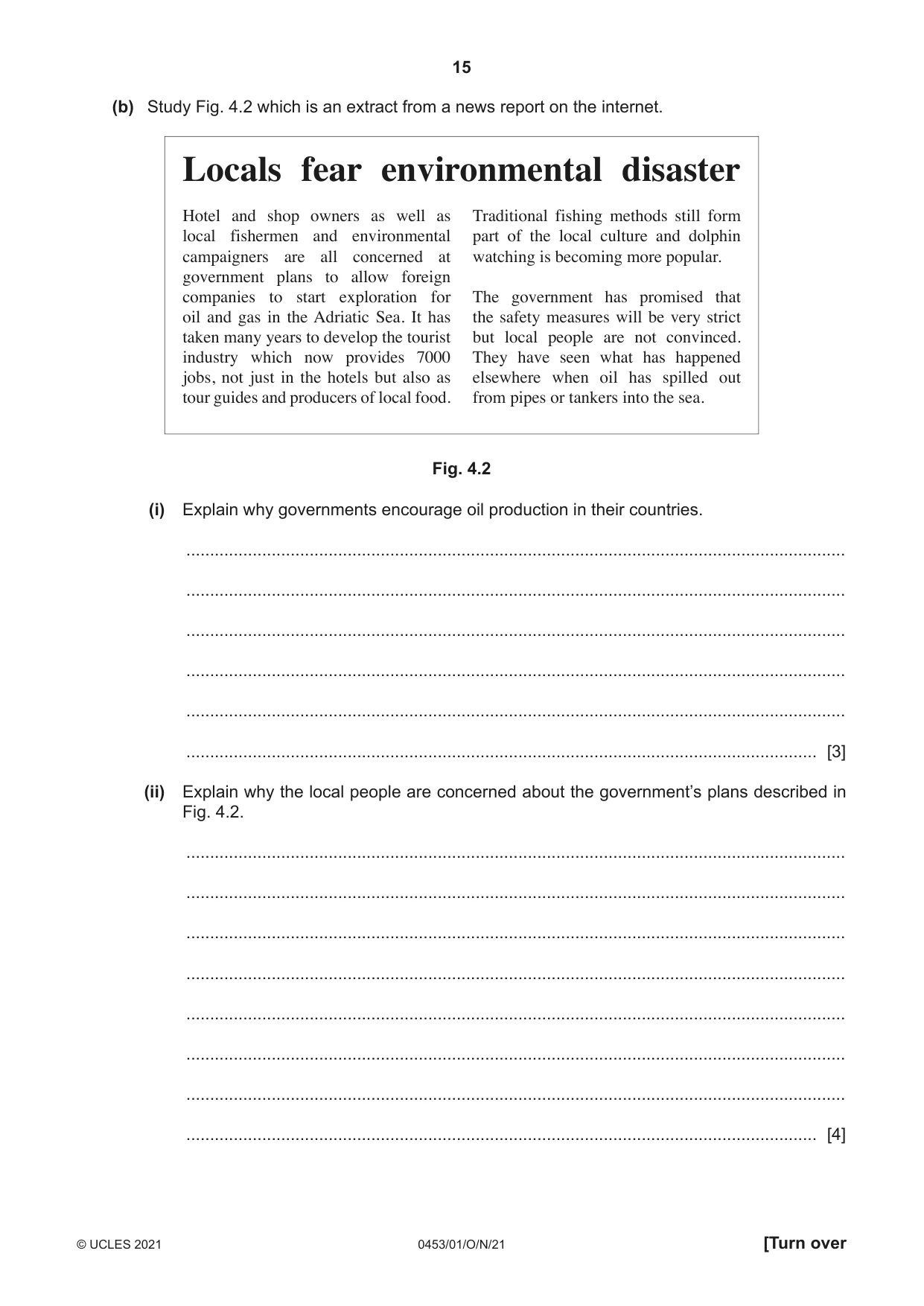
15 0453/01/O/N/21 © UCLES 2021 [Turn over (b) Study Fig. 4.2 which is an extract from a news report on the internet. Locals fear environmental disaster Hotel and shop owners as well as local fishermen and environmental campaigners are all concerned at government plans to allow foreign companies to start exploration for oil and gas in the Adriatic Sea. It has taken many years to develop the tourist industry which now provides 7000 jobs, not just in the hotels but also as tour guides and producers of local food. Traditional fishing methods still form part of the local culture and dolphin watching is becoming more popular. The government has promised that the safety measures will be very strict but local people are not convinced. They have seen what has happened elsewhere when oil has spilled out from pipes or tankers into the sea. Fig. 4.2 (i) Explain why governments encourage oil production in their countries. … … … … … … [3] (ii) Explain why the local people are concerned about the government’s plans described in Fig. 4.2. … … … … … … … … [4]
Question paper, page 16
16 0453/01/O/N/21 © UCLES 2021 (c) Natural disasters result from the earth’s physical processes and can rarely be avoided. For a natural disaster you have studied, describe the immediate effect it had on local communities and explain the longer term impact on the development of the country. You should develop fully the points you make. … … … … … … … … … … … … … … … … … … … … … … … … [6] [Total: 20] To avoid the issue of disclosure of answer-related information to candidates, all copyright acknowledgements are reproduced online in the Cambridge Assessment International Education Copyright Acknowledgements Booklet. This is produced for each series of examinations and is freely available to download at www.cambridgeinternational.org after the live examination series.
What you needed in this session
Cambridge’s own grade thresholds for 2021 Oct/Nov, Paper 1 · Variant 0. A higher threshold means an easier paper — the bar moves with how the cohort did.