Cambridge IGCSE Development Studies 0453 — 2020 Oct/Nov Paper 1 · Variant 0
0453/10/O/N/20
The question paper and its mark scheme, free to read here and free to download. This is Cambridge’s own paper, exactly as it was sat.
Question paper20 pages



Mark scheme
No mark scheme is in the library for this paper.
Paper as text
Question paper, page 1
Cambridge IGCSE™ * 0 8 0 6 2 3 0 8 8 3 * This document has 20 pages. Blank pages are indicated. DEVELOPMENT STUDIES 0453/01 Paper 1 October/November 2020 2 hours You must answer on the question paper. No additional materials are needed. INSTRUCTIONS ● Answer all questions. ● Use a black or dark blue pen. You may use an HB pencil for any diagrams or graphs. ● Write your name, centre number and candidate number in the boxes at the top of the page. ● Write your answer to each question in the space provided. ● Do not use an erasable pen or correction fluid. ● Do not write on any bar codes. INFORMATION ● The total mark for this paper is 80. ● The number of marks for each question or part question is shown in brackets [ ]. DC (SC/SG) 180357/2 © UCLES 2020 [Turn over
Question paper, page 2
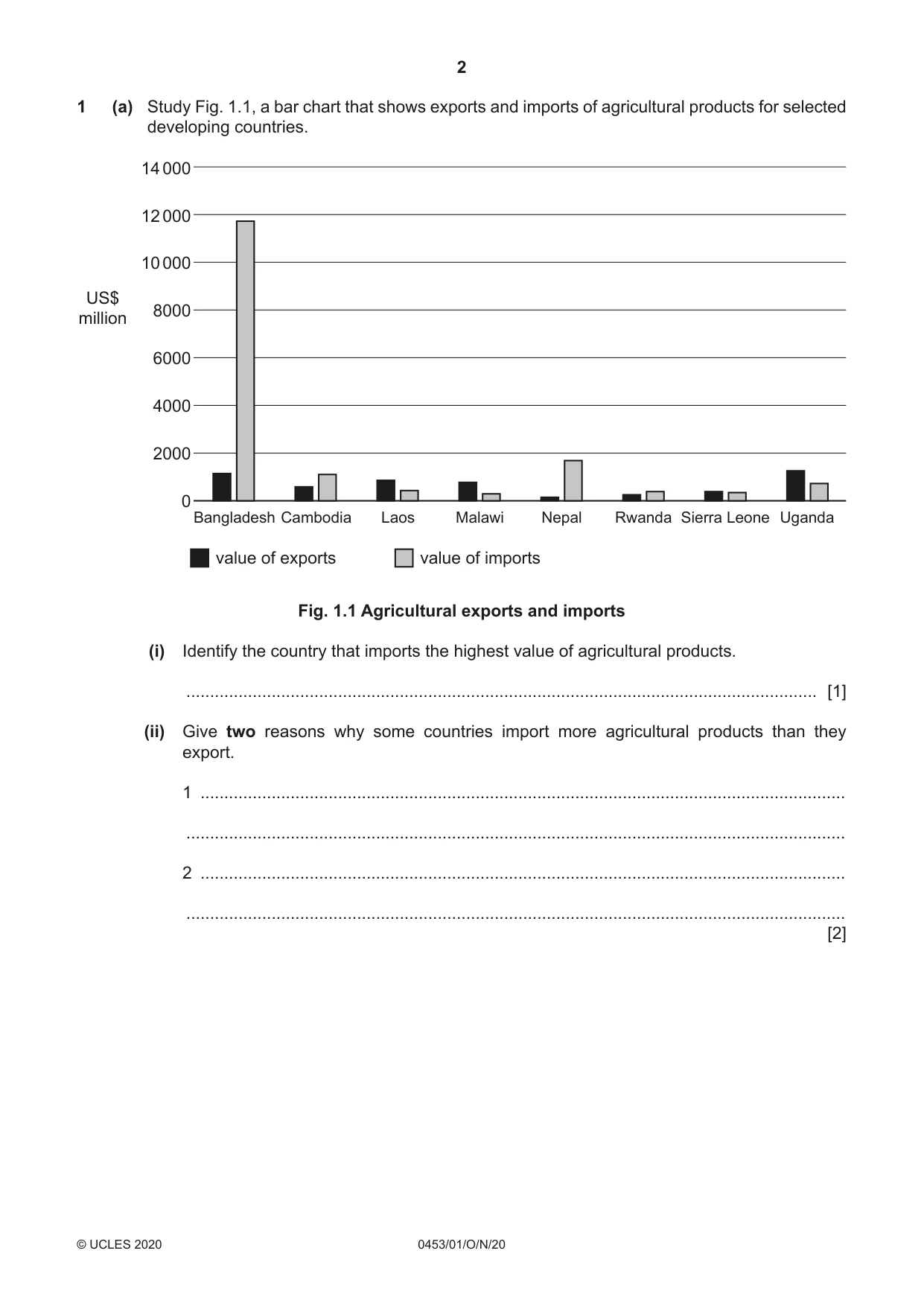
2 0453/01/O/N/20 © UCLES 2020 1 (a) Study Fig. 1.1, a bar chart that shows exports and imports of agricultural products for selected developing countries. 14 000 12 000 10 000 8000 6000 4000 2000 0 Bangladesh Cambodia Laos Malawi Nepal Rwanda Sierra Leone Uganda US$ million value of exports value of imports Fig. 1.1 Agricultural exports and imports (i) Identify the country that imports the highest value of agricultural products. … [1] (ii) Give two reasons why some countries import more agricultural products than they export. 1 … … 2 … … [2]
Question paper, page 3
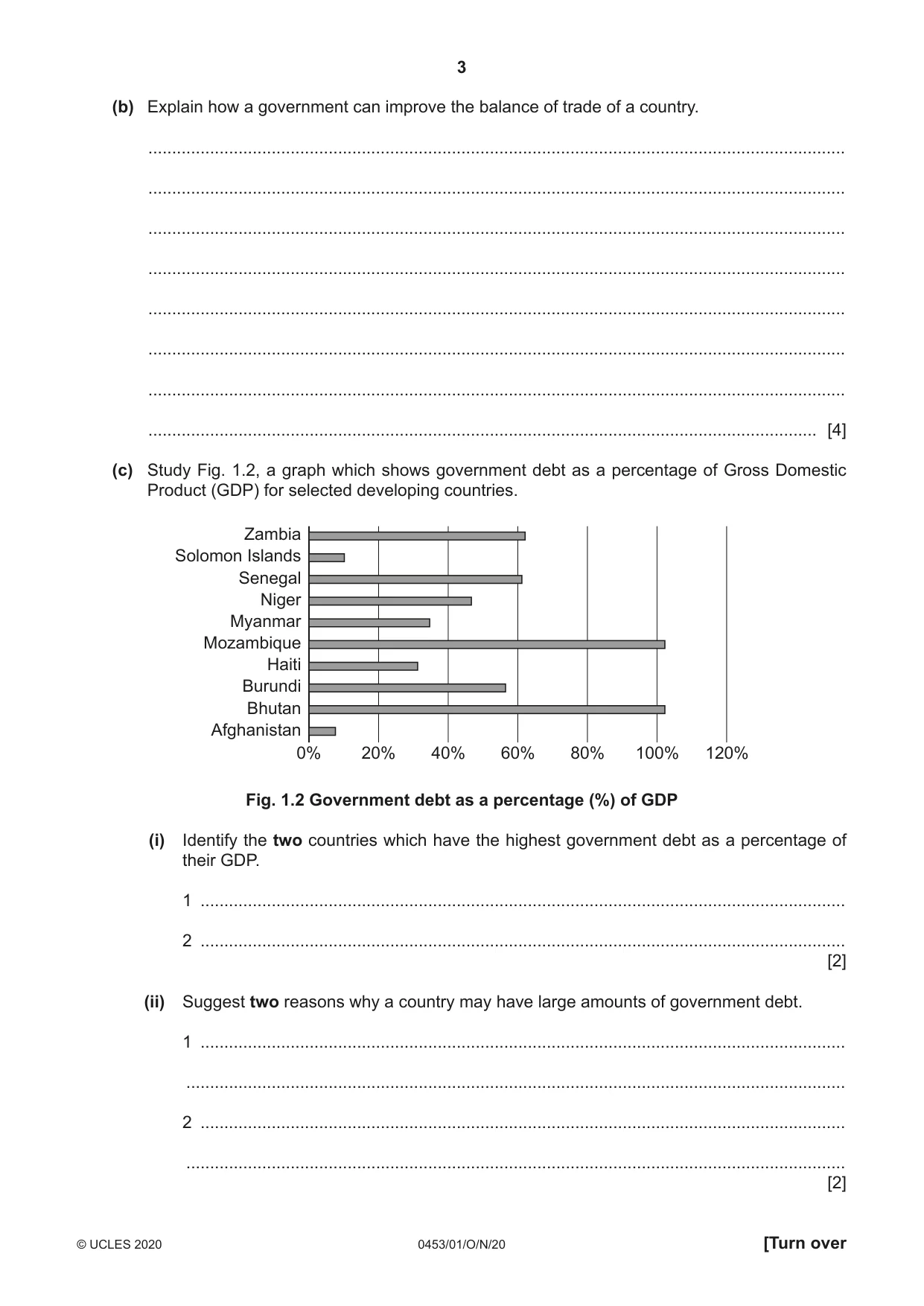
3 0453/01/O/N/20 © UCLES 2020 [Turn over (b) Explain how a government can improve the balance of trade of a country. … … … … … … … … [4] (c) Study Fig. 1.2, a graph which shows government debt as a percentage of Gross Domestic Product (GDP) for selected developing countries. Zambia Solomon Islands Senegal Niger Myanmar Mozambique Haiti Burundi Bhutan Afghanistan 0% 20% 40% 60% 80% 100% 120% Fig. 1.2 Government debt as a percentage (%) of GDP (i) Identify the two countries which have the highest government debt as a percentage of their GDP. 1 … 2 … [2] (ii) Suggest two reasons why a country may have large amounts of government debt. 1 … … 2 … … [2]
Question paper, page 4
4 0453/01/O/N/20 © UCLES 2020 (iii) Describe the possible effects on services, such as health or education, when a government tries to reduce its debt. … … … … … … [3]
Question paper, page 5
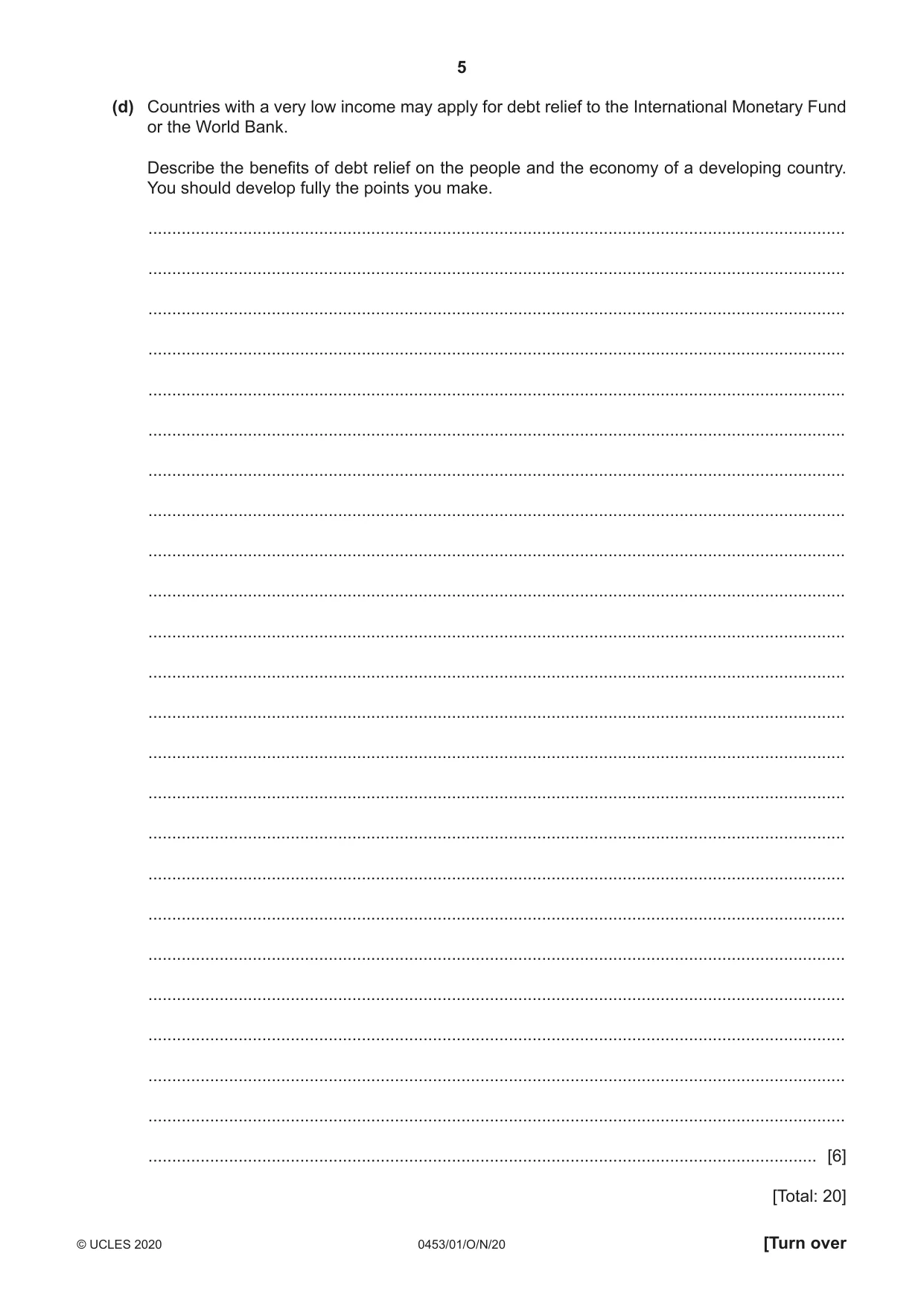
5 0453/01/O/N/20 © UCLES 2020 [Turn over (d) Countries with a very low income may apply for debt relief to the International Monetary Fund or the World Bank. Describe the benefits of debt relief on the people and the economy of a developing country. You should develop fully the points you make. … … … … … … … … … … … … … … … … … … … … … … … … [6] [Total: 20]
Question paper, page 6
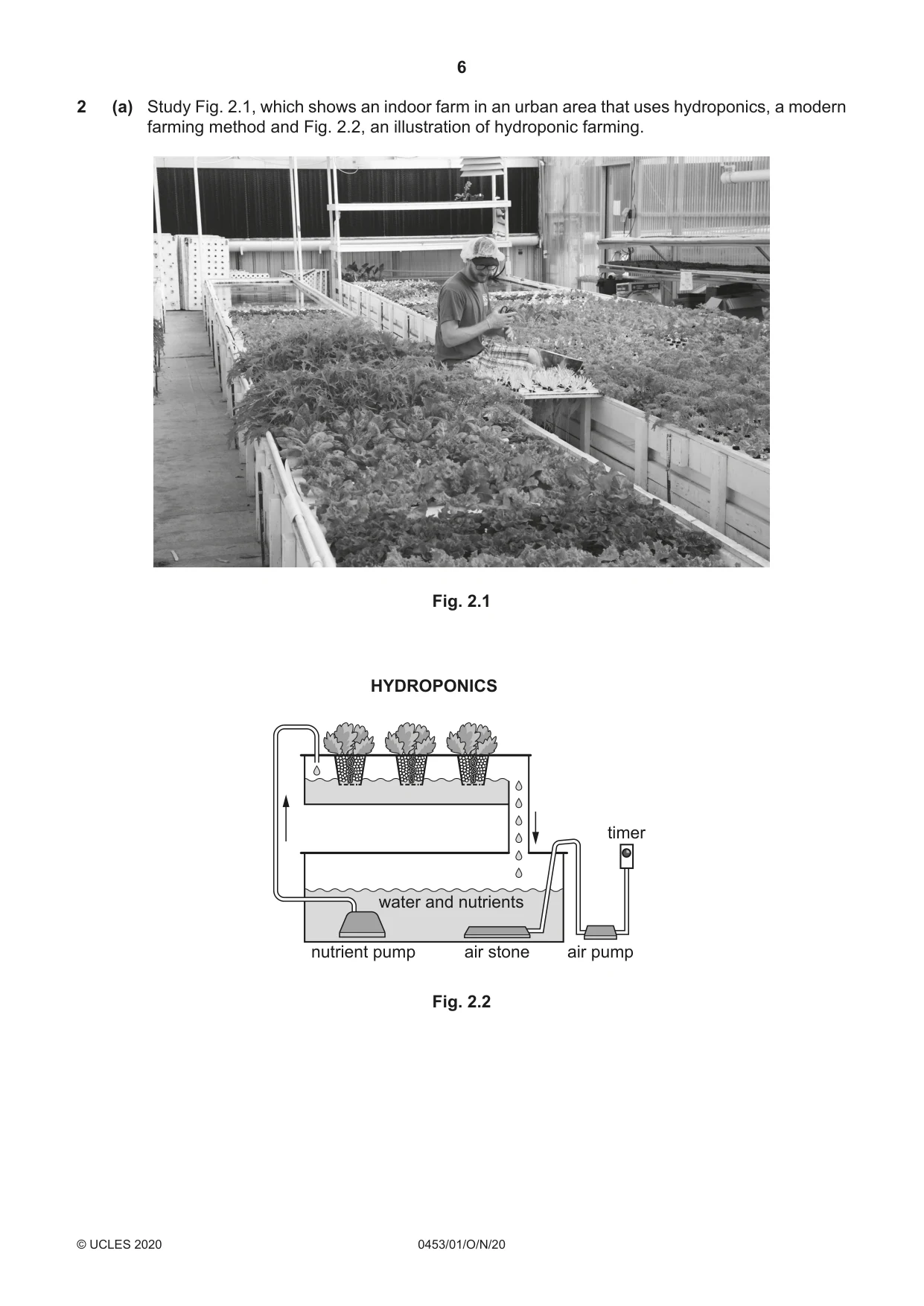
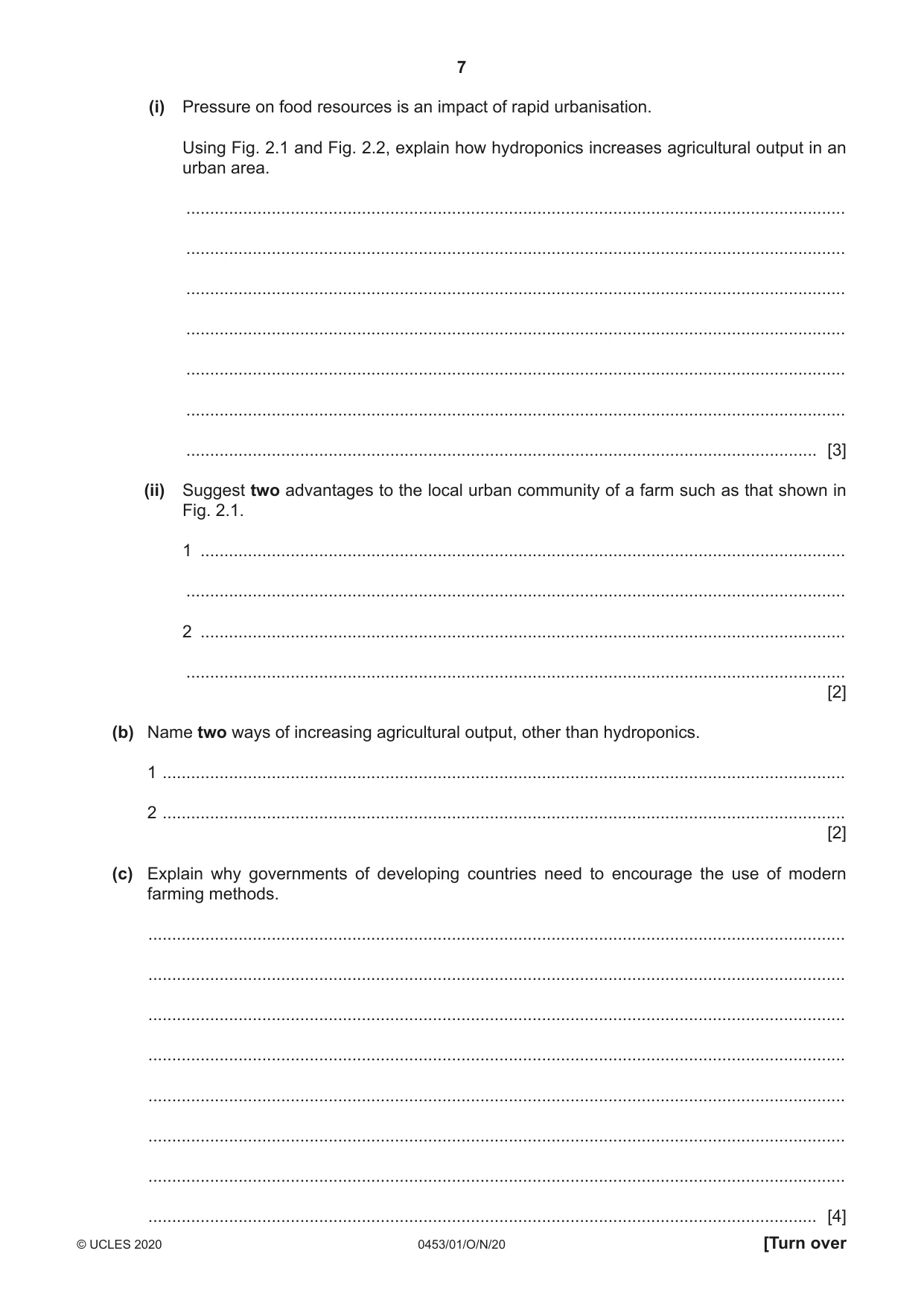
6 0453/01/O/N/20 © UCLES 2020 2 (a) Study Fig. 2.1, which shows an indoor farm in an urban area that uses hydroponics, a modern farming method and Fig. 2.2, an illustration of hydroponic farming. Fig. 2.1 timer air pump air stone nutrient pump HYDROPONICS water and nutrients Fig. 2.2
Question paper, page 7
7 0453/01/O/N/20 © UCLES 2020 [Turn over (i) Pressure on food resources is an impact of rapid urbanisation. Using Fig. 2.1 and Fig. 2.2, explain how hydroponics increases agricultural output in an urban area. … … … … … … … [3] (ii) Suggest two advantages to the local urban community of a farm such as that shown in Fig. 2.1. 1 … … 2 … … [2] (b) Name two ways of increasing agricultural output, other than hydroponics. 1 … 2 … [2] (c) Explain why governments of developing countries need to encourage the use of modern farming methods. … … … … … … … … [4]
Question paper, page 8
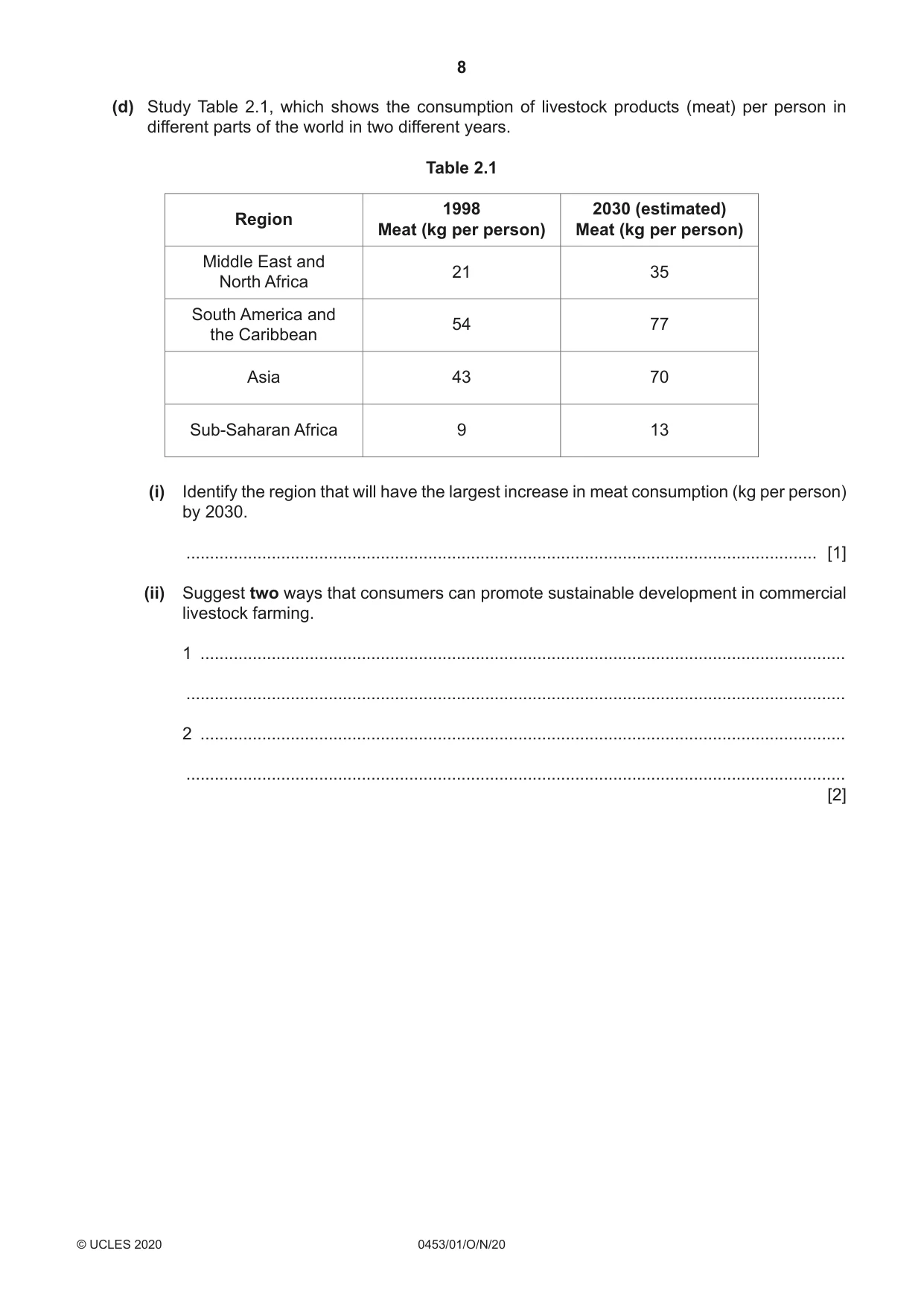
8 0453/01/O/N/20 © UCLES 2020 (d) Study Table 2.1, which shows the consumption of livestock products (meat) per person in different parts of the world in two different years. Table 2.1 Region 1998 Meat (kg per person) 2030 (estimated) Meat (kg per person) Middle East and North Africa 21 35 South America and the Caribbean 54 77 Asia 43 70 Sub-Saharan Africa 9 13 (i) Identify the region that will have the largest increase in meat consumption (kg per person) by 2030. … [1] (ii) Suggest two ways that consumers can promote sustainable development in commercial livestock farming. 1 … … 2 … … [2]
Question paper, page 9
9 0453/01/O/N/20 © UCLES 2020 [Turn over (e) Explain why organic farming would be a sustainable development. You should develop fully the points you make. … … … … … … … … … … … … … … … … … … … … … … … … … … [6] [Total: 20]
Question paper, page 10
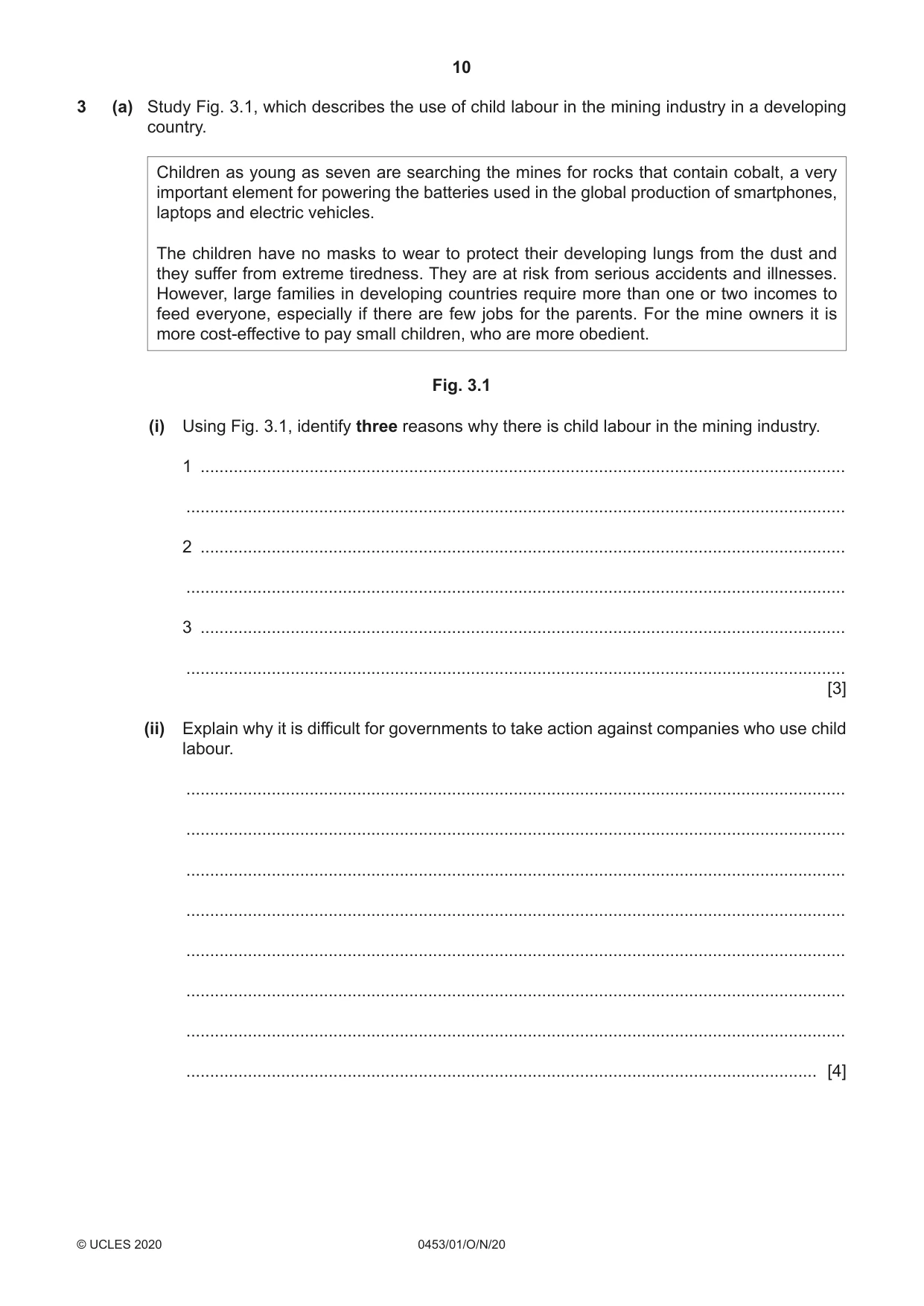
10 0453/01/O/N/20 © UCLES 2020 3 (a) Study Fig. 3.1, which describes the use of child labour in the mining industry in a developing country. Children as young as seven are searching the mines for rocks that contain cobalt, a very important element for powering the batteries used in the global production of smartphones, laptops and electric vehicles. The children have no masks to wear to protect their developing lungs from the dust and they suffer from extreme tiredness. They are at risk from serious accidents and illnesses. However, large families in developing countries require more than one or two incomes to feed everyone, especially if there are few jobs for the parents. For the mine owners it is more cost-effective to pay small children, who are more obedient. Fig. 3.1 (i) Using Fig. 3.1, identify three reasons why there is child labour in the mining industry. 1 … … 2 … … 3 … … [3] (ii) Explain why it is difficult for governments to take action against companies who use child labour. … … … … … … … … [4]
Question paper, page 11
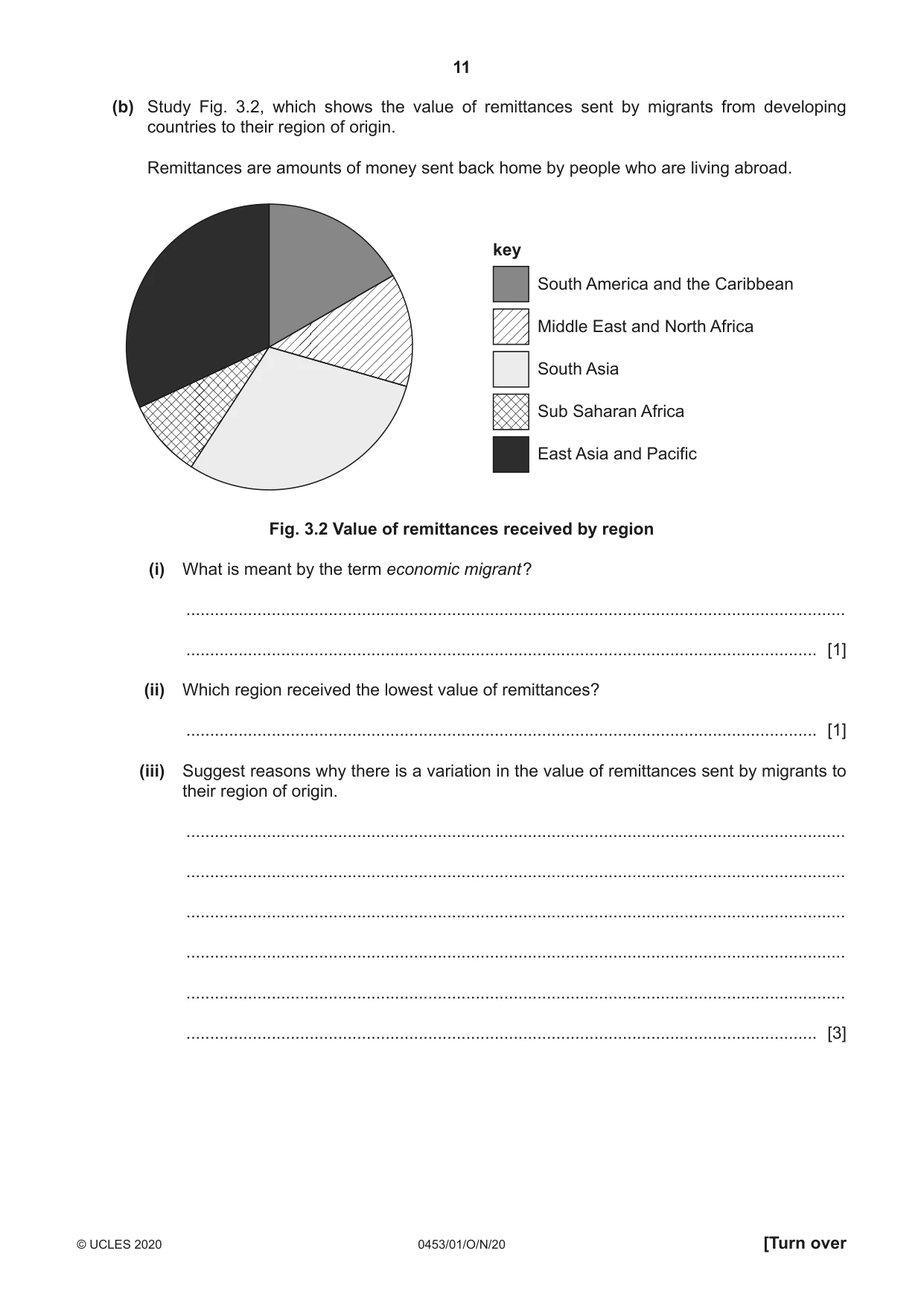
11 0453/01/O/N/20 © UCLES 2020 [Turn over (b) Study Fig. 3.2, which shows the value of remittances sent by migrants from developing countries to their region of origin. Remittances are amounts of money sent back home by people who are living abroad. South America and the Caribbean Middle East and North Africa South Asia Sub Saharan Africa East Asia and Pacific key Fig. 3.2 Value of remittances received by region (i) What is meant by the term economic migrant? … … [1] (ii) Which region received the lowest value of remittances? … [1] (iii) Suggest reasons why there is a variation in the value of remittances sent by migrants to their region of origin. … … … … … … [3]
Question paper, page 12
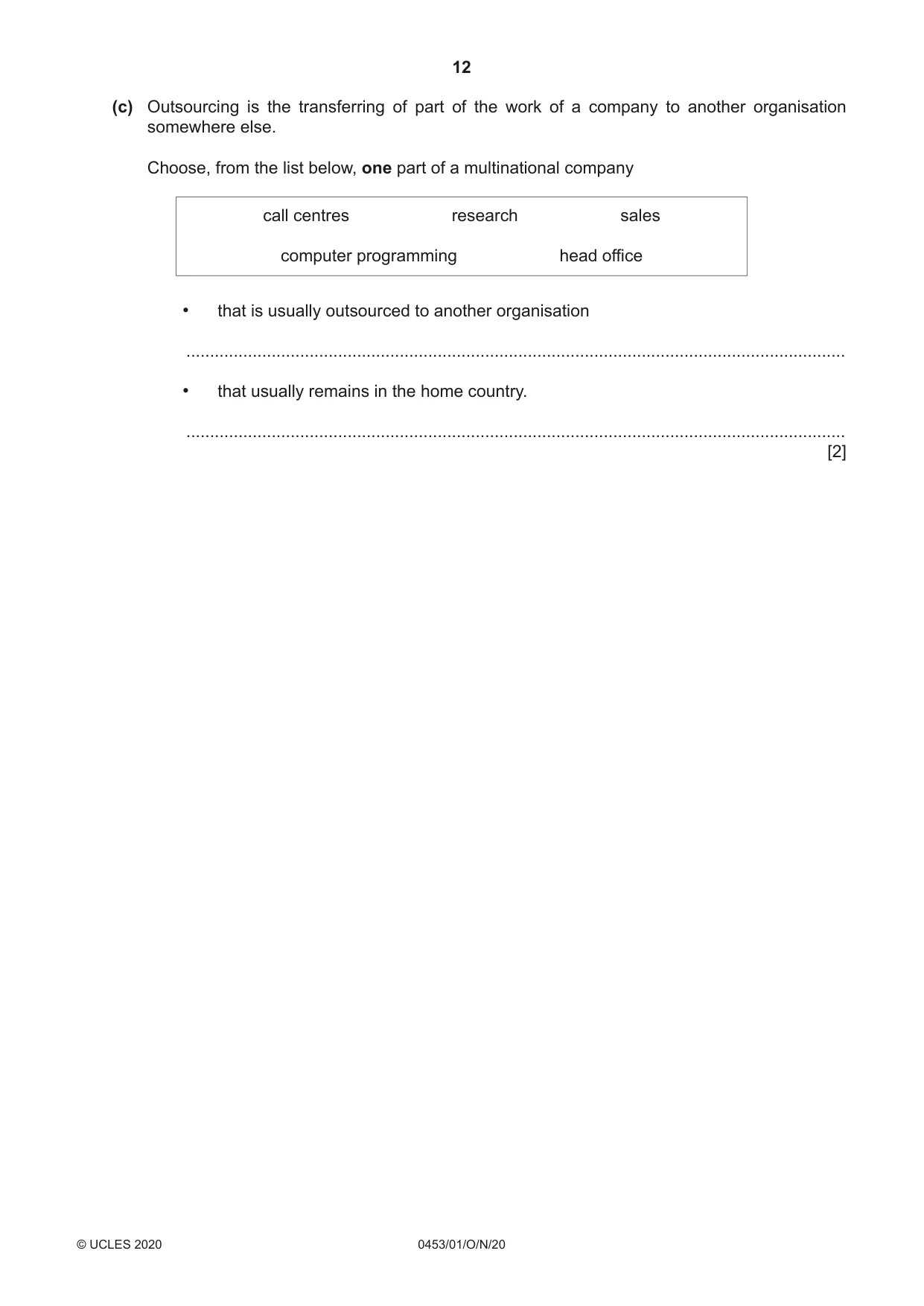
12 0453/01/O/N/20 © UCLES 2020 (c) Outsourcing is the transferring of part of the work of a company to another organisation somewhere else. Choose, from the list below, one part of a multinational company call centres research sales computer programming head office • that is usually outsourced to another organisation … • that usually remains in the home country. … [2]
Question paper, page 13
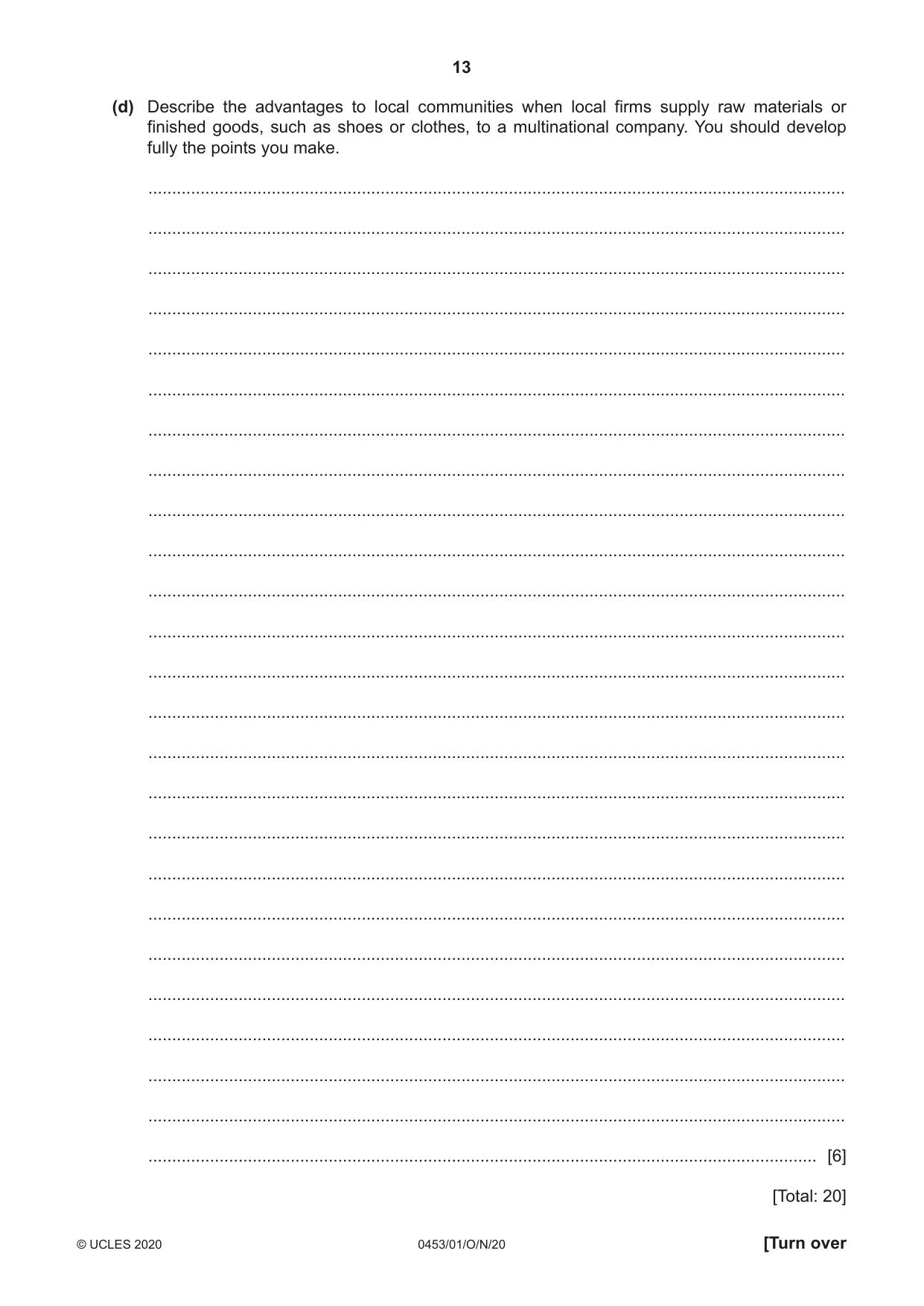
13 0453/01/O/N/20 © UCLES 2020 [Turn over (d) Describe the advantages to local communities when local firms supply raw materials or finished goods, such as shoes or clothes, to a multinational company. You should develop fully the points you make. … … … … … … … … … … … … … … … … … … … … … … … … … [6] [Total: 20]
Question paper, page 14
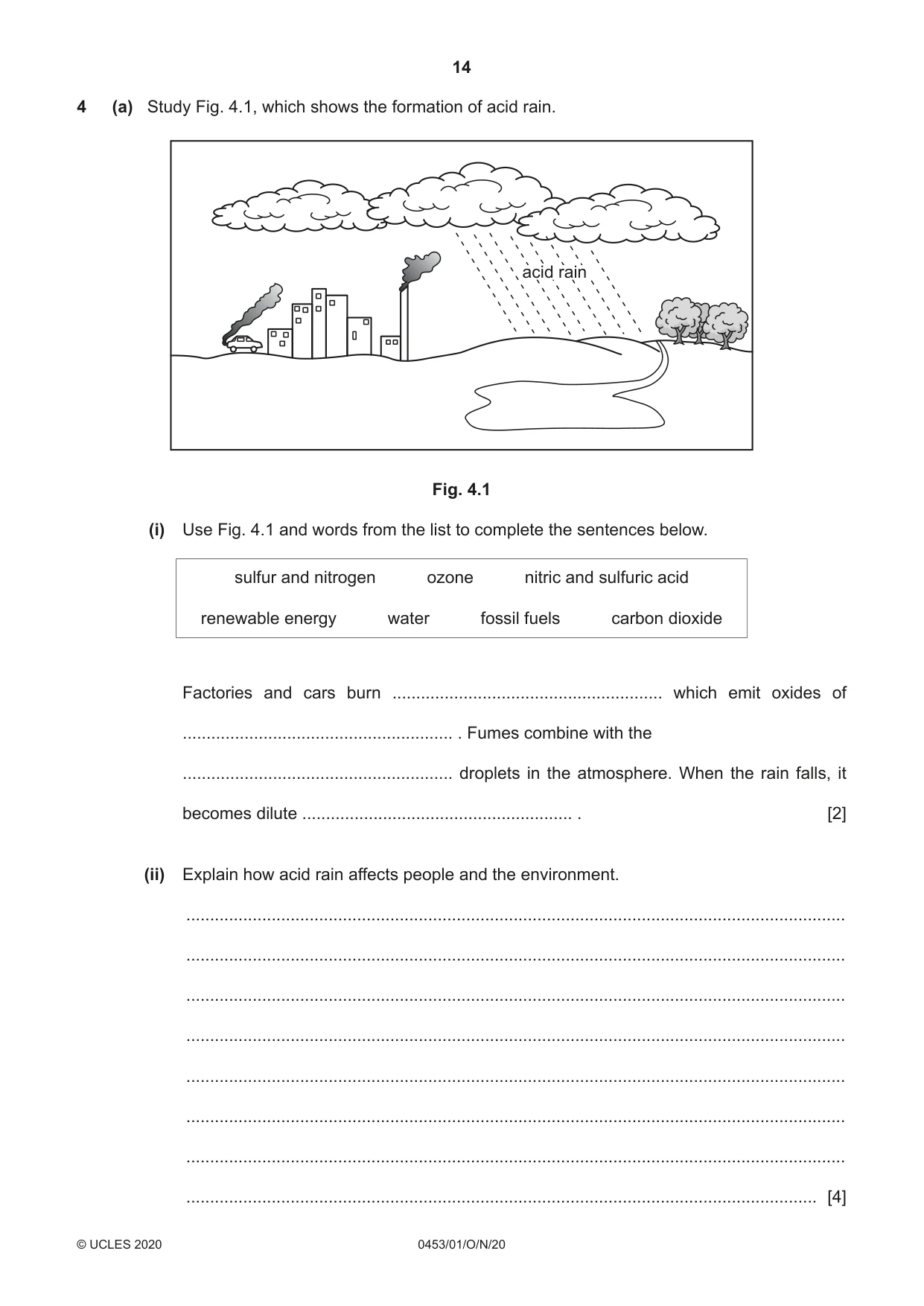
14 0453/01/O/N/20 © UCLES 2020 4 (a) Study Fig. 4.1, which shows the formation of acid rain. acid rain Fig. 4.1 (i) Use Fig. 4.1 and words from the list to complete the sentences below. sulfur and nitrogen ozone nitric and sulfuric acid renewable energy water fossil fuels carbon dioxide Factories and cars burn … which emit oxides of … . Fumes combine with the … droplets in the atmosphere. When the rain falls, it becomes dilute … . [2] (ii) Explain how acid rain affects people and the environment. … … … … … … … … [4]
Question paper, page 15
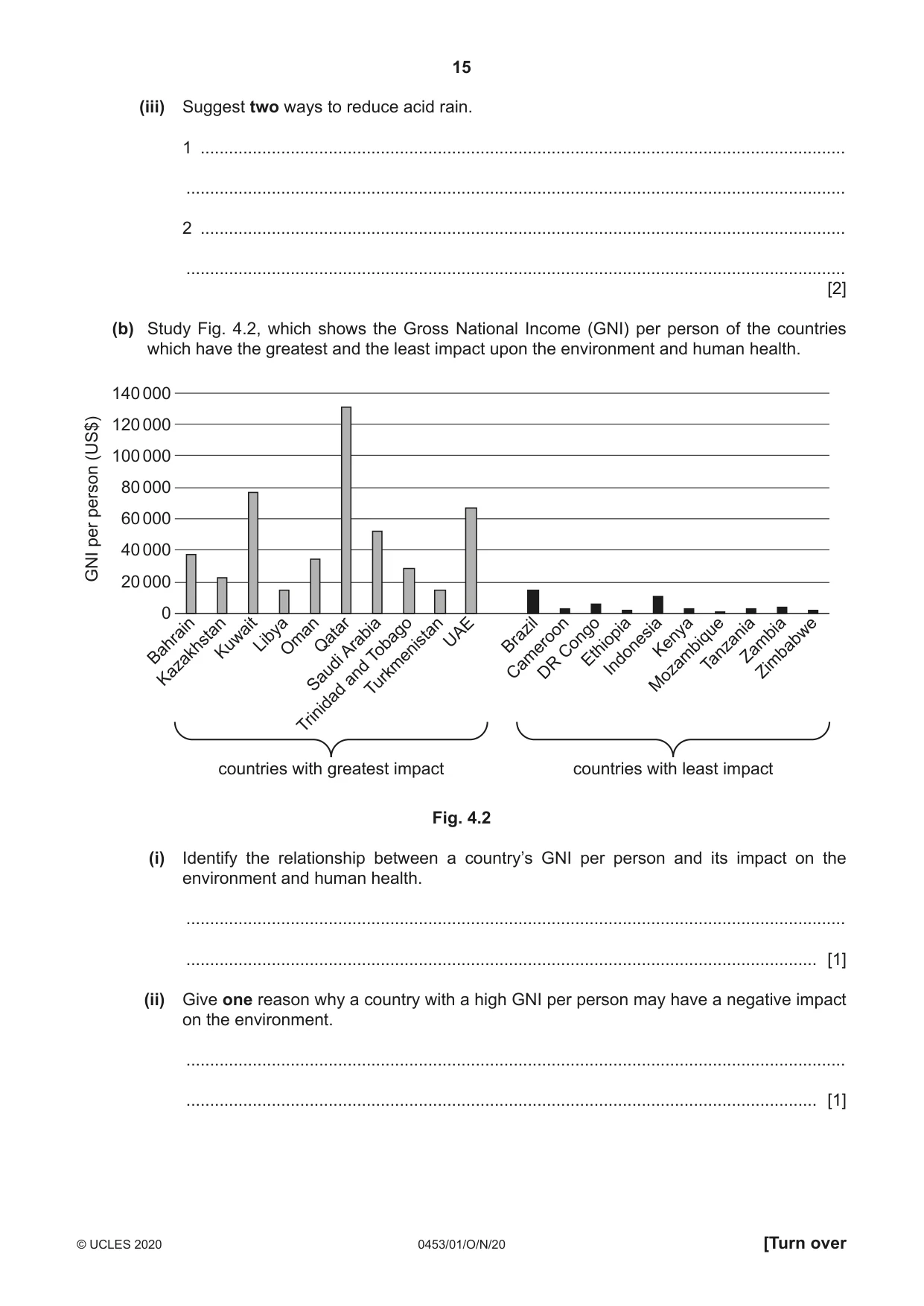
15 0453/01/O/N/20 © UCLES 2020 [Turn over (iii) Suggest two ways to reduce acid rain. 1 … … 2 … … [2] (b) Study Fig. 4.2, which shows the Gross National Income (GNI) per person of the countries which have the greatest and the least impact upon the environment and human health. Bahrain Kazakhstan Kuwait Libya Oman Qatar Saudi Arabia Trinidad and Tobago Turkmenistan UAE Brazil Cameroon DR Congo Ethiopia Indonesia Kenya Mozambique Tanzania Zambia Zimbabwe 140 000 120 000 100 000 80 000 60 000 40 000 20 000 0 countries with greatest impact countries with least impact GNI per person (US$) Fig. 4.2 (i) Identify the relationship between a country’s GNI per person and its impact on the environment and human health. … … [1] (ii) Give one reason why a country with a high GNI per person may have a negative impact on the environment. … … [1]
Question paper, page 16
16 0453/01/O/N/20 © UCLES 2020 (iii) State two indicators used to calculate the Human Development Index. 1 … 2 … [2] (c) Suggest why some aspects of development, such as political freedom, are difficult to measure. … … … … [2]
Question paper, page 17
17 0453/01/O/N/20 © UCLES 2020 (d) Describe how corruption and the mismanagement of resources impact on local people in developing countries. You should develop fully the points you make. … … … … … … … … … … … … … … … … … … … … … … … … … … [6] [Total: 20]
Question paper, page 18
18 0453/01/O/N/20 © UCLES 2020 BLANK PAGE
Question paper, page 19
19 0453/01/O/N/20 © UCLES 2020 BLANK PAGE
Question paper, page 20
20 0453/01/O/N/20 © UCLES 2020 Permission to reproduce items where third-party owned material protected by copyright is included has been sought and cleared where possible. Every reasonable effort has been made by the publisher (UCLES) to trace copyright holders, but if any items requiring clearance have unwittingly been included, the publisher will be pleased to make amends at the earliest possible opportunity. To avoid the issue of disclosure of answer-related information to candidates, all copyright acknowledgements are reproduced online in the Cambridge Assessment International Education Copyright Acknowledgements Booklet. This is produced for each series of examinations and is freely available to download at www.cambridgeinternational.org after the live examination series. Cambridge Assessment International Education is part of the Cambridge Assessment Group. Cambridge Assessment is the brand name of the University of Cambridge Local Examinations Syndicate (UCLES), which itself is a department of the University of Cambridge. BLANK PAGE