Cambridge IGCSE Development Studies 0453 — 2018 Oct/Nov Paper 1 · Variant 0
0453/10/O/N/18
The question paper and its mark scheme, free to read here and free to download. This is Cambridge’s own paper, exactly as it was sat.
Question paper16 pages



Mark scheme
No mark scheme is in the library for this paper.
Paper as text
Question paper, page 1
* 1 3 8 9 6 9 5 2 8 1 * This document consists of 15 printed pages and 1 blank page. DC (SC/FC) 145326/4 © UCLES 2018 [Turn over Cambridge International Examinations Cambridge International General Certificate of Secondary Education DEVELOPMENT STUDIES 0453/01 Paper 1 October/November 2018 2 hours Candidates answer on the Question Paper. No Additional Materials are required. READ THESE INSTRUCTIONS FIRST Write your Centre number, candidate number and name on all the work you hand in. Write in dark blue or black pen. Do not use staples, paper clips, glue or correction fluid. You may use a pencil for any diagrams, graphs or rough working. DO NOT WRITE IN ANY BARCODES. Answer all the questions. You may not need all the answer lines for your answer. You should read and study the sources before answering the questions. At the end of the examination, fasten all your work securely together. The number of marks is given in brackets [ ] at the end of each question or part question.
Question paper, page 2
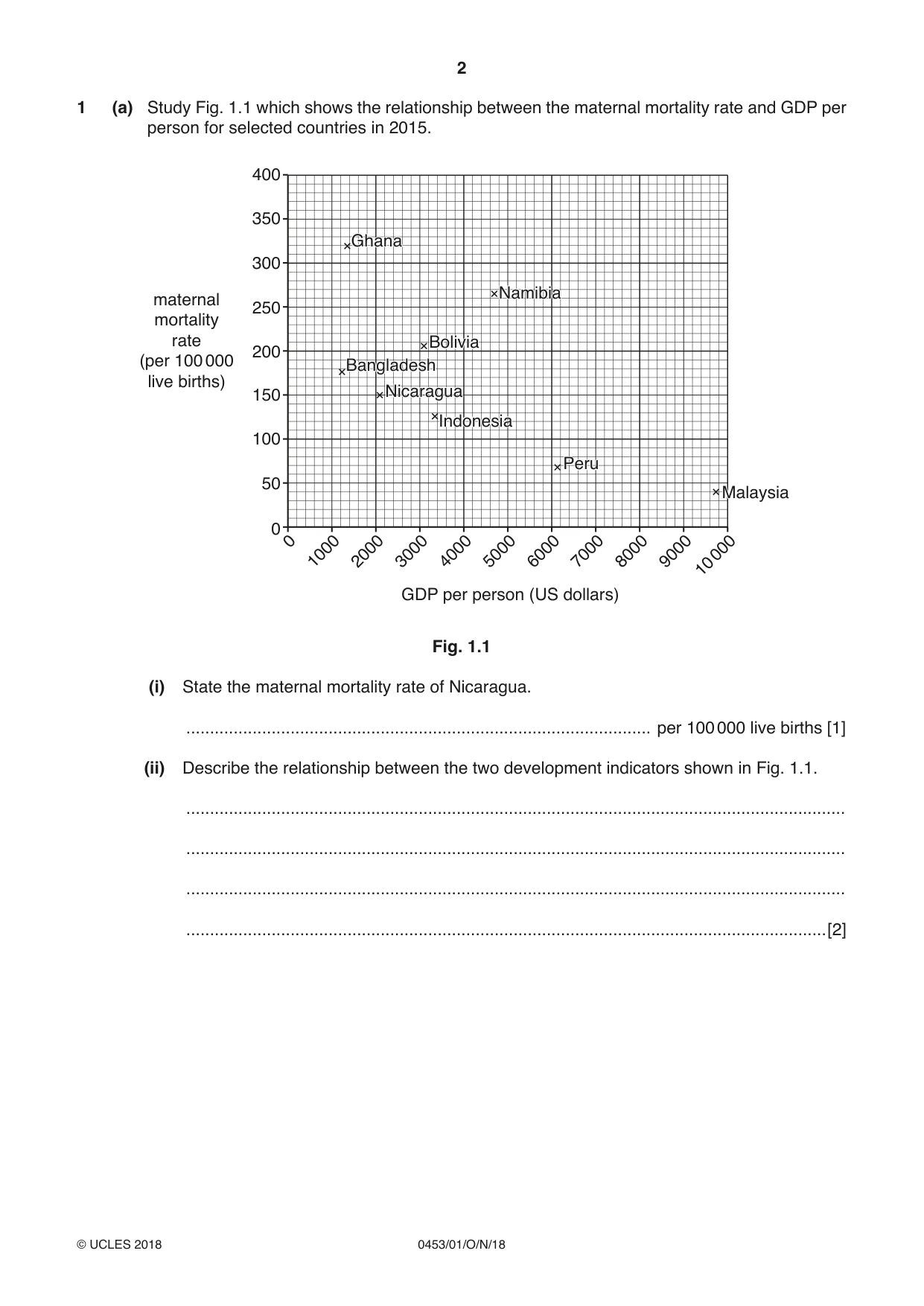
2 0453/01/O/N/18 © UCLES 2018 1 (a) Study Fig. 1.1 which shows the relationship between the maternal mortality rate and GDP per person for selected countries in 2015. 0 1000 2000 3000 4000 5000 6000 7000 8000 9000 10 000 0 50 100 maternal mortality rate (per 100 000 live births) GDP per person (US dollars) 150 200 250 300 350 400 Ghana Ghana Namibia Namibia Bolivia Bolivia Bangladesh Bangladesh Nicaragua Nicaragua Indonesia Indonesia Peru Peru Malaysia Malaysia Fig. 1.1 (i) State the maternal mortality rate of Nicaragua. … per 100 000 live births [1] (ii) Describe the relationship between the two development indicators shown in Fig. 1.1. … … … …[2]
Question paper, page 3
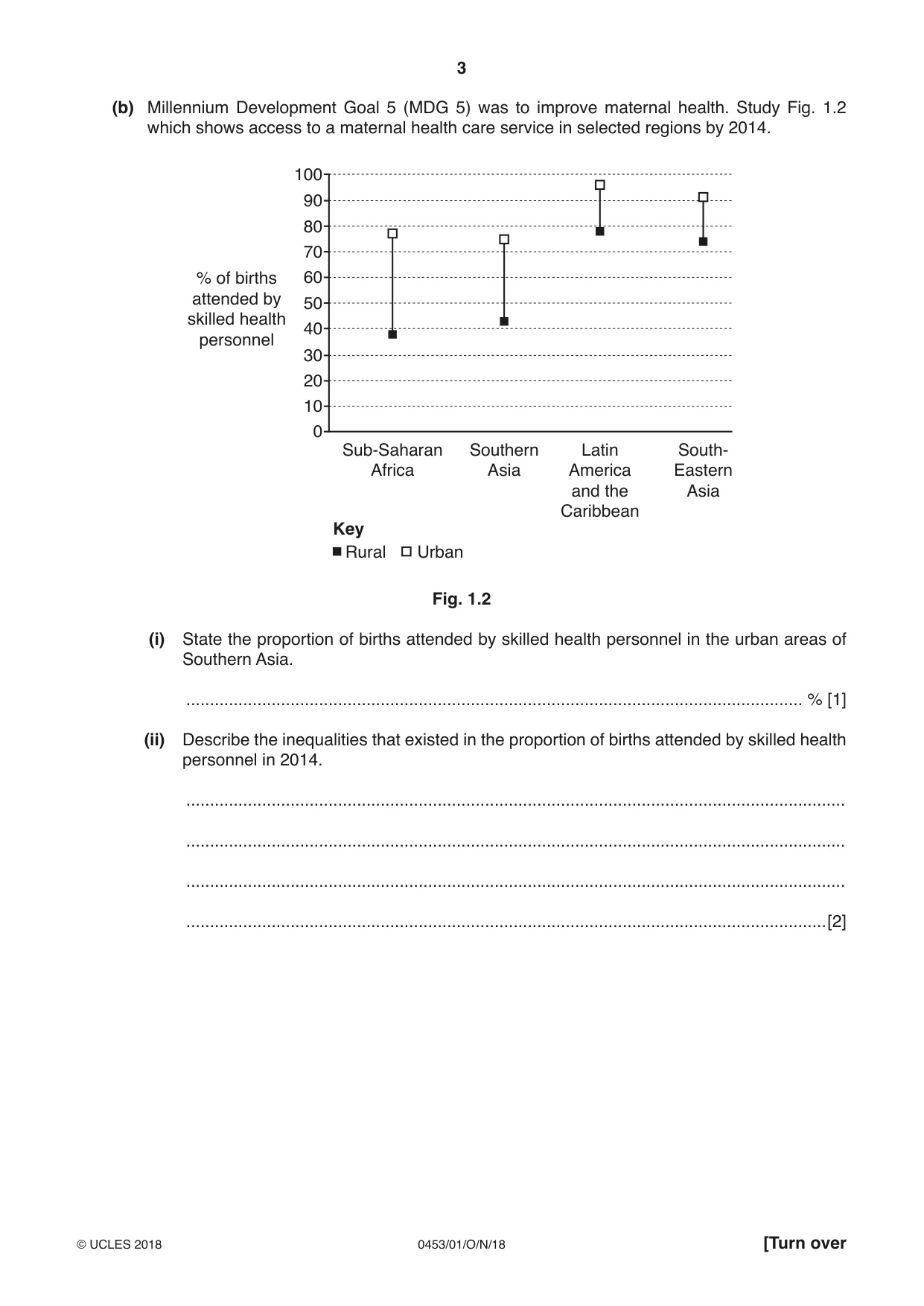
3 0453/01/O/N/18 © UCLES 2018 [Turn over (b) Millennium Development Goal 5 (MDG 5) was to improve maternal health. Study Fig. 1.2 which shows access to a maternal health care service in selected regions by 2014. 0 10 20 30 40 50 % of births attended by skilled health personnel 60 70 80 90 100 Sub-Saharan Africa Southern Asia Latin America and the Caribbean Urban Rural South- Eastern Asia Key Fig. 1.2 (i) State the proportion of births attended by skilled health personnel in the urban areas of Southern Asia. … % [1] (ii) Describe the inequalities that existed in the proportion of births attended by skilled health personnel in 2014. … … … …[2]
Question paper, page 4
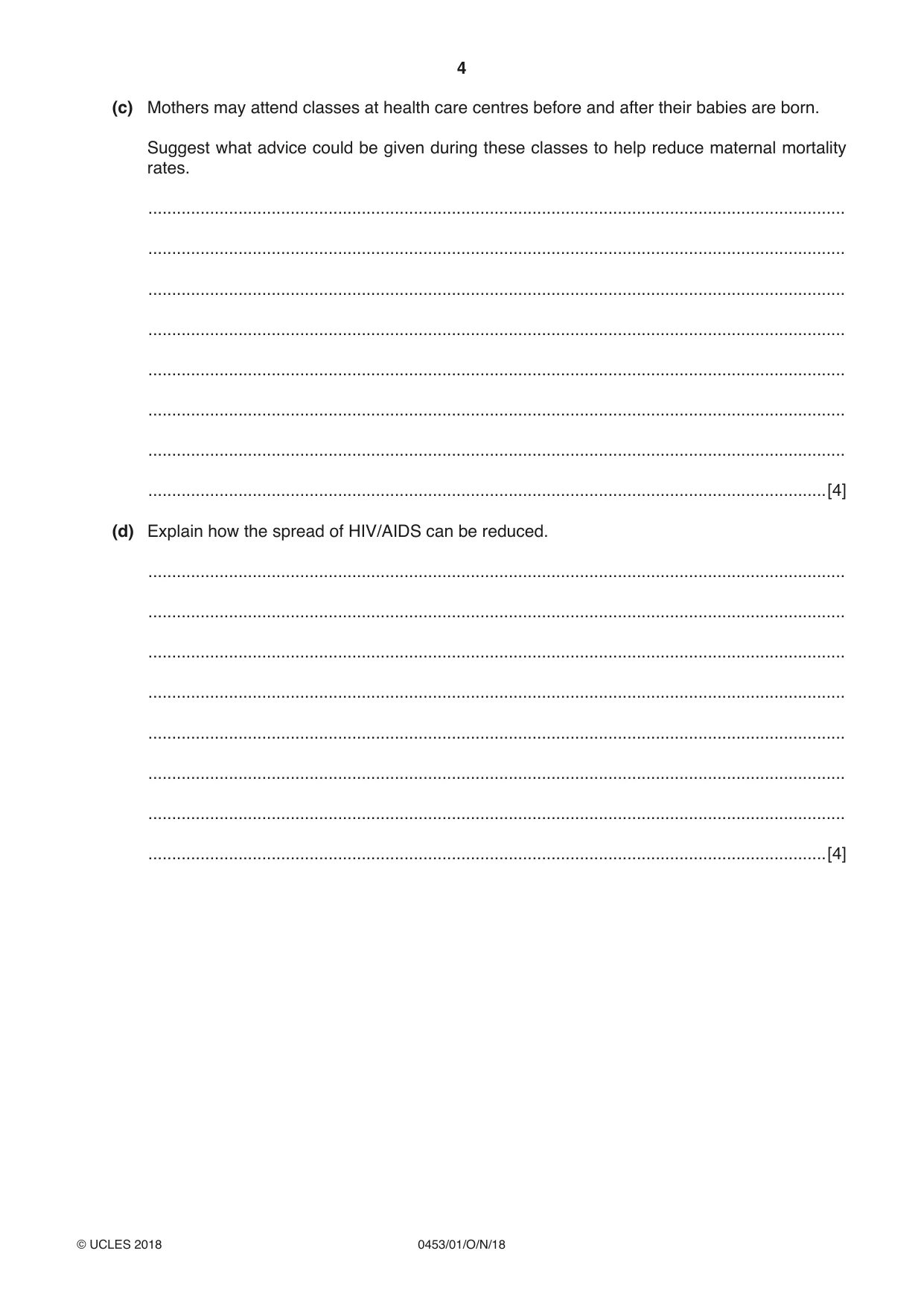
4 0453/01/O/N/18 © UCLES 2018 (c) Mothers may attend classes at health care centres before and after their babies are born. Suggest what advice could be given during these classes to help reduce maternal mortality rates. … … … … … … … …[4] (d) Explain how the spread of HIV/AIDS can be reduced. … … … … … … … …[4]
Question paper, page 5
5 0453/01/O/N/18 © UCLES 2018 [Turn over (e) Explain how easy access to a clean water supply improves the lives of women and their families in rural areas. You should develop fully the points you make. … … … … … … … … … … … … … … … … … … … …[6] [Total: 20]
Question paper, page 6
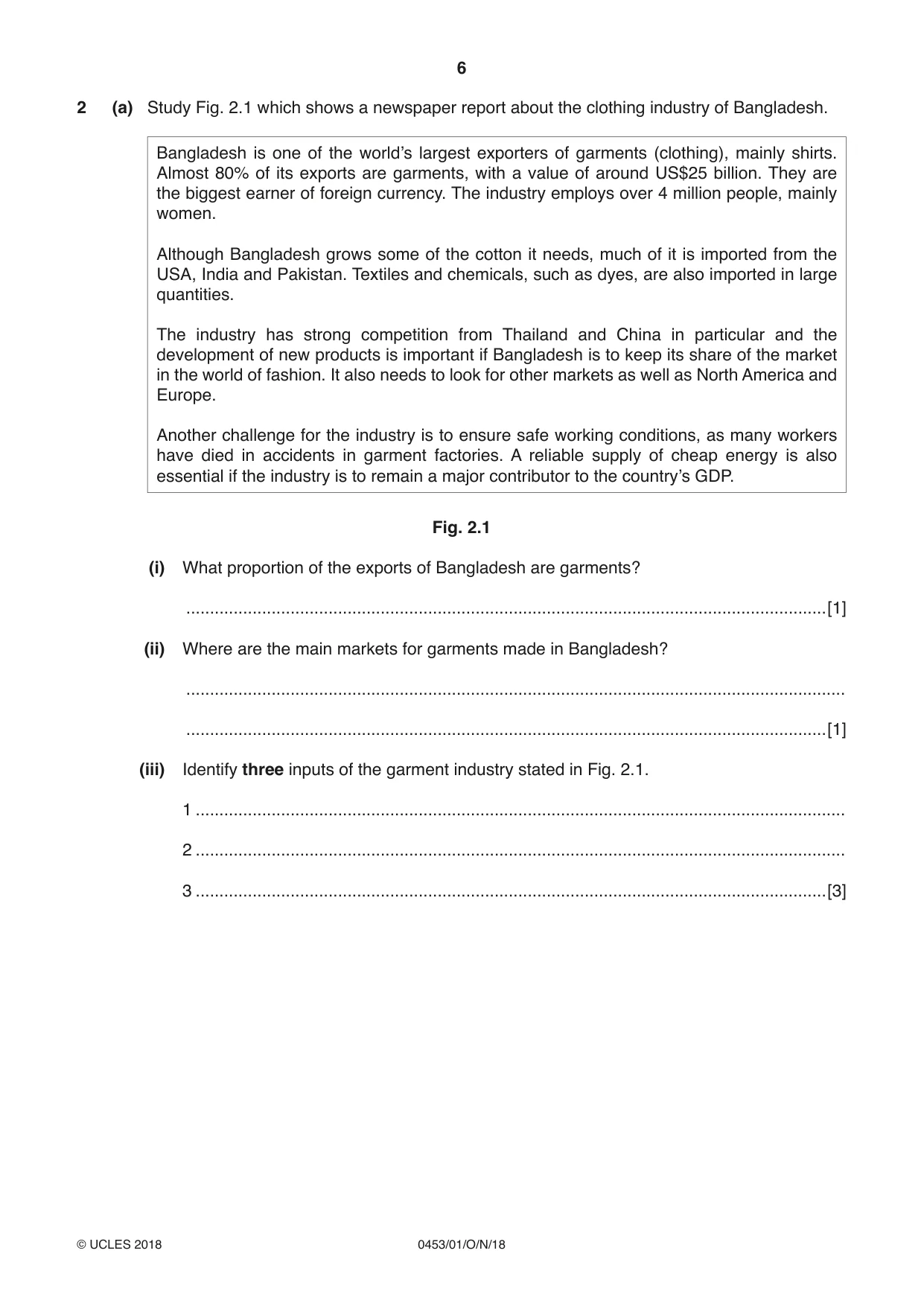
6 0453/01/O/N/18 © UCLES 2018 2 (a) Study Fig. 2.1 which shows a newspaper report about the clothing industry of Bangladesh. Bangladesh is one of the world’s largest exporters of garments (clothing), mainly shirts. Almost 80% of its exports are garments, with a value of around US$25 billion. They are the biggest earner of foreign currency. The industry employs over 4 million people, mainly women. Although Bangladesh grows some of the cotton it needs, much of it is imported from the USA, India and Pakistan. Textiles and chemicals, such as dyes, are also imported in large quantities. The industry has strong competition from Thailand and China in particular and the development of new products is important if Bangladesh is to keep its share of the market in the world of fashion. It also needs to look for other markets as well as North America and Europe. Another challenge for the industry is to ensure safe working conditions, as many workers have died in accidents in garment factories. A reliable supply of cheap energy is also essential if the industry is to remain a major contributor to the country’s GDP. Fig. 2.1 (i) What proportion of the exports of Bangladesh are garments? …[1] (ii) Where are the main markets for garments made in Bangladesh? … …[1] (iii) Identify three inputs of the garment industry stated in Fig. 2.1. 1 … 2 … 3 …[3]
Question paper, page 7
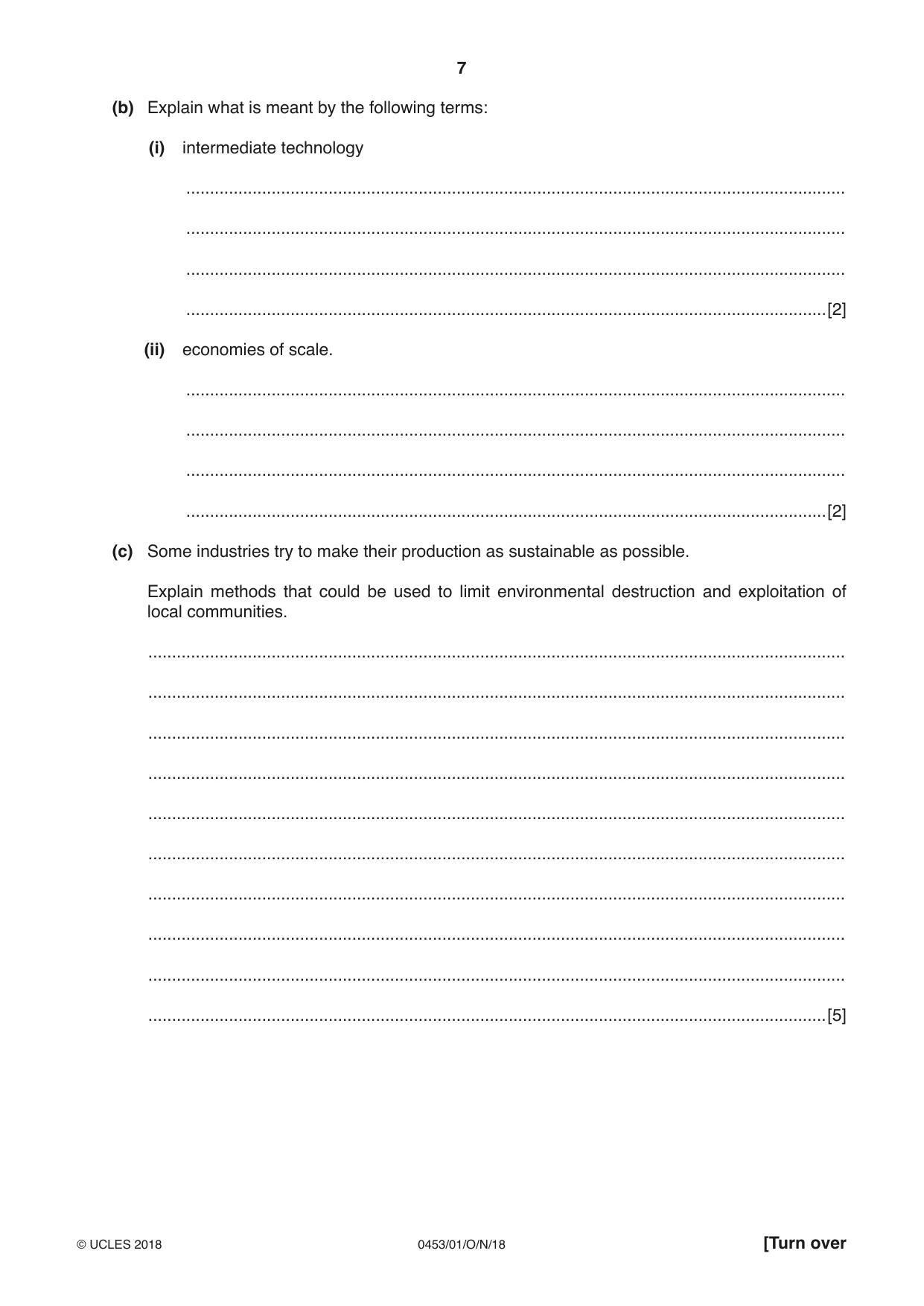
7 0453/01/O/N/18 © UCLES 2018 [Turn over (b) Explain what is meant by the following terms: (i) intermediate technology … … … …[2] (ii) economies of scale. … … … …[2] (c) Some industries try to make their production as sustainable as possible. Explain methods that could be used to limit environmental destruction and exploitation of local communities. … … … … … … … … … …[5]
Question paper, page 8
8 0453/01/O/N/18 © UCLES 2018 (d) Explain how industrialisation contributes to the development of a country. You should develop fully the points you make. … … … … … … … … … … … … … … … … … … … …[6] [Total: 20]
Question paper, page 9
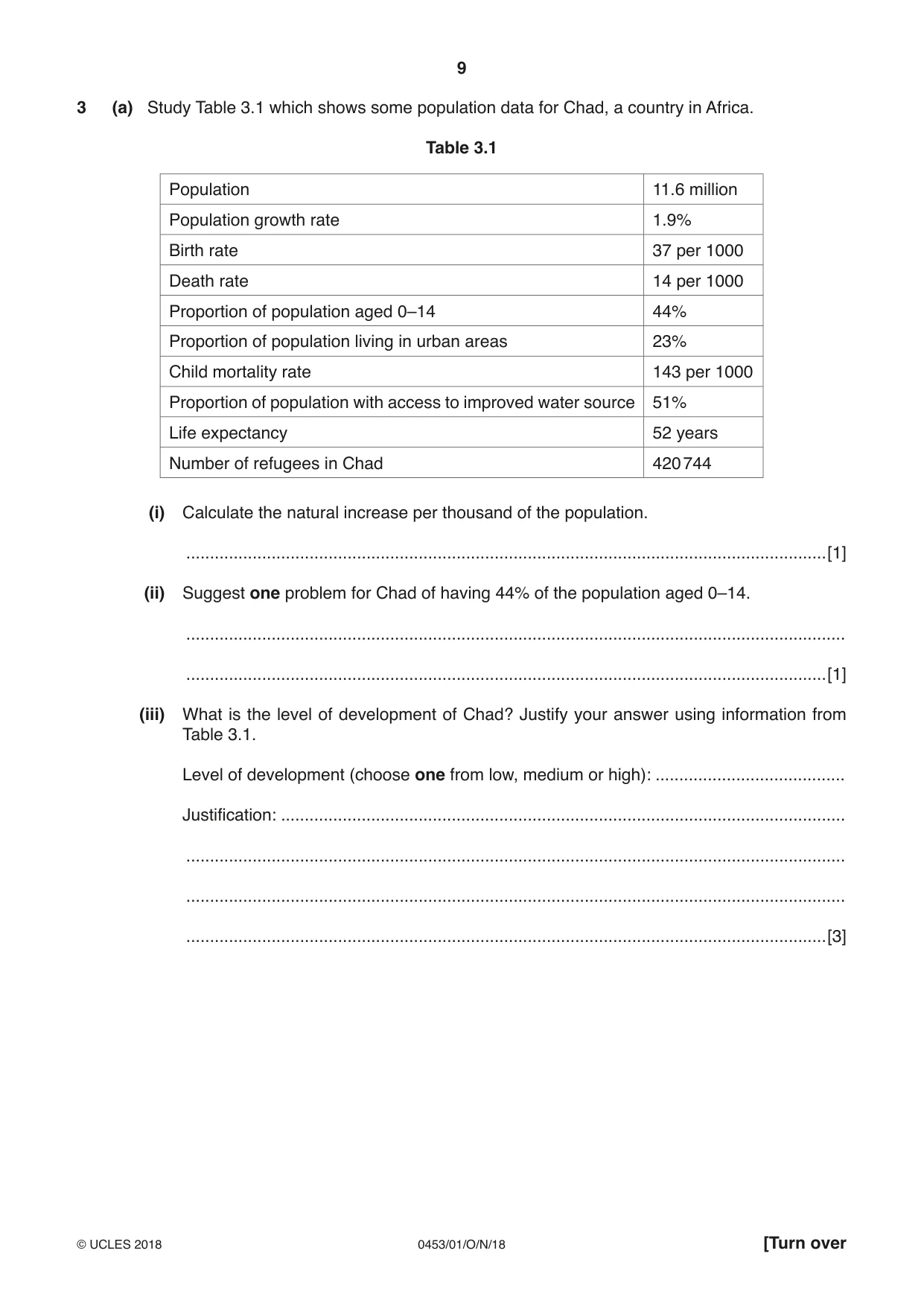
9 0453/01/O/N/18 © UCLES 2018 [Turn over 3 (a) Study Table 3.1 which shows some population data for Chad, a country in Africa. Table 3.1 Population 11.6 million Population growth rate 1.9% Birth rate 37 per 1000 Death rate 14 per 1000 Proportion of population aged 0–14 44% Proportion of population living in urban areas 23% Child mortality rate 143 per 1000 Proportion of population with access to improved water source 51% Life expectancy 52 years Number of refugees in Chad 420 744 (i) Calculate the natural increase per thousand of the population. …[1] (ii) Suggest one problem for Chad of having 44% of the population aged 0–14. … …[1] (iii) What is the level of development of Chad? Justify your answer using information from Table 3.1. Level of development (choose one from low, medium or high): … Justification: … … … …[3]
Question paper, page 10
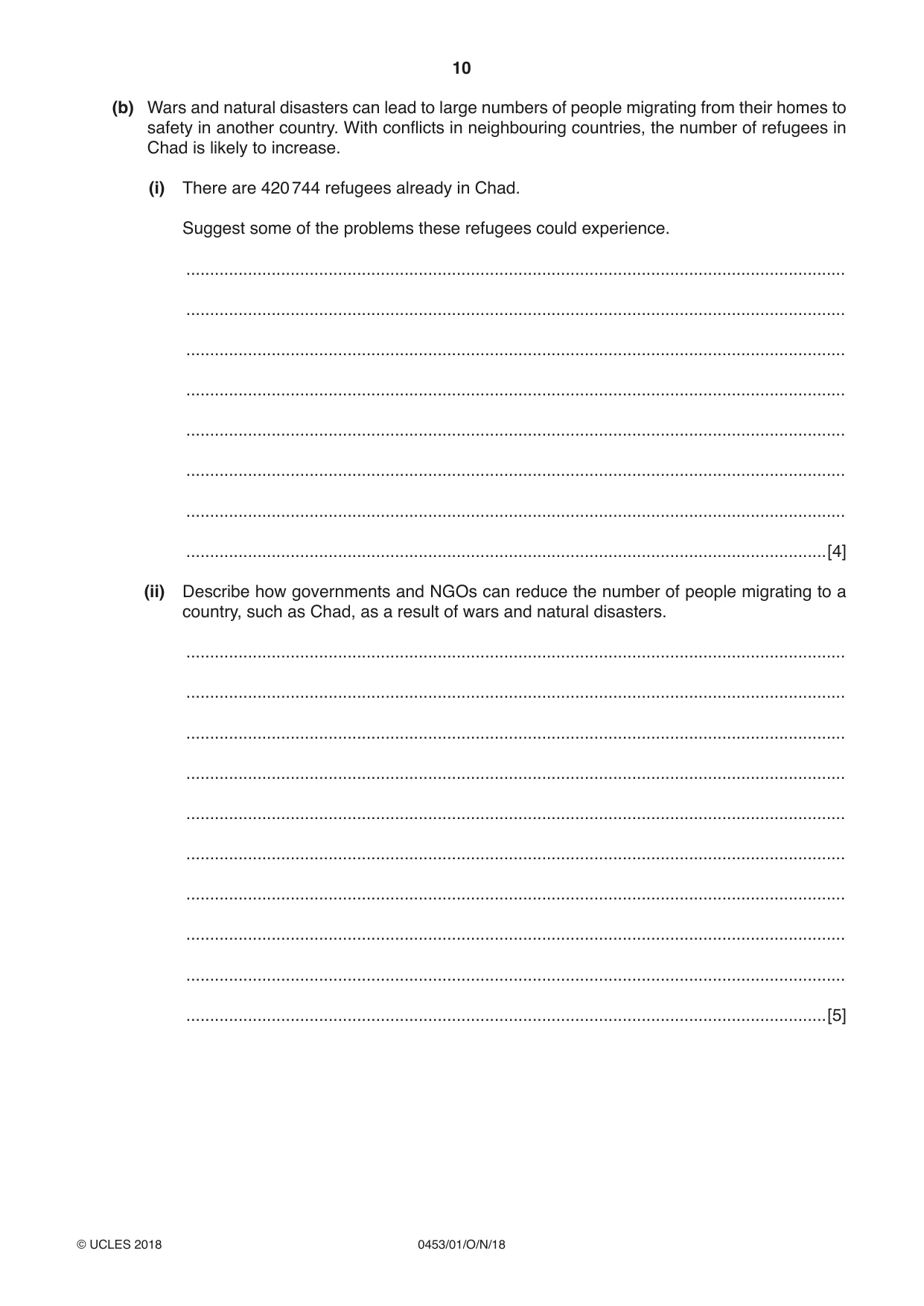
10 0453/01/O/N/18 © UCLES 2018 (b) Wars and natural disasters can lead to large numbers of people migrating from their homes to safety in another country. With conflicts in neighbouring countries, the number of refugees in Chad is likely to increase. (i) There are 420 744 refugees already in Chad. Suggest some of the problems these refugees could experience. … … … … … … … …[4] (ii) Describe how governments and NGOs can reduce the number of people migrating to a country, such as Chad, as a result of wars and natural disasters. … … … … … … … … … …[5]
Question paper, page 11
11 0453/01/O/N/18 © UCLES 2018 [Turn over (c) Explain the causes of rural to urban migration. You should develop fully the points you make. … … … … … … … … … … … … … … … … … … … …[6] [Total: 20]
Question paper, page 12
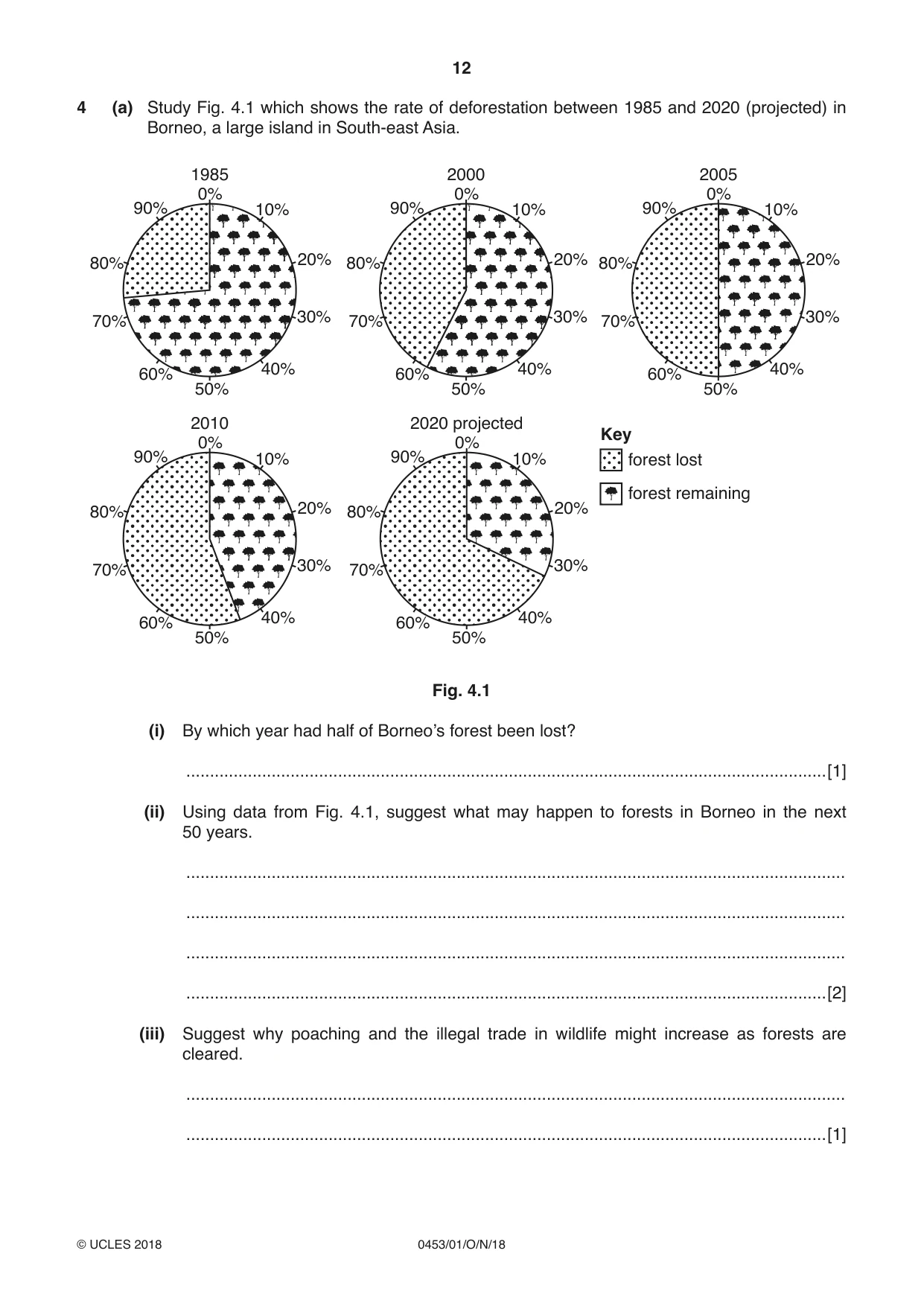
12 0453/01/O/N/18 © UCLES 2018 4 (a) Study Fig. 4.1 which shows the rate of deforestation between 1985 and 2020 (projected) in Borneo, a large island in South-east Asia. 0% 10% 20% 30% 40% 50% 60% 70% 80% 90% 0% 10% 20% 30% 40% 50% 60% 70% 80% 90% 0% 10% 20% 30% 40% 50% 60% 70% 80% 90% 0% 10% 20% 30% 40% 50% 60% 70% 80% 90% 0% 10% 20% 30% 40% 50% 60% 70% 80% 90% 1985 2000 2010 Key forest lost forest remaining 2020 projected 2005 Fig. 4.1 (i) By which year had half of Borneo’s forest been lost? …[1] (ii) Using data from Fig. 4.1, suggest what may happen to forests in Borneo in the next 50 years. … … … …[2] (iii) Suggest why poaching and the illegal trade in wildlife might increase as forests are cleared. … …[1]
Question paper, page 13
13 0453/01/O/N/18 © UCLES 2018 [Turn over (b) As forests are cleared, biodiversity is lost. (i) Explain what is meant by the term ‘biodiversity’. … …[1] (ii) State three reasons why it is important to protect biodiversity. 1 … … 2 … … 3 … …[3]
Question paper, page 14
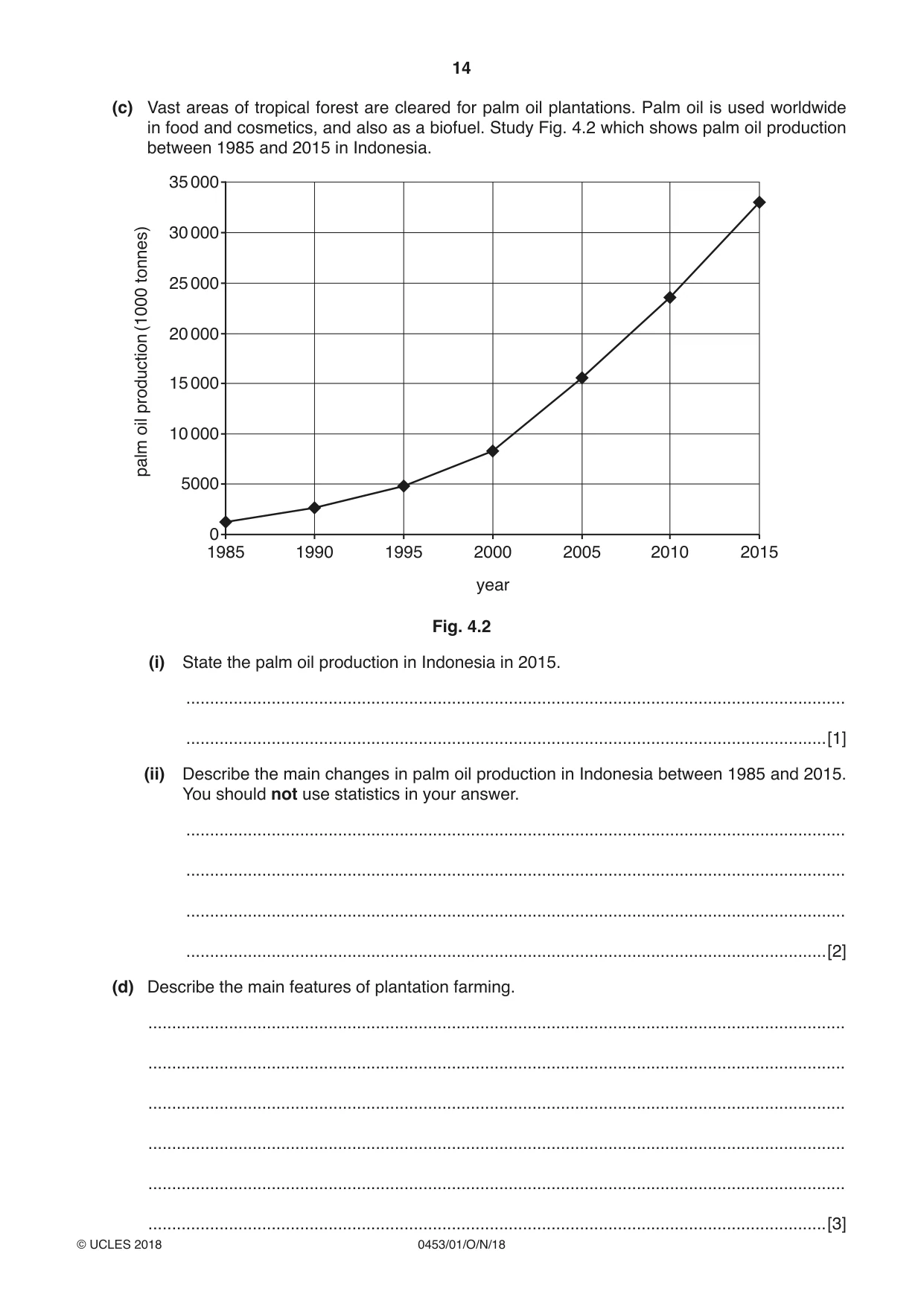
14 0453/01/O/N/18 © UCLES 2018 (c) Vast areas of tropical forest are cleared for palm oil plantations. Palm oil is used worldwide in food and cosmetics, and also as a biofuel. Study Fig. 4.2 which shows palm oil production between 1985 and 2015 in Indonesia. 35 000 30 000 25 000 20 000 palm oil production (1000 tonnes) 15 000 10 000 5000 0 1985 1990 1995 2000 year 2005 2010 2015 Fig. 4.2 (i) State the palm oil production in Indonesia in 2015. … …[1] (ii) Describe the main changes in palm oil production in Indonesia between 1985 and 2015. You should not use statistics in your answer. … … … …[2] (d) Describe the main features of plantation farming. … … … … … …[3]
Question paper, page 15
15 0453/01/O/N/18 © UCLES 2018 (e) Explain how conservation methods can be used to protect tropical forests and retain their biodiversity. You should develop fully the points you make. … … … … … … … … … … … … … … … … … … … …[6] [Total: 20]
Question paper, page 16
16 0453/01/O/N/18 © UCLES 2018 Permission to reproduce items where third-party owned material protected by copyright is included has been sought and cleared where possible. Every reasonable effort has been made by the publisher (UCLES) to trace copyright holders, but if any items requiring clearance have unwittingly been included, the publisher will be pleased to make amends at the earliest possible opportunity. To avoid the issue of disclosure of answer-related information to candidates, all copyright acknowledgements are reproduced online in the Cambridge International Examinations Copyright Acknowledgements Booklet. This is produced for each series of examinations and is freely available to download at www.cie.org.uk after the live examination series. Cambridge International Examinations is part of the Cambridge Assessment Group. Cambridge Assessment is the brand name of University of Cambridge Local Examinations Syndicate (UCLES), which is itself a department of the University of Cambridge. BLANK PAGE