Cambridge IGCSE Development Studies 0453 — 2020 Oct/Nov Paper 2 · Variant 0
0453/20/O/N/20
The question paper and its mark scheme, free to read here and free to download. This is Cambridge’s own paper, exactly as it was sat.
Question paper20 pages

Mark scheme
No mark scheme is in the library for this paper.
Paper as text
Question paper, page 1
Cambridge IGCSE™ * 6 8 7 2 6 3 2 5 7 5 * This document has 20 pages. Blank pages are indicated. DEVELOPMENT STUDIES 0453/02 Paper 2 October/November 2020 2 hours You must answer on the question paper. You will need: Ruler INSTRUCTIONS ● Answer all questions. ● Use a black or dark blue pen. You may use an HB pencil for any diagrams or graphs. ● Write your name, centre number and candidate number in the boxes at the top of the page. ● Write your answer to each question in the space provided. ● Do not use an erasable pen or correction fluid. ● Do not write on any bar codes. INFORMATION ● The total mark for this paper is 80. ● The number of marks for each question or part question is shown in brackets [ ]. DC (SC/SG) 180358/2 © UCLES 2020 [Turn over
Question paper, page 2
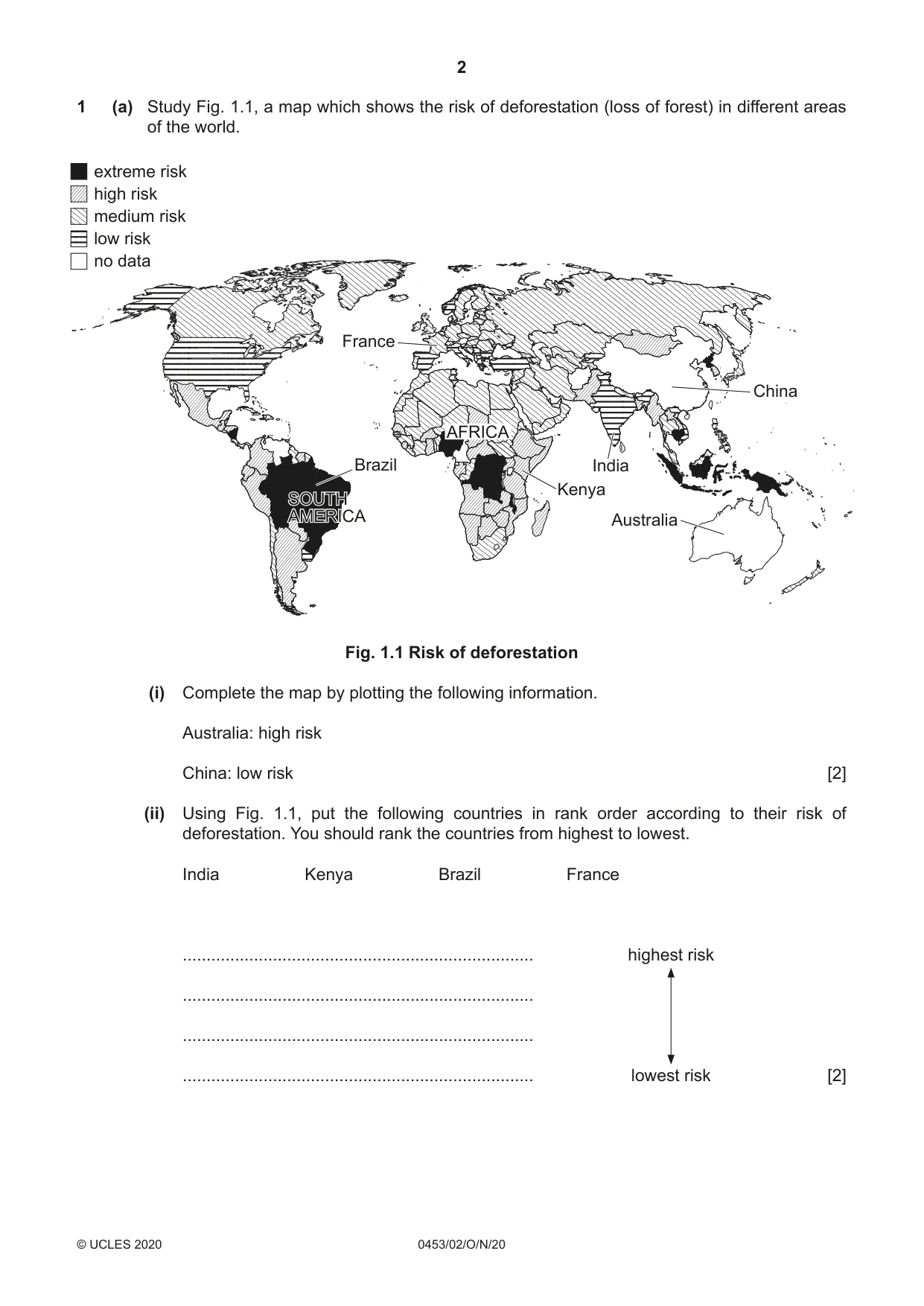
2 0453/02/O/N/20 © UCLES 2020 1 (a) Study Fig. 1.1, a map which shows the risk of deforestation (loss of forest) in different areas of the world. extreme risk high risk medium risk low risk no data Brazil Australia India Kenya China France SOUTH AMERICA SOUTH AMERICA AFRICA Fig. 1.1 Risk of deforestation (i) Complete the map by plotting the following information. Australia: high risk China: low risk [2] (ii) Using Fig. 1.1, put the following countries in rank order according to their risk of deforestation. You should rank the countries from highest to lowest. India Kenya Brazil France … highest risk … … … lowest risk [2]
Question paper, page 3
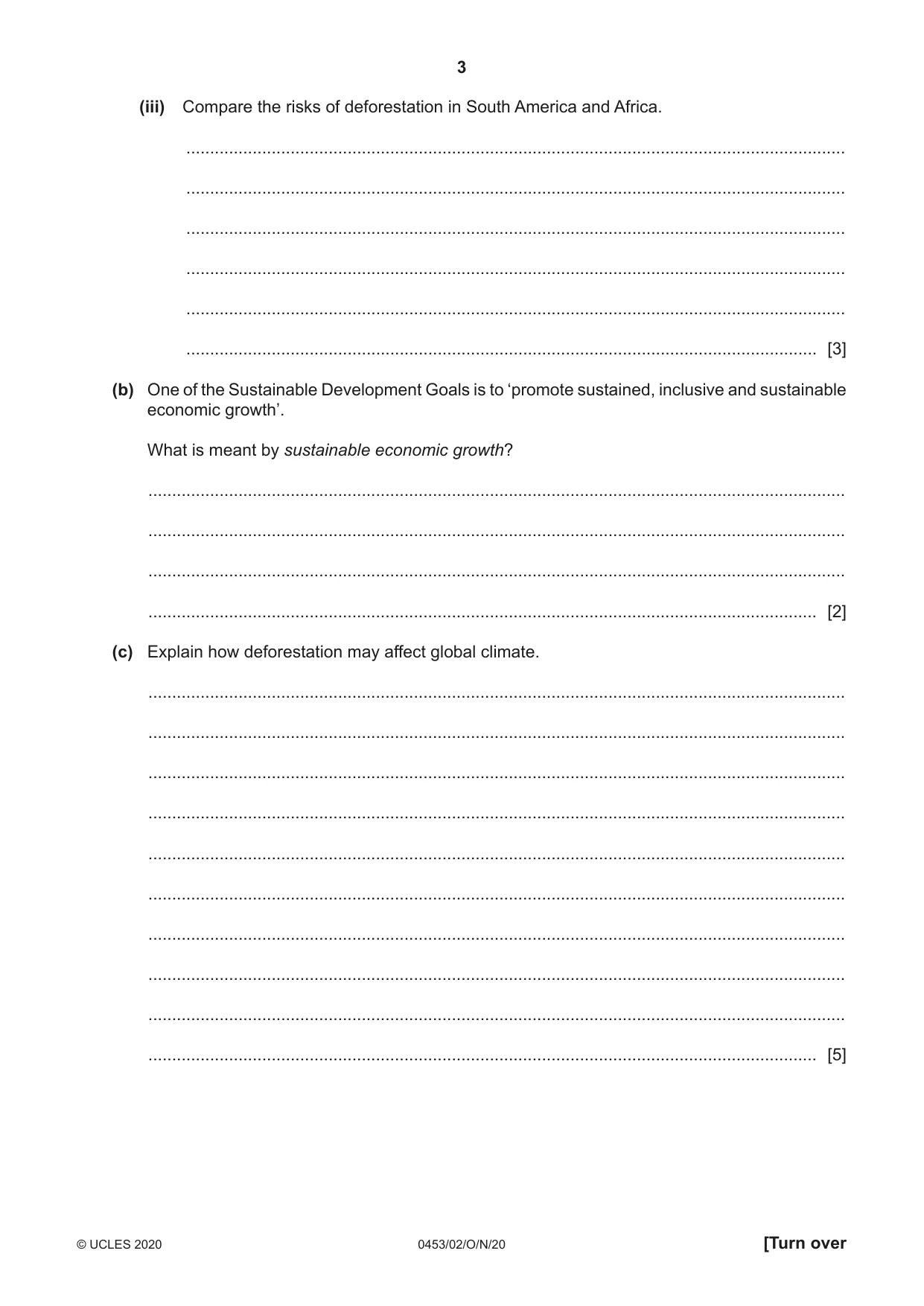
3 0453/02/O/N/20 © UCLES 2020 [Turn over (iii) Compare the risks of deforestation in South America and Africa. … … … … … … [3] (b) One of the Sustainable Development Goals is to ‘promote sustained, inclusive and sustainable economic growth’. What is meant by sustainable economic growth? … … … … [2] (c) Explain how deforestation may affect global climate. … … … … … … … … … … [5]
Question paper, page 4
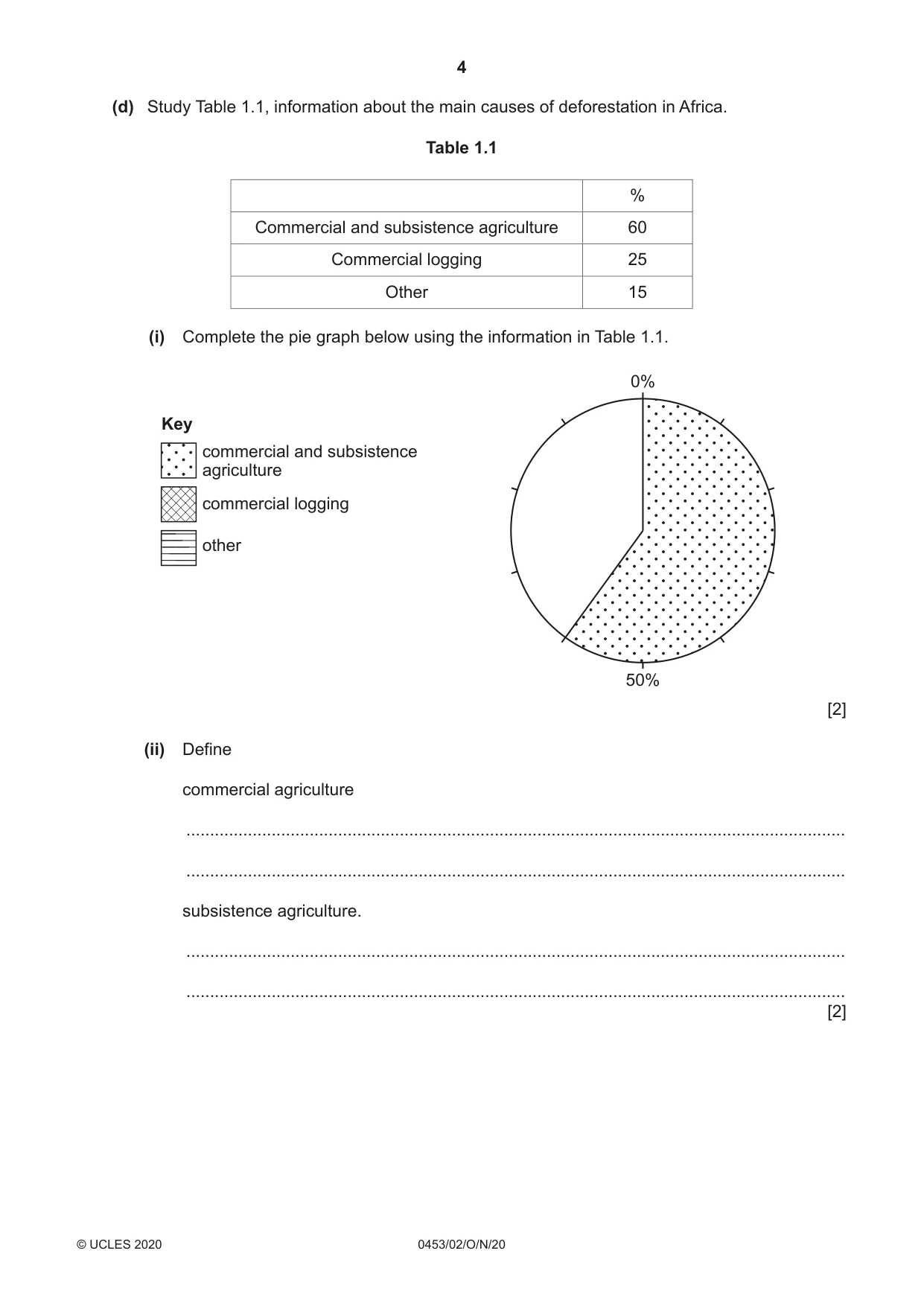
4 0453/02/O/N/20 © UCLES 2020 (d) Study Table 1.1, information about the main causes of deforestation in Africa. Table 1.1 % Commercial and subsistence agriculture 60 Commercial logging 25 Other 15 (i) Complete the pie graph below using the information in Table 1.1. 0% 50% Key commercial and subsistence agriculture commercial logging other [2] (ii) Define commercial agriculture … … subsistence agriculture. … … [2]
Question paper, page 5
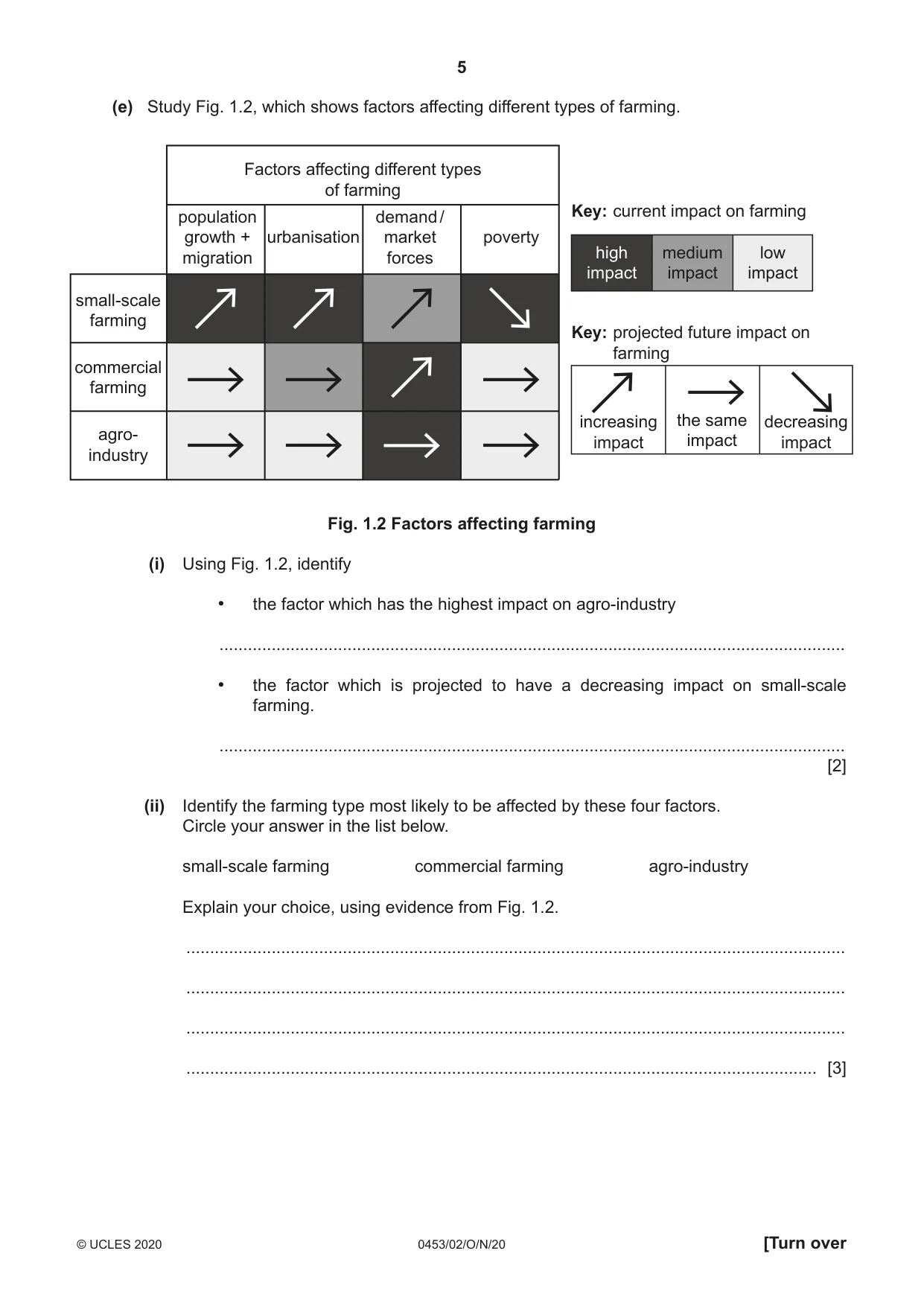
5 0453/02/O/N/20 © UCLES 2020 [Turn over (e) Study Fig. 1.2, which shows factors affecting different types of farming. projected future impact on farming Key: decreasing impact the same impact increasing impact current impact on farming Key: population growth + migration small-scale farming agro- industry commercial farming urbanisation Factors affecting different types of farming demand / market forces poverty low impact medium impact high impact Fig. 1.2 Factors affecting farming (i) Using Fig. 1.2, identify • the factor which has the highest impact on agro-industry … • the factor which is projected to have a decreasing impact on small-scale farming. … [2] (ii) Identify the farming type most likely to be affected by these four factors. Circle your answer in the list below. small-scale farming commercial farming agro-industry Explain your choice, using evidence from Fig. 1.2. … … … … [3]
Question paper, page 6
6 0453/02/O/N/20 © UCLES 2020 (iii) Suggest two natural factors that cause problems for farmers. 1 … … 2 … … [2] [Total: 25]
Question paper, page 7
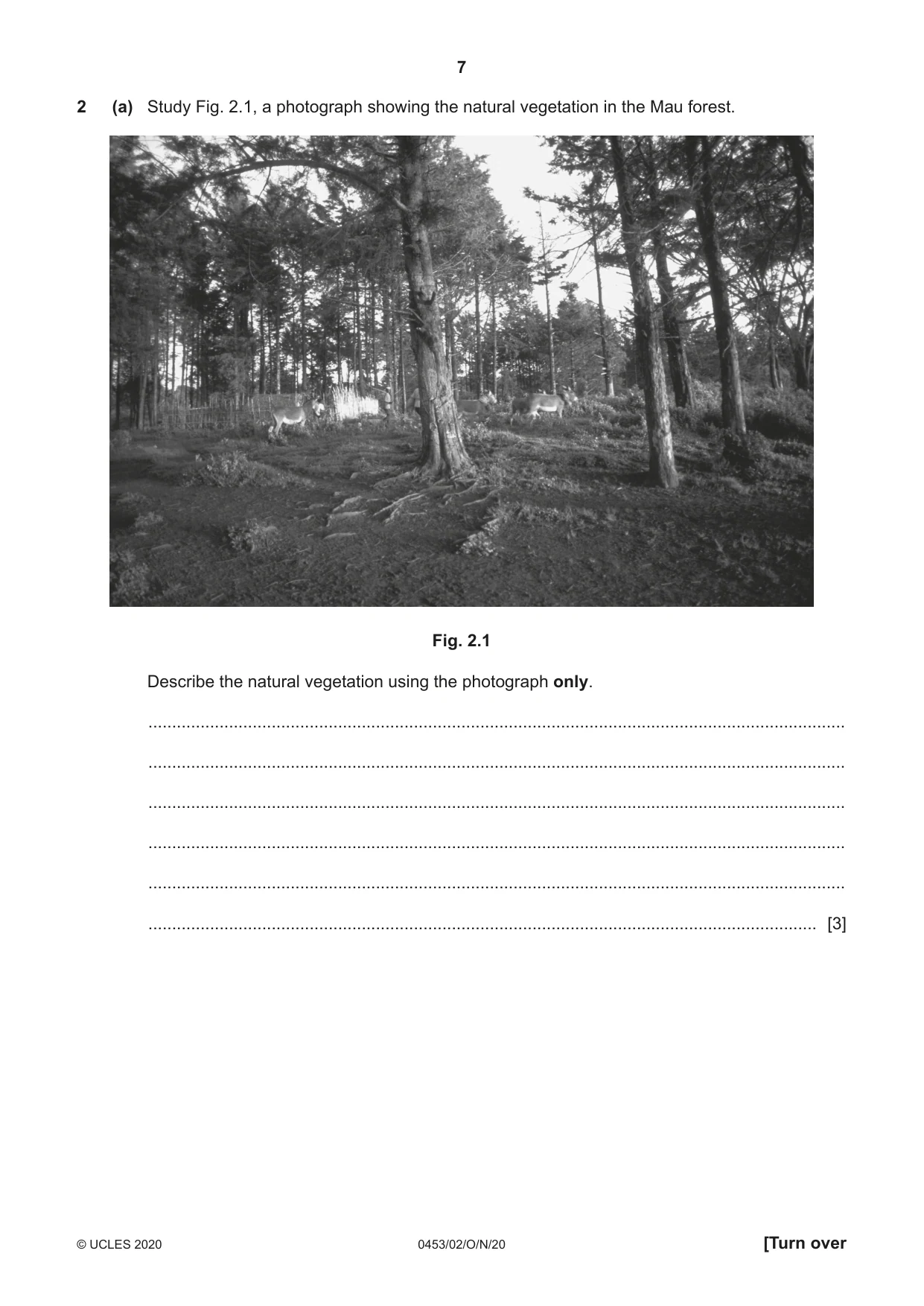
7 0453/02/O/N/20 © UCLES 2020 [Turn over 2 (a) Study Fig. 2.1, a photograph showing the natural vegetation in the Mau forest. Fig. 2.1 Describe the natural vegetation using the photograph only. … … … … … … [3]
Question paper, page 8
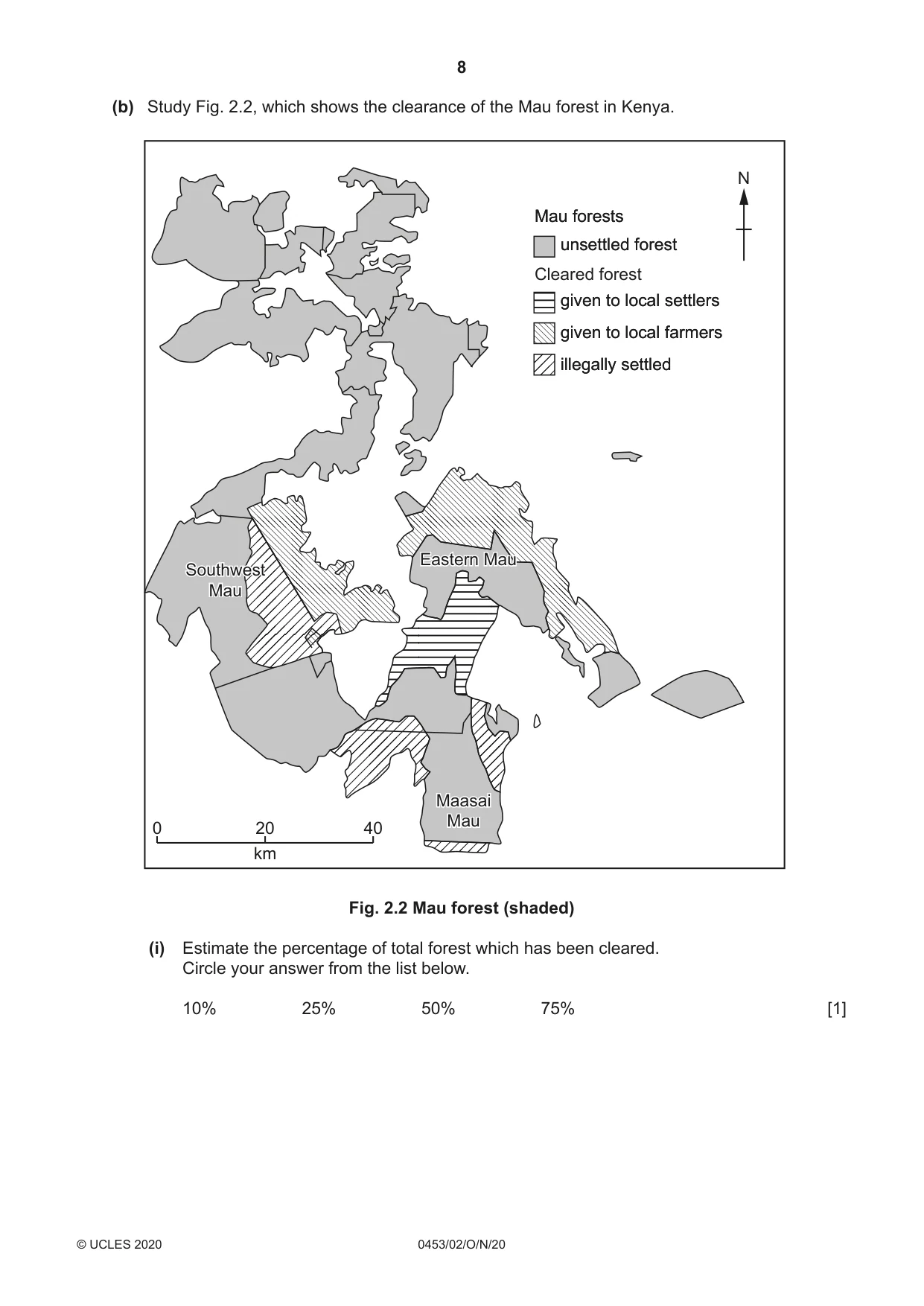
8 0453/02/O/N/20 © UCLES 2020 (b) Study Fig. 2.2, which shows the clearance of the Mau forest in Kenya. unsettled forest Cleared forest Mau forests given to local settlers given to local farmers illegally settled N unsettled forest Mau forests given to local settlers given to local farmers illegally settled 0 20 km 40 Southwest Mau Southwest Mau Eastern Mau Eastern Mau Maasai Mau Maasai Mau Fig. 2.2 Mau forest (shaded) (i) Estimate the percentage of total forest which has been cleared. Circle your answer from the list below. 10% 25% 50% 75% [1]
Question paper, page 9
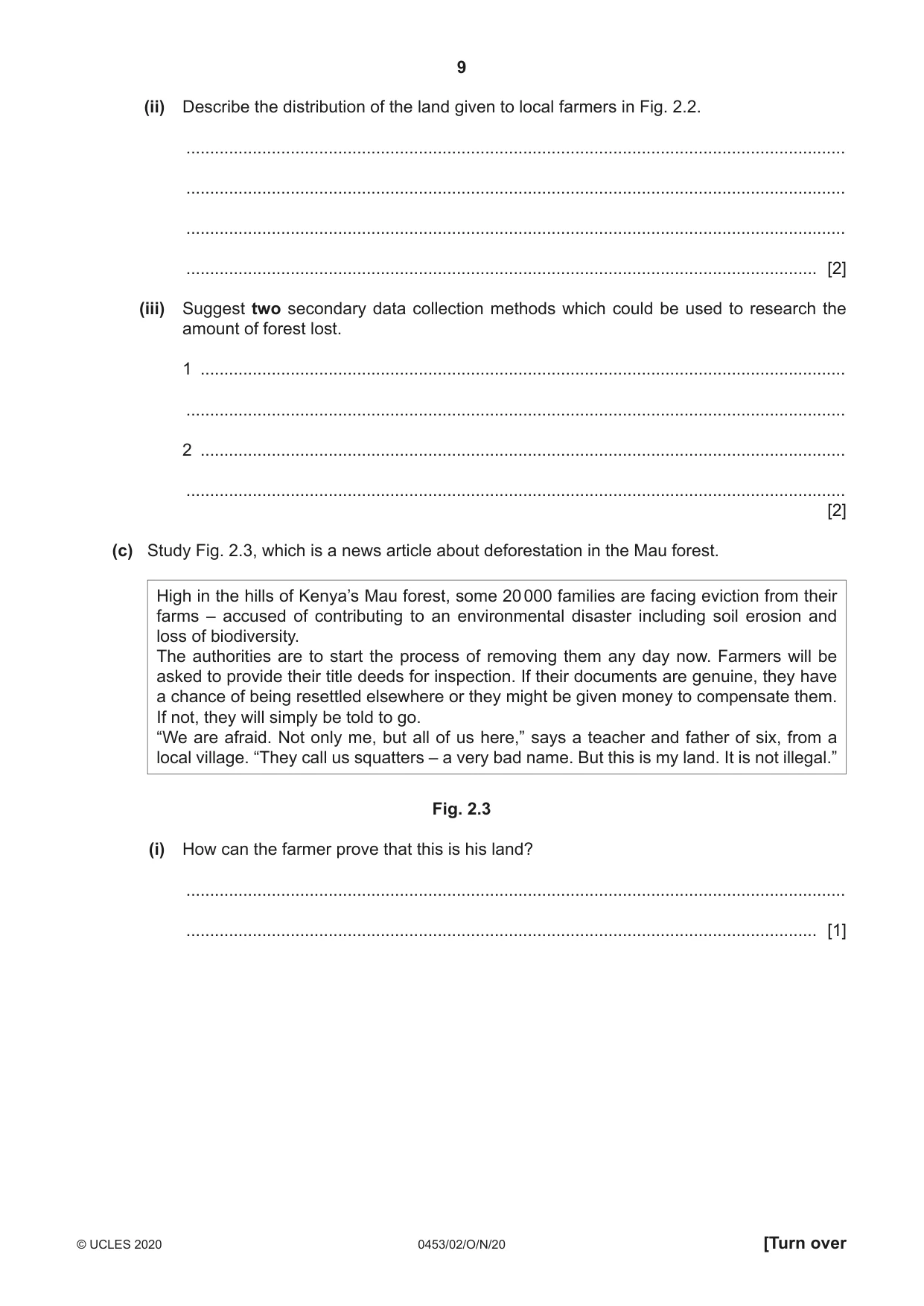
9 0453/02/O/N/20 © UCLES 2020 [Turn over (ii) Describe the distribution of the land given to local farmers in Fig. 2.2. … … … … [2] (iii) Suggest two secondary data collection methods which could be used to research the amount of forest lost. 1 … … 2 … … [2] (c) Study Fig. 2.3, which is a news article about deforestation in the Mau forest. High in the hills of Kenya’s Mau forest, some 20 000 families are facing eviction from their farms – accused of contributing to an environmental disaster including soil erosion and loss of biodiversity. The authorities are to start the process of removing them any day now. Farmers will be asked to provide their title deeds for inspection. If their documents are genuine, they have a chance of being resettled elsewhere or they might be given money to compensate them. If not, they will simply be told to go. “We are afraid. Not only me, but all of us here,” says a teacher and father of six, from a local village. “They call us squatters – a very bad name. But this is my land. It is not illegal.” Fig. 2.3 (i) How can the farmer prove that this is his land? … … [1]
Question paper, page 10
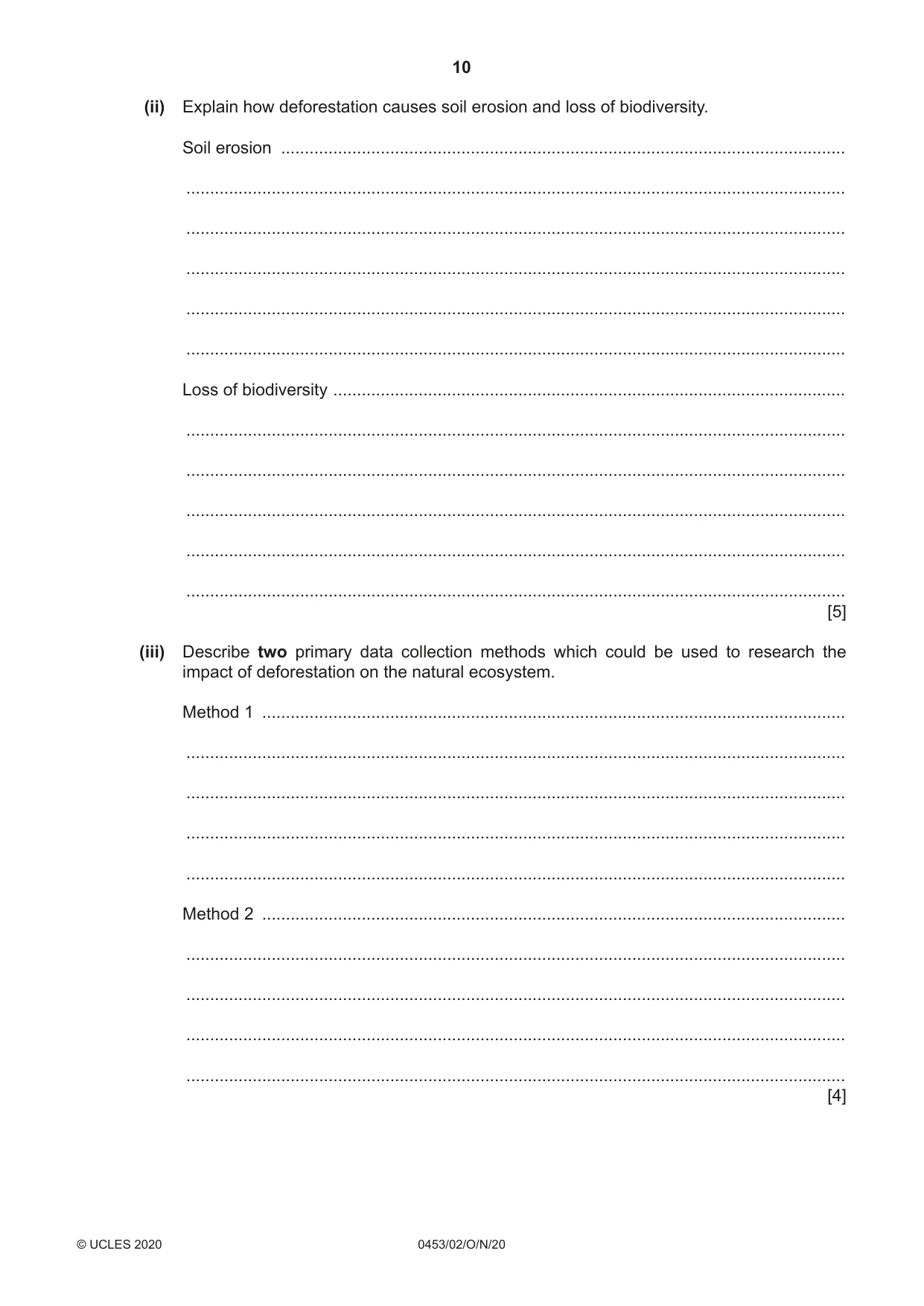
10 0453/02/O/N/20 © UCLES 2020 (ii) Explain how deforestation causes soil erosion and loss of biodiversity. Soil erosion … … … … … … Loss of biodiversity … … … … … … [5] (iii) Describe two primary data collection methods which could be used to research the impact of deforestation on the natural ecosystem. Method 1 … … … … … Method 2 … … … … … [4]
Question paper, page 11
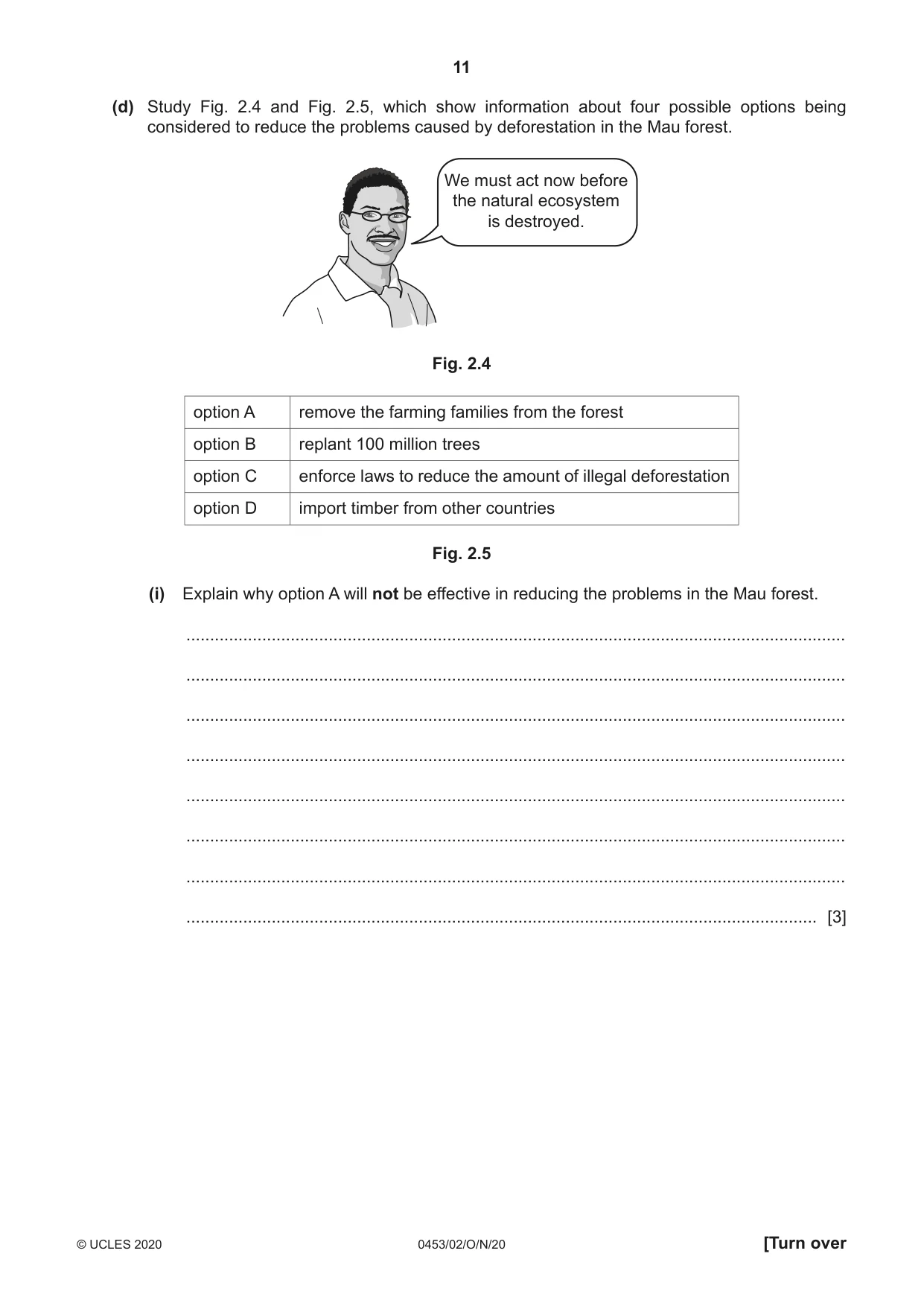
11 0453/02/O/N/20 © UCLES 2020 [Turn over (d) Study Fig. 2.4 and Fig. 2.5, which show information about four possible options being considered to reduce the problems caused by deforestation in the Mau forest. We must act now before the natural ecosystem is destroyed. Fig. 2.4 option A remove the farming families from the forest option B replant 100 million trees option C enforce laws to reduce the amount of illegal deforestation option D import timber from other countries Fig. 2.5 (i) Explain why option A will not be effective in reducing the problems in the Mau forest. … … … … … … … … [3]
Question paper, page 12
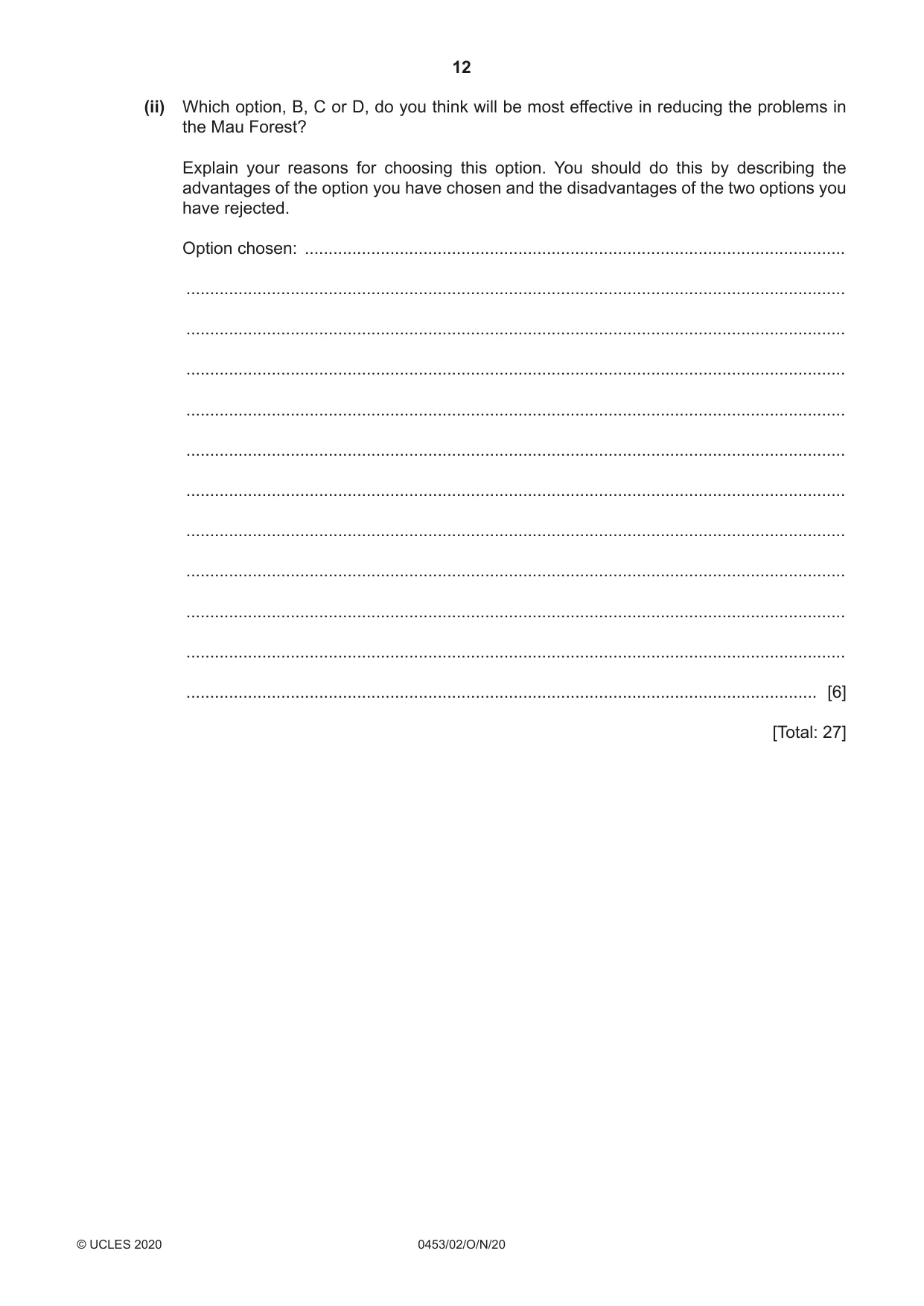
12 0453/02/O/N/20 © UCLES 2020 (ii) Which option, B, C or D, do you think will be most effective in reducing the problems in the Mau Forest? Explain your reasons for choosing this option. You should do this by describing the advantages of the option you have chosen and the disadvantages of the two options you have rejected. Option chosen: … … … … … … … … … … … … [6] [Total: 27]
Question paper, page 13
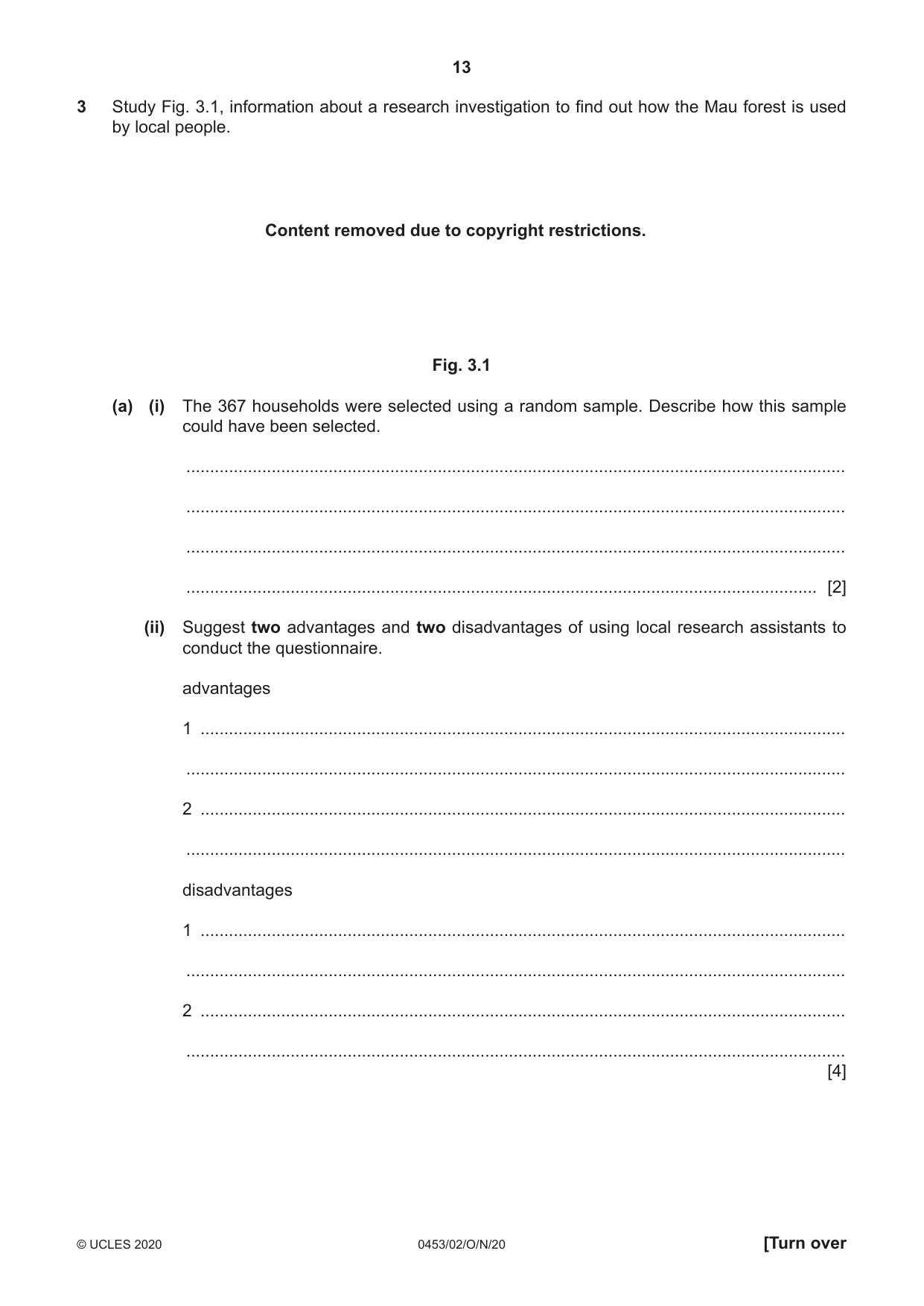
13 0453/02/O/N/20 © UCLES 2020 [Turn over 3 Study Fig. 3.1, information about a research investigation to find out how the Mau forest is used by local people. Fig. 3.1 (a) (i) The 367 households were selected using a random sample. Describe how this sample could have been selected. … … … … [2] (ii) Suggest two advantages and two disadvantages of using local research assistants to conduct the questionnaire. advantages 1 … … 2 … … disadvantages 1 … … 2 … … [4] Content removed due to copyright restrictions.
Question paper, page 14
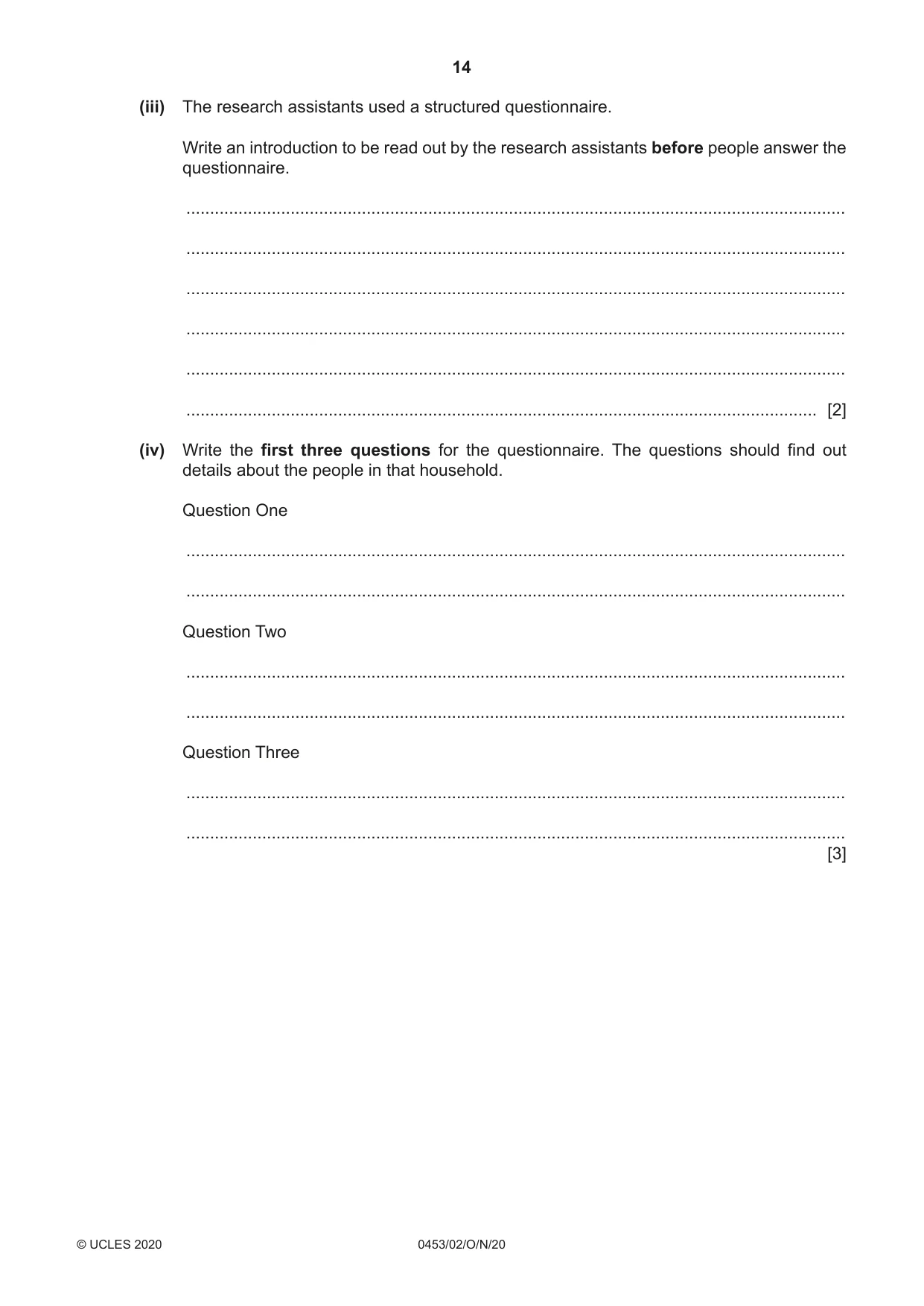
14 0453/02/O/N/20 © UCLES 2020 (iii) The research assistants used a structured questionnaire. Write an introduction to be read out by the research assistants before people answer the questionnaire. … … … … … … [2] (iv) Write the first three questions for the questionnaire. The questions should find out details about the people in that household. Question One … … Question Two … … Question Three … … [3]
Question paper, page 15
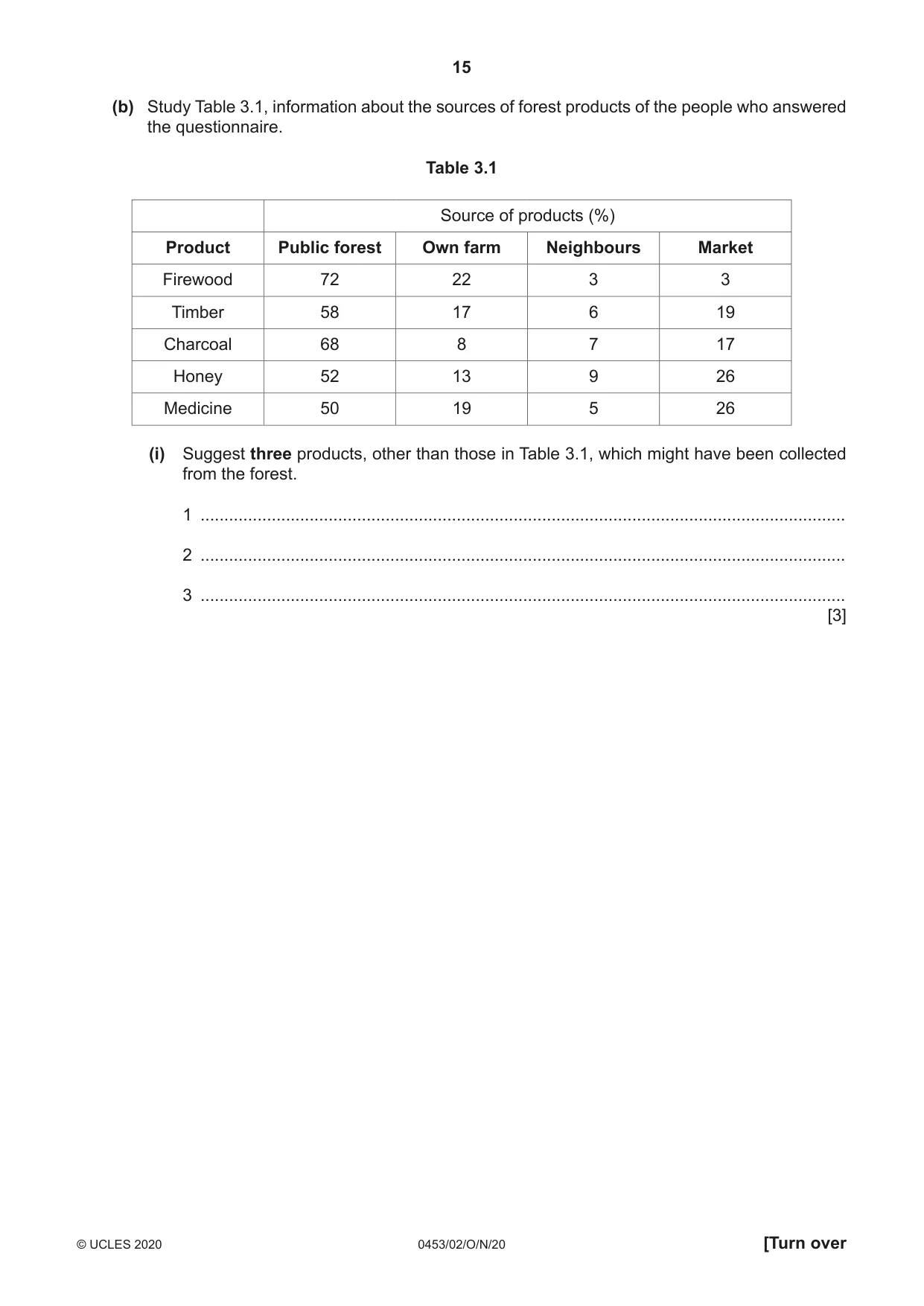
15 0453/02/O/N/20 © UCLES 2020 [Turn over (b) Study Table 3.1, information about the sources of forest products of the people who answered the questionnaire. Table 3.1 Source of products (%) Product Public forest Own farm Neighbours Market Firewood 72 22 3 3 Timber 58 17 6 19 Charcoal 68 8 7 17 Honey 52 13 9 26 Medicine 50 19 5 26 (i) Suggest three products, other than those in Table 3.1, which might have been collected from the forest. 1 … 2 … 3 … [3]
Question paper, page 16
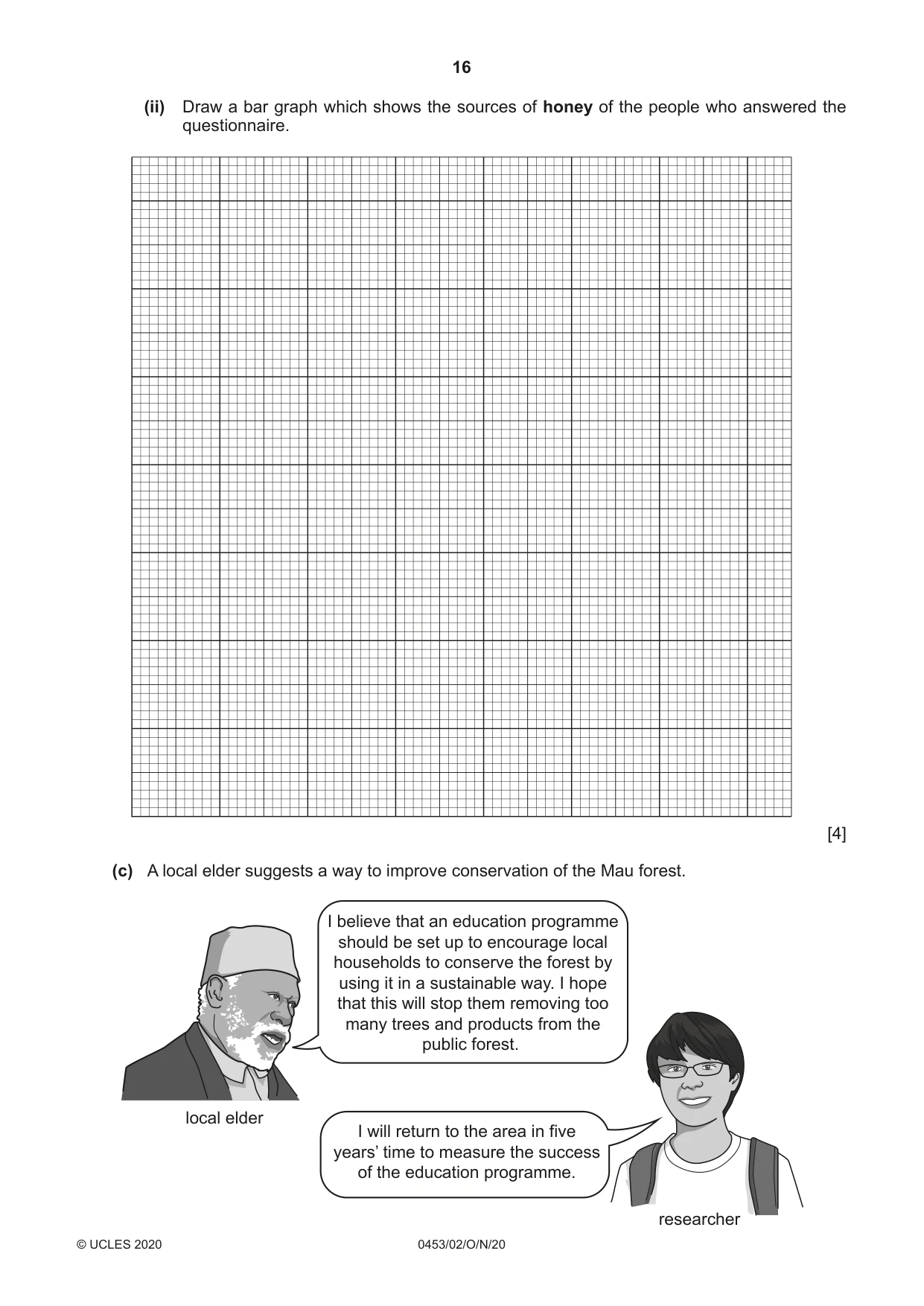
16 0453/02/O/N/20 © UCLES 2020 (ii) Draw a bar graph which shows the sources of honey of the people who answered the questionnaire. [4] (c) A local elder suggests a way to improve conservation of the Mau forest. I will return to the area in five years’ time to measure the success of the education programme. researcher local elder I believe that an education programme should be set up to encourage local households to conserve the forest by using it in a sustainable way. I hope that this will stop them removing too many trees and products from the public forest.
Question paper, page 17
17 0453/02/O/N/20 © UCLES 2020 [Turn over (i) Design an education programme to encourage local households to conserve the forest. … … … … … … … … … … … … … … … … … … … … … … … … … … … [6]
Question paper, page 18
18 0453/02/O/N/20 © UCLES 2020 (ii) Explain how the researcher could measure the success of the education programme. … … … … … … … … [4] [Total: 28]
Question paper, page 19
19 0453/02/O/N/20 © UCLES 2020 BLANK PAGE
Question paper, page 20
20 0453/02/O/N/20 © UCLES 2020 Permission to reproduce items where third-party owned material protected by copyright is included has been sought and cleared where possible. Every reasonable effort has been made by the publisher (UCLES) to trace copyright holders, but if any items requiring clearance have unwittingly been included, the publisher will be pleased to make amends at the earliest possible opportunity. To avoid the issue of disclosure of answer-related information to candidates, all copyright acknowledgements are reproduced online in the Cambridge Assessment International Education Copyright Acknowledgements Booklet. This is produced for each series of examinations and is freely available to download at www.cambridgeinternational.org after the live examination series. Cambridge Assessment International Education is part of the Cambridge Assessment Group. Cambridge Assessment is the brand name of the University of Cambridge Local Examinations Syndicate (UCLES), which itself is a department of the University of Cambridge. BLANK PAGE