Cambridge IGCSE Development Studies 0453 — 2018 Oct/Nov Paper 2 · Variant 0
0453/20/O/N/18
The question paper and its mark scheme, free to read here and free to download. This is Cambridge’s own paper, exactly as it was sat.
Question paper20 pages



Mark scheme
No mark scheme is in the library for this paper.
Paper as text
Question paper, page 1
* 9 4 7 1 0 9 8 0 3 9 * This document consists of 19 printed pages and 1 blank page. DC (RW/AR) 144998/3 © UCLES 2018 [Turn over Cambridge International Examinations Cambridge International General Certificate of Secondary Education DEVELOPMENT STUDIES 0453/02 Paper 2 October/November 2018 2 hours Candidates answer on the Question Paper. No Additional Materials are required. READ THESE INSTRUCTIONS FIRST Write your Centre number, candidate number and name on all the work you hand in. Write in dark blue or black pen. You may use an HB pencil for any diagrams, graphs or rough working. Do not use staples, paper clips, glue or correction fluid. DO NOT WRITE IN ANY BARCODES. Answer all the questions. You may not need all the answer lines for your answer. You should read and study the sources before answering the questions. At the end of the examination, fasten all your work securely together. The number of marks is given in brackets [ ] at the end of each question or part question.
Question paper, page 2
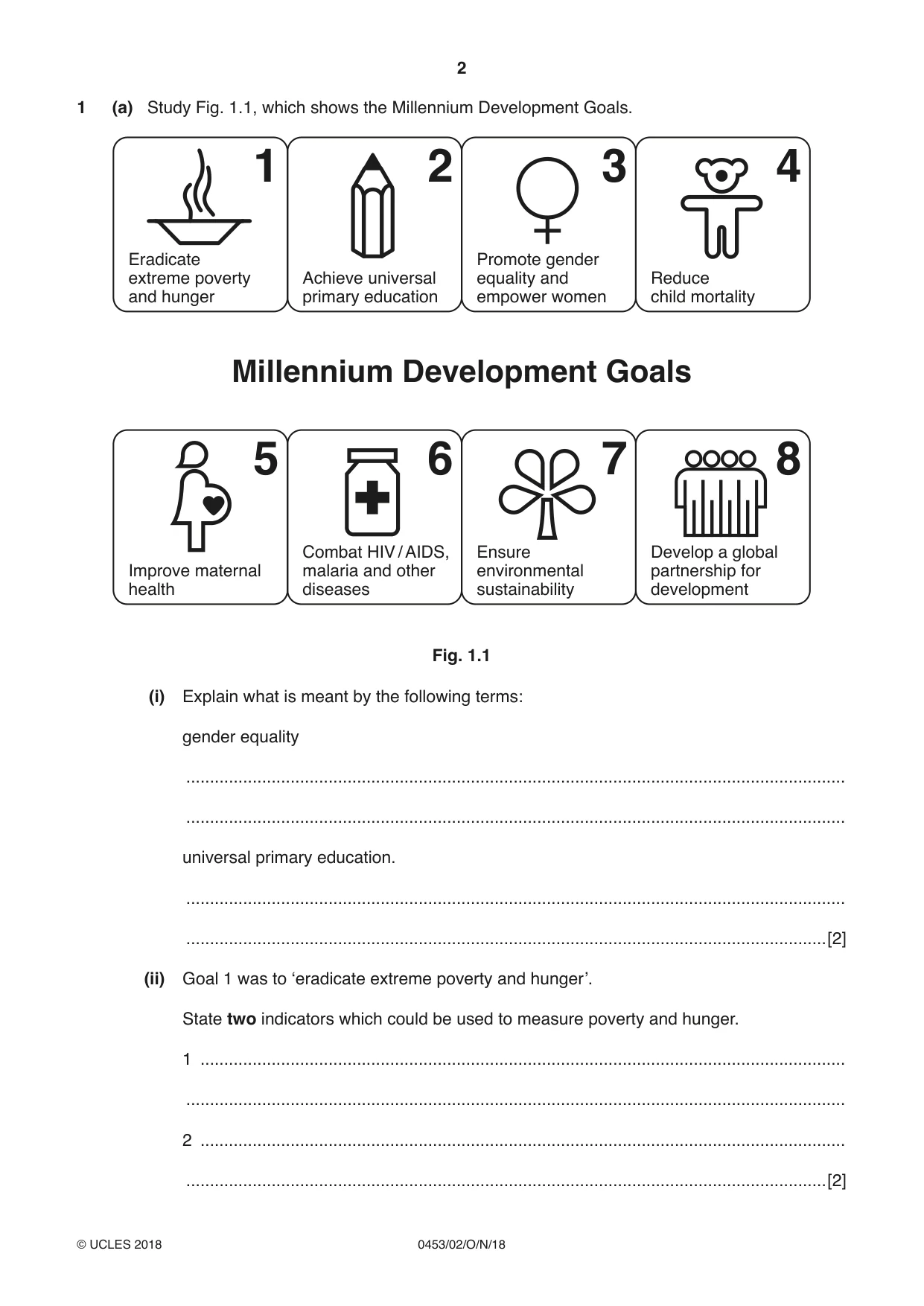
2 0453/02/O/N/18 © UCLES 2018 1 (a) Study Fig. 1.1, which shows the Millennium Development Goals. Eradicate extreme poverty and hunger 1 Achieve universal primary education 2 Promote gender equality and empower women 3 Reduce child mortality 4 Improve maternal health 5 Combat HIV / AIDS, malaria and other diseases 6 Ensure environmental sustainability 7 Develop a global partnership for development 8 Millennium Development Goals Fig. 1.1 (i) Explain what is meant by the following terms: gender equality … … universal primary education. … …[2] (ii) Goal 1 was to ‘eradicate extreme poverty and hunger’. State two indicators which could be used to measure poverty and hunger. 1 … … 2 … …[2]
Question paper, page 3
3 0453/02/O/N/18 © UCLES 2018 [Turn over (iii) Goal 6 was to ‘combat HIV/AIDS, malaria and other diseases’. Explain why it is important to reduce the amount of people suffering from diseases in developing countries. … … … … … …[3]
Question paper, page 4
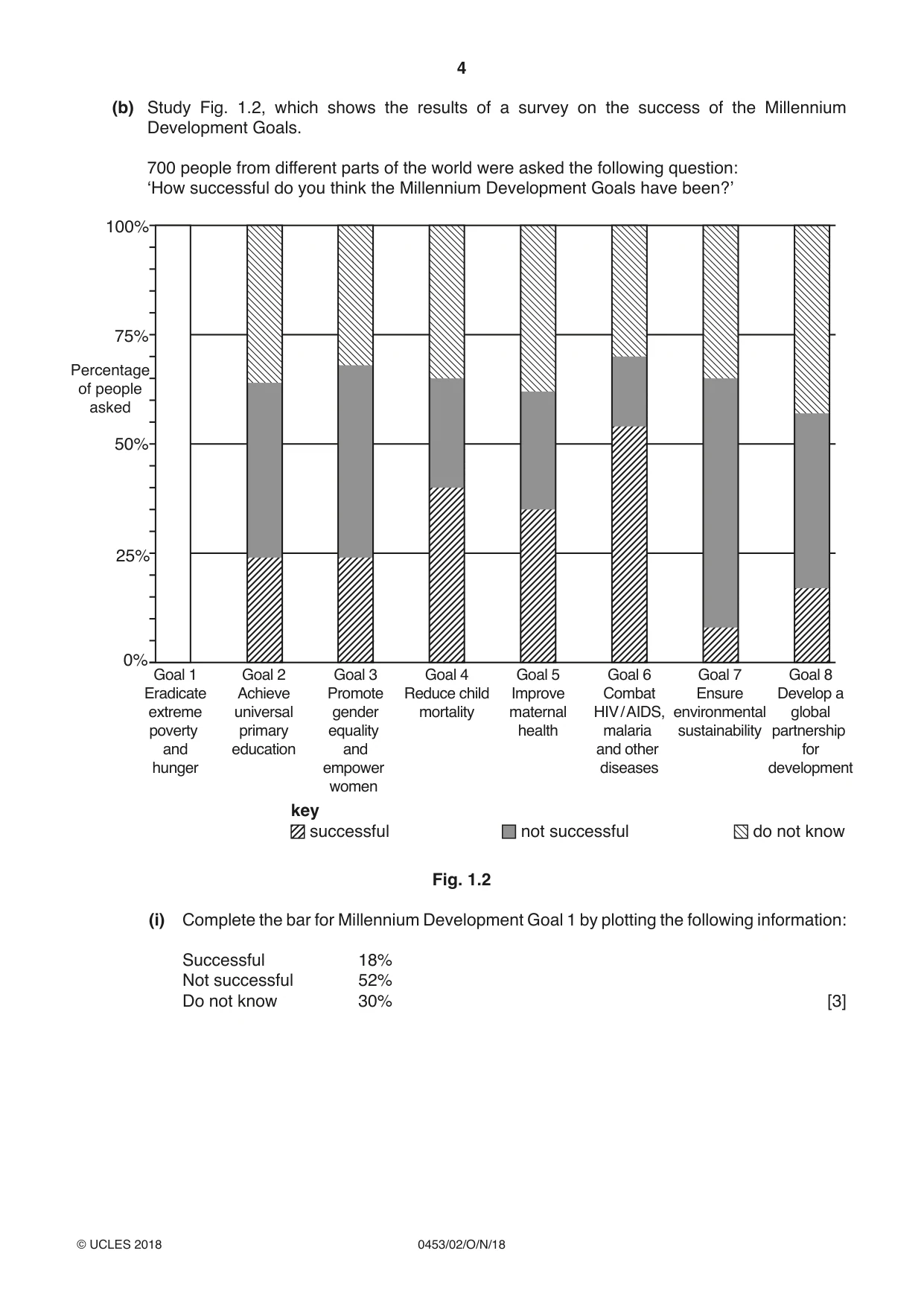
4 0453/02/O/N/18 © UCLES 2018 (b) Study Fig. 1.2, which shows the results of a survey on the success of the Millennium Development Goals. 700 people from different parts of the world were asked the following question: ‘How successful do you think the Millennium Development Goals have been?’ successful 100% 75% 50% 25% 0% not successful do not know Goal 1 Eradicate extreme poverty and hunger Goal 2 Achieve universal primary education Goal 3 Promote gender equality and empower women Goal 5 Improve maternal health Goal 6 Combat HIV / AIDS, malaria and other diseases Goal 4 Reduce child mortality Goal 7 Ensure environmental sustainability Goal 8 Develop a global partnership for development Percentage of people asked key Fig. 1.2 (i) Complete the bar for Millennium Development Goal 1 by plotting the following information: Successful 18% Not successful 52% Do not know 30% [3]
Question paper, page 5
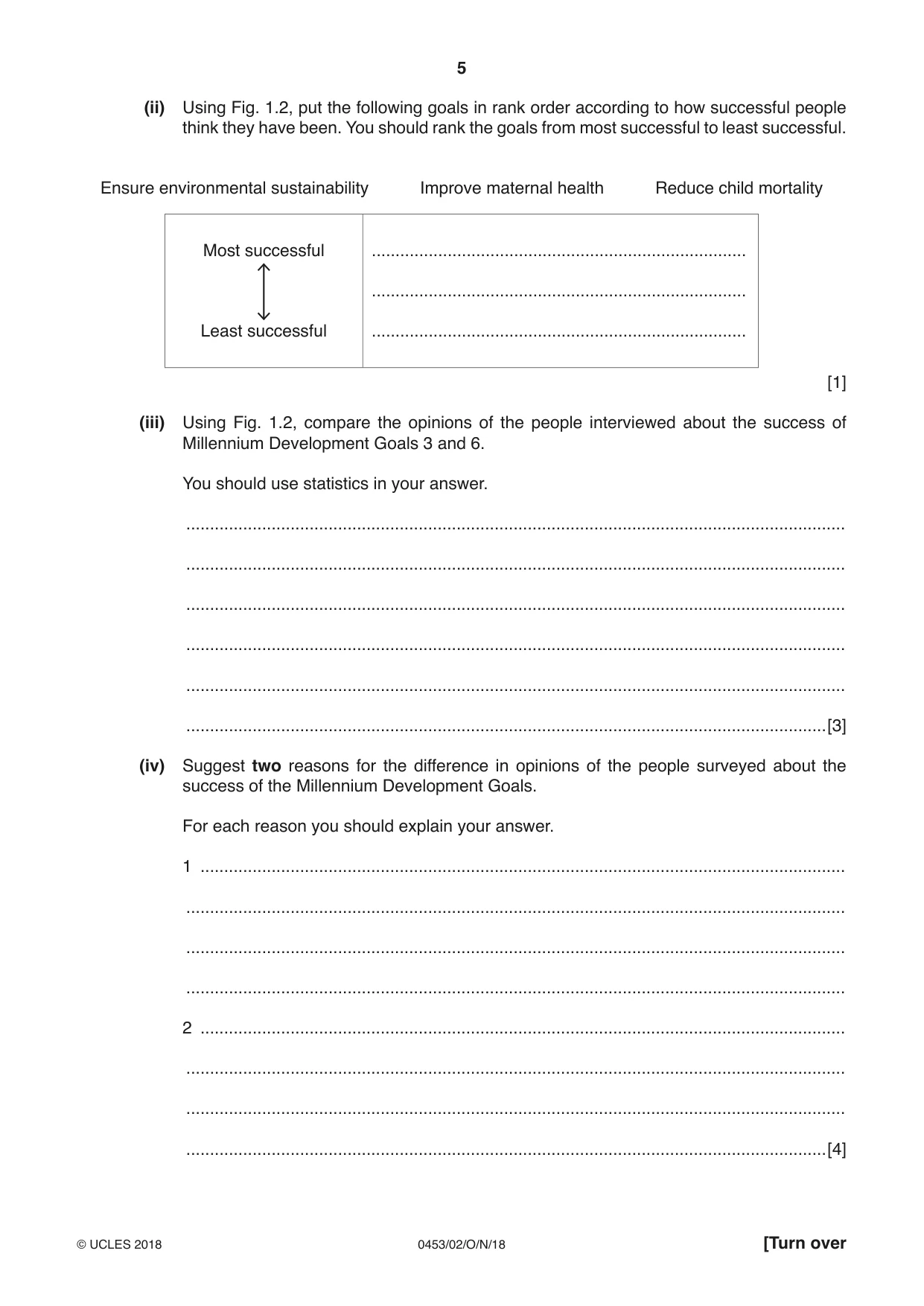
5 0453/02/O/N/18 © UCLES 2018 [Turn over (ii) Using Fig. 1.2, put the following goals in rank order according to how successful people think they have been. You should rank the goals from most successful to least successful. Ensure environmental sustainability Improve maternal health Reduce child mortality Most successful Least successful … … … [1] (iii) Using Fig. 1.2, compare the opinions of the people interviewed about the success of Millennium Development Goals 3 and 6. You should use statistics in your answer. … … … … … …[3] (iv) Suggest two reasons for the difference in opinions of the people surveyed about the success of the Millennium Development Goals. For each reason you should explain your answer. 1 … … … … 2 … … … …[4]
Question paper, page 6
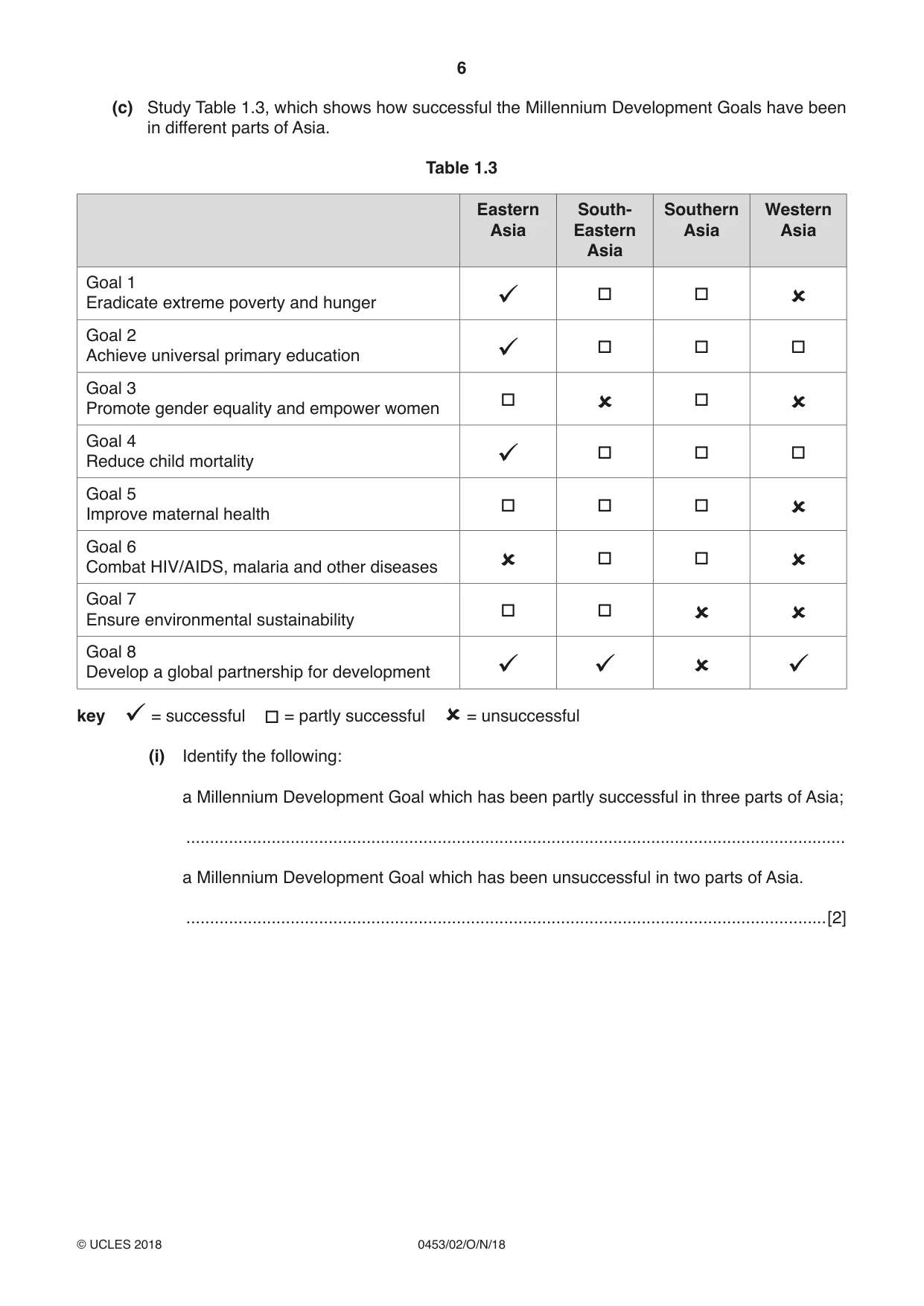
6 0453/02/O/N/18 © UCLES 2018 (c) Study Table 1.3, which shows how successful the Millennium Development Goals have been in different parts of Asia. Table 1.3 Eastern Asia South- Eastern Asia Southern Asia Western Asia Goal 1 Eradicate extreme poverty and hunger ü o o û Goal 2 Achieve universal primary education ü o o o Goal 3 Promote gender equality and empower women o û o û Goal 4 Reduce child mortality ü o o o Goal 5 Improve maternal health o o o û Goal 6 Combat HIV/AIDS, malaria and other diseases û o o û Goal 7 Ensure environmental sustainability o o û û Goal 8 Develop a global partnership for development ü ü û ü key ü = successful o = partly successful û = unsuccessful (i) Identify the following: a Millennium Development Goal which has been partly successful in three parts of Asia; … a Millennium Development Goal which has been unsuccessful in two parts of Asia. …[2]
Question paper, page 7
7 0453/02/O/N/18 © UCLES 2018 [Turn over (ii) Compare the success of the Millennium Development Goals in Eastern Asia and Western Asia. Refer to evidence from Table 1.3 in your answer. … … … … … … … …[4] [Total: 24]
Question paper, page 8
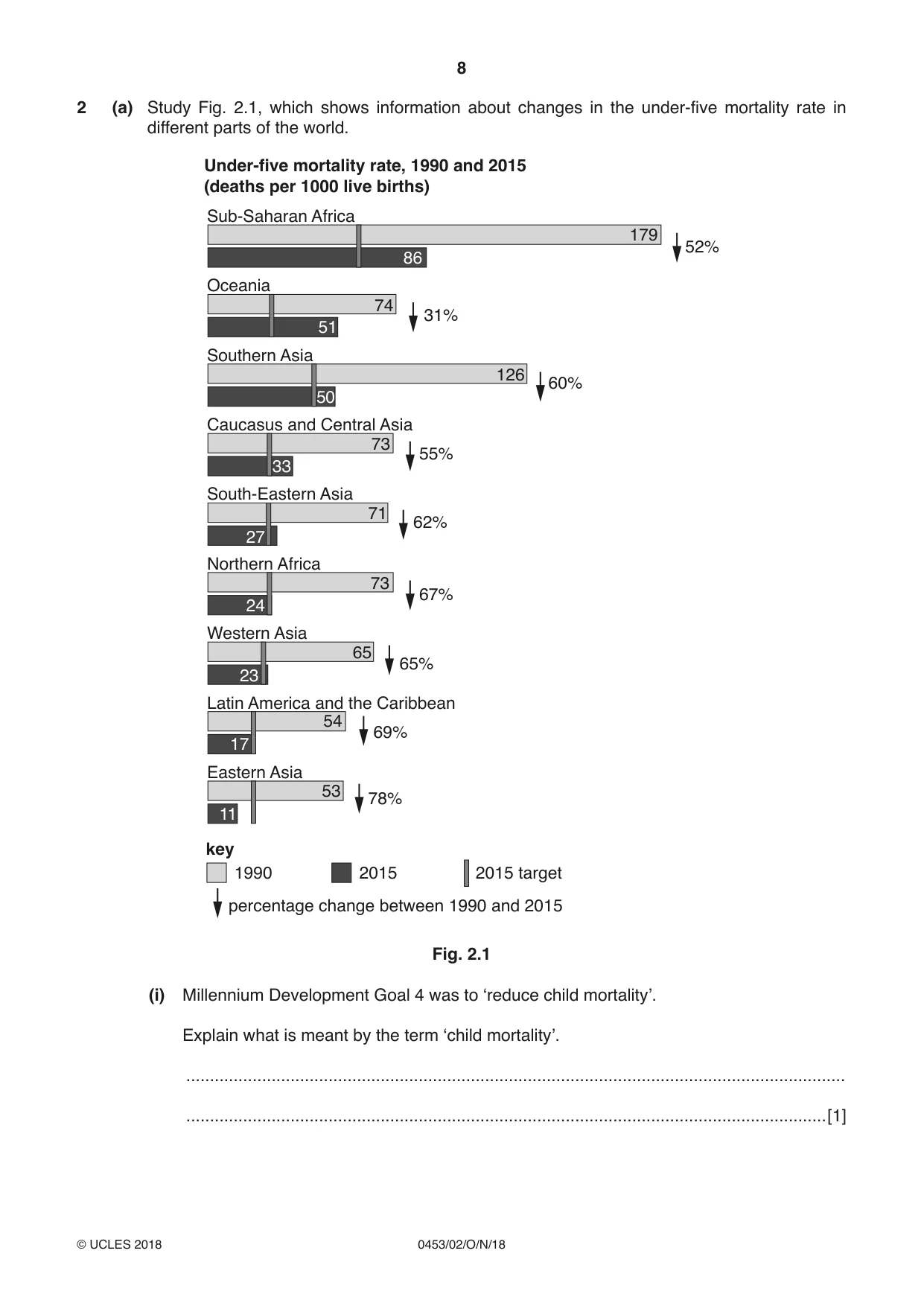
8 0453/02/O/N/18 © UCLES 2018 2 (a) Study Fig. 2.1, which shows information about changes in the under-five mortality rate in different parts of the world. Sub-Saharan Africa Oceania Southern Asia Caucasus and Central Asia South-Eastern Asia Northern Africa Western Asia Latin America and the Caribbean Eastern Asia 86 179 52% 74 51 31% 126 60% 73 55% 33 71 62% 27 24 73 67% 65 65% 23 54 69% 17 53 78% 11 1990 2015 2015 target percentage change between 1990 and 2015 50 Under-five mortality rate, 1990 and 2015 (deaths per 1000 live births) key Fig. 2.1 (i) Millennium Development Goal 4 was to ‘reduce child mortality’. Explain what is meant by the term ‘child mortality’. … …[1]
Question paper, page 9
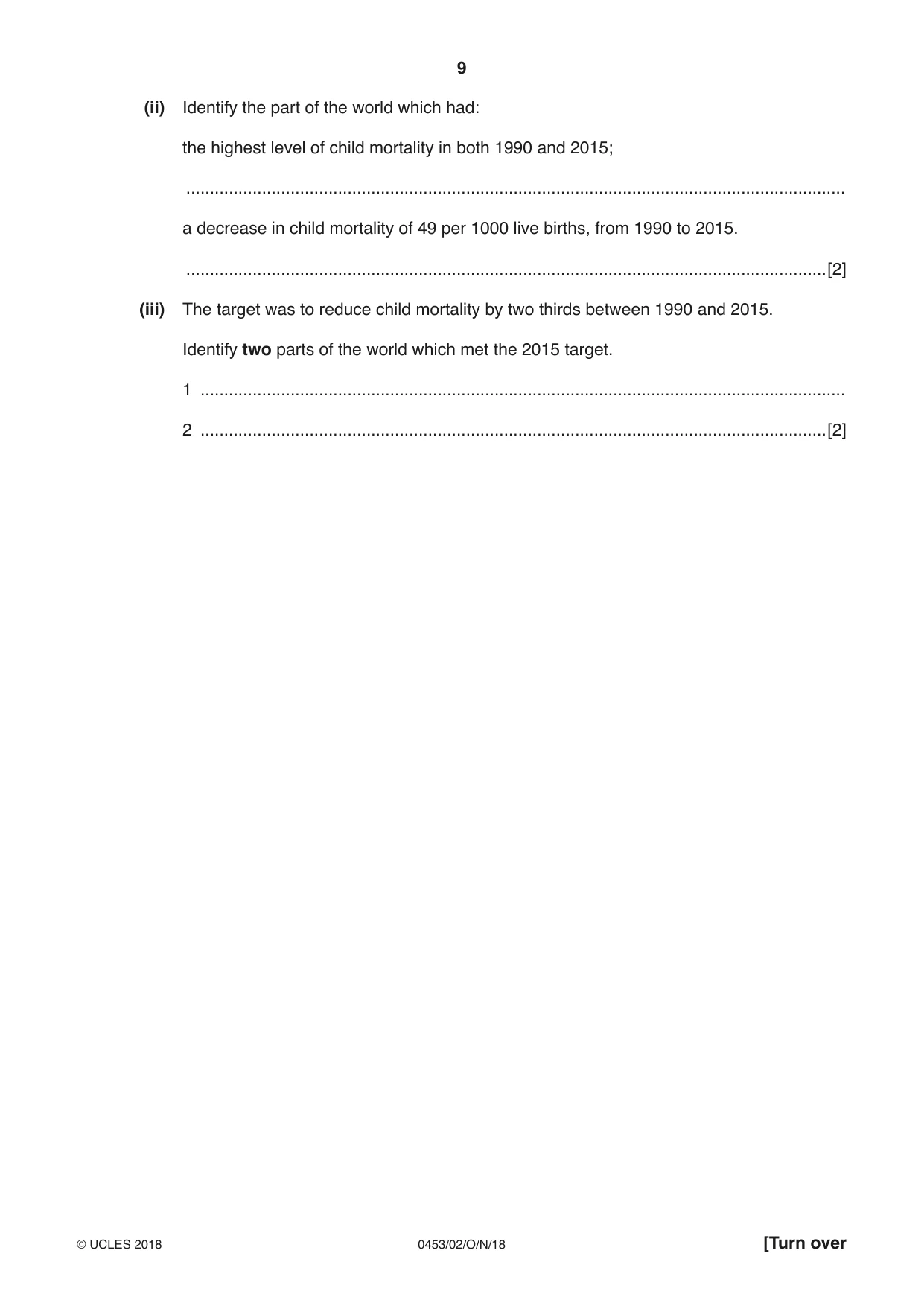
9 0453/02/O/N/18 © UCLES 2018 [Turn over (ii) Identify the part of the world which had: the highest level of child mortality in both 1990 and 2015; … a decrease in child mortality of 49 per 1000 live births, from 1990 to 2015. …[2] (iii) The target was to reduce child mortality by two thirds between 1990 and 2015. Identify two parts of the world which met the 2015 target. 1 … 2 …[2]
Question paper, page 10
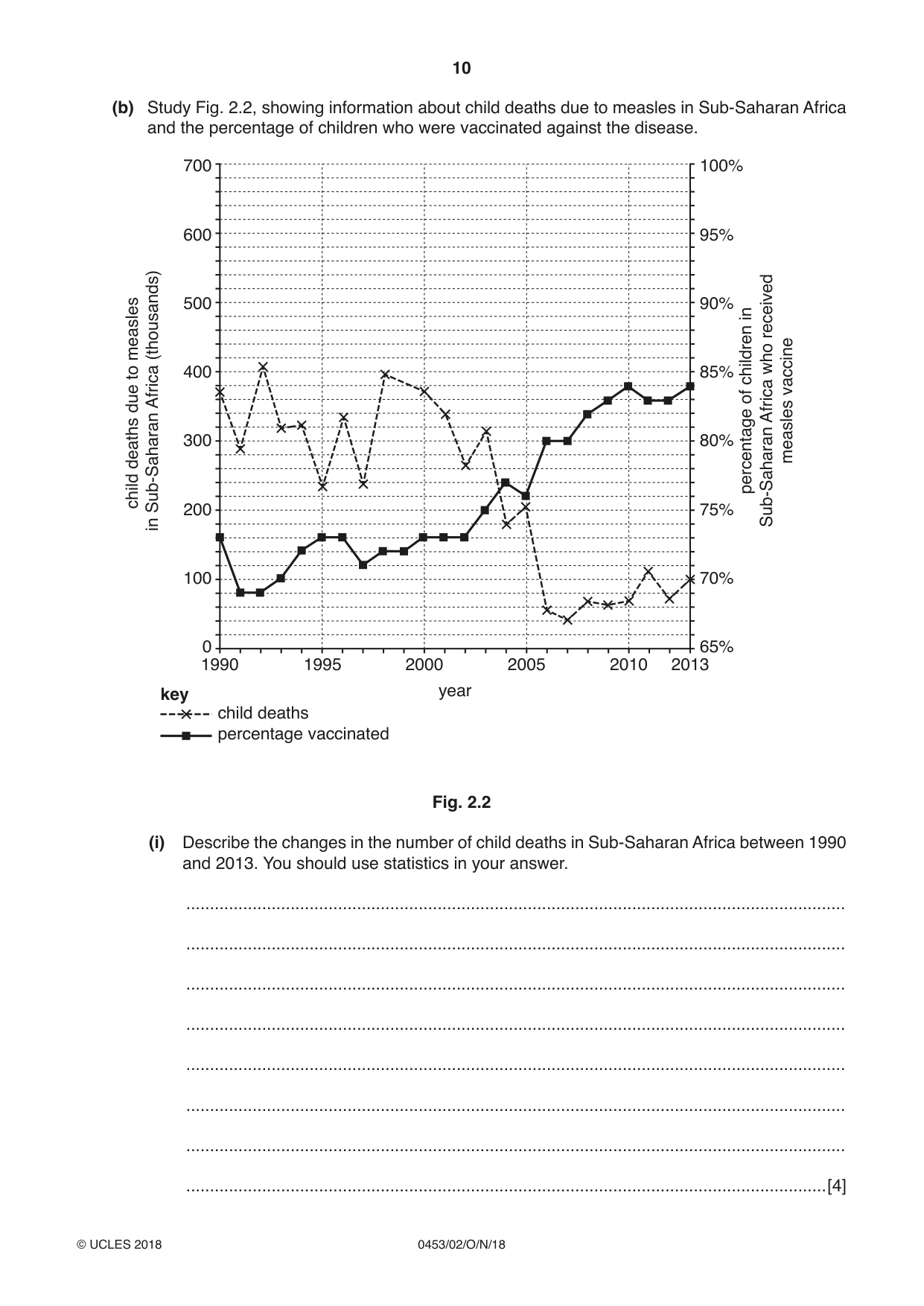
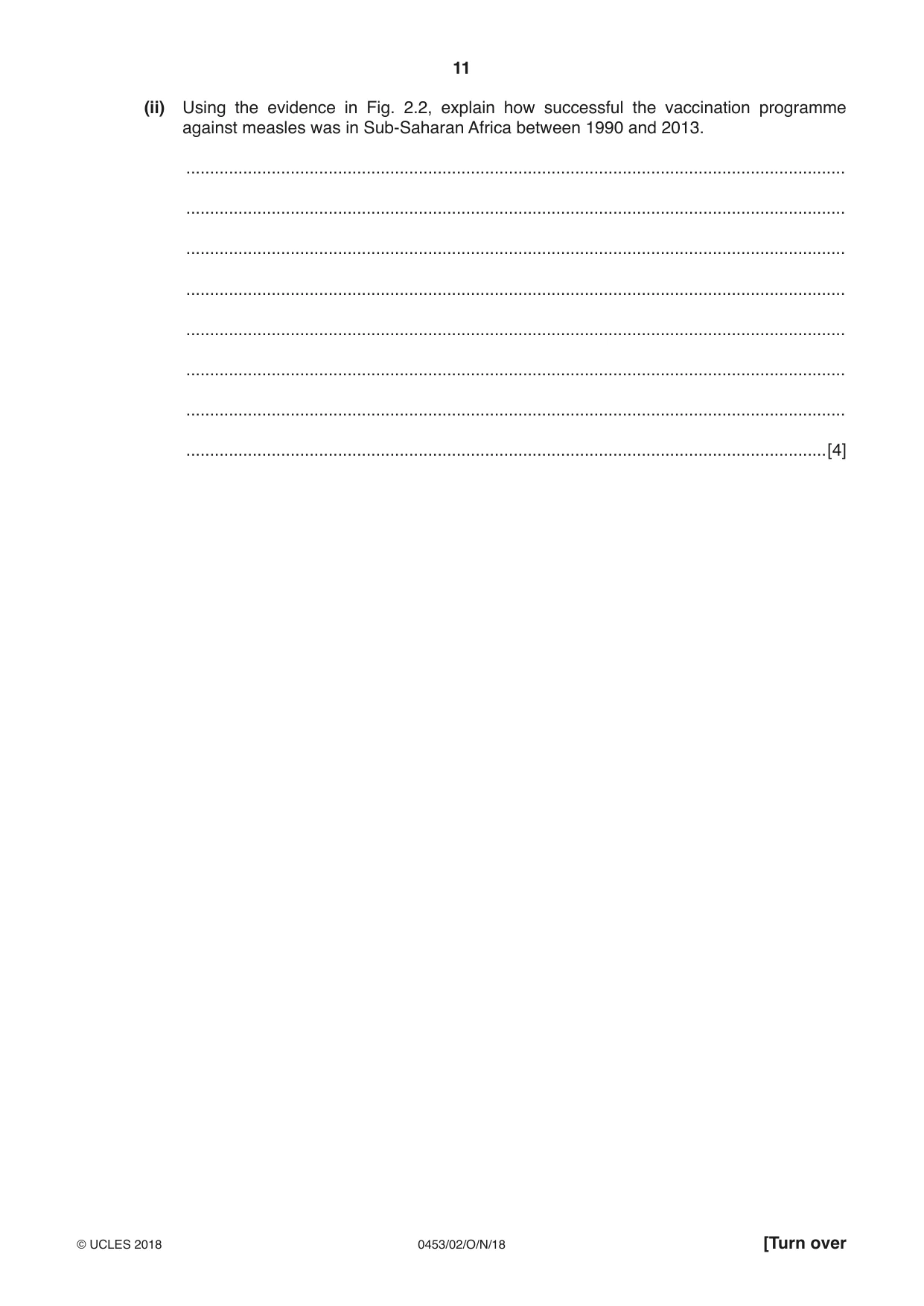
10 0453/02/O/N/18 © UCLES 2018 (b) Study Fig. 2.2, showing information about child deaths due to measles in Sub-Saharan Africa and the percentage of children who were vaccinated against the disease. year 700 600 500 400 300 200 100 0 100% 95% 90% 85% 80% 75% 70% 65% 1990 1995 2000 2005 2010 2013 child deaths due to measles in Sub-Saharan Africa (thousands) percentage of children in Sub-Saharan Africa who received measles vaccine child deaths percentage vaccinated key Fig. 2.2 (i) Describe the changes in the number of child deaths in Sub-Saharan Africa between 1990 and 2013. You should use statistics in your answer. … … … … … … … …[4]
Question paper, page 11
11 0453/02/O/N/18 © UCLES 2018 [Turn over (ii) Using the evidence in Fig. 2.2, explain how successful the vaccination programme against measles was in Sub-Saharan Africa between 1990 and 2013. … … … … … … … …[4]
Question paper, page 12
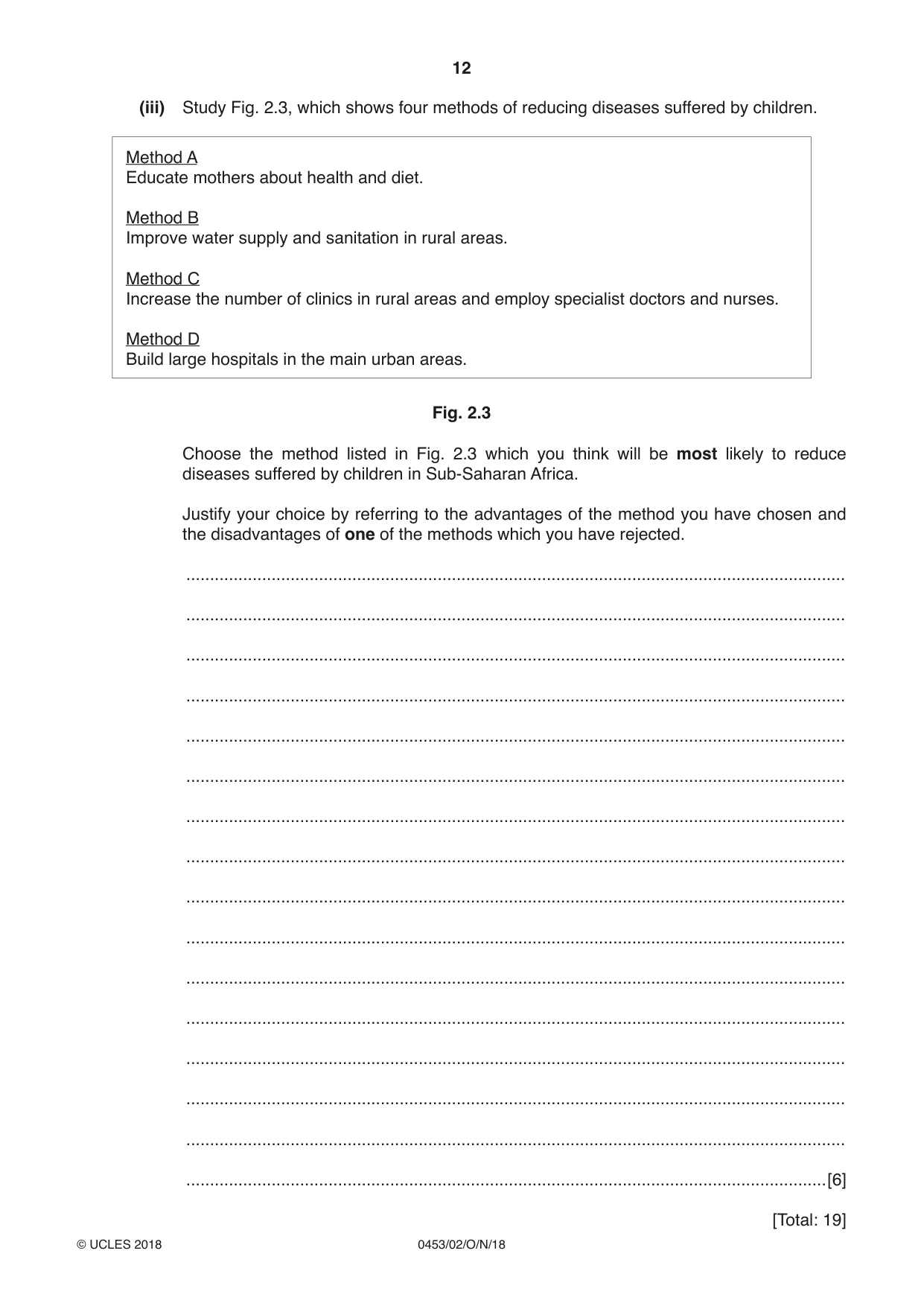
12 0453/02/O/N/18 © UCLES 2018 (iii) Study Fig. 2.3, which shows four methods of reducing diseases suffered by children. Method A Educate mothers about health and diet. Method B Improve water supply and sanitation in rural areas. Method C Increase the number of clinics in rural areas and employ specialist doctors and nurses. Method D Build large hospitals in the main urban areas. Fig. 2.3 Choose the method listed in Fig. 2.3 which you think will be most likely to reduce diseases suffered by children in Sub-Saharan Africa. Justify your choice by referring to the advantages of the method you have chosen and the disadvantages of one of the methods which you have rejected. … … … … … … … … … … … … … … … …[6] [Total: 19]
Question paper, page 13
13 0453/02/O/N/18 © UCLES 2018 [Turn over BLANK PAGE Question 3 begins on the next page.
Question paper, page 14
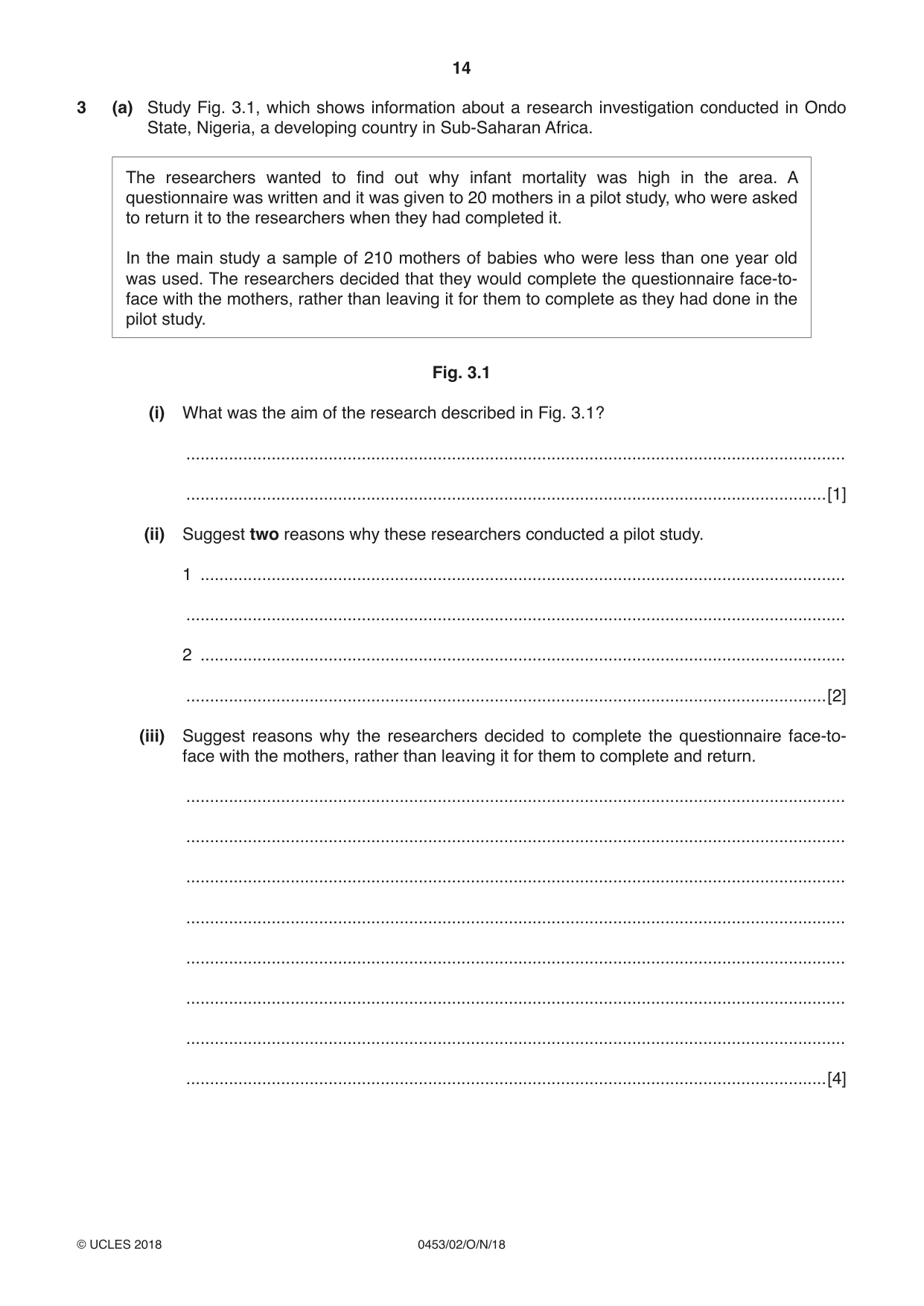
14 0453/02/O/N/18 © UCLES 2018 3 (a) Study Fig. 3.1, which shows information about a research investigation conducted in Ondo State, Nigeria, a developing country in Sub-Saharan Africa. The researchers wanted to find out why infant mortality was high in the area. A questionnaire was written and it was given to 20 mothers in a pilot study, who were asked to return it to the researchers when they had completed it. In the main study a sample of 210 mothers of babies who were less than one year old was used. The researchers decided that they would complete the questionnaire face-to- face with the mothers, rather than leaving it for them to complete as they had done in the pilot study. Fig. 3.1 (i) What was the aim of the research described in Fig. 3.1? … …[1] (ii) Suggest two reasons why these researchers conducted a pilot study. 1 … … 2 … …[2] (iii) Suggest reasons why the researchers decided to complete the questionnaire face-to- face with the mothers, rather than leaving it for them to complete and return. … … … … … … … …[4]
Question paper, page 15
15 0453/02/O/N/18 © UCLES 2018 [Turn over (iv) The 210 people who were selected to complete the questionnaire could have been selected using a random sample, a systematic sample or a stratified sample. Which type of sample do you think would have been best? Justify your choice. Type of sample … Justification … … … …[2] (v) State one other source of primary data and one source of secondary data which the researchers could have used in this study. Primary … … Secondary … …[2] (vi) Give two reasons why secondary data is not always reliable. 1 … … 2 … …[2]
Question paper, page 16
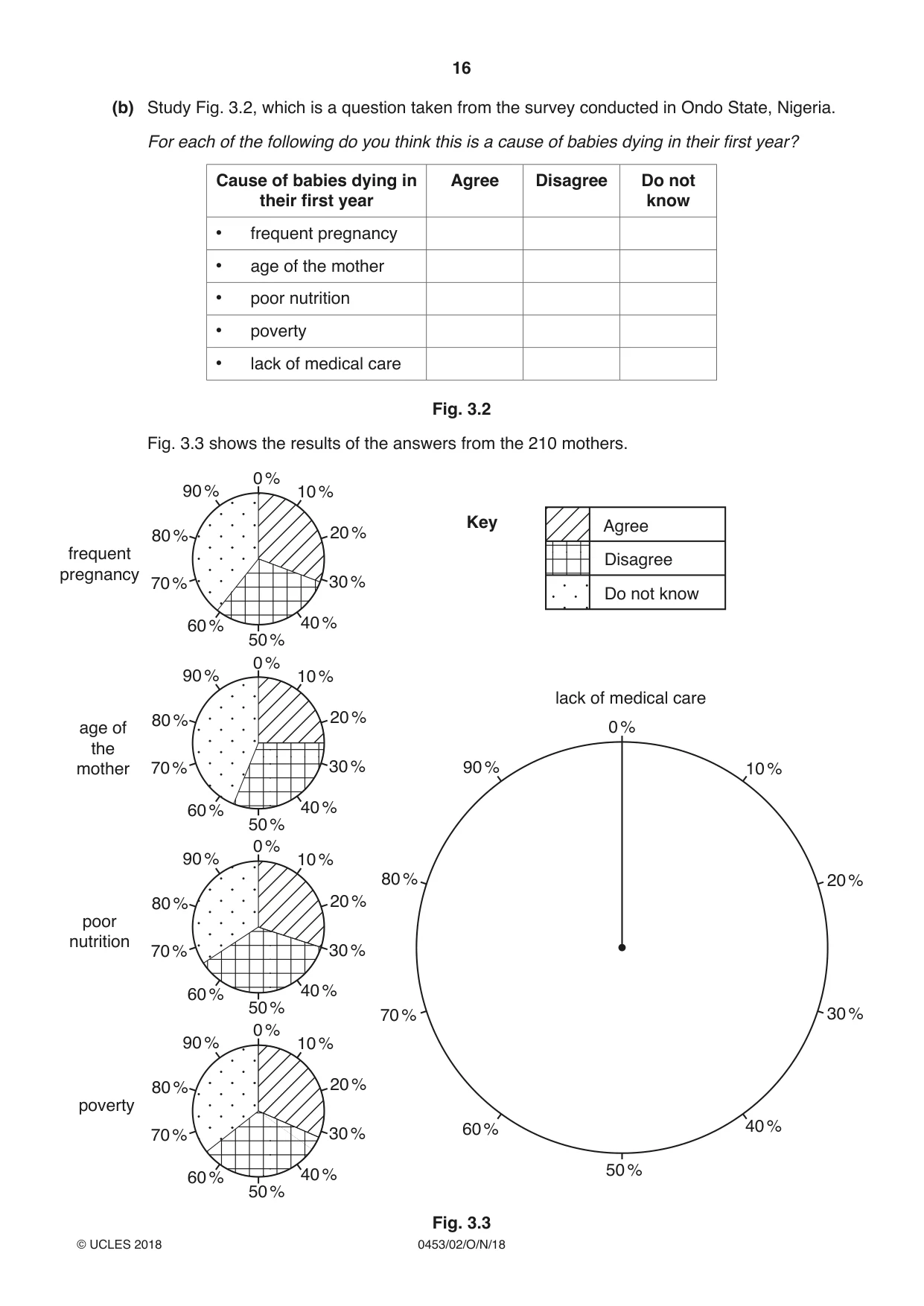
16 0453/02/O/N/18 © UCLES 2018 (b) Study Fig. 3.2, which is a question taken from the survey conducted in Ondo State, Nigeria. For each of the following do you think this is a cause of babies dying in their first year? Cause of babies dying in their first year Agree Disagree Do not know • frequent pregnancy • age of the mother • poor nutrition • poverty • lack of medical care Fig. 3.2 Fig. 3.3 shows the results of the answers from the 210 mothers. Key frequent pregnancy age of the mother poor nutrition 0 % 10 % 20 % 30 % 50 % 40 % 60 % 70 % 80 % 90 % 0 % 10 % 20 % 30 % 50 % 40 % 60 % 70 % 80 % 90 % 0 % 10 % 20 % 30 % 50 % 40 % 60 % 70 % 80 % 90 % 0 % 10 % 20 % 30 % 50 % 40 % 60 % 70 % 80 % 90 % Agree Disagree Do not know 0 % 10 % 20 % 30 % 50 % 40 % 60 % 70 % 80 % 90 % poverty lack of medical care Fig. 3.3
Question paper, page 17
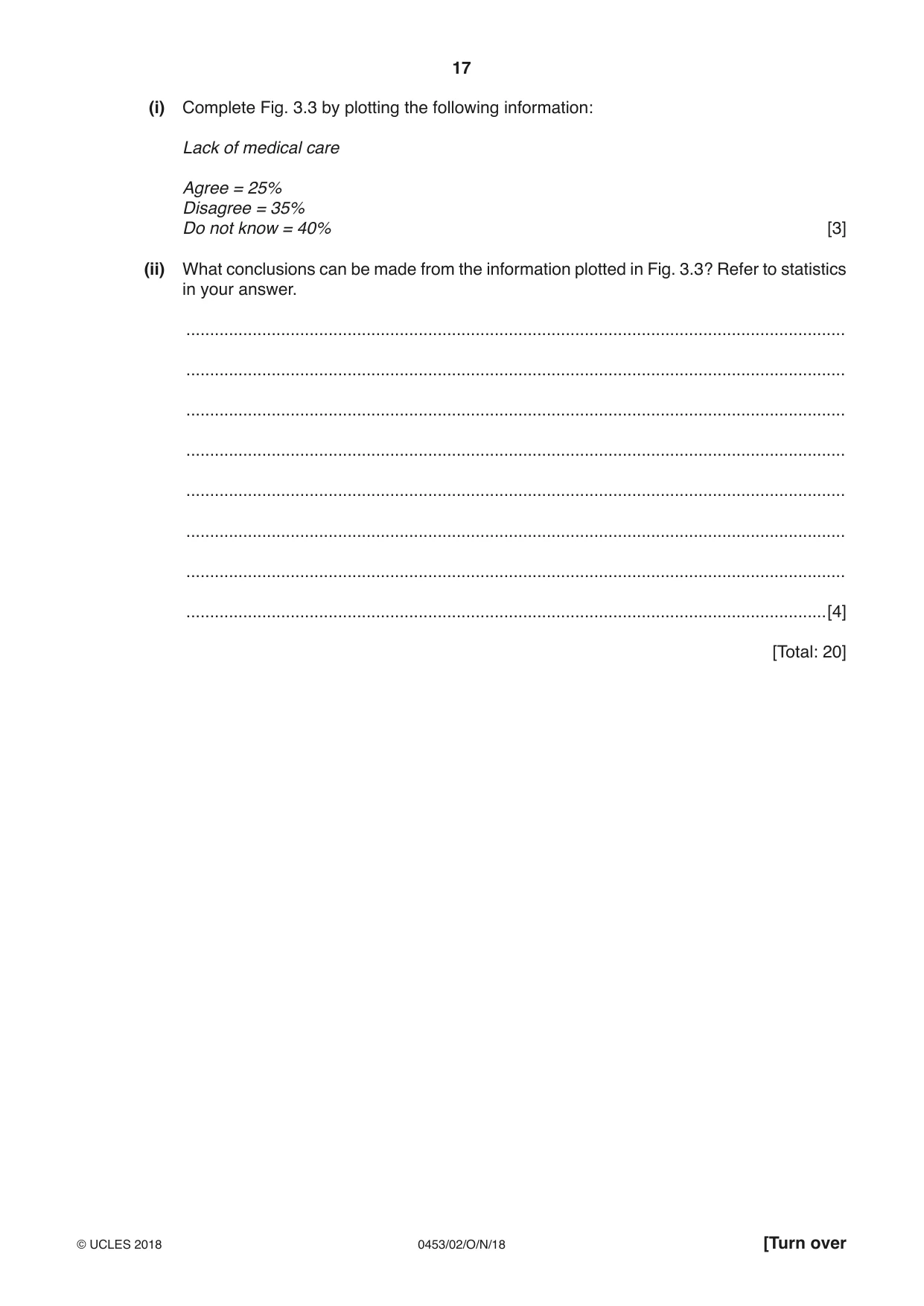
17 0453/02/O/N/18 © UCLES 2018 [Turn over (i) Complete Fig. 3.3 by plotting the following information: Lack of medical care Agree = 25% Disagree = 35% Do not know = 40% [3] (ii) What conclusions can be made from the information plotted in Fig. 3.3? Refer to statistics in your answer. … … … … … … … …[4] [Total: 20]
Question paper, page 18
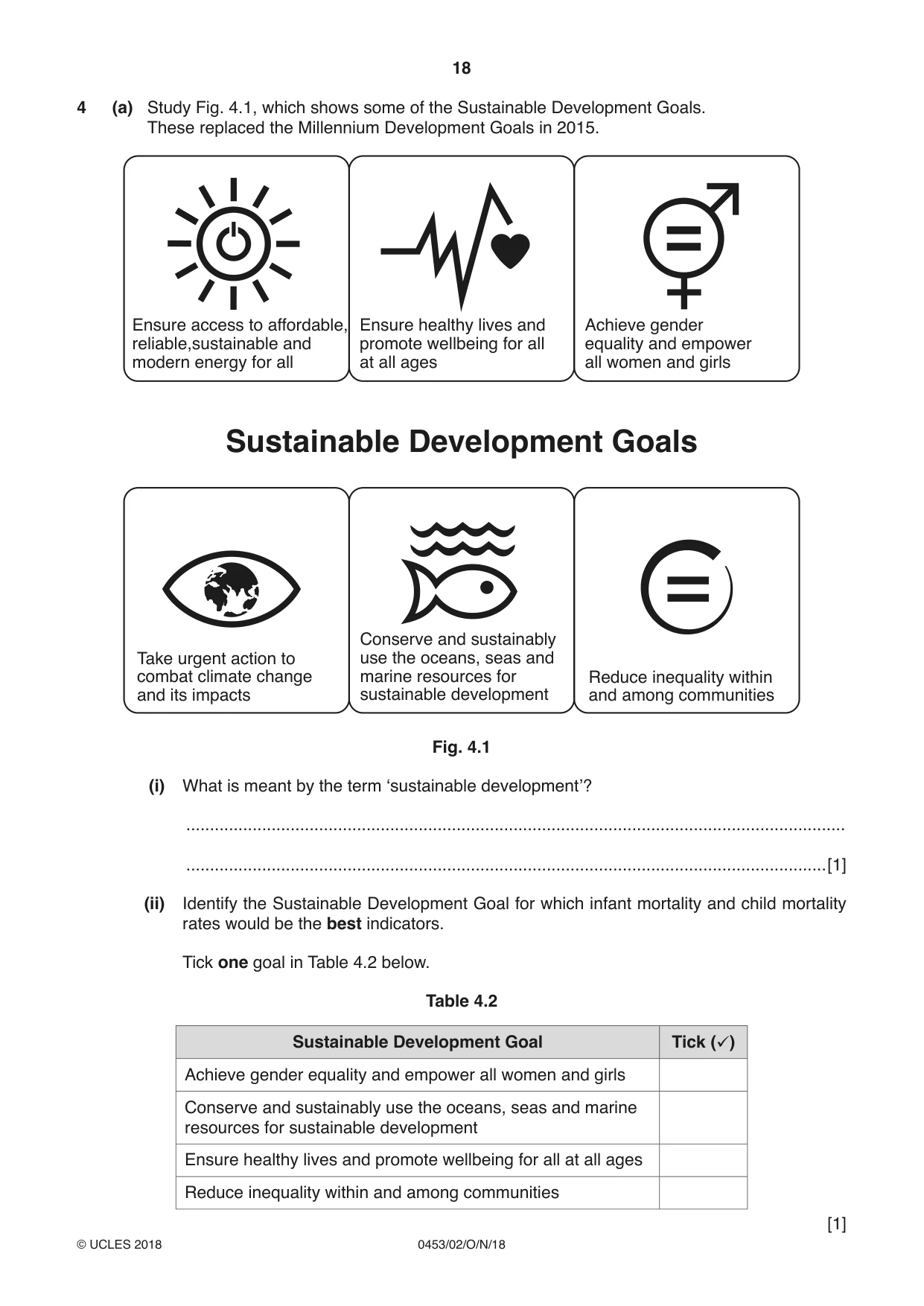
18 0453/02/O/N/18 © UCLES 2018 4 (a) Study Fig. 4.1, which shows some of the Sustainable Development Goals. These replaced the Millennium Development Goals in 2015. Ensure access to affordable, reliable,sustainable and modern energy for all Ensure healthy lives and promote wellbeing for all at all ages Achieve gender equality and empower all women and girls Take urgent action to combat climate change and its impacts Conserve and sustainably use the oceans, seas and marine resources for sustainable development Reduce inequality within and among communities Sustainable Development Goals Fig. 4.1 (i) What is meant by the term ‘sustainable development’? … …[1] (ii) Identify the Sustainable Development Goal for which infant mortality and child mortality rates would be the best indicators. Tick one goal in Table 4.2 below. Table 4.2 Sustainable Development Goal Tick (ü) Achieve gender equality and empower all women and girls Conserve and sustainably use the oceans, seas and marine resources for sustainable development Ensure healthy lives and promote wellbeing for all at all ages Reduce inequality within and among communities [1]
Question paper, page 19
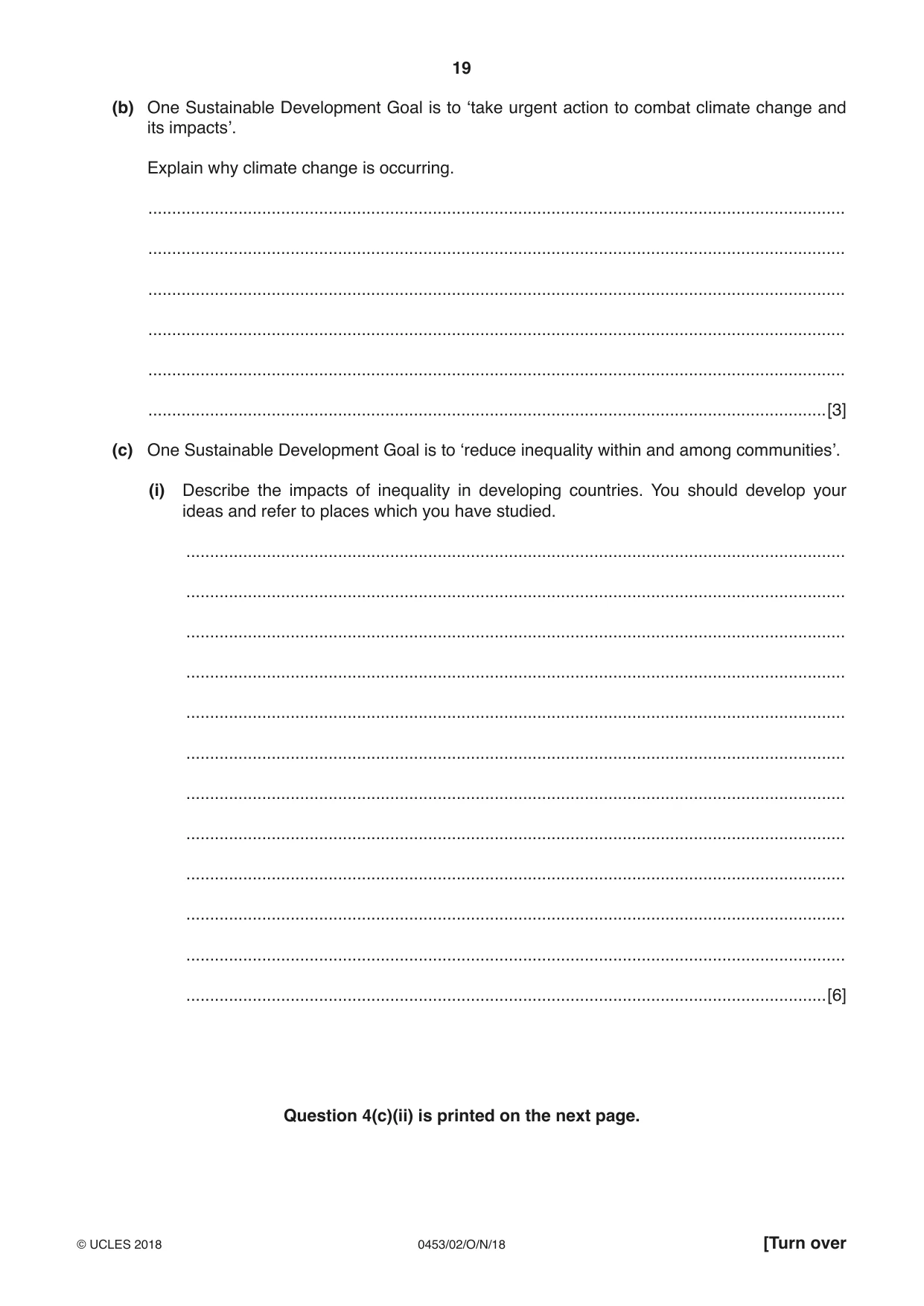
19 0453/02/O/N/18 © UCLES 2018 [Turn over (b) One Sustainable Development Goal is to ‘take urgent action to combat climate change and its impacts’. Explain why climate change is occurring. … … … … … …[3] (c) One Sustainable Development Goal is to ‘reduce inequality within and among communities’. (i) Describe the impacts of inequality in developing countries. You should develop your ideas and refer to places which you have studied. … … … … … … … … … … … …[6] Question 4(c)(ii) is printed on the next page.
Question paper, page 20
20 0453/02/O/N/18 © UCLES 2018 Permission to reproduce items where third-party owned material protected by copyright is included has been sought and cleared where possible. Every reasonable effort has been made by the publisher (UCLES) to trace copyright holders, but if any items requiring clearance have unwittingly been included, the publisher will be pleased to make amends at the earliest possible opportunity. To avoid the issue of disclosure of answer-related information to candidates, all copyright acknowledgements are reproduced online in the Cambridge International Examinations Copyright Acknowledgements Booklet. This is produced for each series of examinations and is freely available to download at www.cie.org.uk after the live examination series. Cambridge International Examinations is part of the Cambridge Assessment Group. Cambridge Assessment is the brand name of University of Cambridge Local Examinations Syndicate (UCLES), which is itself a department of the University of Cambridge. (ii) Explain what can be done in developing countries to reduce inequality. … … … … … … … … … … … …[6] [Total: 17]