Cambridge IGCSE Design and Technology 0445 — 2017 May/June Paper 2 · Variant 1
0445/21/M/J/17 · 50 marks · ≈56 min
The question paper and its mark scheme, free to read here and free to download. This is Cambridge’s own paper, exactly as it was sat.
Question paper4 pages
Mark scheme5 pages
Answers below. Sit the paper first if you are practising.
Paper as text
Question paper, page 1
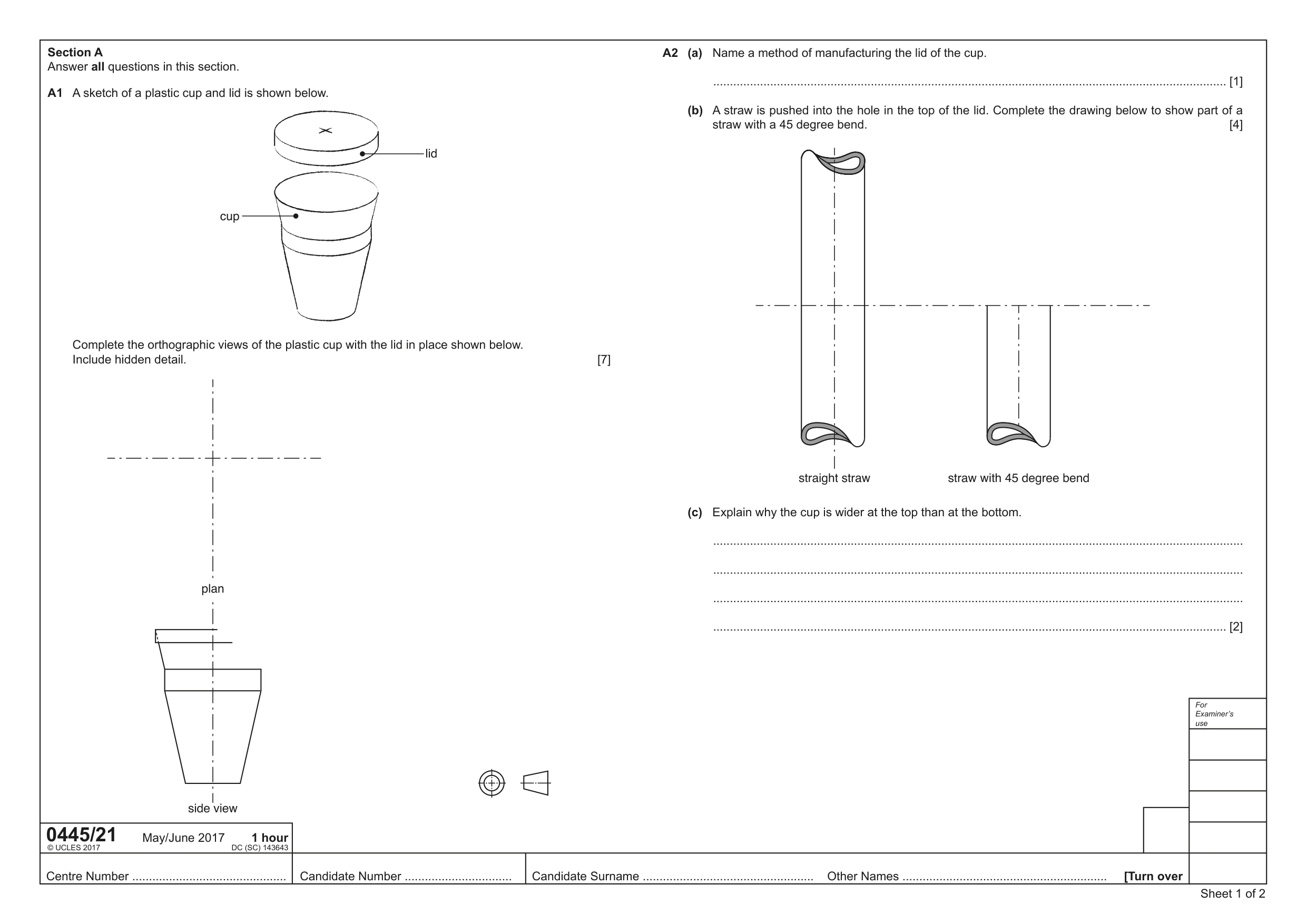
May/June 2017 1 hour For Examiner’s use Centre Number … Candidate Number … Candidate Surname … Other Names … [Turn over Sheet 1 of 2 0445/21 © UCLES 2017 DC (SC) 143643 Section A Answer all questions in this section. A1 A sketch of a plastic cup and lid is shown below. lid cup Complete the orthographic views of the plastic cup with the lid in place shown below. Include hidden detail. [7] plan side view A2 (a) Name a method of manufacturing the lid of the cup. … [1] (b) A straw is pushed into the hole in the top of the lid. Complete the drawing below to show part of a straw with a 45 degree bend. [4] straight straw straw with 45 degree bend (c) Explain why the cup is wider at the top than at the bottom. … … … … [2]
Question paper, page 2
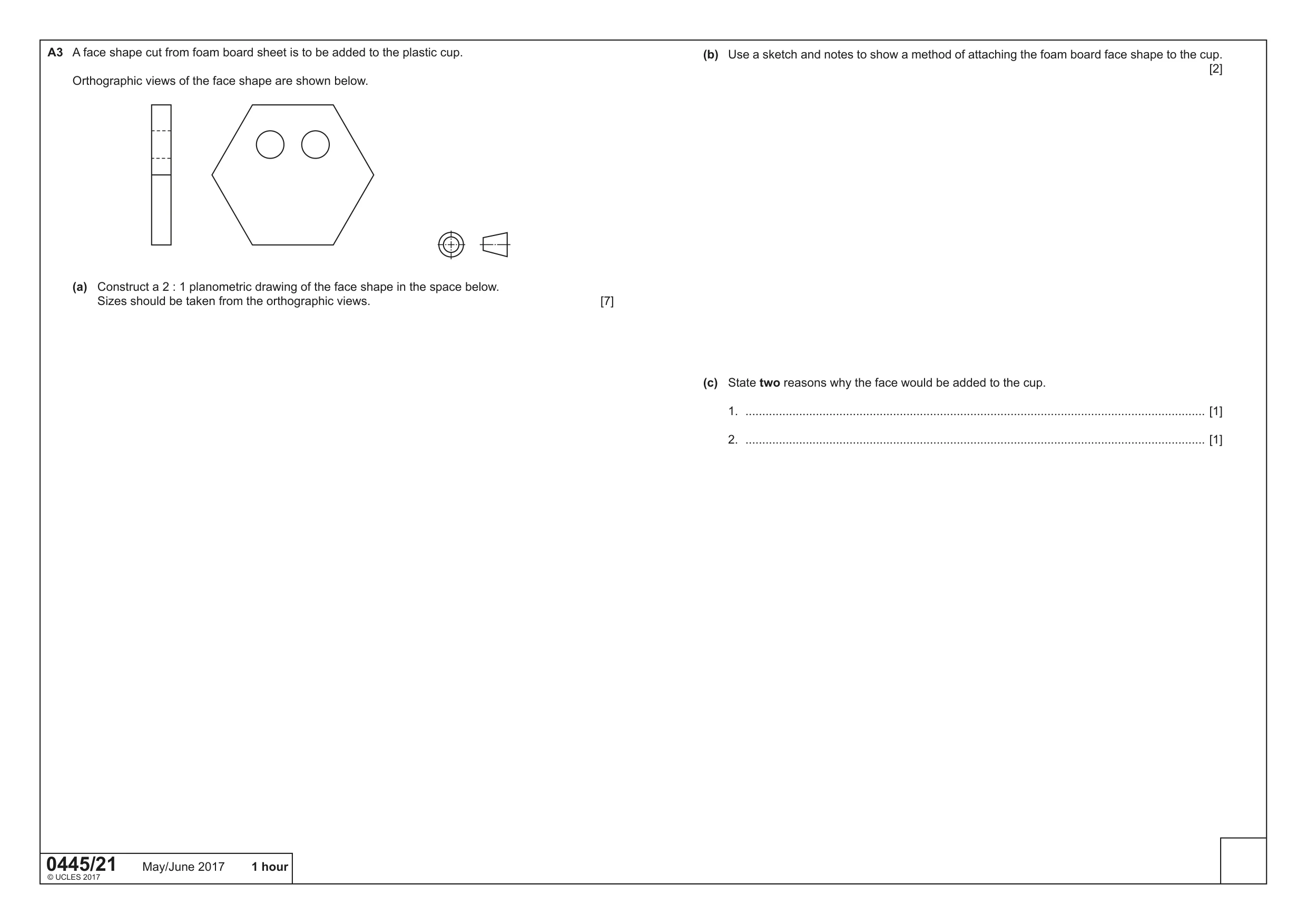
0445/21 May/June 2017 1 hour © UCLES 2017 A3 A face shape cut from foam board sheet is to be added to the plastic cup. Orthographic views of the face shape are shown below. (a) Construct a 2 : 1 planometric drawing of the face shape in the space below. Sizes should be taken from the orthographic views. [7] (b) Use a sketch and notes to show a method of attaching the foam board face shape to the cup. [2] (c) State two reasons why the face would be added to the cup. 1. … [1] 2. … [1]
Question paper, page 3
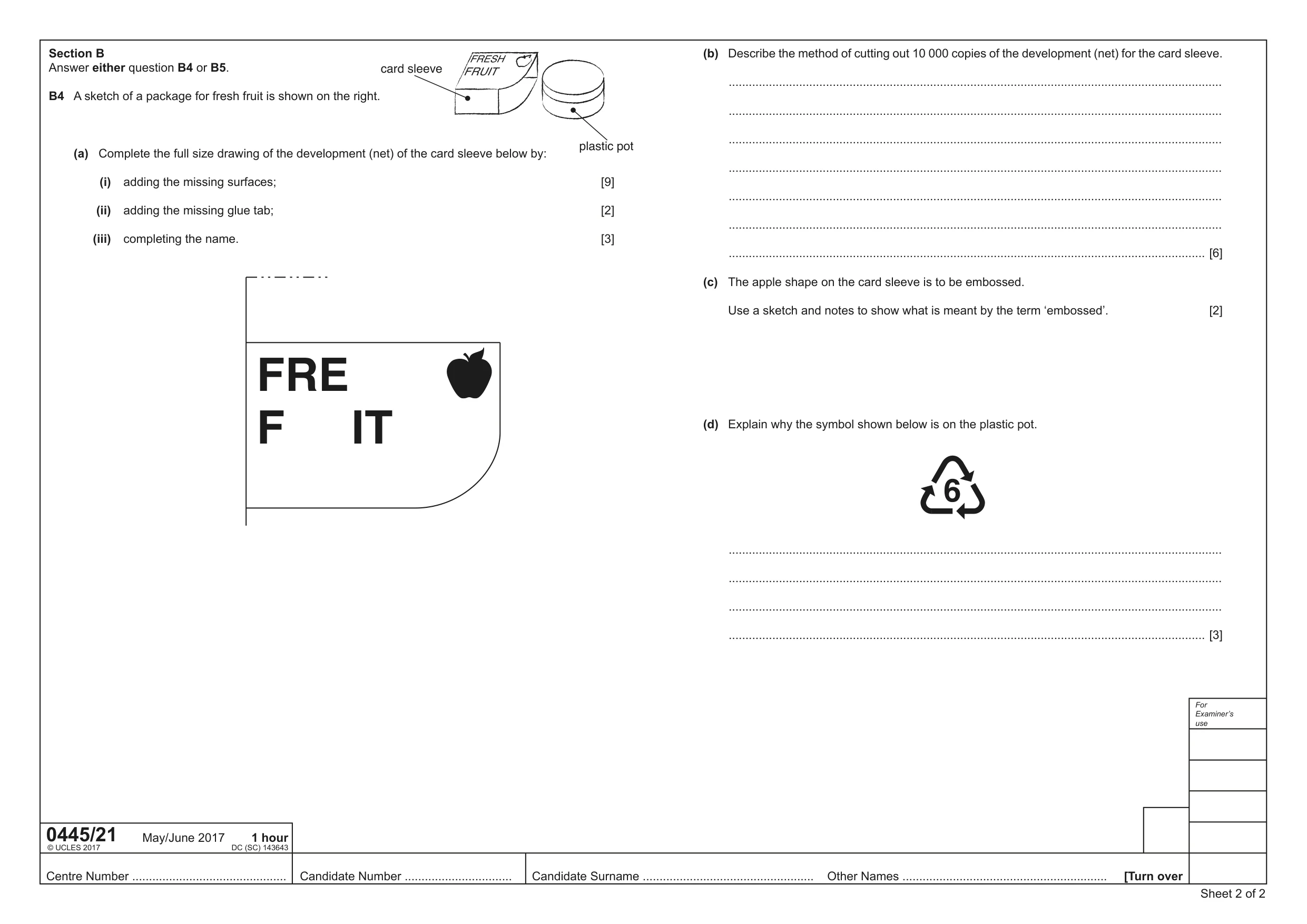
0445/21 May/June 2017 1 hour For Examiner’s use Centre Number … © UCLES 2017 DC (SC) 143643 Candidate Number … Candidate Surname … Other Names … [Turn over Sheet 2 of 2 Section B Answer either question B4 or B5. B4 A sketch of a package for fresh fruit is shown on the right. FRESH FRUIT plastic pot card sleeve (a) Complete the full size drawing of the development (net) of the card sleeve below by: (i) adding the missing surfaces; [9] (ii) adding the missing glue tab; [2] (iii) completing the name. [3] FRE FRUIT (b) Describe the method of cutting out 10 000 copies of the development (net) for the card sleeve. … … … … … … … [6] (c) The apple shape on the card sleeve is to be embossed. Use a sketch and notes to show what is meant by the term ‘embossed’. [2] (d) Explain why the symbol shown below is on the plastic pot. 6 … … … … [3]
Question paper, page 4
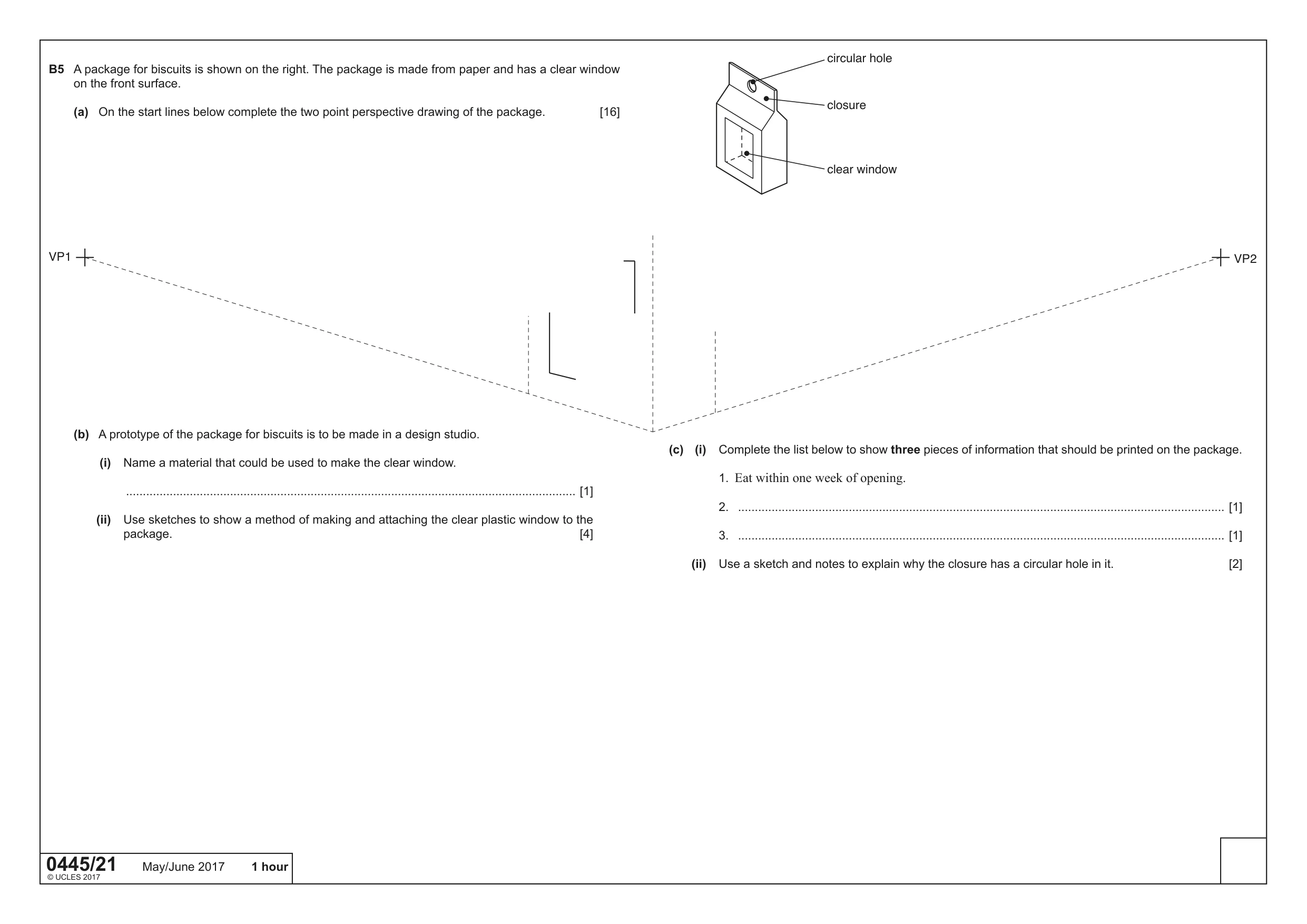
0445/21 May/June 2017 1 hour © UCLES 2017 circular hole closure clear window B5 A package for biscuits is shown on the right. The package is made from paper and has a clear window on the front surface. (a) On the start lines below complete the two point perspective drawing of the package. [16] VP2 VP1 (c) (i) Complete the list below to show three pieces of information that should be printed on the package. 1. Eat within one week of opening. 2. … [1] 3. … [1] (ii) Use a sketch and notes to explain why the closure has a circular hole in it. [2] (b) A prototype of the package for biscuits is to be made in a design studio. (i) Name a material that could be used to make the clear window. … [1] (ii) Use sketches to show a method of making and attaching the clear plastic window to the package. [4]
Mark scheme, page 1
® IGCSE is a registered trademark. This document consists of 5 printed pages. © UCLES 2017 [Turn over Cambridge International Examinations Cambridge International General Certificate of Secondary Education DESIGN AND TECHNOLOGY 0445/21 Paper 2 Graphic Products May/June 2017 MARK SCHEME Maximum Mark: 50 Published This mark scheme is published as an aid to teachers and candidates, to indicate the requirements of the examination. It shows the basis on which Examiners were instructed to award marks. It does not indicate the details of the discussions that took place at an Examiners’ meeting before marking began, which would have considered the acceptability of alternative answers. Mark schemes should be read in conjunction with the question paper and the Principal Examiner Report for Teachers. Cambridge will not enter into discussions about these mark schemes. Cambridge is publishing the mark schemes for the May/June 2017 series for most Cambridge IGCSE®, Cambridge International A and AS Level and Cambridge Pre-U components, and some Cambridge O Level components.
Mark scheme, page 2
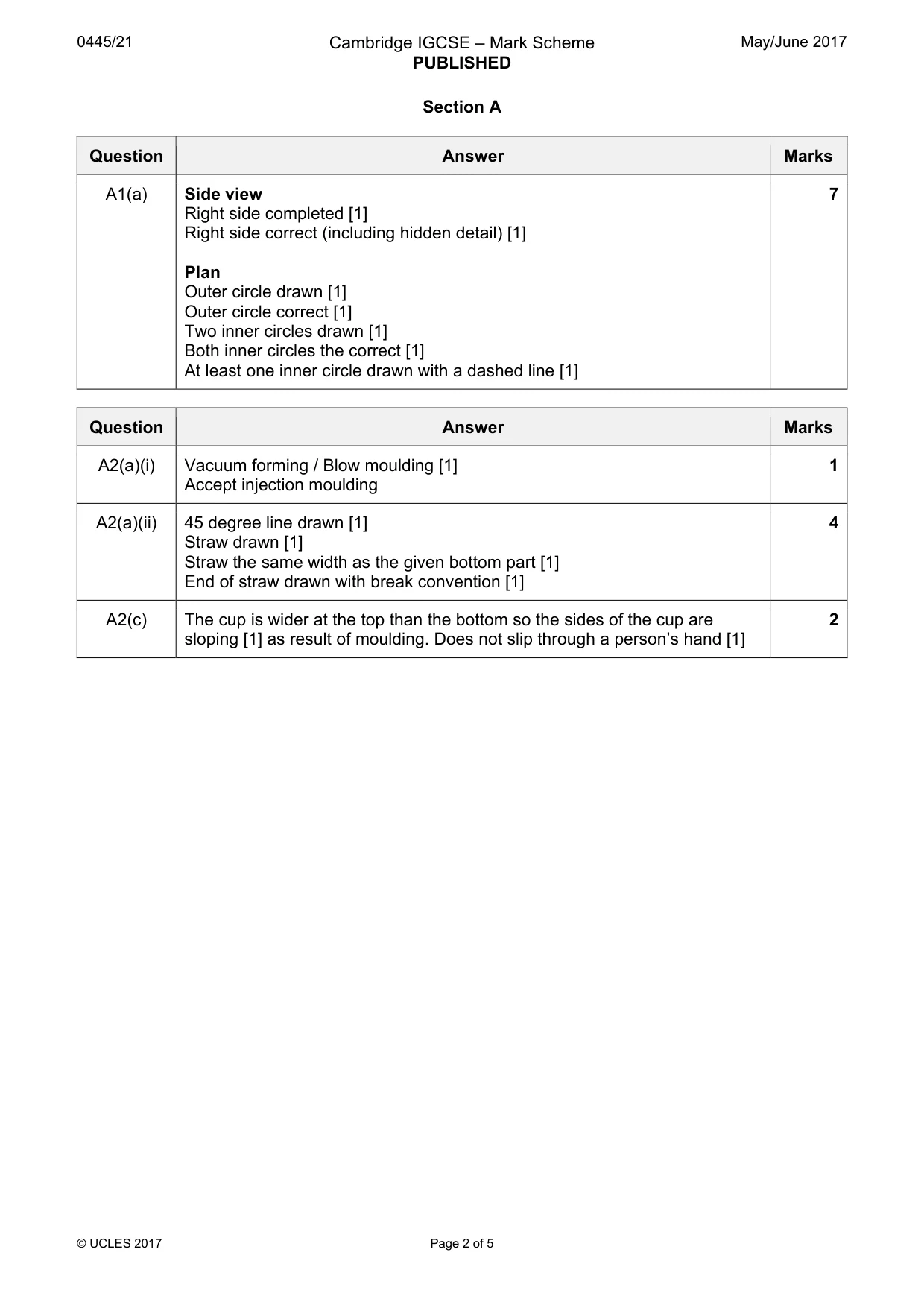
0445/21 Cambridge IGCSE – Mark Scheme PUBLISHED May/June 2017 © UCLES 2017 Page 2 of 5 Section A Question Answer Marks A1(a) Side view Right side completed [1] Right side correct (including hidden detail) [1] Plan Outer circle drawn [1] Outer circle correct [1] Two inner circles drawn [1] Both inner circles the correct [1] At least one inner circle drawn with a dashed line [1] 7 Question Answer Marks A2(a)(i) Vacuum forming / Blow moulding [1] Accept injection moulding 1 A2(a)(ii) 45 degree line drawn [1] Straw drawn [1] Straw the same width as the given bottom part [1] End of straw drawn with break convention [1] 4 A2(c) The cup is wider at the top than the bottom so the sides of the cup are sloping [1] as result of moulding. Does not slip through a person’s hand [1] 2
Mark scheme, page 3
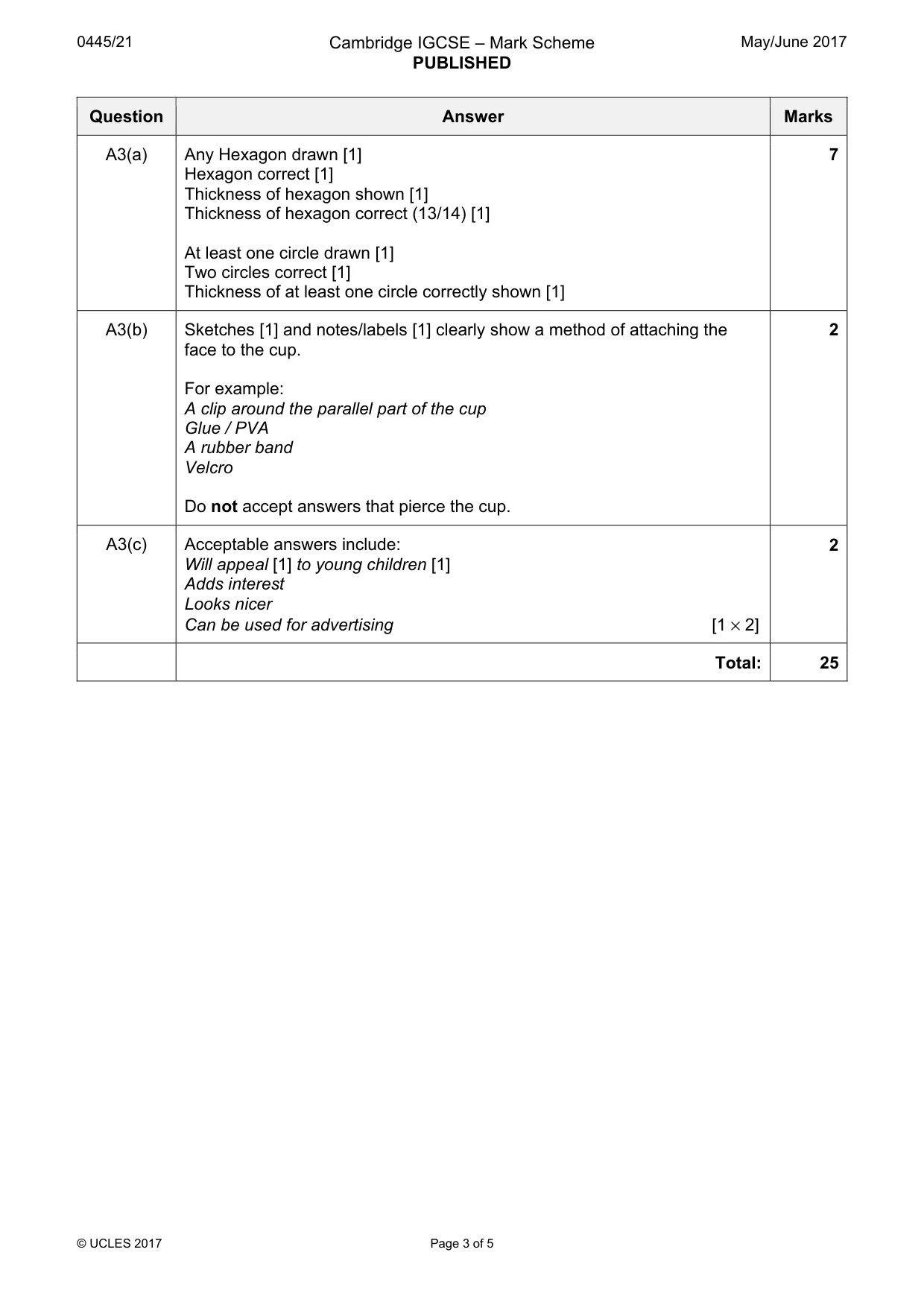
0445/21 Cambridge IGCSE – Mark Scheme PUBLISHED May/June 2017 © UCLES 2017 Page 3 of 5 Question Answer Marks A3(a) Any Hexagon drawn [1] Hexagon correct [1] Thickness of hexagon shown [1] Thickness of hexagon correct (13/14) [1] At least one circle drawn [1] Two circles correct [1] Thickness of at least one circle correctly shown [1] 7 A3(b) Sketches [1] and notes/labels [1] clearly show a method of attaching the face to the cup. For example: A clip around the parallel part of the cup Glue / PVA A rubber band Velcro Do not accept answers that pierce the cup. 2 A3(c) Acceptable answers include: Will appeal [1] to young children [1] Adds interest Looks nicer Can be used for advertising [1 × 2] 2 Total: 25
Mark scheme, page 4
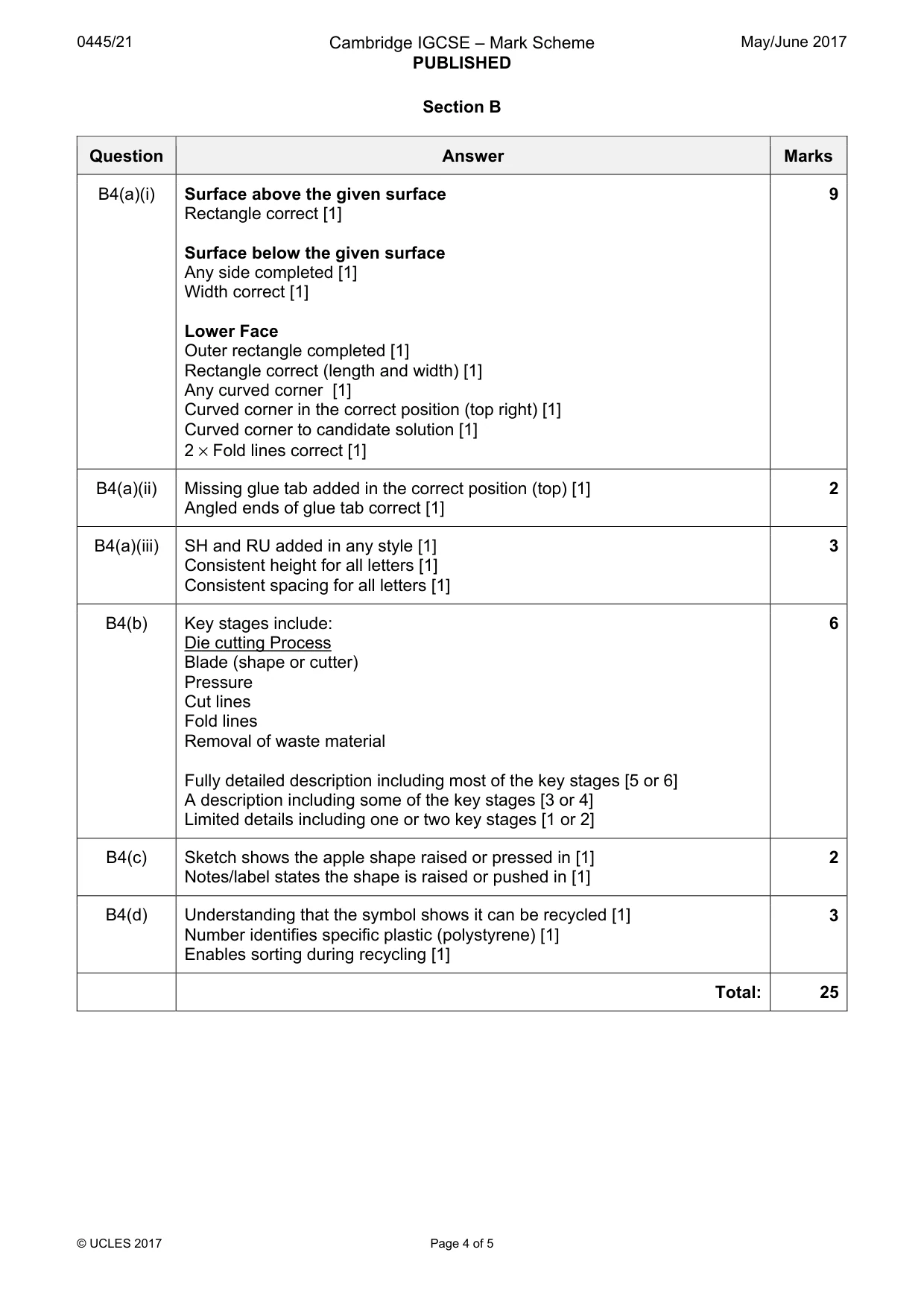
0445/21 Cambridge IGCSE – Mark Scheme PUBLISHED May/June 2017 © UCLES 2017 Page 4 of 5 Section B Question Answer Marks B4(a)(i) Surface above the given surface Rectangle correct [1] Surface below the given surface Any side completed [1] Width correct [1] Lower Face Outer rectangle completed [1] Rectangle correct (length and width) [1] Any curved corner [1] Curved corner in the correct position (top right) [1] Curved corner to candidate solution [1] 2 × Fold lines correct [1] 9 B4(a)(ii) Missing glue tab added in the correct position (top) [1] Angled ends of glue tab correct [1] 2 B4(a)(iii) SH and RU added in any style [1] Consistent height for all letters [1] Consistent spacing for all letters [1] 3 B4(b) Key stages include: Die cutting Process Blade (shape or cutter) Pressure Cut lines Fold lines Removal of waste material Fully detailed description including most of the key stages [5 or 6] A description including some of the key stages [3 or 4] Limited details including one or two key stages [1 or 2] 6 B4(c) Sketch shows the apple shape raised or pressed in [1] Notes/label states the shape is raised or pushed in [1] 2 B4(d) Understanding that the symbol shows it can be recycled [1] Number identifies specific plastic (polystyrene) [1] Enables sorting during recycling [1] 3 Total: 25
Mark scheme, page 5
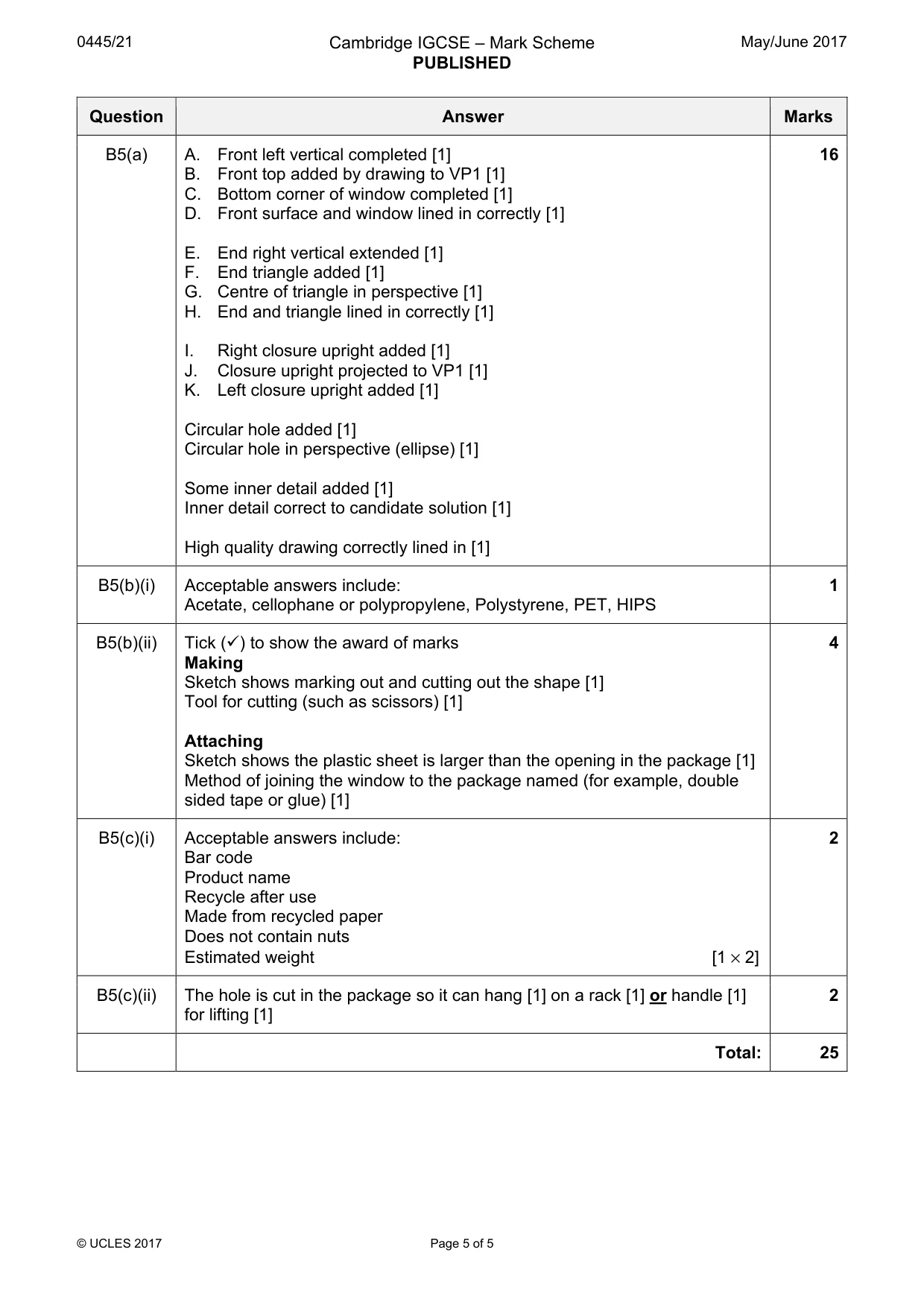
0445/21 Cambridge IGCSE – Mark Scheme PUBLISHED May/June 2017 © UCLES 2017 Page 5 of 5 Question Answer Marks B5(a) A. Front left vertical completed [1] B. Front top added by drawing to VP1 [1] C. Bottom corner of window completed [1] D. Front surface and window lined in correctly [1] E. End right vertical extended [1] F. End triangle added [1] G. Centre of triangle in perspective [1] H. End and triangle lined in correctly [1] I. Right closure upright added [1] J. Closure upright projected to VP1 [1] K. Left closure upright added [1] Circular hole added [1] Circular hole in perspective (ellipse) [1] Some inner detail added [1] Inner detail correct to candidate solution [1] High quality drawing correctly lined in [1] 16 B5(b)(i) Acceptable answers include: Acetate, cellophane or polypropylene, Polystyrene, PET, HIPS 1 B5(b)(ii) Tick (9) to show the award of marks Making Sketch shows marking out and cutting out the shape [1] Tool for cutting (such as scissors) [1] Attaching Sketch shows the plastic sheet is larger than the opening in the package [1] Method of joining the window to the package named (for example, double sided tape or glue) [1] 4 B5(c)(i) Acceptable answers include: Bar code Product name Recycle after use Made from recycled paper Does not contain nuts Estimated weight [1 × 2] 2 B5(c)(ii) The hole is cut in the package so it can hang [1] on a rack [1] or handle [1] for lifting [1] 2 Total: 25
What you needed in this session
Cambridge’s own grade thresholds for 2017 May/June, Paper 2 · Variant 1. A higher threshold means an easier paper — the bar moves with how the cohort did.