Cambridge IGCSE Design and Technology 0445 — 2016 Oct/Nov Paper 2 · Variant 2
0445/22/O/N/16 · 50 marks · ≈56 min
The question paper and its mark scheme, free to read here and free to download. This is Cambridge’s own paper, exactly as it was sat.
Question paper4 pages



Mark scheme5 pages
Answers below. Sit the paper first if you are practising.
Paper as text
Question paper, page 1
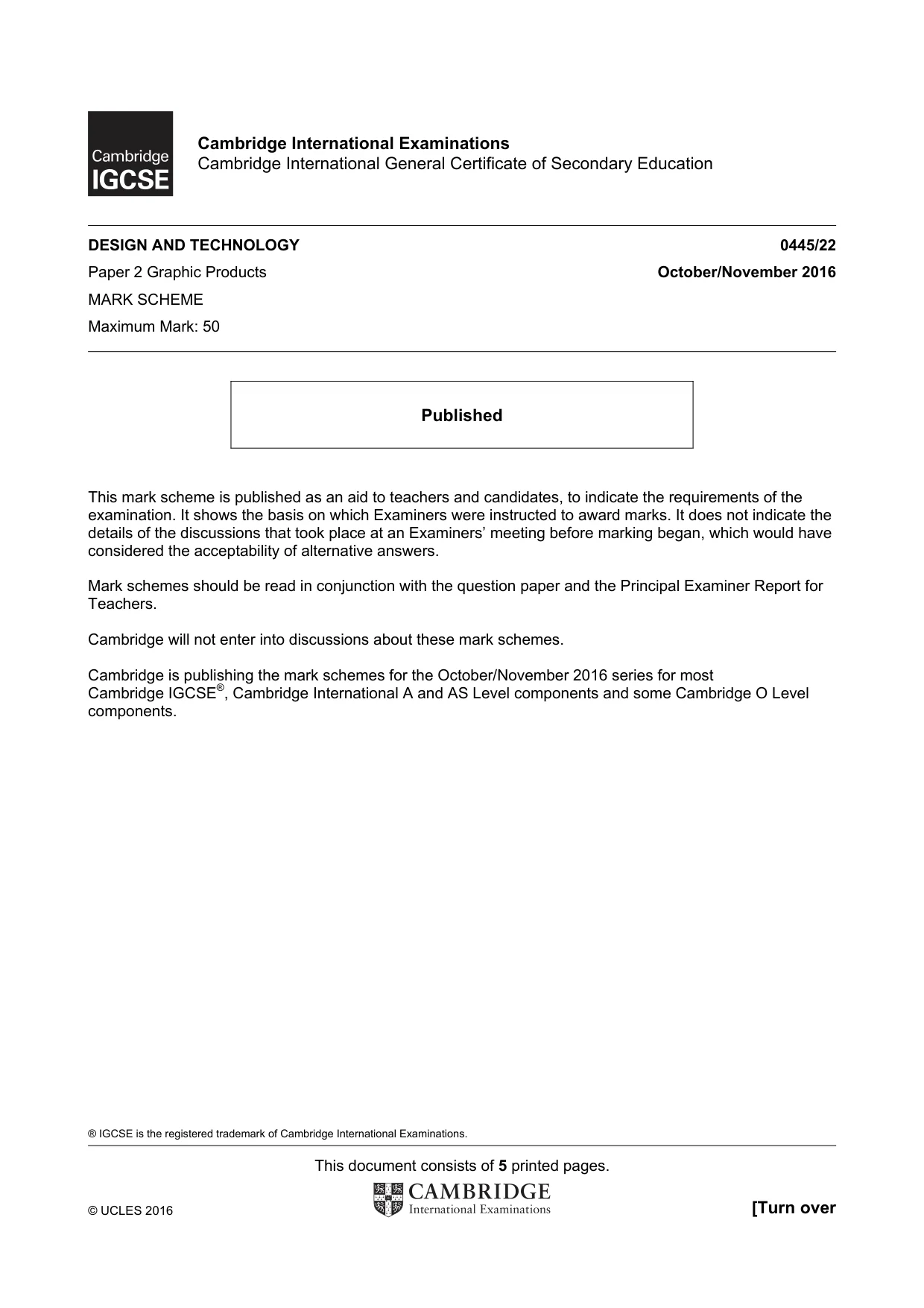
READ THESE INSTRUCTIONS FIRST Write your Centre number, candidate number and name in the spaces at the top of this page and on the two Answer Sheets. Do not use staples, paper clips, glue or correction fl uid. DO NOT WRITE IN ANY BARCODES. Section A Answer all questions in this section (A1, A2 and A3). Section B Answer one question in this section (B4 or B5). You may use a calculator. Draw your answers in the spaces provided on the answer sheets. All construction and projection lines must be clearly shown. All dimensions are in millimetres. At the end of the examination, insert both sheets into this booklet. Do not punch holes in the cover and sheets or tie with string. The total of the marks for this paper is 50. The number of marks is given in brackets [ ] at the end of each question or part question. DESIGN AND TECHNOLOGY 0445/22 Paper 2 Graphic Products October/November 2016 1 hour Candidates answer on the two inserted A3 Answer Sheets. Additional Materials: Standard drawing equipment Cambridge International Examinations Cambridge International General Certifi cate of Secondary Education This document consists of an A3 cover booklet and 2 inserted A3 sheets. [Turn over DC (KN/FD) 115774/3 © UCLES 2016 CANDIDATE NAME CENTRE NUMBER CANDIDATE NUMBER * 8 8 6 4 4 6 7 4 7 9 *
Question paper, page 4
Permission to reproduce items where third-party owned material protected by copyright is included has been sought and cleared where possible. Every reasonable effort has been made by the publisher (UCLES) to trace copyright holders, but if any items requiring clearance have unwittingly been included, the publisher will be pleased to make amends at the earliest possible opportunity. To avoid the issue of disclosure of answer-related information to candidates, all copyright acknowledgements are reproduced online in the Cambridge International Examinations Copyright Acknowledgements Booklet. This is produced for each series of examinations and is freely available to download at www.cie.org.uk after the live examination series. Cambridge International Examinations is part of the Cambridge Assessment Group. Cambridge Assessment is the brand name of University of Cambridge Local Examinations Syndicate (UCLES), which is itself a department of the University of Cambridge.
Mark scheme, page 1
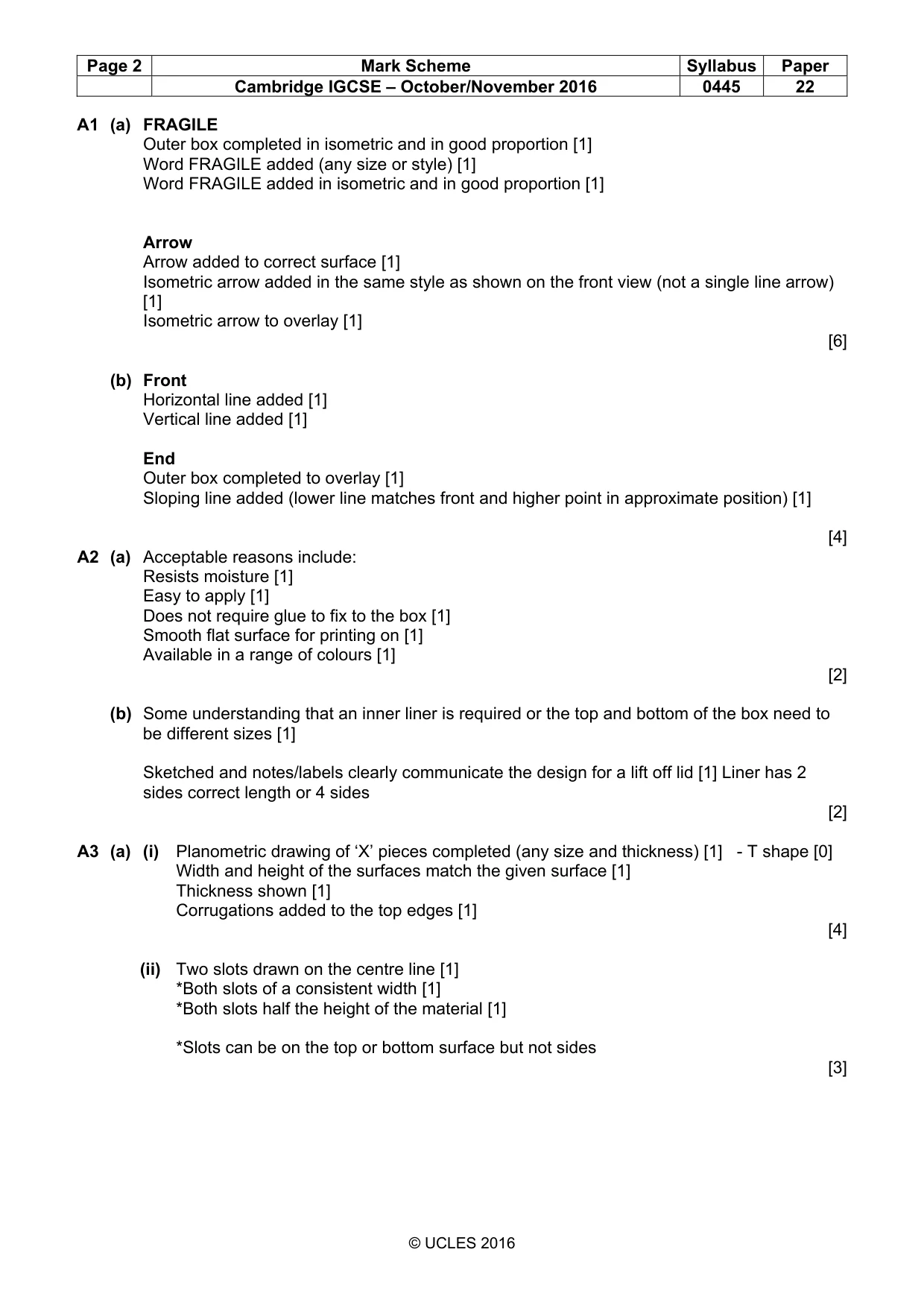
® IGCSE is the registered trademark of Cambridge International Examinations. This document consists of 5 printed pages. © UCLES 2016 [Turn over Cambridge International Examinations Cambridge International General Certificate of Secondary Education DESIGN AND TECHNOLOGY 0445/22 Paper 2 Graphic Products October/November 2016 MARK SCHEME Maximum Mark: 50 Published This mark scheme is published as an aid to teachers and candidates, to indicate the requirements of the examination. It shows the basis on which Examiners were instructed to award marks. It does not indicate the details of the discussions that took place at an Examiners’ meeting before marking began, which would have considered the acceptability of alternative answers. Mark schemes should be read in conjunction with the question paper and the Principal Examiner Report for Teachers. Cambridge will not enter into discussions about these mark schemes. Cambridge is publishing the mark schemes for the October/November 2016 series for most Cambridge IGCSE®, Cambridge International A and AS Level components and some Cambridge O Level components.
Mark scheme, page 2
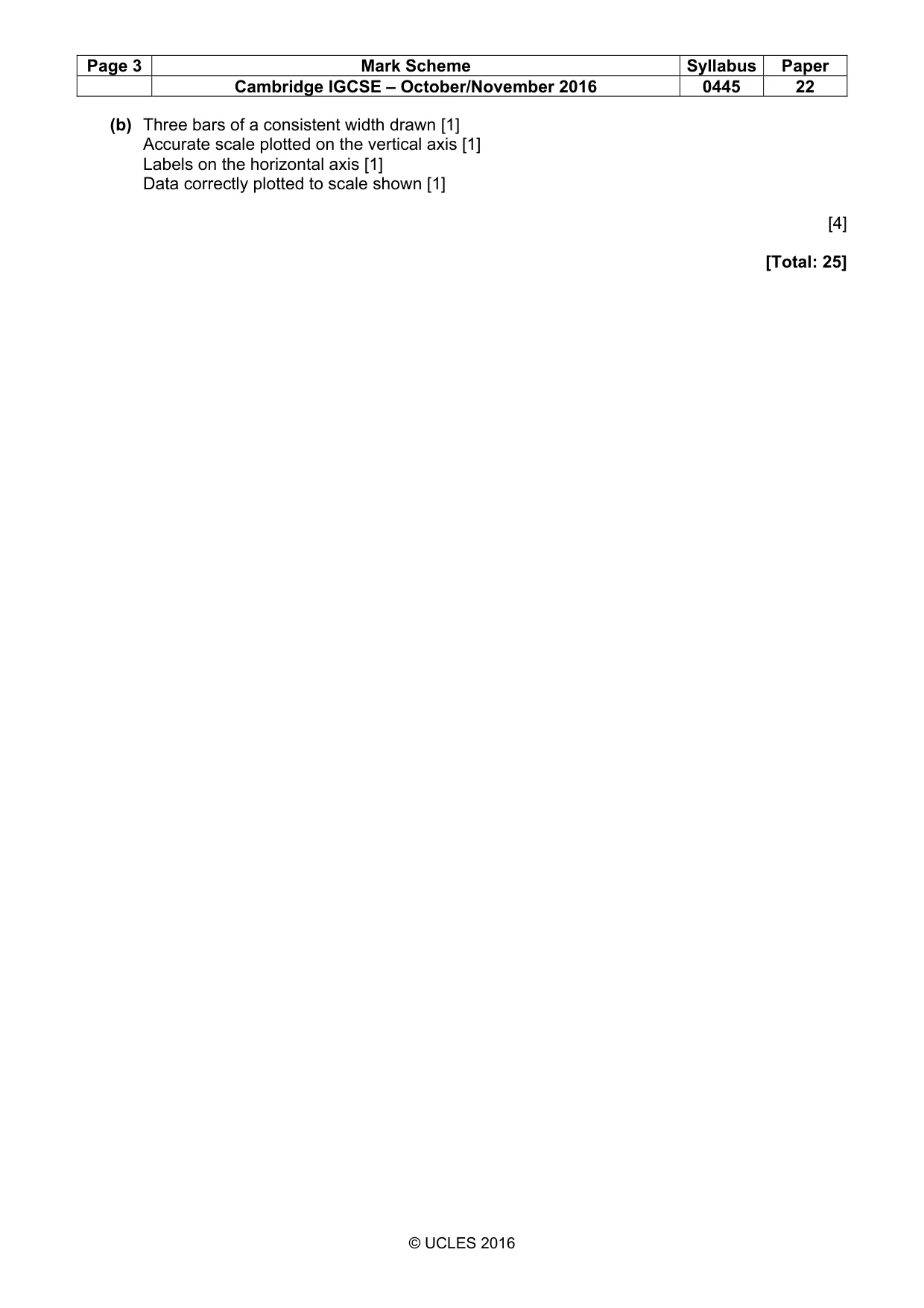
Page 2 Mark Scheme Syllabus Paper Cambridge IGCSE – October/November 2016 0445 22 © UCLES 2016 A1 (a) FRAGILE Outer box completed in isometric and in good proportion [1] Word FRAGILE added (any size or style) [1] Word FRAGILE added in isometric and in good proportion [1] Arrow Arrow added to correct surface [1] Isometric arrow added in the same style as shown on the front view (not a single line arrow) [1] Isometric arrow to overlay [1] [6] (b) Front Horizontal line added [1] Vertical line added [1] End Outer box completed to overlay [1] Sloping line added (lower line matches front and higher point in approximate position) [1] [4] A2 (a) Acceptable reasons include: Resists moisture [1] Easy to apply [1] Does not require glue to fix to the box [1] Smooth flat surface for printing on [1] Available in a range of colours [1] [2] (b) Some understanding that an inner liner is required or the top and bottom of the box need to be different sizes [1] Sketched and notes/labels clearly communicate the design for a lift off lid [1] Liner has 2 sides correct length or 4 sides [2] A3 (a) (i) Planometric drawing of ‘X’ pieces completed (any size and thickness) [1] - T shape [0] Width and height of the surfaces match the given surface [1] Thickness shown [1] Corrugations added to the top edges [1] [4] (ii) Two slots drawn on the centre line [1] *Both slots of a consistent width [1] *Both slots half the height of the material [1] *Slots can be on the top or bottom surface but not sides [3]
Mark scheme, page 3
Page 3 Mark Scheme Syllabus Paper Cambridge IGCSE – October/November 2016 0445 22 © UCLES 2016 (b) Three bars of a consistent width drawn [1] Accurate scale plotted on the vertical axis [1] Labels on the horizontal axis [1] Data correctly plotted to scale shown [1] [4] [Total: 25]
Mark scheme, page 4
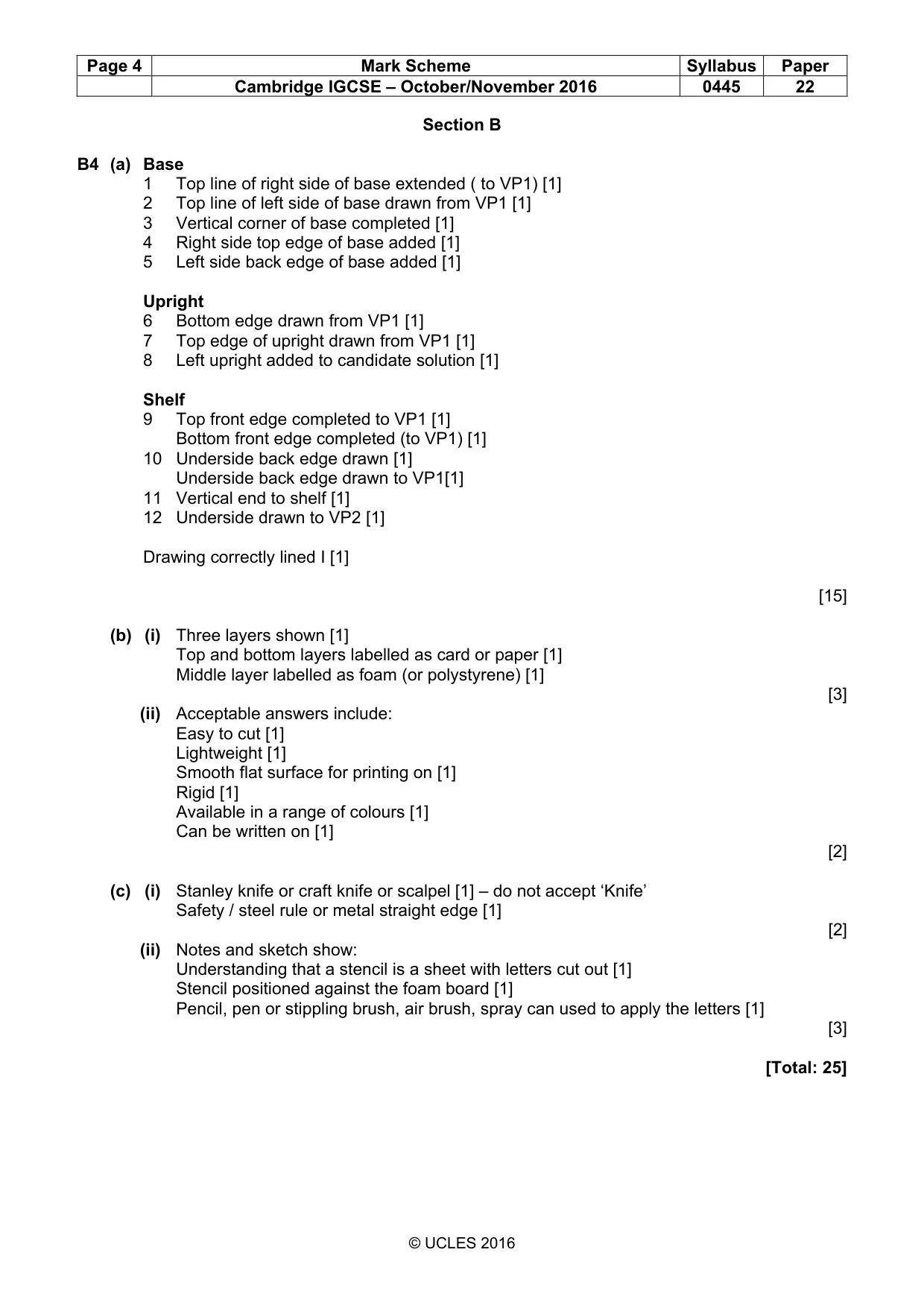
Page 4 Mark Scheme Syllabus Paper Cambridge IGCSE – October/November 2016 0445 22 © UCLES 2016 Section B B4 (a) Base 1 Top line of right side of base extended ( to VP1) [1] 2 Top line of left side of base drawn from VP1 [1] 3 Vertical corner of base completed [1] 4 Right side top edge of base added [1] 5 Left side back edge of base added [1] Upright 6 Bottom edge drawn from VP1 [1] 7 Top edge of upright drawn from VP1 [1] 8 Left upright added to candidate solution [1] Shelf 9 Top front edge completed to VP1 [1] Bottom front edge completed (to VP1) [1] 10 Underside back edge drawn [1] Underside back edge drawn to VP1[1] 11 Vertical end to shelf [1] 12 Underside drawn to VP2 [1] Drawing correctly lined I [1] [15] (b) (i) Three layers shown [1] Top and bottom layers labelled as card or paper [1] Middle layer labelled as foam (or polystyrene) [1] [3] (ii) Acceptable answers include: Easy to cut [1] Lightweight [1] Smooth flat surface for printing on [1] Rigid [1] Available in a range of colours [1] Can be written on [1] [2] (c) (i) Stanley knife or craft knife or scalpel [1] – do not accept ‘Knife’ Safety / steel rule or metal straight edge [1] [2] (ii) Notes and sketch show: Understanding that a stencil is a sheet with letters cut out [1] Stencil positioned against the foam board [1] Pencil, pen or stippling brush, air brush, spray can used to apply the letters [1] [3] [Total: 25]
Mark scheme, page 5
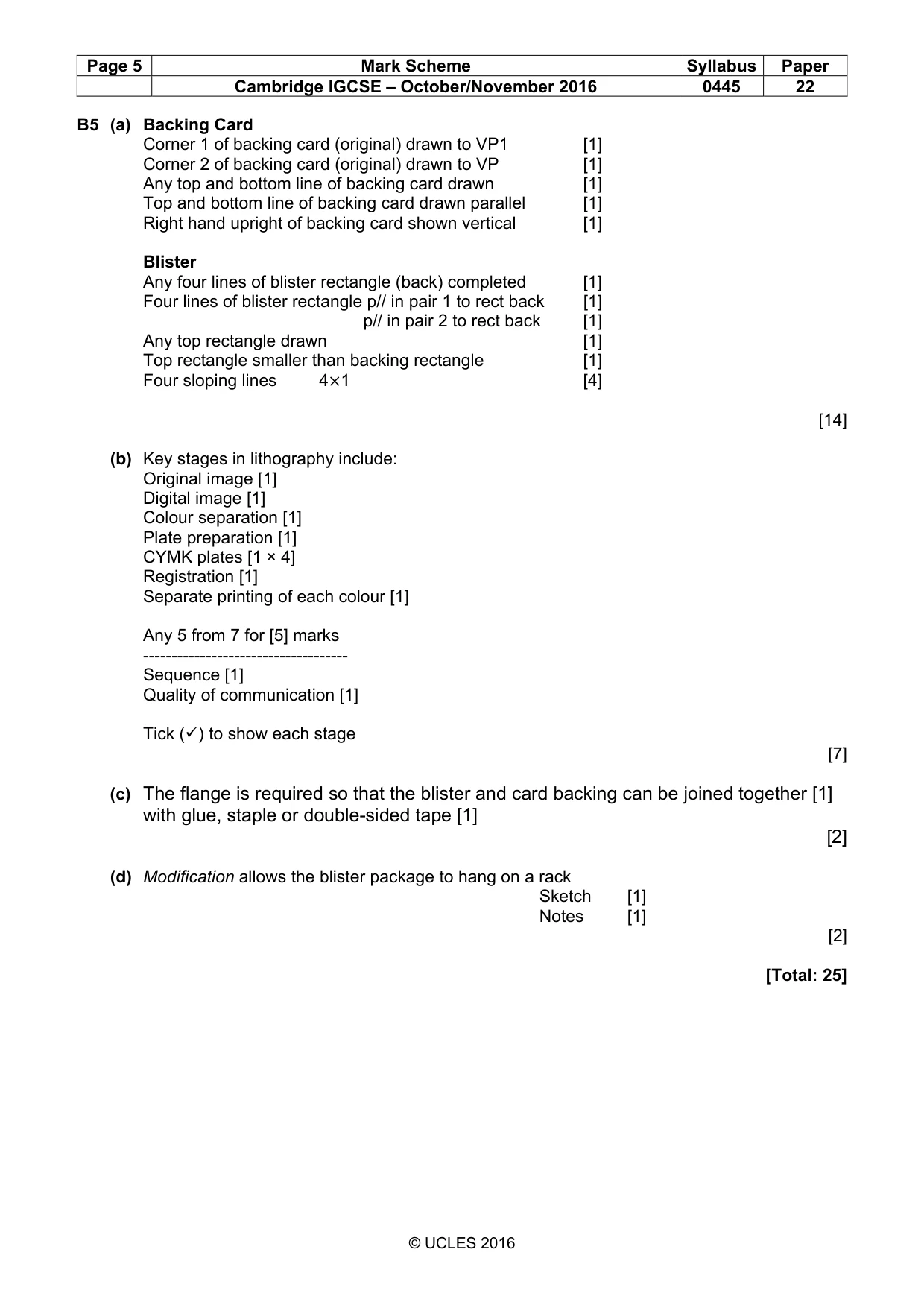
Page 5 Mark Scheme Syllabus Paper Cambridge IGCSE – October/November 2016 0445 22 © UCLES 2016 B5 (a) Backing Card Corner 1 of backing card (original) drawn to VP1 [1] Corner 2 of backing card (original) drawn to VP [1] Any top and bottom line of backing card drawn [1] Top and bottom line of backing card drawn parallel [1] Right hand upright of backing card shown vertical [1] Blister Any four lines of blister rectangle (back) completed [1] Four lines of blister rectangle p// in pair 1 to rect back [1] p// in pair 2 to rect back [1] Any top rectangle drawn [1] Top rectangle smaller than backing rectangle [1] Four sloping lines 4×1 [4] [14] (b) Key stages in lithography include: Original image [1] Digital image [1] Colour separation [1] Plate preparation [1] CYMK plates [1 × 4] Registration [1] Separate printing of each colour [1] Any 5 from 7 for [5] marks ------------------------------------ Sequence [1] Quality of communication [1] Tick (9) to show each stage [7] (c) The flange is required so that the blister and card backing can be joined together [1] with glue, staple or double-sided tape [1] [2] (d) Modification allows the blister package to hang on a rack Sketch [1] Notes [1] [2] [Total: 25]
What you needed in this session
Cambridge’s own grade thresholds for 2016 Oct/Nov, Paper 2 · Variant 2. A higher threshold means an easier paper — the bar moves with how the cohort did.