Cambridge IGCSE Design and Technology 0445 — 2015 Oct/Nov Paper 2 · Variant 2
0445/22/O/N/15 · 50 marks · ≈56 min
The question paper and its mark scheme, free to read here and free to download. This is Cambridge’s own paper, exactly as it was sat.
Question paper4 pages



Mark scheme4 pages
Answers below. Sit the paper first if you are practising.
Paper as text
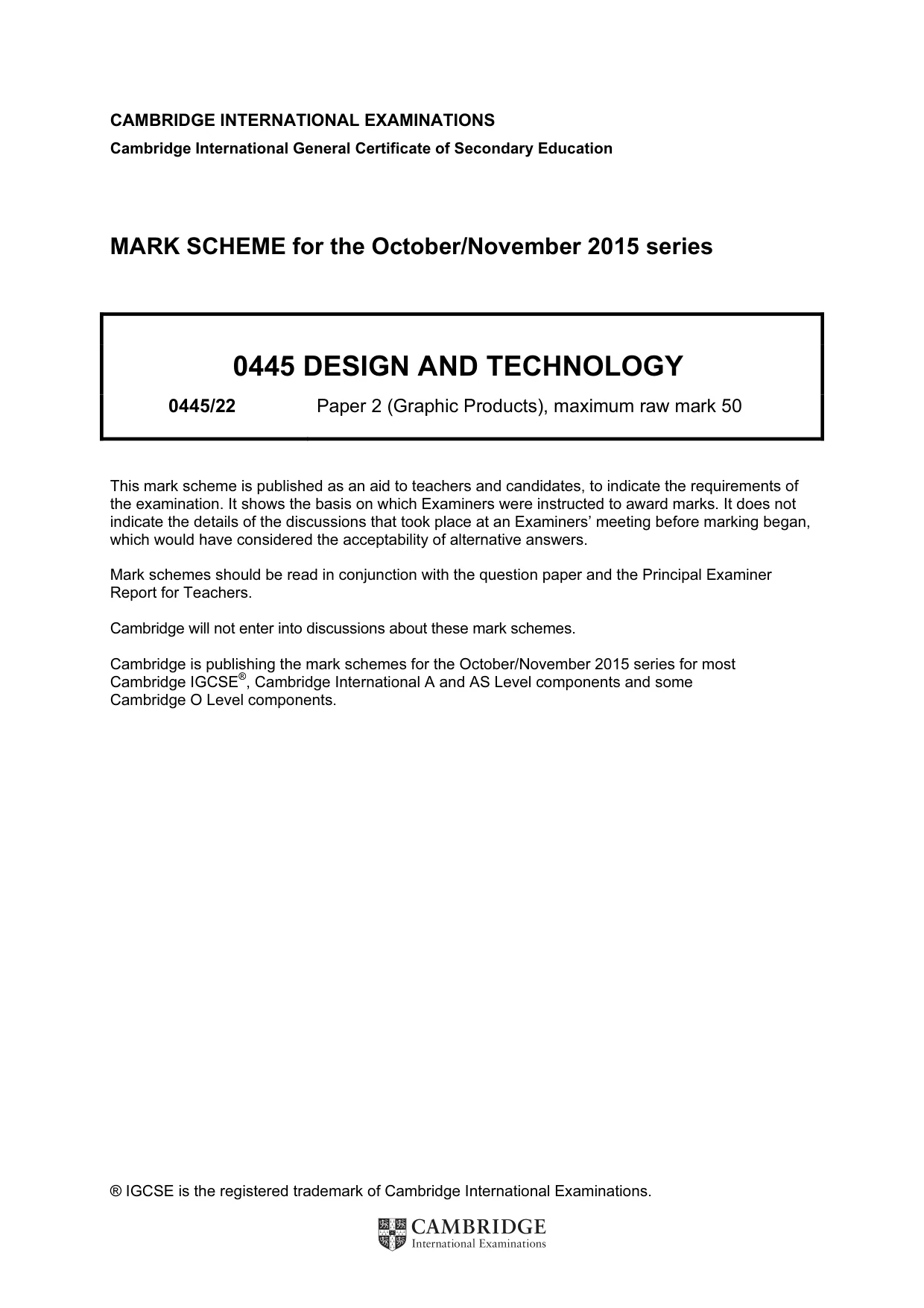
Question paper, page 1
READ THESE INSTRUCTIONS FIRST Write your Centre number, candidate number and name in the spaces at the top of this page and on the two Answer Sheets. Do not use staples, paper clips, glue or correction fl uid. DO NOT WRITE IN ANY BARCODES. Section A Answer all questions in this section (A1, A2 and A3). Section B Answer one question in this section (B4 or B5). You may use a calculator. Draw your answers in the spaces provided on the answer sheets. All construction and projection lines must be clearly shown. All dimensions are in millimetres. At the end of the examination, insert both sheets into this booklet. Do not punch holes in the cover and sheets or tie with string. The total of the marks for this paper is 50. The number of marks is given in brackets [ ] at the end of each question or part question. DESIGN AND TECHNOLOGY 0445/22 Paper 2 Graphic Products October/November 2015 1 hour Candidates answer on the two inserted A3 Answer Sheets. Additional Materials: Standard drawing equipment Cambridge International Examinations Cambridge International General Certifi cate of Secondary Education This document consists of an A3 cover booklet and 2 inserted A3 sheets. [Turn over DC (ST/FD) 101710/3 © UCLES 2015 CANDIDATE NAME CENTRE NUMBER CANDIDATE NUMBER * 1 2 1 2 5 1 8 3 9 8 *
Question paper, page 4
Permission to reproduce items where third-party owned material protected by copyright is included has been sought and cleared where possible. Every reasonable effort has been made by the publisher (UCLES) to trace copyright holders, but if any items requiring clearance have unwittingly been included, the publisher will be pleased to make amends at the earliest possible opportunity. To avoid the issue of disclosure of answer-related information to candidates, all copyright acknowledgements are reproduced online in the Cambridge International Examinations Copyright Acknowledgements Booklet. This is produced for each series of examinations and is freely available to download at www.cie.org.uk after the live examination series. Cambridge International Examinations is part of the Cambridge Assessment Group. Cambridge Assessment is the brand name of University of Cambridge Local Examinations Syndicate (UCLES), which is itself a department of the University of Cambridge.
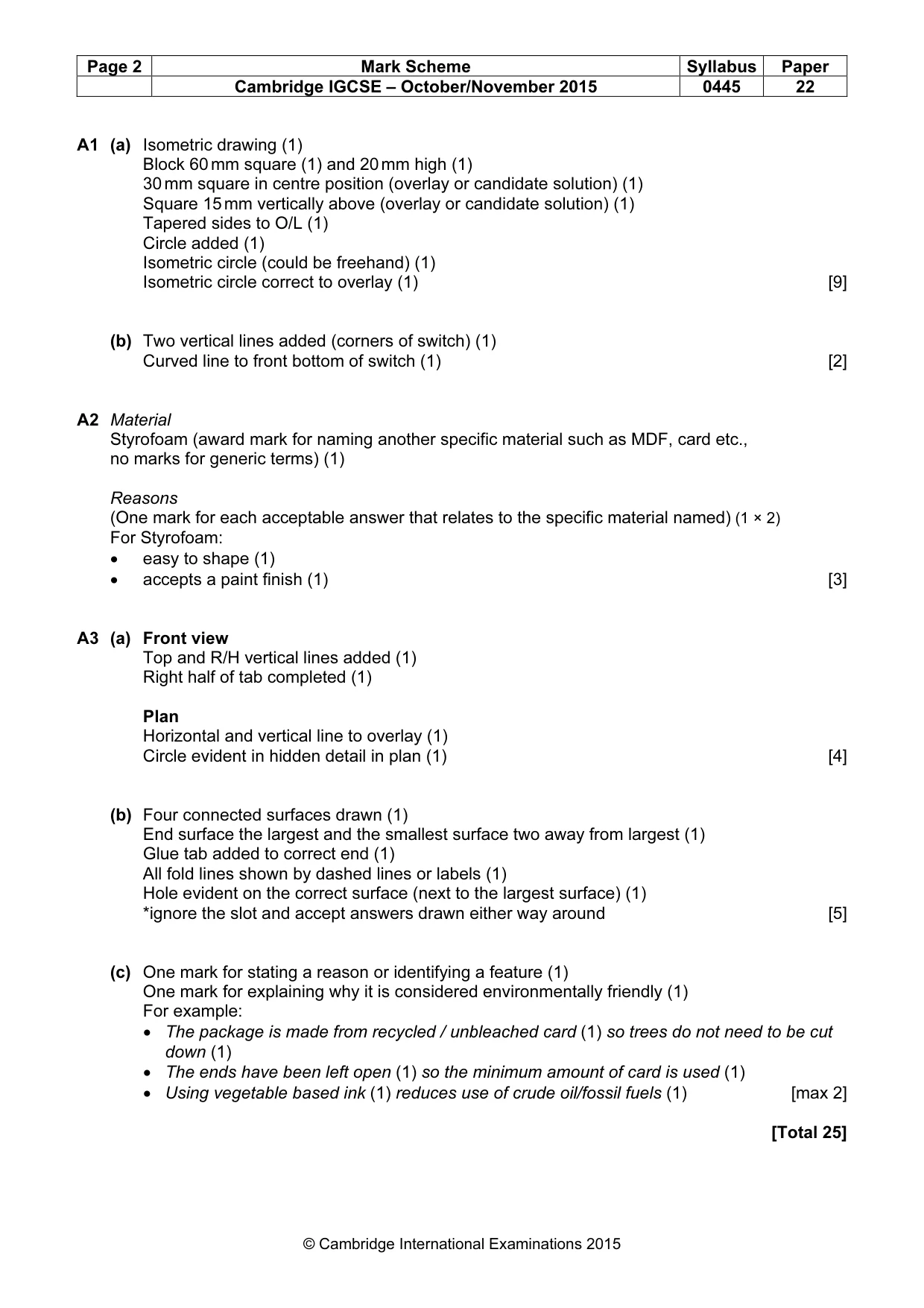
Mark scheme, page 1
® IGCSE is the registered trademark of Cambridge International Examinations. CAMBRIDGE INTERNATIONAL EXAMINATIONS Cambridge International General Certificate of Secondary Education MARK SCHEME for the October/November 2015 series 0445 DESIGN AND TECHNOLOGY 0445/22 Paper 2 (Graphic Products), maximum raw mark 50 This mark scheme is published as an aid to teachers and candidates, to indicate the requirements of the examination. It shows the basis on which Examiners were instructed to award marks. It does not indicate the details of the discussions that took place at an Examiners’ meeting before marking began, which would have considered the acceptability of alternative answers. Mark schemes should be read in conjunction with the question paper and the Principal Examiner Report for Teachers. Cambridge will not enter into discussions about these mark schemes. Cambridge is publishing the mark schemes for the October/November 2015 series for most Cambridge IGCSE®, Cambridge International A and AS Level components and some Cambridge O Level components.
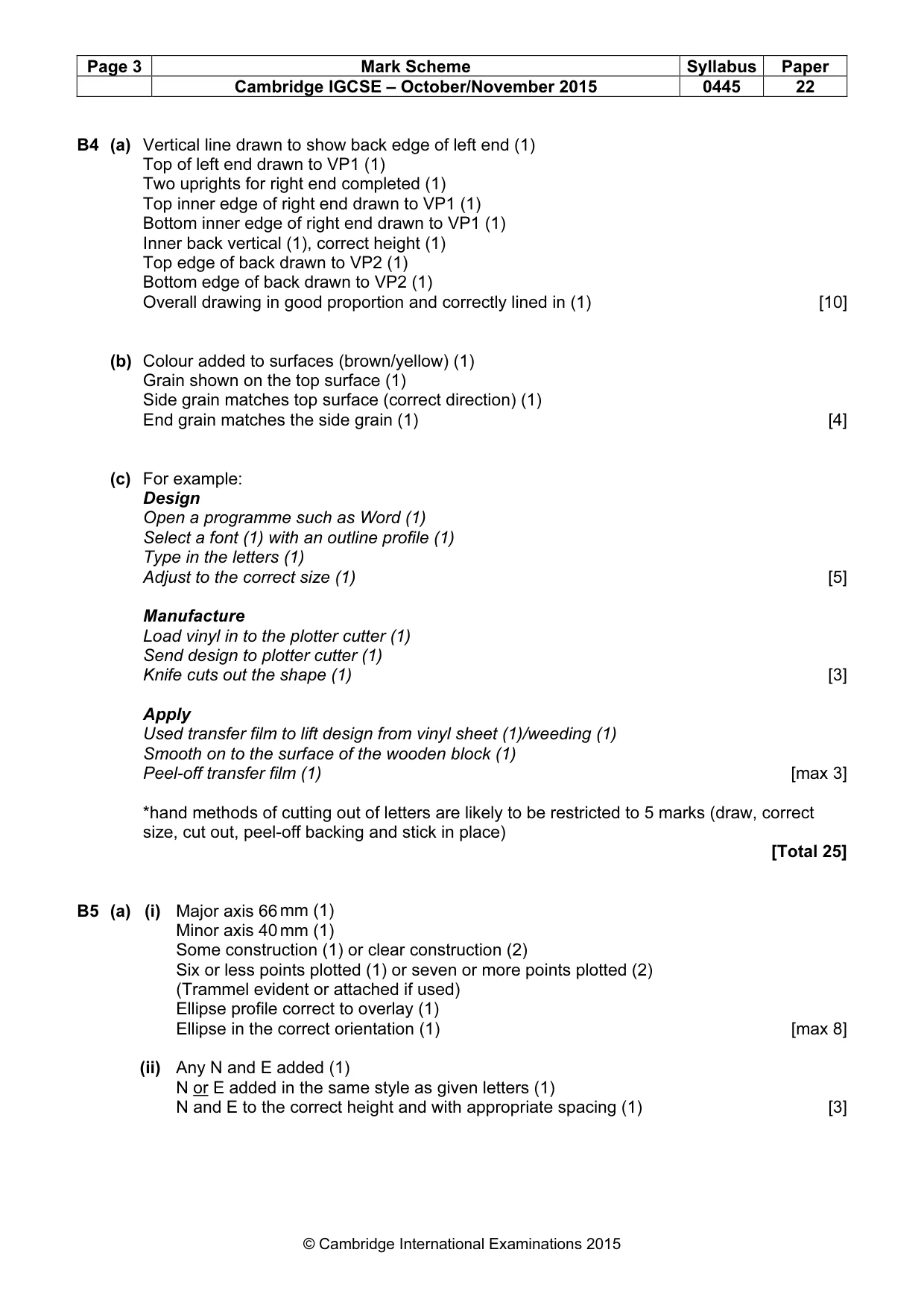
Mark scheme, page 2
Page 2 Mark Scheme Syllabus Paper Cambridge IGCSE – October/November 2015 0445 22 © Cambridge International Examinations 2015 A1 (a) Isometric drawing (1) Block 60 mm square (1) and 20 mm high (1) 30 mm square in centre position (overlay or candidate solution) (1) Square 15 mm vertically above (overlay or candidate solution) (1) Tapered sides to O/L (1) Circle added (1) Isometric circle (could be freehand) (1) Isometric circle correct to overlay (1) [9] (b) Two vertical lines added (corners of switch) (1) Curved line to front bottom of switch (1) [2] A2 Material Styrofoam (award mark for naming another specific material such as MDF, card etc., no marks for generic terms) (1) Reasons (One mark for each acceptable answer that relates to the specific material named) (1 × 2) For Styrofoam: • easy to shape (1) • accepts a paint finish (1) [3] A3 (a) Front view Top and R/H vertical lines added (1) Right half of tab completed (1) Plan Horizontal and vertical line to overlay (1) Circle evident in hidden detail in plan (1) [4] (b) Four connected surfaces drawn (1) End surface the largest and the smallest surface two away from largest (1) Glue tab added to correct end (1) All fold lines shown by dashed lines or labels (1) Hole evident on the correct surface (next to the largest surface) (1) *ignore the slot and accept answers drawn either way around [5] (c) One mark for stating a reason or identifying a feature (1) One mark for explaining why it is considered environmentally friendly (1) For example: • The package is made from recycled / unbleached card (1) so trees do not need to be cut down (1) • The ends have been left open (1) so the minimum amount of card is used (1) • Using vegetable based ink (1) reduces use of crude oil/fossil fuels (1) [max 2] [Total 25]
Mark scheme, page 3
Page 3 Mark Scheme Syllabus Paper Cambridge IGCSE – October/November 2015 0445 22 © Cambridge International Examinations 2015 B4 (a) Vertical line drawn to show back edge of left end (1) Top of left end drawn to VP1 (1) Two uprights for right end completed (1) Top inner edge of right end drawn to VP1 (1) Bottom inner edge of right end drawn to VP1 (1) Inner back vertical (1), correct height (1) Top edge of back drawn to VP2 (1) Bottom edge of back drawn to VP2 (1) Overall drawing in good proportion and correctly lined in (1) [10] (b) Colour added to surfaces (brown/yellow) (1) Grain shown on the top surface (1) Side grain matches top surface (correct direction) (1) End grain matches the side grain (1) [4] (c) For example: Design Open a programme such as Word (1) Select a font (1) with an outline profile (1) Type in the letters (1) Adjust to the correct size (1) [5] Manufacture Load vinyl in to the plotter cutter (1) Send design to plotter cutter (1) Knife cuts out the shape (1) [3] Apply Used transfer film to lift design from vinyl sheet (1)/weeding (1) Smooth on to the surface of the wooden block (1) Peel-off transfer film (1) [max 3] *hand methods of cutting out of letters are likely to be restricted to 5 marks (draw, correct size, cut out, peel-off backing and stick in place) [Total 25] B5 (a) (i) Major axis 66 mm (1) Minor axis 40 mm (1) Some construction (1) or clear construction (2) Six or less points plotted (1) or seven or more points plotted (2) (Trammel evident or attached if used) Ellipse profile correct to overlay (1) Ellipse in the correct orientation (1) [max 8] (ii) Any N and E added (1) N or E added in the same style as given letters (1) N and E to the correct height and with appropriate spacing (1) [3]
Mark scheme, page 4
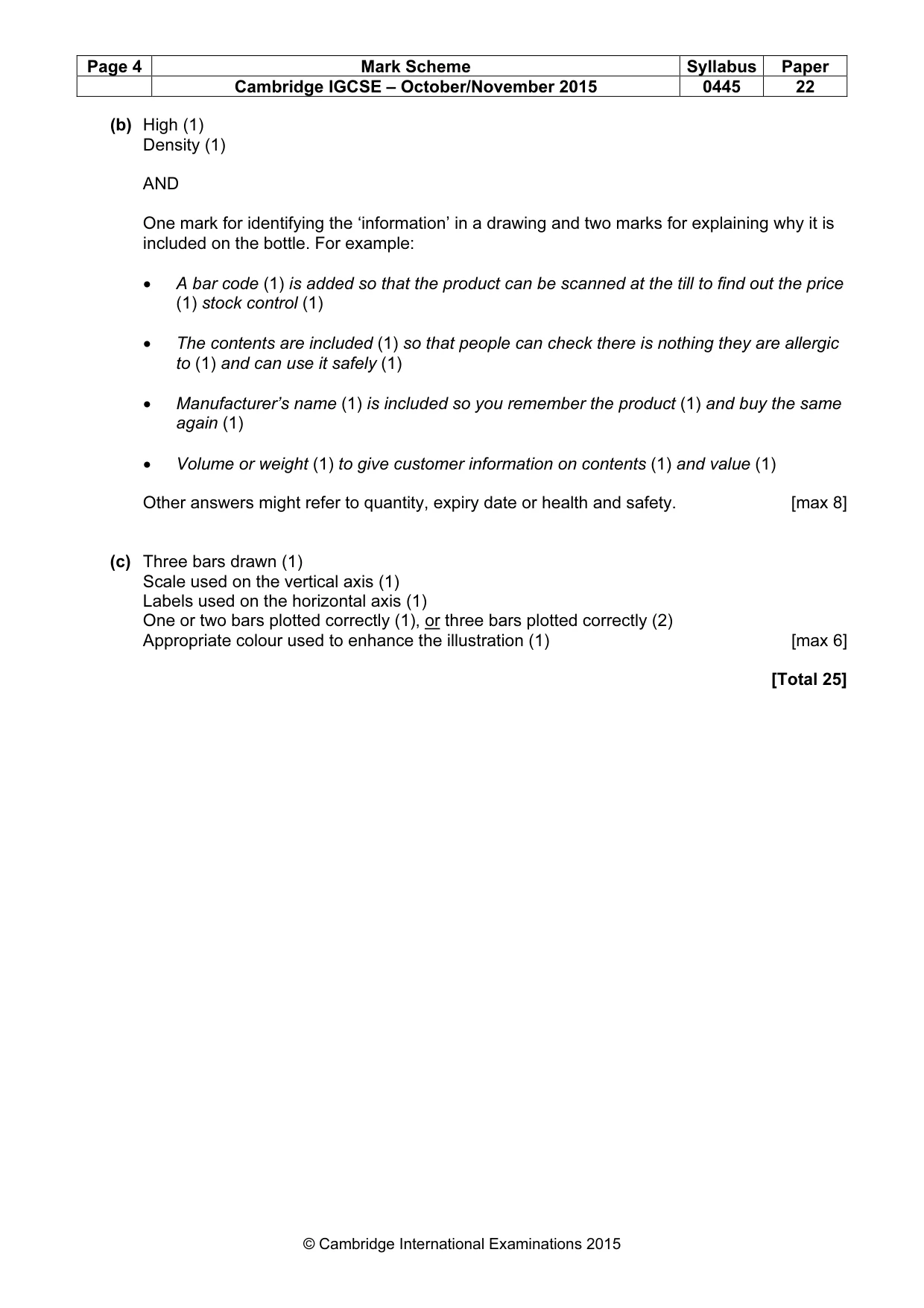
Page 4 Mark Scheme Syllabus Paper Cambridge IGCSE – October/November 2015 0445 22 © Cambridge International Examinations 2015 (b) High (1) Density (1) AND One mark for identifying the ‘information’ in a drawing and two marks for explaining why it is included on the bottle. For example: • A bar code (1) is added so that the product can be scanned at the till to find out the price (1) stock control (1) • The contents are included (1) so that people can check there is nothing they are allergic to (1) and can use it safely (1) • Manufacturer’s name (1) is included so you remember the product (1) and buy the same again (1) • Volume or weight (1) to give customer information on contents (1) and value (1) Other answers might refer to quantity, expiry date or health and safety. [max 8] (c) Three bars drawn (1) Scale used on the vertical axis (1) Labels used on the horizontal axis (1) One or two bars plotted correctly (1), or three bars plotted correctly (2) Appropriate colour used to enhance the illustration (1) [max 6] [Total 25]
What you needed in this session
Cambridge’s own grade thresholds for 2015 Oct/Nov, Paper 2 · Variant 2. A higher threshold means an easier paper — the bar moves with how the cohort did.