Cambridge IGCSE Design and Technology 0445 — 2013 May/June Paper 2 · Variant 3
0445/23/M/J/13 · 50 marks · ≈56 min
The question paper and its mark scheme, free to read here and free to download. This is Cambridge’s own paper, exactly as it was sat.
Question paper4 pages
Mark scheme3 pages
Answers below. Sit the paper first if you are practising.
Paper as text
Question paper, page 1
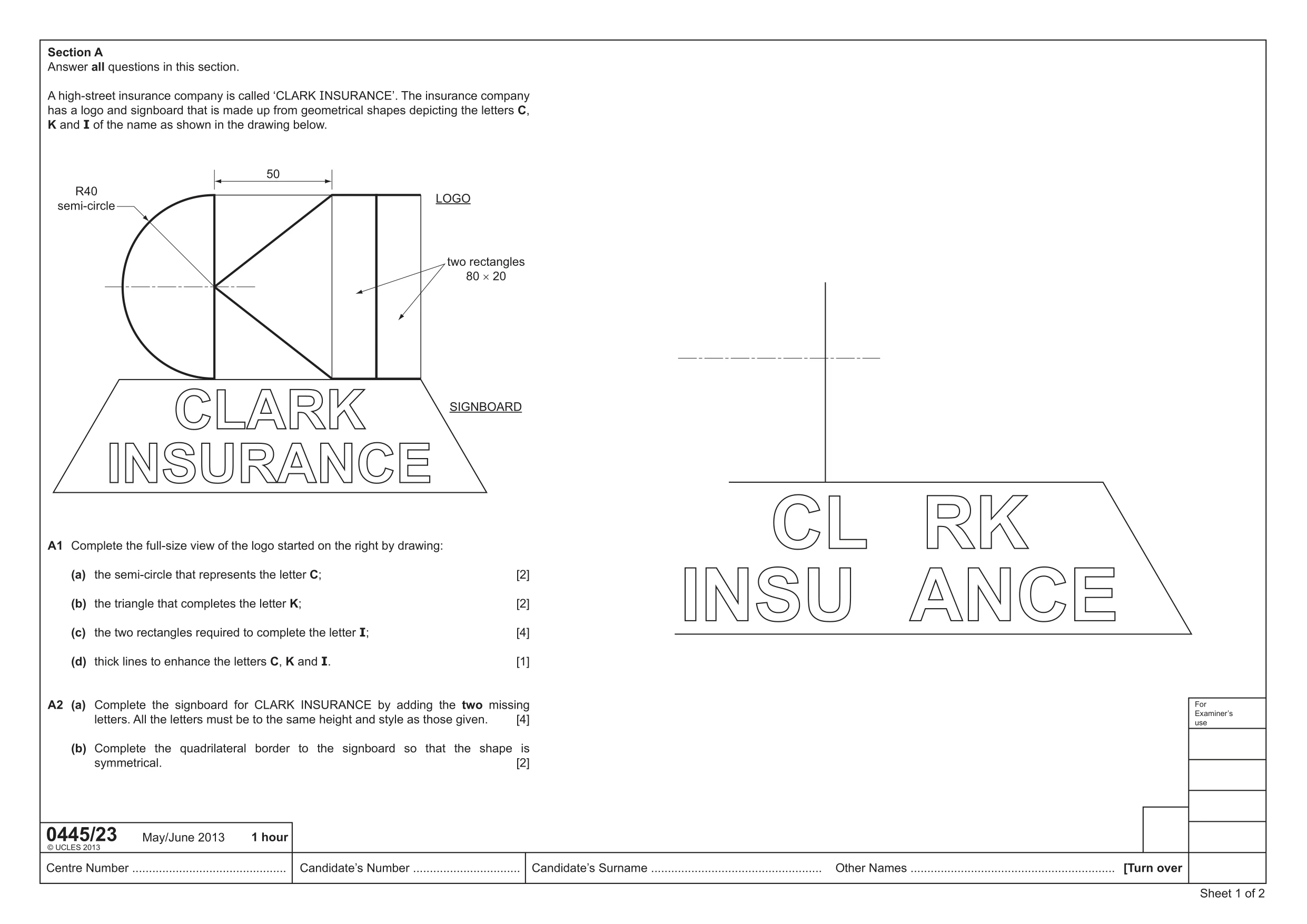
0445/23 May/June 2013 1 hour For Examiner’s use Centre Number … © UCLES 2013 Candidate’s Number … Candidate’s Surname … Other Names … [Turn over Sheet 1 of 2 Section A Answer all questions in this section. A high-street insurance company is called ‘CLARK INSURANCE’. The insurance company has a logo and signboard that is made up from geometrical shapes depicting the letters C, K and I of the name as shown in the drawing below. A1 Complete the full-size view of the logo started on the right by drawing: (a) the semi-circle that represents the letter C; [2] (b) the triangle that completes the letter K; [2] (c) the two rectangles required to complete the letter I; [4] (d) thick lines to enhance the letters C, K and I. [1] A2 (a) Complete the signboard for CLARK INSURANCE by adding the two missing letters. All the letters must be to the same height and style as those given. [4] (b) Complete the quadrilateral border to the signboard so that the shape is symmetrical. [2] R40 semi-circle 50 LOGO SIGNBOARD two rectangles 80 × 20
Question paper, page 2
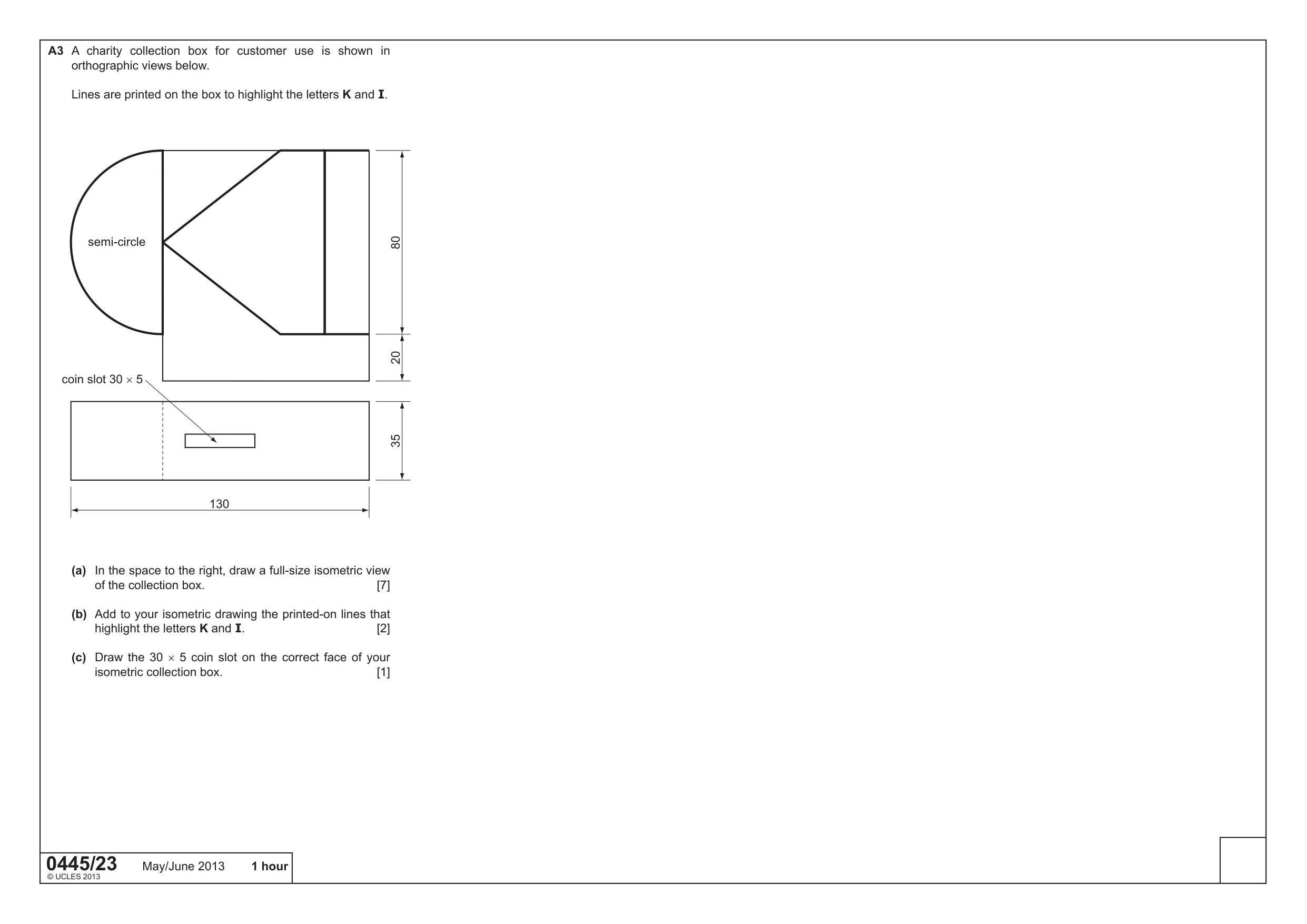
0445/23 May/June 2013 1 hour © UCLES 2013 A3 A charity collection box for customer use is shown in orthographic views below. Lines are printed on the box to highlight the letters K and I. (a) In the space to the right, draw a full-size isometric view of the collection box. [7] (b) Add to your isometric drawing the printed-on lines that highlight the letters K and I. [2] (c) Draw the 30 × 5 coin slot on the correct face of your isometric collection box. [1] 130 80 20 35 semi-circle coin slot 30 × 5
Question paper, page 3
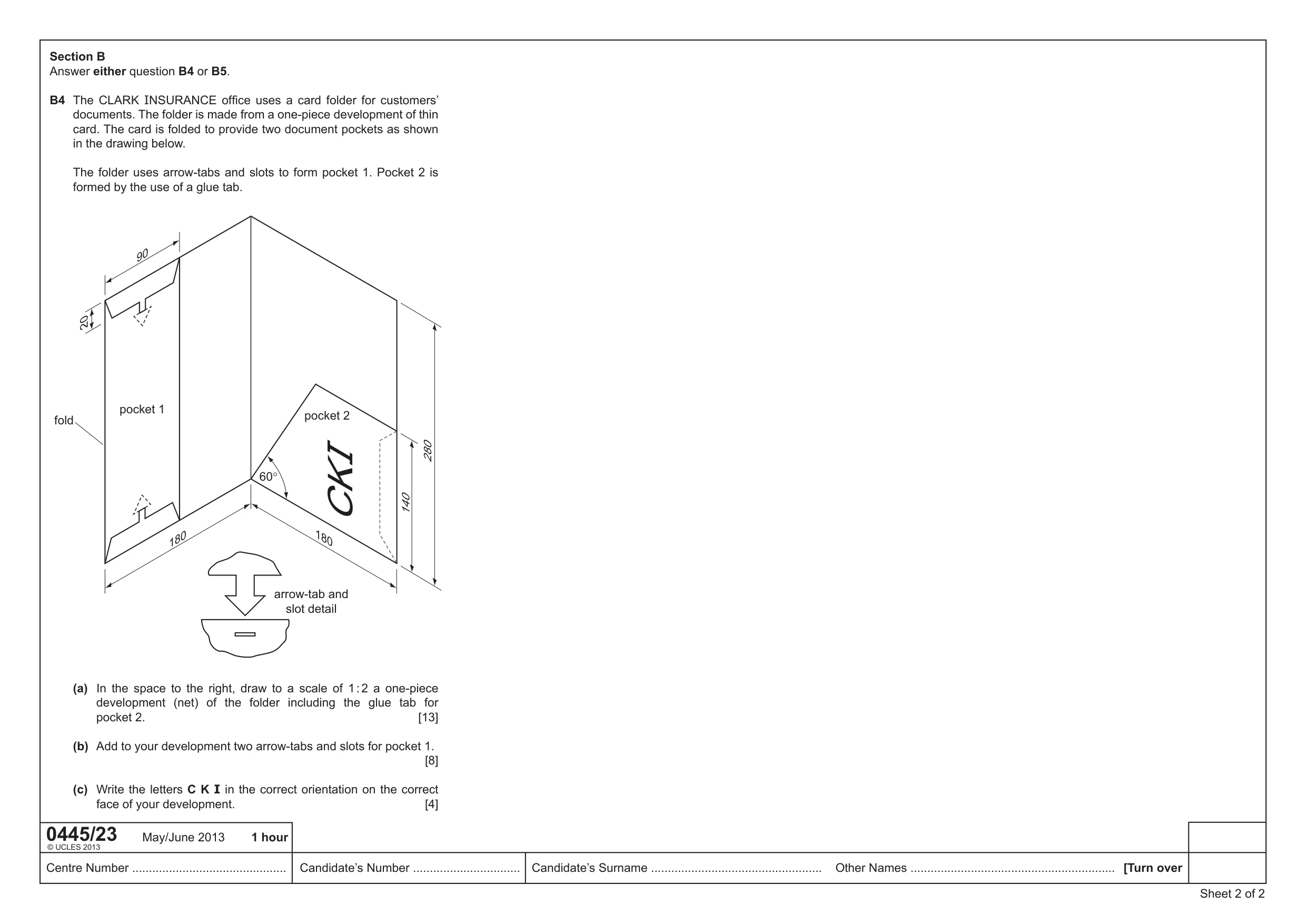
0445/23 May/June 2013 1 hour Centre Number … © UCLES 2013 Candidate’s Number … Candidate’s Surname … Other Names … [Turn over Sheet 2 of 2 Section B Answer either question B4 or B5. B4 The CLARK INSURANCE offi ce uses a card folder for customers’ documents. The folder is made from a one-piece development of thin card. The card is folded to provide two document pockets as shown in the drawing below. The folder uses arrow-tabs and slots to form pocket 1. Pocket 2 is formed by the use of a glue tab. (a) In the space to the right, draw to a scale of 1 : 2 a one-piece development (net) of the folder including the glue tab for pocket 2. [13] (b) Add to your development two arrow-tabs and slots for pocket 1. [8] (c) Write the letters C K I in the correct orientation on the correct face of your development. [4] fold pocket 1 pocket 2 90 180 140 280 CKI 20 180 arrow-tab and slot detail 60°
Question paper, page 4
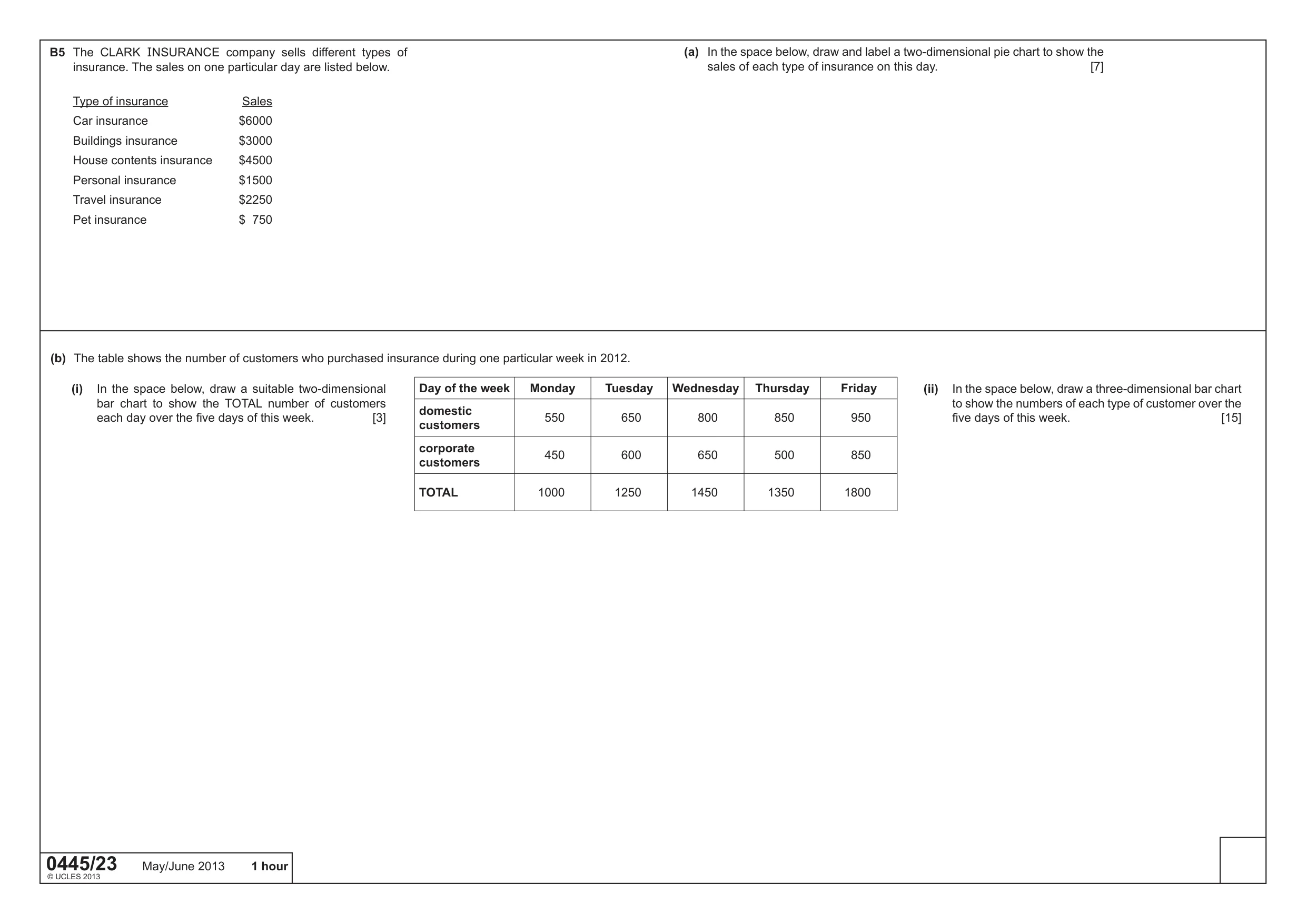
0445/23 May/June 2013 1 hour © UCLES 2013 B5 The CLARK INSURANCE company sells different types of insurance. The sales on one particular day are listed below. Type of insurance Sales Car insurance $6000 Buildings insurance $3000 House contents insurance $4500 Personal insurance $1500 Travel insurance $2250 Pet insurance $ 750 (a) In the space below, draw and label a two-dimensional pie chart to show the sales of each type of insurance on this day. [7] Day of the week Monday Tuesday Wednesday Thursday Friday domestic customers 550 650 800 850 950 corporate customers 450 600 650 500 850 TOTAL 1000 1250 1450 1350 1800 (b) The table shows the number of customers who purchased insurance during one particular week in 2012. (i) In the space below, draw a suitable two-dimensional bar chart to show the TOTAL number of customers each day over the fi ve days of this week. [3] (ii) In the space below, draw a three-dimensional bar chart to show the numbers of each type of customer over the fi ve days of this week. [15]
Mark scheme, page 1
CAMBRIDGE INTERNATIONAL EXAMINATIONS International General Certificate of Secondary Education MARK SCHEME for the May/June 2013 series 0445 DESIGN AND TECHNOLOGY 0455/23 Paper 2 (Graphic Products), maximum raw mark 50 This mark scheme is published as an aid to teachers and candidates, to indicate the requirements of the examination. It shows the basis on which Examiners were instructed to award marks. It does not indicate the details of the discussions that took place at an Examiners’ meeting before marking began, which would have considered the acceptability of alternative answers. Mark schemes should be read in conjunction with the question paper and the Principal Examiner Report for Teachers. Cambridge will not enter into discussions about these mark schemes. Cambridge is publishing the mark schemes for the May/June 2013 series for most IGCSE, GCE Advanced Level and Advanced Subsidiary Level components and some Ordinary Level components.
Mark scheme, page 2
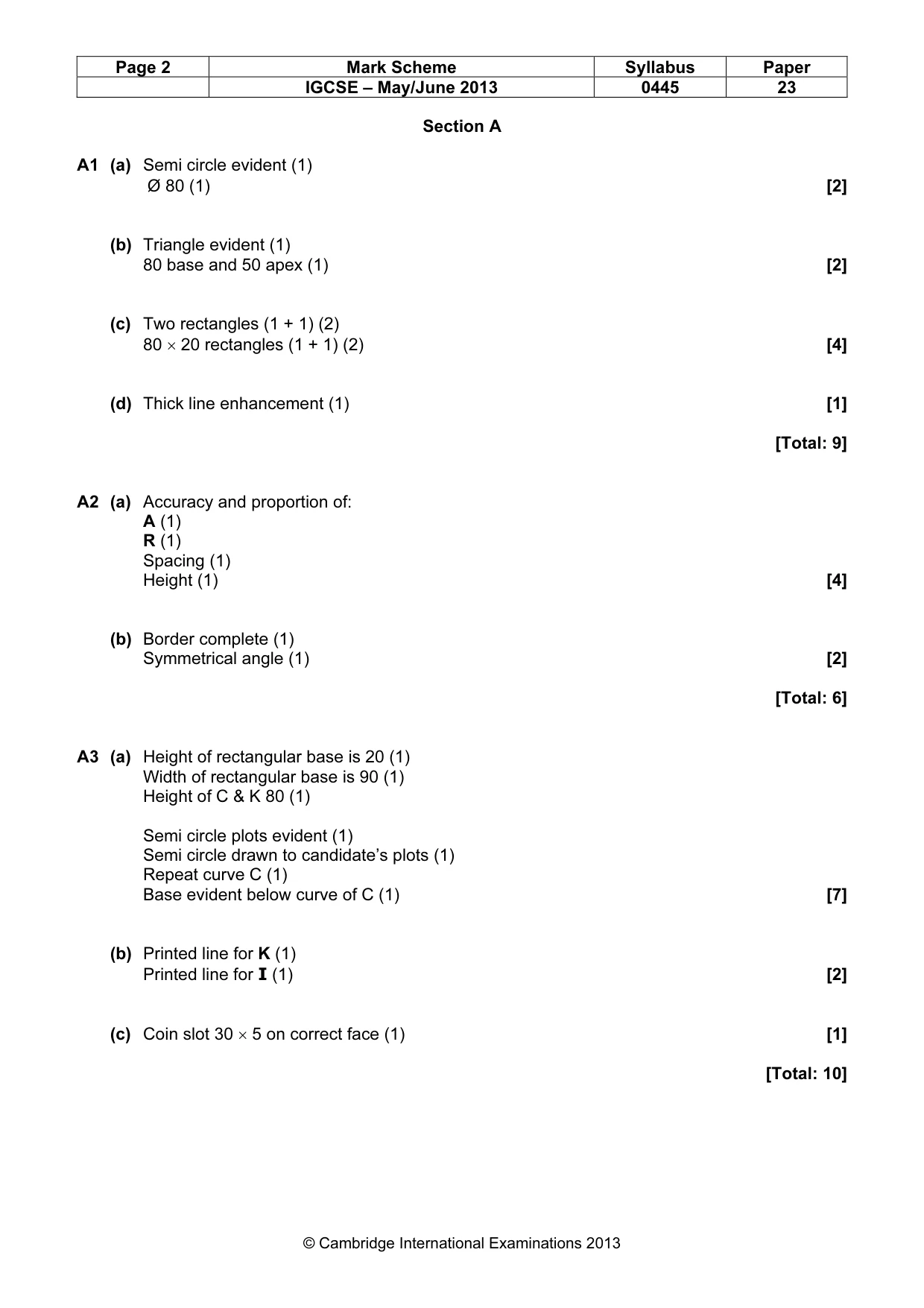
Page 2 Mark Scheme Syllabus Paper IGCSE – May/June 2013 0445 23 © Cambridge International Examinations 2013 Section A A1 (a) Semi circle evident (1) Ø 80 (1) [2] (b) Triangle evident (1) 80 base and 50 apex (1) [2] (c) Two rectangles (1 + 1) (2) 80 × 20 rectangles (1 + 1) (2) [4] (d) Thick line enhancement (1) [1] [Total: 9] A2 (a) Accuracy and proportion of: A (1) R (1) Spacing (1) Height (1) [4] (b) Border complete (1) Symmetrical angle (1) [2] [Total: 6] A3 (a) Height of rectangular base is 20 (1) Width of rectangular base is 90 (1) Height of C & K 80 (1) Semi circle plots evident (1) Semi circle drawn to candidate’s plots (1) Repeat curve C (1) Base evident below curve of C (1) [7] (b) Printed line for K (1) Printed line for I (1) [2] (c) Coin slot 30 × 5 on correct face (1) [1] [Total: 10]
Mark scheme, page 3
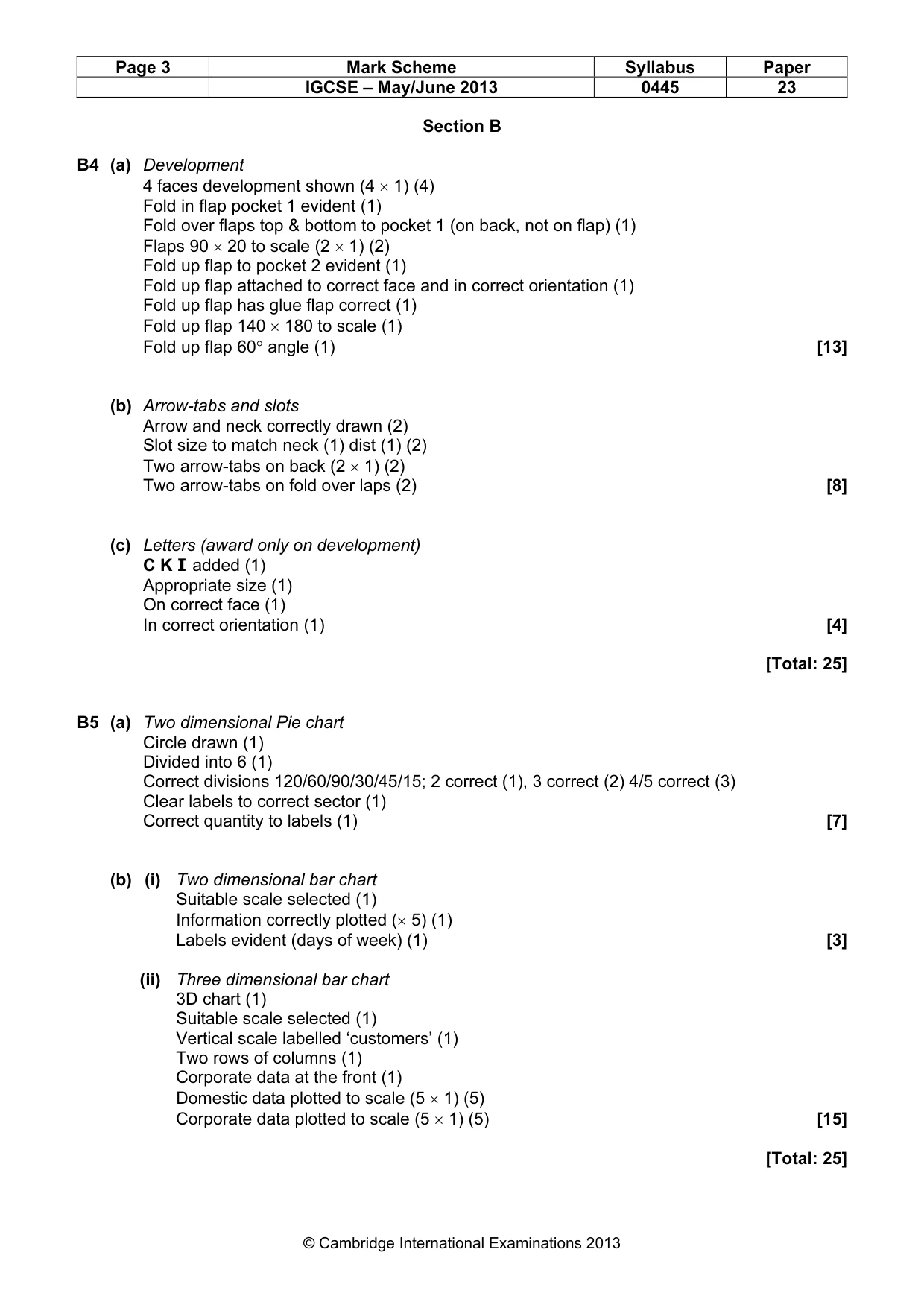
Page 3 Mark Scheme Syllabus Paper IGCSE – May/June 2013 0445 23 © Cambridge International Examinations 2013 Section B B4 (a) Development 4 faces development shown (4 × 1) (4) Fold in flap pocket 1 evident (1) Fold over flaps top & bottom to pocket 1 (on back, not on flap) (1) Flaps 90 × 20 to scale (2 × 1) (2) Fold up flap to pocket 2 evident (1) Fold up flap attached to correct face and in correct orientation (1) Fold up flap has glue flap correct (1) Fold up flap 140 × 180 to scale (1) Fold up flap 60° angle (1) [13] (b) Arrow-tabs and slots Arrow and neck correctly drawn (2) Slot size to match neck (1) dist (1) (2) Two arrow-tabs on back (2 × 1) (2) Two arrow-tabs on fold over laps (2) [8] (c) Letters (award only on development) C K I added (1) Appropriate size (1) On correct face (1) In correct orientation (1) [4] [Total: 25] B5 (a) Two dimensional Pie chart Circle drawn (1) Divided into 6 (1) Correct divisions 120/60/90/30/45/15; 2 correct (1), 3 correct (2) 4/5 correct (3) Clear labels to correct sector (1) Correct quantity to labels (1) [7] (b) (i) Two dimensional bar chart Suitable scale selected (1) Information correctly plotted (× 5) (1) Labels evident (days of week) (1) [3] (ii) Three dimensional bar chart 3D chart (1) Suitable scale selected (1) Vertical scale labelled ‘customers’ (1) Two rows of columns (1) Corporate data at the front (1) Domestic data plotted to scale (5 × 1) (5) Corporate data plotted to scale (5 × 1) (5) [15] [Total: 25]
What you needed in this session
Cambridge’s own grade thresholds for 2013 May/June, Paper 2 · Variant 3. A higher threshold means an easier paper — the bar moves with how the cohort did.