Cambridge IGCSE Design and Technology 0445 — 2006 May/June Paper 1 · Variant 1
0445/11/M/J/06 · 100 marks · ≈113 min
The question paper and its mark scheme, free to read here and free to download. This is Cambridge’s own paper, exactly as it was sat.
Question paper12 pages
Mark scheme6 pages
Answers below. Sit the paper first if you are practising.
Paper as text
Question paper, page 1
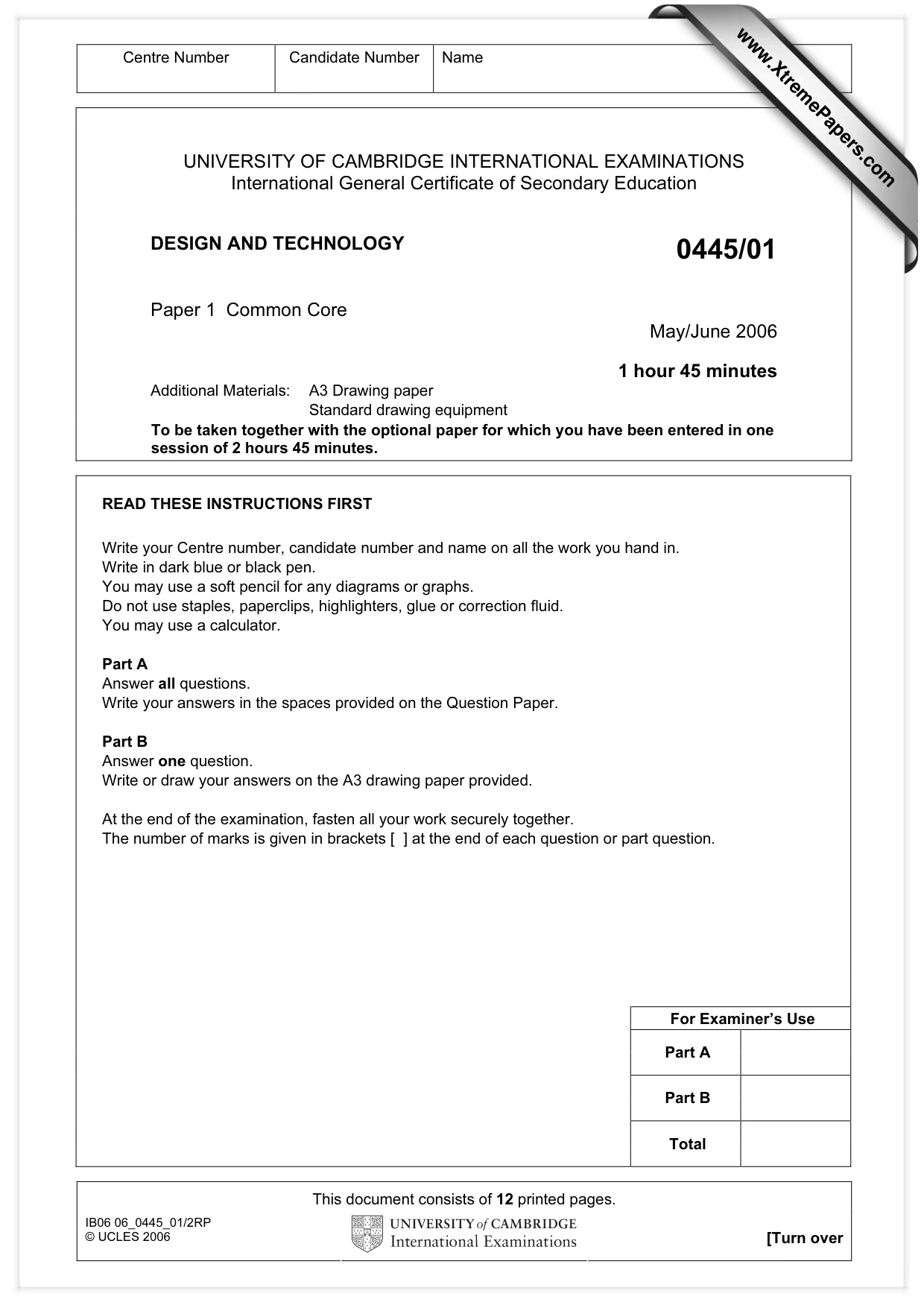
Centre Number Candidate Number Name UNIVERSITY OF CAMBRIDGE INTERNATIONAL EXAMINATIONS International General Certificate of Secondary Education DESIGN AND TECHNOLOGY 0445/01 Paper 1 Common Core May/June 2006 1 hour 45 minutes Additional Materials: A3 Drawing paper Standard drawing equipment To be taken together with the optional paper for which you have been entered in one session of 2 hours 45 minutes. READ THESE INSTRUCTIONS FIRST Write your Centre number, candidate number and name on all the work you hand in. Write in dark blue or black pen. You may use a soft pencil for any diagrams or graphs. Do not use staples, paperclips, highlighters, glue or correction fluid. You may use a calculator. Part A Answer all questions. Write your answers in the spaces provided on the Question Paper. Part B Answer one question. Write or draw your answers on the A3 drawing paper provided. At the end of the examination, fasten all your work securely together. The number of marks is given in brackets [ ] at the end of each question or part question. For Examiner’s Use Part A Part B Total This document consists of 12 printed pages. IB06 06_0445_01/2RP © UCLES 2006 [Turn over www.XtremePapers.com
Question paper, page 2
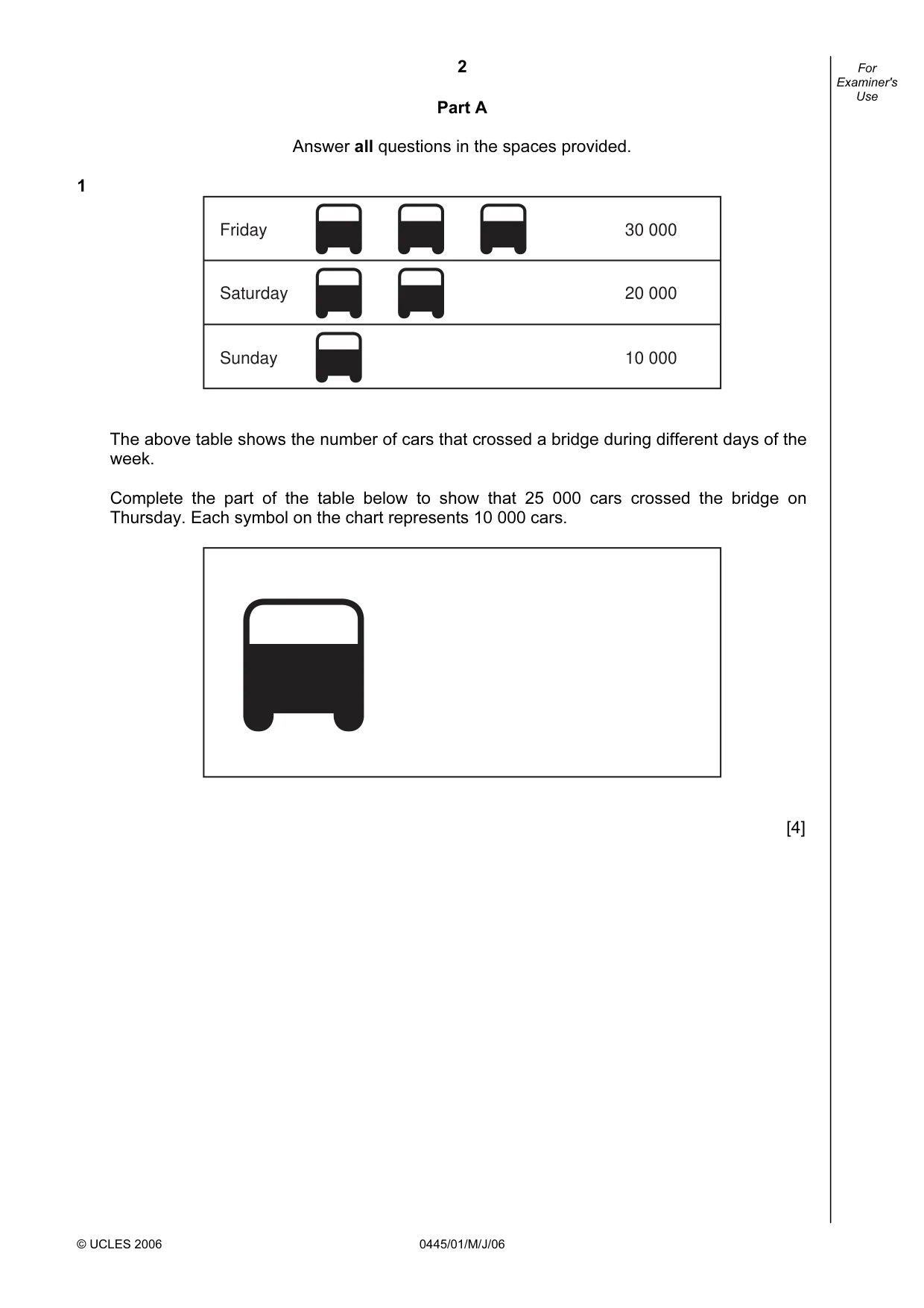
2 © UCLES 2006 0445/01/M/J/06 For Examiner's Use Part A Answer all questions in the spaces provided. 1 Friday Saturday Sunday 30 000 20 000 10 000 The above table shows the number of cars that crossed a bridge during different days of the week. Complete the part of the table below to show that 25 000 cars crossed the bridge on Thursday. Each symbol on the chart represents 10 000 cars. [4]
Question paper, page 3
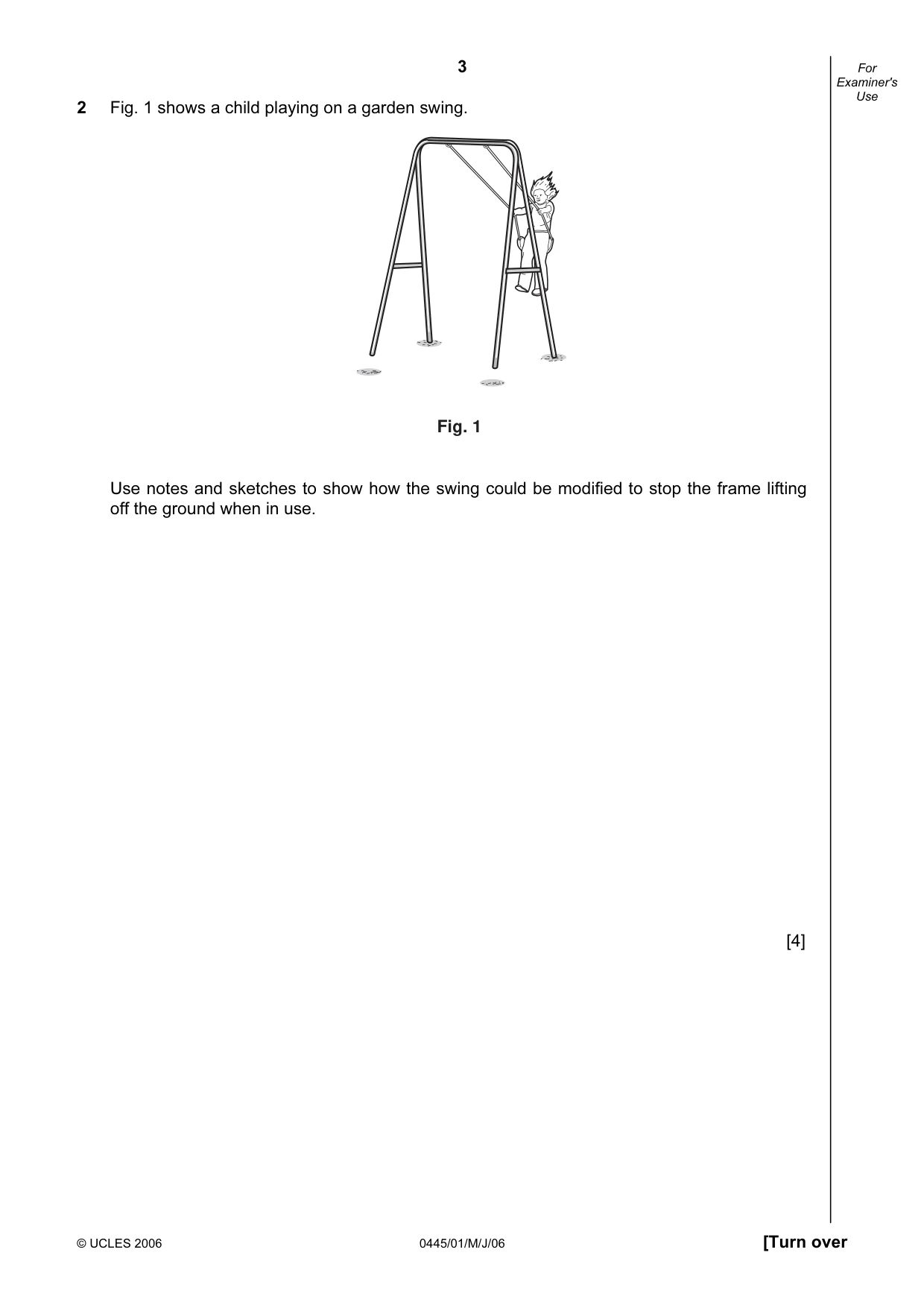
3 © UCLES 2006 0445/01/M/J/06 [Turn over For Examiner's Use 2 Fig. 1 shows a child playing on a garden swing. Fig. 1 Use notes and sketches to show how the swing could be modified to stop the frame lifting off the ground when in use. [4]
Question paper, page 4
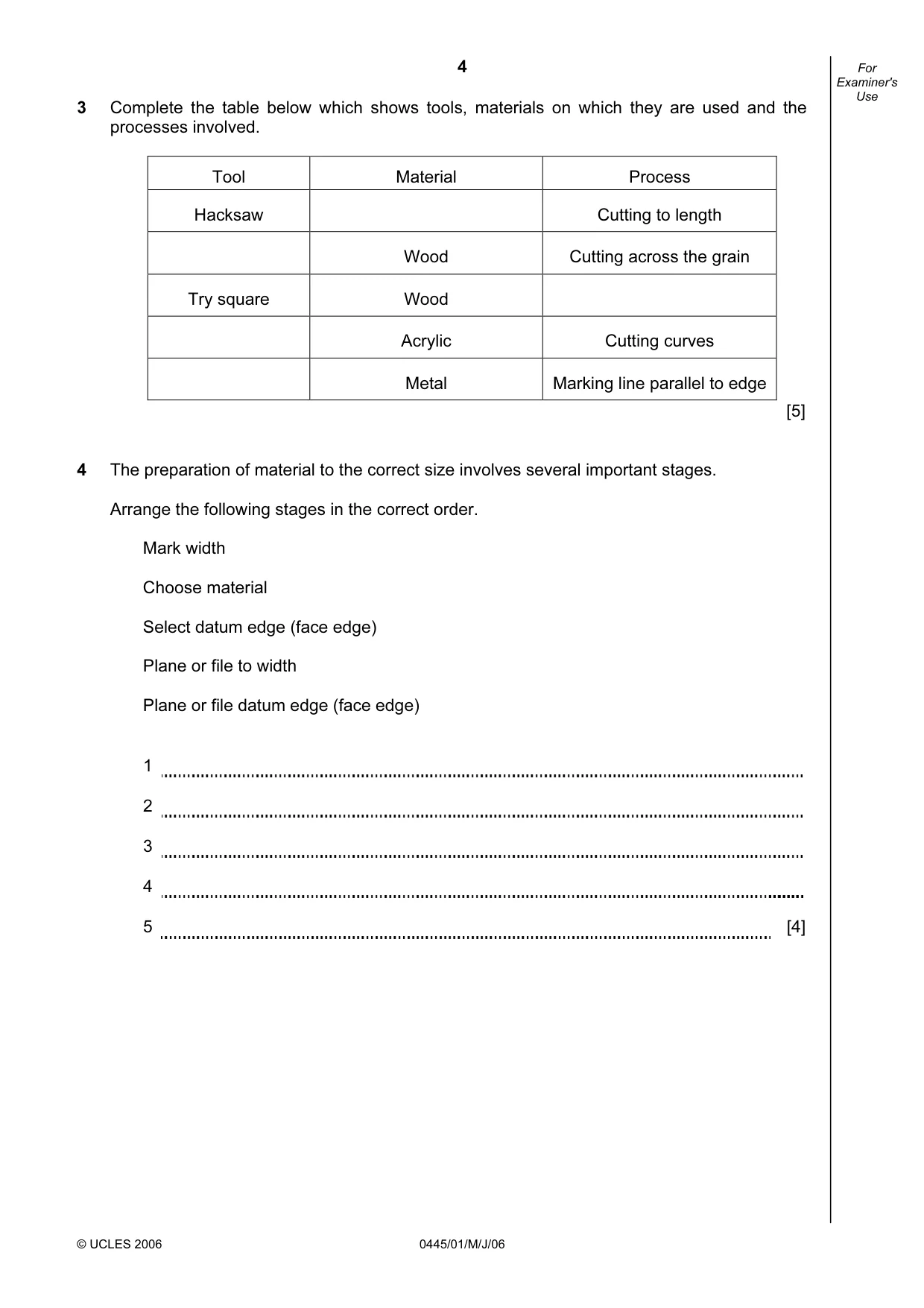
4 © UCLES 2006 0445/01/M/J/06 For Examiner's Use 3 Complete the table below which shows tools, materials on which they are used and the processes involved. Tool Material Process Hacksaw Cutting to length Wood Cutting across the grain Try square Wood Acrylic Cutting curves Metal Marking line parallel to edge [5] 4 The preparation of material to the correct size involves several important stages. Arrange the following stages in the correct order. Mark width Choose material Select datum edge (face edge) Plane or file to width Plane or file datum edge (face edge) 1 2 3 4 5 [4]
Question paper, page 5
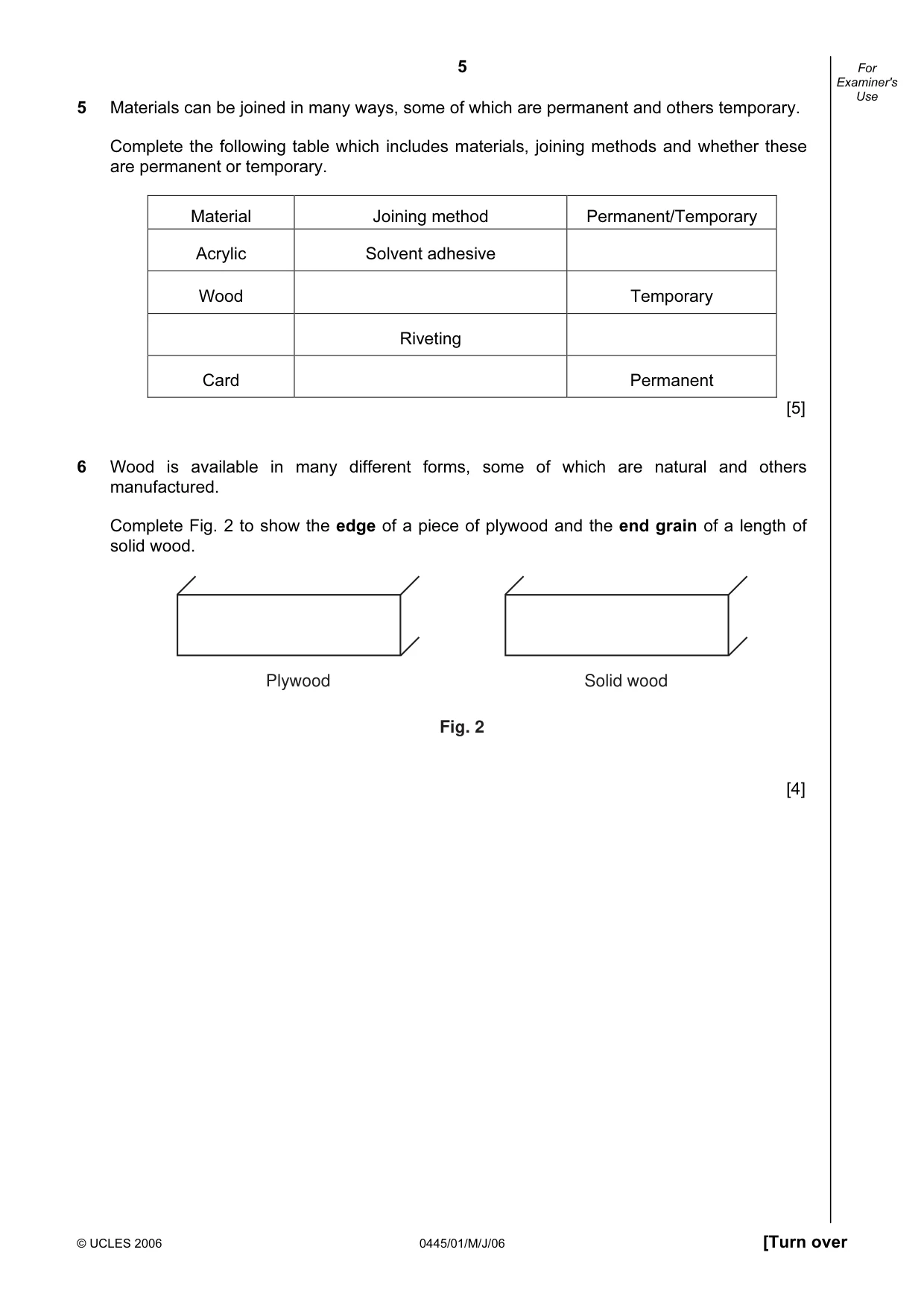
5 © UCLES 2006 0445/01/M/J/06 [Turn over For Examiner's Use 5 Materials can be joined in many ways, some of which are permanent and others temporary. Complete the following table which includes materials, joining methods and whether these are permanent or temporary. Material Joining method Permanent/Temporary Acrylic Solvent adhesive Wood Temporary Riveting Card Permanent [5] 6 Wood is available in many different forms, some of which are natural and others manufactured. Complete Fig. 2 to show the edge of a piece of plywood and the end grain of a length of solid wood. Plywood Solid wood Fig. 2 [4]
Question paper, page 6
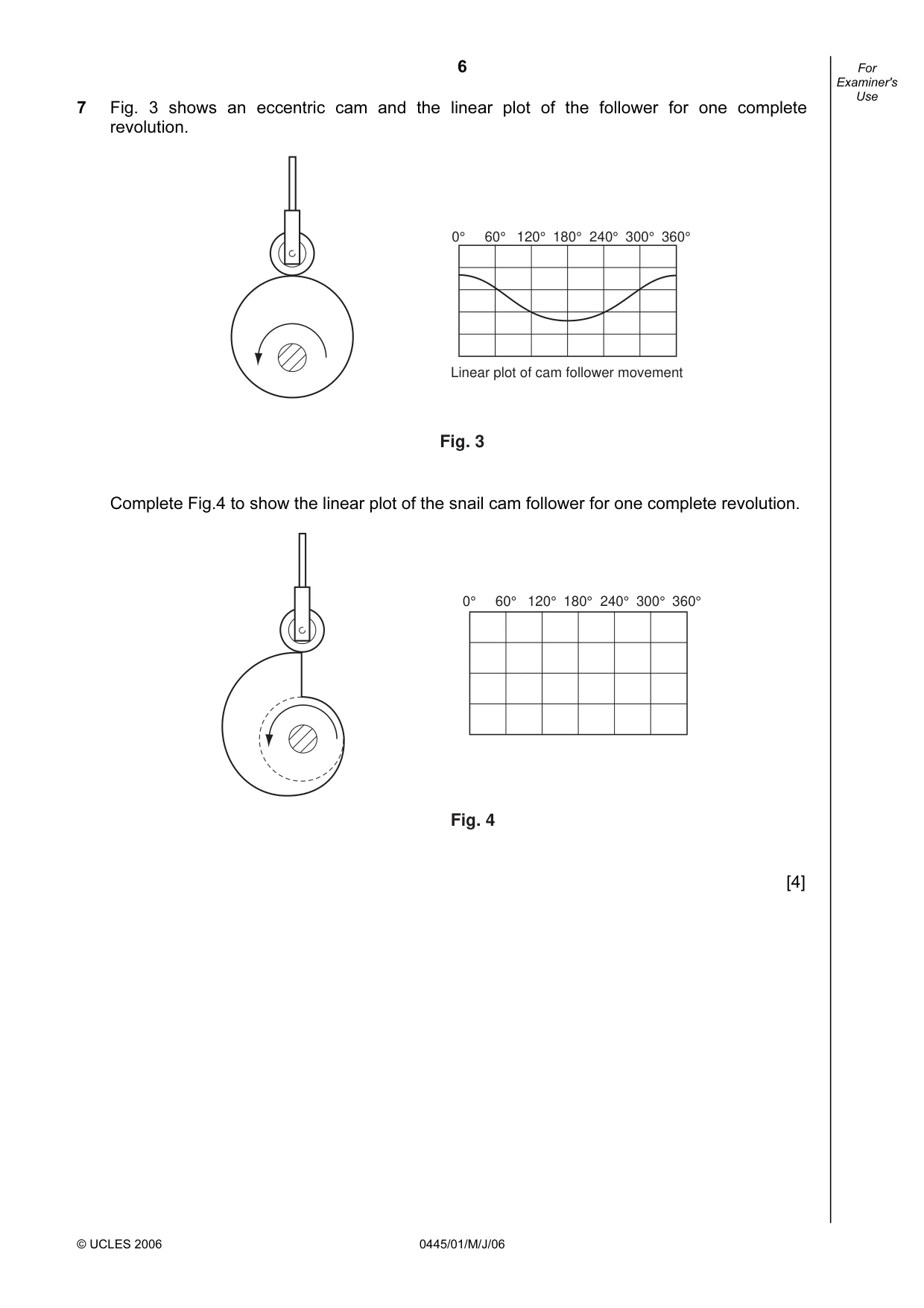
6 © UCLES 2006 0445/01/M/J/06 For Examiner's Use 7 Fig. 3 shows an eccentric cam and the linear plot of the follower for one complete revolution. 0° 60° 120° 180° 240° 300° 360° Linear plot of cam follower movement Fig. 3 Complete Fig.4 to show the linear plot of the snail cam follower for one complete revolution. 0° 60° 120° 180° 240° 300° 360° Fig. 4 [4]
Question paper, page 7
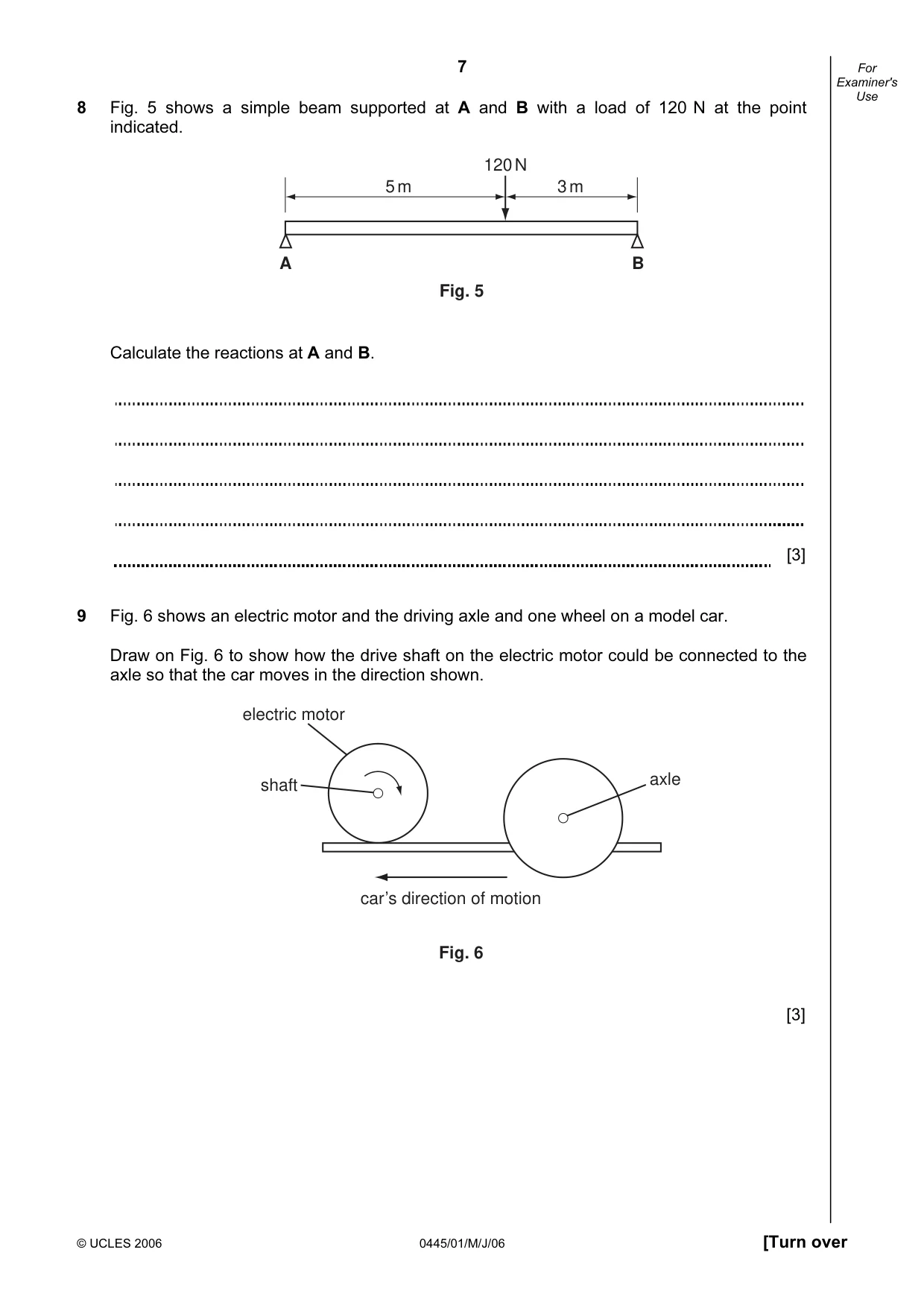
7 © UCLES 2006 0445/01/M/J/06 [Turn over For Examiner's Use 8 Fig. 5 shows a simple beam supported at A and B with a load of 120 N at the point indicated. 3 m 5 m 120 N A B Fig. 5 Calculate the reactions at A and B. [3] 9 Fig. 6 shows an electric motor and the driving axle and one wheel on a model car. Draw on Fig. 6 to show how the drive shaft on the electric motor could be connected to the axle so that the car moves in the direction shown. axle electric motor shaft car’s direction of motion Fig. 6 [3]
Question paper, page 8
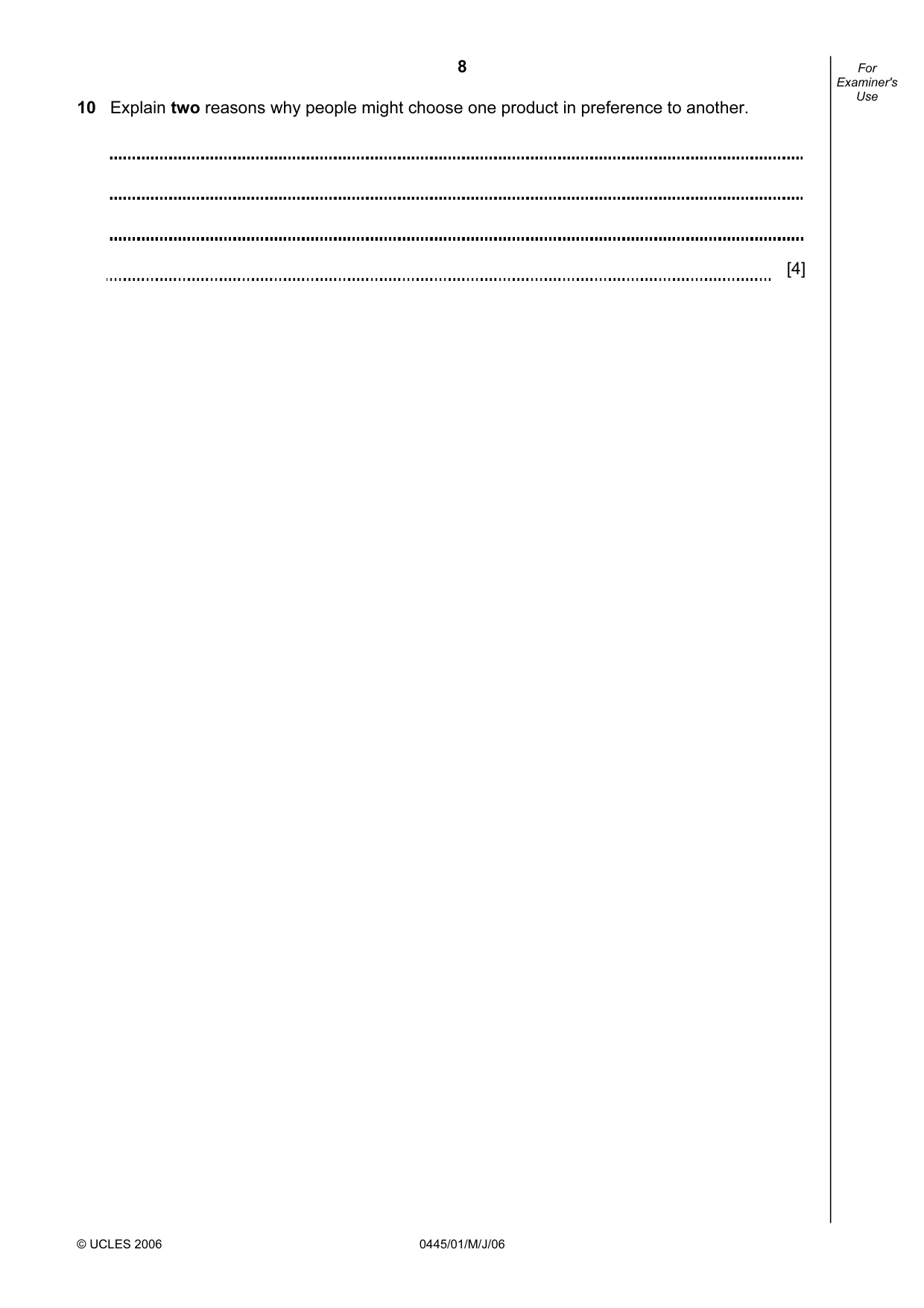
8 © UCLES 2006 0445/01/M/J/06 For Examiner's Use 10 Explain two reasons why people might choose one product in preference to another. [4]
Question paper, page 9
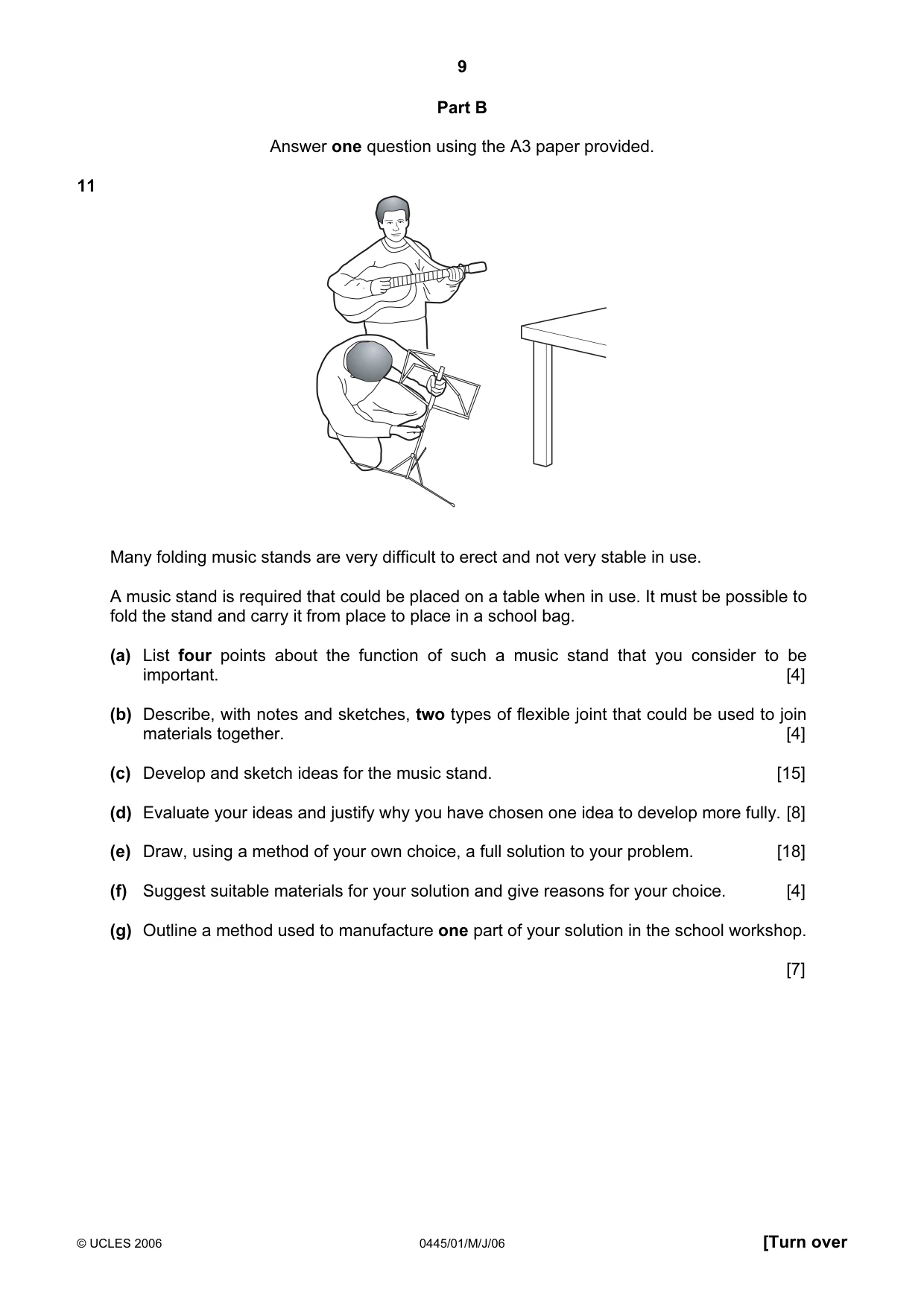
9 © UCLES 2006 0445/01/M/J/06 [Turn over Part B Answer one question using the A3 paper provided. 11 Many folding music stands are very difficult to erect and not very stable in use. A music stand is required that could be placed on a table when in use. It must be possible to fold the stand and carry it from place to place in a school bag. (a) List four points about the function of such a music stand that you consider to be important. [4] (b) Describe, with notes and sketches, two types of flexible joint that could be used to join materials together. [4] (c) Develop and sketch ideas for the music stand. [15] (d) Evaluate your ideas and justify why you have chosen one idea to develop more fully. [8] (e) Draw, using a method of your own choice, a full solution to your problem. [18] (f) Suggest suitable materials for your solution and give reasons for your choice. [4] (g) Outline a method used to manufacture one part of your solution in the school workshop. [7]
Question paper, page 10
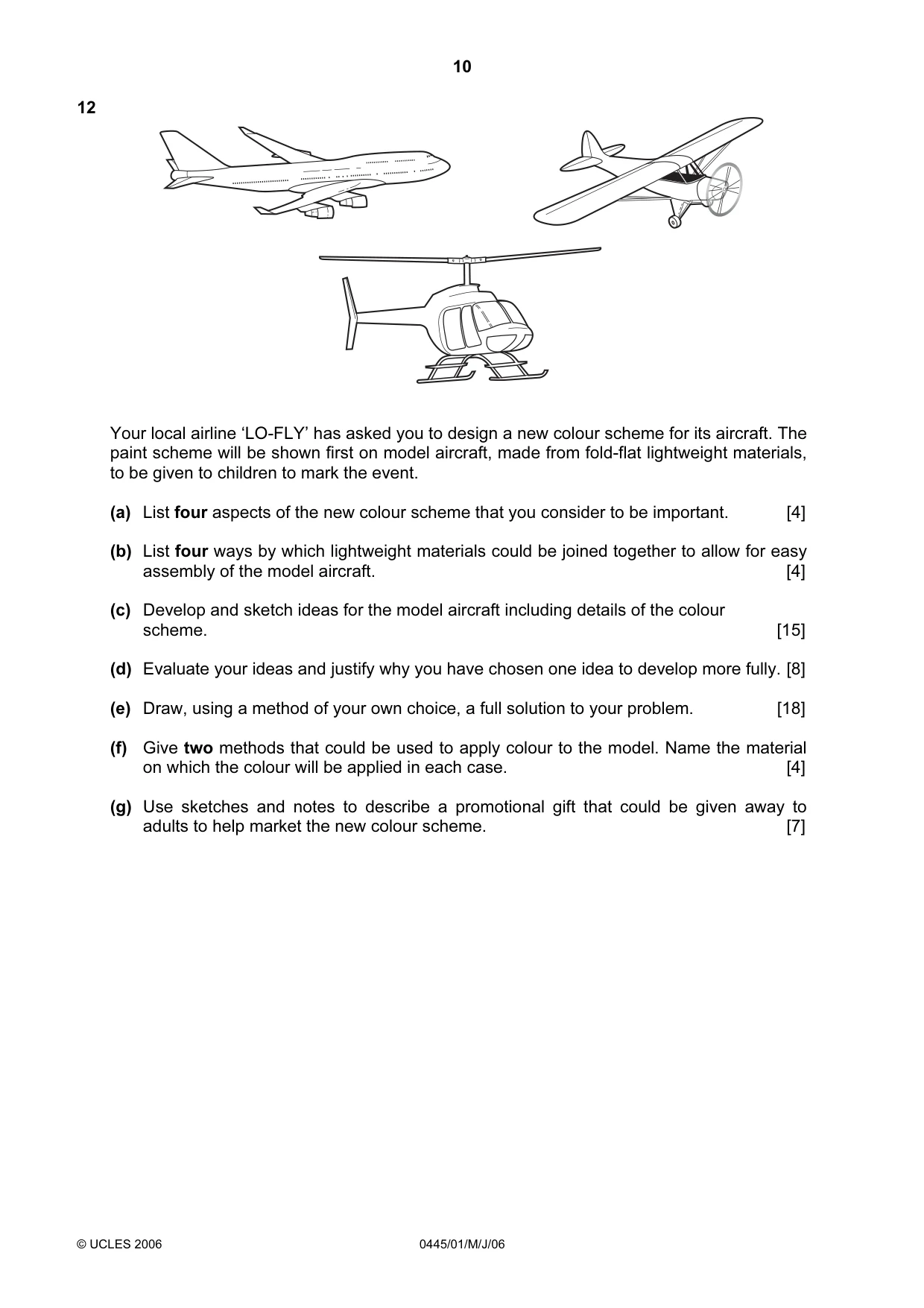
10 © UCLES 2006 0445/01/M/J/06 12 Your local airline ‘LO-FLY’ has asked you to design a new colour scheme for its aircraft. The paint scheme will be shown first on model aircraft, made from fold-flat lightweight materials, to be given to children to mark the event. (a) List four aspects of the new colour scheme that you consider to be important. [4] (b) List four ways by which lightweight materials could be joined together to allow for easy assembly of the model aircraft. [4] (c) Develop and sketch ideas for the model aircraft including details of the colour scheme. [15] (d) Evaluate your ideas and justify why you have chosen one idea to develop more fully. [8] (e) Draw, using a method of your own choice, a full solution to your problem. [18] (f) Give two methods that could be used to apply colour to the model. Name the material on which the colour will be applied in each case. [4] (g) Use sketches and notes to describe a promotional gift that could be given away to adults to help market the new colour scheme. [7]
Question paper, page 11
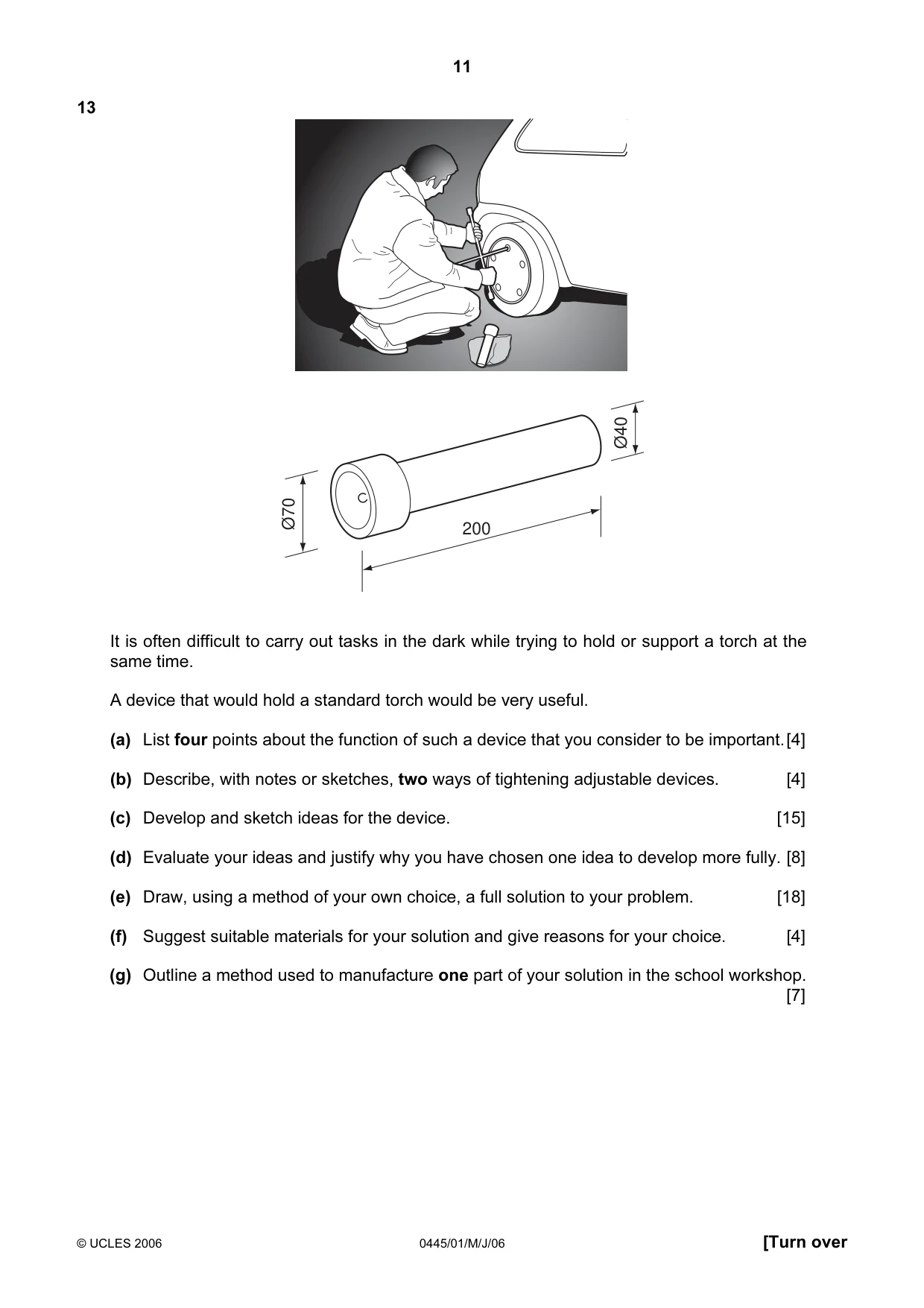
11 © UCLES 2006 0445/01/M/J/06 [Turn over 13 Ø70 Ø40 200 It is often difficult to carry out tasks in the dark while trying to hold or support a torch at the same time. A device that would hold a standard torch would be very useful. (a) List four points about the function of such a device that you consider to be important. [4] (b) Describe, with notes or sketches, two ways of tightening adjustable devices. [4] (c) Develop and sketch ideas for the device. [15] (d) Evaluate your ideas and justify why you have chosen one idea to develop more fully. [8] (e) Draw, using a method of your own choice, a full solution to your problem. [18] (f) Suggest suitable materials for your solution and give reasons for your choice. [4] (g) Outline a method used to manufacture one part of your solution in the school workshop. [7]
Question paper, page 12
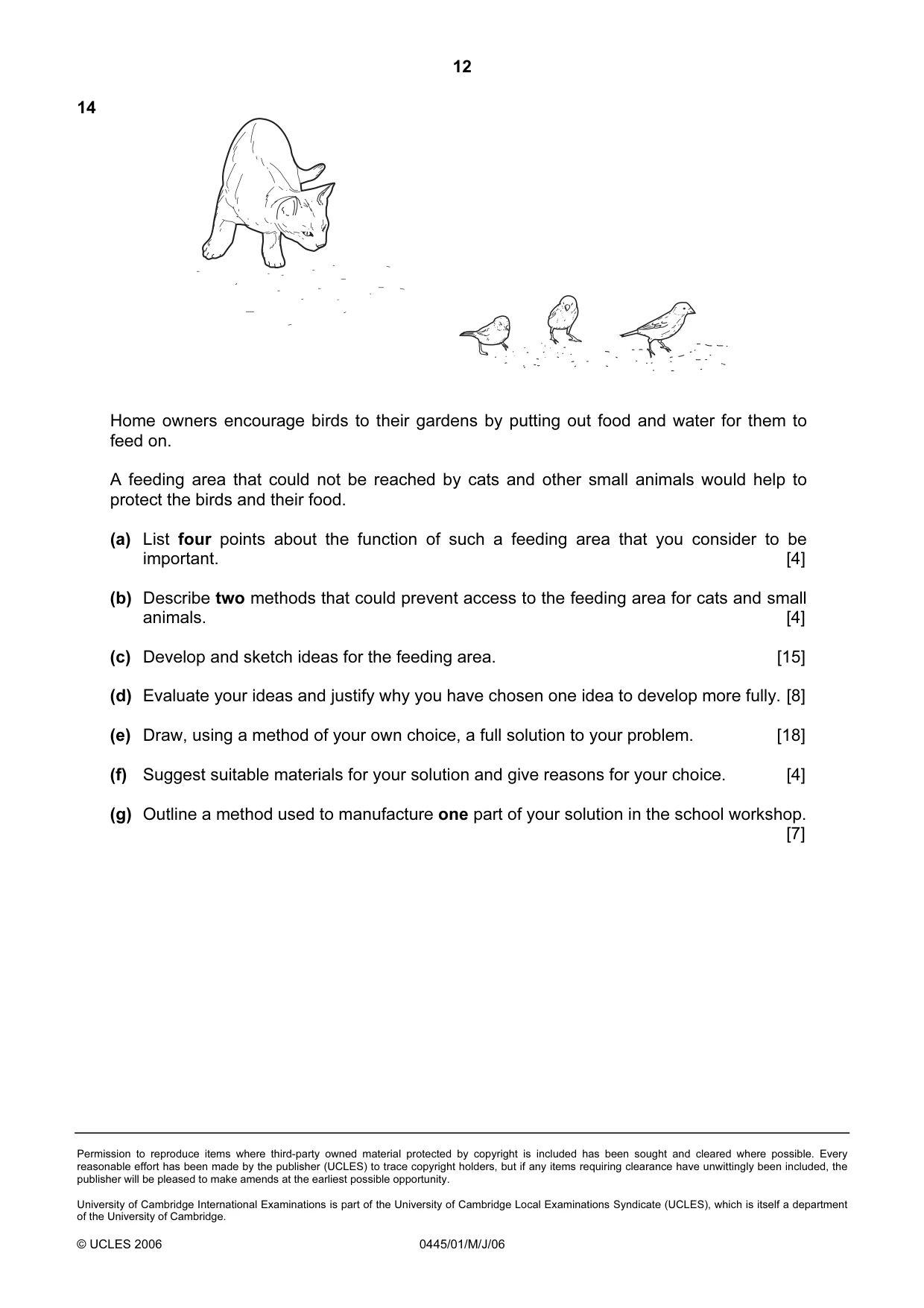
12 Permission to reproduce items where third-party owned material protected by copyright is included has been sought and cleared where possible. Every reasonable effort has been made by the publisher (UCLES) to trace copyright holders, but if any items requiring clearance have unwittingly been included, the publisher will be pleased to make amends at the earliest possible opportunity. University of Cambridge International Examinations is part of the University of Cambridge Local Examinations Syndicate (UCLES), which is itself a department of the University of Cambridge. © UCLES 2006 0445/01/M/J/06 14 Home owners encourage birds to their gardens by putting out food and water for them to feed on. A feeding area that could not be reached by cats and other small animals would help to protect the birds and their food. (a) List four points about the function of such a feeding area that you consider to be important. [4] (b) Describe two methods that could prevent access to the feeding area for cats and small animals. [4] (c) Develop and sketch ideas for the feeding area. [15] (d) Evaluate your ideas and justify why you have chosen one idea to develop more fully. [8] (e) Draw, using a method of your own choice, a full solution to your problem. [18] (f) Suggest suitable materials for your solution and give reasons for your choice. [4] (g) Outline a method used to manufacture one part of your solution in the school workshop. [7]
Mark scheme, page 1
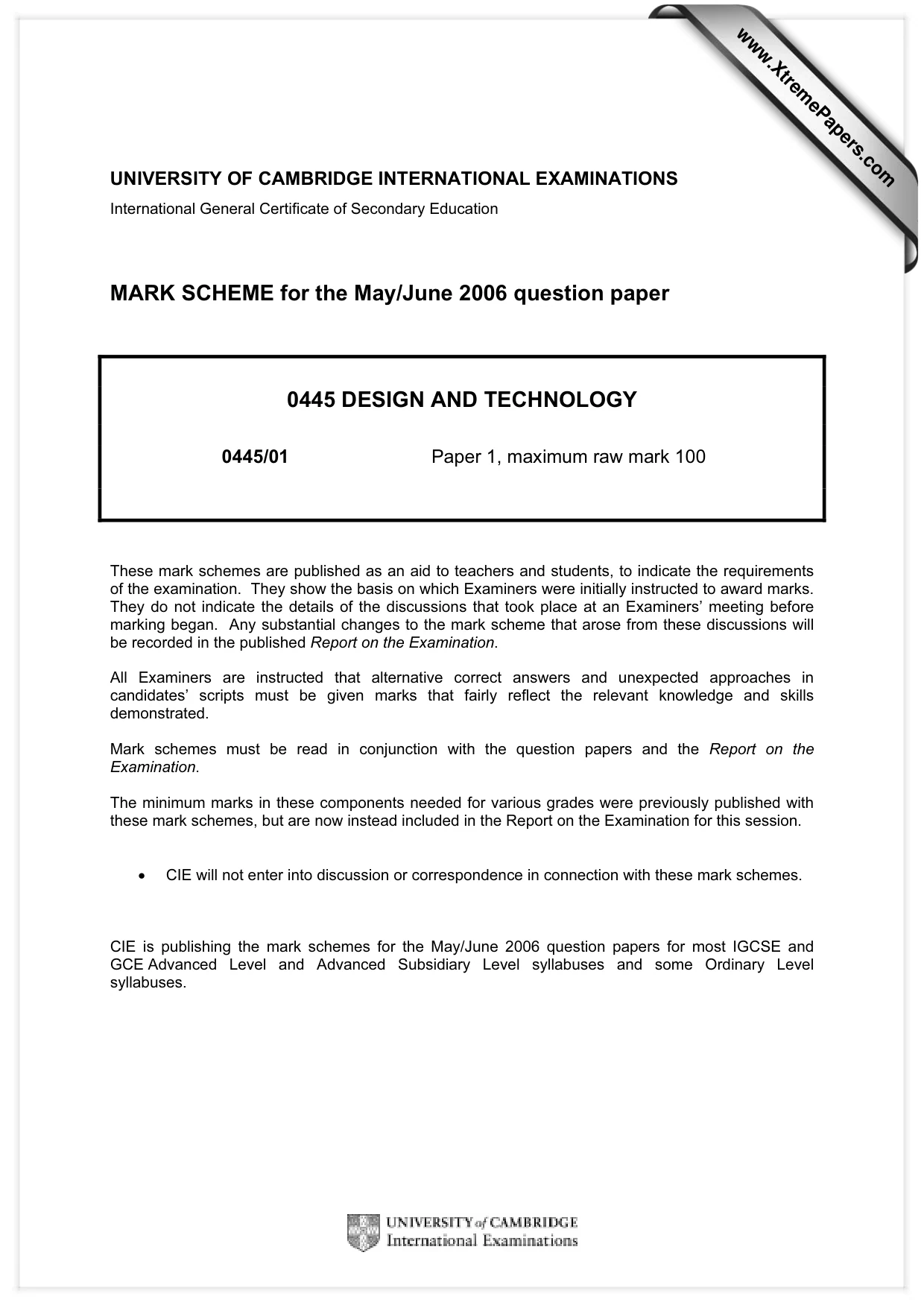
UNIVERSITY OF CAMBRIDGE INTERNATIONAL EXAMINATIONS International General Certificate of Secondary Education MARK SCHEME for the May/June 2006 question paper 0445 DESIGN AND TECHNOLOGY 0445/01 Paper 1, maximum raw mark 100 These mark schemes are published as an aid to teachers and students, to indicate the requirements of the examination. They show the basis on which Examiners were initially instructed to award marks. They do not indicate the details of the discussions that took place at an Examiners’ meeting before marking began. Any substantial changes to the mark scheme that arose from these discussions will be recorded in the published Report on the Examination. All Examiners are instructed that alternative correct answers and unexpected approaches in candidates’ scripts must be given marks that fairly reflect the relevant knowledge and skills demonstrated. Mark schemes must be read in conjunction with the question papers and the Report on the Examination. The minimum marks in these components needed for various grades were previously published with these mark schemes, but are now instead included in the Report on the Examination for this session. • CIE will not enter into discussion or correspondence in connection with these mark schemes. CIE is publishing the mark schemes for the May/June 2006 question papers for most IGCSE and GCE Advanced Level and Advanced Subsidiary Level syllabuses and some Ordinary Level syllabuses. www.XtremePapers.com
Mark scheme, page 2
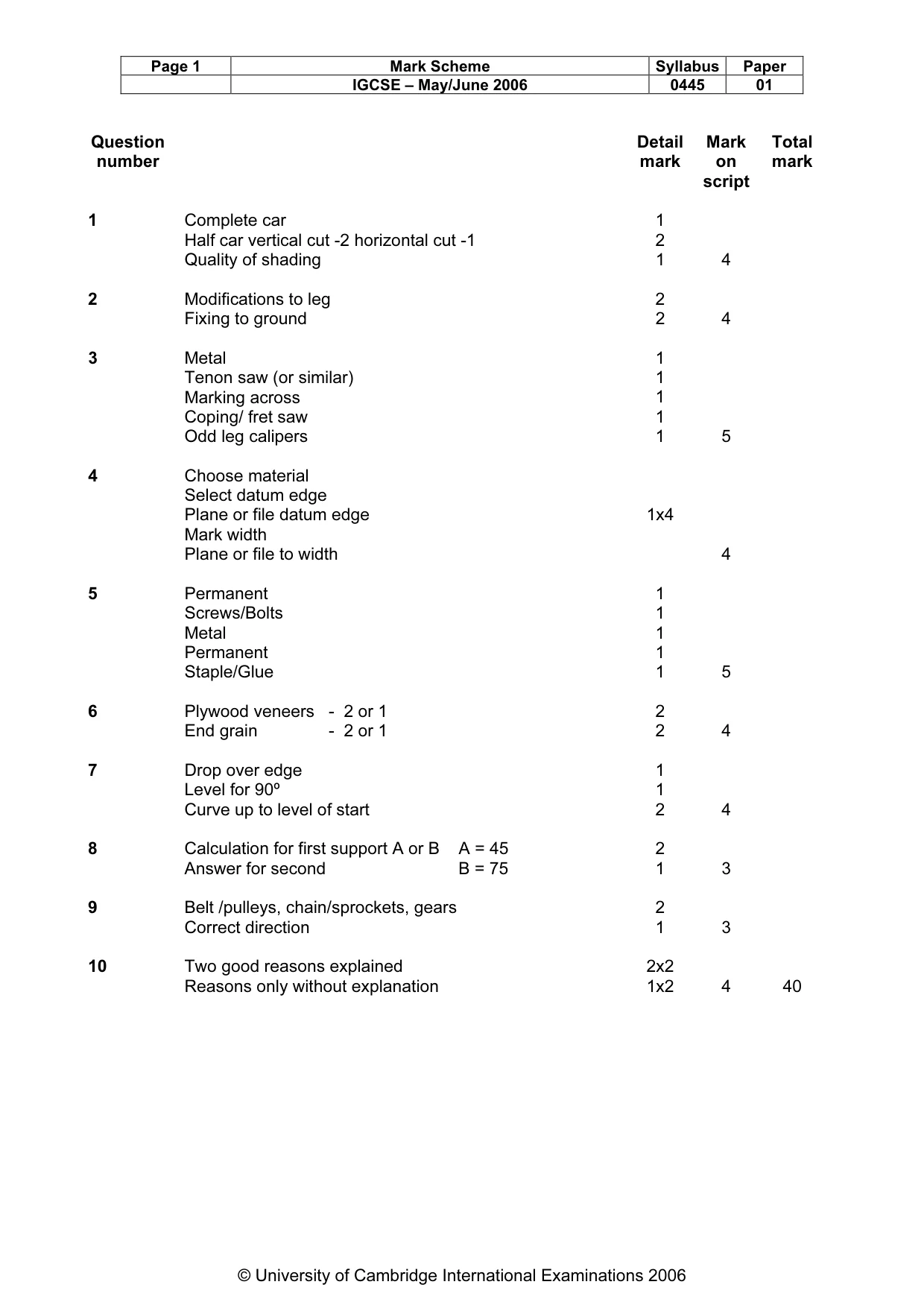
Page 1 Mark Scheme Syllabus Paper IGCSE – May/June 2006 0445 01 © University of Cambridge International Examinations 2006 Question number Detail mark Mark on script Total mark 1 Complete car 1 Half car vertical cut -2 horizontal cut -1 2 Quality of shading 1 4 2 Modifications to leg 2 Fixing to ground 2 4 3 Metal Tenon saw (or similar) Marking across Coping/ fret saw Odd leg calipers 1 1 1 1 1 5 4 Choose material Select datum edge Plane or file datum edge Mark width Plane or file to width 1x4 4 5 Permanent Screws/Bolts Metal Permanent Staple/Glue 1 1 1 1 1 5 6 Plywood veneers - 2 or 1 End grain - 2 or 1 2 2 4 7 Drop over edge Level for 90º Curve up to level of start 1 1 2 4 8 Calculation for first support A or B A = 45 Answer for second B = 75 2 1 3 9 Belt /pulleys, chain/sprockets, gears Correct direction 2 1 3 10 Two good reasons explained Reasons only without explanation 2x2 1x2 4 40
Mark scheme, page 3
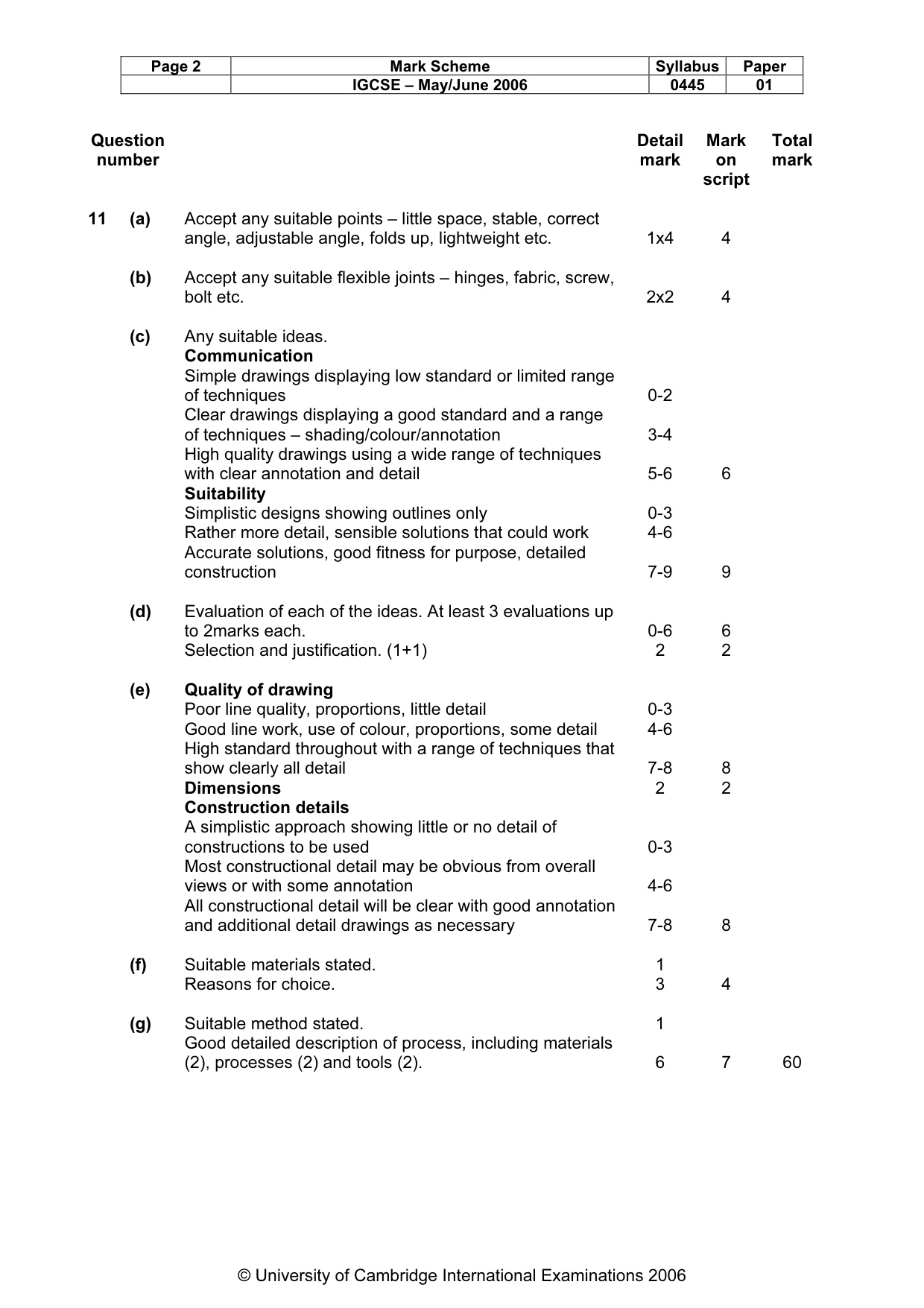
Page 2 Mark Scheme Syllabus Paper IGCSE – May/June 2006 0445 01 © University of Cambridge International Examinations 2006 Question number Detail mark Mark on script Total mark 11 (a) Accept any suitable points – little space, stable, correct angle, adjustable angle, folds up, lightweight etc. 1x4 4 (b) Accept any suitable flexible joints – hinges, fabric, screw, bolt etc. 2x2 4 (c) Any suitable ideas. Communication Simple drawings displaying low standard or limited range of techniques Clear drawings displaying a good standard and a range of techniques – shading/colour/annotation High quality drawings using a wide range of techniques with clear annotation and detail 0-2 3-4 5-6 6 Suitability Simplistic designs showing outlines only Rather more detail, sensible solutions that could work Accurate solutions, good fitness for purpose, detailed construction 0-3 4-6 7-9 9 (d) Evaluation of each of the ideas. At least 3 evaluations up to 2marks each. 0-6 6 Selection and justification. (1+1) 2 2 (e) Quality of drawing Poor line quality, proportions, little detail Good line work, use of colour, proportions, some detail High standard throughout with a range of techniques that show clearly all detail Dimensions Construction details A simplistic approach showing little or no detail of constructions to be used Most constructional detail may be obvious from overall views or with some annotation All constructional detail will be clear with good annotation and additional detail drawings as necessary 0-3 4-6 7-8 2 0-3 4-6 7-8 8 2 8 (f) Suitable materials stated. 1 Reasons for choice. 3 4 (g) Suitable method stated. Good detailed description of process, including materials (2), processes (2) and tools (2). 1 6 7 60
Mark scheme, page 4
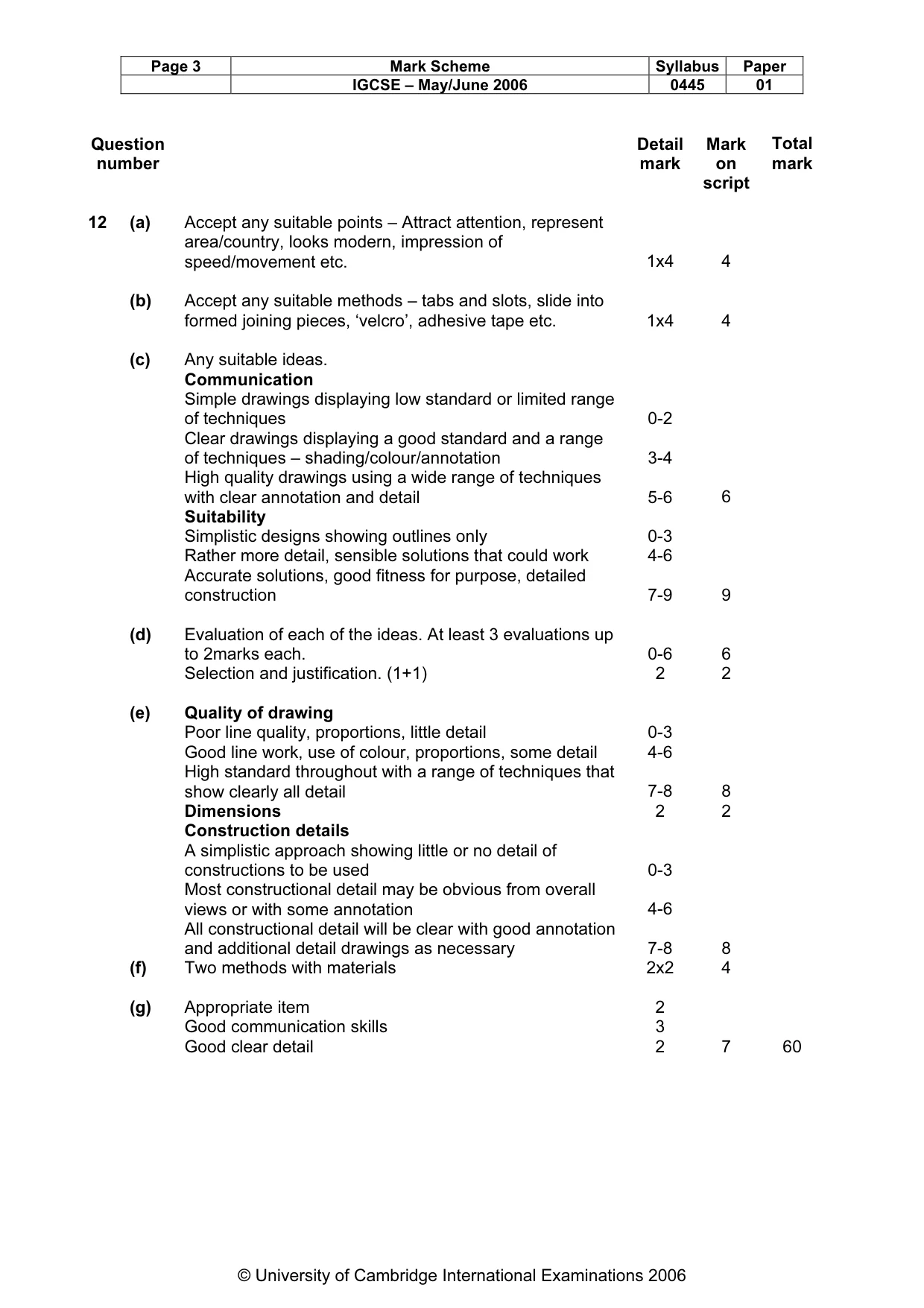
Page 3 Mark Scheme Syllabus Paper IGCSE – May/June 2006 0445 01 © University of Cambridge International Examinations 2006 Question number Detail mark Mark on script Total mark 12 (a) Accept any suitable points – Attract attention, represent area/country, looks modern, impression of speed/movement etc. 1x4 4 (b) Accept any suitable methods – tabs and slots, slide into formed joining pieces, ‘velcro’, adhesive tape etc. 1x4 4 (c) Any suitable ideas. Communication Simple drawings displaying low standard or limited range of techniques Clear drawings displaying a good standard and a range of techniques – shading/colour/annotation High quality drawings using a wide range of techniques with clear annotation and detail 0-2 3-4 5-6 6 Suitability Simplistic designs showing outlines only Rather more detail, sensible solutions that could work Accurate solutions, good fitness for purpose, detailed construction 0-3 4-6 7-9 9 (d) Evaluation of each of the ideas. At least 3 evaluations up to 2marks each. 0-6 6 Selection and justification. (1+1) 2 2 (e) Quality of drawing Poor line quality, proportions, little detail Good line work, use of colour, proportions, some detail High standard throughout with a range of techniques that show clearly all detail Dimensions Construction details A simplistic approach showing little or no detail of constructions to be used Most constructional detail may be obvious from overall views or with some annotation All constructional detail will be clear with good annotation and additional detail drawings as necessary 0-3 4-6 7-8 2 0-3 4-6 7-8 8 2 8 (f) Two methods with materials 2x2 4 (g) Appropriate item Good communication skills Good clear detail 2 3 2 7 60
Mark scheme, page 5
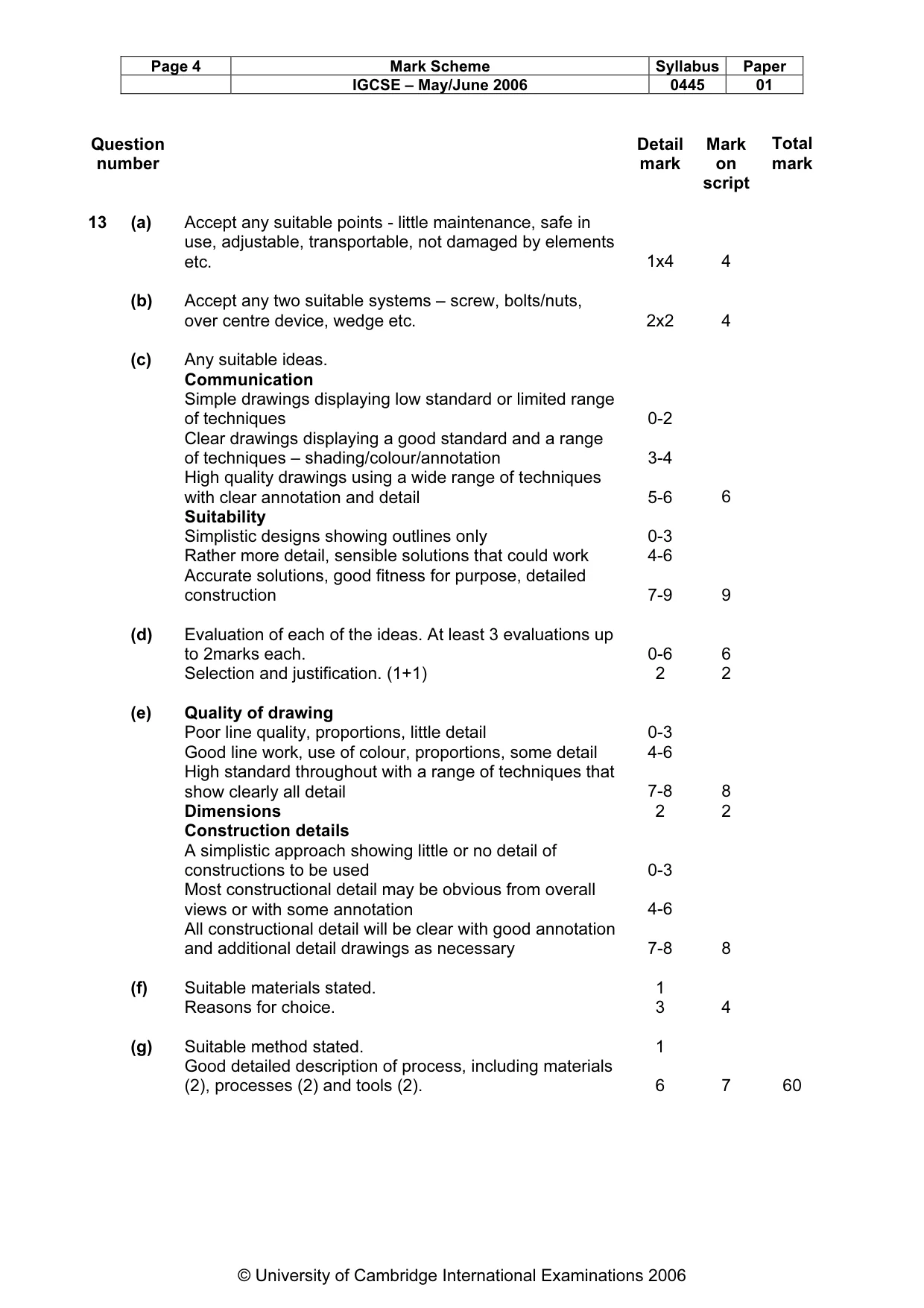
Page 4 Mark Scheme Syllabus Paper IGCSE – May/June 2006 0445 01 © University of Cambridge International Examinations 2006 Question number Detail mark Mark on script Total mark 13 (a) Accept any suitable points - little maintenance, safe in use, adjustable, transportable, not damaged by elements etc. 1x4 4 (b) Accept any two suitable systems – screw, bolts/nuts, over centre device, wedge etc. 2x2 4 (c) Any suitable ideas. Communication Simple drawings displaying low standard or limited range of techniques Clear drawings displaying a good standard and a range of techniques – shading/colour/annotation High quality drawings using a wide range of techniques with clear annotation and detail 0-2 3-4 5-6 6 Suitability Simplistic designs showing outlines only Rather more detail, sensible solutions that could work Accurate solutions, good fitness for purpose, detailed construction 0-3 4-6 7-9 9 (d) Evaluation of each of the ideas. At least 3 evaluations up to 2marks each. 0-6 6 Selection and justification. (1+1) 2 2 (e) Quality of drawing Poor line quality, proportions, little detail Good line work, use of colour, proportions, some detail High standard throughout with a range of techniques that show clearly all detail Dimensions Construction details A simplistic approach showing little or no detail of constructions to be used Most constructional detail may be obvious from overall views or with some annotation All constructional detail will be clear with good annotation and additional detail drawings as necessary 0-3 4-6 7-8 2 0-3 4-6 7-8 8 2 8 (f) Suitable materials stated. 1 Reasons for choice. 3 4 (g) Suitable method stated. Good detailed description of process, including materials (2), processes (2) and tools (2). 1 6 7 60
Mark scheme, page 6
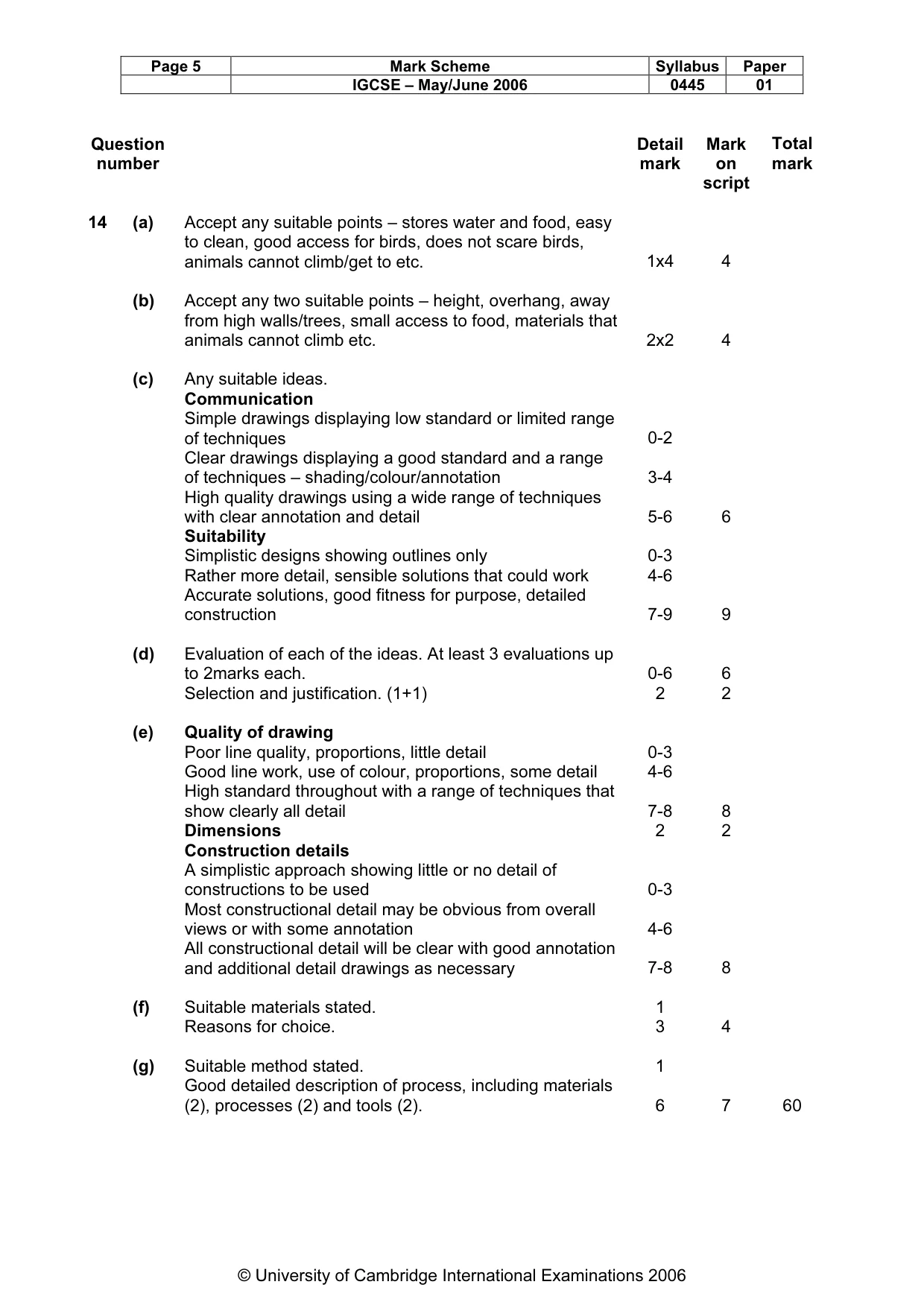
Page 5 Mark Scheme Syllabus Paper IGCSE – May/June 2006 0445 01 © University of Cambridge International Examinations 2006 Question number Detail mark Mark on script Total mark 14 (a) Accept any suitable points – stores water and food, easy to clean, good access for birds, does not scare birds, animals cannot climb/get to etc. 1x4 4 (b) Accept any two suitable points – height, overhang, away from high walls/trees, small access to food, materials that animals cannot climb etc. 2x2 4 (c) Any suitable ideas. Communication Simple drawings displaying low standard or limited range of techniques Clear drawings displaying a good standard and a range of techniques – shading/colour/annotation High quality drawings using a wide range of techniques with clear annotation and detail 0-2 3-4 5-6 6 Suitability Simplistic designs showing outlines only Rather more detail, sensible solutions that could work Accurate solutions, good fitness for purpose, detailed construction 0-3 4-6 7-9 9 (d) Evaluation of each of the ideas. At least 3 evaluations up to 2marks each. 0-6 6 Selection and justification. (1+1) 2 2 (e) Quality of drawing Poor line quality, proportions, little detail Good line work, use of colour, proportions, some detail High standard throughout with a range of techniques that show clearly all detail Dimensions Construction details A simplistic approach showing little or no detail of constructions to be used Most constructional detail may be obvious from overall views or with some annotation All constructional detail will be clear with good annotation and additional detail drawings as necessary 0-3 4-6 7-8 2 0-3 4-6 7-8 8 2 8 (f) Suitable materials stated. 1 Reasons for choice. 3 4 (g) Suitable method stated. Good detailed description of process, including materials (2), processes (2) and tools (2). 1 6 7 60
What you needed in this session
Cambridge’s own grade thresholds for 2006 May/June, Paper 1 · Variant 1. A higher threshold means an easier paper — the bar moves with how the cohort did.