Cambridge IGCSE Design and Technology 0445 — 2005 Oct/Nov Paper 1 · Variant 1
0445/11/O/N/05
The question paper and its mark scheme, free to read here and free to download. This is Cambridge’s own paper, exactly as it was sat.
Question paper12 pages
Mark scheme6 pages
Answers below. Sit the paper first if you are practising.
Paper as text
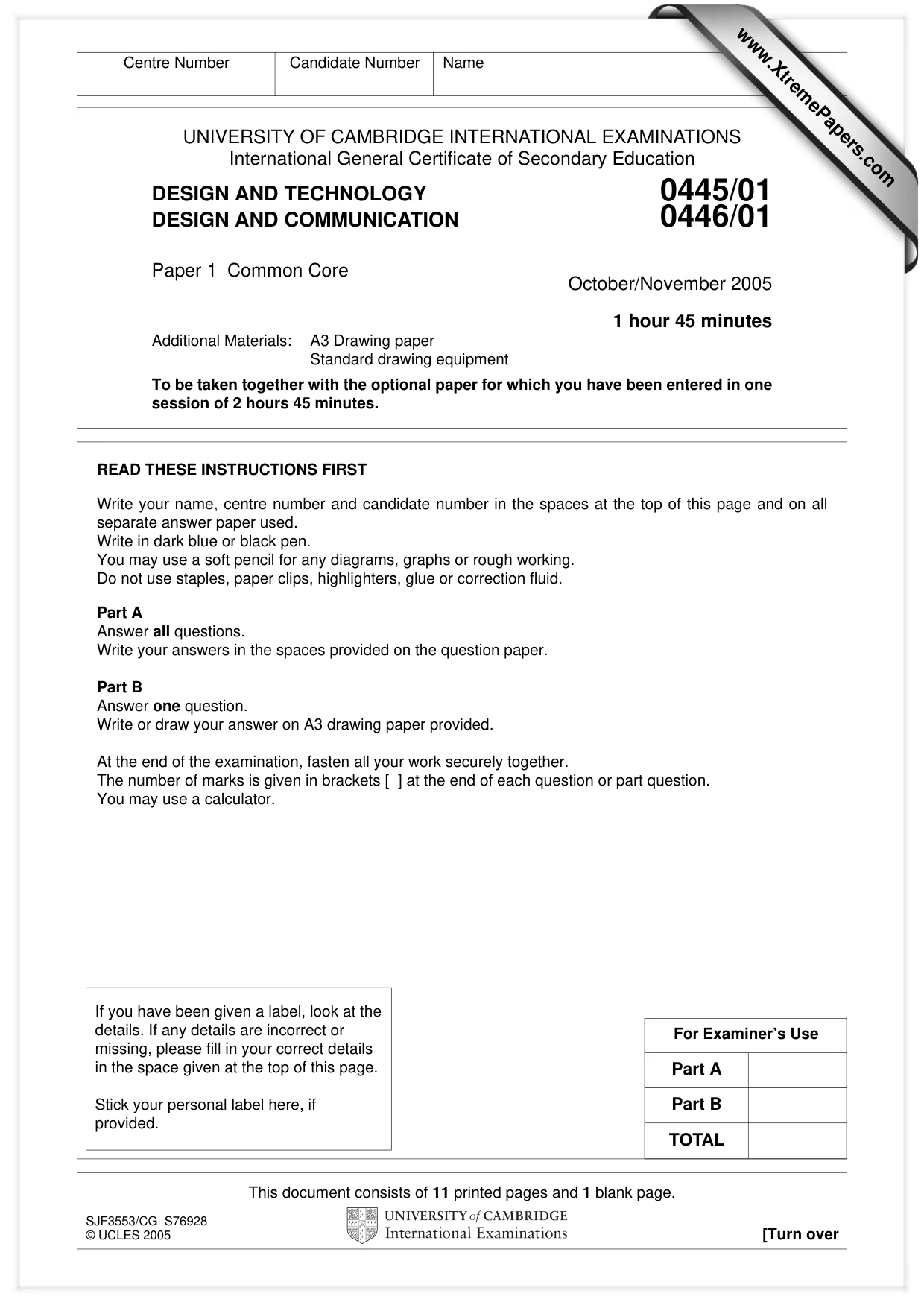
Question paper, page 1
This document consists of 11 printed pages and 1 blank page. SJF3553/CG S76928 © UCLES 2005 [Turn over UNIVERSITY OF CAMBRIDGE INTERNATIONAL EXAMINATIONS International General Certificate of Secondary Education DESIGN AND TECHNOLOGY 0445/01 DESIGN AND COMMUNICATION 0446/01 Paper 1 Common Core October/November 2005 1 hour 45 minutes Additional Materials: A3 Drawing paper Standard drawing equipment To be taken together with the optional paper for which you have been entered in one session of 2 hours 45 minutes. READ THESE INSTRUCTIONS FIRST Write your name, centre number and candidate number in the spaces at the top of this page and on all separate answer paper used. Write in dark blue or black pen. You may use a soft pencil for any diagrams, graphs or rough working. Do not use staples, paper clips, highlighters, glue or correction fluid. Part A Answer all questions. Write your answers in the spaces provided on the question paper. Part B Answer one question. Write or draw your answer on A3 drawing paper provided. At the end of the examination, fasten all your work securely together. The number of marks is given in brackets [ ] at the end of each question or part question. You may use a calculator. Centre Number Candidate Number Name If you have been given a label, look at the details. If any details are incorrect or missing, please fill in your correct details in the space given at the top of this page. Stick your personal label here, if provided. TOTAL Part B Part A For Examiner’s Use www.XtremePapers.com
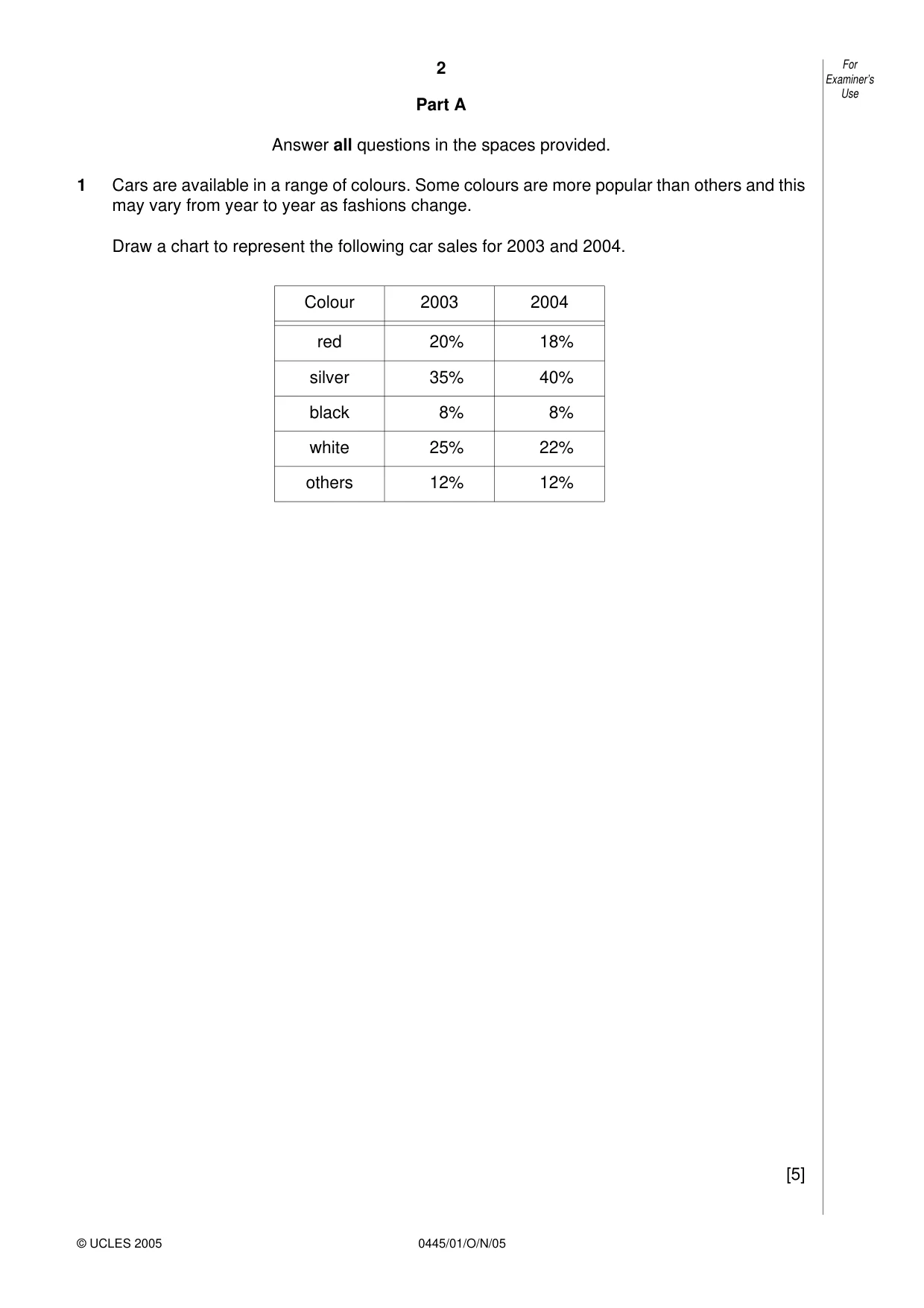
Question paper, page 2
0445/01/O/N/05 2 Part A Answer all questions in the spaces provided. 1 Cars are available in a range of colours. Some colours are more popular than others and this may vary from year to year as fashions change. Draw a chart to represent the following car sales for 2003 and 2004. [5] For Examiner’s Use © UCLES 2005 Colour 2003 2004 red silver black white others 20% 35% 8% 25% 12% 18% 40% 8% 22% 12%
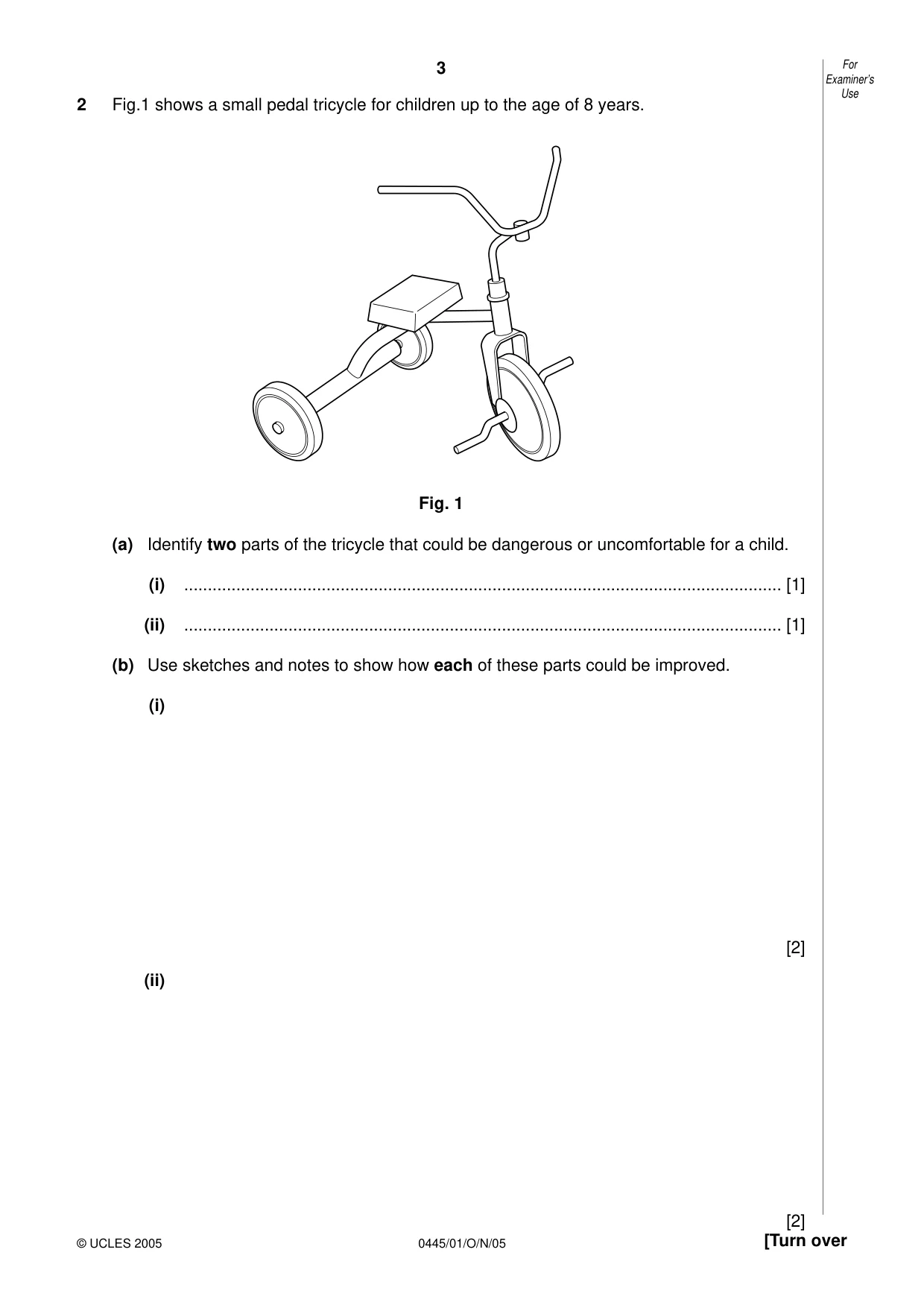
Question paper, page 3
0445/01/O/N/05 [Turn over 3 2 Fig.1 shows a small pedal tricycle for children up to the age of 8 years. Fig. 1 (a) Identify two parts of the tricycle that could be dangerous or uncomfortable for a child. (i) … [1] (ii) … [1] (b) Use sketches and notes to show how each of these parts could be improved. (i) [2] (ii) [2] For Examiner’s Use © UCLES 2005
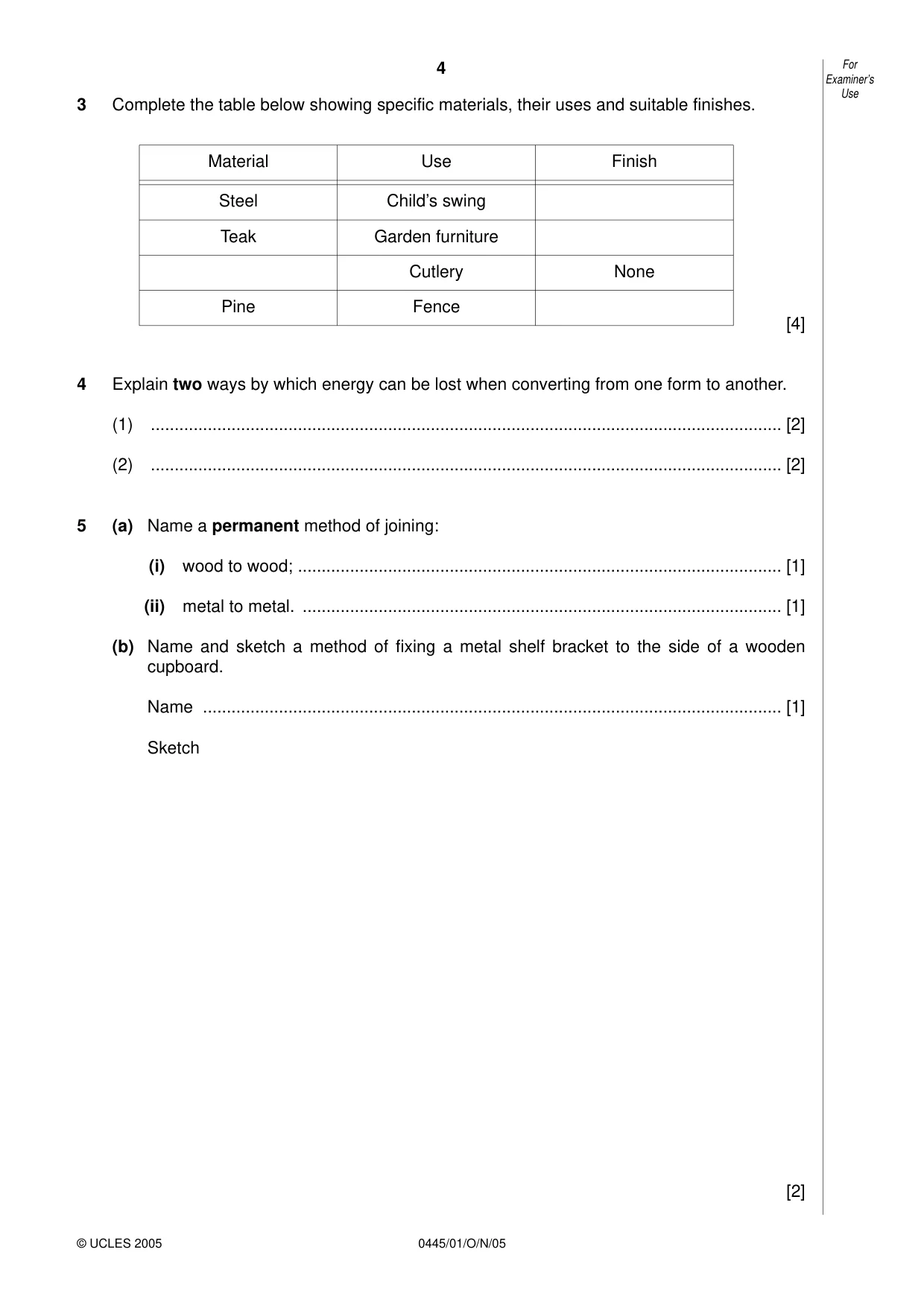
Question paper, page 4
0445/01/O/N/05 4 3 Complete the table below showing specific materials, their uses and suitable finishes. [4] 4 Explain two ways by which energy can be lost when converting from one form to another. (1) … [2] (2) … [2] 5 (a) Name a permanent method of joining: (i) wood to wood; … [1] (ii) metal to metal. … [1] (b) Name and sketch a method of fixing a metal shelf bracket to the side of a wooden cupboard. Name … [1] Sketch [2] For Examiner’s Use © UCLES 2005 Material Use Finish Steel Teak Pine Child’s swing Garden furniture Cutlery Fence None
Question paper, page 5
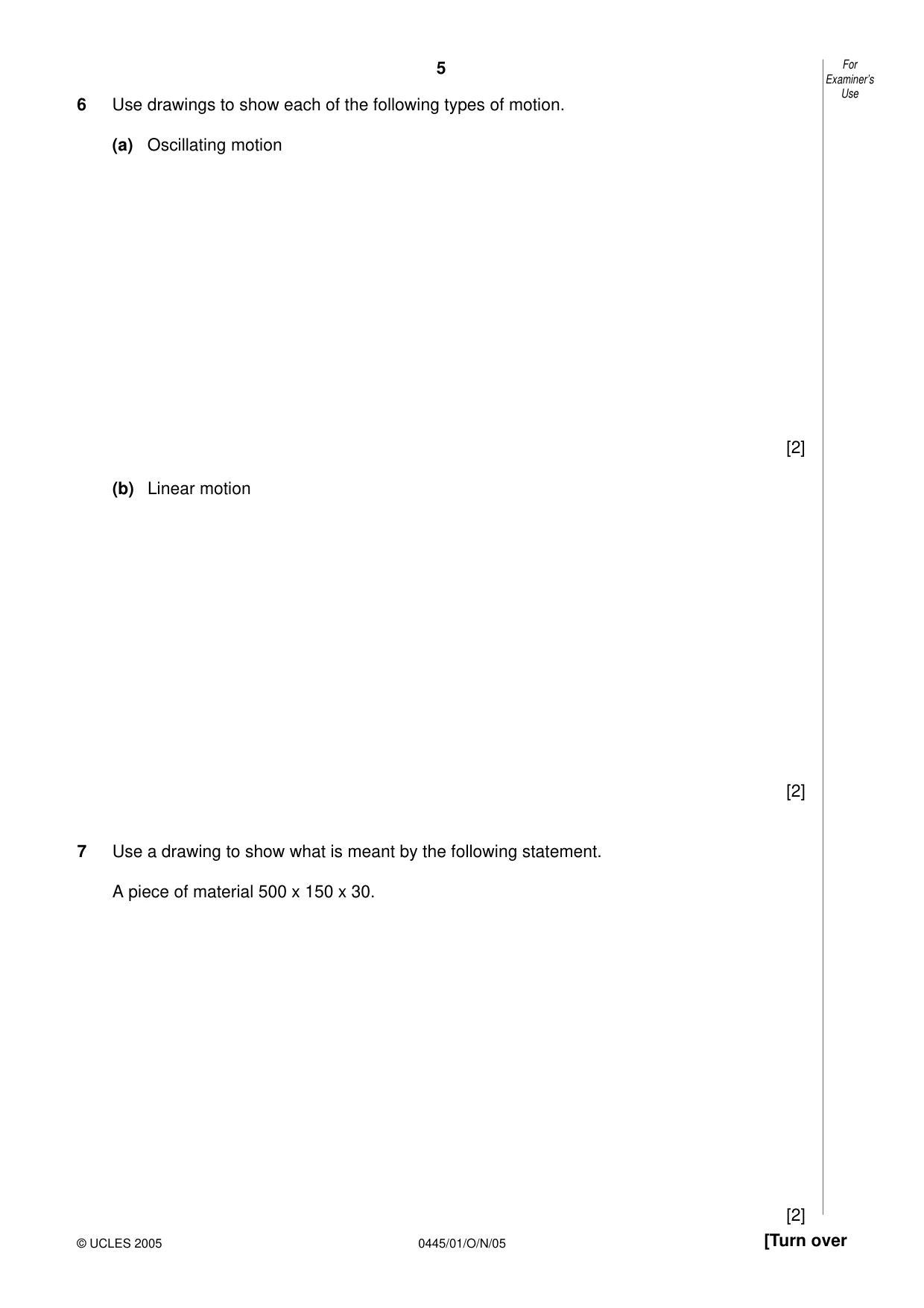
0445/01/O/N/05 [Turn over 5 6 Use drawings to show each of the following types of motion. (a) Oscillating motion [2] (b) Linear motion [2] 7 Use a drawing to show what is meant by the following statement. A piece of material 500 x 150 x 30. [2] For Examiner’s Use © UCLES 2005
Question paper, page 6
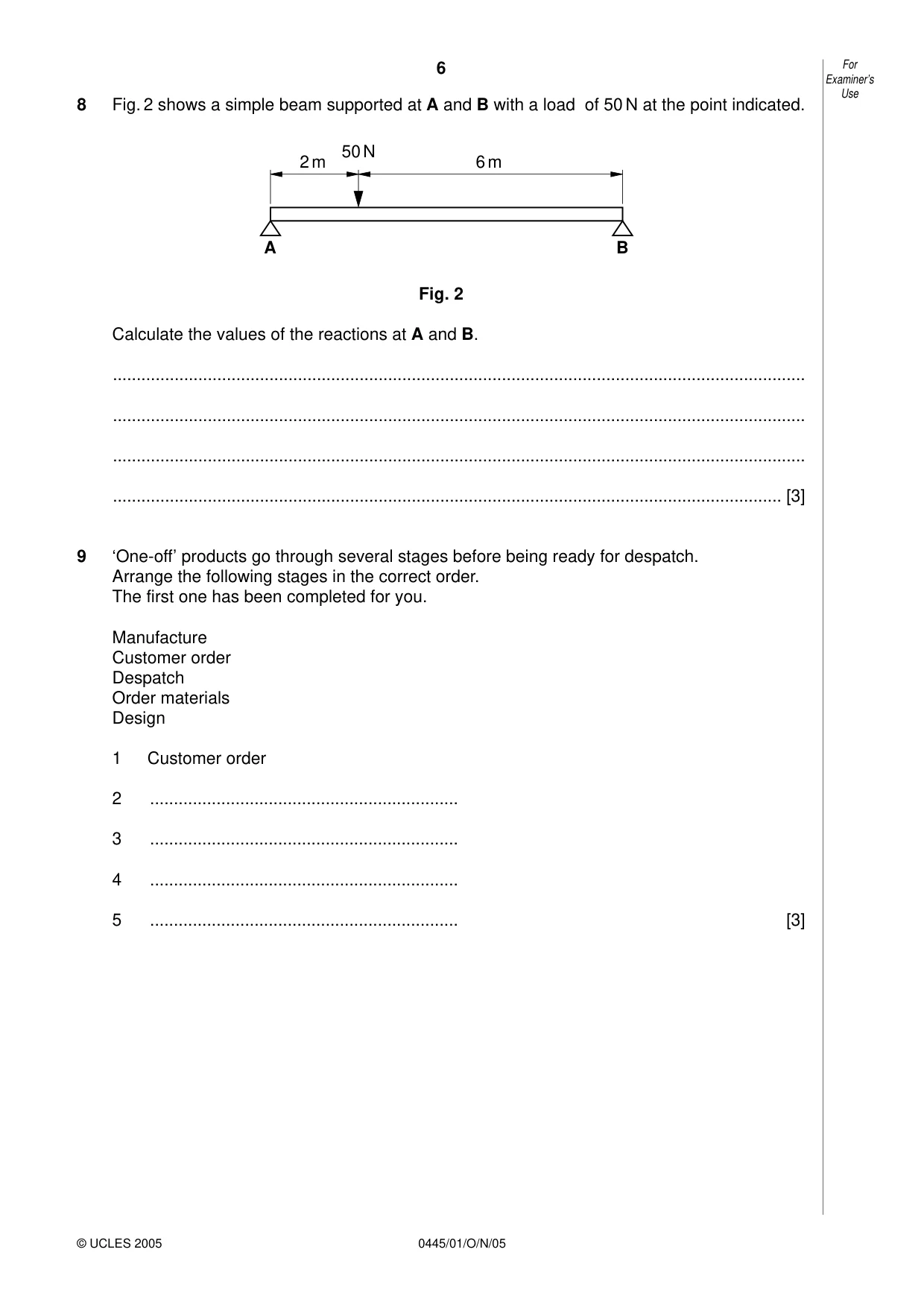
0445/01/O/N/05 6 8 Fig. 2 shows a simple beam supported at A and B with a load of 50 N at the point indicated. Fig. 2 Calculate the values of the reactions at A and B. … … … … [3] 9 ‘One-off’ products go through several stages before being ready for despatch. Arrange the following stages in the correct order. The first one has been completed for you. Manufacture Customer order Despatch Order materials Design 1 Customer order 2 … 3 … 4 … 5 … [3] For Examiner’s Use © UCLES 2005 A B 50 N 2 m 6 m
Question paper, page 7
0445/01/O/N/05 [Turn over 7 10 Use two examples to explain how anthropometric data would be used in the design of a chair. … … … … … … [4] For Examiner’s Use © UCLES 2005
Question paper, page 8
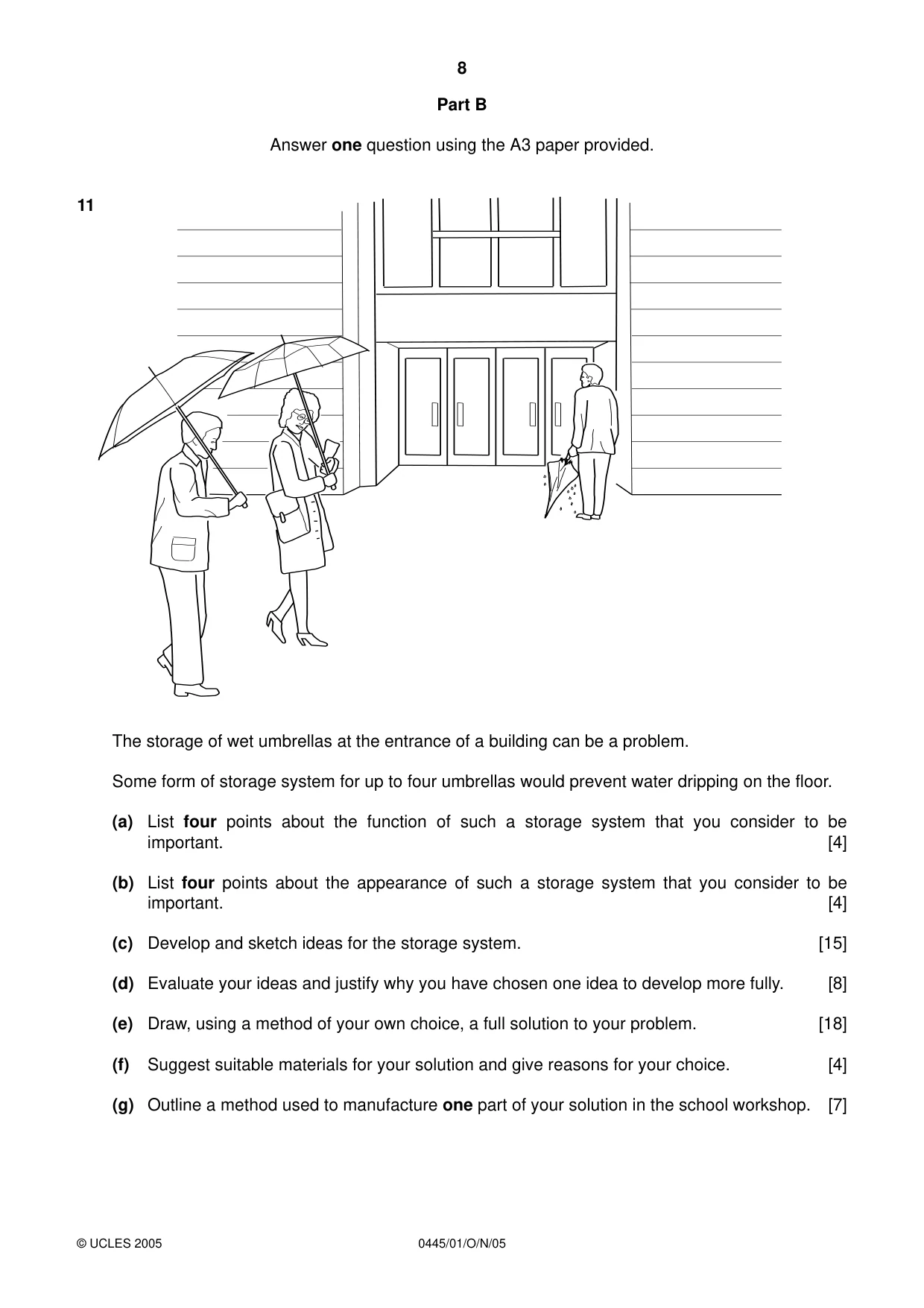
8 0445/01/O/N/05 Part B Answer one question using the A3 paper provided. 11 The storage of wet umbrellas at the entrance of a building can be a problem. Some form of storage system for up to four umbrellas would prevent water dripping on the floor. (a) List four points about the function of such a storage system that you consider to be important. [4] (b) List four points about the appearance of such a storage system that you consider to be important. [4] (c) Develop and sketch ideas for the storage system. [15] (d) Evaluate your ideas and justify why you have chosen one idea to develop more fully. [8] (e) Draw, using a method of your own choice, a full solution to your problem. [18] (f) Suggest suitable materials for your solution and give reasons for your choice. [4] (g) Outline a method used to manufacture one part of your solution in the school workshop. [7] © UCLES 2005
Question paper, page 9
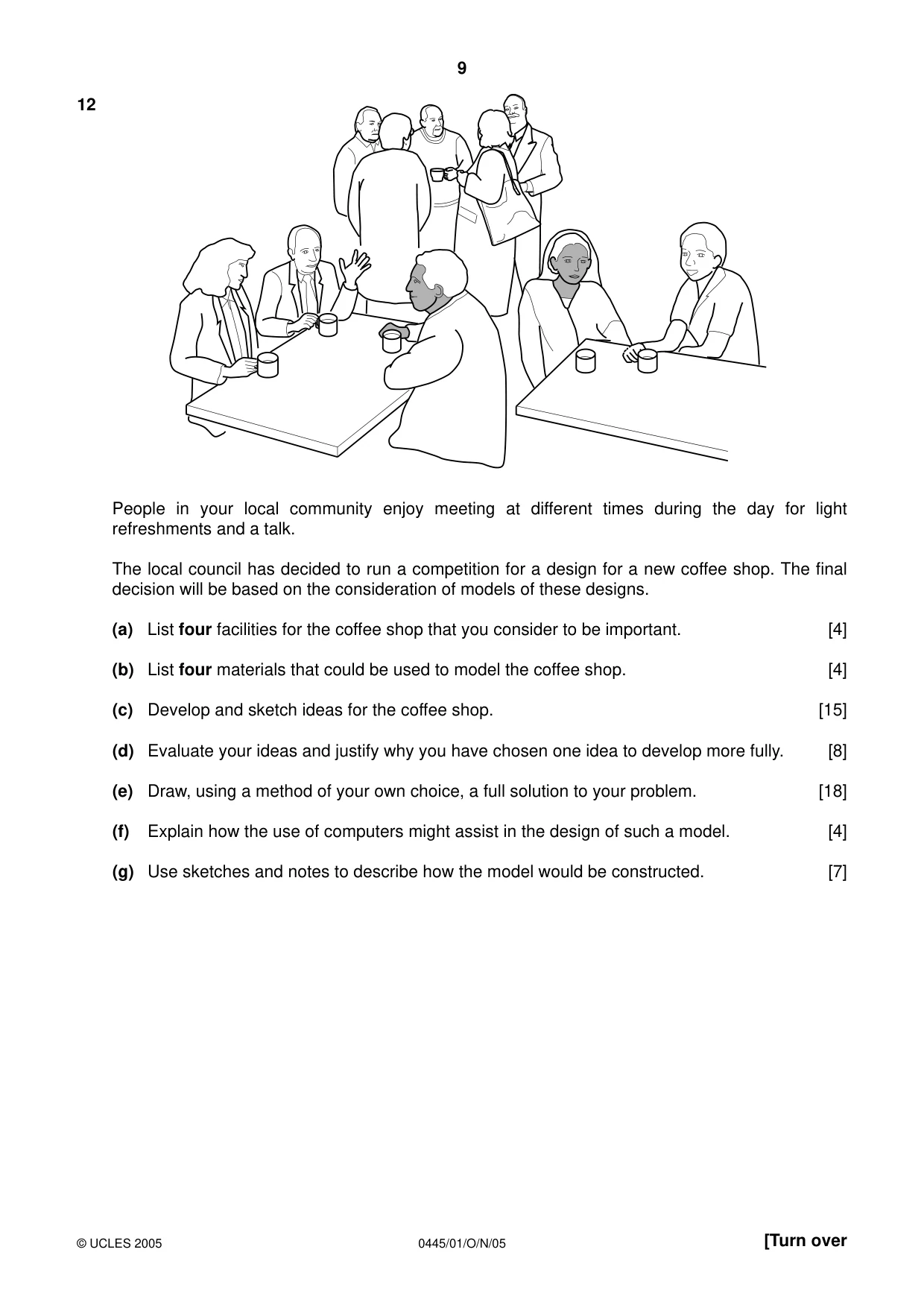
9 0445/01/O/N/05 [Turn over 12 People in your local community enjoy meeting at different times during the day for light refreshments and a talk. The local council has decided to run a competition for a design for a new coffee shop. The final decision will be based on the consideration of models of these designs. (a) List four facilities for the coffee shop that you consider to be important. [4] (b) List four materials that could be used to model the coffee shop. [4] (c) Develop and sketch ideas for the coffee shop. [15] (d) Evaluate your ideas and justify why you have chosen one idea to develop more fully. [8] (e) Draw, using a method of your own choice, a full solution to your problem. [18] (f) Explain how the use of computers might assist in the design of such a model. [4] (g) Use sketches and notes to describe how the model would be constructed. [7] © UCLES 2005
Question paper, page 10
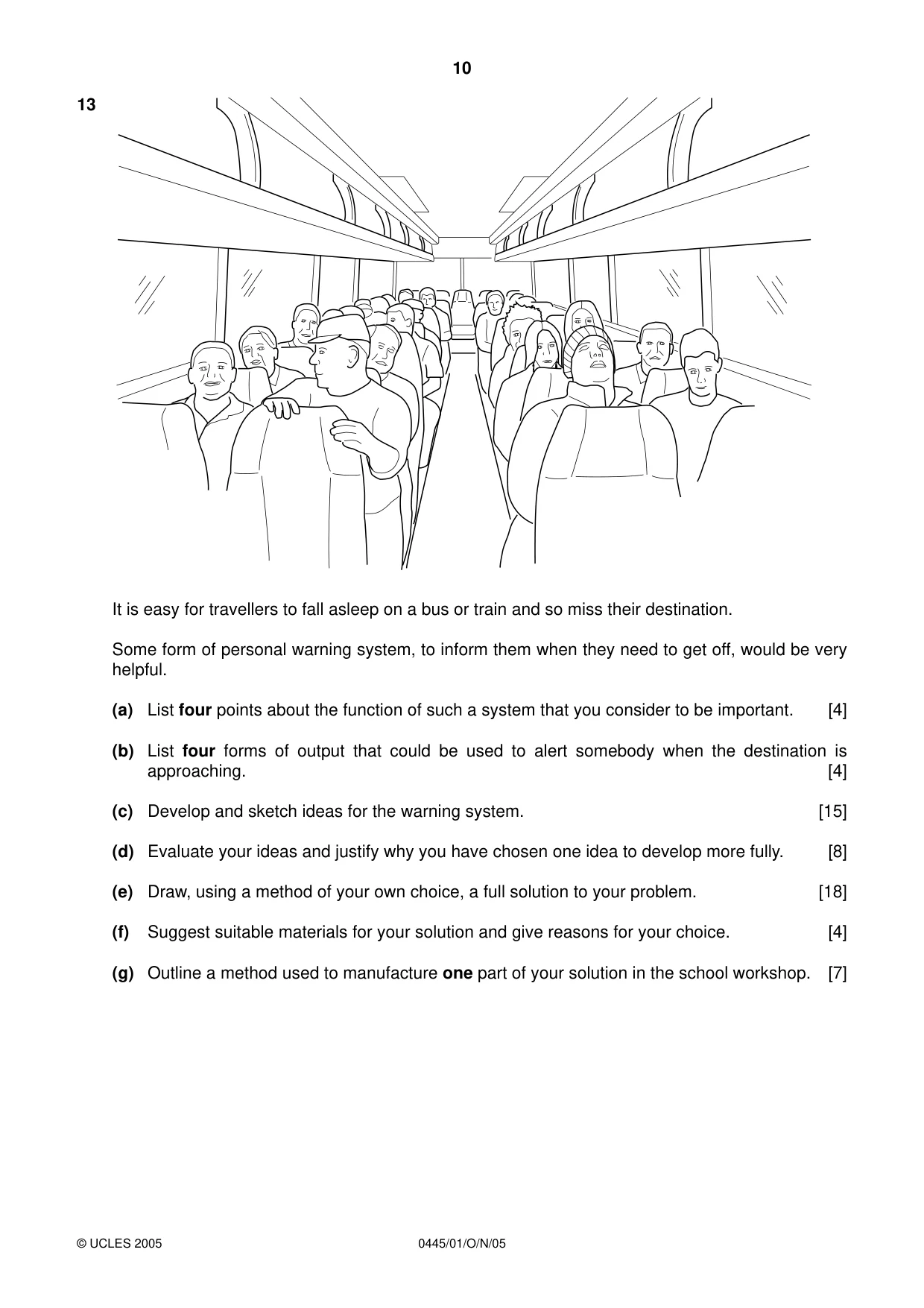
10 0445/01/O/N/05 13 It is easy for travellers to fall asleep on a bus or train and so miss their destination. Some form of personal warning system, to inform them when they need to get off, would be very helpful. (a) List four points about the function of such a system that you consider to be important. [4] (b) List four forms of output that could be used to alert somebody when the destination is approaching. [4] (c) Develop and sketch ideas for the warning system. [15] (d) Evaluate your ideas and justify why you have chosen one idea to develop more fully. [8] (e) Draw, using a method of your own choice, a full solution to your problem. [18] (f) Suggest suitable materials for your solution and give reasons for your choice. [4] (g) Outline a method used to manufacture one part of your solution in the school workshop. [7] © UCLES 2005
Question paper, page 11
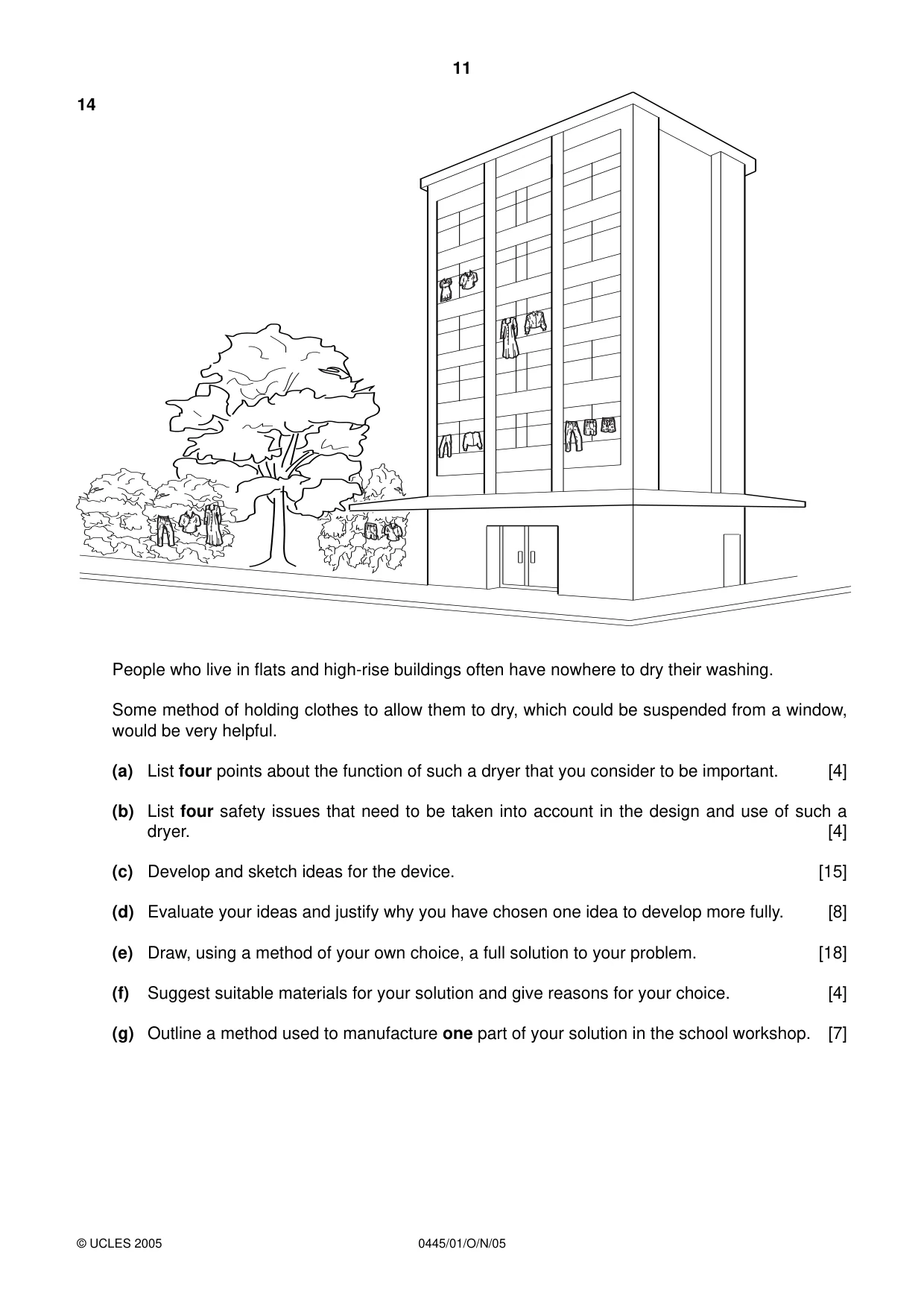
11 0445/01/O/N/05 14 People who live in flats and high-rise buildings often have nowhere to dry their washing. Some method of holding clothes to allow them to dry, which could be suspended from a window, would be very helpful. (a) List four points about the function of such a dryer that you consider to be important. [4] (b) List four safety issues that need to be taken into account in the design and use of such a dryer. [4] (c) Develop and sketch ideas for the device. [15] (d) Evaluate your ideas and justify why you have chosen one idea to develop more fully. [8] (e) Draw, using a method of your own choice, a full solution to your problem. [18] (f) Suggest suitable materials for your solution and give reasons for your choice. [4] (g) Outline a method used to manufacture one part of your solution in the school workshop. [7] © UCLES 2005
Question paper, page 12
12 0445/01/O/N/05 BLANK PAGE Every reasonable effort has been made to trace all copyright holders where the publishers (i.e. UCLES) are aware that third-party material has been reproduced. The publishers would be pleased to hear from anyone whose rights they have unwittingly infringed. University of Cambridge International Examinations is part of the University of Cambridge Local Examinations Syndicate (UCLES), which is itself a department of the University of Cambridge.
Mark scheme, page 1
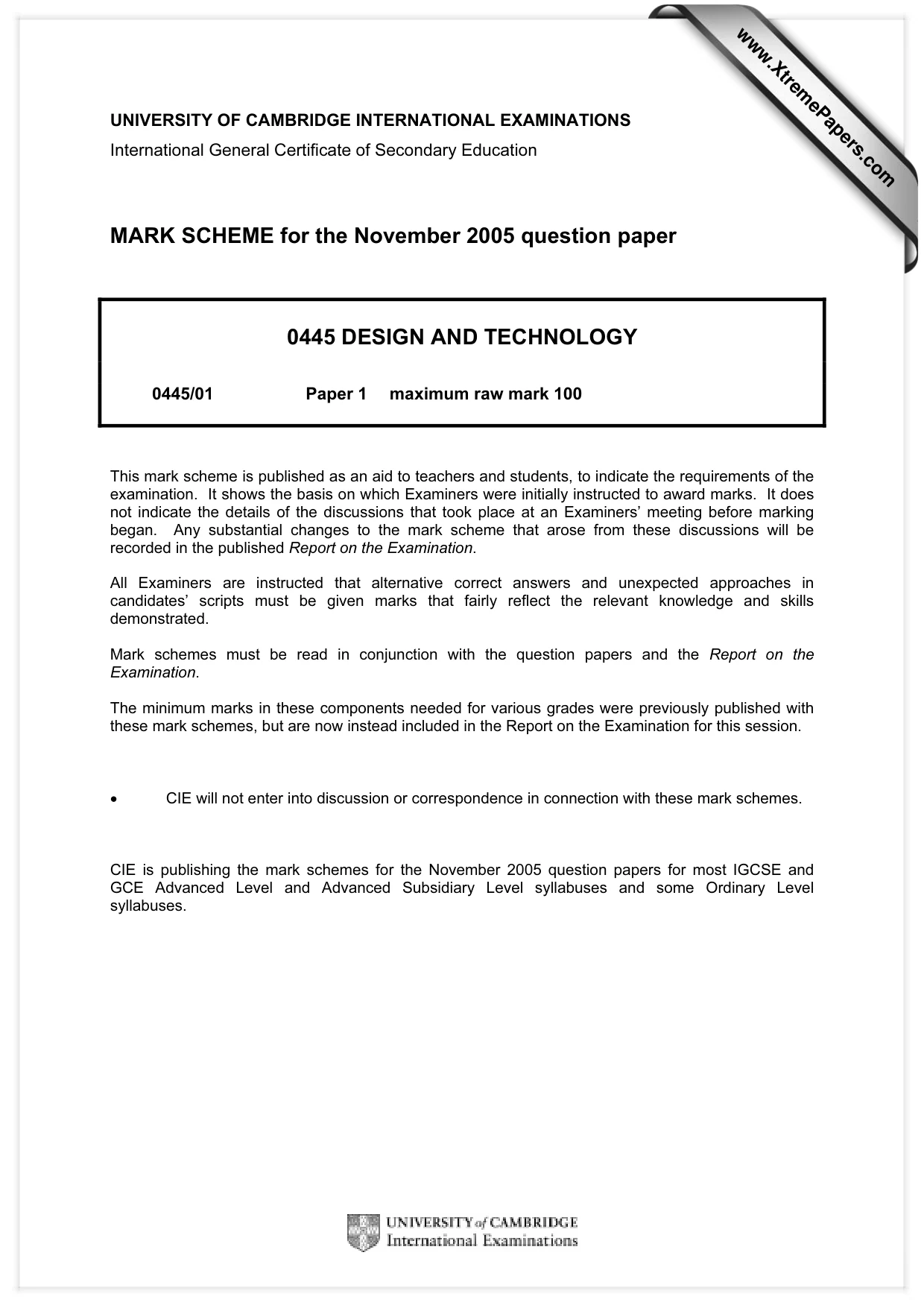
UNIVERSITY OF CAMBRIDGE INTERNATIONAL EXAMINATIONS International General Certificate of Secondary Education MARK SCHEME for the November 2005 question paper 0445 DESIGN AND TECHNOLOGY 0445/01 Paper 1 maximum raw mark 100 This mark scheme is published as an aid to teachers and students, to indicate the requirements of the examination. It shows the basis on which Examiners were initially instructed to award marks. It does not indicate the details of the discussions that took place at an Examiners’ meeting before marking began. Any substantial changes to the mark scheme that arose from these discussions will be recorded in the published Report on the Examination. All Examiners are instructed that alternative correct answers and unexpected approaches in candidates’ scripts must be given marks that fairly reflect the relevant knowledge and skills demonstrated. Mark schemes must be read in conjunction with the question papers and the Report on the Examination. The minimum marks in these components needed for various grades were previously published with these mark schemes, but are now instead included in the Report on the Examination for this session. • CIE will not enter into discussion or correspondence in connection with these mark schemes. CIE is publishing the mark schemes for the November 2005 question papers for most IGCSE and GCE Advanced Level and Advanced Subsidiary Level syllabuses and some Ordinary Level syllabuses. www.XtremePapers.com
Mark scheme, page 2
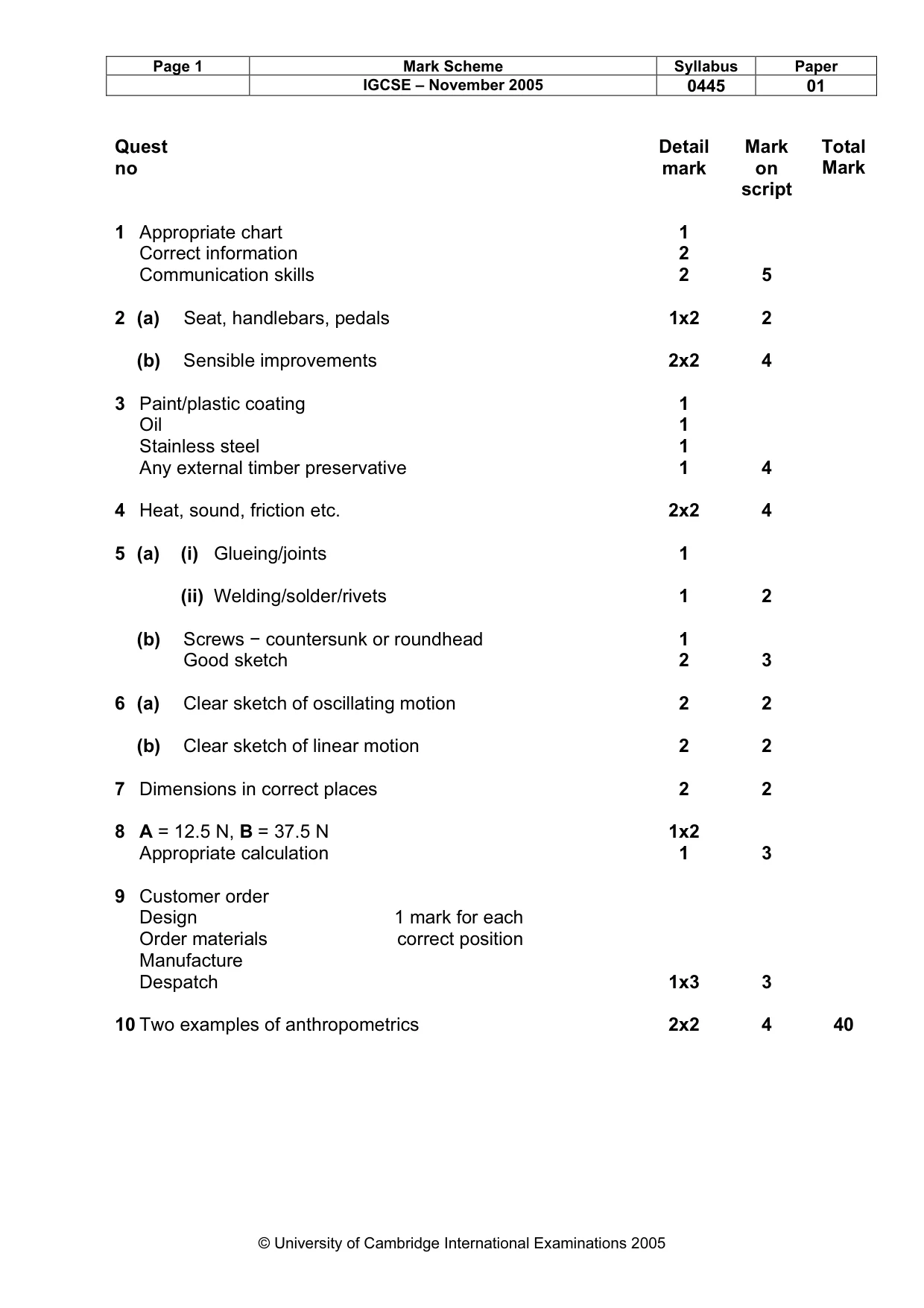
Page 1 Mark Scheme Syllabus Paper IGCSE – November 2005 0445 01 © University of Cambridge International Examinations 2005 Quest no Detail mark Mark on script Total Mark 1 Appropriate chart Correct information Communication skills 1 2 2 5 2 (a) Seat, handlebars, pedals 1x2 2 (b) Sensible improvements 2x2 4 3 Paint/plastic coating 1 Oil 1 Stainless steel 1 Any external timber preservative 1 4 4 Heat, sound, friction etc. 2x2 4 5 (a) (i) Glueing/joints 1 (ii) Welding/solder/rivets 1 2 (b) Screws − countersunk or roundhead 1 Good sketch 2 3 6 (a) Clear sketch of oscillating motion 2 2 (b) Clear sketch of linear motion 2 2 7 Dimensions in correct places 2 2 8 A = 12.5 N, B = 37.5 N 1x2 Appropriate calculation 1 3 9 Customer order Design 1 mark for each Order materials correct position Manufacture Despatch 1x3 3 10 Two examples of anthropometrics 2x2 4 40
Mark scheme, page 3
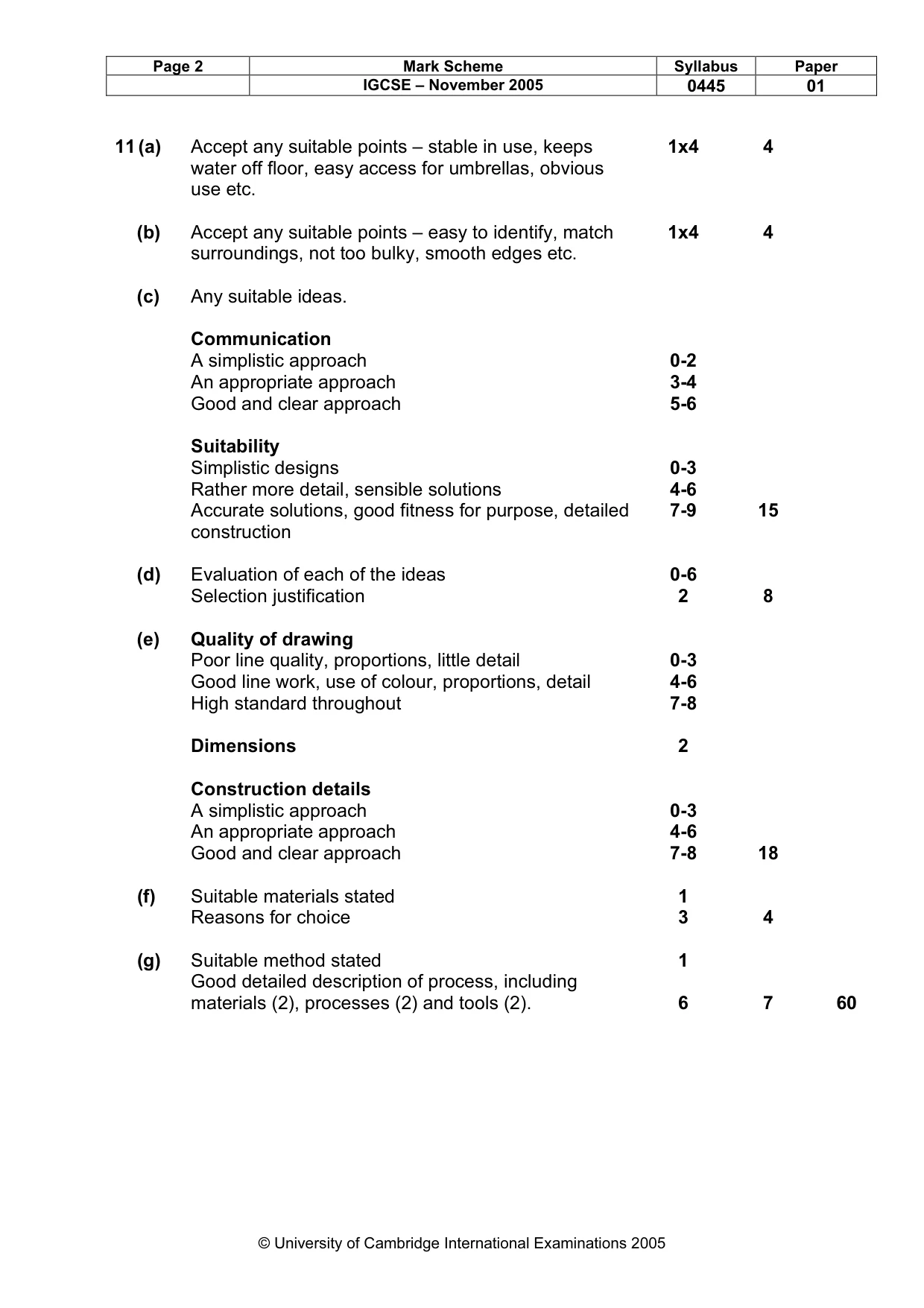
Page 2 Mark Scheme Syllabus Paper IGCSE – November 2005 0445 01 © University of Cambridge International Examinations 2005 11 (a) Accept any suitable points – stable in use, keeps water off floor, easy access for umbrellas, obvious use etc. 1x4 4 (b) Accept any suitable points – easy to identify, match surroundings, not too bulky, smooth edges etc. 1x4 4 (c) Any suitable ideas. Communication A simplistic approach An appropriate approach Good and clear approach 0-2 3-4 5-6 Suitability Simplistic designs Rather more detail, sensible solutions Accurate solutions, good fitness for purpose, detailed construction 0-3 4-6 7-9 15 (d) Evaluation of each of the ideas 0-6 Selection justification 2 8 (e) Quality of drawing Poor line quality, proportions, little detail Good line work, use of colour, proportions, detail High standard throughout Dimensions Construction details A simplistic approach An appropriate approach Good and clear approach 0-3 4-6 7-8 2 0-3 4-6 7-8 18 (f) Suitable materials stated 1 Reasons for choice 3 4 (g) Suitable method stated Good detailed description of process, including materials (2), processes (2) and tools (2). 1 6 7 60
Mark scheme, page 4
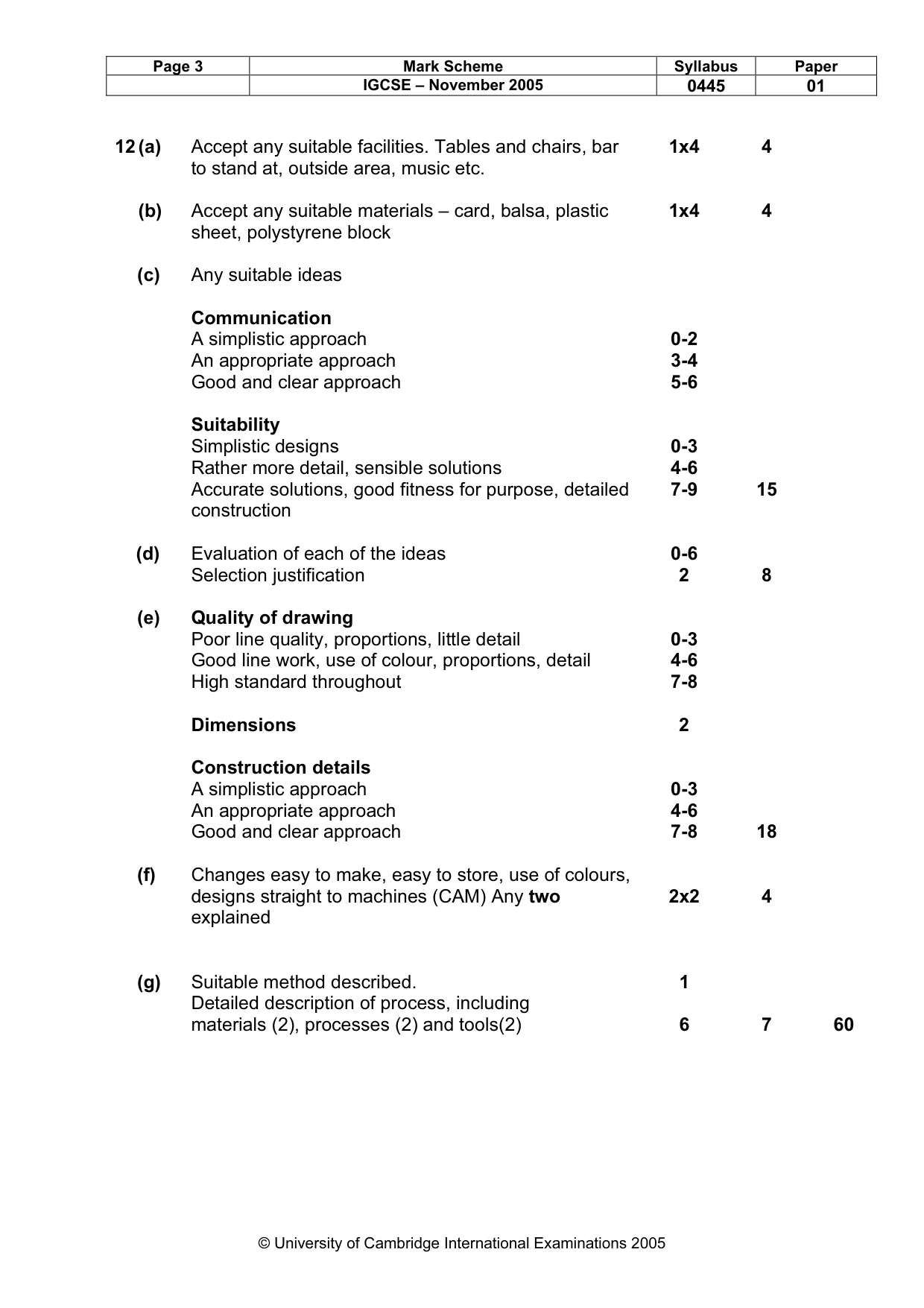
Page 3 Mark Scheme Syllabus Paper IGCSE – November 2005 0445 01 © University of Cambridge International Examinations 2005 12 (a) Accept any suitable facilities. Tables and chairs, bar to stand at, outside area, music etc. 1x4 4 (b) Accept any suitable materials – card, balsa, plastic sheet, polystyrene block 1x4 4 (c) Any suitable ideas Communication A simplistic approach An appropriate approach Good and clear approach 0-2 3-4 5-6 Suitability Simplistic designs Rather more detail, sensible solutions Accurate solutions, good fitness for purpose, detailed construction 0-3 4-6 7-9 15 (d) Evaluation of each of the ideas 0-6 Selection justification 2 8 (e) Quality of drawing Poor line quality, proportions, little detail Good line work, use of colour, proportions, detail High standard throughout Dimensions Construction details A simplistic approach An appropriate approach Good and clear approach 0-3 4-6 7-8 2 0-3 4-6 7-8 18 (f) Changes easy to make, easy to store, use of colours, designs straight to machines (CAM) Any two explained 2x2 4 (g) Suitable method described. Detailed description of process, including materials (2), processes (2) and tools(2) 1 6 7 60
Mark scheme, page 5
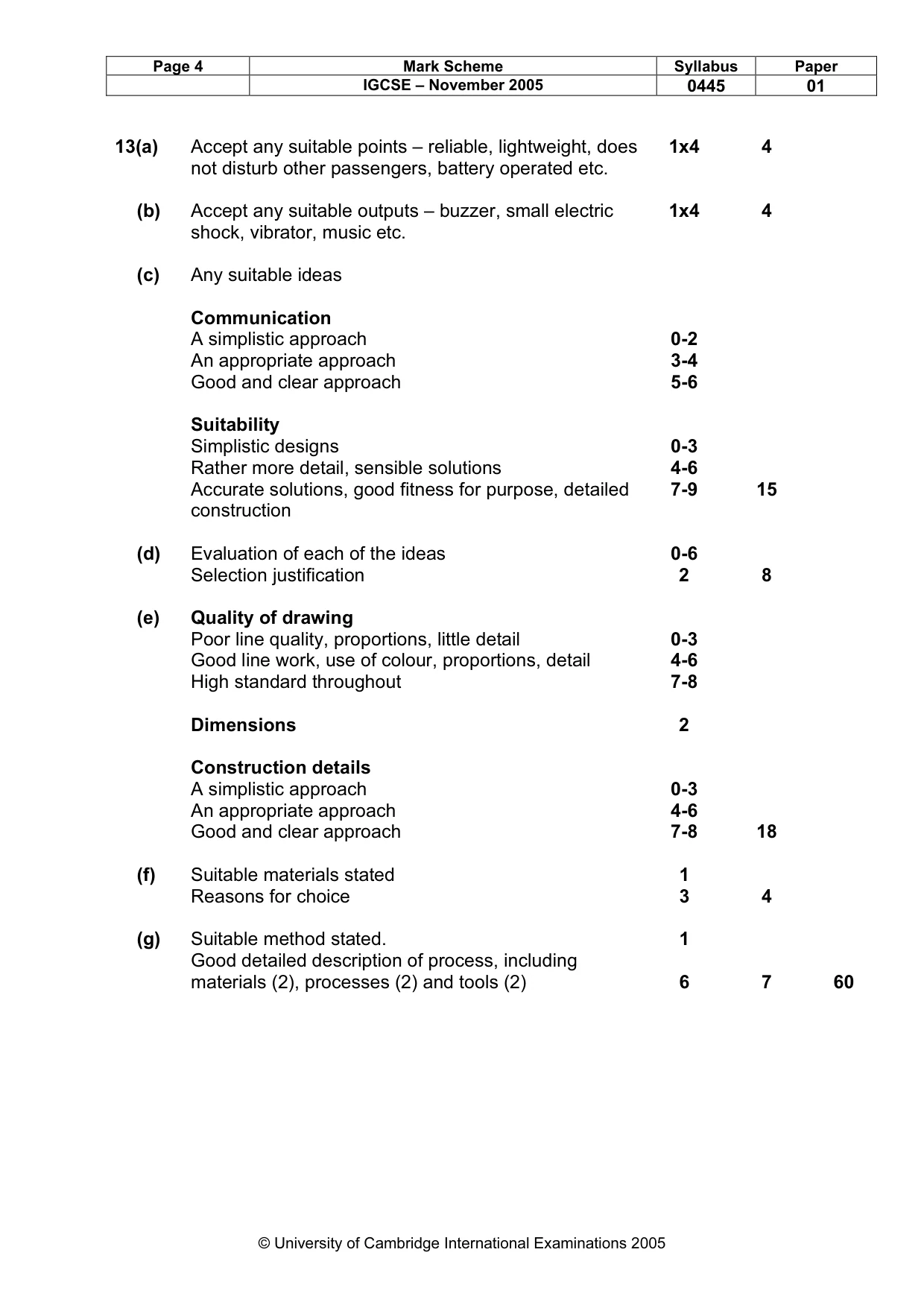
Page 4 Mark Scheme Syllabus Paper IGCSE – November 2005 0445 01 © University of Cambridge International Examinations 2005 13(a) Accept any suitable points – reliable, lightweight, does not disturb other passengers, battery operated etc. 1x4 4 (b) Accept any suitable outputs – buzzer, small electric shock, vibrator, music etc. 1x4 4 (c) Any suitable ideas Communication A simplistic approach An appropriate approach Good and clear approach 0-2 3-4 5-6 Suitability Simplistic designs Rather more detail, sensible solutions Accurate solutions, good fitness for purpose, detailed construction 0-3 4-6 7-9 15 (d) Evaluation of each of the ideas 0-6 Selection justification 2 8 (e) Quality of drawing Poor line quality, proportions, little detail Good line work, use of colour, proportions, detail High standard throughout Dimensions Construction details A simplistic approach An appropriate approach Good and clear approach 0-3 4-6 7-8 2 0-3 4-6 7-8 18 (f) Suitable materials stated 1 Reasons for choice 3 4 (g) Suitable method stated. Good detailed description of process, including materials (2), processes (2) and tools (2) 1 6 7 60
Mark scheme, page 6
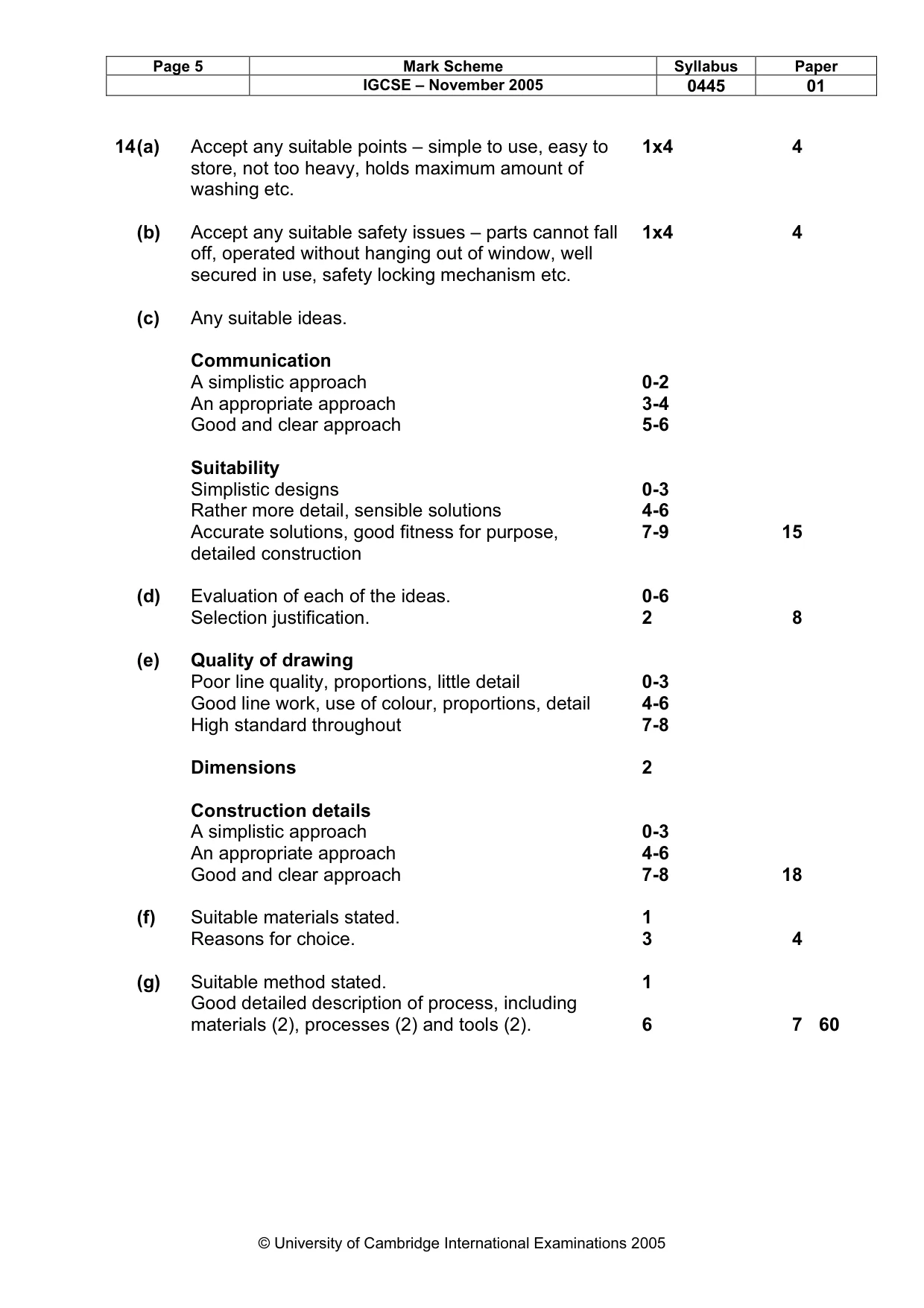
Page 5 Mark Scheme Syllabus Paper IGCSE – November 2005 0445 01 © University of Cambridge International Examinations 2005 14 (a) Accept any suitable points – simple to use, easy to store, not too heavy, holds maximum amount of washing etc. 1x4 4 (b) Accept any suitable safety issues – parts cannot fall off, operated without hanging out of window, well secured in use, safety locking mechanism etc. 1x4 4 (c) Any suitable ideas. Communication A simplistic approach An appropriate approach Good and clear approach 0-2 3-4 5-6 Suitability Simplistic designs Rather more detail, sensible solutions Accurate solutions, good fitness for purpose, detailed construction 0-3 4-6 7-9 15 (d) Evaluation of each of the ideas. 0-6 Selection justification. 2 8 (e) Quality of drawing Poor line quality, proportions, little detail Good line work, use of colour, proportions, detail High standard throughout Dimensions Construction details A simplistic approach An appropriate approach Good and clear approach 0-3 4-6 7-8 2 0-3 4-6 7-8 18 (f) Suitable materials stated. 1 Reasons for choice. 3 4 (g) Suitable method stated. Good detailed description of process, including materials (2), processes (2) and tools (2). 1 6 7 60