Cambridge IGCSE Computer Studies 0420 — 2012 Oct/Nov Paper 1 · Variant 2
0420/12/O/N/12 · 100 marks · ≈113 min
The question paper and its mark scheme, free to read here and free to download. This is Cambridge’s own paper, exactly as it was sat.
Question paper20 pages




Mark scheme12 pages
Answers below. Sit the paper first if you are practising.
Paper as text
Question paper, page 1
This document consists of 19 printed pages and 1 blank page. IB12 11_0420_12/FP © UCLES 2012 [Turn over *5263966857* For Examiner's Use UNIVERSITY OF CAMBRIDGE INTERNATIONAL EXAMINATIONS International General Certificate of Secondary Education COMPUTER STUDIES 0420/12 Paper 1 October/November 2012 2 hours 30 minutes Candidates answer on the Question Paper. No Additional Materials are required. READ THESE INSTRUCTIONS FIRST Write your Centre number, candidate number and name on all the work you hand in. Write in dark blue or black pen. You may use a soft pencil for any diagrams, graphs or rough working. Do not use staples, paper clips, highlighters, glue or correction fluid. DO NOT WRITE IN ANY BARCODES. Answer all questions. No marks will be awarded for using brand names of software packages or hardware. At the end of the examination, fasten all your work securely together. The number of marks is given in brackets [ ] at the end of each question or part question. www.XtremePapers.com
Question paper, page 2
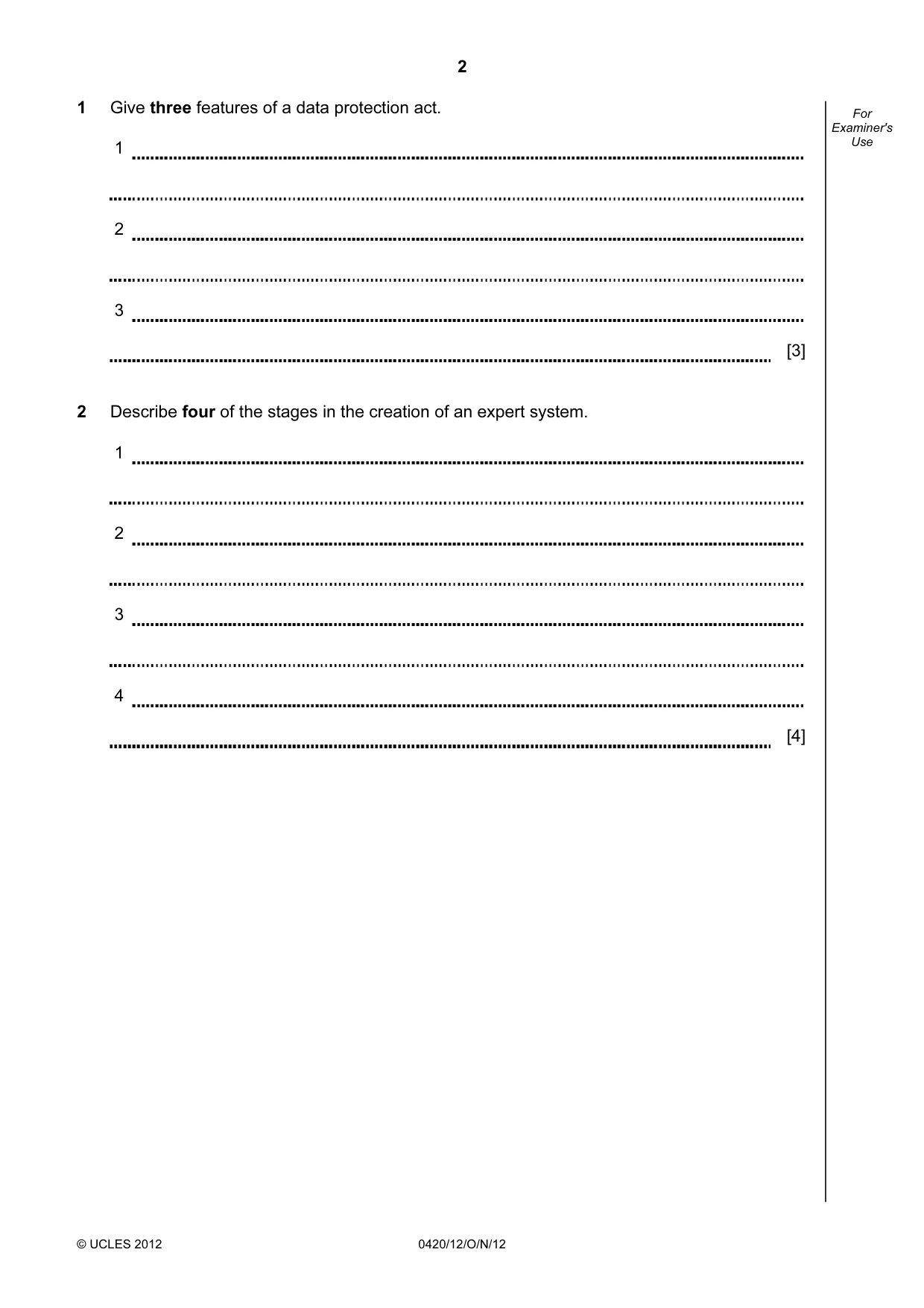
2 © UCLES 2012 0420/12/O/N/12 For Examiner's Use 1 Give three features of a data protection act. 1 2 3 [3] 2 Describe four of the stages in the creation of an expert system. 1 2 3 4 [4]
Question paper, page 3
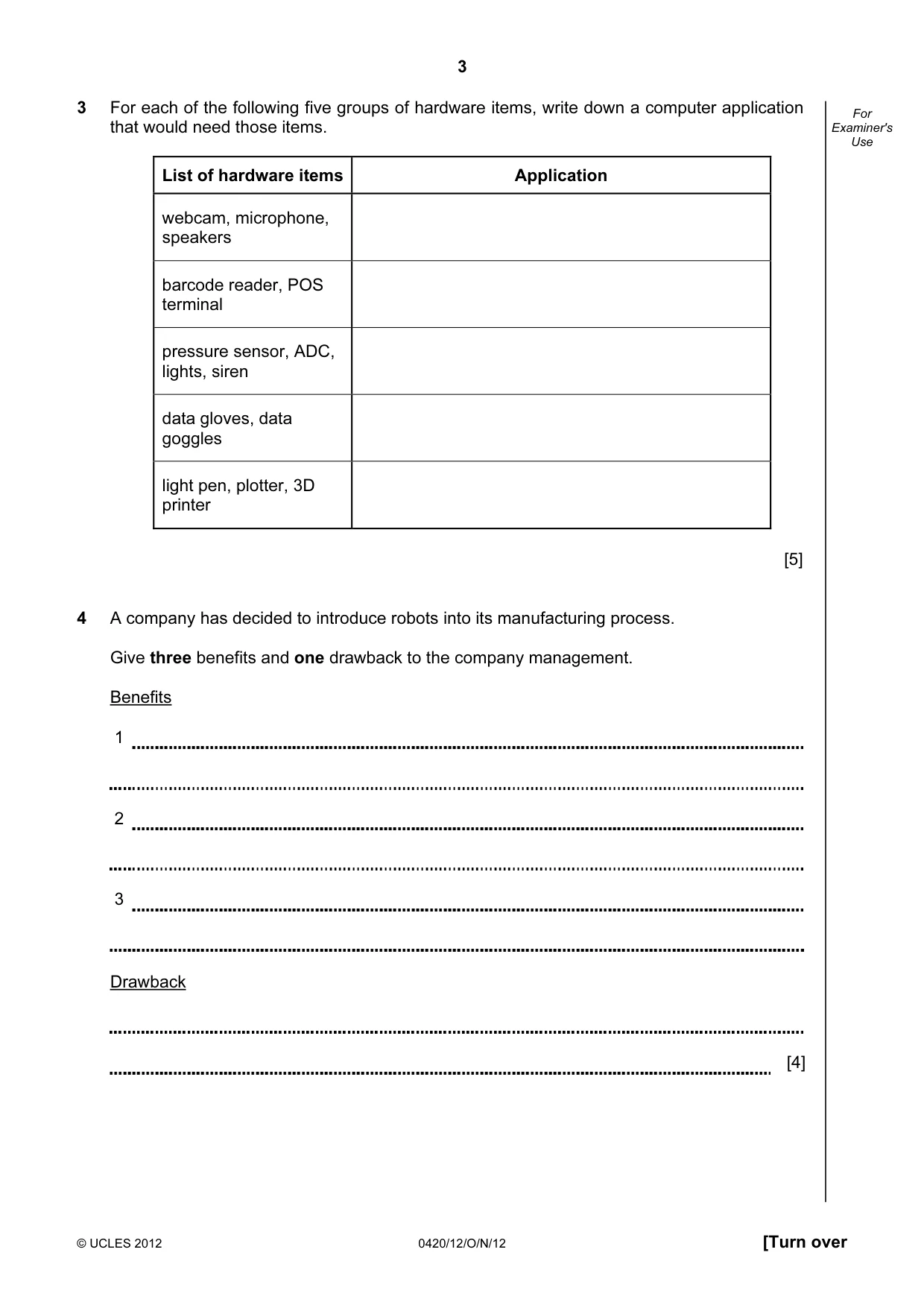
3 © UCLES 2012 0420/12/O/N/12 [Turn over For Examiner's Use 3 For each of the following five groups of hardware items, write down a computer application that would need those items. List of hardware items Application webcam, microphone, speakers barcode reader, POS terminal pressure sensor, ADC, lights, siren data gloves, data goggles light pen, plotter, 3D printer [5] 4 A company has decided to introduce robots into its manufacturing process. Give three benefits and one drawback to the company management. Benefits 1 2 3 Drawback [4]
Question paper, page 4
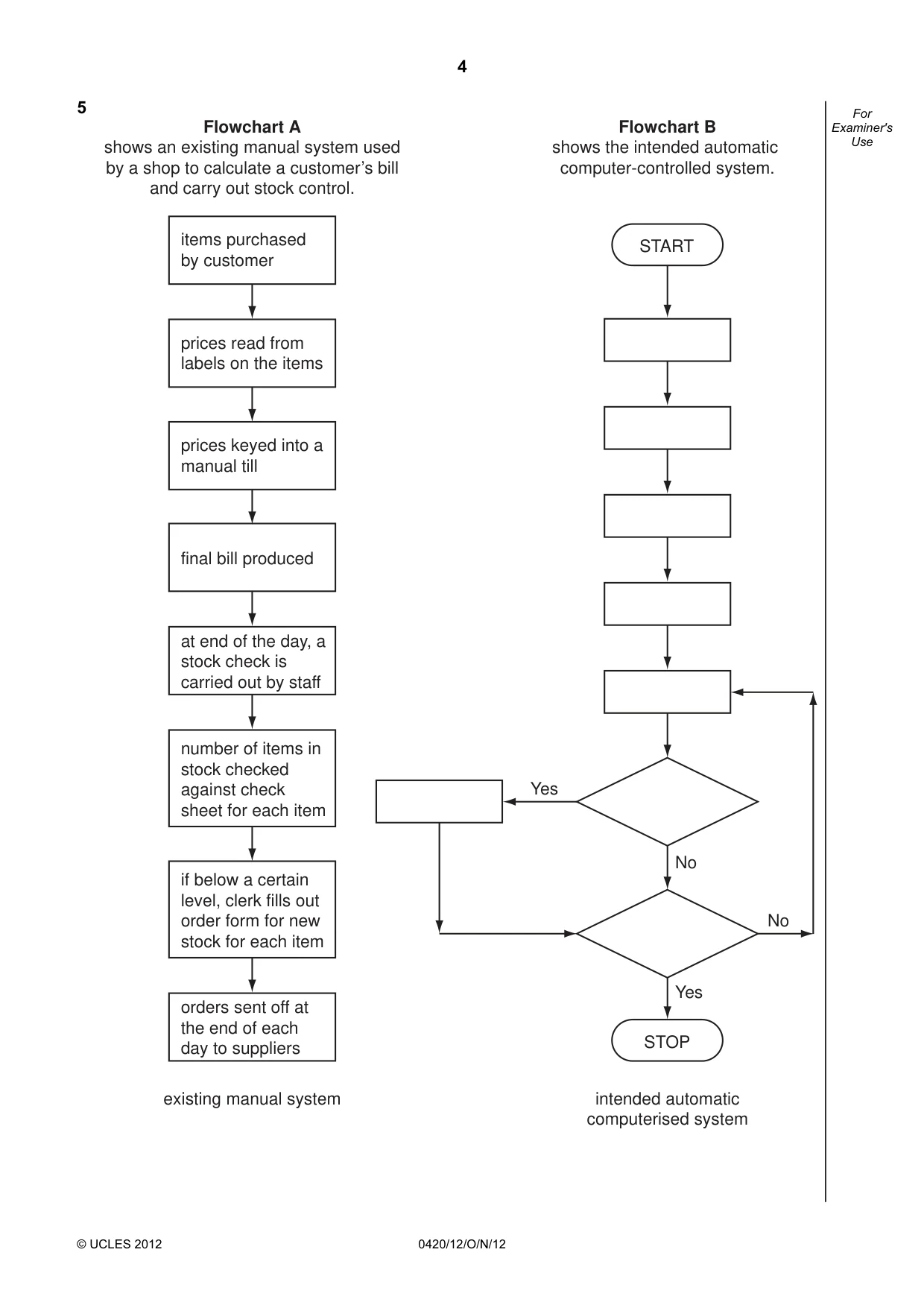
4 © UCLES 2012 0420/12/O/N/12 For Examiner's Use 5 START Flowchart B shows the intended automatic computer-controlled system. intended automatic computerised system Flowchart A shows an existing manual system used by a shop to calculate a customer’s bill and carry out stock control. existing manual system STOP items purchased by customer prices read from labels on the items prices keyed into a manual till at end of the day, a stock check is carried out by staff orders sent off at the end of each day to suppliers number of items in stock checked against check sheet for each item if below a certain level, clerk fills out order form for new stock for each item final bill produced Yes No Yes No
Question paper, page 5
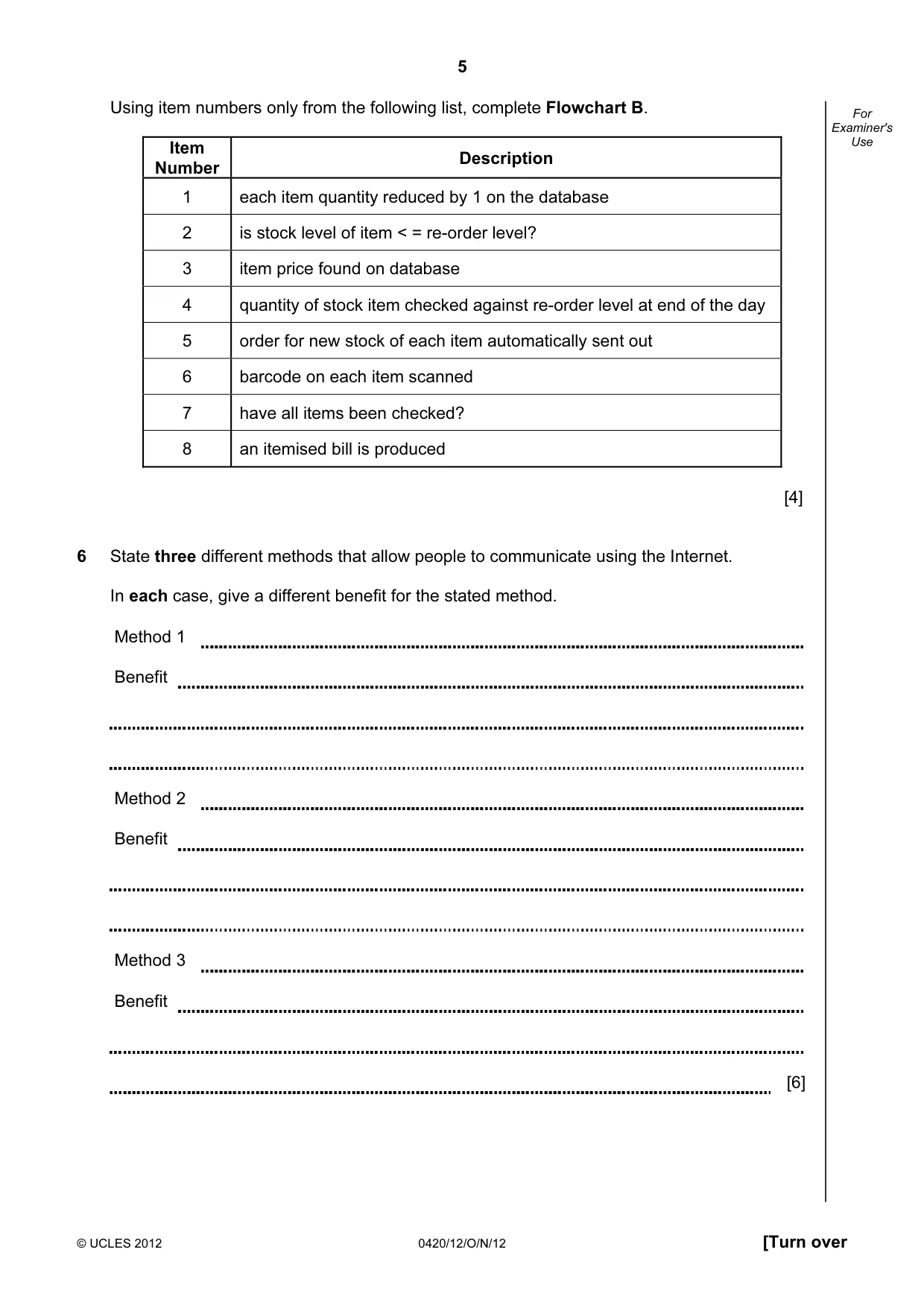
5 © UCLES 2012 0420/12/O/N/12 [Turn over For Examiner's Use Using item numbers only from the following list, complete Flowchart B. Item Number Description 1 each item quantity reduced by 1 on the database 2 is stock level of item < = re-order level? 3 item price found on database 4 quantity of stock item checked against re-order level at end of the day 5 order for new stock of each item automatically sent out 6 barcode on each item scanned 7 have all items been checked? 8 an itemised bill is produced [4] 6 State three different methods that allow people to communicate using the Internet. In each case, give a different benefit for the stated method. Method 1 Benefit Method 2 Benefit Method 3 Benefit [6]
Question paper, page 6
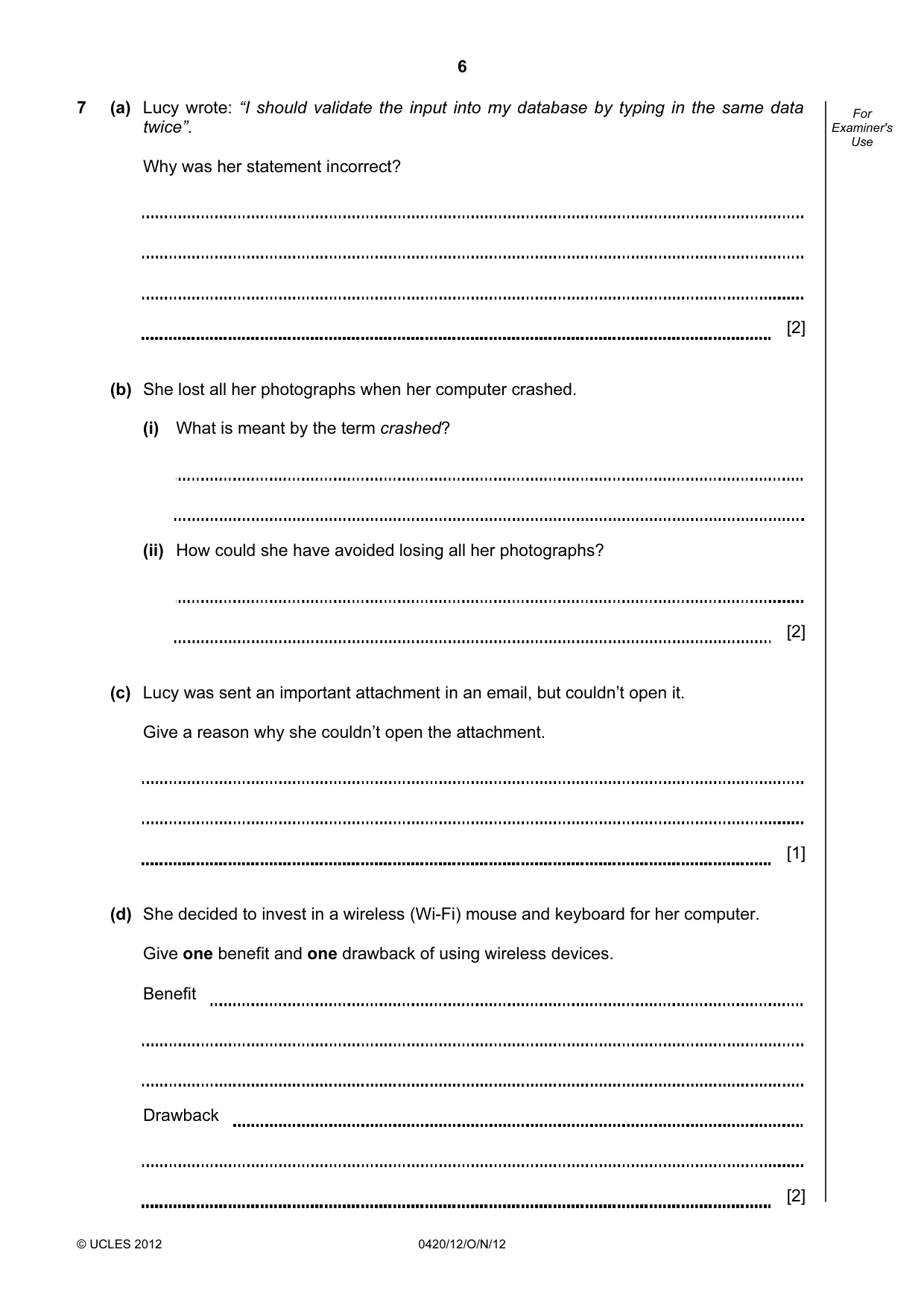
6 © UCLES 2012 0420/12/O/N/12 For Examiner's Use 7 (a) Lucy wrote: “I should validate the input into my database by typing in the same data twice”. Why was her statement incorrect? [2] (b) She lost all her photographs when her computer crashed. (i) What is meant by the term crashed? (ii) How could she have avoided losing all her photographs? [2] (c) Lucy was sent an important attachment in an email, but couldn’t open it. Give a reason why she couldn’t open the attachment. [1] (d) She decided to invest in a wireless (Wi-Fi) mouse and keyboard for her computer. Give one benefit and one drawback of using wireless devices. Benefit Drawback [2]
Question paper, page 7
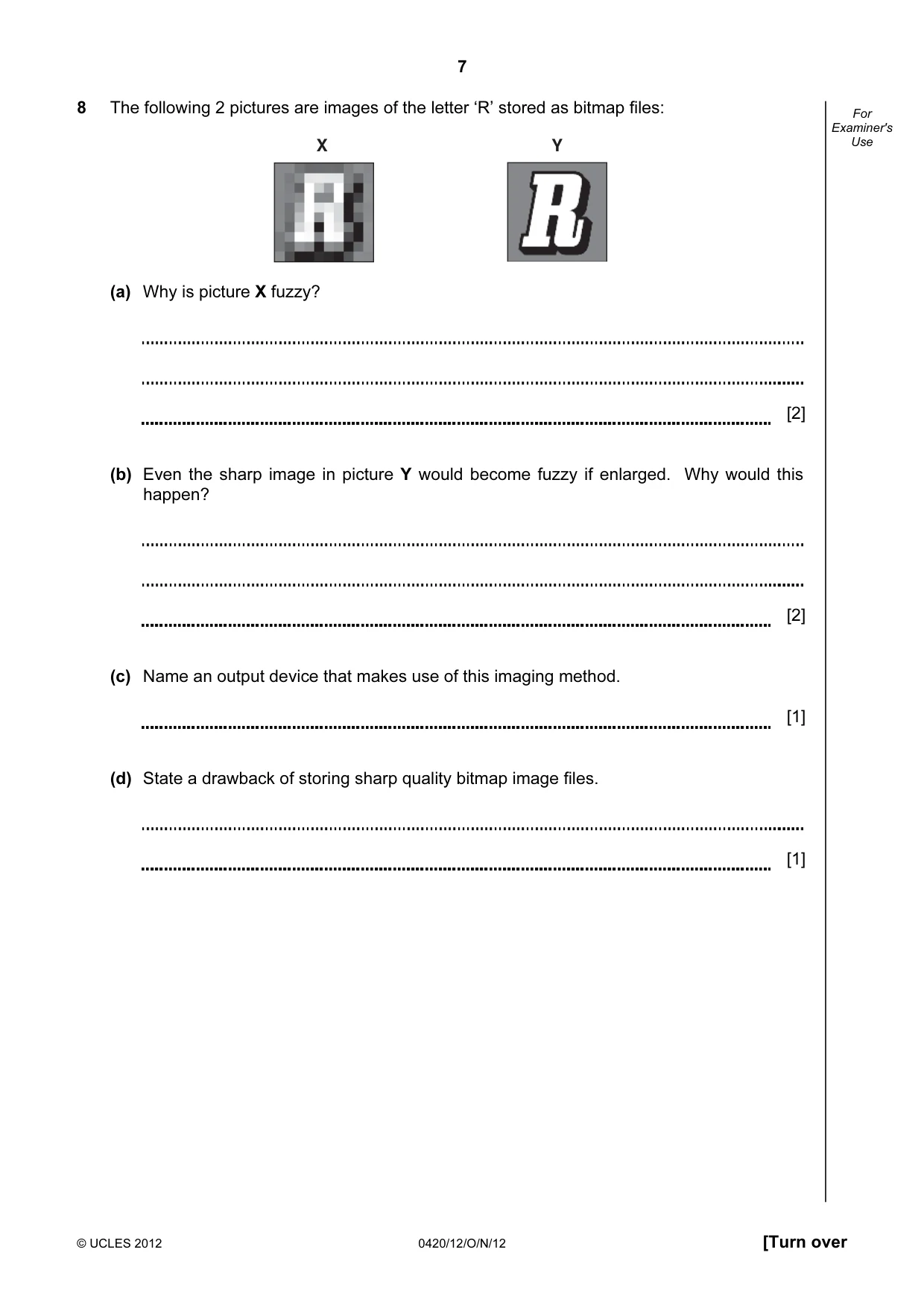
7 © UCLES 2012 0420/12/O/N/12 [Turn over For Examiner's Use 8 The following 2 pictures are images of the letter ‘R’ stored as bitmap files: X Y (a) Why is picture X fuzzy? [2] (b) Even the sharp image in picture Y would become fuzzy if enlarged. Why would this happen? [2] (c) Name an output device that makes use of this imaging method. [1] (d) State a drawback of storing sharp quality bitmap image files. [1]
Question paper, page 8
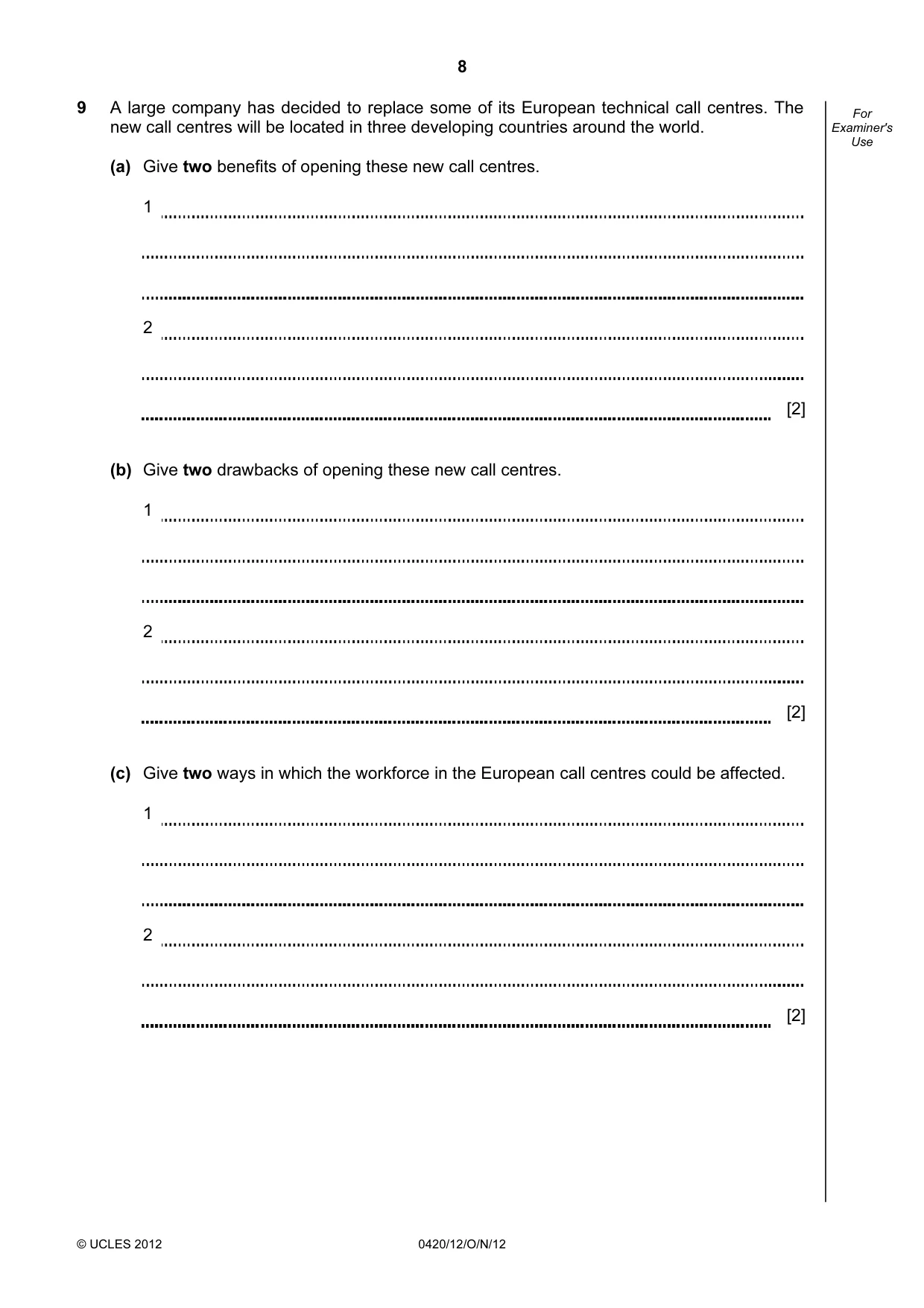
8 © UCLES 2012 0420/12/O/N/12 For Examiner's Use 9 A large company has decided to replace some of its European technical call centres. The new call centres will be located in three developing countries around the world. (a) Give two benefits of opening these new call centres. 1 2 [2] (b) Give two drawbacks of opening these new call centres. 1 2 [2] (c) Give two ways in which the workforce in the European call centres could be affected. 1 2 [2]
Question paper, page 9
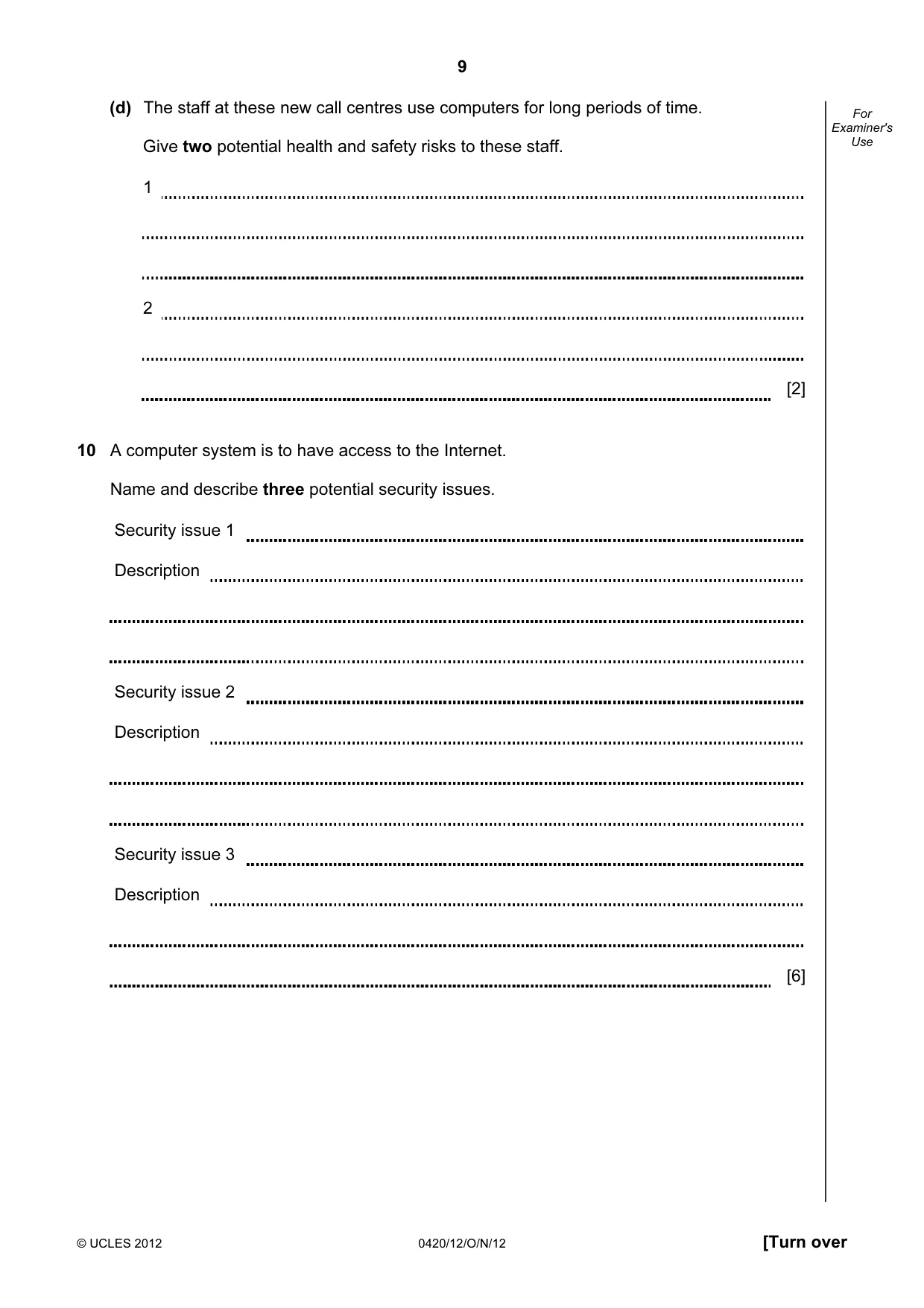
9 © UCLES 2012 0420/12/O/N/12 [Turn over For Examiner's Use (d) The staff at these new call centres use computers for long periods of time. Give two potential health and safety risks to these staff. 1 2 [2] 10 A computer system is to have access to the Internet. Name and describe three potential security issues. Security issue 1 Description Security issue 2 Description Security issue 3 Description [6]
Question paper, page 10
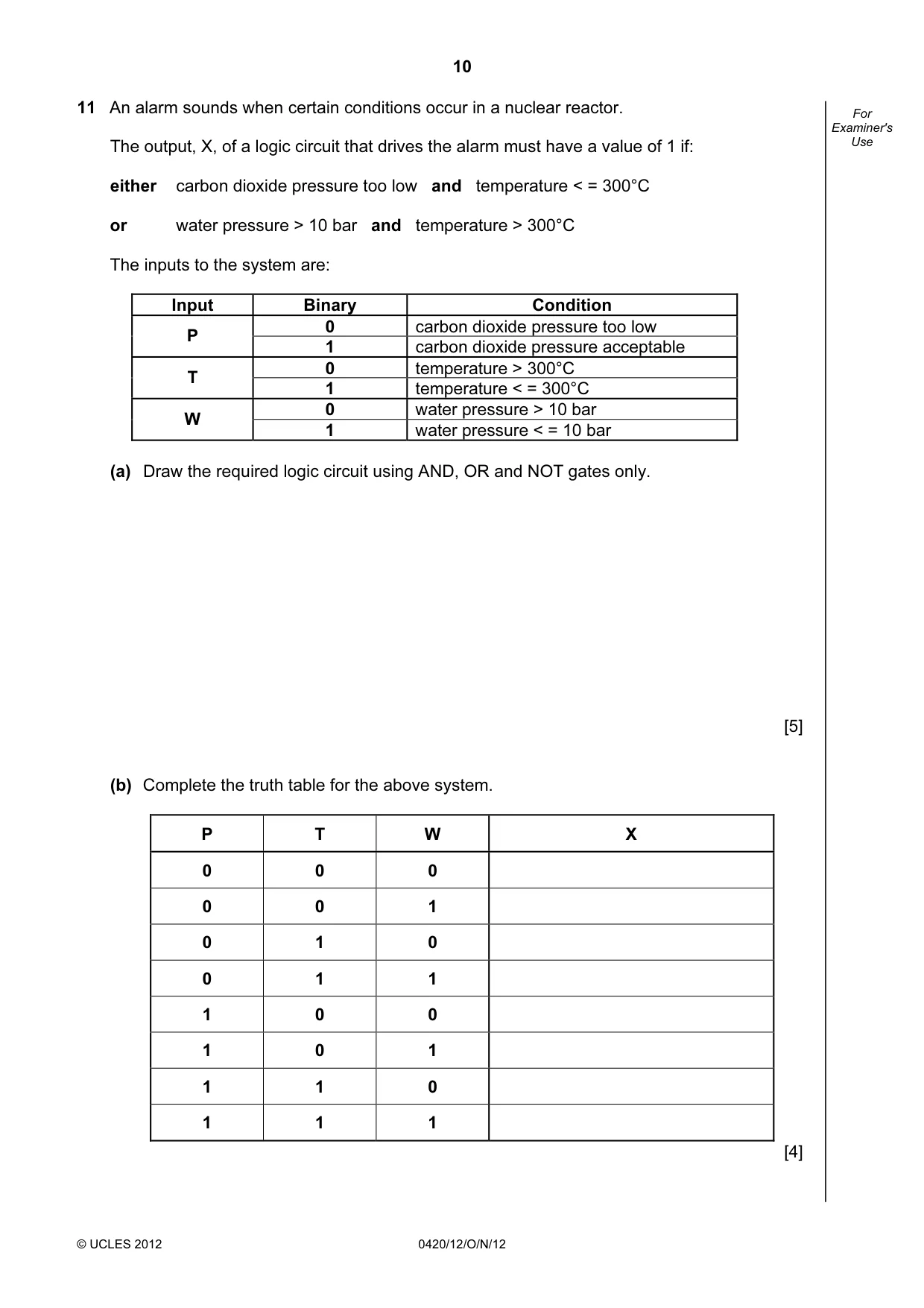
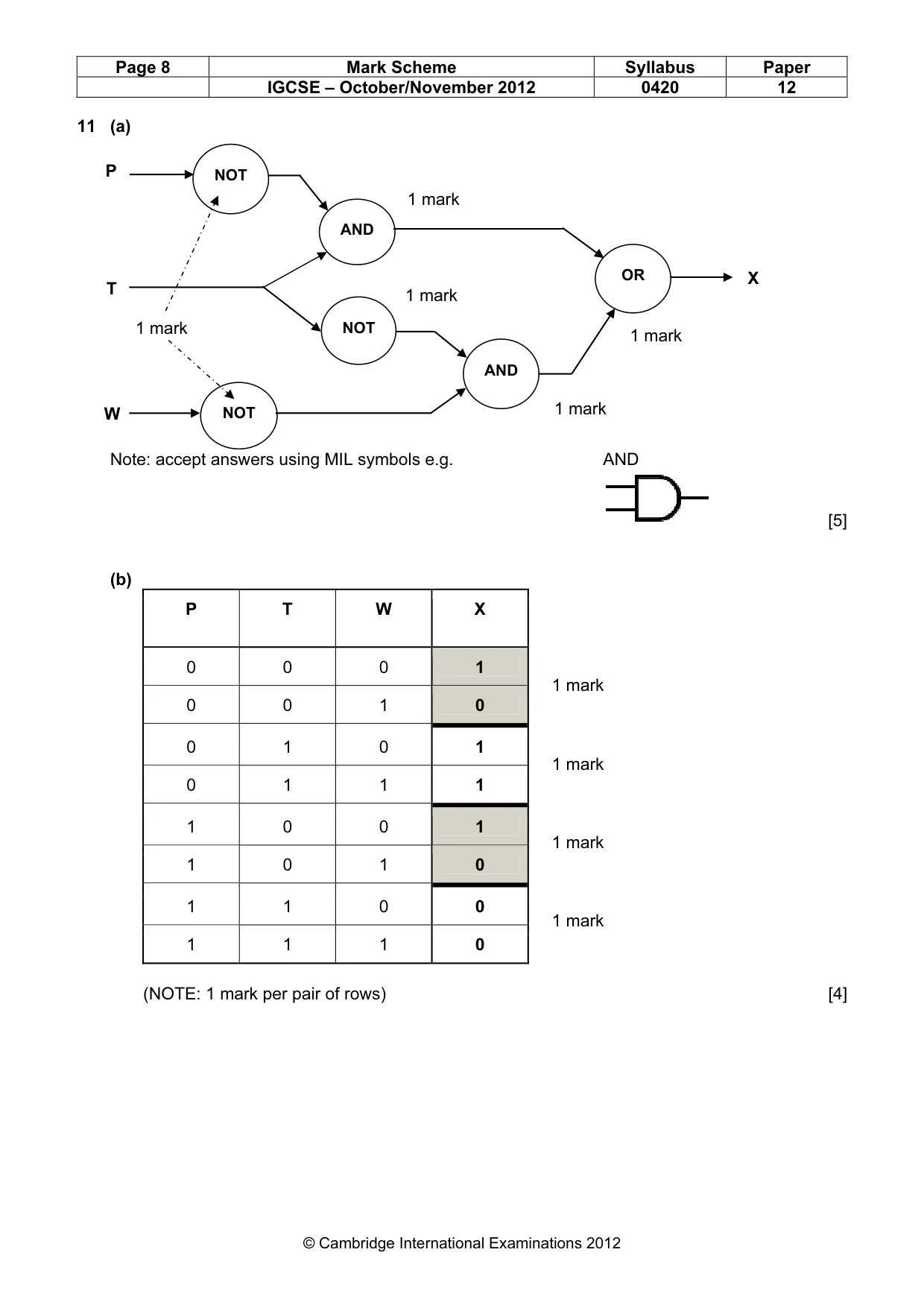
10 © UCLES 2012 0420/12/O/N/12 For Examiner's Use 11 An alarm sounds when certain conditions occur in a nuclear reactor. The output, X, of a logic circuit that drives the alarm must have a value of 1 if: either carbon dioxide pressure too low and temperature < = 300°C or water pressure > 10 bar and temperature > 300°C The inputs to the system are: Input Binary Condition 0 carbon dioxide pressure too low P 1 carbon dioxide pressure acceptable 0 temperature > 300°C T 1 temperature < = 300°C 0 water pressure > 10 bar W 1 water pressure < = 10 bar (a) Draw the required logic circuit using AND, OR and NOT gates only. [5] (b) Complete the truth table for the above system. P T W X 0 0 0 0 0 1 0 1 0 0 1 1 1 0 0 1 0 1 1 1 0 1 1 1 [4]
Question paper, page 11
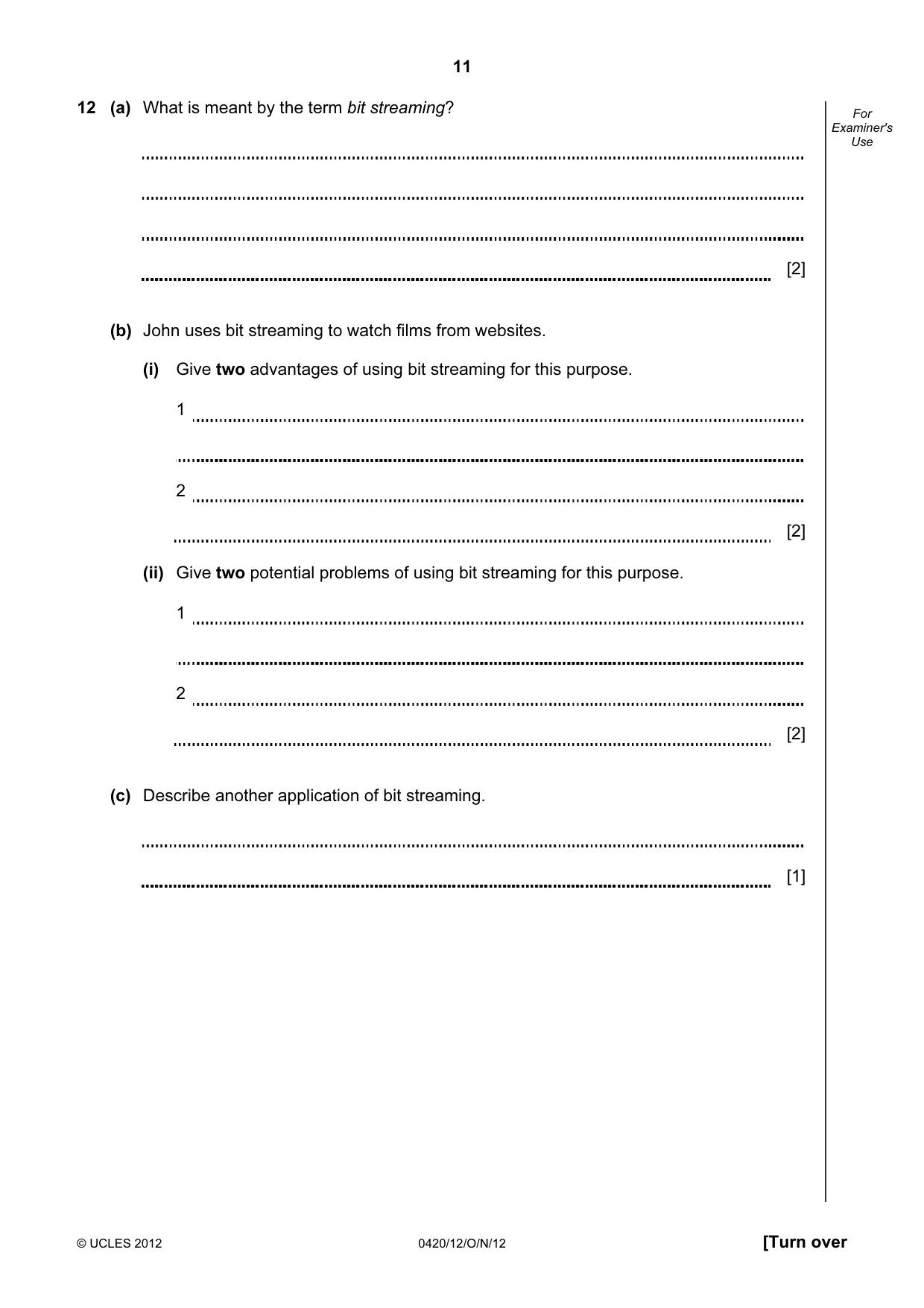
11 © UCLES 2012 0420/12/O/N/12 [Turn over For Examiner's Use 12 (a) What is meant by the term bit streaming? [2] (b) John uses bit streaming to watch films from websites. (i) Give two advantages of using bit streaming for this purpose. 1 2 [2] (ii) Give two potential problems of using bit streaming for this purpose. 1 2 [2] (c) Describe another application of bit streaming. [1]
Question paper, page 12
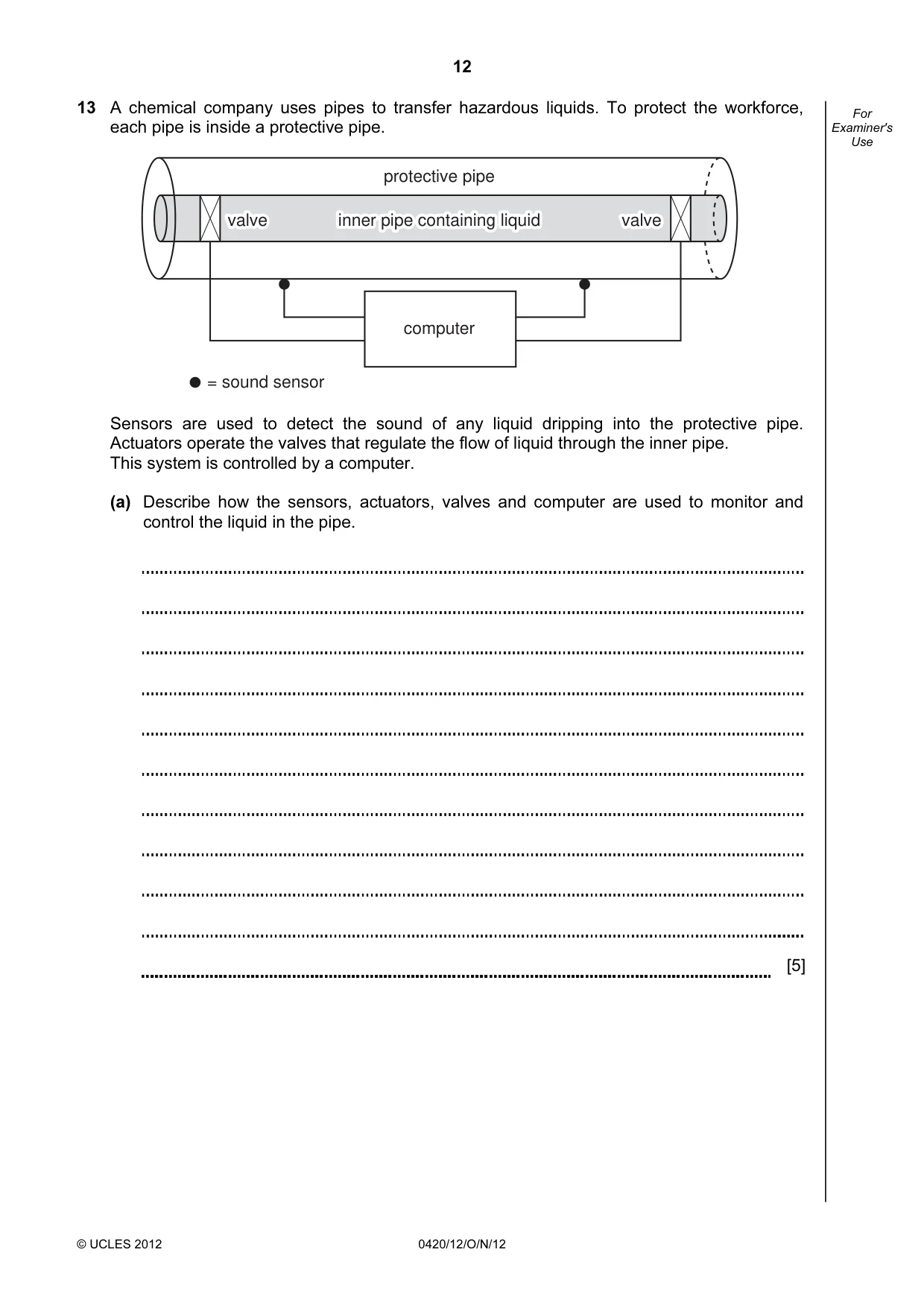
12 © UCLES 2012 0420/12/O/N/12 For Examiner's Use 13 A chemical company uses pipes to transfer hazardous liquids. To protect the workforce, each pipe is inside a protective pipe. computer protective pipe inner pipe containing liquid inner pipe containing liquid valve valve valve valve inner pipe containing liquid valve valve = sound sensor Sensors are used to detect the sound of any liquid dripping into the protective pipe. Actuators operate the valves that regulate the flow of liquid through the inner pipe. This system is controlled by a computer. (a) Describe how the sensors, actuators, valves and computer are used to monitor and control the liquid in the pipe. [5]
Question paper, page 13
13 © UCLES 2012 0420/12/O/N/12 [Turn over For Examiner's Use (b) Give two advantages of using this computer-controlled system rather than visual checks by the workforce. 1 2 [2]
Question paper, page 14
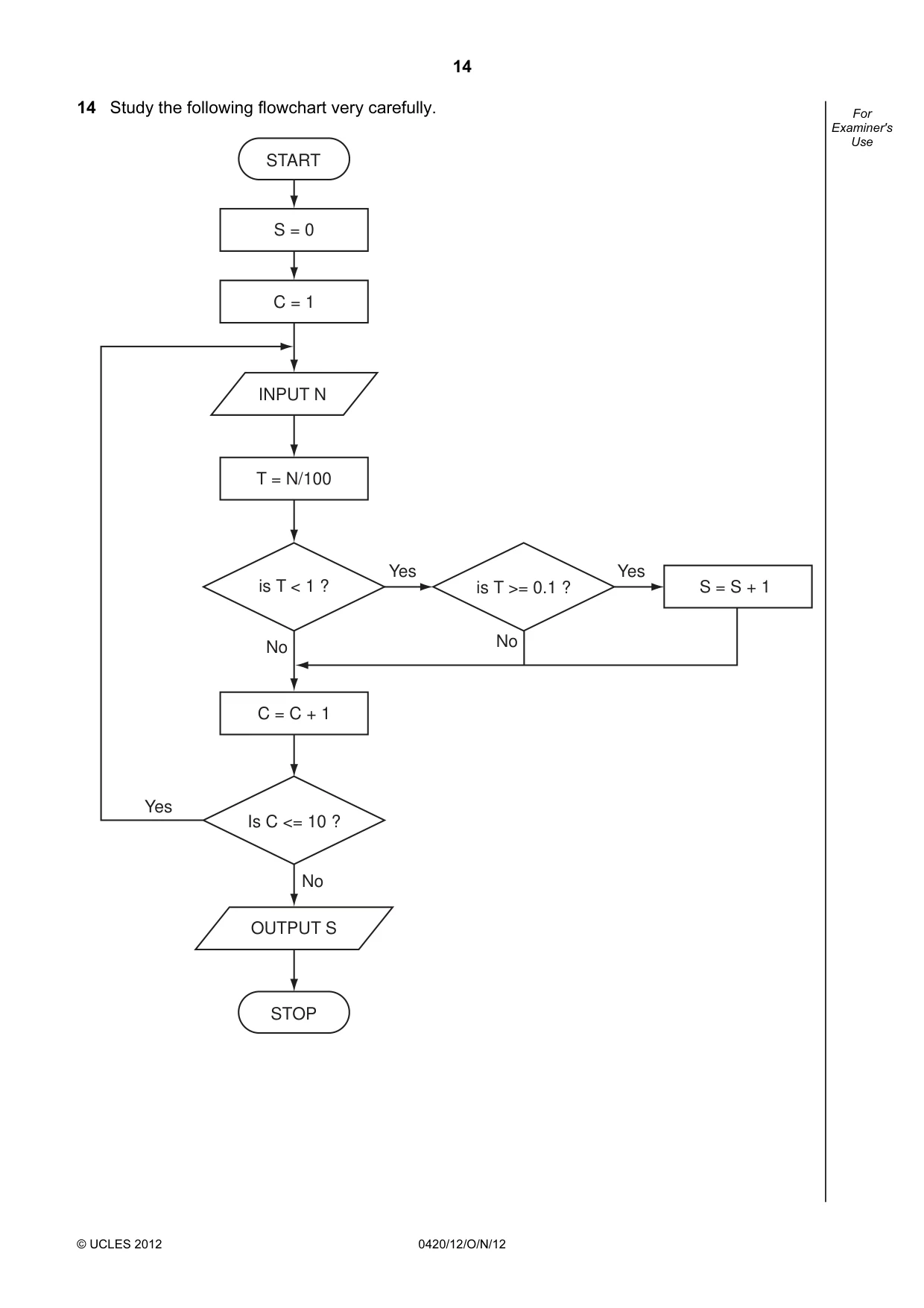
14 © UCLES 2012 0420/12/O/N/12 For Examiner's Use 14 Study the following flowchart very carefully. START STOP C = C + 1 S = 0 C = 1 T = N/100 is T < 1 ? is T >= 0.1 ? Is C <= 10 ? No No No INPUT N OUTPUT S S = S + 1 Yes Yes Yes
Question paper, page 15
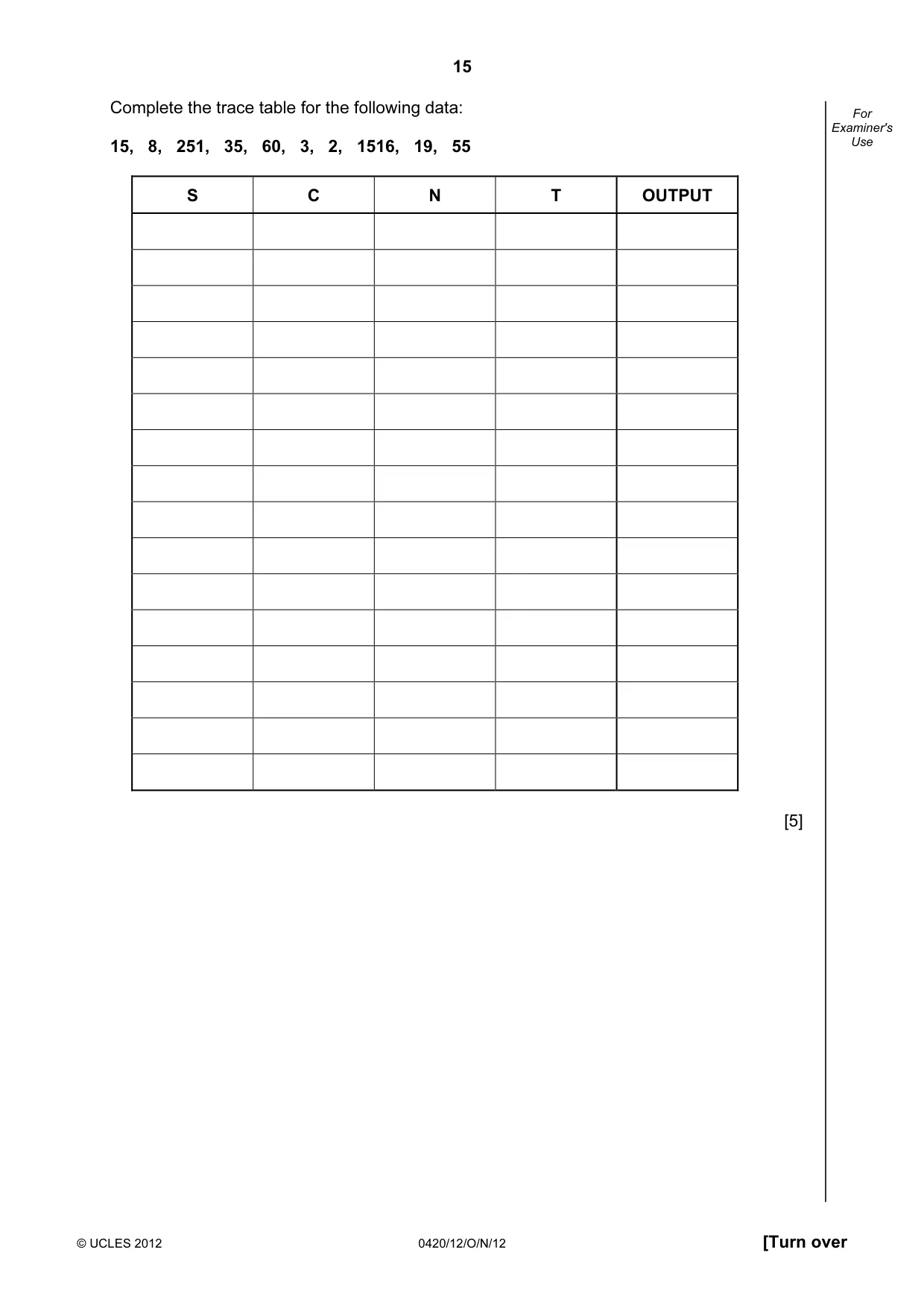
15 © UCLES 2012 0420/12/O/N/12 [Turn over For Examiner's Use Complete the trace table for the following data: 15, 8, 251, 35, 60, 3, 2, 1516, 19, 55 S C N T OUTPUT [5]
Question paper, page 16
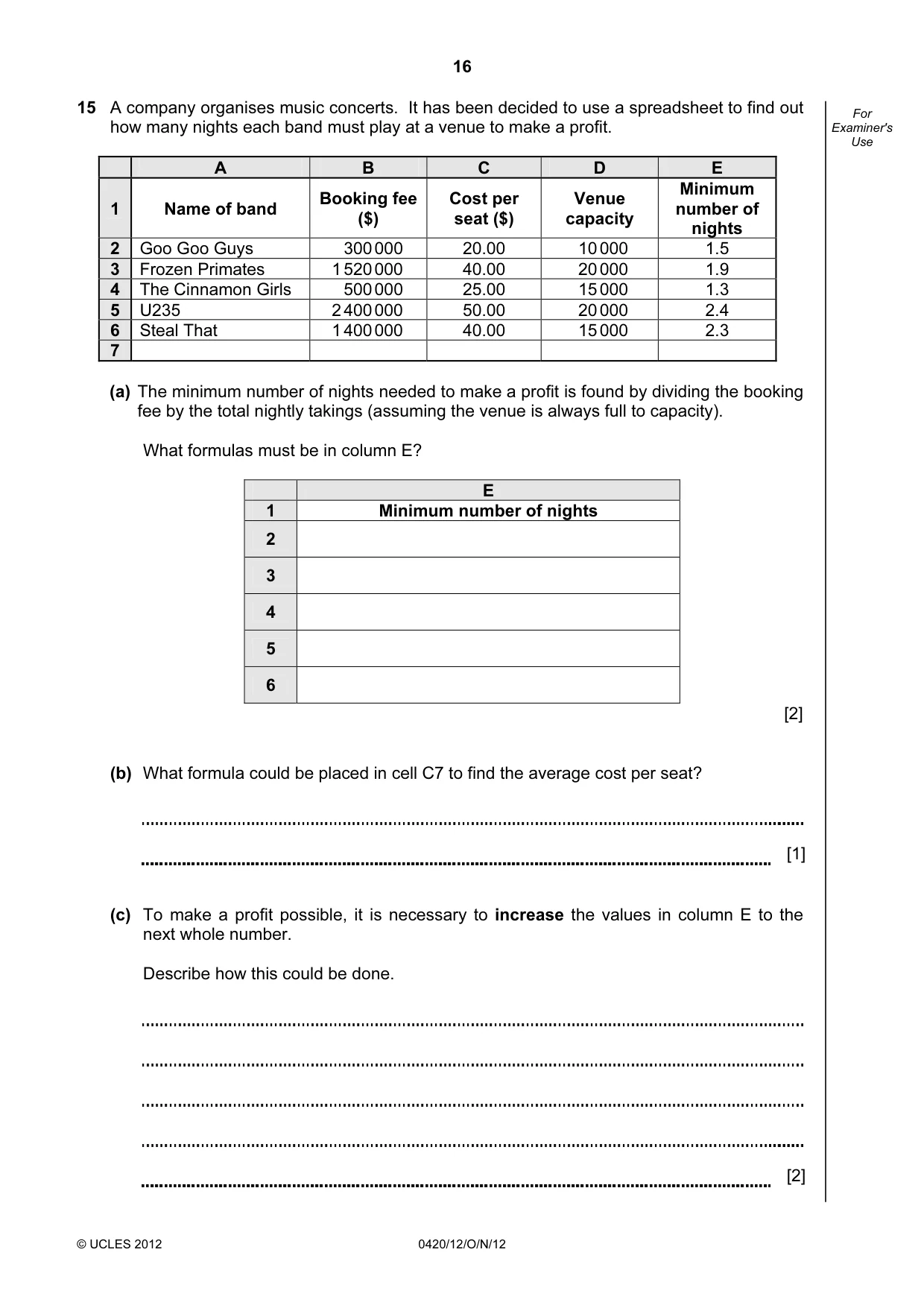
16 © UCLES 2012 0420/12/O/N/12 For Examiner's Use 15 A company organises music concerts. It has been decided to use a spreadsheet to find out how many nights each band must play at a venue to make a profit. A B C D E 1 Name of band Booking fee ($) Cost per seat ($) Venue capacity Minimum number of nights 2 Goo Goo Guys 300 000 20.00 10 000 1.5 3 Frozen Primates 1 520 000 40.00 20 000 1.9 4 The Cinnamon Girls 500 000 25.00 15 000 1.3 5 U235 2 400 000 50.00 20 000 2.4 6 Steal That 1 400 000 40.00 15 000 2.3 7 (a) The minimum number of nights needed to make a profit is found by dividing the booking fee by the total nightly takings (assuming the venue is always full to capacity). What formulas must be in column E? E 1 Minimum number of nights 2 3 4 5 6 [2] (b) What formula could be placed in cell C7 to find the average cost per seat? [1] (c) To make a profit possible, it is necessary to increase the values in column E to the next whole number. Describe how this could be done. [2]
Question paper, page 17
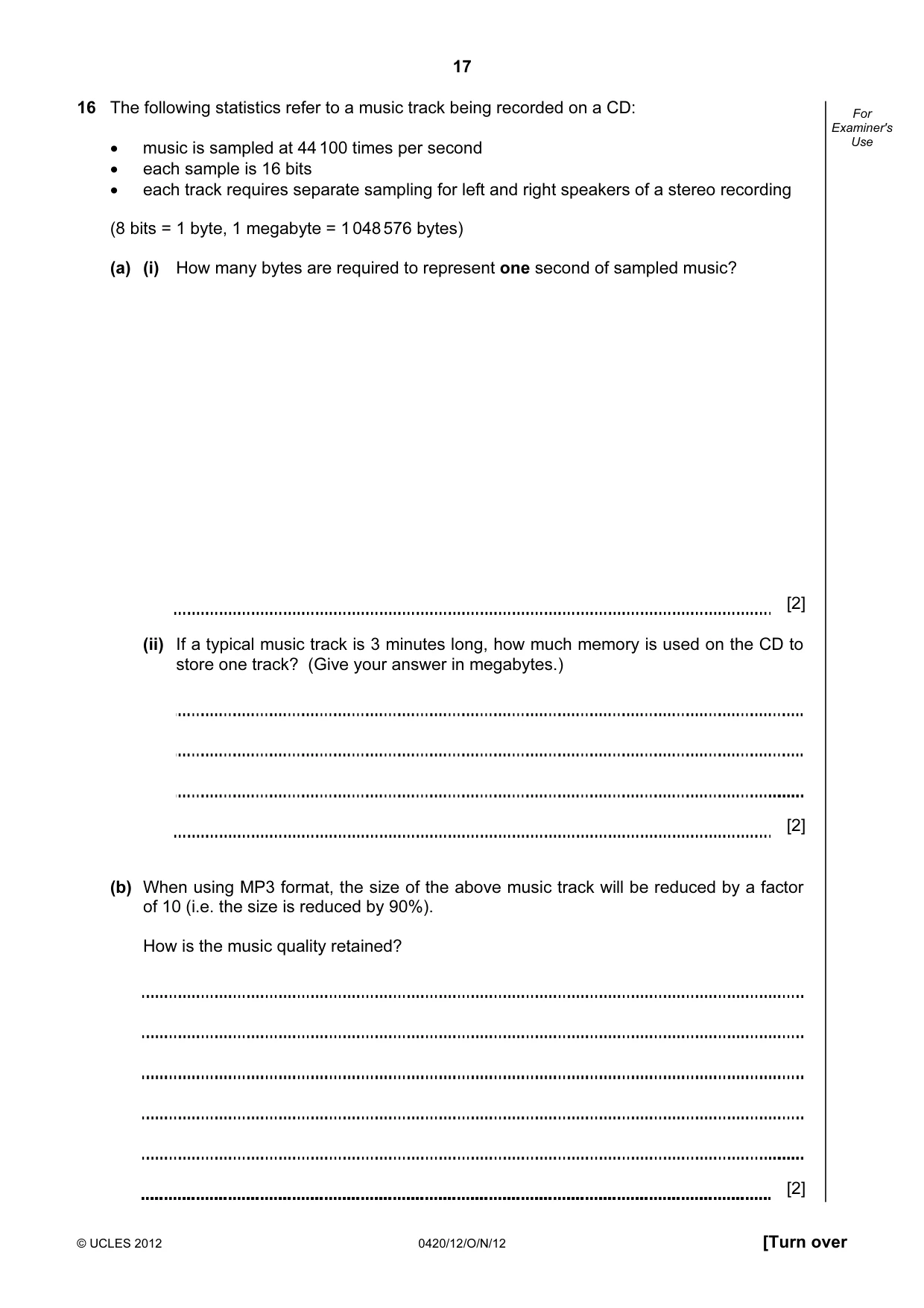
17 © UCLES 2012 0420/12/O/N/12 [Turn over For Examiner's Use 16 The following statistics refer to a music track being recorded on a CD: • music is sampled at 44 100 times per second • each sample is 16 bits • each track requires separate sampling for left and right speakers of a stereo recording (8 bits = 1 byte, 1 megabyte = 1 048 576 bytes) (a) (i) How many bytes are required to represent one second of sampled music? [2] (ii) If a typical music track is 3 minutes long, how much memory is used on the CD to store one track? (Give your answer in megabytes.) [2] (b) When using MP3 format, the size of the above music track will be reduced by a factor of 10 (i.e. the size is reduced by 90%). How is the music quality retained? [2]
Question paper, page 18
18 © UCLES 2012 0420/12/O/N/12 For Examiner's Use 17 (a) Write an algorithm, using pseudocode or a program flowchart only, that: • inputs a series of positive numbers (-1 is used to terminate the input), • outputs how many numbers were less than 1000 and • outputs how many numbers were greater than 1000. [4]
Question paper, page 19
19 © UCLES 2012 0420/12/O/N/12 For Examiner's Use (b) Write an algorithm, using pseudocode or a program flowchart only, that • inputs fifty numbers each as 4 separate digits, for example: 1 5 4 1 • outputs the percentage of numbers that were palindromes. (note: a palindrome reads the same way backwards or forwards. For example, 1331 is a palindrome but 1541 is not). Use separate variables to store the separate digits of a number (for example D1, D2, D3, D4). [4]
Question paper, page 20
20 Permission to reproduce items where third-party owned material protected by copyright is included has been sought and cleared where possible. Every reasonable effort has been made by the publisher (UCLES) to trace copyright holders, but if any items requiring clearance have unwittingly been included, the publisher will be pleased to make amends at the earliest possible opportunity. University of Cambridge International Examinations is part of the Cambridge Assessment Group. Cambridge Assessment is the brand name of University of Cambridge Local Examinations Syndicate (UCLES), which is itself a department of the University of Cambridge. © UCLES 2012 0420/12/O/N/12 BLANK PAGE
Mark scheme, page 1
CAMBRIDGE INTERNATIONAL EXAMINATIONS International General Certificate of Secondary Education MARK SCHEME for the October/November 2012 series 0420 COMPUTER STUDIES 0420/12 Paper 1, maximum raw mark 100 This mark scheme is published as an aid to teachers and candidates, to indicate the requirements of the examination. It shows the basis on which Examiners were instructed to award marks. It does not indicate the details of the discussions that took place at an Examiners’ meeting before marking began, which would have considered the acceptability of alternative answers. Mark schemes should be read in conjunction with the question paper and the Principal Examiner Report for Teachers. Cambridge will not enter into discussions about these mark schemes. Cambridge is publishing the mark schemes for the October/November 2012 series for most IGCSE, GCE Advanced Level and Advanced Subsidiary Level components and some Ordinary Level components. www.XtremePapers.com
Mark scheme, page 2
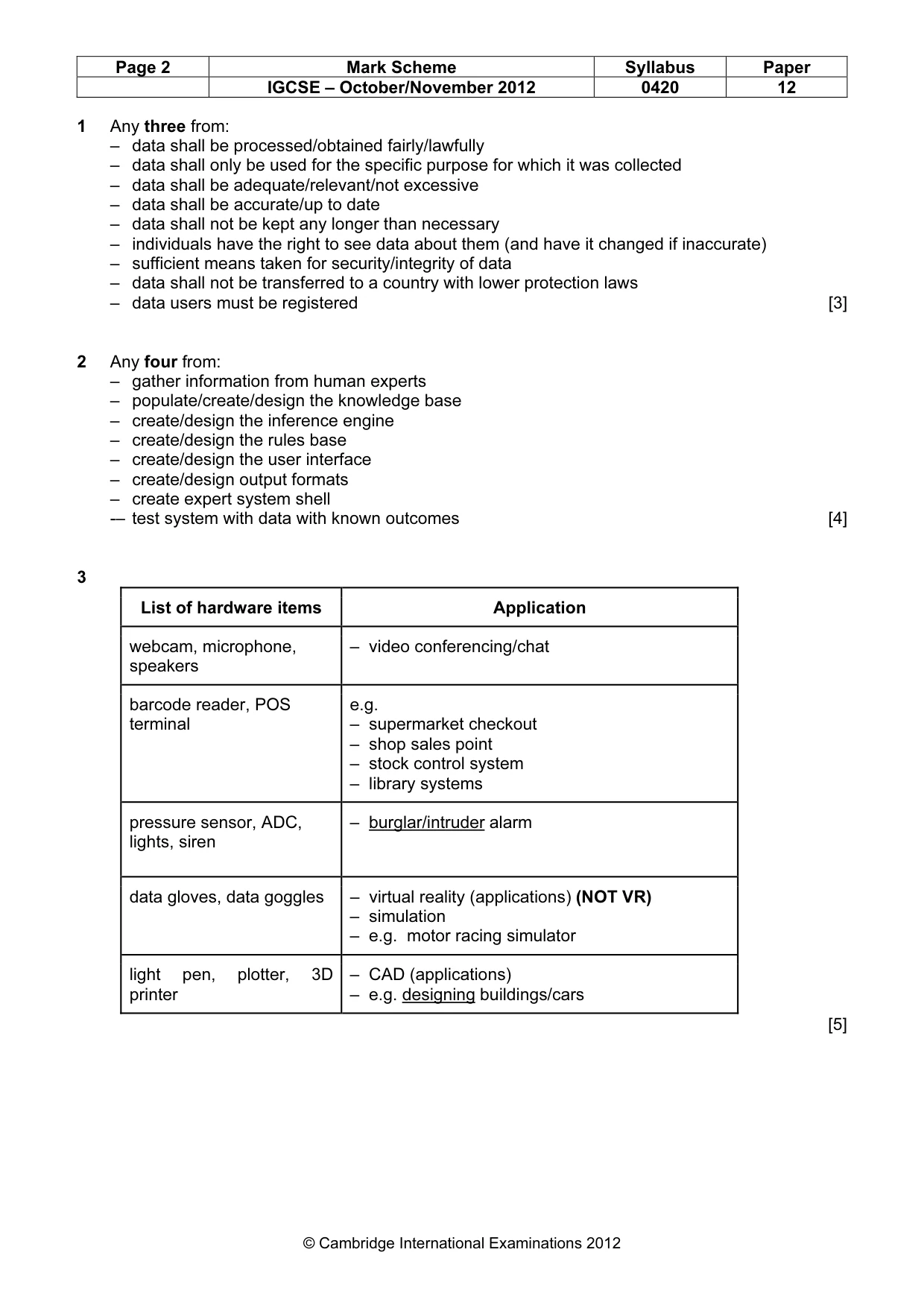
Page 2 Mark Scheme Syllabus Paper IGCSE – October/November 2012 0420 12 © Cambridge International Examinations 2012 1 Any three from: – data shall be processed/obtained fairly/lawfully – data shall only be used for the specific purpose for which it was collected – data shall be adequate/relevant/not excessive – data shall be accurate/up to date – data shall not be kept any longer than necessary – individuals have the right to see data about them (and have it changed if inaccurate) – sufficient means taken for security/integrity of data – data shall not be transferred to a country with lower protection laws – data users must be registered [3] 2 Any four from: – gather information from human experts – populate/create/design the knowledge base – create/design the inference engine – create/design the rules base – create/design the user interface – create/design output formats – create expert system shell -– test system with data with known outcomes [4] 3 List of hardware items Application webcam, microphone, speakers – video conferencing/chat barcode reader, POS terminal e.g. – supermarket checkout – shop sales point – stock control system – library systems pressure sensor, ADC, lights, siren – burglar/intruder alarm data gloves, data goggles – virtual reality (applications) (NOT VR) – simulation – e.g. motor racing simulator light pen, plotter, 3D printer – CAD (applications) – e.g. designing buildings/cars [5]
Mark scheme, page 3
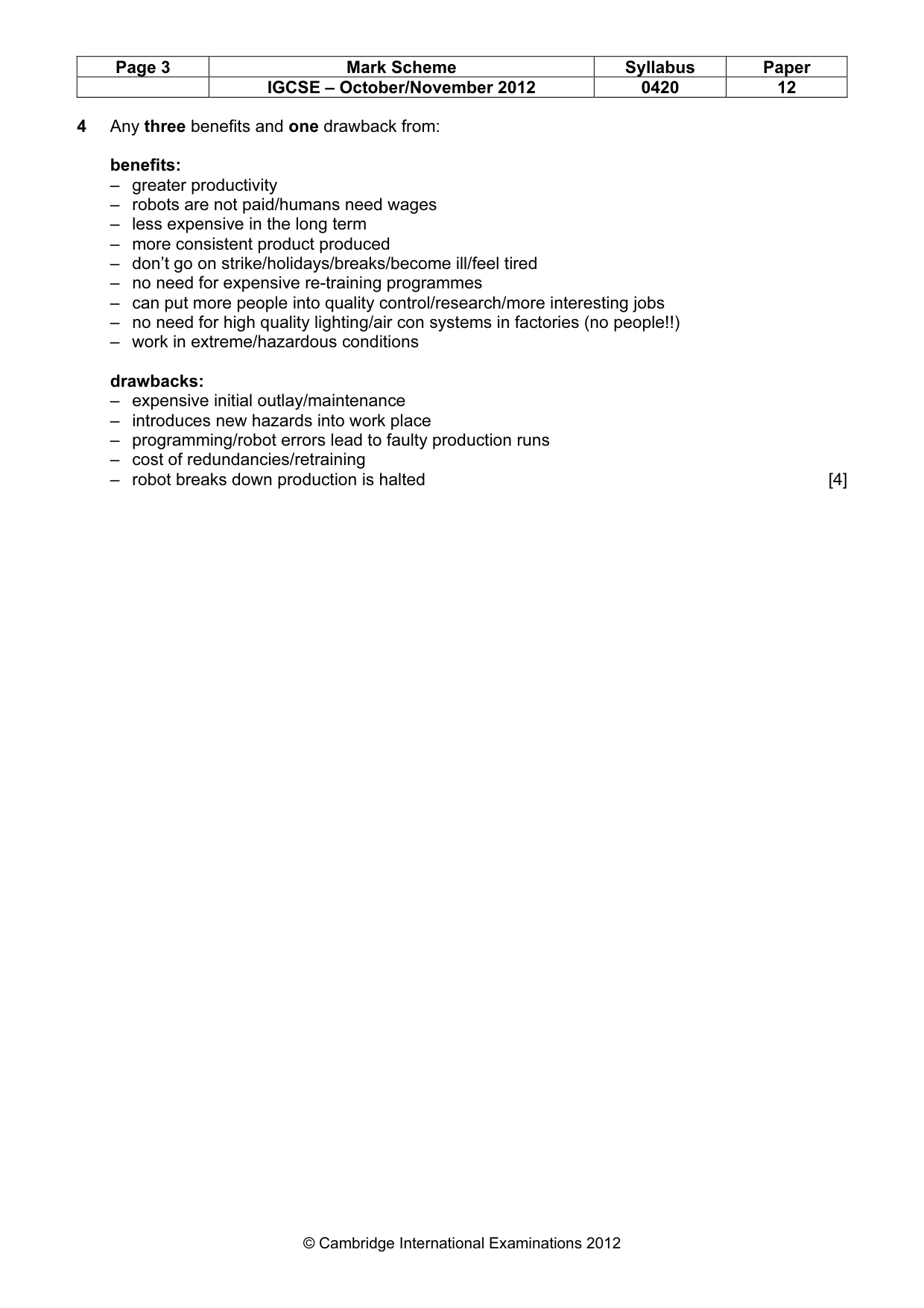
Page 3 Mark Scheme Syllabus Paper IGCSE – October/November 2012 0420 12 © Cambridge International Examinations 2012 4 Any three benefits and one drawback from: benefits: – greater productivity – robots are not paid/humans need wages – less expensive in the long term – more consistent product produced – don’t go on strike/holidays/breaks/become ill/feel tired – no need for expensive re-training programmes – can put more people into quality control/research/more interesting jobs – no need for high quality lighting/air con systems in factories (no people!!) – work in extreme/hazardous conditions drawbacks: – expensive initial outlay/maintenance – introduces new hazards into work place – programming/robot errors lead to faulty production runs – cost of redundancies/retraining – robot breaks down production is halted [4]
Mark scheme, page 4
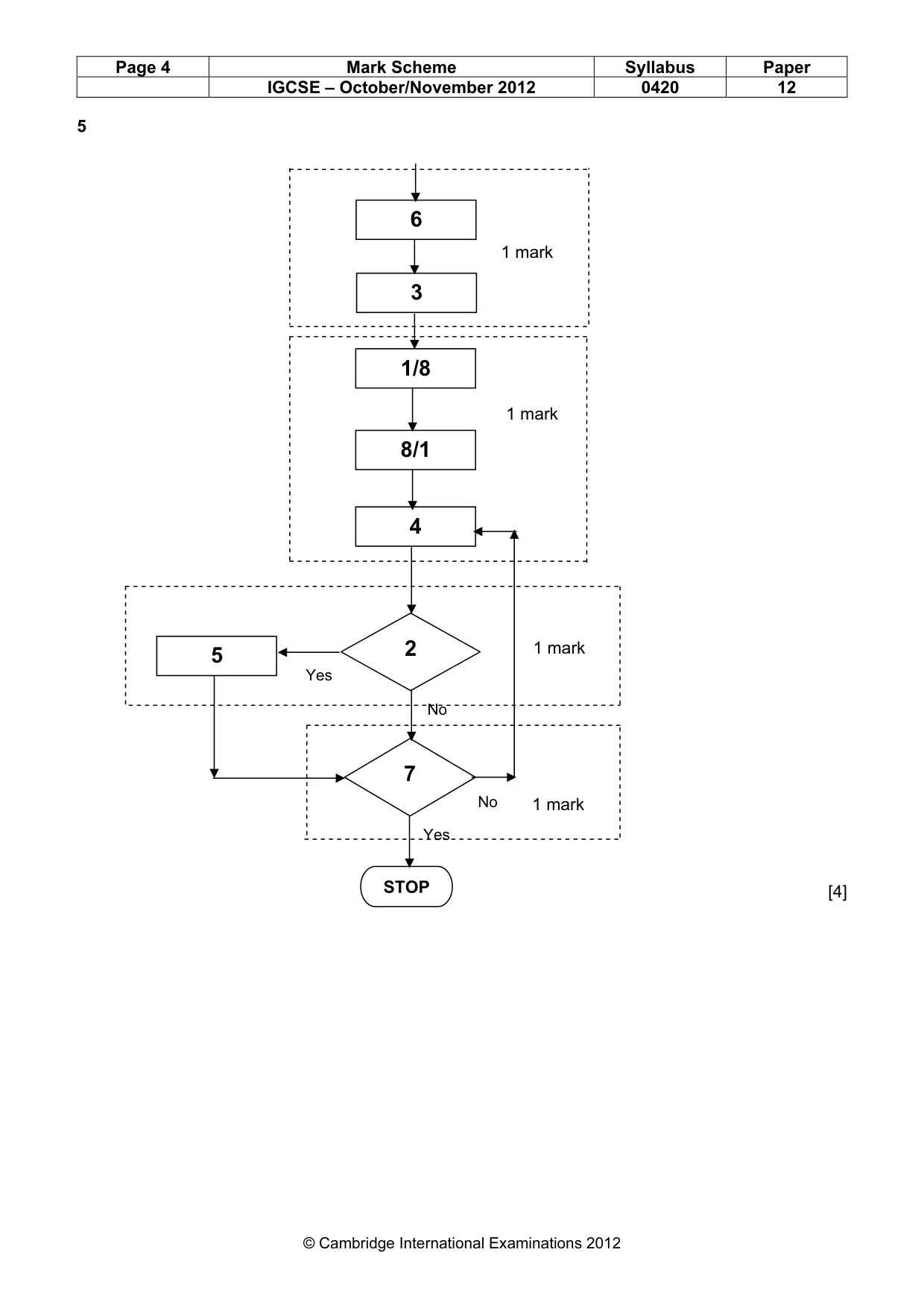
Page 4 Mark Scheme Syllabus Paper IGCSE – October/November 2012 0420 12 © Cambridge International Examinations 2012 5 [4] 6 3 1/8 8/1 4 2 7 5 STOP Yes No Yes No 1 mark 1 mark 1 mark 1 mark
Mark scheme, page 5
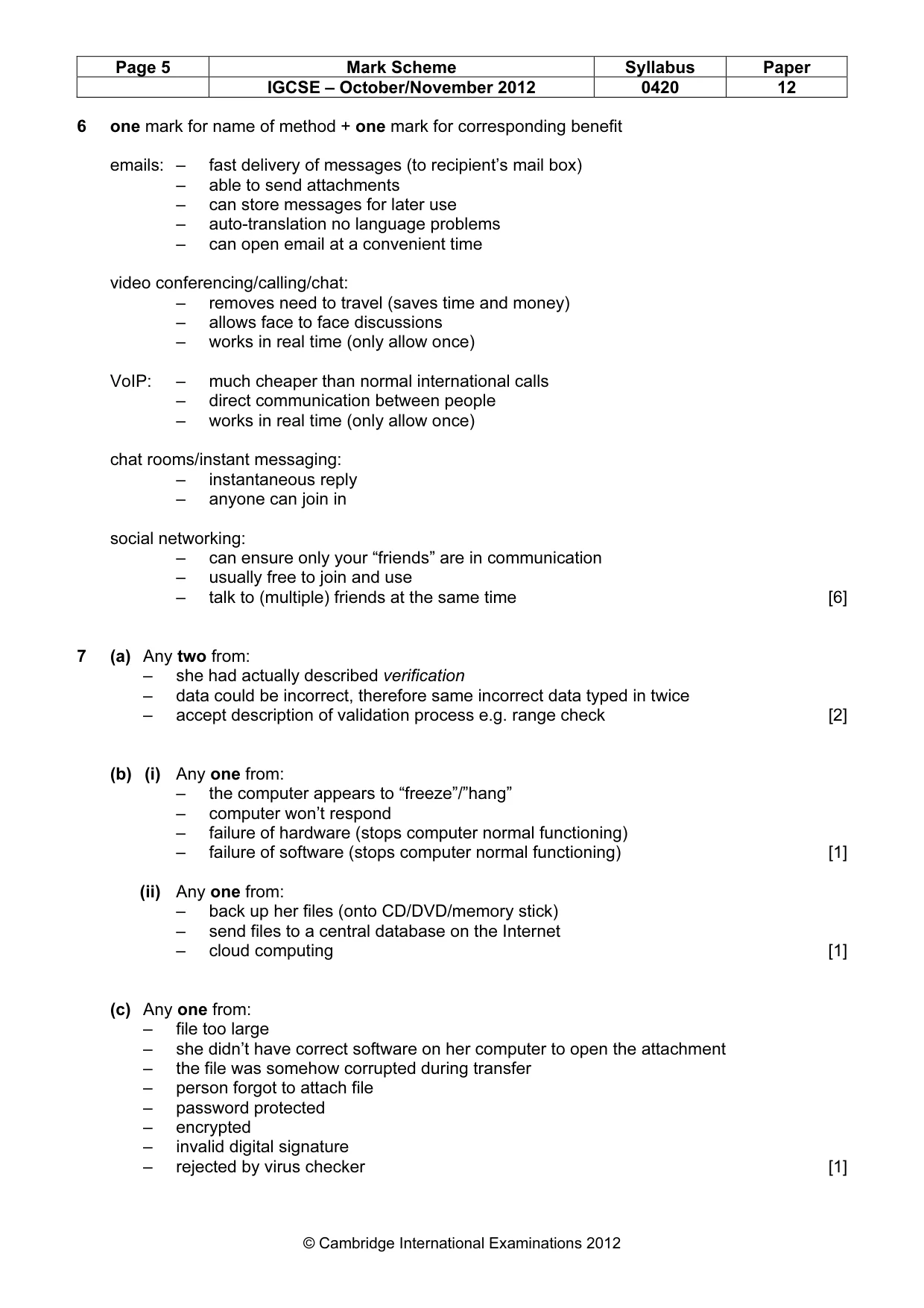
Page 5 Mark Scheme Syllabus Paper IGCSE – October/November 2012 0420 12 © Cambridge International Examinations 2012 6 one mark for name of method + one mark for corresponding benefit emails: – fast delivery of messages (to recipient’s mail box) – able to send attachments – can store messages for later use – auto-translation no language problems – can open email at a convenient time video conferencing/calling/chat: – removes need to travel (saves time and money) – allows face to face discussions – works in real time (only allow once) VoIP: – much cheaper than normal international calls – direct communication between people – works in real time (only allow once) chat rooms/instant messaging: – instantaneous reply – anyone can join in social networking: – can ensure only your “friends” are in communication – usually free to join and use – talk to (multiple) friends at the same time [6] 7 (a) Any two from: – she had actually described verification – data could be incorrect, therefore same incorrect data typed in twice – accept description of validation process e.g. range check [2] (b) (i) Any one from: – the computer appears to “freeze”/”hang” – computer won’t respond – failure of hardware (stops computer normal functioning) – failure of software (stops computer normal functioning) [1] (ii) Any one from: – back up her files (onto CD/DVD/memory stick) – send files to a central database on the Internet – cloud computing [1] (c) Any one from: – file too large – she didn’t have correct software on her computer to open the attachment – the file was somehow corrupted during transfer – person forgot to attach file – password protected – encrypted – invalid digital signature – rejected by virus checker [1]
Mark scheme, page 6
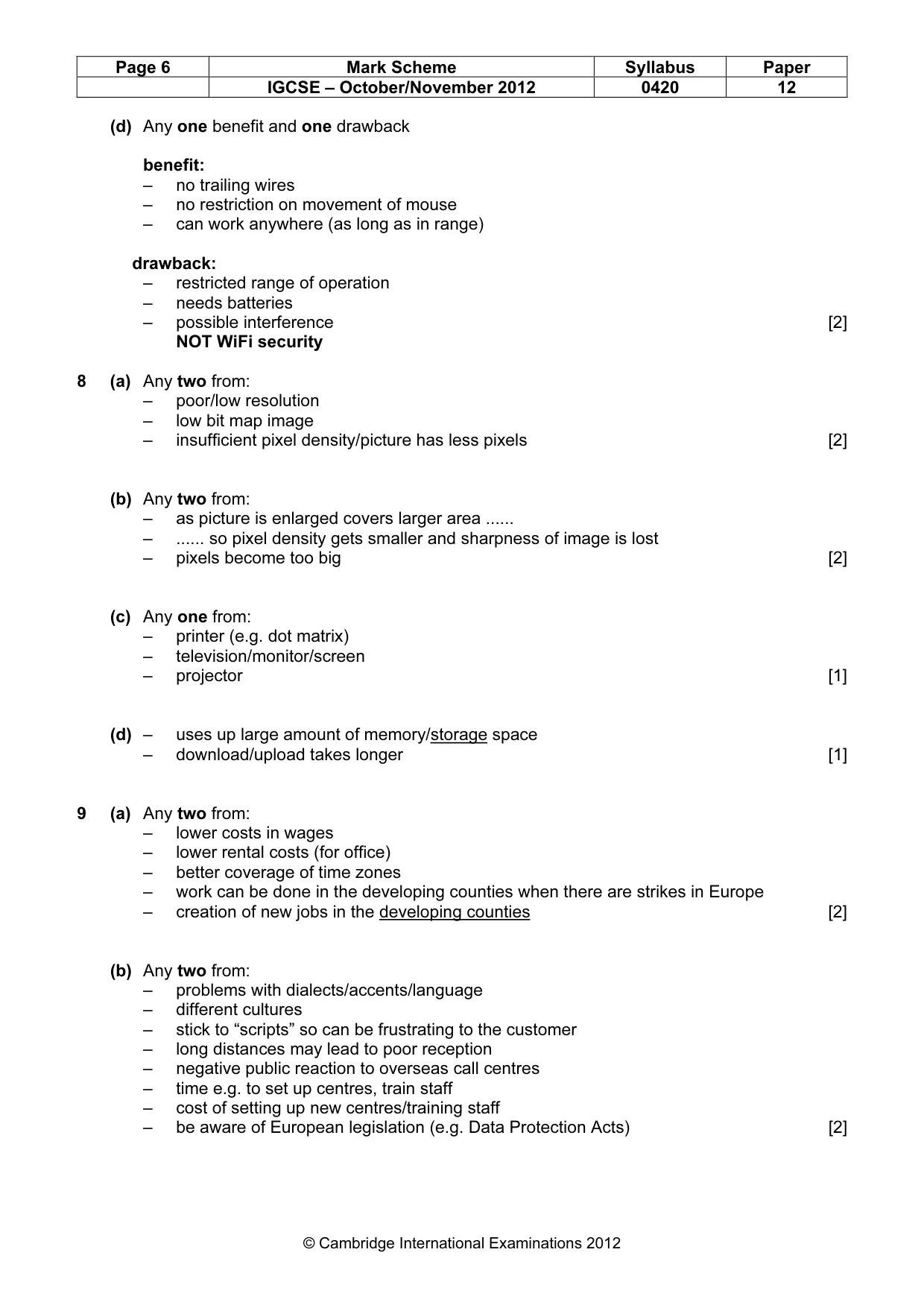
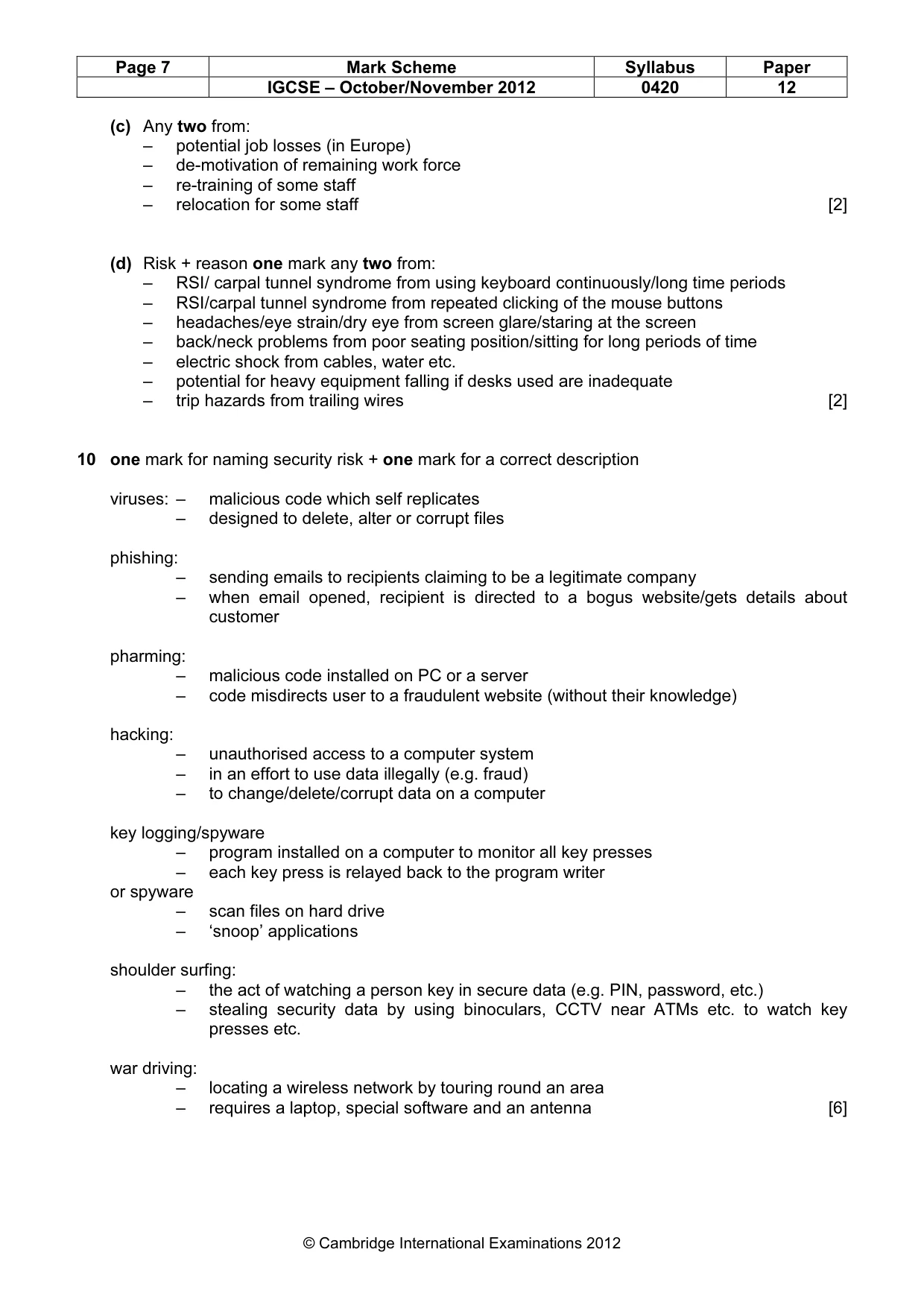
Page 6 Mark Scheme Syllabus Paper IGCSE – October/November 2012 0420 12 © Cambridge International Examinations 2012 (d) Any one benefit and one drawback benefit: – no trailing wires – no restriction on movement of mouse – can work anywhere (as long as in range) drawback: – restricted range of operation – needs batteries – possible interference [2] NOT WiFi security 8 (a) Any two from: – poor/low resolution – low bit map image – insufficient pixel density/picture has less pixels [2] (b) Any two from: – as picture is enlarged covers larger area … – … so pixel density gets smaller and sharpness of image is lost – pixels become too big [2] (c) Any one from: – printer (e.g. dot matrix) – television/monitor/screen – projector [1] (d) – uses up large amount of memory/storage space – download/upload takes longer [1] 9 (a) Any two from: – lower costs in wages – lower rental costs (for office) – better coverage of time zones – work can be done in the developing counties when there are strikes in Europe – creation of new jobs in the developing counties [2] (b) Any two from: – problems with dialects/accents/language – different cultures – stick to “scripts” so can be frustrating to the customer – long distances may lead to poor reception – negative public reaction to overseas call centres – time e.g. to set up centres, train staff – cost of setting up new centres/training staff – be aware of European legislation (e.g. Data Protection Acts) [2]
Mark scheme, page 7
Page 7 Mark Scheme Syllabus Paper IGCSE – October/November 2012 0420 12 © Cambridge International Examinations 2012 (c) Any two from: – potential job losses (in Europe) – de-motivation of remaining work force – re-training of some staff – relocation for some staff [2] (d) Risk + reason one mark any two from: – RSI/ carpal tunnel syndrome from using keyboard continuously/long time periods – RSI/carpal tunnel syndrome from repeated clicking of the mouse buttons – headaches/eye strain/dry eye from screen glare/staring at the screen – back/neck problems from poor seating position/sitting for long periods of time – electric shock from cables, water etc. – potential for heavy equipment falling if desks used are inadequate – trip hazards from trailing wires [2] 10 one mark for naming security risk + one mark for a correct description viruses: – malicious code which self replicates – designed to delete, alter or corrupt files phishing: – sending emails to recipients claiming to be a legitimate company – when email opened, recipient is directed to a bogus website/gets details about customer pharming: – malicious code installed on PC or a server – code misdirects user to a fraudulent website (without their knowledge) hacking: – unauthorised access to a computer system – in an effort to use data illegally (e.g. fraud) – to change/delete/corrupt data on a computer key logging/spyware – program installed on a computer to monitor all key presses – each key press is relayed back to the program writer or spyware – scan files on hard drive – ‘snoop’ applications shoulder surfing: – the act of watching a person key in secure data (e.g. PIN, password, etc.) – stealing security data by using binoculars, CCTV near ATMs etc. to watch key presses etc. war driving: – locating a wireless network by touring round an area – requires a laptop, special software and an antenna [6]
Mark scheme, page 8
Page 8 Mark Scheme Syllabus Paper IGCSE – October/November 2012 0420 12 © Cambridge International Examinations 2012 11 (a) Note: accept answers using MIL symbols e.g. AND [5] (b) P T W X 0 0 0 1 0 0 1 0 0 1 0 1 0 1 1 1 1 0 0 1 1 0 1 0 1 1 0 0 1 1 1 0 (NOTE: 1 mark per pair of rows) [4] NOT AND NOT AND NOT OR P T W X 1 mark 1 mark 1 mark 1 mark 1 mark 1 mark 1 mark 1 mark 1 mark
Mark scheme, page 9
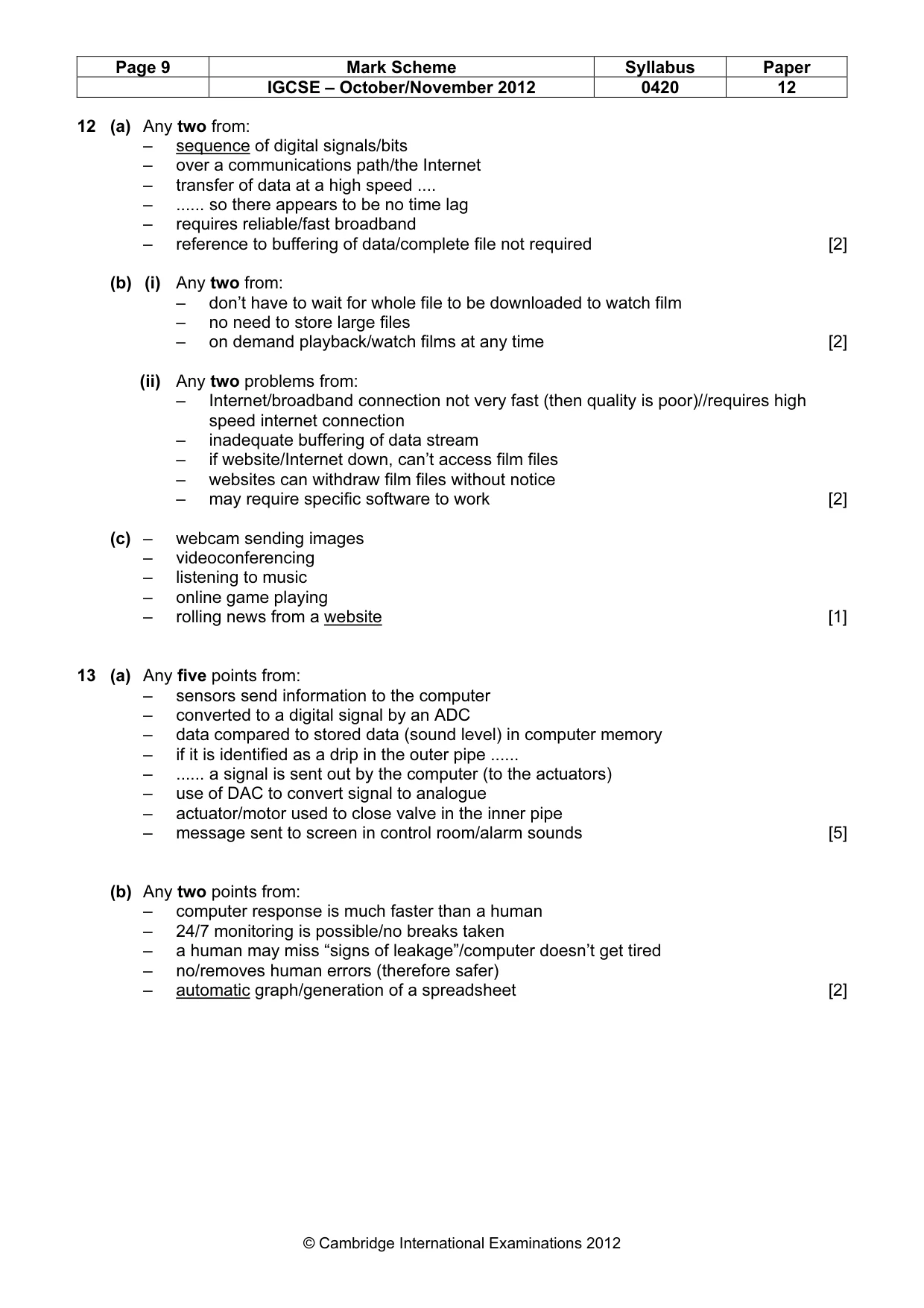
Page 9 Mark Scheme Syllabus Paper IGCSE – October/November 2012 0420 12 © Cambridge International Examinations 2012 12 (a) Any two from: – sequence of digital signals/bits – over a communications path/the Internet – transfer of data at a high speed … – … so there appears to be no time lag – requires reliable/fast broadband – reference to buffering of data/complete file not required [2] (b) (i) Any two from: – don’t have to wait for whole file to be downloaded to watch film – no need to store large files – on demand playback/watch films at any time [2] (ii) Any two problems from: – Internet/broadband connection not very fast (then quality is poor)//requires high speed internet connection – inadequate buffering of data stream – if website/Internet down, can’t access film files – websites can withdraw film files without notice – may require specific software to work [2] (c) – webcam sending images – videoconferencing – listening to music – online game playing – rolling news from a website [1] 13 (a) Any five points from: – sensors send information to the computer – converted to a digital signal by an ADC – data compared to stored data (sound level) in computer memory – if it is identified as a drip in the outer pipe … – … a signal is sent out by the computer (to the actuators) – use of DAC to convert signal to analogue – actuator/motor used to close valve in the inner pipe – message sent to screen in control room/alarm sounds [5] (b) Any two points from: – computer response is much faster than a human – 24/7 monitoring is possible/no breaks taken – a human may miss “signs of leakage”/computer doesn’t get tired – no/removes human errors (therefore safer) – automatic graph/generation of a spreadsheet [2]
Mark scheme, page 10
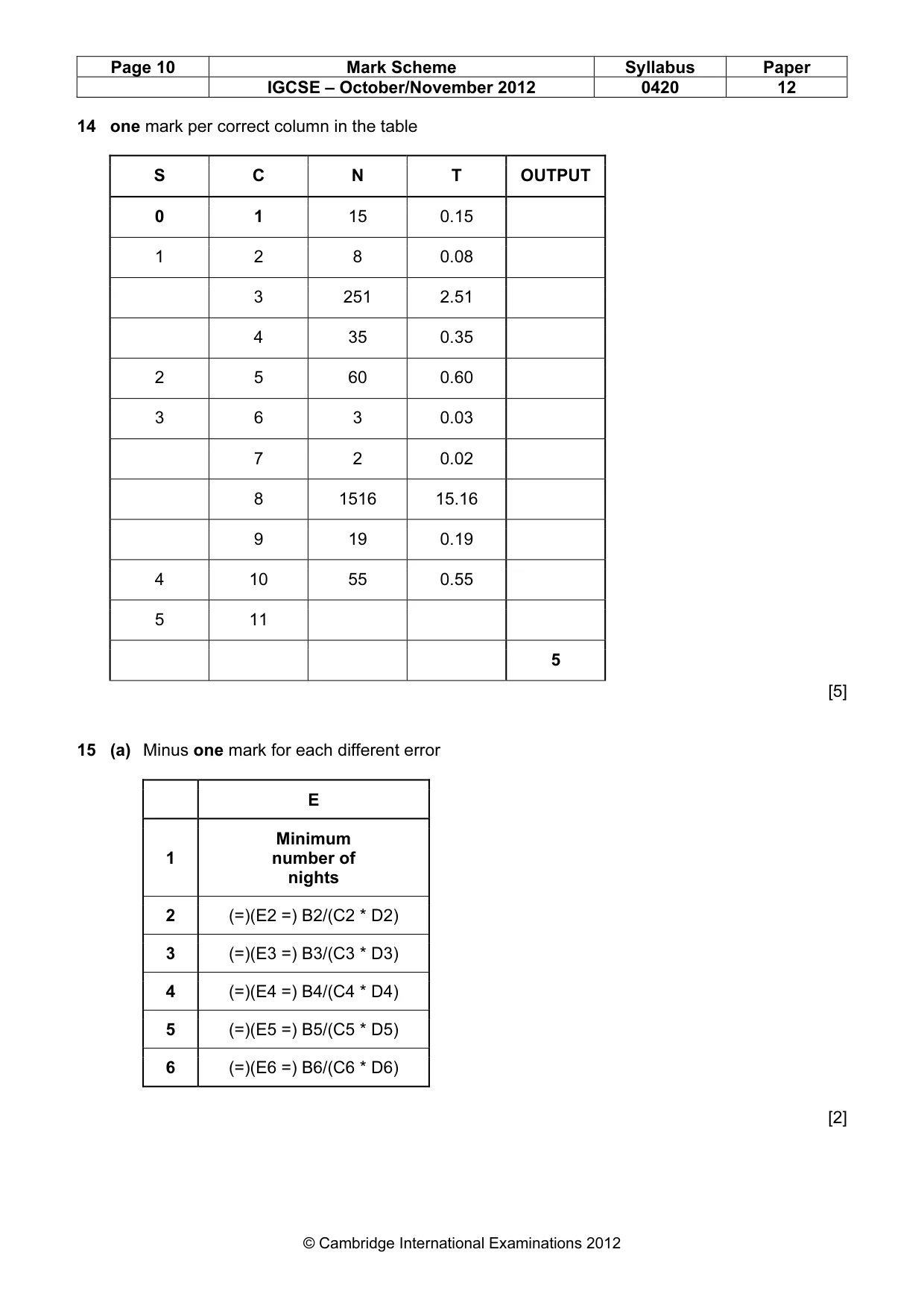
Page 10 Mark Scheme Syllabus Paper IGCSE – October/November 2012 0420 12 © Cambridge International Examinations 2012 14 one mark per correct column in the table S C N T OUTPUT 0 1 15 0.15 1 2 8 0.08 3 251 2.51 4 35 0.35 2 5 60 0.60 3 6 3 0.03 7 2 0.02 8 1516 15.16 9 19 0.19 4 10 55 0.55 5 11 5 [5] 15 (a) Minus one mark for each different error E 1 Minimum number of nights 2 (=)(E2 =) B2/(C2 * D2) 3 (=)(E3 =) B3/(C3 * D3) 4 (=)(E4 =) B4/(C4 * D4) 5 (=)(E5 =) B5/(C5 * D5) 6 (=)(E6 =) B6/(C6 * D6) [2]
Mark scheme, page 11
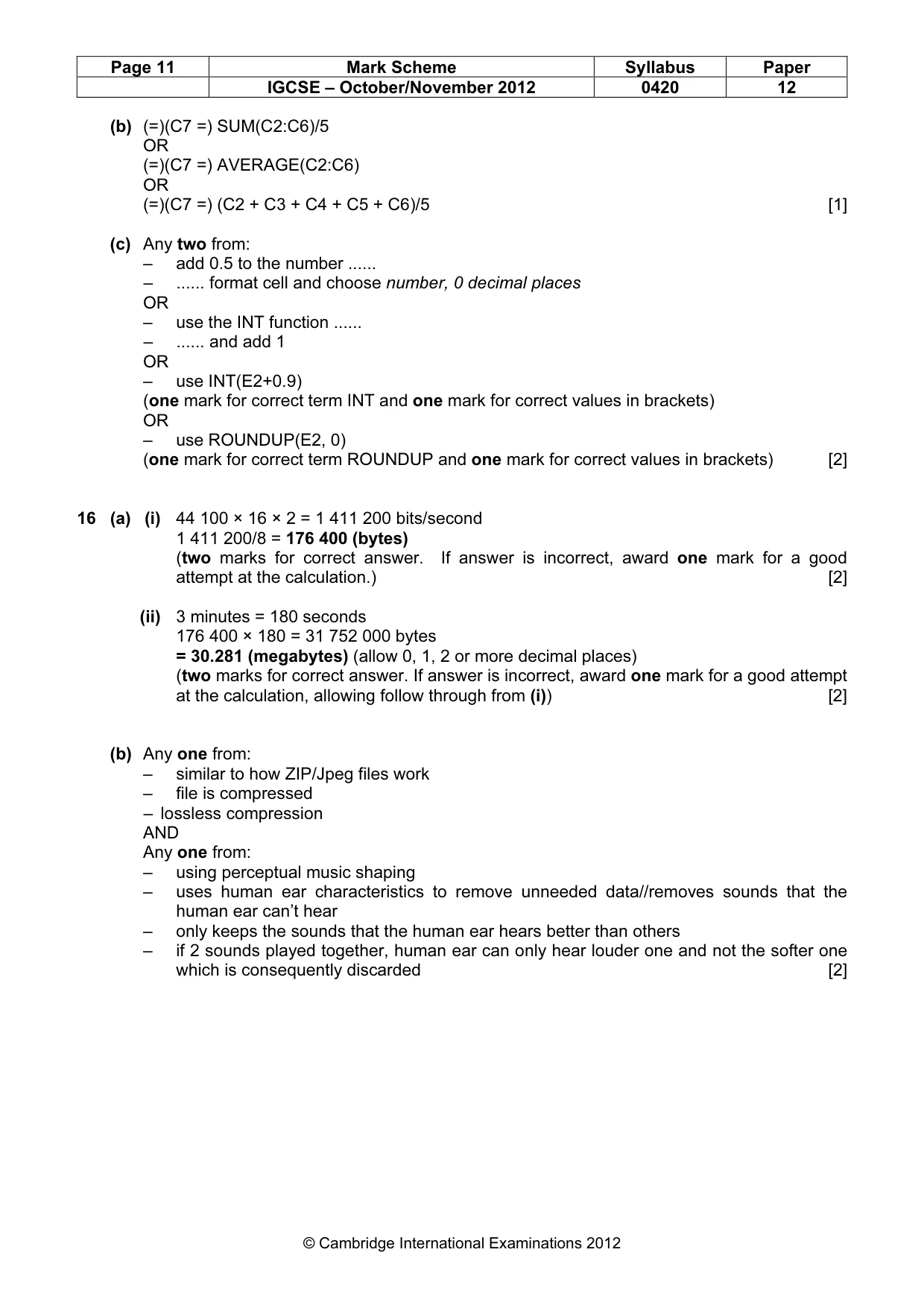
Page 11 Mark Scheme Syllabus Paper IGCSE – October/November 2012 0420 12 © Cambridge International Examinations 2012 (b) (=)(C7 =) SUM(C2:C6)/5 OR (=)(C7 =) AVERAGE(C2:C6) OR (=)(C7 =) (C2 + C3 + C4 + C5 + C6)/5 [1] (c) Any two from: – add 0.5 to the number … – … format cell and choose number, 0 decimal places OR – use the INT function … – … and add 1 OR – use INT(E2+0.9) (one mark for correct term INT and one mark for correct values in brackets) OR – use ROUNDUP(E2, 0) (one mark for correct term ROUNDUP and one mark for correct values in brackets) [2] 16 (a) (i) 44 100 × 16 × 2 = 1 411 200 bits/second 1 411 200/8 = 176 400 (bytes) (two marks for correct answer. If answer is incorrect, award one mark for a good attempt at the calculation.) [2] (ii) 3 minutes = 180 seconds 176 400 × 180 = 31 752 000 bytes = 30.281 (megabytes) (allow 0, 1, 2 or more decimal places) (two marks for correct answer. If answer is incorrect, award one mark for a good attempt at the calculation, allowing follow through from (i)) [2] (b) Any one from: – similar to how ZIP/Jpeg files work – file is compressed – lossless compression AND Any one from: – using perceptual music shaping – uses human ear characteristics to remove unneeded data//removes sounds that the human ear can’t hear – only keeps the sounds that the human ear hears better than others – if 2 sounds played together, human ear can only hear louder one and not the softer one which is consequently discarded [2]
Mark scheme, page 12
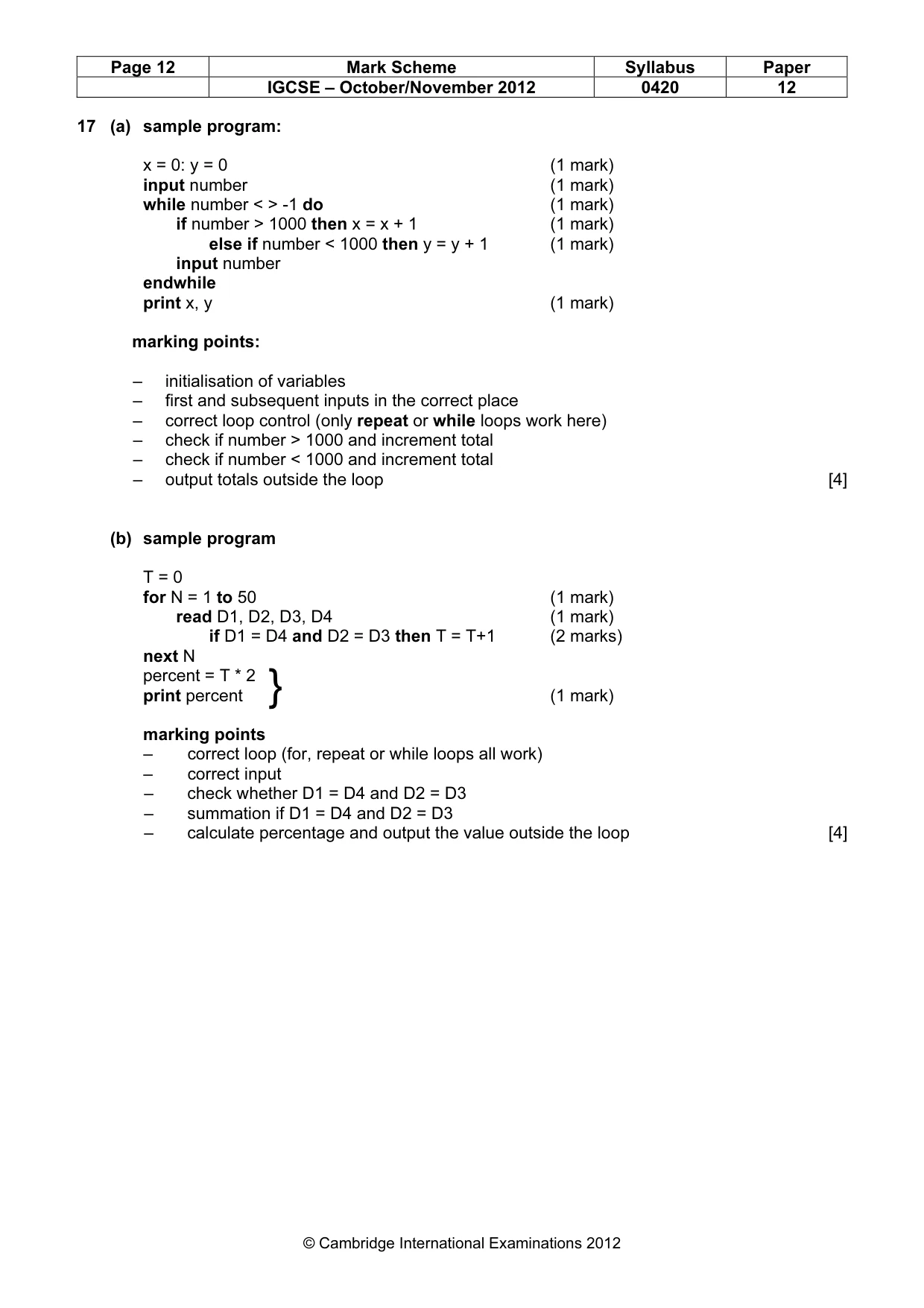
Page 12 Mark Scheme Syllabus Paper IGCSE – October/November 2012 0420 12 © Cambridge International Examinations 2012 17 (a) sample program: x = 0: y = 0 (1 mark) input number (1 mark) while number < > -1 do (1 mark) if number > 1000 then x = x + 1 (1 mark) else if number < 1000 then y = y + 1 (1 mark) input number endwhile print x, y (1 mark) marking points: – initialisation of variables – first and subsequent inputs in the correct place – correct loop control (only repeat or while loops work here) – check if number > 1000 and increment total – check if number < 1000 and increment total – output totals outside the loop [4] (b) sample program T = 0 for N = 1 to 50 (1 mark) read D1, D2, D3, D4 (1 mark) if D1 = D4 and D2 = D3 then T = T+1 (2 marks) next N percent = T * 2 print percent (1 mark) marking points – correct loop (for, repeat or while loops all work) – correct input – check whether D1 = D4 and D2 = D3 – summation if D1 = D4 and D2 = D3 – calculate percentage and output the value outside the loop [4] }
What you needed in this session
Cambridge’s own grade thresholds for 2012 Oct/Nov, Paper 1 · Variant 2. A higher threshold means an easier paper — the bar moves with how the cohort did.