Cambridge IGCSE Computer Studies 0420 — 2012 May/June Paper 1 · Variant 2
0420/12/M/J/12 · 100 marks · ≈113 min
The question paper and its mark scheme, free to read here and free to download. This is Cambridge’s own paper, exactly as it was sat.
Question paper20 pages

Mark scheme11 pages
Answers below. Sit the paper first if you are practising.
Paper as text
Question paper, page 1
This document consists of 20 printed pages. IB12 06_0420_12/2RP © UCLES 2012 [Turn over *9702994269* For Examiner's Use UNIVERSITY OF CAMBRIDGE INTERNATIONAL EXAMINATIONS International General Certificate of Secondary Education COMPUTER STUDIES 0420/12 Paper 1 May/June 2012 2 hours 30 minutes Candidates answer on the Question Paper. No Additional Materials are required. READ THESE INSTRUCTIONS FIRST Write your Centre number, candidate number and name on all the work you hand in. Write in dark blue or black pen. You may use a soft pencil for any diagrams, graphs or rough working. Do not use staples, paper clips, highlighters, glue or correction fluid. DO NOT WRITE IN ANY BARCODES. Answer all questions. No marks will be awarded for using brand names of software packages or hardware. At the end of the examination, fasten all your work securely together. The number of marks is given in brackets [ ] at the end of each question or part question. www.XtremePapers.com
Question paper, page 2
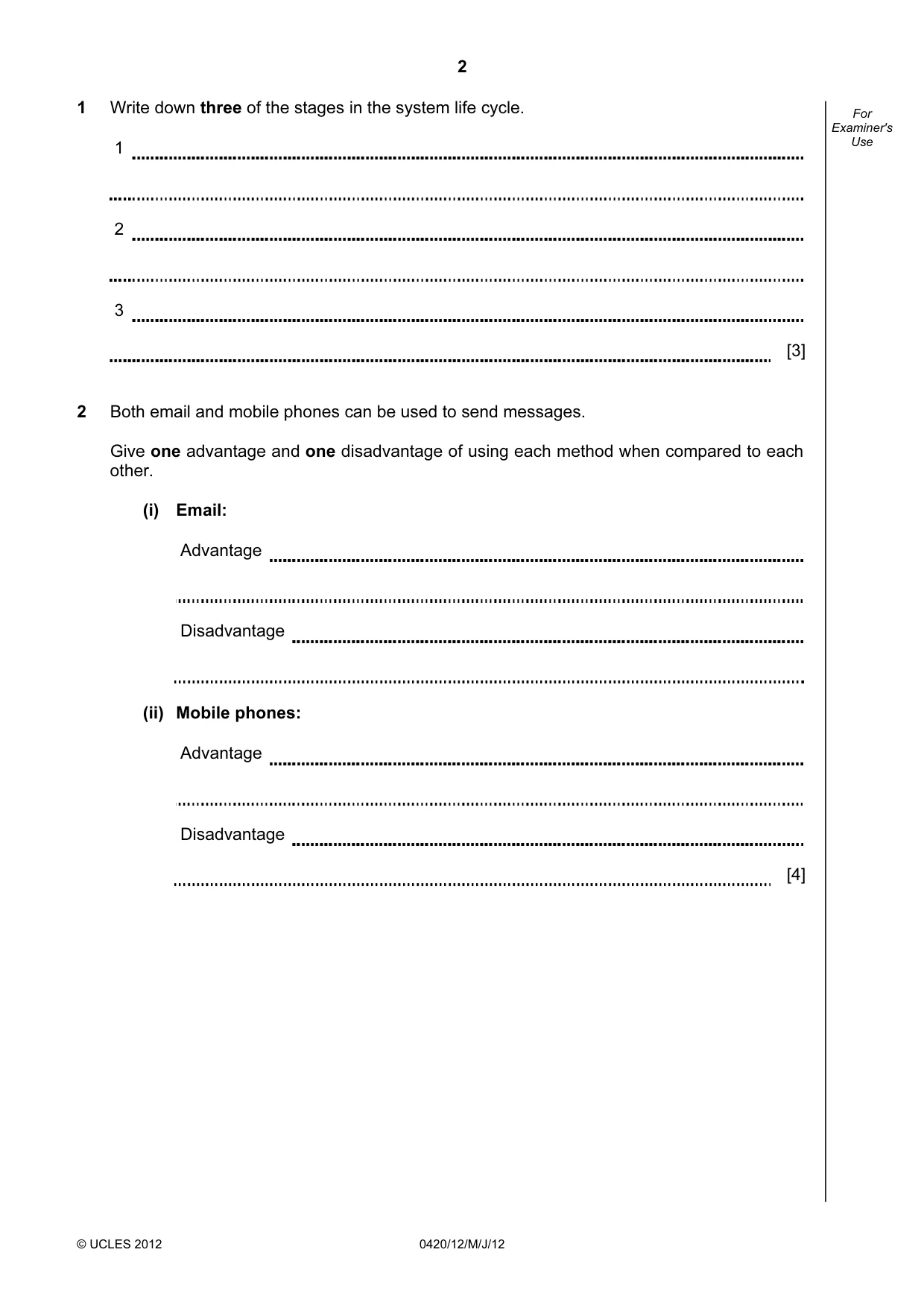
2 © UCLES 2012 0420/12/M/J/12 For Examiner's Use 1 Write down three of the stages in the system life cycle. 1 2 3 [3] 2 Both email and mobile phones can be used to send messages. Give one advantage and one disadvantage of using each method when compared to each other. (i) Email: Advantage Disadvantage (ii) Mobile phones: Advantage Disadvantage [4]
Question paper, page 3
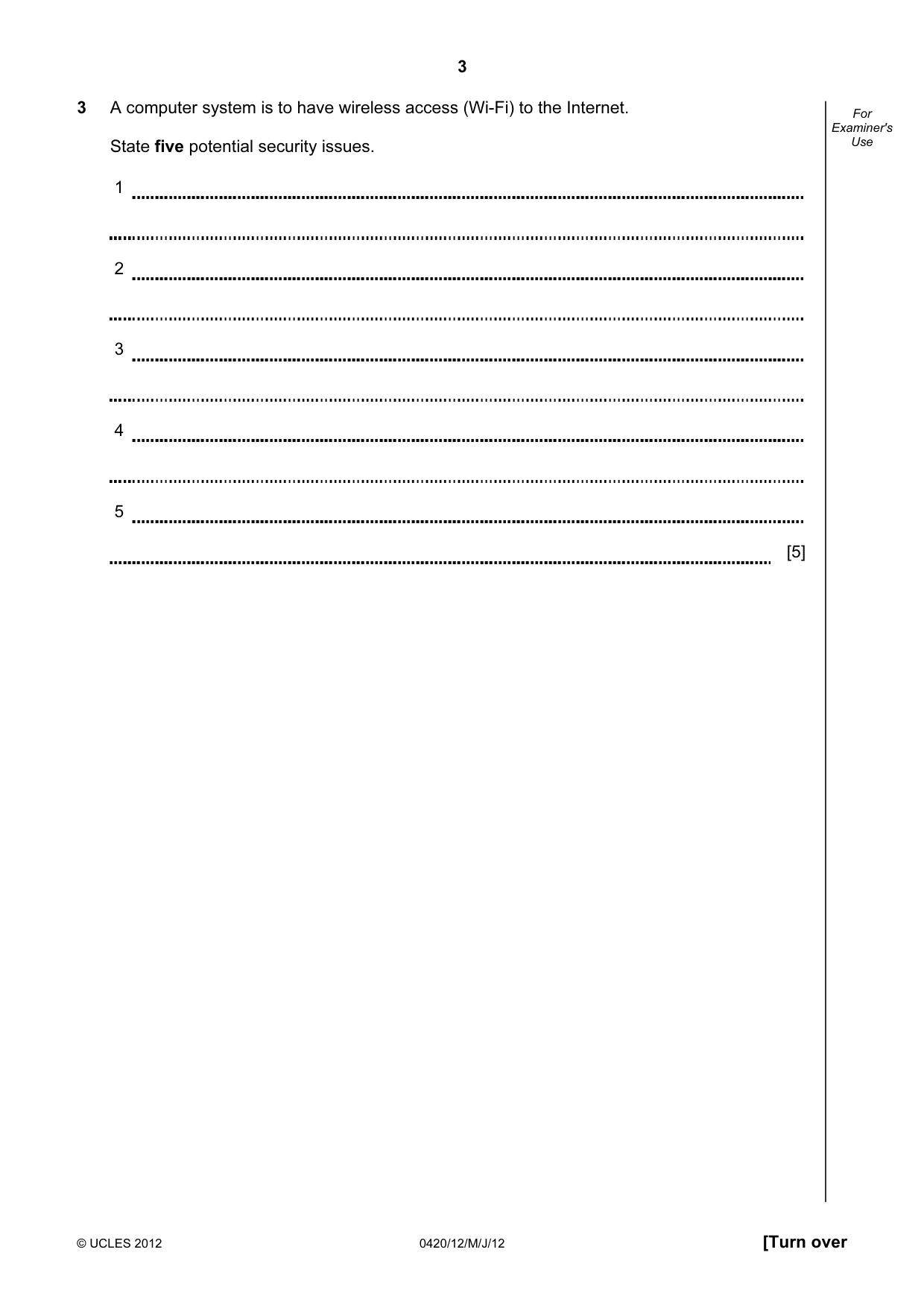
3 © UCLES 2012 0420/12/M/J/12 [Turn over For Examiner's Use 3 A computer system is to have wireless access (Wi-Fi) to the Internet. State five potential security issues. 1 2 3 4 5 [5]
Question paper, page 4
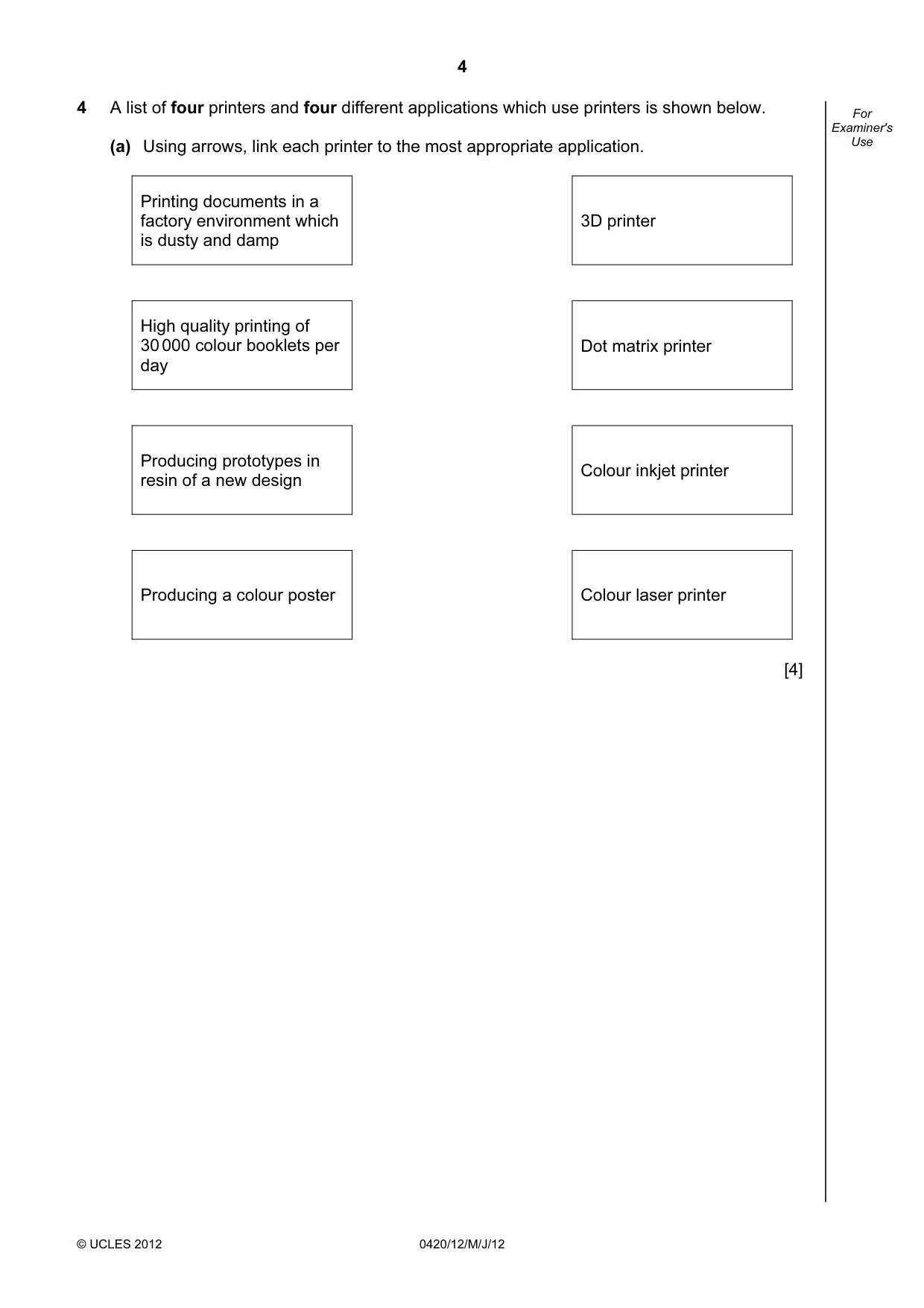
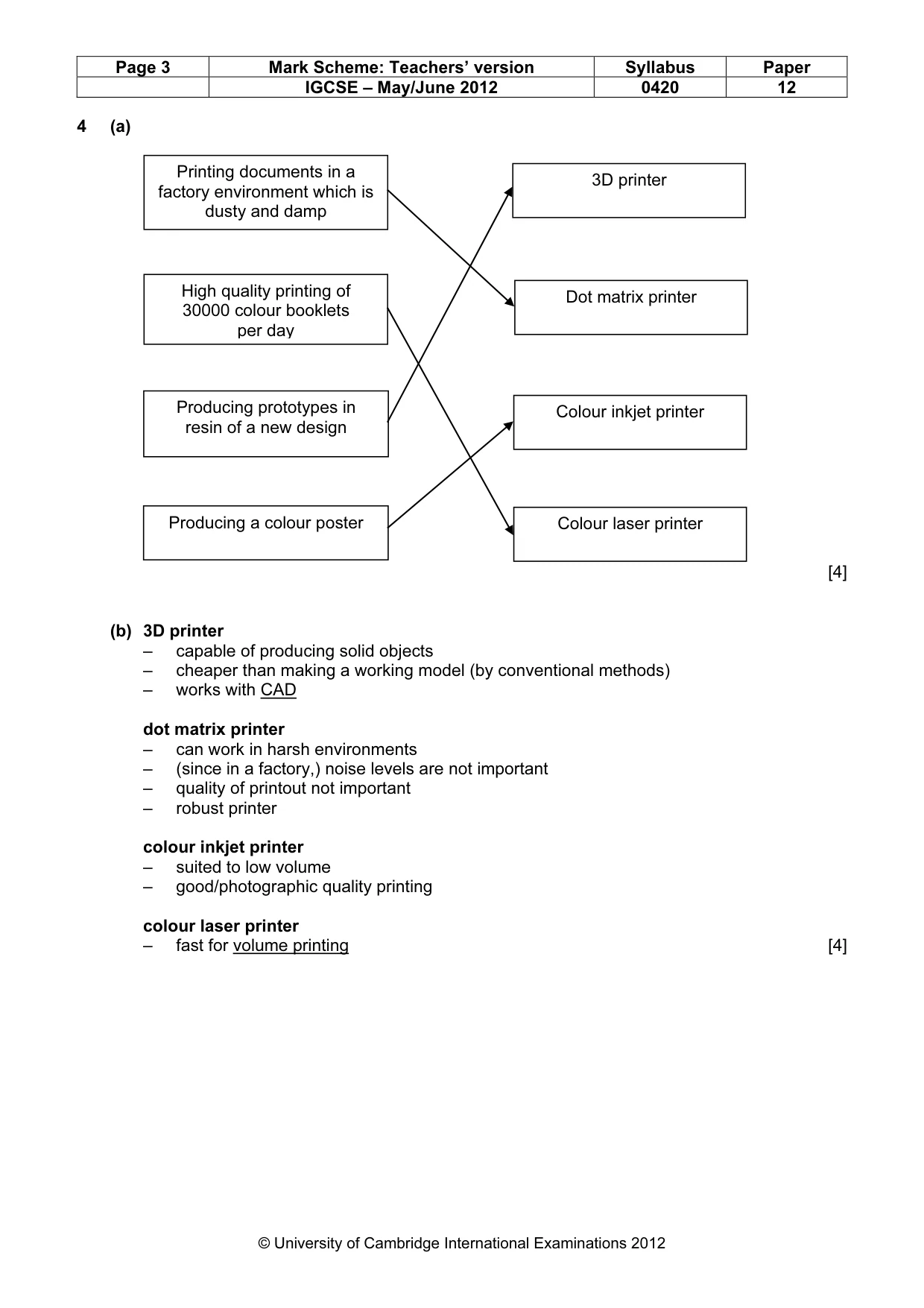
4 © UCLES 2012 0420/12/M/J/12 For Examiner's Use 4 A list of four printers and four different applications which use printers is shown below. (a) Using arrows, link each printer to the most appropriate application. Printing documents in a factory environment which is dusty and damp 3D printer High quality printing of 30 000 colour booklets per day Dot matrix printer Producing prototypes in resin of a new design Colour inkjet printer Producing a colour poster Colour laser printer [4]
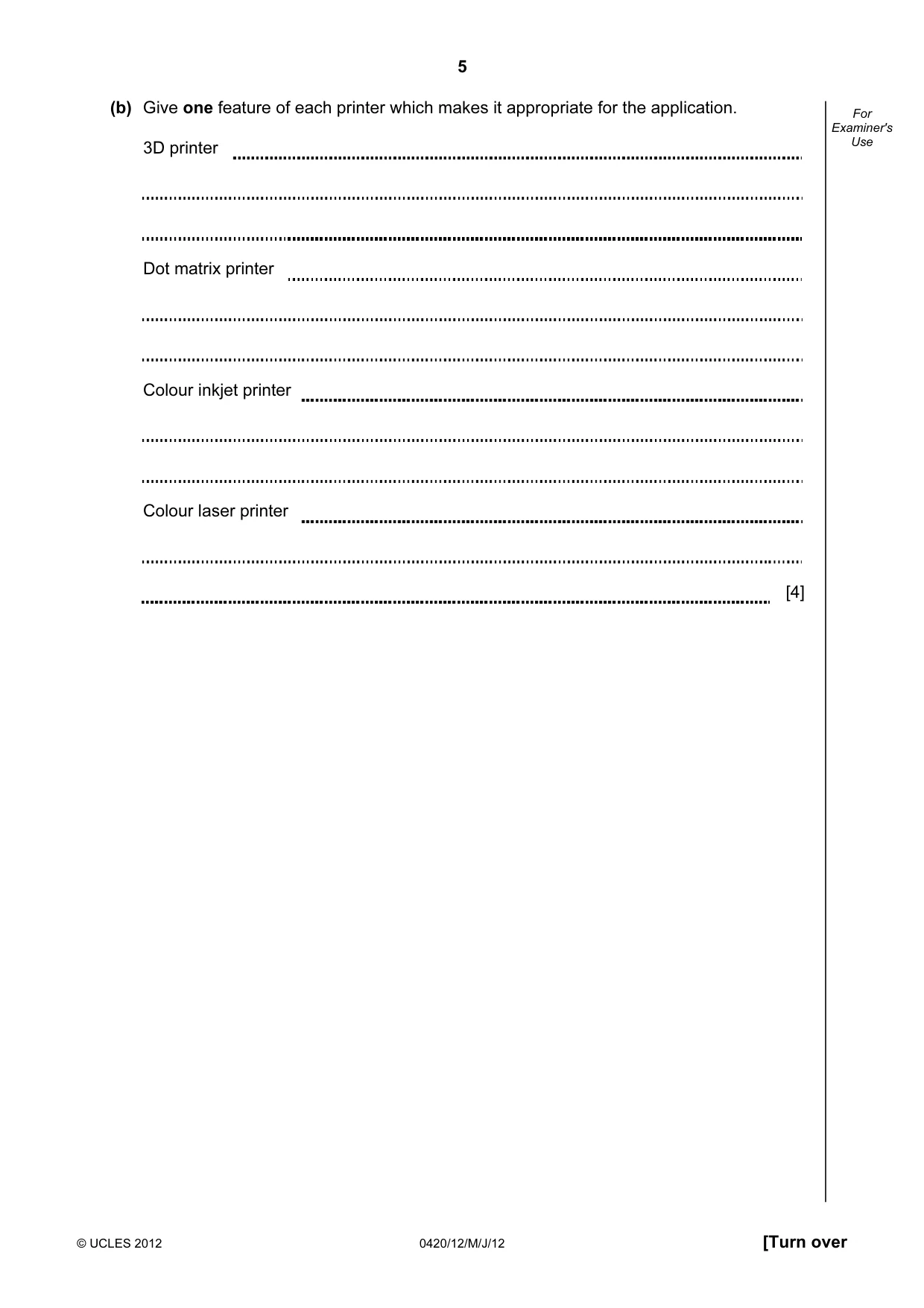
Question paper, page 5
5 © UCLES 2012 0420/12/M/J/12 [Turn over For Examiner's Use (b) Give one feature of each printer which makes it appropriate for the application. 3D printer Dot matrix printer Colour inkjet printer Colour laser printer [4]
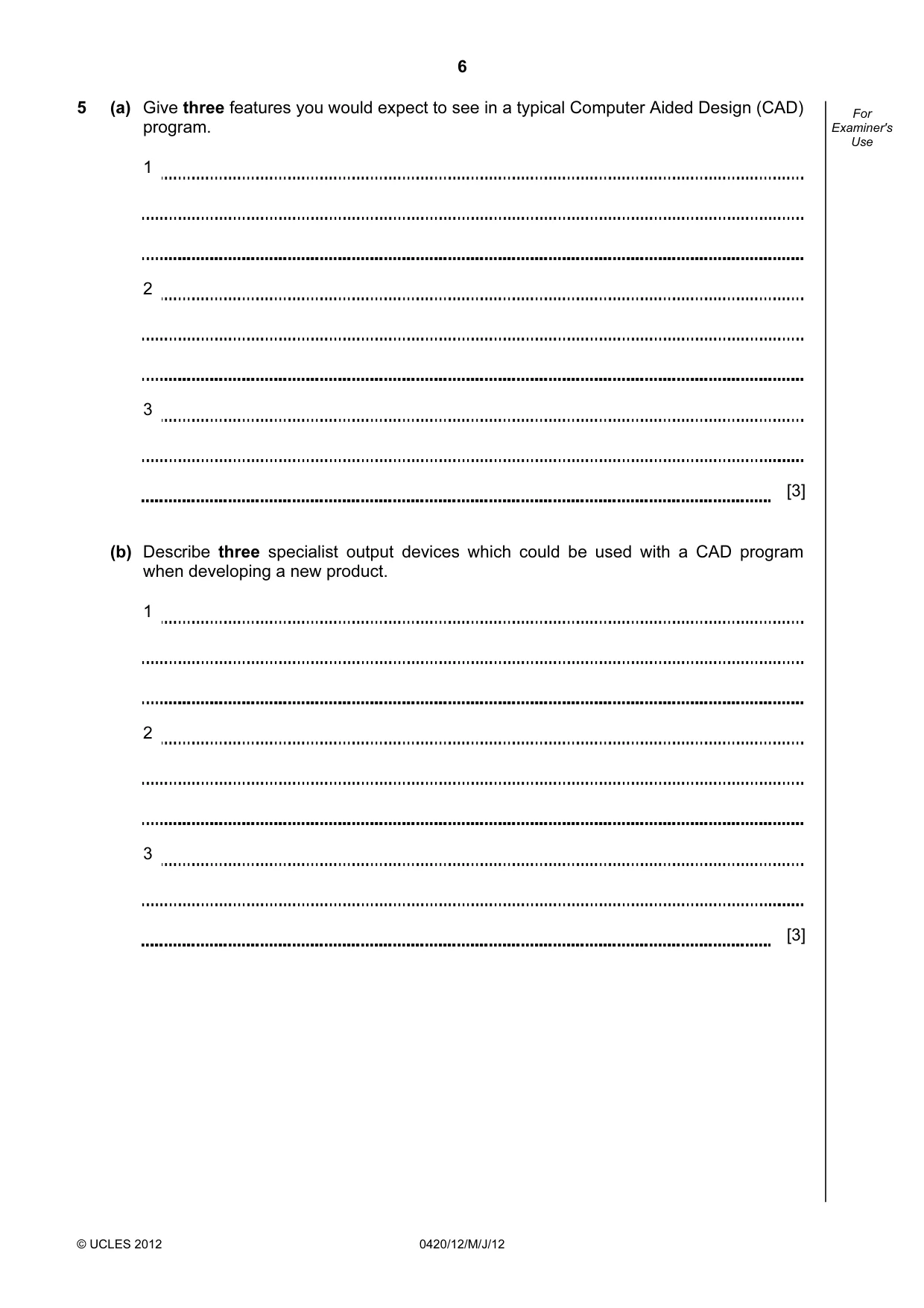
Question paper, page 6
6 © UCLES 2012 0420/12/M/J/12 For Examiner's Use 5 (a) Give three features you would expect to see in a typical Computer Aided Design (CAD) program. 1 2 3 [3] (b) Describe three specialist output devices which could be used with a CAD program when developing a new product. 1 2 3 [3]
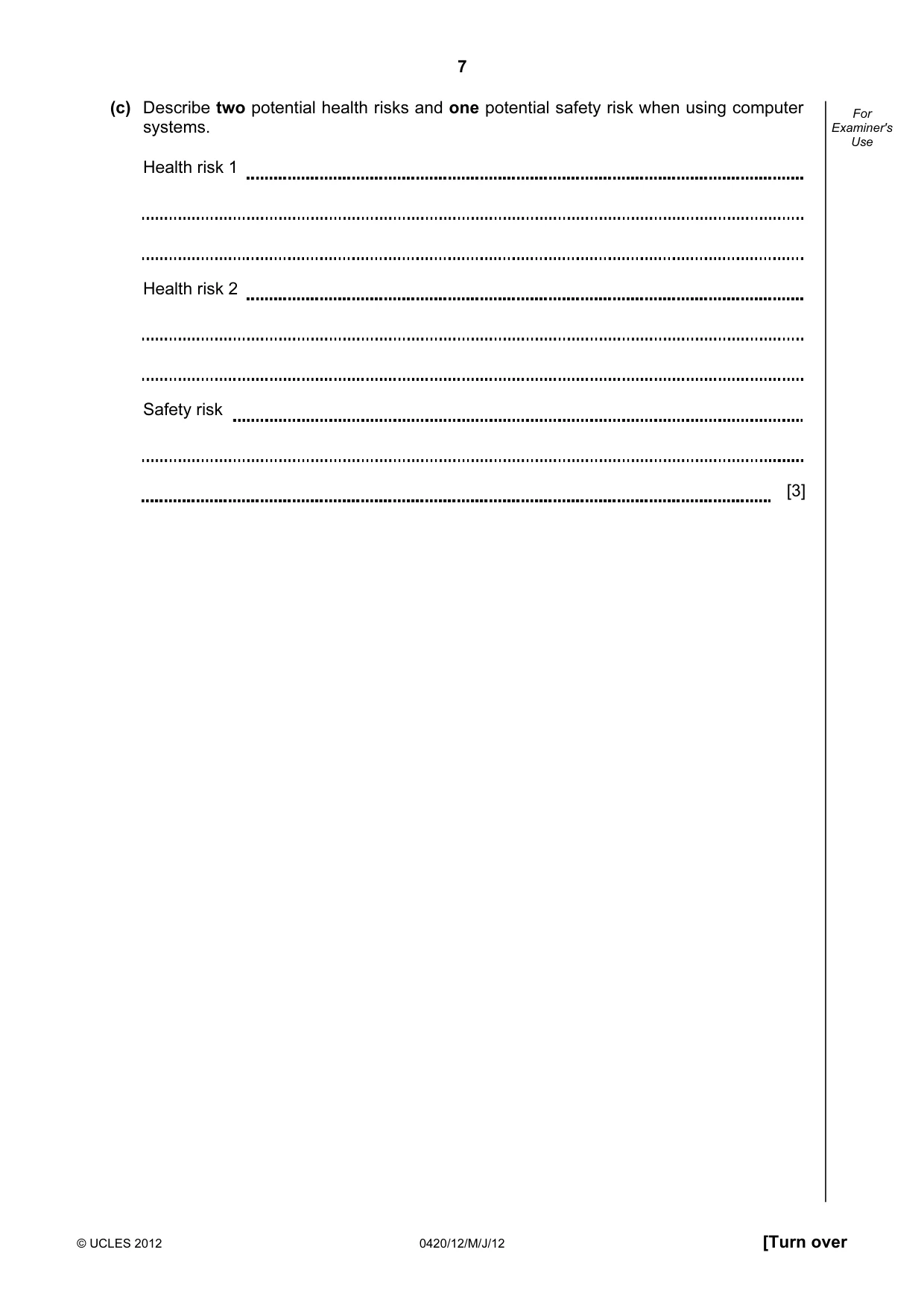
Question paper, page 7
7 © UCLES 2012 0420/12/M/J/12 [Turn over For Examiner's Use (c) Describe two potential health risks and one potential safety risk when using computer systems. Health risk 1 Health risk 2 Safety risk [3]
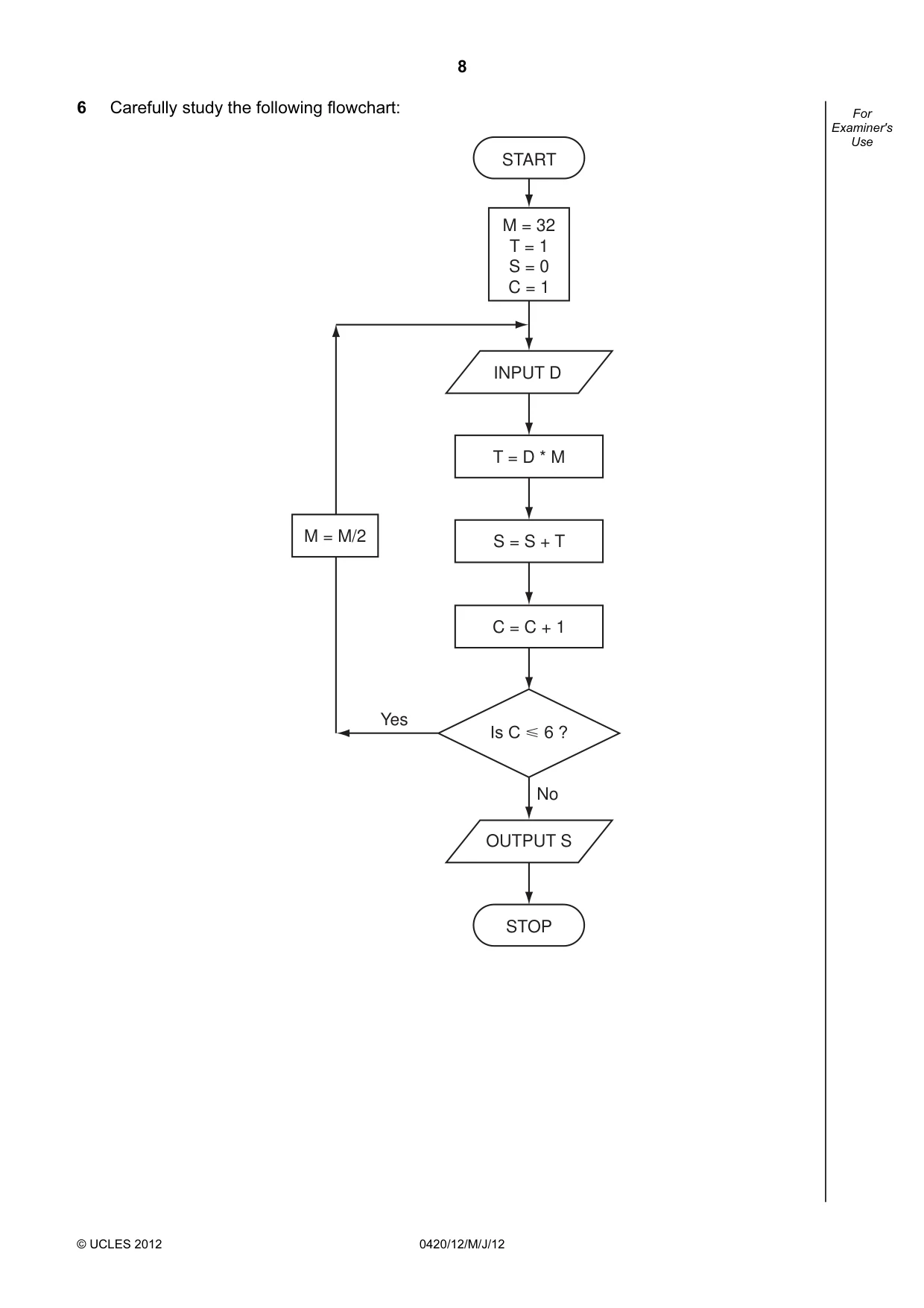
Question paper, page 8
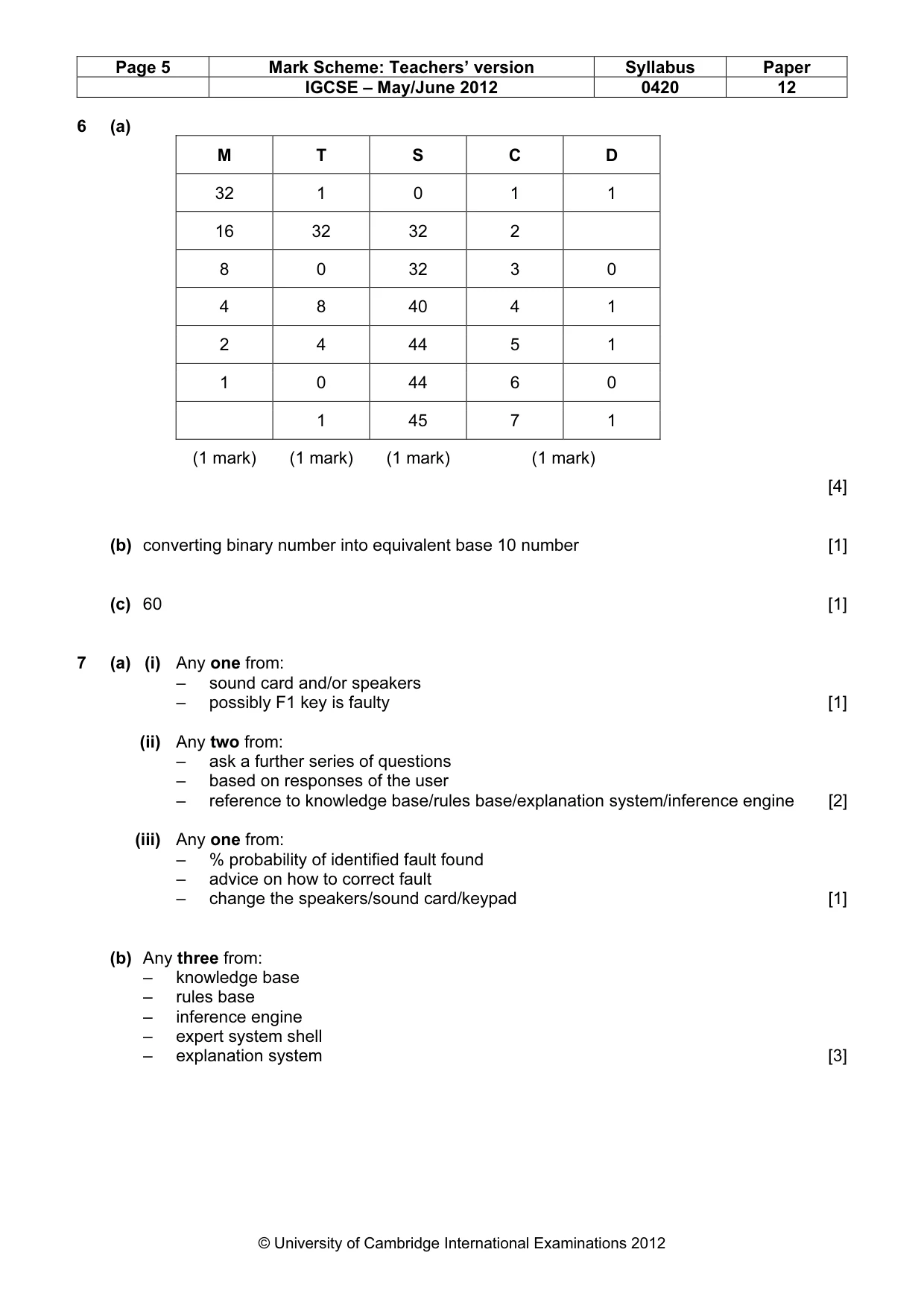
8 © UCLES 2012 0420/12/M/J/12 For Examiner's Use 6 Carefully study the following flowchart: START STOP M = 32 T = 1 S = 0 C = 1 T = D * M S = S + T C = C + 1 No INPUT D OUTPUT S Yes M = M/2
Question paper, page 9
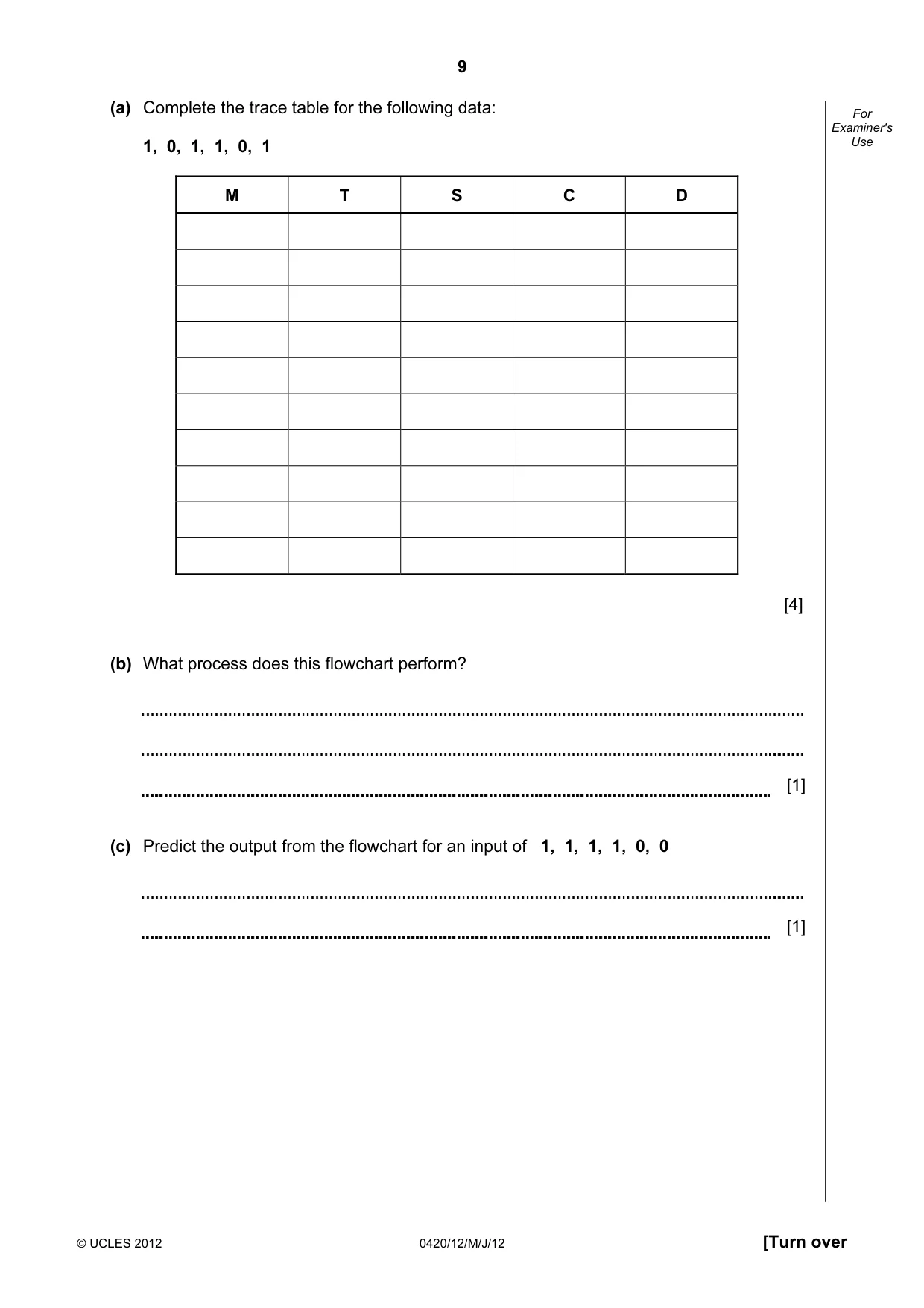
9 © UCLES 2012 0420/12/M/J/12 [Turn over For Examiner's Use (a) Complete the trace table for the following data: 1, 0, 1, 1, 0, 1 M T S C D [4] (b) What process does this flowchart perform? [1] (c) Predict the output from the flowchart for an input of 1, 1, 1, 1, 0, 0 [1]
Question paper, page 10
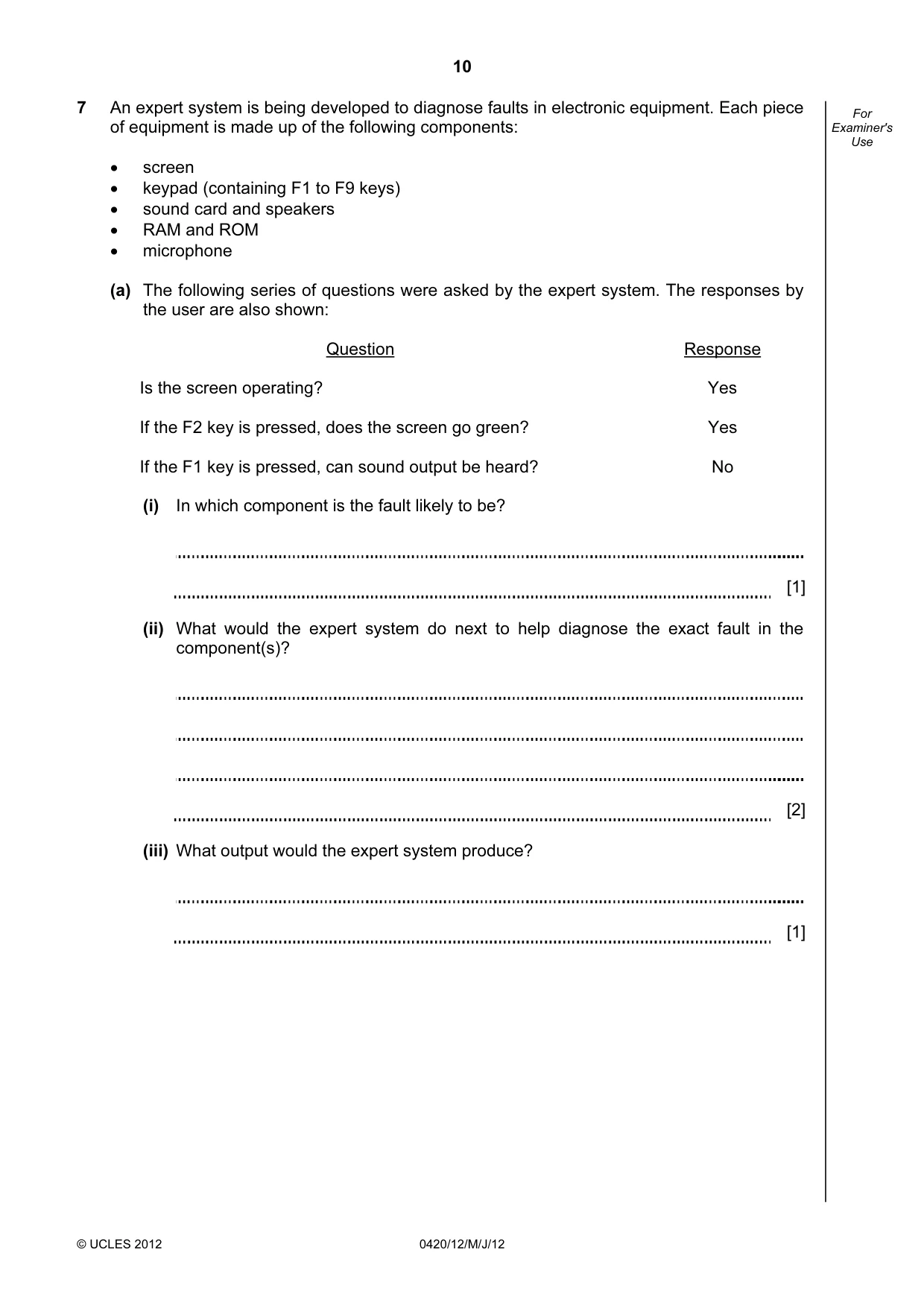
10 © UCLES 2012 0420/12/M/J/12 For Examiner's Use 7 An expert system is being developed to diagnose faults in electronic equipment. Each piece of equipment is made up of the following components: • screen • keypad (containing F1 to F9 keys) • sound card and speakers • RAM and ROM • microphone (a) The following series of questions were asked by the expert system. The responses by the user are also shown: Question Response Is the screen operating? Yes If the F2 key is pressed, does the screen go green? Yes If the F1 key is pressed, can sound output be heard? No (i) In which component is the fault likely to be? [1] (ii) What would the expert system do next to help diagnose the exact fault in the component(s)? [2] (iii) What output would the expert system produce? [1]
Question paper, page 11
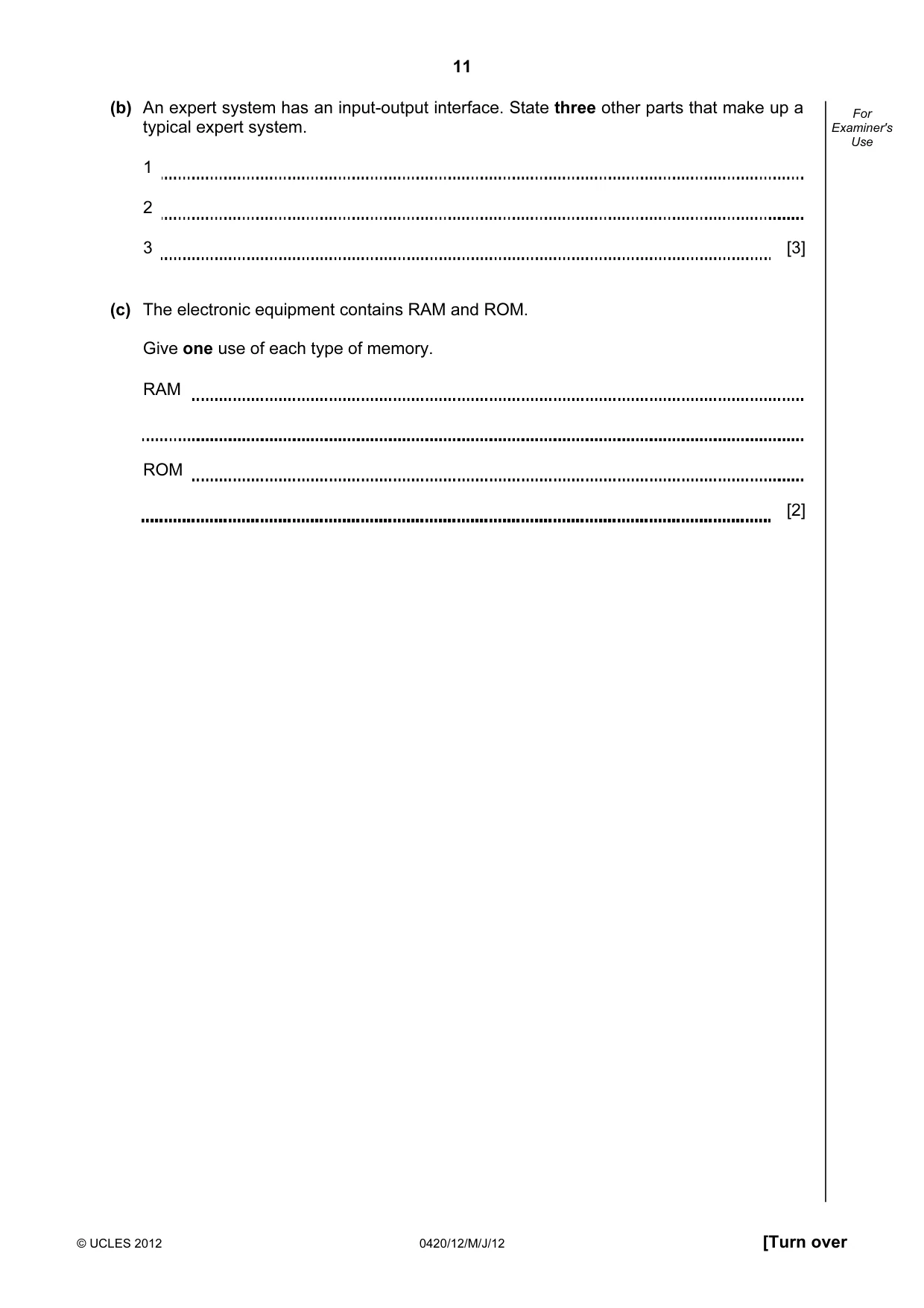
11 © UCLES 2012 0420/12/M/J/12 [Turn over For Examiner's Use (b) An expert system has an input-output interface. State three other parts that make up a typical expert system. 1 2 3 [3] (c) The electronic equipment contains RAM and ROM. Give one use of each type of memory. RAM ROM [2]
Question paper, page 12
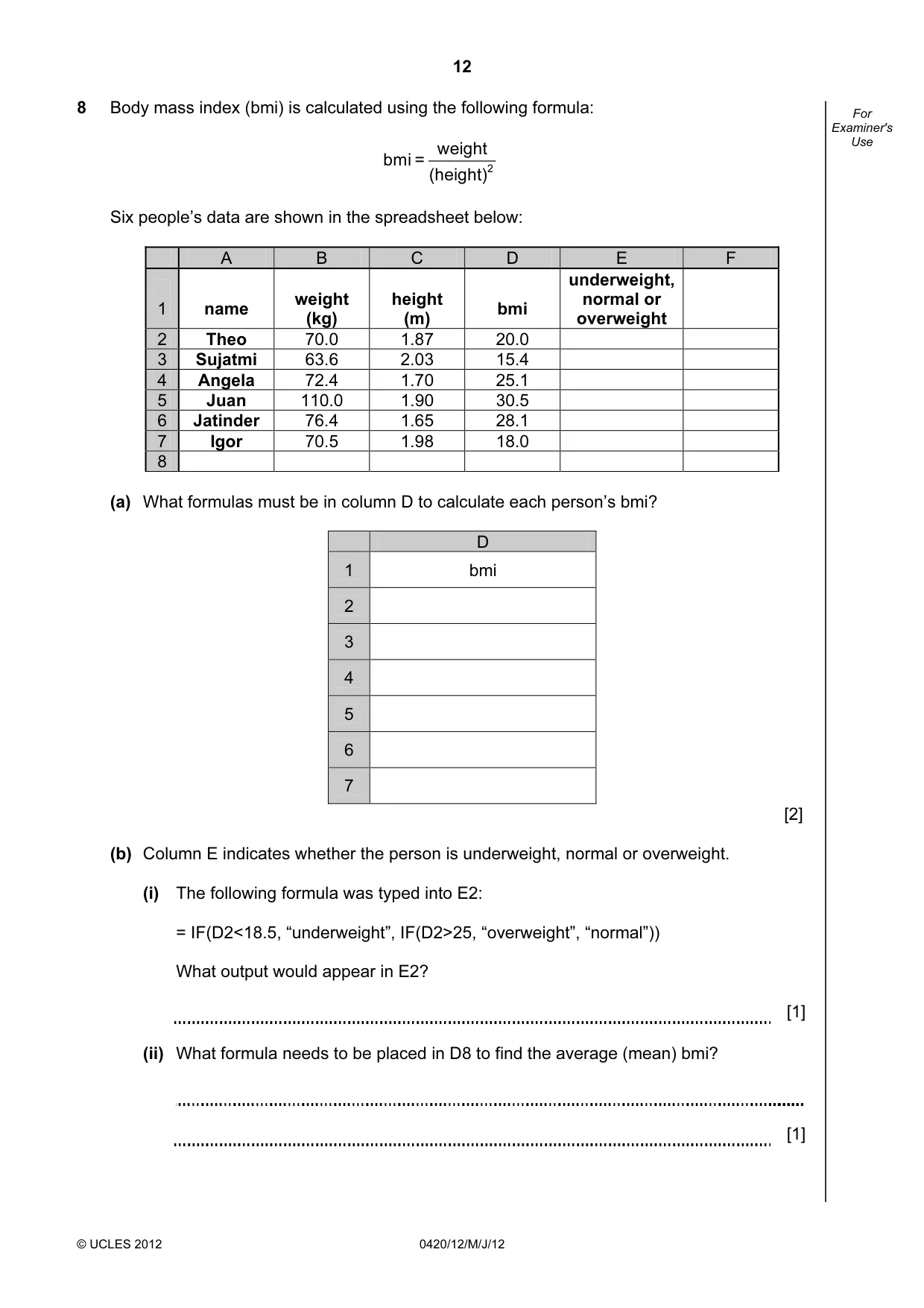
12 © UCLES 2012 0420/12/M/J/12 For Examiner's Use 8 Body mass index (bmi) is calculated using the following formula: 2 weight bmi = (height) Six people’s data are shown in the spreadsheet below: A B C D E F 1 name weight (kg) height (m) bmi underweight, normal or overweight 2 Theo 70.0 1.87 20.0 3 Sujatmi 63.6 2.03 15.4 4 Angela 72.4 1.70 25.1 5 Juan 110.0 1.90 30.5 6 Jatinder 76.4 1.65 28.1 7 Igor 70.5 1.98 18.0 8 (a) What formulas must be in column D to calculate each person’s bmi? D 1 bmi 2 3 4 5 6 7 [2] (b) Column E indicates whether the person is underweight, normal or overweight. (i) The following formula was typed into E2: = IF(D2<18.5, “underweight”, IF(D2>25, “overweight”, “normal”)) What output would appear in E2? [1] (ii) What formula needs to be placed in D8 to find the average (mean) bmi? [1]
Question paper, page 13
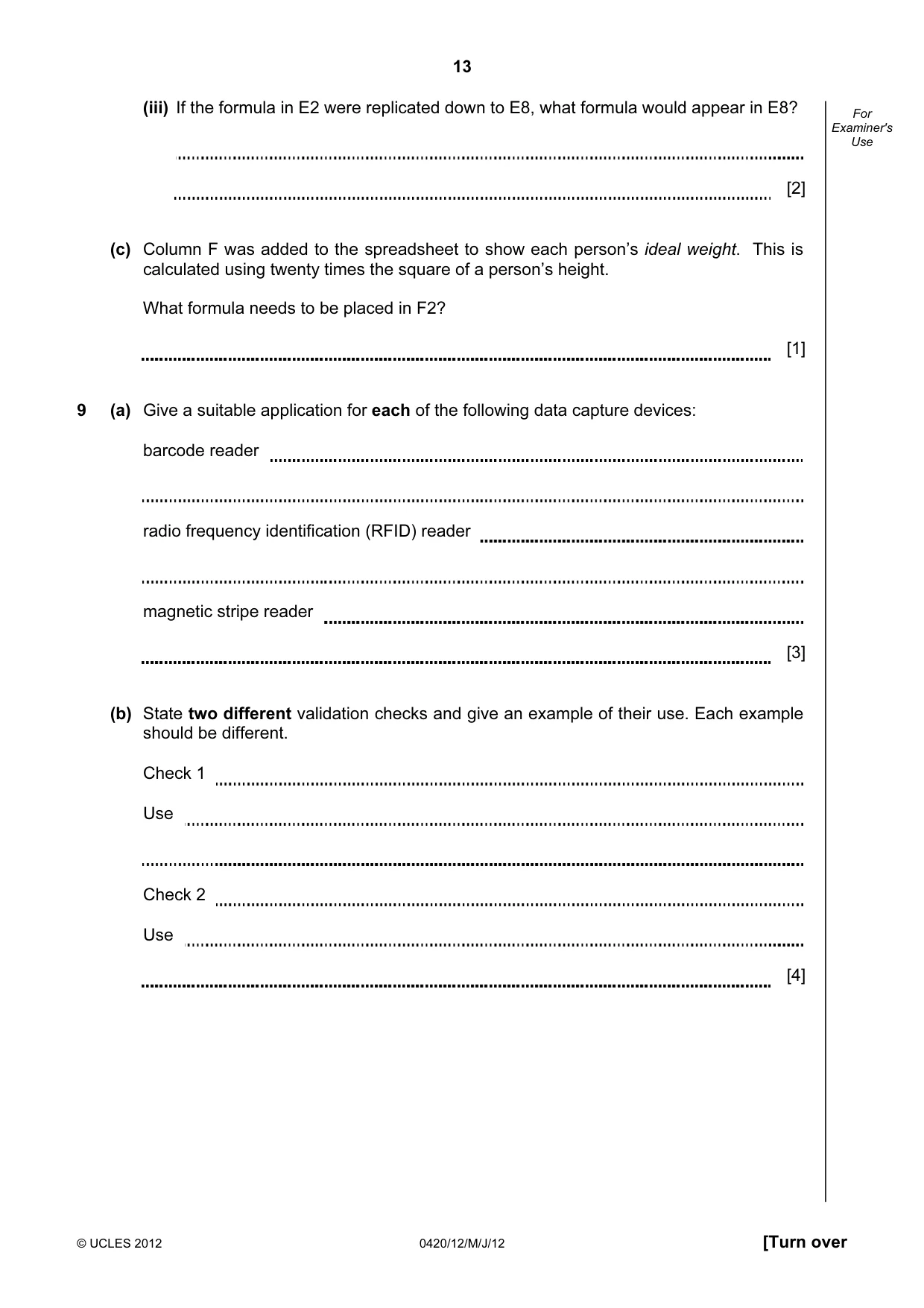
13 © UCLES 2012 0420/12/M/J/12 [Turn over For Examiner's Use (iii) If the formula in E2 were replicated down to E8, what formula would appear in E8? [2] (c) Column F was added to the spreadsheet to show each person’s ideal weight. This is calculated using twenty times the square of a person’s height. What formula needs to be placed in F2? [1] 9 (a) Give a suitable application for each of the following data capture devices: barcode reader radio frequency identification (RFID) reader magnetic stripe reader [3] (b) State two different validation checks and give an example of their use. Each example should be different. Check 1 Use Check 2 Use [4]
Question paper, page 14
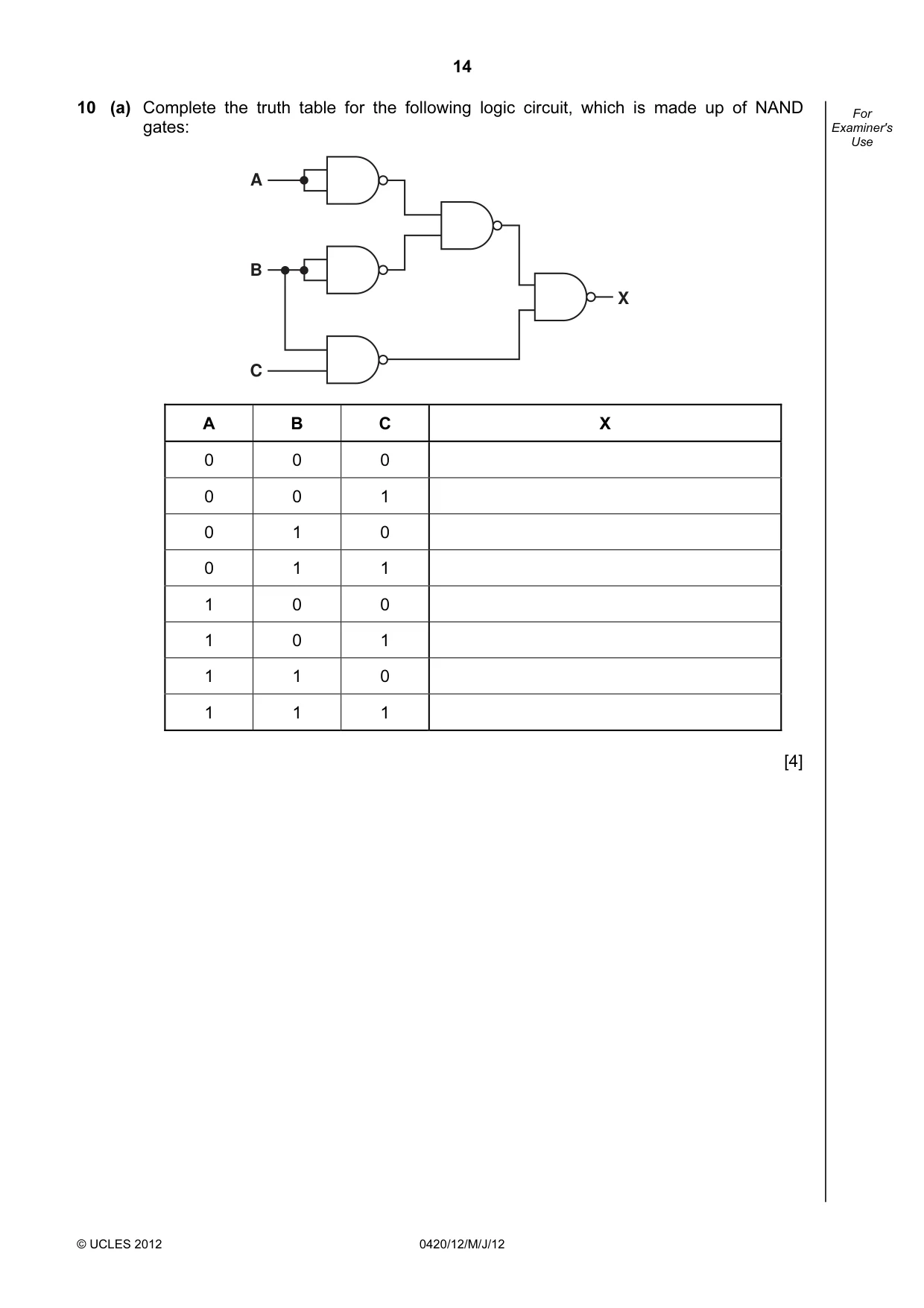
14 © UCLES 2012 0420/12/M/J/12 For Examiner's Use 10 (a) Complete the truth table for the following logic circuit, which is made up of NAND gates: A B C X A B C X 0 0 0 0 0 1 0 1 0 0 1 1 1 0 0 1 0 1 1 1 0 1 1 1 [4]
Question paper, page 15
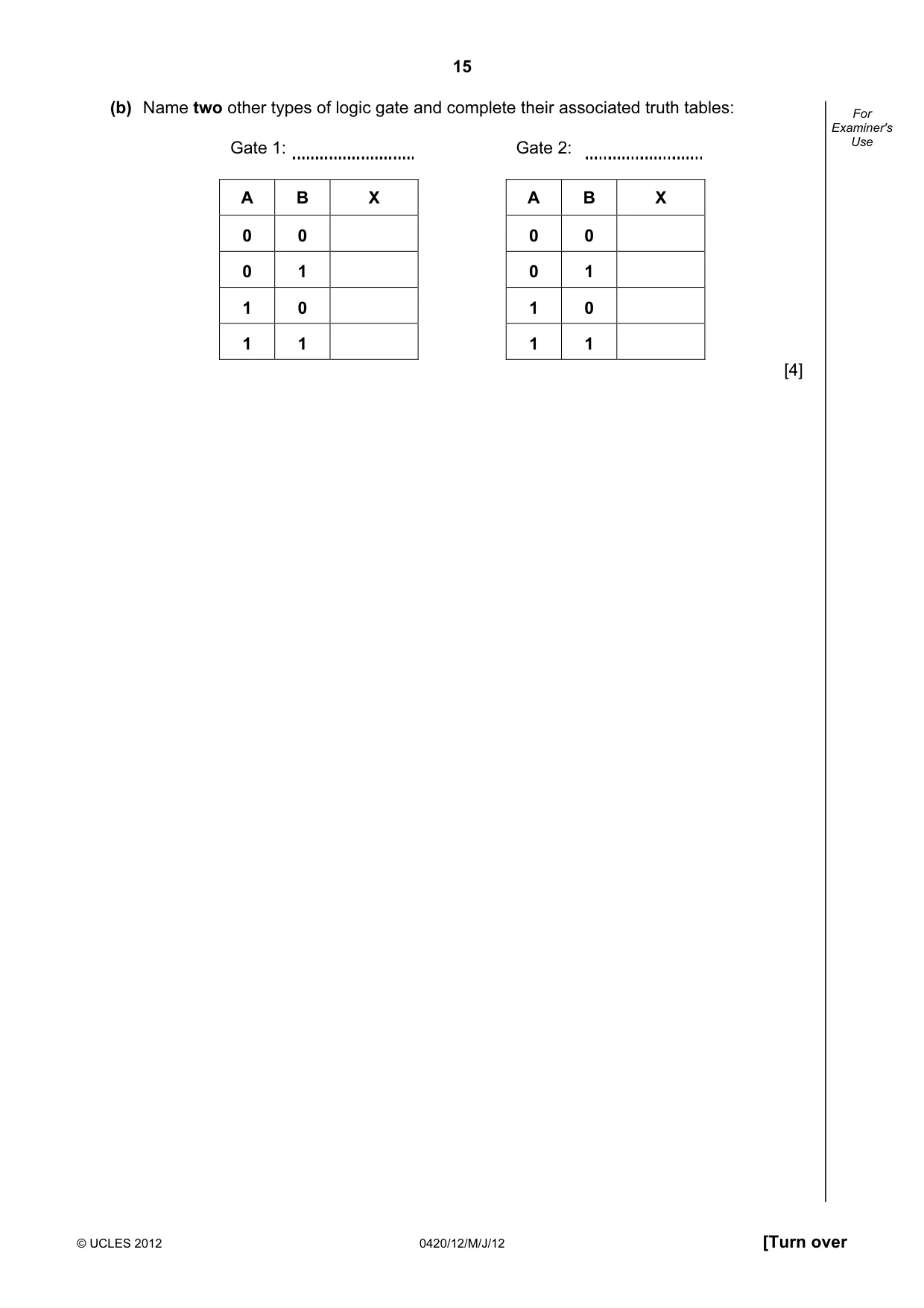
15 © UCLES 2012 0420/12/M/J/12 [Turn over For Examiner's Use (b) Name two other types of logic gate and complete their associated truth tables: Gate 1: Gate 2: A B X A B X 0 0 0 0 0 1 0 1 1 0 1 0 1 1 1 1 [4]
Question paper, page 16
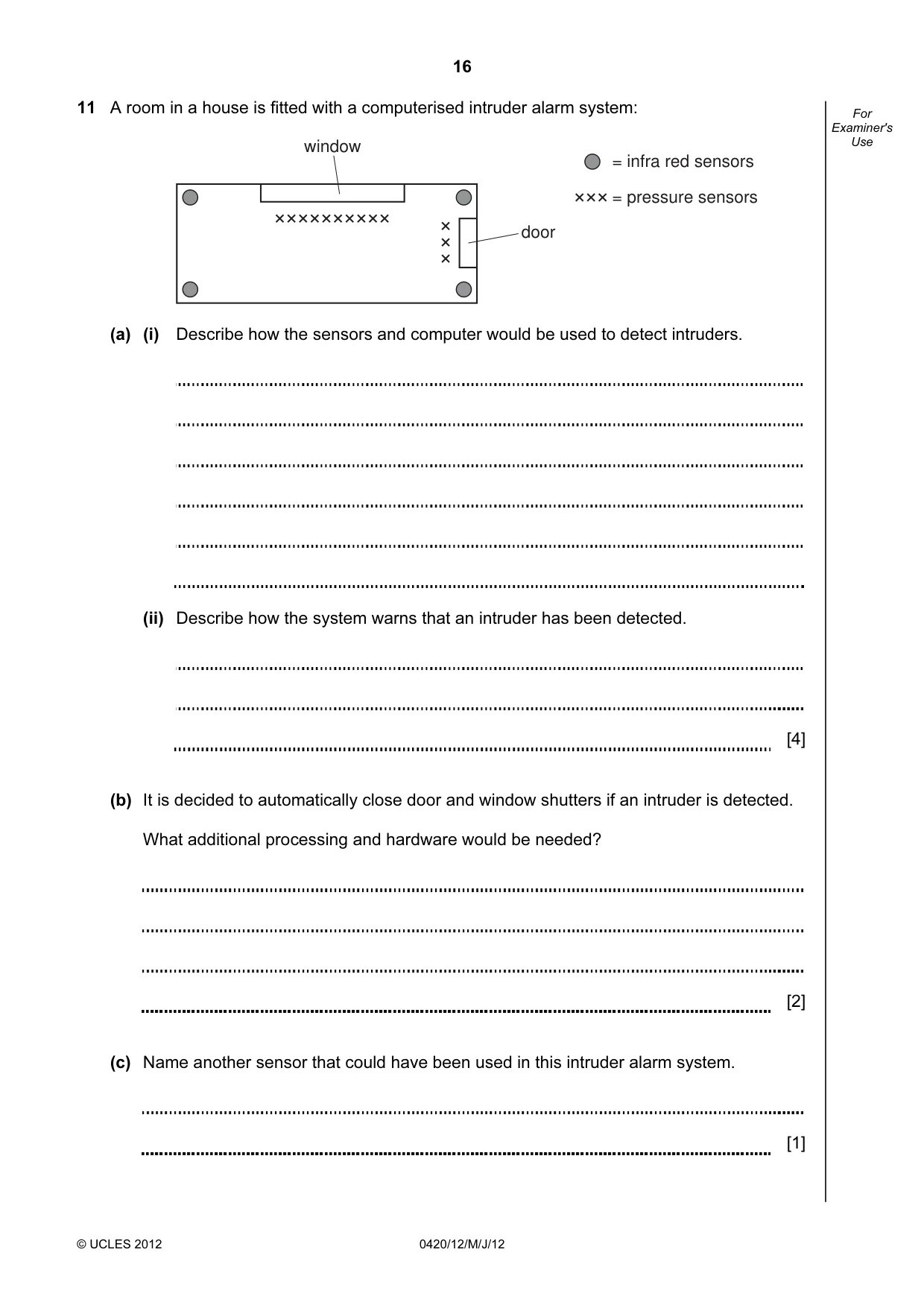
16 © UCLES 2012 0420/12/M/J/12 For Examiner's Use 11 A room in a house is fitted with a computerised intruder alarm system: = infra red sensors = pressure sensors door window (a) (i) Describe how the sensors and computer would be used to detect intruders. (ii) Describe how the system warns that an intruder has been detected. [4] (b) It is decided to automatically close door and window shutters if an intruder is detected. What additional processing and hardware would be needed? [2] (c) Name another sensor that could have been used in this intruder alarm system. [1]
Question paper, page 17
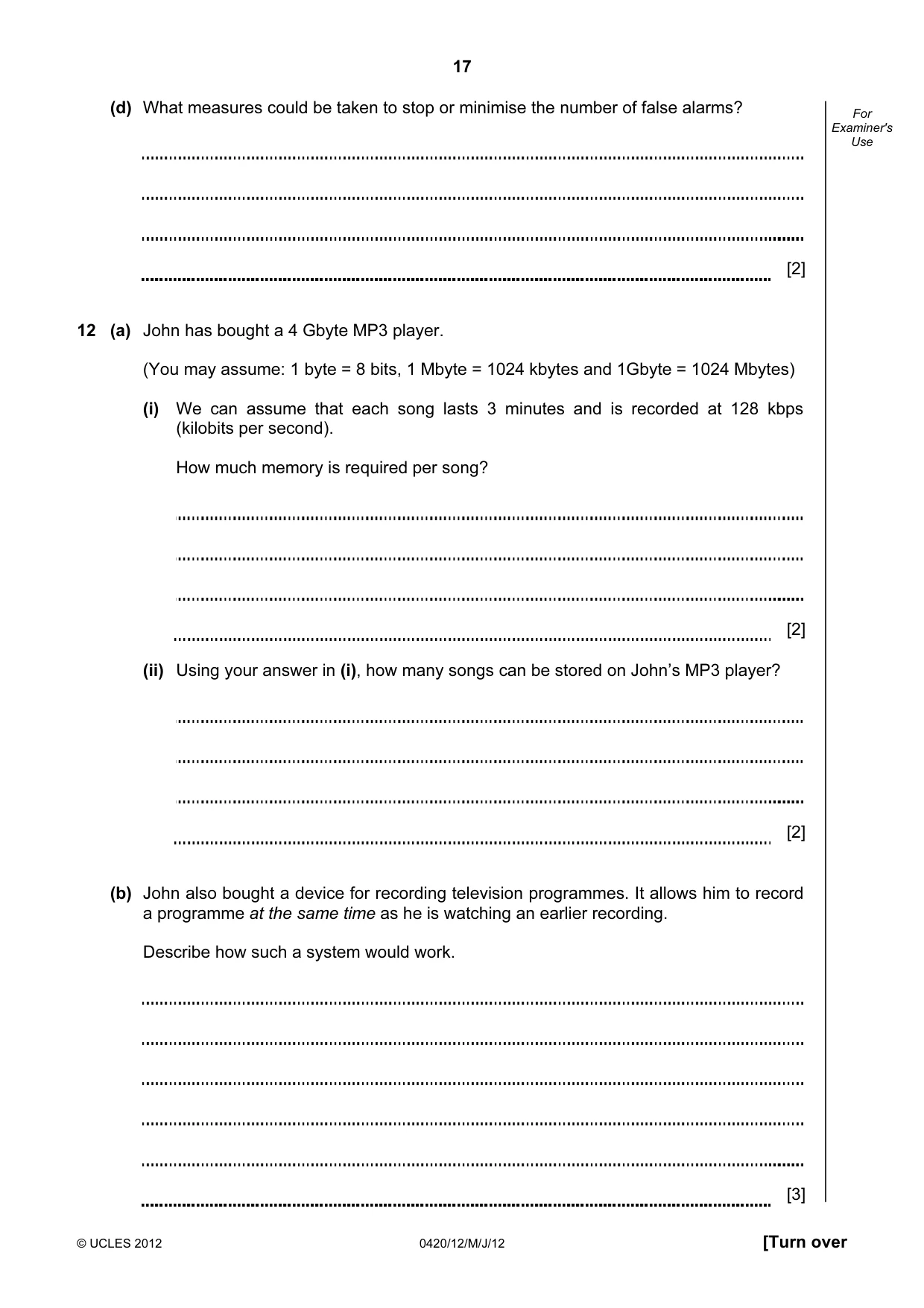
17 © UCLES 2012 0420/12/M/J/12 [Turn over For Examiner's Use (d) What measures could be taken to stop or minimise the number of false alarms? [2] 12 (a) John has bought a 4 Gbyte MP3 player. (You may assume: 1 byte = 8 bits, 1 Mbyte = 1024 kbytes and 1Gbyte = 1024 Mbytes) (i) We can assume that each song lasts 3 minutes and is recorded at 128 kbps (kilobits per second). How much memory is required per song? [2] (ii) Using your answer in (i), how many songs can be stored on John’s MP3 player? [2] (b) John also bought a device for recording television programmes. It allows him to record a programme at the same time as he is watching an earlier recording. Describe how such a system would work. [3]
Question paper, page 18
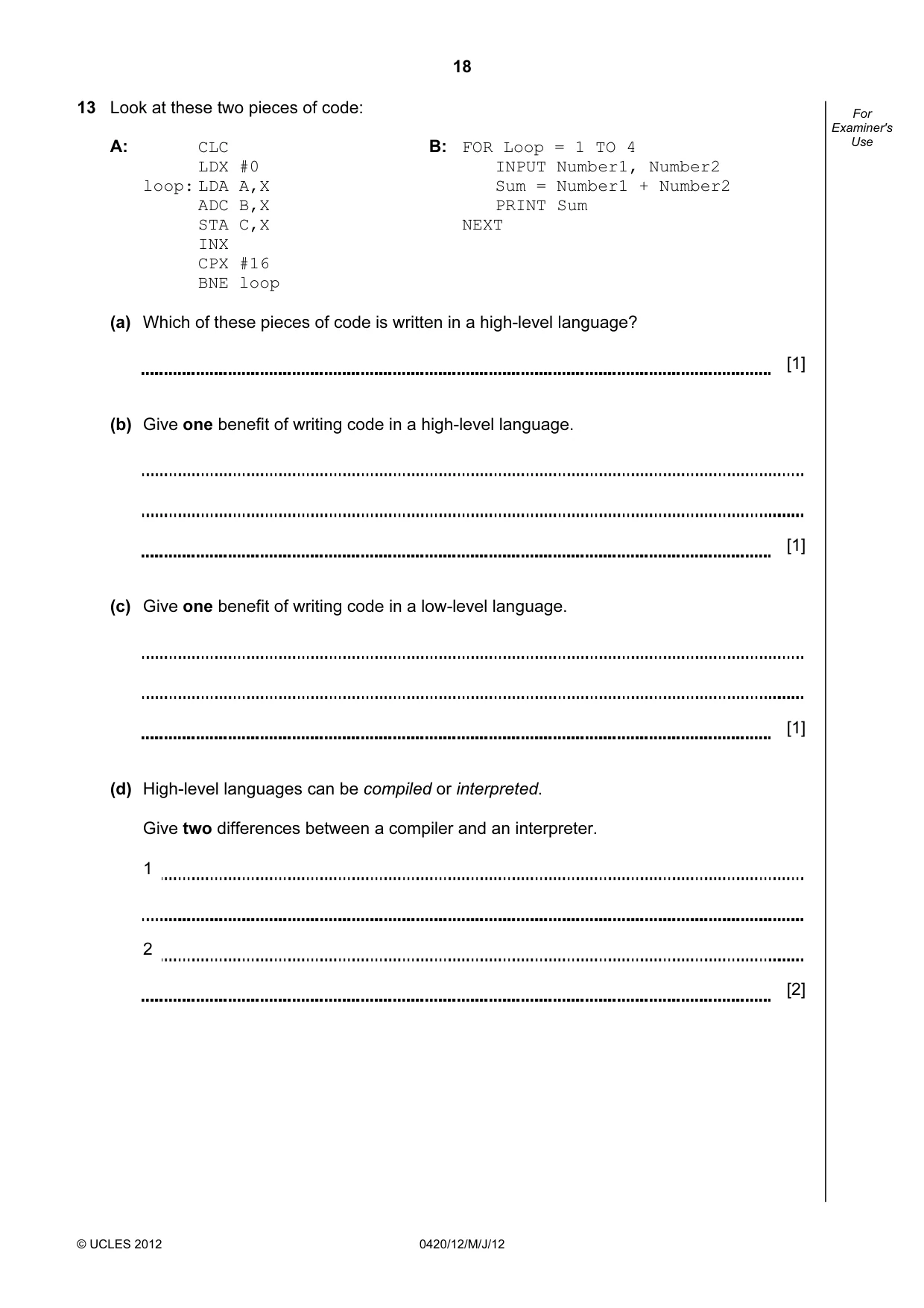
18 © UCLES 2012 0420/12/M/J/12 For Examiner's Use 13 Look at these two pieces of code: A: CLC B: FOR Loop = 1 TO 4 LDX #0 INPUT Number1, Number2 loop: LDA A,X Sum = Number1 + Number2 ADC B,X PRINT Sum STA C,X NEXT INX CPX #16 BNE loop (a) Which of these pieces of code is written in a high-level language? [1] (b) Give one benefit of writing code in a high-level language. [1] (c) Give one benefit of writing code in a low-level language. [1] (d) High-level languages can be compiled or interpreted. Give two differences between a compiler and an interpreter. 1 2 [2]
Question paper, page 19
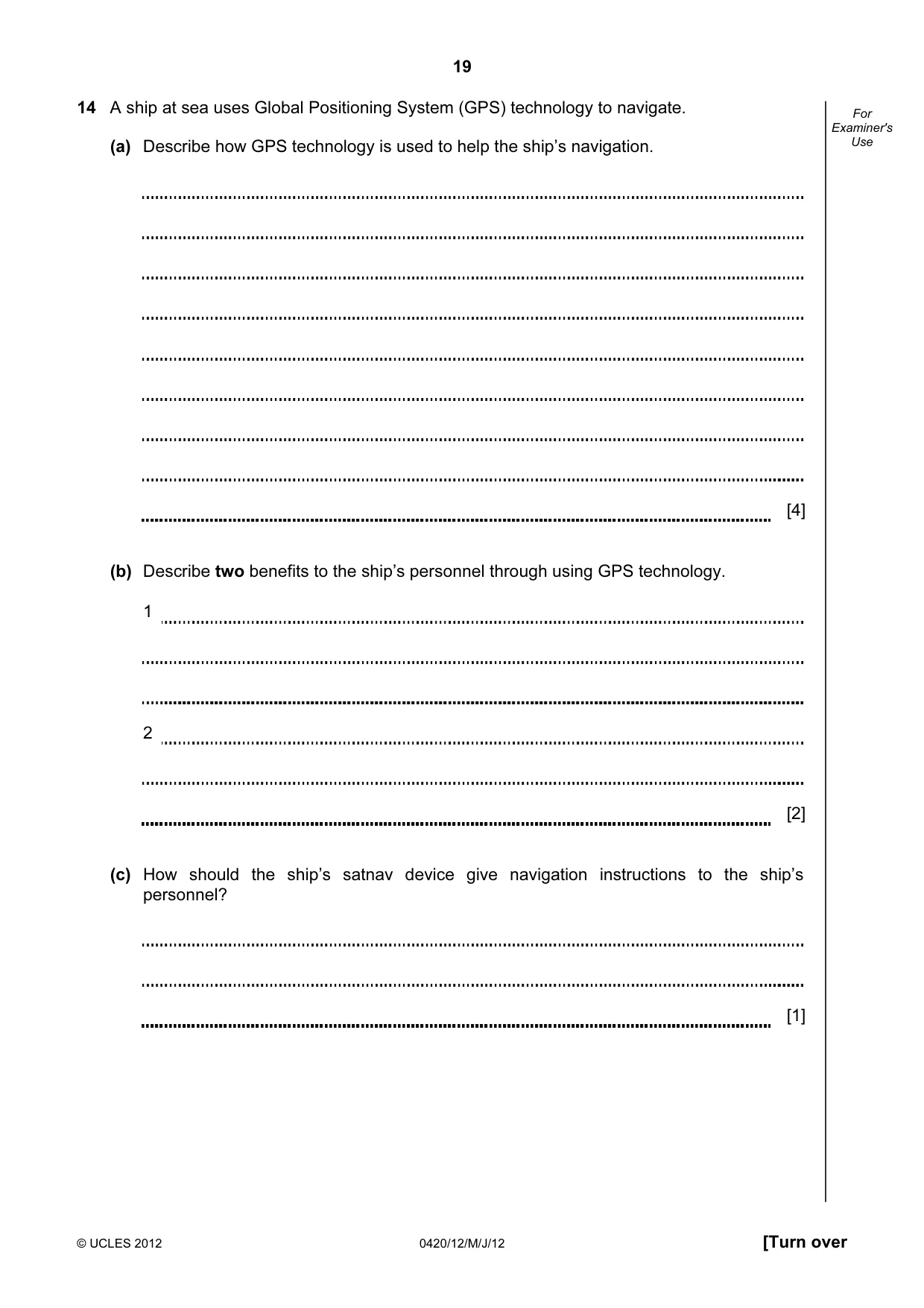
19 © UCLES 2012 0420/12/M/J/12 [Turn over For Examiner's Use 14 A ship at sea uses Global Positioning System (GPS) technology to navigate. (a) Describe how GPS technology is used to help the ship’s navigation. [4] (b) Describe two benefits to the ship’s personnel through using GPS technology. 1 2 [2] (c) How should the ship’s satnav device give navigation instructions to the ship’s personnel? [1]
Question paper, page 20
20 Permission to reproduce items where third-party owned material protected by copyright is included has been sought and cleared where possible. Every reasonable effort has been made by the publisher (UCLES) to trace copyright holders, but if any items requiring clearance have unwittingly been included, the publisher will be pleased to make amends at the earliest possible opportunity. University of Cambridge International Examinations is part of the Cambridge Assessment Group. Cambridge Assessment is the brand name of University of Cambridge Local Examinations Syndicate (UCLES), which is itself a department of the University of Cambridge. © UCLES 2012 0420/12/M/J/12 For Examiner's Use 15 An estate agent advertises houses for sale. The customer enquiries for a 7-day working week are entered weekly into a computer. Write an algorithm, using pseudocode or a program flowchart only, which: • inputs the number of customer enquiries each day, • inputs the house price each customer enquires about, • outputs how many customers enquired each day about houses costing less than $100 000, • outputs the percentage of all enquiries made during the week about houses costing more than $500 000. [6]
Mark scheme, page 1
UNIVERSITY OF CAMBRIDGE INTERNATIONAL EXAMINATIONS International General Certificate of Secondary Education MARK SCHEME for the May/June 2012 question paper for the guidance of teachers 0420 COMPUTER STUDIES 0420/12 Paper 1, maximum raw mark 100 This mark scheme is published as an aid to teachers and candidates, to indicate the requirements of the examination. It shows the basis on which Examiners were instructed to award marks. It does not indicate the details of the discussions that took place at an Examiners’ meeting before marking began, which would have considered the acceptability of alternative answers. Mark schemes must be read in conjunction with the question papers and the report on the examination. • Cambridge will not enter into discussions or correspondence in connection with these mark schemes. Cambridge is publishing the mark schemes for the May/June 2012 question papers for most IGCSE, GCE Advanced Level and Advanced Subsidiary Level syllabuses and some Ordinary Level syllabuses. www.XtremePapers.com
Mark scheme, page 2
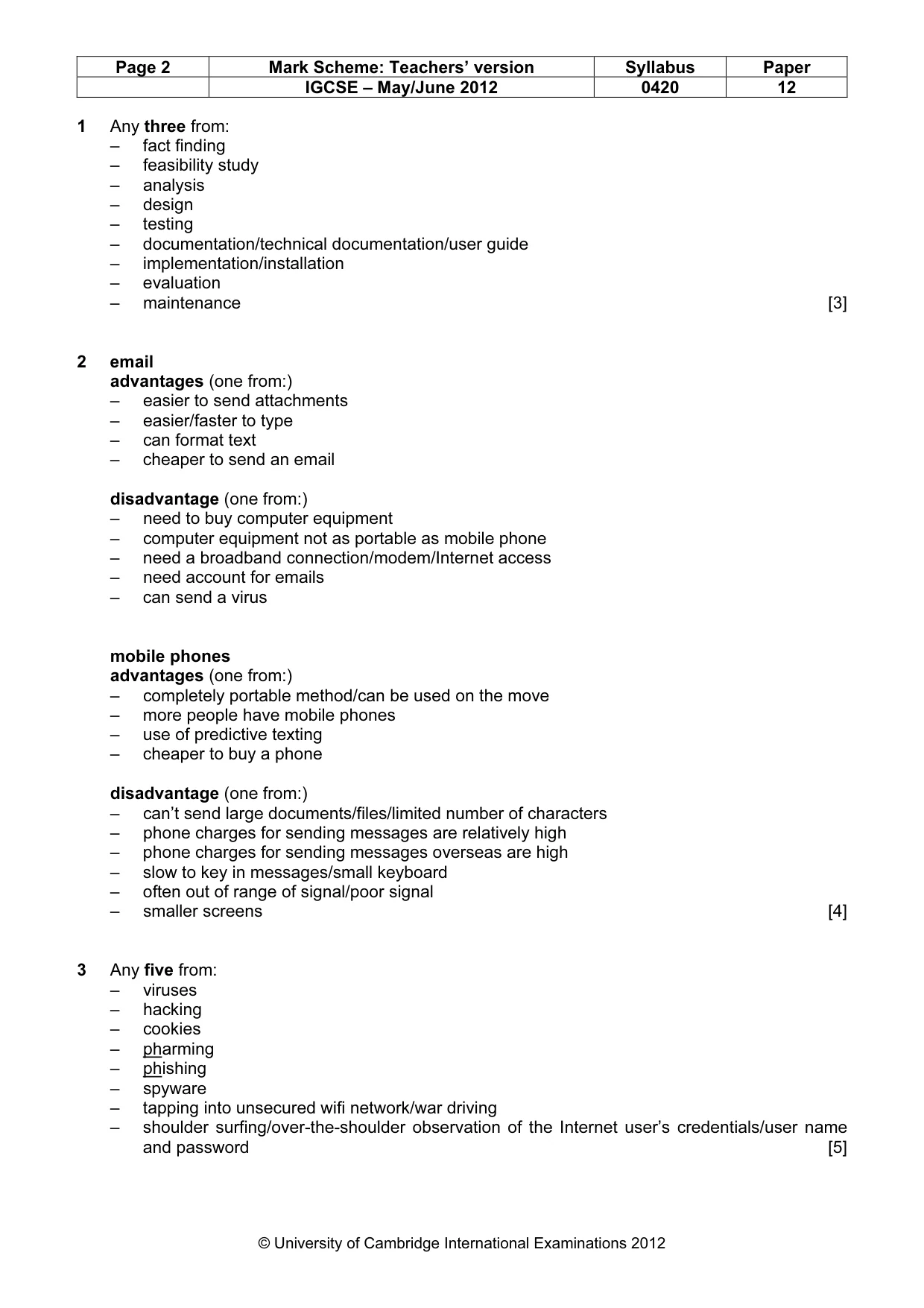
Page 2 Mark Scheme: Teachers’ version Syllabus Paper IGCSE – May/June 2012 0420 12 © University of Cambridge International Examinations 2012 1 Any three from: – fact finding – feasibility study – analysis – design – testing – documentation/technical documentation/user guide – implementation/installation – evaluation – maintenance [3] 2 email advantages (one from:) – easier to send attachments – easier/faster to type – can format text – cheaper to send an email disadvantage (one from:) – need to buy computer equipment – computer equipment not as portable as mobile phone – need a broadband connection/modem/Internet access – need account for emails – can send a virus mobile phones advantages (one from:) – completely portable method/can be used on the move – more people have mobile phones – use of predictive texting – cheaper to buy a phone disadvantage (one from:) – can’t send large documents/files/limited number of characters – phone charges for sending messages are relatively high – phone charges for sending messages overseas are high – slow to key in messages/small keyboard – often out of range of signal/poor signal – smaller screens [4] 3 Any five from: – viruses – hacking – cookies – pharming – phishing – spyware – tapping into unsecured wifi network/war driving – shoulder surfing/over-the-shoulder observation of the Internet user’s credentials/user name and password [5]
Mark scheme, page 3
Page 3 Mark Scheme: Teachers’ version Syllabus Paper IGCSE – May/June 2012 0420 12 © University of Cambridge International Examinations 2012 4 (a) [4] (b) 3D printer – capable of producing solid objects – cheaper than making a working model (by conventional methods) – works with CAD dot matrix printer – can work in harsh environments – (since in a factory,) noise levels are not important – quality of printout not important – robust printer colour inkjet printer – suited to low volume – good/photographic quality printing colour laser printer – fast for volume printing [4] Printing documents in a factory environment which is dusty and damp High quality printing of 30000 colour booklets per day Producing prototypes in resin of a new design Producing a colour poster 3D printer Dot matrix printer Colour inkjet printer Colour laser printer
Mark scheme, page 4
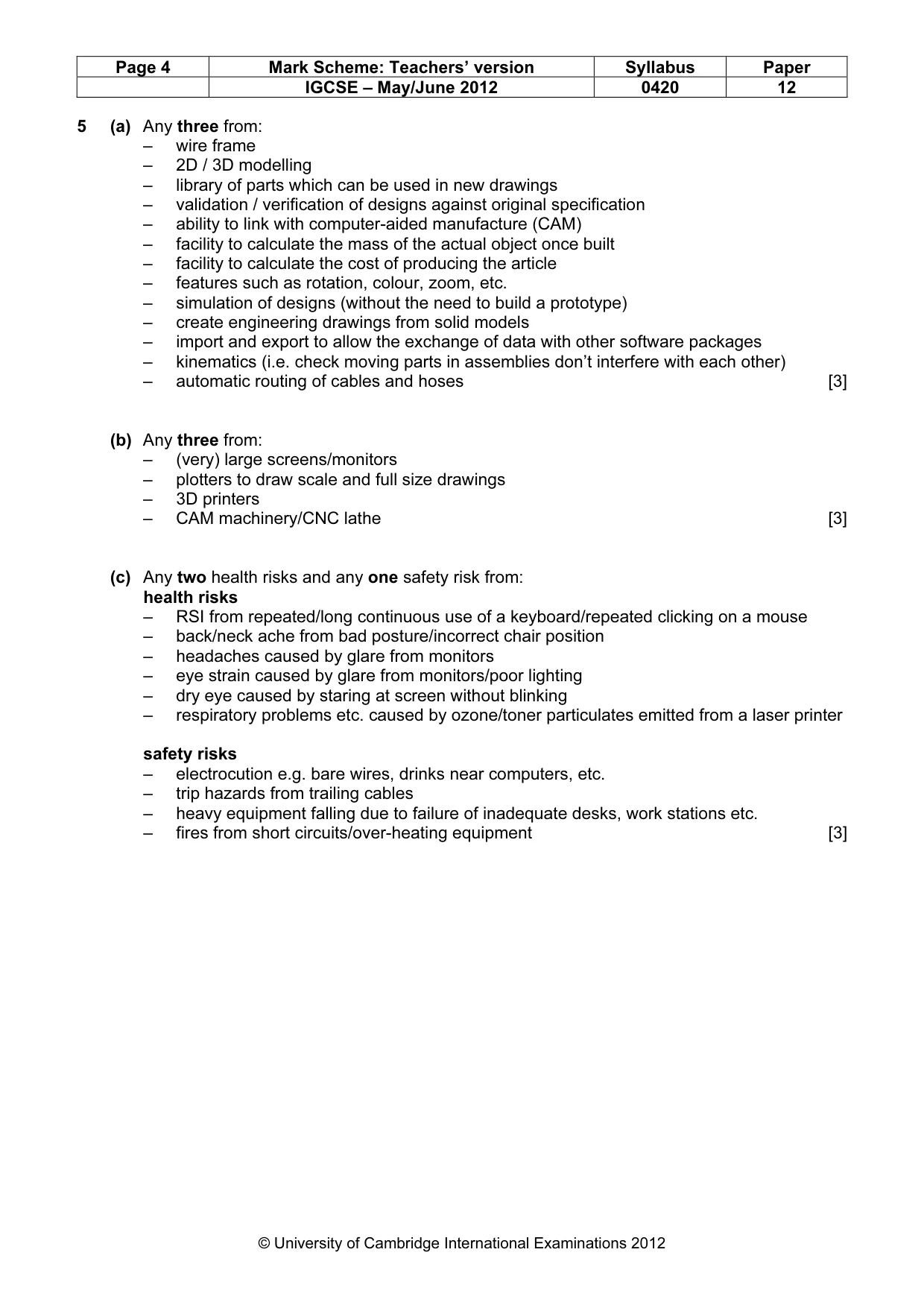
Page 4 Mark Scheme: Teachers’ version Syllabus Paper IGCSE – May/June 2012 0420 12 © University of Cambridge International Examinations 2012 5 (a) Any three from: – wire frame – 2D / 3D modelling – library of parts which can be used in new drawings – validation / verification of designs against original specification – ability to link with computer-aided manufacture (CAM) – facility to calculate the mass of the actual object once built – facility to calculate the cost of producing the article – features such as rotation, colour, zoom, etc. – simulation of designs (without the need to build a prototype) – create engineering drawings from solid models – import and export to allow the exchange of data with other software packages – kinematics (i.e. check moving parts in assemblies don’t interfere with each other) – automatic routing of cables and hoses [3] (b) Any three from: – (very) large screens/monitors – plotters to draw scale and full size drawings – 3D printers – CAM machinery/CNC lathe [3] (c) Any two health risks and any one safety risk from: health risks – RSI from repeated/long continuous use of a keyboard/repeated clicking on a mouse – back/neck ache from bad posture/incorrect chair position – headaches caused by glare from monitors – eye strain caused by glare from monitors/poor lighting – dry eye caused by staring at screen without blinking – respiratory problems etc. caused by ozone/toner particulates emitted from a laser printer safety risks – electrocution e.g. bare wires, drinks near computers, etc. – trip hazards from trailing cables – heavy equipment falling due to failure of inadequate desks, work stations etc. – fires from short circuits/over-heating equipment [3]
Mark scheme, page 5
Page 5 Mark Scheme: Teachers’ version Syllabus Paper IGCSE – May/June 2012 0420 12 © University of Cambridge International Examinations 2012 6 (a) M T S C D 32 1 0 1 1 16 32 32 2 8 0 32 3 0 4 8 40 4 1 2 4 44 5 1 1 0 44 6 0 1 45 7 1 (1 mark) (1 mark) (1 mark) (1 mark) [4] (b) converting binary number into equivalent base 10 number [1] (c) 60 [1] 7 (a) (i) Any one from: – sound card and/or speakers – possibly F1 key is faulty [1] (ii) Any two from: – ask a further series of questions – based on responses of the user – reference to knowledge base/rules base/explanation system/inference engine [2] (iii) Any one from: – % probability of identified fault found – advice on how to correct fault – change the speakers/sound card/keypad [1] (b) Any three from: – knowledge base – rules base – inference engine – expert system shell – explanation system [3]
Mark scheme, page 6
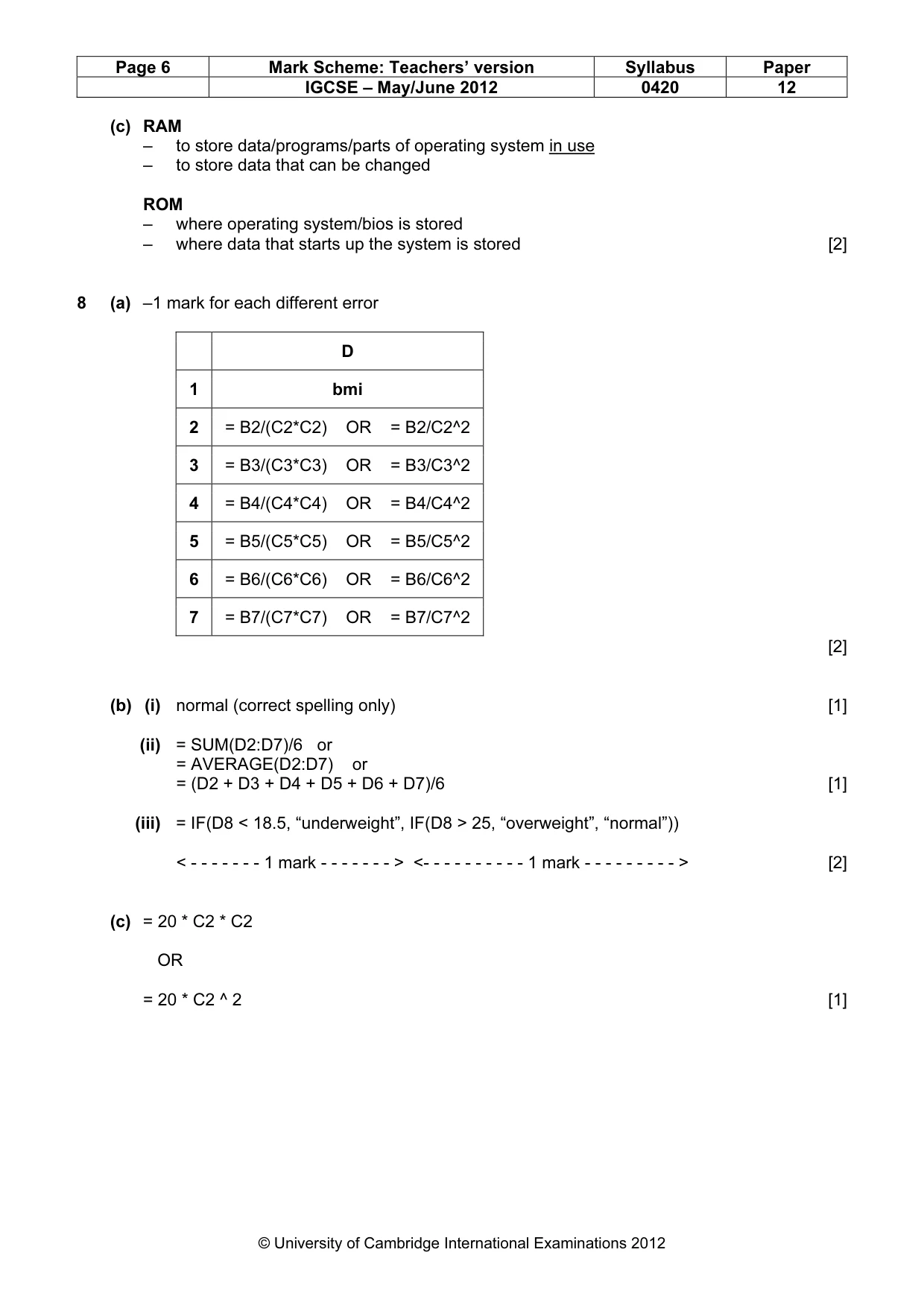
Page 6 Mark Scheme: Teachers’ version Syllabus Paper IGCSE – May/June 2012 0420 12 © University of Cambridge International Examinations 2012 (c) RAM – to store data/programs/parts of operating system in use – to store data that can be changed ROM – where operating system/bios is stored – where data that starts up the system is stored [2] 8 (a) –1 mark for each different error D 1 bmi 2 = B2/(C2*C2) OR = B2/C2^2 3 = B3/(C3*C3) OR = B3/C3^2 4 = B4/(C4*C4) OR = B4/C4^2 5 = B5/(C5*C5) OR = B5/C5^2 6 = B6/(C6*C6) OR = B6/C6^2 7 = B7/(C7*C7) OR = B7/C7^2 [2] (b) (i) normal (correct spelling only) [1] (ii) = SUM(D2:D7)/6 or = AVERAGE(D2:D7) or = (D2 + D3 + D4 + D5 + D6 + D7)/6 [1] (iii) = IF(D8 < 18.5, “underweight”, IF(D8 > 25, “overweight”, “normal”)) < - - - - - - - 1 mark - - - - - - - > <- - - - - - - - - - 1 mark - - - - - - - - - > [2] (c) = 20 * C2 * C2 OR = 20 * C2 ^ 2 [1]
Mark scheme, page 7
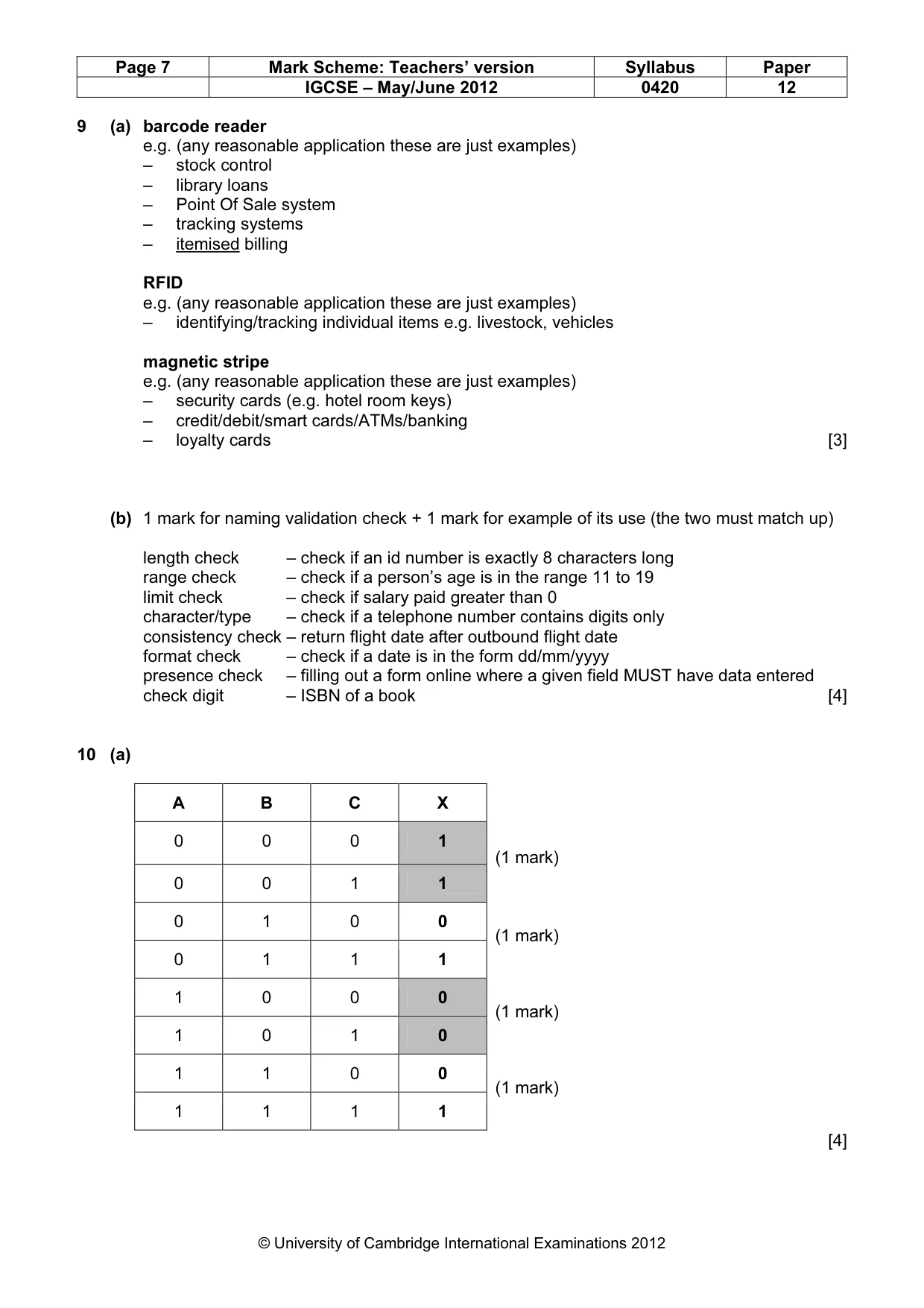
Page 7 Mark Scheme: Teachers’ version Syllabus Paper IGCSE – May/June 2012 0420 12 © University of Cambridge International Examinations 2012 9 (a) barcode reader e.g. (any reasonable application these are just examples) – stock control – library loans – Point Of Sale system – tracking systems – itemised billing RFID e.g. (any reasonable application these are just examples) – identifying/tracking individual items e.g. livestock, vehicles magnetic stripe e.g. (any reasonable application these are just examples) – security cards (e.g. hotel room keys) – credit/debit/smart cards/ATMs/banking – loyalty cards [3] (b) 1 mark for naming validation check + 1 mark for example of its use (the two must match up) length check – check if an id number is exactly 8 characters long range check – check if a person’s age is in the range 11 to 19 limit check – check if salary paid greater than 0 character/type – check if a telephone number contains digits only consistency check – return flight date after outbound flight date format check – check if a date is in the form dd/mm/yyyy presence check – filling out a form online where a given field MUST have data entered check digit – ISBN of a book [4] 10 (a) A B C X 0 0 0 1 0 0 1 1 (1 mark) 0 1 0 0 0 1 1 1 (1 mark) 1 0 0 0 1 0 1 0 (1 mark) 1 1 0 0 1 1 1 1 (1 mark) [4]
Mark scheme, page 8
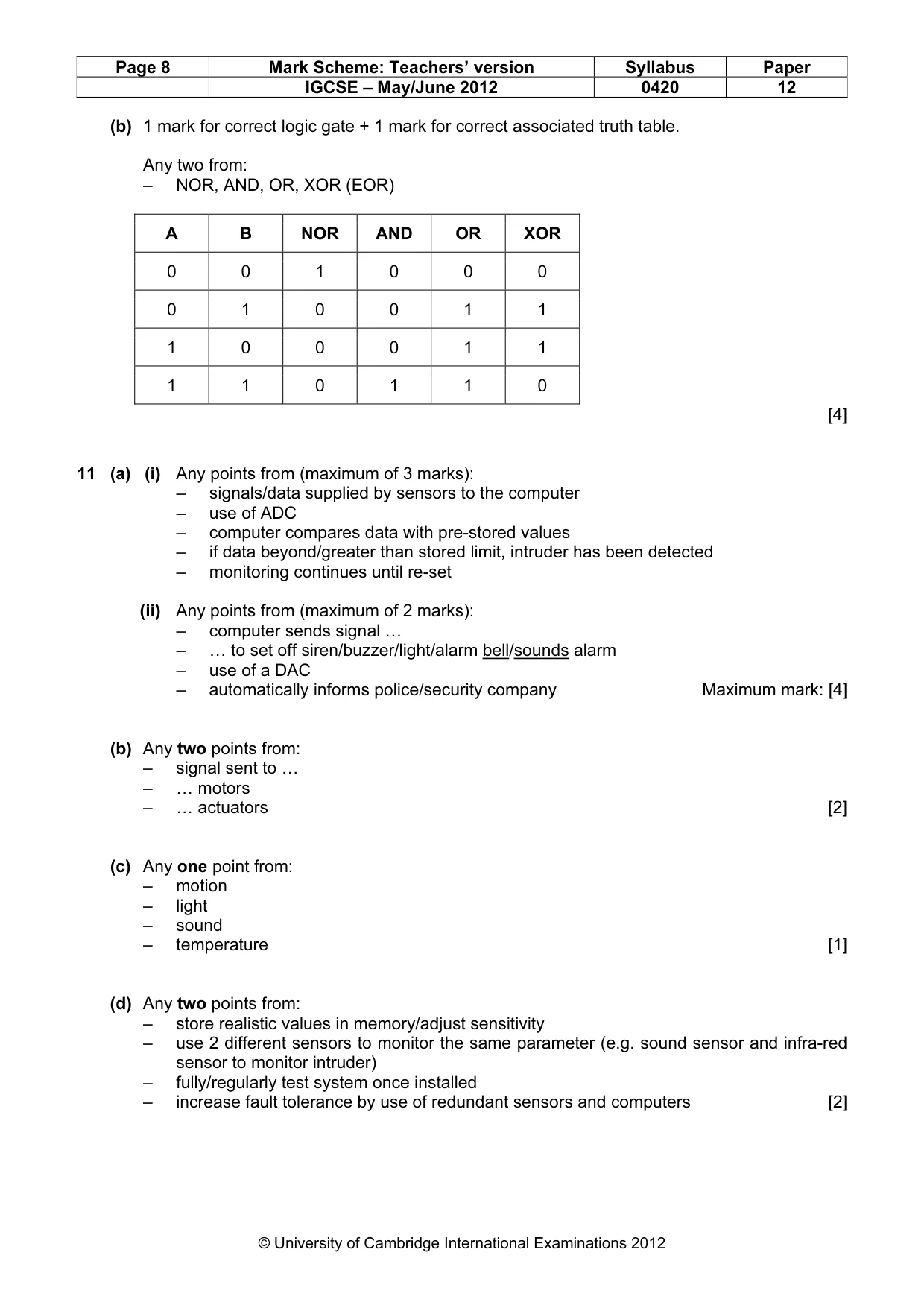
Page 8 Mark Scheme: Teachers’ version Syllabus Paper IGCSE – May/June 2012 0420 12 © University of Cambridge International Examinations 2012 (b) 1 mark for correct logic gate + 1 mark for correct associated truth table. Any two from: – NOR, AND, OR, XOR (EOR) A B NOR AND OR XOR 0 0 1 0 0 0 0 1 0 0 1 1 1 0 0 0 1 1 1 1 0 1 1 0 [4] 11 (a) (i) Any points from (maximum of 3 marks): – signals/data supplied by sensors to the computer – use of ADC – computer compares data with pre-stored values – if data beyond/greater than stored limit, intruder has been detected – monitoring continues until re-set (ii) Any points from (maximum of 2 marks): – computer sends signal … – … to set off siren/buzzer/light/alarm bell/sounds alarm – use of a DAC – automatically informs police/security company Maximum mark: [4] (b) Any two points from: – signal sent to … – … motors – … actuators [2] (c) Any one point from: – motion – light – sound – temperature [1] (d) Any two points from: – store realistic values in memory/adjust sensitivity – use 2 different sensors to monitor the same parameter (e.g. sound sensor and infra-red sensor to monitor intruder) – fully/regularly test system once installed – increase fault tolerance by use of redundant sensors and computers [2]
Mark scheme, page 9
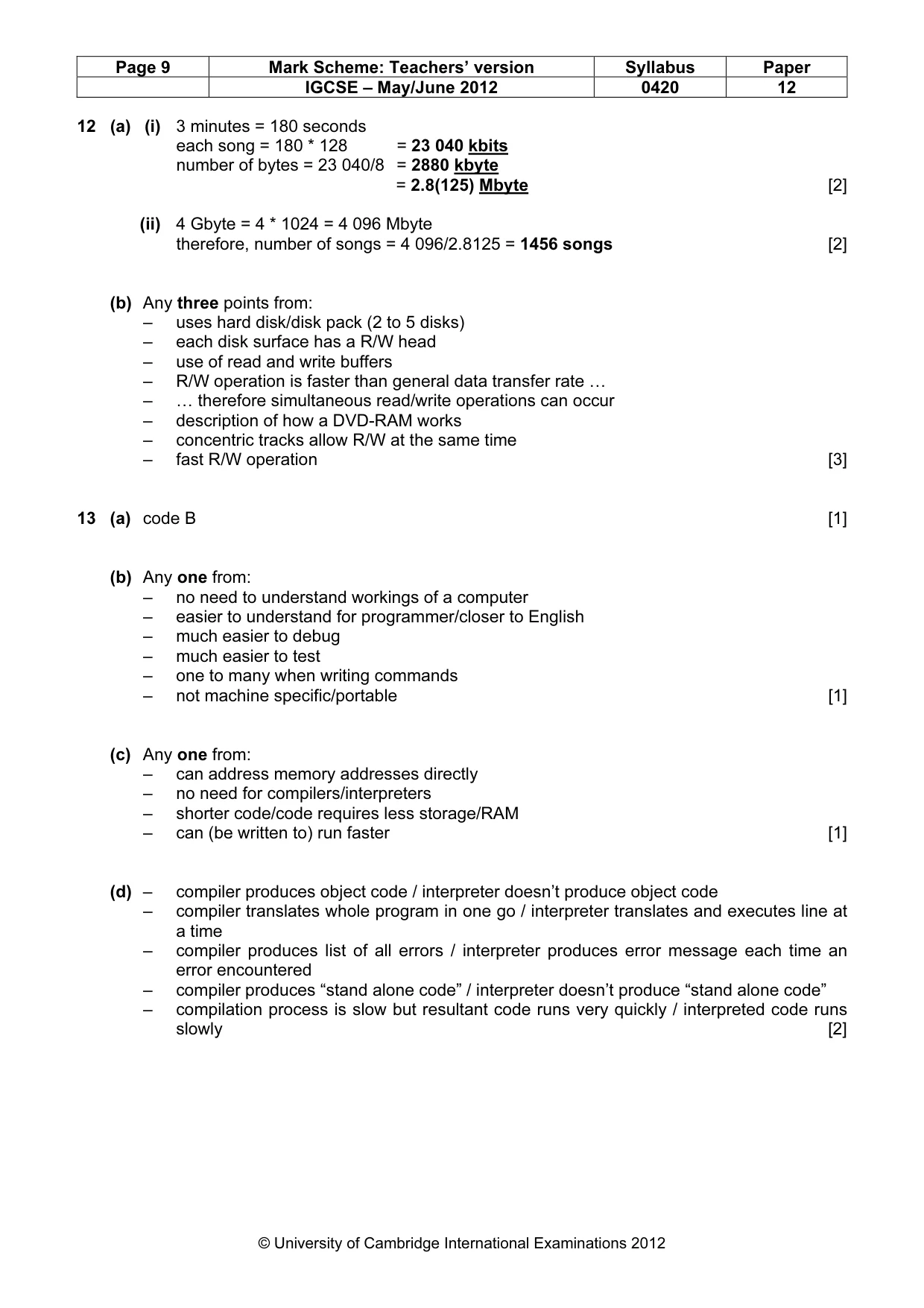
Page 9 Mark Scheme: Teachers’ version Syllabus Paper IGCSE – May/June 2012 0420 12 © University of Cambridge International Examinations 2012 12 (a) (i) 3 minutes = 180 seconds each song = 180 * 128 = 23 040 kbits number of bytes = 23 040/8 = 2880 kbyte = 2.8(125) Mbyte [2] (ii) 4 Gbyte = 4 * 1024 = 4 096 Mbyte therefore, number of songs = 4 096/2.8125 = 1456 songs [2] (b) Any three points from: – uses hard disk/disk pack (2 to 5 disks) – each disk surface has a R/W head – use of read and write buffers – R/W operation is faster than general data transfer rate … – … therefore simultaneous read/write operations can occur – description of how a DVD-RAM works – concentric tracks allow R/W at the same time – fast R/W operation [3] 13 (a) code B [1] (b) Any one from: – no need to understand workings of a computer – easier to understand for programmer/closer to English – much easier to debug – much easier to test – one to many when writing commands – not machine specific/portable [1] (c) Any one from: – can address memory addresses directly – no need for compilers/interpreters – shorter code/code requires less storage/RAM – can (be written to) run faster [1] (d) – compiler produces object code / interpreter doesn’t produce object code – compiler translates whole program in one go / interpreter translates and executes line at a time – compiler produces list of all errors / interpreter produces error message each time an error encountered – compiler produces “stand alone code” / interpreter doesn’t produce “stand alone code” – compilation process is slow but resultant code runs very quickly / interpreted code runs slowly [2]
Mark scheme, page 10
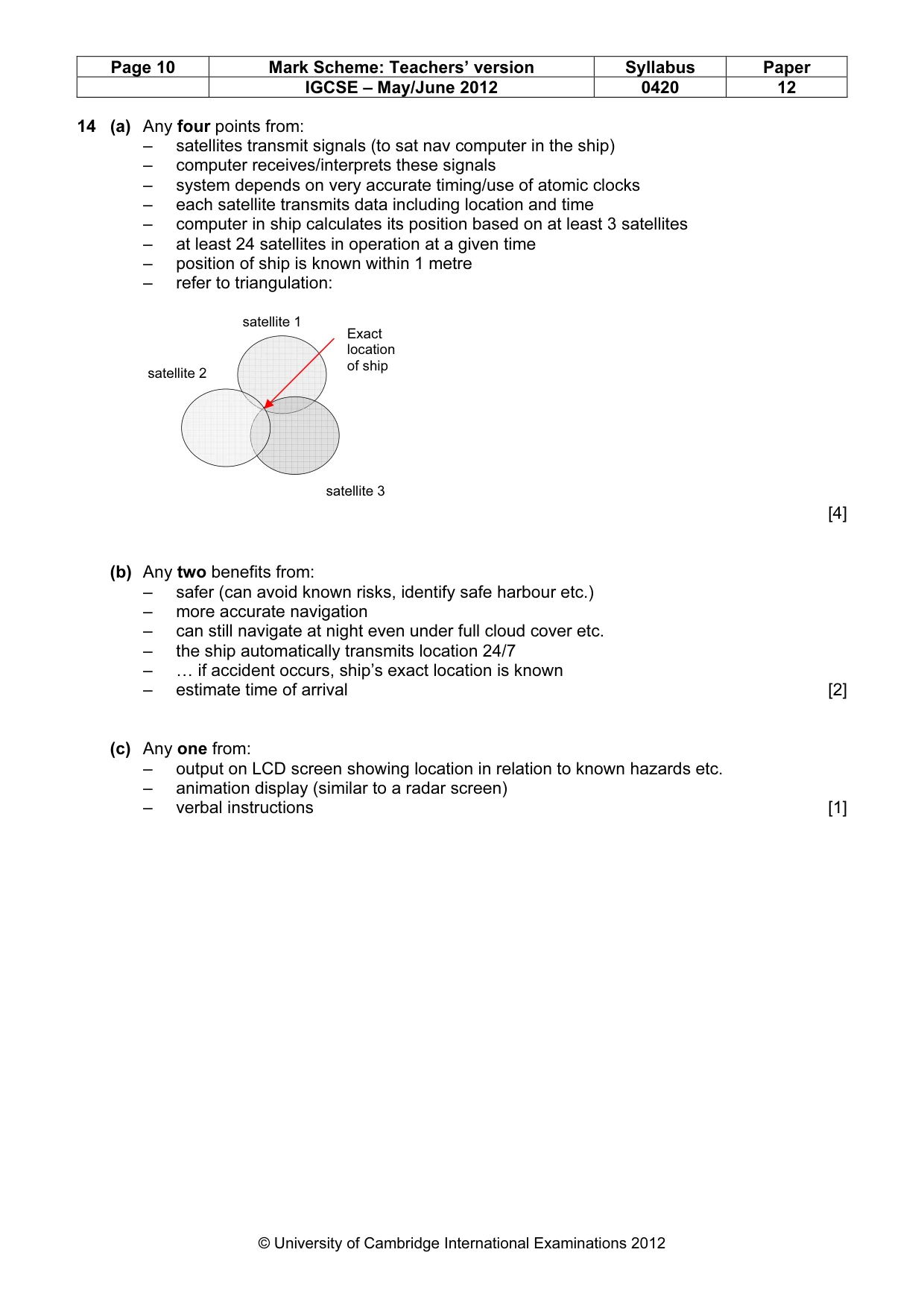
Page 10 Mark Scheme: Teachers’ version Syllabus Paper IGCSE – May/June 2012 0420 12 © University of Cambridge International Examinations 2012 14 (a) Any four points from: – satellites transmit signals (to sat nav computer in the ship) – computer receives/interprets these signals – system depends on very accurate timing/use of atomic clocks – each satellite transmits data including location and time – computer in ship calculates its position based on at least 3 satellites – at least 24 satellites in operation at a given time – position of ship is known within 1 metre – refer to triangulation: [4] (b) Any two benefits from: – safer (can avoid known risks, identify safe harbour etc.) – more accurate navigation – can still navigate at night even under full cloud cover etc. – the ship automatically transmits location 24/7 – … if accident occurs, ship’s exact location is known – estimate time of arrival [2] (c) Any one from: – output on LCD screen showing location in relation to known hazards etc. – animation display (similar to a radar screen) – verbal instructions [1] satellite 1 satellite 2 Exact location of ship satellite 3
Mark scheme, page 11
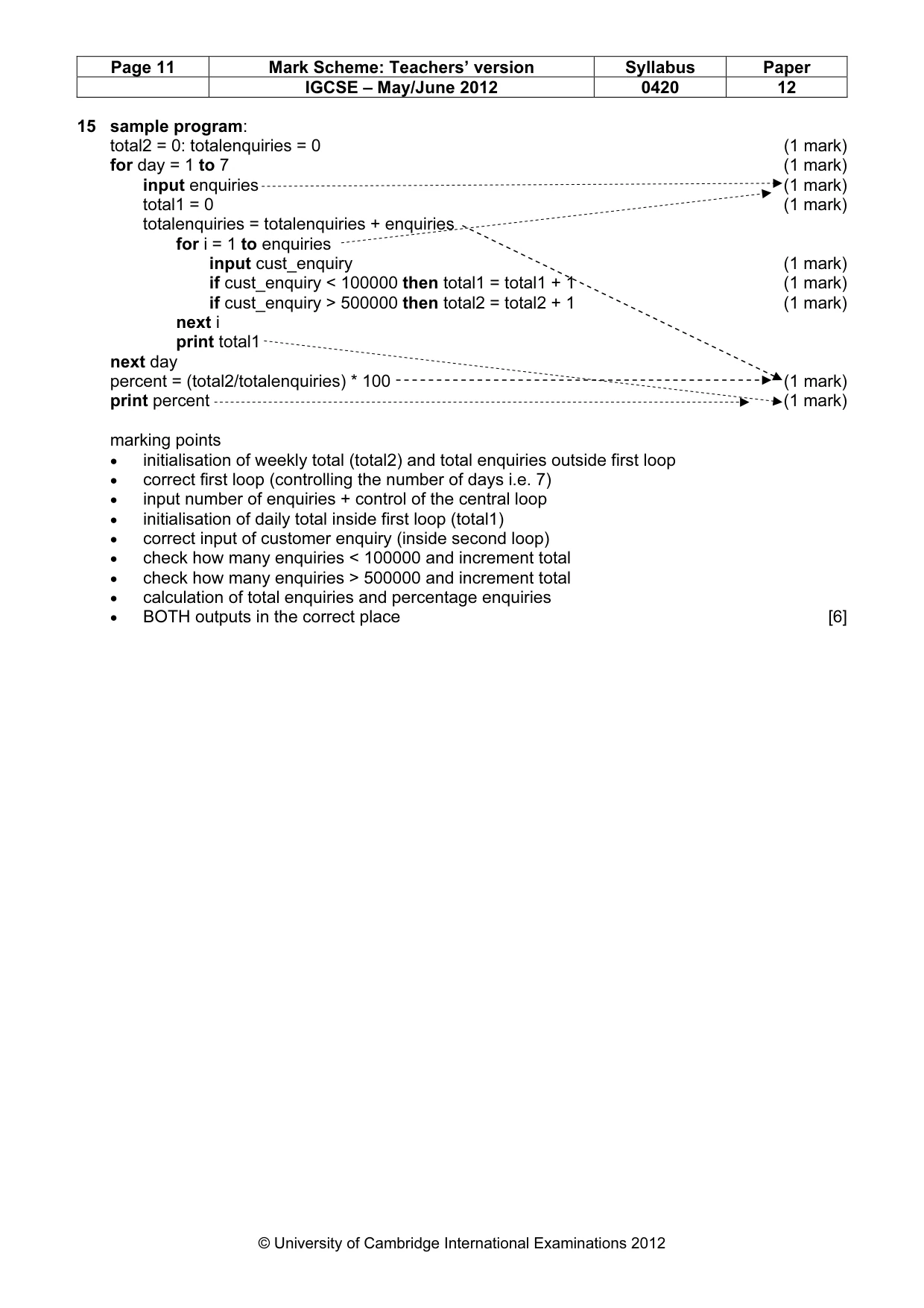
Page 11 Mark Scheme: Teachers’ version Syllabus Paper IGCSE – May/June 2012 0420 12 © University of Cambridge International Examinations 2012 15 sample program: total2 = 0: totalenquiries = 0 (1 mark) for day = 1 to 7 (1 mark) input enquiries (1 mark) total1 = 0 (1 mark) totalenquiries = totalenquiries + enquiries for i = 1 to enquiries input cust_enquiry (1 mark) if cust_enquiry < 100000 then total1 = total1 + 1 (1 mark) if cust_enquiry > 500000 then total2 = total2 + 1 (1 mark) next i print total1 next day percent = (total2/totalenquiries) * 100 (1 mark) print percent (1 mark) marking points • initialisation of weekly total (total2) and total enquiries outside first loop • correct first loop (controlling the number of days i.e. 7) • input number of enquiries + control of the central loop • initialisation of daily total inside first loop (total1) • correct input of customer enquiry (inside second loop) • check how many enquiries < 100000 and increment total • check how many enquiries > 500000 and increment total • calculation of total enquiries and percentage enquiries • BOTH outputs in the correct place [6]
What you needed in this session
Cambridge’s own grade thresholds for 2012 May/June, Paper 1 · Variant 2. A higher threshold means an easier paper — the bar moves with how the cohort did.