Cambridge IGCSE Computer Studies 0420 — 2010 May/June Paper 1 · Variant 1
0420/11/M/J/10 · 100 marks · ≈113 min
The question paper and its mark scheme, free to read here and free to download. This is Cambridge’s own paper, exactly as it was sat.
Question paper20 pages








Mark scheme11 pages
Answers below. Sit the paper first if you are practising.
Paper as text
Question paper, page 1
This document consists of 17 printed pages and 3 blank pages. IB10 06_0420_11/8RP © UCLES 2010 [Turn over *6232209025* For Examiner's Use UNIVERSITY OF CAMBRIDGE INTERNATIONAL EXAMINATIONS International General Certificate of Secondary Education COMPUTER STUDIES 0420/11 Paper 1 May/June 2010 2 hours 30 minutes Candidates answer on the Question Paper. No Additional Materials are required. READ THESE INSTRUCTIONS FIRST Write your Centre number, candidate number and name on all the work you hand in. Write in dark blue or black pen. You may use a soft pencil for any diagrams, graphs or rough working. Do not use staples, paper clips, highlighters, glue or correction fluid. DO NOT WRITE IN ANY BARCODES. Answer all questions. No marks will be awarded for using brand names of software packages or hardware. At the end of the examination, fasten all your work securely together. The number of marks is given in brackets [ ] at the end of each question or part question. www.XtremePapers.com
Question paper, page 2
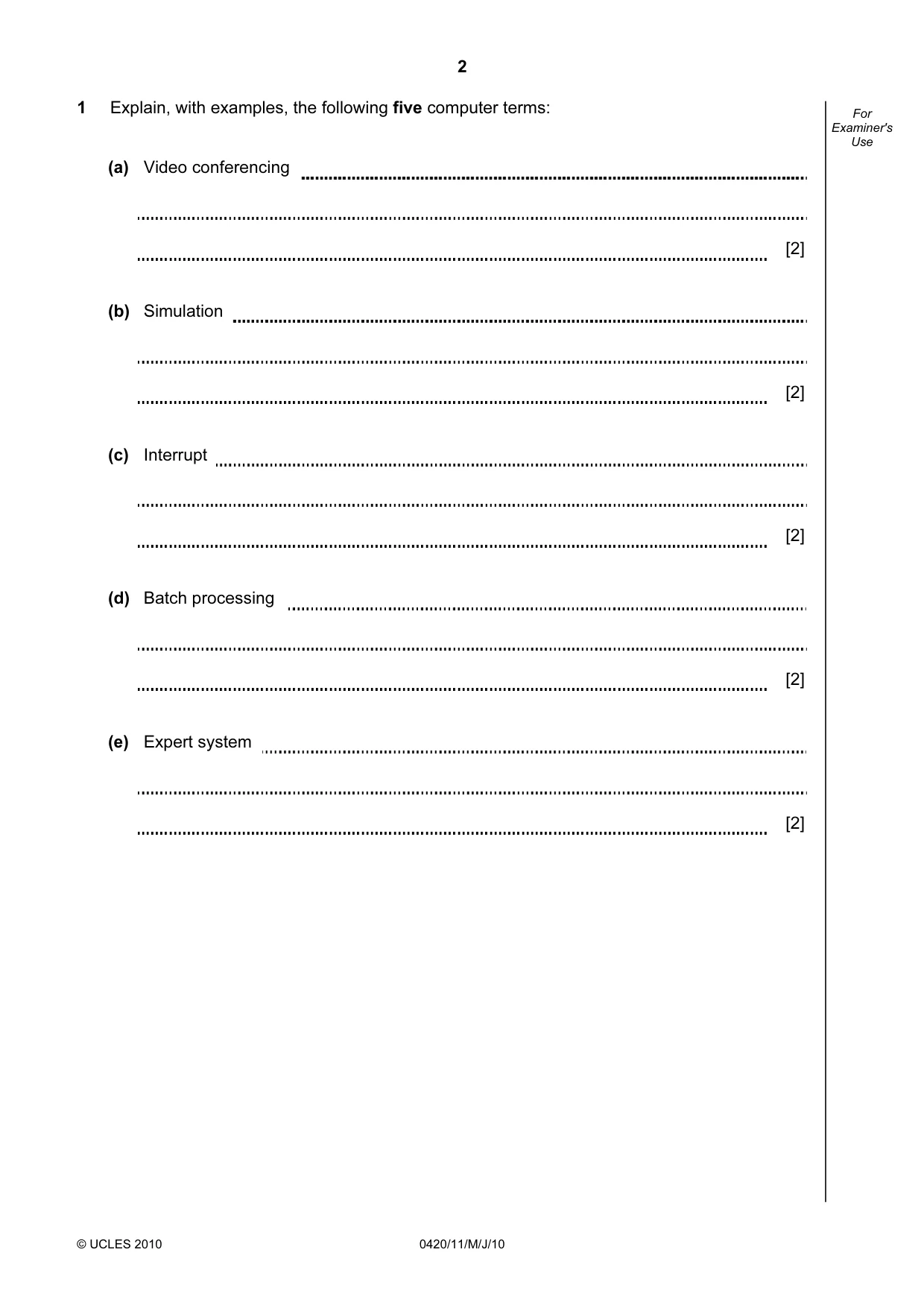
2 © UCLES 2010 0420/11/M/J/10 For Examiner's Use 1 Explain, with examples, the following five computer terms: (a) Video conferencing [2] (b) Simulation [2] (c) Interrupt [2] (d) Batch processing [2] (e) Expert system [2]
Question paper, page 3
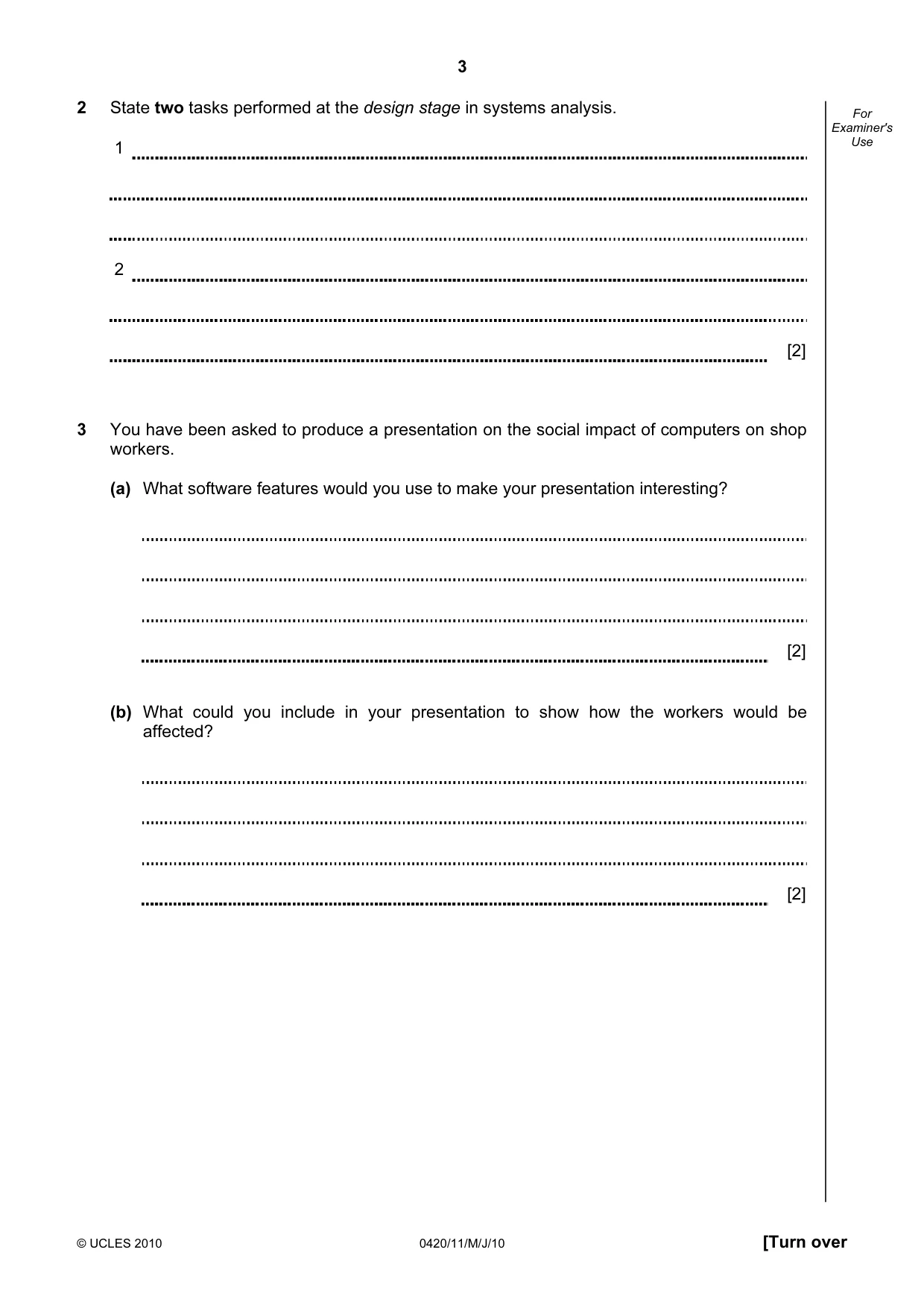
3 © UCLES 2010 0420/11/M/J/10 [Turn over For Examiner's Use 2 State two tasks performed at the design stage in systems analysis. 1 2 [2] 3 You have been asked to produce a presentation on the social impact of computers on shop workers. (a) What software features would you use to make your presentation interesting? [2] (b) What could you include in your presentation to show how the workers would be affected? [2]
Question paper, page 4
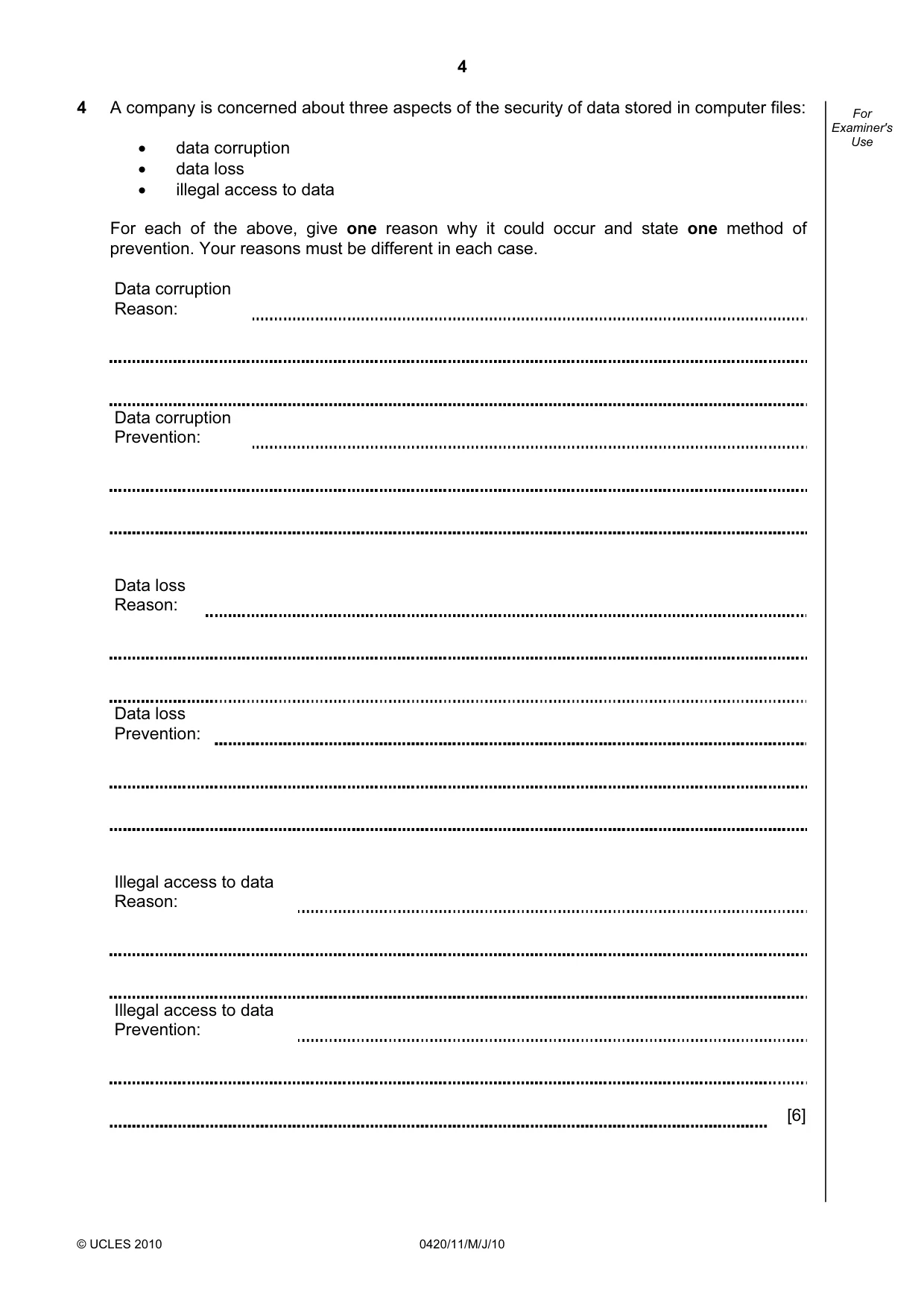
4 © UCLES 2010 0420/11/M/J/10 For Examiner's Use 4 A company is concerned about three aspects of the security of data stored in computer files: • data corruption • data loss • illegal access to data For each of the above, give one reason why it could occur and state one method of prevention. Your reasons must be different in each case. Data corruption Reason: Data corruption Prevention: Data loss Reason: Data loss Prevention: Illegal access to data Reason: Illegal access to data Prevention: [6]
Question paper, page 5
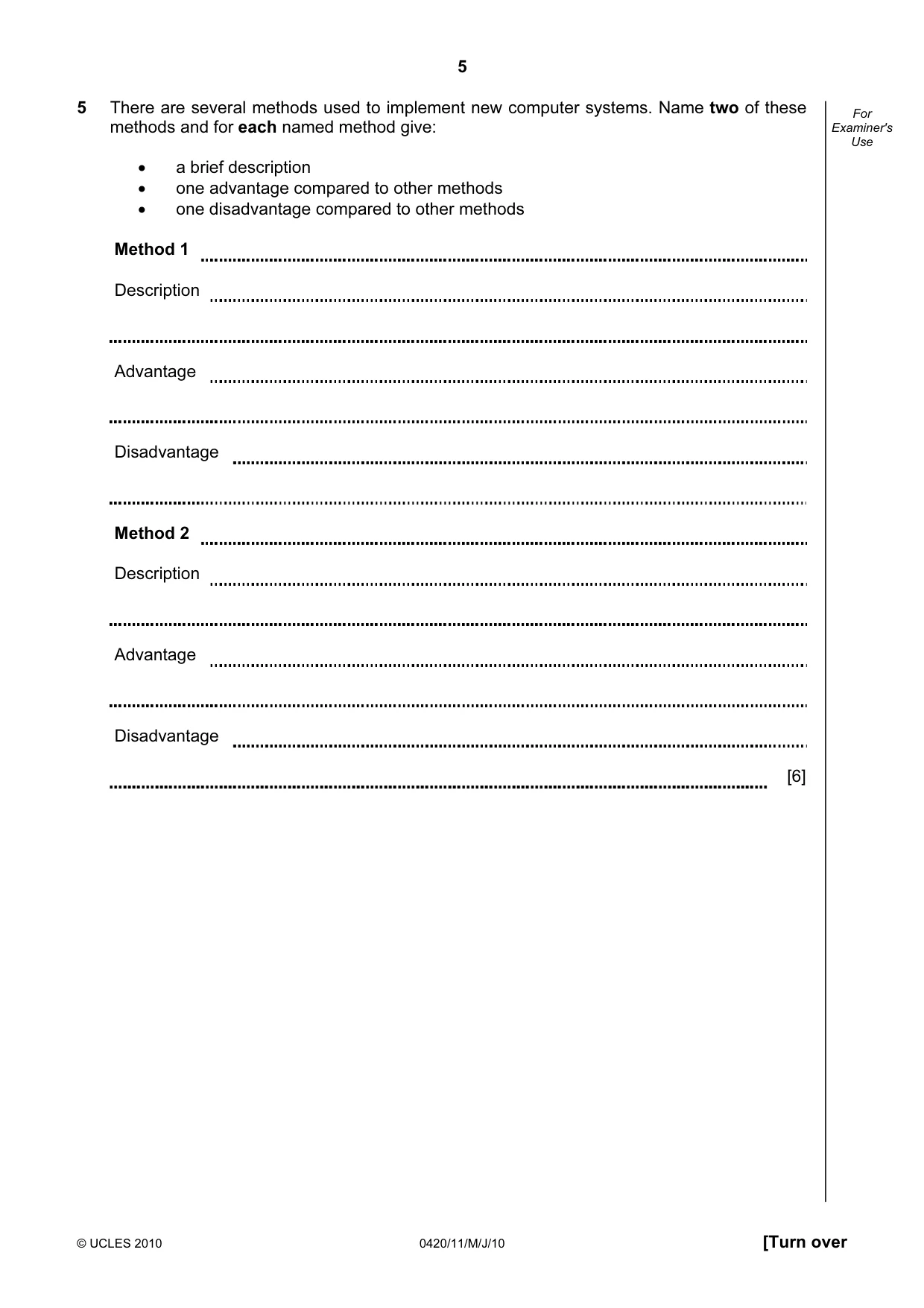
5 © UCLES 2010 0420/11/M/J/10 [Turn over For Examiner's Use 5 There are several methods used to implement new computer systems. Name two of these methods and for each named method give: • a brief description • one advantage compared to other methods • one disadvantage compared to other methods Method 1 Description Advantage Disadvantage Method 2 Description Advantage Disadvantage [6]
Question paper, page 6
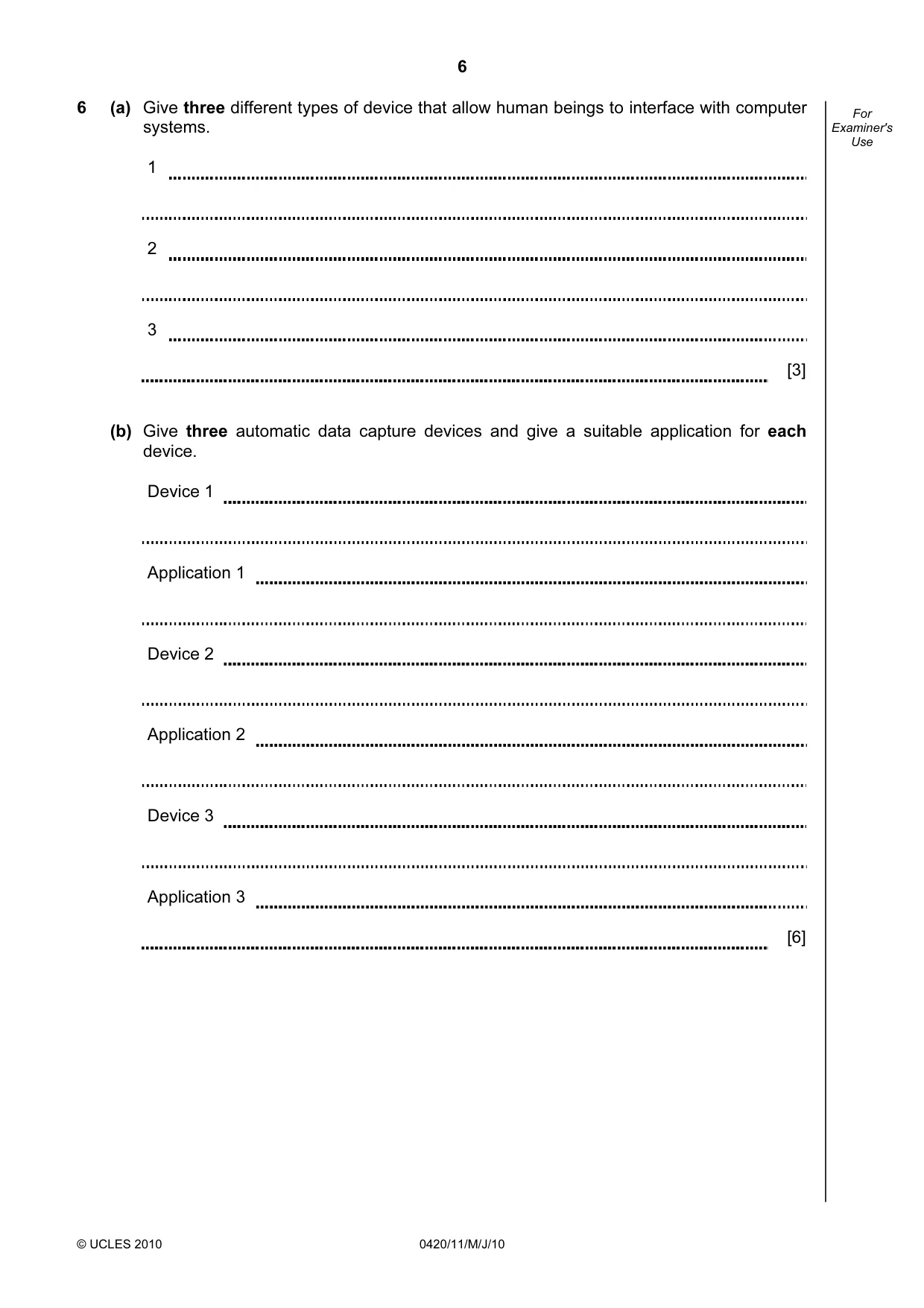
6 © UCLES 2010 0420/11/M/J/10 For Examiner's Use 6 (a) Give three different types of device that allow human beings to interface with computer systems. 1 2 3 [3] (b) Give three automatic data capture devices and give a suitable application for each device. Device 1 Application 1 Device 2 Application 2 Device 3 Application 3 [6]
Question paper, page 7
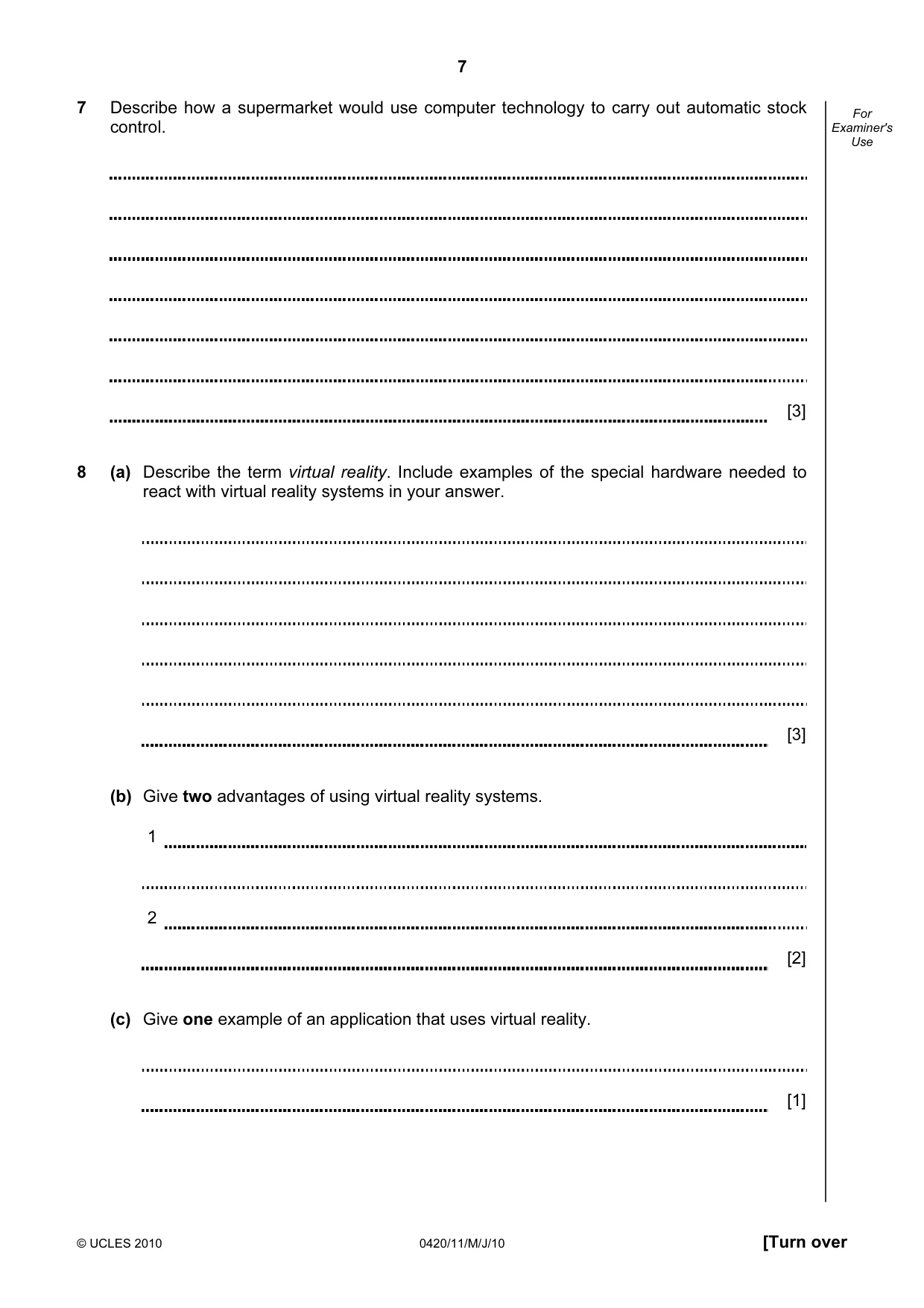
7 © UCLES 2010 0420/11/M/J/10 [Turn over For Examiner's Use 7 Describe how a supermarket would use computer technology to carry out automatic stock control. [3] 8 (a) Describe the term virtual reality. Include examples of the special hardware needed to react with virtual reality systems in your answer. [3] (b) Give two advantages of using virtual reality systems. 1 2 [2] (c) Give one example of an application that uses virtual reality. [1]
Question paper, page 8
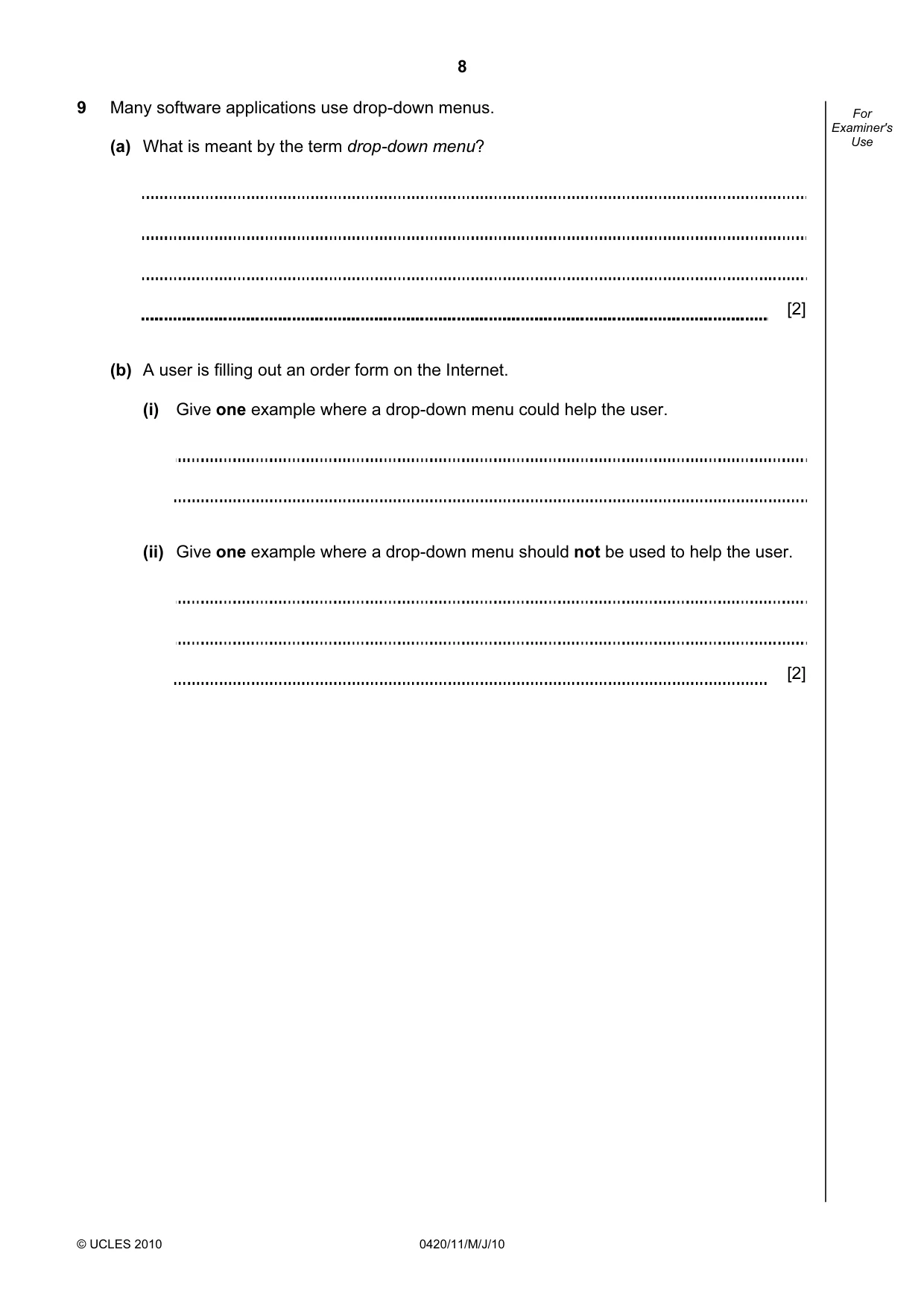
8 © UCLES 2010 0420/11/M/J/10 For Examiner's Use 9 Many software applications use drop-down menus. (a) What is meant by the term drop-down menu? [2] (b) A user is filling out an order form on the Internet. (i) Give one example where a drop-down menu could help the user. (ii) Give one example where a drop-down menu should not be used to help the user. [2]
Question paper, page 9
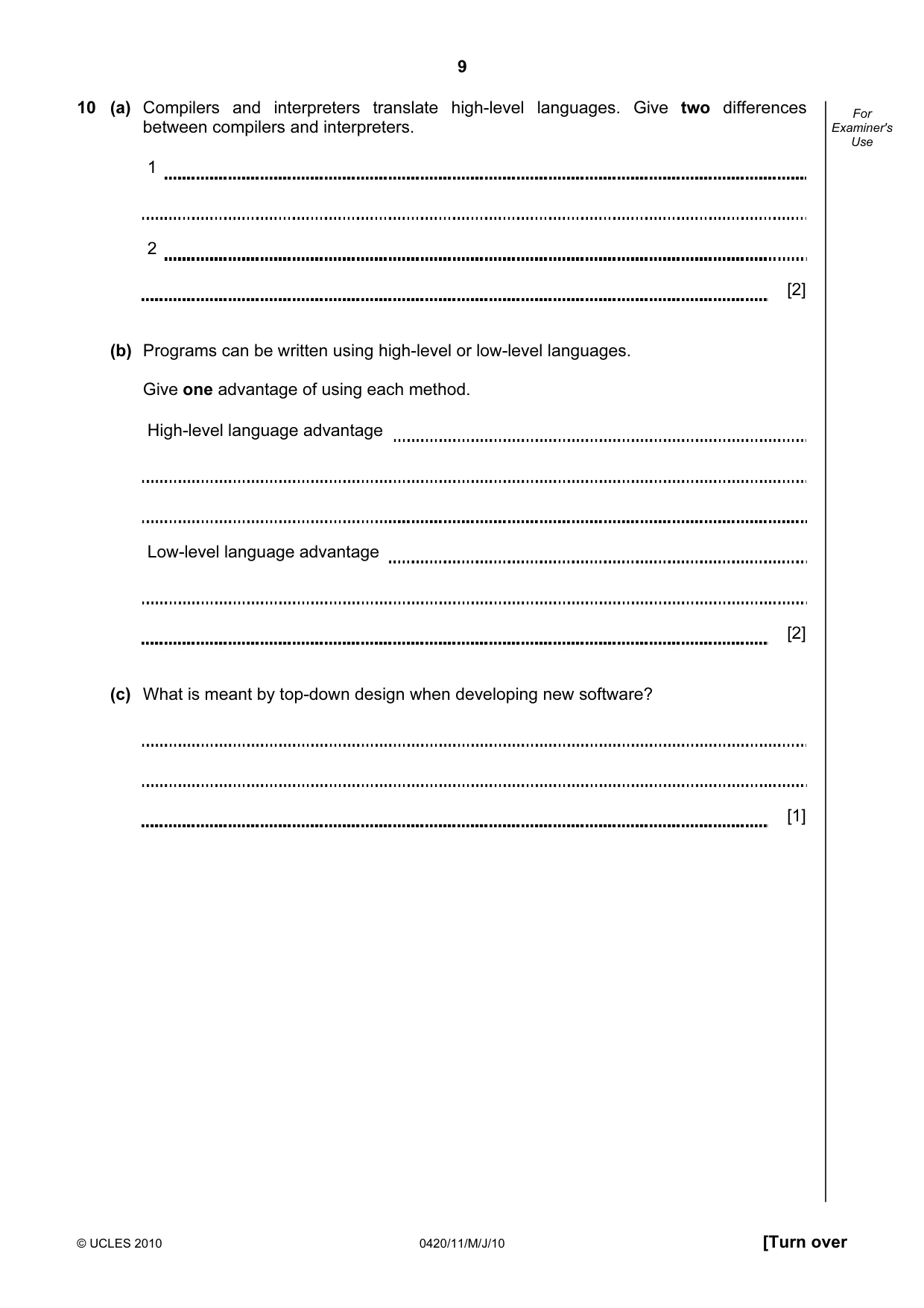
9 © UCLES 2010 0420/11/M/J/10 [Turn over For Examiner's Use 10 (a) Compilers and interpreters translate high-level languages. Give two differences between compilers and interpreters. 1 2 [2] (b) Programs can be written using high-level or low-level languages. Give one advantage of using each method. High-level language advantage Low-level language advantage [2] (c) What is meant by top-down design when developing new software? [1]
Question paper, page 10
10 © UCLES 2010 0420/11/M/J/10 For Examiner's Use 11 A student set up a spreadsheet to compare share prices in six companies over five years. (a) What formula is in cell G5 to find the average (mean) share price for KLN? [1] (b) What formula is in cell H5 to find the highest share price for KLN? [1] (c) If the data in cell E4 was changed to 425, which cells would be automatically updated? [1] (d) The student wants to extend the spreadsheet to include share prices for 2010. Describe how the student would do this. [2] A B C D E F G H 1 Name of company Share price Share price Share price Share price Share price Average share price Highest share price 2 Year: 2005 2006 2007 2008 2009 3 Global Oil 81 190 305 130 140 169 305 4 GSD 619 722 622 325 324 522 722 5 KLN 60 71 71 63 45 62 71 6 Nesto 316 418 522 600 640 499 640 7 Takkco 149 316 394 202 122 237 394 8 Uniway 122 135 254 365 570 289 570
Question paper, page 11
11 © UCLES 2010 0420/11/M/J/10 [Turn over For Examiner's Use 12 A golf course charges $10 for each game of two people. Each additional person incurs a further charge of $2 per game. If they book two or more games in advance, they get a 10% discount on the total charge. The following program has been written in pseudocode to calculate the charges for a game. 1 extracost = 0 2 input numberpeople, numbergames 3 charge = 10 * numbergames 4 extrapeople = numberpeople – 2 5 if numberpeople < 2 then extracost = 2 * extrapeople * numbergames 6 charge = extracost 7 if numbergames > 1 then charge = charge * 0.1 8 print charge There are three errors in the program. Locate these errors and suggest a correct piece of coding. Error 1 Correction 1 Error 2 Correction 2 Error 3 Correction 3 [6]
Question paper, page 12
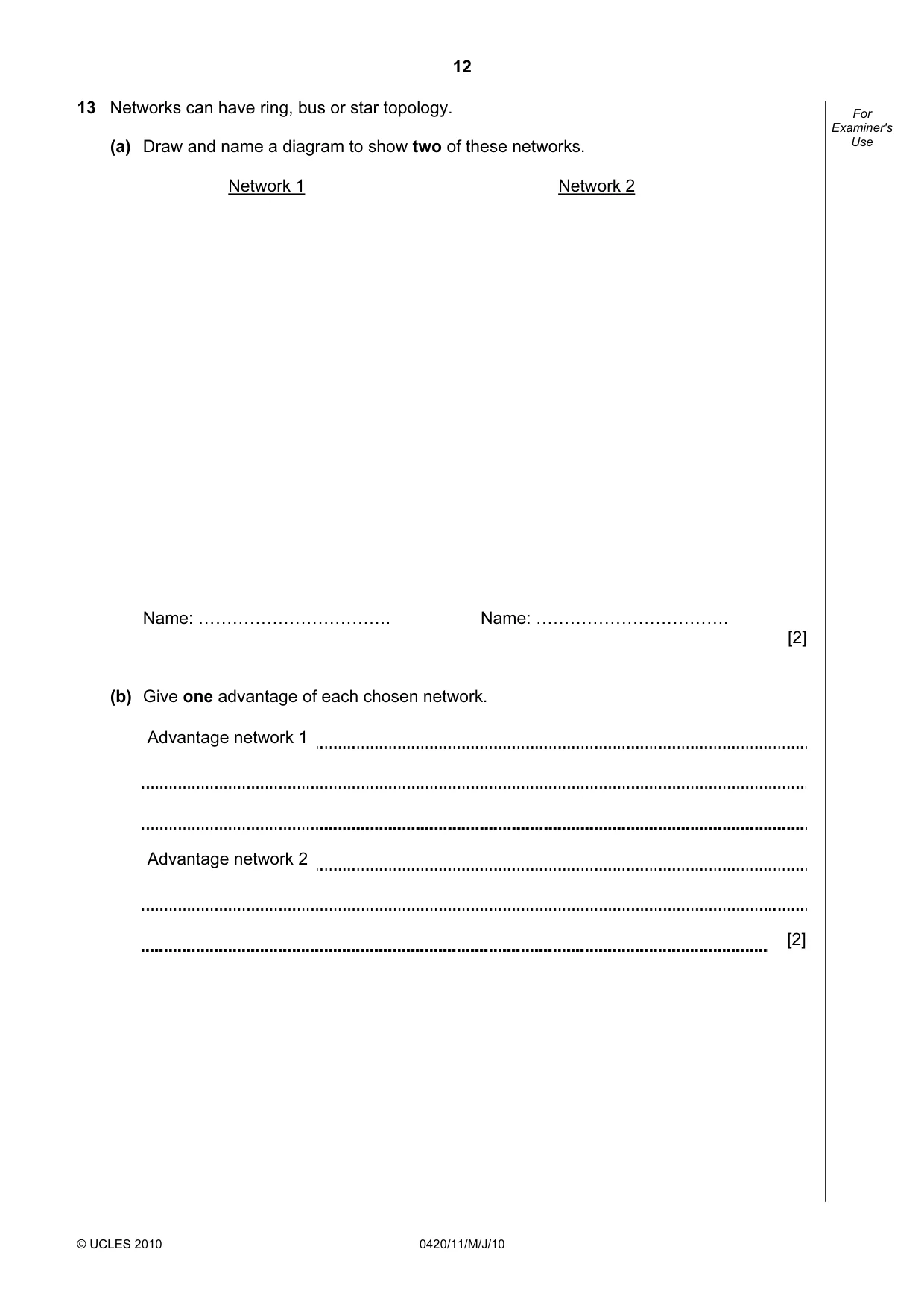
12 © UCLES 2010 0420/11/M/J/10 For Examiner's Use 13 Networks can have ring, bus or star topology. (a) Draw and name a diagram to show two of these networks. Network 1 Network 2 Name: ……………………………. Name: ……………………………. [2] (b) Give one advantage of each chosen network. Advantage network 1 Advantage network 2 [2]
Question paper, page 13
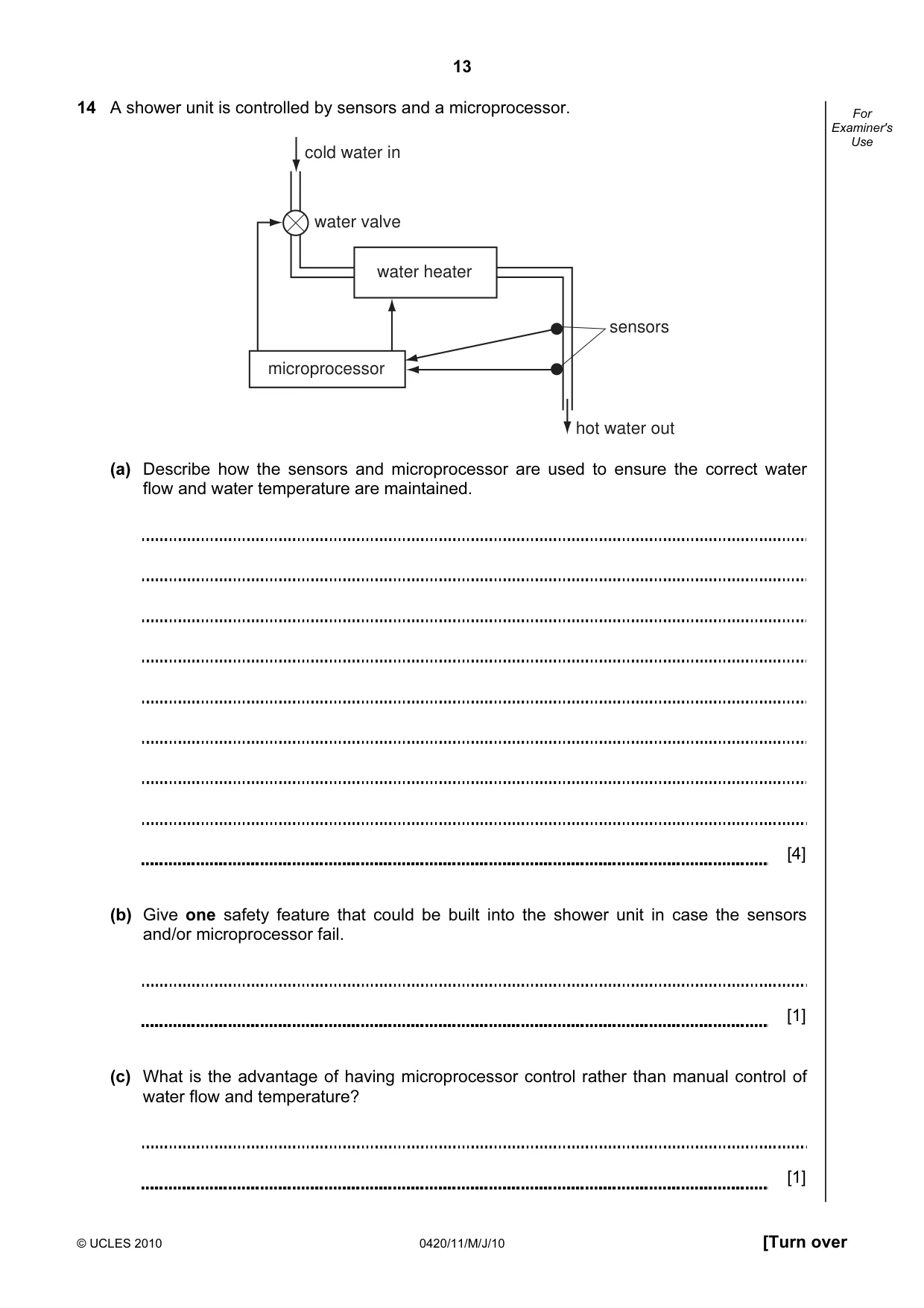
13 © UCLES 2010 0420/11/M/J/10 [Turn over For Examiner's Use 14 A shower unit is controlled by sensors and a microprocessor. sensors hot water out cold water in water valve water heater microprocessor (a) Describe how the sensors and microprocessor are used to ensure the correct water flow and water temperature are maintained. [4] (b) Give one safety feature that could be built into the shower unit in case the sensors and/or microprocessor fail. [1] (c) What is the advantage of having microprocessor control rather than manual control of water flow and temperature? [1]
Question paper, page 14
14 © UCLES 2010 0420/11/M/J/10 For Examiner's Use 15 A database has been set up to bring together information about the world’s tallest buildings. A section of the database is shown below. Ref No. Building Name City Country Year No. of Floors Height (m) Height (ft) TA1 Taipei 101 Taipei Taiwan 2004 101 508 1667 MA1 Petronas Towers Kuala Lumpur Malaysia 1998 88 452 1483 US1 Sears Tower Chicago USA 1974 110 442 1451 CH1 Jiu Mao Building Shanghai China 1999 88 421 1381 CH2 Finance Centre Hong Kong China 2003 88 415 1362 CH3 CITIC Plaza Guangzhan China 1996 80 391 1283 CH4 Shun Hing Square Shenzhen China 1996 69 384 1260 US2 Empire State Building New York USA 1931 102 381 1250 CH5 Central Plaza Hong Kong China 1992 78 374 1227 CH6 Bank of China Hong Kong China 1989 70 367 1205 DU1 Emirates Tower Dubai Dubai 1999 54 355 1165 TA2 Tuntex Sky Tower Kaohsiung Taiwan 1997 85 348 1140 (a) How many records are in the section of the database shown? [1] (b) Using Ref No. only, which records would be output if the following search condition was entered: (Year < 1990) AND (Height (m) > 375)? [1] (c) Write down a search condition to find out how many buildings are in China or how many buildings have more than 80 floors. [2] (d) For each of the following fields give a different validation check. Year Ref No. [2]
Question paper, page 15
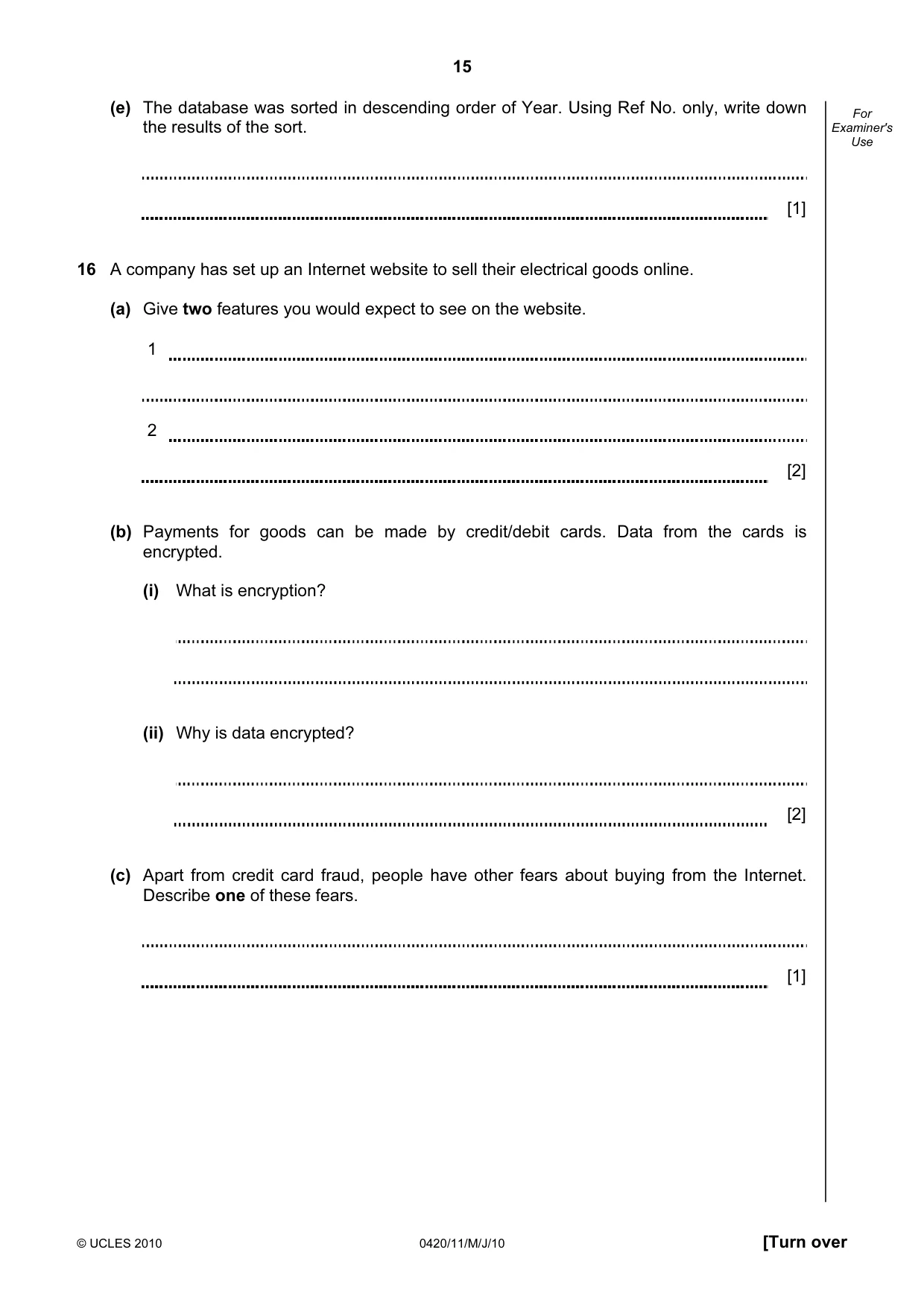
15 © UCLES 2010 0420/11/M/J/10 [Turn over For Examiner's Use (e) The database was sorted in descending order of Year. Using Ref No. only, write down the results of the sort. [1] 16 A company has set up an Internet website to sell their electrical goods online. (a) Give two features you would expect to see on the website. 1 2 [2] (b) Payments for goods can be made by credit/debit cards. Data from the cards is encrypted. (i) What is encryption? (ii) Why is data encrypted? [2] (c) Apart from credit card fraud, people have other fears about buying from the Internet. Describe one of these fears. [1]
Question paper, page 16
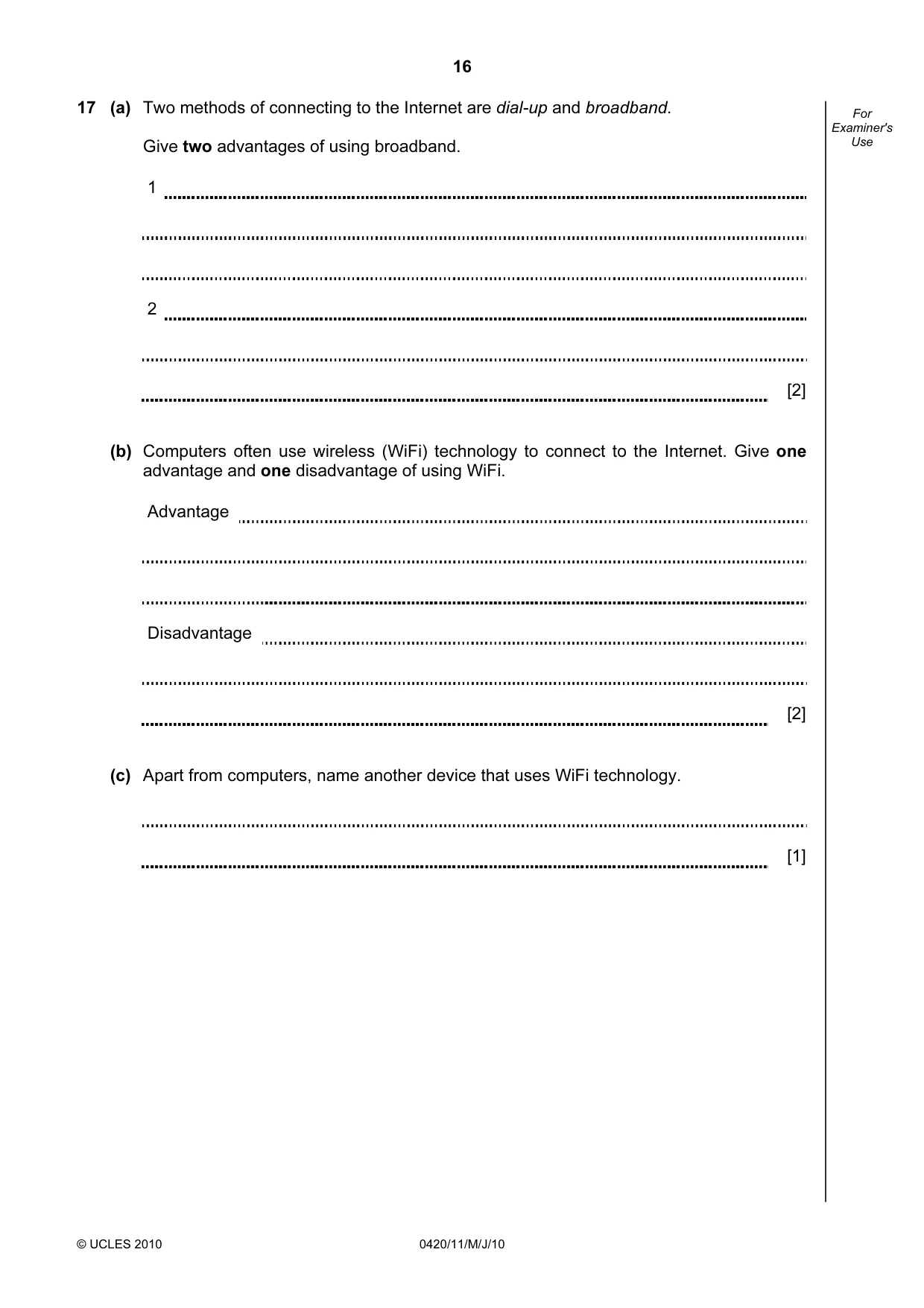
16 © UCLES 2010 0420/11/M/J/10 For Examiner's Use 17 (a) Two methods of connecting to the Internet are dial-up and broadband. Give two advantages of using broadband. 1 2 [2] (b) Computers often use wireless (WiFi) technology to connect to the Internet. Give one advantage and one disadvantage of using WiFi. Advantage Disadvantage [2] (c) Apart from computers, name another device that uses WiFi technology. [1]
Question paper, page 17
17 © UCLES 2010 0420/11/M/J/10 For Examiner's Use 18 A group of students were monitoring the temperature every day over a one-year period. Readings were taken ten times every day (you may assume a year contains 365 days). Write an algorithm, using pseudocode or flowchart, which • inputs all the temperatures (ten per day) • outputs the highest temperature taken over the year • outputs the lowest temperature taken over the year • outputs the average temperature per day • outputs the average temperature for the whole year [7]
Question paper, page 20
20 Permission to reproduce items where third-party owned material protected by copyright is included has been sought and cleared where possible. Every reasonable effort has been made by the publisher (UCLES) to trace copyright holders, but if any items requiring clearance have unwittingly been included, the publisher will be pleased to make amends at the earliest possible opportunity. University of Cambridge International Examinations is part of the Cambridge Assessment Group. Cambridge Assessment is the brand name of University of Cambridge Local Examinations Syndicate (UCLES), which is itself a department of the University of Cambridge. © UCLES 2010 0420/11/M/J/10 BLANK PAGE
Mark scheme, page 1
UNIVERSITY OF CAMBRIDGE INTERNATIONAL EXAMINATIONS International General Certificate of Secondary Education MARK SCHEME for the May/June 2010 question paper for the guidance of teachers 0420 COMPUTER STUDIES 0420/11 Paper 11, maximum raw mark 100 This mark scheme is published as an aid to teachers and candidates, to indicate the requirements of the examination. It shows the basis on which Examiners were instructed to award marks. It does not indicate the details of the discussions that took place at an Examiners’ meeting before marking began, which would have considered the acceptability of alternative answers. Mark schemes must be read in conjunction with the question papers and the report on the examination. • CIE will not enter into discussions or correspondence in connection with these mark schemes. CIE is publishing the mark schemes for the May/June 2010 question papers for most IGCSE, GCE Advanced Level and Advanced Subsidiary Level syllabuses and some Ordinary Level syllabuses. www.XtremePapers.com
Mark scheme, page 2
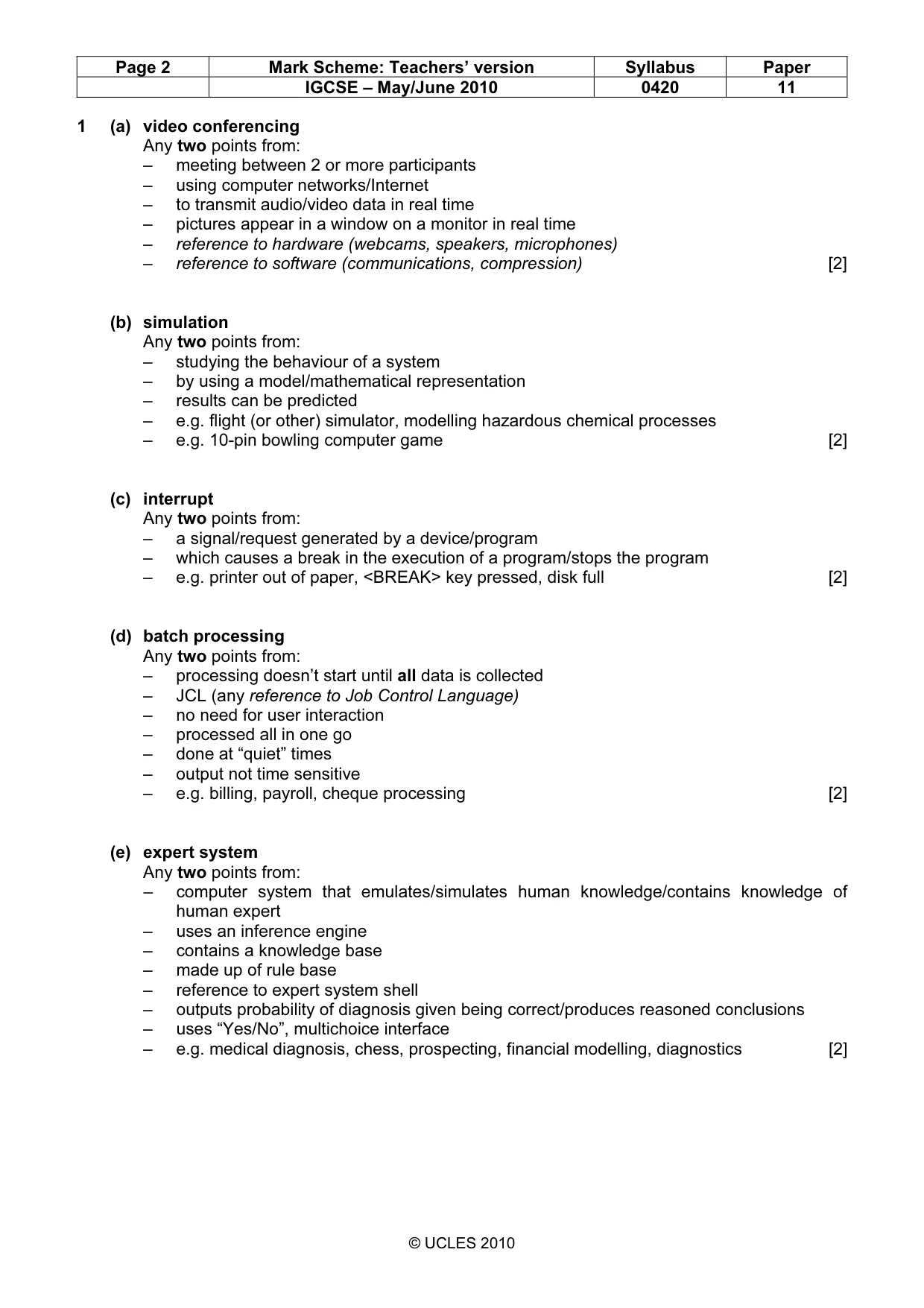
Page 2 Mark Scheme: Teachers’ version Syllabus Paper IGCSE – May/June 2010 0420 11 © UCLES 2010 1 (a) video conferencing Any two points from: – meeting between 2 or more participants – using computer networks/Internet – to transmit audio/video data in real time – pictures appear in a window on a monitor in real time – reference to hardware (webcams, speakers, microphones) – reference to software (communications, compression) [2] (b) simulation Any two points from: – studying the behaviour of a system – by using a model/mathematical representation – results can be predicted – e.g. flight (or other) simulator, modelling hazardous chemical processes – e.g. 10-pin bowling computer game [2] (c) interrupt Any two points from: – a signal/request generated by a device/program – which causes a break in the execution of a program/stops the program – e.g. printer out of paper, <BREAK> key pressed, disk full [2] (d) batch processing Any two points from: – processing doesn’t start until all data is collected – JCL (any reference to Job Control Language) – no need for user interaction – processed all in one go – done at “quiet” times – output not time sensitive – e.g. billing, payroll, cheque processing [2] (e) expert system Any two points from: – computer system that emulates/simulates human knowledge/contains knowledge of human expert – uses an inference engine – contains a knowledge base – made up of rule base – reference to expert system shell – outputs probability of diagnosis given being correct/produces reasoned conclusions – uses “Yes/No”, multichoice interface – e.g. medical diagnosis, chess, prospecting, financial modelling, diagnostics [2]
Mark scheme, page 3
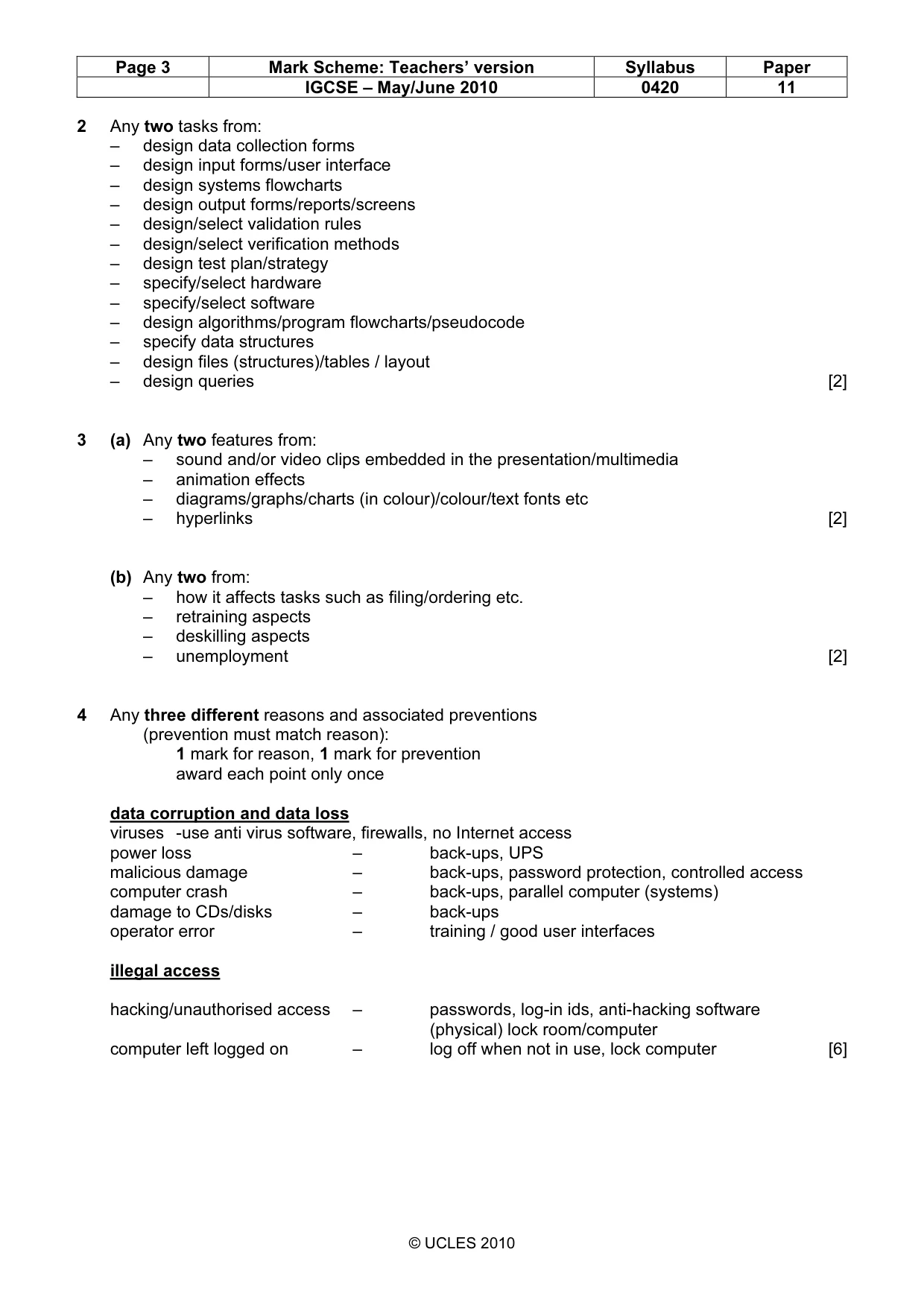
Page 3 Mark Scheme: Teachers’ version Syllabus Paper IGCSE – May/June 2010 0420 11 © UCLES 2010 2 Any two tasks from: – design data collection forms – design input forms/user interface – design systems flowcharts – design output forms/reports/screens – design/select validation rules – design/select verification methods – design test plan/strategy – specify/select hardware – specify/select software – design algorithms/program flowcharts/pseudocode – specify data structures – design files (structures)/tables / layout – design queries [2] 3 (a) Any two features from: – sound and/or video clips embedded in the presentation/multimedia – animation effects – diagrams/graphs/charts (in colour)/colour/text fonts etc – hyperlinks [2] (b) Any two from: – how it affects tasks such as filing/ordering etc. – retraining aspects – deskilling aspects – unemployment [2] 4 Any three different reasons and associated preventions (prevention must match reason): 1 mark for reason, 1 mark for prevention award each point only once data corruption and data loss viruses -use anti virus software, firewalls, no Internet access power loss – back-ups, UPS malicious damage – back-ups, password protection, controlled access computer crash – back-ups, parallel computer (systems) damage to CDs/disks – back-ups operator error – training / good user interfaces illegal access hacking/unauthorised access – passwords, log-in ids, anti-hacking software (physical) lock room/computer computer left logged on – log off when not in use, lock computer [6]
Mark scheme, page 4
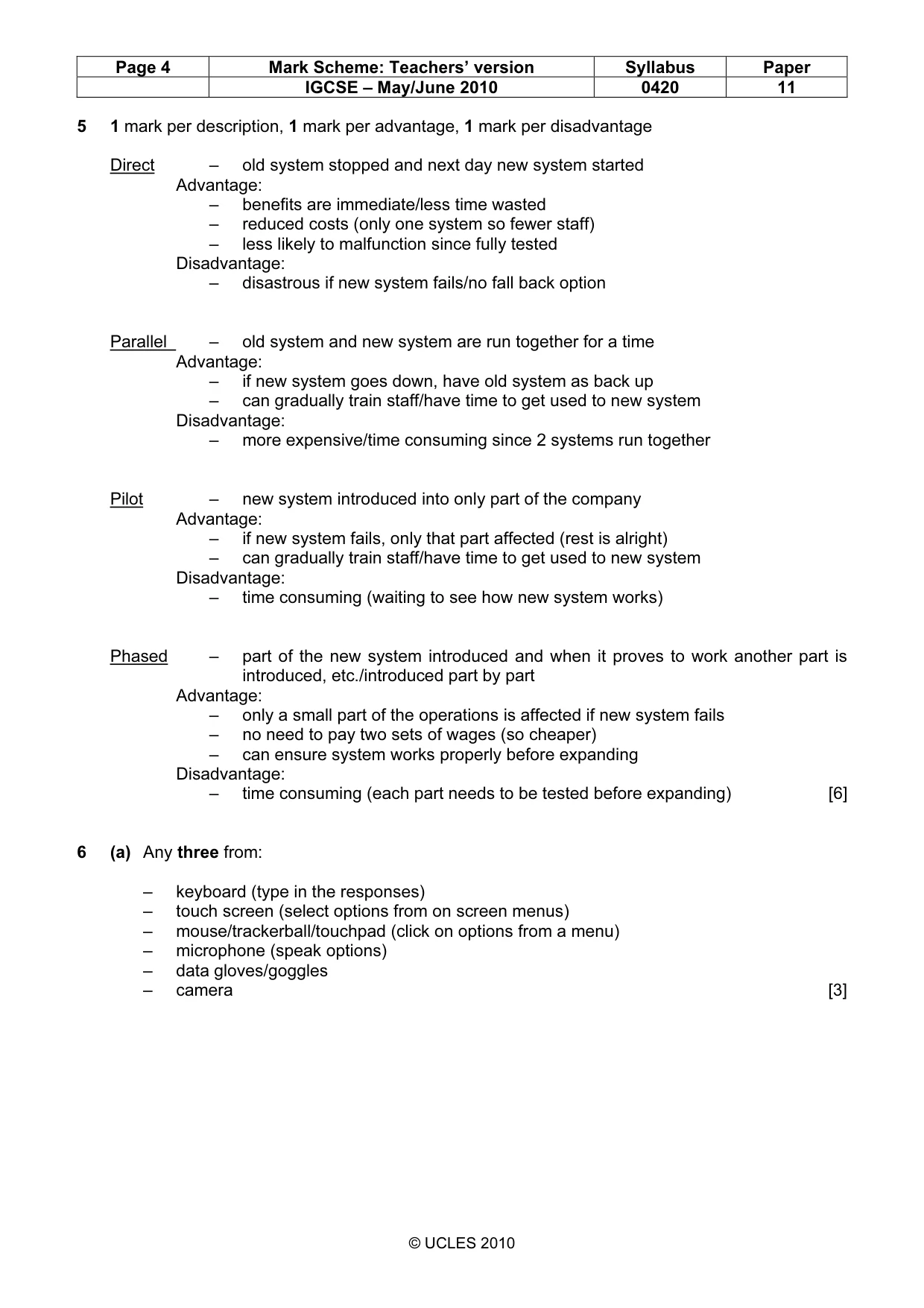
Page 4 Mark Scheme: Teachers’ version Syllabus Paper IGCSE – May/June 2010 0420 11 © UCLES 2010 5 1 mark per description, 1 mark per advantage, 1 mark per disadvantage Direct – old system stopped and next day new system started Advantage: – benefits are immediate/less time wasted – reduced costs (only one system so fewer staff) – less likely to malfunction since fully tested Disadvantage: – disastrous if new system fails/no fall back option Parallel – old system and new system are run together for a time Advantage: – if new system goes down, have old system as back up – can gradually train staff/have time to get used to new system Disadvantage: – more expensive/time consuming since 2 systems run together Pilot – new system introduced into only part of the company Advantage: – if new system fails, only that part affected (rest is alright) – can gradually train staff/have time to get used to new system Disadvantage: – time consuming (waiting to see how new system works) Phased – part of the new system introduced and when it proves to work another part is introduced, etc./introduced part by part Advantage: – only a small part of the operations is affected if new system fails – no need to pay two sets of wages (so cheaper) – can ensure system works properly before expanding Disadvantage: – time consuming (each part needs to be tested before expanding) [6] 6 (a) Any three from: – keyboard (type in the responses) – touch screen (select options from on screen menus) – mouse/trackerball/touchpad (click on options from a menu) – microphone (speak options) – data gloves/goggles – camera [3]
Mark scheme, page 5
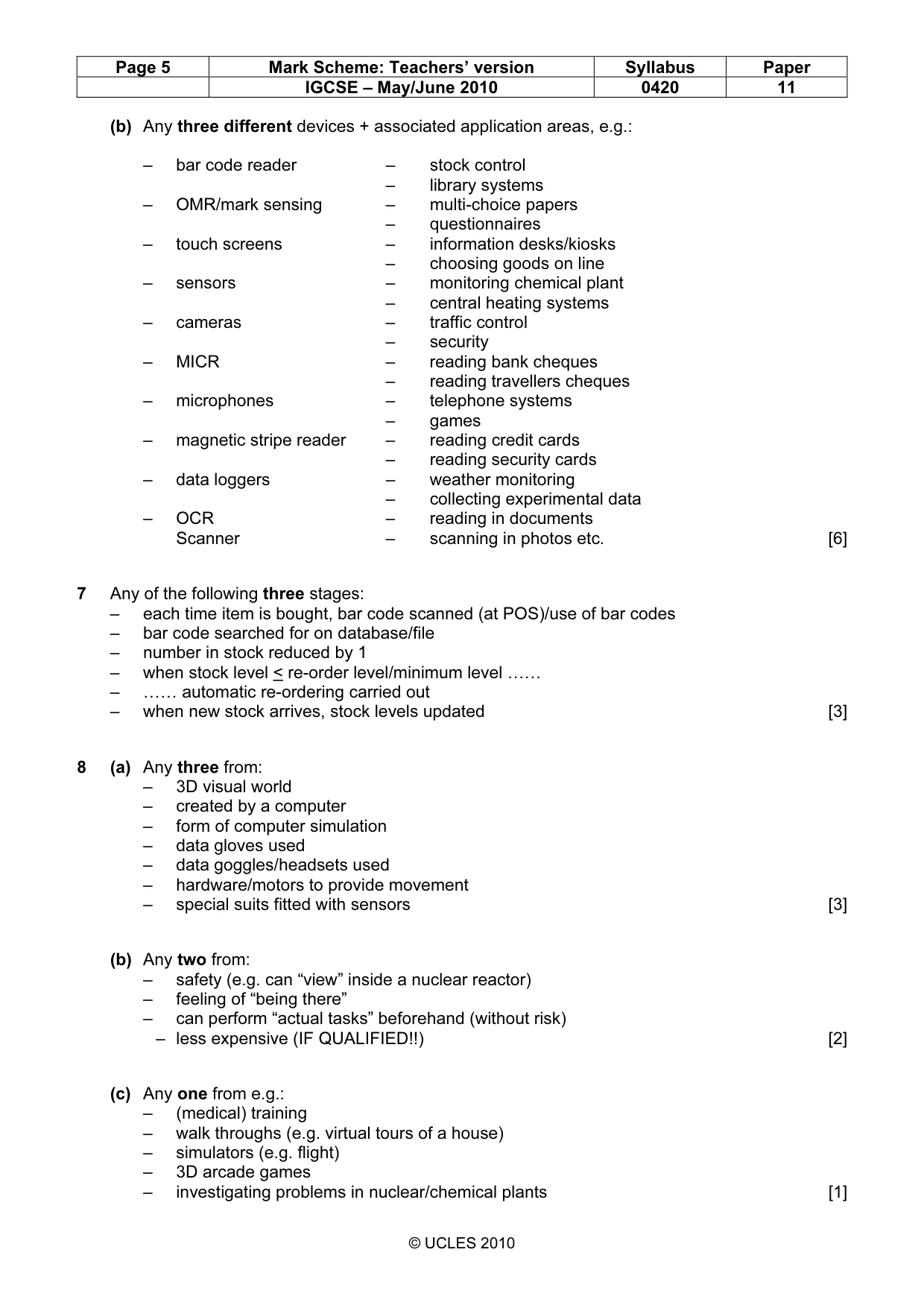
Page 5 Mark Scheme: Teachers’ version Syllabus Paper IGCSE – May/June 2010 0420 11 © UCLES 2010 (b) Any three different devices + associated application areas, e.g.: – bar code reader – stock control – library systems – OMR/mark sensing – multi-choice papers – questionnaires – touch screens – information desks/kiosks – choosing goods on line – sensors – monitoring chemical plant – central heating systems – cameras – traffic control – security – MICR – reading bank cheques – reading travellers cheques – microphones – telephone systems – games – magnetic stripe reader – reading credit cards – reading security cards – data loggers – weather monitoring – collecting experimental data – OCR – reading in documents Scanner – scanning in photos etc. [6] 7 Any of the following three stages: – each time item is bought, bar code scanned (at POS)/use of bar codes – bar code searched for on database/file – number in stock reduced by 1 – when stock level < re-order level/minimum level …… – …… automatic re-ordering carried out – when new stock arrives, stock levels updated [3] 8 (a) Any three from: – 3D visual world – created by a computer – form of computer simulation – data gloves used – data goggles/headsets used – hardware/motors to provide movement – special suits fitted with sensors [3] (b) Any two from: – safety (e.g. can “view” inside a nuclear reactor) – feeling of “being there” – can perform “actual tasks” beforehand (without risk) – less expensive (IF QUALIFIED!!) [2] (c) Any one from e.g.: – (medical) training – walk throughs (e.g. virtual tours of a house) – simulators (e.g. flight) – 3D arcade games – investigating problems in nuclear/chemical plants [1]
Mark scheme, page 6
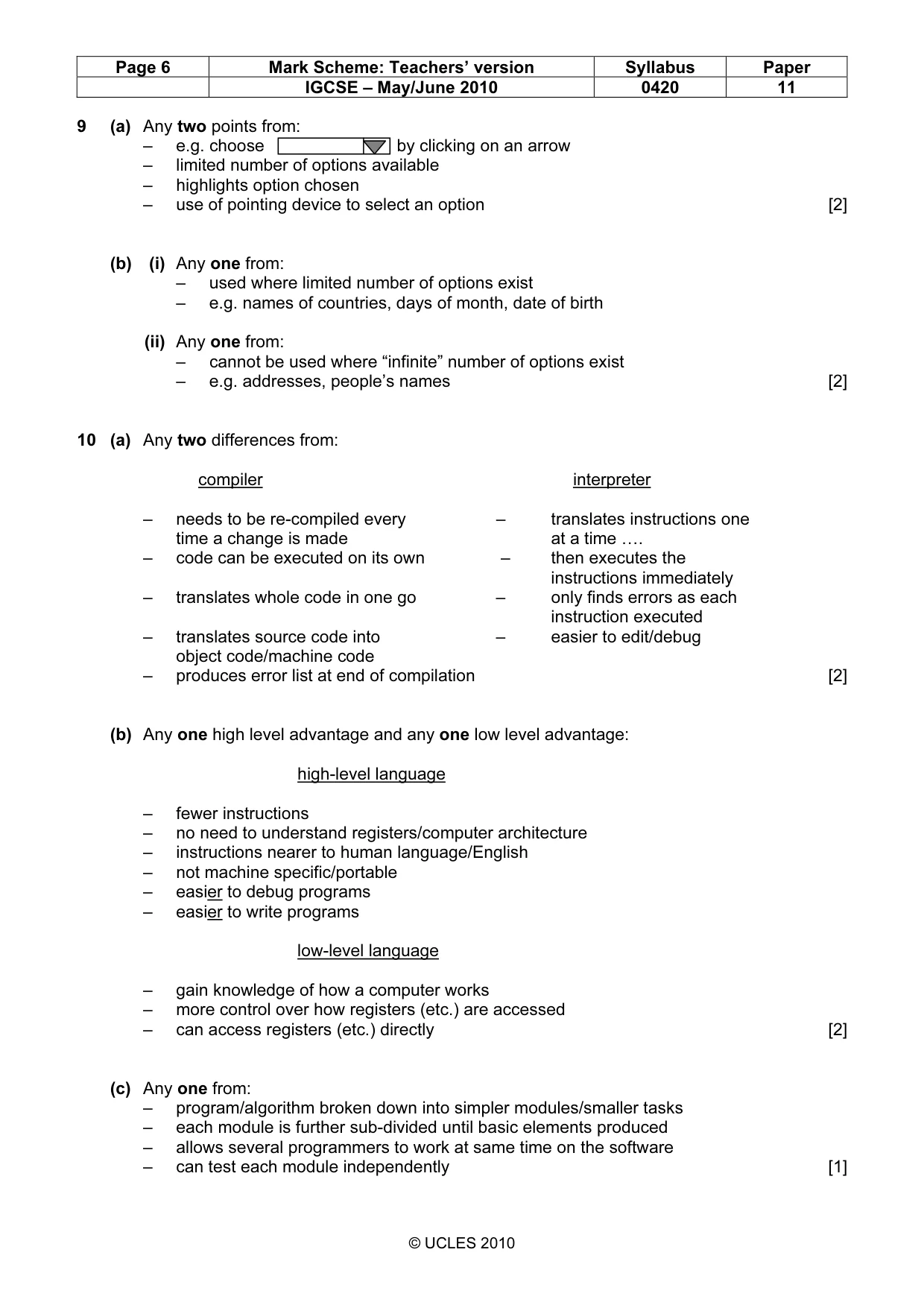
Page 6 Mark Scheme: Teachers’ version Syllabus Paper IGCSE – May/June 2010 0420 11 © UCLES 2010 9 (a) Any two points from: – e.g. choose by clicking on an arrow – limited number of options available – highlights option chosen – use of pointing device to select an option [2] (b) (i) Any one from: – used where limited number of options exist – e.g. names of countries, days of month, date of birth (ii) Any one from: – cannot be used where “infinite” number of options exist – e.g. addresses, people’s names [2] 10 (a) Any two differences from: compiler interpreter – needs to be re-compiled every – translates instructions one time a change is made at a time …. – code can be executed on its own – then executes the instructions immediately – translates whole code in one go – only finds errors as each instruction executed – translates source code into – easier to edit/debug object code/machine code – produces error list at end of compilation [2] (b) Any one high level advantage and any one low level advantage: high-level language – fewer instructions – no need to understand registers/computer architecture – instructions nearer to human language/English – not machine specific/portable – easier to debug programs – easier to write programs low-level language – gain knowledge of how a computer works – more control over how registers (etc.) are accessed – can access registers (etc.) directly [2] (c) Any one from: – program/algorithm broken down into simpler modules/smaller tasks – each module is further sub-divided until basic elements produced – allows several programmers to work at same time on the software – can test each module independently [1]
Mark scheme, page 7
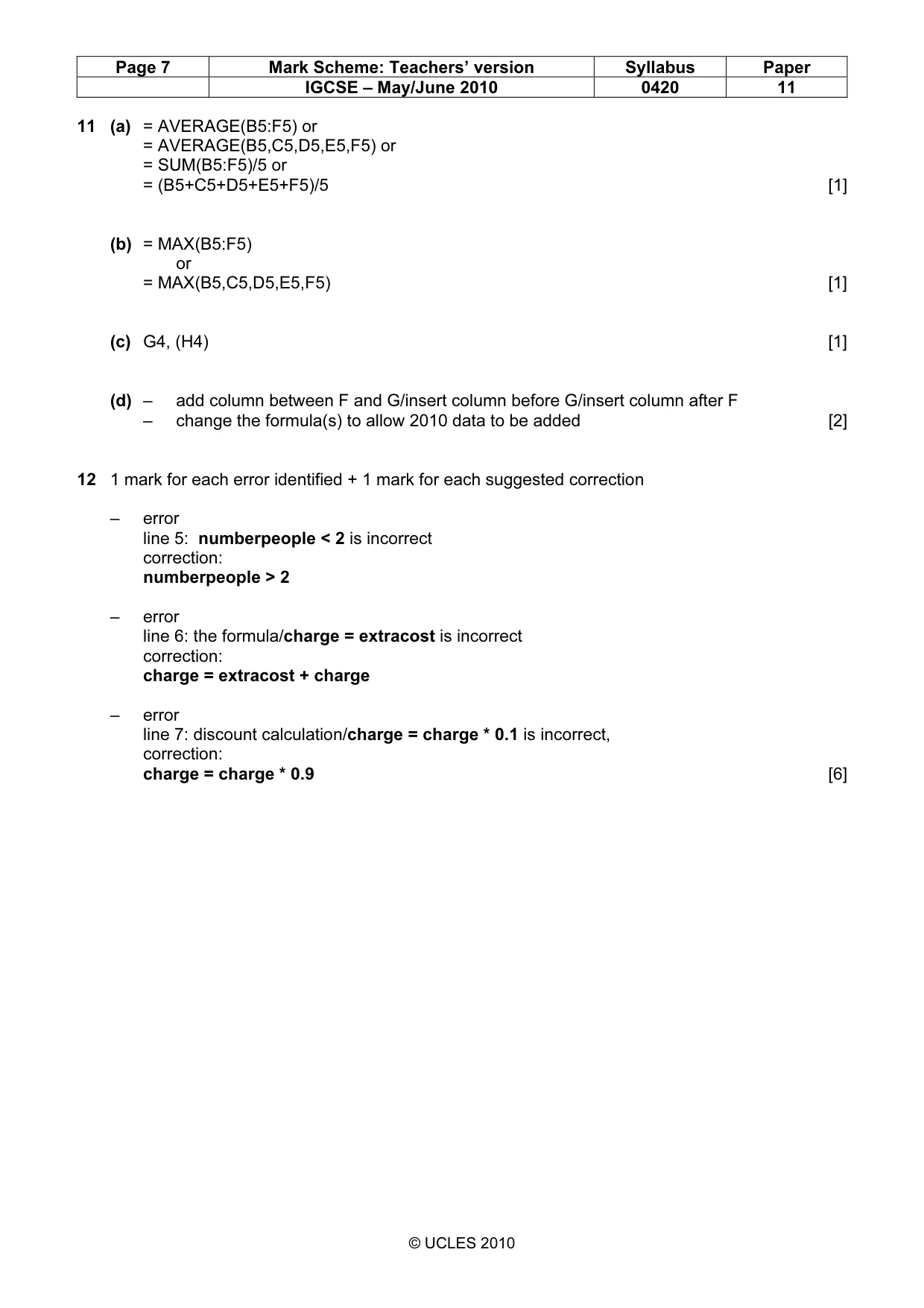
Page 7 Mark Scheme: Teachers’ version Syllabus Paper IGCSE – May/June 2010 0420 11 © UCLES 2010 11 (a) = AVERAGE(B5:F5) or = AVERAGE(B5,C5,D5,E5,F5) or = SUM(B5:F5)/5 or = (B5+C5+D5+E5+F5)/5 [1] (b) = MAX(B5:F5) or = MAX(B5,C5,D5,E5,F5) [1] (c) G4, (H4) [1] (d) – add column between F and G/insert column before G/insert column after F – change the formula(s) to allow 2010 data to be added [2] 12 1 mark for each error identified + 1 mark for each suggested correction – error line 5: numberpeople < 2 is incorrect correction: numberpeople > 2 – error line 6: the formula/charge = extracost is incorrect correction: charge = extracost + charge – error line 7: discount calculation/charge = charge * 0.1 is incorrect, correction: charge = charge * 0.9 [6]
Mark scheme, page 8
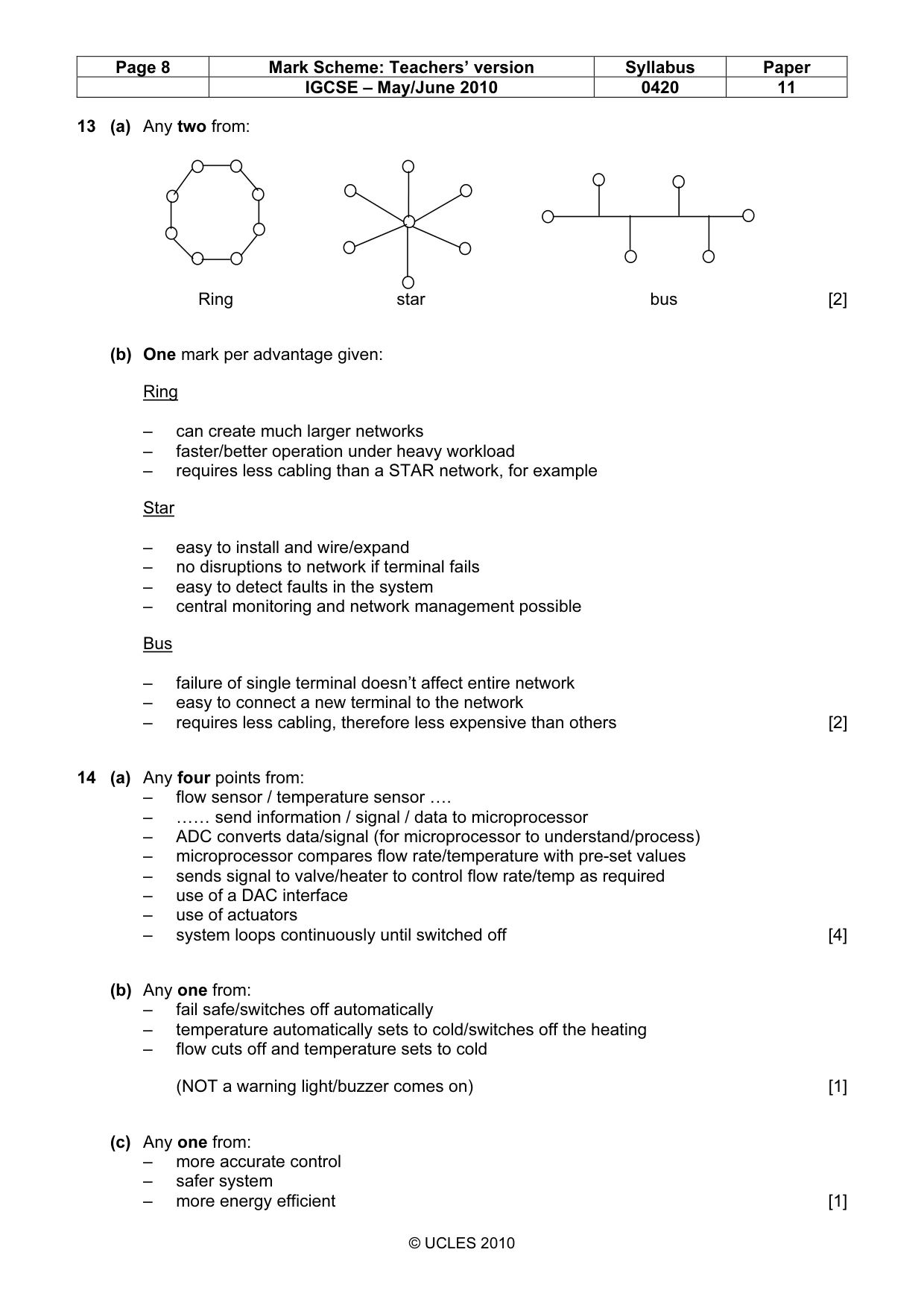
Page 8 Mark Scheme: Teachers’ version Syllabus Paper IGCSE – May/June 2010 0420 11 © UCLES 2010 13 (a) Any two from: Ring star bus [2] (b) One mark per advantage given: Ring – can create much larger networks – faster/better operation under heavy workload – requires less cabling than a STAR network, for example Star – easy to install and wire/expand – no disruptions to network if terminal fails – easy to detect faults in the system – central monitoring and network management possible Bus – failure of single terminal doesn’t affect entire network – easy to connect a new terminal to the network – requires less cabling, therefore less expensive than others [2] 14 (a) Any four points from: – flow sensor / temperature sensor …. – …… send information / signal / data to microprocessor – ADC converts data/signal (for microprocessor to understand/process) – microprocessor compares flow rate/temperature with pre-set values – sends signal to valve/heater to control flow rate/temp as required – use of a DAC interface – use of actuators – system loops continuously until switched off [4] (b) Any one from: – fail safe/switches off automatically – temperature automatically sets to cold/switches off the heating – flow cuts off and temperature sets to cold (NOT a warning light/buzzer comes on) [1] (c) Any one from: – more accurate control – safer system – more energy efficient [1]
Mark scheme, page 9
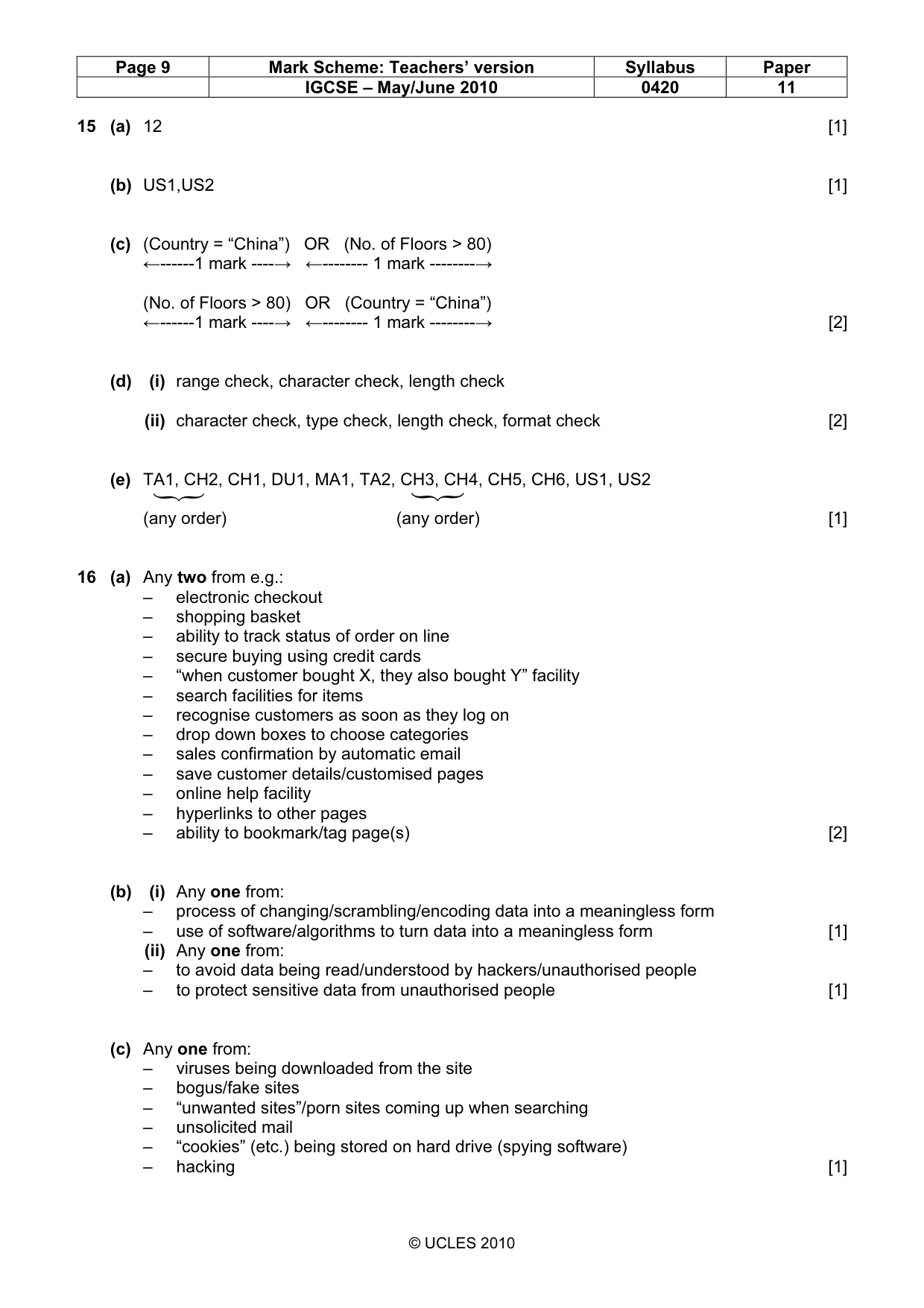
Page 9 Mark Scheme: Teachers’ version Syllabus Paper IGCSE – May/June 2010 0420 11 © UCLES 2010 { { 15 (a) 12 [1] (b) US1,US2 [1] (c) (Country = “China”) OR (No. of Floors > 80) ←------1 mark ----→ ←-------- 1 mark --------→ (No. of Floors > 80) OR (Country = “China”) ←------1 mark ----→ ←-------- 1 mark --------→ [2] (d) (i) range check, character check, length check (ii) character check, type check, length check, format check [2] (e) TA1, CH2, CH1, DU1, MA1, TA2, CH3, CH4, CH5, CH6, US1, US2 (any order) (any order) [1] 16 (a) Any two from e.g.: – electronic checkout – shopping basket – ability to track status of order on line – secure buying using credit cards – “when customer bought X, they also bought Y” facility – search facilities for items – recognise customers as soon as they log on – drop down boxes to choose categories – sales confirmation by automatic email – save customer details/customised pages – online help facility – hyperlinks to other pages – ability to bookmark/tag page(s) [2] (b) (i) Any one from: – process of changing/scrambling/encoding data into a meaningless form – use of software/algorithms to turn data into a meaningless form [1] (ii) Any one from: – to avoid data being read/understood by hackers/unauthorised people – to protect sensitive data from unauthorised people [1] (c) Any one from: – viruses being downloaded from the site – bogus/fake sites – “unwanted sites”/porn sites coming up when searching – unsolicited mail – “cookies” (etc.) being stored on hard drive (spying software) – hacking [1]
Mark scheme, page 10
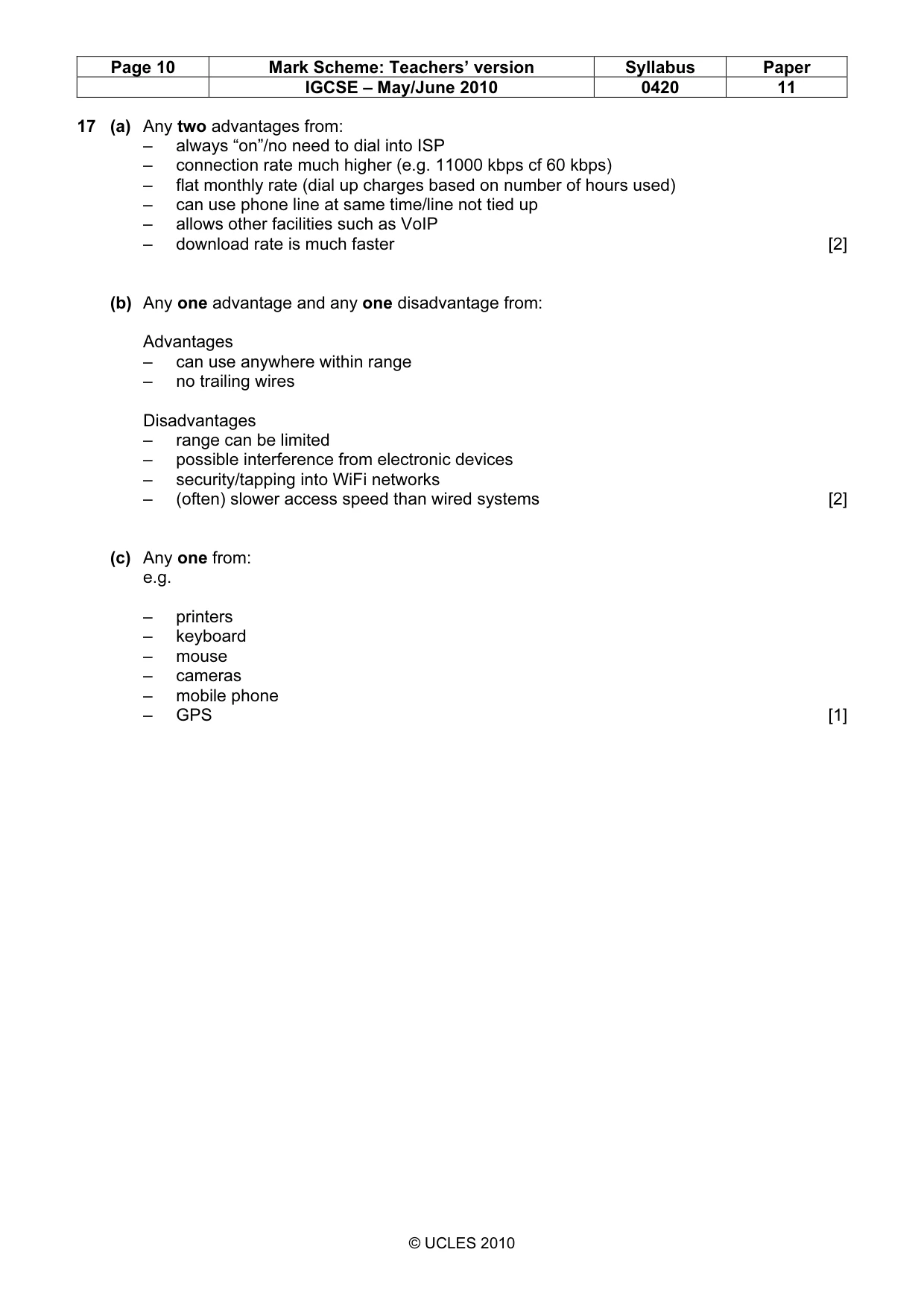
Page 10 Mark Scheme: Teachers’ version Syllabus Paper IGCSE – May/June 2010 0420 11 © UCLES 2010 17 (a) Any two advantages from: – always “on”/no need to dial into ISP – connection rate much higher (e.g. 11000 kbps cf 60 kbps) – flat monthly rate (dial up charges based on number of hours used) – can use phone line at same time/line not tied up – allows other facilities such as VoIP – download rate is much faster [2] (b) Any one advantage and any one disadvantage from: Advantages – can use anywhere within range – no trailing wires Disadvantages – range can be limited – possible interference from electronic devices – security/tapping into WiFi networks – (often) slower access speed than wired systems [2] (c) Any one from: e.g. – printers – keyboard – mouse – cameras – mobile phone – GPS [1]
Mark scheme, page 11
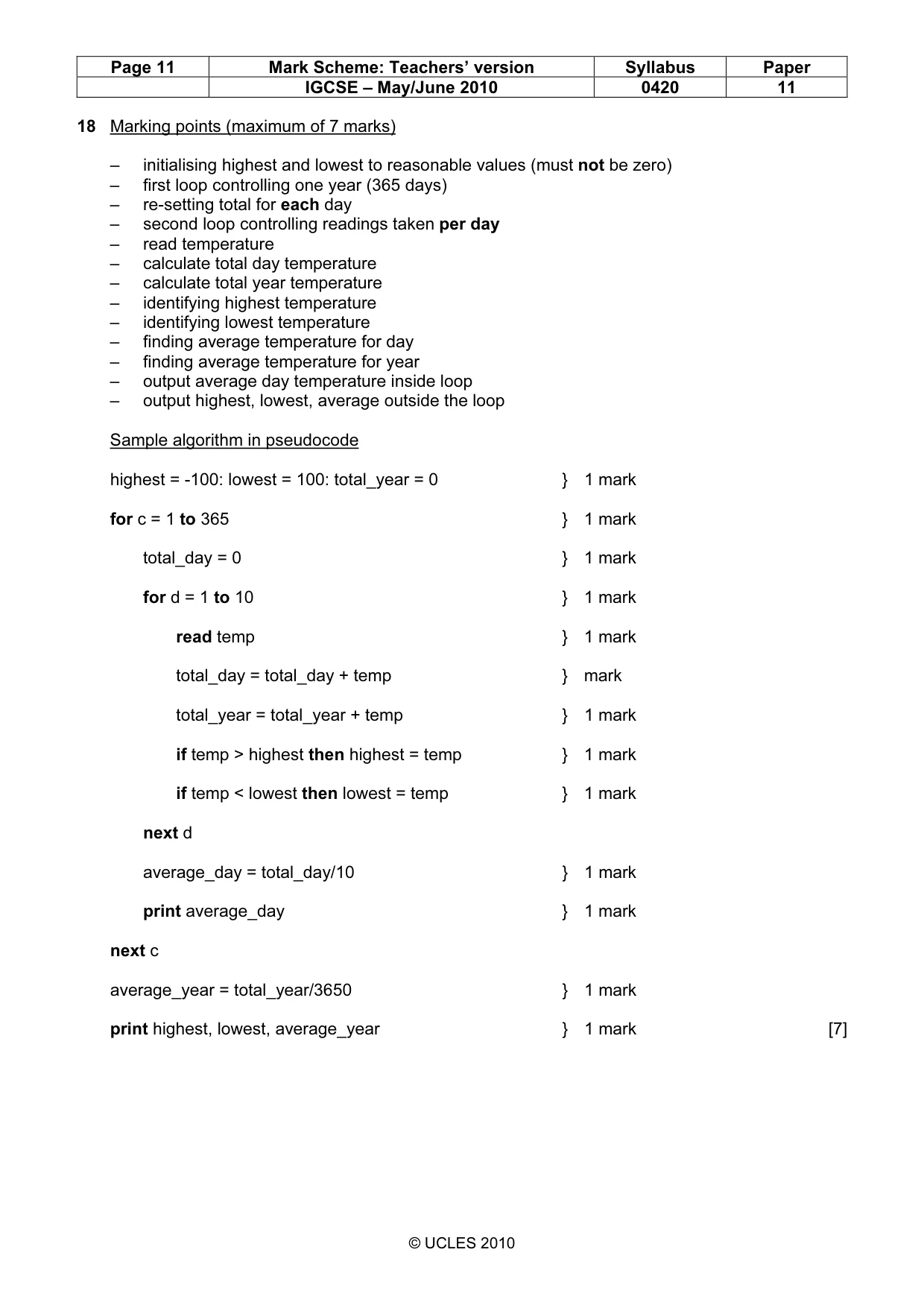
Page 11 Mark Scheme: Teachers’ version Syllabus Paper IGCSE – May/June 2010 0420 11 © UCLES 2010 18 Marking points (maximum of 7 marks) – initialising highest and lowest to reasonable values (must not be zero) – first loop controlling one year (365 days) – re-setting total for each day – second loop controlling readings taken per day – read temperature – calculate total day temperature – calculate total year temperature – identifying highest temperature – identifying lowest temperature – finding average temperature for day – finding average temperature for year – output average day temperature inside loop – output highest, lowest, average outside the loop Sample algorithm in pseudocode highest = -100: lowest = 100: total_year = 0 } 1 mark for c = 1 to 365 } 1 mark total_day = 0 } 1 mark for d = 1 to 10 } 1 mark read temp } 1 mark total_day = total_day + temp } mark total_year = total_year + temp } 1 mark if temp > highest then highest = temp } 1 mark if temp < lowest then lowest = temp } 1 mark next d average_day = total_day/10 } 1 mark print average_day } 1 mark next c average_year = total_year/3650 } 1 mark print highest, lowest, average_year } 1 mark [7]
What you needed in this session
Cambridge’s own grade thresholds for 2010 May/June, Paper 1 · Variant 1. A higher threshold means an easier paper — the bar moves with how the cohort did.