Cambridge IGCSE Computer Studies 0420 — 2014 Oct/Nov Paper 1 · Variant 1
0420/11/O/N/14 · 100 marks · ≈113 min
The question paper and its mark scheme, free to read here and free to download. This is Cambridge’s own paper, exactly as it was sat.
Question paper24 pages




Mark scheme12 pages
Answers below. Sit the paper first if you are practising.
Paper as text
Question paper, page 1
This document consists of 23 printed pages and 1 blank page. DC (LK/CGW) 88640/3 © UCLES 2014 [Turn over Cambridge International Examinations Cambridge International General Certificate of Secondary Education * 8 2 1 9 5 9 0 7 7 4 * COMPUTER STUDIES 0420/11 Paper 1 October/November 2014 2 hours 30 minutes Candidates answer on the Question Paper. No Additional Materials are required. READ THESE INSTRUCTIONS FIRST Write your Centre number, candidate number and name on all the work you hand in. Write in dark blue or black pen. You may use an HB pencil for any diagrams, graphs or rough working. Do not use staples, paper clips, glue or correction fluid. DO NOT WRITE IN ANY BARCODES. Answer all questions. No marks will be awarded for using brand names of software packages or hardware. At the end of the examination, fasten all your work securely together. The number of marks is given in brackets [ ] at the end of each question or part question.
Question paper, page 2
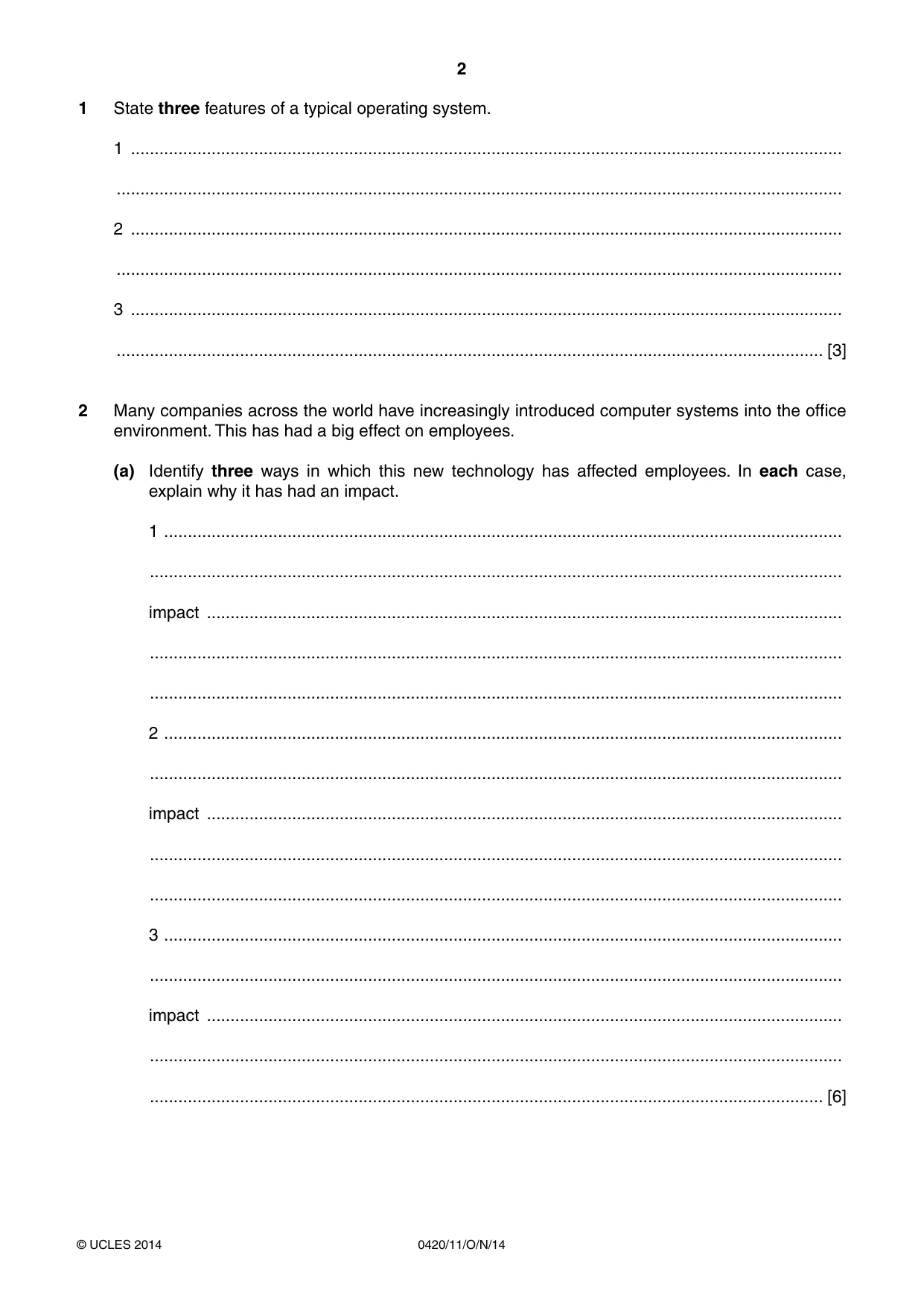
2 0420/11/O/N/14 © UCLES 2014 1 State three features of a typical operating system. 1 … … 2 … … 3 … … [3] 2 Many companies across the world have increasingly introduced computer systems into the office environment. This has had a big effect on employees. (a) Identify three ways in which this new technology has affected employees. In each case, explain why it has had an impact. 1 … … impact … … … 2 … … impact … … … 3 … … impact … … … [6]
Question paper, page 3
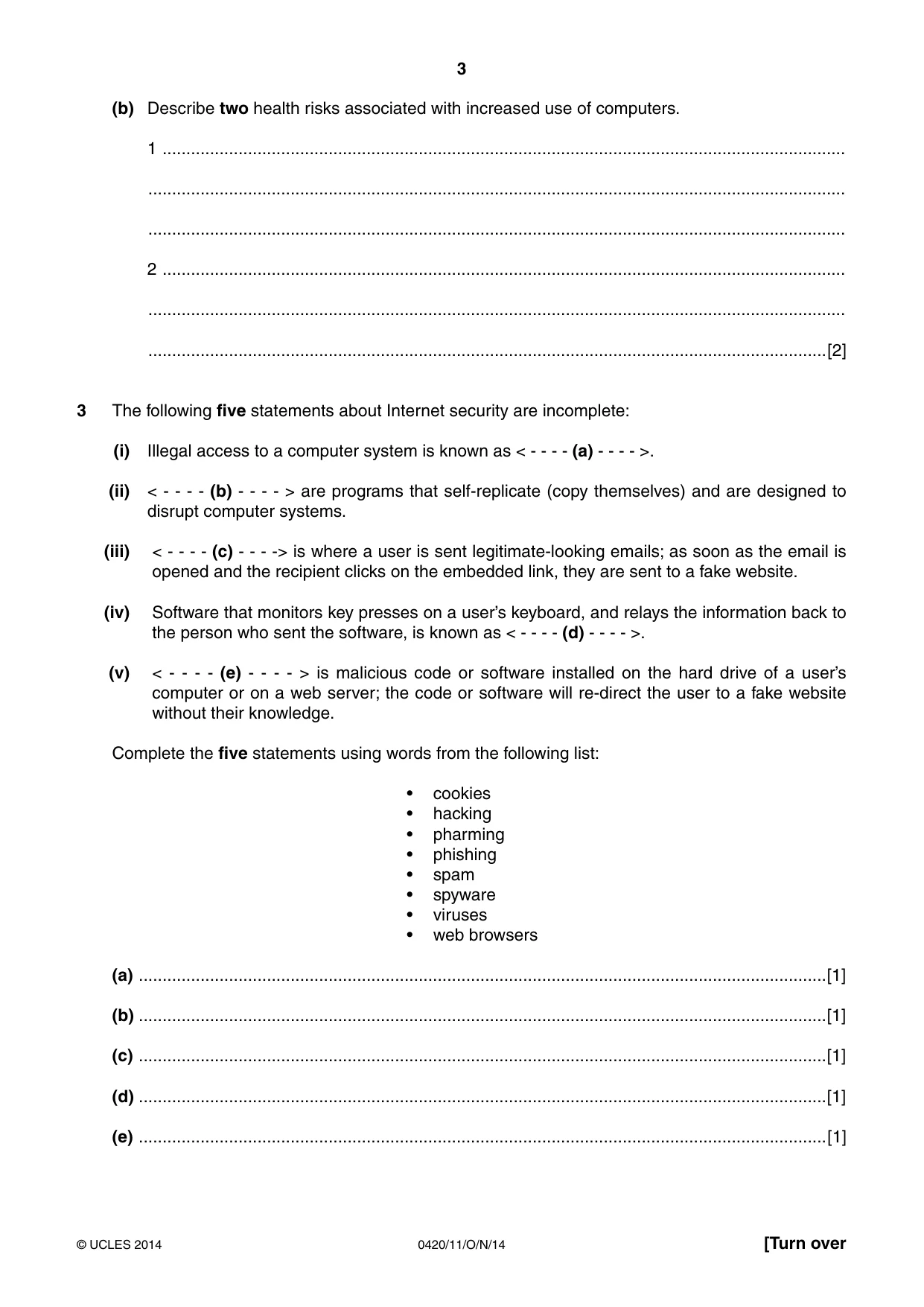
3 0420/11/O/N/14 © UCLES 2014 [Turn over (b) Describe two health risks associated with increased use of computers. 1 … … … 2 … … …[2] 3 The following five statements about Internet security are incomplete: (i) Illegal access to a computer system is known as < - - - - (a) - - - - >. (ii) < - - - - (b) - - - - > are programs that self-replicate (copy themselves) and are designed to disrupt computer systems. (iii) < - - - - (c) - - - -> is where a user is sent legitimate-looking emails; as soon as the email is opened and the recipient clicks on the embedded link, they are sent to a fake website. (iv) Software that monitors key presses on a user’s keyboard, and relays the information back to the person who sent the software, is known as < - - - - (d) - - - - >. (v) < - - - - (e) - - - - > is malicious code or software installed on the hard drive of a user’s computer or on a web server; the code or software will re-direct the user to a fake website without their knowledge. Complete the five statements using words from the following list: • cookies • hacking • pharming • phishing • spam • spyware • viruses • web browsers (a) …[1] (b) …[1] (c) …[1] (d) …[1] (e) …[1]
Question paper, page 4
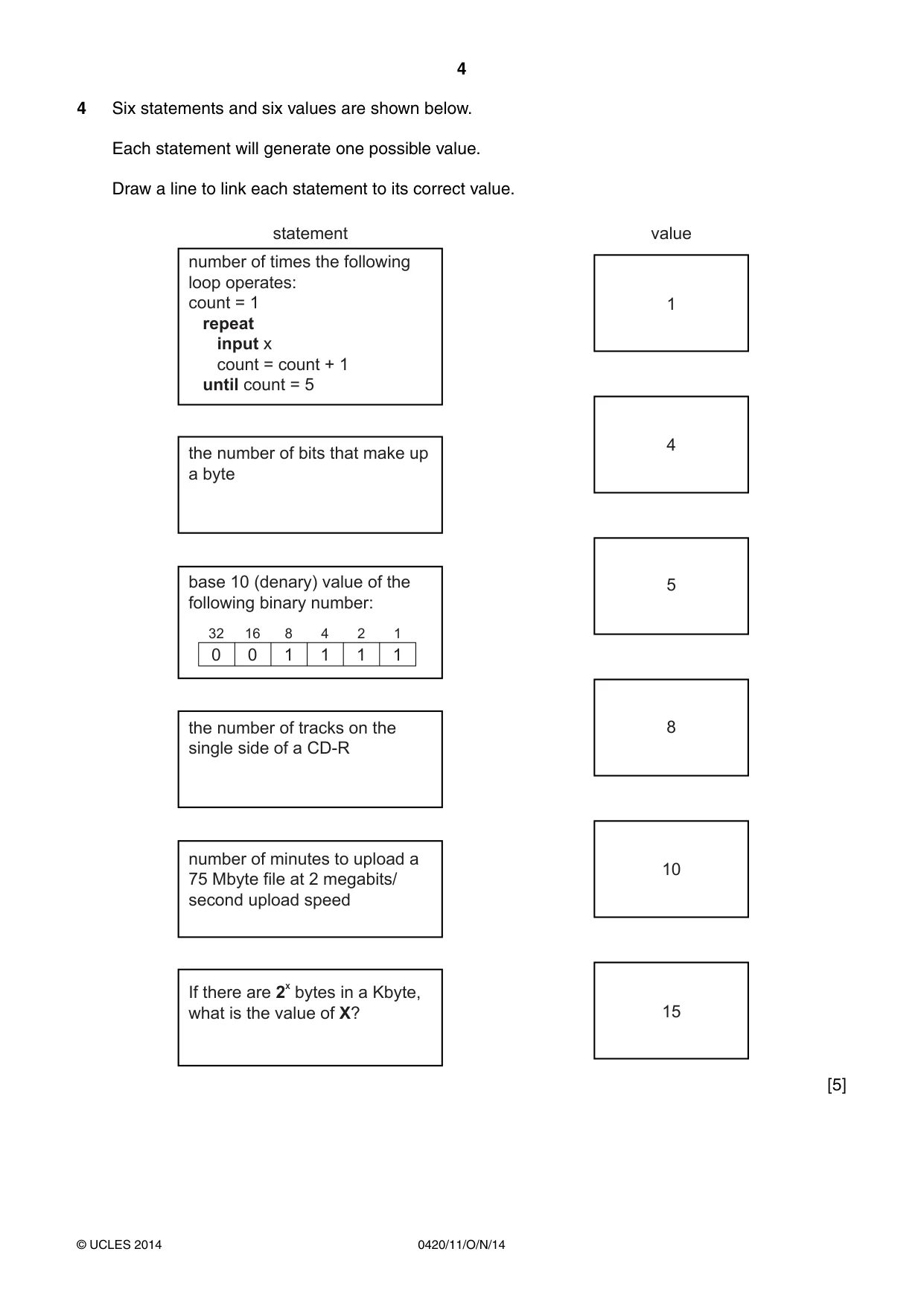
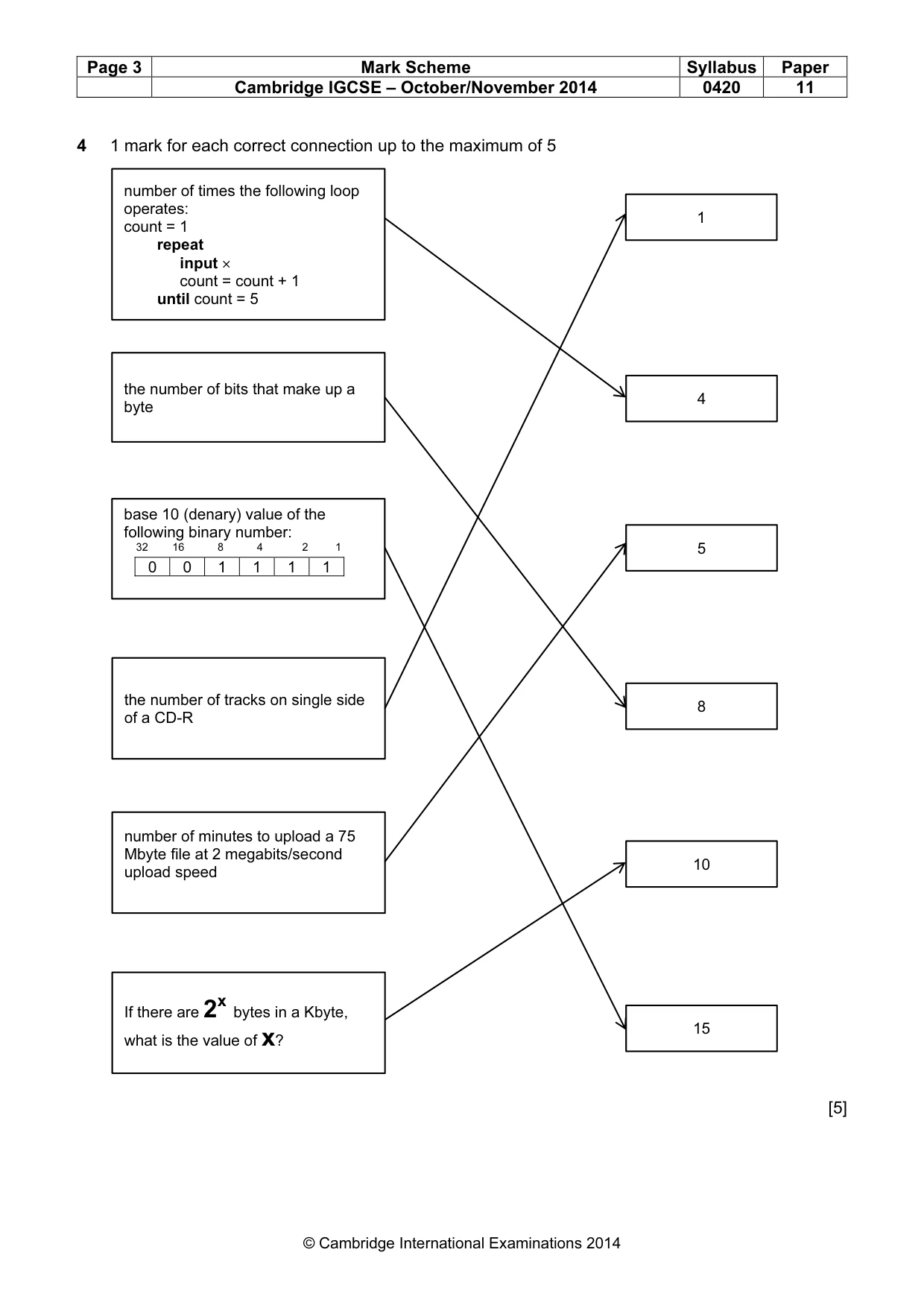
4 0420/11/O/N/14 © UCLES 2014 4 Six statements and six values are shown below. Each statement will generate one possible value. Draw a line to link each statement to its correct value. number of times the following loop operates: count = 1 repeat input x count = count + 1 until count = 5 the number of bits that make up a byte statement value base 10 (denary) value of the following binary number: the number of tracks on the single side of a CD-R number of minutes to upload a 75 Mbyte file at 2 megabits/ second upload speed If there are 2 X bytes in a Kbyte, what is the value of X? 1 4 5 8 10 15 0 0 1 1 1 1 32 16 8 4 2 1 [5]
Question paper, page 5
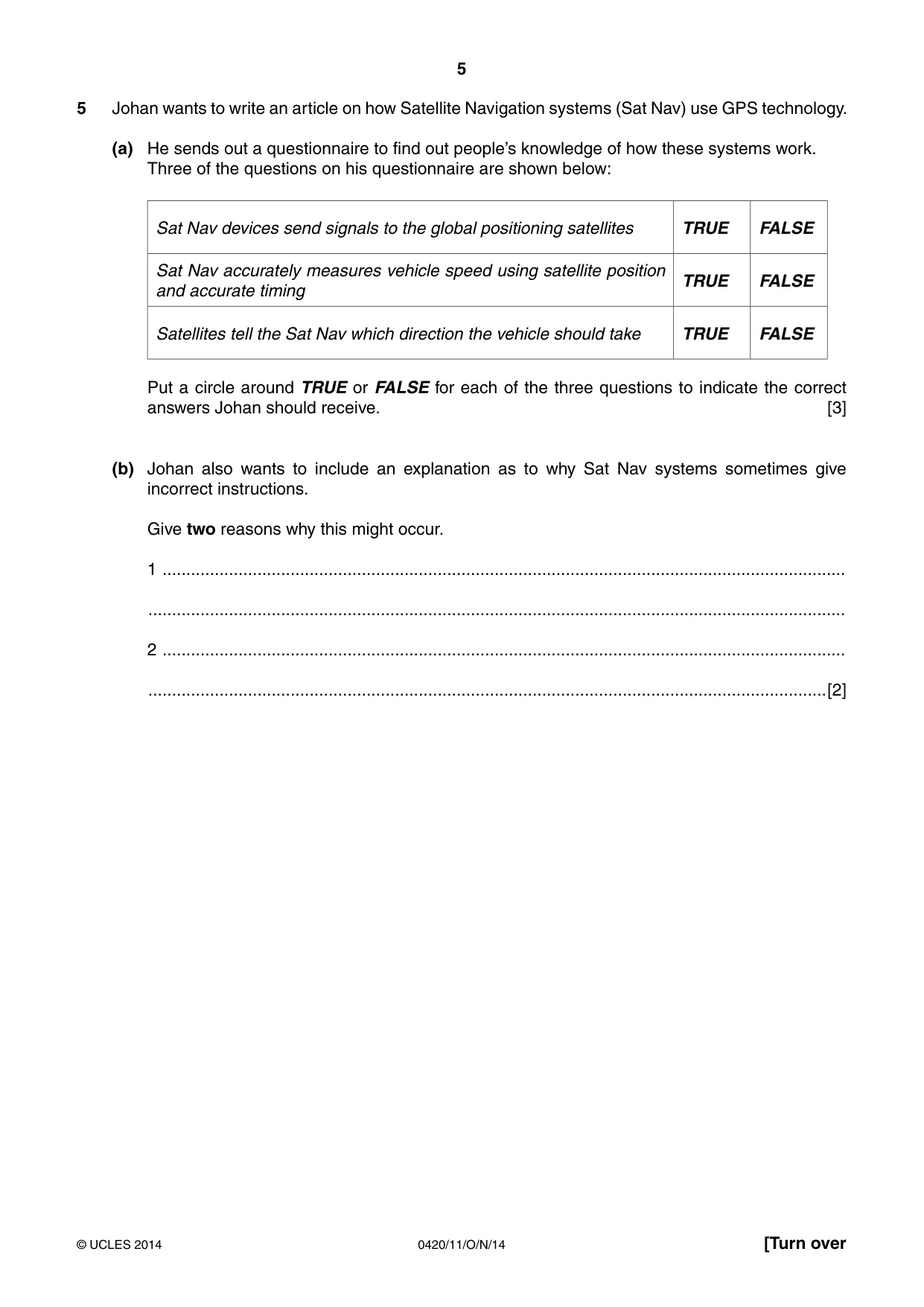
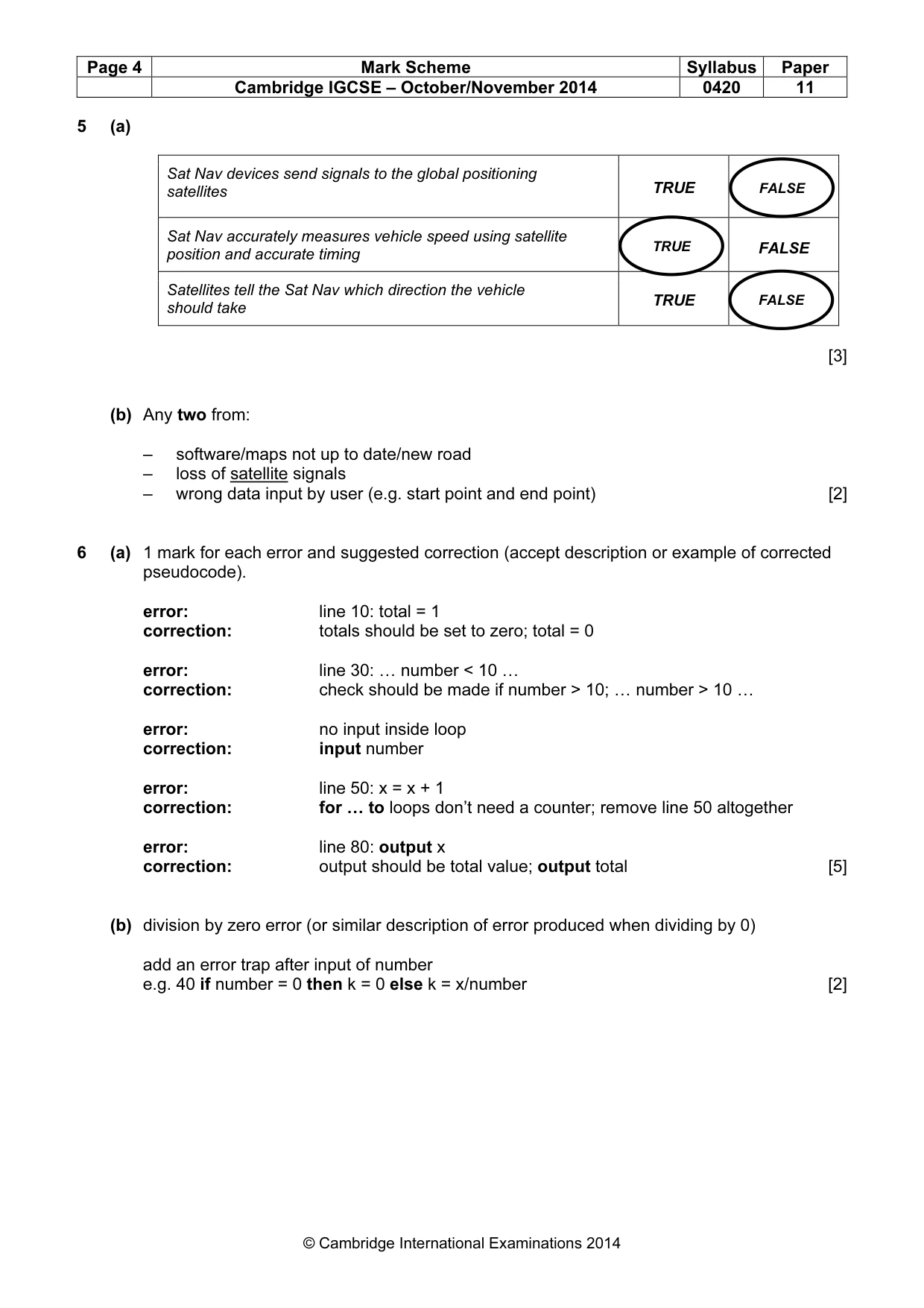
5 0420/11/O/N/14 © UCLES 2014 [Turn over 5 Johan wants to write an article on how Satellite Navigation systems (Sat Nav) use GPS technology. (a) He sends out a questionnaire to find out people’s knowledge of how these systems work. Three of the questions on his questionnaire are shown below: Sat Nav devices send signals to the global positioning satellites TRUE FALSE Sat Nav accurately measures vehicle speed using satellite position and accurate timing TRUE FALSE Satellites tell the Sat Nav which direction the vehicle should take TRUE FALSE Put a circle around TRUE or FALSE for each of the three questions to indicate the correct answers Johan should receive. [3] (b) Johan also wants to include an explanation as to why Sat Nav systems sometimes give incorrect instructions. Give two reasons why this might occur. 1 … … 2 … …[2]
Question paper, page 6
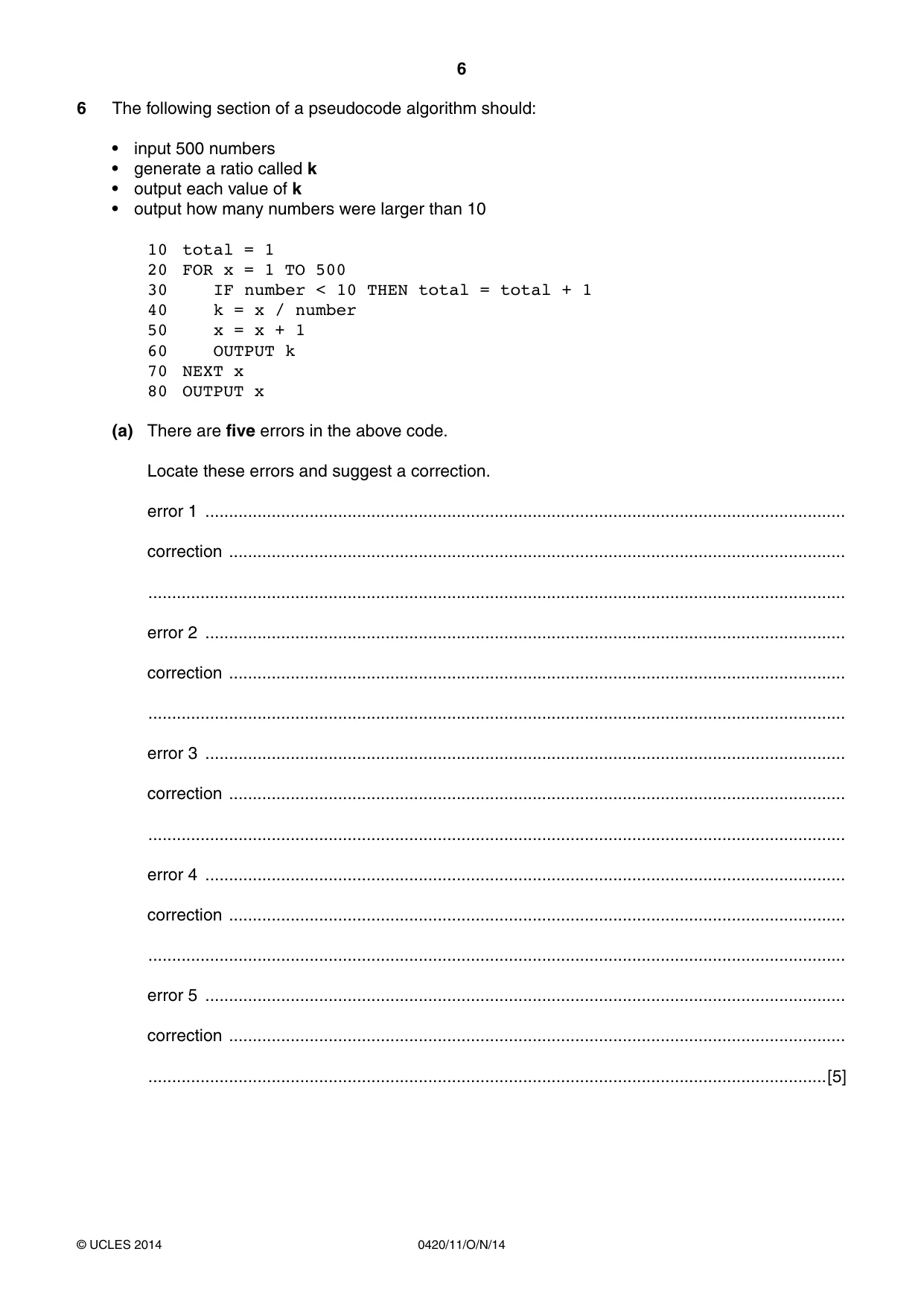
6 0420/11/O/N/14 © UCLES 2014 6 The following section of a pseudocode algorithm should: • input 500 numbers • generate a ratio called k • output each value of k • output how many numbers were larger than 10 10 total = 1 20 FOR x = 1 TO 500 30 IF number < 10 THEN total = total + 1 40 k = x / number 50 x = x + 1 60 OUTPUT k 70 NEXT x 80 OUTPUT x (a) There are five errors in the above code. Locate these errors and suggest a correction. error 1 … correction … … error 2 … correction … … error 3 … correction … … error 4 … correction … … error 5 … correction … …[5]
Question paper, page 7
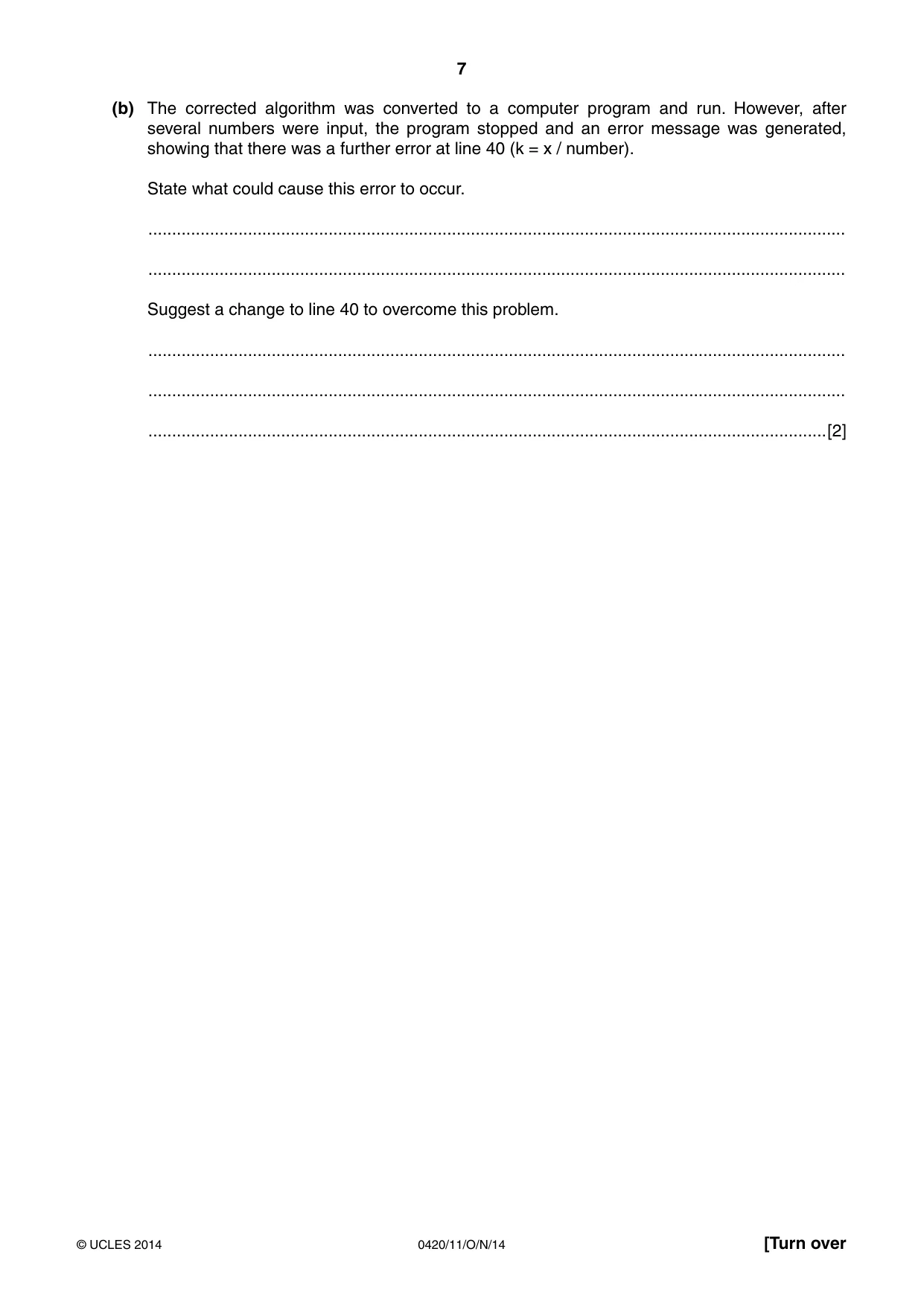
7 0420/11/O/N/14 © UCLES 2014 [Turn over (b) The corrected algorithm was converted to a computer program and run. However, after several numbers were input, the program stopped and an error message was generated, showing that there was a further error at line 40 (k = x / number). State what could cause this error to occur. … … Suggest a change to line 40 to overcome this problem. … … …[2]
Question paper, page 8
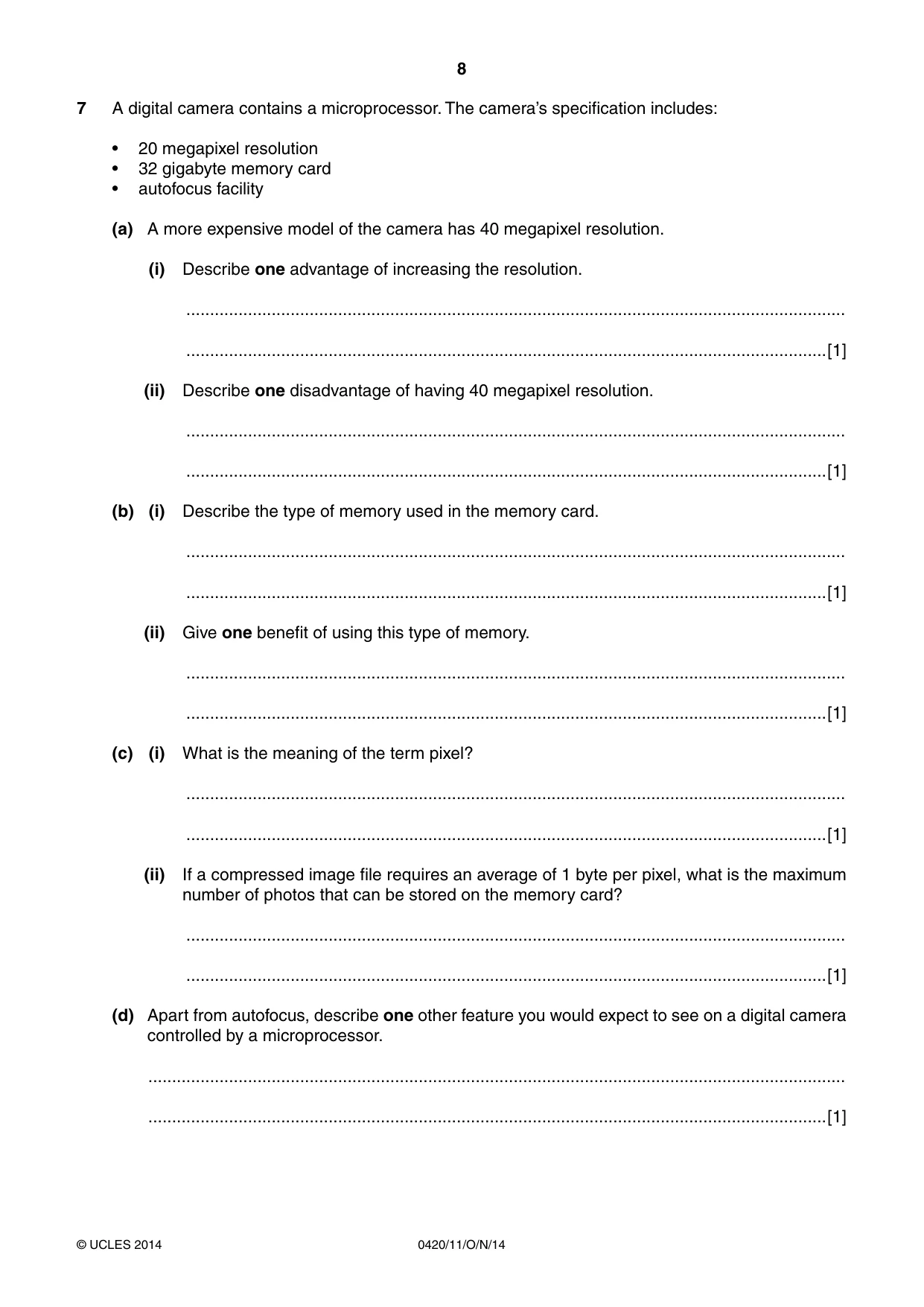
8 0420/11/O/N/14 © UCLES 2014 7 A digital camera contains a microprocessor. The camera’s specification includes: • 20 megapixel resolution • 32 gigabyte memory card • autofocus facility (a) A more expensive model of the camera has 40 megapixel resolution. (i) Describe one advantage of increasing the resolution. … …[1] (ii) Describe one disadvantage of having 40 megapixel resolution. … …[1] (b) (i) Describe the type of memory used in the memory card. … …[1] (ii) Give one benefit of using this type of memory. … …[1] (c) (i) What is the meaning of the term pixel? … …[1] (ii) If a compressed image file requires an average of 1 byte per pixel, what is the maximum number of photos that can be stored on the memory card? … …[1] (d) Apart from autofocus, describe one other feature you would expect to see on a digital camera controlled by a microprocessor. … …[1]
Question paper, page 9
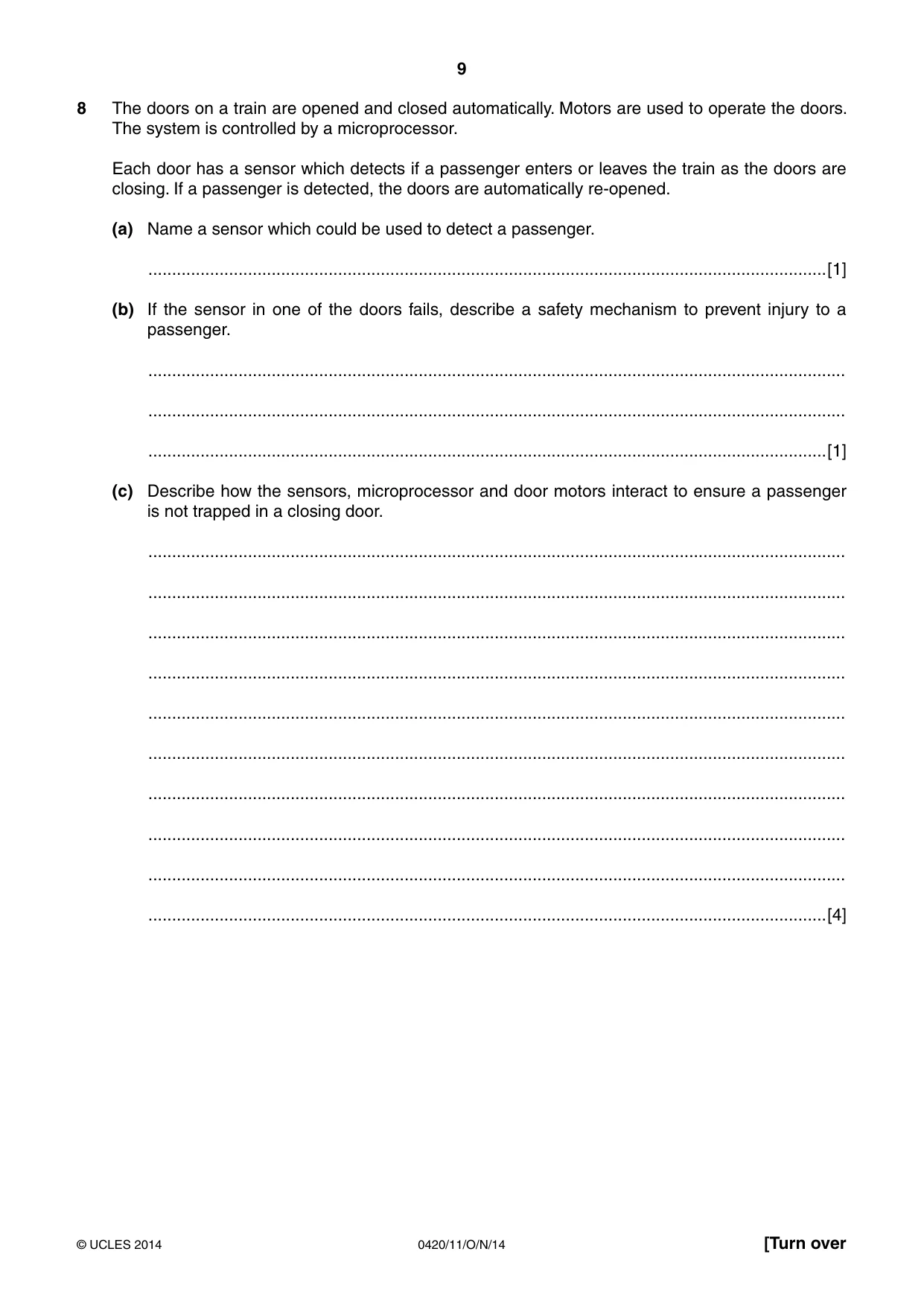
9 0420/11/O/N/14 © UCLES 2014 [Turn over 8 The doors on a train are opened and closed automatically. Motors are used to operate the doors. The system is controlled by a microprocessor. Each door has a sensor which detects if a passenger enters or leaves the train as the doors are closing. If a passenger is detected, the doors are automatically re-opened. (a) Name a sensor which could be used to detect a passenger. …[1] (b) If the sensor in one of the doors fails, describe a safety mechanism to prevent injury to a passenger. … … …[1] (c) Describe how the sensors, microprocessor and door motors interact to ensure a passenger is not trapped in a closing door. … … … … … … … … … …[4]
Question paper, page 10
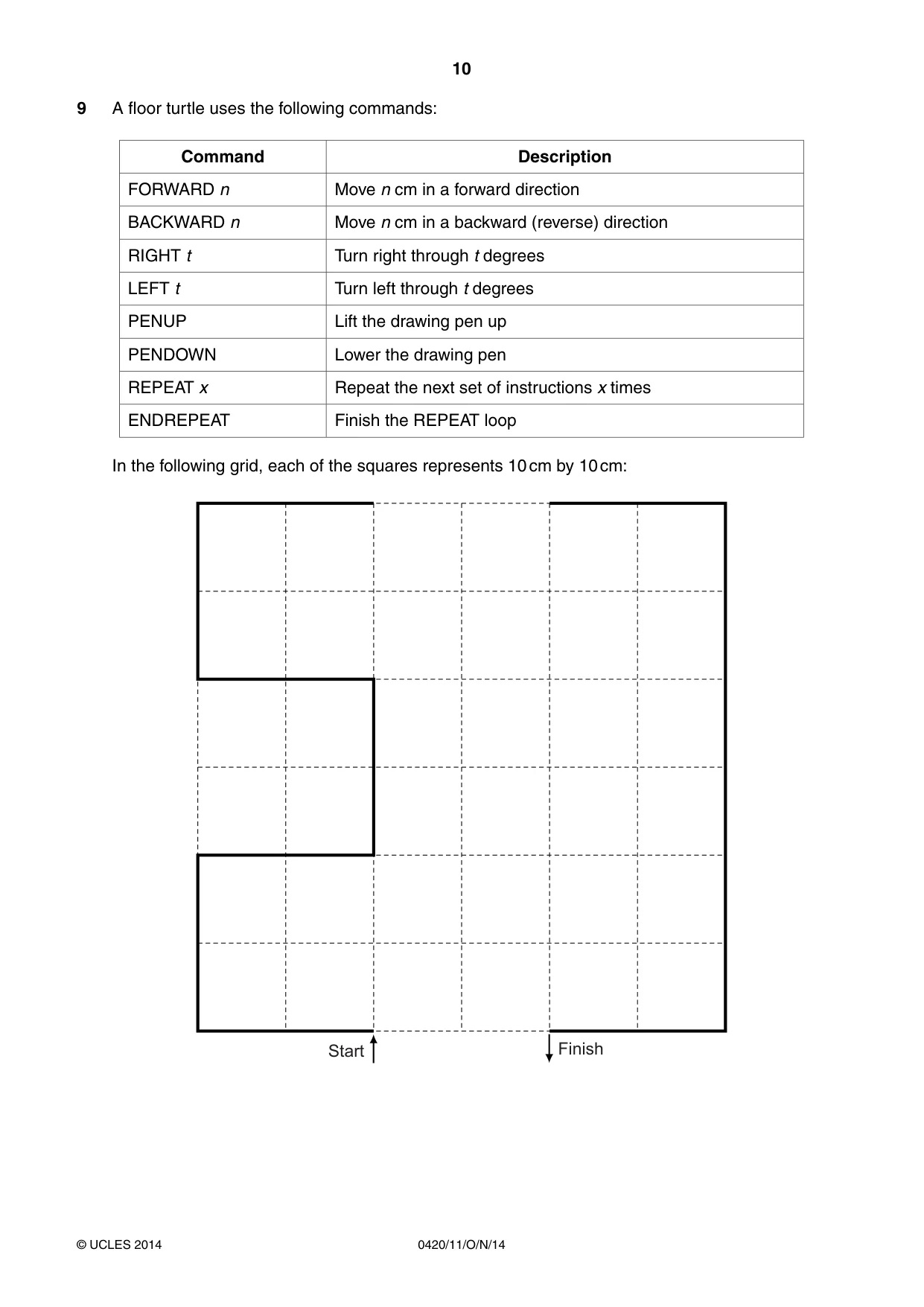
10 0420/11/O/N/14 © UCLES 2014 9 A floor turtle uses the following commands: Command Description FORWARD n Move n cm in a forward direction BACKWARD n Move n cm in a backward (reverse) direction RIGHT t Turn right through t degrees LEFT t Turn left through t degrees PENUP Lift the drawing pen up PENDOWN Lower the drawing pen REPEAT x Repeat the next set of instructions x times ENDREPEAT Finish the REPEAT loop In the following grid, each of the squares represents 10 cm by 10 cm: Start Finish
Question paper, page 11
11 0420/11/O/N/14 © UCLES 2014 [Turn over Complete the set of instructions to draw the shape shown on the left: 1 PENDOWN 2 LEFT 90 3 REPEAT 2 4 - - - - - - - - - - - - - - - - - - - - - - - - - - - - 5 - - - - - - - - - - - - - - - - - - - - - - - - - - - - 6 - - - - - - - - - - - - - - - - - - - - - - - - - - - - 7 - - - - - - - - - - - - - - - - - - - - - - - - - - - - 8 - - - - - - - - - - - - - - - - - - - - - - - - - - - - 9 - - - - - - - - - - - - - - - - - - - - - - - - - - - - 10 - - - - - - - - - - - - - - - - - - - - - - - - - - - - 11 - - - - - - - - - - - - - - - - - - - - - - - - - - - - 12 - - - - - - - - - - - - - - - - - - - - - - - - - - - - 13 - - - - - - - - - - - - - - - - - - - - - - - - - - - - 14 - - - - - - - - - - - - - - - - - - - - - - - - - - - - 15 - - - - - - - - - - - - - - - - - - - - - - - - - - - - 16 - - - - - - - - - - - - - - - - - - - - - - - - - - - - 17 - - - - - - - - - - - - - - - - - - - - - - - - - - - - 18 - - - - - - - - - - - - - - - - - - - - - - - - - - - - 19 - - - - - - - - - - - - - - - - - - - - - - - - - - - - 20 - - - - - - - - - - - - - - - - - - - - - - - - - - - - 21 - - - - - - - - - - - - - - - - - - - - - - - - - - - - 22 - - - - - - - - - - - - - - - - - - - - - - - - - - - - 23 - - - - - - - - - - - - - - - - - - - - - - - - - - - - 24 - - - - - - - - - - - - - - - - - - - - - - - - - - - - 25 - - - - - - - - - - - - - - - - - - - - - - - - - - - - [6]
Question paper, page 12
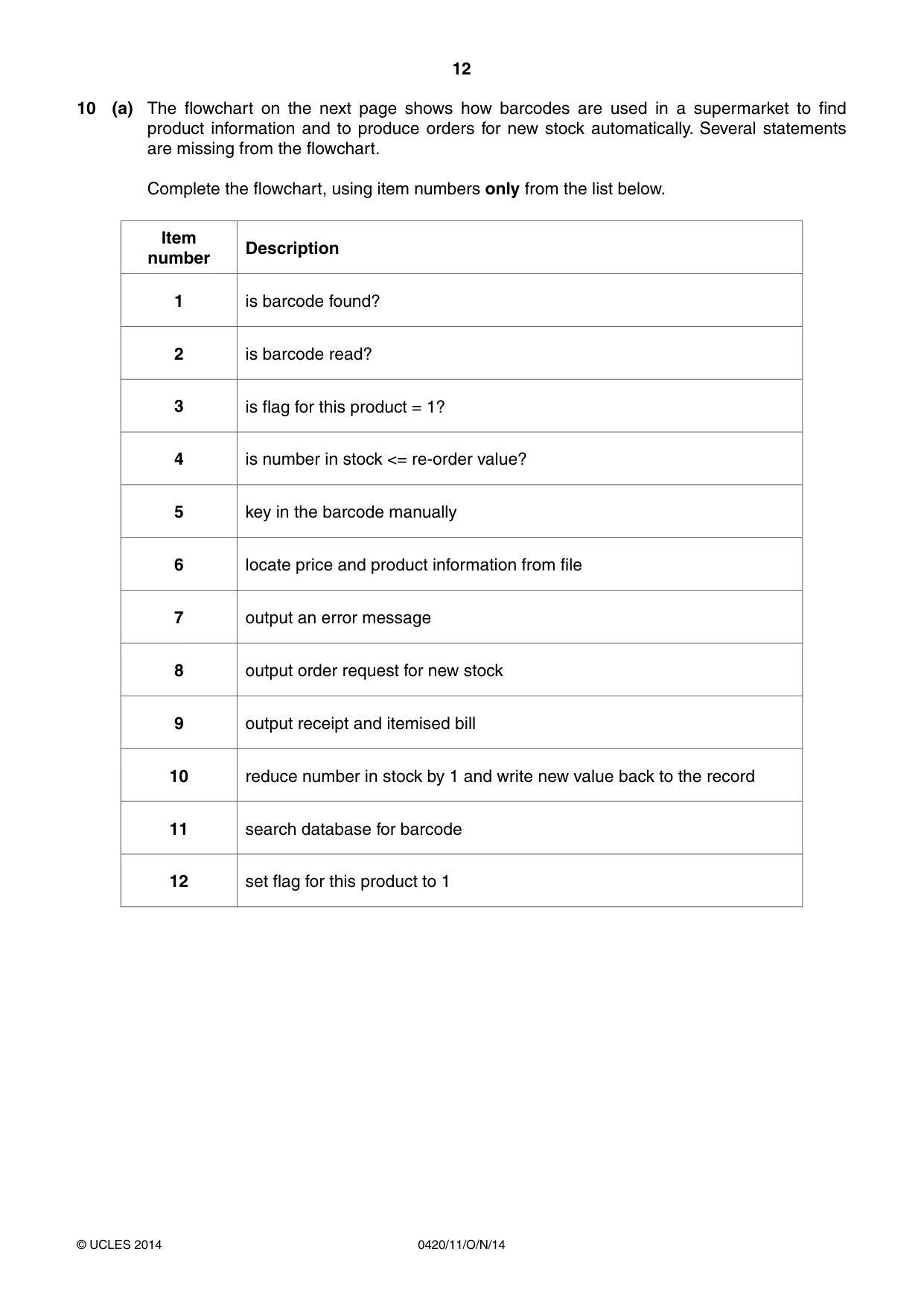
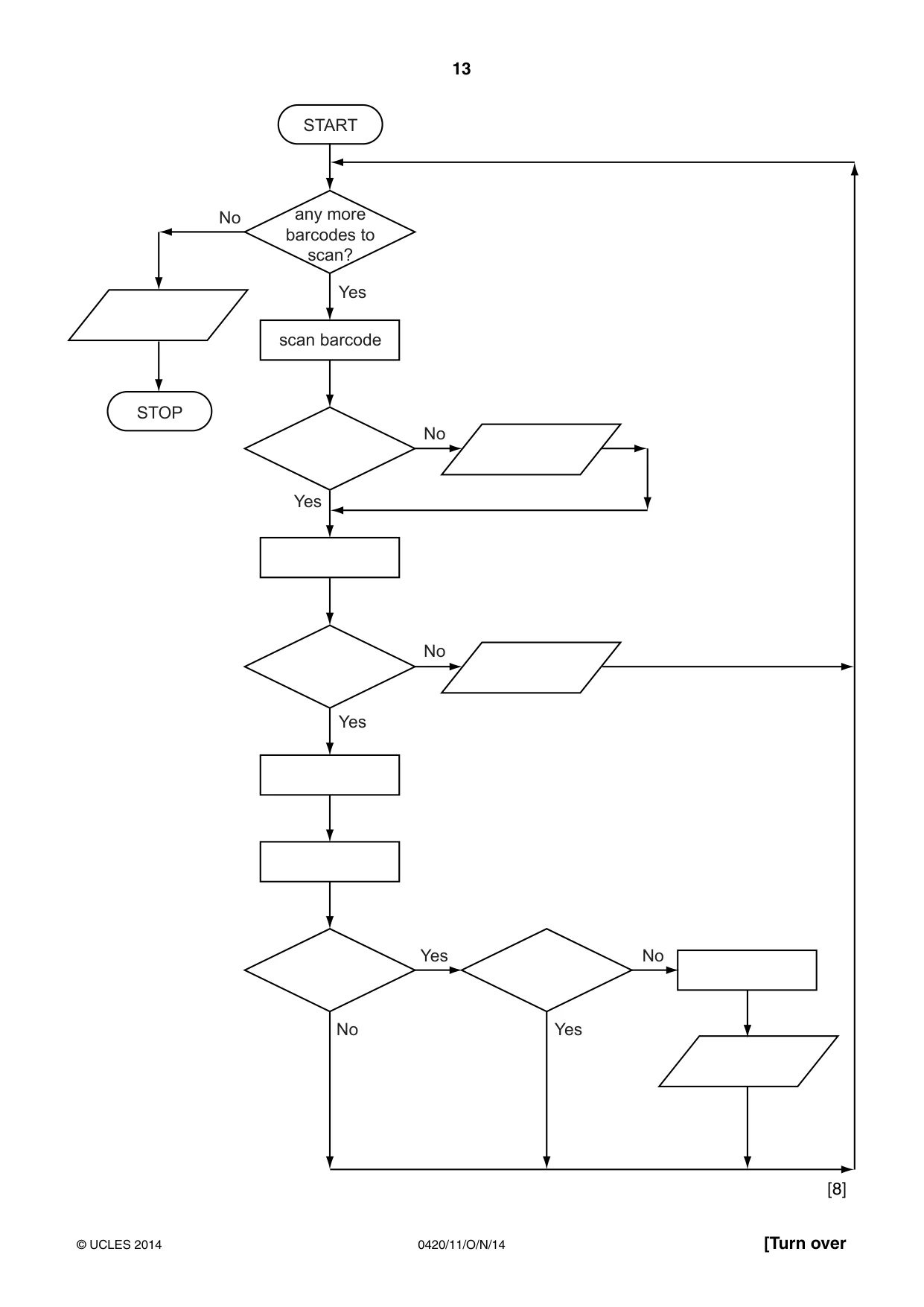
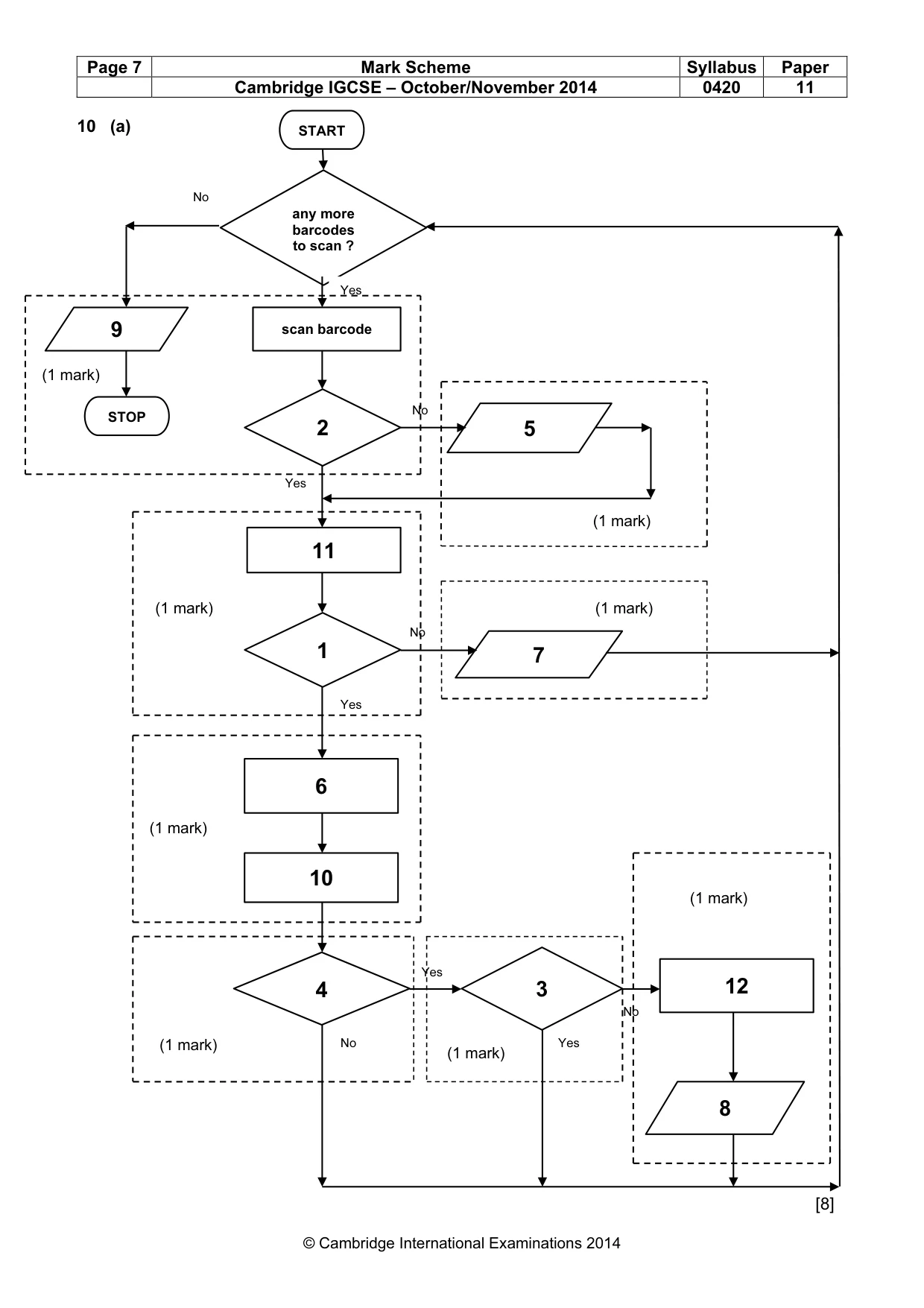
12 0420/11/O/N/14 © UCLES 2014 10 (a) The flowchart on the next page shows how barcodes are used in a supermarket to find product information and to produce orders for new stock automatically. Several statements are missing from the flowchart. Complete the flowchart, using item numbers only from the list below. Item number Description 1 is barcode found? 2 is barcode read? 3 is flag for this product = 1? 4 is number in stock <= re-order value? 5 key in the barcode manually 6 locate price and product information from file 7 output an error message 8 output order request for new stock 9 output receipt and itemised bill 10 reduce number in stock by 1 and write new value back to the record 11 search database for barcode 12 set flag for this product to 1
Question paper, page 13
13 0420/11/O/N/14 © UCLES 2014 [Turn over START STOP any more barcodes to scan? scan barcode Yes Yes Yes Yes No No Yes No No No [8]
Question paper, page 14
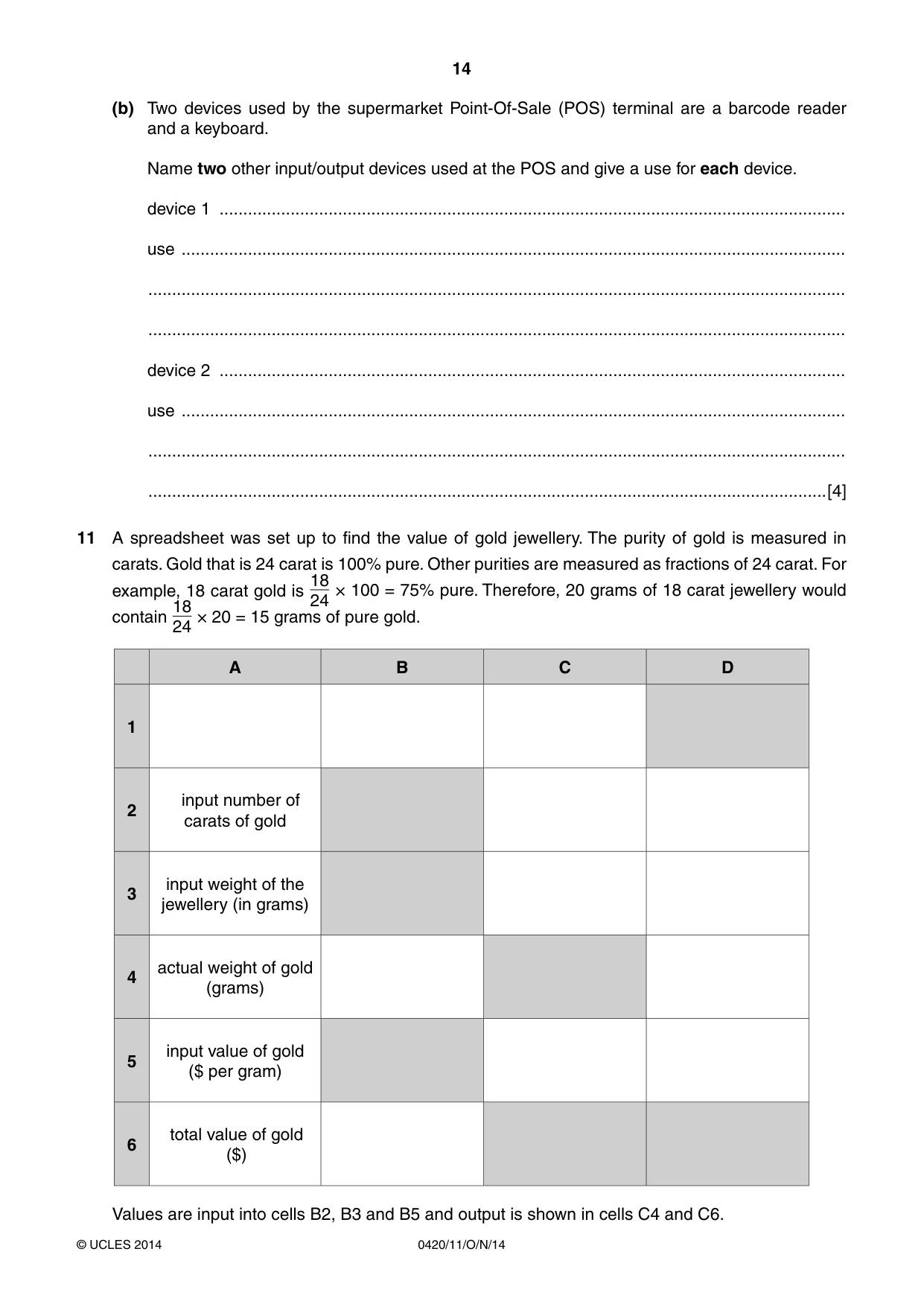
14 0420/11/O/N/14 © UCLES 2014 (b) Two devices used by the supermarket Point-Of-Sale (POS) terminal are a barcode reader and a keyboard. Name two other input/output devices used at the POS and give a use for each device. device 1 … use … … … device 2 … use … … …[4] 11 A spreadsheet was set up to find the value of gold jewellery. The purity of gold is measured in carats. Gold that is 24 carat is 100% pure. Other purities are measured as fractions of 24 carat. For example, 18 carat gold is 18 24 × 100 = 75% pure. Therefore, 20 grams of 18 carat jewellery would contain 18 24 × 20 = 15 grams of pure gold. A B C D 1 2 input number of carats of gold 3 input weight of the jewellery (in grams) 4 actual weight of gold (grams) 5 input value of gold ($ per gram) 6 total value of gold ($) Values are input into cells B2, B3 and B5 and output is shown in cells C4 and C6.
Question paper, page 15
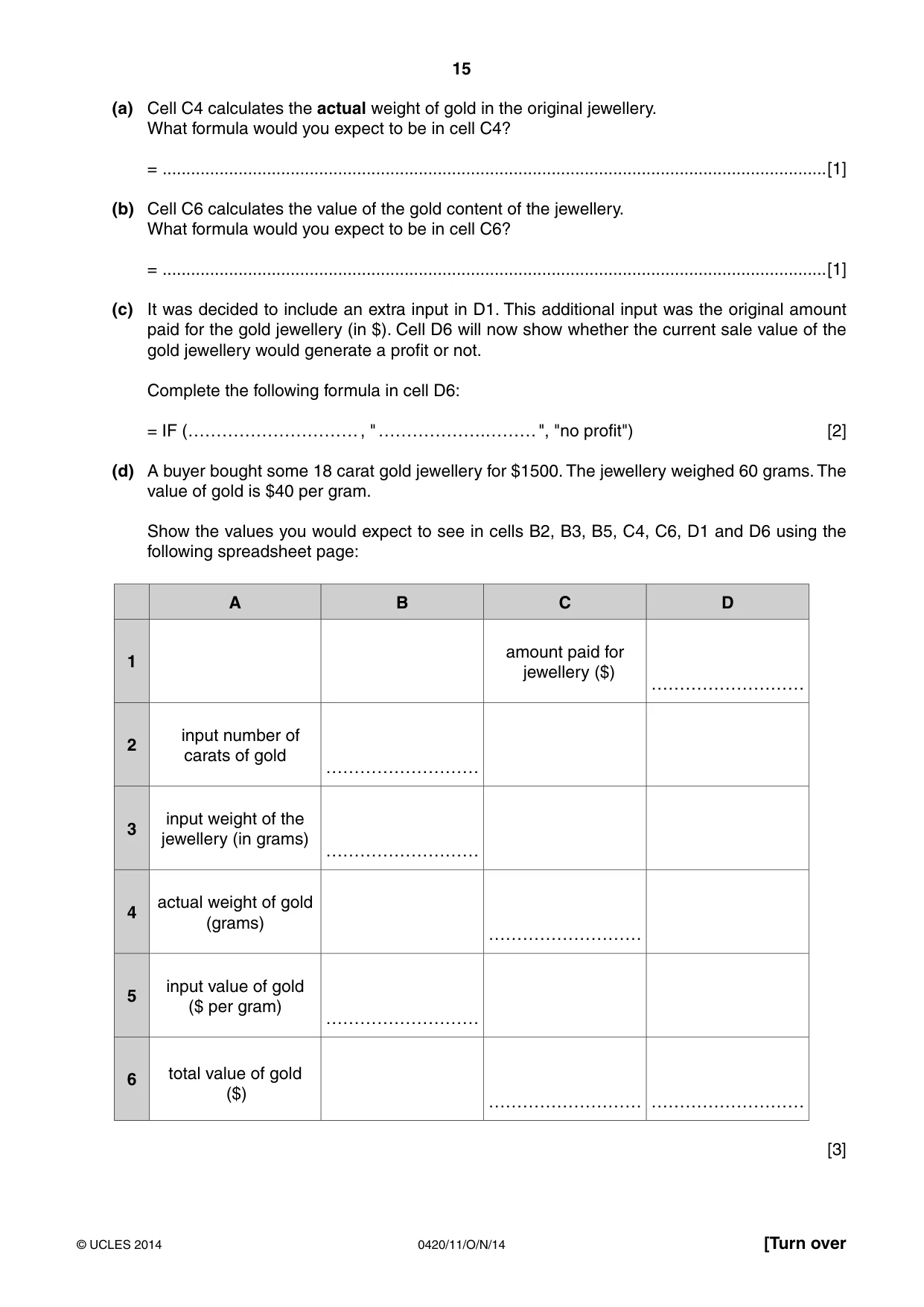
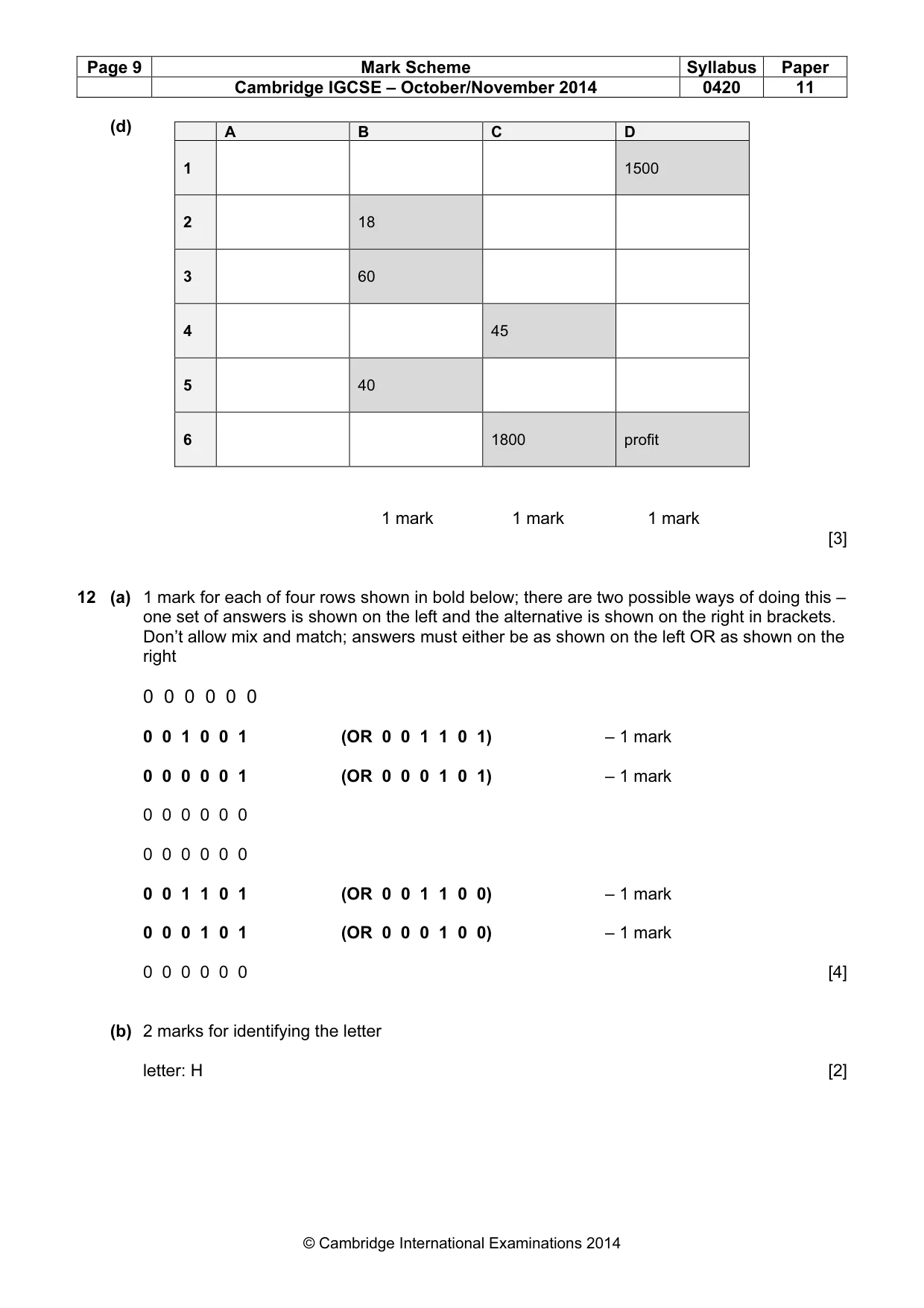
15 0420/11/O/N/14 © UCLES 2014 [Turn over (a) Cell C4 calculates the actual weight of gold in the original jewellery. What formula would you expect to be in cell C4? = …[1] (b) Cell C6 calculates the value of the gold content of the jewellery. What formula would you expect to be in cell C6? = …[1] (c) It was decided to include an extra input in D1. This additional input was the original amount paid for the gold jewellery (in $). Cell D6 will now show whether the current sale value of the gold jewellery would generate a profit or not. Complete the following formula in cell D6: = IF (………………………… , " ……………….……… ", "no profit") [2] (d) A buyer bought some 18 carat gold jewellery for $1500. The jewellery weighed 60 grams. The value of gold is $40 per gram. Show the values you would expect to see in cells B2, B3, B5, C4, C6, D1 and D6 using the following spreadsheet page: A B C D 1 amount paid for jewellery ($) ……………………… 2 input number of carats of gold ……………………… 3 input weight of the jewellery (in grams) ……………………… 4 actual weight of gold (grams) ……………………… 5 input value of gold ($ per gram) ……………………… 6 total value of gold ($) ……………………… ……………………… [3]
Question paper, page 16
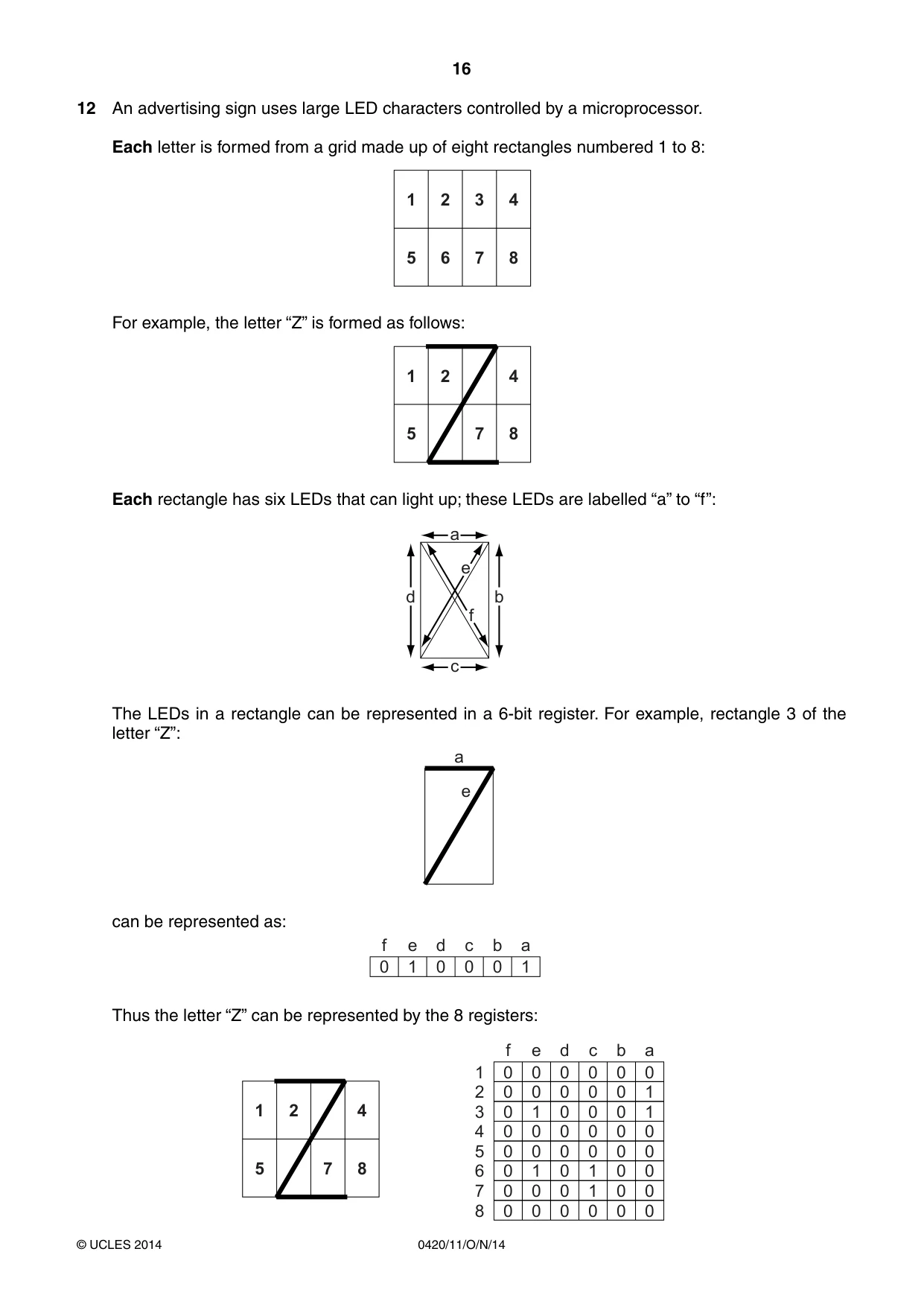
16 0420/11/O/N/14 © UCLES 2014 12 An advertising sign uses large LED characters controlled by a microprocessor. Each letter is formed from a grid made up of eight rectangles numbered 1 to 8: 1 2 3 4 5 6 7 8 For example, the letter “Z” is formed as follows: 1 2 4 5 7 8 Each rectangle has six LEDs that can light up; these LEDs are labelled “a” to “f”: f e a c b d The LEDs in a rectangle can be represented in a 6-bit register. For example, rectangle 3 of the letter “Z”: e a can be represented as: 0 1 0 0 0 1 f e d c b a Thus the letter “Z” can be represented by the 8 registers: 1 2 4 5 7 8 f e d c b a 0 0 0 0 0 0 0 0 0 0 0 1 0 1 0 0 0 1 0 0 0 0 0 0 0 0 0 0 0 0 0 1 0 1 0 0 0 0 0 1 0 0 0 1 2 3 4 5 6 7 8 0 0 0 0 0
Question paper, page 17
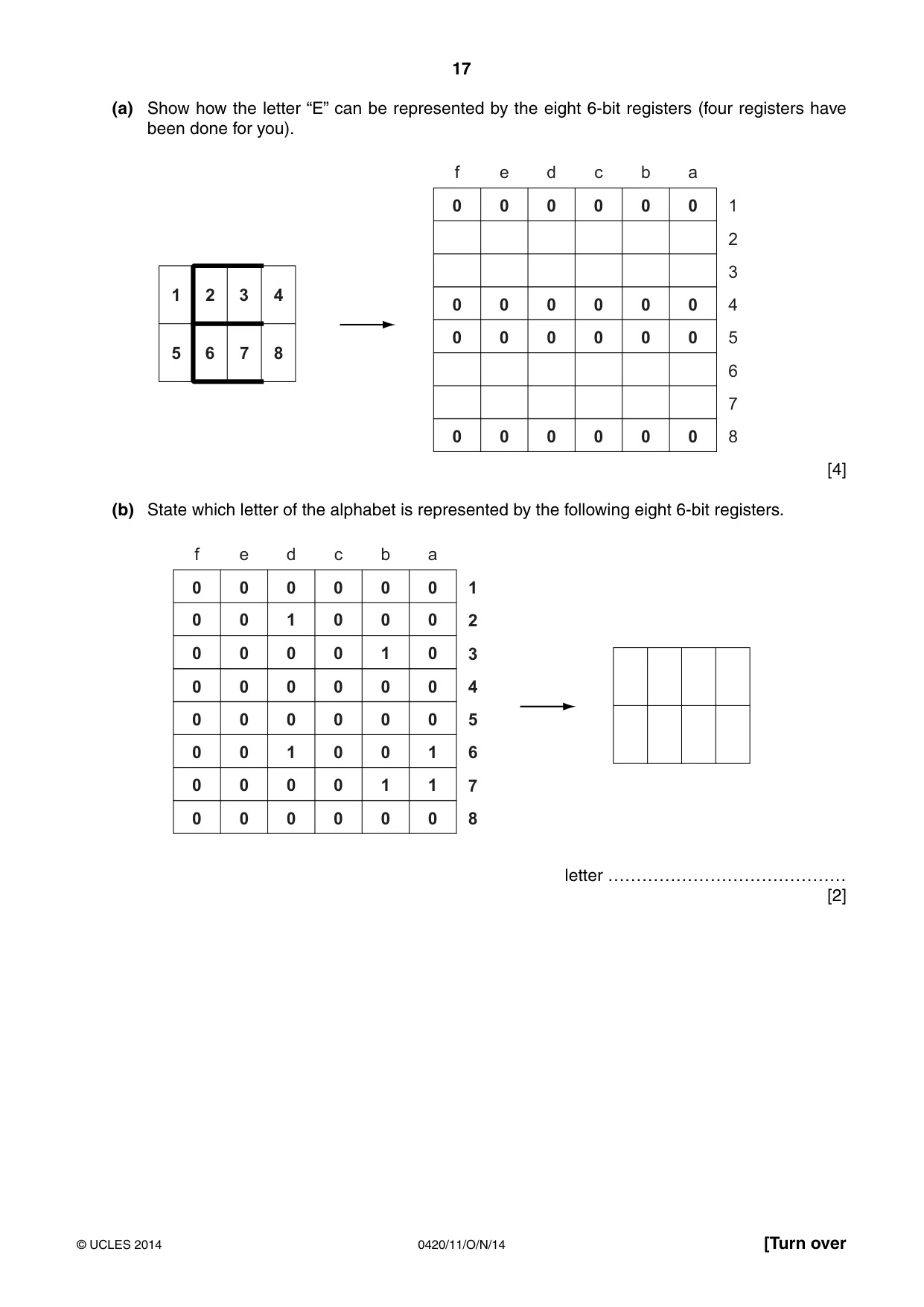
17 0420/11/O/N/14 © UCLES 2014 [Turn over (a) Show how the letter “E” can be represented by the eight 6-bit registers (four registers have been done for you). 1 2 4 5 7 3 6 8 f e d c b a 0 0 0 0 0 0 0 0 0 0 0 0 0 0 0 0 0 0 0 1 2 3 4 5 6 7 8 0 0 0 0 0 [4] (b) State which letter of the alphabet is represented by the following eight 6-bit registers. f e d c b a 0 0 0 0 0 0 0 0 0 0 0 0 0 0 0 0 0 0 0 0 1 0 0 1 0 0 0 0 1 1 0 0 1 0 0 0 0 0 0 0 1 0 0 1 2 3 4 5 6 7 8 0 0 0 0 0 letter …………………………………… [2]
Question paper, page 18
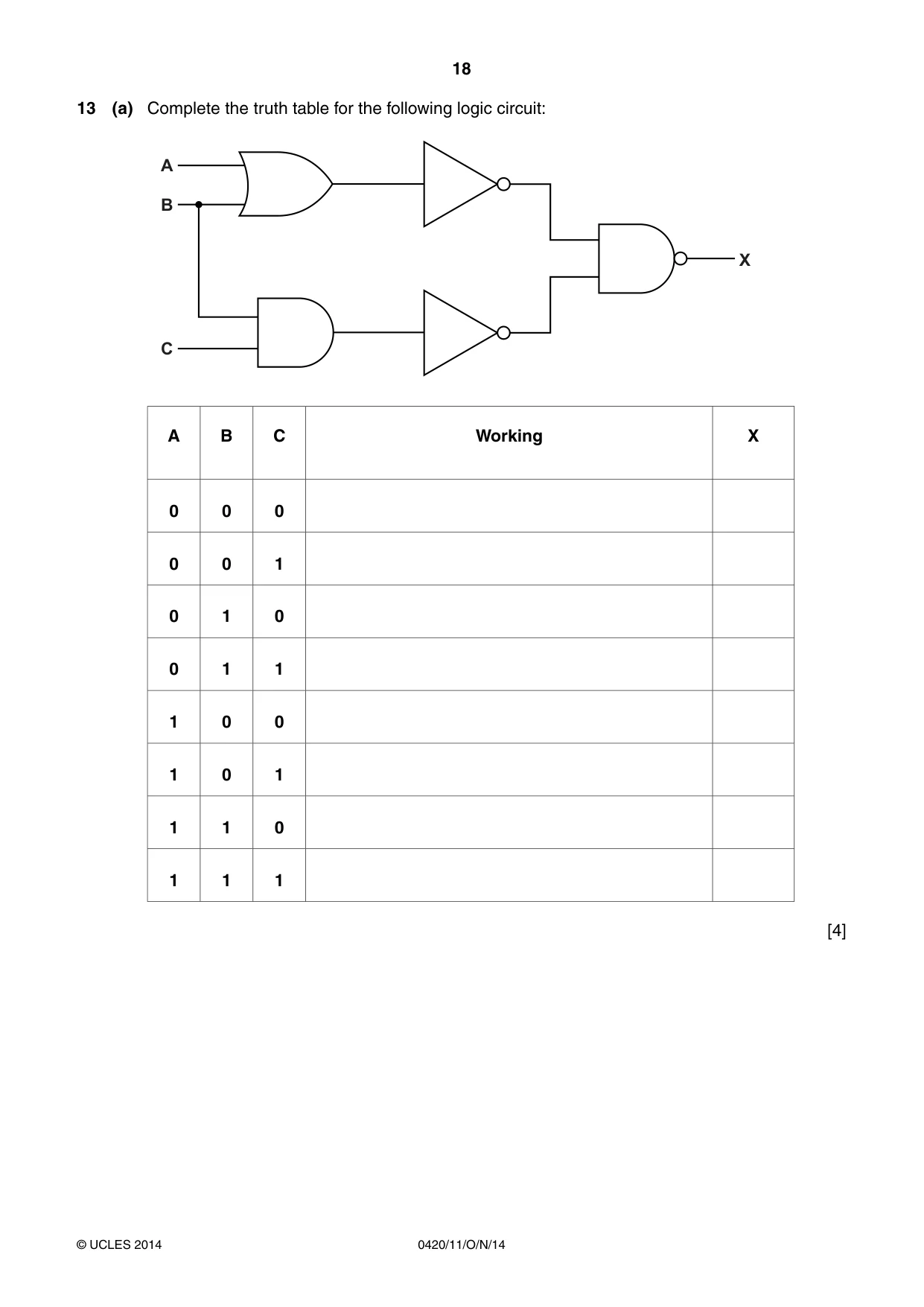
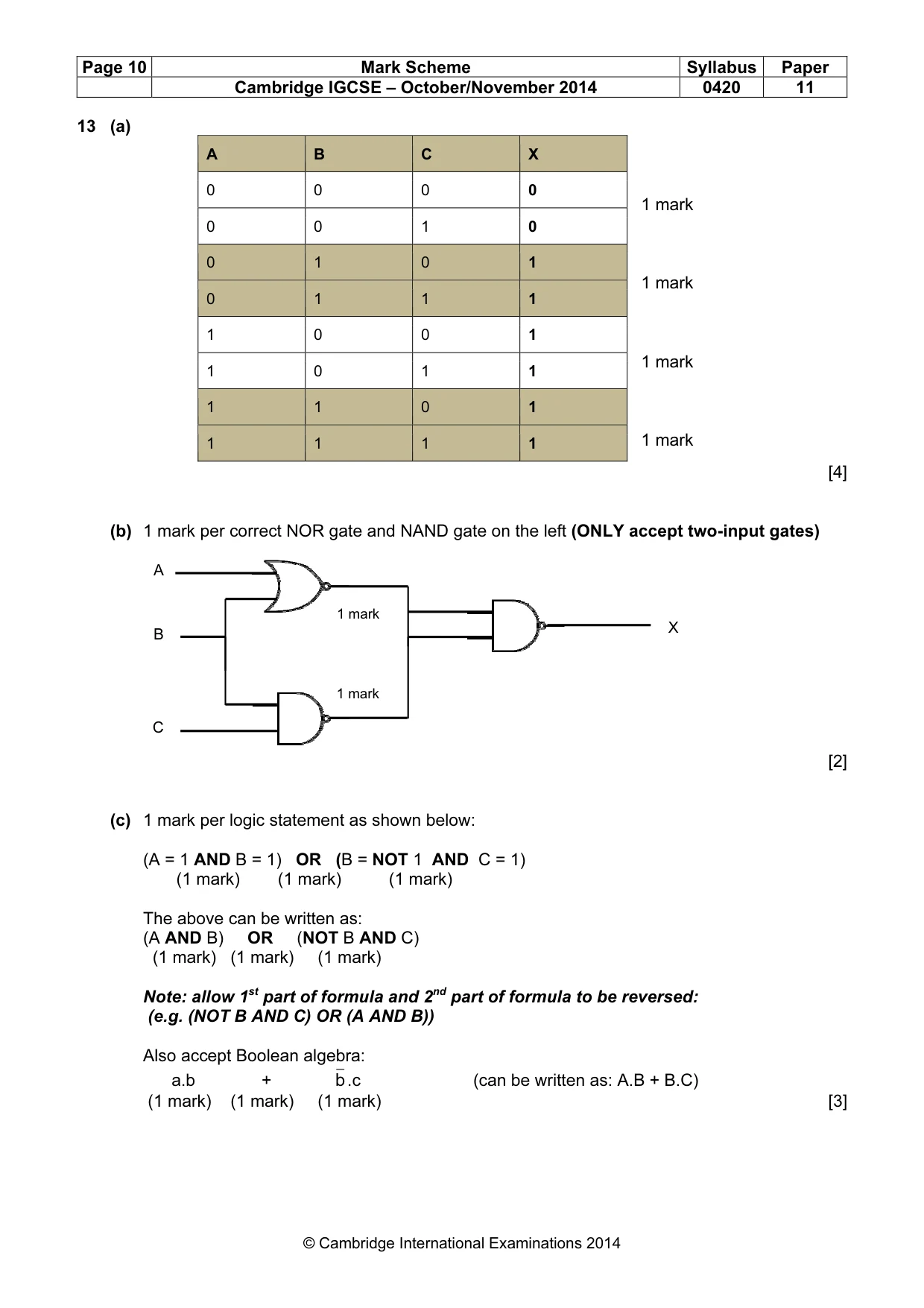
18 0420/11/O/N/14 © UCLES 2014 13 (a) Complete the truth table for the following logic circuit: A B C X A B C Working X 0 0 0 0 0 1 0 1 0 0 1 1 1 0 0 1 0 1 1 1 0 1 1 1 [4]
Question paper, page 19
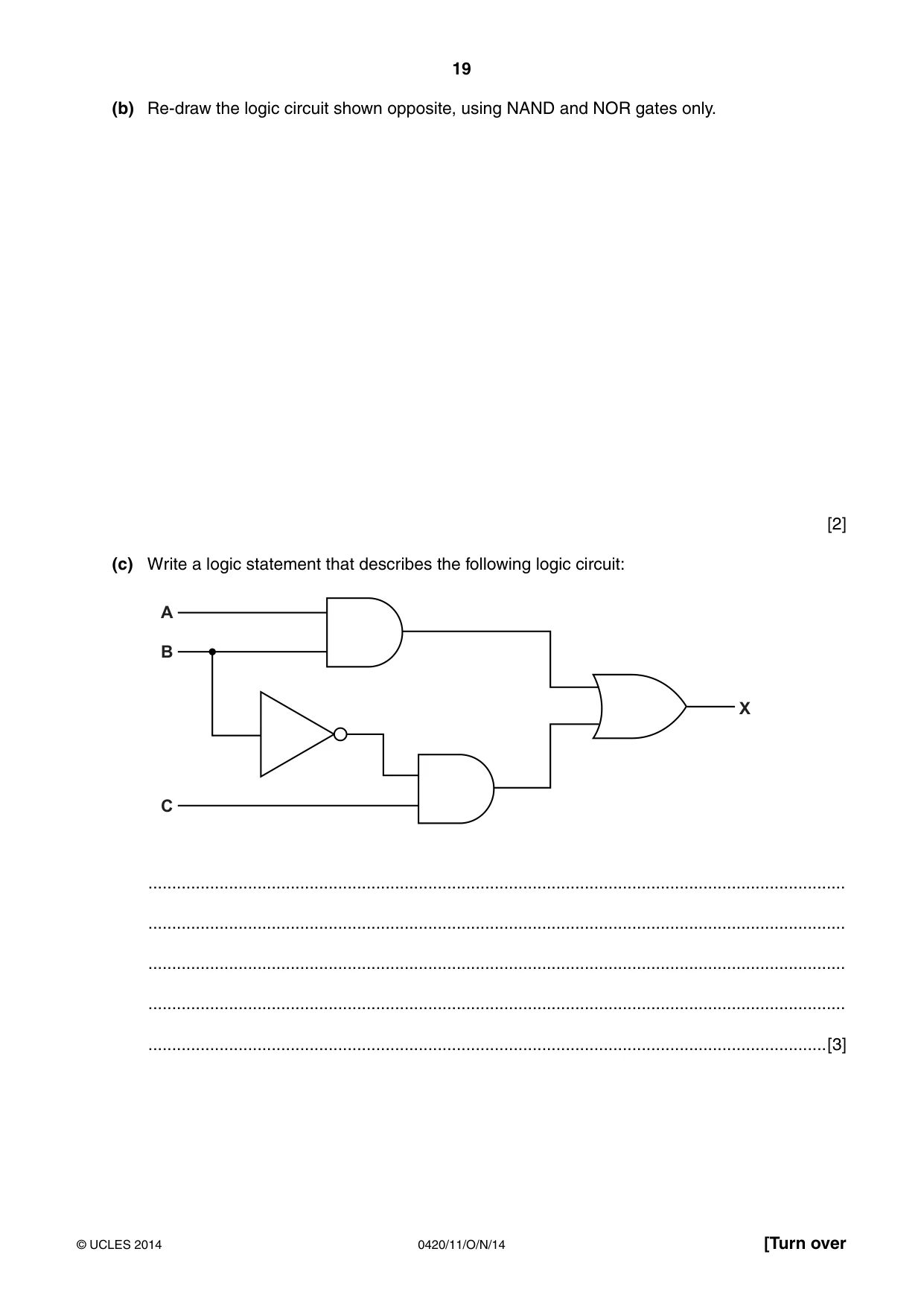
19 0420/11/O/N/14 © UCLES 2014 [Turn over (b) Re-draw the logic circuit shown opposite, using NAND and NOR gates only. [2] (c) Write a logic statement that describes the following logic circuit: A B C X … … … … …[3]
Question paper, page 20
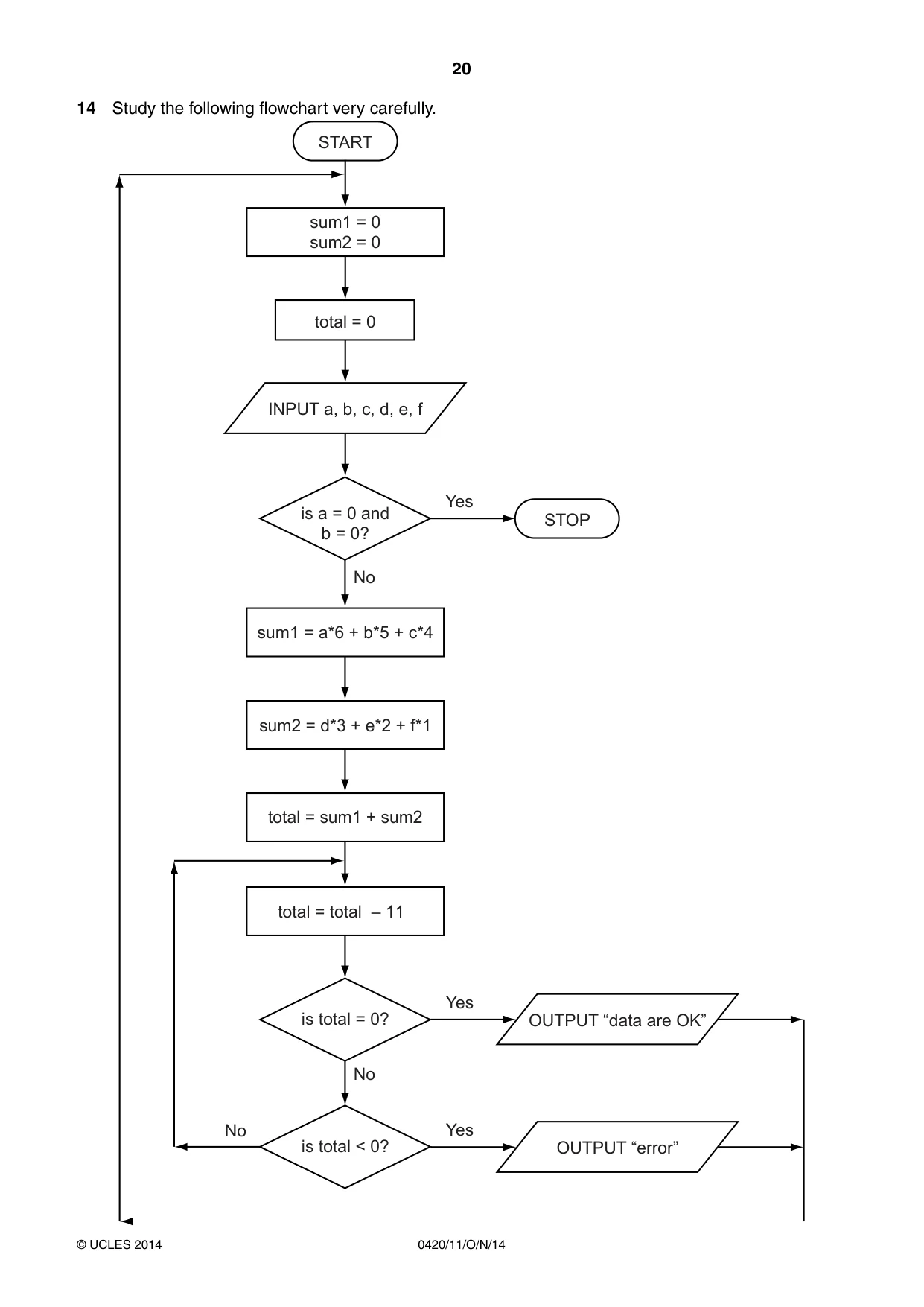
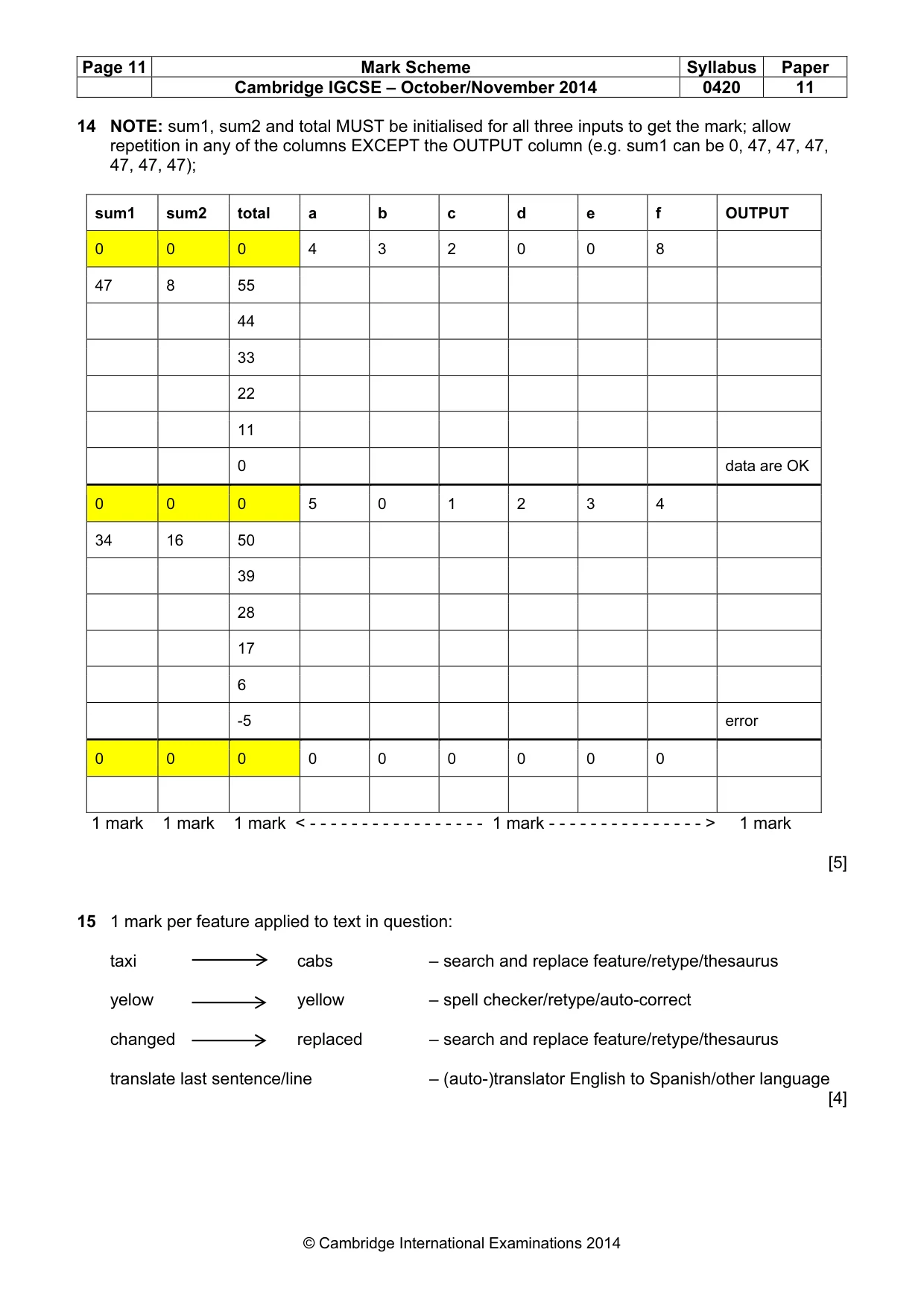
20 0420/11/O/N/14 © UCLES 2014 14 Study the following flowchart very carefully. START STOP sum1 = 0 sum2 = 0 Yes Yes Yes No No No sum1 = a*6 + b*5 + c*4 sum2 = d*3 + e*2 + f*1 total = sum1 + sum2 total = total – 11 total = 0 INPUT a, b, c, d, e, f is a = 0 and b = 0? is total = 0? is total < 0? OUTPUT “data are OK” OUTPUT “error”
Question paper, page 21
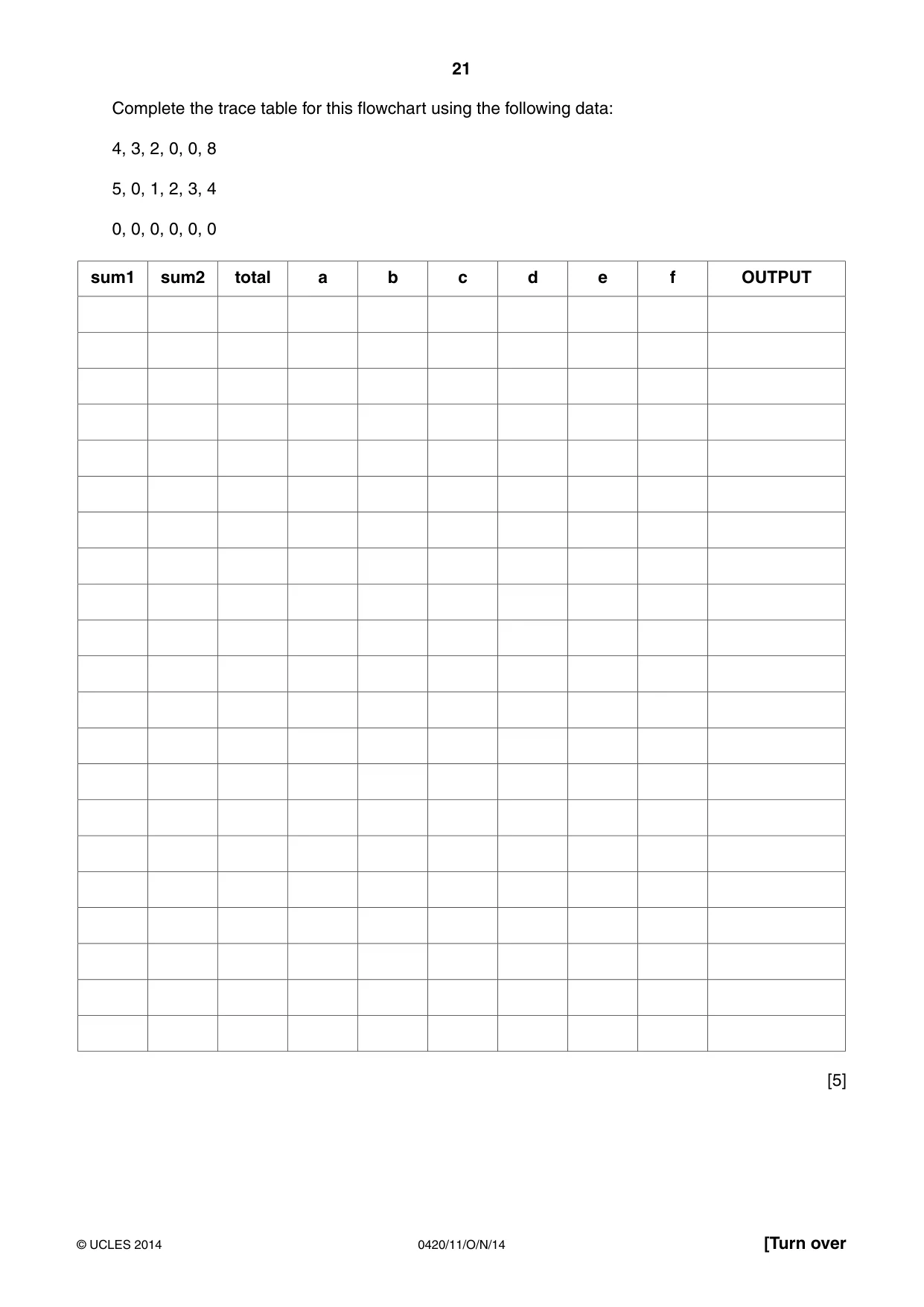
21 0420/11/O/N/14 © UCLES 2014 [Turn over Complete the trace table for this flowchart using the following data: 4, 3, 2, 0, 0, 8 5, 0, 1, 2, 3, 4 0, 0, 0, 0, 0, 0 sum1 sum2 total a b c d e f OUTPUT [5]
Question paper, page 22
22 0420/11/O/N/14 © UCLES 2014 15 The following statement was produced using a word processor. In New York City, all the taxis are painted yelow. This colour scheme for these taxis goes back many years. Taxis have to be changed every 3 years for safety reasons. All instructions inside the taxis are in English and Spanish since this is a dual language city. Four changes were made to the original document using built-in word processing features. Note that all the changes are shown in shaded text. In New York City, all the cabs are painted yellow. This colour scheme for these cabs goes back many years. Cabs have to be replaced every 3 years for safety reasons. Todas las instrucciones dentro de los taxis están en inglés y español puesto que esto es una ciudad dual de la lengua. Describe four different word processing features that could have been used to make these changes. 1 … … … 2 … … … 3 … … … 4 … … …[4]
Question paper, page 23
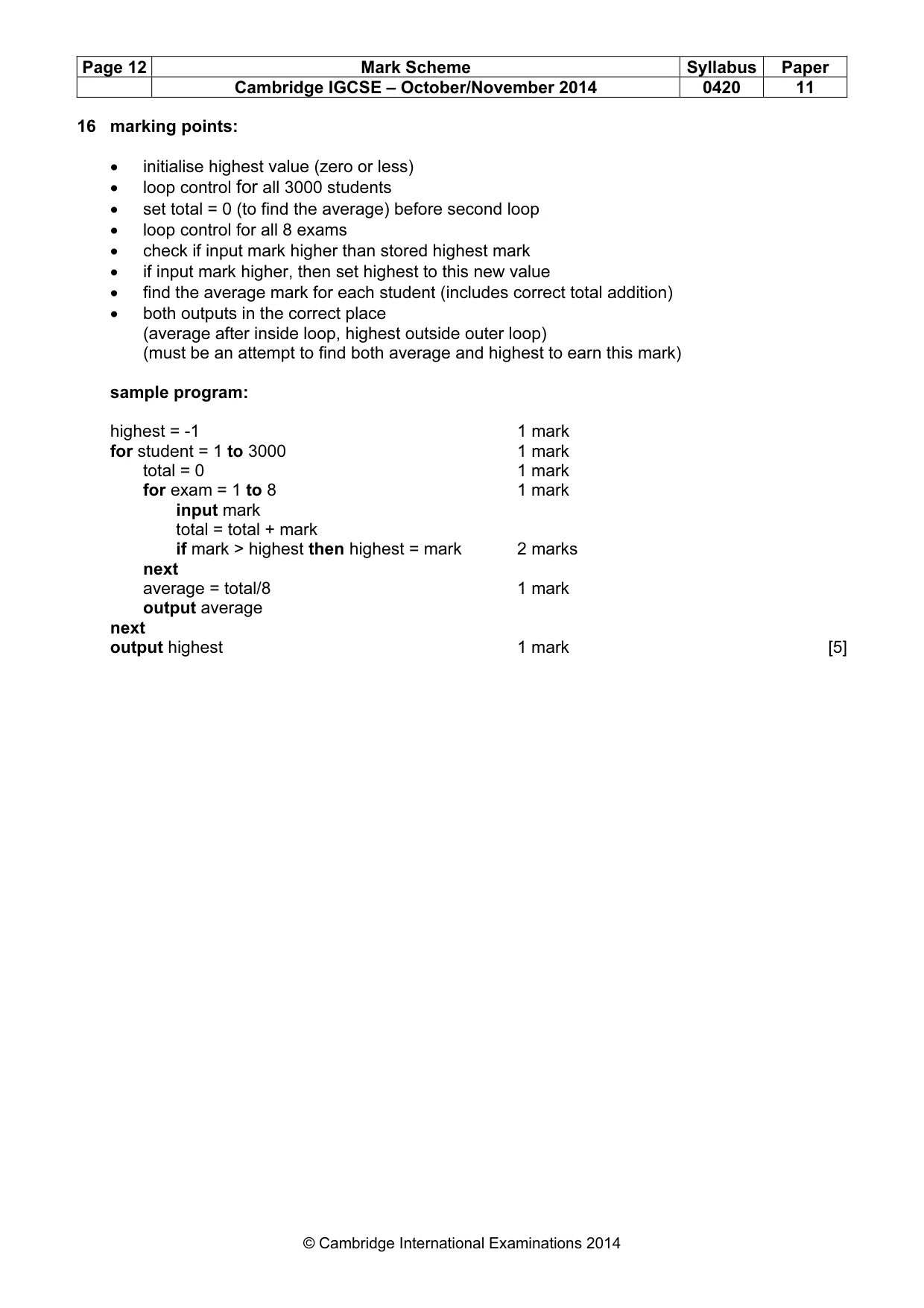
23 0420/11/O/N/14 © UCLES 2014 16 A school has 3000 students sitting final examinations. Each student sits eight examinations. Write an algorithm, using pseudocode or a flowchart, which: • inputs the marks for all 8 examinations for each student • outputs for each student the average mark for their 8 examinations • outputs the highest mark overall … … … … … … … … … … … … … … … … … … … … … … …[5]
Question paper, page 24
24 0420/11/O/N/14 © UCLES 2014 Permission to reproduce items where third-party owned material protected by copyright is included has been sought and cleared where possible. Every reasonable effort has been made by the publisher (UCLES) to trace copyright holders, but if any items requiring clearance have unwittingly been included, the publisher will be pleased to make amends at the earliest possible opportunity. Cambridge International Examinations is part of the Cambridge Assessment Group. Cambridge Assessment is the brand name of University of Cambridge Local Examinations Syndicate (UCLES), which is itself a department of the University of Cambridge. BLANK PAGE
Mark scheme, page 1
® IGCSE is the registered trademark of Cambridge International Examinations. CAMBRIDGE INTERNATIONAL EXAMINATIONS Cambridge International General Certificate of Secondary Education MARK SCHEME for the October/November 2014 series 0420 COMPUTER STUDIES 0420/11 Paper 1, maximum raw mark 100 This mark scheme is published as an aid to teachers and candidates, to indicate the requirements of the examination. It shows the basis on which Examiners were instructed to award marks. It does not indicate the details of the discussions that took place at an Examiners’ meeting before marking began, which would have considered the acceptability of alternative answers. Mark schemes should be read in conjunction with the question paper and the Principal Examiner Report for Teachers. Cambridge will not enter into discussions about these mark schemes. Cambridge is publishing the mark schemes for the October/November 2014 series for most Cambridge IGCSE®, Cambridge International A and AS Level components and some Cambridge O Level components.
Mark scheme, page 2
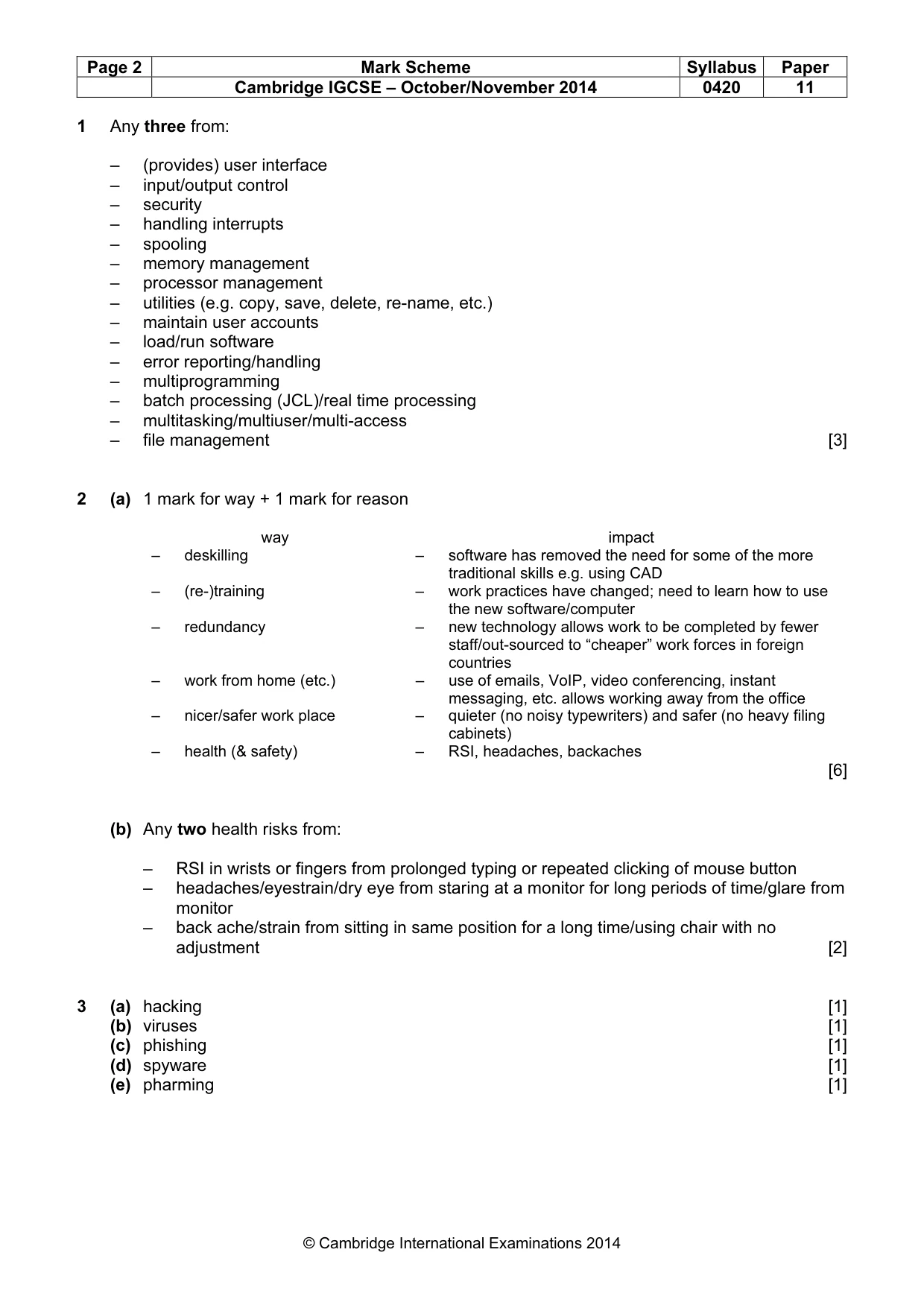
Page 2 Mark Scheme Syllabus Paper Cambridge IGCSE – October/November 2014 0420 11 © Cambridge International Examinations 2014 1 Any three from: – (provides) user interface – input/output control – security – handling interrupts – spooling – memory management – processor management – utilities (e.g. copy, save, delete, re-name, etc.) – maintain user accounts – load/run software – error reporting/handling – multiprogramming – batch processing (JCL)/real time processing – multitasking/multiuser/multi-access – file management [3] 2 (a) 1 mark for way + 1 mark for reason way impact – deskilling – software has removed the need for some of the more traditional skills e.g. using CAD – (re-)training – work practices have changed; need to learn how to use the new software/computer – redundancy – new technology allows work to be completed by fewer staff/out-sourced to “cheaper” work forces in foreign countries – work from home (etc.) – use of emails, VoIP, video conferencing, instant messaging, etc. allows working away from the office – nicer/safer work place – quieter (no noisy typewriters) and safer (no heavy filing cabinets) – health (& safety) – RSI, headaches, backaches [6] (b) Any two health risks from: – RSI in wrists or fingers from prolonged typing or repeated clicking of mouse button – headaches/eyestrain/dry eye from staring at a monitor for long periods of time/glare from monitor – back ache/strain from sitting in same position for a long time/using chair with no adjustment [2] 3 (a) hacking [1] (b) viruses [1] (c) phishing [1] (d) spyware [1] (e) pharming [1]
Mark scheme, page 3
Page 3 Mark Scheme Syllabus Paper Cambridge IGCSE – October/November 2014 0420 11 © Cambridge International Examinations 2014 4 1 mark for each correct connection up to the maximum of 5 [5] number of times the following loop operates: count = 1 repeat input × count = count + 1 until count = 5 the number of bits that make up a byte base 10 (denary) value of the following binary number: 32 16 8 4 2 1 0 0 1 1 1 1 the number of tracks on single side of a CD-R number of minutes to upload a 75 Mbyte file at 2 megabits/second upload speed If there are 2x bytes in a Kbyte, what is the value of x? 1 4 5 8 10 15
Mark scheme, page 4
Page 4 Mark Scheme Syllabus Paper Cambridge IGCSE – October/November 2014 0420 11 © Cambridge International Examinations 2014 5 (a) Sat Nav devices send signals to the global positioning satellites TRUE FALSE Sat Nav accurately measures vehicle speed using satellite position and accurate timing FALSE Satellites tell the Sat Nav which direction the vehicle should take TRUE [3] (b) Any two from: – software/maps not up to date/new road – loss of satellite signals – wrong data input by user (e.g. start point and end point) [2] 6 (a) 1 mark for each error and suggested correction (accept description or example of corrected pseudocode). error: line 10: total = 1 correction: totals should be set to zero; total = 0 error: line 30: … number < 10 … correction: check should be made if number > 10; … number > 10 … error: no input inside loop correction: input number error: line 50: x = x + 1 correction: for … to loops don’t need a counter; remove line 50 altogether error: line 80: output x correction: output should be total value; output total [5] (b) division by zero error (or similar description of error produced when dividing by 0) add an error trap after input of number e.g. 40 if number = 0 then k = 0 else k = x/number [2] FALSE TRUE FALSE
Mark scheme, page 5
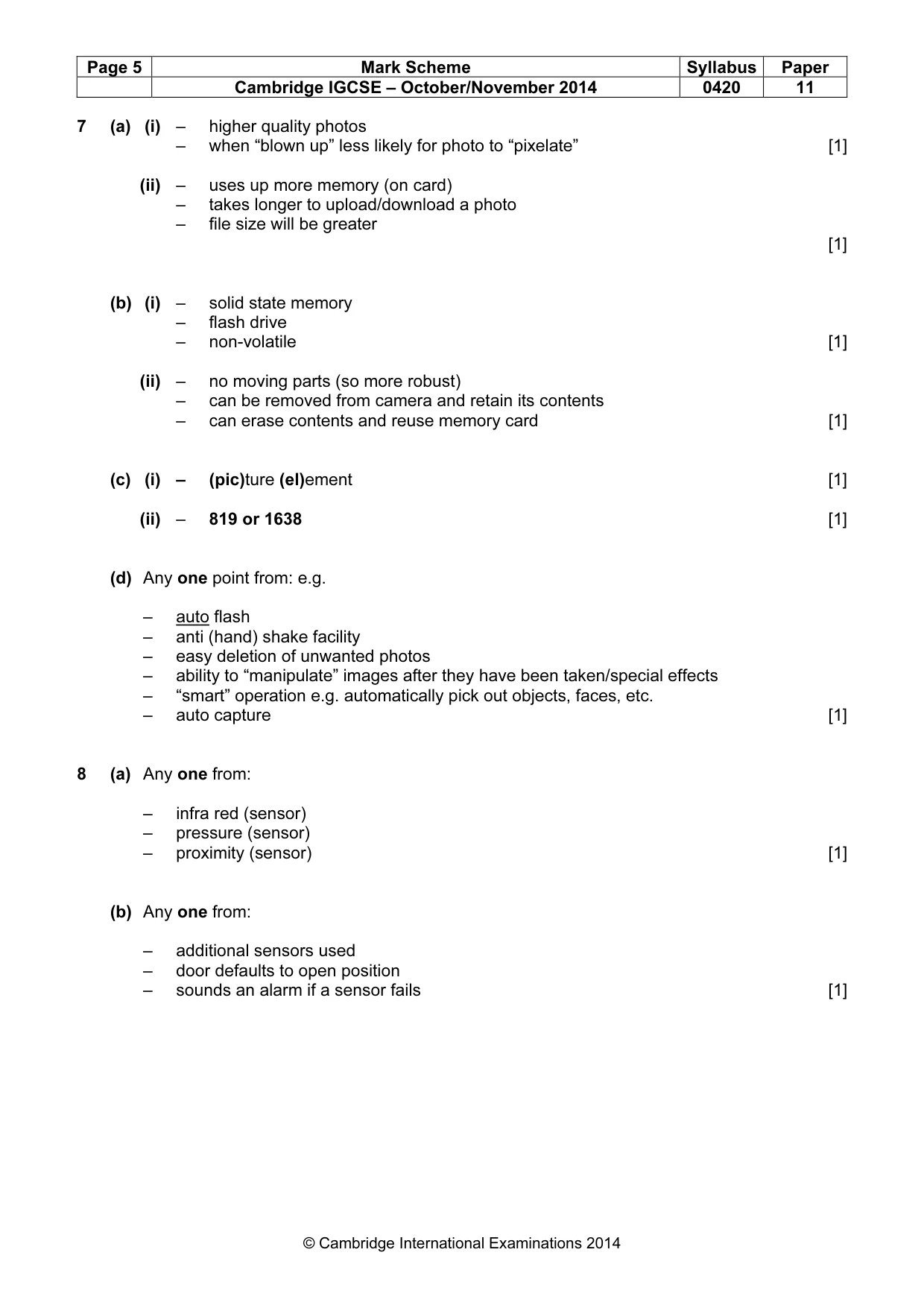
Page 5 Mark Scheme Syllabus Paper Cambridge IGCSE – October/November 2014 0420 11 © Cambridge International Examinations 2014 7 (a) (i) – higher quality photos – when “blown up” less likely for photo to “pixelate” [1] (ii) – uses up more memory (on card) – takes longer to upload/download a photo – file size will be greater [1] (b) (i) – solid state memory – flash drive – non-volatile [1] (ii) – no moving parts (so more robust) – can be removed from camera and retain its contents – can erase contents and reuse memory card [1] (c) (i) – (pic)ture (el)ement [1] (ii) – 819 or 1638 [1] (d) Any one point from: e.g. – auto flash – anti (hand) shake facility – easy deletion of unwanted photos – ability to “manipulate” images after they have been taken/special effects – “smart” operation e.g. automatically pick out objects, faces, etc. – auto capture [1] 8 (a) Any one from: – infra red (sensor) – pressure (sensor) – proximity (sensor) [1] (b) Any one from: – additional sensors used – door defaults to open position – sounds an alarm if a sensor fails [1]
Mark scheme, page 6
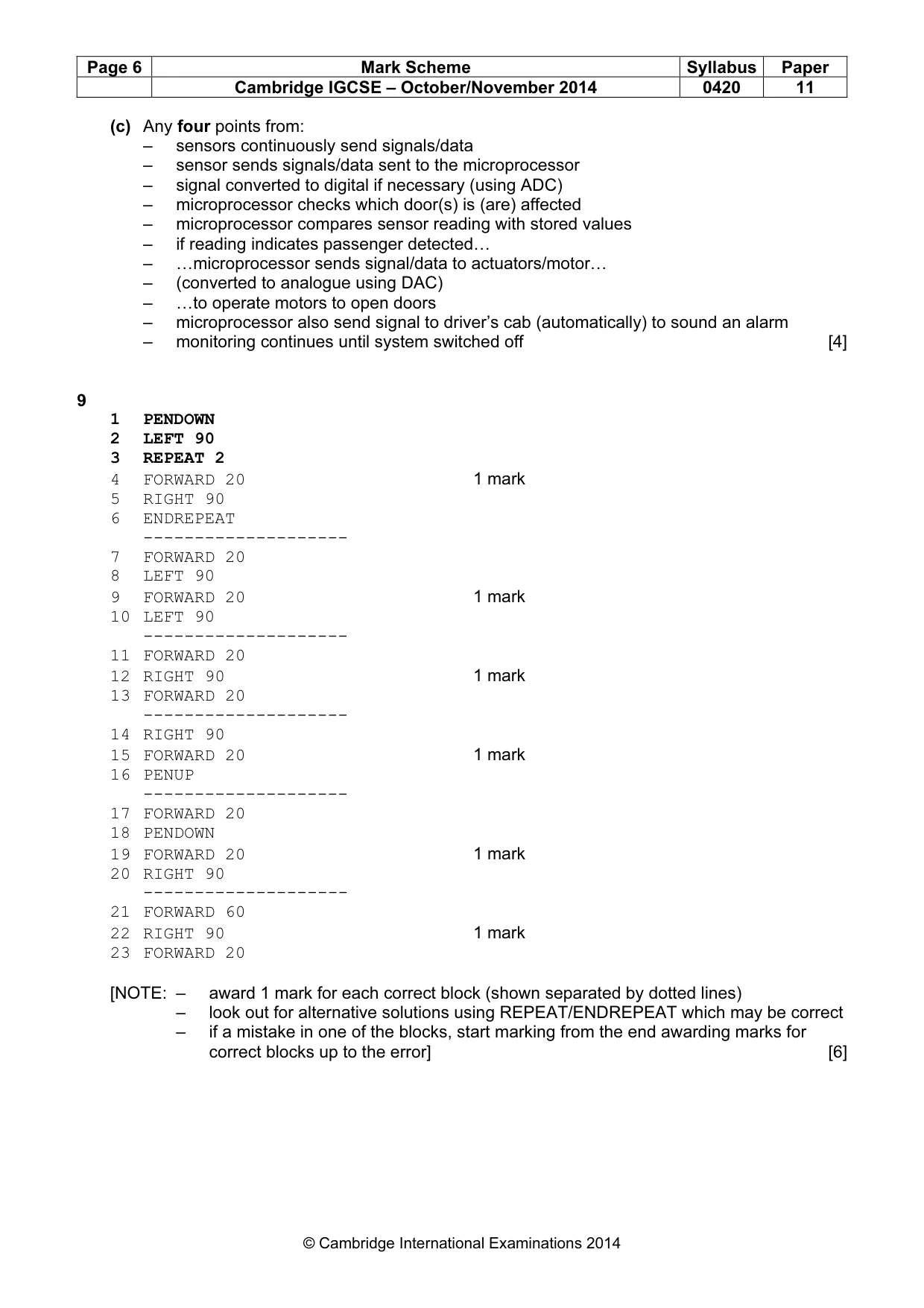
Page 6 Mark Scheme Syllabus Paper Cambridge IGCSE – October/November 2014 0420 11 © Cambridge International Examinations 2014 (c) Any four points from: – sensors continuously send signals/data – sensor sends signals/data sent to the microprocessor – signal converted to digital if necessary (using ADC) – microprocessor checks which door(s) is (are) affected – microprocessor compares sensor reading with stored values – if reading indicates passenger detected… – …microprocessor sends signal/data to actuators/motor… – (converted to analogue using DAC) – …to operate motors to open doors – microprocessor also send signal to driver’s cab (automatically) to sound an alarm – monitoring continues until system switched off [4] 9 1 PENDOWN 2 LEFT 90 3 REPEAT 2 4 FORWARD 20 1 mark 5 RIGHT 90 6 ENDREPEAT -------------------- 7 FORWARD 20 8 LEFT 90 9 FORWARD 20 1 mark 10 LEFT 90 -------------------- 11 FORWARD 20 12 RIGHT 90 1 mark 13 FORWARD 20 -------------------- 14 RIGHT 90 15 FORWARD 20 1 mark 16 PENUP -------------------- 17 FORWARD 20 18 PENDOWN 19 FORWARD 20 1 mark 20 RIGHT 90 -------------------- 21 FORWARD 60 22 RIGHT 90 1 mark 23 FORWARD 20 [NOTE: – award 1 mark for each correct block (shown separated by dotted lines) – look out for alternative solutions using REPEAT/ENDREPEAT which may be correct – if a mistake in one of the blocks, start marking from the end awarding marks for correct blocks up to the error] [6]
Mark scheme, page 7
Page 7 Mark Scheme Syllabus Paper Cambridge IGCSE – October/November 2014 0420 11 © Cambridge International Examinations 2014 10 (a) START any more barcodes to scan ? scan barcode 2 9 5 11 7 1 6 10 4 3 12 8 STOP No Yes No Yes No Yes Yes No No Yes (1 mark) (1 mark) (1 mark) (1 mark) (1 mark) (1 mark) (1 mark) (1 mark) [8]
Mark scheme, page 8
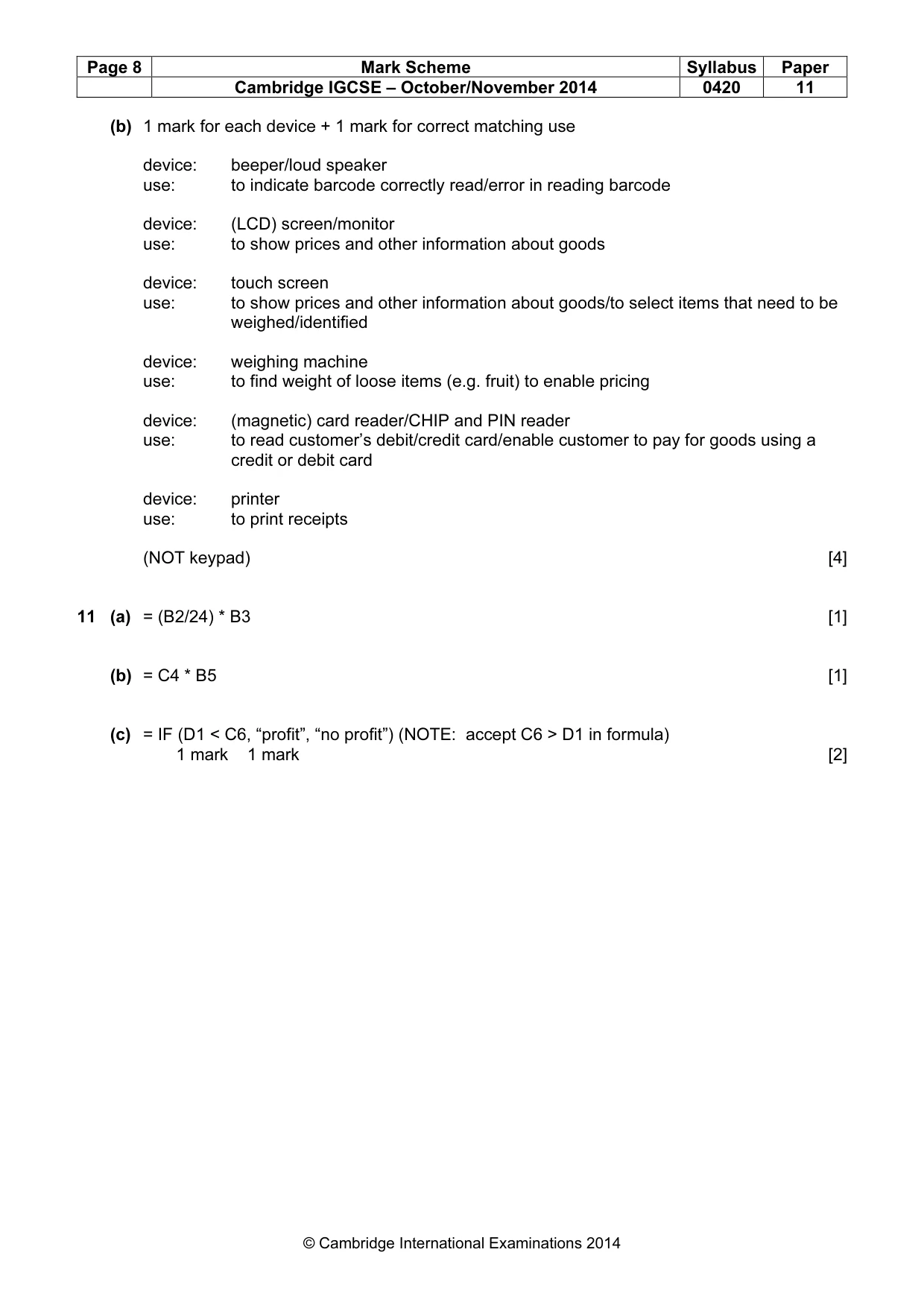
Page 8 Mark Scheme Syllabus Paper Cambridge IGCSE – October/November 2014 0420 11 © Cambridge International Examinations 2014 (b) 1 mark for each device + 1 mark for correct matching use device: beeper/loud speaker use: to indicate barcode correctly read/error in reading barcode device: (LCD) screen/monitor use: to show prices and other information about goods device: touch screen use: to show prices and other information about goods/to select items that need to be weighed/identified device: weighing machine use: to find weight of loose items (e.g. fruit) to enable pricing device: (magnetic) card reader/CHIP and PIN reader use: to read customer’s debit/credit card/enable customer to pay for goods using a credit or debit card device: printer use: to print receipts (NOT keypad) [4] 11 (a) = (B2/24) * B3 [1] (b) = C4 * B5 [1] (c) = IF (D1 < C6, “profit”, “no profit”) (NOTE: accept C6 > D1 in formula) 1 mark 1 mark [2]
Mark scheme, page 9
Page 9 Mark Scheme Syllabus Paper Cambridge IGCSE – October/November 2014 0420 11 © Cambridge International Examinations 2014 (d) [3] 12 (a) 1 mark for each of four rows shown in bold below; there are two possible ways of doing this – one set of answers is shown on the left and the alternative is shown on the right in brackets. Don’t allow mix and match; answers must either be as shown on the left OR as shown on the right 0 0 0 0 0 0 0 0 1 0 0 1 (OR 0 0 1 1 0 1) – 1 mark 0 0 0 0 0 1 (OR 0 0 0 1 0 1) – 1 mark 0 0 0 0 0 0 0 0 0 0 0 0 0 0 1 1 0 1 (OR 0 0 1 1 0 0) – 1 mark 0 0 0 1 0 1 (OR 0 0 0 1 0 0) – 1 mark 0 0 0 0 0 0 [4] (b) 2 marks for identifying the letter letter: H [2] A B C D 1 1500 2 18 3 60 4 45 5 40 6 1800 profit 1 mark 1 mark 1 mark
Mark scheme, page 10
Page 10 Mark Scheme Syllabus Paper Cambridge IGCSE – October/November 2014 0420 11 © Cambridge International Examinations 2014 13 (a) A B C X 0 0 0 0 0 0 1 0 0 1 0 1 0 1 1 1 1 0 0 1 1 0 1 1 1 1 0 1 1 1 1 1 [4] (b) 1 mark per correct NOR gate and NAND gate on the left (ONLY accept two-input gates) [2] (c) 1 mark per logic statement as shown below: (A = 1 AND B = 1) OR (B = NOT 1 AND C = 1) (1 mark) (1 mark) (1 mark) The above can be written as: (A AND B) OR (NOT B AND C) (1 mark) (1 mark) (1 mark) Note: allow 1st part of formula and 2nd part of formula to be reversed: (e.g. (NOT B AND C) OR (A AND B)) Also accept Boolean algebra: a.b + b.c (can be written as: A.B + B.C) (1 mark) (1 mark) (1 mark) [3] 1 mark 1 mark 1 mark 1 mark A B C X 1 mark 1 mark
Mark scheme, page 11
Page 11 Mark Scheme Syllabus Paper Cambridge IGCSE – October/November 2014 0420 11 © Cambridge International Examinations 2014 14 NOTE: sum1, sum2 and total MUST be initialised for all three inputs to get the mark; allow repetition in any of the columns EXCEPT the OUTPUT column (e.g. sum1 can be 0, 47, 47, 47, 47, 47, 47); sum1 sum2 total a b c d e f OUTPUT 0 0 0 4 3 2 0 0 8 47 8 55 44 33 22 11 0 data are OK 0 0 0 5 0 1 2 3 4 34 16 50 39 28 17 6 -5 error 0 0 0 0 0 0 0 0 0 1 mark 1 mark 1 mark < - - - - - - - - - - - - - - - - - 1 mark - - - - - - - - - - - - - - - > 1 mark [5] 15 1 mark per feature applied to text in question: taxi cabs – search and replace feature/retype/thesaurus yelow yellow – spell checker/retype/auto-correct changed replaced – search and replace feature/retype/thesaurus translate last sentence/line – (auto-)translator English to Spanish/other language [4]
Mark scheme, page 12
Page 12 Mark Scheme Syllabus Paper Cambridge IGCSE – October/November 2014 0420 11 © Cambridge International Examinations 2014 16 marking points: • initialise highest value (zero or less) • loop control for all 3000 students • set total = 0 (to find the average) before second loop • loop control for all 8 exams • check if input mark higher than stored highest mark • if input mark higher, then set highest to this new value • find the average mark for each student (includes correct total addition) • both outputs in the correct place (average after inside loop, highest outside outer loop) (must be an attempt to find both average and highest to earn this mark) sample program: highest = -1 1 mark for student = 1 to 3000 1 mark total = 0 1 mark for exam = 1 to 8 1 mark input mark total = total + mark if mark > highest then highest = mark 2 marks next average = total/8 1 mark output average next output highest 1 mark [5]
What you needed in this session
Cambridge’s own grade thresholds for 2014 Oct/Nov, Paper 1 · Variant 1. A higher threshold means an easier paper — the bar moves with how the cohort did.