Cambridge IGCSE Computer Studies 0420 — 2014 May/June Paper 1 · Variant 1
0420/11/M/J/14 · 100 marks · ≈113 min
The question paper and its mark scheme, free to read here and free to download. This is Cambridge’s own paper, exactly as it was sat.
Question paper20 pages
Mark scheme12 pages
Answers below. Sit the paper first if you are practising.
Paper as text
Question paper, page 1
This document consists of 20 printed pages. IB14 06_0420_11/5RP © UCLES 2014 [Turn over *6845577155* Cambridge International Examinations Cambridge International General Certificate of Secondary Education COMPUTER STUDIES 0420/11 Paper 1 May/June 2014 2 hours 30 minutes Candidates answer on the Question Paper. No Additional Materials are required. READ THESE INSTRUCTIONS FIRST Write your Centre number, candidate number and name on all the work you hand in. Write in dark blue or black pen. You may use an HB pencil for any diagrams, graphs or rough working. Do not use staples, paper clips, glue or correction fluid. DO NOT WRITE IN ANY BARCODES. Answer all questions. No marks will be awarded for using brand names of software packages or hardware. At the end of the examination, fasten all your work securely together. The number of marks is given in brackets [ ] at the end of each question or part question. The maximum number of marks is 100.
Question paper, page 2
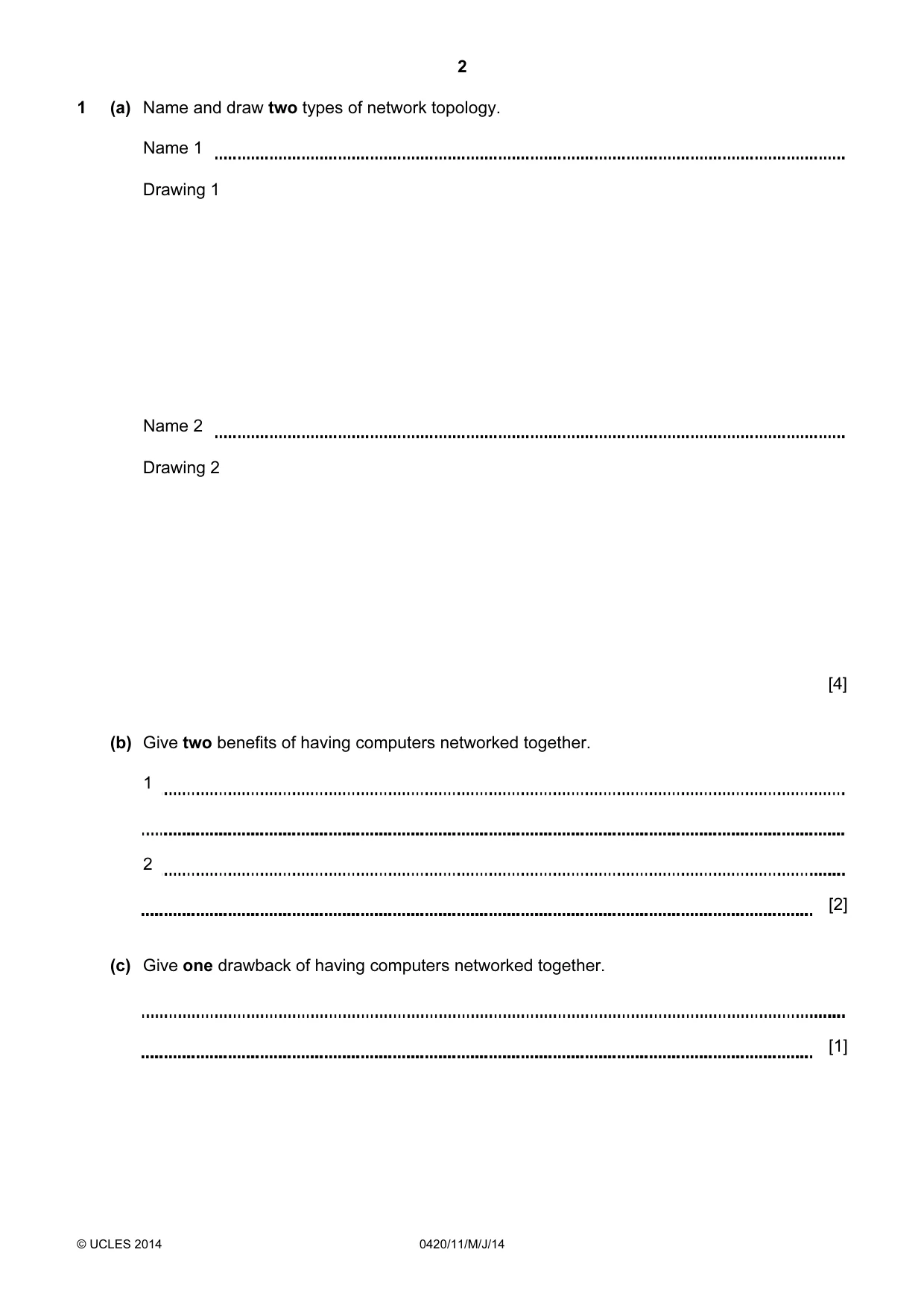
2 © UCLES 2014 0420/11/M/J/14 1 (a) Name and draw two types of network topology. Name 1 Drawing 1 Name 2 Drawing 2 [4] (b) Give two benefits of having computers networked together. 1 2 [2] (c) Give one drawback of having computers networked together. [1]
Question paper, page 3
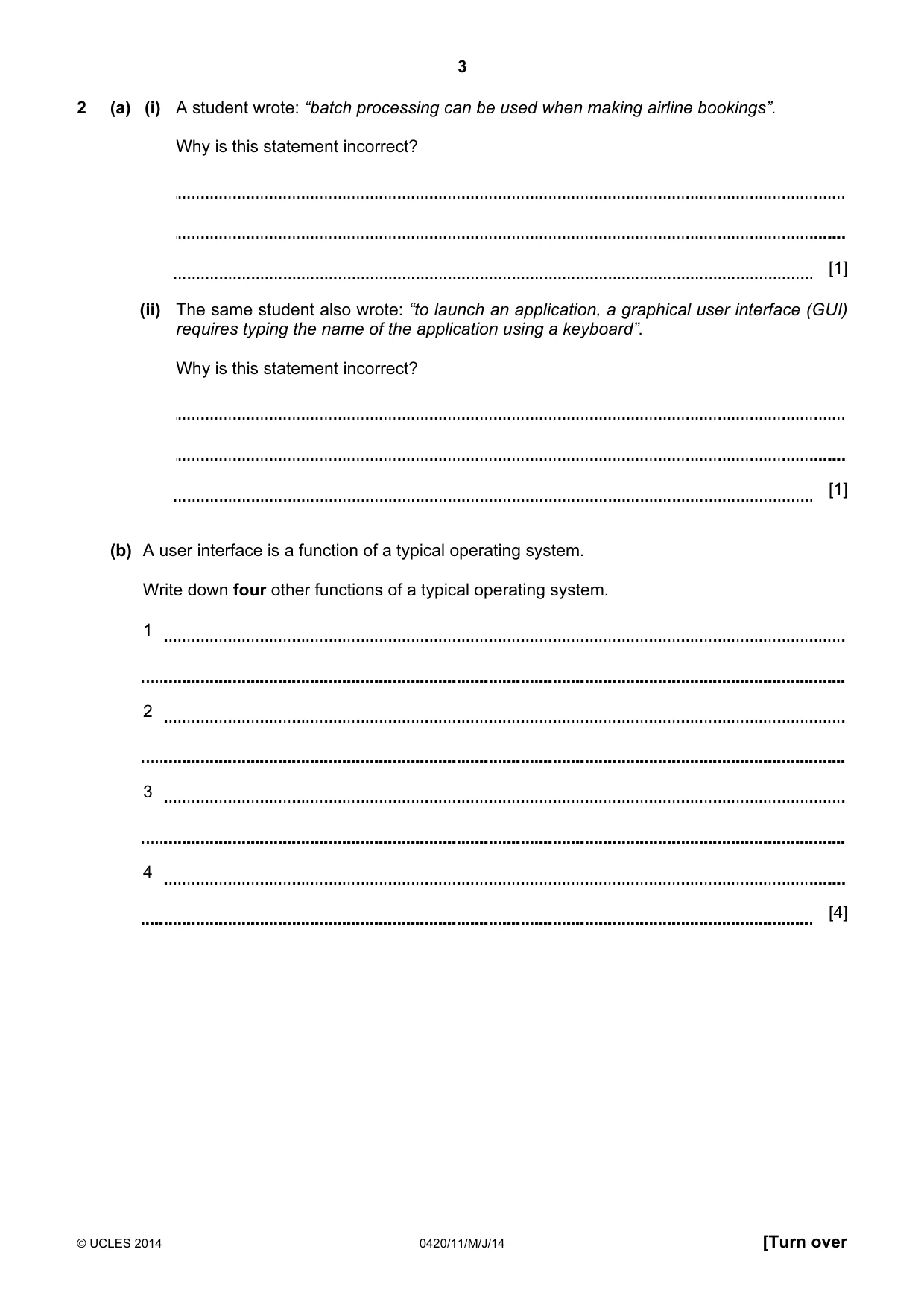
3 © UCLES 2014 0420/11/M/J/14 [Turn over 2 (a) (i) A student wrote: “batch processing can be used when making airline bookings”. Why is this statement incorrect? [1] (ii) The same student also wrote: “to launch an application, a graphical user interface (GUI) requires typing the name of the application using a keyboard”. Why is this statement incorrect? [1] (b) A user interface is a function of a typical operating system. Write down four other functions of a typical operating system. 1 2 3 4 [4]
Question paper, page 4
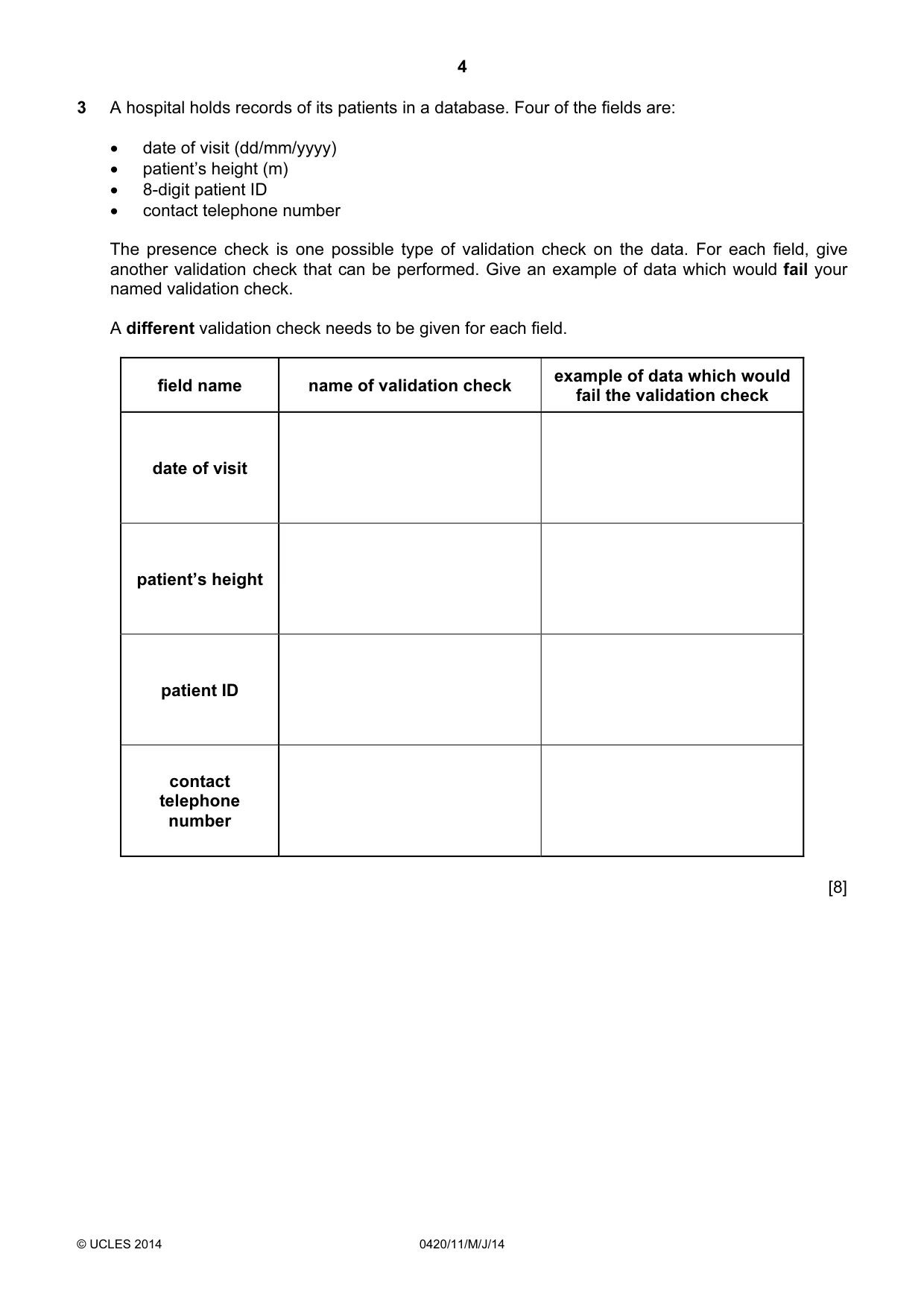
4 © UCLES 2014 0420/11/M/J/14 3 A hospital holds records of its patients in a database. Four of the fields are: • date of visit (dd/mm/yyyy) • patient’s height (m) • 8-digit patient ID • contact telephone number The presence check is one possible type of validation check on the data. For each field, give another validation check that can be performed. Give an example of data which would fail your named validation check. A different validation check needs to be given for each field. field name name of validation check example of data which would fail the validation check date of visit patient’s height patient ID contact telephone number [8]
Question paper, page 5
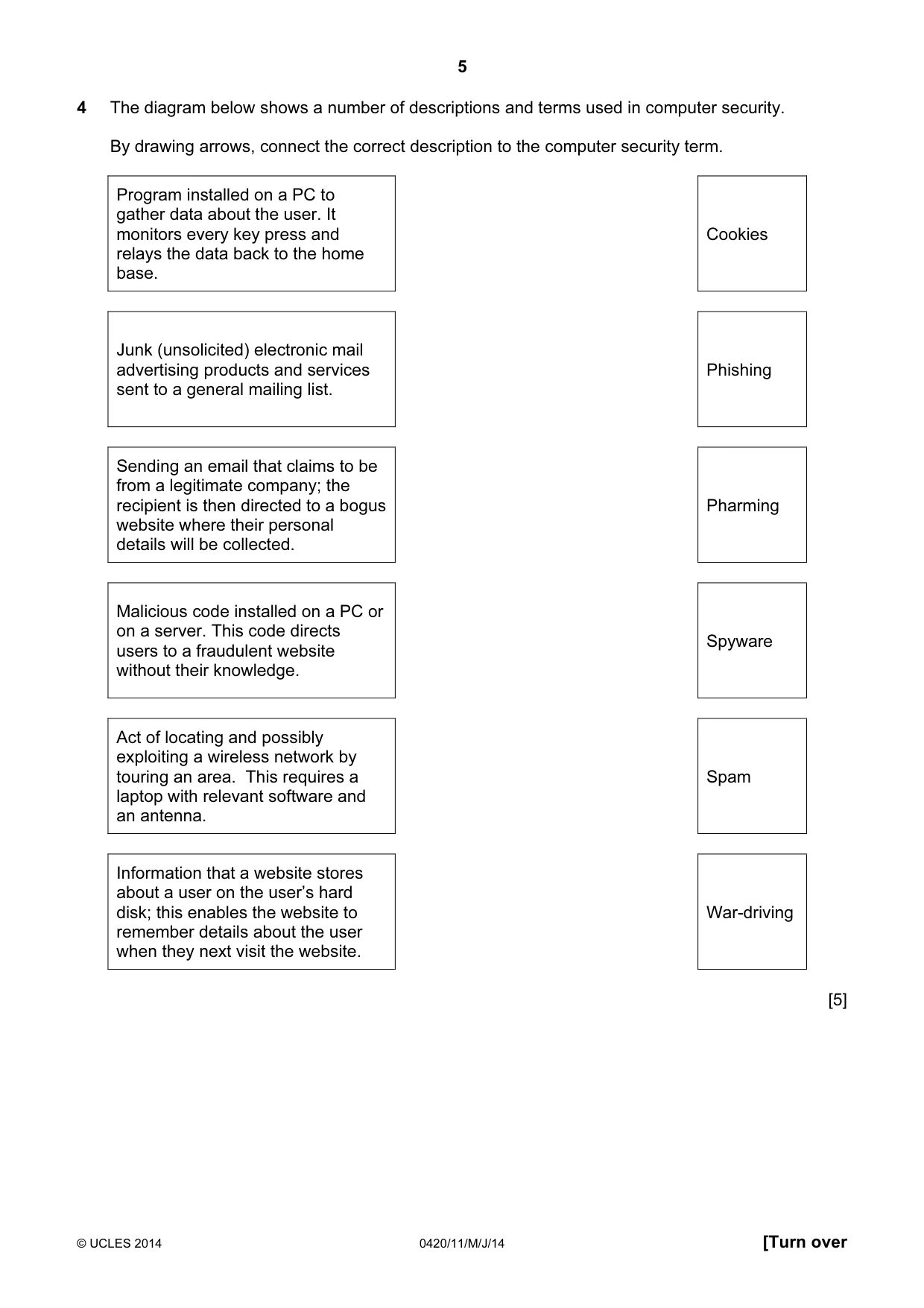
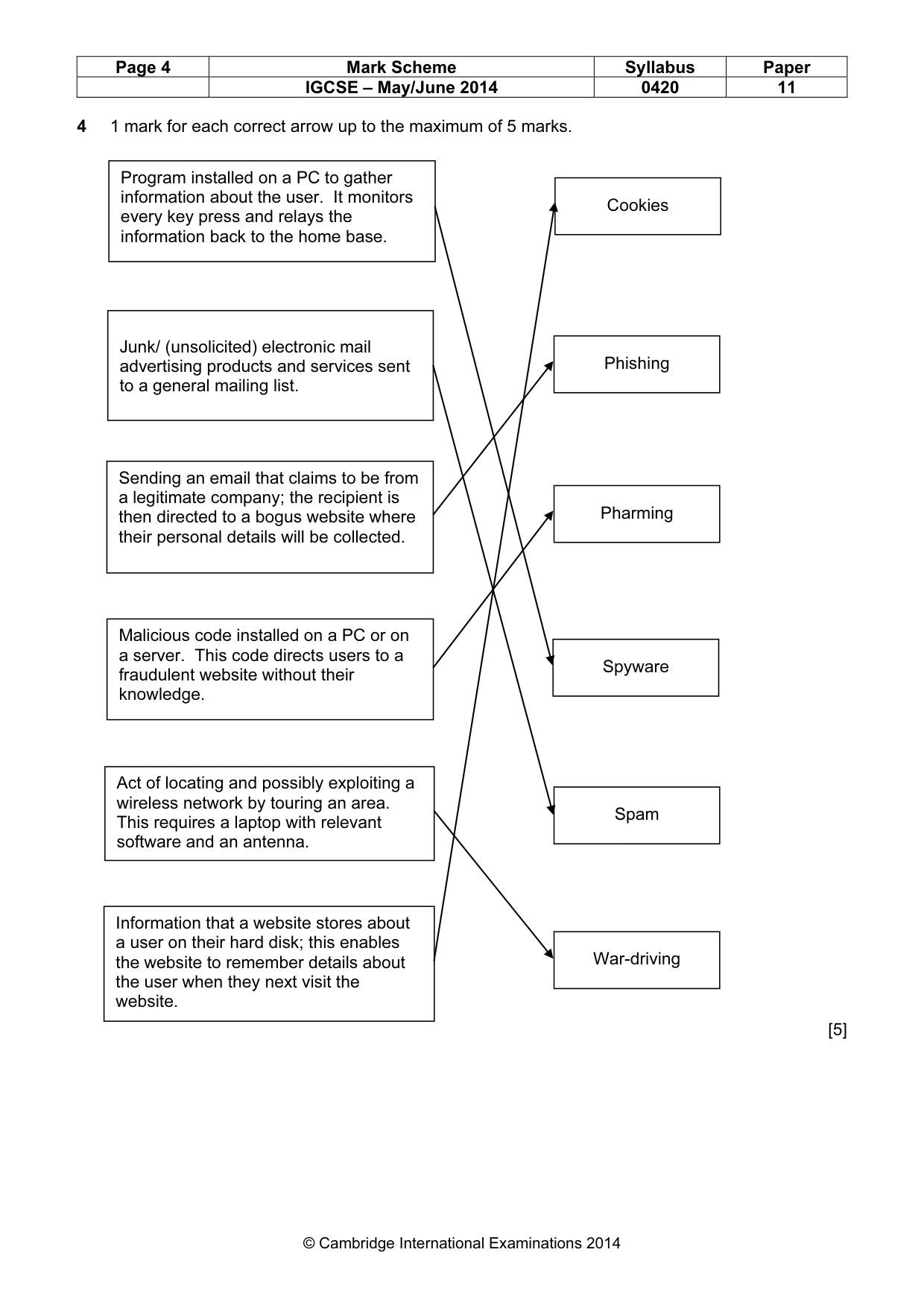
5 © UCLES 2014 0420/11/M/J/14 [Turn over 4 The diagram below shows a number of descriptions and terms used in computer security. By drawing arrows, connect the correct description to the computer security term. Program installed on a PC to gather data about the user. It monitors every key press and relays the data back to the home base. Cookies Junk (unsolicited) electronic mail advertising products and services sent to a general mailing list. Phishing Sending an email that claims to be from a legitimate company; the recipient is then directed to a bogus website where their personal details will be collected. Pharming Malicious code installed on a PC or on a server. This code directs users to a fraudulent website without their knowledge. Spyware Act of locating and possibly exploiting a wireless network by touring an area. This requires a laptop with relevant software and an antenna. Spam Information that a website stores about a user on the user’s hard disk; this enables the website to remember details about the user when they next visit the website. War-driving [5]
Question paper, page 6
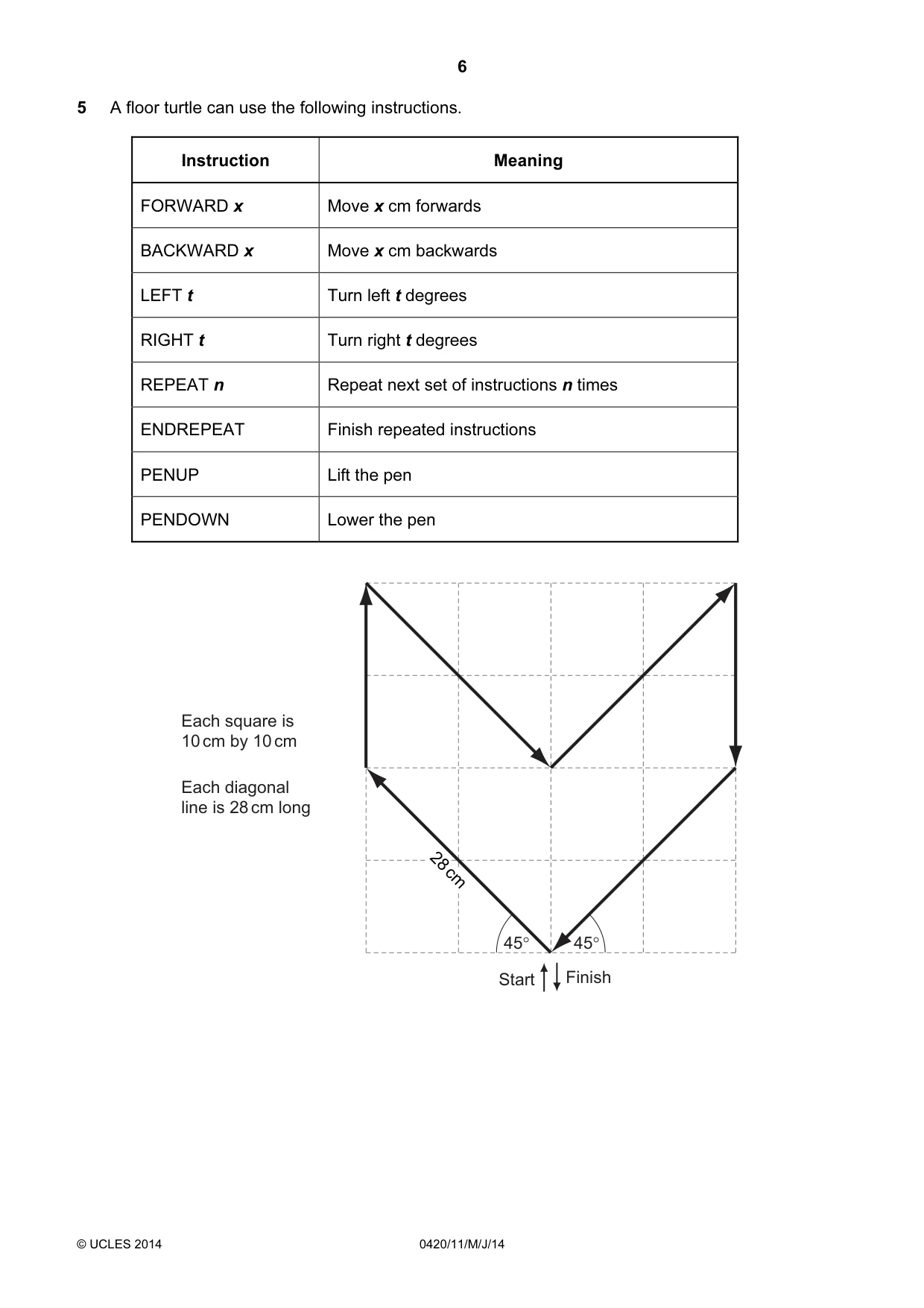
6 © UCLES 2014 0420/11/M/J/14 5 A floor turtle can use the following instructions. Instruction Meaning FORWARD x Move x cm forwards BACKWARD x Move x cm backwards LEFT t Turn left t degrees RIGHT t Turn right t degrees REPEAT n Repeat next set of instructions n times ENDREPEAT Finish repeated instructions PENUP Lift the pen PENDOWN Lower the pen 28 cm 45° 45° Start Finish Each square is 10 cm by 10 cm Each diagonal line is 28 cm long
Question paper, page 7
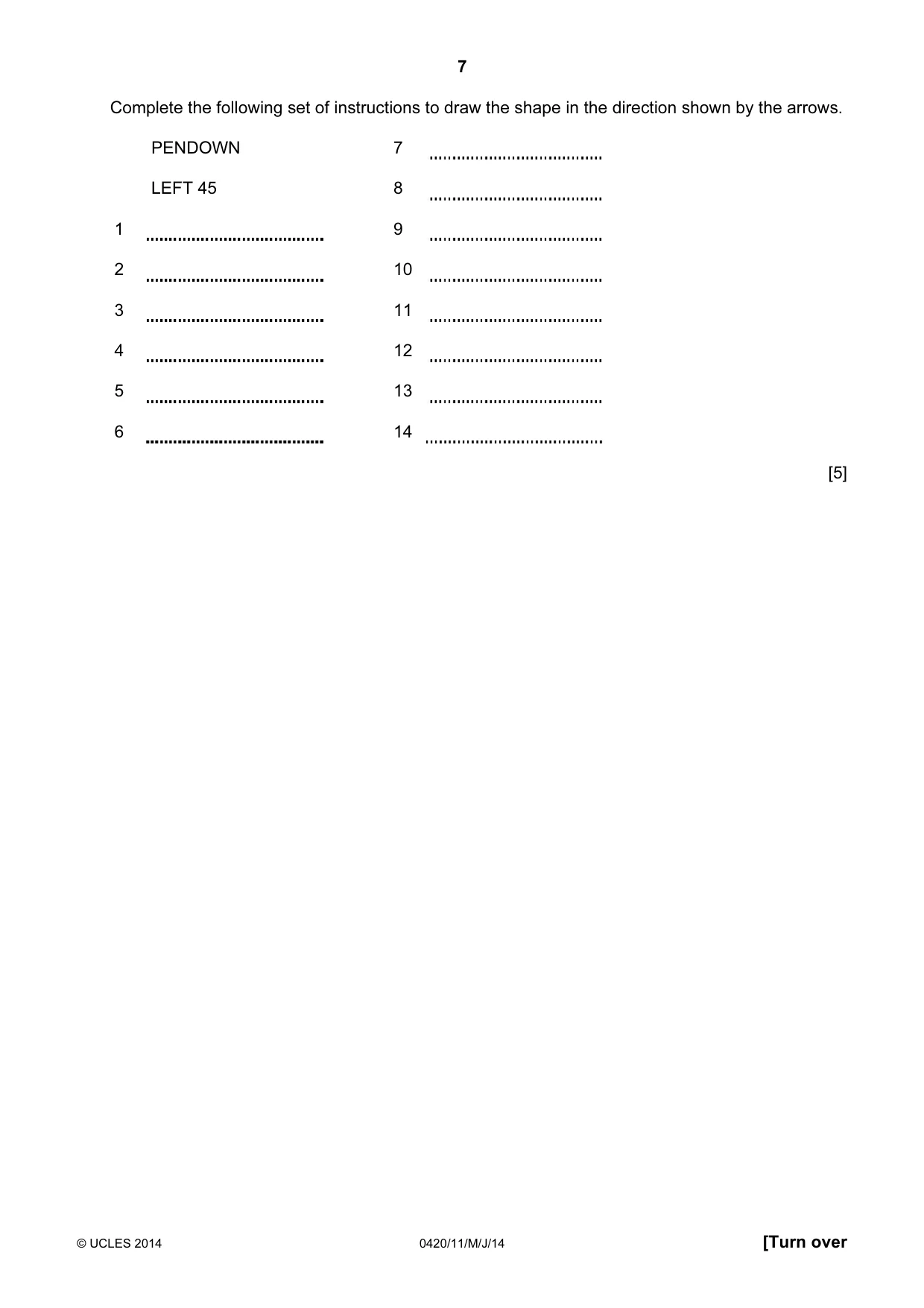
7 © UCLES 2014 0420/11/M/J/14 [Turn over Complete the following set of instructions to draw the shape in the direction shown by the arrows. PENDOWN 7 LEFT 45 8 1 9 2 10 3 11 4 12 5 13 6 14 [5]
Question paper, page 8
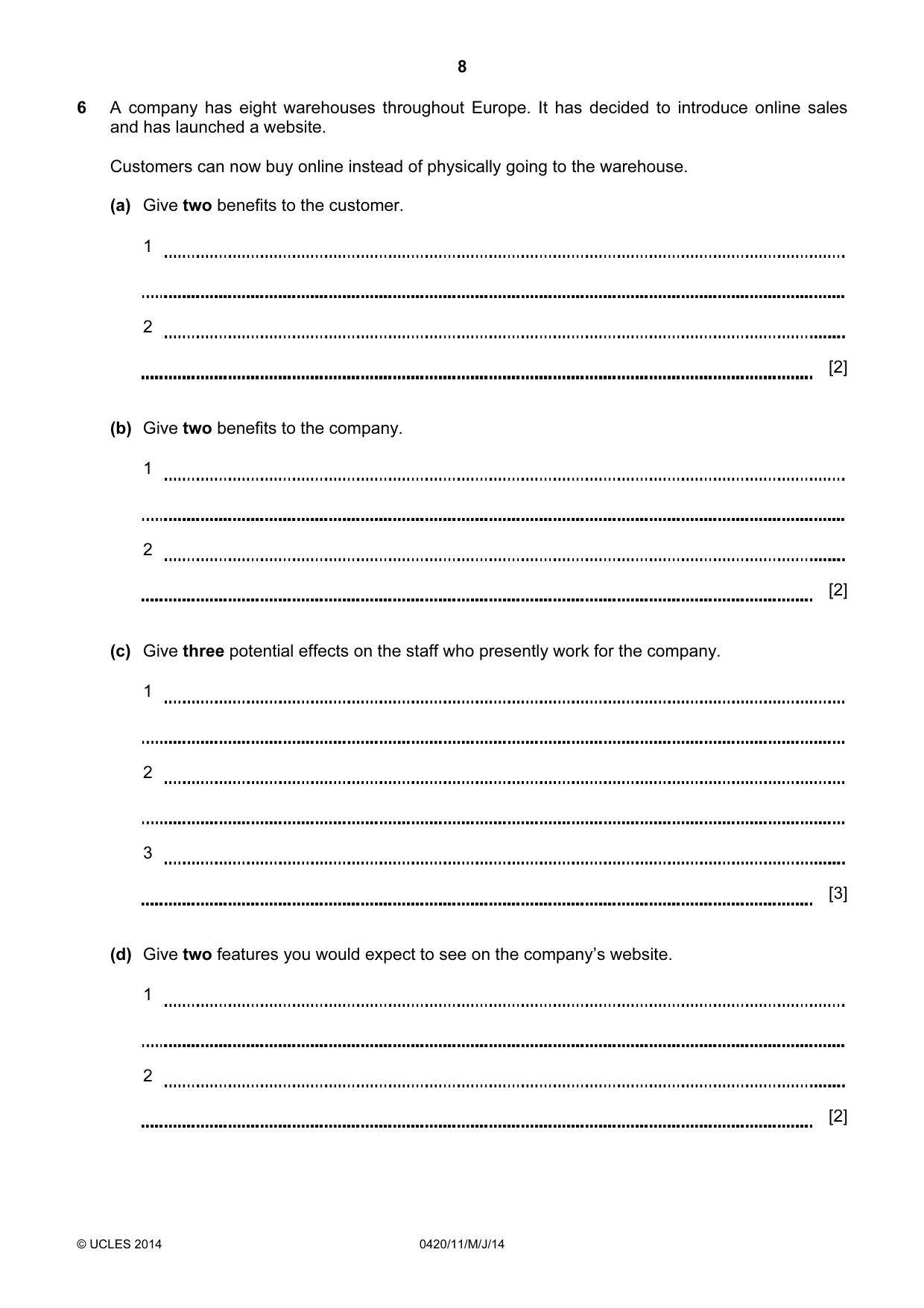
8 © UCLES 2014 0420/11/M/J/14 6 A company has eight warehouses throughout Europe. It has decided to introduce online sales and has launched a website. Customers can now buy online instead of physically going to the warehouse. (a) Give two benefits to the customer. 1 2 [2] (b) Give two benefits to the company. 1 2 [2] (c) Give three potential effects on the staff who presently work for the company. 1 2 3 [3] (d) Give two features you would expect to see on the company’s website. 1 2 [2]
Question paper, page 9
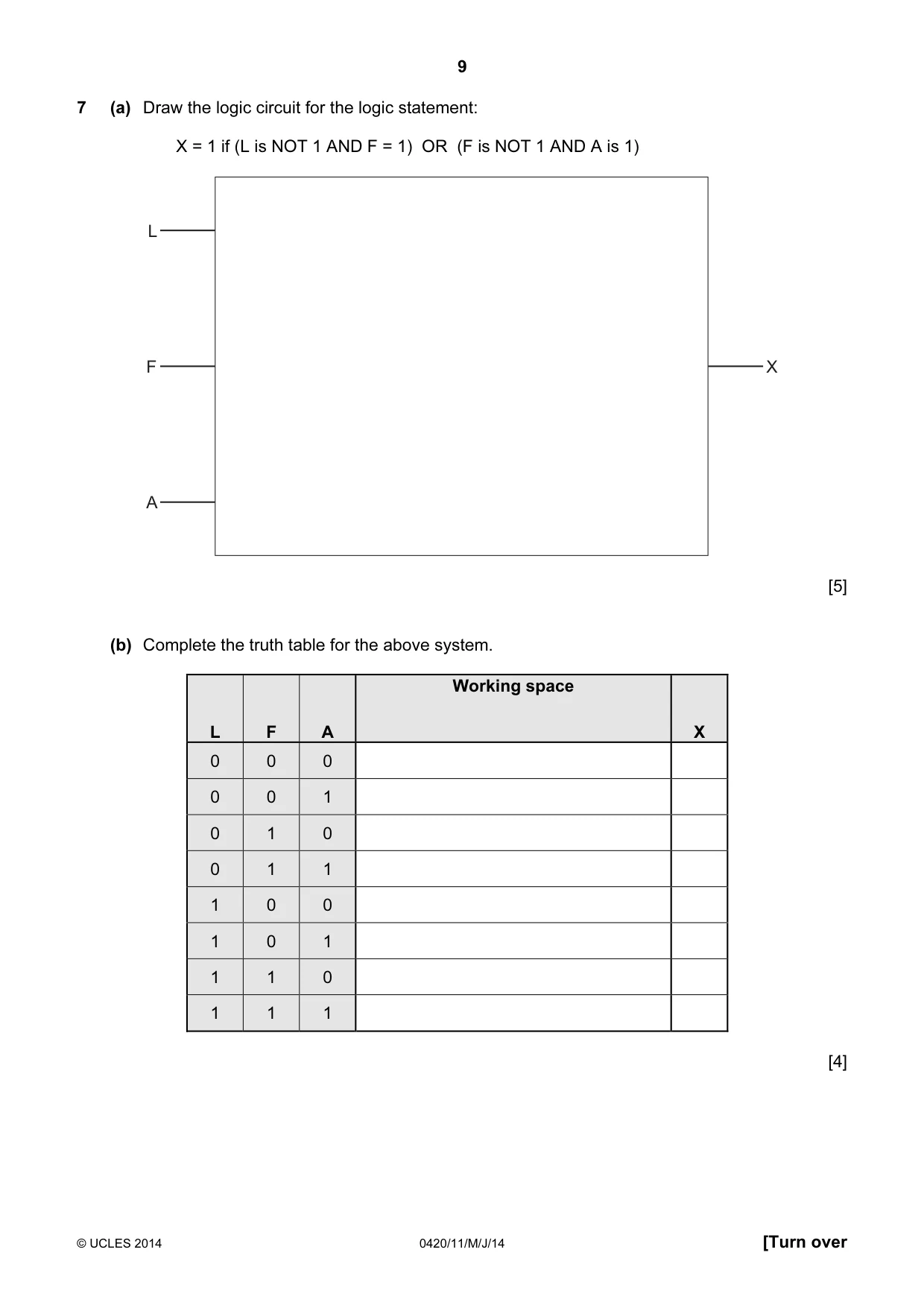
9 © UCLES 2014 0420/11/M/J/14 [Turn over 7 (a) Draw the logic circuit for the logic statement: X = 1 if (L is NOT 1 AND F = 1) OR (F is NOT 1 AND A is 1) L F X A [5] (b) Complete the truth table for the above system. L F A Working space X 0 0 0 0 0 1 0 1 0 0 1 1 1 0 0 1 0 1 1 1 0 1 1 1 [4]
Question paper, page 10
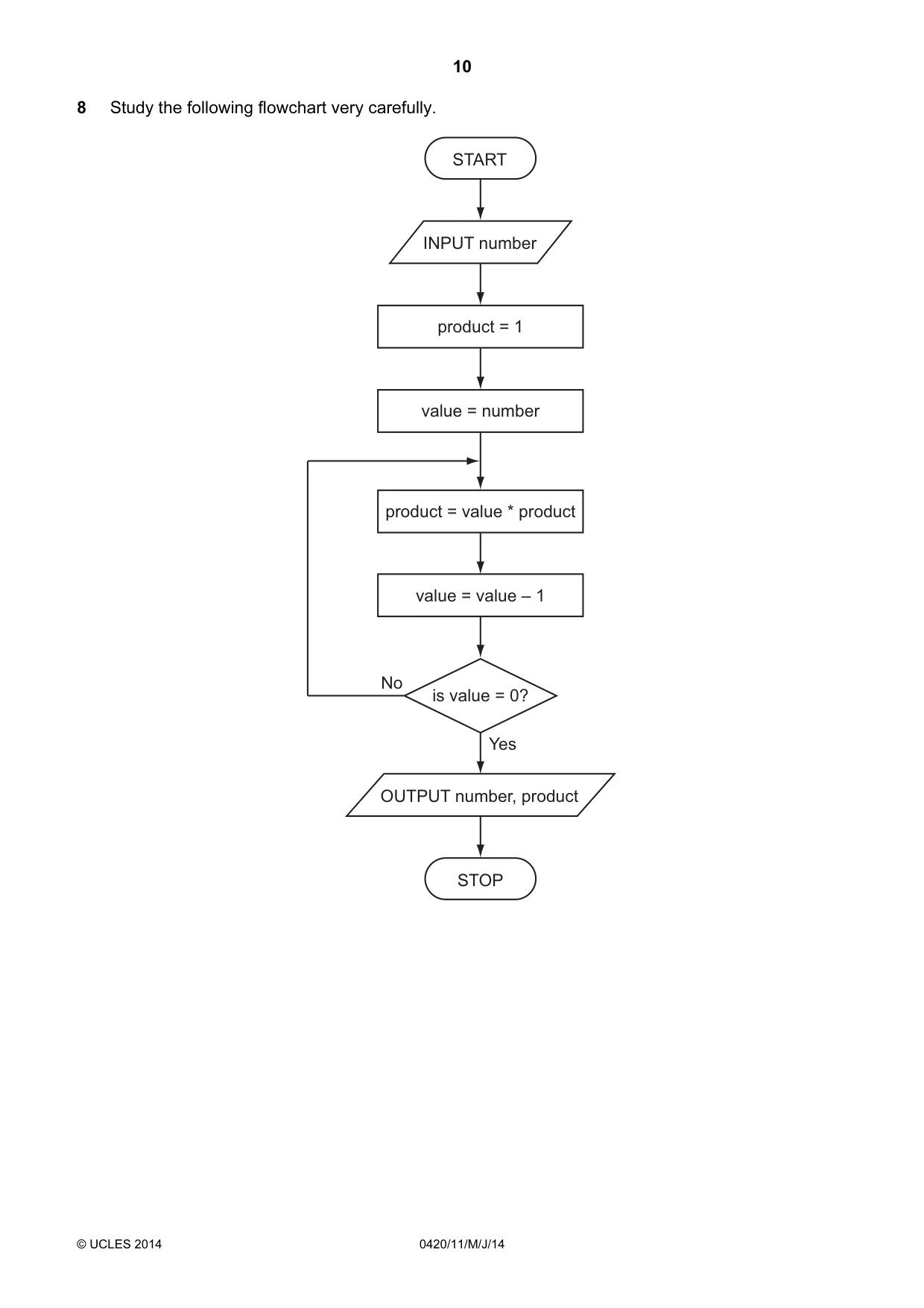
10 © UCLES 2014 0420/11/M/J/14 8 Study the following flowchart very carefully. START STOP product = 1 value = number product = value * product value = value – 1 is value = 0? INPUT number OUTPUT number, product Yes No
Question paper, page 11
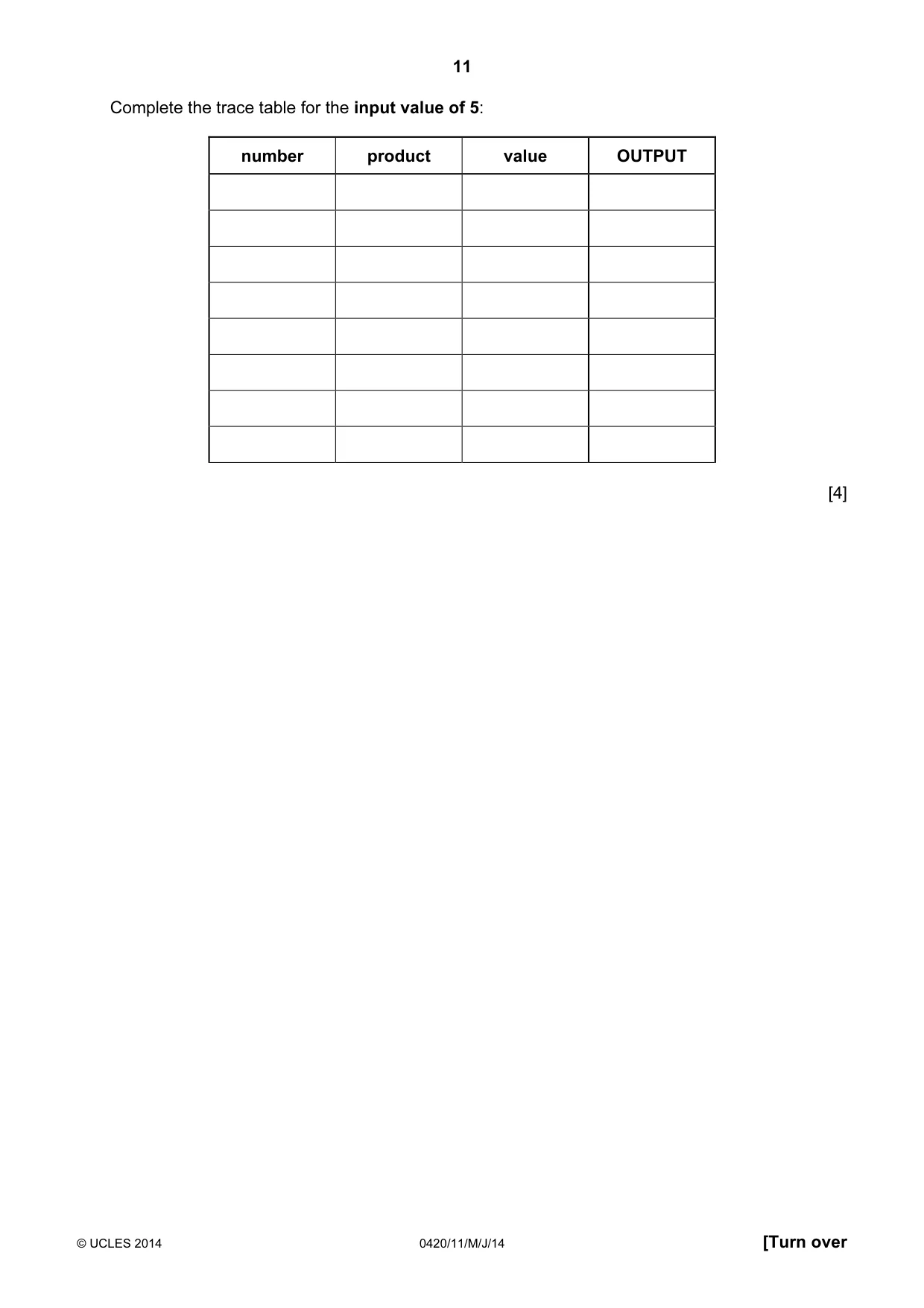
11 © UCLES 2014 0420/11/M/J/14 [Turn over Complete the trace table for the input value of 5: number product value OUTPUT [4]
Question paper, page 12
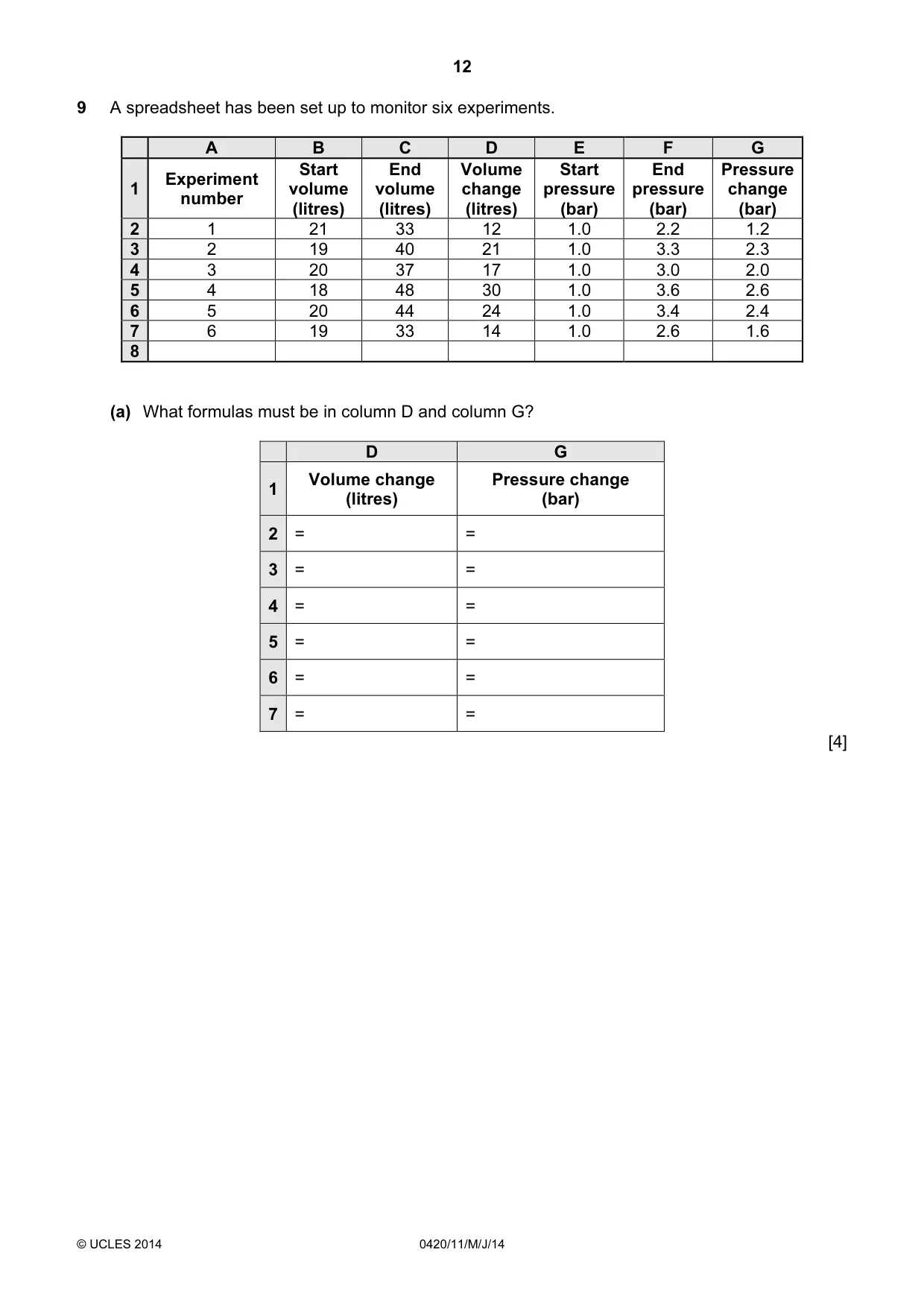
12 © UCLES 2014 0420/11/M/J/14 9 A spreadsheet has been set up to monitor six experiments. A B C D E F G 1 Experiment number Start volume (litres) End volume (litres) Volume change (litres) Start pressure (bar) End pressure (bar) Pressure change (bar) 2 1 21 33 12 1.0 2.2 1.2 3 2 19 40 21 1.0 3.3 2.3 4 3 20 37 17 1.0 3.0 2.0 5 4 18 48 30 1.0 3.6 2.6 6 5 20 44 24 1.0 3.4 2.4 7 6 19 33 14 1.0 2.6 1.6 8 (a) What formulas must be in column D and column G? D G 1 Volume change (litres) Pressure change (bar) 2 = = 3 = = 4 = = 5 = = 6 = = 7 = = [4]
Question paper, page 13
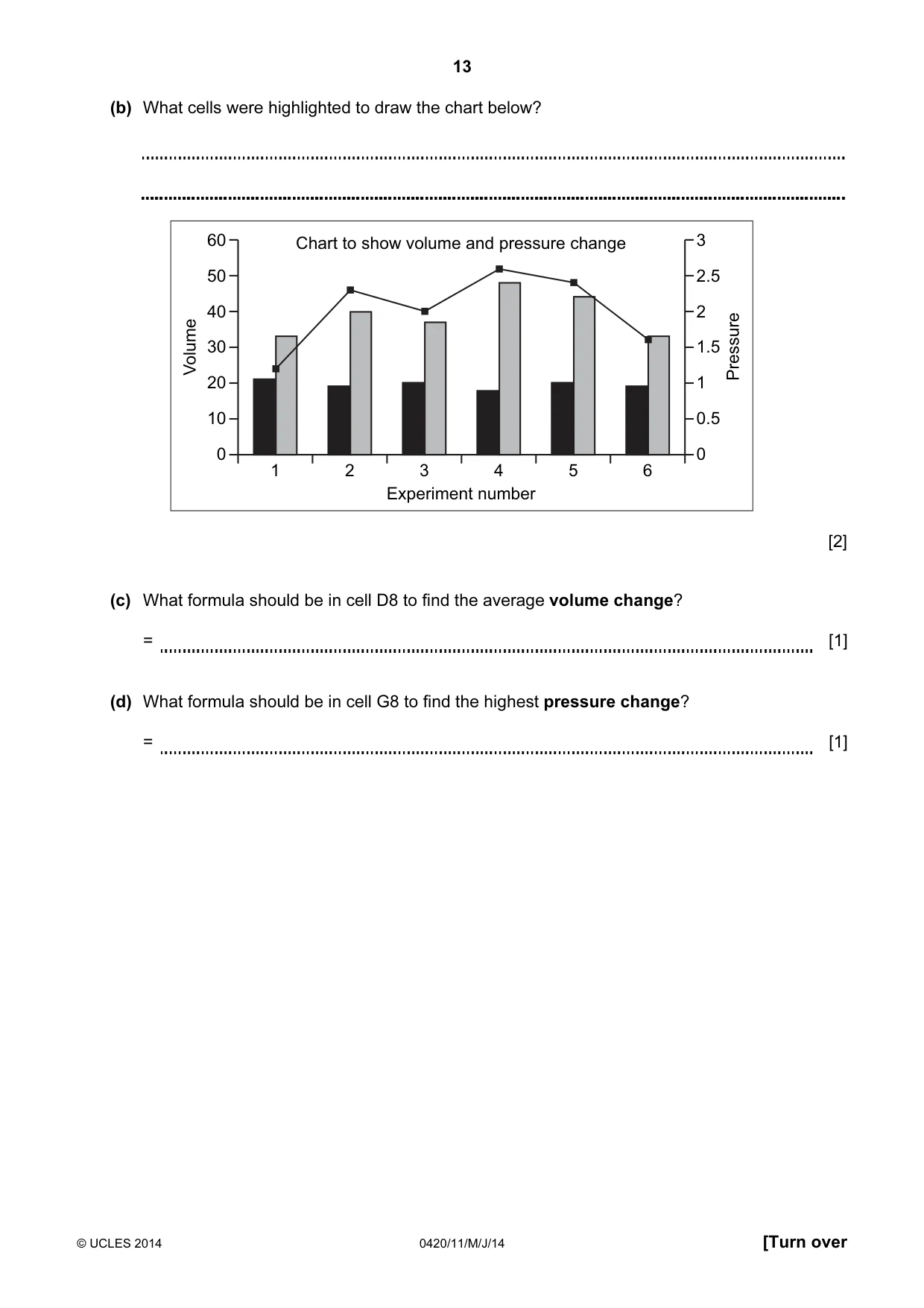
13 © UCLES 2014 0420/11/M/J/14 [Turn over (b) What cells were highlighted to draw the chart below? 1 2 3 4 5 6 3 2.5 2 1.5 1 0.5 0 60 50 40 30 20 10 0 Experiment number Chart to show volume and pressure change Pressure Volume [2] (c) What formula should be in cell D8 to find the average volume change? = [1] (d) What formula should be in cell G8 to find the highest pressure change? = [1]
Question paper, page 14
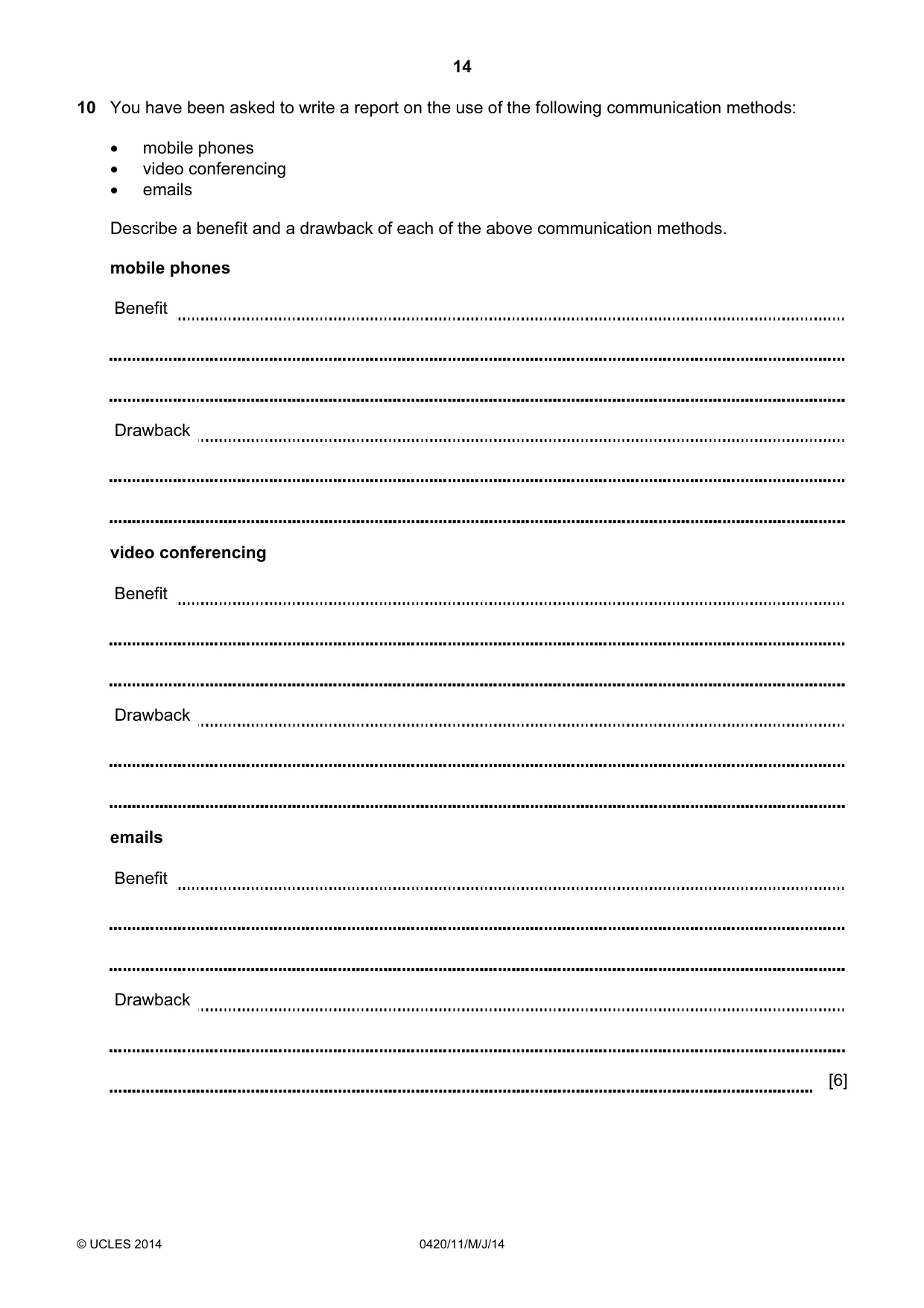
14 © UCLES 2014 0420/11/M/J/14 10 You have been asked to write a report on the use of the following communication methods: • mobile phones • video conferencing • emails Describe a benefit and a drawback of each of the above communication methods. mobile phones Benefit Drawback video conferencing Benefit Drawback emails Benefit Drawback [6]
Question paper, page 15
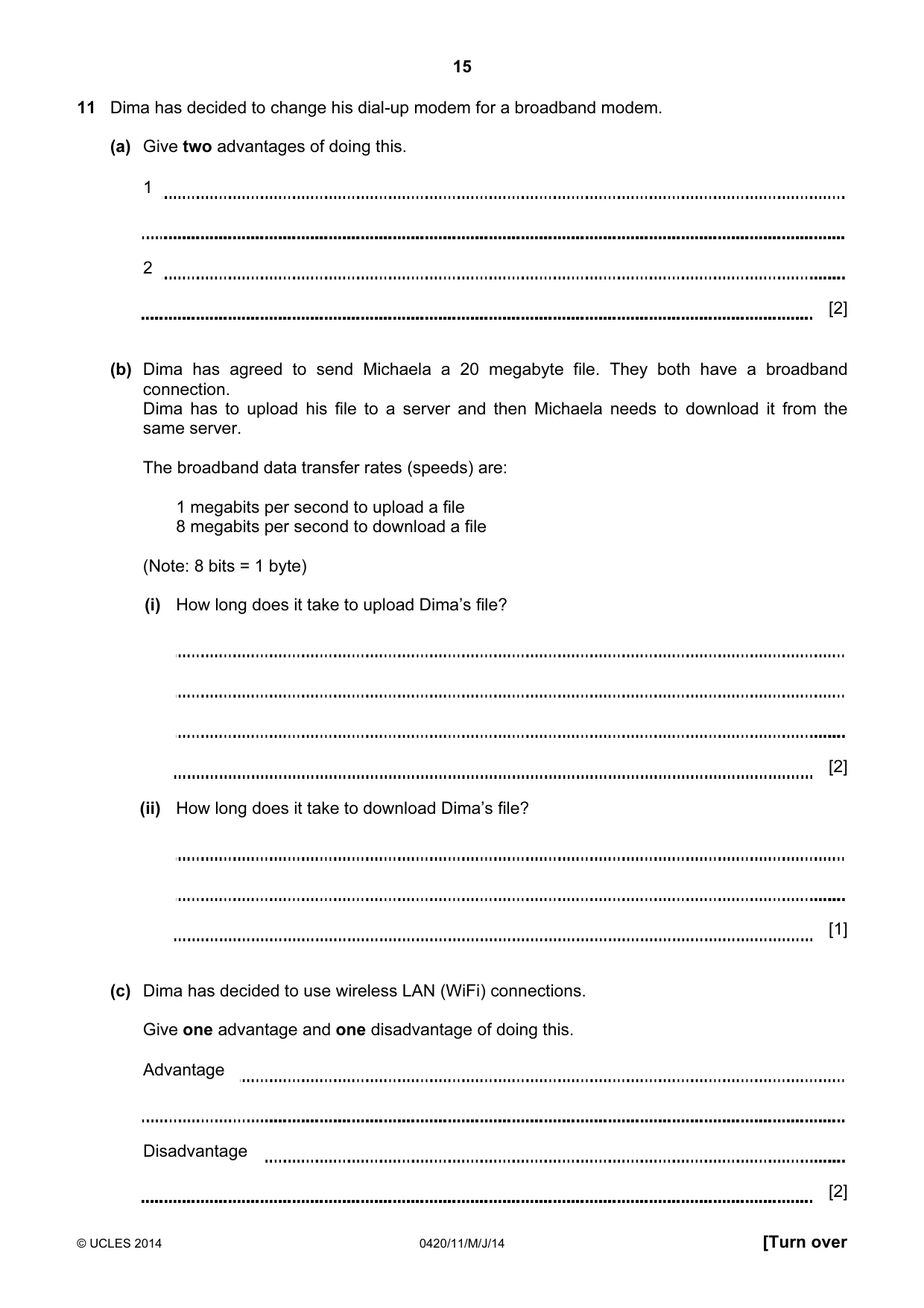
15 © UCLES 2014 0420/11/M/J/14 [Turn over 11 Dima has decided to change his dial-up modem for a broadband modem. (a) Give two advantages of doing this. 1 2 [2] (b) Dima has agreed to send Michaela a 20 megabyte file. They both have a broadband connection. Dima has to upload his file to a server and then Michaela needs to download it from the same server. The broadband data transfer rates (speeds) are: 1 megabits per second to upload a file 8 megabits per second to download a file (Note: 8 bits = 1 byte) (i) How long does it take to upload Dima’s file? [2] (ii) How long does it take to download Dima’s file? [1] (c) Dima has decided to use wireless LAN (WiFi) connections. Give one advantage and one disadvantage of doing this. Advantage Disadvantage [2]
Question paper, page 16
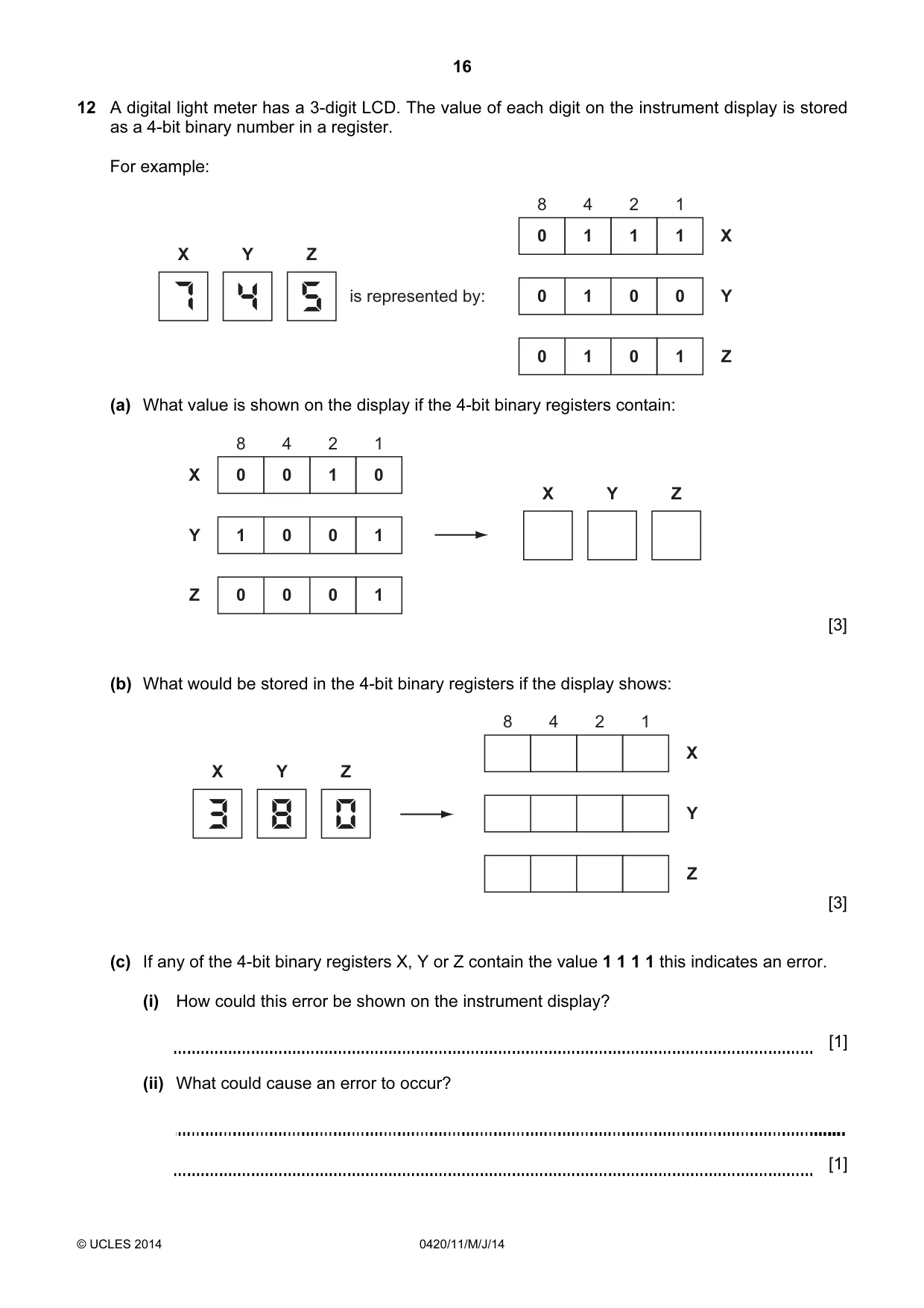
16 © UCLES 2014 0420/11/M/J/14 12 A digital light meter has a 3-digit LCD. The value of each digit on the instrument display is stored as a 4-bit binary number in a register. For example: 8 4 2 1 0 1 1 1 X 0 1 0 0 Y is represented by: 0 1 0 1 Z Z Y X (a) What value is shown on the display if the 4-bit binary registers contain: 8 4 2 1 0 0 1 0 X 1 0 0 1 Y 0 0 0 1 Z Z Y X [3] (b) What would be stored in the 4-bit binary registers if the display shows: 8 4 2 1 X Y Z Z Y X [3] (c) If any of the 4-bit binary registers X, Y or Z contain the value 1 1 1 1 this indicates an error. (i) How could this error be shown on the instrument display? [1] (ii) What could cause an error to occur? [1]
Question paper, page 17
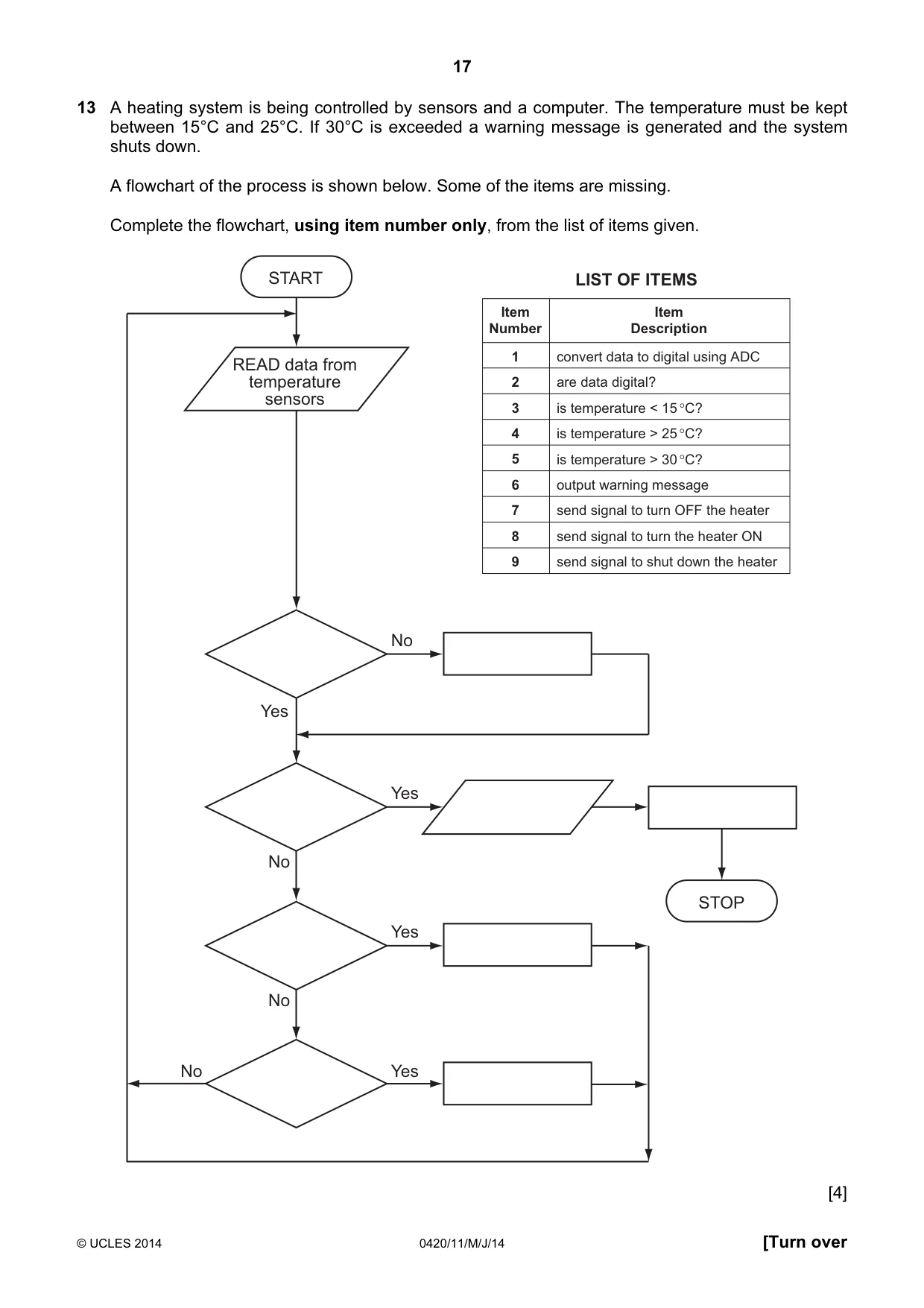
17 © UCLES 2014 0420/11/M/J/14 [Turn over 13 A heating system is being controlled by sensors and a computer. The temperature must be kept between 15°C and 25°C. If 30°C is exceeded a warning message is generated and the system shuts down. A flowchart of the process is shown below. Some of the items are missing. Complete the flowchart, using item number only, from the list of items given. START STOP READ data from temperature sensors No Yes Yes Yes No Yes No No Item Number Item Description LIST OF ITEMS 1 convert data to digital using ADC 2 are data digital? 3 is temperature < 15 °C? 4 is temperature > 25 °C? 5 is temperature > 30 °C? 6 output warning message 7 send signal to turn OFF the heater 8 send signal to turn the heater ON 9 send signal to shut down the heater [4]
Question paper, page 18
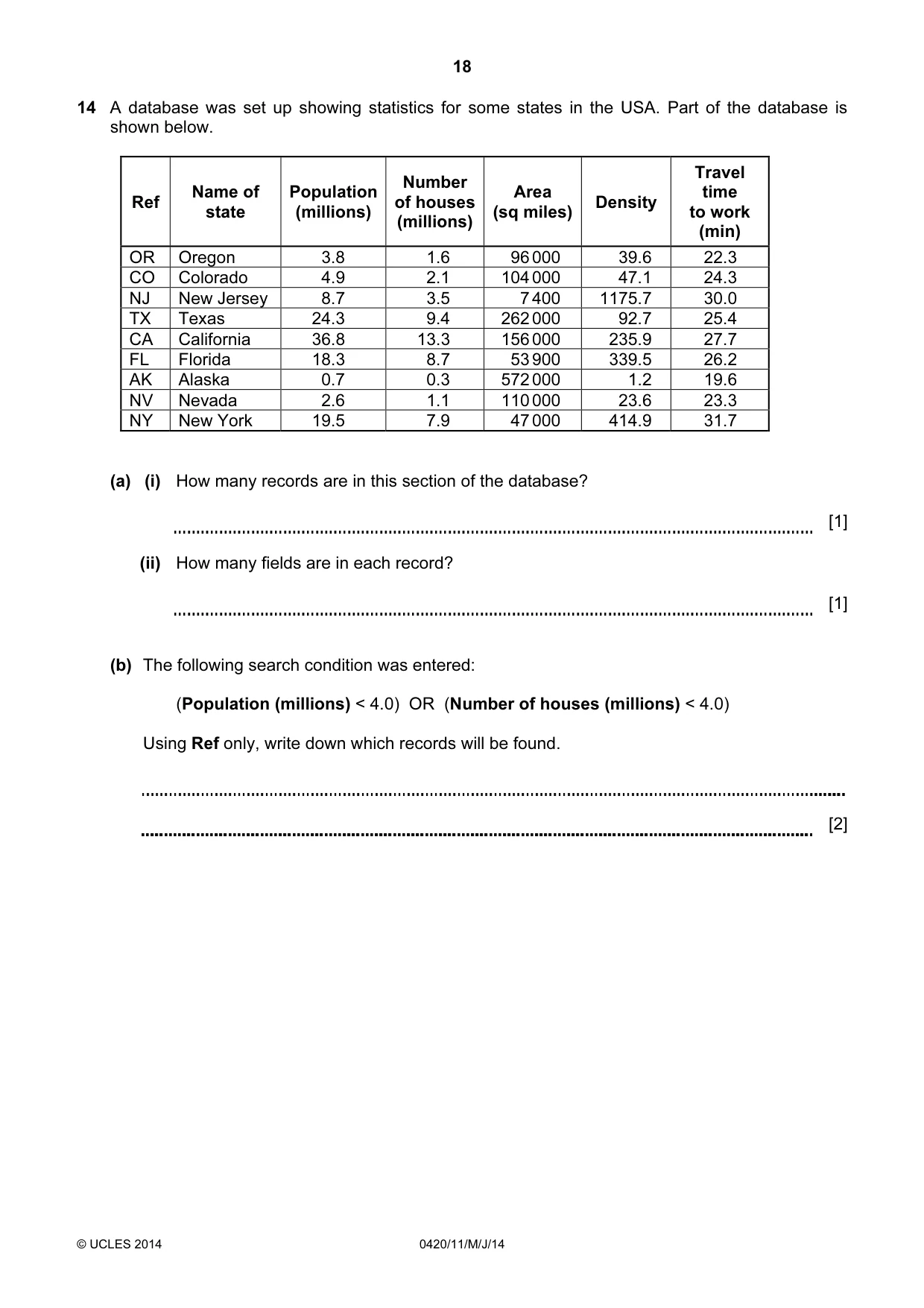
18 © UCLES 2014 0420/11/M/J/14 14 A database was set up showing statistics for some states in the USA. Part of the database is shown below. Ref Name of state Population (millions) Number of houses (millions) Area (sq miles) Density Travel time to work (min) OR Oregon 3.8 1.6 96 000 39.6 22.3 CO Colorado 4.9 2.1 104 000 47.1 24.3 NJ New Jersey 8.7 3.5 7 400 1175.7 30.0 TX Texas 24.3 9.4 262 000 92.7 25.4 CA California 36.8 13.3 156 000 235.9 27.7 FL Florida 18.3 8.7 53 900 339.5 26.2 AK Alaska 0.7 0.3 572 000 1.2 19.6 NV Nevada 2.6 1.1 110 000 23.6 23.3 NY New York 19.5 7.9 47 000 414.9 31.7 (a) (i) How many records are in this section of the database? [1] (ii) How many fields are in each record? [1] (b) The following search condition was entered: (Population (millions) < 4.0) OR (Number of houses (millions) < 4.0) Using Ref only, write down which records will be found. [2]
Question paper, page 19
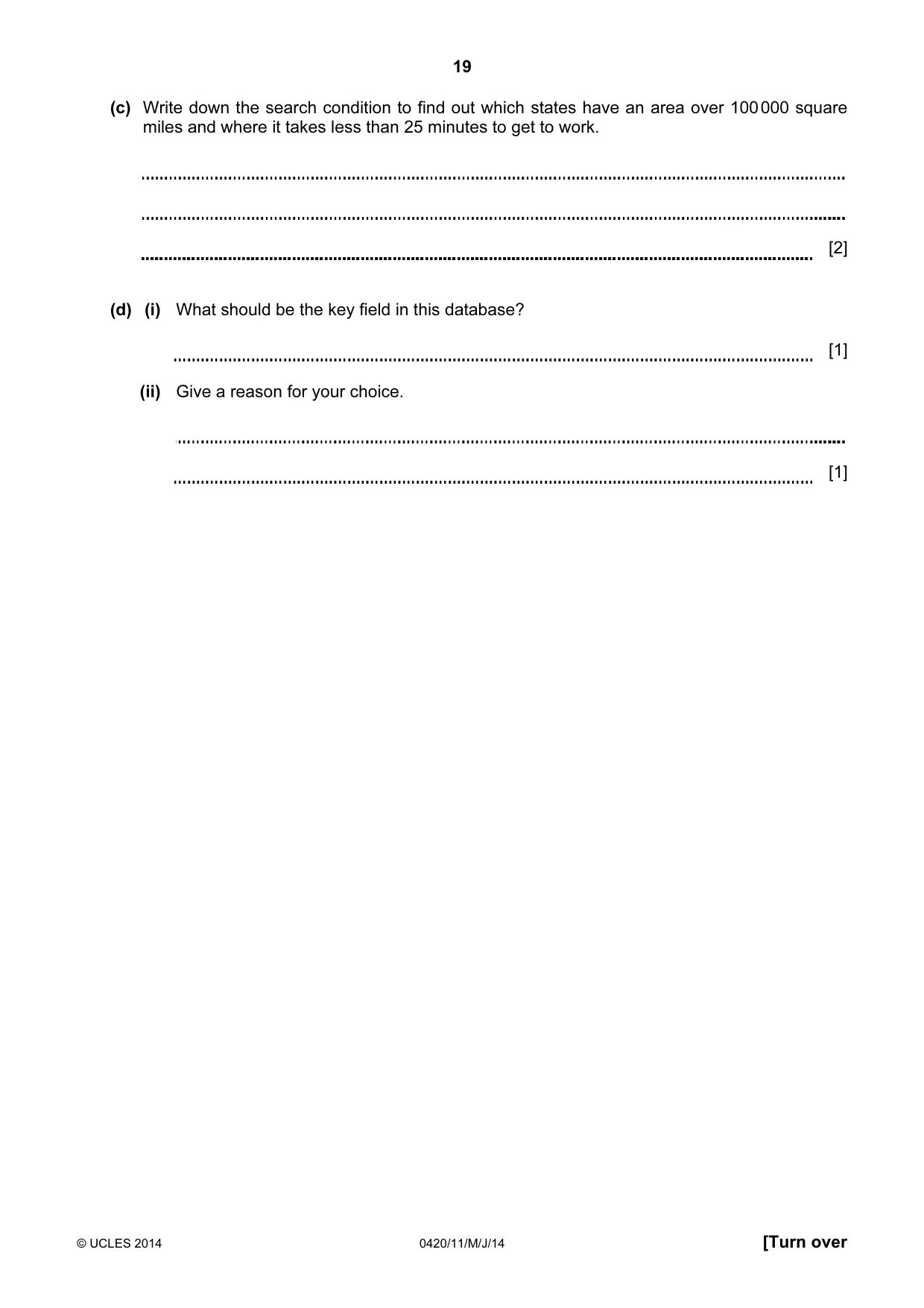
19 © UCLES 2014 0420/11/M/J/14 [Turn over (c) Write down the search condition to find out which states have an area over 100 000 square miles and where it takes less than 25 minutes to get to work. [2] (d) (i) What should be the key field in this database? [1] (ii) Give a reason for your choice. [1]
Question paper, page 20
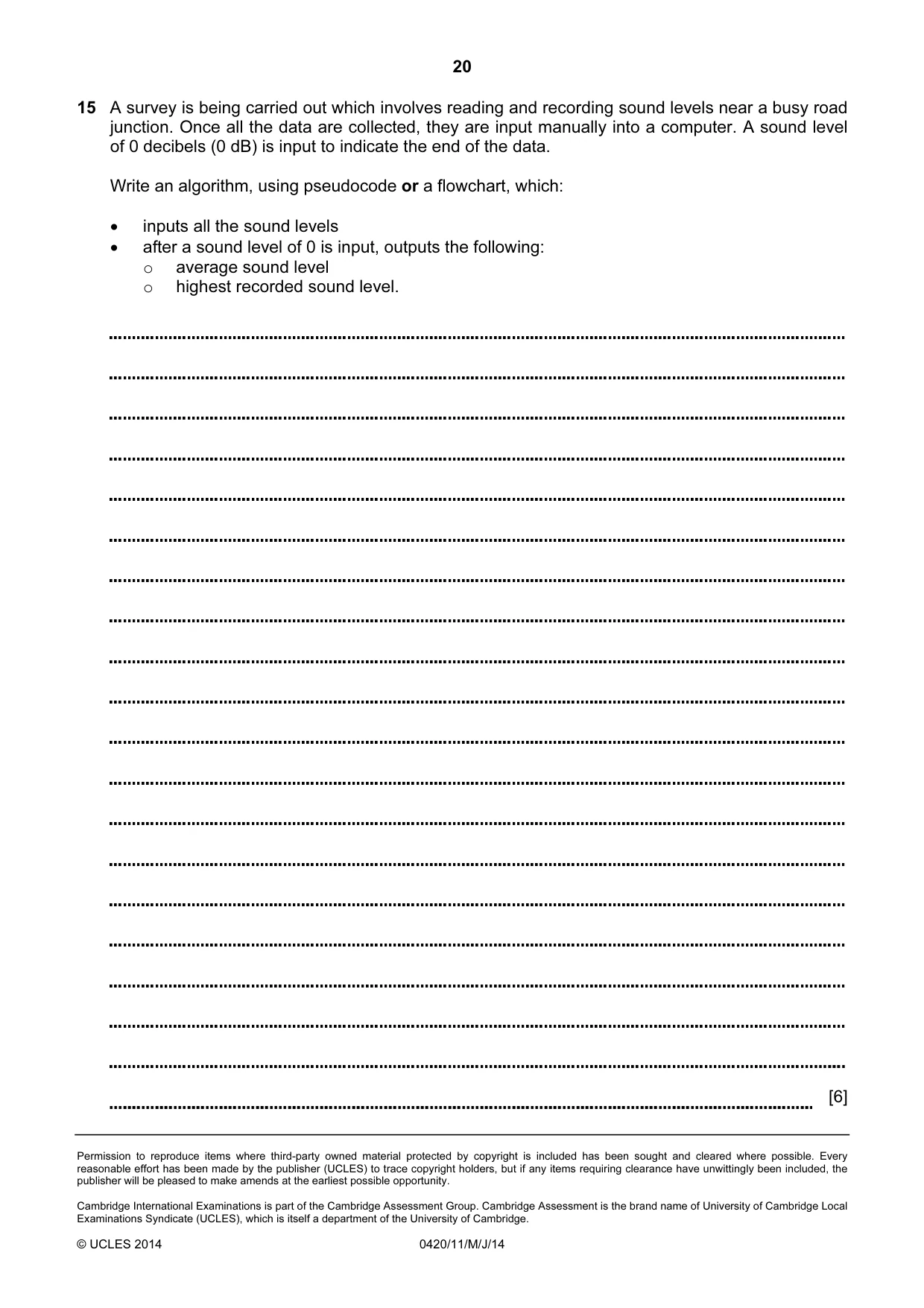
20 Permission to reproduce items where third-party owned material protected by copyright is included has been sought and cleared where possible. Every reasonable effort has been made by the publisher (UCLES) to trace copyright holders, but if any items requiring clearance have unwittingly been included, the publisher will be pleased to make amends at the earliest possible opportunity. Cambridge International Examinations is part of the Cambridge Assessment Group. Cambridge Assessment is the brand name of University of Cambridge Local Examinations Syndicate (UCLES), which is itself a department of the University of Cambridge. © UCLES 2014 0420/11/M/J/14 15 A survey is being carried out which involves reading and recording sound levels near a busy road junction. Once all the data are collected, they are input manually into a computer. A sound level of 0 decibels (0 dB) is input to indicate the end of the data. Write an algorithm, using pseudocode or a flowchart, which: • inputs all the sound levels • after a sound level of 0 is input, outputs the following: o average sound level o highest recorded sound level. [6]
Mark scheme, page 1
CAMBRIDGE INTERNATIONAL EXAMINATIONS International General Certificate of Secondary Education MARK SCHEME for the May/June 2014 series 0420 COMPUTER STUDIES 0420/11 Paper 1, maximum raw mark 100 This mark scheme is published as an aid to teachers and candidates, to indicate the requirements of the examination. It shows the basis on which Examiners were instructed to award marks. It does not indicate the details of the discussions that took place at an Examiners’ meeting before marking began, which would have considered the acceptability of alternative answers. Mark schemes should be read in conjunction with the question paper and the Principal Examiner Report for Teachers. Cambridge will not enter into discussions about these mark schemes. Cambridge is publishing the mark schemes for the May/June 2014 series for most IGCSE, GCE Advanced Level and Advanced Subsidiary Level components and some Ordinary Level components.
Mark scheme, page 2
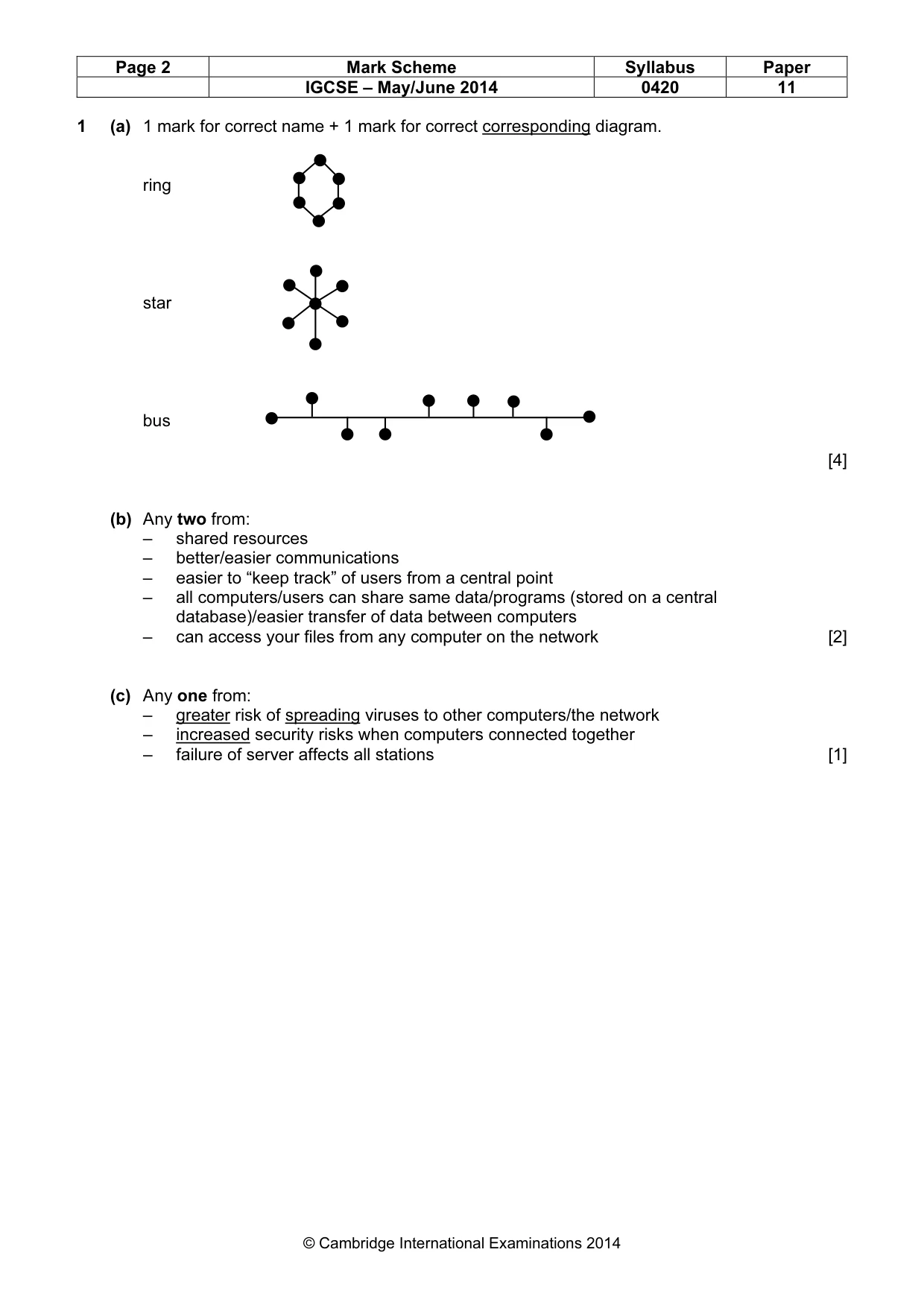
Page 2 Mark Scheme Syllabus Paper IGCSE – May/June 2014 0420 11 © Cambridge International Examinations 2014 1 (a) 1 mark for correct name + 1 mark for correct corresponding diagram. ring star bus [4] (b) Any two from: – shared resources – better/easier communications – easier to “keep track” of users from a central point – all computers/users can share same data/programs (stored on a central database)/easier transfer of data between computers – can access your files from any computer on the network [2] (c) Any one from: – greater risk of spreading viruses to other computers/the network – increased security risks when computers connected together – failure of server affects all stations [1]
Mark scheme, page 3
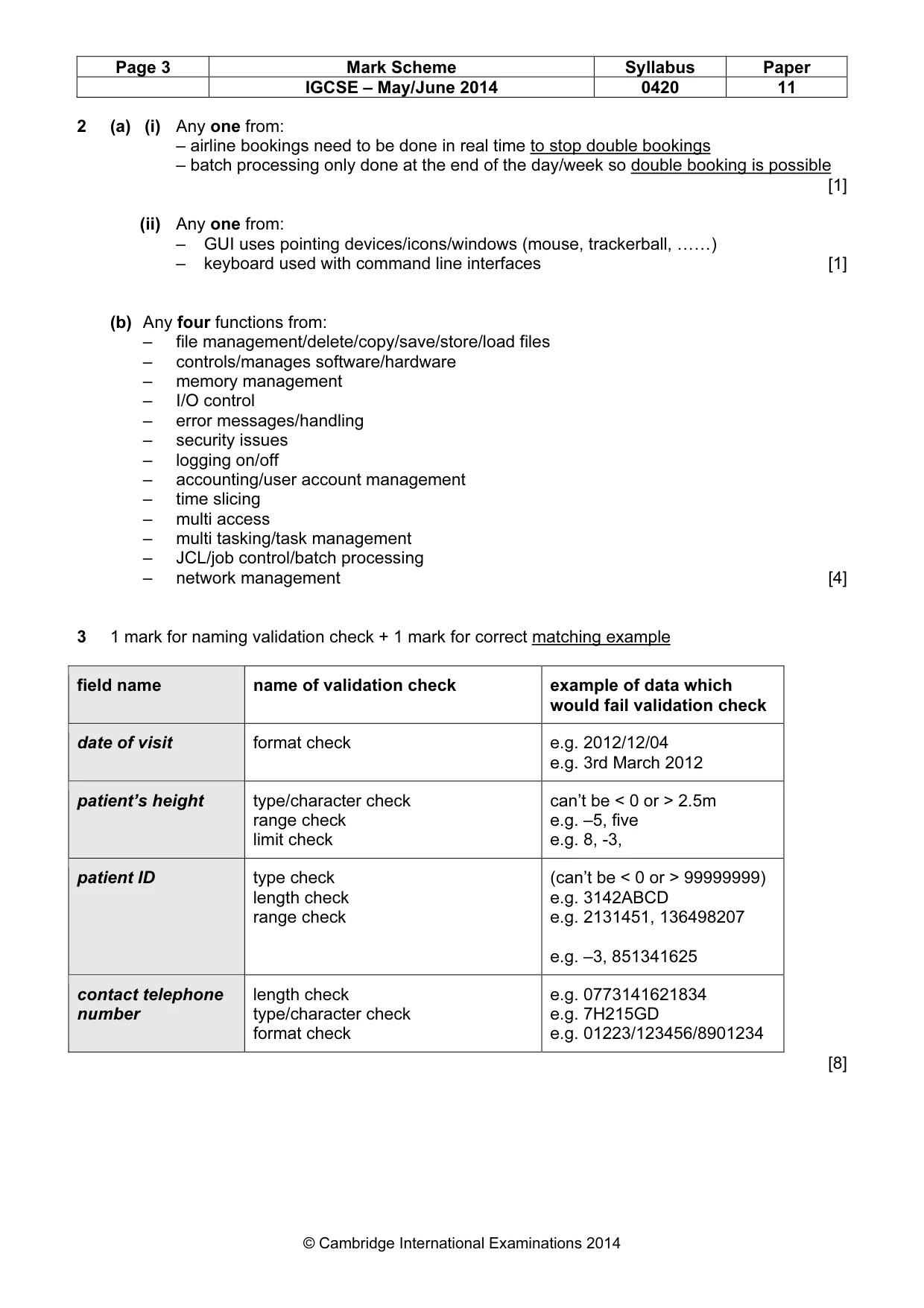
Page 3 Mark Scheme Syllabus Paper IGCSE – May/June 2014 0420 11 © Cambridge International Examinations 2014 2 (a) (i) Any one from: – airline bookings need to be done in real time to stop double bookings – batch processing only done at the end of the day/week so double booking is possible [1] (ii) Any one from: – GUI uses pointing devices/icons/windows (mouse, trackerball, ……) – keyboard used with command line interfaces [1] (b) Any four functions from: – file management/delete/copy/save/store/load files – controls/manages software/hardware – memory management – I/O control – error messages/handling – security issues – logging on/off – accounting/user account management – time slicing – multi access – multi tasking/task management – JCL/job control/batch processing – network management [4] 3 1 mark for naming validation check + 1 mark for correct matching example field name name of validation check example of data which would fail validation check date of visit format check e.g. 2012/12/04 e.g. 3rd March 2012 patient’s height type/character check range check limit check can’t be < 0 or > 2.5m e.g. –5, five e.g. 8, -3, patient ID type check length check range check (can’t be < 0 or > 99999999) e.g. 3142ABCD e.g. 2131451, 136498207 e.g. –3, 851341625 contact telephone number length check type/character check format check e.g. 0773141621834 e.g. 7H215GD e.g. 01223/123456/8901234 [8]
Mark scheme, page 4
Page 4 Mark Scheme Syllabus Paper IGCSE – May/June 2014 0420 11 © Cambridge International Examinations 2014 4 1 mark for each correct arrow up to the maximum of 5 marks. [5] Program installed on a PC to gather information about the user. It monitors every key press and relays the information back to the home base. Junk/ (unsolicited) electronic mail advertising products and services sent to a general mailing list. Sending an email that claims to be from a legitimate company; the recipient is then directed to a bogus website where their personal details will be collected. Malicious code installed on a PC or on a server. This code directs users to a fraudulent website without their knowledge. Act of locating and possibly exploiting a wireless network by touring an area. This requires a laptop with relevant software and an antenna. Information that a website stores about a user on their hard disk; this enables the website to remember details about the user when they next visit the website. Cookies Phishing Pharming Spyware Spam War-driving
Mark scheme, page 5
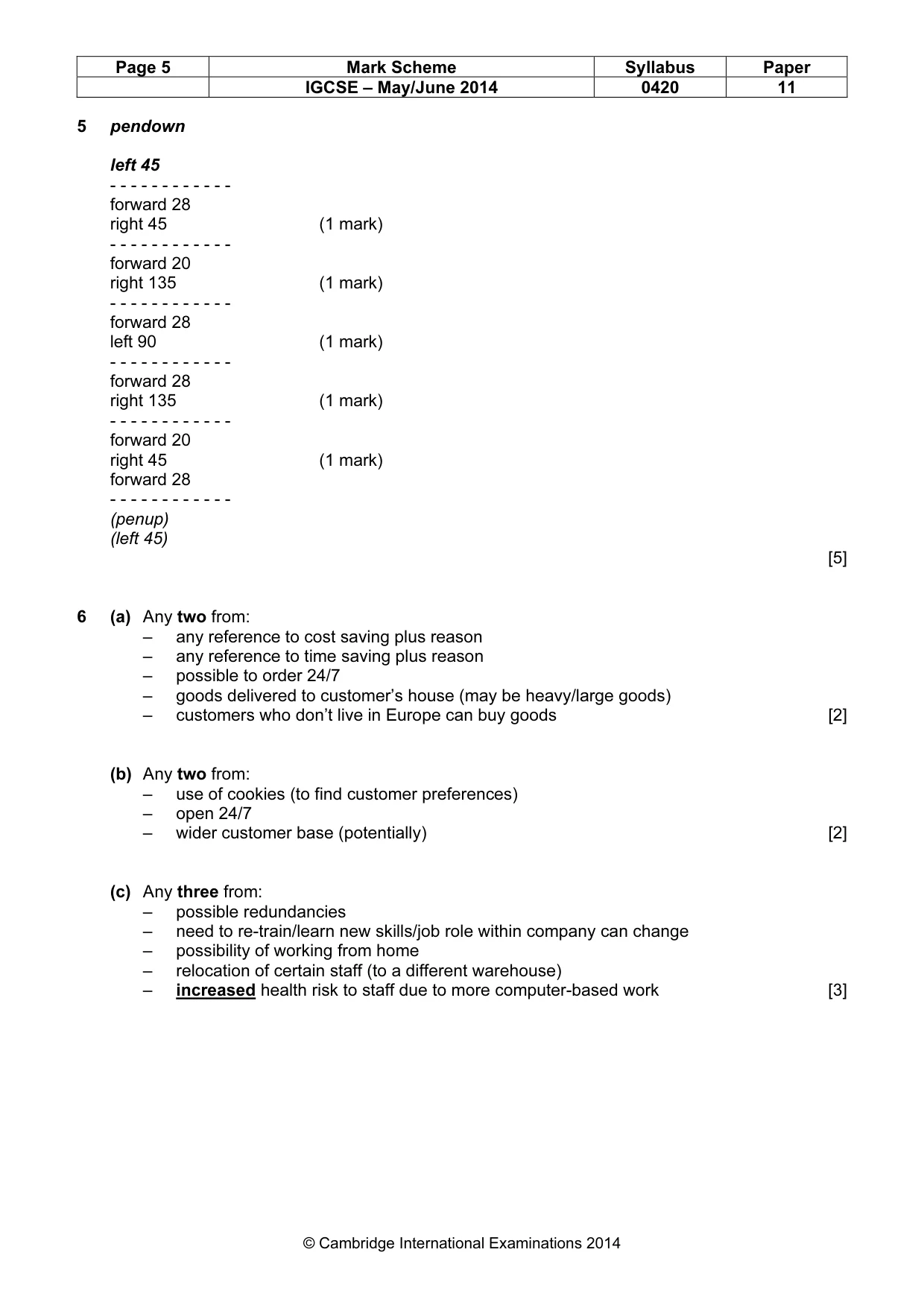
Page 5 Mark Scheme Syllabus Paper IGCSE – May/June 2014 0420 11 © Cambridge International Examinations 2014 5 pendown left 45 - - - - - - - - - - - - forward 28 right 45 (1 mark) - - - - - - - - - - - - forward 20 right 135 (1 mark) - - - - - - - - - - - - forward 28 left 90 (1 mark) - - - - - - - - - - - - forward 28 right 135 (1 mark) - - - - - - - - - - - - forward 20 right 45 (1 mark) forward 28 - - - - - - - - - - - - (penup) (left 45) [5] 6 (a) Any two from: – any reference to cost saving plus reason – any reference to time saving plus reason – possible to order 24/7 – goods delivered to customer’s house (may be heavy/large goods) – customers who don’t live in Europe can buy goods [2] (b) Any two from: – use of cookies (to find customer preferences) – open 24/7 – wider customer base (potentially) [2] (c) Any three from: – possible redundancies – need to re-train/learn new skills/job role within company can change – possibility of working from home – relocation of certain staff (to a different warehouse) – increased health risk to staff due to more computer-based work [3]
Mark scheme, page 6
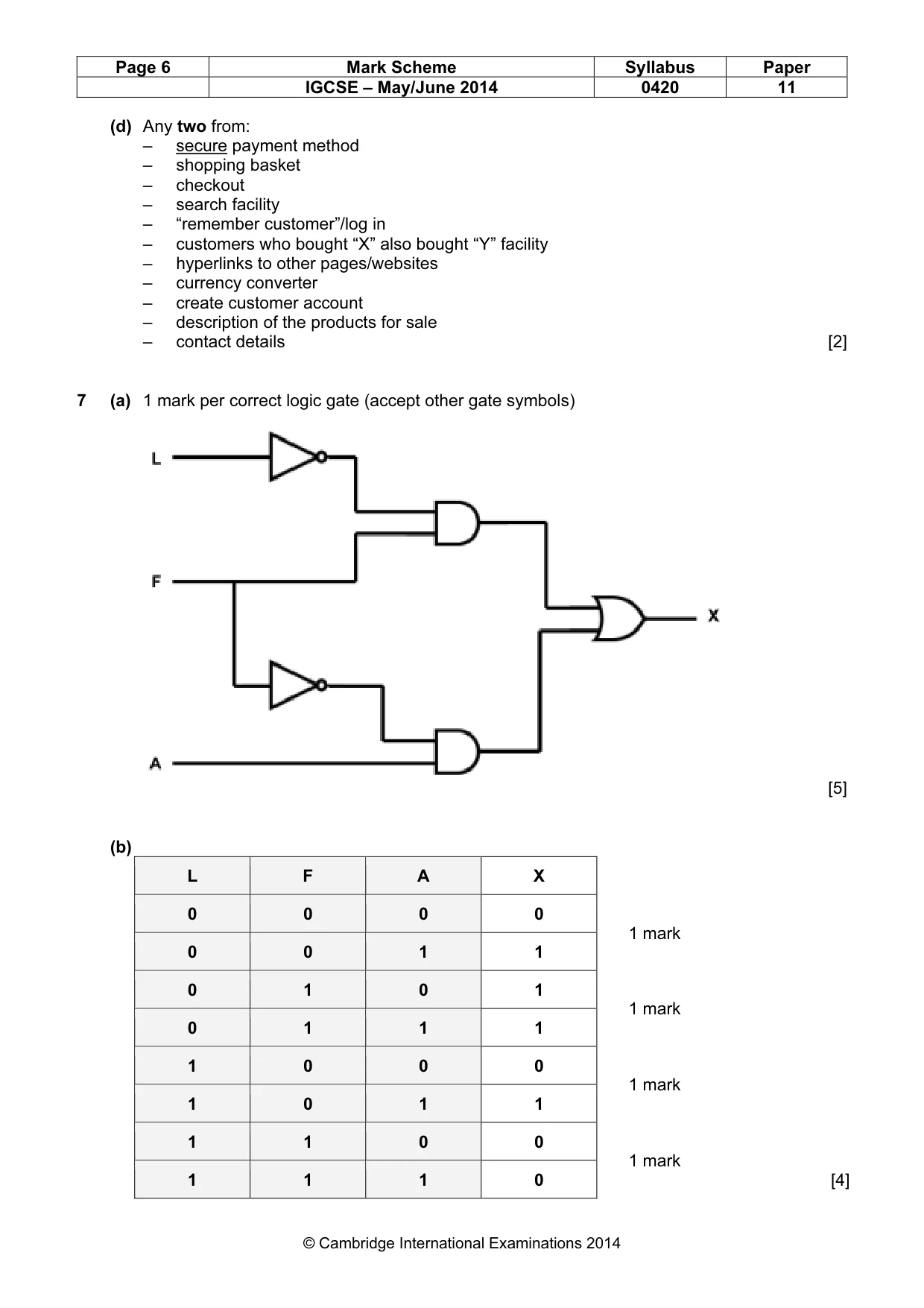
Page 6 Mark Scheme Syllabus Paper IGCSE – May/June 2014 0420 11 © Cambridge International Examinations 2014 (d) Any two from: – secure payment method – shopping basket – checkout – search facility – “remember customer”/log in – customers who bought “X” also bought “Y” facility – hyperlinks to other pages/websites – currency converter – create customer account – description of the products for sale – contact details [2] 7 (a) 1 mark per correct logic gate (accept other gate symbols) [5] (b) L F A X [4] 0 0 0 0 1 mark 0 0 1 1 0 1 0 1 1 mark 0 1 1 1 1 0 0 0 1 mark 1 0 1 1 1 1 0 0 1 mark 1 1 1 0
Mark scheme, page 7
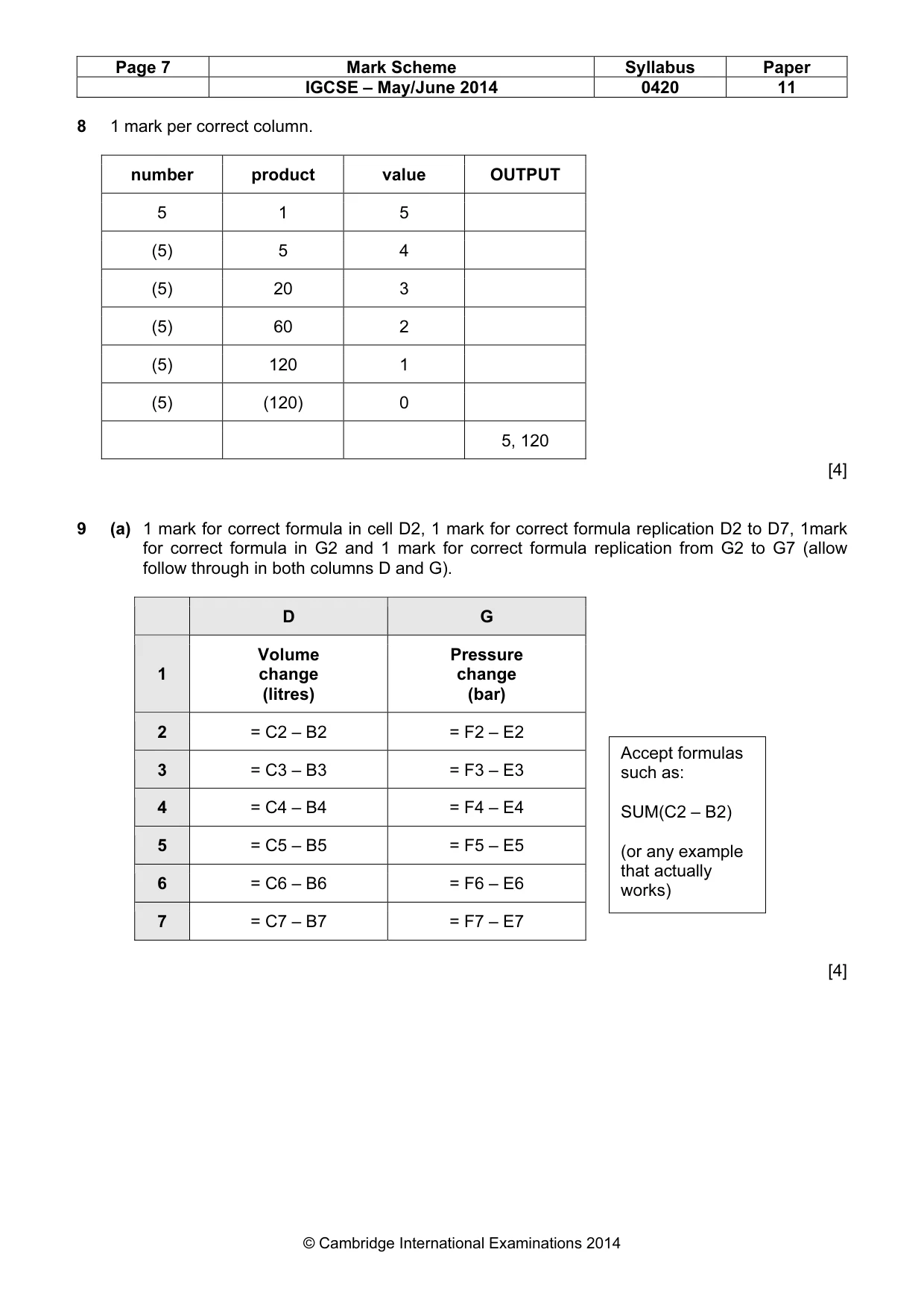
Page 7 Mark Scheme Syllabus Paper IGCSE – May/June 2014 0420 11 © Cambridge International Examinations 2014 8 1 mark per correct column. number product value OUTPUT 5 1 5 (5) 5 4 (5) 20 3 (5) 60 2 (5) 120 1 (5) (120) 0 5, 120 [4] 9 (a) 1 mark for correct formula in cell D2, 1 mark for correct formula replication D2 to D7, 1mark for correct formula in G2 and 1 mark for correct formula replication from G2 to G7 (allow follow through in both columns D and G). D G 1 Volume change (litres) Pressure change (bar) 2 = C2 – B2 = F2 – E2 3 = C3 – B3 = F3 – E3 4 = C4 – B4 = F4 – E4 5 = C5 – B5 = F5 – E5 6 = C6 – B6 = F6 – E6 7 = C7 – B7 = F7 – E7 [4] Accept formulas such as: SUM(C2 – B2) (or any example that actually works)
Mark scheme, page 8
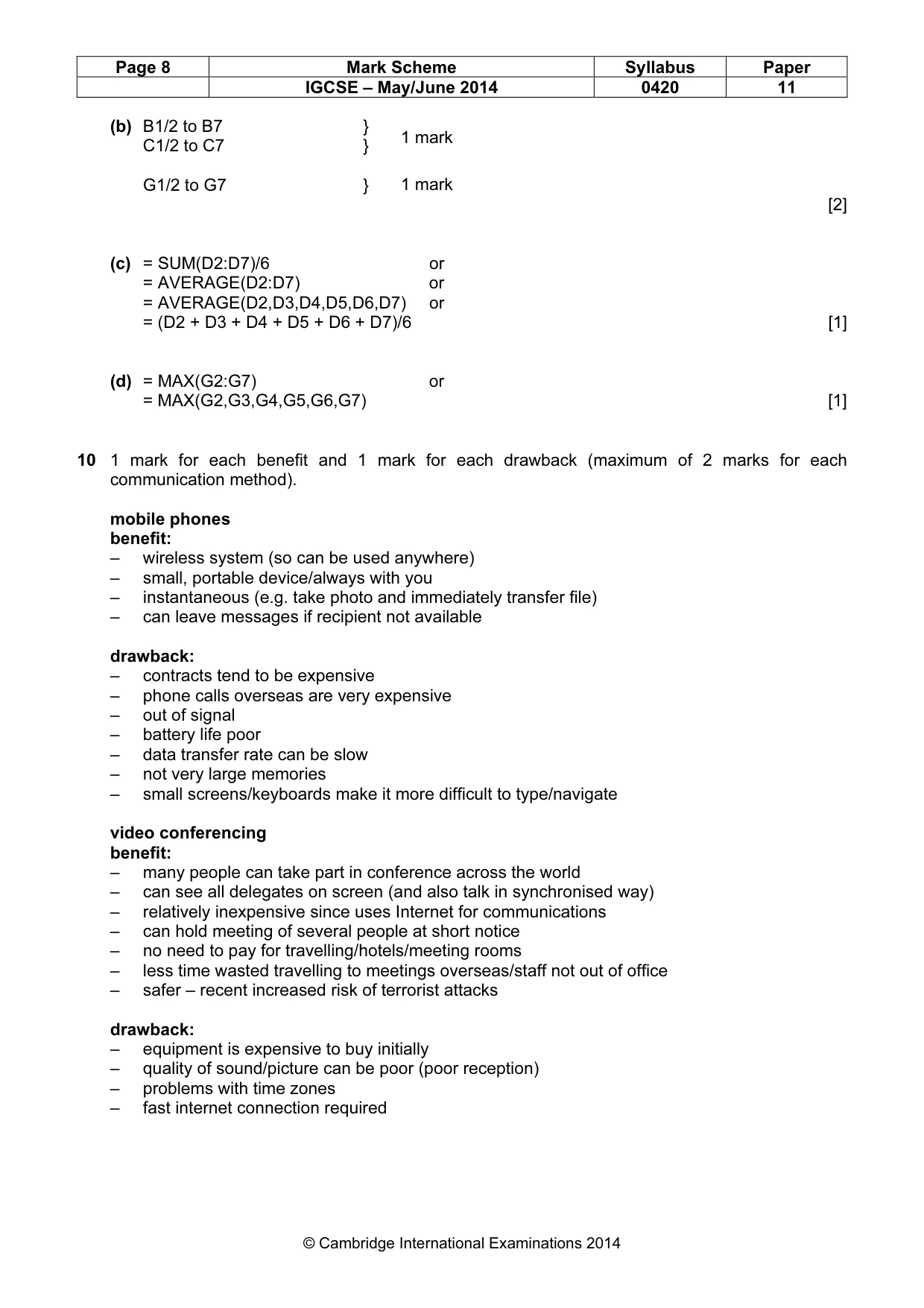
Page 8 Mark Scheme Syllabus Paper IGCSE – May/June 2014 0420 11 © Cambridge International Examinations 2014 (b) B1/2 to B7 } C1/2 to C7 } G1/2 to G7 } [2] (c) = SUM(D2:D7)/6 or = AVERAGE(D2:D7) or = AVERAGE(D2,D3,D4,D5,D6,D7) or = (D2 + D3 + D4 + D5 + D6 + D7)/6 [1] (d) = MAX(G2:G7) or = MAX(G2,G3,G4,G5,G6,G7) [1] 10 1 mark for each benefit and 1 mark for each drawback (maximum of 2 marks for each communication method). mobile phones benefit: – wireless system (so can be used anywhere) – small, portable device/always with you – instantaneous (e.g. take photo and immediately transfer file) – can leave messages if recipient not available drawback: – contracts tend to be expensive – phone calls overseas are very expensive – out of signal – battery life poor – data transfer rate can be slow – not very large memories – small screens/keyboards make it more difficult to type/navigate video conferencing benefit: – many people can take part in conference across the world – can see all delegates on screen (and also talk in synchronised way) – relatively inexpensive since uses Internet for communications – can hold meeting of several people at short notice – no need to pay for travelling/hotels/meeting rooms – less time wasted travelling to meetings overseas/staff not out of office – safer – recent increased risk of terrorist attacks drawback: – equipment is expensive to buy initially – quality of sound/picture can be poor (poor reception) – problems with time zones – fast internet connection required 1 mark 1 mark
Mark scheme, page 9
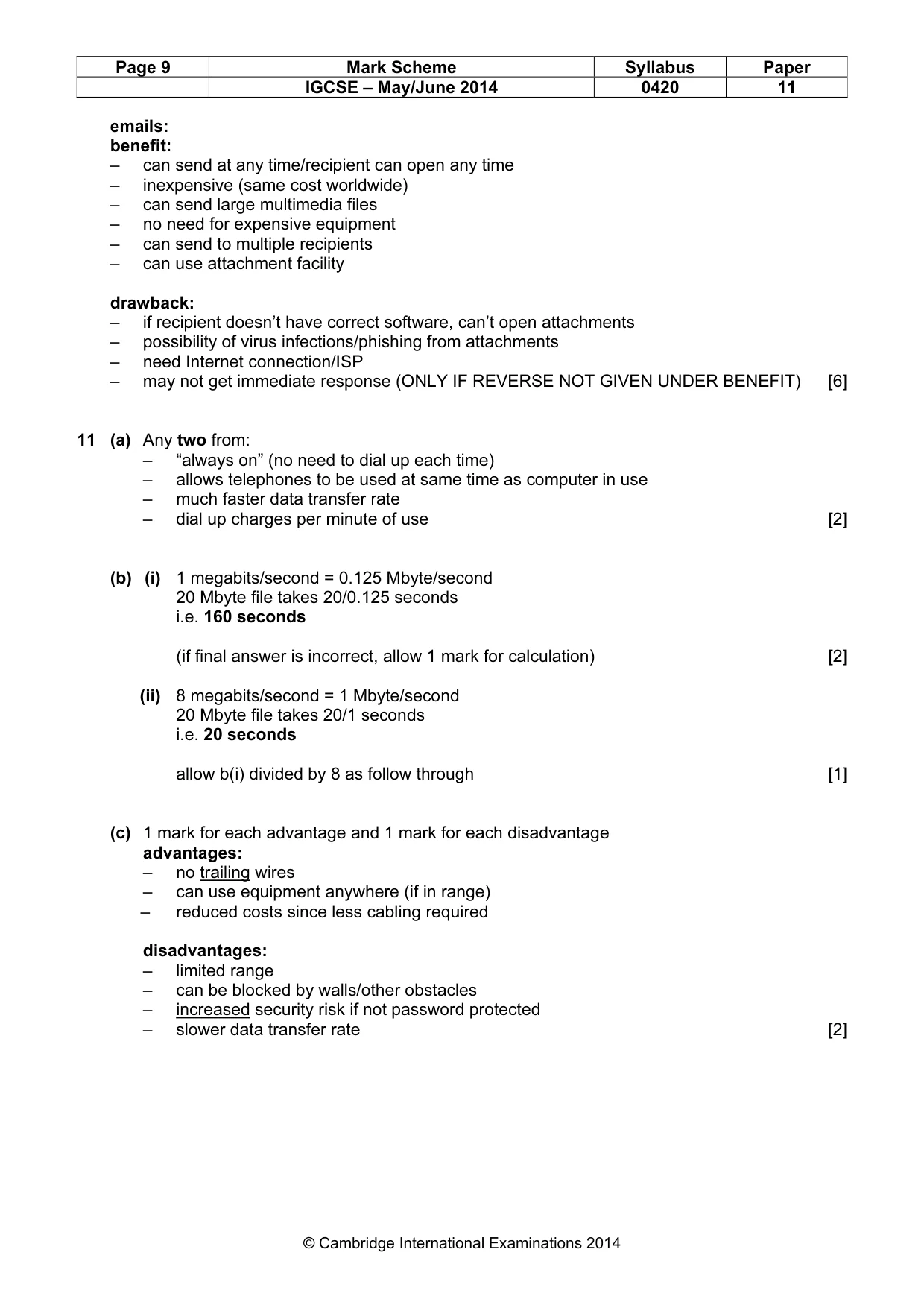
Page 9 Mark Scheme Syllabus Paper IGCSE – May/June 2014 0420 11 © Cambridge International Examinations 2014 emails: benefit: – can send at any time/recipient can open any time – inexpensive (same cost worldwide) – can send large multimedia files – no need for expensive equipment – can send to multiple recipients – can use attachment facility drawback: – if recipient doesn’t have correct software, can’t open attachments – possibility of virus infections/phishing from attachments – need Internet connection/ISP – may not get immediate response (ONLY IF REVERSE NOT GIVEN UNDER BENEFIT) [6] 11 (a) Any two from: – “always on” (no need to dial up each time) – allows telephones to be used at same time as computer in use – much faster data transfer rate – dial up charges per minute of use [2] (b) (i) 1 megabits/second = 0.125 Mbyte/second 20 Mbyte file takes 20/0.125 seconds i.e. 160 seconds (if final answer is incorrect, allow 1 mark for calculation) [2] (ii) 8 megabits/second = 1 Mbyte/second 20 Mbyte file takes 20/1 seconds i.e. 20 seconds allow b(i) divided by 8 as follow through [1] (c) 1 mark for each advantage and 1 mark for each disadvantage advantages: – no trailing wires – can use equipment anywhere (if in range) – reduced costs since less cabling required disadvantages: – limited range – can be blocked by walls/other obstacles – increased security risk if not password protected – slower data transfer rate [2]
Mark scheme, page 10
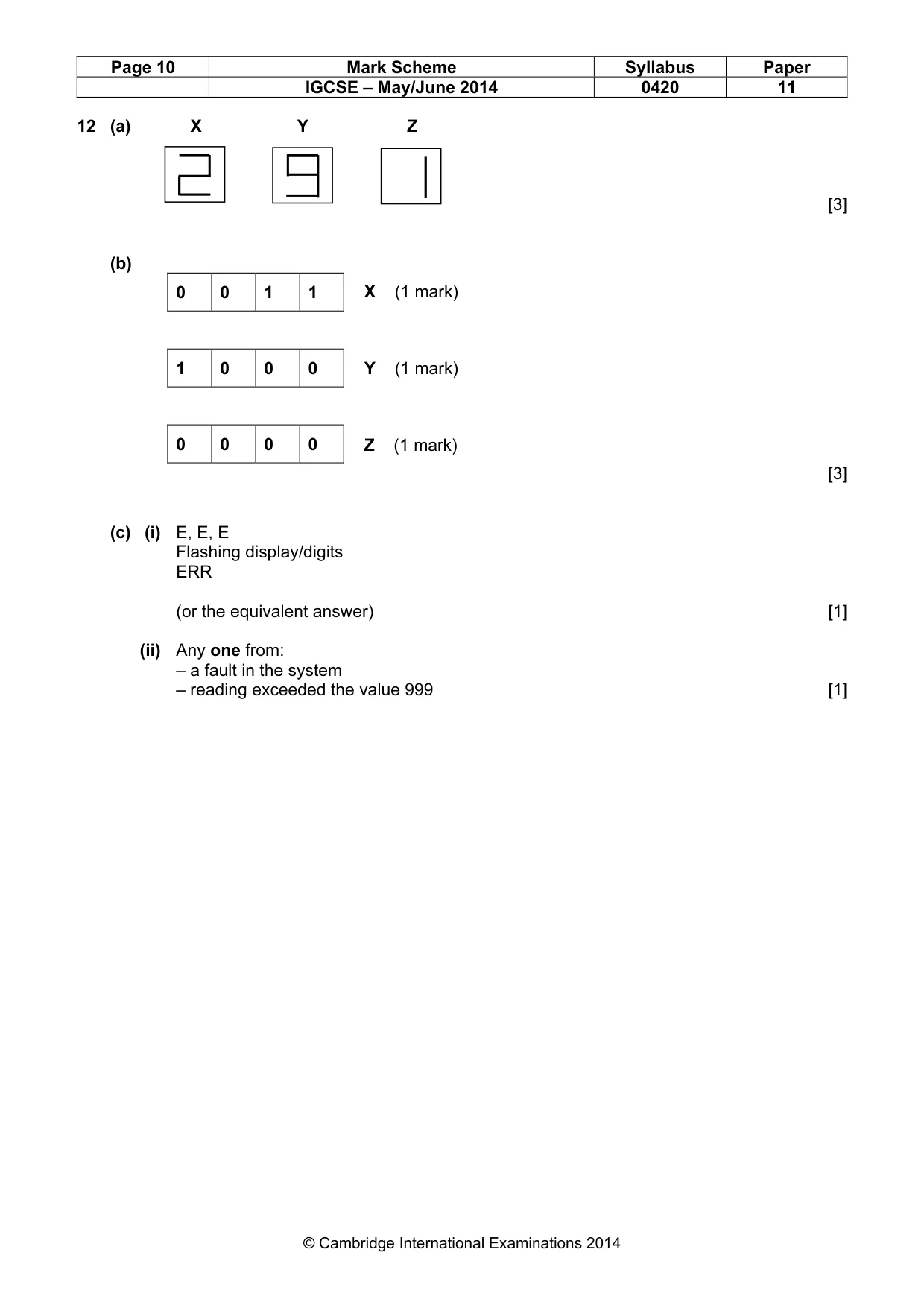
Page 10 Mark Scheme Syllabus Paper IGCSE – May/June 2014 0420 11 © Cambridge International Examinations 2014 12 (a) X Y Z [3] (b) 0 0 1 1 1 0 0 0 0 0 0 0 [3] (c) (i) E, E, E Flashing display/digits ERR (or the equivalent answer) [1] (ii) Any one from: – a fault in the system – reading exceeded the value 999 [1] X (1 mark) Y (1 mark) Z (1 mark)
Mark scheme, page 11
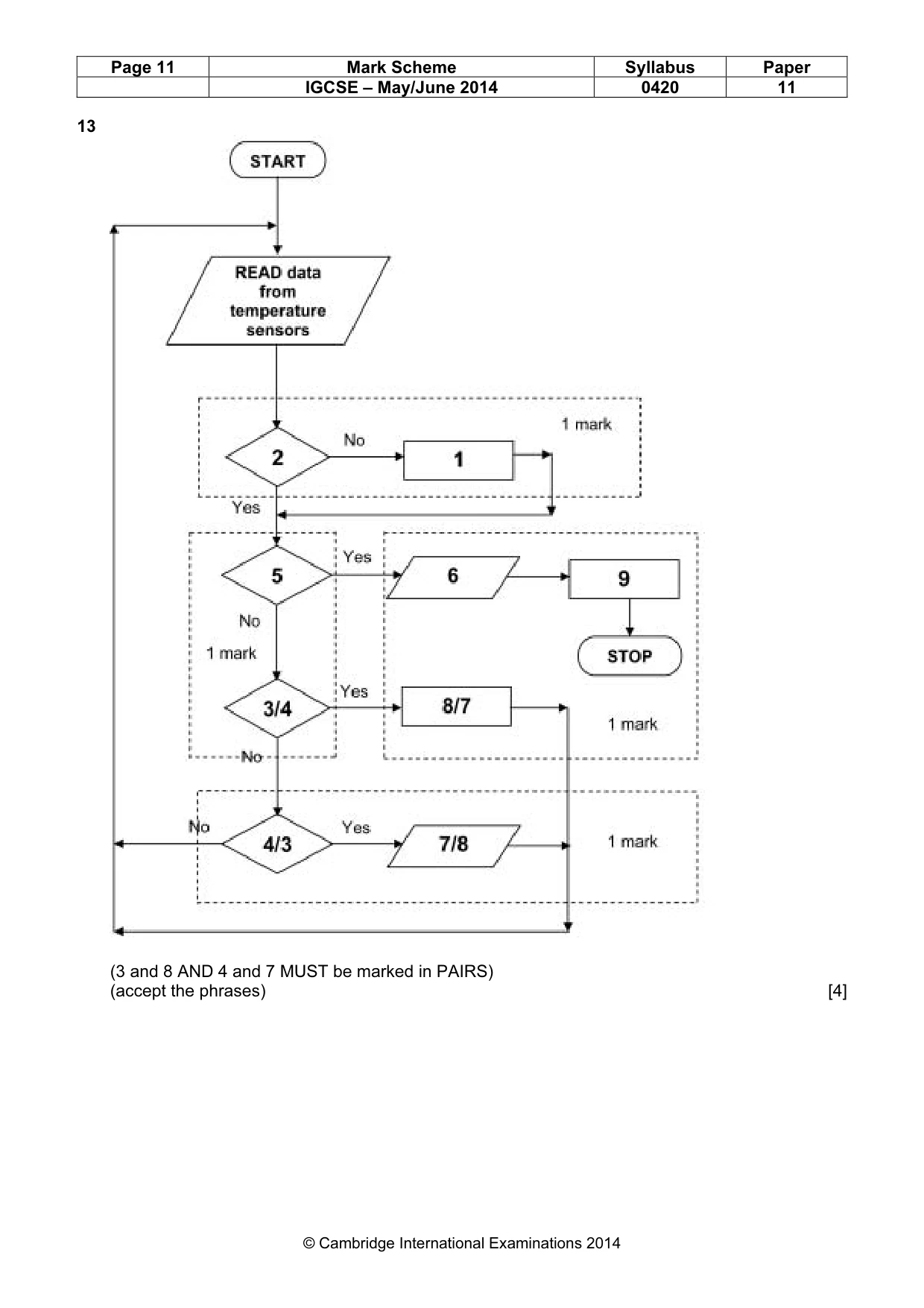
Page 11 Mark Scheme Syllabus Paper IGCSE – May/June 2014 0420 11 © Cambridge International Examinations 2014 13 (3 and 8 AND 4 and 7 MUST be marked in PAIRS) (accept the phrases) [4]
Mark scheme, page 12
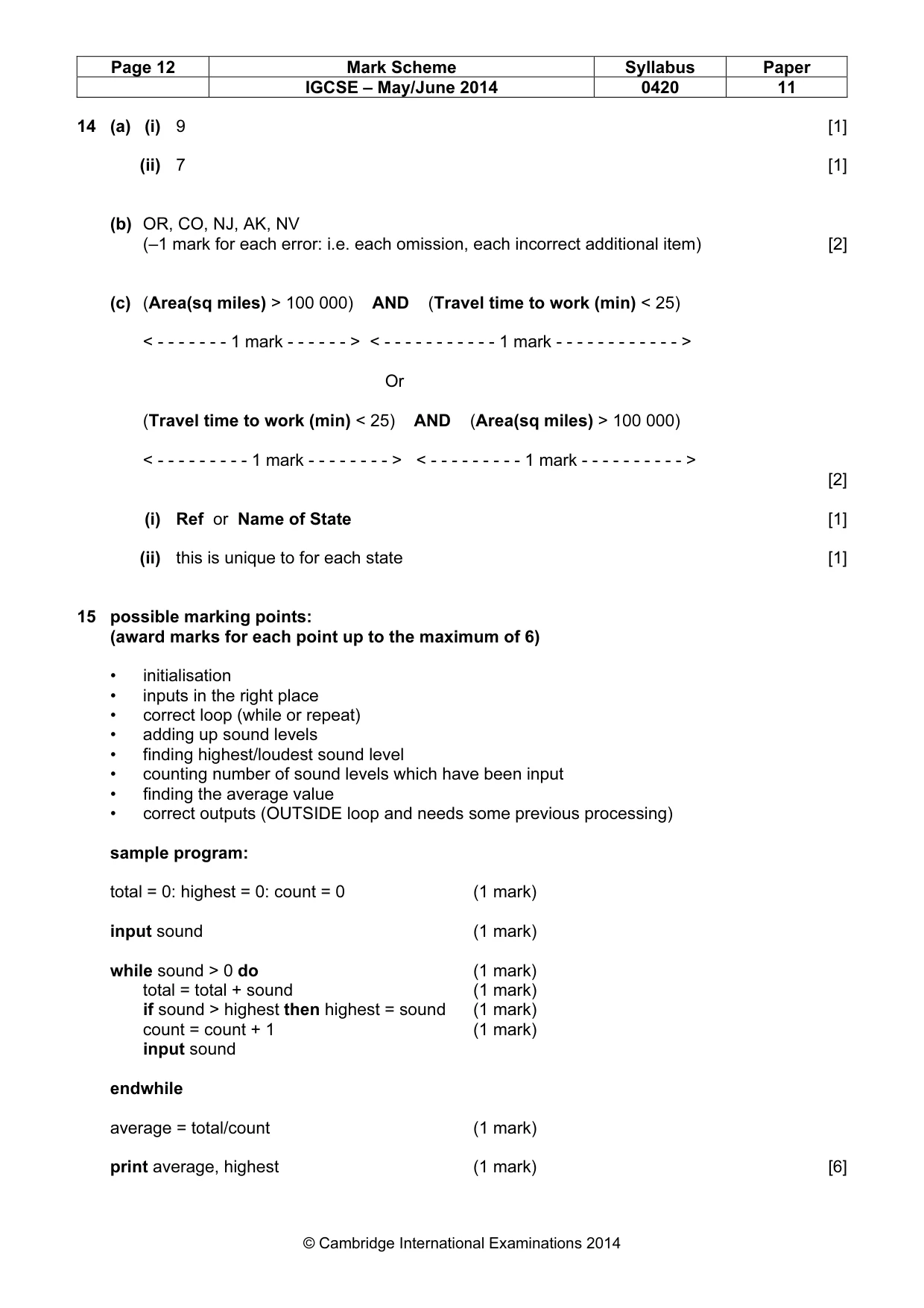
Page 12 Mark Scheme Syllabus Paper IGCSE – May/June 2014 0420 11 © Cambridge International Examinations 2014 14 (a) (i) 9 [1] (ii) 7 [1] (b) OR, CO, NJ, AK, NV (–1 mark for each error: i.e. each omission, each incorrect additional item) [2] (c) (Area(sq miles) > 100 000) AND (Travel time to work (min) < 25) < - - - - - - - 1 mark - - - - - - > < - - - - - - - - - - - 1 mark - - - - - - - - - - - - > Or (Travel time to work (min) < 25) AND (Area(sq miles) > 100 000) < - - - - - - - - - 1 mark - - - - - - - - > < - - - - - - - - - 1 mark - - - - - - - - - - > [2] (i) Ref or Name of State [1] (ii) this is unique to for each state [1] 15 possible marking points: (award marks for each point up to the maximum of 6) • initialisation • inputs in the right place • correct loop (while or repeat) • adding up sound levels • finding highest/loudest sound level • counting number of sound levels which have been input • finding the average value • correct outputs (OUTSIDE loop and needs some previous processing) sample program: total = 0: highest = 0: count = 0 (1 mark) input sound (1 mark) while sound > 0 do (1 mark) total = total + sound (1 mark) if sound > highest then highest = sound (1 mark) count = count + 1 (1 mark) input sound endwhile average = total/count (1 mark) print average, highest (1 mark) [6]
What you needed in this session
Cambridge’s own grade thresholds for 2014 May/June, Paper 1 · Variant 1. A higher threshold means an easier paper — the bar moves with how the cohort did.