Cambridge IGCSE Computer Science (9-1) 0984 — 2023 Oct/Nov Paper 1 · Variant 2
0984/12/O/N/23 · 75 marks · ≈84 min
The question paper and its mark scheme, free to read here and free to download. This is Cambridge’s own paper, exactly as it was sat.
Question paper12 pages
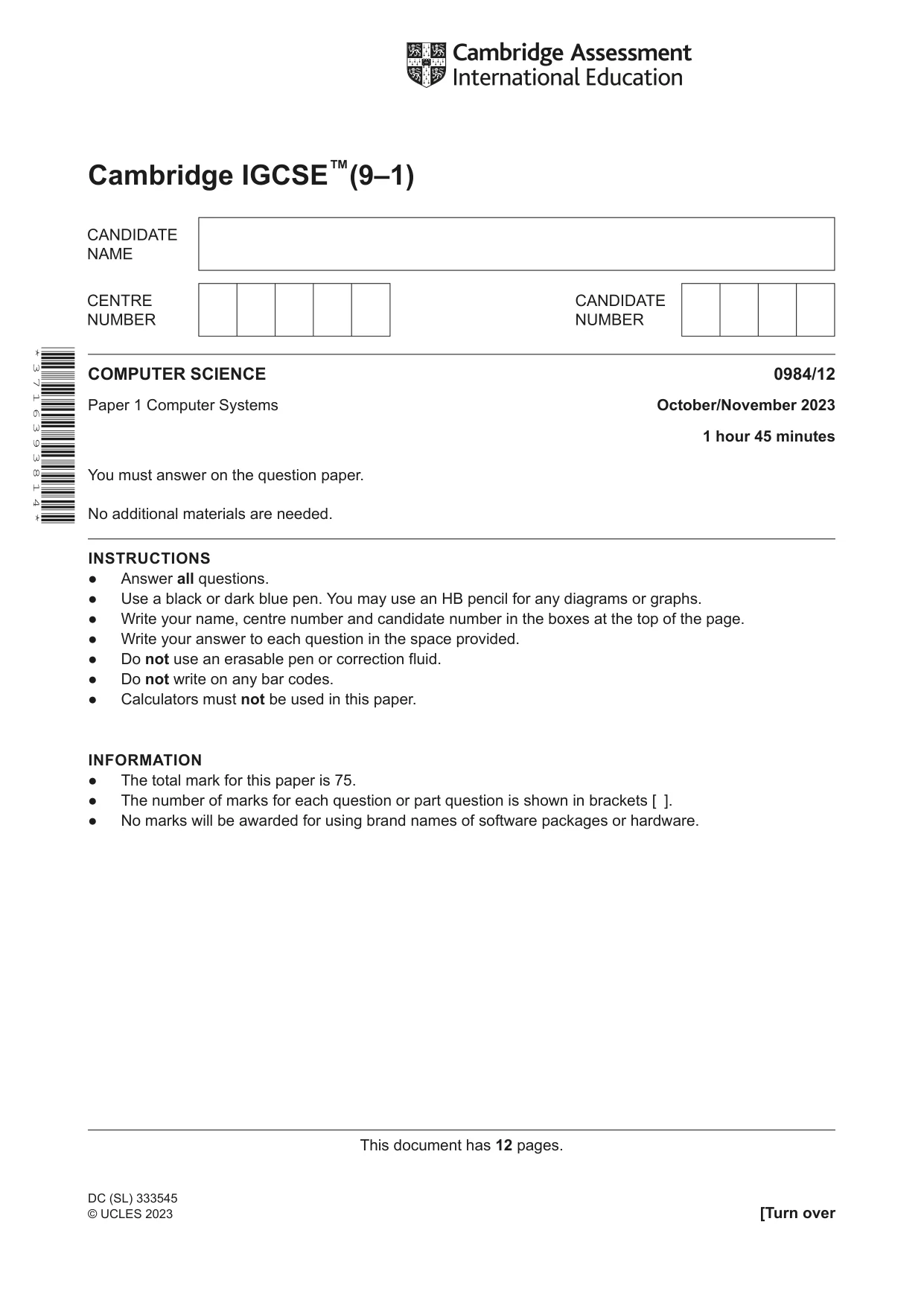


Mark scheme10 pages
Answers below. Sit the paper first if you are practising.

Paper as text
Question paper, page 1
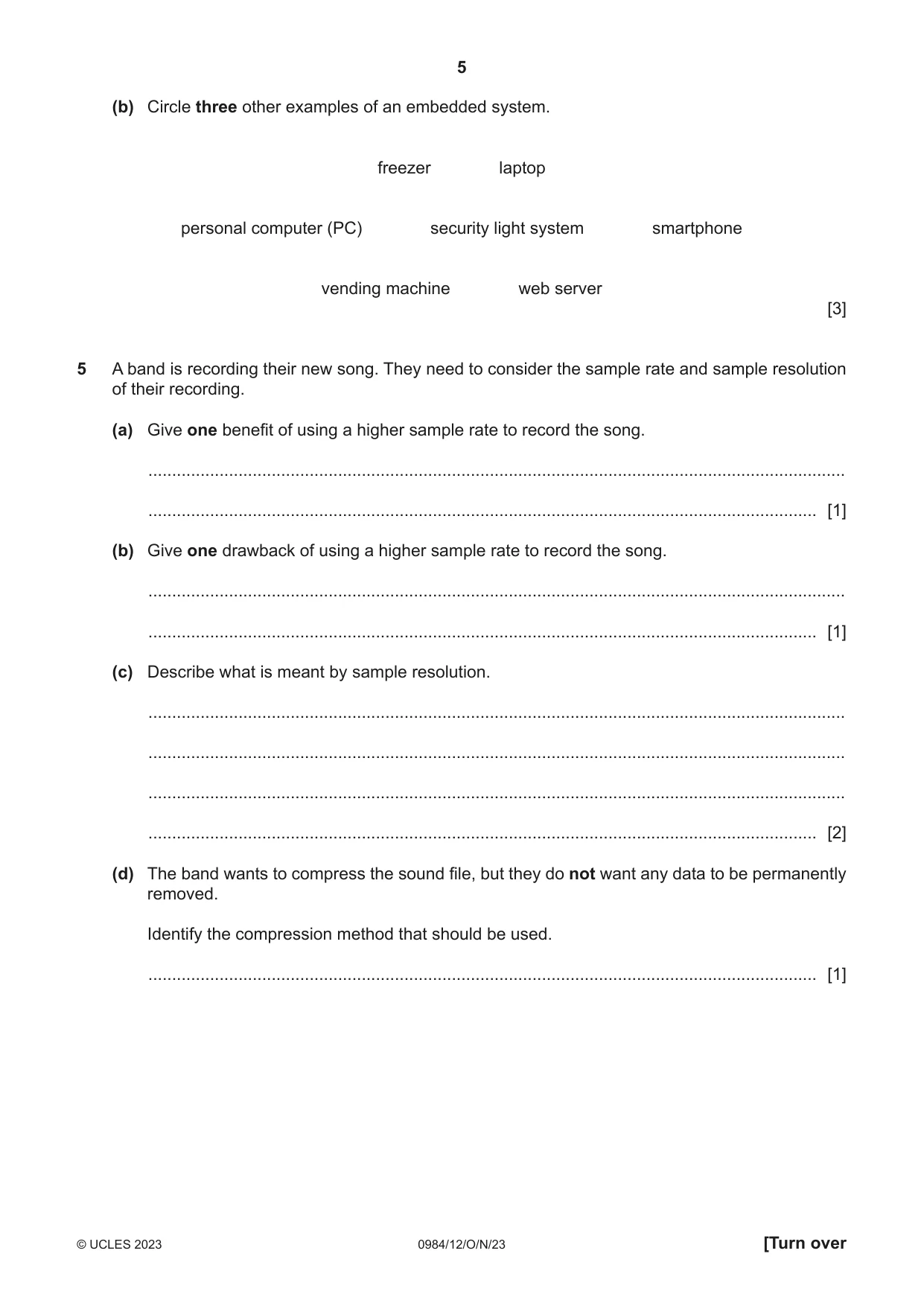
This document has 12 pages. [Turn over Cambridge IGCSE™(9–1) COMPUTER SCIENCE 0984/12 Paper 1 Computer Systems October/November 2023 1 hour 45 minutes You must answer on the question paper. No additional materials are needed. INSTRUCTIONS ● Answer all questions. ● Use a black or dark blue pen. You may use an HB pencil for any diagrams or graphs. ● Write your name, centre number and candidate number in the boxes at the top of the page. ● Write your answer to each question in the space provided. ● Do not use an erasable pen or correction fluid. ● Do not write on any bar codes. ● Calculators must not be used in this paper. INFORMATION ● The total mark for this paper is 75. ● The number of marks for each question or part question is shown in brackets [ ]. ● No marks will be awarded for using brand names of software packages or hardware. * 3 7 1 6 3 9 3 8 1 4 * DC (SL) 333545 © UCLES 2023
Question paper, page 2
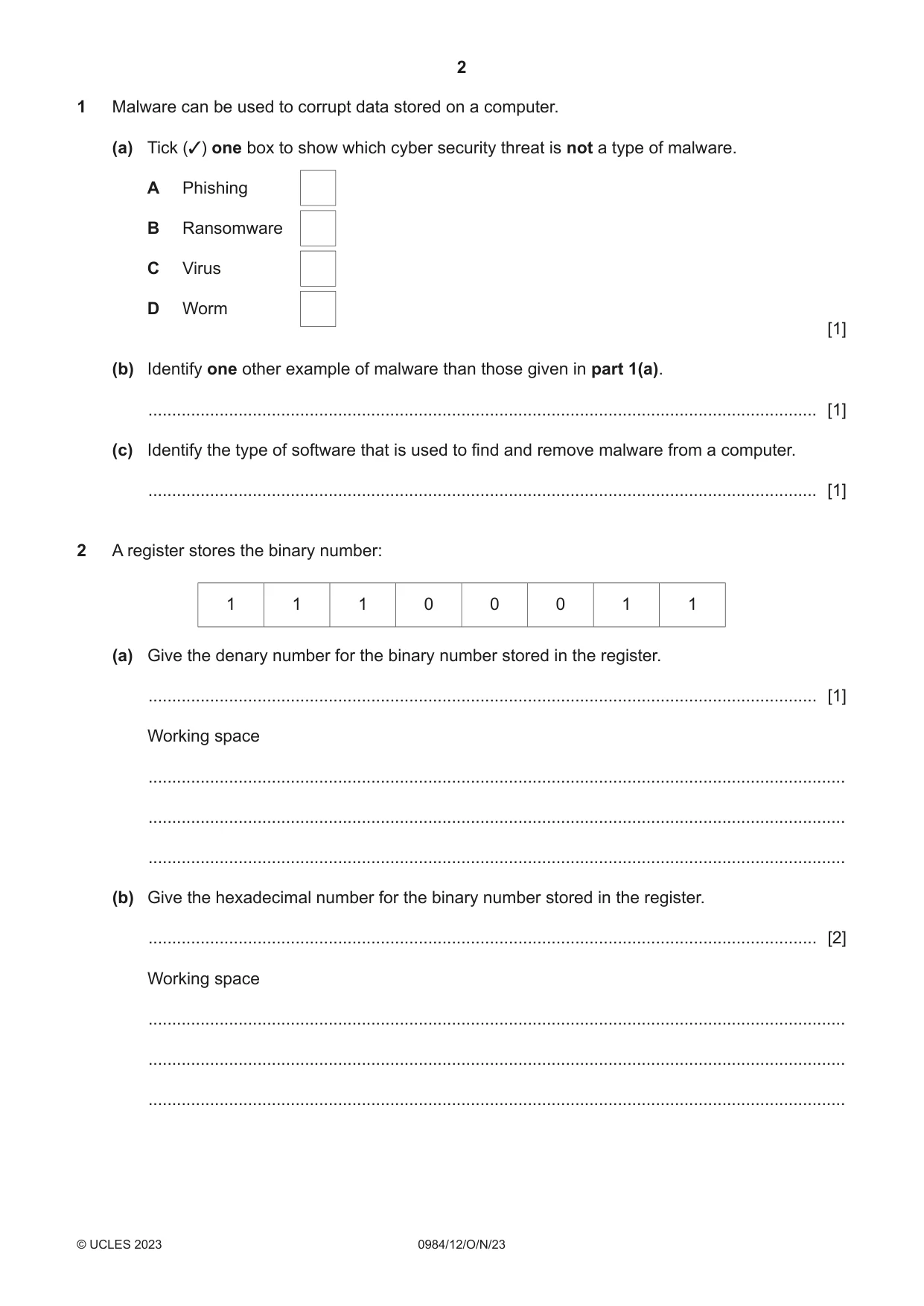
2 0984/12/O/N/23 © UCLES 2023 1 Malware can be used to corrupt data stored on a computer. (a) Tick (3) one box to show which cyber security threat is not a type of malware. A Phishing B Ransomware C Virus D Worm [1] (b) Identify one other example of malware than those given in part 1(a). … [1] (c) Identify the type of software that is used to find and remove malware from a computer. … [1] 2 A register stores the binary number: 1 1 1 0 0 0 1 1 (a) Give the denary number for the binary number stored in the register. … [1] Working space … … … (b) Give the hexadecimal number for the binary number stored in the register. … [2] Working space … … …
Question paper, page 3
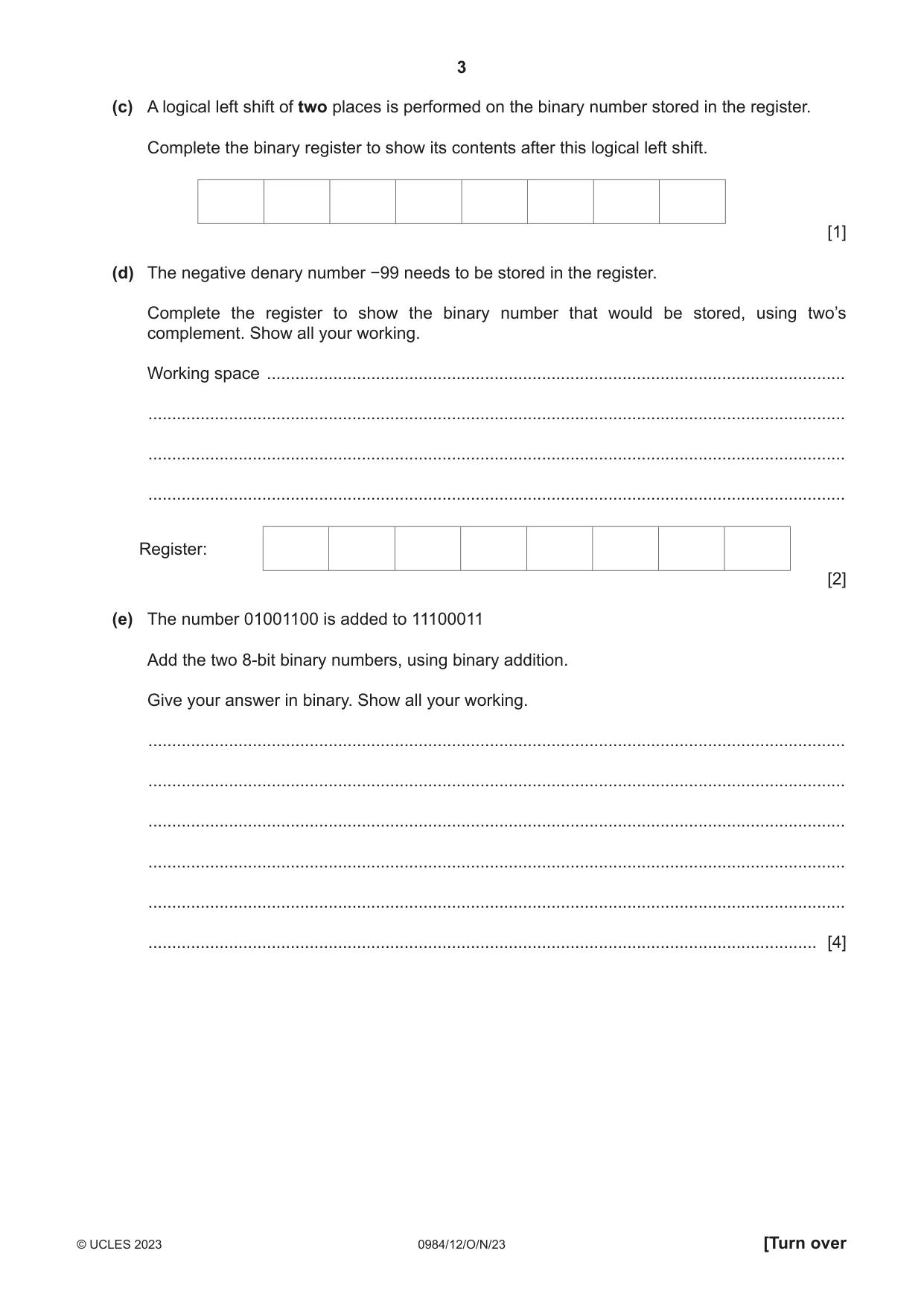
3 0984/12/O/N/23 © UCLES 2023 [Turn over (c) A logical left shift of two places is performed on the binary number stored in the register. Complete the binary register to show its contents after this logical left shift. [1] (d) The negative denary number −99 needs to be stored in the register. Complete the register to show the binary number that would be stored, using two’s complement. Show all your working. Working space … … … … Register: [2] (e) The number 01001100 is added to 11100011 Add the two 8-bit binary numbers, using binary addition. Give your answer in binary. Show all your working. … … … … … … [4]
Question paper, page 4
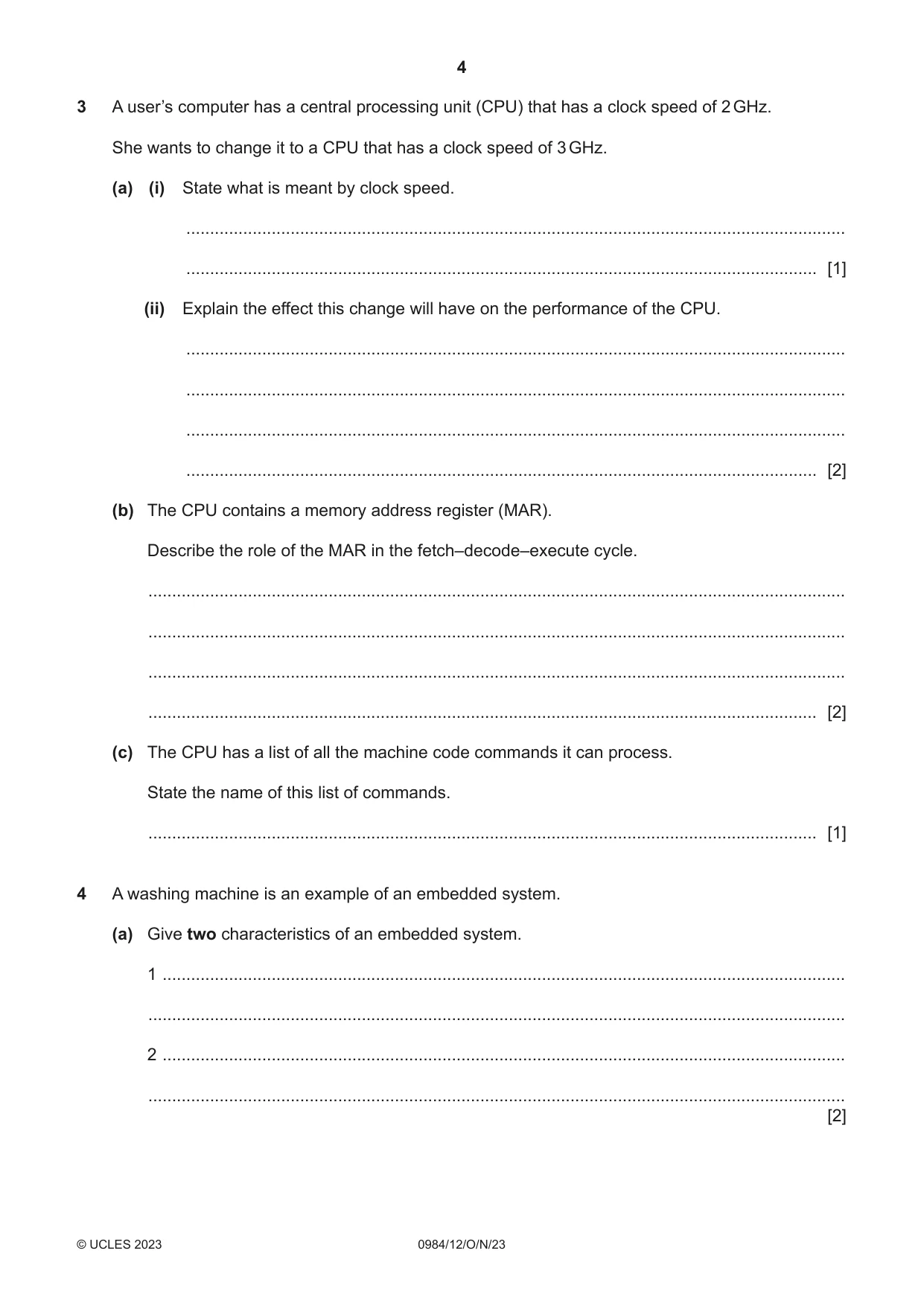
4 0984/12/O/N/23 © UCLES 2023 3 A user’s computer has a central processing unit (CPU) that has a clock speed of 2 GHz. She wants to change it to a CPU that has a clock speed of 3 GHz. (a) (i) State what is meant by clock speed. … … [1] (ii) Explain the effect this change will have on the performance of the CPU. … … … … [2] (b) The CPU contains a memory address register (MAR). Describe the role of the MAR in the fetch–decode–execute cycle. … … … … [2] (c) The CPU has a list of all the machine code commands it can process. State the name of this list of commands. … [1] 4 A washing machine is an example of an embedded system. (a) Give two characteristics of an embedded system. 1 … … 2 … … [2]
Question paper, page 5
5 0984/12/O/N/23 © UCLES 2023 [Turn over (b) Circle three other examples of an embedded system. freezer laptop personal computer (PC) security light system smartphone vending machine web server [3] 5 A band is recording their new song. They need to consider the sample rate and sample resolution of their recording. (a) Give one benefit of using a higher sample rate to record the song. … … [1] (b) Give one drawback of using a higher sample rate to record the song. … … [1] (c) Describe what is meant by sample resolution. … … … … [2] (d) The band wants to compress the sound file, but they do not want any data to be permanently removed. Identify the compression method that should be used. … [1]
Question paper, page 6
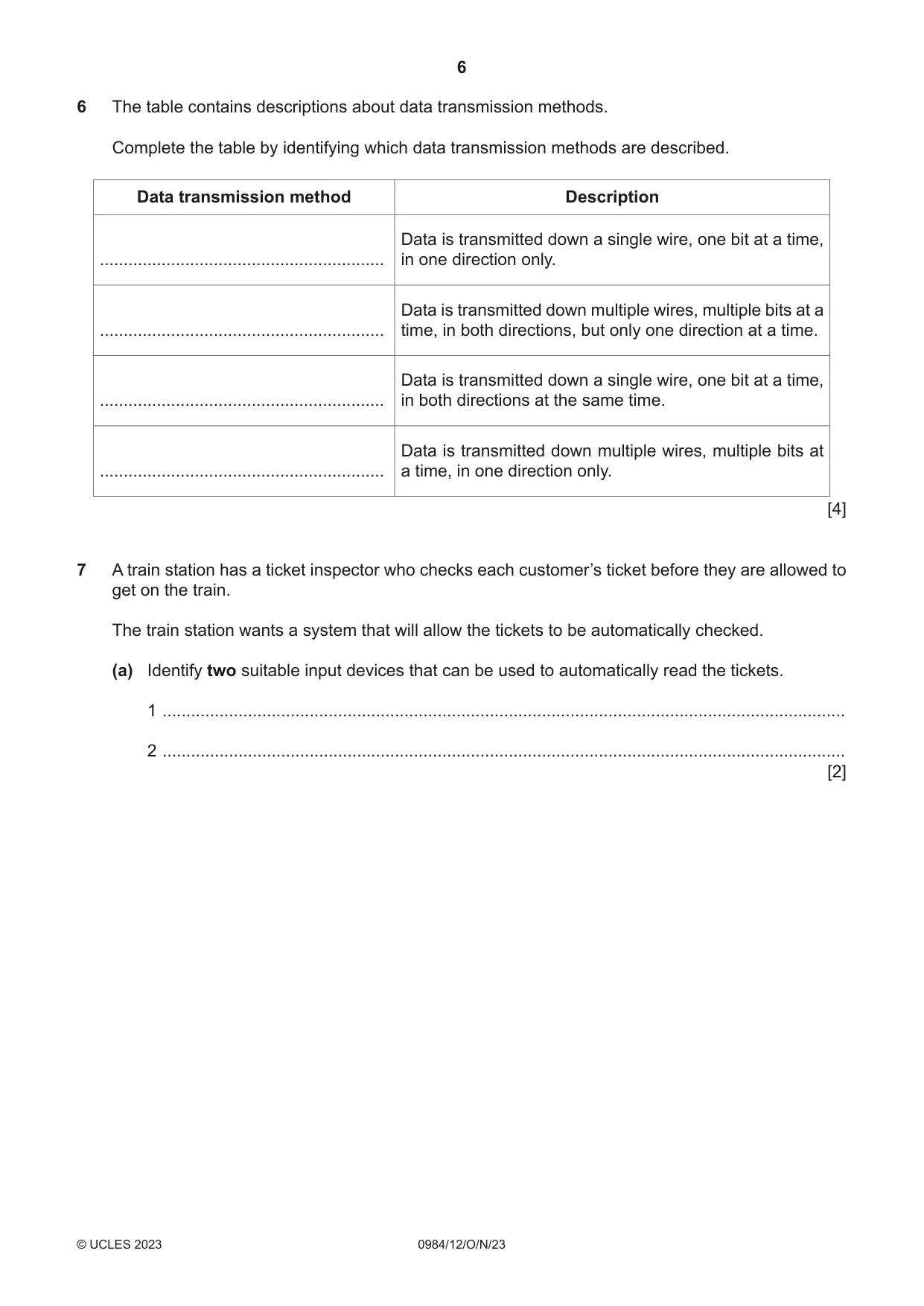
6 0984/12/O/N/23 © UCLES 2023 6 The table contains descriptions about data transmission methods. Complete the table by identifying which data transmission methods are described. Data transmission method Description … Data is transmitted down a single wire, one bit at a time, in one direction only. … Data is transmitted down multiple wires, multiple bits at a time, in both directions, but only one direction at a time. … Data is transmitted down a single wire, one bit at a time, in both directions at the same time. … Data is transmitted down multiple wires, multiple bits at a time, in one direction only. [4] 7 A train station has a ticket inspector who checks each customer’s ticket before they are allowed to get on the train. The train station wants a system that will allow the tickets to be automatically checked. (a) Identify two suitable input devices that can be used to automatically read the tickets. 1 … 2 … [2]
Question paper, page 7
7 0984/12/O/N/23 © UCLES 2023 [Turn over (b) The train driver pushes a button to close the train door when all passengers have boarded the train. The train door will only close when there are no passengers in the doorway. The system to check there are no passengers in the doorway uses a sensor and a microprocessor. Explain how the sensor and the microprocessor are used to check whether the train door can be closed. … … … … … … … … … … … … [6]
Question paper, page 8
8 0984/12/O/N/23 © UCLES 2023 8 (a) Draw and annotate a diagram that demonstrates the cyber security threat of data interception. [4] (b) Identify one security solution that will help keep data safe from data interception and state why it will help keep the data safe. … … … … [2]
Question paper, page 9
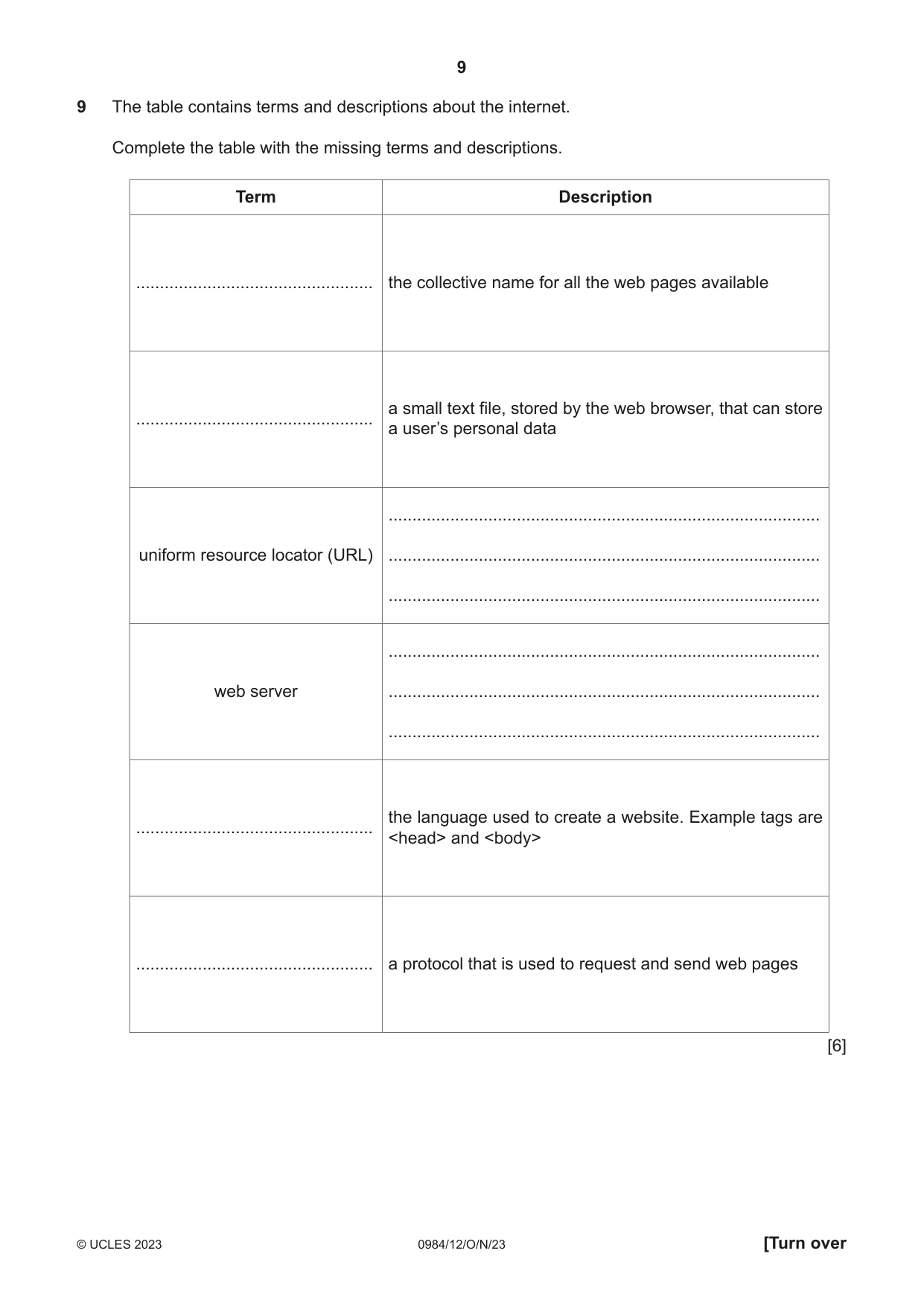
9 0984/12/O/N/23 © UCLES 2023 [Turn over 9 The table contains terms and descriptions about the internet. Complete the table with the missing terms and descriptions. Term Description … the collective name for all the web pages available … a small text file, stored by the web browser, that can store a user’s personal data uniform resource locator (URL) … … … web server … … … … the language used to create a website. Example tags are <head> and <body> … a protocol that is used to request and send web pages [6]
Question paper, page 10
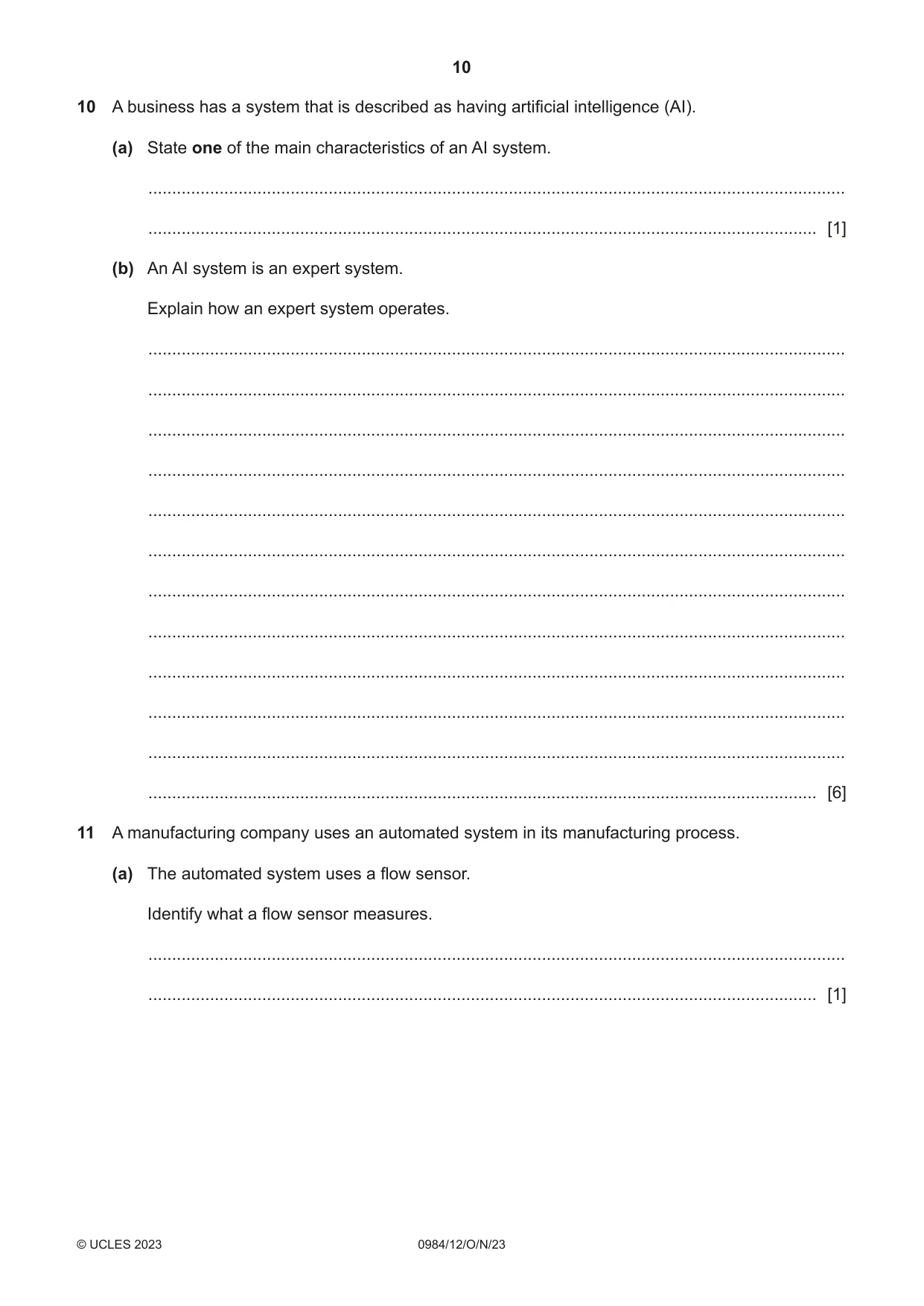
10 0984/12/O/N/23 © UCLES 2023 10 A business has a system that is described as having artificial intelligence (AI). (a) State one of the main characteristics of an AI system. … … [1] (b) An AI system is an expert system. Explain how an expert system operates. … … … … … … … … … … … … [6] 11 A manufacturing company uses an automated system in its manufacturing process. (a) The automated system uses a flow sensor. Identify what a flow sensor measures. … … [1]
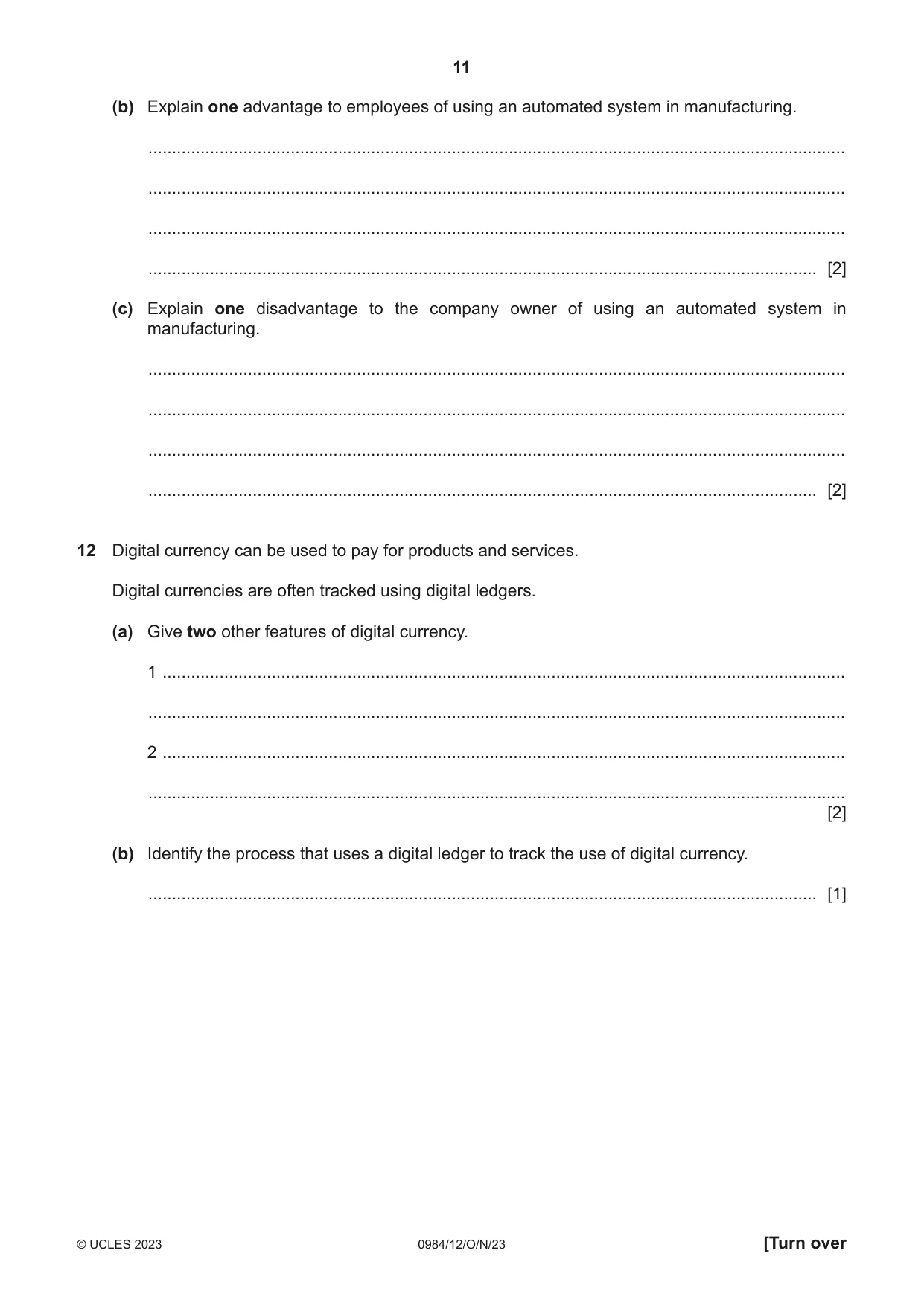
Question paper, page 11
11 0984/12/O/N/23 © UCLES 2023 [Turn over (b) Explain one advantage to employees of using an automated system in manufacturing. … … … … [2] (c) Explain one disadvantage to the company owner of using an automated system in manufacturing. … … … … [2] 12 Digital currency can be used to pay for products and services. Digital currencies are often tracked using digital ledgers. (a) Give two other features of digital currency. 1 … … 2 … … [2] (b) Identify the process that uses a digital ledger to track the use of digital currency. … [1]
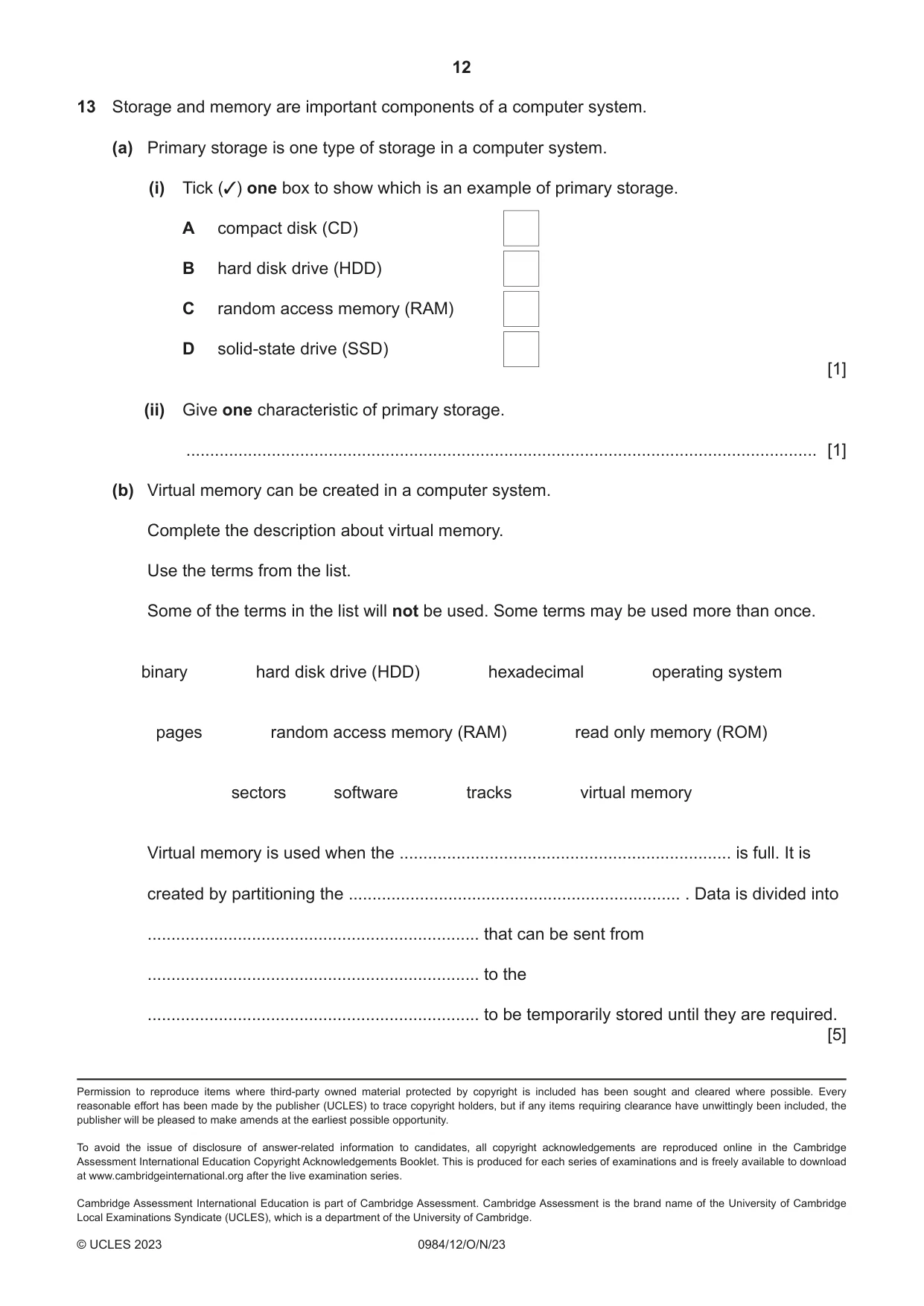
Question paper, page 12
12 0984/12/O/N/23 © UCLES 2023 13 Storage and memory are important components of a computer system. (a) Primary storage is one type of storage in a computer system. (i) Tick (3) one box to show which is an example of primary storage. A compact disk (CD) B hard disk drive (HDD) C random access memory (RAM) D solid-state drive (SSD) [1] (ii) Give one characteristic of primary storage. … [1] (b) Virtual memory can be created in a computer system. Complete the description about virtual memory. Use the terms from the list. Some of the terms in the list will not be used. Some terms may be used more than once. binary hard disk drive (HDD) hexadecimal operating system pages random access memory (RAM) read only memory (ROM) sectors software tracks virtual memory Virtual memory is used when the … is full. It is created by partitioning the … . Data is divided into … that can be sent from … to the … to be temporarily stored until they are required. [5] Permission to reproduce items where third-party owned material protected by copyright is included has been sought and cleared where possible. Every reasonable effort has been made by the publisher (UCLES) to trace copyright holders, but if any items requiring clearance have unwittingly been included, the publisher will be pleased to make amends at the earliest possible opportunity. To avoid the issue of disclosure of answer-related information to candidates, all copyright acknowledgements are reproduced online in the Cambridge Assessment International Education Copyright Acknowledgements Booklet. This is produced for each series of examinations and is freely available to download at www.cambridgeinternational.org after the live examination series. Cambridge Assessment International Education is part of Cambridge Assessment. Cambridge Assessment is the brand name of the University of Cambridge Local Examinations Syndicate (UCLES), which is a department of the University of Cambridge.
Mark scheme, page 1
This document consists of 10 printed pages. © UCLES 2023 [Turn over Cambridge IGCSE™ (9–1) COMPUTER SCIENCE 0984/12 Paper 1 Computer Systems October/November 2023 MARK SCHEME Maximum Mark: 75 Published This mark scheme is published as an aid to teachers and candidates, to indicate the requirements of the examination. It shows the basis on which Examiners were instructed to award marks. It does not indicate the details of the discussions that took place at an Examiners’ meeting before marking began, which would have considered the acceptability of alternative answers. Mark schemes should be read in conjunction with the question paper and the Principal Examiner Report for Teachers. Cambridge International will not enter into discussions about these mark schemes. Cambridge International is publishing the mark schemes for the October/November 2023 series for most Cambridge IGCSE, Cambridge International A and AS Level components, and some Cambridge O Level components.
Mark scheme, page 2
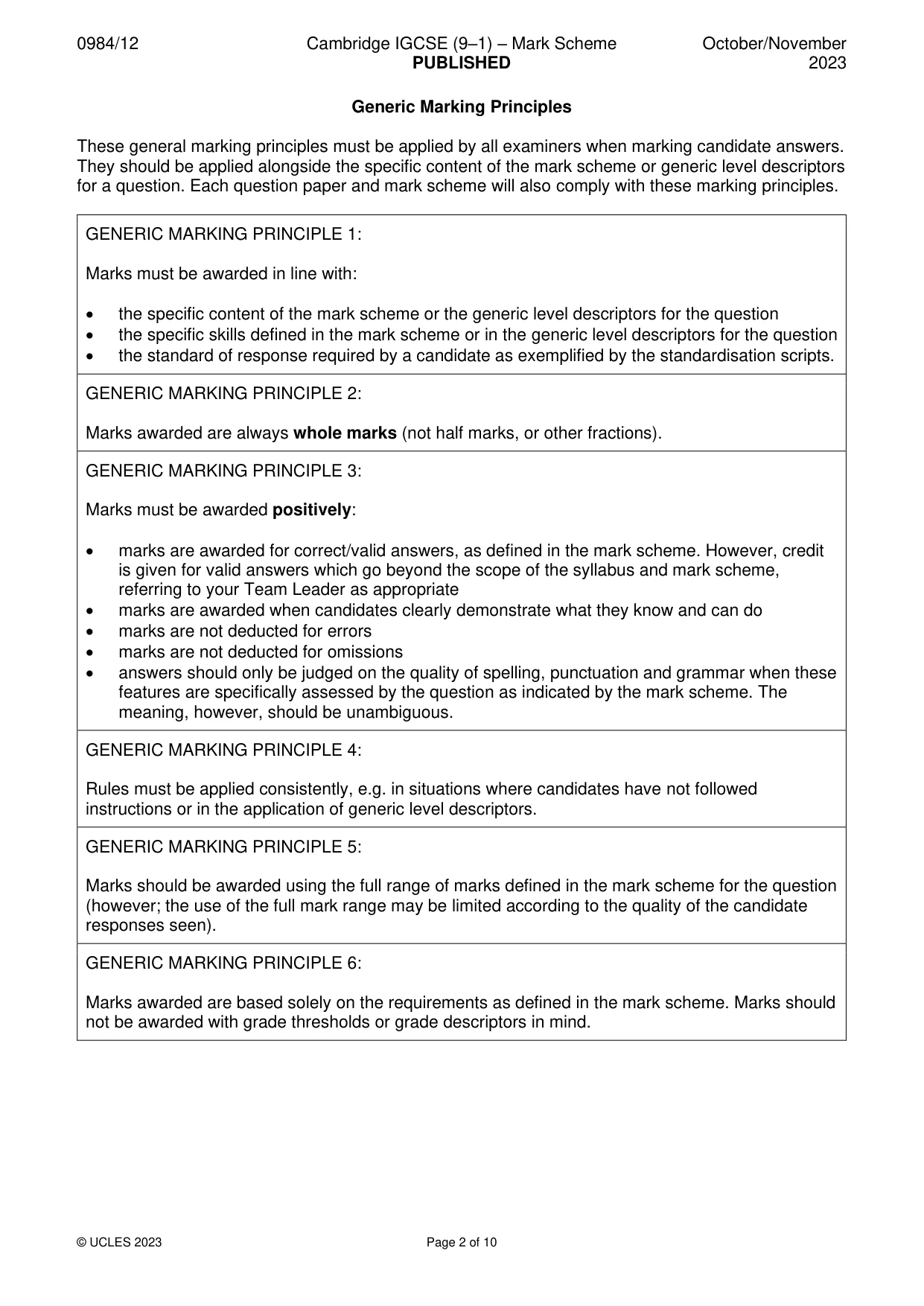
0984/12 Cambridge IGCSE (9–1) – Mark Scheme PUBLISHED October/November 2023 © UCLES 2023 Page 2 of 10 Generic Marking Principles These general marking principles must be applied by all examiners when marking candidate answers. They should be applied alongside the specific content of the mark scheme or generic level descriptors for a question. Each question paper and mark scheme will also comply with these marking principles. GENERIC MARKING PRINCIPLE 1: Marks must be awarded in line with: • the specific content of the mark scheme or the generic level descriptors for the question • the specific skills defined in the mark scheme or in the generic level descriptors for the question • the standard of response required by a candidate as exemplified by the standardisation scripts. GENERIC MARKING PRINCIPLE 2: Marks awarded are always whole marks (not half marks, or other fractions). GENERIC MARKING PRINCIPLE 3: Marks must be awarded positively: • marks are awarded for correct/valid answers, as defined in the mark scheme. However, credit is given for valid answers which go beyond the scope of the syllabus and mark scheme, referring to your Team Leader as appropriate • marks are awarded when candidates clearly demonstrate what they know and can do • marks are not deducted for errors • marks are not deducted for omissions • answers should only be judged on the quality of spelling, punctuation and grammar when these features are specifically assessed by the question as indicated by the mark scheme. The meaning, however, should be unambiguous. GENERIC MARKING PRINCIPLE 4: Rules must be applied consistently, e.g. in situations where candidates have not followed instructions or in the application of generic level descriptors. GENERIC MARKING PRINCIPLE 5: Marks should be awarded using the full range of marks defined in the mark scheme for the question (however; the use of the full mark range may be limited according to the quality of the candidate responses seen). GENERIC MARKING PRINCIPLE 6: Marks awarded are based solely on the requirements as defined in the mark scheme. Marks should not be awarded with grade thresholds or grade descriptors in mind.
Mark scheme, page 3
0984/12 Cambridge IGCSE (9–1) – Mark Scheme PUBLISHED October/November 2023 © UCLES 2023 Page 3 of 10 Mark scheme abbreviations / separates alternative words / phrases within a marking point // separates alternative answers within a marking point underline actual word given must be used by candidate (grammatical variants accepted) max indicates the maximum number of marks that can be awarded ( ) the word / phrase in brackets is not required, but sets the context Note: No marks are awarded for using brand names of software packages or hardware.
Mark scheme, page 4
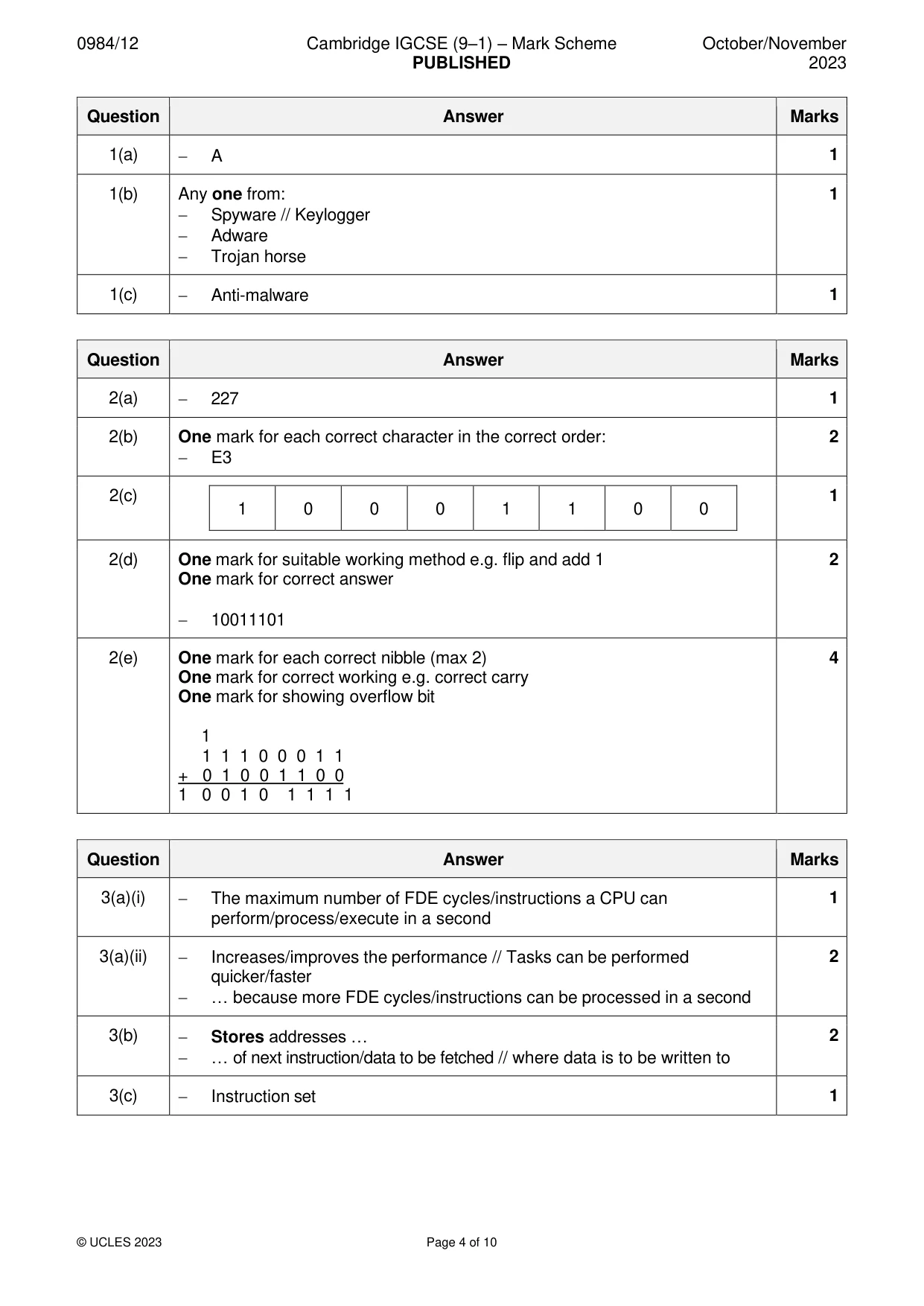
0984/12 Cambridge IGCSE (9–1) – Mark Scheme PUBLISHED October/November 2023 © UCLES 2023 Page 4 of 10 Question Answer Marks 1(a) − A 1 1(b) Any one from: − Spyware // Keylogger − Adware − Trojan horse 1 1(c) − Anti-malware 1 Question Answer Marks 2(a) − 227 1 2(b) One mark for each correct character in the correct order: − E3 2 2(c) 1 0 0 0 1 1 0 0 1 2(d) One mark for suitable working method e.g. flip and add 1 One mark for correct answer − 10011101 2 2(e) One mark for each correct nibble (max 2) One mark for correct working e.g. correct carry One mark for showing overflow bit 1 1 1 1 0 0 0 1 1 + 0 1 0 0 1 1 0 0 1 0 0 1 0 1 1 1 1 4 Question Answer Marks 3(a)(i) − The maximum number of FDE cycles/instructions a CPU can perform/process/execute in a second 1 3(a)(ii) − Increases/improves the performance // Tasks can be performed quicker/faster − … because more FDE cycles/instructions can be processed in a second 2 3(b) − Stores addresses … − … of next instruction/data to be fetched // where data is to be written to 2 3(c) − Instruction set 1
Mark scheme, page 5
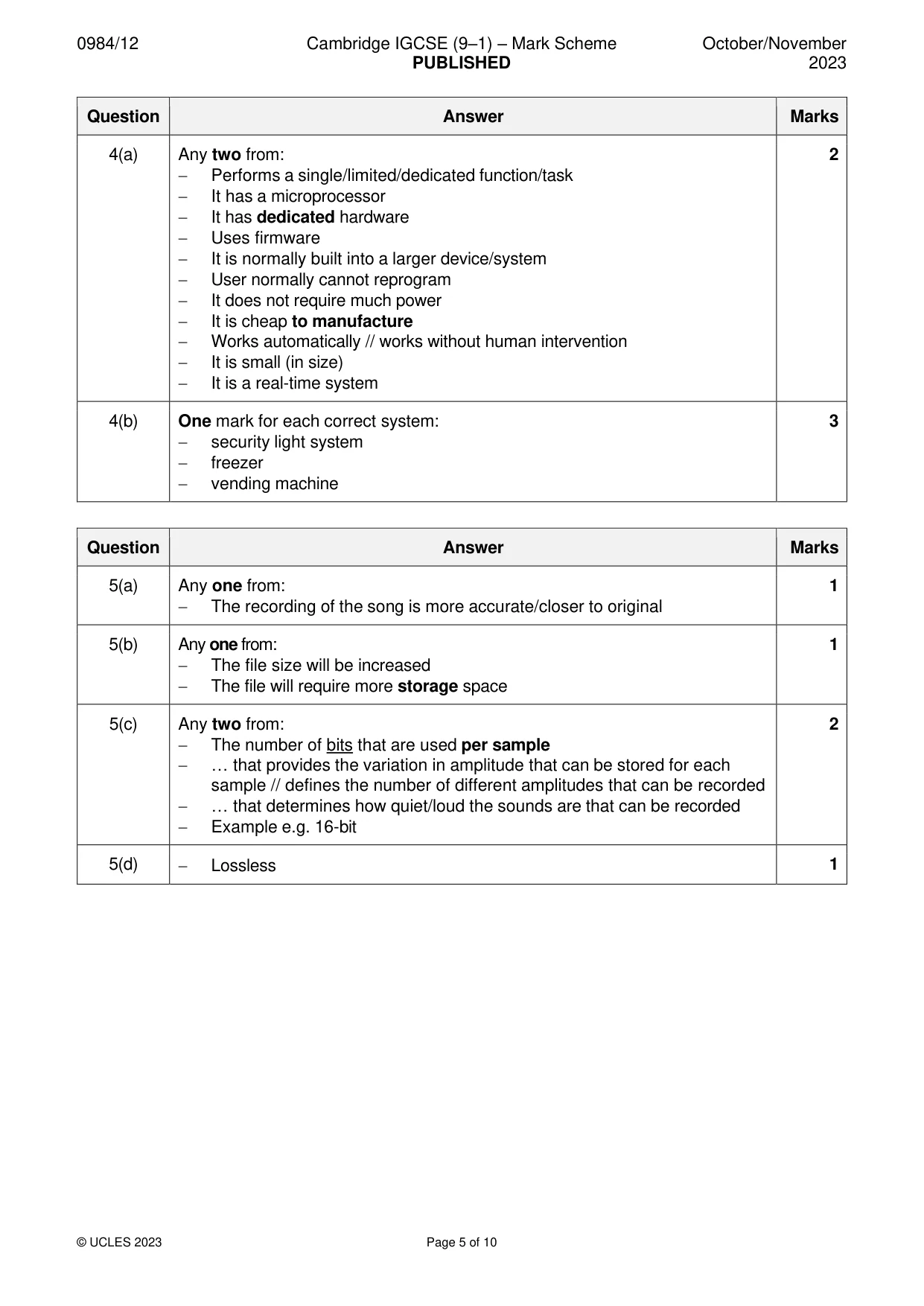
0984/12 Cambridge IGCSE (9–1) – Mark Scheme PUBLISHED October/November 2023 © UCLES 2023 Page 5 of 10 Question Answer Marks 4(a) Any two from: − Performs a single/limited/dedicated function/task − It has a microprocessor − It has dedicated hardware − Uses firmware − It is normally built into a larger device/system − User normally cannot reprogram − It does not require much power − It is cheap to manufacture − Works automatically // works without human intervention − It is small (in size) − It is a real-time system 2 4(b) One mark for each correct system: − security light system − freezer − vending machine 3 Question Answer Marks 5(a) Any one from: − The recording of the song is more accurate/closer to original 1 5(b) Any one from: − The file size will be increased − The file will require more storage space 1 5(c) Any two from: − The number of bits that are used per sample − … that provides the variation in amplitude that can be stored for each sample // defines the number of different amplitudes that can be recorded − … that determines how quiet/loud the sounds are that can be recorded − Example e.g. 16-bit 2 5(d) − Lossless 1
Mark scheme, page 6
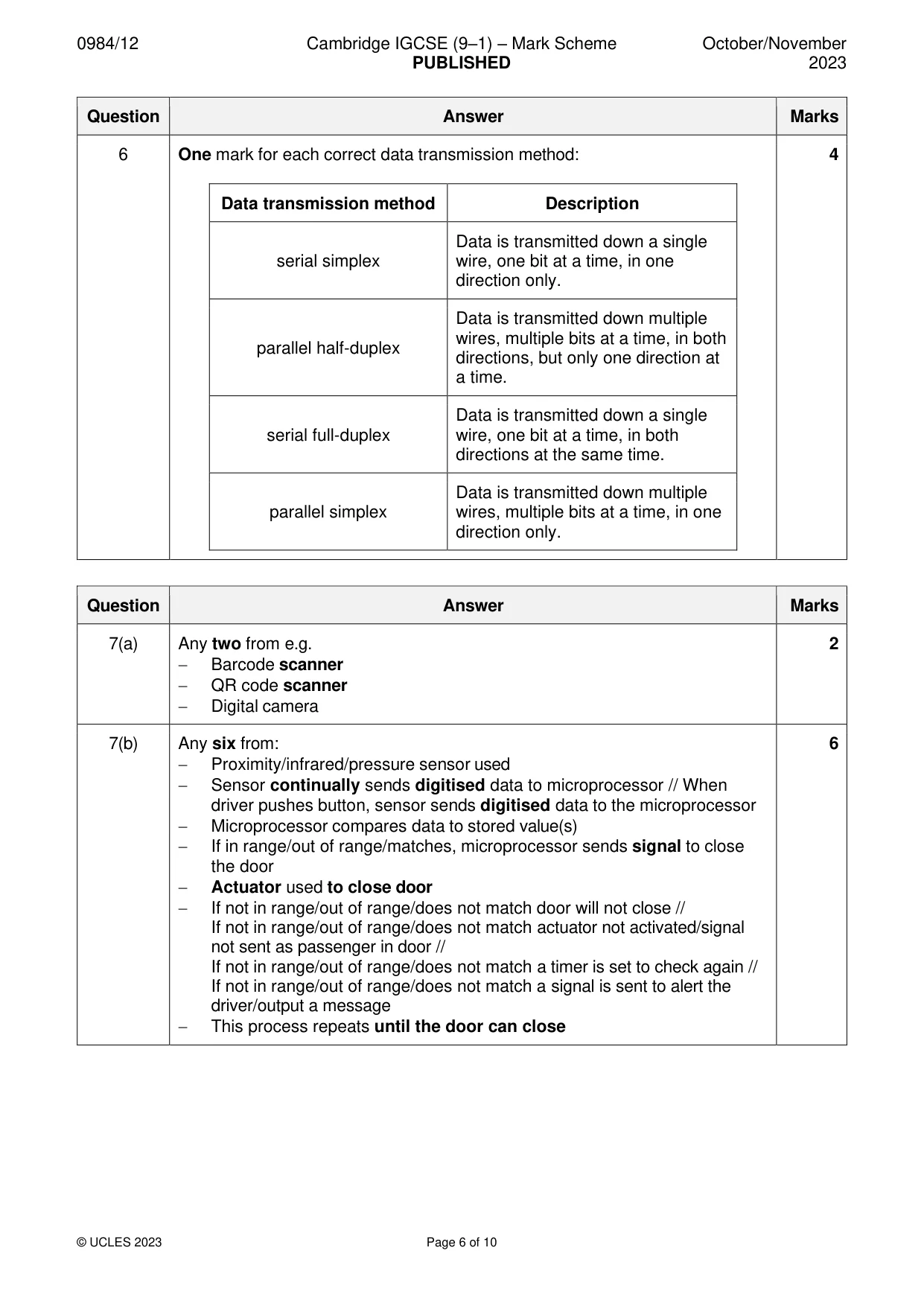
0984/12 Cambridge IGCSE (9–1) – Mark Scheme PUBLISHED October/November 2023 © UCLES 2023 Page 6 of 10 Question Answer Marks 6 One mark for each correct data transmission method: Data transmission method Description serial simplex Data is transmitted down a single wire, one bit at a time, in one direction only. parallel half-duplex Data is transmitted down multiple wires, multiple bits at a time, in both directions, but only one direction at a time. serial full-duplex Data is transmitted down a single wire, one bit at a time, in both directions at the same time. parallel simplex Data is transmitted down multiple wires, multiple bits at a time, in one direction only. 4 Question Answer Marks 7(a) Any two from e.g. − Barcode scanner − QR code scanner − Digital camera 2 7(b) Any six from: − Proximity/infrared/pressure sensor used − Sensor continually sends digitised data to microprocessor // When driver pushes button, sensor sends digitised data to the microprocessor − Microprocessor compares data to stored value(s) − If in range/out of range/matches, microprocessor sends signal to close the door − Actuator used to close door − If not in range/out of range/does not match door will not close // If not in range/out of range/does not match actuator not activated/signal not sent as passenger in door // If not in range/out of range/does not match a timer is set to check again // If not in range/out of range/does not match a signal is sent to alert the driver/output a message − This process repeats until the door can close 6
Mark scheme, page 7
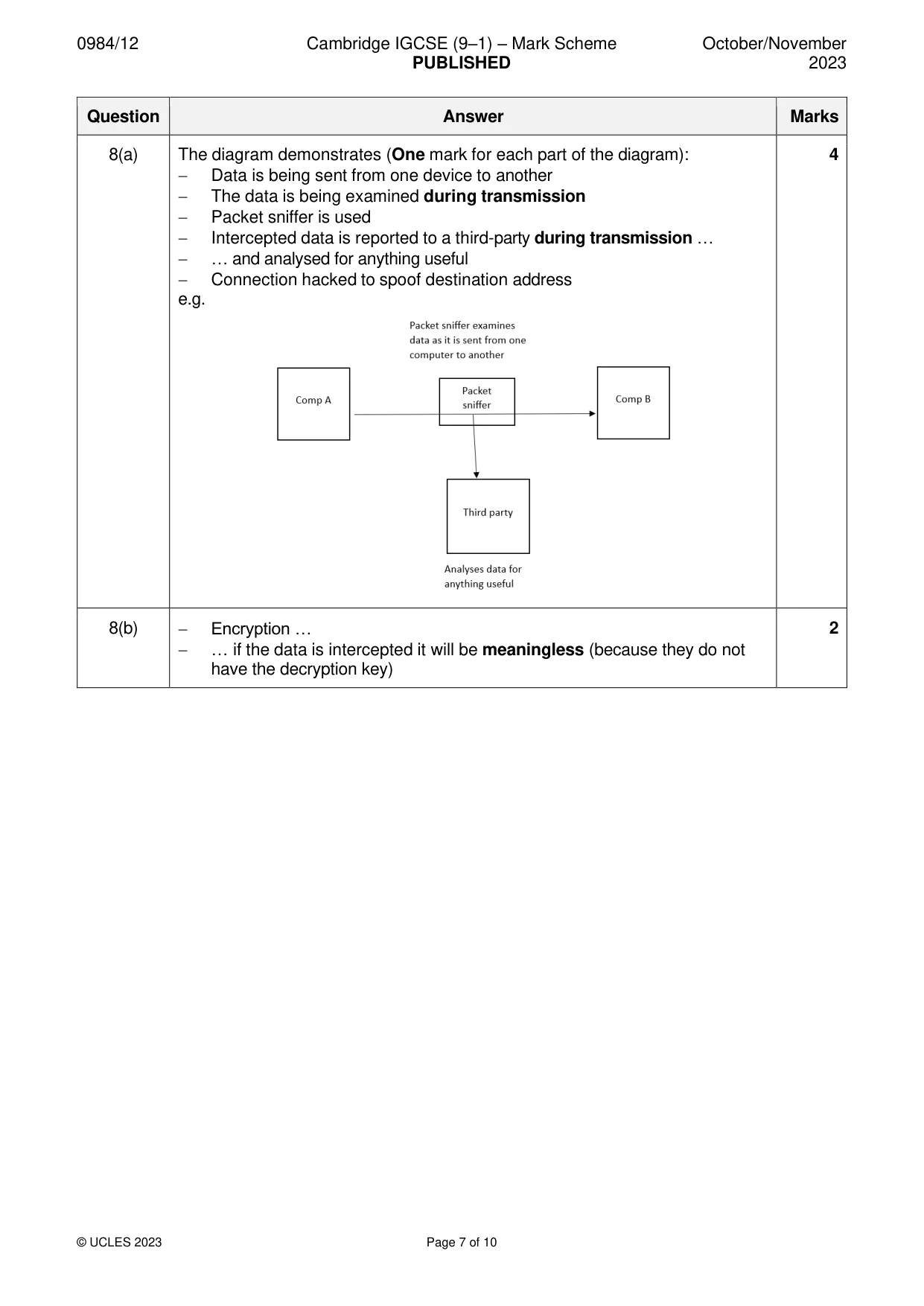
0984/12 Cambridge IGCSE (9–1) – Mark Scheme PUBLISHED October/November 2023 © UCLES 2023 Page 7 of 10 Question Answer Marks 8(a) The diagram demonstrates (One mark for each part of the diagram): − Data is being sent from one device to another − The data is being examined during transmission − Packet sniffer is used − Intercepted data is reported to a third-party during transmission … − … and analysed for anything useful − Connection hacked to spoof destination address e.g. 4 8(b) − Encryption … − … if the data is intercepted it will be meaningless (because they do not have the decryption key) 2
Mark scheme, page 8
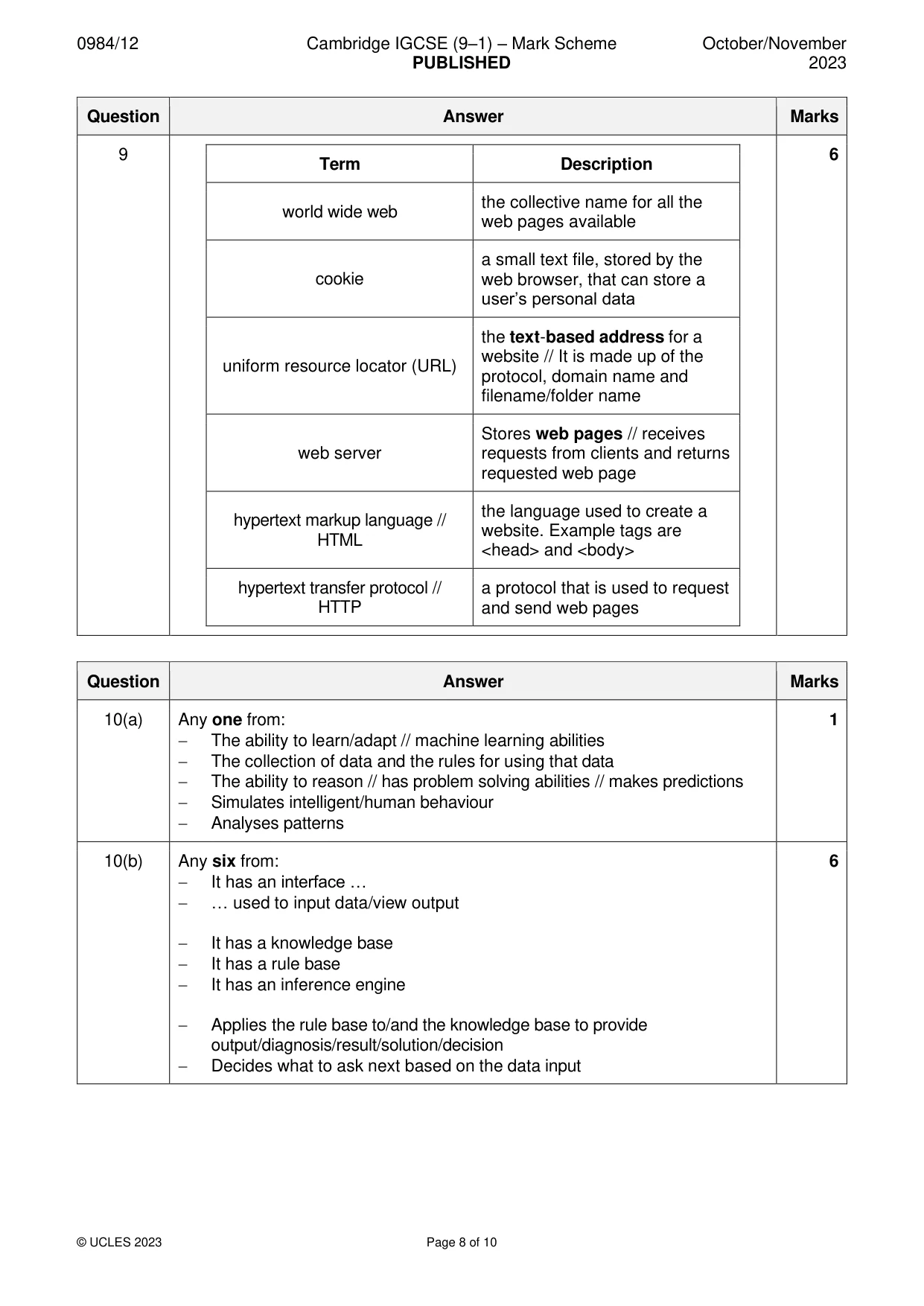
0984/12 Cambridge IGCSE (9–1) – Mark Scheme PUBLISHED October/November 2023 © UCLES 2023 Page 8 of 10 Question Answer Marks 9 Term Description world wide web the collective name for all the web pages available cookie a small text file, stored by the web browser, that can store a user’s personal data uniform resource locator (URL) the text-based address for a website // It is made up of the protocol, domain name and filename/folder name web server Stores web pages // receives requests from clients and returns requested web page hypertext markup language // HTML the language used to create a website. Example tags are <head> and <body> hypertext transfer protocol // HTTP a protocol that is used to request and send web pages 6 Question Answer Marks 10(a) Any one from: − The ability to learn/adapt // machine learning abilities − The collection of data and the rules for using that data − The ability to reason // has problem solving abilities // makes predictions − Simulates intelligent/human behaviour − Analyses patterns 1 10(b) Any six from: − It has an interface … − … used to input data/view output − It has a knowledge base − It has a rule base − It has an inference engine − Applies the rule base to/and the knowledge base to provide output/diagnosis/result/solution/decision − Decides what to ask next based on the data input 6
Mark scheme, page 9
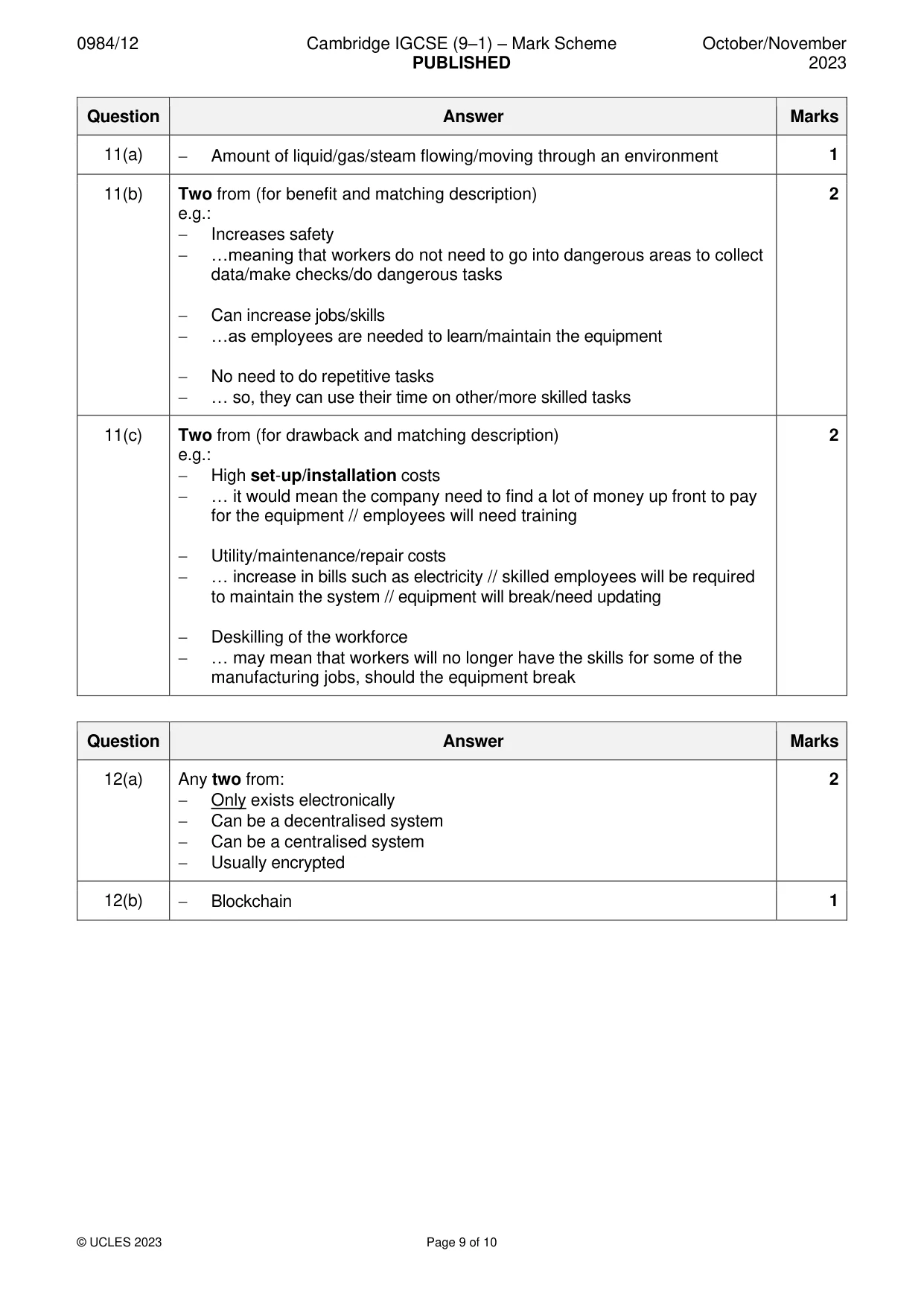
0984/12 Cambridge IGCSE (9–1) – Mark Scheme PUBLISHED October/November 2023 © UCLES 2023 Page 9 of 10 Question Answer Marks 11(a) − Amount of liquid/gas/steam flowing/moving through an environment 1 11(b) Two from (for benefit and matching description) e.g.: − Increases safety − …meaning that workers do not need to go into dangerous areas to collect data/make checks/do dangerous tasks − Can increase jobs/skills − …as employees are needed to learn/maintain the equipment − No need to do repetitive tasks − … so, they can use their time on other/more skilled tasks 2 11(c) Two from (for drawback and matching description) e.g.: − High set-up/installation costs − … it would mean the company need to find a lot of money up front to pay for the equipment // employees will need training − Utility/maintenance/repair costs − … increase in bills such as electricity // skilled employees will be required to maintain the system // equipment will break/need updating − Deskilling of the workforce − … may mean that workers will no longer have the skills for some of the manufacturing jobs, should the equipment break 2 Question Answer Marks 12(a) Any two from: − Only exists electronically − Can be a decentralised system − Can be a centralised system − Usually encrypted 2 12(b) − Blockchain 1
Mark scheme, page 10
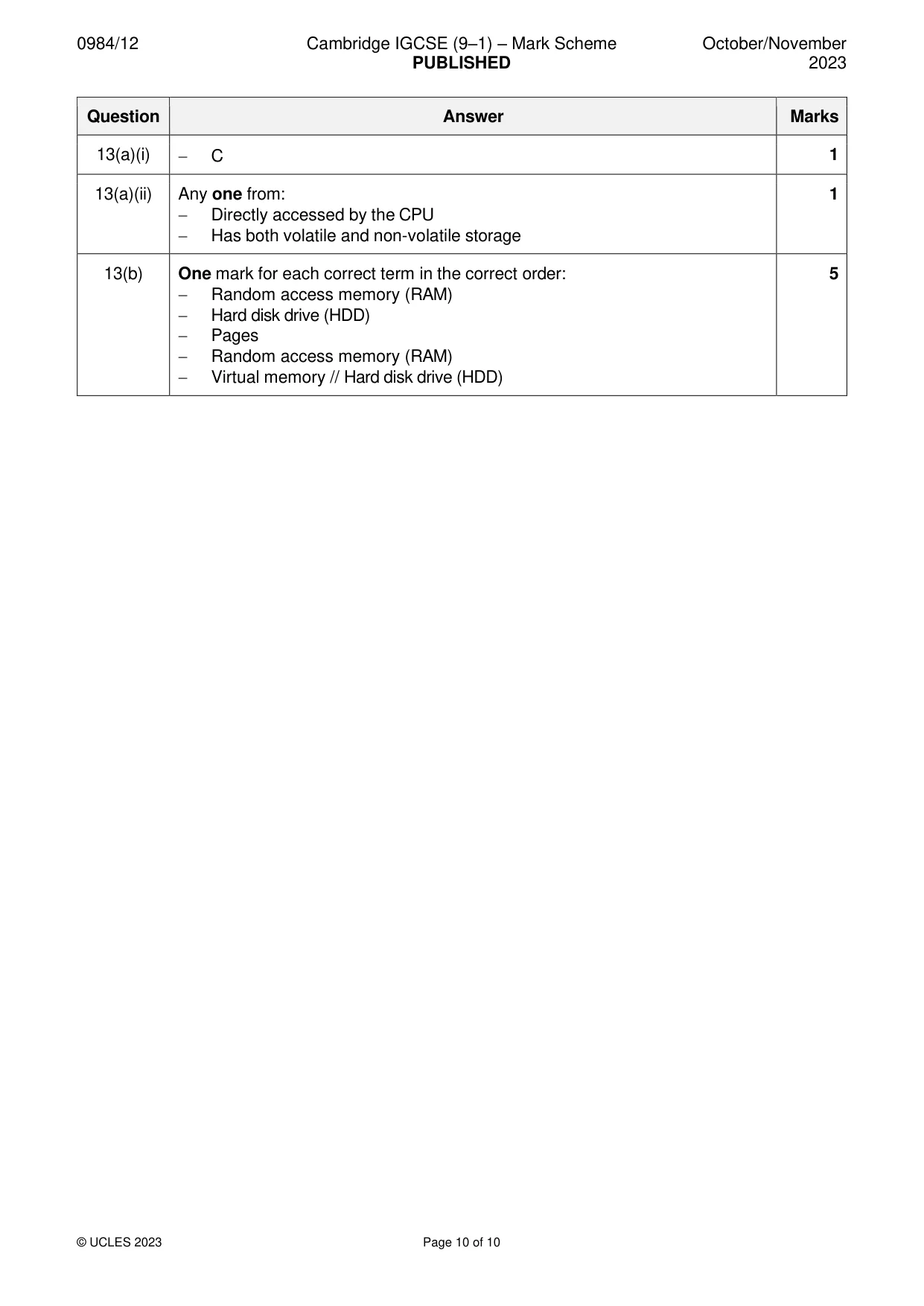
0984/12 Cambridge IGCSE (9–1) – Mark Scheme PUBLISHED October/November 2023 © UCLES 2023 Page 10 of 10 Question Answer Marks 13(a)(i) − C 1 13(a)(ii) Any one from: − Directly accessed by the CPU − Has both volatile and non-volatile storage 1 13(b) One mark for each correct term in the correct order: − Random access memory (RAM) − Hard disk drive (HDD) − Pages − Random access memory (RAM) − Virtual memory // Hard disk drive (HDD) 5
What you needed in this session
Cambridge’s own grade thresholds for 2023 Oct/Nov, Paper 1 · Variant 2. A higher threshold means an easier paper — the bar moves with how the cohort did.