Cambridge IGCSE Chinese (Mandarin) - Foreign Language 0547 — 2006 May/June Paper 2 · Variant 1

0547/21/M/J/06 · 65 marks · ≈73 min

The question paper and its mark scheme, free to read here and free to download. This is Cambridge’s own paper, exactly as it was sat.

Question paper16 pages
Cambridge IGCSE Chinese (Mandarin) - Foreign Language 0547 2006 May/June Paper 2 · Variant 1 question paper, page 1 of 16
Page 1 of 16
Cambridge IGCSE Chinese (Mandarin) - Foreign Language 0547 2006 May/June Paper 2 · Variant 1 question paper, page 2 of 16
Page 2 of 16
Cambridge IGCSE Chinese (Mandarin) - Foreign Language 0547 2006 May/June Paper 2 · Variant 1 question paper, page 3 of 16
Page 3 of 16
Cambridge IGCSE Chinese (Mandarin) - Foreign Language 0547 2006 May/June Paper 2 · Variant 1 question paper, page 4 of 16
Page 4 of 16
Cambridge IGCSE Chinese (Mandarin) - Foreign Language 0547 2006 May/June Paper 2 · Variant 1 question paper, page 5 of 16
Page 5 of 16
Cambridge IGCSE Chinese (Mandarin) - Foreign Language 0547 2006 May/June Paper 2 · Variant 1 question paper, page 6 of 16
Page 6 of 16
Cambridge IGCSE Chinese (Mandarin) - Foreign Language 0547 2006 May/June Paper 2 · Variant 1 question paper, page 7 of 16
Page 7 of 16
Cambridge IGCSE Chinese (Mandarin) - Foreign Language 0547 2006 May/June Paper 2 · Variant 1 question paper, page 8 of 16
Page 8 of 16
Cambridge IGCSE Chinese (Mandarin) - Foreign Language 0547 2006 May/June Paper 2 · Variant 1 question paper, page 9 of 16
Page 9 of 16
Cambridge IGCSE Chinese (Mandarin) - Foreign Language 0547 2006 May/June Paper 2 · Variant 1 question paper, page 10 of 16
Page 10 of 16
Cambridge IGCSE Chinese (Mandarin) - Foreign Language 0547 2006 May/June Paper 2 · Variant 1 question paper, page 11 of 16
Page 11 of 16
Cambridge IGCSE Chinese (Mandarin) - Foreign Language 0547 2006 May/June Paper 2 · Variant 1 question paper, page 12 of 16
Page 12 of 16
Cambridge IGCSE Chinese (Mandarin) - Foreign Language 0547 2006 May/June Paper 2 · Variant 1 question paper, page 13 of 16
Page 13 of 16
Cambridge IGCSE Chinese (Mandarin) - Foreign Language 0547 2006 May/June Paper 2 · Variant 1 question paper, page 14 of 16
Page 14 of 16
Cambridge IGCSE Chinese (Mandarin) - Foreign Language 0547 2006 May/June Paper 2 · Variant 1 question paper, page 15 of 16
Page 15 of 16
Cambridge IGCSE Chinese (Mandarin) - Foreign Language 0547 2006 May/June Paper 2 · Variant 1 question paper, page 16 of 16
Page 16 of 16

Mark scheme5 pages

Answers below. Sit the paper first if you are practising.
Mark scheme, page 1 of 5
Page 1 of 5
Mark scheme, page 2 of 5
Page 2 of 5
Mark scheme, page 3 of 5
Page 3 of 5
Mark scheme, page 4 of 5
Page 4 of 5
Mark scheme, page 5 of 5
Page 5 of 5

Paper as text

Question paper, page 1

                                                                                                                                                              www.XtremePapers.com

Question paper, page 3

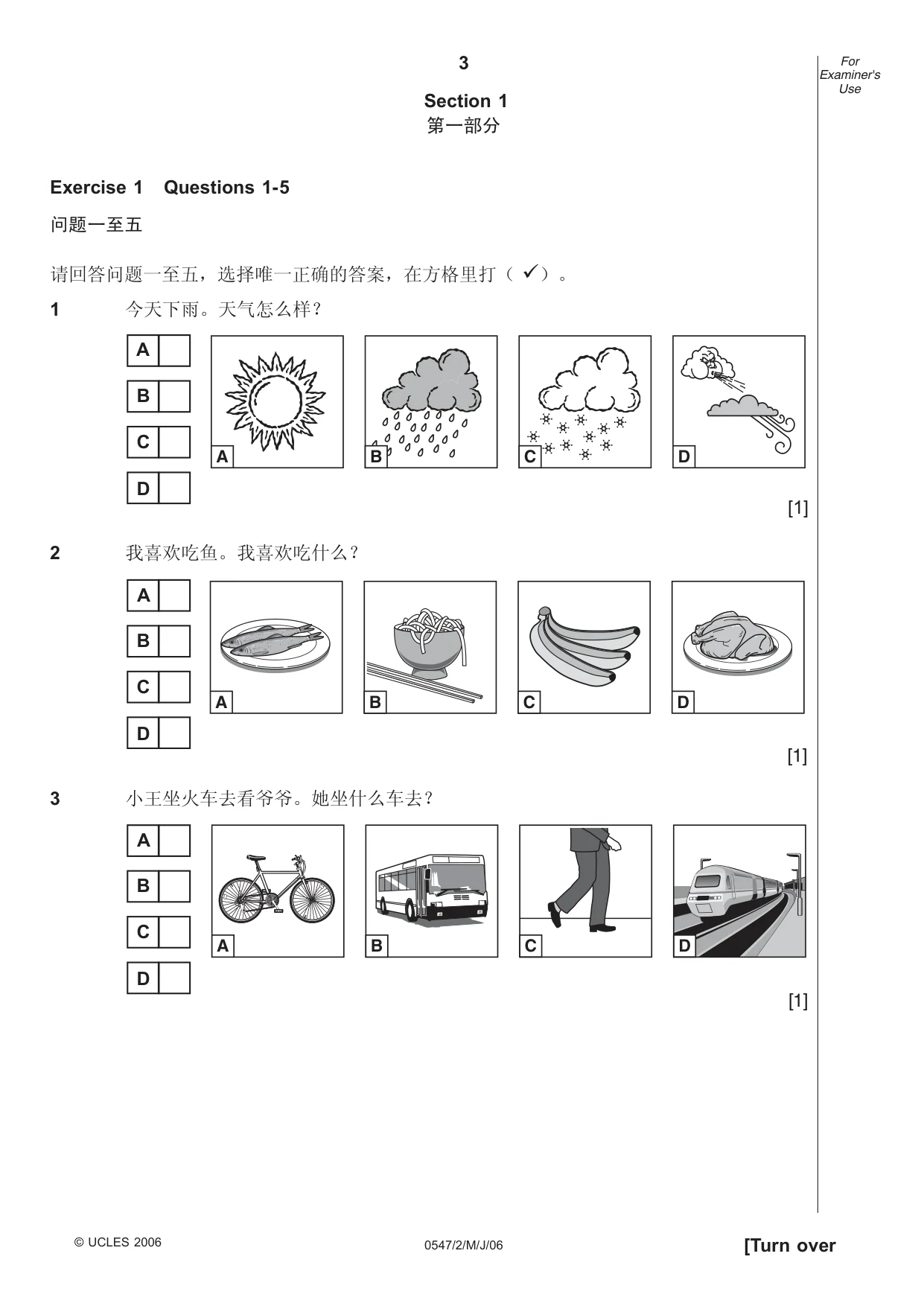
       For Examiner's Use        第一部分     问题一至五 请回答问题一至五,选择唯一正确的答案,在方格里打( )。  今天下雨。天气怎么样?  我喜欢吃鱼。我喜欢吃什么?  小王坐火车去看爷爷。她坐什么车去? [1] [1]         A D B C A D B C A B D C

Question paper, page 4

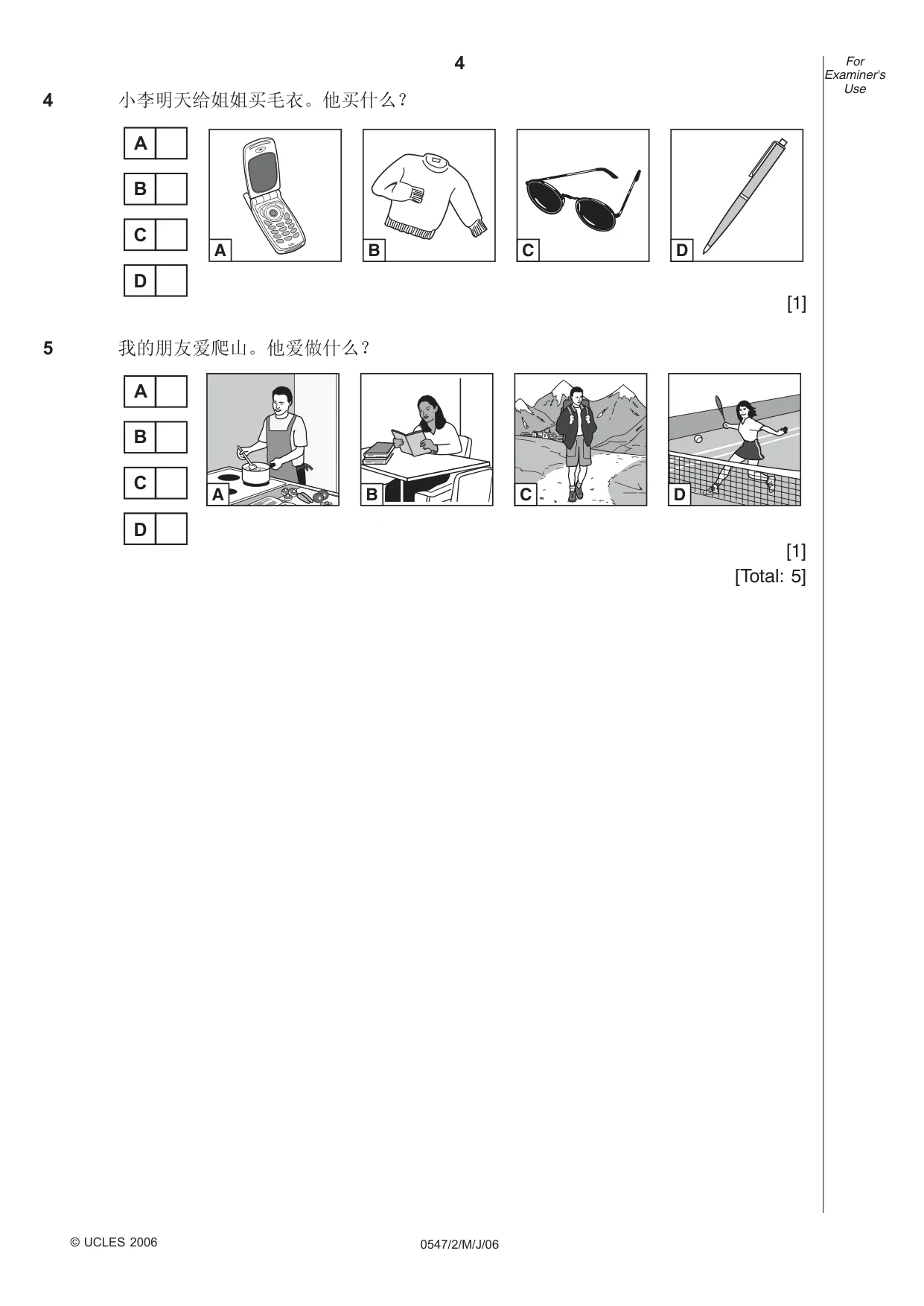
     For Examiner's Use  小李明天给姐姐买毛衣。他买什么?  我的朋友爱爬山。他爱做什么? [1] [Total: 5] [1]         A B D C C A B D

Question paper, page 5

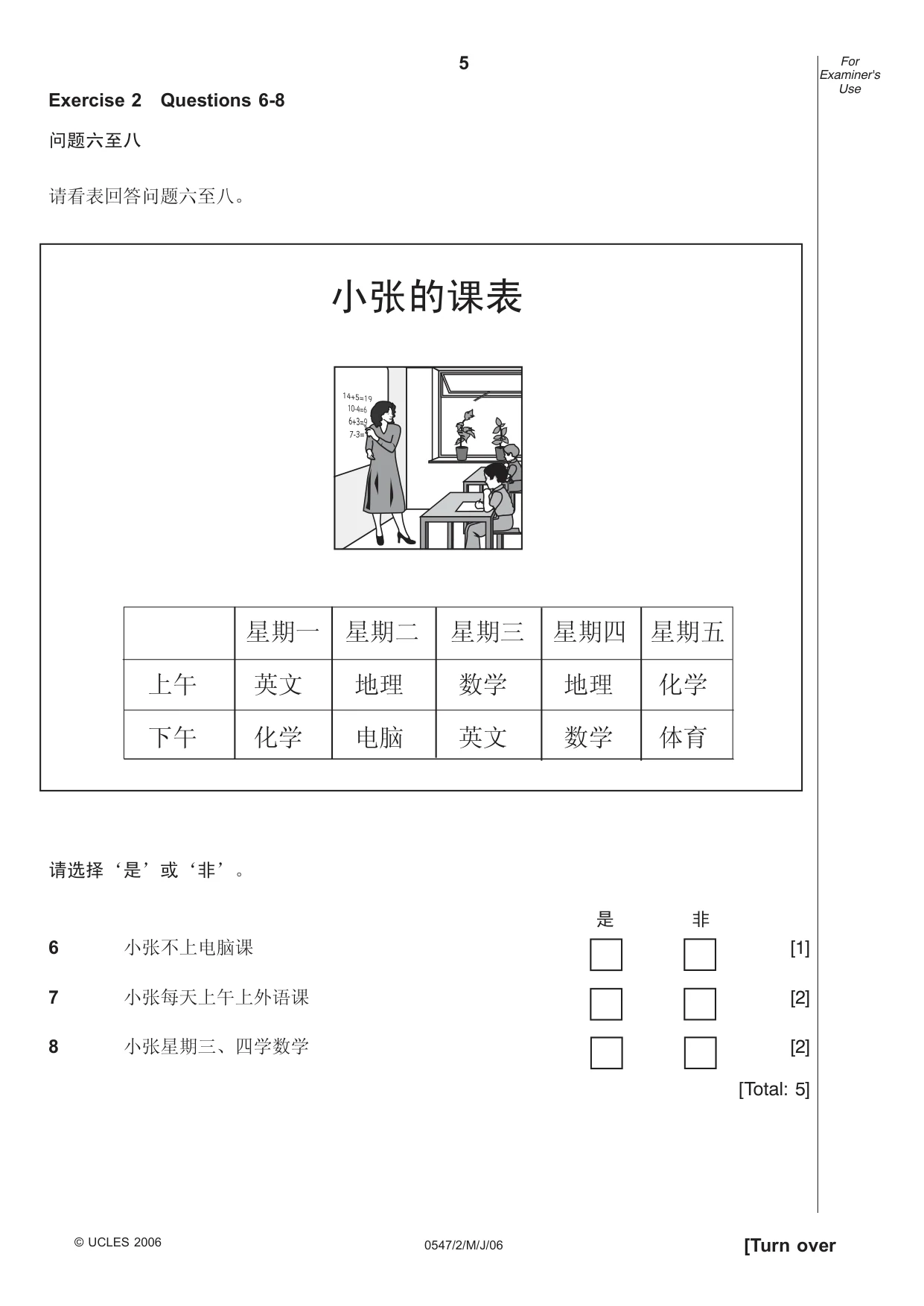
       For Examiner's Use 请选择‘是’或‘非’。  小张不上电脑课 [1]  小张每天上午上外语课 [2]  小张星期三、四学数学 [2] [Total: 5]     请看表回答问题六至八。 是 非 星期一 星期二 星期三 星期四 星期五 上午 英文 地理 数学 地理 化学 下午 化学 电脑 英文 数学 体育 问题六至八 小张的课表

Question paper, page 6

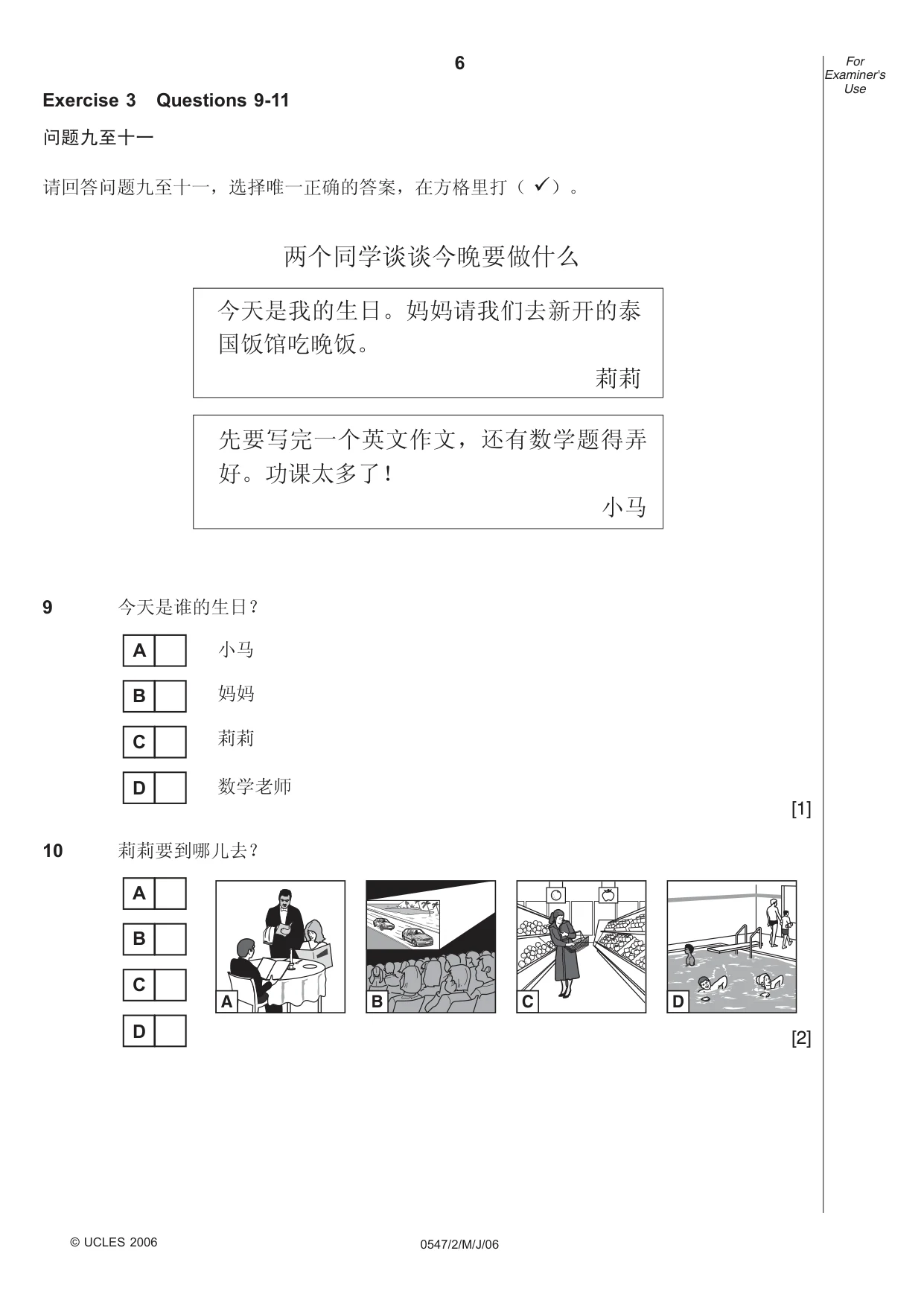
     For Examiner's Use     问题九至十一 请回答问题九至十一,选择唯一正确的答案,在方格里打( )。 两个同学谈谈今晚要做什么 [2] 先要写完一个英文作文,还有数学题得弄 好。功课太多了! 小马 今天是我的生日。妈妈请我们去新开的泰 国饭馆吃晚饭。 莉莉  今天是谁的生日?  莉莉要到哪儿去? [1]          小马 妈妈 莉莉 数学老师 D C A B

Question paper, page 7

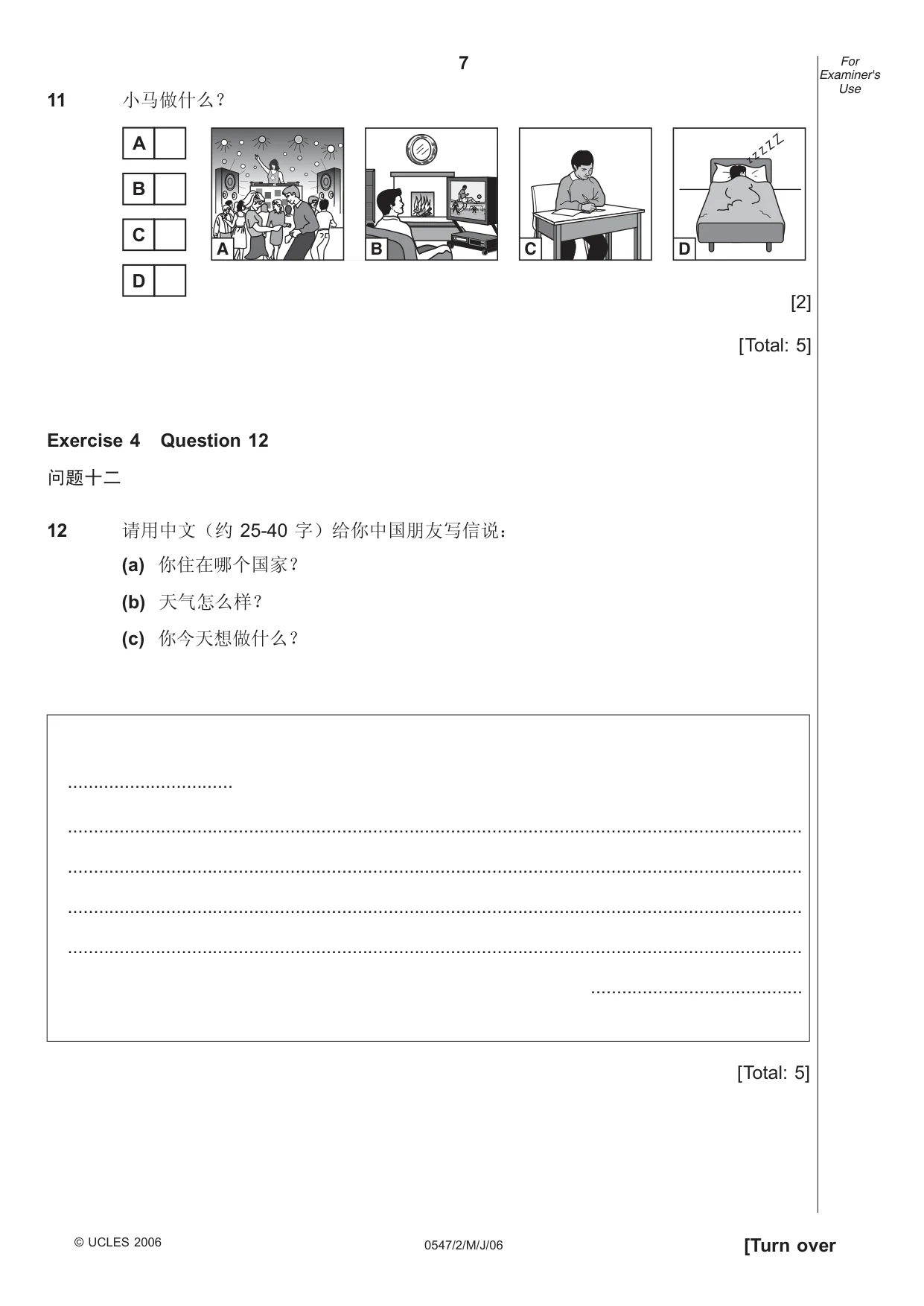
       For Examiner's Use     问题十二  请用中文(约  字)给你中国朋友写信说:  你住在哪个国家?  天气怎么样?  你今天想做什么?          小马做什么?        D C A B

Question paper, page 8

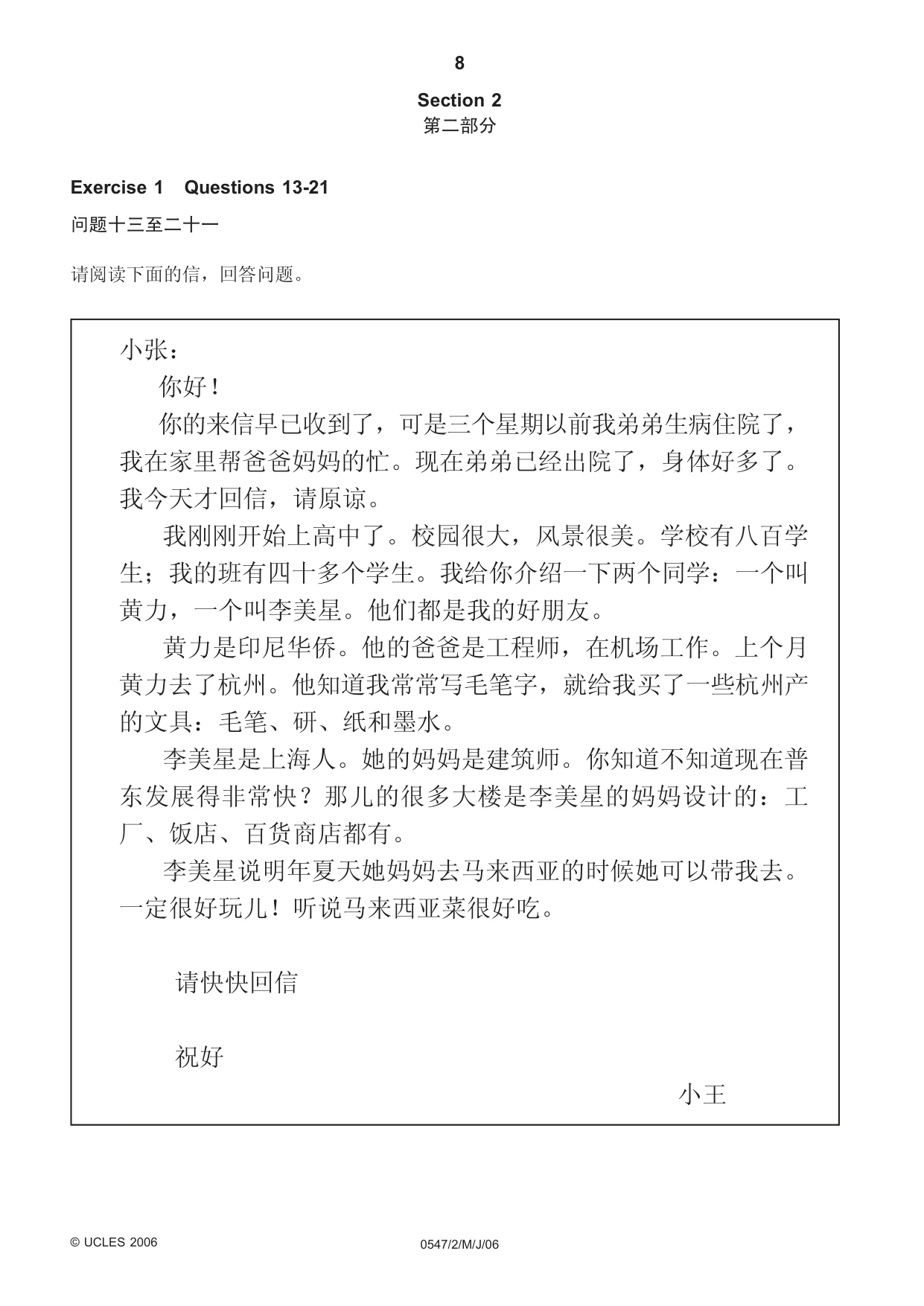
       第二部分     问题十三至二十一 请阅读下面的信,回答问题。 小张: 你好! 你的来信早已收到了,可是三个星期以前我弟弟生病住院了, 我在家里帮爸爸妈妈的忙。现在弟弟已经出院了,身体好多了。 我今天才回信,请原谅。 我刚刚开始上高中了。校园很大,风景很美。学校有八百学 生;我的班有四十多个学生。我给你介绍一下两个同学:一个叫 黄力,一个叫李美星。他们都是我的好朋友。 黄力是印尼华侨。他的爸爸是工程师,在机场工作。上个月 黄力去了杭州。他知道我常常写毛笔字,就给我买了一些杭州产 的文具:毛笔、研、纸和墨水。 李美星是上海人。她的妈妈是建筑师。你知道不知道现在普 东发展得非常快?那儿的很多大楼是李美星的妈妈设计的:工 厂、饭店、百货商店都有。 李美星说明年夏天她妈妈去马来西亚的时候她可以带我去。 一定很好玩儿!听说马来西亚菜很好吃。 请快快回信 祝好 小王

Question paper, page 9

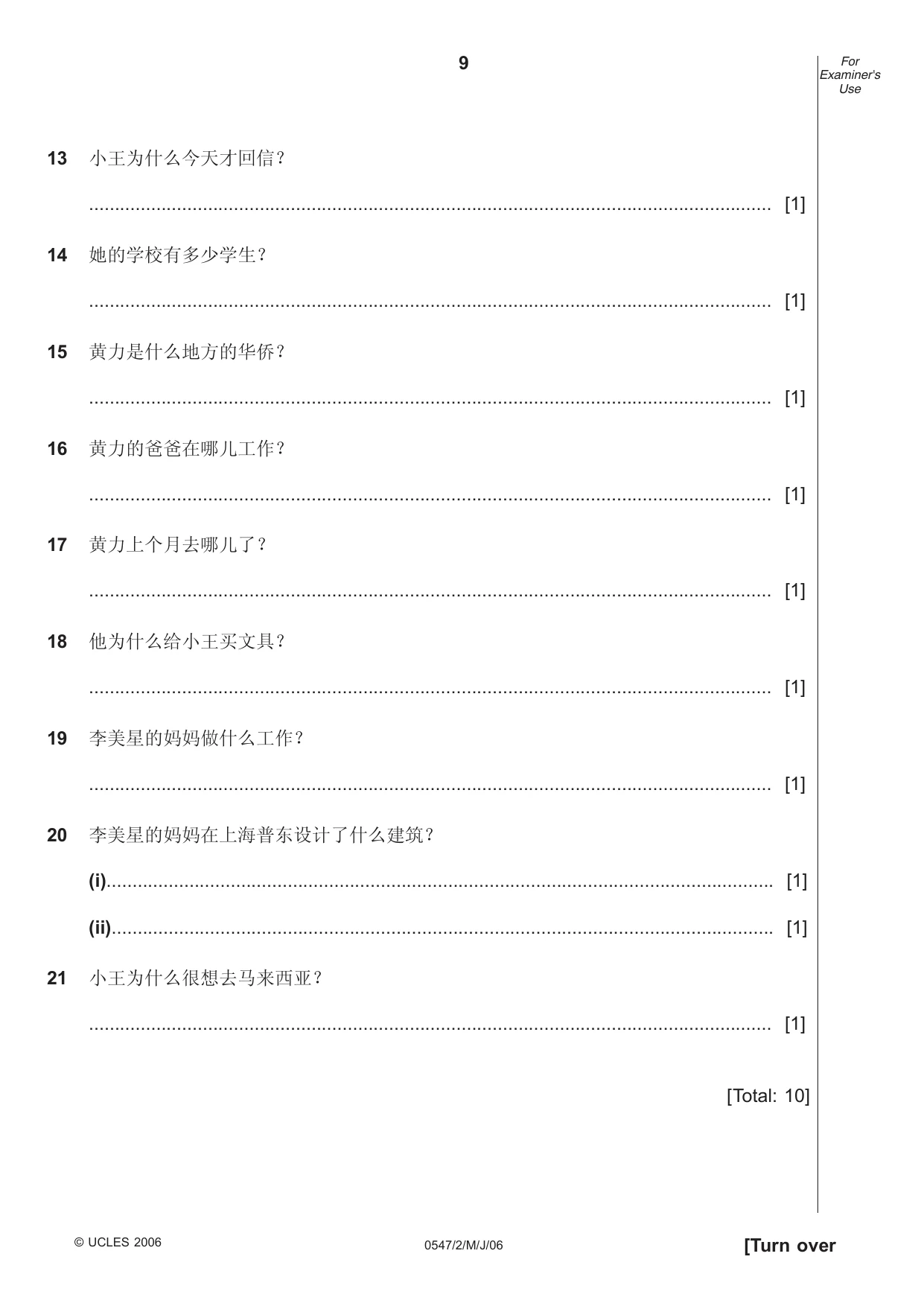
       For Examiner's Use  小王为什么今天才回信?    她的学校有多少学生?    黄力是什么地方的华侨?    黄力的爸爸在哪儿工作?    黄力上个月去哪儿了?    他为什么给小王买文具?    李美星的妈妈做什么工作?    李美星的妈妈在上海普东设计了什么建筑?      小王为什么很想去马来西亚?    

Question paper, page 10

     For Examiner's Use     问题二十二  上个月你搬到了另外一个城市。请给你的朋友小李写一封信( 字)信里讲一讲:  你的新房子怎么样?(有多少房间?有没有花园?)  你的卧室怎么样?  介绍一下你的新朋友  你喜欢你的新学校吗?  你觉得新城市好不好?为什么?               

Question paper, page 11

              

Question paper, page 12

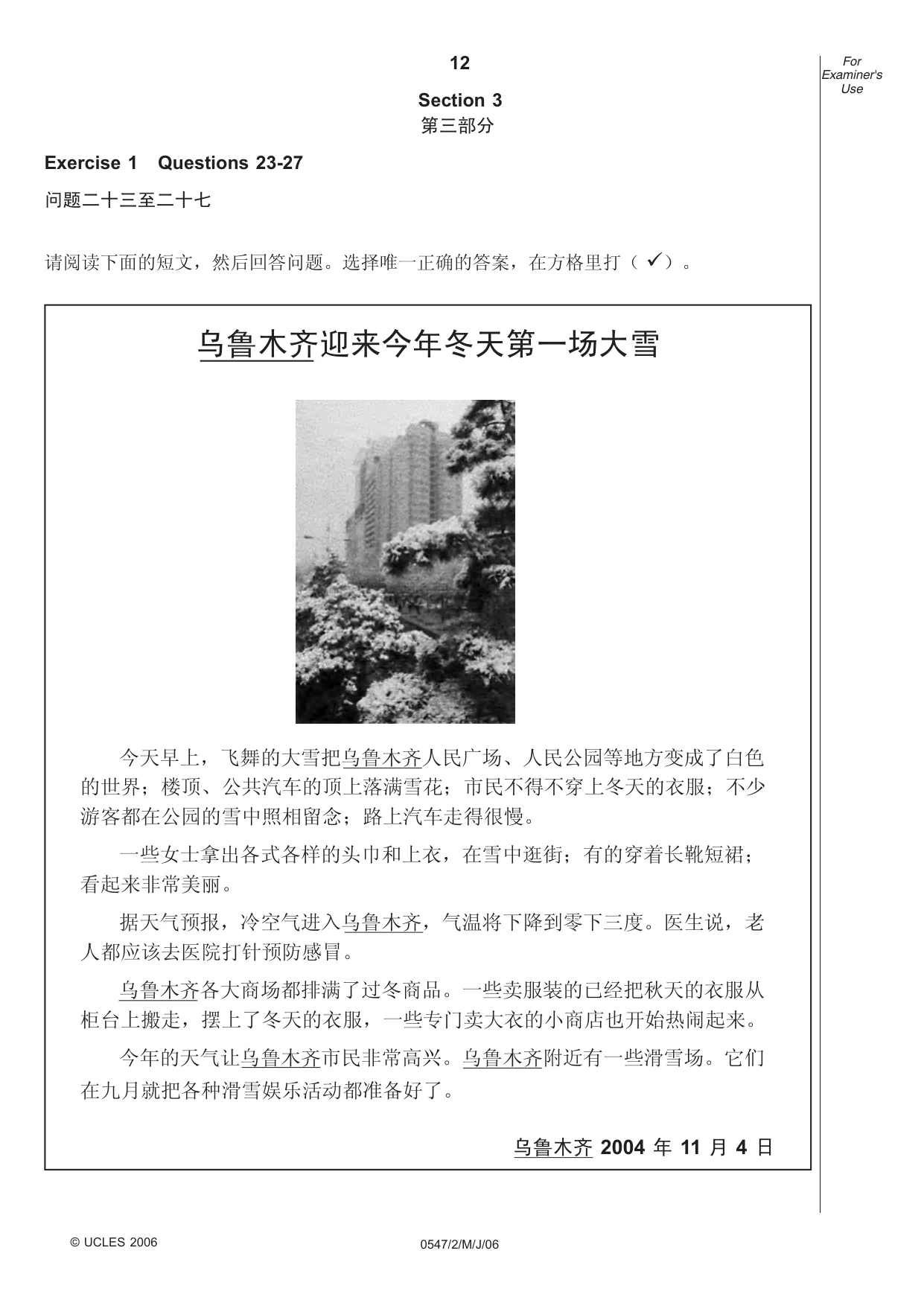
     For Examiner's Use   第三部分     问题二十三至二十七 请阅读下面的短文,然后回答问题。选择唯一正确的答案,在方格里打( )。 乌鲁木齐迎来今年冬天第一场大雪 今天早上,飞舞的大雪把乌鲁木齐人民广场、人民公园等地方变成了白色 的世界;楼顶、公共汽车的顶上落满雪花;市民不得不穿上冬天的衣服;不少 游客都在公园的雪中照相留念;路上汽车走得很慢。 一些女士拿出各式各样的头巾和上衣,在雪中逛街;有的穿着长靴短裙; 看起来非常美丽。 据天气预报,冷空气进入乌鲁木齐,气温将下降到零下三度。医生说,老 人都应该去医院打针预防感冒。 乌鲁木齐各大商场都排满了过冬商品。一些卖服装的已经把秋天的衣服从 柜台上搬走,摆上了冬天的衣服,一些专门卖大衣的小商店也开始热闹起来。 今年的天气让乌鲁木齐市民非常高兴。乌鲁木齐附近有一些滑雪场。它们 在九月就把各种滑雪娱乐活动都准备好了。 乌鲁木齐  年  月  日

Question paper, page 13

       For Examiner's Use  滑雪活动都安排好了 都在市中心 都还没准备好 现在不能开门   要多买菜 要买减价的秋衣 要买大衣 要买中药 乌鲁木齐的滑雪场怎么样? C  人民公园里有很多人在 买花 照相 跳舞 慢走  作者认为女士穿衣服穿得 太少 跟美国人一样 像男人一样 很漂亮  谁应该特别注意身体? 医生 小学生 年纪大的人 穿短裙的女士  有的市民因为下了雪                         

Question paper, page 14

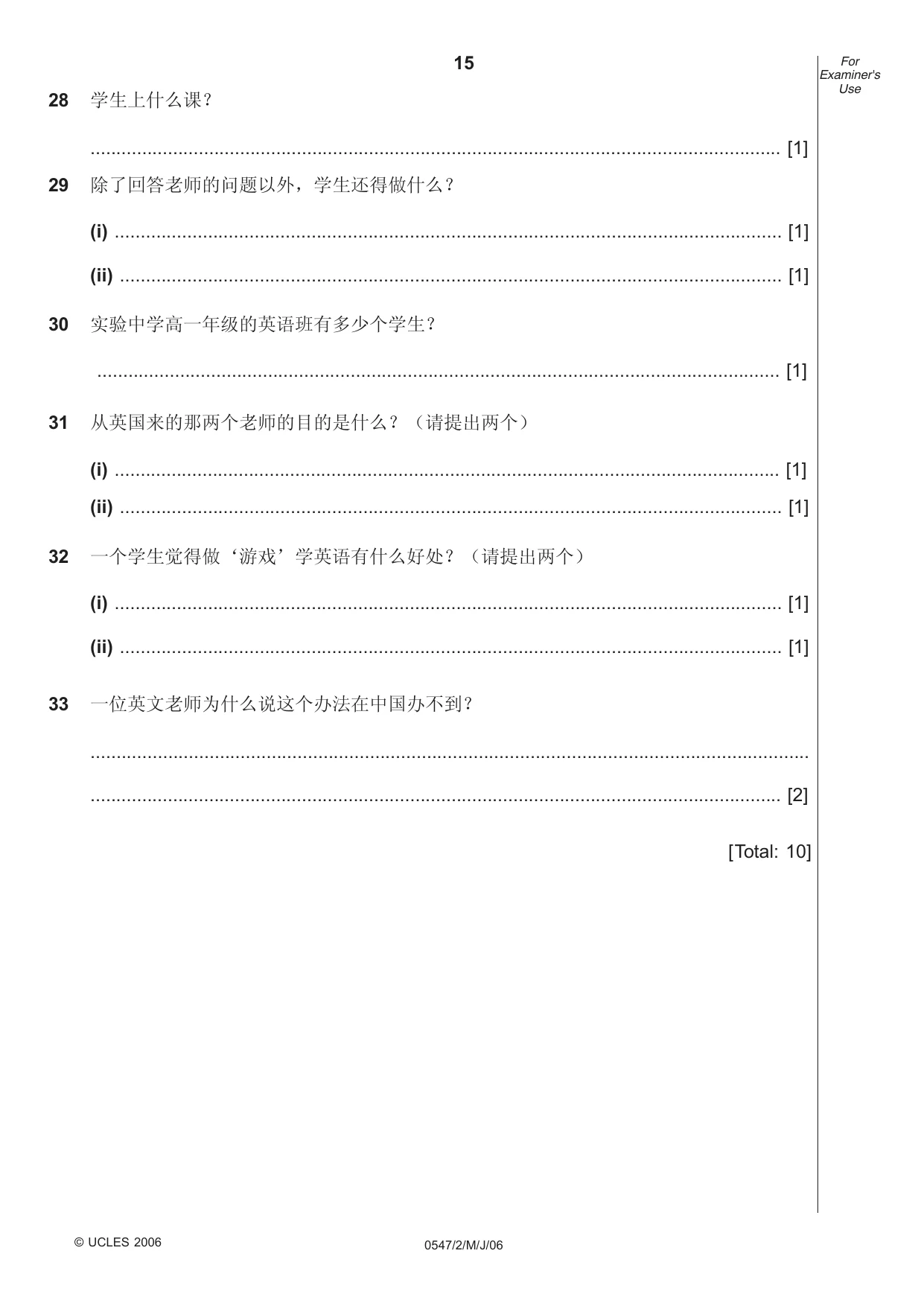
         问题二十八至三十三 请阅读下面的短文,然后回答问题。 让高中学生做‘游戏’学英语 “大声唱,别急…边唱边跳,跟我一样,来,举起你的左手…” 一节英文课,没有语法,没有语言点,也不用记笔记,可是老师和同学都 忙得很。中国学生不但要边唱边跳,还要不停地回答英语老师的问题。教室里 欢声笑语不断。  月  日至  日,“中英教育周”第一次在广州举行。从英国来的两位 老师为广东省实验中学高一年级二十名学生和他们的老师,演示了怎么样更轻松 地教课,怎么样更简单地提高英语水平,怎么样把学习和趣味性结合在一起。 “挺好玩的,既可以学新单词,又可以练口语。”一个学生说。王明是学校 里英语不错的学生,平时就喜欢在地铁、公共汽车站跟外国人说话;他说:“有 点简单,有点失望。” 一位英文老师说:“我们不可以让高一的学生天天做‘游戏’,我们也没有 那么多时间。如果语法解决不了,语言点解决不了,考试通过不了,一切都是假 的。这个办法在中国办不到。”

Question paper, page 15

       For Examiner's Use  学生上什么课?    除了回答老师的问题以外,学生还得做什么?        实验中学高一年级的英语班有多少个学生?    从英国来的那两个老师的目的是什么?(请提出两个)        一个学生觉得做‘游戏’学英语有什么好处?(请提出两个)        一位英文老师为什么说这个办法在中国办不到?     

Question paper, page 16

       Copyright Acknowledgements: Questions 23-27 © http://news.cyol.com/gb/news/2004-11/04/content_981357.htm Questions 28-33 © http://zqb.cyol.com/gb/zqb/2004-11/15/content_987652.htm Permission to reproduce items where third-party owned material protected by copyright is included has been sought and cleared where possible. Every reasonable effort has been made by the publisher (UCLES) to trace copyright holders, but if any items requiring clearance have unwittingly been included, the publisher will be pleased to make amends at the earliest possible opportunity. University of Cambridge International Examinations is part of the University of Cambridge Local Examinations Syndicate (UCLES), which is itself a department of the University of Cambridge.

Mark scheme, page 1

UNIVERSITY OF CAMBRIDGE INTERNATIONAL EXAMINATIONS International General Certificate of Secondary Education MARK SCHEME for the May/June 2006 question paper 0547 MANDARIN CHINESE (FOREIGN LANGUAGE) 0547/02 Paper 2, maximum raw mark 65 These mark schemes are published as an aid to teachers and students, to indicate the requirements of the examination. They show the basis on which Examiners were initially instructed to award marks. They do not indicate the details of the discussions that took place at an Examiners’ meeting before marking began. Any substantial changes to the mark scheme that arose from these discussions will be recorded in the published Report on the Examination. All Examiners are instructed that alternative correct answers and unexpected approaches in candidates’ scripts must be given marks that fairly reflect the relevant knowledge and skills demonstrated. Mark schemes must be read in conjunction with the question papers and the Report on the Examination. The minimum marks in these components needed for various grades were previously published with these mark schemes, but are now instead included in the Report on the Examination for this session. • CIE will not enter into discussion or correspondence in connection with these mark schemes. CIE is publishing the mark schemes for the May/June 2006 question papers for most IGCSE and GCE Advanced Level and Advanced Subsidiary Level syllabuses and some Ordinary Level syllabuses. www.XtremePapers.com

Mark scheme, page 2

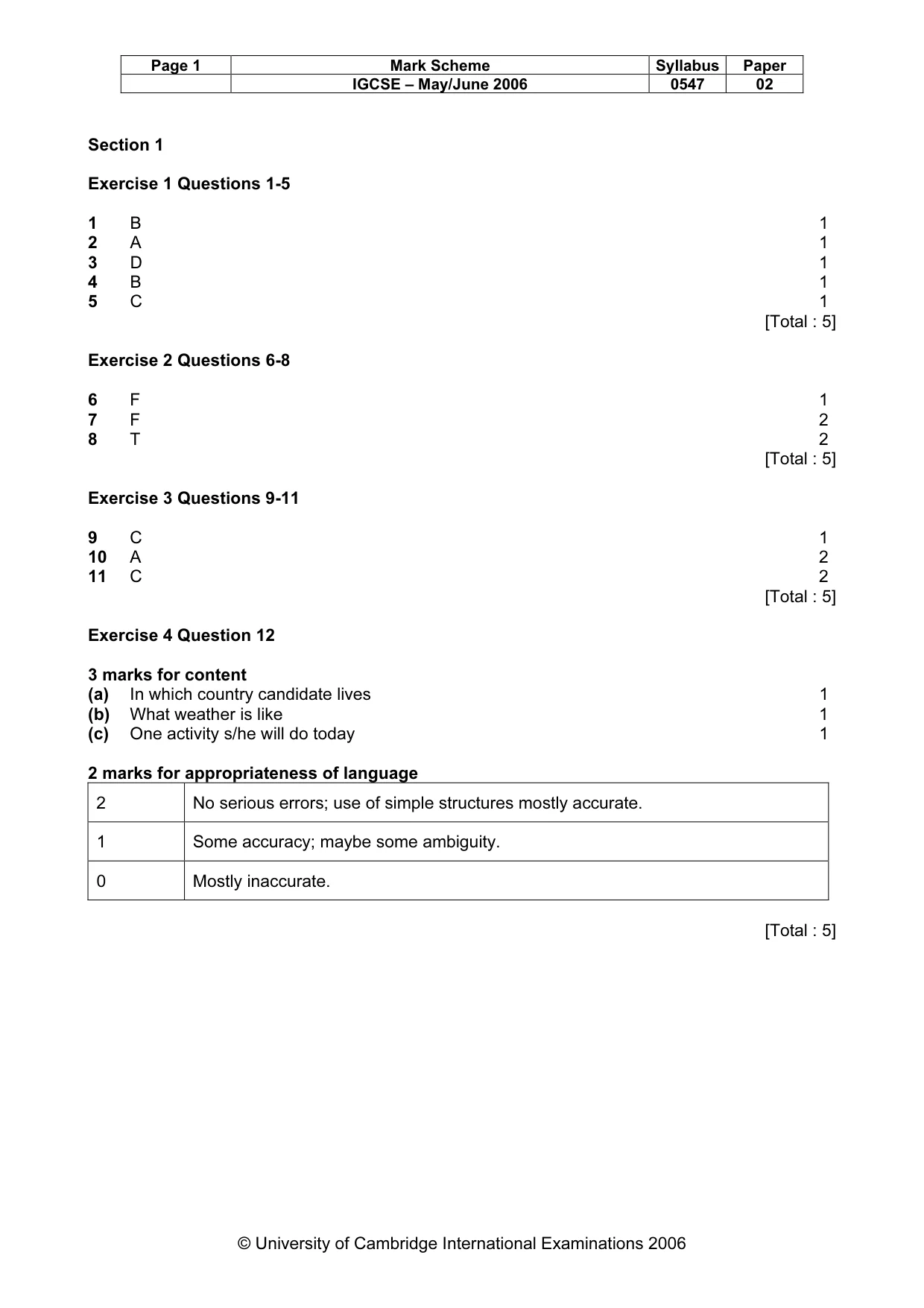
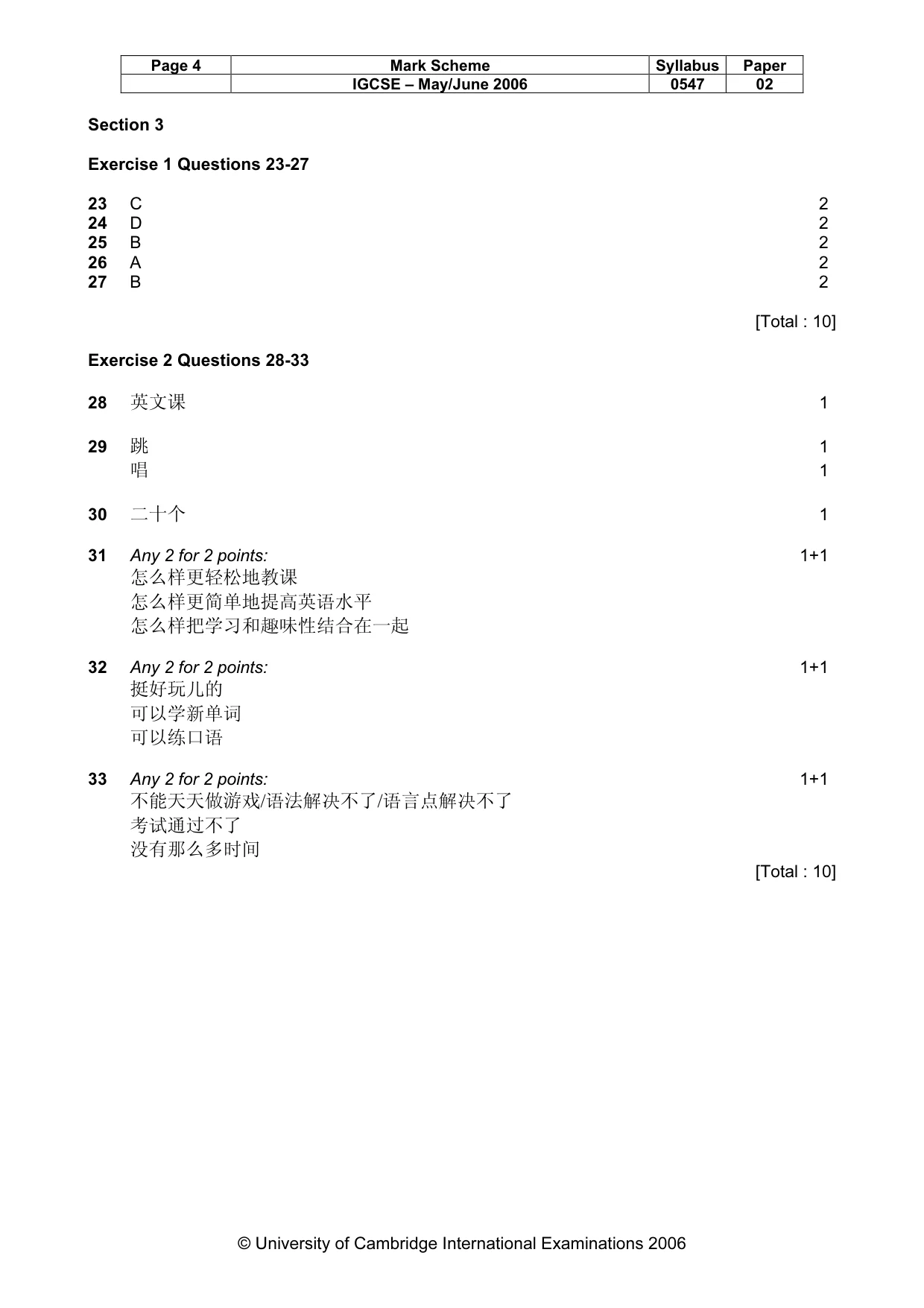
Page 1 Mark Scheme Syllabus Paper IGCSE – May/June 2006 0547 02 © University of Cambridge International Examinations 2006 Section 1 Exercise 1 Questions 1-5 1 B 1 2 A 1 3 D 1 4 B 1 5 C 1 [Total : 5] Exercise 2 Questions 6-8 6 F 1 7 F 2 8 T 2 [Total : 5] Exercise 3 Questions 9-11 9 C 1 10 A 2 11 C 2 [Total : 5] Exercise 4 Question 12 3 marks for content (a) In which country candidate lives 1 (b) What weather is like 1 (c) One activity s/he will do today 1 2 marks for appropriateness of language 2 No serious errors; use of simple structures mostly accurate. 1 Some accuracy; maybe some ambiguity. 0 Mostly inaccurate. [Total : 5]

Mark scheme, page 3

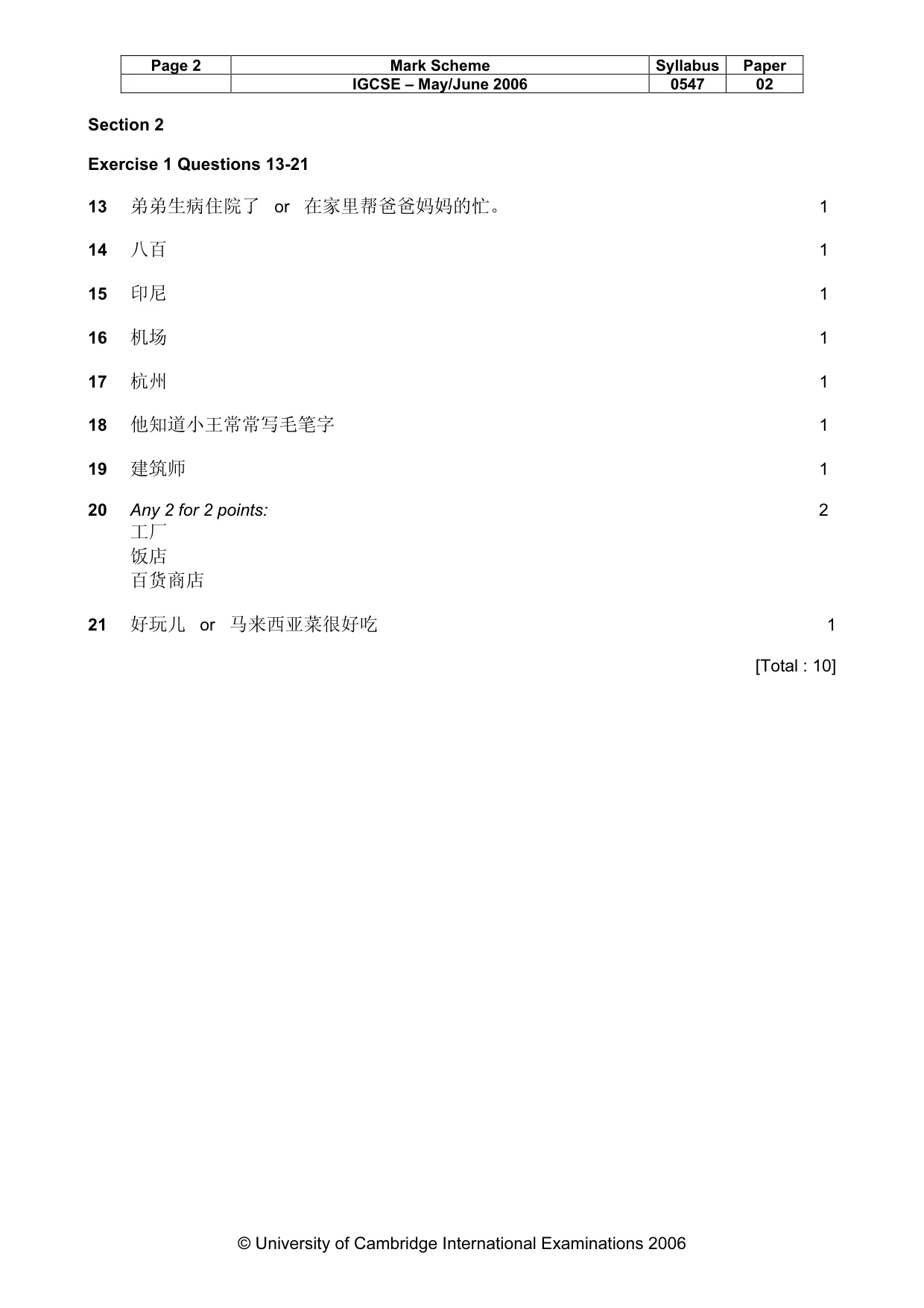
Page 2 Mark Scheme Syllabus Paper IGCSE – May/June 2006 0547 02 © University of Cambridge International Examinations 2006 Section 2 Exercise 1 Questions 13-21 13 弟弟生病住院了 or 在家里帮爸爸妈妈的忙。 1 14 八百 1 15 印尼 1 16 机场 1 17 杭州 1 18 他知道小王常常写毛笔字 1 19 建筑师 1 20 Any 2 for 2 points: 2 工厂 饭店 百货商店 21 好玩儿 or 马来西亚菜很好吃 1 [Total : 10]

Mark scheme, page 4

Page 3 Mark Scheme Syllabus Paper IGCSE – May/June 2006 0547 02 © University of Cambridge International Examinations 2006 Exercise 2 Question 22 Communication marks: 10 marks are awarded for Communication. 1 mark is awarded for each item of relevant information communicated. Candidates who have not completed all of the tasks stipulated in the rubric cannot score full Communication marks (a) What new home is like (b) What candidate's room is like (c) Description of new friend(s) (d) Opinion of school (e) Opinion of new town plus reason Up to 5 further marks available for additional details for (a) to (e) 1 mark available for appropriate beginning or ending Maximum of 3 marks for a list Accuracy marks: 5 marks are awarded for Accuracy of Grammar and Structures according to the grid that follows: 5 marks Highly accurate in the use of simpler structures, with occasional minor slips. 4 marks Accurate in the use of simpler structures, except for occasional more serious errors/more frequent slips. 3 marks Generally accurate, but with increased incidence of more serious errors. 2 marks Substantially inaccurate, despite several examples of accurate usage. 1 marks Substantially inaccurate, with only isolated examples of accurate usage. [Total : 15]

Mark scheme, page 5

Page 4 Mark Scheme Syllabus Paper IGCSE – May/June 2006 0547 02 © University of Cambridge International Examinations 2006 Section 3 Exercise 1 Questions 23-27 23 C 2 24 D 2 25 B 2 26 A 2 27 B 2 [Total : 10] Exercise 2 Questions 28-33 28 英文课 1 29 跳 1 唱 1 30 二十个 1 31 Any 2 for 2 points: 1+1 怎么样更轻松地教课 怎么样更简单地提高英语水平 怎么样把学习和趣味性结合在一起 32 Any 2 for 2 points: 1+1 挺好玩儿的 可以学新单词 可以练口语 33 Any 2 for 2 points: 1+1 不能天天做游戏/语法解决不了/语言点解决不了 考试通过不了 没有那么多时间 [Total : 10]

What you needed in this session

Cambridge’s own grade thresholds for 2006 May/June, Paper 2 · Variant 1. A higher threshold means an easier paper — the bar moves with how the cohort did.

A48/65
C31/65
E20/65
F15/65