Cambridge IGCSE Chemistry (9-1) 0971 — 2025 May/June Paper 5 · Variant 1
0971/51/M/J/25 · 3 questions · 40 marks · 75 min
The question paper and its mark scheme, free to read here and free to download. This is Cambridge’s own paper, exactly as it was sat.
Question paper12 pages



Mark scheme8 pages
Answers below. Sit the paper first if you are practising.
Questions as text
Q1 · You are going to investigate how the rate of reaction of magnesium ribbon with dilute…
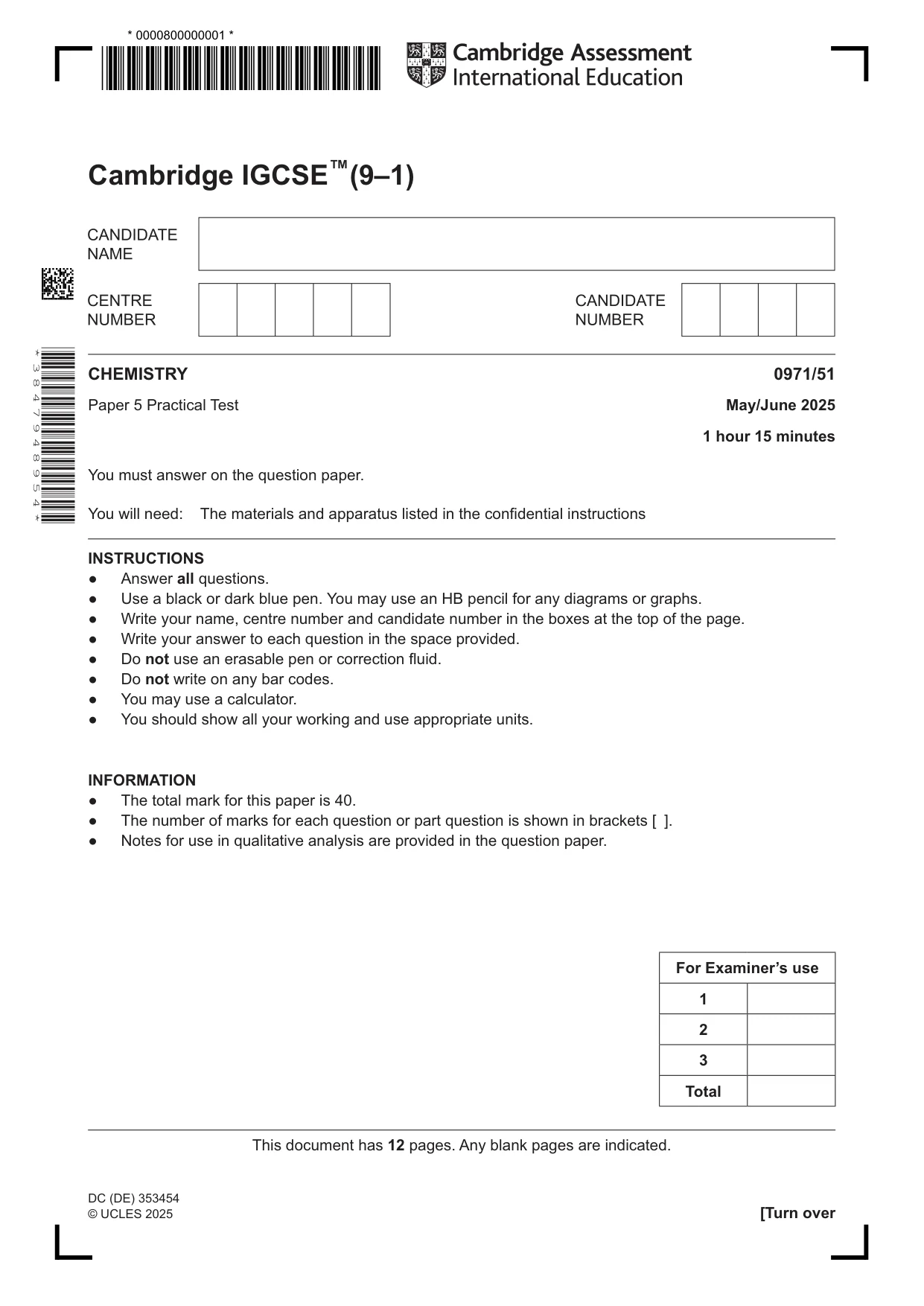
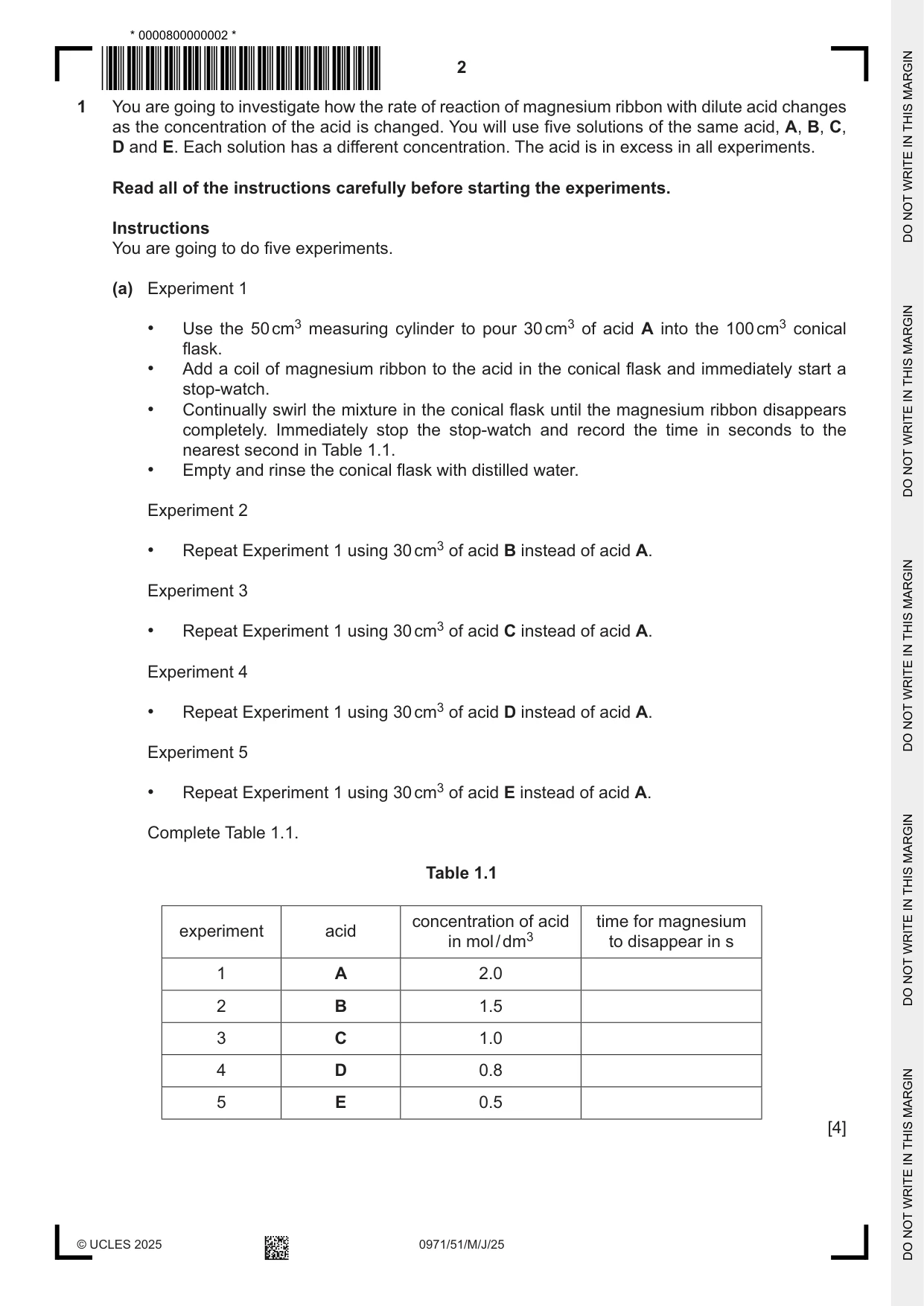
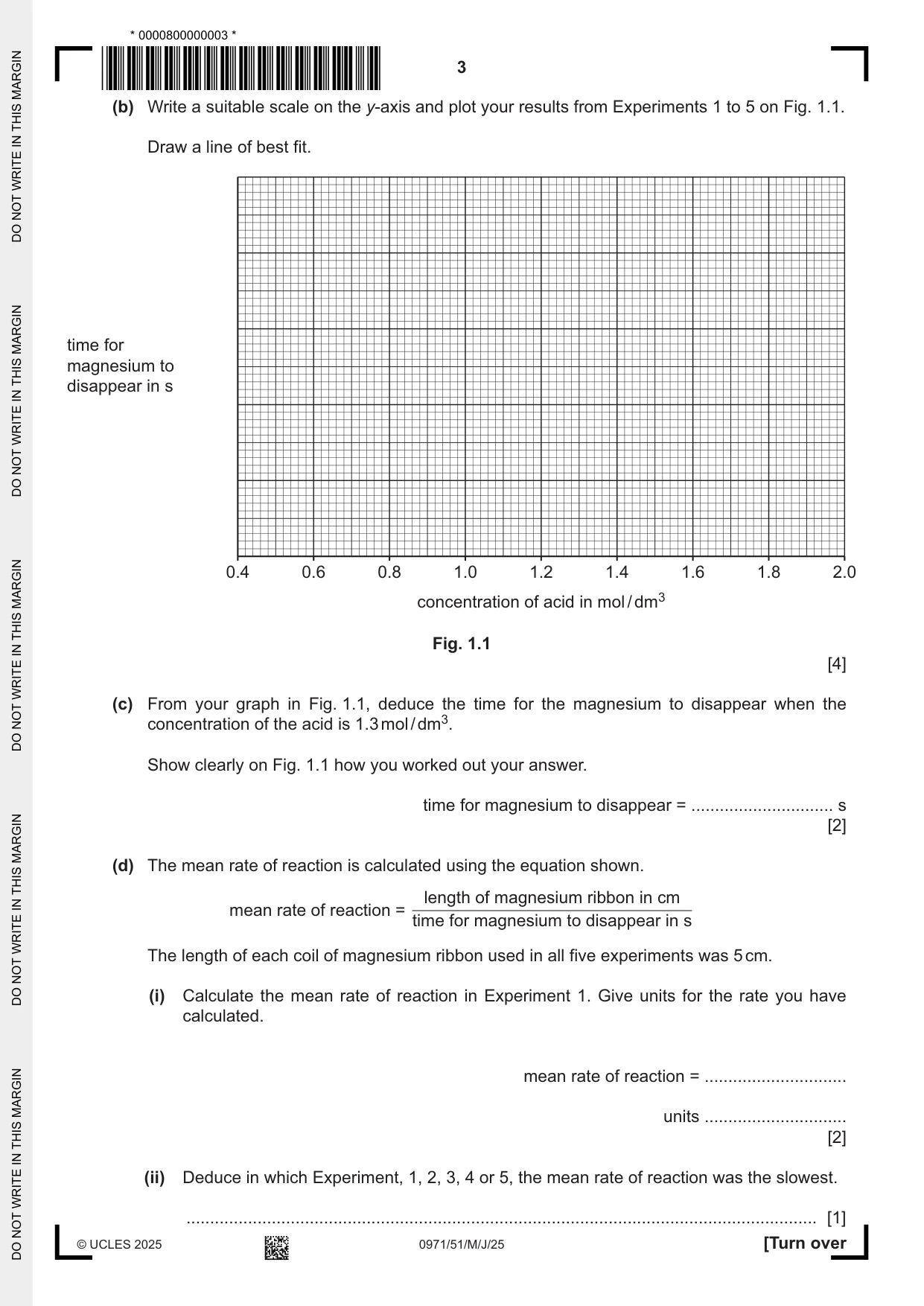
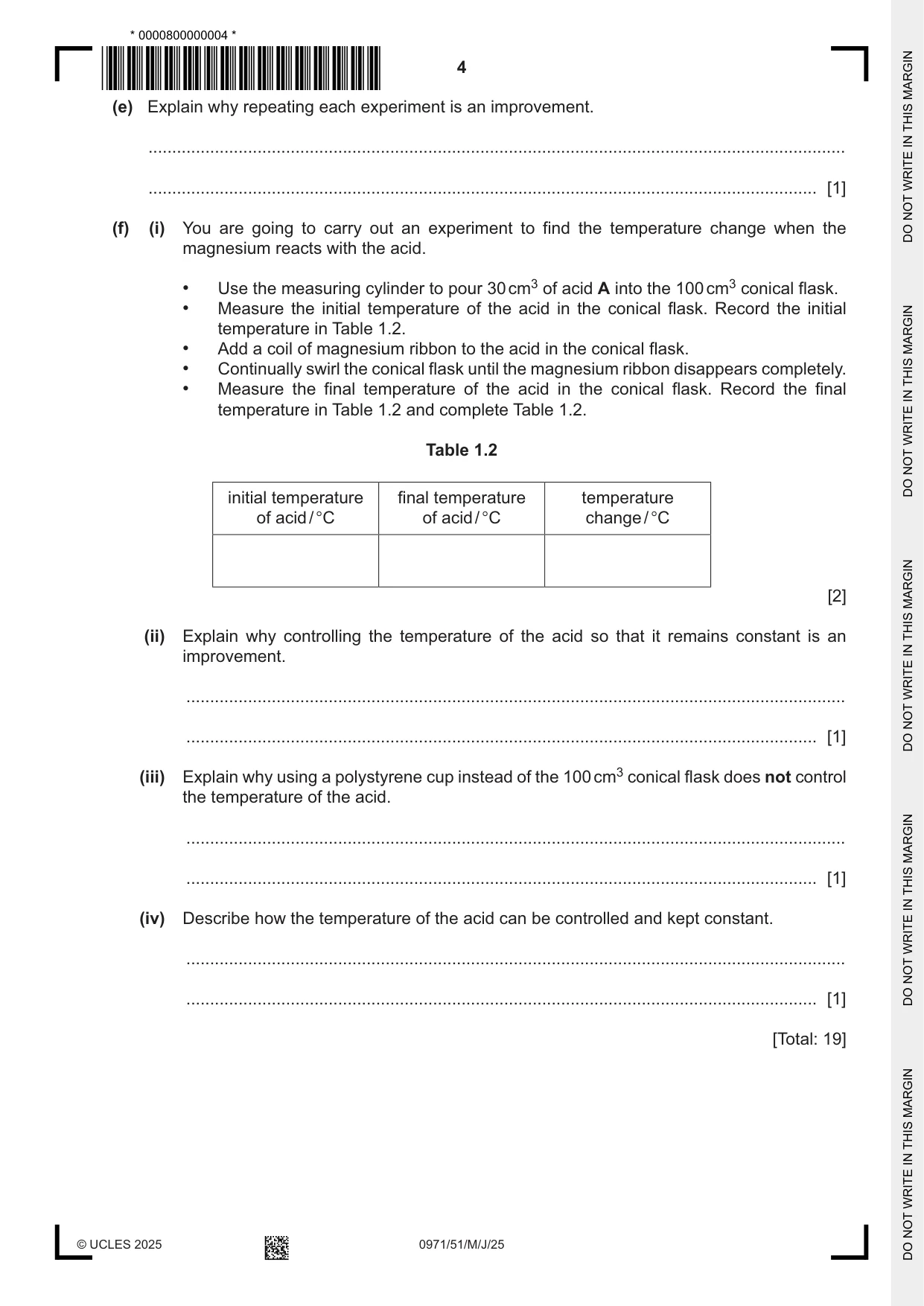
1 You are going to investigate how the rate of reaction of magnesium ribbon with dilute acid changes as the concentration of the acid is changed. You will use five solutions of the same acid, A, B, C, D and E. Each solution has a different concentration. The acid is in excess in all experiments. Read all of the instructions carefully before starting the experiments. Instructions You are going to do five experiments. (a) Experiment 1 • Use the 50 cm3 measuring cylinder to pour 30 cm3 of acid A into the 100 cm3 conical flask. • Add a coil of magnesium ribbon to the acid in the conical flask and immediately start a stop‑watch. • Continually swirl the mixture in the conical flask until the magnesium ribbon disappears completely. Immediately stop the stop‑watch and record the time in seconds to the nearest second in Table 1.1. • Empty and rinse the conical flask with distilled water. Experiment 2 • Repeat Experiment 1 using 30 cm3 of acid B instead of acid A. Experiment 3 • Repeat Experiment 1 using 30 cm3 of acid C instead of acid A. Experiment 4 • Repeat Experiment 1 using 30 cm3 of acid D instead of acid A. Experiment 5 • Repeat Experiment 1 using 30 cm3 of acid E instead of acid A. Complete Table 1.1. Table 1.1 concentration of acid time for magnesium experiment acid in mol / dm3 to disappear in s 1 A 2.0 2 B 1.5 3 C 1.0 4 D 0.8 5 E 0.5 [4] (b) Write a suitable scale on the y‑axis and plot your results from Experiments 1 to 5 on Fig. 1.1. Draw a line of best fit. time for magnesium to disappear in s 0.4 0.6 0.8 1.0 1.2 1.4 1.6 1.8 2.0 concentration of acid in mol / dm3 Fig. 1.1 [4] (c) From your graph in Fig. 1.1, deduce the time for the magnesium to disappear when the concentration of the acid is 1.3 mol / dm3. Show clearly on Fig. 1.1 how you worked out your answer. time for magnesium to disappear = .............................. s [2] (d) The mean rate of reaction is calculated using the equation shown. length of magnesium ribbon in cm mean rate of reaction = time for magnesium to disappear in s The length of each coil of magnesium ribbon used in all five experiments was 5 cm. (i) Calculate the mean rate of reaction in Experiment 1. Give units for the rate you have calculated. mean rate of reaction = .............................. units .............................. [2] (ii) Deduce in which Experiment, 1, 2, 3, 4 or 5, the mean rate of reaction was the slowest. ..................................................................................................................................... [1] (e) Explain why repeating each experiment is an improvement. ................................................................................................................................................... ............................................................................................................................................. [1] (f) (i) You are going to carry out an experiment to find the temperature change when the magnesium reacts with the acid. • Use the measuring cylinder to pour 30 cm3 of acid A into the 100 cm3 conical flask. • Measure the initial temperature of the acid in the conical flask. Record the initial temperature in Table 1.2. • Add a coil of magnesium ribbon to the acid in the conical flask. • Continually swirl the conical flask until the magnesium ribbon disappears completely. • Measure the final temperature of the acid in the conical flask. Record the final temperature in Table 1.2 and complete Table 1.2. Table 1.2 initial temperature final temperature temperature of acid / °C of acid / °C change / °C [2] (ii) Explain why controlling the temperature of the acid so that it remains constant is an improvement. ........................................................................................................................................... ..................................................................................................................................... [1] (iii) Explain why using a polystyrene cup instead of the 100 cm3 conical flask does not control the temperature of the acid. ........................................................................................................................................... ..................................................................................................................................... [1] (iv) Describe how the temperature of the acid can be controlled and kept constant. ........................................................................................................................................... ..................................................................................................................................... [1] [Total: 19]
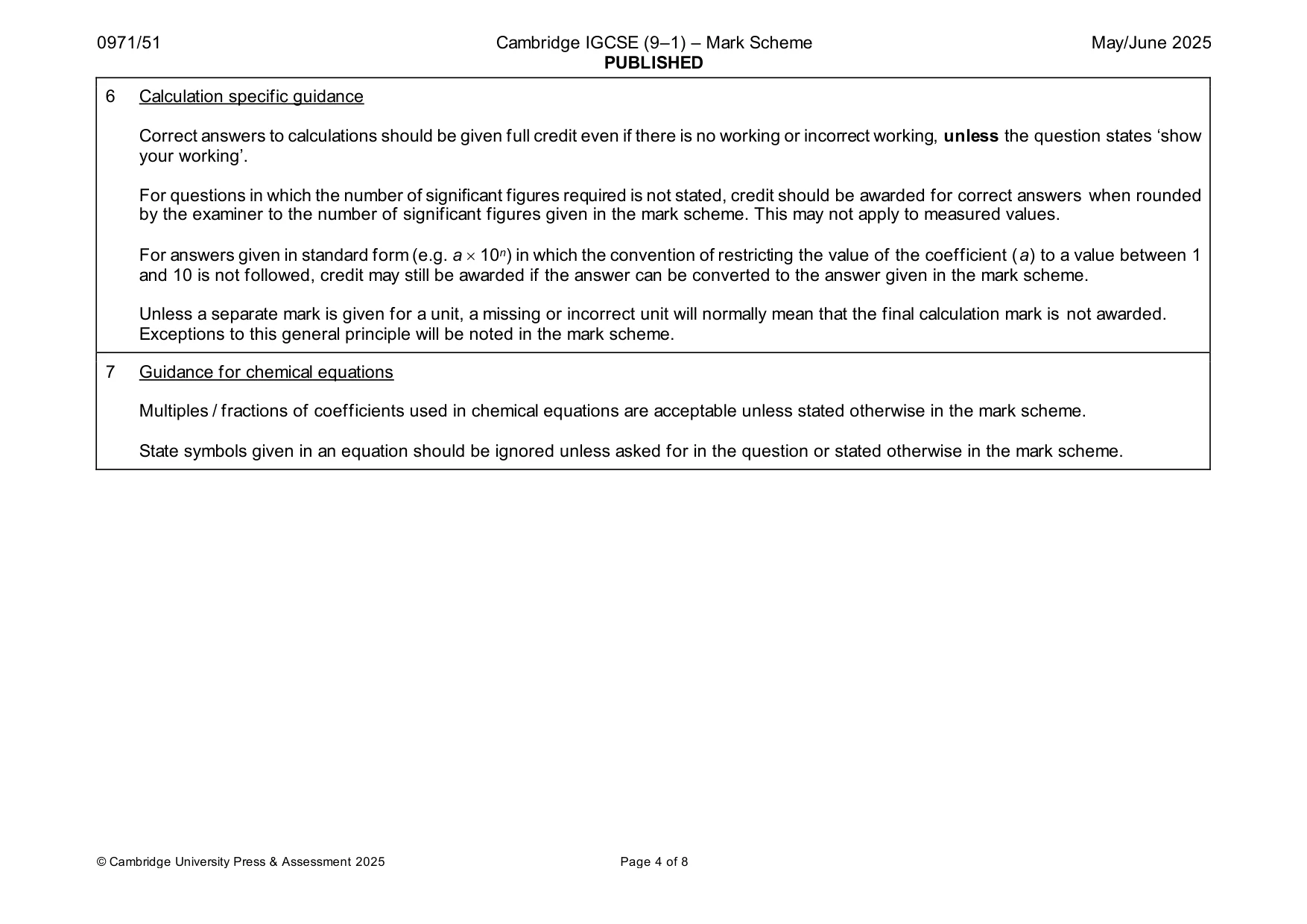
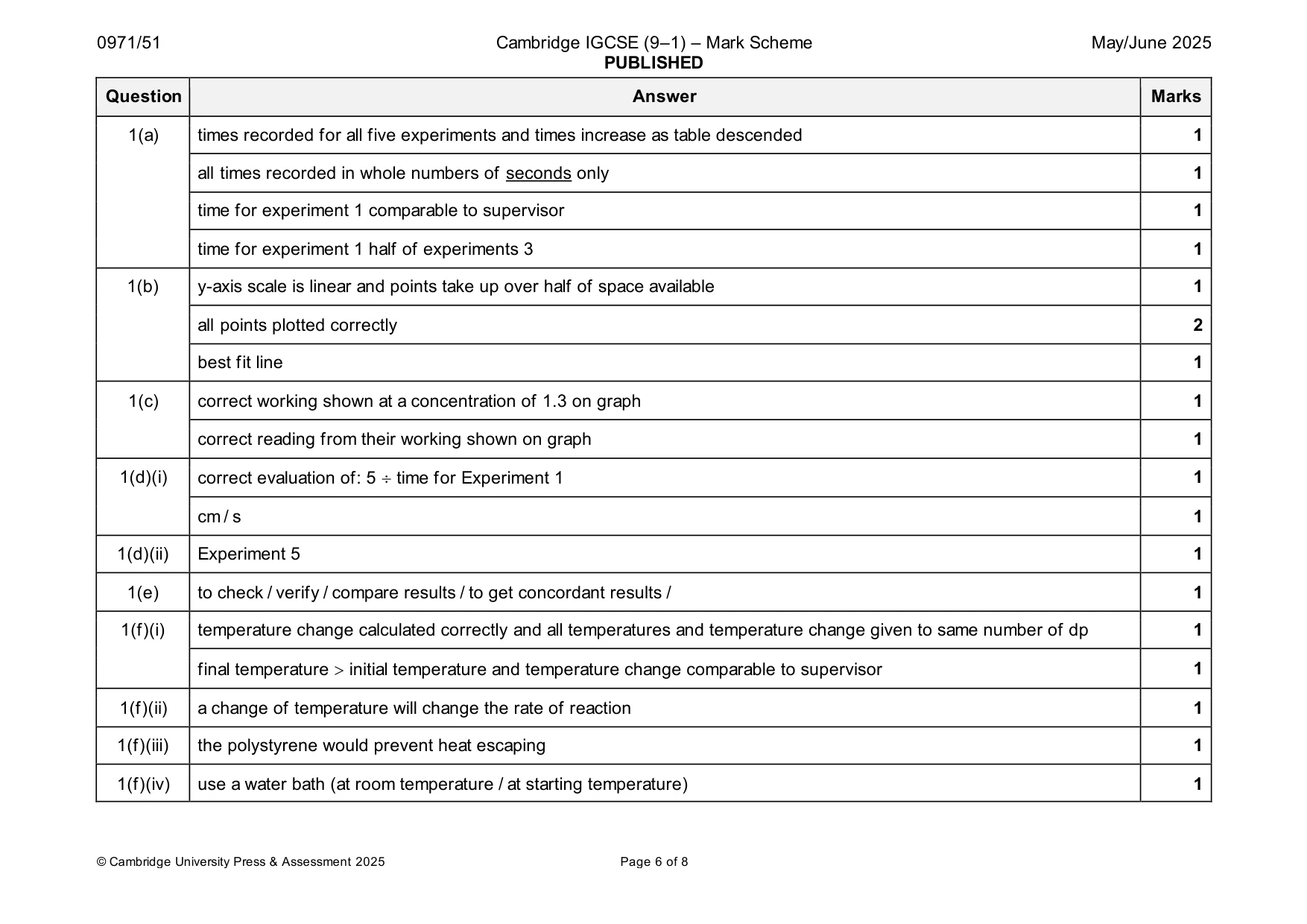
Mark scheme: Question Answer Marks 1(a) times recorded for all five experiments and times increase as table descended 1 all times recorded in whole numbers of seconds only 1 time for experiment 1 comparable to supervisor 1 time for experiment 1 half of experiments 3 1 1(b) y-axis scale is linear and points take up over half of space available 1 all points plotted correctly 2 best fit line 1 1(c) correct working shown at a concentration of 1.3 on graph 1 correct reading from their working shown on graph 1 1(d)(i) correct evaluation of: 5 time for Experiment 1 1 cm / s 1 1(d)(ii) Experiment 5 1 1(e) to check / verify / compare results / to get concordant results / 1 1(f)(i) temperature change calculated correctly and all temperatures and temperature change given to same number of dp 1 final temperature initial temperature and temperature change comparable to supervisor 1 1(f)(ii) a change of temperature will change the rate of reaction 1 1(f)(iii) the polystyrene would prevent heat escaping 1 1(f)(iv) use a water bath (at room temperature / at starting temperature) 1
Q2 · You are provided with two solids: solid F and solid G
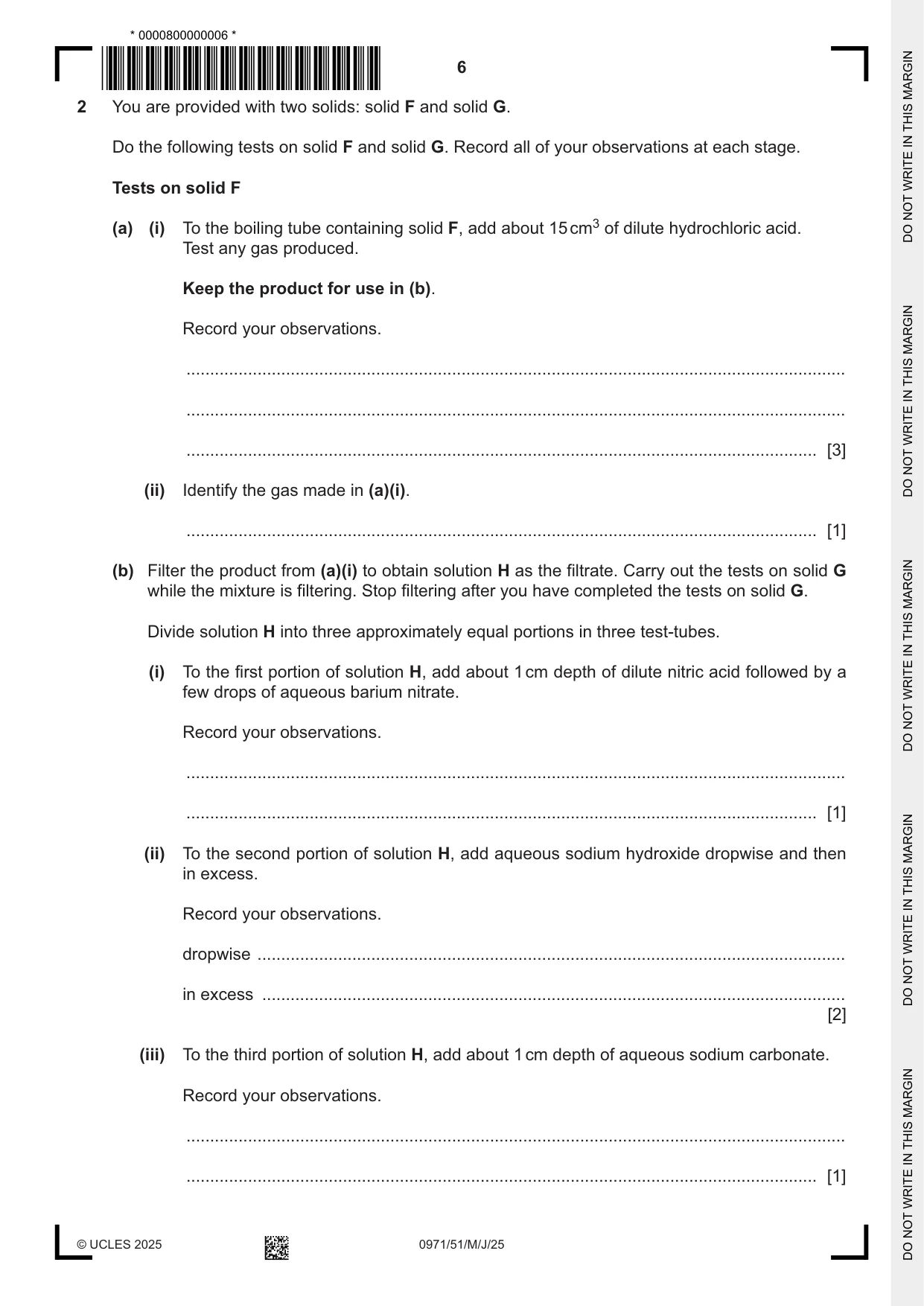
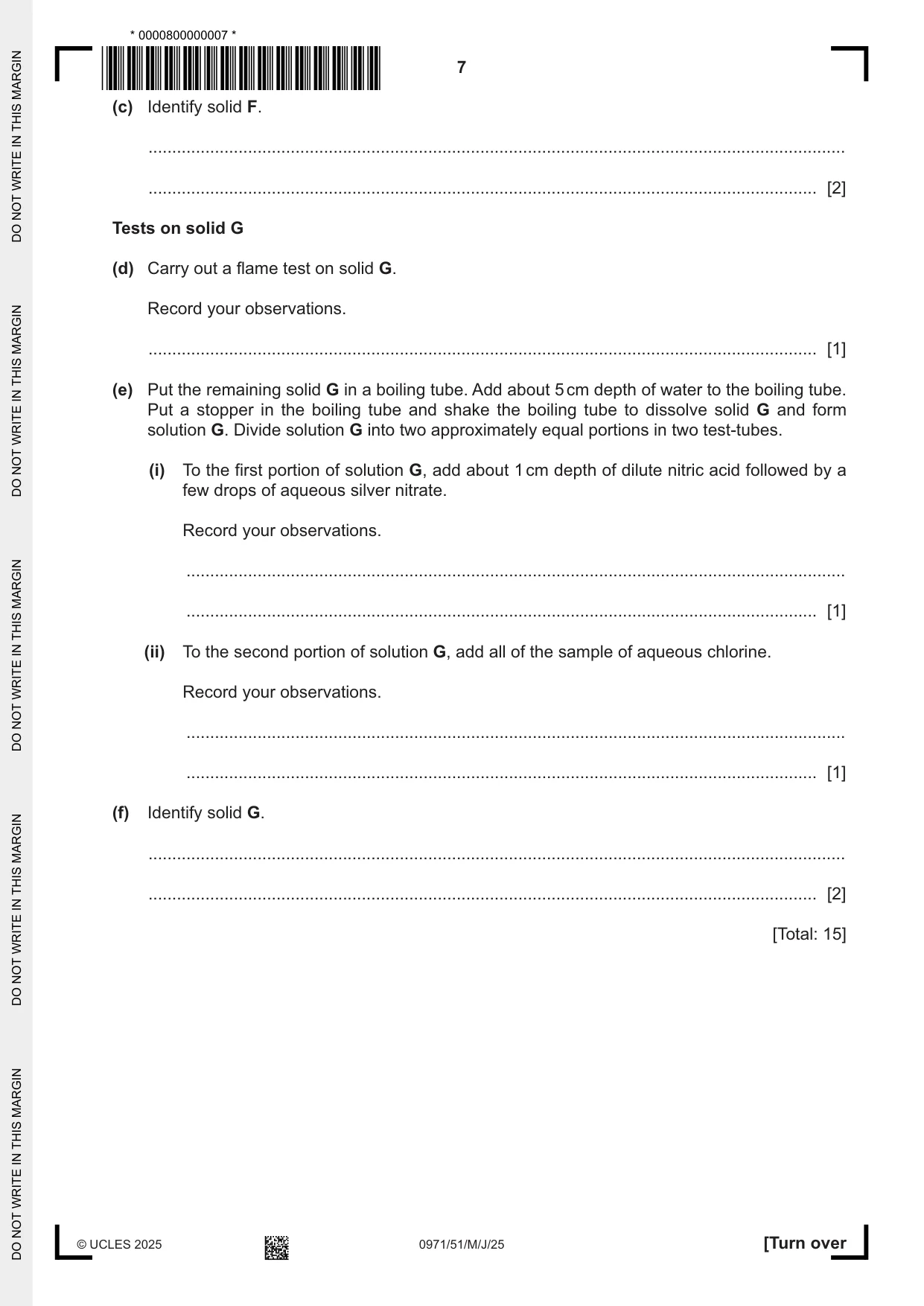
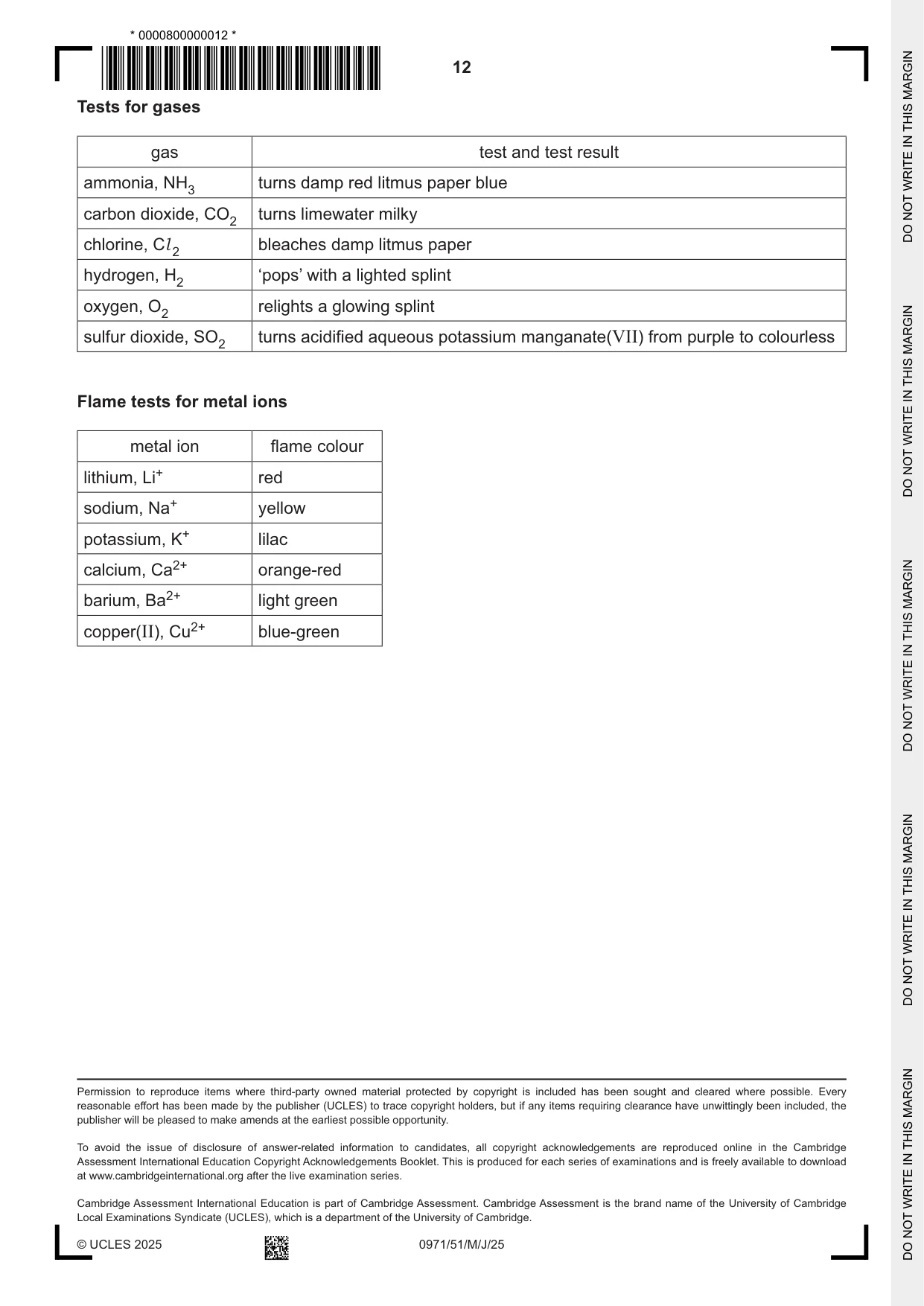
2 You are provided with two solids: solid F and solid G. Do the following tests on solid F and solid G. Record all of your observations at each stage. Tests on solid F (a) (i) To the boiling tube containing solid F, add about 15 cm3 of dilute hydrochloric acid. Test any gas produced. Keep the product for use in (b). Record your observations. ........................................................................................................................................... ........................................................................................................................................... ..................................................................................................................................... [3] (ii) Identify the gas made in (a)(i). ..................................................................................................................................... [1] (b) Filter the product from (a)(i) to obtain solution H as the filtrate. Carry out the tests on solid G while the mixture is filtering. Stop filtering after you have completed the tests on solid G. Divide solution H into three approximately equal portions in three test‑tubes. (i) To the first portion of solution H, add about 1 cm depth of dilute nitric acid followed by a few drops of aqueous barium nitrate. Record your observations. ........................................................................................................................................... ..................................................................................................................................... [1] (ii) To the second portion of solution H, add aqueous sodium hydroxide dropwise and then in excess. Record your observations. dropwise ............................................................................................................................ in excess ........................................................................................................................... [2] (iii) To the third portion of solution H, add about 1 cm depth of aqueous sodium carbonate. Record your observations. ........................................................................................................................................... ..................................................................................................................................... [1] (c) Identify solid F. ................................................................................................................................................... ............................................................................................................................................. [2] Tests on solid G (d) Carry out a flame test on solid G. Record your observations. ............................................................................................................................................. [1] (e) Put the remaining solid G in a boiling tube. Add about 5 cm depth of water to the boiling tube. Put a stopper in the boiling tube and shake the boiling tube to dissolve solid G and form solution G. Divide solution G into two approximately equal portions in two test‑tubes. (i) To the first portion of solution G, add about 1 cm depth of dilute nitric acid followed by a few drops of aqueous silver nitrate. Record your observations. ........................................................................................................................................... ..................................................................................................................................... [1] (ii) To the second portion of solution G, add all of the sample of aqueous chlorine. Record your observations. ........................................................................................................................................... ..................................................................................................................................... [1] (f) Identify solid G. ................................................................................................................................................... ............................................................................................................................................. [2] [Total: 15]
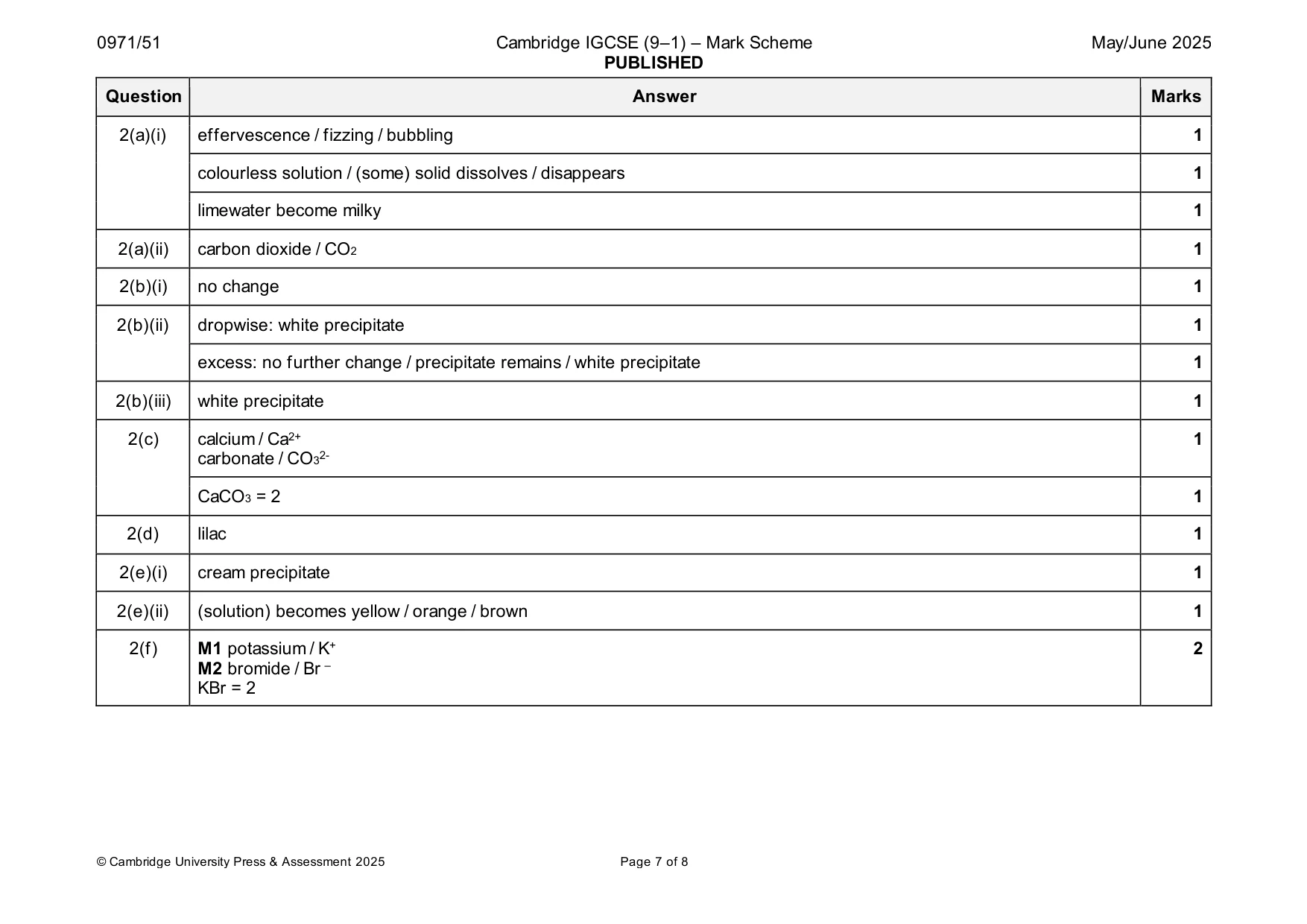
Mark scheme: 2(a)(i) effervescence / fizzing / bubbling 1 colourless solution / (some) solid dissolves / disappears 1 limewater become milky 1 2(a)(ii) carbon dioxide / CO2 1 2(b)(i) no change 1 2(b)(ii) dropwise: white precipitate 1 excess: no further change / precipitate remains / white precipitate 1 2(b)(iii) white precipitate 1 2(c) calcium / Ca2+ 1 carbonate / CO32- CaCO3 = 2 1 2(d) lilac 1 2(e)(i) cream precipitate 1 2(e)(ii) (solution) becomes yellow / orange / brown 1 2(f) M1 potassium / K+ 2 M2 bromide / Br – KBr = 2
Q3 · Solid sodium hydrogencarbonate, NaHCO3, reacts with dilute hydrochloric acid and with…
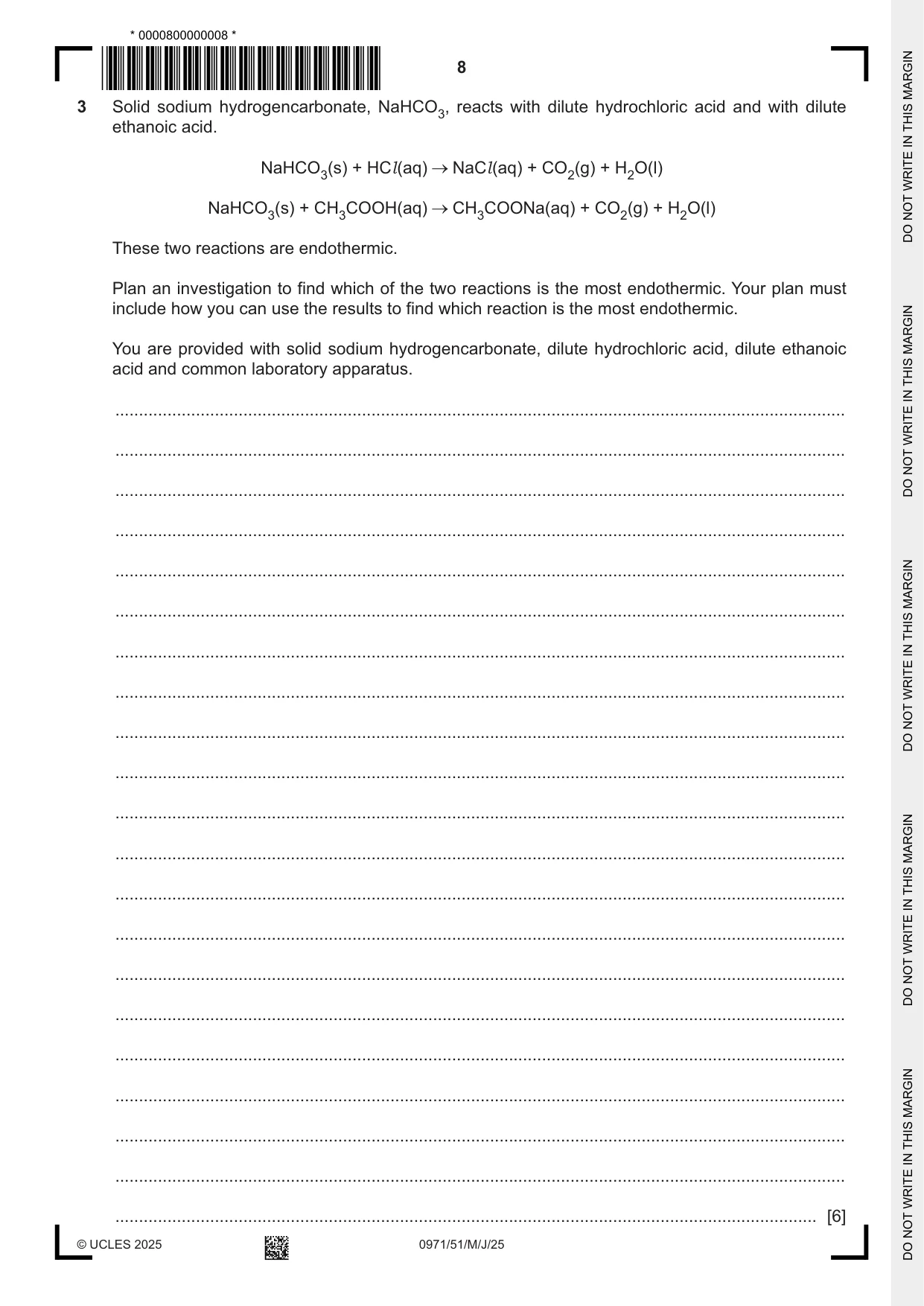
3 Solid sodium hydrogencarbonate, NaHCO3, reacts with dilute hydrochloric acid and with dilute ethanoic acid. NaHCO3(s) + HCl (aq) NaCl (aq) + CO2(g) + H2O(l) NaHCO3(s) + CH3COOH(aq) CH3COONa(aq) + CO2(g) + H2O(l) These two reactions are endothermic. Plan an investigation to find which of the two reactions is the most endothermic. Your plan must include how you can use the results to find which reaction is the most endothermic. You are provided with solid sodium hydrogencarbonate, dilute hydrochloric acid, dilute ethanoic acid and common laboratory apparatus. .......................................................................................................................................................... .......................................................................................................................................................... .......................................................................................................................................................... .......................................................................................................................................................... .......................................................................................................................................................... .......................................................................................................................................................... .......................................................................................................................................................... .......................................................................................................................................................... .......................................................................................................................................................... .......................................................................................................................................................... .......................................................................................................................................................... .......................................................................................................................................................... .......................................................................................................................................................... .......................................................................................................................................................... .......................................................................................................................................................... .......................................................................................................................................................... .......................................................................................................................................................... .......................................................................................................................................................... .......................................................................................................................................................... .......................................................................................................................................................... .................................................................................................................................................... [6]
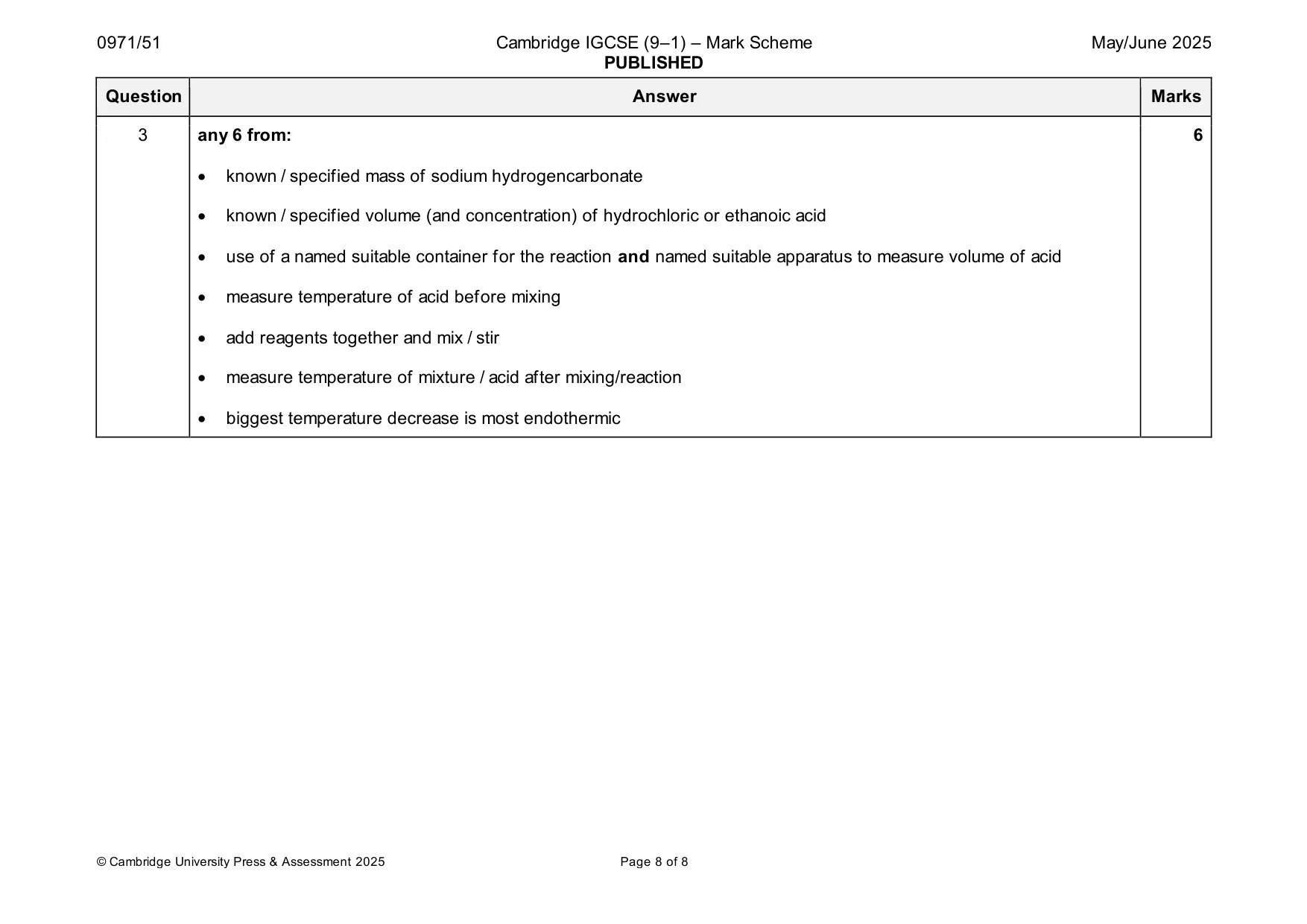
Mark scheme: 3 any 6 from: 6 • known / specified mass of sodium hydrogencarbonate • known / specified volume (and concentration) of hydrochloric or ethanoic acid • use of a named suitable container for the reaction and named suitable apparatus to measure volume of acid • measure temperature of acid before mixing • add reagents together and mix / stir • measure temperature of mixture / acid after mixing/reaction • biggest temperature decrease is most endothermic
What was in this paper
The subtopics covered by these 3 questions, and how many questions each got. Open one in a new tab to see every Cambridge question on it.
What you needed in this session
Cambridge’s own grade thresholds for 2025 May/June, Paper 5 · Variant 1. A higher threshold means an easier paper — the bar moves with how the cohort did.