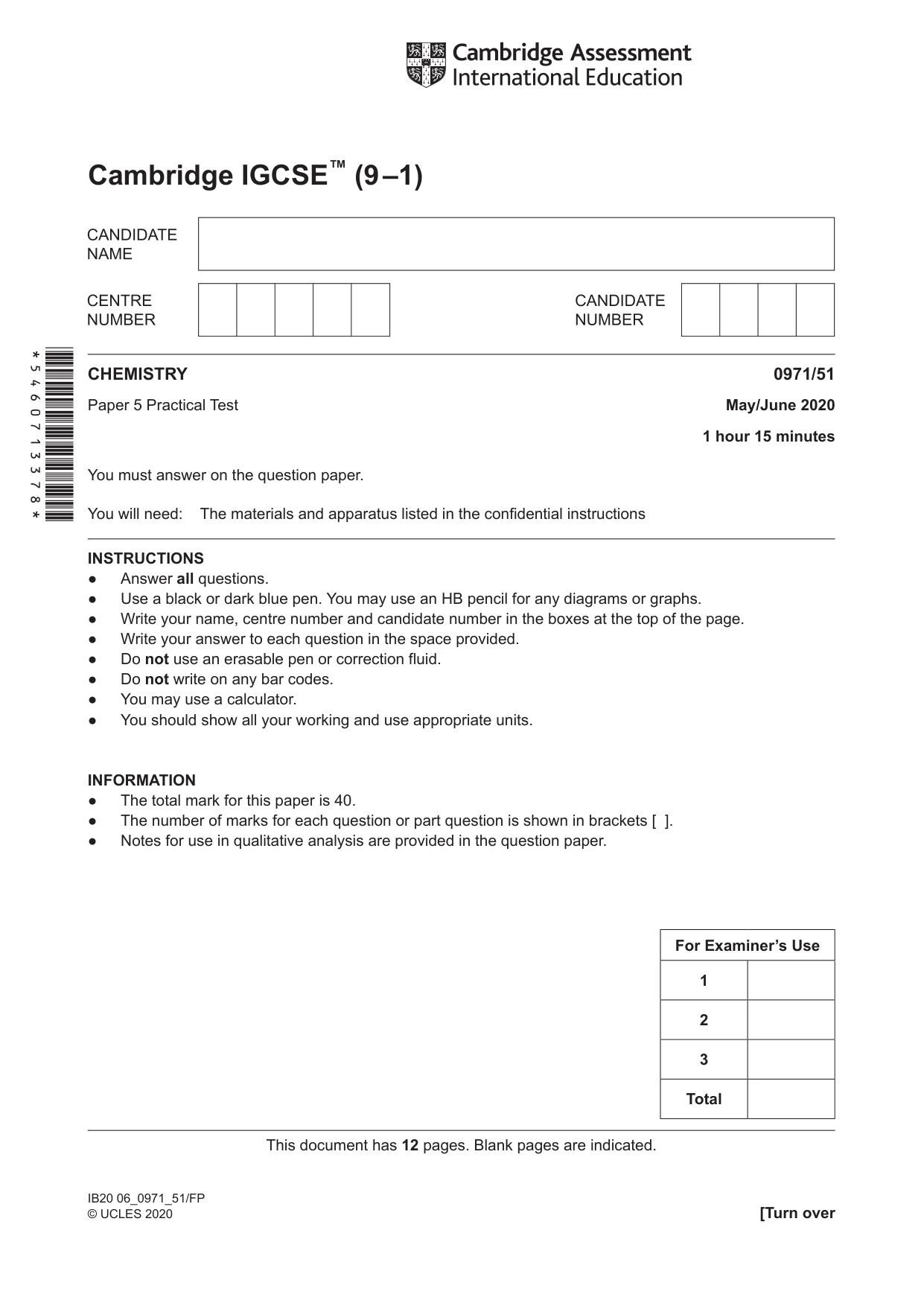
Cambridge IGCSE Chemistry (9-1) 0971 — 2020 May/June Paper 5 · Variant 1
0971/51/M/J/20 · 3 questions · 40 marks · ≈45 min
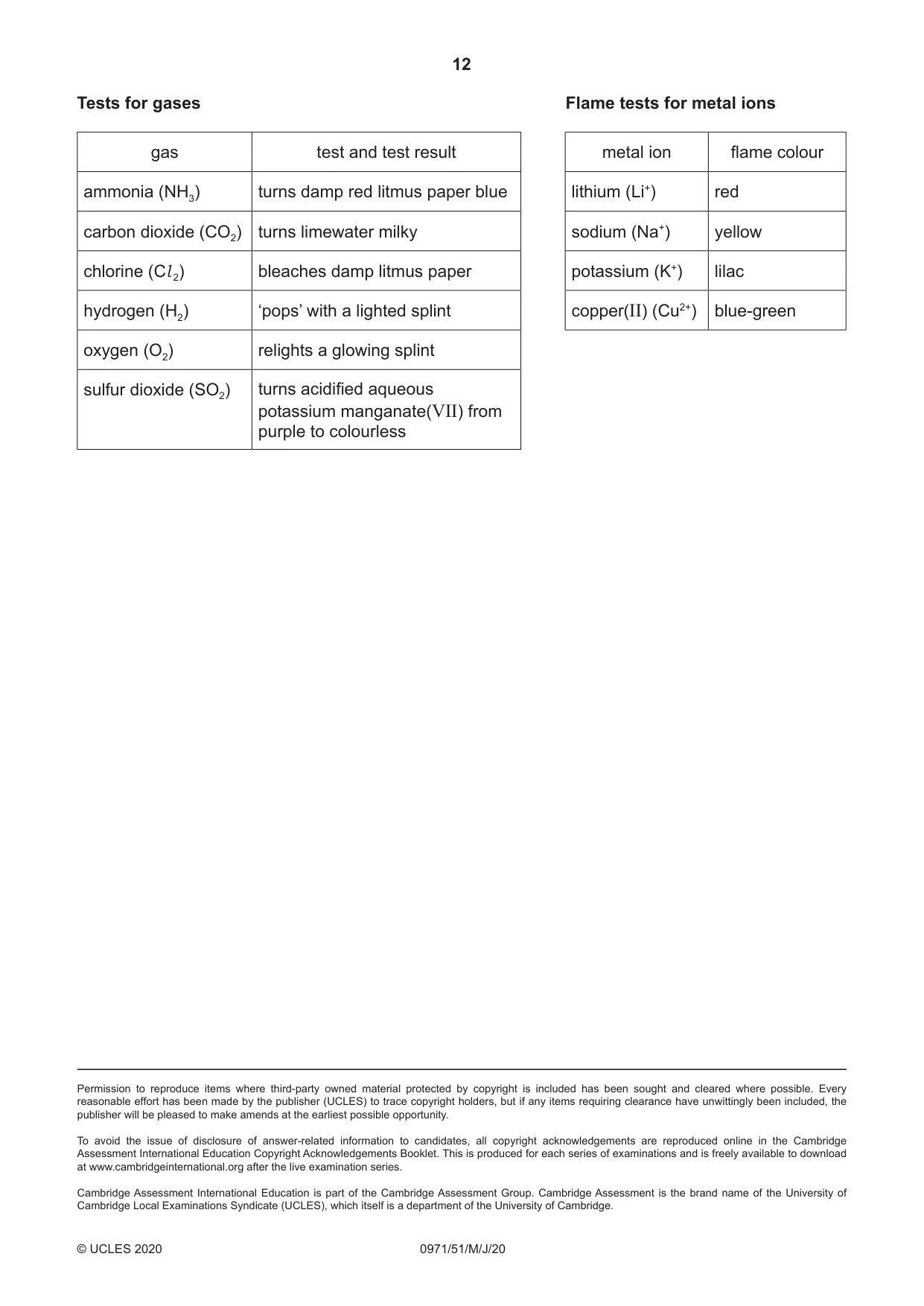
The question paper and its mark scheme, free to read here and free to download. This is Cambridge’s own paper, exactly as it was sat.
Question paper12 pages



Mark scheme8 pages
Answers below. Sit the paper first if you are practising.
Questions as text
Q1 · You are going to investigate the reaction between dilute hydrochloric acid and two…
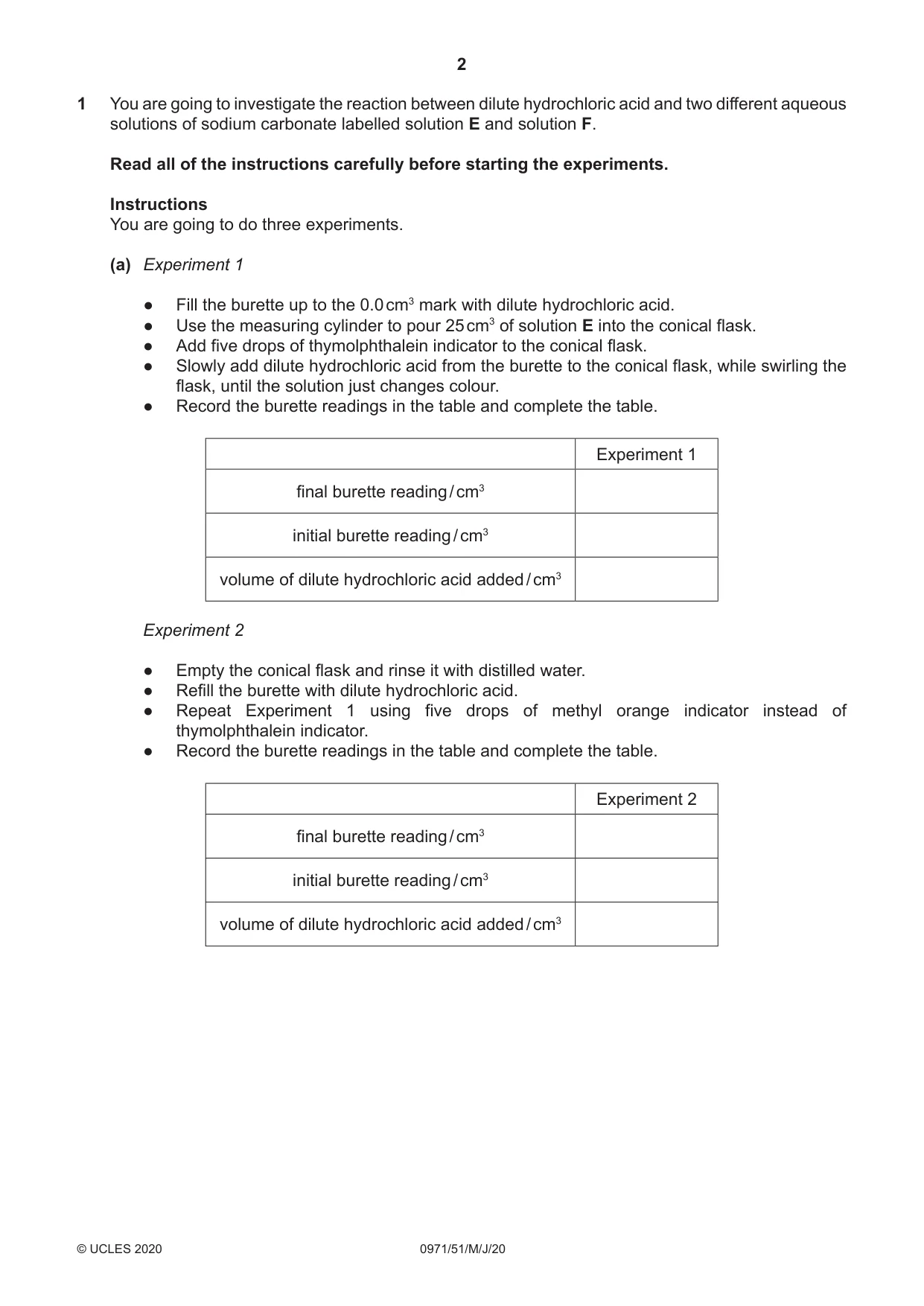
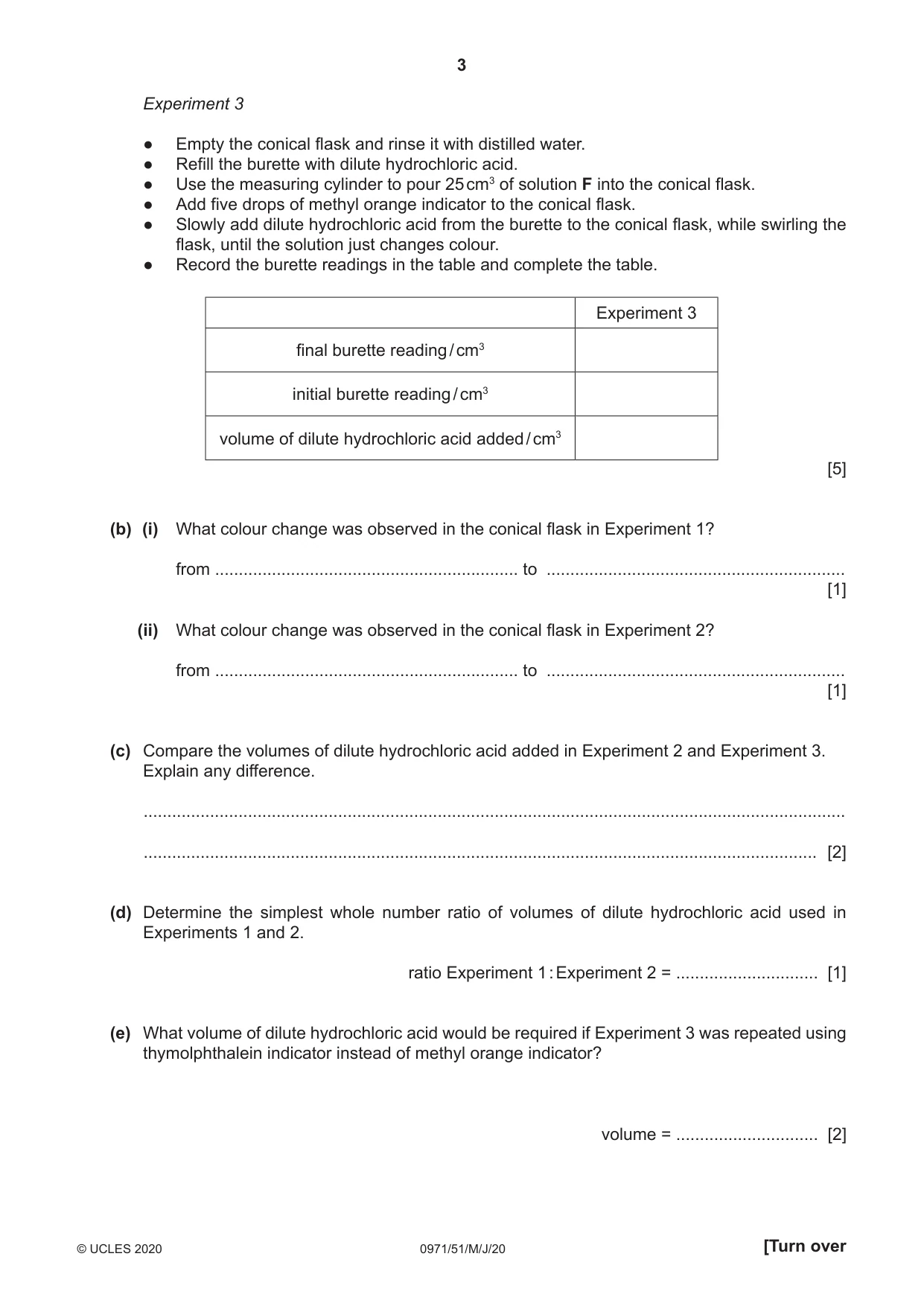
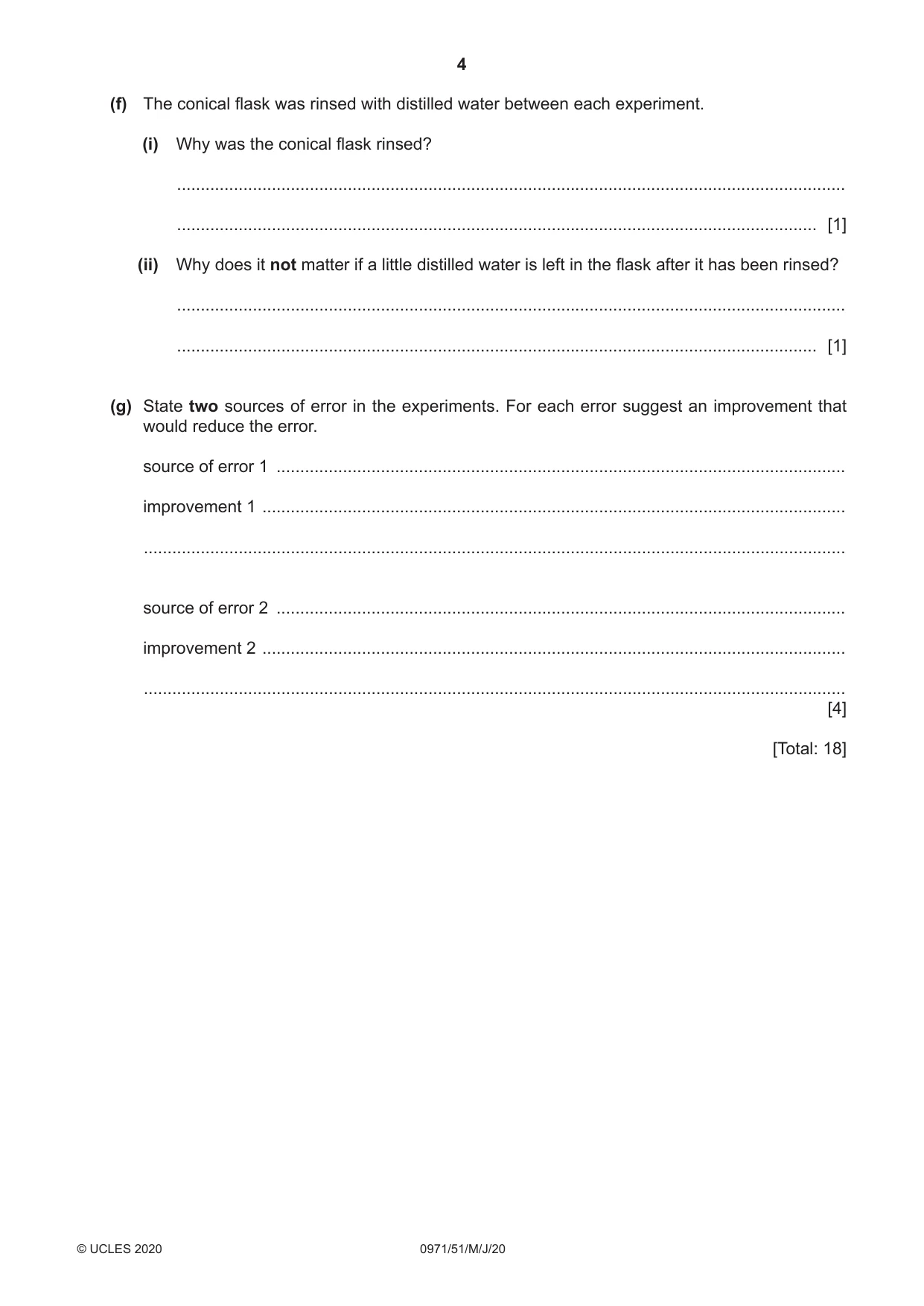
1 You are going to investigate the reaction between dilute hydrochloric acid and two different aqueous solutions of sodium carbonate labelled solution E and solution F. Read all of the instructions carefully before starting the experiments. Instructions You are going to do three experiments. (a) Experiment 1 ●● Fill the burette up to the 0.0 cm3 mark with dilute hydrochloric acid. ●● Use the measuring cylinder to pour 25 cm3 of solution E into the conical flask. ●● Add five drops of thymolphthalein indicator to the conical flask. ●● Slowly add dilute hydrochloric acid from the burette to the conical flask, while swirling the flask, until the solution just changes colour. ●● Record the burette readings in the table and complete the table. Experiment 1 final burette reading / cm3 initial burette reading / cm3 volume of dilute hydrochloric acid added / cm3 Experiment 2 ●● Empty the conical flask and rinse it with distilled water. ●● Refill the burette with dilute hydrochloric acid. ●● Repeat Experiment 1 using five drops of methyl orange indicator instead of thymolphthalein indicator. ●● Record the burette readings in the table and complete the table. Experiment 2 final burette reading / cm3 initial burette reading / cm3 volume of dilute hydrochloric acid added / cm3 Experiment 3 ●● Empty the conical flask and rinse it with distilled water. ●● Refill the burette with dilute hydrochloric acid. ●● Use the measuring cylinder to pour 25 cm3 of solution F into the conical flask. ●● Add five drops of methyl orange indicator to the conical flask. ●● Slowly add dilute hydrochloric acid from the burette to the conical flask, while swirling the flask, until the solution just changes colour. ●● Record the burette readings in the table and complete the table. Experiment 3 final burette reading / cm3 initial burette reading / cm3 volume of dilute hydrochloric acid added / cm3 [5] (b) (i) What colour change was observed in the conical flask in Experiment 1? from ................................................................ to ................................................................ [1] (ii) What colour change was observed in the conical flask in Experiment 2? from ................................................................ to ................................................................ [1] (c) Compare the volumes of dilute hydrochloric acid added in Experiment 2 and Experiment 3. Explain any difference. .................................................................................................................................................... .............................................................................................................................................. [2] (d) Determine the simplest whole number ratio of volumes of dilute hydrochloric acid used in Experiments 1 and 2. ratio Experiment 1 : Experiment 2 = .............................. [1] (e) What volume of dilute hydrochloric acid would be required if Experiment 3 was repeated using thymolphthalein indicator instead of methyl orange indicator? volume = .............................. [2] (f) The conical flask was rinsed with distilled water between each experiment. (i) Why was the conical flask rinsed? ............................................................................................................................................. ....................................................................................................................................... [1] (ii) Why does it not matter if a little distilled water is left in the flask after it has been rinsed? ............................................................................................................................................. ....................................................................................................................................... [1] (g) State two sources of error in the experiments. For each error suggest an improvement that would reduce the error. source of error 1 ......................................................................................................................... improvement 1 ........................................................................................................................... .................................................................................................................................................... source of error 2 ......................................................................................................................... improvement 2 ........................................................................................................................... .................................................................................................................................................... [4] [Total: 18]
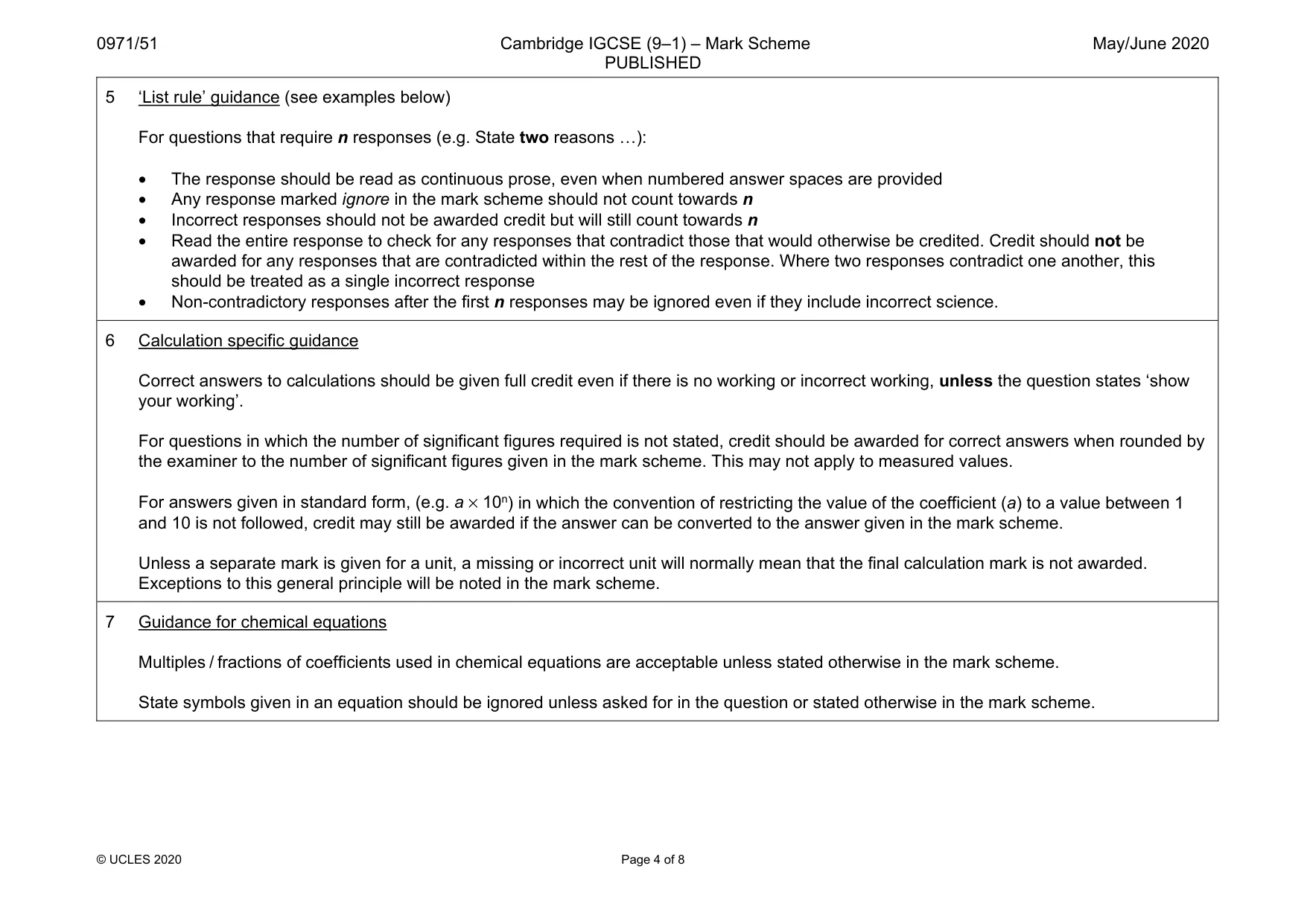
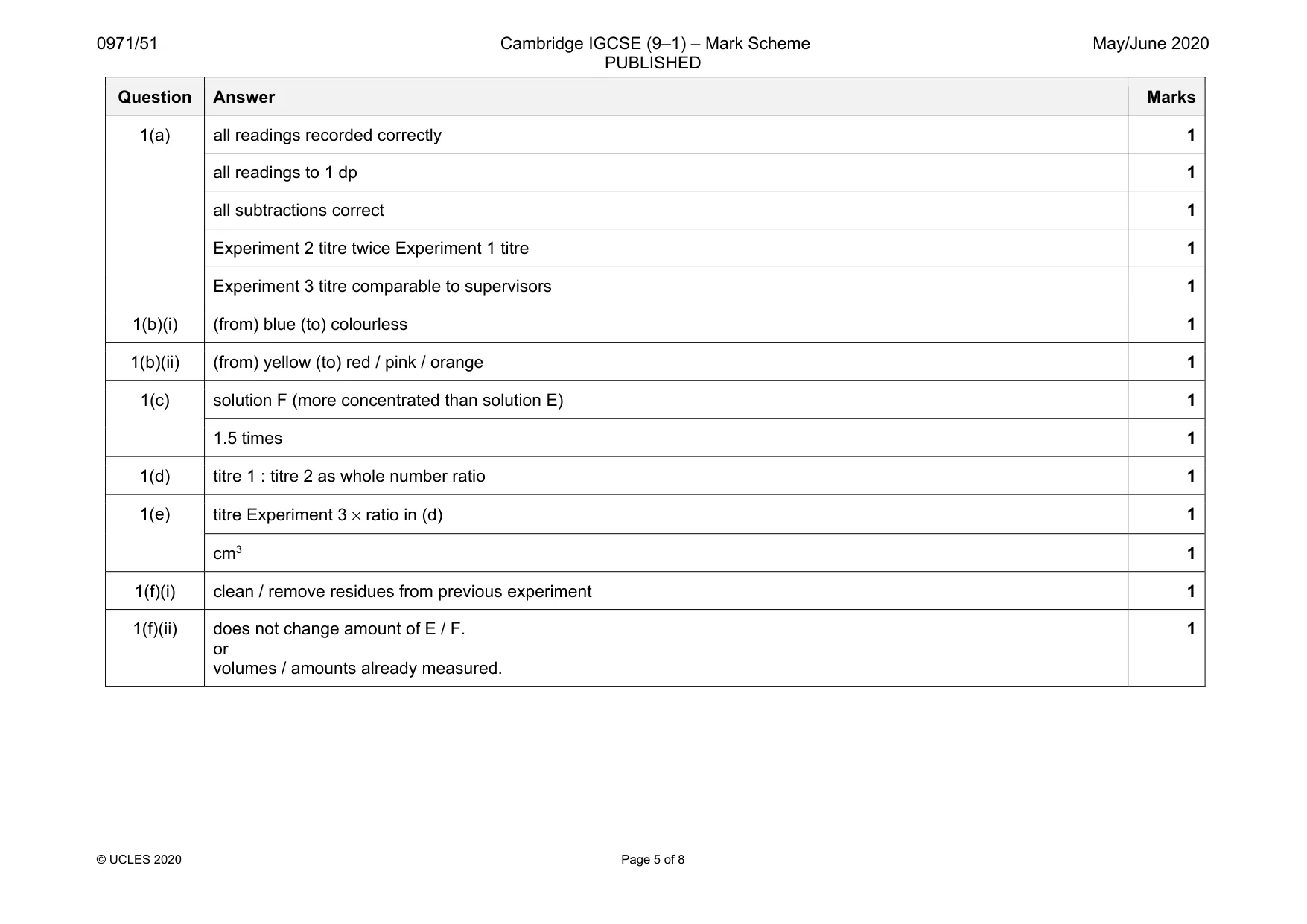
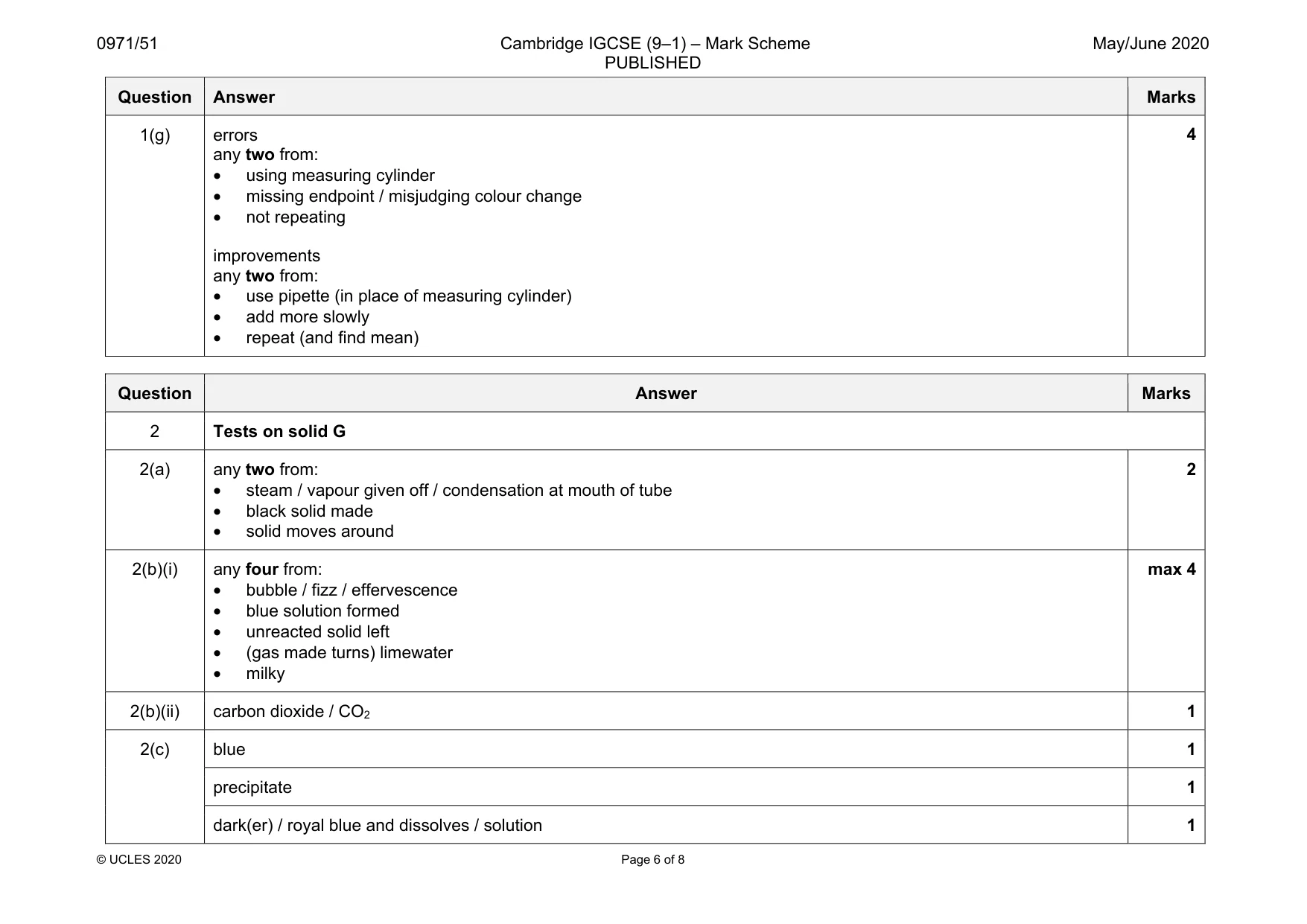
Mark scheme: 1(a) all readings recorded correctly 1 all readings to 1 dp 1 all subtractions correct 1 Experiment 2 titre twice Experiment 1 titre 1 Experiment 3 titre comparable to supervisors 1 1(b)(i) (from) blue (to) colourless 1 1(b)(ii) (from) yellow (to) red / pink / orange 1 1(c) solution F (more concentrated than solution E) 1 1.5 times 1 1(d) titre 1 : titre 2 as whole number ratio 1 1(e) titre Experiment 3 × ratio in (d) 1 cm3 1 1(f)(i) clean / remove residues from previous experiment 1 1(f)(ii) does not change amount of E / F. or volumes / amounts already measured. 1 Question Answer Marks 1(g) errors any two from: • using measuring cylinder • missing endpoint / misjudging colour change • not repeating improvements any two from: • use pipette (in place of measuring cylinder) • add more slowly • repeat (and find mean) 4
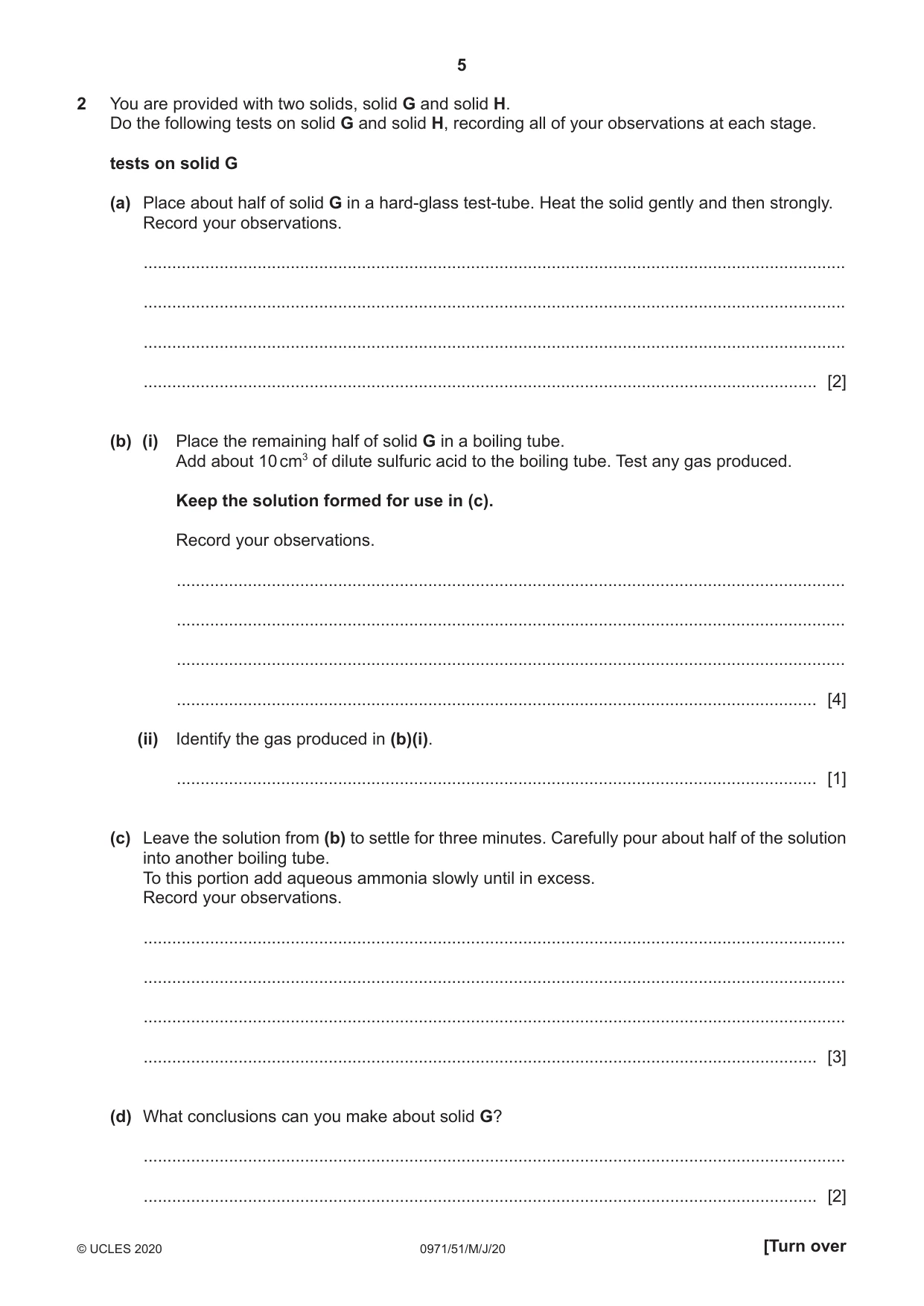
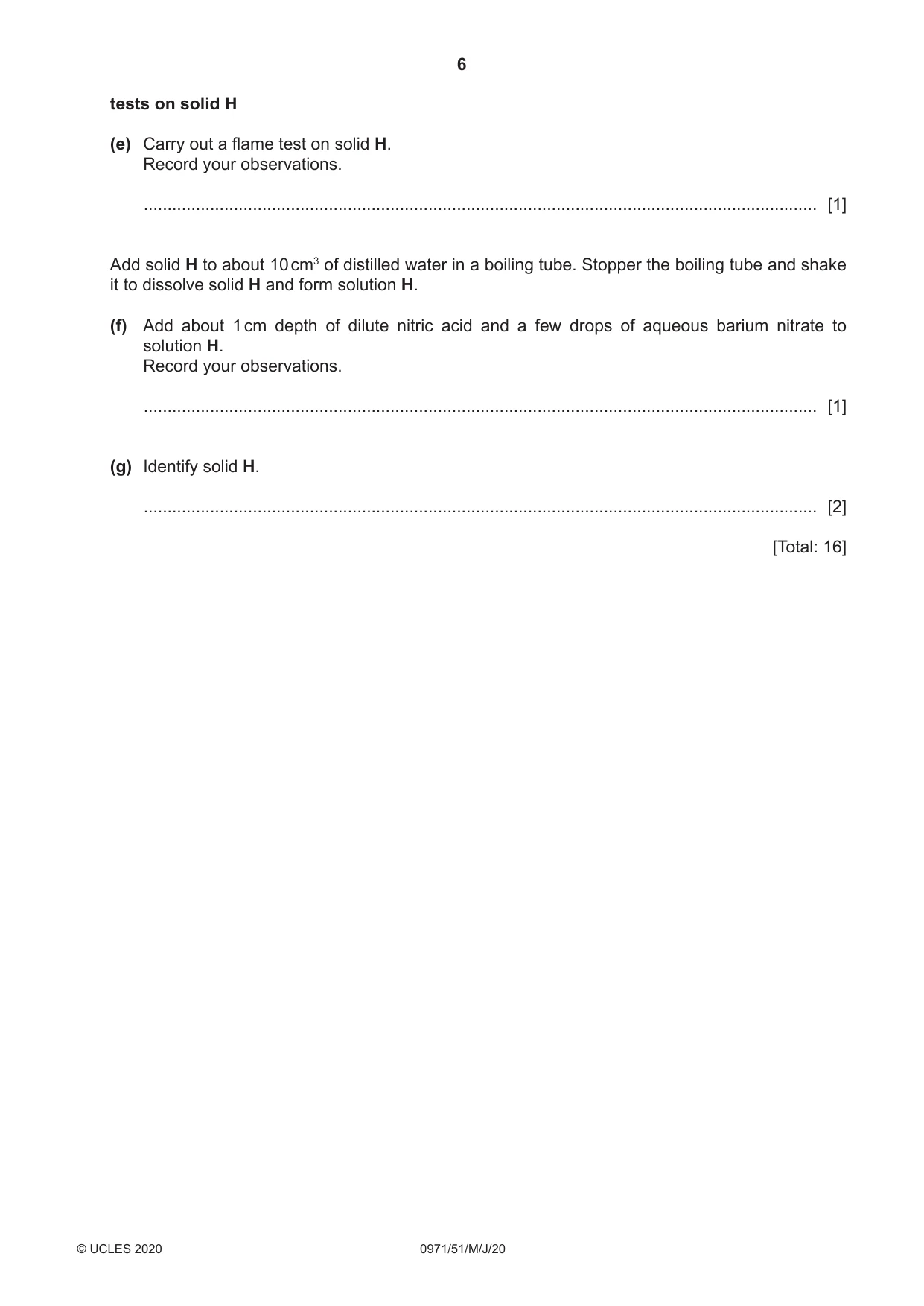
Q2 · You are provided with two solids, solid G and solid H
2 You are provided with two solids, solid G and solid H. Do the following tests on solid G and solid H, recording all of your observations at each stage. tests on solid G (a) Place about half of solid G in a hard‑glass test‑tube. Heat the solid gently and then strongly. Record your observations. .................................................................................................................................................... .................................................................................................................................................... .................................................................................................................................................... .............................................................................................................................................. [2] (b) (i) Place the remaining half of solid G in a boiling tube. Add about 10 cm3 of dilute sulfuric acid to the boiling tube. Test any gas produced. Keep the solution formed for use in (c). Record your observations. ............................................................................................................................................. ............................................................................................................................................. ............................................................................................................................................. ....................................................................................................................................... [4] (ii) Identify the gas produced in (b)(i). ....................................................................................................................................... [1] (c) Leave the solution from (b) to settle for three minutes. Carefully pour about half of the solution into another boiling tube. To this portion add aqueous ammonia slowly until in excess. Record your observations. .................................................................................................................................................... .................................................................................................................................................... .................................................................................................................................................... .............................................................................................................................................. [3] (d) What conclusions can you make about solid G? .................................................................................................................................................... .............................................................................................................................................. [2] tests on solid H (e) Carry out a flame test on solid H. Record your observations. .............................................................................................................................................. [1] Add solid H to about 10 cm3 of distilled water in a boiling tube. Stopper the boiling tube and shake it to dissolve solid H and form solution H. (f) Add about 1 cm depth of dilute nitric acid and a few drops of aqueous barium nitrate to solution H. Record your observations. .............................................................................................................................................. [1] (g) Identify solid H. .............................................................................................................................................. [2] [Total: 16]
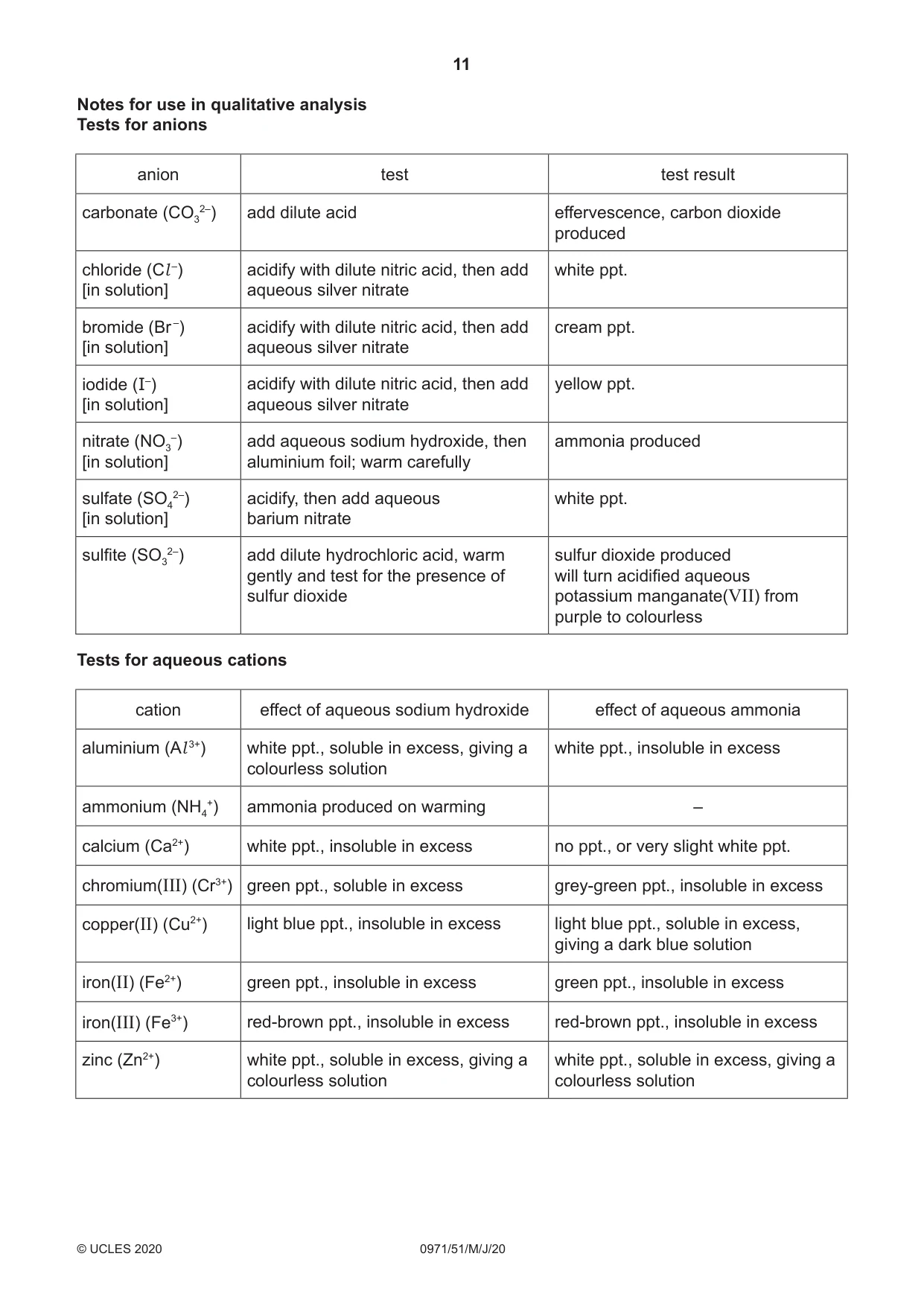
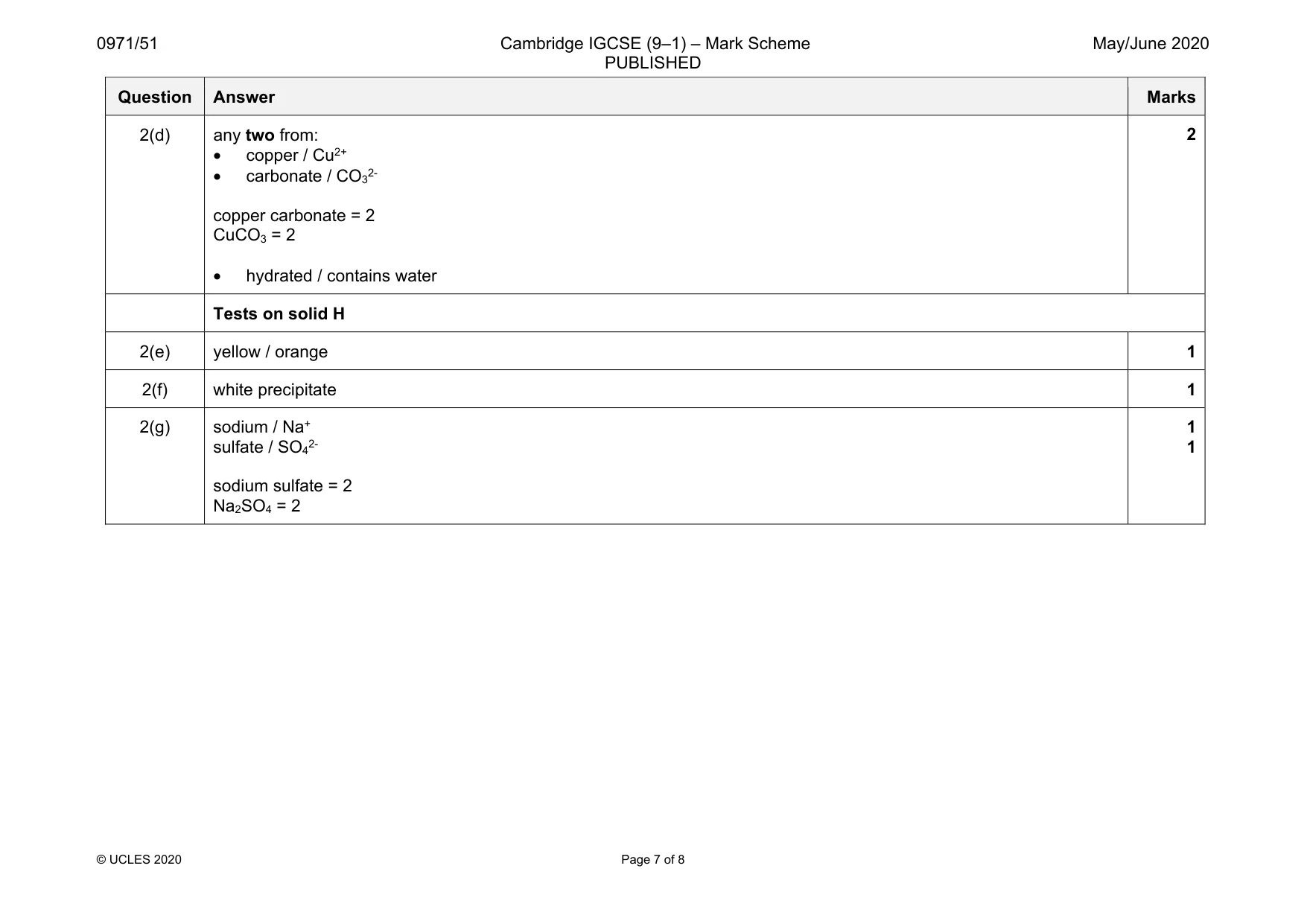
Mark scheme: 2 Tests on solid G 2(a) any two from: • steam / vapour given off / condensation at mouth of tube • black solid made • solid moves around 2 2(b)(i) any four from: • bubble / fizz / effervescence • blue solution formed • unreacted solid left • (gas made turns) limewater • milky max 4 2(b)(ii) carbon dioxide / CO2 1 2(c) blue 1 precipitate 1 dark(er) / royal blue and dissolves / solution 1 Question Answer Marks 2(d) any two from: • copper / Cu2+ • carbonate / CO32- copper carbonate = 2 CuCO3 = 2 • hydrated / contains water 2 Tests on solid H 2(e) yellow / orange 1 2(f) white precipitate 1 2(g) sodium / Na+ sulfate / SO42- sodium sulfate = 2 Na2SO4 = 2 1 1
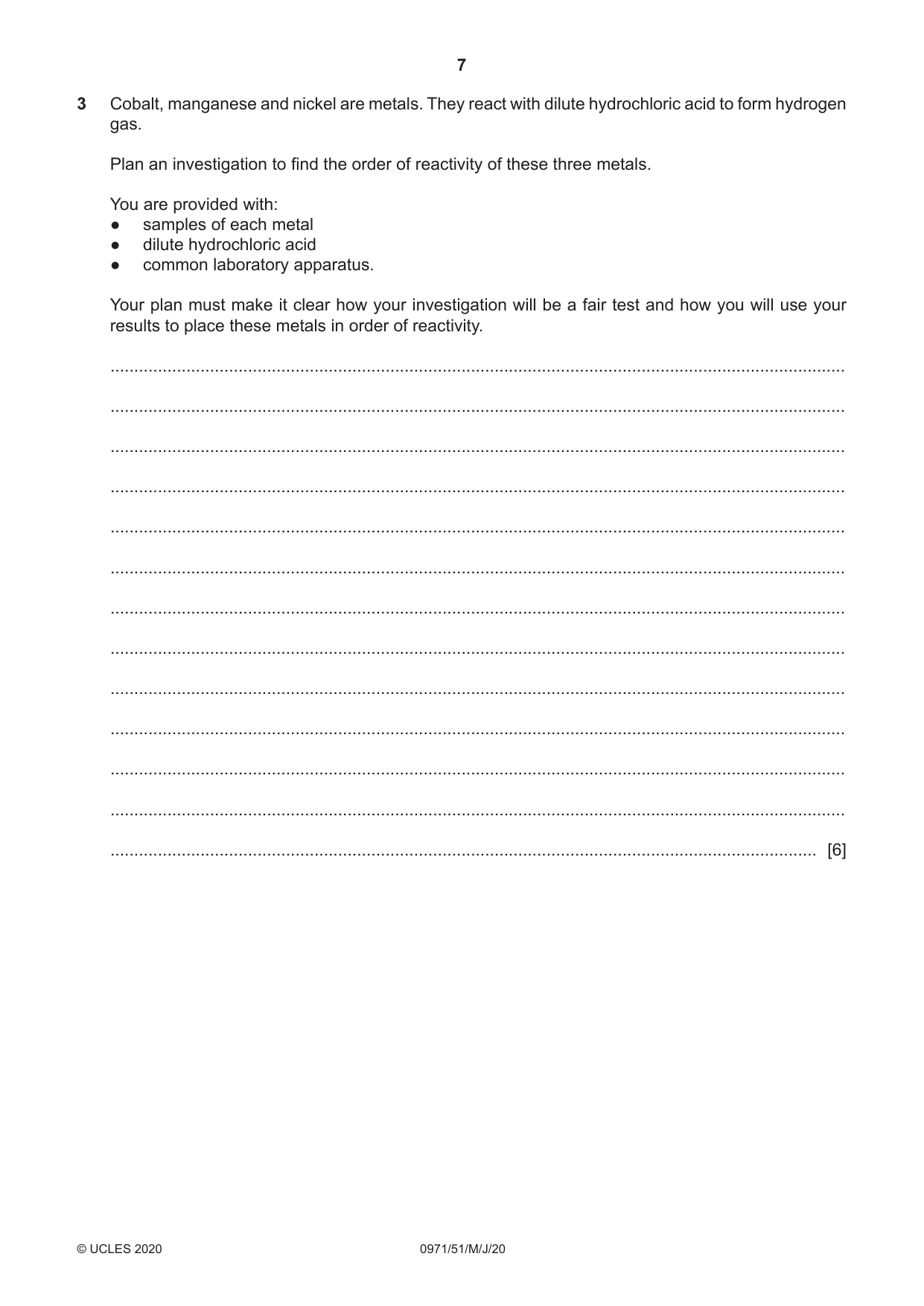
Q3 · Cobalt, manganese and nickel are metals
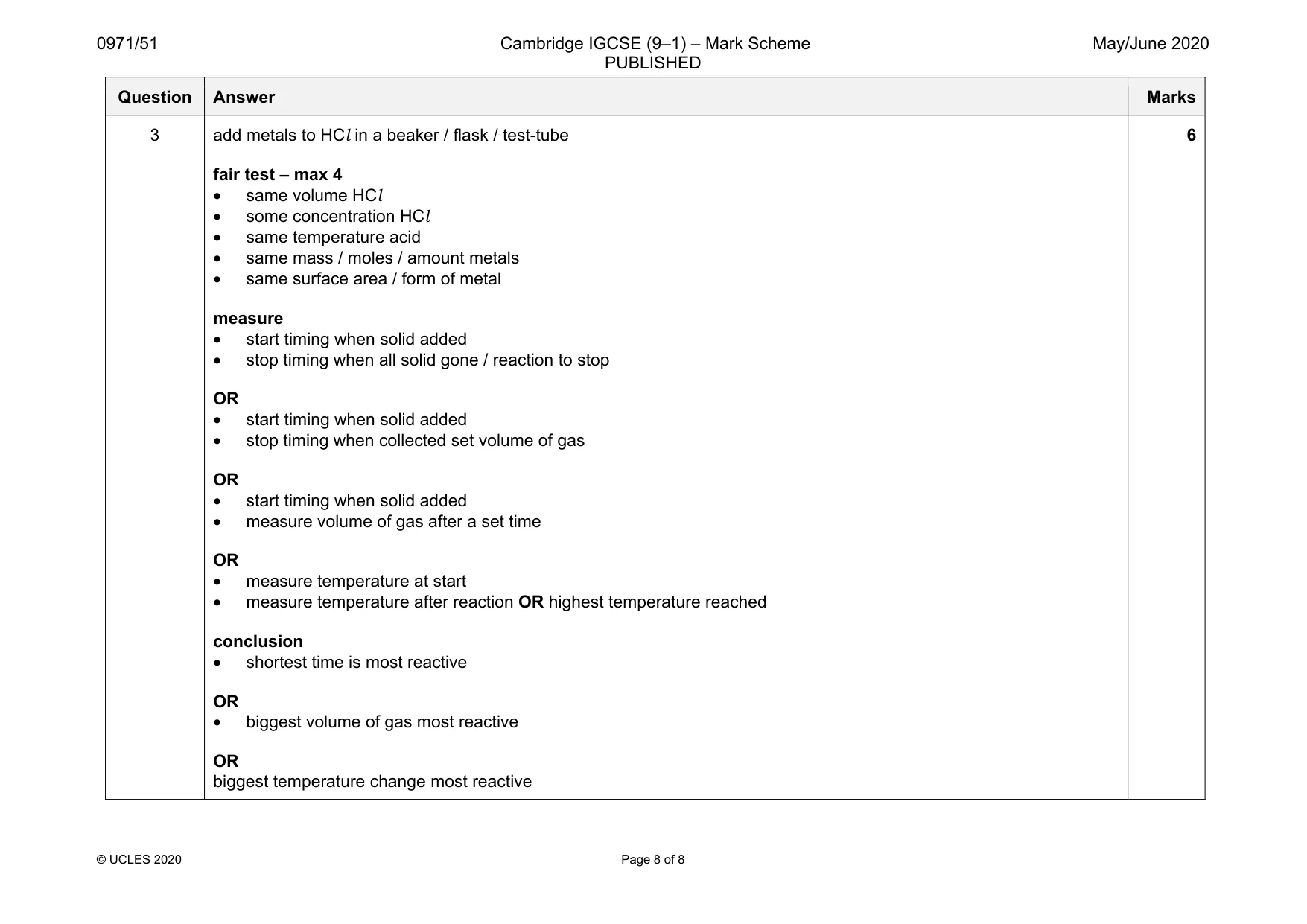
3 Cobalt, manganese and nickel are metals. They react with dilute hydrochloric acid to form hydrogen gas. Plan an investigation to find the order of reactivity of these three metals. You are provided with: ●● samples of each metal ●● dilute hydrochloric acid ●● common laboratory apparatus. Your plan must make it clear how your investigation will be a fair test and how you will use your results to place these metals in order of reactivity. ........................................................................................................................................................... ........................................................................................................................................................... ........................................................................................................................................................... ........................................................................................................................................................... ........................................................................................................................................................... ........................................................................................................................................................... ........................................................................................................................................................... ........................................................................................................................................................... ........................................................................................................................................................... ........................................................................................................................................................... ........................................................................................................................................................... ........................................................................................................................................................... ..................................................................................................................................................... [6]
Mark scheme: 3 fair test – max 4 • same volume HCl • some concentration HCl • same temperature acid • same mass / moles / amount metals • same surface area / form of metal measure • start timing when solid added • stop timing when all solid gone / reaction to stop OR • start timing when solid added • stop timing when collected set volume of gas OR • start timing when solid added • measure volume of gas after a set time OR • measure temperature at start • measure temperature after reaction OR highest temperature reached conclusion • shortest time is most reactive OR • biggest volume of gas most reactive OR biggest temperature change most reactive 6
What was in this paper
The subtopics covered by these 3 questions, and how many questions each got. Open one in a new tab to see every Cambridge question on it.