Cambridge IGCSE Chemistry (9-1) 0971 — 2018 May/June Paper 5 · Variant 1
0971/51/M/J/18 · 3 questions · 40 marks · ≈45 min
The question paper and its mark scheme, free to read here and free to download. This is Cambridge’s own paper, exactly as it was sat.
Question paper12 pages

Mark scheme6 pages
Answers below. Sit the paper first if you are practising.
Questions as text
Q1 · You are going to investigate the rate of reaction between dilute hydrochloric acid and…
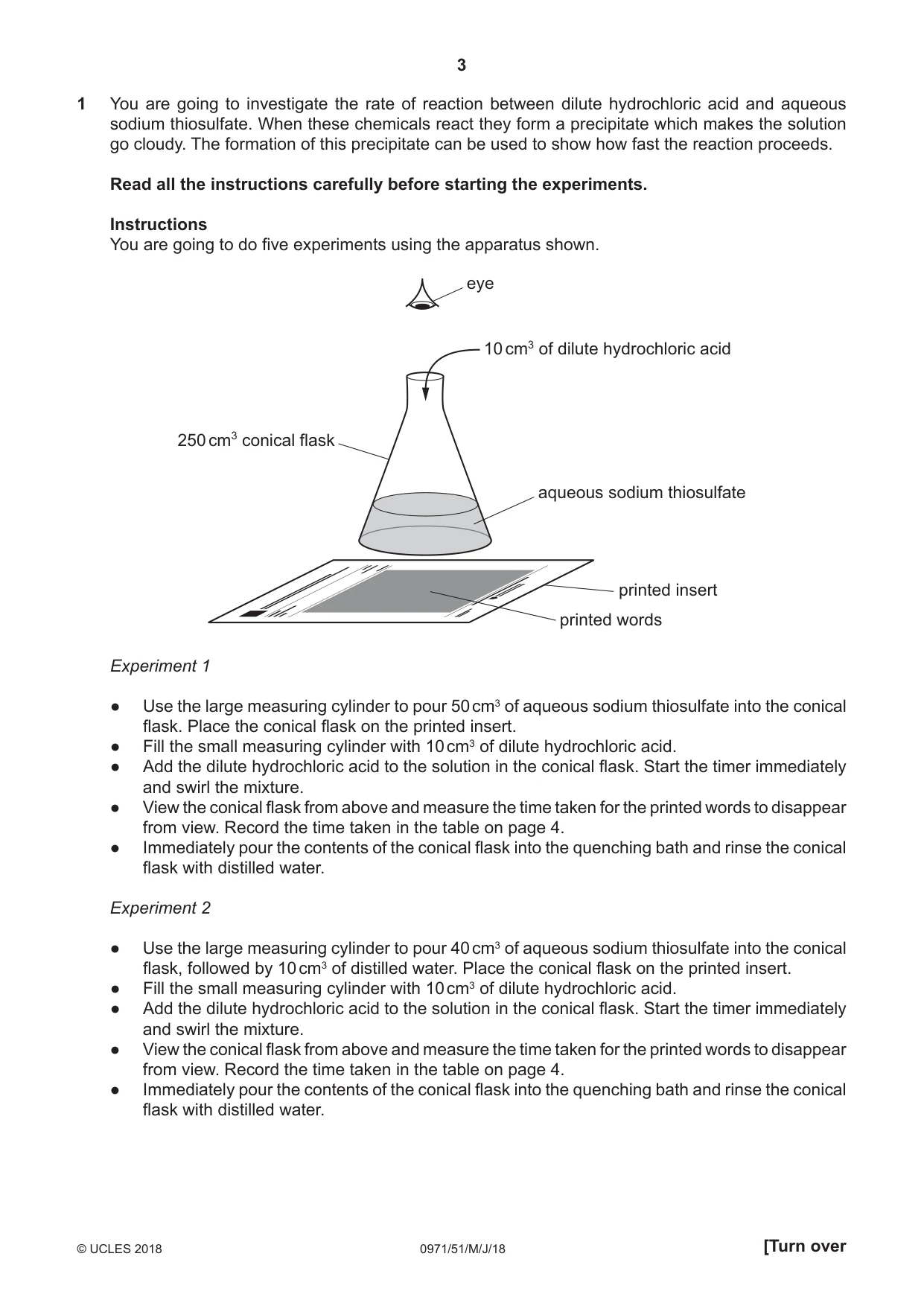
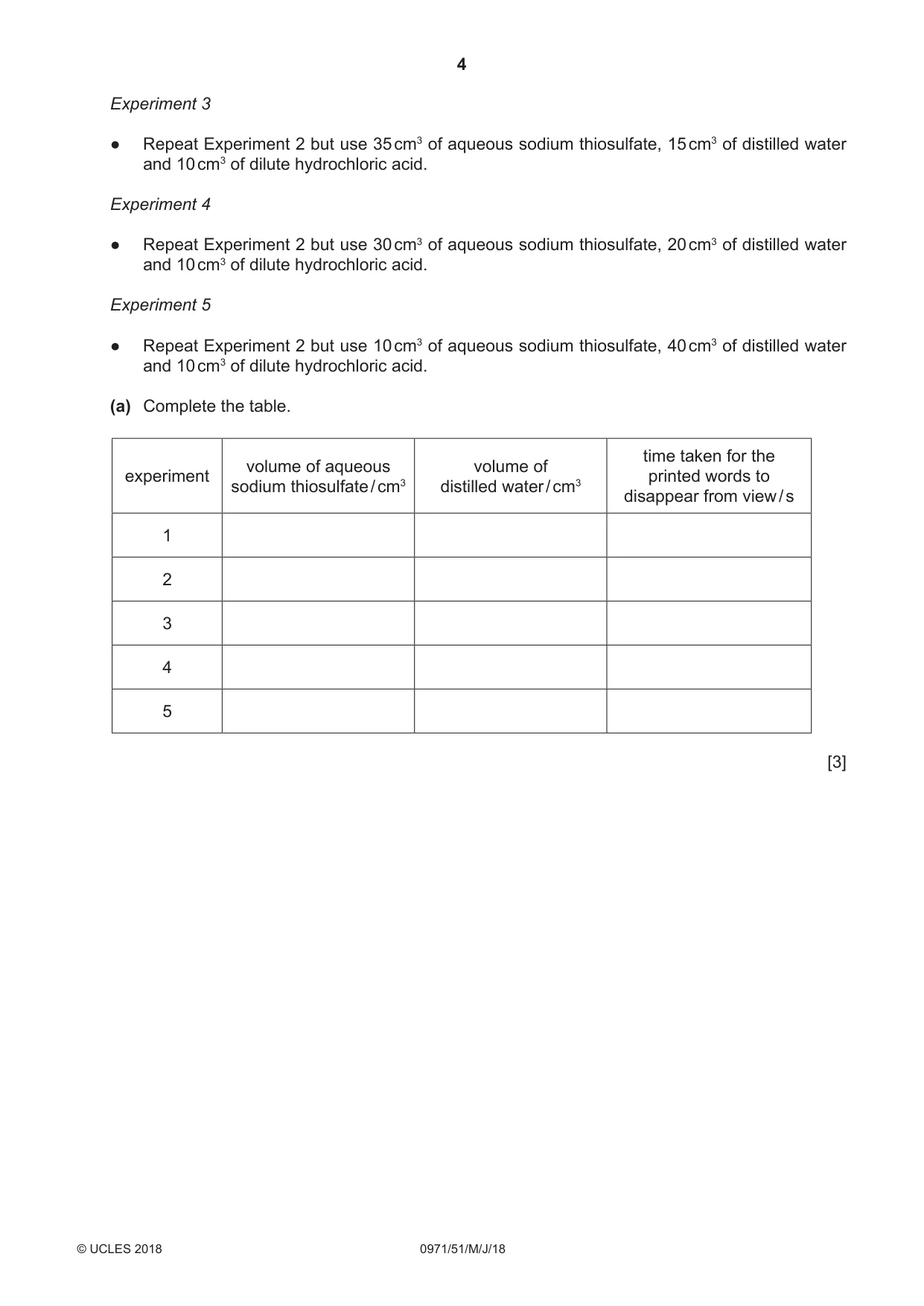
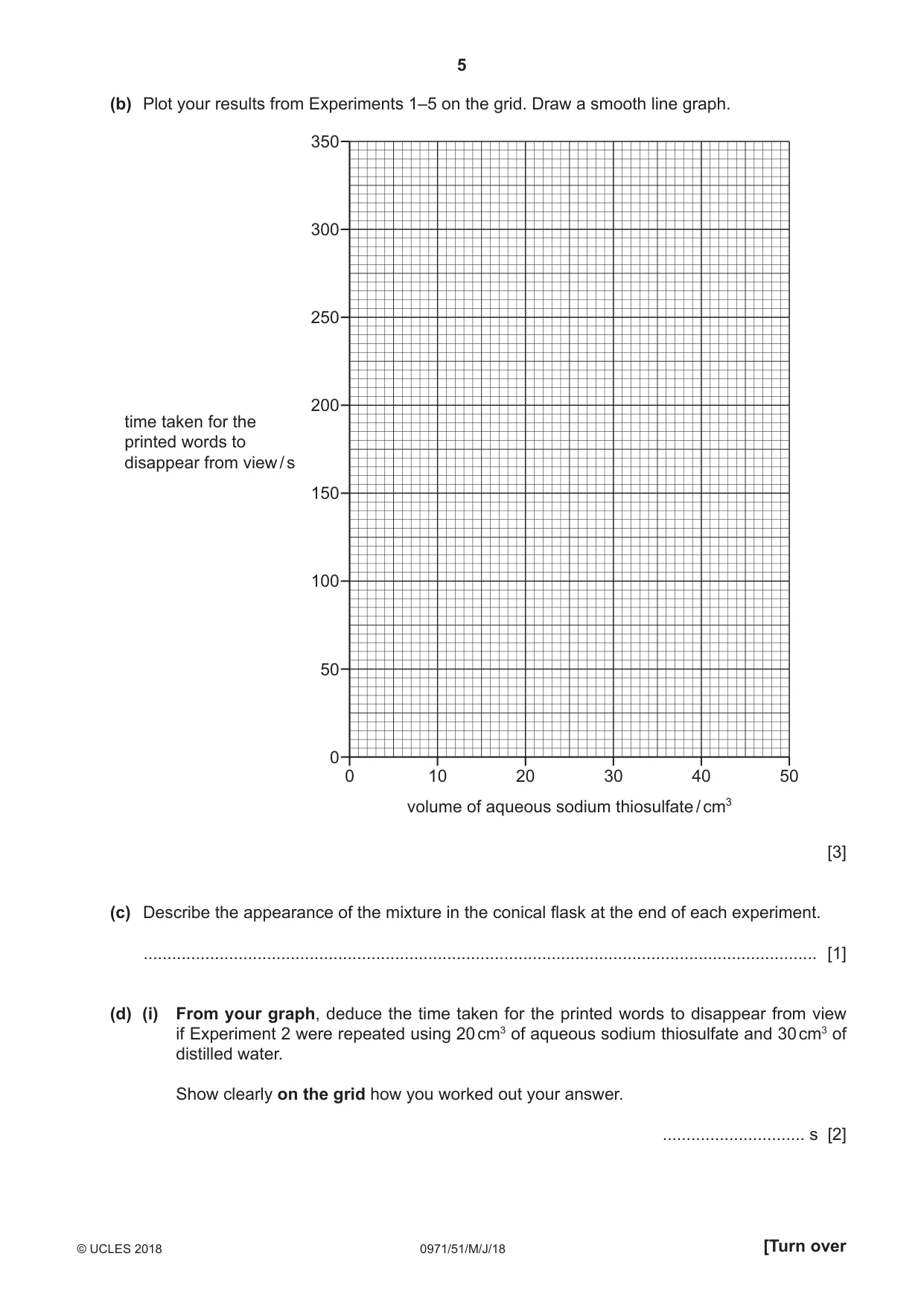
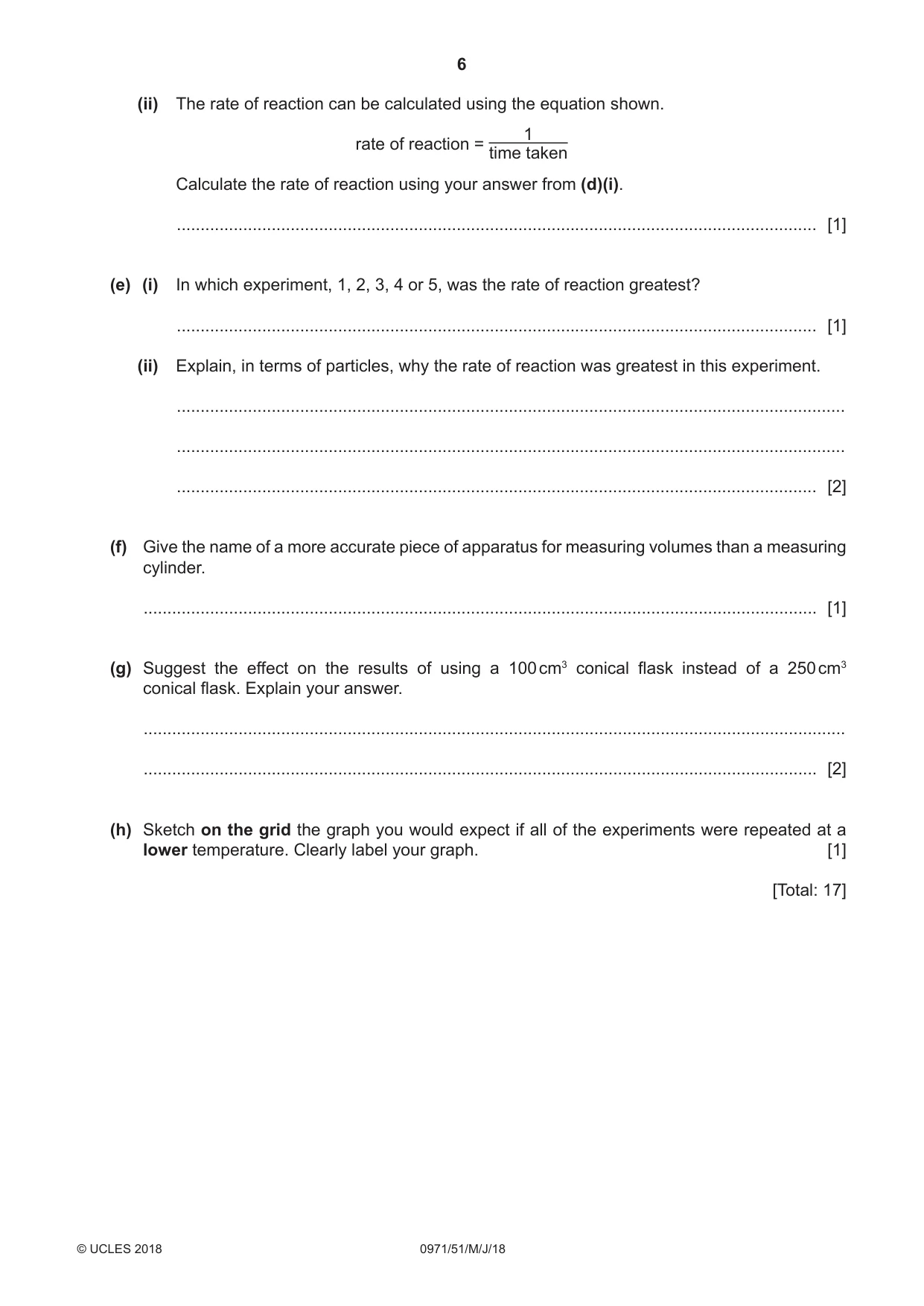
1 You are going to investigate the rate of reaction between dilute hydrochloric acid and aqueous sodium thiosulfate. When these chemicals react they form a precipitate which makes the solution go cloudy. The formation of this precipitate can be used to show how fast the reaction proceeds. Read all the instructions carefully before starting the experiments. Instructions You are going to do five experiments using the apparatus shown. eye 10 cm3 of dilute hydrochloric acid 250 cm3 conical flask aqueous sodium thiosulfate printed insert printed words Experiment 1 ● Use the large measuring cylinder to pour 50 cm3 of aqueous sodium thiosulfate into the conical flask. Place the conical flask on the printed insert. ● Fill the small measuring cylinder with 10 cm3 of dilute hydrochloric acid. ● Add the dilute hydrochloric acid to the solution in the conical flask. Start the timer immediately and swirl the mixture. ● View the conical flask from above and measure the time taken for the printed words to disappear from view. Record the time taken in the table on page 4. ● Immediately pour the contents of the conical flask into the quenching bath and rinse the conical flask with distilled water. Experiment 2 ● Use the large measuring cylinder to pour 40 cm3 of aqueous sodium thiosulfate into the conical flask, followed by 10 cm3 of distilled water. Place the conical flask on the printed insert. ● Fill the small measuring cylinder with 10 cm3 of dilute hydrochloric acid. ● Add the dilute hydrochloric acid to the solution in the conical flask. Start the timer immediately and swirl the mixture. ● View the conical flask from above and measure the time taken for the printed words to disappear from view. Record the time taken in the table on page 4. ● Immediately pour the contents of the conical flask into the quenching bath and rinse the conical flask with distilled water. Experiment 3 ● Repeat Experiment 2 but use 35 cm3 of aqueous sodium thiosulfate, 15 cm3 of distilled water and 10 cm3 of dilute hydrochloric acid. Experiment 4 ● Repeat Experiment 2 but use 30 cm3 of aqueous sodium thiosulfate, 20 cm3 of distilled water and 10 cm3 of dilute hydrochloric acid. Experiment 5 ● Repeat Experiment 2 but use 10 cm3 of aqueous sodium thiosulfate, 40 cm3 of distilled water and 10 cm3 of dilute hydrochloric acid. (a) Complete the table. time taken for the volume of aqueous volume of experiment printed words to sodium thiosulfate / cm3 distilled water / cm3 disappear from view / s 1 2 3 4 5 [3] (b) Plot your results from Experiments 1–5 on the grid. Draw a smooth line graph. 350 300 250 200 time taken for the printed words to disappear from view / s 150 100 50 0 0 10 20 30 40 50 volume of aqueous sodium thiosulfate / cm3 [3] (c) Describe the appearance of the mixture in the conical flask at the end of each experiment. .............................................................................................................................................. [1] (d) (i) From your graph, deduce the time taken for the printed words to disappear from view if Experiment 2 were repeated using 20 cm3 of aqueous sodium thiosulfate and 30 cm3 of distilled water. Show clearly on the grid how you worked out your answer. .............................. s [2] (ii) The rate of reaction can be calculated using the equation shown. 1 rate of reaction = time taken Calculate the rate of reaction using your answer from (d)(i). ....................................................................................................................................... [1] (e) (i) In which experiment, 1, 2, 3, 4 or 5, was the rate of reaction greatest? ....................................................................................................................................... [1] (ii) Explain, in terms of particles, why the rate of reaction was greatest in this experiment. ............................................................................................................................................. ............................................................................................................................................. ....................................................................................................................................... [2] (f) Give the name of a more accurate piece of apparatus for measuring volumes than a measuring cylinder. .............................................................................................................................................. [1] (g) Suggest the effect on the results of using a 100 cm3 conical flask instead of a 250 cm3 conical flask. Explain your answer. .................................................................................................................................................... .............................................................................................................................................. [2] (h) Sketch on the grid the graph you would expect if all of the experiments were repeated at a lower temperature. Clearly label your graph. [1] [Total: 17]
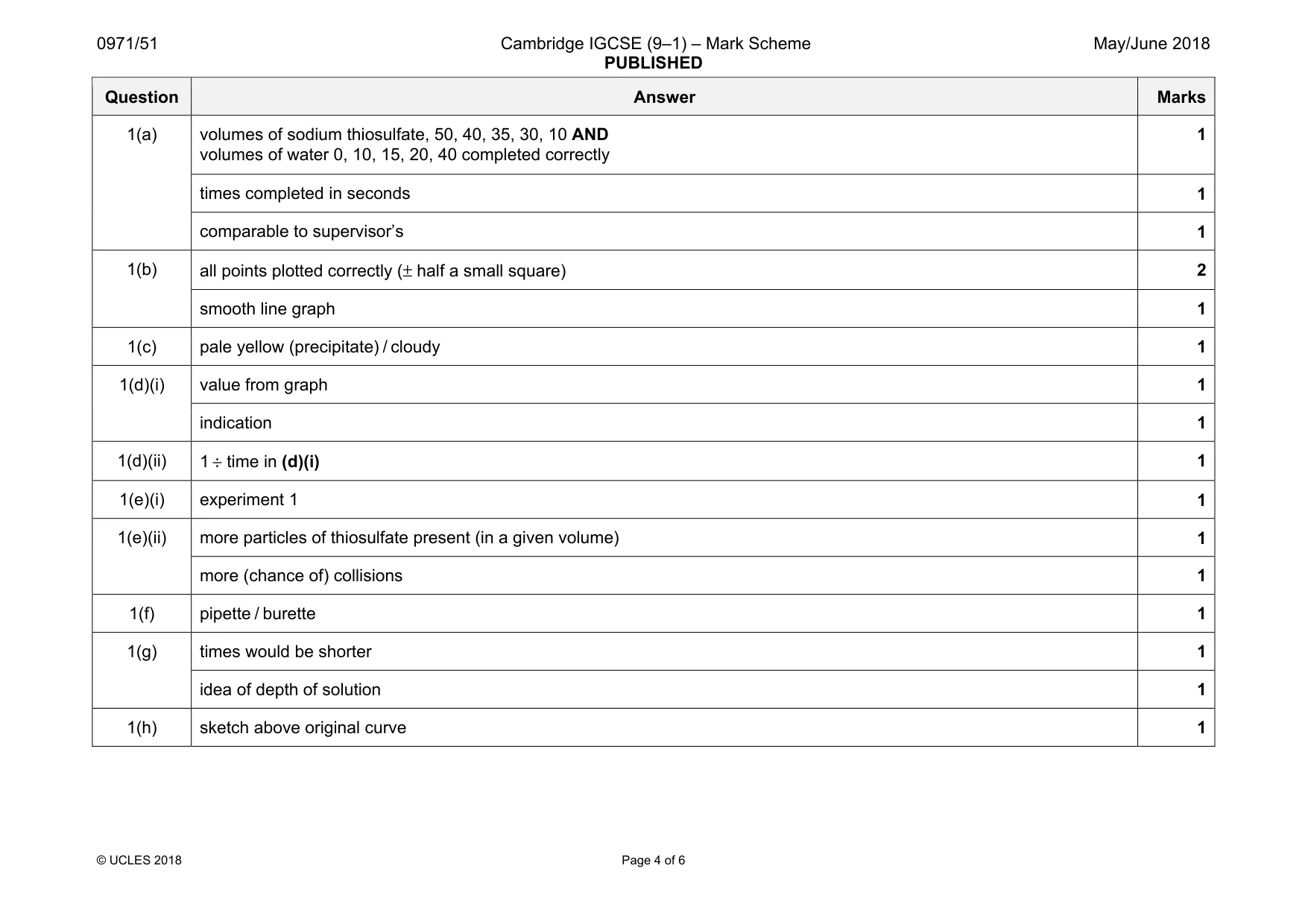
Mark scheme: 1(a) volumes of sodium thiosulfate, 50, 40, 35, 30, 10 AND volumes of water 0, 10, 15, 20, 40 completed correctly 1 times completed in seconds 1 comparable to supervisor’s 1 1(b) all points plotted correctly (± half a small square) 2 smooth line graph 1 1(c) pale yellow (precipitate) / cloudy 1 1(d)(i) value from graph 1 indication 1 1(d)(ii) 1 ÷ time in (d)(i) 1 1(e)(i) experiment 1 1 1(e)(ii) more particles of thiosulfate present (in a given volume) 1 more (chance of) collisions 1 1(f) pipette / burette 1 1(g) times would be shorter 1 idea of depth of solution 1 1(h) sketch above original curve 1
Q2 · You are provided with two substances, solution A and solid B
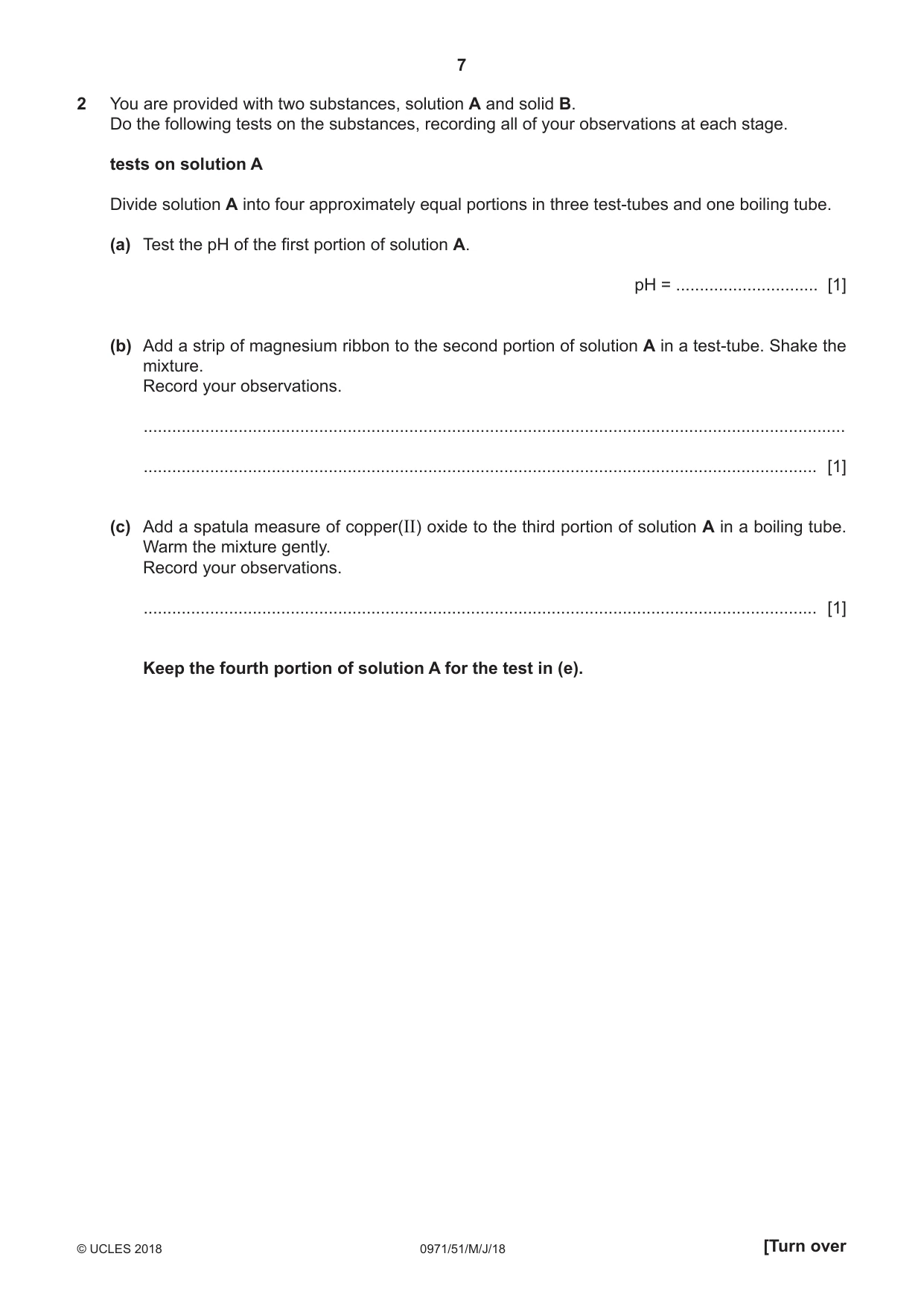
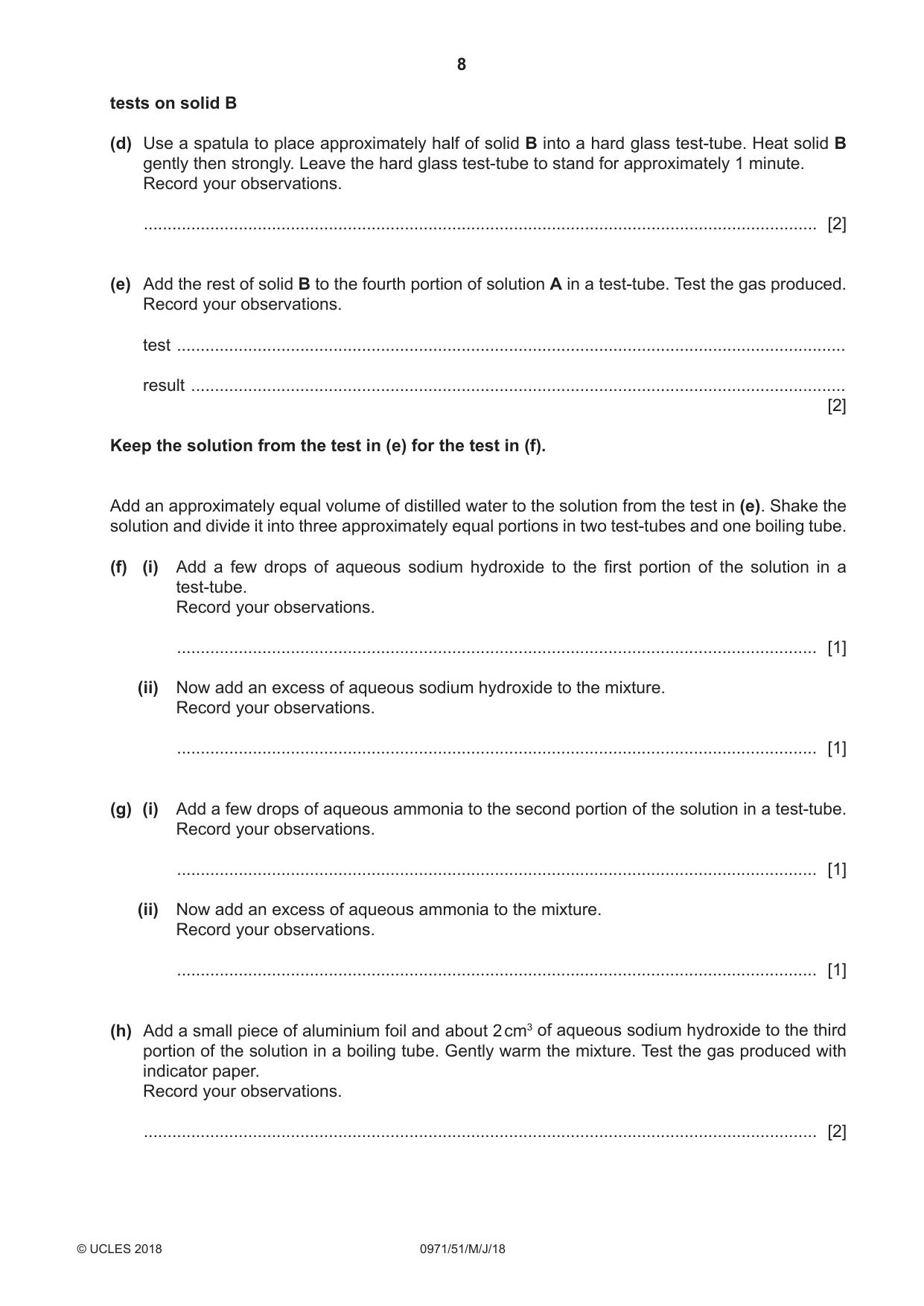
2 You are provided with two substances, solution A and solid B. Do the following tests on the substances, recording all of your observations at each stage. tests on solution A Divide solution A into four approximately equal portions in three test-tubes and one boiling tube. (a) Test the pH of the first portion of solution A. pH = .............................. [1] (b) Add a strip of magnesium ribbon to the second portion of solution A in a test‑tube. Shake the mixture. Record your observations. .................................................................................................................................................... .............................................................................................................................................. [1] (c) Add a spatula measure of copper(II) oxide to the third portion of solution A in a boiling tube. Warm the mixture gently. Record your observations. .............................................................................................................................................. [1] Keep the fourth portion of solution A for the test in (e). tests on solid B (d) Use a spatula to place approximately half of solid B into a hard glass test-tube. Heat solid B gently then strongly. Leave the hard glass test-tube to stand for approximately 1 minute. Record your observations. .............................................................................................................................................. [2] (e) Add the rest of solid B to the fourth portion of solution A in a test-tube. Test the gas produced. Record your observations. test ............................................................................................................................................. result .......................................................................................................................................... [2] Keep the solution from the test in (e) for the test in (f). Add an approximately equal volume of distilled water to the solution from the test in (e). Shake the solution and divide it into three approximately equal portions in two test-tubes and one boiling tube. (f) (i) Add a few drops of aqueous sodium hydroxide to the first portion of the solution in a test‑tube. Record your observations. ....................................................................................................................................... [1] (ii) Now add an excess of aqueous sodium hydroxide to the mixture. Record your observations. ....................................................................................................................................... [1] (g) (i) Add a few drops of aqueous ammonia to the second portion of the solution in a test‑tube. Record your observations. ....................................................................................................................................... [1] (ii) Now add an excess of aqueous ammonia to the mixture. Record your observations. ....................................................................................................................................... [1] (h) Add a small piece of aluminium foil and about 2 cm3 of aqueous sodium hydroxide to the third portion of the solution in a boiling tube. Gently warm the mixture. Test the gas produced with indicator paper. Record your observations. .............................................................................................................................................. [2] (i) Identify solution A. .............................................................................................................................................. [2] (j) Identify solid B. .............................................................................................................................................. [2] [Total: 17]
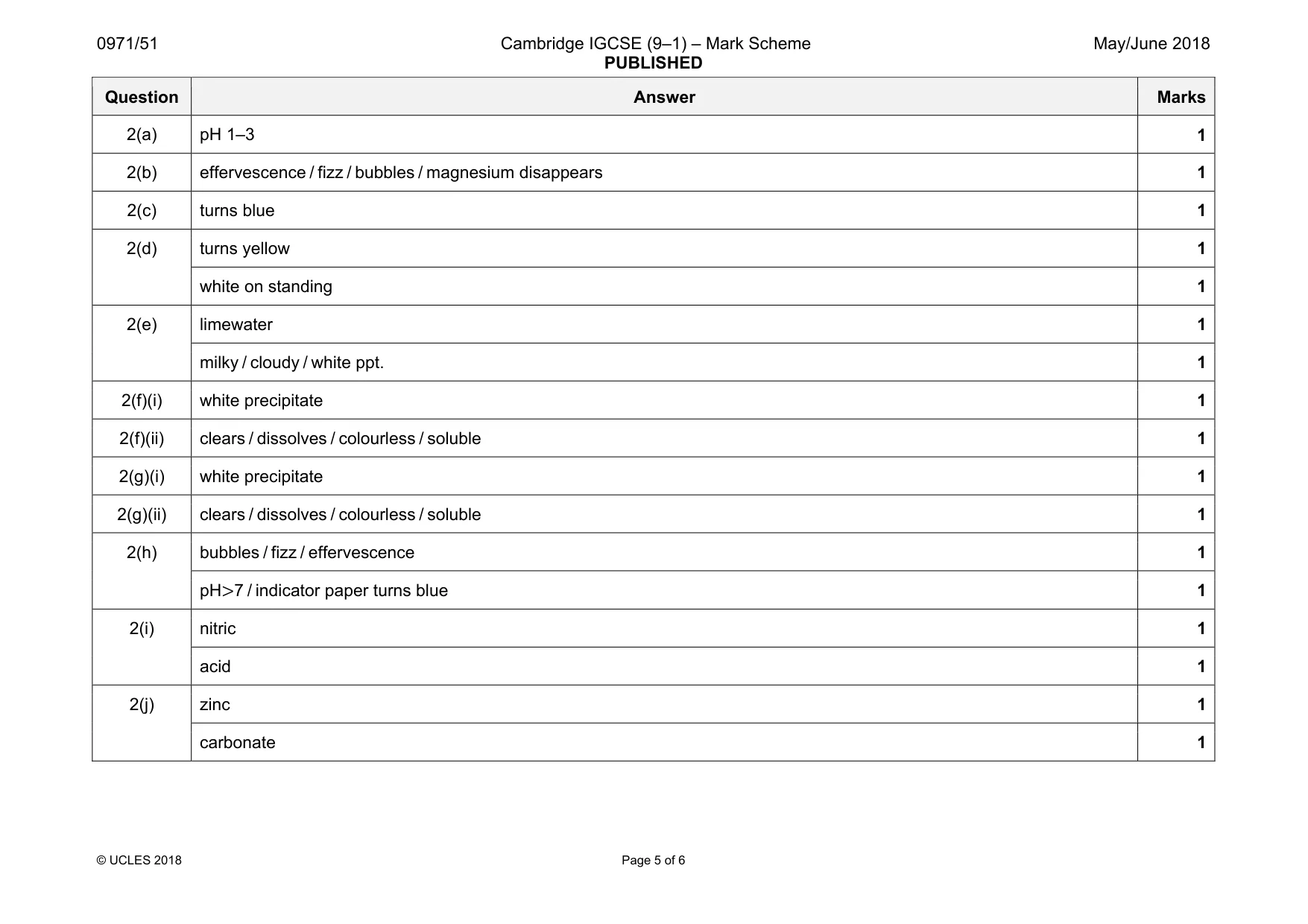
Mark scheme: 2(a) pH 1–3 1 2(b) effervescence / fizz / bubbles / magnesium disappears 1 2(c) turns blue 1 2(d) turns yellow 1 white on standing 1 2(e) limewater 1 milky / cloudy / white ppt. 1 2(f)(i) white precipitate 1 2(f)(ii) clears / dissolves / colourless / soluble 1 2(g)(i) white precipitate 1 2(g)(ii) clears / dissolves / colourless / soluble 1 2(h) bubbles / fizz / effervescence 1 pH>7 / indicator paper turns blue 1 2(i) nitric 1 acid 1 2(j) zinc 1 carbonate 1
Q3 · Potassium chloride is a salt that dissolves in water
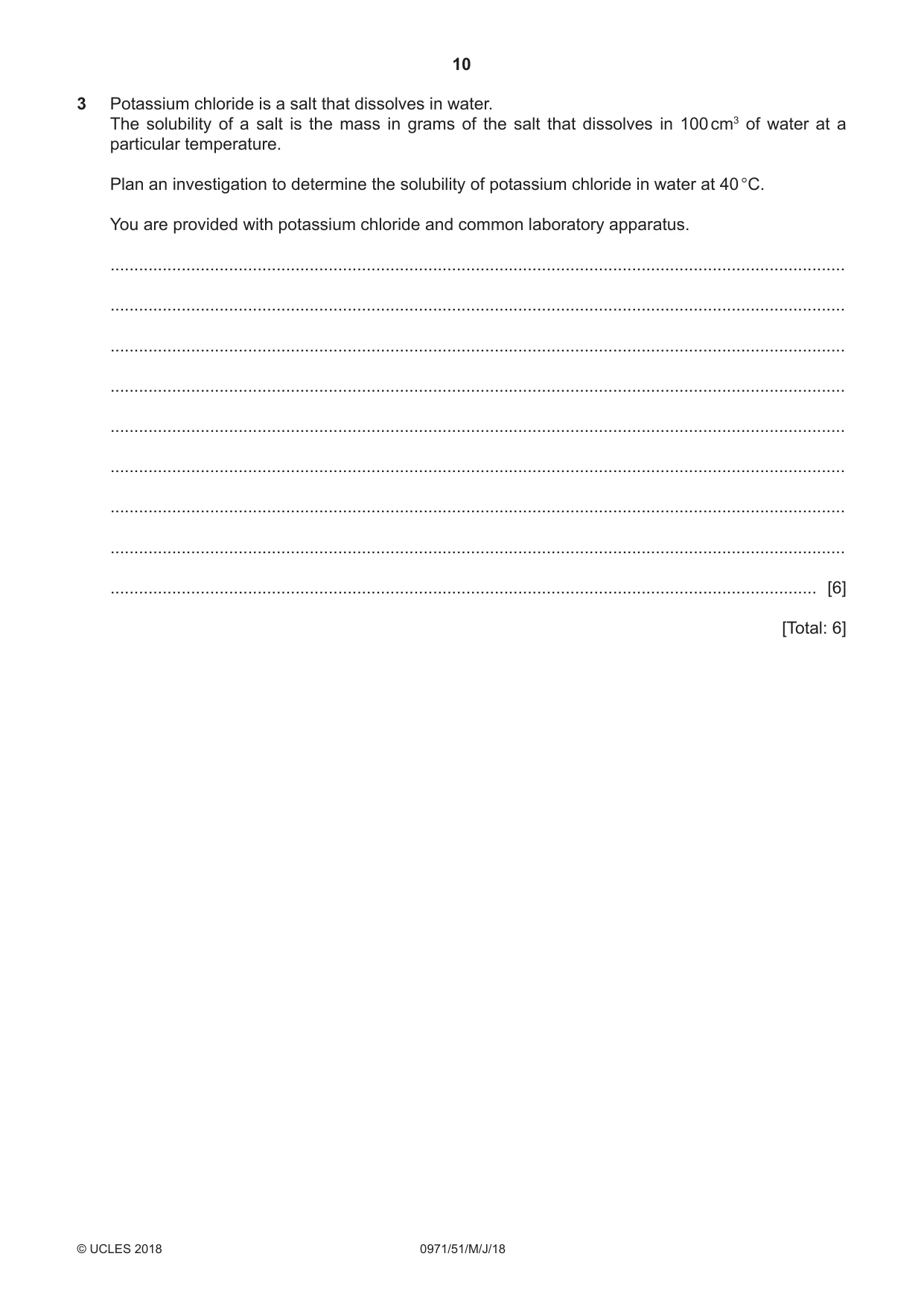
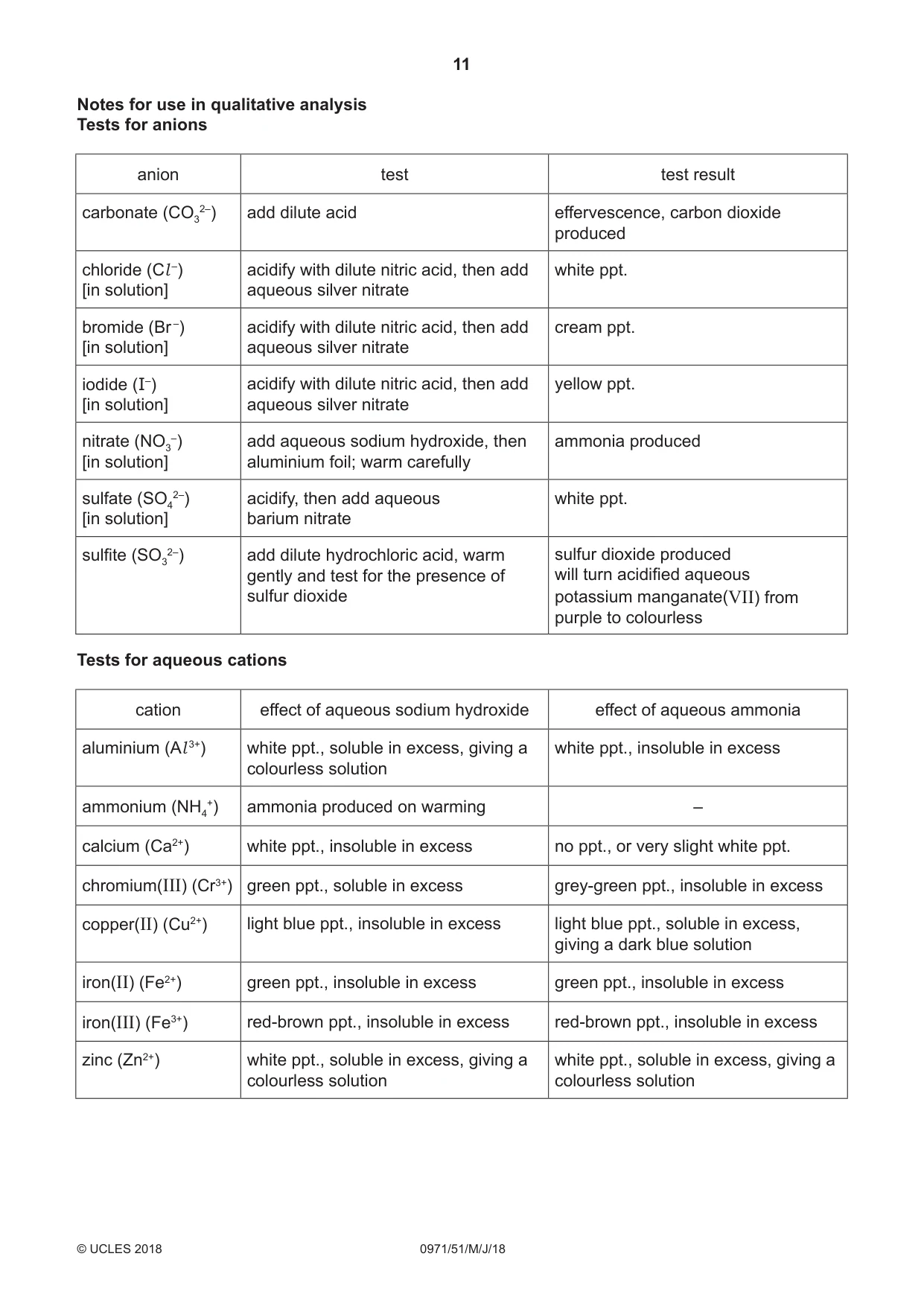
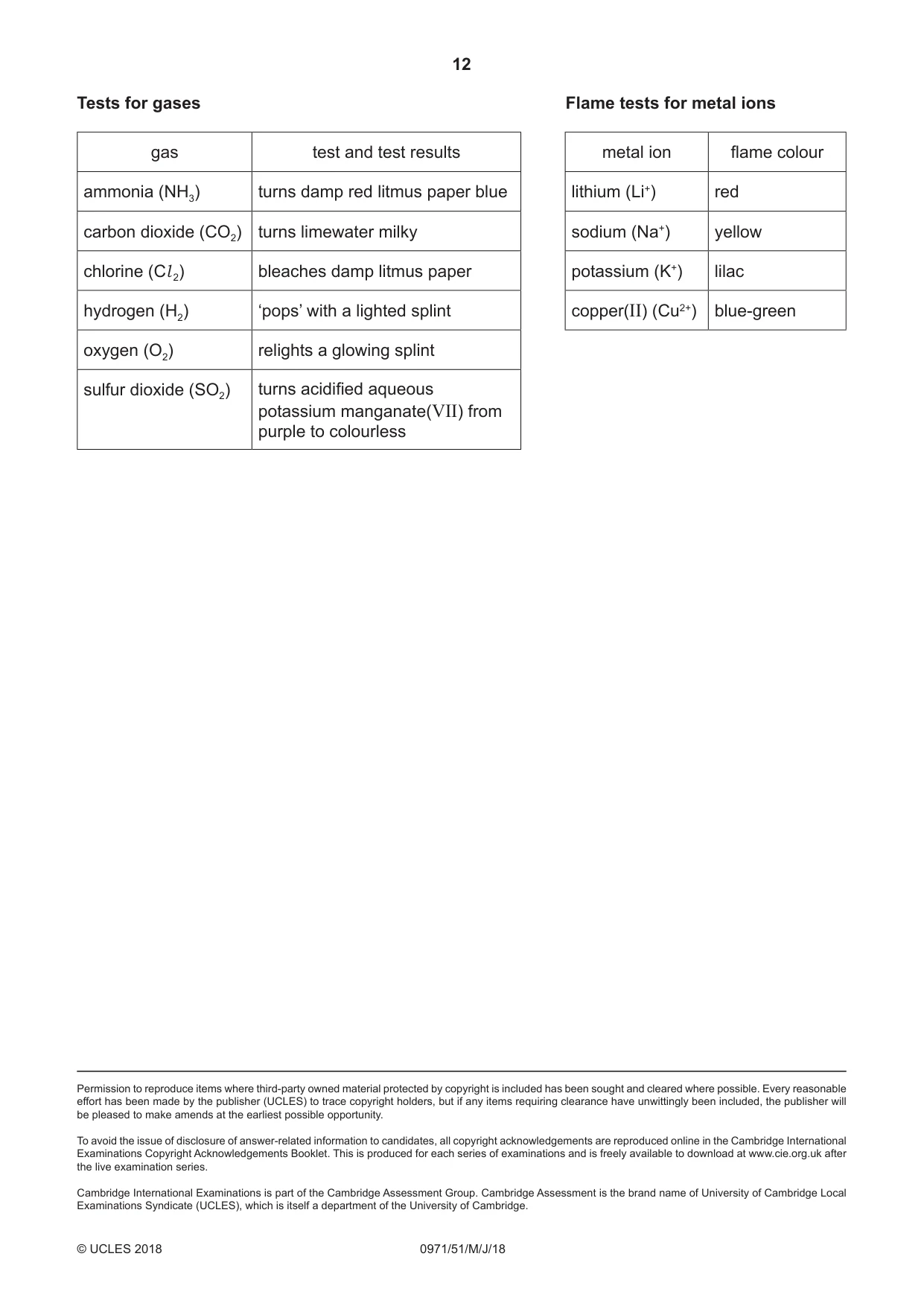
3 Potassium chloride is a salt that dissolves in water. The solubility of a salt is the mass in grams of the salt that dissolves in 100 cm3 of water at a particular temperature. Plan an investigation to determine the solubility of potassium chloride in water at 40 °C. You are provided with potassium chloride and common laboratory apparatus. ........................................................................................................................................................... ........................................................................................................................................................... ........................................................................................................................................................... ........................................................................................................................................................... ........................................................................................................................................................... ........................................................................................................................................................... ........................................................................................................................................................... ........................................................................................................................................................... ..................................................................................................................................................... [6] [Total: 6] Notes for use in qualitative analysis Tests for anions anion test test result carbonate (CO32–) add dilute acid effervescence, carbon dioxide produced chloride (Cl –) acidify with dilute nitric acid, then add white ppt. [in solution] aqueous silver nitrate bromide (Br –) acidify with dilute nitric acid, then add cream ppt. [in solution] aqueous silver nitrate iodide (I–) acidify with dilute nitric acid, then add yellow ppt. [in solution] aqueous silver nitrate nitrate (NO3–) add aqueous sodium hydroxide, then ammonia produced [in solution] aluminium foil; warm carefully sulfate (SO42–) acidify, then add aqueous white ppt. [in solution] barium nitrate sulfite (SO32–) add dilute hydrochloric acid, warm sulfur dioxide produced gently and test for the presence of will turn acidified aqueous sulfur dioxide potassium manganate(VII) from purple to colourless Tests for aqueous cations cation effect of aqueous sodium hydroxide effect of aqueous ammonia aluminium (Al 3+) white ppt., soluble in excess, giving a white ppt., insoluble in excess colourless solution ammonium (NH4+) ammonia produced on warming – calcium (Ca2+) white ppt., insoluble in excess no ppt., or very slight white ppt. chromium(III) (Cr3+) green ppt., soluble in excess grey-green ppt., insoluble in excess copper(II) (Cu2+) light blue ppt., insoluble in excess light blue ppt., soluble in excess, giving a dark blue solution iron(II) (Fe2+) green ppt., insoluble in excess green ppt., insoluble in excess iron(III) (Fe3+) red-brown ppt., insoluble in excess red-brown ppt., insoluble in excess zinc (Zn2+) white ppt., soluble in excess, giving a white ppt., soluble in excess, giving a colourless solution colourless solution Tests for gases Flame tests for metal ions gas test and test results metal ion flame colour ammonia (NH3) turns damp red litmus paper blue lithium (Li+) red carbon dioxide (CO2) turns limewater milky sodium (Na+) yellow chlorine (Cl 2) bleaches damp litmus paper potassium (K+) lilac hydrogen (H2) ‘pops’ with a lighted splint copper(II) (Cu2+) blue-green oxygen (O2) relights a glowing splint sulfur dioxide (SO2) turns acidified aqueous potassium manganate(VII) from purple to colourless
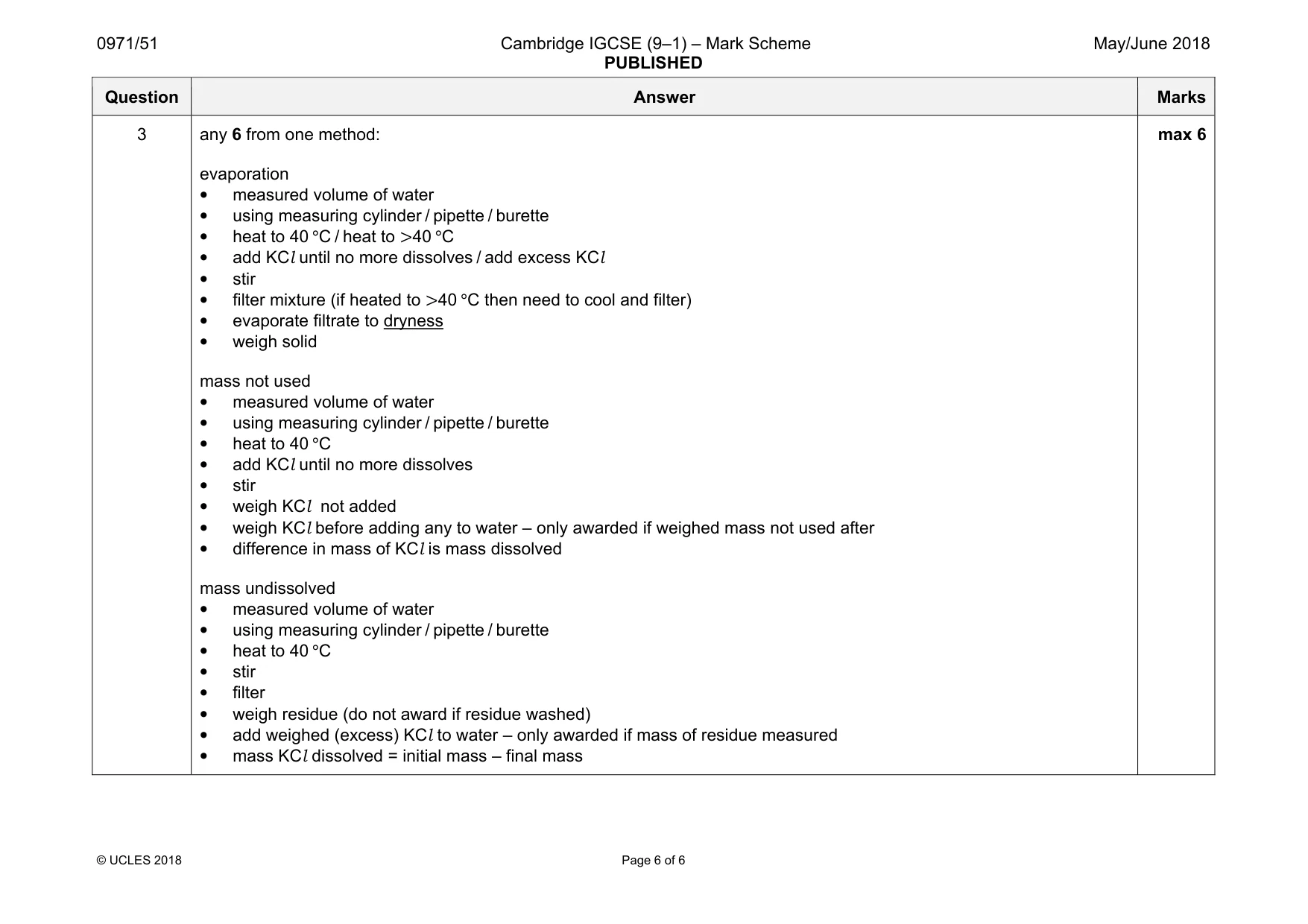
Mark scheme: 3 any 6 from one method: evaporation • measured volume of water • using measuring cylinder / pipette / burette • heat to 40 °C / heat to >40 °C • add KCl until no more dissolves / add excess KCl • stir • filter mixture (if heated to >40 °C then need to cool and filter) • evaporate filtrate to dryness • weigh solid mass not used • measured volume of water • using measuring cylinder / pipette / burette • heat to 40 °C • add KCl until no more dissolves • stir • weigh KCl not added • weigh KCl before adding any to water – only awarded if weighed mass not used after • difference in mass of KCl is mass dissolved mass undissolved • measured volume of water • using measuring cylinder / pipette / burette • heat to 40 °C • stir • filter • weigh residue (do not award if residue washed) • add weighed (excess) KCl to water – only awarded if mass of residue measured • mass KCl dissolved = initial mass – final mass max 6
What was in this paper
The subtopics covered by these 3 questions, and how many questions each got. Open one in a new tab to see every Cambridge question on it.
What you needed in this session
Cambridge’s own grade thresholds for 2018 May/June, Paper 5 · Variant 1. A higher threshold means an easier paper — the bar moves with how the cohort did.