Cambridge IGCSE Business Studies (9-1) 0986 — 2025 May/June Paper 2 · Variant 1
0986/21/M/J/25 · 4 questions · 80 marks · ≈90 min
The question paper and its mark scheme, free to read here and free to download. This is Cambridge’s own paper, exactly as it was sat.
Question paper12 pages



Mark scheme20 pages
Answers below. Sit the paper first if you are practising.

Questions as text
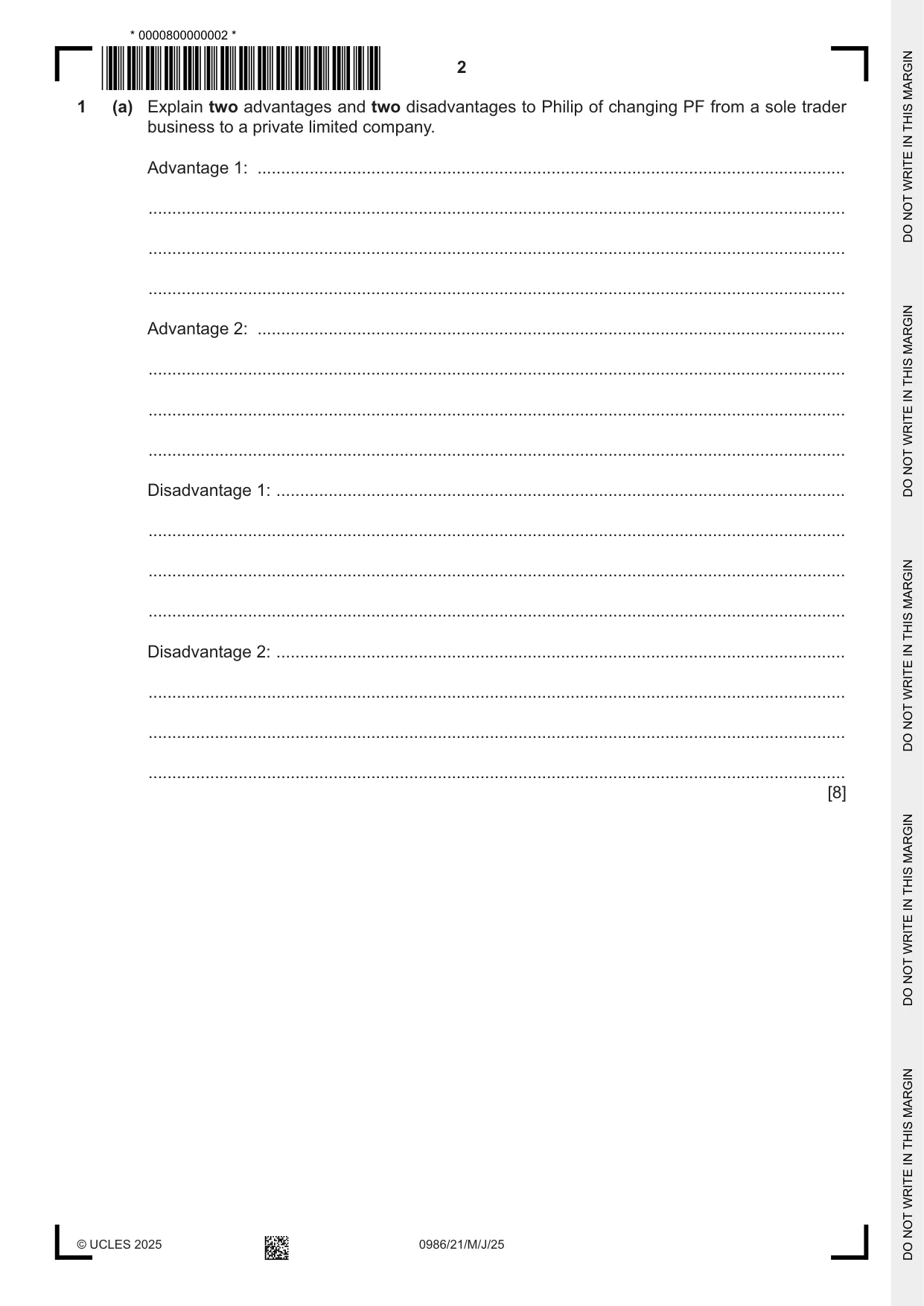
Q1 · Explain two advantages and two disadvantages to Philip of changing PF from a sole trader…
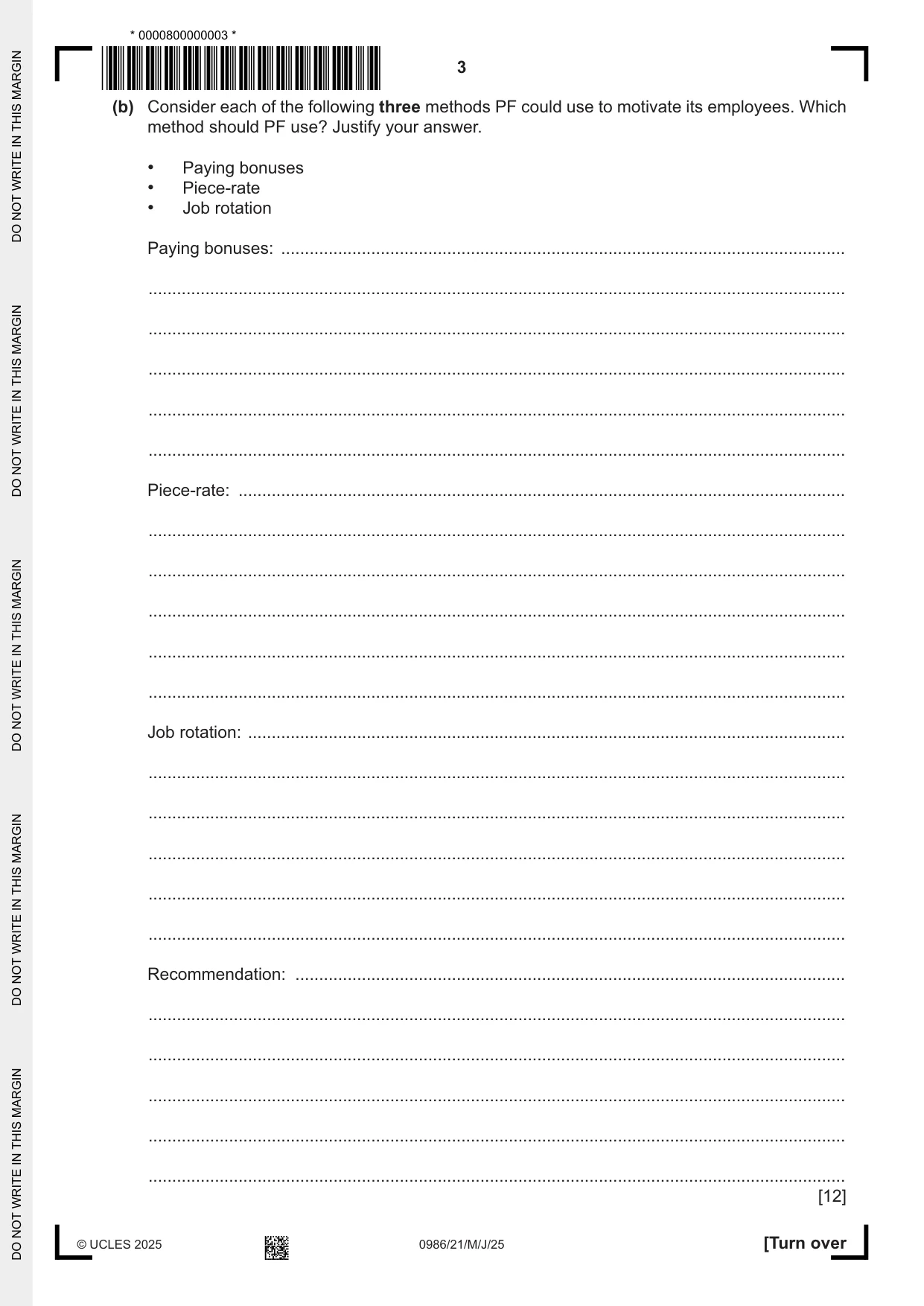
1 (a) Explain two advantages and two disadvantages to Philip of changing PF from a sole trader business to a private limited company. Advantage 1: ............................................................................................................................ ................................................................................................................................................... ................................................................................................................................................... ................................................................................................................................................... Advantage 2: ............................................................................................................................ ................................................................................................................................................... ................................................................................................................................................... ................................................................................................................................................... Disadvantage 1: ........................................................................................................................ ................................................................................................................................................... ................................................................................................................................................... ................................................................................................................................................... Disadvantage 2: ........................................................................................................................ ................................................................................................................................................... ................................................................................................................................................... ................................................................................................................................................... [8] (b) Consider each of the following three methods PF could use to motivate its employees. Which method should PF use? Justify your answer. • Paying bonuses • Piece‑rate • Job rotation Paying bonuses: ....................................................................................................................... ................................................................................................................................................... ................................................................................................................................................... ................................................................................................................................................... ................................................................................................................................................... ................................................................................................................................................... Piece‑rate: ................................................................................................................................ ................................................................................................................................................... ................................................................................................................................................... ................................................................................................................................................... ................................................................................................................................................... ................................................................................................................................................... Job rotation: .............................................................................................................................. ................................................................................................................................................... ................................................................................................................................................... ................................................................................................................................................... ................................................................................................................................................... ................................................................................................................................................... Recommendation: .................................................................................................................... ................................................................................................................................................... ................................................................................................................................................... ................................................................................................................................................... ................................................................................................................................................... ................................................................................................................................................... [12]
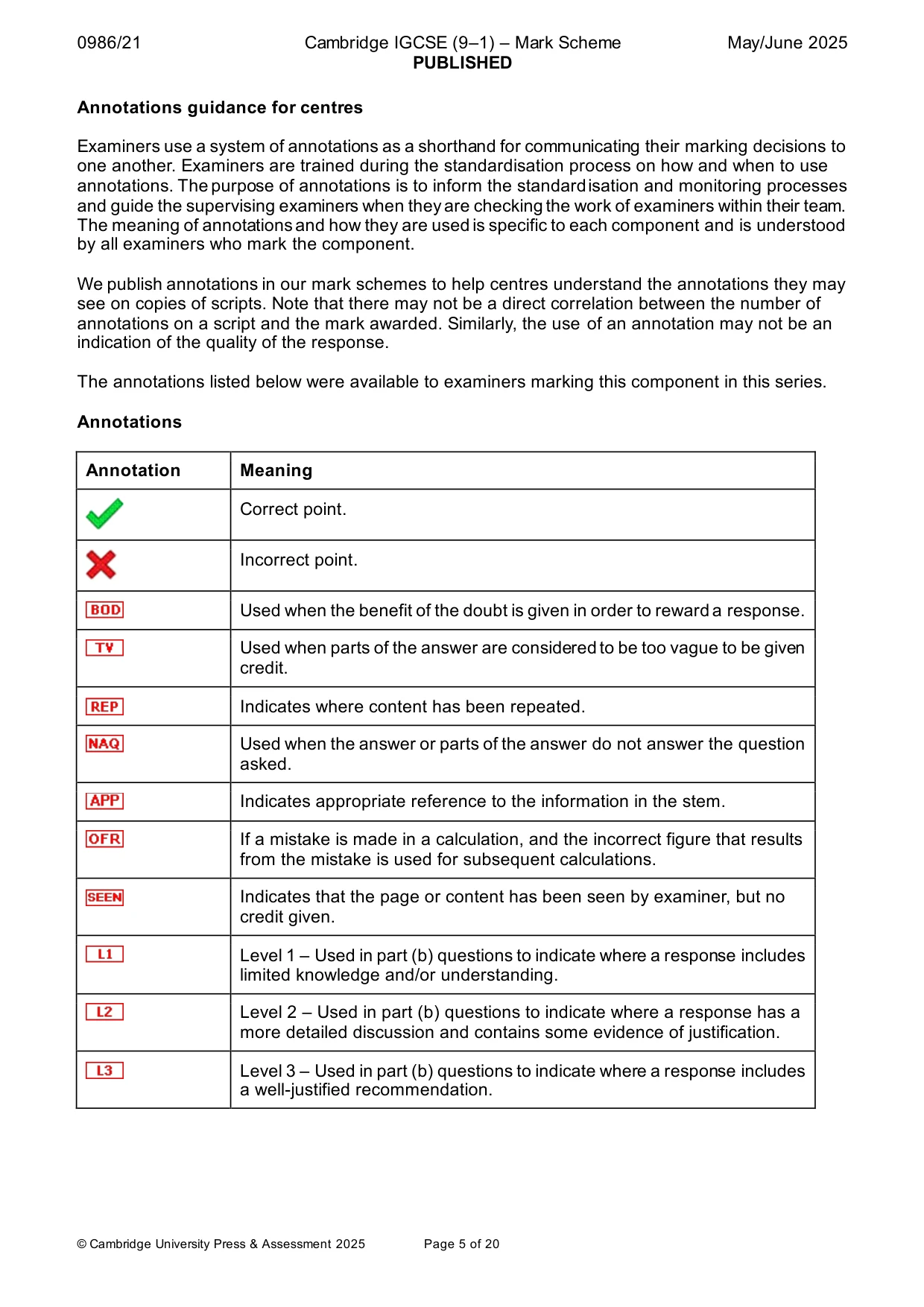
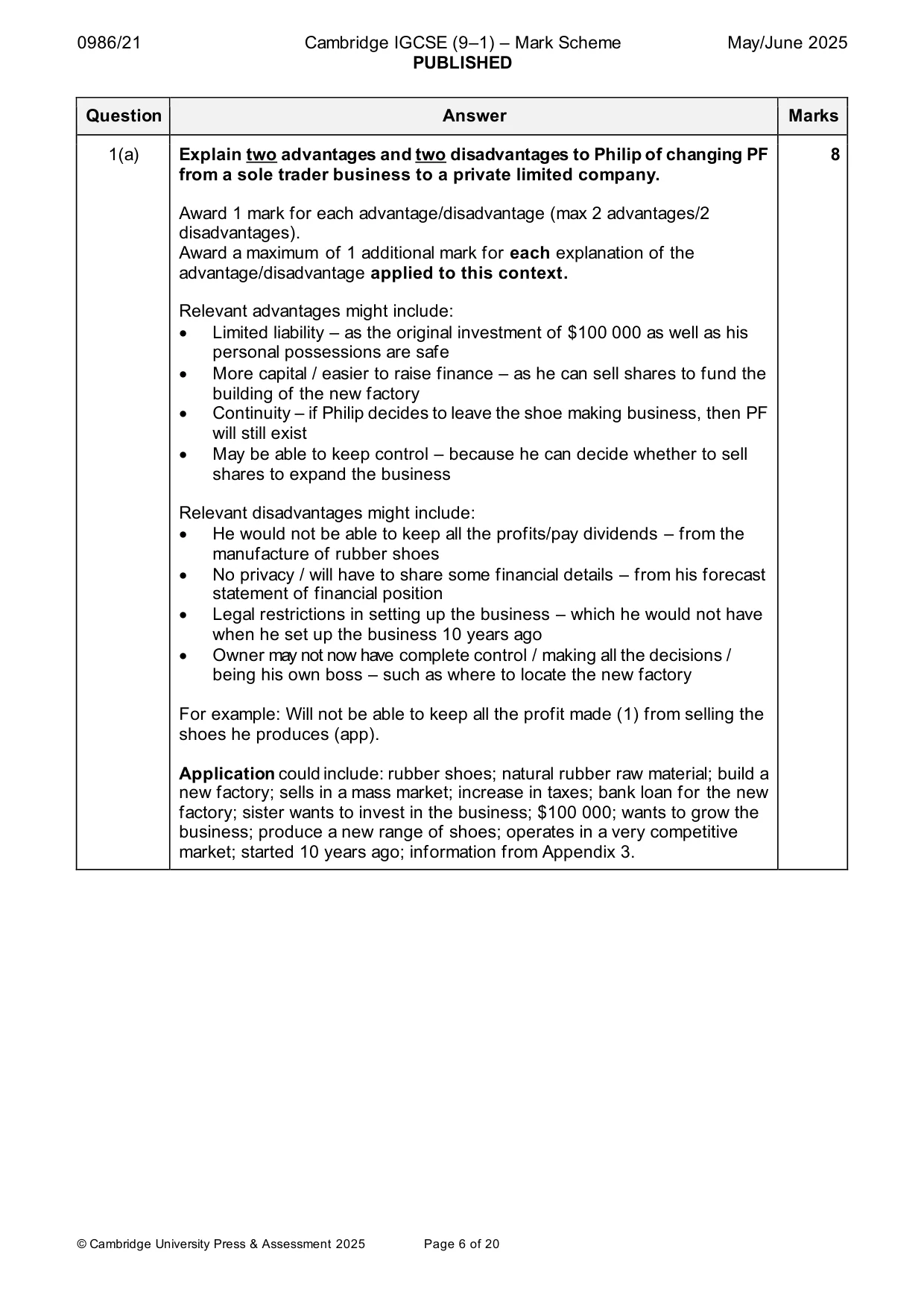
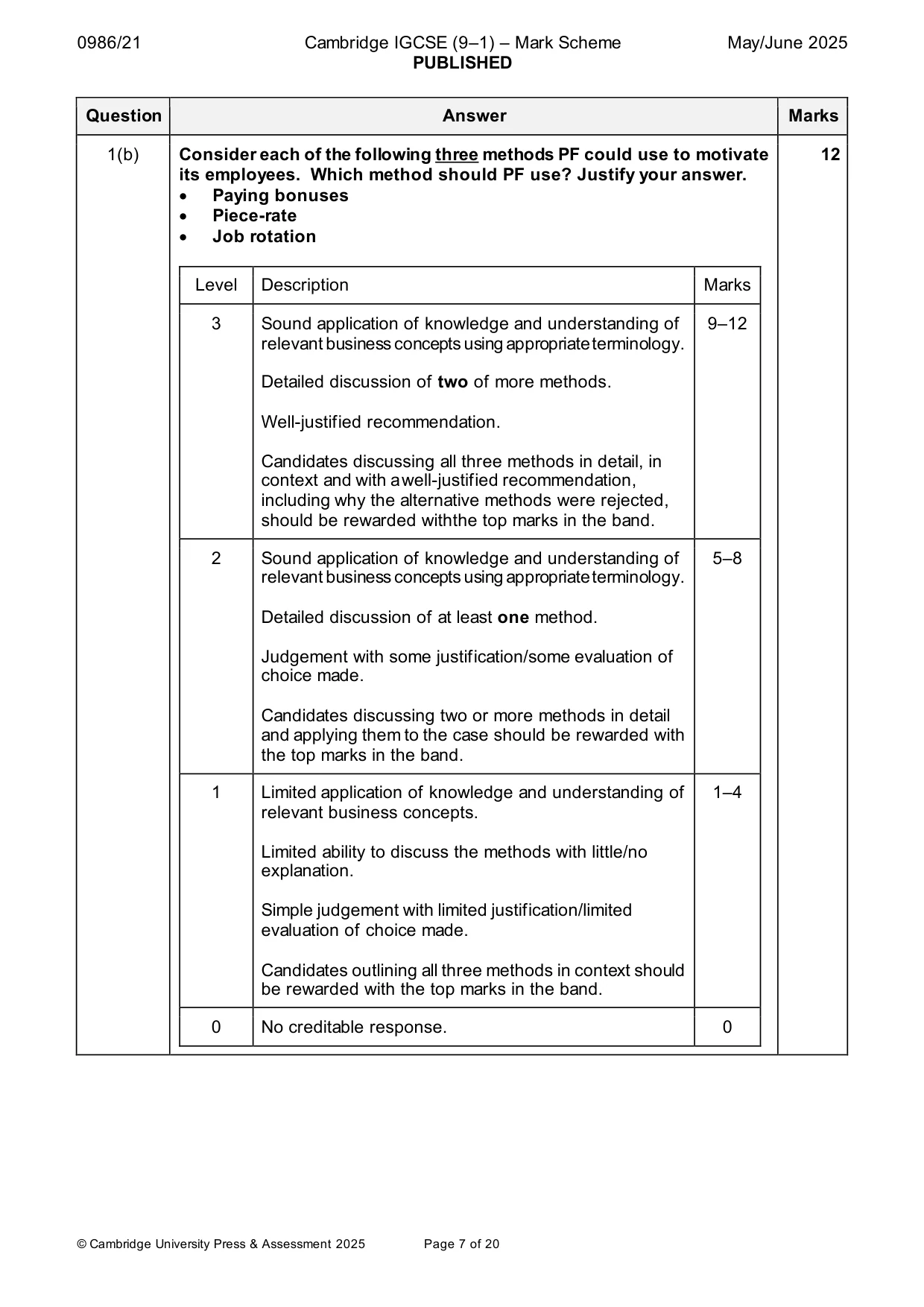
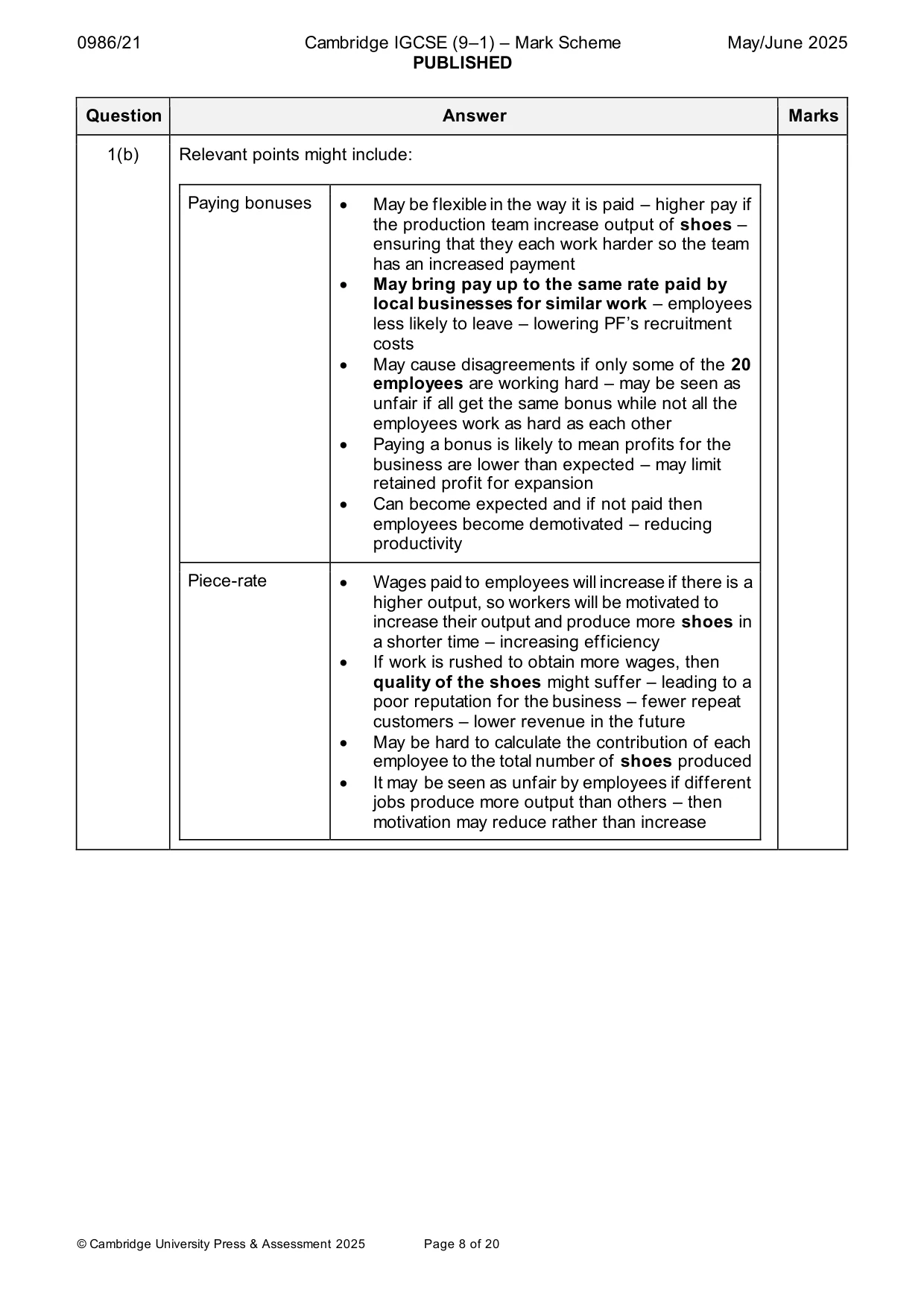
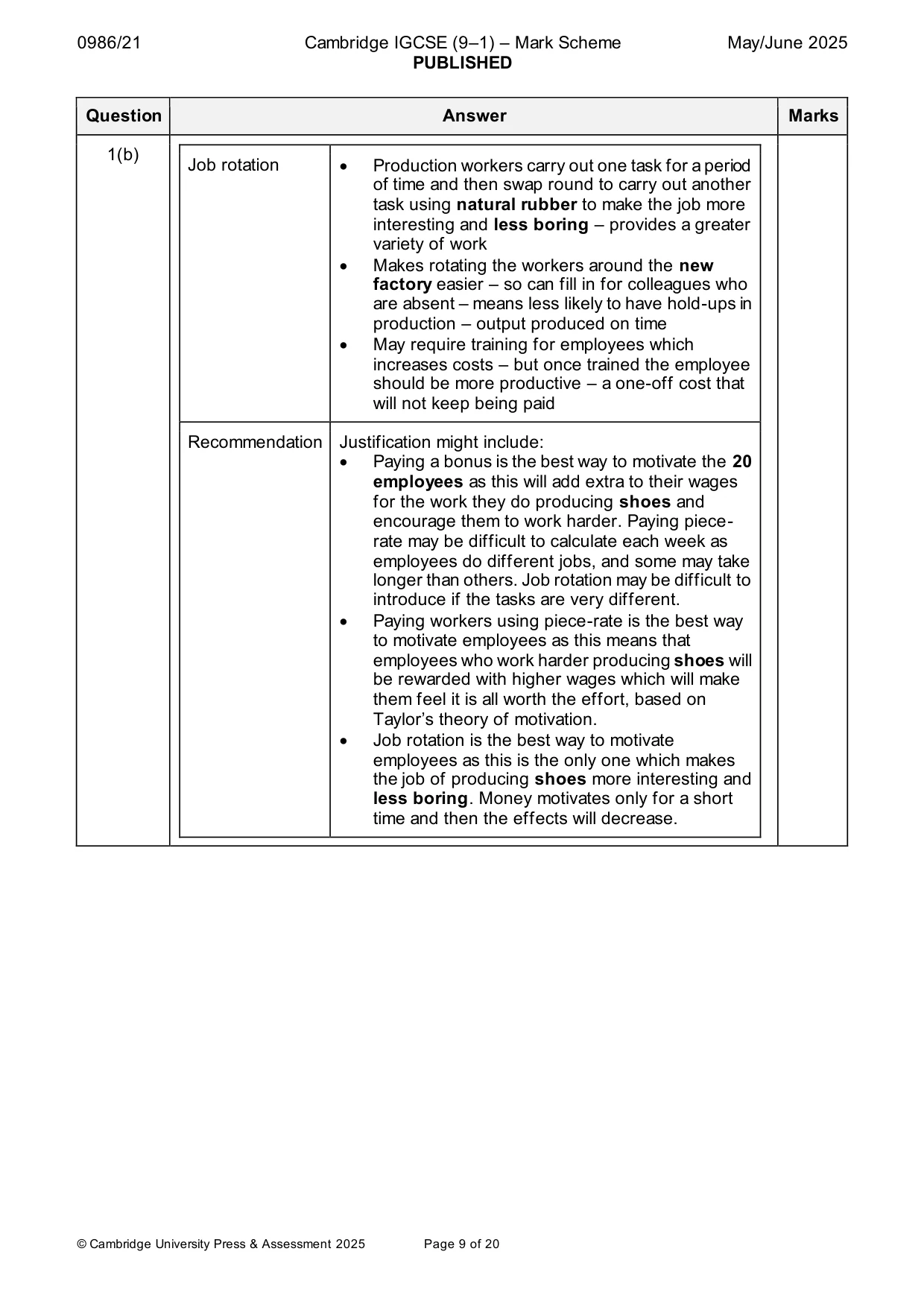
Mark scheme: Question Answer Marks 1(a) Explain two advantages and two disadvantages to Philip of changing PF 8 from a sole trader business to a private limited company. Award 1 mark for each advantage/disadvantage (max 2 advantages/2 disadvantages). Award a maximum of 1 additional mark for each explanation of the advantage/disadvantage applied to this context. Relevant advantages might include: • Limited liability – as the original investment of $100 000 as well as his personal possessions are safe • More capital / easier to raise finance – as he can sell shares to fund the building of the new factory • Continuity – if Philip decides to leave the shoe making business, then PF will still exist • May be able to keep control – because he can decide whether to sell shares to expand the business Relevant disadvantages might include: • He would not be able to keep all the profits/pay dividends – from the manufacture of rubber shoes • No privacy / will have to share some financial details – from his forecast statement of financial position • Legal restrictions in setting up the business – which he would not have when he set up the business 10 years ago • Owner may not now have complete control / making all the decisions / being his own boss – such as where to locate the new factory For example: Will not be able to keep all the profit made (1) from selling the shoes he produces (app). Application could include: rubber shoes; natural rubber raw material; build a new factory; sells in a mass market; increase in taxes; bank loan for the new factory; sister wants to invest in the business; $100 000; wants to grow the business; produce a new range of shoes; operates in a very competitive market; started 10 years ago; information from Appendix 3. 1(b) Consider each of the following three methods PF could use to motivate 12 its employees. Which method should PF use? Justify your answer. • Paying bonuses • Piece-rate • Job rotation Level Description Marks 3 Sound application of knowledge and understanding of 9–12 relevant business concepts using appropriate terminology. Detailed discussion of two of more methods. Well-justified recommendation. Candidates discussing all three methods in detail, in context and with a well-justified recommendation, including why the alternative methods were rejected, should be rewarded with the top marks in the band. 2 Sound application of knowledge and understanding of 5–8 relevant business concepts using appropriate terminology. Detailed discussion of at least one method. Judgement with some justification/some evaluation of choice made. Candidates discussing two or more methods in detail and applying them to the case should be rewarded with the top marks in the band. 1 Limited application of knowledge and understanding of 1–4 relevant business concepts. Limited ability to discuss the methods with little/no explanation. Simple judgement with limited justification/limited evaluation of choice made. Candidates outlining all three methods in context should be rewarded with the top marks in the band. 0 No creditable response. 0 1(b) Relevant points might include: Paying bonuses • May be flexible in the way it is paid – higher pay if the production team increase output of shoes – ensuring that they each work harder so the team has an increased payment • May bring pay up to the same rate paid by local businesses for similar work – employees less likely to leave – lowering PF’s recruitment costs • May cause disagreements if only some of the 20 employees are working hard – may be seen as unfair if all get the same bonus while not all the employees work as hard as each other • Paying a bonus is likely to mean profits for the business are lower than expected – may limit retained profit for expansion • Can become expected and if not paid then employees become demotivated – reducing productivity Piece-rate • Wages paid to employees will increase if there is a higher output, so workers will be motivated to increase their output and produce more shoes in a shorter time – increasing efficiency • If work is rushed to obtain more wages, then quality of the shoes might suffer – leading to a poor reputation for the business – fewer repeat customers – lower revenue in the future • May be hard to calculate the contribution of each employee to the total number of shoes produced • It may be seen as unfair by employees if different jobs produce more output than others – then motivation may reduce rather than increase 1(b) Job rotation • Production workers carry out one task for a period of time and then swap round to carry out another task using natural rubber to make the job more interesting and less boring – provides a greater variety of work • Makes rotating the workers around the new factory easier – so can fill in for colleagues who are absent – means less likely to have hold-ups in production – output produced on time • May require training for employees which increases costs – but once trained the employee should be more productive – a one-off cost that will not keep being paid Recommendation Justification might include: • Paying a bonus is the best way to motivate the 20 employees as this will add extra to their wages for the work they do producing shoes and encourage them to work harder. Paying piece- rate may be difficult to calculate each week as employees do different jobs, and some may take longer than others. Job rotation may be difficult to introduce if the tasks are very different. • Paying workers using piece-rate is the best way to motivate employees as this means that employees who work harder producing shoes will be rewarded with higher wages which will make them feel it is all worth the effort, based on Taylor’s theory of motivation. • Job rotation is the best way to motivate employees as this is the only one which makes the job of producing shoes more interesting and less boring. Money motivates only for a short time and then the effects will decrease.
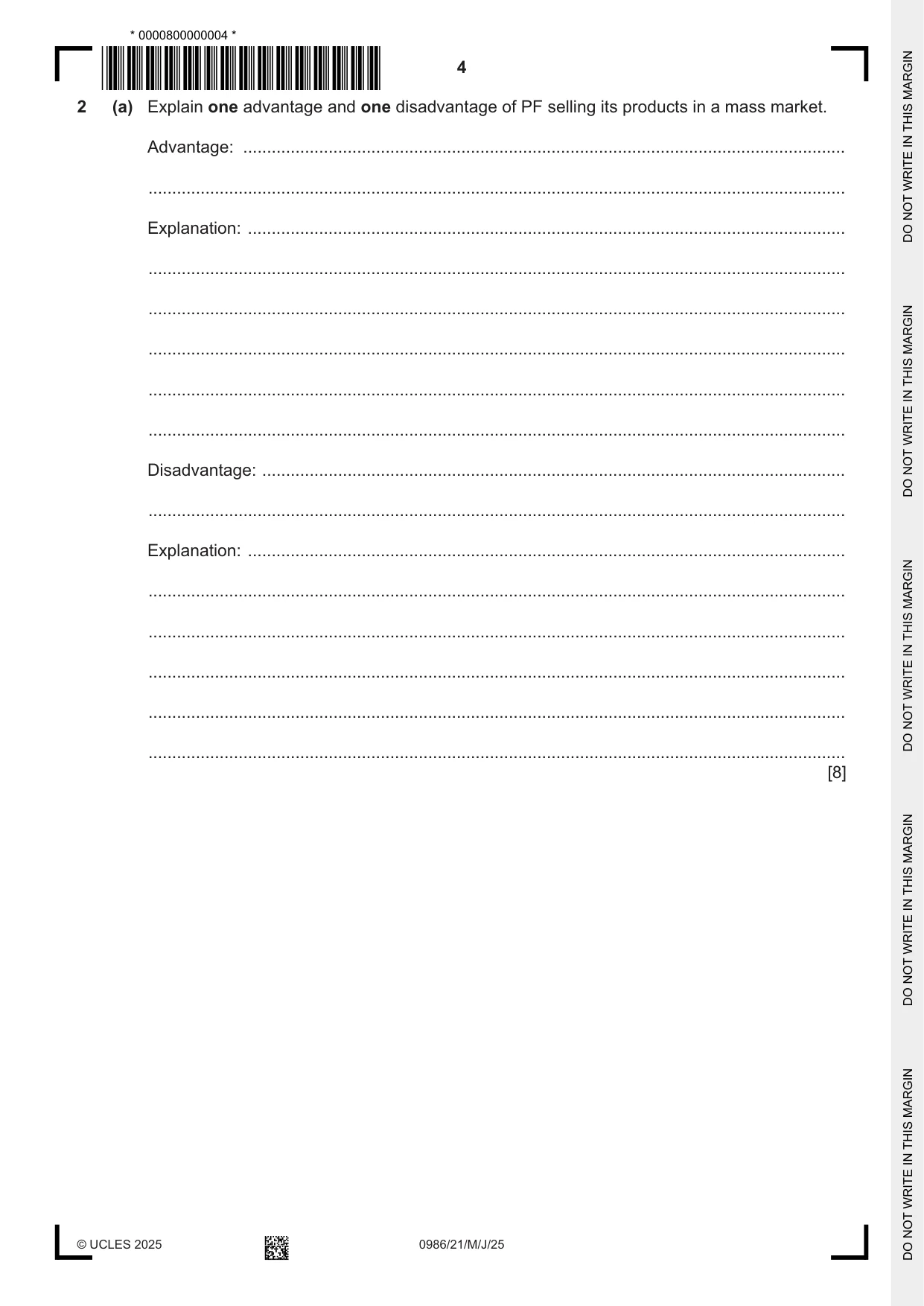
Q2 · Explain one advantage and one disadvantage of PF selling its products in a mass market
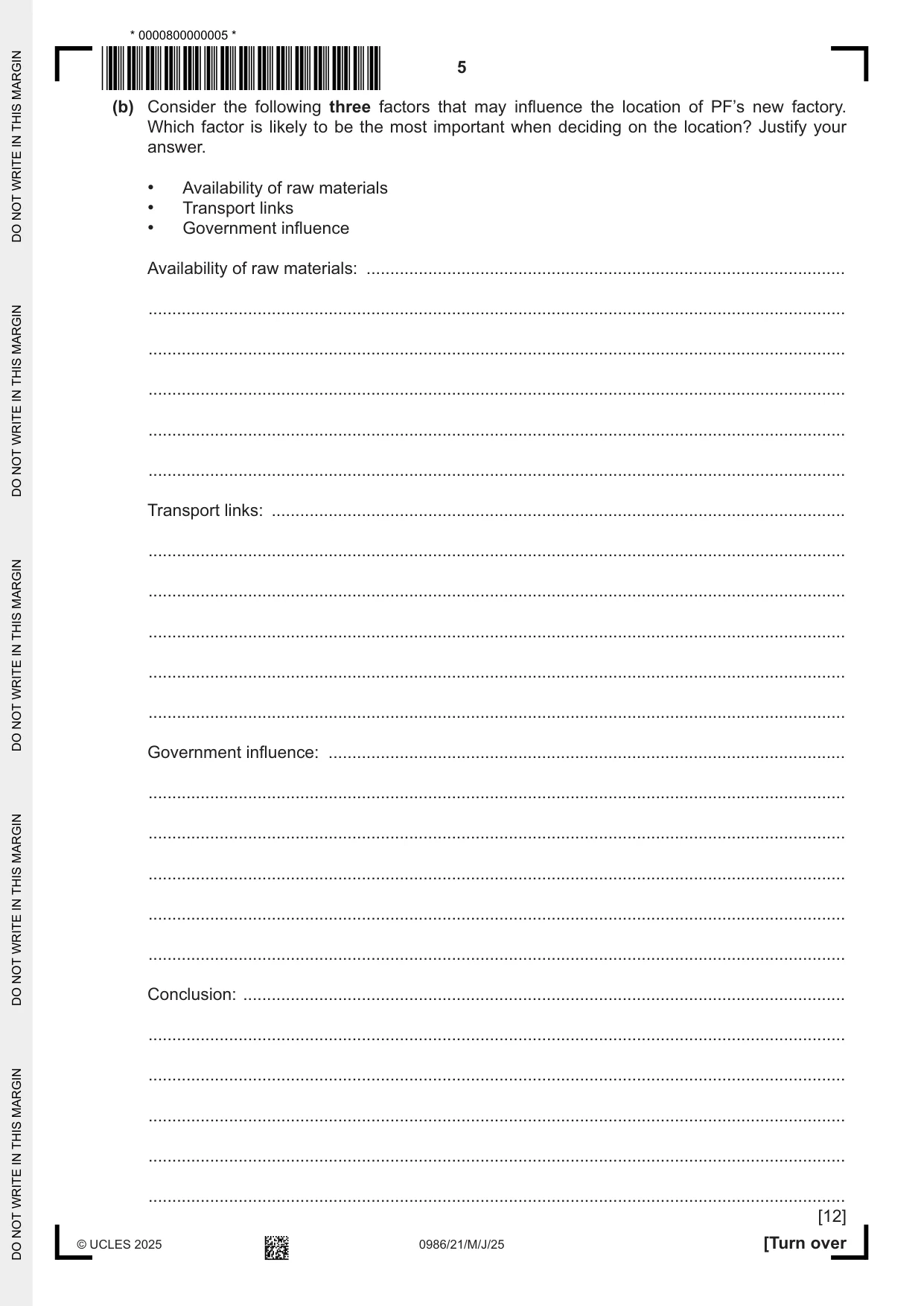
2 (a) Explain one advantage and one disadvantage of PF selling its products in a mass market. Advantage: ............................................................................................................................... ................................................................................................................................................... Explanation: .............................................................................................................................. ................................................................................................................................................... ................................................................................................................................................... ................................................................................................................................................... ................................................................................................................................................... ................................................................................................................................................... Disadvantage: ........................................................................................................................... ................................................................................................................................................... Explanation: .............................................................................................................................. ................................................................................................................................................... ................................................................................................................................................... ................................................................................................................................................... ................................................................................................................................................... ................................................................................................................................................... [8] (b) Consider the following three factors that may influence the location of PF’s new factory. Which factor is likely to be the most important when deciding on the location? Justify your answer. • Availability of raw materials • Transport links • Government influence Availability of raw materials: ..................................................................................................... ................................................................................................................................................... ................................................................................................................................................... ................................................................................................................................................... ................................................................................................................................................... ................................................................................................................................................... Transport links: ......................................................................................................................... ................................................................................................................................................... ................................................................................................................................................... ................................................................................................................................................... ................................................................................................................................................... ................................................................................................................................................... Government influence: ............................................................................................................. ................................................................................................................................................... ................................................................................................................................................... ................................................................................................................................................... ................................................................................................................................................... ................................................................................................................................................... Conclusion: ............................................................................................................................... ................................................................................................................................................... ................................................................................................................................................... ................................................................................................................................................... ................................................................................................................................................... ................................................................................................................................................... [12]
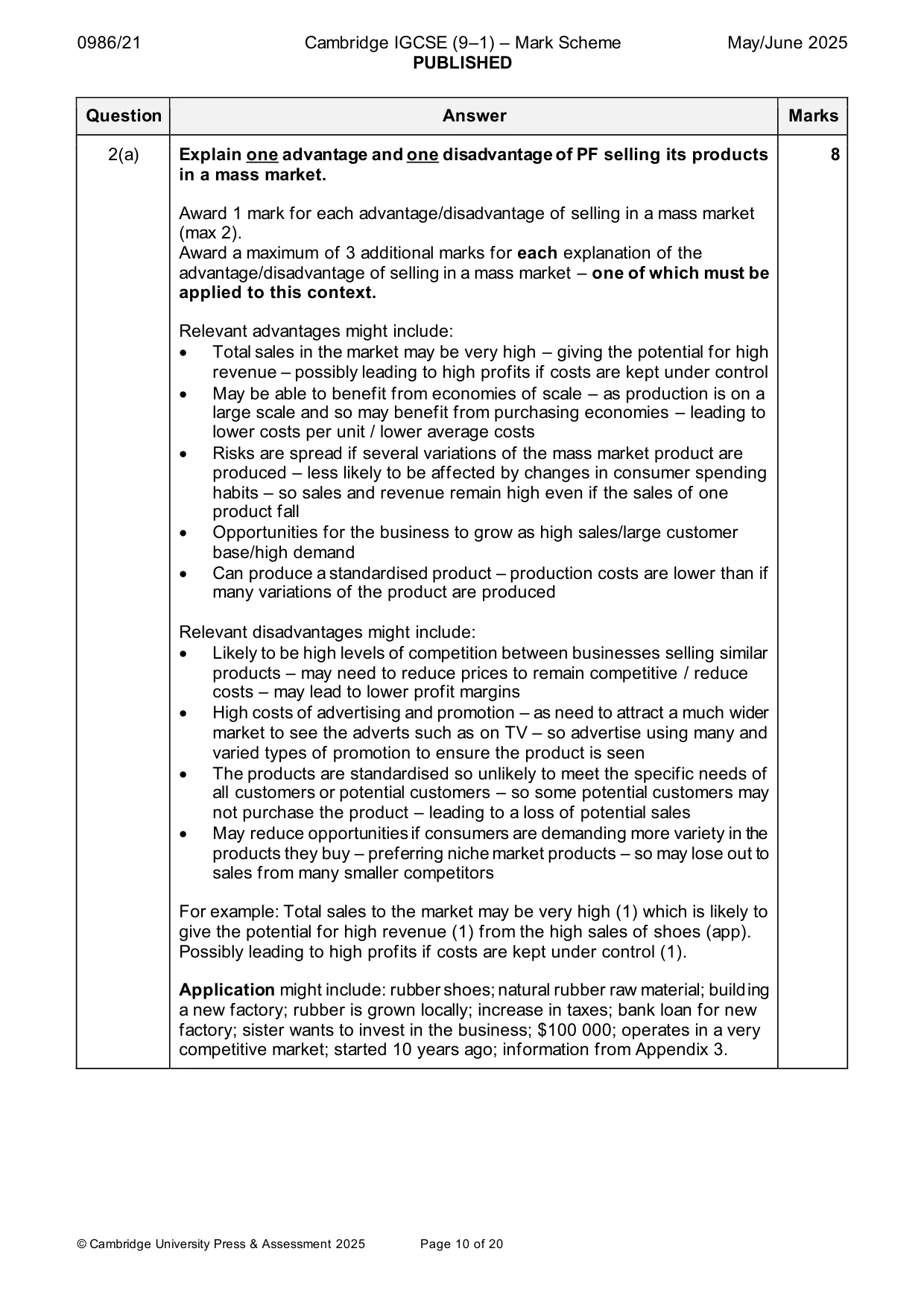
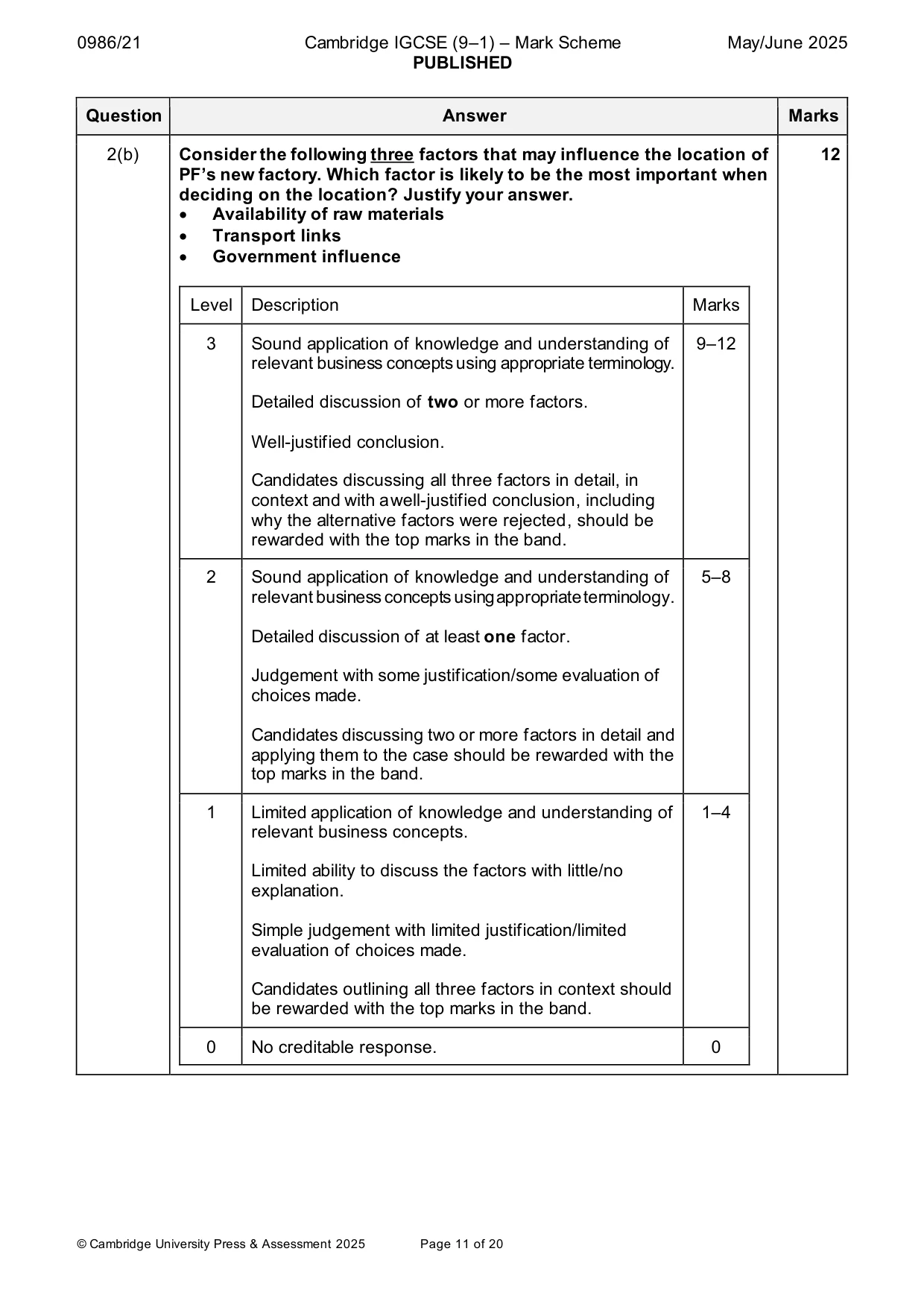
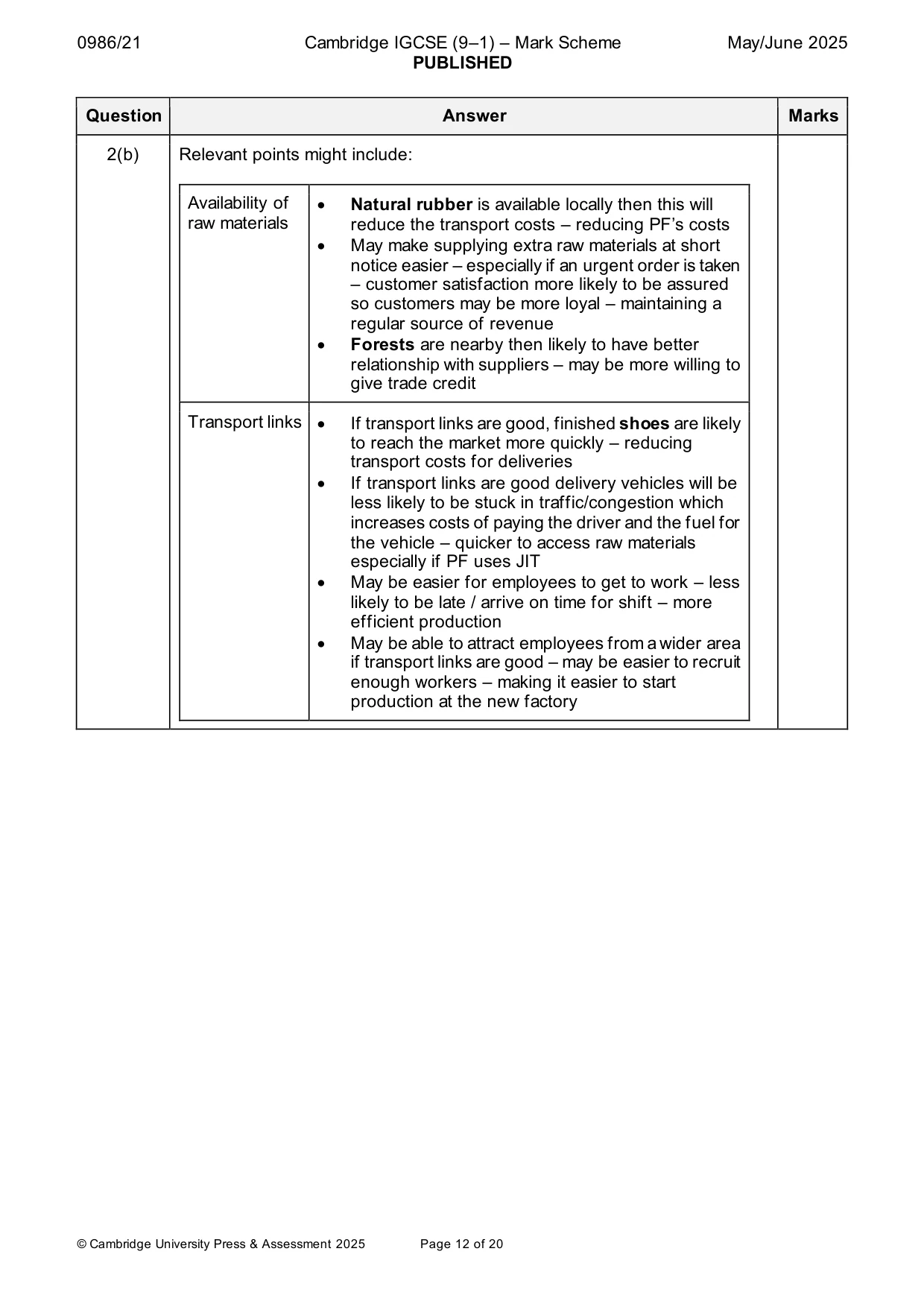
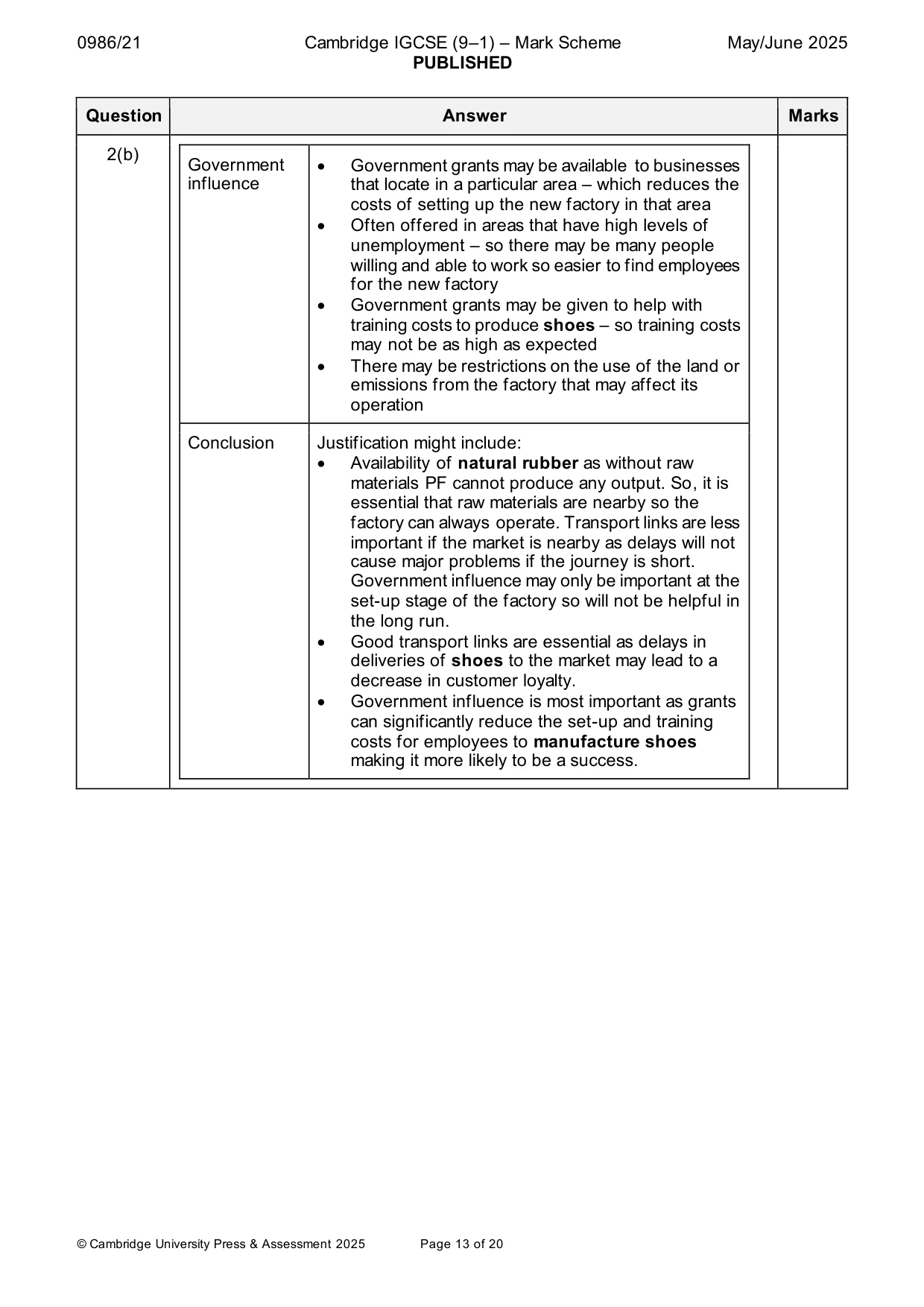
Mark scheme: 2(a) Explain one advantage and one disadvantage of PF selling its products 8 in a mass market. Award 1 mark for each advantage/disadvantage of selling in a mass market (max 2). Award a maximum of 3 additional marks for each explanation of the advantage/disadvantage of selling in a mass market – one of which must be applied to this context. Relevant advantages might include: • Total sales in the market may be very high – giving the potential for high revenue – possibly leading to high profits if costs are kept under control • May be able to benefit from economies of scale – as production is on a large scale and so may benefit from purchasing economies – leading to lower costs per unit / lower average costs • Risks are spread if several variations of the mass market product are produced – less likely to be affected by changes in consumer spending habits – so sales and revenue remain high even if the sales of one product fall • Opportunities for the business to grow as high sales/large customer base/high demand • Can produce a standardised product – production costs are lower than if many variations of the product are produced Relevant disadvantages might include: • Likely to be high levels of competition between businesses selling similar products – may need to reduce prices to remain competitive / reduce costs – may lead to lower profit margins • High costs of advertising and promotion – as need to attract a much wider market to see the adverts such as on TV – so advertise using many and varied types of promotion to ensure the product is seen • The products are standardised so unlikely to meet the specific needs of all customers or potential customers – so some potential customers may not purchase the product – leading to a loss of potential sales • May reduce opportunities if consumers are demanding more variety in the products they buy – preferring niche market products – so may lose out to sales from many smaller competitors For example: Total sales to the market may be very high (1) which is likely to give the potential for high revenue (1) from the high sales of shoes (app). Possibly leading to high profits if costs are kept under control (1). Application might include: rubber shoes; natural rubber raw material; building a new factory; rubber is grown locally; increase in taxes; bank loan for new factory; sister wants to invest in the business; $100 000; operates in a very competitive market; started 10 years ago; information from Appendix 3. 2(b) Consider the following three factors that may influence the location of 12 PF’s new factory. Which factor is likely to be the most important when deciding on the location? Justify your answer. • Availability of raw materials • Transport links • Government influence Level Description Marks 3 Sound application of knowledge and understanding of 9–12 relevant business concepts using appropriate terminology. Detailed discussion of two or more factors. Well-justified conclusion. Candidates discussing all three factors in detail, in context and with a well-justified conclusion, including why the alternative factors were rejected, should be rewarded with the top marks in the band. 2 Sound application of knowledge and understanding of 5–8 relevant business concepts using appropriate terminology. Detailed discussion of at least one factor. Judgement with some justification/some evaluation of choices made. Candidates discussing two or more factors in detail and applying them to the case should be rewarded with the top marks in the band. 1 Limited application of knowledge and understanding of 1–4 relevant business concepts. Limited ability to discuss the factors with little/no explanation. Simple judgement with limited justification/limited evaluation of choices made. Candidates outlining all three factors in context should be rewarded with the top marks in the band. 0 No creditable response. 0 2(b) Relevant points might include: Availability of • Natural rubber is available locally then this will raw materials reduce the transport costs – reducing PF’s costs • May make supplying extra raw materials at short notice easier – especially if an urgent order is taken – customer satisfaction more likely to be assured so customers may be more loyal – maintaining a regular source of revenue • Forests are nearby then likely to have better relationship with suppliers – may be more willing to give trade credit Transport links • If transport links are good, finished shoes are likely to reach the market more quickly – reducing transport costs for deliveries • If transport links are good delivery vehicles will be less likely to be stuck in traffic/congestion which increases costs of paying the driver and the fuel for the vehicle – quicker to access raw materials especially if PF uses JIT • May be easier for employees to get to work – less likely to be late / arrive on time for shift – more efficient production • May be able to attract employees from a wider area if transport links are good – may be easier to recruit enough workers – making it easier to start production at the new factory 2(b) Government • Government grants may be available to businesses influence that locate in a particular area – which reduces the costs of setting up the new factory in that area • Often offered in areas that have high levels of unemployment – so there may be many people willing and able to work so easier to find employees for the new factory • Government grants may be given to help with training costs to produce shoes – so training costs may not be as high as expected • There may be restrictions on the use of the land or emissions from the factory that may affect its operation Conclusion Justification might include: • Availability of natural rubber as without raw materials PF cannot produce any output. So, it is essential that raw materials are nearby so the factory can always operate. Transport links are less important if the market is nearby as delays will not cause major problems if the journey is short. Government influence may only be important at the set-up stage of the factory so will not be helpful in the long run. • Good transport links are essential as delays in deliveries of shoes to the market may lead to a decrease in customer loyalty. • Government influence is most important as grants can significantly reduce the set-up and training costs for employees to manufacture shoes making it more likely to be a success.
Q3 · Explain two advantages and two disadvantages to a business of using a bank loan as a…
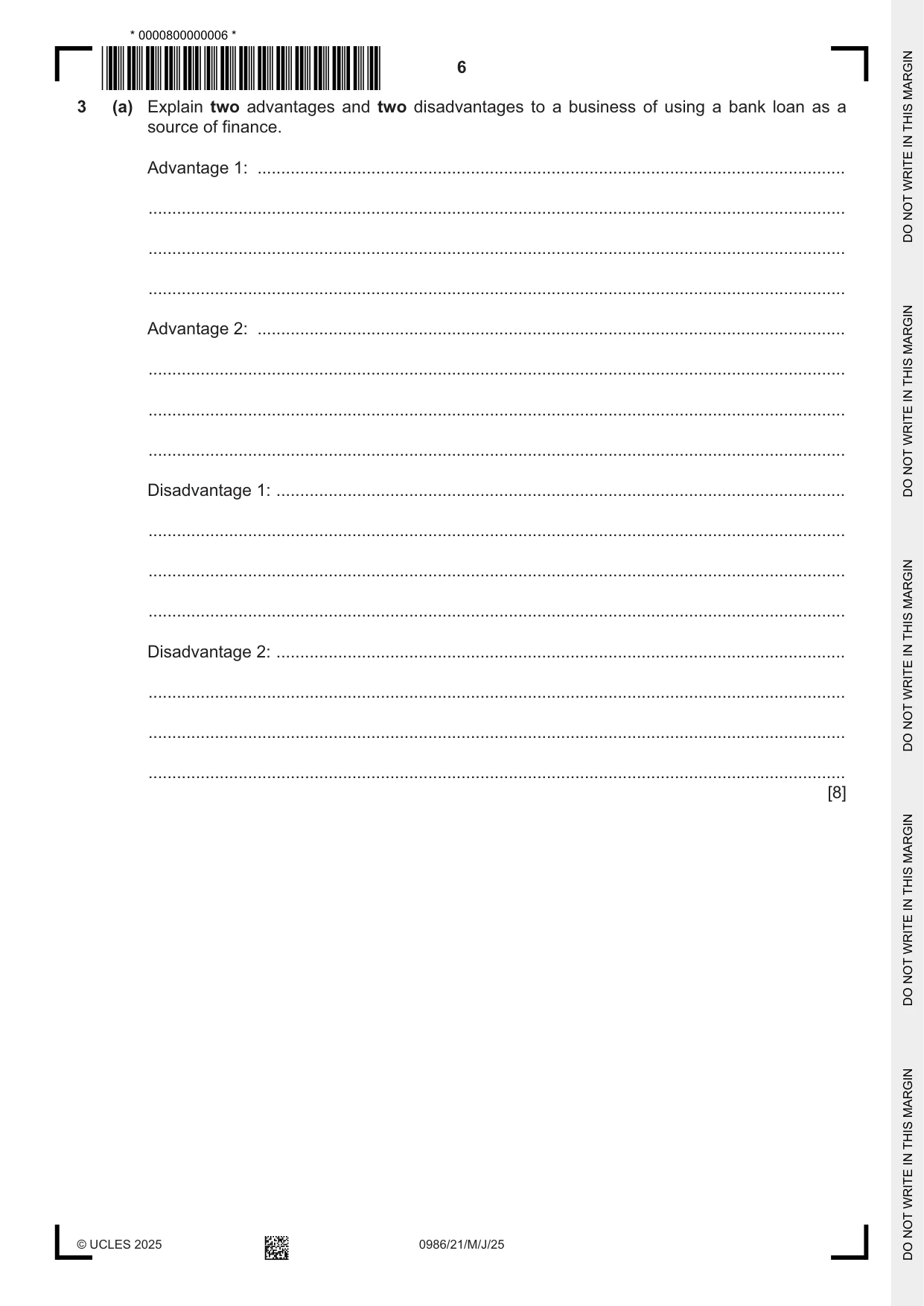
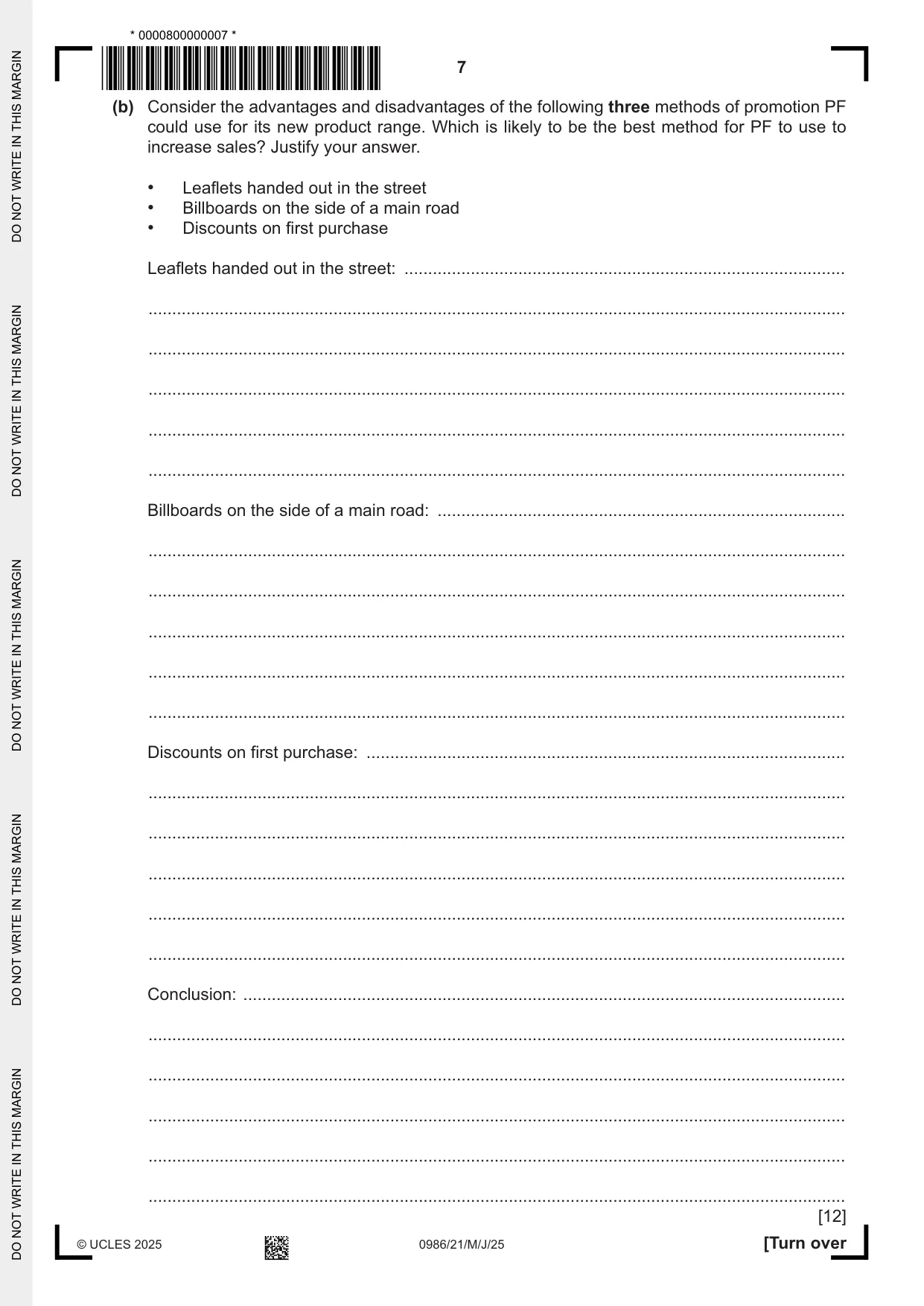
3 (a) Explain two advantages and two disadvantages to a business of using a bank loan as a source of finance. Advantage 1: ............................................................................................................................ ................................................................................................................................................... ................................................................................................................................................... ................................................................................................................................................... Advantage 2: ............................................................................................................................ ................................................................................................................................................... ................................................................................................................................................... ................................................................................................................................................... Disadvantage 1: ........................................................................................................................ ................................................................................................................................................... ................................................................................................................................................... ................................................................................................................................................... Disadvantage 2: ........................................................................................................................ ................................................................................................................................................... ................................................................................................................................................... ................................................................................................................................................... [8] (b) Consider the advantages and disadvantages of the following three methods of promotion PF could use for its new product range. Which is likely to be the best method for PF to use to increase sales? Justify your answer. • Leaflets handed out in the street • Billboards on the side of a main road • Discounts on first purchase Leaflets handed out in the street: ............................................................................................. ................................................................................................................................................... ................................................................................................................................................... ................................................................................................................................................... ................................................................................................................................................... ................................................................................................................................................... Billboards on the side of a main road: ...................................................................................... ................................................................................................................................................... ................................................................................................................................................... ................................................................................................................................................... ................................................................................................................................................... ................................................................................................................................................... Discounts on first purchase: ..................................................................................................... ................................................................................................................................................... ................................................................................................................................................... ................................................................................................................................................... ................................................................................................................................................... ................................................................................................................................................... Conclusion: ............................................................................................................................... ................................................................................................................................................... ................................................................................................................................................... ................................................................................................................................................... ................................................................................................................................................... ................................................................................................................................................... [12]
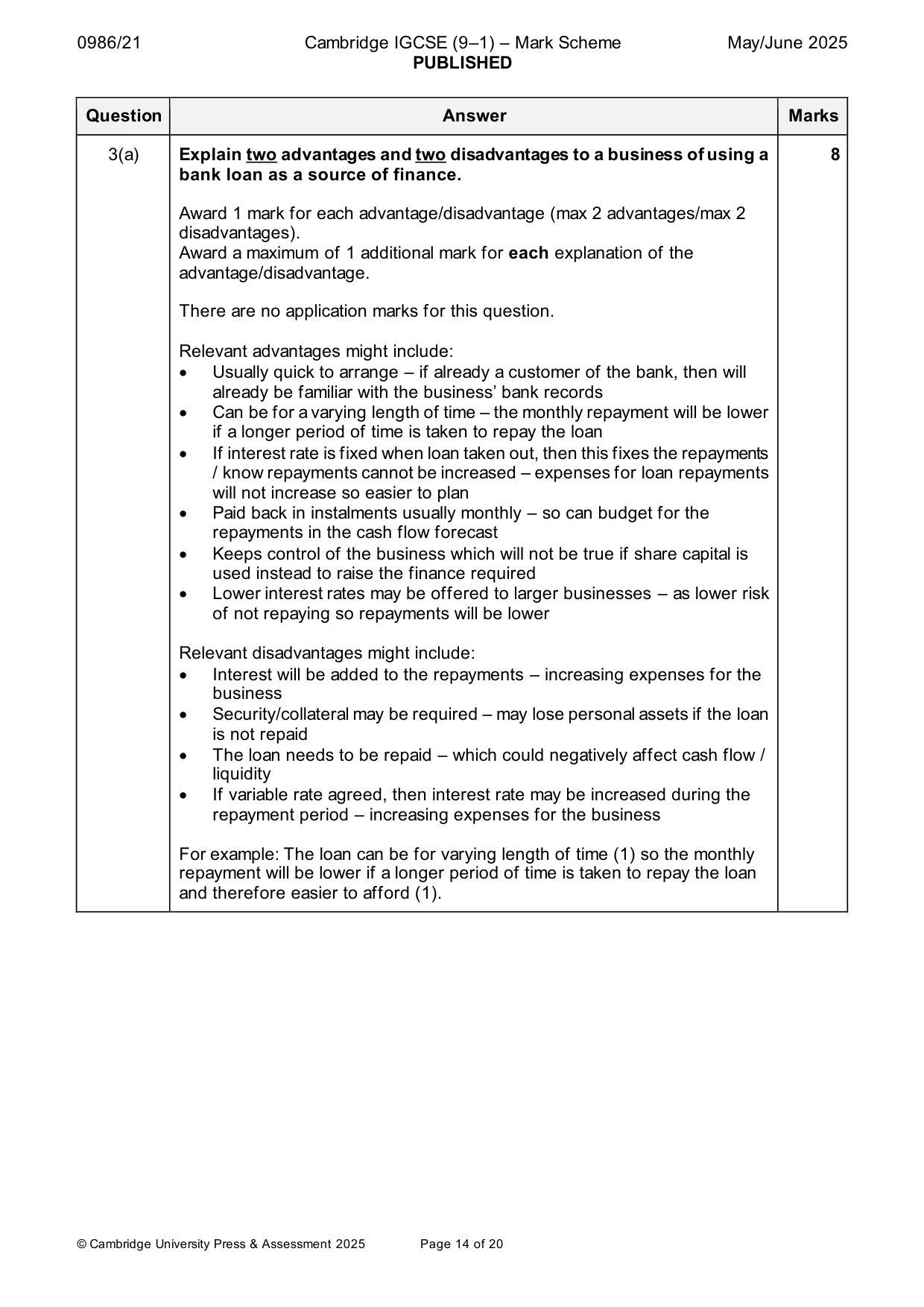
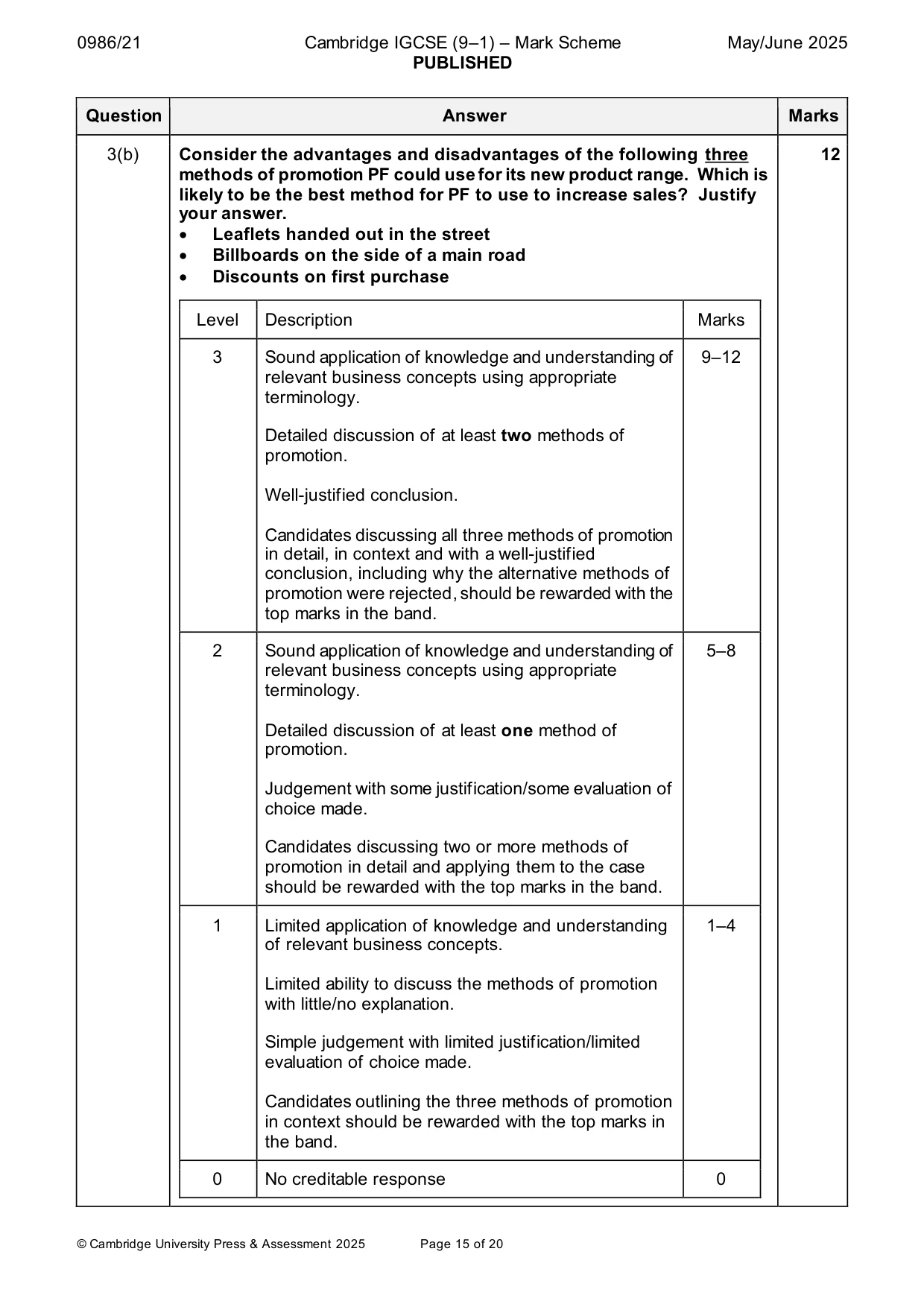
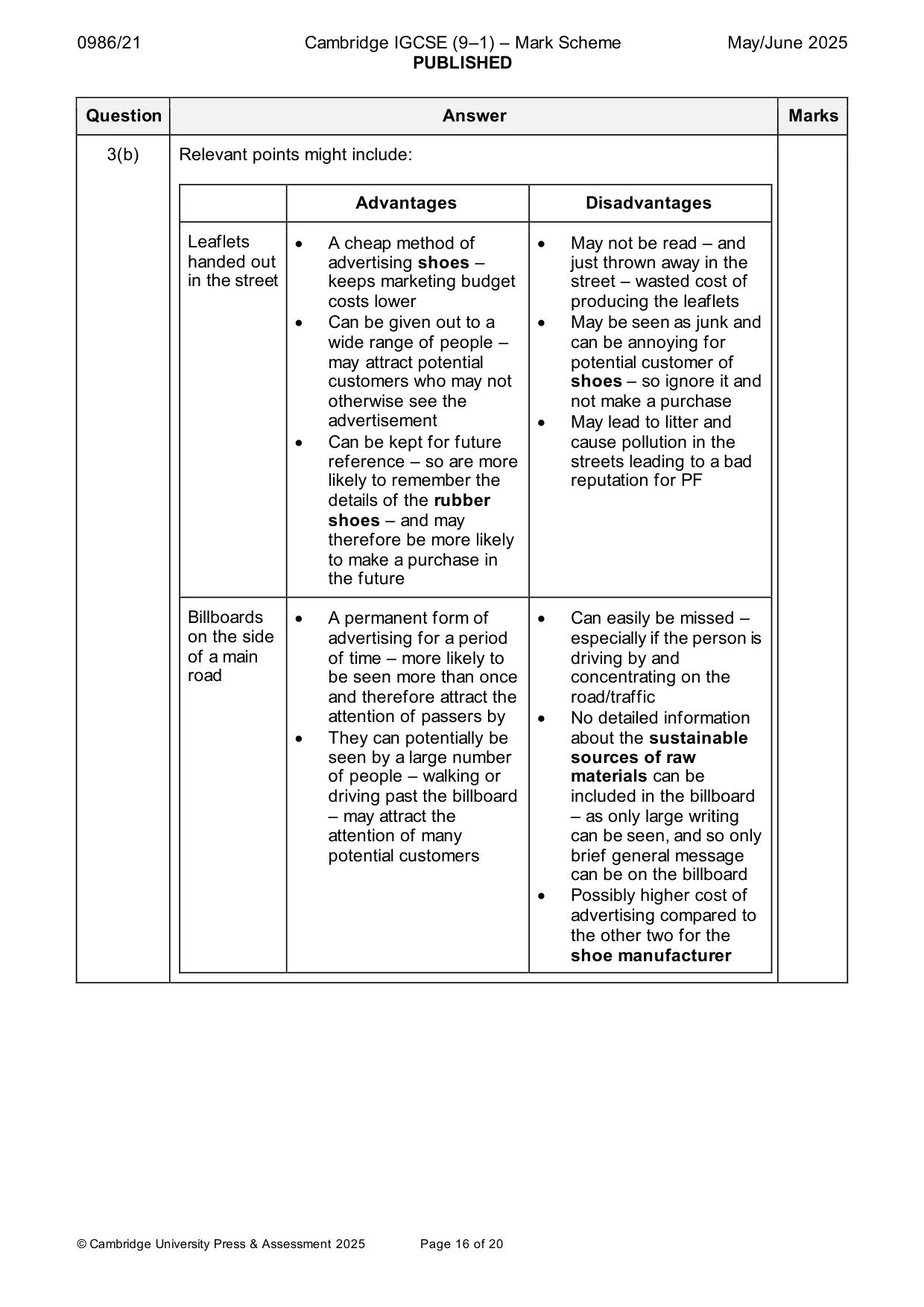
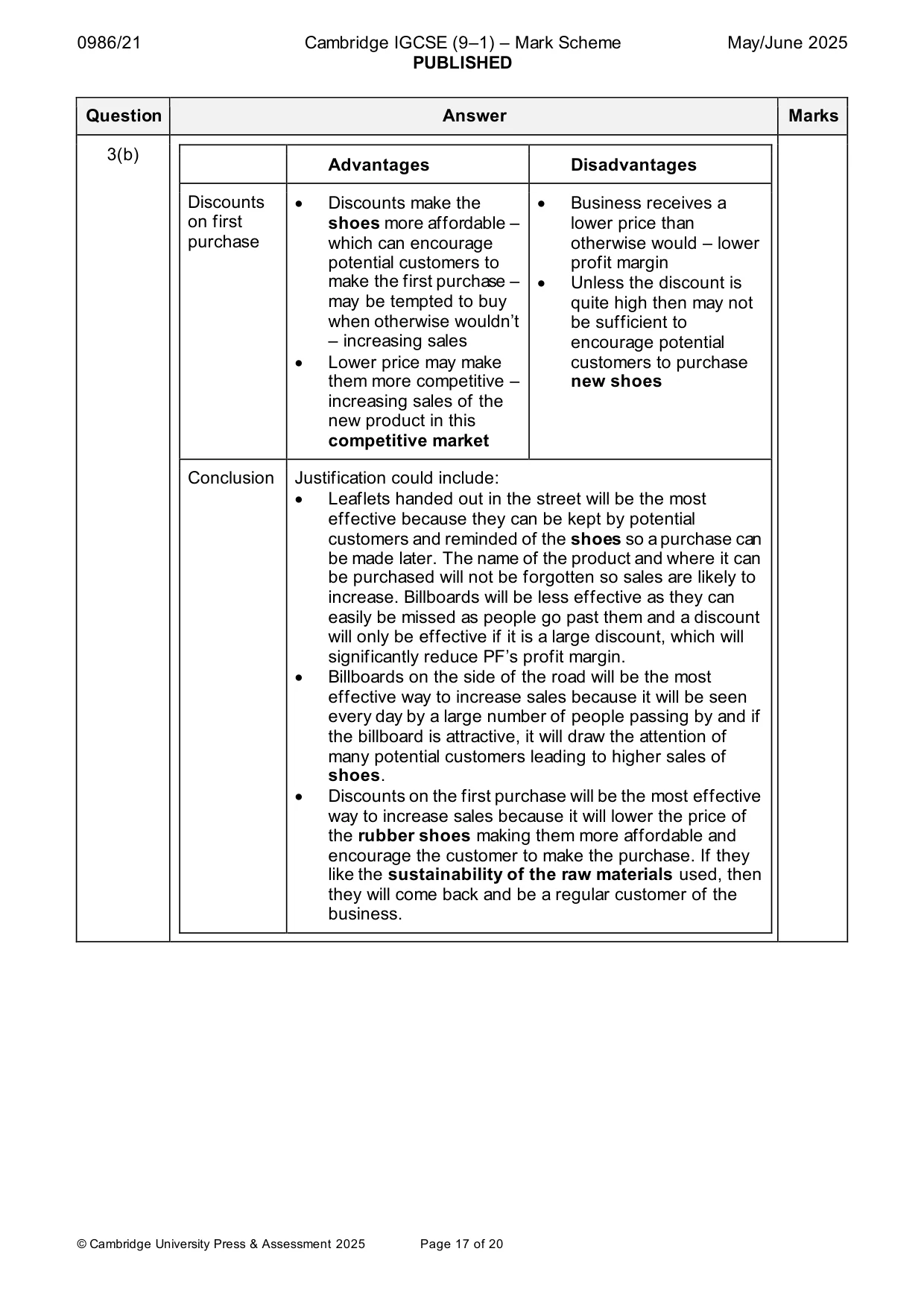
Mark scheme: 3(a) Explain two advantages and two disadvantages to a business of using a 8 bank loan as a source of finance. Award 1 mark for each advantage/disadvantage (max 2 advantages/max 2 disadvantages). Award a maximum of 1 additional mark for each explanation of the advantage/disadvantage. There are no application marks for this question. Relevant advantages might include: • Usually quick to arrange – if already a customer of the bank, then will already be familiar with the business’ bank records • Can be for a varying length of time – the monthly repayment will be lower if a longer period of time is taken to repay the loan • If interest rate is fixed when loan taken out, then this fixes the repayments / know repayments cannot be increased – expenses for loan repayments will not increase so easier to plan • Paid back in instalments usually monthly – so can budget for the repayments in the cash flow forecast • Keeps control of the business which will not be true if share capital is used instead to raise the finance required • Lower interest rates may be offered to larger businesses – as lower risk of not repaying so repayments will be lower Relevant disadvantages might include: • Interest will be added to the repayments – increasing expenses for the business • Security/collateral may be required – may lose personal assets if the loan is not repaid • The loan needs to be repaid – which could negatively affect cash flow / liquidity • If variable rate agreed, then interest rate may be increased during the repayment period – increasing expenses for the business For example: The loan can be for varying length of time (1) so the monthly repayment will be lower if a longer period of time is taken to repay the loan and therefore easier to afford (1). 3(b) Consider the advantages and disadvantages of the following three 12 methods of promotion PF could use for its new product range. Which is likely to be the best method for PF to use to increase sales? Justify your answer. • Leaflets handed out in the street • Billboards on the side of a main road • Discounts on first purchase Level Description Marks 3 Sound application of knowledge and understanding of 9–12 relevant business concepts using appropriate terminology. Detailed discussion of at least two methods of promotion. Well-justified conclusion. Candidates discussing all three methods of promotion in detail, in context and with a well-justified conclusion, including why the alternative methods of promotion were rejected, should be rewarded with the top marks in the band. 2 Sound application of knowledge and understanding of 5–8 relevant business concepts using appropriate terminology. Detailed discussion of at least one method of promotion. Judgement with some justification/some evaluation of choice made. Candidates discussing two or more methods of promotion in detail and applying them to the case should be rewarded with the top marks in the band. 1 Limited application of knowledge and understanding 1–4 of relevant business concepts. Limited ability to discuss the methods of promotion with little/no explanation. Simple judgement with limited justification/limited evaluation of choice made. Candidates outlining the three methods of promotion in context should be rewarded with the top marks in the band. 0 No creditable response 0 3(b) Relevant points might include: Advantages Disadvantages Leaflets • A cheap method of • May not be read – and handed out advertising shoes – just thrown away in the in the street keeps marketing budget street – wasted cost of costs lower producing the leaflets • Can be given out to a • May be seen as junk and wide range of people – can be annoying for may attract potential potential customer of customers who may not shoes – so ignore it and otherwise see the not make a purchase advertisement • May lead to litter and • Can be kept for future cause pollution in the reference – so are more streets leading to a bad likely to remember the reputation for PF details of the rubber shoes – and may therefore be more likely to make a purchase in the future Billboards • A permanent form of • Can easily be missed – on the side advertising for a period especially if the person is of a main of time – more likely to driving by and road be seen more than once concentrating on the and therefore attract the road/traffic attention of passers by • No detailed information • They can potentially be about the sustainable seen by a large number sources of raw of people – walking or materials can be driving past the billboard included in the billboard – may attract the – as only large writing attention of many can be seen, and so only potential customers brief general message can be on the billboard • Possibly higher cost of advertising compared to the other two for the shoe manufacturer 3(b) Advantages Disadvantages Discounts • Discounts make the • Business receives a on first shoes more affordable – lower price than purchase which can encourage otherwise would – lower potential customers to profit margin make the first purchase – • Unless the discount is may be tempted to buy quite high then may not when otherwise wouldn’t be sufficient to – increasing sales encourage potential • Lower price may make customers to purchase them more competitive – new shoes increasing sales of the new product in this competitive market Conclusion Justification could include: • Leaflets handed out in the street will be the most effective because they can be kept by potential customers and reminded of the shoes so a purchase can be made later. The name of the product and where it can be purchased will not be forgotten so sales are likely to increase. Billboards will be less effective as they can easily be missed as people go past them and a discount will only be effective if it is a large discount, which will significantly reduce PF’s profit margin. • Billboards on the side of the road will be the most effective way to increase sales because it will be seen every day by a large number of people passing by and if the billboard is attractive, it will draw the attention of many potential customers leading to higher sales of shoes. • Discounts on the first purchase will be the most effective way to increase sales because it will lower the price of the rubber shoes making them more affordable and encourage the customer to make the purchase. If they like the sustainability of the raw materials used, then they will come back and be a regular customer of the business.
Q4 · Explain one effect on PF of the increase in each of the two taxes outlined in Appendix 2
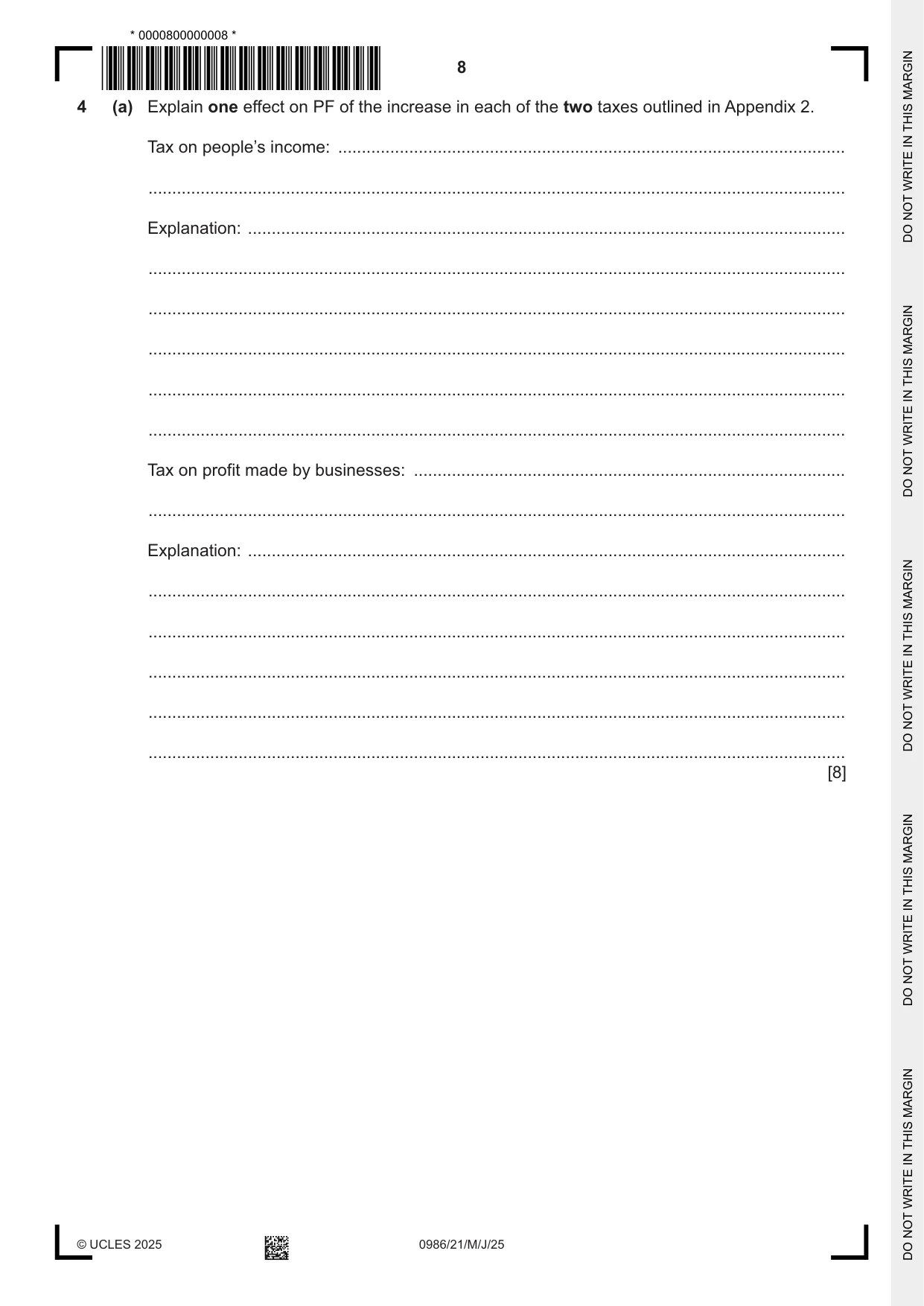
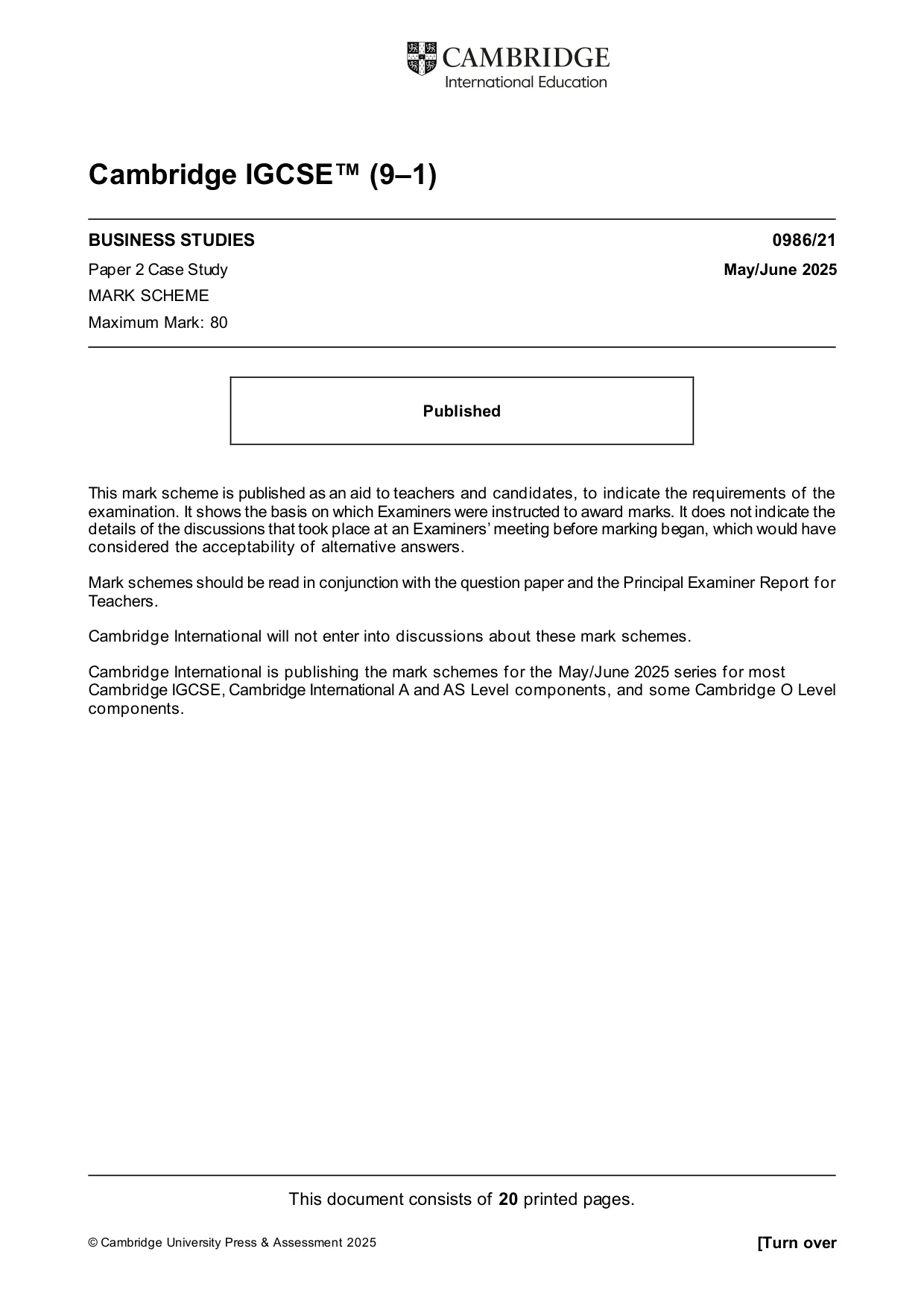
4 (a) Explain one effect on PF of the increase in each of the two taxes outlined in Appendix 2. Tax on people’s income: ........................................................................................................... ................................................................................................................................................... Explanation: .............................................................................................................................. ................................................................................................................................................... ................................................................................................................................................... ................................................................................................................................................... ................................................................................................................................................... ................................................................................................................................................... Tax on profit made by businesses: ........................................................................................... ................................................................................................................................................... Explanation: .............................................................................................................................. ................................................................................................................................................... ................................................................................................................................................... ................................................................................................................................................... ................................................................................................................................................... ................................................................................................................................................... [8] (b) Using Appendix 3 and other information, consider PF’s financial position in 2025 and forecast financial position in 2026. Do you think Philip’s sister should invest in PF? Justify your answer using suitable calculations. 2025: ......................................................................................................................................... ................................................................................................................................................... ................................................................................................................................................... ................................................................................................................................................... ................................................................................................................................................... ................................................................................................................................................... ................................................................................................................................................... ................................................................................................................................................... 2026 (forecast): ........................................................................................................................ ................................................................................................................................................... ................................................................................................................................................... ................................................................................................................................................... ................................................................................................................................................... ................................................................................................................................................... ................................................................................................................................................... ................................................................................................................................................... Recommendation: .................................................................................................................... ................................................................................................................................................... ................................................................................................................................................... ................................................................................................................................................... ................................................................................................................................................... ................................................................................................................................................... ................................................................................................................................................... ................................................................................................................................................... [12]
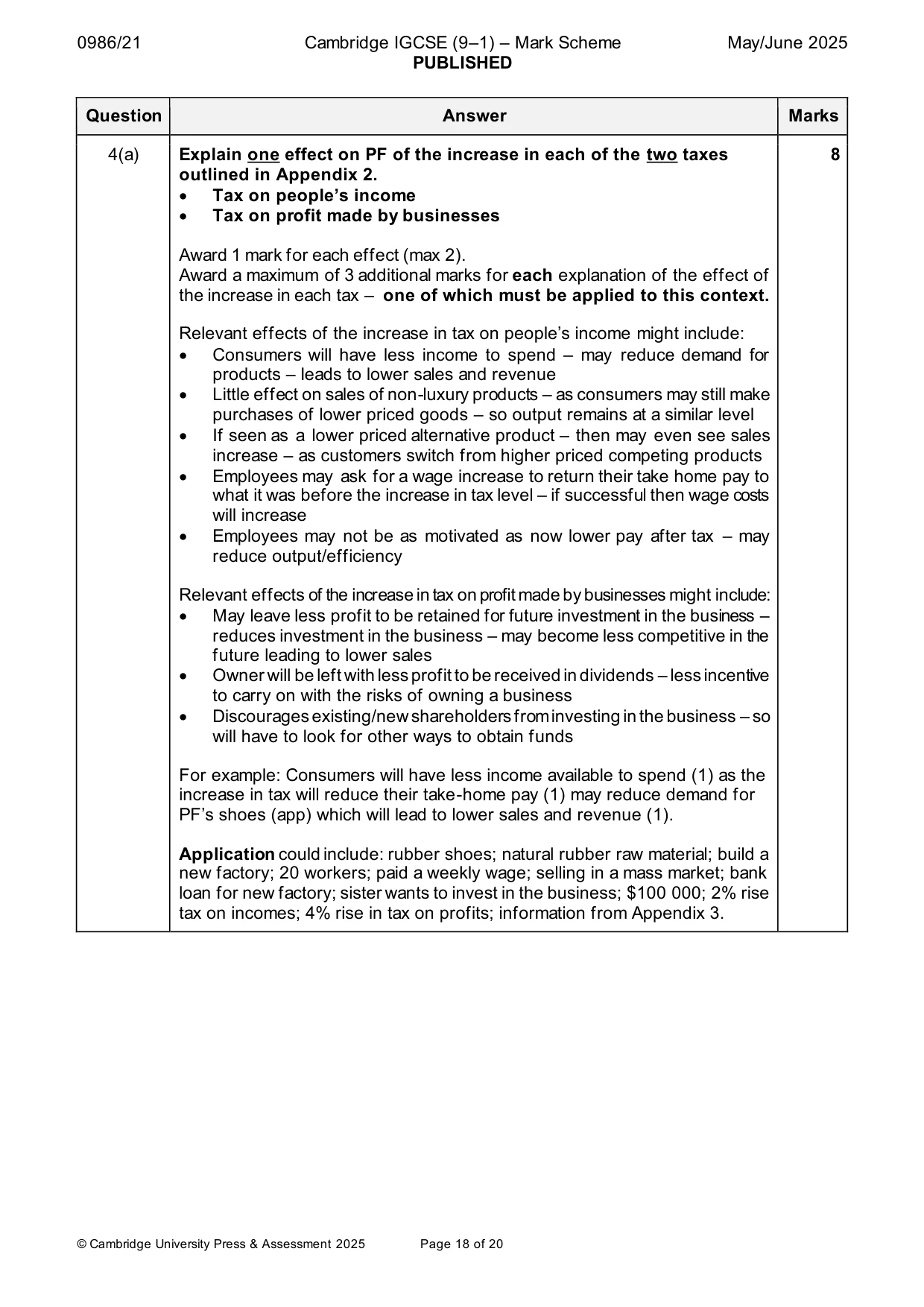
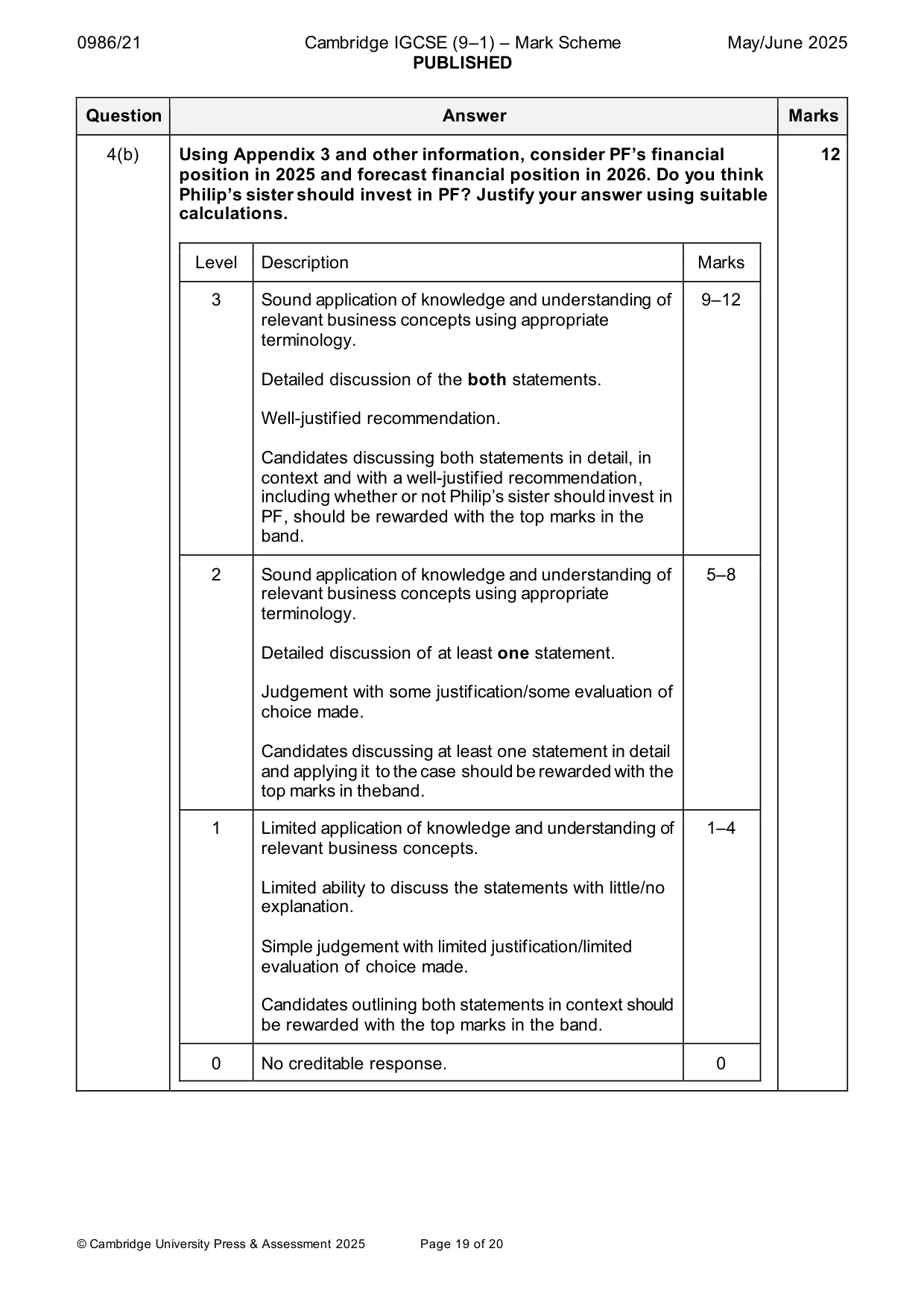
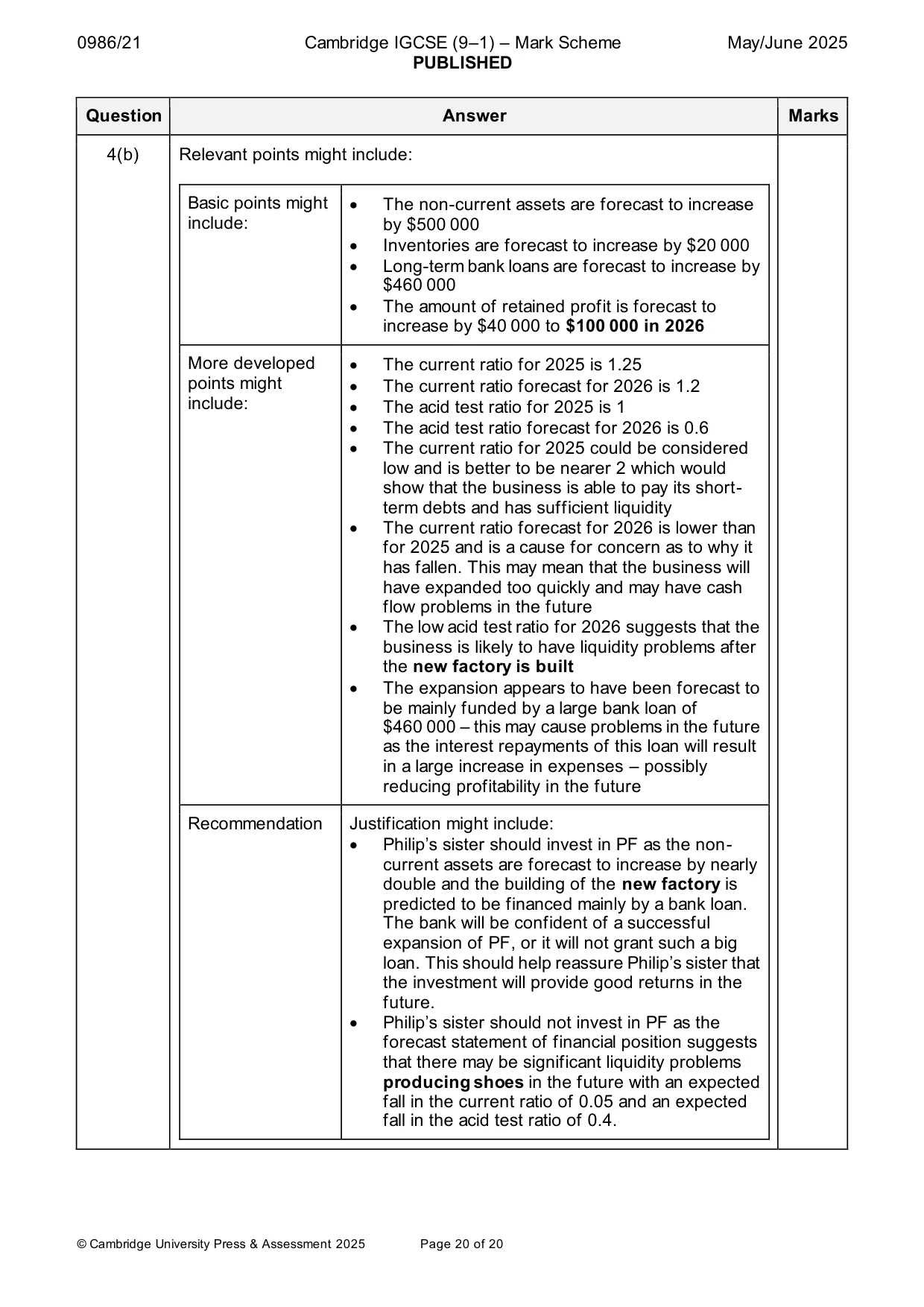
Mark scheme: 4(a) Explain one effect on PF of the increase in each of the two taxes 8 outlined in Appendix 2. • Tax on people’s income • Tax on profit made by businesses Award 1 mark for each effect (max 2). Award a maximum of 3 additional marks for each explanation of the effect of the increase in each tax – one of which must be applied to this context. Relevant effects of the increase in tax on people’s income might include: • Consumers will have less income to spend – may reduce demand for products – leads to lower sales and revenue • Little effect on sales of non-luxury products – as consumers may still make purchases of lower priced goods – so output remains at a similar level • If seen as a lower priced alternative product – then may even see sales increase – as customers switch from higher priced competing products • Employees may ask for a wage increase to return their take home pay to what it was before the increase in tax level – if successful then wage costs will increase • Employees may not be as motivated as now lower pay after tax – may reduce output/efficiency Relevant effects of the increase in tax on profit made by businesses might include: • May leave less profit to be retained for future investment in the business – reduces investment in the business – may become less competitive in the future leading to lower sales • Owner will be left with less profit to be received in dividends – less incentive to carry on with the risks of owning a business • Discourages existing/new shareholders from investing in the business – so will have to look for other ways to obtain funds For example: Consumers will have less income available to spend (1) as the increase in tax will reduce their take-home pay (1) may reduce demand for PF’s shoes (app) which will lead to lower sales and revenue (1). Application could include: rubber shoes; natural rubber raw material; build a new factory; 20 workers; paid a weekly wage; selling in a mass market; bank loan for new factory; sister wants to invest in the business; $100 000; 2% rise tax on incomes; 4% rise in tax on profits; information from Appendix 3. 4(b) Using Appendix 3 and other information, consider PF’s financial 12 position in 2025 and forecast financial position in 2026. Do you think Philip’s sister should invest in PF? Justify your answer using suitable calculations. Level Description Marks 3 Sound application of knowledge and understanding of 9–12 relevant business concepts using appropriate terminology. Detailed discussion of the both statements. Well-justified recommendation. Candidates discussing both statements in detail, in context and with a well-justified recommendation, including whether or not Philip’s sister should invest in PF, should be rewarded with the top marks in the band. 2 Sound application of knowledge and understanding of 5–8 relevant business concepts using appropriate terminology. Detailed discussion of at least one statement. Judgement with some justification/some evaluation of choice made. Candidates discussing at least one statement in detail and applying it to the case should be rewarded with the top marks in the band. 1 Limited application of knowledge and understanding of 1–4 relevant business concepts. Limited ability to discuss the statements with little/no explanation. Simple judgement with limited justification/limited evaluation of choice made. Candidates outlining both statements in context should be rewarded with the top marks in the band. 0 No creditable response. 0 4(b) Relevant points might include: Basic points might • The non-current assets are forecast to increase include: by $500 000 • Inventories are forecast to increase by $20 000 • Long-term bank loans are forecast to increase by $460 000 • The amount of retained profit is forecast to increase by $40 000 to $100 000 in 2026 More developed • The current ratio for 2025 is 1.25 points might • The current ratio forecast for 2026 is 1.2 include: • The acid test ratio for 2025 is 1 • The acid test ratio forecast for 2026 is 0.6 • The current ratio for 2025 could be considered low and is better to be nearer 2 which would show that the business is able to pay its short- term debts and has sufficient liquidity • The current ratio forecast for 2026 is lower than for 2025 and is a cause for concern as to why it has fallen. This may mean that the business will have expanded too quickly and may have cash flow problems in the future • The low acid test ratio for 2026 suggests that the business is likely to have liquidity problems after the new factory is built • The expansion appears to have been forecast to be mainly funded by a large bank loan of $460 000 – this may cause problems in the future as the interest repayments of this loan will result in a large increase in expenses – possibly reducing profitability in the future Recommendation Justification might include: • Philip’s sister should invest in PF as the non- current assets are forecast to increase by nearly double and the building of the new factory is predicted to be financed mainly by a bank loan. The bank will be confident of a successful expansion of PF, or it will not grant such a big loan. This should help reassure Philip’s sister that the investment will provide good returns in the future. • Philip’s sister should not invest in PF as the forecast statement of financial position suggests that there may be significant liquidity problems producing shoes in the future with an expected fall in the current ratio of 0.05 and an expected fall in the acid test ratio of 0.4.
What was in this paper
The subtopics covered by these 4 questions, and how many questions each got. Open one in a new tab to see every Cambridge question on it.
What you needed in this session
Cambridge’s own grade thresholds for 2025 May/June, Paper 2 · Variant 1. A higher threshold means an easier paper — the bar moves with how the cohort did.