Cambridge IGCSE Business Studies 0450 — 2021 May/June Paper 2 · Variant 1
0450/21/M/J/21 · 80 marks · ≈90 min
The question paper and its mark scheme, free to read here and free to download. This is Cambridge’s own paper, exactly as it was sat.
Question paper12 pages


Mark scheme17 pages
Answers below. Sit the paper first if you are practising.
Paper as text
Question paper, page 1
Cambridge IGCSE™ 0450/21 May/June 2021 1 hour 30 minutes BUSINESS STUDIES Paper 2 Case Study You must answer on the question paper. You will need: Insert (enclosed) INSTRUCTIONS • Answer all questions. • Use a black or dark blue pen. You may use an HB pencil for any diagrams or graphs. • Write your name, centre number and candidate number in the boxes at the top of the page. • Write your answer to each question in the space provided. • Do not use an erasable pen or correction fluid. • Do not write on any bar codes. • You may use a calculator. INFORMATION • The total mark for this paper is 80. • The number of marks for each question or part question is shown in brackets [ ]. • The insert contains the case study. This document has 12 pages. Any blank pages are indicated. [Turn over 06_0450_21_2021_1.17 © UCLES 2021 *2317502265*
Question paper, page 2
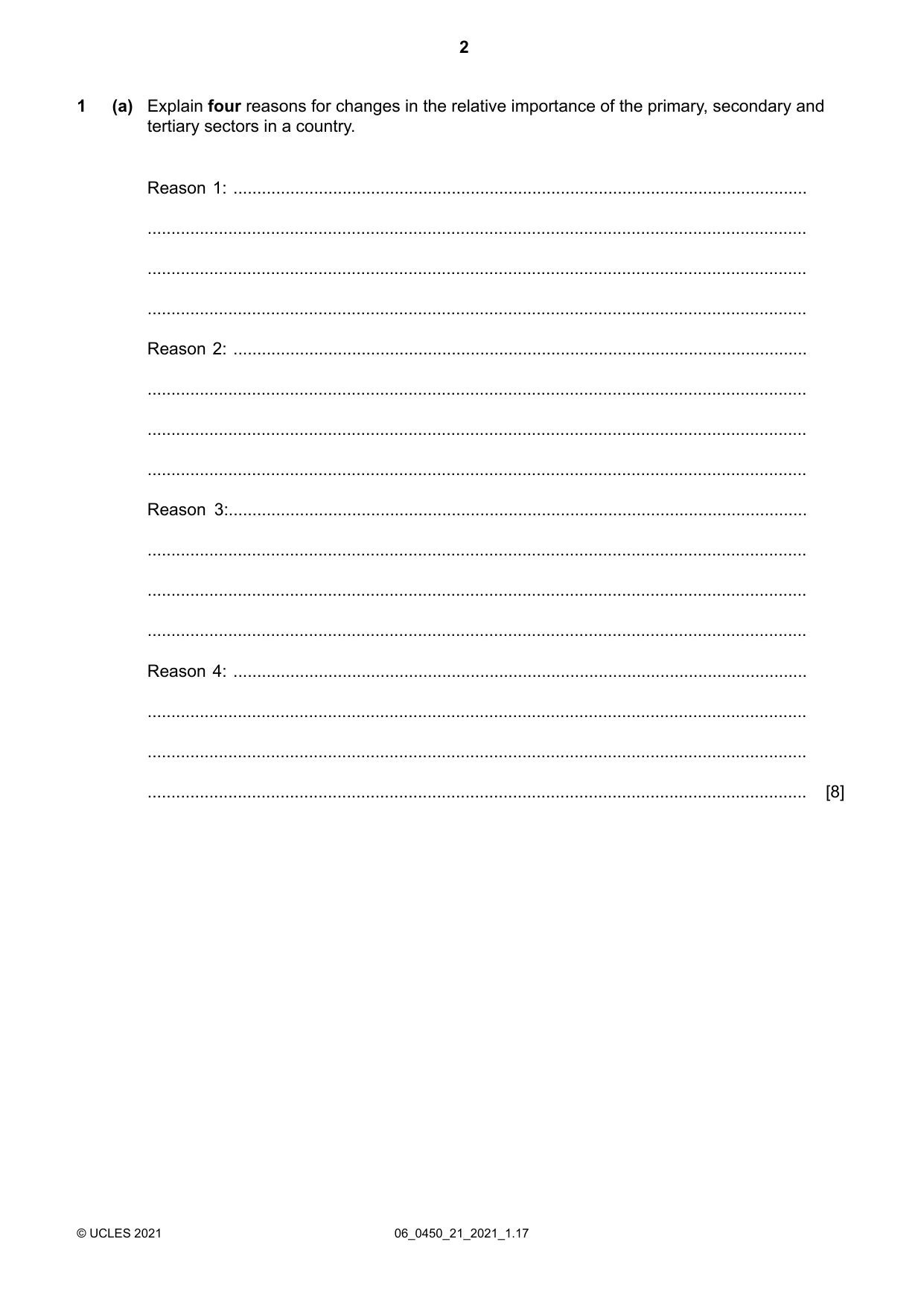
Explain four reasons for changes in the relative importance of the primary, secondary and tertiary sectors in a country. (a) 1 Reason 1: … … … … Reason 2: … … … … Reason 3:… … … … Reason 4: … … … … [8] 06_0450_21_2021_1.17 © UCLES 2021 2
Question paper, page 3
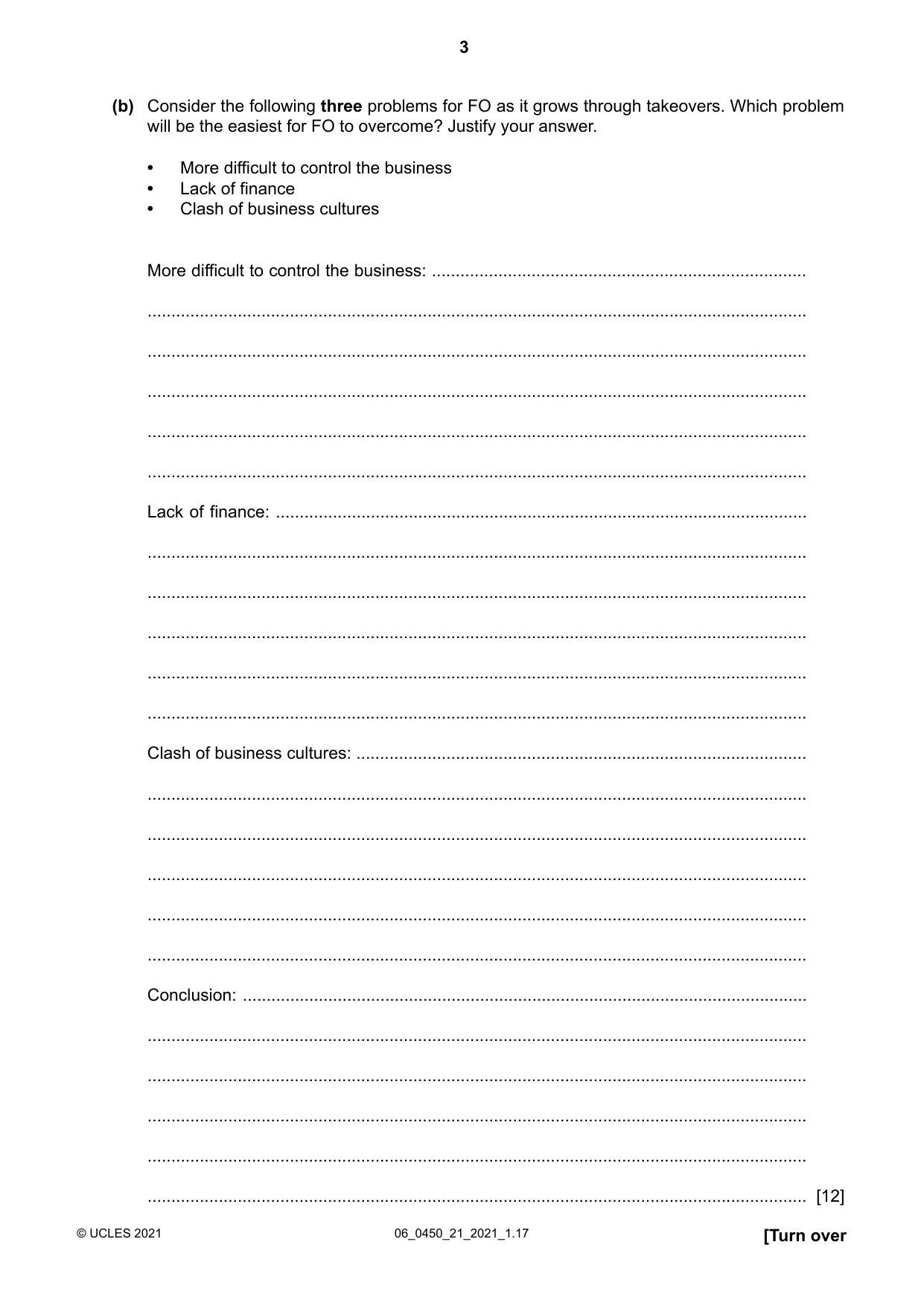
Consider the following three problems for FO as it grows through takeovers. Which problem will be the easiest for FO to overcome? Justify your answer. (b) • More difficult to control the business • Lack of finance • Clash of business cultures More difficult to control the business: … … … … … … Lack of finance: … … … … … … Clash of business cultures: … … … … … … Conclusion: … … … … … … [12] [Turn over 06_0450_21_2021_1.17 © UCLES 2021 3
Question paper, page 4
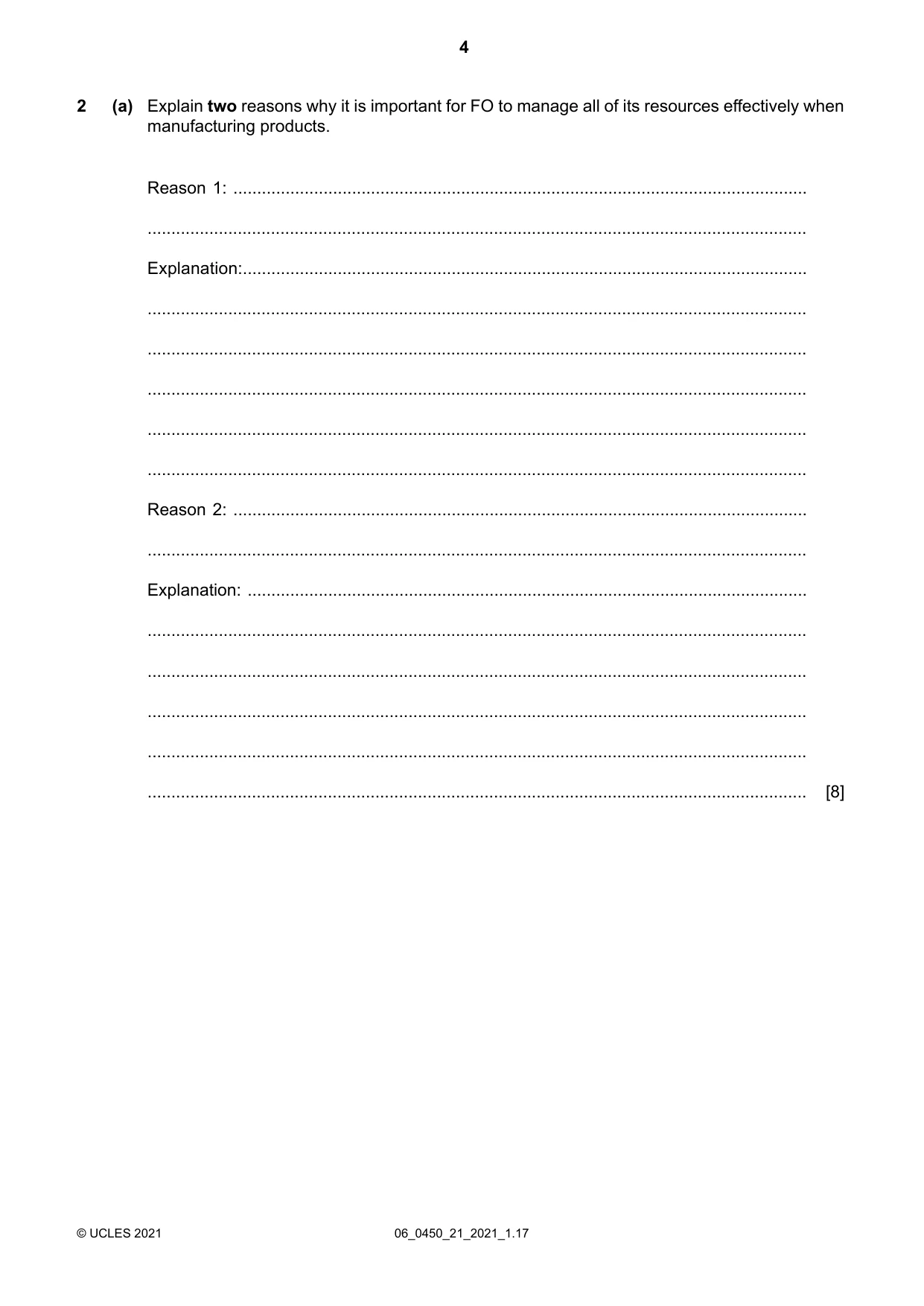
Explain two reasons why it is important for FO to manage all of its resources effectively when manufacturing products. (a) 2 Reason 1: … … Explanation:… … … … … … Reason 2: … … Explanation: … … … … … … [8] 06_0450_21_2021_1.17 © UCLES 2021 4
Question paper, page 5
Consider the benefits and limitations of the following three methods of communication FO could use. Which method of communication would be most suitable when contacting suppliers about a late delivery? Justify your answer. (b) • Email • Mobile (cell) phone • Letter Email: … … … … … … Mobile (cell) phone: … … … … … … Letter: … … … … … … Recommendation: … … … … … … [12] [Turn over 06_0450_21_2021_1.17 © UCLES 2021 5
Question paper, page 6
Explain how one internal source and one external source of finance could be used by FO as it expands. (a) 3 Internal source of finance: … … Explanation: … … … … … … External source of finance: … … Explanation: … … … … … … [8] 06_0450_21_2021_1.17 © UCLES 2021 6
Question paper, page 7
Consider the advantages and disadvantages to FO of using a wholesaler, retailer or selling direct to the customer when distributing its products. Which channel of distribution should FO use? Justify your answer. (b) Wholesaler: … … … … … … Retailer: … … … … … … Selling direct to customer: … … … … … … Recommendation: … … … … … … [12] [Turn over 06_0450_21_2021_1.17 © UCLES 2021 7
Question paper, page 8
Using the information in Appendix 2: (a) 4 Calculate the break-even level of output per month (i) … … … [2] Calculate the margin of safety per month for tables: (ii) … … … [2] Identify four limitations of using break-even analysis. (iii) Limitation 1:… … Limitation 2:… … Limitation 3:… … Limitation 4:… … [4] 06_0450_21_2021_1.17 © UCLES 2021 8
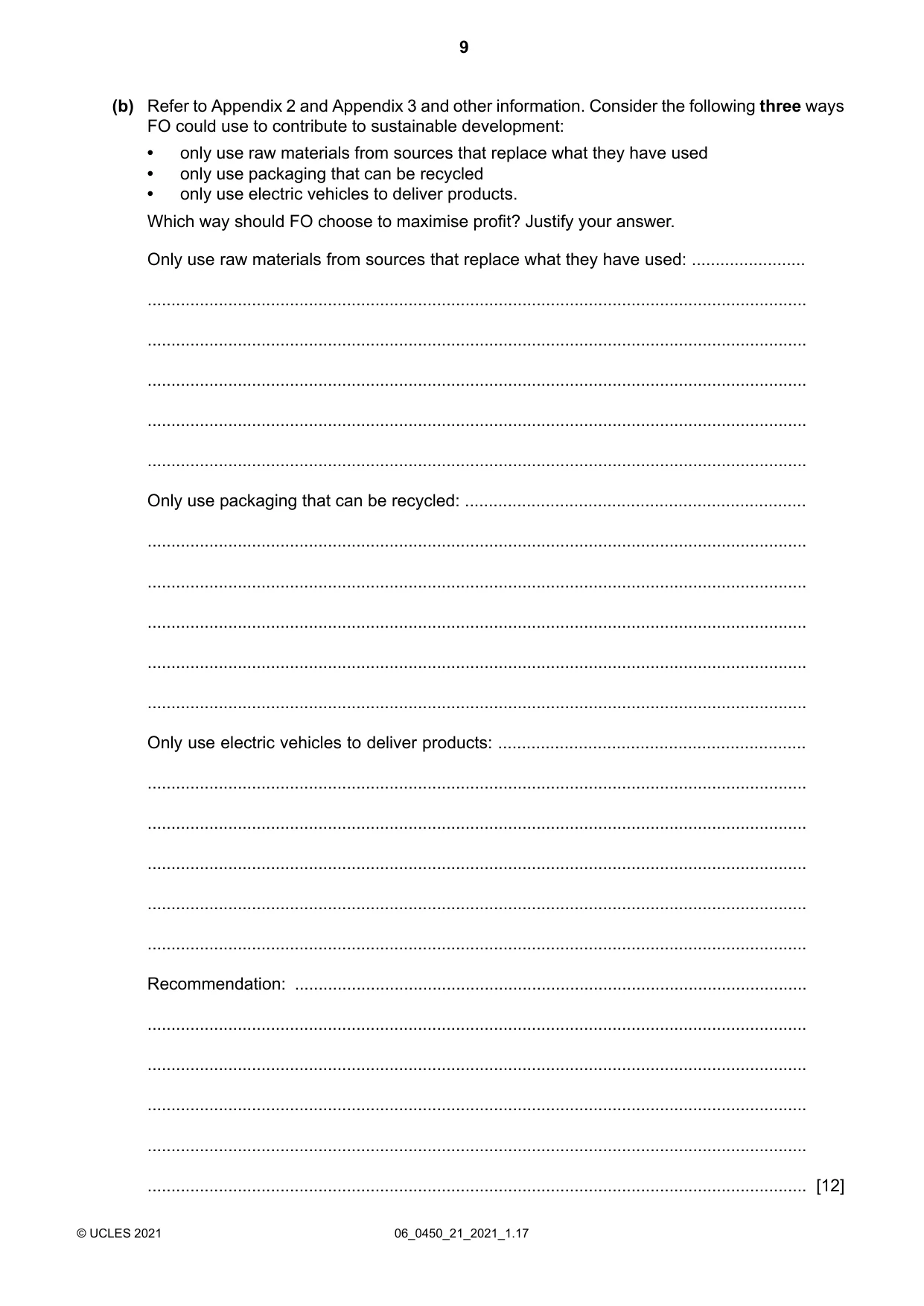
Question paper, page 9
Refer to Appendix 2 and Appendix 3 and other information. Consider the following three ways FO could use to contribute to sustainable development: (b) • only use raw materials from sources that replace what they have used • only use packaging that can be recycled • only use electric vehicles to deliver products. Which way should FO choose to maximise profit? Justify your answer. Only use raw materials from sources that replace what they have used: … … … … … … Only use packaging that can be recycled: … … … … … … Only use electric vehicles to deliver products: … … … … … … Recommendation: … … … … … … [12] 06_0450_21_2021_1.17 © UCLES 2021 9
Question paper, page 10
BLANK PAGE 06_0450_21_2021_1.17 © UCLES 2021 10
Question paper, page 11
BLANK PAGE 06_0450_21_2021_1.17 © UCLES 2021 11
Question paper, page 12
BLANK PAGE Permission to reproduce items where third-party owned material protected by copyright is included has been sought and cleared where possible. Every reasonable effort has been made by the publisher (UCLES) to trace copyright holders, but if any items requiring clearance have unwittingly been included, the publisher will be pleased to make amends at the earliest possible opportunity. To avoid the issue of disclosure of answer-related information to candidates, all copyright acknowledgements are reproduced online in the Cambridge Assessment International Education Copyright Acknowledgements Booklet. This is produced for each series of examinations and is freely available to download at www.cambridgeinternational.org after the live examination series. Cambridge Assessment International Education is part of the Cambridge Assessment Group. Cambridge Assessment is the brand name of the University of Cambridge Local Examinations Syndicate (UCLES), which itself is a department of the University of Cambridge. 06_0450_21_2021_1.17 © UCLES 2021 12
Mark scheme, page 1
This document consists of 17 printed pages. © UCLES 2021 [Turn over Cambridge IGCSE™ BUSINESS STUDIES 0450/21 Paper 2 Case Study May/June 2021 MARK SCHEME Maximum Mark: 80 Published This mark scheme is published as an aid to teachers and candidates, to indicate the requirements of the examination. It shows the basis on which Examiners were instructed to award marks. It does not indicate the details of the discussions that took place at an Examiners’ meeting before marking began, which would have considered the acceptability of alternative answers. Mark schemes should be read in conjunction with the question paper and the Principal Examiner Report for Teachers. Cambridge International will not enter into discussions about these mark schemes. Cambridge International is publishing the mark schemes for the May/June 2021 series for most Cambridge IGCSE™, Cambridge International A and AS Level components and some Cambridge O Level components.
Mark scheme, page 2
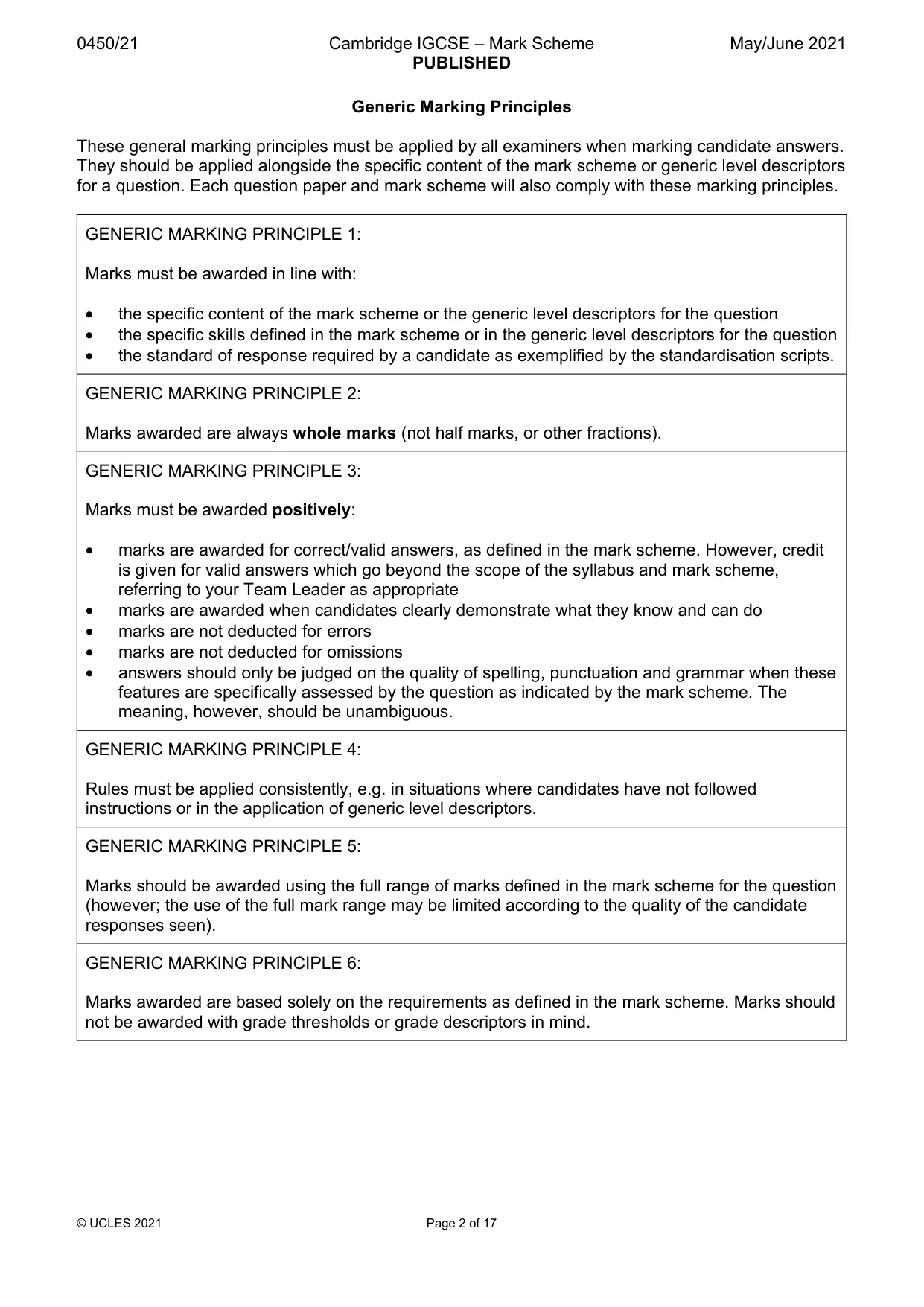
0450/21 Cambridge IGCSE – Mark Scheme PUBLISHED May/June 2021 © UCLES 2021 Page 2 of 17 Generic Marking Principles These general marking principles must be applied by all examiners when marking candidate answers. They should be applied alongside the specific content of the mark scheme or generic level descriptors for a question. Each question paper and mark scheme will also comply with these marking principles. GENERIC MARKING PRINCIPLE 1: Marks must be awarded in line with: • the specific content of the mark scheme or the generic level descriptors for the question • the specific skills defined in the mark scheme or in the generic level descriptors for the question • the standard of response required by a candidate as exemplified by the standardisation scripts. GENERIC MARKING PRINCIPLE 2: Marks awarded are always whole marks (not half marks, or other fractions). GENERIC MARKING PRINCIPLE 3: Marks must be awarded positively: • marks are awarded for correct/valid answers, as defined in the mark scheme. However, credit is given for valid answers which go beyond the scope of the syllabus and mark scheme, referring to your Team Leader as appropriate • marks are awarded when candidates clearly demonstrate what they know and can do • marks are not deducted for errors • marks are not deducted for omissions • answers should only be judged on the quality of spelling, punctuation and grammar when these features are specifically assessed by the question as indicated by the mark scheme. The meaning, however, should be unambiguous. GENERIC MARKING PRINCIPLE 4: Rules must be applied consistently, e.g. in situations where candidates have not followed instructions or in the application of generic level descriptors. GENERIC MARKING PRINCIPLE 5: Marks should be awarded using the full range of marks defined in the mark scheme for the question (however; the use of the full mark range may be limited according to the quality of the candidate responses seen). GENERIC MARKING PRINCIPLE 6: Marks awarded are based solely on the requirements as defined in the mark scheme. Marks should not be awarded with grade thresholds or grade descriptors in mind.
Mark scheme, page 3
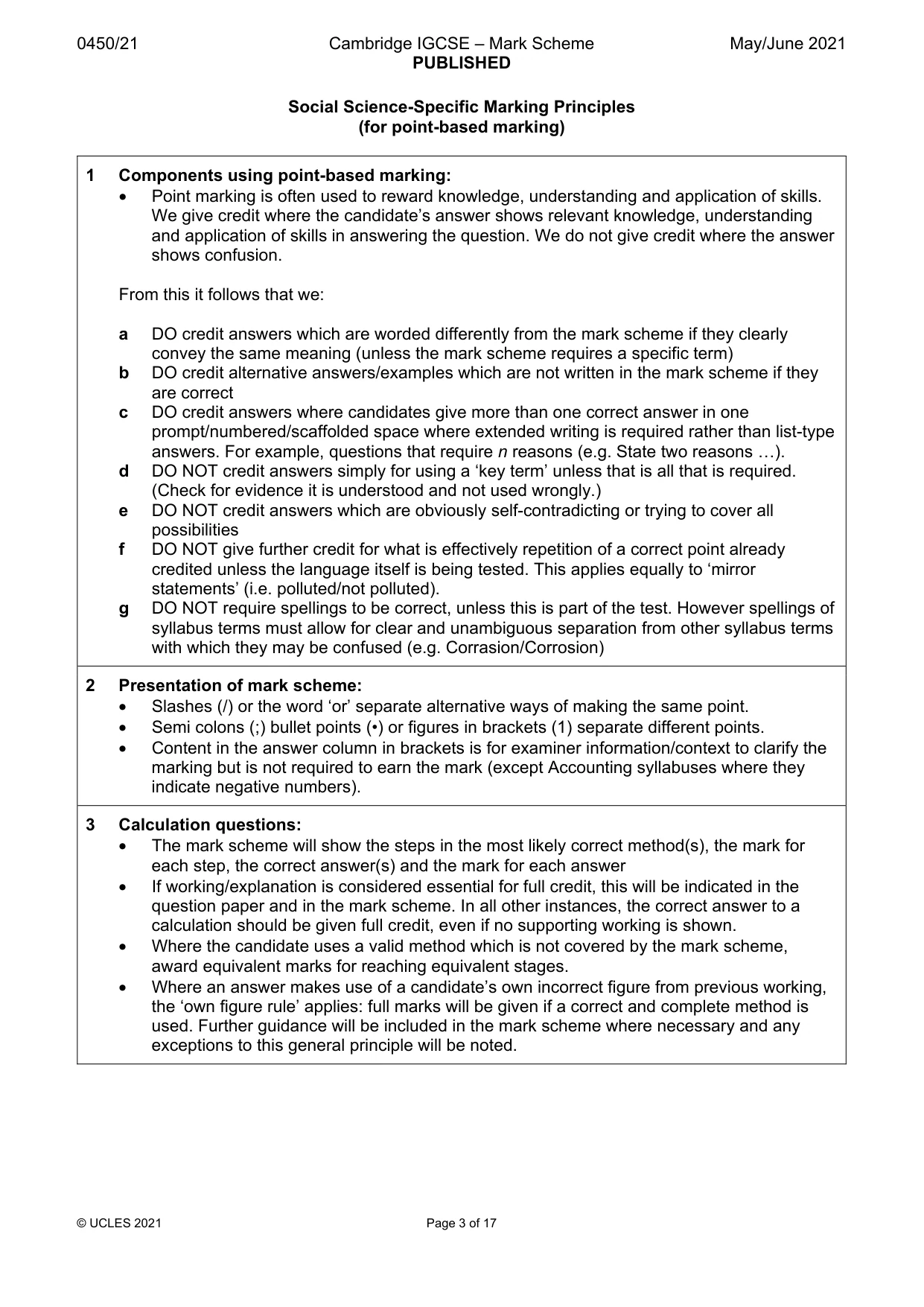
0450/21 Cambridge IGCSE – Mark Scheme PUBLISHED May/June 2021 © UCLES 2021 Page 3 of 17 Social Science-Specific Marking Principles (for point-based marking) 1 Components using point-based marking: • Point marking is often used to reward knowledge, understanding and application of skills. We give credit where the candidate’s answer shows relevant knowledge, understanding and application of skills in answering the question. We do not give credit where the answer shows confusion. From this it follows that we: a DO credit answers which are worded differently from the mark scheme if they clearly convey the same meaning (unless the mark scheme requires a specific term) b DO credit alternative answers/examples which are not written in the mark scheme if they are correct c DO credit answers where candidates give more than one correct answer in one prompt/numbered/scaffolded space where extended writing is required rather than list-type answers. For example, questions that require n reasons (e.g. State two reasons …). d DO NOT credit answers simply for using a ‘key term’ unless that is all that is required. (Check for evidence it is understood and not used wrongly.) e DO NOT credit answers which are obviously self-contradicting or trying to cover all possibilities f DO NOT give further credit for what is effectively repetition of a correct point already credited unless the language itself is being tested. This applies equally to ‘mirror statements’ (i.e. polluted/not polluted). g DO NOT require spellings to be correct, unless this is part of the test. However spellings of syllabus terms must allow for clear and unambiguous separation from other syllabus terms with which they may be confused (e.g. Corrasion/Corrosion) 2 Presentation of mark scheme: • Slashes (/) or the word ‘or’ separate alternative ways of making the same point. • Semi colons (;) bullet points (•) or figures in brackets (1) separate different points. • Content in the answer column in brackets is for examiner information/context to clarify the marking but is not required to earn the mark (except Accounting syllabuses where they indicate negative numbers). 3 Calculation questions: • The mark scheme will show the steps in the most likely correct method(s), the mark for each step, the correct answer(s) and the mark for each answer • If working/explanation is considered essential for full credit, this will be indicated in the question paper and in the mark scheme. In all other instances, the correct answer to a calculation should be given full credit, even if no supporting working is shown. • Where the candidate uses a valid method which is not covered by the mark scheme, award equivalent marks for reaching equivalent stages. • Where an answer makes use of a candidate’s own incorrect figure from previous working, the ‘own figure rule’ applies: full marks will be given if a correct and complete method is used. Further guidance will be included in the mark scheme where necessary and any exceptions to this general principle will be noted.
Mark scheme, page 4
0450/21 Cambridge IGCSE – Mark Scheme PUBLISHED May/June 2021 © UCLES 2021 Page 4 of 17 4 Annotation: • For point marking, ticks can be used to indicate correct answers and crosses can be used to indicate wrong answers. There is no direct relationship between ticks and marks. Ticks have no defined meaning for levels of response marking. • For levels of response marking, the level awarded should be annotated on the script. • Other annotations will be used by examiners as agreed during standardisation, and the meaning will be understood by all examiners who marked that paper.
Mark scheme, page 5
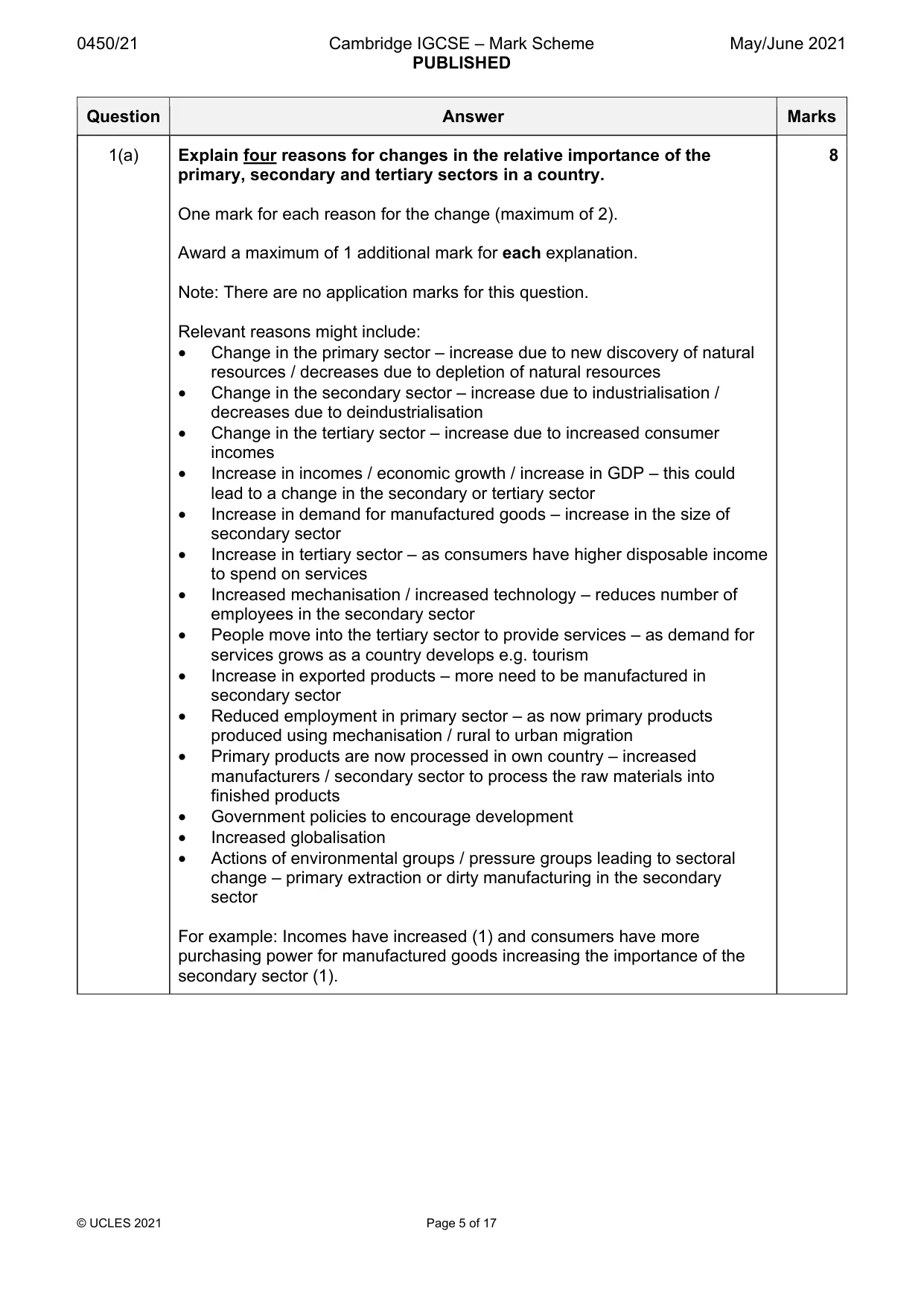
0450/21 Cambridge IGCSE – Mark Scheme PUBLISHED May/June 2021 © UCLES 2021 Page 5 of 17 Question Answer Marks 1(a) Explain four reasons for changes in the relative importance of the primary, secondary and tertiary sectors in a country. One mark for each reason for the change (maximum of 2). Award a maximum of 1 additional mark for each explanation. Note: There are no application marks for this question. Relevant reasons might include: • Change in the primary sector – increase due to new discovery of natural resources / decreases due to depletion of natural resources • Change in the secondary sector – increase due to industrialisation / decreases due to deindustrialisation • Change in the tertiary sector – increase due to increased consumer incomes • Increase in incomes / economic growth / increase in GDP – this could lead to a change in the secondary or tertiary sector • Increase in demand for manufactured goods – increase in the size of secondary sector • Increase in tertiary sector – as consumers have higher disposable income to spend on services • Increased mechanisation / increased technology – reduces number of employees in the secondary sector • People move into the tertiary sector to provide services – as demand for services grows as a country develops e.g. tourism • Increase in exported products – more need to be manufactured in secondary sector • Reduced employment in primary sector – as now primary products produced using mechanisation / rural to urban migration • Primary products are now processed in own country – increased manufacturers / secondary sector to process the raw materials into finished products • Government policies to encourage development • Increased globalisation • Actions of environmental groups / pressure groups leading to sectoral change – primary extraction or dirty manufacturing in the secondary sector For example: Incomes have increased (1) and consumers have more purchasing power for manufactured goods increasing the importance of the secondary sector (1). 8
Mark scheme, page 6
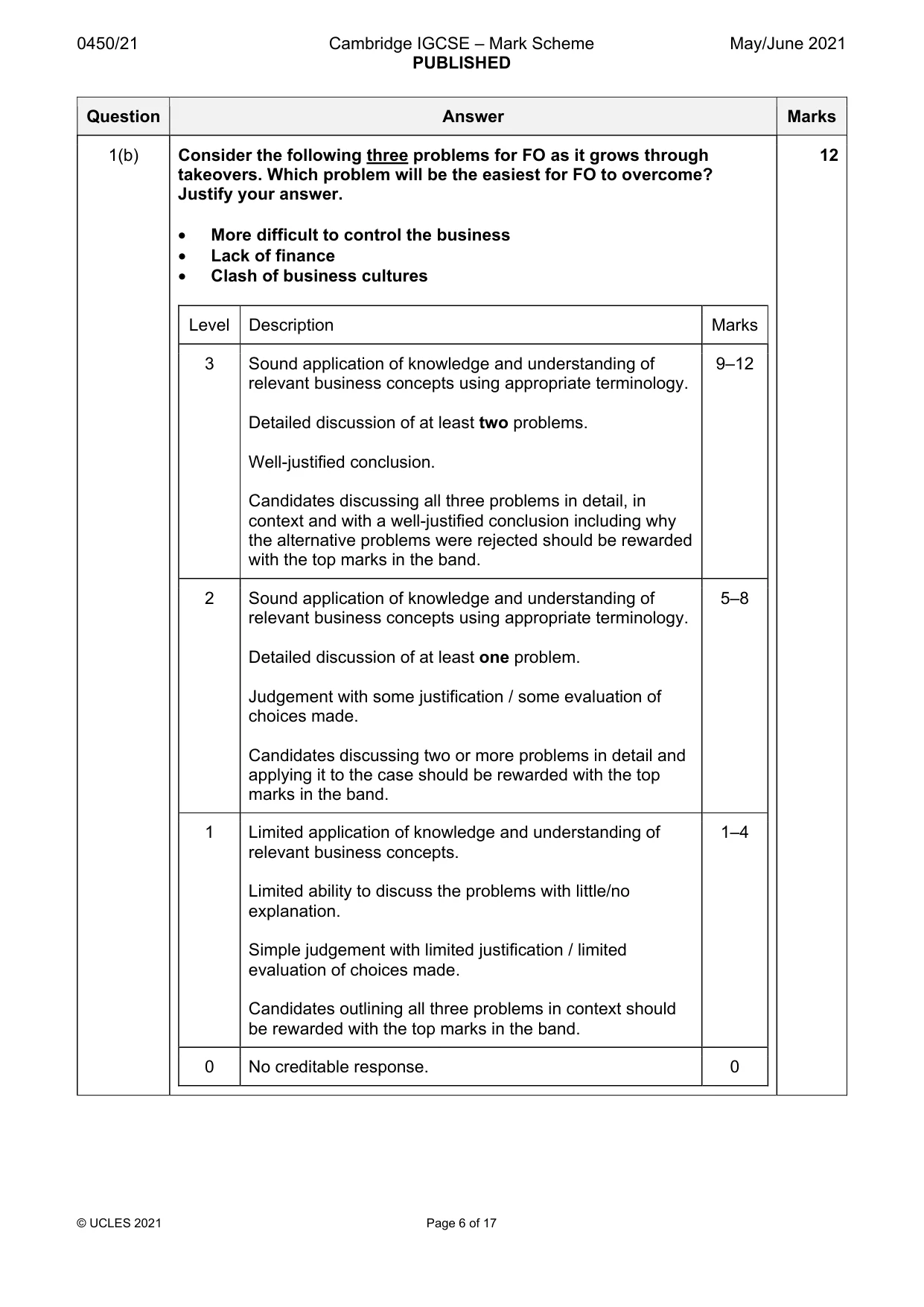
0450/21 Cambridge IGCSE – Mark Scheme PUBLISHED May/June 2021 © UCLES 2021 Page 6 of 17 Question Answer Marks 1(b) Consider the following three problems for FO as it grows through takeovers. Which problem will be the easiest for FO to overcome? Justify your answer. • More difficult to control the business • Lack of finance • Clash of business cultures Level Description Marks 3 Sound application of knowledge and understanding of relevant business concepts using appropriate terminology. Detailed discussion of at least two problems. Well-justified conclusion. Candidates discussing all three problems in detail, in context and with a well-justified conclusion including why the alternative problems were rejected should be rewarded with the top marks in the band. 9–12 2 Sound application of knowledge and understanding of relevant business concepts using appropriate terminology. Detailed discussion of at least one problem. Judgement with some justification / some evaluation of choices made. Candidates discussing two or more problems in detail and applying it to the case should be rewarded with the top marks in the band. 5–8 1 Limited application of knowledge and understanding of relevant business concepts. Limited ability to discuss the problems with little/no explanation. Simple judgement with limited justification / limited evaluation of choices made. Candidates outlining all three problems in context should be rewarded with the top marks in the band. 1–4 0 No creditable response. 0 12
Mark scheme, page 7
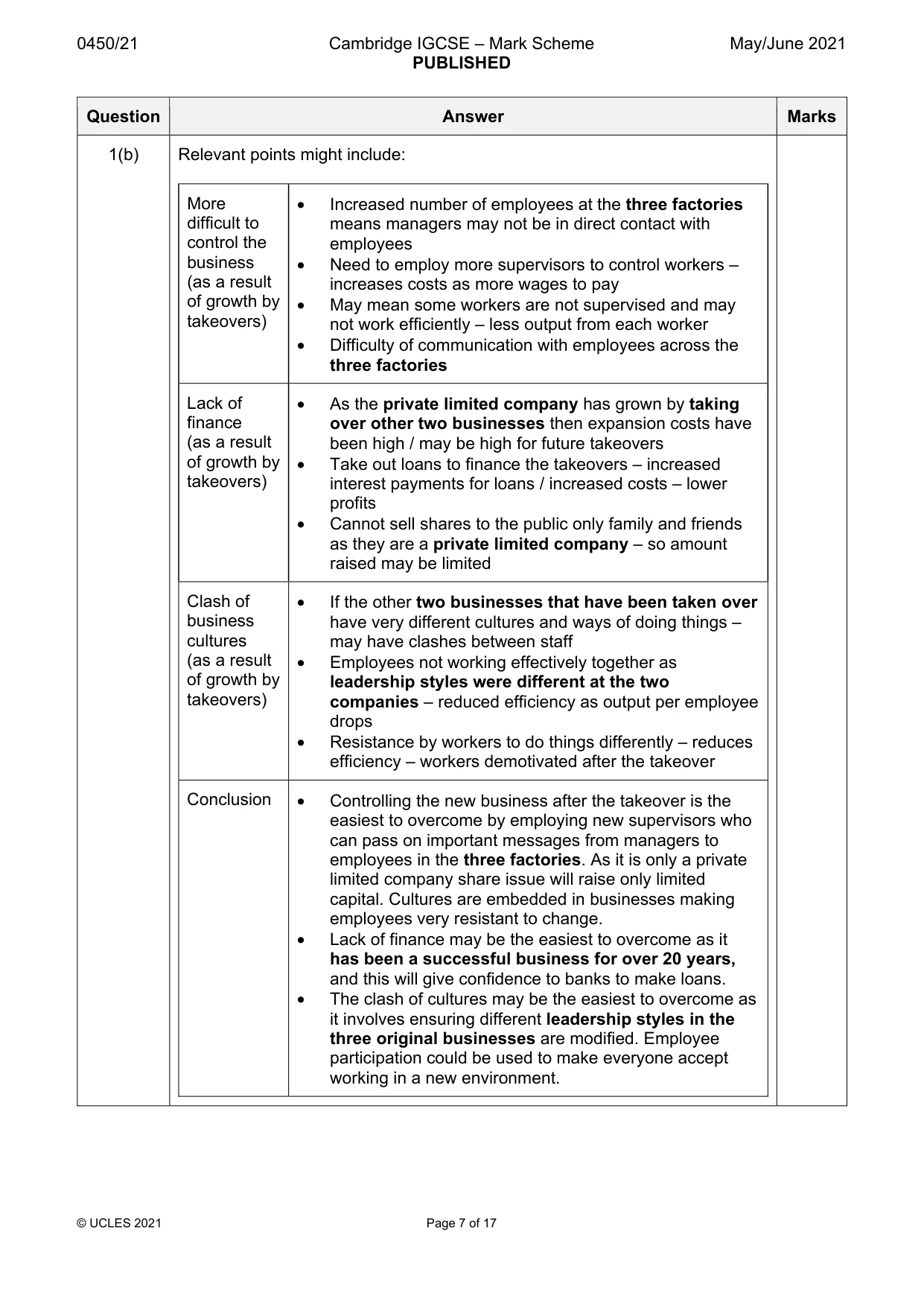
0450/21 Cambridge IGCSE – Mark Scheme PUBLISHED May/June 2021 © UCLES 2021 Page 7 of 17 Question Answer Marks 1(b) Relevant points might include: More difficult to control the business (as a result of growth by takeovers) • Increased number of employees at the three factories means managers may not be in direct contact with employees • Need to employ more supervisors to control workers – increases costs as more wages to pay • May mean some workers are not supervised and may not work efficiently – less output from each worker • Difficulty of communication with employees across the three factories Lack of finance (as a result of growth by takeovers) • As the private limited company has grown by taking over other two businesses then expansion costs have been high / may be high for future takeovers • Take out loans to finance the takeovers – increased interest payments for loans / increased costs – lower profits • Cannot sell shares to the public only family and friends as they are a private limited company – so amount raised may be limited Clash of business cultures (as a result of growth by takeovers) • If the other two businesses that have been taken over have very different cultures and ways of doing things – may have clashes between staff • Employees not working effectively together as leadership styles were different at the two companies – reduced efficiency as output per employee drops • Resistance by workers to do things differently – reduces efficiency – workers demotivated after the takeover Conclusion • Controlling the new business after the takeover is the easiest to overcome by employing new supervisors who can pass on important messages from managers to employees in the three factories. As it is only a private limited company share issue will raise only limited capital. Cultures are embedded in businesses making employees very resistant to change. • Lack of finance may be the easiest to overcome as it has been a successful business for over 20 years, and this will give confidence to banks to make loans. • The clash of cultures may be the easiest to overcome as it involves ensuring different leadership styles in the three original businesses are modified. Employee participation could be used to make everyone accept working in a new environment.
Mark scheme, page 8
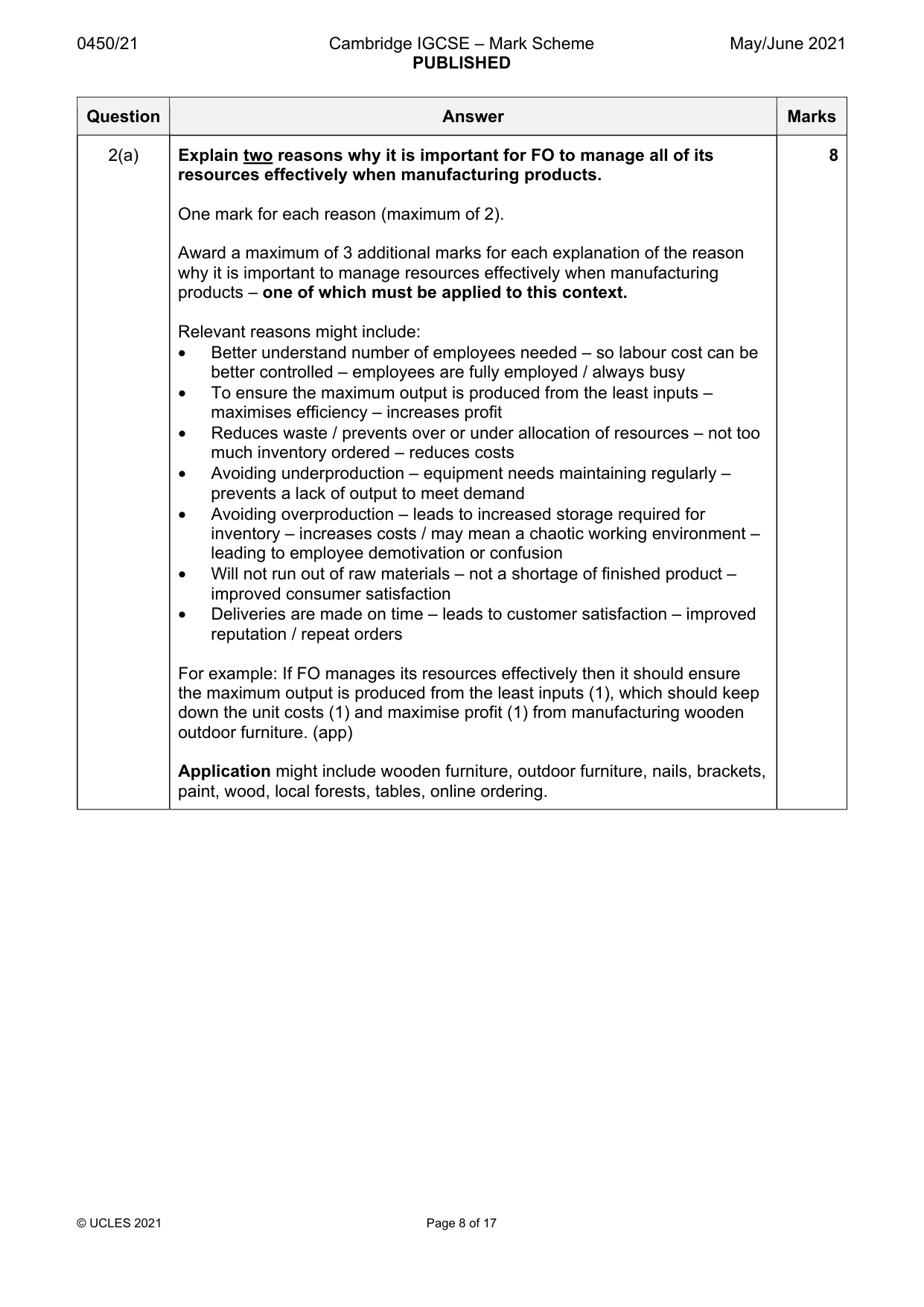
0450/21 Cambridge IGCSE – Mark Scheme PUBLISHED May/June 2021 © UCLES 2021 Page 8 of 17 Question Answer Marks 2(a) Explain two reasons why it is important for FO to manage all of its resources effectively when manufacturing products. One mark for each reason (maximum of 2). Award a maximum of 3 additional marks for each explanation of the reason why it is important to manage resources effectively when manufacturing products – one of which must be applied to this context. Relevant reasons might include: • Better understand number of employees needed – so labour cost can be better controlled – employees are fully employed / always busy • To ensure the maximum output is produced from the least inputs – maximises efficiency – increases profit • Reduces waste / prevents over or under allocation of resources – not too much inventory ordered – reduces costs • Avoiding underproduction – equipment needs maintaining regularly – prevents a lack of output to meet demand • Avoiding overproduction – leads to increased storage required for inventory – increases costs / may mean a chaotic working environment – leading to employee demotivation or confusion • Will not run out of raw materials – not a shortage of finished product – improved consumer satisfaction • Deliveries are made on time – leads to customer satisfaction – improved reputation / repeat orders For example: If FO manages its resources effectively then it should ensure the maximum output is produced from the least inputs (1), which should keep down the unit costs (1) and maximise profit (1) from manufacturing wooden outdoor furniture. (app) Application might include wooden furniture, outdoor furniture, nails, brackets, paint, wood, local forests, tables, online ordering. 8
Mark scheme, page 9
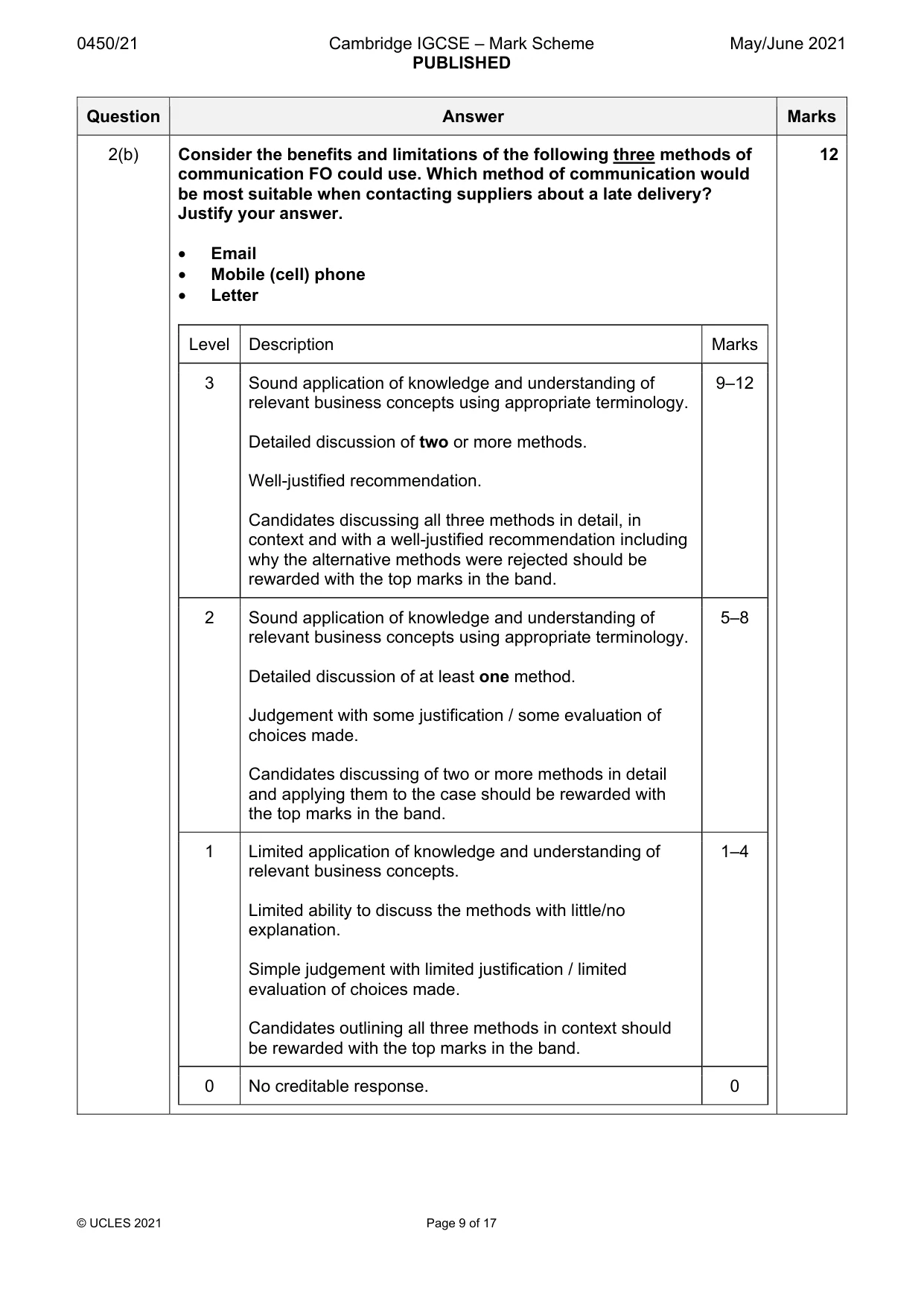
0450/21 Cambridge IGCSE – Mark Scheme PUBLISHED May/June 2021 © UCLES 2021 Page 9 of 17 Question Answer Marks 2(b) Consider the benefits and limitations of the following three methods of communication FO could use. Which method of communication would be most suitable when contacting suppliers about a late delivery? Justify your answer. • Email • Mobile (cell) phone • Letter Level Description Marks 3 Sound application of knowledge and understanding of relevant business concepts using appropriate terminology. Detailed discussion of two or more methods. Well-justified recommendation. Candidates discussing all three methods in detail, in context and with a well-justified recommendation including why the alternative methods were rejected should be rewarded with the top marks in the band. 9–12 2 Sound application of knowledge and understanding of relevant business concepts using appropriate terminology. Detailed discussion of at least one method. Judgement with some justification / some evaluation of choices made. Candidates discussing of two or more methods in detail and applying them to the case should be rewarded with the top marks in the band. 5–8 1 Limited application of knowledge and understanding of relevant business concepts. Limited ability to discuss the methods with little/no explanation. Simple judgement with limited justification / limited evaluation of choices made. Candidates outlining all three methods in context should be rewarded with the top marks in the band. 1–4 0 No creditable response. 0 12
Mark scheme, page 10
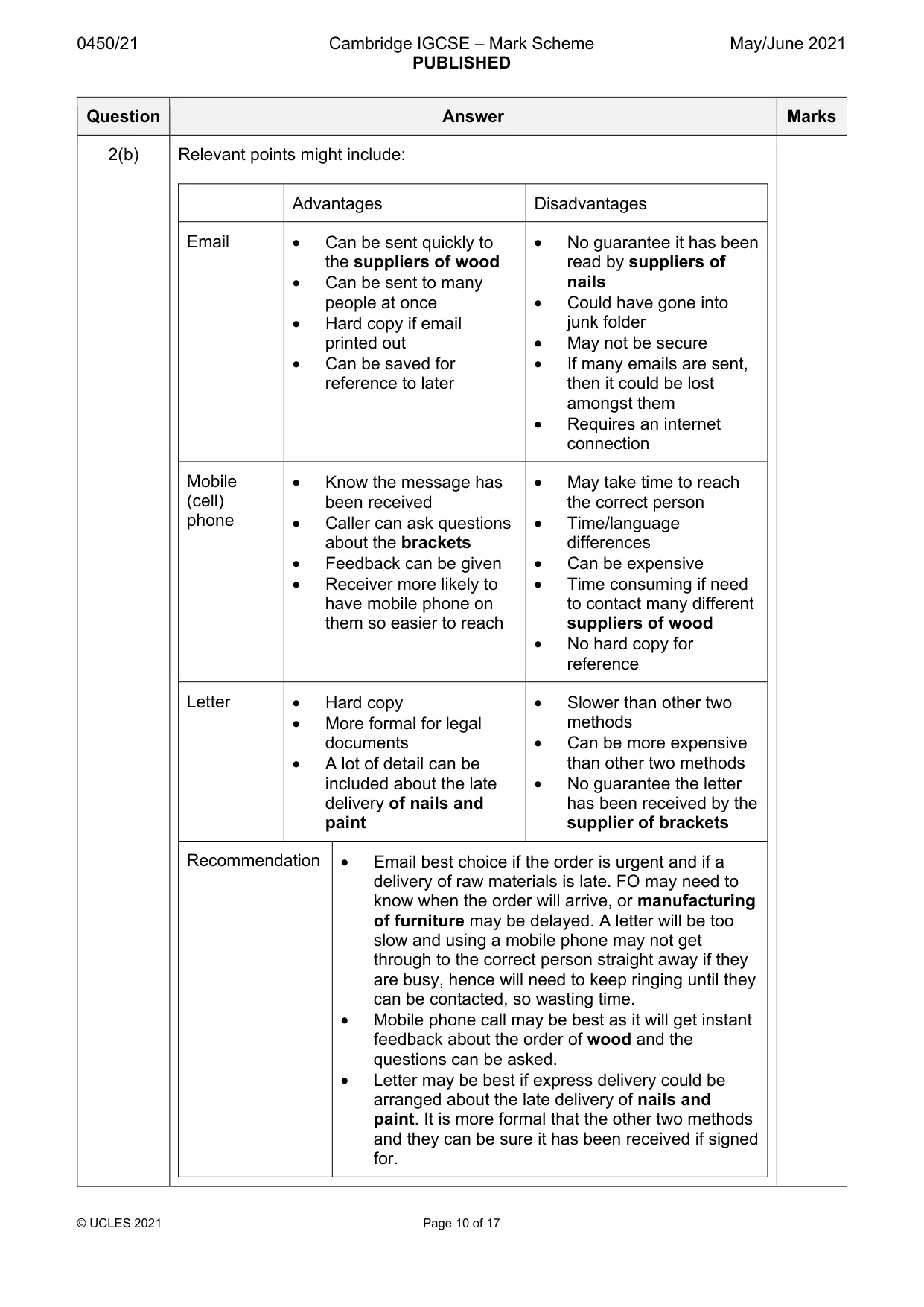
0450/21 Cambridge IGCSE – Mark Scheme PUBLISHED May/June 2021 © UCLES 2021 Page 10 of 17 Question Answer Marks 2(b) Relevant points might include: Advantages Disadvantages Email • Can be sent quickly to the suppliers of wood • Can be sent to many people at once • Hard copy if email printed out • Can be saved for reference to later • No guarantee it has been read by suppliers of nails • Could have gone into junk folder • May not be secure • If many emails are sent, then it could be lost amongst them • Requires an internet connection Mobile (cell) phone • Know the message has been received • Caller can ask questions about the brackets • Feedback can be given • Receiver more likely to have mobile phone on them so easier to reach • May take time to reach the correct person • Time/language differences • Can be expensive • Time consuming if need to contact many different suppliers of wood • No hard copy for reference Letter • Hard copy • More formal for legal documents • A lot of detail can be included about the late delivery of nails and paint • Slower than other two methods • Can be more expensive than other two methods • No guarantee the letter has been received by the supplier of brackets Recommendation • Email best choice if the order is urgent and if a delivery of raw materials is late. FO may need to know when the order will arrive, or manufacturing of furniture may be delayed. A letter will be too slow and using a mobile phone may not get through to the correct person straight away if they are busy, hence will need to keep ringing until they can be contacted, so wasting time. • Mobile phone call may be best as it will get instant feedback about the order of wood and the questions can be asked. • Letter may be best if express delivery could be arranged about the late delivery of nails and paint. It is more formal that the other two methods and they can be sure it has been received if signed for.
Mark scheme, page 11
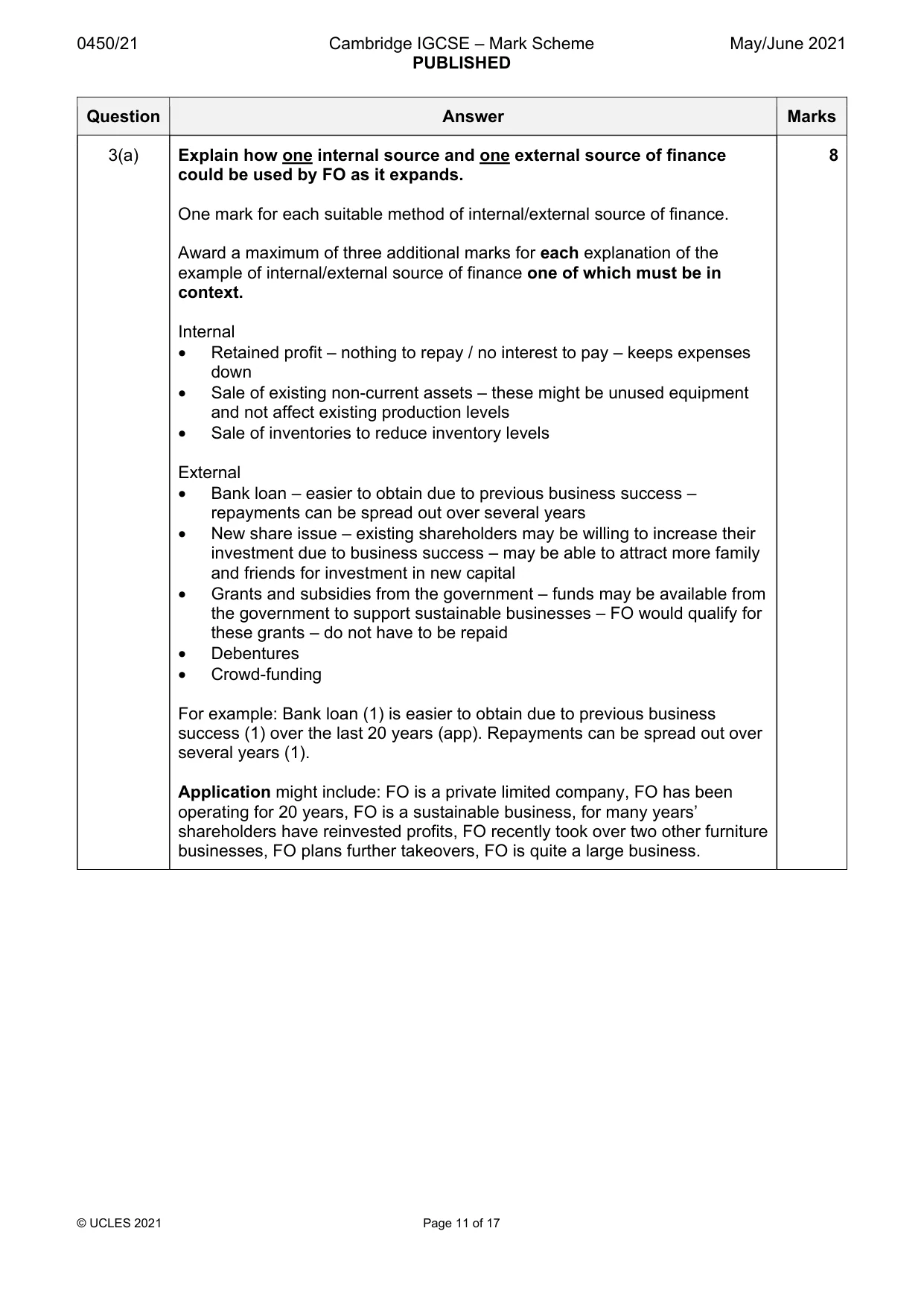
0450/21 Cambridge IGCSE – Mark Scheme PUBLISHED May/June 2021 © UCLES 2021 Page 11 of 17 Question Answer Marks 3(a) Explain how one internal source and one external source of finance could be used by FO as it expands. One mark for each suitable method of internal/external source of finance. Award a maximum of three additional marks for each explanation of the example of internal/external source of finance one of which must be in context. Internal • Retained profit – nothing to repay / no interest to pay – keeps expenses down • Sale of existing non-current assets – these might be unused equipment and not affect existing production levels • Sale of inventories to reduce inventory levels External • Bank loan – easier to obtain due to previous business success – repayments can be spread out over several years • New share issue – existing shareholders may be willing to increase their investment due to business success – may be able to attract more family and friends for investment in new capital • Grants and subsidies from the government – funds may be available from the government to support sustainable businesses – FO would qualify for these grants – do not have to be repaid • Debentures • Crowd-funding For example: Bank loan (1) is easier to obtain due to previous business success (1) over the last 20 years (app). Repayments can be spread out over several years (1). Application might include: FO is a private limited company, FO has been operating for 20 years, FO is a sustainable business, for many years’ shareholders have reinvested profits, FO recently took over two other furniture businesses, FO plans further takeovers, FO is quite a large business. 8
Mark scheme, page 12
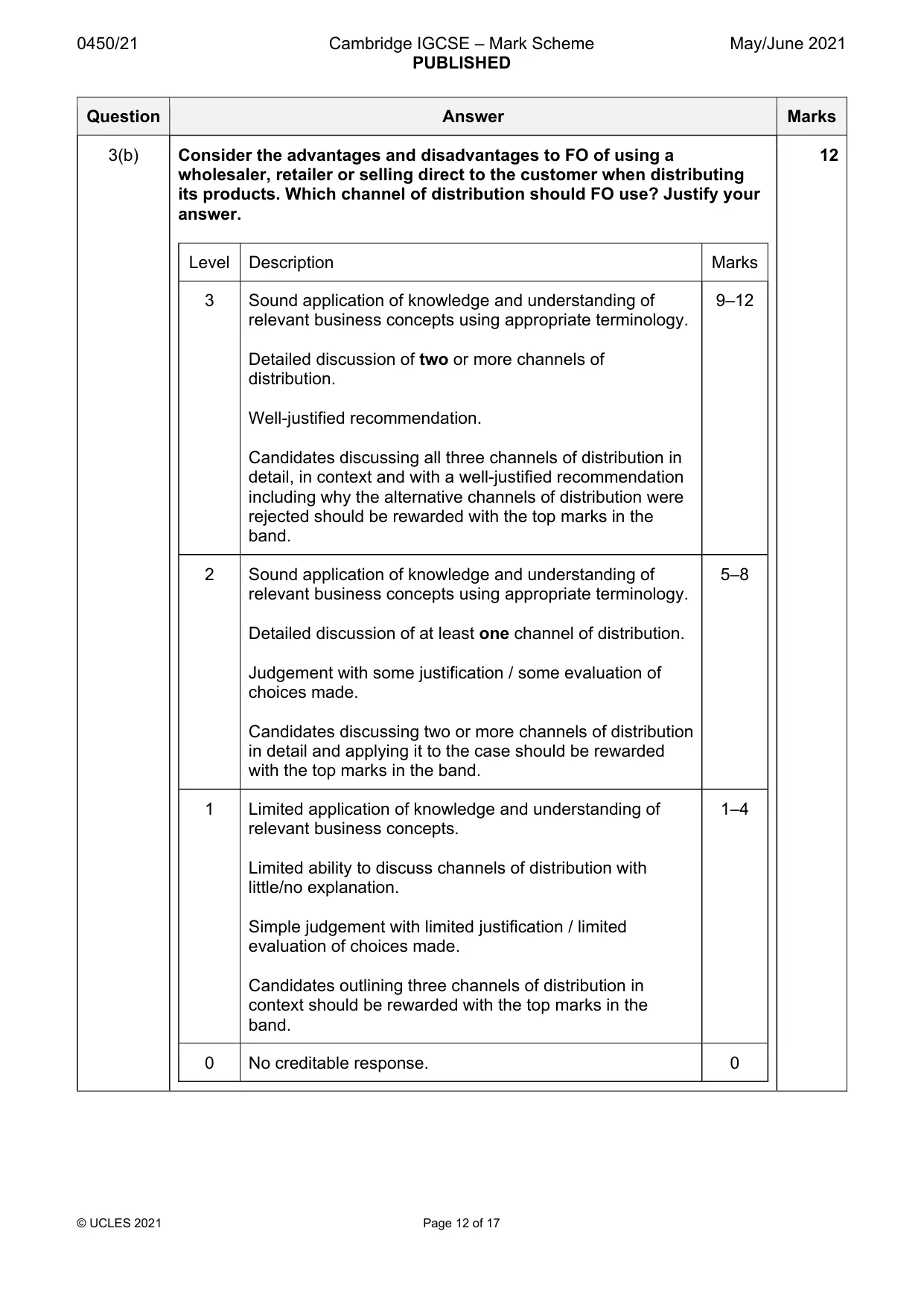
0450/21 Cambridge IGCSE – Mark Scheme PUBLISHED May/June 2021 © UCLES 2021 Page 12 of 17 Question Answer Marks 3(b) Consider the advantages and disadvantages to FO of using a wholesaler, retailer or selling direct to the customer when distributing its products. Which channel of distribution should FO use? Justify your answer. Level Description Marks 3 Sound application of knowledge and understanding of relevant business concepts using appropriate terminology. Detailed discussion of two or more channels of distribution. Well-justified recommendation. Candidates discussing all three channels of distribution in detail, in context and with a well-justified recommendation including why the alternative channels of distribution were rejected should be rewarded with the top marks in the band. 9–12 2 Sound application of knowledge and understanding of relevant business concepts using appropriate terminology. Detailed discussion of at least one channel of distribution. Judgement with some justification / some evaluation of choices made. Candidates discussing two or more channels of distribution in detail and applying it to the case should be rewarded with the top marks in the band. 5–8 1 Limited application of knowledge and understanding of relevant business concepts. Limited ability to discuss channels of distribution with little/no explanation. Simple judgement with limited justification / limited evaluation of choices made. Candidates outlining three channels of distribution in context should be rewarded with the top marks in the band. 1–4 0 No creditable response. 0 12
Mark scheme, page 13
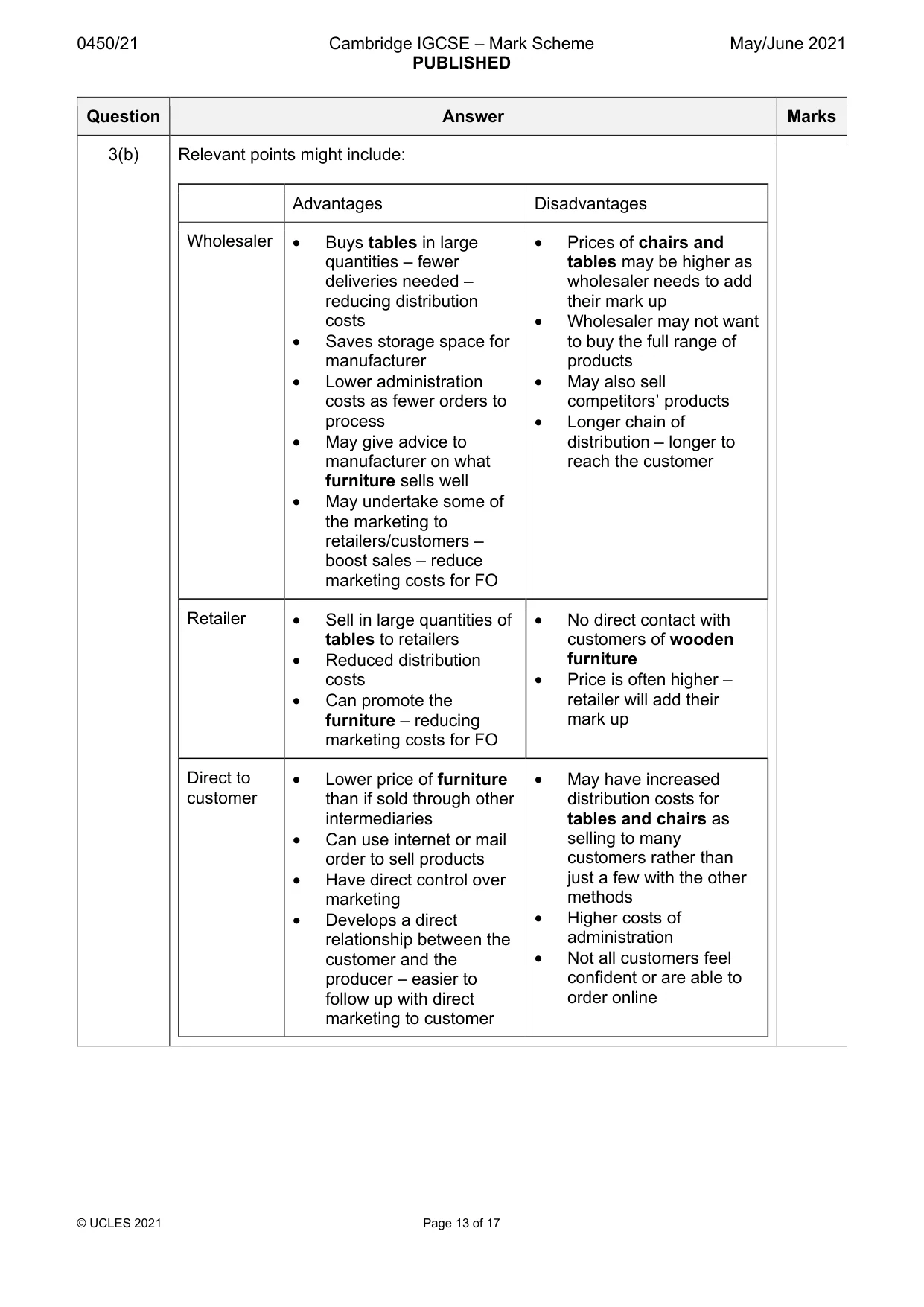
0450/21 Cambridge IGCSE – Mark Scheme PUBLISHED May/June 2021 © UCLES 2021 Page 13 of 17 Question Answer Marks 3(b) Relevant points might include: Advantages Disadvantages Wholesaler • Buys tables in large quantities – fewer deliveries needed – reducing distribution costs • Saves storage space for manufacturer • Lower administration costs as fewer orders to process • May give advice to manufacturer on what furniture sells well • May undertake some of the marketing to retailers/customers – boost sales – reduce marketing costs for FO • Prices of chairs and tables may be higher as wholesaler needs to add their mark up • Wholesaler may not want to buy the full range of products • May also sell competitors’ products • Longer chain of distribution – longer to reach the customer Retailer • Sell in large quantities of tables to retailers • Reduced distribution costs • Can promote the furniture – reducing marketing costs for FO • No direct contact with customers of wooden furniture • Price is often higher – retailer will add their mark up Direct to customer • Lower price of furniture than if sold through other intermediaries • Can use internet or mail order to sell products • Have direct control over marketing • Develops a direct relationship between the customer and the producer – easier to follow up with direct marketing to customer • May have increased distribution costs for tables and chairs as selling to many customers rather than just a few with the other methods • Higher costs of administration • Not all customers feel confident or are able to order online
Mark scheme, page 14
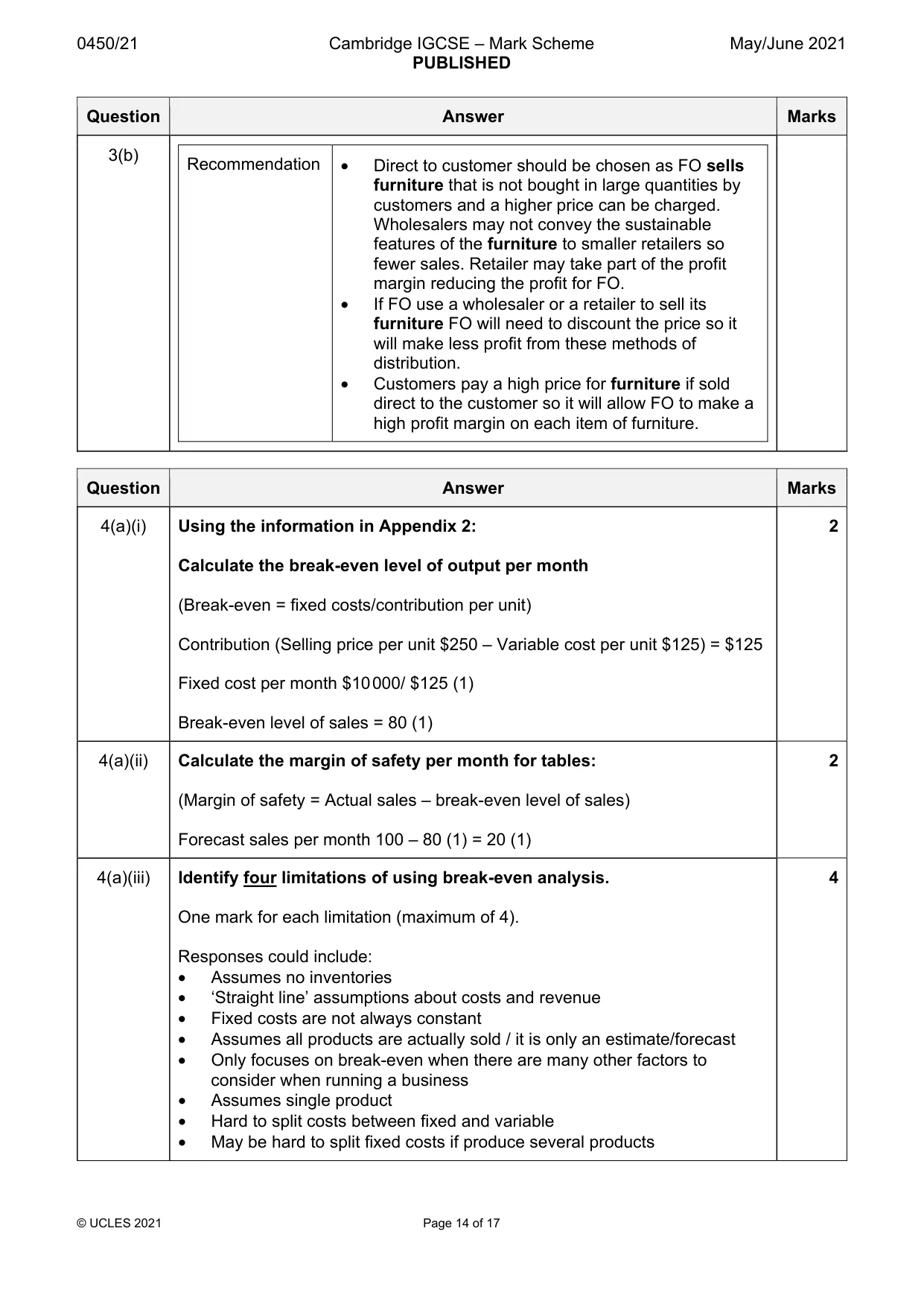
0450/21 Cambridge IGCSE – Mark Scheme PUBLISHED May/June 2021 © UCLES 2021 Page 14 of 17 Question Answer Marks 3(b) Recommendation • Direct to customer should be chosen as FO sells furniture that is not bought in large quantities by customers and a higher price can be charged. Wholesalers may not convey the sustainable features of the furniture to smaller retailers so fewer sales. Retailer may take part of the profit margin reducing the profit for FO. • If FO use a wholesaler or a retailer to sell its furniture FO will need to discount the price so it will make less profit from these methods of distribution. • Customers pay a high price for furniture if sold direct to the customer so it will allow FO to make a high profit margin on each item of furniture. Question Answer Marks 4(a)(i) Using the information in Appendix 2: Calculate the break-even level of output per month (Break-even = fixed costs/contribution per unit) Contribution (Selling price per unit $250 – Variable cost per unit $125) = $125 Fixed cost per month $10 000/ $125 (1) Break-even level of sales = 80 (1) 2 4(a)(ii) Calculate the margin of safety per month for tables: (Margin of safety = Actual sales – break-even level of sales) Forecast sales per month 100 – 80 (1) = 20 (1) 2 4(a)(iii) Identify four limitations of using break-even analysis. One mark for each limitation (maximum of 4). Responses could include: • Assumes no inventories • ‘Straight line’ assumptions about costs and revenue • Fixed costs are not always constant • Assumes all products are actually sold / it is only an estimate/forecast • Only focuses on break-even when there are many other factors to consider when running a business • Assumes single product • Hard to split costs between fixed and variable • May be hard to split fixed costs if produce several products 4
Mark scheme, page 15
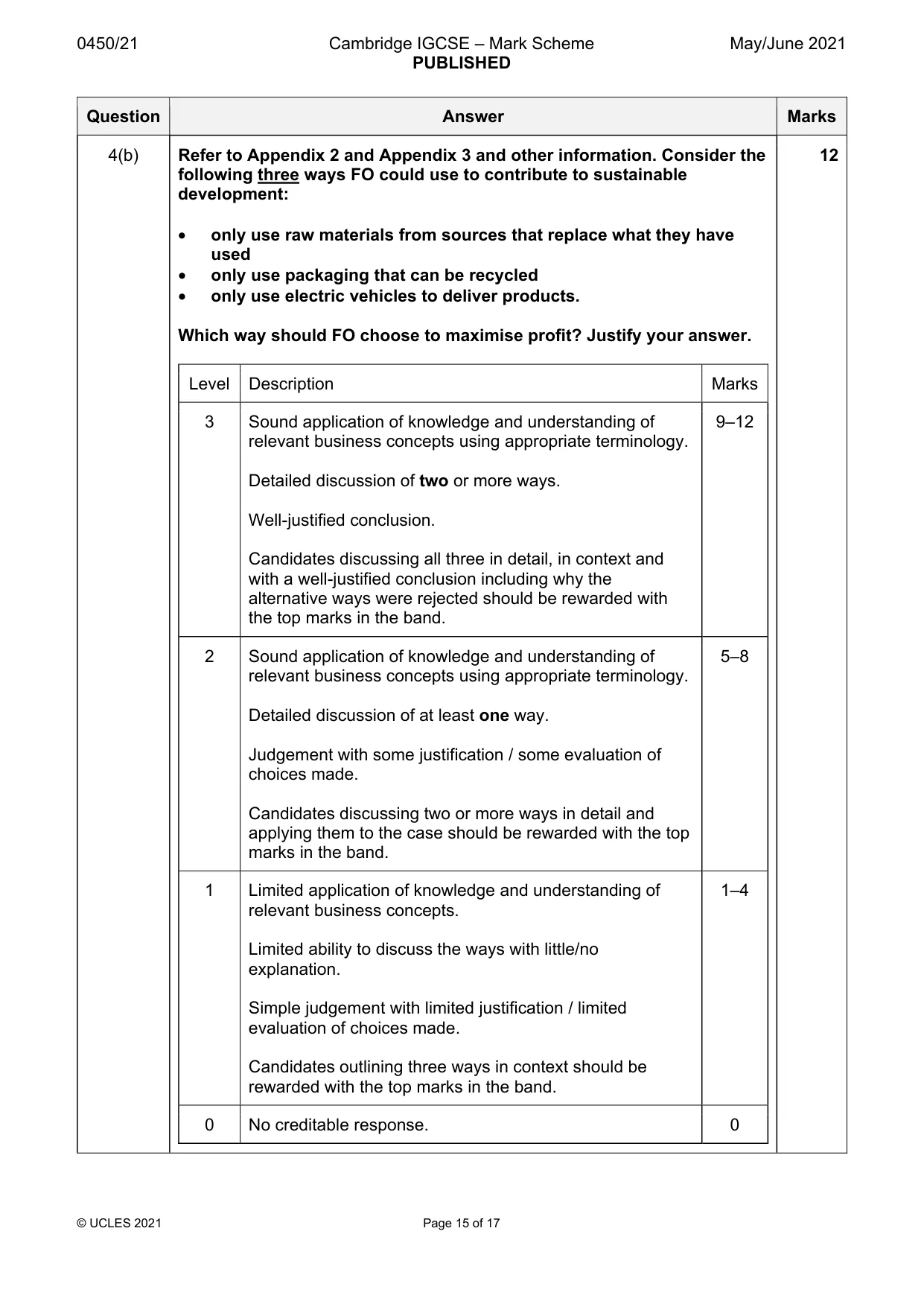
0450/21 Cambridge IGCSE – Mark Scheme PUBLISHED May/June 2021 © UCLES 2021 Page 15 of 17 Question Answer Marks 4(b) Refer to Appendix 2 and Appendix 3 and other information. Consider the following three ways FO could use to contribute to sustainable development: • only use raw materials from sources that replace what they have used • only use packaging that can be recycled • only use electric vehicles to deliver products. Which way should FO choose to maximise profit? Justify your answer. Level Description Marks 3 Sound application of knowledge and understanding of relevant business concepts using appropriate terminology. Detailed discussion of two or more ways. Well-justified conclusion. Candidates discussing all three in detail, in context and with a well-justified conclusion including why the alternative ways were rejected should be rewarded with the top marks in the band. 9–12 2 Sound application of knowledge and understanding of relevant business concepts using appropriate terminology. Detailed discussion of at least one way. Judgement with some justification / some evaluation of choices made. Candidates discussing two or more ways in detail and applying them to the case should be rewarded with the top marks in the band. 5–8 1 Limited application of knowledge and understanding of relevant business concepts. Limited ability to discuss the ways with little/no explanation. Simple judgement with limited justification / limited evaluation of choices made. Candidates outlining three ways in context should be rewarded with the top marks in the band. 1–4 0 No creditable response. 0 12
Mark scheme, page 16
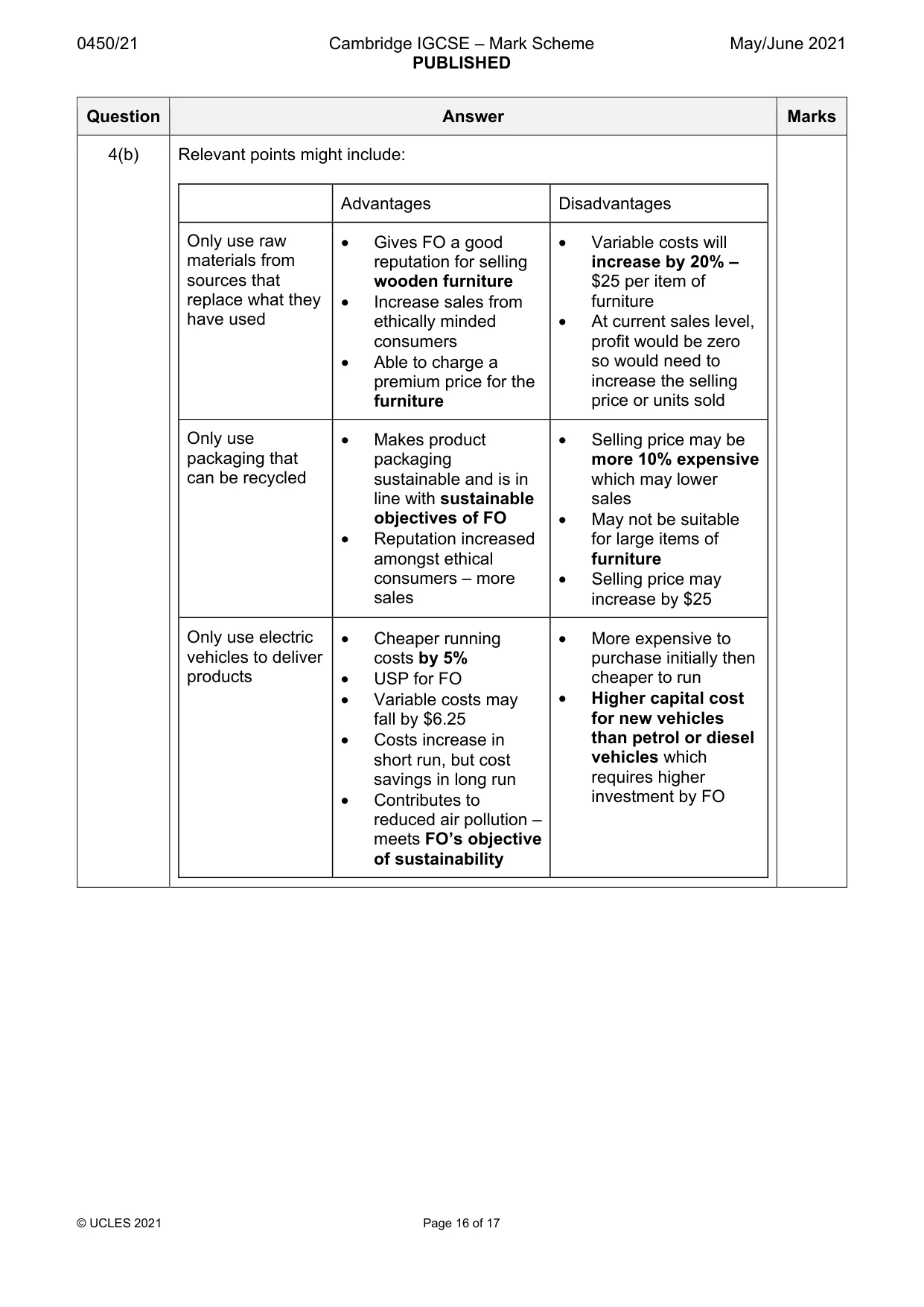
0450/21 Cambridge IGCSE – Mark Scheme PUBLISHED May/June 2021 © UCLES 2021 Page 16 of 17 Question Answer Marks 4(b) Relevant points might include: Advantages Disadvantages Only use raw materials from sources that replace what they have used • Gives FO a good reputation for selling wooden furniture • Increase sales from ethically minded consumers • Able to charge a premium price for the furniture • Variable costs will increase by 20% – $25 per item of furniture • At current sales level, profit would be zero so would need to increase the selling price or units sold Only use packaging that can be recycled • Makes product packaging sustainable and is in line with sustainable objectives of FO • Reputation increased amongst ethical consumers – more sales • Selling price may be more 10% expensive which may lower sales • May not be suitable for large items of furniture • Selling price may increase by $25 Only use electric vehicles to deliver products • Cheaper running costs by 5% • USP for FO • Variable costs may fall by $6.25 • Costs increase in short run, but cost savings in long run • Contributes to reduced air pollution – meets FO’s objective of sustainability • More expensive to purchase initially then cheaper to run • Higher capital cost for new vehicles than petrol or diesel vehicles which requires higher investment by FO
Mark scheme, page 17
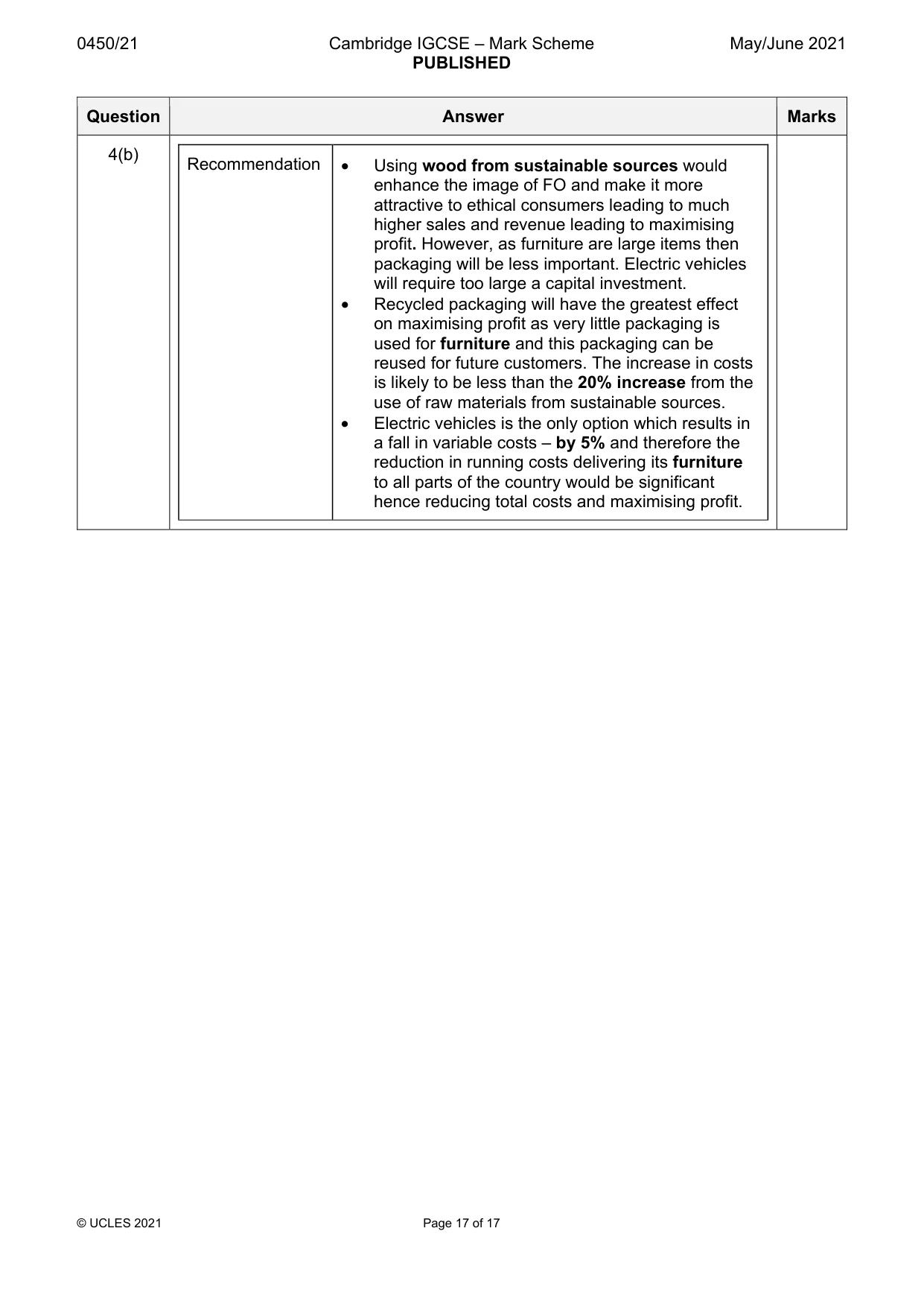
0450/21 Cambridge IGCSE – Mark Scheme PUBLISHED May/June 2021 © UCLES 2021 Page 17 of 17 Question Answer Marks 4(b) Recommendation • Using wood from sustainable sources would enhance the image of FO and make it more attractive to ethical consumers leading to much higher sales and revenue leading to maximising profit. However, as furniture are large items then packaging will be less important. Electric vehicles will require too large a capital investment. • Recycled packaging will have the greatest effect on maximising profit as very little packaging is used for furniture and this packaging can be reused for future customers. The increase in costs is likely to be less than the 20% increase from the use of raw materials from sustainable sources. • Electric vehicles is the only option which results in a fall in variable costs – by 5% and therefore the reduction in running costs delivering its furniture to all parts of the country would be significant hence reducing total costs and maximising profit.
What you needed in this session
Cambridge’s own grade thresholds for 2021 May/June, Paper 2 · Variant 1. A higher threshold means an easier paper — the bar moves with how the cohort did.