Cambridge IGCSE Business Studies 0450 — 2024 May/June Paper 2 · Variant 1
0450/21/M/J/24 · 80 marks · ≈90 min
The question paper and its mark scheme, free to read here and free to download. This is Cambridge’s own paper, exactly as it was sat.
Question paper12 pages



Mark scheme21 pages
Answers below. Sit the paper first if you are practising.

Paper as text
Question paper, page 1
Cambridge IGCSE™ 0450/21 May/June 2024 1 hour 30 minutes BUSINESS STUDIES Paper 2 Case Study You must answer on the question paper. You will need: Insert (enclosed) INSTRUCTIONS • Answer all questions. • Use a black or dark blue pen. You may use an HB pencil for any diagrams or graphs. • Write your name, centre number and candidate number in the boxes at the top of the page. • Write your answer to each question in the space provided. • Do not use an erasable pen or correction fluid. • Do not write on any bar codes. • You may use a calculator. INFORMATION • The total mark for this paper is 80. • The number of marks for each question or part question is shown in brackets [ ]. • The insert contains the case study. This document has 12 pages. Any blank pages are indicated. [Turn over 06_0450_21_2024_1.16 © UCLES 2024 *3921137726*
Question paper, page 2
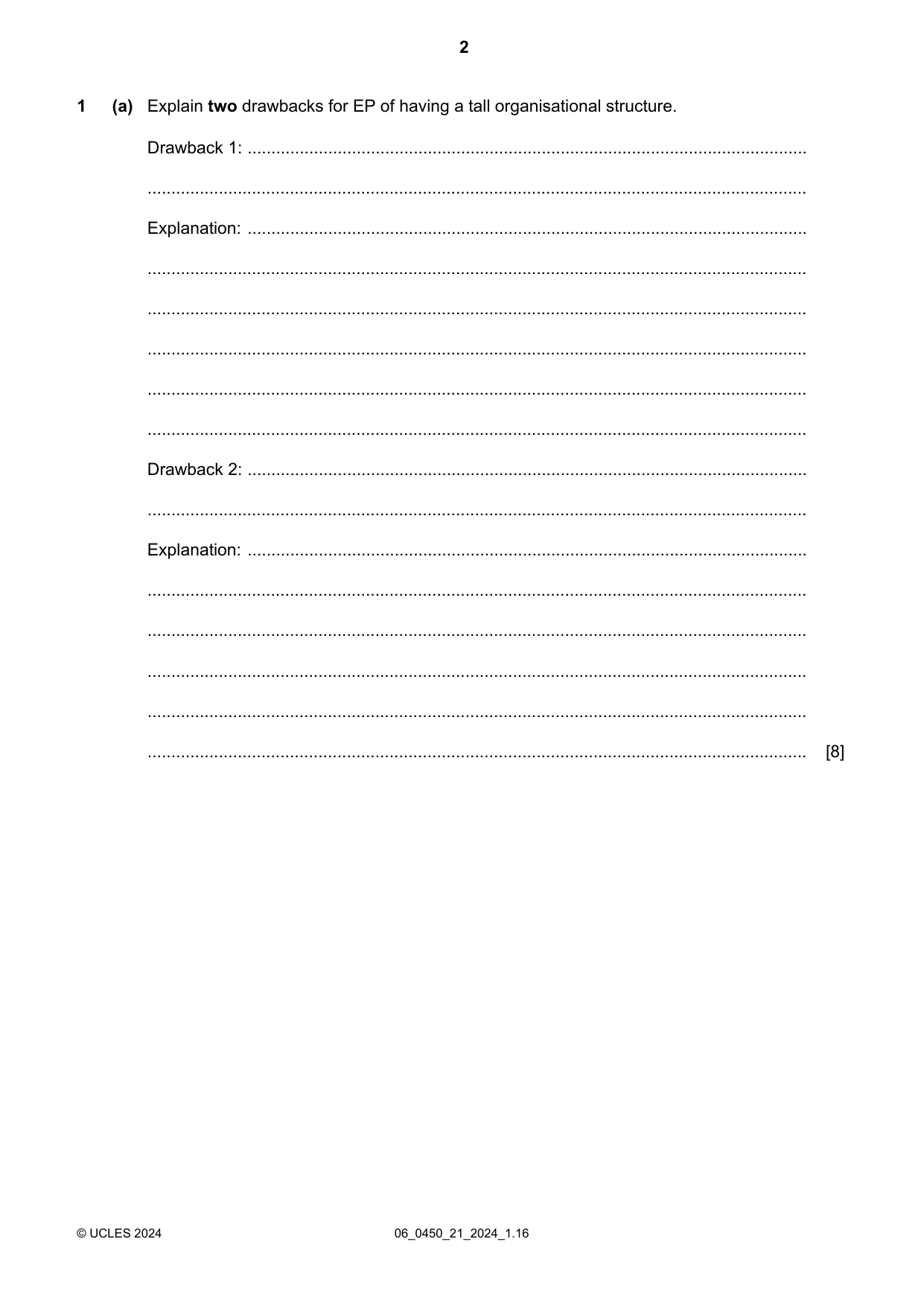
Explain two drawbacks for EP of having a tall organisational structure. (a) 1 Drawback 1: … … Explanation: … … … … … … Drawback 2: … … Explanation: … … … … … … [8] 06_0450_21_2024_1.16 © UCLES 2024 2
Question paper, page 3
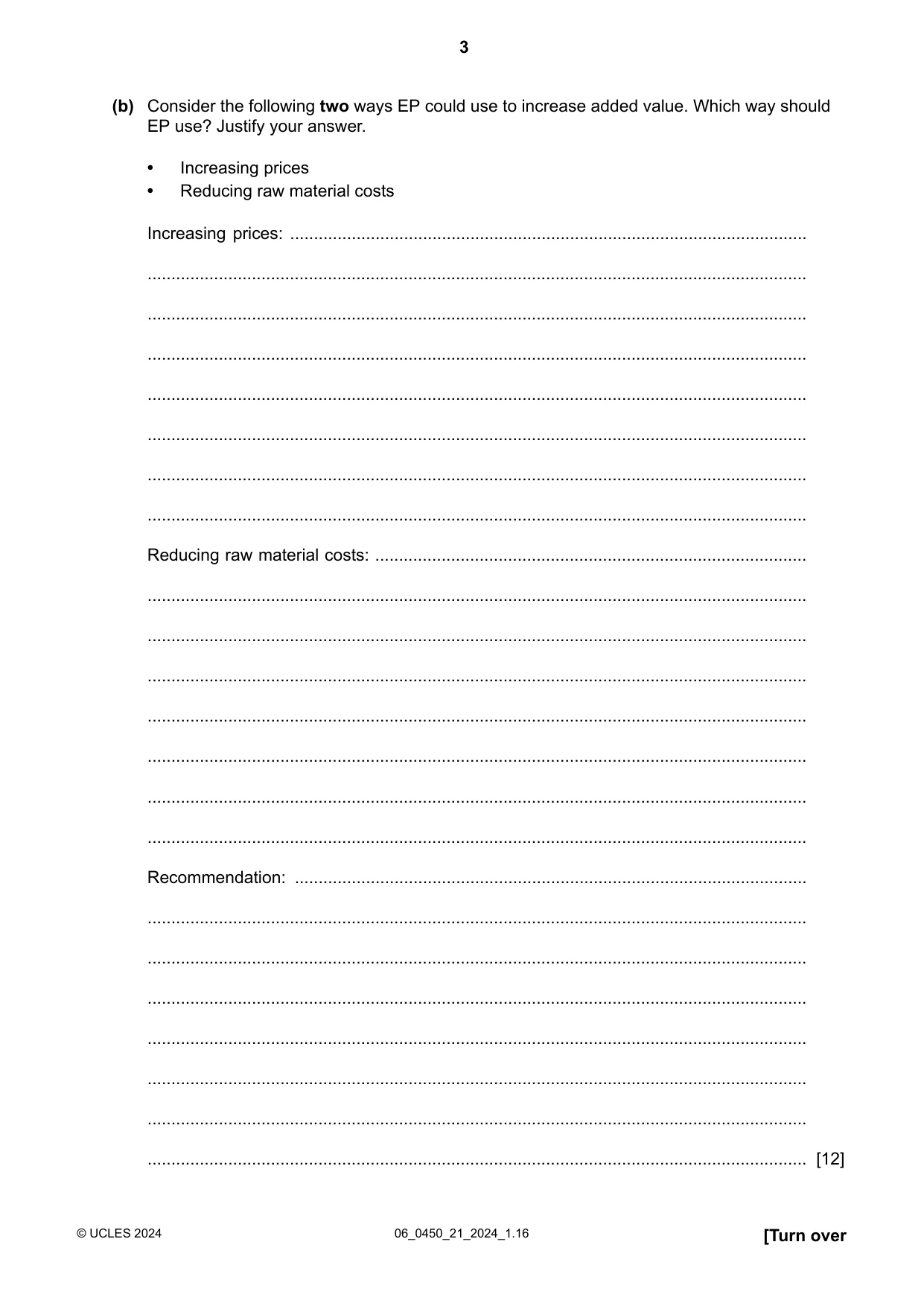
Consider the following two ways EP could use to increase added value. Which way should EP use? Justify your answer. (b) • Increasing prices • Reducing raw material costs Increasing prices: … … … … … … … … Reducing raw material costs: … … … … … … … … Recommendation: … … … … … … … … [12] [Turn over 06_0450_21_2024_1.16 © UCLES 2024 3
Question paper, page 4
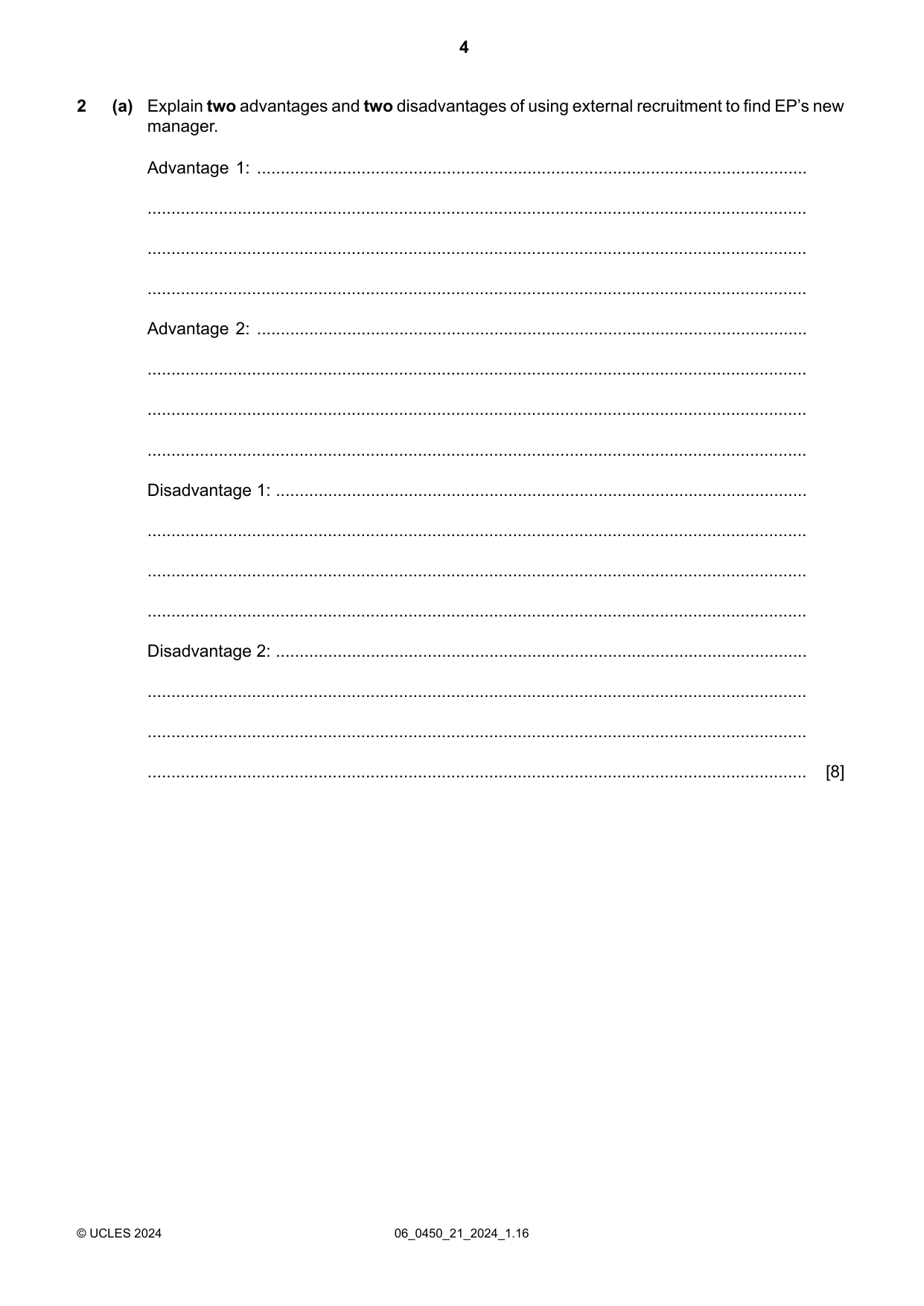
Explain two advantages and two disadvantages of using external recruitment to find EP’s new manager. (a) 2 Advantage 1: … … … … Advantage 2: … … … … Disadvantage 1: … … … … Disadvantage 2: … … … … [8] 06_0450_21_2024_1.16 © UCLES 2024 4
Question paper, page 5
Consider the following three ways EP could use to increase the sales of its products. Which would be the best way for EP to use? Justify your answer. (b) • Advertising using social media • Emailing special offers to existing customers • Setting up a website Advertising using social media: … … … … … … Emailing special offers to existing customers: … … … … … … Setting up a website: … … … … … … Recommendation: … … … … … … [12] [Turn over 06_0450_21_2024_1.16 © UCLES 2024 5
Question paper, page 6
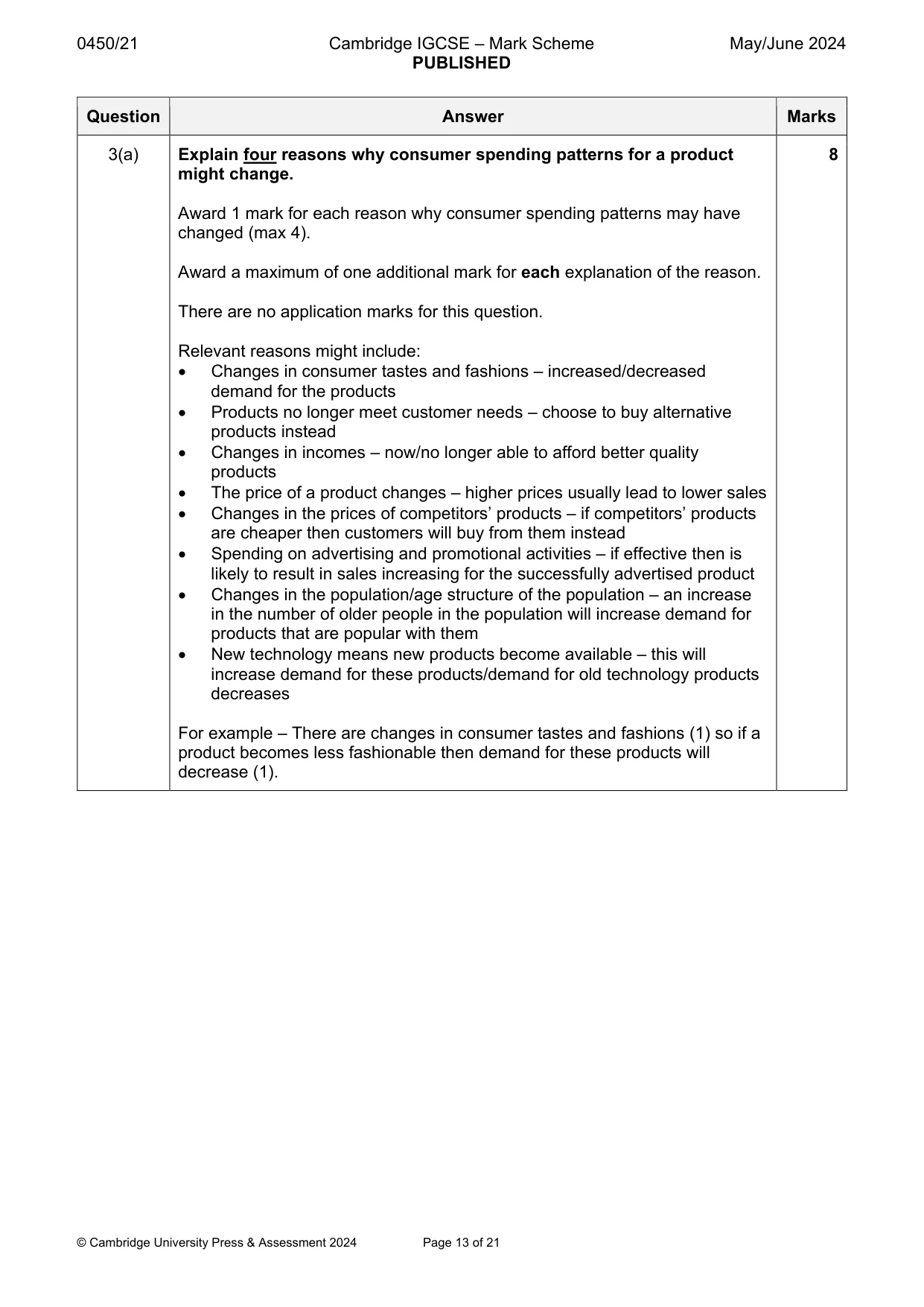
Explain four reasons why consumer spending patterns for a product might change. (a) 3 Reason 1: … … … … Reason 2: … … … … Reason 3: … … … … Reason 4: … … … … [8] 06_0450_21_2024_1.16 © UCLES 2024 6
Question paper, page 7
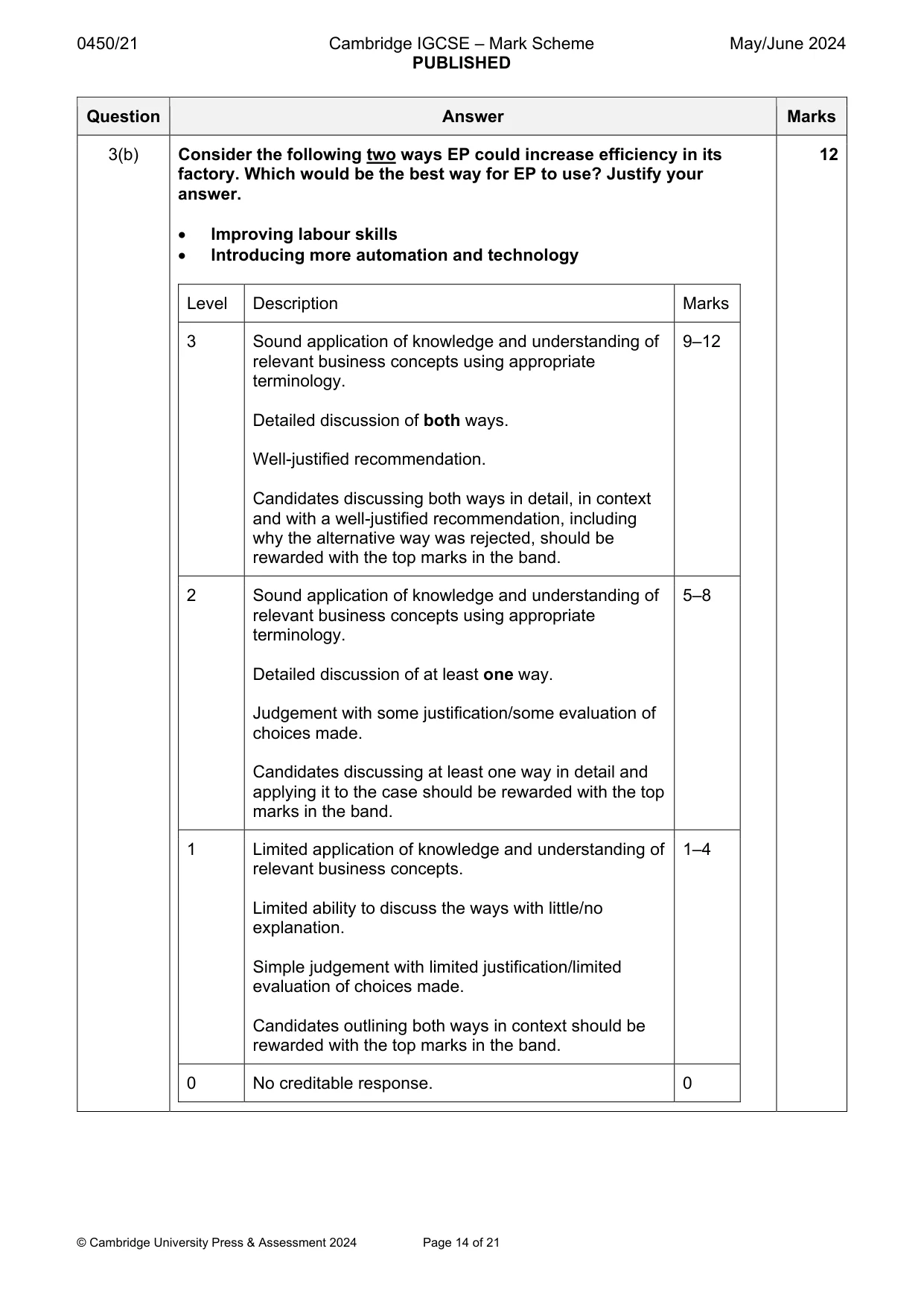
Consider the following two ways EP could increase efficiency in its factory. Which would be the best way for EP to use? Justify your answer. (b) • Improving labour skills • Introducing more automation and technology Improving labour skills: … … … … … … … … Introducing more automation and technology: … … … … … … … … Recommendation: … … … … … … … … [12] [Turn over 06_0450_21_2024_1.16 © UCLES 2024 7
Question paper, page 8
Explain two factors EP should consider when choosing a source of finance. (a) 4 Factor 1: … … Explanation: … … … … … … Factor 2: … … Explanation: … … … … … … [8] 06_0450_21_2024_1.16 © UCLES 2024 8
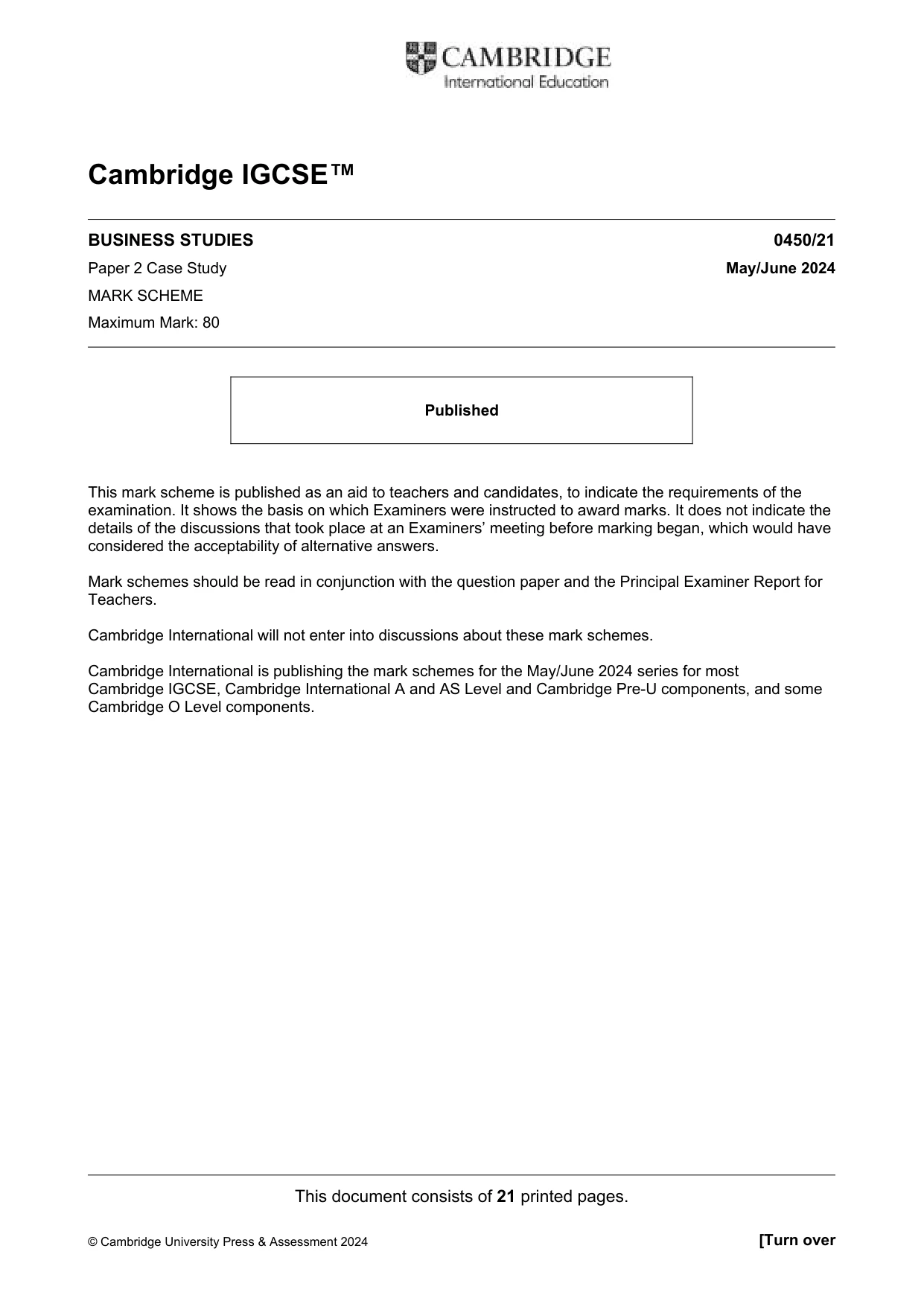
Question paper, page 9
Using Appendix 3 and other information, consider the following two products EP makes. Which product should EP stop making? Justify your answer. (b) • Product A • Product B Product A: … … … … … … … … Product B: … … … … … … … … Recommendation: … … … … … … … … [12] 06_0450_21_2024_1.16 © UCLES 2024 9
Question paper, page 10
BLANK PAGE 06_0450_21_2024_1.16 © UCLES 2024 10
Question paper, page 11
BLANK PAGE 06_0450_21_2024_1.16 © UCLES 2024 11
Question paper, page 12
BLANK PAGE Permission to reproduce items where third-party owned material protected by copyright is included has been sought and cleared where possible. Every reasonable effort has been made by the publisher (UCLES) to trace copyright holders, but if any items requiring clearance have unwittingly been included, the publisher will be pleased to make amends at the earliest possible opportunity. To avoid the issue of disclosure of answer-related information to candidates, all copyright acknowledgements are reproduced online in the Cambridge Assessment International Education Copyright Acknowledgements Booklet. This is produced for each series of examinations and is freely available to download at www.cambridgeinternational.org after the live examination series. Cambridge Assessment International Education is part of Cambridge Assessment. Cambridge Assessment is the brand name of the University of Cambridge Local Examinations Syndicate (UCLES), which is a department of the University of Cambridge. 06_0450_21_2024_1.16 © UCLES 2024 12
Mark scheme, page 1
This document consists of 21 printed pages. © Cambridge University Press & Assessment 2024 [Turn over Cambridge IGCSE™ BUSINESS STUDIES 0450/21 Paper 2 Case Study May/June 2024 MARK SCHEME Maximum Mark: 80 Published This mark scheme is published as an aid to teachers and candidates, to indicate the requirements of the examination. It shows the basis on which Examiners were instructed to award marks. It does not indicate the details of the discussions that took place at an Examiners’ meeting before marking began, which would have considered the acceptability of alternative answers. Mark schemes should be read in conjunction with the question paper and the Principal Examiner Report for Teachers. Cambridge International will not enter into discussions about these mark schemes. Cambridge International is publishing the mark schemes for the May/June 2024 series for most Cambridge IGCSE, Cambridge International A and AS Level and Cambridge Pre-U components, and some Cambridge O Level components.
Mark scheme, page 2
0450/21 Cambridge IGCSE – Mark Scheme PUBLISHED May/June 2024 © Cambridge University Press & Assessment 2024 Page 2 of 21 Generic Marking Principles These general marking principles must be applied by all examiners when marking candidate answers. They should be applied alongside the specific content of the mark scheme or generic level descriptions for a question. Each question paper and mark scheme will also comply with these marking principles. GENERIC MARKING PRINCIPLE 1: Marks must be awarded in line with: the specific content of the mark scheme or the generic level descriptors for the question the specific skills defined in the mark scheme or in the generic level descriptors for the question the standard of response required by a candidate as exemplified by the standardisation scripts. GENERIC MARKING PRINCIPLE 2: Marks awarded are always whole marks (not half marks, or other fractions). GENERIC MARKING PRINCIPLE 3: Marks must be awarded positively: marks are awarded for correct/valid answers, as defined in the mark scheme. However, credit is given for valid answers which go beyond the scope of the syllabus and mark scheme, referring to your Team Leader as appropriate marks are awarded when candidates clearly demonstrate what they know and can do marks are not deducted for errors marks are not deducted for omissions answers should only be judged on the quality of spelling, punctuation and grammar when these features are specifically assessed by the question as indicated by the mark scheme. The meaning, however, should be unambiguous. GENERIC MARKING PRINCIPLE 4: Rules must be applied consistently, e.g. in situations where candidates have not followed instructions or in the application of generic level descriptors. GENERIC MARKING PRINCIPLE 5: Marks should be awarded using the full range of marks defined in the mark scheme for the question (however; the use of the full mark range may be limited according to the quality of the candidate responses seen). GENERIC MARKING PRINCIPLE 6: Marks awarded are based solely on the requirements as defined in the mark scheme. Marks should not be awarded with grade thresholds or grade descriptors in mind.
Mark scheme, page 3
0450/21 Cambridge IGCSE – Mark Scheme PUBLISHED May/June 2024 © Cambridge University Press & Assessment 2024 Page 3 of 21 Social Science-Specific Marking Principles (for point-based marking) 1 Components using point-based marking: Point marking is often used to reward knowledge, understanding and application of skills. We give credit where the candidate’s answer shows relevant knowledge, understanding and application of skills in answering the question. We do not give credit where the answer shows confusion. From this it follows that we: a DO credit answers which are worded differently from the mark scheme if they clearly convey the same meaning (unless the mark scheme requires a specific term) b DO credit alternative answers/examples which are not written in the mark scheme if they are correct c DO credit answers where candidates give more than one correct answer in one prompt/numbered/scaffolded space where extended writing is required rather than list-type answers. For example, questions that require n reasons (e.g. State two reasons …). d DO NOT credit answers simply for using a ‘key term’ unless that is all that is required. (Check for evidence it is understood and not used wrongly.) e DO NOT credit answers which are obviously self-contradicting or trying to cover all possibilities f DO NOT give further credit for what is effectively repetition of a correct point already credited unless the language itself is being tested. This applies equally to ‘mirror statements’ (i.e. polluted/not polluted). g DO NOT require spellings to be correct, unless this is part of the test. However spellings of syllabus terms must allow for clear and unambiguous separation from other syllabus terms with which they may be confused (e.g. Corrasion/Corrosion) 2 Presentation of mark scheme: Slashes (/) or the word ‘or’ separate alternative ways of making the same point. Semi colons (;) bullet points (•) or figures in brackets (1) separate different points. Content in the answer column in brackets is for examiner information/context to clarify the marking but is not required to earn the mark (except Accounting syllabuses where they indicate negative numbers). 3 Calculation questions: The mark scheme will show the steps in the most likely correct method(s), the mark for each step, the correct answer(s) and the mark for each answer If working/explanation is considered essential for full credit, this will be indicated in the question paper and in the mark scheme. In all other instances, the correct answer to a calculation should be given full credit, even if no supporting working is shown. Where the candidate uses a valid method which is not covered by the mark scheme, award equivalent marks for reaching equivalent stages. Where an answer makes use of a candidate’s own incorrect figure from previous working, the ‘own figure rule’ applies: full marks will be given if a correct and complete method is used. Further guidance will be included in the mark scheme where necessary and any exceptions to this general principle will be noted.
Mark scheme, page 4
0450/21 Cambridge IGCSE – Mark Scheme PUBLISHED May/June 2024 © Cambridge University Press & Assessment 2024 Page 4 of 21 4 Annotation: For point marking, ticks can be used to indicate correct answers and crosses can be used to indicate wrong answers. There is no direct relationship between ticks and marks. Ticks have no defined meaning for levels of response marking. For levels of response marking, the level awarded should be annotated on the script. Other annotations will be used by examiners as agreed during standardisation, and the meaning will be understood by all examiners who marked that paper.
Mark scheme, page 5
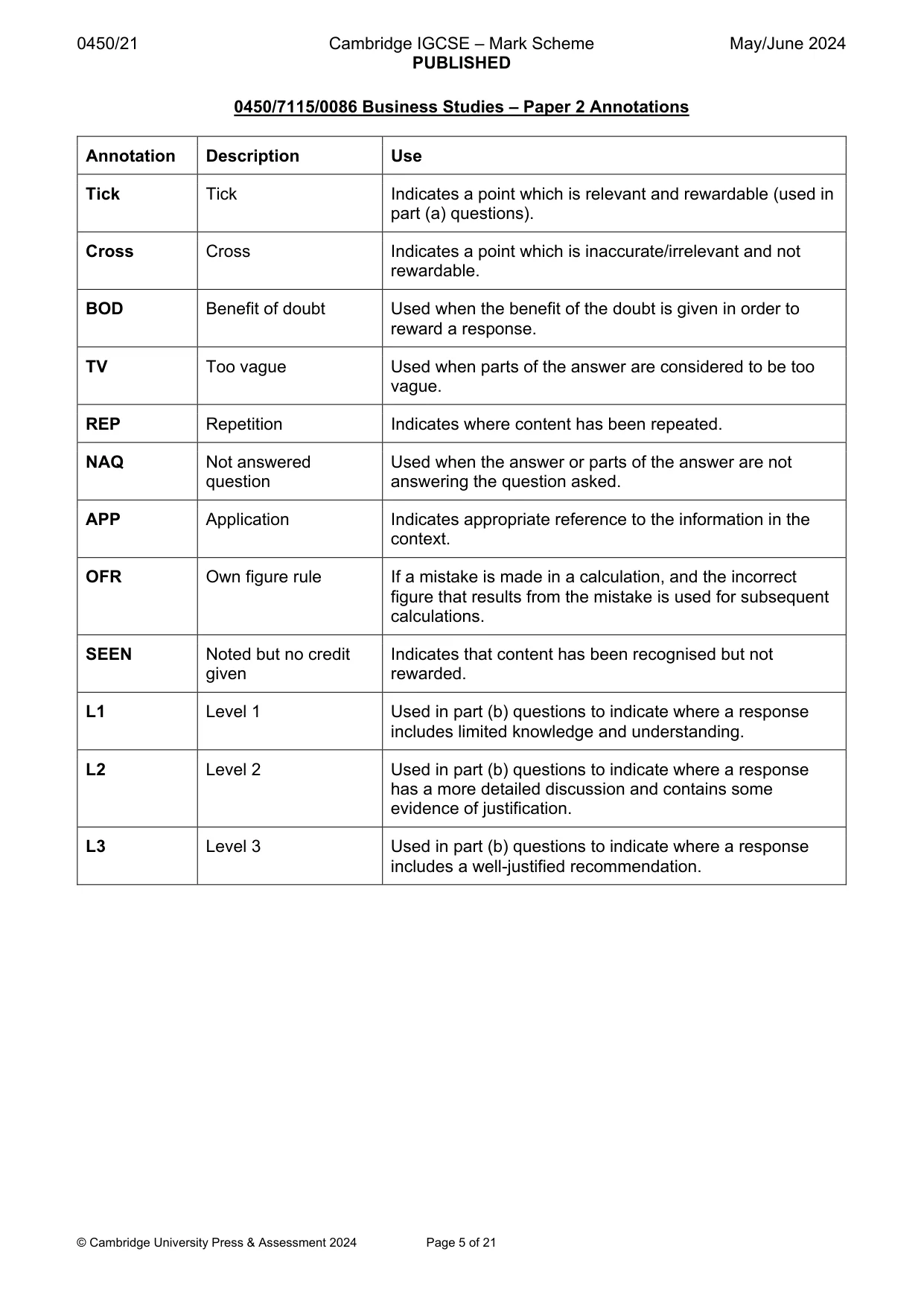
0450/21 Cambridge IGCSE – Mark Scheme PUBLISHED May/June 2024 © Cambridge University Press & Assessment 2024 Page 5 of 21 0450/7115/0086 Business Studies – Paper 2 Annotations Annotation Description Use Tick Tick Indicates a point which is relevant and rewardable (used in part (a) questions). Cross Cross Indicates a point which is inaccurate/irrelevant and not rewardable. BOD Benefit of doubt Used when the benefit of the doubt is given in order to reward a response. TV Too vague Used when parts of the answer are considered to be too vague. REP Repetition Indicates where content has been repeated. NAQ Not answered question Used when the answer or parts of the answer are not answering the question asked. APP Application Indicates appropriate reference to the information in the context. OFR Own figure rule If a mistake is made in a calculation, and the incorrect figure that results from the mistake is used for subsequent calculations. SEEN Noted but no credit given Indicates that content has been recognised but not rewarded. L1 Level 1 Used in part (b) questions to indicate where a response includes limited knowledge and understanding. L2 Level 2 Used in part (b) questions to indicate where a response has a more detailed discussion and contains some evidence of justification. L3 Level 3 Used in part (b) questions to indicate where a response includes a well-justified recommendation.
Mark scheme, page 6
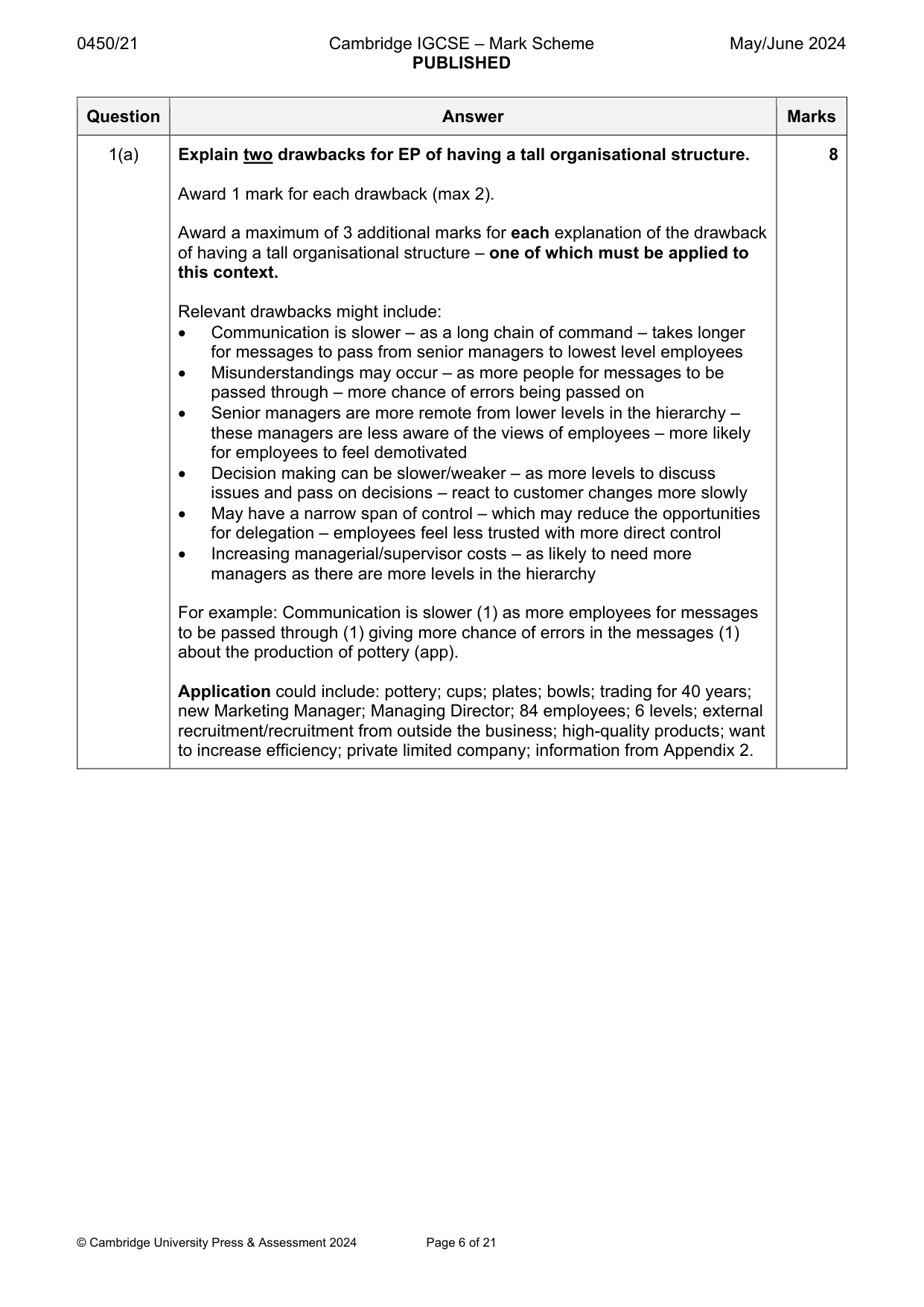
0450/21 Cambridge IGCSE – Mark Scheme PUBLISHED May/June 2024 © Cambridge University Press & Assessment 2024 Page 6 of 21 Question Answer Marks 1(a) Explain two drawbacks for EP of having a tall organisational structure. Award 1 mark for each drawback (max 2). Award a maximum of 3 additional marks for each explanation of the drawback of having a tall organisational structure – one of which must be applied to this context. Relevant drawbacks might include: Communication is slower – as a long chain of command – takes longer for messages to pass from senior managers to lowest level employees Misunderstandings may occur – as more people for messages to be passed through – more chance of errors being passed on Senior managers are more remote from lower levels in the hierarchy – these managers are less aware of the views of employees – more likely for employees to feel demotivated Decision making can be slower/weaker – as more levels to discuss issues and pass on decisions – react to customer changes more slowly May have a narrow span of control – which may reduce the opportunities for delegation – employees feel less trusted with more direct control Increasing managerial/supervisor costs – as likely to need more managers as there are more levels in the hierarchy For example: Communication is slower (1) as more employees for messages to be passed through (1) giving more chance of errors in the messages (1) about the production of pottery (app). Application could include: pottery; cups; plates; bowls; trading for 40 years; new Marketing Manager; Managing Director; 84 employees; 6 levels; external recruitment/recruitment from outside the business; high-quality products; want to increase efficiency; private limited company; information from Appendix 2. 8
Mark scheme, page 7
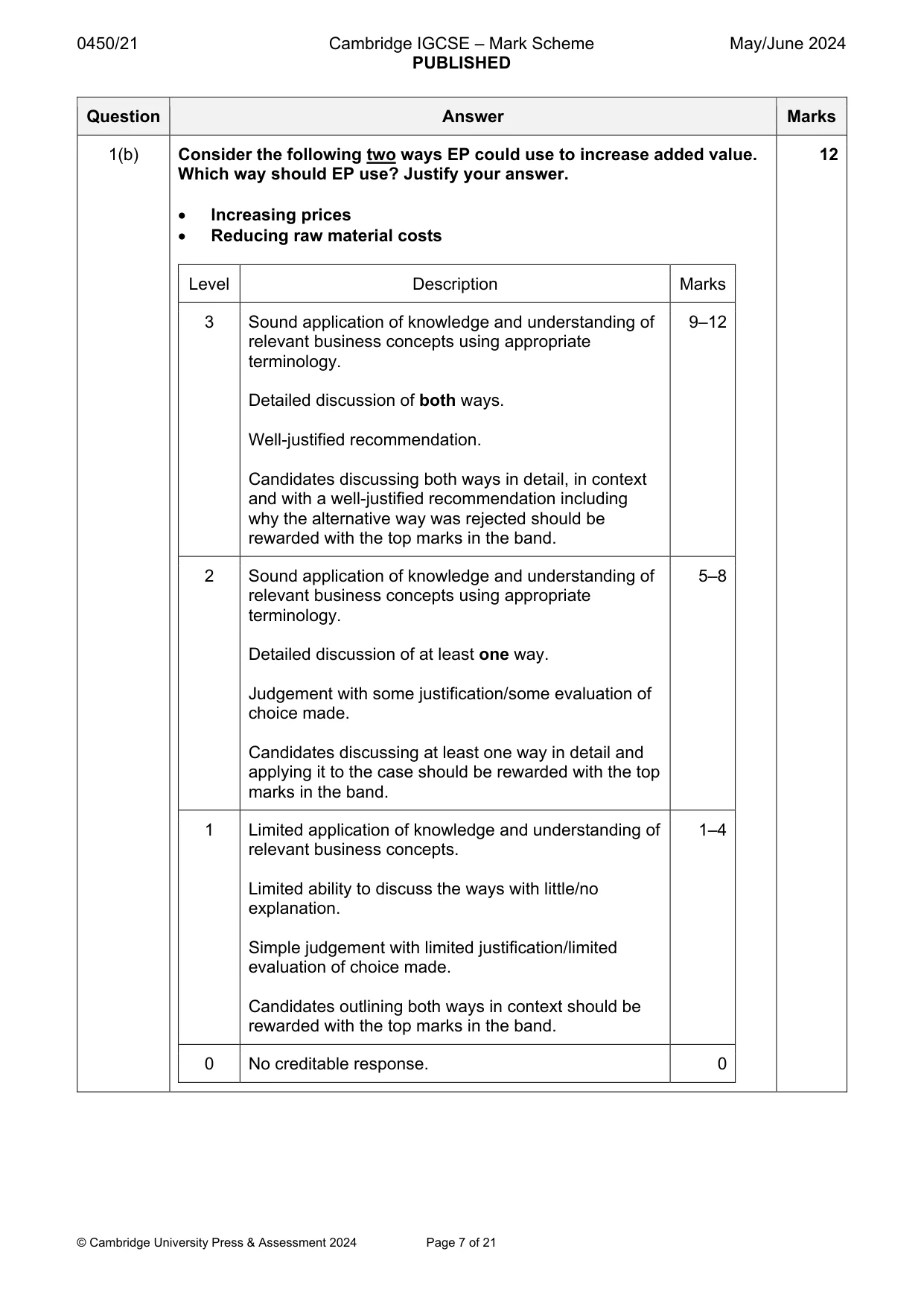
0450/21 Cambridge IGCSE – Mark Scheme PUBLISHED May/June 2024 © Cambridge University Press & Assessment 2024 Page 7 of 21 Question Answer Marks 1(b) Consider the following two ways EP could use to increase added value. Which way should EP use? Justify your answer. Increasing prices Reducing raw material costs Level Description Marks 3 Sound application of knowledge and understanding of relevant business concepts using appropriate terminology. Detailed discussion of both ways. Well-justified recommendation. Candidates discussing both ways in detail, in context and with a well-justified recommendation including why the alternative way was rejected should be rewarded with the top marks in the band. 9–12 2 Sound application of knowledge and understanding of relevant business concepts using appropriate terminology. Detailed discussion of at least one way. Judgement with some justification/some evaluation of choice made. Candidates discussing at least one way in detail and applying it to the case should be rewarded with the top marks in the band. 5–8 1 Limited application of knowledge and understanding of relevant business concepts. Limited ability to discuss the ways with little/no explanation. Simple judgement with limited justification/limited evaluation of choice made. Candidates outlining both ways in context should be rewarded with the top marks in the band. 1–4 0 No creditable response. 0 12
Mark scheme, page 8
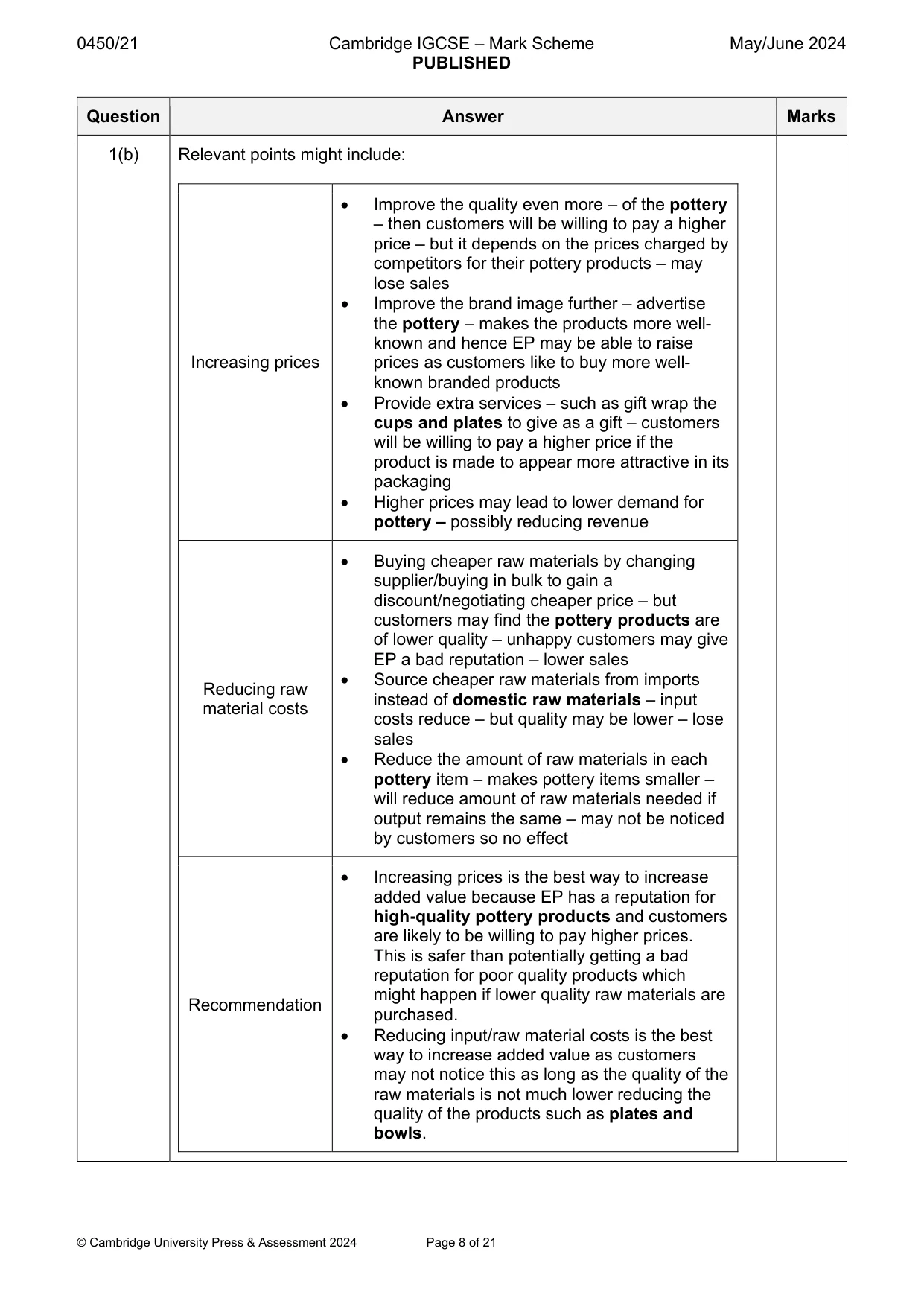
0450/21 Cambridge IGCSE – Mark Scheme PUBLISHED May/June 2024 © Cambridge University Press & Assessment 2024 Page 8 of 21 Question Answer Marks 1(b) Relevant points might include: Increasing prices Improve the quality even more – of the pottery – then customers will be willing to pay a higher price – but it depends on the prices charged by competitors for their pottery products – may lose sales Improve the brand image further – advertise the pottery – makes the products more well- known and hence EP may be able to raise prices as customers like to buy more well- known branded products Provide extra services – such as gift wrap the cups and plates to give as a gift – customers will be willing to pay a higher price if the product is made to appear more attractive in its packaging Higher prices may lead to lower demand for pottery – possibly reducing revenue Reducing raw material costs Buying cheaper raw materials by changing supplier/buying in bulk to gain a discount/negotiating cheaper price – but customers may find the pottery products are of lower quality – unhappy customers may give EP a bad reputation – lower sales Source cheaper raw materials from imports instead of domestic raw materials – input costs reduce – but quality may be lower – lose sales Reduce the amount of raw materials in each pottery item – makes pottery items smaller – will reduce amount of raw materials needed if output remains the same – may not be noticed by customers so no effect Recommendation Increasing prices is the best way to increase added value because EP has a reputation for high-quality pottery products and customers are likely to be willing to pay higher prices. This is safer than potentially getting a bad reputation for poor quality products which might happen if lower quality raw materials are purchased. Reducing input/raw material costs is the best way to increase added value as customers may not notice this as long as the quality of the raw materials is not much lower reducing the quality of the products such as plates and bowls.
Mark scheme, page 9
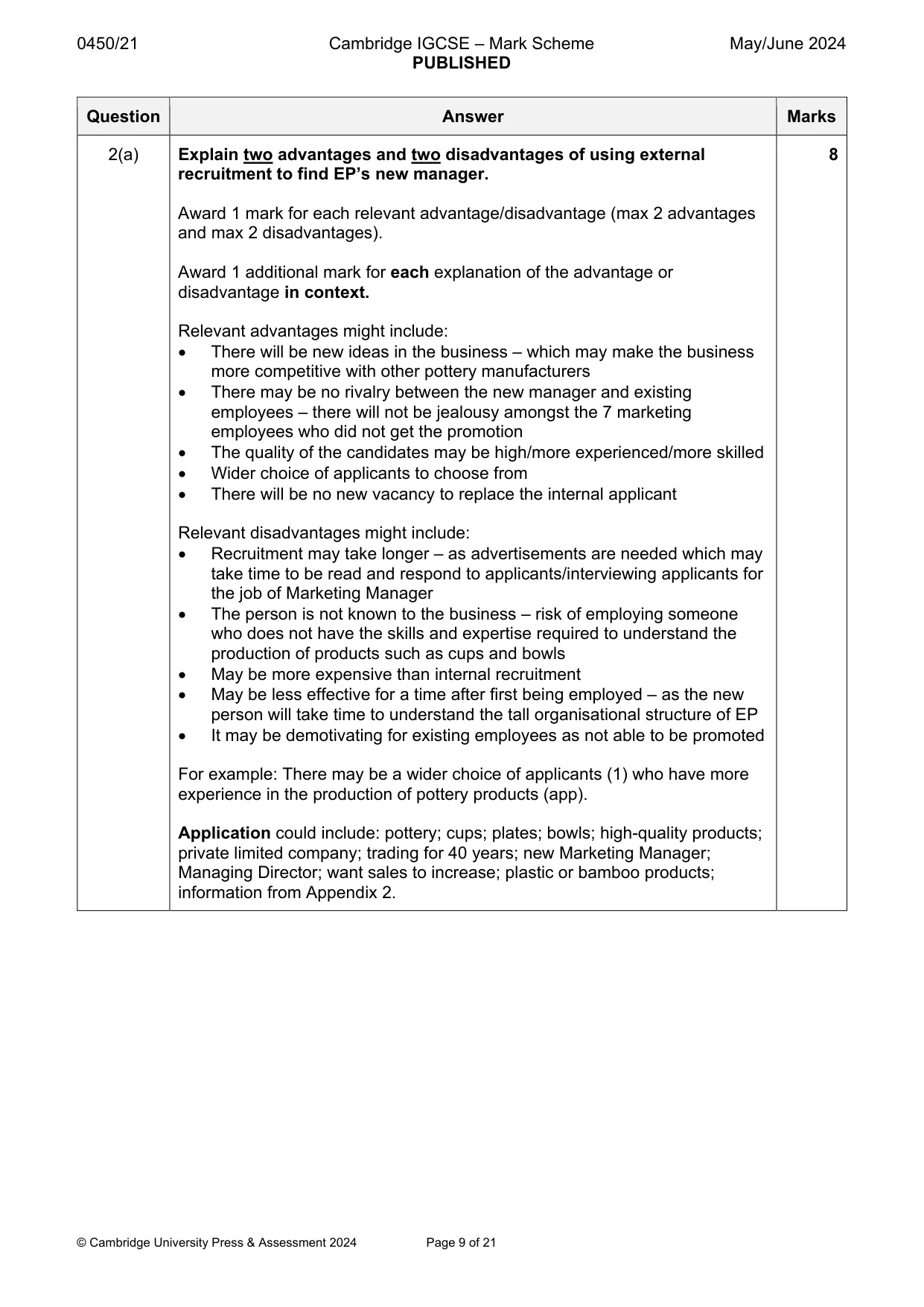
0450/21 Cambridge IGCSE – Mark Scheme PUBLISHED May/June 2024 © Cambridge University Press & Assessment 2024 Page 9 of 21 Question Answer Marks 2(a) Explain two advantages and two disadvantages of using external recruitment to find EP’s new manager. Award 1 mark for each relevant advantage/disadvantage (max 2 advantages and max 2 disadvantages). Award 1 additional mark for each explanation of the advantage or disadvantage in context. Relevant advantages might include: There will be new ideas in the business – which may make the business more competitive with other pottery manufacturers There may be no rivalry between the new manager and existing employees – there will not be jealousy amongst the 7 marketing employees who did not get the promotion The quality of the candidates may be high/more experienced/more skilled Wider choice of applicants to choose from There will be no new vacancy to replace the internal applicant Relevant disadvantages might include: Recruitment may take longer – as advertisements are needed which may take time to be read and respond to applicants/interviewing applicants for the job of Marketing Manager The person is not known to the business – risk of employing someone who does not have the skills and expertise required to understand the production of products such as cups and bowls May be more expensive than internal recruitment May be less effective for a time after first being employed – as the new person will take time to understand the tall organisational structure of EP It may be demotivating for existing employees as not able to be promoted For example: There may be a wider choice of applicants (1) who have more experience in the production of pottery products (app). Application could include: pottery; cups; plates; bowls; high-quality products; private limited company; trading for 40 years; new Marketing Manager; Managing Director; want sales to increase; plastic or bamboo products; information from Appendix 2. 8
Mark scheme, page 10
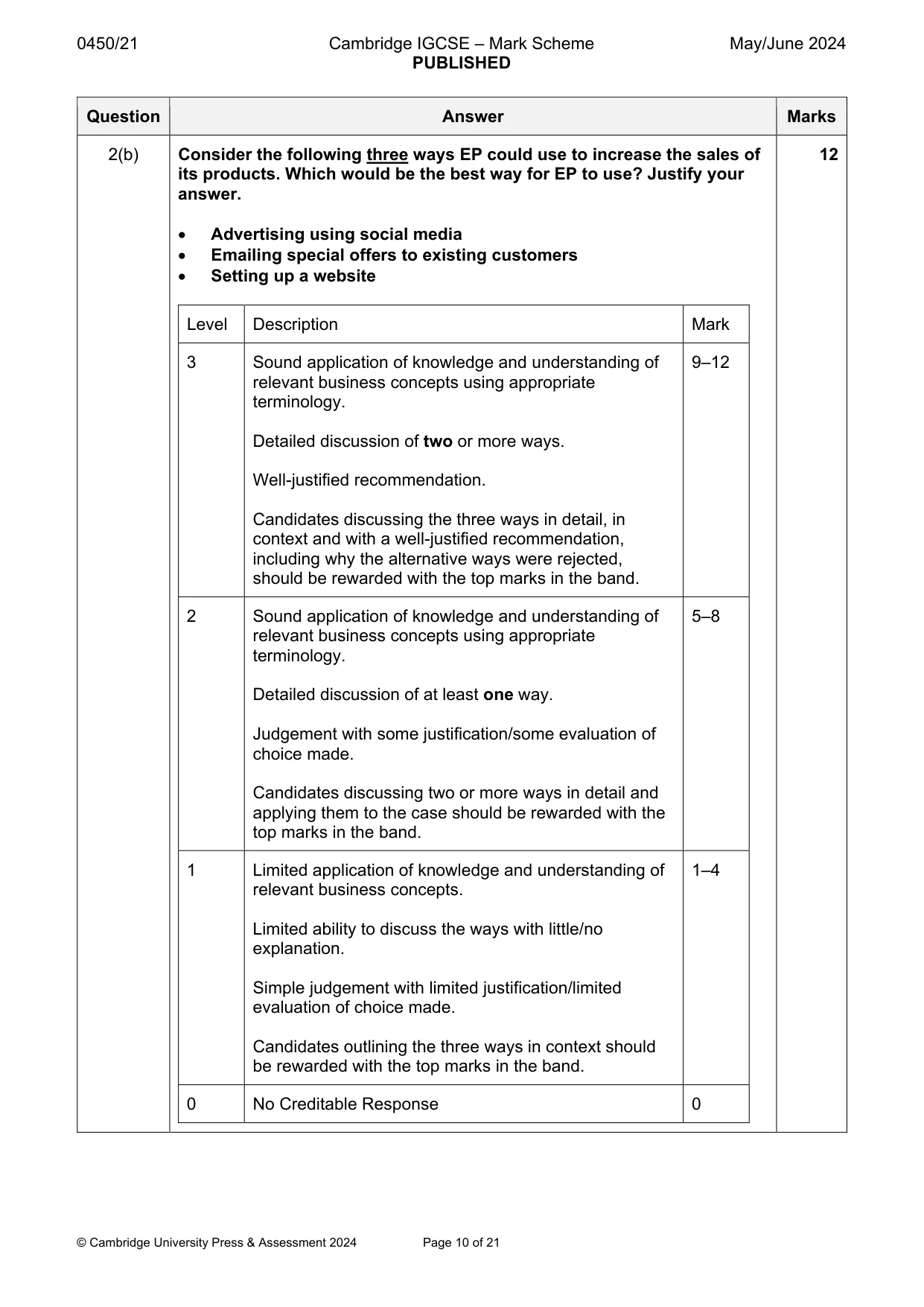
0450/21 Cambridge IGCSE – Mark Scheme PUBLISHED May/June 2024 © Cambridge University Press & Assessment 2024 Page 10 of 21 Question Answer Marks 2(b) Consider the following three ways EP could use to increase the sales of its products. Which would be the best way for EP to use? Justify your answer. Advertising using social media Emailing special offers to existing customers Setting up a website Level Description Mark 3 Sound application of knowledge and understanding of relevant business concepts using appropriate terminology. Detailed discussion of two or more ways. Well-justified recommendation. Candidates discussing the three ways in detail, in context and with a well-justified recommendation, including why the alternative ways were rejected, should be rewarded with the top marks in the band. 9–12 2 Sound application of knowledge and understanding of relevant business concepts using appropriate terminology. Detailed discussion of at least one way. Judgement with some justification/some evaluation of choice made. Candidates discussing two or more ways in detail and applying them to the case should be rewarded with the top marks in the band. 5–8 1 Limited application of knowledge and understanding of relevant business concepts. Limited ability to discuss the ways with little/no explanation. Simple judgement with limited justification/limited evaluation of choice made. Candidates outlining the three ways in context should be rewarded with the top marks in the band. 1–4 0 No Creditable Response 0 12
Mark scheme, page 11
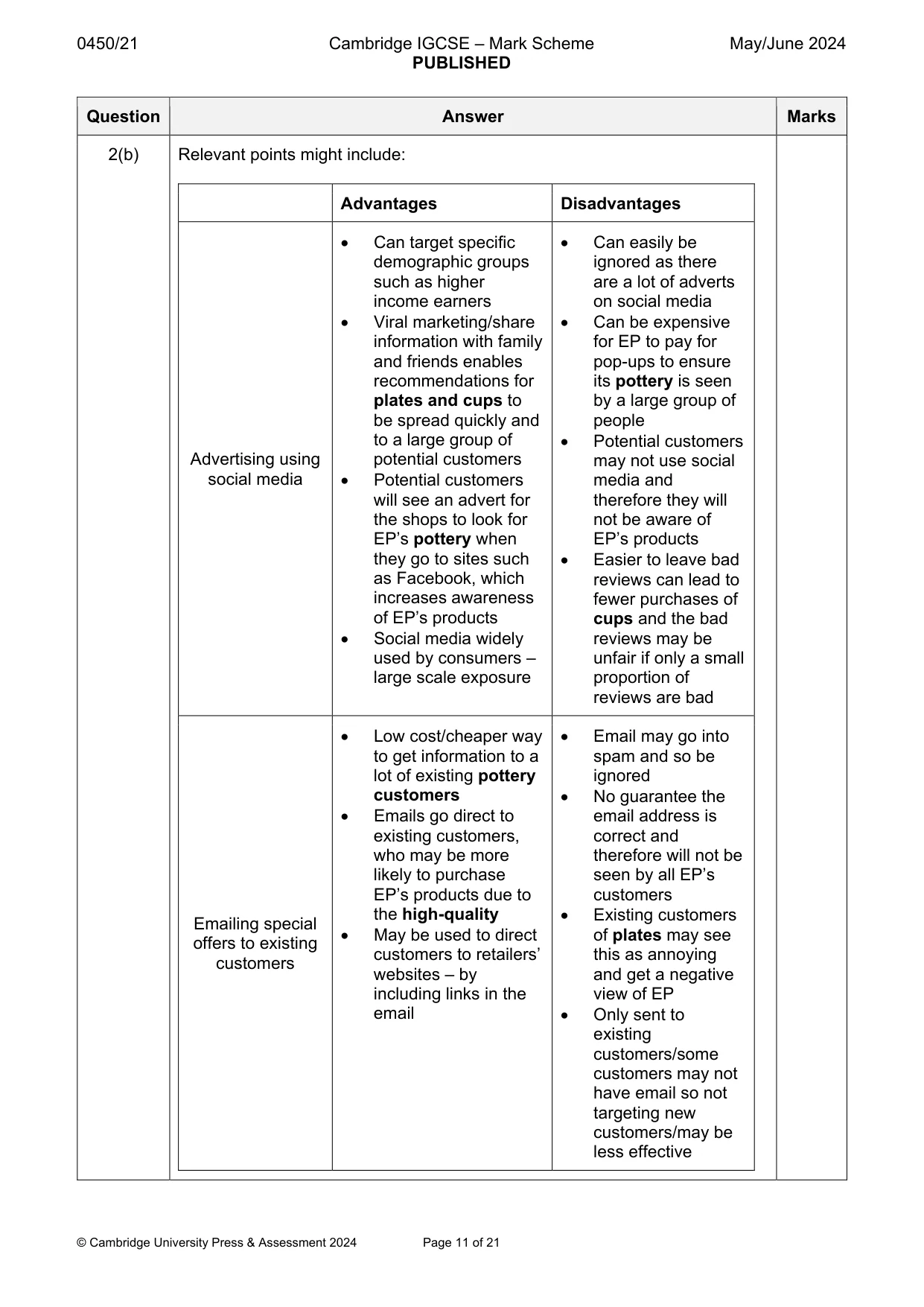
0450/21 Cambridge IGCSE – Mark Scheme PUBLISHED May/June 2024 © Cambridge University Press & Assessment 2024 Page 11 of 21 Question Answer Marks 2(b) Relevant points might include: Advantages Disadvantages Advertising using social media Can target specific demographic groups such as higher income earners Viral marketing/share information with family and friends enables recommendations for plates and cups to be spread quickly and to a large group of potential customers Potential customers will see an advert for the shops to look for EP’s pottery when they go to sites such as Facebook, which increases awareness of EP’s products Social media widely used by consumers – large scale exposure Can easily be ignored as there are a lot of adverts on social media Can be expensive for EP to pay for pop-ups to ensure its pottery is seen by a large group of people Potential customers may not use social media and therefore they will not be aware of EP’s products Easier to leave bad reviews can lead to fewer purchases of cups and the bad reviews may be unfair if only a small proportion of reviews are bad Emailing special offers to existing customers Low cost/cheaper way to get information to a lot of existing pottery customers Emails go direct to existing customers, who may be more likely to purchase EP’s products due to the high-quality May be used to direct customers to retailers’ websites – by including links in the email Email may go into spam and so be ignored No guarantee the email address is correct and therefore will not be seen by all EP’s customers Existing customers of plates may see this as annoying and get a negative view of EP Only sent to existing customers/some customers may not have email so not targeting new customers/may be less effective
Mark scheme, page 12
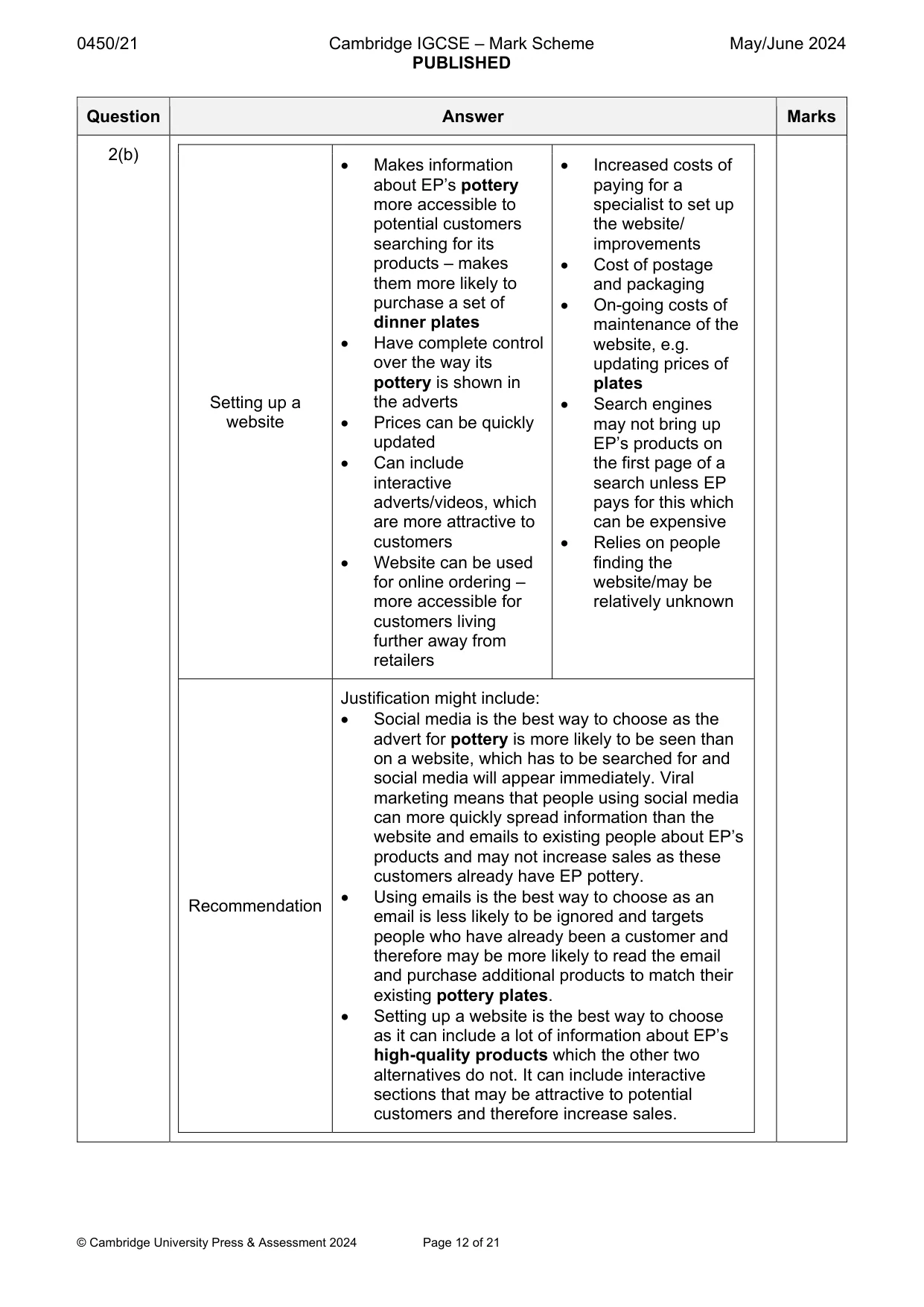
0450/21 Cambridge IGCSE – Mark Scheme PUBLISHED May/June 2024 © Cambridge University Press & Assessment 2024 Page 12 of 21 Question Answer Marks 2(b) Setting up a website Makes information about EP’s pottery more accessible to potential customers searching for its products – makes them more likely to purchase a set of dinner plates Have complete control over the way its pottery is shown in the adverts Prices can be quickly updated Can include interactive adverts/videos, which are more attractive to customers Website can be used for online ordering – more accessible for customers living further away from retailers Increased costs of paying for a specialist to set up the website/ improvements Cost of postage and packaging On-going costs of maintenance of the website, e.g. updating prices of plates Search engines may not bring up EP’s products on the first page of a search unless EP pays for this which can be expensive Relies on people finding the website/may be relatively unknown Recommendation Justification might include: Social media is the best way to choose as the advert for pottery is more likely to be seen than on a website, which has to be searched for and social media will appear immediately. Viral marketing means that people using social media can more quickly spread information than the website and emails to existing people about EP’s products and may not increase sales as these customers already have EP pottery. Using emails is the best way to choose as an email is less likely to be ignored and targets people who have already been a customer and therefore may be more likely to read the email and purchase additional products to match their existing pottery plates. Setting up a website is the best way to choose as it can include a lot of information about EP’s high-quality products which the other two alternatives do not. It can include interactive sections that may be attractive to potential customers and therefore increase sales.
Mark scheme, page 13
0450/21 Cambridge IGCSE – Mark Scheme PUBLISHED May/June 2024 © Cambridge University Press & Assessment 2024 Page 13 of 21 Question Answer Marks 3(a) Explain four reasons why consumer spending patterns for a product might change. Award 1 mark for each reason why consumer spending patterns may have changed (max 4). Award a maximum of one additional mark for each explanation of the reason. There are no application marks for this question. Relevant reasons might include: Changes in consumer tastes and fashions – increased/decreased demand for the products Products no longer meet customer needs – choose to buy alternative products instead Changes in incomes – now/no longer able to afford better quality products The price of a product changes – higher prices usually lead to lower sales Changes in the prices of competitors’ products – if competitors’ products are cheaper then customers will buy from them instead Spending on advertising and promotional activities – if effective then is likely to result in sales increasing for the successfully advertised product Changes in the population/age structure of the population – an increase in the number of older people in the population will increase demand for products that are popular with them New technology means new products become available – this will increase demand for these products/demand for old technology products decreases For example – There are changes in consumer tastes and fashions (1) so if a product becomes less fashionable then demand for these products will decrease (1). 8
Mark scheme, page 14
0450/21 Cambridge IGCSE – Mark Scheme PUBLISHED May/June 2024 © Cambridge University Press & Assessment 2024 Page 14 of 21 Question Answer Marks 3(b) Consider the following two ways EP could increase efficiency in its factory. Which would be the best way for EP to use? Justify your answer. Improving labour skills Introducing more automation and technology Level Description Marks 3 Sound application of knowledge and understanding of relevant business concepts using appropriate terminology. Detailed discussion of both ways. Well-justified recommendation. Candidates discussing both ways in detail, in context and with a well-justified recommendation, including why the alternative way was rejected, should be rewarded with the top marks in the band. 9–12 2 Sound application of knowledge and understanding of relevant business concepts using appropriate terminology. Detailed discussion of at least one way. Judgement with some justification/some evaluation of choices made. Candidates discussing at least one way in detail and applying it to the case should be rewarded with the top marks in the band. 5–8 1 Limited application of knowledge and understanding of relevant business concepts. Limited ability to discuss the ways with little/no explanation. Simple judgement with limited justification/limited evaluation of choices made. Candidates outlining both ways in context should be rewarded with the top marks in the band. 1–4 0 No creditable response. 0 12
Mark scheme, page 15
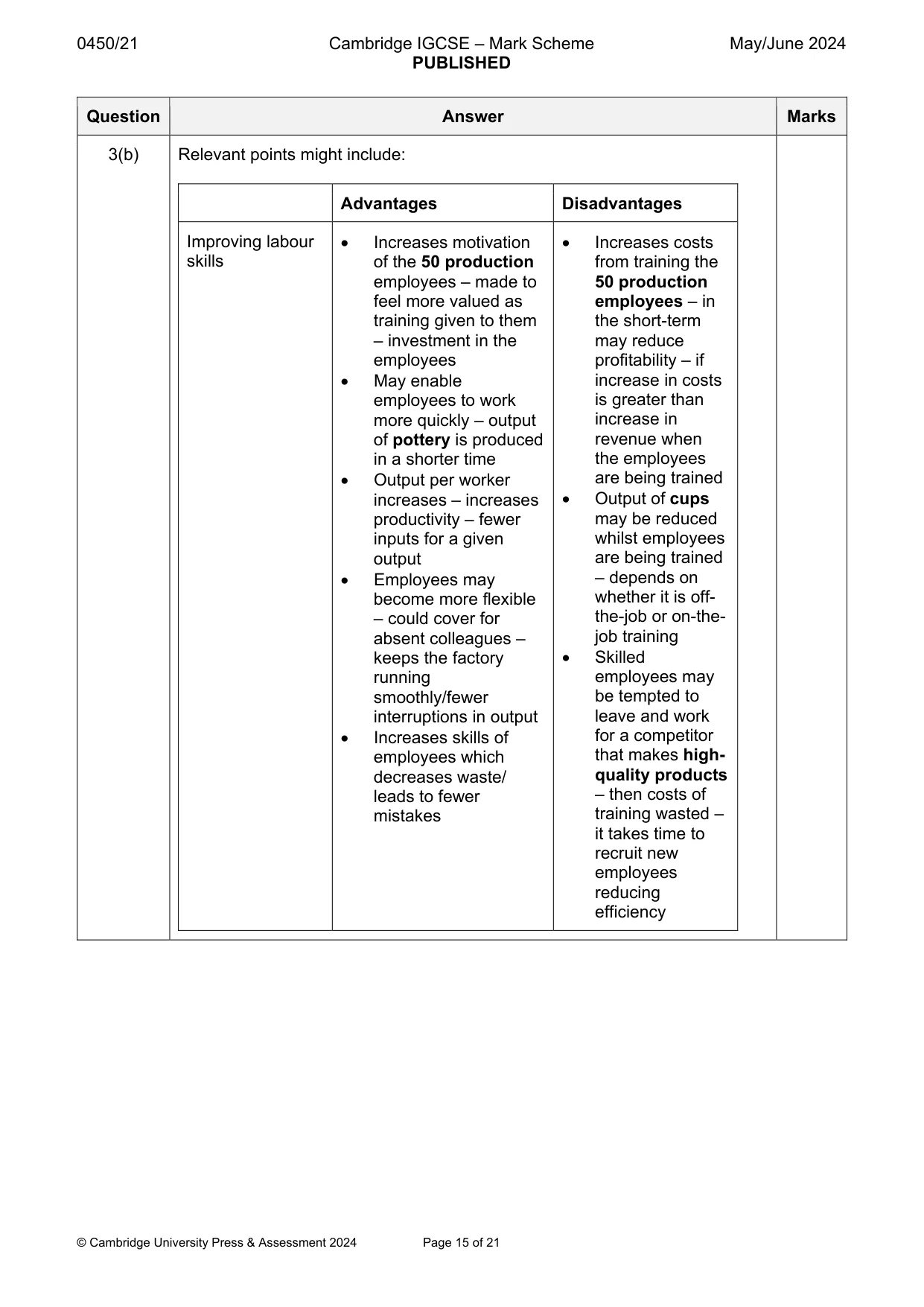
0450/21 Cambridge IGCSE – Mark Scheme PUBLISHED May/June 2024 © Cambridge University Press & Assessment 2024 Page 15 of 21 Question Answer Marks 3(b) Relevant points might include: Advantages Disadvantages Improving labour skills Increases motivation of the 50 production employees – made to feel more valued as training given to them – investment in the employees May enable employees to work more quickly – output of pottery is produced in a shorter time Output per worker increases – increases productivity – fewer inputs for a given output Employees may become more flexible – could cover for absent colleagues – keeps the factory running smoothly/fewer interruptions in output Increases skills of employees which decreases waste/ leads to fewer mistakes Increases costs from training the 50 production employees – in the short-term may reduce profitability – if increase in costs is greater than increase in revenue when the employees are being trained Output of cups may be reduced whilst employees are being trained – depends on whether it is off- the-job or on-the- job training Skilled employees may be tempted to leave and work for a competitor that makes high- quality products – then costs of training wasted – it takes time to recruit new employees reducing efficiency
Mark scheme, page 16
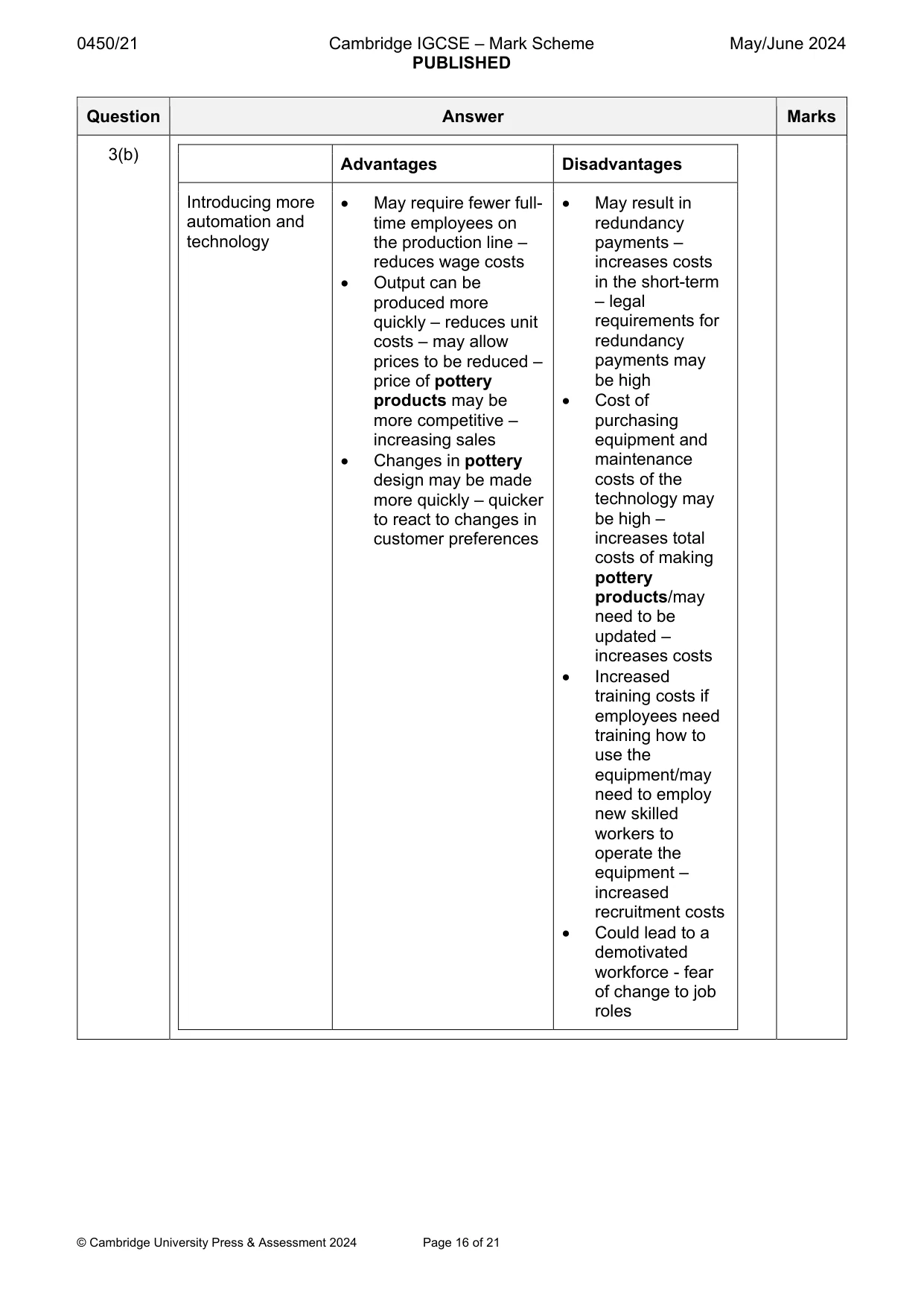
0450/21 Cambridge IGCSE – Mark Scheme PUBLISHED May/June 2024 © Cambridge University Press & Assessment 2024 Page 16 of 21 Question Answer Marks 3(b) Advantages Disadvantages Introducing more automation and technology May require fewer full- time employees on the production line – reduces wage costs Output can be produced more quickly – reduces unit costs – may allow prices to be reduced – price of pottery products may be more competitive – increasing sales Changes in pottery design may be made more quickly – quicker to react to changes in customer preferences May result in redundancy payments – increases costs in the short-term – legal requirements for redundancy payments may be high Cost of purchasing equipment and maintenance costs of the technology may be high – increases total costs of making pottery products/may need to be updated – increases costs Increased training costs if employees need training how to use the equipment/may need to employ new skilled workers to operate the equipment – increased recruitment costs Could lead to a demotivated workforce - fear of change to job roles
Mark scheme, page 17
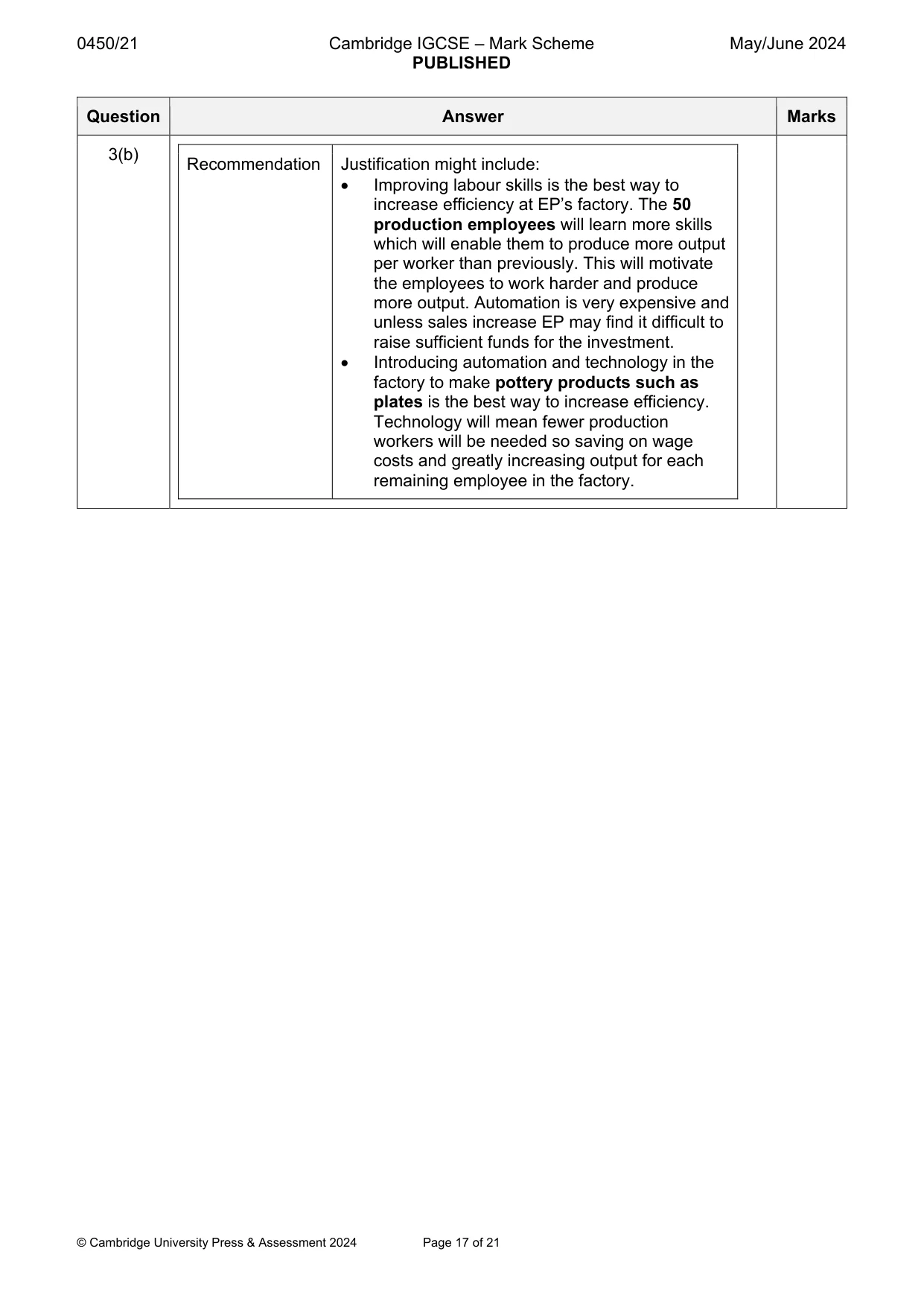
0450/21 Cambridge IGCSE – Mark Scheme PUBLISHED May/June 2024 © Cambridge University Press & Assessment 2024 Page 17 of 21 Question Answer Marks 3(b) Recommendation Justification might include: Improving labour skills is the best way to increase efficiency at EP’s factory. The 50 production employees will learn more skills which will enable them to produce more output per worker than previously. This will motivate the employees to work harder and produce more output. Automation is very expensive and unless sales increase EP may find it difficult to raise sufficient funds for the investment. Introducing automation and technology in the factory to make pottery products such as plates is the best way to increase efficiency. Technology will mean fewer production workers will be needed so saving on wage costs and greatly increasing output for each remaining employee in the factory.
Mark scheme, page 18
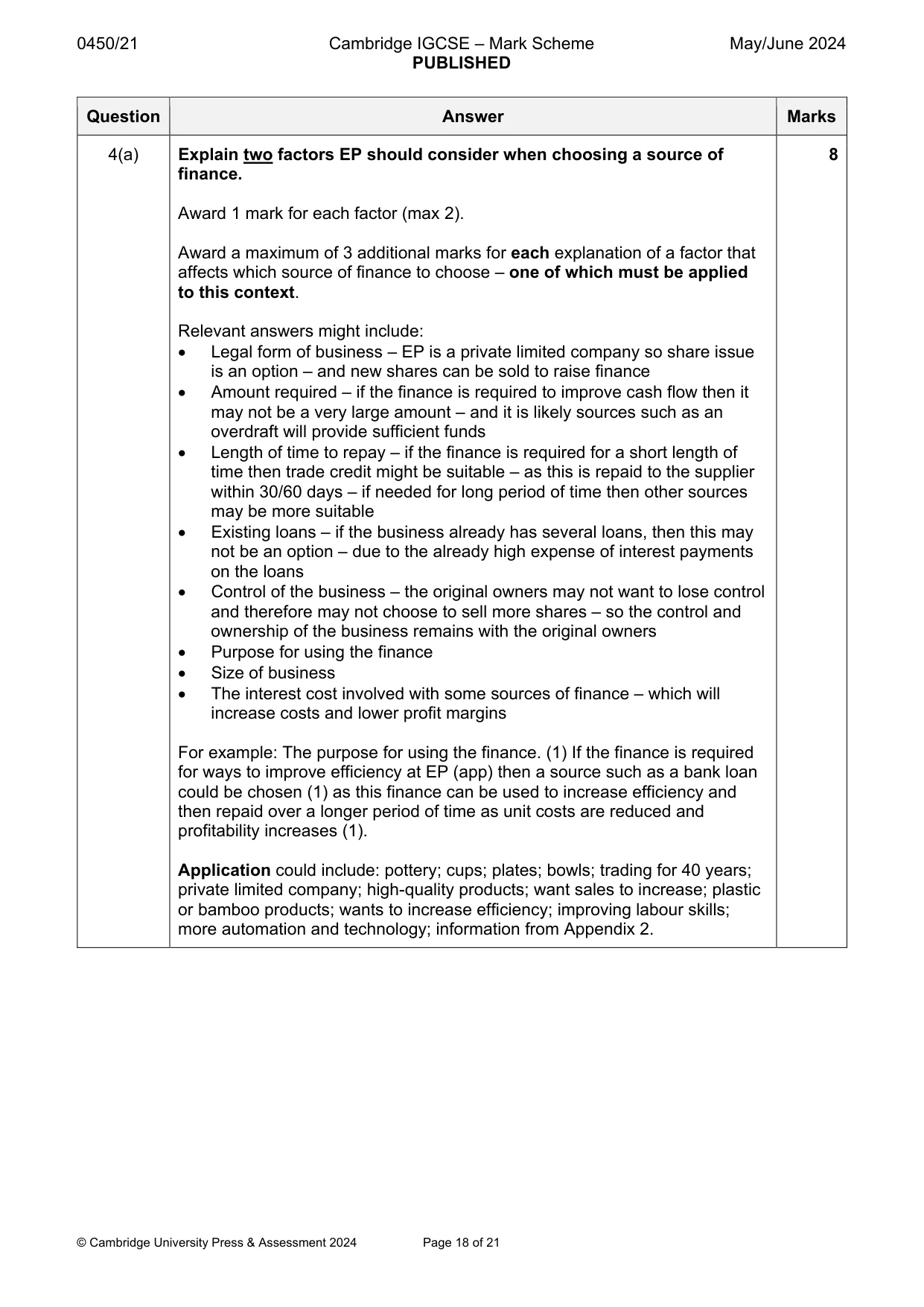
0450/21 Cambridge IGCSE – Mark Scheme PUBLISHED May/June 2024 © Cambridge University Press & Assessment 2024 Page 18 of 21 Question Answer Marks 4(a) Explain two factors EP should consider when choosing a source of finance. Award 1 mark for each factor (max 2). Award a maximum of 3 additional marks for each explanation of a factor that affects which source of finance to choose – one of which must be applied to this context. Relevant answers might include: Legal form of business – EP is a private limited company so share issue is an option – and new shares can be sold to raise finance Amount required – if the finance is required to improve cash flow then it may not be a very large amount – and it is likely sources such as an overdraft will provide sufficient funds Length of time to repay – if the finance is required for a short length of time then trade credit might be suitable – as this is repaid to the supplier within 30/60 days – if needed for long period of time then other sources may be more suitable Existing loans – if the business already has several loans, then this may not be an option – due to the already high expense of interest payments on the loans Control of the business – the original owners may not want to lose control and therefore may not choose to sell more shares – so the control and ownership of the business remains with the original owners Purpose for using the finance Size of business The interest cost involved with some sources of finance – which will increase costs and lower profit margins For example: The purpose for using the finance. (1) If the finance is required for ways to improve efficiency at EP (app) then a source such as a bank loan could be chosen (1) as this finance can be used to increase efficiency and then repaid over a longer period of time as unit costs are reduced and profitability increases (1). Application could include: pottery; cups; plates; bowls; trading for 40 years; private limited company; high-quality products; want sales to increase; plastic or bamboo products; wants to increase efficiency; improving labour skills; more automation and technology; information from Appendix 2. 8
Mark scheme, page 19
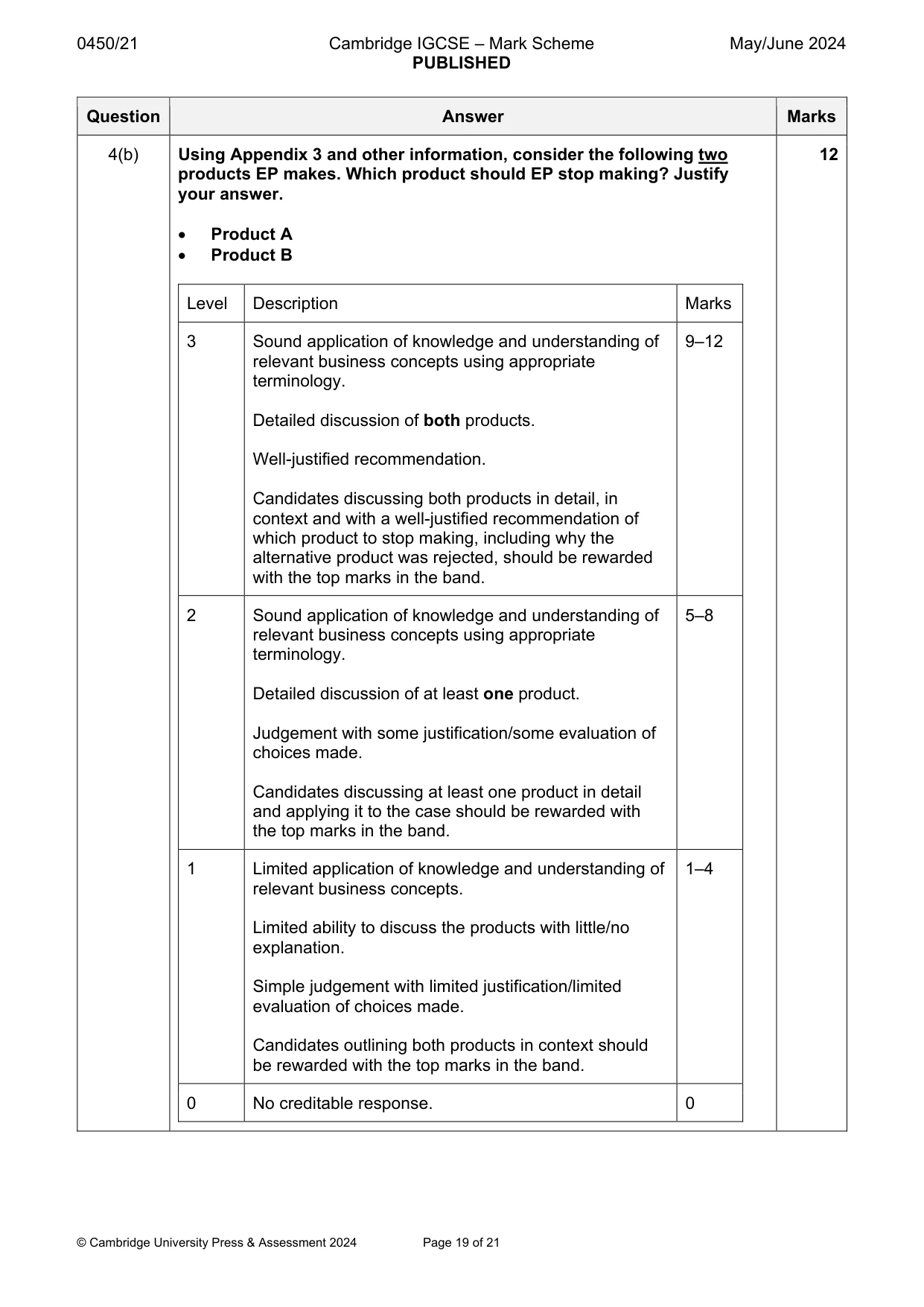
0450/21 Cambridge IGCSE – Mark Scheme PUBLISHED May/June 2024 © Cambridge University Press & Assessment 2024 Page 19 of 21 Question Answer Marks 4(b) Using Appendix 3 and other information, consider the following two products EP makes. Which product should EP stop making? Justify your answer. Product A Product B Level Description Marks 3 Sound application of knowledge and understanding of relevant business concepts using appropriate terminology. Detailed discussion of both products. Well-justified recommendation. Candidates discussing both products in detail, in context and with a well-justified recommendation of which product to stop making, including why the alternative product was rejected, should be rewarded with the top marks in the band. 9–12 2 Sound application of knowledge and understanding of relevant business concepts using appropriate terminology. Detailed discussion of at least one product. Judgement with some justification/some evaluation of choices made. Candidates discussing at least one product in detail and applying it to the case should be rewarded with the top marks in the band. 5–8 1 Limited application of knowledge and understanding of relevant business concepts. Limited ability to discuss the products with little/no explanation. Simple judgement with limited justification/limited evaluation of choices made. Candidates outlining both products in context should be rewarded with the top marks in the band. 1–4 0 No creditable response. 0 12
Mark scheme, page 20
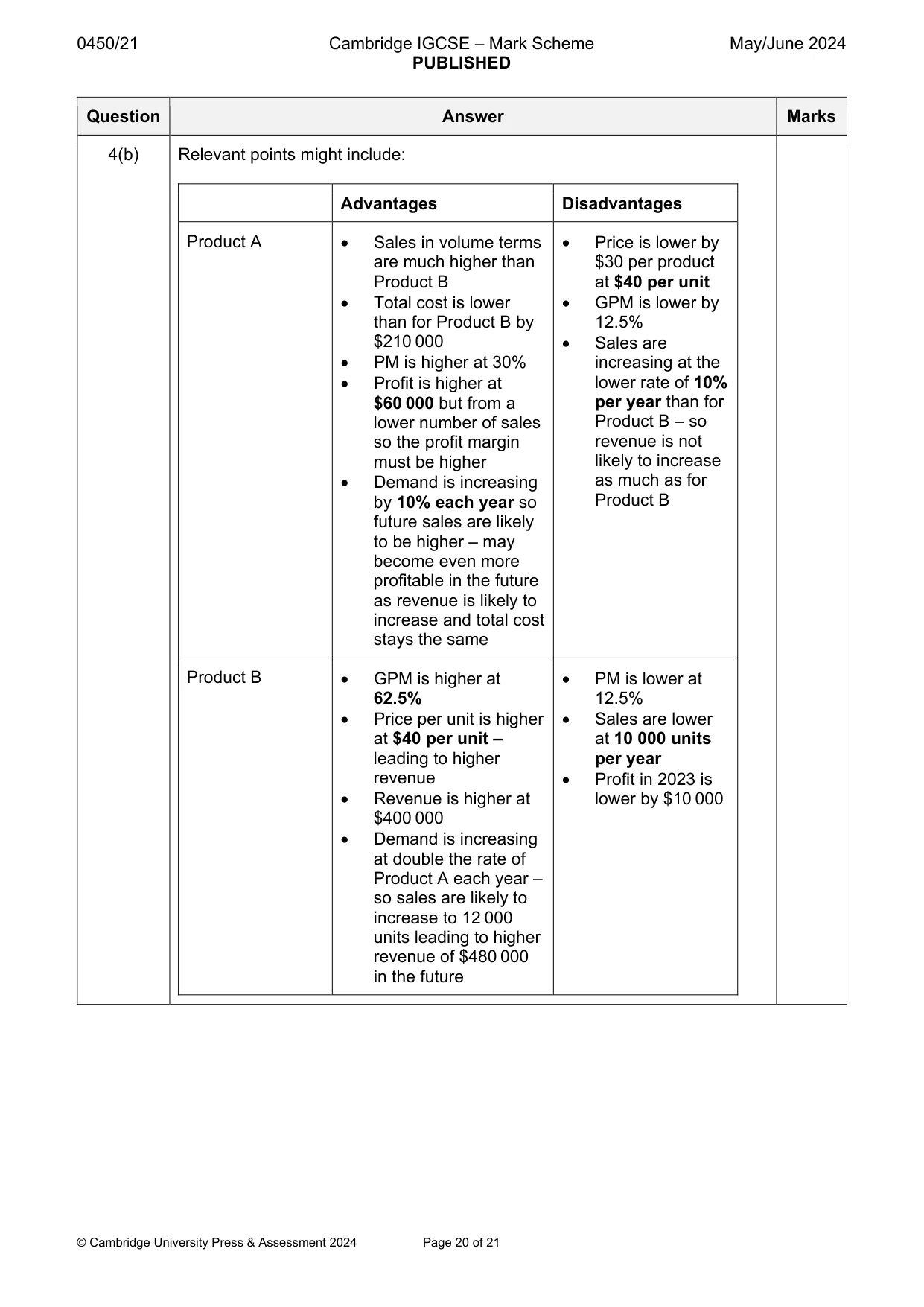
0450/21 Cambridge IGCSE – Mark Scheme PUBLISHED May/June 2024 © Cambridge University Press & Assessment 2024 Page 20 of 21 Question Answer Marks 4(b) Relevant points might include: Advantages Disadvantages Product A Sales in volume terms are much higher than Product B Total cost is lower than for Product B by $210 000 PM is higher at 30% Profit is higher at $60 000 but from a lower number of sales so the profit margin must be higher Demand is increasing by 10% each year so future sales are likely to be higher – may become even more profitable in the future as revenue is likely to increase and total cost stays the same Price is lower by $30 per product at $40 per unit GPM is lower by 12.5% Sales are increasing at the lower rate of 10% per year than for Product B – so revenue is not likely to increase as much as for Product B Product B GPM is higher at 62.5% Price per unit is higher at $40 per unit – leading to higher revenue Revenue is higher at $400 000 Demand is increasing at double the rate of Product A each year – so sales are likely to increase to 12 000 units leading to higher revenue of $480 000 in the future PM is lower at 12.5% Sales are lower at 10 000 units per year Profit in 2023 is lower by $10 000
Mark scheme, page 21
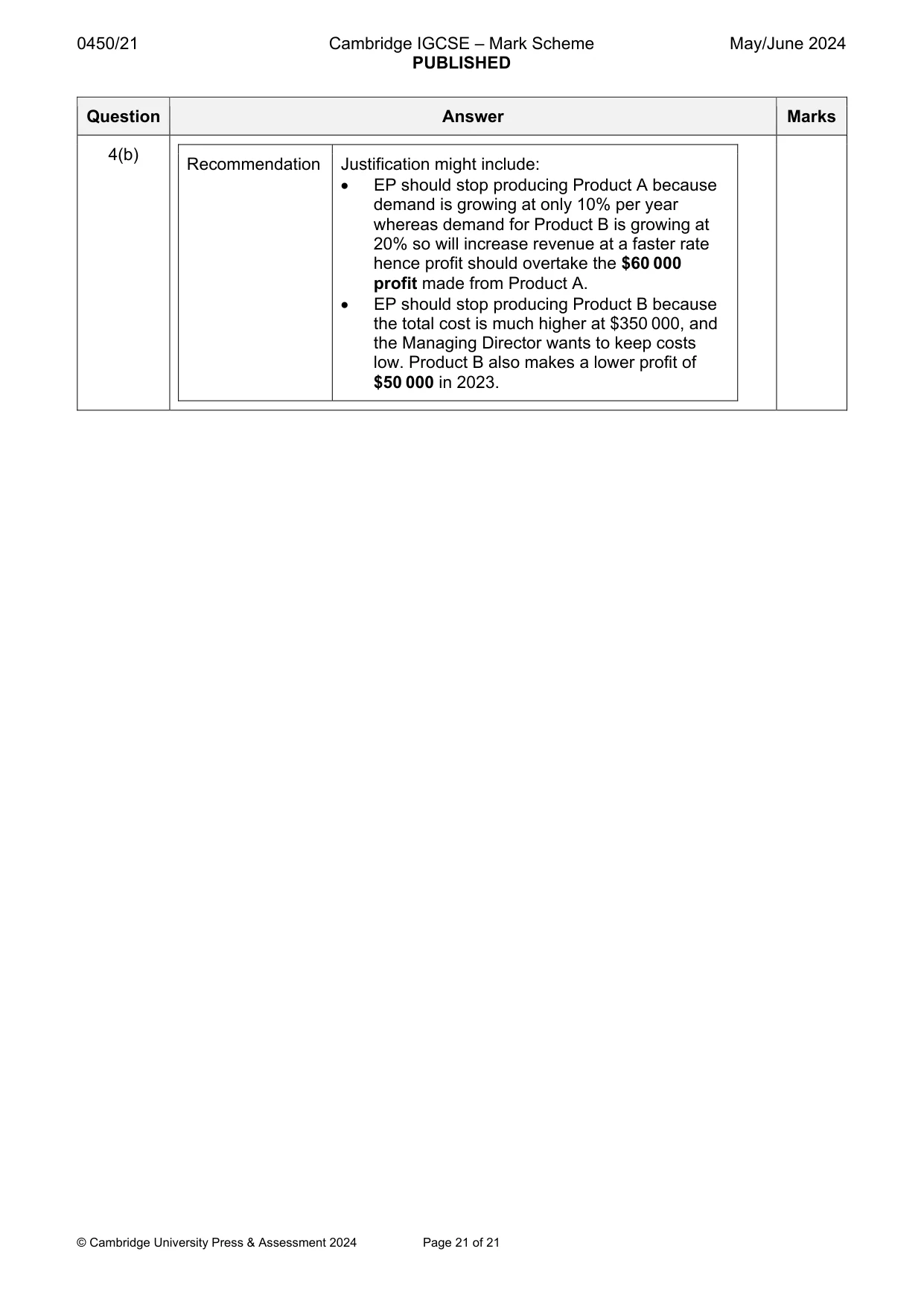
0450/21 Cambridge IGCSE – Mark Scheme PUBLISHED May/June 2024 © Cambridge University Press & Assessment 2024 Page 21 of 21 Question Answer Marks 4(b) Recommendation Justification might include: EP should stop producing Product A because demand is growing at only 10% per year whereas demand for Product B is growing at 20% so will increase revenue at a faster rate hence profit should overtake the $60 000 profit made from Product A. EP should stop producing Product B because the total cost is much higher at $350 000, and the Managing Director wants to keep costs low. Product B also makes a lower profit of $50 000 in 2023.
What you needed in this session
Cambridge’s own grade thresholds for 2024 May/June, Paper 2 · Variant 1. A higher threshold means an easier paper — the bar moves with how the cohort did.