Cambridge IGCSE Business Studies 0450 — 2021 May/June Paper 2 · Variant 3
0450/23/M/J/21 · 80 marks · ≈90 min
The question paper and its mark scheme, free to read here and free to download. This is Cambridge’s own paper, exactly as it was sat.
Question paper12 pages





Mark scheme17 pages
Answers below. Sit the paper first if you are practising.

Paper as text
Question paper, page 1
Cambridge IGCSE™ 0450/23 May/June 2021 1 hour 30 minutes BUSINESS STUDIES Paper 2 Case Study You must answer on the question paper. You will need: Insert (enclosed) INSTRUCTIONS • Answer all questions. • Use a black or dark blue pen. You may use an HB pencil for any diagrams or graphs. • Write your name, centre number and candidate number in the boxes at the top of the page. • Write your answer to each question in the space provided. • Do not use an erasable pen or correction fluid. • Do not write on any bar codes. • You may use a calculator. INFORMATION • The total mark for this paper is 80. • The number of marks for each question or part question is shown in brackets [ ]. • The insert contains the case study. This document has 12 pages. Any blank pages are indicated. [Turn over 06_0450_23_2021_1.14 © UCLES 2021 *9030633940*
Question paper, page 2
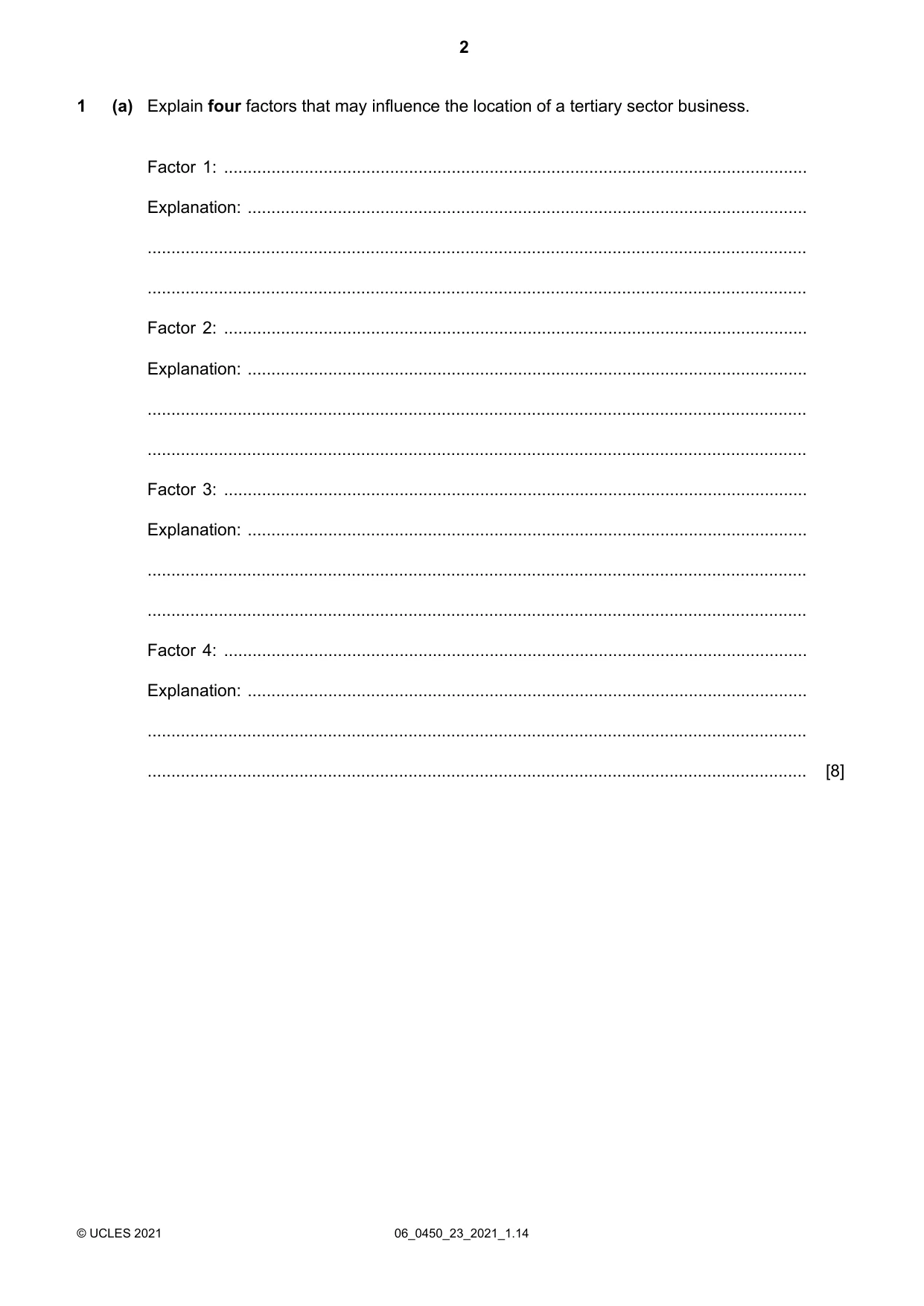
Explain four factors that may influence the location of a tertiary sector business. (a) 1 Factor 1: … Explanation: … … … Factor 2: … Explanation: … … … Factor 3: … Explanation: … … … Factor 4: … Explanation: … … … [8] 06_0450_23_2021_1.14 © UCLES 2021 2
Question paper, page 3
Explain how the following three factors could cause Ruben’s new business to fail: (b) • Lack of management experience • Insufficient working capital • Poor planning Which factor do you think is most important to Ruben? Justify your answer. Lack of management experience: … … … … … … Insufficient working capital: … … … … … … Poor planning: … … … … … … Conclusion: … … … … … … [12] [Turn over 06_0450_23_2021_1.14 © UCLES 2021 3
Question paper, page 4
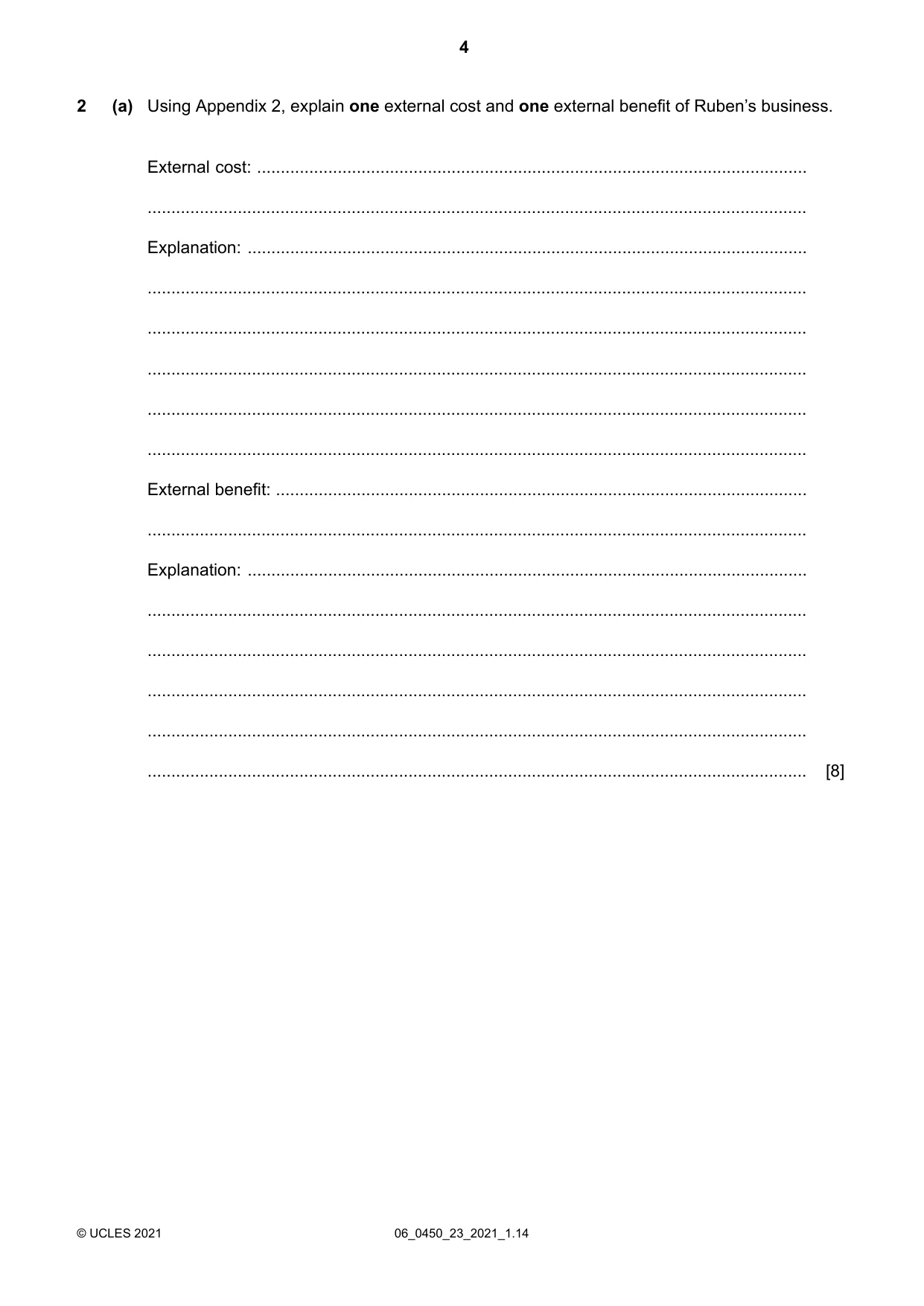
Using Appendix 2, explain one external cost and one external benefit of Ruben’s business. (a) 2 External cost: … … Explanation: … … … … … … External benefit: … … Explanation: … … … … … … [8] 06_0450_23_2021_1.14 © UCLES 2021 4
Question paper, page 5
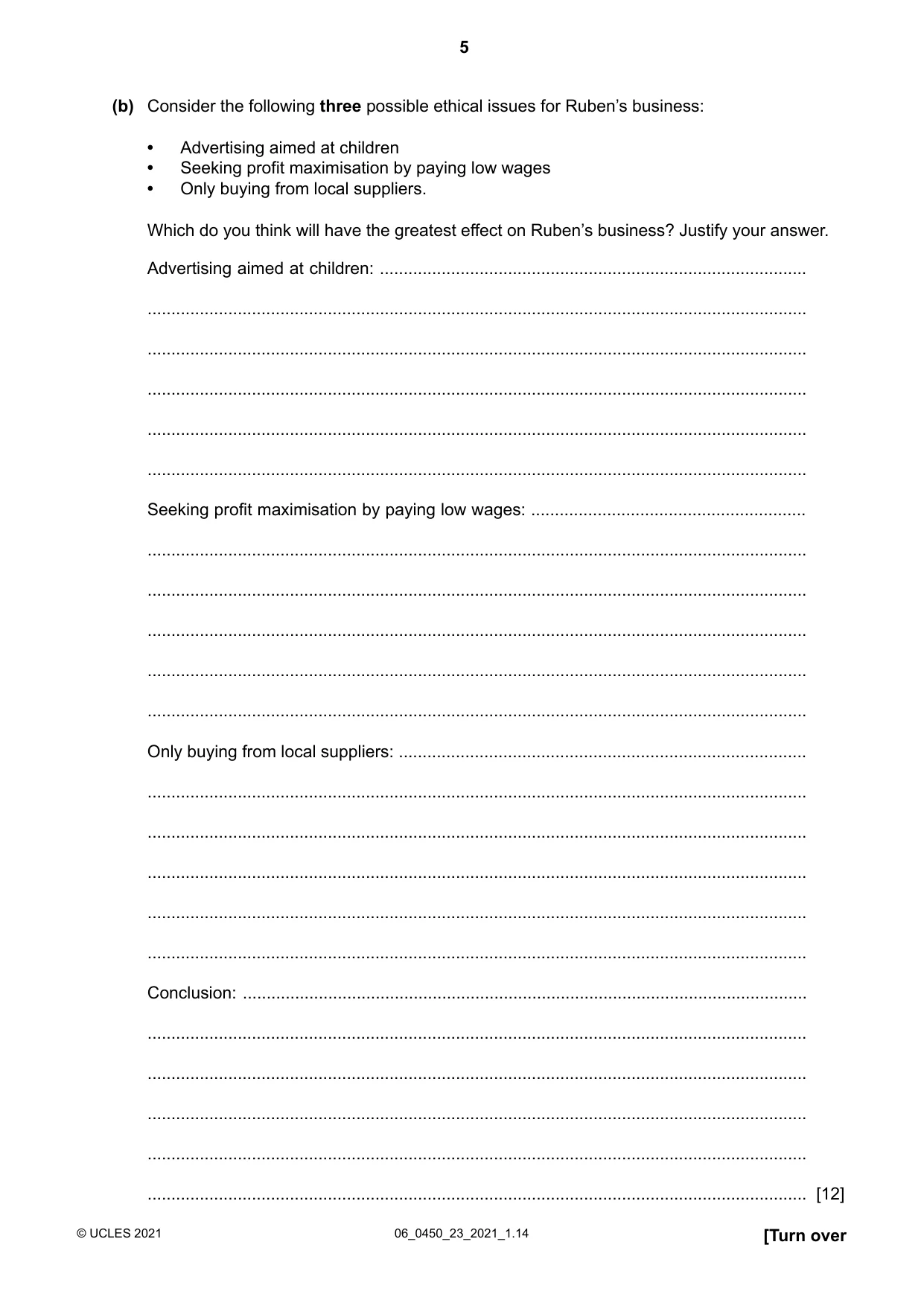
Consider the following three possible ethical issues for Ruben’s business: (b) • Advertising aimed at children • Seeking profit maximisation by paying low wages • Only buying from local suppliers. Which do you think will have the greatest effect on Ruben’s business? Justify your answer. Advertising aimed at children: … … … … … … Seeking profit maximisation by paying low wages: … … … … … … Only buying from local suppliers: … … … … … … Conclusion: … … … … … … [12] [Turn over 06_0450_23_2021_1.14 © UCLES 2021 5
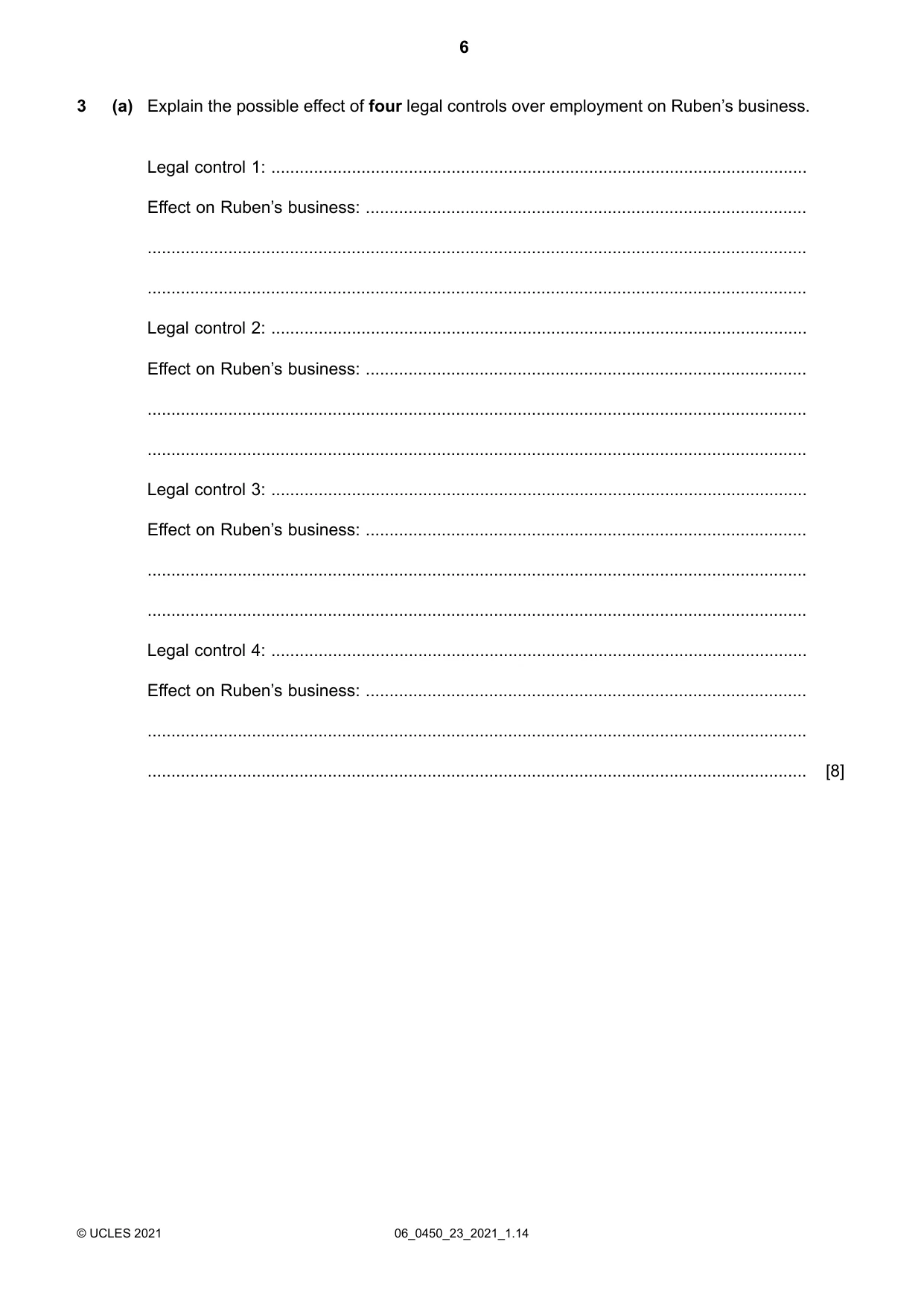
Question paper, page 6
Explain the possible effect of four legal controls over employment on Ruben’s business. (a) 3 Legal control 1: … Effect on Ruben’s business: … … … Legal control 2: … Effect on Ruben’s business: … … … Legal control 3: … Effect on Ruben’s business: … … … Legal control 4: … Effect on Ruben’s business: … … … [8] 06_0450_23_2021_1.14 © UCLES 2021 6
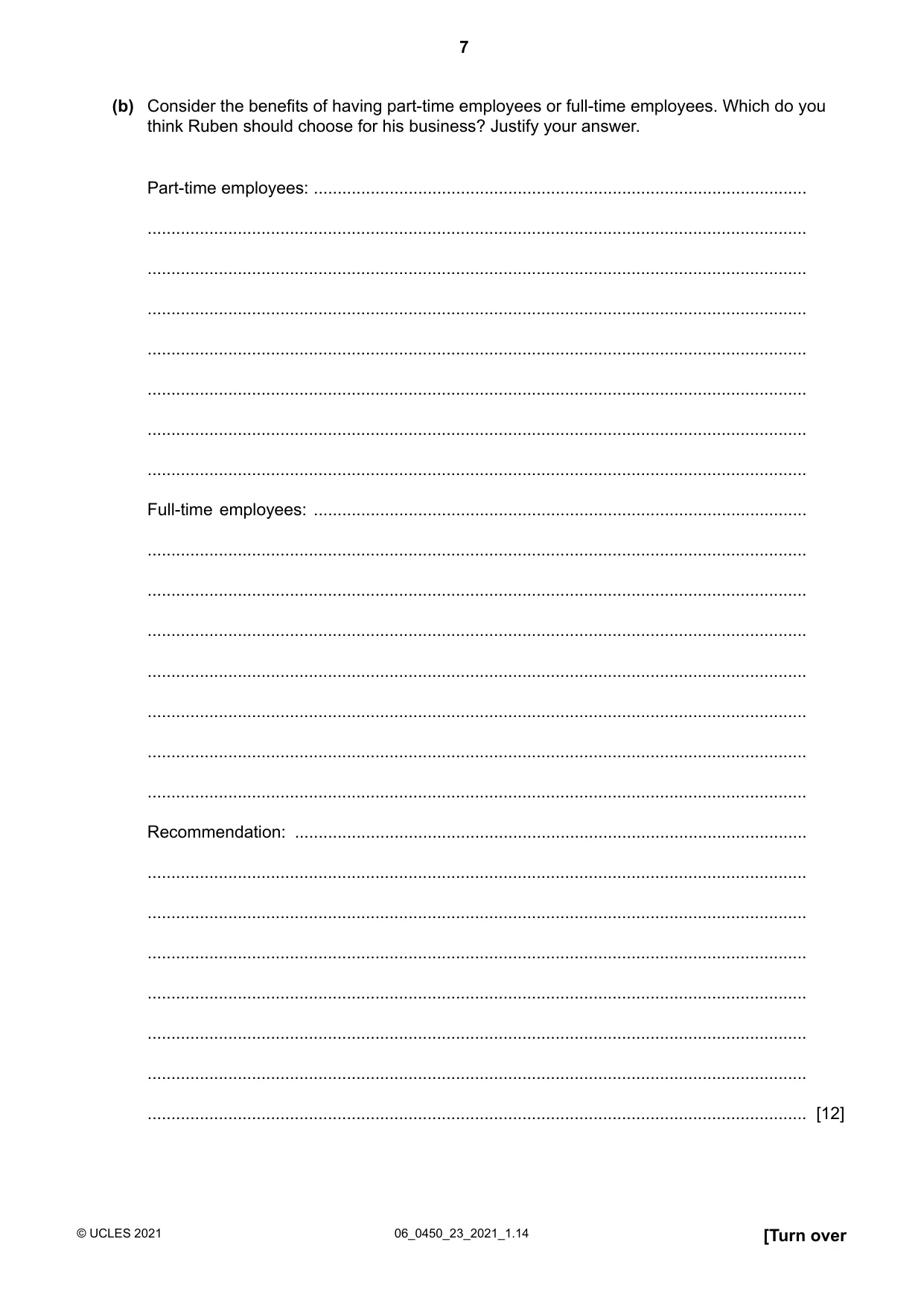
Question paper, page 7
Consider the benefits of having part-time employees or full-time employees. Which do you think Ruben should choose for his business? Justify your answer. (b) Part-time employees: … … … … … … … … Full-time employees: … … … … … … … … Recommendation: … … … … … … … … [12] [Turn over 06_0450_23_2021_1.14 © UCLES 2021 7
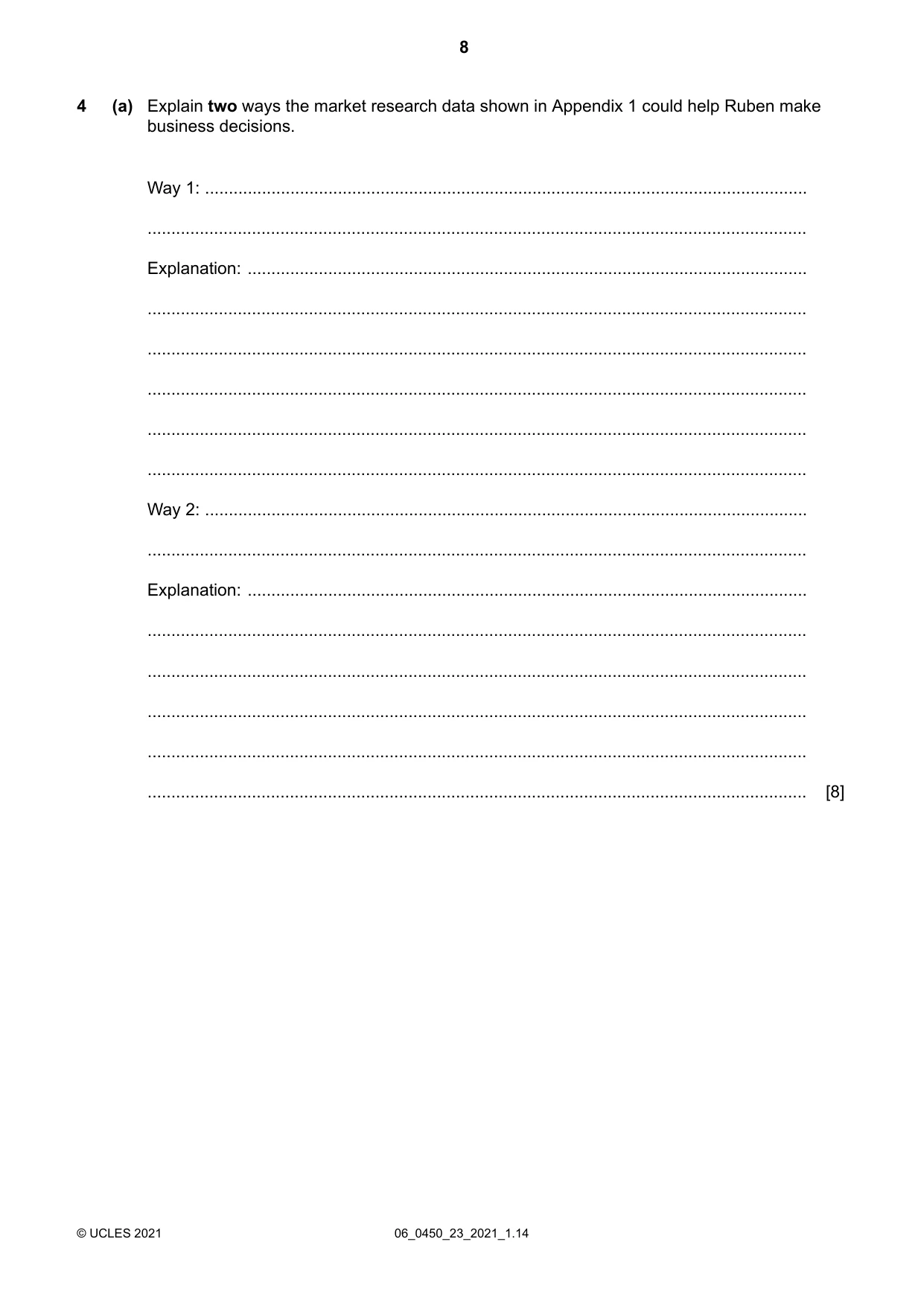
Question paper, page 8
Explain two ways the market research data shown in Appendix 1 could help Ruben make business decisions. (a) 4 Way 1: … … Explanation: … … … … … … Way 2: … … Explanation: … … … … … … [8] 06_0450_23_2021_1.14 © UCLES 2021 8
Question paper, page 9
Consider the advantages and disadvantages of the three sources of finance outlined in Appendix 3 if Ruben chooses to buy the franchise. Which source of finance should Ruben choose? Justify your choice using cost calculations for each source. (b) Bank loan 1 year: … … … … … … Bank loan 3 years: … … … … … … Inheritance from grandparents: … … … … … … Recommendation: … … … … … … [12] 06_0450_23_2021_1.14 © UCLES 2021 9
Question paper, page 10
BLANK PAGE 06_0450_23_2021_1.14 © UCLES 2021 10
Question paper, page 11
BLANK PAGE 06_0450_23_2021_1.14 © UCLES 2021 11
Question paper, page 12
BLANK PAGE Permission to reproduce items where third-party owned material protected by copyright is included has been sought and cleared where possible. Every reasonable effort has been made by the publisher (UCLES) to trace copyright holders, but if any items requiring clearance have unwittingly been included, the publisher will be pleased to make amends at the earliest possible opportunity. To avoid the issue of disclosure of answer-related information to candidates, all copyright acknowledgements are reproduced online in the Cambridge Assessment International Education Copyright Acknowledgements Booklet. This is produced for each series of examinations and is freely available to download at www.cambridgeinternational.org after the live examination series. Cambridge Assessment International Education is part of the Cambridge Assessment Group. Cambridge Assessment is the brand name of the University of Cambridge Local Examinations Syndicate (UCLES), which itself is a department of the University of Cambridge. 06_0450_23_2021_1.14 © UCLES 2021 12
Mark scheme, page 1
This document consists of 17 printed pages. © UCLES 2021 [Turn over Cambridge IGCSE™ BUSINESS STUDIES 0450/23 Paper 2 Case Study May/June 2021 MARK SCHEME Maximum Mark: 80 Published This mark scheme is published as an aid to teachers and candidates, to indicate the requirements of the examination. It shows the basis on which Examiners were instructed to award marks. It does not indicate the details of the discussions that took place at an Examiners’ meeting before marking began, which would have considered the acceptability of alternative answers. Mark schemes should be read in conjunction with the question paper and the Principal Examiner Report for Teachers. Cambridge International will not enter into discussions about these mark schemes. Cambridge International is publishing the mark schemes for the May/June 2021 series for most Cambridge IGCSE™, Cambridge International A and AS Level components and some Cambridge O Level components.
Mark scheme, page 2
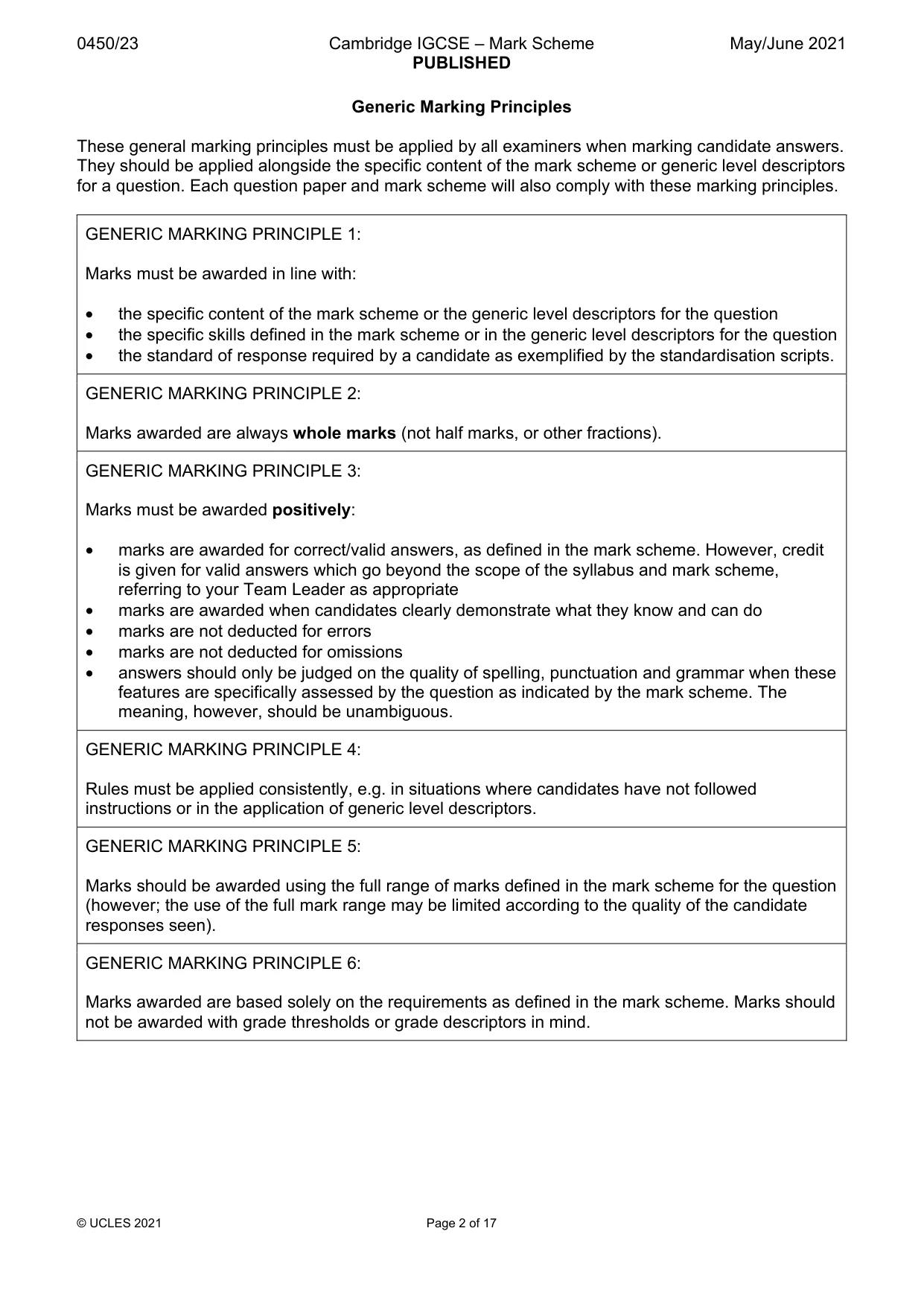
0450/23 Cambridge IGCSE – Mark Scheme PUBLISHED May/June 2021 © UCLES 2021 Page 2 of 17 Generic Marking Principles These general marking principles must be applied by all examiners when marking candidate answers. They should be applied alongside the specific content of the mark scheme or generic level descriptors for a question. Each question paper and mark scheme will also comply with these marking principles. GENERIC MARKING PRINCIPLE 1: Marks must be awarded in line with: • the specific content of the mark scheme or the generic level descriptors for the question • the specific skills defined in the mark scheme or in the generic level descriptors for the question • the standard of response required by a candidate as exemplified by the standardisation scripts. GENERIC MARKING PRINCIPLE 2: Marks awarded are always whole marks (not half marks, or other fractions). GENERIC MARKING PRINCIPLE 3: Marks must be awarded positively: • marks are awarded for correct/valid answers, as defined in the mark scheme. However, credit is given for valid answers which go beyond the scope of the syllabus and mark scheme, referring to your Team Leader as appropriate • marks are awarded when candidates clearly demonstrate what they know and can do • marks are not deducted for errors • marks are not deducted for omissions • answers should only be judged on the quality of spelling, punctuation and grammar when these features are specifically assessed by the question as indicated by the mark scheme. The meaning, however, should be unambiguous. GENERIC MARKING PRINCIPLE 4: Rules must be applied consistently, e.g. in situations where candidates have not followed instructions or in the application of generic level descriptors. GENERIC MARKING PRINCIPLE 5: Marks should be awarded using the full range of marks defined in the mark scheme for the question (however; the use of the full mark range may be limited according to the quality of the candidate responses seen). GENERIC MARKING PRINCIPLE 6: Marks awarded are based solely on the requirements as defined in the mark scheme. Marks should not be awarded with grade thresholds or grade descriptors in mind.
Mark scheme, page 3
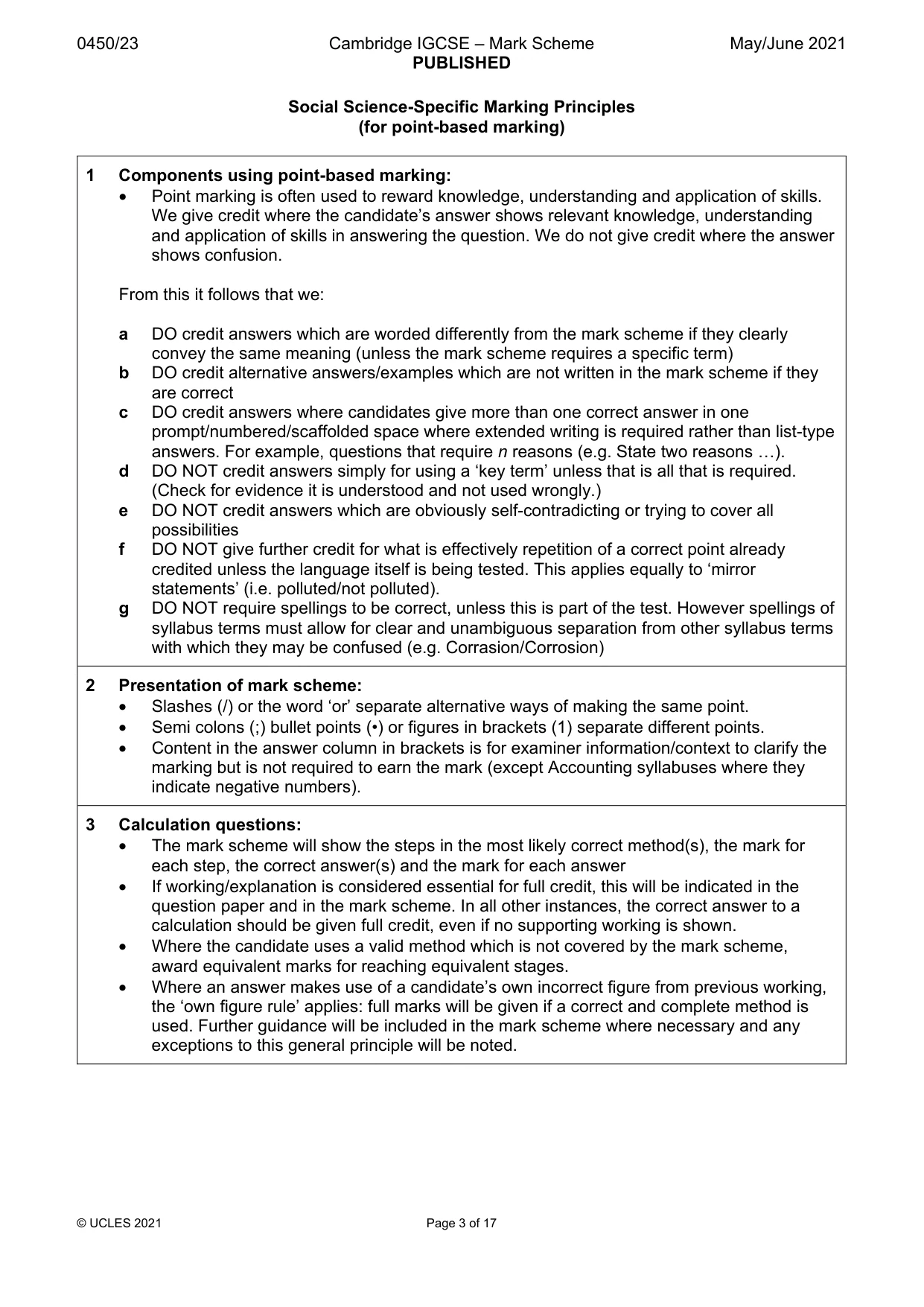
0450/23 Cambridge IGCSE – Mark Scheme PUBLISHED May/June 2021 © UCLES 2021 Page 3 of 17 Social Science-Specific Marking Principles (for point-based marking) 1 Components using point-based marking: • Point marking is often used to reward knowledge, understanding and application of skills. We give credit where the candidate’s answer shows relevant knowledge, understanding and application of skills in answering the question. We do not give credit where the answer shows confusion. From this it follows that we: a DO credit answers which are worded differently from the mark scheme if they clearly convey the same meaning (unless the mark scheme requires a specific term) b DO credit alternative answers/examples which are not written in the mark scheme if they are correct c DO credit answers where candidates give more than one correct answer in one prompt/numbered/scaffolded space where extended writing is required rather than list-type answers. For example, questions that require n reasons (e.g. State two reasons …). d DO NOT credit answers simply for using a ‘key term’ unless that is all that is required. (Check for evidence it is understood and not used wrongly.) e DO NOT credit answers which are obviously self-contradicting or trying to cover all possibilities f DO NOT give further credit for what is effectively repetition of a correct point already credited unless the language itself is being tested. This applies equally to ‘mirror statements’ (i.e. polluted/not polluted). g DO NOT require spellings to be correct, unless this is part of the test. However spellings of syllabus terms must allow for clear and unambiguous separation from other syllabus terms with which they may be confused (e.g. Corrasion/Corrosion) 2 Presentation of mark scheme: • Slashes (/) or the word ‘or’ separate alternative ways of making the same point. • Semi colons (;) bullet points (•) or figures in brackets (1) separate different points. • Content in the answer column in brackets is for examiner information/context to clarify the marking but is not required to earn the mark (except Accounting syllabuses where they indicate negative numbers). 3 Calculation questions: • The mark scheme will show the steps in the most likely correct method(s), the mark for each step, the correct answer(s) and the mark for each answer • If working/explanation is considered essential for full credit, this will be indicated in the question paper and in the mark scheme. In all other instances, the correct answer to a calculation should be given full credit, even if no supporting working is shown. • Where the candidate uses a valid method which is not covered by the mark scheme, award equivalent marks for reaching equivalent stages. • Where an answer makes use of a candidate’s own incorrect figure from previous working, the ‘own figure rule’ applies: full marks will be given if a correct and complete method is used. Further guidance will be included in the mark scheme where necessary and any exceptions to this general principle will be noted.
Mark scheme, page 4
0450/23 Cambridge IGCSE – Mark Scheme PUBLISHED May/June 2021 © UCLES 2021 Page 4 of 17 4 Annotation: • For point marking, ticks can be used to indicate correct answers and crosses can be used to indicate wrong answers. There is no direct relationship between ticks and marks. Ticks have no defined meaning for levels of response marking. • For levels of response marking, the level awarded should be annotated on the script. • Other annotations will be used by examiners as agreed during standardisation, and the meaning will be understood by all examiners who marked that paper.
Mark scheme, page 5
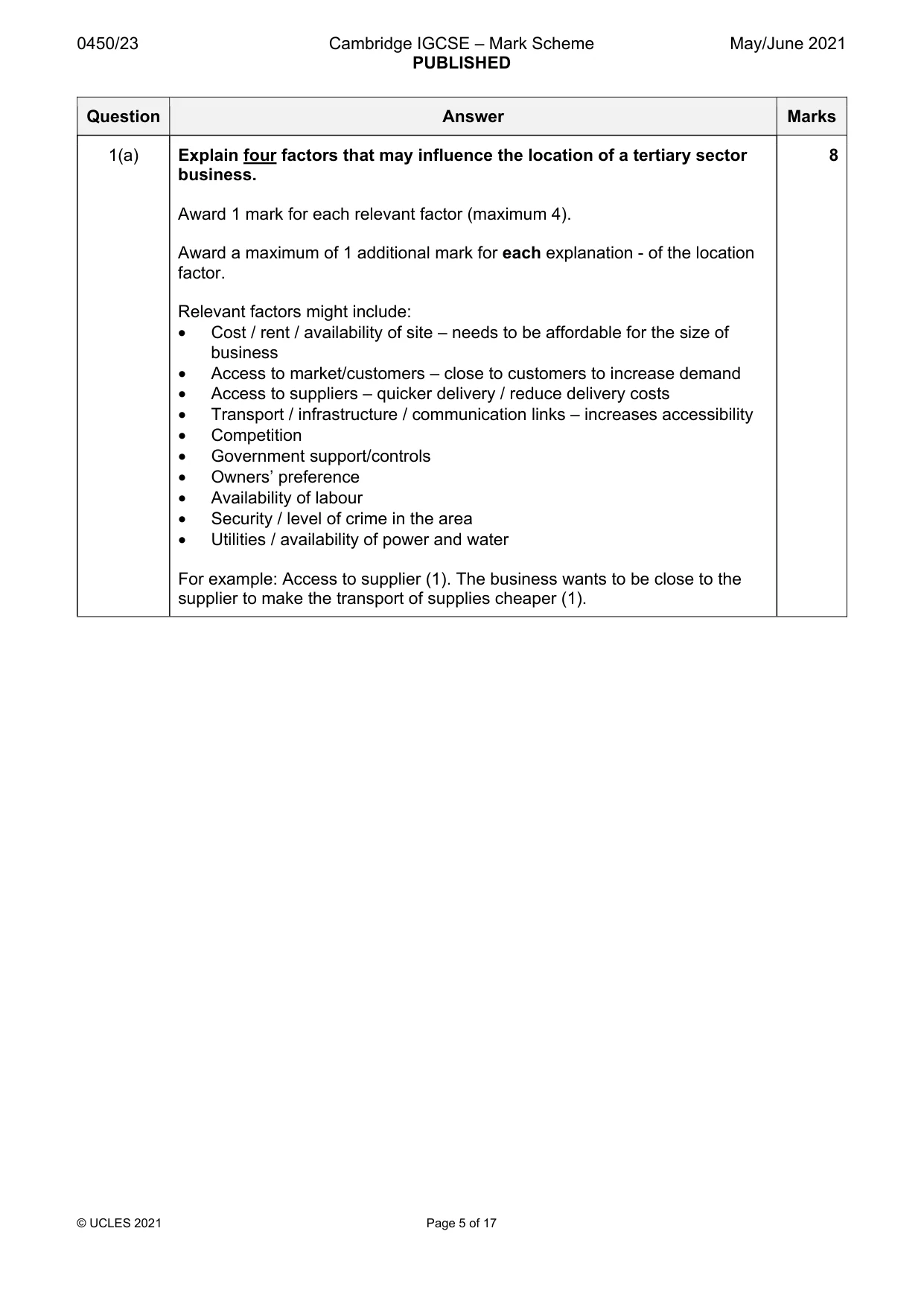
0450/23 Cambridge IGCSE – Mark Scheme PUBLISHED May/June 2021 © UCLES 2021 Page 5 of 17 Question Answer Marks 1(a) Explain four factors that may influence the location of a tertiary sector business. Award 1 mark for each relevant factor (maximum 4). Award a maximum of 1 additional mark for each explanation - of the location factor. Relevant factors might include: • Cost / rent / availability of site – needs to be affordable for the size of business • Access to market/customers – close to customers to increase demand • Access to suppliers – quicker delivery / reduce delivery costs • Transport / infrastructure / communication links – increases accessibility • Competition • Government support/controls • Owners’ preference • Availability of labour • Security / level of crime in the area • Utilities / availability of power and water For example: Access to supplier (1). The business wants to be close to the supplier to make the transport of supplies cheaper (1). 8
Mark scheme, page 6
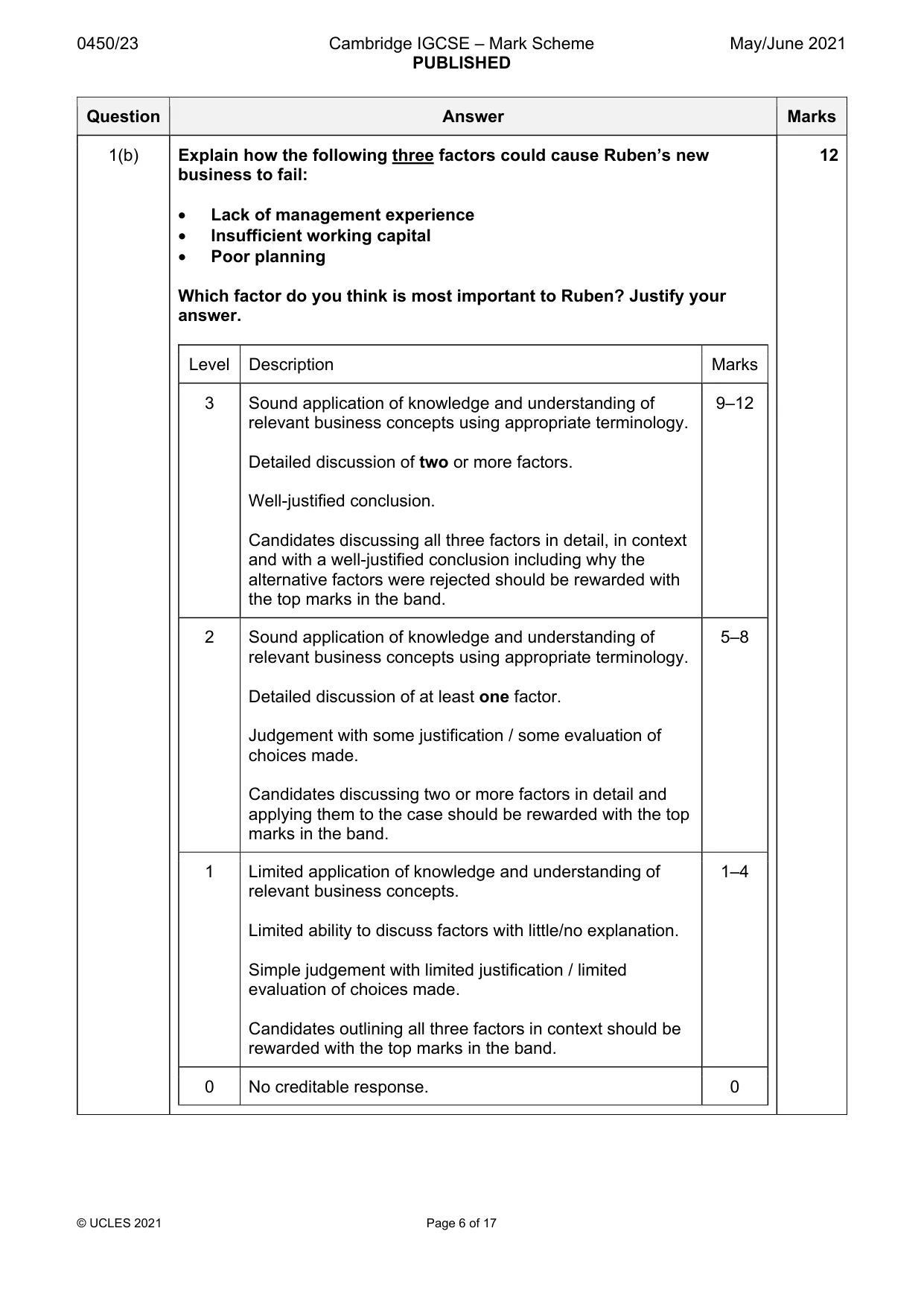
0450/23 Cambridge IGCSE – Mark Scheme PUBLISHED May/June 2021 © UCLES 2021 Page 6 of 17 Question Answer Marks 1(b) Explain how the following three factors could cause Ruben’s new business to fail: • Lack of management experience • Insufficient working capital • Poor planning Which factor do you think is most important to Ruben? Justify your answer. Level Description Marks 3 Sound application of knowledge and understanding of relevant business concepts using appropriate terminology. Detailed discussion of two or more factors. Well-justified conclusion. Candidates discussing all three factors in detail, in context and with a well-justified conclusion including why the alternative factors were rejected should be rewarded with the top marks in the band. 9–12 2 Sound application of knowledge and understanding of relevant business concepts using appropriate terminology. Detailed discussion of at least one factor. Judgement with some justification / some evaluation of choices made. Candidates discussing two or more factors in detail and applying them to the case should be rewarded with the top marks in the band. 5–8 1 Limited application of knowledge and understanding of relevant business concepts. Limited ability to discuss factors with little/no explanation. Simple judgement with limited justification / limited evaluation of choices made. Candidates outlining all three factors in context should be rewarded with the top marks in the band. 1–4 0 No creditable response. 0 12
Mark scheme, page 7
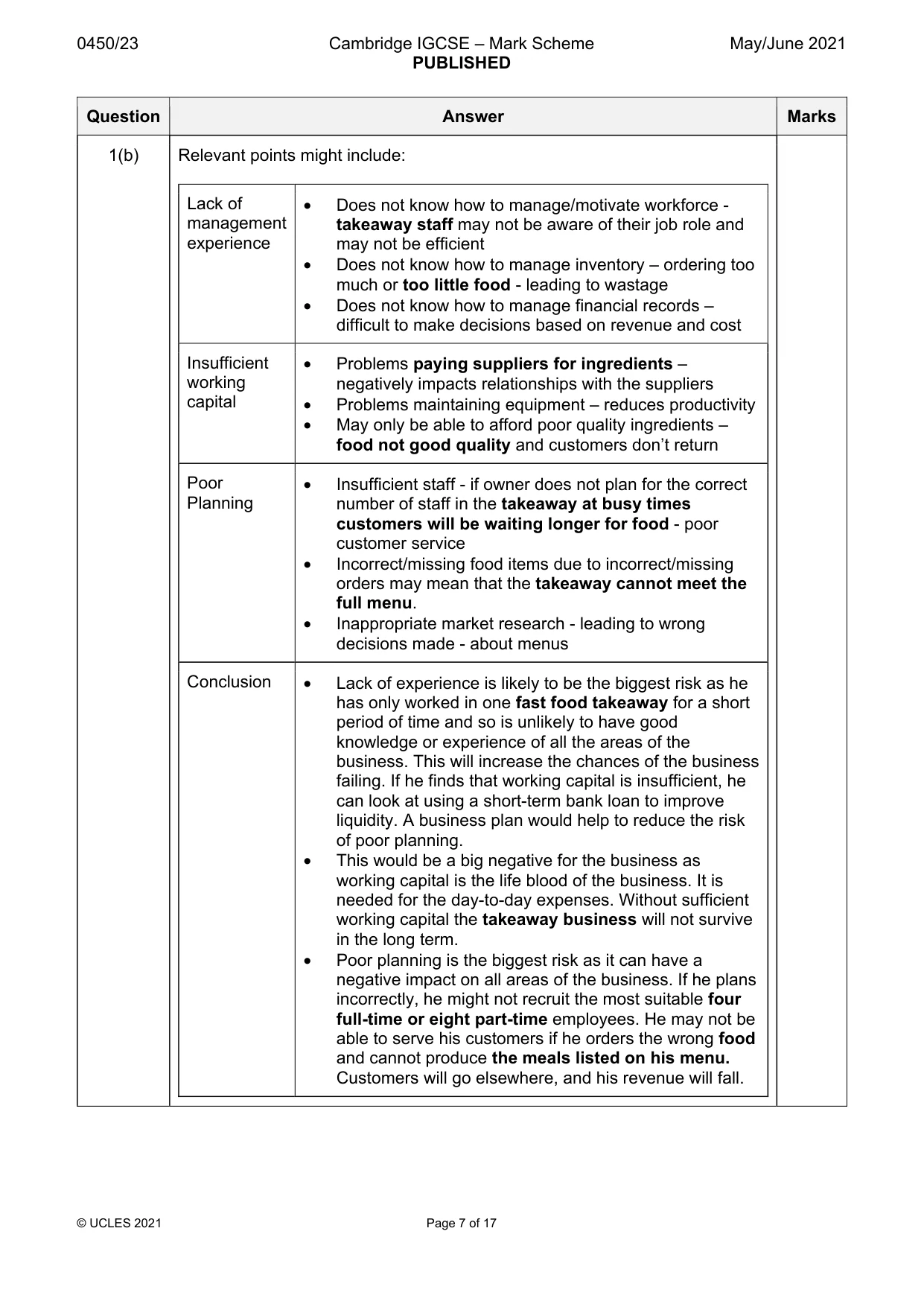
0450/23 Cambridge IGCSE – Mark Scheme PUBLISHED May/June 2021 © UCLES 2021 Page 7 of 17 Question Answer Marks 1(b) Relevant points might include: Lack of management experience • Does not know how to manage/motivate workforce - takeaway staff may not be aware of their job role and may not be efficient • Does not know how to manage inventory – ordering too much or too little food - leading to wastage • Does not know how to manage financial records – difficult to make decisions based on revenue and cost Insufficient working capital • Problems paying suppliers for ingredients – negatively impacts relationships with the suppliers • Problems maintaining equipment – reduces productivity • May only be able to afford poor quality ingredients – food not good quality and customers don’t return Poor Planning • Insufficient staff - if owner does not plan for the correct number of staff in the takeaway at busy times customers will be waiting longer for food - poor customer service • Incorrect/missing food items due to incorrect/missing orders may mean that the takeaway cannot meet the full menu. • Inappropriate market research - leading to wrong decisions made - about menus Conclusion • Lack of experience is likely to be the biggest risk as he has only worked in one fast food takeaway for a short period of time and so is unlikely to have good knowledge or experience of all the areas of the business. This will increase the chances of the business failing. If he finds that working capital is insufficient, he can look at using a short-term bank loan to improve liquidity. A business plan would help to reduce the risk of poor planning. • This would be a big negative for the business as working capital is the life blood of the business. It is needed for the day-to-day expenses. Without sufficient working capital the takeaway business will not survive in the long term. • Poor planning is the biggest risk as it can have a negative impact on all areas of the business. If he plans incorrectly, he might not recruit the most suitable four full-time or eight part-time employees. He may not be able to serve his customers if he orders the wrong food and cannot produce the meals listed on his menu. Customers will go elsewhere, and his revenue will fall.
Mark scheme, page 8
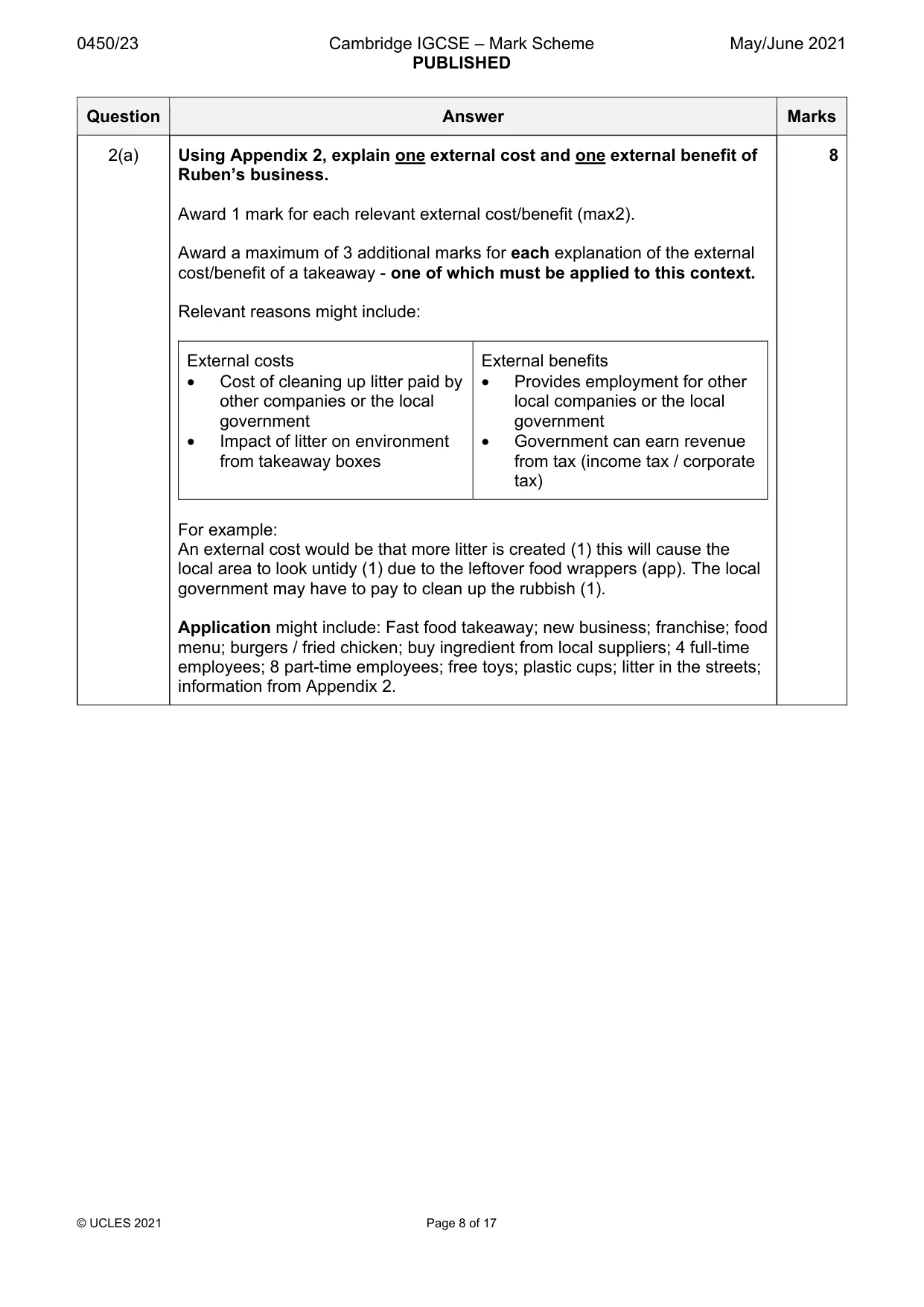
0450/23 Cambridge IGCSE – Mark Scheme PUBLISHED May/June 2021 © UCLES 2021 Page 8 of 17 Question Answer Marks 2(a) Using Appendix 2, explain one external cost and one external benefit of Ruben’s business. Award 1 mark for each relevant external cost/benefit (max2). Award a maximum of 3 additional marks for each explanation of the external cost/benefit of a takeaway - one of which must be applied to this context. Relevant reasons might include: External costs • Cost of cleaning up litter paid by other companies or the local government • Impact of litter on environment from takeaway boxes External benefits • Provides employment for other local companies or the local government • Government can earn revenue from tax (income tax / corporate tax) For example: An external cost would be that more litter is created (1) this will cause the local area to look untidy (1) due to the leftover food wrappers (app). The local government may have to pay to clean up the rubbish (1). Application might include: Fast food takeaway; new business; franchise; food menu; burgers / fried chicken; buy ingredient from local suppliers; 4 full-time employees; 8 part-time employees; free toys; plastic cups; litter in the streets; information from Appendix 2. 8
Mark scheme, page 9
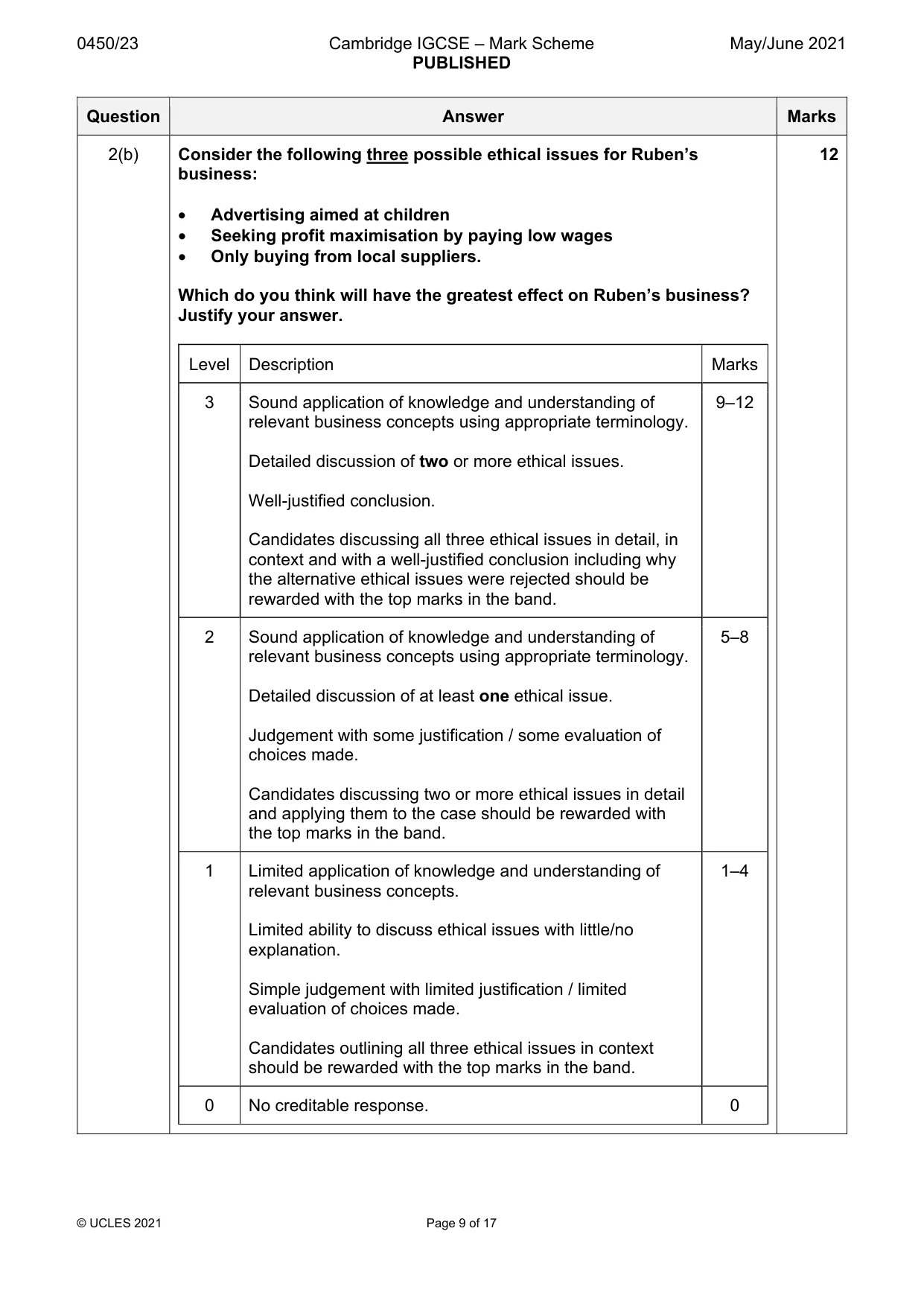
0450/23 Cambridge IGCSE – Mark Scheme PUBLISHED May/June 2021 © UCLES 2021 Page 9 of 17 Question Answer Marks 2(b) Consider the following three possible ethical issues for Ruben’s business: • Advertising aimed at children • Seeking profit maximisation by paying low wages • Only buying from local suppliers. Which do you think will have the greatest effect on Ruben’s business? Justify your answer. Level Description Marks 3 Sound application of knowledge and understanding of relevant business concepts using appropriate terminology. Detailed discussion of two or more ethical issues. Well-justified conclusion. Candidates discussing all three ethical issues in detail, in context and with a well-justified conclusion including why the alternative ethical issues were rejected should be rewarded with the top marks in the band. 9–12 2 Sound application of knowledge and understanding of relevant business concepts using appropriate terminology. Detailed discussion of at least one ethical issue. Judgement with some justification / some evaluation of choices made. Candidates discussing two or more ethical issues in detail and applying them to the case should be rewarded with the top marks in the band. 5–8 1 Limited application of knowledge and understanding of relevant business concepts. Limited ability to discuss ethical issues with little/no explanation. Simple judgement with limited justification / limited evaluation of choices made. Candidates outlining all three ethical issues in context should be rewarded with the top marks in the band. 1–4 0 No creditable response. 0 12
Mark scheme, page 10
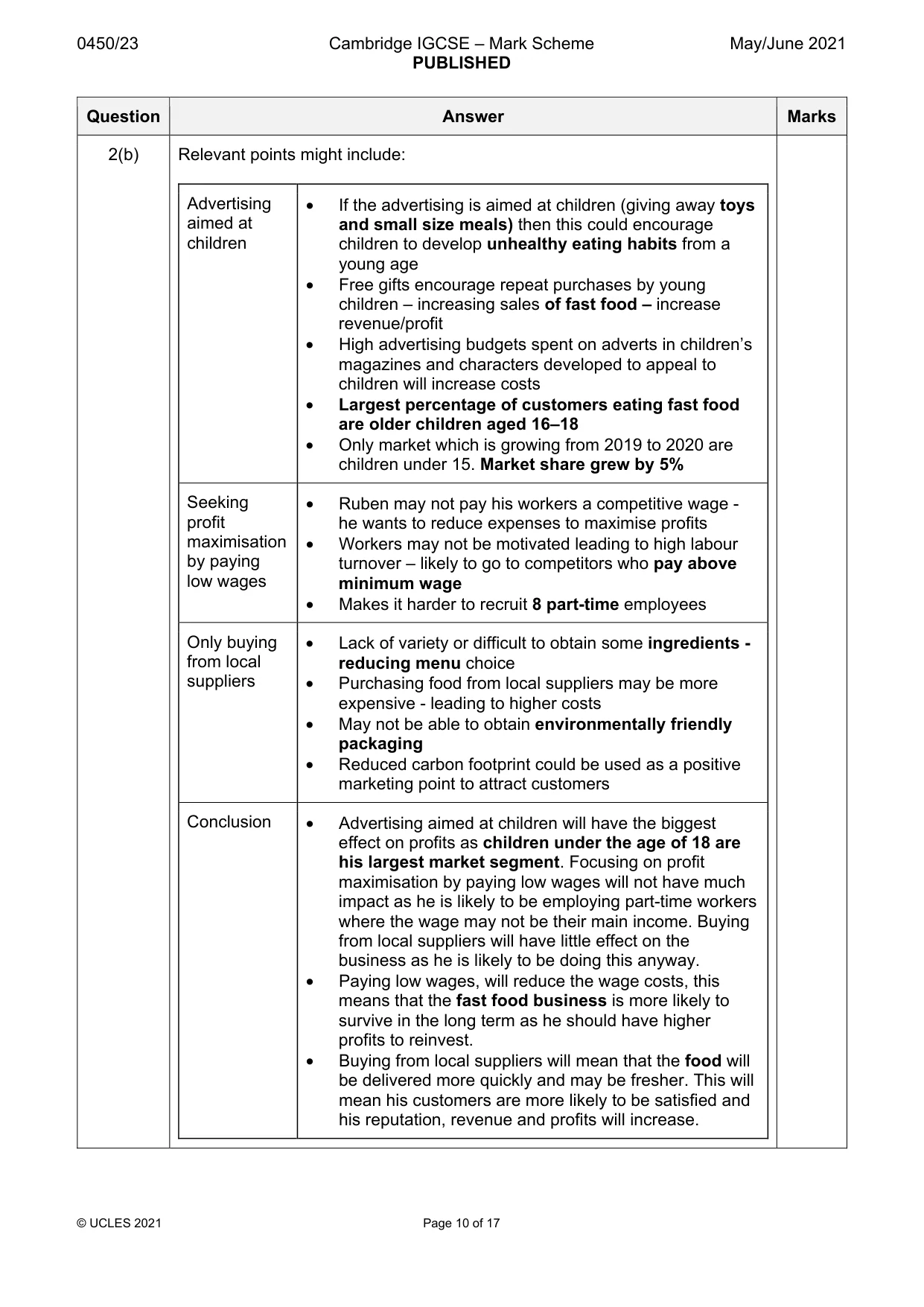
0450/23 Cambridge IGCSE – Mark Scheme PUBLISHED May/June 2021 © UCLES 2021 Page 10 of 17 Question Answer Marks 2(b) Relevant points might include: Advertising aimed at children • If the advertising is aimed at children (giving away toys and small size meals) then this could encourage children to develop unhealthy eating habits from a young age • Free gifts encourage repeat purchases by young children – increasing sales of fast food – increase revenue/profit • High advertising budgets spent on adverts in children’s magazines and characters developed to appeal to children will increase costs • Largest percentage of customers eating fast food are older children aged 16–18 • Only market which is growing from 2019 to 2020 are children under 15. Market share grew by 5% Seeking profit maximisation by paying low wages • Ruben may not pay his workers a competitive wage - he wants to reduce expenses to maximise profits • Workers may not be motivated leading to high labour turnover – likely to go to competitors who pay above minimum wage • Makes it harder to recruit 8 part-time employees Only buying from local suppliers • Lack of variety or difficult to obtain some ingredients - reducing menu choice • Purchasing food from local suppliers may be more expensive - leading to higher costs • May not be able to obtain environmentally friendly packaging • Reduced carbon footprint could be used as a positive marketing point to attract customers Conclusion • Advertising aimed at children will have the biggest effect on profits as children under the age of 18 are his largest market segment. Focusing on profit maximisation by paying low wages will not have much impact as he is likely to be employing part-time workers where the wage may not be their main income. Buying from local suppliers will have little effect on the business as he is likely to be doing this anyway. • Paying low wages, will reduce the wage costs, this means that the fast food business is more likely to survive in the long term as he should have higher profits to reinvest. • Buying from local suppliers will mean that the food will be delivered more quickly and may be fresher. This will mean his customers are more likely to be satisfied and his reputation, revenue and profits will increase.
Mark scheme, page 11
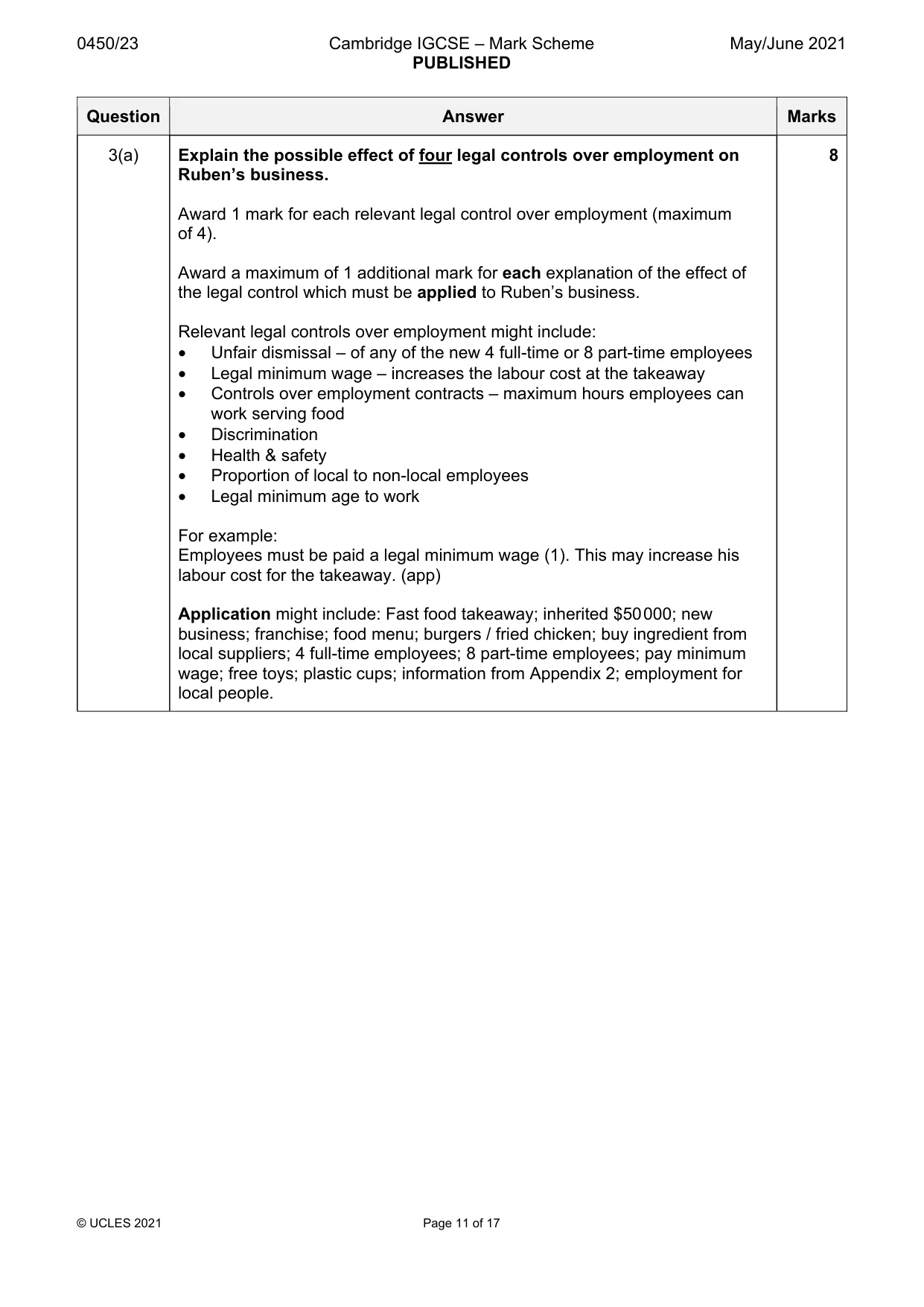
0450/23 Cambridge IGCSE – Mark Scheme PUBLISHED May/June 2021 © UCLES 2021 Page 11 of 17 Question Answer Marks 3(a) Explain the possible effect of four legal controls over employment on Ruben’s business. Award 1 mark for each relevant legal control over employment (maximum of 4). Award a maximum of 1 additional mark for each explanation of the effect of the legal control which must be applied to Ruben’s business. Relevant legal controls over employment might include: • Unfair dismissal – of any of the new 4 full-time or 8 part-time employees • Legal minimum wage – increases the labour cost at the takeaway • Controls over employment contracts – maximum hours employees can work serving food • Discrimination • Health & safety • Proportion of local to non-local employees • Legal minimum age to work For example: Employees must be paid a legal minimum wage (1). This may increase his labour cost for the takeaway. (app) Application might include: Fast food takeaway; inherited $50 000; new business; franchise; food menu; burgers / fried chicken; buy ingredient from local suppliers; 4 full-time employees; 8 part-time employees; pay minimum wage; free toys; plastic cups; information from Appendix 2; employment for local people. 8
Mark scheme, page 12
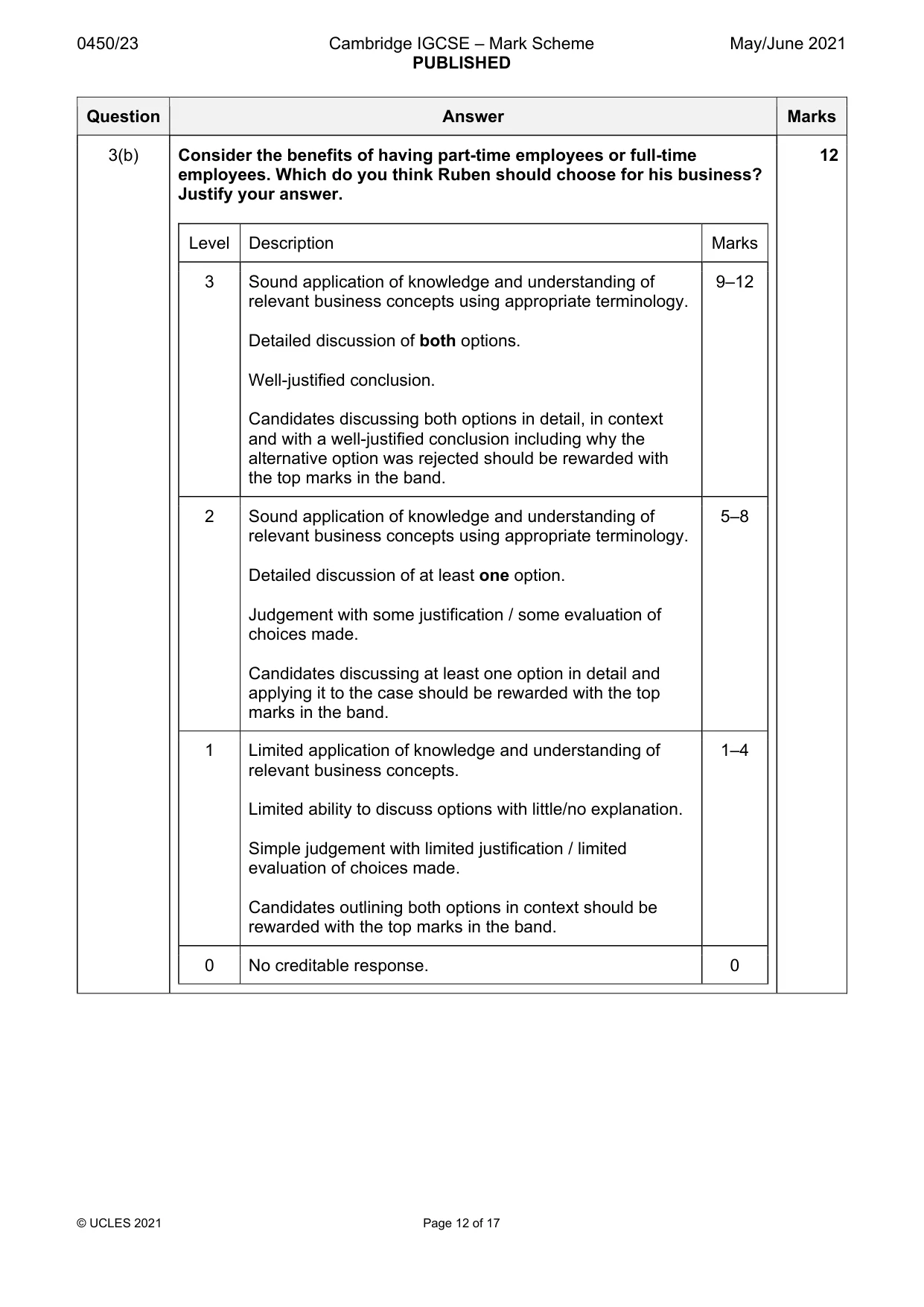
0450/23 Cambridge IGCSE – Mark Scheme PUBLISHED May/June 2021 © UCLES 2021 Page 12 of 17 Question Answer Marks 3(b) Consider the benefits of having part-time employees or full-time employees. Which do you think Ruben should choose for his business? Justify your answer. Level Description Marks 3 Sound application of knowledge and understanding of relevant business concepts using appropriate terminology. Detailed discussion of both options. Well-justified conclusion. Candidates discussing both options in detail, in context and with a well-justified conclusion including why the alternative option was rejected should be rewarded with the top marks in the band. 9–12 2 Sound application of knowledge and understanding of relevant business concepts using appropriate terminology. Detailed discussion of at least one option. Judgement with some justification / some evaluation of choices made. Candidates discussing at least one option in detail and applying it to the case should be rewarded with the top marks in the band. 5–8 1 Limited application of knowledge and understanding of relevant business concepts. Limited ability to discuss options with little/no explanation. Simple judgement with limited justification / limited evaluation of choices made. Candidates outlining both options in context should be rewarded with the top marks in the band. 1–4 0 No creditable response. 0 12
Mark scheme, page 13
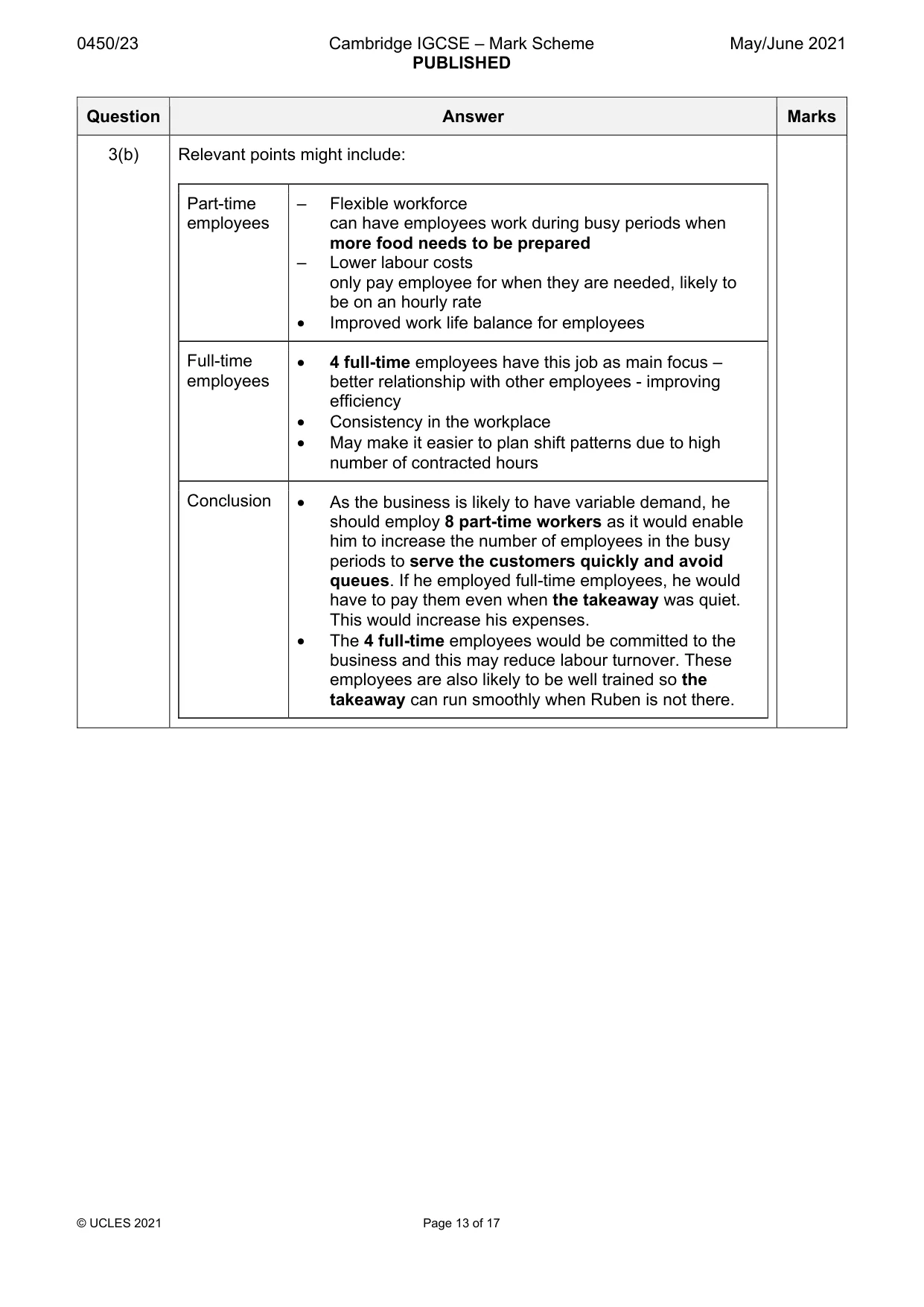
0450/23 Cambridge IGCSE – Mark Scheme PUBLISHED May/June 2021 © UCLES 2021 Page 13 of 17 Question Answer Marks 3(b) Relevant points might include: Part-time employees – Flexible workforce can have employees work during busy periods when more food needs to be prepared – Lower labour costs only pay employee for when they are needed, likely to be on an hourly rate • Improved work life balance for employees Full-time employees • 4 full-time employees have this job as main focus – better relationship with other employees - improving efficiency • Consistency in the workplace • May make it easier to plan shift patterns due to high number of contracted hours Conclusion • As the business is likely to have variable demand, he should employ 8 part-time workers as it would enable him to increase the number of employees in the busy periods to serve the customers quickly and avoid queues. If he employed full-time employees, he would have to pay them even when the takeaway was quiet. This would increase his expenses. • The 4 full-time employees would be committed to the business and this may reduce labour turnover. These employees are also likely to be well trained so the takeaway can run smoothly when Ruben is not there.
Mark scheme, page 14
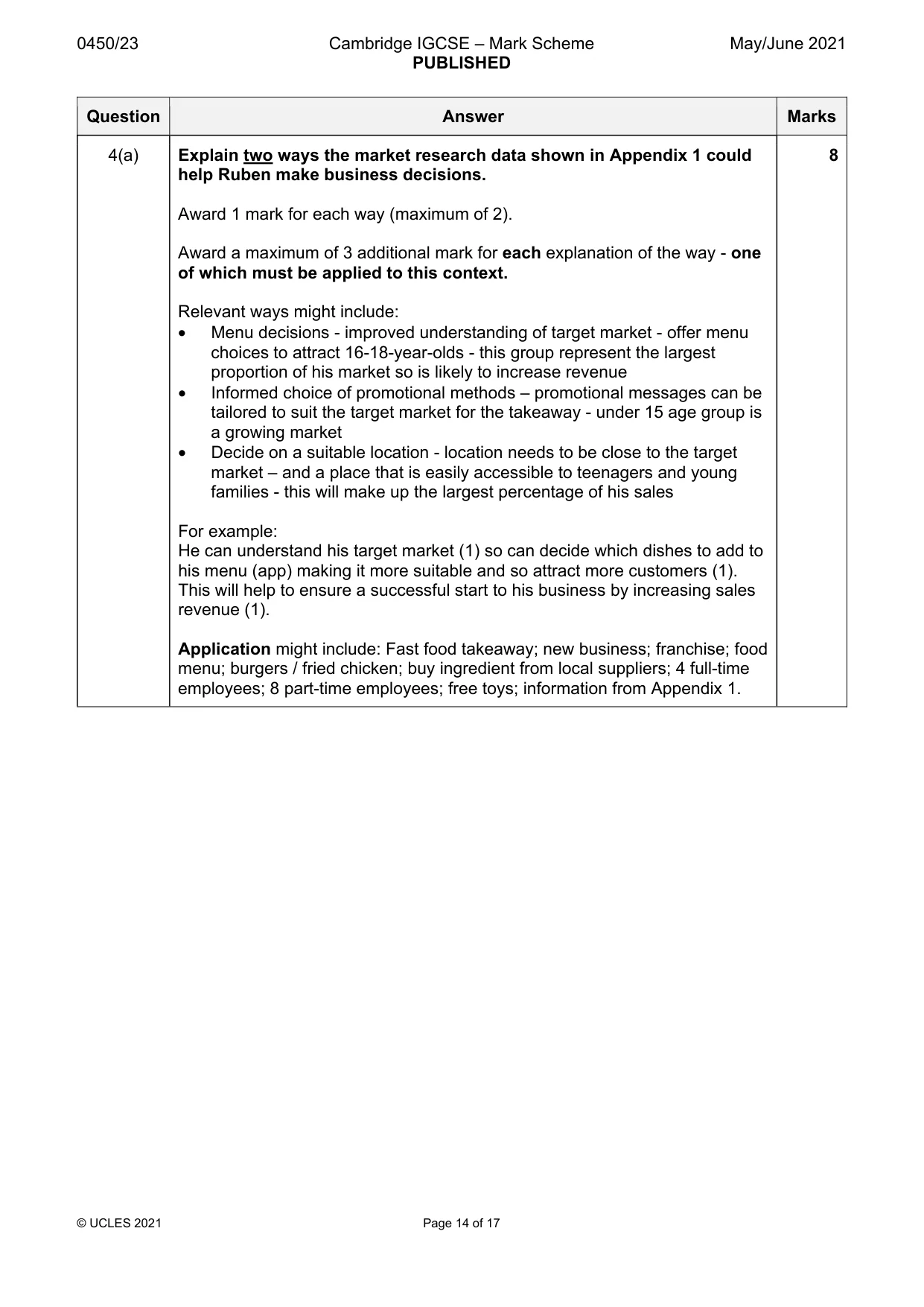
0450/23 Cambridge IGCSE – Mark Scheme PUBLISHED May/June 2021 © UCLES 2021 Page 14 of 17 Question Answer Marks 4(a) Explain two ways the market research data shown in Appendix 1 could help Ruben make business decisions. Award 1 mark for each way (maximum of 2). Award a maximum of 3 additional mark for each explanation of the way - one of which must be applied to this context. Relevant ways might include: • Menu decisions - improved understanding of target market - offer menu choices to attract 16-18-year-olds - this group represent the largest proportion of his market so is likely to increase revenue • Informed choice of promotional methods – promotional messages can be tailored to suit the target market for the takeaway - under 15 age group is a growing market • Decide on a suitable location - location needs to be close to the target market – and a place that is easily accessible to teenagers and young families - this will make up the largest percentage of his sales For example: He can understand his target market (1) so can decide which dishes to add to his menu (app) making it more suitable and so attract more customers (1). This will help to ensure a successful start to his business by increasing sales revenue (1). Application might include: Fast food takeaway; new business; franchise; food menu; burgers / fried chicken; buy ingredient from local suppliers; 4 full-time employees; 8 part-time employees; free toys; information from Appendix 1. 8
Mark scheme, page 15
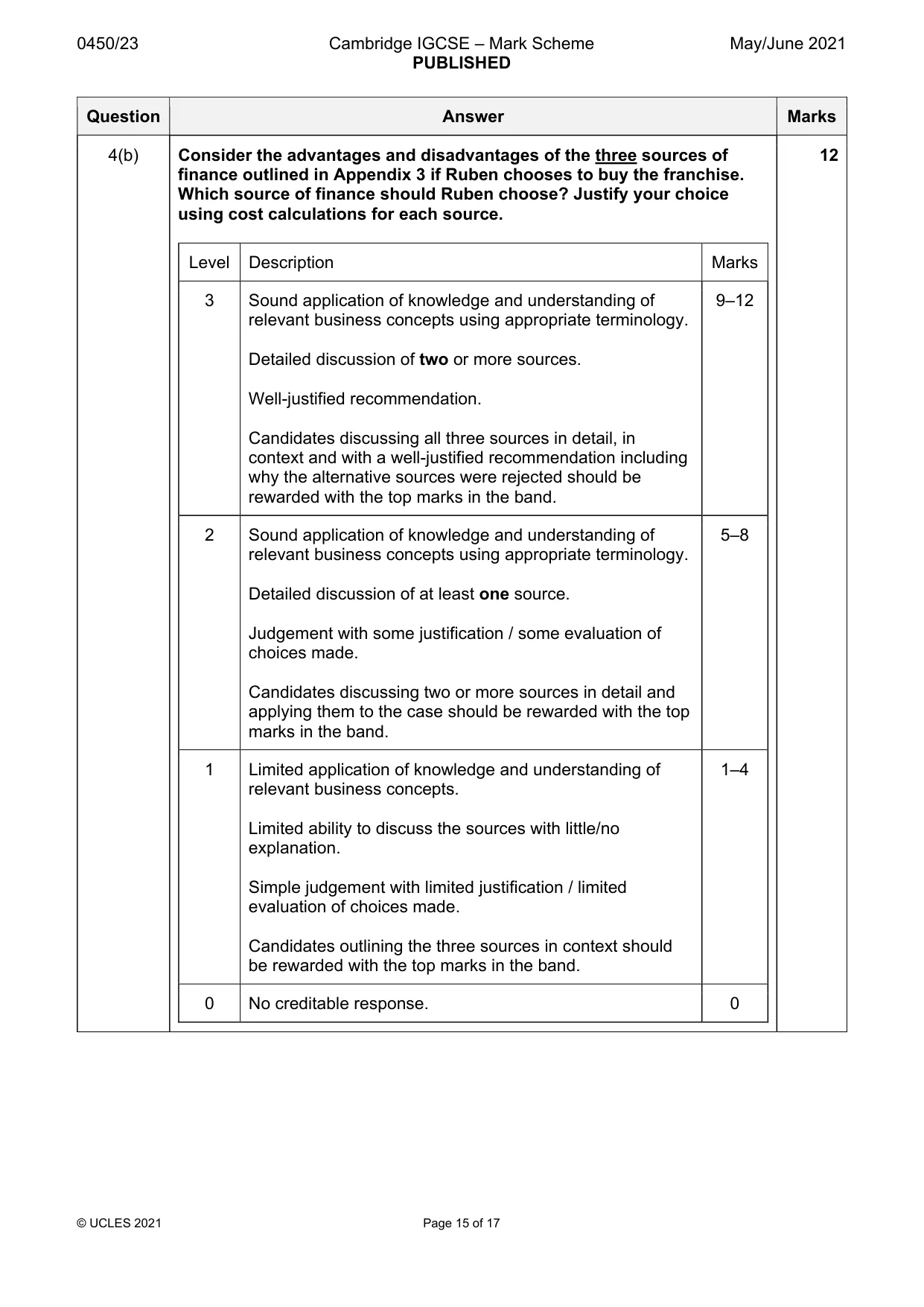
0450/23 Cambridge IGCSE – Mark Scheme PUBLISHED May/June 2021 © UCLES 2021 Page 15 of 17 Question Answer Marks 4(b) Consider the advantages and disadvantages of the three sources of finance outlined in Appendix 3 if Ruben chooses to buy the franchise. Which source of finance should Ruben choose? Justify your choice using cost calculations for each source. Level Description Marks 3 Sound application of knowledge and understanding of relevant business concepts using appropriate terminology. Detailed discussion of two or more sources. Well-justified recommendation. Candidates discussing all three sources in detail, in context and with a well-justified recommendation including why the alternative sources were rejected should be rewarded with the top marks in the band. 9–12 2 Sound application of knowledge and understanding of relevant business concepts using appropriate terminology. Detailed discussion of at least one source. Judgement with some justification / some evaluation of choices made. Candidates discussing two or more sources in detail and applying them to the case should be rewarded with the top marks in the band. 5–8 1 Limited application of knowledge and understanding of relevant business concepts. Limited ability to discuss the sources with little/no explanation. Simple judgement with limited justification / limited evaluation of choices made. Candidates outlining the three sources in context should be rewarded with the top marks in the band. 1–4 0 No creditable response. 0 12
Mark scheme, page 16
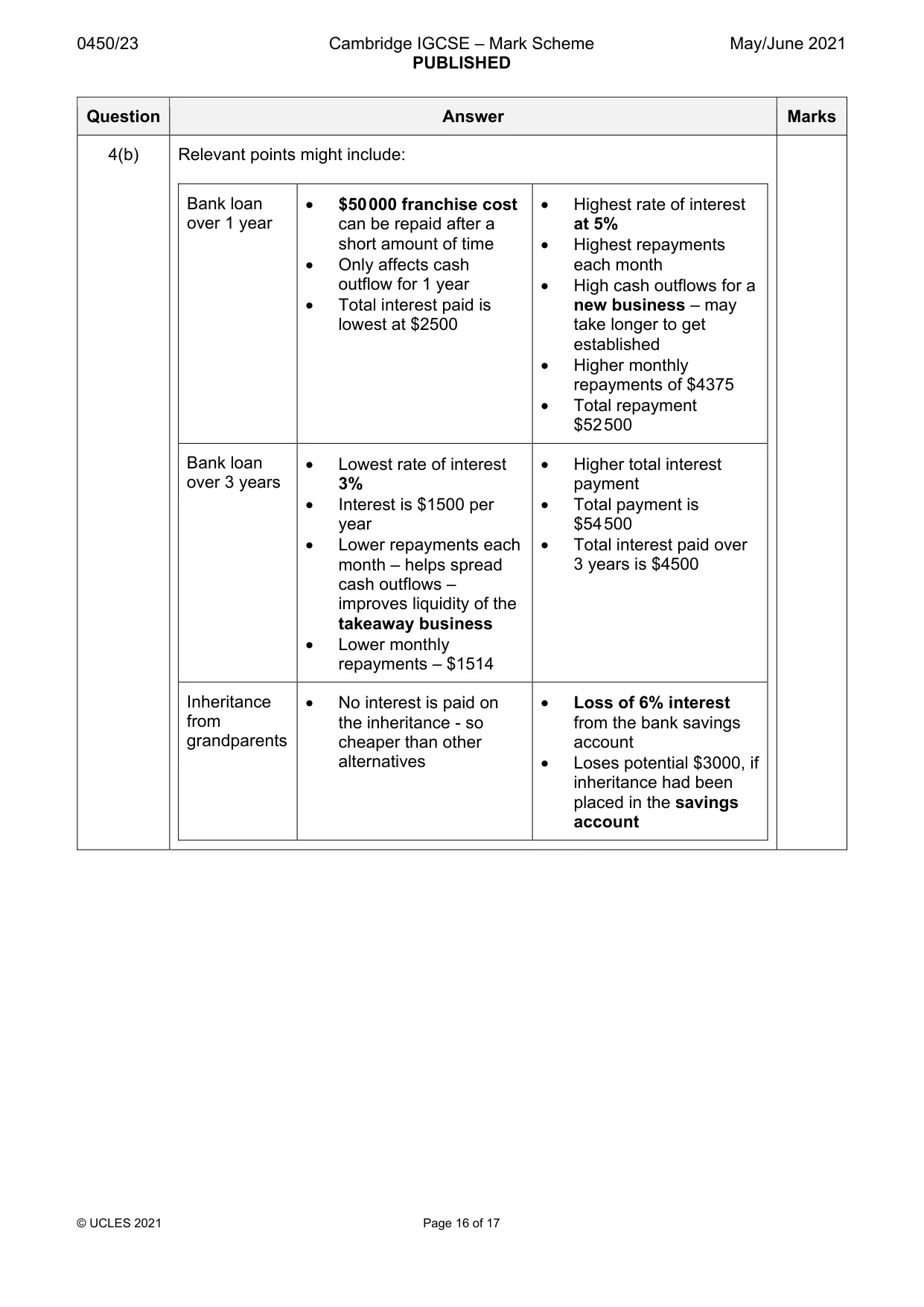
0450/23 Cambridge IGCSE – Mark Scheme PUBLISHED May/June 2021 © UCLES 2021 Page 16 of 17 Question Answer Marks 4(b) Relevant points might include: Bank loan over 1 year • $50 000 franchise cost can be repaid after a short amount of time • Only affects cash outflow for 1 year • Total interest paid is lowest at $2500 • Highest rate of interest at 5% • Highest repayments each month • High cash outflows for a new business – may take longer to get established • Higher monthly repayments of $4375 • Total repayment $52 500 Bank loan over 3 years • Lowest rate of interest 3% • Interest is $1500 per year • Lower repayments each month – helps spread cash outflows – improves liquidity of the takeaway business • Lower monthly repayments – $1514 • Higher total interest payment • Total payment is $54 500 • Total interest paid over 3 years is $4500 Inheritance from grandparents • No interest is paid on the inheritance - so cheaper than other alternatives • Loss of 6% interest from the bank savings account • Loses potential $3000, if inheritance had been placed in the savings account
Mark scheme, page 17
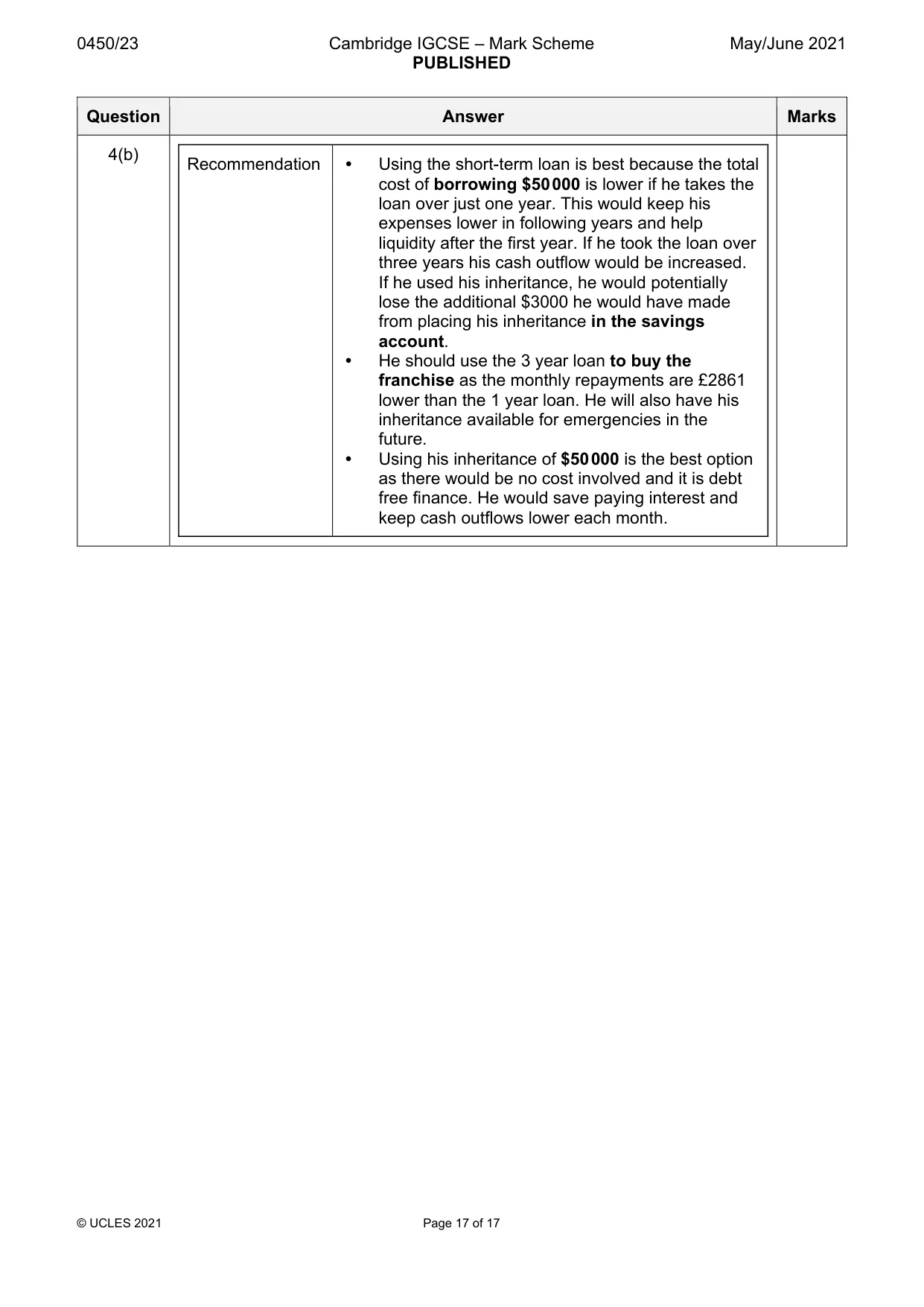
0450/23 Cambridge IGCSE – Mark Scheme PUBLISHED May/June 2021 © UCLES 2021 Page 17 of 17 Question Answer Marks 4(b) Recommendation • Using the short-term loan is best because the total cost of borrowing $50 000 is lower if he takes the loan over just one year. This would keep his expenses lower in following years and help liquidity after the first year. If he took the loan over three years his cash outflow would be increased. If he used his inheritance, he would potentially lose the additional $3000 he would have made from placing his inheritance in the savings account. • He should use the 3 year loan to buy the franchise as the monthly repayments are £2861 lower than the 1 year loan. He will also have his inheritance available for emergencies in the future. • Using his inheritance of $50 000 is the best option as there would be no cost involved and it is debt free finance. He would save paying interest and keep cash outflows lower each month.
What you needed in this session
Cambridge’s own grade thresholds for 2021 May/June, Paper 2 · Variant 3. A higher threshold means an easier paper — the bar moves with how the cohort did.