Cambridge IGCSE Business Studies 0450 — 2014 Oct/Nov Paper 2 · Variant 1
0450/21/O/N/14 · 100 marks · ≈113 min
The question paper and its mark scheme, free to read here and free to download. This is Cambridge’s own paper, exactly as it was sat.
Question paper12 pages

Mark scheme13 pages
Answers below. Sit the paper first if you are practising.
Paper as text
Question paper, page 1
This document consists of 11 printed pages, 1 blank page and 1 insert. DC (SLM) 79753/3 © UCLES 2014 [Turn over Cambridge International Examinations Cambridge International General Certificate of Secondary Education * 6 3 3 0 9 8 4 5 7 5 * BUSINESS STUDIES 0450/21 Paper 2 October/November 2014 1 hour 45 minutes Candidates answer on the Question Paper. No Additional Materials are required. READ THESE INSTRUCTIONS FIRST Write your Centre number, candidate number and name on all the work you hand in. Write in dark blue or black pen. Do not use staples, paper clips, glue or correction fluid. DO NOT WRITE IN ANY BARCODES. Answer all questions. The Insert contains the case study. The businesses described in this question paper are entirely fictitious. At the end of the examination, fasten all your work securely together. The number of marks is given in brackets [ ] at the end of each question or part question. The syllabus is approved for use in England, Wales and Northern Ireland as a Cambridge International Level 1/Level 2 Certificate.
Question paper, page 2
2 0450/21/O/N/14 © UCLES 2014 1 (a) Identify and explain two disadvantages to PB Bank of being a public limited company. Disadvantage 1: … … Explanation: … … … … … … Disadvantage 2: … … Explanation: … … … … … …[8]
Question paper, page 3
3 0450/21/O/N/14 © UCLES 2014 [Turn over (b) Employees complain they never know important information about the bank. Consider three ways the HR Director could use to improve the internal communication in the bank. Recommend which will be the best way to use. Justify your answer. Way 1: … … … … … … Way 2: … … … … … … Way 3: … … … … … … Recommendation: … … … … … …[12]
Question paper, page 4
4 0450/21/O/N/14 © UCLES 2014 2 (a) Banking is a tertiary sector business. Identify four other types of tertiary sector businesses that PB Bank might use and explain what services they offer to PB Bank. Type of tertiary sector business: … Explanation: … … … Type of tertiary sector business: … Explanation: … … … Type of tertiary sector business: … Explanation: … … … Type of tertiary sector business: … Explanation: … … …[8]
Question paper, page 5
5 0450/21/O/N/14 © UCLES 2014 [Turn over (b) Refer to the organisational chart in Appendix 1. The directors are thinking of removing the middle management level (deputy managers). Consider the advantages and disadvantages of widening the span of control for the remaining managers. Recommend whether the directors should remove this level of management. Justify your answer. Advantages: … … … … … … … … Disadvantages: … … … … … … … … Recommendation: … … … … … … … …[12]
Question paper, page 6
6 0450/21/O/N/14 © UCLES 2014 3 (a) Identify and explain two appropriate ways in which the results from the question ‘do you have a bank account? ’ in Appendix 3 could be presented. Way 1: Explanation: … … … … Way 2: Explanation: … … … …[8]
Question paper, page 7
7 0450/21/O/N/14 © UCLES 2014 [Turn over (b) PB needs to close some of its branches as more customers use online banking. Consider the advantages and disadvantages of branch X and branch Y. Recommend which branch PB should close. Justify your answer. Branch X: … … … … … … … … Branch Y: … … … … … … … … Recommendation: … … … … … … … …[12]
Question paper, page 8
8 0450/21/O/N/14 © UCLES 2014 4 (a) Identify and explain four reasons why the information in Appendix 3 may not be an accurate record of the views of all bank customers. Reason 1: … Explanation: … … … Reason 2: … Explanation: … … … Reason 3: … Explanation: … … … Reason 4: … Explanation: … … …[8]
Question paper, page 9
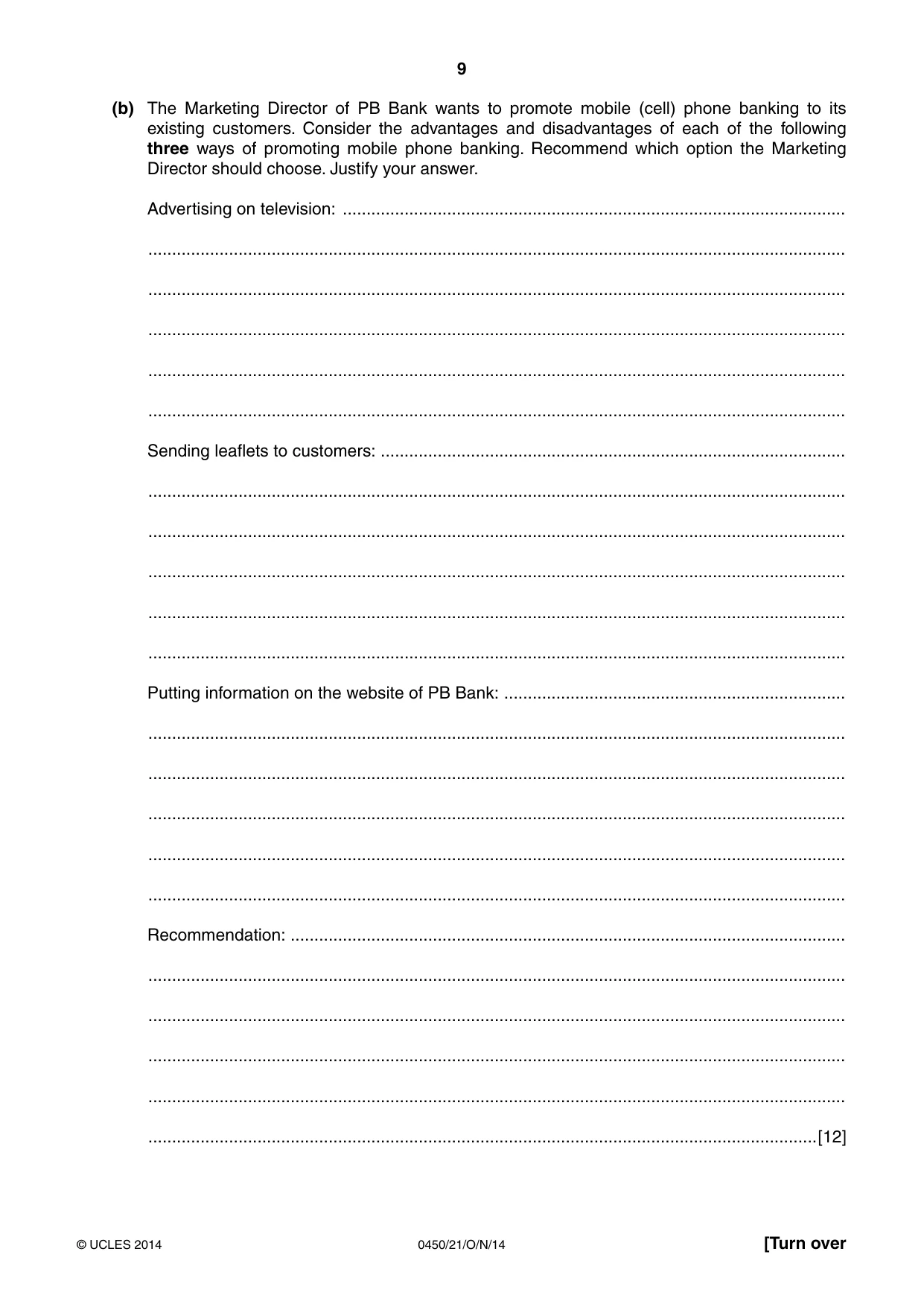
9 0450/21/O/N/14 © UCLES 2014 [Turn over (b) The Marketing Director of PB Bank wants to promote mobile (cell) phone banking to its existing customers. Consider the advantages and disadvantages of each of the following three ways of promoting mobile phone banking. Recommend which option the Marketing Director should choose. Justify your answer. Advertising on television: … … … … … … Sending leaflets to customers: … … … … … … Putting information on the website of PB Bank: … … … … … … Recommendation: … … … … … …[12]
Question paper, page 10
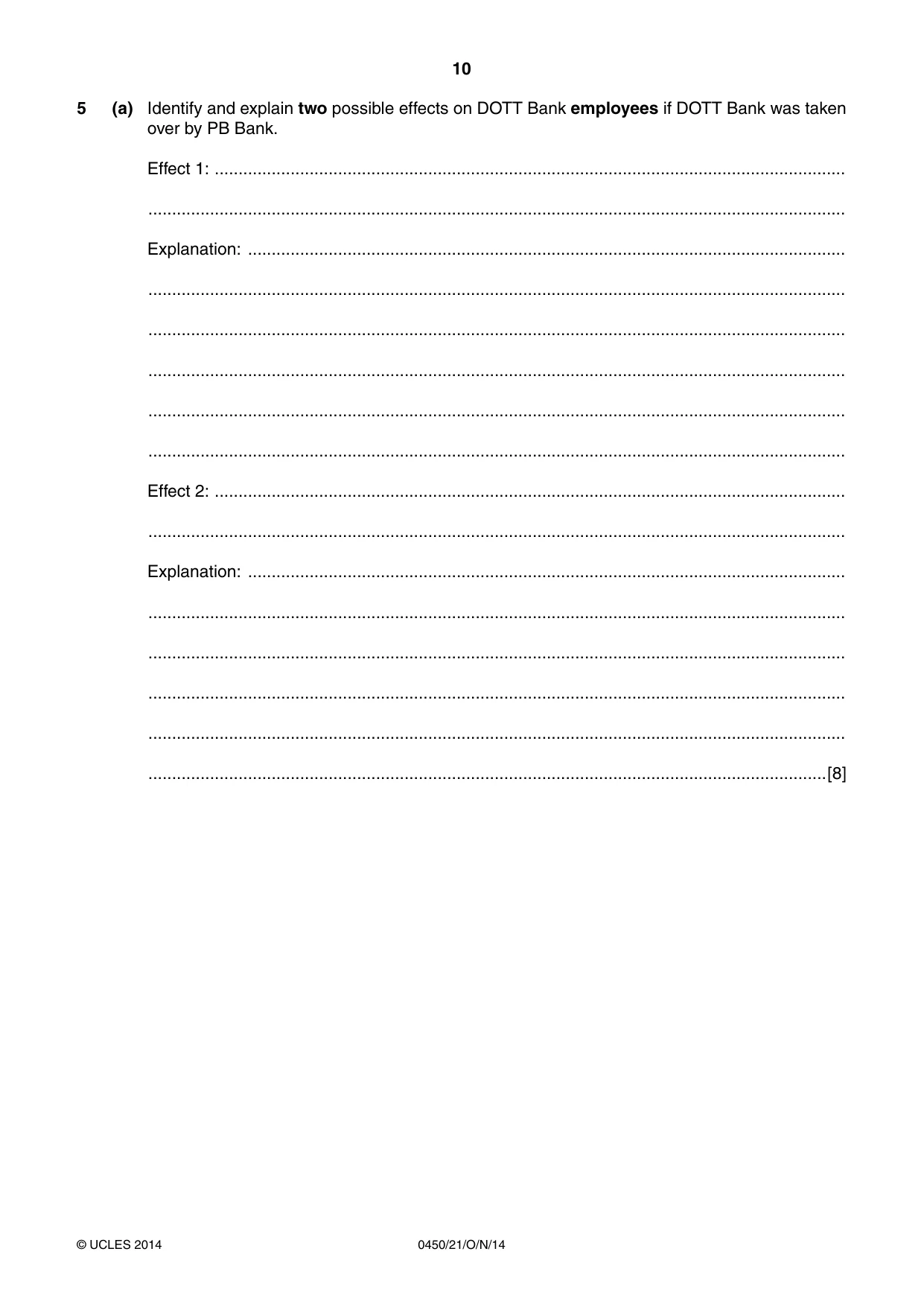
10 0450/21/O/N/14 © UCLES 2014 5 (a) Identify and explain two possible effects on DOTT Bank employees if DOTT Bank was taken over by PB Bank. Effect 1: … … Explanation: … … … … … … Effect 2: … … Explanation: … … … … … …[8]
Question paper, page 11
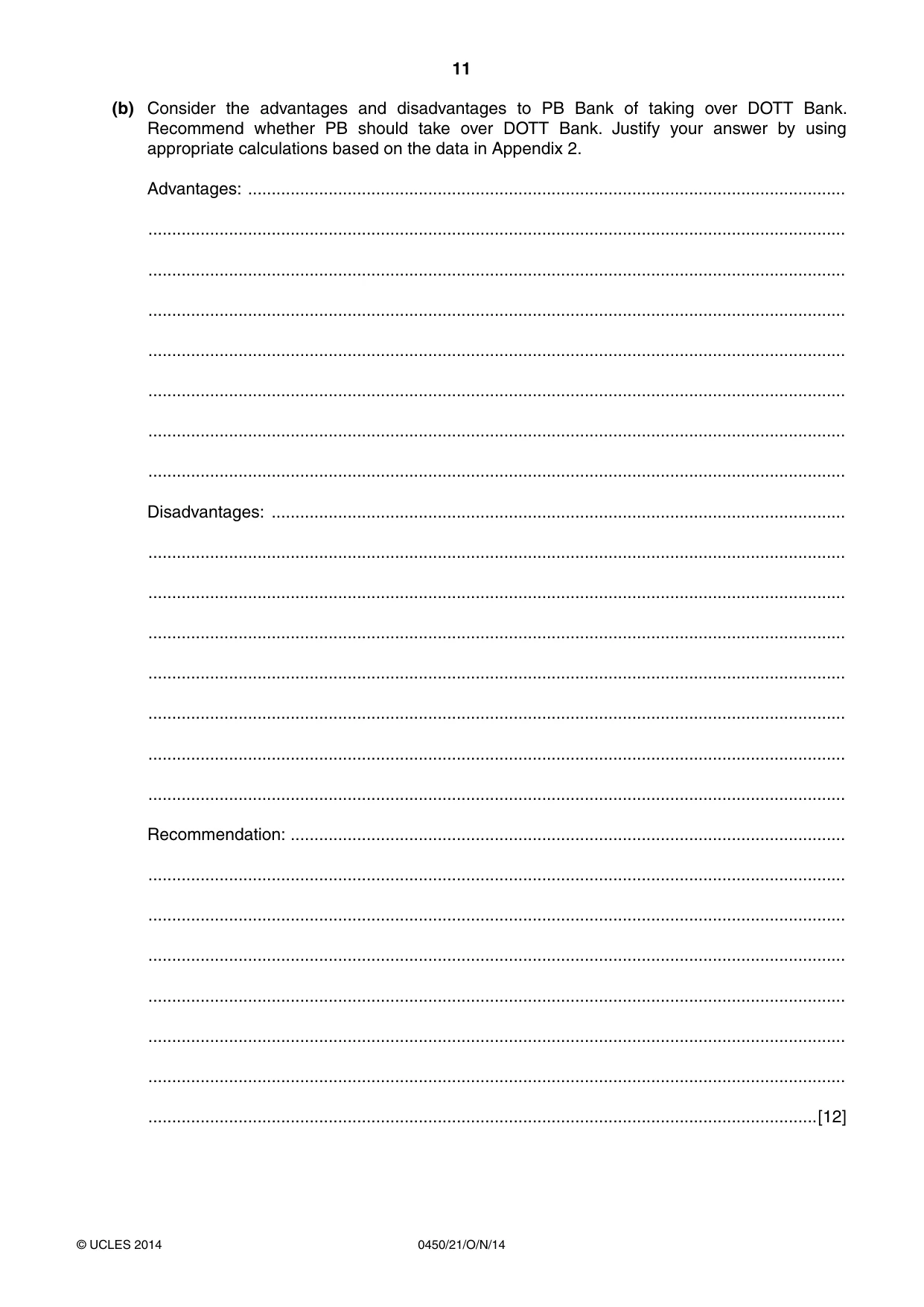
11 0450/21/O/N/14 © UCLES 2014 (b) Consider the advantages and disadvantages to PB Bank of taking over DOTT Bank. Recommend whether PB should take over DOTT Bank. Justify your answer by using appropriate calculations based on the data in Appendix 2. Advantages: … … … … … … … … Disadvantages: … … … … … … … … Recommendation: … … … … … … … …[12]
Question paper, page 12
12 0450/21/O/N/14 © UCLES 2014 Permission to reproduce items where third-party owned material protected by copyright is included has been sought and cleared where possible. Every reasonable effort has been made by the publisher (UCLES) to trace copyright holders, but if any items requiring clearance have unwittingly been included, the publisher will be pleased to make amends at the earliest possible opportunity. Cambridge International Examinations is part of the Cambridge Assessment Group. Cambridge Assessment is the brand name of University of Cambridge Local Examinations Syndicate (UCLES), which is itself a department of the University of Cambridge. BLANK PAGE
Mark scheme, page 1
® IGCSE is the registered trademark of Cambridge International Examinations. CAMBRIDGE INTERNATIONAL EXAMINATIONS Cambridge International General Certificate of Secondary Education MARK SCHEME for the October/November 2014 series 0450 BUSINESS STUDIES 0450/21 Paper 2 (Case Study), maximum raw mark 100 This mark scheme is published as an aid to teachers and candidates, to indicate the requirements of the examination. It shows the basis on which Examiners were instructed to award marks. It does not indicate the details of the discussions that took place at an Examiners’ meeting before marking began, which would have considered the acceptability of alternative answers. Mark schemes should be read in conjunction with the question paper and the Principal Examiner Report for Teachers. Cambridge will not enter into discussions about these mark schemes. Cambridge is publishing the mark schemes for the October/November 2014 series for most Cambridge IGCSE®, Cambridge International A and AS Level components and some Cambridge O Level components.
Mark scheme, page 2
Page 2 Mark Scheme Syllabus Paper Cambridge IGCSE – October/November 2014 0450 21 © Cambridge International Examinations 2014 This mark scheme includes a summary of appropriate content for answering each question. It should be emphasised, however, that this material is for illustrative purposes and is not intended to provide a definitive guide to acceptable answers. It is quite possible that among the scripts there will be some candidate answers that are not covered directly by the content of this mark scheme. In such cases, professional judgement should be exercised in assessing the merits of the answer and the senior examiners should be consulted if further guidance is required. Examples of possible answers are also included in this mark scheme. Again, it should be emphasised that this is for illustrative purposes and the examples chosen represent only some of the many possible responses that would merit reward. Application marks are not awarded for the name of the business or person from the case material. Application is by answering in the context of the case or by using the information in the case to help answer the question.
Mark scheme, page 3
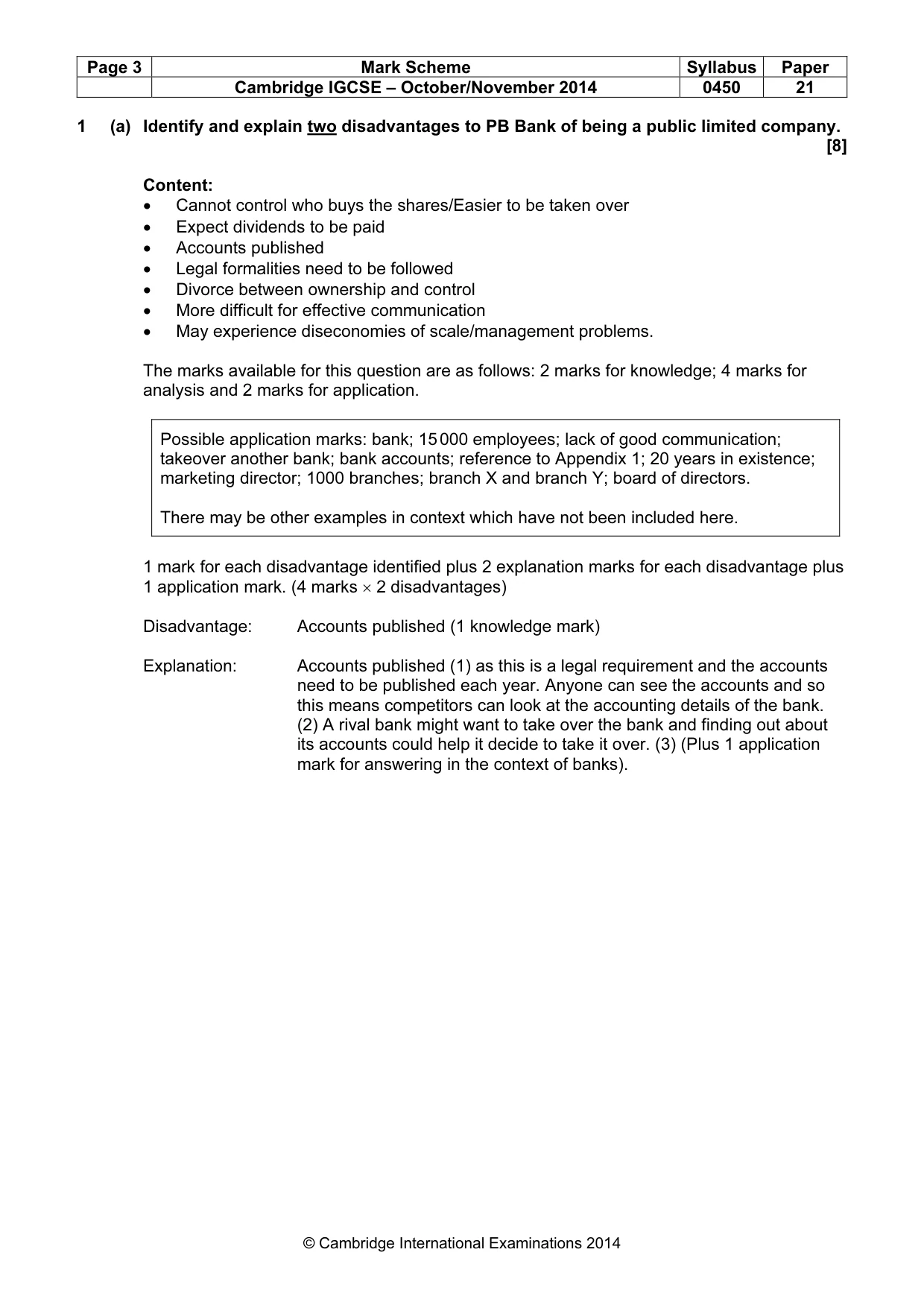
Page 3 Mark Scheme Syllabus Paper Cambridge IGCSE – October/November 2014 0450 21 © Cambridge International Examinations 2014 1 (a) Identify and explain two disadvantages to PB Bank of being a public limited company. [8] Content: • Cannot control who buys the shares/Easier to be taken over • Expect dividends to be paid • Accounts published • Legal formalities need to be followed • Divorce between ownership and control • More difficult for effective communication • May experience diseconomies of scale/management problems. The marks available for this question are as follows: 2 marks for knowledge; 4 marks for analysis and 2 marks for application. Possible application marks: bank; 15 000 employees; lack of good communication; takeover another bank; bank accounts; reference to Appendix 1; 20 years in existence; marketing director; 1000 branches; branch X and branch Y; board of directors. There may be other examples in context which have not been included here. 1 mark for each disadvantage identified plus 2 explanation marks for each disadvantage plus 1 application mark. (4 marks × 2 disadvantages) Disadvantage: Accounts published (1 knowledge mark) Explanation: Accounts published (1) as this is a legal requirement and the accounts need to be published each year. Anyone can see the accounts and so this means competitors can look at the accounting details of the bank. (2) A rival bank might want to take over the bank and finding out about its accounts could help it decide to take it over. (3) (Plus 1 application mark for answering in the context of banks).
Mark scheme, page 4
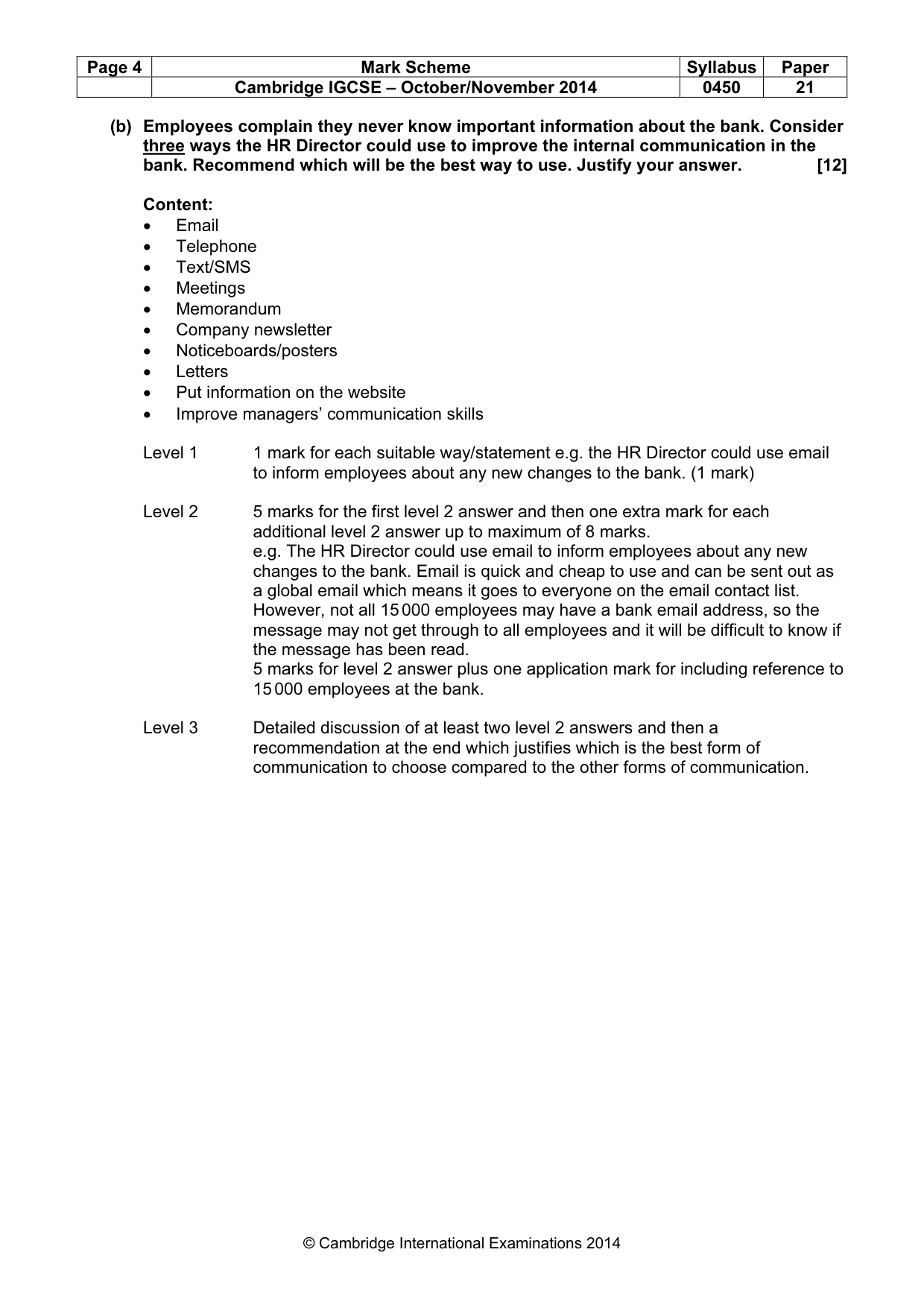
Page 4 Mark Scheme Syllabus Paper Cambridge IGCSE – October/November 2014 0450 21 © Cambridge International Examinations 2014 (b) Employees complain they never know important information about the bank. Consider three ways the HR Director could use to improve the internal communication in the bank. Recommend which will be the best way to use. Justify your answer. [12] Content: • Email • Telephone • Text/SMS • Meetings • Memorandum • Company newsletter • Noticeboards/posters • Letters • Put information on the website • Improve managers’ communication skills Level 1 1 mark for each suitable way/statement e.g. the HR Director could use email to inform employees about any new changes to the bank. (1 mark) Level 2 5 marks for the first level 2 answer and then one extra mark for each additional level 2 answer up to maximum of 8 marks. e.g. The HR Director could use email to inform employees about any new changes to the bank. Email is quick and cheap to use and can be sent out as a global email which means it goes to everyone on the email contact list. However, not all 15 000 employees may have a bank email address, so the message may not get through to all employees and it will be difficult to know if the message has been read. 5 marks for level 2 answer plus one application mark for including reference to 15 000 employees at the bank. Level 3 Detailed discussion of at least two level 2 answers and then a recommendation at the end which justifies which is the best form of communication to choose compared to the other forms of communication.
Mark scheme, page 5
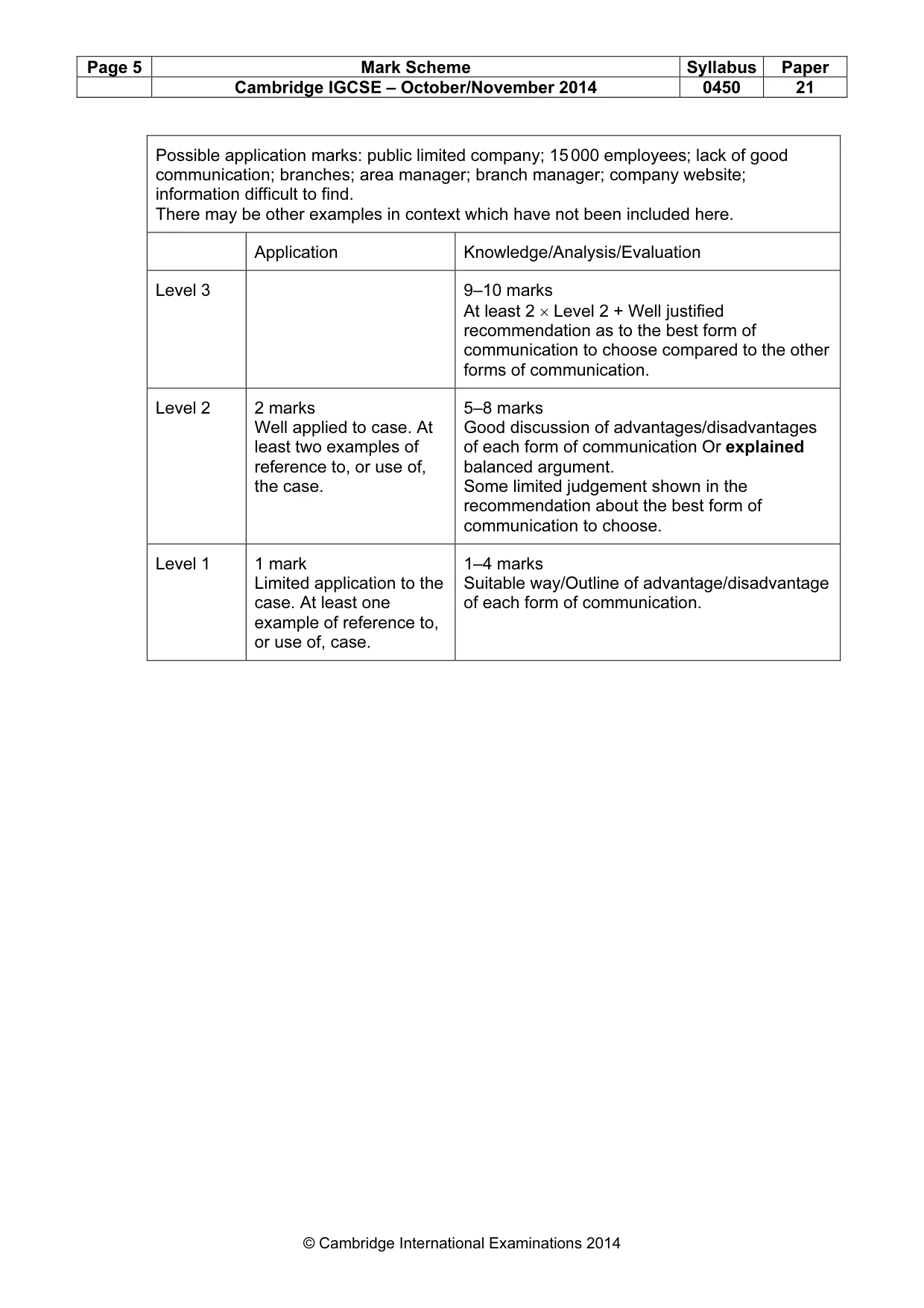
Page 5 Mark Scheme Syllabus Paper Cambridge IGCSE – October/November 2014 0450 21 © Cambridge International Examinations 2014 Possible application marks: public limited company; 15 000 employees; lack of good communication; branches; area manager; branch manager; company website; information difficult to find. There may be other examples in context which have not been included here. Application Knowledge/Analysis/Evaluation Level 3 9–10 marks At least 2 × Level 2 + Well justified recommendation as to the best form of communication to choose compared to the other forms of communication. Level 2 2 marks Well applied to case. At least two examples of reference to, or use of, the case. 5–8 marks Good discussion of advantages/disadvantages of each form of communication Or explained balanced argument. Some limited judgement shown in the recommendation about the best form of communication to choose. Level 1 1 mark Limited application to the case. At least one example of reference to, or use of, case. 1–4 marks Suitable way/Outline of advantage/disadvantage of each form of communication.
Mark scheme, page 6
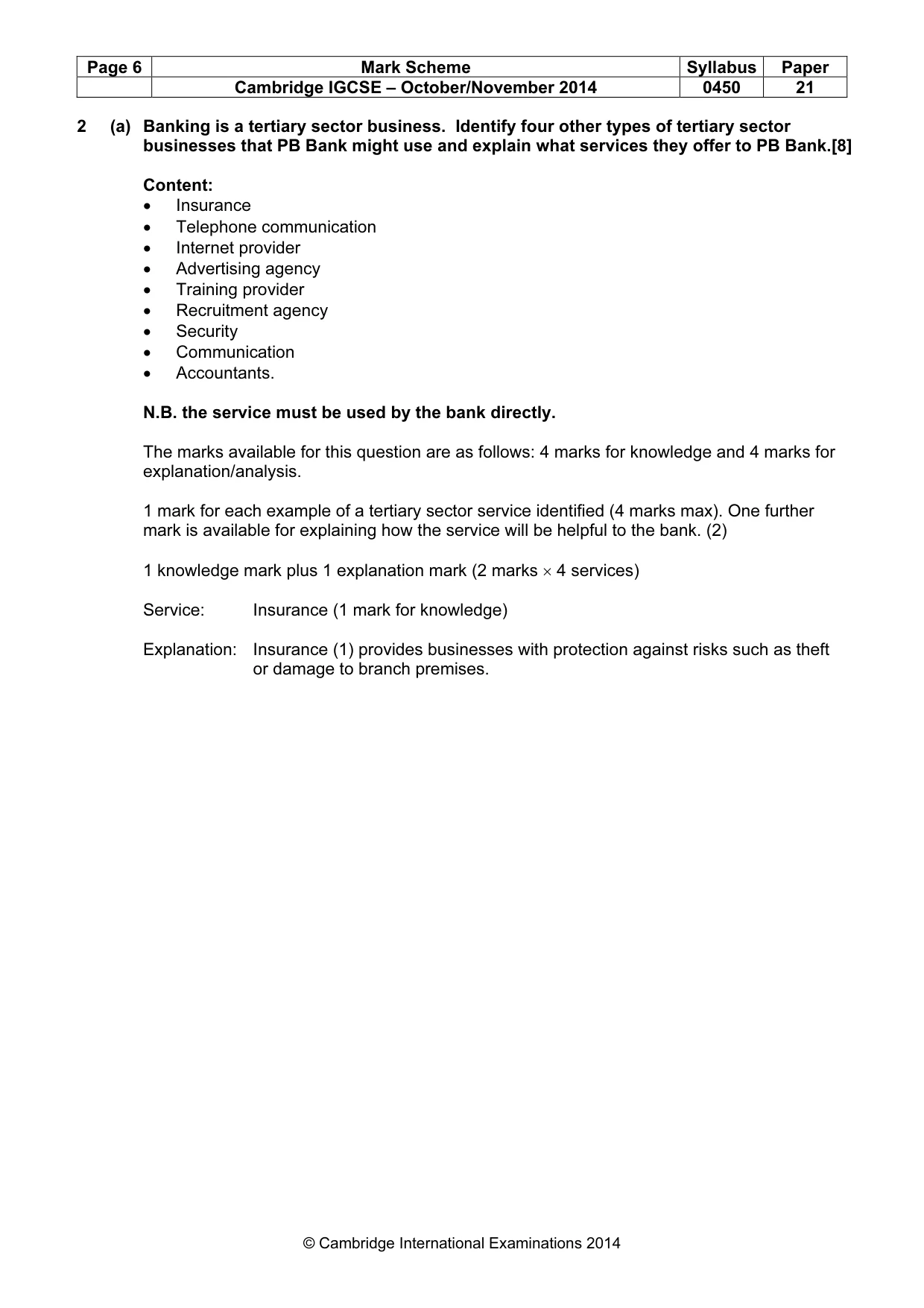
Page 6 Mark Scheme Syllabus Paper Cambridge IGCSE – October/November 2014 0450 21 © Cambridge International Examinations 2014 2 (a) Banking is a tertiary sector business. Identify four other types of tertiary sector businesses that PB Bank might use and explain what services they offer to PB Bank.[8] Content: • Insurance • Telephone communication • Internet provider • Advertising agency • Training provider • Recruitment agency • Security • Communication • Accountants. N.B. the service must be used by the bank directly. The marks available for this question are as follows: 4 marks for knowledge and 4 marks for explanation/analysis. 1 mark for each example of a tertiary sector service identified (4 marks max). One further mark is available for explaining how the service will be helpful to the bank. (2) 1 knowledge mark plus 1 explanation mark (2 marks × 4 services) Service: Insurance (1 mark for knowledge) Explanation: Insurance (1) provides businesses with protection against risks such as theft or damage to branch premises.
Mark scheme, page 7
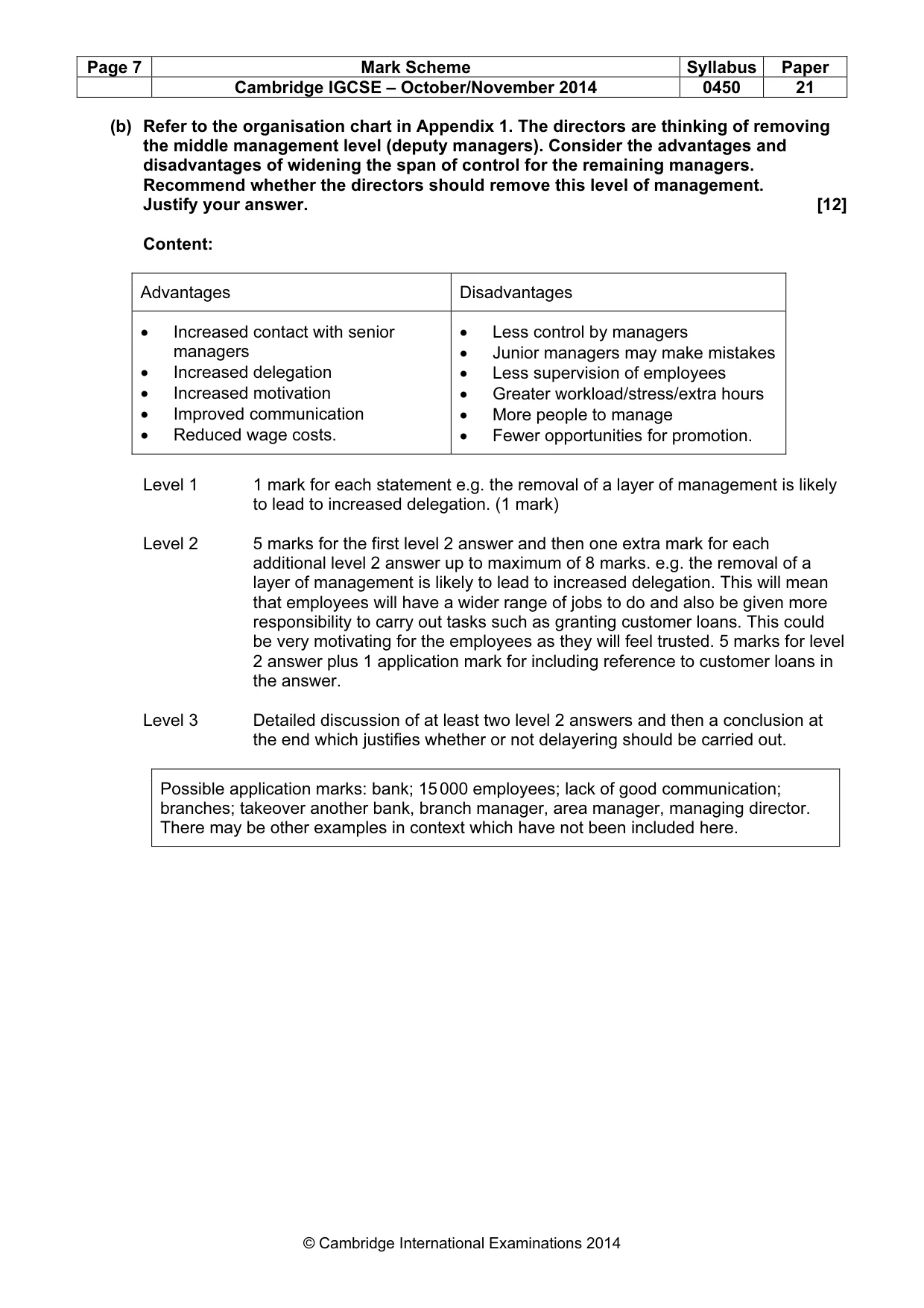
Page 7 Mark Scheme Syllabus Paper Cambridge IGCSE – October/November 2014 0450 21 © Cambridge International Examinations 2014 (b) Refer to the organisation chart in Appendix 1. The directors are thinking of removing the middle management level (deputy managers). Consider the advantages and disadvantages of widening the span of control for the remaining managers. Recommend whether the directors should remove this level of management. Justify your answer. [12] Content: Advantages Disadvantages • Increased contact with senior managers • Increased delegation • Increased motivation • Improved communication • Reduced wage costs. • Less control by managers • Junior managers may make mistakes • Less supervision of employees • Greater workload/stress/extra hours • More people to manage • Fewer opportunities for promotion. Level 1 1 mark for each statement e.g. the removal of a layer of management is likely to lead to increased delegation. (1 mark) Level 2 5 marks for the first level 2 answer and then one extra mark for each additional level 2 answer up to maximum of 8 marks. e.g. the removal of a layer of management is likely to lead to increased delegation. This will mean that employees will have a wider range of jobs to do and also be given more responsibility to carry out tasks such as granting customer loans. This could be very motivating for the employees as they will feel trusted. 5 marks for level 2 answer plus 1 application mark for including reference to customer loans in the answer. Level 3 Detailed discussion of at least two level 2 answers and then a conclusion at the end which justifies whether or not delayering should be carried out. Possible application marks: bank; 15 000 employees; lack of good communication; branches; takeover another bank, branch manager, area manager, managing director. There may be other examples in context which have not been included here.
Mark scheme, page 8
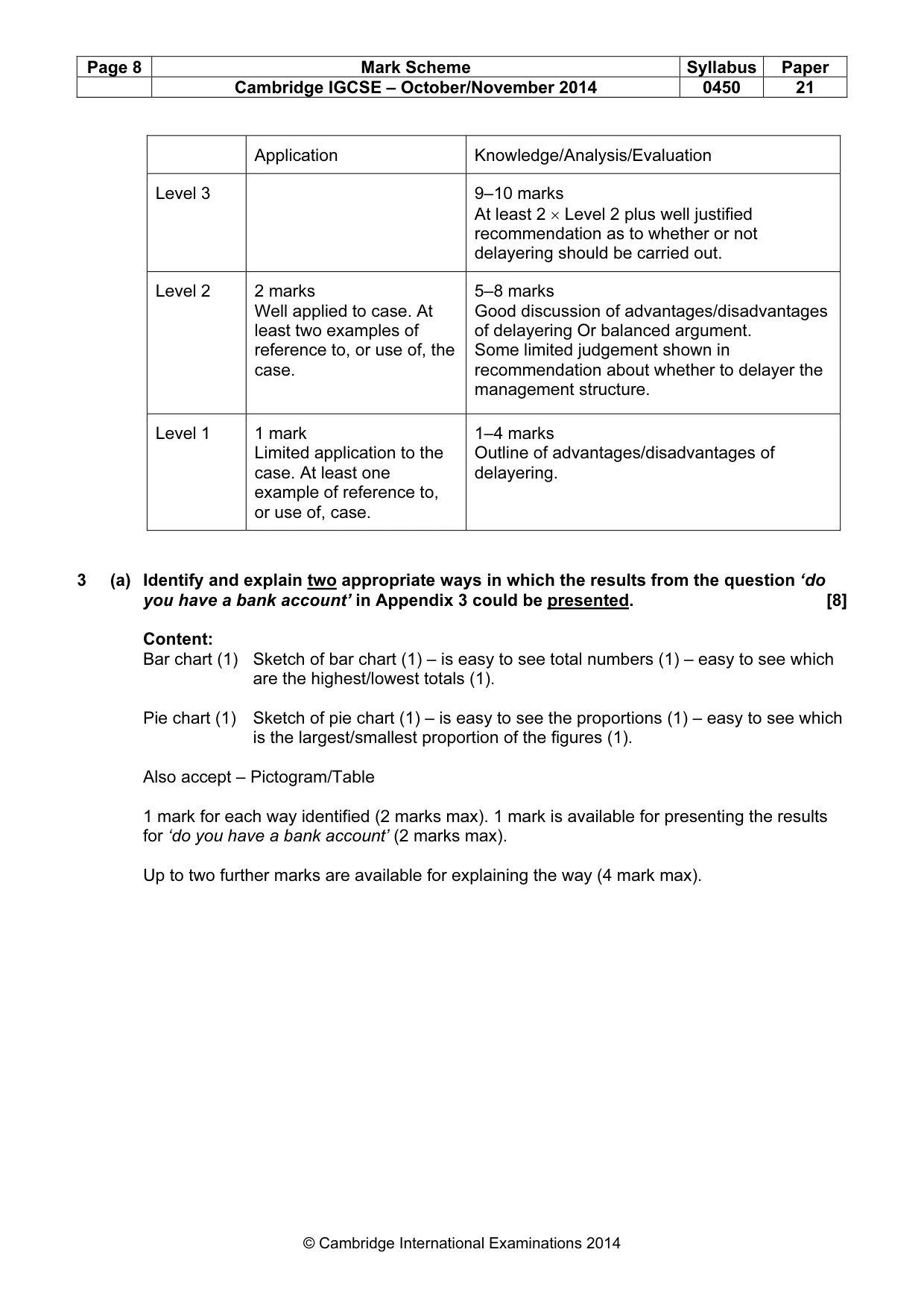
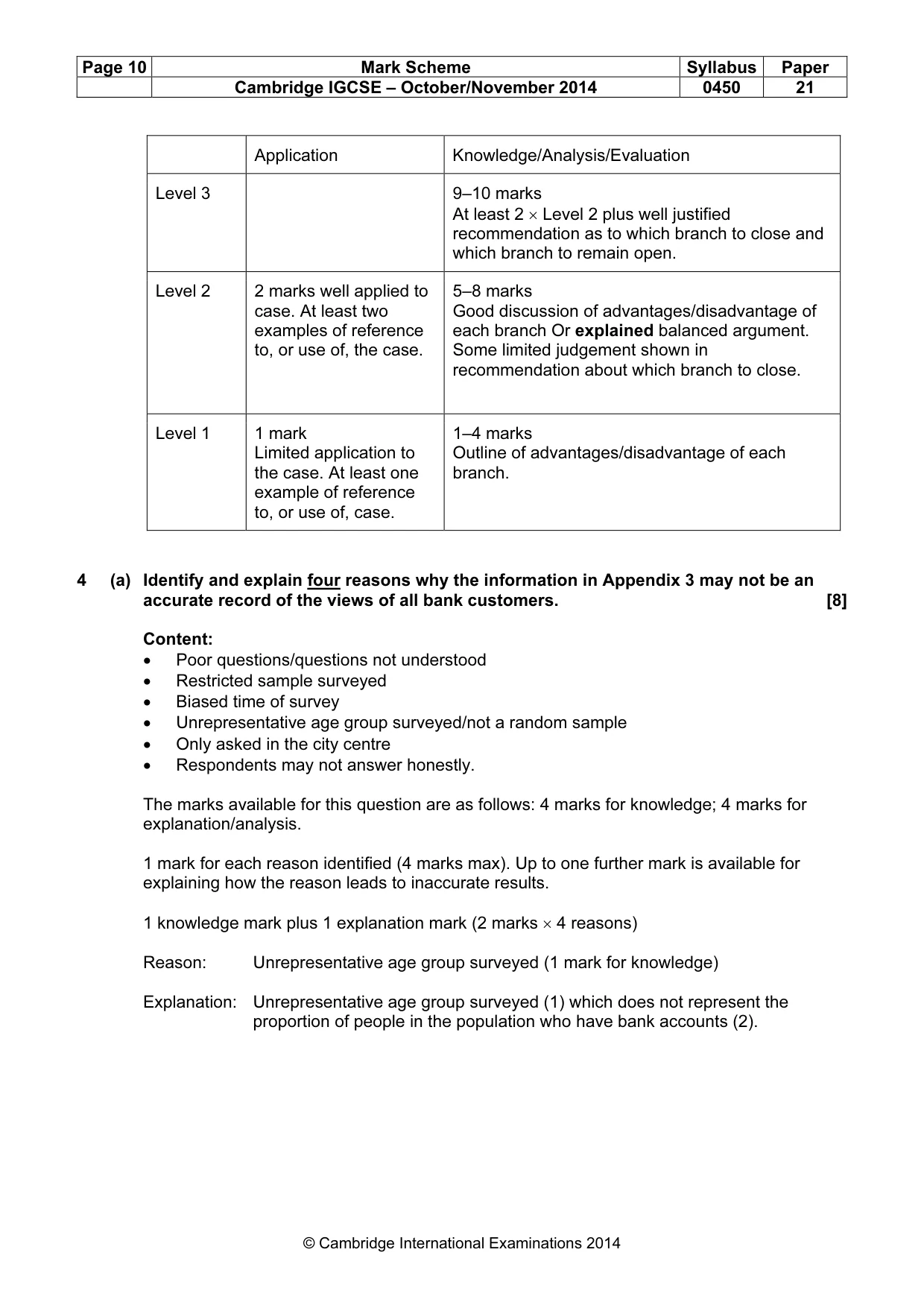
Page 8 Mark Scheme Syllabus Paper Cambridge IGCSE – October/November 2014 0450 21 © Cambridge International Examinations 2014 Application Knowledge/Analysis/Evaluation Level 3 9–10 marks At least 2 × Level 2 plus well justified recommendation as to whether or not delayering should be carried out. Level 2 2 marks Well applied to case. At least two examples of reference to, or use of, the case. 5–8 marks Good discussion of advantages/disadvantages of delayering Or balanced argument. Some limited judgement shown in recommendation about whether to delayer the management structure. Level 1 1 mark Limited application to the case. At least one example of reference to, or use of, case. 1–4 marks Outline of advantages/disadvantages of delayering. 3 (a) Identify and explain two appropriate ways in which the results from the question ‘do you have a bank account’ in Appendix 3 could be presented. [8] Content: Bar chart (1) Sketch of bar chart (1) – is easy to see total numbers (1) – easy to see which are the highest/lowest totals (1). Pie chart (1) Sketch of pie chart (1) – is easy to see the proportions (1) – easy to see which is the largest/smallest proportion of the figures (1). Also accept – Pictogram/Table 1 mark for each way identified (2 marks max). 1 mark is available for presenting the results for ‘do you have a bank account’ (2 marks max). Up to two further marks are available for explaining the way (4 mark max).
Mark scheme, page 9
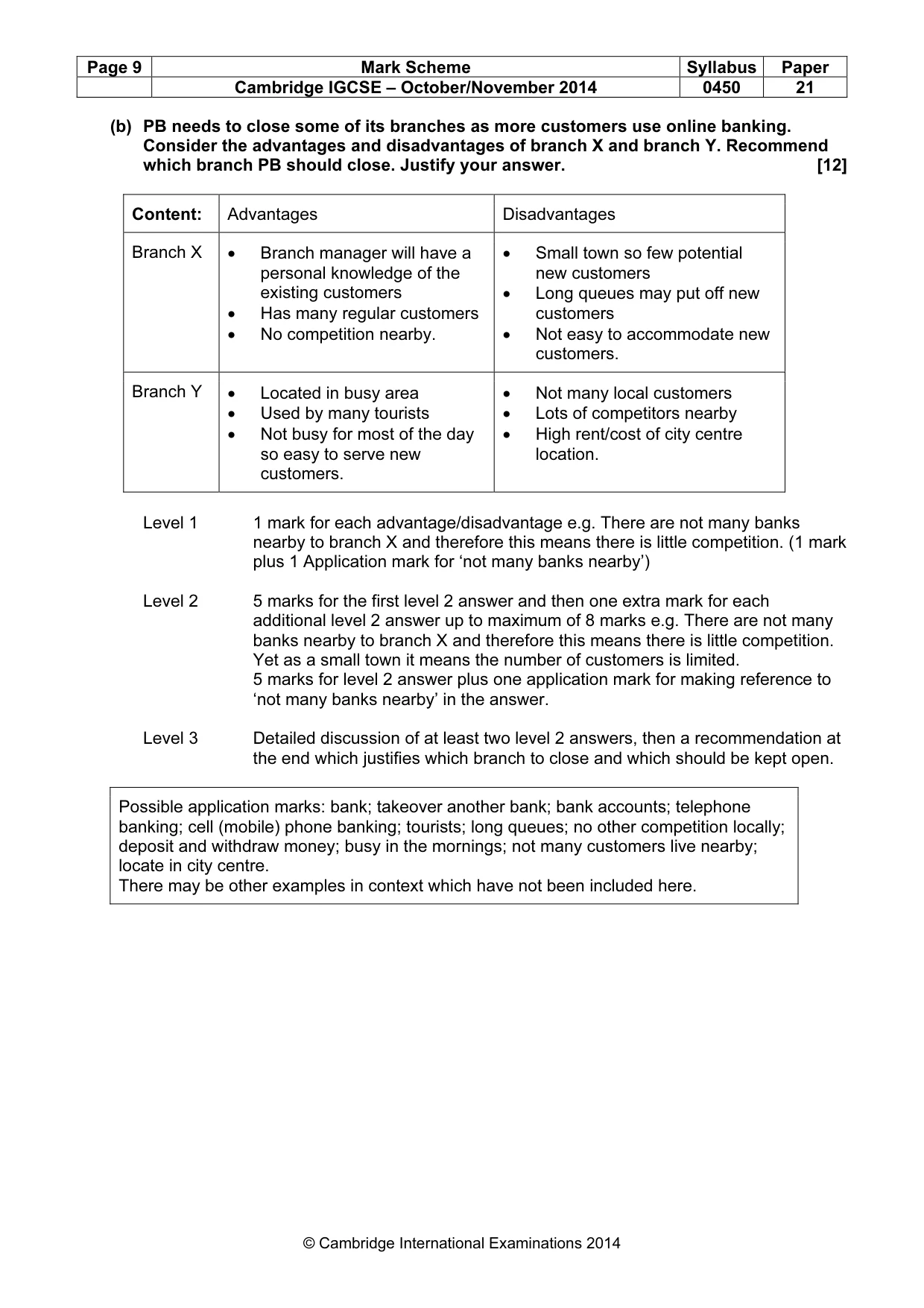
Page 9 Mark Scheme Syllabus Paper Cambridge IGCSE – October/November 2014 0450 21 © Cambridge International Examinations 2014 (b) PB needs to close some of its branches as more customers use online banking. Consider the advantages and disadvantages of branch X and branch Y. Recommend which branch PB should close. Justify your answer. [12] Content: Advantages Disadvantages Branch X • Branch manager will have a personal knowledge of the existing customers • Has many regular customers • No competition nearby. • Small town so few potential new customers • Long queues may put off new customers • Not easy to accommodate new customers. Branch Y • Located in busy area • Used by many tourists • Not busy for most of the day so easy to serve new customers. • Not many local customers • Lots of competitors nearby • High rent/cost of city centre location. Level 1 1 mark for each advantage/disadvantage e.g. There are not many banks nearby to branch X and therefore this means there is little competition. (1 mark plus 1 Application mark for ‘not many banks nearby’) Level 2 5 marks for the first level 2 answer and then one extra mark for each additional level 2 answer up to maximum of 8 marks e.g. There are not many banks nearby to branch X and therefore this means there is little competition. Yet as a small town it means the number of customers is limited. 5 marks for level 2 answer plus one application mark for making reference to ‘not many banks nearby’ in the answer. Level 3 Detailed discussion of at least two level 2 answers, then a recommendation at the end which justifies which branch to close and which should be kept open. Possible application marks: bank; takeover another bank; bank accounts; telephone banking; cell (mobile) phone banking; tourists; long queues; no other competition locally; deposit and withdraw money; busy in the mornings; not many customers live nearby; locate in city centre. There may be other examples in context which have not been included here.
Mark scheme, page 10
Page 10 Mark Scheme Syllabus Paper Cambridge IGCSE – October/November 2014 0450 21 © Cambridge International Examinations 2014 Application Knowledge/Analysis/Evaluation Level 3 9–10 marks At least 2 × Level 2 plus well justified recommendation as to which branch to close and which branch to remain open. Level 2 2 marks well applied to case. At least two examples of reference to, or use of, the case. 5–8 marks Good discussion of advantages/disadvantage of each branch Or explained balanced argument. Some limited judgement shown in recommendation about which branch to close. Level 1 1 mark Limited application to the case. At least one example of reference to, or use of, case. 1–4 marks Outline of advantages/disadvantage of each branch. 4 (a) Identify and explain four reasons why the information in Appendix 3 may not be an accurate record of the views of all bank customers. [8] Content: • Poor questions/questions not understood • Restricted sample surveyed • Biased time of survey • Unrepresentative age group surveyed/not a random sample • Only asked in the city centre • Respondents may not answer honestly. The marks available for this question are as follows: 4 marks for knowledge; 4 marks for explanation/analysis. 1 mark for each reason identified (4 marks max). Up to one further mark is available for explaining how the reason leads to inaccurate results. 1 knowledge mark plus 1 explanation mark (2 marks × 4 reasons) Reason: Unrepresentative age group surveyed (1 mark for knowledge) Explanation: Unrepresentative age group surveyed (1) which does not represent the proportion of people in the population who have bank accounts (2).
Mark scheme, page 11
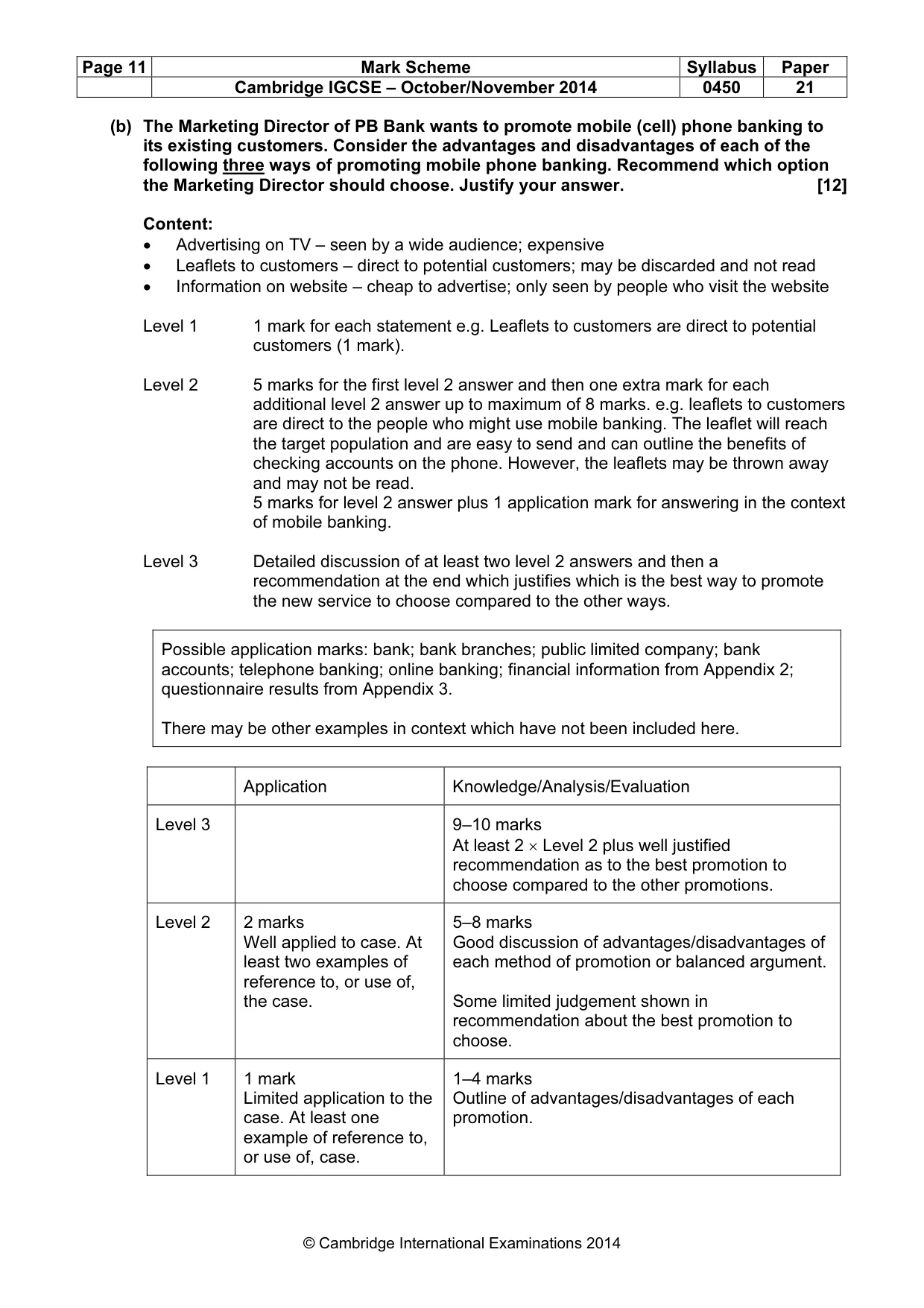
Page 11 Mark Scheme Syllabus Paper Cambridge IGCSE – October/November 2014 0450 21 © Cambridge International Examinations 2014 (b) The Marketing Director of PB Bank wants to promote mobile (cell) phone banking to its existing customers. Consider the advantages and disadvantages of each of the following three ways of promoting mobile phone banking. Recommend which option the Marketing Director should choose. Justify your answer. [12] Content: • Advertising on TV – seen by a wide audience; expensive • Leaflets to customers – direct to potential customers; may be discarded and not read • Information on website – cheap to advertise; only seen by people who visit the website Level 1 1 mark for each statement e.g. Leaflets to customers are direct to potential customers (1 mark). Level 2 5 marks for the first level 2 answer and then one extra mark for each additional level 2 answer up to maximum of 8 marks. e.g. leaflets to customers are direct to the people who might use mobile banking. The leaflet will reach the target population and are easy to send and can outline the benefits of checking accounts on the phone. However, the leaflets may be thrown away and may not be read. 5 marks for level 2 answer plus 1 application mark for answering in the context of mobile banking. Level 3 Detailed discussion of at least two level 2 answers and then a recommendation at the end which justifies which is the best way to promote the new service to choose compared to the other ways. Possible application marks: bank; bank branches; public limited company; bank accounts; telephone banking; online banking; financial information from Appendix 2; questionnaire results from Appendix 3. There may be other examples in context which have not been included here. Application Knowledge/Analysis/Evaluation Level 3 9–10 marks At least 2 × Level 2 plus well justified recommendation as to the best promotion to choose compared to the other promotions. Level 2 2 marks Well applied to case. At least two examples of reference to, or use of, the case. 5–8 marks Good discussion of advantages/disadvantages of each method of promotion or balanced argument. Some limited judgement shown in recommendation about the best promotion to choose. Level 1 1 mark Limited application to the case. At least one example of reference to, or use of, case. 1–4 marks Outline of advantages/disadvantages of each promotion.
Mark scheme, page 12
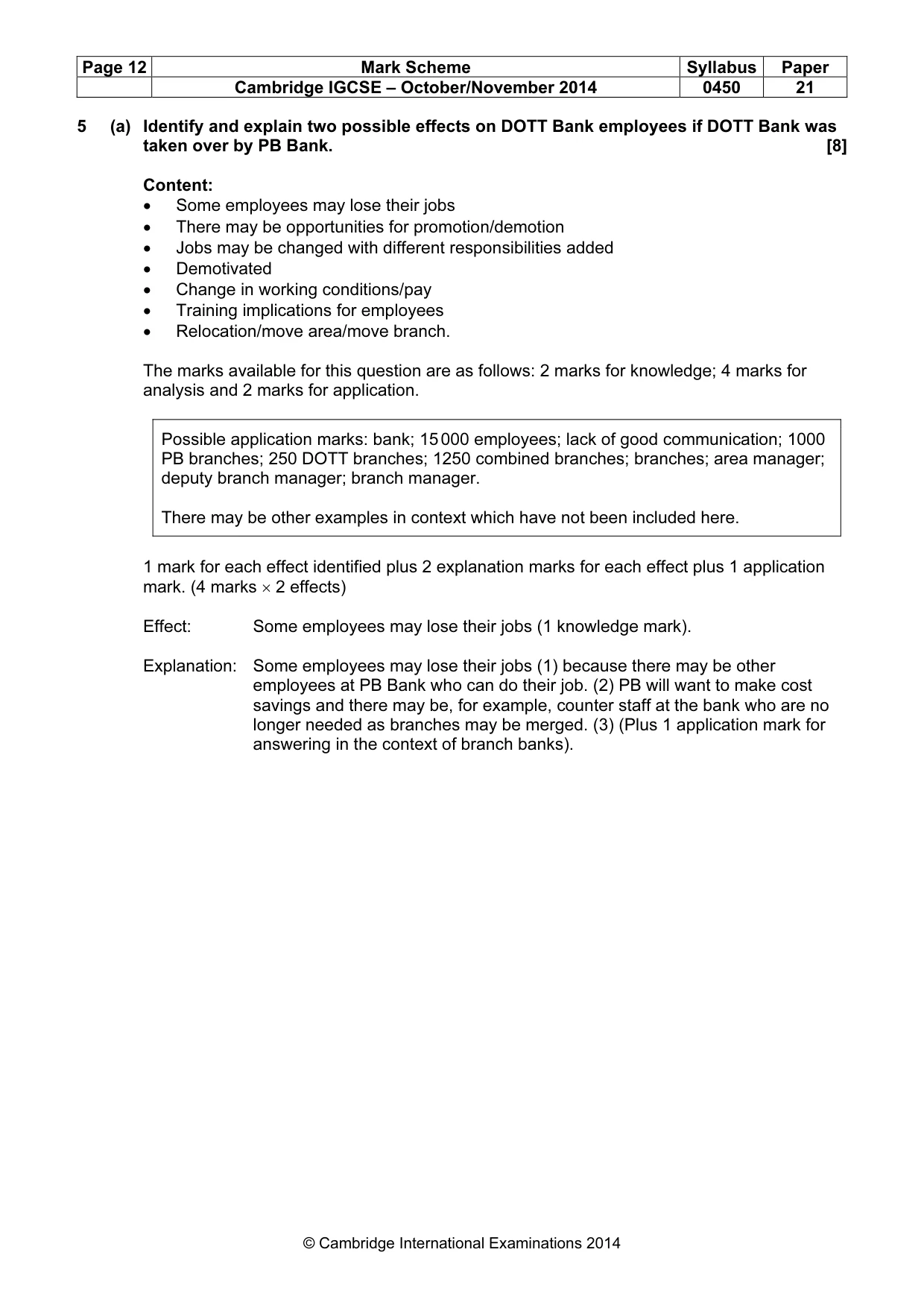
Page 12 Mark Scheme Syllabus Paper Cambridge IGCSE – October/November 2014 0450 21 © Cambridge International Examinations 2014 5 (a) Identify and explain two possible effects on DOTT Bank employees if DOTT Bank was taken over by PB Bank. [8] Content: • Some employees may lose their jobs • There may be opportunities for promotion/demotion • Jobs may be changed with different responsibilities added • Demotivated • Change in working conditions/pay • Training implications for employees • Relocation/move area/move branch. The marks available for this question are as follows: 2 marks for knowledge; 4 marks for analysis and 2 marks for application. Possible application marks: bank; 15 000 employees; lack of good communication; 1000 PB branches; 250 DOTT branches; 1250 combined branches; branches; area manager; deputy branch manager; branch manager. There may be other examples in context which have not been included here. 1 mark for each effect identified plus 2 explanation marks for each effect plus 1 application mark. (4 marks × 2 effects) Effect: Some employees may lose their jobs (1 knowledge mark). Explanation: Some employees may lose their jobs (1) because there may be other employees at PB Bank who can do their job. (2) PB will want to make cost savings and there may be, for example, counter staff at the bank who are no longer needed as branches may be merged. (3) (Plus 1 application mark for answering in the context of branch banks).
Mark scheme, page 13
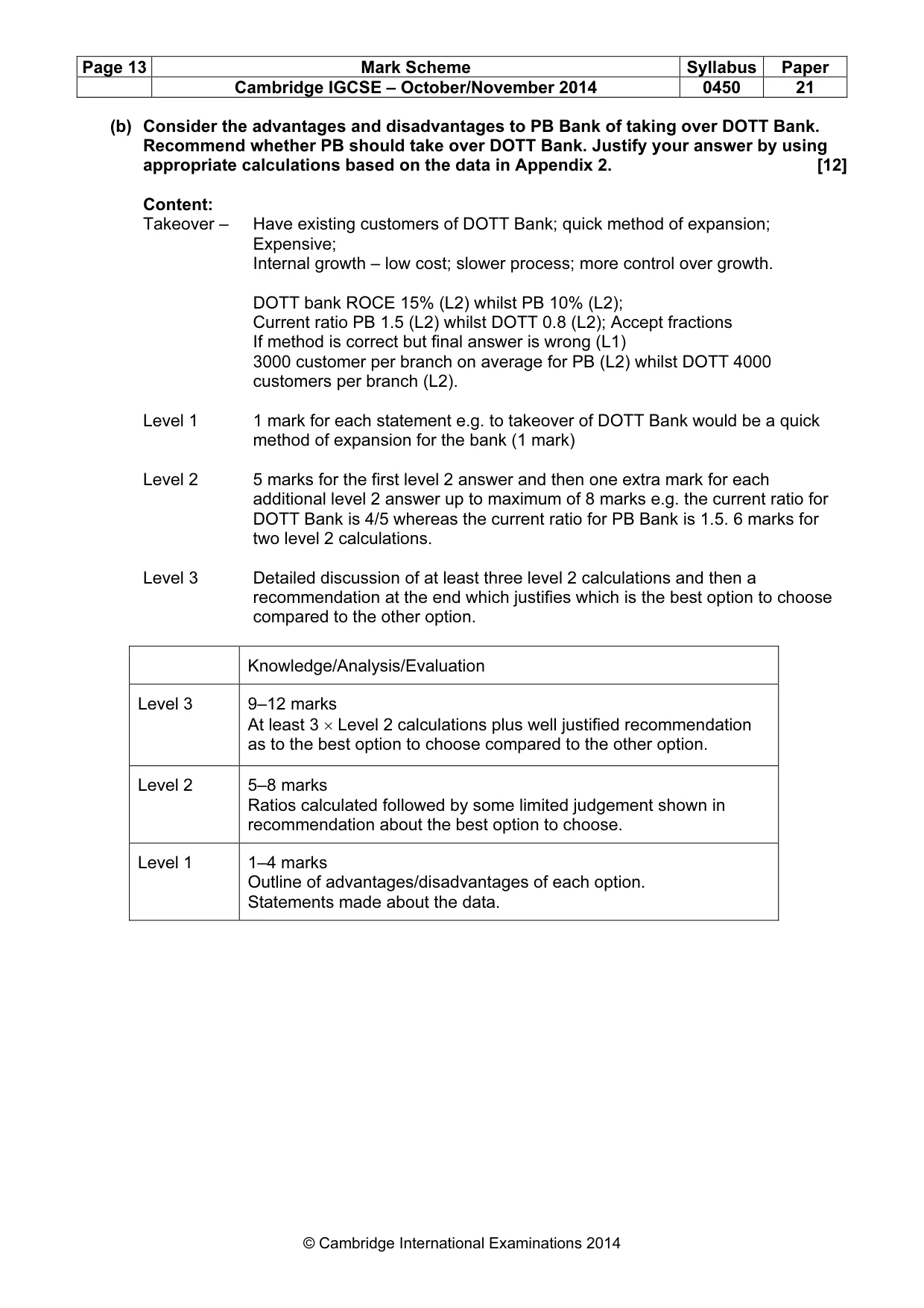
Page 13 Mark Scheme Syllabus Paper Cambridge IGCSE – October/November 2014 0450 21 © Cambridge International Examinations 2014 (b) Consider the advantages and disadvantages to PB Bank of taking over DOTT Bank. Recommend whether PB should take over DOTT Bank. Justify your answer by using appropriate calculations based on the data in Appendix 2. [12] Content: Takeover – Have existing customers of DOTT Bank; quick method of expansion; Expensive; Internal growth – low cost; slower process; more control over growth. DOTT bank ROCE 15% (L2) whilst PB 10% (L2); Current ratio PB 1.5 (L2) whilst DOTT 0.8 (L2); Accept fractions If method is correct but final answer is wrong (L1) 3000 customer per branch on average for PB (L2) whilst DOTT 4000 customers per branch (L2). Level 1 1 mark for each statement e.g. to takeover of DOTT Bank would be a quick method of expansion for the bank (1 mark) Level 2 5 marks for the first level 2 answer and then one extra mark for each additional level 2 answer up to maximum of 8 marks e.g. the current ratio for DOTT Bank is 4/5 whereas the current ratio for PB Bank is 1.5. 6 marks for two level 2 calculations. Level 3 Detailed discussion of at least three level 2 calculations and then a recommendation at the end which justifies which is the best option to choose compared to the other option. Knowledge/Analysis/Evaluation Level 3 9–12 marks At least 3 × Level 2 calculations plus well justified recommendation as to the best option to choose compared to the other option. Level 2 5–8 marks Ratios calculated followed by some limited judgement shown in recommendation about the best option to choose. Level 1 1–4 marks Outline of advantages/disadvantages of each option. Statements made about the data.
What you needed in this session
Cambridge’s own grade thresholds for 2014 Oct/Nov, Paper 2 · Variant 1. A higher threshold means an easier paper — the bar moves with how the cohort did.