Cambridge IGCSE Business Studies 0450 — 2014 Oct/Nov Paper 2 · Variant 3
0450/23/O/N/14 · 100 marks · ≈113 min
The question paper and its mark scheme, free to read here and free to download. This is Cambridge’s own paper, exactly as it was sat.
Question paper12 pages

Mark scheme12 pages
Answers below. Sit the paper first if you are practising.
Paper as text
Question paper, page 1
This document consists of 11 printed pages, 1 blank page and 1 insert. DC (HB (PK)) 79755/1 © UCLES 2014 [Turn over Cambridge International Examinations Cambridge International General Certificate of Secondary Education * 1 9 5 1 8 0 3 8 7 8 * The syllabus is approved for use in England, Wales and Northern Ireland as a Cambridge International Level 1/Level 2 Certificate. BUSINESS STUDIES 0450/23 Paper 2 October/November 2014 1 hour 45 minutes Candidates answer on the Question Paper. No Additional Materials are required. READ THESE INSTRUCTIONS FIRST Write your Centre number, candidate number and name on all the work you hand in. Write in dark blue or black pen. Do not use staples, paper clips, glue or correction fluid. DO NOT WRITE IN ANY BARCODES. Answer all questions. The Insert contains the case study. The businesses described in this question paper are entirely fictitious. At the end of the examination, fasten all your work securely together. The number of marks is given in brackets [ ] at the end of each question or part question.
Question paper, page 2
2 0450/23/O/N/14 © UCLES 2014 1 (a) Identify and explain one advantage and one disadvantage to the business of being a private limited company. Advantage: … … Explanation: … … … … … … Disadvantage: … … Explanation: … … … … … … [8]
Question paper, page 3
3 0450/23/O/N/14 © UCLES 2014 [Turn over (b) Using the information in Appendix 1, consider three ways to improve the hotel’s cash flow. Recommend which way would be the most likely to succeed in improving the hotel’s cash flow. Justify your answer. Way 1: … … … … … … Way 2: … … … … … … Way 3: … … … … … … Recommendation: … … … … … … [12]
Question paper, page 4
4 0450/23/O/N/14 © UCLES 2014 2 (a) Ben might offer some of the hotel rooms for business meetings when the hotel is not busy. Identify and explain one advantage and one disadvantage to the hotel of doing this. Advantage: … … Explanation: … … … … … … Disadvantage: … … Explanation: … … … … … … [8]
Question paper, page 5
5 0450/23/O/N/14 © UCLES 2014 [Turn over (b) Consider three suitable methods of primary research to find out customer requirements for business meeting rooms. Recommend which is the best method of primary research for Ben to use. Justify your answer. Method 1: … … … … … … Method 2: … … … … … … Method 3: … … … … … … Recommendation: … … … … … … [12]
Question paper, page 6
6 0450/23/O/N/14 © UCLES 2014 3 (a) Ben’s hotel is part of the large Marrat group of hotels. Identify and explain two benefits to Ben’s employees of the hotel being part of a large group. Benefit 1: … … Explanation: … … … … … … Benefit 2: … … Explanation: … … … … … … [8]
Question paper, page 7
7 0450/23/O/N/14 © UCLES 2014 [Turn over (b) There is more work to be done when the hotel is busy. Consider the advantages and disadvantages of each of the following two options. Recommend which would be the best option. Justify your answer. Recruiting new employees for the tourist season: … … … … … … … … Paying overtime to the existing employees so that they work longer hours: … … … … … … … … … Recommendation: … … … … … … … … [12]
Question paper, page 8
8 0450/23/O/N/14 © UCLES 2014 4 (a) Identify and explain two ways Ben could try to ensure that the hotel provides a quality service for all its customers. Way 1: … … Explanation: … … … … … … Way 2: … … Explanation: … … … … … … [8]
Question paper, page 9
9 0450/23/O/N/14 © UCLES 2014 [Turn over (b) Ben wants the hotel redecorated. Consider the advantages and disadvantages of the following three methods of financing the costs of redecoration. Recommend which would be the best method of finance to use. Justify your answer. Retained profits: … … … … … … Three-year bank loan: … … … … … … Overdraft: … … … … … … Recommendation: … … … … … …[12]
Question paper, page 10
10 0450/23/O/N/14 © UCLES 2014 5 (a) Identify and explain four ways Ben could use to increase the number of tourists using his hotel. Way 1: … Explanation: … … … Way 2: … Explanation: … … … Way 3: … Explanation: … … … Way 4: … Explanation: … … … [8]
Question paper, page 11
11 0450/23/O/N/14 © UCLES 2014 (b) Consider the impact on hotels in country X of the following changes. Which one of these changes do you think will have the biggest effect on the profitability of the hotel that Ben manages? Justify your answer. Government puts a tax on all hotel rooms which has to be paid whether occupied or empty: … … … … … … Minimum wage in country X is increased by 5%: … … … … … … Appreciation in the currency of country X: … … … … … … Conclusion: … … … … … … [12]
Question paper, page 12
12 0450/23/O/N/14 © UCLES 2014 Permission to reproduce items where third-party owned material protected by copyright is included has been sought and cleared where possible. Every reasonable effort has been made by the publisher (UCLES) to trace copyright holders, but if any items requiring clearance have unwittingly been included, the publisher will be pleased to make amends at the earliest possible opportunity. Cambridge International Examinations is part of the Cambridge Assessment Group. Cambridge Assessment is the brand name of University of Cambridge Local Examinations Syndicate (UCLES), which is itself a department of the University of Cambridge. BLANK PAGE
Mark scheme, page 1
® IGCSE is the registered trademark of Cambridge International Examinations. CAMBRIDGE INTERNATIONAL EXAMINATIONS Cambridge International General Certificate of Secondary Education MARK SCHEME for the October/November 2014 series 0450 BUSINESS STUDIES 0450/23 Paper 2 (Case Study), maximum raw mark 100 This mark scheme is published as an aid to teachers and candidates, to indicate the requirements of the examination. It shows the basis on which Examiners were instructed to award marks. It does not indicate the details of the discussions that took place at an Examiners’ meeting before marking began, which would have considered the acceptability of alternative answers. Mark schemes should be read in conjunction with the question paper and the Principal Examiner Report for Teachers. Cambridge will not enter into discussions about these mark schemes. Cambridge is publishing the mark schemes for the October/November 2014 series for most Cambridge IGCSE®, Cambridge International A and AS Level components and some Cambridge O Level components.
Mark scheme, page 2
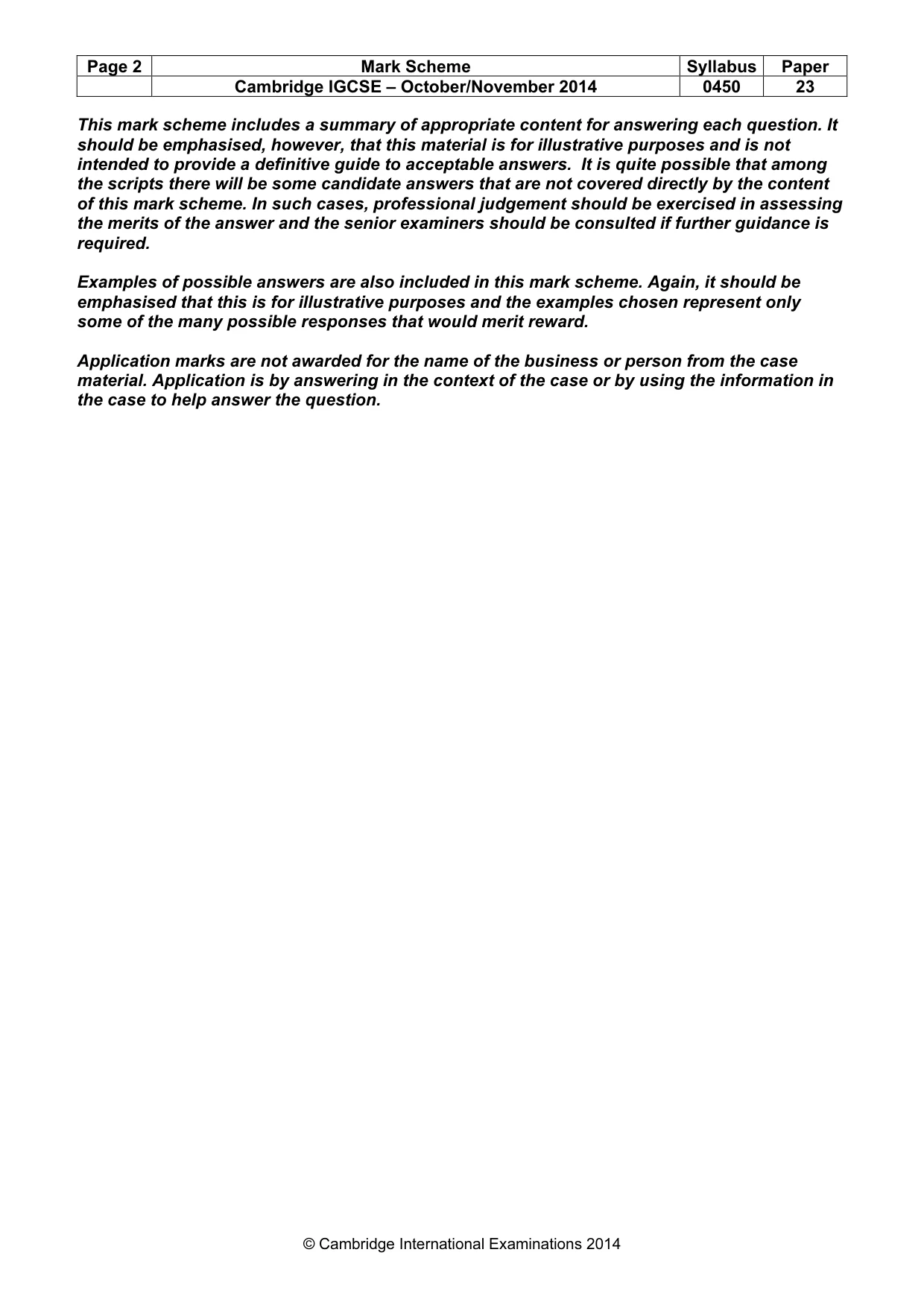
Page 2 Mark Scheme Syllabus Paper Cambridge IGCSE – October/November 2014 0450 23 © Cambridge International Examinations 2014 This mark scheme includes a summary of appropriate content for answering each question. It should be emphasised, however, that this material is for illustrative purposes and is not intended to provide a definitive guide to acceptable answers. It is quite possible that among the scripts there will be some candidate answers that are not covered directly by the content of this mark scheme. In such cases, professional judgement should be exercised in assessing the merits of the answer and the senior examiners should be consulted if further guidance is required. Examples of possible answers are also included in this mark scheme. Again, it should be emphasised that this is for illustrative purposes and the examples chosen represent only some of the many possible responses that would merit reward. Application marks are not awarded for the name of the business or person from the case material. Application is by answering in the context of the case or by using the information in the case to help answer the question.
Mark scheme, page 3
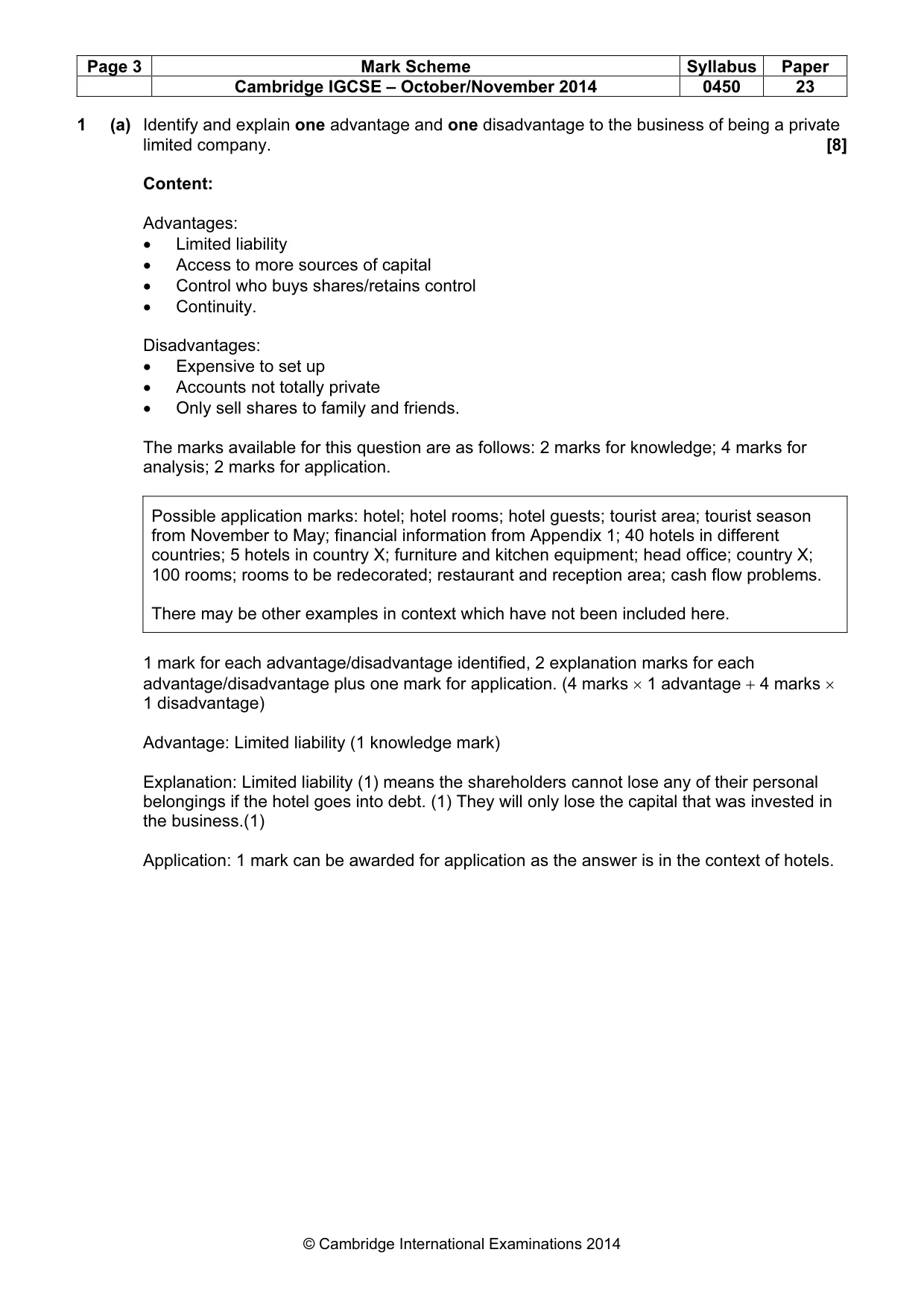
Page 3 Mark Scheme Syllabus Paper Cambridge IGCSE – October/November 2014 0450 23 © Cambridge International Examinations 2014 1 (a) Identify and explain one advantage and one disadvantage to the business of being a private limited company. [8] Content: Advantages: • Limited liability • Access to more sources of capital • Control who buys shares/retains control • Continuity. Disadvantages: • Expensive to set up • Accounts not totally private • Only sell shares to family and friends. The marks available for this question are as follows: 2 marks for knowledge; 4 marks for analysis; 2 marks for application. Possible application marks: hotel; hotel rooms; hotel guests; tourist area; tourist season from November to May; financial information from Appendix 1; 40 hotels in different countries; 5 hotels in country X; furniture and kitchen equipment; head office; country X; 100 rooms; rooms to be redecorated; restaurant and reception area; cash flow problems. There may be other examples in context which have not been included here. 1 mark for each advantage/disadvantage identified, 2 explanation marks for each advantage/disadvantage plus one mark for application. (4 marks × 1 advantage + 4 marks × 1 disadvantage) Advantage: Limited liability (1 knowledge mark) Explanation: Limited liability (1) means the shareholders cannot lose any of their personal belongings if the hotel goes into debt. (1) They will only lose the capital that was invested in the business.(1) Application: 1 mark can be awarded for application as the answer is in the context of hotels.
Mark scheme, page 4
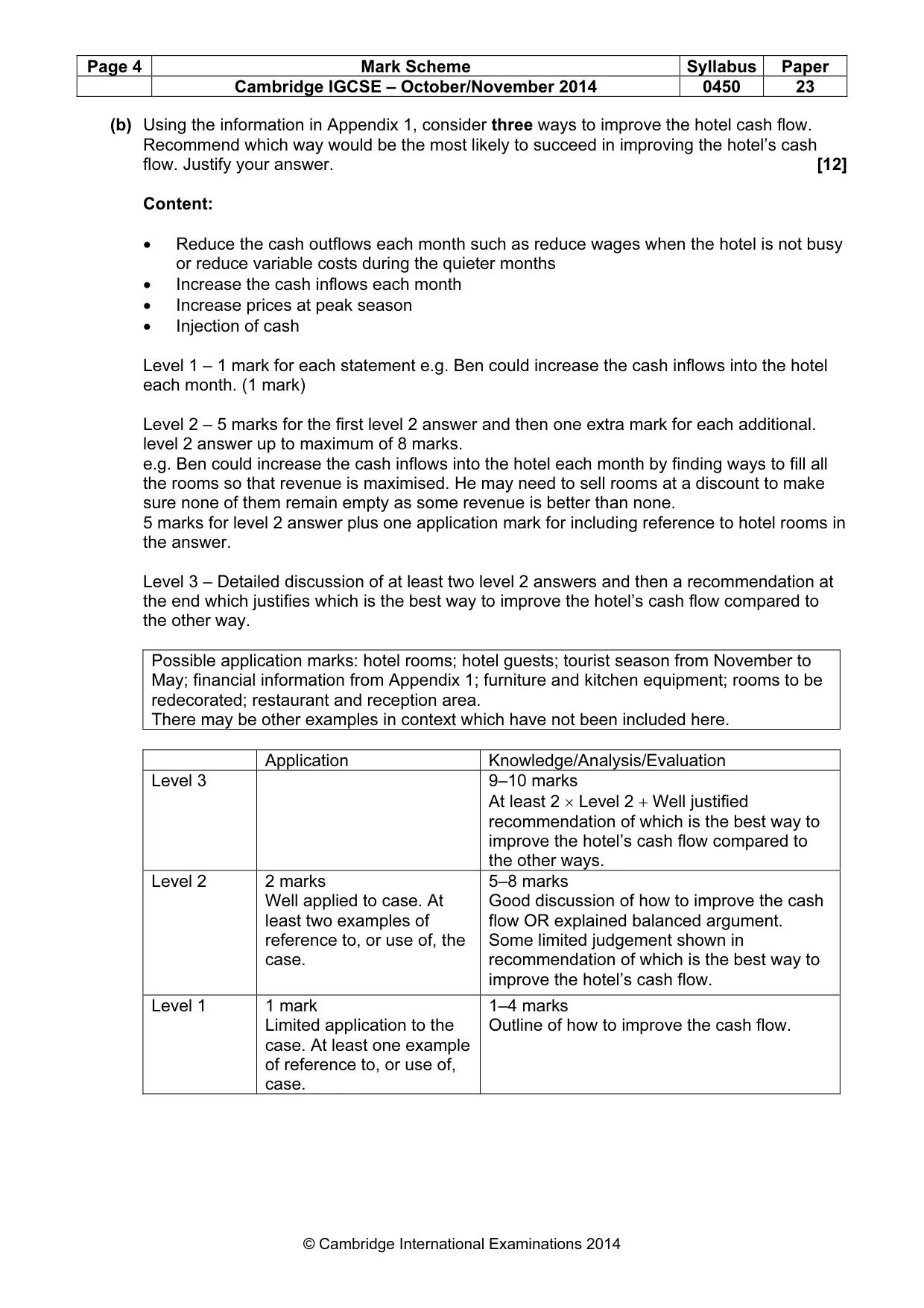
Page 4 Mark Scheme Syllabus Paper Cambridge IGCSE – October/November 2014 0450 23 © Cambridge International Examinations 2014 (b) Using the information in Appendix 1, consider three ways to improve the hotel cash flow. Recommend which way would be the most likely to succeed in improving the hotel’s cash flow. Justify your answer. [12] Content: • Reduce the cash outflows each month such as reduce wages when the hotel is not busy or reduce variable costs during the quieter months • Increase the cash inflows each month • Increase prices at peak season • Injection of cash Level 1 – 1 mark for each statement e.g. Ben could increase the cash inflows into the hotel each month. (1 mark) Level 2 – 5 marks for the first level 2 answer and then one extra mark for each additional. level 2 answer up to maximum of 8 marks. e.g. Ben could increase the cash inflows into the hotel each month by finding ways to fill all the rooms so that revenue is maximised. He may need to sell rooms at a discount to make sure none of them remain empty as some revenue is better than none. 5 marks for level 2 answer plus one application mark for including reference to hotel rooms in the answer. Level 3 – Detailed discussion of at least two level 2 answers and then a recommendation at the end which justifies which is the best way to improve the hotel’s cash flow compared to the other way. Possible application marks: hotel rooms; hotel guests; tourist season from November to May; financial information from Appendix 1; furniture and kitchen equipment; rooms to be redecorated; restaurant and reception area. There may be other examples in context which have not been included here. Application Knowledge/Analysis/Evaluation Level 3 9–10 marks At least 2 × Level 2 + Well justified recommendation of which is the best way to improve the hotel’s cash flow compared to the other ways. Level 2 2 marks Well applied to case. At least two examples of reference to, or use of, the case. 5–8 marks Good discussion of how to improve the cash flow OR explained balanced argument. Some limited judgement shown in recommendation of which is the best way to improve the hotel’s cash flow. Level 1 1 mark Limited application to the case. At least one example of reference to, or use of, case. 1–4 marks Outline of how to improve the cash flow.
Mark scheme, page 5
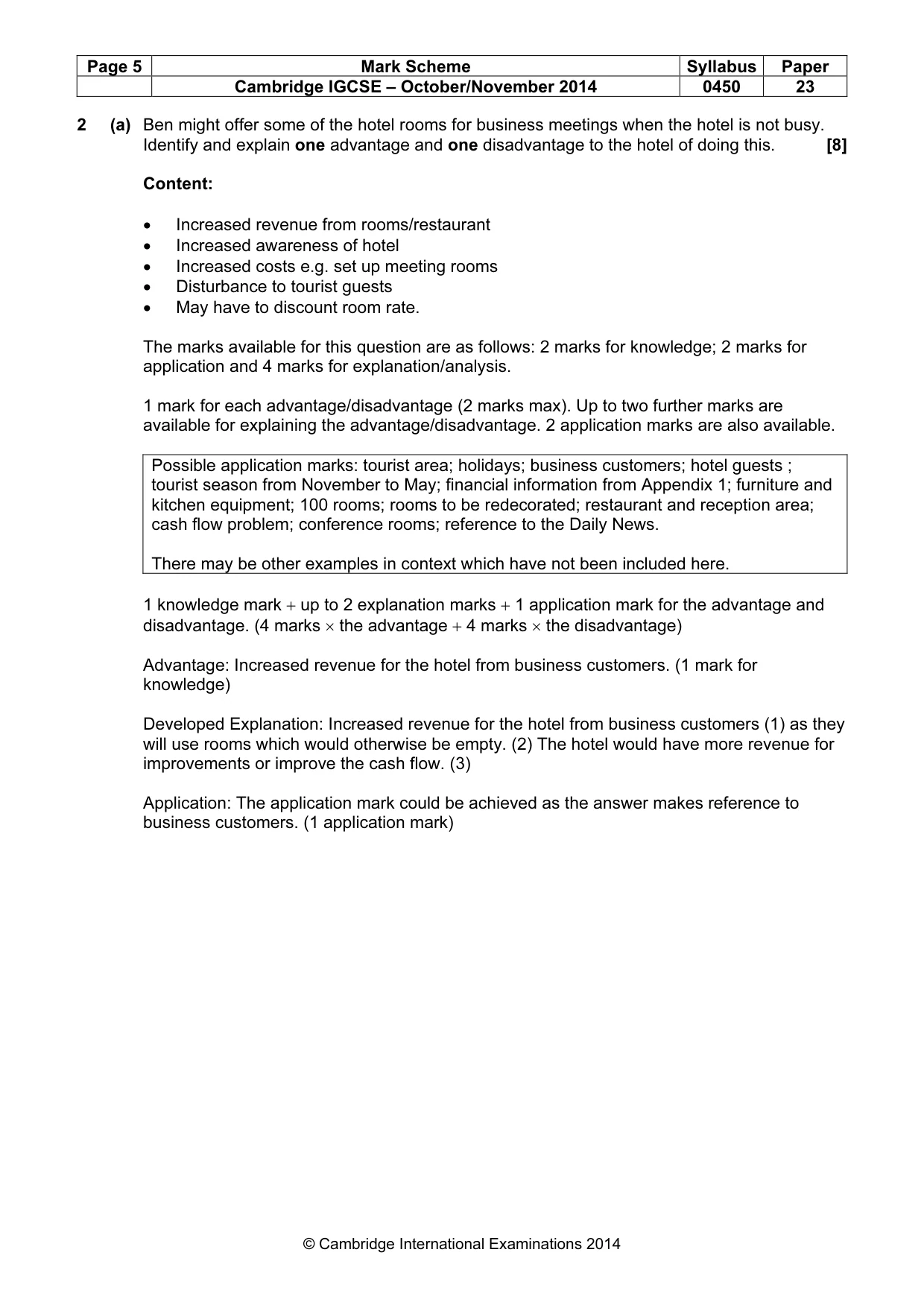
Page 5 Mark Scheme Syllabus Paper Cambridge IGCSE – October/November 2014 0450 23 © Cambridge International Examinations 2014 2 (a) Ben might offer some of the hotel rooms for business meetings when the hotel is not busy. Identify and explain one advantage and one disadvantage to the hotel of doing this. [8] Content: • Increased revenue from rooms/restaurant • Increased awareness of hotel • Increased costs e.g. set up meeting rooms • Disturbance to tourist guests • May have to discount room rate. The marks available for this question are as follows: 2 marks for knowledge; 2 marks for application and 4 marks for explanation/analysis. 1 mark for each advantage/disadvantage (2 marks max). Up to two further marks are available for explaining the advantage/disadvantage. 2 application marks are also available. Possible application marks: tourist area; holidays; business customers; hotel guests ; tourist season from November to May; financial information from Appendix 1; furniture and kitchen equipment; 100 rooms; rooms to be redecorated; restaurant and reception area; cash flow problem; conference rooms; reference to the Daily News. There may be other examples in context which have not been included here. 1 knowledge mark + up to 2 explanation marks + 1 application mark for the advantage and disadvantage. (4 marks × the advantage + 4 marks × the disadvantage) Advantage: Increased revenue for the hotel from business customers. (1 mark for knowledge) Developed Explanation: Increased revenue for the hotel from business customers (1) as they will use rooms which would otherwise be empty. (2) The hotel would have more revenue for improvements or improve the cash flow. (3) Application: The application mark could be achieved as the answer makes reference to business customers. (1 application mark)
Mark scheme, page 6
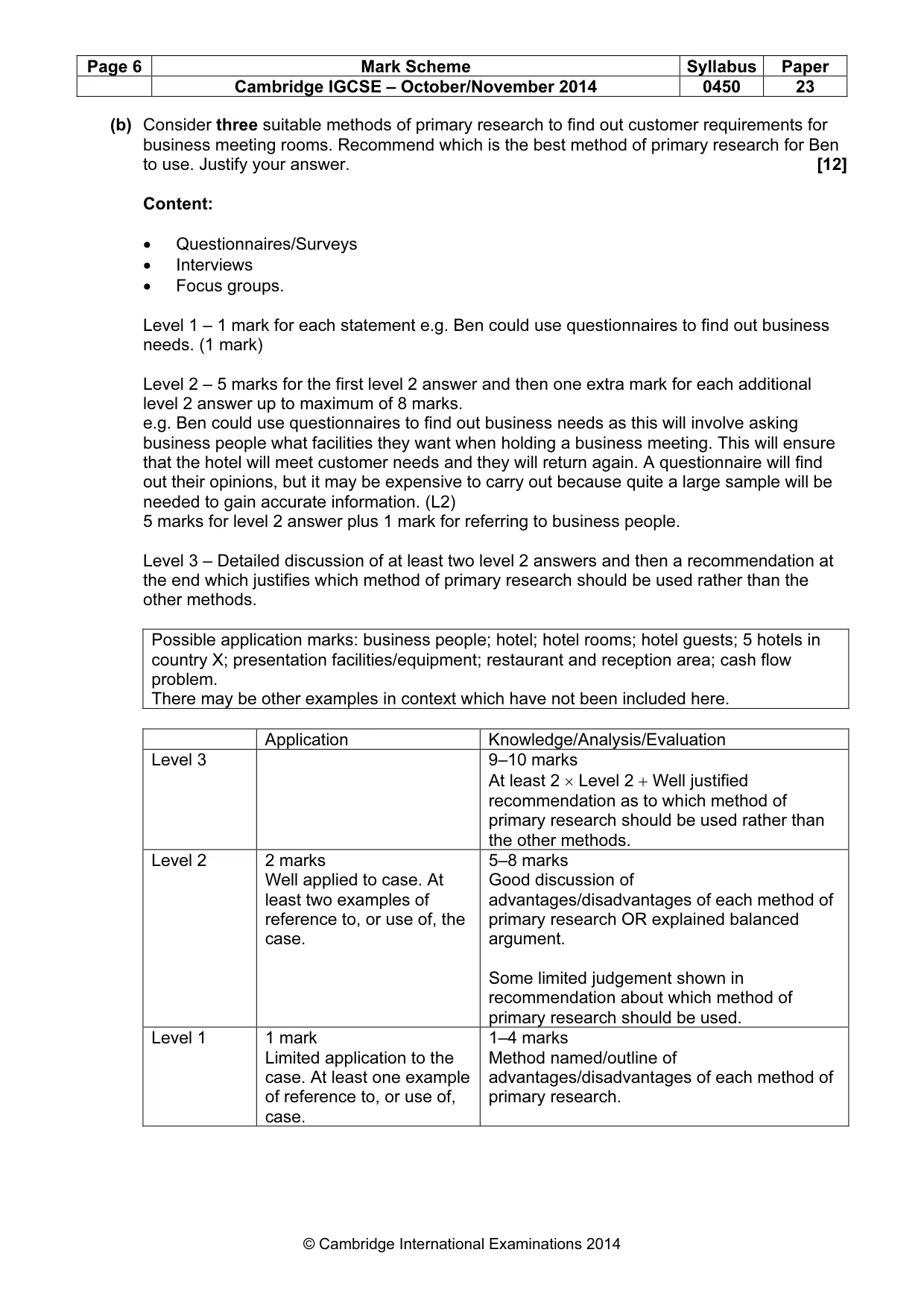
Page 6 Mark Scheme Syllabus Paper Cambridge IGCSE – October/November 2014 0450 23 © Cambridge International Examinations 2014 (b) Consider three suitable methods of primary research to find out customer requirements for business meeting rooms. Recommend which is the best method of primary research for Ben to use. Justify your answer. [12] Content: • Questionnaires/Surveys • Interviews • Focus groups. Level 1 – 1 mark for each statement e.g. Ben could use questionnaires to find out business needs. (1 mark) Level 2 – 5 marks for the first level 2 answer and then one extra mark for each additional level 2 answer up to maximum of 8 marks. e.g. Ben could use questionnaires to find out business needs as this will involve asking business people what facilities they want when holding a business meeting. This will ensure that the hotel will meet customer needs and they will return again. A questionnaire will find out their opinions, but it may be expensive to carry out because quite a large sample will be needed to gain accurate information. (L2) 5 marks for level 2 answer plus 1 mark for referring to business people. Level 3 – Detailed discussion of at least two level 2 answers and then a recommendation at the end which justifies which method of primary research should be used rather than the other methods. Possible application marks: business people; hotel; hotel rooms; hotel guests; 5 hotels in country X; presentation facilities/equipment; restaurant and reception area; cash flow problem. There may be other examples in context which have not been included here. Application Knowledge/Analysis/Evaluation Level 3 9–10 marks At least 2 × Level 2 + Well justified recommendation as to which method of primary research should be used rather than the other methods. Level 2 2 marks Well applied to case. At least two examples of reference to, or use of, the case. 5–8 marks Good discussion of advantages/disadvantages of each method of primary research OR explained balanced argument. Some limited judgement shown in recommendation about which method of primary research should be used. Level 1 1 mark Limited application to the case. At least one example of reference to, or use of, case. 1–4 marks Method named/outline of advantages/disadvantages of each method of primary research.
Mark scheme, page 7
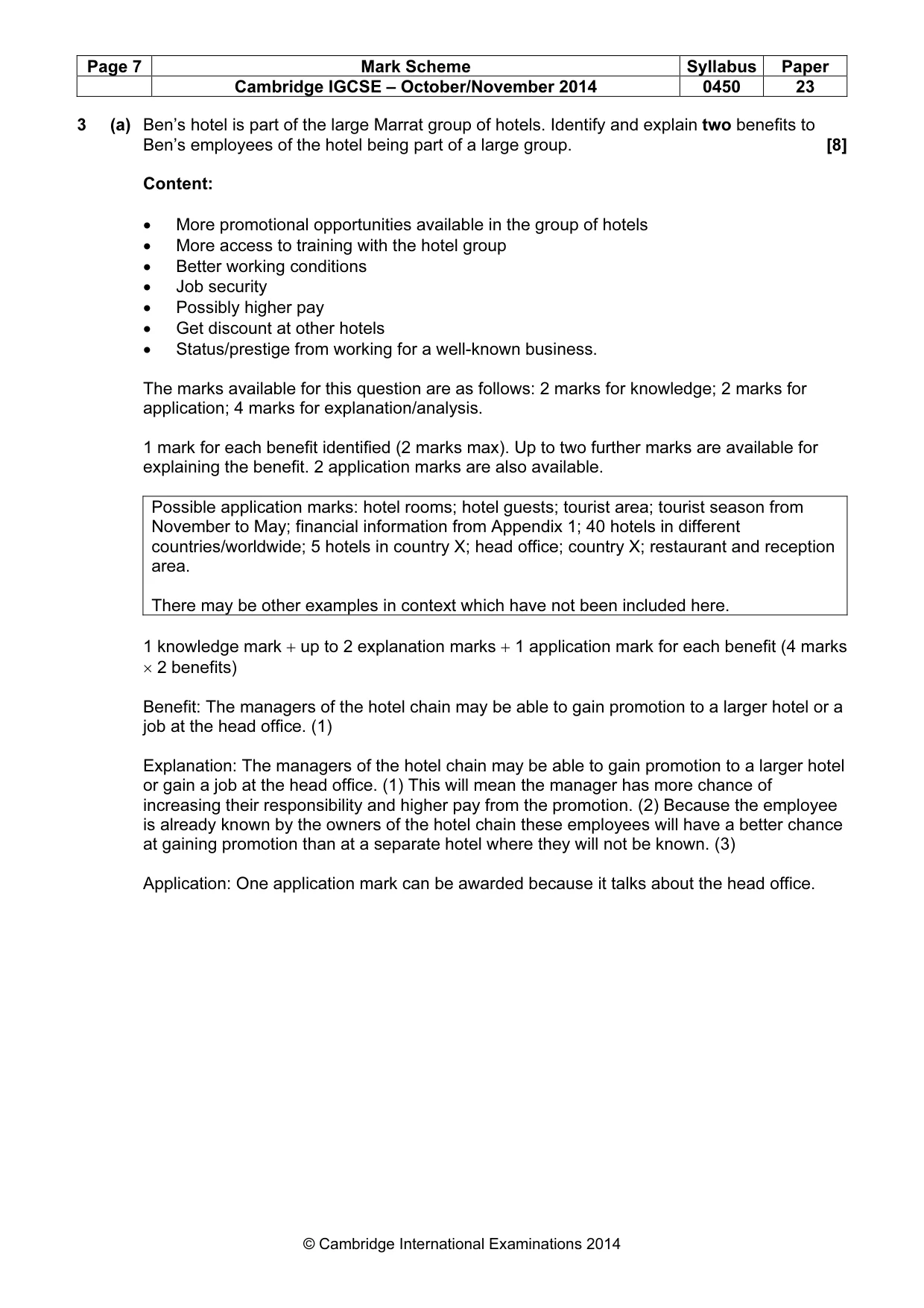
Page 7 Mark Scheme Syllabus Paper Cambridge IGCSE – October/November 2014 0450 23 © Cambridge International Examinations 2014 3 (a) Ben’s hotel is part of the large Marrat group of hotels. Identify and explain two benefits to Ben’s employees of the hotel being part of a large group. [8] Content: • More promotional opportunities available in the group of hotels • More access to training with the hotel group • Better working conditions • Job security • Possibly higher pay • Get discount at other hotels • Status/prestige from working for a well-known business. The marks available for this question are as follows: 2 marks for knowledge; 2 marks for application; 4 marks for explanation/analysis. 1 mark for each benefit identified (2 marks max). Up to two further marks are available for explaining the benefit. 2 application marks are also available. Possible application marks: hotel rooms; hotel guests; tourist area; tourist season from November to May; financial information from Appendix 1; 40 hotels in different countries/worldwide; 5 hotels in country X; head office; country X; restaurant and reception area. There may be other examples in context which have not been included here. 1 knowledge mark + up to 2 explanation marks + 1 application mark for each benefit (4 marks × 2 benefits) Benefit: The managers of the hotel chain may be able to gain promotion to a larger hotel or a job at the head office. (1) Explanation: The managers of the hotel chain may be able to gain promotion to a larger hotel or gain a job at the head office. (1) This will mean the manager has more chance of increasing their responsibility and higher pay from the promotion. (2) Because the employee is already known by the owners of the hotel chain these employees will have a better chance at gaining promotion than at a separate hotel where they will not be known. (3) Application: One application mark can be awarded because it talks about the head office.
Mark scheme, page 8
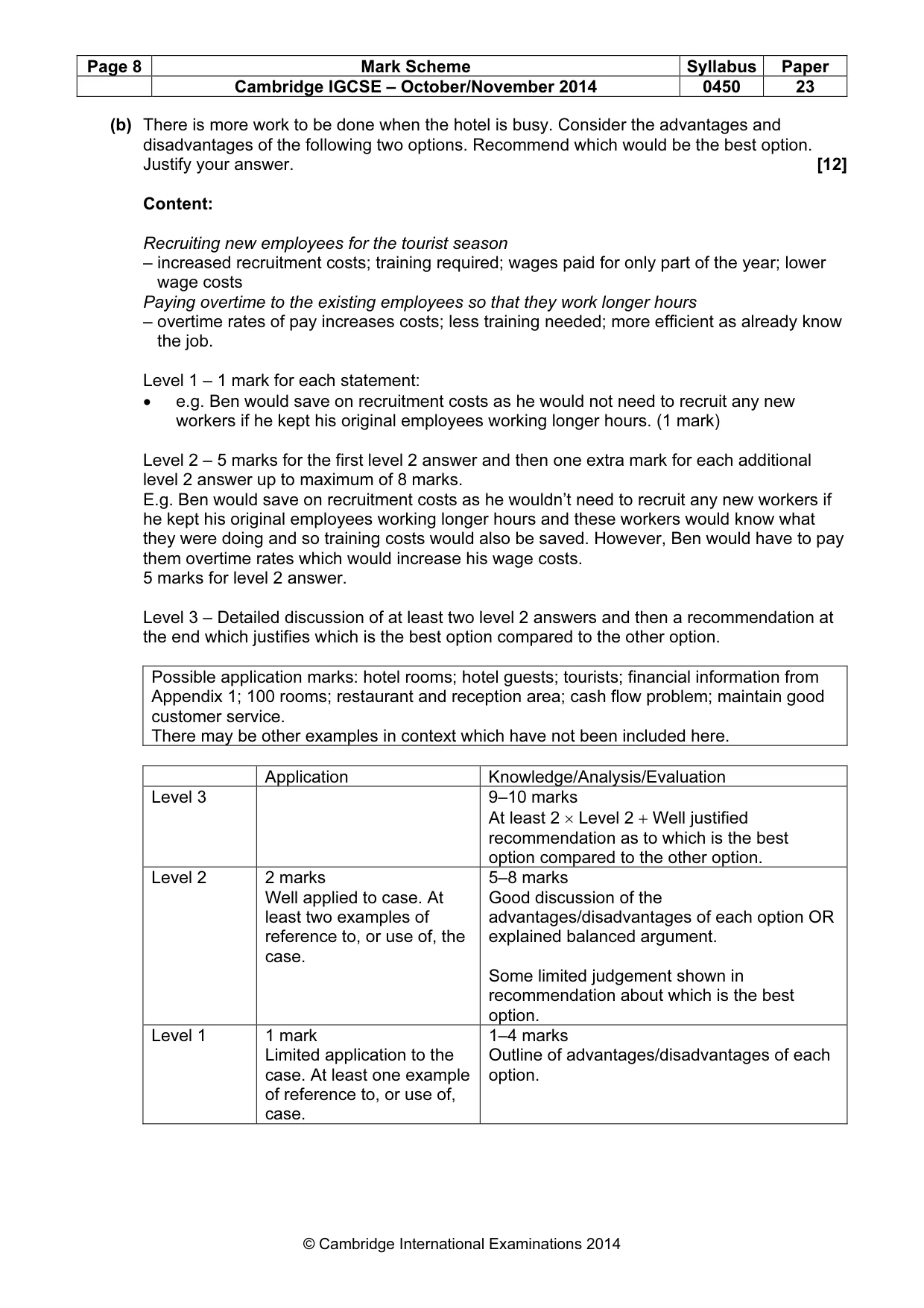
Page 8 Mark Scheme Syllabus Paper Cambridge IGCSE – October/November 2014 0450 23 © Cambridge International Examinations 2014 (b) There is more work to be done when the hotel is busy. Consider the advantages and disadvantages of the following two options. Recommend which would be the best option. Justify your answer. [12] Content: Recruiting new employees for the tourist season – increased recruitment costs; training required; wages paid for only part of the year; lower wage costs Paying overtime to the existing employees so that they work longer hours – overtime rates of pay increases costs; less training needed; more efficient as already know the job. Level 1 – 1 mark for each statement: • e.g. Ben would save on recruitment costs as he would not need to recruit any new workers if he kept his original employees working longer hours. (1 mark) Level 2 – 5 marks for the first level 2 answer and then one extra mark for each additional level 2 answer up to maximum of 8 marks. E.g. Ben would save on recruitment costs as he wouldn’t need to recruit any new workers if he kept his original employees working longer hours and these workers would know what they were doing and so training costs would also be saved. However, Ben would have to pay them overtime rates which would increase his wage costs. 5 marks for level 2 answer. Level 3 – Detailed discussion of at least two level 2 answers and then a recommendation at the end which justifies which is the best option compared to the other option. Possible application marks: hotel rooms; hotel guests; tourists; financial information from Appendix 1; 100 rooms; restaurant and reception area; cash flow problem; maintain good customer service. There may be other examples in context which have not been included here. Application Knowledge/Analysis/Evaluation Level 3 9–10 marks At least 2 × Level 2 + Well justified recommendation as to which is the best option compared to the other option. Level 2 2 marks Well applied to case. At least two examples of reference to, or use of, the case. 5–8 marks Good discussion of the advantages/disadvantages of each option OR explained balanced argument. Some limited judgement shown in recommendation about which is the best option. Level 1 1 mark Limited application to the case. At least one example of reference to, or use of, case. 1–4 marks Outline of advantages/disadvantages of each option.
Mark scheme, page 9
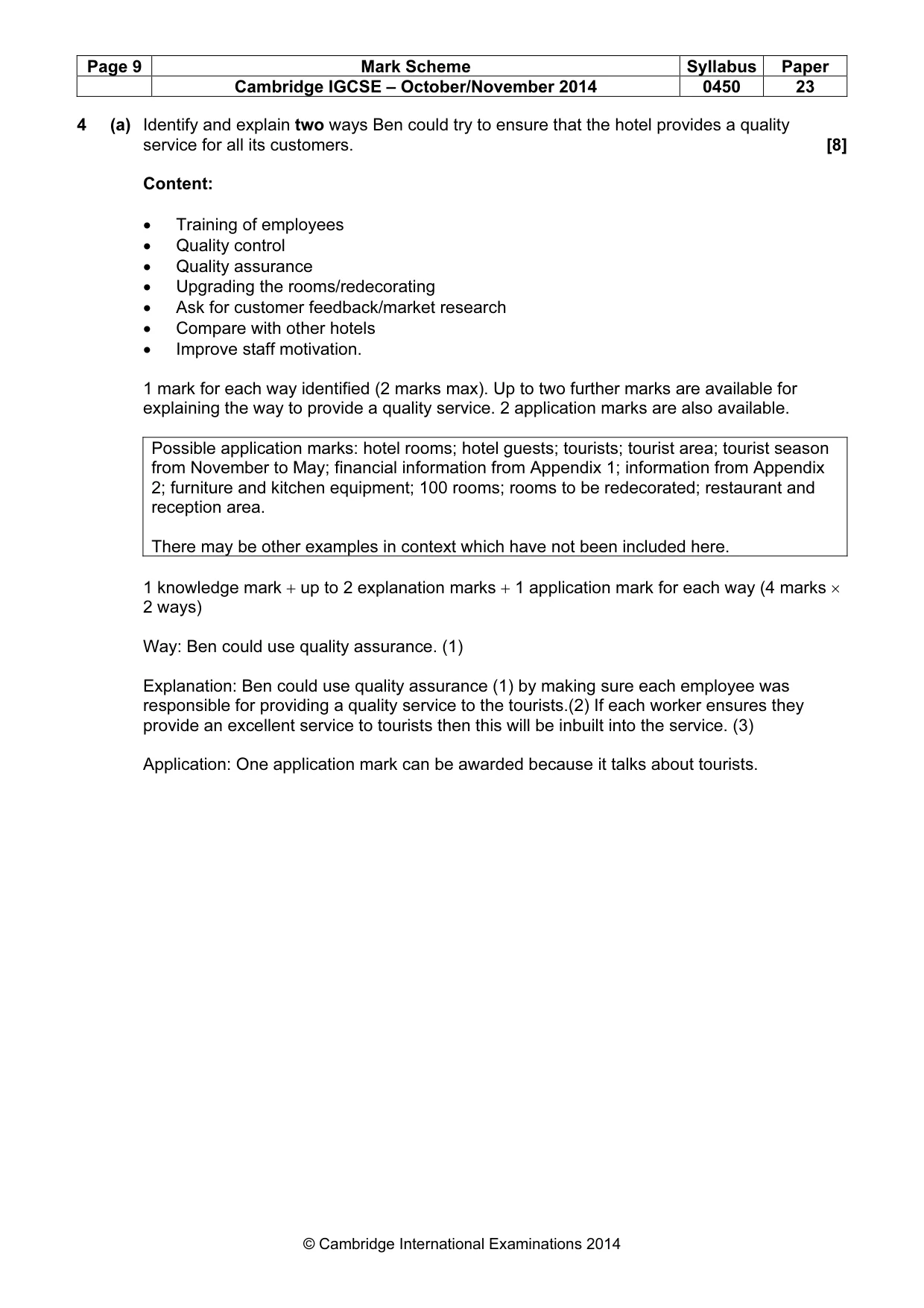
Page 9 Mark Scheme Syllabus Paper Cambridge IGCSE – October/November 2014 0450 23 © Cambridge International Examinations 2014 4 (a) Identify and explain two ways Ben could try to ensure that the hotel provides a quality service for all its customers. [8] Content: • Training of employees • Quality control • Quality assurance • Upgrading the rooms/redecorating • Ask for customer feedback/market research • Compare with other hotels • Improve staff motivation. 1 mark for each way identified (2 marks max). Up to two further marks are available for explaining the way to provide a quality service. 2 application marks are also available. Possible application marks: hotel rooms; hotel guests; tourists; tourist area; tourist season from November to May; financial information from Appendix 1; information from Appendix 2; furniture and kitchen equipment; 100 rooms; rooms to be redecorated; restaurant and reception area. There may be other examples in context which have not been included here. 1 knowledge mark + up to 2 explanation marks + 1 application mark for each way (4 marks × 2 ways) Way: Ben could use quality assurance. (1) Explanation: Ben could use quality assurance (1) by making sure each employee was responsible for providing a quality service to the tourists.(2) If each worker ensures they provide an excellent service to tourists then this will be inbuilt into the service. (3) Application: One application mark can be awarded because it talks about tourists.
Mark scheme, page 10
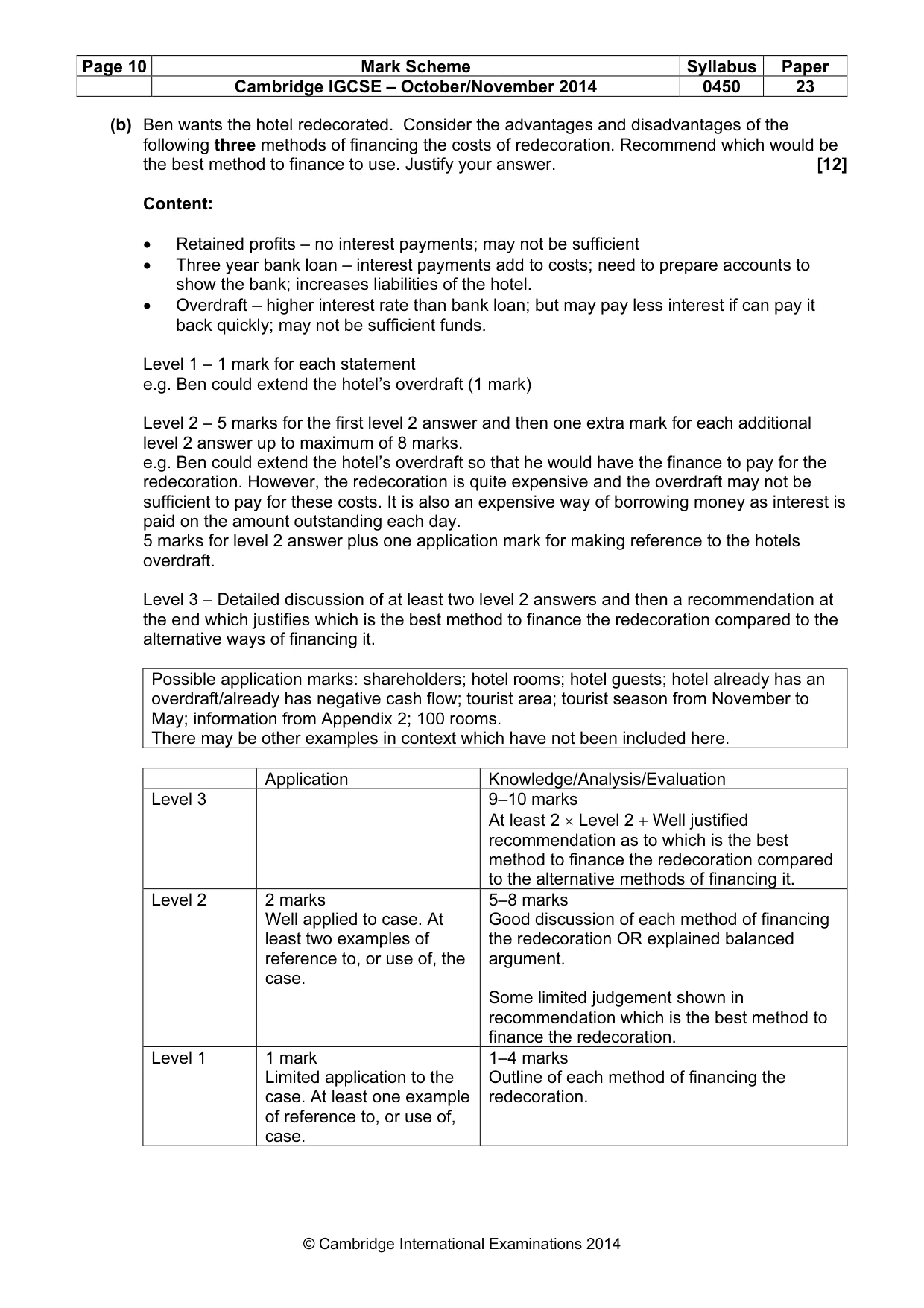
Page 10 Mark Scheme Syllabus Paper Cambridge IGCSE – October/November 2014 0450 23 © Cambridge International Examinations 2014 (b) Ben wants the hotel redecorated. Consider the advantages and disadvantages of the following three methods of financing the costs of redecoration. Recommend which would be the best method to finance to use. Justify your answer. [12] Content: • Retained profits – no interest payments; may not be sufficient • Three year bank loan – interest payments add to costs; need to prepare accounts to show the bank; increases liabilities of the hotel. • Overdraft – higher interest rate than bank loan; but may pay less interest if can pay it back quickly; may not be sufficient funds. Level 1 – 1 mark for each statement e.g. Ben could extend the hotel’s overdraft (1 mark) Level 2 – 5 marks for the first level 2 answer and then one extra mark for each additional level 2 answer up to maximum of 8 marks. e.g. Ben could extend the hotel’s overdraft so that he would have the finance to pay for the redecoration. However, the redecoration is quite expensive and the overdraft may not be sufficient to pay for these costs. It is also an expensive way of borrowing money as interest is paid on the amount outstanding each day. 5 marks for level 2 answer plus one application mark for making reference to the hotels overdraft. Level 3 – Detailed discussion of at least two level 2 answers and then a recommendation at the end which justifies which is the best method to finance the redecoration compared to the alternative ways of financing it. Possible application marks: shareholders; hotel rooms; hotel guests; hotel already has an overdraft/already has negative cash flow; tourist area; tourist season from November to May; information from Appendix 2; 100 rooms. There may be other examples in context which have not been included here. Application Knowledge/Analysis/Evaluation Level 3 9–10 marks At least 2 × Level 2 + Well justified recommendation as to which is the best method to finance the redecoration compared to the alternative methods of financing it. Level 2 2 marks Well applied to case. At least two examples of reference to, or use of, the case. 5–8 marks Good discussion of each method of financing the redecoration OR explained balanced argument. Some limited judgement shown in recommendation which is the best method to finance the redecoration. Level 1 1 mark Limited application to the case. At least one example of reference to, or use of, case. 1–4 marks Outline of each method of financing the redecoration.
Mark scheme, page 11
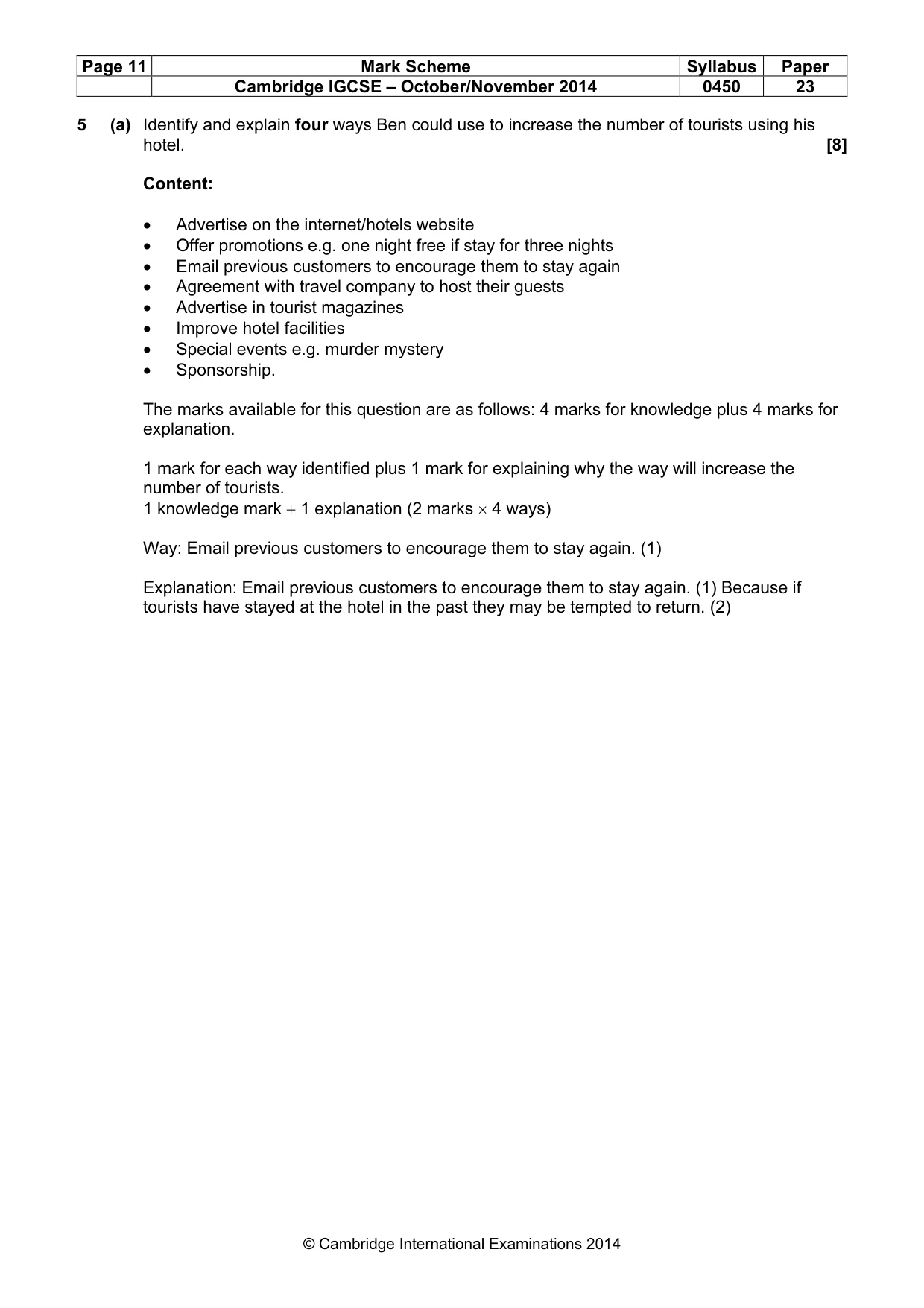
Page 11 Mark Scheme Syllabus Paper Cambridge IGCSE – October/November 2014 0450 23 © Cambridge International Examinations 2014 5 (a) Identify and explain four ways Ben could use to increase the number of tourists using his hotel. [8] Content: • Advertise on the internet/hotels website • Offer promotions e.g. one night free if stay for three nights • Email previous customers to encourage them to stay again • Agreement with travel company to host their guests • Advertise in tourist magazines • Improve hotel facilities • Special events e.g. murder mystery • Sponsorship. The marks available for this question are as follows: 4 marks for knowledge plus 4 marks for explanation. 1 mark for each way identified plus 1 mark for explaining why the way will increase the number of tourists. 1 knowledge mark + 1 explanation (2 marks × 4 ways) Way: Email previous customers to encourage them to stay again. (1) Explanation: Email previous customers to encourage them to stay again. (1) Because if tourists have stayed at the hotel in the past they may be tempted to return. (2)
Mark scheme, page 12
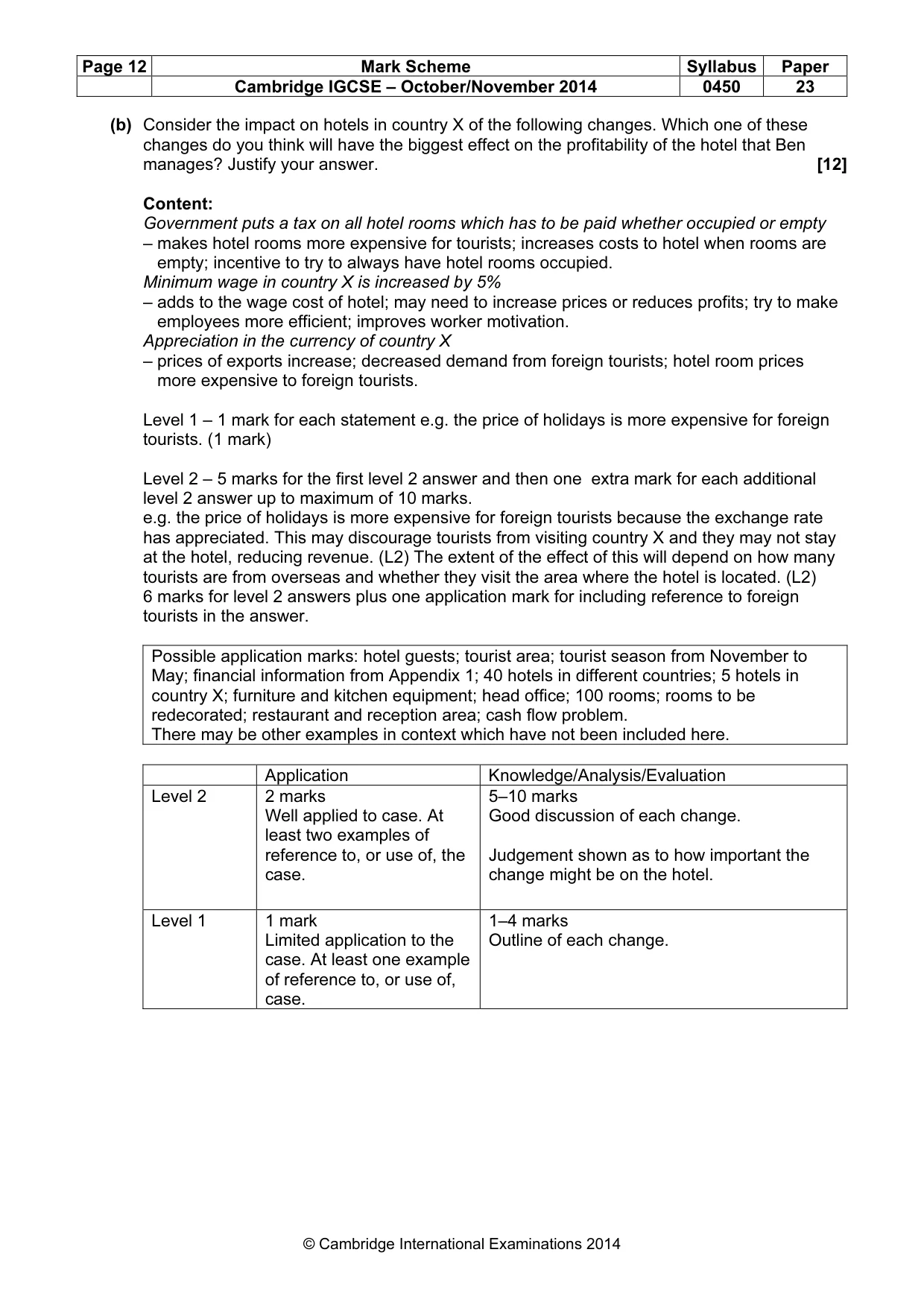
Page 12 Mark Scheme Syllabus Paper Cambridge IGCSE – October/November 2014 0450 23 © Cambridge International Examinations 2014 (b) Consider the impact on hotels in country X of the following changes. Which one of these changes do you think will have the biggest effect on the profitability of the hotel that Ben manages? Justify your answer. [12] Content: Government puts a tax on all hotel rooms which has to be paid whether occupied or empty – makes hotel rooms more expensive for tourists; increases costs to hotel when rooms are empty; incentive to try to always have hotel rooms occupied. Minimum wage in country X is increased by 5% – adds to the wage cost of hotel; may need to increase prices or reduces profits; try to make employees more efficient; improves worker motivation. Appreciation in the currency of country X – prices of exports increase; decreased demand from foreign tourists; hotel room prices more expensive to foreign tourists. Level 1 – 1 mark for each statement e.g. the price of holidays is more expensive for foreign tourists. (1 mark) Level 2 – 5 marks for the first level 2 answer and then one extra mark for each additional level 2 answer up to maximum of 10 marks. e.g. the price of holidays is more expensive for foreign tourists because the exchange rate has appreciated. This may discourage tourists from visiting country X and they may not stay at the hotel, reducing revenue. (L2) The extent of the effect of this will depend on how many tourists are from overseas and whether they visit the area where the hotel is located. (L2) 6 marks for level 2 answers plus one application mark for including reference to foreign tourists in the answer. Possible application marks: hotel guests; tourist area; tourist season from November to May; financial information from Appendix 1; 40 hotels in different countries; 5 hotels in country X; furniture and kitchen equipment; head office; 100 rooms; rooms to be redecorated; restaurant and reception area; cash flow problem. There may be other examples in context which have not been included here. Application Knowledge/Analysis/Evaluation Level 2 2 marks Well applied to case. At least two examples of reference to, or use of, the case. 5–10 marks Good discussion of each change. Judgement shown as to how important the change might be on the hotel. Level 1 1 mark Limited application to the case. At least one example of reference to, or use of, case. 1–4 marks Outline of each change.
What you needed in this session
Cambridge’s own grade thresholds for 2014 Oct/Nov, Paper 2 · Variant 3. A higher threshold means an easier paper — the bar moves with how the cohort did.