Cambridge IGCSE Business Studies 0450 — 2013 Oct/Nov Paper 2 · Variant 1
0450/21/O/N/13 · 100 marks · ≈113 min
The question paper and its mark scheme, free to read here and free to download. This is Cambridge’s own paper, exactly as it was sat.
Question paper12 pages

Mark scheme16 pages
Answers below. Sit the paper first if you are practising.
Paper as text
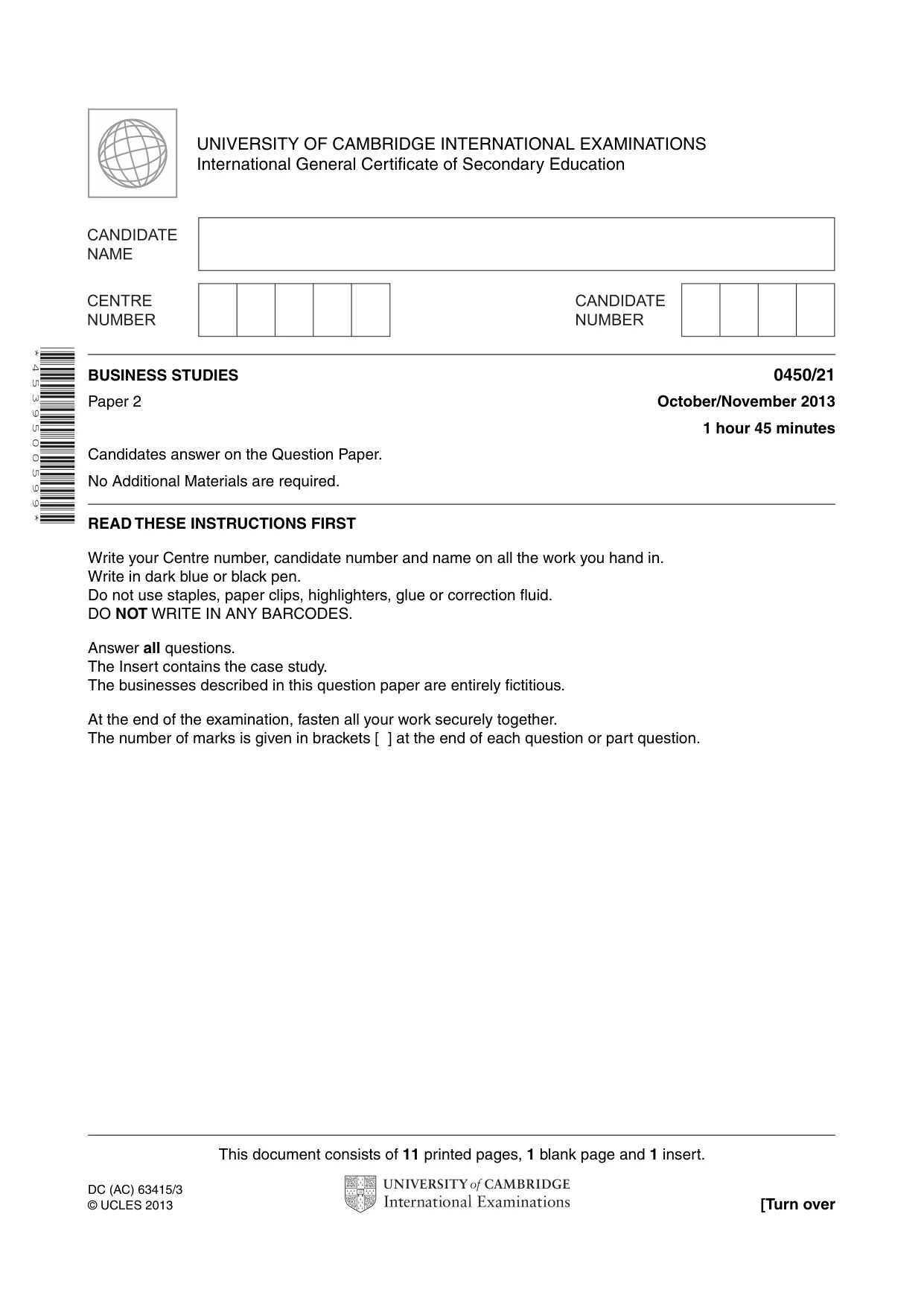
Question paper, page 1
This document consists of 11 printed pages, 1 blank page and 1 insert. DC (AC) 63415/3 © UCLES 2013 [Turn over UNIVERSITY OF CAMBRIDGE INTERNATIONAL EXAMINATIONS International General Certificate of Secondary Education * 4 5 3 9 5 0 0 5 9 9 * BUSINESS STUDIES 0450/21 Paper 2 October/November 2013 1 hour 45 minutes Candidates answer on the Question Paper. No Additional Materials are required. READ THESE INSTRUCTIONS FIRST Write your Centre number, candidate number and name on all the work you hand in. Write in dark blue or black pen. Do not use staples, paper clips, highlighters, glue or correction fluid. DO NOT WRITE IN ANY BARCODES. Answer all questions. The Insert contains the case study. The businesses described in this question paper are entirely fictitious. At the end of the examination, fasten all your work securely together. The number of marks is given in brackets [ ] at the end of each question or part question.
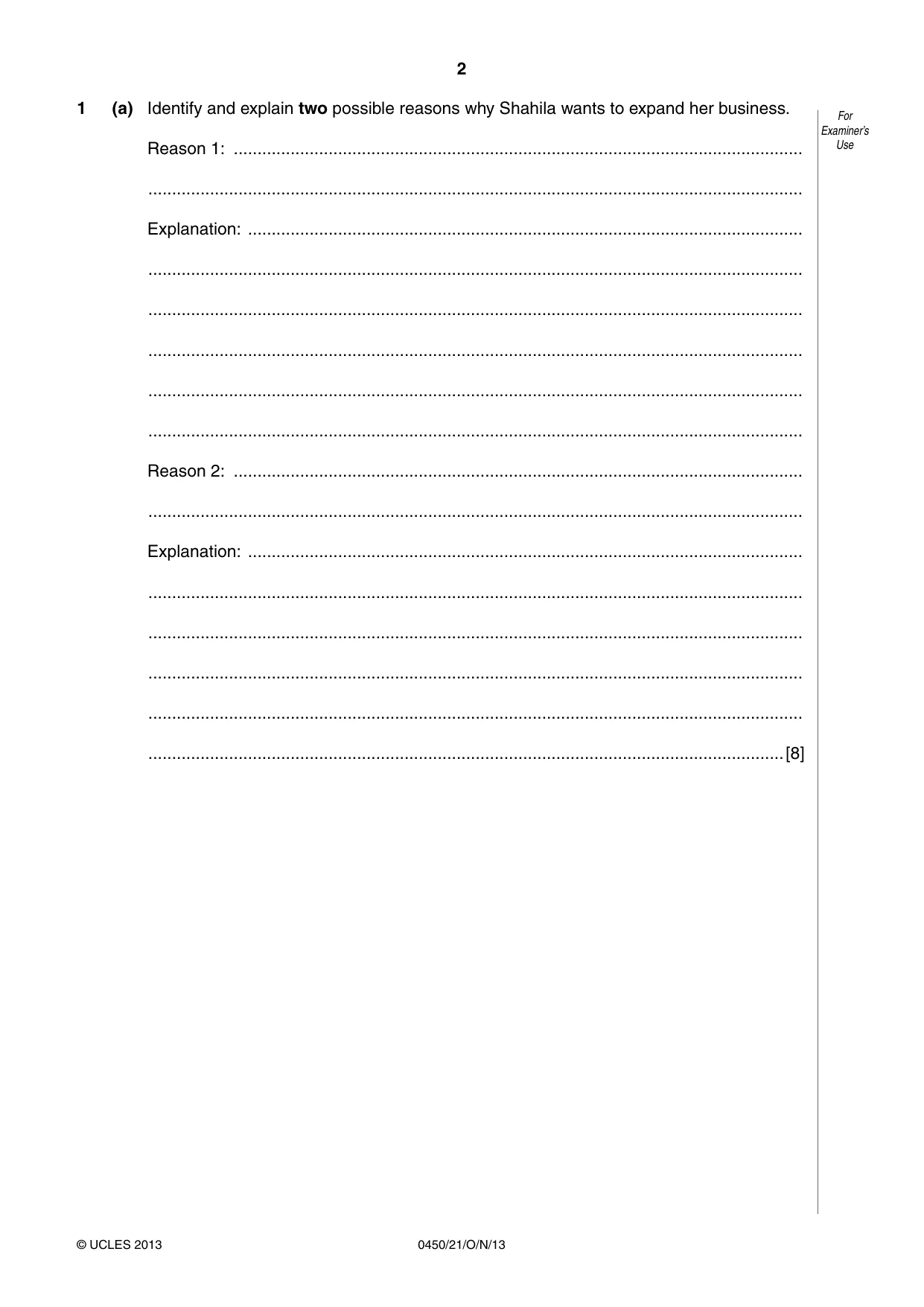
Question paper, page 2
2 0450/21/O/N/13 © UCLES 2013 For Examiner’s Use 1 (a) Identify and explain two possible reasons why Shahila wants to expand her business. Reason 1: … … Explanation: … … … … … … Reason 2: … … Explanation: … … … … … …[8]
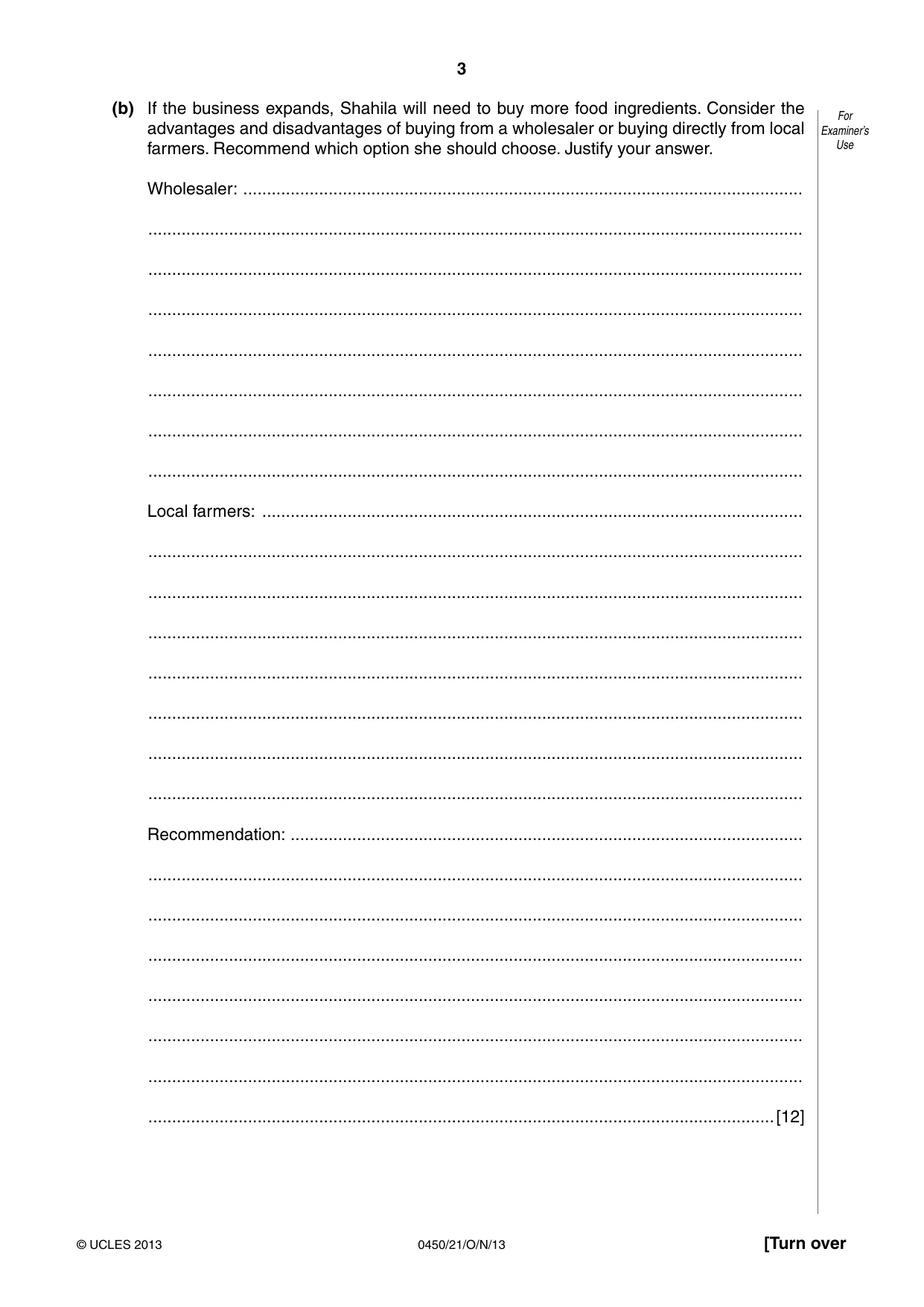
Question paper, page 3
3 0450/21/O/N/13 © UCLES 2013 [Turn over For Examiner’s Use (b) If the business expands, Shahila will need to buy more food ingredients. Consider the advantages and disadvantages of buying from a wholesaler or buying directly from local farmers. Recommend which option she should choose. Justify your answer. Wholesaler: … … … … … … … … Local farmers: … … … … … … … … Recommendation: … … … … … … … …[12]
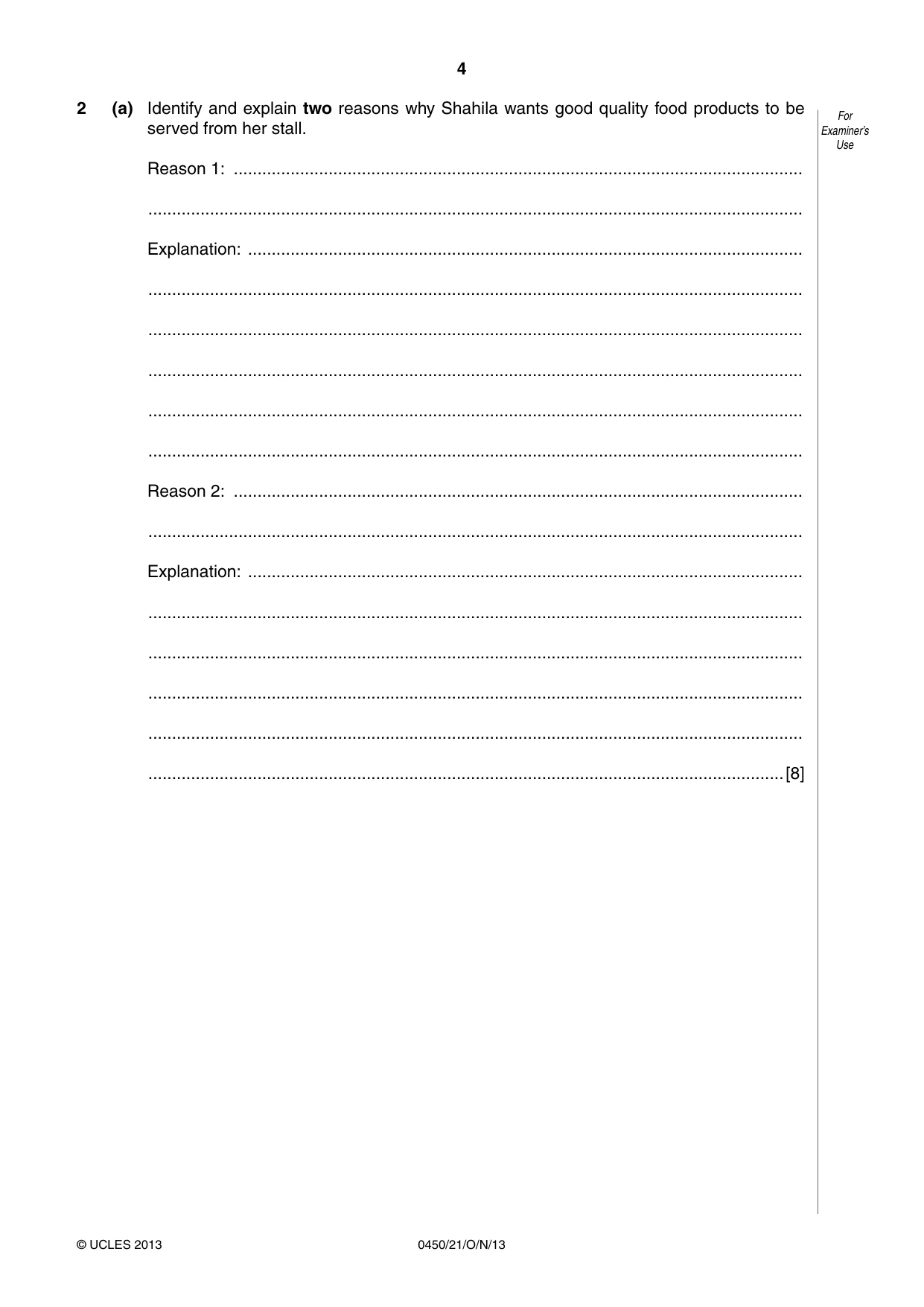
Question paper, page 4
4 0450/21/O/N/13 © UCLES 2013 For Examiner’s Use 2 (a) Identify and explain two reasons why Shahila wants good quality food products to be served from her stall. Reason 1: … … Explanation: … … … … … … Reason 2: … … Explanation: … … … … … …[8]
Question paper, page 5
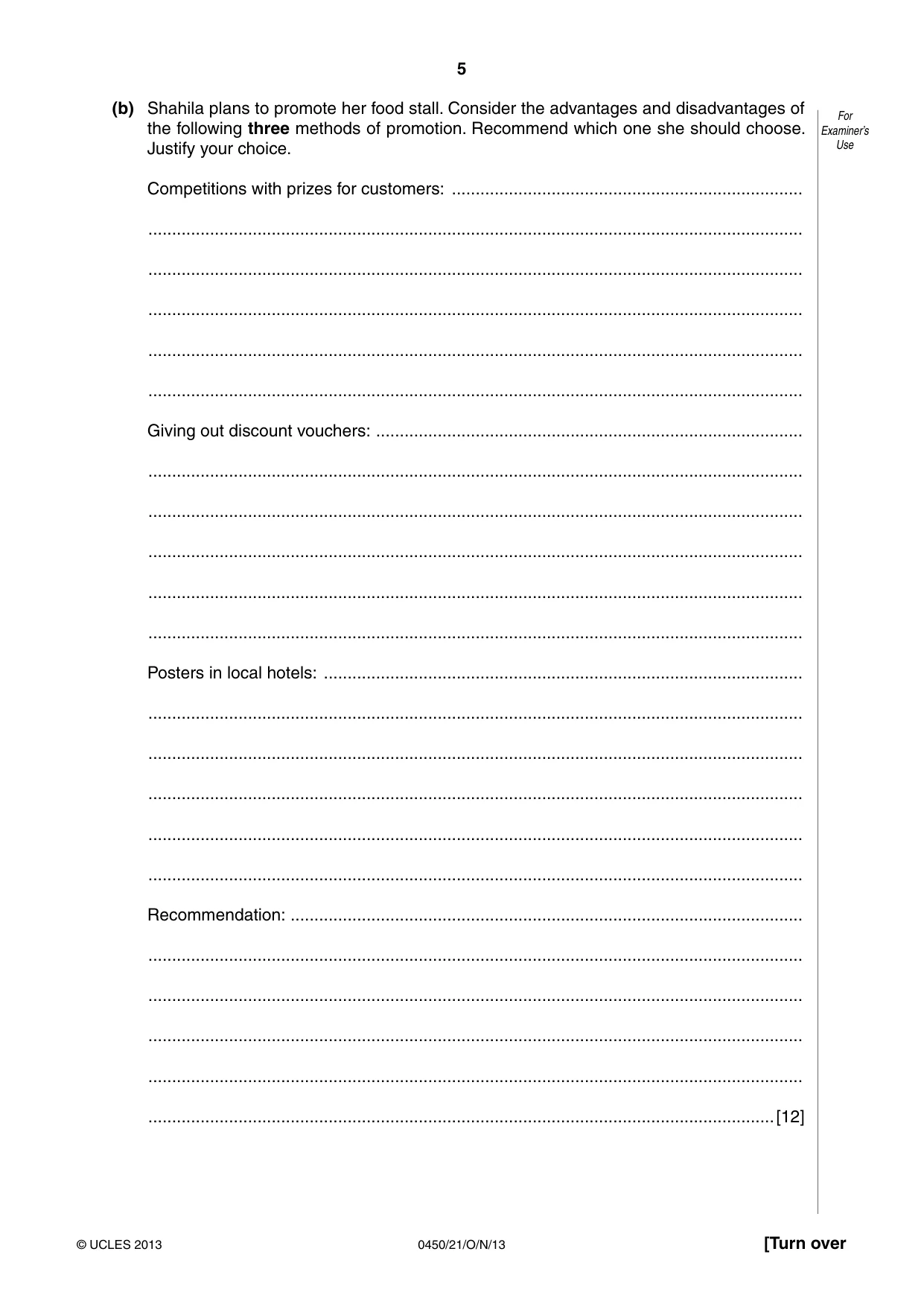
5 0450/21/O/N/13 © UCLES 2013 [Turn over For Examiner’s Use (b) Shahila plans to promote her food stall. Consider the advantages and disadvantages of the following three methods of promotion. Recommend which one she should choose. Justify your choice. Competitions with prizes for customers: … … … … … … Giving out discount vouchers: … … … … … … Posters in local hotels: … … … … … … Recommendation: … … … … … …[12]
Question paper, page 6
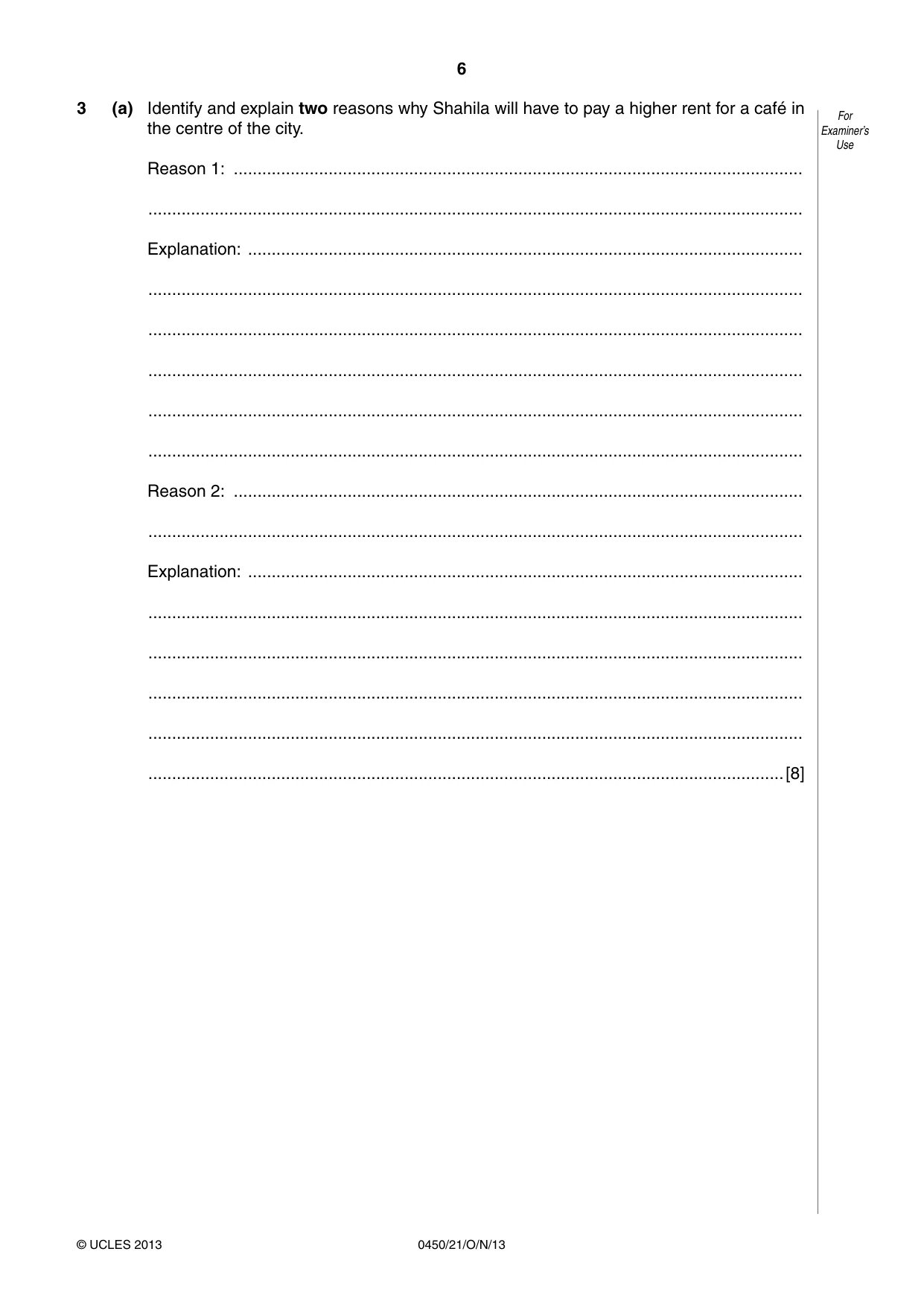
6 0450/21/O/N/13 © UCLES 2013 For Examiner’s Use 3 (a) Identify and explain two reasons why Shahila will have to pay a higher rent for a café in the centre of the city. Reason 1: … … Explanation: … … … … … … Reason 2: … … Explanation: … … … … … …[8]
Question paper, page 7
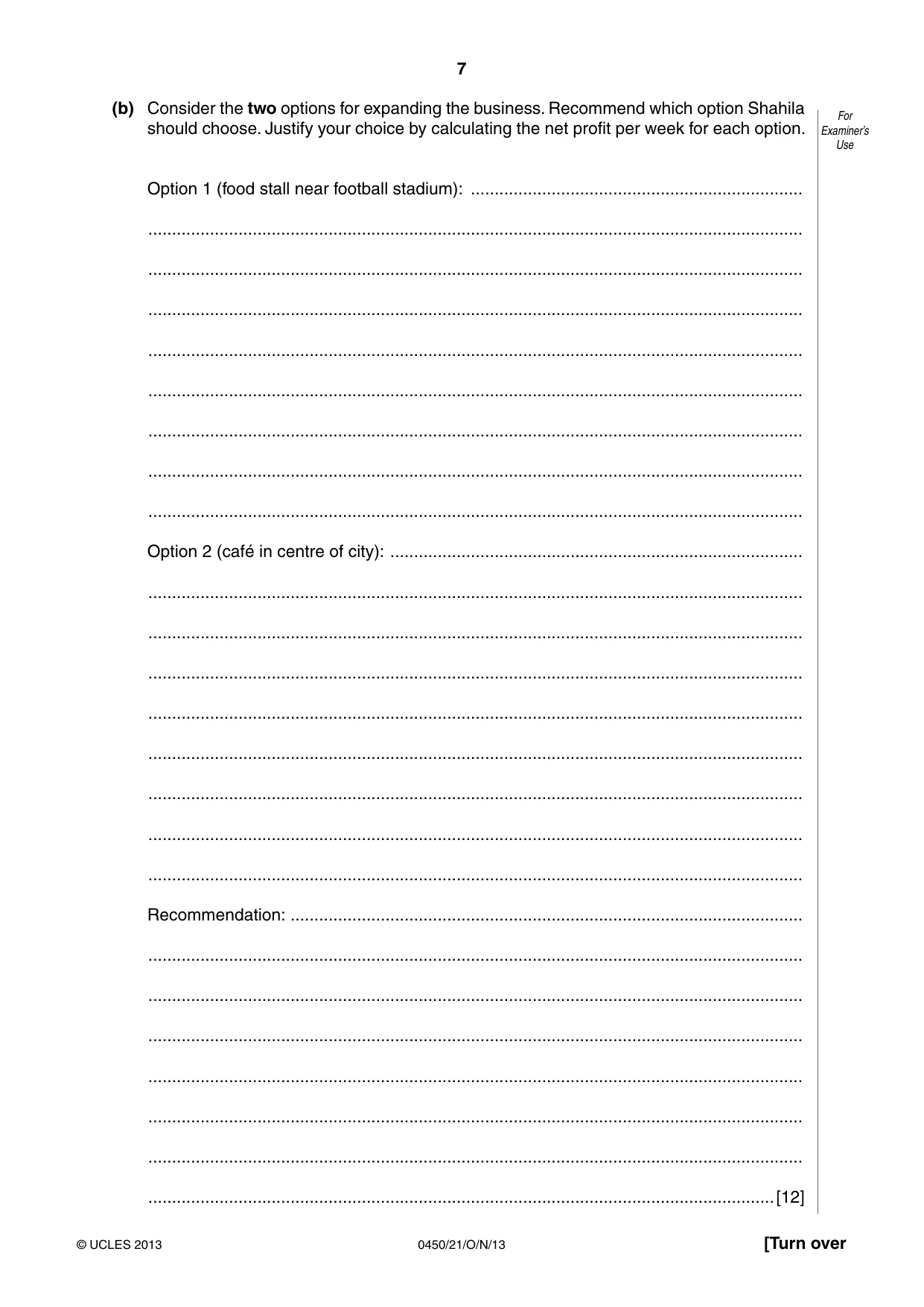
7 0450/21/O/N/13 © UCLES 2013 [Turn over For Examiner’s Use (b) Consider the two options for expanding the business. Recommend which option Shahila should choose. Justify your choice by calculating the net profit per week for each option. Option 1 (food stall near football stadium): … … … … … … … … … Option 2 (café in centre of city): … … … … … … … … … Recommendation: … … … … … … … …[12]
Question paper, page 8
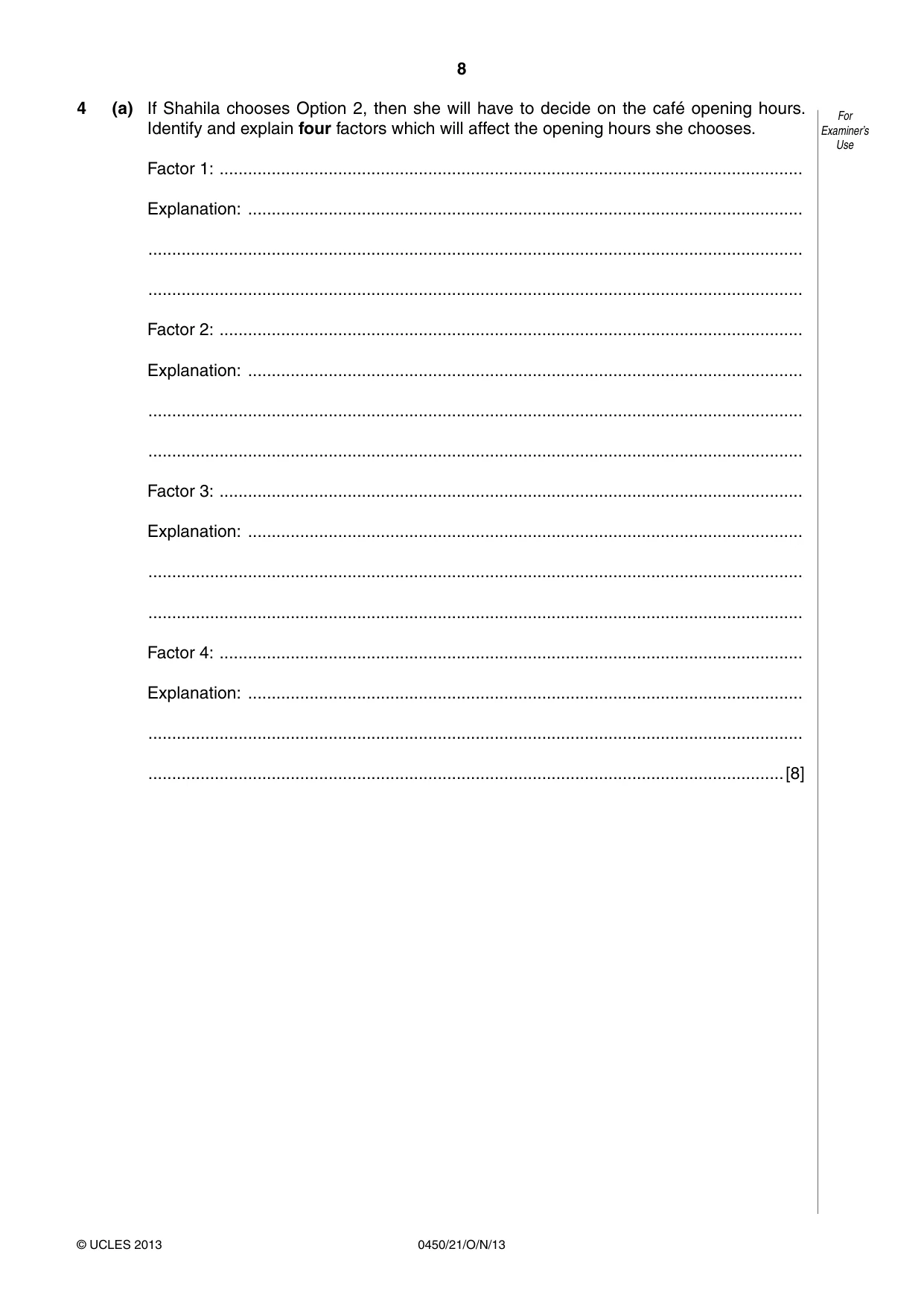
8 0450/21/O/N/13 © UCLES 2013 For Examiner’s Use 4 (a) If Shahila chooses Option 2, then she will have to decide on the café opening hours. Identify and explain four factors which will affect the opening hours she chooses. Factor 1: … Explanation: … … … Factor 2: … Explanation: … … … Factor 3: … Explanation: … … … Factor 4: … Explanation: … … …[8]
Question paper, page 9
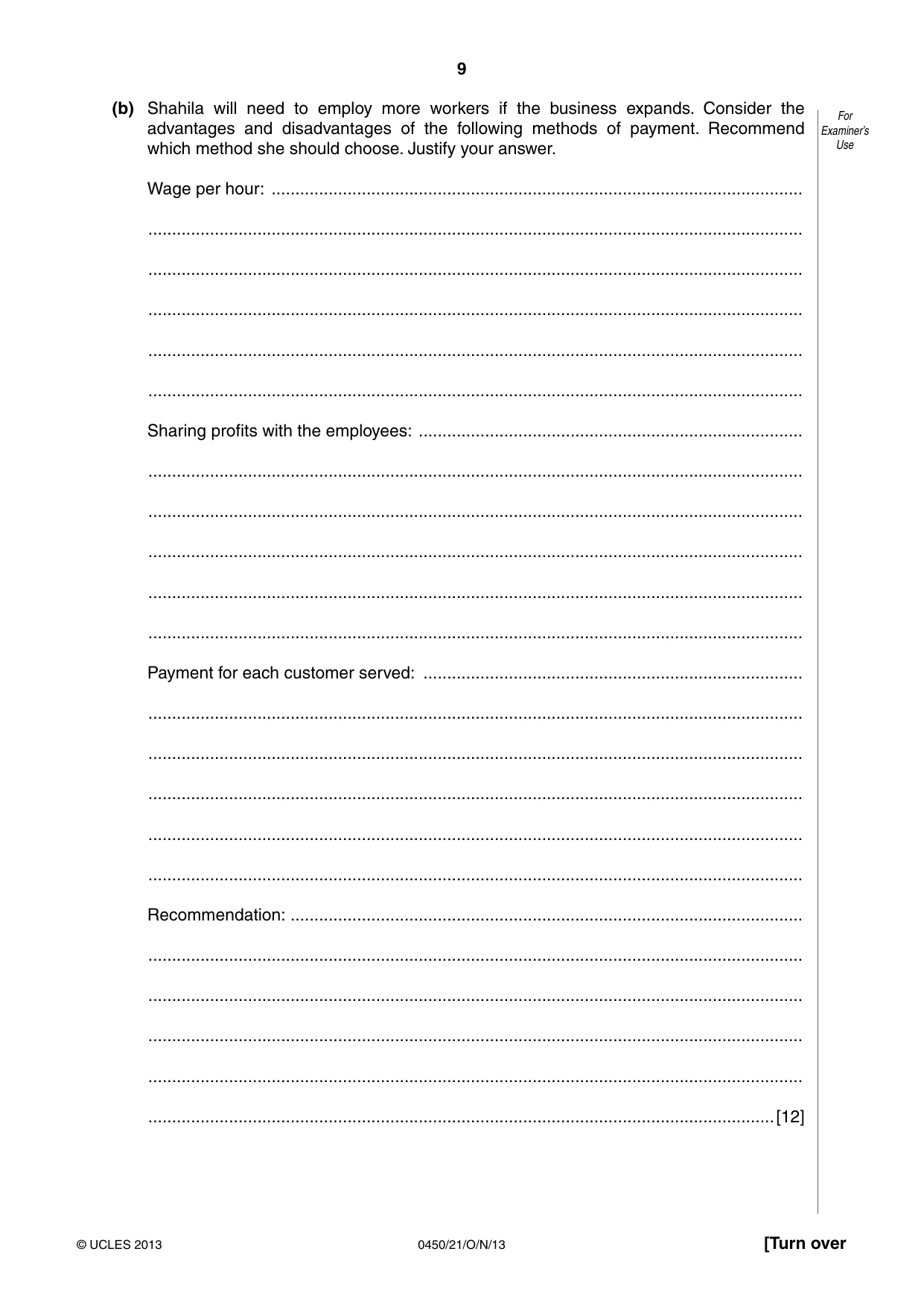
9 0450/21/O/N/13 © UCLES 2013 [Turn over For Examiner’s Use (b) Shahila will need to employ more workers if the business expands. Consider the advantages and disadvantages of the following methods of payment. Recommend which method she should choose. Justify your answer. Wage per hour: … … … … … … Sharing profits with the employees: … … … … … … Payment for each customer served: … … … … … … Recommendation: … … … … … …[12]
Question paper, page 10
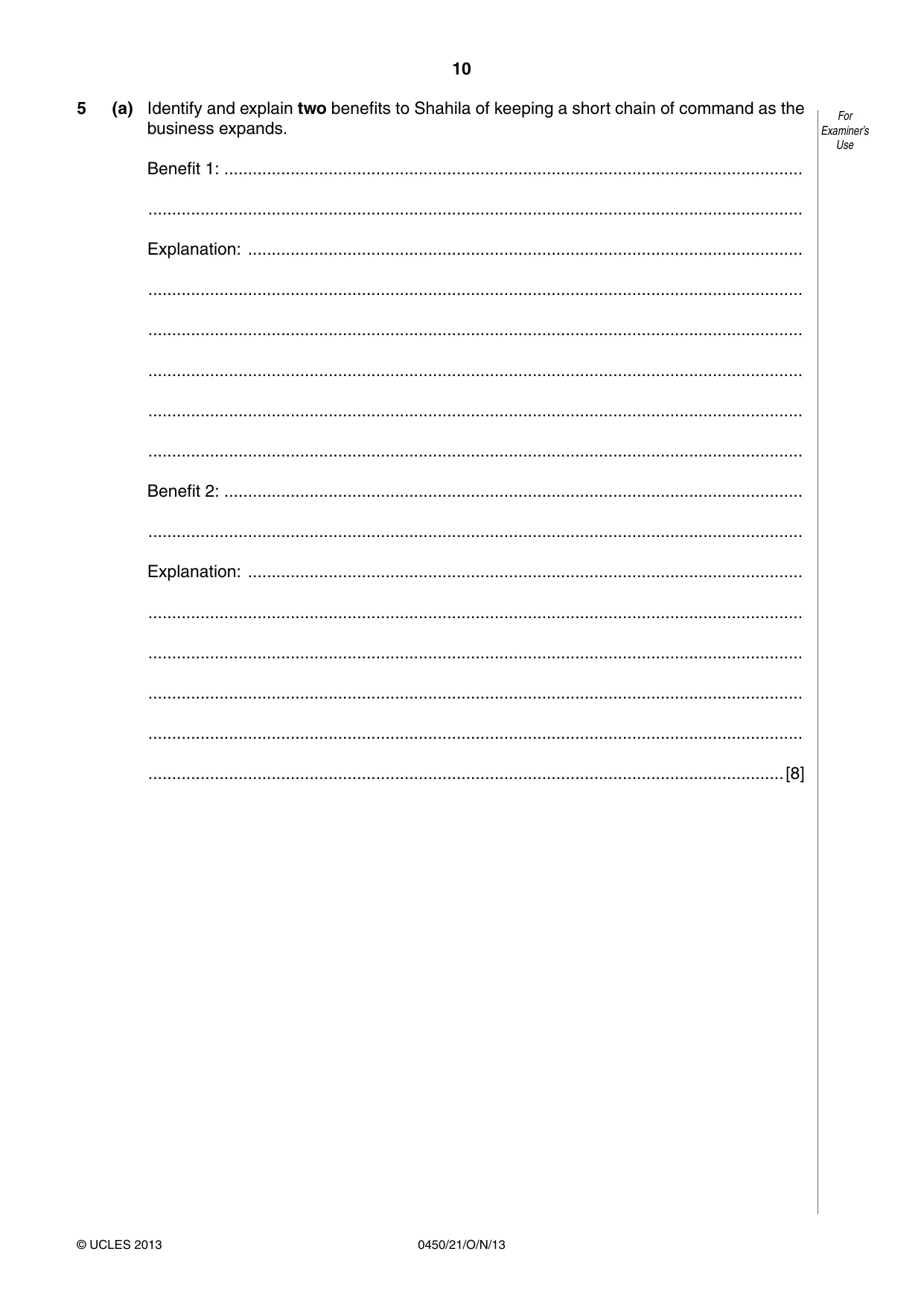
10 0450/21/O/N/13 © UCLES 2013 For Examiner’s Use 5 (a) Identify and explain two benefits to Shahila of keeping a short chain of command as the business expands. Benefit 1: … … Explanation: … … … … … … Benefit 2: … … Explanation: … … … … … …[8]
Question paper, page 11
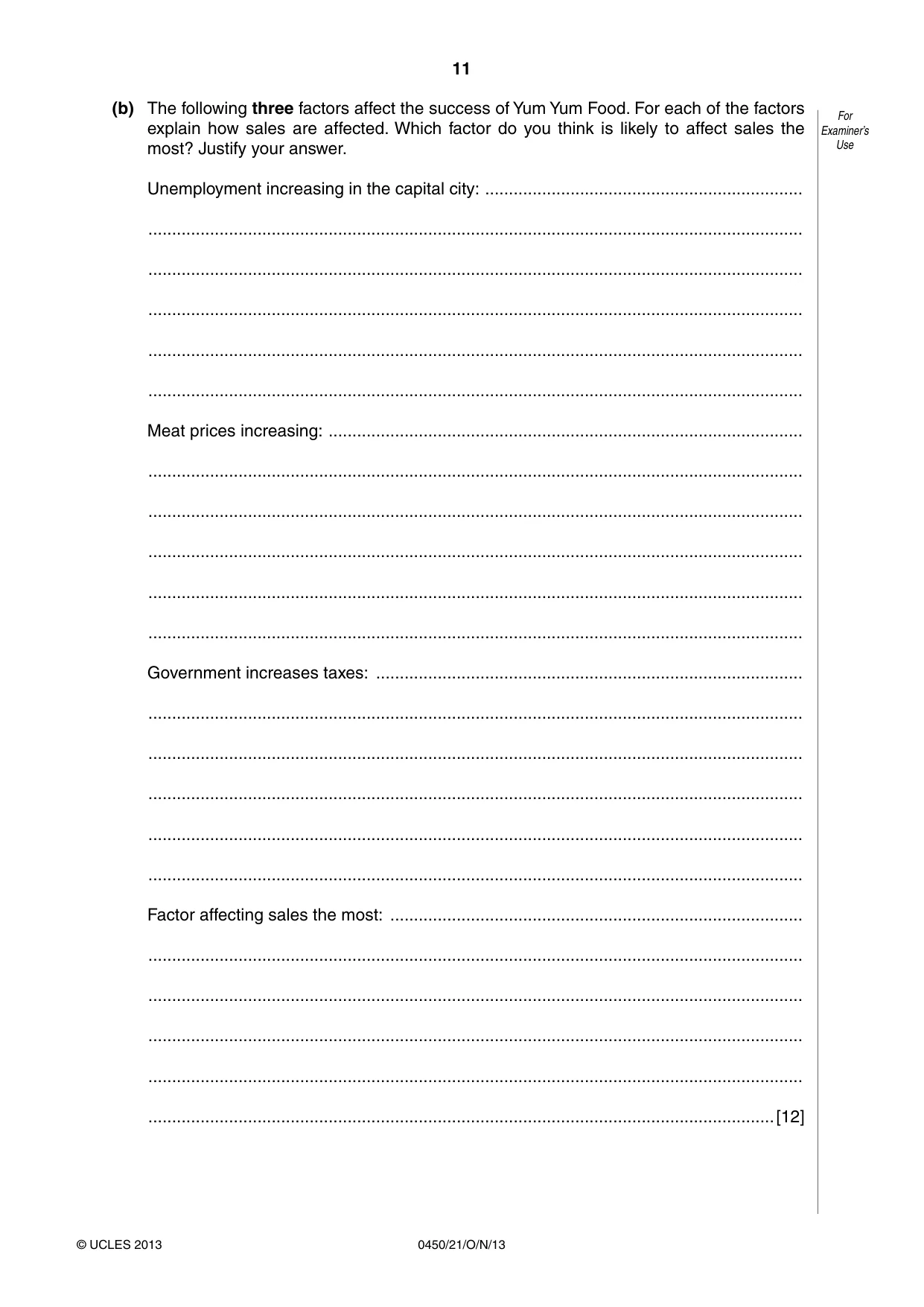
11 0450/21/O/N/13 © UCLES 2013 For Examiner’s Use (b) The following three factors affect the success of Yum Yum Food. For each of the factors explain how sales are affected. Which factor do you think is likely to affect sales the most? Justify your answer. Unemployment increasing in the capital city: … … … … … … Meat prices increasing: … … … … … … Government increases taxes: … … … … … … Factor affecting sales the most: … … … … … …[12]
Question paper, page 12
12 0450/21/O/N/13 © UCLES 2013 Permission to reproduce items where third-party owned material protected by copyright is included has been sought and cleared where possible. Every reasonable effort has been made by the publisher (UCLES) to trace copyright holders, but if any items requiring clearance have unwittingly been included, the publisher will be pleased to make amends at the earliest possible opportunity. University of Cambridge International Examinations is part of the Cambridge Assessment Group. Cambridge Assessment is the brand name of University of Cambridge Local Examinations Syndicate (UCLES), which is itself a department of the University of Cambridge. BLANK PAGE
Mark scheme, page 1
CAMBRIDGE INTERNATIONAL EXAMINATIONS International General Certificate of Secondary Education MARK SCHEME for the October/November 2013 series 0450 BUSINESS STUDIES 0450/21 Paper 2 (Case Study), maximum raw mark 100 This mark scheme is published as an aid to teachers and candidates, to indicate the requirements of the examination. It shows the basis on which Examiners were instructed to award marks. It does not indicate the details of the discussions that took place at an Examiners’ meeting before marking began, which would have considered the acceptability of alternative answers. Mark schemes should be read in conjunction with the question paper and the Principal Examiner Report for Teachers. Cambridge will not enter into discussions about these mark schemes. Cambridge is publishing the mark schemes for the October/November 2013 series for most IGCSE, GCE Advanced Level and Advanced Subsidiary Level components and some Ordinary Level components.
Mark scheme, page 2
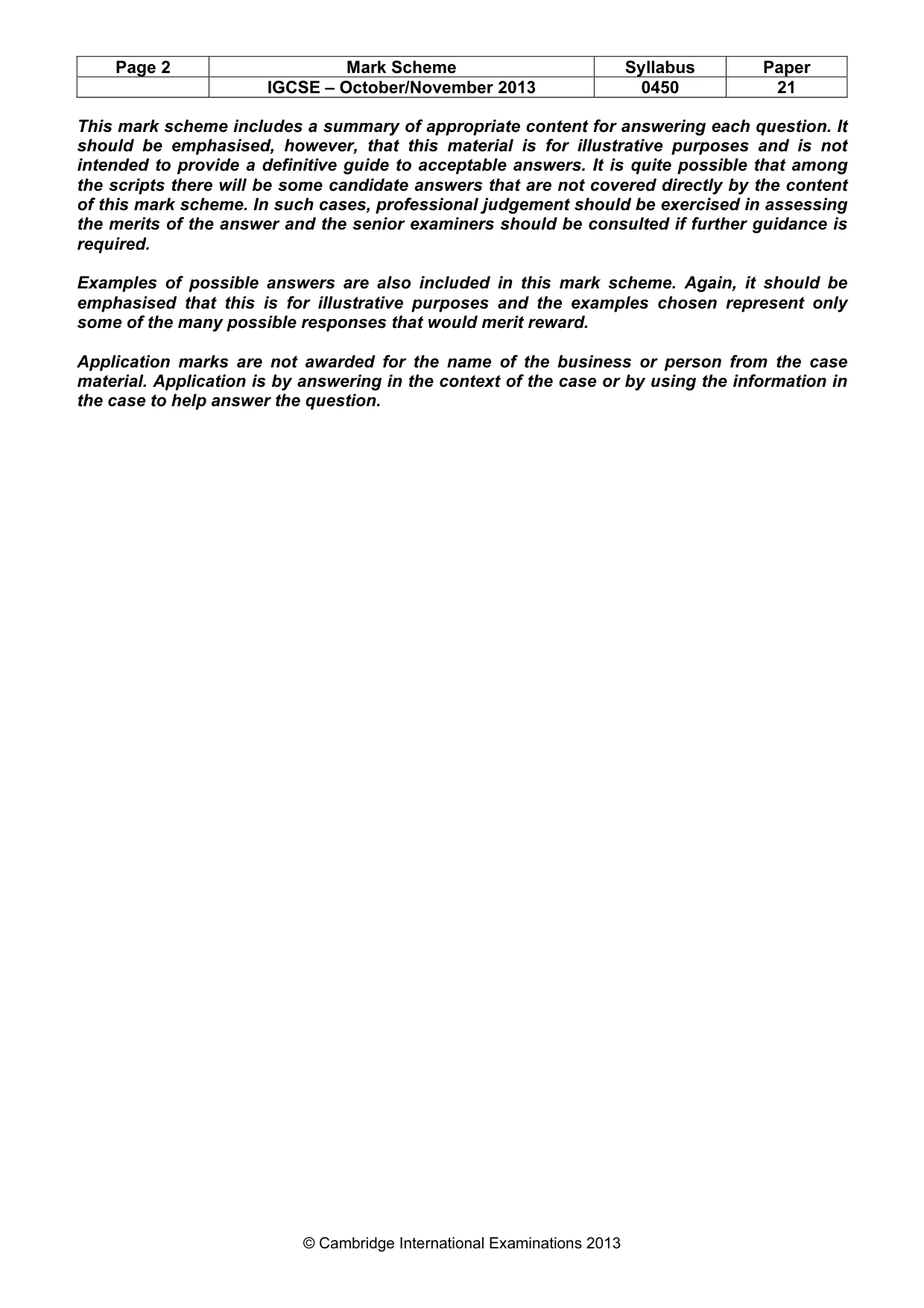
Page 2 Mark Scheme Syllabus Paper IGCSE – October/November 2013 0450 21 © Cambridge International Examinations 2013 This mark scheme includes a summary of appropriate content for answering each question. It should be emphasised, however, that this material is for illustrative purposes and is not intended to provide a definitive guide to acceptable answers. It is quite possible that among the scripts there will be some candidate answers that are not covered directly by the content of this mark scheme. In such cases, professional judgement should be exercised in assessing the merits of the answer and the senior examiners should be consulted if further guidance is required. Examples of possible answers are also included in this mark scheme. Again, it should be emphasised that this is for illustrative purposes and the examples chosen represent only some of the many possible responses that would merit reward. Application marks are not awarded for the name of the business or person from the case material. Application is by answering in the context of the case or by using the information in the case to help answer the question.
Mark scheme, page 3
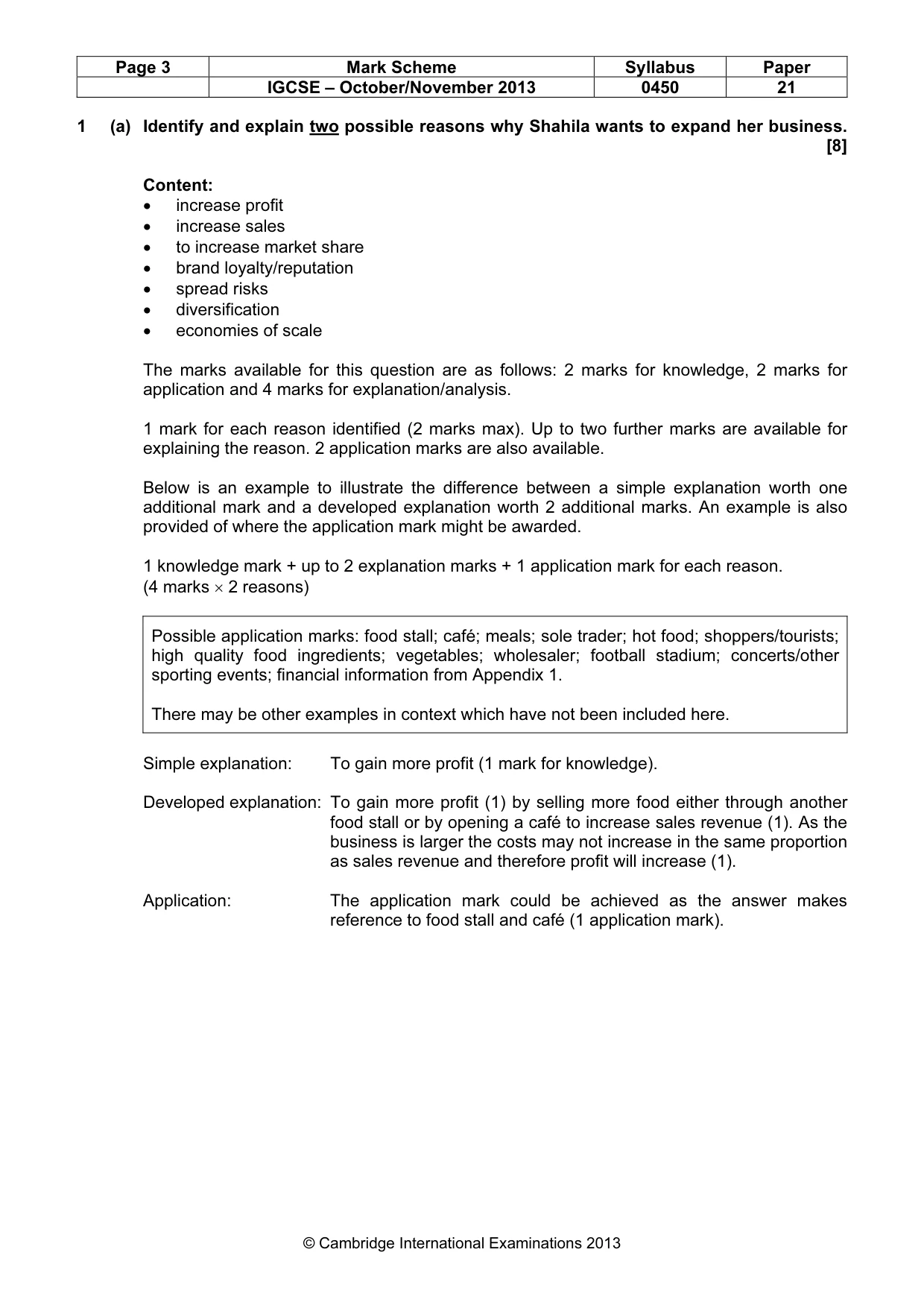
Page 3 Mark Scheme Syllabus Paper IGCSE – October/November 2013 0450 21 © Cambridge International Examinations 2013 1 (a) Identify and explain two possible reasons why Shahila wants to expand her business. [8] Content: • increase profit • increase sales • to increase market share • brand loyalty/reputation • spread risks • diversification • economies of scale The marks available for this question are as follows: 2 marks for knowledge, 2 marks for application and 4 marks for explanation/analysis. 1 mark for each reason identified (2 marks max). Up to two further marks are available for explaining the reason. 2 application marks are also available. Below is an example to illustrate the difference between a simple explanation worth one additional mark and a developed explanation worth 2 additional marks. An example is also provided of where the application mark might be awarded. 1 knowledge mark + up to 2 explanation marks + 1 application mark for each reason. (4 marks × 2 reasons) Possible application marks: food stall; café; meals; sole trader; hot food; shoppers/tourists; high quality food ingredients; vegetables; wholesaler; football stadium; concerts/other sporting events; financial information from Appendix 1. There may be other examples in context which have not been included here. Simple explanation: To gain more profit (1 mark for knowledge). Developed explanation: To gain more profit (1) by selling more food either through another food stall or by opening a café to increase sales revenue (1). As the business is larger the costs may not increase in the same proportion as sales revenue and therefore profit will increase (1). Application: The application mark could be achieved as the answer makes reference to food stall and café (1 application mark).
Mark scheme, page 4
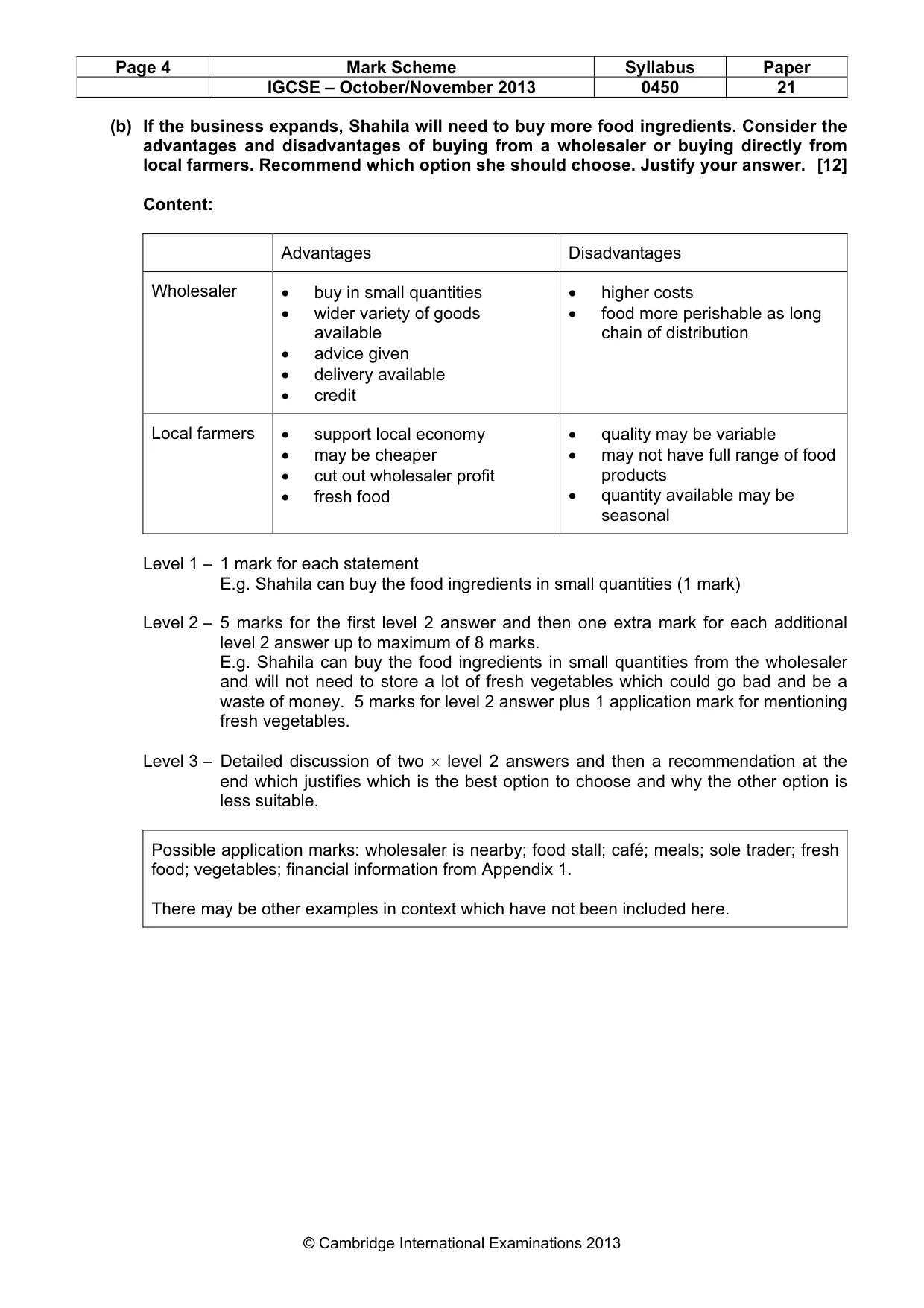
Page 4 Mark Scheme Syllabus Paper IGCSE – October/November 2013 0450 21 © Cambridge International Examinations 2013 (b) If the business expands, Shahila will need to buy more food ingredients. Consider the advantages and disadvantages of buying from a wholesaler or buying directly from local farmers. Recommend which option she should choose. Justify your answer. [12] Content: Advantages Disadvantages Wholesaler • buy in small quantities • wider variety of goods available • advice given • delivery available • credit • higher costs • food more perishable as long chain of distribution Local farmers • support local economy • may be cheaper • cut out wholesaler profit • fresh food • quality may be variable • may not have full range of food products • quantity available may be seasonal Level 1 – 1 mark for each statement E.g. Shahila can buy the food ingredients in small quantities (1 mark) Level 2 – 5 marks for the first level 2 answer and then one extra mark for each additional level 2 answer up to maximum of 8 marks. E.g. Shahila can buy the food ingredients in small quantities from the wholesaler and will not need to store a lot of fresh vegetables which could go bad and be a waste of money. 5 marks for level 2 answer plus 1 application mark for mentioning fresh vegetables. Level 3 – Detailed discussion of two × level 2 answers and then a recommendation at the end which justifies which is the best option to choose and why the other option is less suitable. Possible application marks: wholesaler is nearby; food stall; café; meals; sole trader; fresh food; vegetables; financial information from Appendix 1. There may be other examples in context which have not been included here.
Mark scheme, page 5
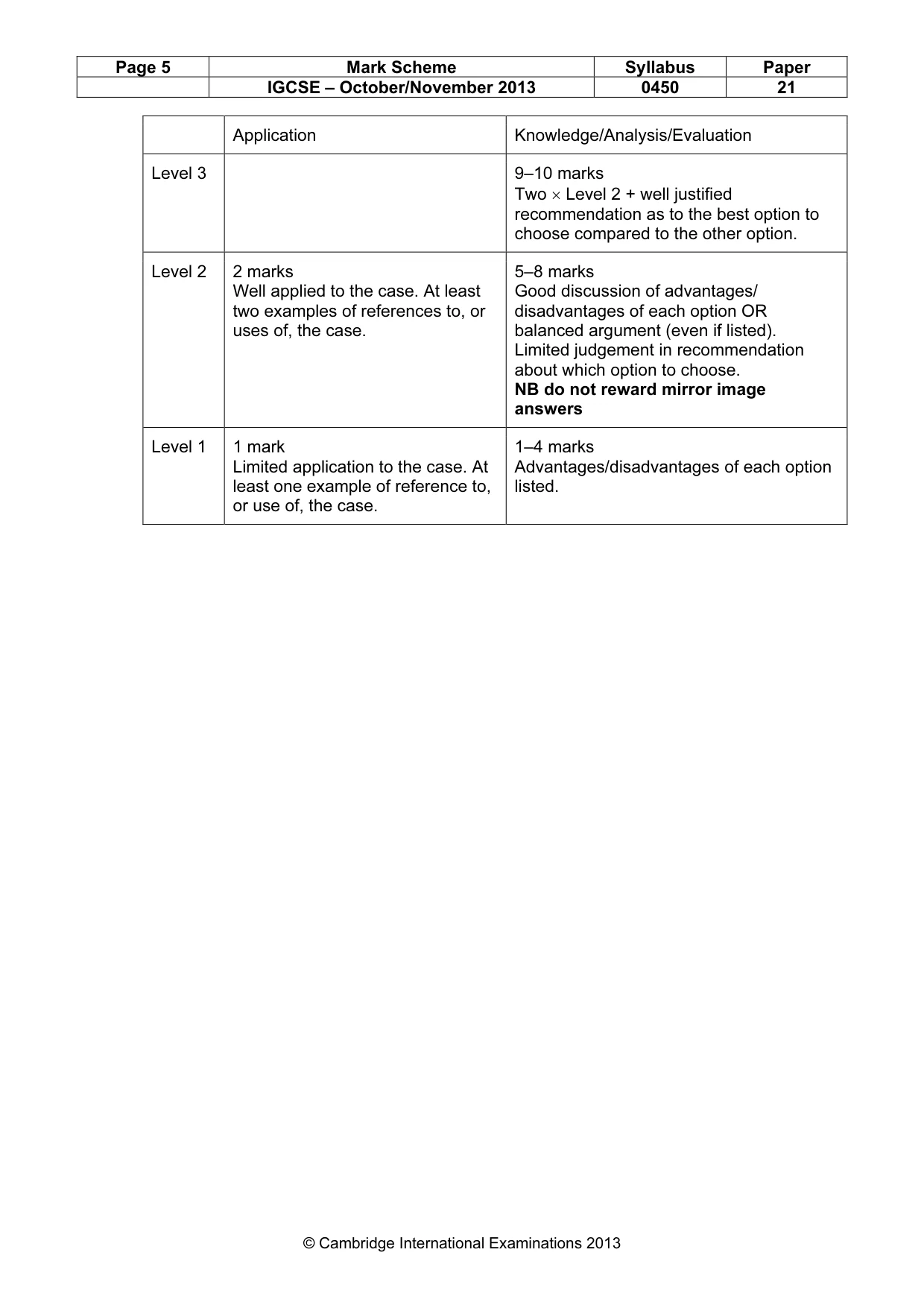
Page 5 Mark Scheme Syllabus Paper IGCSE – October/November 2013 0450 21 © Cambridge International Examinations 2013 Application Knowledge/Analysis/Evaluation Level 3 9–10 marks Two × Level 2 + well justified recommendation as to the best option to choose compared to the other option. Level 2 2 marks Well applied to the case. At least two examples of references to, or uses of, the case. 5–8 marks Good discussion of advantages/ disadvantages of each option OR balanced argument (even if listed). Limited judgement in recommendation about which option to choose. NB do not reward mirror image answers Level 1 1 mark Limited application to the case. At least one example of reference to, or use of, the case. 1–4 marks Advantages/disadvantages of each option listed.
Mark scheme, page 6
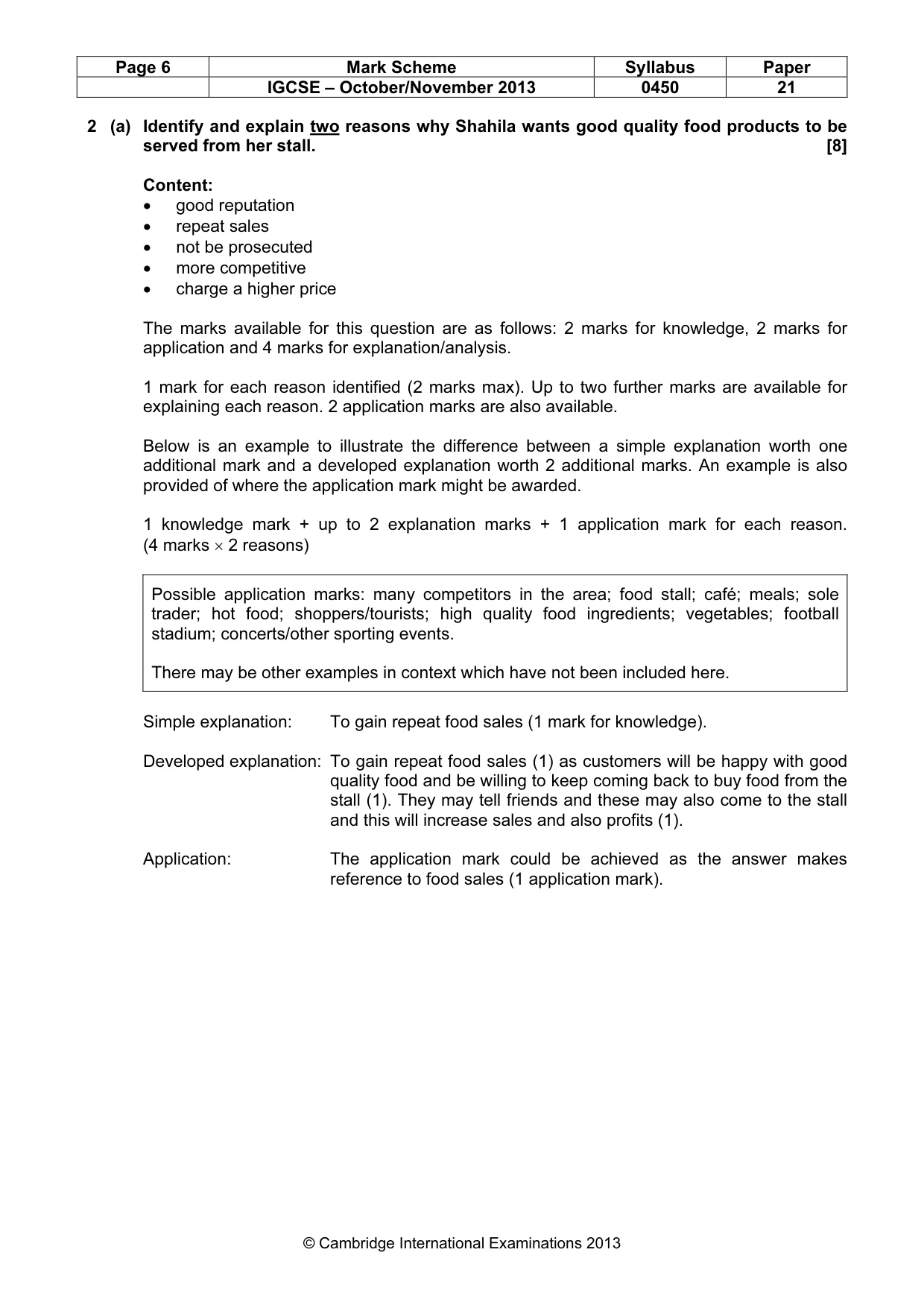
Page 6 Mark Scheme Syllabus Paper IGCSE – October/November 2013 0450 21 © Cambridge International Examinations 2013 2 (a) Identify and explain two reasons why Shahila wants good quality food products to be served from her stall. [8] Content: • good reputation • repeat sales • not be prosecuted • more competitive • charge a higher price The marks available for this question are as follows: 2 marks for knowledge, 2 marks for application and 4 marks for explanation/analysis. 1 mark for each reason identified (2 marks max). Up to two further marks are available for explaining each reason. 2 application marks are also available. Below is an example to illustrate the difference between a simple explanation worth one additional mark and a developed explanation worth 2 additional marks. An example is also provided of where the application mark might be awarded. 1 knowledge mark + up to 2 explanation marks + 1 application mark for each reason. (4 marks × 2 reasons) Possible application marks: many competitors in the area; food stall; café; meals; sole trader; hot food; shoppers/tourists; high quality food ingredients; vegetables; football stadium; concerts/other sporting events. There may be other examples in context which have not been included here. Simple explanation: To gain repeat food sales (1 mark for knowledge). Developed explanation: To gain repeat food sales (1) as customers will be happy with good quality food and be willing to keep coming back to buy food from the stall (1). They may tell friends and these may also come to the stall and this will increase sales and also profits (1). Application: The application mark could be achieved as the answer makes reference to food sales (1 application mark).
Mark scheme, page 7
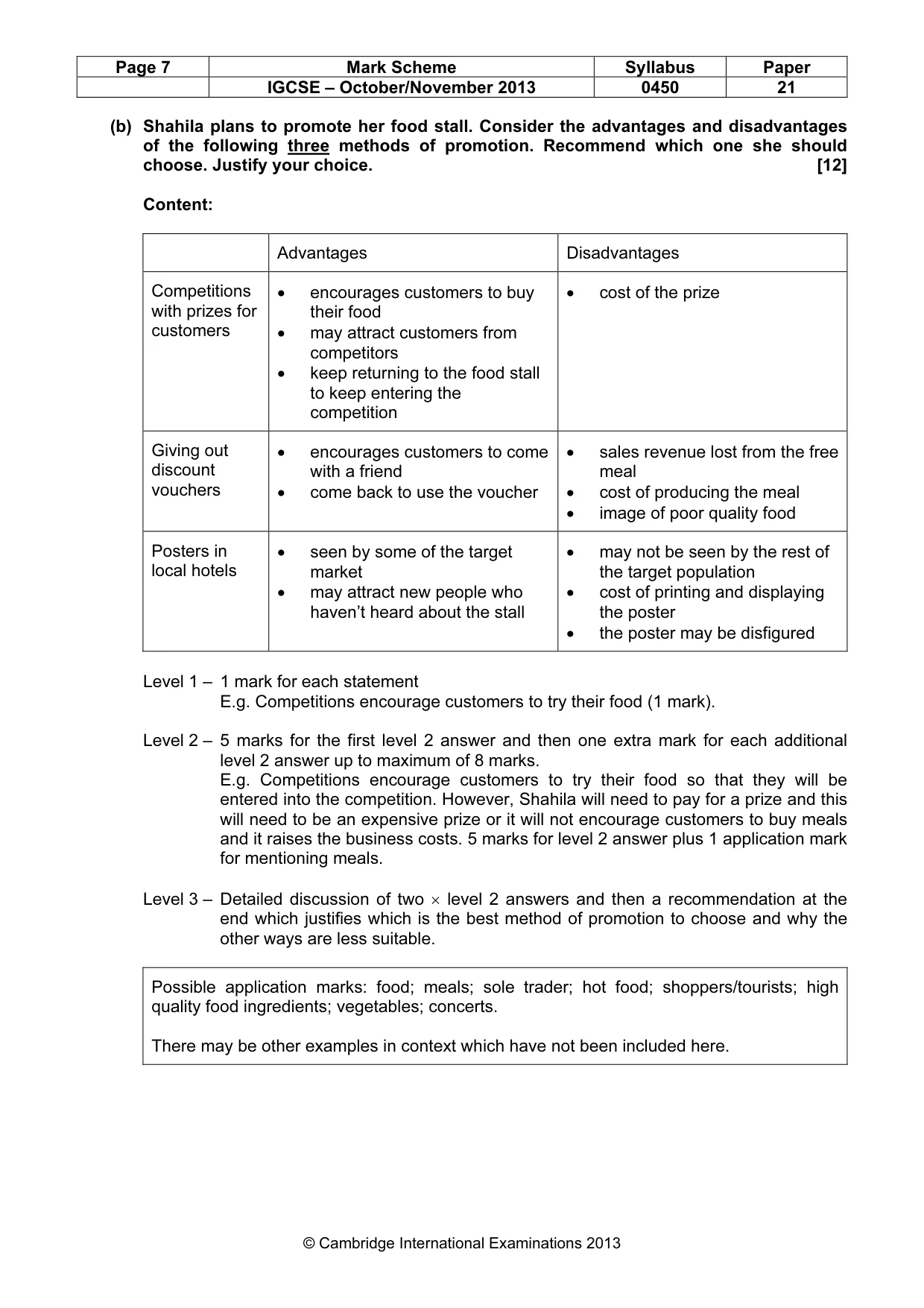
Page 7 Mark Scheme Syllabus Paper IGCSE – October/November 2013 0450 21 © Cambridge International Examinations 2013 (b) Shahila plans to promote her food stall. Consider the advantages and disadvantages of the following three methods of promotion. Recommend which one she should choose. Justify your choice. [12] Content: Advantages Disadvantages Competitions with prizes for customers • encourages customers to buy their food • may attract customers from competitors • keep returning to the food stall to keep entering the competition • cost of the prize Giving out discount vouchers • encourages customers to come with a friend • come back to use the voucher • sales revenue lost from the free meal • cost of producing the meal • image of poor quality food Posters in local hotels • seen by some of the target market • may attract new people who haven’t heard about the stall • may not be seen by the rest of the target population • cost of printing and displaying the poster • the poster may be disfigured Level 1 – 1 mark for each statement E.g. Competitions encourage customers to try their food (1 mark). Level 2 – 5 marks for the first level 2 answer and then one extra mark for each additional level 2 answer up to maximum of 8 marks. E.g. Competitions encourage customers to try their food so that they will be entered into the competition. However, Shahila will need to pay for a prize and this will need to be an expensive prize or it will not encourage customers to buy meals and it raises the business costs. 5 marks for level 2 answer plus 1 application mark for mentioning meals. Level 3 – Detailed discussion of two × level 2 answers and then a recommendation at the end which justifies which is the best method of promotion to choose and why the other ways are less suitable. Possible application marks: food; meals; sole trader; hot food; shoppers/tourists; high quality food ingredients; vegetables; concerts. There may be other examples in context which have not been included here.
Mark scheme, page 8
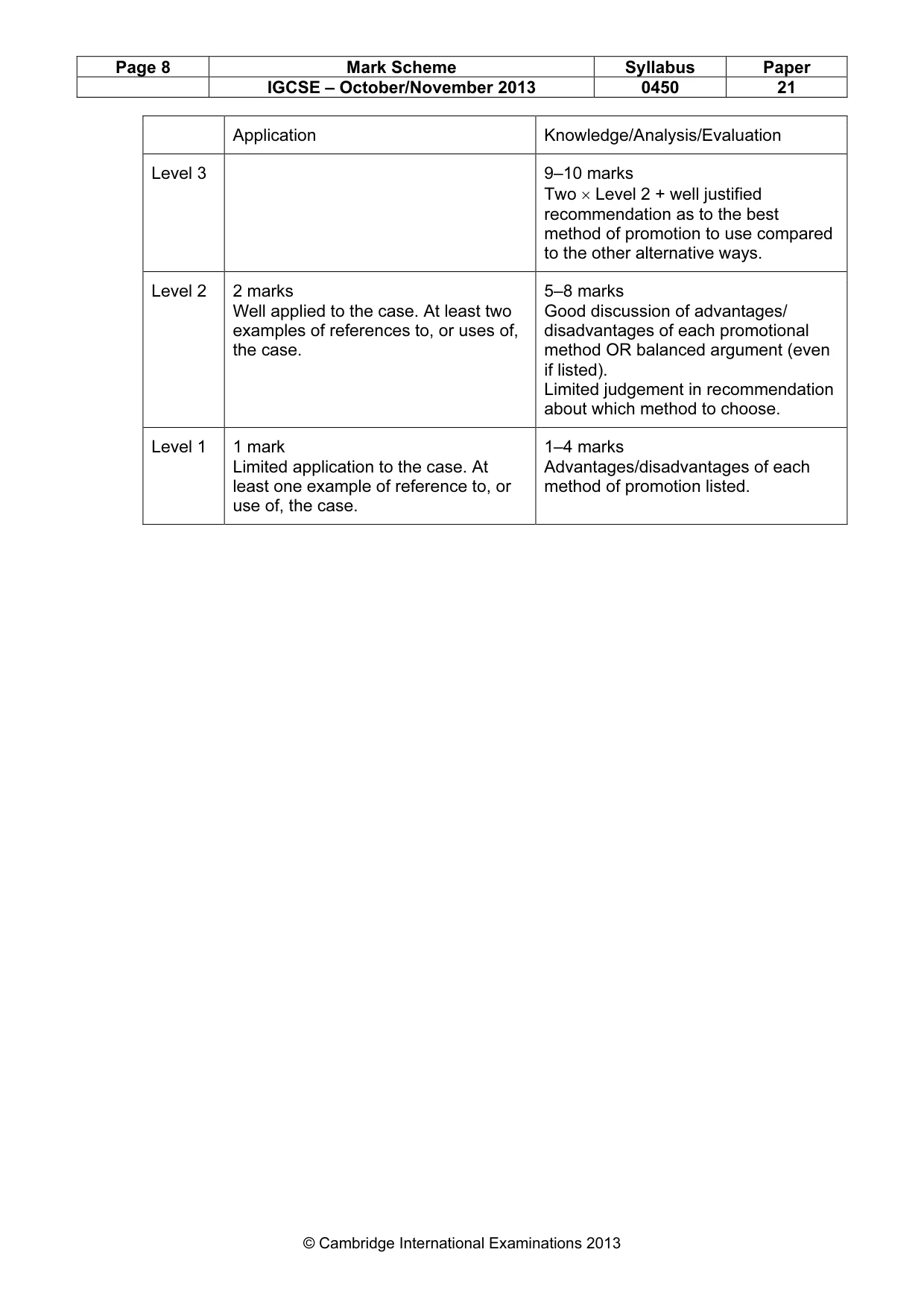
Page 8 Mark Scheme Syllabus Paper IGCSE – October/November 2013 0450 21 © Cambridge International Examinations 2013 Application Knowledge/Analysis/Evaluation Level 3 9–10 marks Two × Level 2 + well justified recommendation as to the best method of promotion to use compared to the other alternative ways. Level 2 2 marks Well applied to the case. At least two examples of references to, or uses of, the case. 5–8 marks Good discussion of advantages/ disadvantages of each promotional method OR balanced argument (even if listed). Limited judgement in recommendation about which method to choose. Level 1 1 mark Limited application to the case. At least one example of reference to, or use of, the case. 1–4 marks Advantages/disadvantages of each method of promotion listed.
Mark scheme, page 9
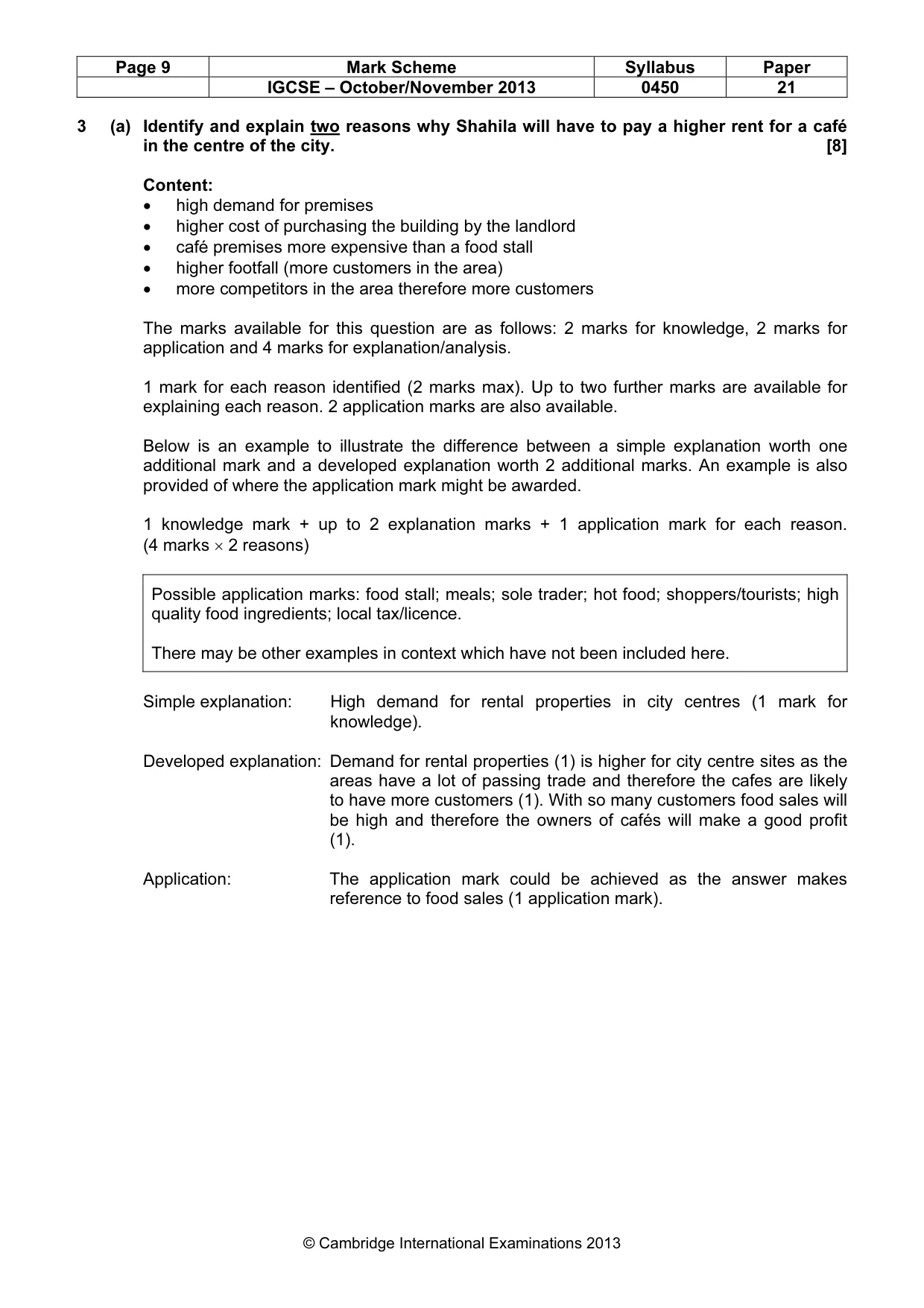
Page 9 Mark Scheme Syllabus Paper IGCSE – October/November 2013 0450 21 © Cambridge International Examinations 2013 3 (a) Identify and explain two reasons why Shahila will have to pay a higher rent for a café in the centre of the city. [8] Content: • high demand for premises • higher cost of purchasing the building by the landlord • café premises more expensive than a food stall • higher footfall (more customers in the area) • more competitors in the area therefore more customers The marks available for this question are as follows: 2 marks for knowledge, 2 marks for application and 4 marks for explanation/analysis. 1 mark for each reason identified (2 marks max). Up to two further marks are available for explaining each reason. 2 application marks are also available. Below is an example to illustrate the difference between a simple explanation worth one additional mark and a developed explanation worth 2 additional marks. An example is also provided of where the application mark might be awarded. 1 knowledge mark + up to 2 explanation marks + 1 application mark for each reason. (4 marks × 2 reasons) Possible application marks: food stall; meals; sole trader; hot food; shoppers/tourists; high quality food ingredients; local tax/licence. There may be other examples in context which have not been included here. Simple explanation: High demand for rental properties in city centres (1 mark for knowledge). Developed explanation: Demand for rental properties (1) is higher for city centre sites as the areas have a lot of passing trade and therefore the cafes are likely to have more customers (1). With so many customers food sales will be high and therefore the owners of cafés will make a good profit (1). Application: The application mark could be achieved as the answer makes reference to food sales (1 application mark).
Mark scheme, page 10
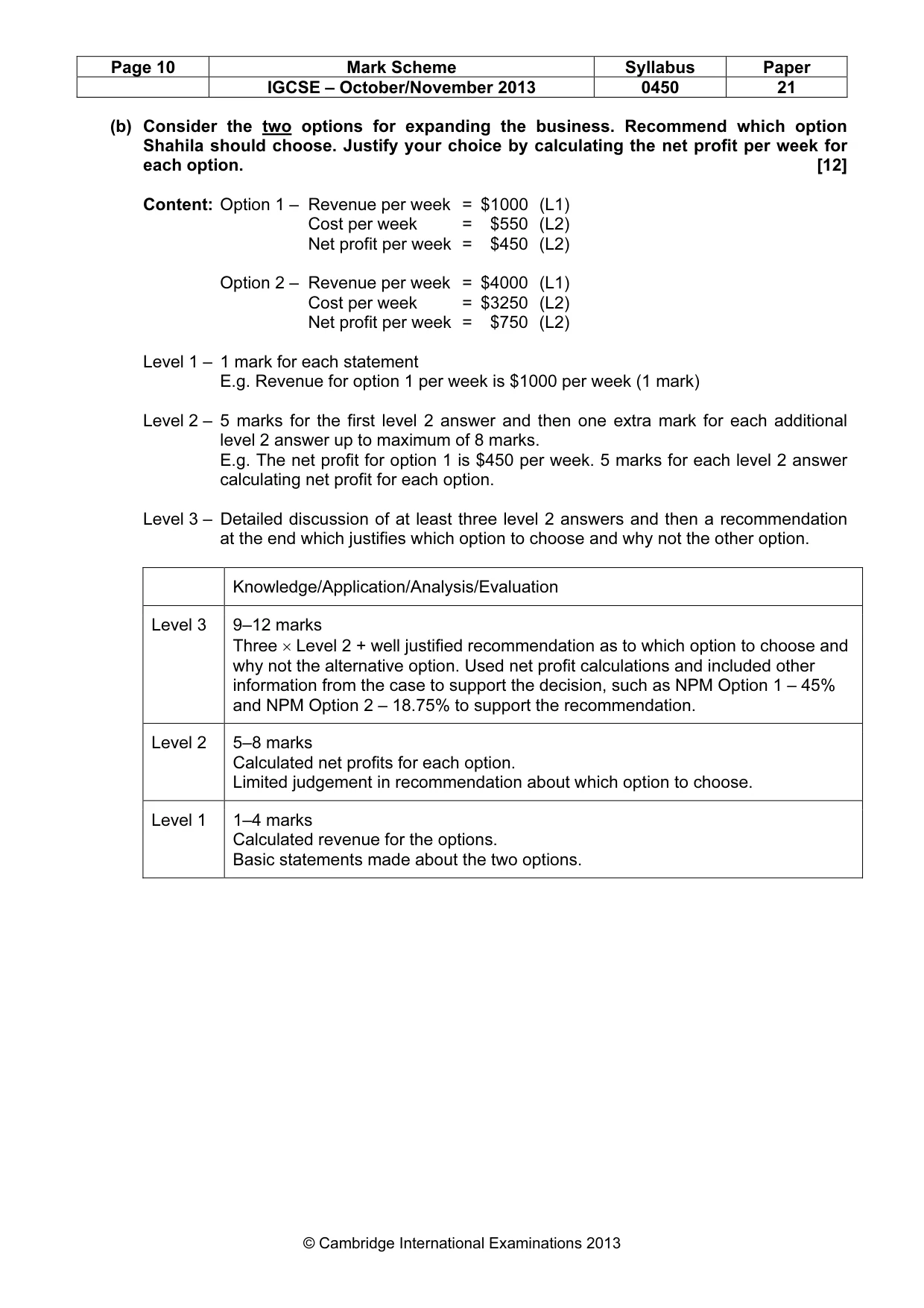
Page 10 Mark Scheme Syllabus Paper IGCSE – October/November 2013 0450 21 © Cambridge International Examinations 2013 (b) Consider the two options for expanding the business. Recommend which option Shahila should choose. Justify your choice by calculating the net profit per week for each option. [12] Content: Option 1 – Revenue per week = $1000 (L1) Cost per week = $550 (L2) Net profit per week = $450 (L2) Option 2 – Revenue per week = $4000 (L1) Cost per week = $3250 (L2) Net profit per week = $750 (L2) Level 1 – 1 mark for each statement E.g. Revenue for option 1 per week is $1000 per week (1 mark) Level 2 – 5 marks for the first level 2 answer and then one extra mark for each additional level 2 answer up to maximum of 8 marks. E.g. The net profit for option 1 is $450 per week. 5 marks for each level 2 answer calculating net profit for each option. Level 3 – Detailed discussion of at least three level 2 answers and then a recommendation at the end which justifies which option to choose and why not the other option. Knowledge/Application/Analysis/Evaluation Level 3 9–12 marks Three × Level 2 + well justified recommendation as to which option to choose and why not the alternative option. Used net profit calculations and included other information from the case to support the decision, such as NPM Option 1 – 45% and NPM Option 2 – 18.75% to support the recommendation. Level 2 5–8 marks Calculated net profits for each option. Limited judgement in recommendation about which option to choose. Level 1 1–4 marks Calculated revenue for the options. Basic statements made about the two options.
Mark scheme, page 11
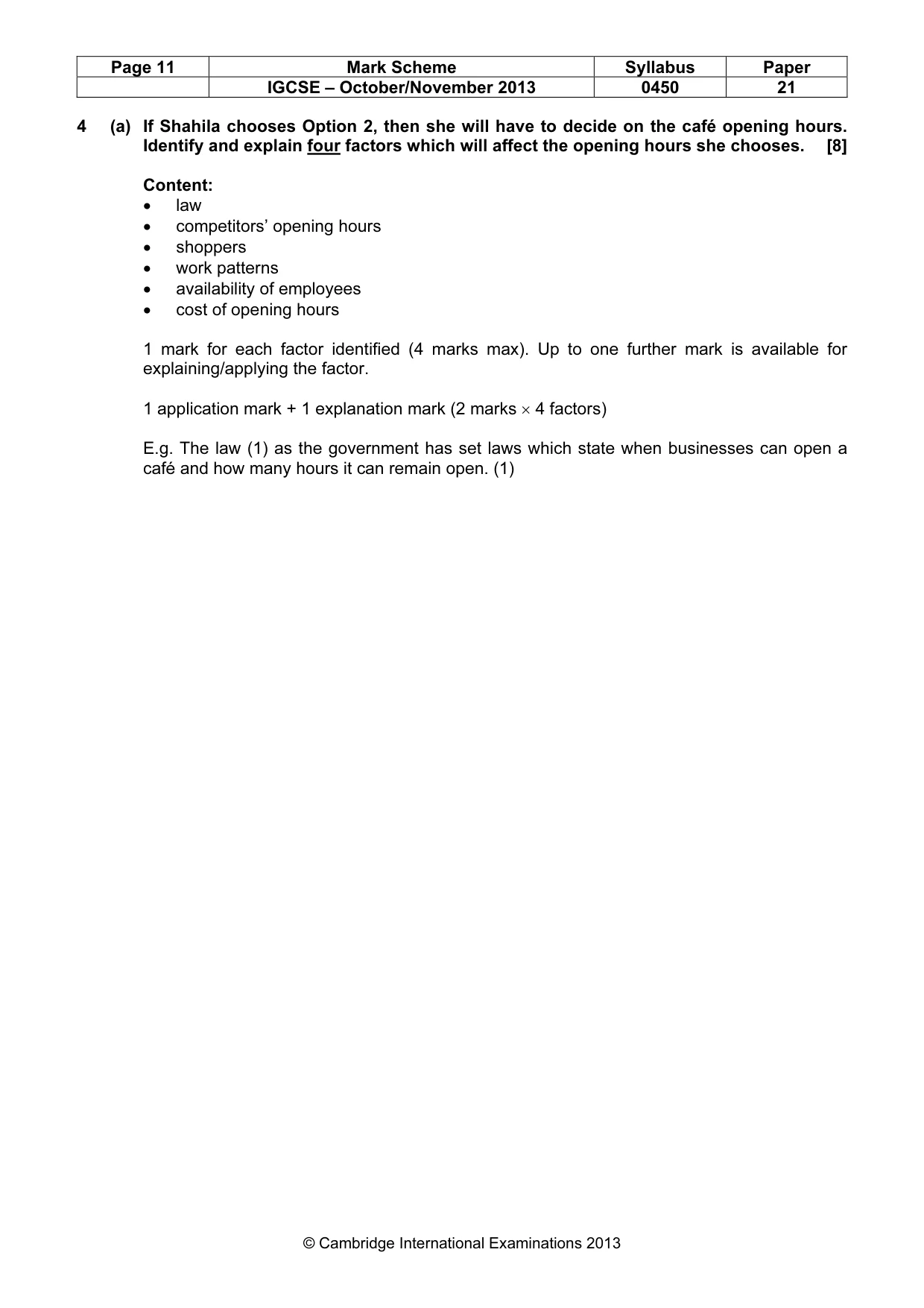
Page 11 Mark Scheme Syllabus Paper IGCSE – October/November 2013 0450 21 © Cambridge International Examinations 2013 4 (a) If Shahila chooses Option 2, then she will have to decide on the café opening hours. Identify and explain four factors which will affect the opening hours she chooses. [8] Content: • law • competitors’ opening hours • shoppers • work patterns • availability of employees • cost of opening hours 1 mark for each factor identified (4 marks max). Up to one further mark is available for explaining/applying the factor. 1 application mark + 1 explanation mark (2 marks × 4 factors) E.g. The law (1) as the government has set laws which state when businesses can open a café and how many hours it can remain open. (1)
Mark scheme, page 12
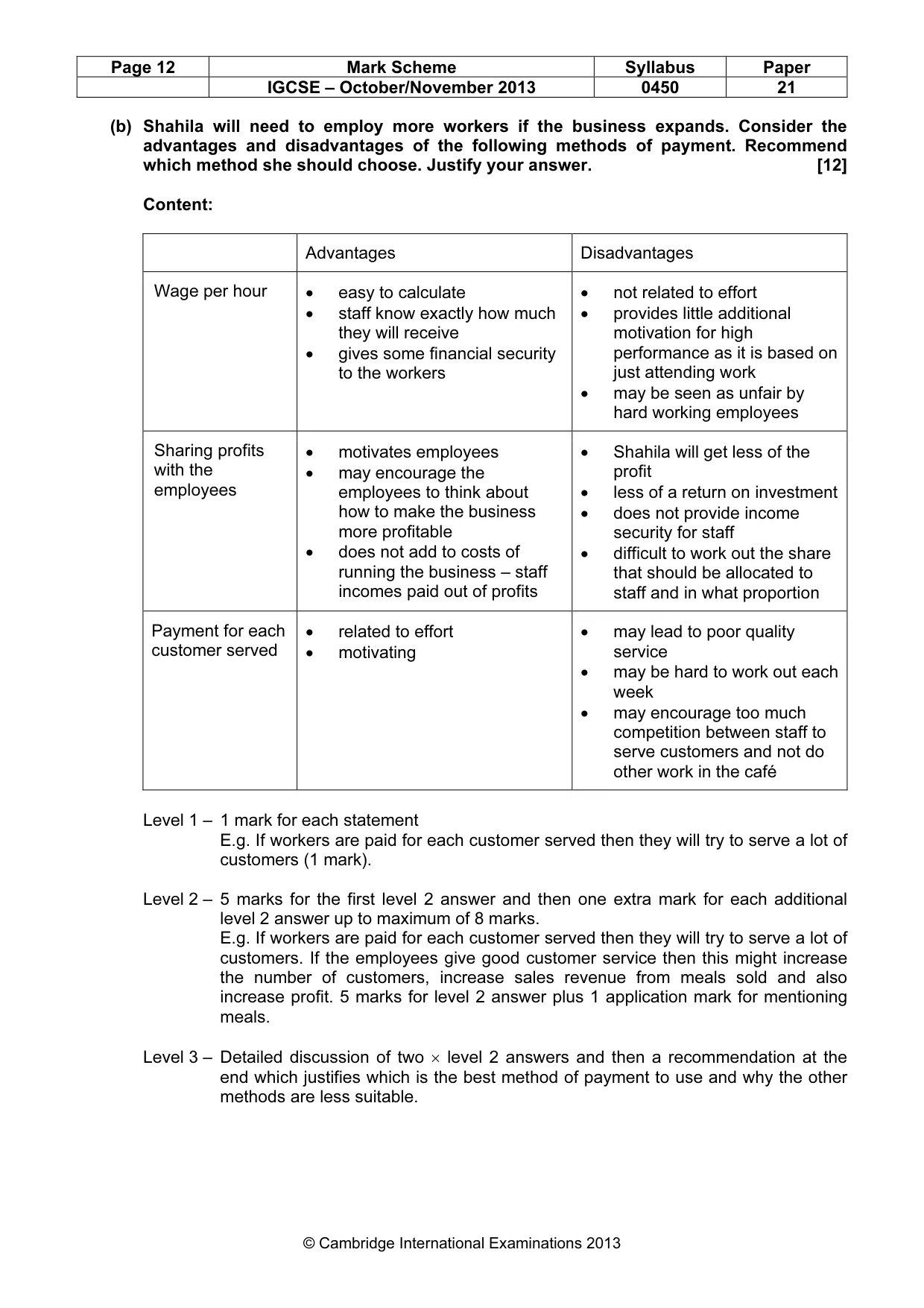
Page 12 Mark Scheme Syllabus Paper IGCSE – October/November 2013 0450 21 © Cambridge International Examinations 2013 (b) Shahila will need to employ more workers if the business expands. Consider the advantages and disadvantages of the following methods of payment. Recommend which method she should choose. Justify your answer. [12] Content: Advantages Disadvantages Wage per hour • easy to calculate • staff know exactly how much they will receive • gives some financial security to the workers • not related to effort • provides little additional motivation for high performance as it is based on just attending work • may be seen as unfair by hard working employees Sharing profits with the employees • motivates employees • may encourage the employees to think about how to make the business more profitable • does not add to costs of running the business – staff incomes paid out of profits • Shahila will get less of the profit • less of a return on investment • does not provide income security for staff • difficult to work out the share that should be allocated to staff and in what proportion Payment for each customer served • related to effort • motivating • may lead to poor quality service • may be hard to work out each week • may encourage too much competition between staff to serve customers and not do other work in the café Level 1 – 1 mark for each statement E.g. If workers are paid for each customer served then they will try to serve a lot of customers (1 mark). Level 2 – 5 marks for the first level 2 answer and then one extra mark for each additional level 2 answer up to maximum of 8 marks. E.g. If workers are paid for each customer served then they will try to serve a lot of customers. If the employees give good customer service then this might increase the number of customers, increase sales revenue from meals sold and also increase profit. 5 marks for level 2 answer plus 1 application mark for mentioning meals. Level 3 – Detailed discussion of two × level 2 answers and then a recommendation at the end which justifies which is the best method of payment to use and why the other methods are less suitable.
Mark scheme, page 13
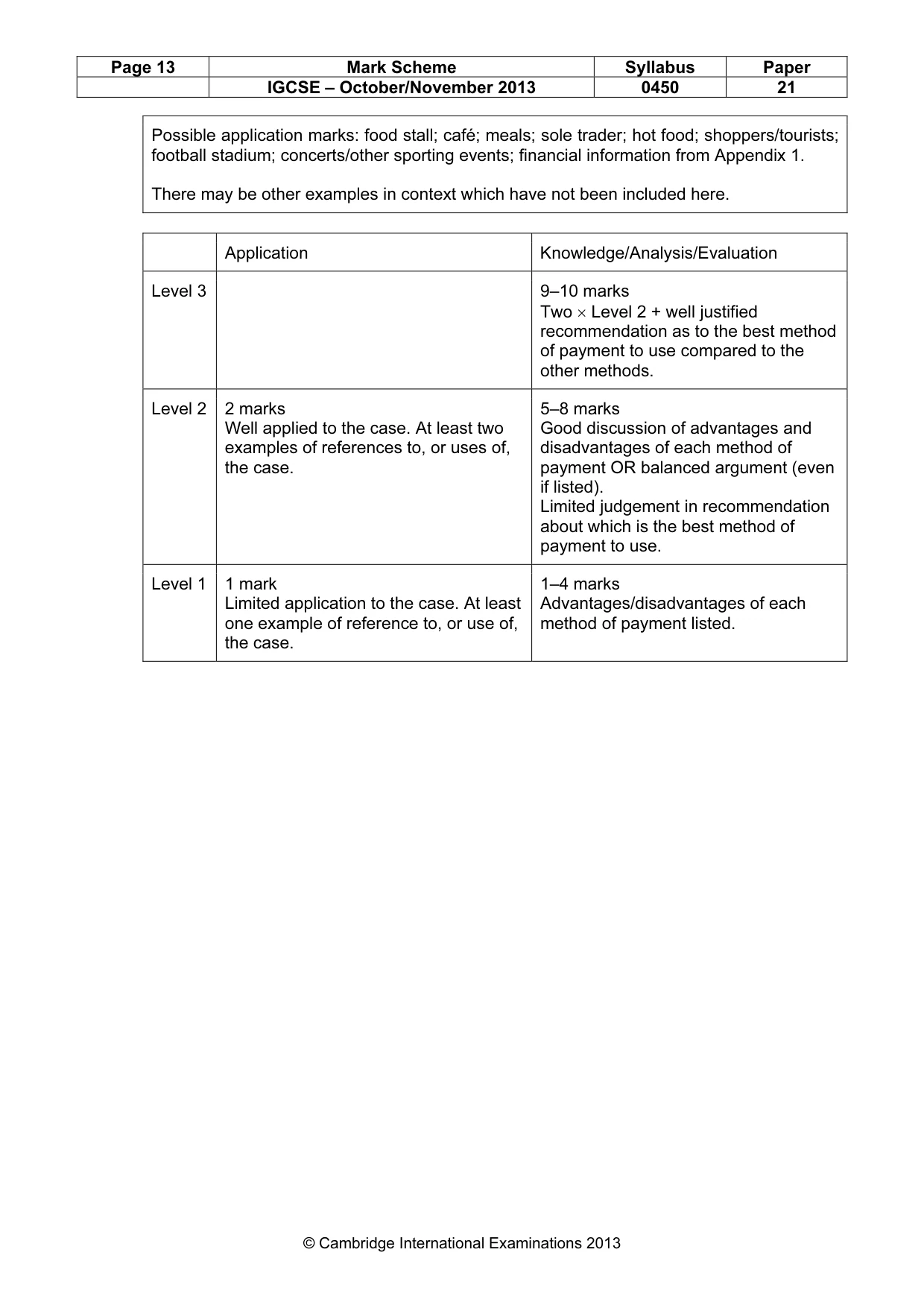
Page 13 Mark Scheme Syllabus Paper IGCSE – October/November 2013 0450 21 © Cambridge International Examinations 2013 Possible application marks: food stall; café; meals; sole trader; hot food; shoppers/tourists; football stadium; concerts/other sporting events; financial information from Appendix 1. There may be other examples in context which have not been included here. Application Knowledge/Analysis/Evaluation Level 3 9–10 marks Two × Level 2 + well justified recommendation as to the best method of payment to use compared to the other methods. Level 2 2 marks Well applied to the case. At least two examples of references to, or uses of, the case. 5–8 marks Good discussion of advantages and disadvantages of each method of payment OR balanced argument (even if listed). Limited judgement in recommendation about which is the best method of payment to use. Level 1 1 mark Limited application to the case. At least one example of reference to, or use of, the case. 1–4 marks Advantages/disadvantages of each method of payment listed.
Mark scheme, page 14
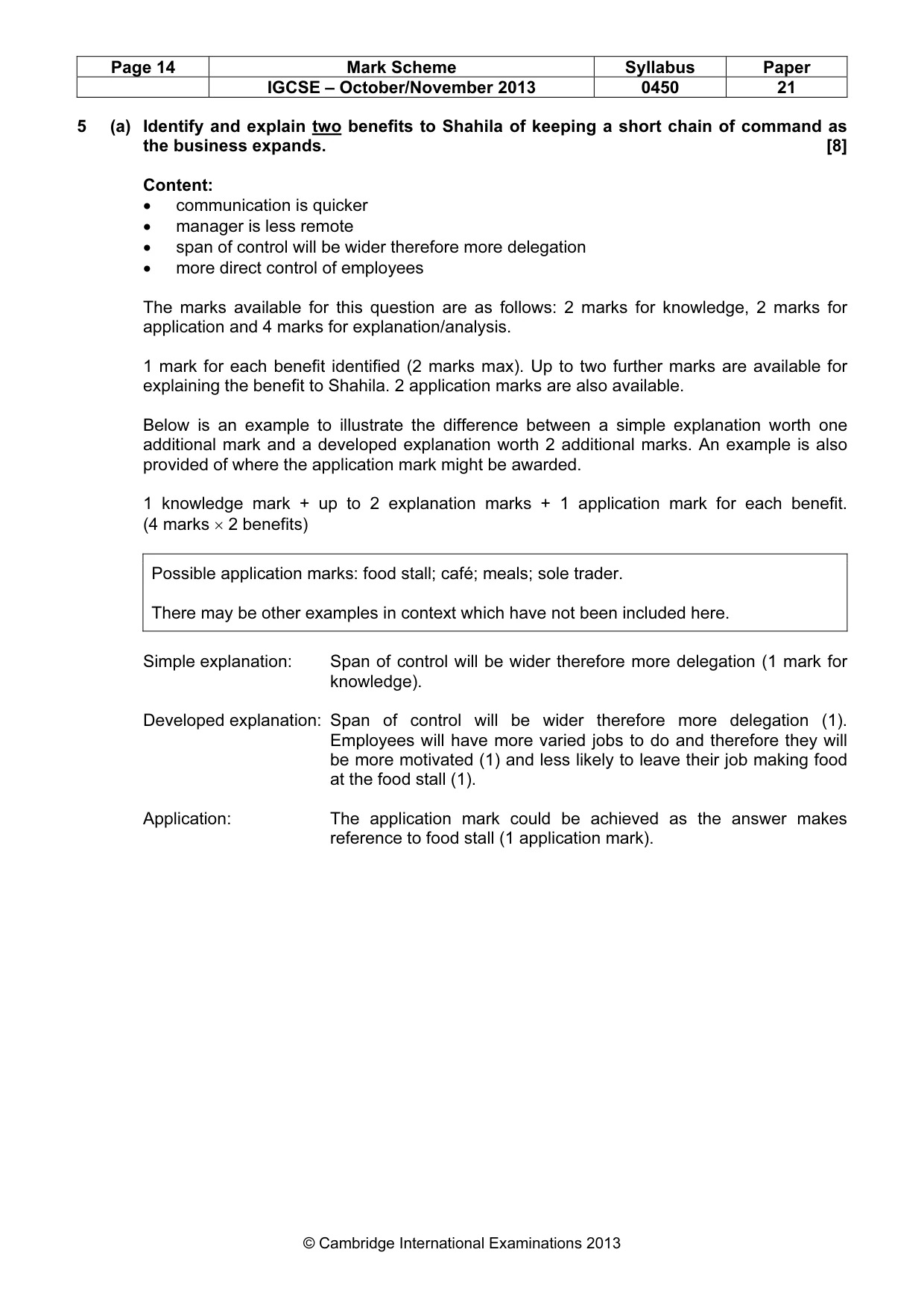
Page 14 Mark Scheme Syllabus Paper IGCSE – October/November 2013 0450 21 © Cambridge International Examinations 2013 5 (a) Identify and explain two benefits to Shahila of keeping a short chain of command as the business expands. [8] Content: • communication is quicker • manager is less remote • span of control will be wider therefore more delegation • more direct control of employees The marks available for this question are as follows: 2 marks for knowledge, 2 marks for application and 4 marks for explanation/analysis. 1 mark for each benefit identified (2 marks max). Up to two further marks are available for explaining the benefit to Shahila. 2 application marks are also available. Below is an example to illustrate the difference between a simple explanation worth one additional mark and a developed explanation worth 2 additional marks. An example is also provided of where the application mark might be awarded. 1 knowledge mark + up to 2 explanation marks + 1 application mark for each benefit. (4 marks × 2 benefits) Possible application marks: food stall; café; meals; sole trader. There may be other examples in context which have not been included here. Simple explanation: Span of control will be wider therefore more delegation (1 mark for knowledge). Developed explanation: Span of control will be wider therefore more delegation (1). Employees will have more varied jobs to do and therefore they will be more motivated (1) and less likely to leave their job making food at the food stall (1). Application: The application mark could be achieved as the answer makes reference to food stall (1 application mark).
Mark scheme, page 15
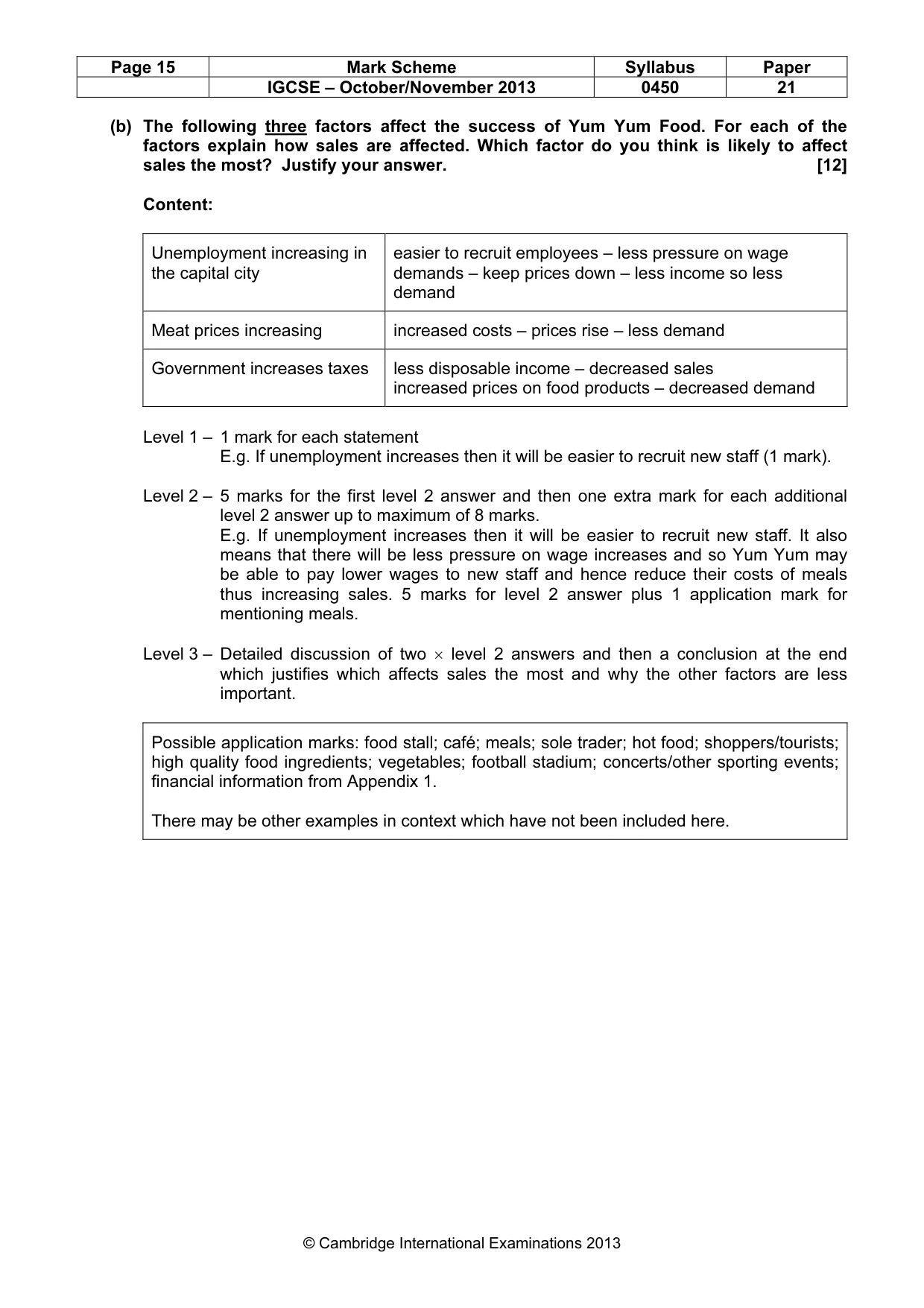
Page 15 Mark Scheme Syllabus Paper IGCSE – October/November 2013 0450 21 © Cambridge International Examinations 2013 (b) The following three factors affect the success of Yum Yum Food. For each of the factors explain how sales are affected. Which factor do you think is likely to affect sales the most? Justify your answer. [12] Content: Unemployment increasing in the capital city easier to recruit employees – less pressure on wage demands – keep prices down – less income so less demand Meat prices increasing increased costs – prices rise – less demand Government increases taxes less disposable income – decreased sales increased prices on food products – decreased demand Level 1 – 1 mark for each statement E.g. If unemployment increases then it will be easier to recruit new staff (1 mark). Level 2 – 5 marks for the first level 2 answer and then one extra mark for each additional level 2 answer up to maximum of 8 marks. E.g. If unemployment increases then it will be easier to recruit new staff. It also means that there will be less pressure on wage increases and so Yum Yum may be able to pay lower wages to new staff and hence reduce their costs of meals thus increasing sales. 5 marks for level 2 answer plus 1 application mark for mentioning meals. Level 3 – Detailed discussion of two × level 2 answers and then a conclusion at the end which justifies which affects sales the most and why the other factors are less important. Possible application marks: food stall; café; meals; sole trader; hot food; shoppers/tourists; high quality food ingredients; vegetables; football stadium; concerts/other sporting events; financial information from Appendix 1. There may be other examples in context which have not been included here.
Mark scheme, page 16
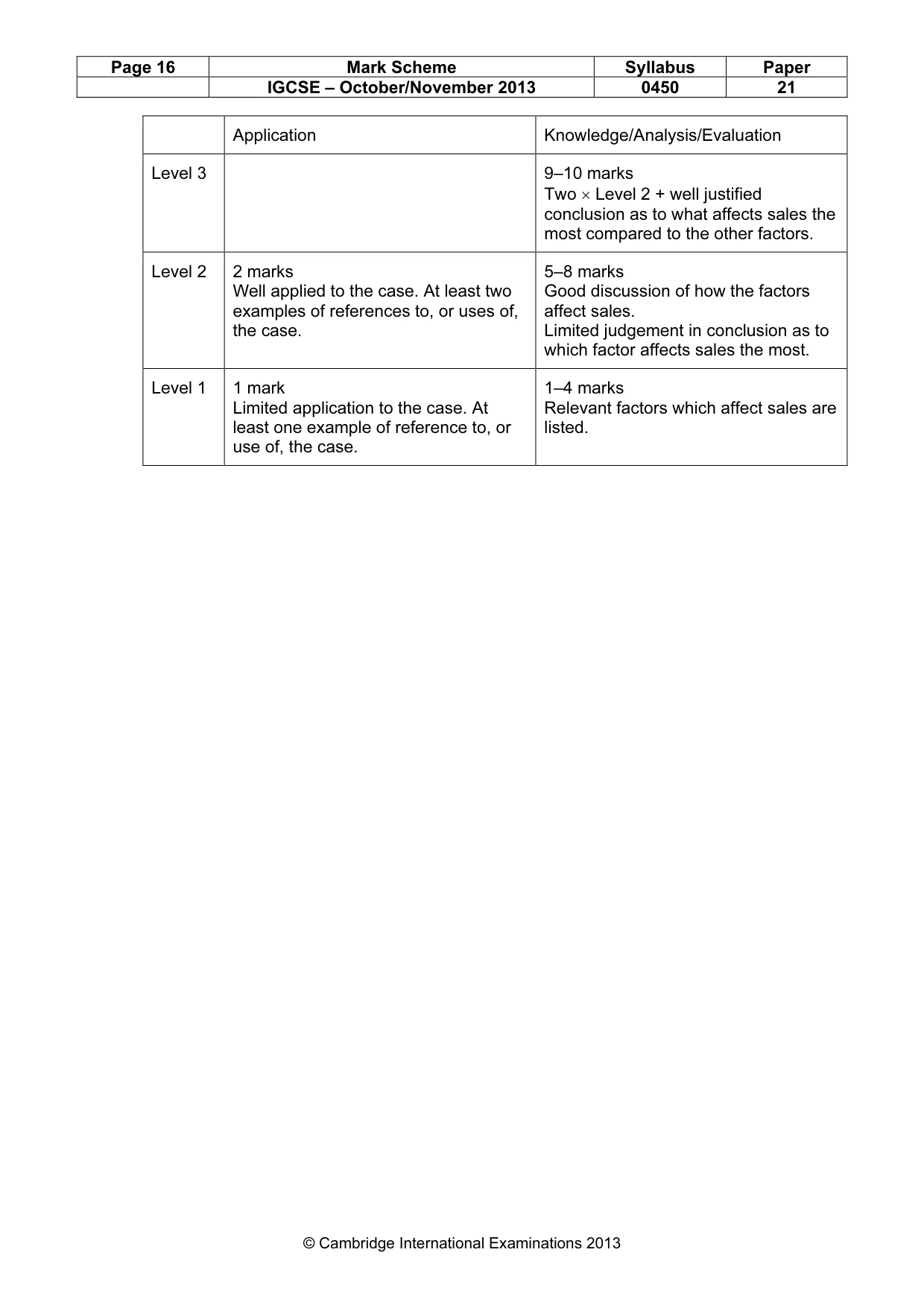
Page 16 Mark Scheme Syllabus Paper IGCSE – October/November 2013 0450 21 © Cambridge International Examinations 2013 Application Knowledge/Analysis/Evaluation Level 3 9–10 marks Two × Level 2 + well justified conclusion as to what affects sales the most compared to the other factors. Level 2 2 marks Well applied to the case. At least two examples of references to, or uses of, the case. 5–8 marks Good discussion of how the factors affect sales. Limited judgement in conclusion as to which factor affects sales the most. Level 1 1 mark Limited application to the case. At least one example of reference to, or use of, the case. 1–4 marks Relevant factors which affect sales are listed.
What you needed in this session
Cambridge’s own grade thresholds for 2013 Oct/Nov, Paper 2 · Variant 1. A higher threshold means an easier paper — the bar moves with how the cohort did.