Cambridge IGCSE Business Studies 0450 — 2013 Oct/Nov Paper 2 · Variant 3
0450/23/O/N/13 · 100 marks · ≈113 min
The question paper and its mark scheme, free to read here and free to download. This is Cambridge’s own paper, exactly as it was sat.
Question paper12 pages

Mark scheme12 pages
Answers below. Sit the paper first if you are practising.
Paper as text
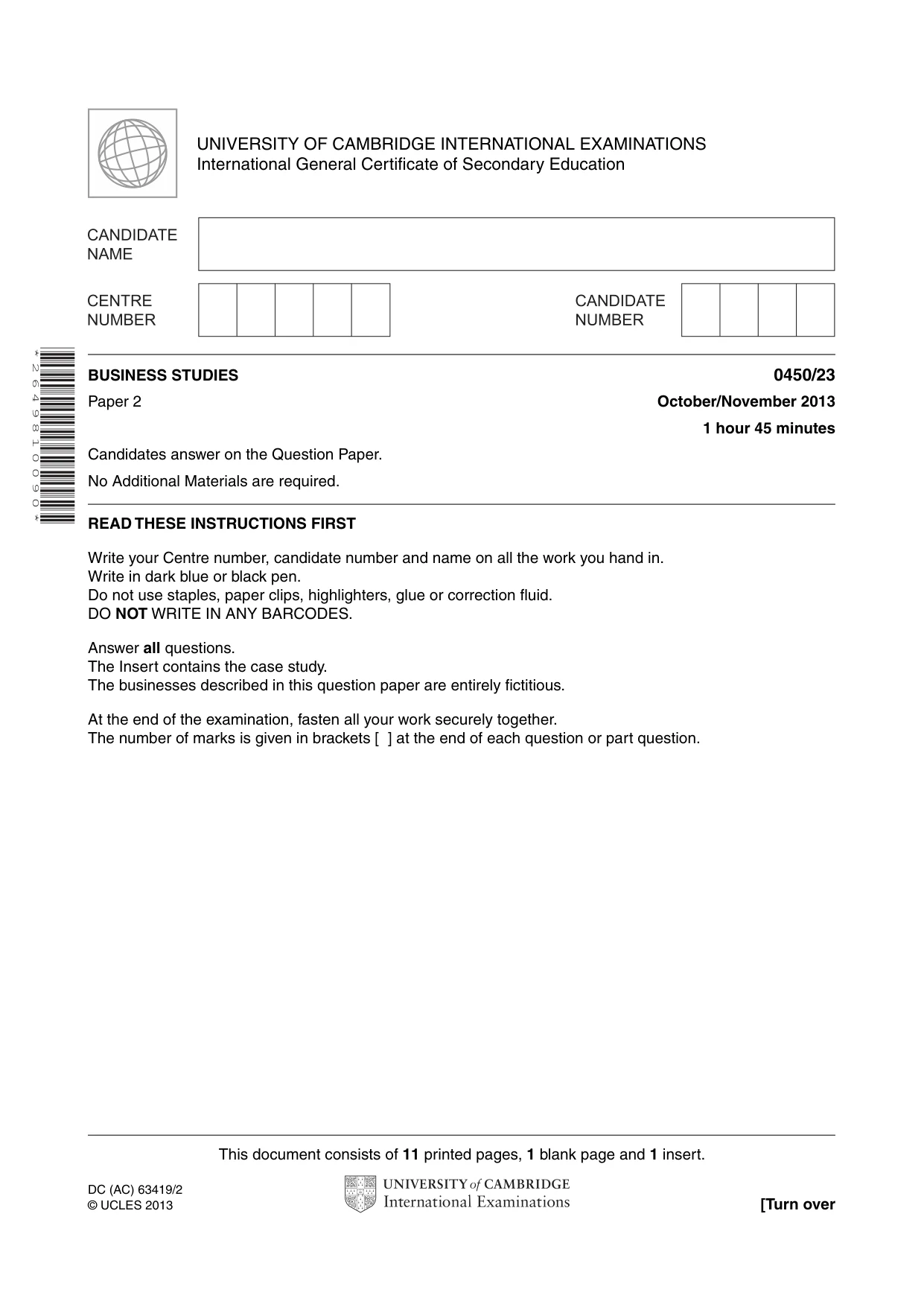
Question paper, page 1
This document consists of 11 printed pages, 1 blank page and 1 insert. DC (AC) 63419/2 © UCLES 2013 [Turn over UNIVERSITY OF CAMBRIDGE INTERNATIONAL EXAMINATIONS International General Certificate of Secondary Education * 2 6 4 9 8 1 0 0 9 0 * BUSINESS STUDIES 0450/23 Paper 2 October/November 2013 1 hour 45 minutes Candidates answer on the Question Paper. No Additional Materials are required. READ THESE INSTRUCTIONS FIRST Write your Centre number, candidate number and name on all the work you hand in. Write in dark blue or black pen. Do not use staples, paper clips, highlighters, glue or correction fluid. DO NOT WRITE IN ANY BARCODES. Answer all questions. The Insert contains the case study. The businesses described in this question paper are entirely fictitious. At the end of the examination, fasten all your work securely together. The number of marks is given in brackets [ ] at the end of each question or part question.
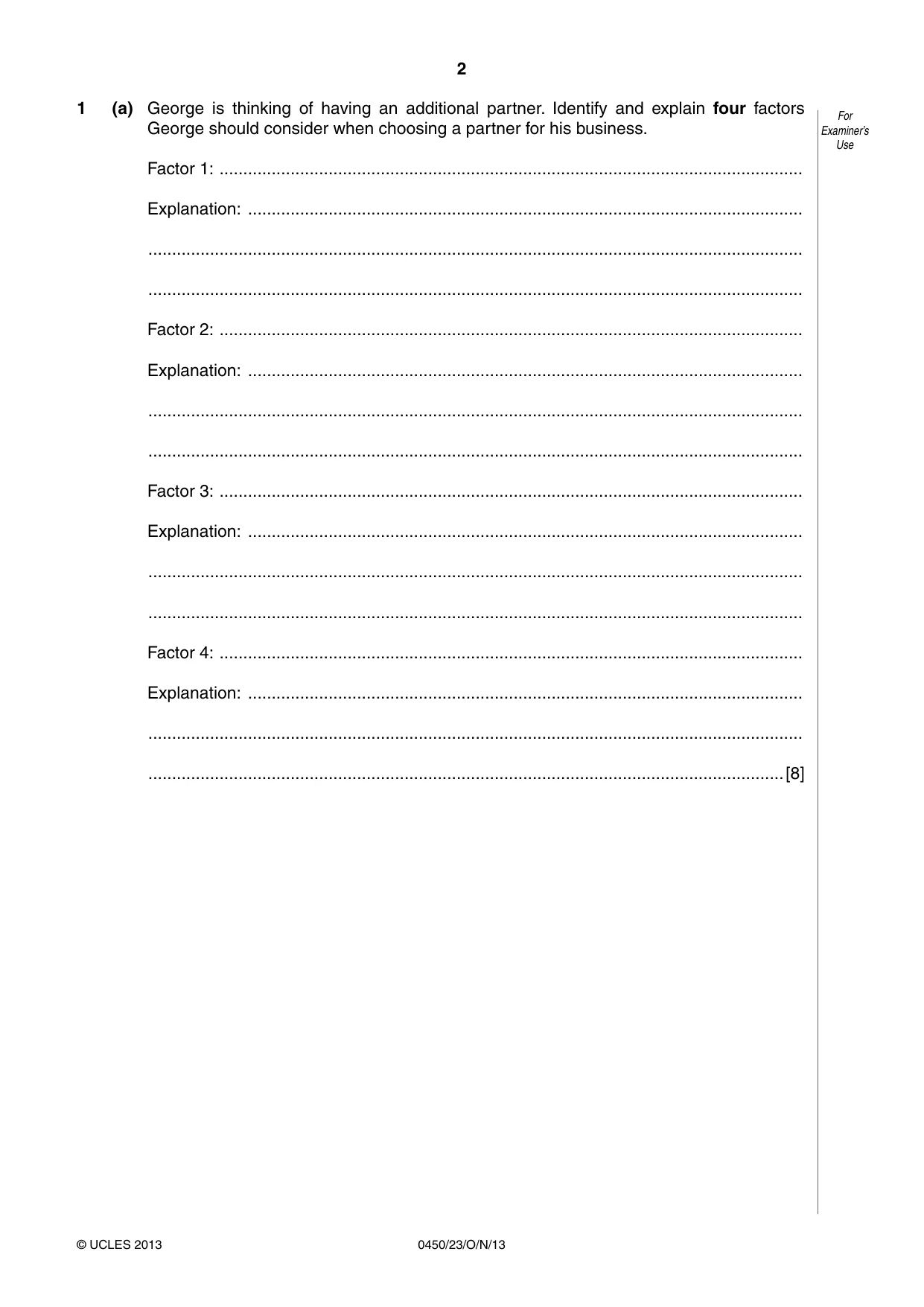
Question paper, page 2
2 0450/23/O/N/13 © UCLES 2013 For Examiner’s Use 1 (a) George is thinking of having an additional partner. Identify and explain four factors George should consider when choosing a partner for his business. Factor 1: … Explanation: … … … Factor 2: … Explanation: … … … Factor 3: … Explanation: … … … Factor 4: … Explanation: … … …[8]
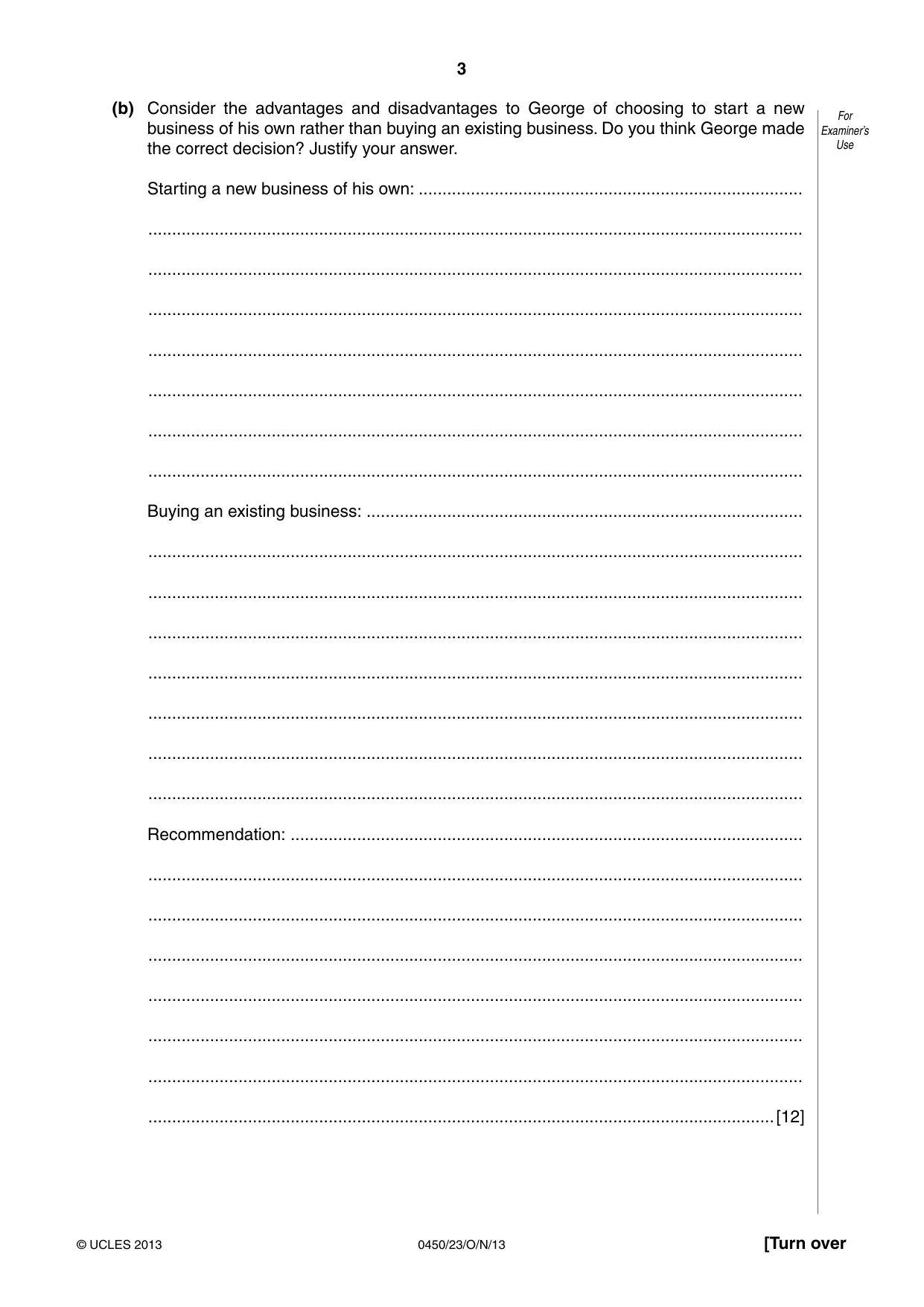
Question paper, page 3
3 0450/23/O/N/13 © UCLES 2013 [Turn over For Examiner’s Use (b) Consider the advantages and disadvantages to George of choosing to start a new business of his own rather than buying an existing business. Do you think George made the correct decision? Justify your answer. Starting a new business of his own: … … … … … … … … Buying an existing business: … … … … … … … … Recommendation: … … … … … … … …[12]
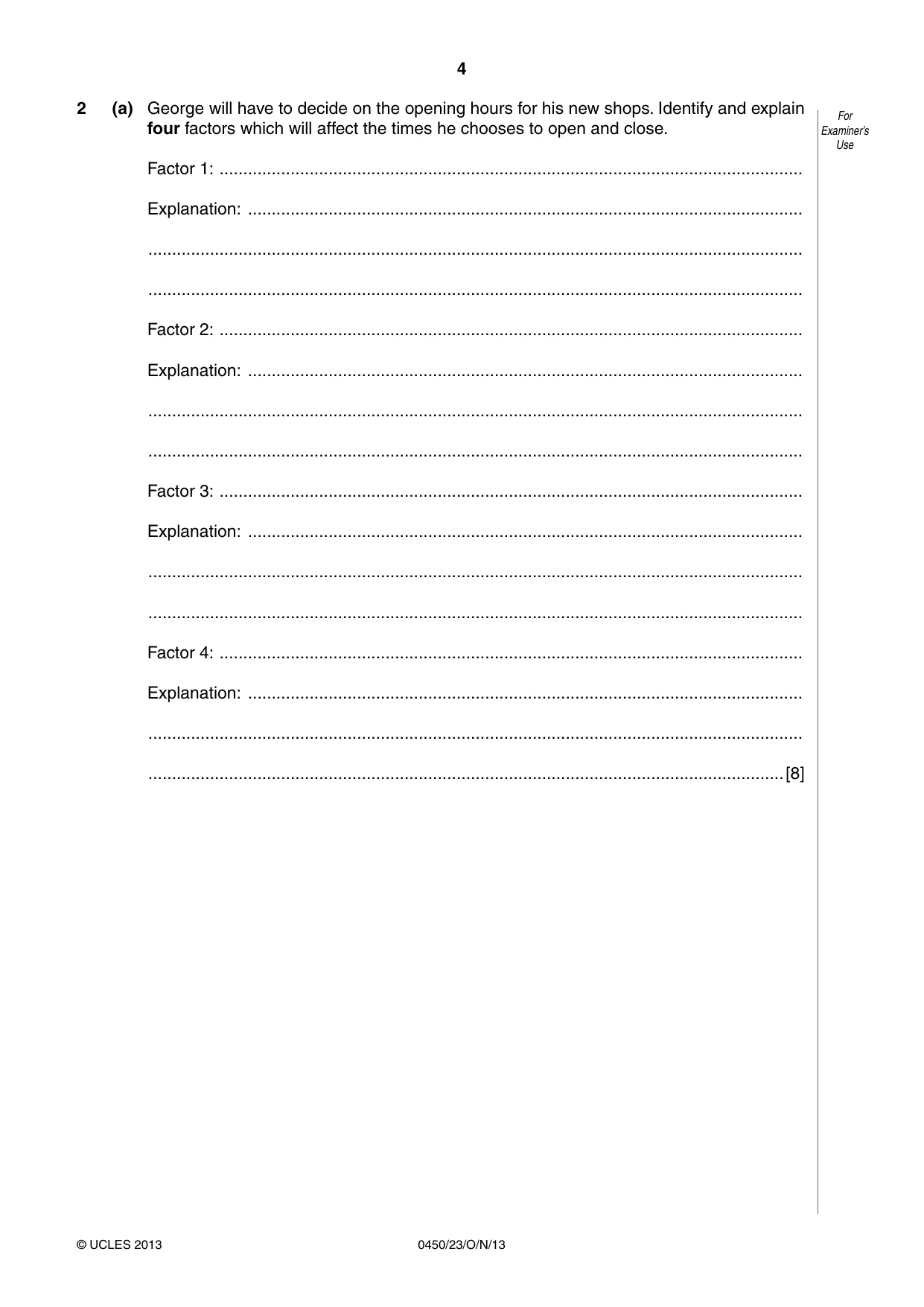
Question paper, page 4
4 0450/23/O/N/13 © UCLES 2013 For Examiner’s Use 2 (a) George will have to decide on the opening hours for his new shops. Identify and explain four factors which will affect the times he chooses to open and close. Factor 1: … Explanation: … … … Factor 2: … Explanation: … … … Factor 3: … Explanation: … … … Factor 4: … Explanation: … … …[8]
Question paper, page 5
5 0450/23/O/N/13 © UCLES 2013 [Turn over For Examiner’s Use (b) George finally decides to choose Option 2. Do you think he made the correct decision? Justify your answer by considering the advantages and disadvantages of Option 1 and Option 2. Option 1: … … … … … … … … Option 2: … … … … … … … … Recommendation: … … … … … … … …[12]
Question paper, page 6
6 0450/23/O/N/13 © UCLES 2013 For Examiner’s Use 3 (a) Identify and explain two economies of scale GG might benefit from as the business expands. Economy of scale 1: … … Explanation: … … … … … … Economy of scale 2: … … Explanation: … … … … … …[8]
Question paper, page 7
7 0450/23/O/N/13 © UCLES 2013 [Turn over For Examiner’s Use (b) Do you think George should be happy with the financial position of the business? Justify your answer by calculating liquidity ratios and using other information in Appendix 1. … … … … … … … … … … … … … … … … … … … … … … … …[12]
Question paper, page 8
8 0450/23/O/N/13 © UCLES 2013 For Examiner’s Use 4 (a) Identify and explain two items of market research information George should find out before he opens the shops in the hotels. Item 1: … … Explanation: … … … … … … Item 2: … … Explanation: … … … … … …[8]
Question paper, page 9
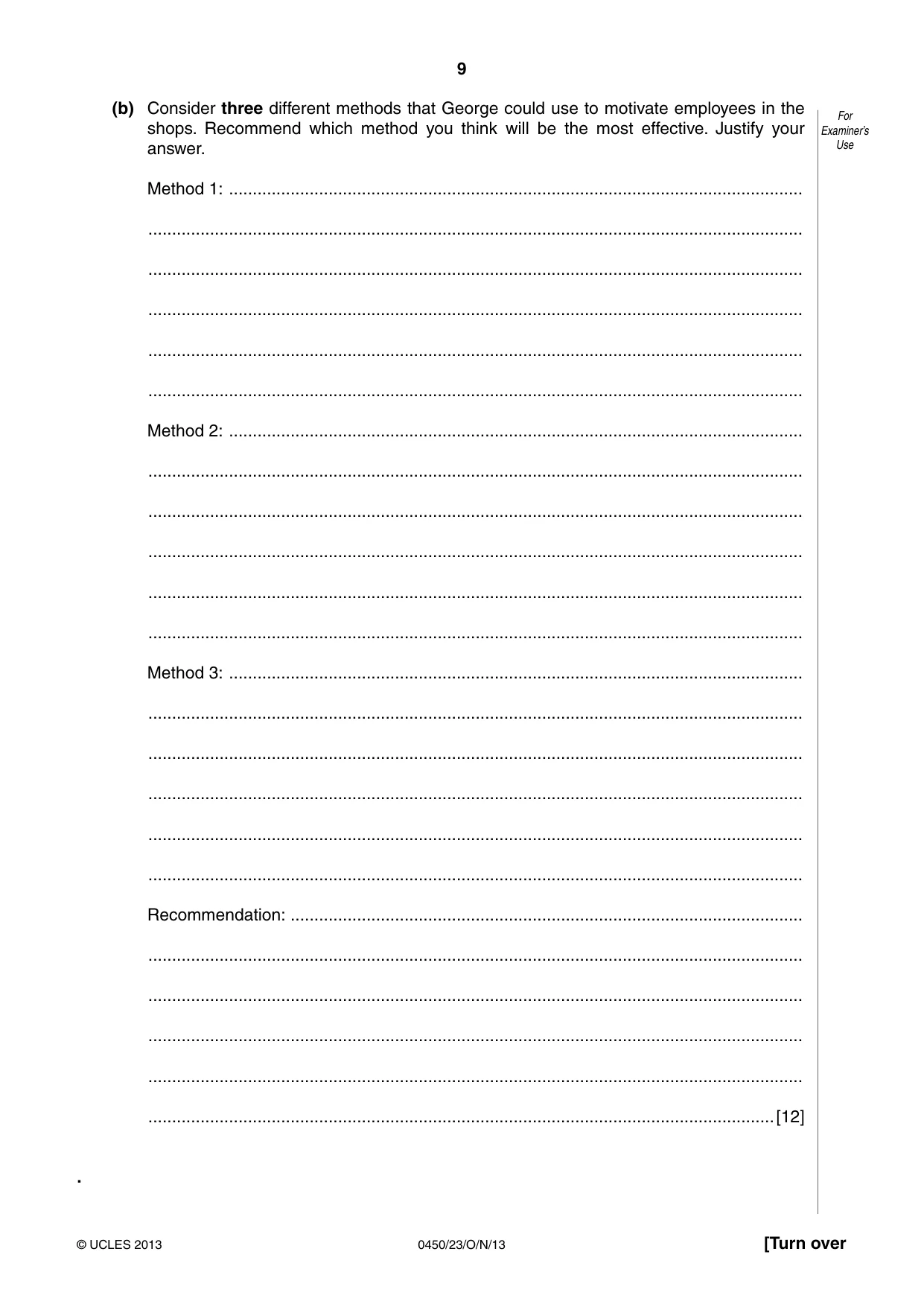
9 0450/23/O/N/13 © UCLES 2013 [Turn over For Examiner’s Use (b) Consider three different methods that George could use to motivate employees in the shops. Recommend which method you think will be the most effective. Justify your answer. Method 1: … … … … … … Method 2: … … … … … … Method 3: … … … … … … Recommendation: … … … … … …[12] .
Question paper, page 10
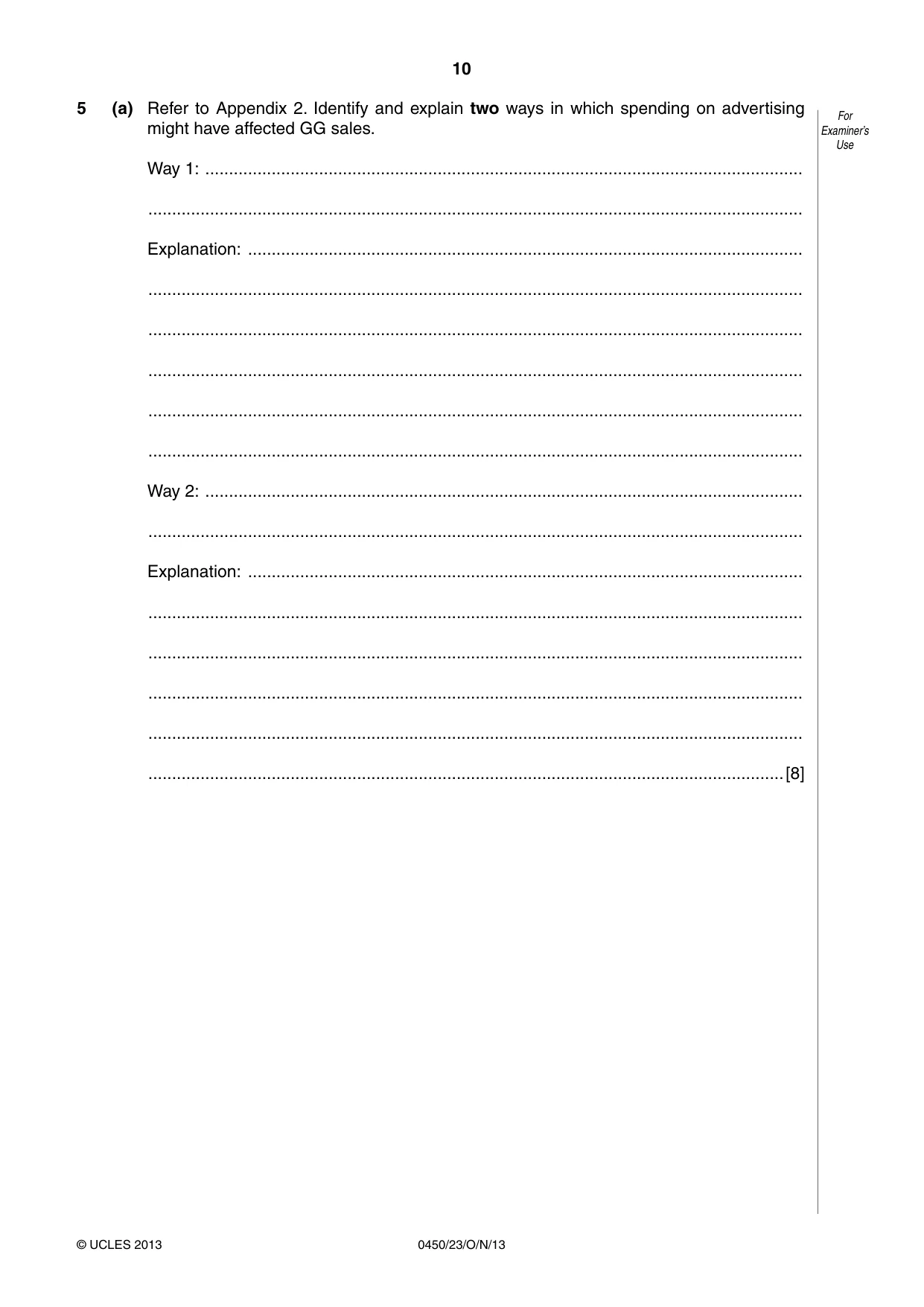
10 0450/23/O/N/13 © UCLES 2013 For Examiner’s Use 5 (a) Refer to Appendix 2. Identify and explain two ways in which spending on advertising might have affected GG sales. Way 1: … … Explanation: … … … … … … Way 2: … … Explanation: … … … … … …[8]
Question paper, page 11
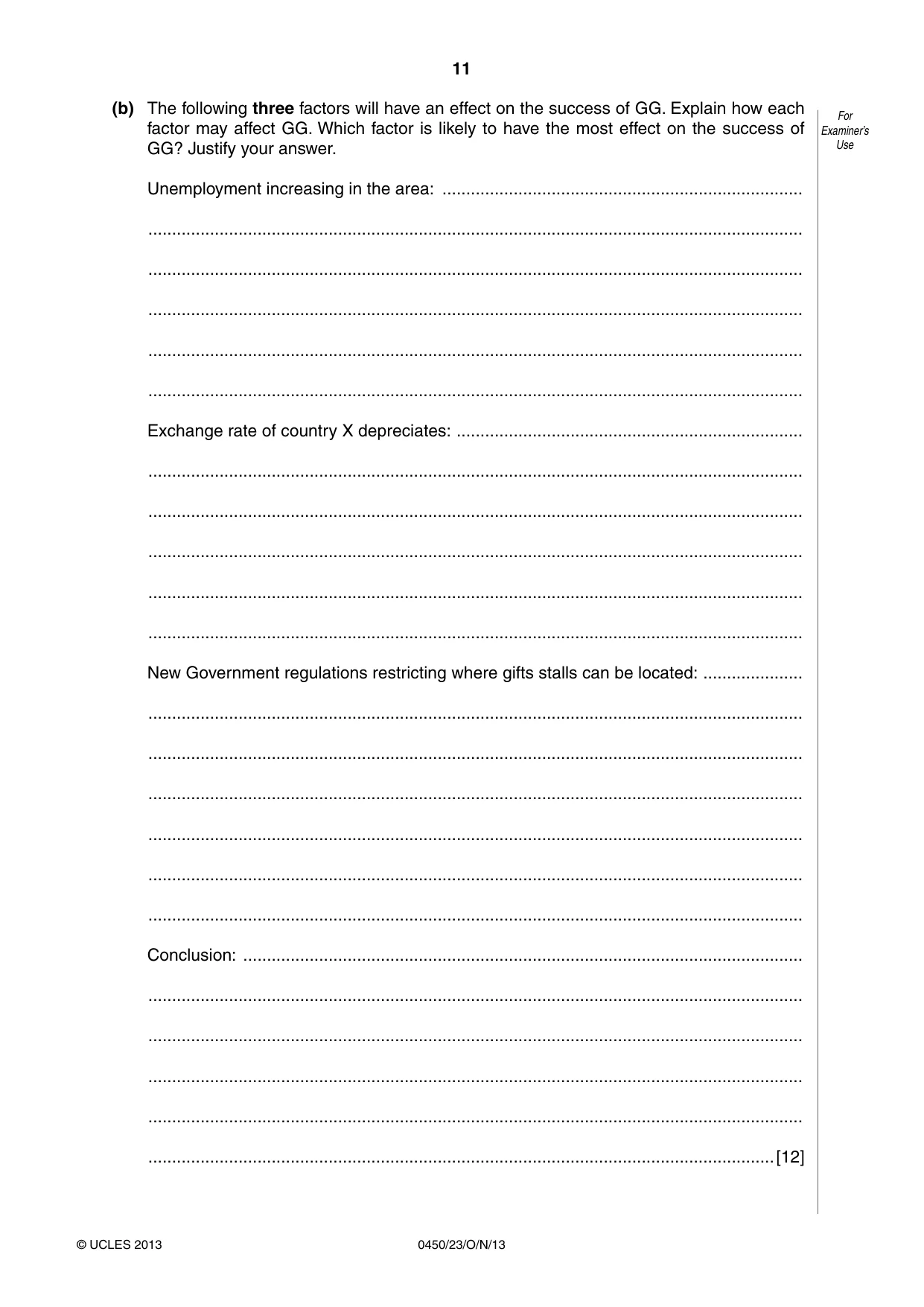
11 0450/23/O/N/13 © UCLES 2013 For Examiner’s Use (b) The following three factors will have an effect on the success of GG. Explain how each factor may affect GG. Which factor is likely to have the most effect on the success of GG? Justify your answer. Unemployment increasing in the area: … … … … … … Exchange rate of country X depreciates: … … … … … … New Government regulations restricting where gifts stalls can be located: … … … … … … … Conclusion: … … … … … …[12]
Question paper, page 12
12 0450/23/O/N/13 © UCLES 2013 Permission to reproduce items where third-party owned material protected by copyright is included has been sought and cleared where possible. Every reasonable effort has been made by the publisher (UCLES) to trace copyright holders, but if any items requiring clearance have unwittingly been included, the publisher will be pleased to make amends at the earliest possible opportunity. University of Cambridge International Examinations is part of the Cambridge Assessment Group. Cambridge Assessment is the brand name of University of Cambridge Local Examinations Syndicate (UCLES), which is itself a department of the University of Cambridge. BLANK PAGE
Mark scheme, page 1
CAMBRIDGE INTERNATIONAL EXAMINATIONS International General Certificate of Secondary Education MARK SCHEME for the October/November 2013 series 0450 BUSINESS STUDIES 0450/23 Paper 2 (Case Study), maximum raw mark 100 This mark scheme is published as an aid to teachers and candidates, to indicate the requirements of the examination. It shows the basis on which Examiners were instructed to award marks. It does not indicate the details of the discussions that took place at an Examiners’ meeting before marking began, which would have considered the acceptability of alternative answers. Mark schemes should be read in conjunction with the question paper and the Principal Examiner Report for Teachers. Cambridge will not enter into discussions about these mark schemes. Cambridge is publishing the mark schemes for the October/November 2013 series for most IGCSE, GCE Advanced Level and Advanced Subsidiary Level components and some Ordinary Level components.
Mark scheme, page 2
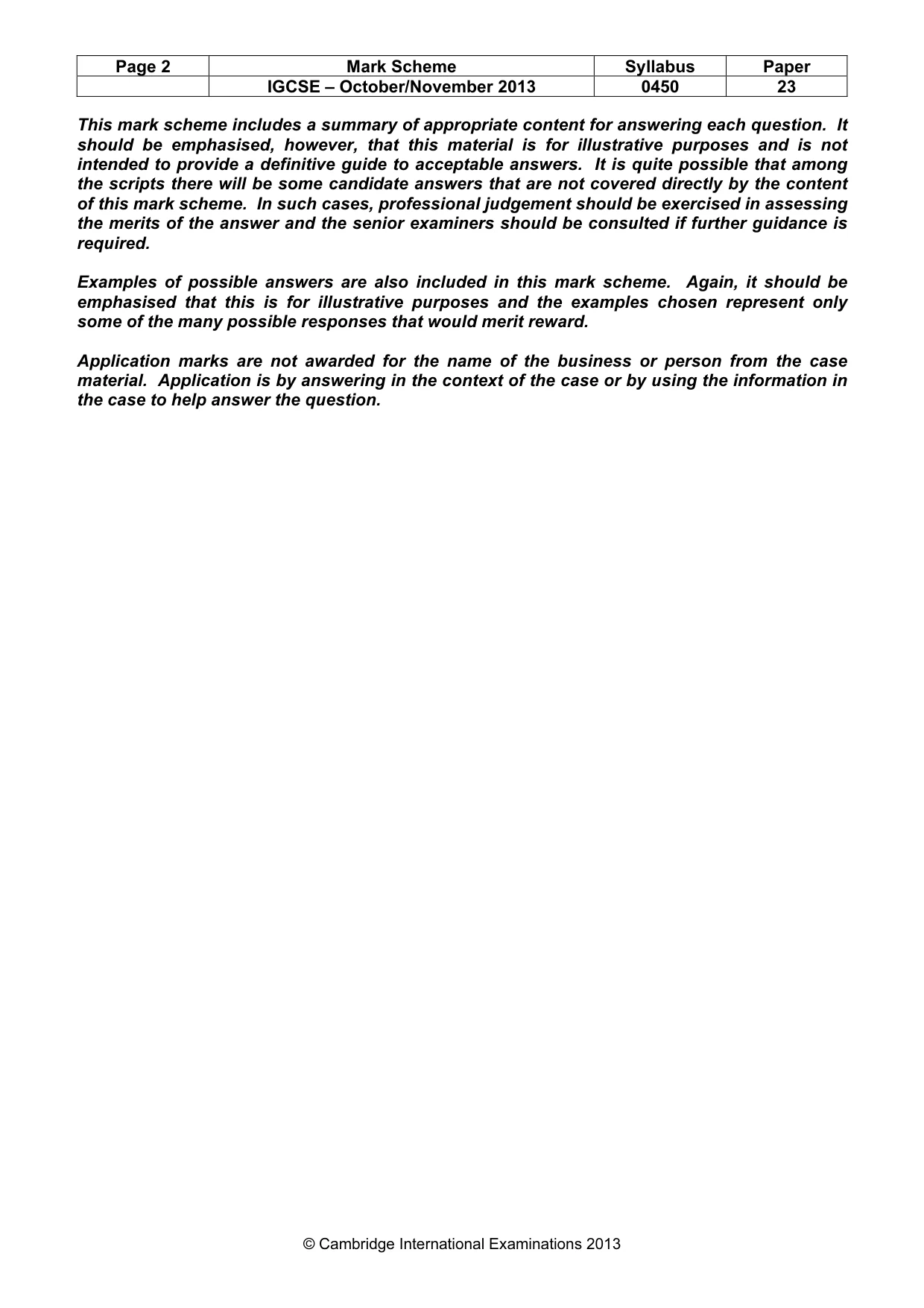
Page 2 Mark Scheme Syllabus Paper IGCSE – October/November 2013 0450 23 © Cambridge International Examinations 2013 This mark scheme includes a summary of appropriate content for answering each question. It should be emphasised, however, that this material is for illustrative purposes and is not intended to provide a definitive guide to acceptable answers. It is quite possible that among the scripts there will be some candidate answers that are not covered directly by the content of this mark scheme. In such cases, professional judgement should be exercised in assessing the merits of the answer and the senior examiners should be consulted if further guidance is required. Examples of possible answers are also included in this mark scheme. Again, it should be emphasised that this is for illustrative purposes and the examples chosen represent only some of the many possible responses that would merit reward. Application marks are not awarded for the name of the business or person from the case material. Application is by answering in the context of the case or by using the information in the case to help answer the question.
Mark scheme, page 3
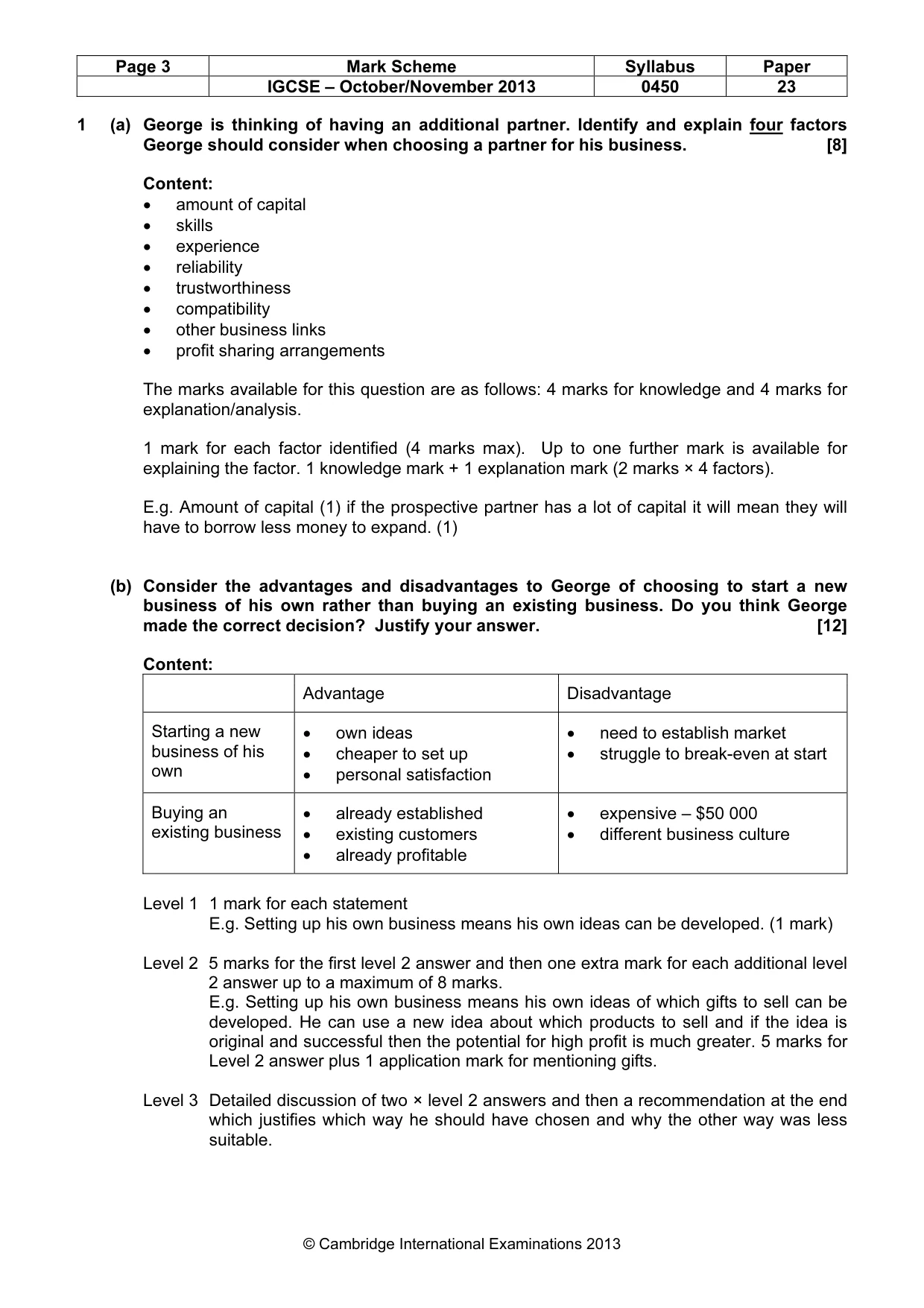
Page 3 Mark Scheme Syllabus Paper IGCSE – October/November 2013 0450 23 © Cambridge International Examinations 2013 1 (a) George is thinking of having an additional partner. Identify and explain four factors George should consider when choosing a partner for his business. [8] Content: • amount of capital • skills • experience • reliability • trustworthiness • compatibility • other business links • profit sharing arrangements The marks available for this question are as follows: 4 marks for knowledge and 4 marks for explanation/analysis. 1 mark for each factor identified (4 marks max). Up to one further mark is available for explaining the factor. 1 knowledge mark + 1 explanation mark (2 marks × 4 factors). E.g. Amount of capital (1) if the prospective partner has a lot of capital it will mean they will have to borrow less money to expand. (1) (b) Consider the advantages and disadvantages to George of choosing to start a new business of his own rather than buying an existing business. Do you think George made the correct decision? Justify your answer. [12] Content: Advantage Disadvantage Starting a new business of his own • own ideas • cheaper to set up • personal satisfaction • need to establish market • struggle to break-even at start Buying an existing business • already established • existing customers • already profitable • expensive – $50 000 • different business culture Level 1 1 mark for each statement E.g. Setting up his own business means his own ideas can be developed. (1 mark) Level 2 5 marks for the first level 2 answer and then one extra mark for each additional level 2 answer up to a maximum of 8 marks. E.g. Setting up his own business means his own ideas of which gifts to sell can be developed. He can use a new idea about which products to sell and if the idea is original and successful then the potential for high profit is much greater. 5 marks for Level 2 answer plus 1 application mark for mentioning gifts. Level 3 Detailed discussion of two × level 2 answers and then a recommendation at the end which justifies which way he should have chosen and why the other way was less suitable.
Mark scheme, page 4
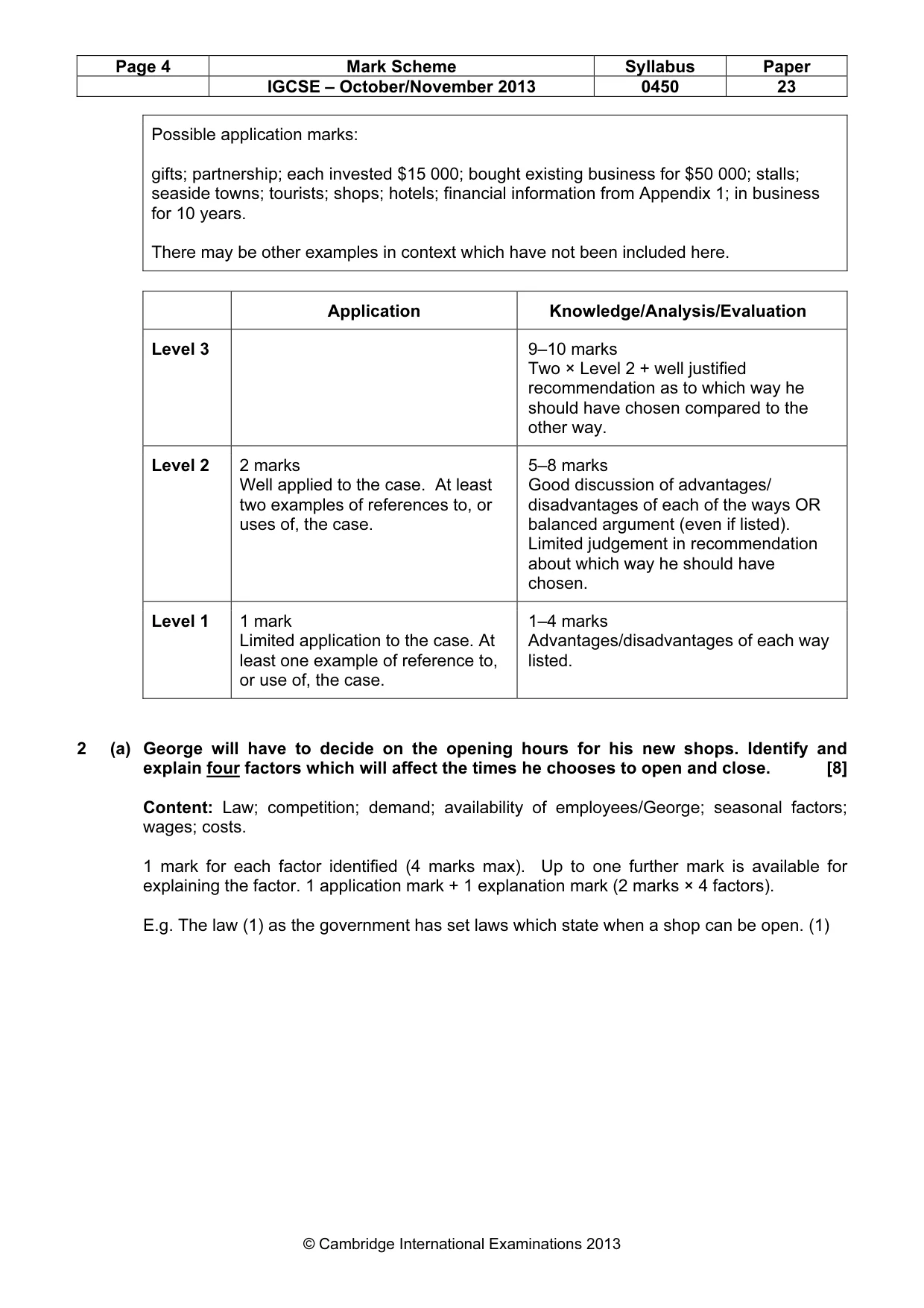
Page 4 Mark Scheme Syllabus Paper IGCSE – October/November 2013 0450 23 © Cambridge International Examinations 2013 Possible application marks: gifts; partnership; each invested $15 000; bought existing business for $50 000; stalls; seaside towns; tourists; shops; hotels; financial information from Appendix 1; in business for 10 years. There may be other examples in context which have not been included here. Application Knowledge/Analysis/Evaluation Level 3 9–10 marks Two × Level 2 + well justified recommendation as to which way he should have chosen compared to the other way. Level 2 2 marks Well applied to the case. At least two examples of references to, or uses of, the case. 5–8 marks Good discussion of advantages/ disadvantages of each of the ways OR balanced argument (even if listed). Limited judgement in recommendation about which way he should have chosen. Level 1 1 mark Limited application to the case. At least one example of reference to, or use of, the case. 1–4 marks Advantages/disadvantages of each way listed. 2 (a) George will have to decide on the opening hours for his new shops. Identify and explain four factors which will affect the times he chooses to open and close. [8] Content: Law; competition; demand; availability of employees/George; seasonal factors; wages; costs. 1 mark for each factor identified (4 marks max). Up to one further mark is available for explaining the factor. 1 application mark + 1 explanation mark (2 marks × 4 factors). E.g. The law (1) as the government has set laws which state when a shop can be open. (1)
Mark scheme, page 5
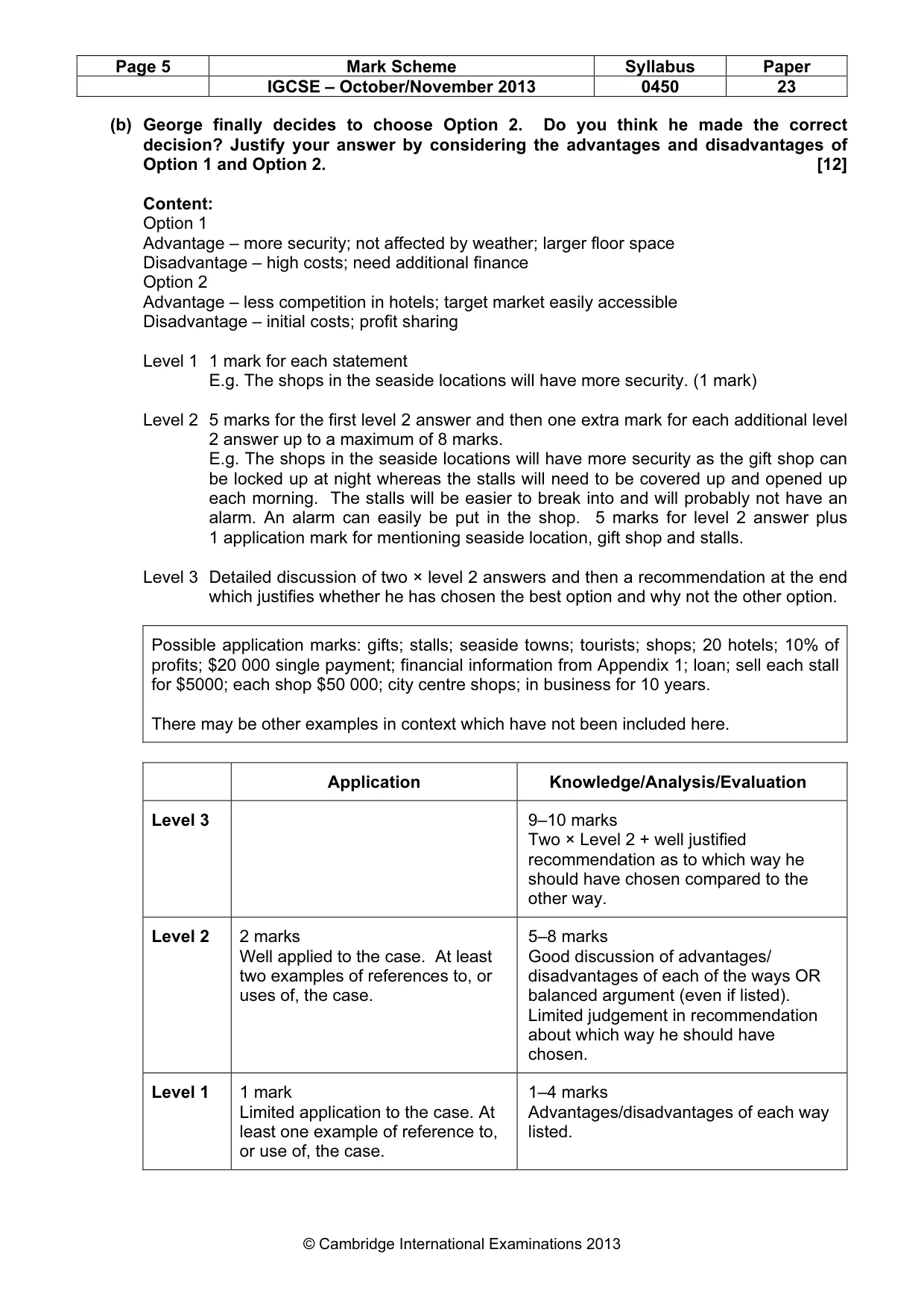
Page 5 Mark Scheme Syllabus Paper IGCSE – October/November 2013 0450 23 © Cambridge International Examinations 2013 (b) George finally decides to choose Option 2. Do you think he made the correct decision? Justify your answer by considering the advantages and disadvantages of Option 1 and Option 2. [12] Content: Option 1 Advantage – more security; not affected by weather; larger floor space Disadvantage – high costs; need additional finance Option 2 Advantage – less competition in hotels; target market easily accessible Disadvantage – initial costs; profit sharing Level 1 1 mark for each statement E.g. The shops in the seaside locations will have more security. (1 mark) Level 2 5 marks for the first level 2 answer and then one extra mark for each additional level 2 answer up to a maximum of 8 marks. E.g. The shops in the seaside locations will have more security as the gift shop can be locked up at night whereas the stalls will need to be covered up and opened up each morning. The stalls will be easier to break into and will probably not have an alarm. An alarm can easily be put in the shop. 5 marks for level 2 answer plus 1 application mark for mentioning seaside location, gift shop and stalls. Level 3 Detailed discussion of two × level 2 answers and then a recommendation at the end which justifies whether he has chosen the best option and why not the other option. Possible application marks: gifts; stalls; seaside towns; tourists; shops; 20 hotels; 10% of profits; $20 000 single payment; financial information from Appendix 1; loan; sell each stall for $5000; each shop $50 000; city centre shops; in business for 10 years. There may be other examples in context which have not been included here. Application Knowledge/Analysis/Evaluation Level 3 9–10 marks Two × Level 2 + well justified recommendation as to which way he should have chosen compared to the other way. Level 2 2 marks Well applied to the case. At least two examples of references to, or uses of, the case. 5–8 marks Good discussion of advantages/ disadvantages of each of the ways OR balanced argument (even if listed). Limited judgement in recommendation about which way he should have chosen. Level 1 1 mark Limited application to the case. At least one example of reference to, or use of, the case. 1–4 marks Advantages/disadvantages of each way listed.
Mark scheme, page 6
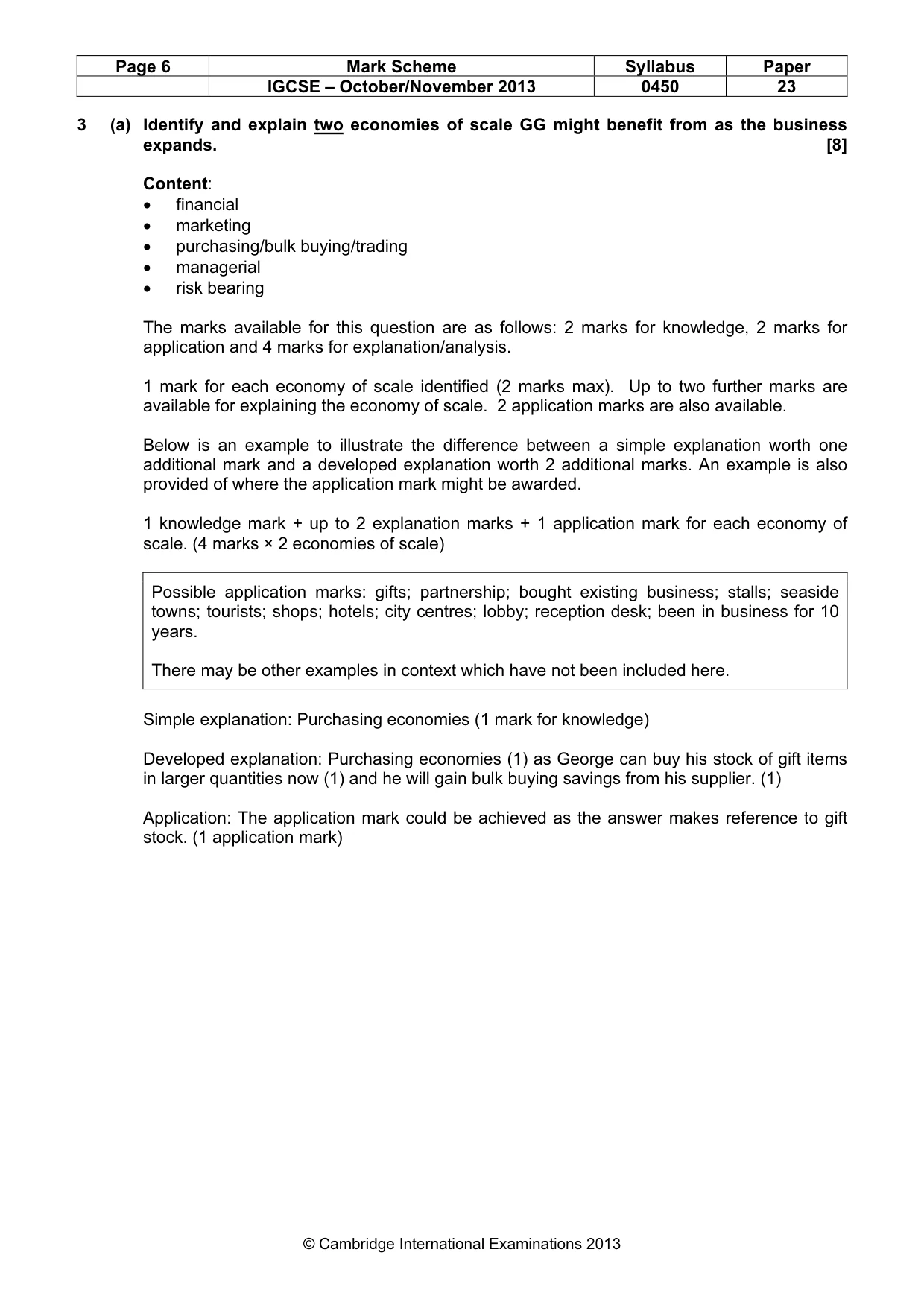
Page 6 Mark Scheme Syllabus Paper IGCSE – October/November 2013 0450 23 © Cambridge International Examinations 2013 3 (a) Identify and explain two economies of scale GG might benefit from as the business expands. [8] Content: • financial • marketing • purchasing/bulk buying/trading • managerial • risk bearing The marks available for this question are as follows: 2 marks for knowledge, 2 marks for application and 4 marks for explanation/analysis. 1 mark for each economy of scale identified (2 marks max). Up to two further marks are available for explaining the economy of scale. 2 application marks are also available. Below is an example to illustrate the difference between a simple explanation worth one additional mark and a developed explanation worth 2 additional marks. An example is also provided of where the application mark might be awarded. 1 knowledge mark + up to 2 explanation marks + 1 application mark for each economy of scale. (4 marks × 2 economies of scale) Possible application marks: gifts; partnership; bought existing business; stalls; seaside towns; tourists; shops; hotels; city centres; lobby; reception desk; been in business for 10 years. There may be other examples in context which have not been included here. Simple explanation: Purchasing economies (1 mark for knowledge) Developed explanation: Purchasing economies (1) as George can buy his stock of gift items in larger quantities now (1) and he will gain bulk buying savings from his supplier. (1) Application: The application mark could be achieved as the answer makes reference to gift stock. (1 application mark)
Mark scheme, page 7
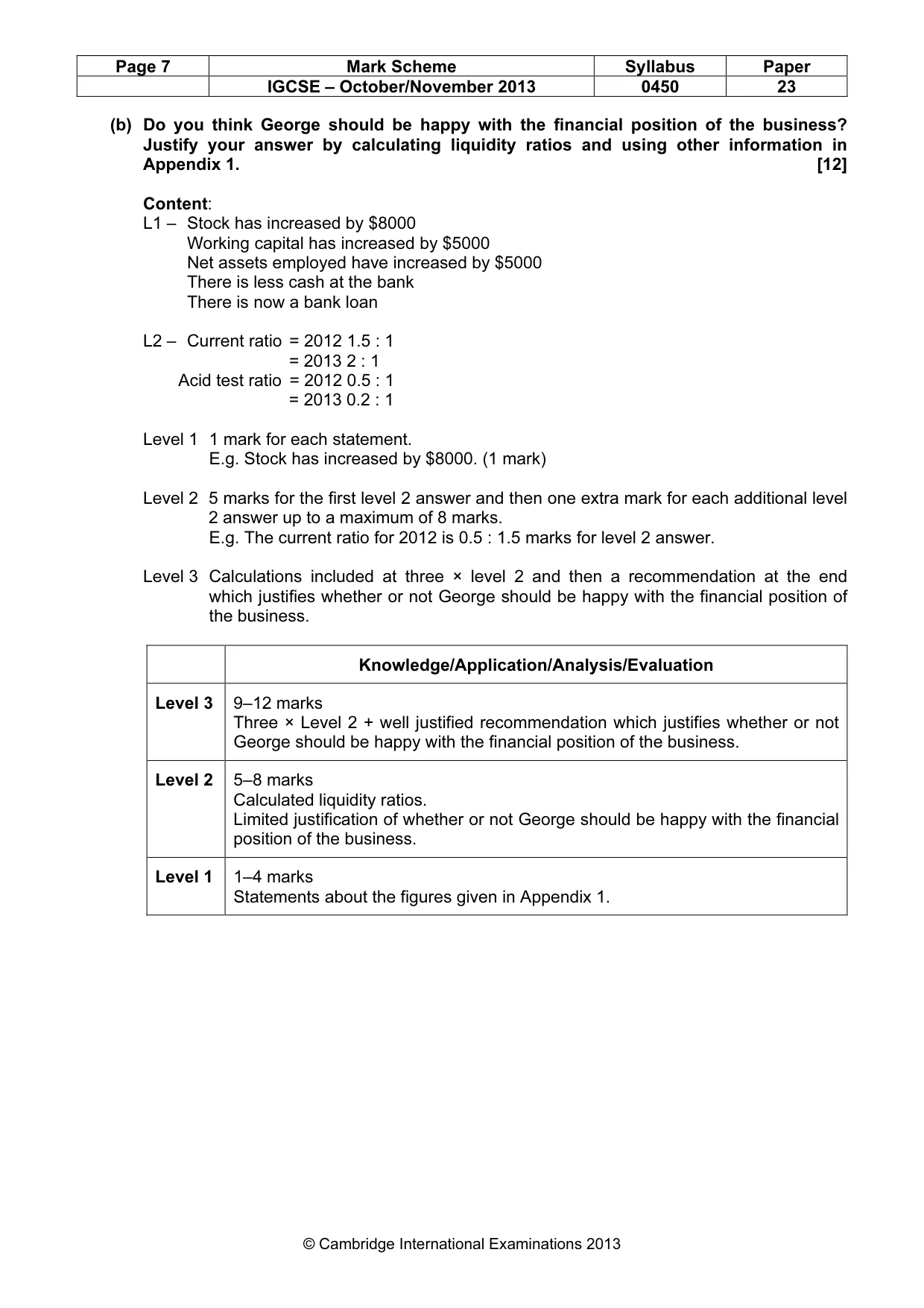
Page 7 Mark Scheme Syllabus Paper IGCSE – October/November 2013 0450 23 © Cambridge International Examinations 2013 (b) Do you think George should be happy with the financial position of the business? Justify your answer by calculating liquidity ratios and using other information in Appendix 1. [12] Content: L1 – Stock has increased by $8000 Working capital has increased by $5000 Net assets employed have increased by $5000 There is less cash at the bank There is now a bank loan L2 – Current ratio = 2012 1.5 : 1 = 2013 2 : 1 Acid test ratio = 2012 0.5 : 1 = 2013 0.2 : 1 Level 1 1 mark for each statement. E.g. Stock has increased by $8000. (1 mark) Level 2 5 marks for the first level 2 answer and then one extra mark for each additional level 2 answer up to a maximum of 8 marks. E.g. The current ratio for 2012 is 0.5 : 1.5 marks for level 2 answer. Level 3 Calculations included at three × level 2 and then a recommendation at the end which justifies whether or not George should be happy with the financial position of the business. Knowledge/Application/Analysis/Evaluation Level 3 9–12 marks Three × Level 2 + well justified recommendation which justifies whether or not George should be happy with the financial position of the business. Level 2 5–8 marks Calculated liquidity ratios. Limited justification of whether or not George should be happy with the financial position of the business. Level 1 1–4 marks Statements about the figures given in Appendix 1.
Mark scheme, page 8
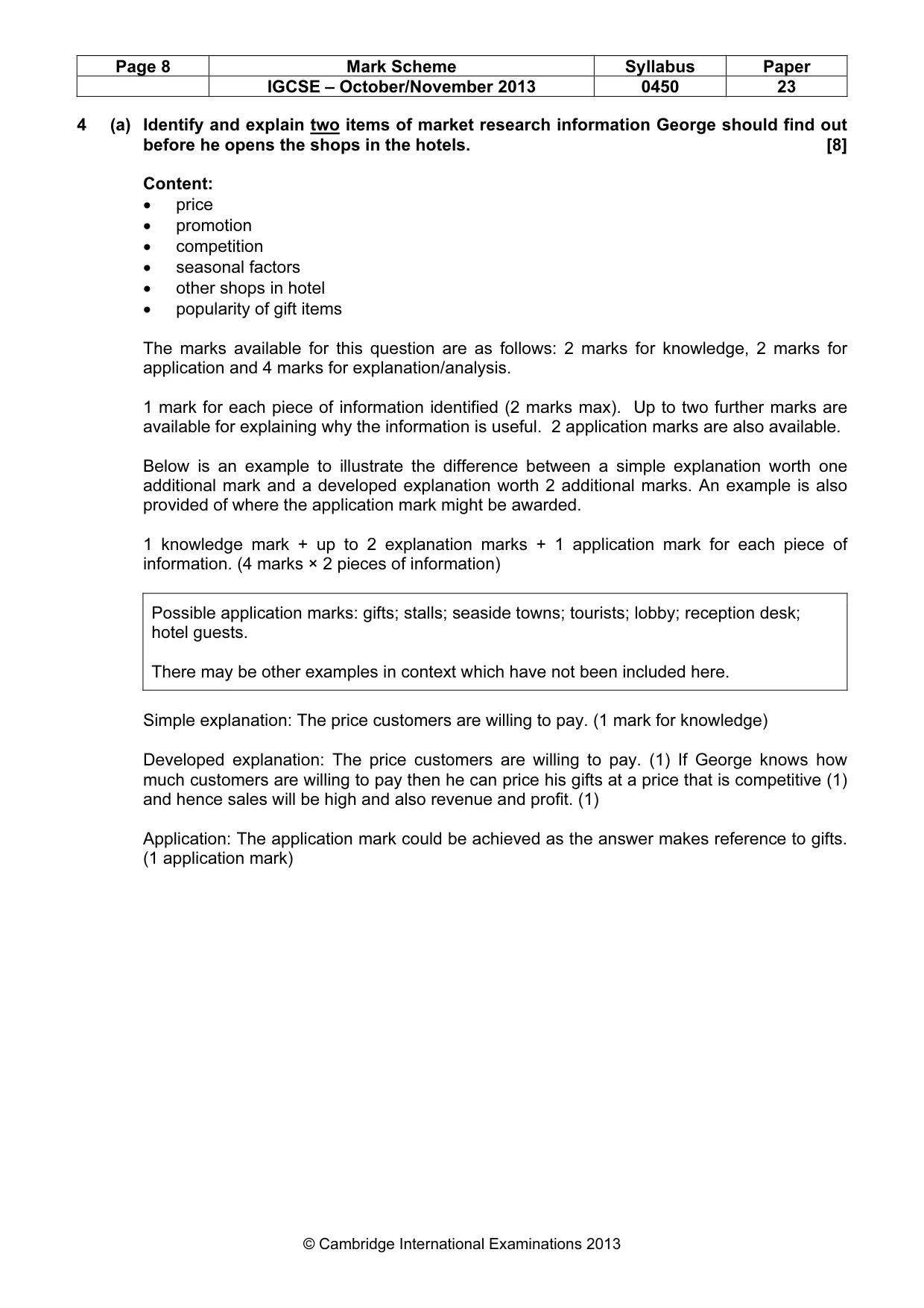
Page 8 Mark Scheme Syllabus Paper IGCSE – October/November 2013 0450 23 © Cambridge International Examinations 2013 4 (a) Identify and explain two items of market research information George should find out before he opens the shops in the hotels. [8] Content: • price • promotion • competition • seasonal factors • other shops in hotel • popularity of gift items The marks available for this question are as follows: 2 marks for knowledge, 2 marks for application and 4 marks for explanation/analysis. 1 mark for each piece of information identified (2 marks max). Up to two further marks are available for explaining why the information is useful. 2 application marks are also available. Below is an example to illustrate the difference between a simple explanation worth one additional mark and a developed explanation worth 2 additional marks. An example is also provided of where the application mark might be awarded. 1 knowledge mark + up to 2 explanation marks + 1 application mark for each piece of information. (4 marks × 2 pieces of information) Possible application marks: gifts; stalls; seaside towns; tourists; lobby; reception desk; hotel guests. There may be other examples in context which have not been included here. Simple explanation: The price customers are willing to pay. (1 mark for knowledge) Developed explanation: The price customers are willing to pay. (1) If George knows how much customers are willing to pay then he can price his gifts at a price that is competitive (1) and hence sales will be high and also revenue and profit. (1) Application: The application mark could be achieved as the answer makes reference to gifts. (1 application mark)
Mark scheme, page 9
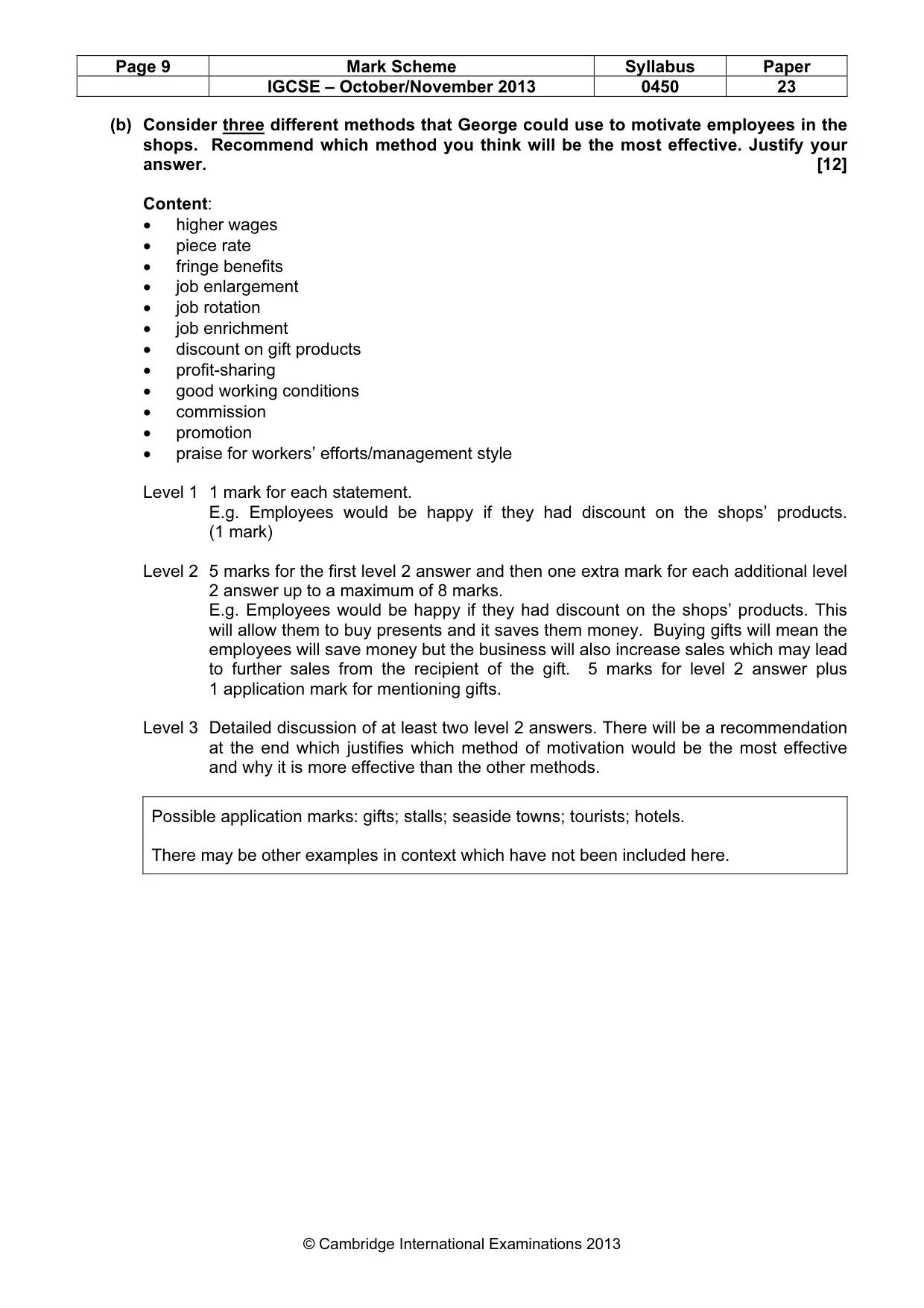
Page 9 Mark Scheme Syllabus Paper IGCSE – October/November 2013 0450 23 © Cambridge International Examinations 2013 (b) Consider three different methods that George could use to motivate employees in the shops. Recommend which method you think will be the most effective. Justify your answer. [12] Content: • higher wages • piece rate • fringe benefits • job enlargement • job rotation • job enrichment • discount on gift products • profit-sharing • good working conditions • commission • promotion • praise for workers’ efforts/management style Level 1 1 mark for each statement. E.g. Employees would be happy if they had discount on the shops’ products. (1 mark) Level 2 5 marks for the first level 2 answer and then one extra mark for each additional level 2 answer up to a maximum of 8 marks. E.g. Employees would be happy if they had discount on the shops’ products. This will allow them to buy presents and it saves them money. Buying gifts will mean the employees will save money but the business will also increase sales which may lead to further sales from the recipient of the gift. 5 marks for level 2 answer plus 1 application mark for mentioning gifts. Level 3 Detailed discussion of at least two level 2 answers. There will be a recommendation at the end which justifies which method of motivation would be the most effective and why it is more effective than the other methods. Possible application marks: gifts; stalls; seaside towns; tourists; hotels. There may be other examples in context which have not been included here.
Mark scheme, page 10
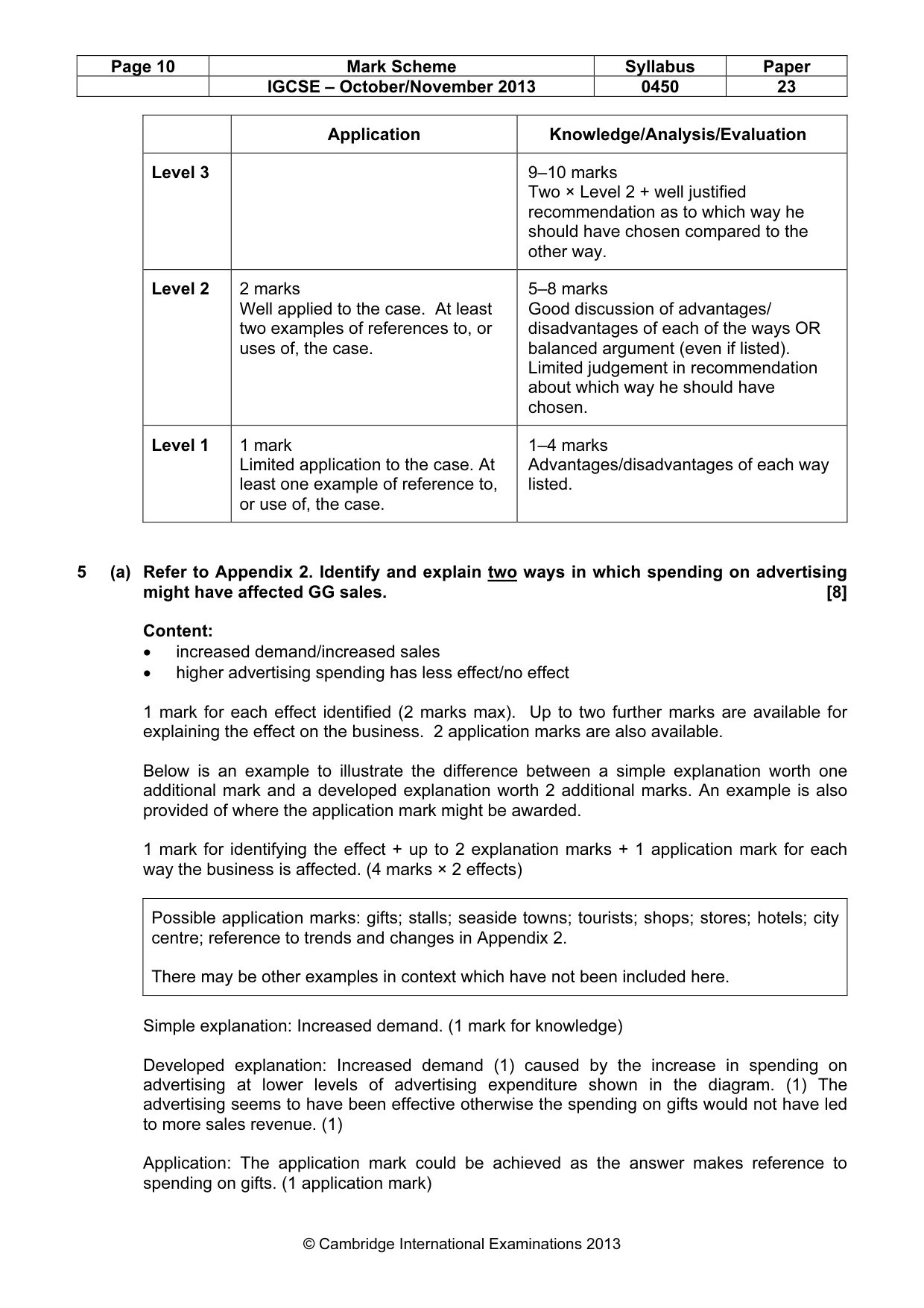
Page 10 Mark Scheme Syllabus Paper IGCSE – October/November 2013 0450 23 © Cambridge International Examinations 2013 Application Knowledge/Analysis/Evaluation Level 3 9–10 marks Two × Level 2 + well justified recommendation as to which way he should have chosen compared to the other way. Level 2 2 marks Well applied to the case. At least two examples of references to, or uses of, the case. 5–8 marks Good discussion of advantages/ disadvantages of each of the ways OR balanced argument (even if listed). Limited judgement in recommendation about which way he should have chosen. Level 1 1 mark Limited application to the case. At least one example of reference to, or use of, the case. 1–4 marks Advantages/disadvantages of each way listed. 5 (a) Refer to Appendix 2. Identify and explain two ways in which spending on advertising might have affected GG sales. [8] Content: • increased demand/increased sales • higher advertising spending has less effect/no effect 1 mark for each effect identified (2 marks max). Up to two further marks are available for explaining the effect on the business. 2 application marks are also available. Below is an example to illustrate the difference between a simple explanation worth one additional mark and a developed explanation worth 2 additional marks. An example is also provided of where the application mark might be awarded. 1 mark for identifying the effect + up to 2 explanation marks + 1 application mark for each way the business is affected. (4 marks × 2 effects) Possible application marks: gifts; stalls; seaside towns; tourists; shops; stores; hotels; city centre; reference to trends and changes in Appendix 2. There may be other examples in context which have not been included here. Simple explanation: Increased demand. (1 mark for knowledge) Developed explanation: Increased demand (1) caused by the increase in spending on advertising at lower levels of advertising expenditure shown in the diagram. (1) The advertising seems to have been effective otherwise the spending on gifts would not have led to more sales revenue. (1) Application: The application mark could be achieved as the answer makes reference to spending on gifts. (1 application mark)
Mark scheme, page 11
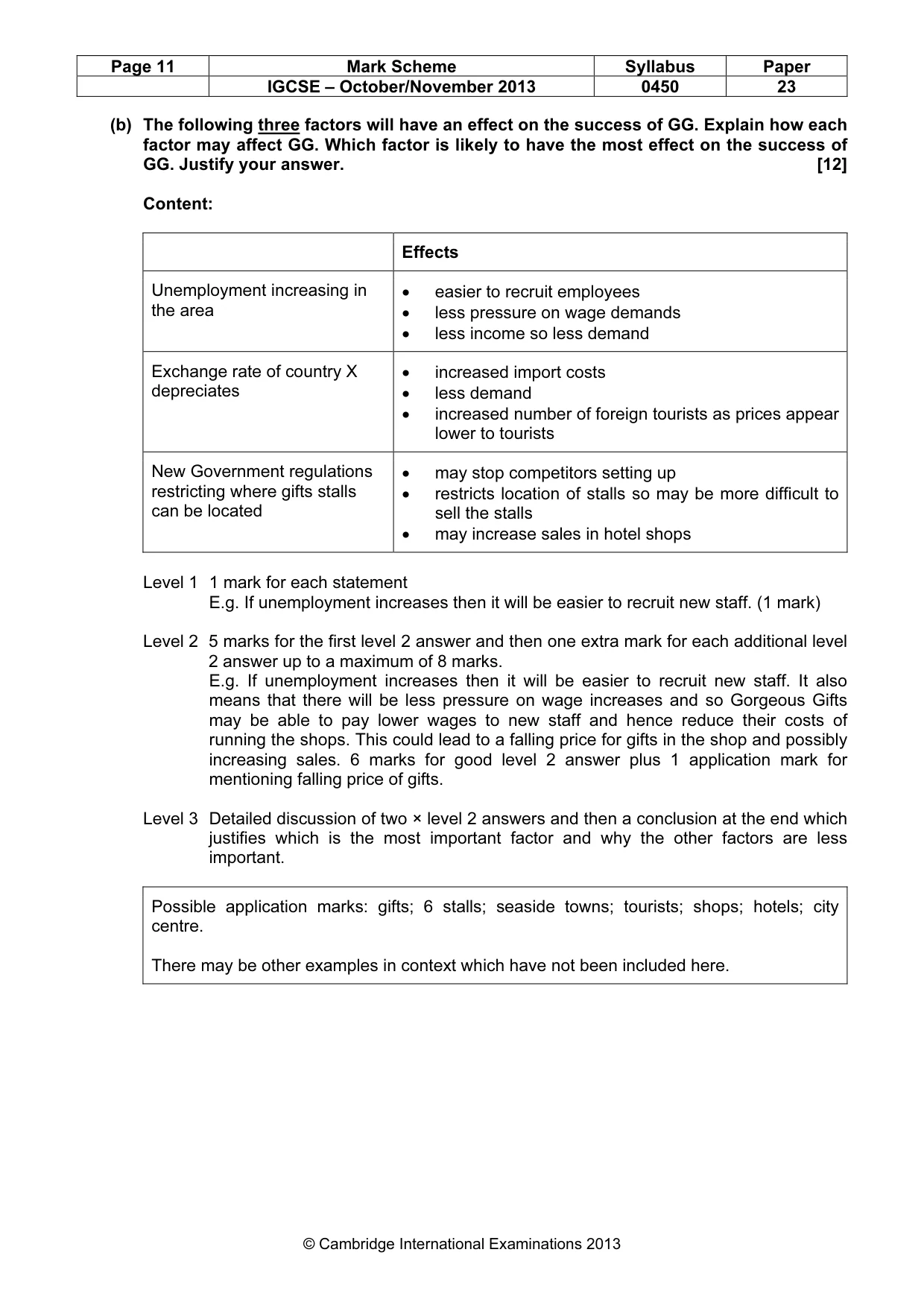
Page 11 Mark Scheme Syllabus Paper IGCSE – October/November 2013 0450 23 © Cambridge International Examinations 2013 (b) The following three factors will have an effect on the success of GG. Explain how each factor may affect GG. Which factor is likely to have the most effect on the success of GG. Justify your answer. [12] Content: Effects Unemployment increasing in the area • easier to recruit employees • less pressure on wage demands • less income so less demand Exchange rate of country X depreciates • increased import costs • less demand • increased number of foreign tourists as prices appear lower to tourists New Government regulations restricting where gifts stalls can be located • may stop competitors setting up • restricts location of stalls so may be more difficult to sell the stalls • may increase sales in hotel shops Level 1 1 mark for each statement E.g. If unemployment increases then it will be easier to recruit new staff. (1 mark) Level 2 5 marks for the first level 2 answer and then one extra mark for each additional level 2 answer up to a maximum of 8 marks. E.g. If unemployment increases then it will be easier to recruit new staff. It also means that there will be less pressure on wage increases and so Gorgeous Gifts may be able to pay lower wages to new staff and hence reduce their costs of running the shops. This could lead to a falling price for gifts in the shop and possibly increasing sales. 6 marks for good level 2 answer plus 1 application mark for mentioning falling price of gifts. Level 3 Detailed discussion of two × level 2 answers and then a conclusion at the end which justifies which is the most important factor and why the other factors are less important. Possible application marks: gifts; 6 stalls; seaside towns; tourists; shops; hotels; city centre. There may be other examples in context which have not been included here.
Mark scheme, page 12
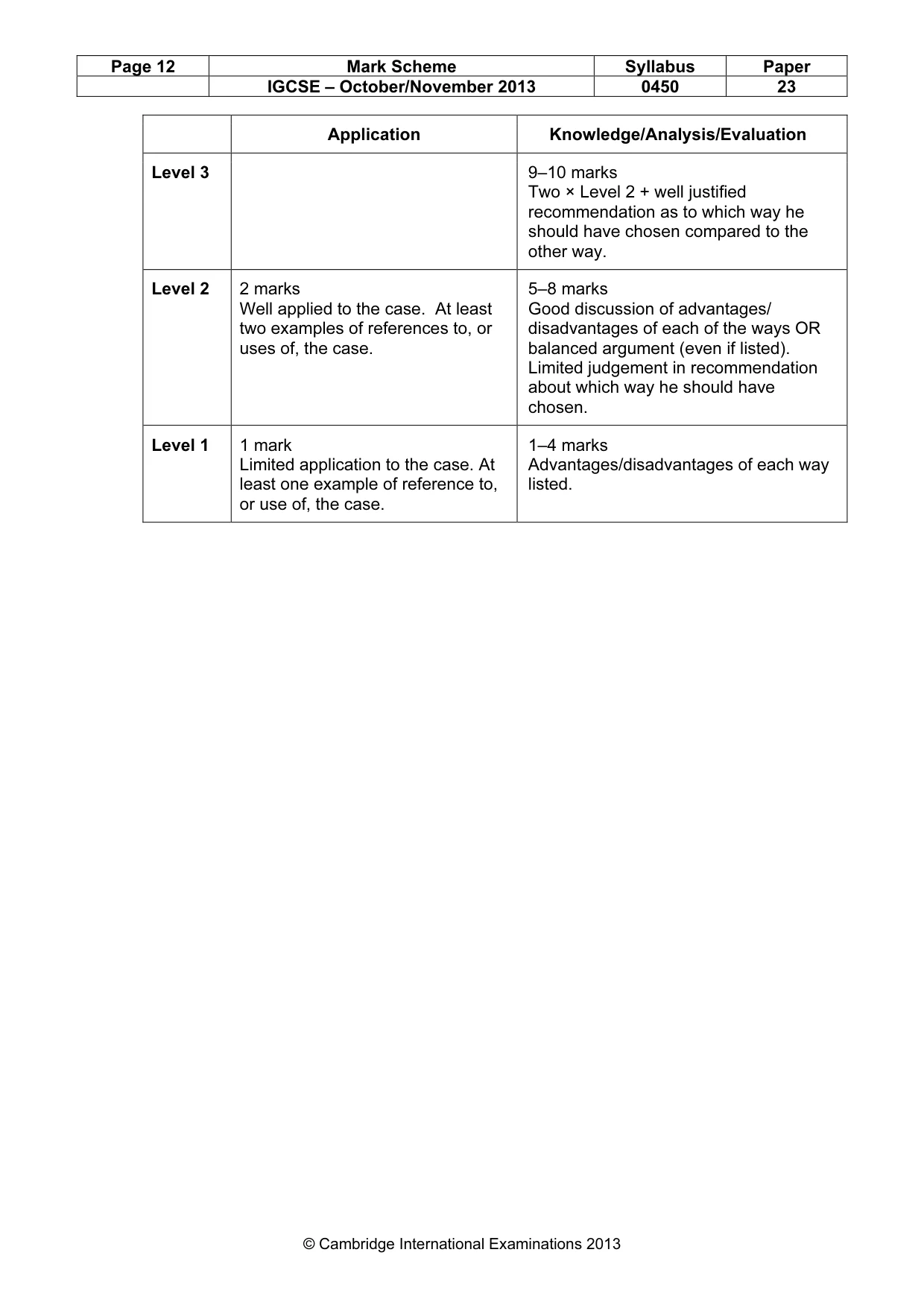
Page 12 Mark Scheme Syllabus Paper IGCSE – October/November 2013 0450 23 © Cambridge International Examinations 2013 Application Knowledge/Analysis/Evaluation Level 3 9–10 marks Two × Level 2 + well justified recommendation as to which way he should have chosen compared to the other way. Level 2 2 marks Well applied to the case. At least two examples of references to, or uses of, the case. 5–8 marks Good discussion of advantages/ disadvantages of each of the ways OR balanced argument (even if listed). Limited judgement in recommendation about which way he should have chosen. Level 1 1 mark Limited application to the case. At least one example of reference to, or use of, the case. 1–4 marks Advantages/disadvantages of each way listed.
What you needed in this session
Cambridge’s own grade thresholds for 2013 Oct/Nov, Paper 2 · Variant 3. A higher threshold means an easier paper — the bar moves with how the cohort did.