Cambridge IGCSE Business Studies 0450 — 2013 Oct/Nov Paper 1 · Variant 2
0450/12/O/N/13 · 100 marks · ≈113 min
The question paper and its mark scheme, free to read here and free to download. This is Cambridge’s own paper, exactly as it was sat.
Question paper12 pages

Mark scheme11 pages
Answers below. Sit the paper first if you are practising.
Paper as text
Question paper, page 1
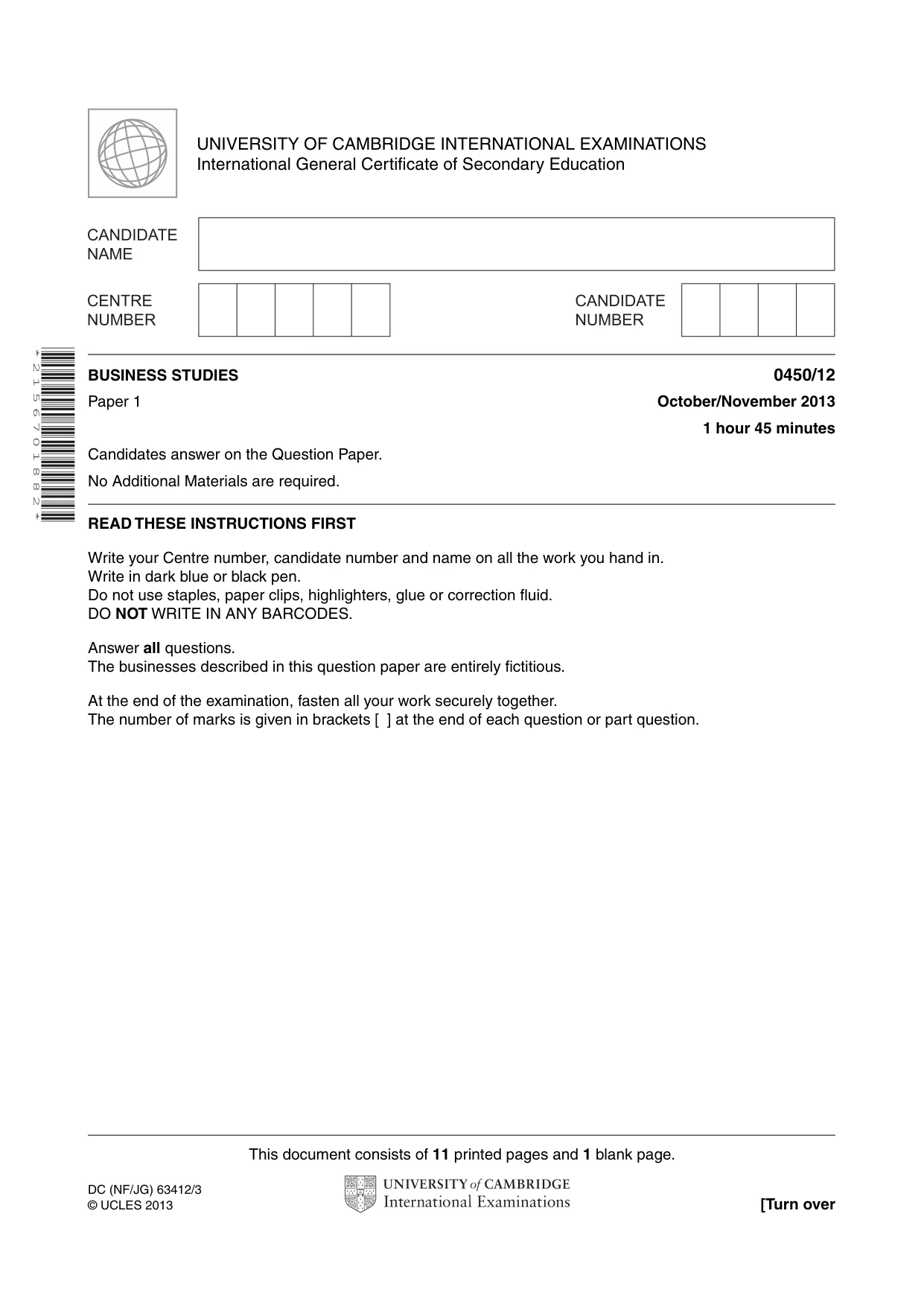
This document consists of 11 printed pages and 1 blank page. DC (NF/JG) 63412/3 © UCLES 2013 [Turn over UNIVERSITY OF CAMBRIDGE INTERNATIONAL EXAMINATIONS International General Certificate of Secondary Education * 2 1 5 6 7 0 1 8 8 2 * BUSINESS STUDIES 0450/12 Paper 1 October/November 2013 1 hour 45 minutes Candidates answer on the Question Paper. No Additional Materials are required. READ THESE INSTRUCTIONS FIRST Write your Centre number, candidate number and name on all the work you hand in. Write in dark blue or black pen. Do not use staples, paper clips, highlighters, glue or correction fluid. DO NOT WRITE IN ANY BARCODES. Answer all questions. The businesses described in this question paper are entirely fictitious. At the end of the examination, fasten all your work securely together. The number of marks is given in brackets [ ] at the end of each question or part question.
Question paper, page 2
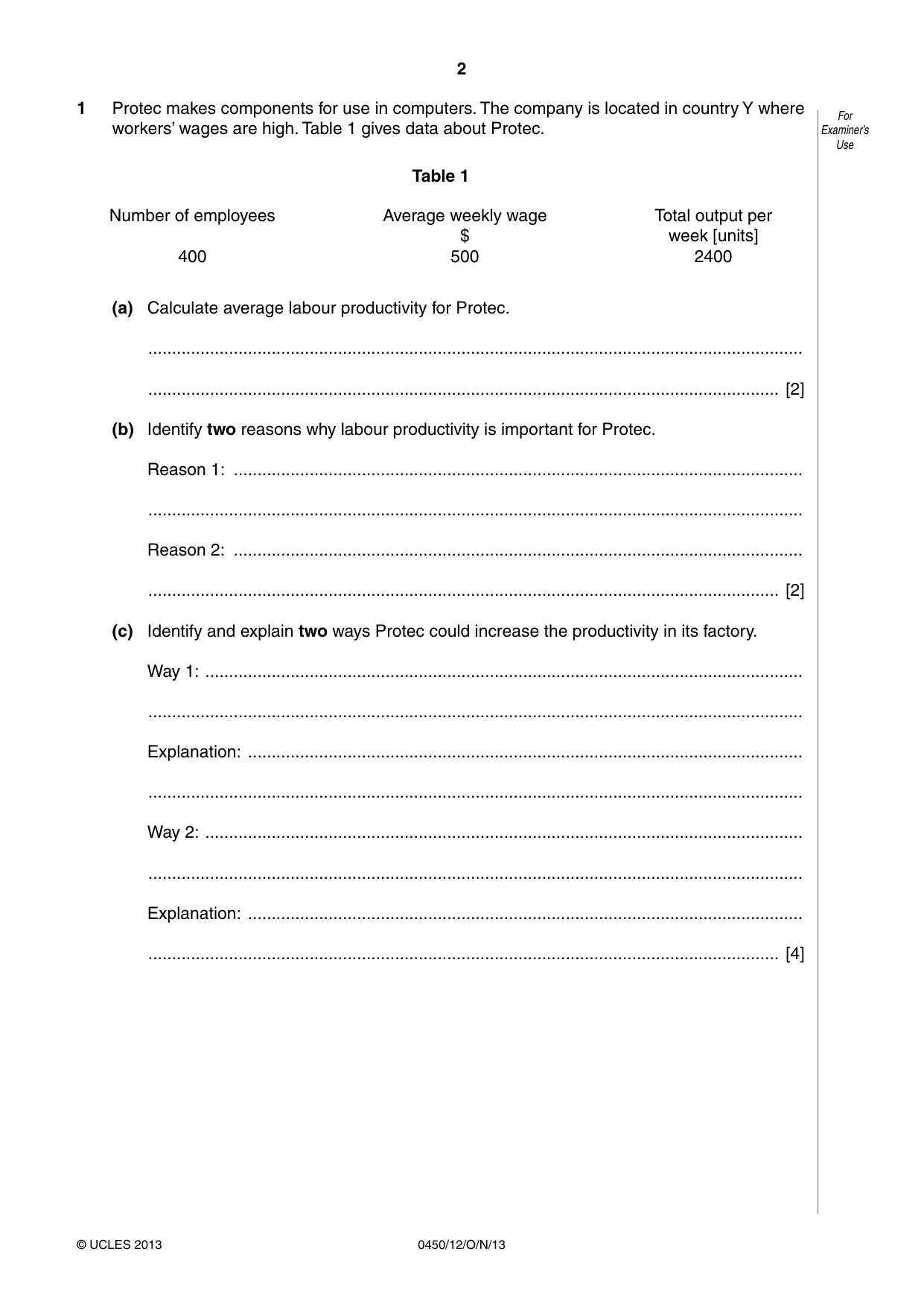
2 0450/12/O/N/13 © UCLES 2013 For Examiner’s Use 1 Protec makes components for use in computers. The company is located in country Y where workers’ wages are high. Table 1 gives data about Protec. Table 1 Number of employees Average weekly wage $ Total output per week [units] 400 500 2400 (a) Calculate average labour productivity for Protec. … … [2] (b) Identify two reasons why labour productivity is important for Protec. Reason 1: … … Reason 2: … … [2] (c) Identify and explain two ways Protec could increase the productivity in its factory. Way 1: … … Explanation: … … Way 2: … … Explanation: … … [4]
Question paper, page 3
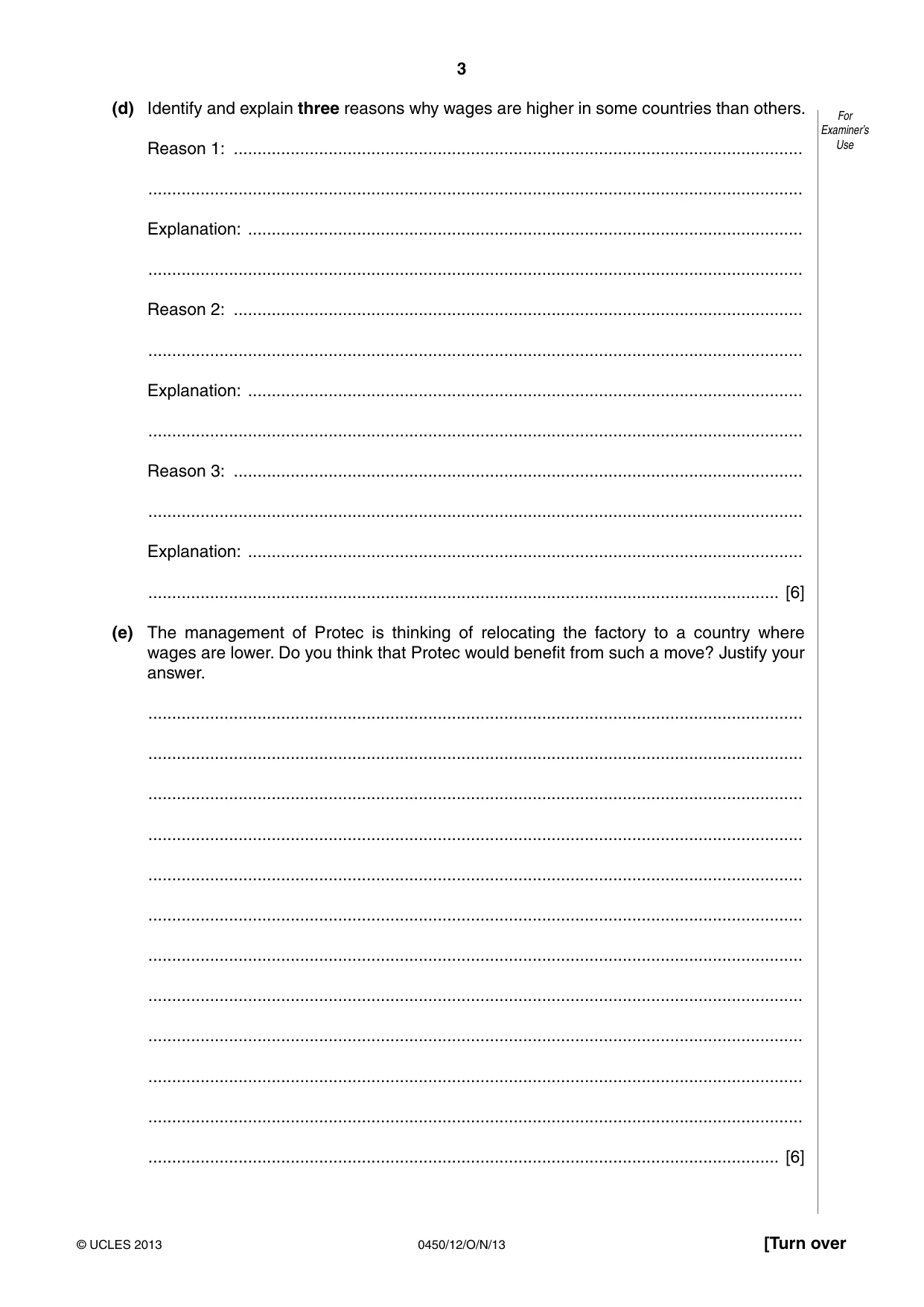
3 0450/12/O/N/13 © UCLES 2013 [Turn over For Examiner’s Use (d) Identify and explain three reasons why wages are higher in some countries than others. Reason 1: … … Explanation: … … Reason 2: … … Explanation: … … Reason 3: … … Explanation: … … [6] (e) The management of Protec is thinking of relocating the factory to a country where wages are lower. Do you think that Protec would benefit from such a move? Justify your answer. … … … … … … … … … … … … [6]
Question paper, page 4
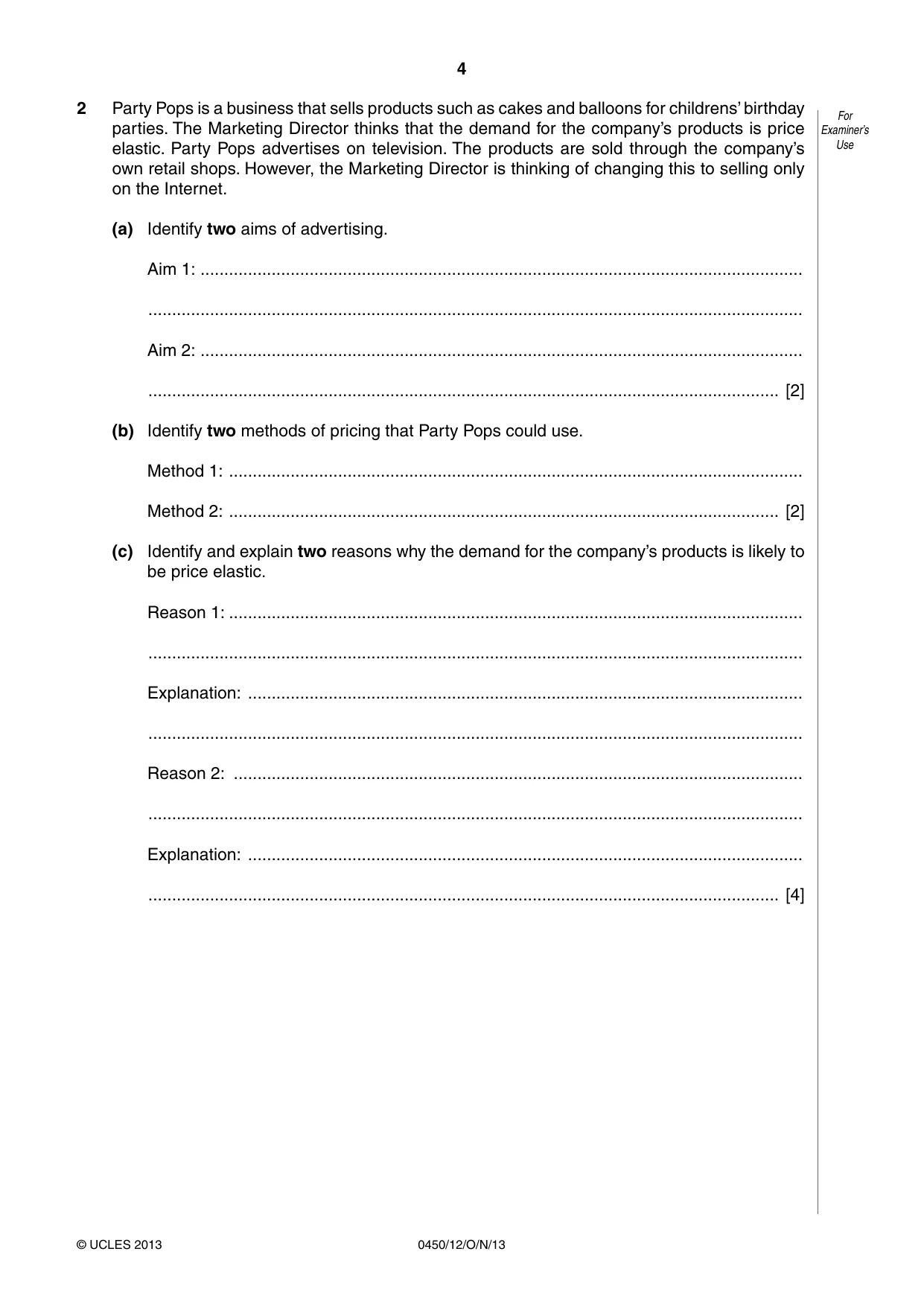
4 0450/12/O/N/13 © UCLES 2013 For Examiner’s Use 2 Party Pops is a business that sells products such as cakes and balloons for childrens’ birthday parties. The Marketing Director thinks that the demand for the company’s products is price elastic. Party Pops advertises on television. The products are sold through the company’s own retail shops. However, the Marketing Director is thinking of changing this to selling only on the Internet. (a) Identify two aims of advertising. Aim 1: … … Aim 2: … … [2] (b) Identify two methods of pricing that Party Pops could use. Method 1: … Method 2: … [2] (c) Identify and explain two reasons why the demand for the company’s products is likely to be price elastic. Reason 1: … … Explanation: … … Reason 2: … … Explanation: … … [4]
Question paper, page 5
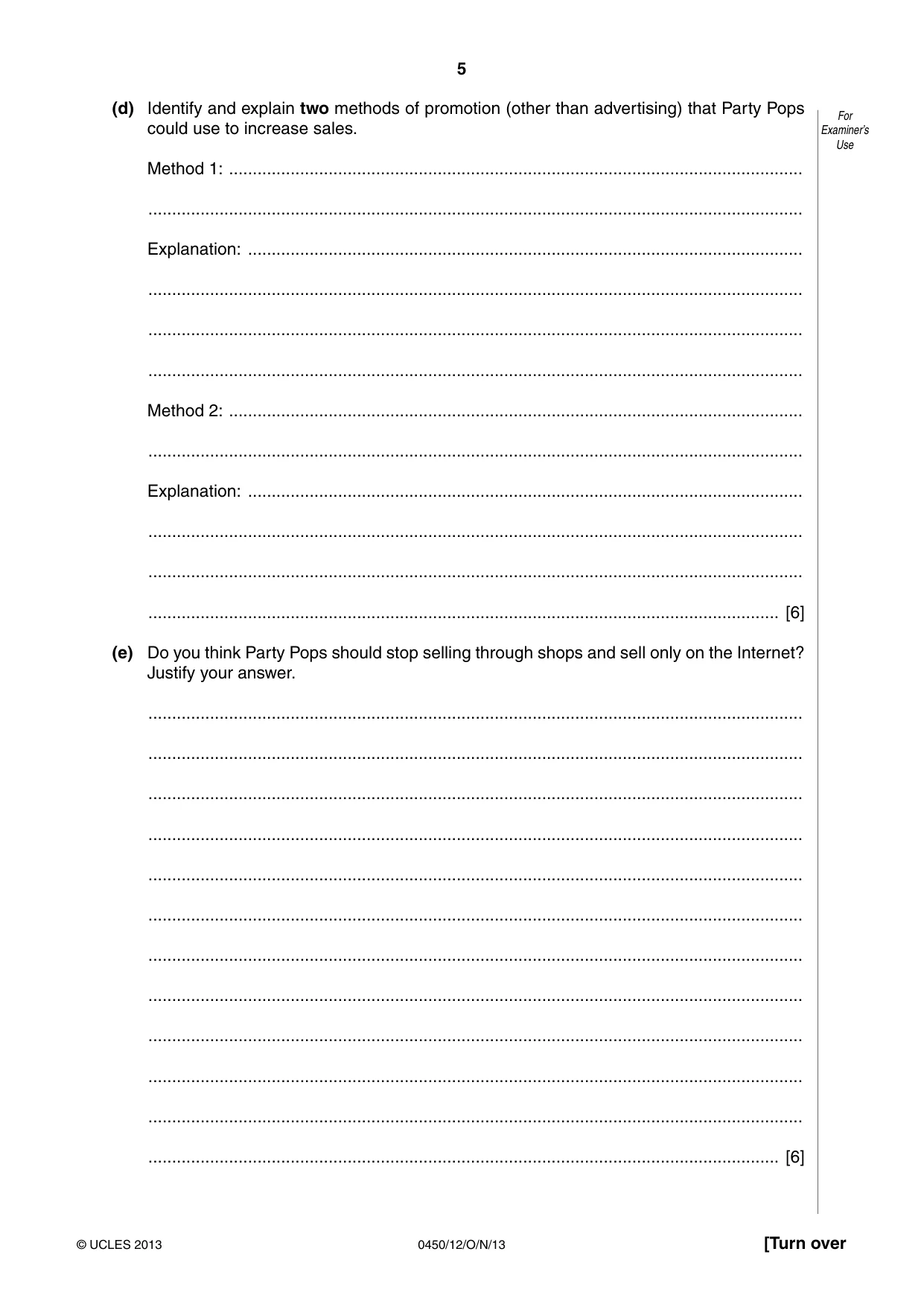
5 0450/12/O/N/13 © UCLES 2013 [Turn over For Examiner’s Use (d) Identify and explain two methods of promotion (other than advertising) that Party Pops could use to increase sales. Method 1: … … Explanation: … … … … Method 2: … … Explanation: … … … … [6] (e) Do you think Party Pops should stop selling through shops and sell only on the Internet? Justify your answer. … … … … … … … … … … … … [6]
Question paper, page 6
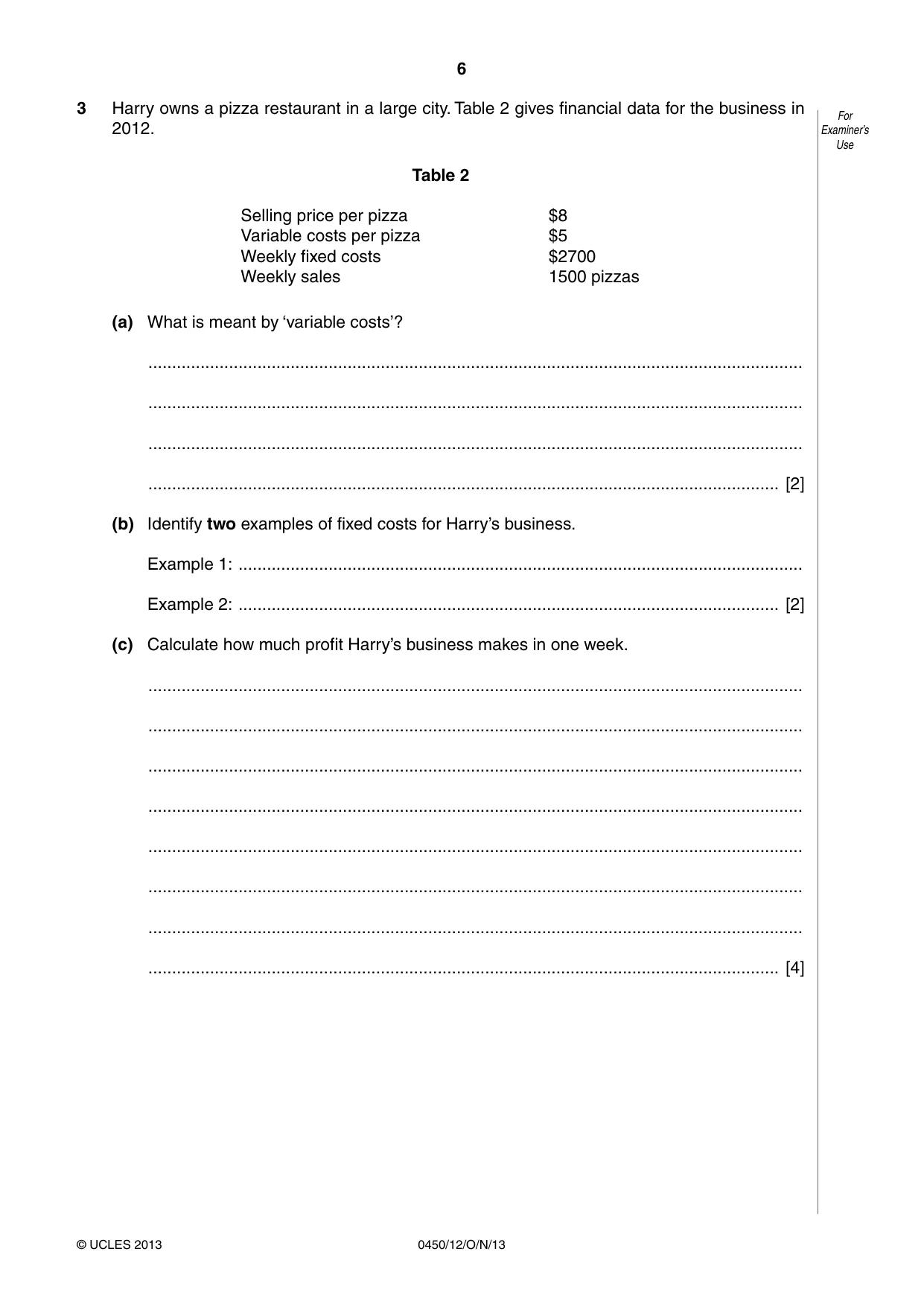
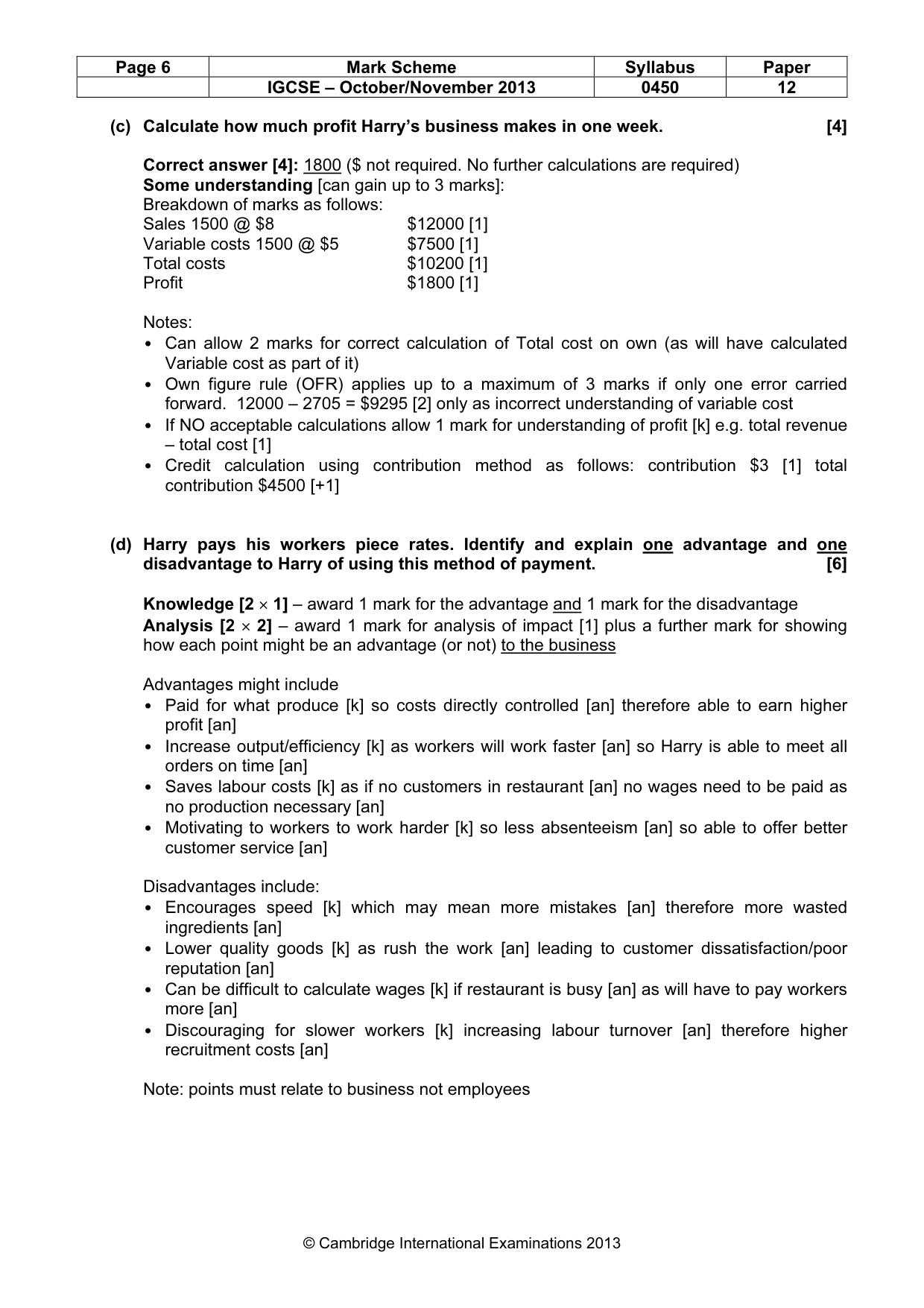
6 0450/12/O/N/13 © UCLES 2013 For Examiner’s Use 3 Harry owns a pizza restaurant in a large city. Table 2 gives financial data for the business in 2012. Table 2 Selling price per pizza $8 Variable costs per pizza $5 Weekly fixed costs $2700 Weekly sales 1500 pizzas (a) What is meant by ‘variable costs’? … … … … [2] (b) Identify two examples of fixed costs for Harry’s business. Example 1: … Example 2: … [2] (c) Calculate how much profit Harry’s business makes in one week. … … … … … … … … [4]
Question paper, page 7
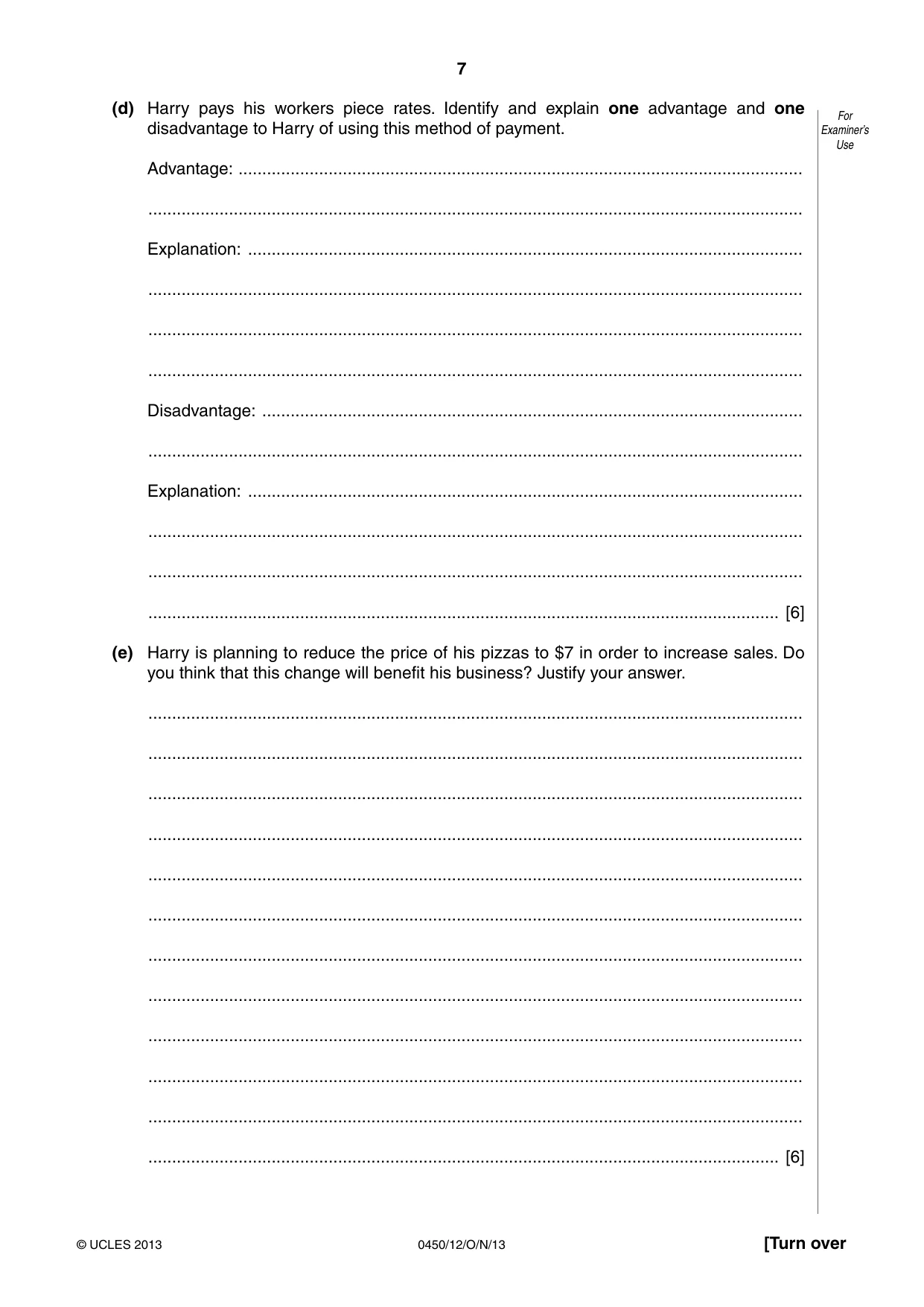
7 0450/12/O/N/13 © UCLES 2013 [Turn over For Examiner’s Use (d) Harry pays his workers piece rates. Identify and explain one advantage and one disadvantage to Harry of using this method of payment. Advantage: … … Explanation: … … … … Disadvantage: … … Explanation: … … … … [6] (e) Harry is planning to reduce the price of his pizzas to $7 in order to increase sales. Do you think that this change will benefit his business? Justify your answer. … … … … … … … … … … … … [6]
Question paper, page 8
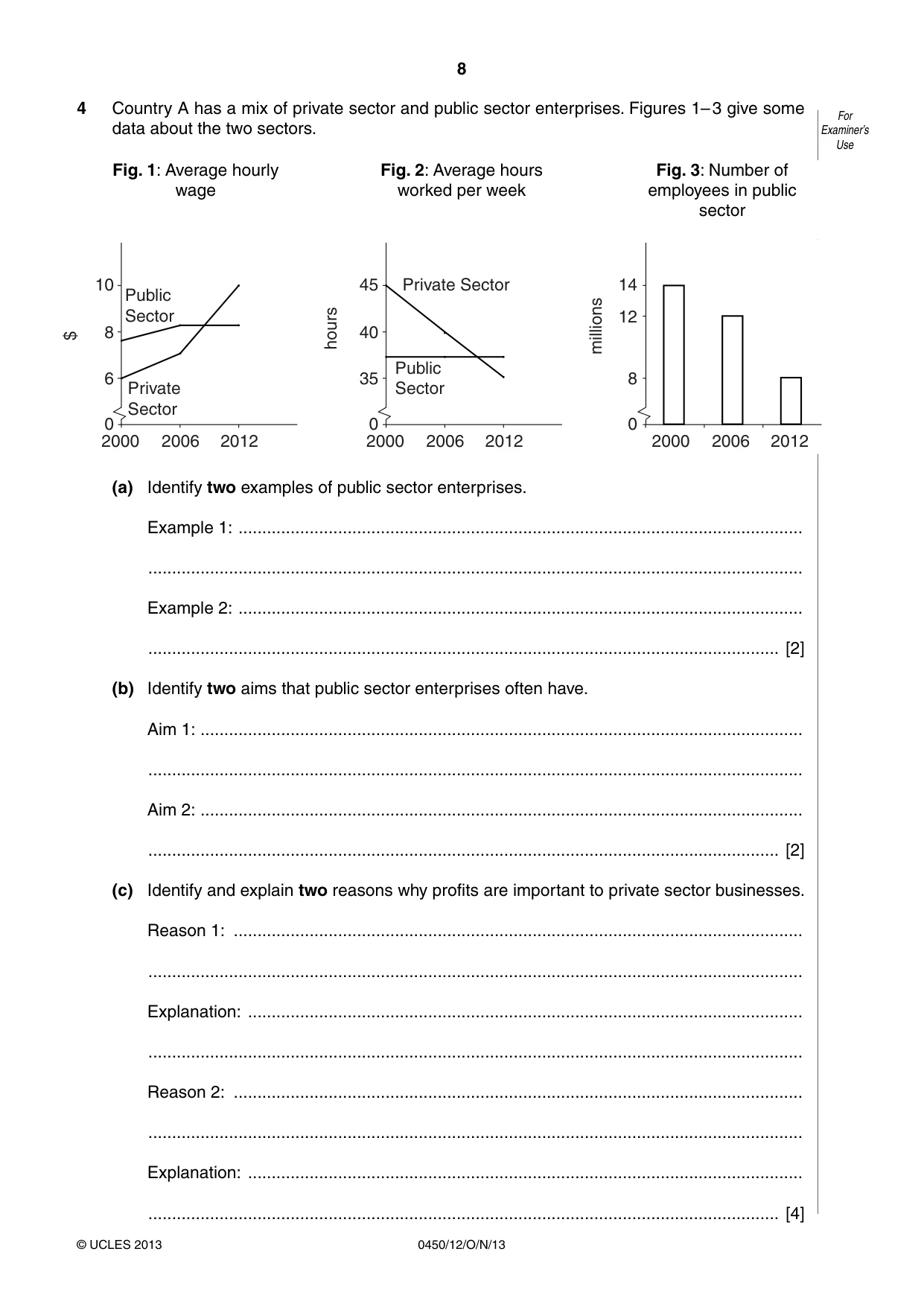
8 0450/12/O/N/13 © UCLES 2013 For Examiner’s Use 4 Country A has a mix of private sector and public sector enterprises. Figures 1– 3 give some data about the two sectors. Fig. 1: Average hourly Fig. 2: Average hours Fig. 3: Number of wage worked per week employees in public sector 2012 2006 2000 10 8 6 0 2012 2006 2000 45 40 35 0 2012 2006 2000 14 12 8 0 Public Sector Public Sector Private Sector Private Sector millions hours $ (a) Identify two examples of public sector enterprises. Example 1: … … Example 2: … … [2] (b) Identify two aims that public sector enterprises often have. Aim 1: … … Aim 2: … … [2] (c) Identify and explain two reasons why profits are important to private sector businesses. Reason 1: … … Explanation: … … Reason 2: … … Explanation: … … [4]
Question paper, page 9
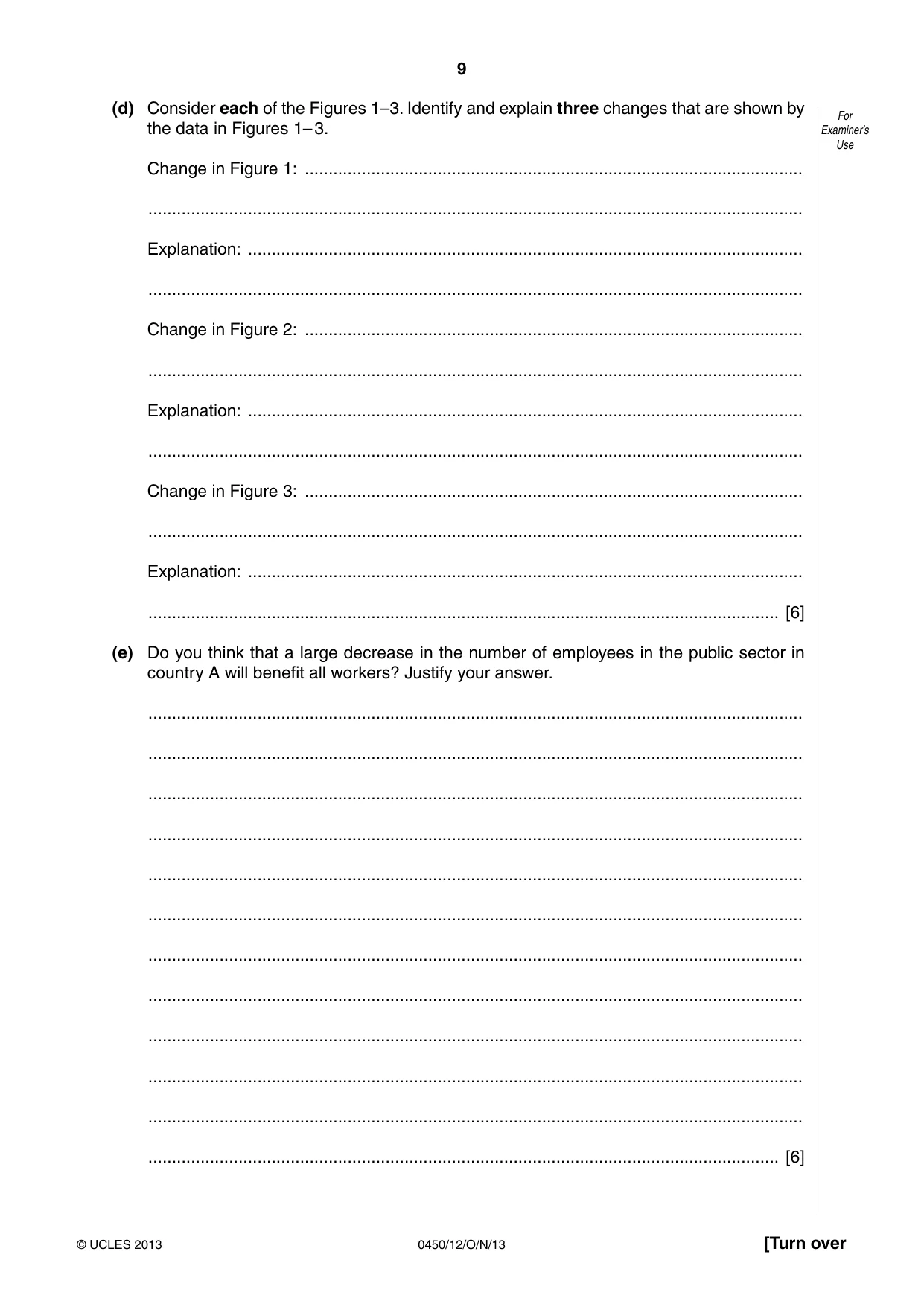
9 0450/12/O/N/13 © UCLES 2013 [Turn over For Examiner’s Use (d) Consider each of the Figures 1–3. Identify and explain three changes that are shown by the data in Figures 1– 3. Change in Figure 1: … … Explanation: … … Change in Figure 2: … … Explanation: … … Change in Figure 3: … … Explanation: … … [6] (e) Do you think that a large decrease in the number of employees in the public sector in country A will benefit all workers? Justify your answer. … … … … … … … … … … … … [6]
Question paper, page 10
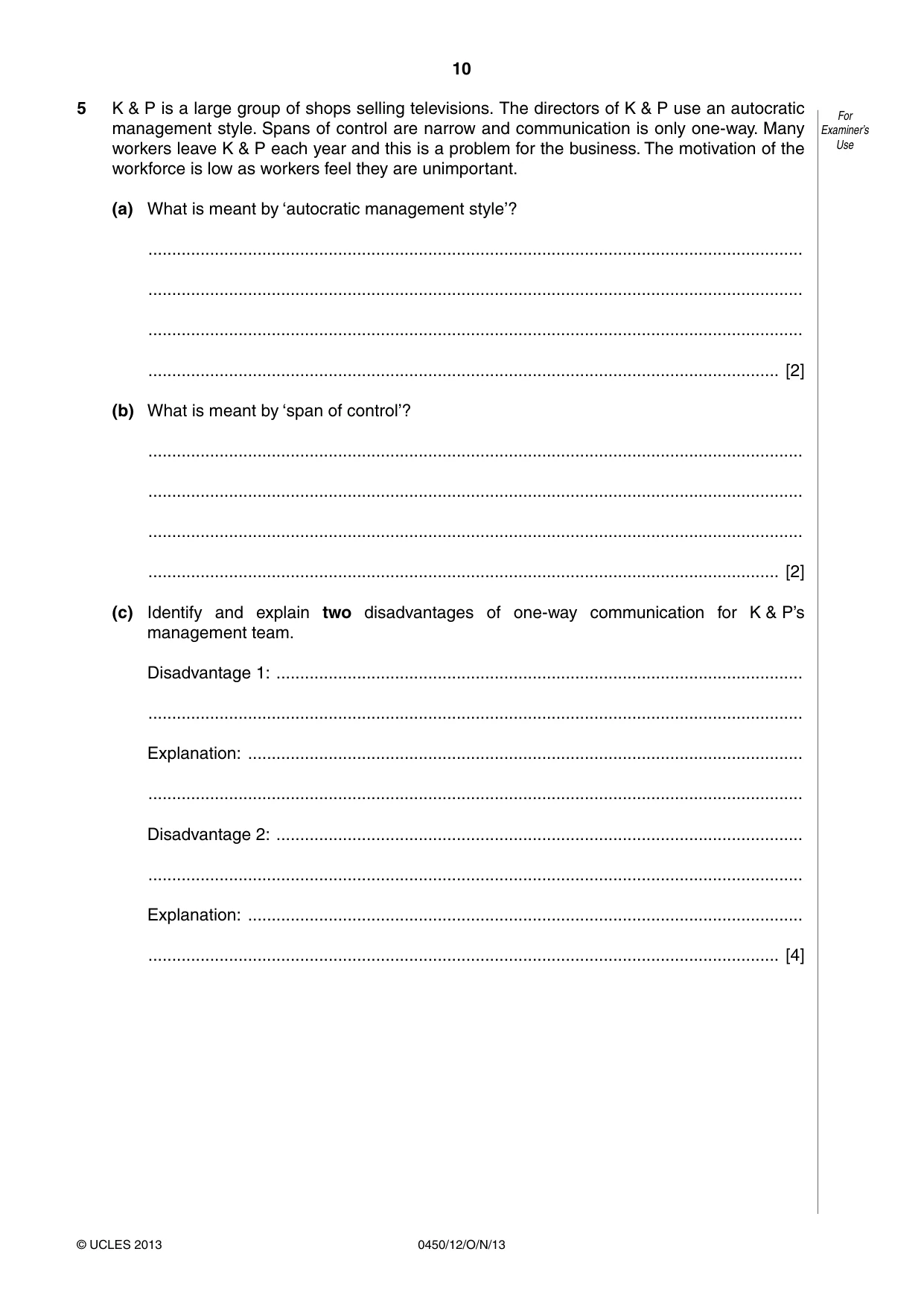
10 0450/12/O/N/13 © UCLES 2013 For Examiner’s Use 5 K & P is a large group of shops selling televisions. The directors of K & P use an autocratic management style. Spans of control are narrow and communication is only one-way. Many workers leave K & P each year and this is a problem for the business. The motivation of the workforce is low as workers feel they are unimportant. (a) What is meant by ‘autocratic management style’? … … … … [2] (b) What is meant by ‘span of control’? … … … … [2] (c) Identify and explain two disadvantages of one-way communication for K & P’s management team. Disadvantage 1: … … Explanation: … … Disadvantage 2: … … Explanation: … … [4]
Question paper, page 11
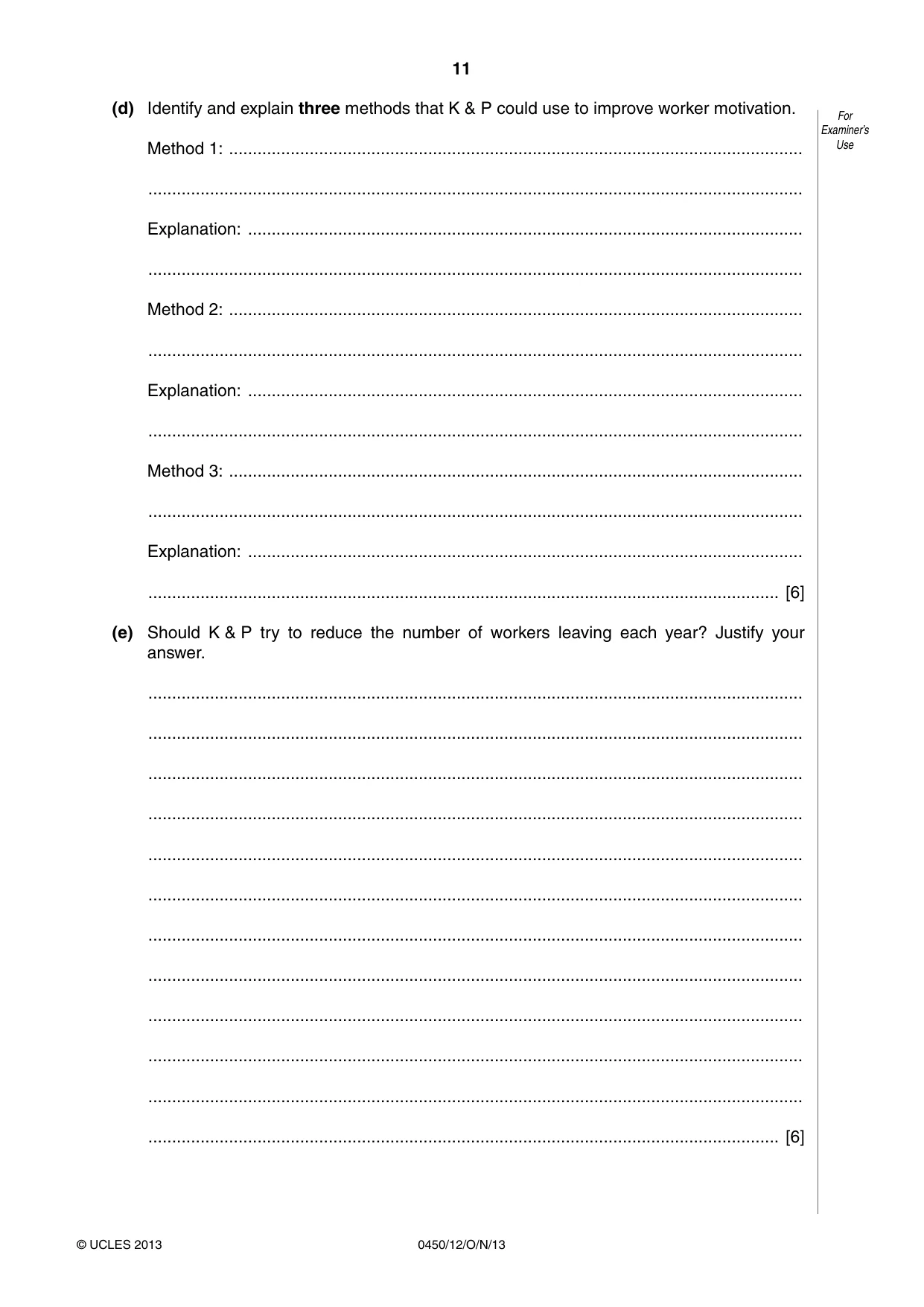
11 0450/12/O/N/13 © UCLES 2013 For Examiner’s Use (d) Identify and explain three methods that K & P could use to improve worker motivation. Method 1: … … Explanation: … … Method 2: … … Explanation: … … Method 3: … … Explanation: … … [6] (e) Should K & P try to reduce the number of workers leaving each year? Justify your answer. … … … … … … … … … … … … [6]
Question paper, page 12
12 0450/12/O/N/13 © UCLES 2013 Permission to reproduce items where third-party owned material protected by copyright is included has been sought and cleared where possible. Every reasonable effort has been made by the publisher (UCLES) to trace copyright holders, but if any items requiring clearance have unwittingly been included, the publisher will be pleased to make amends at the earliest possible opportunity. University of Cambridge International Examinations is part of the Cambridge Assessment Group. Cambridge Assessment is the brand name of University of Cambridge Local Examinations Syndicate (UCLES), which is itself a department of the University of Cambridge. BLANK PAGE
Mark scheme, page 1
CAMBRIDGE INTERNATIONAL EXAMINATIONS International General Certificate of Secondary Education MARK SCHEME for the October/November 2013 series 0450 BUSINESS STUDIES 0450/12 Paper 1 (Short Answer/Structured Response), maximum raw mark 100 This mark scheme is published as an aid to teachers and candidates, to indicate the requirements of the examination. It shows the basis on which Examiners were instructed to award marks. It does not indicate the details of the discussions that took place at an Examiners’ meeting before marking began, which would have considered the acceptability of alternative answers. Mark schemes should be read in conjunction with the question paper and the Principal Examiner Report for Teachers. Cambridge will not enter into discussions about these mark schemes. Cambridge is publishing the mark schemes for the October/November 2013 series for most IGCSE, GCE Advanced Level and Advanced Subsidiary Level components and some Ordinary Level components.
Mark scheme, page 2
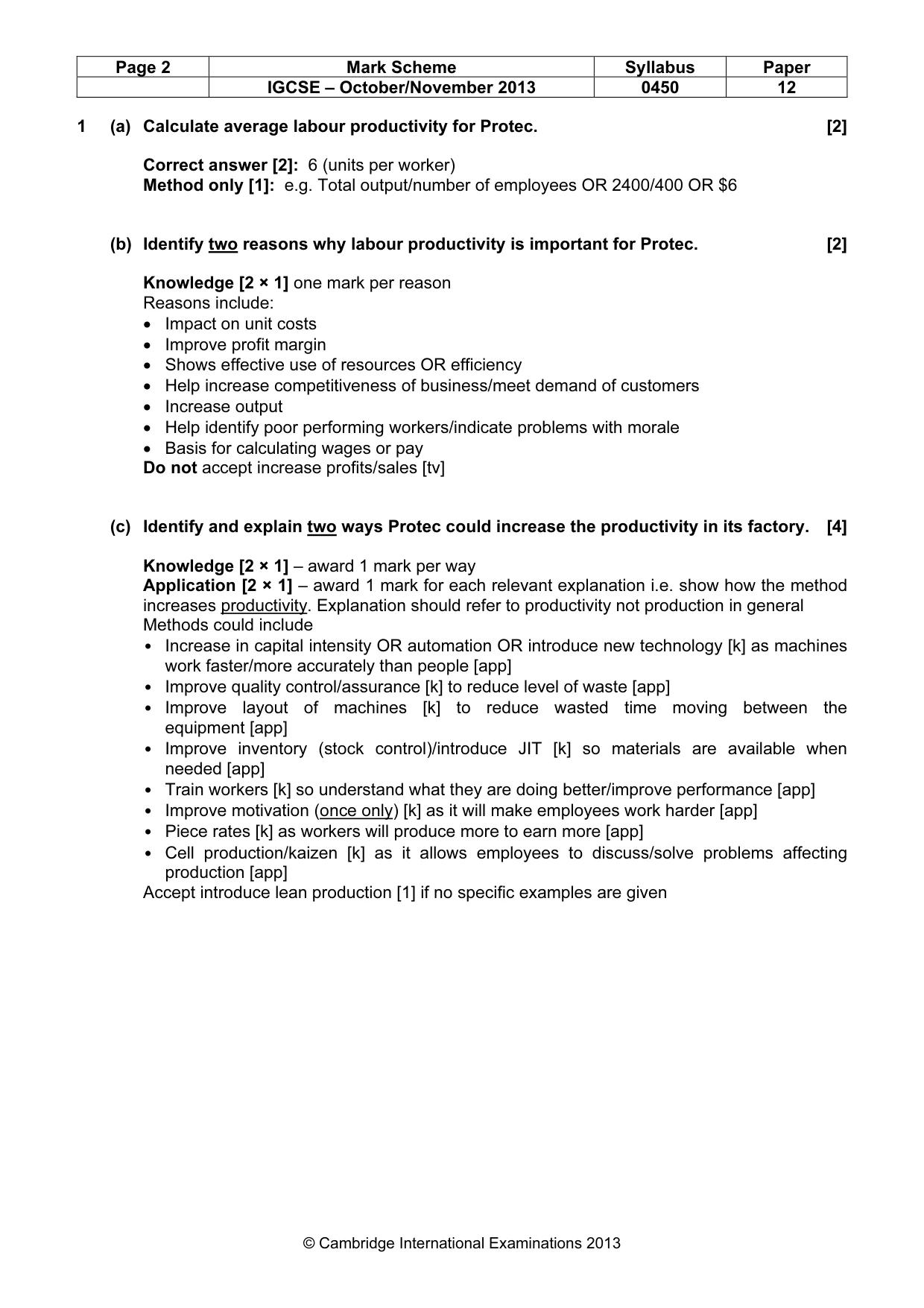
Page 2 Mark Scheme Syllabus Paper IGCSE – October/November 2013 0450 12 © Cambridge International Examinations 2013 1 (a) Calculate average labour productivity for Protec. [2] Correct answer [2]: 6 (units per worker) Method only [1]: e.g. Total output/number of employees OR 2400/400 OR $6 (b) Identify two reasons why labour productivity is important for Protec. [2] Knowledge [2 × 1] one mark per reason Reasons include: • Impact on unit costs • Improve profit margin • Shows effective use of resources OR efficiency • Help increase competitiveness of business/meet demand of customers • Increase output • Help identify poor performing workers/indicate problems with morale • Basis for calculating wages or pay Do not accept increase profits/sales [tv] (c) Identify and explain two ways Protec could increase the productivity in its factory. [4] Knowledge [2 × 1] – award 1 mark per way Application [2 × 1] – award 1 mark for each relevant explanation i.e. show how the method increases productivity. Explanation should refer to productivity not production in general Methods could include • Increase in capital intensity OR automation OR introduce new technology [k] as machines work faster/more accurately than people [app] • Improve quality control/assurance [k] to reduce level of waste [app] • Improve layout of machines [k] to reduce wasted time moving between the equipment [app] • Improve inventory (stock control)/introduce JIT [k] so materials are available when needed [app] • Train workers [k] so understand what they are doing better/improve performance [app] • Improve motivation (once only) [k] as it will make employees work harder [app] • Piece rates [k] as workers will produce more to earn more [app] • Cell production/kaizen [k] as it allows employees to discuss/solve problems affecting production [app] Accept introduce lean production [1] if no specific examples are given
Mark scheme, page 3
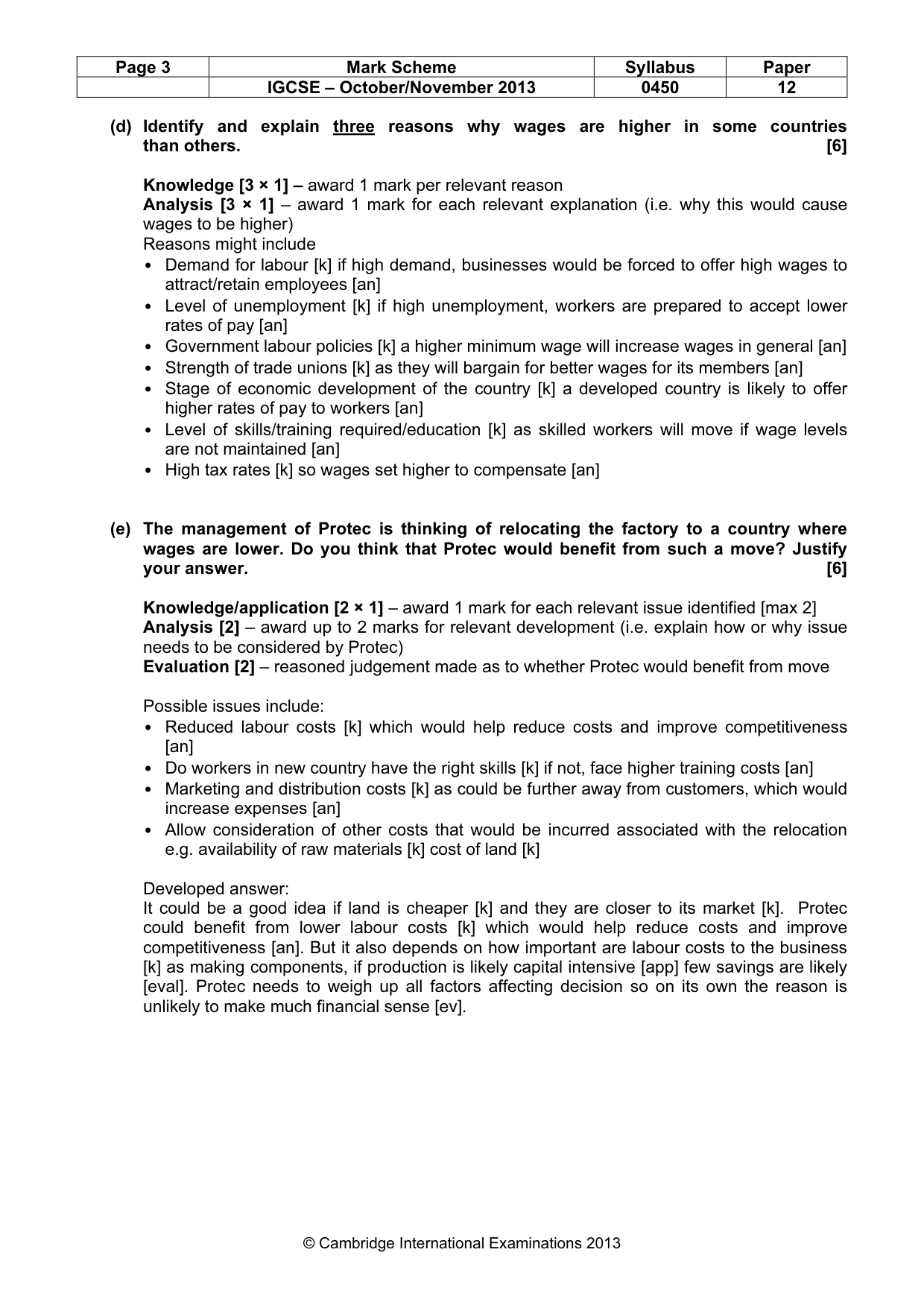
Page 3 Mark Scheme Syllabus Paper IGCSE – October/November 2013 0450 12 © Cambridge International Examinations 2013 (d) Identify and explain three reasons why wages are higher in some countries than others. [6] Knowledge [3 × 1] – award 1 mark per relevant reason Analysis [3 × 1] – award 1 mark for each relevant explanation (i.e. why this would cause wages to be higher) Reasons might include • Demand for labour [k] if high demand, businesses would be forced to offer high wages to attract/retain employees [an] • Level of unemployment [k] if high unemployment, workers are prepared to accept lower rates of pay [an] • Government labour policies [k] a higher minimum wage will increase wages in general [an] • Strength of trade unions [k] as they will bargain for better wages for its members [an] • Stage of economic development of the country [k] a developed country is likely to offer higher rates of pay to workers [an] • Level of skills/training required/education [k] as skilled workers will move if wage levels are not maintained [an] • High tax rates [k] so wages set higher to compensate [an] (e) The management of Protec is thinking of relocating the factory to a country where wages are lower. Do you think that Protec would benefit from such a move? Justify your answer. [6] Knowledge/application [2 × 1] – award 1 mark for each relevant issue identified [max 2] Analysis [2] – award up to 2 marks for relevant development (i.e. explain how or why issue needs to be considered by Protec) Evaluation [2] – reasoned judgement made as to whether Protec would benefit from move Possible issues include: • Reduced labour costs [k] which would help reduce costs and improve competitiveness [an] • Do workers in new country have the right skills [k] if not, face higher training costs [an] • Marketing and distribution costs [k] as could be further away from customers, which would increase expenses [an] • Allow consideration of other costs that would be incurred associated with the relocation e.g. availability of raw materials [k] cost of land [k] Developed answer: It could be a good idea if land is cheaper [k] and they are closer to its market [k]. Protec could benefit from lower labour costs [k] which would help reduce costs and improve competitiveness [an]. But it also depends on how important are labour costs to the business [k] as making components, if production is likely capital intensive [app] few savings are likely [eval]. Protec needs to weigh up all factors affecting decision so on its own the reason is unlikely to make much financial sense [ev].
Mark scheme, page 4
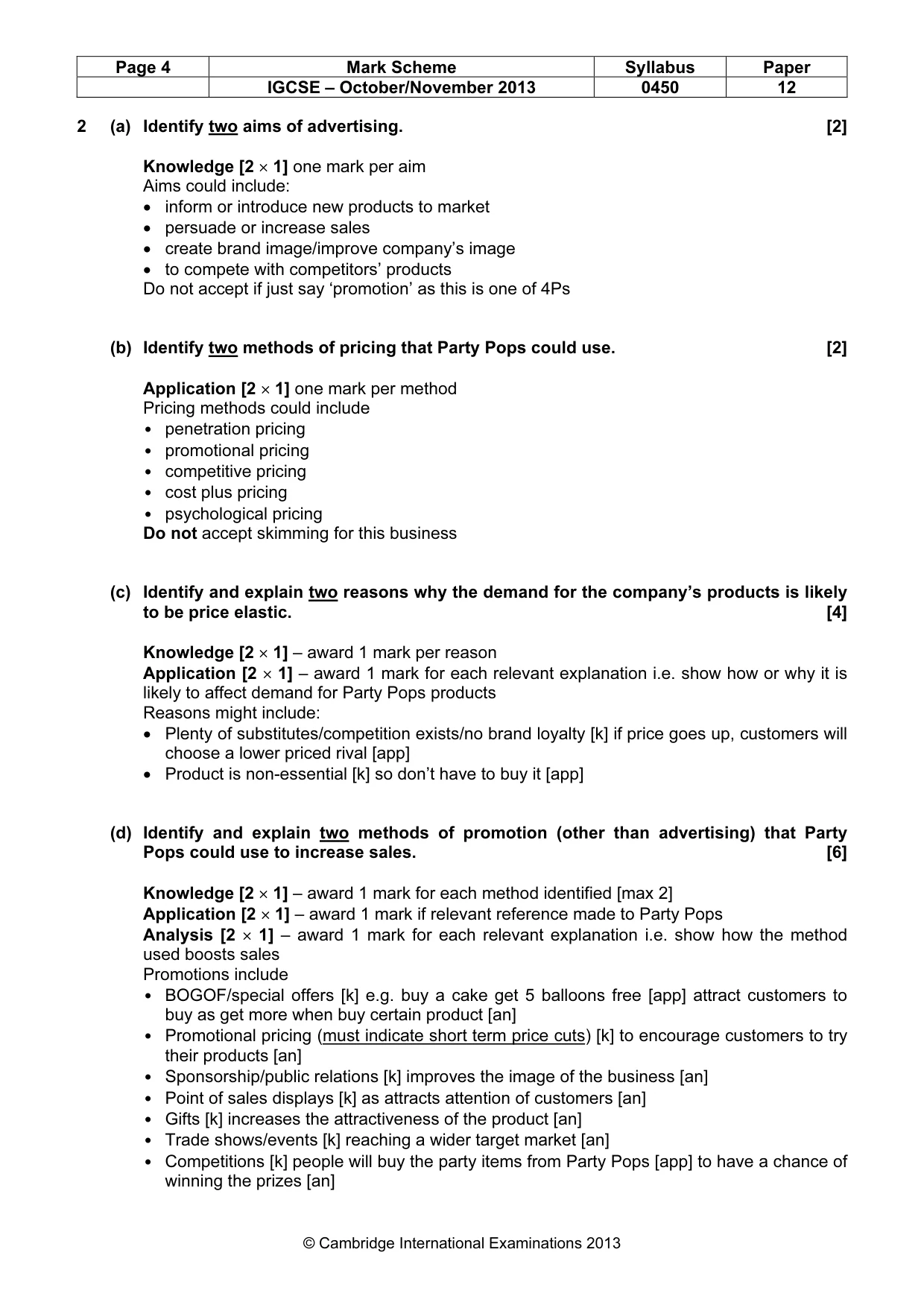
Page 4 Mark Scheme Syllabus Paper IGCSE – October/November 2013 0450 12 © Cambridge International Examinations 2013 2 (a) Identify two aims of advertising. [2] Knowledge [2 × 1] one mark per aim Aims could include: • inform or introduce new products to market • persuade or increase sales • create brand image/improve company’s image • to compete with competitors’ products Do not accept if just say ‘promotion’ as this is one of 4Ps (b) Identify two methods of pricing that Party Pops could use. [2] Application [2 × 1] one mark per method Pricing methods could include • penetration pricing • promotional pricing • competitive pricing • cost plus pricing • psychological pricing Do not accept skimming for this business (c) Identify and explain two reasons why the demand for the company’s products is likely to be price elastic. [4] Knowledge [2 × 1] – award 1 mark per reason Application [2 × 1] – award 1 mark for each relevant explanation i.e. show how or why it is likely to affect demand for Party Pops products Reasons might include: • Plenty of substitutes/competition exists/no brand loyalty [k] if price goes up, customers will choose a lower priced rival [app] • Product is non-essential [k] so don’t have to buy it [app] (d) Identify and explain two methods of promotion (other than advertising) that Party Pops could use to increase sales. [6] Knowledge [2 × 1] – award 1 mark for each method identified [max 2] Application [2 × 1] – award 1 mark if relevant reference made to Party Pops Analysis [2 × 1] – award 1 mark for each relevant explanation i.e. show how the method used boosts sales Promotions include • BOGOF/special offers [k] e.g. buy a cake get 5 balloons free [app] attract customers to buy as get more when buy certain product [an] • Promotional pricing (must indicate short term price cuts) [k] to encourage customers to try their products [an] • Sponsorship/public relations [k] improves the image of the business [an] • Point of sales displays [k] as attracts attention of customers [an] • Gifts [k] increases the attractiveness of the product [an] • Trade shows/events [k] reaching a wider target market [an] • Competitions [k] people will buy the party items from Party Pops [app] to have a chance of winning the prizes [an]
Mark scheme, page 5
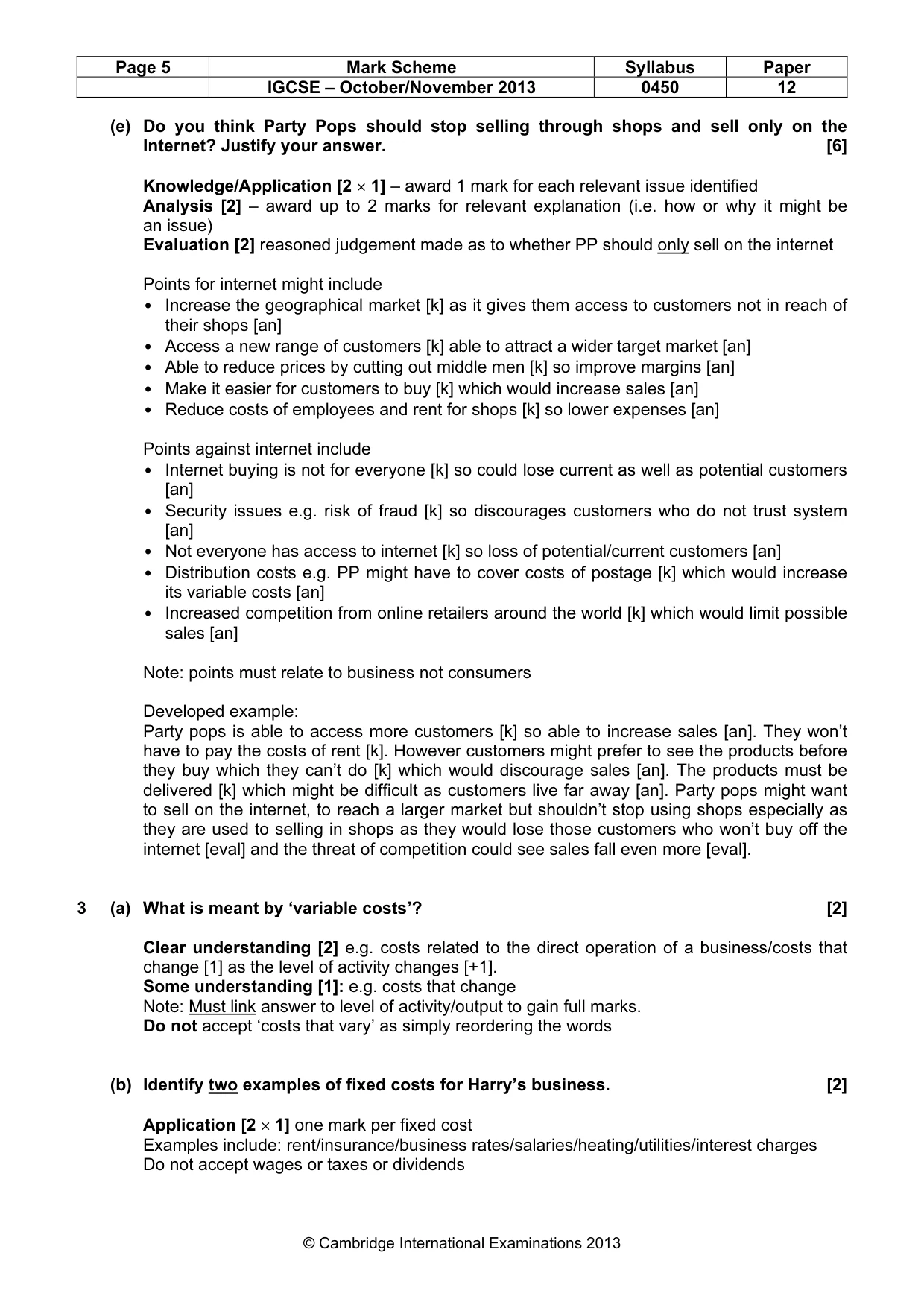
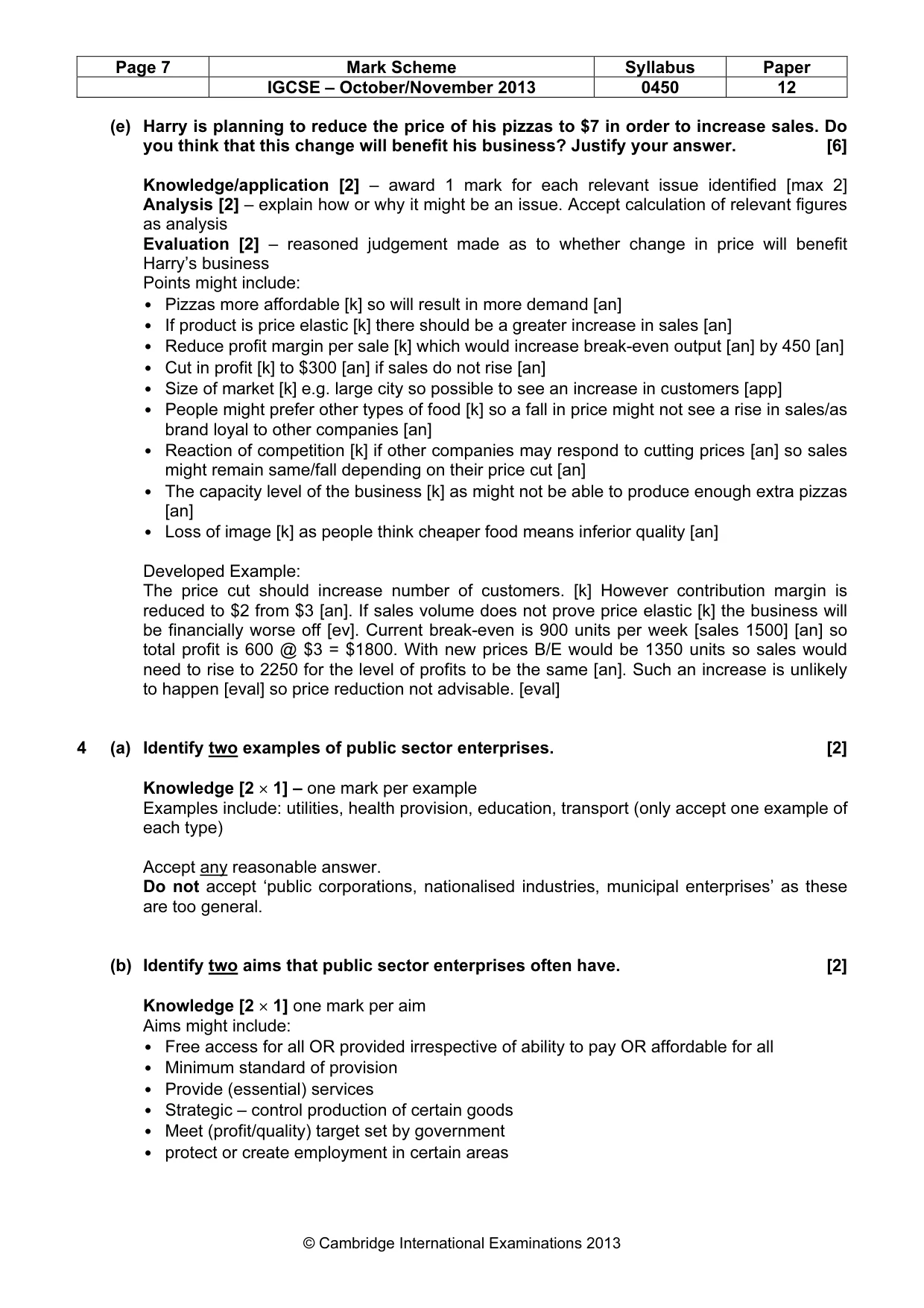
Page 5 Mark Scheme Syllabus Paper IGCSE – October/November 2013 0450 12 © Cambridge International Examinations 2013 (e) Do you think Party Pops should stop selling through shops and sell only on the Internet? Justify your answer. [6] Knowledge/Application [2 × 1] – award 1 mark for each relevant issue identified Analysis [2] – award up to 2 marks for relevant explanation (i.e. how or why it might be an issue) Evaluation [2] reasoned judgement made as to whether PP should only sell on the internet Points for internet might include • Increase the geographical market [k] as it gives them access to customers not in reach of their shops [an] • Access a new range of customers [k] able to attract a wider target market [an] • Able to reduce prices by cutting out middle men [k] so improve margins [an] • Make it easier for customers to buy [k] which would increase sales [an] • Reduce costs of employees and rent for shops [k] so lower expenses [an] Points against internet include • Internet buying is not for everyone [k] so could lose current as well as potential customers [an] • Security issues e.g. risk of fraud [k] so discourages customers who do not trust system [an] • Not everyone has access to internet [k] so loss of potential/current customers [an] • Distribution costs e.g. PP might have to cover costs of postage [k] which would increase its variable costs [an] • Increased competition from online retailers around the world [k] which would limit possible sales [an] Note: points must relate to business not consumers Developed example: Party pops is able to access more customers [k] so able to increase sales [an]. They won’t have to pay the costs of rent [k]. However customers might prefer to see the products before they buy which they can’t do [k] which would discourage sales [an]. The products must be delivered [k] which might be difficult as customers live far away [an]. Party pops might want to sell on the internet, to reach a larger market but shouldn’t stop using shops especially as they are used to selling in shops as they would lose those customers who won’t buy off the internet [eval] and the threat of competition could see sales fall even more [eval]. 3 (a) What is meant by ‘variable costs’? [2] Clear understanding [2] e.g. costs related to the direct operation of a business/costs that change [1] as the level of activity changes [+1]. Some understanding [1]: e.g. costs that change Note: Must link answer to level of activity/output to gain full marks. Do not accept ‘costs that vary’ as simply reordering the words (b) Identify two examples of fixed costs for Harry’s business. [2] Application [2 × 1] one mark per fixed cost Examples include: rent/insurance/business rates/salaries/heating/utilities/interest charges Do not accept wages or taxes or dividends
Mark scheme, page 6
Page 6 Mark Scheme Syllabus Paper IGCSE – October/November 2013 0450 12 © Cambridge International Examinations 2013 (c) Calculate how much profit Harry’s business makes in one week. [4] Correct answer [4]: 1800 ($ not required. No further calculations are required) Some understanding [can gain up to 3 marks]: Breakdown of marks as follows: Sales 1500 @ $8 $12000 [1] Variable costs 1500 @ $5 $7500 [1] Total costs $10200 [1] Profit $1800 [1] Notes: • Can allow 2 marks for correct calculation of Total cost on own (as will have calculated Variable cost as part of it) • Own figure rule (OFR) applies up to a maximum of 3 marks if only one error carried forward. 12000 – 2705 = $9295 [2] only as incorrect understanding of variable cost • If NO acceptable calculations allow 1 mark for understanding of profit [k] e.g. total revenue – total cost [1] • Credit calculation using contribution method as follows: contribution $3 [1] total contribution $4500 [+1] (d) Harry pays his workers piece rates. Identify and explain one advantage and one disadvantage to Harry of using this method of payment. [6] Knowledge [2 × 1] – award 1 mark for the advantage and 1 mark for the disadvantage Analysis [2 × 2] – award 1 mark for analysis of impact [1] plus a further mark for showing how each point might be an advantage (or not) to the business Advantages might include • Paid for what produce [k] so costs directly controlled [an] therefore able to earn higher profit [an] • Increase output/efficiency [k] as workers will work faster [an] so Harry is able to meet all orders on time [an] • Saves labour costs [k] as if no customers in restaurant [an] no wages need to be paid as no production necessary [an] • Motivating to workers to work harder [k] so less absenteeism [an] so able to offer better customer service [an] Disadvantages include: • Encourages speed [k] which may mean more mistakes [an] therefore more wasted ingredients [an] • Lower quality goods [k] as rush the work [an] leading to customer dissatisfaction/poor reputation [an] • Can be difficult to calculate wages [k] if restaurant is busy [an] as will have to pay workers more [an] • Discouraging for slower workers [k] increasing labour turnover [an] therefore higher recruitment costs [an] Note: points must relate to business not employees
Mark scheme, page 7
Page 7 Mark Scheme Syllabus Paper IGCSE – October/November 2013 0450 12 © Cambridge International Examinations 2013 (e) Harry is planning to reduce the price of his pizzas to $7 in order to increase sales. Do you think that this change will benefit his business? Justify your answer. [6] Knowledge/application [2] – award 1 mark for each relevant issue identified [max 2] Analysis [2] – explain how or why it might be an issue. Accept calculation of relevant figures as analysis Evaluation [2] – reasoned judgement made as to whether change in price will benefit Harry’s business Points might include: • Pizzas more affordable [k] so will result in more demand [an] • If product is price elastic [k] there should be a greater increase in sales [an] • Reduce profit margin per sale [k] which would increase break-even output [an] by 450 [an] • Cut in profit [k] to $300 [an] if sales do not rise [an] • Size of market [k] e.g. large city so possible to see an increase in customers [app] • People might prefer other types of food [k] so a fall in price might not see a rise in sales/as brand loyal to other companies [an] • Reaction of competition [k] if other companies may respond to cutting prices [an] so sales might remain same/fall depending on their price cut [an] • The capacity level of the business [k] as might not be able to produce enough extra pizzas [an] • Loss of image [k] as people think cheaper food means inferior quality [an] Developed Example: The price cut should increase number of customers. [k] However contribution margin is reduced to $2 from $3 [an]. If sales volume does not prove price elastic [k] the business will be financially worse off [ev]. Current break-even is 900 units per week [sales 1500] [an] so total profit is 600 @ $3 = $1800. With new prices B/E would be 1350 units so sales would need to rise to 2250 for the level of profits to be the same [an]. Such an increase is unlikely to happen [eval] so price reduction not advisable. [eval] 4 (a) Identify two examples of public sector enterprises. [2] Knowledge [2 × 1] – one mark per example Examples include: utilities, health provision, education, transport (only accept one example of each type) Accept any reasonable answer. Do not accept ‘public corporations, nationalised industries, municipal enterprises’ as these are too general. (b) Identify two aims that public sector enterprises often have. [2] Knowledge [2 × 1] one mark per aim Aims might include: • Free access for all OR provided irrespective of ability to pay OR affordable for all • Minimum standard of provision • Provide (essential) services • Strategic – control production of certain goods • Meet (profit/quality) target set by government • protect or create employment in certain areas
Mark scheme, page 8
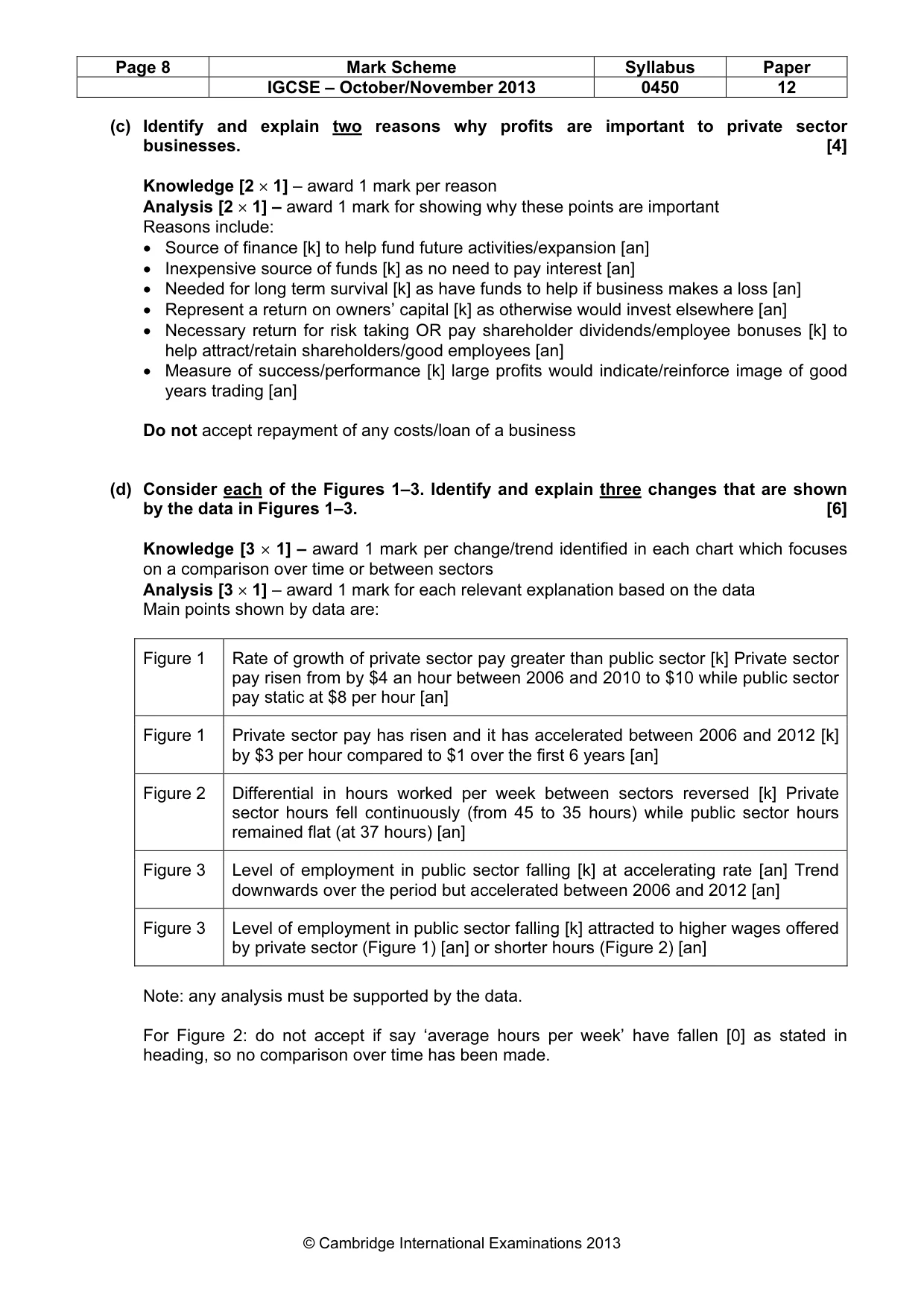
Page 8 Mark Scheme Syllabus Paper IGCSE – October/November 2013 0450 12 © Cambridge International Examinations 2013 (c) Identify and explain two reasons why profits are important to private sector businesses. [4] Knowledge [2 × 1] – award 1 mark per reason Analysis [2 × 1] – award 1 mark for showing why these points are important Reasons include: • Source of finance [k] to help fund future activities/expansion [an] • Inexpensive source of funds [k] as no need to pay interest [an] • Needed for long term survival [k] as have funds to help if business makes a loss [an] • Represent a return on owners’ capital [k] as otherwise would invest elsewhere [an] • Necessary return for risk taking OR pay shareholder dividends/employee bonuses [k] to help attract/retain shareholders/good employees [an] • Measure of success/performance [k] large profits would indicate/reinforce image of good years trading [an] Do not accept repayment of any costs/loan of a business (d) Consider each of the Figures 1–3. Identify and explain three changes that are shown by the data in Figures 1–3. [6] Knowledge [3 × 1] – award 1 mark per change/trend identified in each chart which focuses on a comparison over time or between sectors Analysis [3 × 1] – award 1 mark for each relevant explanation based on the data Main points shown by data are: Figure 1 Rate of growth of private sector pay greater than public sector [k] Private sector pay risen from by $4 an hour between 2006 and 2010 to $10 while public sector pay static at $8 per hour [an] Figure 1 Private sector pay has risen and it has accelerated between 2006 and 2012 [k] by $3 per hour compared to $1 over the first 6 years [an] Figure 2 Differential in hours worked per week between sectors reversed [k] Private sector hours fell continuously (from 45 to 35 hours) while public sector hours remained flat (at 37 hours) [an] Figure 3 Level of employment in public sector falling [k] at accelerating rate [an] Trend downwards over the period but accelerated between 2006 and 2012 [an] Figure 3 Level of employment in public sector falling [k] attracted to higher wages offered by private sector (Figure 1) [an] or shorter hours (Figure 2) [an] Note: any analysis must be supported by the data. For Figure 2: do not accept if say ‘average hours per week’ have fallen [0] as stated in heading, so no comparison over time has been made.
Mark scheme, page 9
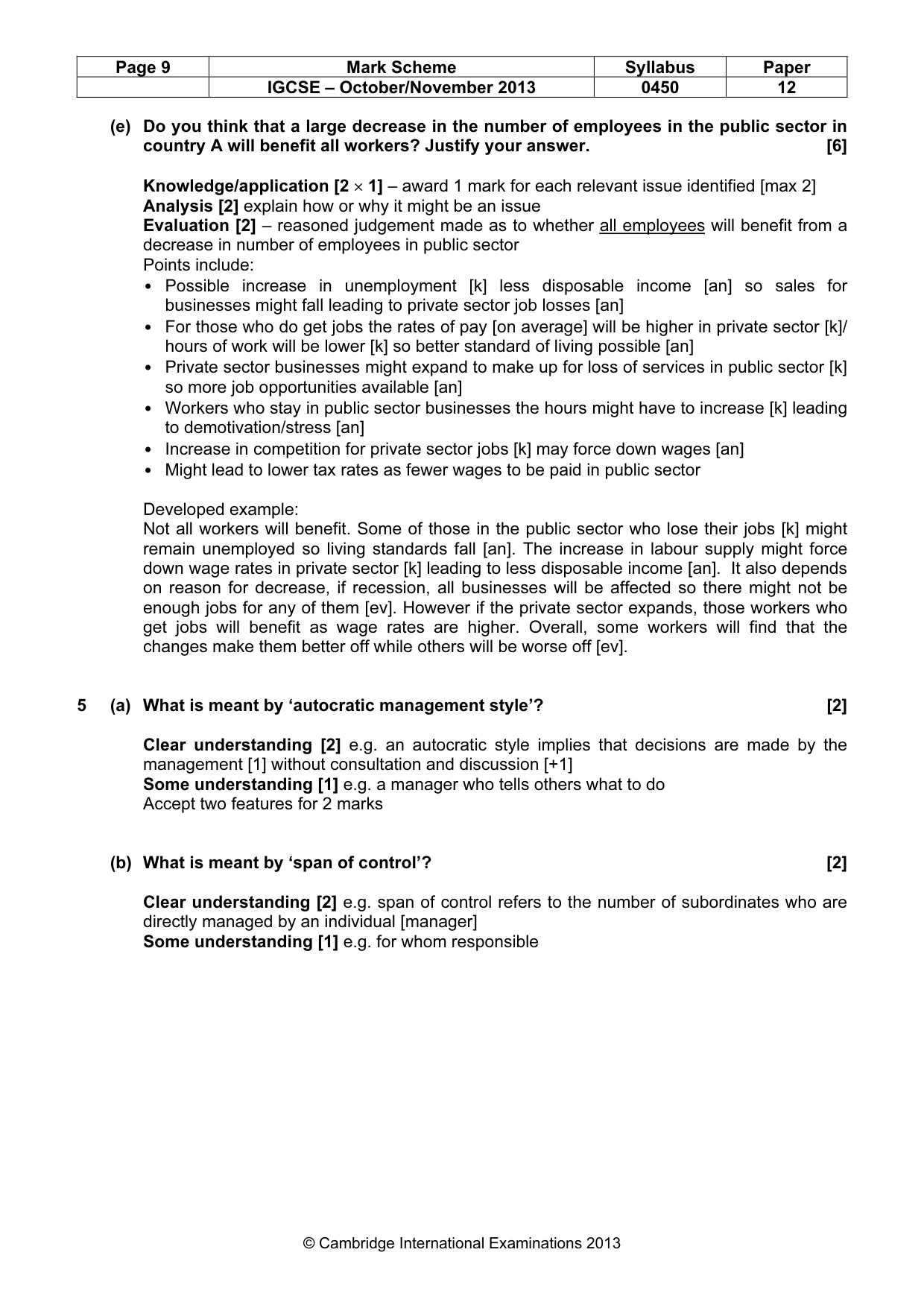
Page 9 Mark Scheme Syllabus Paper IGCSE – October/November 2013 0450 12 © Cambridge International Examinations 2013 (e) Do you think that a large decrease in the number of employees in the public sector in country A will benefit all workers? Justify your answer. [6] Knowledge/application [2 × 1] – award 1 mark for each relevant issue identified [max 2] Analysis [2] explain how or why it might be an issue Evaluation [2] – reasoned judgement made as to whether all employees will benefit from a decrease in number of employees in public sector Points include: • Possible increase in unemployment [k] less disposable income [an] so sales for businesses might fall leading to private sector job losses [an] • For those who do get jobs the rates of pay [on average] will be higher in private sector [k]/ hours of work will be lower [k] so better standard of living possible [an] • Private sector businesses might expand to make up for loss of services in public sector [k] so more job opportunities available [an] • Workers who stay in public sector businesses the hours might have to increase [k] leading to demotivation/stress [an] • Increase in competition for private sector jobs [k] may force down wages [an] • Might lead to lower tax rates as fewer wages to be paid in public sector Developed example: Not all workers will benefit. Some of those in the public sector who lose their jobs [k] might remain unemployed so living standards fall [an]. The increase in labour supply might force down wage rates in private sector [k] leading to less disposable income [an]. It also depends on reason for decrease, if recession, all businesses will be affected so there might not be enough jobs for any of them [ev]. However if the private sector expands, those workers who get jobs will benefit as wage rates are higher. Overall, some workers will find that the changes make them better off while others will be worse off [ev]. 5 (a) What is meant by ‘autocratic management style’? [2] Clear understanding [2] e.g. an autocratic style implies that decisions are made by the management [1] without consultation and discussion [+1] Some understanding [1] e.g. a manager who tells others what to do Accept two features for 2 marks (b) What is meant by ‘span of control’? [2] Clear understanding [2] e.g. span of control refers to the number of subordinates who are directly managed by an individual [manager] Some understanding [1] e.g. for whom responsible
Mark scheme, page 10
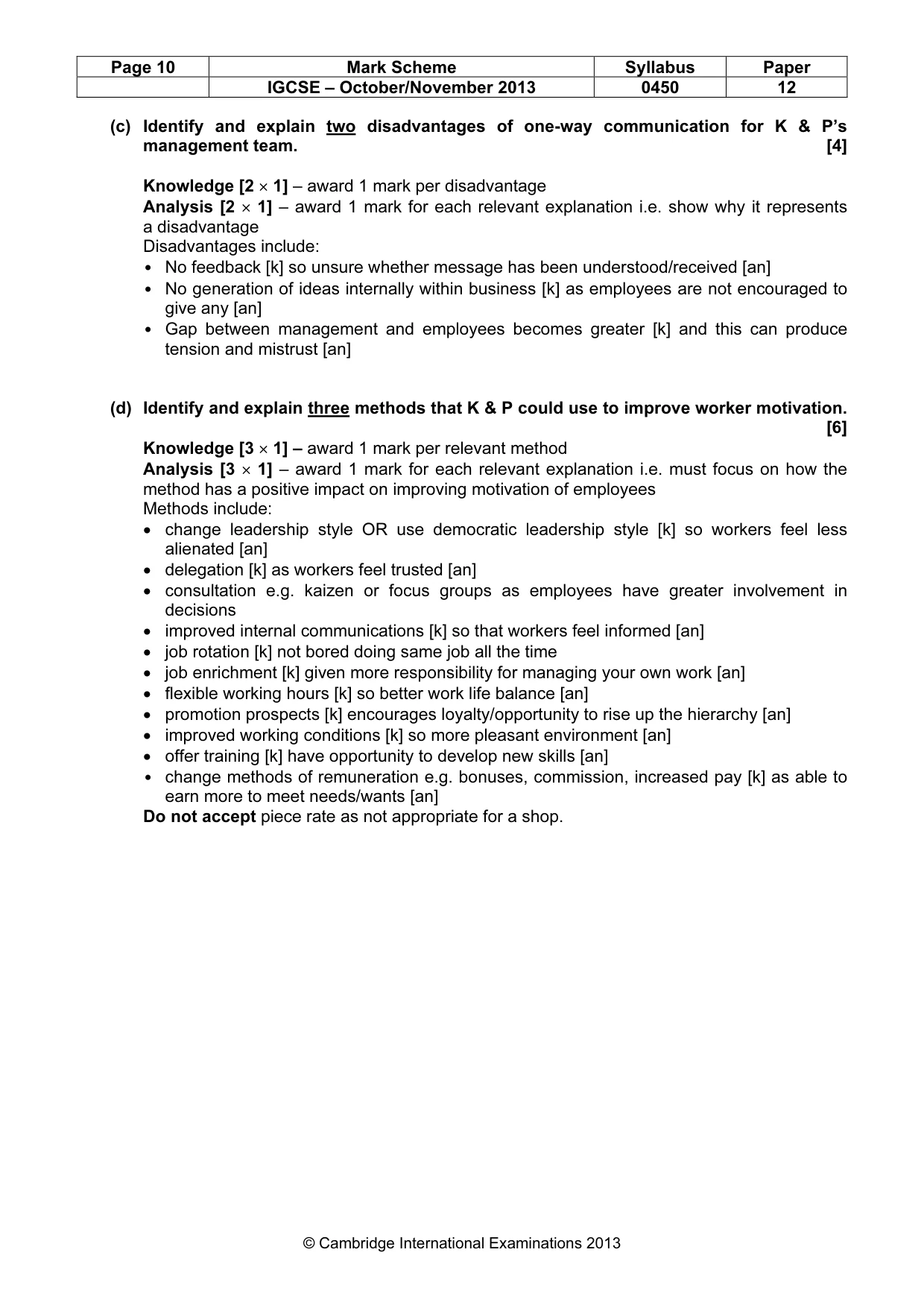
Page 10 Mark Scheme Syllabus Paper IGCSE – October/November 2013 0450 12 © Cambridge International Examinations 2013 (c) Identify and explain two disadvantages of one-way communication for K & P’s management team. [4] Knowledge [2 × 1] – award 1 mark per disadvantage Analysis [2 × 1] – award 1 mark for each relevant explanation i.e. show why it represents a disadvantage Disadvantages include: • No feedback [k] so unsure whether message has been understood/received [an] • No generation of ideas internally within business [k] as employees are not encouraged to give any [an] • Gap between management and employees becomes greater [k] and this can produce tension and mistrust [an] (d) Identify and explain three methods that K & P could use to improve worker motivation. [6] Knowledge [3 × 1] – award 1 mark per relevant method Analysis [3 × 1] – award 1 mark for each relevant explanation i.e. must focus on how the method has a positive impact on improving motivation of employees Methods include: • change leadership style OR use democratic leadership style [k] so workers feel less alienated [an] • delegation [k] as workers feel trusted [an] • consultation e.g. kaizen or focus groups as employees have greater involvement in decisions • improved internal communications [k] so that workers feel informed [an] • job rotation [k] not bored doing same job all the time • job enrichment [k] given more responsibility for managing your own work [an] • flexible working hours [k] so better work life balance [an] • promotion prospects [k] encourages loyalty/opportunity to rise up the hierarchy [an] • improved working conditions [k] so more pleasant environment [an] • offer training [k] have opportunity to develop new skills [an] • change methods of remuneration e.g. bonuses, commission, increased pay [k] as able to earn more to meet needs/wants [an] Do not accept piece rate as not appropriate for a shop.
Mark scheme, page 11
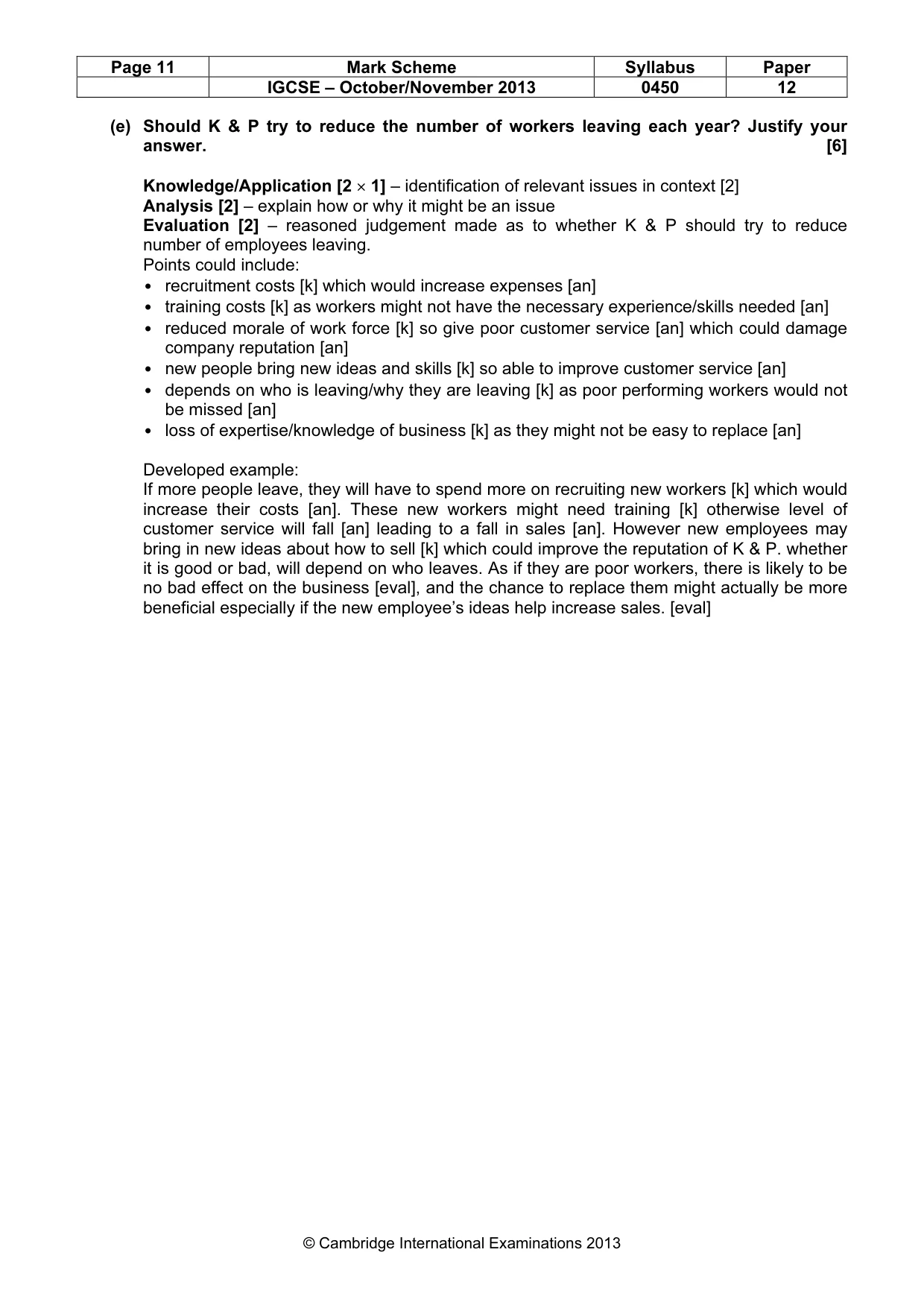
Page 11 Mark Scheme Syllabus Paper IGCSE – October/November 2013 0450 12 © Cambridge International Examinations 2013 (e) Should K & P try to reduce the number of workers leaving each year? Justify your answer. [6] Knowledge/Application [2 × 1] – identification of relevant issues in context [2] Analysis [2] – explain how or why it might be an issue Evaluation [2] – reasoned judgement made as to whether K & P should try to reduce number of employees leaving. Points could include: • recruitment costs [k] which would increase expenses [an] • training costs [k] as workers might not have the necessary experience/skills needed [an] • reduced morale of work force [k] so give poor customer service [an] which could damage company reputation [an] • new people bring new ideas and skills [k] so able to improve customer service [an] • depends on who is leaving/why they are leaving [k] as poor performing workers would not be missed [an] • loss of expertise/knowledge of business [k] as they might not be easy to replace [an] Developed example: If more people leave, they will have to spend more on recruiting new workers [k] which would increase their costs [an]. These new workers might need training [k] otherwise level of customer service will fall [an] leading to a fall in sales [an]. However new employees may bring in new ideas about how to sell [k] which could improve the reputation of K & P. whether it is good or bad, will depend on who leaves. As if they are poor workers, there is likely to be no bad effect on the business [eval], and the chance to replace them might actually be more beneficial especially if the new employee’s ideas help increase sales. [eval]
What you needed in this session
Cambridge’s own grade thresholds for 2013 Oct/Nov, Paper 1 · Variant 2. A higher threshold means an easier paper — the bar moves with how the cohort did.