Cambridge IGCSE Business Studies 0450 — 2013 Oct/Nov Paper 1 · Variant 1
0450/11/O/N/13 · 100 marks · ≈113 min
The question paper and its mark scheme, free to read here and free to download. This is Cambridge’s own paper, exactly as it was sat.
Question paper12 pages

Mark scheme11 pages
Answers below. Sit the paper first if you are practising.
Paper as text
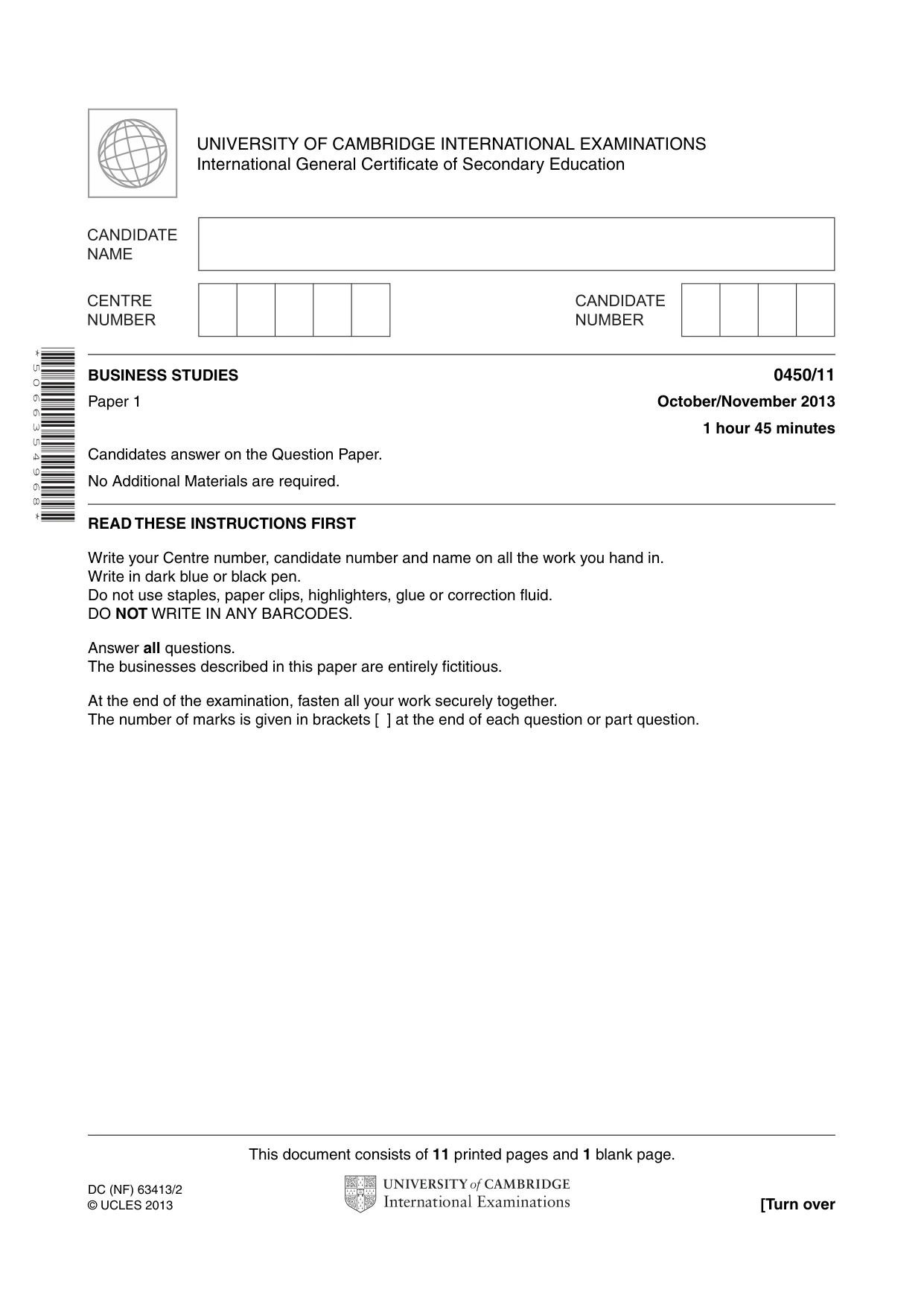
Question paper, page 1
This document consists of 11 printed pages and 1 blank page. DC (NF) 63413/2 © UCLES 2013 [Turn over UNIVERSITY OF CAMBRIDGE INTERNATIONAL EXAMINATIONS International General Certificate of Secondary Education * 5 0 6 6 3 5 4 9 6 8 * BUSINESS STUDIES 0450/11 Paper 1 October/November 2013 1 hour 45 minutes Candidates answer on the Question Paper. No Additional Materials are required. READ THESE INSTRUCTIONS FIRST Write your Centre number, candidate number and name on all the work you hand in. Write in dark blue or black pen. Do not use staples, paper clips, highlighters, glue or correction fluid. DO NOT WRITE IN ANY BARCODES. Answer all questions. The businesses described in this paper are entirely fictitious. At the end of the examination, fasten all your work securely together. The number of marks is given in brackets [ ] at the end of each question or part question.
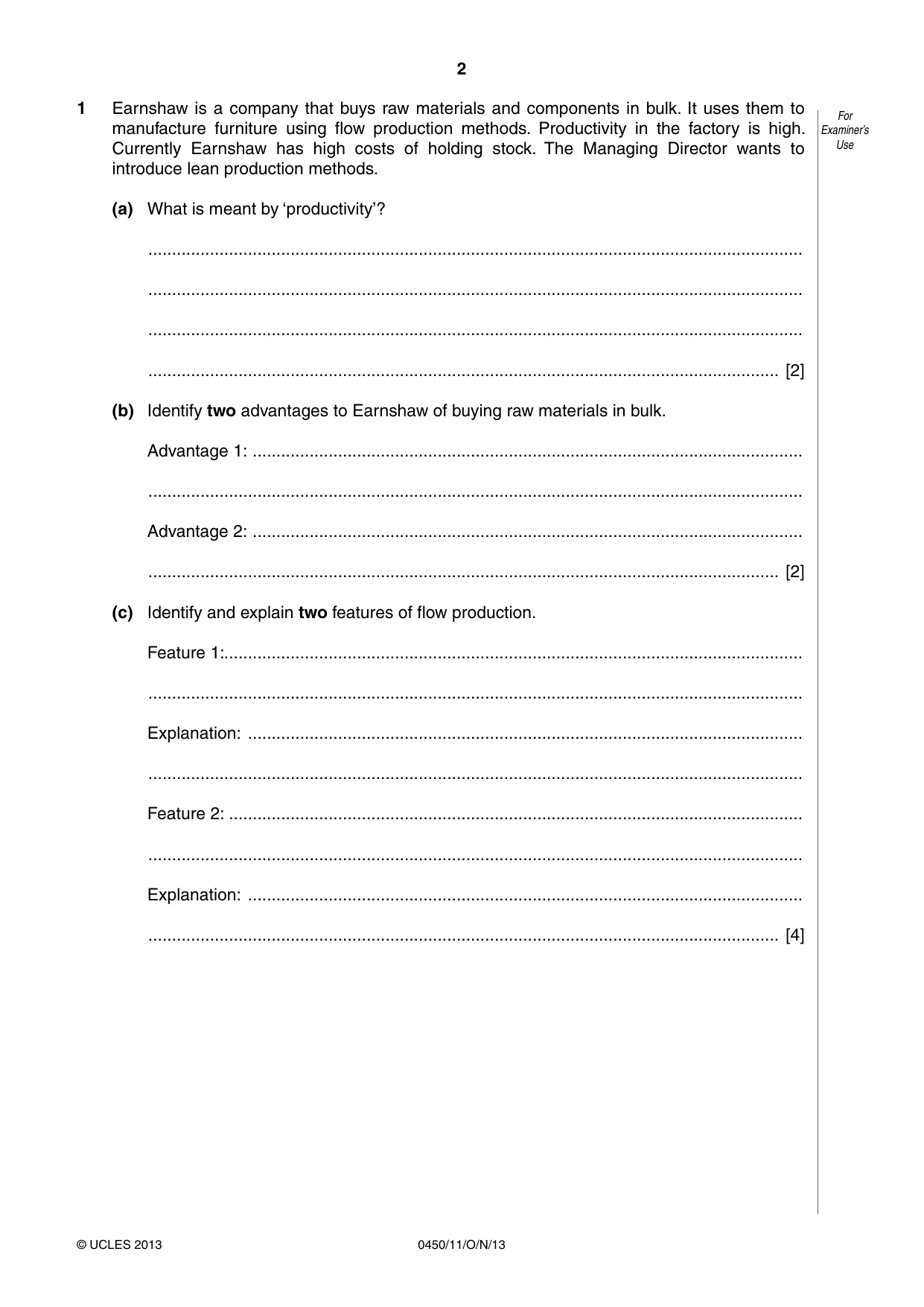
Question paper, page 2
2 0450/11/O/N/13 © UCLES 2013 For Examiner’s Use 1 Earnshaw is a company that buys raw materials and components in bulk. It uses them to manufacture furniture using flow production methods. Productivity in the factory is high. Currently Earnshaw has high costs of holding stock. The Managing Director wants to introduce lean production methods. (a) What is meant by ‘productivity’? … … … … [2] (b) Identify two advantages to Earnshaw of buying raw materials in bulk. Advantage 1: … … Advantage 2: … … [2] (c) Identify and explain two features of flow production. Feature 1: … … Explanation: … … Feature 2: … … Explanation: … … [4]
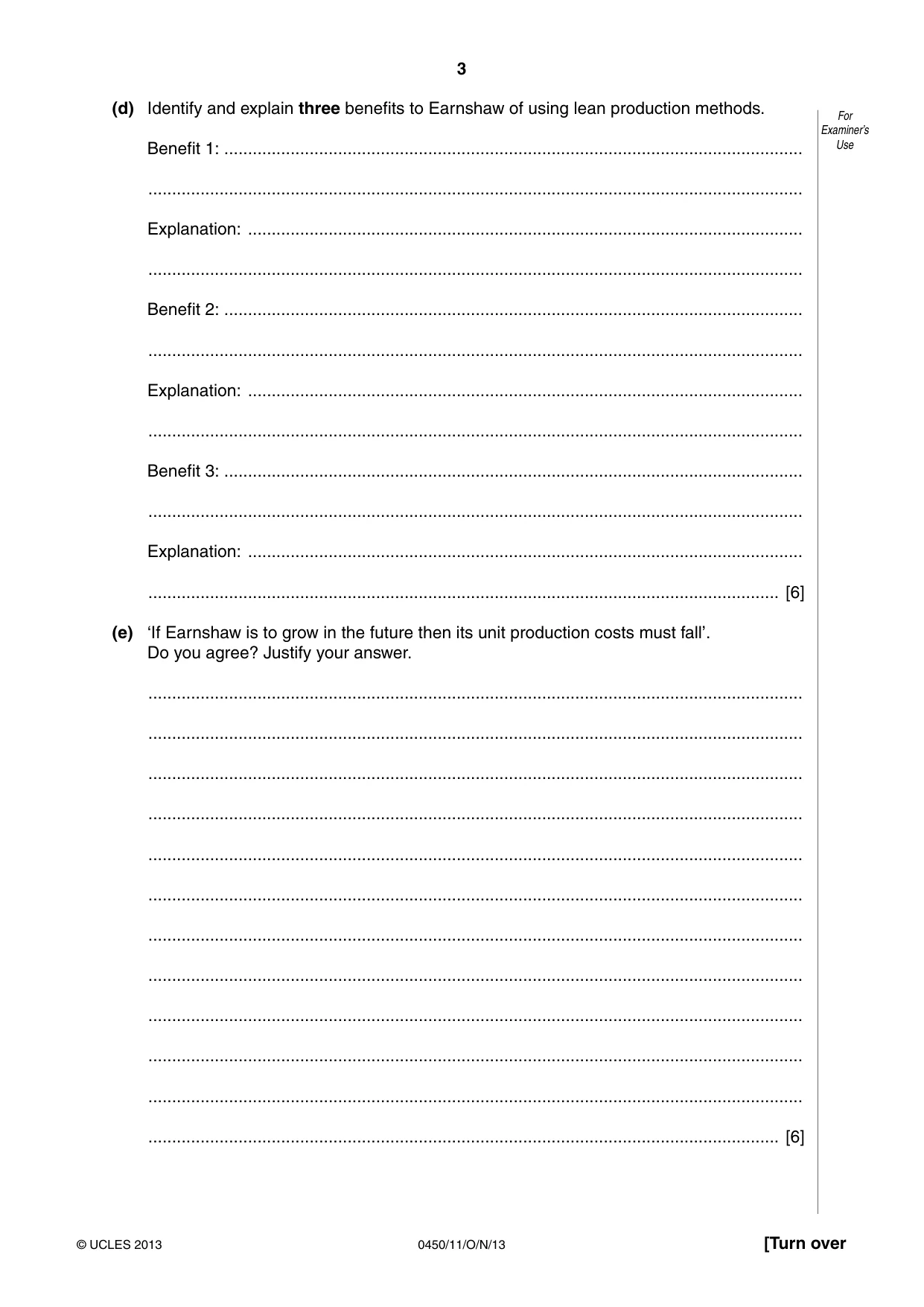
Question paper, page 3
3 0450/11/O/N/13 © UCLES 2013 [Turn over For Examiner’s Use (d) Identify and explain three benefits to Earnshaw of using lean production methods. Benefit 1: … … Explanation: … … Benefit 2: … … Explanation: … … Benefit 3: … … Explanation: … … [6] (e) ‘If Earnshaw is to grow in the future then its unit production costs must fall’. Do you agree? Justify your answer. … … … … … … … … … … … … [6]
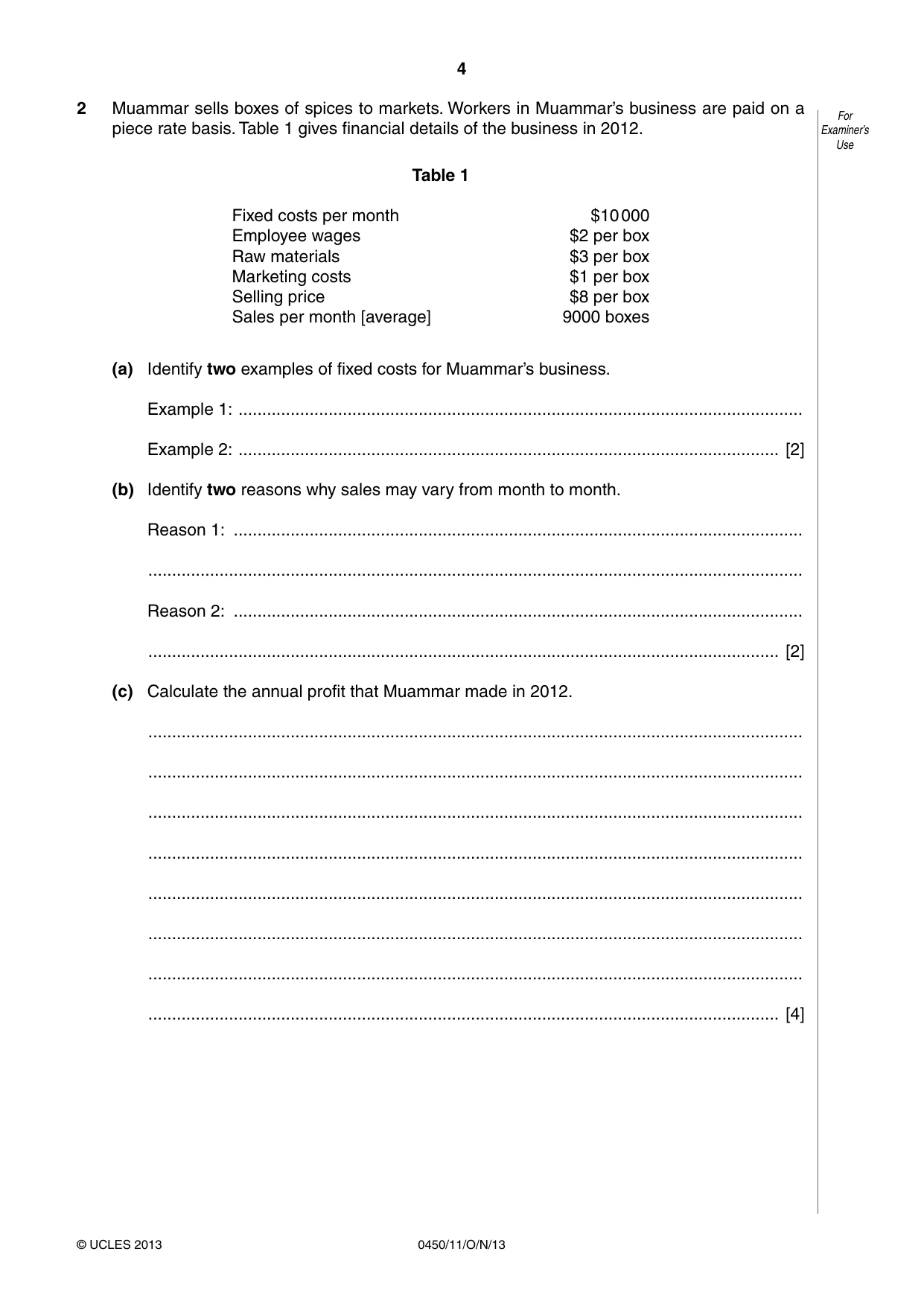
Question paper, page 4
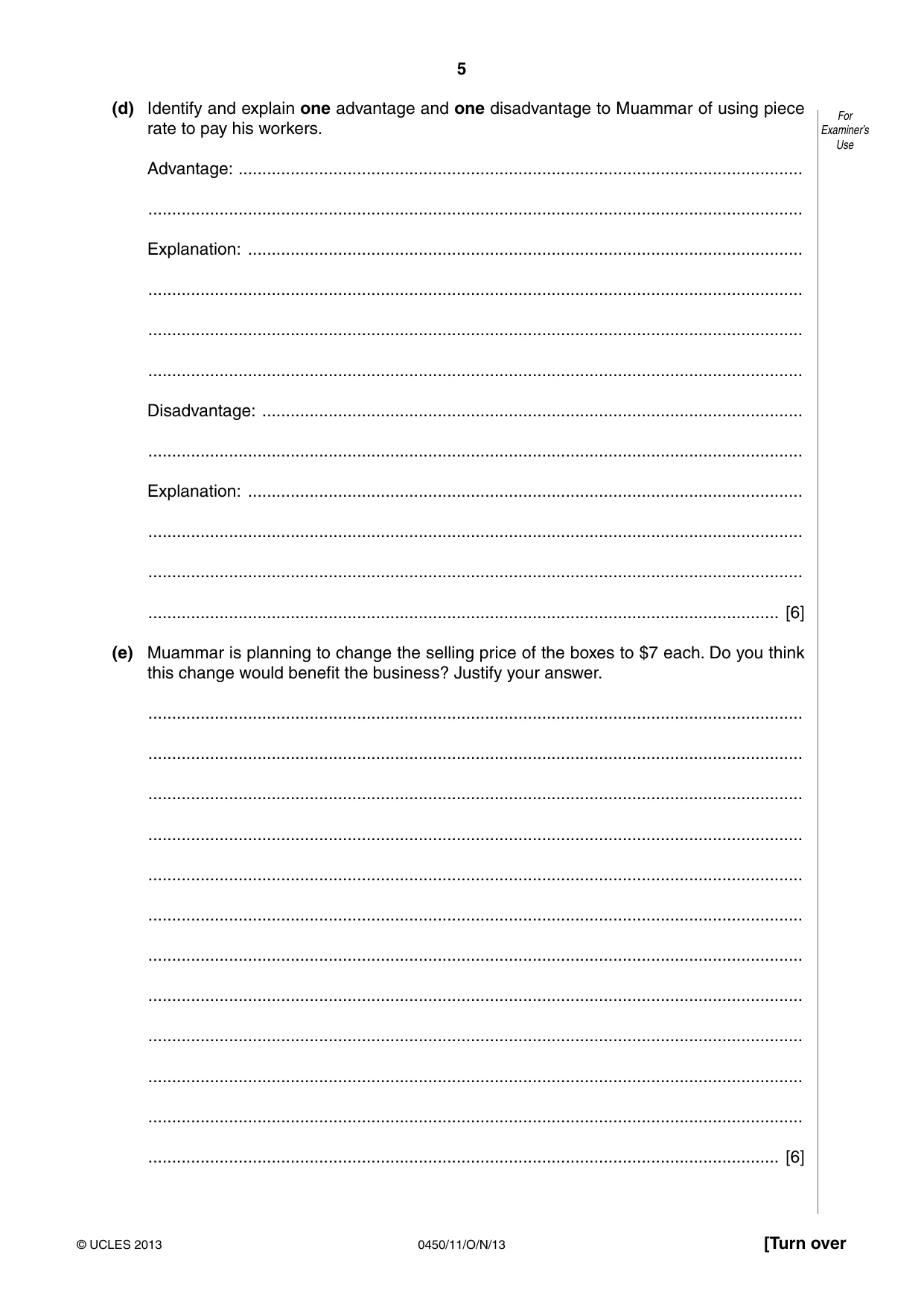
4 0450/11/O/N/13 © UCLES 2013 For Examiner’s Use 2 Muammar sells boxes of spices to markets. Workers in Muammar’s business are paid on a piece rate basis. Table 1 gives financial details of the business in 2012. Table 1 Fixed costs per month $10 000 Employee wages $2 per box Raw materials $3 per box Marketing costs $1 per box Selling price $8 per box Sales per month [average] 9000 boxes (a) Identify two examples of fixed costs for Muammar’s business. Example 1: … Example 2: … [2] (b) Identify two reasons why sales may vary from month to month. Reason 1: … … Reason 2: … … [2] (c) Calculate the annual profit that Muammar made in 2012. … … … … … … … … [4]
Question paper, page 5
5 0450/11/O/N/13 © UCLES 2013 [Turn over For Examiner’s Use (d) Identify and explain one advantage and one disadvantage to Muammar of using piece rate to pay his workers. Advantage: … … Explanation: … … … … Disadvantage: … … Explanation: … … … … [6] (e) Muammar is planning to change the selling price of the boxes to $7 each. Do you think this change would benefit the business? Justify your answer. … … … … … … … … … … … … [6]
Question paper, page 6
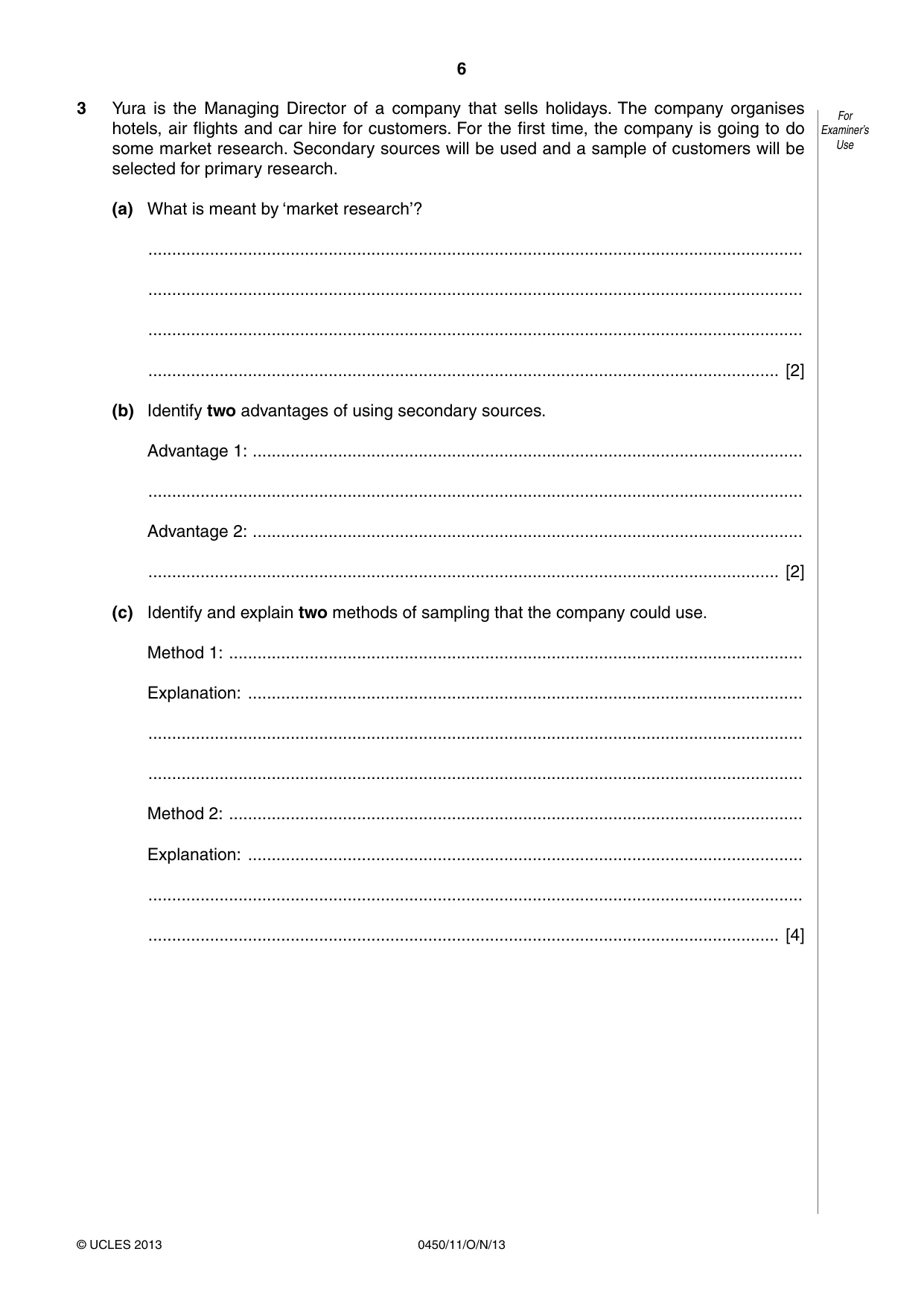
6 0450/11/O/N/13 © UCLES 2013 For Examiner’s Use 3 Yura is the Managing Director of a company that sells holidays. The company organises hotels, air flights and car hire for customers. For the first time, the company is going to do some market research. Secondary sources will be used and a sample of customers will be selected for primary research. (a) What is meant by ‘market research’? … … … … [2] (b) Identify two advantages of using secondary sources. Advantage 1: … … Advantage 2: … … [2] (c) Identify and explain two methods of sampling that the company could use. Method 1: … Explanation: … … … Method 2: … Explanation: … … … [4]
Question paper, page 7
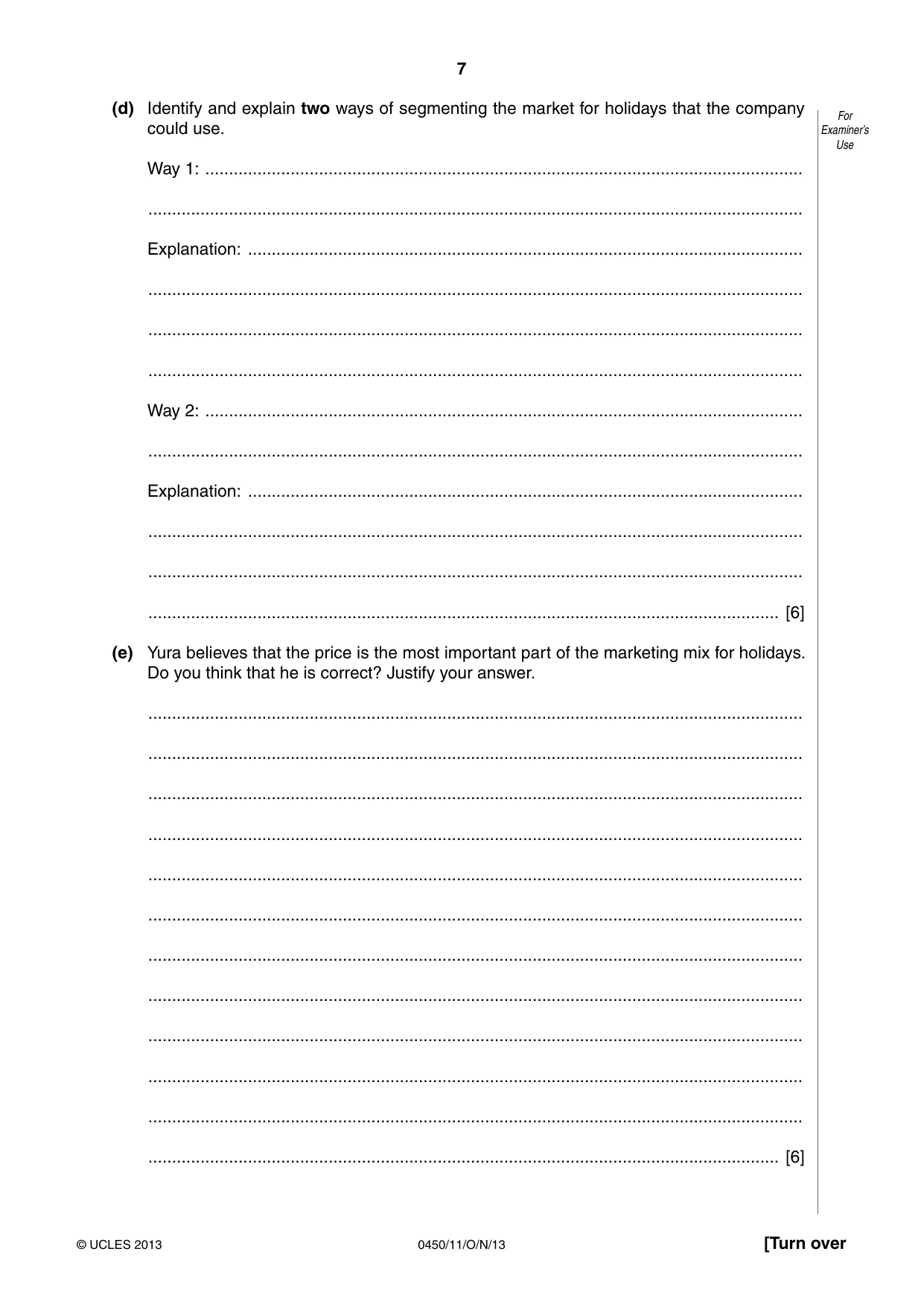
7 0450/11/O/N/13 © UCLES 2013 [Turn over For Examiner’s Use (d) Identify and explain two ways of segmenting the market for holidays that the company could use. Way 1: … … Explanation: … … … … Way 2: … … Explanation: … … … … [6] (e) Yura believes that the price is the most important part of the marketing mix for holidays. Do you think that he is correct? Justify your answer. … … … … … … … … … … … … [6]
Question paper, page 8
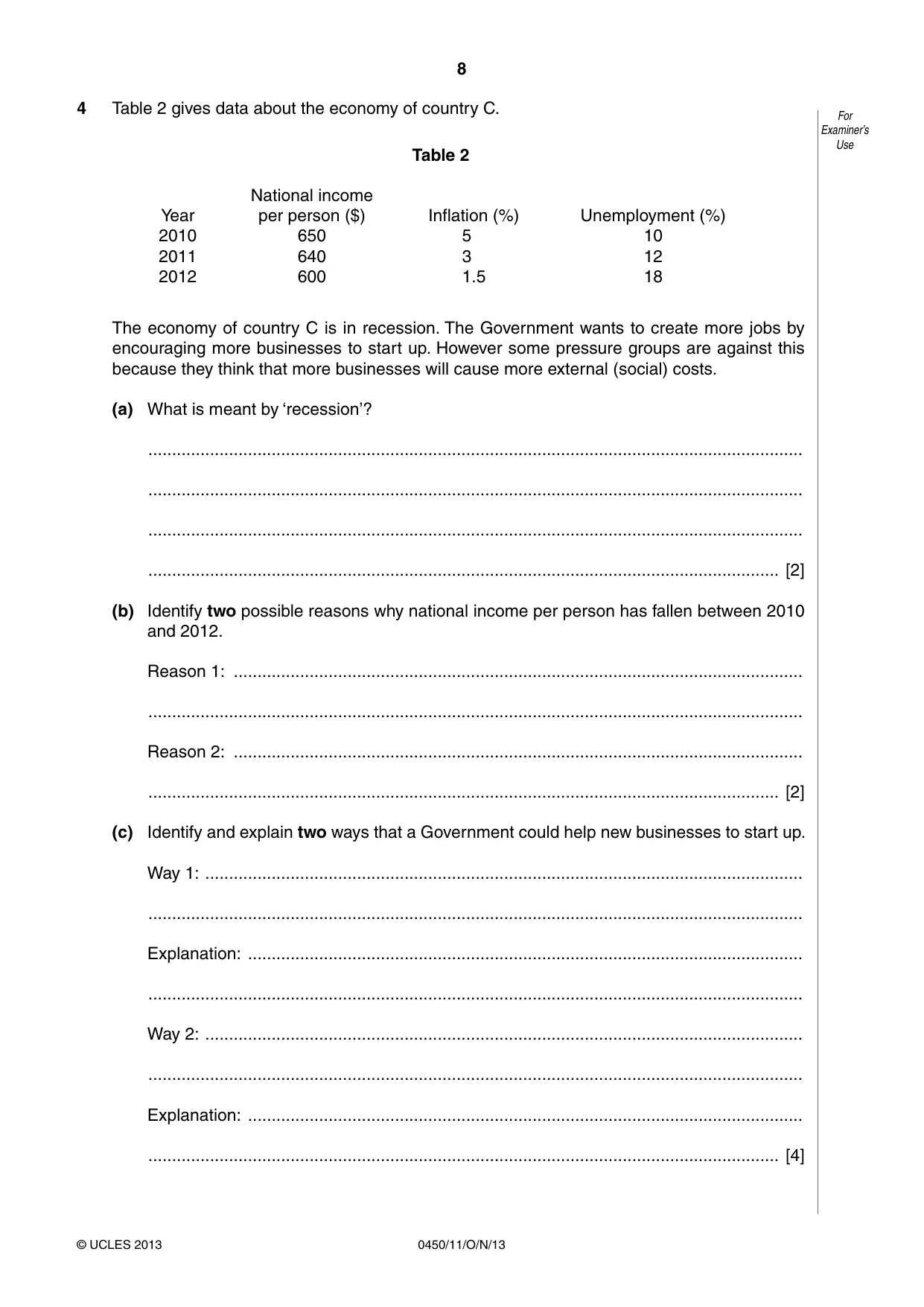
8 0450/11/O/N/13 © UCLES 2013 For Examiner’s Use 4 Table 2 gives data about the economy of country C. Table 2 National income Year per person ($) Inflation (%) Unemployment (%) 2010 650 5 10 2011 640 3 12 2012 600 1.5 18 The economy of country C is in recession. The Government wants to create more jobs by encouraging more businesses to start up. However some pressure groups are against this because they think that more businesses will cause more external (social) costs. (a) What is meant by ‘recession’? … … … … [2] (b) Identify two possible reasons why national income per person has fallen between 2010 and 2012. Reason 1: … … Reason 2: … … [2] (c) Identify and explain two ways that a Government could help new businesses to start up. Way 1: … … Explanation: … … Way 2: … … Explanation: … … [4]
Question paper, page 9
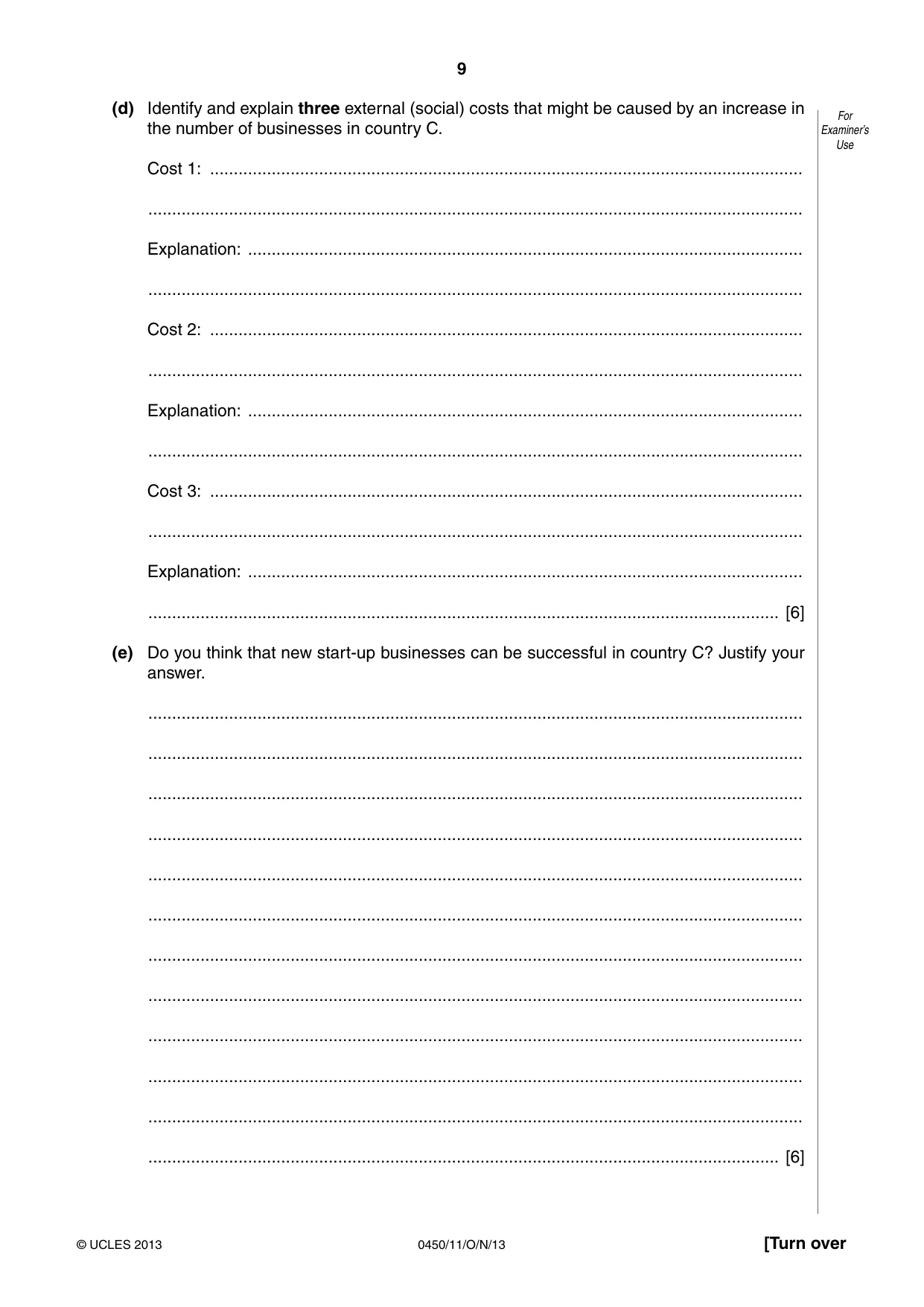
9 0450/11/O/N/13 © UCLES 2013 [Turn over For Examiner’s Use (d) Identify and explain three external (social) costs that might be caused by an increase in the number of businesses in country C. Cost 1: … … Explanation: … … Cost 2: … … Explanation: … … Cost 3: … … Explanation: … … [6] (e) Do you think that new start-up businesses can be successful in country C? Justify your answer. … … … … … … … … … … … … [6]
Question paper, page 10
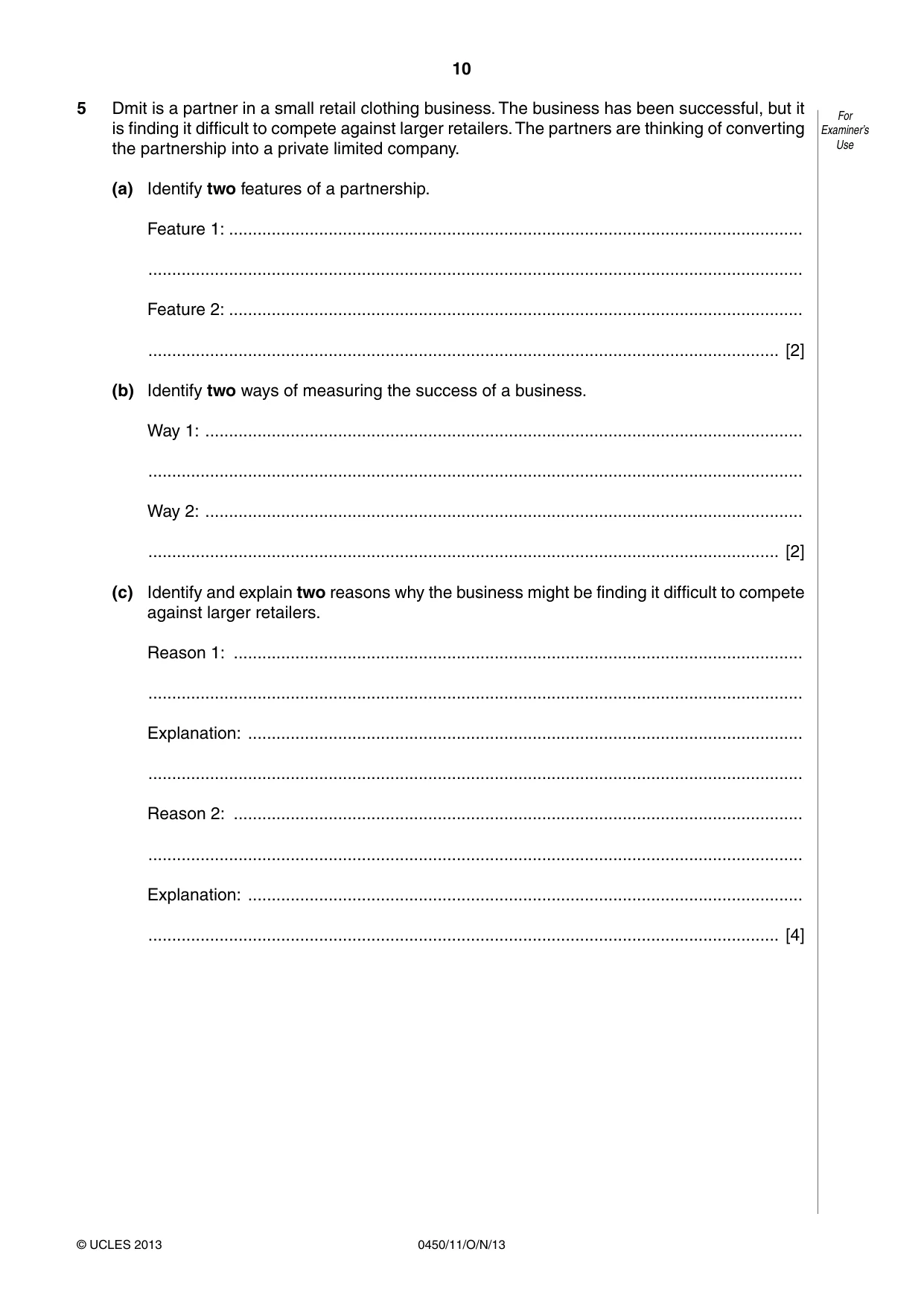
10 0450/11/O/N/13 © UCLES 2013 For Examiner’s Use 5 Dmit is a partner in a small retail clothing business. The business has been successful, but it is finding it difficult to compete against larger retailers. The partners are thinking of converting the partnership into a private limited company. (a) Identify two features of a partnership. Feature 1: … … Feature 2: … … [2] (b) Identify two ways of measuring the success of a business. Way 1: … … Way 2: … … [2] (c) Identify and explain two reasons why the business might be finding it difficult to compete against larger retailers. Reason 1: … … Explanation: … … Reason 2: … … Explanation: … … [4]
Question paper, page 11
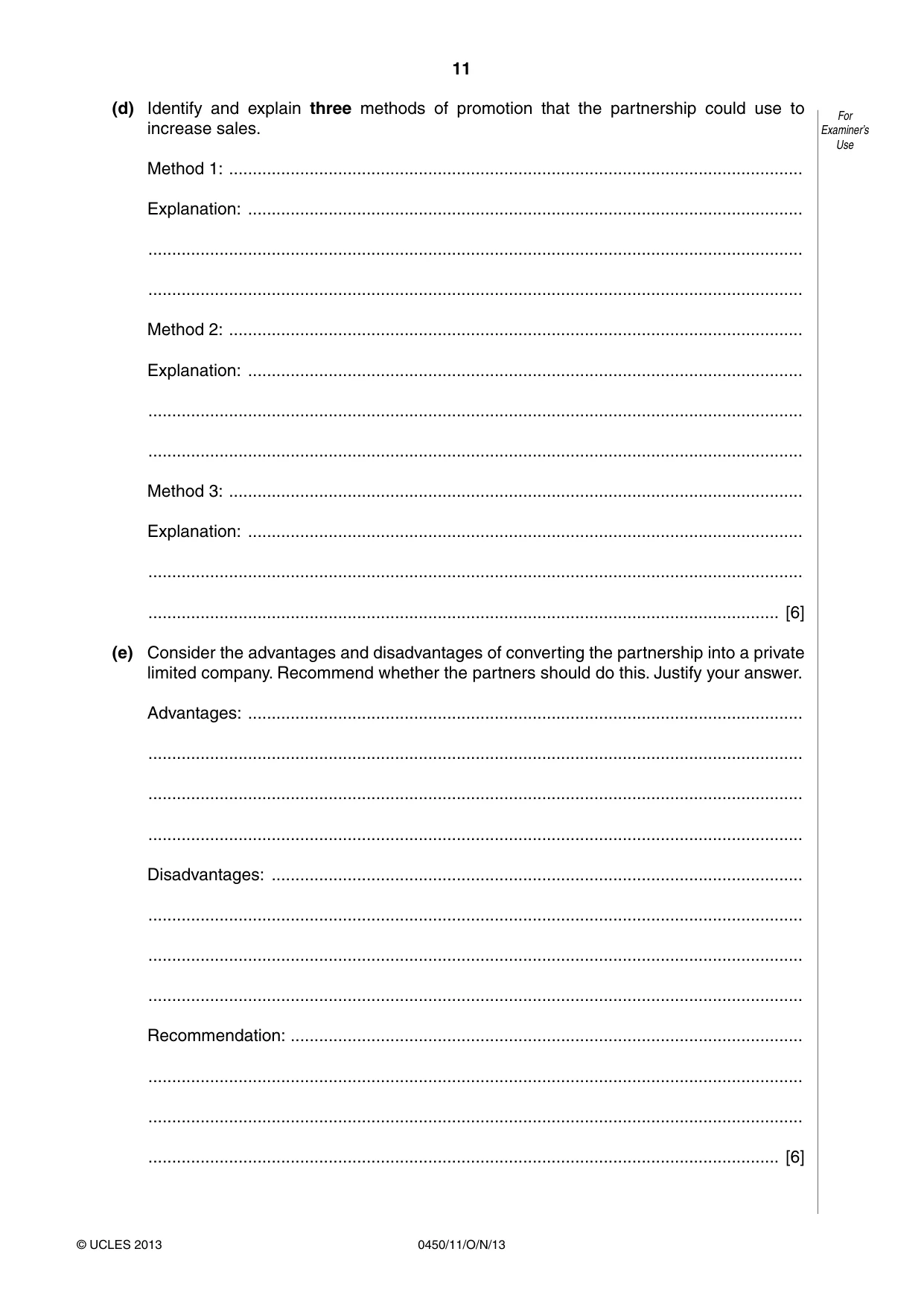
11 0450/11/O/N/13 © UCLES 2013 For Examiner’s Use (d) Identify and explain three methods of promotion that the partnership could use to increase sales. Method 1: … Explanation: … … … Method 2: … Explanation: … … … Method 3: … Explanation: … … … [6] (e) Consider the advantages and disadvantages of converting the partnership into a private limited company. Recommend whether the partners should do this. Justify your answer. Advantages: … … … … Disadvantages: … … … … Recommendation: … … … … [6]
Question paper, page 12
12 0450/11/O/N/13 © UCLES 2013 Permission to reproduce items where third-party owned material protected by copyright is included has been sought and cleared where possible. Every reasonable effort has been made by the publisher (UCLES) to trace copyright holders, but if any items requiring clearance have unwittingly been included, the publisher will be pleased to make amends at the earliest possible opportunity. University of Cambridge International Examinations is part of the Cambridge Assessment Group. Cambridge Assessment is the brand name of University of Cambridge Local Examinations Syndicate (UCLES), which is itself a department of the University of Cambridge. BLANK PAGE
Mark scheme, page 1
CAMBRIDGE INTERNATIONAL EXAMINATIONS International General Certificate of Secondary Education MARK SCHEME for the October/November 2013 series 0450 BUSINESS STUDIES 0450/11 Paper 1 (Short Answer/Structured Response), maximum raw mark 100 This mark scheme is published as an aid to teachers and candidates, to indicate the requirements of the examination. It shows the basis on which Examiners were instructed to award marks. It does not indicate the details of the discussions that took place at an Examiners’ meeting before marking began, which would have considered the acceptability of alternative answers. Mark schemes should be read in conjunction with the question paper and the Principal Examiner Report for Teachers. Cambridge will not enter into discussions about these mark schemes. Cambridge is publishing the mark schemes for the October/November 2013 series for most IGCSE, GCE Advanced Level and Advanced Subsidiary Level components and some Ordinary Level components.
Mark scheme, page 2
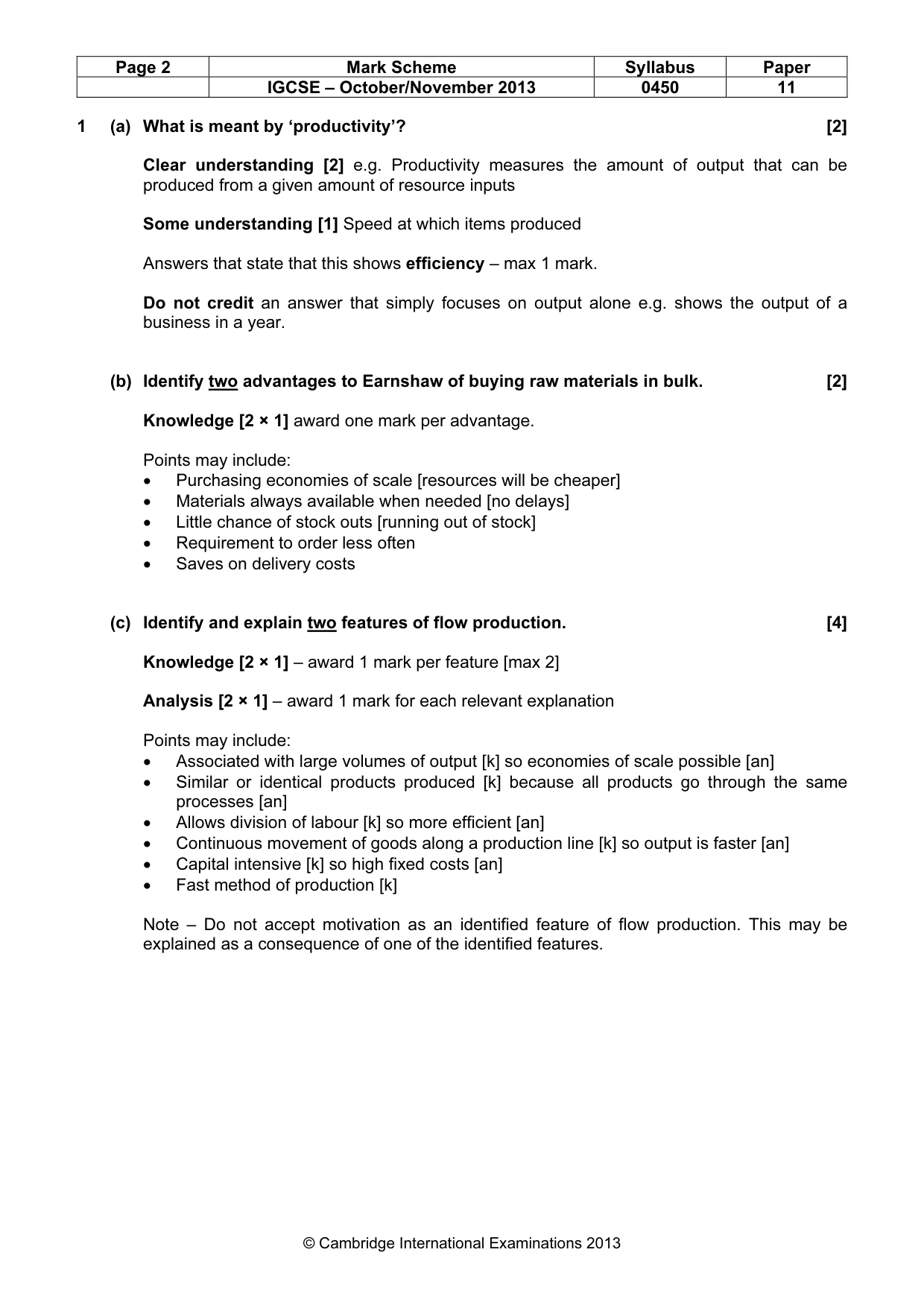
Page 2 Mark Scheme Syllabus Paper IGCSE – October/November 2013 0450 11 © Cambridge International Examinations 2013 1 (a) What is meant by ‘productivity’? [2] Clear understanding [2] e.g. Productivity measures the amount of output that can be produced from a given amount of resource inputs Some understanding [1] Speed at which items produced Answers that state that this shows efficiency – max 1 mark. Do not credit an answer that simply focuses on output alone e.g. shows the output of a business in a year. (b) Identify two advantages to Earnshaw of buying raw materials in bulk. [2] Knowledge [2 × 1] award one mark per advantage. Points may include: • Purchasing economies of scale [resources will be cheaper] • Materials always available when needed [no delays] • Little chance of stock outs [running out of stock] • Requirement to order less often • Saves on delivery costs (c) Identify and explain two features of flow production. [4] Knowledge [2 × 1] – award 1 mark per feature [max 2] Analysis [2 × 1] – award 1 mark for each relevant explanation Points may include: • Associated with large volumes of output [k] so economies of scale possible [an] • Similar or identical products produced [k] because all products go through the same processes [an] • Allows division of labour [k] so more efficient [an] • Continuous movement of goods along a production line [k] so output is faster [an] • Capital intensive [k] so high fixed costs [an] • Fast method of production [k] Note – Do not accept motivation as an identified feature of flow production. This may be explained as a consequence of one of the identified features.
Mark scheme, page 3
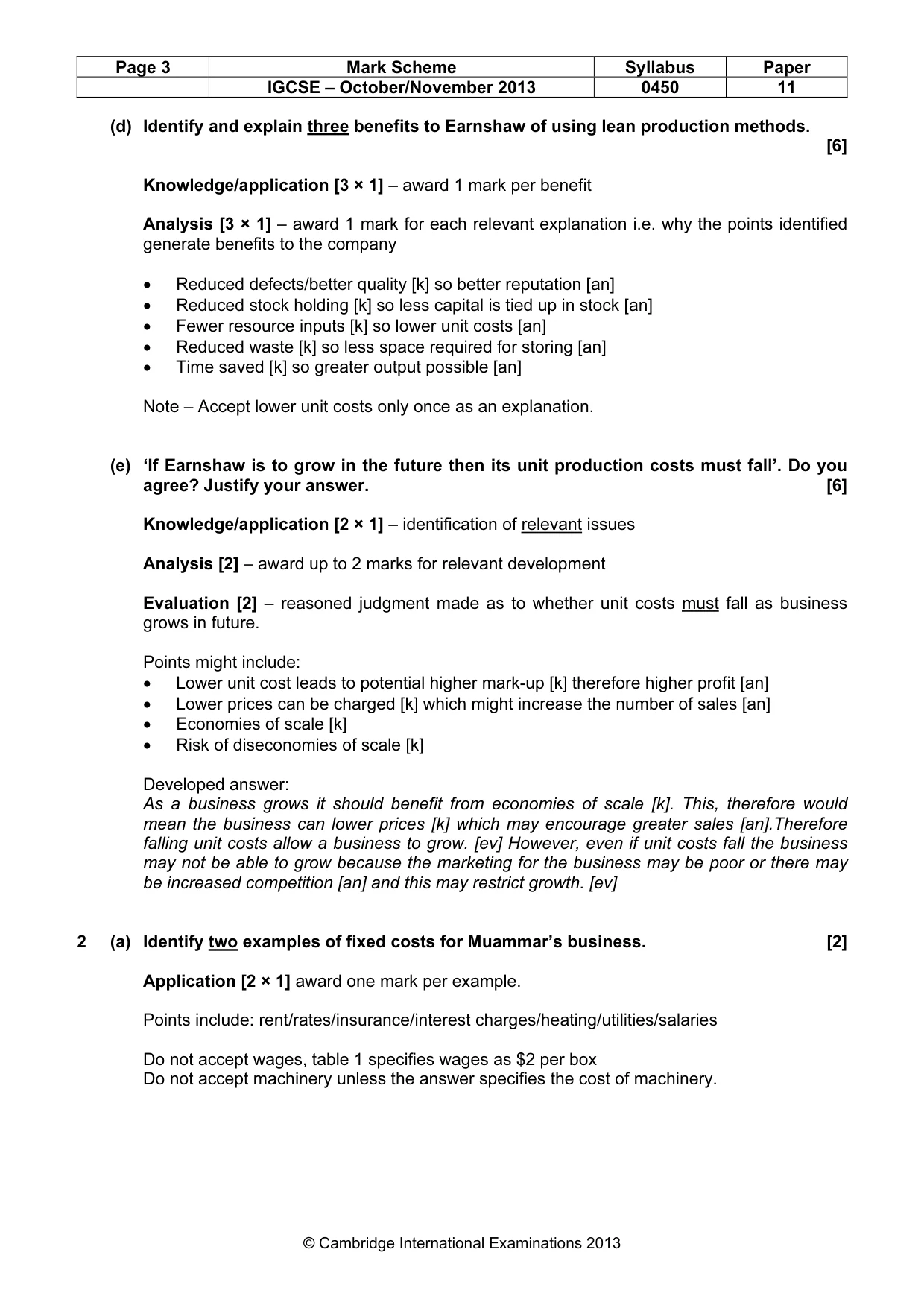
Page 3 Mark Scheme Syllabus Paper IGCSE – October/November 2013 0450 11 © Cambridge International Examinations 2013 (d) Identify and explain three benefits to Earnshaw of using lean production methods. [6] Knowledge/application [3 × 1] – award 1 mark per benefit Analysis [3 × 1] – award 1 mark for each relevant explanation i.e. why the points identified generate benefits to the company • Reduced defects/better quality [k] so better reputation [an] • Reduced stock holding [k] so less capital is tied up in stock [an] • Fewer resource inputs [k] so lower unit costs [an] • Reduced waste [k] so less space required for storing [an] • Time saved [k] so greater output possible [an] Note – Accept lower unit costs only once as an explanation. (e) ‘If Earnshaw is to grow in the future then its unit production costs must fall’. Do you agree? Justify your answer. [6] Knowledge/application [2 × 1] – identification of relevant issues Analysis [2] – award up to 2 marks for relevant development Evaluation [2] – reasoned judgment made as to whether unit costs must fall as business grows in future. Points might include: • Lower unit cost leads to potential higher mark-up [k] therefore higher profit [an] • Lower prices can be charged [k] which might increase the number of sales [an] • Economies of scale [k] • Risk of diseconomies of scale [k] Developed answer: As a business grows it should benefit from economies of scale [k]. This, therefore would mean the business can lower prices [k] which may encourage greater sales [an].Therefore falling unit costs allow a business to grow. [ev] However, even if unit costs fall the business may not be able to grow because the marketing for the business may be poor or there may be increased competition [an] and this may restrict growth. [ev] 2 (a) Identify two examples of fixed costs for Muammar’s business. [2] Application [2 × 1] award one mark per example. Points include: rent/rates/insurance/interest charges/heating/utilities/salaries Do not accept wages, table 1 specifies wages as $2 per box Do not accept machinery unless the answer specifies the cost of machinery.
Mark scheme, page 4
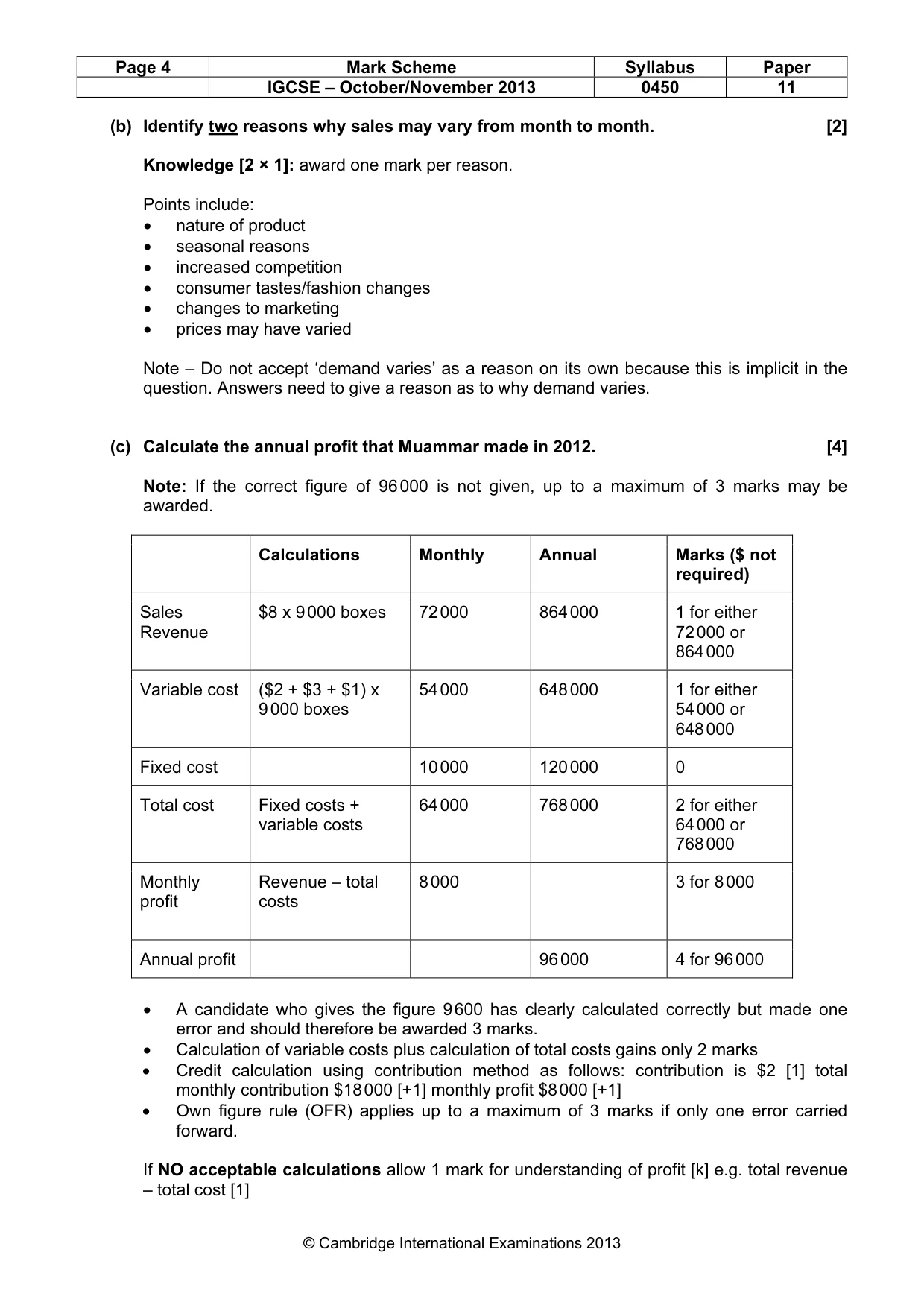
Page 4 Mark Scheme Syllabus Paper IGCSE – October/November 2013 0450 11 © Cambridge International Examinations 2013 (b) Identify two reasons why sales may vary from month to month. [2] Knowledge [2 × 1]: award one mark per reason. Points include: • nature of product • seasonal reasons • increased competition • consumer tastes/fashion changes • changes to marketing • prices may have varied Note – Do not accept ‘demand varies’ as a reason on its own because this is implicit in the question. Answers need to give a reason as to why demand varies. (c) Calculate the annual profit that Muammar made in 2012. [4] Note: If the correct figure of 96 000 is not given, up to a maximum of 3 marks may be awarded. Calculations Monthly Annual Marks ($ not required) Sales Revenue $8 x 9 000 boxes 72 000 864 000 1 for either 72 000 or 864 000 Variable cost ($2 + $3 + $1) x 9 000 boxes 54 000 648 000 1 for either 54 000 or 648 000 Fixed cost 10 000 120 000 0 Total cost Fixed costs + variable costs 64 000 768 000 2 for either 64 000 or 768 000 Monthly profit Revenue – total costs 8 000 3 for 8 000 Annual profit 96 000 4 for 96 000 • A candidate who gives the figure 9 600 has clearly calculated correctly but made one error and should therefore be awarded 3 marks. • Calculation of variable costs plus calculation of total costs gains only 2 marks • Credit calculation using contribution method as follows: contribution is $2 [1] total monthly contribution $18 000 [+1] monthly profit $8 000 [+1] • Own figure rule (OFR) applies up to a maximum of 3 marks if only one error carried forward. If NO acceptable calculations allow 1 mark for understanding of profit [k] e.g. total revenue – total cost [1]
Mark scheme, page 5
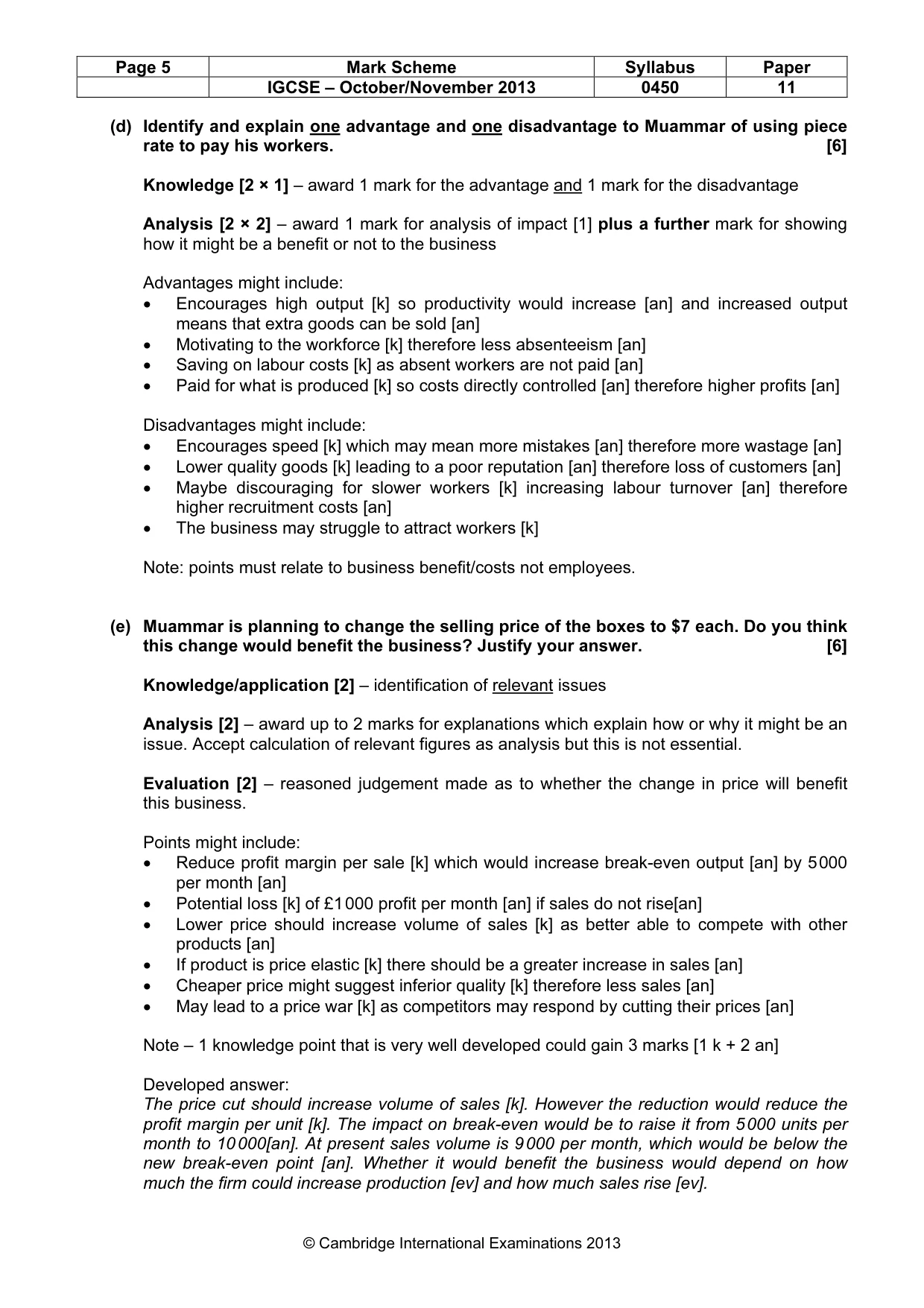
Page 5 Mark Scheme Syllabus Paper IGCSE – October/November 2013 0450 11 © Cambridge International Examinations 2013 (d) Identify and explain one advantage and one disadvantage to Muammar of using piece rate to pay his workers. [6] Knowledge [2 × 1] – award 1 mark for the advantage and 1 mark for the disadvantage Analysis [2 × 2] – award 1 mark for analysis of impact [1] plus a further mark for showing how it might be a benefit or not to the business Advantages might include: • Encourages high output [k] so productivity would increase [an] and increased output means that extra goods can be sold [an] • Motivating to the workforce [k] therefore less absenteeism [an] • Saving on labour costs [k] as absent workers are not paid [an] • Paid for what is produced [k] so costs directly controlled [an] therefore higher profits [an] Disadvantages might include: • Encourages speed [k] which may mean more mistakes [an] therefore more wastage [an] • Lower quality goods [k] leading to a poor reputation [an] therefore loss of customers [an] • Maybe discouraging for slower workers [k] increasing labour turnover [an] therefore higher recruitment costs [an] • The business may struggle to attract workers [k] Note: points must relate to business benefit/costs not employees. (e) Muammar is planning to change the selling price of the boxes to $7 each. Do you think this change would benefit the business? Justify your answer. [6] Knowledge/application [2] – identification of relevant issues Analysis [2] – award up to 2 marks for explanations which explain how or why it might be an issue. Accept calculation of relevant figures as analysis but this is not essential. Evaluation [2] – reasoned judgement made as to whether the change in price will benefit this business. Points might include: • Reduce profit margin per sale [k] which would increase break-even output [an] by 5 000 per month [an] • Potential loss [k] of £1 000 profit per month [an] if sales do not rise[an] • Lower price should increase volume of sales [k] as better able to compete with other products [an] • If product is price elastic [k] there should be a greater increase in sales [an] • Cheaper price might suggest inferior quality [k] therefore less sales [an] • May lead to a price war [k] as competitors may respond by cutting their prices [an] Note – 1 knowledge point that is very well developed could gain 3 marks [1 k + 2 an] Developed answer: The price cut should increase volume of sales [k]. However the reduction would reduce the profit margin per unit [k]. The impact on break-even would be to raise it from 5 000 units per month to 10 000[an]. At present sales volume is 9 000 per month, which would be below the new break-even point [an]. Whether it would benefit the business would depend on how much the firm could increase production [ev] and how much sales rise [ev].
Mark scheme, page 6
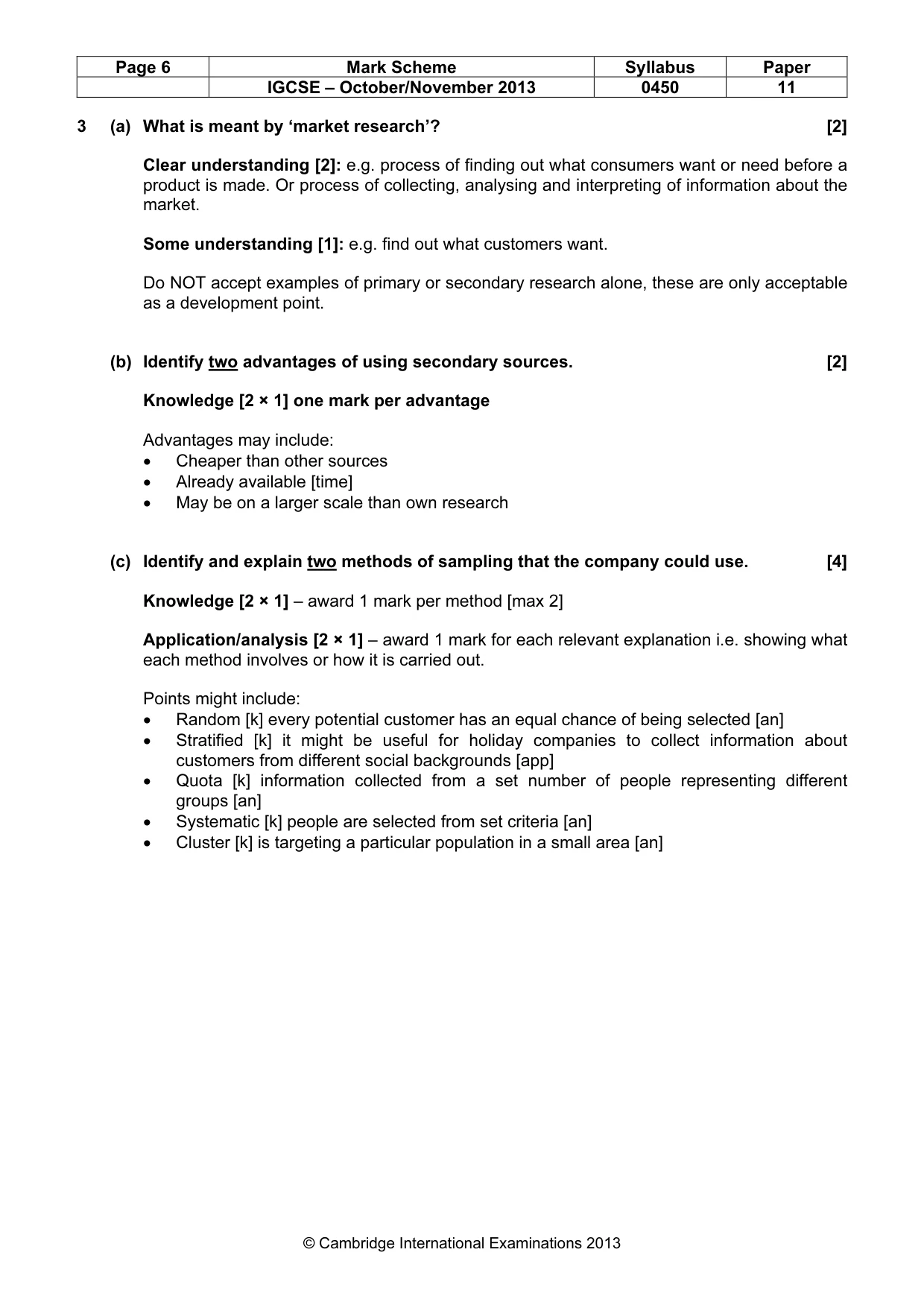
Page 6 Mark Scheme Syllabus Paper IGCSE – October/November 2013 0450 11 © Cambridge International Examinations 2013 3 (a) What is meant by ‘market research’? [2] Clear understanding [2]: e.g. process of finding out what consumers want or need before a product is made. Or process of collecting, analysing and interpreting of information about the market. Some understanding [1]: e.g. find out what customers want. Do NOT accept examples of primary or secondary research alone, these are only acceptable as a development point. (b) Identify two advantages of using secondary sources. [2] Knowledge [2 × 1] one mark per advantage Advantages may include: • Cheaper than other sources • Already available [time] • May be on a larger scale than own research (c) Identify and explain two methods of sampling that the company could use. [4] Knowledge [2 × 1] – award 1 mark per method [max 2] Application/analysis [2 × 1] – award 1 mark for each relevant explanation i.e. showing what each method involves or how it is carried out. Points might include: • Random [k] every potential customer has an equal chance of being selected [an] • Stratified [k] it might be useful for holiday companies to collect information about customers from different social backgrounds [app] • Quota [k] information collected from a set number of people representing different groups [an] • Systematic [k] people are selected from set criteria [an] • Cluster [k] is targeting a particular population in a small area [an]
Mark scheme, page 7
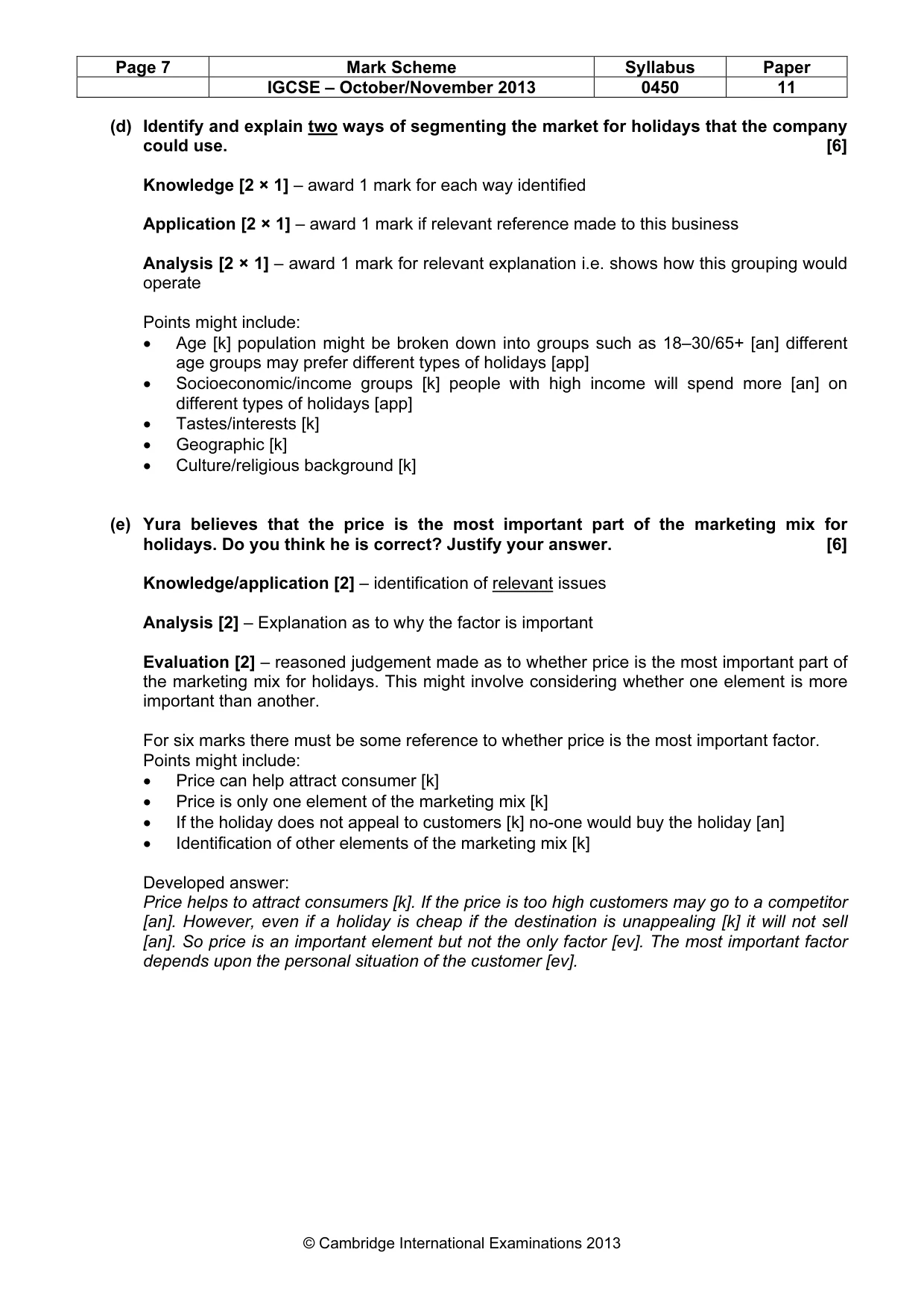
Page 7 Mark Scheme Syllabus Paper IGCSE – October/November 2013 0450 11 © Cambridge International Examinations 2013 (d) Identify and explain two ways of segmenting the market for holidays that the company could use. [6] Knowledge [2 × 1] – award 1 mark for each way identified Application [2 × 1] – award 1 mark if relevant reference made to this business Analysis [2 × 1] – award 1 mark for relevant explanation i.e. shows how this grouping would operate Points might include: • Age [k] population might be broken down into groups such as 18–30/65+ [an] different age groups may prefer different types of holidays [app] • Socioeconomic/income groups [k] people with high income will spend more [an] on different types of holidays [app] • Tastes/interests [k] • Geographic [k] • Culture/religious background [k] (e) Yura believes that the price is the most important part of the marketing mix for holidays. Do you think he is correct? Justify your answer. [6] Knowledge/application [2] – identification of relevant issues Analysis [2] – Explanation as to why the factor is important Evaluation [2] – reasoned judgement made as to whether price is the most important part of the marketing mix for holidays. This might involve considering whether one element is more important than another. For six marks there must be some reference to whether price is the most important factor. Points might include: • Price can help attract consumer [k] • Price is only one element of the marketing mix [k] • If the holiday does not appeal to customers [k] no-one would buy the holiday [an] • Identification of other elements of the marketing mix [k] Developed answer: Price helps to attract consumers [k]. If the price is too high customers may go to a competitor [an]. However, even if a holiday is cheap if the destination is unappealing [k] it will not sell [an]. So price is an important element but not the only factor [ev]. The most important factor depends upon the personal situation of the customer [ev].
Mark scheme, page 8
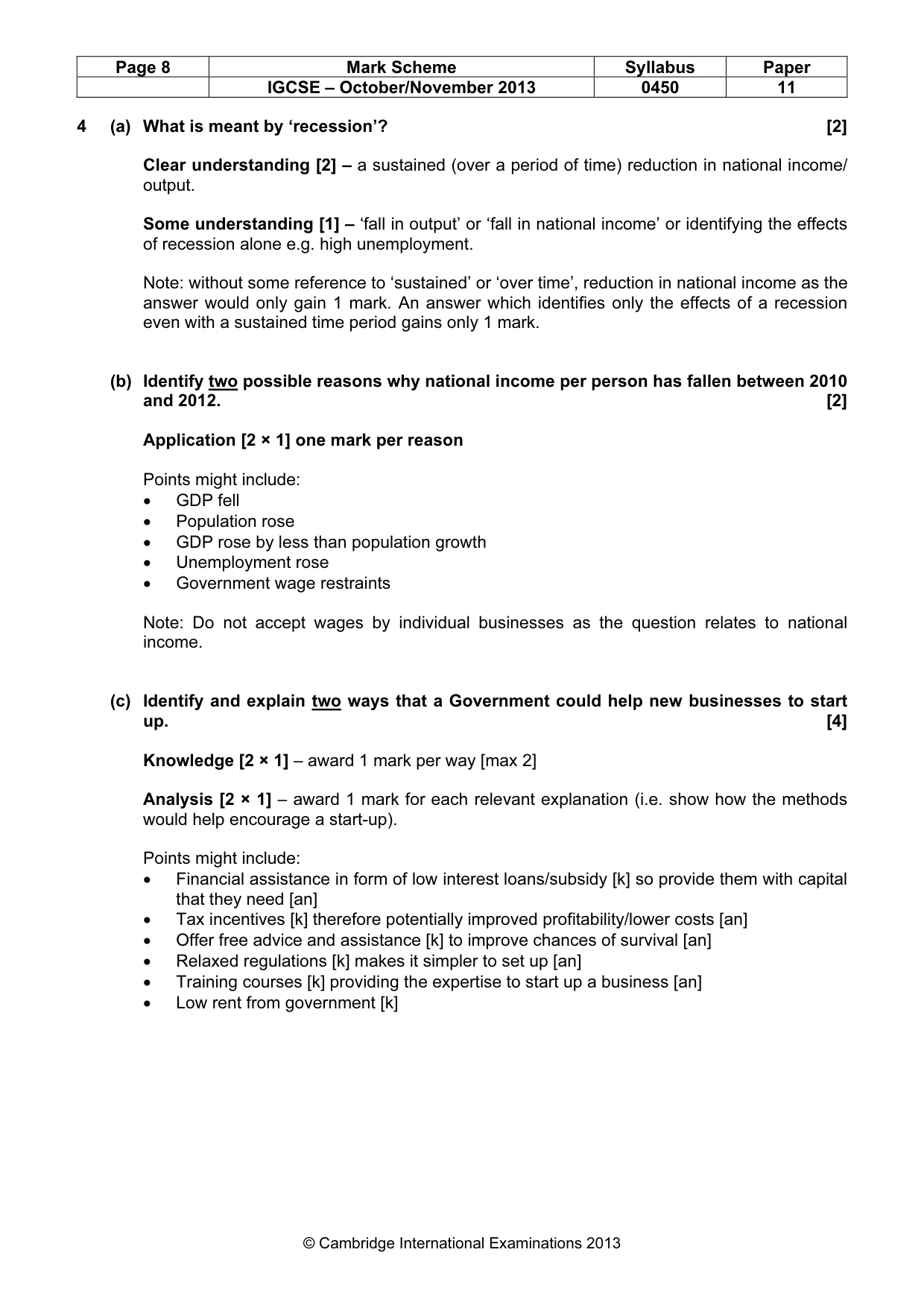
Page 8 Mark Scheme Syllabus Paper IGCSE – October/November 2013 0450 11 © Cambridge International Examinations 2013 4 (a) What is meant by ‘recession’? [2] Clear understanding [2] – a sustained (over a period of time) reduction in national income/ output. Some understanding [1] – ‘fall in output’ or ‘fall in national income’ or identifying the effects of recession alone e.g. high unemployment. Note: without some reference to ‘sustained’ or ‘over time’, reduction in national income as the answer would only gain 1 mark. An answer which identifies only the effects of a recession even with a sustained time period gains only 1 mark. (b) Identify two possible reasons why national income per person has fallen between 2010 and 2012. [2] Application [2 × 1] one mark per reason Points might include: • GDP fell • Population rose • GDP rose by less than population growth • Unemployment rose • Government wage restraints Note: Do not accept wages by individual businesses as the question relates to national income. (c) Identify and explain two ways that a Government could help new businesses to start up. [4] Knowledge [2 × 1] – award 1 mark per way [max 2] Analysis [2 × 1] – award 1 mark for each relevant explanation (i.e. show how the methods would help encourage a start-up). Points might include: • Financial assistance in form of low interest loans/subsidy [k] so provide them with capital that they need [an] • Tax incentives [k] therefore potentially improved profitability/lower costs [an] • Offer free advice and assistance [k] to improve chances of survival [an] • Relaxed regulations [k] makes it simpler to set up [an] • Training courses [k] providing the expertise to start up a business [an] • Low rent from government [k]
Mark scheme, page 9
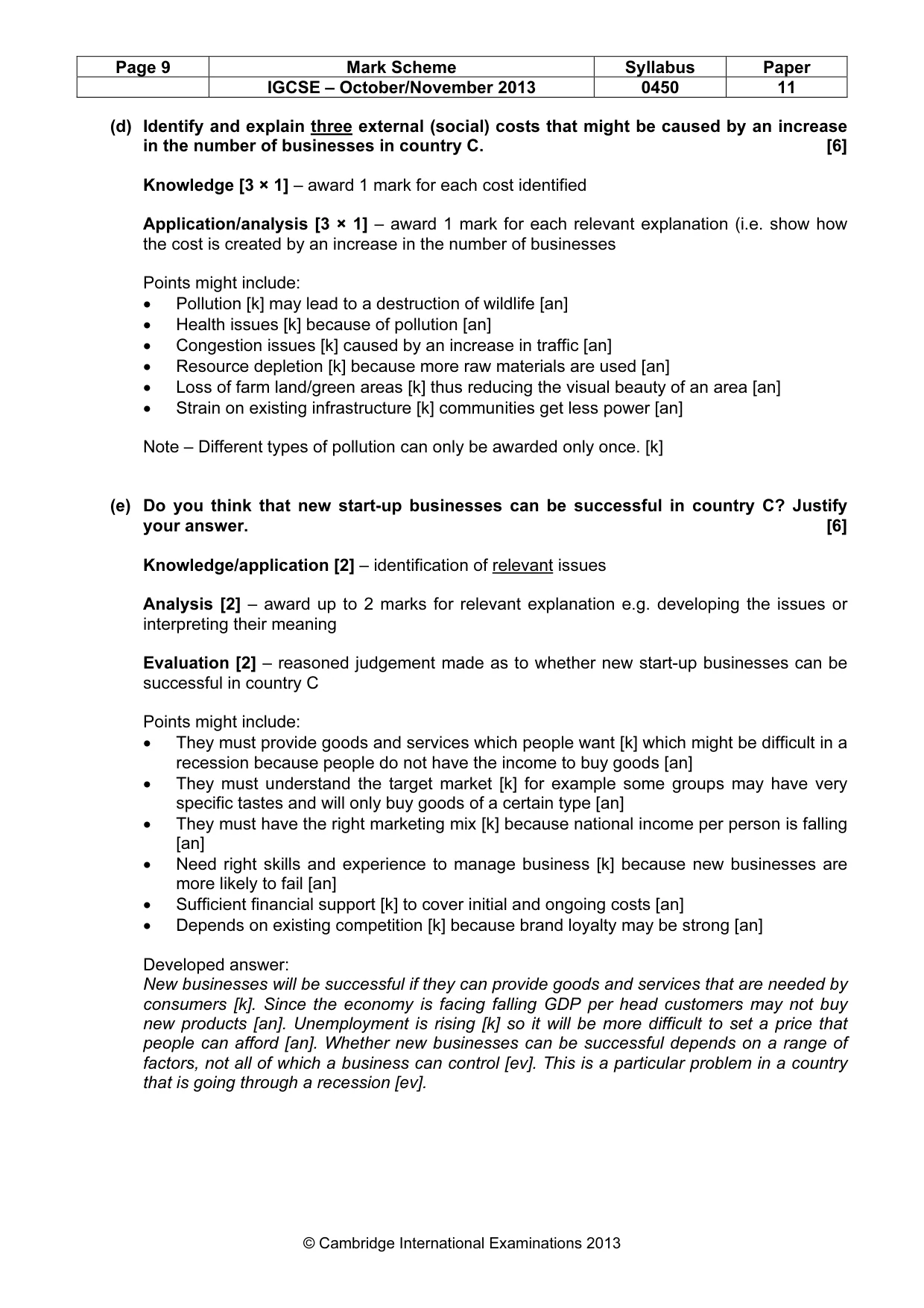
Page 9 Mark Scheme Syllabus Paper IGCSE – October/November 2013 0450 11 © Cambridge International Examinations 2013 (d) Identify and explain three external (social) costs that might be caused by an increase in the number of businesses in country C. [6] Knowledge [3 × 1] – award 1 mark for each cost identified Application/analysis [3 × 1] – award 1 mark for each relevant explanation (i.e. show how the cost is created by an increase in the number of businesses Points might include: • Pollution [k] may lead to a destruction of wildlife [an] • Health issues [k] because of pollution [an] • Congestion issues [k] caused by an increase in traffic [an] • Resource depletion [k] because more raw materials are used [an] • Loss of farm land/green areas [k] thus reducing the visual beauty of an area [an] • Strain on existing infrastructure [k] communities get less power [an] Note – Different types of pollution can only be awarded only once. [k] (e) Do you think that new start-up businesses can be successful in country C? Justify your answer. [6] Knowledge/application [2] – identification of relevant issues Analysis [2] – award up to 2 marks for relevant explanation e.g. developing the issues or interpreting their meaning Evaluation [2] – reasoned judgement made as to whether new start-up businesses can be successful in country C Points might include: • They must provide goods and services which people want [k] which might be difficult in a recession because people do not have the income to buy goods [an] • They must understand the target market [k] for example some groups may have very specific tastes and will only buy goods of a certain type [an] • They must have the right marketing mix [k] because national income per person is falling [an] • Need right skills and experience to manage business [k] because new businesses are more likely to fail [an] • Sufficient financial support [k] to cover initial and ongoing costs [an] • Depends on existing competition [k] because brand loyalty may be strong [an] Developed answer: New businesses will be successful if they can provide goods and services that are needed by consumers [k]. Since the economy is facing falling GDP per head customers may not buy new products [an]. Unemployment is rising [k] so it will be more difficult to set a price that people can afford [an]. Whether new businesses can be successful depends on a range of factors, not all of which a business can control [ev]. This is a particular problem in a country that is going through a recession [ev].
Mark scheme, page 10
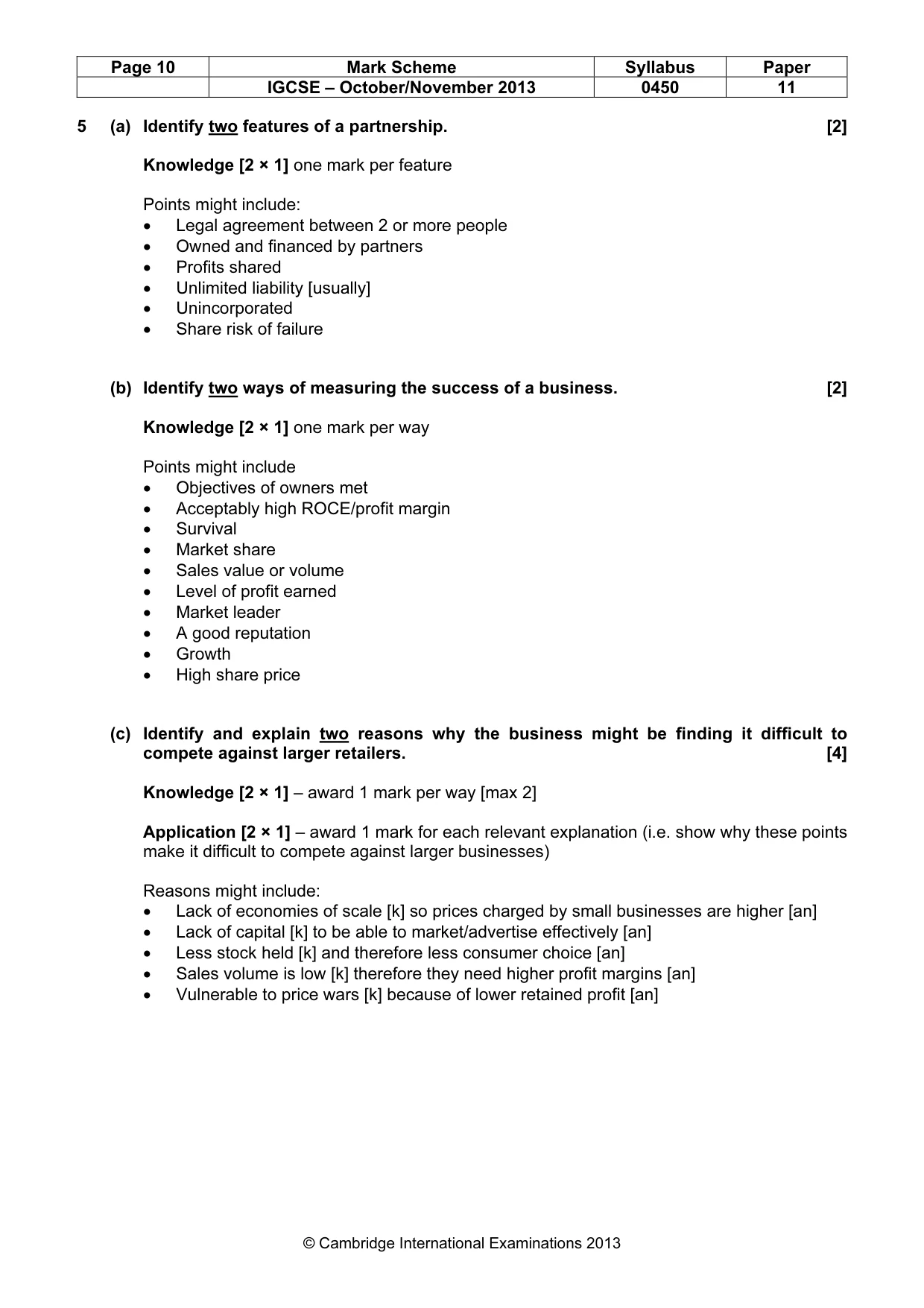
Page 10 Mark Scheme Syllabus Paper IGCSE – October/November 2013 0450 11 © Cambridge International Examinations 2013 5 (a) Identify two features of a partnership. [2] Knowledge [2 × 1] one mark per feature Points might include: • Legal agreement between 2 or more people • Owned and financed by partners • Profits shared • Unlimited liability [usually] • Unincorporated • Share risk of failure (b) Identify two ways of measuring the success of a business. [2] Knowledge [2 × 1] one mark per way Points might include • Objectives of owners met • Acceptably high ROCE/profit margin • Survival • Market share • Sales value or volume • Level of profit earned • Market leader • A good reputation • Growth • High share price (c) Identify and explain two reasons why the business might be finding it difficult to compete against larger retailers. [4] Knowledge [2 × 1] – award 1 mark per way [max 2] Application [2 × 1] – award 1 mark for each relevant explanation (i.e. show why these points make it difficult to compete against larger businesses) Reasons might include: • Lack of economies of scale [k] so prices charged by small businesses are higher [an] • Lack of capital [k] to be able to market/advertise effectively [an] • Less stock held [k] and therefore less consumer choice [an] • Sales volume is low [k] therefore they need higher profit margins [an] • Vulnerable to price wars [k] because of lower retained profit [an]
Mark scheme, page 11
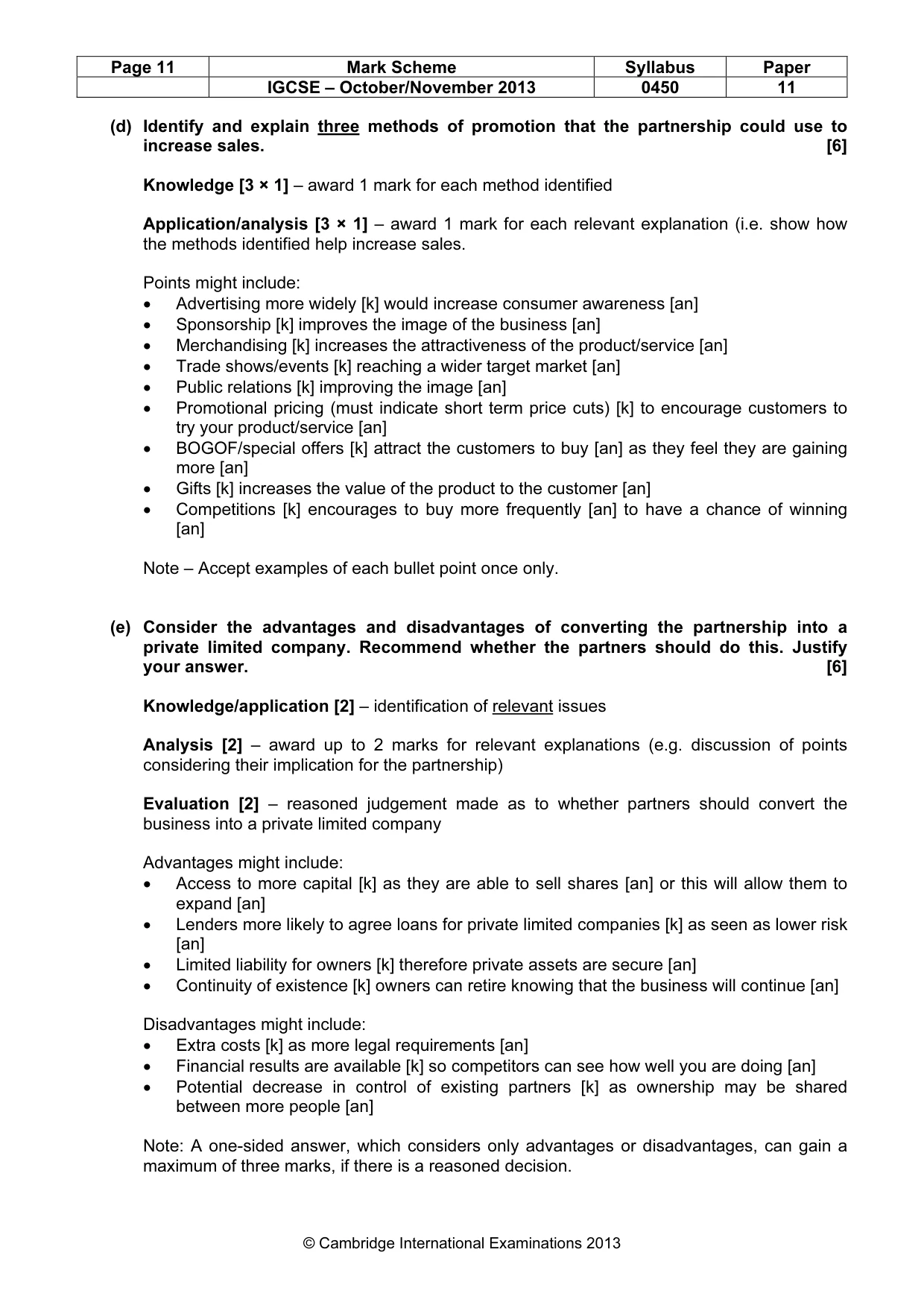
Page 11 Mark Scheme Syllabus Paper IGCSE – October/November 2013 0450 11 © Cambridge International Examinations 2013 (d) Identify and explain three methods of promotion that the partnership could use to increase sales. [6] Knowledge [3 × 1] – award 1 mark for each method identified Application/analysis [3 × 1] – award 1 mark for each relevant explanation (i.e. show how the methods identified help increase sales. Points might include: • Advertising more widely [k] would increase consumer awareness [an] • Sponsorship [k] improves the image of the business [an] • Merchandising [k] increases the attractiveness of the product/service [an] • Trade shows/events [k] reaching a wider target market [an] • Public relations [k] improving the image [an] • Promotional pricing (must indicate short term price cuts) [k] to encourage customers to try your product/service [an] • BOGOF/special offers [k] attract the customers to buy [an] as they feel they are gaining more [an] • Gifts [k] increases the value of the product to the customer [an] • Competitions [k] encourages to buy more frequently [an] to have a chance of winning [an] Note – Accept examples of each bullet point once only. (e) Consider the advantages and disadvantages of converting the partnership into a private limited company. Recommend whether the partners should do this. Justify your answer. [6] Knowledge/application [2] – identification of relevant issues Analysis [2] – award up to 2 marks for relevant explanations (e.g. discussion of points considering their implication for the partnership) Evaluation [2] – reasoned judgement made as to whether partners should convert the business into a private limited company Advantages might include: • Access to more capital [k] as they are able to sell shares [an] or this will allow them to expand [an] • Lenders more likely to agree loans for private limited companies [k] as seen as lower risk [an] • Limited liability for owners [k] therefore private assets are secure [an] • Continuity of existence [k] owners can retire knowing that the business will continue [an] Disadvantages might include: • Extra costs [k] as more legal requirements [an] • Financial results are available [k] so competitors can see how well you are doing [an] • Potential decrease in control of existing partners [k] as ownership may be shared between more people [an] Note: A one-sided answer, which considers only advantages or disadvantages, can gain a maximum of three marks, if there is a reasoned decision.
What you needed in this session
Cambridge’s own grade thresholds for 2013 Oct/Nov, Paper 1 · Variant 1. A higher threshold means an easier paper — the bar moves with how the cohort did.