Cambridge IGCSE Business Studies 0450 — 2012 Oct/Nov Paper 2 · Variant 1
0450/21/O/N/12 · 100 marks · ≈113 min
The question paper and its mark scheme, free to read here and free to download. This is Cambridge’s own paper, exactly as it was sat.
Question paper12 pages

Mark scheme15 pages
Answers below. Sit the paper first if you are practising.
Paper as text
Question paper, page 1
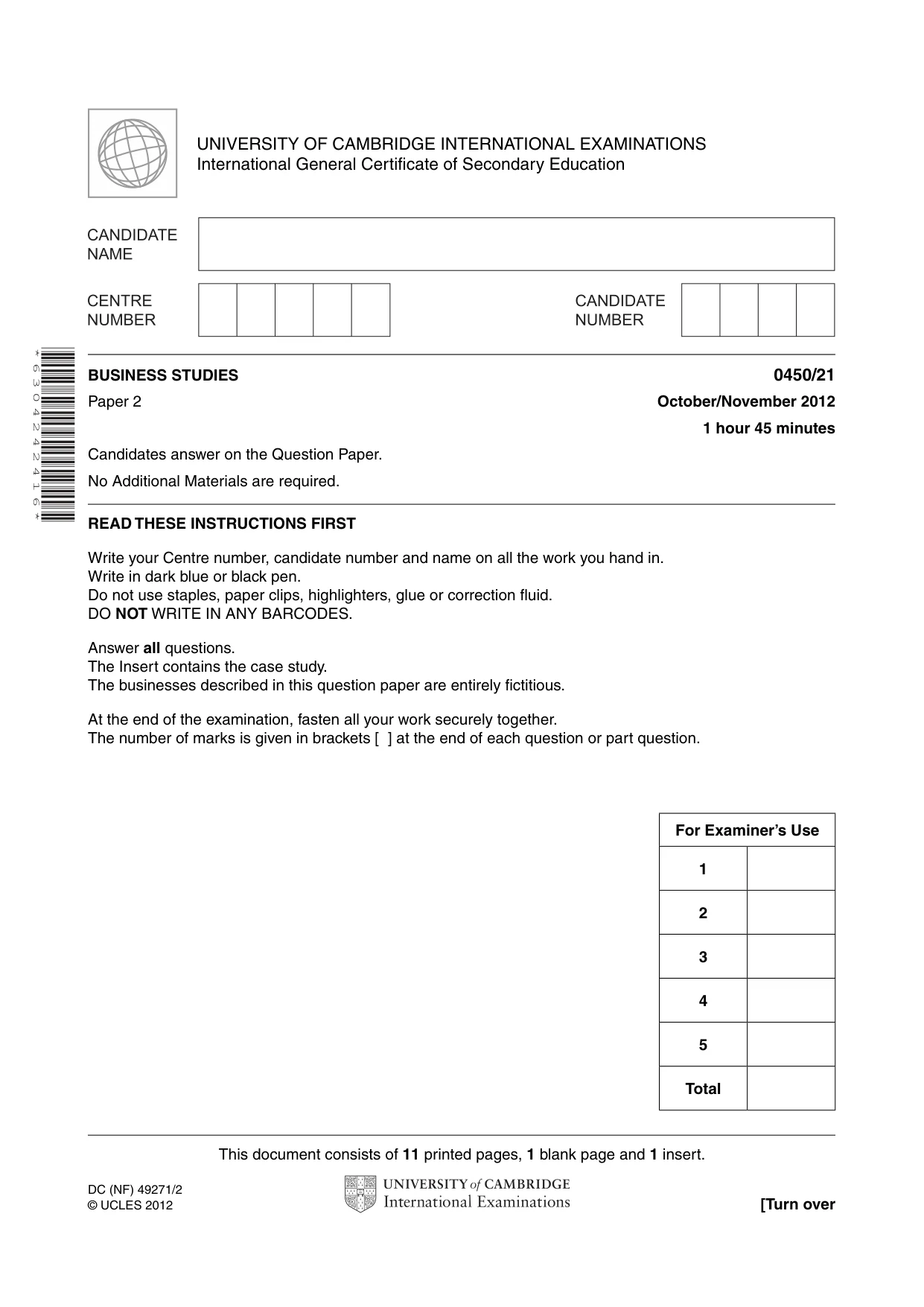
This document consists of 11 printed pages, 1 blank page and 1 insert. DC (NF) 49271/2 © UCLES 2012 [Turn over UNIVERSITY OF CAMBRIDGE INTERNATIONAL EXAMINATIONS International General Certificate of Secondary Education * 6 3 0 4 2 4 2 4 1 6 * BUSINESS STUDIES 0450/21 Paper 2 October/November 2012 1 hour 45 minutes Candidates answer on the Question Paper. No Additional Materials are required. READ THESE INSTRUCTIONS FIRST Write your Centre number, candidate number and name on all the work you hand in. Write in dark blue or black pen. Do not use staples, paper clips, highlighters, glue or correction fluid. DO NOT WRITE IN ANY BARCODES. Answer all questions. The Insert contains the case study. The businesses described in this question paper are entirely fictitious. At the end of the examination, fasten all your work securely together. The number of marks is given in brackets [ ] at the end of each question or part question. For Examiner’s Use 1 2 3 4 5 Total
Question paper, page 2
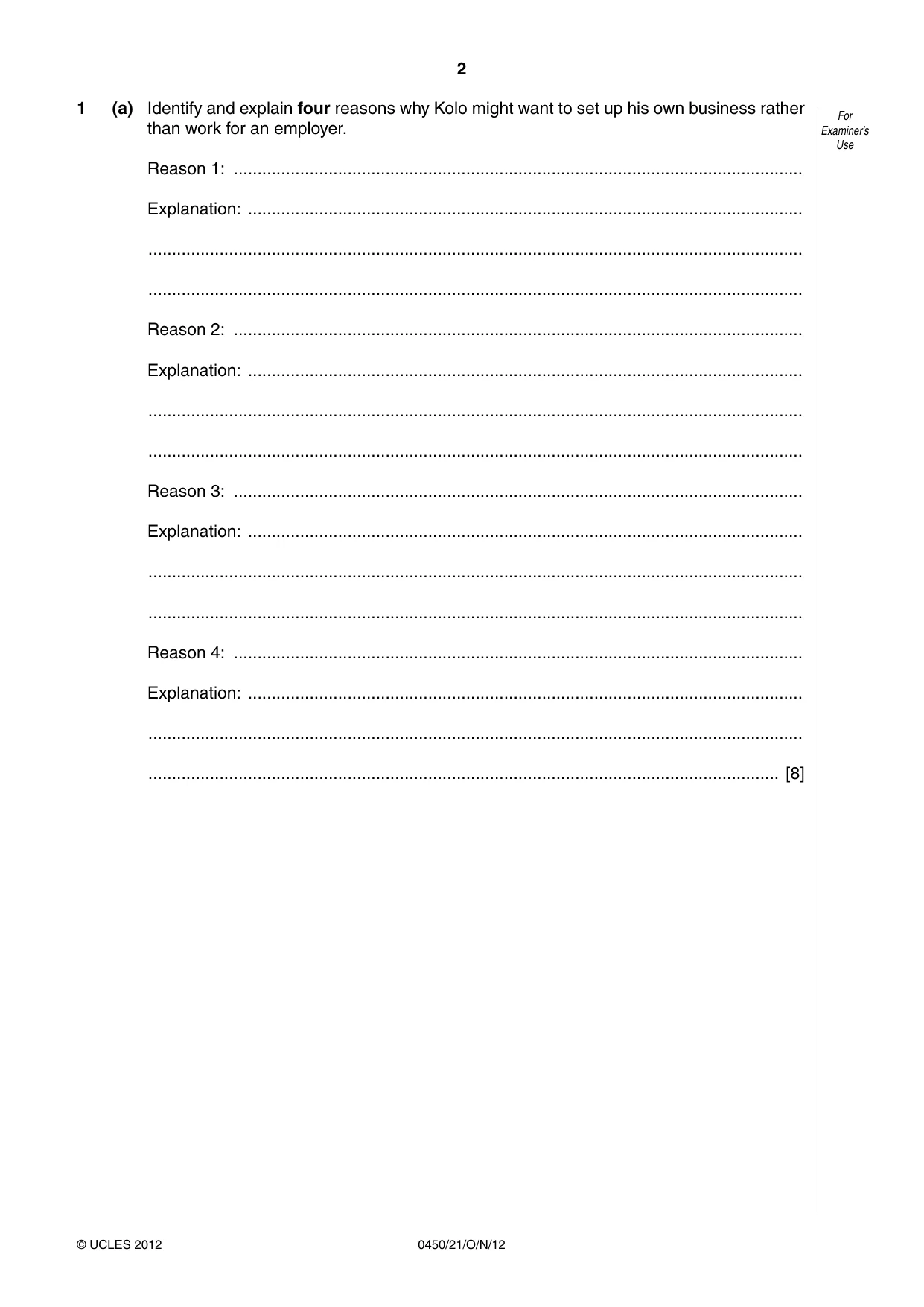
2 0450/21/O/N/12 © UCLES 2012 For Examiner’s Use 1 (a) Identify and explain four reasons why Kolo might want to set up his own business rather than work for an employer. Reason 1: … Explanation: … … … Reason 2: … Explanation: … … … Reason 3: … Explanation: … … … Reason 4: … Explanation: … … … [8]
Question paper, page 3
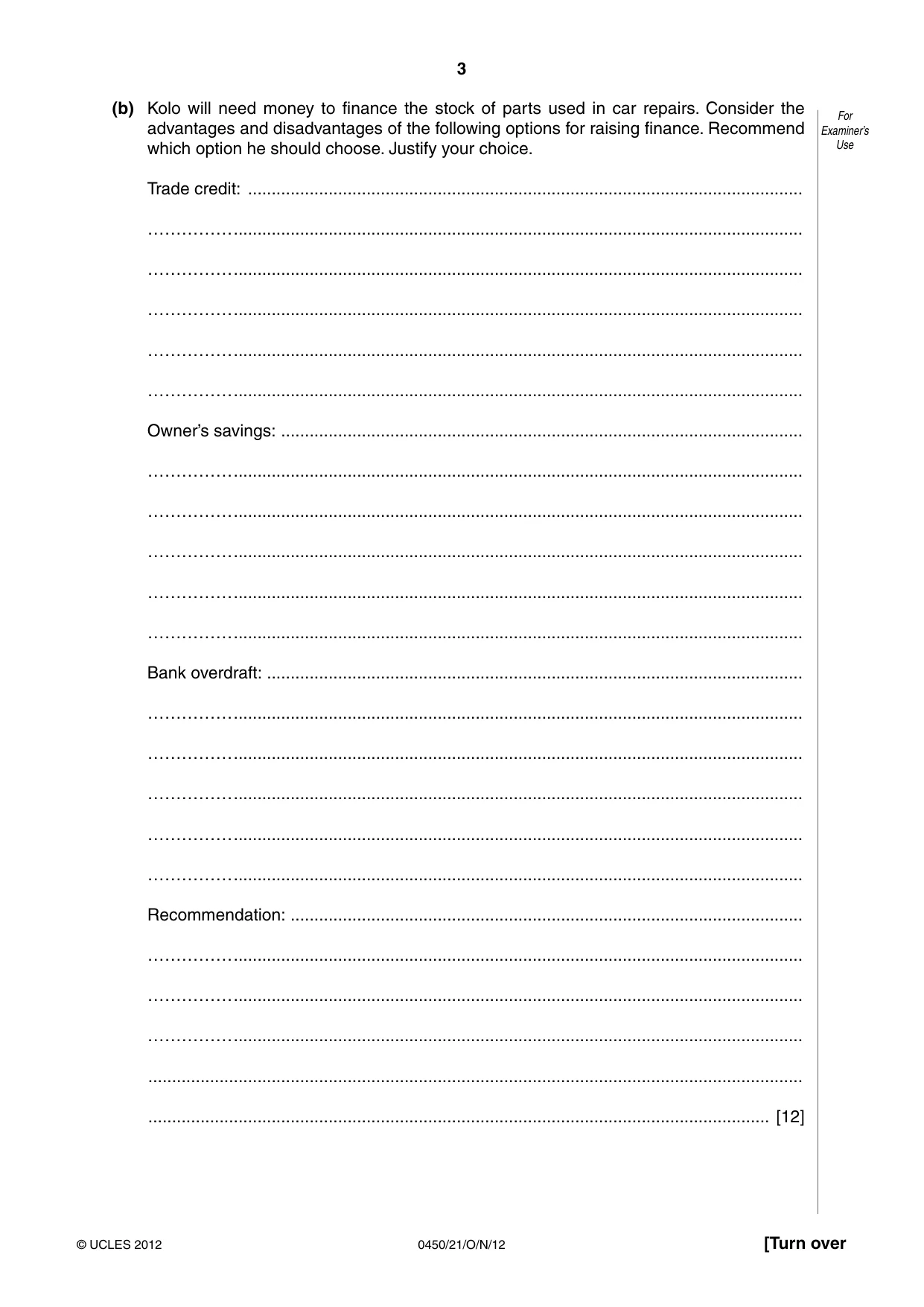
3 0450/21/O/N/12 © UCLES 2012 [Turn over For Examiner’s Use (b) Kolo will need money to finance the stock of parts used in car repairs. Consider the advantages and disadvantages of the following options for raising finance. Recommend which option he should choose. Justify your choice. Trade credit: … …………… … …………… … …………… … …………… … …………… … Owner’s savings: … …………… … …………… … …………… … …………… … …………… … Bank overdraft: … …………… … …………… … …………… … …………… … …………… … Recommendation: … …………… … …………… … …………… … … … [12]
Question paper, page 4
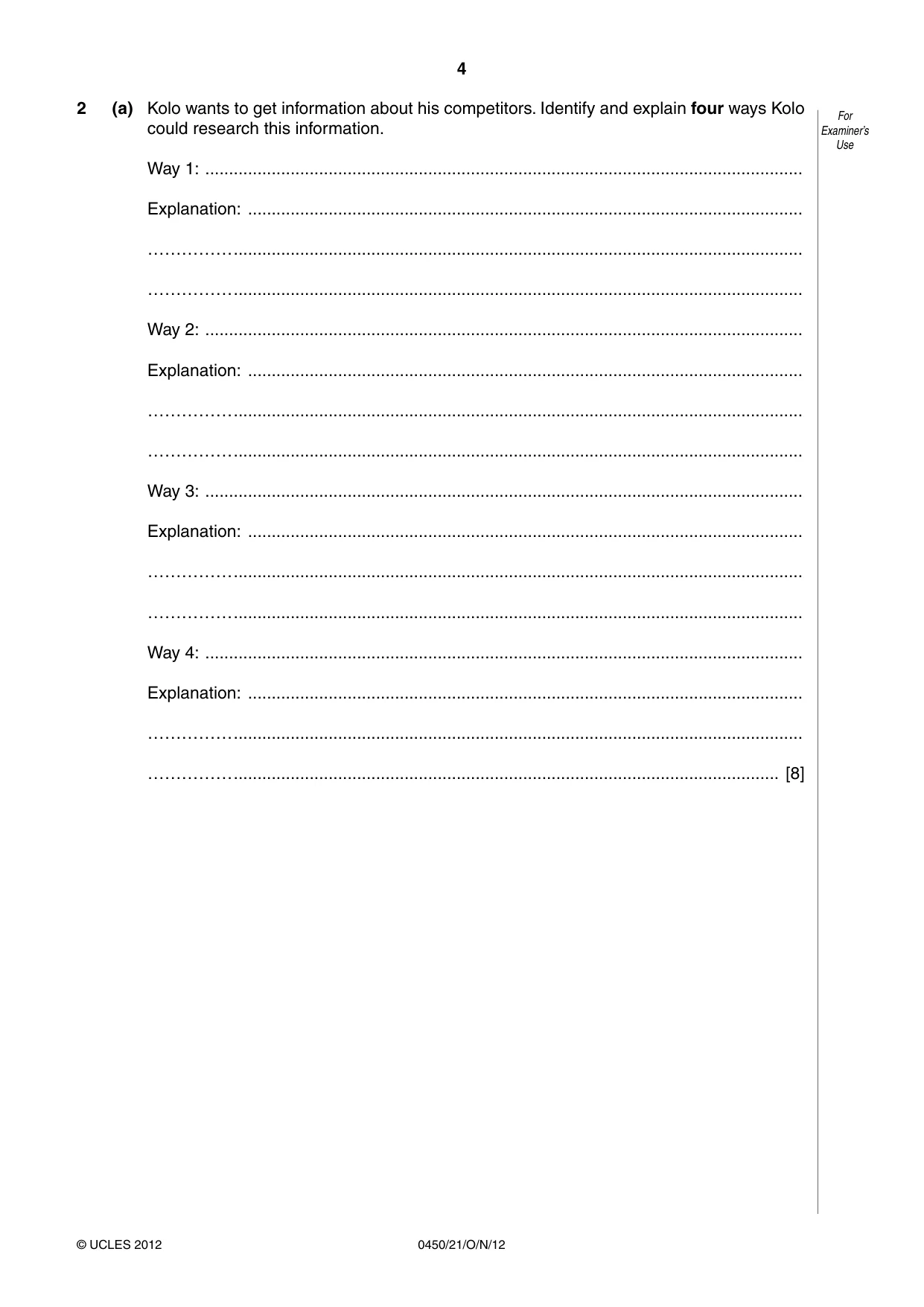
4 0450/21/O/N/12 © UCLES 2012 For Examiner’s Use 2 (a) Kolo wants to get information about his competitors. Identify and explain four ways Kolo could research this information. Way 1: … Explanation: … …………… … …………… … Way 2: … Explanation: … …………… … …………… … Way 3: … Explanation: … …………… … …………… … Way 4: … Explanation: … …………… … …………… … [8]
Question paper, page 5
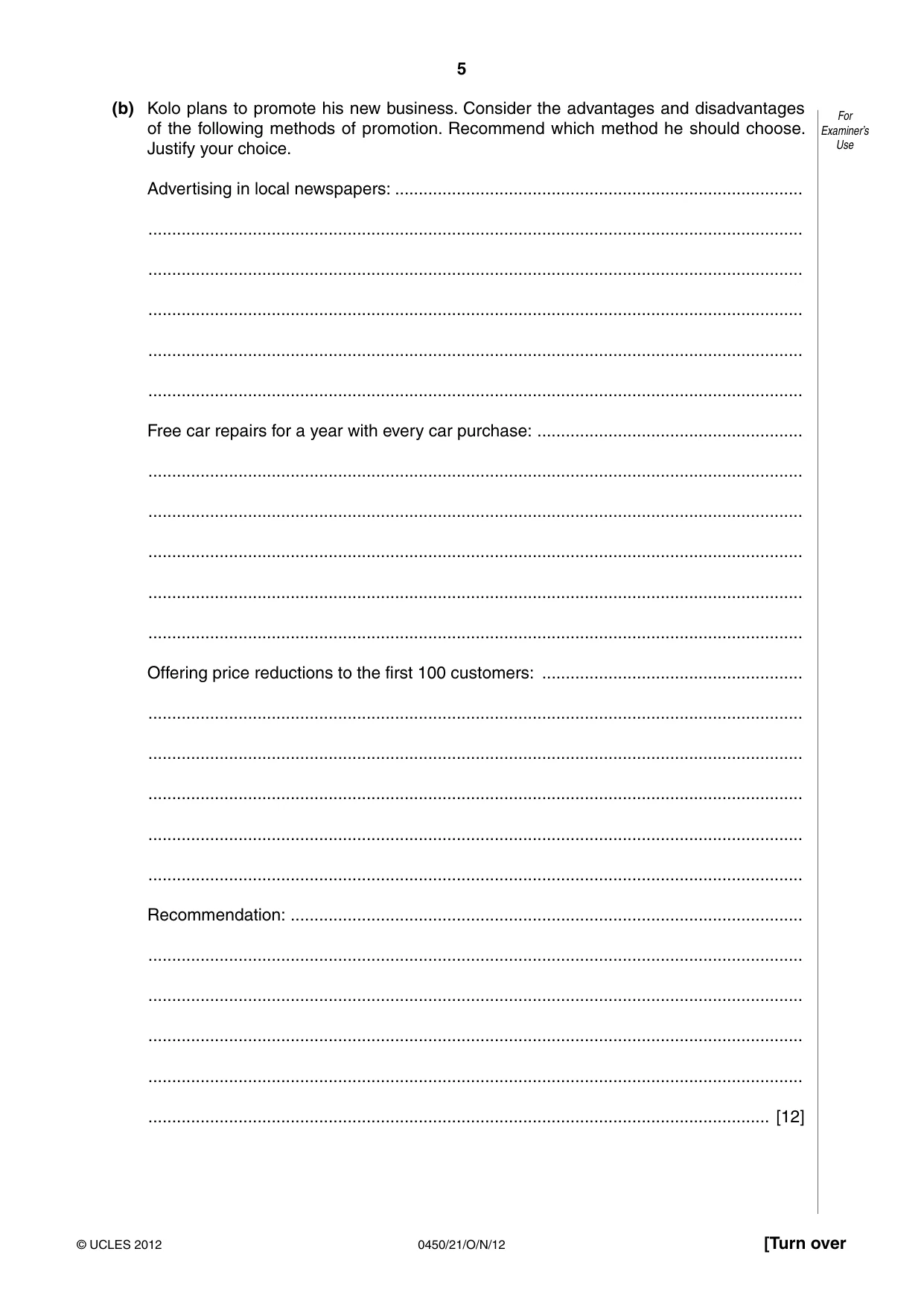
5 0450/21/O/N/12 © UCLES 2012 [Turn over For Examiner’s Use (b) Kolo plans to promote his new business. Consider the advantages and disadvantages of the following methods of promotion. Recommend which method he should choose. Justify your choice. Advertising in local newspapers: … … … … … … Free car repairs for a year with every car purchase: … … … … … … Offering price reductions to the first 100 customers: … … … … … … Recommendation: … … … … … … [12]
Question paper, page 6
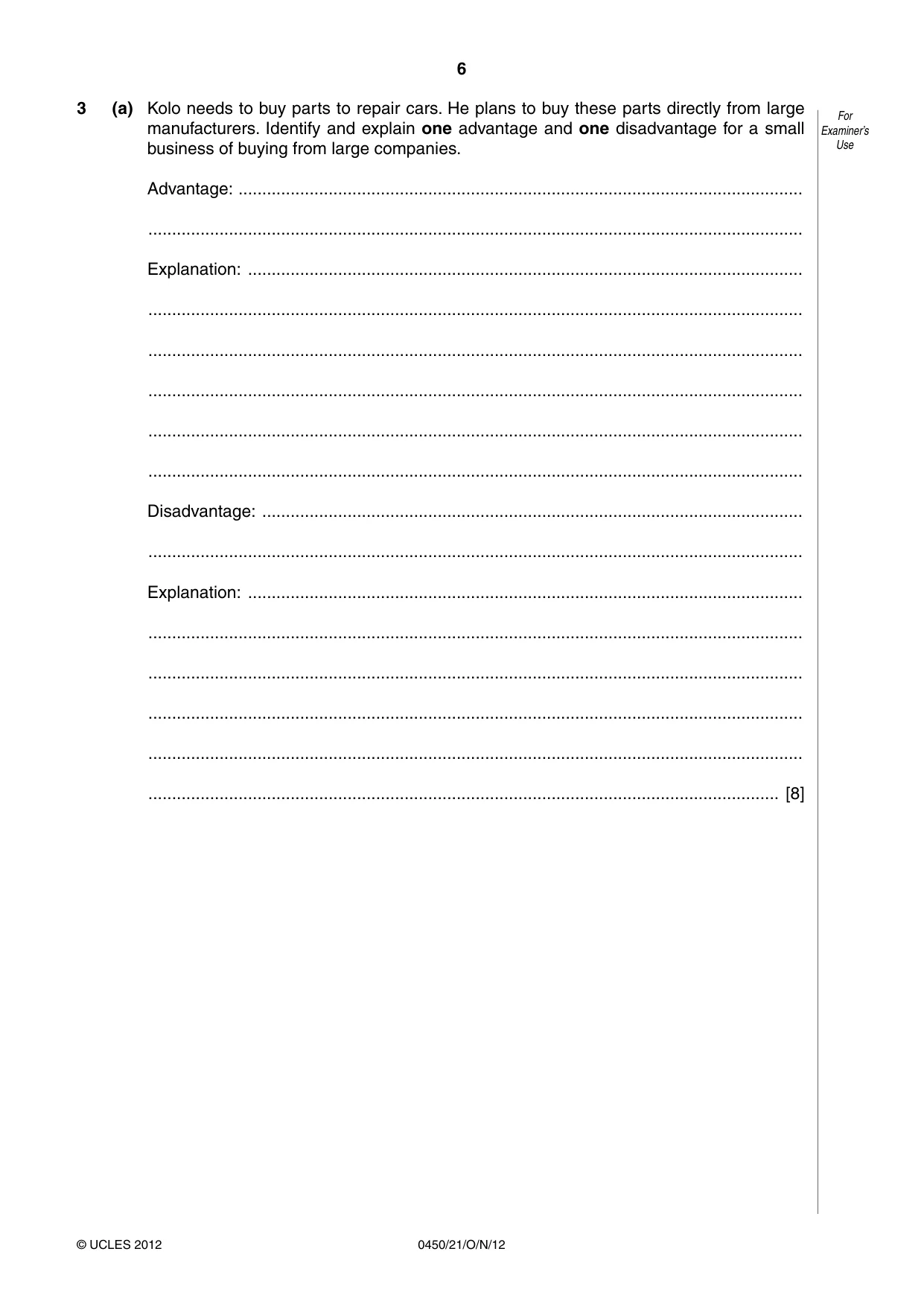
6 0450/21/O/N/12 © UCLES 2012 For Examiner’s Use 3 (a) Kolo needs to buy parts to repair cars. He plans to buy these parts directly from large manufacturers. Identify and explain one advantage and one disadvantage for a small business of buying from large companies. Advantage: … … Explanation: … … … … … … Disadvantage: … … Explanation: … … … … … … [8]
Question paper, page 7
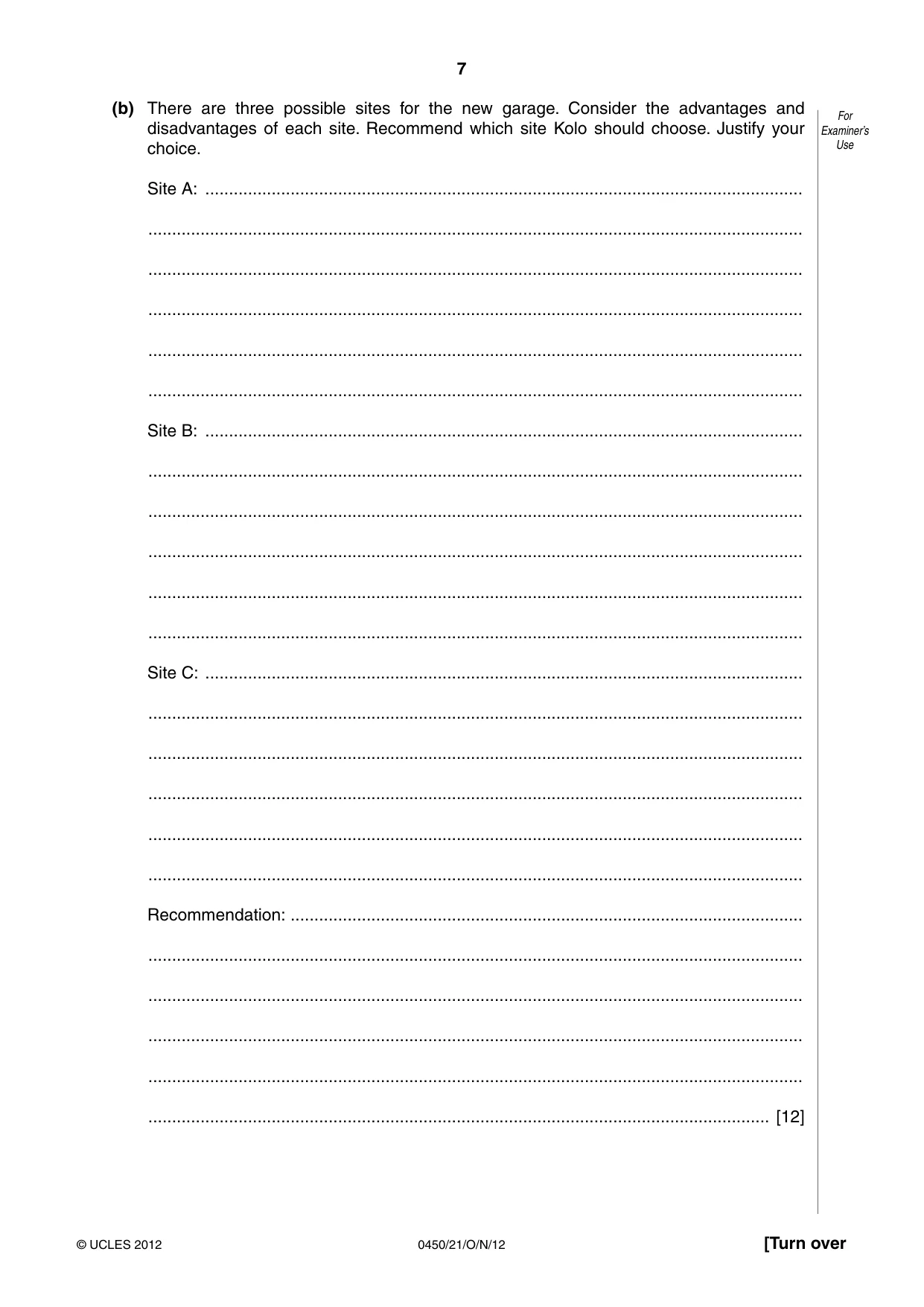
7 0450/21/O/N/12 © UCLES 2012 [Turn over For Examiner’s Use (b) There are three possible sites for the new garage. Consider the advantages and disadvantages of each site. Recommend which site Kolo should choose. Justify your choice. Site A: … … … … … … Site B: … … … … … … Site C: … … … … … … Recommendation: … … … … … … [12]
Question paper, page 8
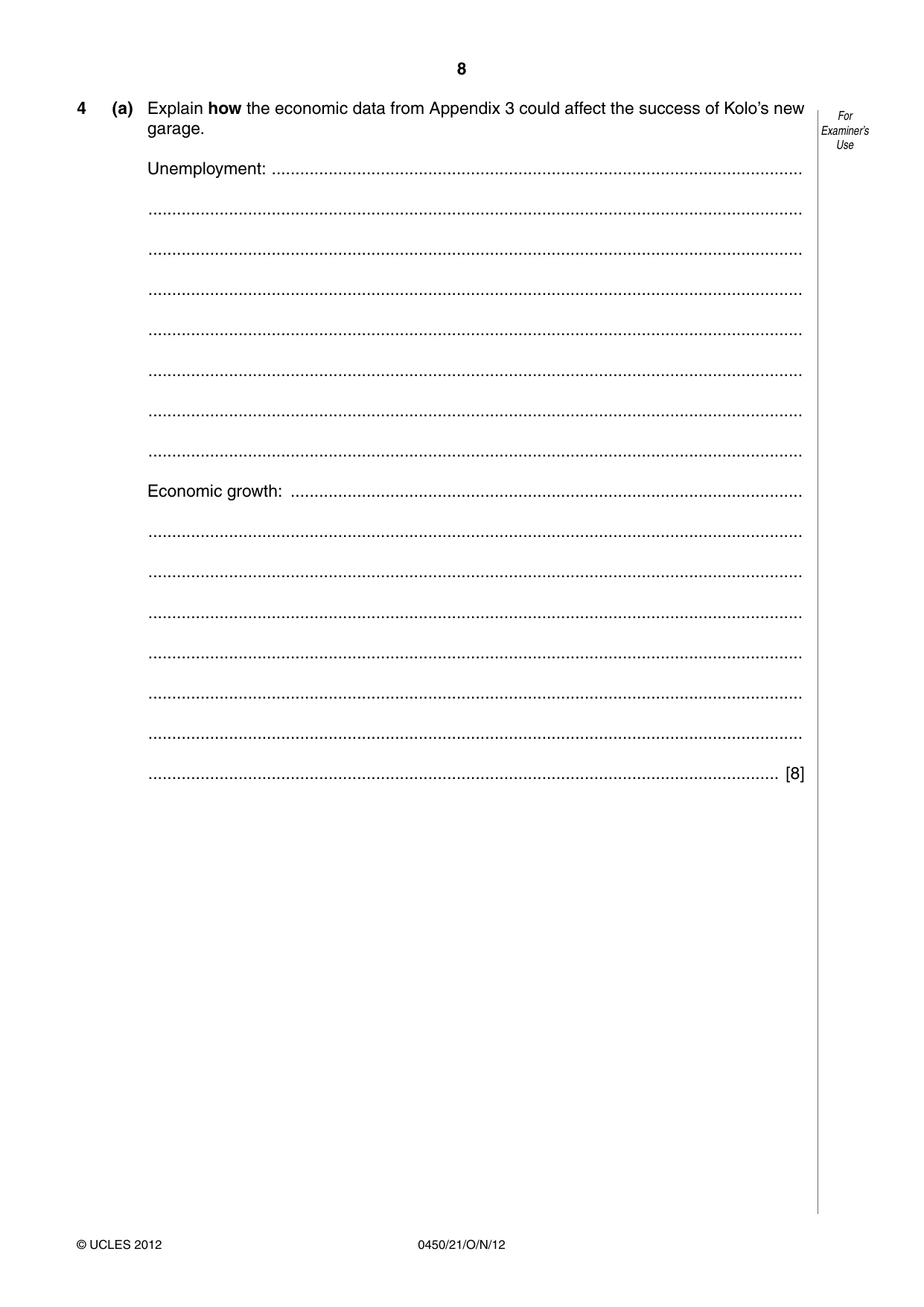
8 0450/21/O/N/12 © UCLES 2012 For Examiner’s Use 4 (a) Explain how the economic data from Appendix 3 could affect the success of Kolo’s new garage. Unemployment: … … … … … … … … Economic growth: … … … … … … … … [8]
Question paper, page 9
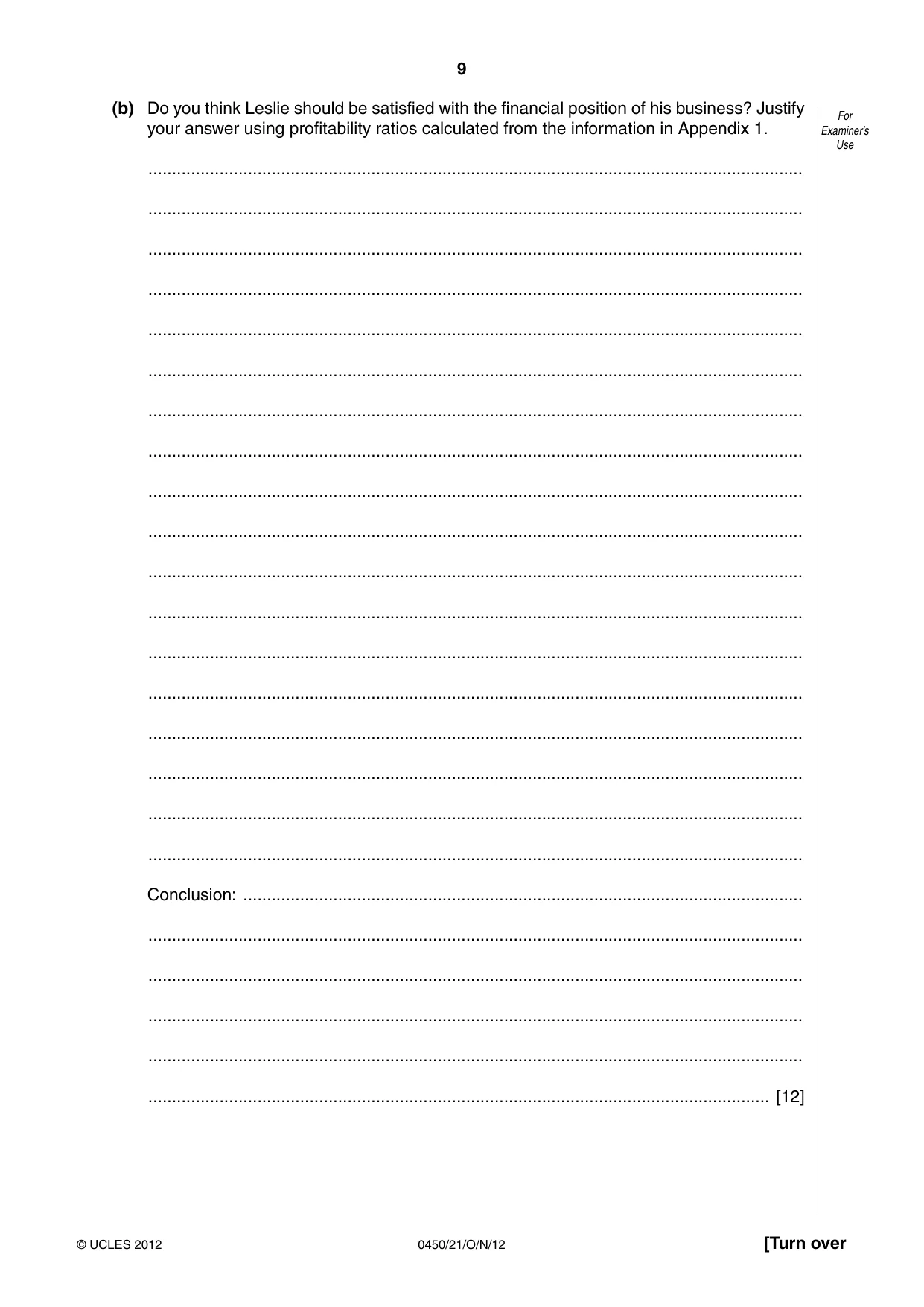
9 0450/21/O/N/12 © UCLES 2012 [Turn over For Examiner’s Use (b) Do you think Leslie should be satisfied with the financial position of his business? Justify your answer using profitability ratios calculated from the information in Appendix 1. … … … … … … … … … … … … … … … … … … Conclusion: … … … … … … [12]
Question paper, page 10
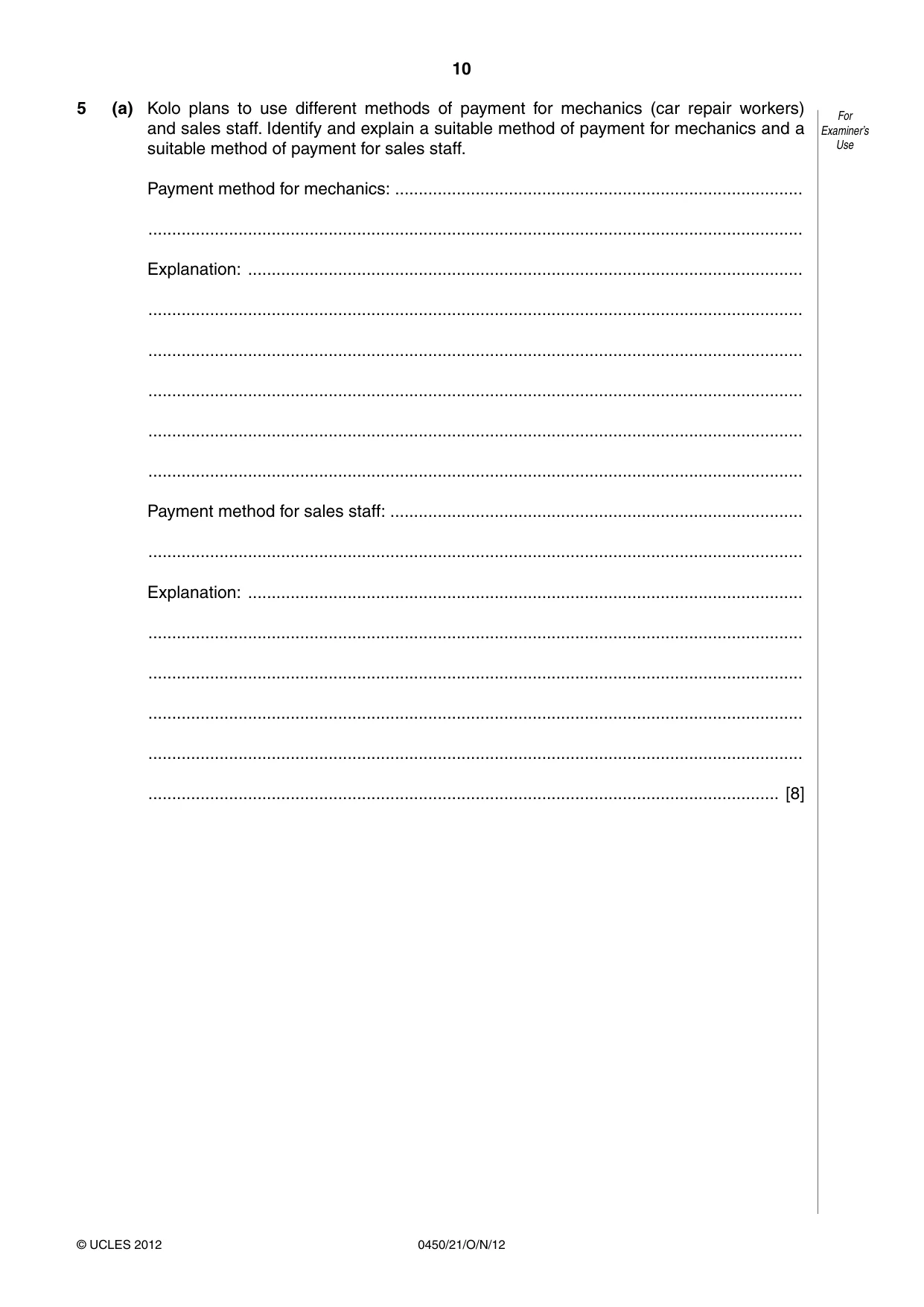
10 0450/21/O/N/12 © UCLES 2012 For Examiner’s Use 5 (a) Kolo plans to use different methods of payment for mechanics (car repair workers) and sales staff. Identify and explain a suitable method of payment for mechanics and a suitable method of payment for sales staff. Payment method for mechanics: … … Explanation: … … … … … … Payment method for sales staff: … … Explanation: … … … … … … [8]
Question paper, page 11
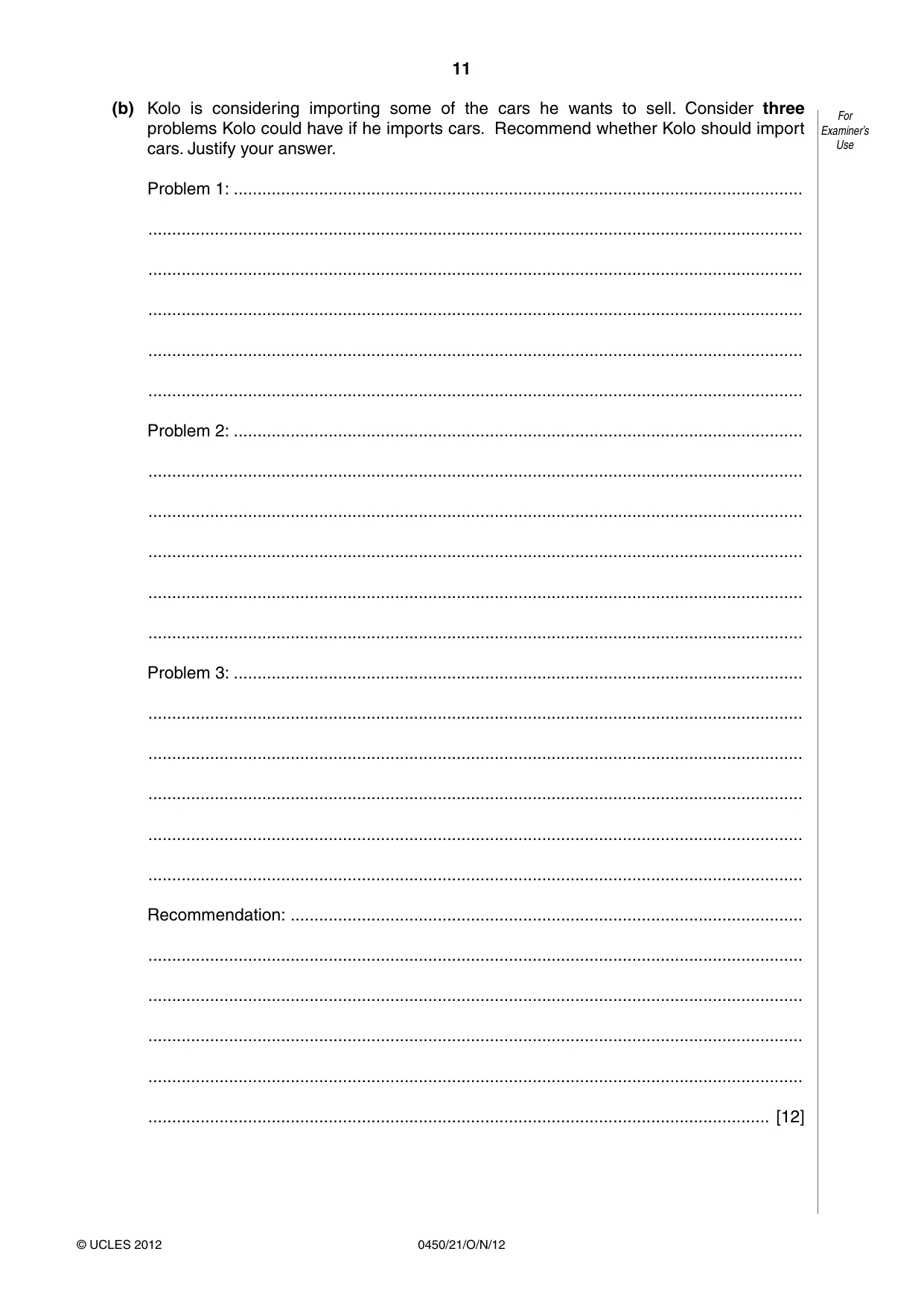
11 0450/21/O/N/12 © UCLES 2012 For Examiner’s Use (b) Kolo is considering importing some of the cars he wants to sell. Consider three problems Kolo could have if he imports cars. Recommend whether Kolo should import cars. Justify your answer. Problem 1: … … … … … … Problem 2: … … … … … … Problem 3: … … … … … … Recommendation: … … … … … … [12]
Question paper, page 12
12 0450/21/O/N/12 © UCLES 2012 Permission to reproduce items where third-party owned material protected by copyright is included has been sought and cleared where possible. Every reasonable effort has been made by the publisher (UCLES) to trace copyright holders, but if any items requiring clearance have unwittingly been included, the publisher will be pleased to make amends at the earliest possible opportunity. University of Cambridge International Examinations is part of the Cambridge Assessment Group. Cambridge Assessment is the brand name of University of Cambridge Local Examinations Syndicate (UCLES), which is itself a department of the University of Cambridge. BLANK PAGE
Mark scheme, page 1
CAMBRIDGE INTERNATIONAL EXAMINATIONS International General Certificate of Secondary Education MARK SCHEME for the October/November 2012 series 0450 BUSINESS STUDIES 0450/21 Paper 2 (Case Study), maximum raw mark 100 This mark scheme is published as an aid to teachers and candidates, to indicate the requirements of the examination. It shows the basis on which Examiners were instructed to award marks. It does not indicate the details of the discussions that took place at an Examiners’ meeting before marking began, which would have considered the acceptability of alternative answers. Mark schemes should be read in conjunction with the question paper and the Principal Examiner Report for Teachers. Cambridge will not enter into discussions about these mark schemes. Cambridge is publishing the mark schemes for the October/November 2012 series for most IGCSE, GCE Advanced Level and Advanced Subsidiary Level components and some Ordinary Level components.
Mark scheme, page 2
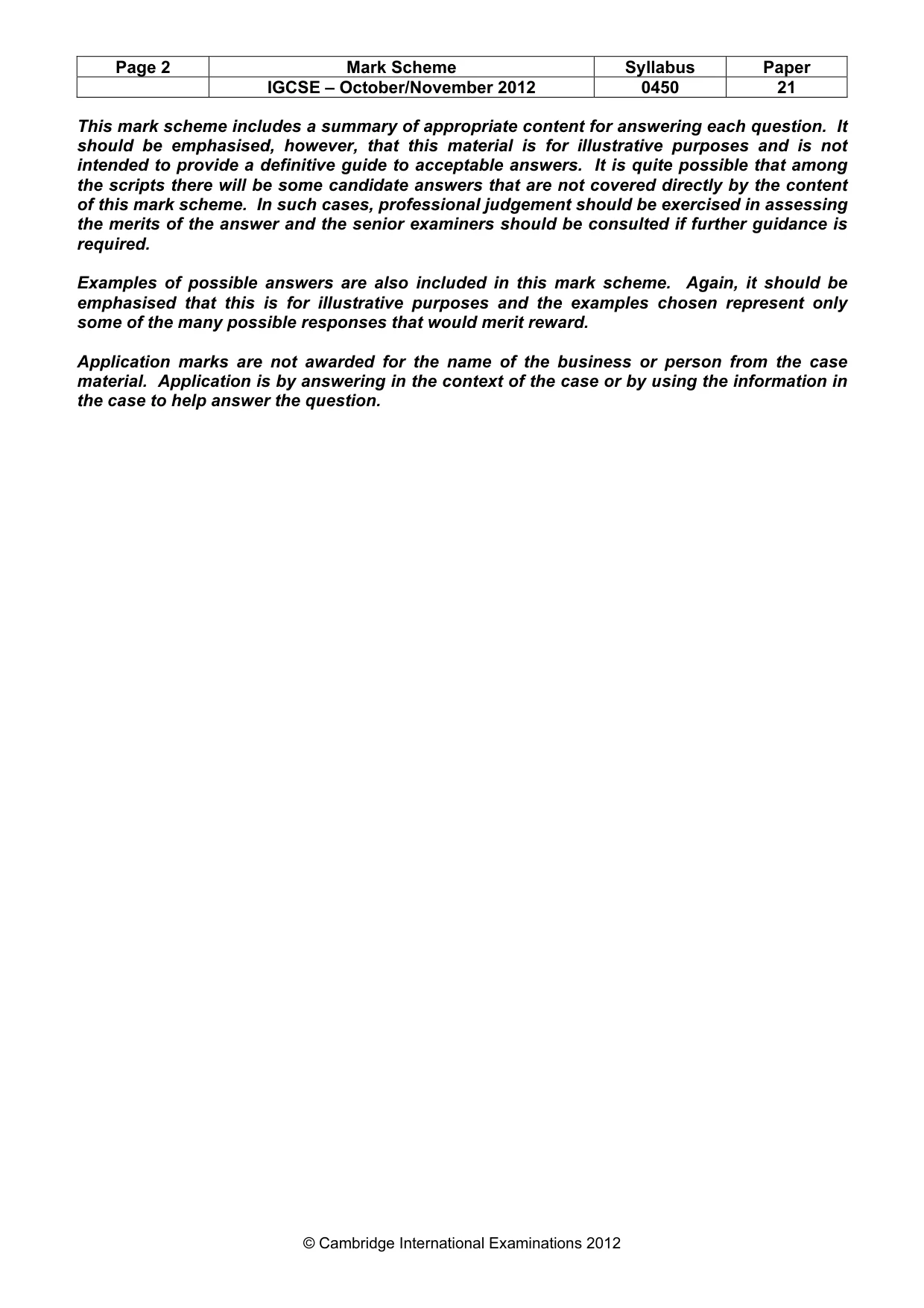
Page 2 Mark Scheme Syllabus Paper IGCSE – October/November 2012 0450 21 © Cambridge International Examinations 2012 This mark scheme includes a summary of appropriate content for answering each question. It should be emphasised, however, that this material is for illustrative purposes and is not intended to provide a definitive guide to acceptable answers. It is quite possible that among the scripts there will be some candidate answers that are not covered directly by the content of this mark scheme. In such cases, professional judgement should be exercised in assessing the merits of the answer and the senior examiners should be consulted if further guidance is required. Examples of possible answers are also included in this mark scheme. Again, it should be emphasised that this is for illustrative purposes and the examples chosen represent only some of the many possible responses that would merit reward. Application marks are not awarded for the name of the business or person from the case material. Application is by answering in the context of the case or by using the information in the case to help answer the question.
Mark scheme, page 3
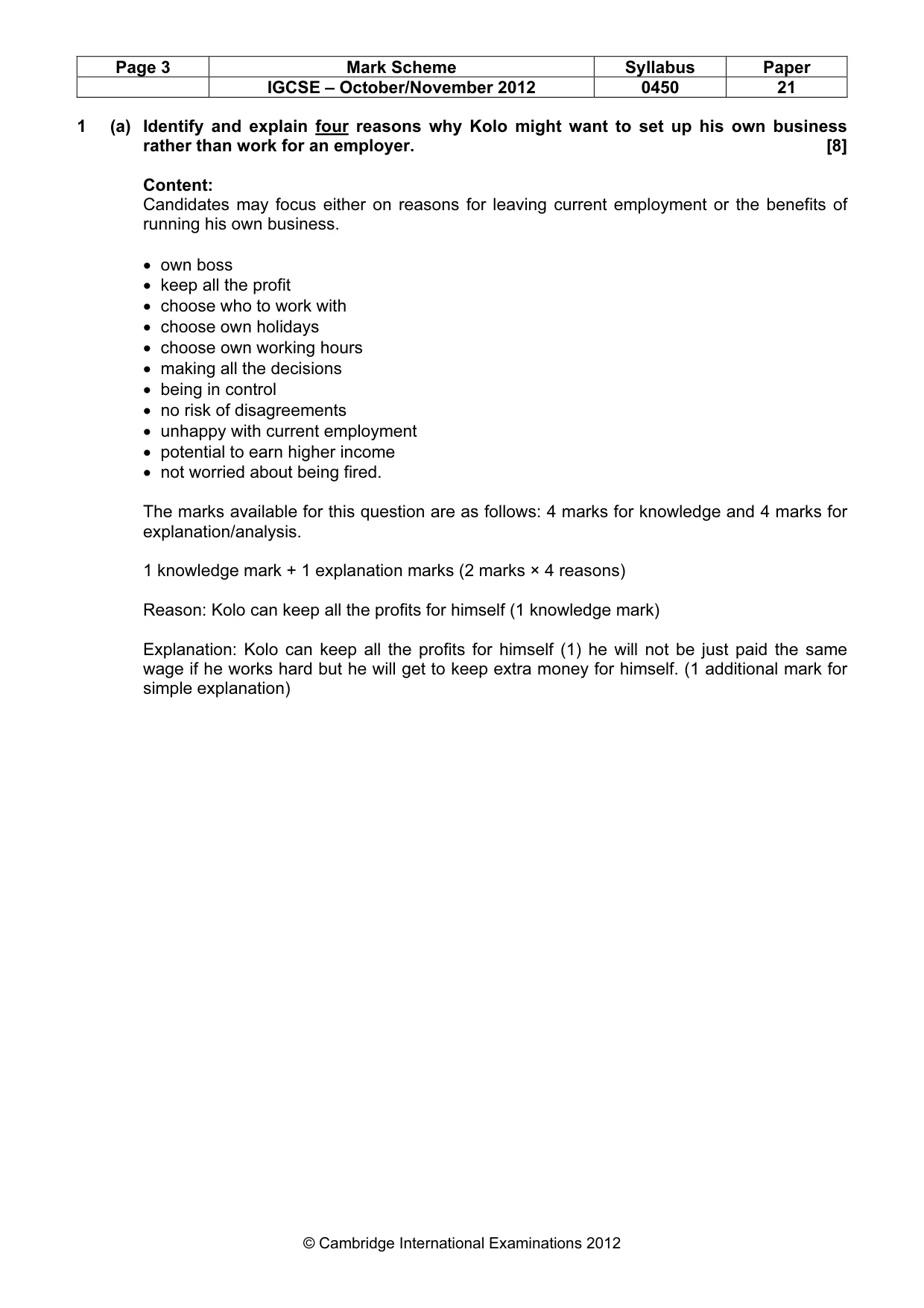
Page 3 Mark Scheme Syllabus Paper IGCSE – October/November 2012 0450 21 © Cambridge International Examinations 2012 1 (a) Identify and explain four reasons why Kolo might want to set up his own business rather than work for an employer. [8] Content: Candidates may focus either on reasons for leaving current employment or the benefits of running his own business. • own boss • keep all the profit • choose who to work with • choose own holidays • choose own working hours • making all the decisions • being in control • no risk of disagreements • unhappy with current employment • potential to earn higher income • not worried about being fired. The marks available for this question are as follows: 4 marks for knowledge and 4 marks for explanation/analysis. 1 knowledge mark + 1 explanation marks (2 marks × 4 reasons) Reason: Kolo can keep all the profits for himself (1 knowledge mark) Explanation: Kolo can keep all the profits for himself (1) he will not be just paid the same wage if he works hard but he will get to keep extra money for himself. (1 additional mark for simple explanation)
Mark scheme, page 4
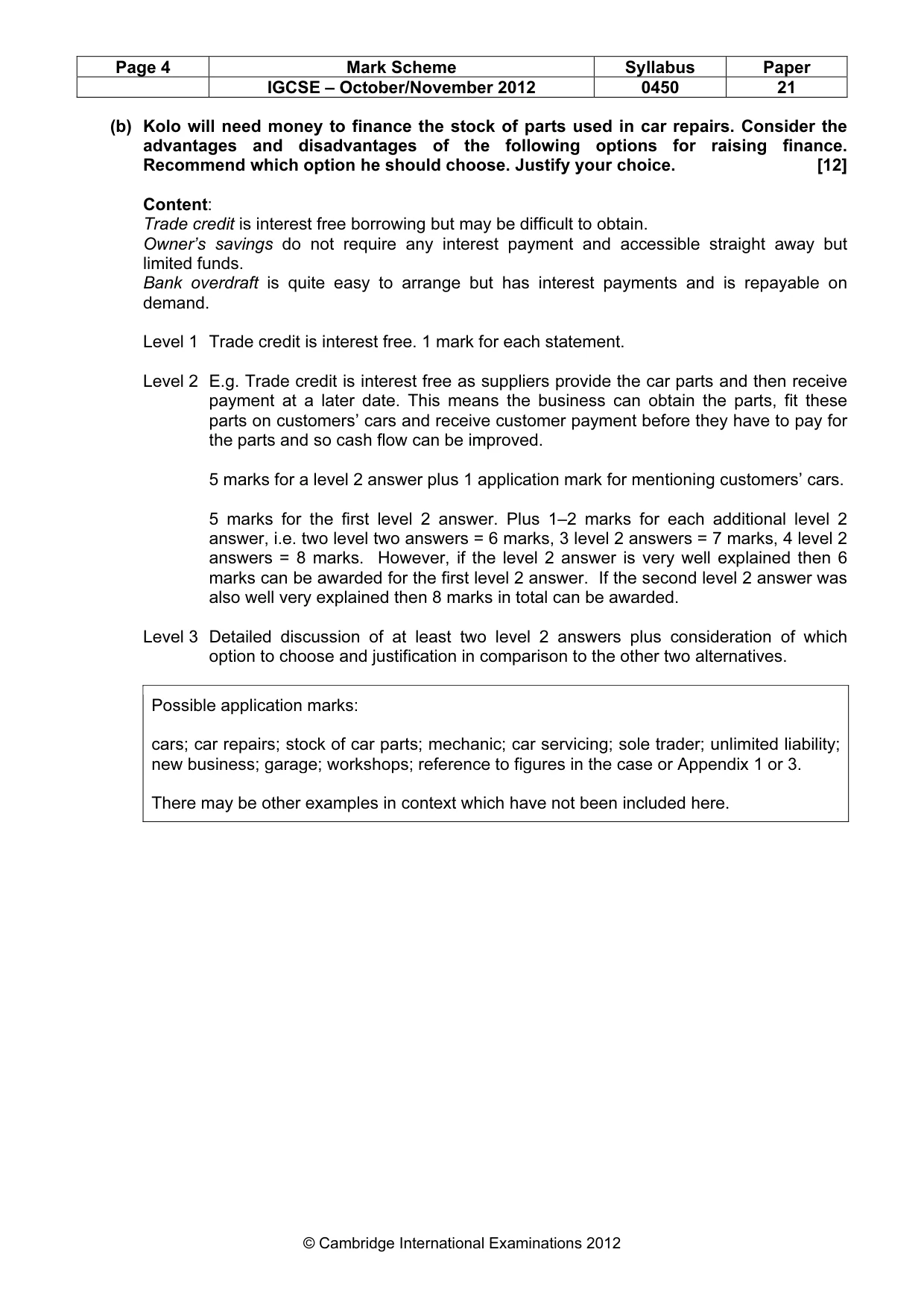
Page 4 Mark Scheme Syllabus Paper IGCSE – October/November 2012 0450 21 © Cambridge International Examinations 2012 (b) Kolo will need money to finance the stock of parts used in car repairs. Consider the advantages and disadvantages of the following options for raising finance. Recommend which option he should choose. Justify your choice. [12] Content: Trade credit is interest free borrowing but may be difficult to obtain. Owner’s savings do not require any interest payment and accessible straight away but limited funds. Bank overdraft is quite easy to arrange but has interest payments and is repayable on demand. Level 1 Trade credit is interest free. 1 mark for each statement. Level 2 E.g. Trade credit is interest free as suppliers provide the car parts and then receive payment at a later date. This means the business can obtain the parts, fit these parts on customers’ cars and receive customer payment before they have to pay for the parts and so cash flow can be improved. 5 marks for a level 2 answer plus 1 application mark for mentioning customers’ cars. 5 marks for the first level 2 answer. Plus 1–2 marks for each additional level 2 answer, i.e. two level two answers = 6 marks, 3 level 2 answers = 7 marks, 4 level 2 answers = 8 marks. However, if the level 2 answer is very well explained then 6 marks can be awarded for the first level 2 answer. If the second level 2 answer was also well very explained then 8 marks in total can be awarded. Level 3 Detailed discussion of at least two level 2 answers plus consideration of which option to choose and justification in comparison to the other two alternatives. Possible application marks: cars; car repairs; stock of car parts; mechanic; car servicing; sole trader; unlimited liability; new business; garage; workshops; reference to figures in the case or Appendix 1 or 3. There may be other examples in context which have not been included here.
Mark scheme, page 5
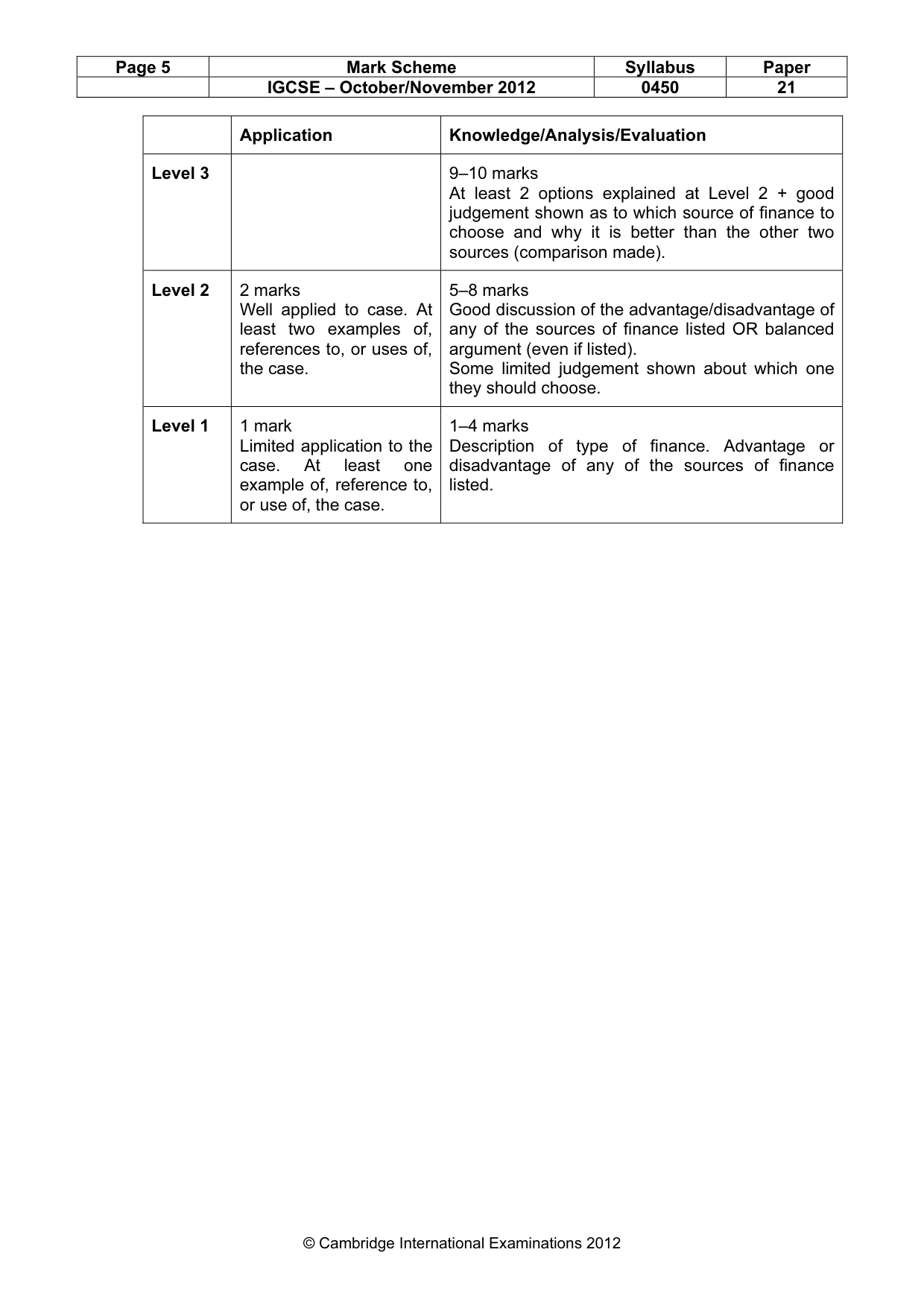
Page 5 Mark Scheme Syllabus Paper IGCSE – October/November 2012 0450 21 © Cambridge International Examinations 2012 Application Knowledge/Analysis/Evaluation Level 3 9–10 marks At least 2 options explained at Level 2 + good judgement shown as to which source of finance to choose and why it is better than the other two sources (comparison made). Level 2 2 marks Well applied to case. At least two examples of, references to, or uses of, the case. 5–8 marks Good discussion of the advantage/disadvantage of any of the sources of finance listed OR balanced argument (even if listed). Some limited judgement shown about which one they should choose. Level 1 1 mark Limited application to the case. At least one example of, reference to, or use of, the case. 1–4 marks Description of type of finance. Advantage or disadvantage of any of the sources of finance listed.
Mark scheme, page 6
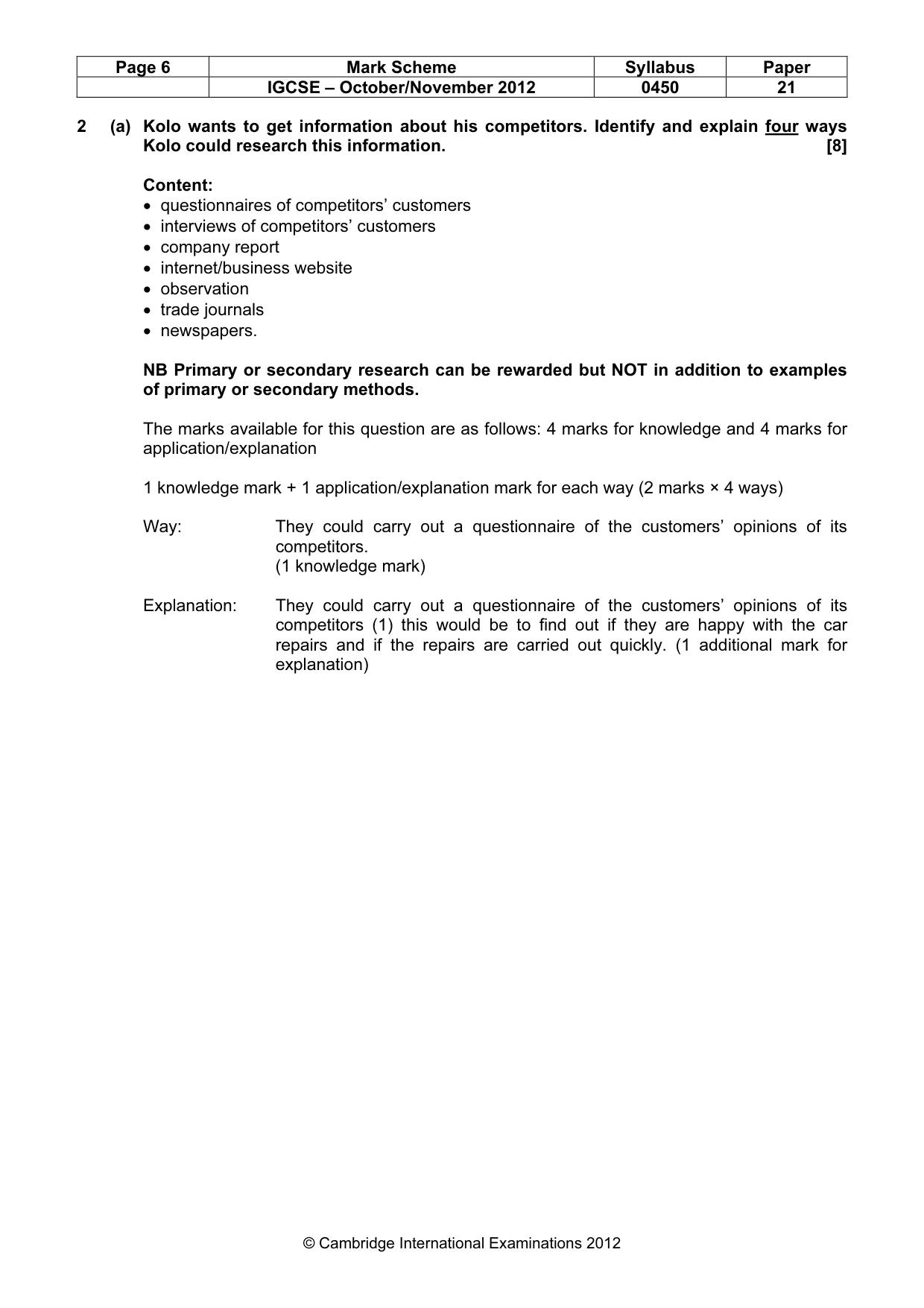
Page 6 Mark Scheme Syllabus Paper IGCSE – October/November 2012 0450 21 © Cambridge International Examinations 2012 2 (a) Kolo wants to get information about his competitors. Identify and explain four ways Kolo could research this information. [8] Content: • questionnaires of competitors’ customers • interviews of competitors’ customers • company report • internet/business website • observation • trade journals • newspapers. NB Primary or secondary research can be rewarded but NOT in addition to examples of primary or secondary methods. The marks available for this question are as follows: 4 marks for knowledge and 4 marks for application/explanation 1 knowledge mark + 1 application/explanation mark for each way (2 marks × 4 ways) Way: They could carry out a questionnaire of the customers’ opinions of its competitors. (1 knowledge mark) Explanation: They could carry out a questionnaire of the customers’ opinions of its competitors (1) this would be to find out if they are happy with the car repairs and if the repairs are carried out quickly. (1 additional mark for explanation)
Mark scheme, page 7
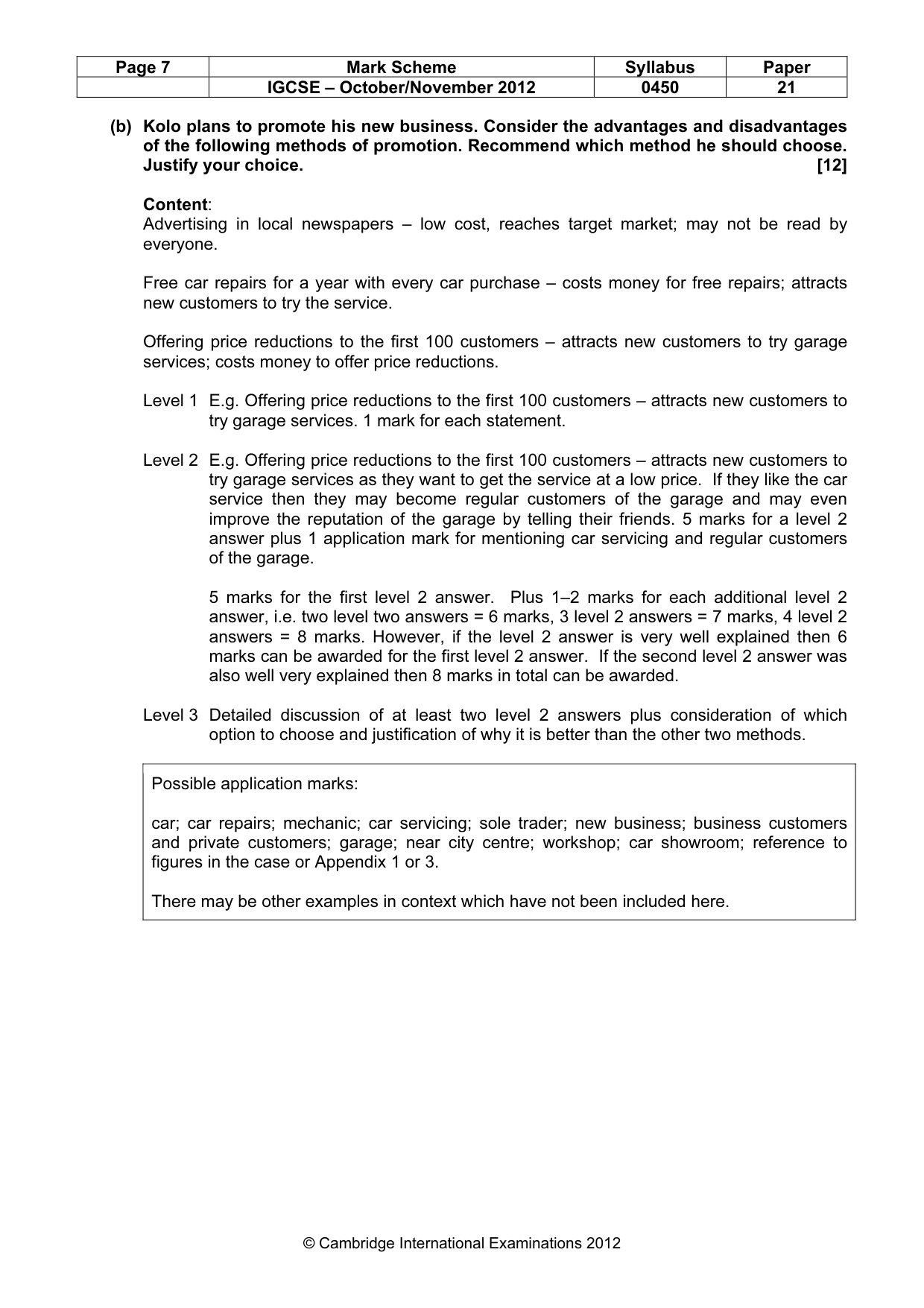
Page 7 Mark Scheme Syllabus Paper IGCSE – October/November 2012 0450 21 © Cambridge International Examinations 2012 (b) Kolo plans to promote his new business. Consider the advantages and disadvantages of the following methods of promotion. Recommend which method he should choose. Justify your choice. [12] Content: Advertising in local newspapers – low cost, reaches target market; may not be read by everyone. Free car repairs for a year with every car purchase – costs money for free repairs; attracts new customers to try the service. Offering price reductions to the first 100 customers – attracts new customers to try garage services; costs money to offer price reductions. Level 1 E.g. Offering price reductions to the first 100 customers – attracts new customers to try garage services. 1 mark for each statement. Level 2 E.g. Offering price reductions to the first 100 customers – attracts new customers to try garage services as they want to get the service at a low price. If they like the car service then they may become regular customers of the garage and may even improve the reputation of the garage by telling their friends. 5 marks for a level 2 answer plus 1 application mark for mentioning car servicing and regular customers of the garage. 5 marks for the first level 2 answer. Plus 1–2 marks for each additional level 2 answer, i.e. two level two answers = 6 marks, 3 level 2 answers = 7 marks, 4 level 2 answers = 8 marks. However, if the level 2 answer is very well explained then 6 marks can be awarded for the first level 2 answer. If the second level 2 answer was also well very explained then 8 marks in total can be awarded. Level 3 Detailed discussion of at least two level 2 answers plus consideration of which option to choose and justification of why it is better than the other two methods. Possible application marks: car; car repairs; mechanic; car servicing; sole trader; new business; business customers and private customers; garage; near city centre; workshop; car showroom; reference to figures in the case or Appendix 1 or 3. There may be other examples in context which have not been included here.
Mark scheme, page 8
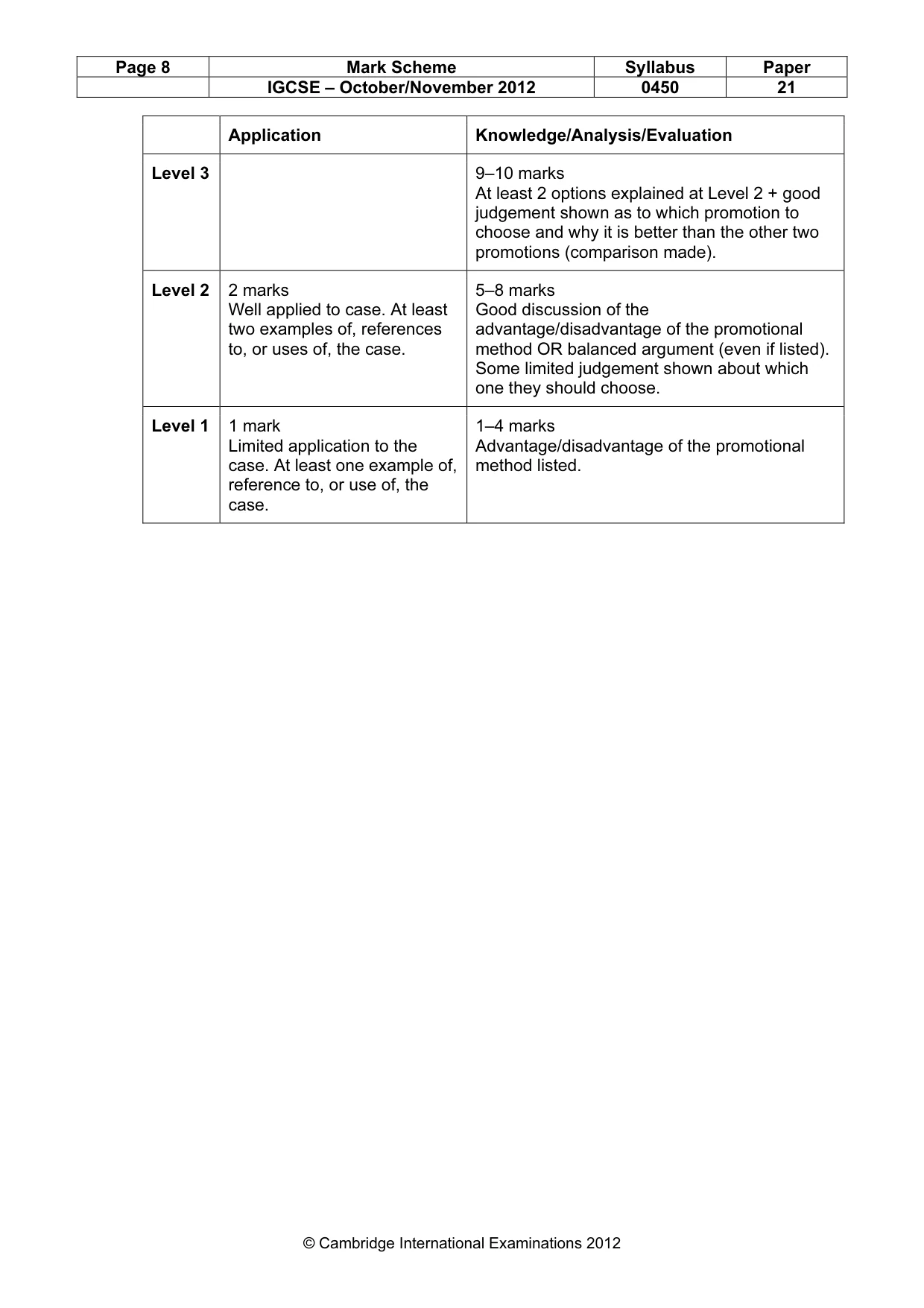
Page 8 Mark Scheme Syllabus Paper IGCSE – October/November 2012 0450 21 © Cambridge International Examinations 2012 Application Knowledge/Analysis/Evaluation Level 3 9–10 marks At least 2 options explained at Level 2 + good judgement shown as to which promotion to choose and why it is better than the other two promotions (comparison made). Level 2 2 marks Well applied to case. At least two examples of, references to, or uses of, the case. 5–8 marks Good discussion of the advantage/disadvantage of the promotional method OR balanced argument (even if listed). Some limited judgement shown about which one they should choose. Level 1 1 mark Limited application to the case. At least one example of, reference to, or use of, the case. 1–4 marks Advantage/disadvantage of the promotional method listed.
Mark scheme, page 9
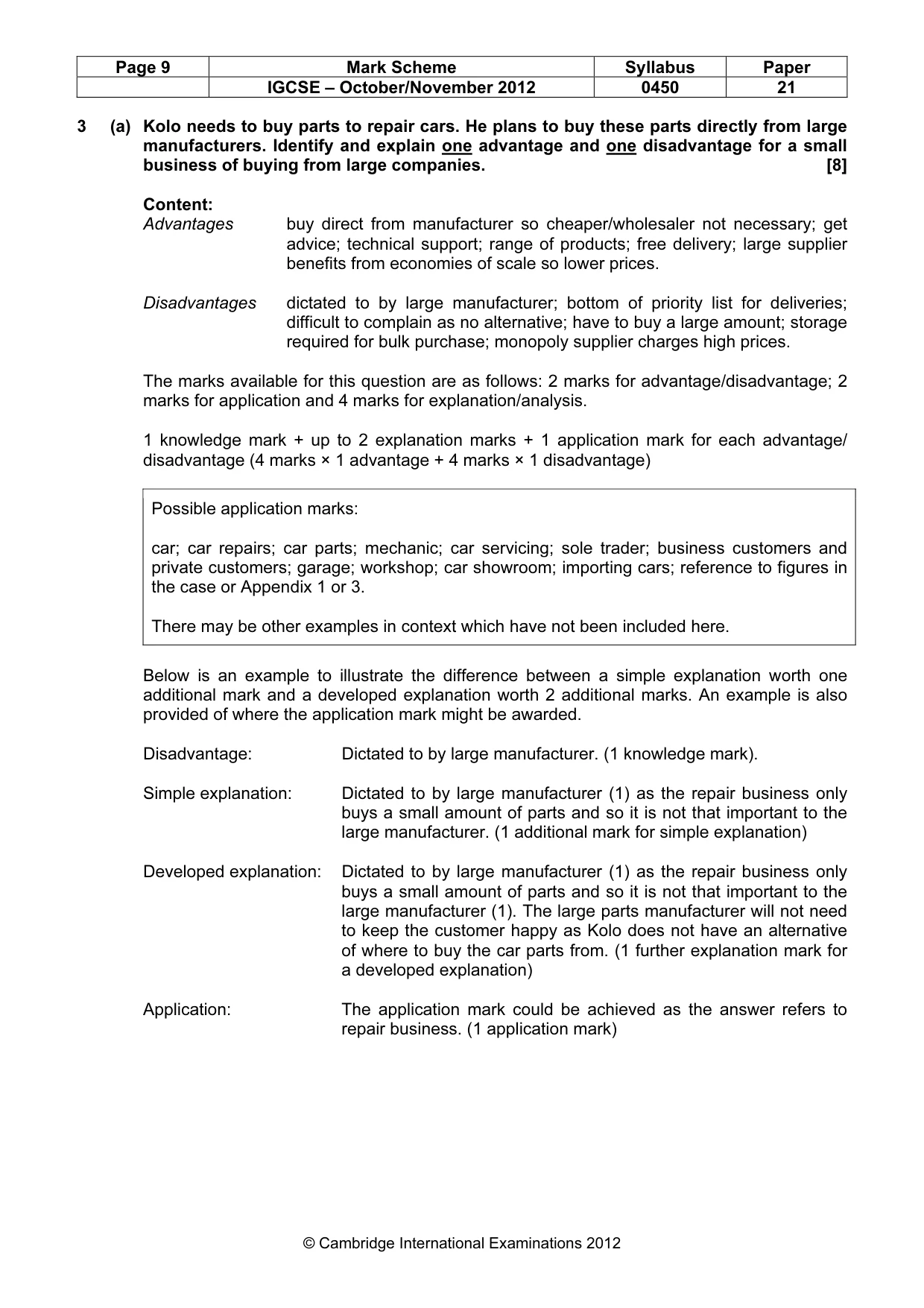
Page 9 Mark Scheme Syllabus Paper IGCSE – October/November 2012 0450 21 © Cambridge International Examinations 2012 3 (a) Kolo needs to buy parts to repair cars. He plans to buy these parts directly from large manufacturers. Identify and explain one advantage and one disadvantage for a small business of buying from large companies. [8] Content: Advantages buy direct from manufacturer so cheaper/wholesaler not necessary; get advice; technical support; range of products; free delivery; large supplier benefits from economies of scale so lower prices. Disadvantages dictated to by large manufacturer; bottom of priority list for deliveries; difficult to complain as no alternative; have to buy a large amount; storage required for bulk purchase; monopoly supplier charges high prices. The marks available for this question are as follows: 2 marks for advantage/disadvantage; 2 marks for application and 4 marks for explanation/analysis. 1 knowledge mark + up to 2 explanation marks + 1 application mark for each advantage/ disadvantage (4 marks × 1 advantage + 4 marks × 1 disadvantage) Possible application marks: car; car repairs; car parts; mechanic; car servicing; sole trader; business customers and private customers; garage; workshop; car showroom; importing cars; reference to figures in the case or Appendix 1 or 3. There may be other examples in context which have not been included here. Below is an example to illustrate the difference between a simple explanation worth one additional mark and a developed explanation worth 2 additional marks. An example is also provided of where the application mark might be awarded. Disadvantage: Dictated to by large manufacturer. (1 knowledge mark). Simple explanation: Dictated to by large manufacturer (1) as the repair business only buys a small amount of parts and so it is not that important to the large manufacturer. (1 additional mark for simple explanation) Developed explanation: Dictated to by large manufacturer (1) as the repair business only buys a small amount of parts and so it is not that important to the large manufacturer (1). The large parts manufacturer will not need to keep the customer happy as Kolo does not have an alternative of where to buy the car parts from. (1 further explanation mark for a developed explanation) Application: The application mark could be achieved as the answer refers to repair business. (1 application mark)
Mark scheme, page 10
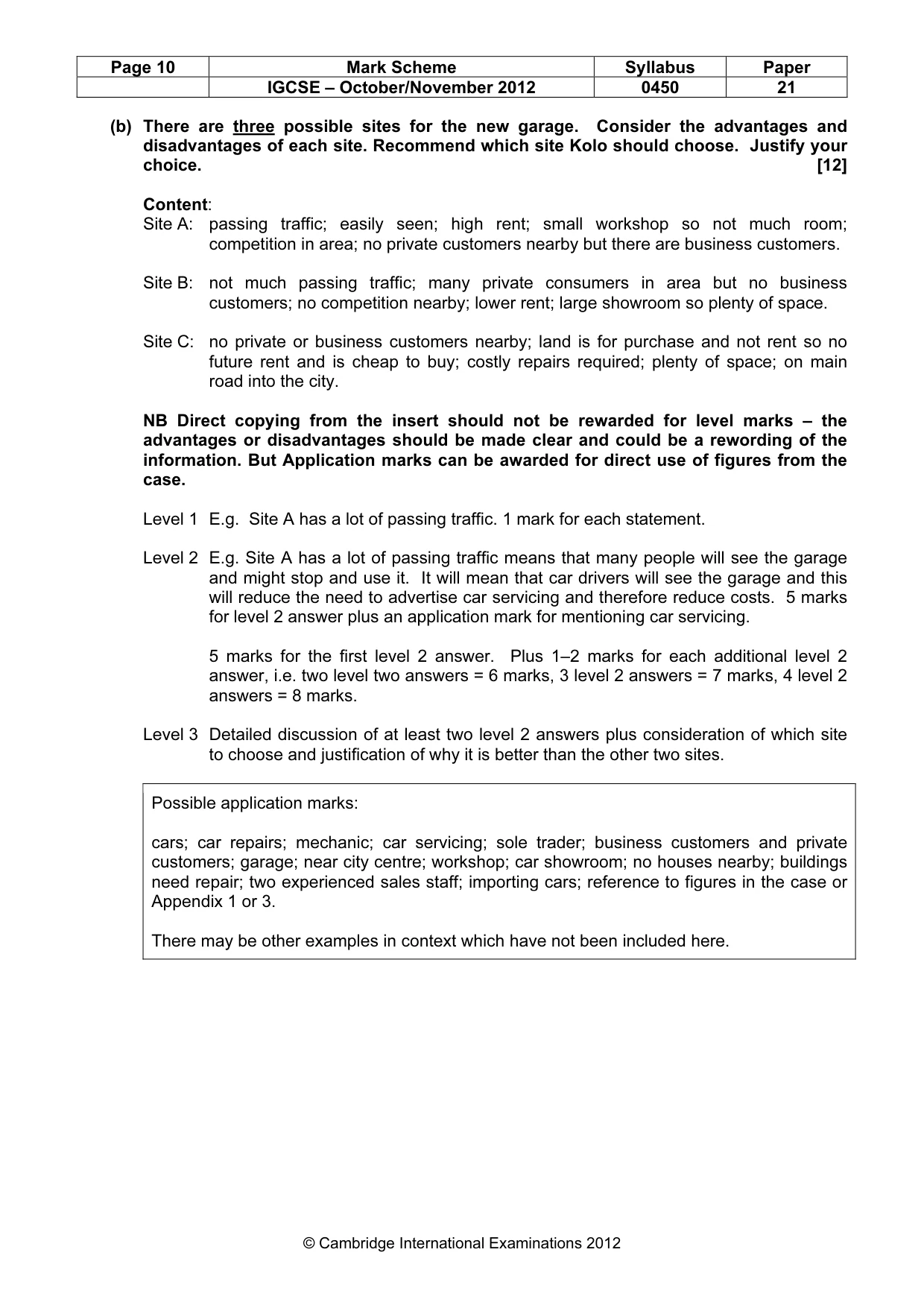
Page 10 Mark Scheme Syllabus Paper IGCSE – October/November 2012 0450 21 © Cambridge International Examinations 2012 (b) There are three possible sites for the new garage. Consider the advantages and disadvantages of each site. Recommend which site Kolo should choose. Justify your choice. [12] Content: Site A: passing traffic; easily seen; high rent; small workshop so not much room; competition in area; no private customers nearby but there are business customers. Site B: not much passing traffic; many private consumers in area but no business customers; no competition nearby; lower rent; large showroom so plenty of space. Site C: no private or business customers nearby; land is for purchase and not rent so no future rent and is cheap to buy; costly repairs required; plenty of space; on main road into the city. NB Direct copying from the insert should not be rewarded for level marks – the advantages or disadvantages should be made clear and could be a rewording of the information. But Application marks can be awarded for direct use of figures from the case. Level 1 E.g. Site A has a lot of passing traffic. 1 mark for each statement. Level 2 E.g. Site A has a lot of passing traffic means that many people will see the garage and might stop and use it. It will mean that car drivers will see the garage and this will reduce the need to advertise car servicing and therefore reduce costs. 5 marks for level 2 answer plus an application mark for mentioning car servicing. 5 marks for the first level 2 answer. Plus 1–2 marks for each additional level 2 answer, i.e. two level two answers = 6 marks, 3 level 2 answers = 7 marks, 4 level 2 answers = 8 marks. Level 3 Detailed discussion of at least two level 2 answers plus consideration of which site to choose and justification of why it is better than the other two sites. Possible application marks: cars; car repairs; mechanic; car servicing; sole trader; business customers and private customers; garage; near city centre; workshop; car showroom; no houses nearby; buildings need repair; two experienced sales staff; importing cars; reference to figures in the case or Appendix 1 or 3. There may be other examples in context which have not been included here.
Mark scheme, page 11
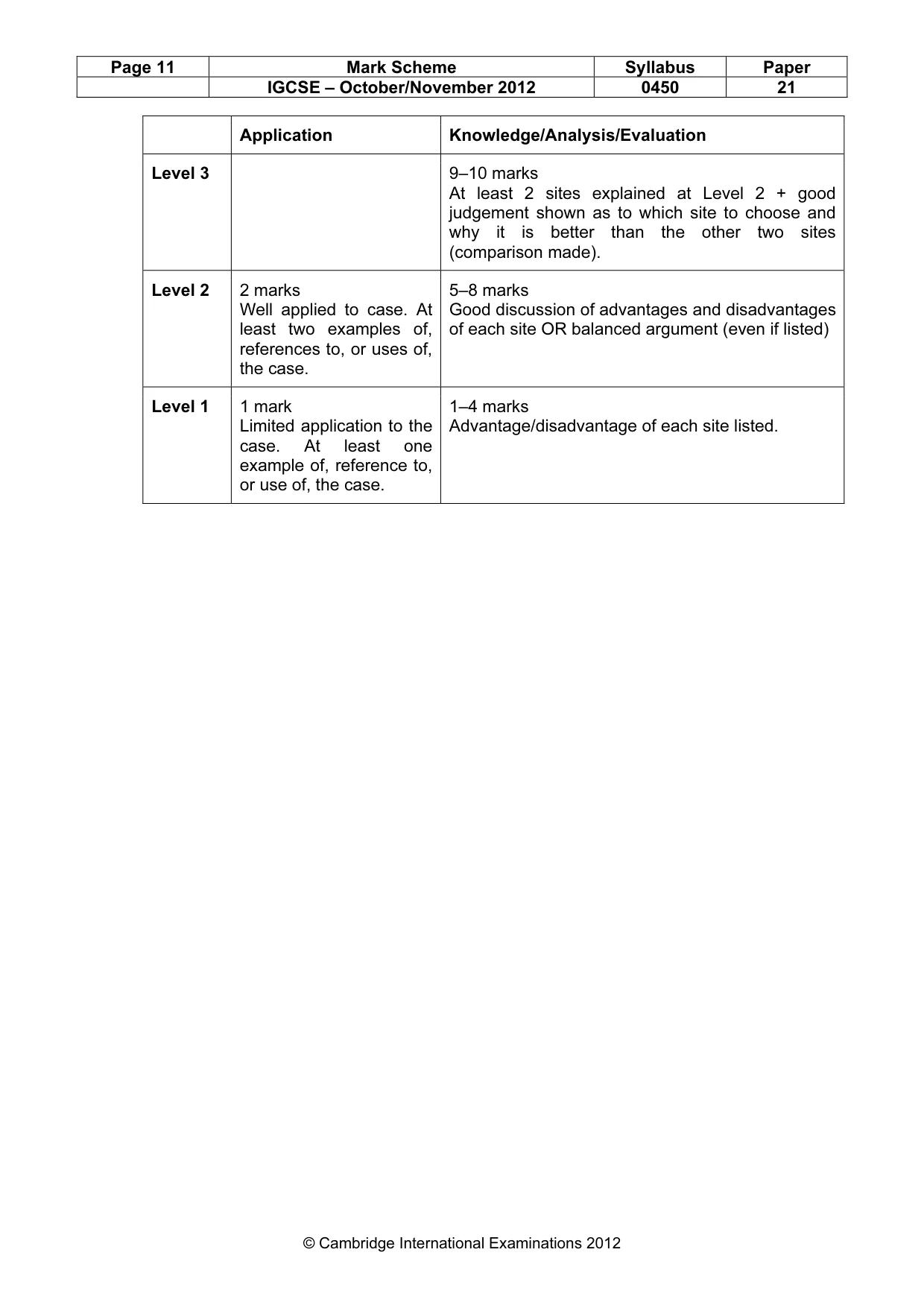
Page 11 Mark Scheme Syllabus Paper IGCSE – October/November 2012 0450 21 © Cambridge International Examinations 2012 Application Knowledge/Analysis/Evaluation Level 3 9–10 marks At least 2 sites explained at Level 2 + good judgement shown as to which site to choose and why it is better than the other two sites (comparison made). Level 2 2 marks Well applied to case. At least two examples of, references to, or uses of, the case. 5–8 marks Good discussion of advantages and disadvantages of each site OR balanced argument (even if listed) Level 1 1 mark Limited application to the case. At least one example of, reference to, or use of, the case. 1–4 marks Advantage/disadvantage of each site listed.
Mark scheme, page 12
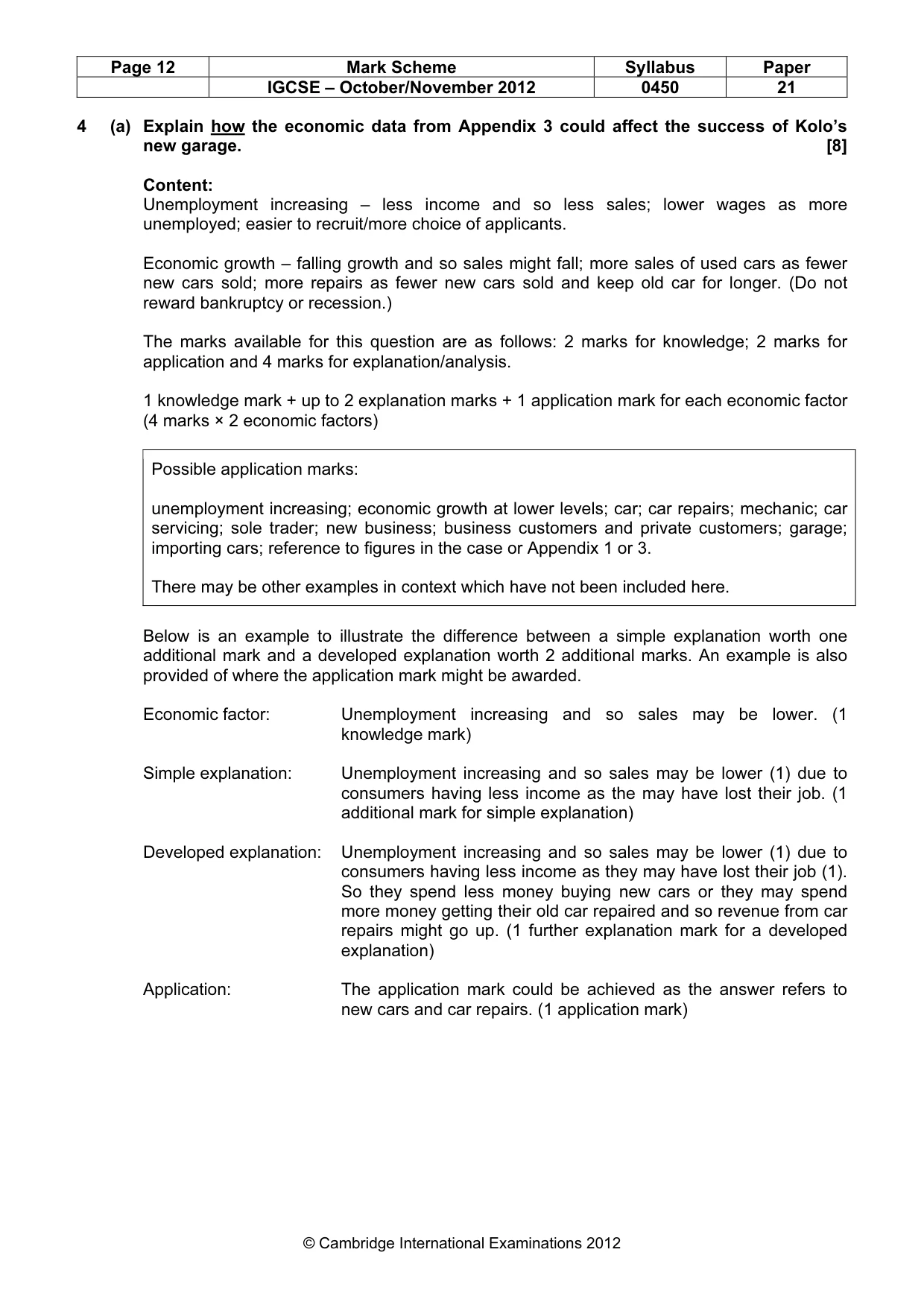
Page 12 Mark Scheme Syllabus Paper IGCSE – October/November 2012 0450 21 © Cambridge International Examinations 2012 4 (a) Explain how the economic data from Appendix 3 could affect the success of Kolo’s new garage. [8] Content: Unemployment increasing – less income and so less sales; lower wages as more unemployed; easier to recruit/more choice of applicants. Economic growth – falling growth and so sales might fall; more sales of used cars as fewer new cars sold; more repairs as fewer new cars sold and keep old car for longer. (Do not reward bankruptcy or recession.) The marks available for this question are as follows: 2 marks for knowledge; 2 marks for application and 4 marks for explanation/analysis. 1 knowledge mark + up to 2 explanation marks + 1 application mark for each economic factor (4 marks × 2 economic factors) Possible application marks: unemployment increasing; economic growth at lower levels; car; car repairs; mechanic; car servicing; sole trader; new business; business customers and private customers; garage; importing cars; reference to figures in the case or Appendix 1 or 3. There may be other examples in context which have not been included here. Below is an example to illustrate the difference between a simple explanation worth one additional mark and a developed explanation worth 2 additional marks. An example is also provided of where the application mark might be awarded. Economic factor: Unemployment increasing and so sales may be lower. (1 knowledge mark) Simple explanation: Unemployment increasing and so sales may be lower (1) due to consumers having less income as the may have lost their job. (1 additional mark for simple explanation) Developed explanation: Unemployment increasing and so sales may be lower (1) due to consumers having less income as they may have lost their job (1). So they spend less money buying new cars or they may spend more money getting their old car repaired and so revenue from car repairs might go up. (1 further explanation mark for a developed explanation) Application: The application mark could be achieved as the answer refers to new cars and car repairs. (1 application mark)
Mark scheme, page 13
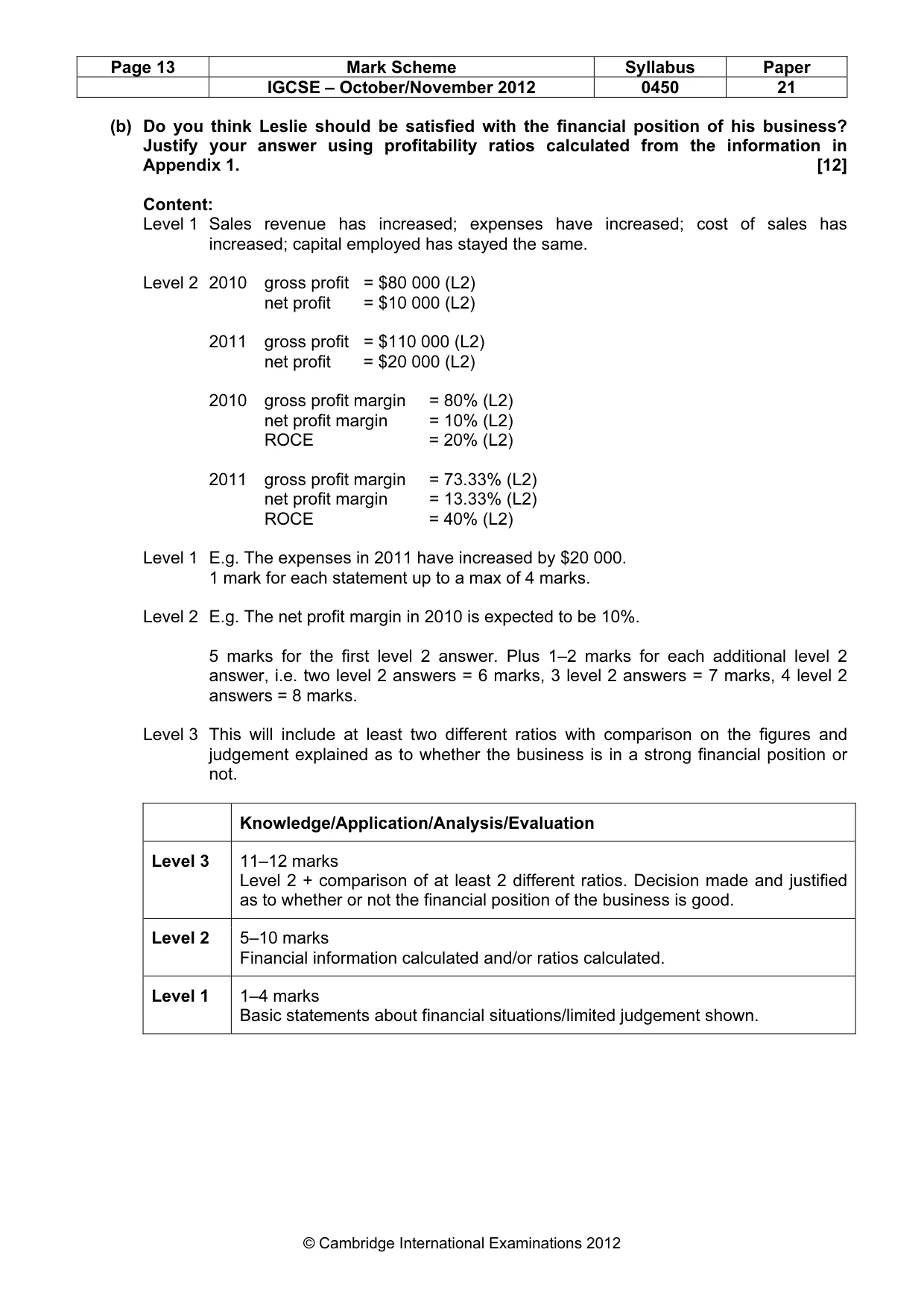
Page 13 Mark Scheme Syllabus Paper IGCSE – October/November 2012 0450 21 © Cambridge International Examinations 2012 (b) Do you think Leslie should be satisfied with the financial position of his business? Justify your answer using profitability ratios calculated from the information in Appendix 1. [12] Content: Level 1 Sales revenue has increased; expenses have increased; cost of sales has increased; capital employed has stayed the same. Level 2 2010 gross profit = $80 000 (L2) net profit = $10 000 (L2) 2011 gross profit = $110 000 (L2) net profit = $20 000 (L2) 2010 gross profit margin = 80% (L2) net profit margin = 10% (L2) ROCE = 20% (L2) 2011 gross profit margin = 73.33% (L2) net profit margin = 13.33% (L2) ROCE = 40% (L2) Level 1 E.g. The expenses in 2011 have increased by $20 000. 1 mark for each statement up to a max of 4 marks. Level 2 E.g. The net profit margin in 2010 is expected to be 10%. 5 marks for the first level 2 answer. Plus 1–2 marks for each additional level 2 answer, i.e. two level 2 answers = 6 marks, 3 level 2 answers = 7 marks, 4 level 2 answers = 8 marks. Level 3 This will include at least two different ratios with comparison on the figures and judgement explained as to whether the business is in a strong financial position or not. Knowledge/Application/Analysis/Evaluation Level 3 11–12 marks Level 2 + comparison of at least 2 different ratios. Decision made and justified as to whether or not the financial position of the business is good. Level 2 5–10 marks Financial information calculated and/or ratios calculated. Level 1 1–4 marks Basic statements about financial situations/limited judgement shown.
Mark scheme, page 14
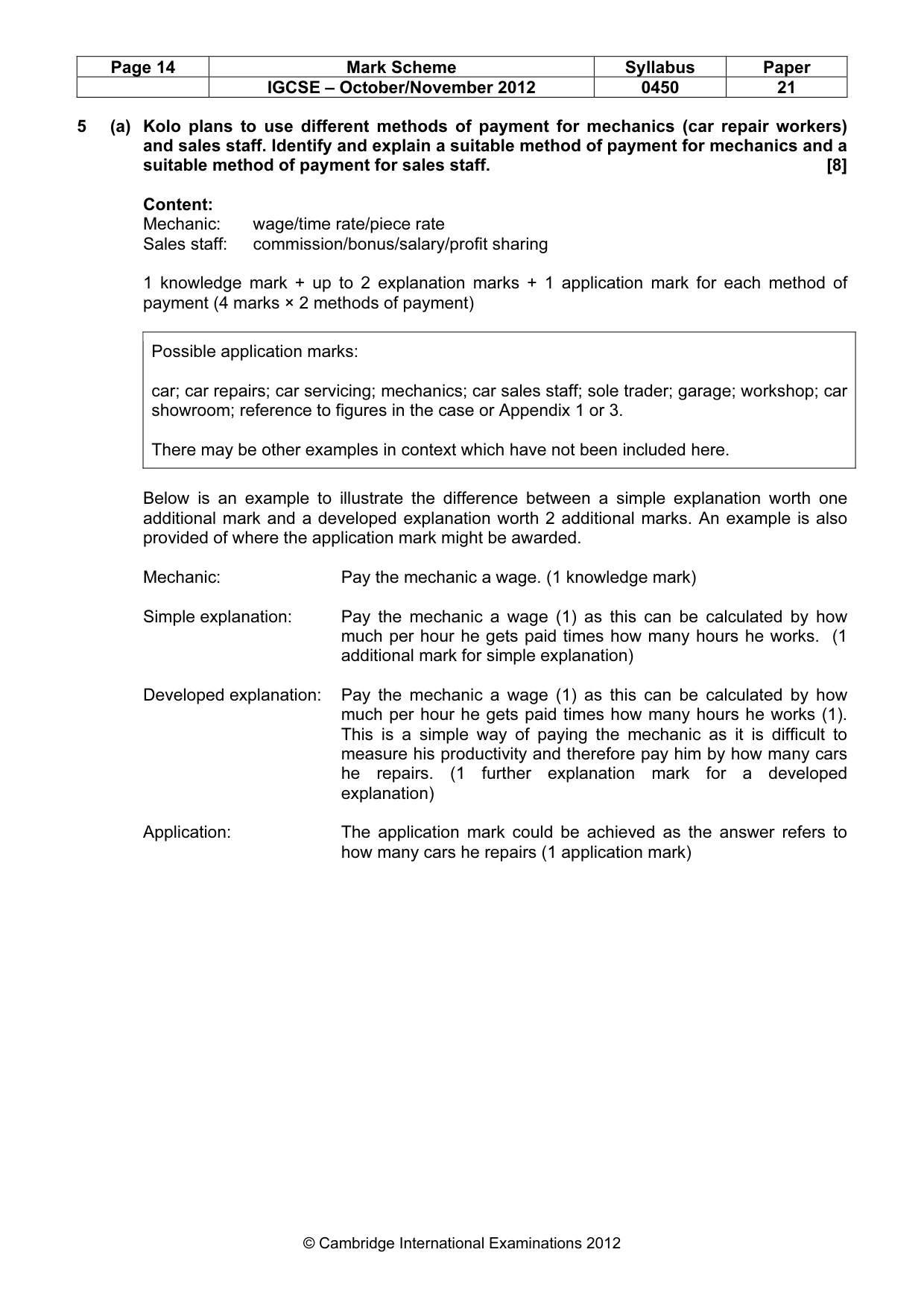
Page 14 Mark Scheme Syllabus Paper IGCSE – October/November 2012 0450 21 © Cambridge International Examinations 2012 5 (a) Kolo plans to use different methods of payment for mechanics (car repair workers) and sales staff. Identify and explain a suitable method of payment for mechanics and a suitable method of payment for sales staff. [8] Content: Mechanic: wage/time rate/piece rate Sales staff: commission/bonus/salary/profit sharing 1 knowledge mark + up to 2 explanation marks + 1 application mark for each method of payment (4 marks × 2 methods of payment) Possible application marks: car; car repairs; car servicing; mechanics; car sales staff; sole trader; garage; workshop; car showroom; reference to figures in the case or Appendix 1 or 3. There may be other examples in context which have not been included here. Below is an example to illustrate the difference between a simple explanation worth one additional mark and a developed explanation worth 2 additional marks. An example is also provided of where the application mark might be awarded. Mechanic: Pay the mechanic a wage. (1 knowledge mark) Simple explanation: Pay the mechanic a wage (1) as this can be calculated by how much per hour he gets paid times how many hours he works. (1 additional mark for simple explanation) Developed explanation: Pay the mechanic a wage (1) as this can be calculated by how much per hour he gets paid times how many hours he works (1). This is a simple way of paying the mechanic as it is difficult to measure his productivity and therefore pay him by how many cars he repairs. (1 further explanation mark for a developed explanation) Application: The application mark could be achieved as the answer refers to how many cars he repairs (1 application mark)
Mark scheme, page 15
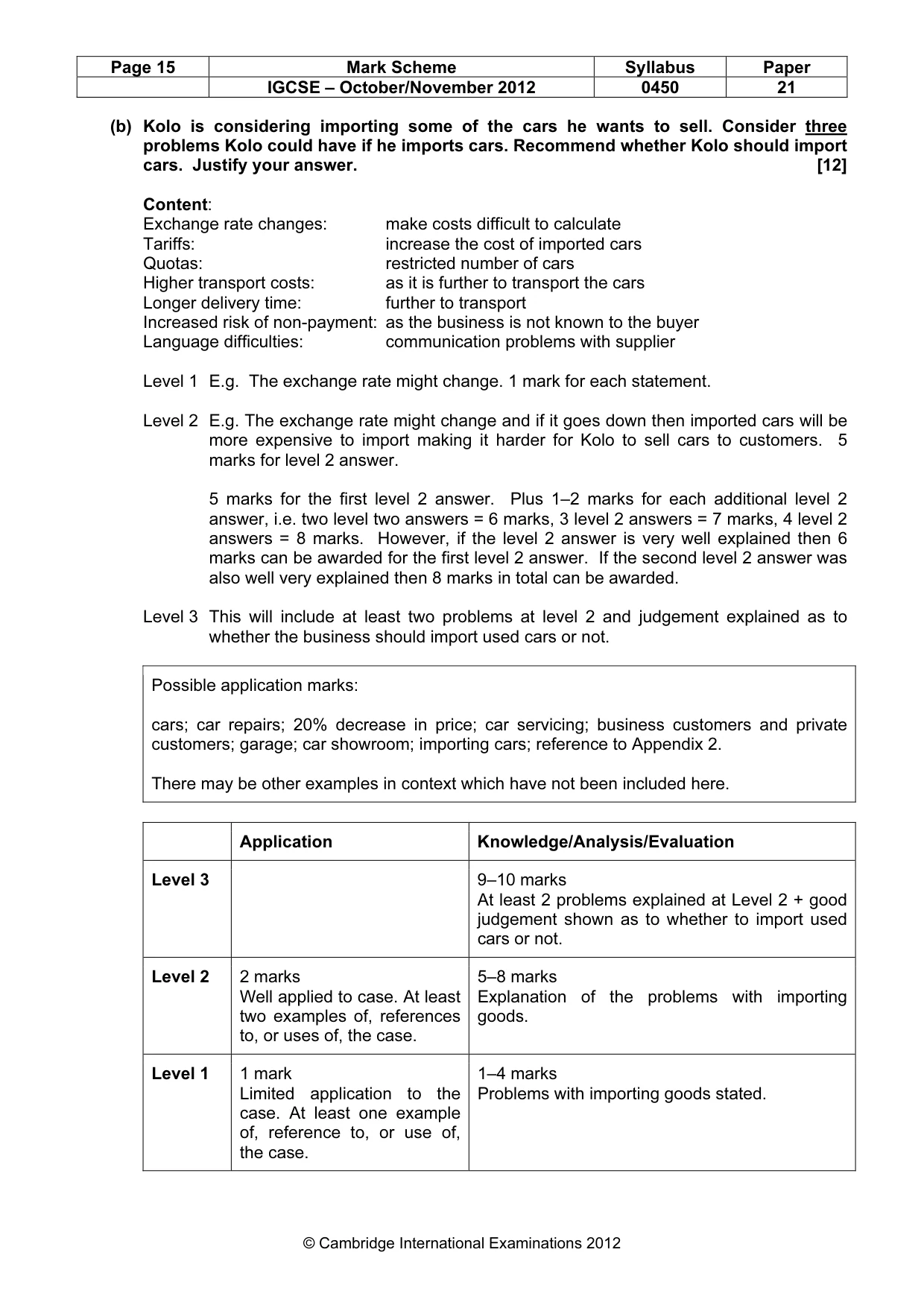
Page 15 Mark Scheme Syllabus Paper IGCSE – October/November 2012 0450 21 © Cambridge International Examinations 2012 (b) Kolo is considering importing some of the cars he wants to sell. Consider three problems Kolo could have if he imports cars. Recommend whether Kolo should import cars. Justify your answer. [12] Content: Exchange rate changes: make costs difficult to calculate Tariffs: increase the cost of imported cars Quotas: restricted number of cars Higher transport costs: as it is further to transport the cars Longer delivery time: further to transport Increased risk of non-payment: as the business is not known to the buyer Language difficulties: communication problems with supplier Level 1 E.g. The exchange rate might change. 1 mark for each statement. Level 2 E.g. The exchange rate might change and if it goes down then imported cars will be more expensive to import making it harder for Kolo to sell cars to customers. 5 marks for level 2 answer. 5 marks for the first level 2 answer. Plus 1–2 marks for each additional level 2 answer, i.e. two level two answers = 6 marks, 3 level 2 answers = 7 marks, 4 level 2 answers = 8 marks. However, if the level 2 answer is very well explained then 6 marks can be awarded for the first level 2 answer. If the second level 2 answer was also well very explained then 8 marks in total can be awarded. Level 3 This will include at least two problems at level 2 and judgement explained as to whether the business should import used cars or not. Possible application marks: cars; car repairs; 20% decrease in price; car servicing; business customers and private customers; garage; car showroom; importing cars; reference to Appendix 2. There may be other examples in context which have not been included here. Application Knowledge/Analysis/Evaluation Level 3 9–10 marks At least 2 problems explained at Level 2 + good judgement shown as to whether to import used cars or not. Level 2 2 marks Well applied to case. At least two examples of, references to, or uses of, the case. 5–8 marks Explanation of the problems with importing goods. Level 1 1 mark Limited application to the case. At least one example of, reference to, or use of, the case. 1–4 marks Problems with importing goods stated.
What you needed in this session
Cambridge’s own grade thresholds for 2012 Oct/Nov, Paper 2 · Variant 1. A higher threshold means an easier paper — the bar moves with how the cohort did.