Cambridge IGCSE Business Studies 0450 — 2012 Oct/Nov Paper 2 · Variant 3
0450/23/O/N/12 · 100 marks · ≈113 min
The question paper and its mark scheme, free to read here and free to download. This is Cambridge’s own paper, exactly as it was sat.
Question paper12 pages

Mark scheme11 pages
Answers below. Sit the paper first if you are practising.
Paper as text
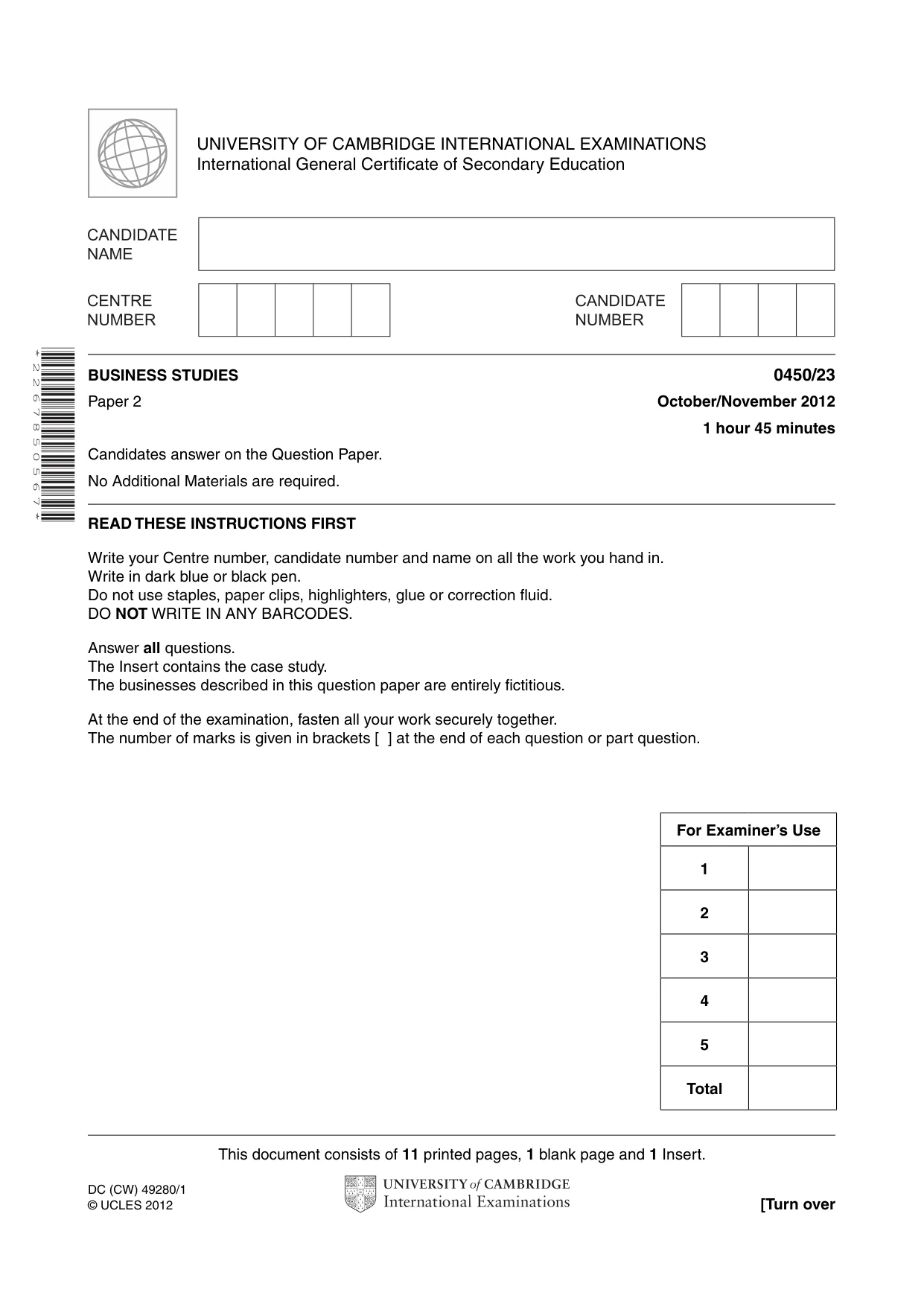
Question paper, page 1
This document consists of 11 printed pages, 1 blank page and 1 Insert. DC (CW) 49280/1 © UCLES 2012 [Turn over UNIVERSITY OF CAMBRIDGE INTERNATIONAL EXAMINATIONS International General Certificate of Secondary Education * 2 2 6 7 8 5 0 5 6 7 * BUSINESS STUDIES 0450/23 Paper 2 October/November 2012 1 hour 45 minutes Candidates answer on the Question Paper. No Additional Materials are required. READ THESE INSTRUCTIONS FIRST Write your Centre number, candidate number and name on all the work you hand in. Write in dark blue or black pen. Do not use staples, paper clips, highlighters, glue or correction fluid. DO NOT WRITE IN ANY BARCODES. Answer all questions. The Insert contains the case study. The businesses described in this question paper are entirely fictitious. At the end of the examination, fasten all your work securely together. The number of marks is given in brackets [ ] at the end of each question or part question. For Examiner’s Use 1 2 3 4 5 Total
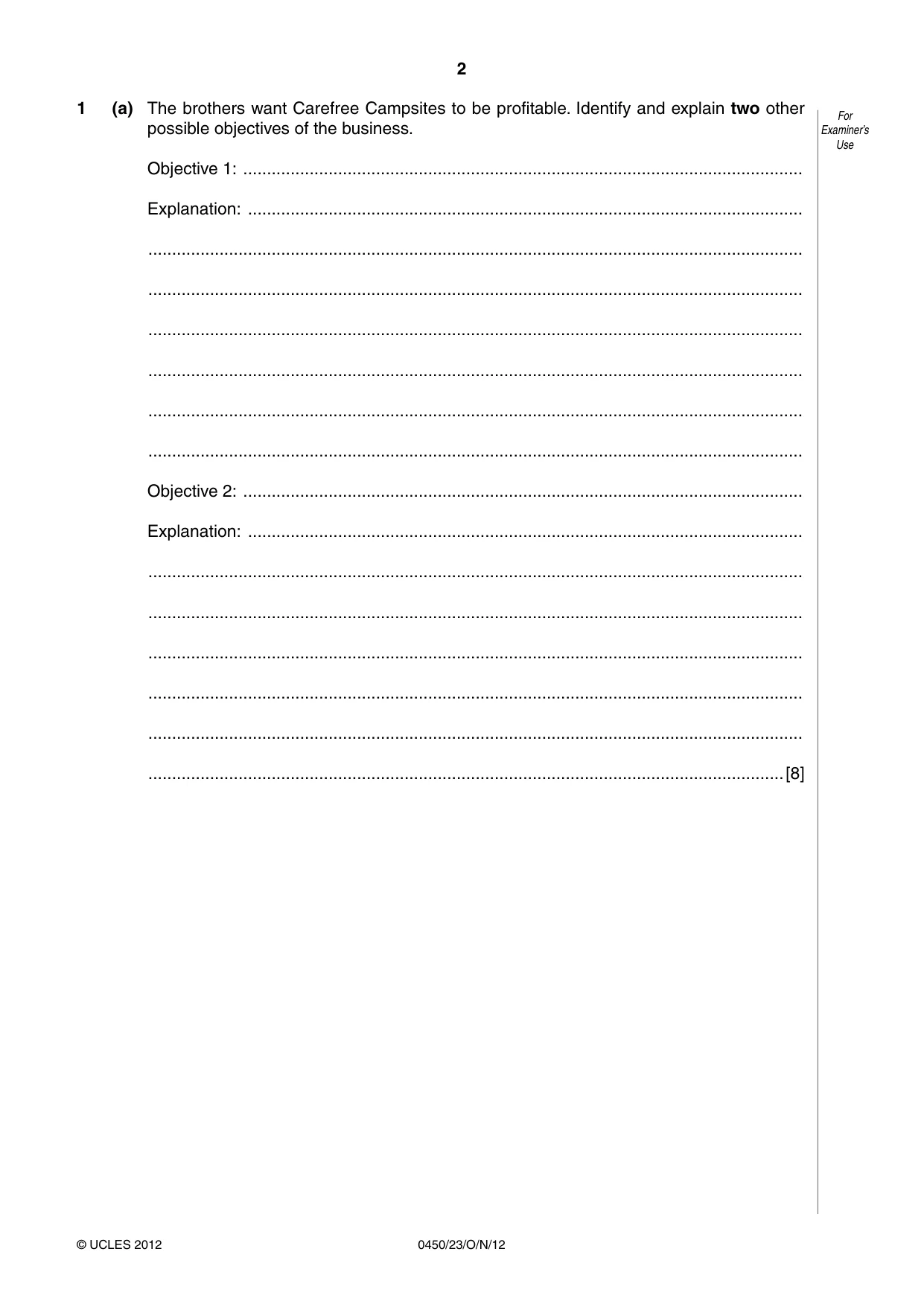
Question paper, page 2
2 0450/23/O/N/12 © UCLES 2012 For Examiner’s Use 1 (a) The brothers want Carefree Campsites to be profitable. Identify and explain two other possible objectives of the business. Objective 1: … Explanation: … … … … … … … Objective 2: … Explanation: … … … … … … …[8]
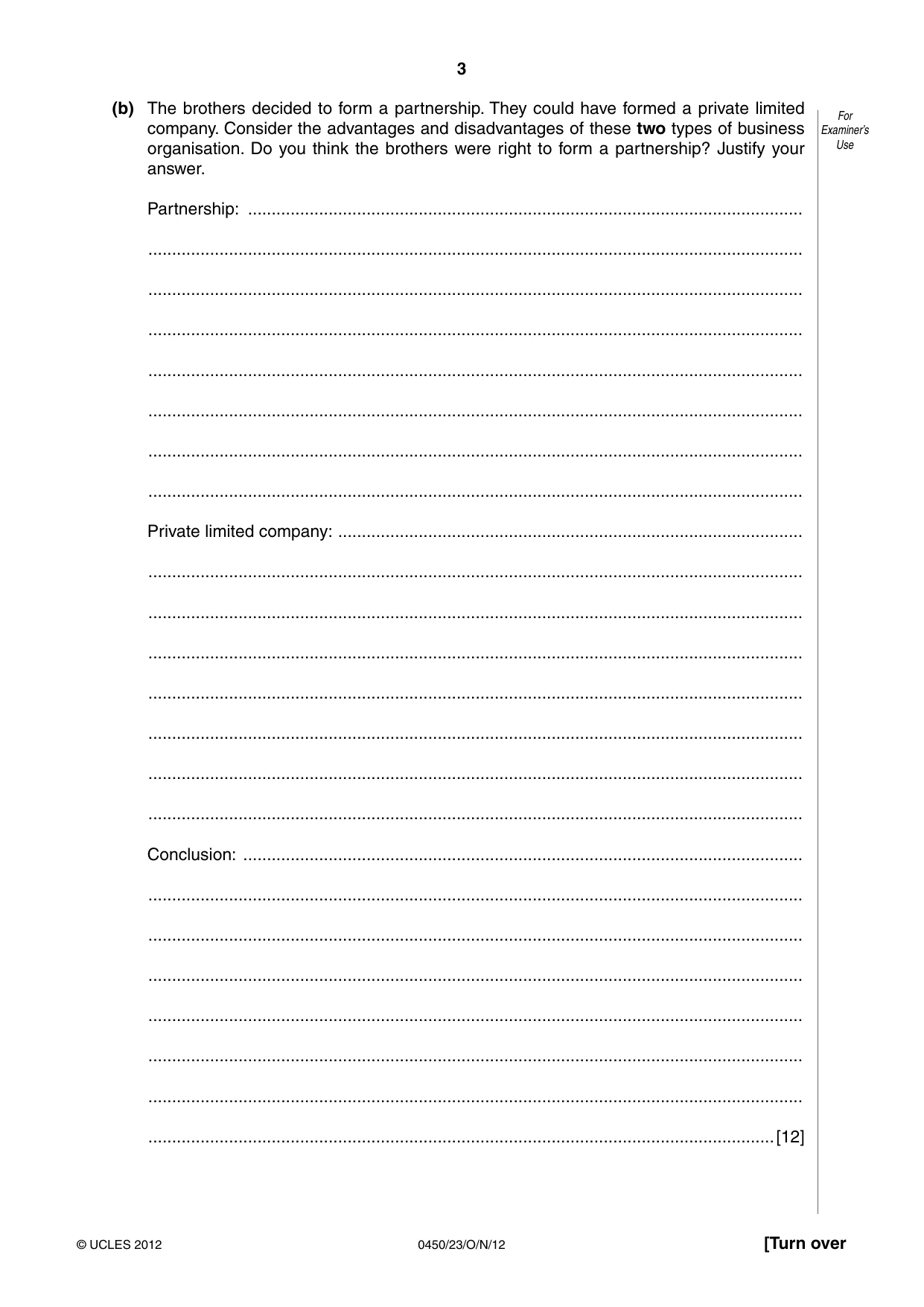
Question paper, page 3
3 0450/23/O/N/12 © UCLES 2012 [Turn over For Examiner’s Use (b) The brothers decided to form a partnership. They could have formed a private limited company. Consider the advantages and disadvantages of these two types of business organisation. Do you think the brothers were right to form a partnership? Justify your answer. Partnership: … … … … … … … … Private limited company: … … … … … … … … Conclusion: … … … … … … … …[12]
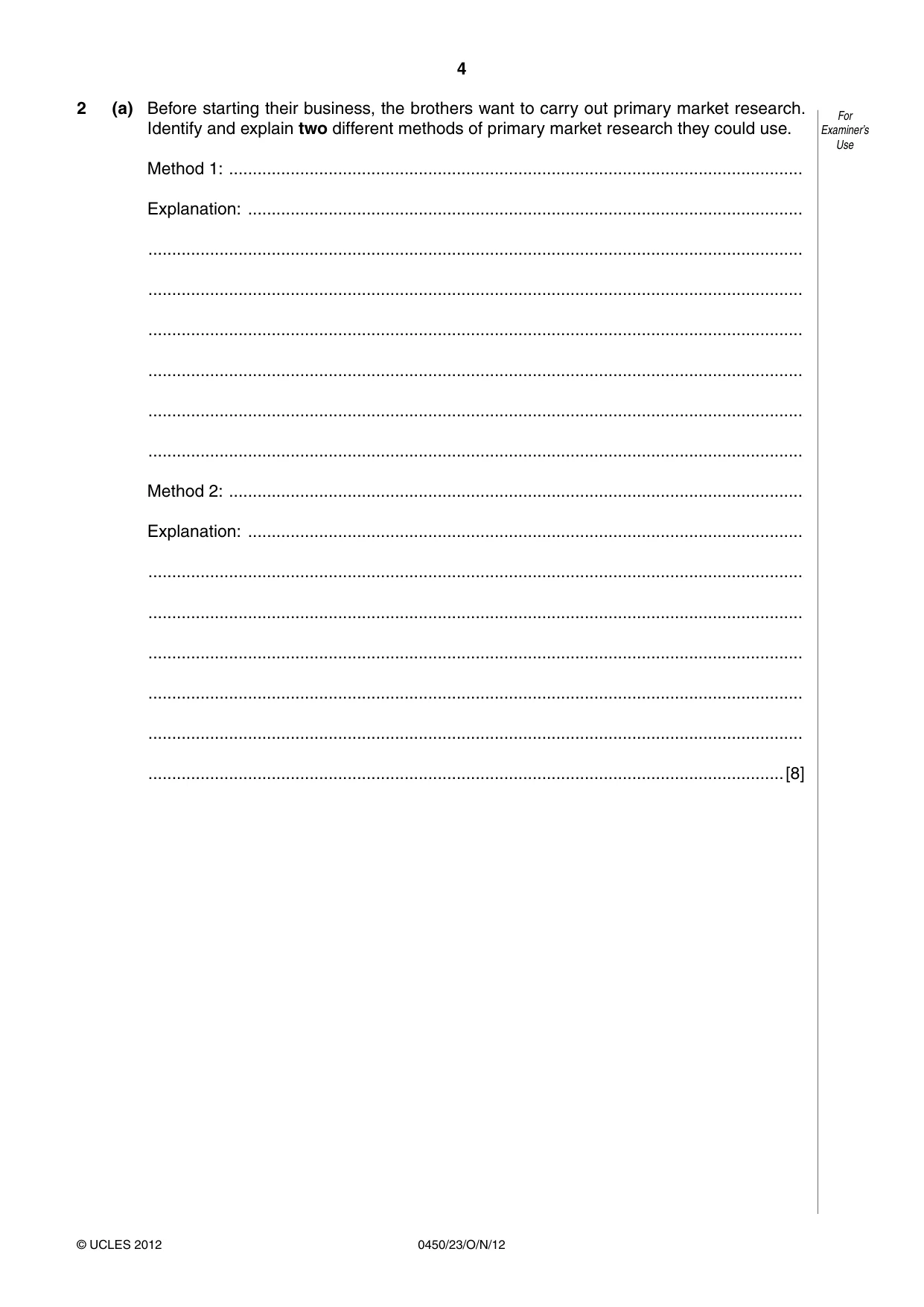
Question paper, page 4
4 0450/23/O/N/12 © UCLES 2012 For Examiner’s Use 2 (a) Before starting their business, the brothers want to carry out primary market research. Identify and explain two different methods of primary market research they could use. Method 1: … Explanation: … … … … … … … Method 2: … Explanation: … … … … … … …[8]
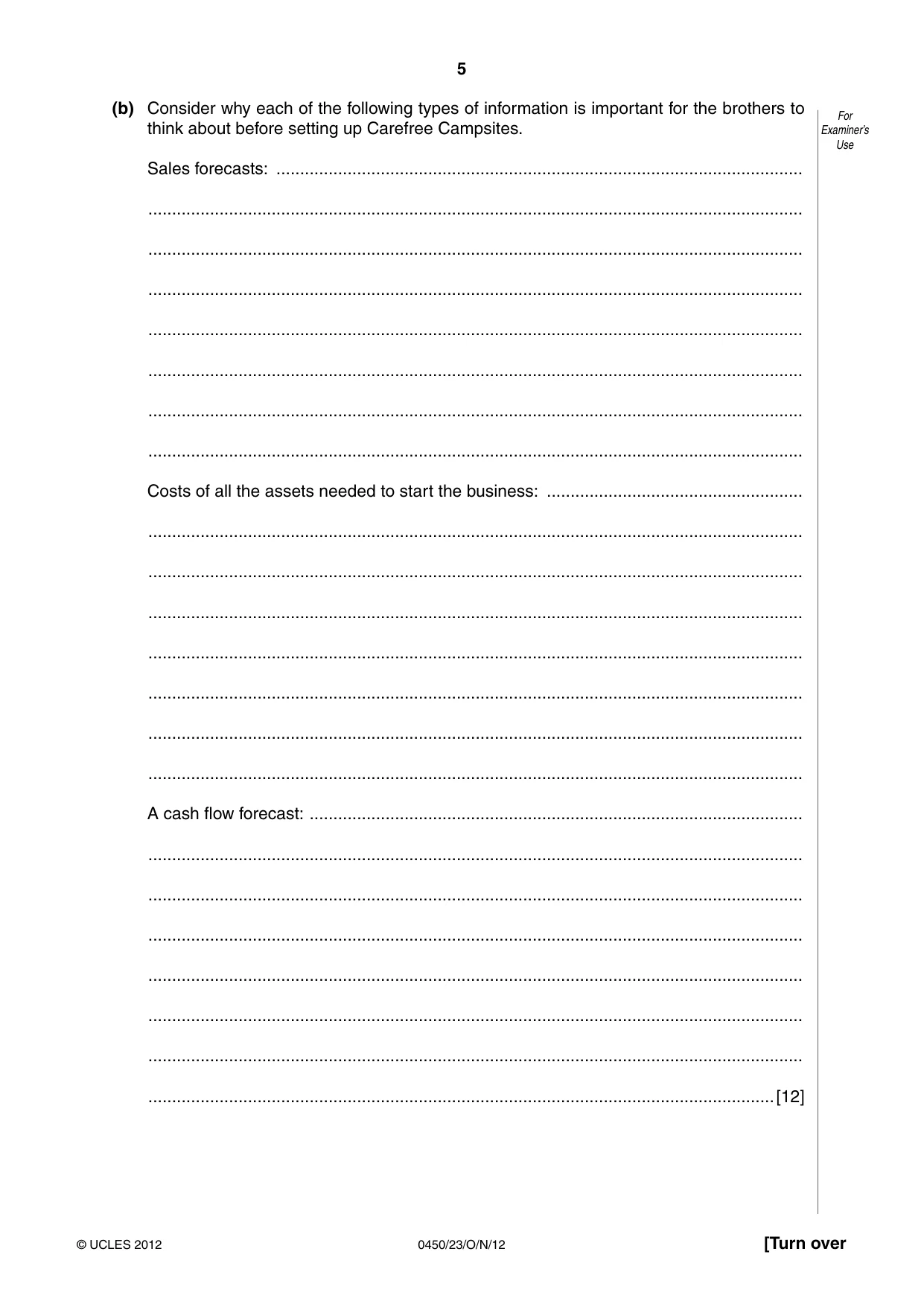
Question paper, page 5
5 0450/23/O/N/12 © UCLES 2012 [Turn over For Examiner’s Use (b) Consider why each of the following types of information is important for the brothers to think about before setting up Carefree Campsites. Sales forecasts: … … … … … … … … Costs of all the assets needed to start the business: … … … … … … … … A cash flow forecast: … … … … … … … …[12]
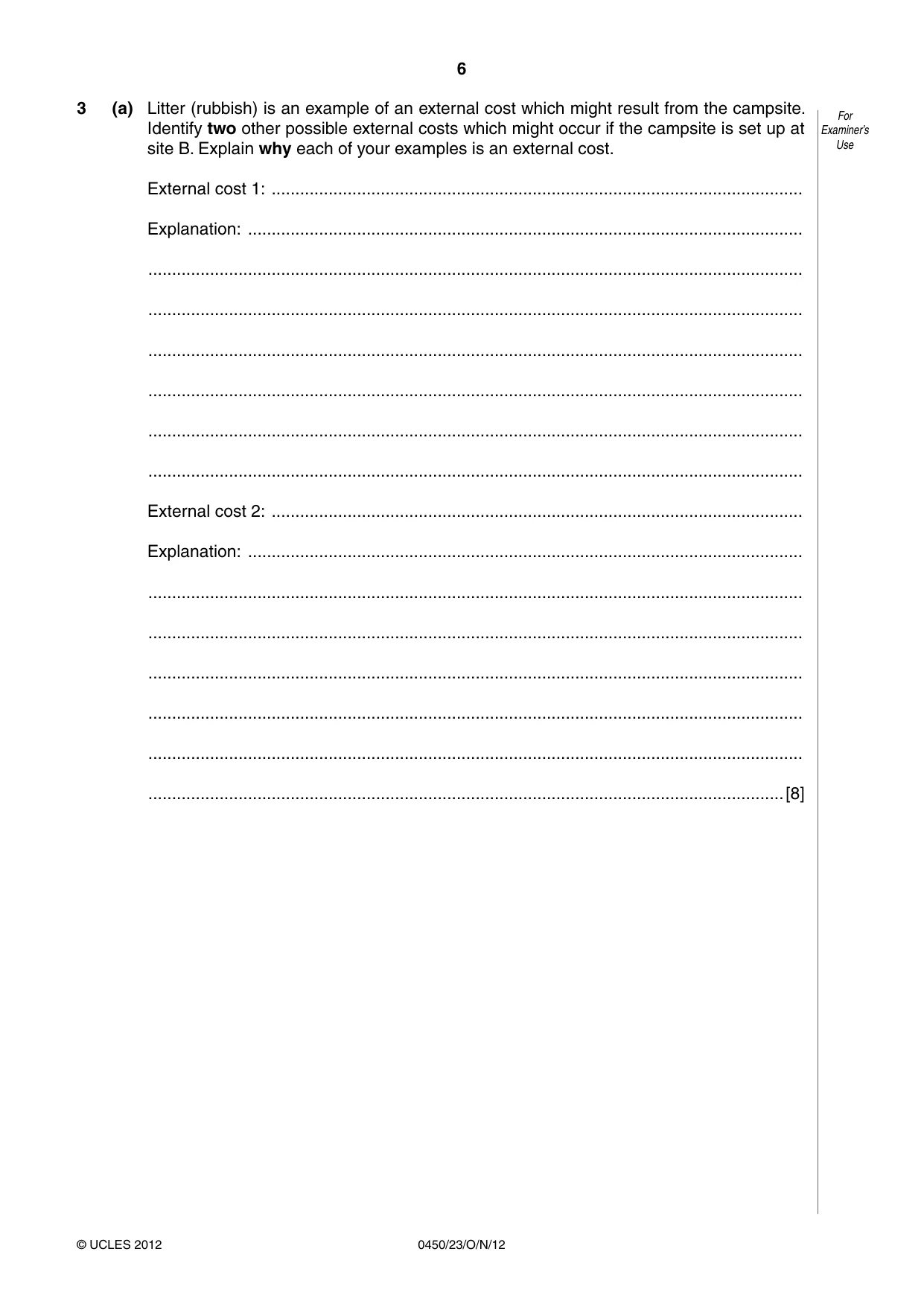
Question paper, page 6
6 0450/23/O/N/12 © UCLES 2012 For Examiner’s Use 3 (a) Litter (rubbish) is an example of an external cost which might result from the campsite. Identify two other possible external costs which might occur if the campsite is set up at site B. Explain why each of your examples is an external cost. External cost 1: … Explanation: … … … … … … … External cost 2: … Explanation: … … … … … … …[8]
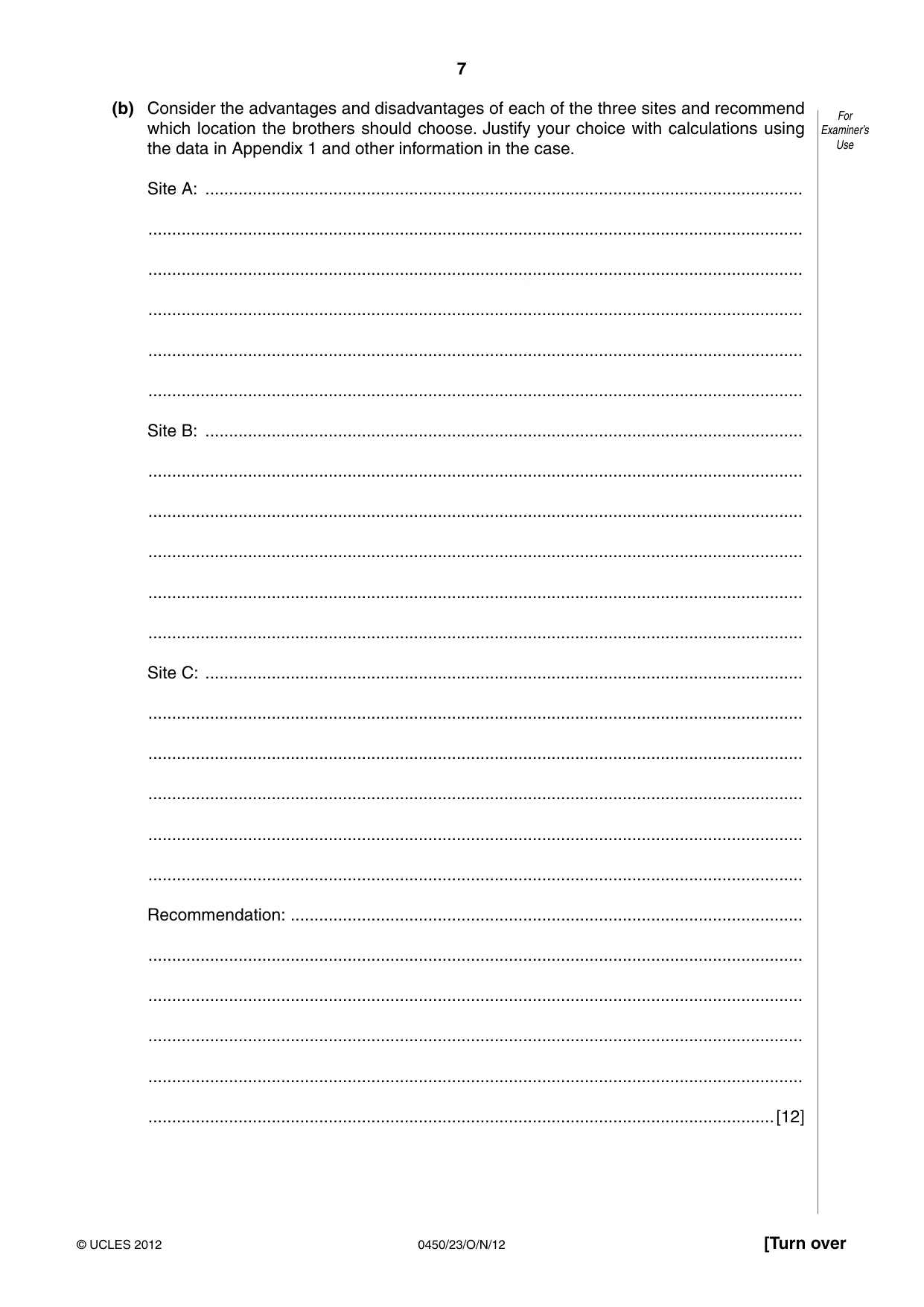
Question paper, page 7
7 0450/23/O/N/12 © UCLES 2012 [Turn over For Examiner’s Use (b) Consider the advantages and disadvantages of each of the three sites and recommend which location the brothers should choose. Justify your choice with calculations using the data in Appendix 1 and other information in the case. Site A: … … … … … … Site B: … … … … … … Site C: … … … … … … Recommendation: … … … … … …[12]
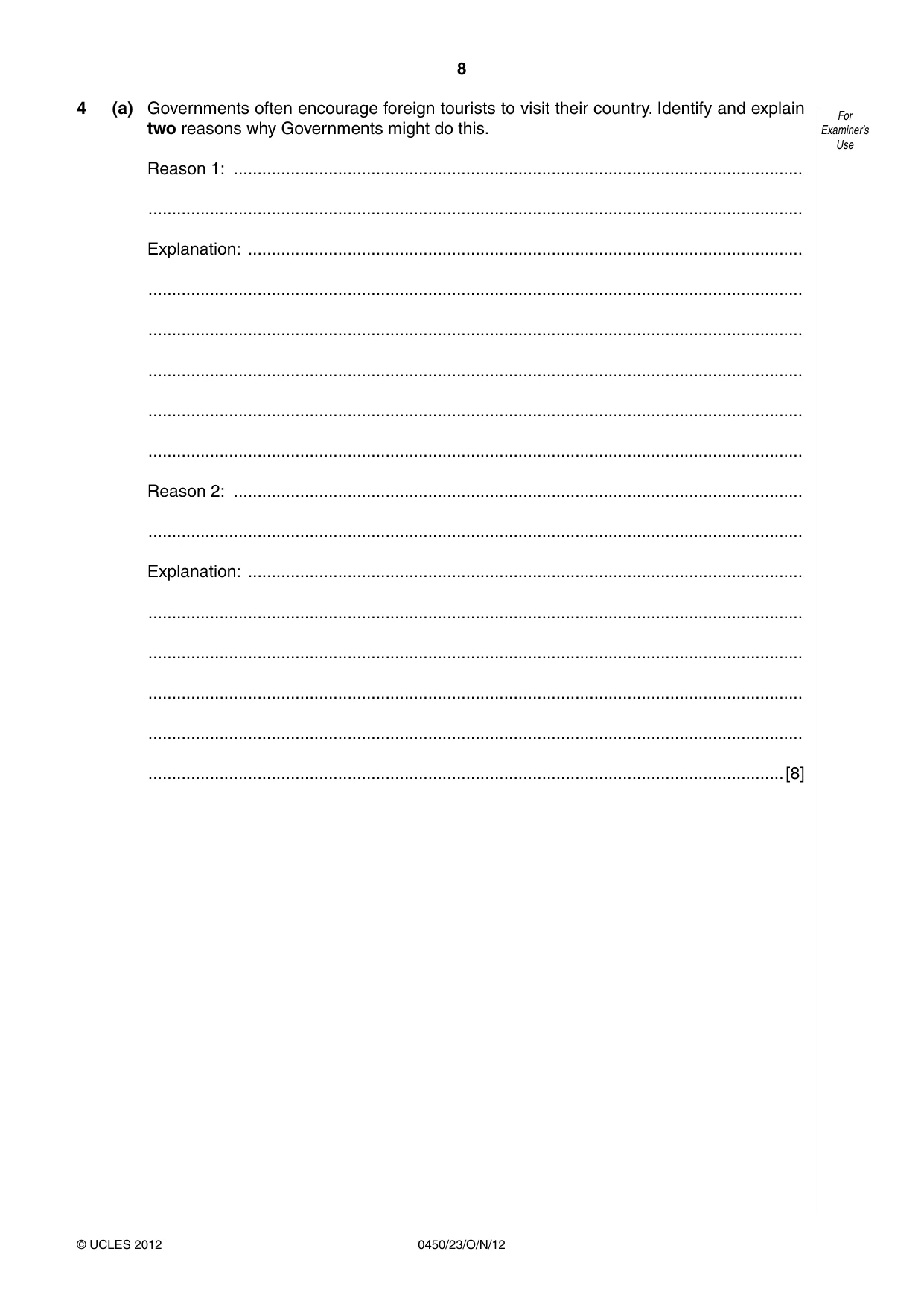
Question paper, page 8
8 0450/23/O/N/12 © UCLES 2012 For Examiner’s Use 4 (a) Governments often encourage foreign tourists to visit their country. Identify and explain two reasons why Governments might do this. Reason 1: … … Explanation: … … … … … … Reason 2: … … Explanation: … … … … … …[8]
Question paper, page 9
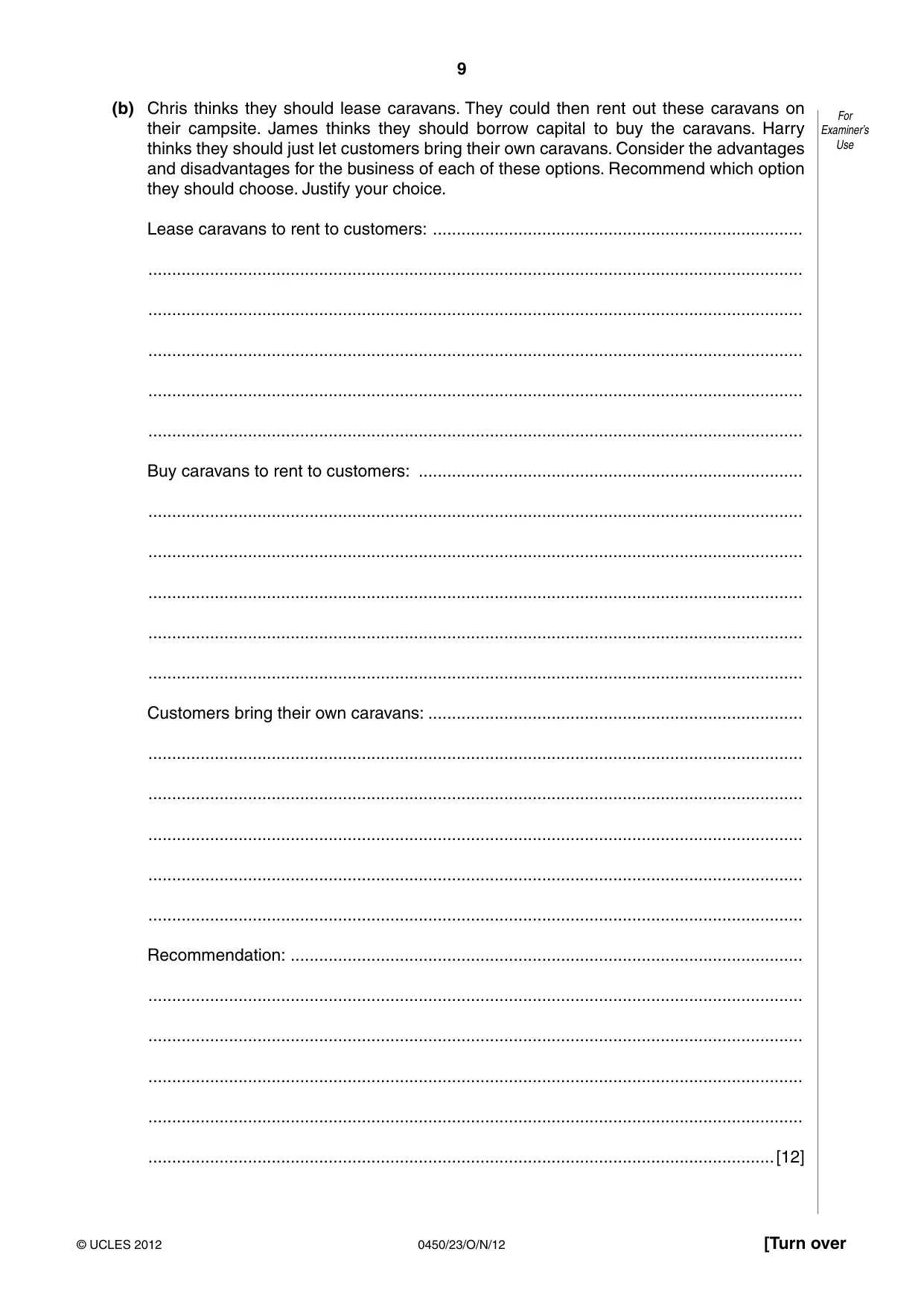
9 0450/23/O/N/12 © UCLES 2012 [Turn over For Examiner’s Use (b) Chris thinks they should lease caravans. They could then rent out these caravans on their campsite. James thinks they should borrow capital to buy the caravans. Harry thinks they should just let customers bring their own caravans. Consider the advantages and disadvantages for the business of each of these options. Recommend which option they should choose. Justify your choice. Lease caravans to rent to customers: … … … … … … Buy caravans to rent to customers: … … … … … … Customers bring their own caravans: … … … … … … Recommendation: … … … … … …[12]
Question paper, page 10
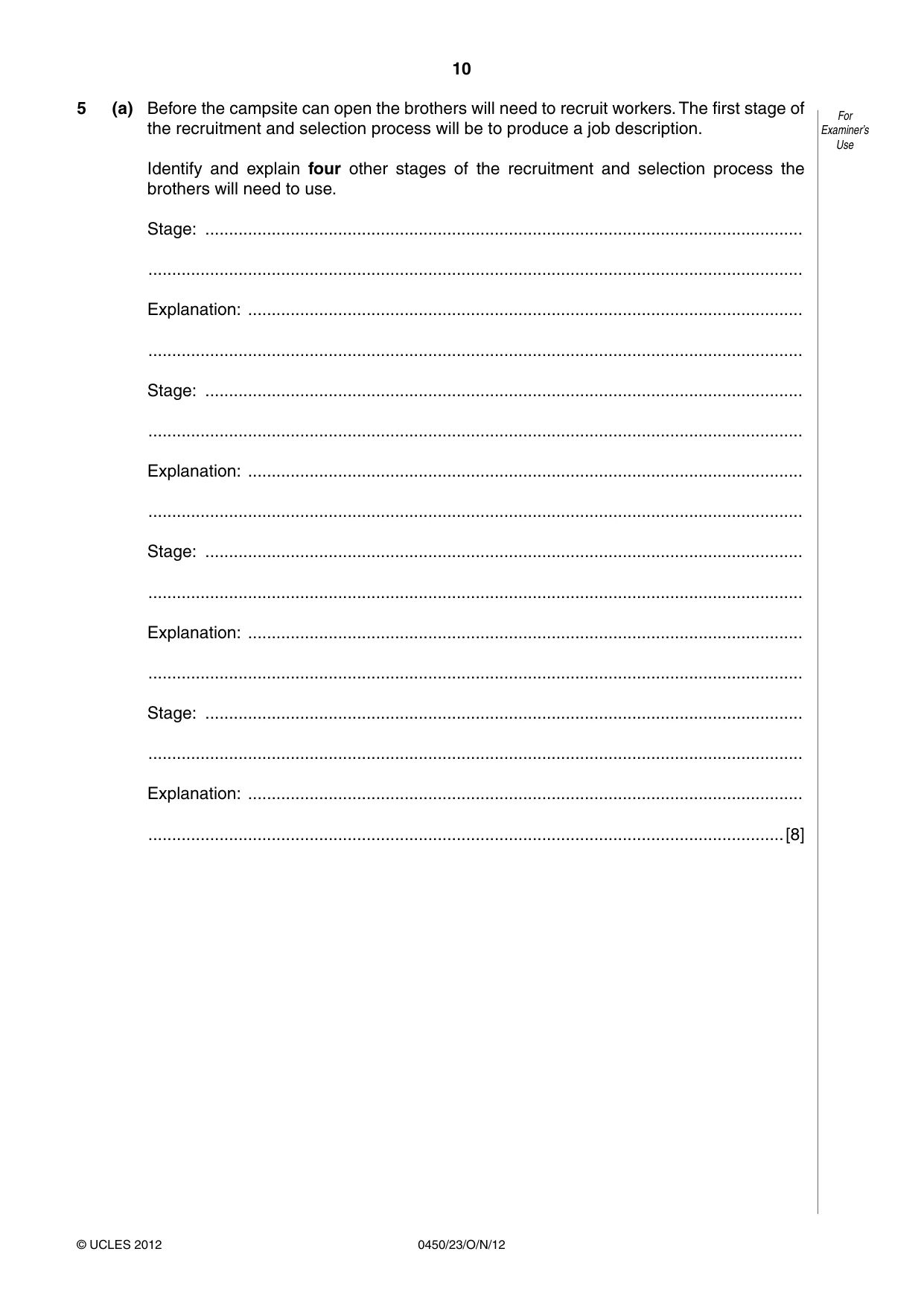
10 0450/23/O/N/12 © UCLES 2012 For Examiner’s Use 5 (a) Before the campsite can open the brothers will need to recruit workers. The first stage of the recruitment and selection process will be to produce a job description. Identify and explain four other stages of the recruitment and selection process the brothers will need to use. Stage: … … Explanation: … … Stage: … … Explanation: … … Stage: … … Explanation: … … Stage: … … Explanation: … …[8]
Question paper, page 11
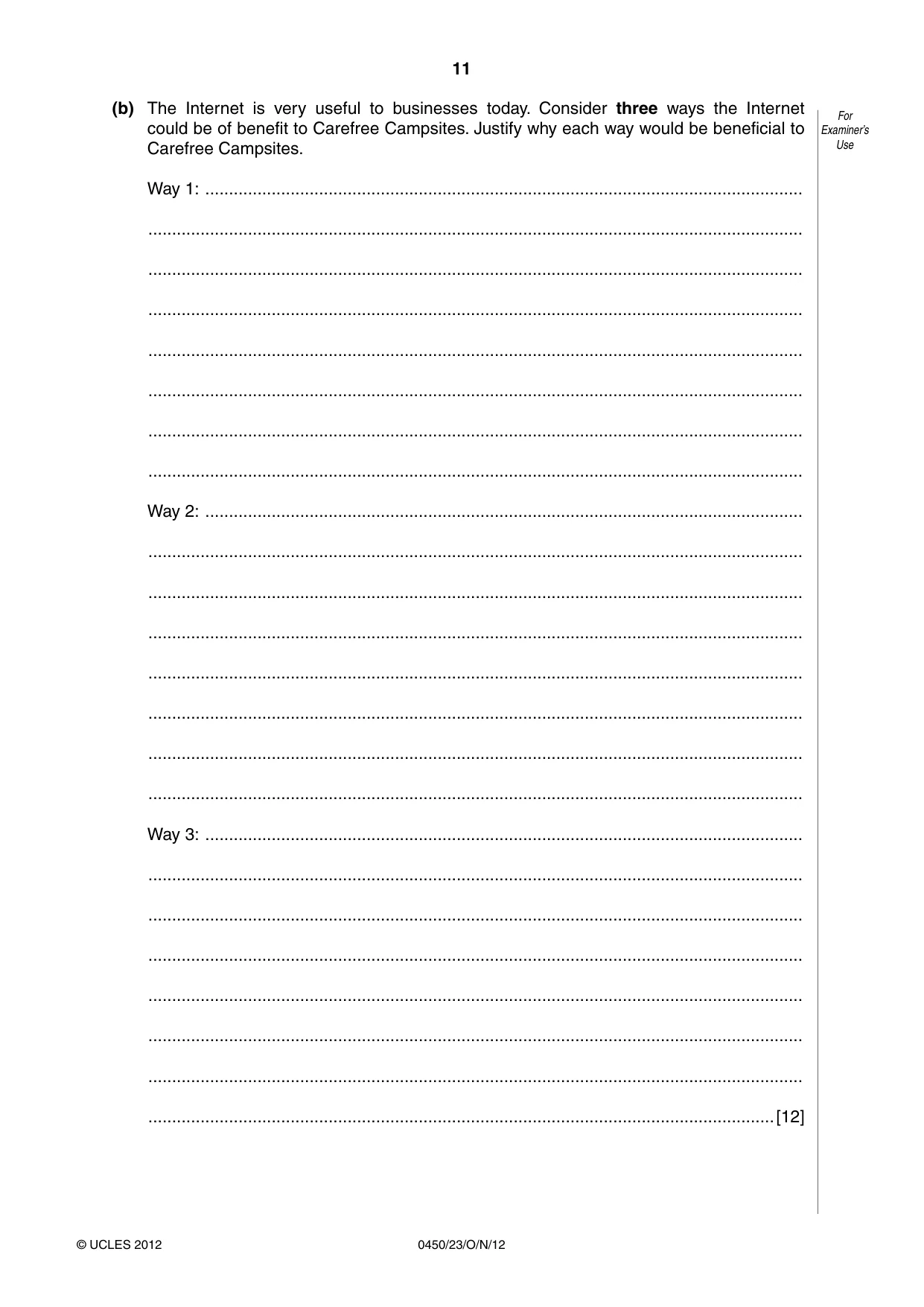
11 0450/23/O/N/12 © UCLES 2012 For Examiner’s Use (b) The Internet is very useful to businesses today. Consider three ways the Internet could be of benefit to Carefree Campsites. Justify why each way would be beneficial to Carefree Campsites. Way 1: … … … … … … … … Way 2: … … … … … … … … Way 3: … … … … … … … …[12]
Question paper, page 12
12 0450/23/O/N/12 © UCLES 2012 Permission to reproduce items where third-party owned material protected by copyright is included has been sought and cleared where possible. Every reasonable effort has been made by the publisher (UCLES) to trace copyright holders, but if any items requiring clearance have unwittingly been included, the publisher will be pleased to make amends at the earliest possible opportunity. University of Cambridge International Examinations is part of the Cambridge Assessment Group. Cambridge Assessment is the brand name of University of Cambridge Local Examinations Syndicate (UCLES), which is itself a department of the University of Cambridge. BLANK PAGE
Mark scheme, page 1
CAMBRIDGE INTERNATIONAL EXAMINATIONS International General Certificate of Secondary Education MARK SCHEME for the October/November 2012 series 0450 BUSINESS STUDIES 0450/23 Paper 2 (Case Study), maximum raw mark 100 This mark scheme is published as an aid to teachers and candidates, to indicate the requirements of the examination. It shows the basis on which Examiners were instructed to award marks. It does not indicate the details of the discussions that took place at an Examiners’ meeting before marking began, which would have considered the acceptability of alternative answers. Mark schemes should be read in conjunction with the question paper and the Principal Examiner Report for Teachers. Cambridge will not enter into discussions about these mark schemes. Cambridge is publishing the mark schemes for the October/November 2012 series for most IGCSE, GCE Advanced Level and Advanced Subsidiary Level components and some Ordinary Level components.
Mark scheme, page 2
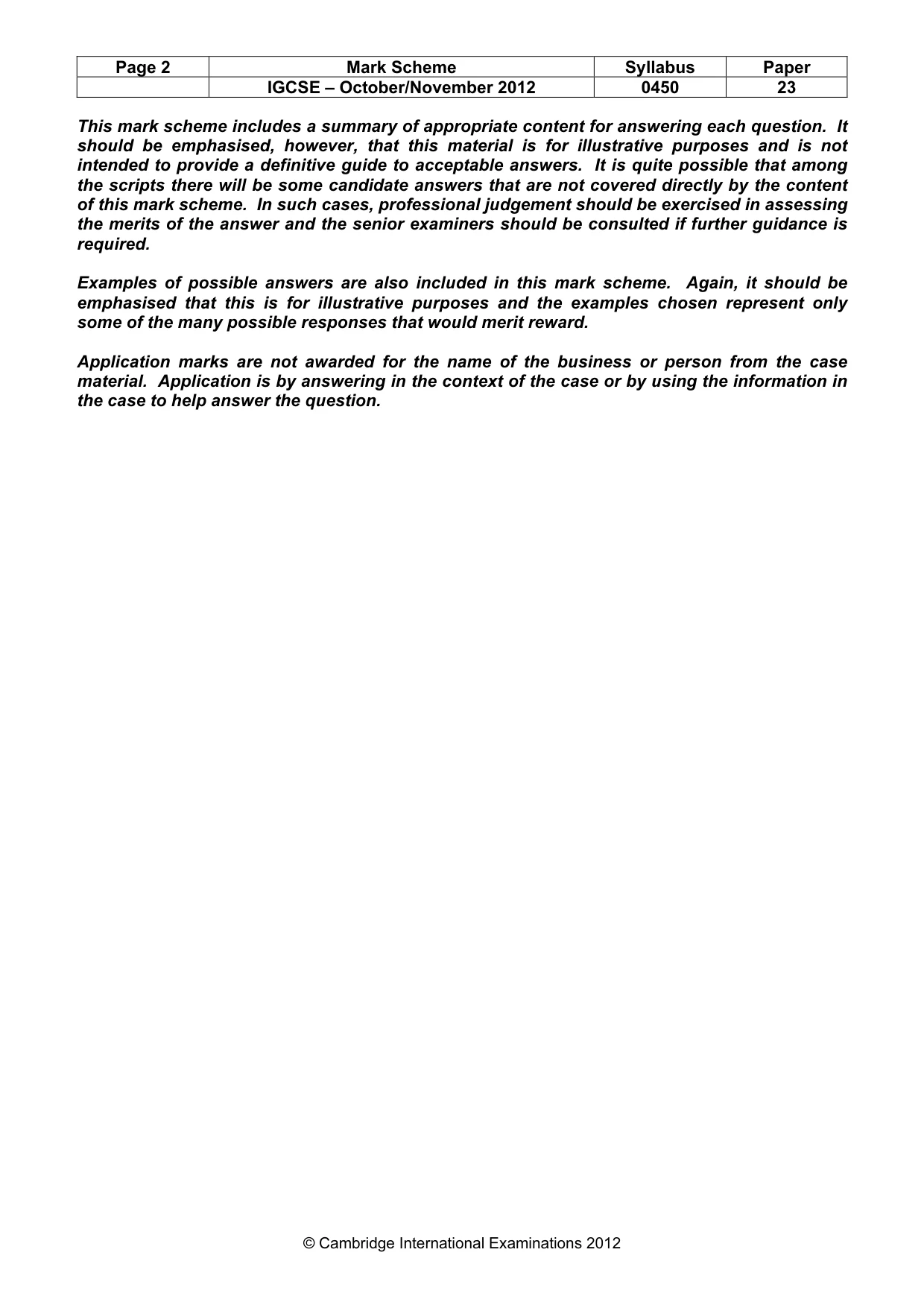
Page 2 Mark Scheme Syllabus Paper IGCSE – October/November 2012 0450 23 © Cambridge International Examinations 2012 This mark scheme includes a summary of appropriate content for answering each question. It should be emphasised, however, that this material is for illustrative purposes and is not intended to provide a definitive guide to acceptable answers. It is quite possible that among the scripts there will be some candidate answers that are not covered directly by the content of this mark scheme. In such cases, professional judgement should be exercised in assessing the merits of the answer and the senior examiners should be consulted if further guidance is required. Examples of possible answers are also included in this mark scheme. Again, it should be emphasised that this is for illustrative purposes and the examples chosen represent only some of the many possible responses that would merit reward. Application marks are not awarded for the name of the business or person from the case material. Application is by answering in the context of the case or by using the information in the case to help answer the question.
Mark scheme, page 3
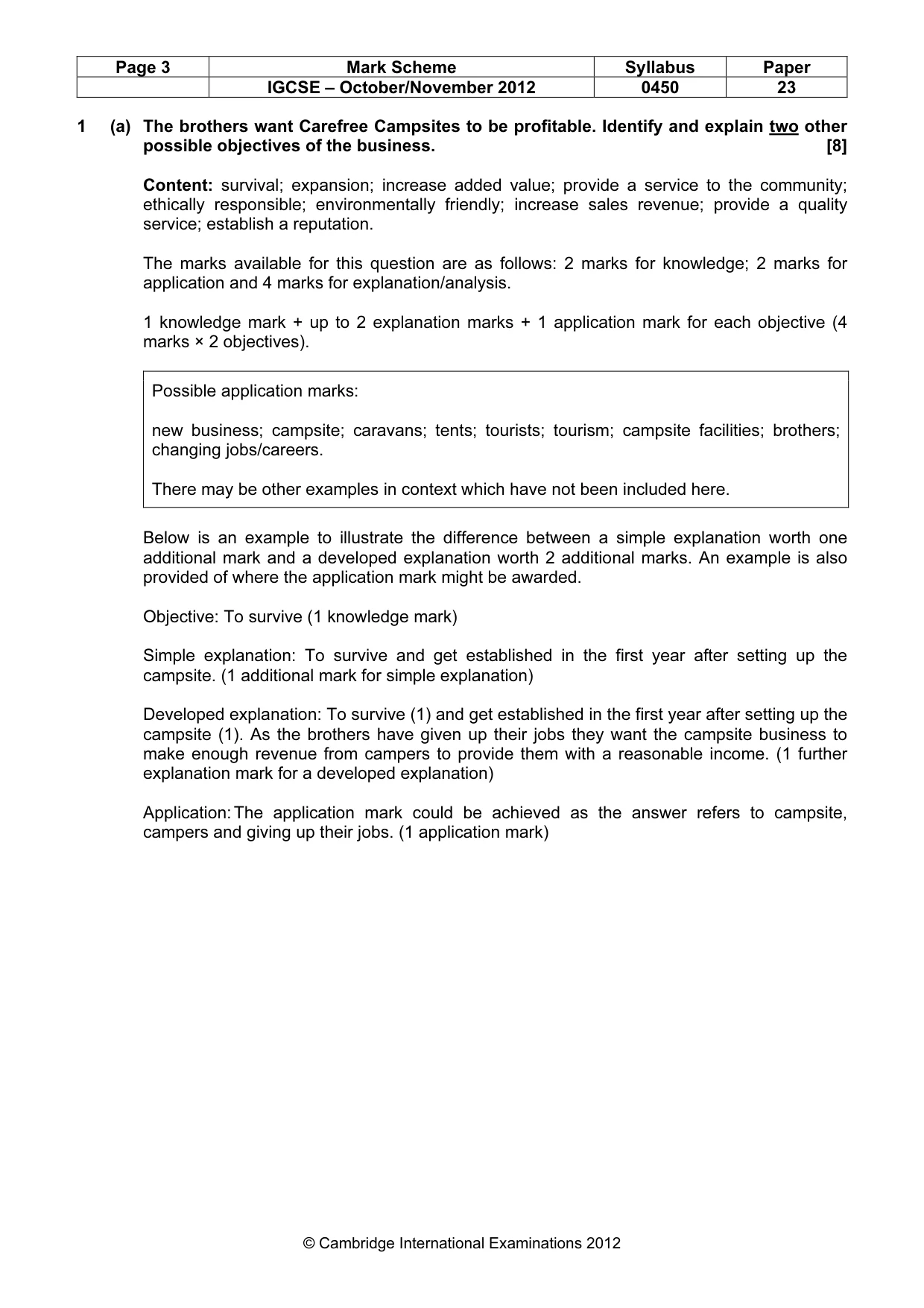
Page 3 Mark Scheme Syllabus Paper IGCSE – October/November 2012 0450 23 © Cambridge International Examinations 2012 1 (a) The brothers want Carefree Campsites to be profitable. Identify and explain two other possible objectives of the business. [8] Content: survival; expansion; increase added value; provide a service to the community; ethically responsible; environmentally friendly; increase sales revenue; provide a quality service; establish a reputation. The marks available for this question are as follows: 2 marks for knowledge; 2 marks for application and 4 marks for explanation/analysis. 1 knowledge mark + up to 2 explanation marks + 1 application mark for each objective (4 marks × 2 objectives). Possible application marks: new business; campsite; caravans; tents; tourists; tourism; campsite facilities; brothers; changing jobs/careers. There may be other examples in context which have not been included here. Below is an example to illustrate the difference between a simple explanation worth one additional mark and a developed explanation worth 2 additional marks. An example is also provided of where the application mark might be awarded. Objective: To survive (1 knowledge mark) Simple explanation: To survive and get established in the first year after setting up the campsite. (1 additional mark for simple explanation) Developed explanation: To survive (1) and get established in the first year after setting up the campsite (1). As the brothers have given up their jobs they want the campsite business to make enough revenue from campers to provide them with a reasonable income. (1 further explanation mark for a developed explanation) Application: The application mark could be achieved as the answer refers to campsite, campers and giving up their jobs. (1 application mark)
Mark scheme, page 4
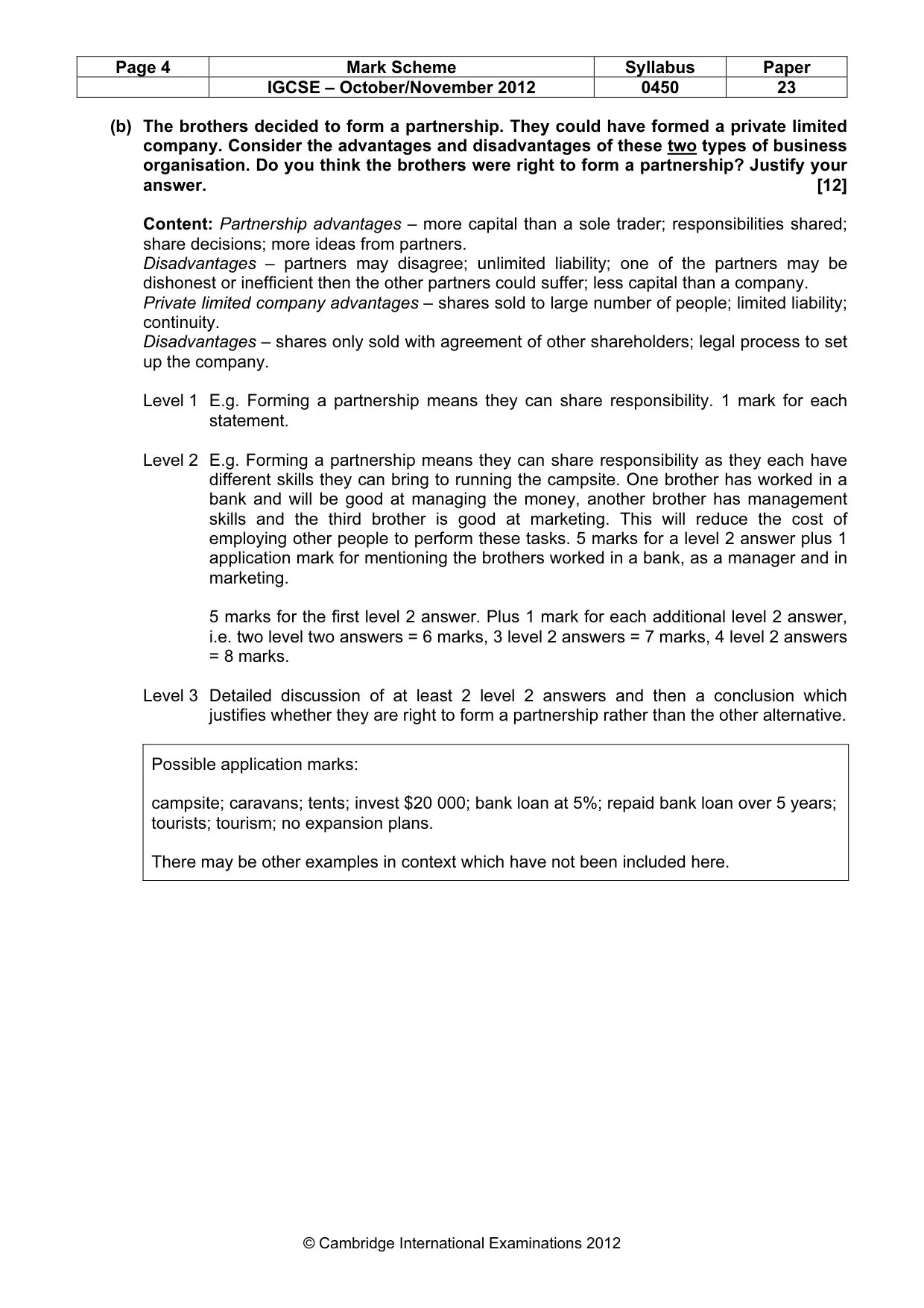
Page 4 Mark Scheme Syllabus Paper IGCSE – October/November 2012 0450 23 © Cambridge International Examinations 2012 (b) The brothers decided to form a partnership. They could have formed a private limited company. Consider the advantages and disadvantages of these two types of business organisation. Do you think the brothers were right to form a partnership? Justify your answer. [12] Content: Partnership advantages – more capital than a sole trader; responsibilities shared; share decisions; more ideas from partners. Disadvantages – partners may disagree; unlimited liability; one of the partners may be dishonest or inefficient then the other partners could suffer; less capital than a company. Private limited company advantages – shares sold to large number of people; limited liability; continuity. Disadvantages – shares only sold with agreement of other shareholders; legal process to set up the company. Level 1 E.g. Forming a partnership means they can share responsibility. 1 mark for each statement. Level 2 E.g. Forming a partnership means they can share responsibility as they each have different skills they can bring to running the campsite. One brother has worked in a bank and will be good at managing the money, another brother has management skills and the third brother is good at marketing. This will reduce the cost of employing other people to perform these tasks. 5 marks for a level 2 answer plus 1 application mark for mentioning the brothers worked in a bank, as a manager and in marketing. 5 marks for the first level 2 answer. Plus 1 mark for each additional level 2 answer, i.e. two level two answers = 6 marks, 3 level 2 answers = 7 marks, 4 level 2 answers = 8 marks. Level 3 Detailed discussion of at least 2 level 2 answers and then a conclusion which justifies whether they are right to form a partnership rather than the other alternative. Possible application marks: campsite; caravans; tents; invest $20 000; bank loan at 5%; repaid bank loan over 5 years; tourists; tourism; no expansion plans. There may be other examples in context which have not been included here.
Mark scheme, page 5
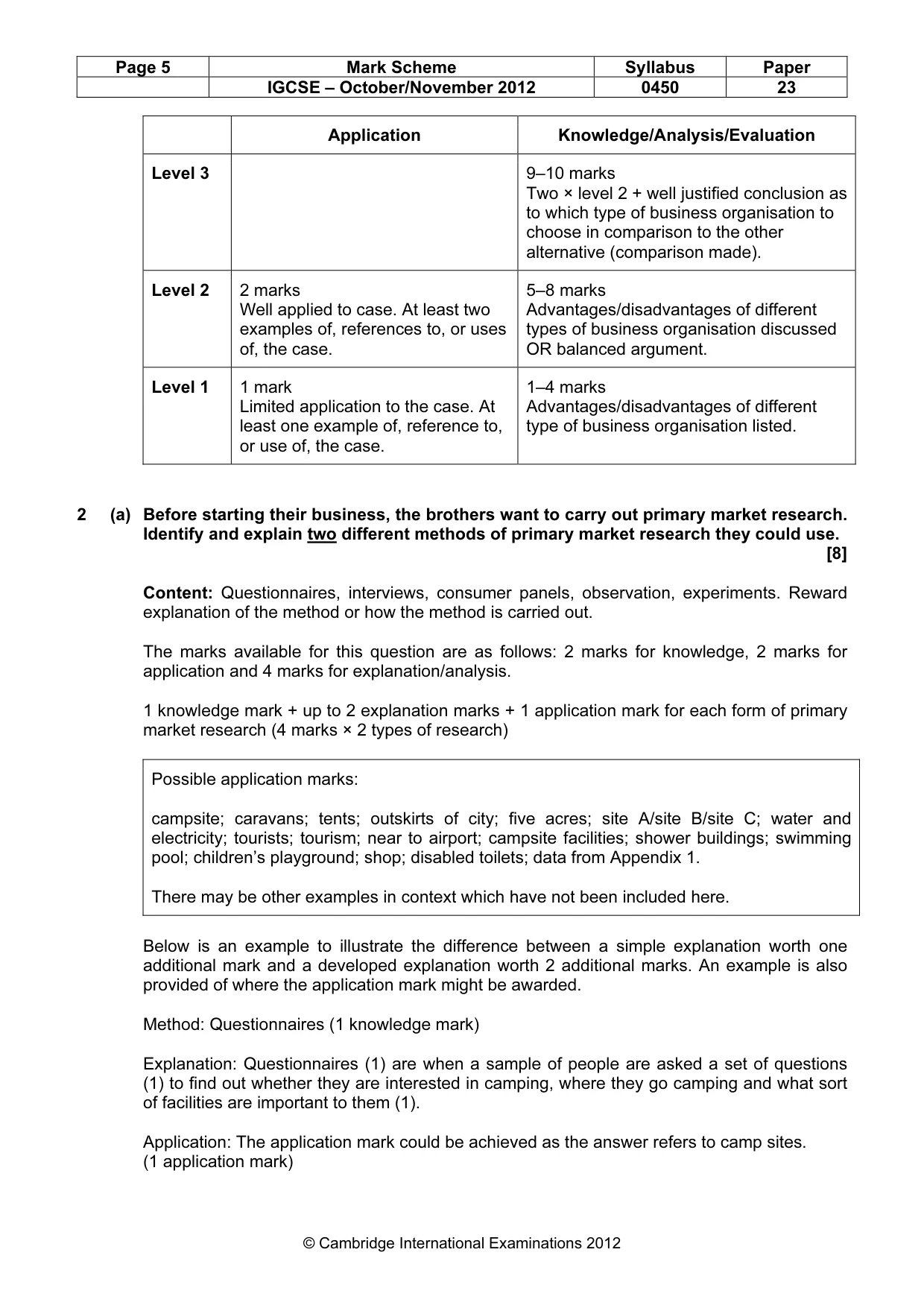
Page 5 Mark Scheme Syllabus Paper IGCSE – October/November 2012 0450 23 © Cambridge International Examinations 2012 Application Knowledge/Analysis/Evaluation Level 3 9–10 marks Two × level 2 + well justified conclusion as to which type of business organisation to choose in comparison to the other alternative (comparison made). Level 2 2 marks Well applied to case. At least two examples of, references to, or uses of, the case. 5–8 marks Advantages/disadvantages of different types of business organisation discussed OR balanced argument. Level 1 1 mark Limited application to the case. At least one example of, reference to, or use of, the case. 1–4 marks Advantages/disadvantages of different type of business organisation listed. 2 (a) Before starting their business, the brothers want to carry out primary market research. Identify and explain two different methods of primary market research they could use. [8] Content: Questionnaires, interviews, consumer panels, observation, experiments. Reward explanation of the method or how the method is carried out. The marks available for this question are as follows: 2 marks for knowledge, 2 marks for application and 4 marks for explanation/analysis. 1 knowledge mark + up to 2 explanation marks + 1 application mark for each form of primary market research (4 marks × 2 types of research) Possible application marks: campsite; caravans; tents; outskirts of city; five acres; site A/site B/site C; water and electricity; tourists; tourism; near to airport; campsite facilities; shower buildings; swimming pool; children’s playground; shop; disabled toilets; data from Appendix 1. There may be other examples in context which have not been included here. Below is an example to illustrate the difference between a simple explanation worth one additional mark and a developed explanation worth 2 additional marks. An example is also provided of where the application mark might be awarded. Method: Questionnaires (1 knowledge mark) Explanation: Questionnaires (1) are when a sample of people are asked a set of questions (1) to find out whether they are interested in camping, where they go camping and what sort of facilities are important to them (1). Application: The application mark could be achieved as the answer refers to camp sites. (1 application mark)
Mark scheme, page 6
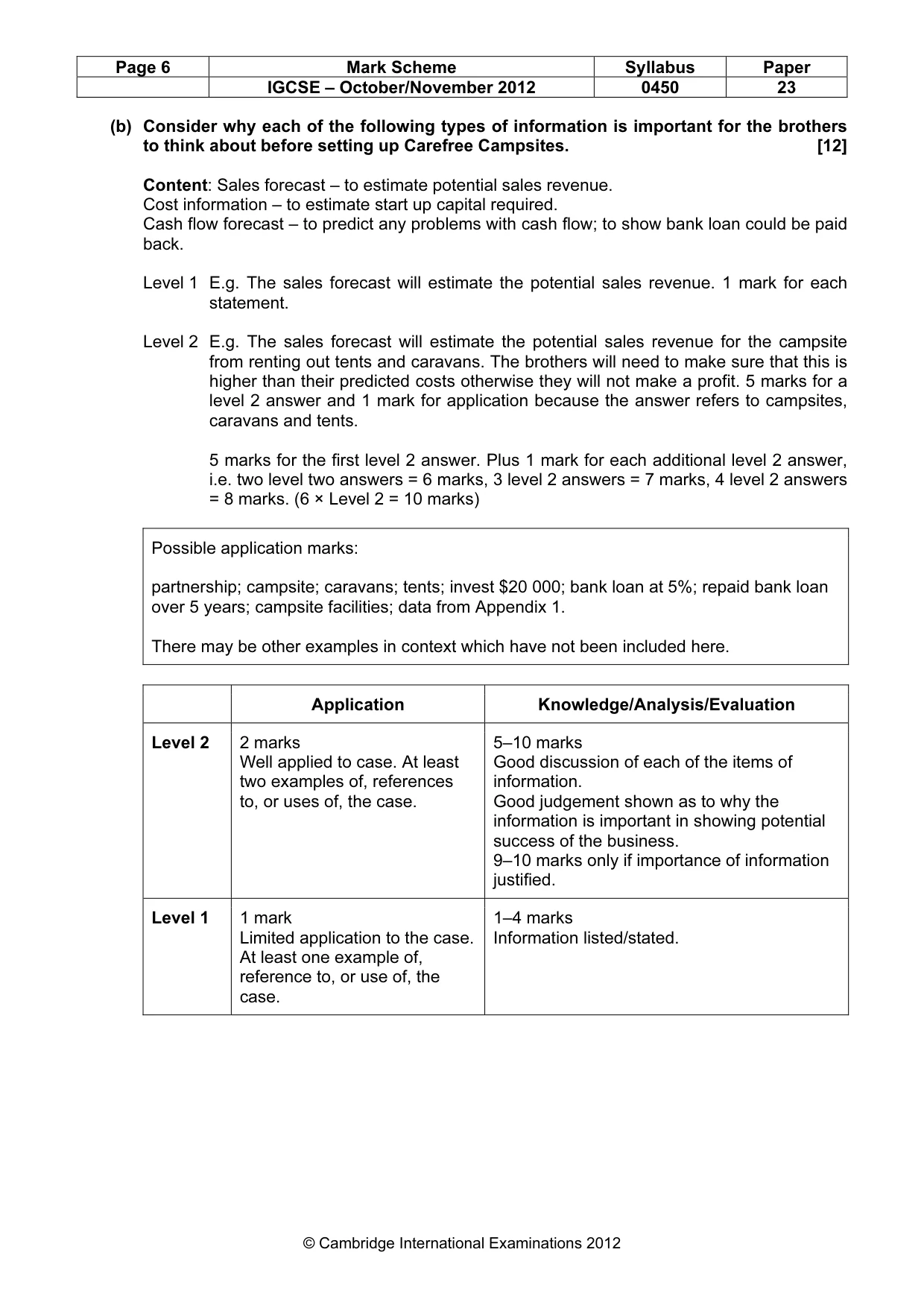
Page 6 Mark Scheme Syllabus Paper IGCSE – October/November 2012 0450 23 © Cambridge International Examinations 2012 (b) Consider why each of the following types of information is important for the brothers to think about before setting up Carefree Campsites. [12] Content: Sales forecast – to estimate potential sales revenue. Cost information – to estimate start up capital required. Cash flow forecast – to predict any problems with cash flow; to show bank loan could be paid back. Level 1 E.g. The sales forecast will estimate the potential sales revenue. 1 mark for each statement. Level 2 E.g. The sales forecast will estimate the potential sales revenue for the campsite from renting out tents and caravans. The brothers will need to make sure that this is higher than their predicted costs otherwise they will not make a profit. 5 marks for a level 2 answer and 1 mark for application because the answer refers to campsites, caravans and tents. 5 marks for the first level 2 answer. Plus 1 mark for each additional level 2 answer, i.e. two level two answers = 6 marks, 3 level 2 answers = 7 marks, 4 level 2 answers = 8 marks. (6 × Level 2 = 10 marks) Possible application marks: partnership; campsite; caravans; tents; invest $20 000; bank loan at 5%; repaid bank loan over 5 years; campsite facilities; data from Appendix 1. There may be other examples in context which have not been included here. Application Knowledge/Analysis/Evaluation Level 2 2 marks Well applied to case. At least two examples of, references to, or uses of, the case. 5–10 marks Good discussion of each of the items of information. Good judgement shown as to why the information is important in showing potential success of the business. 9–10 marks only if importance of information justified. Level 1 1 mark Limited application to the case. At least one example of, reference to, or use of, the case. 1–4 marks Information listed/stated.
Mark scheme, page 7
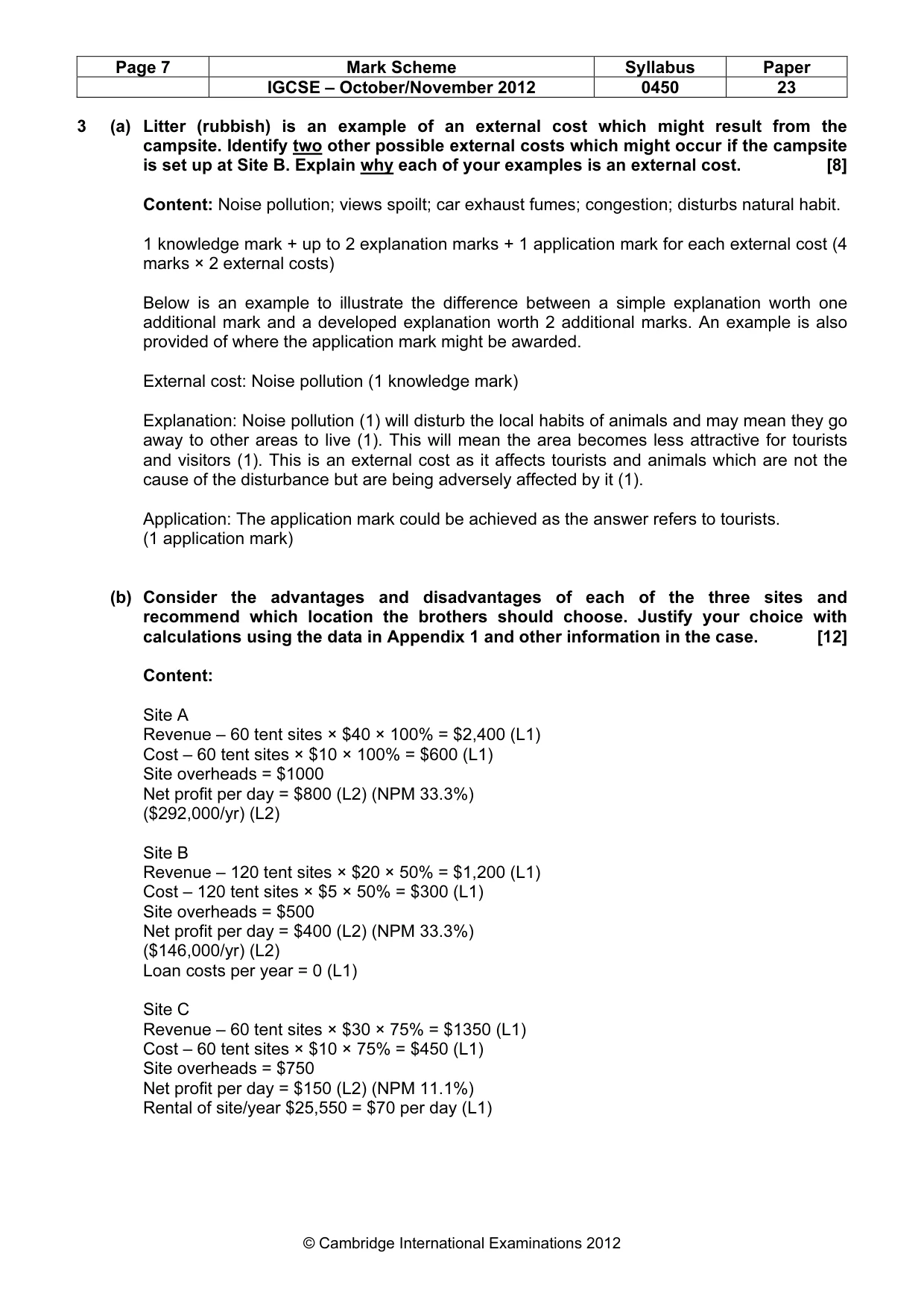
Page 7 Mark Scheme Syllabus Paper IGCSE – October/November 2012 0450 23 © Cambridge International Examinations 2012 3 (a) Litter (rubbish) is an example of an external cost which might result from the campsite. Identify two other possible external costs which might occur if the campsite is set up at Site B. Explain why each of your examples is an external cost. [8] Content: Noise pollution; views spoilt; car exhaust fumes; congestion; disturbs natural habit. 1 knowledge mark + up to 2 explanation marks + 1 application mark for each external cost (4 marks × 2 external costs) Below is an example to illustrate the difference between a simple explanation worth one additional mark and a developed explanation worth 2 additional marks. An example is also provided of where the application mark might be awarded. External cost: Noise pollution (1 knowledge mark) Explanation: Noise pollution (1) will disturb the local habits of animals and may mean they go away to other areas to live (1). This will mean the area becomes less attractive for tourists and visitors (1). This is an external cost as it affects tourists and animals which are not the cause of the disturbance but are being adversely affected by it (1). Application: The application mark could be achieved as the answer refers to tourists. (1 application mark) (b) Consider the advantages and disadvantages of each of the three sites and recommend which location the brothers should choose. Justify your choice with calculations using the data in Appendix 1 and other information in the case. [12] Content: Site A Revenue – 60 tent sites × $40 × 100% = $2,400 (L1) Cost – 60 tent sites × $10 × 100% = $600 (L1) Site overheads = $1000 Net profit per day = $800 (L2) (NPM 33.3%) ($292,000/yr) (L2) Site B Revenue – 120 tent sites × $20 × 50% = $1,200 (L1) Cost – 120 tent sites × $5 × 50% = $300 (L1) Site overheads = $500 Net profit per day = $400 (L2) (NPM 33.3%) ($146,000/yr) (L2) Loan costs per year = 0 (L1) Site C Revenue – 60 tent sites × $30 × 75% = $1350 (L1) Cost – 60 tent sites × $10 × 75% = $450 (L1) Site overheads = $750 Net profit per day = $150 (L2) (NPM 11.1%) Rental of site/year $25,550 = $70 per day (L1)
Mark scheme, page 8
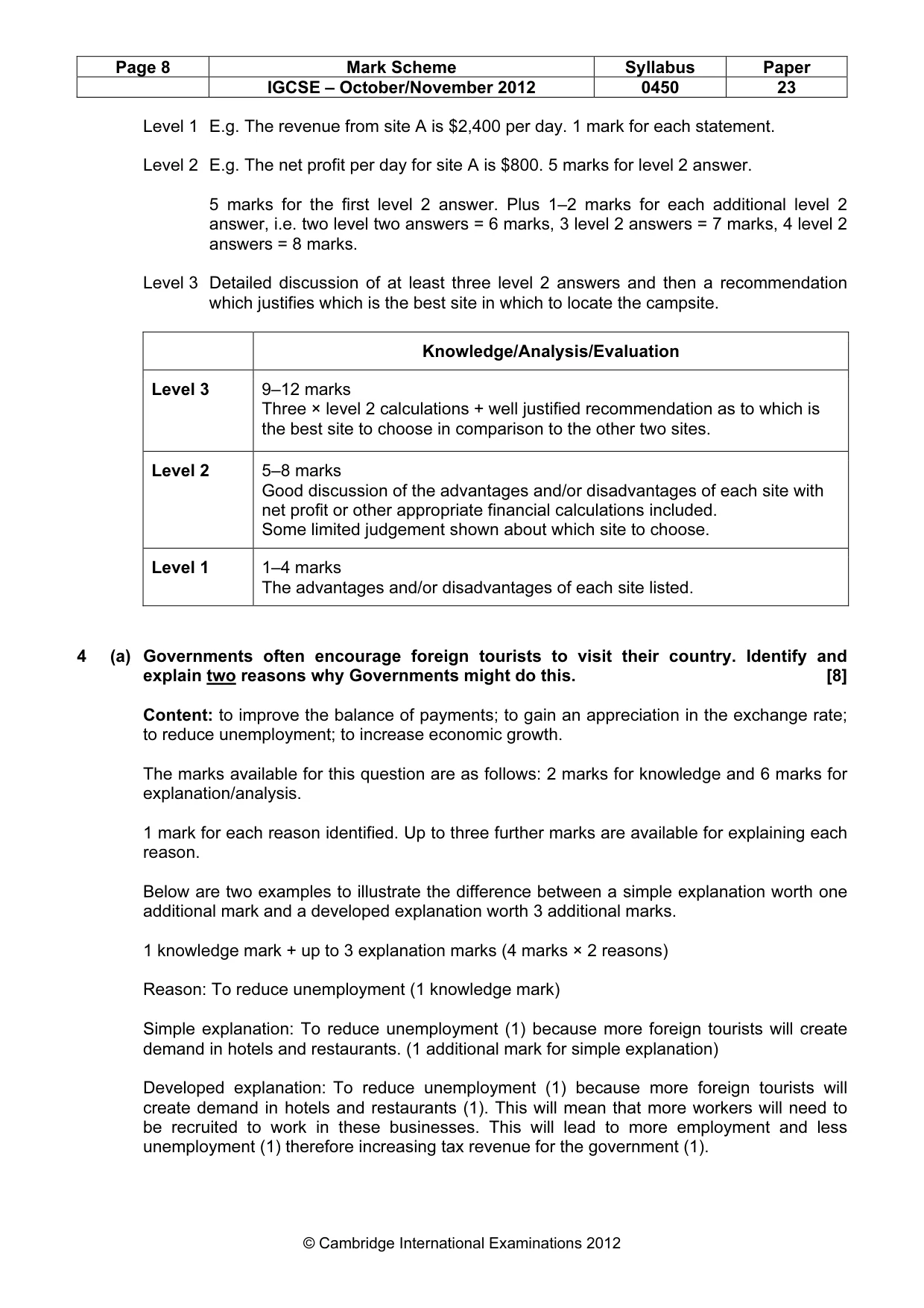
Page 8 Mark Scheme Syllabus Paper IGCSE – October/November 2012 0450 23 © Cambridge International Examinations 2012 Level 1 E.g. The revenue from site A is $2,400 per day. 1 mark for each statement. Level 2 E.g. The net profit per day for site A is $800. 5 marks for level 2 answer. 5 marks for the first level 2 answer. Plus 1–2 marks for each additional level 2 answer, i.e. two level two answers = 6 marks, 3 level 2 answers = 7 marks, 4 level 2 answers = 8 marks. Level 3 Detailed discussion of at least three level 2 answers and then a recommendation which justifies which is the best site in which to locate the campsite. Knowledge/Analysis/Evaluation Level 3 9–12 marks Three × level 2 calculations + well justified recommendation as to which is the best site to choose in comparison to the other two sites. Level 2 5–8 marks Good discussion of the advantages and/or disadvantages of each site with net profit or other appropriate financial calculations included. Some limited judgement shown about which site to choose. Level 1 1–4 marks The advantages and/or disadvantages of each site listed. 4 (a) Governments often encourage foreign tourists to visit their country. Identify and explain two reasons why Governments might do this. [8] Content: to improve the balance of payments; to gain an appreciation in the exchange rate; to reduce unemployment; to increase economic growth. The marks available for this question are as follows: 2 marks for knowledge and 6 marks for explanation/analysis. 1 mark for each reason identified. Up to three further marks are available for explaining each reason. Below are two examples to illustrate the difference between a simple explanation worth one additional mark and a developed explanation worth 3 additional marks. 1 knowledge mark + up to 3 explanation marks (4 marks × 2 reasons) Reason: To reduce unemployment (1 knowledge mark) Simple explanation: To reduce unemployment (1) because more foreign tourists will create demand in hotels and restaurants. (1 additional mark for simple explanation) Developed explanation: To reduce unemployment (1) because more foreign tourists will create demand in hotels and restaurants (1). This will mean that more workers will need to be recruited to work in these businesses. This will lead to more employment and less unemployment (1) therefore increasing tax revenue for the government (1).
Mark scheme, page 9
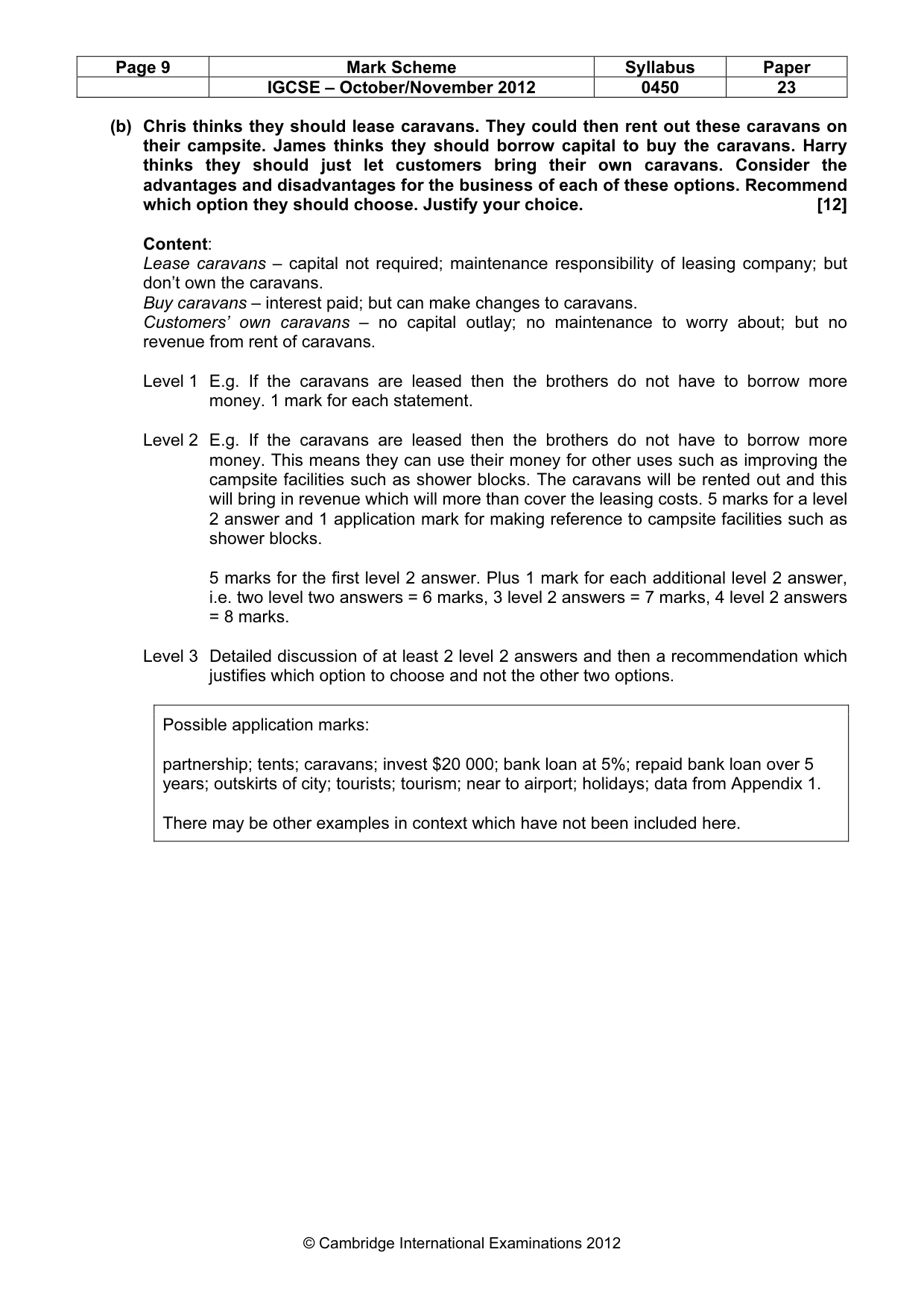
Page 9 Mark Scheme Syllabus Paper IGCSE – October/November 2012 0450 23 © Cambridge International Examinations 2012 (b) Chris thinks they should lease caravans. They could then rent out these caravans on their campsite. James thinks they should borrow capital to buy the caravans. Harry thinks they should just let customers bring their own caravans. Consider the advantages and disadvantages for the business of each of these options. Recommend which option they should choose. Justify your choice. [12] Content: Lease caravans – capital not required; maintenance responsibility of leasing company; but don’t own the caravans. Buy caravans – interest paid; but can make changes to caravans. Customers’ own caravans – no capital outlay; no maintenance to worry about; but no revenue from rent of caravans. Level 1 E.g. If the caravans are leased then the brothers do not have to borrow more money. 1 mark for each statement. Level 2 E.g. If the caravans are leased then the brothers do not have to borrow more money. This means they can use their money for other uses such as improving the campsite facilities such as shower blocks. The caravans will be rented out and this will bring in revenue which will more than cover the leasing costs. 5 marks for a level 2 answer and 1 application mark for making reference to campsite facilities such as shower blocks. 5 marks for the first level 2 answer. Plus 1 mark for each additional level 2 answer, i.e. two level two answers = 6 marks, 3 level 2 answers = 7 marks, 4 level 2 answers = 8 marks. Level 3 Detailed discussion of at least 2 level 2 answers and then a recommendation which justifies which option to choose and not the other two options. Possible application marks: partnership; tents; caravans; invest $20 000; bank loan at 5%; repaid bank loan over 5 years; outskirts of city; tourists; tourism; near to airport; holidays; data from Appendix 1. There may be other examples in context which have not been included here.
Mark scheme, page 10
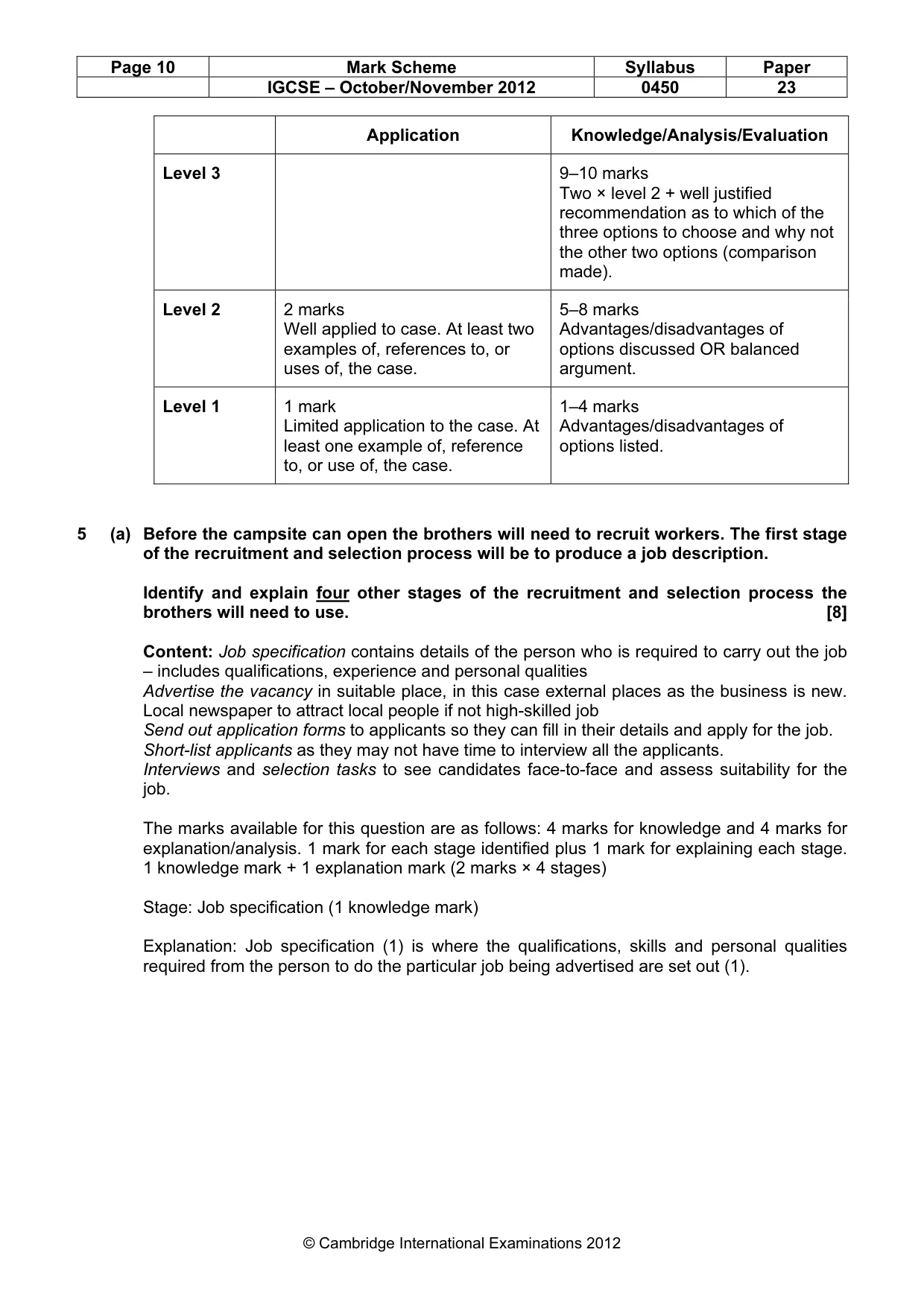
Page 10 Mark Scheme Syllabus Paper IGCSE – October/November 2012 0450 23 © Cambridge International Examinations 2012 Application Knowledge/Analysis/Evaluation Level 3 9–10 marks Two × level 2 + well justified recommendation as to which of the three options to choose and why not the other two options (comparison made). Level 2 2 marks Well applied to case. At least two examples of, references to, or uses of, the case. 5–8 marks Advantages/disadvantages of options discussed OR balanced argument. Level 1 1 mark Limited application to the case. At least one example of, reference to, or use of, the case. 1–4 marks Advantages/disadvantages of options listed. 5 (a) Before the campsite can open the brothers will need to recruit workers. The first stage of the recruitment and selection process will be to produce a job description. Identify and explain four other stages of the recruitment and selection process the brothers will need to use. [8] Content: Job specification contains details of the person who is required to carry out the job – includes qualifications, experience and personal qualities Advertise the vacancy in suitable place, in this case external places as the business is new. Local newspaper to attract local people if not high-skilled job Send out application forms to applicants so they can fill in their details and apply for the job. Short-list applicants as they may not have time to interview all the applicants. Interviews and selection tasks to see candidates face-to-face and assess suitability for the job. The marks available for this question are as follows: 4 marks for knowledge and 4 marks for explanation/analysis. 1 mark for each stage identified plus 1 mark for explaining each stage. 1 knowledge mark + 1 explanation mark (2 marks × 4 stages) Stage: Job specification (1 knowledge mark) Explanation: Job specification (1) is where the qualifications, skills and personal qualities required from the person to do the particular job being advertised are set out (1).
Mark scheme, page 11
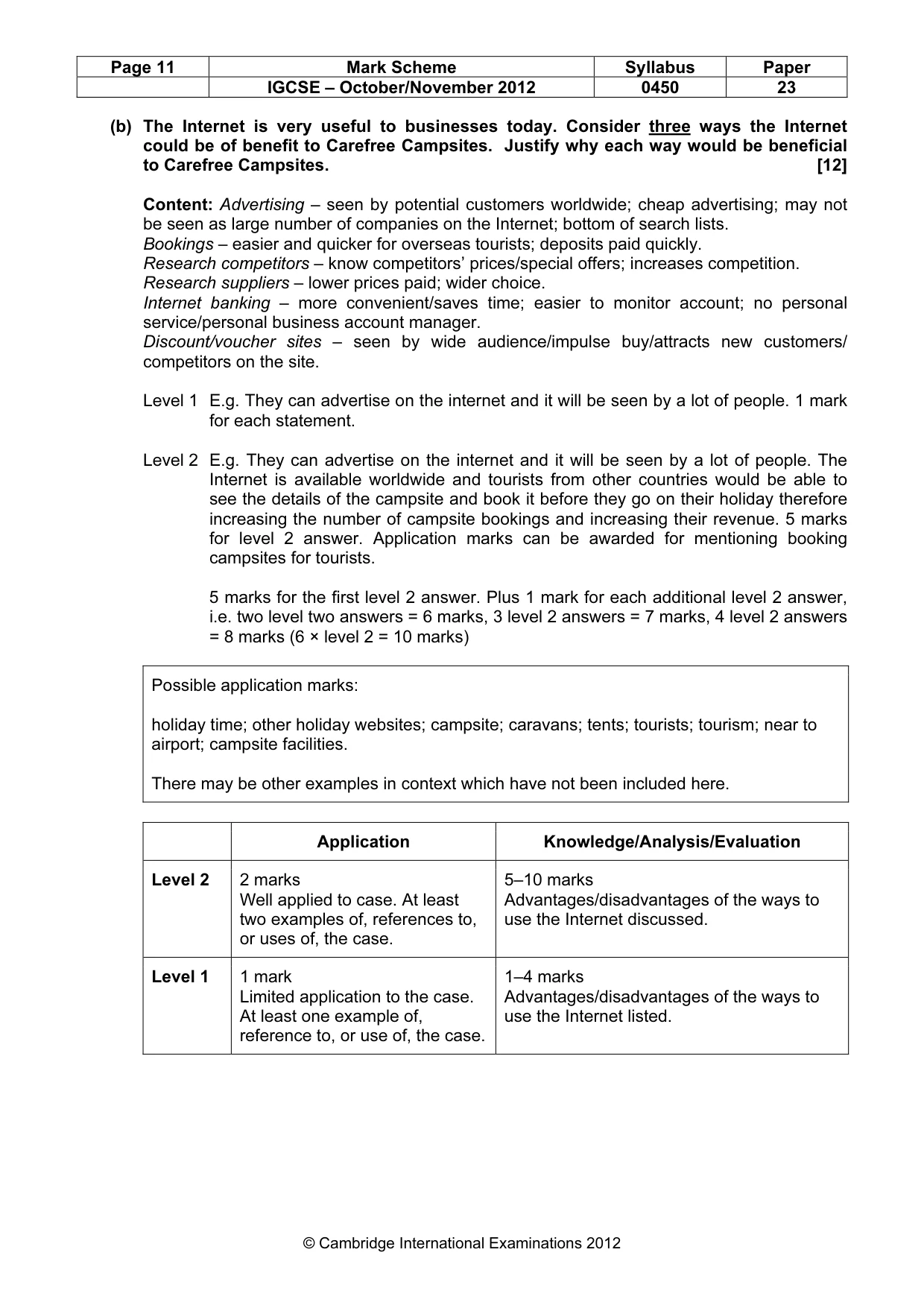
Page 11 Mark Scheme Syllabus Paper IGCSE – October/November 2012 0450 23 © Cambridge International Examinations 2012 (b) The Internet is very useful to businesses today. Consider three ways the Internet could be of benefit to Carefree Campsites. Justify why each way would be beneficial to Carefree Campsites. [12] Content: Advertising – seen by potential customers worldwide; cheap advertising; may not be seen as large number of companies on the Internet; bottom of search lists. Bookings – easier and quicker for overseas tourists; deposits paid quickly. Research competitors – know competitors’ prices/special offers; increases competition. Research suppliers – lower prices paid; wider choice. Internet banking – more convenient/saves time; easier to monitor account; no personal service/personal business account manager. Discount/voucher sites – seen by wide audience/impulse buy/attracts new customers/ competitors on the site. Level 1 E.g. They can advertise on the internet and it will be seen by a lot of people. 1 mark for each statement. Level 2 E.g. They can advertise on the internet and it will be seen by a lot of people. The Internet is available worldwide and tourists from other countries would be able to see the details of the campsite and book it before they go on their holiday therefore increasing the number of campsite bookings and increasing their revenue. 5 marks for level 2 answer. Application marks can be awarded for mentioning booking campsites for tourists. 5 marks for the first level 2 answer. Plus 1 mark for each additional level 2 answer, i.e. two level two answers = 6 marks, 3 level 2 answers = 7 marks, 4 level 2 answers = 8 marks (6 × level 2 = 10 marks) Possible application marks: holiday time; other holiday websites; campsite; caravans; tents; tourists; tourism; near to airport; campsite facilities. There may be other examples in context which have not been included here. Application Knowledge/Analysis/Evaluation Level 2 2 marks Well applied to case. At least two examples of, references to, or uses of, the case. 5–10 marks Advantages/disadvantages of the ways to use the Internet discussed. Level 1 1 mark Limited application to the case. At least one example of, reference to, or use of, the case. 1–4 marks Advantages/disadvantages of the ways to use the Internet listed.
What you needed in this session
Cambridge’s own grade thresholds for 2012 Oct/Nov, Paper 2 · Variant 3. A higher threshold means an easier paper — the bar moves with how the cohort did.