Cambridge IGCSE Arabic - Foreign Language 0544 — 2018 May/June Paper 2 · Variant 1
0544/21/M/J/18
The question paper and its mark scheme, free to read here and free to download. This is Cambridge’s own paper, exactly as it was sat.
Question paper16 pages

Mark scheme14 pages
Answers below. Sit the paper first if you are practising.
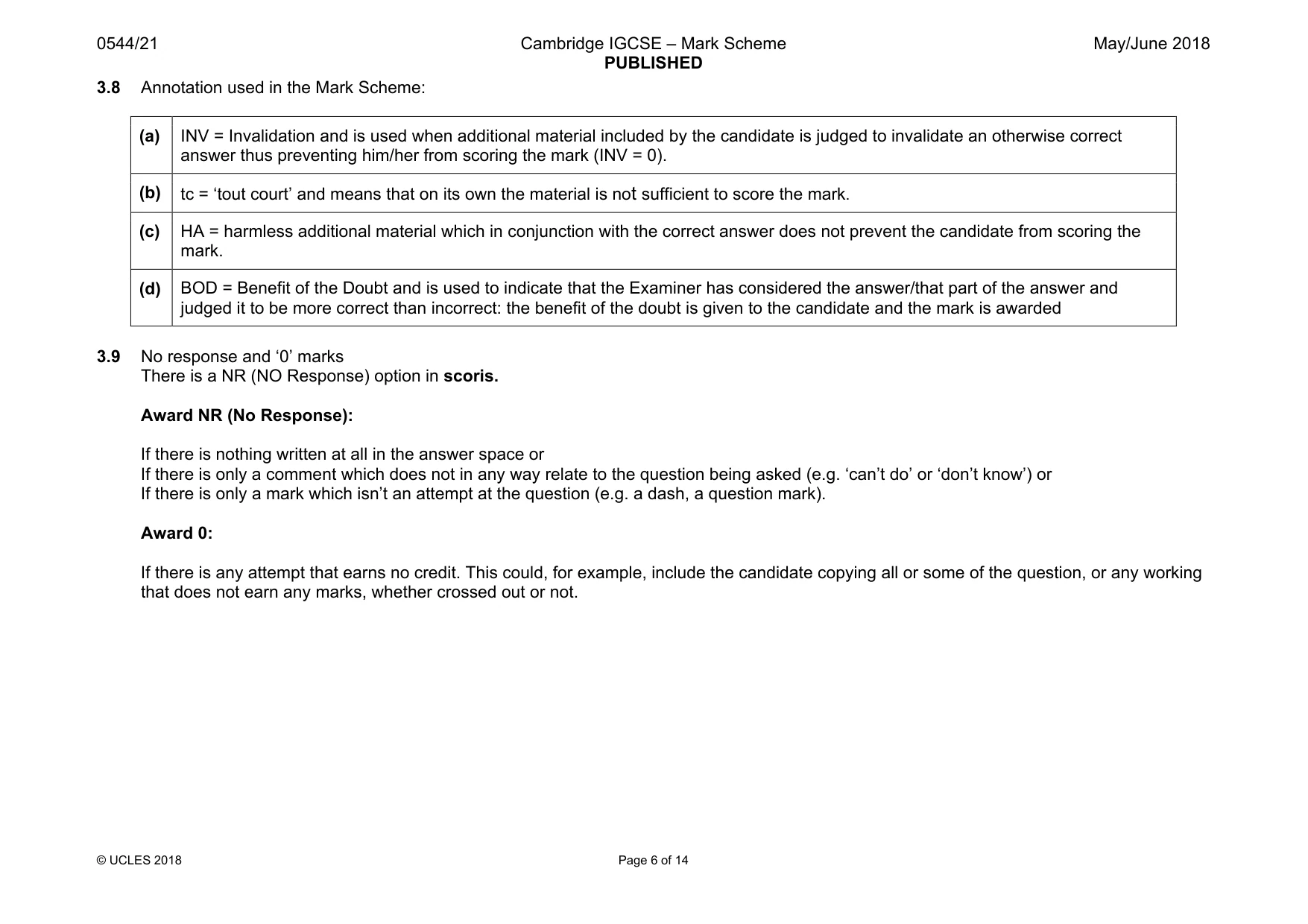
Paper as text
Question paper, page 1
* 3 6 4 8 3 3 6 5 5 4 * This document consists of 14 printed pages and 2 blank pages. DC (LEG) 164413 © UCLES 2018 [Turn over Cambridge International Examinations Cambridge International General Certificate of Secondary Education ARABIC 0544/21 Paper 2 Reading May/June 2018 1 hour Candidates answer on the Question Paper. No Additional Materials are required. READ THESE INSTRUCTIONS FIRST Write your Centre number, candidate number and name on all the work you hand in. Write in dark blue or black pen. Do not use staples, paper clips, glue or correction fluid. DO NOT WRITE IN ANY BARCODES. Answer all questions. The number of marks is given in brackets [ ] at the end of each question or part question.
Question paper, page 2
2 0544/21/M/J/18 © UCLES 2018 BLANK PAGE
Question paper, page 3
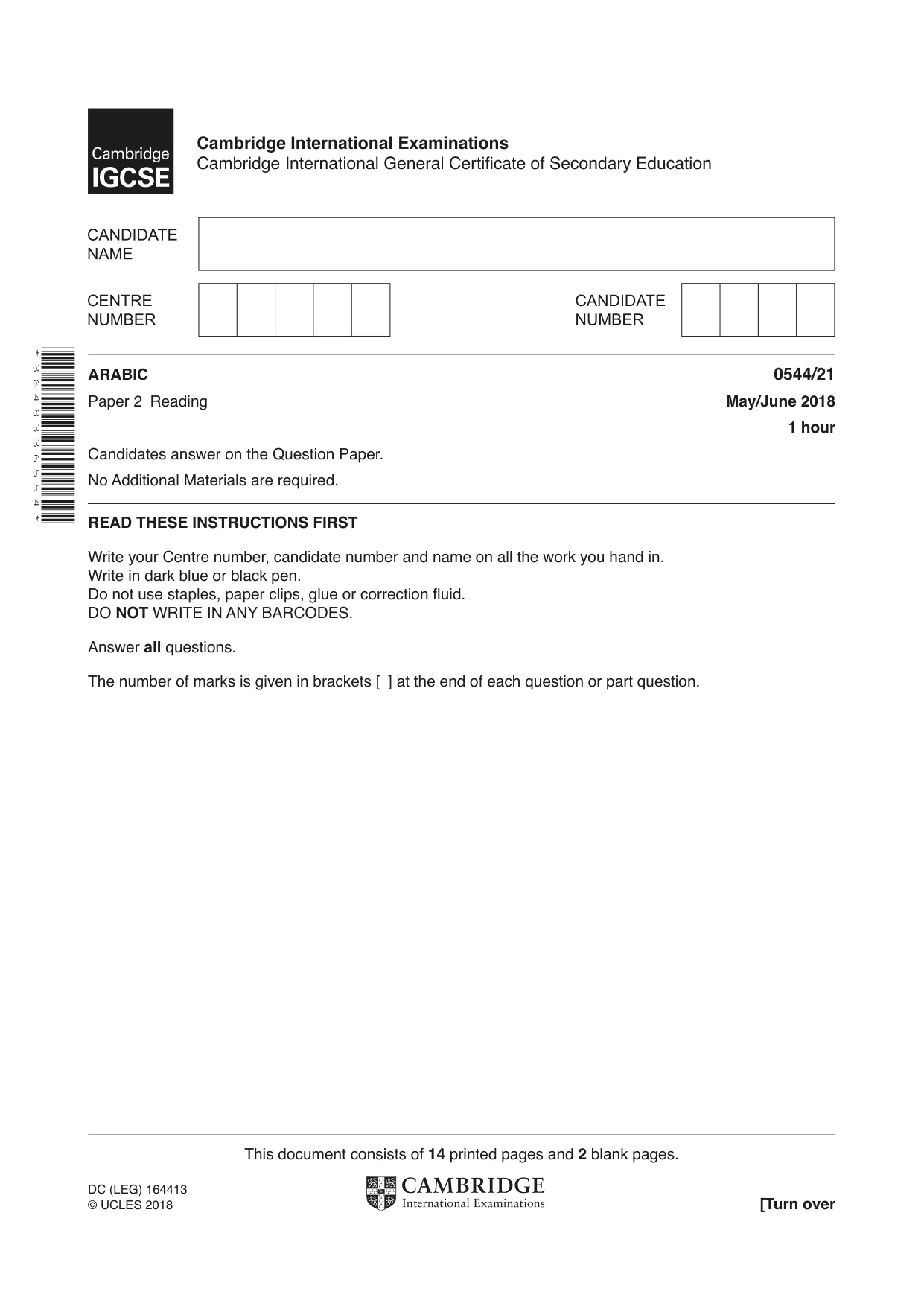
3 0544/21/M/J/18 © UCLES 2018 [Turn over Section 1 Exercise 1 Questions 1–5 1 D C B A [1] 2 2 × 15 = D C B A [1] 3 D C B A [1]
Question paper, page 4
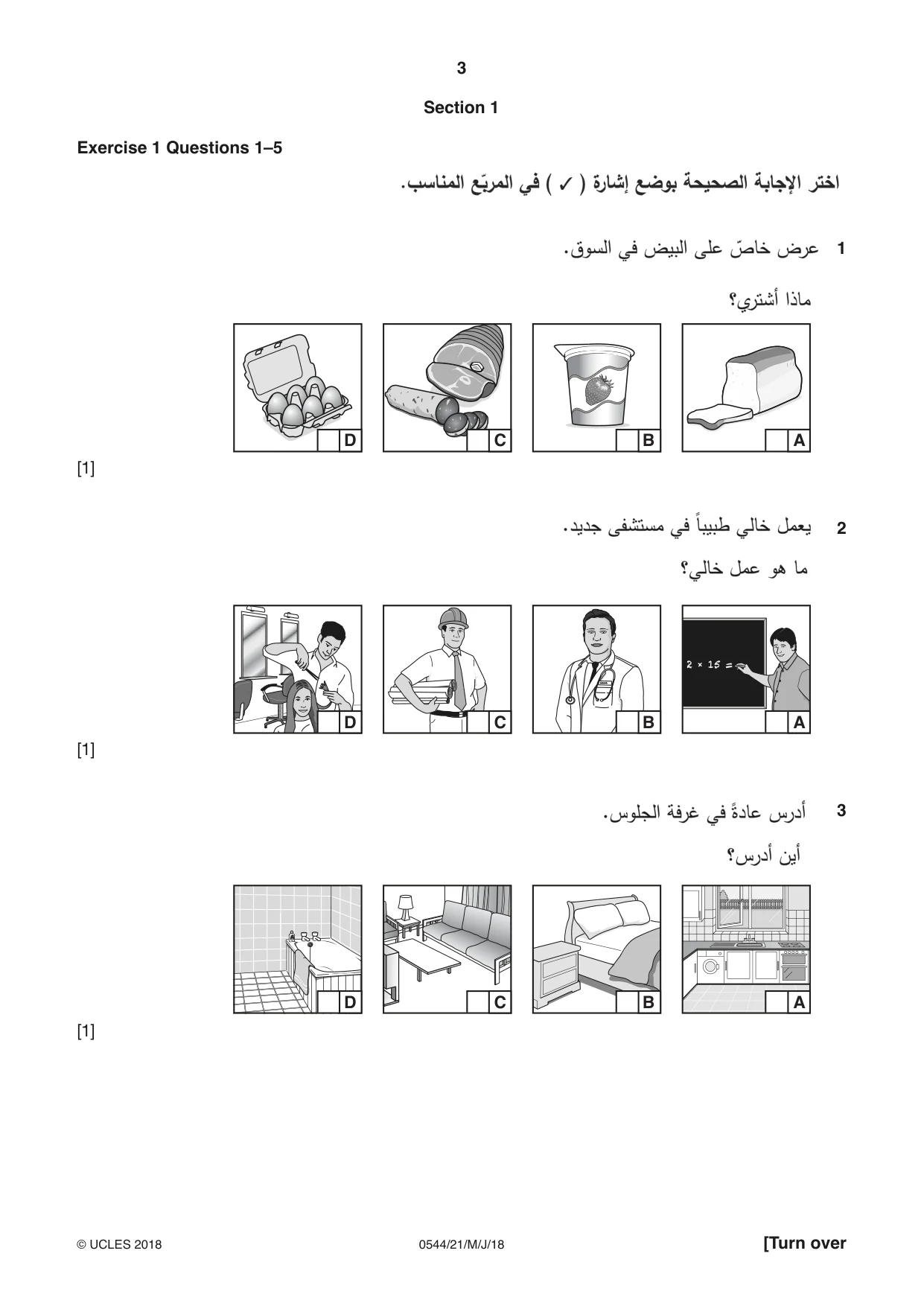
4 0544/21/M/J/18 © UCLES 2018 4 D C B A [1] 5 D C B A [1] [Total: 5]
Question paper, page 5
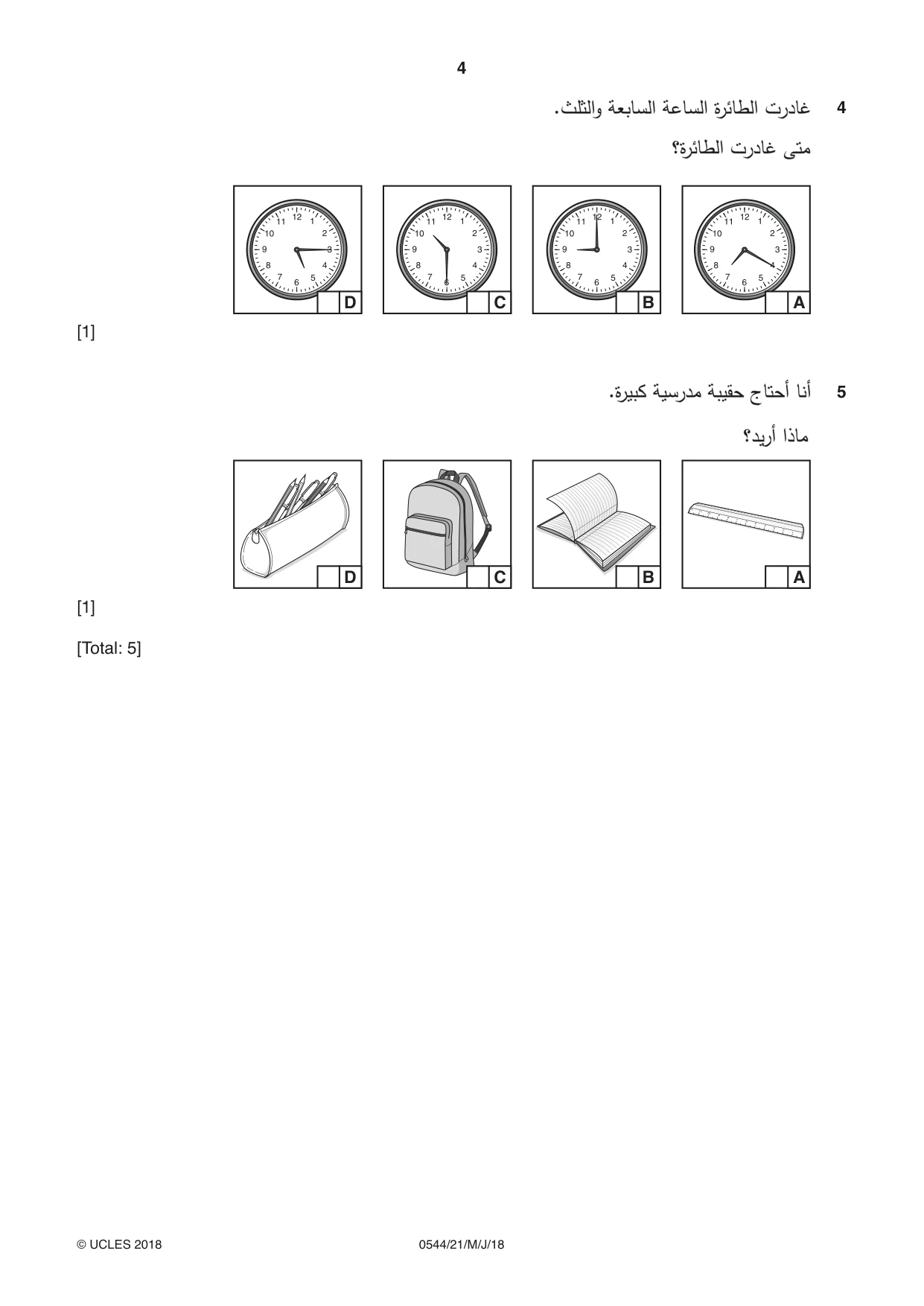
5 0544/21/M/J/18 © UCLES 2018 [Turn over Exercise 2 Questions 6–10 C B A E D F 6 7 8 9 10 [Total: 5]
Question paper, page 6
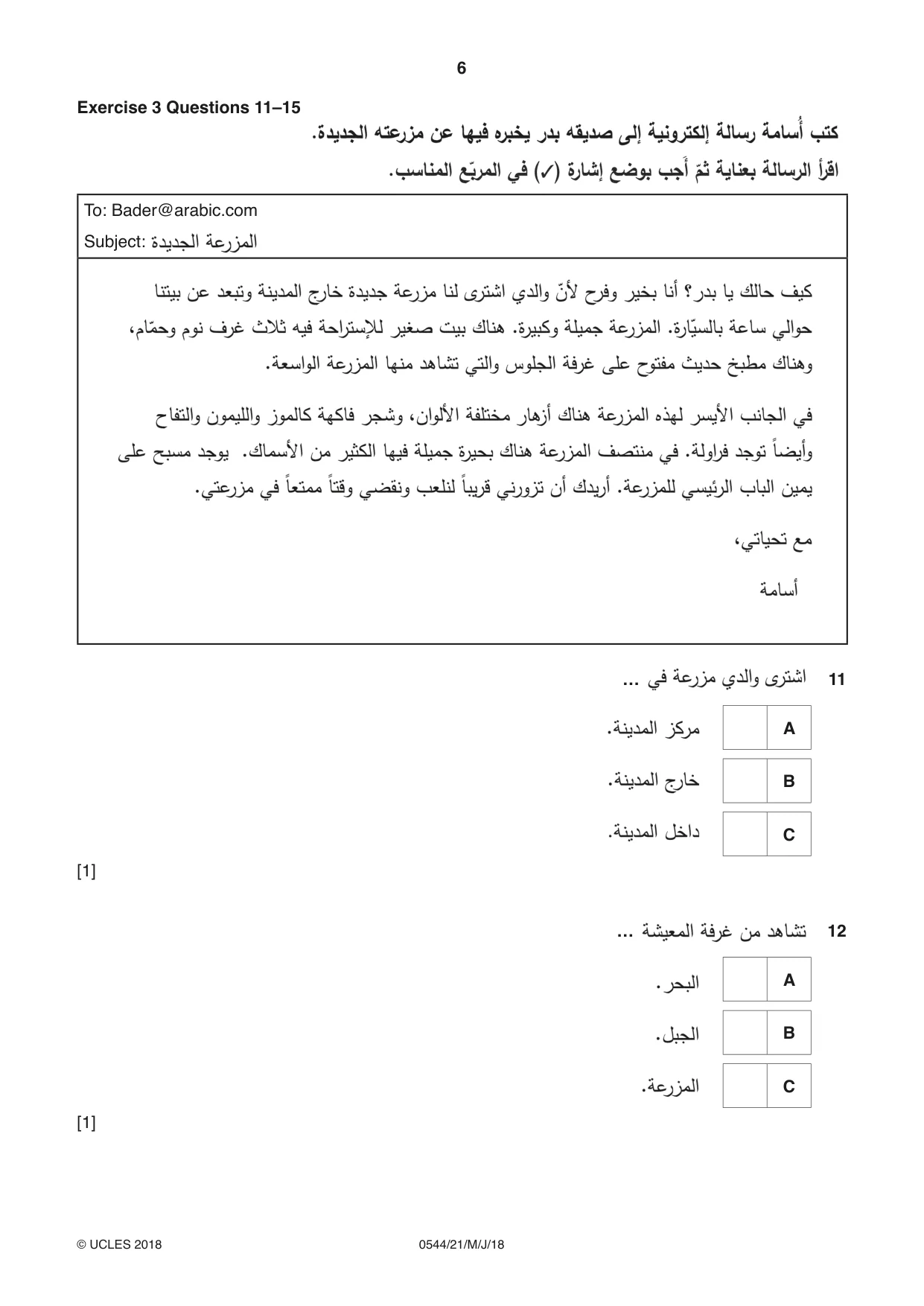
6 0544/21/M/J/18 © UCLES 2018 Exercise 3 Questions 11–15 To: Bader@arabic.com Subject: … 11 A B C [1] … 12 A B C [1]
Question paper, page 7
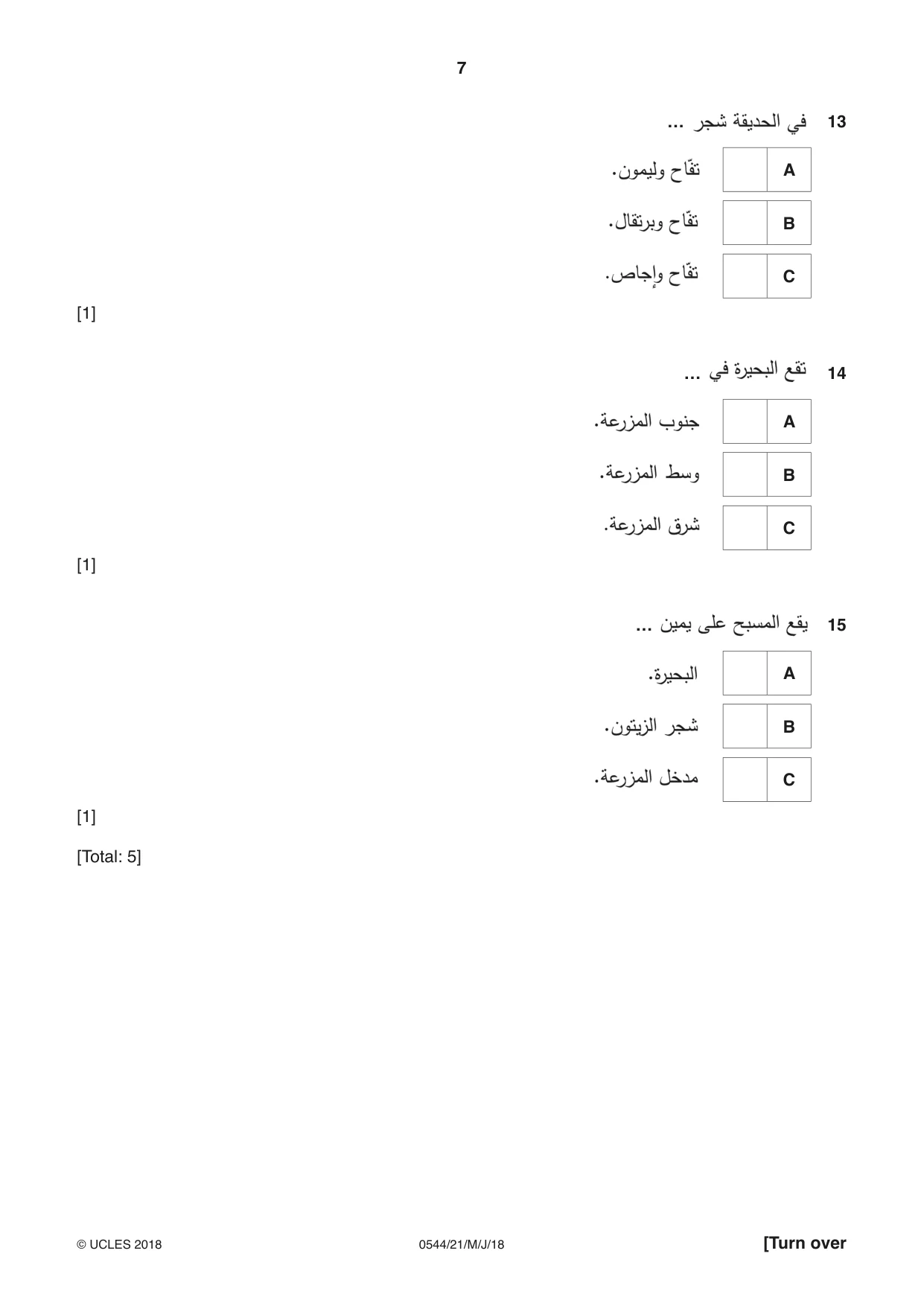
7 0544/21/M/J/18 © UCLES 2018 [Turn over … 13 A B C [1] … 14 A B C [1] … 15 A B C [1] [Total: 5]
Question paper, page 8
2 s5al) cpl Andel! uli) © UCLES 2018 0544/21/M/J/18.
Question paper, page 9
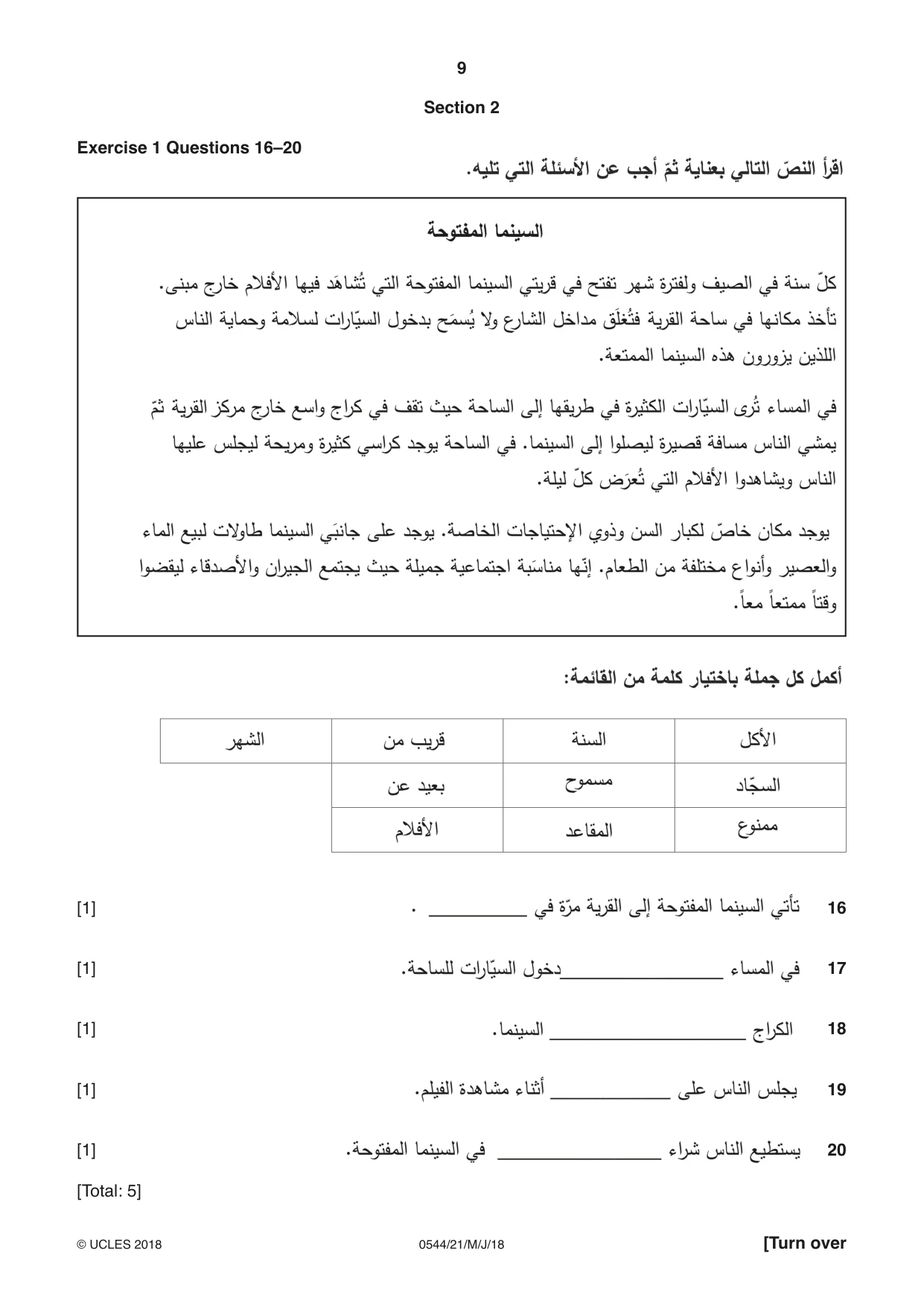
9 0544/21/M/J/18 © UCLES 2018 [Turn over Section 2 Exercise 1 Questions 16–20 [1] 16 [1] 17 [1] 18 [1] 19 [1] 20 [Total: 5]
Question paper, page 10
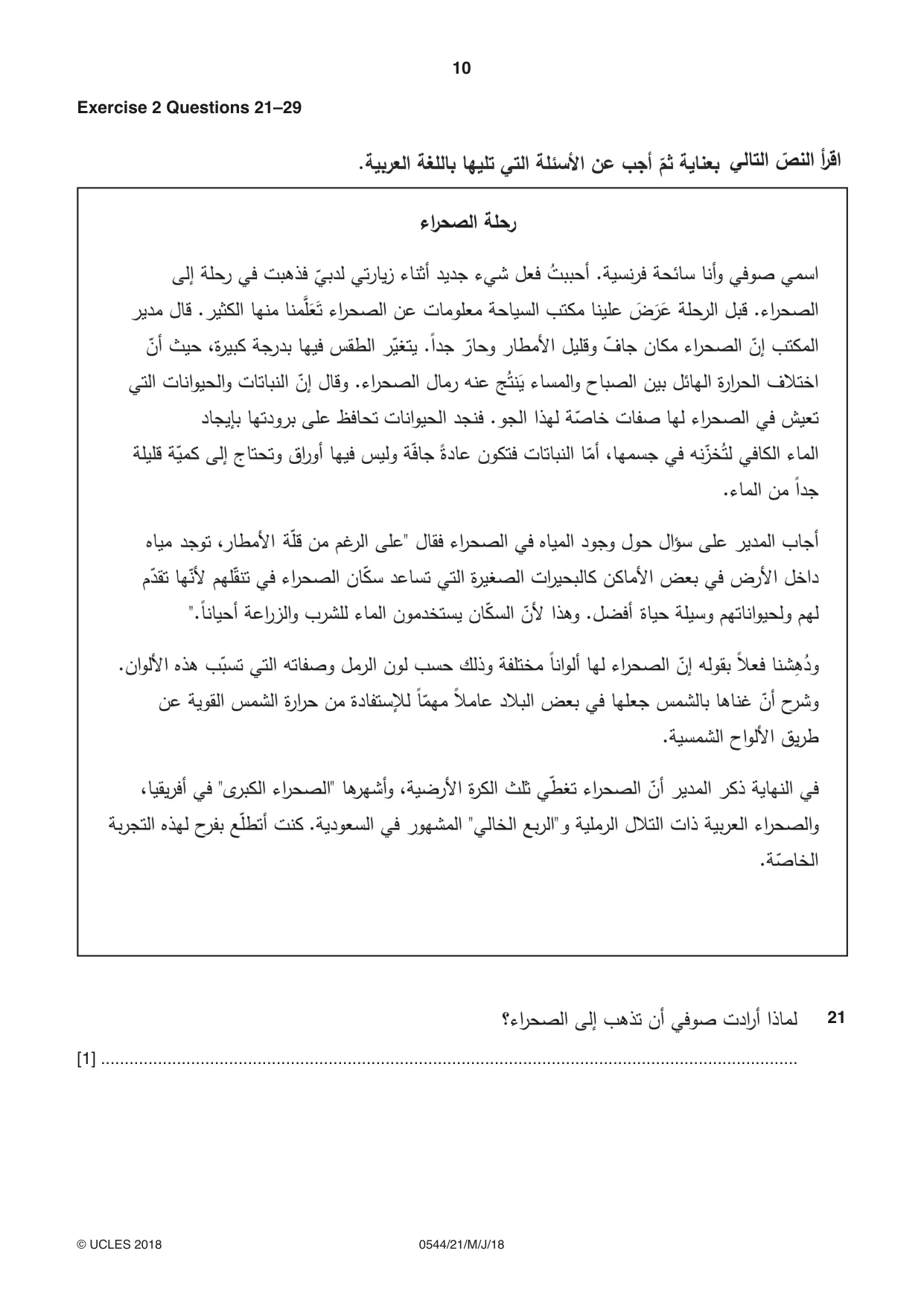
10 0544/21/M/J/18 © UCLES 2018 Exercise 2 Questions 21–29 21 [1] …
Question paper, page 11
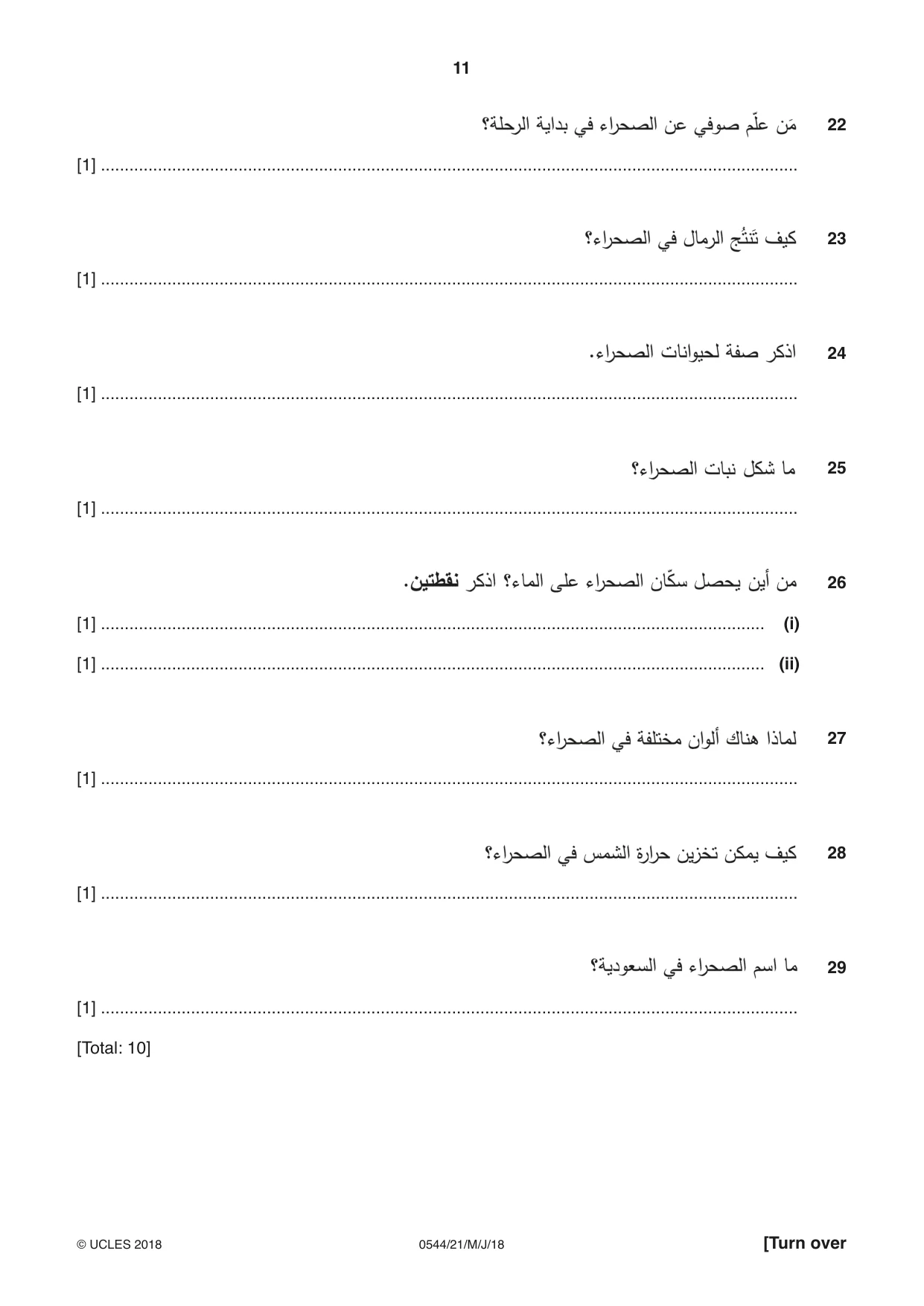
11 0544/21/M/J/18 © UCLES 2018 [Turn over 22 [1] … 23 [1] … 24 [1] … 25 [1] … 26 [1] … (i) [1] … (ii) 27 [1] … 28 [1] … 29 [1] … [Total: 10]
Question paper, page 12
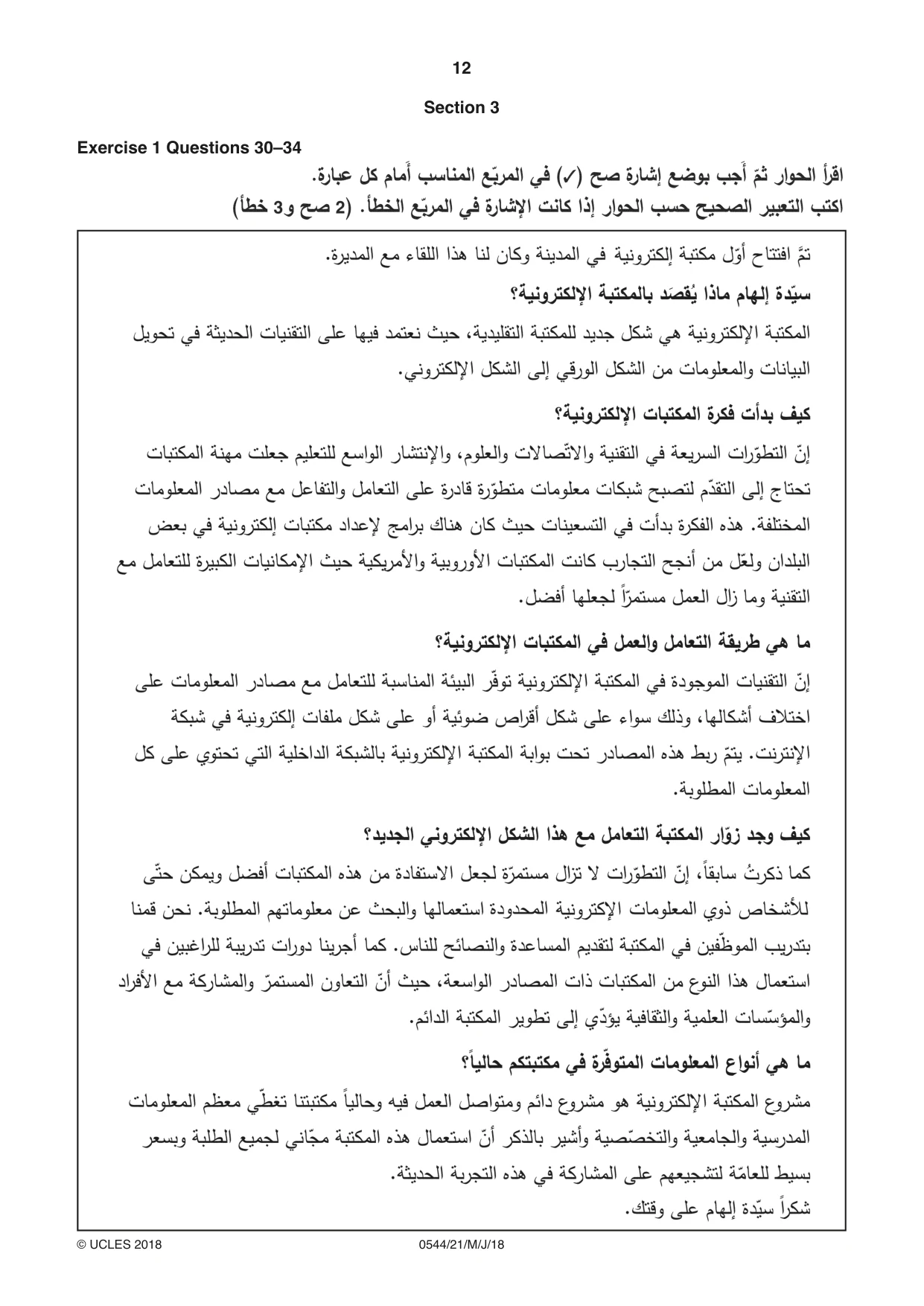
12 0544/21/M/J/18 © UCLES 2018 Section 3 Exercise 1 Questions 30–34
Question paper, page 13
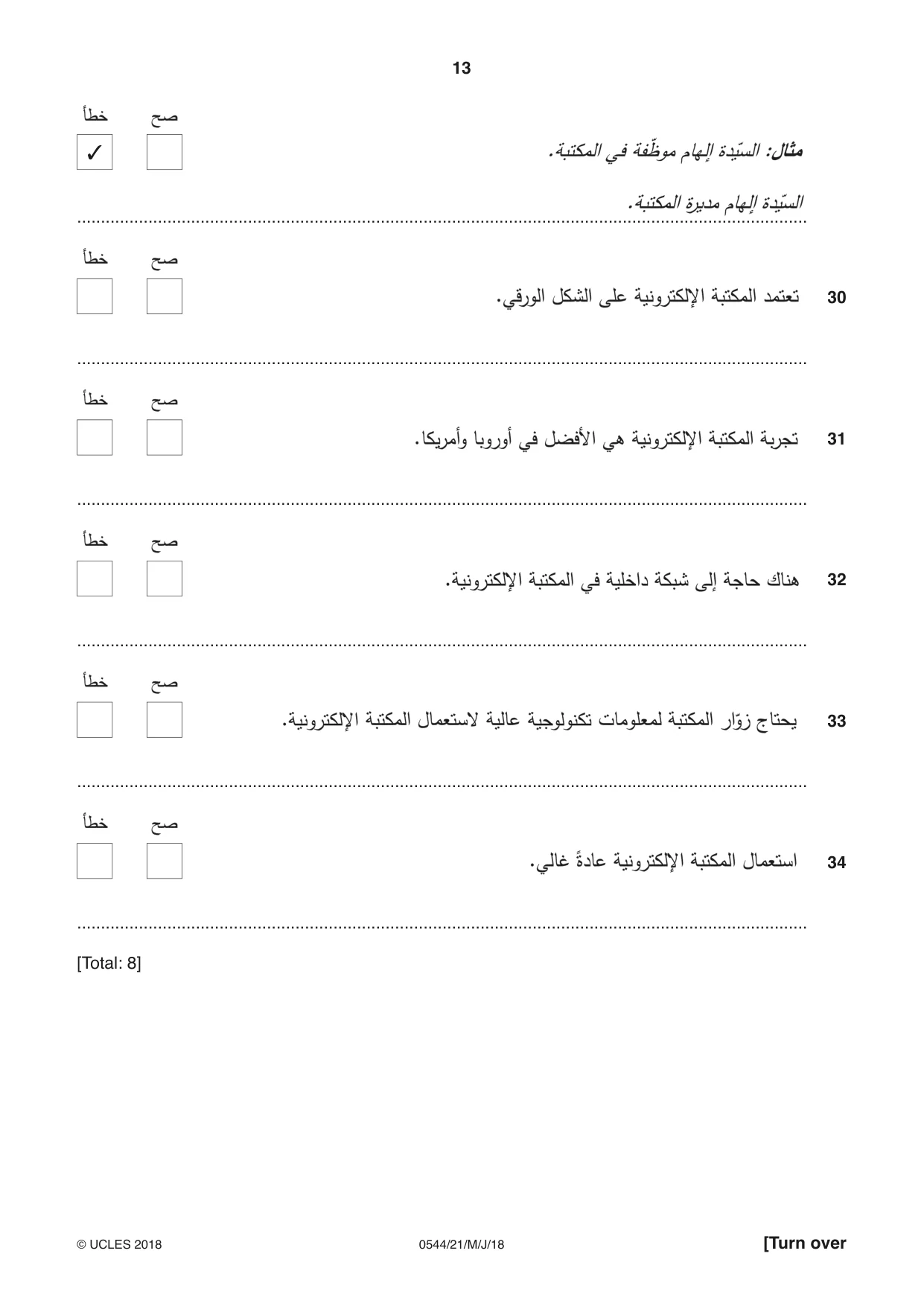
13 0544/21/M/J/18 © UCLES 2018 [Turn over 3 … 30 … 31 … 32 … 33 … 34 … [Total: 8]
Question paper, page 14
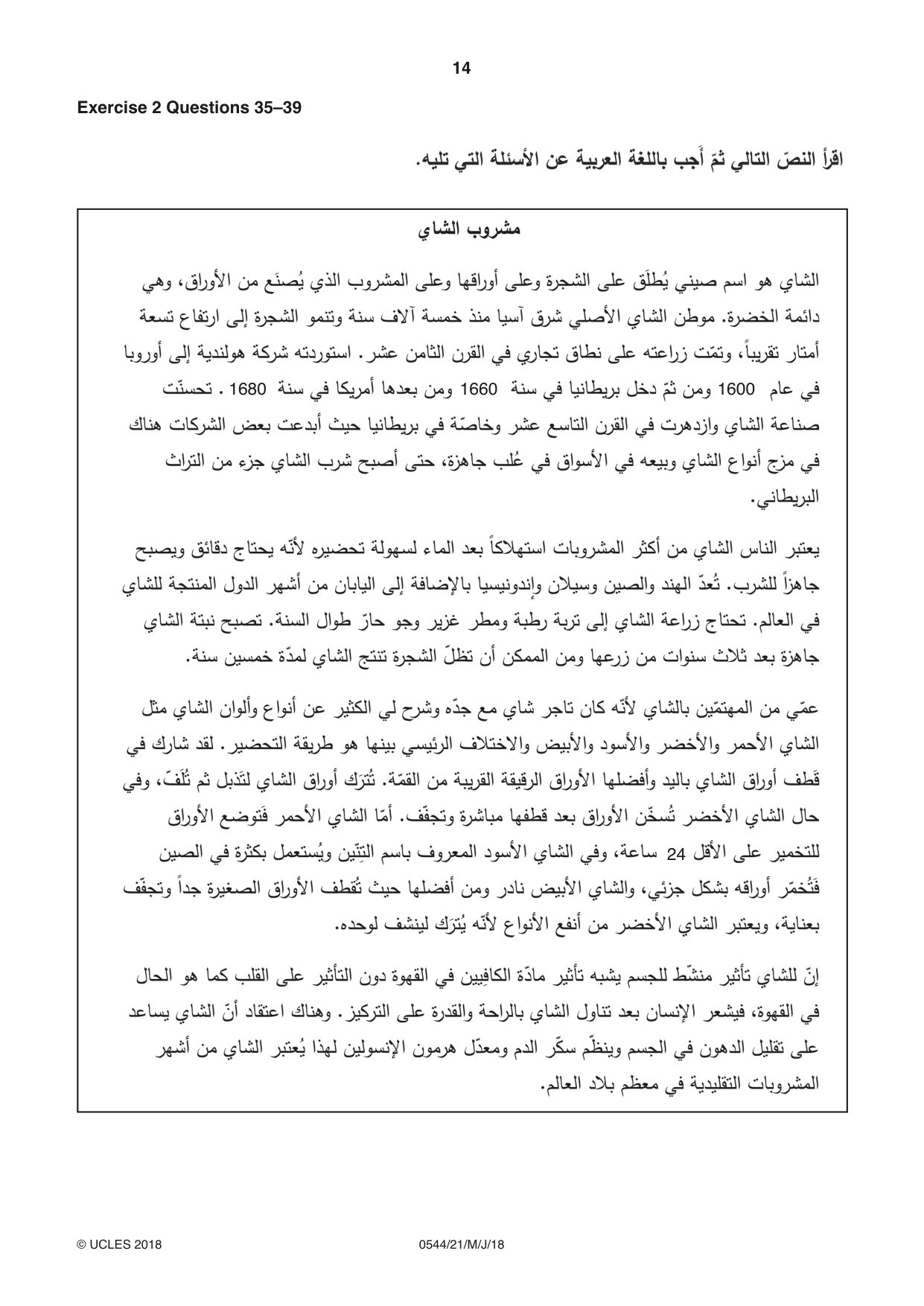
14 0544/21/M/J/18 © UCLES 2018 Exercise 2 Questions 35–39 1680 1660 1600 24
Question paper, page 15
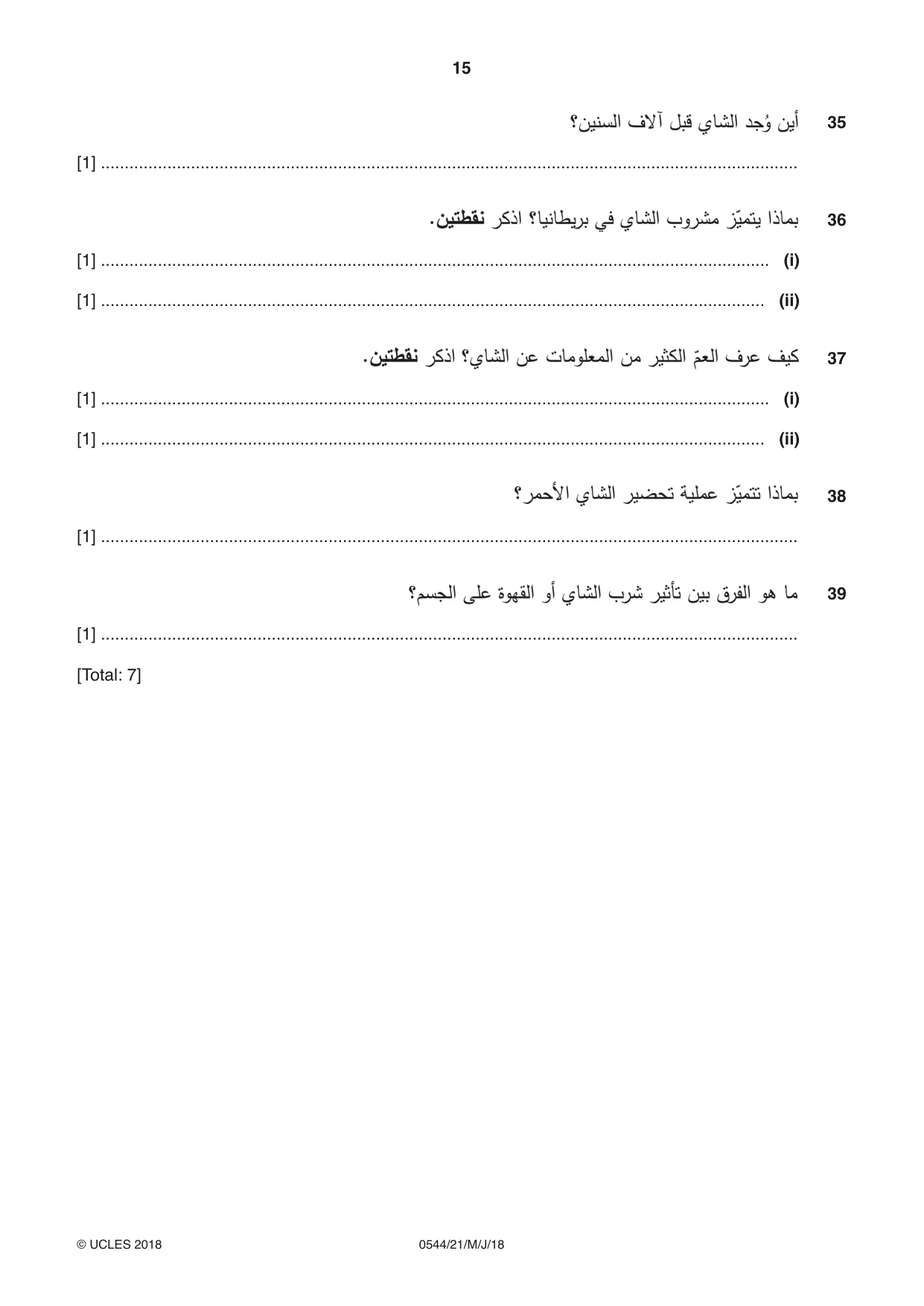
15 0544/21/M/J/18 © UCLES 2018 35 [1] … 36 [1] … (i) [1] … (ii) 37 [1] … (i) [1] … (ii) 38 [1] … 39 [1] … [Total: 7]
Question paper, page 16
16 0544/21/M/J/18 © UCLES 2018 Permission to reproduce items where third-party owned material protected by copyright is included has been sought and cleared where possible. Every reasonable effort has been made by the publisher (UCLES) to trace copyright holders, but if any items requiring clearance have unwittingly been included, the publisher will be pleased to make amends at the earliest possible opportunity. To avoid the issue of disclosure of answer-related information to candidates, all copyright acknowledgements are reproduced online in the Cambridge International Examinations Copyright Acknowledgements Booklet. This is produced for each series of examinations and is freely available to download at www.cie.org.uk after the live examination series. Cambridge International Examinations is part of the Cambridge Assessment Group. Cambridge Assessment is the brand name of University of Cambridge Local Examinations Syndicate (UCLES), which is itself a department of the University of Cambridge. BLANK PAGE
Mark scheme, page 1
IGCSE™ is a re.g.istered trademark. This document consists of 14 printed pages. © UCLES 2018 [Turn over Cambridge Assessment International Education Cambridge International General Certificate of Secondary Education ARABIC 0544/21 Paper 2 Reading May/June 2018 MARK SCHEME Maximum Mark: 45 Published This mark scheme is published as an aid to teachers and candidates, to indicate the requirements of the examination. It shows the basis on which Examiners were instructed to award marks. It does not indicate the details of the discussions that took place at an Examiners’ meeting before marking be.g.an, which would have considered the acceptability of alternative answers. Mark schemes should be read in conjunction with the question paper and the Principal Examiner Report for Teachers. Cambridge International will not enter into discussions about these mark schemes. Cambridge International is publishing the mark schemes for the May/June 2018 series for most Cambridge IGCSE™, Cambridge International A and AS Level and Cambridge Pre-U components, and some Cambridge O Level components.
Mark scheme, page 2
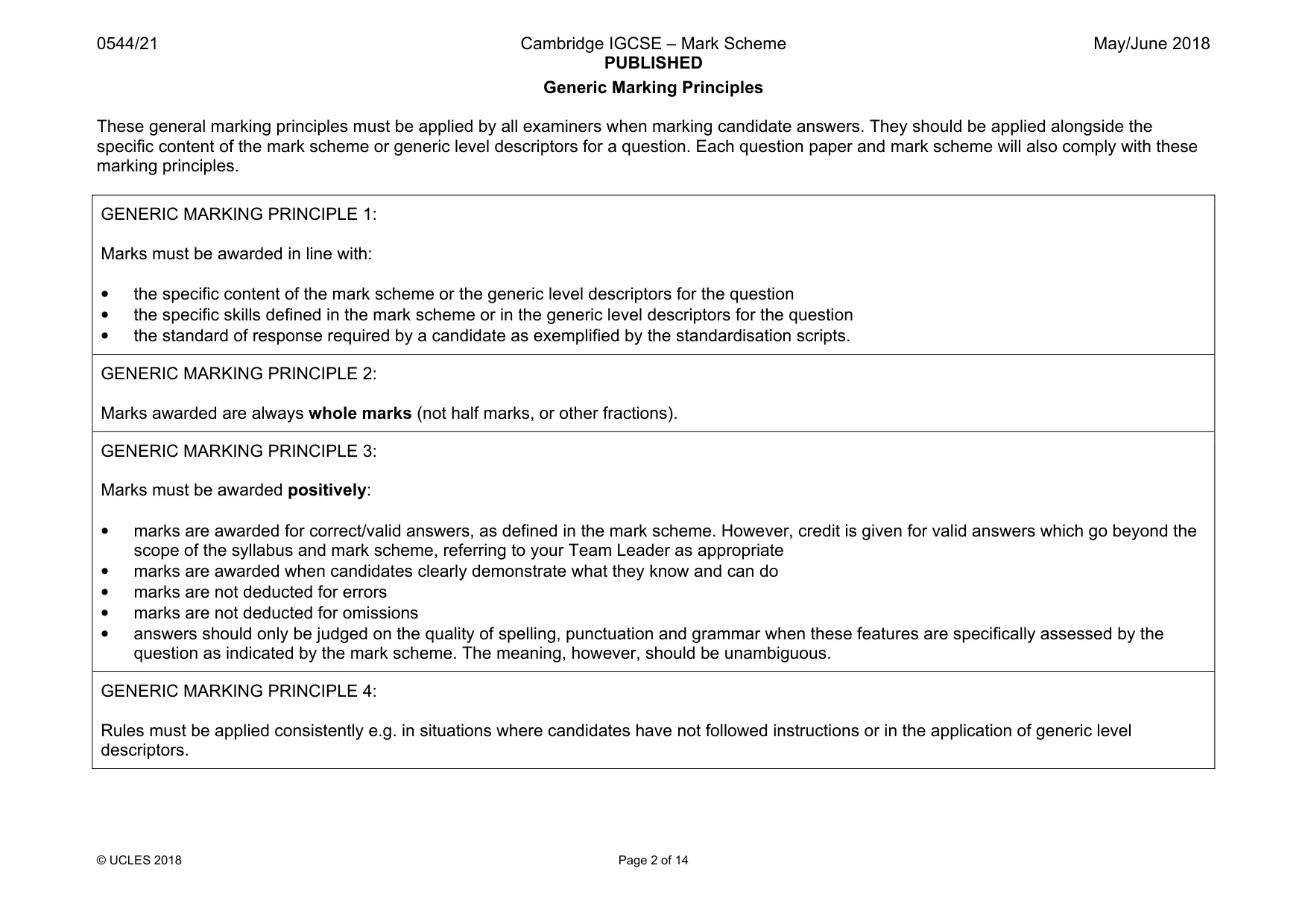
0544/21 Cambridge IGCSE – Mark Scheme PUBLISHED May/June 2018 © UCLES 2018 Page 2 of 14 Generic Marking Principles These general marking principles must be applied by all examiners when marking candidate answers. They should be applied alongside the specific content of the mark scheme or generic level descriptors for a question. Each question paper and mark scheme will also comply with these marking principles. GENERIC MARKING PRINCIPLE 1: Marks must be awarded in line with: • the specific content of the mark scheme or the generic level descriptors for the question • the specific skills defined in the mark scheme or in the generic level descriptors for the question • the standard of response required by a candidate as exemplified by the standardisation scripts. GENERIC MARKING PRINCIPLE 2: Marks awarded are always whole marks (not half marks, or other fractions). GENERIC MARKING PRINCIPLE 3: Marks must be awarded positively: • marks are awarded for correct/valid answers, as defined in the mark scheme. However, credit is given for valid answers which go beyond the scope of the syllabus and mark scheme, referring to your Team Leader as appropriate • marks are awarded when candidates clearly demonstrate what they know and can do • marks are not deducted for errors • marks are not deducted for omissions • answers should only be judged on the quality of spelling, punctuation and grammar when these features are specifically assessed by the question as indicated by the mark scheme. The meaning, however, should be unambiguous. GENERIC MARKING PRINCIPLE 4: Rules must be applied consistently e.g. in situations where candidates have not followed instructions or in the application of generic level descriptors.
Mark scheme, page 3
0544/21 Cambridge IGCSE – Mark Scheme PUBLISHED May/June 2018 © UCLES 2018 Page 3 of 14 GENERIC MARKING PRINCIPLE 5: Marks should be awarded using the full range of marks defined in the mark scheme for the question (however; the use of the full mark range may be limited according to the quality of the candidate responses seen). GENERIC MARKING PRINCIPLE 6: Marks awarded are based solely on the requirements as defined in the mark scheme. Marks should not be awarded with grade thresholds or grade descriptors in mind.
Mark scheme, page 4
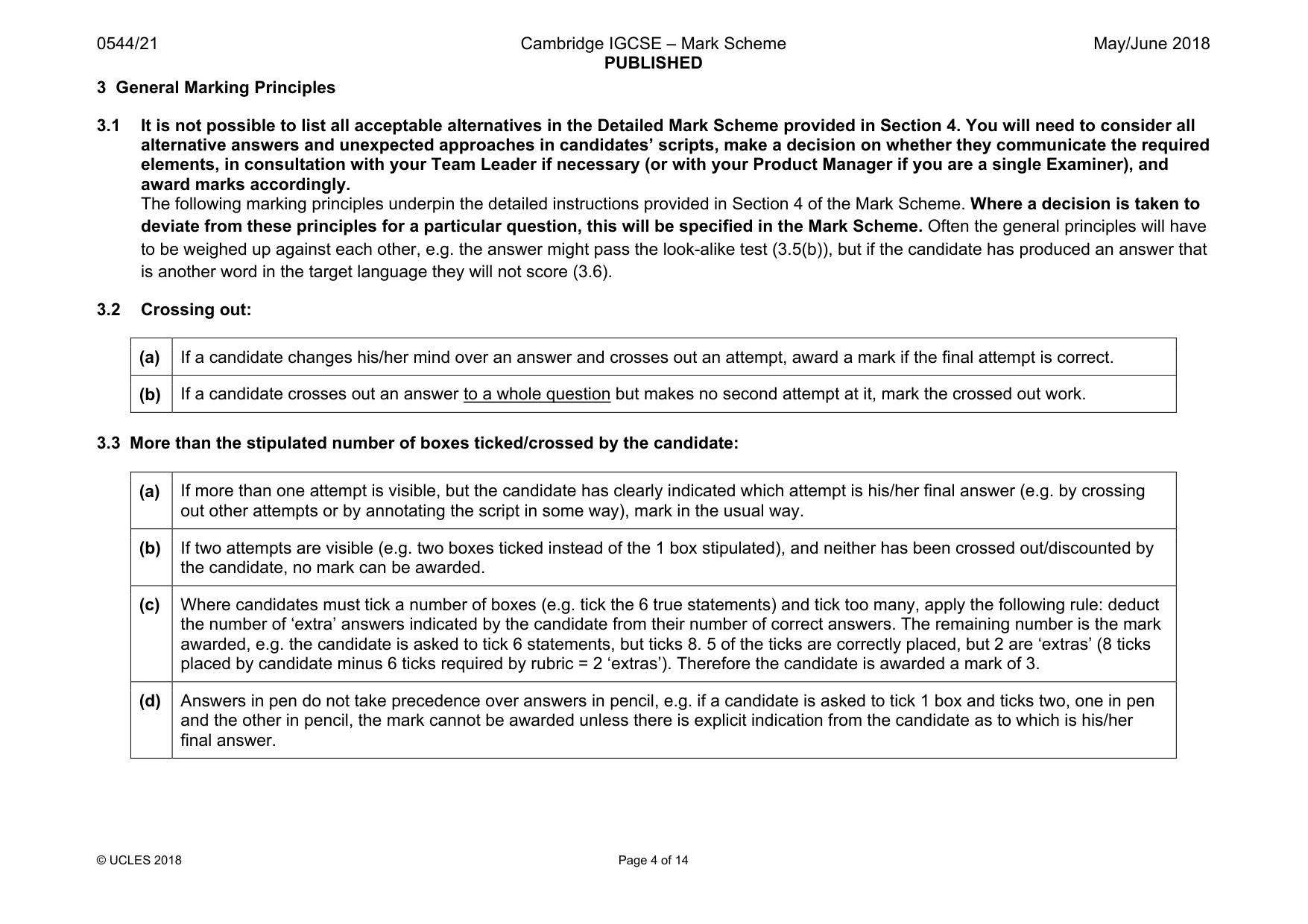
0544/21 Cambridge IGCSE – Mark Scheme PUBLISHED May/June 2018 © UCLES 2018 Page 4 of 14 3 General Marking Principles 3.1 It is not possible to list all acceptable alternatives in the Detailed Mark Scheme provided in Section 4. You will need to consider all alternative answers and unexpected approaches in candidates’ scripts, make a decision on whether they communicate the required elements, in consultation with your Team Leader if necessary (or with your Product Manager if you are a single Examiner), and award marks accordingly. The following marking principles underpin the detailed instructions provided in Section 4 of the Mark Scheme. Where a decision is taken to deviate from these principles for a particular question, this will be specified in the Mark Scheme. Often the general principles will have to be weighed up against each other, e.g. the answer might pass the look-alike test (3.5(b)), but if the candidate has produced an answer that is another word in the target language they will not score (3.6). 3.2 Crossing out: (a) If a candidate changes his/her mind over an answer and crosses out an attempt, award a mark if the final attempt is correct. (b) If a candidate crosses out an answer to a whole question but makes no second attempt at it, mark the crossed out work. 3.3 More than the stipulated number of boxes ticked/crossed by the candidate: (a) If more than one attempt is visible, but the candidate has clearly indicated which attempt is his/her final answer (e.g. by crossing out other attempts or by annotating the script in some way), mark in the usual way. (b) If two attempts are visible (e.g. two boxes ticked instead of the 1 box stipulated), and neither has been crossed out/discounted by the candidate, no mark can be awarded. (c) Where candidates must tick a number of boxes (e.g. tick the 6 true statements) and tick too many, apply the following rule: deduct the number of ‘extra’ answers indicated by the candidate from their number of correct answers. The remaining number is the mark awarded, e.g. the candidate is asked to tick 6 statements, but ticks 8. 5 of the ticks are correctly placed, but 2 are ‘extras’ (8 ticks placed by candidate minus 6 ticks required by rubric = 2 ‘extras’). Therefore the candidate is awarded a mark of 3. (d) Answers in pen do not take precedence over answers in pencil, e.g. if a candidate is asked to tick 1 box and ticks two, one in pen and the other in pencil, the mark cannot be awarded unless there is explicit indication from the candidate as to which is his/her final answer.
Mark scheme, page 5
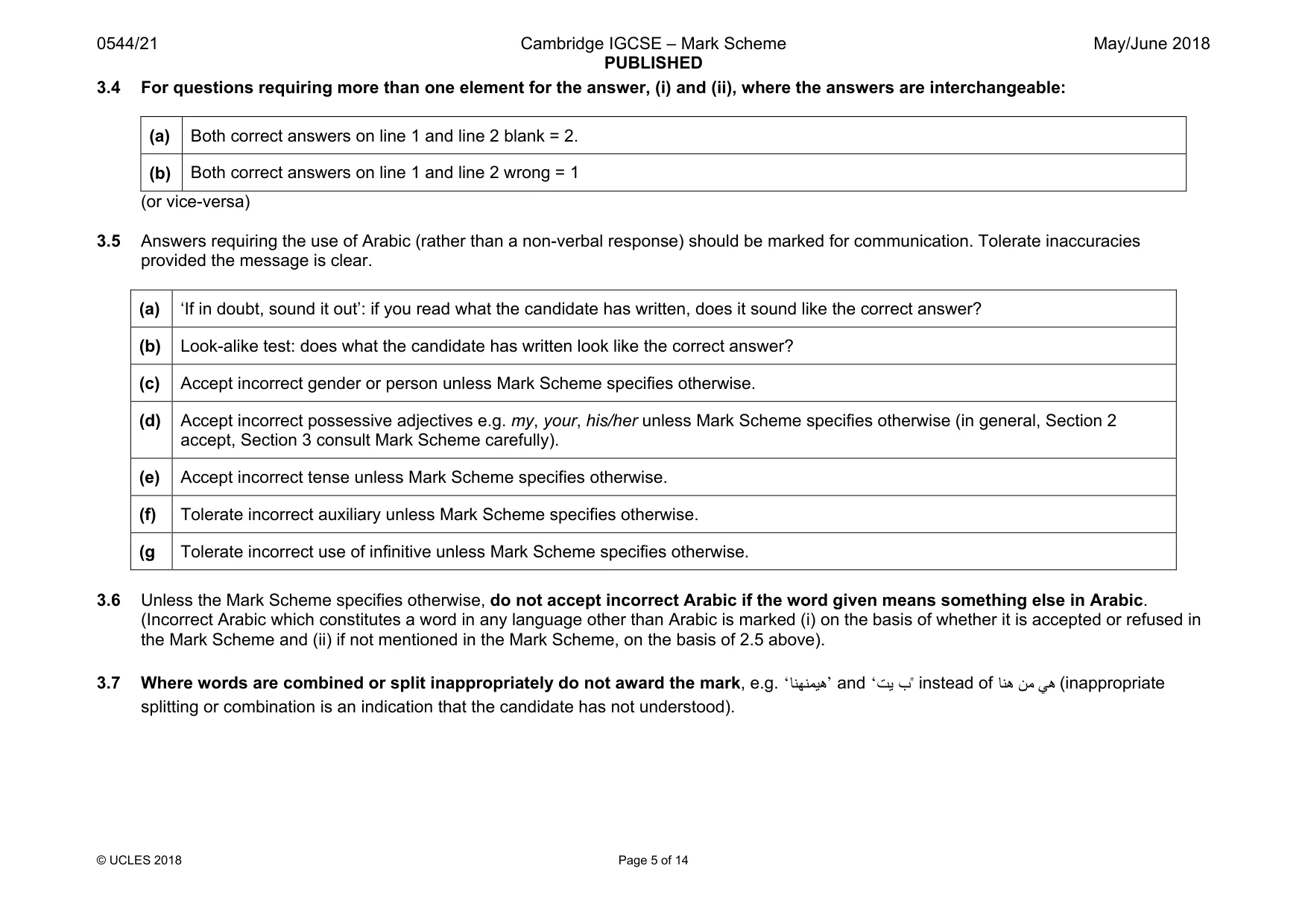
0544/21 Cambridge IGCSE – Mark Scheme PUBLISHED May/June 2018 © UCLES 2018 Page 5 of 14 3.4 For questions requiring more than one element for the answer, (i) and (ii), where the answers are interchangeable: (a) Both correct answers on line 1 and line 2 blank = 2. (b) Both correct answers on line 1 and line 2 wrong = 1 (or vice-versa) 3.5 Answers requiring the use of Arabic (rather than a non-verbal response) should be marked for communication. Tolerate inaccuracies provided the message is clear. (a) ‘If in doubt, sound it out’: if you read what the candidate has written, does it sound like the correct answer? (b) Look-alike test: does what the candidate has written look like the correct answer? (c) Accept incorrect gender or person unless Mark Scheme specifies otherwise. (d) Accept incorrect possessive adjectives e.g. my, your, his/her unless Mark Scheme specifies otherwise (in general, Section 2 accept, Section 3 consult Mark Scheme carefully). (e) Accept incorrect tense unless Mark Scheme specifies otherwise. (f) Tolerate incorrect auxiliary unless Mark Scheme specifies otherwise. (g Tolerate incorrect use of infinitive unless Mark Scheme specifies otherwise. 3.6 Unless the Mark Scheme specifies otherwise, do not accept incorrect Arabic if the word given means something else in Arabic. (Incorrect Arabic which constitutes a word in any language other than Arabic is marked (i) on the basis of whether it is accepted or refused in the Mark Scheme and (ii) if not mentioned in the Mark Scheme, on the basis of 2.5 above). 3.7 Where words are combined or split inappropriately do not award the mark, e.g. ‘ŕƊƎƊƈƔƍ’ and ‘ªƔ ¨" instead of Ɠƍ Áƈ ŕƊƍ (inappropriate splitting or combination is an indication that the candidate has not understood).
Mark scheme, page 6
0544/21 Cambridge IGCSE – Mark Scheme PUBLISHED May/June 2018 © UCLES 2018 Page 6 of 14 3.8 Annotation used in the Mark Scheme: (a) INV = Invalidation and is used when additional material included by the candidate is judged to invalidate an otherwise correct answer thus preventing him/her from scoring the mark (INV = 0). (b) tc = ‘tout court’ and means that on its own the material is not sufficient to score the mark. (c) HA = harmless additional material which in conjunction with the correct answer does not prevent the candidate from scoring the mark. (d) BOD = Benefit of the Doubt and is used to indicate that the Examiner has considered the answer/that part of the answer and judged it to be more correct than incorrect: the benefit of the doubt is given to the candidate and the mark is awarded 3.9 No response and ‘0’ marks There is a NR (NO Response) option in scoris. Award NR (No Response): If there is nothing written at all in the answer space or If there is only a comment which does not in any way relate to the question being asked (e.g. ‘can’t do’ or ‘don’t know’) or If there is only a mark which isn’t an attempt at the question (e.g. a dash, a question mark). Award 0: If there is any attempt that earns no credit. This could, for example, include the candidate copying all or some of the question, or any working that does not earn any marks, whether crossed out or not.
Mark scheme, page 7
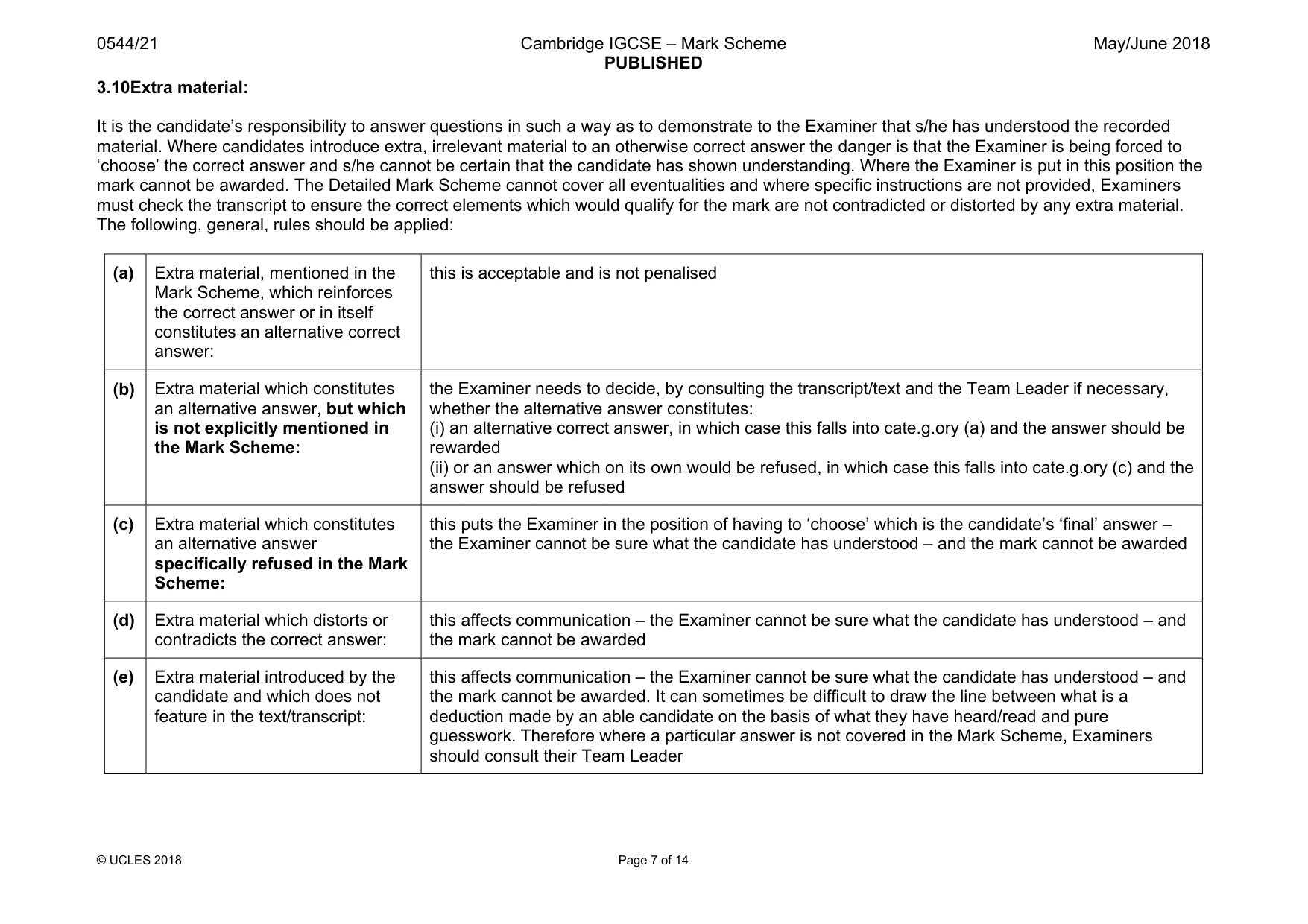
0544/21 Cambridge IGCSE – Mark Scheme PUBLISHED May/June 2018 © UCLES 2018 Page 7 of 14 3.10Extra material: It is the candidate’s responsibility to answer questions in such a way as to demonstrate to the Examiner that s/he has understood the recorded material. Where candidates introduce extra, irrelevant material to an otherwise correct answer the danger is that the Examiner is being forced to ‘choose’ the correct answer and s/he cannot be certain that the candidate has shown understanding. Where the Examiner is put in this position the mark cannot be awarded. The Detailed Mark Scheme cannot cover all eventualities and where specific instructions are not provided, Examiners must check the transcript to ensure the correct elements which would qualify for the mark are not contradicted or distorted by any extra material. The following, general, rules should be applied: (a) Extra material, mentioned in the Mark Scheme, which reinforces the correct answer or in itself constitutes an alternative correct answer: this is acceptable and is not penalised (b) Extra material which constitutes an alternative answer, but which is not explicitly mentioned in the Mark Scheme: the Examiner needs to decide, by consulting the transcript/text and the Team Leader if necessary, whether the alternative answer constitutes: (i) an alternative correct answer, in which case this falls into cate.g.ory (a) and the answer should be rewarded (ii) or an answer which on its own would be refused, in which case this falls into cate.g.ory (c) and the answer should be refused (c) Extra material which constitutes an alternative answer specifically refused in the Mark Scheme: this puts the Examiner in the position of having to ‘choose’ which is the candidate’s ‘final’ answer – the Examiner cannot be sure what the candidate has understood – and the mark cannot be awarded (d) Extra material which distorts or contradicts the correct answer: this affects communication – the Examiner cannot be sure what the candidate has understood – and the mark cannot be awarded (e) Extra material introduced by the candidate and which does not feature in the text/transcript: this affects communication – the Examiner cannot be sure what the candidate has understood – and the mark cannot be awarded. It can sometimes be difficult to draw the line between what is a deduction made by an able candidate on the basis of what they have heard/read and pure guesswork. Therefore where a particular answer is not covered in the Mark Scheme, Examiners should consult their Team Leader
Mark scheme, page 8
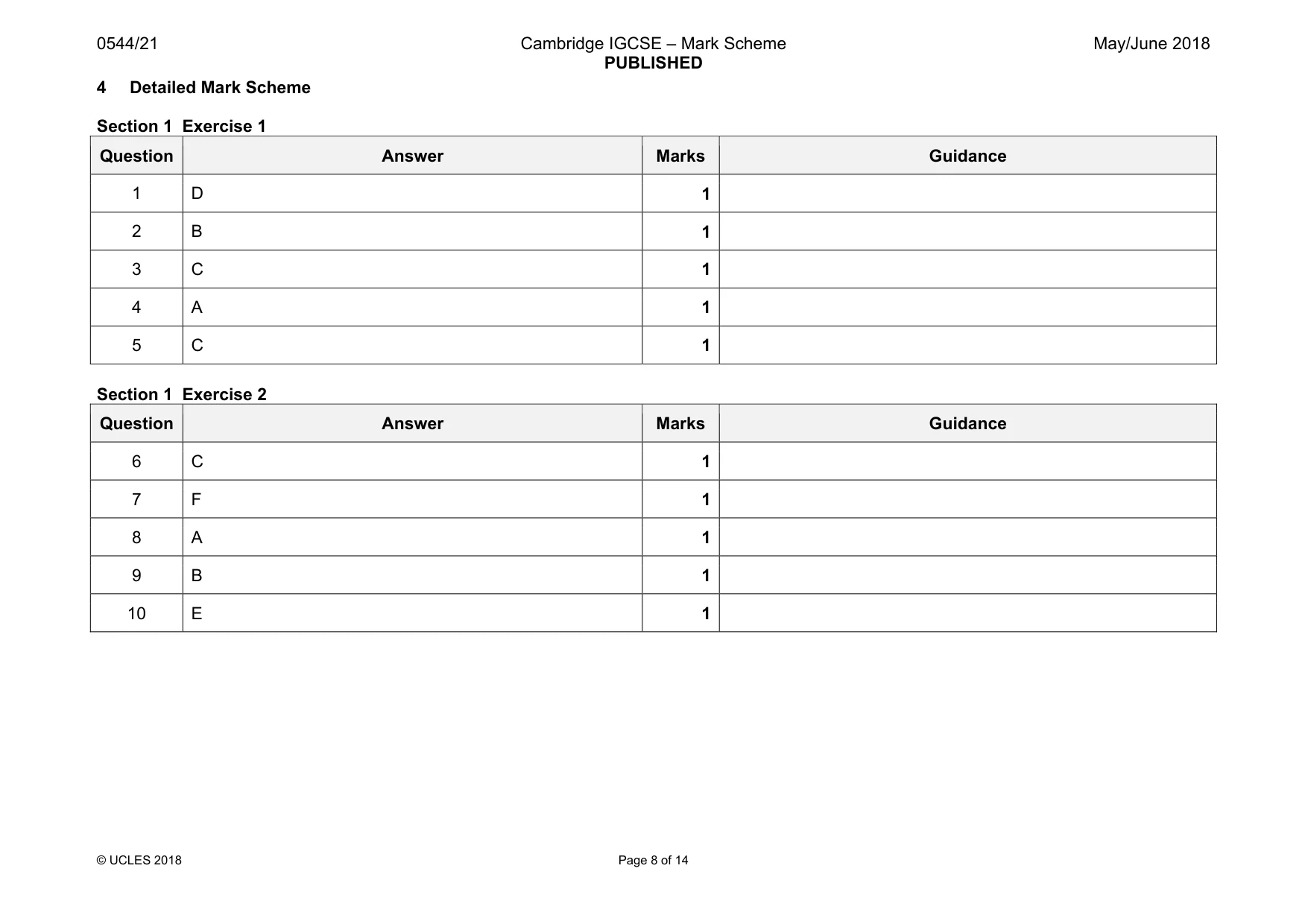
0544/21 Cambridge IGCSE – Mark Scheme PUBLISHED May/June 2018 © UCLES 2018 Page 8 of 14 4 Detailed Mark Scheme Section 1 Exercise 1 Question Answer Marks Guidance 1 D 1 2 B 1 3 C 1 4 A 1 5 C 1 Section 1 Exercise 2 Question Answer Marks Guidance 6 C 1 7 F 1 8 A 1 9 B 1 10 E 1
Mark scheme, page 9
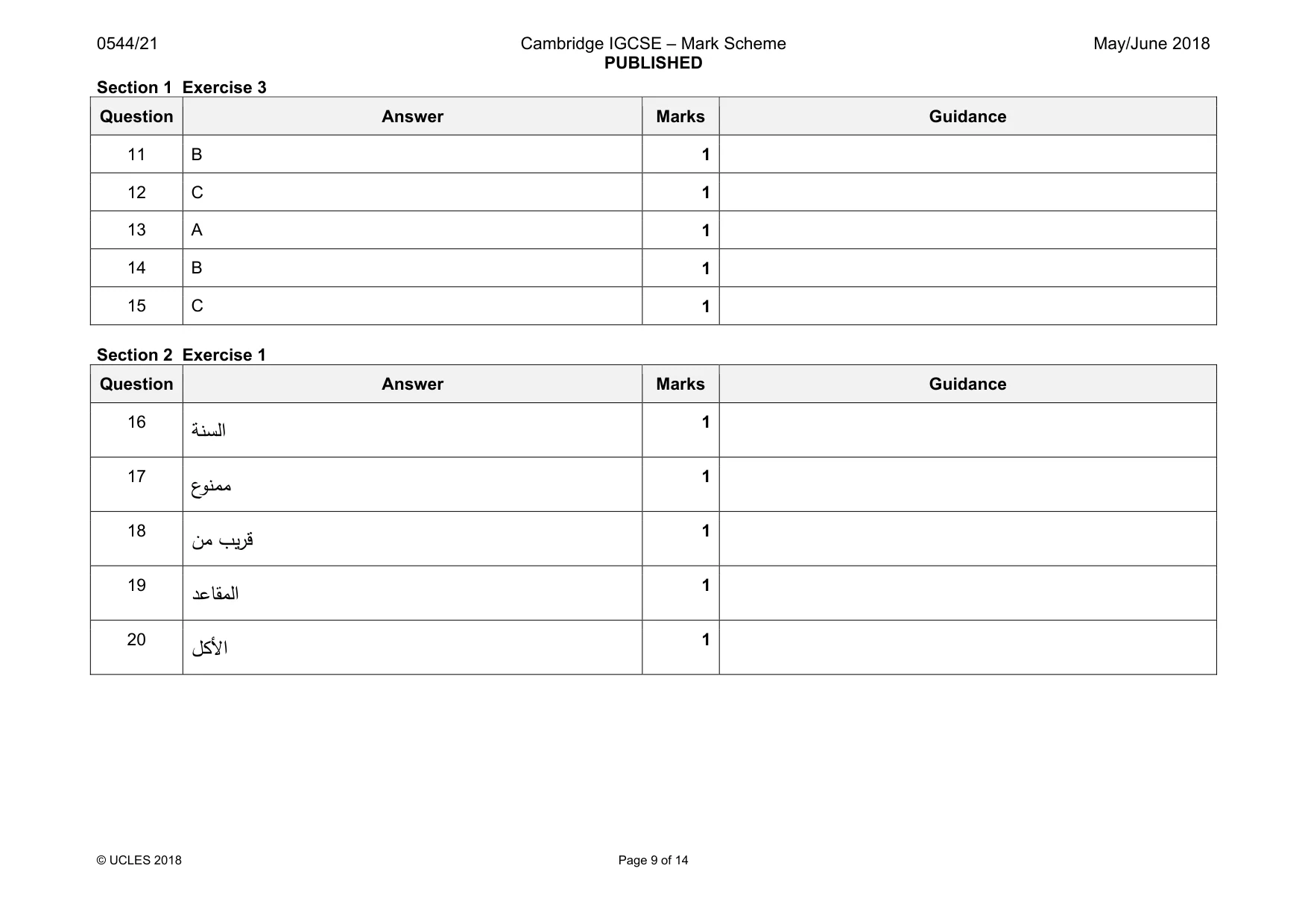
0544/21 Cambridge IGCSE – Mark Scheme PUBLISHED May/June 2018 © UCLES 2018 Page 9 of 14 Section 1 Exercise 3 Question Answer Marks Guidance 11 B 1 12 C 1 13 A 1 14 B 1 15 C 1 Section 2 Exercise 1 Question Answer Marks Guidance 16 řƊŬƅ§ 1 17 ¹ÃƊƈƈ 1 18 Áƈ ¨Ɣ±Ɓ 1 19 ¯ŷŕƂƈƅ§ 1 20 ¿ƄƗ§ 1
Mark scheme, page 10
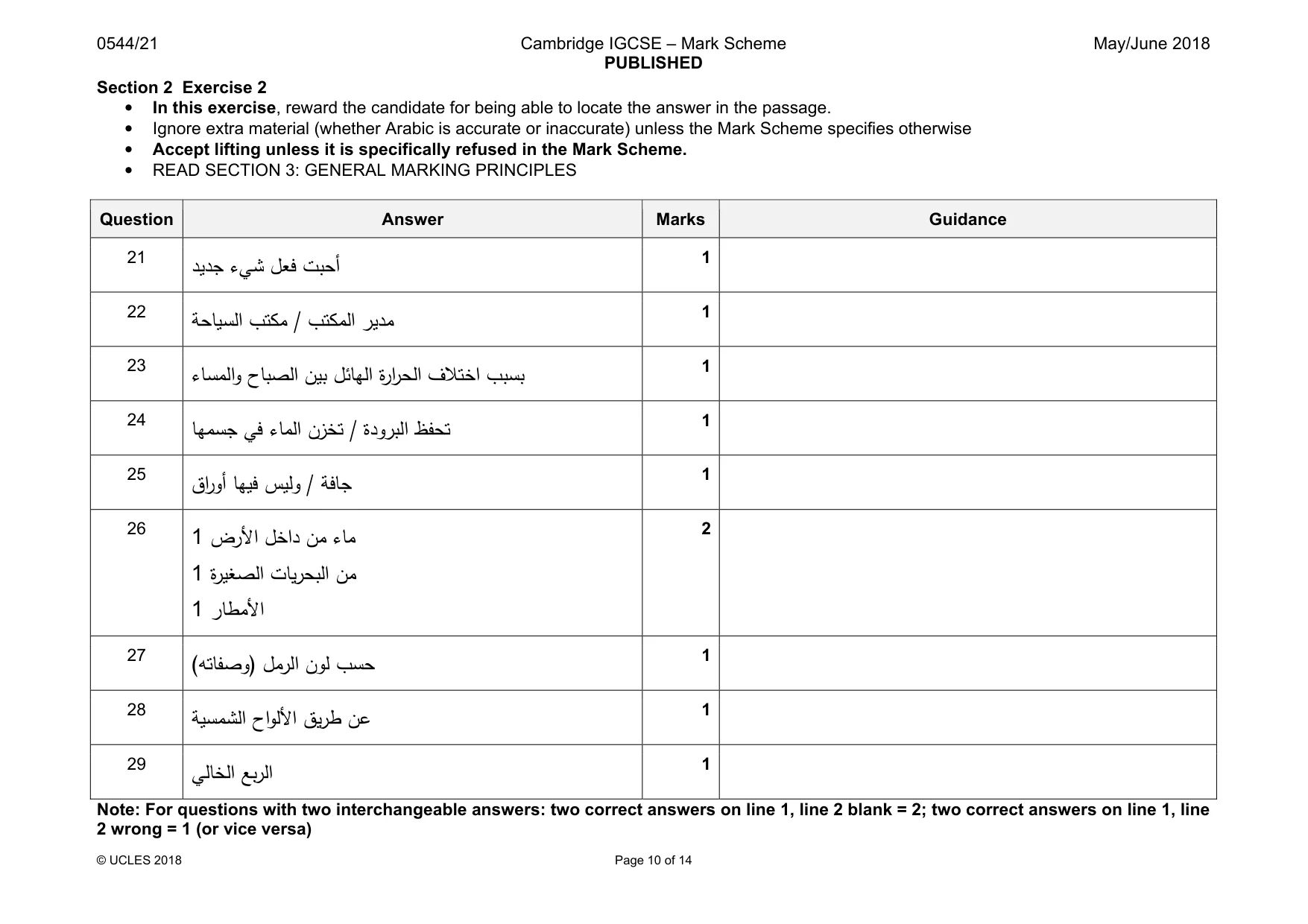
0544/21 Cambridge IGCSE – Mark Scheme PUBLISHED May/June 2018 © UCLES 2018 Page 10 of 14 Section 2 Exercise 2 • In this exercise, reward the candidate for being able to locate the answer in the passage. • Ignore extra material (whether Arabic is accurate or inaccurate) unless the Mark Scheme specifies otherwise • Accept lifting unless it is specifically refused in the Mark Scheme. • READ SECTION 3: GENERAL MARKING PRINCIPLES Question Answer Marks Guidance 21 ¯Ɣ¯Š ¡ƓŮ ¿Ÿž ªŗţ£ 1 22 řţŕƔŬƅ§ ¨śƄƈ / ¨śƄƈƅ§ ±Ɣ¯ƈ 1 23 ¡ŕŬƈƅ§Ã ŕŗŰƅ§ ÁƔŗ ¿œŕƎƅ§ ©±§±ţƅ§ ¼ƜśŦ§ ¨ŗŬŗ 1 24 ŕƎƈŬŠ Ɠž ¡ŕƈƅ§ Á²Ŧś / ©¯Ã±ŗƅ§ ¸ſţś 1 25 ½§±Ã£ ŕƎƔž ³Ɣƅà / řžŕŠ 1 26 ¶±Ɨ§ ¿Ŧ§¯ Áƈ ¡ŕƈ 1 ©±ƔżŰƅ§ ªŕƔ±ţŗƅ§ Áƈ 1 ±ŕ·ƈƗ§ 1 2 27 (ƌśŕſŰÃ) ¿ƈ±ƅ§ ÁÃƅ ¨Ŭţ 1 28 řƔŬƈŮƅ§ §ÃƅƗ§ ½Ɣ±· Áŷ 1 29 ƓƅŕŦƅ§ Ŷŗ±ƅ§ 1 Note: For questions with two interchangeable answers: two correct answers on line 1, line 2 blank = 2; two correct answers on line 1, line 2 wrong = 1 (or vice versa)
Mark scheme, page 11
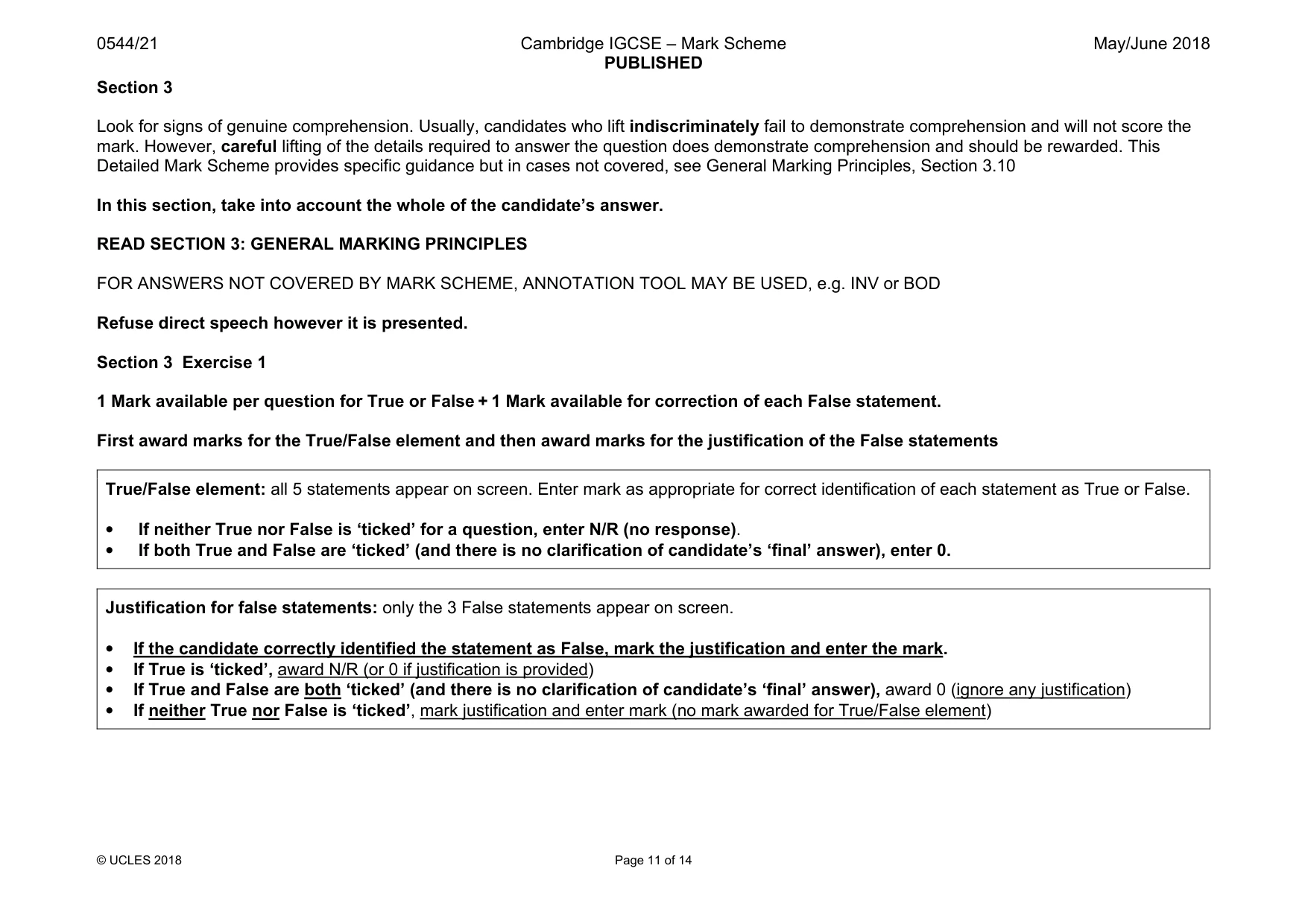
0544/21 Cambridge IGCSE – Mark Scheme PUBLISHED May/June 2018 © UCLES 2018 Page 11 of 14 Section 3 Look for signs of genuine comprehension. Usually, candidates who lift indiscriminately fail to demonstrate comprehension and will not score the mark. However, careful lifting of the details required to answer the question does demonstrate comprehension and should be rewarded. This Detailed Mark Scheme provides specific guidance but in cases not covered, see General Marking Principles, Section 3.10 In this section, take into account the whole of the candidate’s answer. READ SECTION 3: GENERAL MARKING PRINCIPLES FOR ANSWERS NOT COVERED BY MARK SCHEME, ANNOTATION TOOL MAY BE USED, e.g. INV or BOD Refuse direct speech however it is presented. Section 3 Exercise 1 1 Mark available per question for True or False + 1 Mark available for correction of each False statement. First award marks for the True/False element and then award marks for the justification of the False statements True/False element: all 5 statements appear on screen. Enter mark as appropriate for correct identification of each statement as True or False. • If neither True nor False is ‘ticked’ for a question, enter N/R (no response). • If both True and False are ‘ticked’ (and there is no clarification of candidate’s ‘final’ answer), enter 0. Justification for false statements: only the 3 False statements appear on screen. • If the candidate correctly identified the statement as False, mark the justification and enter the mark. • If True is ‘ticked’, award N/R (or 0 if justification is provided) • If True and False are both ‘ticked’ (and there is no clarification of candidate’s ‘final’ answer), award 0 (ignore any justification) • If neither True nor False is ‘ticked’, mark justification and enter mark (no mark awarded for True/False element)
Mark scheme, page 12
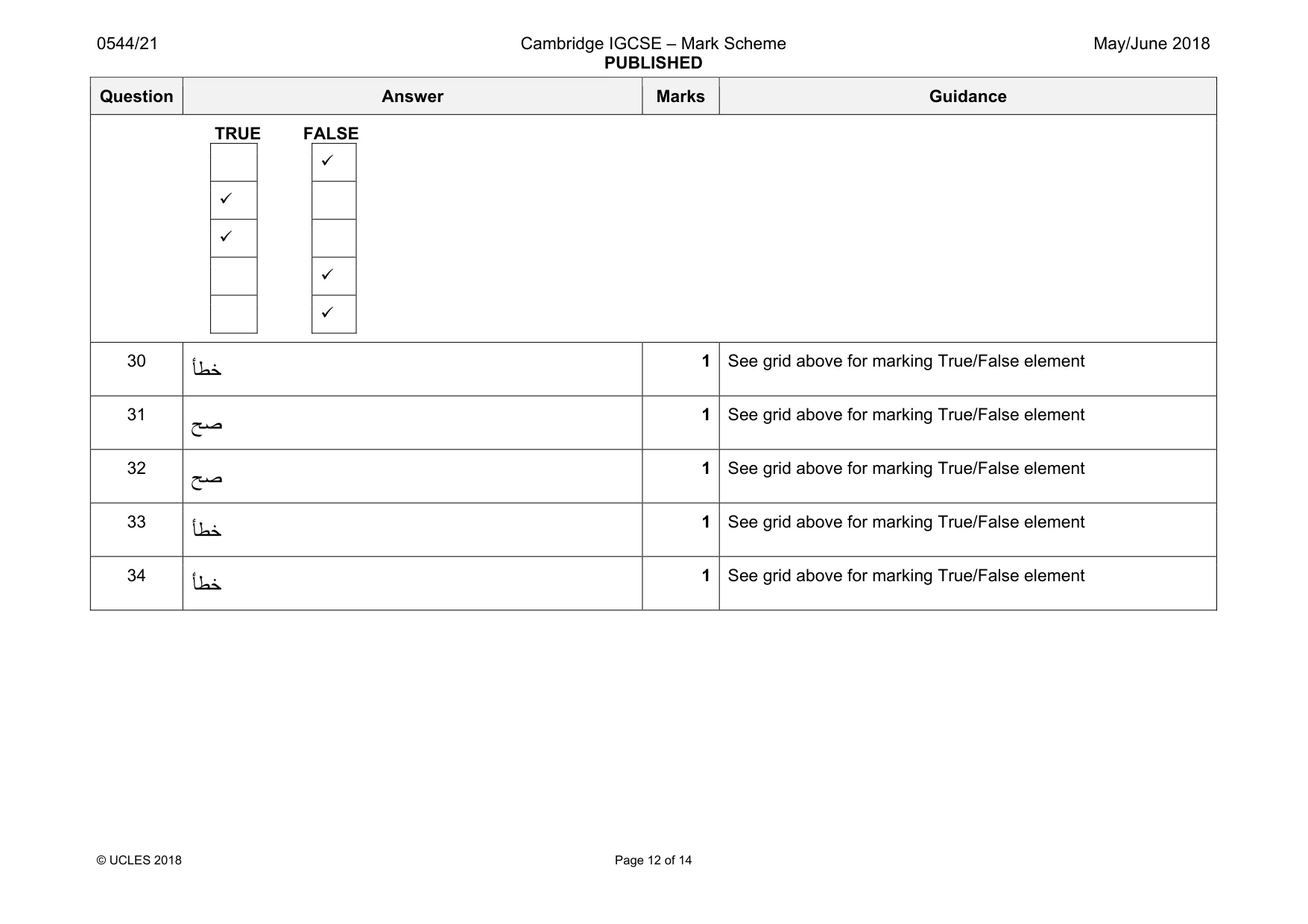
0544/21 Cambridge IGCSE – Mark Scheme PUBLISHED May/June 2018 © UCLES 2018 Page 12 of 14 Question Answer Marks Guidance TRUE FALSE 9 9 9 9 9 30 ō·Ŧ 1 See grid above for marking True/False element 31 ŢŰ 1 See grid above for marking True/False element 32 ŢŰ 1 See grid above for marking True/False element 33 ō·Ŧ 1 See grid above for marking True/False element 34 ō·Ŧ 1 See grid above for marking True/False element
Mark scheme, page 13
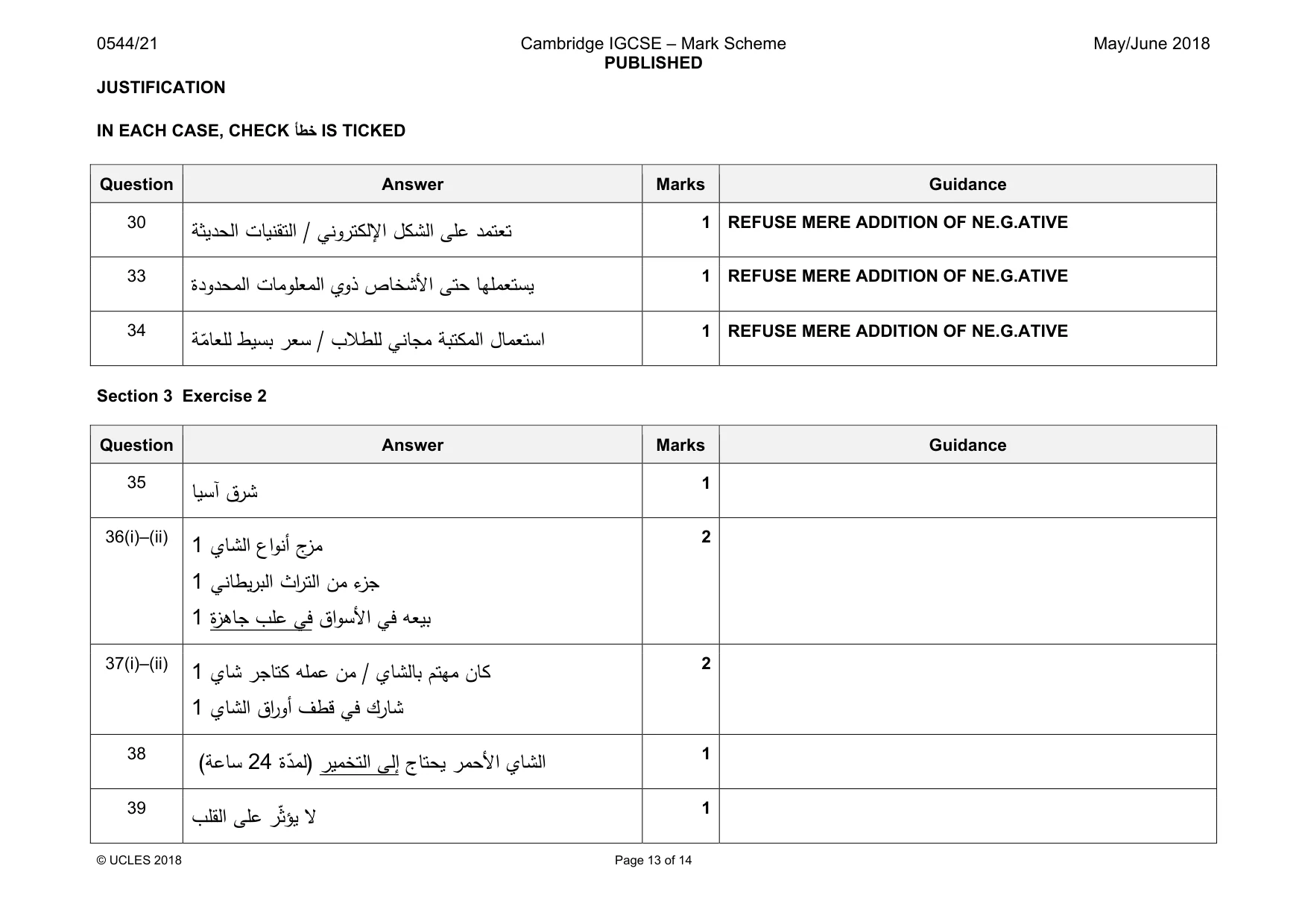
0544/21 Cambridge IGCSE – Mark Scheme PUBLISHED May/June 2018 © UCLES 2018 Page 13 of 14 JUSTIFICATION IN EACH CASE, CHECK ŋ¶Ť IS TICKED Question Answer Marks Guidance 30 / ƓƊñśƄƅƙ§ ¿ƄŮƅ§ ƑƆŷ ¯ƈśŸś řŝƔ¯ţƅ§ ªŕƔƊƂśƅ§ 1 REFUSE MERE ADDITION OF NE.G.ATIVE 33 ©¯Ã¯ţƈƅ§ ªŕƈÃƆŸƈƅ§ Åð µŕŦŮƗ§ Ƒśţ ŕƎƆƈŸśŬƔ 1 REFUSE MERE ADDITION OF NE.G.ATIVE 34 řÌƈŕŸƆƅ ·ƔŬŗ ±ŸŬ / ¨Ɯ·Ɔƅ ƓƊŕŠƈ řŗśƄƈƅ§ ¿ŕƈŸśŬ§ 1 REFUSE MERE ADDITION OF NE.G.ATIVE Section 3 Exercise 2 Question Answer Marks Guidance 35 ŕƔŬ¢ ½±Ů 1 36(i)–(ii) ÅŕŮƅ§ ¹§ÃƊ£ ¬²ƈ 1 ƓƊŕ·Ɣ±ŗƅ§ «§±śƅ§ Áƈ ¡²Š 1 1 ©²ƍ੠¨Ɔŷ Ɠž ½§ÃŬƗ§ Ɠž ƌŸƔŗ 2 37(i)–(ii) ÅŕŮ ±ŠŕśƄ ƌƆƈŷ Áƈ / ÅŕŮƅŕŗ ÀśƎƈ ÁŕƄ 1 ÅŕŮƅ§ ½§±Ã£ ¼·Ɓ Ɠž ¾±ŕŮ 1 2 38 (řŷŕŬ 24 ©Ì¯ƈƅ) ±ƔƈŦśƅ§ Ƒƅ¥ ¬ŕśţƔ ±ƈţƗ§ ÅŕŮƅ§ 1 39 ¨ƆƂƅ§ ƑƆŷ ±Ìŝ¤Ɣ ƛ 1
Mark scheme, page 14
0544/21 Cambridge IGCSE – Mark Scheme PUBLISHED May/June 2018 © UCLES 2018 Page 14 of 14 Note: For questions with two interchangeable answers: two correct answers on line 1, line 2 blank = 2; two correct answers on line 1, line 2 wrong = 1 (or vice versa) TICK BLANK PAGES