Cambridge IGCSE Accounting (9-1) 0985 — 2020 May/June Paper 2 · Variant 1
0985/21/M/J/20
The question paper and its mark scheme, free to read here and free to download. This is Cambridge’s own paper, exactly as it was sat.
Question paper24 pages




Mark scheme18 pages
Answers below. Sit the paper first if you are practising.
Paper as text
Question paper, page 1
Cambridge IGCSE™(9–1) ACCOUNTING 0985/21 Paper 2 Structured Written Paper May/June 2020 1 hour 45 minutes You must answer on the question paper. No additional materials are needed. INSTRUCTIONS ● Answer all questions. ● Use a black or dark blue pen. You may use an HB pencil for any diagrams or graphs. ● Write your name, centre number and candidate number in the boxes at the top of the page. ● Write your answer to each question in the space provided. ● Do not use an erasable pen or correction fluid. ● Do not write on any bar codes. ● You may use a calculator. ● International accounting terms and formats should be used as appropriate. ● You should show your workings. INFORMATION ● The total mark for this paper is 100. ● The number of marks for each question or part question is shown in brackets [ ]. ● Where you are asked to complete a layout, you may not need all the lines for your answer. DC (RW) 198532 © UCLES 2020 [Turn over This document has 24 pages. Blank pages are indicated. Cambridge IGCSE™ * 9 8 4 0 5 7 3 0 4 1 *
Question paper, page 2
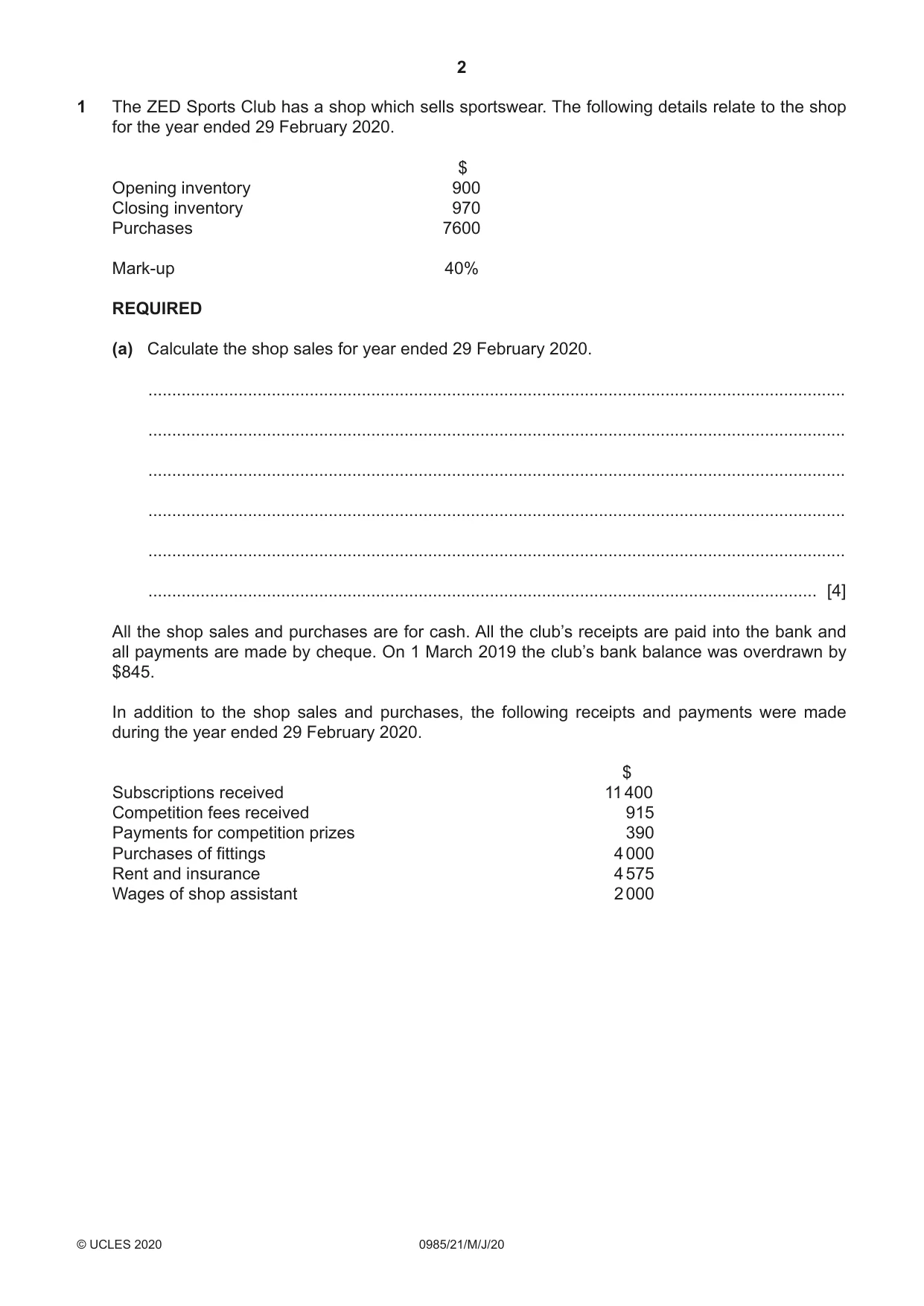
2 0985/21/M/J/20 © UCLES 2020 1 The ZED Sports Club has a shop which sells sportswear. The following details relate to the shop for the year ended 29 February 2020. $ Opening inventory 900 Closing inventory 970 Purchases 7600 Mark-up 40% REQUIRED (a) Calculate the shop sales for year ended 29 February 2020. … … … … … … [4] All the shop sales and purchases are for cash. All the club’s receipts are paid into the bank and all payments are made by cheque. On 1 March 2019 the club’s bank balance was overdrawn by $845. In addition to the shop sales and purchases, the following receipts and payments were made during the year ended 29 February 2020. $ Subscriptions received 11 400 Competition fees received 915 Payments for competition prizes 390 Purchases of fittings 4 000 Rent and insurance 4 575 Wages of shop assistant 2 000
Question paper, page 3
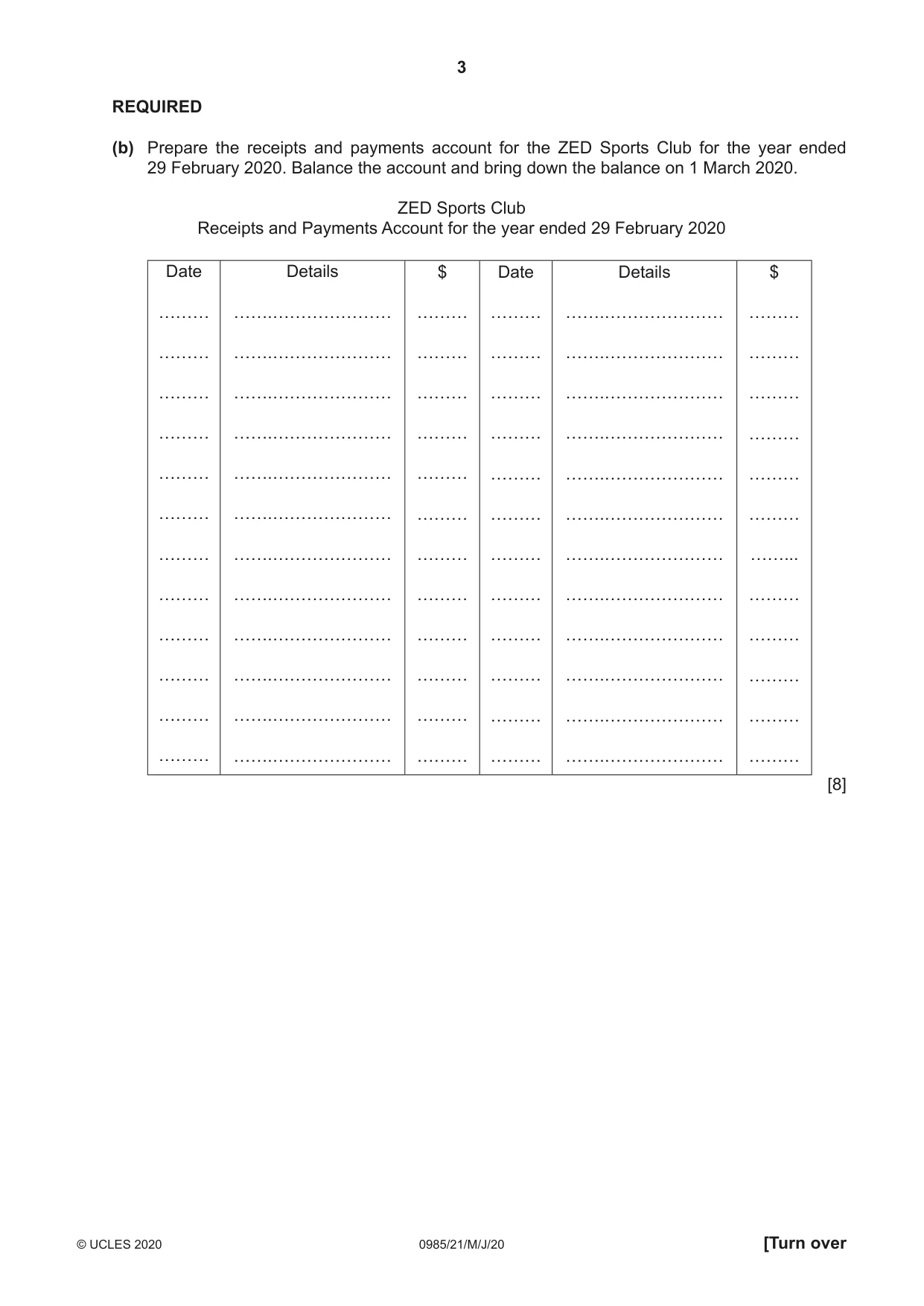
3 0985/21/M/J/20 © UCLES 2020 [Turn over REQUIRED (b) Prepare the receipts and payments account for the ZED Sports Club for the year ended 29 February 2020. Balance the account and bring down the balance on 1 March 2020. ZED Sports Club Receipts and Payments Account for the year ended 29 February 2020 Date ……… ……… ……… ……… ……… ……… ……… ……… ……… ……… ……… ……… Details …….………………… …….………………… …….………………… …….………………… …….………………… …….………………… …….………………… …….………………… …….………………… …….………………… …….………………… …….………………… $ ……… ……… ……… ……… ……… ……… ……… ……… ……… ……… ……… ……… Date ……… ……… ……… ……… ……… ……… ……… ……… ……… ……… ……… ……… Details …….………………… …….………………… …….………………… …….………………… …….………………… …….………………… …….………………… …….………………… …….………………… …….………………… …….………………… …….………………… $ ……… ……… ……… ……… ……… ……… ……... ……… ……… ……… ……… ……… [8]
Question paper, page 4
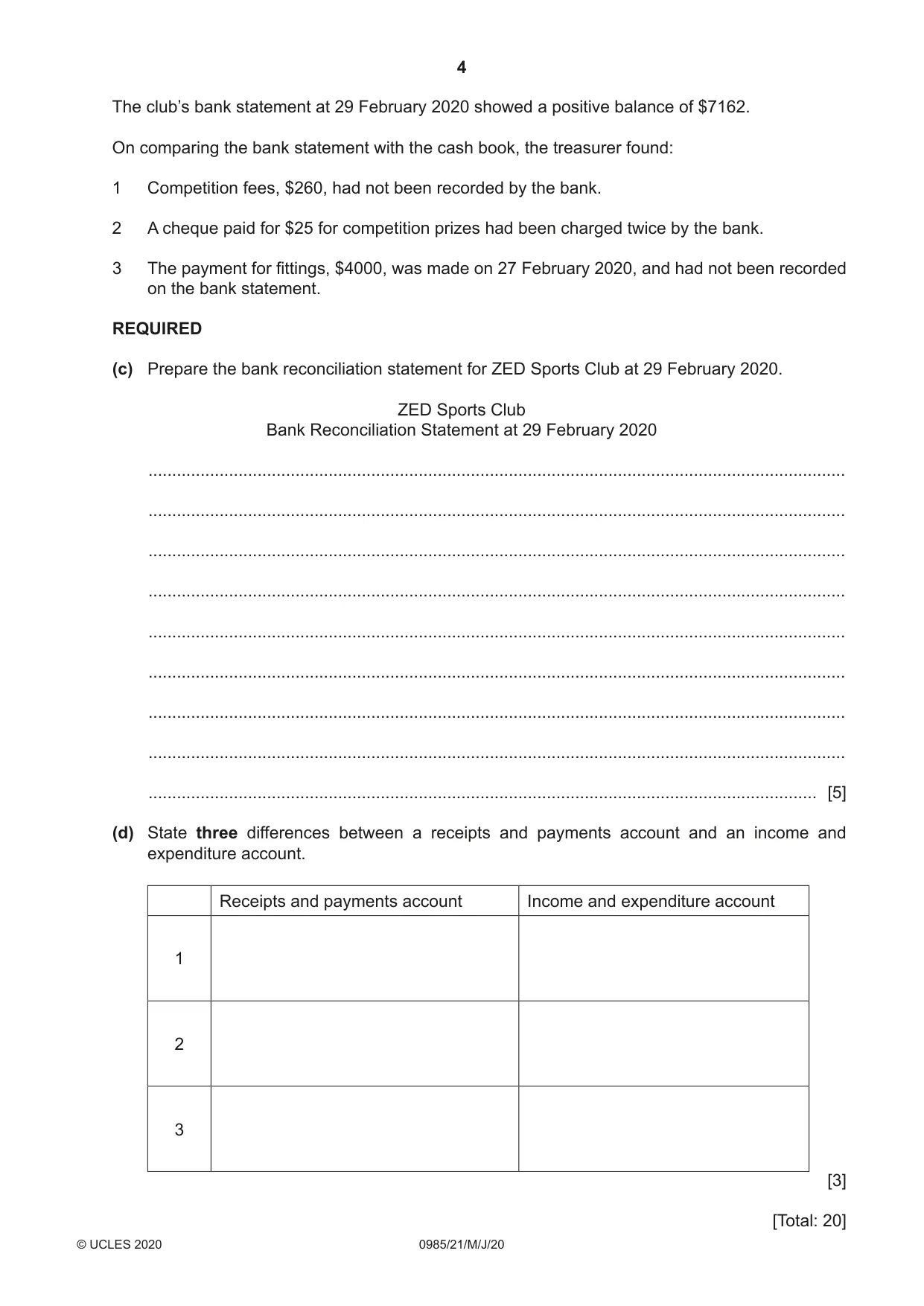
4 0985/21/M/J/20 © UCLES 2020 The club’s bank statement at 29 February 2020 showed a positive balance of $7162. On comparing the bank statement with the cash book, the treasurer found: 1 Competition fees, $260, had not been recorded by the bank. 2 A cheque paid for $25 for competition prizes had been charged twice by the bank. 3 The payment for fittings, $4000, was made on 27 February 2020, and had not been recorded on the bank statement. REQUIRED (c) Prepare the bank reconciliation statement for ZED Sports Club at 29 February 2020. ZED Sports Club Bank Reconciliation Statement at 29 February 2020 … … … … … … … … … [5] (d) State three differences between a receipts and payments account and an income and expenditure account. Receipts and payments account Income and expenditure account 1 2 3 [3] [Total: 20]
Question paper, page 5
5 0985/21/M/J/20 © UCLES 2020 [Turn over PLEASE TURN OVER
Question paper, page 6
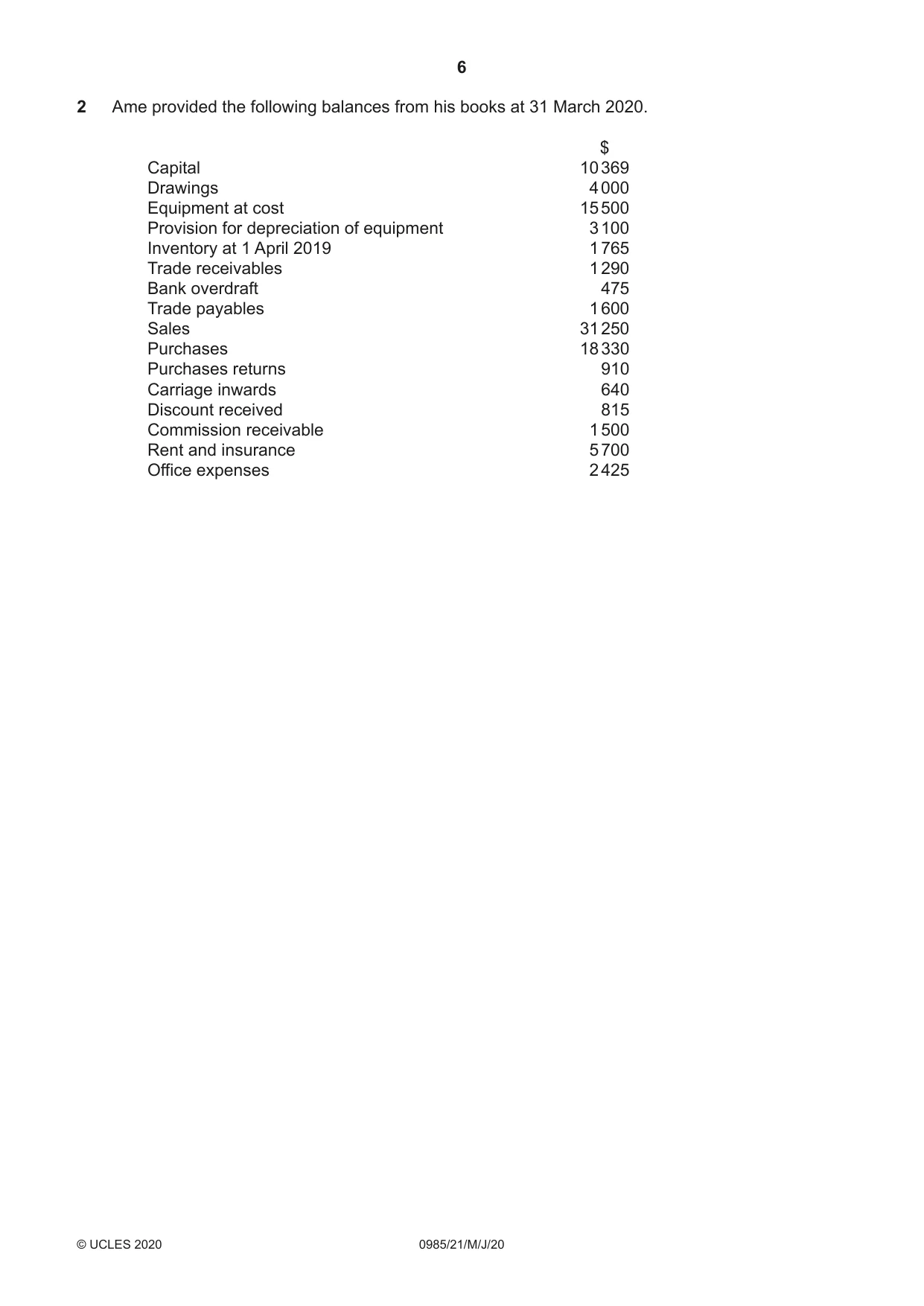
6 0985/21/M/J/20 © UCLES 2020 2 Ame provided the following balances from his books at 31 March 2020. $ Capital 10 369 Drawings 4 000 Equipment at cost 15 500 Provision for depreciation of equipment 3 100 Inventory at 1 April 2019 1 765 Trade receivables 1 290 Bank overdraft 475 Trade payables 1 600 Sales 31 250 Purchases 18 330 Purchases returns 910 Carriage inwards 640 Discount received 815 Commission receivable 1 500 Rent and insurance 5 700 Office expenses 2 425
Question paper, page 7
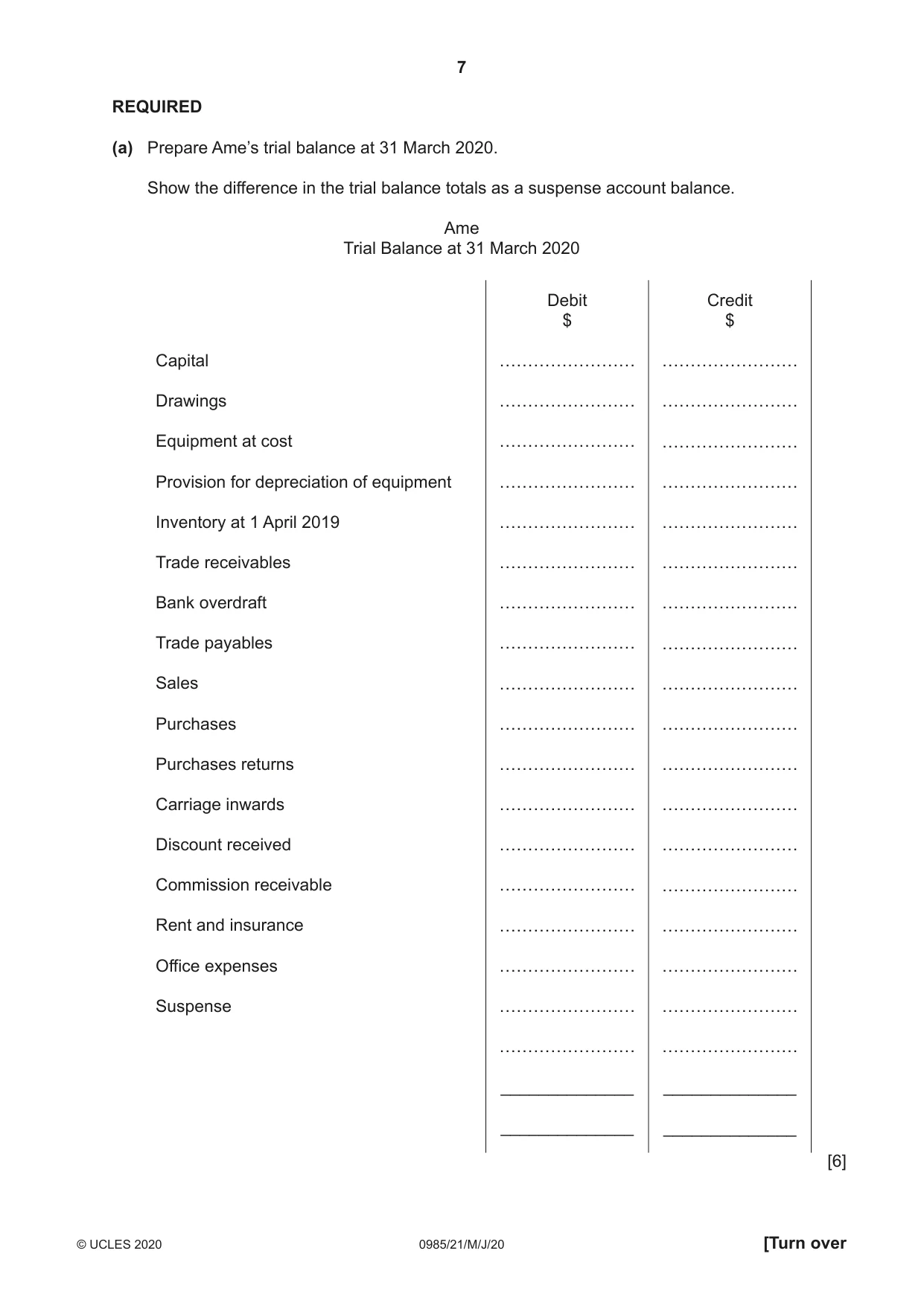
7 0985/21/M/J/20 © UCLES 2020 [Turn over REQUIRED (a) Prepare Ame’s trial balance at 31 March 2020. Show the difference in the trial balance totals as a suspense account balance. Ame Trial Balance at 31 March 2020 Capital Drawings Equipment at cost Provision for depreciation of equipment Inventory at 1 April 2019 Trade receivables Bank overdraft Trade payables Sales Purchases Purchases returns Carriage inwards Discount received Commission receivable Rent and insurance Office expenses Suspense Debit $ …………………… …………………… …………………… …………………… …………………… …………………… …………………… …………………… …………………… …………………… …………………… …………………… …………………… …………………… …………………… …………………… …………………… …………………… ______________ ______________ Credit $ …………………… …………………… …………………… …………………… …………………… …………………… …………………… …………………… …………………… …………………… …………………… …………………… …………………… …………………… …………………… …………………… …………………… …………………… ______________ ______________ [6]
Question paper, page 8
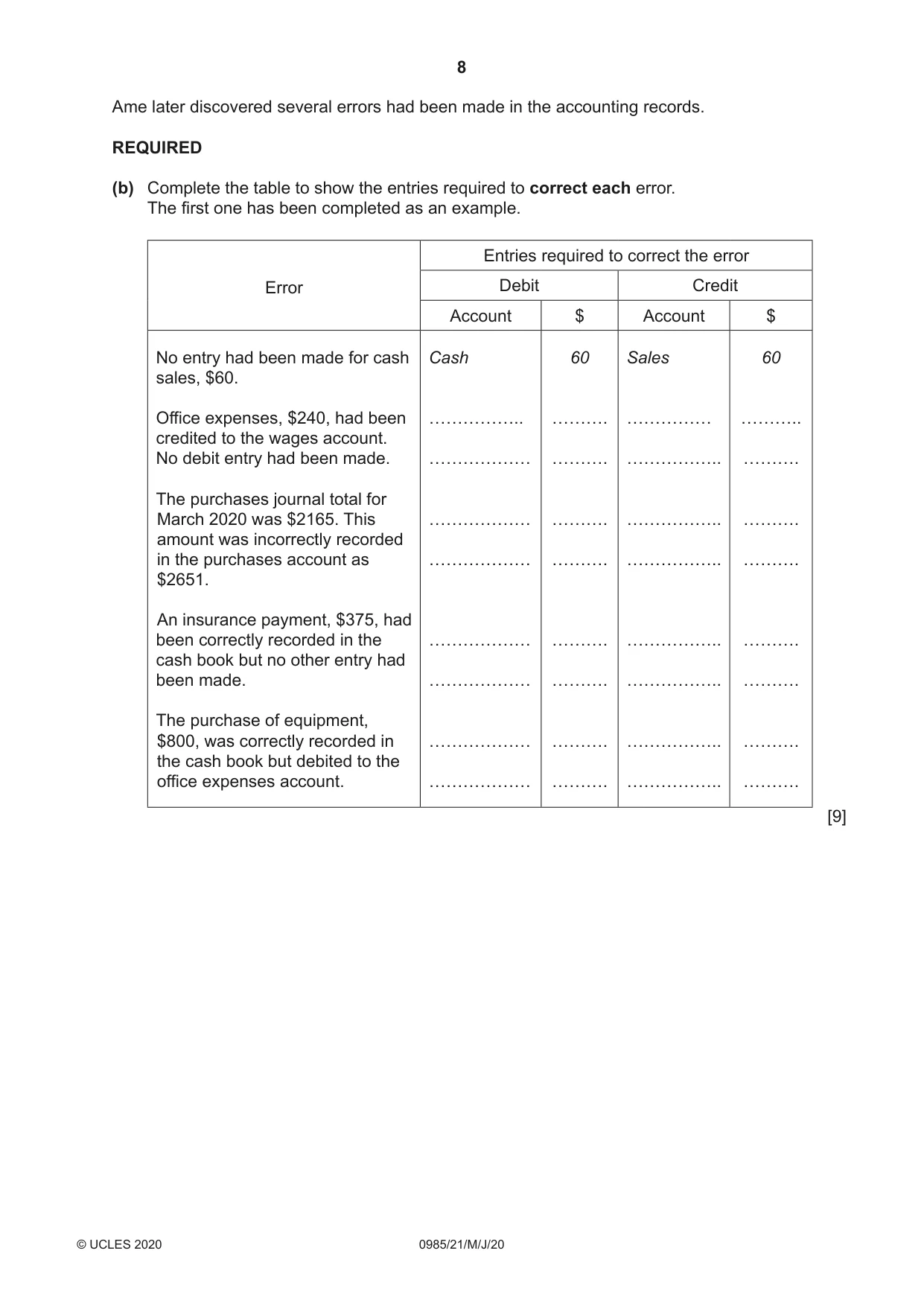
8 0985/21/M/J/20 © UCLES 2020 Ame later discovered several errors had been made in the accounting records. REQUIRED (b) Complete the table to show the entries required to correct each error. The first one has been completed as an example. Error Entries required to correct the error Debit Credit Account $ Account $ No entry had been made for cash sales, $60. Office expenses, $240, had been credited to the wages account. No debit entry had been made. The purchases journal total for March 2020 was $2165. This amount was incorrectly recorded in the purchases account as $2651. An insurance payment, $375, had been correctly recorded in the cash book but no other entry had been made. The purchase of equipment, $800, was correctly recorded in the cash book but debited to the office expenses account. Cash …………….. ……………… ……………… ……………… ……………… ……………… ……………… ……………… 60 ………. ………. ………. ………. ………. ………. ………. ………. Sales …………… …………….. …………….. …………….. …………….. …………….. …………….. …………….. 60 ……….. ………. ………. ………. ………. ………. ………. ………. [9]
Question paper, page 9
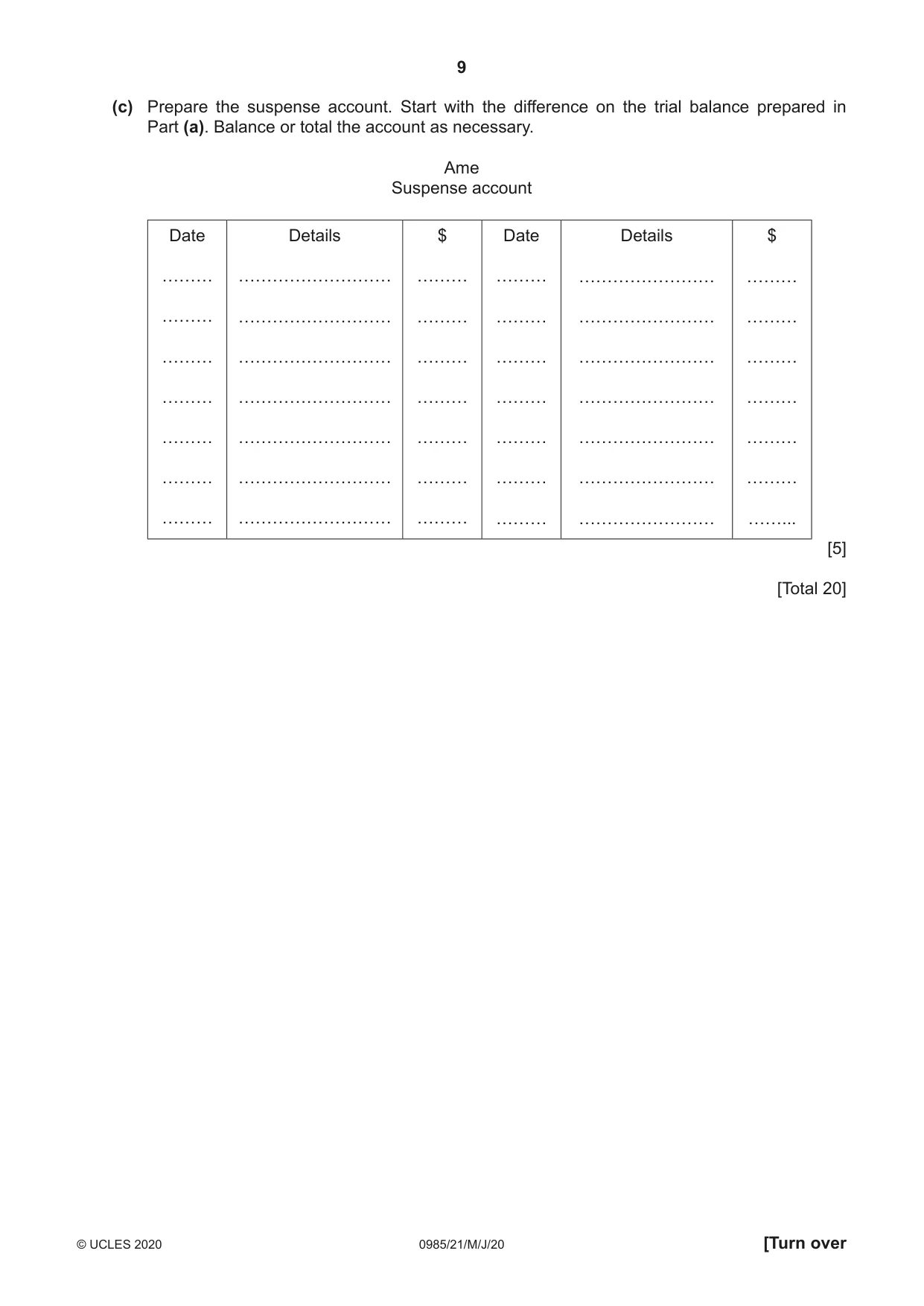
9 0985/21/M/J/20 © UCLES 2020 [Turn over (c) Prepare the suspense account. Start with the difference on the trial balance prepared in Part (a). Balance or total the account as necessary. Ame Suspense account Date ……… ……… ……… ……… ……… ……… ……… Details ……………………… ……………………… ……………………… ……………………… ……………………… ……………………… ……………………… $ ……… ……… ……… ……… ……… ……… ……… Date ……… ……… ……… ……… ……… ……… ……… Details …………………… …………………… …………………… …………………… …………………… …………………… …………………… $ ……… ……… ……… ……… ……… ……… ……... [5] [Total 20]
Question paper, page 10
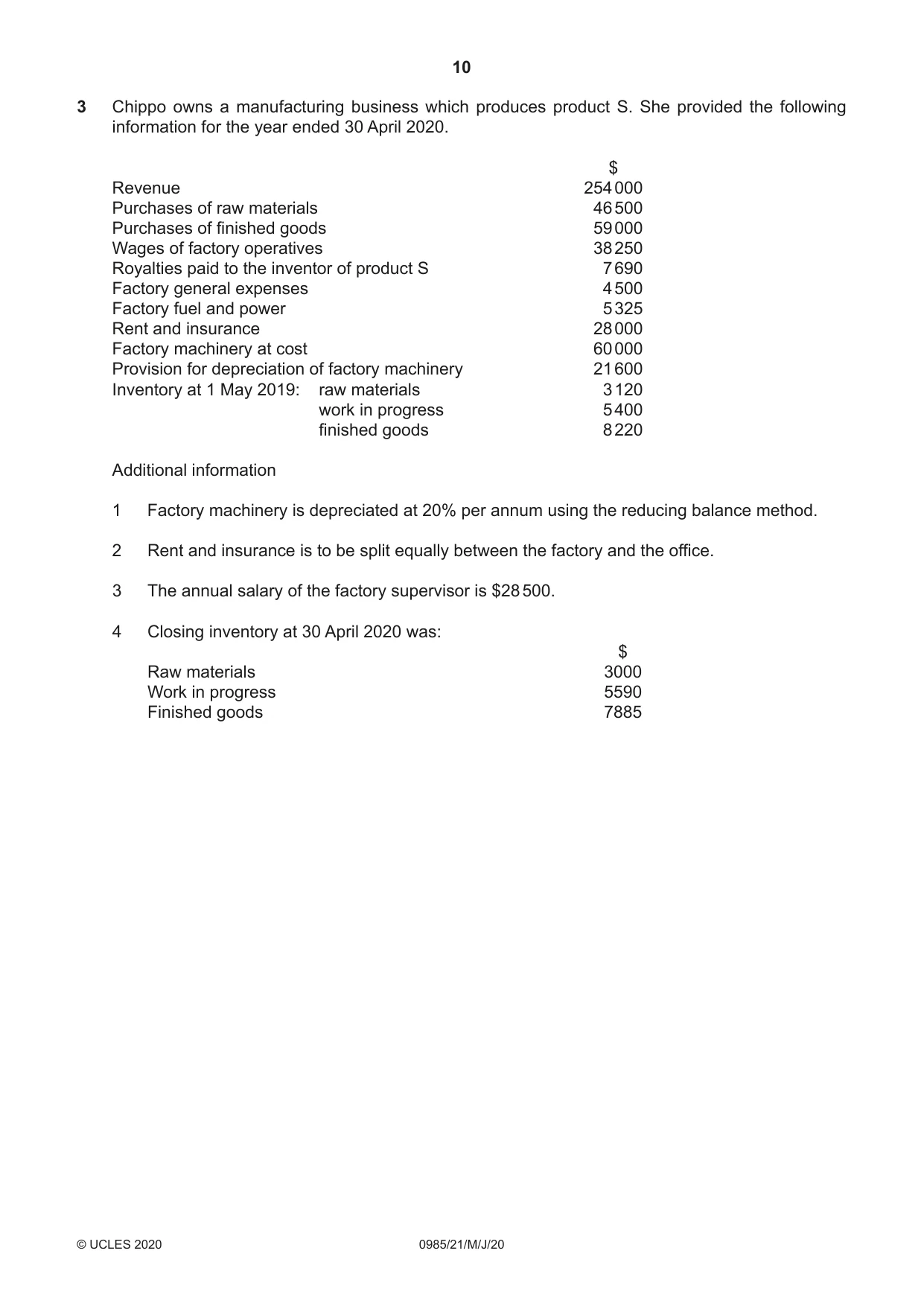
10 0985/21/M/J/20 © UCLES 2020 3 Chippo owns a manufacturing business which produces product S. She provided the following information for the year ended 30 April 2020. $ Revenue 254 000 Purchases of raw materials 46 500 Purchases of finished goods 59 000 Wages of factory operatives 38 250 Royalties paid to the inventor of product S 7 690 Factory general expenses 4 500 Factory fuel and power 5 325 Rent and insurance 28 000 Factory machinery at cost 60 000 Provision for depreciation of factory machinery 21 600 Inventory at 1 May 2019: raw materials 3 120 work in progress 5 400 finished goods 8 220 Additional information 1 Factory machinery is depreciated at 20% per annum using the reducing balance method. 2 Rent and insurance is to be split equally between the factory and the office. 3 The annual salary of the factory supervisor is $28 500. 4 Closing inventory at 30 April 2020 was: $ Raw materials 3000 Work in progress 5590 Finished goods 7885
Question paper, page 11
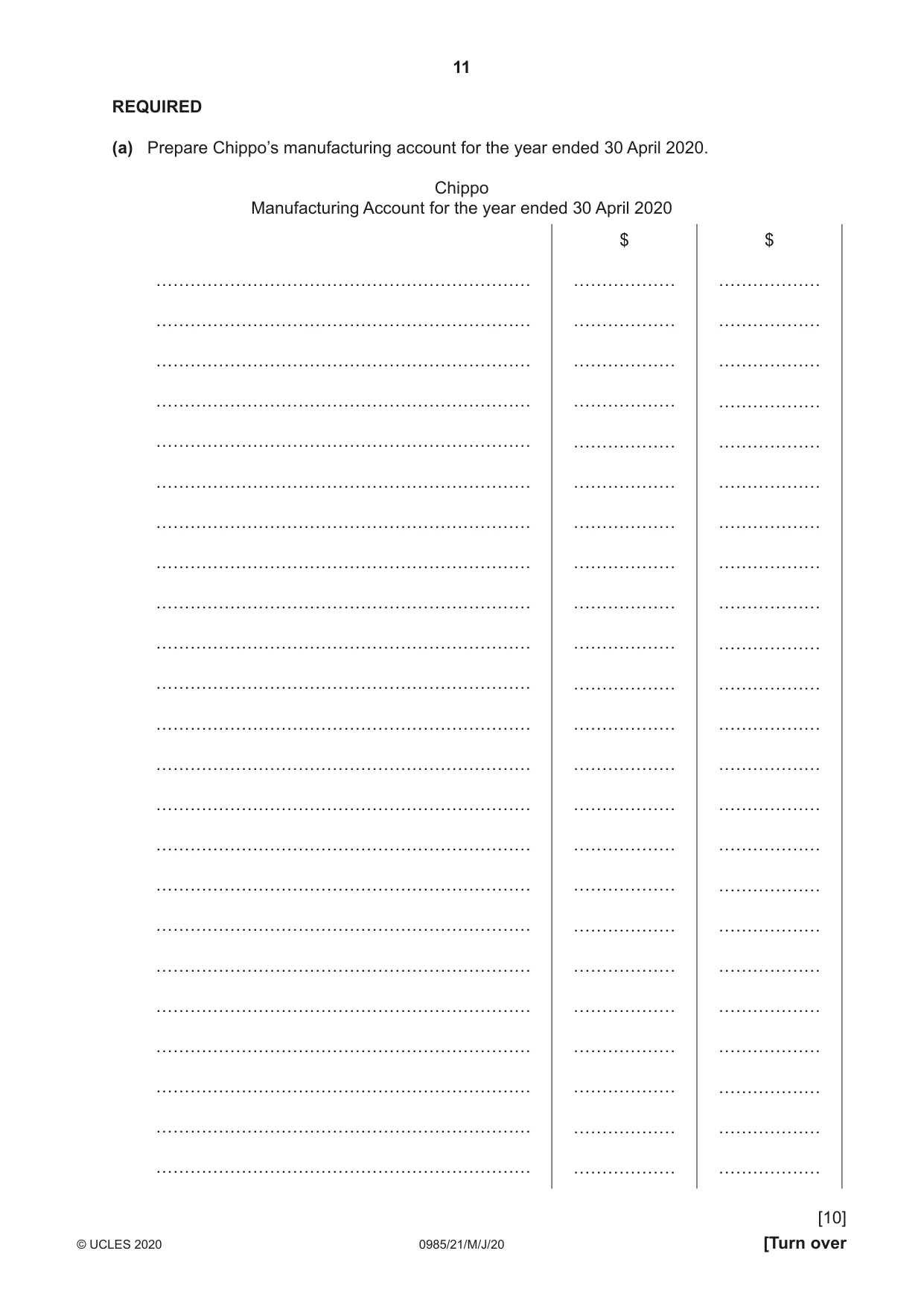
11 0985/21/M/J/20 © UCLES 2020 [Turn over REQUIRED (a) Prepare Chippo’s manufacturing account for the year ended 30 April 2020. Chippo Manufacturing Account for the year ended 30 April 2020 ………………………………………………………… ………………………………………………………… ………………………………………………………… ………………………………………………………… ………………………………………………………… ………………………………………………………… ………………………………………………………… ………………………………………………………… ………………………………………………………… ………………………………………………………… ………………………………………………………… ………………………………………………………… ………………………………………………………… ………………………………………………………… ………………………………………………………… ………………………………………………………… ………………………………………………………… ………………………………………………………… ………………………………………………………… ………………………………………………………… ………………………………………………………… ………………………………………………………… ………………………………………………………… $ ……………… ……………… ……………… ……………… ……………… ……………… ……………… ……………… ……………… ……………… ……………… ……………… ……………… ……………… ……………… ……………… ……………… ……………… ……………… ……………… ……………… ……………… ……………… $ ……………… ……………… ……………… ……………… ……………… ……………… ……………… ……………… ……………… ……………… ……………… ……………… ……………… ……………… ……………… ……………… ……………… ……………… ……………… ……………… ……………… ……………… ……………… [10]
Question paper, page 12
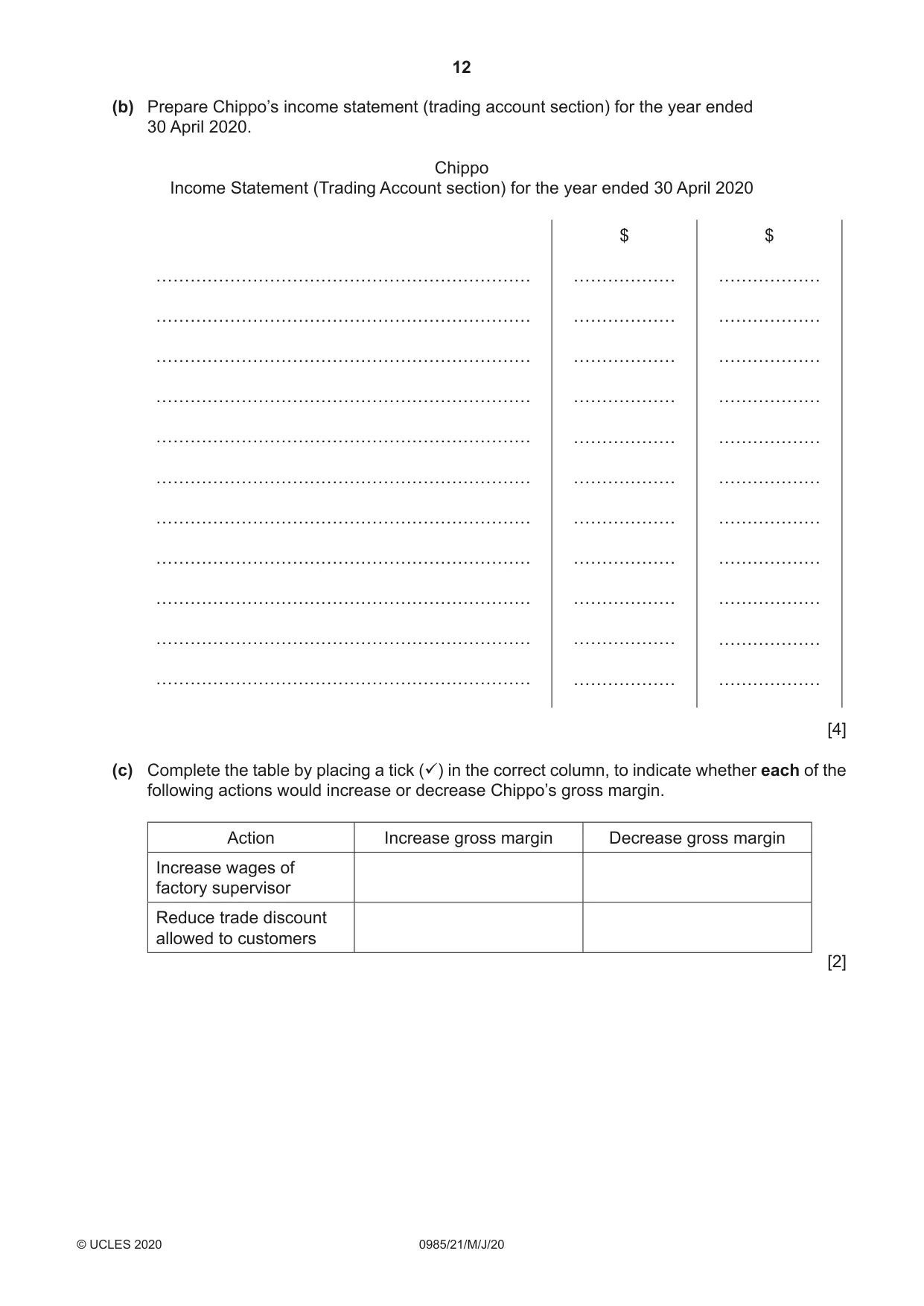
12 0985/21/M/J/20 © UCLES 2020 (b) Prepare Chippo’s income statement (trading account section) for the year ended 30 April 2020. Chippo Income Statement (Trading Account section) for the year ended 30 April 2020 ………………………………………………………… ………………………………………………………… ………………………………………………………… ………………………………………………………… ………………………………………………………… ………………………………………………………… ………………………………………………………… ………………………………………………………… ………………………………………………………… ………………………………………………………… ………………………………………………………… $ ……………… ……………… ……………… ……………… ……………… ……………… ……………… ……………… ……………… ……………… ……………… $ ……………… ……………… ……………… ……………… ……………… ……………… ……………… ……………… ……………… ……………… ……………… [4] (c) Complete the table by placing a tick (ü) in the correct column, to indicate whether each of the following actions would increase or decrease Chippo’s gross margin. Action Increase gross margin Decrease gross margin Increase wages of factory supervisor Reduce trade discount allowed to customers [2]
Question paper, page 13
13 0985/21/M/J/20 © UCLES 2020 [Turn over Chippo is considering converting her sole trader business into a limited company because she thinks that this will make it easier for her to obtain finance for future expansion. REQUIRED (d) Advise Chippo whether or not she should convert her business to a limited company, in order to obtain finance. Justify your answer by providing advantages and disadvantages. … … … … … … … … … … … … [4] [Total: 20]
Question paper, page 14
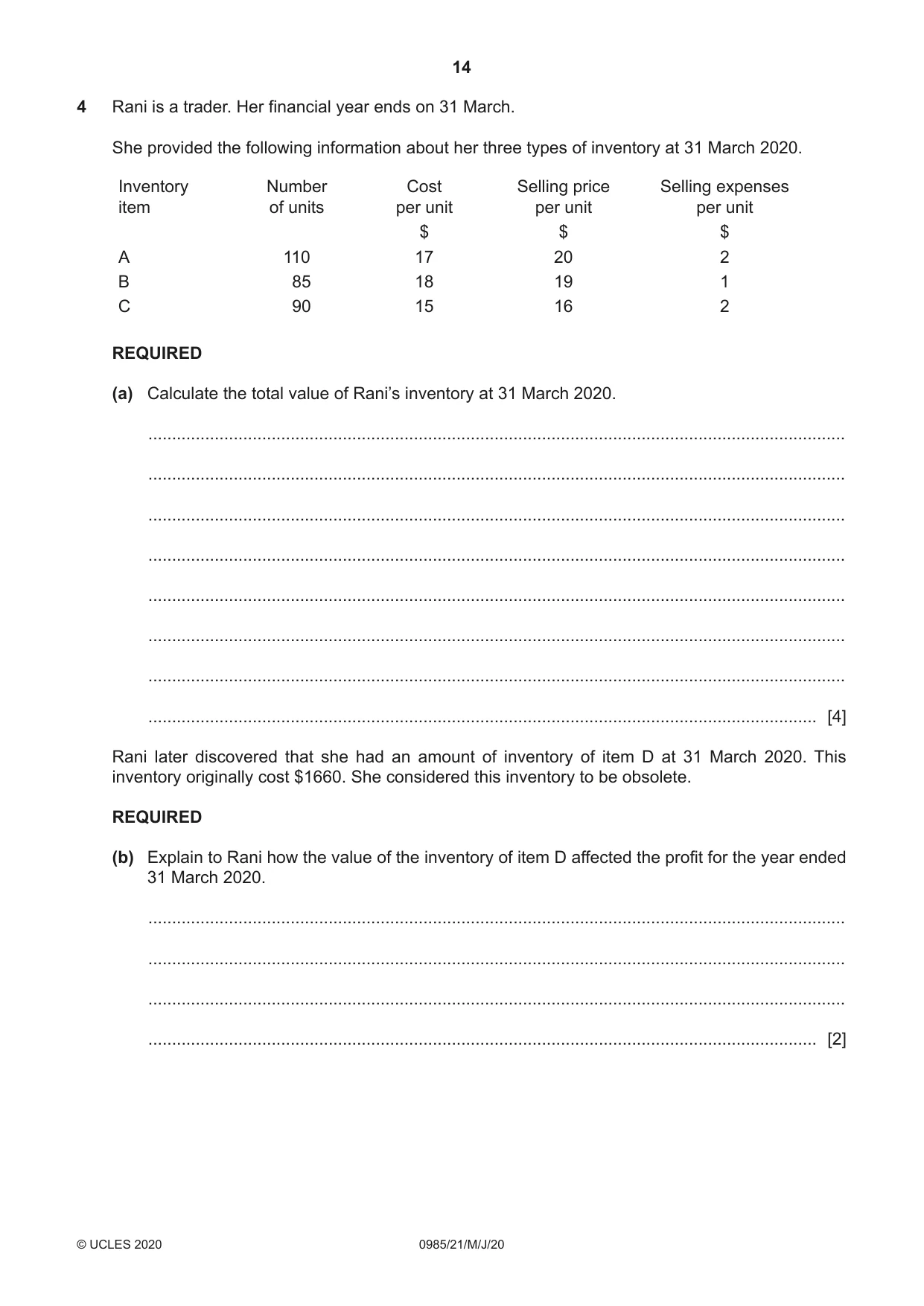
14 0985/21/M/J/20 © UCLES 2020 4 Rani is a trader. Her financial year ends on 31 March. She provided the following information about her three types of inventory at 31 March 2020. Inventory Number Cost Selling price Selling expenses item of units per unit per unit per unit $ $ $ A 110 17 20 2 B 85 18 19 1 C 90 15 16 2 REQUIRED (a) Calculate the total value of Rani’s inventory at 31 March 2020. … … … … … … … … [4] Rani later discovered that she had an amount of inventory of item D at 31 March 2020. This inventory originally cost $1660. She considered this inventory to be obsolete. REQUIRED (b) Explain to Rani how the value of the inventory of item D affected the profit for the year ended 31 March 2020. … … … … [2]
Question paper, page 15
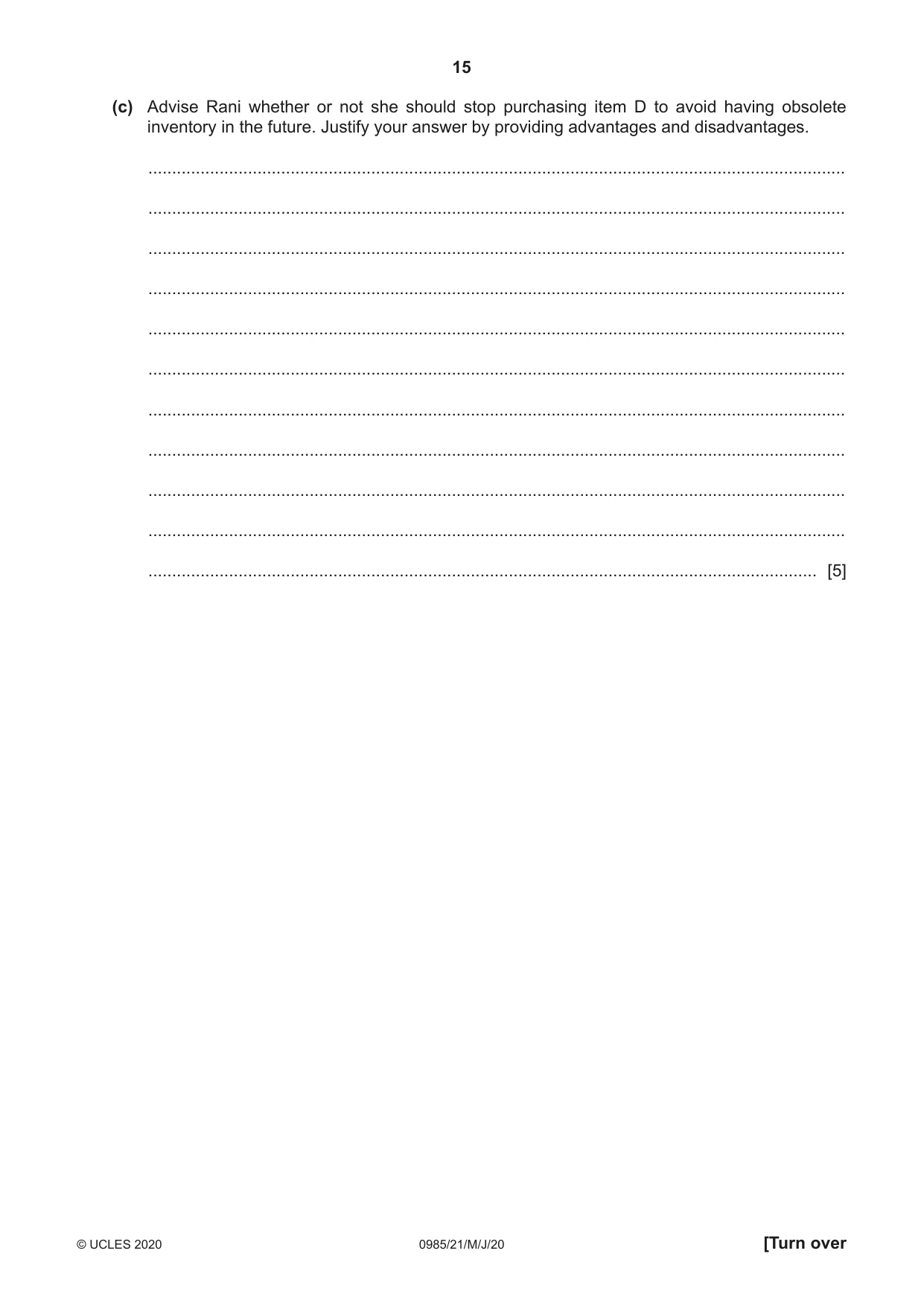
15 0985/21/M/J/20 © UCLES 2020 [Turn over (c) Advise Rani whether or not she should stop purchasing item D to avoid having obsolete inventory in the future. Justify your answer by providing advantages and disadvantages. … … … … … … … … … … … [5]
Question paper, page 16
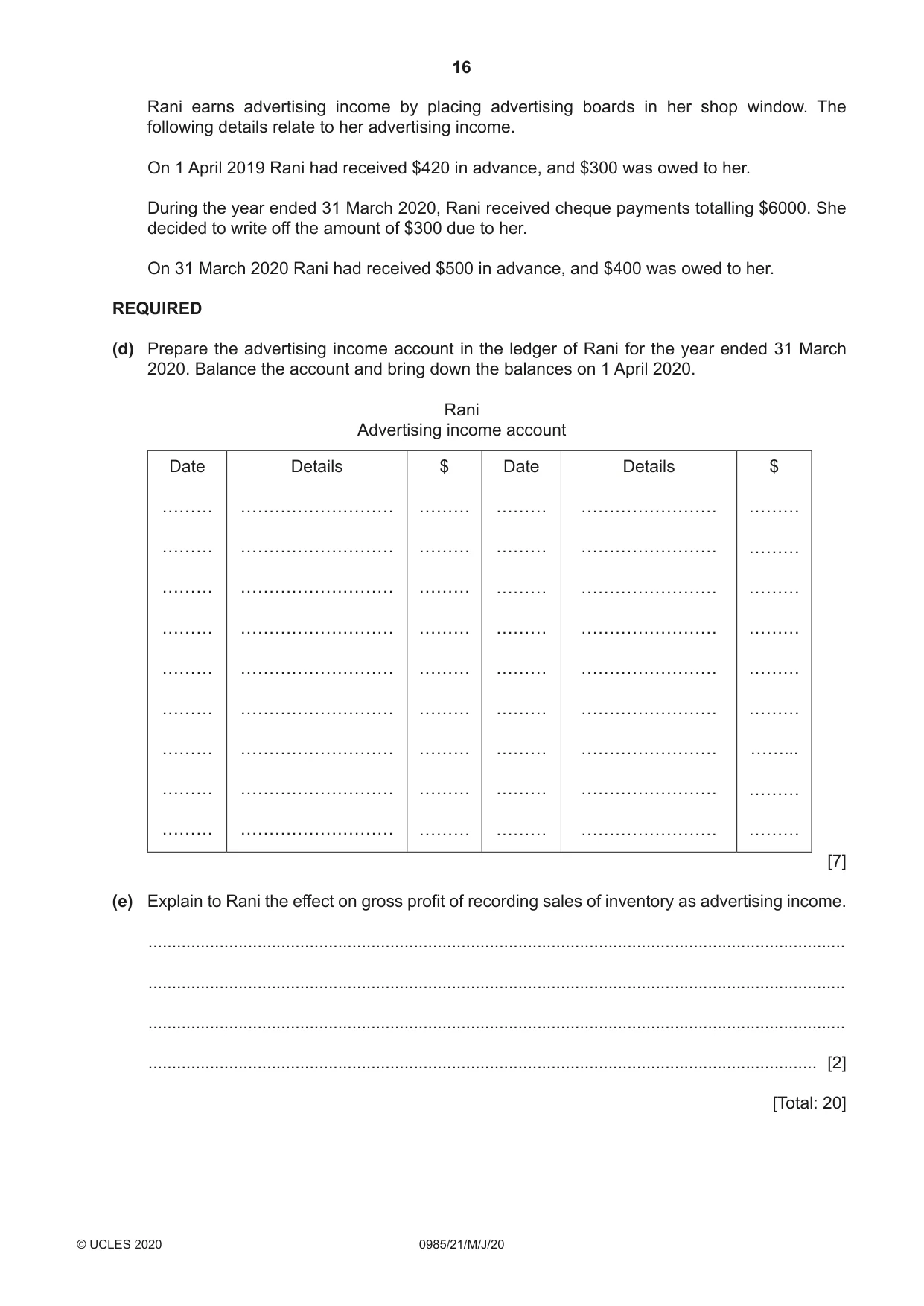
16 0985/21/M/J/20 © UCLES 2020 Rani earns advertising income by placing advertising boards in her shop window. The following details relate to her advertising income. On 1 April 2019 Rani had received $420 in advance, and $300 was owed to her. During the year ended 31 March 2020, Rani received cheque payments totalling $6000. She decided to write off the amount of $300 due to her. On 31 March 2020 Rani had received $500 in advance, and $400 was owed to her. REQUIRED (d) Prepare the advertising income account in the ledger of Rani for the year ended 31 March 2020. Balance the account and bring down the balances on 1 April 2020. Rani Advertising income account Date ……… ……… ……… ……… ……… ……… ……… ……… ……… Details ……………………… ……………………… ……………………… ……………………… ……………………… ……………………… ……………………… ……………………… ……………………… $ ……… ……… ……… ……… ……… ……… ……… ……… ……… Date ……… ……… ……… ……… ……… ……… ……… ……… ……… Details …………………… …………………… …………………… …………………… …………………… …………………… …………………… …………………… …………………… $ ……… ……… ……… ……… ……… ……… ……... ……… ……… [7] (e) Explain to Rani the effect on gross profit of recording sales of inventory as advertising income. … … … … [2] [Total: 20]
Question paper, page 17
17 0985/21/M/J/20 © UCLES 2020 [Turn over PLEASE TURN OVER
Question paper, page 18
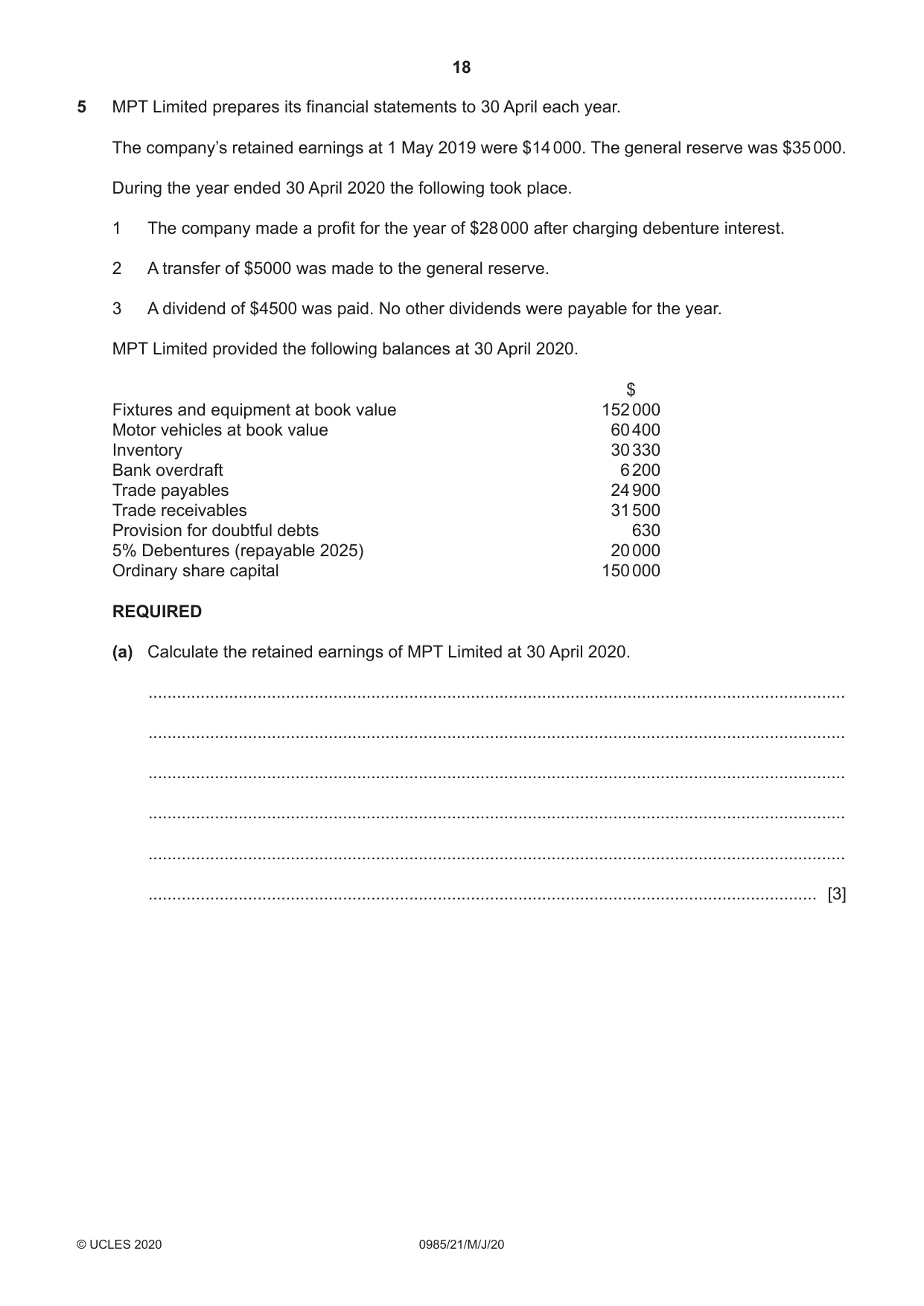
18 0985/21/M/J/20 © UCLES 2020 5 MPT Limited prepares its financial statements to 30 April each year. The company’s retained earnings at 1 May 2019 were $14 000. The general reserve was $35 000. During the year ended 30 April 2020 the following took place. 1 The company made a profit for the year of $28 000 after charging debenture interest. 2 A transfer of $5000 was made to the general reserve. 3 A dividend of $4500 was paid. No other dividends were payable for the year. MPT Limited provided the following balances at 30 April 2020. $ Fixtures and equipment at book value 152 000 Motor vehicles at book value 60 400 Inventory 30 330 Bank overdraft 6 200 Trade payables 24 900 Trade receivables 31 500 Provision for doubtful debts 630 5% Debentures (repayable 2025) 20 000 Ordinary share capital 150 000 REQUIRED (a) Calculate the retained earnings of MPT Limited at 30 April 2020. … … … … … … [3]
Question paper, page 19
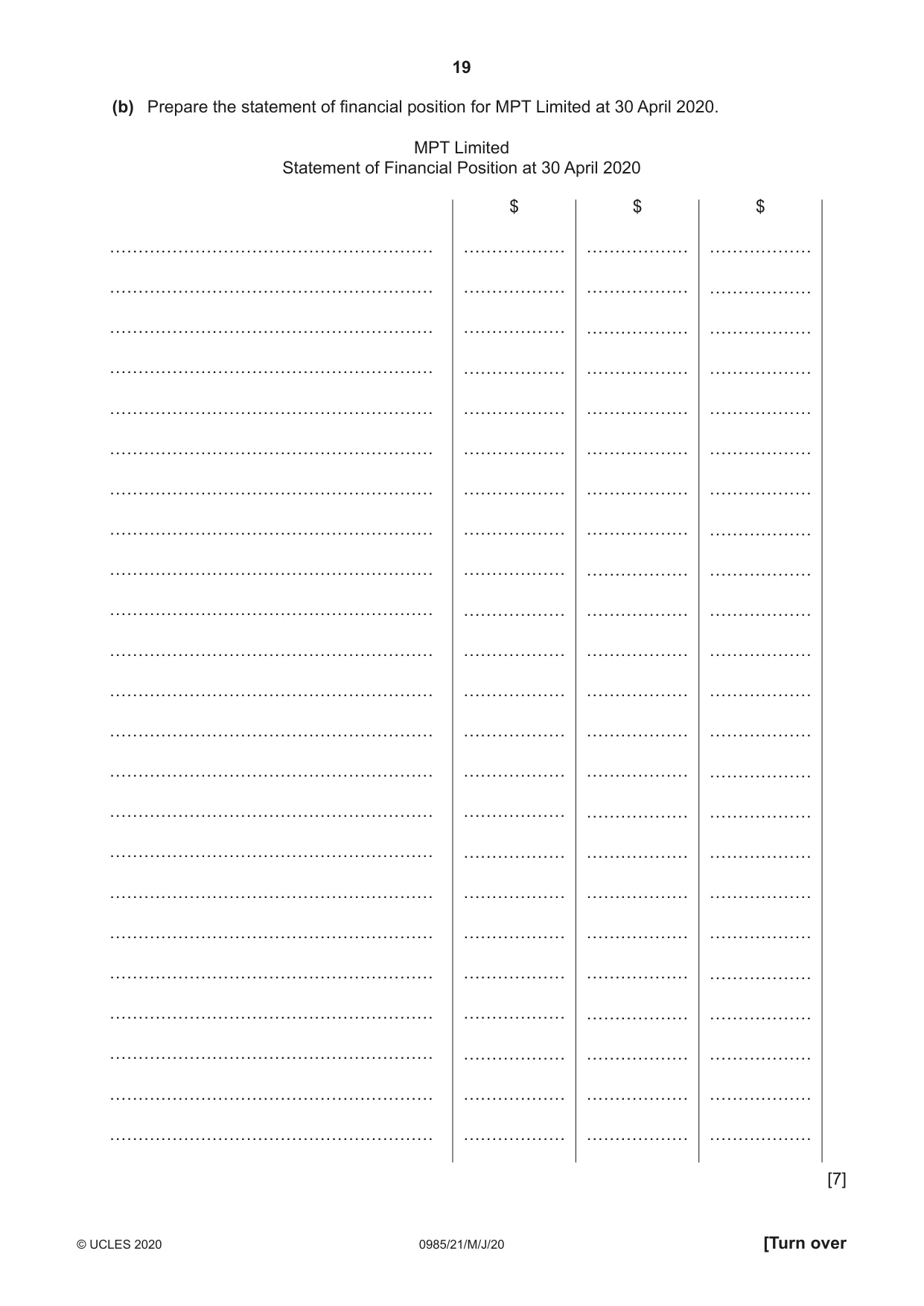
19 0985/21/M/J/20 © UCLES 2020 [Turn over (b) Prepare the statement of financial position for MPT Limited at 30 April 2020. MPT Limited Statement of Financial Position at 30 April 2020 ………………………………………………… ………………………………………………… ………………………………………………… ………………………………………………… ………………………………………………… ………………………………………………… ………………………………………………… ………………………………………………… ………………………………………………… ………………………………………………… ………………………………………………… ………………………………………………… ………………………………………………… ………………………………………………… ………………………………………………… ………………………………………………… ………………………………………………… ………………………………………………… ………………………………………………… ………………………………………………… ………………………………………………… ………………………………………………… ………………………………………………… $ ……………… ……………… ……………… ……………… ……………… ……………… ……………… ……………… ……………… ……………… ……………… ……………… ……………… ……………… ……………… ……………… ……………… ……………… ……………… ……………… ……………… ……………… ……………… $ ……………… ……………… ……………… ……………… ……………… ……………… ……………… ……………… ……………… ……………… ……………… ……………… ……………… ……………… ……………… ……………… ……………… ……………… ……………… ……………… ……………… ……………… ……………… $ ……………… ……………… ……………… ……………… ……………… ……………… ……………… ……………… ……………… ……………… ……………… ……………… ……………… ……………… ……………… ……………… ……………… ……………… ……………… ……………… ……………… ……………… ……………… [7]
Question paper, page 20
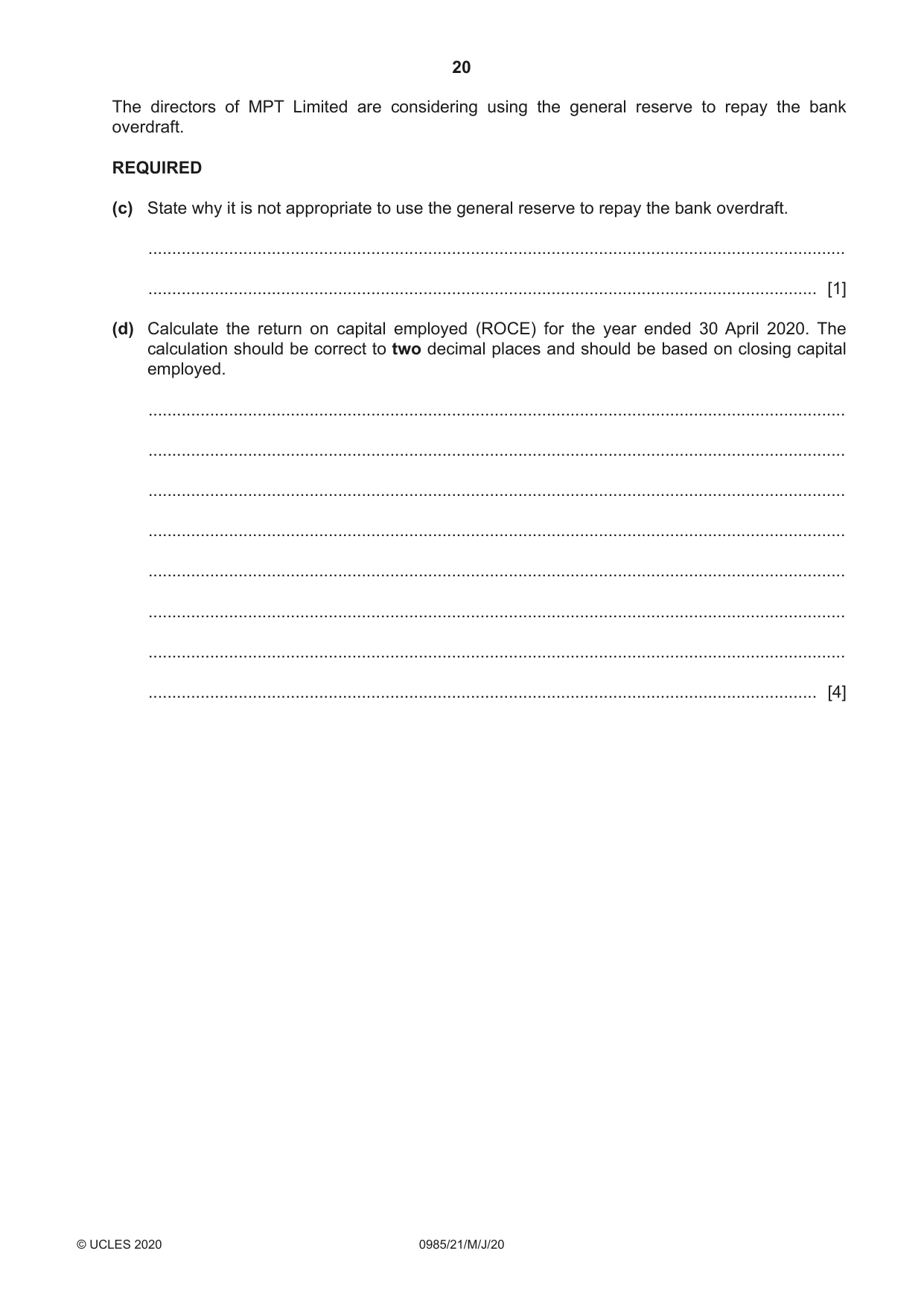
20 0985/21/M/J/20 © UCLES 2020 The directors of MPT Limited are considering using the general reserve to repay the bank overdraft. REQUIRED (c) State why it is not appropriate to use the general reserve to repay the bank overdraft. … … [1] (d) Calculate the return on capital employed (ROCE) for the year ended 30 April 2020. The calculation should be correct to two decimal places and should be based on closing capital employed. … … … … … … … … [4]
Question paper, page 21
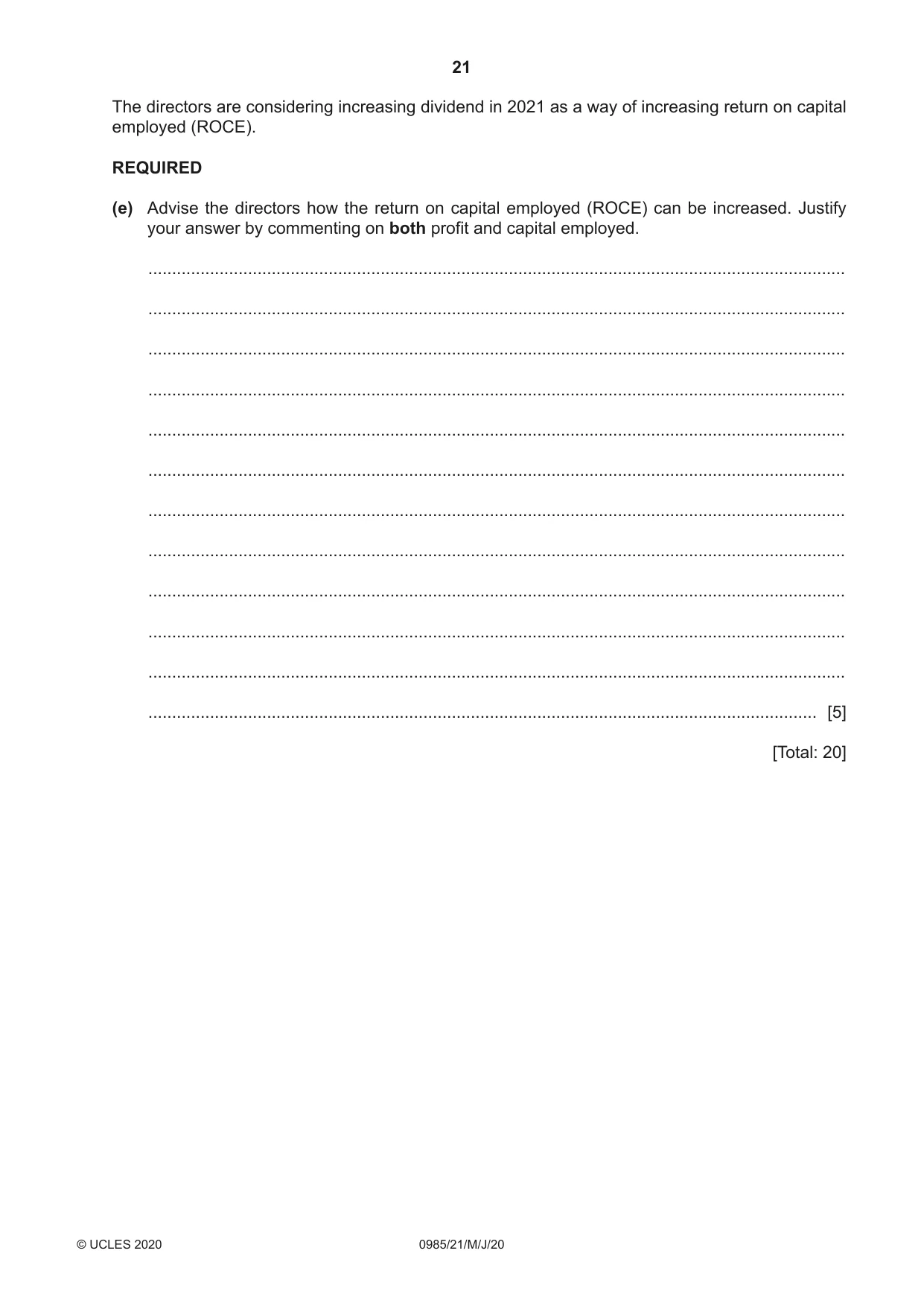
21 0985/21/M/J/20 © UCLES 2020 The directors are considering increasing dividend in 2021 as a way of increasing return on capital employed (ROCE). REQUIRED (e) Advise the directors how the return on capital employed (ROCE) can be increased. Justify your answer by commenting on both profit and capital employed. … … … … … … … … … … … … [5] [Total: 20]
Question paper, page 22
22 0985/21/M/J/20 © UCLES 2020 BLANK PAGE
Question paper, page 23
23 0985/21/M/J/20 © UCLES 2020 BLANK PAGE
Question paper, page 24
24 0985/21/M/J/20 © UCLES 2020 Permission to reproduce items where third-party owned material protected by copyright is included has been sought and cleared where possible. Every reasonable effort has been made by the publisher (UCLES) to trace copyright holders, but if any items requiring clearance have unwittingly been included, the publisher will be pleased to make amends at the earliest possible opportunity. To avoid the issue of disclosure of answer-related information to candidates, all copyright acknowledgements are reproduced online in the Cambridge Assessment International Education Copyright Acknowledgements Booklet. This is produced for each series of examinations and is freely available to download at www.cambridgeinternational.org after the live examination series. Cambridge Assessment International Education is part of the Cambridge Assessment Group. Cambridge Assessment is the brand name of the University of Cambridge Local Examinations Syndicate (UCLES), which itself is a department of the University of Cambridge. BLANK PAGE
Mark scheme, page 1
This document consists of 18 printed pages. © UCLES 2020 [Turn over Cambridge IGCSE™ (9–1) ACCOUNTING 0985/21 Paper 2 May/June 2020 MARK SCHEME Maximum Mark: 120 Published Students did not sit exam papers in the June 2020 series due to the Covid-19 global pandemic. This mark scheme is published to support teachers and students and should be read together with the question paper. It shows the requirements of the exam. The answer column of the mark scheme shows the proposed basis on which Examiners would award marks for this exam. Where appropriate, this column also provides the most likely acceptable alternative responses expected from students. Examiners usually review the mark scheme after they have seen student responses and update the mark scheme if appropriate. In the June series, Examiners were unable to consider the acceptability of alternative responses, as there were no student responses to consider. Mark schemes should usually be read together with the Principal Examiner Report for Teachers. However, because students did not sit exam papers, there is no Principal Examiner Report for Teachers for the June 2020 series. Cambridge International will not enter into discussions about these mark schemes. Cambridge International is publishing the mark schemes for the June 2020 series for most Cambridge IGCSE™ and Cambridge International A & AS Level components, and some Cambridge O Level components.
Mark scheme, page 2
0985/21 Cambridge IGCSE (9–1) – Mark Scheme PUBLISHED May/June 2020 © UCLES 2020 Page 2 of 18 Generic Marking Principles These general marking principles must be applied by all examiners when marking candidate answers. They should be applied alongside the specific content of the mark scheme or generic level descriptors for a question. Each question paper and mark scheme will also comply with these marking principles. GENERIC MARKING PRINCIPLE 1: Marks must be awarded in line with: • the specific content of the mark scheme or the generic level descriptors for the question • the specific skills defined in the mark scheme or in the generic level descriptors for the question • the standard of response required by a candidate as exemplified by the standardisation scripts. GENERIC MARKING PRINCIPLE 2: Marks awarded are always whole marks (not half marks, or other fractions). GENERIC MARKING PRINCIPLE 3: Marks must be awarded positively: • marks are awarded for correct/valid answers, as defined in the mark scheme. However, credit is given for valid answers which go beyond the scope of the syllabus and mark scheme, referring to your Team Leader as appropriate • marks are awarded when candidates clearly demonstrate what they know and can do • marks are not deducted for errors • marks are not deducted for omissions • answers should only be judged on the quality of spelling, punctuation and grammar when these features are specifically assessed by the question as indicated by the mark scheme. The meaning, however, should be unambiguous. GENERIC MARKING PRINCIPLE 4: Rules must be applied consistently e.g. in situations where candidates have not followed instructions or in the application of generic level descriptors.
Mark scheme, page 3
0985/21 Cambridge IGCSE (9–1) – Mark Scheme PUBLISHED May/June 2020 © UCLES 2020 Page 3 of 18 GENERIC MARKING PRINCIPLE 5: Marks should be awarded using the full range of marks defined in the mark scheme for the question (however; the use of the full mark range may be limited according to the quality of the candidate responses seen). GENERIC MARKING PRINCIPLE 6: Marks awarded are based solely on the requirements as defined in the mark scheme. Marks should not be awarded with grade thresholds or grade descriptors in mind.
Mark scheme, page 4
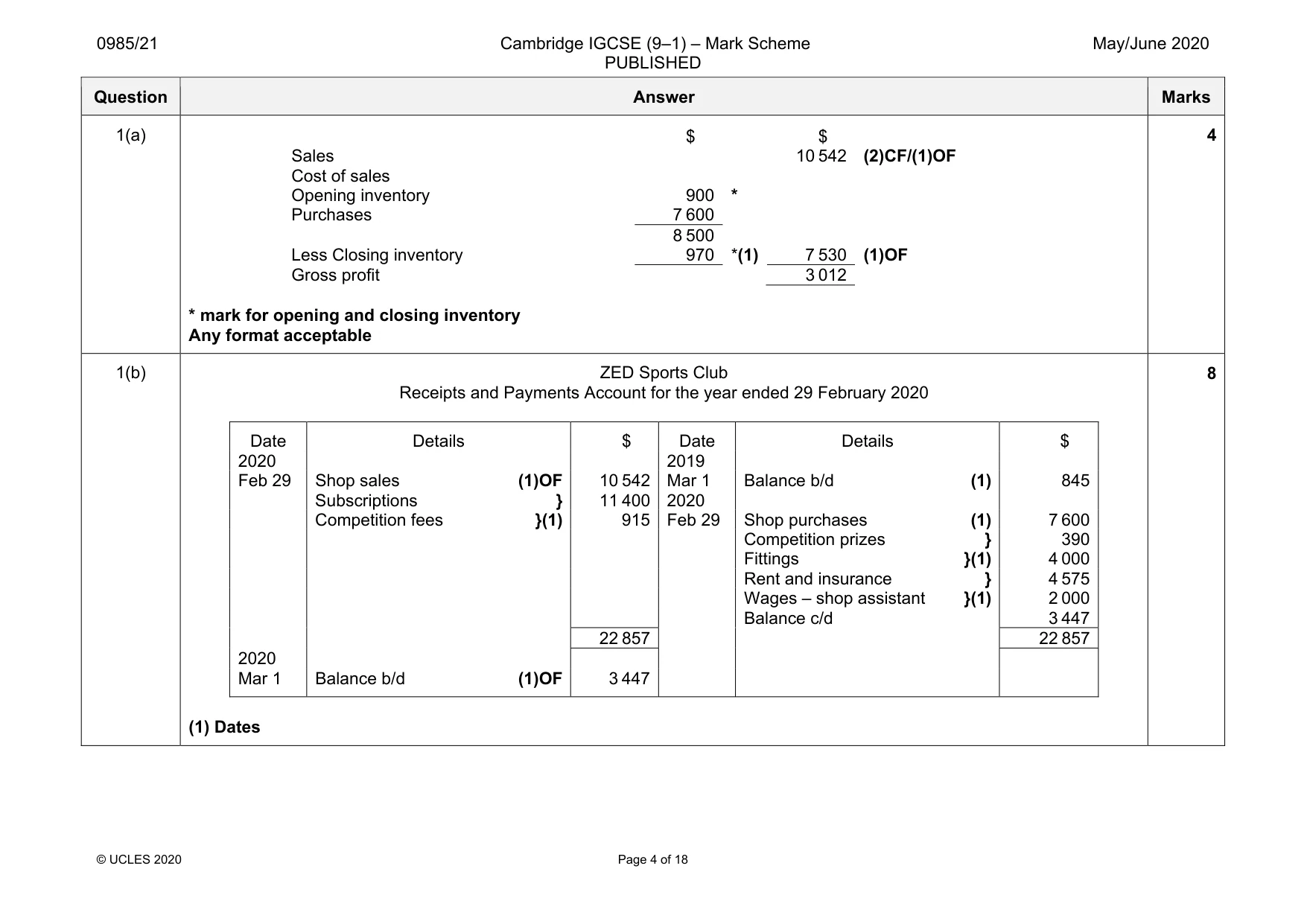
0985/21 Cambridge IGCSE (9–1) – Mark Scheme PUBLISHED May/June 2020 © UCLES 2020 Page 4 of 18 Question Answer Marks 1(a) $ $ Sales 10 542 (2)CF/(1)OF Cost of sales Opening inventory 900 * Purchases 7 600 8 500 Less Closing inventory 970 *(1) 7 530 (1)OF Gross profit 3 012 * mark for opening and closing inventory Any format acceptable 4 1(b) ZED Sports Club Receipts and Payments Account for the year ended 29 February 2020 Date Details $ Date Details $ 2020 2019 Feb 29 Shop sales (1)OF 10 542 Mar 1 Balance b/d (1) 845 Subscriptions } 11 400 2020 Competition fees }(1) 915 Feb 29 Shop purchases (1) 7 600 Competition prizes } 390 Fittings }(1) 4 000 Rent and insurance } 4 575 Wages – shop assistant }(1) 2 000 Balance c/d 3 447 22 857 22 857 2020 Mar 1 Balance b/d (1)OF 3 447 (1) Dates 8
Mark scheme, page 5
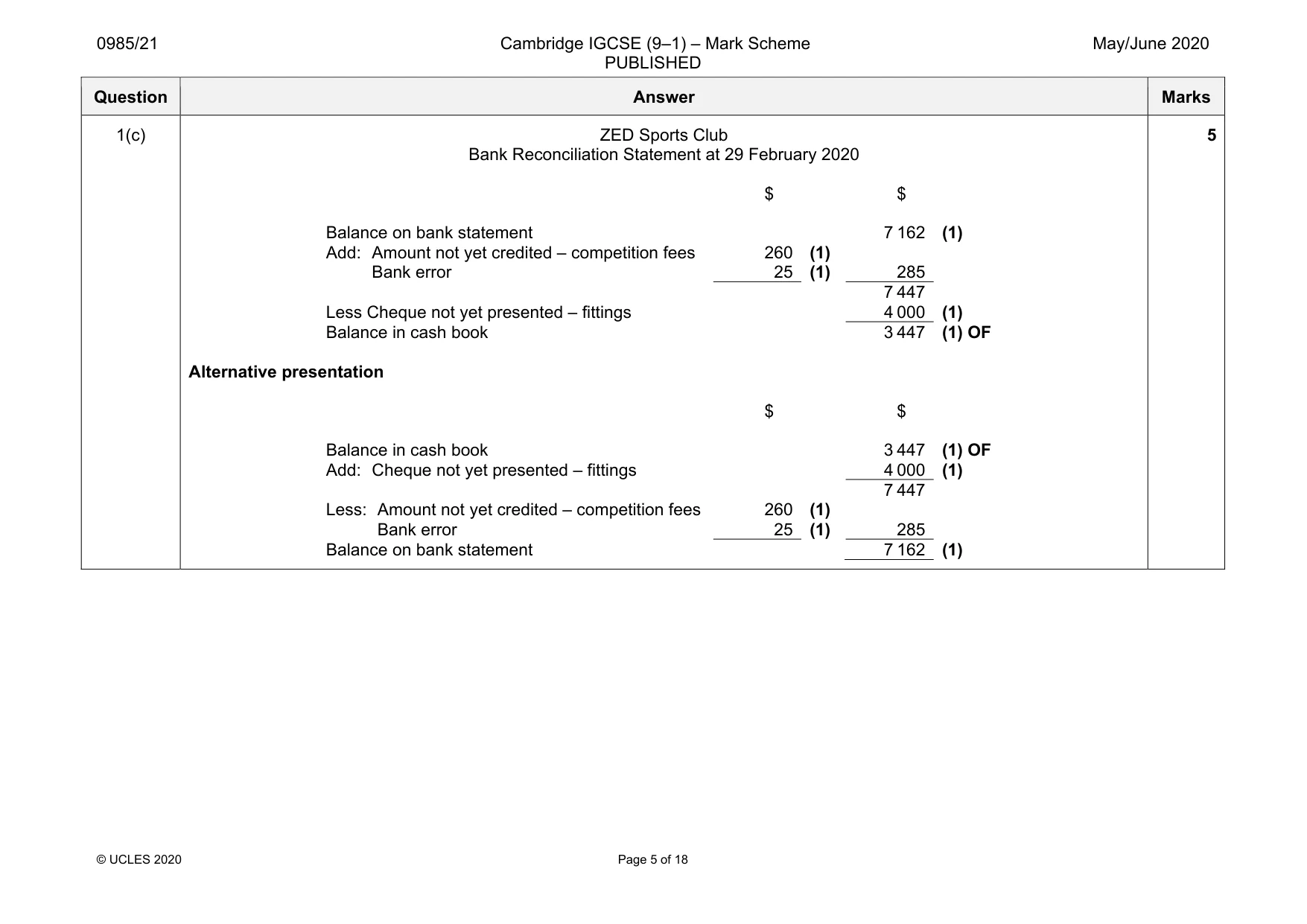
0985/21 Cambridge IGCSE (9–1) – Mark Scheme PUBLISHED May/June 2020 © UCLES 2020 Page 5 of 18 Question Answer Marks 1(c) ZED Sports Club Bank Reconciliation Statement at 29 February 2020 $ $ Balance on bank statement 7 162 (1) Add: Amount not yet credited – competition fees 260 (1) Bank error 25 (1) 285 7 447 Less Cheque not yet presented – fittings 4 000 (1) Balance in cash book 3 447 (1) OF Alternative presentation $ $ Balance in cash book 3 447 (1) OF Add: Cheque not yet presented – fittings 4 000 (1) 7 447 Less: Amount not yet credited – competition fees 260 (1) Bank error 25 (1) 285 Balance on bank statement 7 162 (1) 5
Mark scheme, page 6
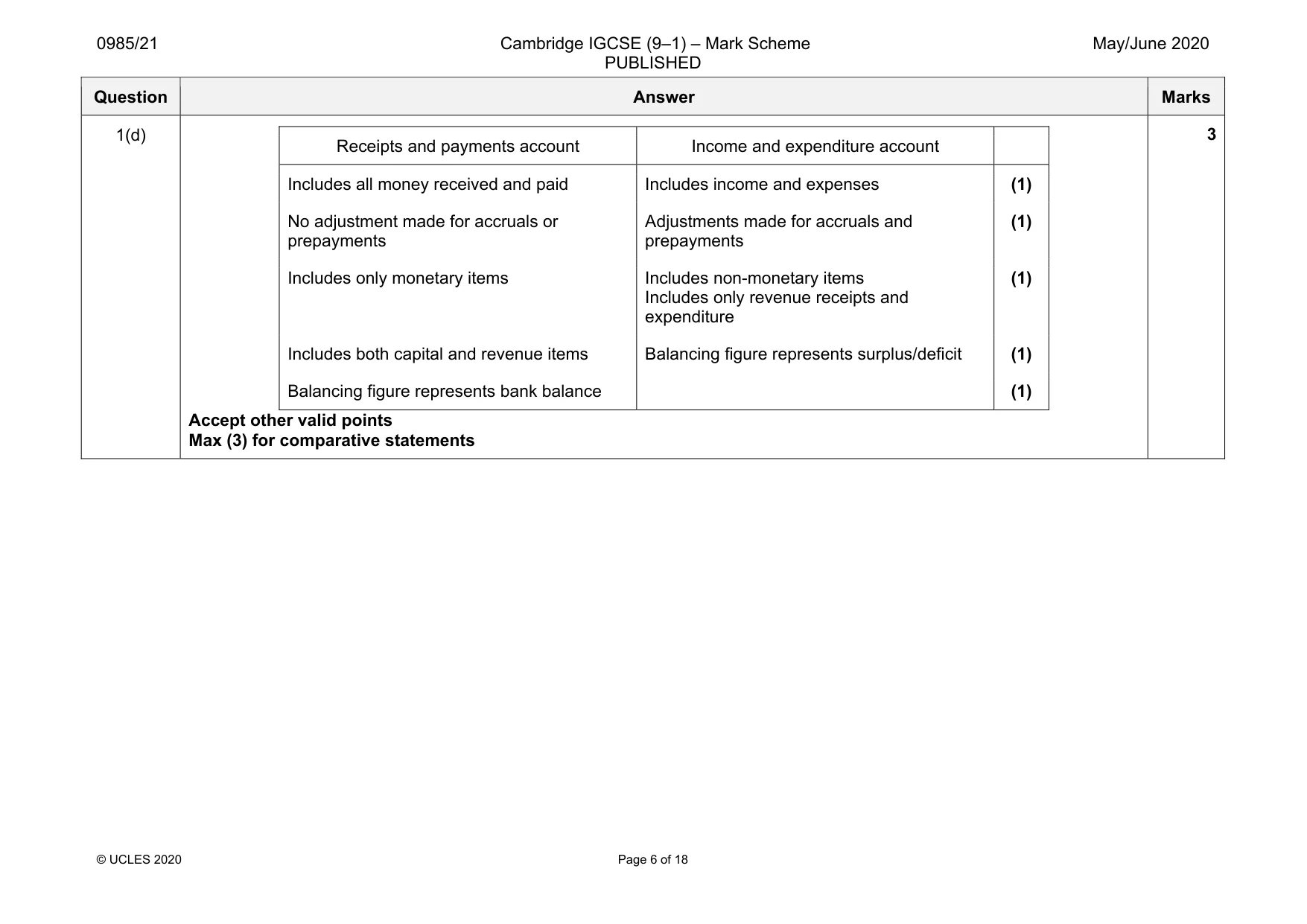
0985/21 Cambridge IGCSE (9–1) – Mark Scheme PUBLISHED May/June 2020 © UCLES 2020 Page 6 of 18 Question Answer Marks 1(d) Receipts and payments account Income and expenditure account Includes all money received and paid Includes income and expenses (1) No adjustment made for accruals or prepayments Adjustments made for accruals and prepayments (1) Includes only monetary items Includes non-monetary items Includes only revenue receipts and expenditure (1) Includes both capital and revenue items Balancing figure represents surplus/deficit (1) Balancing figure represents bank balance (1) Accept other valid points Max (3) for comparative statements 3
Mark scheme, page 7
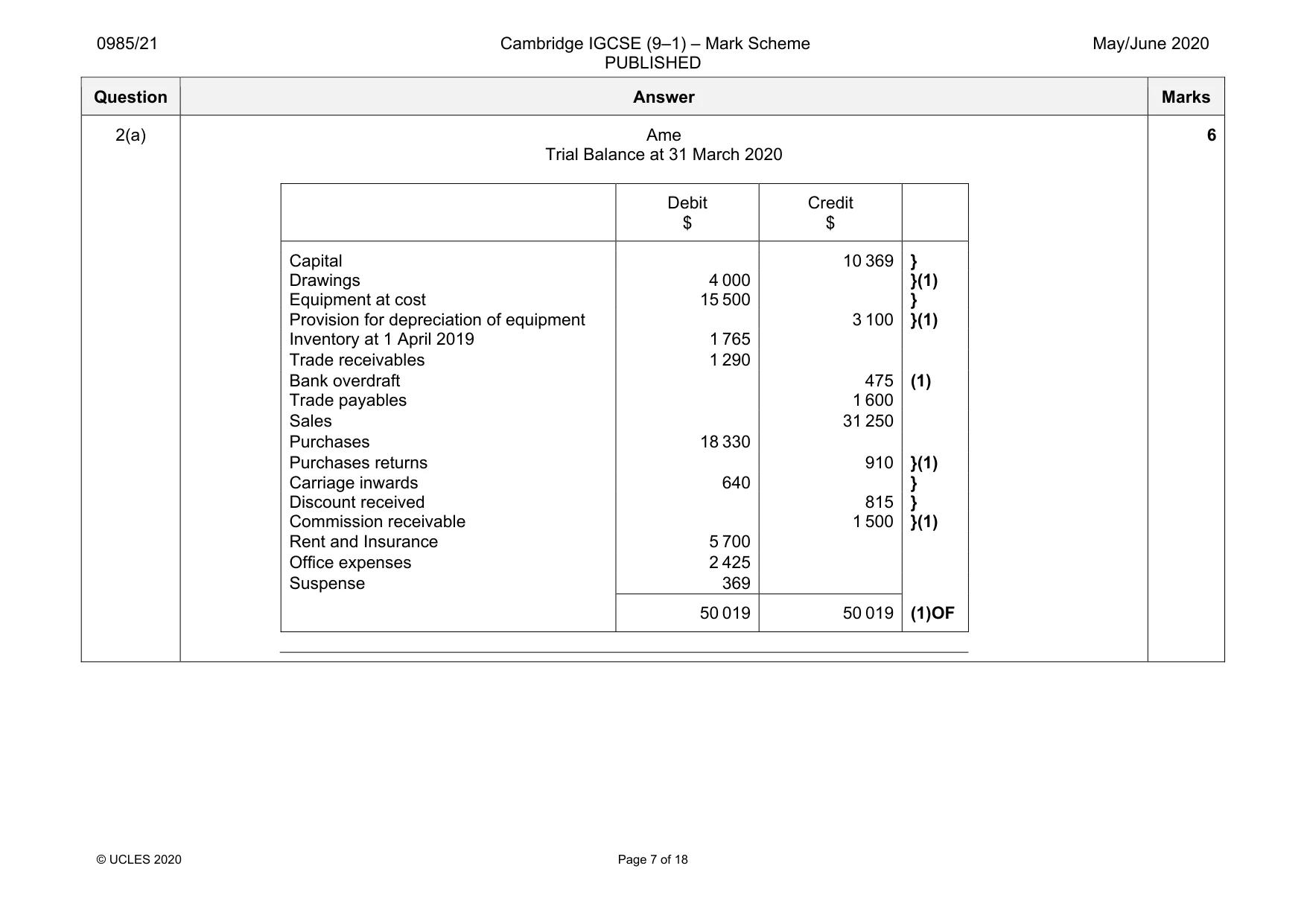
0985/21 Cambridge IGCSE (9–1) – Mark Scheme PUBLISHED May/June 2020 © UCLES 2020 Page 7 of 18 Question Answer Marks 2(a) Ame Trial Balance at 31 March 2020 Debit $ Credit $ Capital 10 369 } Drawings 4 000 }(1) Equipment at cost 15 500 } Provision for depreciation of equipment 3 100 }(1) Inventory at 1 April 2019 1 765 Trade receivables 1 290 Bank overdraft 475 (1) Trade payables 1 600 Sales 31 250 Purchases 18 330 Purchases returns 910 }(1) Carriage inwards 640 } Discount received 815 } Commission receivable 1 500 }(1) Rent and Insurance 5 700 Office expenses 2 425 Suspense 369 50 019 50 019 (1)OF 6
Mark scheme, page 8
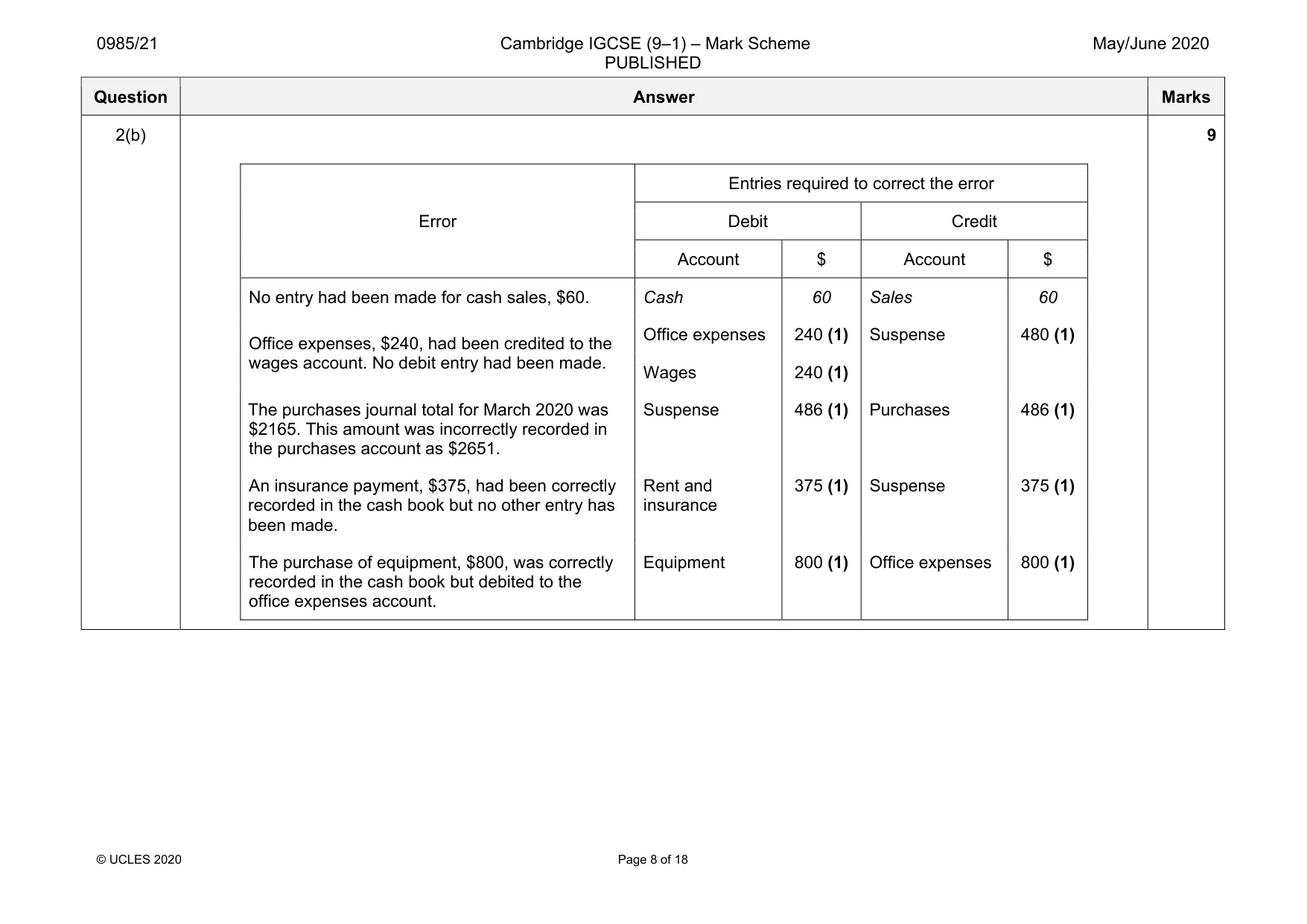
0985/21 Cambridge IGCSE (9–1) – Mark Scheme PUBLISHED May/June 2020 © UCLES 2020 Page 8 of 18 Question Answer Marks 2(b) Error Entries required to correct the error Debit Credit Account $ Account $ No entry had been made for cash sales, $60. Cash 60 Sales 60 Office expenses, $240, had been credited to the wages account. No debit entry had been made. Office expenses 240 (1) Suspense 480 (1) Wages 240 (1) The purchases journal total for March 2020 was $2165. This amount was incorrectly recorded in the purchases account as $2651. Suspense 486 (1) Purchases 486 (1) An insurance payment, $375, had been correctly recorded in the cash book but no other entry has been made. Rent and insurance 375 (1) Suspense 375 (1) The purchase of equipment, $800, was correctly recorded in the cash book but debited to the office expenses account. Equipment 800 (1) Office expenses 800 (1) 9
Mark scheme, page 9
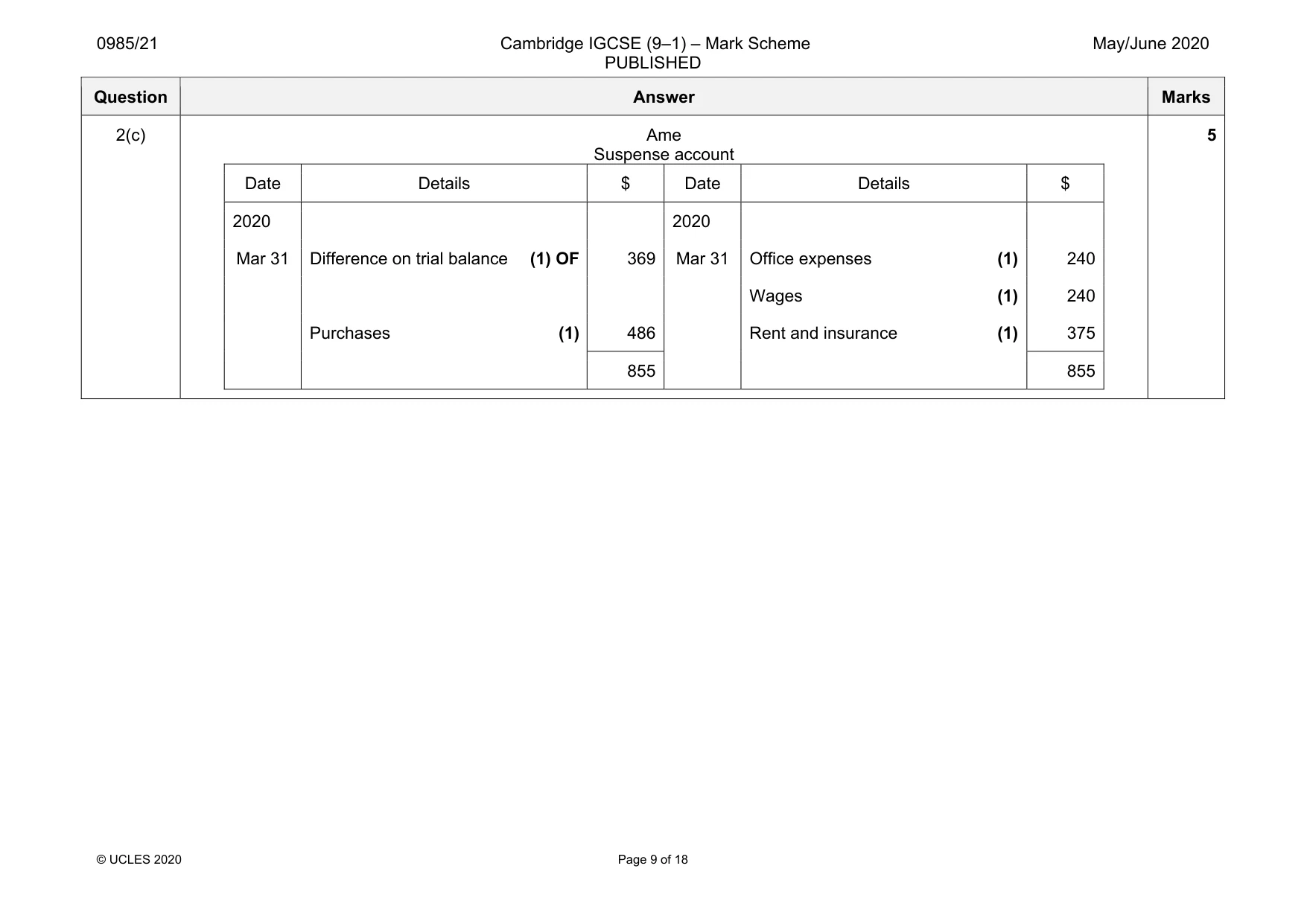
0985/21 Cambridge IGCSE (9–1) – Mark Scheme PUBLISHED May/June 2020 © UCLES 2020 Page 9 of 18 Question Answer Marks 2(c) Ame Suspense account Date Details $ Date Details $ 2020 2020 Mar 31 Difference on trial balance (1) OF 369 Mar 31 Office expenses (1) 240 Wages (1) 240 Purchases (1) 486 Rent and insurance (1) 375 855 855 5
Mark scheme, page 10
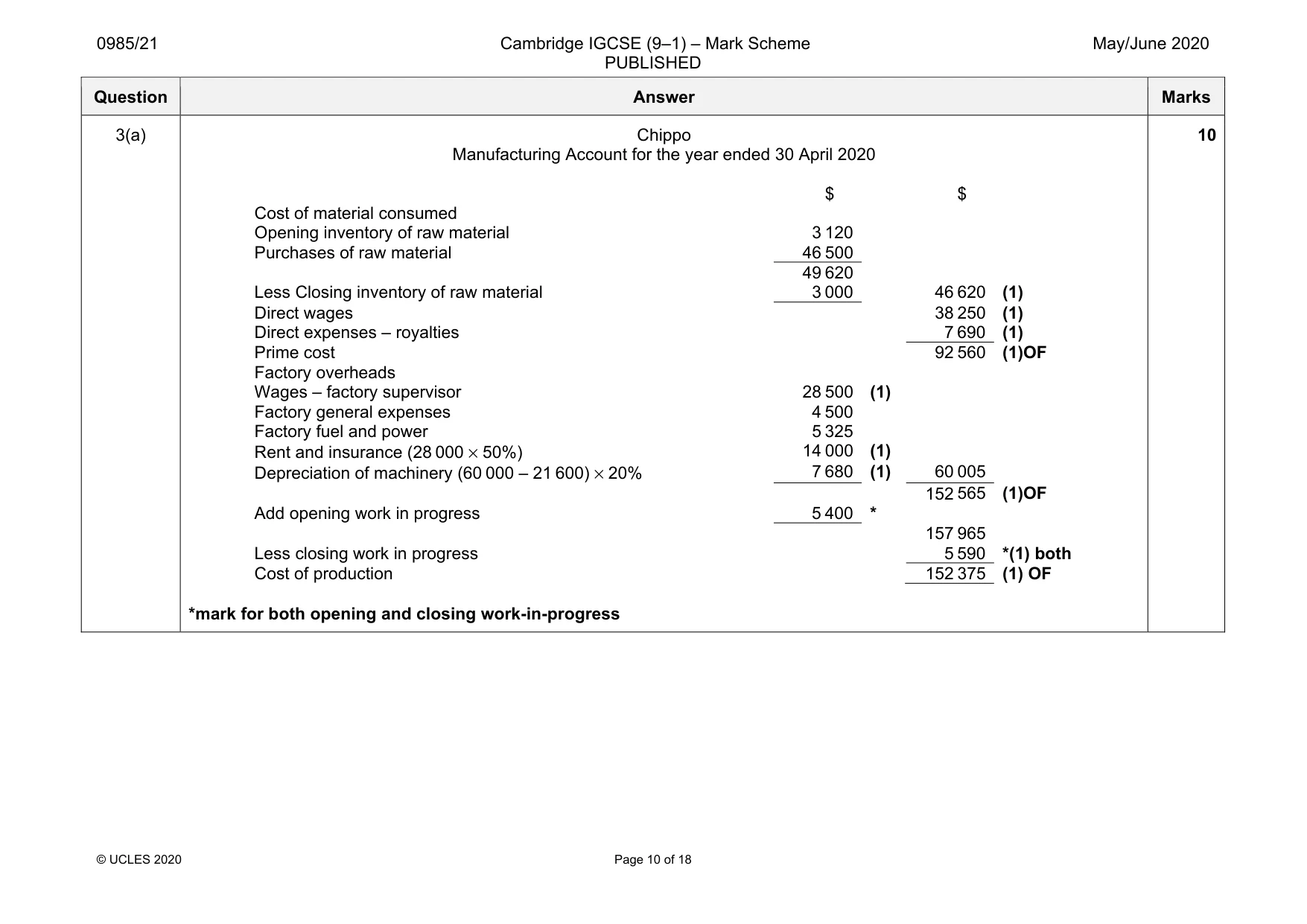
0985/21 Cambridge IGCSE (9–1) – Mark Scheme PUBLISHED May/June 2020 © UCLES 2020 Page 10 of 18 Question Answer Marks 3(a) Chippo Manufacturing Account for the year ended 30 April 2020 $ $ Cost of material consumed Opening inventory of raw material 3 120 Purchases of raw material 46 500 49 620 Less Closing inventory of raw material 3 000 46 620 (1) Direct wages 38 250 (1) Direct expenses – royalties 7 690 (1) Prime cost 92 560 (1)OF Factory overheads Wages – factory supervisor 28 500 (1) Factory general expenses 4 500 Factory fuel and power 5 325 Rent and insurance (28 000 × 50%) 14 000 (1) Depreciation of machinery (60 000 – 21 600) × 20% 7 680 (1) 60 005 152 565 (1)OF Add opening work in progress 5 400 * 157 965 Less closing work in progress 5 590 *(1) both Cost of production 152 375 (1) OF *mark for both opening and closing work-in-progress 10
Mark scheme, page 11
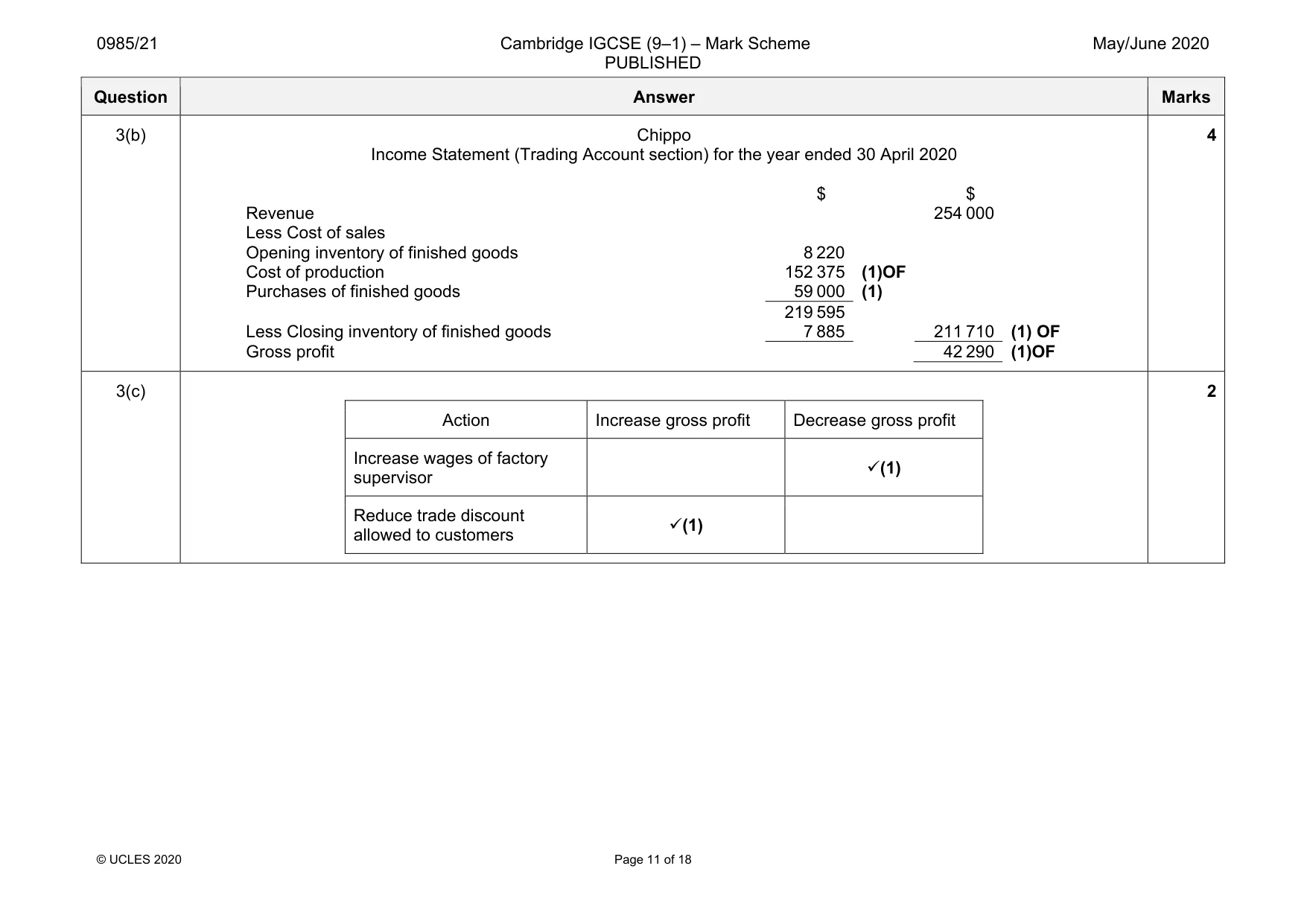
0985/21 Cambridge IGCSE (9–1) – Mark Scheme PUBLISHED May/June 2020 © UCLES 2020 Page 11 of 18 Question Answer Marks 3(b) Chippo Income Statement (Trading Account section) for the year ended 30 April 2020 $ $ Revenue 254 000 Less Cost of sales Opening inventory of finished goods 8 220 Cost of production 152 375 (1)OF Purchases of finished goods 59 000 (1) 219 595 Less Closing inventory of finished goods 7 885 211 710 (1) OF Gross profit 42 290 (1)OF 4 3(c) Action Increase gross profit Decrease gross profit Increase wages of factory supervisor (1) Reduce trade discount allowed to customers (1) 2
Mark scheme, page 12
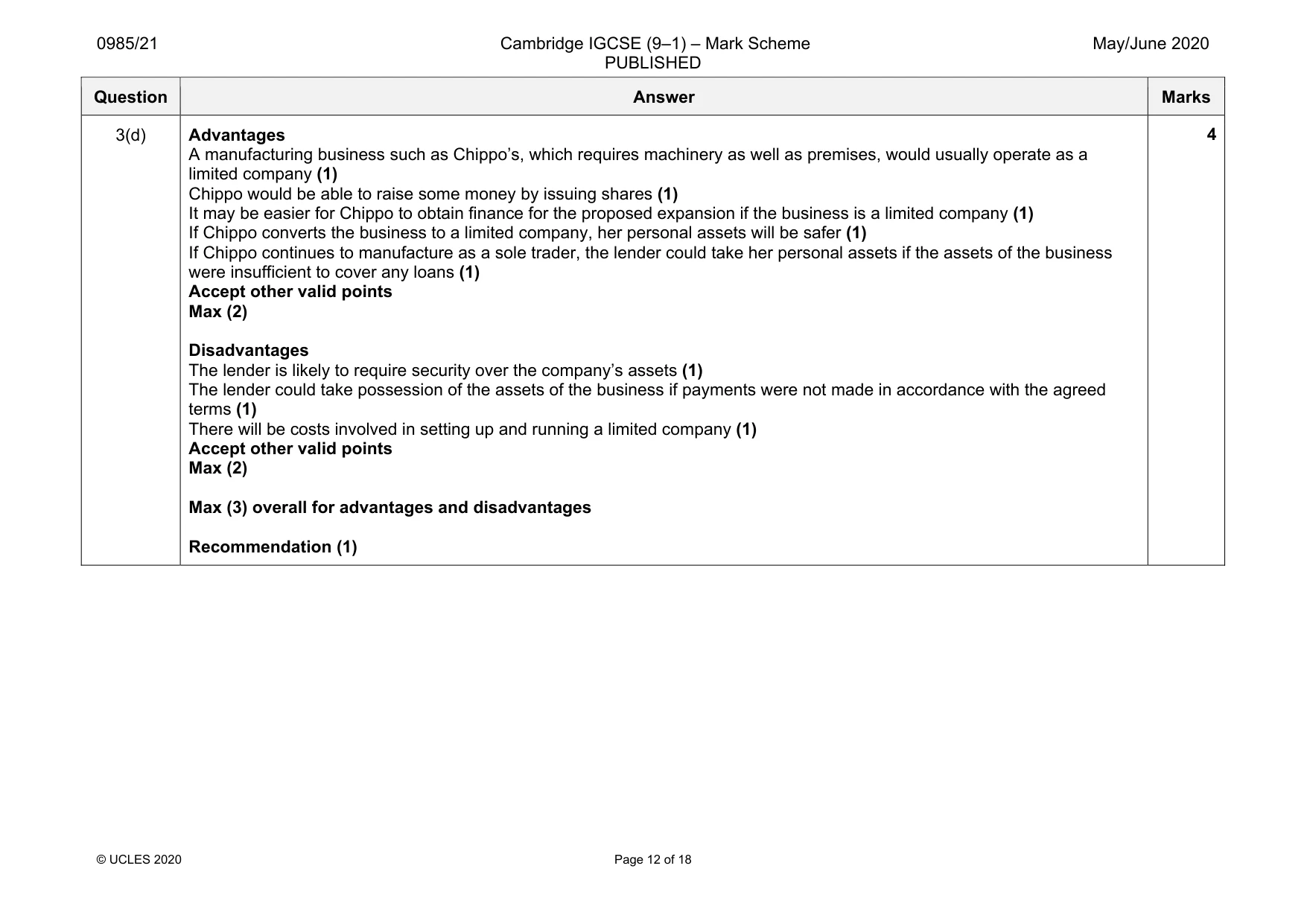
0985/21 Cambridge IGCSE (9–1) – Mark Scheme PUBLISHED May/June 2020 © UCLES 2020 Page 12 of 18 Question Answer Marks 3(d) Advantages A manufacturing business such as Chippo’s, which requires machinery as well as premises, would usually operate as a limited company (1) Chippo would be able to raise some money by issuing shares (1) It may be easier for Chippo to obtain finance for the proposed expansion if the business is a limited company (1) If Chippo converts the business to a limited company, her personal assets will be safer (1) If Chippo continues to manufacture as a sole trader, the lender could take her personal assets if the assets of the business were insufficient to cover any loans (1) Accept other valid points Max (2) Disadvantages The lender is likely to require security over the company’s assets (1) The lender could take possession of the assets of the business if payments were not made in accordance with the agreed terms (1) There will be costs involved in setting up and running a limited company (1) Accept other valid points Max (2) Max (3) overall for advantages and disadvantages Recommendation (1) 4
Mark scheme, page 13
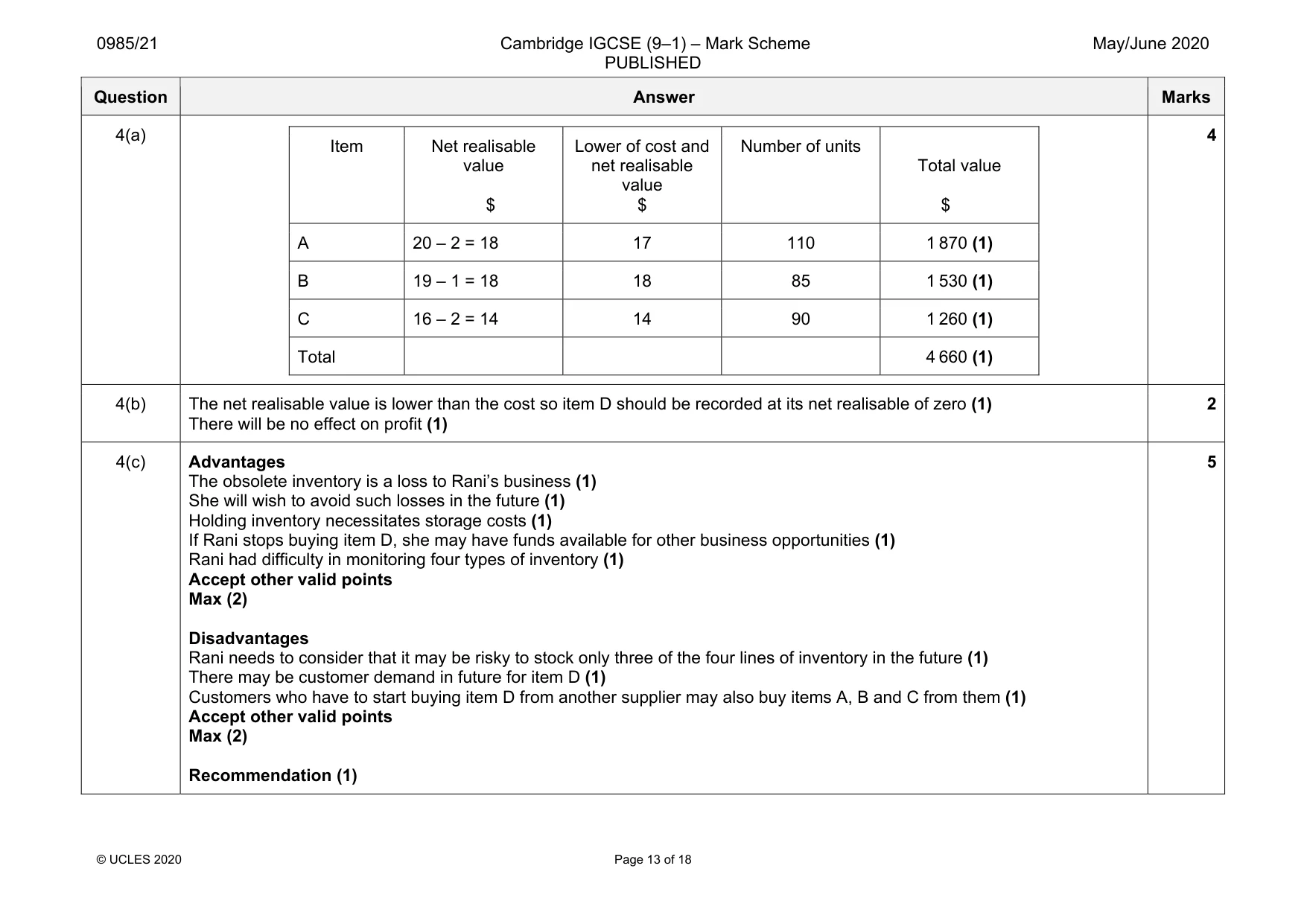
0985/21 Cambridge IGCSE (9–1) – Mark Scheme PUBLISHED May/June 2020 © UCLES 2020 Page 13 of 18 Question Answer Marks 4(a) Item Net realisable value $ Lower of cost and net realisable value $ Number of units Total value $ A 20 – 2 = 18 17 110 1 870 (1) B 19 – 1 = 18 18 85 1 530 (1) C 16 – 2 = 14 14 90 1 260 (1) Total 4 660 (1) 4 4(b) The net realisable value is lower than the cost so item D should be recorded at its net realisable of zero (1) There will be no effect on profit (1) 2 4(c) Advantages The obsolete inventory is a loss to Rani’s business (1) She will wish to avoid such losses in the future (1) Holding inventory necessitates storage costs (1) If Rani stops buying item D, she may have funds available for other business opportunities (1) Rani had difficulty in monitoring four types of inventory (1) Accept other valid points Max (2) Disadvantages Rani needs to consider that it may be risky to stock only three of the four lines of inventory in the future (1) There may be customer demand in future for item D (1) Customers who have to start buying item D from another supplier may also buy items A, B and C from them (1) Accept other valid points Max (2) Recommendation (1) 5
Mark scheme, page 14
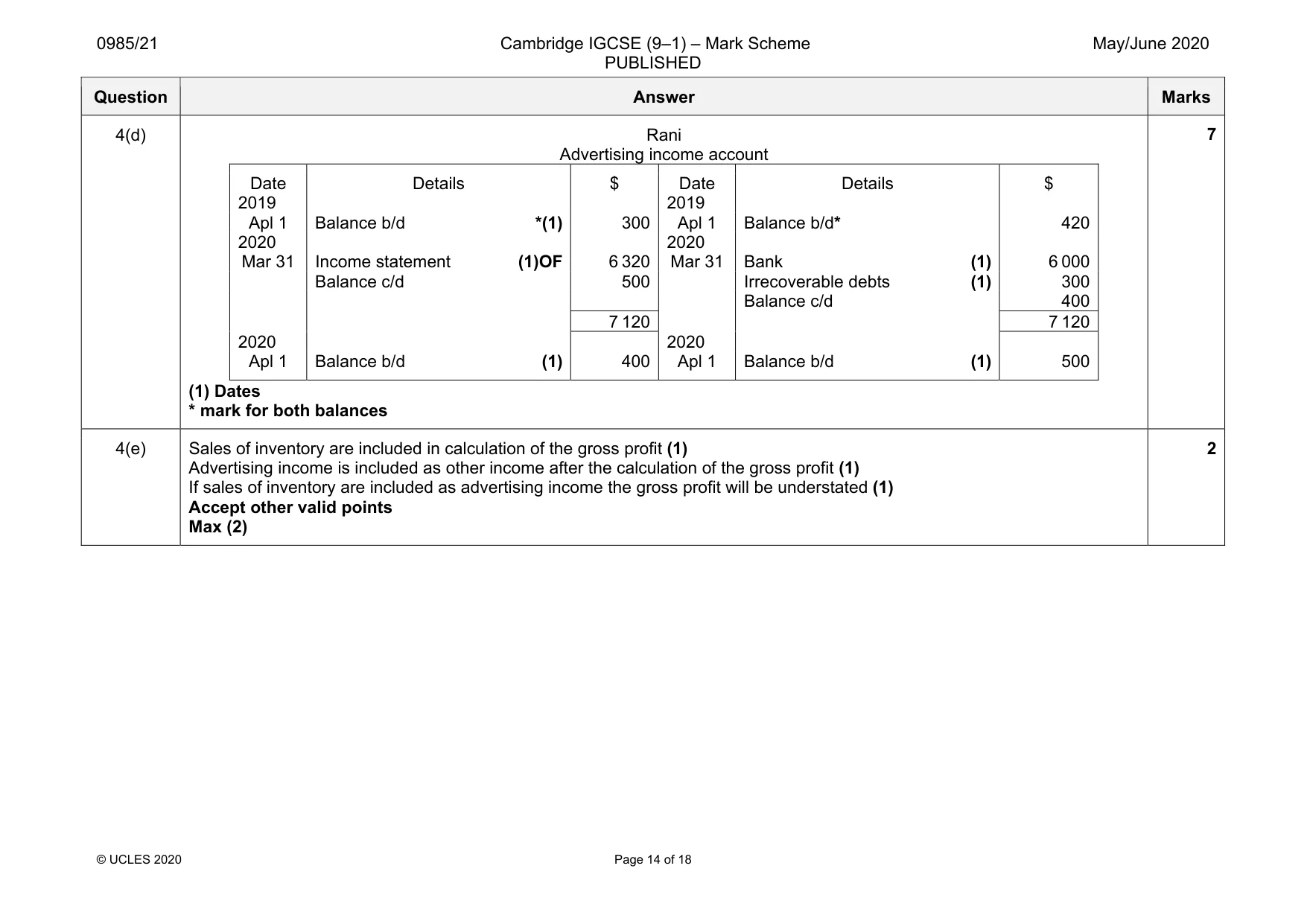
0985/21 Cambridge IGCSE (9–1) – Mark Scheme PUBLISHED May/June 2020 © UCLES 2020 Page 14 of 18 Question Answer Marks 4(d) Rani Advertising income account Date Details $ Date Details $ 2019 2019 Apl 1 Balance b/d *(1) 300 Apl 1 Balance b/d* 420 2020 2020 Mar 31 Income statement (1)OF 6 320 Mar 31 Bank (1) 6 000 Balance c/d 500 Irrecoverable debts (1) 300 Balance c/d 400 7 120 7 120 2020 2020 Apl 1 Balance b/d (1) 400 Apl 1 Balance b/d (1) 500 (1) Dates * mark for both balances 7 4(e) Sales of inventory are included in calculation of the gross profit (1) Advertising income is included as other income after the calculation of the gross profit (1) If sales of inventory are included as advertising income the gross profit will be understated (1) Accept other valid points Max (2) 2
Mark scheme, page 15
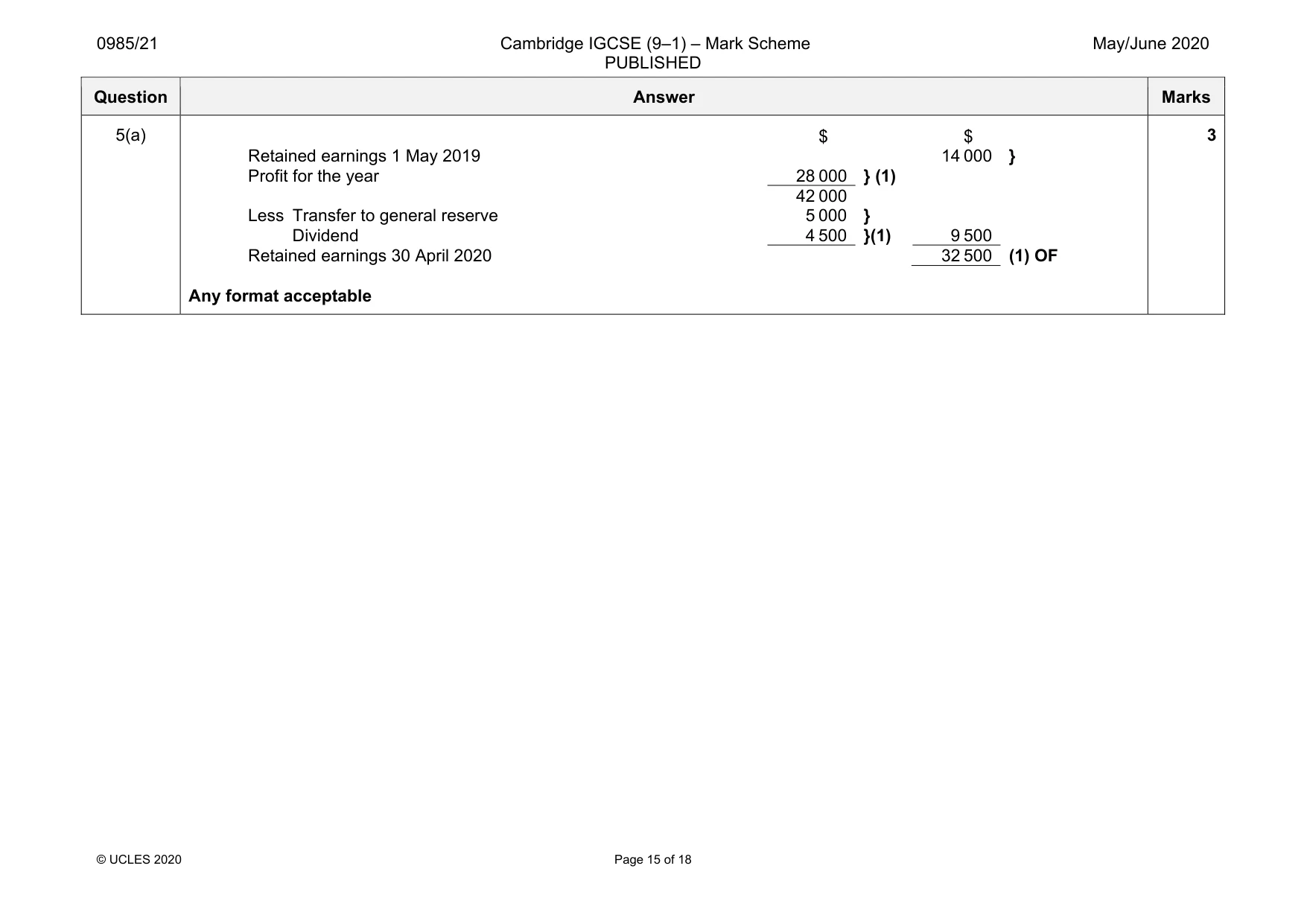
0985/21 Cambridge IGCSE (9–1) – Mark Scheme PUBLISHED May/June 2020 © UCLES 2020 Page 15 of 18 Question Answer Marks 5(a) $ $ Retained earnings 1 May 2019 14 000 } Profit for the year 28 000 } (1) 42 000 Less Transfer to general reserve 5 000 } Dividend 4 500 }(1) 9 500 Retained earnings 30 April 2020 32 500 (1) OF Any format acceptable 3
Mark scheme, page 16
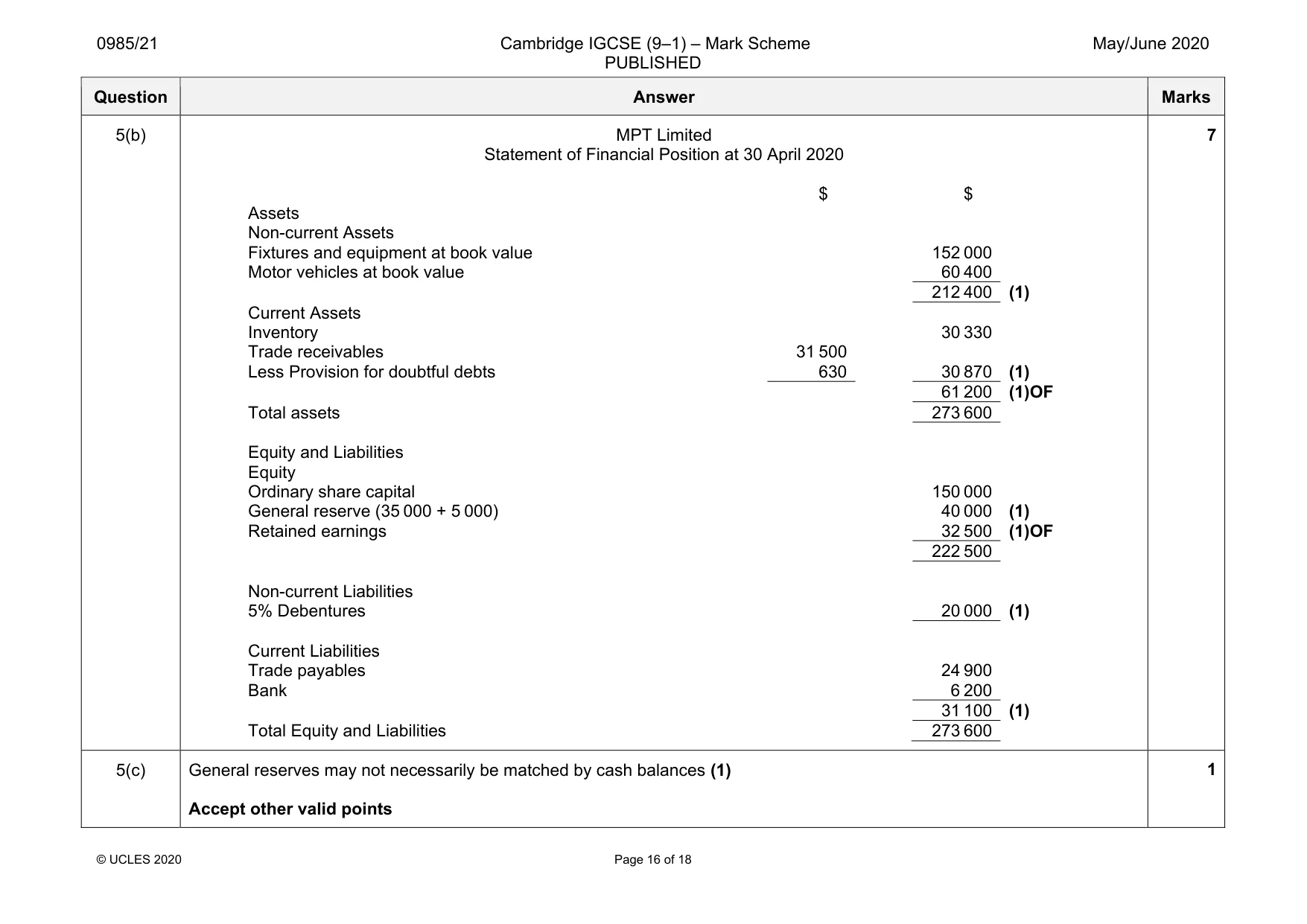
0985/21 Cambridge IGCSE (9–1) – Mark Scheme PUBLISHED May/June 2020 © UCLES 2020 Page 16 of 18 Question Answer Marks 5(b) MPT Limited Statement of Financial Position at 30 April 2020 $ $ Assets Non-current Assets Fixtures and equipment at book value 152 000 Motor vehicles at book value 60 400 212 400 (1) Current Assets Inventory 30 330 Trade receivables 31 500 Less Provision for doubtful debts 630 30 870 (1) 61 200 (1)OF Total assets 273 600 Equity and Liabilities Equity Ordinary share capital 150 000 General reserve (35 000 + 5 000) 40 000 (1) Retained earnings 32 500 (1)OF 222 500 Non-current Liabilities 5% Debentures 20 000 (1) Current Liabilities Trade payables 24 900 Bank 6 200 31 100 (1) Total Equity and Liabilities 273 600 7 5(c) General reserves may not necessarily be matched by cash balances (1) Accept other valid points 1
Mark scheme, page 17
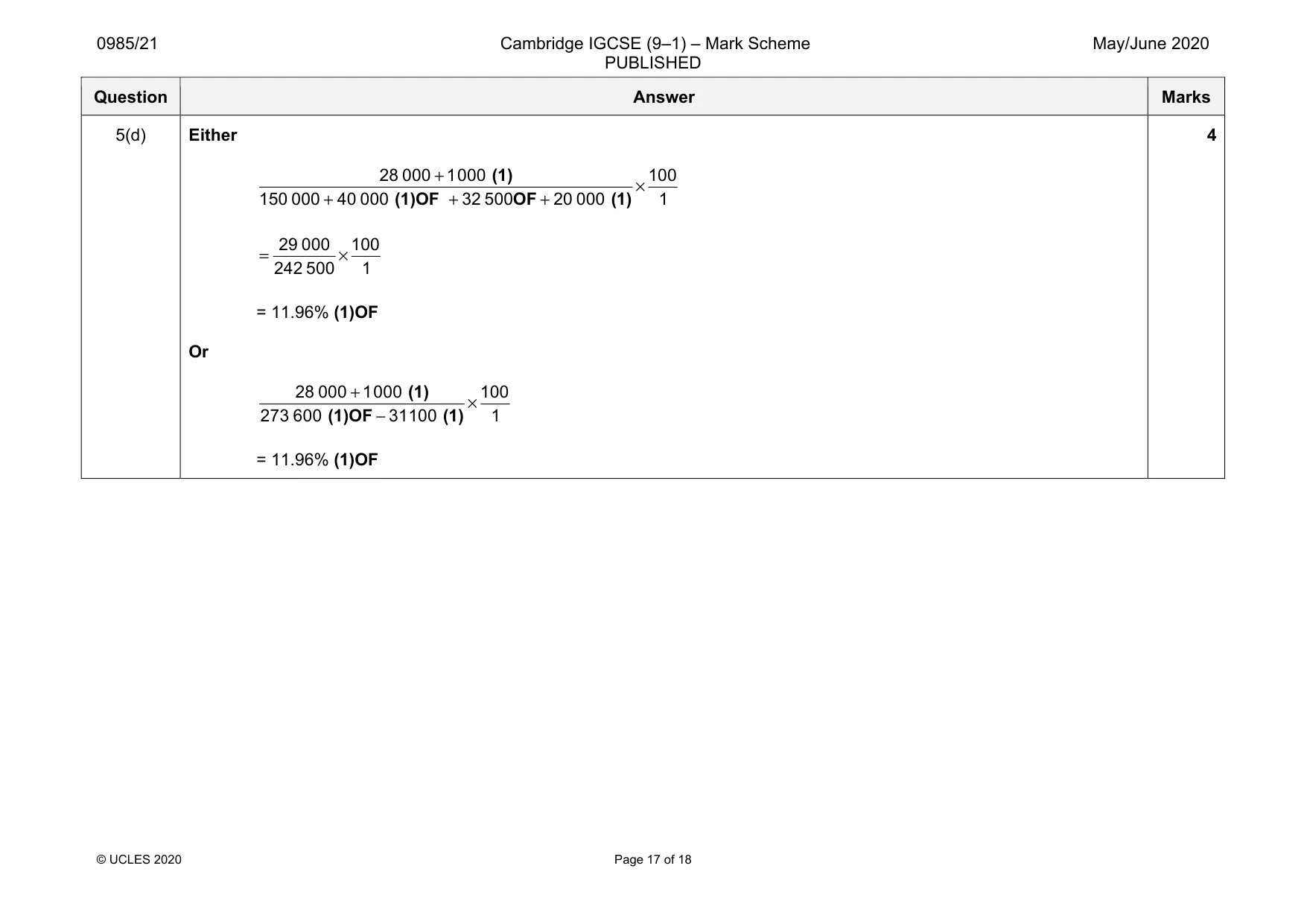
0985/21 Cambridge IGCSE (9–1) – Mark Scheme PUBLISHED May/June 2020 © UCLES 2020 Page 17 of 18 Question Answer Marks 5(d) Either 28 000 1000 100 150 000 40 000 32 500 20 000 1 + × + + + (1) (1)OF OF (1) 29 000 100 242 500 1 = × = 11.96% (1)OF Or 28 000 1000 100 273 600 31100 1 + × − (1) (1)OF (1) = 11.96% (1)OF 4
Mark scheme, page 18
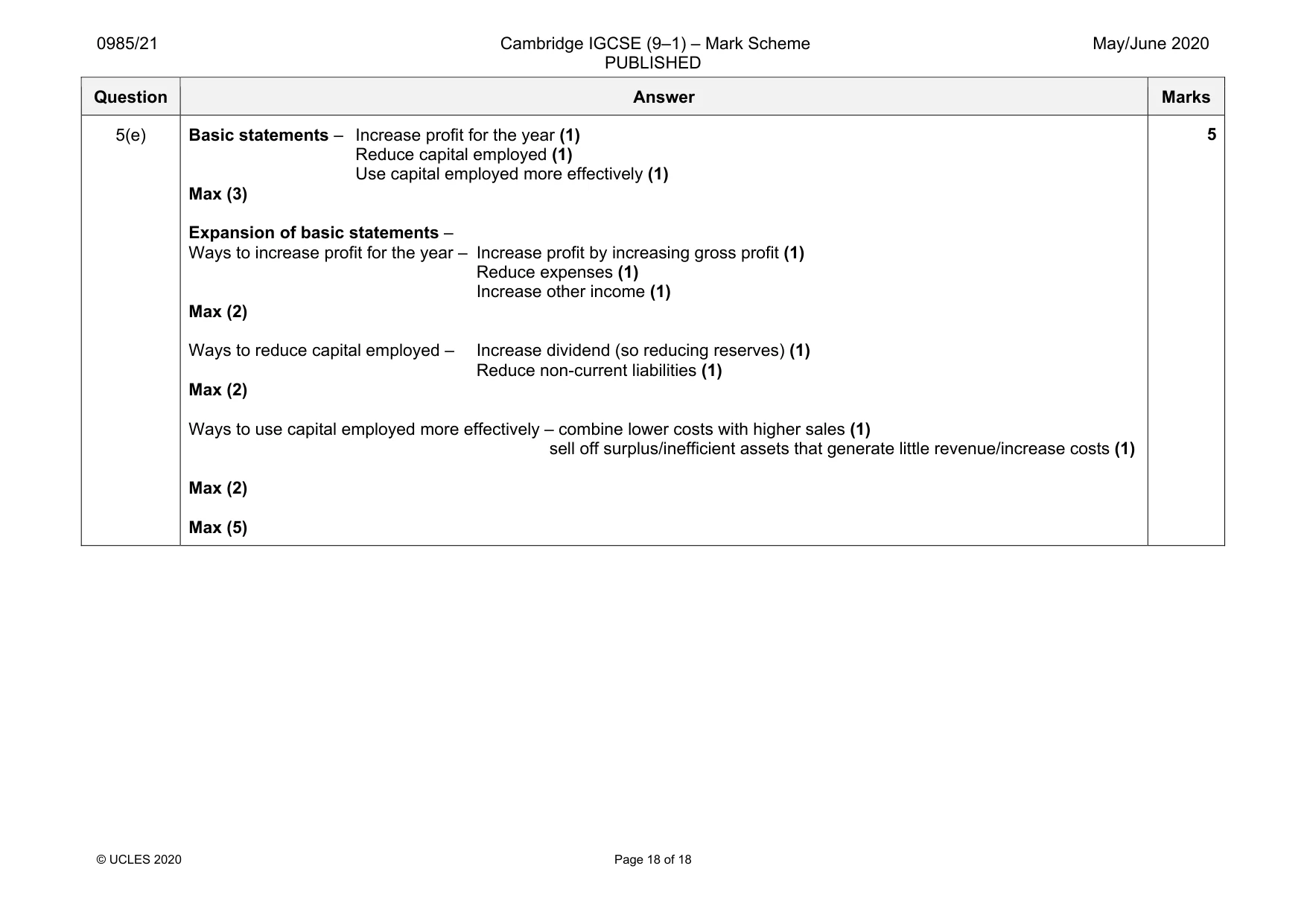
0985/21 Cambridge IGCSE (9–1) – Mark Scheme PUBLISHED May/June 2020 © UCLES 2020 Page 18 of 18 Question Answer Marks 5(e) Basic statements – Increase profit for the year (1) Reduce capital employed (1) Use capital employed more effectively (1) Max (3) Expansion of basic statements – Ways to increase profit for the year – Increase profit by increasing gross profit (1) Reduce expenses (1) Increase other income (1) Max (2) Ways to reduce capital employed – Increase dividend (so reducing reserves) (1) Reduce non-current liabilities (1) Max (2) Ways to use capital employed more effectively – combine lower costs with higher sales (1) sell off surplus/inefficient assets that generate little revenue/increase costs (1) Max (2) Max (5) 5