Cambridge IGCSE Accounting 0452 — 2017 Feb/March Paper 1 · Variant 2
0452/12/F/M/17 · 120 marks · ≈135 min
The question paper and its mark scheme, free to read here and free to download. This is Cambridge’s own paper, exactly as it was sat.
Question paper20 pages
Mark scheme8 pages
Answers below. Sit the paper first if you are practising.
Paper as text
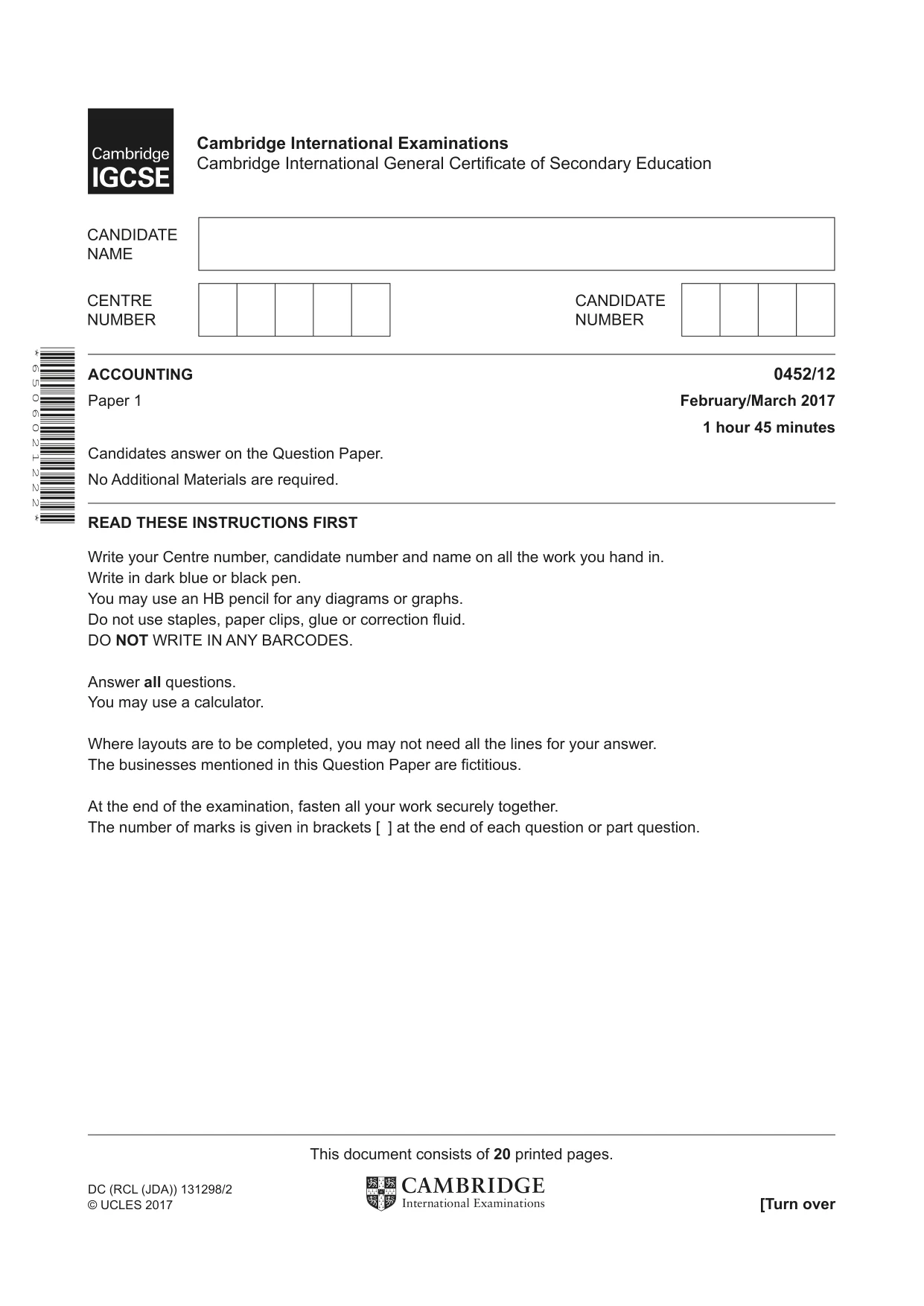
Question paper, page 1
This document consists of 20 printed pages. DC (RCL (JDA)) 131298/2 © UCLES 2017 [Turn over Cambridge International Examinations Cambridge International General Certificate of Secondary Education * 6 5 0 6 0 2 1 2 2 2 * ACCOUNTING 0452/12 Paper 1 February/March 2017 1 hour 45 minutes Candidates answer on the Question Paper. No Additional Materials are required. READ THESE INSTRUCTIONS FIRST Write your Centre number, candidate number and name on all the work you hand in. Write in dark blue or black pen. You may use an HB pencil for any diagrams or graphs. Do not use staples, paper clips, glue or correction fluid. DO NOT WRITE IN ANY BARCODES. Answer all questions. You may use a calculator. Where layouts are to be completed, you may not need all the lines for your answer. The businesses mentioned in this Question Paper are fictitious. At the end of the examination, fasten all your work securely together. The number of marks is given in brackets [ ] at the end of each question or part question.
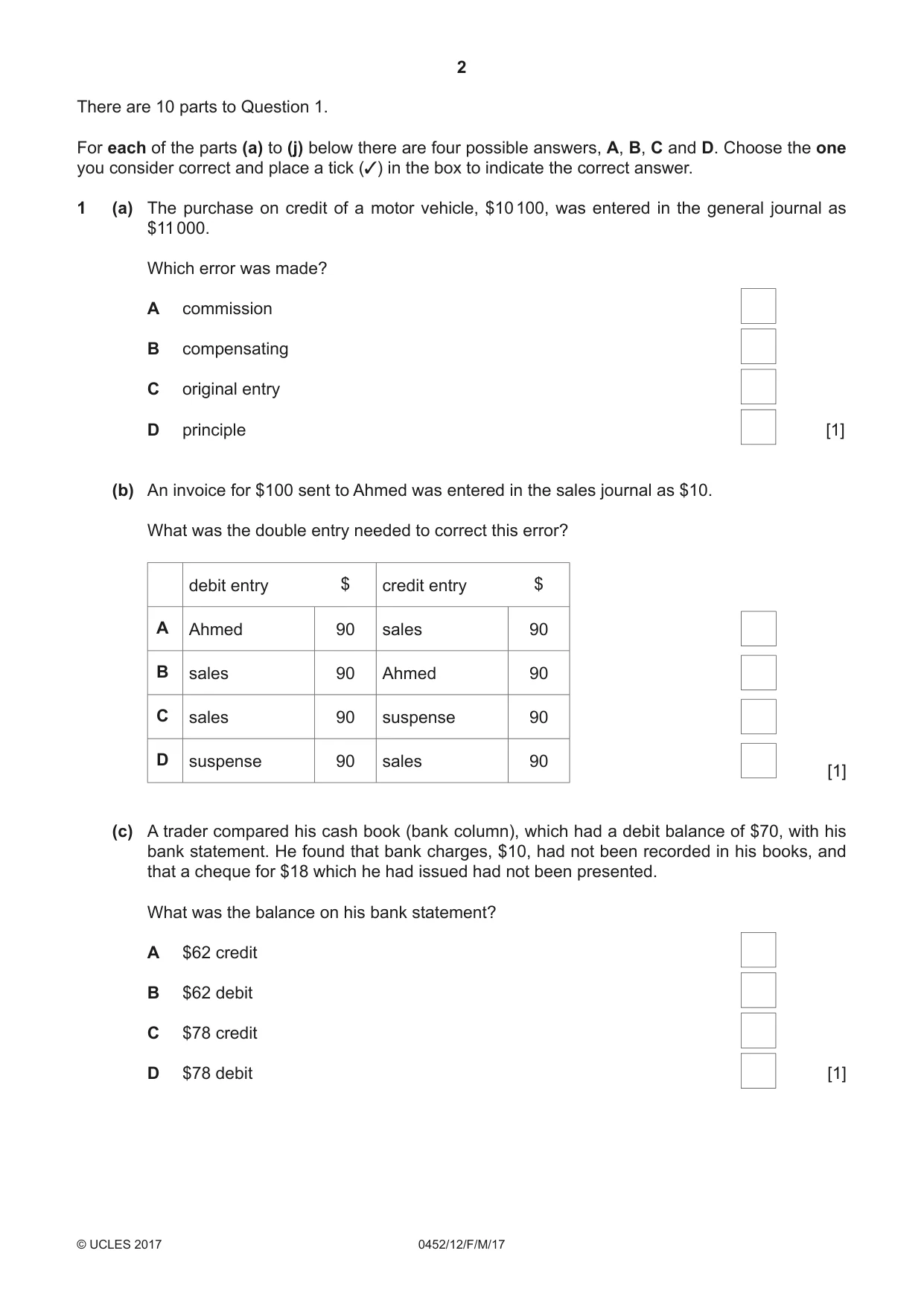
Question paper, page 2
2 0452/12/F/M/17 © UCLES 2017 There are 10 parts to Question 1. For each of the parts (a) to (j) below there are four possible answers, A, B, C and D. Choose the one you consider correct and place a tick (3) in the box to indicate the correct answer. 1 (a) The purchase on credit of a motor vehicle, $10 100, was entered in the general journal as $11 000. Which error was made? A commission B compensating C original entry D principle [1] (b) An invoice for $100 sent to Ahmed was entered in the sales journal as $10. What was the double entry needed to correct this error? debit entry $ credit entry $ A Ahmed 90 sales 90 B sales 90 Ahmed 90 C sales 90 suspense 90 D suspense 90 sales 90 [1] (c) A trader compared his cash book (bank column), which had a debit balance of $70, with his bank statement. He found that bank charges, $10, had not been recorded in his books, and that a cheque for $18 which he had issued had not been presented. What was the balance on his bank statement? A $62 credit B $62 debit C $78 credit D $78 debit [1]
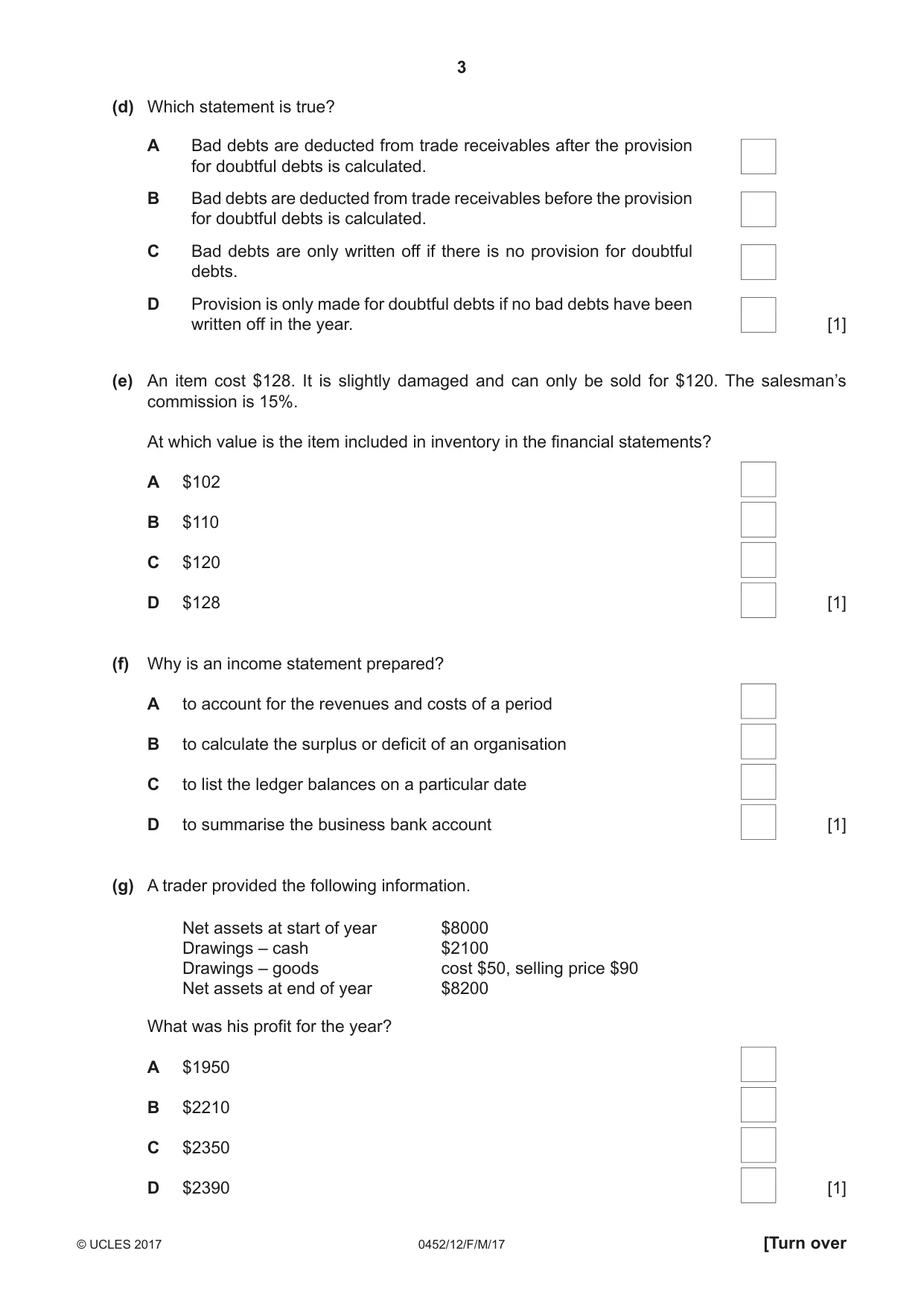
Question paper, page 3
3 0452/12/F/M/17 © UCLES 2017 [Turn over (d) Which statement is true? A Bad debts are deducted from trade receivables after the provision for doubtful debts is calculated. B Bad debts are deducted from trade receivables before the provision for doubtful debts is calculated. C Bad debts are only written off if there is no provision for doubtful debts. D Provision is only made for doubtful debts if no bad debts have been written off in the year. [1] (e) An item cost $128. It is slightly damaged and can only be sold for $120. The salesman’s commission is 15%. At which value is the item included in inventory in the financial statements? A $102 B $110 C $120 D $128 [1] (f) Why is an income statement prepared? A to account for the revenues and costs of a period B to calculate the surplus or deficit of an organisation C to list the ledger balances on a particular date D to summarise the business bank account [1] (g) A trader provided the following information. Net assets at start of year $8000 Drawings – cash $2100 Drawings – goods cost $50, selling price $90 Net assets at end of year $8200 What was his profit for the year? A $1950 B $2210 C $2350 D $2390 [1]
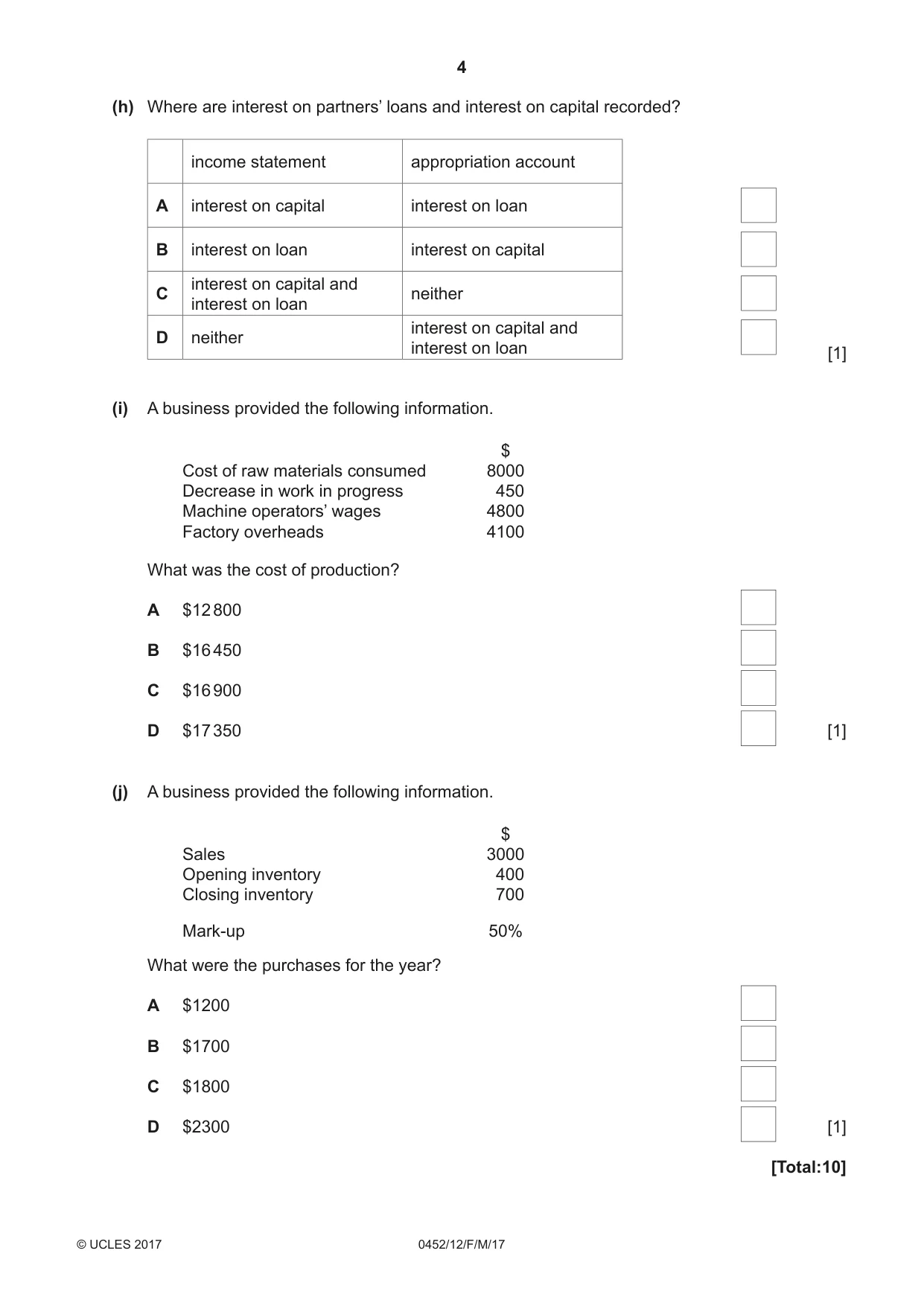
Question paper, page 4
4 0452/12/F/M/17 © UCLES 2017 (h) Where are interest on partners’ loans and interest on capital recorded? income statement appropriation account A interest on capital interest on loan B interest on loan interest on capital C interest on capital and interest on loan neither D neither interest on capital and interest on loan [1] (i) A business provided the following information. $ Cost of raw materials consumed 8000 Decrease in work in progress 450 Machine operators’ wages 4800 Factory overheads 4100 What was the cost of production? A $12 800 B $16 450 C $16 900 D $17 350 [1] (j) A business provided the following information. $ Sales 3000 Opening inventory 400 Closing inventory 700 Mark-up 50% What were the purchases for the year? A $1200 B $1700 C $1800 D $2300 [1] [Total:10]
Question paper, page 5
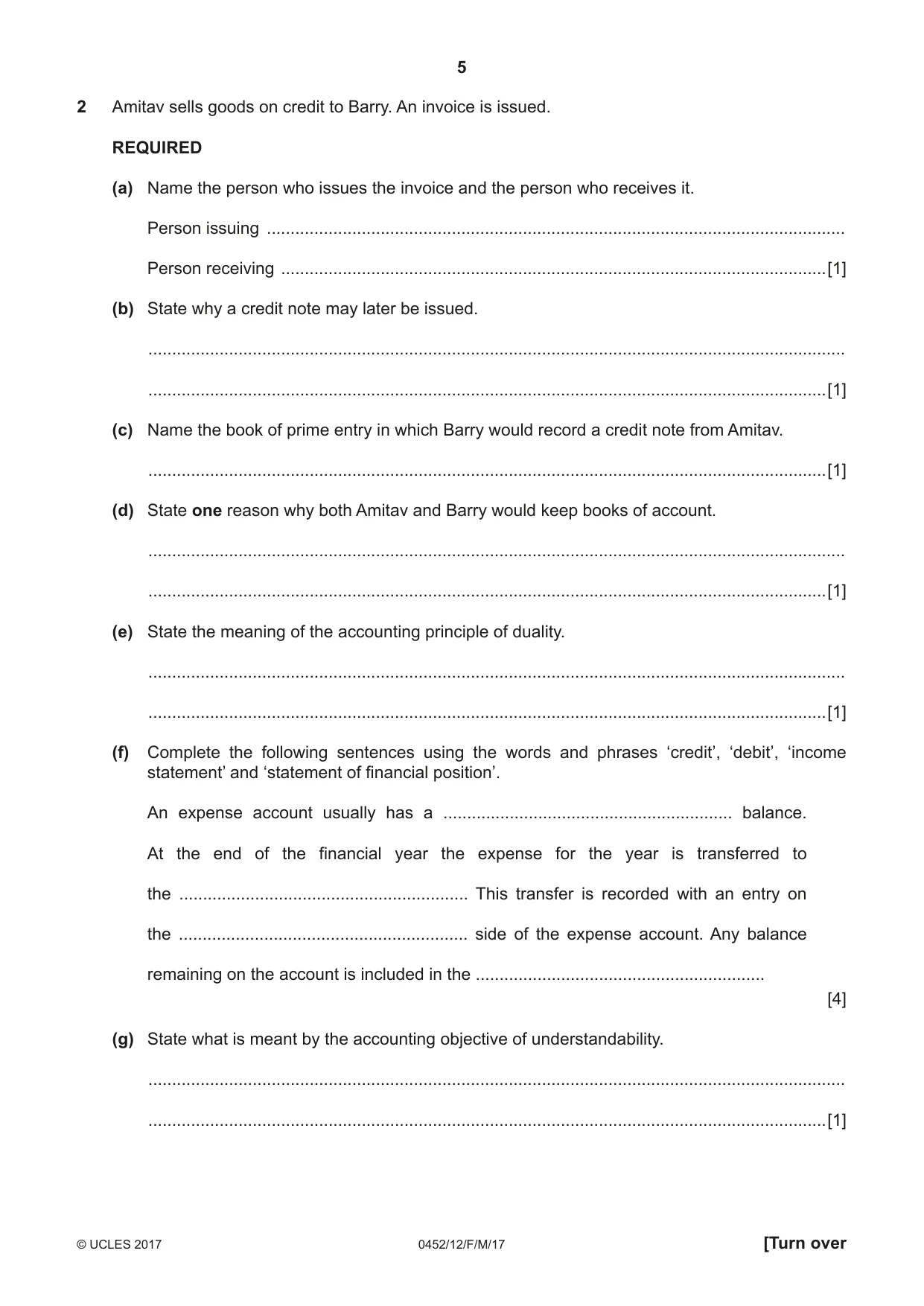
5 0452/12/F/M/17 © UCLES 2017 [Turn over 2 Amitav sells goods on credit to Barry. An invoice is issued. REQUIRED (a) Name the person who issues the invoice and the person who receives it. Person issuing … Person receiving …[1] (b) State why a credit note may later be issued. … …[1] (c) Name the book of prime entry in which Barry would record a credit note from Amitav. …[1] (d) State one reason why both Amitav and Barry would keep books of account. … …[1] (e) State the meaning of the accounting principle of duality. … …[1] (f) Complete the following sentences using the words and phrases ‘credit’, ‘debit’, ‘income statement’ and ‘statement of financial position’. An expense account usually has a … balance. At the end of the financial year the expense for the year is transferred to the … This transfer is recorded with an entry on the … side of the expense account. Any balance remaining on the account is included in the … [4] (g) State what is meant by the accounting objective of understandability. … …[1]
Question paper, page 6
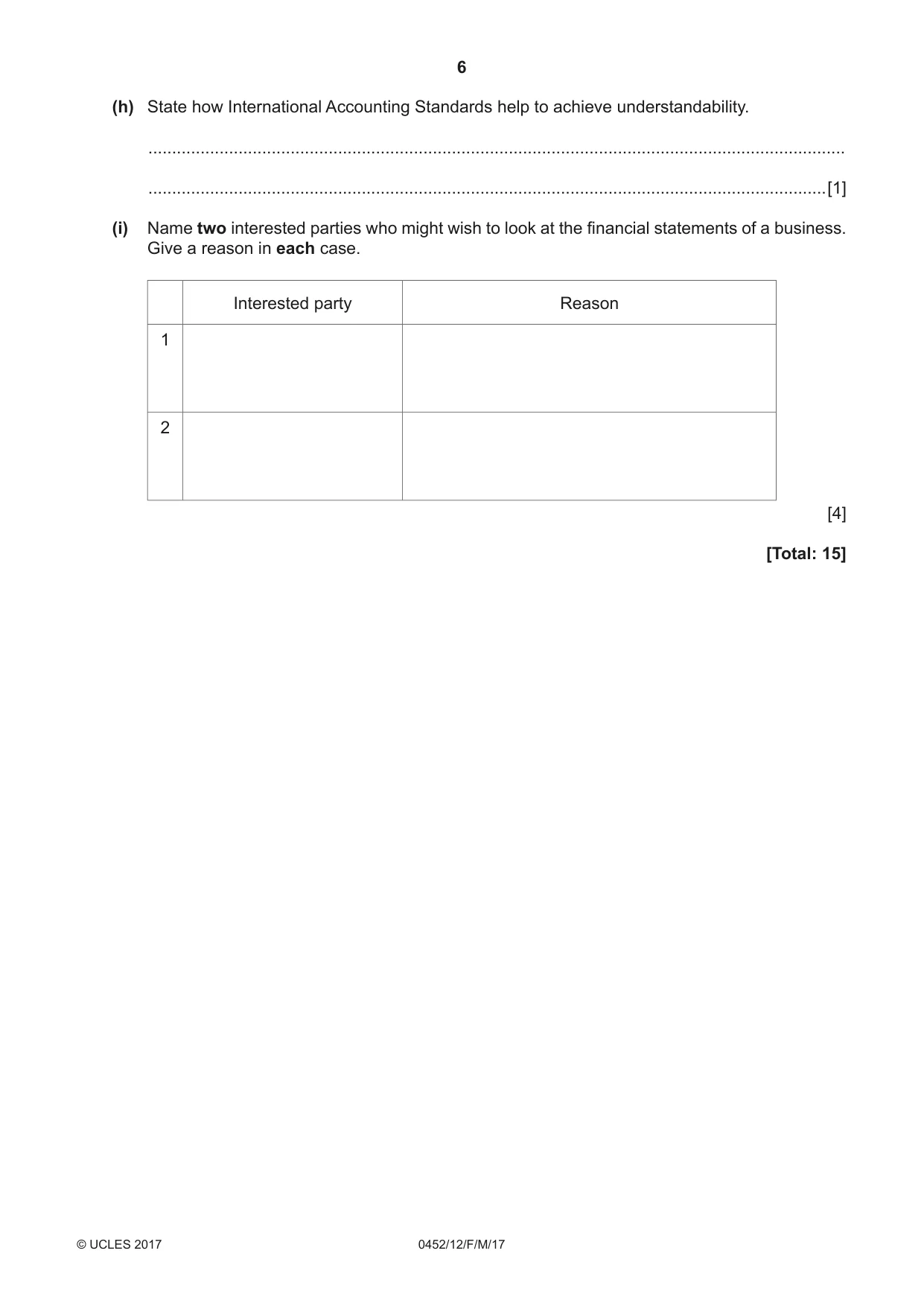
6 0452/12/F/M/17 © UCLES 2017 (h) State how International Accounting Standards help to achieve understandability. … …[1] (i) Name two interested parties who might wish to look at the financial statements of a business. Give a reason in each case. Interested party Reason 1 2 [4] [Total: 15]
Question paper, page 7
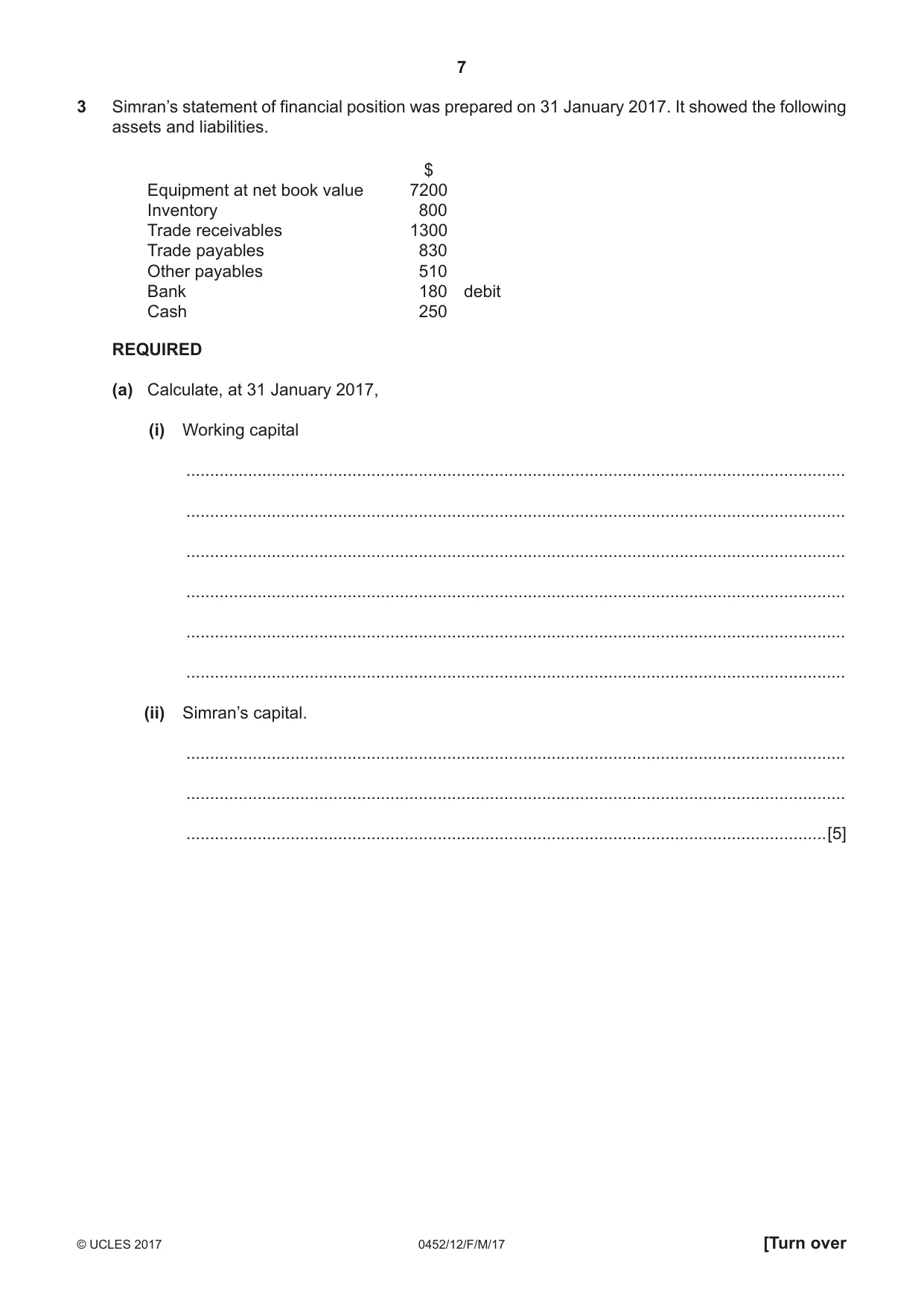
7 0452/12/F/M/17 © UCLES 2017 [Turn over 3 Simran’s statement of financial position was prepared on 31 January 2017. It showed the following assets and liabilities. $ Equipment at net book value 7200 Inventory 800 Trade receivables 1300 Trade payables 830 Other payables 510 Bank 180 debit Cash 250 REQUIRED (a) Calculate, at 31 January 2017, (i) Working capital … … … … … … (ii) Simran’s capital. … … …[5]
Question paper, page 8
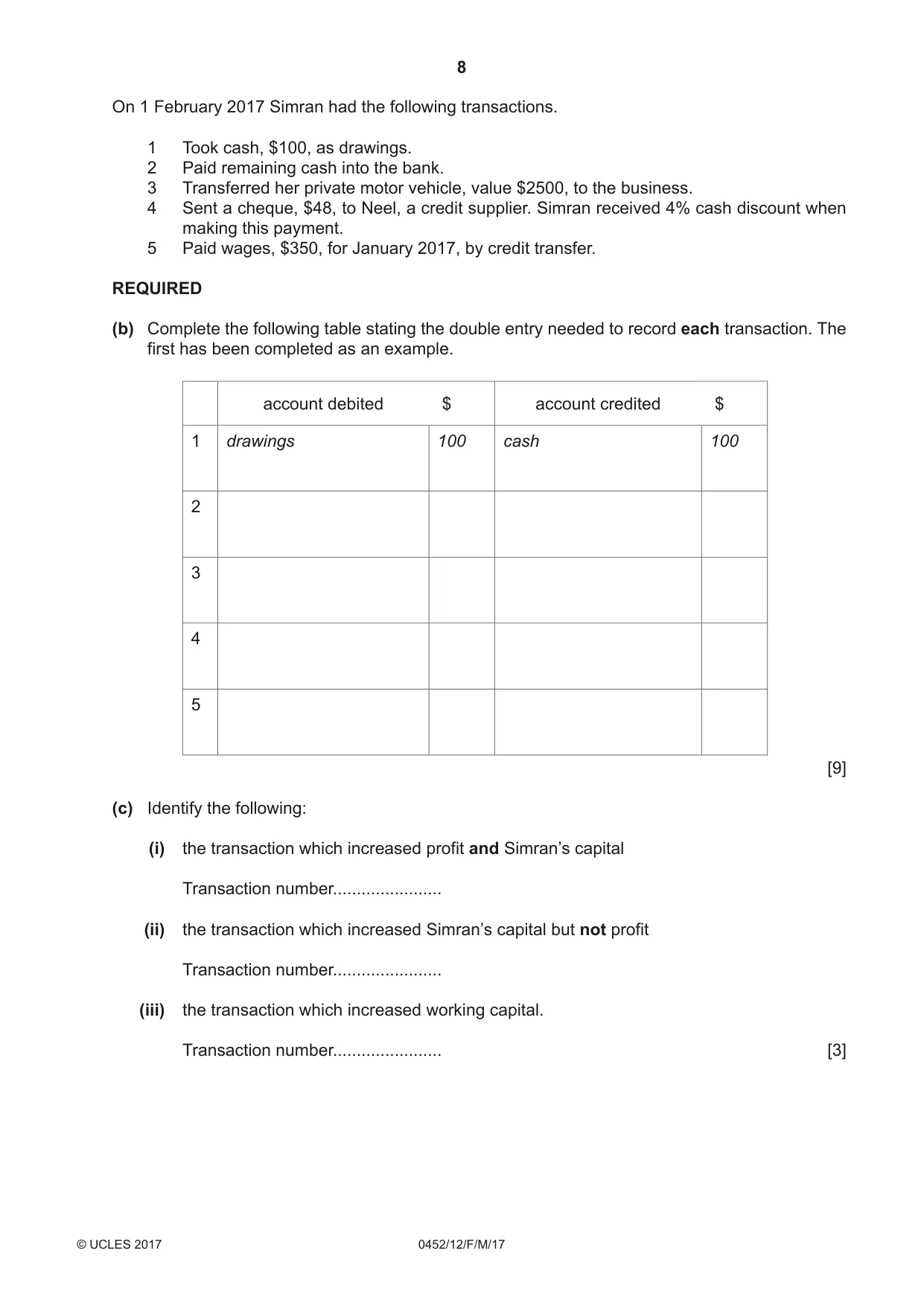
8 0452/12/F/M/17 © UCLES 2017 On 1 February 2017 Simran had the following transactions. 1 Took cash, $100, as drawings. 2 Paid remaining cash into the bank. 3 Transferred her private motor vehicle, value $2500, to the business. 4 Sent a cheque, $48, to Neel, a credit supplier. Simran received 4% cash discount when making this payment. 5 Paid wages, $350, for January 2017, by credit transfer. REQUIRED (b) Complete the following table stating the double entry needed to record each transaction. The first has been completed as an example. account debited $ account credited $ 1 drawings 100 cash 100 2 3 4 5 [9] (c) Identify the following: (i) the transaction which increased profit and Simran’s capital Transaction number… (ii) the transaction which increased Simran’s capital but not profit Transaction number… (iii) the transaction which increased working capital. Transaction number… [3]
Question paper, page 9
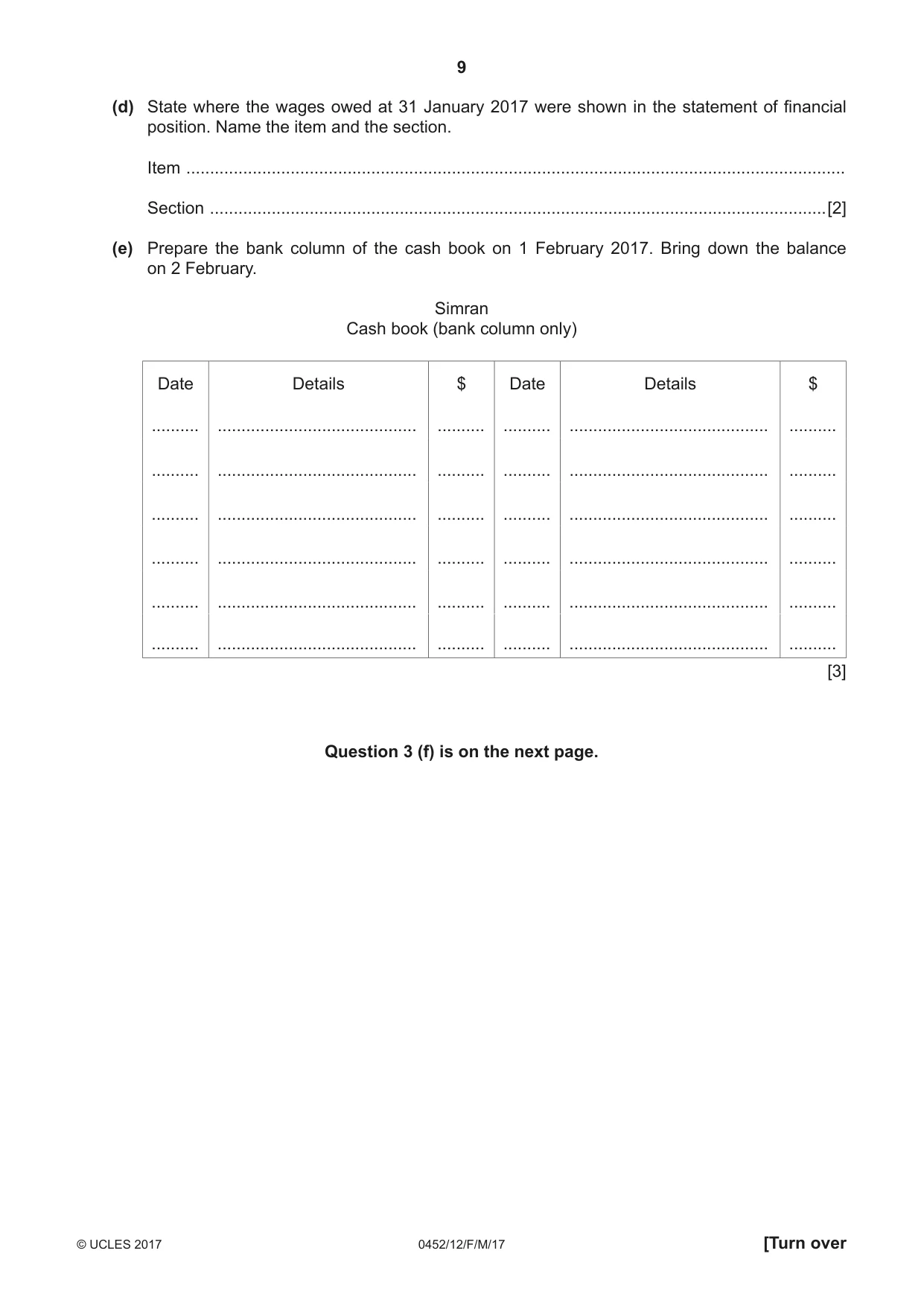
9 0452/12/F/M/17 © UCLES 2017 [Turn over (d) State where the wages owed at 31 January 2017 were shown in the statement of financial position. Name the item and the section. Item … Section …[2] (e) Prepare the bank column of the cash book on 1 February 2017. Bring down the balance on 2 February. Simran Cash book (bank column only) Date Details $ Date Details $ … … … … … … … … … … … … … … … … … … … … … … … … … … … … … … … … … … … … [3] Question 3 (f) is on the next page.
Question paper, page 10
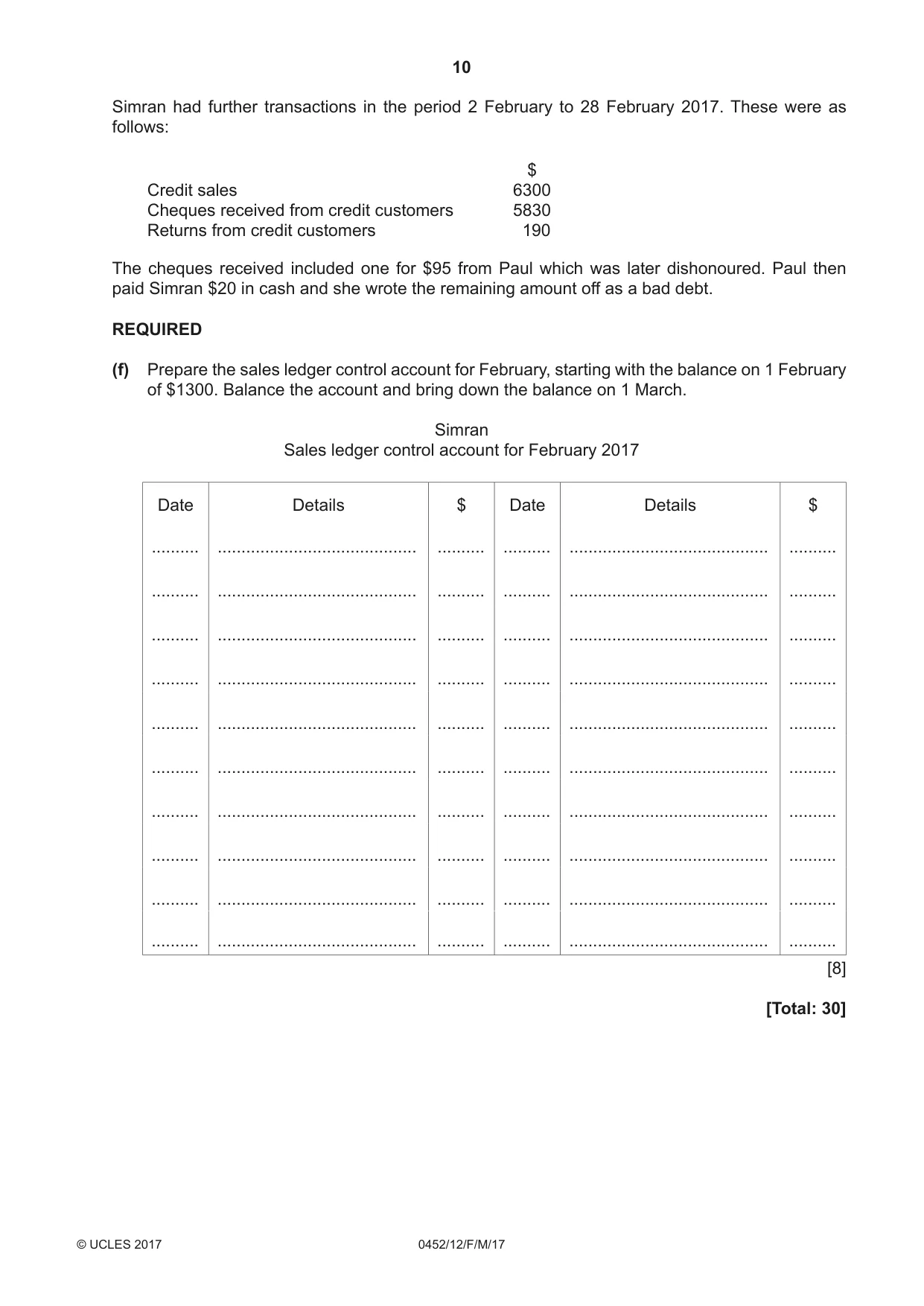
10 0452/12/F/M/17 © UCLES 2017 Simran had further transactions in the period 2 February to 28 February 2017. These were as follows: $ Credit sales 6300 Cheques received from credit customers 5830 Returns from credit customers 190 The cheques received included one for $95 from Paul which was later dishonoured. Paul then paid Simran $20 in cash and she wrote the remaining amount off as a bad debt. REQUIRED (f) Prepare the sales ledger control account for February, starting with the balance on 1 February of $1300. Balance the account and bring down the balance on 1 March. Simran Sales ledger control account for February 2017 Date Details $ Date Details $ … … … … … … … … … … … … … … … … … … … … … … … … … … … … … … … … … … … … … … … … … … … … … … … … … … … … … … … … … … … … [8] [Total: 30]
Question paper, page 11
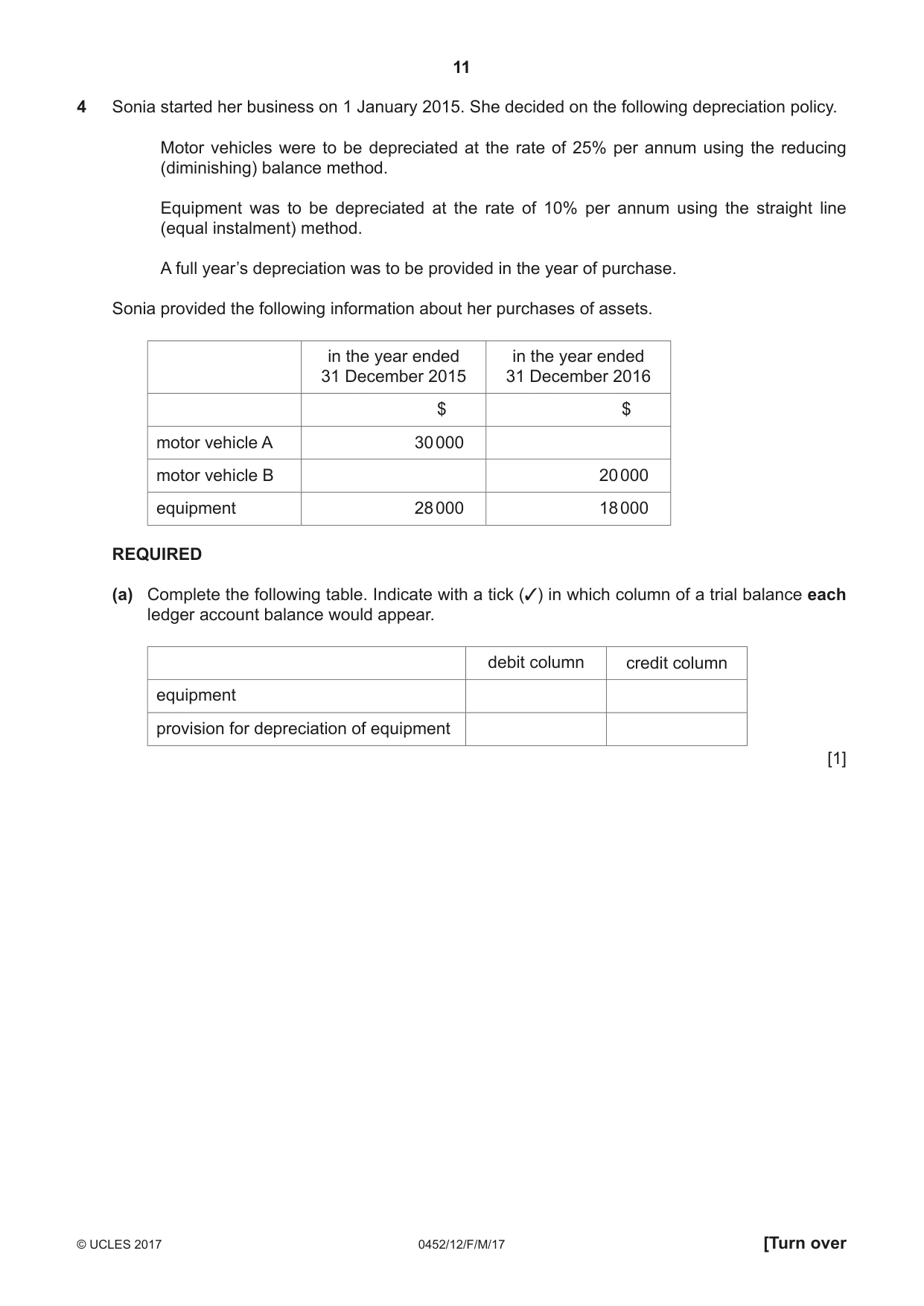
11 0452/12/F/M/17 © UCLES 2017 [Turn over 4 Sonia started her business on 1 January 2015. She decided on the following depreciation policy. Motor vehicles were to be depreciated at the rate of 25% per annum using the reducing (diminishing) balance method. Equipment was to be depreciated at the rate of 10% per annum using the straight line (equal instalment) method. A full year’s depreciation was to be provided in the year of purchase. Sonia provided the following information about her purchases of assets. in the year ended 31 December 2015 in the year ended 31 December 2016 $ $ motor vehicle A 30 000 motor vehicle B 20 000 equipment 28 000 18 000 REQUIRED (a) Complete the following table. Indicate with a tick (3) in which column of a trial balance each ledger account balance would appear. debit column credit column equipment provision for depreciation of equipment [1]
Question paper, page 12
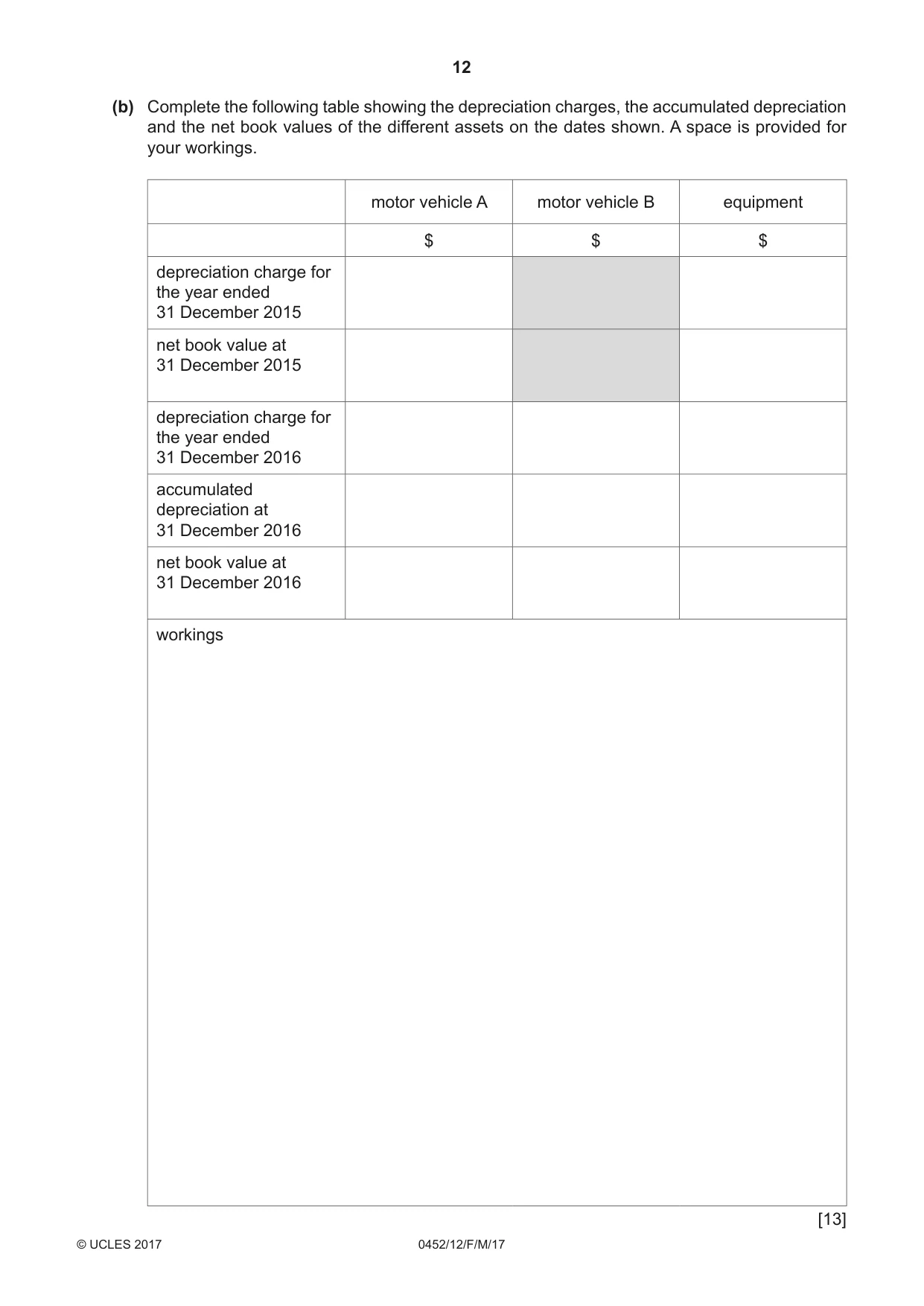
12 0452/12/F/M/17 © UCLES 2017 (b) Complete the following table showing the depreciation charges, the accumulated depreciation and the net book values of the different assets on the dates shown. A space is provided for your workings. motor vehicle A motor vehicle B equipment $ $ $ depreciation charge for the year ended 31 December 2015 net book value at 31 December 2015 depreciation charge for the year ended 31 December 2016 accumulated depreciation at 31 December 2016 net book value at 31 December 2016 workings [13]
Question paper, page 13
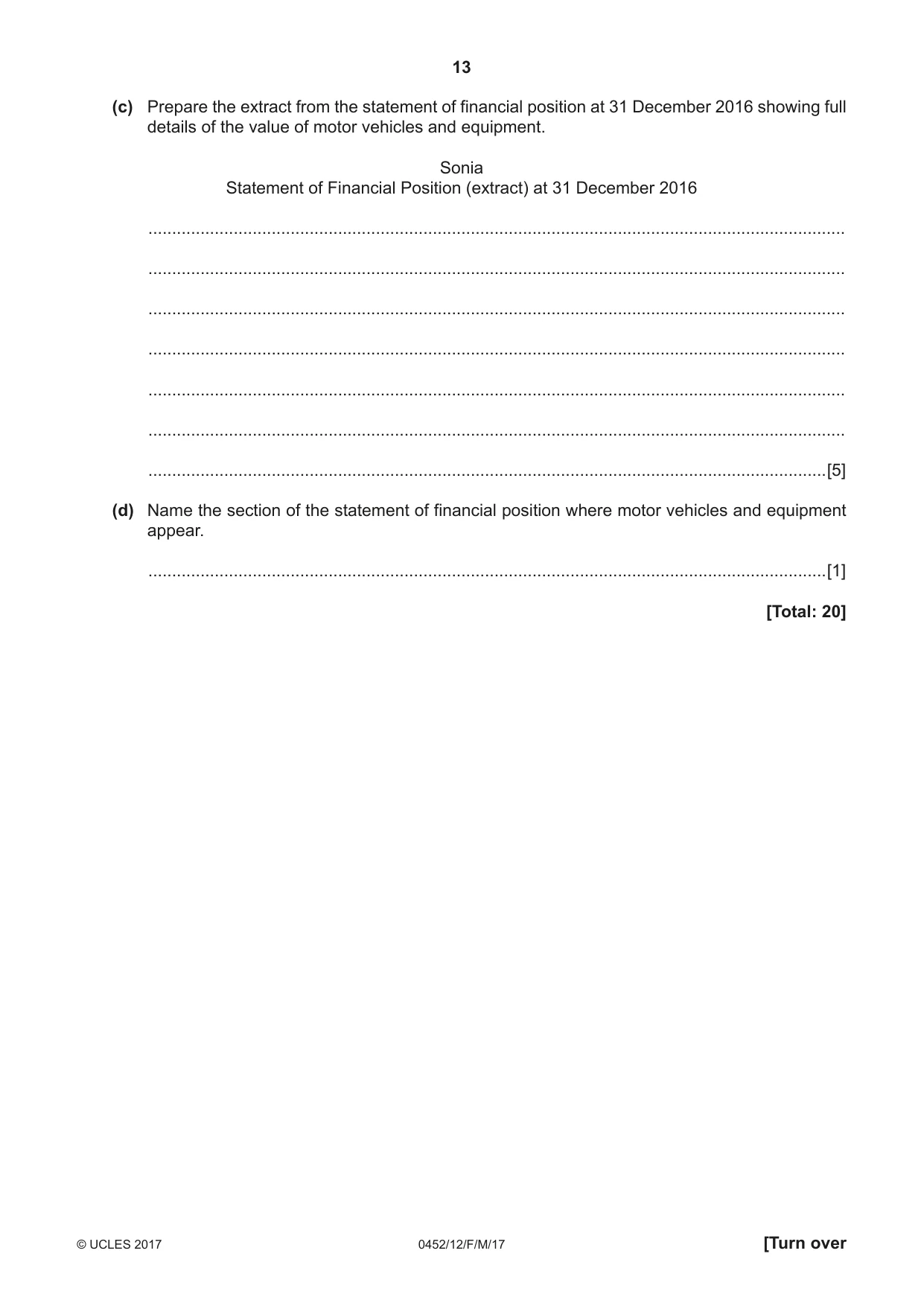
13 0452/12/F/M/17 © UCLES 2017 [Turn over (c) Prepare the extract from the statement of financial position at 31 December 2016 showing full details of the value of motor vehicles and equipment. Sonia Statement of Financial Position (extract) at 31 December 2016 … … … … … … …[5] (d) Name the section of the statement of financial position where motor vehicles and equipment appear. …[1] [Total: 20]
Question paper, page 14
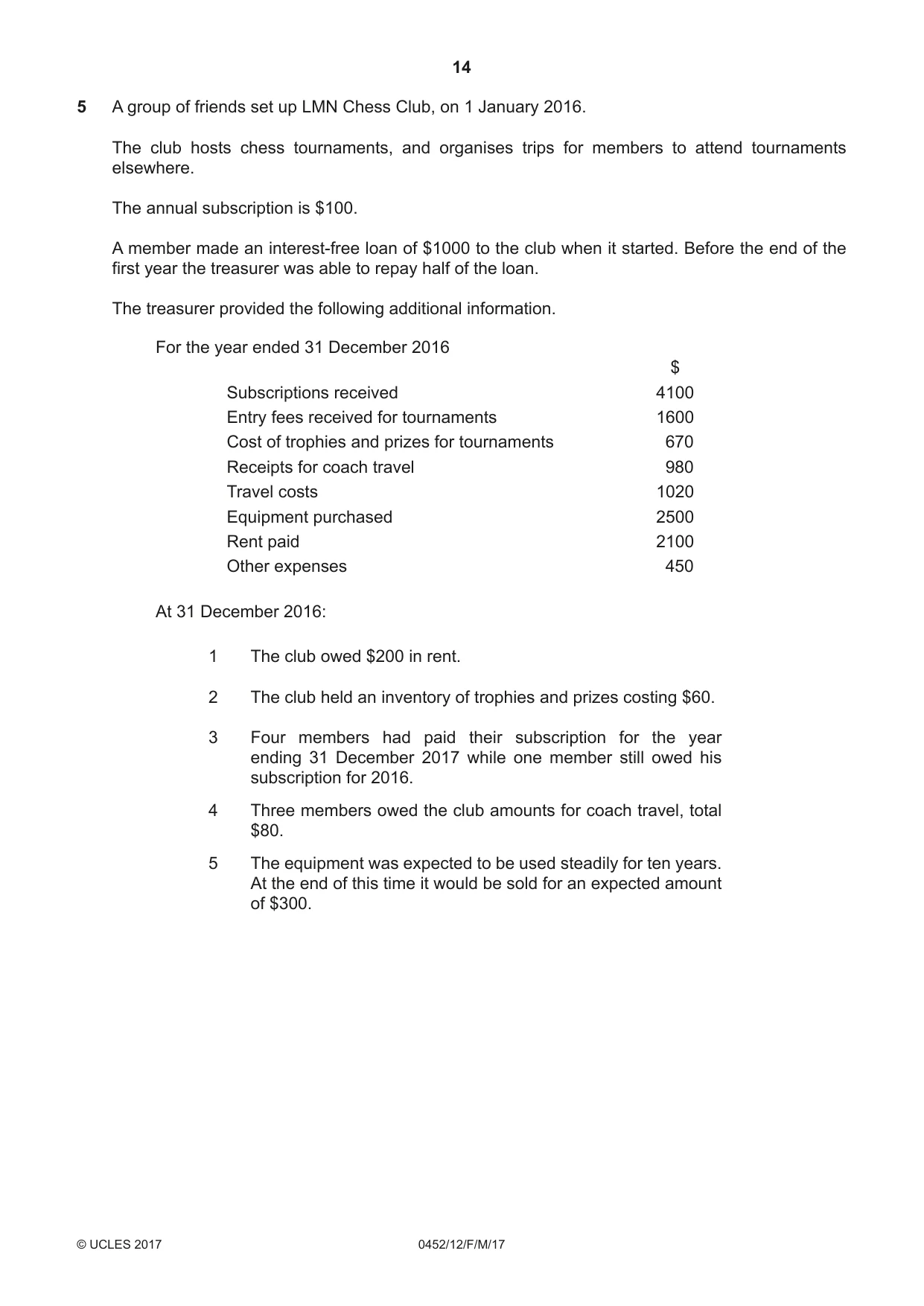
14 0452/12/F/M/17 © UCLES 2017 5 A group of friends set up LMN Chess Club, on 1 January 2016. The club hosts chess tournaments, and organises trips for members to attend tournaments elsewhere. The annual subscription is $100. A member made an interest-free loan of $1000 to the club when it started. Before the end of the first year the treasurer was able to repay half of the loan. The treasurer provided the following additional information. For the year ended 31 December 2016 $ Subscriptions received 4100 Entry fees received for tournaments 1600 Cost of trophies and prizes for tournaments 670 Receipts for coach travel 980 Travel costs 1020 Equipment purchased 2500 Rent paid 2100 Other expenses 450 At 31 December 2016: 1 The club owed $200 in rent. 2 The club held an inventory of trophies and prizes costing $60. 3 Four members had paid their subscription for the year ending 31 December 2017 while one member still owed his subscription for 2016. 4 Three members owed the club amounts for coach travel, total $80. 5 The equipment was expected to be used steadily for ten years. At the end of this time it would be sold for an expected amount of $300.
Question paper, page 15
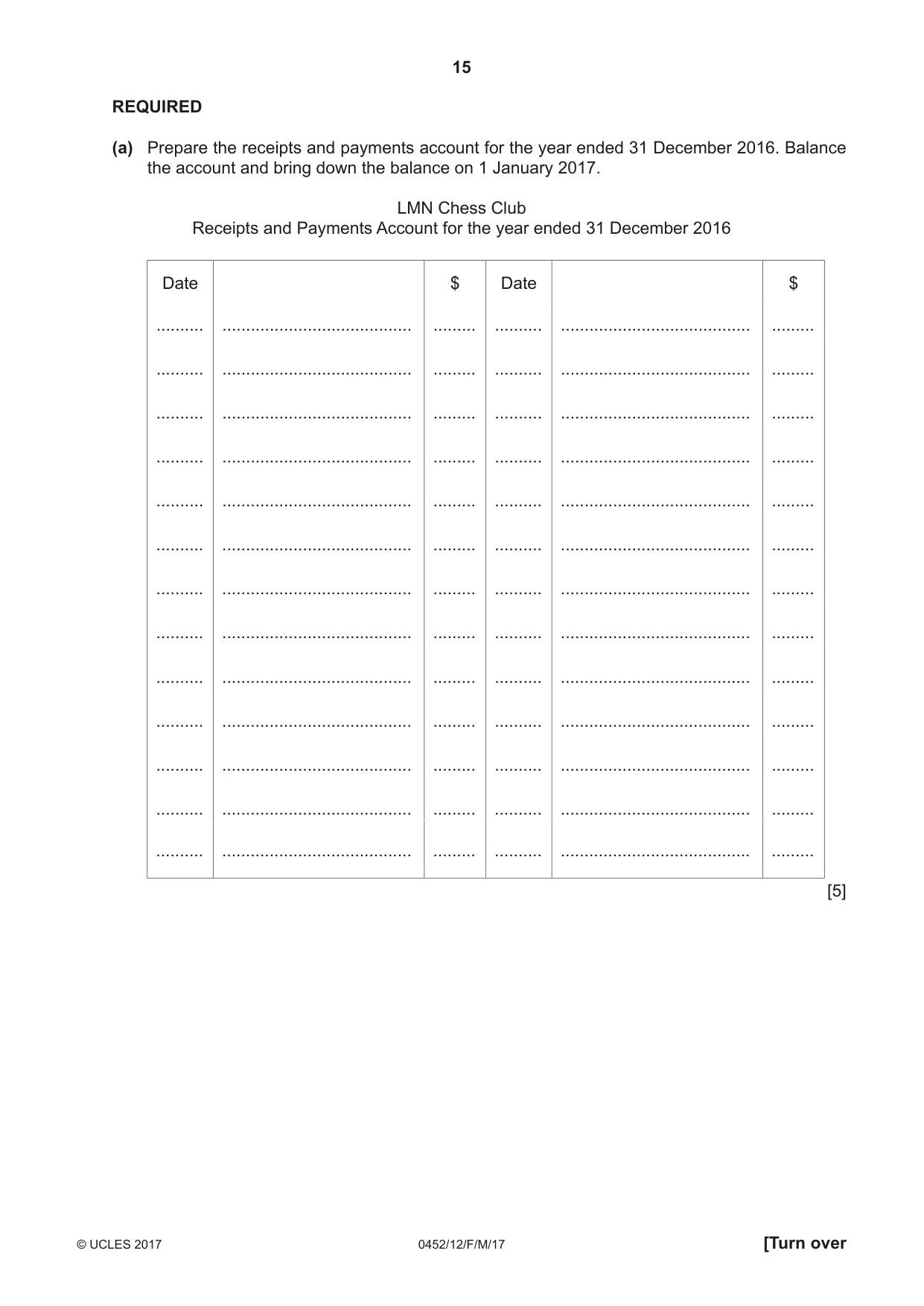
15 0452/12/F/M/17 © UCLES 2017 [Turn over REQUIRED (a) Prepare the receipts and payments account for the year ended 31 December 2016. Balance the account and bring down the balance on 1 January 2017. LMN Chess Club Receipts and Payments Account for the year ended 31 December 2016 Date $ Date $ … … … … … … … … … … … … … … … … … … … … … … … … … … … … … … … … … … … … … … … … … … … … … … … … … … … … … … … … … … … … … … … … … … … … … … … … … … … … … … [5]
Question paper, page 16
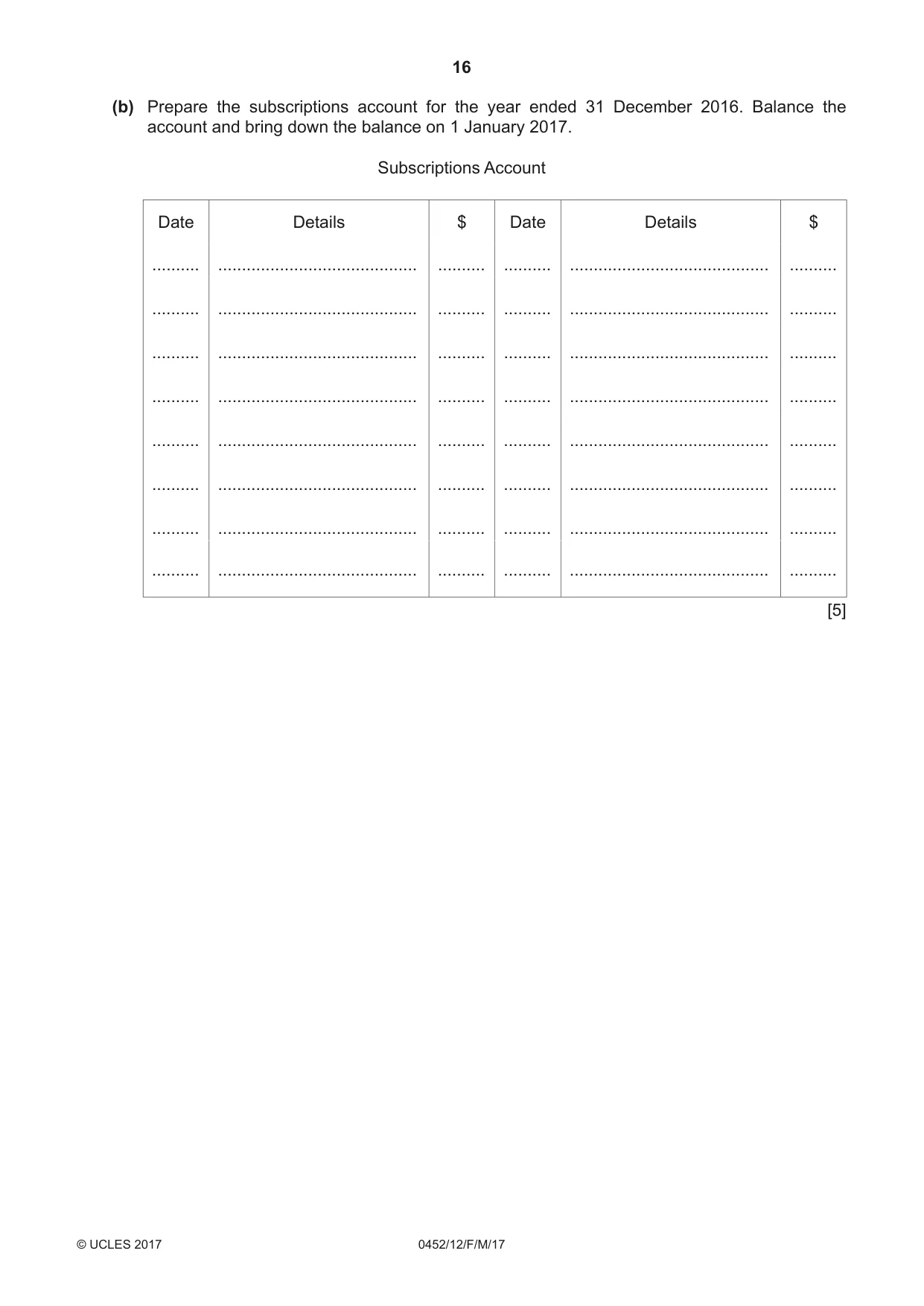
16 0452/12/F/M/17 © UCLES 2017 (b) Prepare the subscriptions account for the year ended 31 December 2016. Balance the account and bring down the balance on 1 January 2017. Subscriptions Account Date Details $ Date Details $ … … … … … … … … … … … … … … … … … … … … … … … … … … … … … … … … … … … … … … … … … … … … … … … … [5]
Question paper, page 17
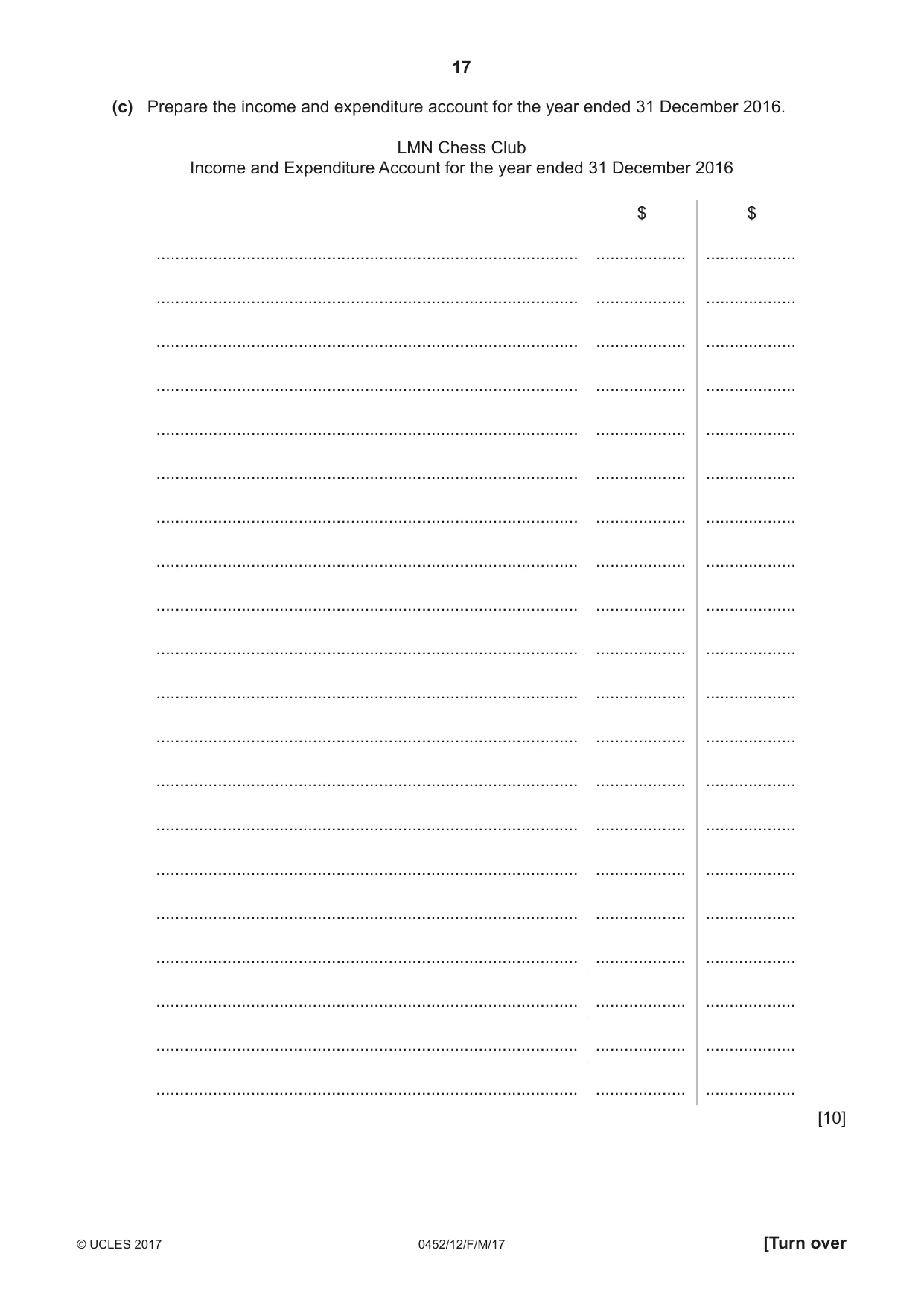
17 0452/12/F/M/17 © UCLES 2017 [Turn over (c) Prepare the income and expenditure account for the year ended 31 December 2016. LMN Chess Club Income and Expenditure Account for the year ended 31 December 2016 $ $ … … … … … … … … … … … … … … … … … … … … … … … … … … … … … … … … … … … … … … … … … … … … … … … … … … … … … … … … … … … … [10]
Question paper, page 18
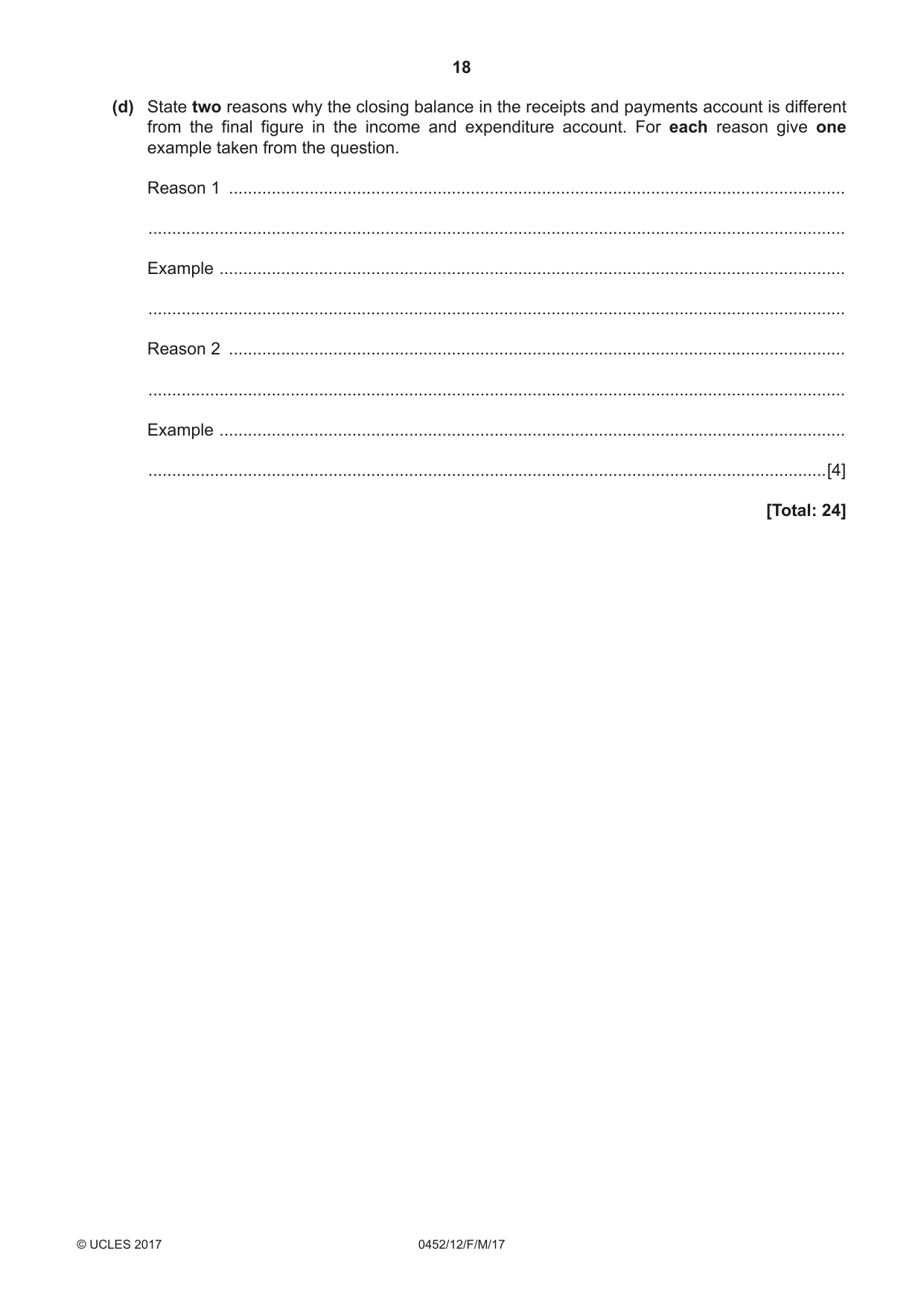
18 0452/12/F/M/17 © UCLES 2017 (d) State two reasons why the closing balance in the receipts and payments account is different from the final figure in the income and expenditure account. For each reason give one example taken from the question. Reason 1 … … Example … … Reason 2 … … Example … …[4] [Total: 24]
Question paper, page 19
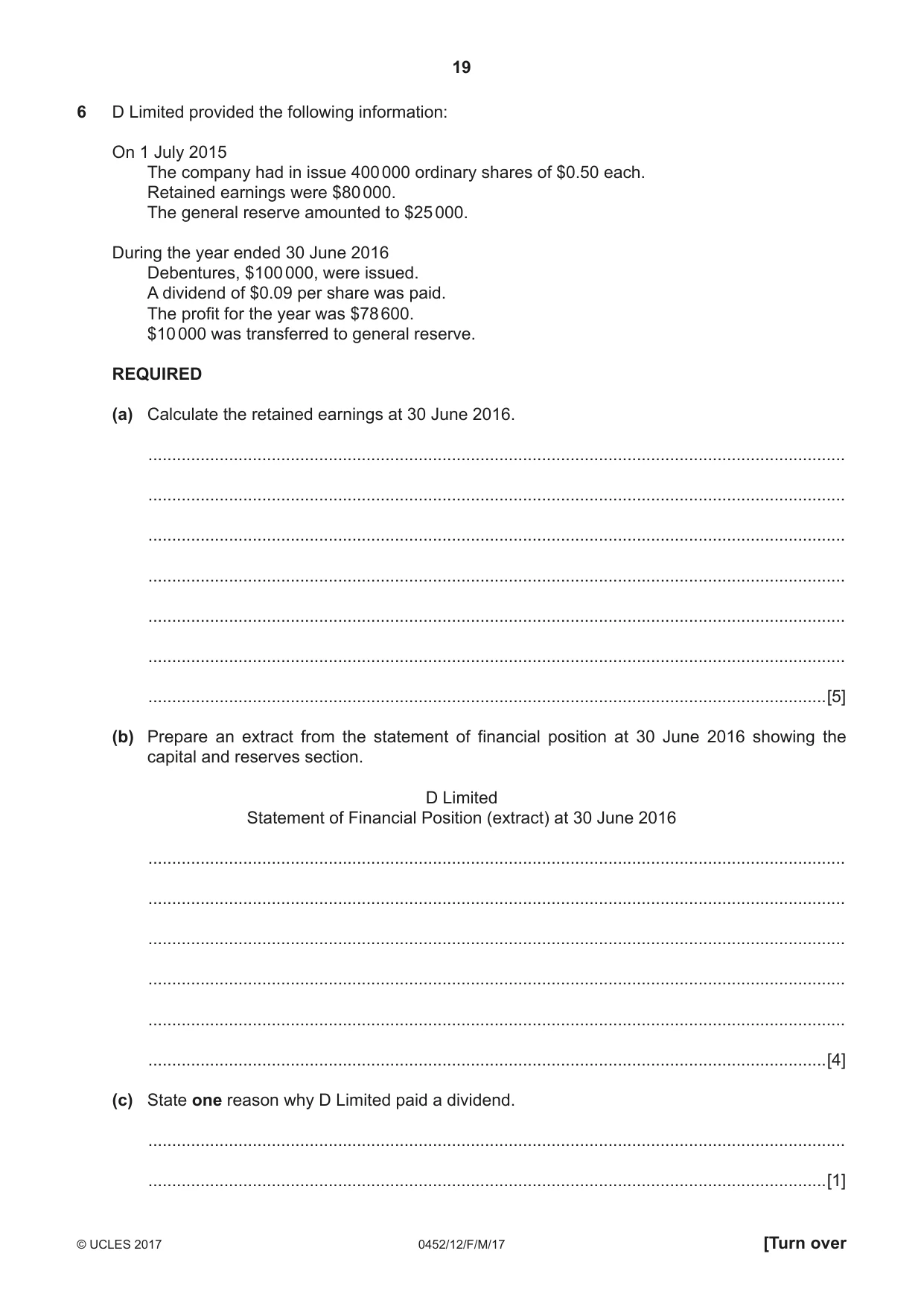
19 0452/12/F/M/17 © UCLES 2017 [Turn over 6 D Limited provided the following information: On 1 July 2015 The company had in issue 400 000 ordinary shares of $0.50 each. Retained earnings were $80 000. The general reserve amounted to $25 000. During the year ended 30 June 2016 Debentures, $100 000, were issued. A dividend of $0.09 per share was paid. The profit for the year was $78 600. $10 000 was transferred to general reserve. REQUIRED (a) Calculate the retained earnings at 30 June 2016. … … … … … … …[5] (b) Prepare an extract from the statement of financial position at 30 June 2016 showing the capital and reserves section. D Limited Statement of Financial Position (extract) at 30 June 2016 … … … … … …[4] (c) State one reason why D Limited paid a dividend. … …[1]
Question paper, page 20
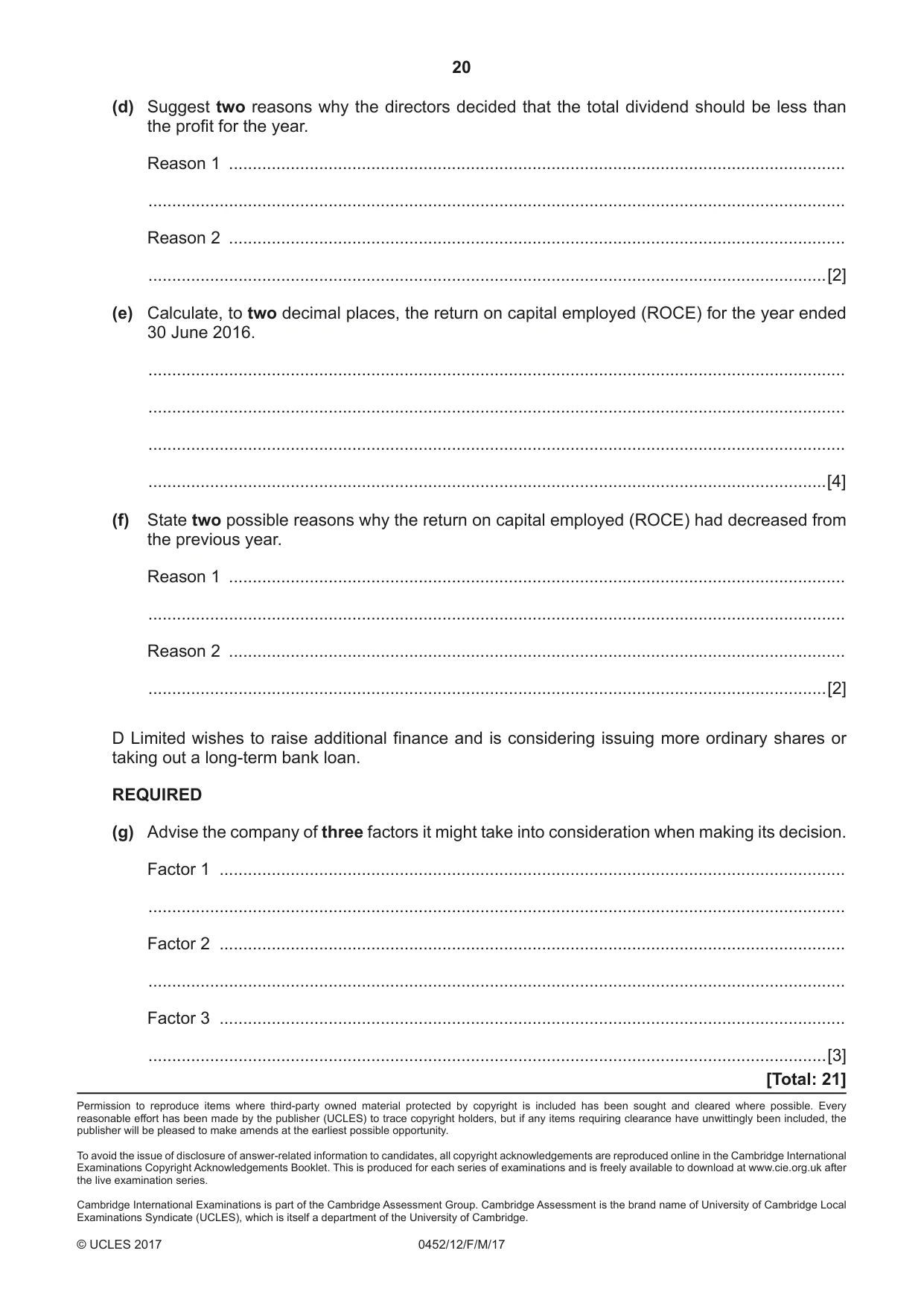
20 0452/12/F/M/17 © UCLES 2017 Permission to reproduce items where third-party owned material protected by copyright is included has been sought and cleared where possible. Every reasonable effort has been made by the publisher (UCLES) to trace copyright holders, but if any items requiring clearance have unwittingly been included, the publisher will be pleased to make amends at the earliest possible opportunity. To avoid the issue of disclosure of answer-related information to candidates, all copyright acknowledgements are reproduced online in the Cambridge International Examinations Copyright Acknowledgements Booklet. This is produced for each series of examinations and is freely available to download at www.cie.org.uk after the live examination series. Cambridge International Examinations is part of the Cambridge Assessment Group. Cambridge Assessment is the brand name of University of Cambridge Local Examinations Syndicate (UCLES), which is itself a department of the University of Cambridge. (d) Suggest two reasons why the directors decided that the total dividend should be less than the profit for the year. Reason 1 … … Reason 2 … …[2] (e) Calculate, to two decimal places, the return on capital employed (ROCE) for the year ended 30 June 2016. … … … …[4] (f) State two possible reasons why the return on capital employed (ROCE) had decreased from the previous year. Reason 1 … … Reason 2 … …[2] D Limited wishes to raise additional finance and is considering issuing more ordinary shares or taking out a long-term bank loan. REQUIRED (g) Advise the company of three factors it might take into consideration when making its decision. Factor 1 … … Factor 2 … … Factor 3 … …[3] [Total: 21]
Mark scheme, page 1
® IGCSE is a registered trademark. This document consists of 8 printed pages. © UCLES 2017 [Turn over Cambridge International Examinations Cambridge International General Certificate of Secondary Education ACCOUNTING 0452/12 Paper 1 March 2017 MARK SCHEME Maximum Mark: 120 Published This mark scheme is published as an aid to teachers and candidates, to indicate the requirements of the examination. It shows the basis on which Examiners were instructed to award marks. It does not indicate the details of the discussions that took place at an Examiners’ meeting before marking began, which would have considered the acceptability of alternative answers. Mark schemes should be read in conjunction with the question paper and the Principal Examiner Report for Teachers. Cambridge will not enter into discussions about these mark schemes. Cambridge is publishing the mark schemes for the March 2017 series for most Cambridge IGCSE®, Cambridge International A and AS Level components and some Cambridge O Level components.
Mark scheme, page 2
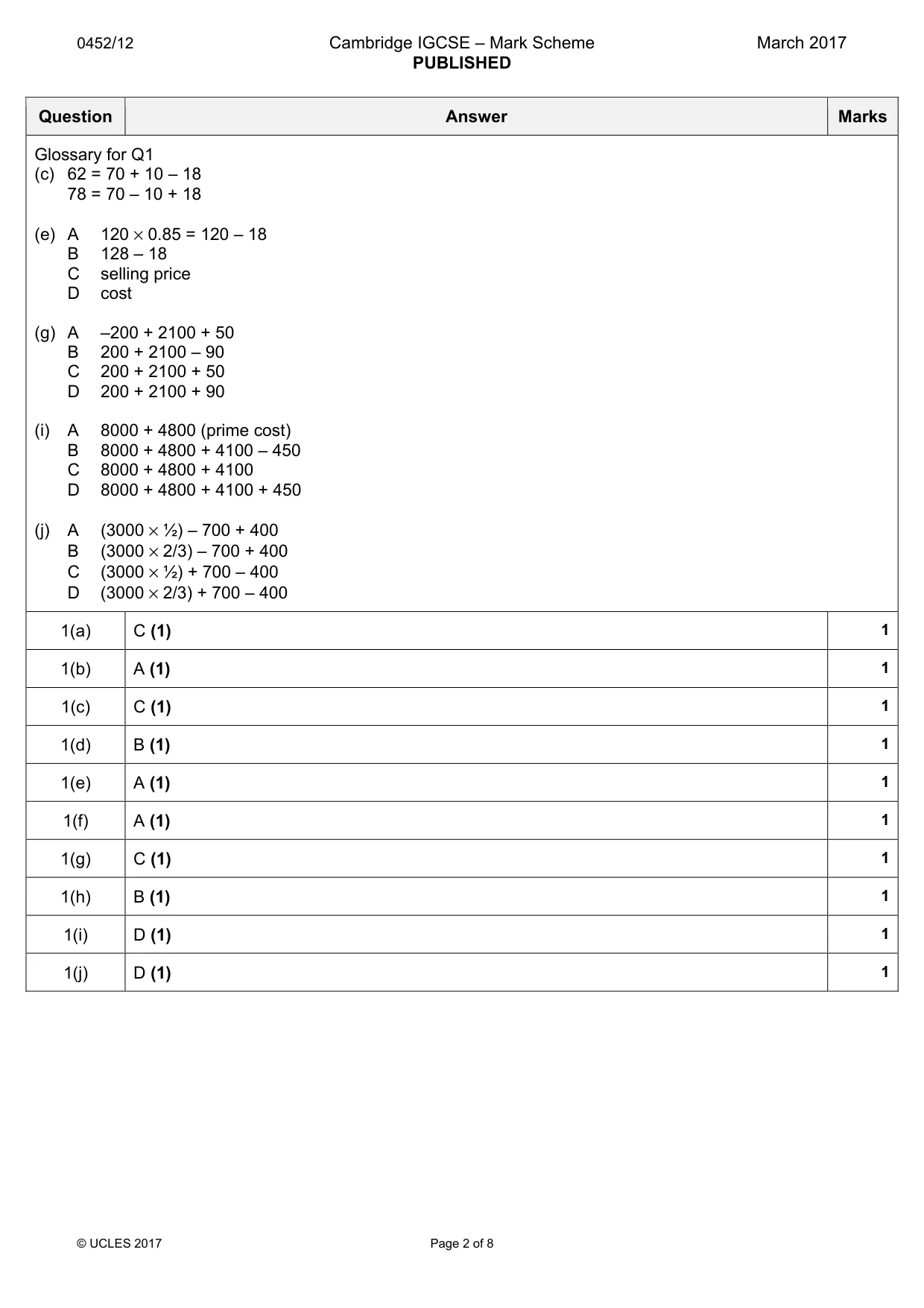
0452/12 Cambridge IGCSE – Mark Scheme PUBLISHED March 2017 © UCLES 2017 Page 2 of 8 Question Answer Marks Glossary for Q1 (c) 62 = 70 + 10 – 18 78 = 70 – 10 + 18 (e) A 120 × 0.85 = 120 – 18 B 128 – 18 C selling price D cost (g) A –200 + 2100 + 50 B 200 + 2100 – 90 C 200 + 2100 + 50 D 200 + 2100 + 90 (i) A 8000 + 4800 (prime cost) B 8000 + 4800 + 4100 – 450 C 8000 + 4800 + 4100 D 8000 + 4800 + 4100 + 450 (j) A (3000 × ½) – 700 + 400 B (3000 × 2/3) – 700 + 400 C (3000 × ½) + 700 – 400 D (3000 × 2/3) + 700 – 400 1(a) C (1) 1 1(b) A (1) 1 1(c) C (1) 1 1(d) B (1) 1 1(e) A (1) 1 1(f) A (1) 1 1(g) C (1) 1 1(h) B (1) 1 1(i) D (1) 1 1(j) D (1) 1
Mark scheme, page 3
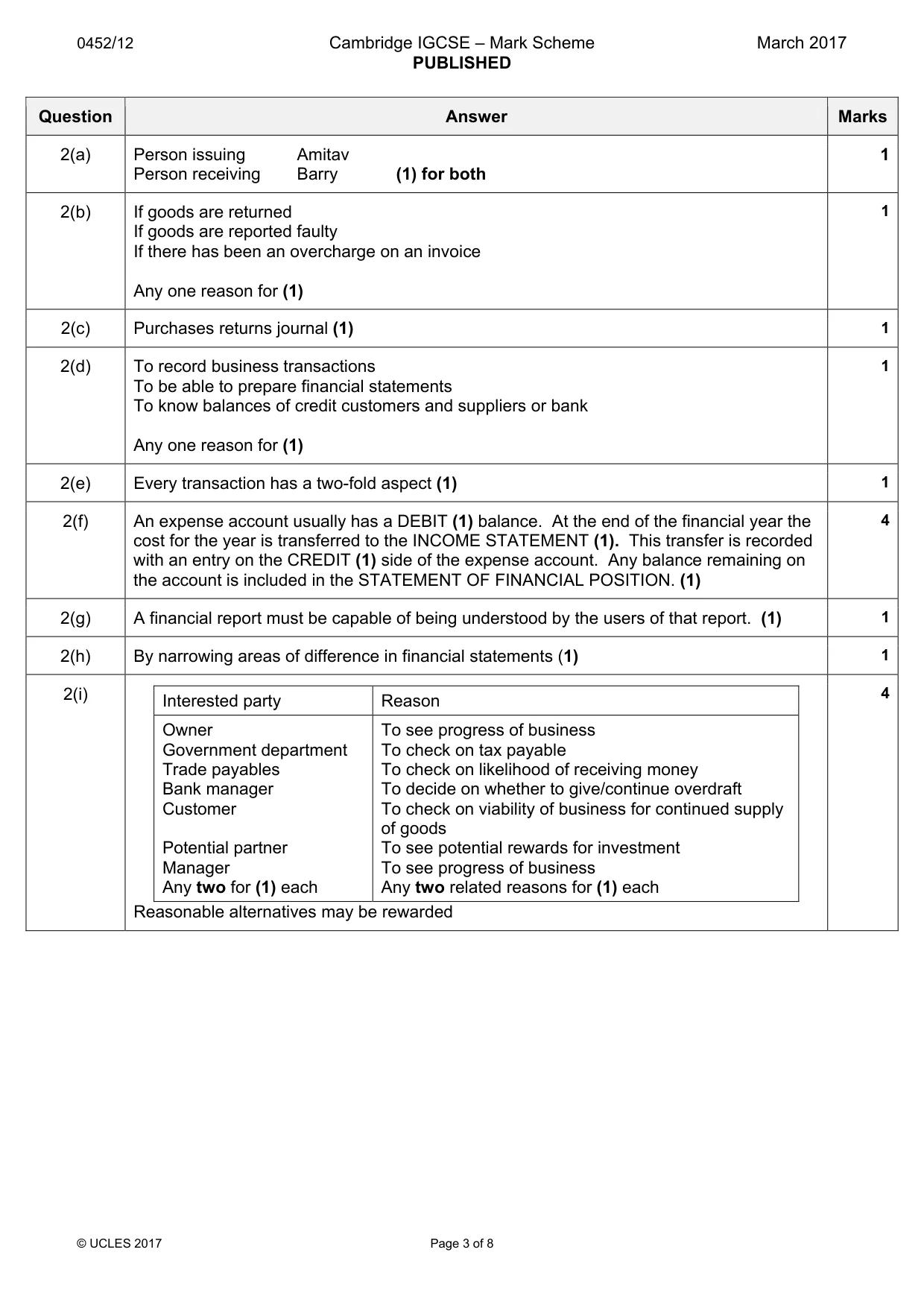
0452/12 Cambridge IGCSE – Mark Scheme PUBLISHED March 2017 © UCLES 2017 Page 3 of 8 Question Answer Marks 2(a) Person issuing Amitav Person receiving Barry (1) for both 1 2(b) If goods are returned If goods are reported faulty If there has been an overcharge on an invoice Any one reason for (1) 1 2(c) Purchases returns journal (1) 1 2(d) To record business transactions To be able to prepare financial statements To know balances of credit customers and suppliers or bank Any one reason for (1) 1 2(e) Every transaction has a two-fold aspect (1) 1 2(f) An expense account usually has a DEBIT (1) balance. At the end of the financial year the cost for the year is transferred to the INCOME STATEMENT (1). This transfer is recorded with an entry on the CREDIT (1) side of the expense account. Any balance remaining on the account is included in the STATEMENT OF FINANCIAL POSITION. (1) 4 2(g) A financial report must be capable of being understood by the users of that report. (1) 1 2(h) By narrowing areas of difference in financial statements (1) 1 2(i) Interested party Reason Owner Government department Trade payables Bank manager Customer Potential partner Manager Any two for (1) each To see progress of business To check on tax payable To check on likelihood of receiving money To decide on whether to give/continue overdraft To check on viability of business for continued supply of goods To see potential rewards for investment To see progress of business Any two related reasons for (1) each Reasonable alternatives may be rewarded 4
Mark scheme, page 4
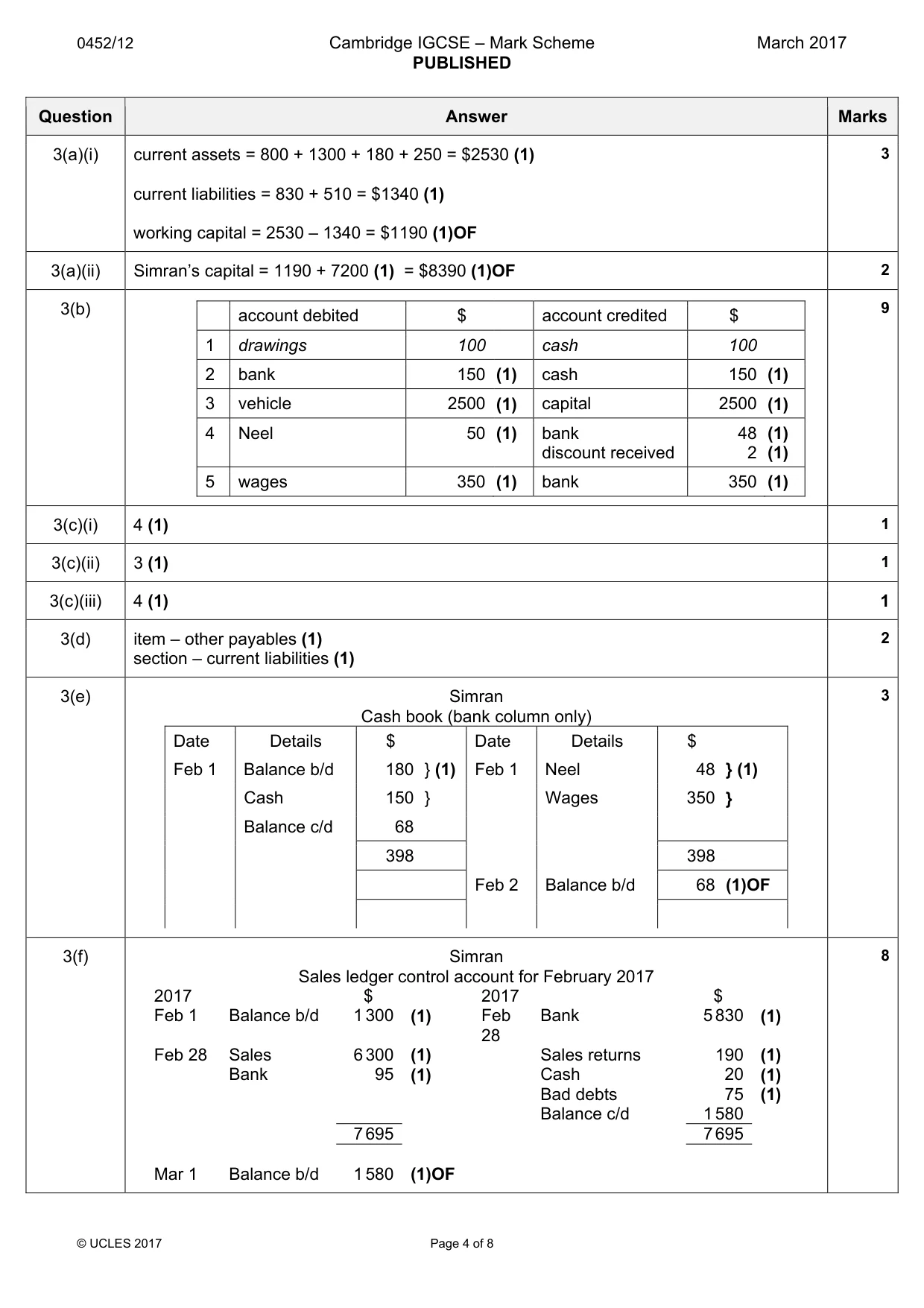
0452/12 Cambridge IGCSE – Mark Scheme PUBLISHED March 2017 © UCLES 2017 Page 4 of 8 Question Answer Marks 3(a)(i) current assets = 800 + 1300 + 180 + 250 = $2530 (1) current liabilities = 830 + 510 = $1340 (1) working capital = 2530 – 1340 = $1190 (1)OF 3 3(a)(ii) Simran’s capital = 1190 + 7200 (1) = $8390 (1)OF 2 3(b) account debited $ account credited $ 1 drawings 100 cash 100 2 bank 150 (1) cash 150 (1) 3 vehicle 2500 (1) capital 2500 (1) 4 Neel 50 (1) bank discount received 48 2 (1) (1) 5 wages 350 (1) bank 350 (1) 9 3(c)(i) 4 (1) 1 3(c)(ii) 3 (1) 1 3(c)(iii) 4 (1) 1 3(d) item – other payables (1) section – current liabilities (1) 2 3(e) Simran Cash book (bank column only) Date Details $ Date Details $ Feb 1 Balance b/d 180 } (1) Feb 1 Neel 48 } (1) Cash 150 } Wages 350 } Balance c/d 68 398 398 Feb 2 Balance b/d 68 (1)OF 3 3(f) Simran Sales ledger control account for February 2017 2017 $ 2017 $ Feb 1 Balance b/d 1 300 (1) Feb 28 Bank 5 830 (1) Feb 28 Sales 6 300 (1) Sales returns 190 (1) Bank 95 (1) Cash 20 (1) Bad debts 75 (1) Balance c/d 1 580 7 695 7 695 Mar 1 Balance b/d 1 580 (1)OF 8
Mark scheme, page 5
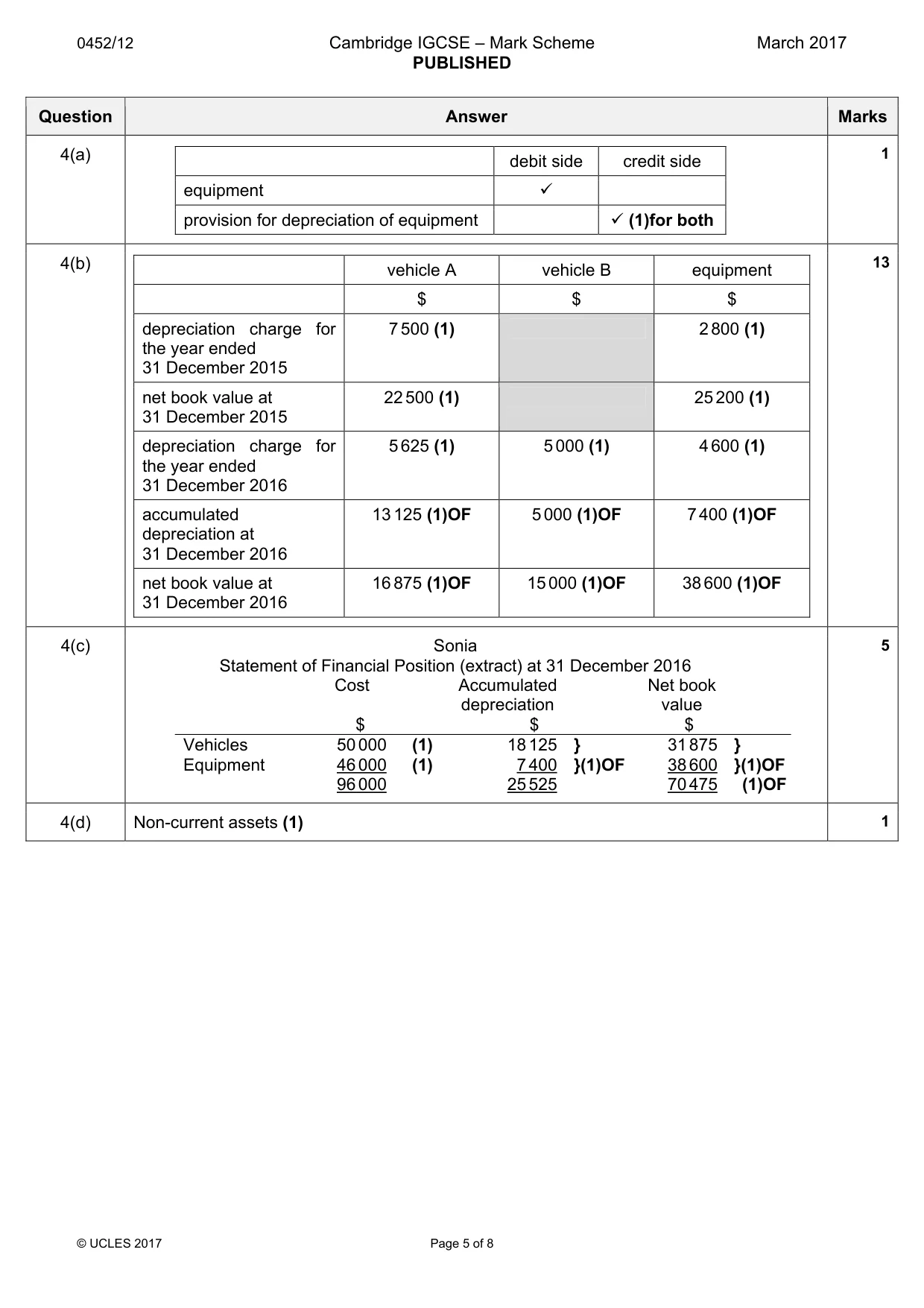
0452/12 Cambridge IGCSE – Mark Scheme PUBLISHED March 2017 © UCLES 2017 Page 5 of 8 Question Answer Marks 4(a) debit side credit side equipment 9 provision for depreciation of equipment 9 (1)for both 1 4(b) vehicle A vehicle B equipment $ $ $ depreciation charge for the year ended 31 December 2015 7 500 (1) 2 800 (1) net book value at 31 December 2015 22 500 (1) 25 200 (1) depreciation charge for the year ended 31 December 2016 5 625 (1) 5 000 (1) 4 600 (1) accumulated depreciation at 31 December 2016 13 125 (1)OF 5 000 (1)OF 7 400 (1)OF net book value at 31 December 2016 16 875 (1)OF 15 000 (1)OF 38 600 (1)OF 13 4(c) Sonia Statement of Financial Position (extract) at 31 December 2016 Cost Accumulated depreciation Net book value $ $ $ Vehicles 50 000 (1) 18 125 } 31 875 } Equipment 46 000 (1) 7 400 }(1)OF 38 600 }(1)OF 96 000 25 525 70 475 (1)OF 5 4(d) Non-current assets (1) 1
Mark scheme, page 6
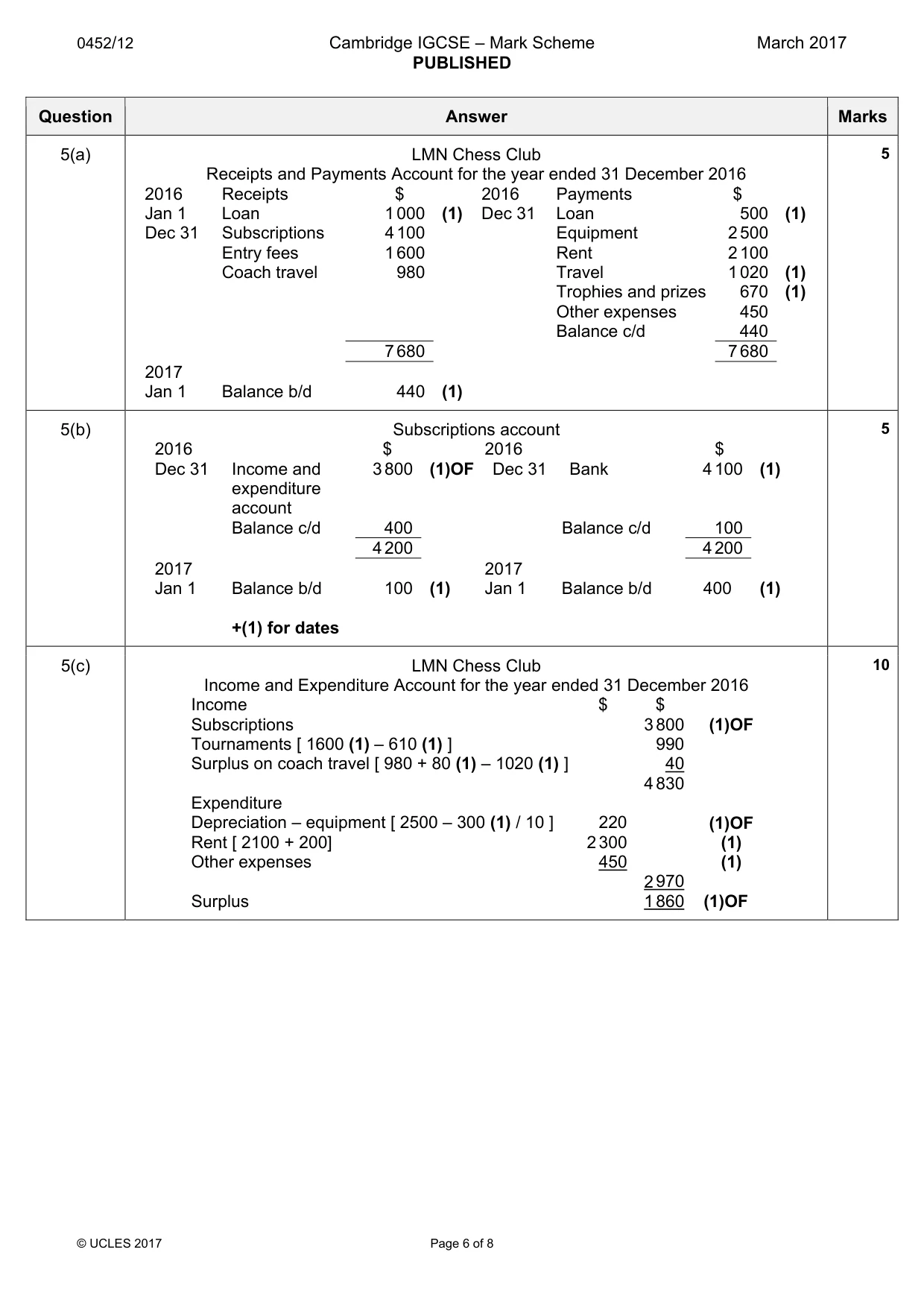
0452/12 Cambridge IGCSE – Mark Scheme PUBLISHED March 2017 © UCLES 2017 Page 6 of 8 Question Answer Marks 5(a) LMN Chess Club Receipts and Payments Account for the year ended 31 December 2016 2016 Receipts $ 2016 Payments $ Jan 1 Loan 1 000 (1) Dec 31 Loan 500 (1) Dec 31 Subscriptions 4 100 Equipment 2 500 Entry fees 1 600 Rent 2 100 Coach travel 980 Travel 1 020 (1) Trophies and prizes 670 (1) Other expenses 450 Balance c/d 440 7 680 7 680 2017 Jan 1 Balance b/d 440 (1) 5 5(b) Subscriptions account 2016 $ 2016 $ Dec 31 Income and expenditure account 3 800 (1)OF Dec 31 Bank 4 100 (1) Balance c/d 400 Balance c/d 100 4 200 4 200 2017 Jan 1 Balance b/d +(1) for dates 100 (1) 2017 Jan 1 Balance b/d 400 (1) 5 5(c) LMN Chess Club Income and Expenditure Account for the year ended 31 December 2016 Income $ $ Subscriptions 3 800 (1)OF Tournaments [ 1600 (1) – 610 (1) ] 990 Surplus on coach travel [ 980 + 80 (1) – 1020 (1) ] 40 4 830 Expenditure Depreciation – equipment [ 2500 – 300 (1) / 10 ] 220 (1)OF Rent [ 2100 + 200] 2 300 (1) Other expenses 450 (1) 2 970 Surplus 1 860 (1)OF 10
Mark scheme, page 7
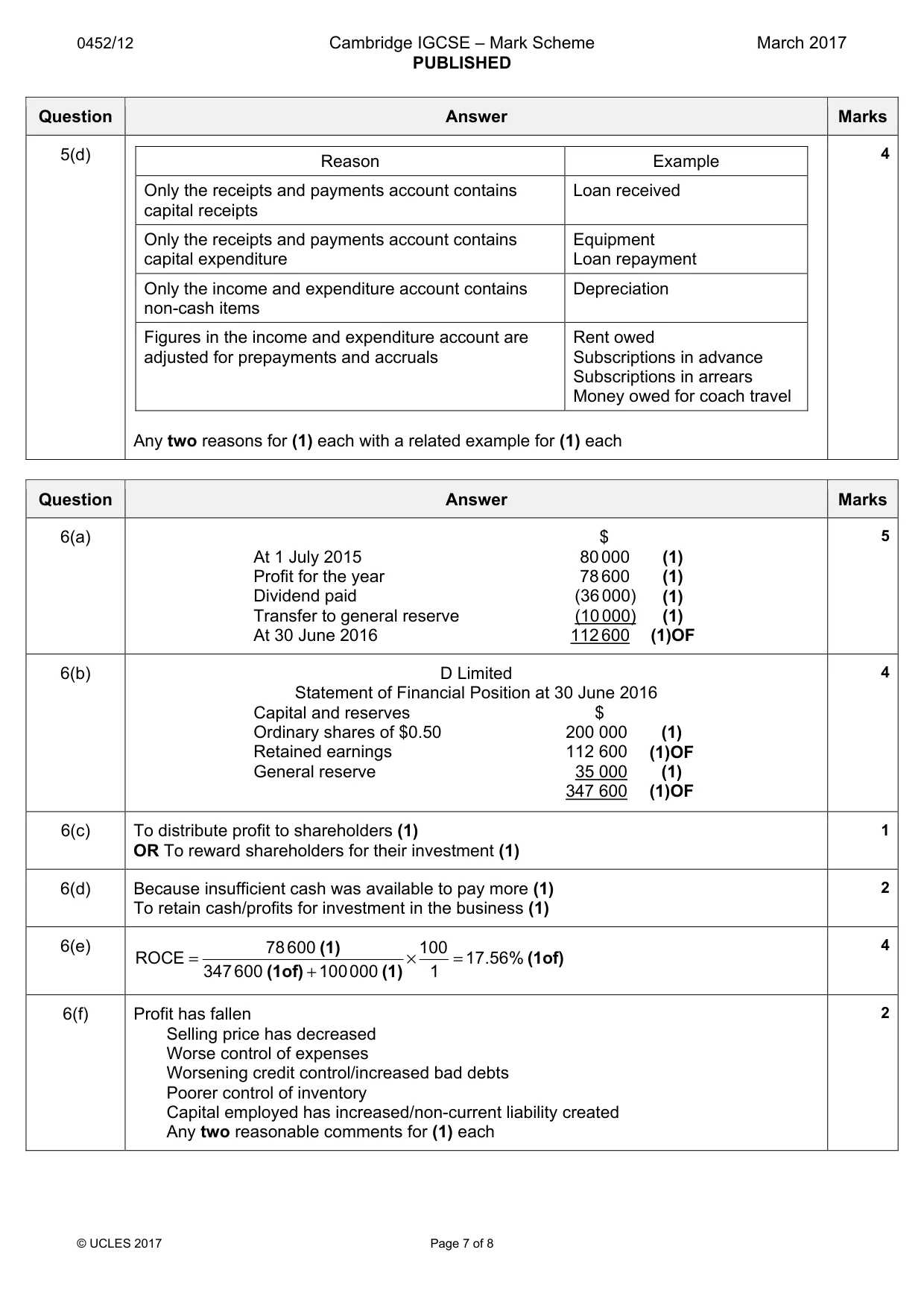
0452/12 Cambridge IGCSE – Mark Scheme PUBLISHED March 2017 © UCLES 2017 Page 7 of 8 Question Answer Marks 5(d) Reason Example Only the receipts and payments account contains capital receipts Loan received Only the receipts and payments account contains capital expenditure Equipment Loan repayment Only the income and expenditure account contains non-cash items Depreciation Figures in the income and expenditure account are adjusted for prepayments and accruals Rent owed Subscriptions in advance Subscriptions in arrears Money owed for coach travel Any two reasons for (1) each with a related example for (1) each 4 Question Answer Marks 6(a) $ At 1 July 2015 80 000 (1) Profit for the year 78 600 (1) Dividend paid (36 000) (1) Transfer to general reserve (10 000) (1) At 30 June 2016 112 600 (1)OF 5 6(b) D Limited Statement of Financial Position at 30 June 2016 Capital and reserves $ Ordinary shares of $0.50 200 000 (1) Retained earnings 112 600 (1)OF General reserve 35 000 (1) 347 600 (1)OF 4 6(c) To distribute profit to shareholders (1) OR To reward shareholders for their investment (1) 1 6(d) Because insufficient cash was available to pay more (1) To retain cash/profits for investment in the business (1) 2 6(e) = × = + 78600 100 ROCE 17.56% 347600 100000 1 (1) (1of) (1of) (1) 4 6(f) Profit has fallen Selling price has decreased Worse control of expenses Worsening credit control/increased bad debts Poorer control of inventory Capital employed has increased/non-current liability created Any two reasonable comments for (1) each 2
Mark scheme, page 8
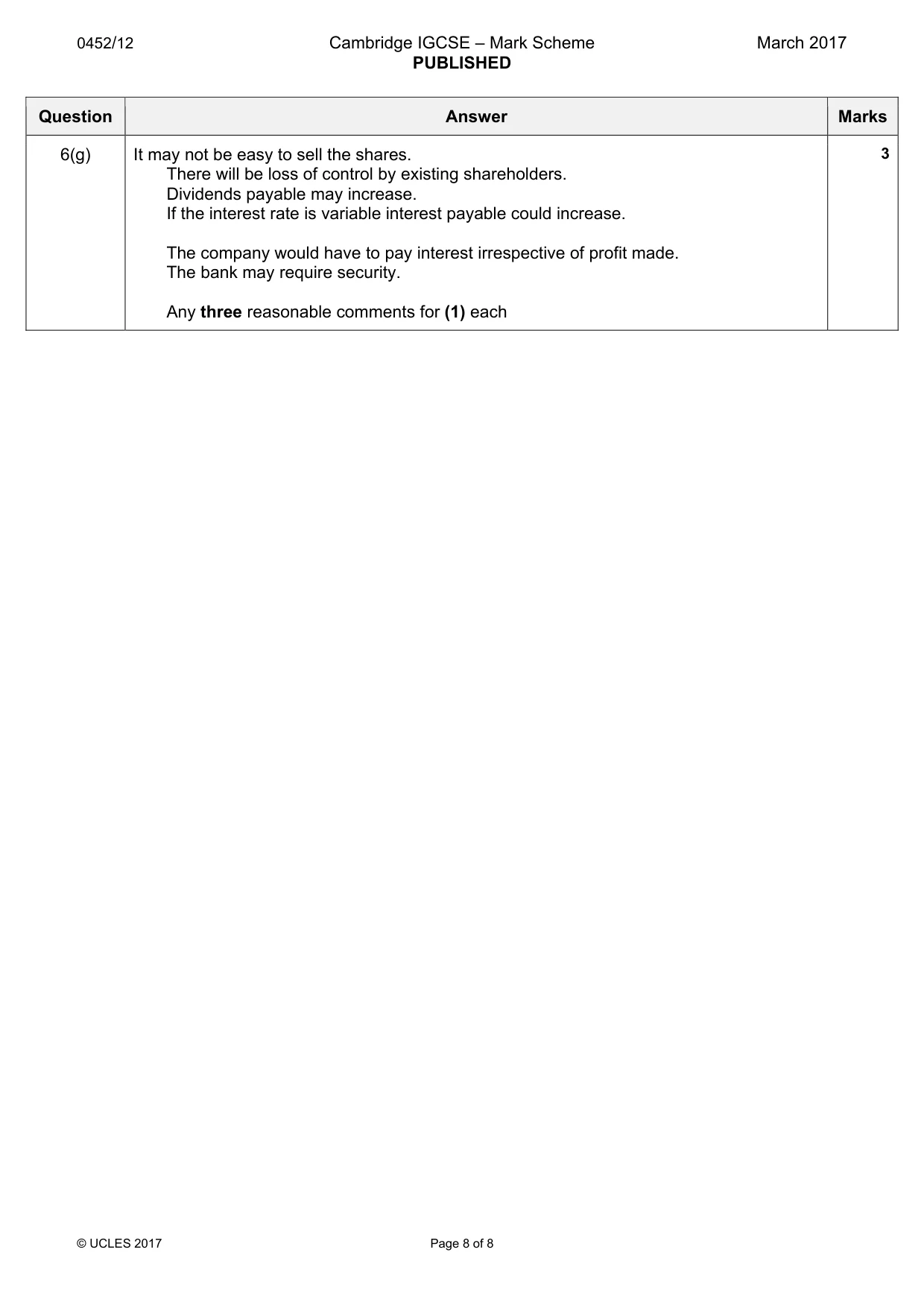
0452/12 Cambridge IGCSE – Mark Scheme PUBLISHED March 2017 © UCLES 2017 Page 8 of 8 Question Answer Marks 6(g) It may not be easy to sell the shares. There will be loss of control by existing shareholders. Dividends payable may increase. If the interest rate is variable interest payable could increase. The company would have to pay interest irrespective of profit made. The bank may require security. Any three reasonable comments for (1) each 3
What you needed in this session
Cambridge’s own grade thresholds for 2017 Feb/March, Paper 1 · Variant 2. A higher threshold means an easier paper — the bar moves with how the cohort did.