Cambridge IGCSE Accounting 0452 — 2016 Oct/Nov Paper 1 · Variant 3
0452/13/O/N/16 · 120 marks · ≈135 min
The question paper and its mark scheme, free to read here and free to download. This is Cambridge’s own paper, exactly as it was sat.
Question paper24 pages
Mark scheme10 pages
Answers below. Sit the paper first if you are practising.
Paper as text
Question paper, page 1
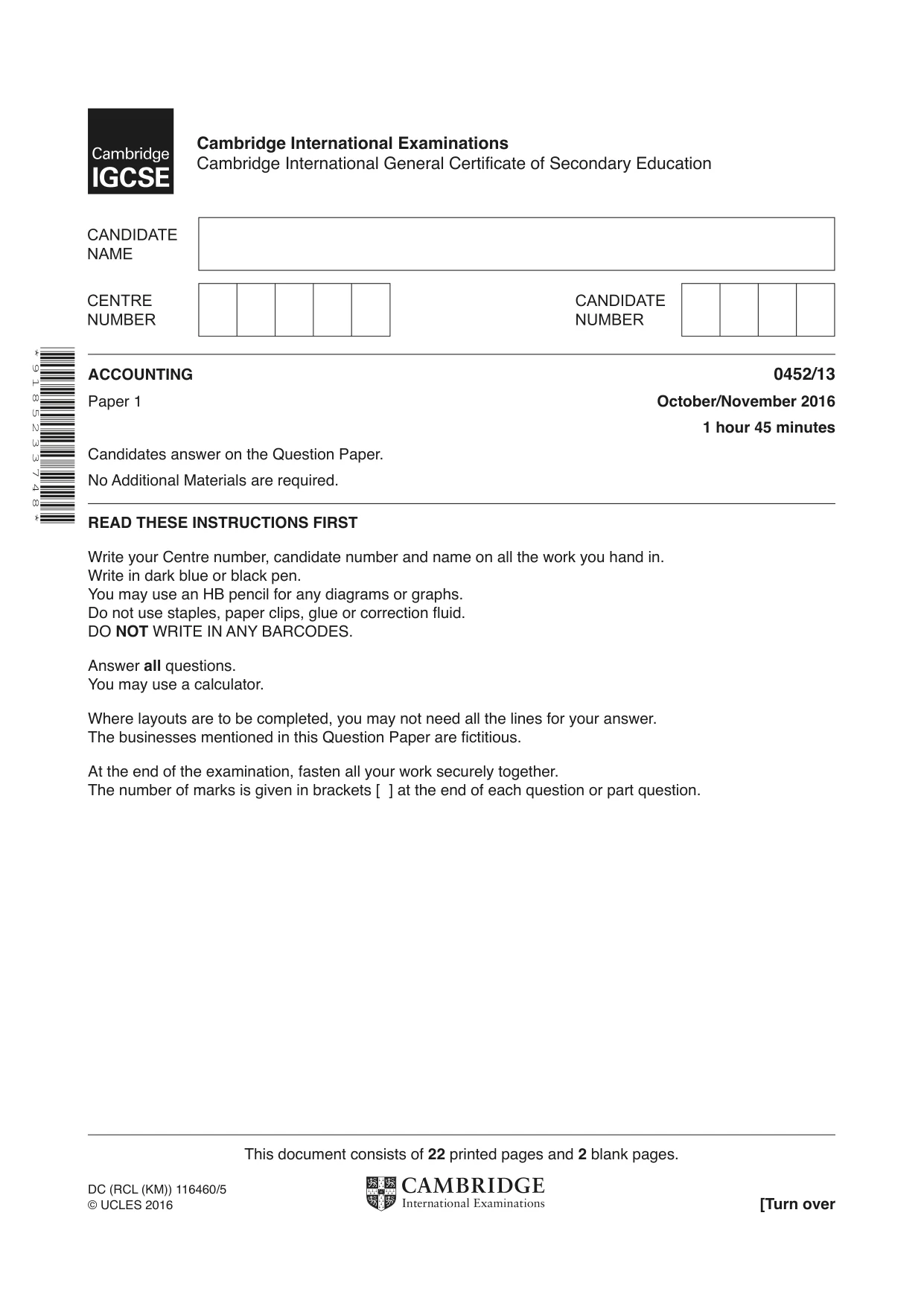
This document consists of 22 printed pages and 2 blank pages. DC (RCL (KM)) 116460/5 © UCLES 2016 [Turn over Cambridge International Examinations Cambridge International General Certificate of Secondary Education * 9 1 8 5 2 3 3 7 4 8 * ACCOUNTING 0452/13 Paper 1 October/November 2016 1 hour 45 minutes Candidates answer on the Question Paper. No Additional Materials are required. READ THESE INSTRUCTIONS FIRST Write your Centre number, candidate number and name on all the work you hand in. Write in dark blue or black pen. You may use an HB pencil for any diagrams or graphs. Do not use staples, paper clips, glue or correction fluid. DO NOT WRITE IN ANY BARCODES. Answer all questions. You may use a calculator. Where layouts are to be completed, you may not need all the lines for your answer. The businesses mentioned in this Question Paper are fictitious. At the end of the examination, fasten all your work securely together. The number of marks is given in brackets [ ] at the end of each question or part question.
Question paper, page 2
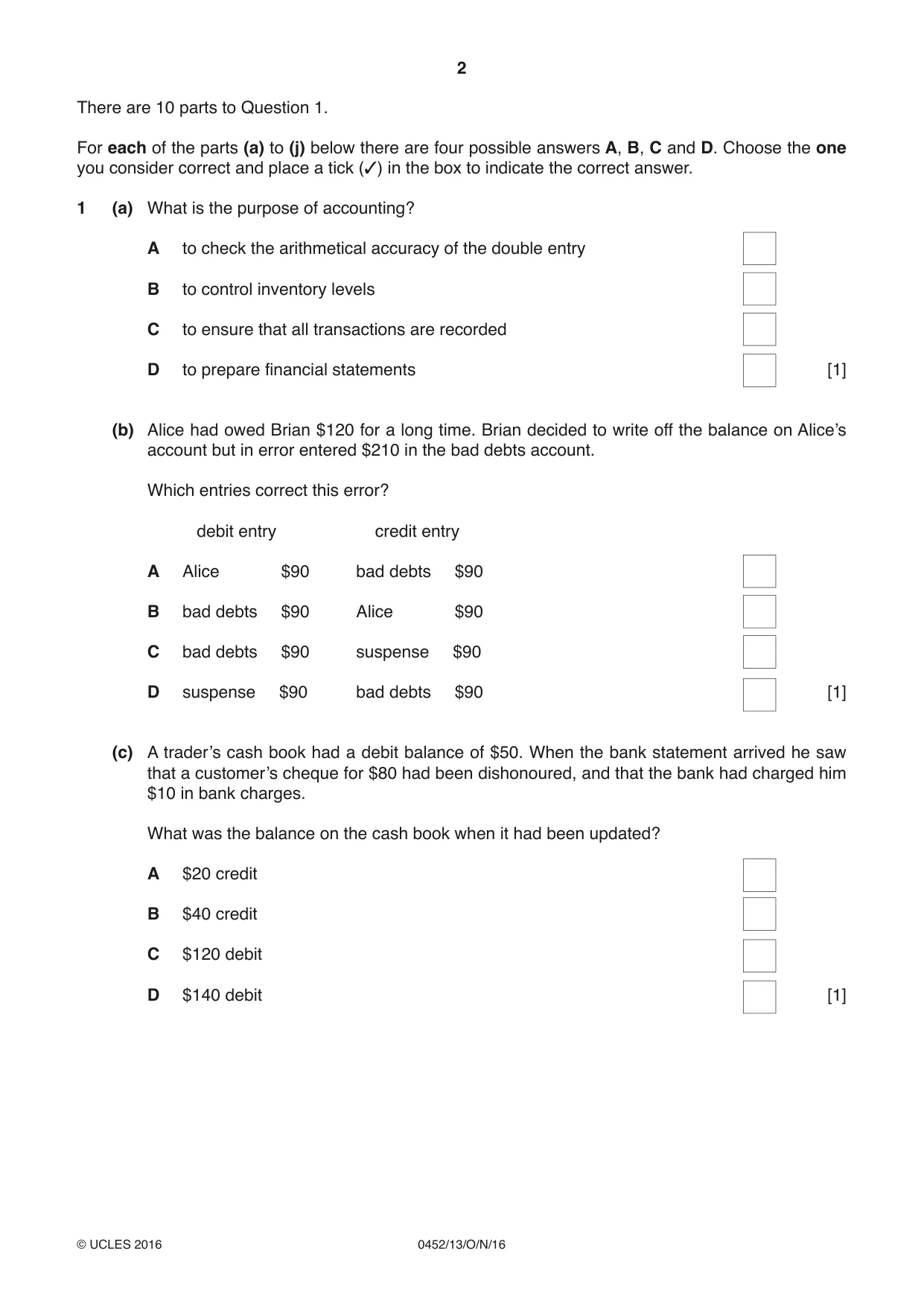
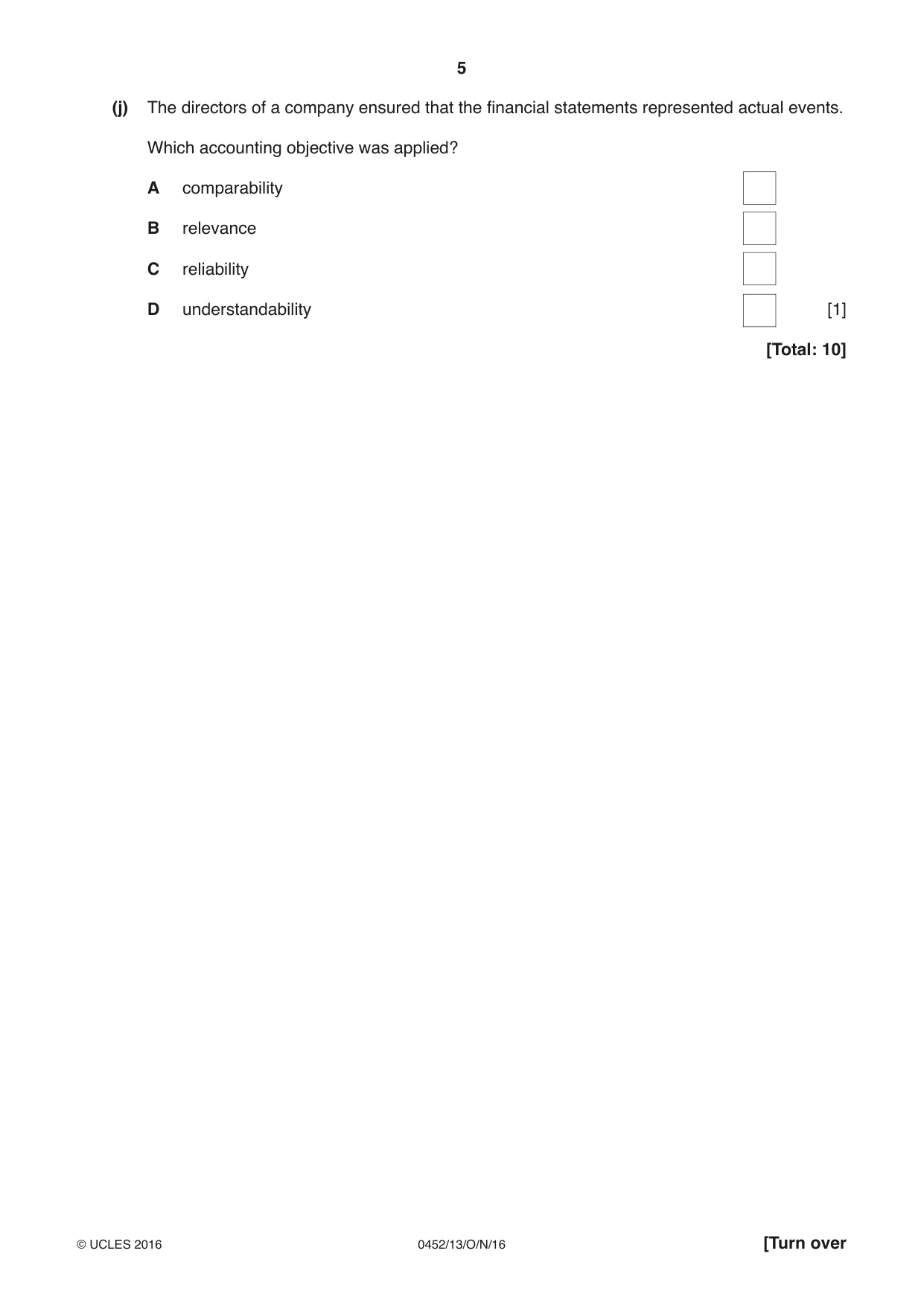
2 0452/13/O/N/16 © UCLES 2016 There are 10 parts to Question 1. For each of the parts (a) to (j) below there are four possible answers A, B, C and D. Choose the one you consider correct and place a tick (✓) in the box to indicate the correct answer. 1 (a) What is the purpose of accounting? A to check the arithmetical accuracy of the double entry B to control inventory levels C to ensure that all transactions are recorded D to prepare financial statements [1] (b) Alice had owed Brian $120 for a long time. Brian decided to write off the balance on Alice’s account but in error entered $210 in the bad debts account. Which entries correct this error? debit entry credit entry A Alice $90 bad debts $90 B bad debts $90 Alice $90 C bad debts $90 suspense $90 D suspense $90 bad debts $90 [1] (c) A trader’s cash book had a debit balance of $50. When the bank statement arrived he saw that a customer’s cheque for $80 had been dishonoured, and that the bank had charged him $10 in bank charges. What was the balance on the cash book when it had been updated? A $20 credit B $40 credit C $120 debit D $140 debit [1]
Question paper, page 3
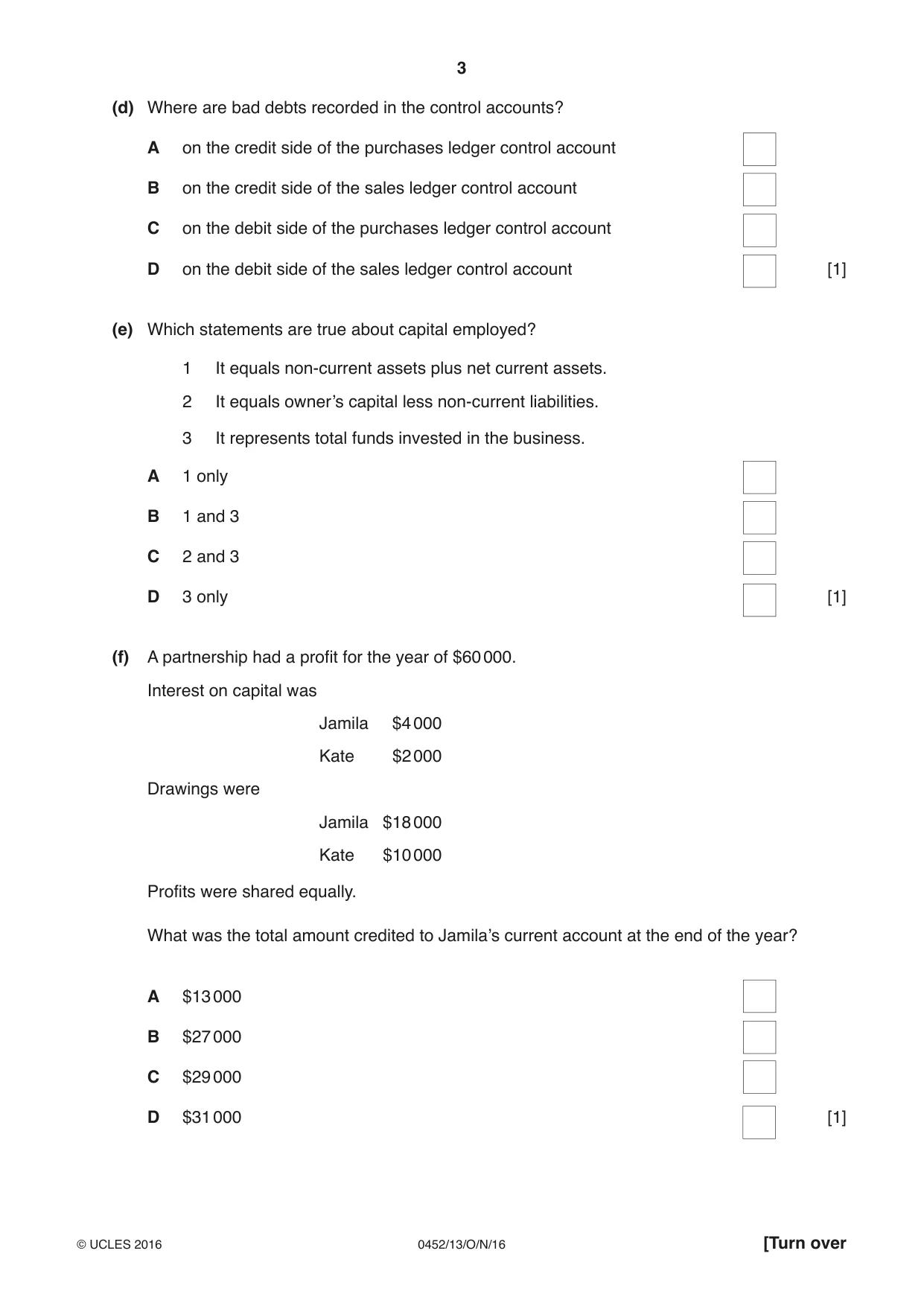
3 0452/13/O/N/16 © UCLES 2016 [Turn over (d) Where are bad debts recorded in the control accounts? A on the credit side of the purchases ledger control account B on the credit side of the sales ledger control account C on the debit side of the purchases ledger control account D on the debit side of the sales ledger control account [1] (e) Which statements are true about capital employed? 1 It equals non-current assets plus net current assets. 2 It equals owner’s capital less non-current liabilities. 3 It represents total funds invested in the business. A 1 only B 1 and 3 C 2 and 3 D 3 only [1] (f) A partnership had a profit for the year of $60 000. Interest on capital was Jamila $4 000 Kate $2 000 Drawings were Jamila $18 000 Kate $10 000 Profits were shared equally. What was the total amount credited to Jamila’s current account at the end of the year? A $13 000 B $27 000 C $29 000 D $31 000 [1]
Question paper, page 4
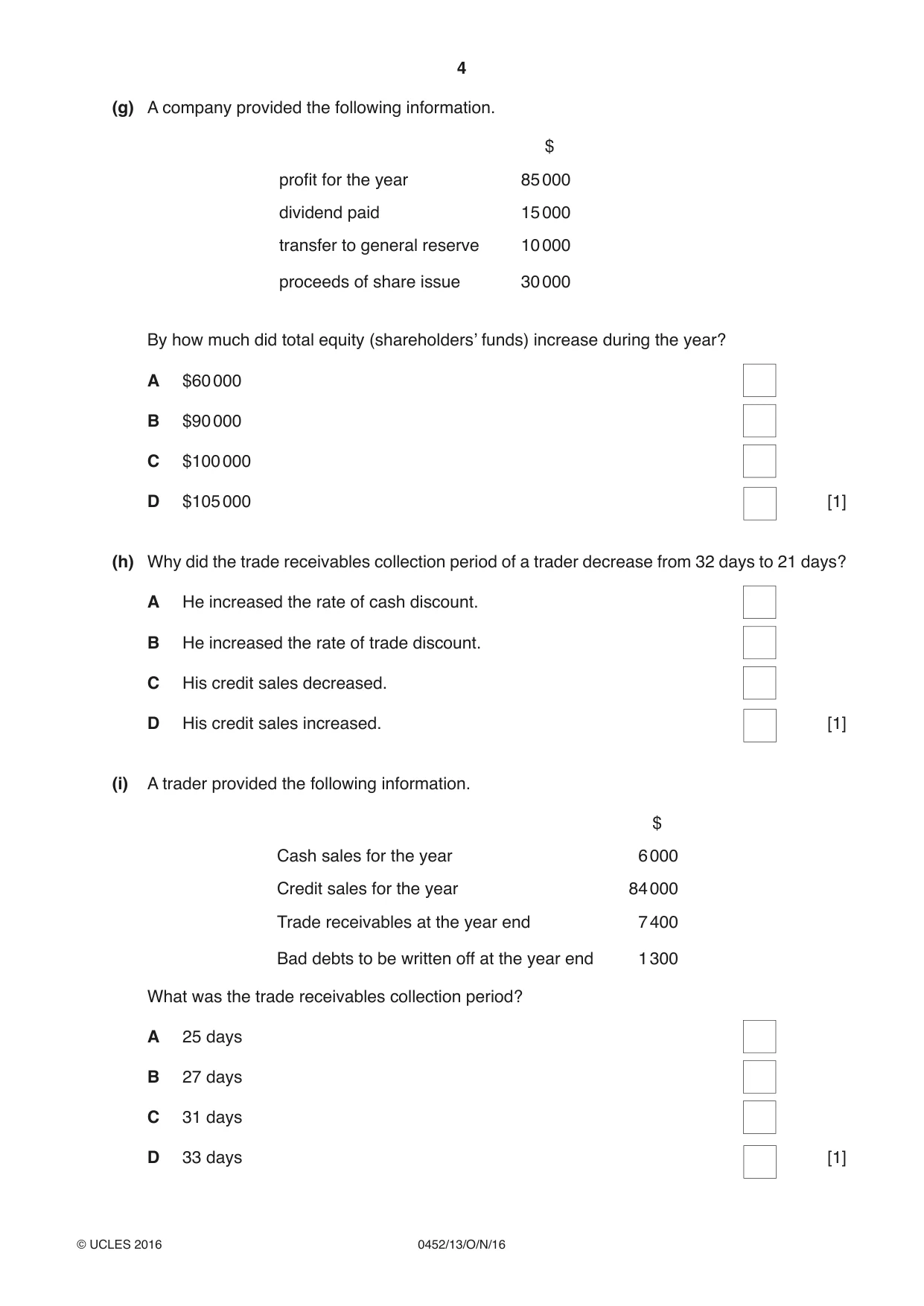
4 0452/13/O/N/16 © UCLES 2016 (g) A company provided the following information. $ profit for the year 85 000 dividend paid 15 000 transfer to general reserve 10 000 proceeds of share issue 30 000 By how much did total equity (shareholders’ funds) increase during the year? A $60 000 B $90 000 C $100 000 D $105 000 [1] (h) Why did the trade receivables collection period of a trader decrease from 32 days to 21 days? A He increased the rate of cash discount. B He increased the rate of trade discount. C His credit sales decreased. D His credit sales increased. [1] (i) A trader provided the following information. $ Cash sales for the year 6 000 Credit sales for the year 84 000 Trade receivables at the year end 7 400 Bad debts to be written off at the year end 1 300 What was the trade receivables collection period? A 25 days B 27 days C 31 days D 33 days [1]
Question paper, page 5
5 0452/13/O/N/16 © UCLES 2016 [Turn over (j) The directors of a company ensured that the financial statements represented actual events. Which accounting objective was applied? A comparability B relevance C reliability D understandability [1] [Total: 10]
Question paper, page 6
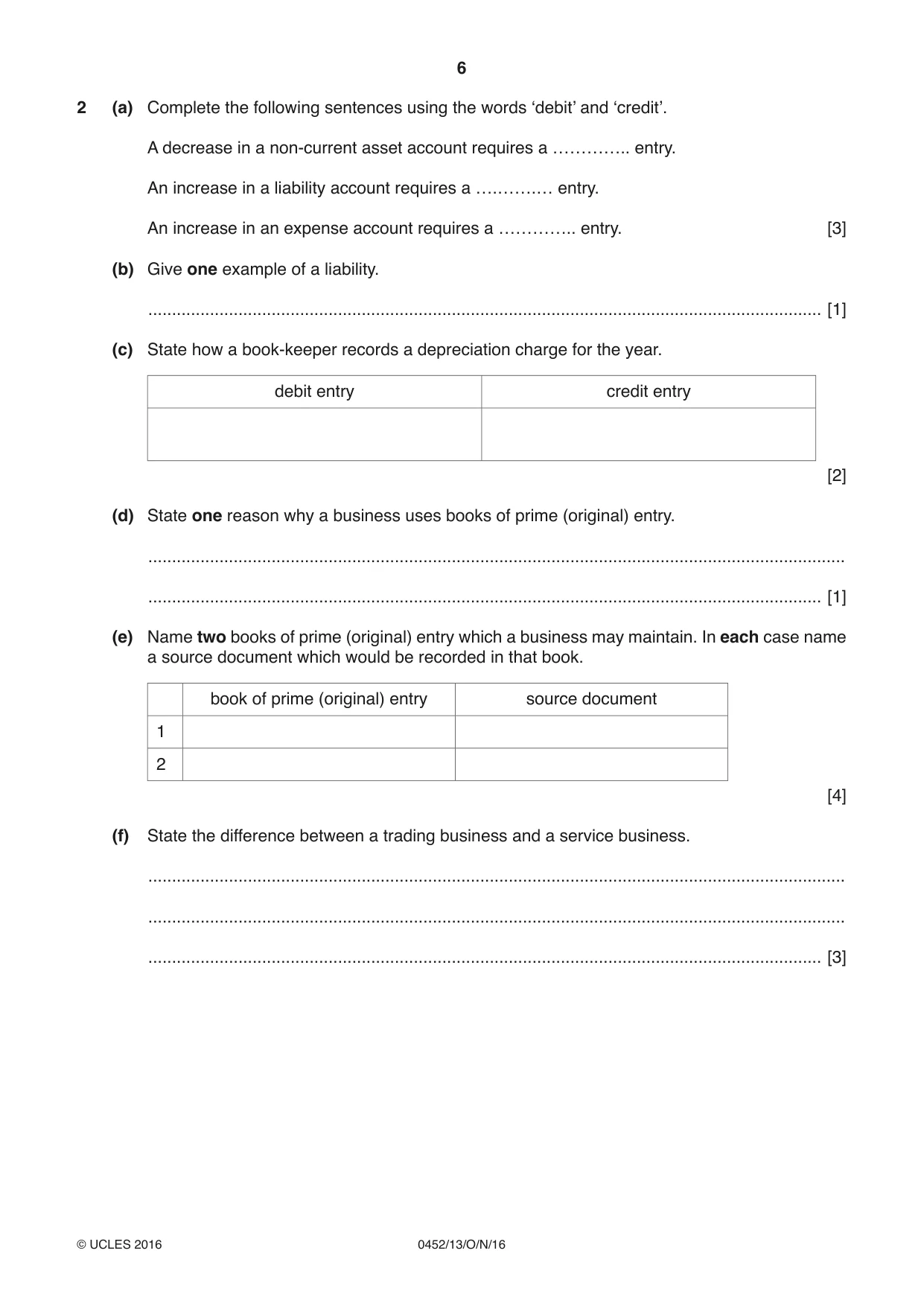
6 0452/13/O/N/16 © UCLES 2016 2 (a) Complete the following sentences using the words ‘debit’ and ‘credit’. A decrease in a non-current asset account requires a ………….. entry. An increase in a liability account requires a ….…….… entry. An increase in an expense account requires a ………….. entry. [3] (b) Give one example of a liability. … [1] (c) State how a book-keeper records a depreciation charge for the year. debit entry credit entry [2] (d) State one reason why a business uses books of prime (original) entry. … … [1] (e) Name two books of prime (original) entry which a business may maintain. In each case name a source document which would be recorded in that book. book of prime (original) entry source document 1 2 [4] (f) State the difference between a trading business and a service business. … … … [3]
Question paper, page 7
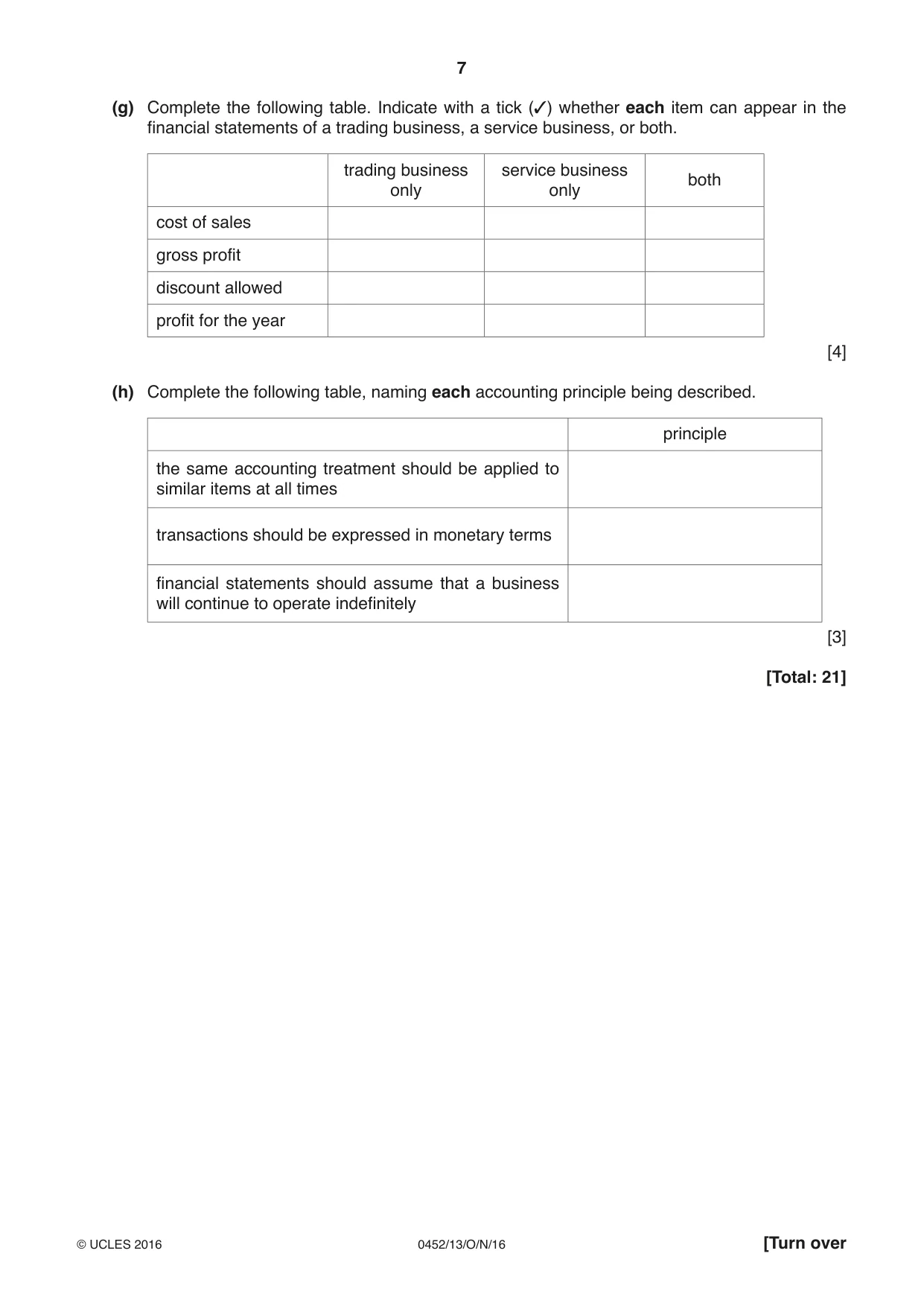
7 0452/13/O/N/16 © UCLES 2016 [Turn over (g) Complete the following table. Indicate with a tick (✓) whether each item can appear in the financial statements of a trading business, a service business, or both. trading business only service business only both cost of sales gross profit discount allowed profit for the year [4] (h) Complete the following table, naming each accounting principle being described. principle the same accounting treatment should be applied to similar items at all times transactions should be expressed in monetary terms financial statements should assume that a business will continue to operate indefinitely [3] [Total: 21]
Question paper, page 8
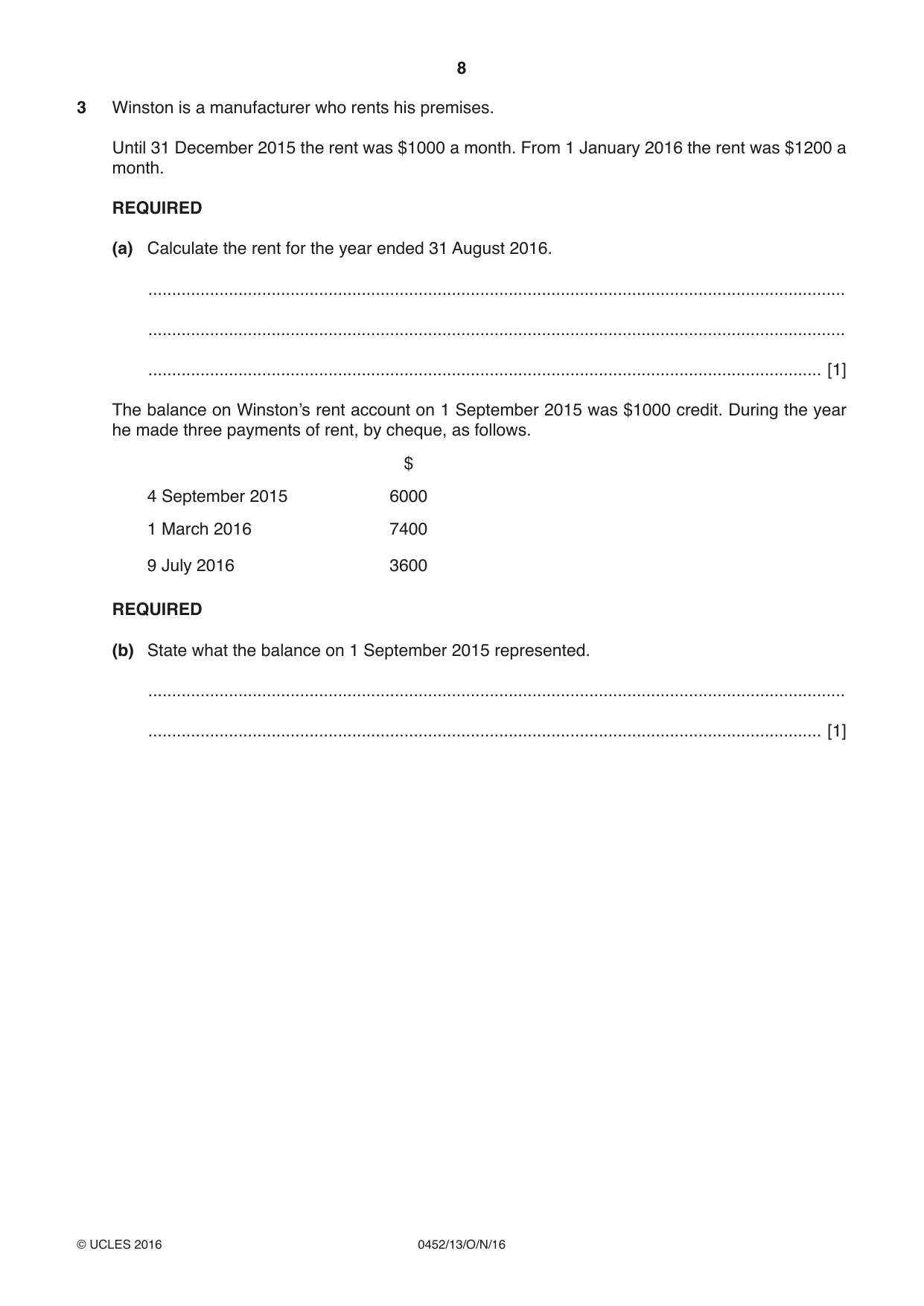
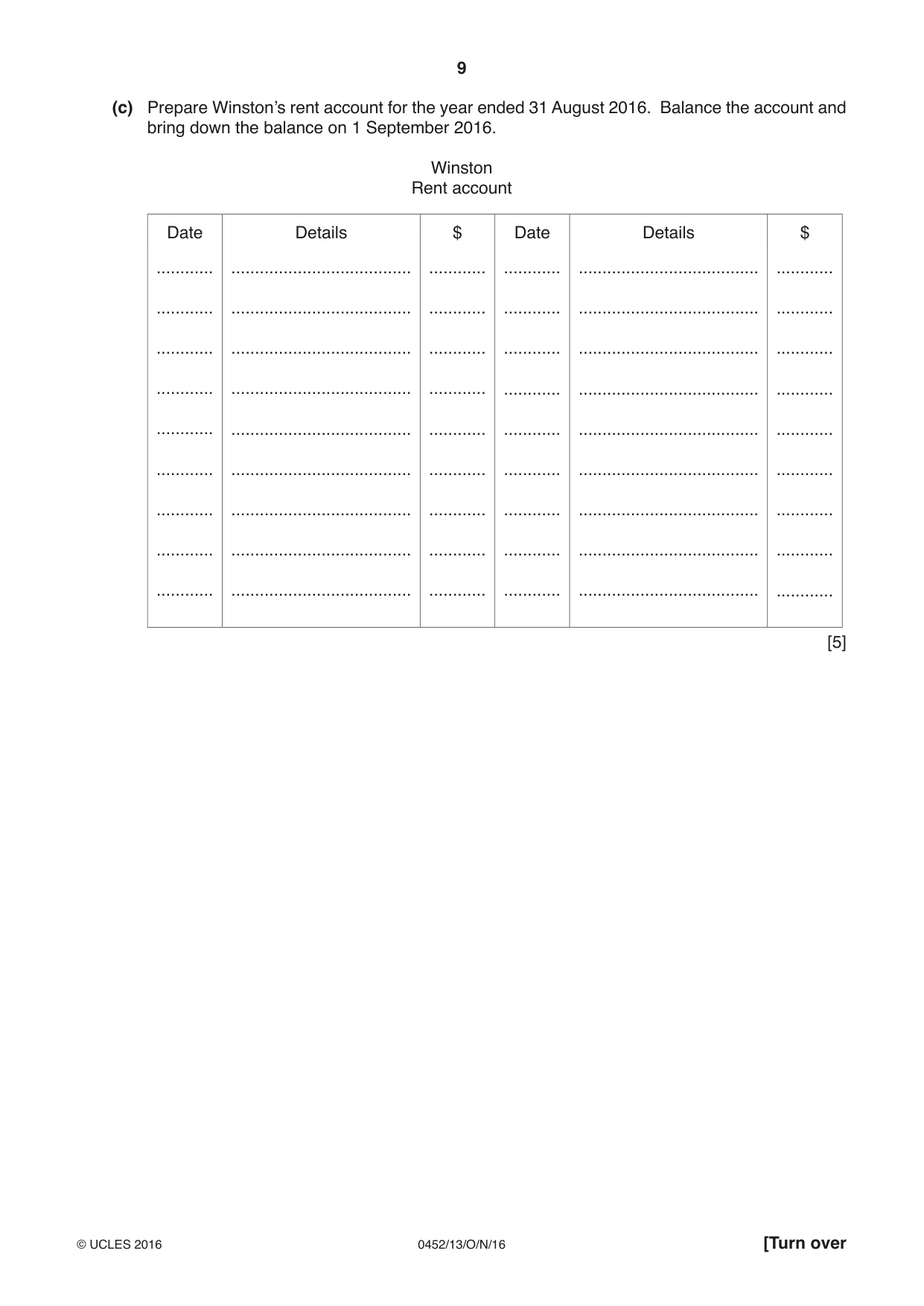
8 0452/13/O/N/16 © UCLES 2016 3 Winston is a manufacturer who rents his premises. Until 31 December 2015 the rent was $1000 a month. From 1 January 2016 the rent was $1200 a month. REQUIRED (a) Calculate the rent for the year ended 31 August 2016. … … … [1] The balance on Winston’s rent account on 1 September 2015 was $1000 credit. During the year he made three payments of rent, by cheque, as follows. $ 4 September 2015 6000 1 March 2016 7400 9 July 2016 3600 REQUIRED (b) State what the balance on 1 September 2015 represented. … … [1]
Question paper, page 9
9 0452/13/O/N/16 © UCLES 2016 [Turn over (c) Prepare Winston’s rent account for the year ended 31 August 2016. Balance the account and bring down the balance on 1 September 2016. Winston Rent account Date Details $ Date Details $ … … … … … … … … … … … … … … … … … … … … … … … … … … … … … … … … … … … … … … … … … … … … … … … … … … … … … … [5]
Question paper, page 10
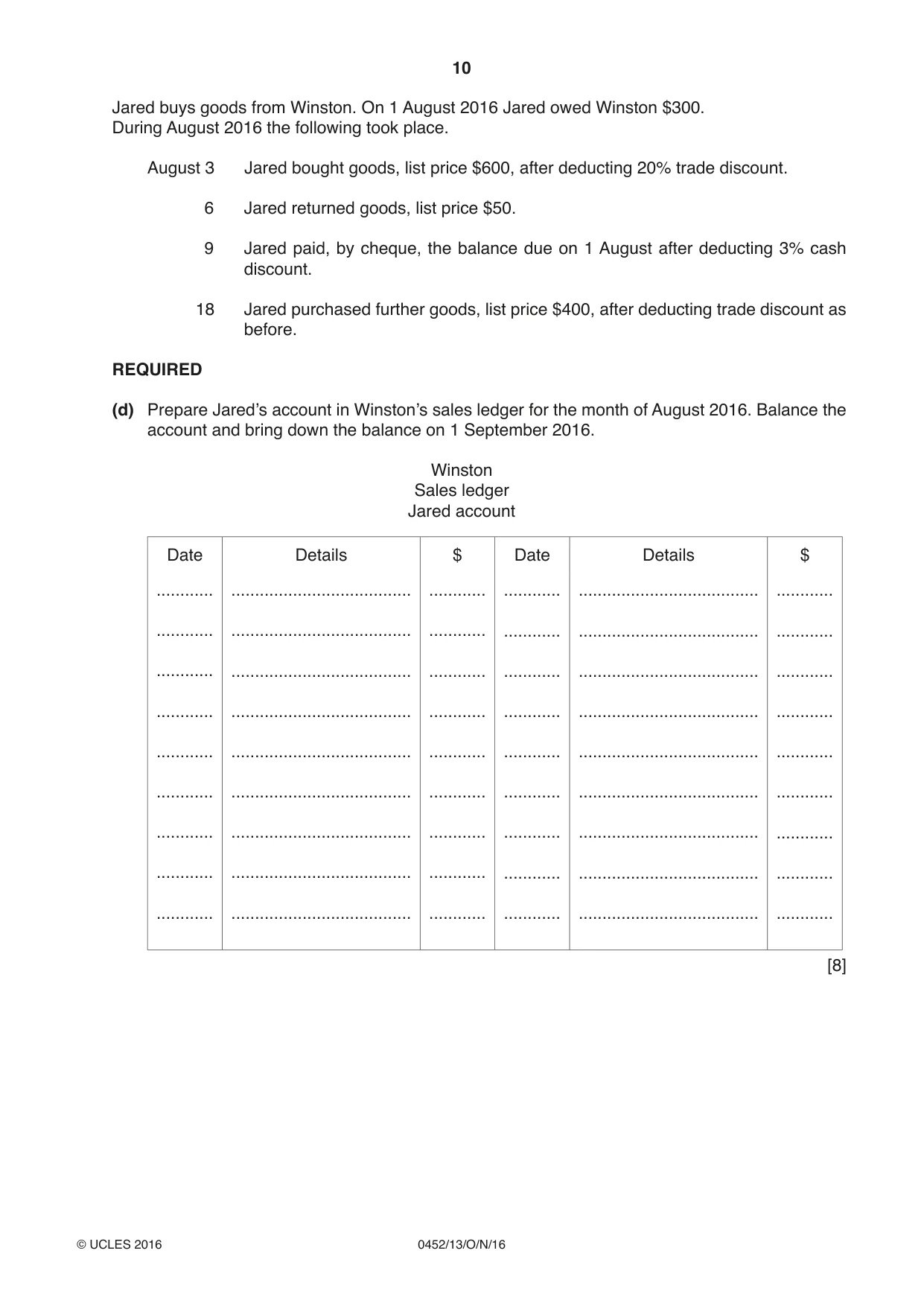
10 0452/13/O/N/16 © UCLES 2016 Jared buys goods from Winston. On 1 August 2016 Jared owed Winston $300. During August 2016 the following took place. August 3 Jared bought goods, list price $600, after deducting 20% trade discount. 6 Jared returned goods, list price $50. 9 Jared paid, by cheque, the balance due on 1 August after deducting 3% cash discount. 18 Jared purchased further goods, list price $400, after deducting trade discount as before. REQUIRED (d) Prepare Jared’s account in Winston’s sales ledger for the month of August 2016. Balance the account and bring down the balance on 1 September 2016. Winston Sales ledger Jared account Date Details $ Date Details $ … … … … … … … … … … … … … … … … … … … … … … … … … … … … … … … … … … … … … … … … … … … … … … … … … … … … … … [8]
Question paper, page 11
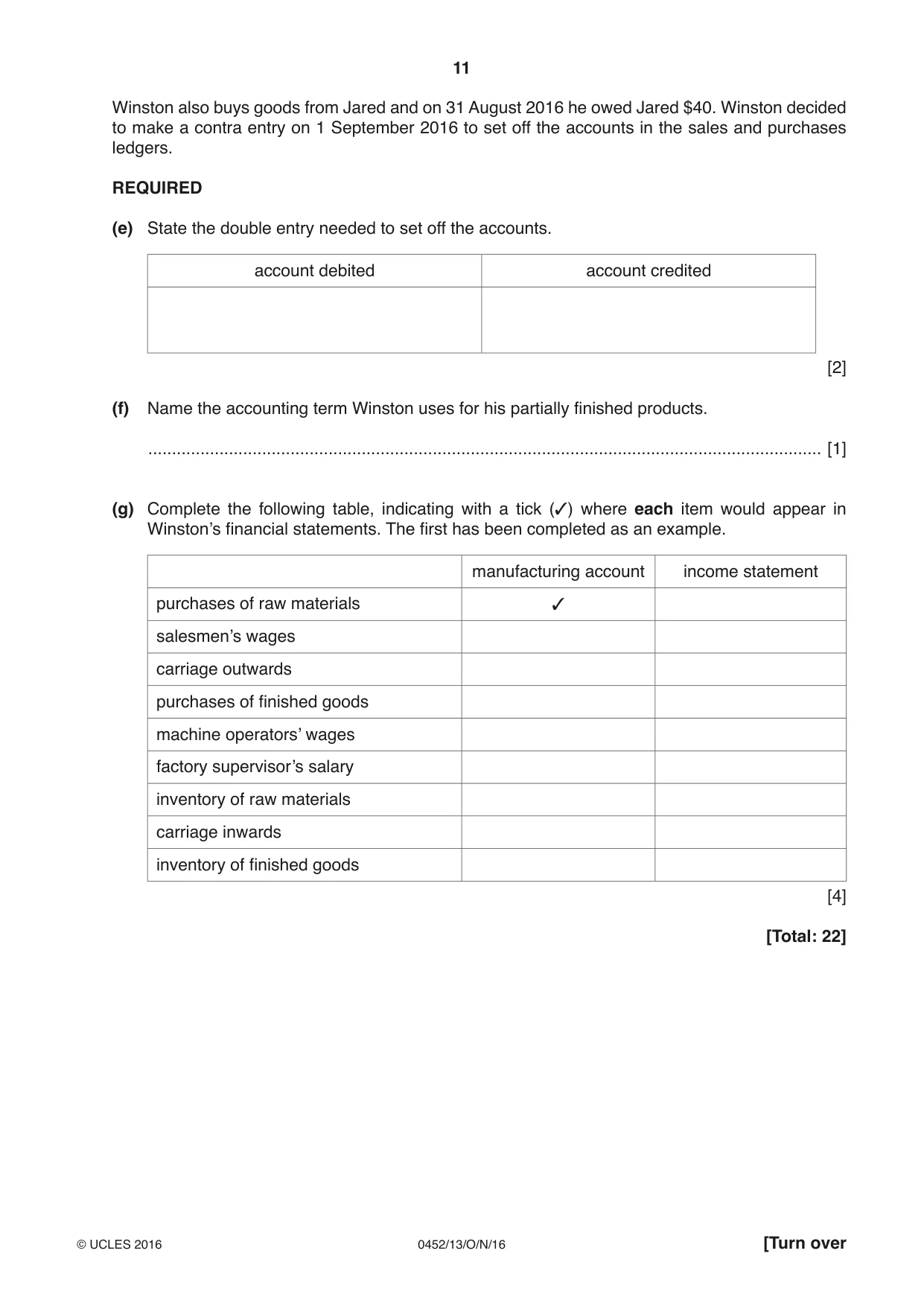
11 0452/13/O/N/16 © UCLES 2016 [Turn over Winston also buys goods from Jared and on 31 August 2016 he owed Jared $40. Winston decided to make a contra entry on 1 September 2016 to set off the accounts in the sales and purchases ledgers. REQUIRED (e) State the double entry needed to set off the accounts. account debited account credited [2] (f) Name the accounting term Winston uses for his partially finished products. … [1] (g) Complete the following table, indicating with a tick (✓) where each item would appear in Winston’s financial statements. The first has been completed as an example. manufacturing account income statement purchases of raw materials ✓ salesmen’s wages carriage outwards purchases of finished goods machine operators’ wages factory supervisor’s salary inventory of raw materials carriage inwards inventory of finished goods [4] [Total: 22]
Question paper, page 12
12 0452/13/O/N/16 © UCLES 2016 BLANK PAGE
Question paper, page 13
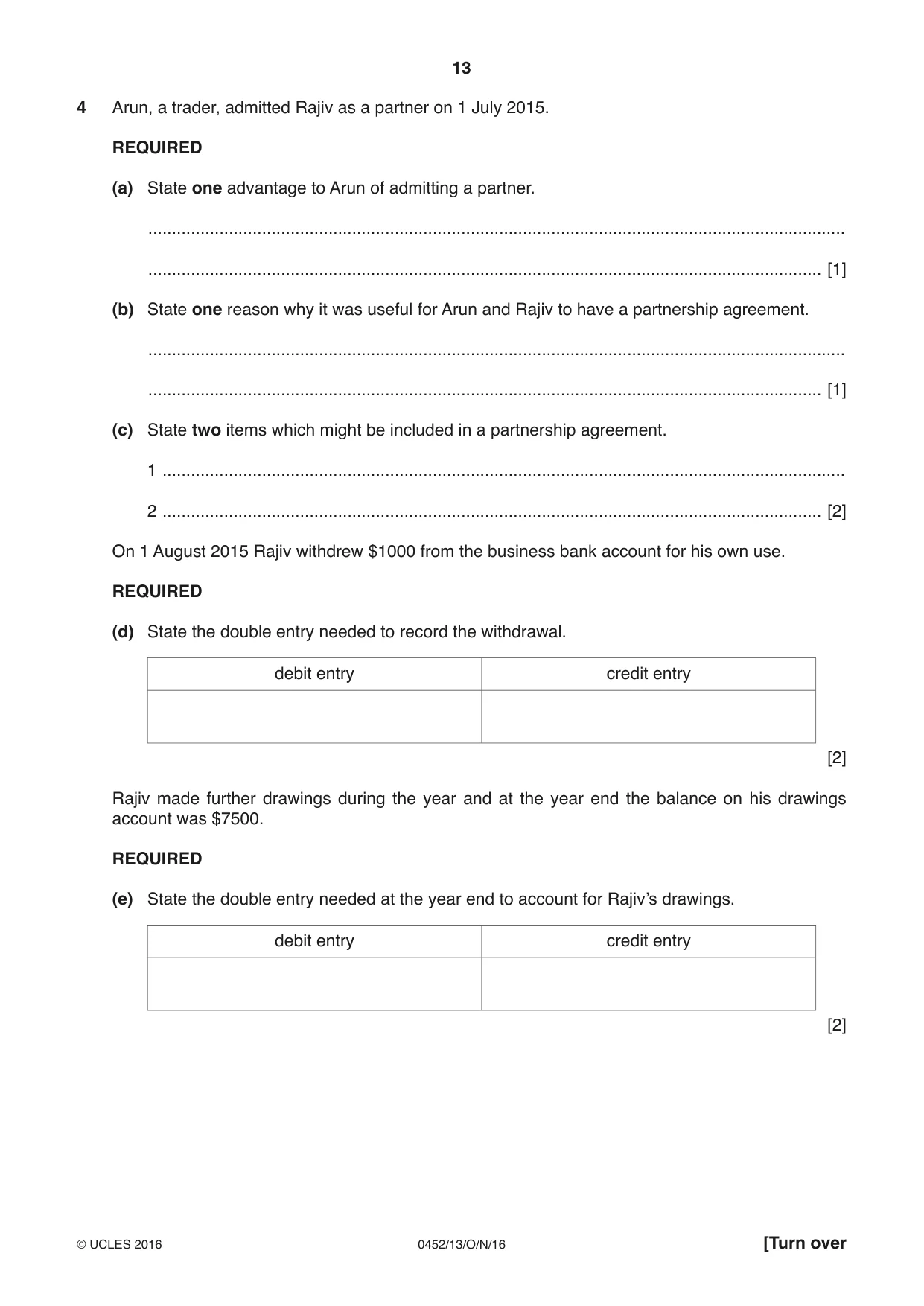
13 0452/13/O/N/16 © UCLES 2016 [Turn over 4 Arun, a trader, admitted Rajiv as a partner on 1 July 2015. REQUIRED (a) State one advantage to Arun of admitting a partner. … … [1] (b) State one reason why it was useful for Arun and Rajiv to have a partnership agreement. … … [1] (c) State two items which might be included in a partnership agreement. 1 … 2 … [2] On 1 August 2015 Rajiv withdrew $1000 from the business bank account for his own use. REQUIRED (d) State the double entry needed to record the withdrawal. debit entry credit entry [2] Rajiv made further drawings during the year and at the year end the balance on his drawings account was $7500. REQUIRED (e) State the double entry needed at the year end to account for Rajiv’s drawings. debit entry credit entry [2]
Question paper, page 14
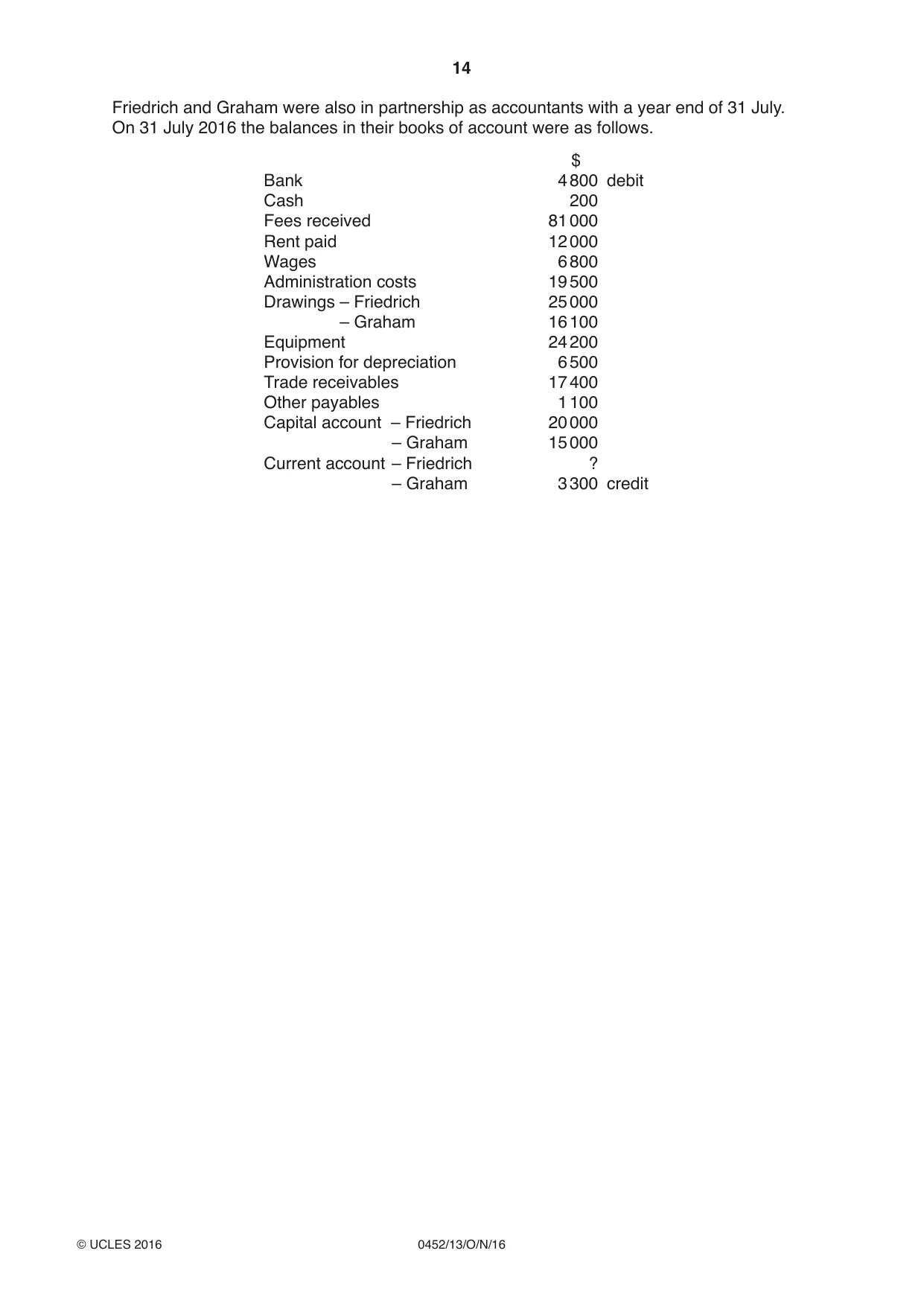
14 0452/13/O/N/16 © UCLES 2016 Friedrich and Graham were also in partnership as accountants with a year end of 31 July. On 31 July 2016 the balances in their books of account were as follows. $ Bank 4 800 debit Cash 200 Fees received 81 000 Rent paid 12 000 Wages 6 800 Administration costs 19 500 Drawings – Friedrich 25 000 – Graham 16 100 Equipment 24 200 Provision for depreciation 6 500 Trade receivables 17 400 Other payables 1 100 Capital account – Friedrich 20 000 – Graham 15 000 Current account – Friedrich ? – Graham 3 300 credit
Question paper, page 15
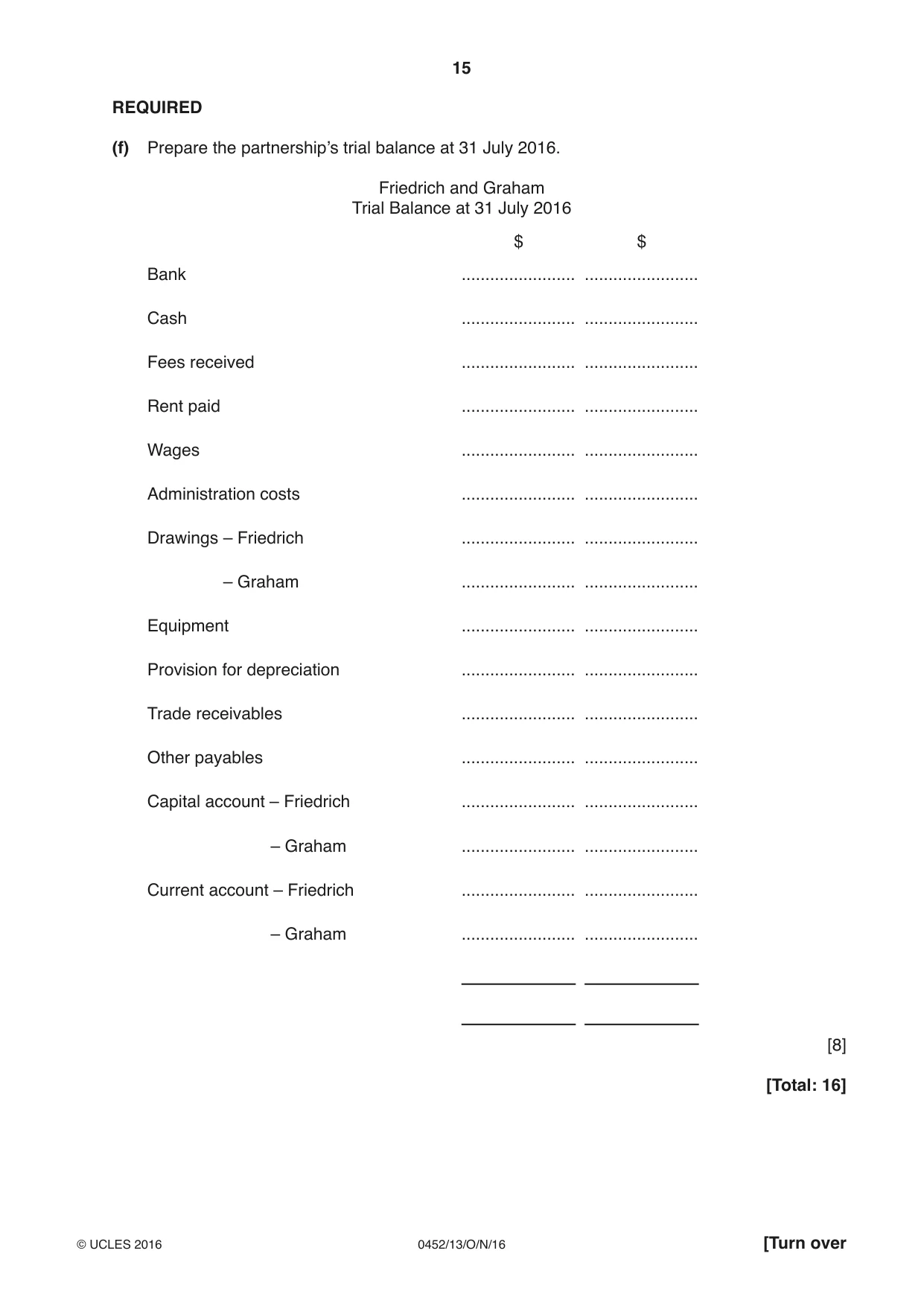
15 0452/13/O/N/16 © UCLES 2016 [Turn over REQUIRED (f) Prepare the partnership’s trial balance at 31 July 2016. Friedrich and Graham Trial Balance at 31 July 2016 $ $ Bank … … Cash … … Fees received … … Rent paid … … Wages … … Administration costs … … Drawings – Friedrich … … – Graham … … Equipment … … Provision for depreciation … … Trade receivables … … Other payables … … Capital account – Friedrich … … – Graham … … Current account – Friedrich … … – Graham … … [8] [Total: 16]
Question paper, page 16
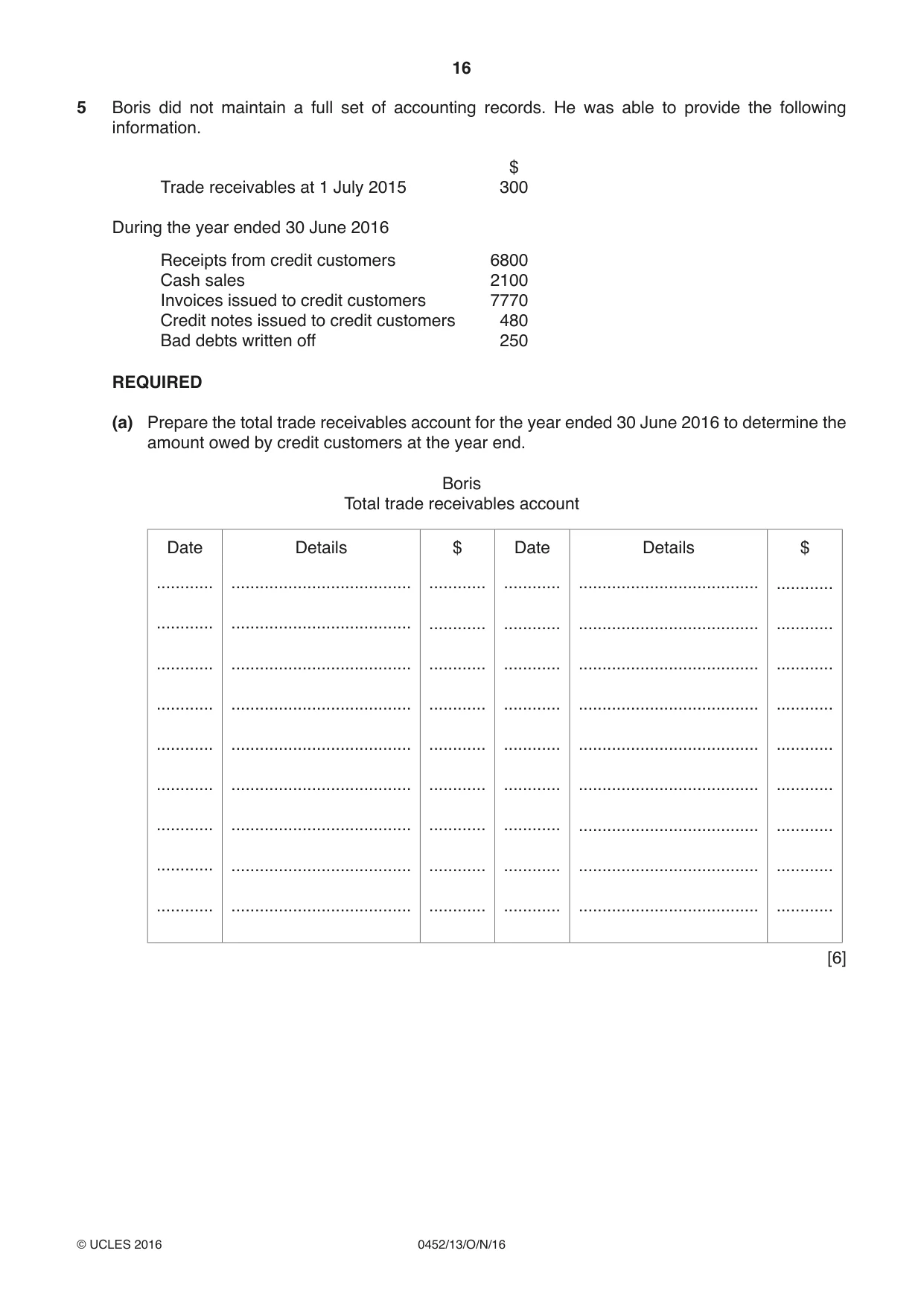
16 0452/13/O/N/16 © UCLES 2016 5 Boris did not maintain a full set of accounting records. He was able to provide the following information. $ Trade receivables at 1 July 2015 300 During the year ended 30 June 2016 Receipts from credit customers 6800 Cash sales 2100 Invoices issued to credit customers 7770 Credit notes issued to credit customers 480 Bad debts written off 250 REQUIRED (a) Prepare the total trade receivables account for the year ended 30 June 2016 to determine the amount owed by credit customers at the year end. Boris Total trade receivables account Date Details $ Date Details $ … … … … … … … … … … … … … … … … … … … … … … … … … … … … … … … … … … … … … … … … … … … … … … … … … … … … … … [6]
Question paper, page 17
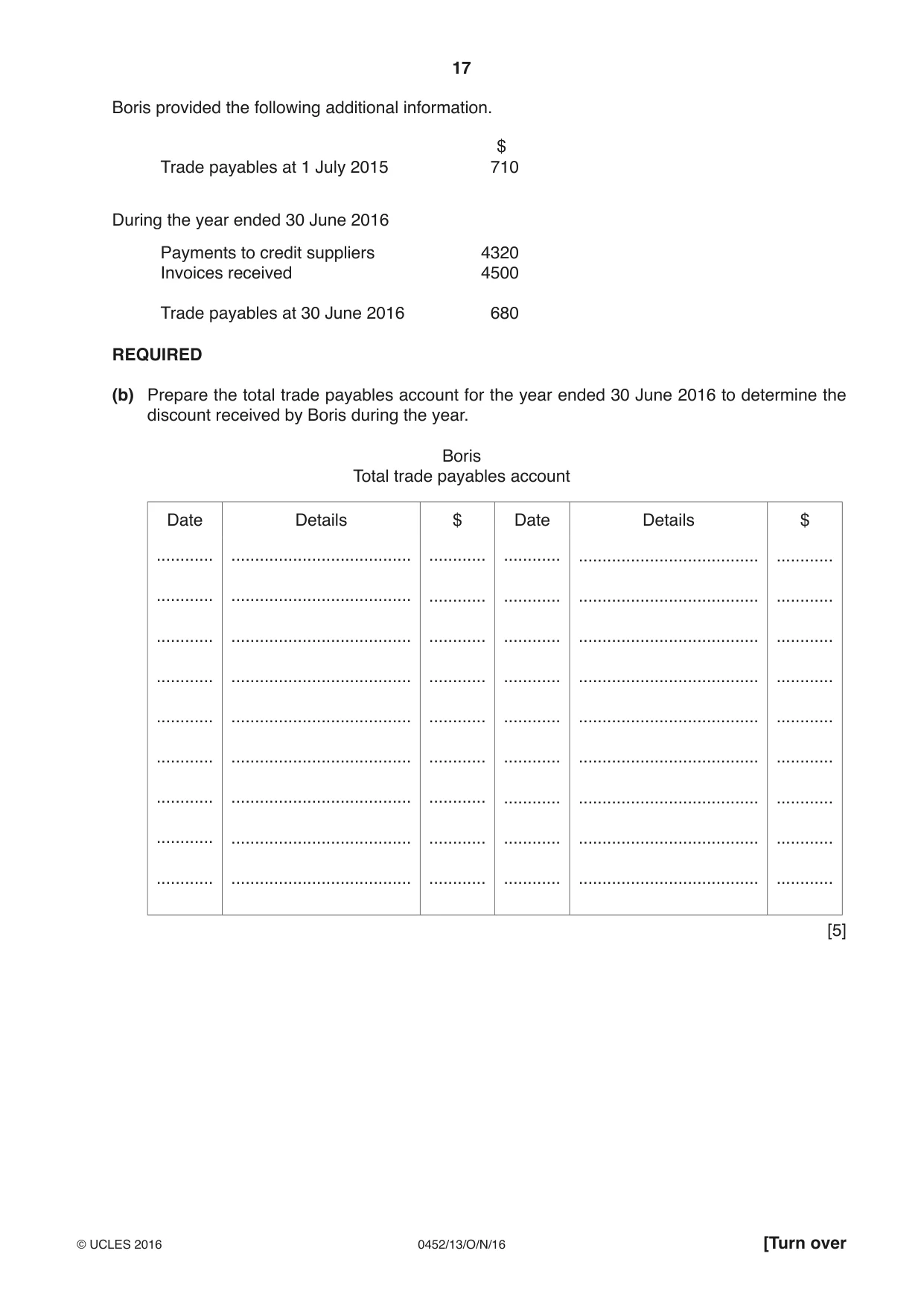
17 0452/13/O/N/16 © UCLES 2016 [Turn over Boris provided the following additional information. $ Trade payables at 1 July 2015 710 During the year ended 30 June 2016 Payments to credit suppliers 4320 Invoices received 4500 Trade payables at 30 June 2016 680 REQUIRED (b) Prepare the total trade payables account for the year ended 30 June 2016 to determine the discount received by Boris during the year. Boris Total trade payables account Date Details $ Date Details $ … … … … … … … … … … … … … … … … … … … … … … … … … … … … … … … … … … … … … … … … … … … … … … … … … … … … … … [5]
Question paper, page 18
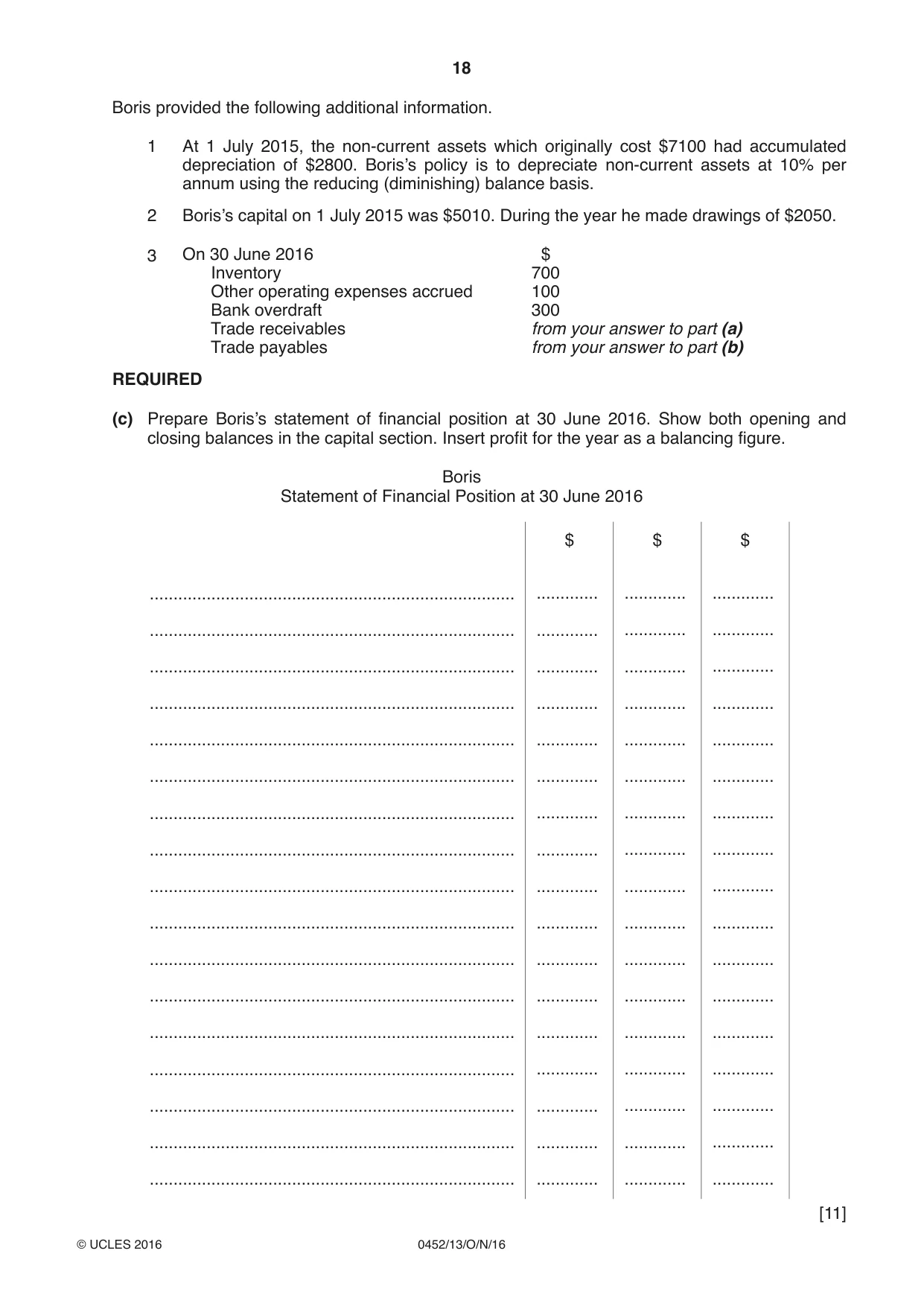
18 0452/13/O/N/16 © UCLES 2016 Boris provided the following additional information. 1 At 1 July 2015, the non-current assets which originally cost $7100 had accumulated depreciation of $2800. Boris’s policy is to depreciate non-current assets at 10% per annum using the reducing (diminishing) balance basis. 2 Boris’s capital on 1 July 2015 was $5010. During the year he made drawings of $2050. 3 On 30 June 2016 $ Inventory 700 Other operating expenses accrued 100 Bank overdraft 300 Trade receivables from your answer to part (a) Trade payables from your answer to part (b) REQUIRED (c) Prepare Boris’s statement of financial position at 30 June 2016. Show both opening and closing balances in the capital section. Insert profit for the year as a balancing figure. Boris Statement of Financial Position at 30 June 2016 $ $ $ … … … … … … … … … … … … … … … … … … … … … … … … … … … … … … … … … … … … … … … … … … … … … … … … … … … … … … … … … … … … … … … … … … … … [11]
Question paper, page 19
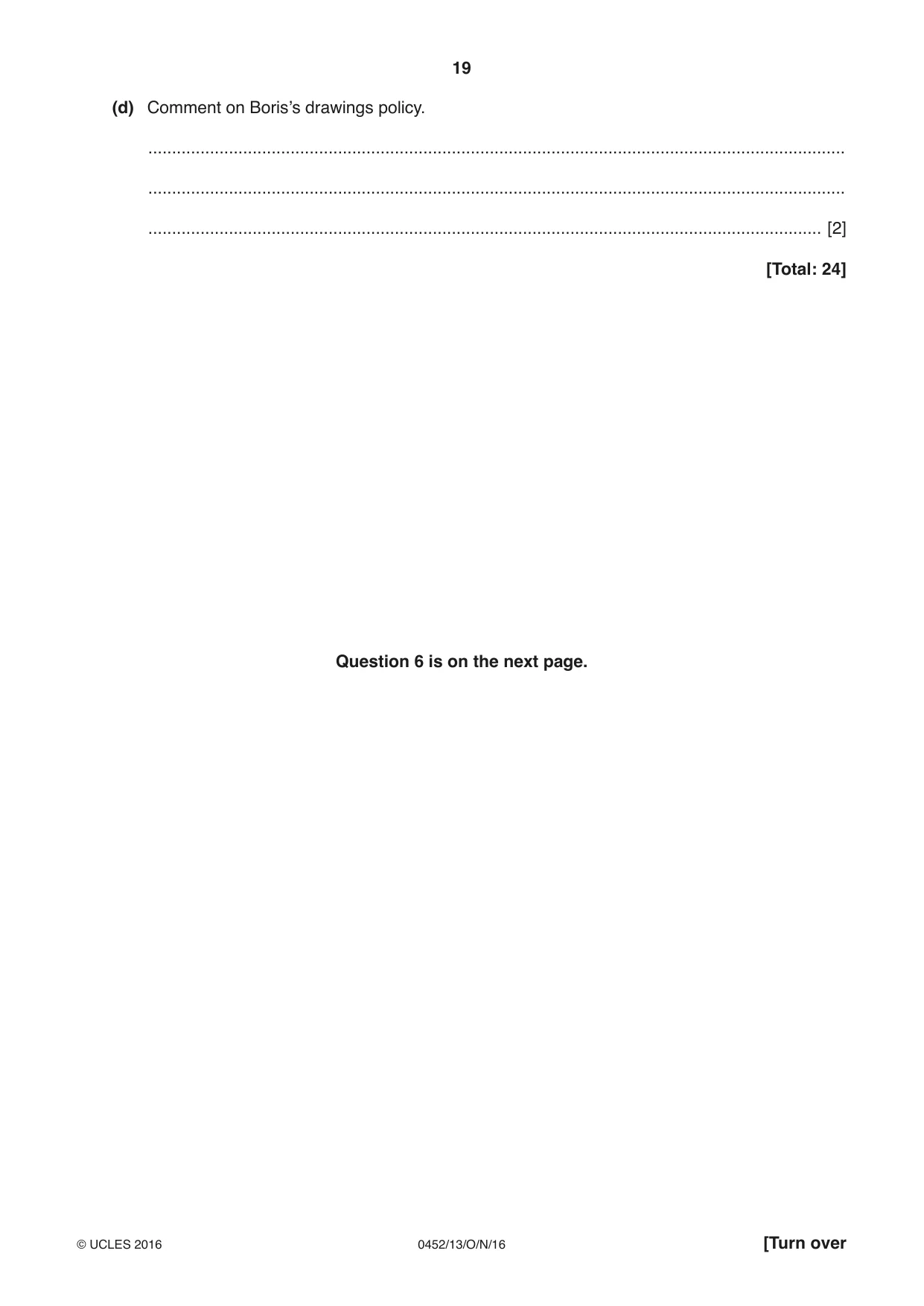
19 0452/13/O/N/16 © UCLES 2016 [Turn over (d) Comment on Boris’s drawings policy. … … … [2] [Total: 24] Question 6 is on the next page.
Question paper, page 20
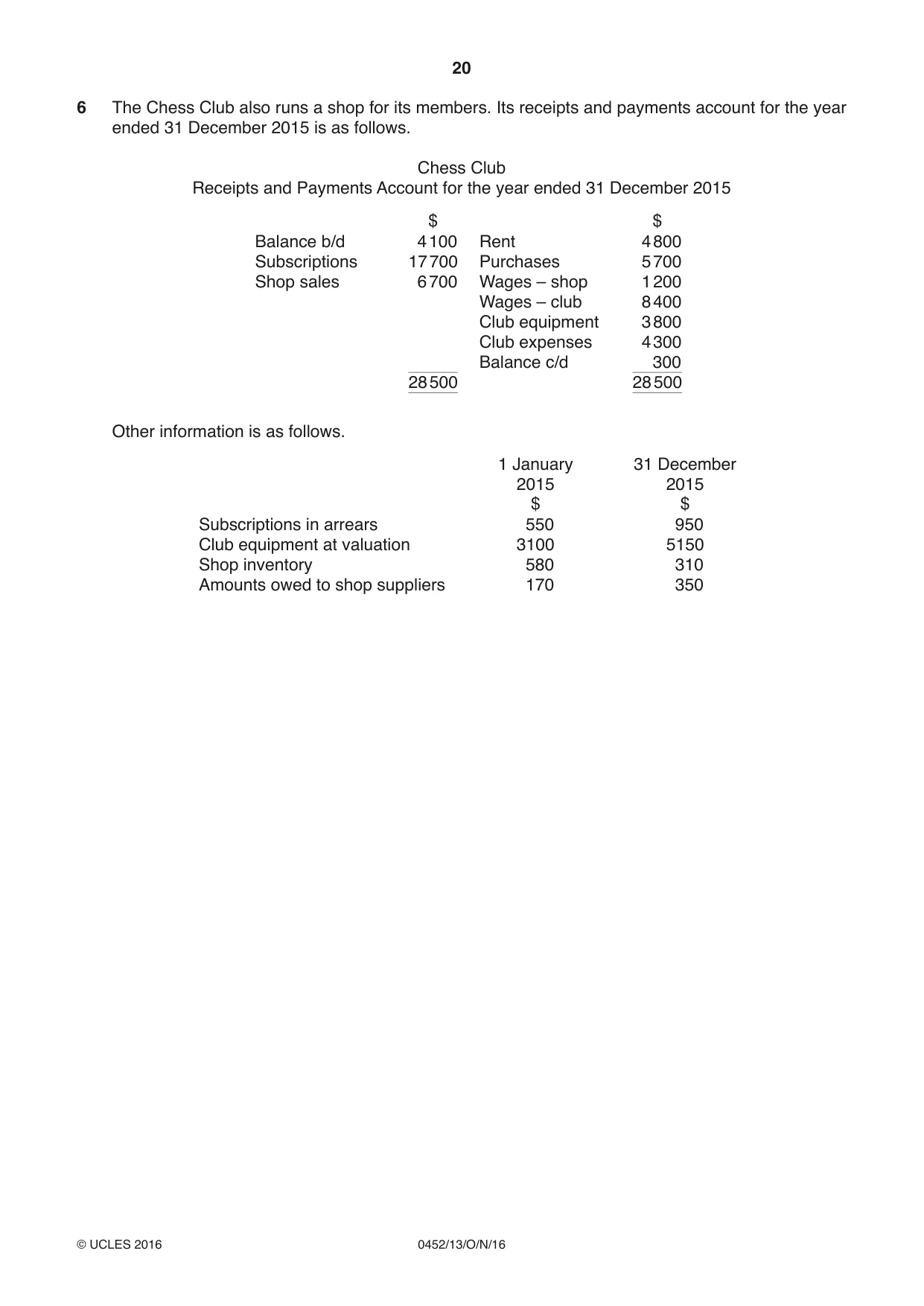
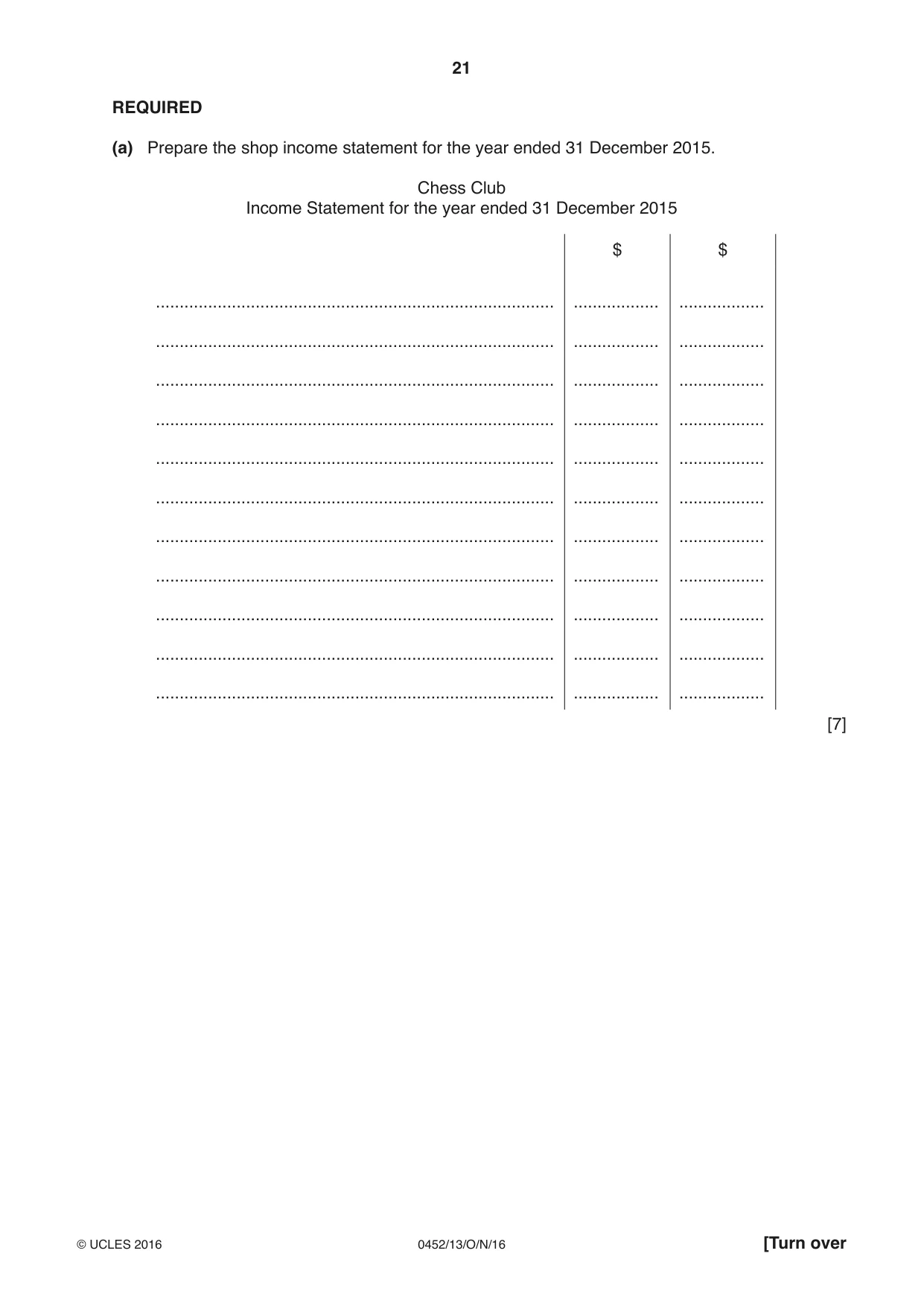
20 0452/13/O/N/16 © UCLES 2016 6 The Chess Club also runs a shop for its members. Its receipts and payments account for the year ended 31 December 2015 is as follows. Chess Club Receipts and Payments Account for the year ended 31 December 2015 $ $ Balance b/d 4 100 Rent 4 800 Subscriptions 17 700 Purchases 5 700 Shop sales 6 700 Wages – shop 1 200 Wages – club 8 400 Club equipment 3 800 Club expenses 4 300 Balance c/d 300 28 500 28 500 Other information is as follows. 1 January 2015 31 December 2015 $ $ Subscriptions in arrears 550 950 Club equipment at valuation 3100 5150 Shop inventory 580 310 Amounts owed to shop suppliers 170 350
Question paper, page 21
21 0452/13/O/N/16 © UCLES 2016 REQUIRED (a) Prepare the shop income statement for the year ended 31 December 2015. Chess Club Income Statement for the year ended 31 December 2015 $ $ … … … … … … … … … … … … … … … … … … … … … … … … … … … … … … … … … [7] [Turn over
Question paper, page 22
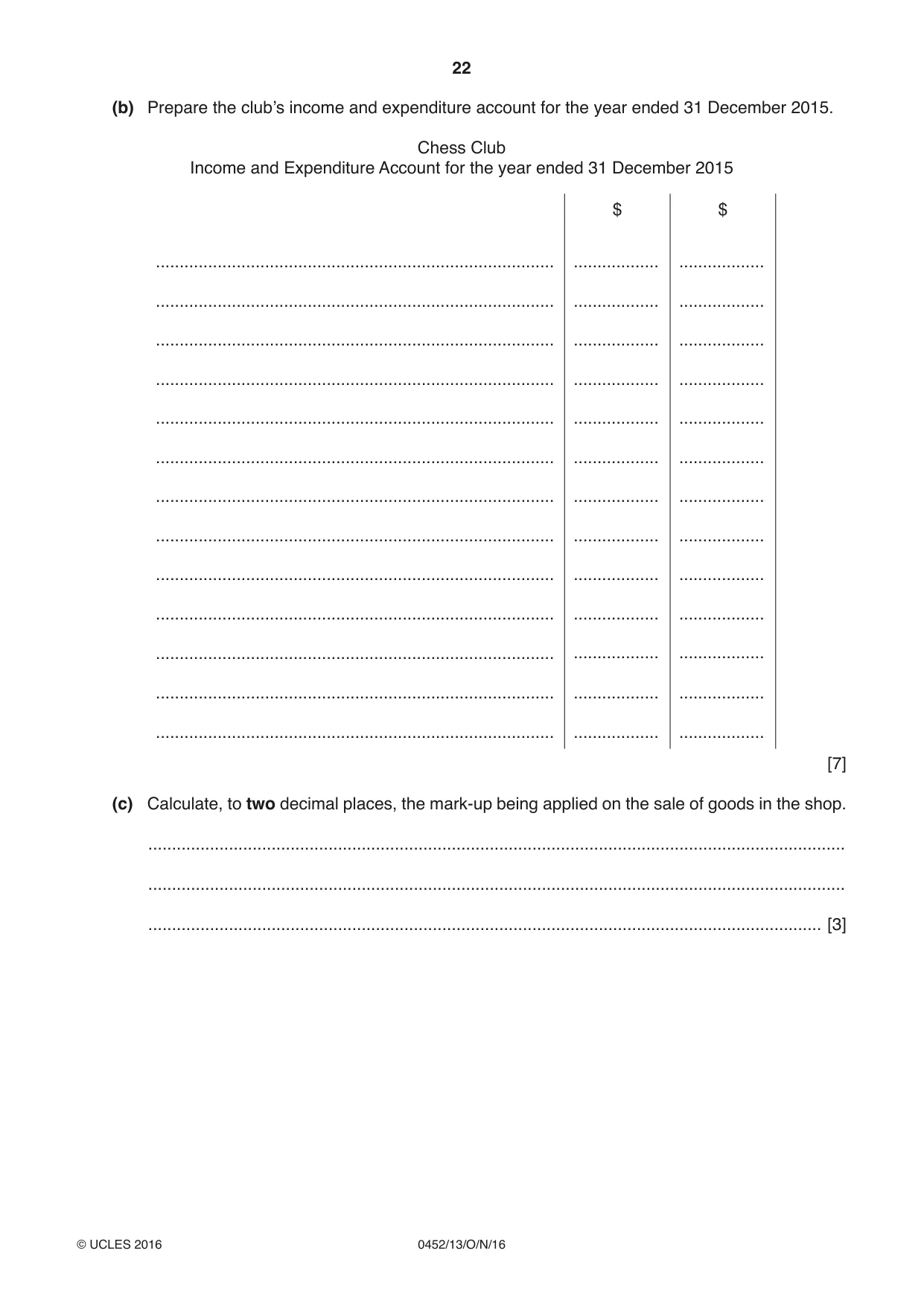
22 0452/13/O/N/16 © UCLES 2016 (b) Prepare the club’s income and expenditure account for the year ended 31 December 2015. Chess Club Income and Expenditure Account for the year ended 31 December 2015 $ $ … … … … … … … … … … … … … … … … … … … … … … … … … … … … … … … … … … … … … … … [7] (c) Calculate, to two decimal places, the mark-up being applied on the sale of goods in the shop. … … … [3]
Question paper, page 23
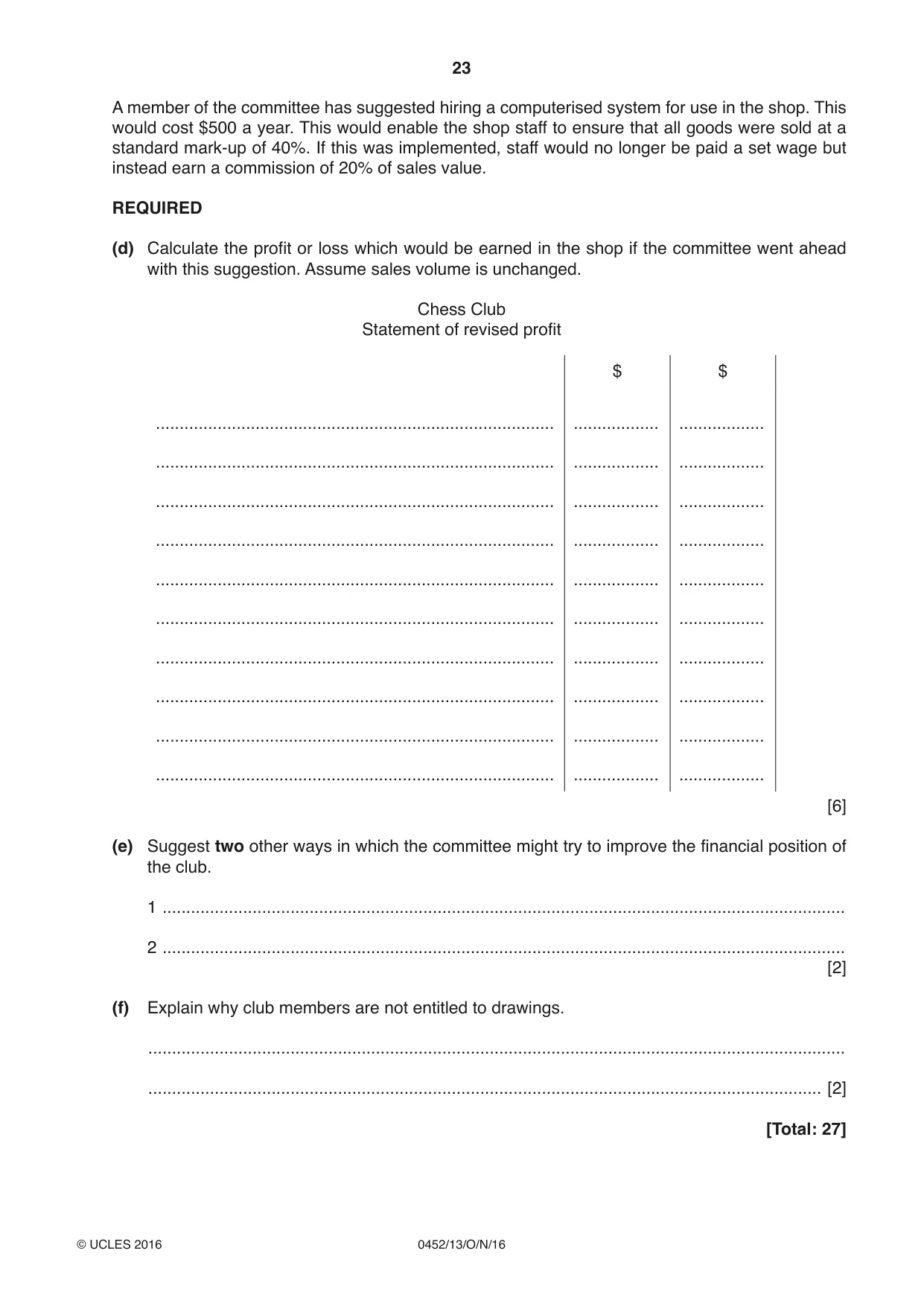
23 0452/13/O/N/16 © UCLES 2016 A member of the committee has suggested hiring a computerised system for use in the shop. This would cost $500 a year. This would enable the shop staff to ensure that all goods were sold at a standard mark-up of 40%. If this was implemented, staff would no longer be paid a set wage but instead earn a commission of 20% of sales value. REQUIRED (d) Calculate the profit or loss which would be earned in the shop if the committee went ahead with this suggestion. Assume sales volume is unchanged. Chess Club Statement of revised profit $ $ … … … … … … … … … … … … … … … … … … … … … … … … … … … … … … [6] (e) Suggest two other ways in which the committee might try to improve the financial position of the club. 1 … 2 … [2] (f) Explain why club members are not entitled to drawings. … … [2] [Total: 27]
Question paper, page 24
24 0452/13/O/N/16 © UCLES 2016 Permission to reproduce items where third-party owned material protected by copyright is included has been sought and cleared where possible. Every reasonable effort has been made by the publisher (UCLES) to trace copyright holders, but if any items requiring clearance have unwittingly been included, the publisher will be pleased to make amends at the earliest possible opportunity. To avoid the issue of disclosure of answer-related information to candidates, all copyright acknowledgements are reproduced online in the Cambridge International Examinations Copyright Acknowledgements Booklet. This is produced for each series of examinations and is freely available to download at www.cie.org.uk after the live examination series. Cambridge International Examinations is part of the Cambridge Assessment Group. Cambridge Assessment is the brand name of University of Cambridge Local Examinations Syndicate (UCLES), which is itself a department of the University of Cambridge. BLANK PAGE
Mark scheme, page 1
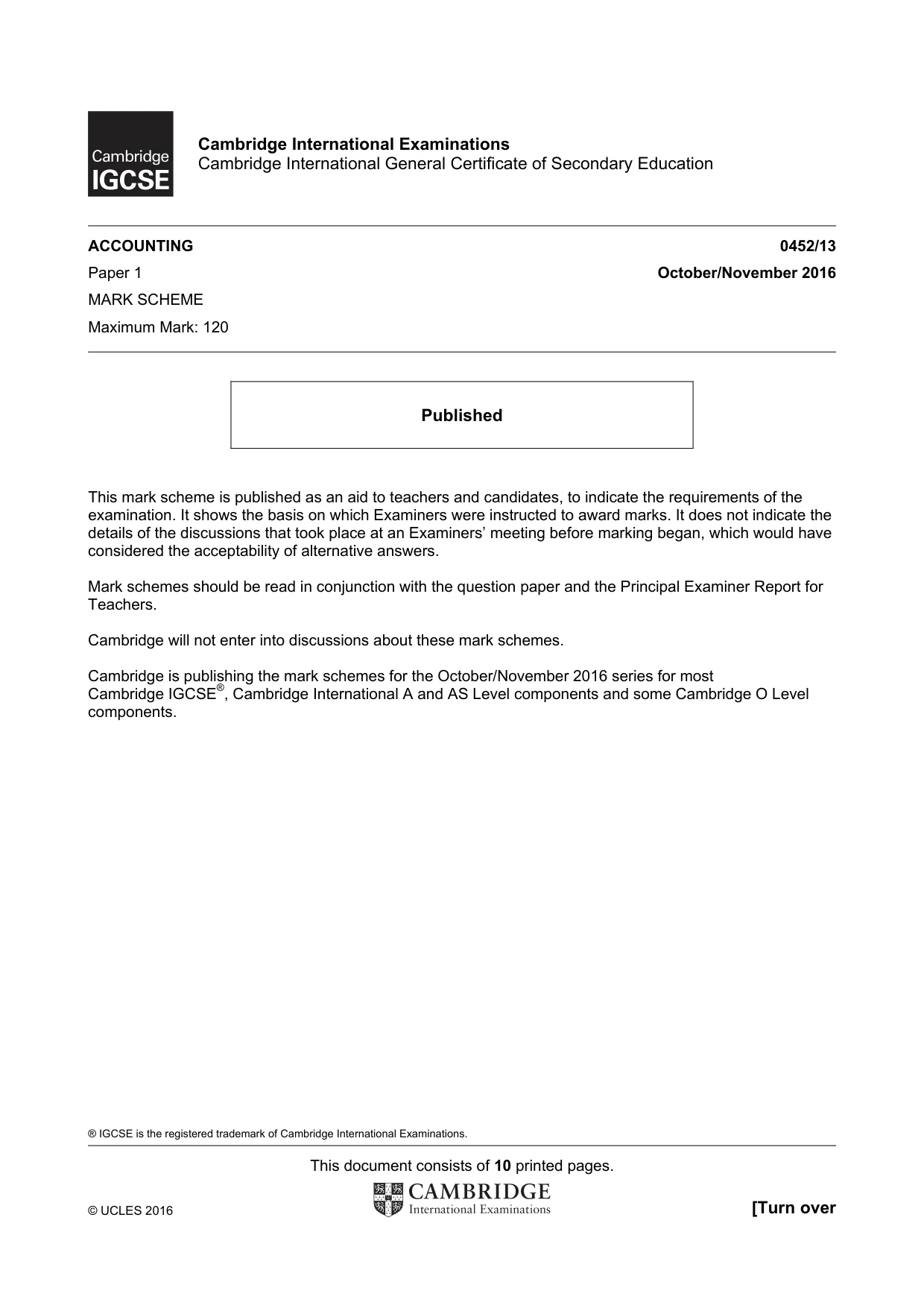
® IGCSE is the registered trademark of Cambridge International Examinations. This document consists of 10 printed pages. © UCLES 2016 [Turn over Cambridge International Examinations Cambridge International General Certificate of Secondary Education ACCOUNTING 0452/13 Paper 1 October/November 2016 MARK SCHEME Maximum Mark: 120 Published This mark scheme is published as an aid to teachers and candidates, to indicate the requirements of the examination. It shows the basis on which Examiners were instructed to award marks. It does not indicate the details of the discussions that took place at an Examiners’ meeting before marking began, which would have considered the acceptability of alternative answers. Mark schemes should be read in conjunction with the question paper and the Principal Examiner Report for Teachers. Cambridge will not enter into discussions about these mark schemes. Cambridge is publishing the mark schemes for the October/November 2016 series for most Cambridge IGCSE®, Cambridge International A and AS Level components and some Cambridge O Level components.
Mark scheme, page 2
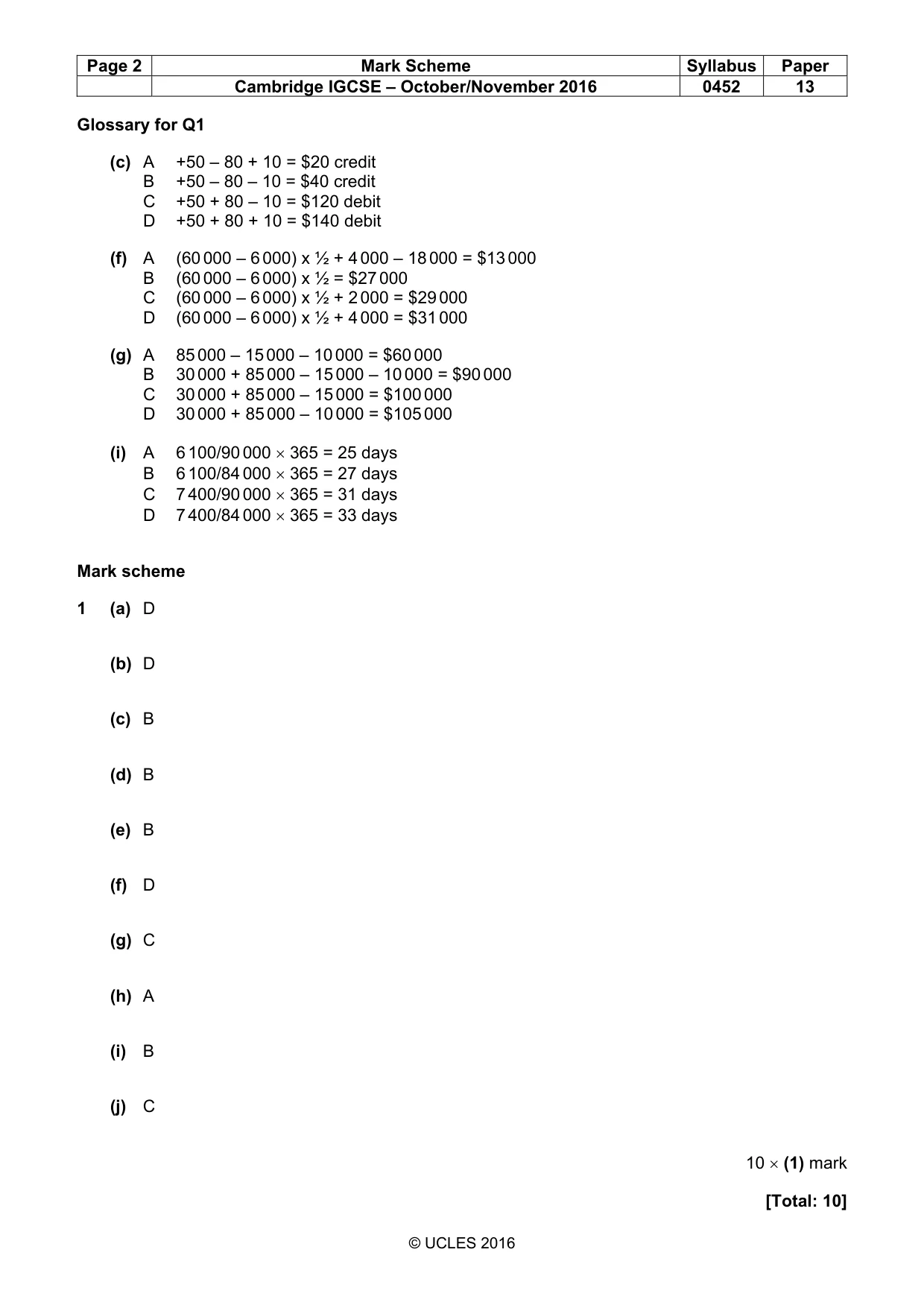
Page 2 Mark Scheme Syllabus Paper Cambridge IGCSE – October/November 2016 0452 13 © UCLES 2016 Glossary for Q1 (c) A +50 – 80 + 10 = $20 credit B +50 – 80 – 10 = $40 credit C +50 + 80 – 10 = $120 debit D +50 + 80 + 10 = $140 debit (f) A (60 000 – 6 000) x ½ + 4 000 – 18 000 = $13 000 B (60 000 – 6 000) x ½ = $27 000 C (60 000 – 6 000) x ½ + 2 000 = $29 000 D (60 000 – 6 000) x ½ + 4 000 = $31 000 (g) A 85 000 – 15 000 – 10 000 = $60 000 B 30 000 + 85 000 – 15 000 – 10 000 = $90 000 C 30 000 + 85 000 – 15 000 = $100 000 D 30 000 + 85 000 – 10 000 = $105 000 (i) A 6 100/90 000 × 365 = 25 days B 6 100/84 000 × 365 = 27 days C 7 400/90 000 × 365 = 31 days D 7 400/84 000 × 365 = 33 days Mark scheme 1 (a) D (b) D (c) B (d) B (e) B (f) D (g) C (h) A (i) B (j) C 10 × (1) mark [Total: 10]
Mark scheme, page 3
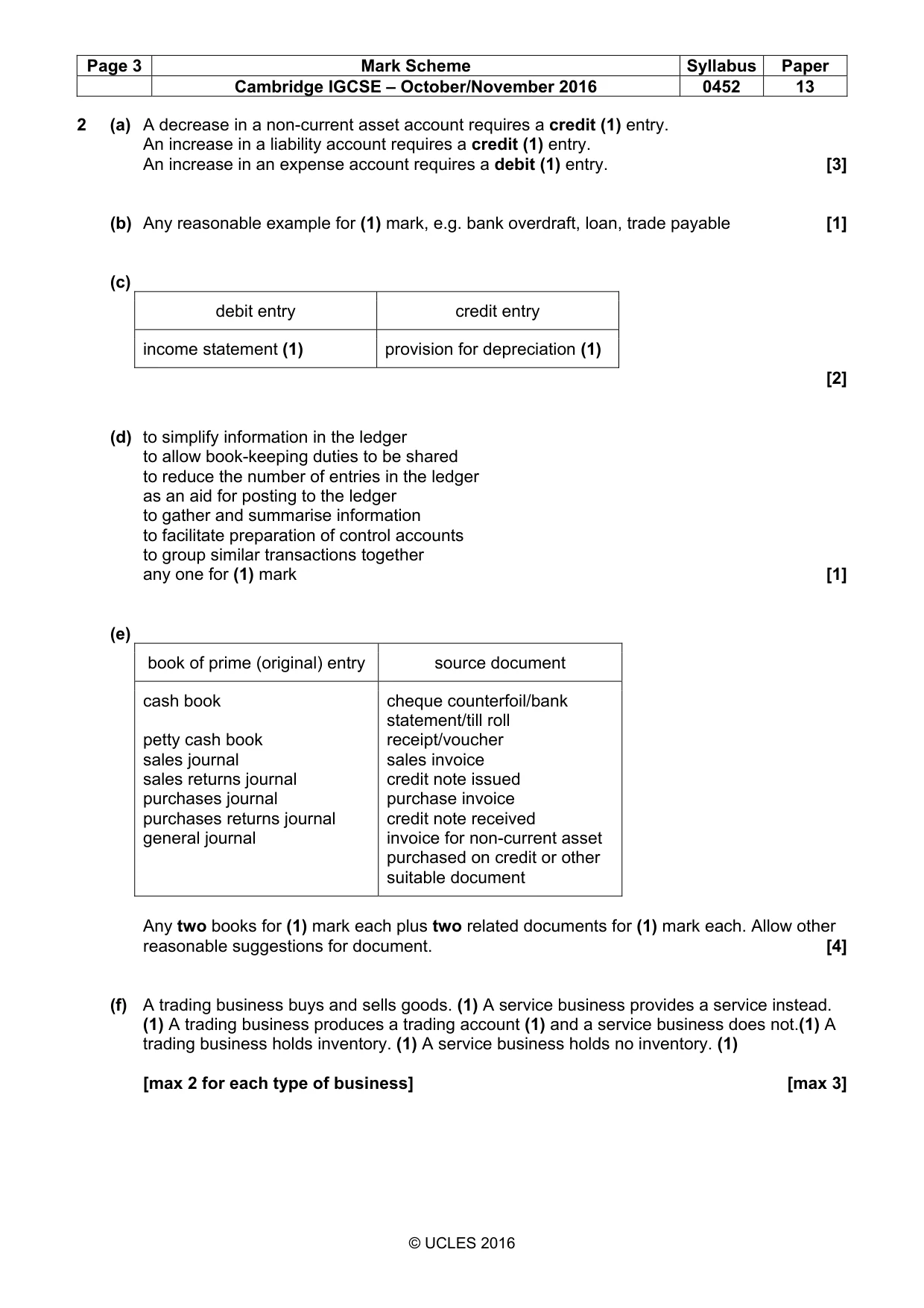
Page 3 Mark Scheme Syllabus Paper Cambridge IGCSE – October/November 2016 0452 13 © UCLES 2016 2 (a) A decrease in a non-current asset account requires a credit (1) entry. An increase in a liability account requires a credit (1) entry. An increase in an expense account requires a debit (1) entry. [3] (b) Any reasonable example for (1) mark, e.g. bank overdraft, loan, trade payable [1] (c) debit entry credit entry income statement (1) provision for depreciation (1) [2] (d) to simplify information in the ledger to allow book-keeping duties to be shared to reduce the number of entries in the ledger as an aid for posting to the ledger to gather and summarise information to facilitate preparation of control accounts to group similar transactions together any one for (1) mark [1] (e) book of prime (original) entry source document cash book petty cash book sales journal sales returns journal purchases journal purchases returns journal general journal cheque counterfoil/bank statement/till roll receipt/voucher sales invoice credit note issued purchase invoice credit note received invoice for non-current asset purchased on credit or other suitable document Any two books for (1) mark each plus two related documents for (1) mark each. Allow other reasonable suggestions for document. [4] (f) A trading business buys and sells goods. (1) A service business provides a service instead. (1) A trading business produces a trading account (1) and a service business does not.(1) A trading business holds inventory. (1) A service business holds no inventory. (1) [max 2 for each type of business] [max 3]
Mark scheme, page 4
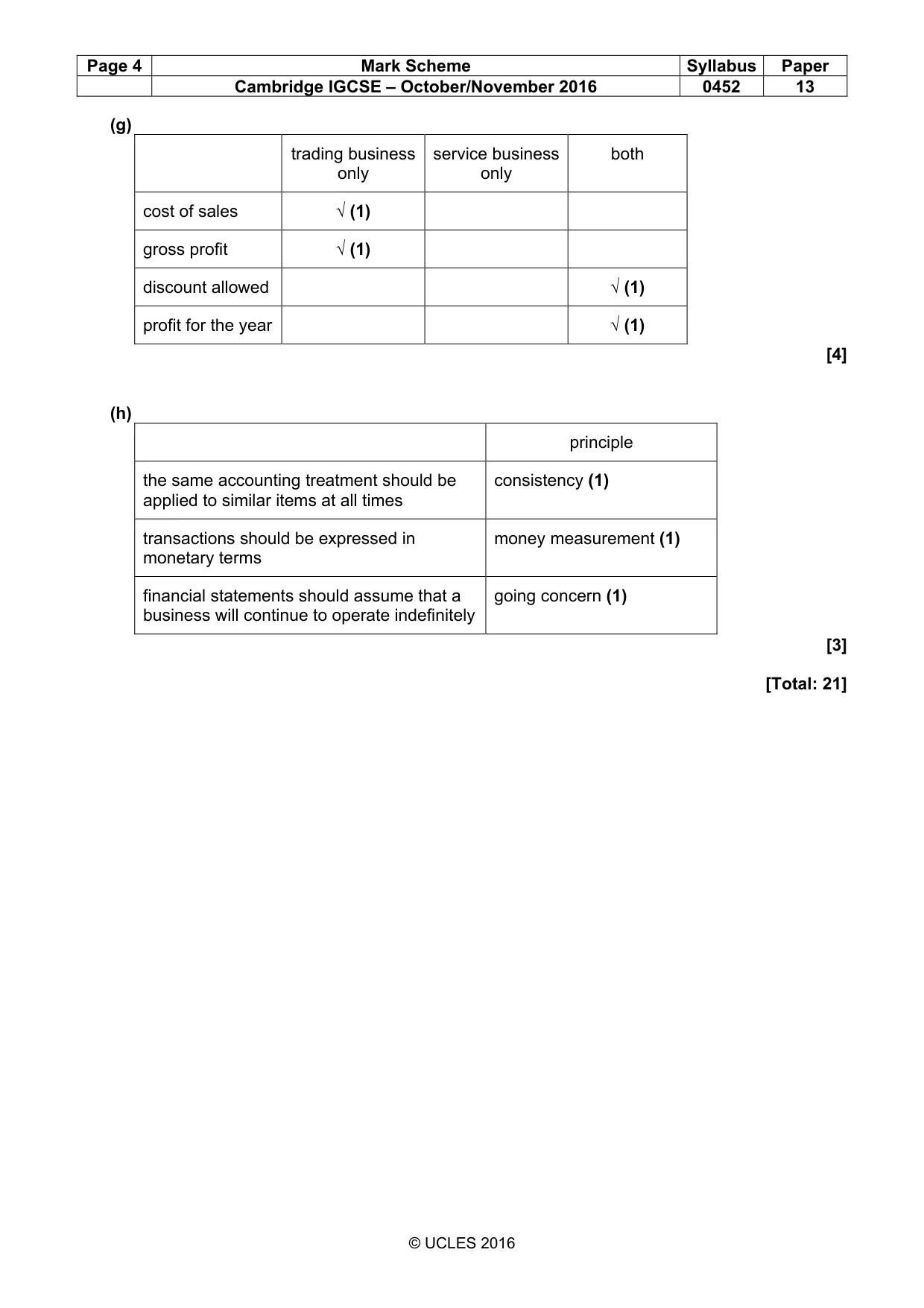
Page 4 Mark Scheme Syllabus Paper Cambridge IGCSE – October/November 2016 0452 13 © UCLES 2016 (g) trading business only service business only both cost of sales √ (1) gross profit √ (1) discount allowed √ (1) profit for the year √ (1) [4] (h) principle the same accounting treatment should be applied to similar items at all times consistency (1) transactions should be expressed in monetary terms money measurement (1) financial statements should assume that a business will continue to operate indefinitely going concern (1) [3] [Total: 21]
Mark scheme, page 5
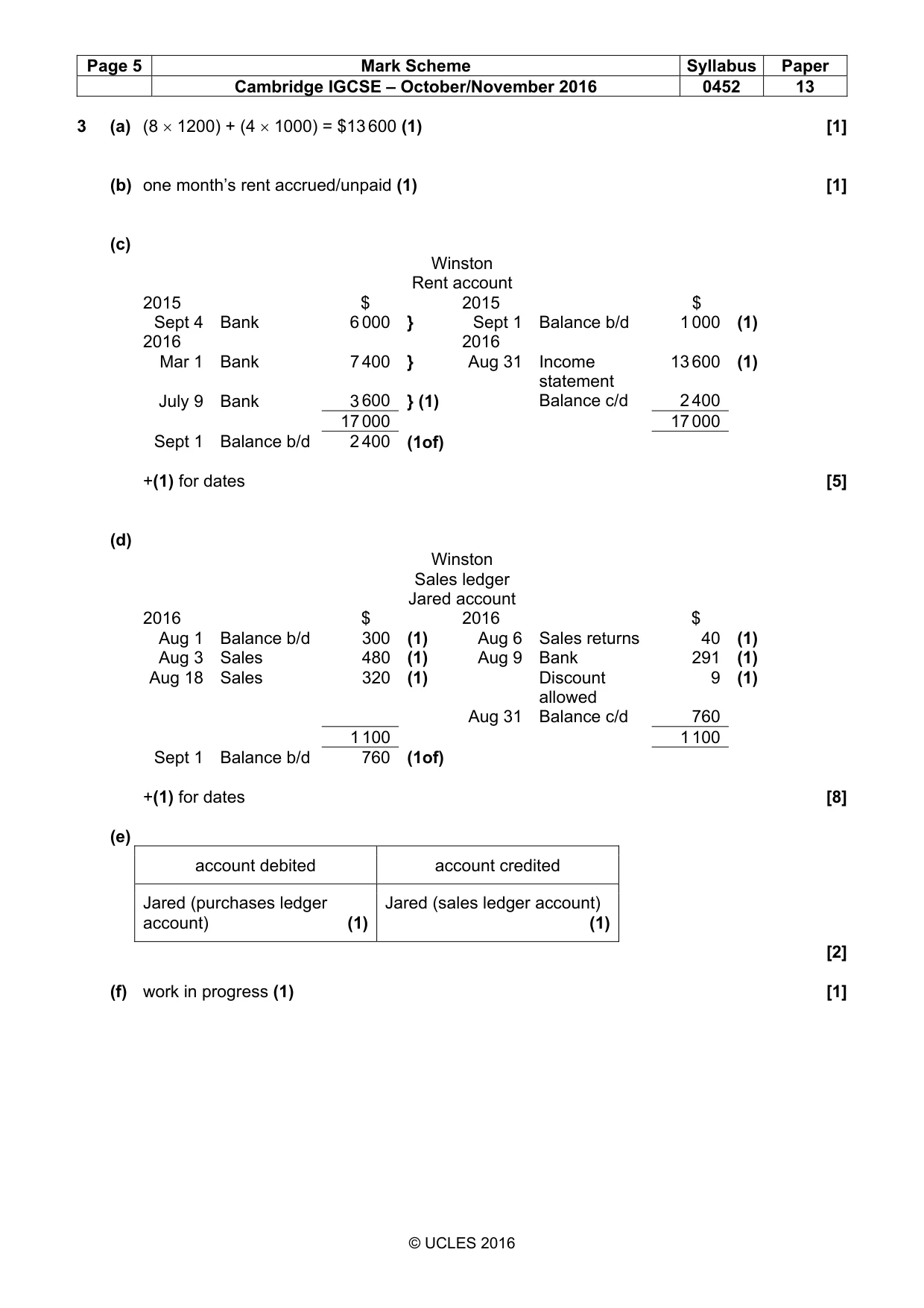
Page 5 Mark Scheme Syllabus Paper Cambridge IGCSE – October/November 2016 0452 13 © UCLES 2016 3 (a) (8 × 1200) + (4 × 1000) = $13 600 (1) [1] (b) one month’s rent accrued/unpaid (1) [1] (c) Winston Rent account 2015 $ 2015 $ Sept 4 Bank 6 000 } Sept 1 Balance b/d 1 000 (1) 2016 2016 Mar 1 Bank 7 400 } Aug 31 Income statement 13 600 (1) July 9 Bank 3 600 } (1) Balance c/d 2 400 17 000 17 000 Sept 1 Balance b/d 2 400 (1of) +(1) for dates [5] (d) Winston Sales ledger Jared account 2016 $ 2016 $ Aug 1 Balance b/d 300 (1) Aug 6 Sales returns 40 (1) Aug 3 Sales 480 (1) Aug 9 Bank 291 (1) Aug 18 Sales 320 (1) Discount allowed 9 (1) Aug 31 Balance c/d 760 1 100 1 100 Sept 1 Balance b/d 760 (1of) +(1) for dates [8] (e) account debited account credited Jared (purchases ledger account) (1) Jared (sales ledger account) (1) [2] (f) work in progress (1) [1]
Mark scheme, page 6
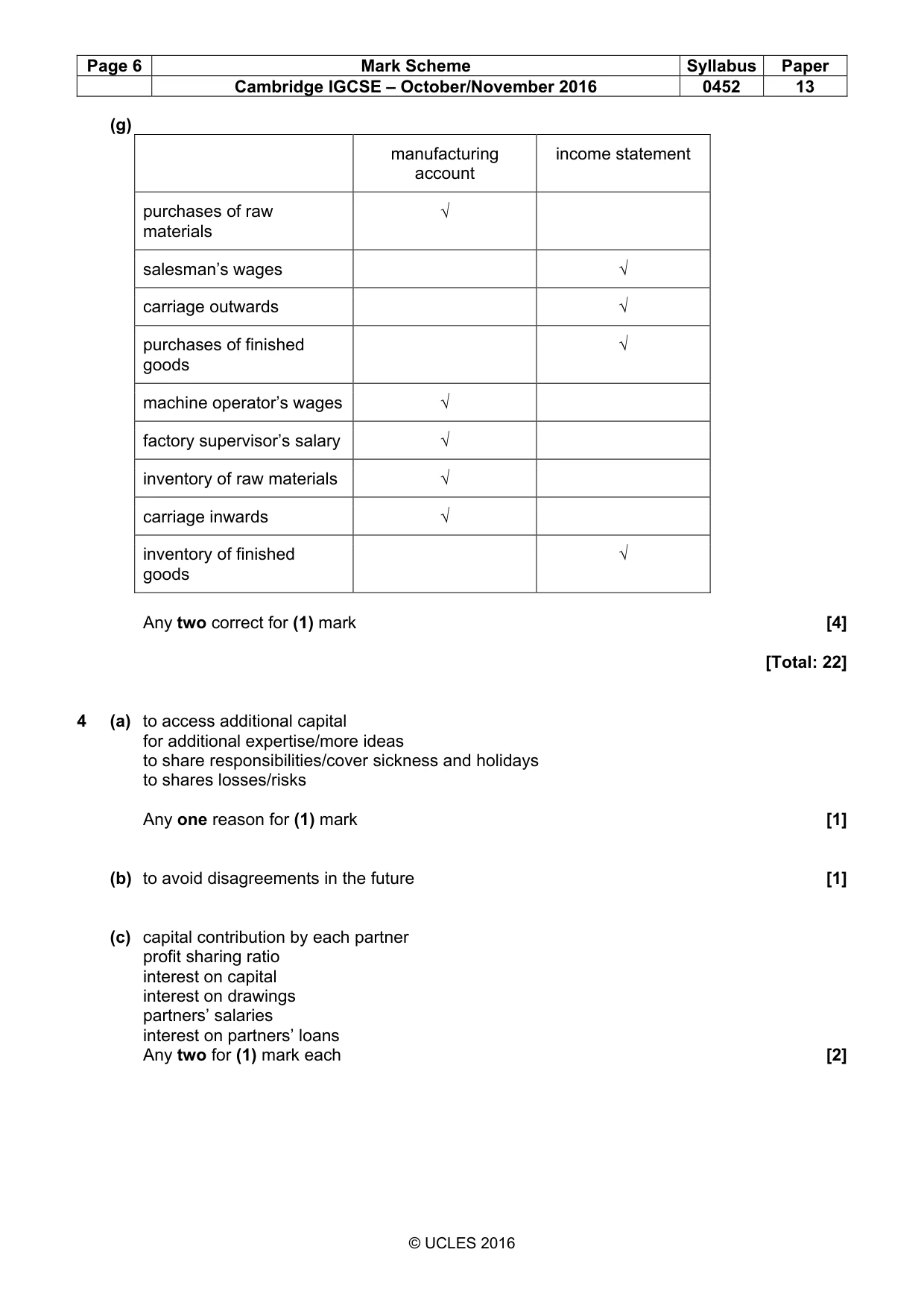
Page 6 Mark Scheme Syllabus Paper Cambridge IGCSE – October/November 2016 0452 13 © UCLES 2016 (g) manufacturing account income statement purchases of raw materials √ salesman’s wages √ carriage outwards √ purchases of finished goods √ machine operator’s wages √ factory supervisor’s salary √ inventory of raw materials √ carriage inwards √ inventory of finished goods √ Any two correct for (1) mark [4] [Total: 22] 4 (a) to access additional capital for additional expertise/more ideas to share responsibilities/cover sickness and holidays to shares losses/risks Any one reason for (1) mark [1] (b) to avoid disagreements in the future [1] (c) capital contribution by each partner profit sharing ratio interest on capital interest on drawings partners’ salaries interest on partners’ loans Any two for (1) mark each [2]
Mark scheme, page 7
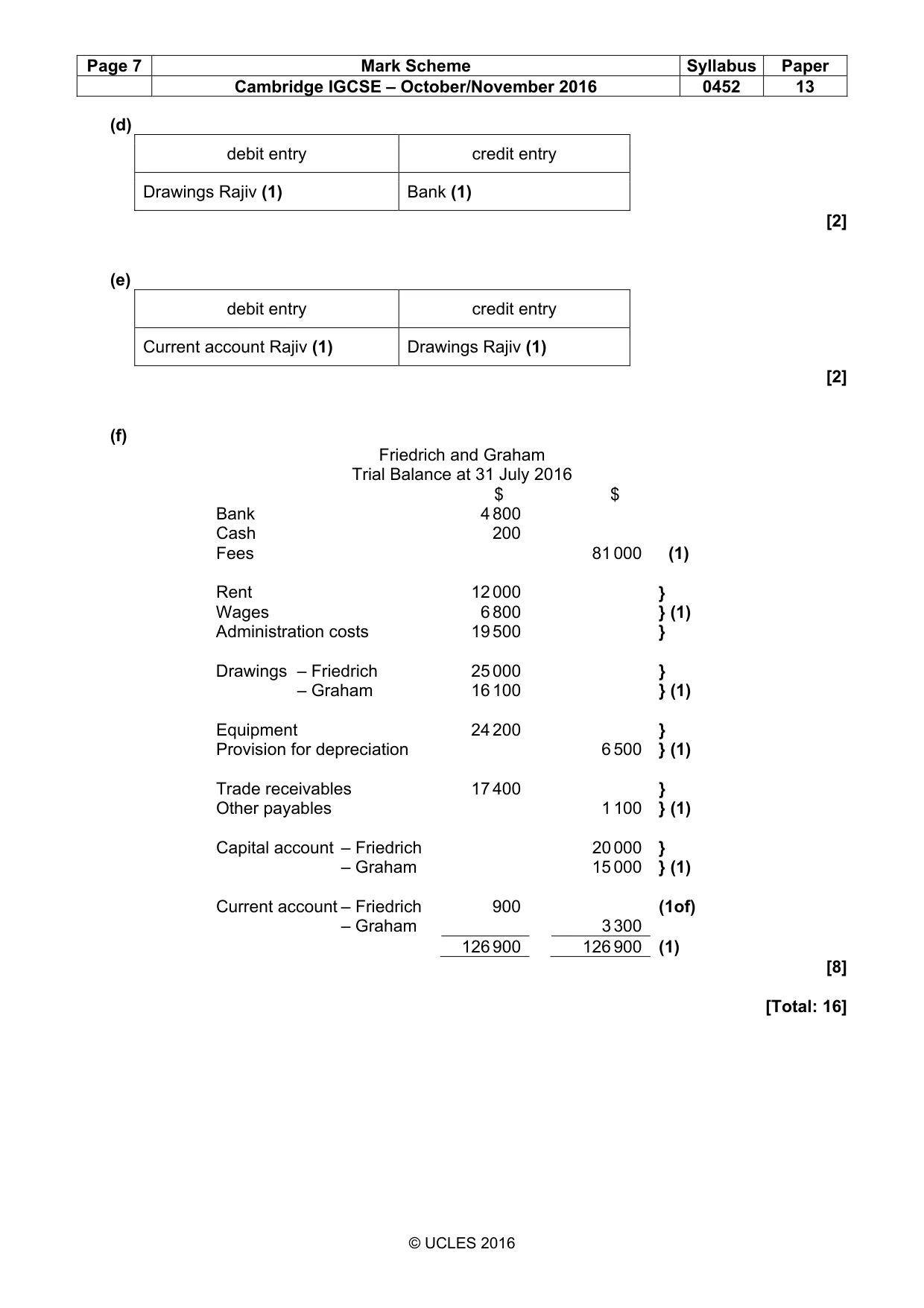
Page 7 Mark Scheme Syllabus Paper Cambridge IGCSE – October/November 2016 0452 13 © UCLES 2016 (d) debit entry credit entry Drawings Rajiv (1) Bank (1) [2] (e) debit entry credit entry Current account Rajiv (1) Drawings Rajiv (1) [2] (f) Friedrich and Graham Trial Balance at 31 July 2016 $ $ Bank 4 800 Cash 200 Fees 81 000 (1) Rent 12 000 } Wages 6 800 } (1) Administration costs 19 500 } Drawings – Friedrich 25 000 } – Graham 16 100 } (1) Equipment 24 200 } Provision for depreciation 6 500 } (1) Trade receivables 17 400 } Other payables 1 100 } (1) Capital account – Friedrich 20 000 } – Graham 15 000 } (1) Current account – Friedrich 900 (1of) – Graham 3 300 126 900 126 900 (1) [8] [Total: 16]
Mark scheme, page 8
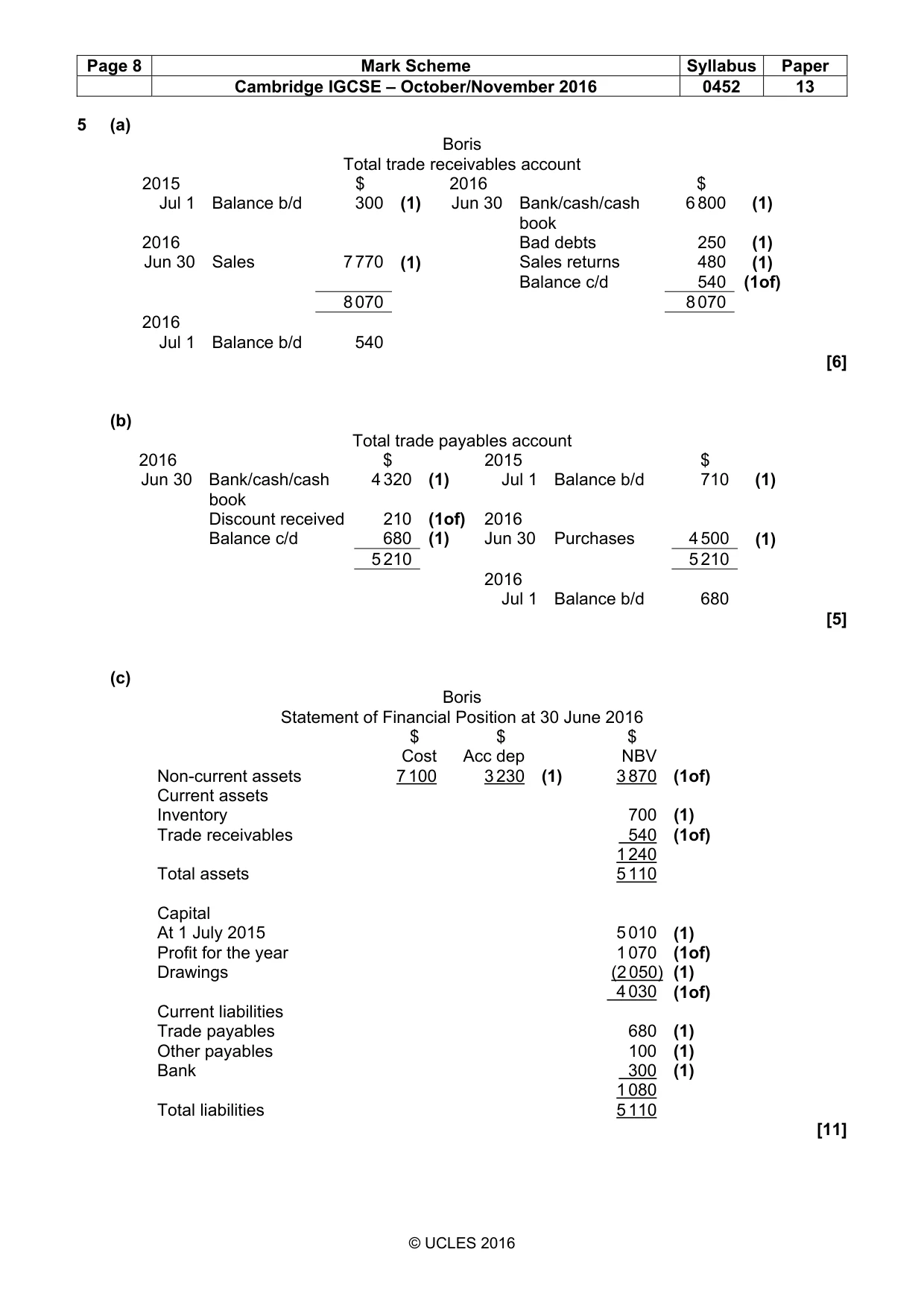
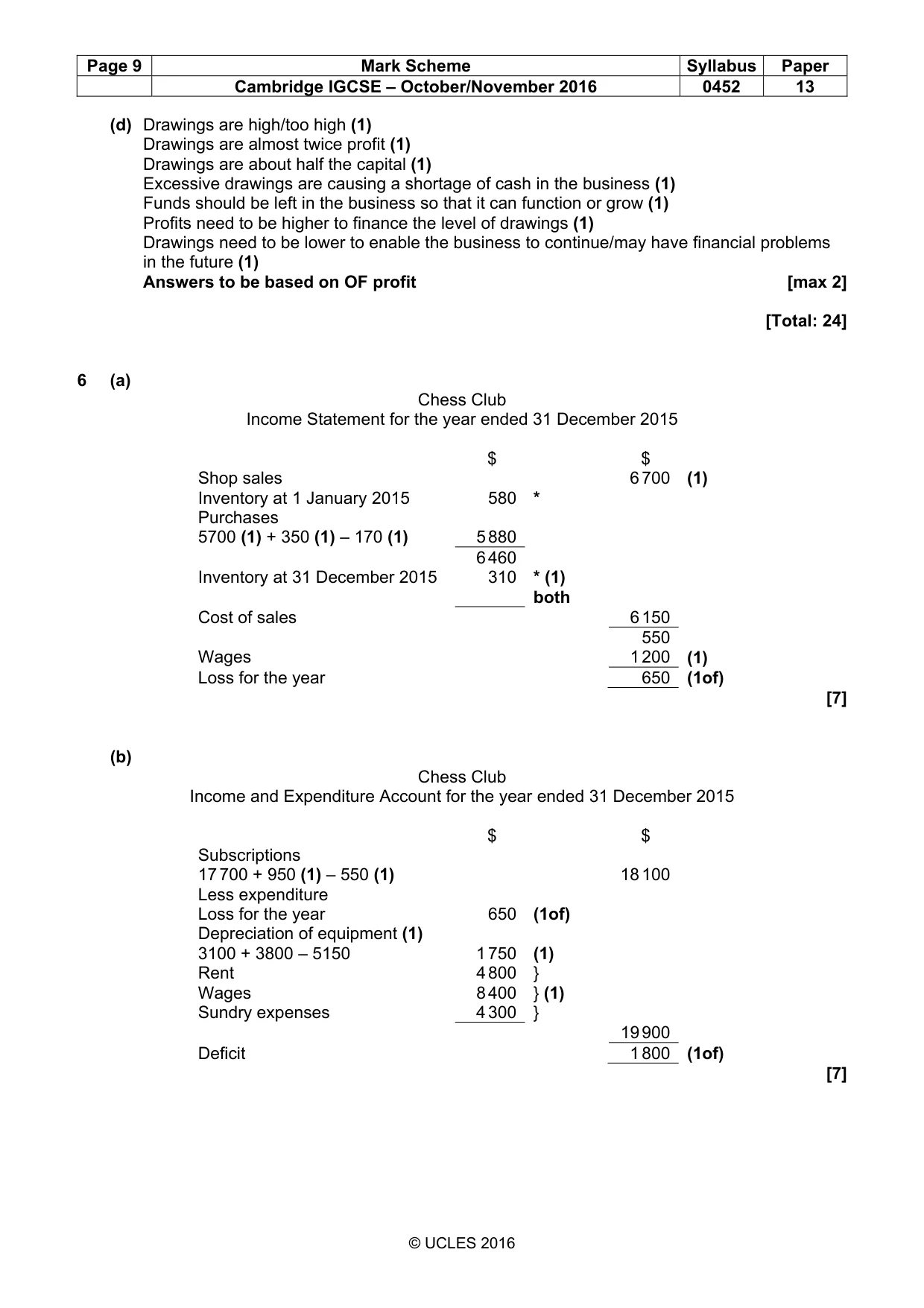
Page 8 Mark Scheme Syllabus Paper Cambridge IGCSE – October/November 2016 0452 13 © UCLES 2016 5 (a) Boris Total trade receivables account 2015 $ 2016 $ Jul 1 Balance b/d 300 (1) Jun 30 Bank/cash/cash book 6 800 (1) 2016 Bad debts 250 (1) Jun 30 Sales 7 770 (1) Sales returns 480 (1) Balance c/d 540 (1of) 8 070 8 070 2016 Jul 1 Balance b/d 540 [6] (b) Total trade payables account 2016 $ 2015 $ Jun 30 Bank/cash/cash book 4 320 (1) Jul 1 Balance b/d 710 (1) Discount received 210 (1of) 2016 Balance c/d 680 (1) Jun 30 Purchases 4 500 (1) 5 210 5 210 2016 Jul 1 Balance b/d 680 [5] (c) Boris Statement of Financial Position at 30 June 2016 $ $ $ Cost Acc dep NBV Non-current assets 7 100 3 230 (1) 3 870 (1of) Current assets Inventory 700 (1) Trade receivables 540 (1of) 1 240 Total assets 5 110 Capital At 1 July 2015 5 010 (1) Profit for the year 1 070 (1of) Drawings (2 050) (1) 4 030 (1of) Current liabilities Trade payables 680 (1) Other payables 100 (1) Bank 300 (1) 1 080 Total liabilities 5 110 [11]
Mark scheme, page 9
Page 9 Mark Scheme Syllabus Paper Cambridge IGCSE – October/November 2016 0452 13 © UCLES 2016 (d) Drawings are high/too high (1) Drawings are almost twice profit (1) Drawings are about half the capital (1) Excessive drawings are causing a shortage of cash in the business (1) Funds should be left in the business so that it can function or grow (1) Profits need to be higher to finance the level of drawings (1) Drawings need to be lower to enable the business to continue/may have financial problems in the future (1) Answers to be based on OF profit [max 2] [Total: 24] 6 (a) Chess Club Income Statement for the year ended 31 December 2015 $ $ Shop sales 6 700 (1) Inventory at 1 January 2015 580 * Purchases 5700 (1) + 350 (1) – 170 (1) 5 880 6 460 Inventory at 31 December 2015 310 * (1) both Cost of sales 6 150 550 Wages 1 200 (1) Loss for the year 650 (1of) [7] (b) Chess Club Income and Expenditure Account for the year ended 31 December 2015 $ $ Subscriptions 17 700 + 950 (1) – 550 (1) 18 100 Less expenditure Loss for the year 650 (1of) Depreciation of equipment (1) 3100 + 3800 – 5150 1 750 (1) Rent 4 800 } Wages 8 400 } (1) Sundry expenses 4 300 } 19 900 Deficit 1 800 (1of) [7]
Mark scheme, page 10
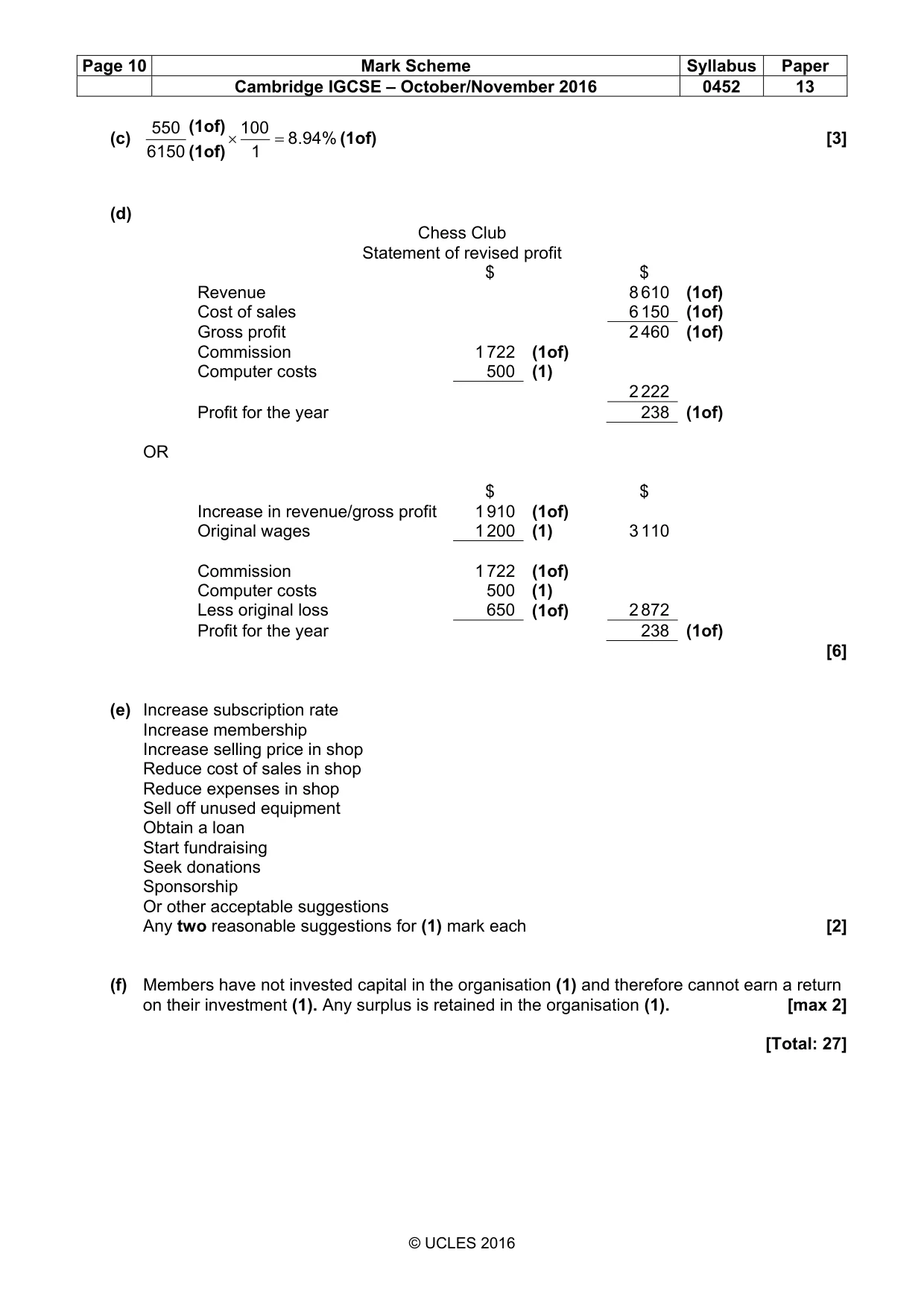
Page 10 Mark Scheme Syllabus Paper Cambridge IGCSE – October/November 2016 0452 13 © UCLES 2016 (c) 550 100 8.94% 6150 1 × = (1of) (1of) (1of) [3] (d) Chess Club Statement of revised profit $ $ Revenue 8 610 (1of) Cost of sales 6 150 (1of) Gross profit 2 460 (1of) Commission 1 722 (1of) Computer costs 500 (1) 2 222 Profit for the year 238 (1of) OR $ $ Increase in revenue/gross profit 1 910 (1of) Original wages 1 200 (1) 3 110 Commission 1 722 (1of) Computer costs 500 (1) Less original loss 650 (1of) 2 872 Profit for the year 238 (1of) [6] (e) Increase subscription rate Increase membership Increase selling price in shop Reduce cost of sales in shop Reduce expenses in shop Sell off unused equipment Obtain a loan Start fundraising Seek donations Sponsorship Or other acceptable suggestions Any two reasonable suggestions for (1) mark each [2] (f) Members have not invested capital in the organisation (1) and therefore cannot earn a return on their investment (1). Any surplus is retained in the organisation (1). [max 2] [Total: 27]
What you needed in this session
Cambridge’s own grade thresholds for 2016 Oct/Nov, Paper 1 · Variant 3. A higher threshold means an easier paper — the bar moves with how the cohort did.