Cambridge IGCSE Accounting 0452 — 2015 May/June Paper 1 · Variant 2
0452/12/M/J/15 · 120 marks · ≈135 min
The question paper and its mark scheme, free to read here and free to download. This is Cambridge’s own paper, exactly as it was sat.
Question paper20 pages
Mark scheme7 pages
Answers below. Sit the paper first if you are practising.
Paper as text
Question paper, page 1
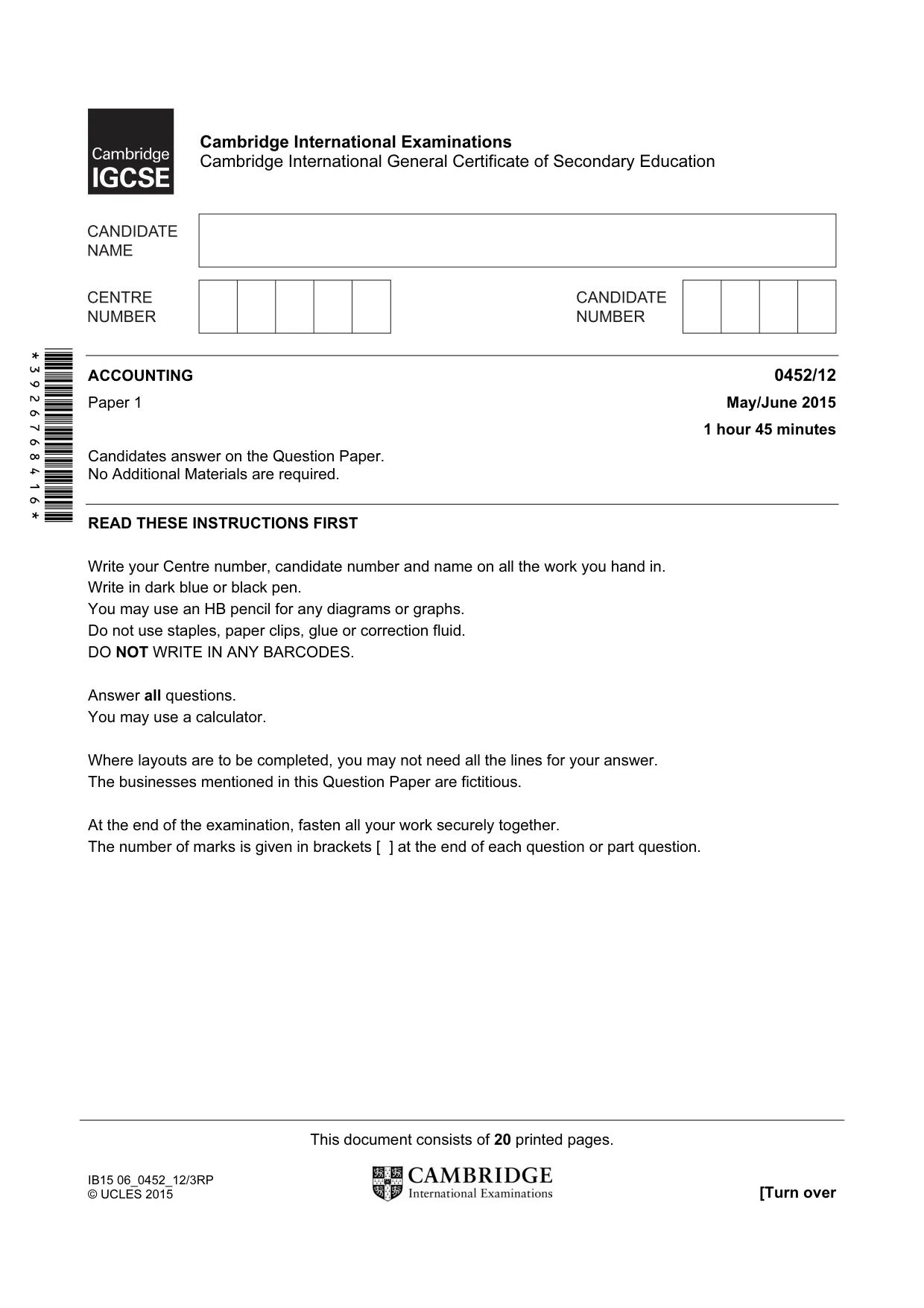
This document consists of 20 printed pages. IB15 06_0452_12/3RP © UCLES 2015 [Turn over *3926768416* Cambridge International Examinations Cambridge International General Certificate of Secondary Education ACCOUNTING 0452/12 Paper 1 May/June 2015 1 hour 45 minutes Candidates answer on the Question Paper. No Additional Materials are required. READ THESE INSTRUCTIONS FIRST Write your Centre number, candidate number and name on all the work you hand in. Write in dark blue or black pen. You may use an HB pencil for any diagrams or graphs. Do not use staples, paper clips, glue or correction fluid. DO NOT WRITE IN ANY BARCODES. Answer all questions. You may use a calculator. Where layouts are to be completed, you may not need all the lines for your answer. The businesses mentioned in this Question Paper are fictitious. At the end of the examination, fasten all your work securely together. The number of marks is given in brackets [ ] at the end of each question or part question.
Question paper, page 2
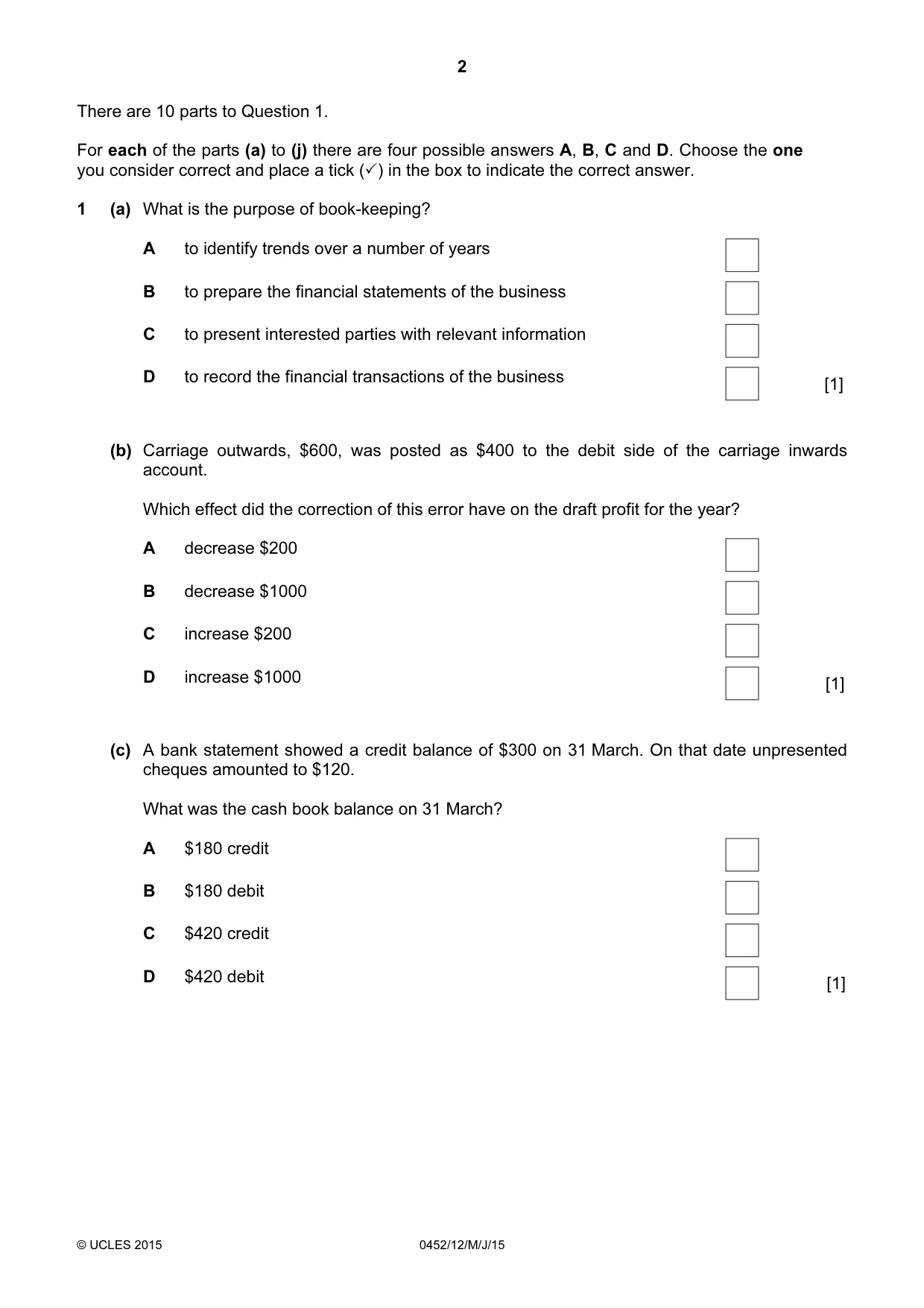
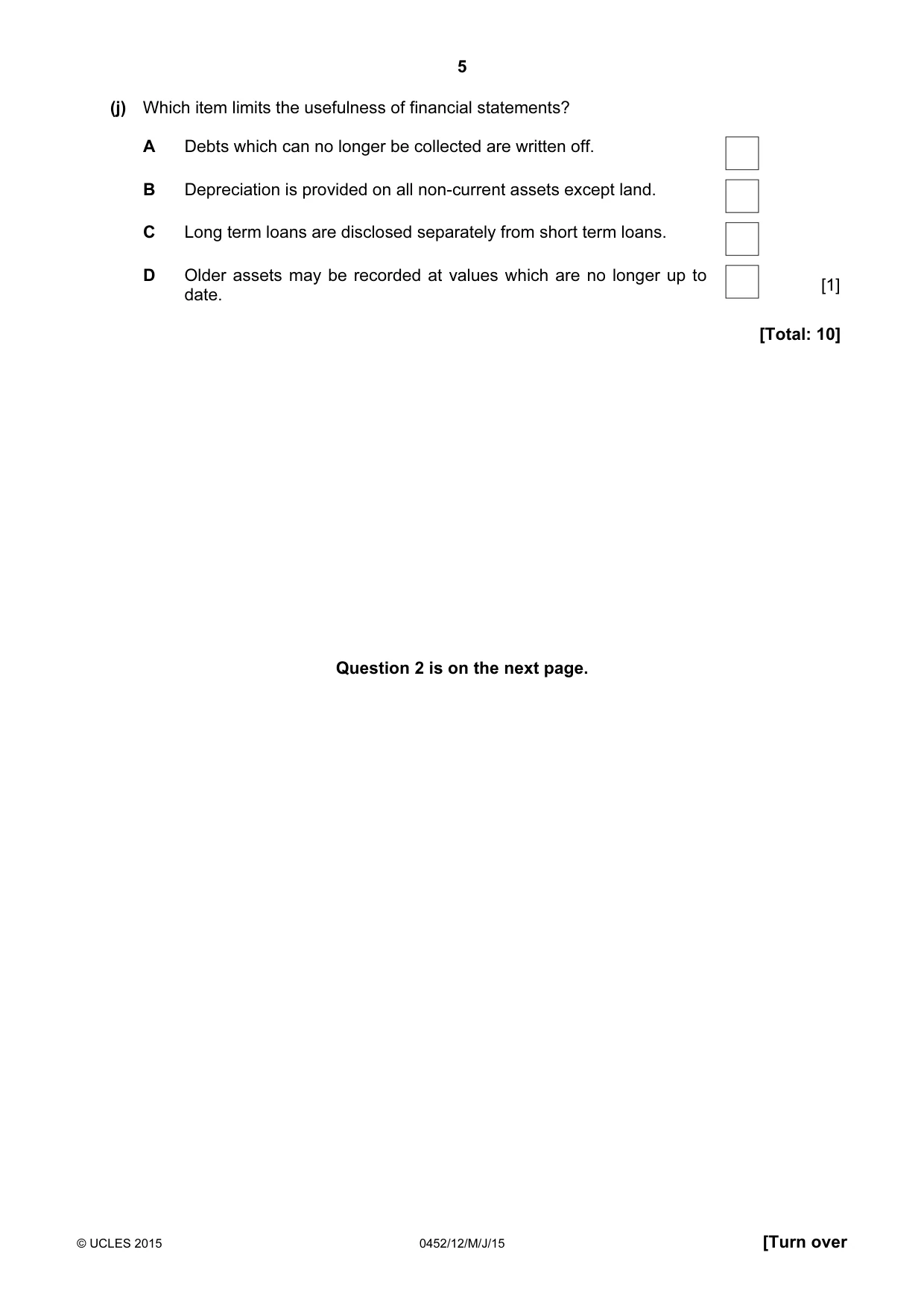
2 © UCLES 2015 0452/12/M/J/15 There are 10 parts to Question 1. For each of the parts (a) to (j) there are four possible answers A, B, C and D. Choose the one you consider correct and place a tick (✓) in the box to indicate the correct answer. 1 (a) What is the purpose of book-keeping? A to identify trends over a number of years B to prepare the financial statements of the business C to present interested parties with relevant information D to record the financial transactions of the business [1] (b) Carriage outwards, $600, was posted as $400 to the debit side of the carriage inwards account. Which effect did the correction of this error have on the draft profit for the year? A decrease $200 B decrease $1000 C increase $200 D increase $1000 [1] (c) A bank statement showed a credit balance of $300 on 31 March. On that date unpresented cheques amounted to $120. What was the cash book balance on 31 March? A $180 credit B $180 debit C $420 credit D $420 debit [1]
Question paper, page 3
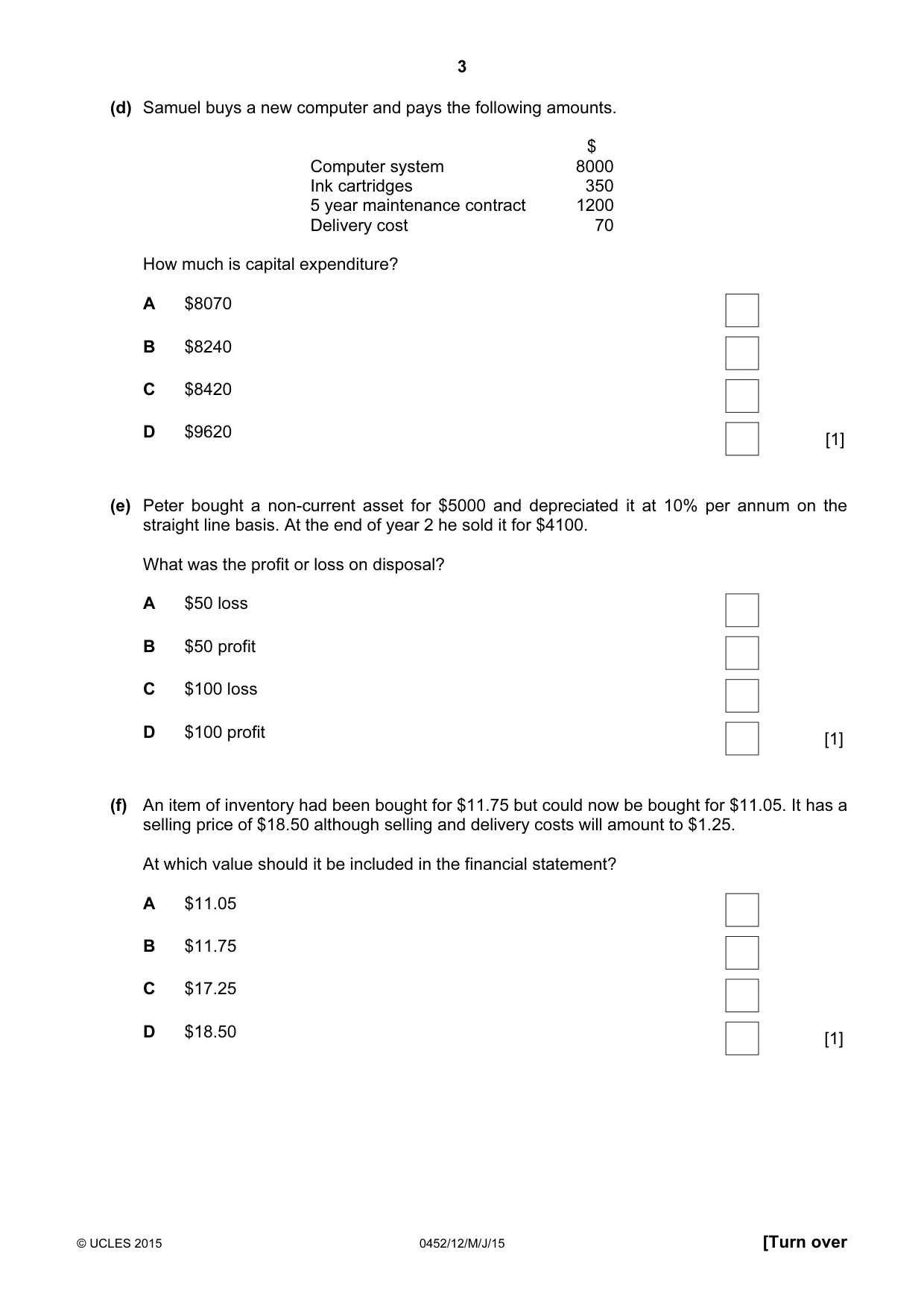
3 © UCLES 2015 0452/12/M/J/15 [Turn over (d) Samuel buys a new computer and pays the following amounts. $ Computer system 8000 Ink cartridges 350 5 year maintenance contract 1200 Delivery cost 70 How much is capital expenditure? A $8070 B $8240 C $8420 D $9620 [1] (e) Peter bought a non-current asset for $5000 and depreciated it at 10% per annum on the straight line basis. At the end of year 2 he sold it for $4100. What was the profit or loss on disposal? A $50 loss B $50 profit C $100 loss D $100 profit [1] (f) An item of inventory had been bought for $11.75 but could now be bought for $11.05. It has a selling price of $18.50 although selling and delivery costs will amount to $1.25. At which value should it be included in the financial statement? A $11.05 B $11.75 C $17.25 D $18.50 [1]
Question paper, page 4
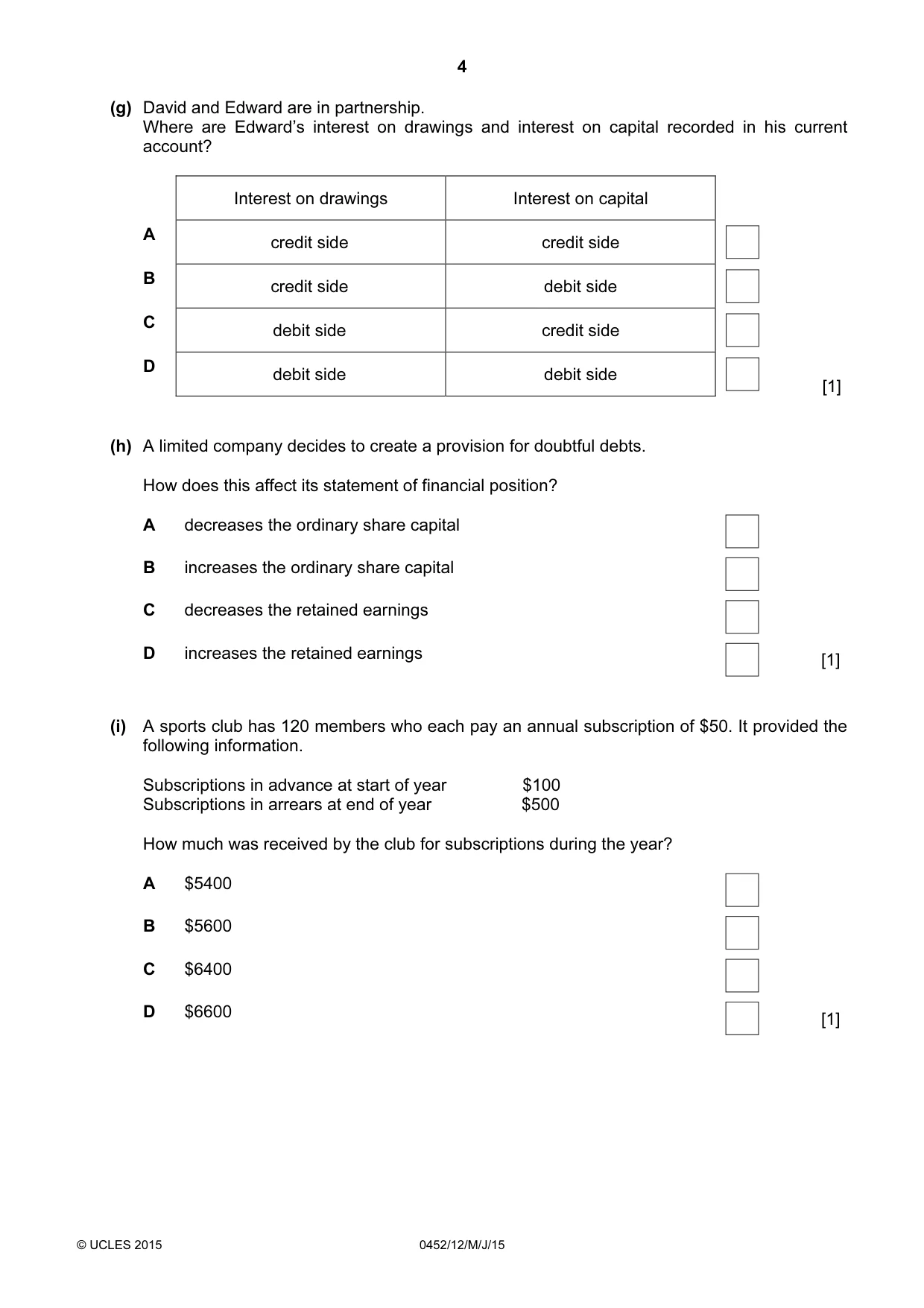
4 © UCLES 2015 0452/12/M/J/15 (g) David and Edward are in partnership. Where are Edward’s interest on drawings and interest on capital recorded in his current account? Interest on drawings Interest on capital A credit side credit side B credit side debit side C debit side credit side D debit side debit side [1] (h) A limited company decides to create a provision for doubtful debts. How does this affect its statement of financial position? A decreases the ordinary share capital B increases the ordinary share capital C decreases the retained earnings D increases the retained earnings [1] (i) A sports club has 120 members who each pay an annual subscription of $50. It provided the following information. Subscriptions in advance at start of year $100 Subscriptions in arrears at end of year $500 How much was received by the club for subscriptions during the year? A $5400 B $5600 C $6400 D $6600 [1]
Question paper, page 5
5 © UCLES 2015 0452/12/M/J/15 [Turn over (j) Which item limits the usefulness of financial statements? A Debts which can no longer be collected are written off. B Depreciation is provided on all non-current assets except land. C Long term loans are disclosed separately from short term loans. D Older assets may be recorded at values which are no longer up to date. [1] [Total: 10] Question 2 is on the next page.
Question paper, page 6
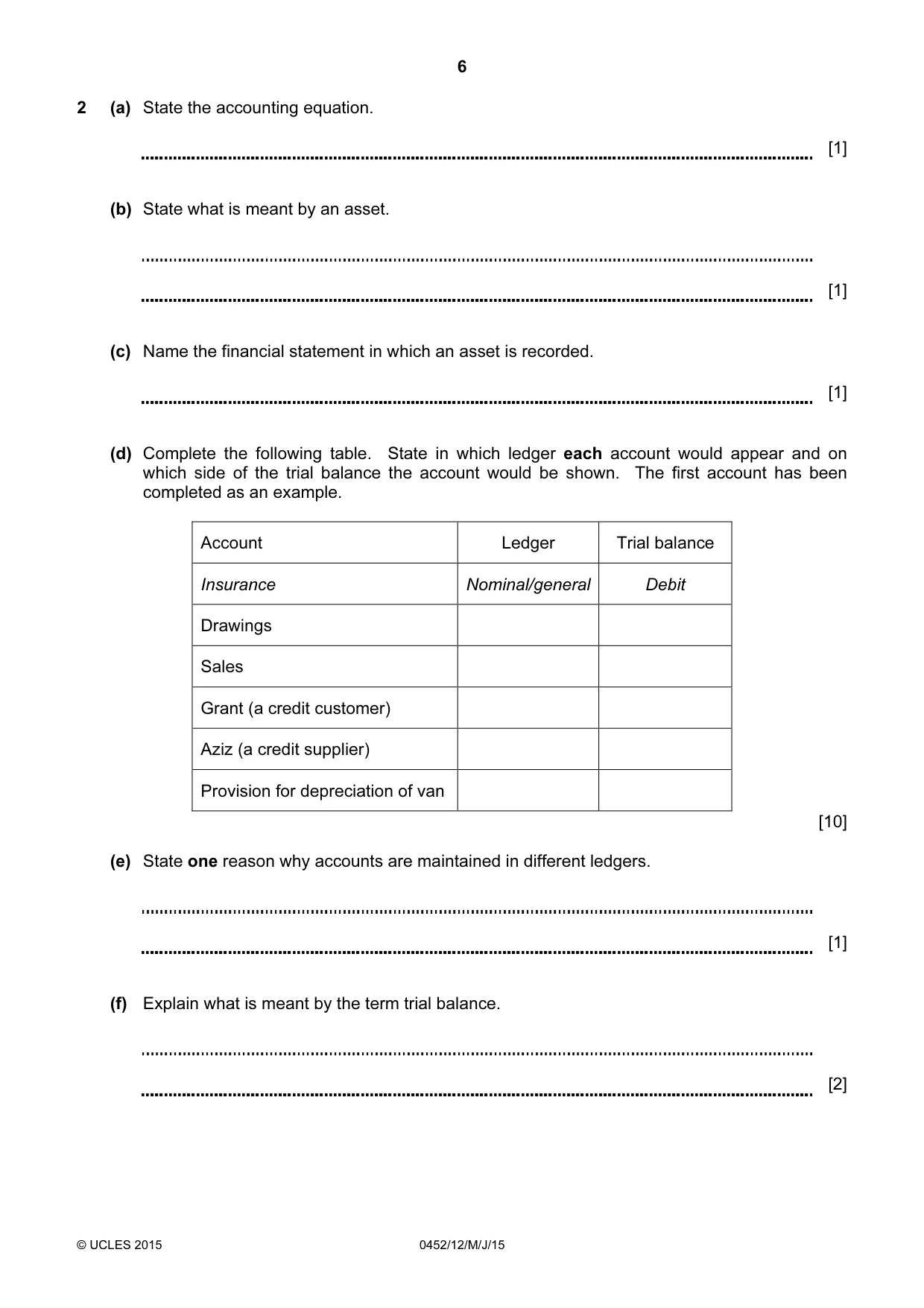
6 © UCLES 2015 0452/12/M/J/15 2 (a) State the accounting equation. [1] (b) State what is meant by an asset. [1] (c) Name the financial statement in which an asset is recorded. [1] (d) Complete the following table. State in which ledger each account would appear and on which side of the trial balance the account would be shown. The first account has been completed as an example. Account Ledger Trial balance Insurance Nominal/general Debit Drawings Sales Grant (a credit customer) Aziz (a credit supplier) Provision for depreciation of van [10] (e) State one reason why accounts are maintained in different ledgers. [1] (f) Explain what is meant by the term trial balance. [2]
Question paper, page 7
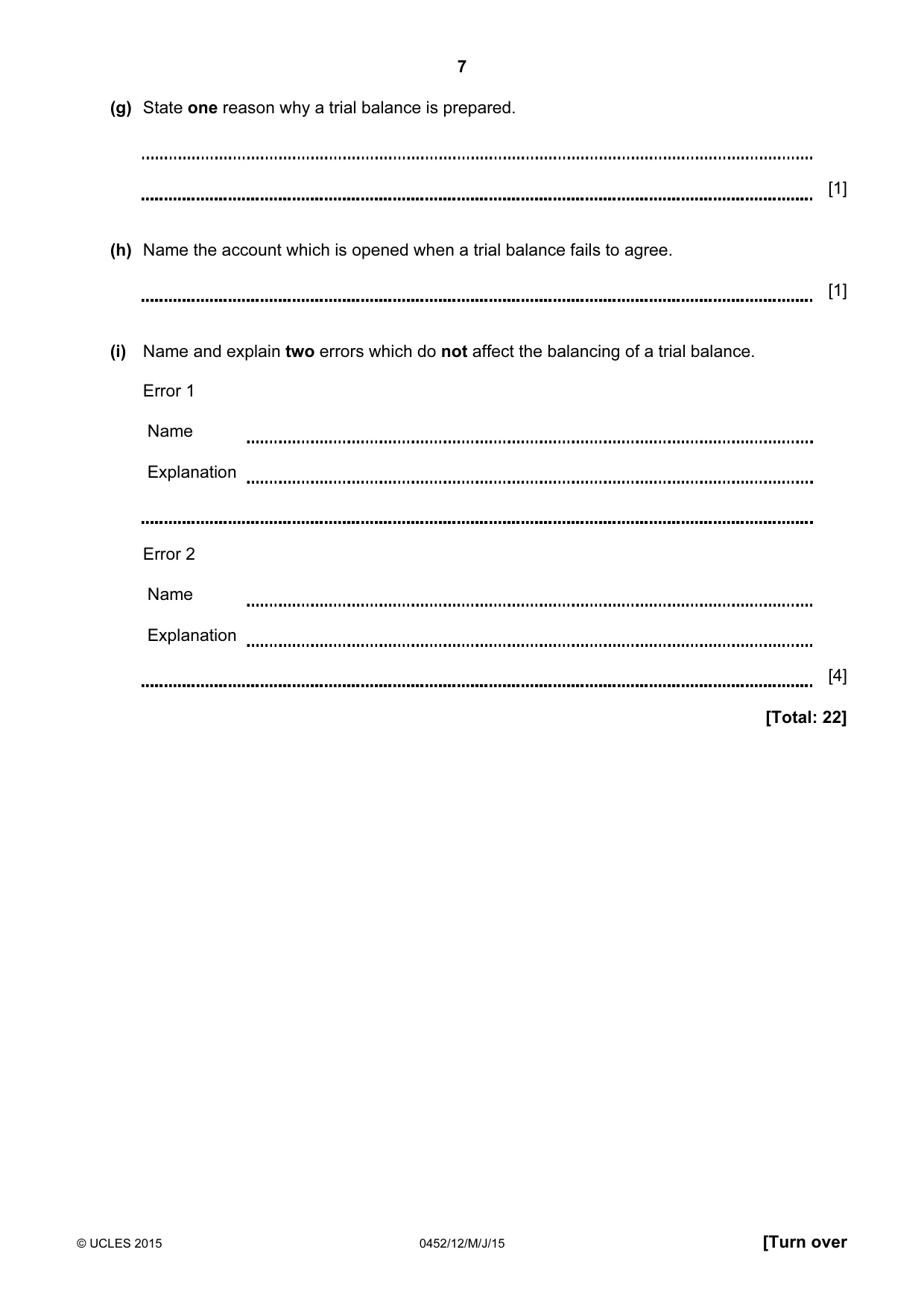
7 © UCLES 2015 0452/12/M/J/15 [Turn over (g) State one reason why a trial balance is prepared. [1] (h) Name the account which is opened when a trial balance fails to agree. [1] (i) Name and explain two errors which do not affect the balancing of a trial balance. Error 1 Name Explanation Error 2 Name Explanation [4] [Total: 22]
Question paper, page 8
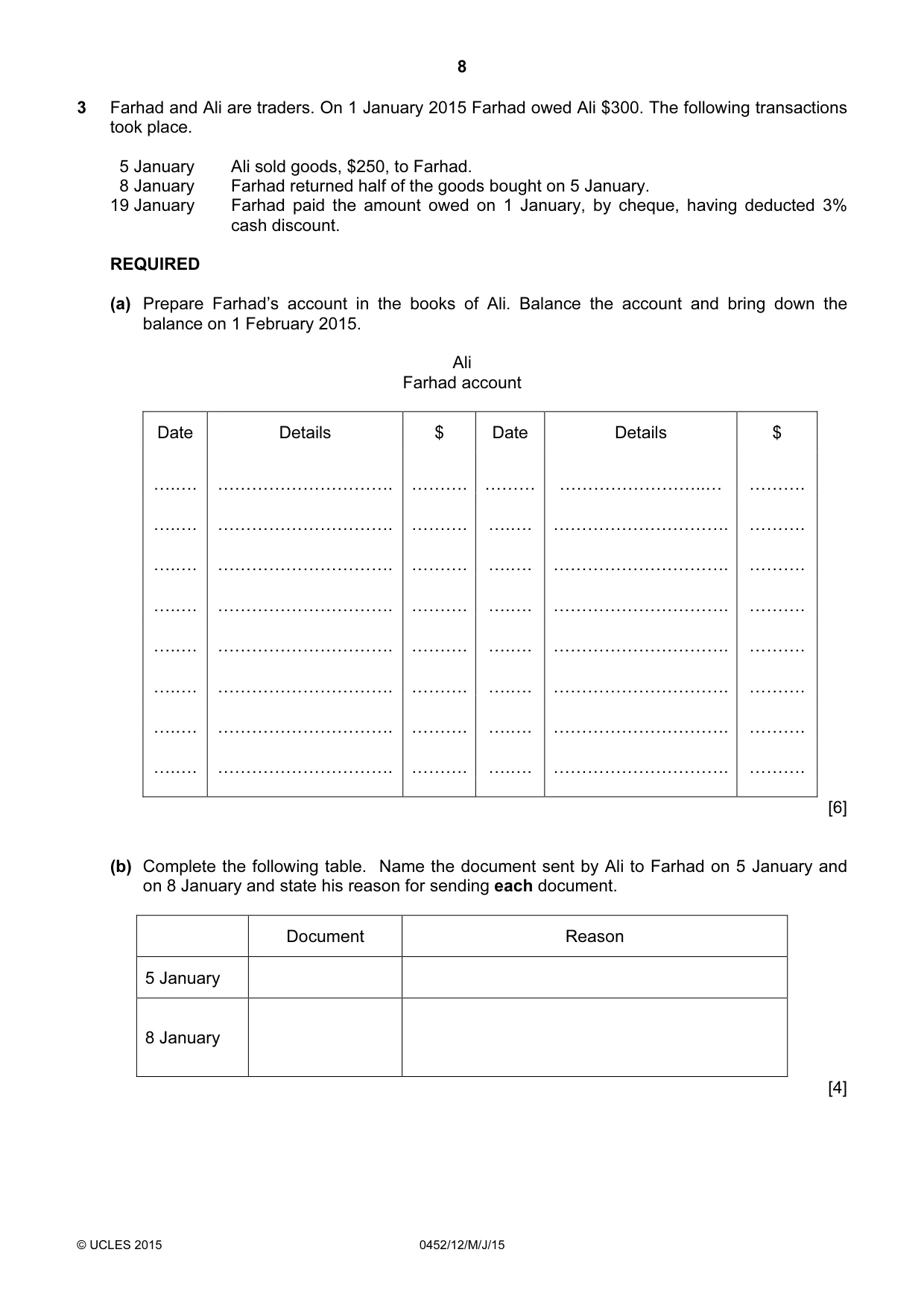
8 © UCLES 2015 0452/12/M/J/15 3 Farhad and Ali are traders. On 1 January 2015 Farhad owed Ali $300. The following transactions took place. 5 January Ali sold goods, $250, to Farhad. 8 January Farhad returned half of the goods bought on 5 January. 19 January Farhad paid the amount owed on 1 January, by cheque, having deducted 3% cash discount. REQUIRED (a) Prepare Farhad’s account in the books of Ali. Balance the account and bring down the balance on 1 February 2015. Ali Farhad account Date Details $ Date Details $ ….…. …………………………. ………. ……… ……………………..… ………. ….…. …………………………. ………. ….…. …………………………. ………. ….…. …………………………. ………. ….…. …………………………. ………. ….…. …………………………. ………. ….…. …………………………. ………. ….…. …………………………. ………. ….…. …………………………. ………. ….…. …………………………. ………. ….…. …………………………. ………. ….…. …………………………. ………. ….…. …………………………. ………. ….…. …………………………. ………. ….…. …………………………. ………. [6] (b) Complete the following table. Name the document sent by Ali to Farhad on 5 January and on 8 January and state his reason for sending each document. Document Reason 5 January 8 January [4]
Question paper, page 9
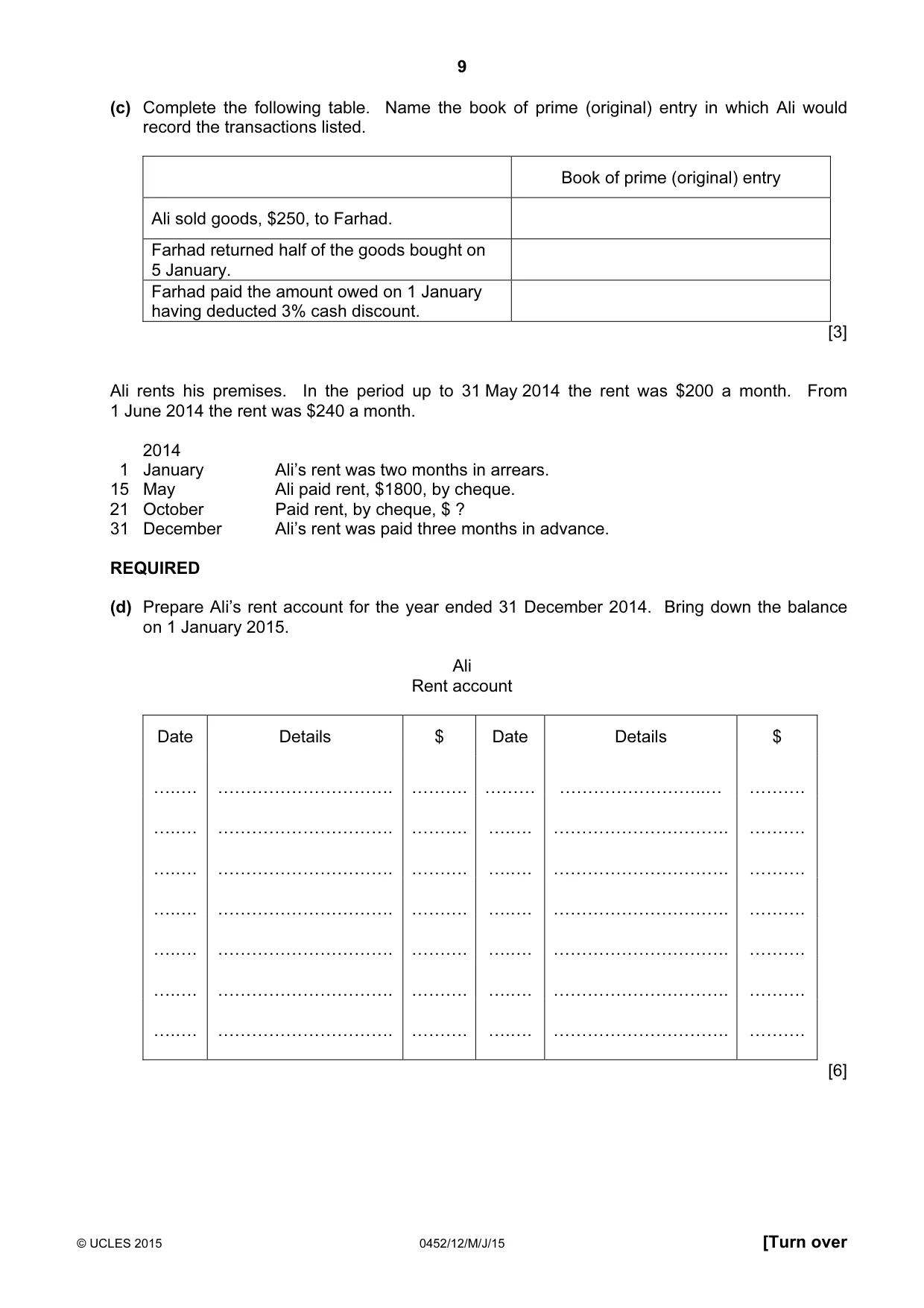
9 © UCLES 2015 0452/12/M/J/15 [Turn over (c) Complete the following table. Name the book of prime (original) entry in which Ali would record the transactions listed. Book of prime (original) entry Ali sold goods, $250, to Farhad. Farhad returned half of the goods bought on 5 January. Farhad paid the amount owed on 1 January having deducted 3% cash discount. [3] Ali rents his premises. In the period up to 31 May 2014 the rent was $200 a month. From 1 June 2014 the rent was $240 a month. 2014 1 January Ali’s rent was two months in arrears. 15 May Ali paid rent, $1800, by cheque. 21 October Paid rent, by cheque, $ ? 31 December Ali’s rent was paid three months in advance. REQUIRED (d) Prepare Ali’s rent account for the year ended 31 December 2014. Bring down the balance on 1 January 2015. Ali Rent account Date Details $ Date Details $ ….…. …………………………. ………. ……… ……………………..… ………. ….…. …………………………. ………. ….…. …………………………. ………. ….…. …………………………. ………. ….…. …………………………. ………. ….…. …………………………. ………. ….…. …………………………. ………. ….…. …………………………. ………. ….…. …………………………. ………. ….…. …………………………. ………. ….…. …………………………. ………. ….…. …………………………. ………. ….…. …………………………. ………. [6]
Question paper, page 10
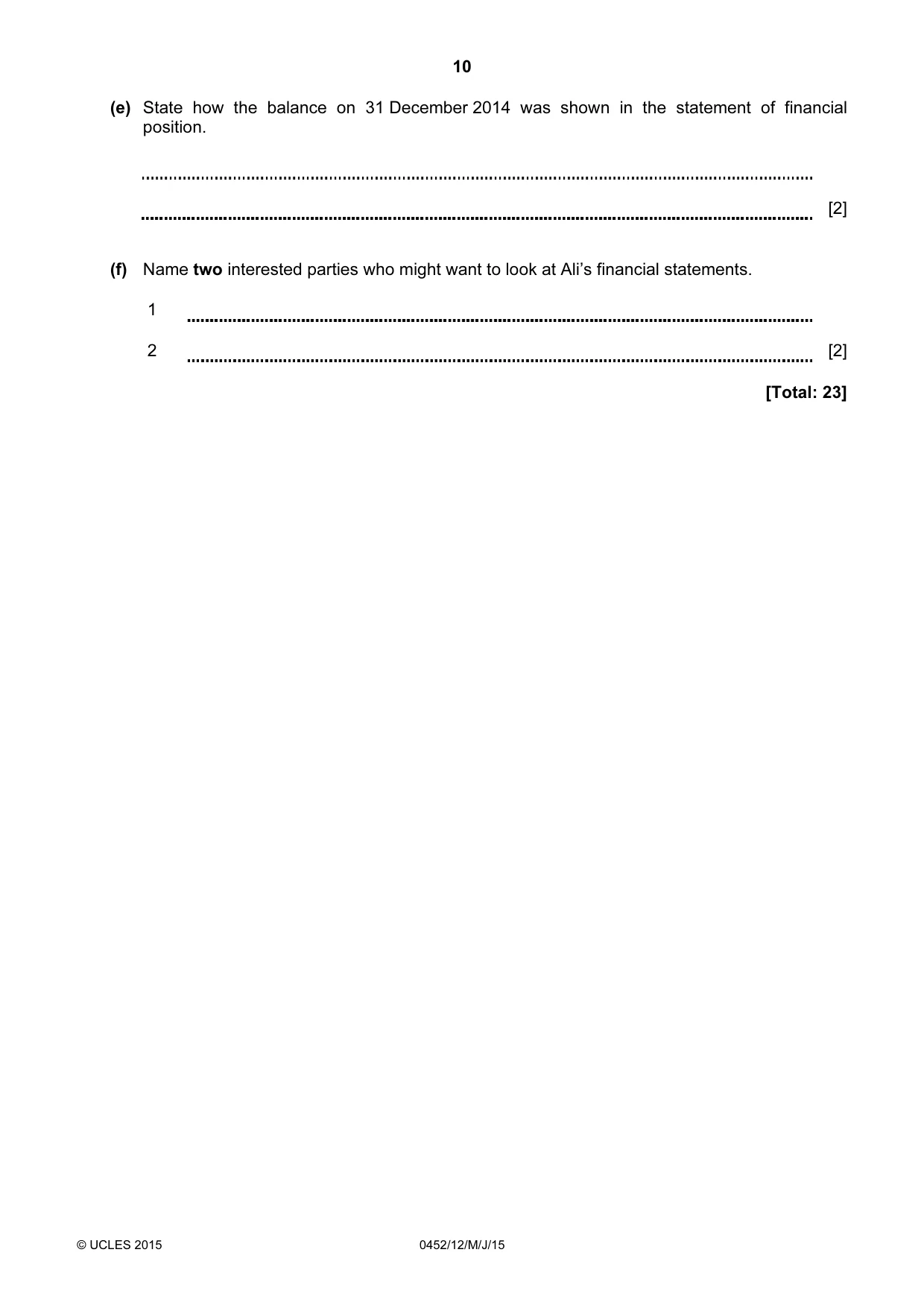
10 © UCLES 2015 0452/12/M/J/15 (e) State how the balance on 31 December 2014 was shown in the statement of financial position. [2] (f) Name two interested parties who might want to look at Ali’s financial statements. 1 2 [2] [Total: 23]
Question paper, page 11
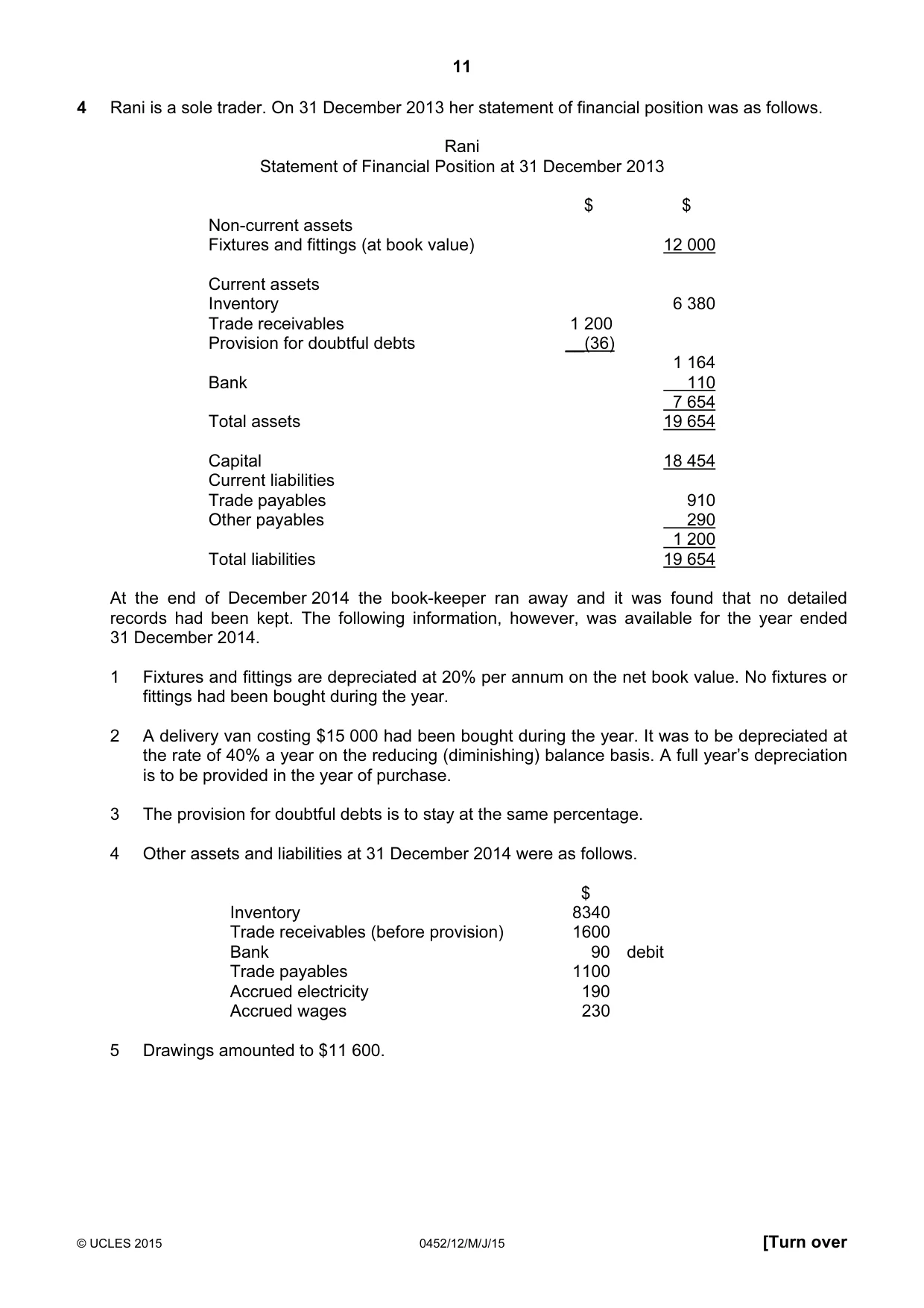
11 © UCLES 2015 0452/12/M/J/15 [Turn over 4 Rani is a sole trader. On 31 December 2013 her statement of financial position was as follows. Rani Statement of Financial Position at 31 December 2013 $ $ Non-current assets Fixtures and fittings (at book value) 12 000 Current assets Inventory 6 380 Trade receivables 1 200 Provision for doubtful debts __(36) 1 164 Bank 110 7 654 Total assets 19 654 Capital 18 454 Current liabilities Trade payables 910 Other payables 290 1 200 Total liabilities 19 654 At the end of December 2014 the book-keeper ran away and it was found that no detailed records had been kept. The following information, however, was available for the year ended 31 December 2014. 1 Fixtures and fittings are depreciated at 20% per annum on the net book value. No fixtures or fittings had been bought during the year. 2 A delivery van costing $15 000 had been bought during the year. It was to be depreciated at the rate of 40% a year on the reducing (diminishing) balance basis. A full year’s depreciation is to be provided in the year of purchase. 3 The provision for doubtful debts is to stay at the same percentage. 4 Other assets and liabilities at 31 December 2014 were as follows. $ Inventory 8340 Trade receivables (before provision) 1600 Bank 90 debit Trade payables 1100 Accrued electricity 190 Accrued wages 230 5 Drawings amounted to $11 600.
Question paper, page 12
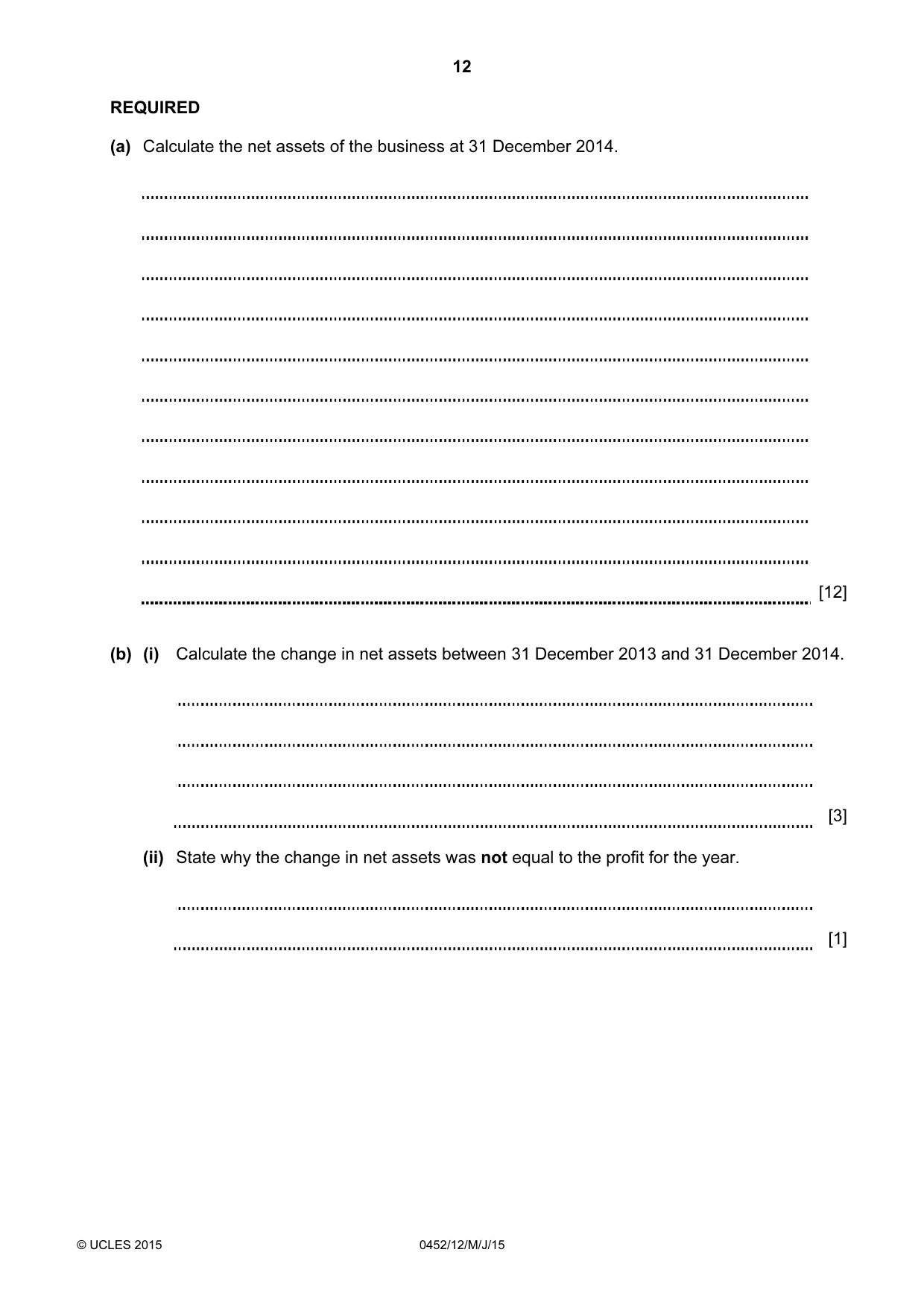
12 © UCLES 2015 0452/12/M/J/15 REQUIRED (a) Calculate the net assets of the business at 31 December 2014. [12] (b) (i) Calculate the change in net assets between 31 December 2013 and 31 December 2014. [3] (ii) State why the change in net assets was not equal to the profit for the year. [1]
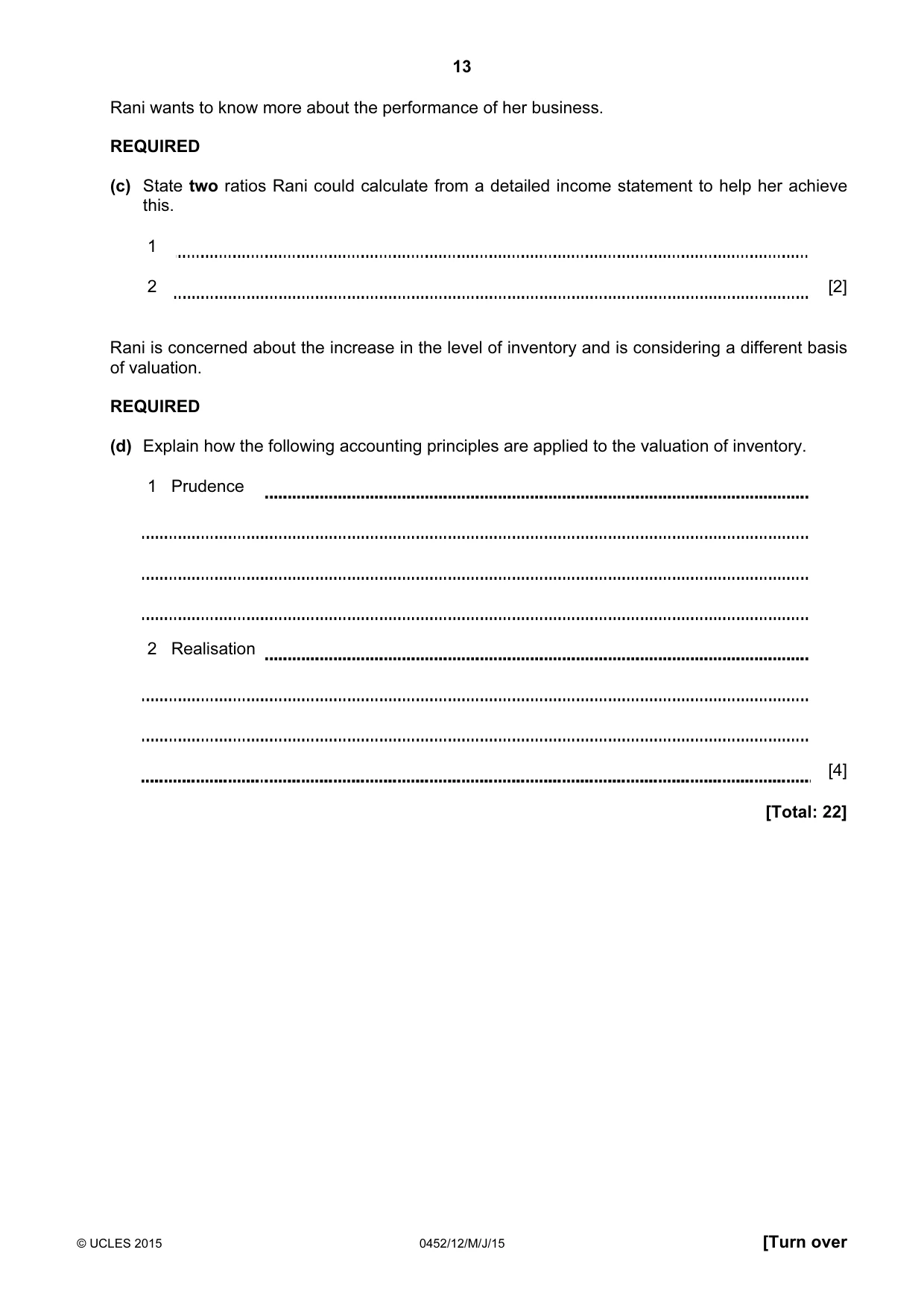
Question paper, page 13
13 © UCLES 2015 0452/12/M/J/15 [Turn over Rani wants to know more about the performance of her business. REQUIRED (c) State two ratios Rani could calculate from a detailed income statement to help her achieve this. 1 2 [2] Rani is concerned about the increase in the level of inventory and is considering a different basis of valuation. REQUIRED (d) Explain how the following accounting principles are applied to the valuation of inventory. 1 Prudence 2 Realisation [4] [Total: 22]
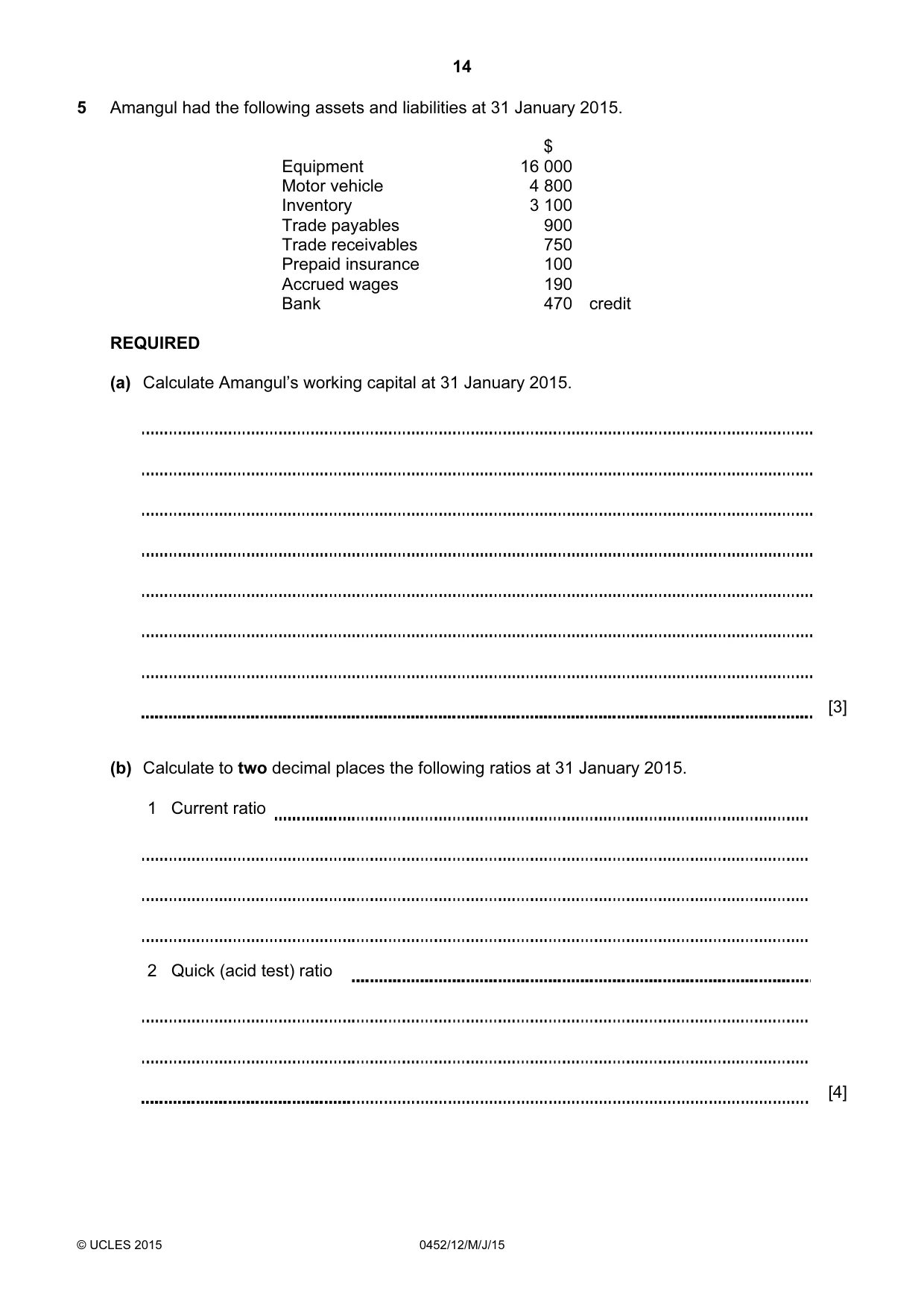
Question paper, page 14
14 © UCLES 2015 0452/12/M/J/15 5 Amangul had the following assets and liabilities at 31 January 2015. $ Equipment 16 000 Motor vehicle 4 800 Inventory 3 100 Trade payables 900 Trade receivables 750 Prepaid insurance 100 Accrued wages 190 Bank 470 credit REQUIRED (a) Calculate Amangul’s working capital at 31 January 2015. [3] (b) Calculate to two decimal places the following ratios at 31 January 2015. 1 Current ratio 2 Quick (acid test) ratio [4]
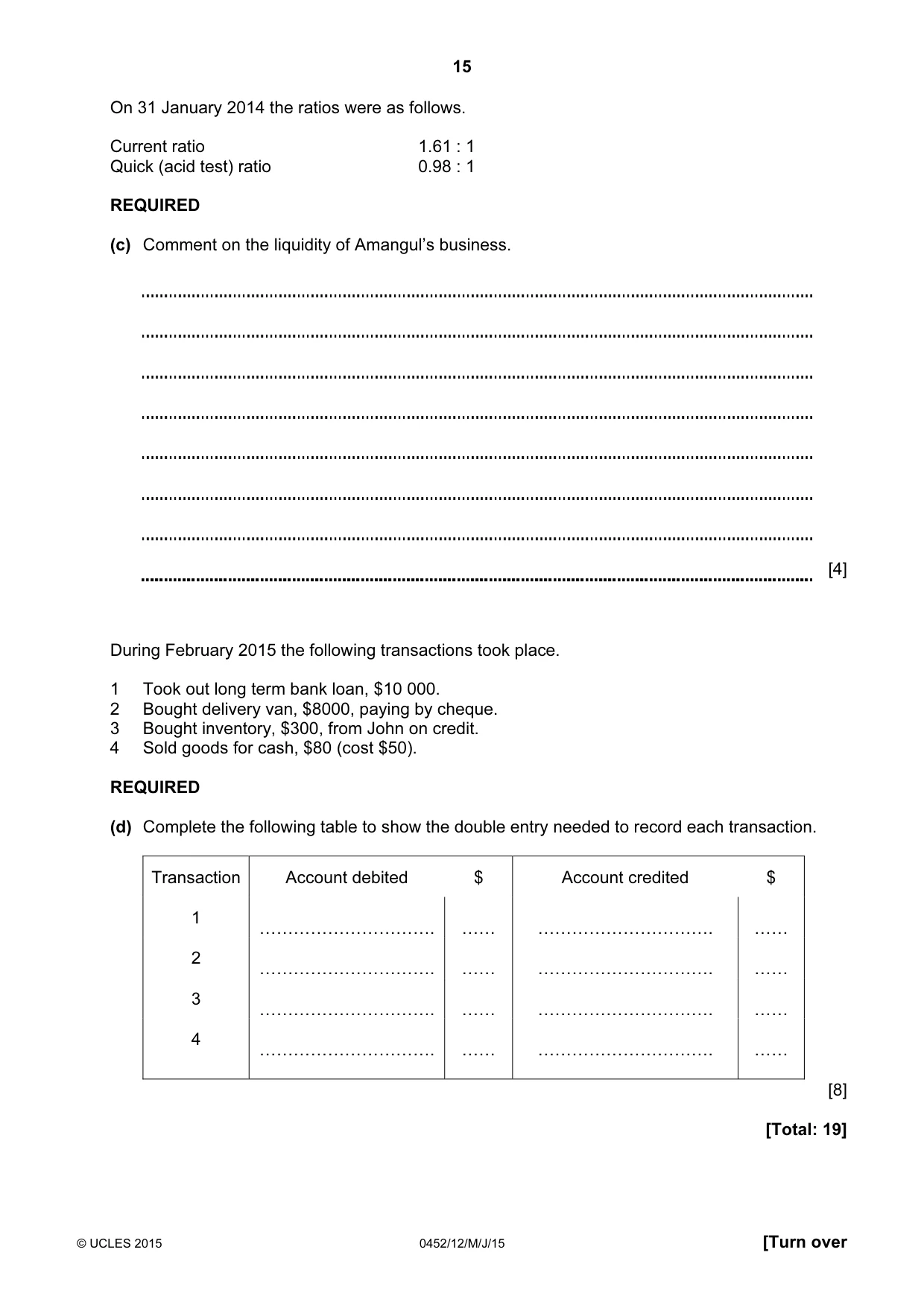
Question paper, page 15
15 © UCLES 2015 0452/12/M/J/15 [Turn over On 31 January 2014 the ratios were as follows. Current ratio 1.61 : 1 Quick (acid test) ratio 0.98 : 1 REQUIRED (c) Comment on the liquidity of Amangul’s business. [4] During February 2015 the following transactions took place. 1 Took out long term bank loan, $10 000. 2 Bought delivery van, $8000, paying by cheque. 3 Bought inventory, $300, from John on credit. 4 Sold goods for cash, $80 (cost $50). REQUIRED (d) Complete the following table to show the double entry needed to record each transaction. Transaction Account debited $ Account credited $ 1 …………………………. …… …………………………. …… 2 …………………………. …… …………………………. …… 3 …………………………. …… …………………………. …… 4 …………………………. …… …………………………. …… [8] [Total: 19]
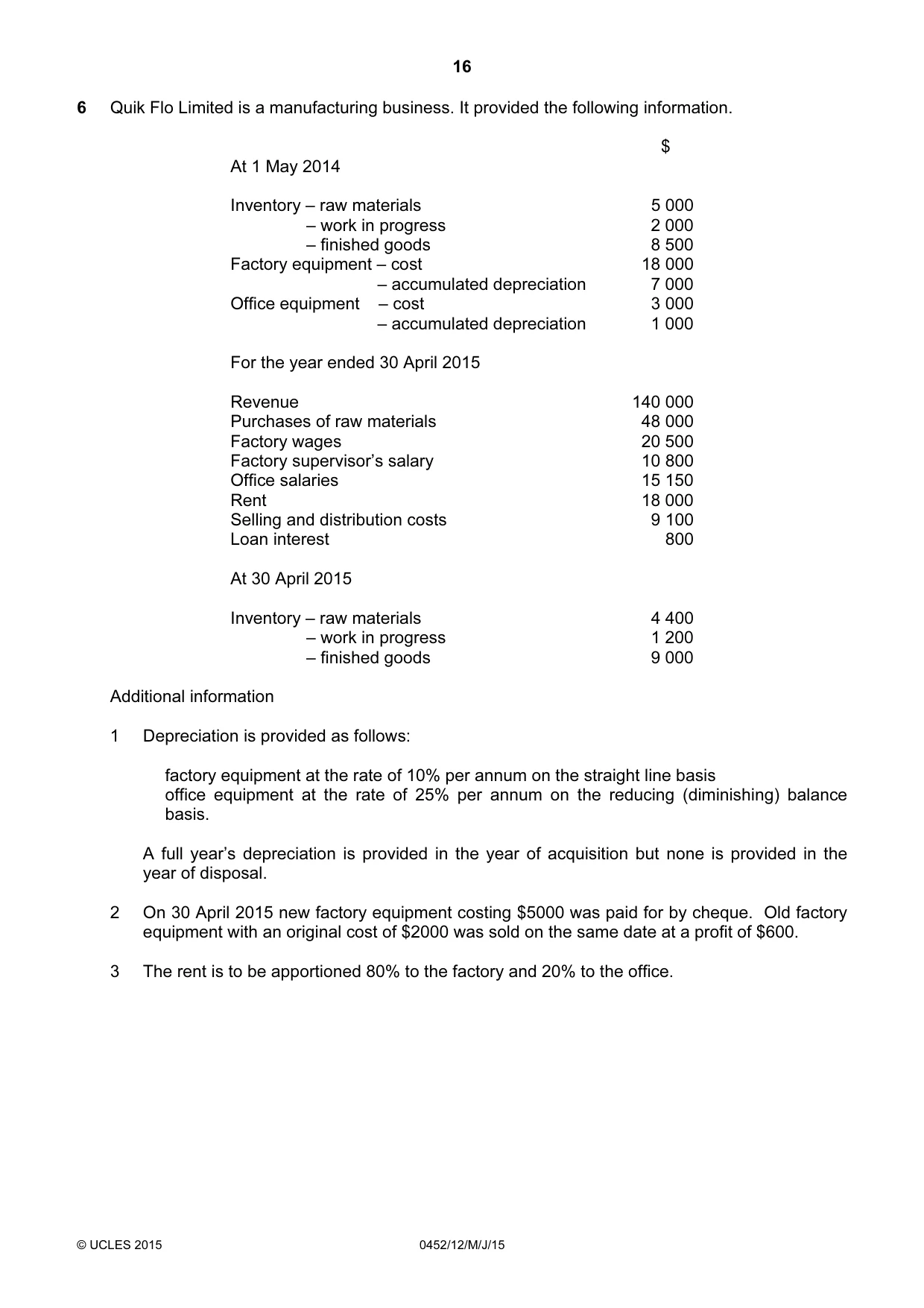
Question paper, page 16
16 © UCLES 2015 0452/12/M/J/15 6 Quik Flo Limited is a manufacturing business. It provided the following information. $ At 1 May 2014 Inventory – raw materials 5 000 – work in progress 2 000 – finished goods 8 500 Factory equipment – cost 18 000 – accumulated depreciation 7 000 Office equipment – cost 3 000 – accumulated depreciation 1 000 For the year ended 30 April 2015 Revenue 140 000 Purchases of raw materials 48 000 Factory wages 20 500 Factory supervisor’s salary 10 800 Office salaries 15 150 Rent 18 000 Selling and distribution costs 9 100 Loan interest 800 At 30 April 2015 Inventory – raw materials 4 400 – work in progress 1 200 – finished goods 9 000 Additional information 1 Depreciation is provided as follows: factory equipment at the rate of 10% per annum on the straight line basis office equipment at the rate of 25% per annum on the reducing (diminishing) balance basis. A full year’s depreciation is provided in the year of acquisition but none is provided in the year of disposal. 2 On 30 April 2015 new factory equipment costing $5000 was paid for by cheque. Old factory equipment with an original cost of $2000 was sold on the same date at a profit of $600. 3 The rent is to be apportioned 80% to the factory and 20% to the office.
Question paper, page 17
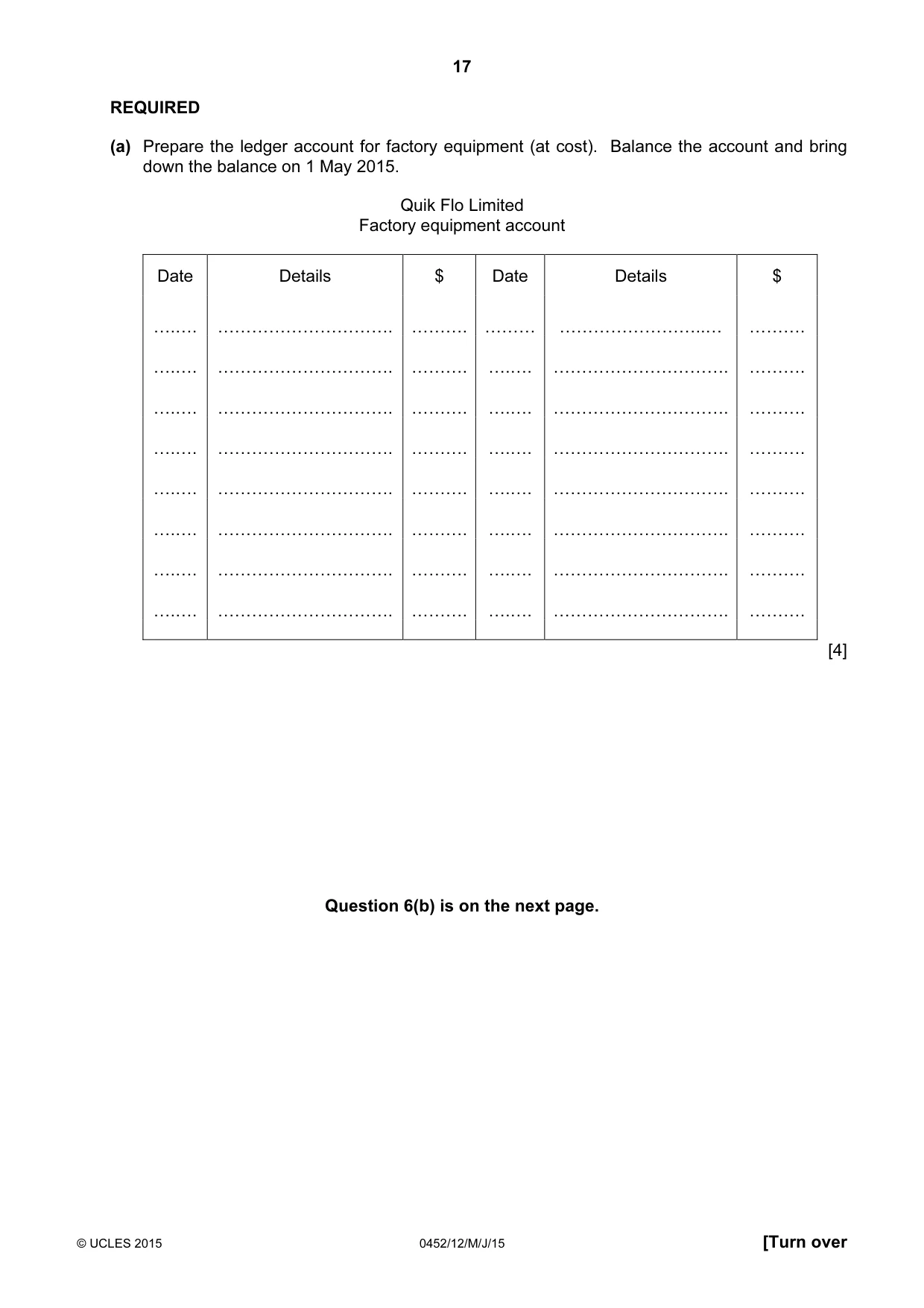
17 © UCLES 2015 0452/12/M/J/15 [Turn over REQUIRED (a) Prepare the ledger account for factory equipment (at cost). Balance the account and bring down the balance on 1 May 2015. Quik Flo Limited Factory equipment account Date Details $ Date Details $ ….…. …………………………. ………. ……… ……………………..… ………. ….…. …………………………. ………. ….…. …………………………. ………. ….…. …………………………. ………. ….…. …………………………. ………. ….…. …………………………. ………. ….…. …………………………. ………. ….…. …………………………. ………. ….…. …………………………. ………. ….…. …………………………. ………. ….…. …………………………. ………. ….…. …………………………. ………. ….…. …………………………. ………. ….…. …………………………. ………. ….…. …………………………. ………. [4] Question 6(b) is on the next page.
Question paper, page 18
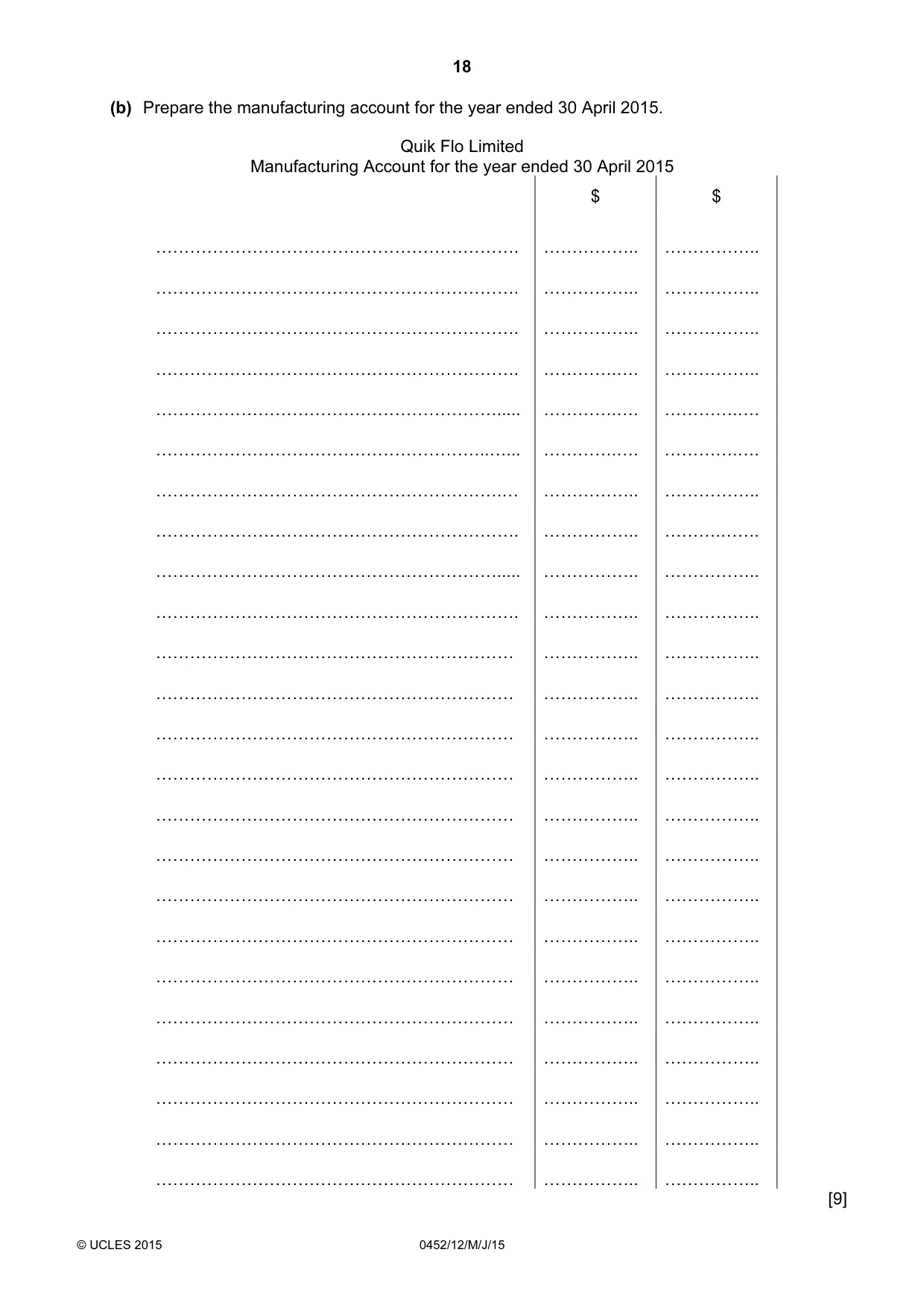
18 © UCLES 2015 0452/12/M/J/15 (b) Prepare the manufacturing account for the year ended 30 April 2015. Quik Flo Limited Manufacturing Account for the year ended 30 April 2015 $ $ ………………………………………………………. …………….. …………….. ………………………………………………………. …………….. …………….. ………………………………………………………. …………….. …………….. ………………………………………………………. ………….…. …………….. ……………………………………………………… ………….…. ………….…. …………………………………………………..…... ………….…. ………….…. …………………………………………………….… …………….. …………….. ………………………………………………………. …………….. ……….……. ……………………………………………………… …………….. …………….. ………………………………………………………. …………….. …………….. ……………………………………………………… …………….. …………….. ……………………………………………………… …………….. …………….. ……………………………………………………… …………….. …………….. ……………………………………………………… …………….. …………….. ……………………………………………………… …………….. …………….. ……………………………………………………… …………….. …………….. ……………………………………………………… …………….. …………….. ……………………………………………………… …………….. …………….. ……………………………………………………… …………….. …………….. ……………………………………………………… …………….. …………….. ……………………………………………………… …………….. …………….. ……………………………………………………… …………….. …………….. ……………………………………………………… …………….. …………….. ……………………………………………………… …………….. …………….. [9]
Question paper, page 19
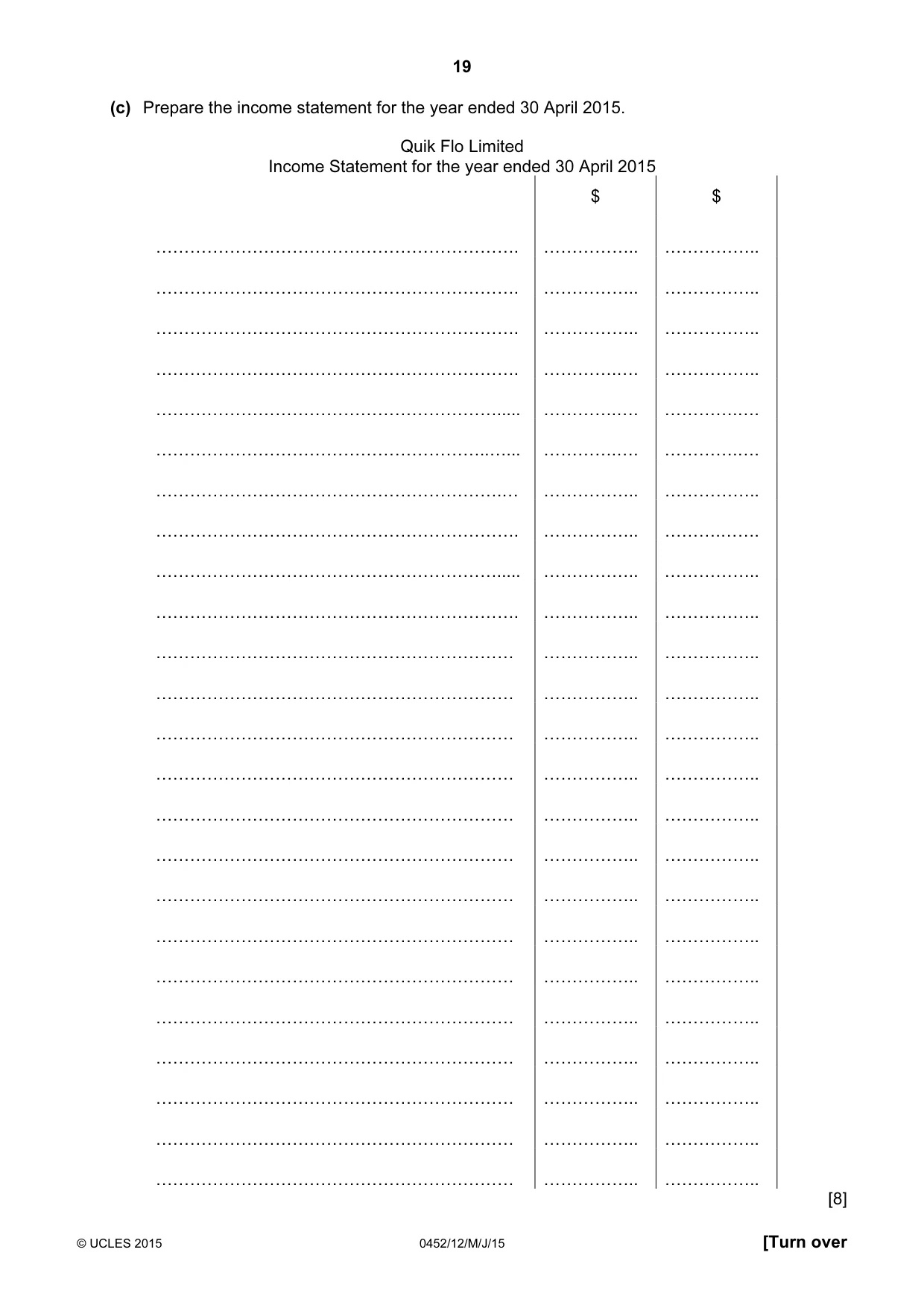
19 © UCLES 2015 0452/12/M/J/15 [Turn over (c) Prepare the income statement for the year ended 30 April 2015. Quik Flo Limited Income Statement for the year ended 30 April 2015 $ $ ………………………………………………………. …………….. …………….. ………………………………………………………. …………….. …………….. ………………………………………………………. …………….. …………….. ………………………………………………………. ………….…. …………….. ……………………………………………………… ………….…. ………….…. …………………………………………………..…... ………….…. ………….…. …………………………………………………….… …………….. …………….. ………………………………………………………. …………….. ……….……. ……………………………………………………… …………….. …………….. ………………………………………………………. …………….. …………….. ……………………………………………………… …………….. …………….. ……………………………………………………… …………….. …………….. ……………………………………………………… …………….. …………….. ……………………………………………………… …………….. …………….. ……………………………………………………… …………….. …………….. ……………………………………………………… …………….. …………….. ……………………………………………………… …………….. …………….. ……………………………………………………… …………….. …………….. ……………………………………………………… …………….. …………….. ……………………………………………………… …………….. …………….. ……………………………………………………… …………….. …………….. ……………………………………………………… …………….. …………….. ……………………………………………………… …………….. …………….. ……………………………………………………… …………….. …………….. [8]
Question paper, page 20
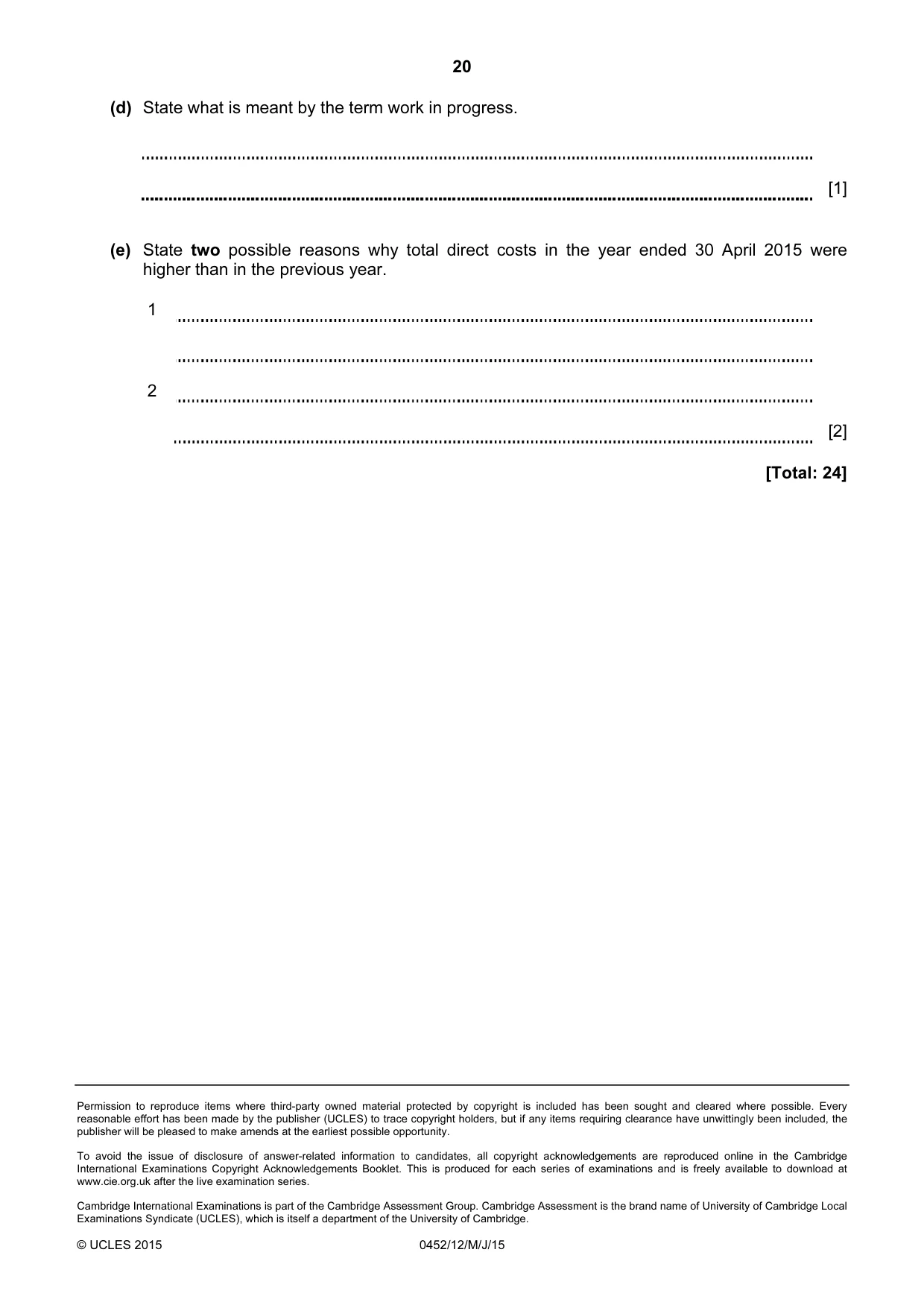
20 Permission to reproduce items where third-party owned material protected by copyright is included has been sought and cleared where possible. Every reasonable effort has been made by the publisher (UCLES) to trace copyright holders, but if any items requiring clearance have unwittingly been included, the publisher will be pleased to make amends at the earliest possible opportunity. To avoid the issue of disclosure of answer-related information to candidates, all copyright acknowledgements are reproduced online in the Cambridge International Examinations Copyright Acknowledgements Booklet. This is produced for each series of examinations and is freely available to download at www.cie.org.uk after the live examination series. Cambridge International Examinations is part of the Cambridge Assessment Group. Cambridge Assessment is the brand name of University of Cambridge Local Examinations Syndicate (UCLES), which is itself a department of the University of Cambridge. © UCLES 2015 0452/12/M/J/15 (d) State what is meant by the term work in progress. [1] (e) State two possible reasons why total direct costs in the year ended 30 April 2015 were higher than in the previous year. 1 2 [2] [Total: 24]
Mark scheme, page 1
® IGCSE is the registered trademark of Cambridge International Examinations. CAMBRIDGE INTERNATIONAL EXAMINATIONS Cambridge International General Certificate of Secondary Education MARK SCHEME for the May/June 2015 series 0452 ACCOUNTING 0452/12 Paper 1, maximum raw mark 120 This mark scheme is published as an aid to teachers and candidates, to indicate the requirements of the examination. It shows the basis on which Examiners were instructed to award marks. It does not indicate the details of the discussions that took place at an Examiners’ meeting before marking began, which would have considered the acceptability of alternative answers. Mark schemes should be read in conjunction with the question paper and the Principal Examiner Report for Teachers. Cambridge will not enter into discussions about these mark schemes. Cambridge is publishing the mark schemes for the May/June 2015 series for most Cambridge IGCSE®, Cambridge International A and AS Level components and some Cambridge O Level components.
Mark scheme, page 2
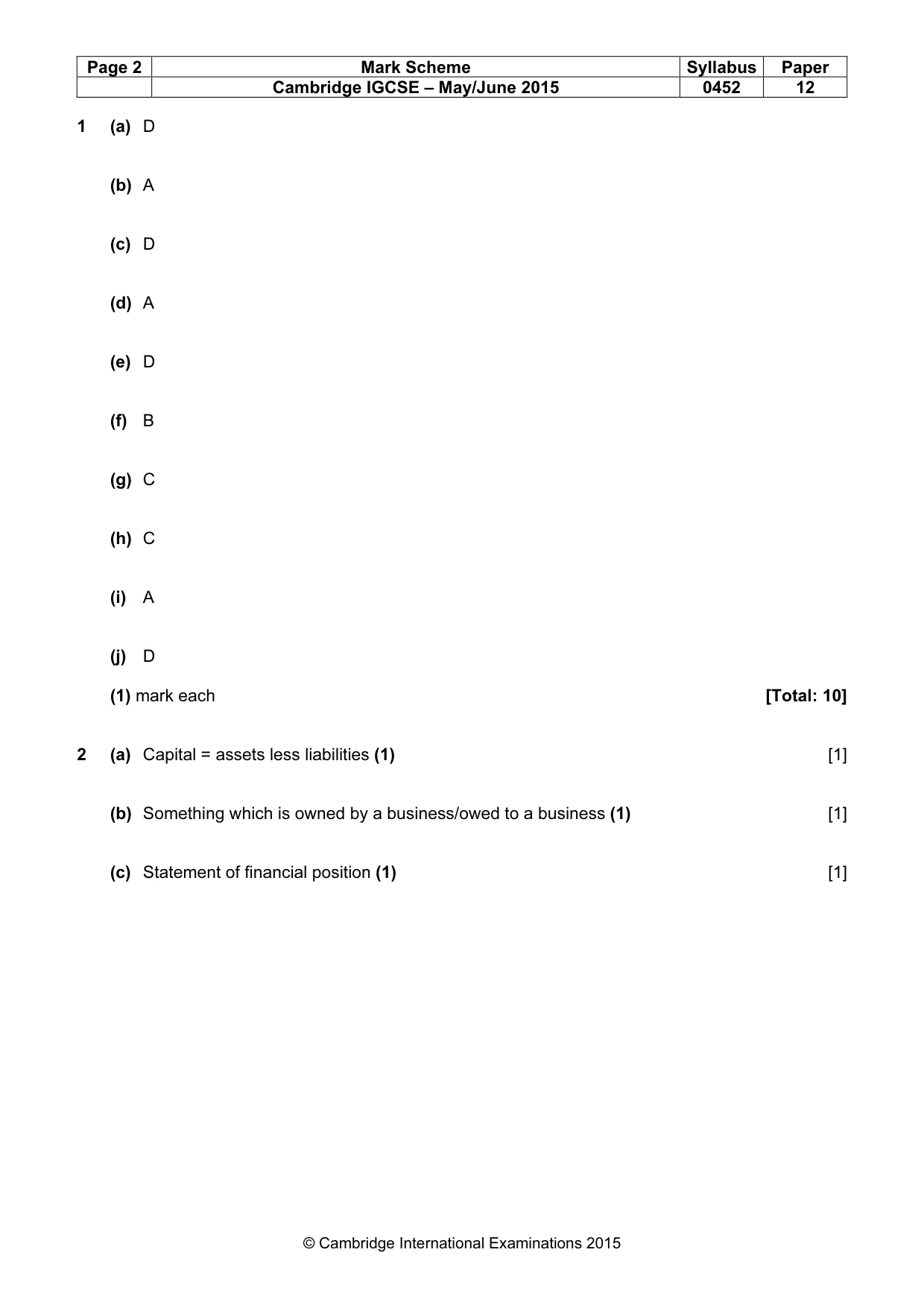
Page 2 Mark Scheme Syllabus Paper Cambridge IGCSE – May/June 2015 0452 12 © Cambridge International Examinations 2015 1 (a) D (b) A (c) D (d) A (e) D (f) B (g) C (h) C (i) A (j) D (1) mark each [Total: 10] 2 (a) Capital = assets less liabilities (1) [1] (b) Something which is owned by a business/owed to a business (1) [1] (c) Statement of financial position (1) [1]
Mark scheme, page 3
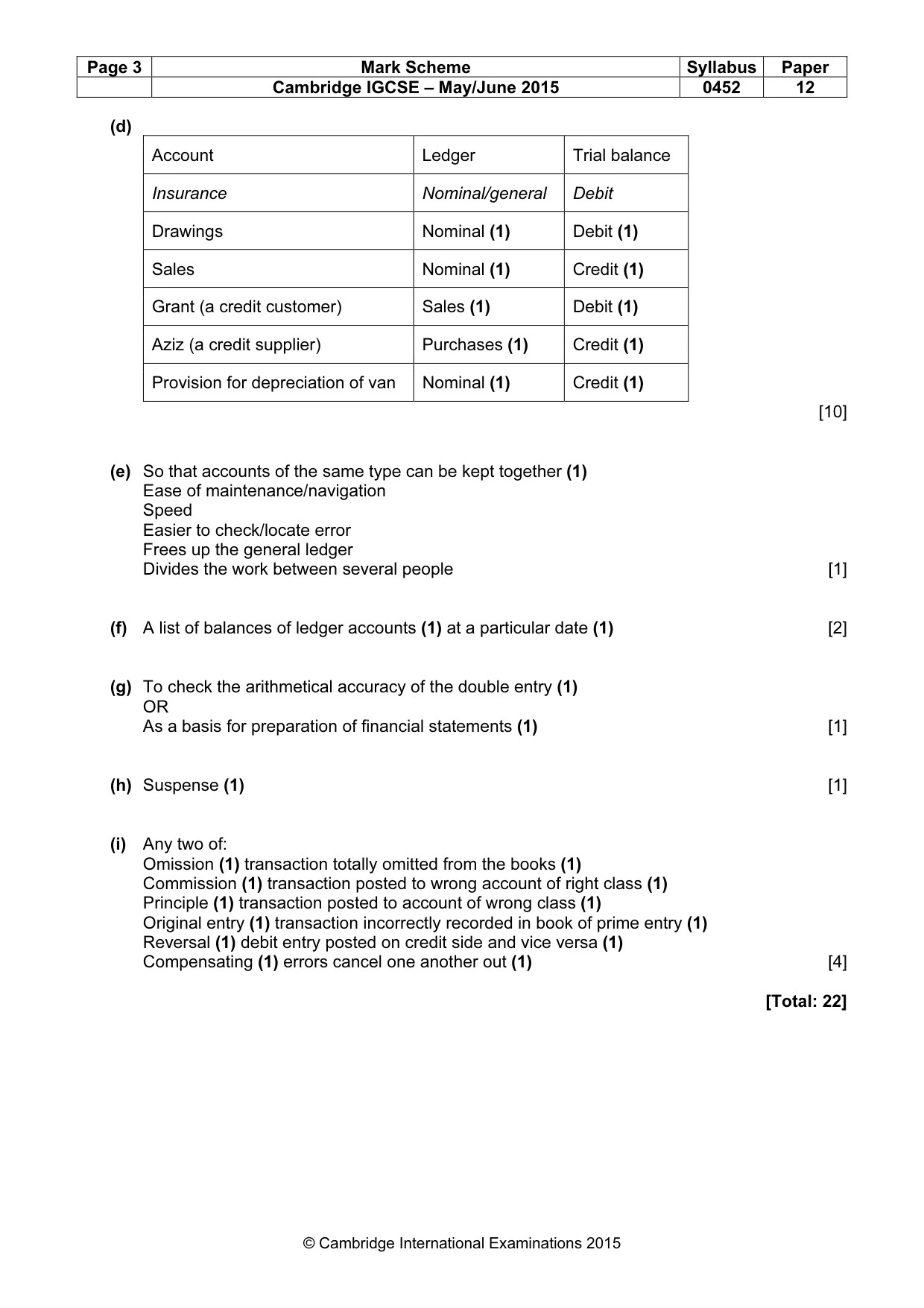
Page 3 Mark Scheme Syllabus Paper Cambridge IGCSE – May/June 2015 0452 12 © Cambridge International Examinations 2015 (d) Account Ledger Trial balance Insurance Nominal/general Debit Drawings Nominal (1) Debit (1) Sales Nominal (1) Credit (1) Grant (a credit customer) Sales (1) Debit (1) Aziz (a credit supplier) Purchases (1) Credit (1) Provision for depreciation of van Nominal (1) Credit (1) [10] (e) So that accounts of the same type can be kept together (1) Ease of maintenance/navigation Speed Easier to check/locate error Frees up the general ledger Divides the work between several people [1] (f) A list of balances of ledger accounts (1) at a particular date (1) [2] (g) To check the arithmetical accuracy of the double entry (1) OR As a basis for preparation of financial statements (1) [1] (h) Suspense (1) [1] (i) Any two of: Omission (1) transaction totally omitted from the books (1) Commission (1) transaction posted to wrong account of right class (1) Principle (1) transaction posted to account of wrong class (1) Original entry (1) transaction incorrectly recorded in book of prime entry (1) Reversal (1) debit entry posted on credit side and vice versa (1) Compensating (1) errors cancel one another out (1) [4] [Total: 22]
Mark scheme, page 4
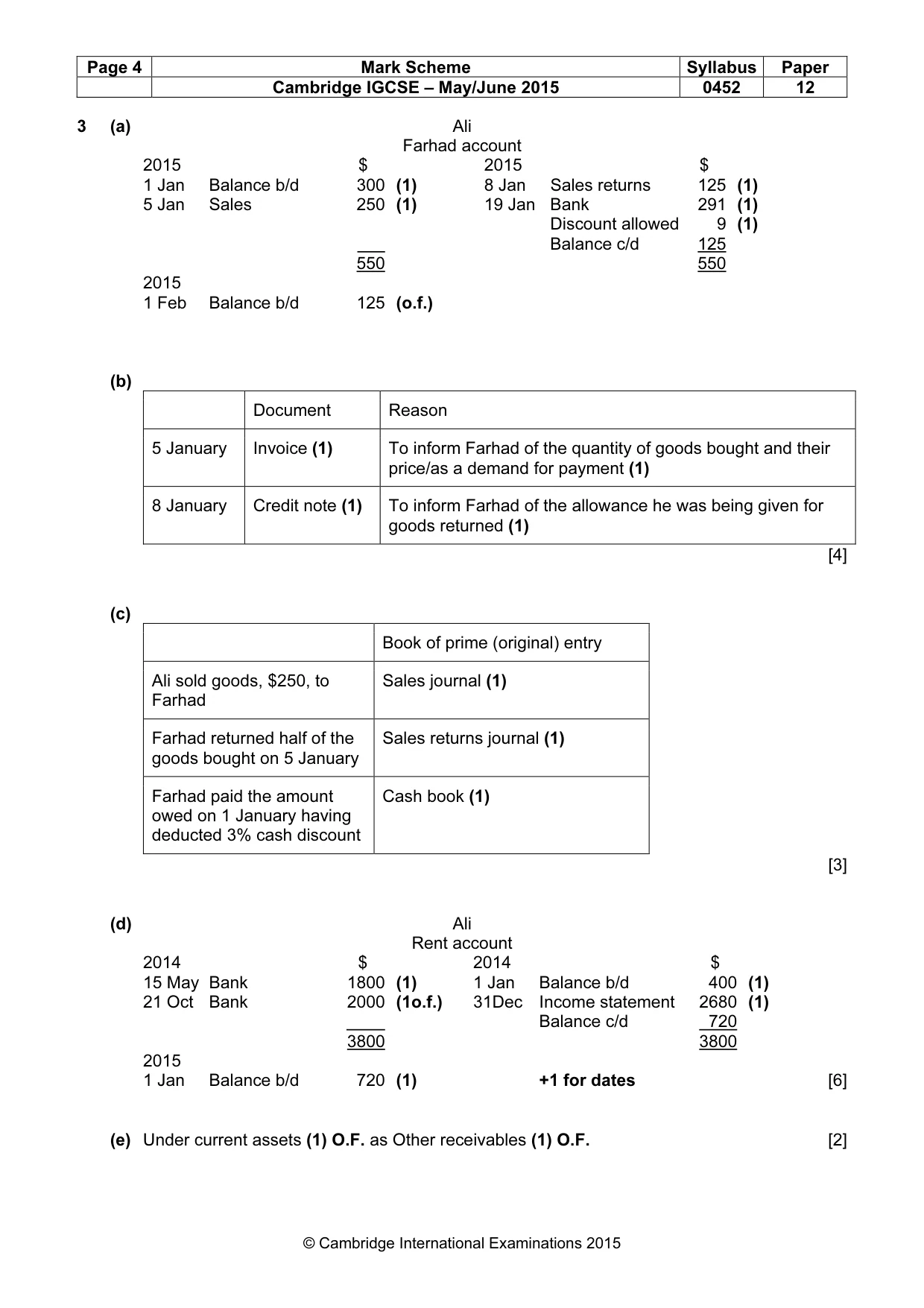
Page 4 Mark Scheme Syllabus Paper Cambridge IGCSE – May/June 2015 0452 12 © Cambridge International Examinations 2015 3 (a) Ali Farhad account 2015 $ 2015 $ 1 Jan Balance b/d 300 (1) 8 Jan Sales returns 125 (1) 5 Jan Sales 250 (1) 19 Jan Bank 291 (1) Discount allowed 9 (1) Balance c/d 125 550 550 2015 1 Feb Balance b/d 125 (o.f.) (b) Document Reason 5 January Invoice (1) To inform Farhad of the quantity of goods bought and their price/as a demand for payment (1) 8 January Credit note (1) To inform Farhad of the allowance he was being given for goods returned (1) [4] (c) Book of prime (original) entry Ali sold goods, $250, to Farhad Sales journal (1) Farhad returned half of the goods bought on 5 January Sales returns journal (1) Farhad paid the amount owed on 1 January having deducted 3% cash discount Cash book (1) [3] (d) Ali Rent account 2014 $ 2014 $ 15 May Bank 1800 (1) 1 Jan Balance b/d 400 (1) 21 Oct Bank 2000 (1o.f.) 31Dec Income statement 2680 (1) Balance c/d 720 3800 3800 2015 1 Jan Balance b/d 720 (1) +1 for dates [6] (e) Under current assets (1) O.F. as Other receivables (1) O.F. [2]
Mark scheme, page 5
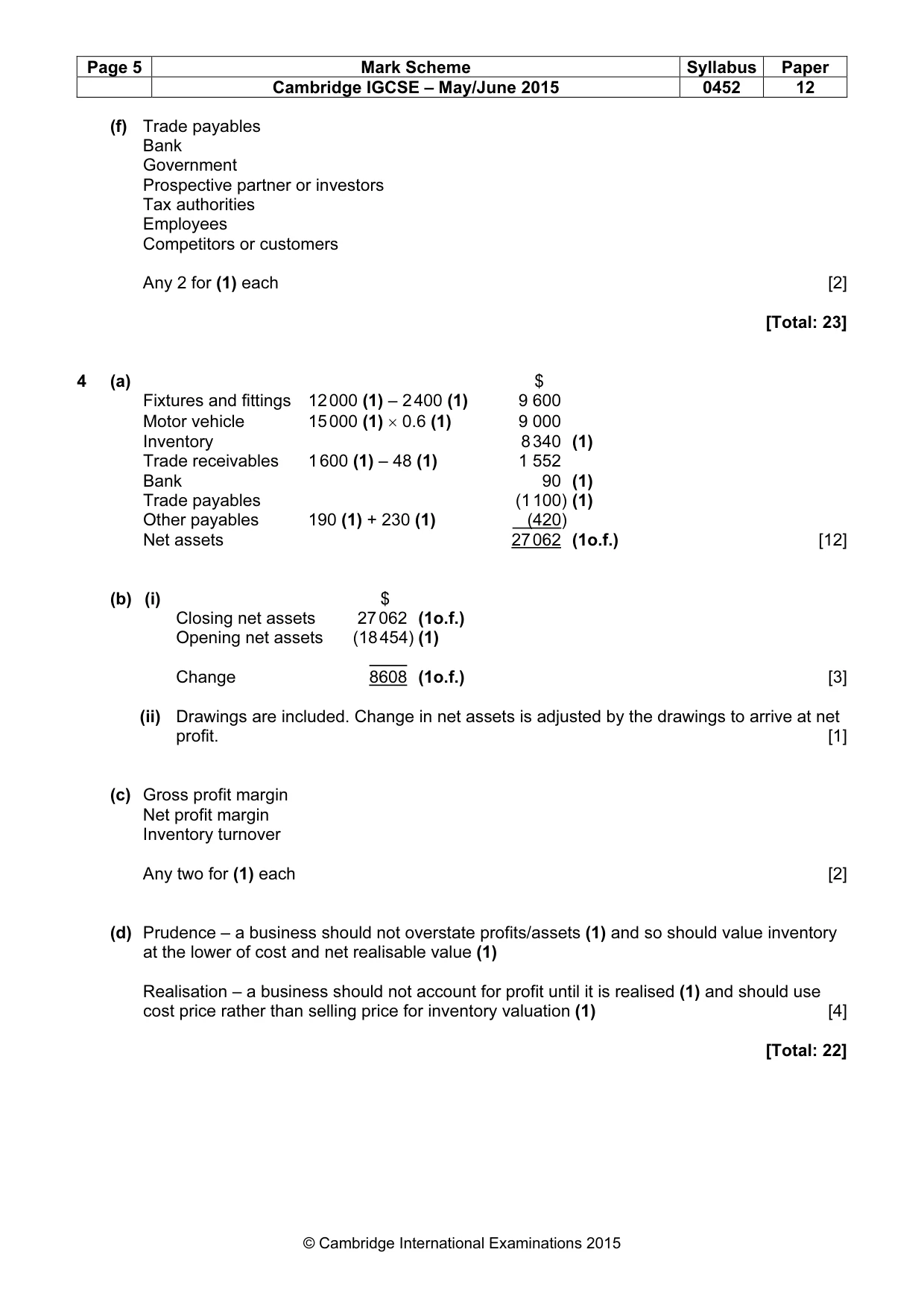
Page 5 Mark Scheme Syllabus Paper Cambridge IGCSE – May/June 2015 0452 12 © Cambridge International Examinations 2015 (f) Trade payables Bank Government Prospective partner or investors Tax authorities Employees Competitors or customers Any 2 for (1) each [2] [Total: 23] 4 (a) $ Fixtures and fittings 12 000 (1) – 2 400 (1) 9 600 Motor vehicle 15 000 (1) × 0.6 (1) 9 000 Inventory 8 340 (1) Trade receivables 1 600 (1) – 48 (1) 1 552 Bank 90 (1) Trade payables (1 100) (1) Other payables 190 (1) + 230 (1) (420) Net assets 27 062 (1o.f.) [12] (b) (i) $ Closing net assets 27 062 (1o.f.) Opening net assets (18 454) (1) Change 8608 (1o.f.) [3] (ii) Drawings are included. Change in net assets is adjusted by the drawings to arrive at net profit. [1] (c) Gross profit margin Net profit margin Inventory turnover Any two for (1) each [2] (d) Prudence – a business should not overstate profits/assets (1) and so should value inventory at the lower of cost and net realisable value (1) Realisation – a business should not account for profit until it is realised (1) and should use cost price rather than selling price for inventory valuation (1) [4] [Total: 22]
Mark scheme, page 6
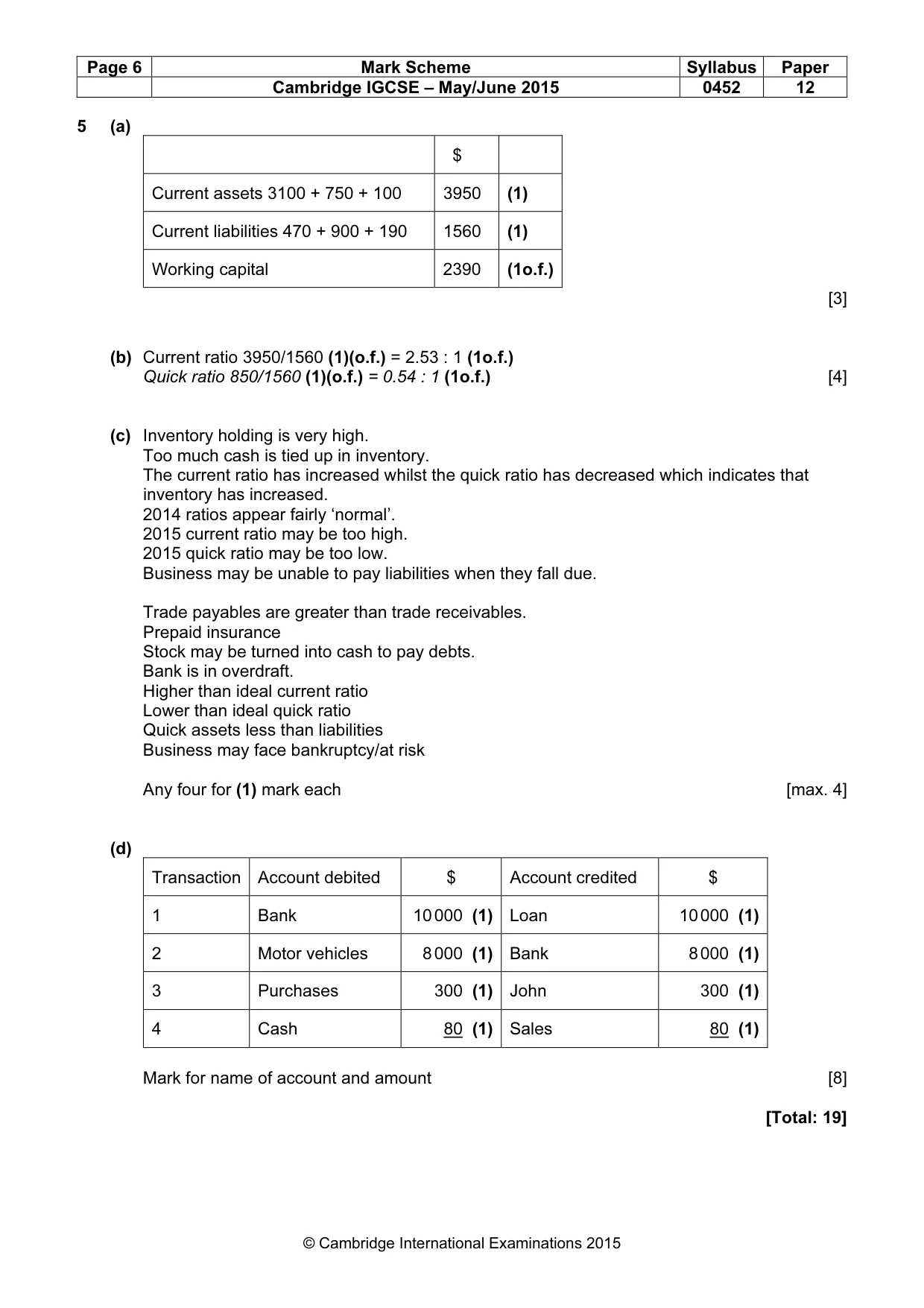
Page 6 Mark Scheme Syllabus Paper Cambridge IGCSE – May/June 2015 0452 12 © Cambridge International Examinations 2015 5 (a) $ Current assets 3100 + 750 + 100 3950 (1) Current liabilities 470 + 900 + 190 1560 (1) Working capital 2390 (1o.f.) [3] (b) Current ratio 3950/1560 (1)(o.f.) = 2.53 : 1 (1o.f.) Quick ratio 850/1560 (1)(o.f.) = 0.54 : 1 (1o.f.) [4] (c) Inventory holding is very high. Too much cash is tied up in inventory. The current ratio has increased whilst the quick ratio has decreased which indicates that inventory has increased. 2014 ratios appear fairly ‘normal’. 2015 current ratio may be too high. 2015 quick ratio may be too low. Business may be unable to pay liabilities when they fall due. Trade payables are greater than trade receivables. Prepaid insurance Stock may be turned into cash to pay debts. Bank is in overdraft. Higher than ideal current ratio Lower than ideal quick ratio Quick assets less than liabilities Business may face bankruptcy/at risk Any four for (1) mark each [max. 4] (d) Transaction Account debited $ Account credited $ 1 Bank 10 000 (1) Loan 10 000 (1) 2 Motor vehicles 8 000 (1) Bank 8 000 (1) 3 Purchases 300 (1) John 300 (1) 4 Cash 80 (1) Sales 80 (1) Mark for name of account and amount [8] [Total: 19]
Mark scheme, page 7
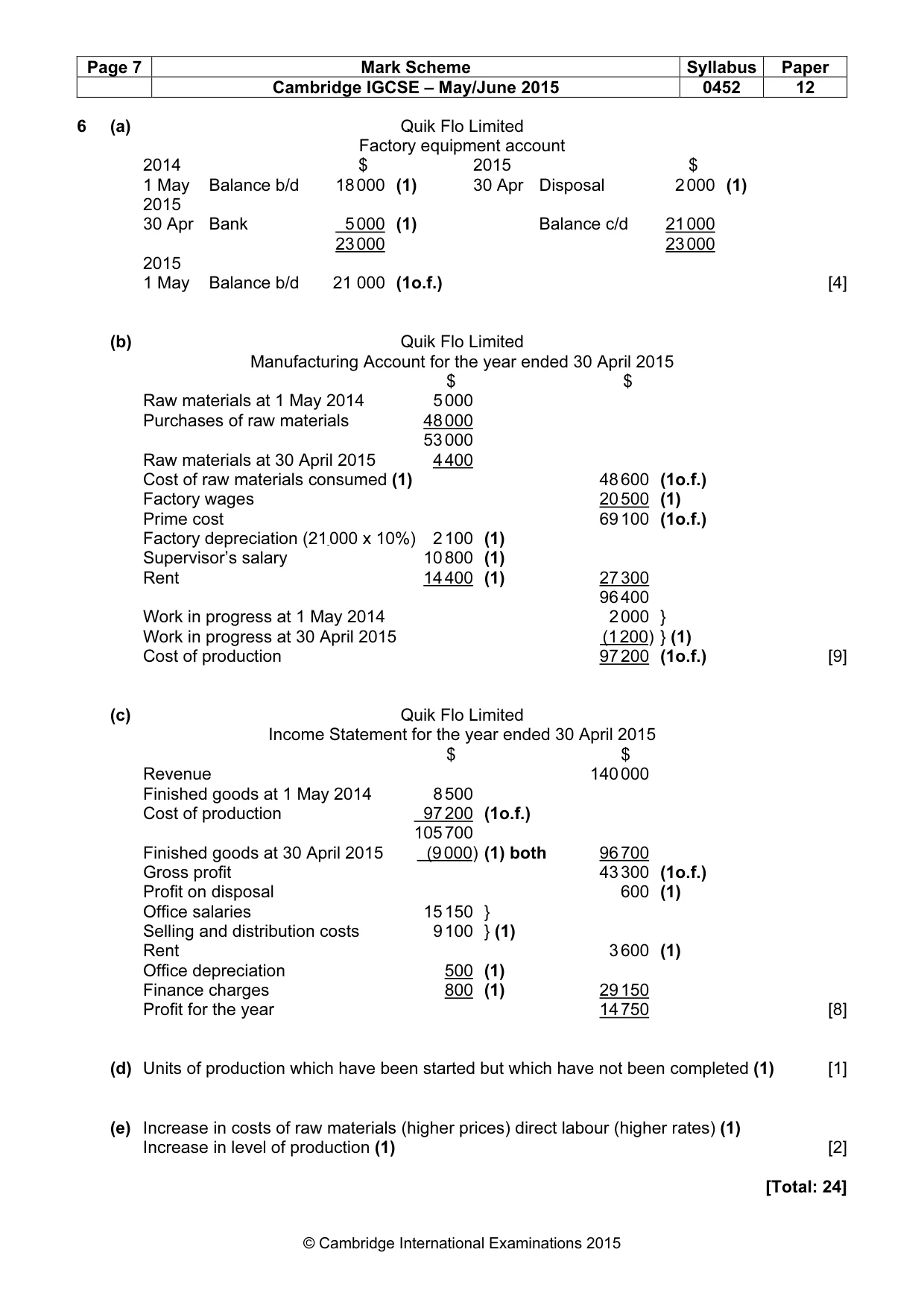
Page 7 Mark Scheme Syllabus Paper Cambridge IGCSE – May/June 2015 0452 12 © Cambridge International Examinations 2015 6 (a) Quik Flo Limited Factory equipment account 2014 $ 2015 $ 1 May Balance b/d 18 000 (1) 30 Apr Disposal 2 000 (1) 2015 30 Apr Bank 5 000 (1) Balance c/d 21 000 23 000 23 000 2015 1 May Balance b/d 21 000 (1o.f.) [4] (b) Quik Flo Limited Manufacturing Account for the year ended 30 April 2015 $ $ Raw materials at 1 May 2014 5 000 Purchases of raw materials 48 000 53 000 Raw materials at 30 April 2015 4 400 Cost of raw materials consumed (1) 48 600 (1o.f.) Factory wages 20 500 (1) Prime cost 69 100 (1o.f.) Factory depreciation (21 000 x 10%) 2 100 (1) Supervisor’s salary 10 800 (1) Rent 14 400 (1) 27 300 96 400 Work in progress at 1 May 2014 2 000 } Work in progress at 30 April 2015 (1 200) } (1) Cost of production 97 200 (1o.f.) [9] (c) Quik Flo Limited Income Statement for the year ended 30 April 2015 $ $ Revenue 140 000 Finished goods at 1 May 2014 8 500 Cost of production 97 200 (1o.f.) 105 700 Finished goods at 30 April 2015 (9 000) (1) both 96 700 Gross profit 43 300 (1o.f.) Profit on disposal 600 (1) Office salaries 15 150 } Selling and distribution costs 9 100 } (1) Rent 3 600 (1) Office depreciation 500 (1) Finance charges 800 (1) 29 150 Profit for the year 14 750 [8] (d) Units of production which have been started but which have not been completed (1) [1] (e) Increase in costs of raw materials (higher prices) direct labour (higher rates) (1) Increase in level of production (1) [2] [Total: 24]
What you needed in this session
Cambridge’s own grade thresholds for 2015 May/June, Paper 1 · Variant 2. A higher threshold means an easier paper — the bar moves with how the cohort did.