Cambridge A Level Travel and Tourism 9395 — 2022 May/June Paper 1 · Variant 2
9395/12/M/J/22 · 100 marks · ≈113 min
The question paper and its mark scheme, free to read here and free to download. This is Cambridge’s own paper, exactly as it was sat.
Question paper16 pages



Mark scheme16 pages
Answers below. Sit the paper first if you are practising.

Paper as text
Question paper, page 1
This document has 16 pages. Any blank pages are indicated. [Turn over Cambridge International AS & A Level TRAVEL & TOURISM 9395/12 Paper 1 The Industry May/June 2022 2 hours 30 minutes You must answer on the question paper. You will need: Insert (enclosed) INSTRUCTIONS ● Answer all questions. ● Use a black or dark blue pen. ● Write your name, centre number and candidate number in the boxes at the top of the page. ● Write your answer to each question in the space provided. ● Do not use an erasable pen or correction fluid. ● Do not write on any bar codes. INFORMATION ● The total mark for this paper is 100. ● The number of marks for each question or part question is shown in brackets [ ]. ● The insert contains all the figures referred to in the questions. * 0 3 2 3 6 9 4 9 3 5 * DC (LK) 213490/2 © UCLES 2022
Question paper, page 2
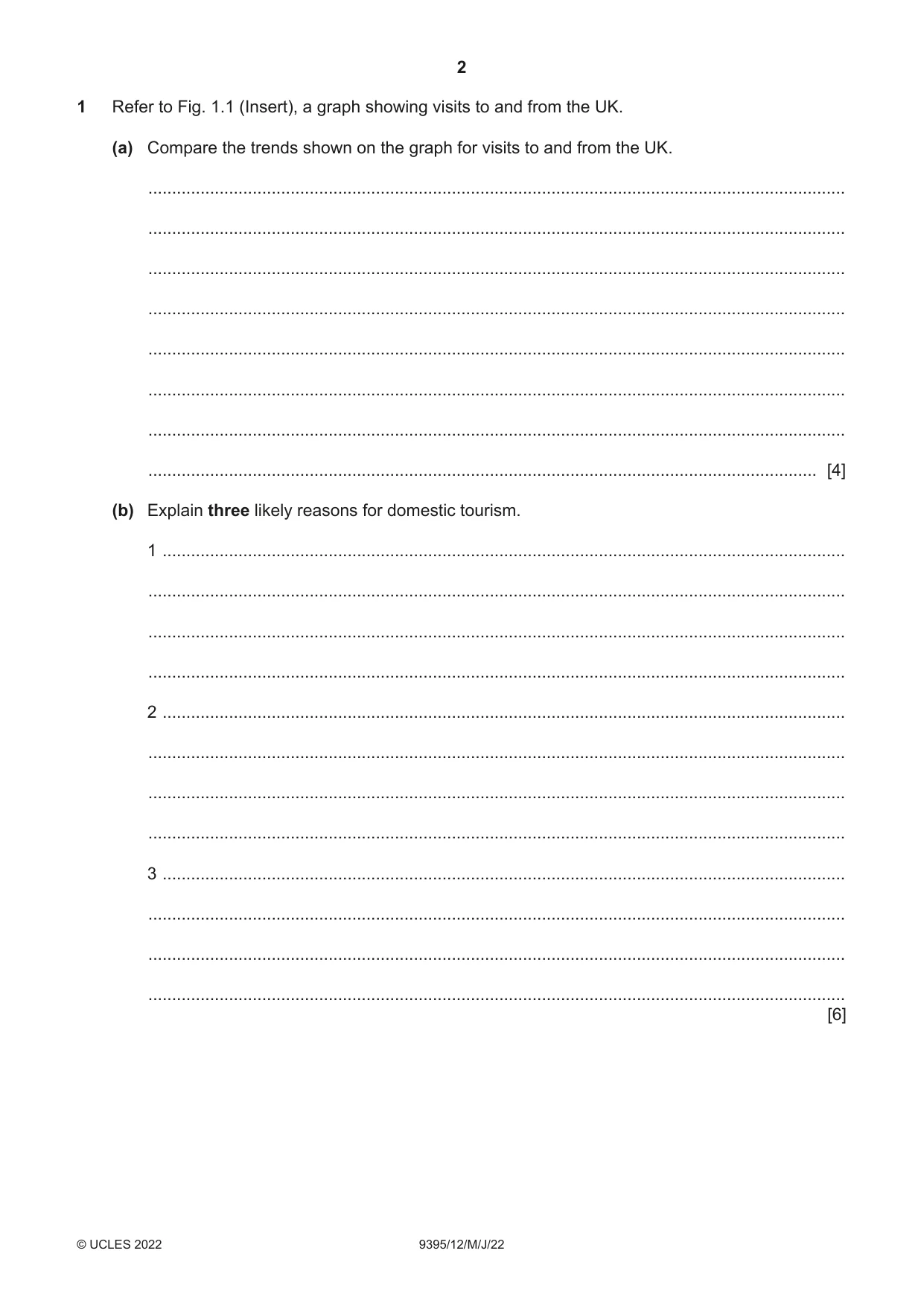
2 9395/12/M/J/22 © UCLES 2022 1 Refer to Fig. 1.1 (Insert), a graph showing visits to and from the UK. (a) Compare the trends shown on the graph for visits to and from the UK. … … … … … … … … [4] (b) Explain three likely reasons for domestic tourism. 1 … … … … 2 … … … … 3 … … … … [6]
Question paper, page 3
3 9395/12/M/J/22 © UCLES 2022 [Turn over (c) Explain the possible reasons why many tourists choose to visit neighbouring countries. … … … … … … … … … … … … [6]
Question paper, page 4
4 9395/12/M/J/22 © UCLES 2022 (d) Discuss the economic factors that may cause a decline in tourist visits to and from a country. … … … … … … … … … … … … … … … … … … [9] [Total: 25]
Question paper, page 5
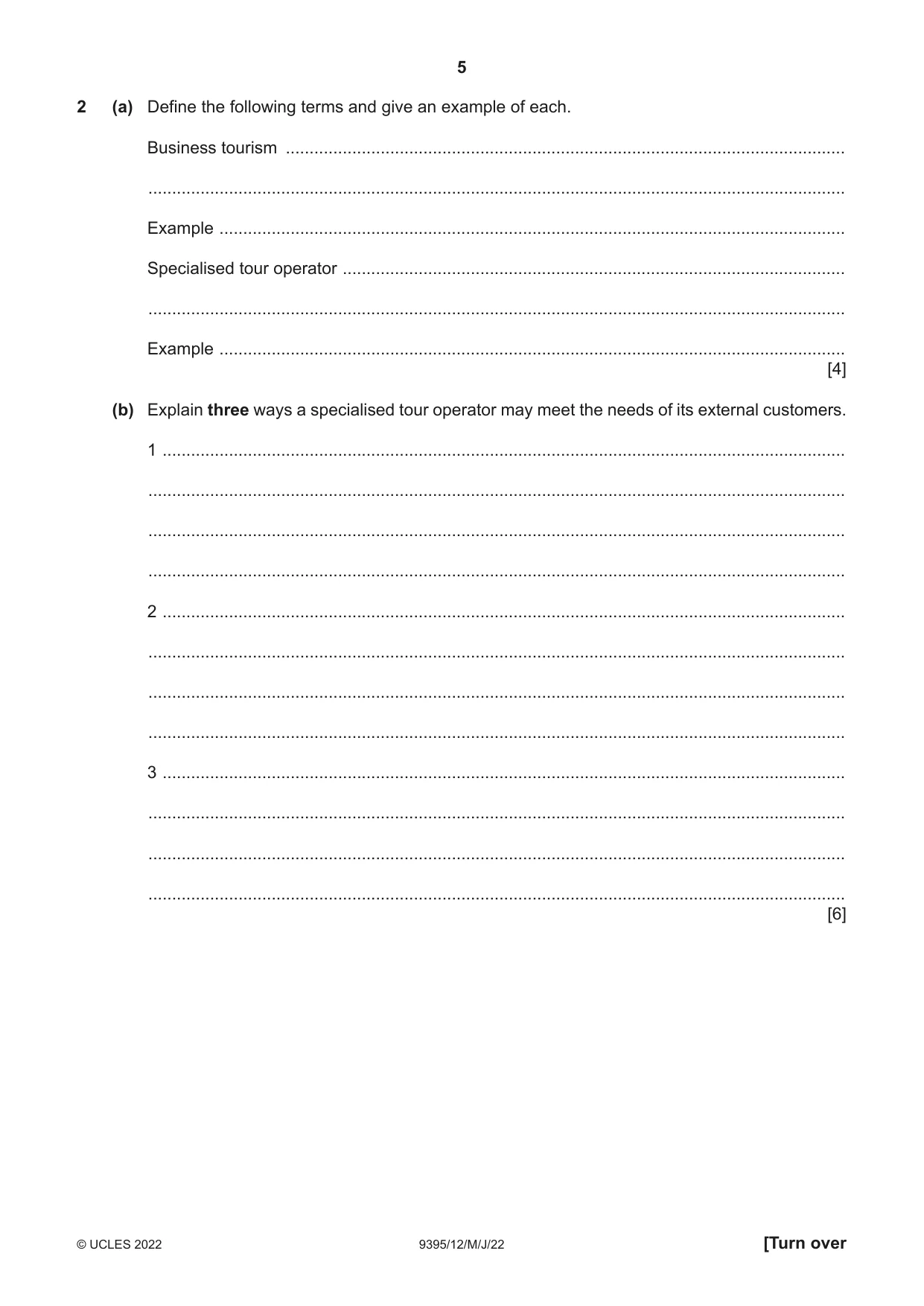
5 9395/12/M/J/22 © UCLES 2022 [Turn over 2 (a) Define the following terms and give an example of each. Business tourism … … Example … Specialised tour operator … … Example … [4] (b) Explain three ways a specialised tour operator may meet the needs of its external customers. 1 … … … … 2 … … … … 3 … … … … [6]
Question paper, page 6
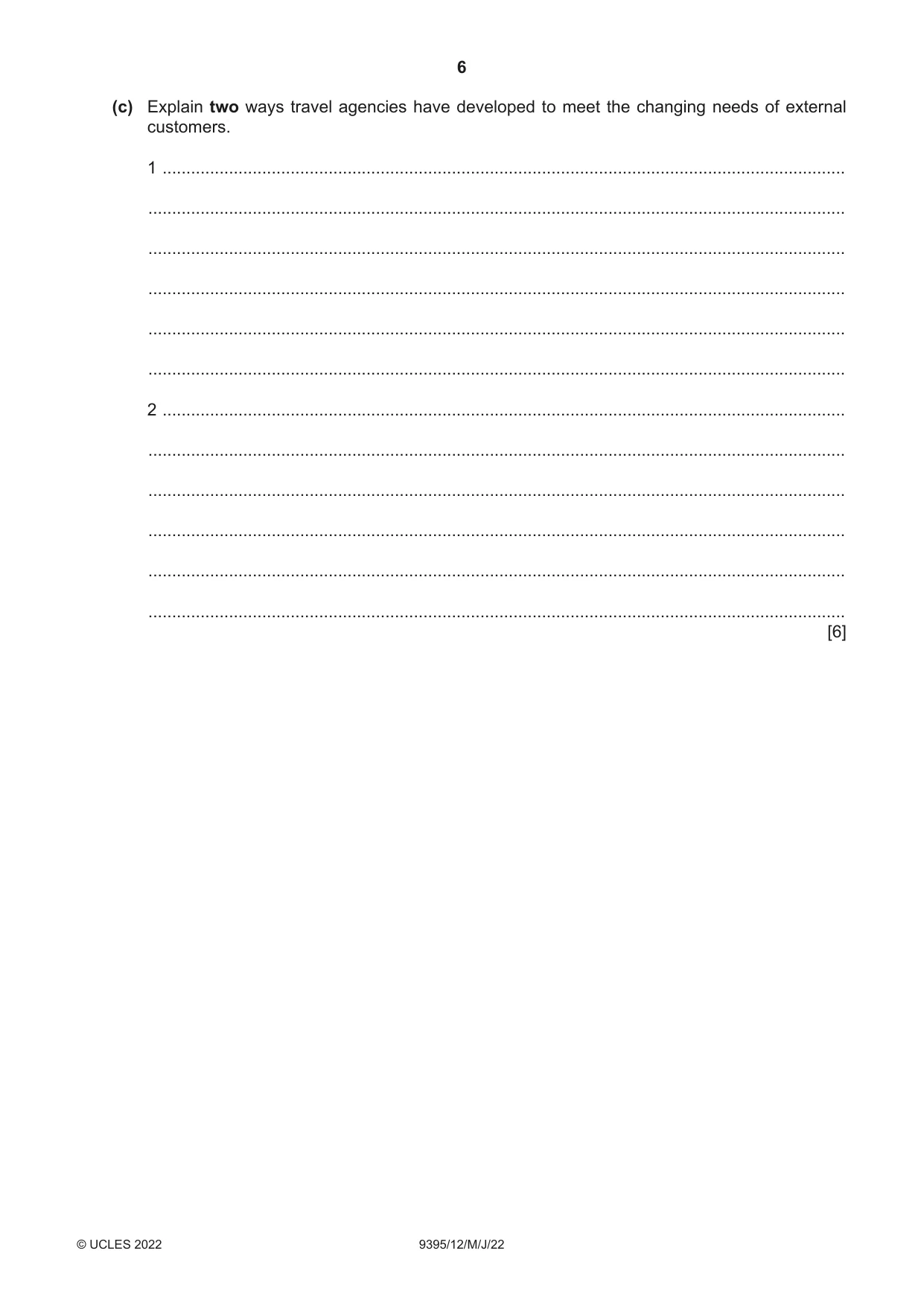
6 9395/12/M/J/22 © UCLES 2022 (c) Explain two ways travel agencies have developed to meet the changing needs of external customers. 1 … … … … … … 2 … … … … … … [6]
Question paper, page 7
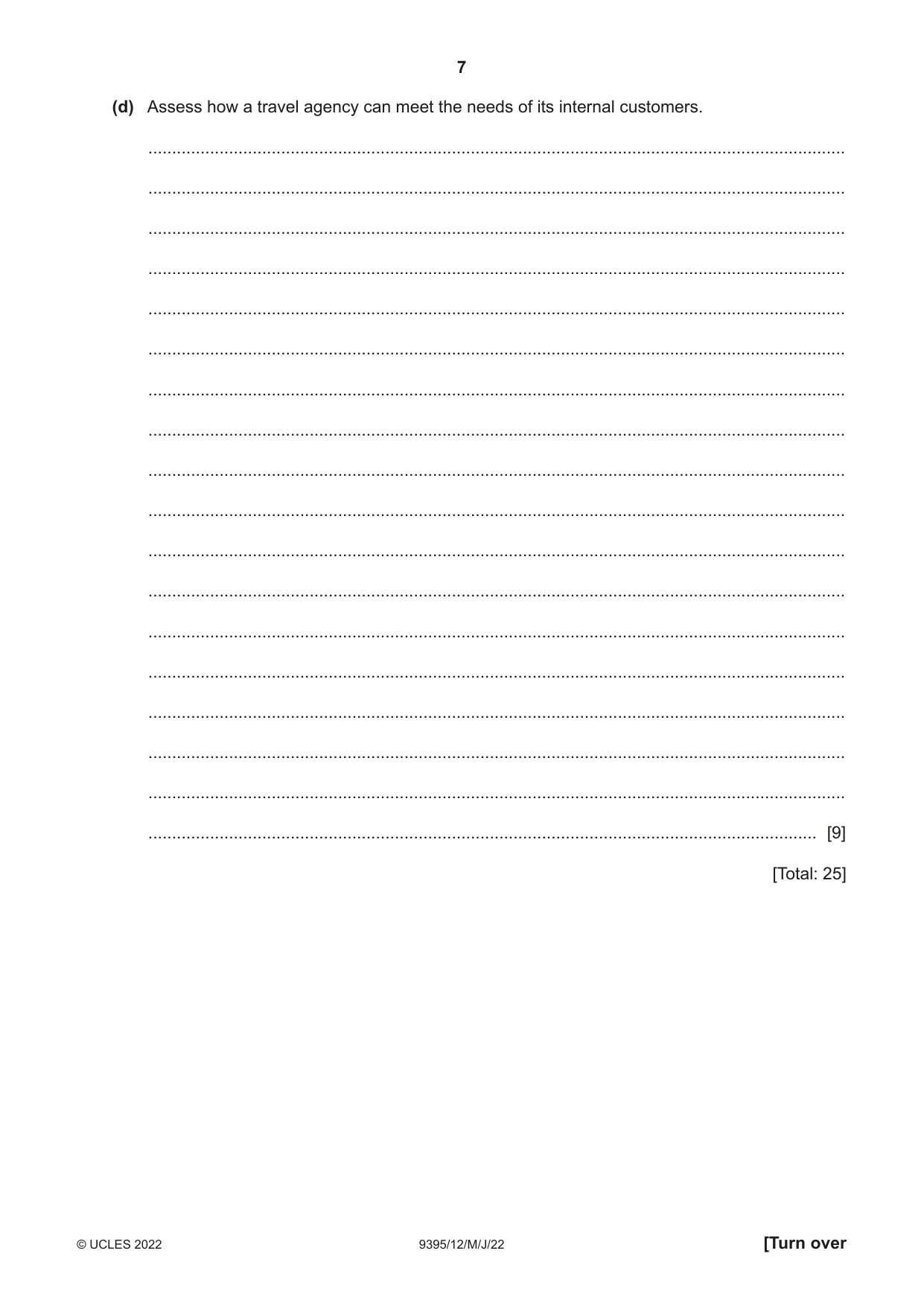
7 9395/12/M/J/22 © UCLES 2022 [Turn over (d) Assess how a travel agency can meet the needs of its internal customers. … … … … … … … … … … … … … … … … … … [9] [Total: 25]
Question paper, page 8
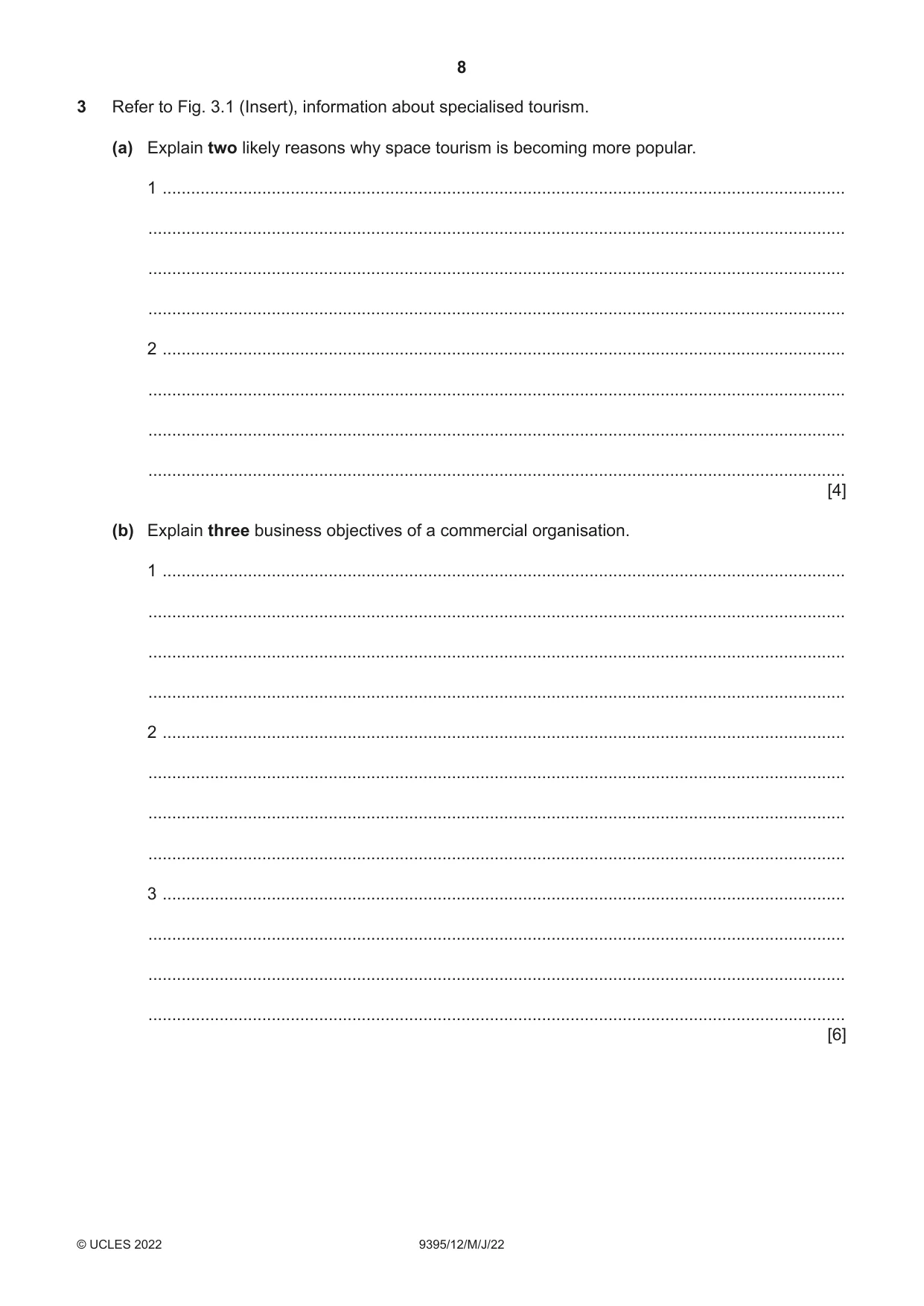
8 9395/12/M/J/22 © UCLES 2022 3 Refer to Fig. 3.1 (Insert), information about specialised tourism. (a) Explain two likely reasons why space tourism is becoming more popular. 1 … … … … 2 … … … … [4] (b) Explain three business objectives of a commercial organisation. 1 … … … … 2 … … … … 3 … … … … [6]
Question paper, page 9
9 9395/12/M/J/22 © UCLES 2022 [Turn over (c) Tourism is often intangible. Explain how intangibility may be overcome by tourism providers. … … … … … … … … … … … … [6]
Question paper, page 10
10 9395/12/M/J/22 © UCLES 2022 (d) Assess the impact of technological change on tourism providers. … … … … … … … … … … … … … … … … … … [9] [Total: 25]
Question paper, page 11
11 9395/12/M/J/22 © UCLES 2022 [Turn over 4 (a) Explain how a restaurant can provide for each of the following customer needs: specific dietary requirements … … … … language requirements … … … … [4] (b) Explain three problems restaurants may face due to poor customer service. 1 … … … … 2 … … … … 3 … … … … [6]
Question paper, page 12
12 9395/12/M/J/22 © UCLES 2022 (c) Assess the most suitable method for restaurants to monitor the quality of customer service. … … … … … … … … … … … … [6]
Question paper, page 13
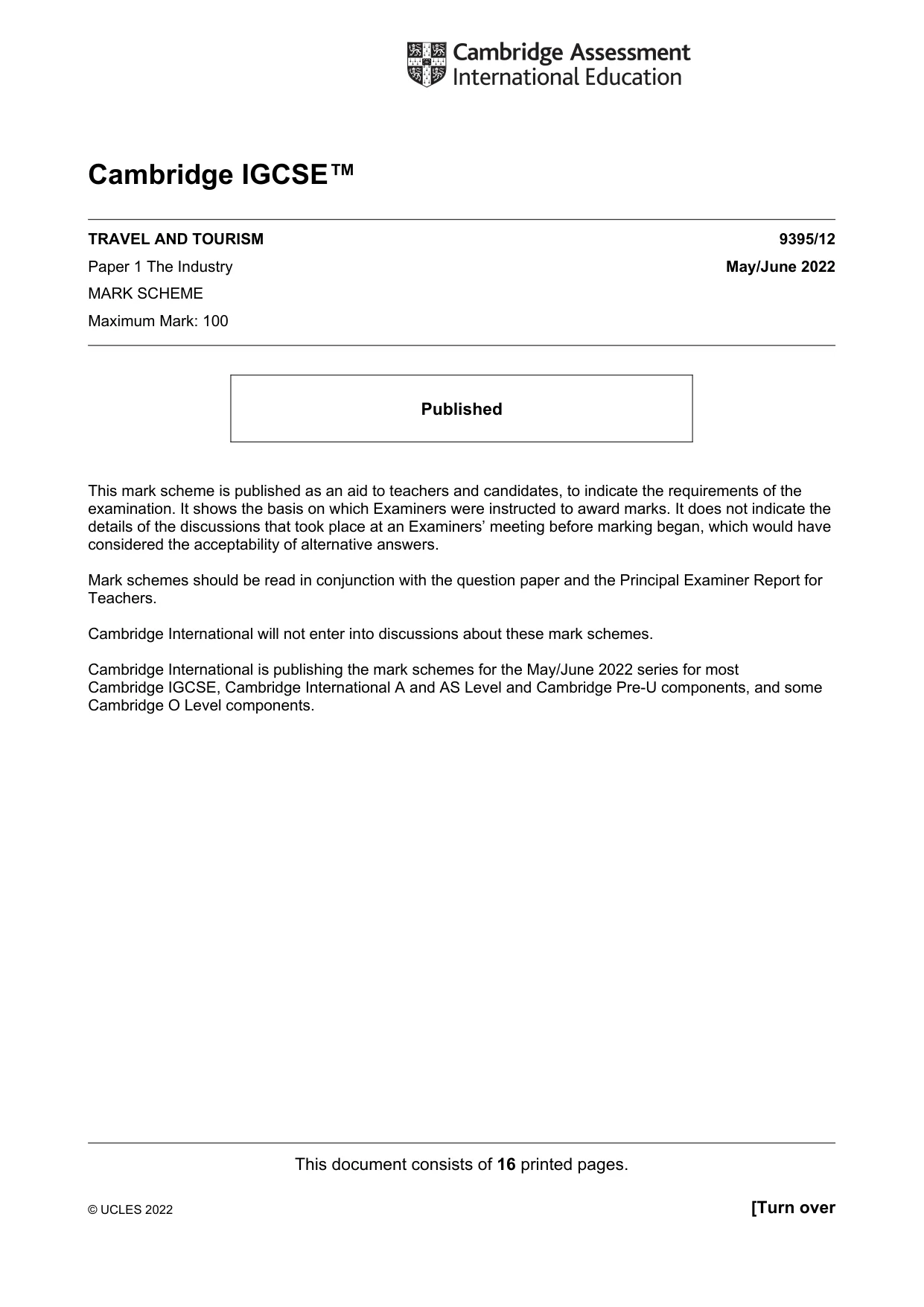
13 9395/12/M/J/22 © UCLES 2022 (d) Discuss the importance of performance management and appraisal procedures for travel and tourism organisations. … … … … … … … … … … … … … … … … … … [9] [Total: 25]
Question paper, page 14
14 9395/12/M/J/22 © UCLES 2022 BLANK PAGE
Question paper, page 15
15 9395/12/M/J/22 © UCLES 2022 BLANK PAGE
Question paper, page 16
16 9395/12/M/J/22 © UCLES 2022 The boundaries and names shown, the designations used and the presentation of material on any maps contained in this question paper/insert do not imply official endorsement or acceptance by Cambridge Assessment International Education concerning the legal status of any country, territory, or area or any of its authorities, or of the delimitation of its frontiers or boundaries. Permission to reproduce items where third-party owned material protected by copyright is included has been sought and cleared where possible. Every reasonable effort has been made by the publisher (UCLES) to trace copyright holders, but if any items requiring clearance have unwittingly been included, the publisher will be pleased to make amends at the earliest possible opportunity. To avoid the issue of disclosure of answer-related information to candidates, all copyright acknowledgements are reproduced online in the Cambridge Assessment International Education Copyright Acknowledgements Booklet. This is produced for each series of examinations and is freely available to download at www.cambridgeinternational.org after the live examination series. Cambridge Assessment International Education is part of Cambridge Assessment. Cambridge Assessment is the brand name of the University of Cambridge Local Examinations Syndicate (UCLES), which is a department of the University of Cambridge. BLANK PAGE
Mark scheme, page 1
This document consists of 16 printed pages. © UCLES 2022 [Turn over Cambridge IGCSE™ TRAVEL AND TOURISM 9395/12 Paper 1 The Industry May/June 2022 MARK SCHEME Maximum Mark: 100 Published This mark scheme is published as an aid to teachers and candidates, to indicate the requirements of the examination. It shows the basis on which Examiners were instructed to award marks. It does not indicate the details of the discussions that took place at an Examiners’ meeting before marking began, which would have considered the acceptability of alternative answers. Mark schemes should be read in conjunction with the question paper and the Principal Examiner Report for Teachers. Cambridge International will not enter into discussions about these mark schemes. Cambridge International is publishing the mark schemes for the May/June 2022 series for most Cambridge IGCSE, Cambridge International A and AS Level and Cambridge Pre-U components, and some Cambridge O Level components.
Mark scheme, page 2
9395/12 Cambridge IGCSE – Mark Scheme PUBLISHED May/June 2022 © UCLES 2022 Page 2 of 16 Generic Marking Principles These general marking principles must be applied by all examiners when marking candidate answers. They should be applied alongside the specific content of the mark scheme or generic level descriptors for a question. Each question paper and mark scheme will also comply with these marking principles. GENERIC MARKING PRINCIPLE 1: Marks must be awarded in line with: the specific content of the mark scheme or the generic level descriptors for the question the specific skills defined in the mark scheme or in the generic level descriptors for the question the standard of response required by a candidate as exemplified by the standardisation scripts. GENERIC MARKING PRINCIPLE 2: Marks awarded are always whole marks (not half marks, or other fractions). GENERIC MARKING PRINCIPLE 3: Marks must be awarded positively: marks are awarded for correct/valid answers, as defined in the mark scheme. However, credit is given for valid answers which go beyond the scope of the syllabus and mark scheme, referring to your Team Leader as appropriate marks are awarded when candidates clearly demonstrate what they know and can do marks are not deducted for errors marks are not deducted for omissions answers should only be judged on the quality of spelling, punctuation and grammar when these features are specifically assessed by the question as indicated by the mark scheme. The meaning, however, should be unambiguous. GENERIC MARKING PRINCIPLE 4: Rules must be applied consistently, e.g. in situations where candidates have not followed instructions or in the application of generic level descriptors. GENERIC MARKING PRINCIPLE 5: Marks should be awarded using the full range of marks defined in the mark scheme for the question (however; the use of the full mark range may be limited according to the quality of the candidate responses seen). GENERIC MARKING PRINCIPLE 6: Marks awarded are based solely on the requirements as defined in the mark scheme. Marks should not be awarded with grade thresholds or grade descriptors in mind.
Mark scheme, page 3
9395/12 Cambridge IGCSE – Mark Scheme PUBLISHED May/June 2022 © UCLES 2022 Page 3 of 16 Social Science-Specific Marking Principles (for point-based marking) 1 Components using point-based marking: Point marking is often used to reward knowledge, understanding and application of skills. We give credit where the candidate’s answer shows relevant knowledge, understanding and application of skills in answering the question. We do not give credit where the answer shows confusion. From this it follows that we: a DO credit answers which are worded differently from the mark scheme if they clearly convey the same meaning (unless the mark scheme requires a specific term) b DO credit alternative answers/examples which are not written in the mark scheme if they are correct c DO credit answers where candidates give more than one correct answer in one prompt/numbered/scaffolded space where extended writing is required rather than list-type answers. For example, questions that require n reasons (e.g. State two reasons …). d DO NOT credit answers simply for using a ‘key term’ unless that is all that is required. (Check for evidence it is understood and not used wrongly.) e DO NOT credit answers which are obviously self-contradicting or trying to cover all possibilities f DO NOT give further credit for what is effectively repetition of a correct point already credited unless the language itself is being tested. This applies equally to ‘mirror statements’ (i.e. polluted/not polluted). g DO NOT require spellings to be correct, unless this is part of the test. However spellings of syllabus terms must allow for clear and unambiguous separation from other syllabus terms with which they may be confused (e.g. Corrasion/Corrosion) 2 Presentation of mark scheme: Slashes (/) or the word ‘or’ separate alternative ways of making the same point. Semi colons (;) bullet points (•) or figures in brackets (1) separate different points. Content in the answer column in brackets is for examiner information/context to clarify the marking but is not required to earn the mark (except Accounting syllabuses where they indicate negative numbers). 3 Calculation questions: The mark scheme will show the steps in the most likely correct method(s), the mark for each step, the correct answer(s) and the mark for each answer If working/explanation is considered essential for full credit, this will be indicated in the question paper and in the mark scheme. In all other instances, the correct answer to a calculation should be given full credit, even if no supporting working is shown. Where the candidate uses a valid method which is not covered by the mark scheme, award equivalent marks for reaching equivalent stages. Where an answer makes use of a candidate’s own incorrect figure from previous working, the ‘own figure rule’ applies: full marks will be given if a correct and complete method is used. Further guidance will be included in the mark scheme where necessary and any exceptions to this general principle will be noted.
Mark scheme, page 4
9395/12 Cambridge IGCSE – Mark Scheme PUBLISHED May/June 2022 © UCLES 2022 Page 4 of 16 4 Annotation: For point marking, ticks can be used to indicate correct answers and crosses can be used to indicate wrong answers. There is no direct relationship between ticks and marks. Ticks have no defined meaning for levels of response marking. For levels of response marking, the level awarded should be annotated on the script. Other annotations will be used by examiners as agreed during standardisation, and the meaning will be understood by all examiners who marked that paper.
Mark scheme, page 5
9395/12 Cambridge IGCSE – Mark Scheme PUBLISHED May/June 2022 © UCLES 2022 Page 5 of 16 Question Answer Marks 1(a) Compare the trends shown on the graph for visits to and from the UK. Award up to four marks for comparing the trends. Overseas visitor numbers fluctuate over the years (1) with three peaks clearly seen (1) whereas the overseas rate stays relatively stable (1) When the UK numbers peak it is summer and the overseas numbers do not change as drastically (1) When the UK rates drop it is winter and the overseas rates do not drop significantly (1) The numbers of UK tourists travelling overseas is consistently higher than the overseas numbers coming to the UK (1) Credit any other reasonable answer. 4 1(b) Explain three likely reasons for domestic tourism. Award one mark for each reason and a second mark for the accompanying explanation. The value of the local currency may have fallen (1) this will prevent many residents travelling to other countries as it will be expensive (1) There may be some form of problem in other countries such as terrorism or disease (1) which may stop people from travelling abroad (1) VFR (1) may be going to a family event (1) There may be an important event on during the summer months (1) this attracts more residents (1) Business travellers (1) may be going to a meeting/exhibition or conference (1) Credit any other reasonable answer. 6
Mark scheme, page 6
9395/12 Cambridge IGCSE – Mark Scheme PUBLISHED May/June 2022 © UCLES 2022 Page 6 of 16 Question Answer Marks 1(c) Explain the possible reasons why many tourists choose to visit neighbouring countries. Indicative content: Neighbouring countries may have good infrastructure/health services. It is easy to access in a variety of ways e.g. airlines/ferry/train The language spoken may be the same Exchange rates may be good for visitors at this time Many may be working or conducting business in a neighbouring country Other relevant information should also be credited. Mark according to the levels of response criteria below. Level 3 (5–6marks) Candidates will show a clear understanding of the question and include a detailed explanation as to why many tourists visit neighbouring countries. Candidates effectively explain some reasons. There is sound and frequent evidence of thorough, detailed and accurate knowledge and understanding of concepts and principles using appropriate terminology. Level 2 (3–4 marks) Candidates will show an understanding of the question and include some explanation of why many tourists visit neighbouring countries. The answer is relevant and accurate and shows reasonable knowledge and understanding of concepts and principles with some use of appropriate terminology. Level 1 (1–2 marks) Candidates identify/describe some possible reasons why many tourists visit neighbouring countries. Information may be a list of points. The answer lacks coherent organisation and there is little or no attempt to explain. The answer is basic and shows limited knowledge and understanding of concepts and principles with limited use of appropriate terminology. Level 0 (0 marks) No content worthy of reward 6
Mark scheme, page 7
9395/12 Cambridge IGCSE – Mark Scheme PUBLISHED May/June 2022 © UCLES 2022 Page 7 of 16 Question Answer Marks 1(d) Discuss the economic factors that may cause a decline in tourist visits to and from a country. Indicative content: Lack of employment in the visiting country which will restrict spending on holidays. Good rates of pay will allow more international travel so if the economic situation is good then people will be paid more money or may have longer paid holidays. The exchange rates may not be good–the level of exchange abroad may be high so it is not a good value destination. However, if the currency is weak then fewer people may go to other countries and will prefer to spend their holidays at home. People may be working away from home and have to travel for their work. Recession causes decreases in income so people may be unable to travel as they may have pay cuts or may be laid off or on fewer hours. Other relevant information should also be credited. Mark according to the levels of response criteria below. Level 3 (7–9 marks) Candidates will show a clear understanding of the question and include detailed identification and discussion of the economic factors that may cause a decline in visits both to and from countries. Candidates effectively discuss a range of factors and clearly attempt to weigh up the significance of each. Analytical language will be used. There is sound and frequent evidence of thorough, detailed and accurate knowledge and understanding of concepts and principles using appropriate terminology. Level 2 (4–6 marks) Candidates will show an understanding of the question and include some explanation of the economic factors that may cause a decline in visits both to and from different countries. There may be some attempt to discuss and some analytical language may be used. The answer is relevant and accurate and shows reasonable knowledge and understanding of concepts and principles with some use of appropriate terminology. Level 1 (1–3 marks) Candidates identify/describe some of the economic factors that may cause a decline in visits both to and from different countries. Information may be a list of points but explanations are incomplete and arguments partial (if present). The explanations lack coherent organisation and there is no attempt to discuss. The answer is basic and shows limited knowledge and understanding of concepts and principles with limited use of appropriate terminology. Level 0 (0 marks) No content worthy of reward 9
Mark scheme, page 8
9395/12 Cambridge IGCSE – Mark Scheme PUBLISHED May/June 2022 © UCLES 2022 Page 8 of 16 Question Answer Marks 2(a) Define the following terms and give an example of each. Business tourism: Movement from place to place for the purpose of conducting business, Example: someone attending a conference. Specialised tour operator: Specialises in the arrangement of trips may have specific elements included which may be necessary for the type of tourism being undertaken Example: a business person may need hotels close to airports/city centres etc. Credit any other reasonable answer. 4 2(b) Explain three ways a specialist tour operator may meet the needs of its external customers. Award one mark for identifying a way and a second mark for the explanation. Provide travel (1) such as transfers or taxi services so that they can visit attractions/destinations (1) Fast bookings (1) so that urgent meetings may be reached on time (1) Customer loyalty programmes (1) award points/give rewards (1) Can advise (1) their customers about possible destinations/tours that are appropriate for their chosen specialist tourism venture (1) They may provide tourists with suitable/appropriate accommodation (1) such as hostels/guesthouses/campsites for adventure tourists or safaris for example (1) Provision of suitable transport (1) so that the tourist may access their destination without difficulty (1) Provide tour guides (1) which could be either in person or downloaded so their customers are informed about their holiday (1) They can also help with advice (1) about travel/health requirements needed for their holiday (1) Tour operators would provide help acquiring visas (1) that may be required for entry to the country they are travelling to (1) Tour operators also provide ancillary services (1) including travel insurance which would be tailored to their needs (1) Credit any other reasonable answer. 6
Mark scheme, page 9
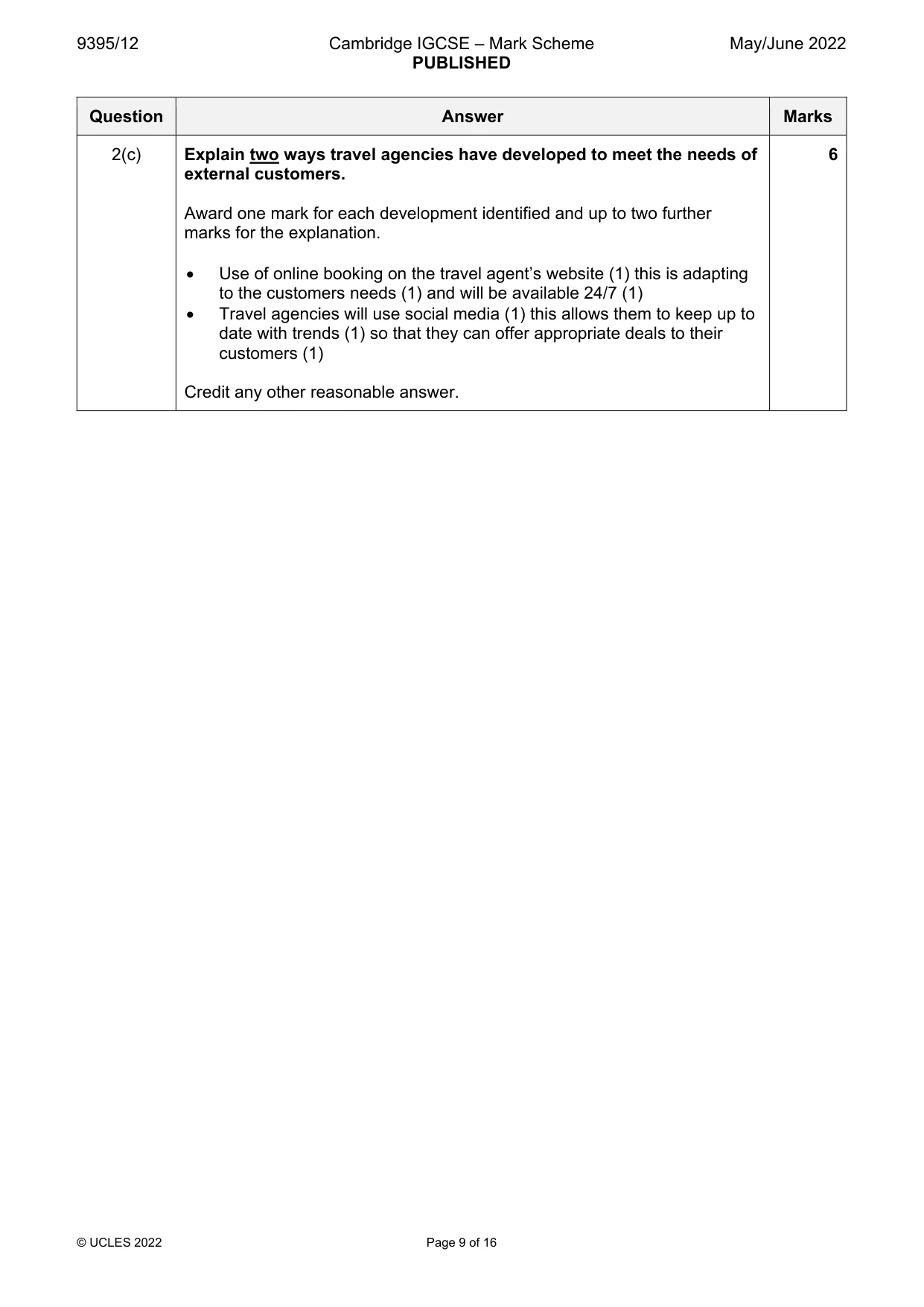
9395/12 Cambridge IGCSE – Mark Scheme PUBLISHED May/June 2022 © UCLES 2022 Page 9 of 16 Question Answer Marks 2(c) Explain two ways travel agencies have developed to meet the needs of external customers. Award one mark for each development identified and up to two further marks for the explanation. Use of online booking on the travel agent’s website (1) this is adapting to the customers needs (1) and will be available 24/7 (1) Travel agencies will use social media (1) this allows them to keep up to date with trends (1) so that they can offer appropriate deals to their customers (1) Credit any other reasonable answer. 6
Mark scheme, page 10
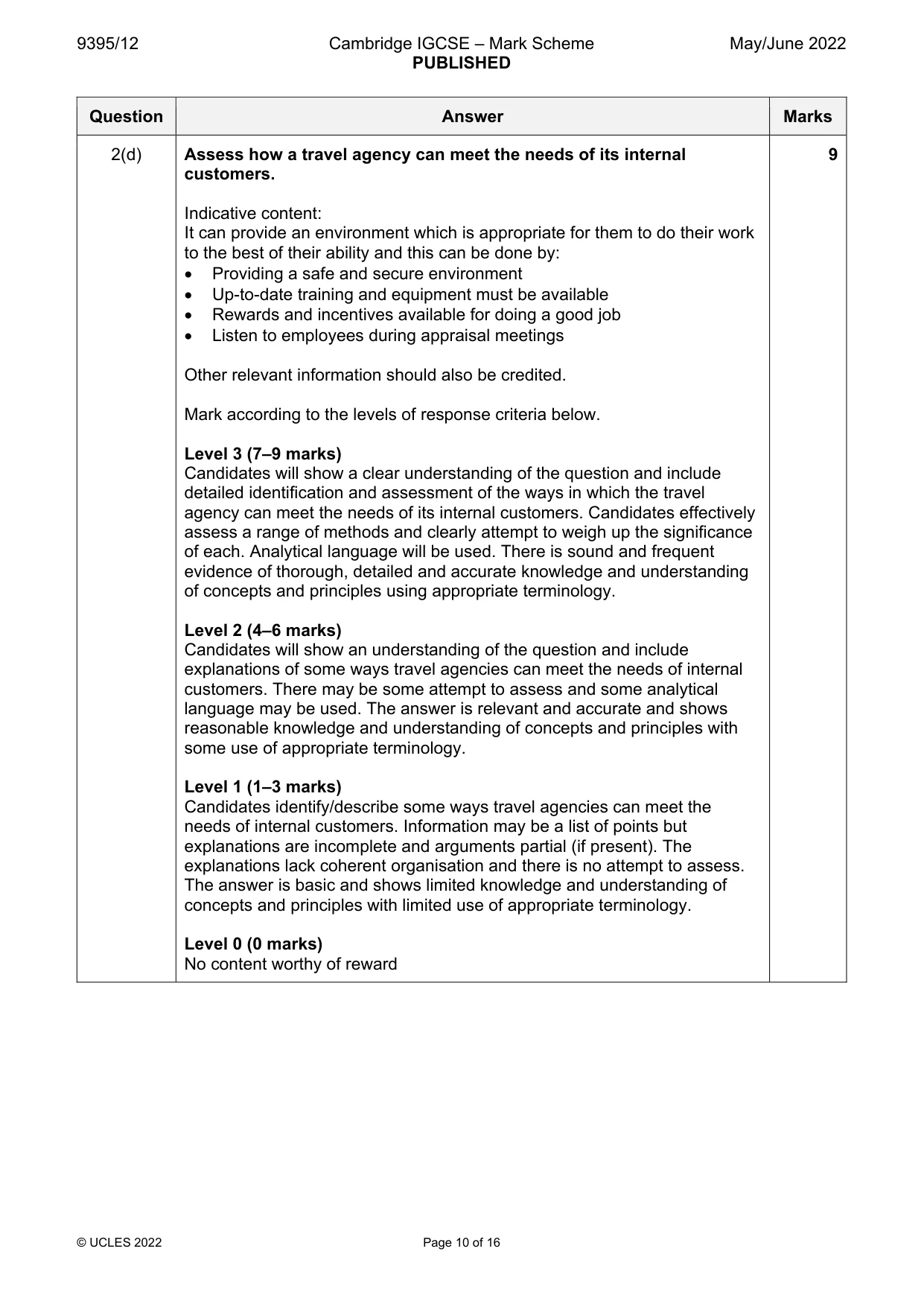
9395/12 Cambridge IGCSE – Mark Scheme PUBLISHED May/June 2022 © UCLES 2022 Page 10 of 16 Question Answer Marks 2(d) Assess how a travel agency can meet the needs of its internal customers. Indicative content: It can provide an environment which is appropriate for them to do their work to the best of their ability and this can be done by: Providing a safe and secure environment Up-to-date training and equipment must be available Rewards and incentives available for doing a good job Listen to employees during appraisal meetings Other relevant information should also be credited. Mark according to the levels of response criteria below. Level 3 (7–9 marks) Candidates will show a clear understanding of the question and include detailed identification and assessment of the ways in which the travel agency can meet the needs of its internal customers. Candidates effectively assess a range of methods and clearly attempt to weigh up the significance of each. Analytical language will be used. There is sound and frequent evidence of thorough, detailed and accurate knowledge and understanding of concepts and principles using appropriate terminology. Level 2 (4–6 marks) Candidates will show an understanding of the question and include explanations of some ways travel agencies can meet the needs of internal customers. There may be some attempt to assess and some analytical language may be used. The answer is relevant and accurate and shows reasonable knowledge and understanding of concepts and principles with some use of appropriate terminology. Level 1 (1–3 marks) Candidates identify/describe some ways travel agencies can meet the needs of internal customers. Information may be a list of points but explanations are incomplete and arguments partial (if present). The explanations lack coherent organisation and there is no attempt to assess. The answer is basic and shows limited knowledge and understanding of concepts and principles with limited use of appropriate terminology. Level 0 (0 marks) No content worthy of reward 9
Mark scheme, page 11
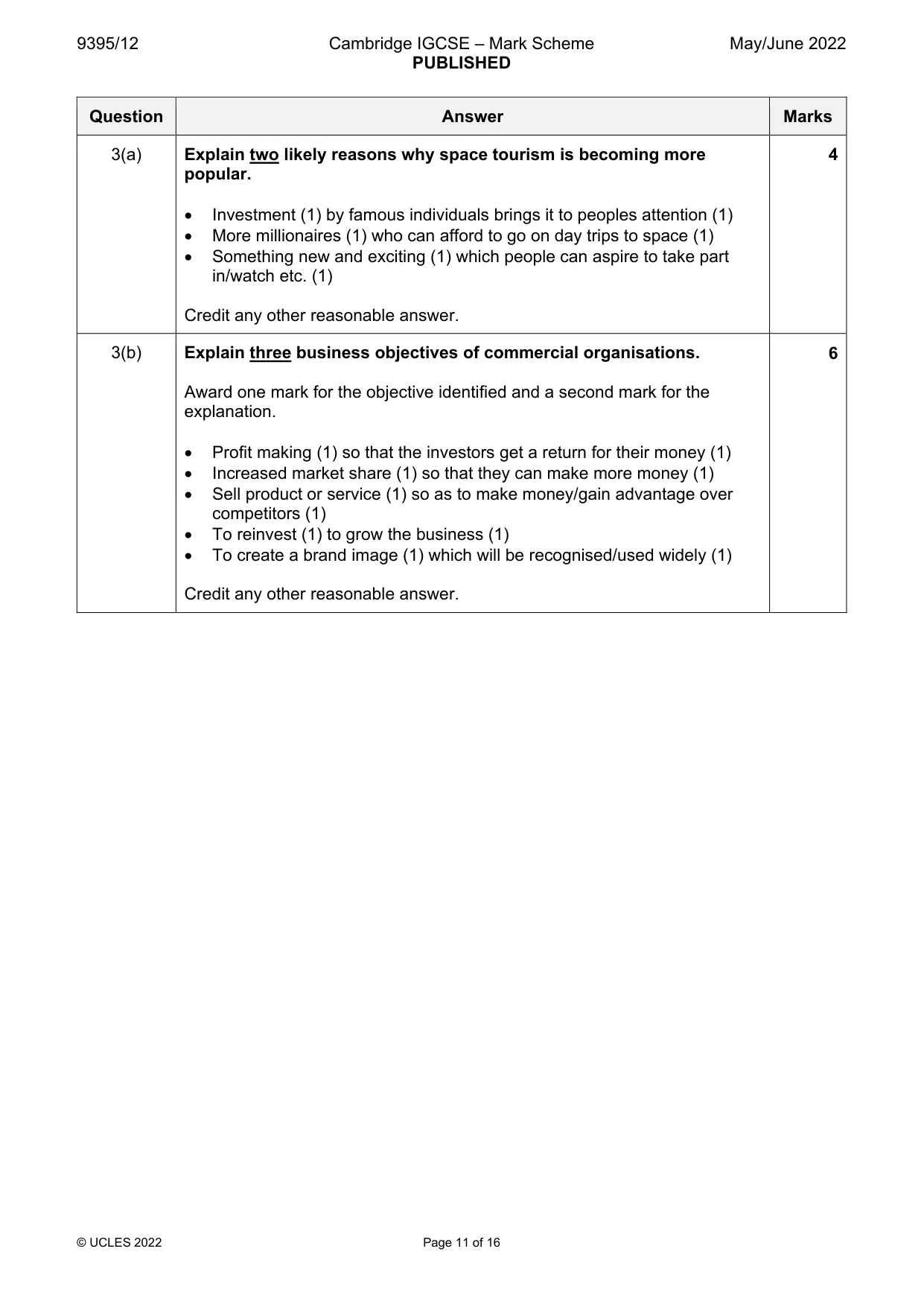
9395/12 Cambridge IGCSE – Mark Scheme PUBLISHED May/June 2022 © UCLES 2022 Page 11 of 16 Question Answer Marks 3(a) Explain two likely reasons why space tourism is becoming more popular. Investment (1) by famous individuals brings it to peoples attention (1) More millionaires (1) who can afford to go on day trips to space (1) Something new and exciting (1) which people can aspire to take part in/watch etc. (1) Credit any other reasonable answer. 4 3(b) Explain three business objectives of commercial organisations. Award one mark for the objective identified and a second mark for the explanation. Profit making (1) so that the investors get a return for their money (1) Increased market share (1) so that they can make more money (1) Sell product or service (1) so as to make money/gain advantage over competitors (1) To reinvest (1) to grow the business (1) To create a brand image (1) which will be recognised/used widely (1) Credit any other reasonable answer. 6
Mark scheme, page 12
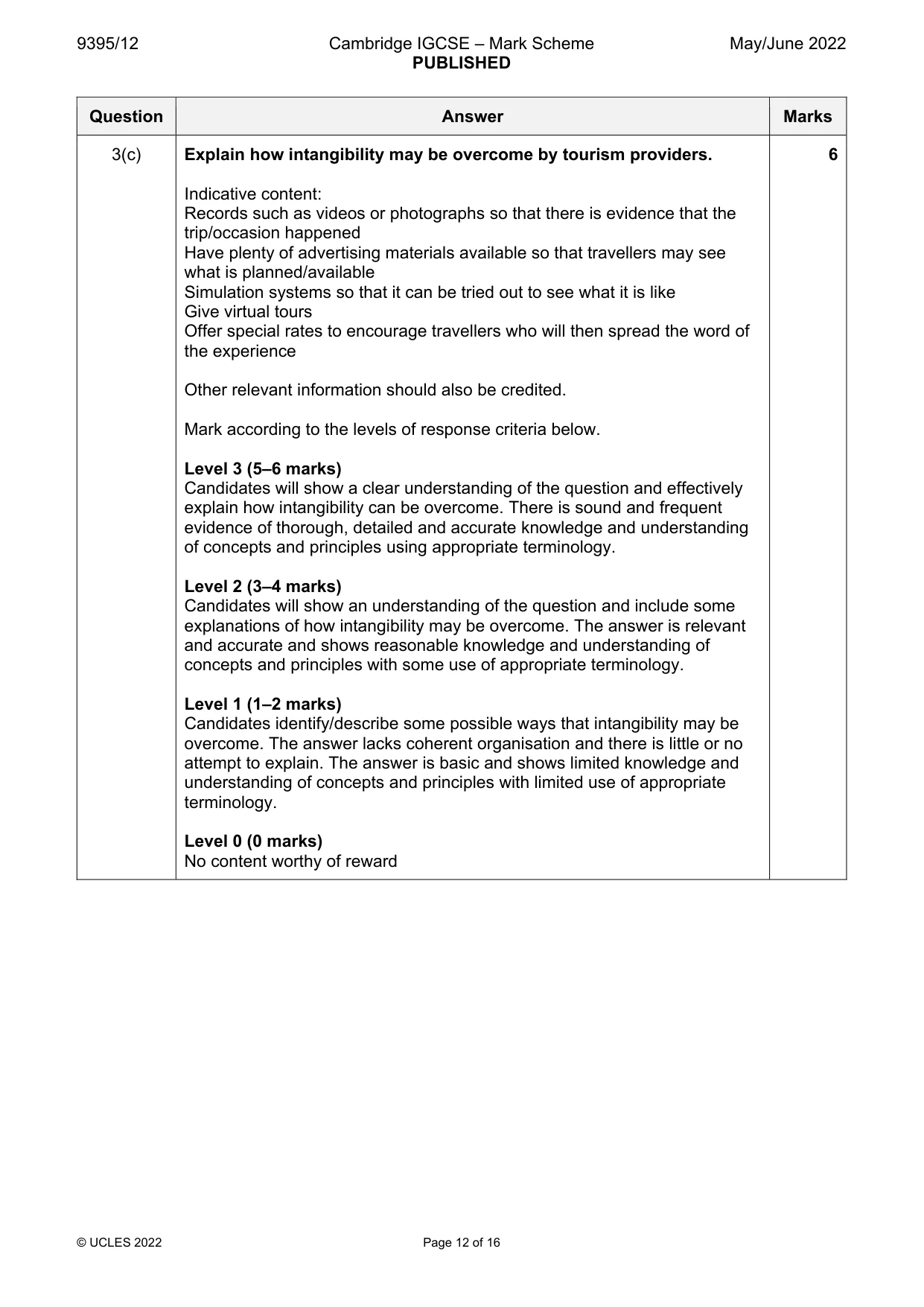
9395/12 Cambridge IGCSE – Mark Scheme PUBLISHED May/June 2022 © UCLES 2022 Page 12 of 16 Question Answer Marks 3(c) Explain how intangibility may be overcome by tourism providers. Indicative content: Records such as videos or photographs so that there is evidence that the trip/occasion happened Have plenty of advertising materials available so that travellers may see what is planned/available Simulation systems so that it can be tried out to see what it is like Give virtual tours Offer special rates to encourage travellers who will then spread the word of the experience Other relevant information should also be credited. Mark according to the levels of response criteria below. Level 3 (5–6 marks) Candidates will show a clear understanding of the question and effectively explain how intangibility can be overcome. There is sound and frequent evidence of thorough, detailed and accurate knowledge and understanding of concepts and principles using appropriate terminology. Level 2 (3–4 marks) Candidates will show an understanding of the question and include some explanations of how intangibility may be overcome. The answer is relevant and accurate and shows reasonable knowledge and understanding of concepts and principles with some use of appropriate terminology. Level 1 (1–2 marks) Candidates identify/describe some possible ways that intangibility may be overcome. The answer lacks coherent organisation and there is little or no attempt to explain. The answer is basic and shows limited knowledge and understanding of concepts and principles with limited use of appropriate terminology. Level 0 (0 marks) No content worthy of reward 6
Mark scheme, page 13
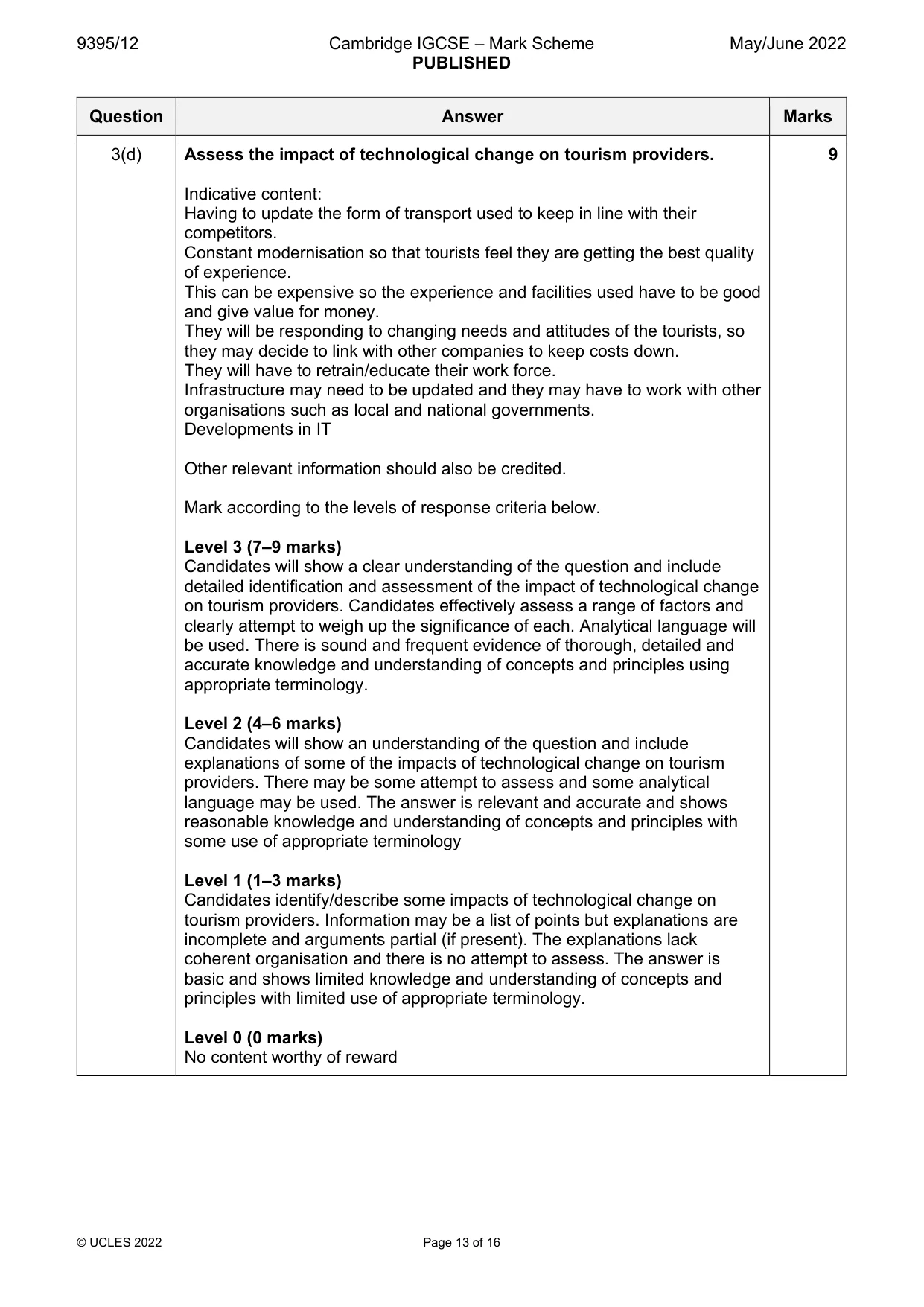
9395/12 Cambridge IGCSE – Mark Scheme PUBLISHED May/June 2022 © UCLES 2022 Page 13 of 16 Question Answer Marks 3(d) Assess the impact of technological change on tourism providers. Indicative content: Having to update the form of transport used to keep in line with their competitors. Constant modernisation so that tourists feel they are getting the best quality of experience. This can be expensive so the experience and facilities used have to be good and give value for money. They will be responding to changing needs and attitudes of the tourists, so they may decide to link with other companies to keep costs down. They will have to retrain/educate their work force. Infrastructure may need to be updated and they may have to work with other organisations such as local and national governments. Developments in IT Other relevant information should also be credited. Mark according to the levels of response criteria below. Level 3 (7–9 marks) Candidates will show a clear understanding of the question and include detailed identification and assessment of the impact of technological change on tourism providers. Candidates effectively assess a range of factors and clearly attempt to weigh up the significance of each. Analytical language will be used. There is sound and frequent evidence of thorough, detailed and accurate knowledge and understanding of concepts and principles using appropriate terminology. Level 2 (4–6 marks) Candidates will show an understanding of the question and include explanations of some of the impacts of technological change on tourism providers. There may be some attempt to assess and some analytical language may be used. The answer is relevant and accurate and shows reasonable knowledge and understanding of concepts and principles with some use of appropriate terminology Level 1 (1–3 marks) Candidates identify/describe some impacts of technological change on tourism providers. Information may be a list of points but explanations are incomplete and arguments partial (if present). The explanations lack coherent organisation and there is no attempt to assess. The answer is basic and shows limited knowledge and understanding of concepts and principles with limited use of appropriate terminology. Level 0 (0 marks) No content worthy of reward 9
Mark scheme, page 14
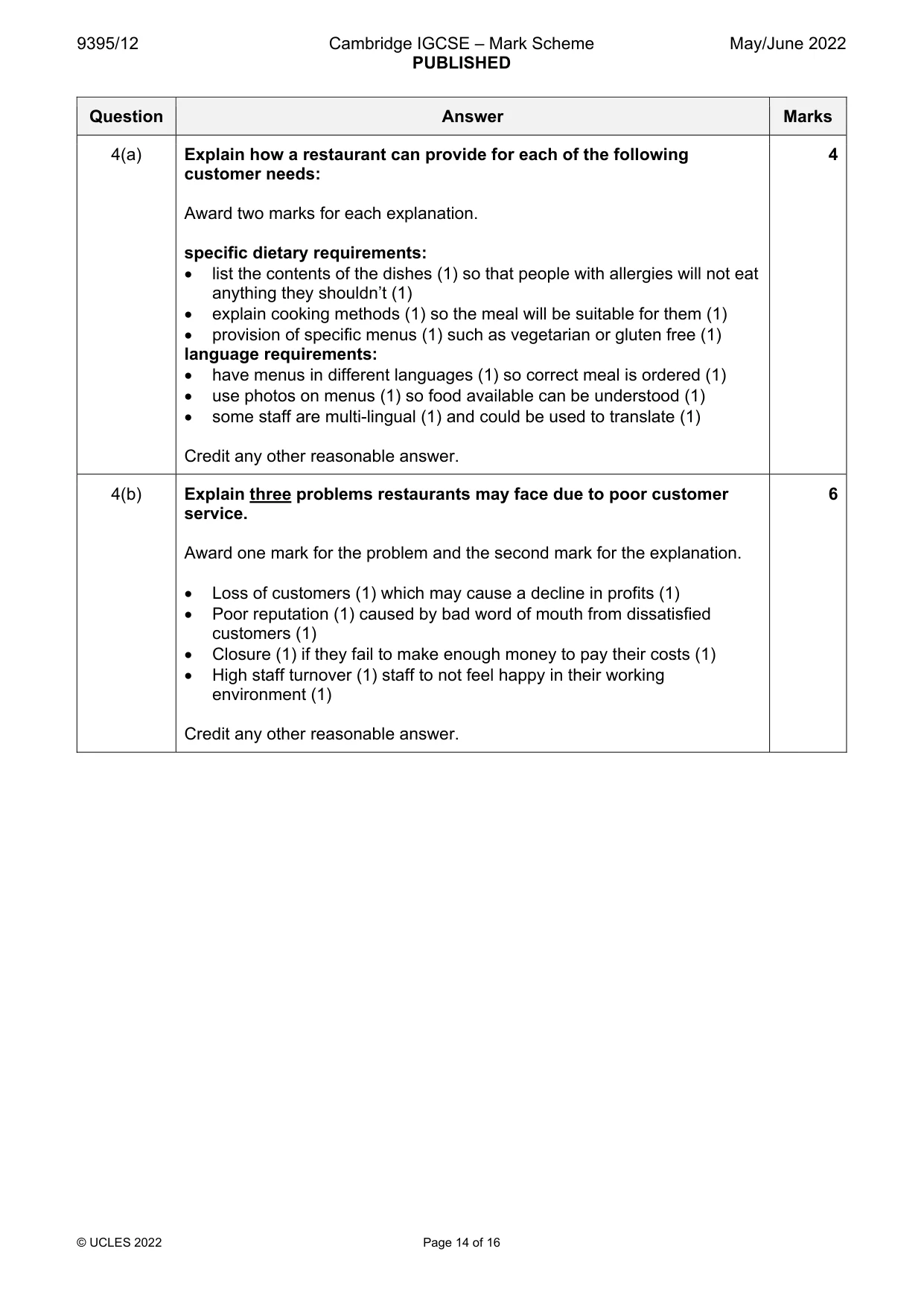
9395/12 Cambridge IGCSE – Mark Scheme PUBLISHED May/June 2022 © UCLES 2022 Page 14 of 16 Question Answer Marks 4(a) Explain how a restaurant can provide for each of the following customer needs: Award two marks for each explanation. specific dietary requirements: list the contents of the dishes (1) so that people with allergies will not eat anything they shouldn’t (1) explain cooking methods (1) so the meal will be suitable for them (1) provision of specific menus (1) such as vegetarian or gluten free (1) language requirements: have menus in different languages (1) so correct meal is ordered (1) use photos on menus (1) so food available can be understood (1) some staff are multi-lingual (1) and could be used to translate (1) Credit any other reasonable answer. 4 4(b) Explain three problems restaurants may face due to poor customer service. Award one mark for the problem and the second mark for the explanation. Loss of customers (1) which may cause a decline in profits (1) Poor reputation (1) caused by bad word of mouth from dissatisfied customers (1) Closure (1) if they fail to make enough money to pay their costs (1) High staff turnover (1) staff to not feel happy in their working environment (1) Credit any other reasonable answer. 6
Mark scheme, page 15
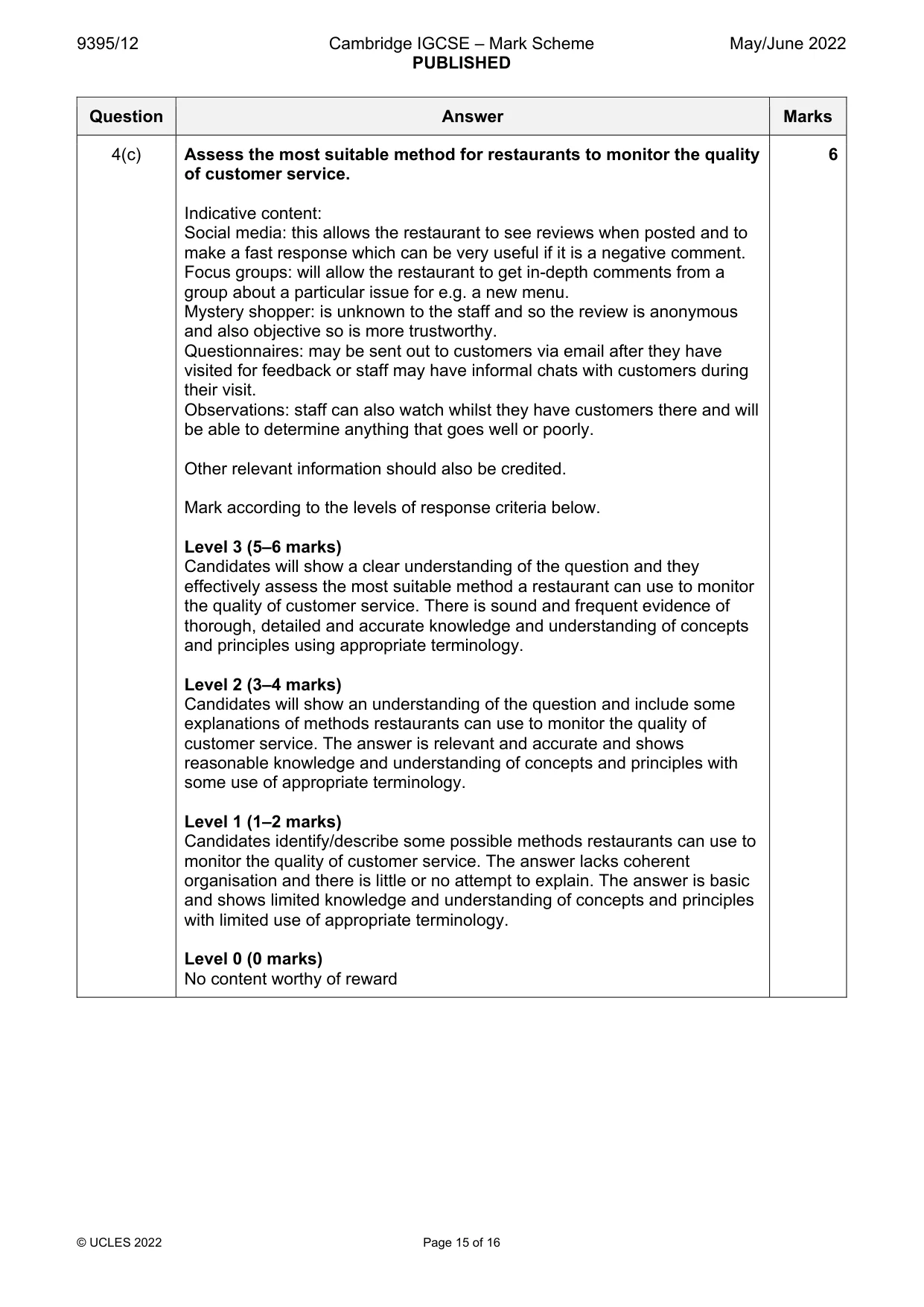
9395/12 Cambridge IGCSE – Mark Scheme PUBLISHED May/June 2022 © UCLES 2022 Page 15 of 16 Question Answer Marks 4(c) Assess the most suitable method for restaurants to monitor the quality of customer service. Indicative content: Social media: this allows the restaurant to see reviews when posted and to make a fast response which can be very useful if it is a negative comment. Focus groups: will allow the restaurant to get in-depth comments from a group about a particular issue for e.g. a new menu. Mystery shopper: is unknown to the staff and so the review is anonymous and also objective so is more trustworthy. Questionnaires: may be sent out to customers via email after they have visited for feedback or staff may have informal chats with customers during their visit. Observations: staff can also watch whilst they have customers there and will be able to determine anything that goes well or poorly. Other relevant information should also be credited. Mark according to the levels of response criteria below. Level 3 (5–6 marks) Candidates will show a clear understanding of the question and they effectively assess the most suitable method a restaurant can use to monitor the quality of customer service. There is sound and frequent evidence of thorough, detailed and accurate knowledge and understanding of concepts and principles using appropriate terminology. Level 2 (3–4 marks) Candidates will show an understanding of the question and include some explanations of methods restaurants can use to monitor the quality of customer service. The answer is relevant and accurate and shows reasonable knowledge and understanding of concepts and principles with some use of appropriate terminology. Level 1 (1–2 marks) Candidates identify/describe some possible methods restaurants can use to monitor the quality of customer service. The answer lacks coherent organisation and there is little or no attempt to explain. The answer is basic and shows limited knowledge and understanding of concepts and principles with limited use of appropriate terminology. Level 0 (0 marks) No content worthy of reward 6
Mark scheme, page 16
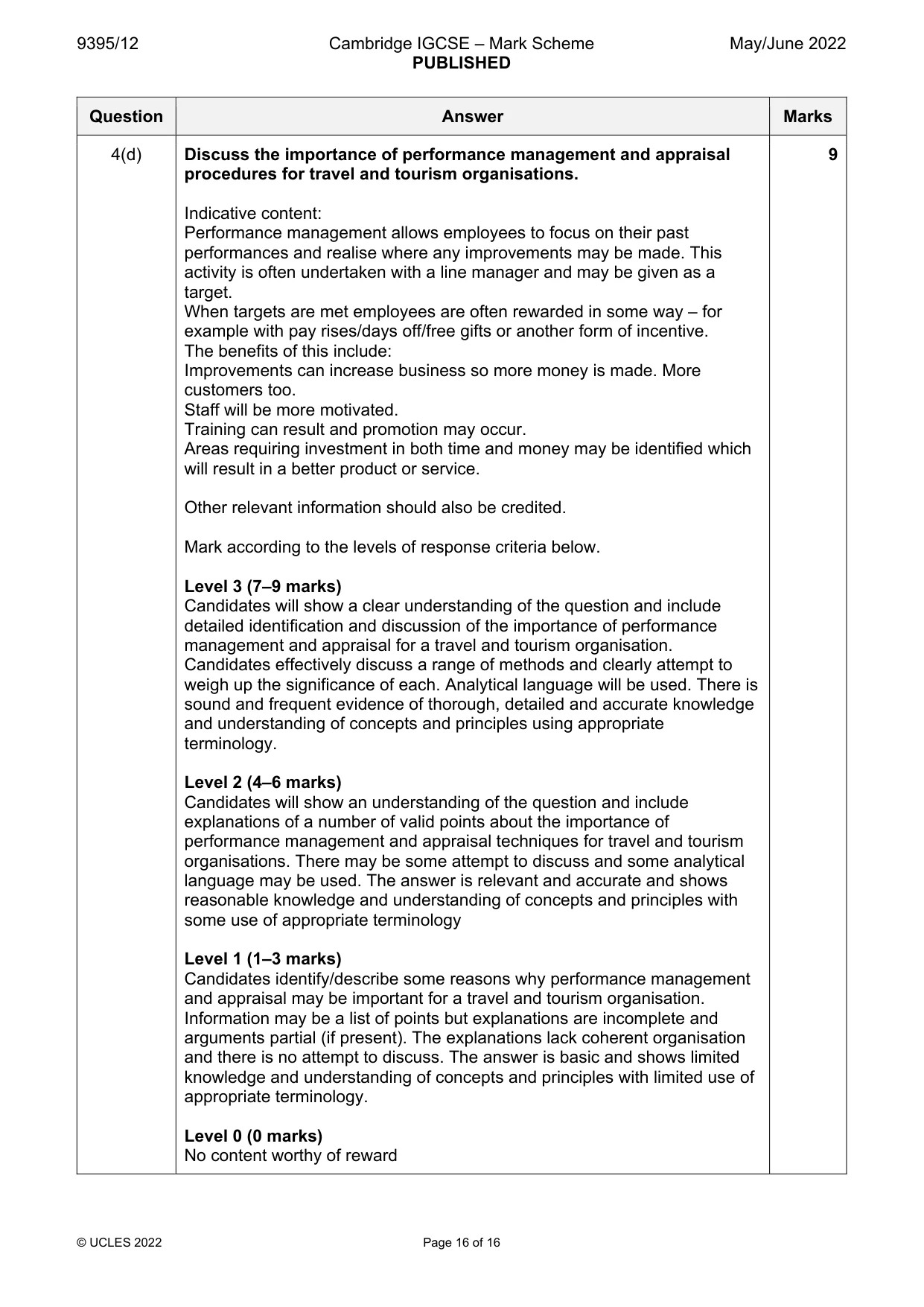
9395/12 Cambridge IGCSE – Mark Scheme PUBLISHED May/June 2022 © UCLES 2022 Page 16 of 16 Question Answer Marks 4(d) Discuss the importance of performance management and appraisal procedures for travel and tourism organisations. Indicative content: Performance management allows employees to focus on their past performances and realise where any improvements may be made. This activity is often undertaken with a line manager and may be given as a target. When targets are met employees are often rewarded in some way – for example with pay rises/days off/free gifts or another form of incentive. The benefits of this include: Improvements can increase business so more money is made. More customers too. Staff will be more motivated. Training can result and promotion may occur. Areas requiring investment in both time and money may be identified which will result in a better product or service. Other relevant information should also be credited. Mark according to the levels of response criteria below. Level 3 (7–9 marks) Candidates will show a clear understanding of the question and include detailed identification and discussion of the importance of performance management and appraisal for a travel and tourism organisation. Candidates effectively discuss a range of methods and clearly attempt to weigh up the significance of each. Analytical language will be used. There is sound and frequent evidence of thorough, detailed and accurate knowledge and understanding of concepts and principles using appropriate terminology. Level 2 (4–6 marks) Candidates will show an understanding of the question and include explanations of a number of valid points about the importance of performance management and appraisal techniques for travel and tourism organisations. There may be some attempt to discuss and some analytical language may be used. The answer is relevant and accurate and shows reasonable knowledge and understanding of concepts and principles with some use of appropriate terminology Level 1 (1–3 marks) Candidates identify/describe some reasons why performance management and appraisal may be important for a travel and tourism organisation. Information may be a list of points but explanations are incomplete and arguments partial (if present). The explanations lack coherent organisation and there is no attempt to discuss. The answer is basic and shows limited knowledge and understanding of concepts and principles with limited use of appropriate terminology. Level 0 (0 marks) No content worthy of reward 9
What you needed in this session
Cambridge’s own grade thresholds for 2022 May/June, Paper 1 · Variant 2. A higher threshold means an easier paper — the bar moves with how the cohort did.