Cambridge A Level Travel and Tourism 9395 — 2022 May/June Paper 1 · Variant 1
9395/11/M/J/22 · 100 marks · ≈113 min
The question paper and its mark scheme, free to read here and free to download. This is Cambridge’s own paper, exactly as it was sat.
Question paper16 pages



Mark scheme15 pages
Answers below. Sit the paper first if you are practising.

Paper as text
Question paper, page 1
This document has 16 pages. Any blank pages are indicated. [Turn over DC (RW) 213472/2 © UCLES 2022 * 3 4 1 1 7 5 3 0 4 5 * TRAVEL & TOURISM 9395/11 Paper 1 The Industry May/June 2022 2 hours 30 minutes You must answer on the question paper. You will need: Insert (enclosed) INSTRUCTIONS ● Answer all questions. ● Use a black or dark blue pen. ● Write your name, centre number and candidate number in the boxes at the top of the page. ● Write your answer to each question in the space provided. ● Do not use an erasable pen or correction fluid. ● Do not write on any bar codes. INFORMATION ● The total mark for this paper is 100. ● The number of marks for each question or part question is shown in brackets [ ]. ● The insert contains all the figures referred to in the questions. Cambridge International AS & A Level
Question paper, page 2
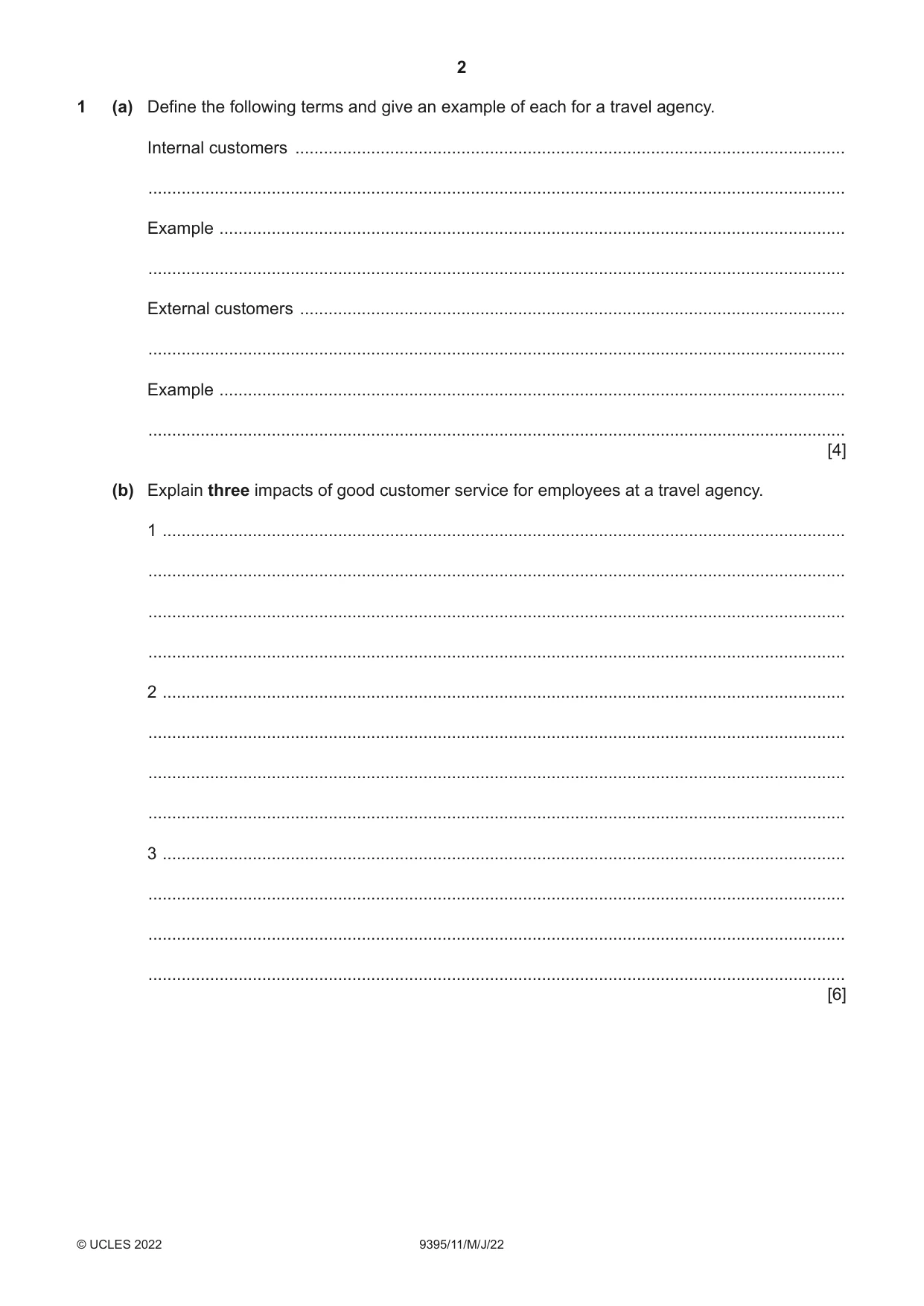
2 9395/11/M/J/22 © UCLES 2022 1 (a) Define the following terms and give an example of each for a travel agency. Internal customers … … Example … … External customers … … Example … … [4] (b) Explain three impacts of good customer service for employees at a travel agency. 1 … … … … 2 … … … … 3 … … … … [6]
Question paper, page 3
3 9395/11/M/J/22 © UCLES 2022 [Turn over (c) Explain two ways that benchmarking could be useful to a hotel chain. 1 … … … … … … 2 … … … … … … [6]
Question paper, page 4
4 9395/11/M/J/22 © UCLES 2022 (d) Evaluate how a hotel could meet the needs of an educational tour group. … … … … … … … … … … … … … … … … … … [9] [Total: 25]
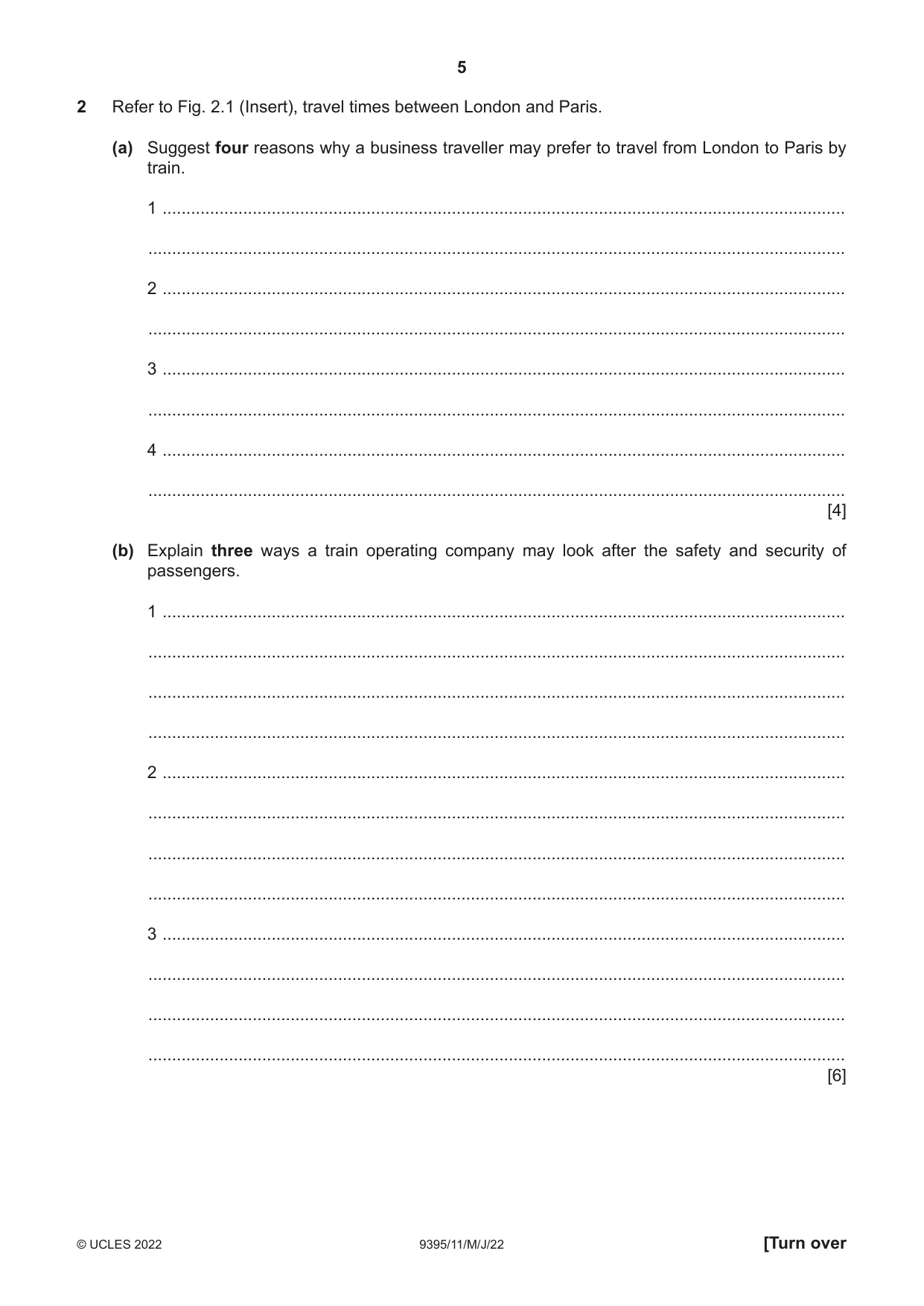
Question paper, page 5
5 9395/11/M/J/22 © UCLES 2022 [Turn over 2 Refer to Fig. 2.1 (Insert), travel times between London and Paris. (a) Suggest four reasons why a business traveller may prefer to travel from London to Paris by train. 1 … … 2 … … 3 … … 4 … … [4] (b) Explain three ways a train operating company may look after the safety and security of passengers. 1 … … … … 2 … … … … 3 … … … … [6]
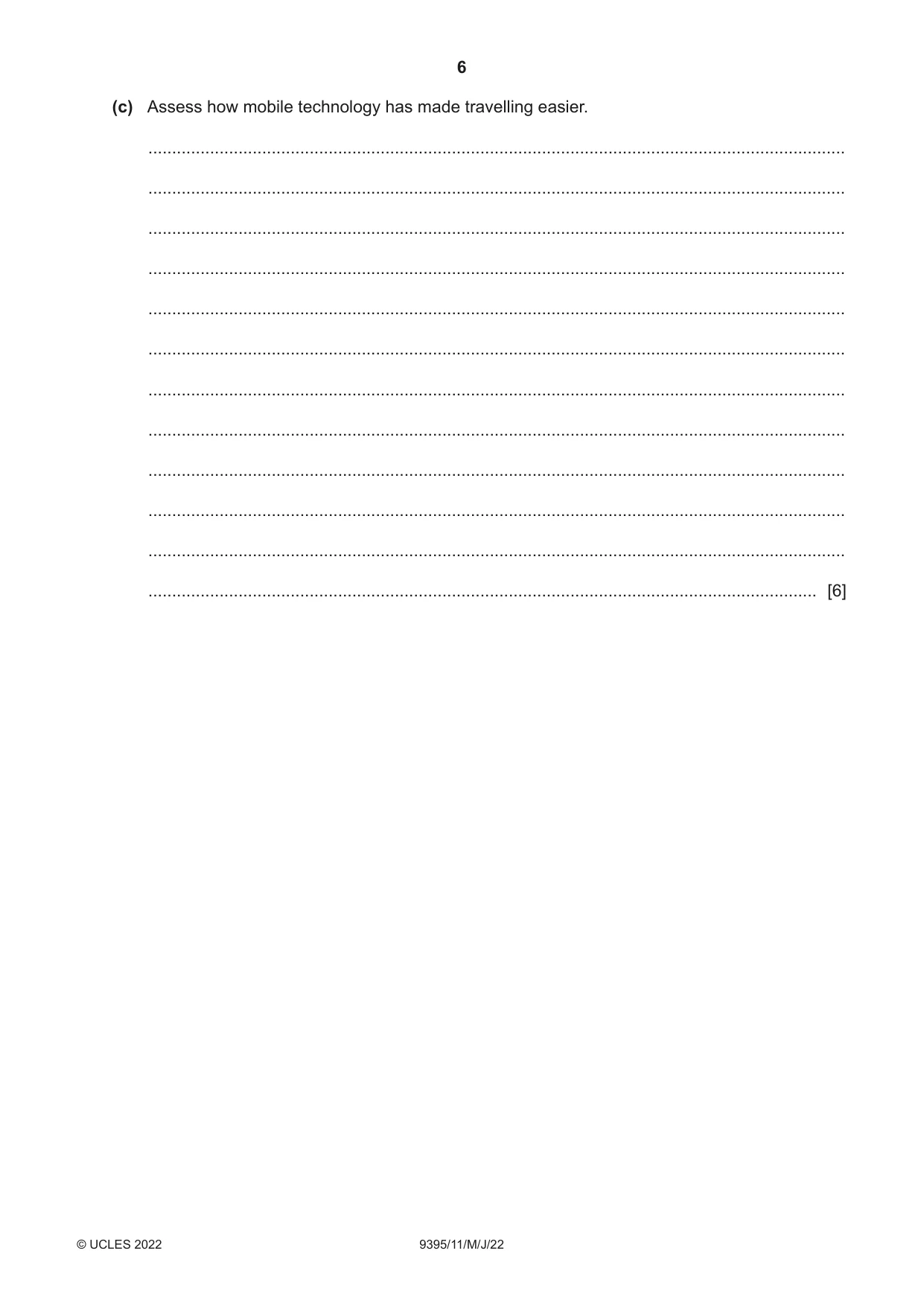
Question paper, page 6
6 9395/11/M/J/22 © UCLES 2022 (c) Assess how mobile technology has made travelling easier. … … … … … … … … … … … … [6]
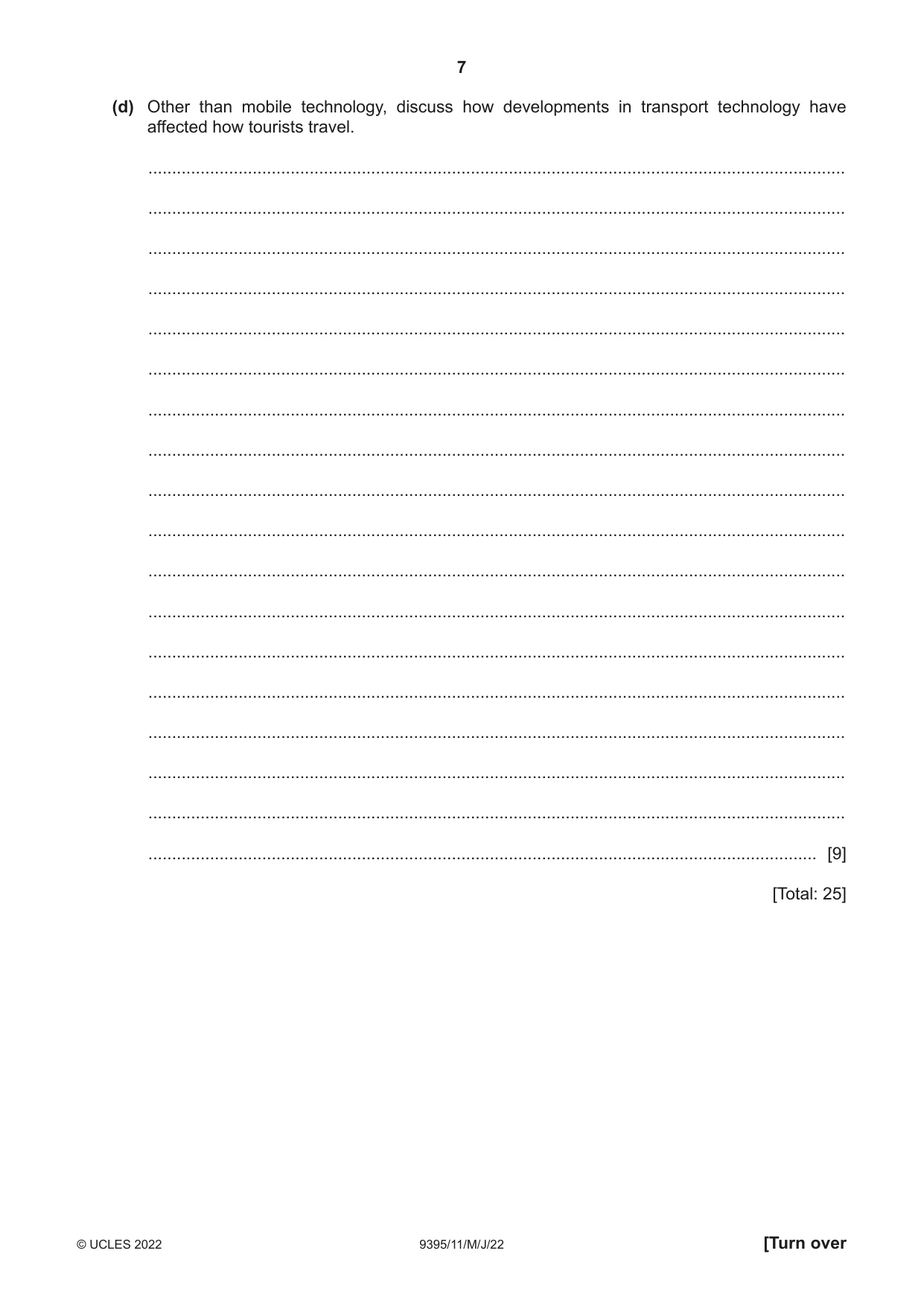
Question paper, page 7
7 9395/11/M/J/22 © UCLES 2022 [Turn over (d) Other than mobile technology, discuss how developments in transport technology have affected how tourists travel. … … … … … … … … … … … … … … … … … … [9] [Total: 25]
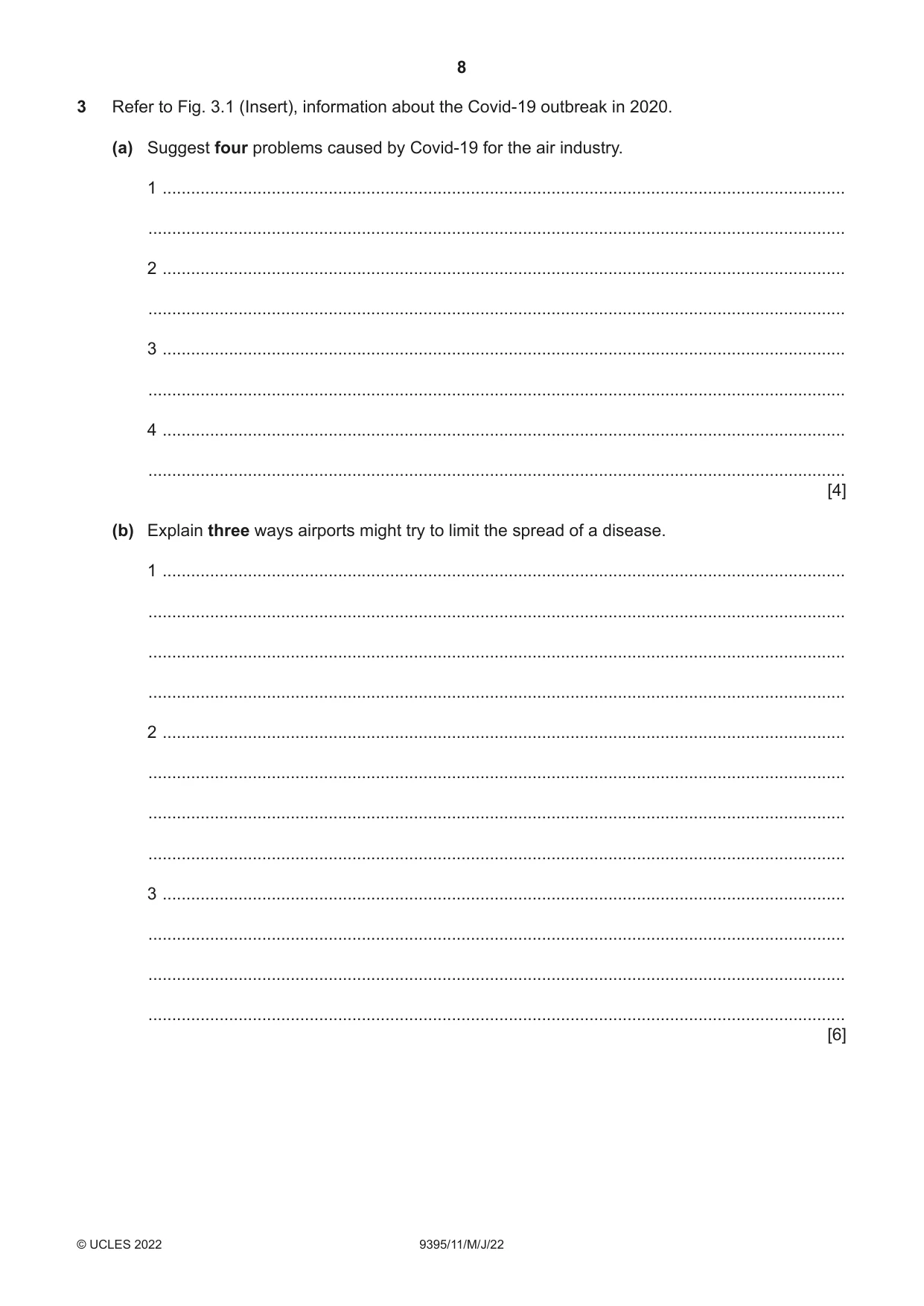
Question paper, page 8
8 9395/11/M/J/22 © UCLES 2022 3 Refer to Fig. 3.1 (Insert), information about the Covid‑19 outbreak in 2020. (a) Suggest four problems caused by Covid‑19 for the air industry. 1 … … 2 … … 3 … … 4 … … [4] (b) Explain three ways airports might try to limit the spread of a disease. 1 … … … … 2 … … … … 3 … … … … [6]
Question paper, page 9
9 9395/11/M/J/22 © UCLES 2022 [Turn over (c) Assess how airports might introduce procedures and routines to maintain a safe working environment for their employees. … … … … … … … … … … … … [6]
Question paper, page 10
10 9395/11/M/J/22 © UCLES 2022 (d) Discuss the role of National Tourism Organisations (NTOs) in helping tourism recover from an outbreak of disease, such as Covid‑19. … … … … … … … … … … … … … … … … … … [9] [Total: 25]
Question paper, page 11
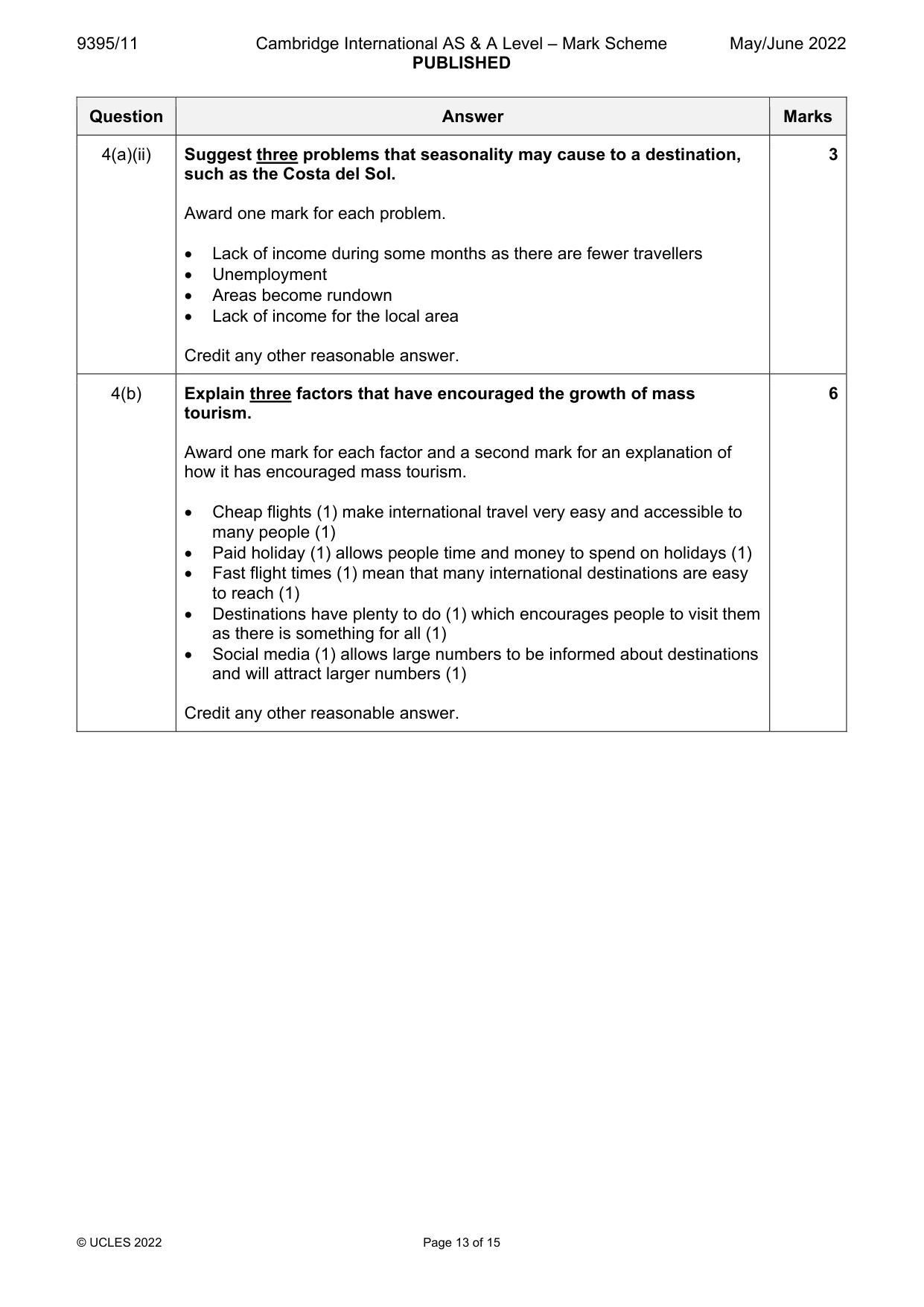
11 9395/11/M/J/22 © UCLES 2022 [Turn over 4 Refer to Fig. 4.1 (Insert), photographs of the Costa del Sol in Spain, a country in western Europe. (a) (i) Define the term ‘mass tourism’. … … [1] (ii) Suggest three problems that seasonality may cause to a destination, such as the Costa del Sol. 1 … … 2 … … 3 … … [3] (b) Explain three factors that have encouraged the growth of mass tourism. 1 … … … … 2 … … … … 3 … … … … [6]
Question paper, page 12
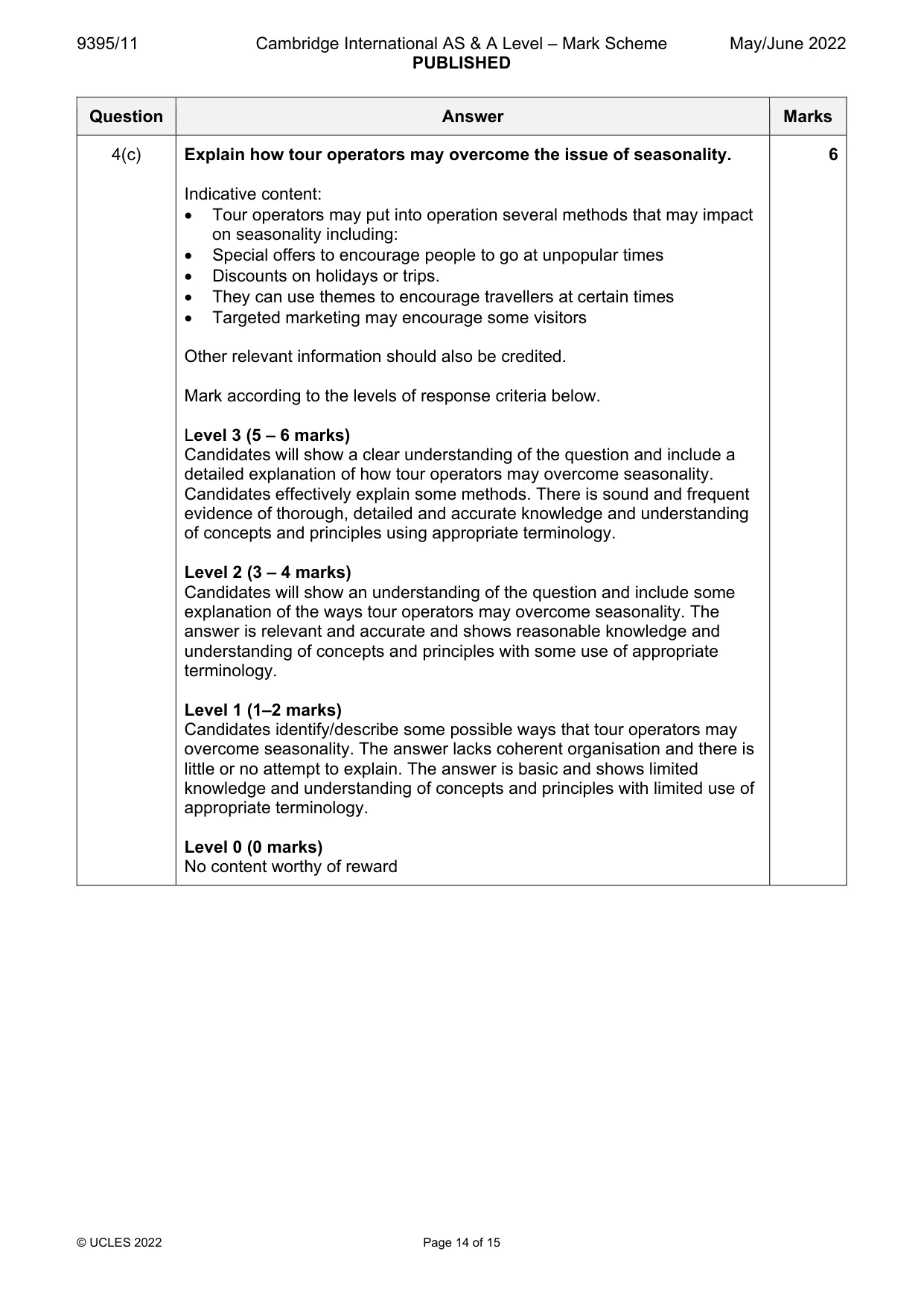
12 9395/11/M/J/22 © UCLES 2022 (c) Explain how tour operators may overcome the issue of seasonality. … … … … … … … … … … … … [6]
Question paper, page 13
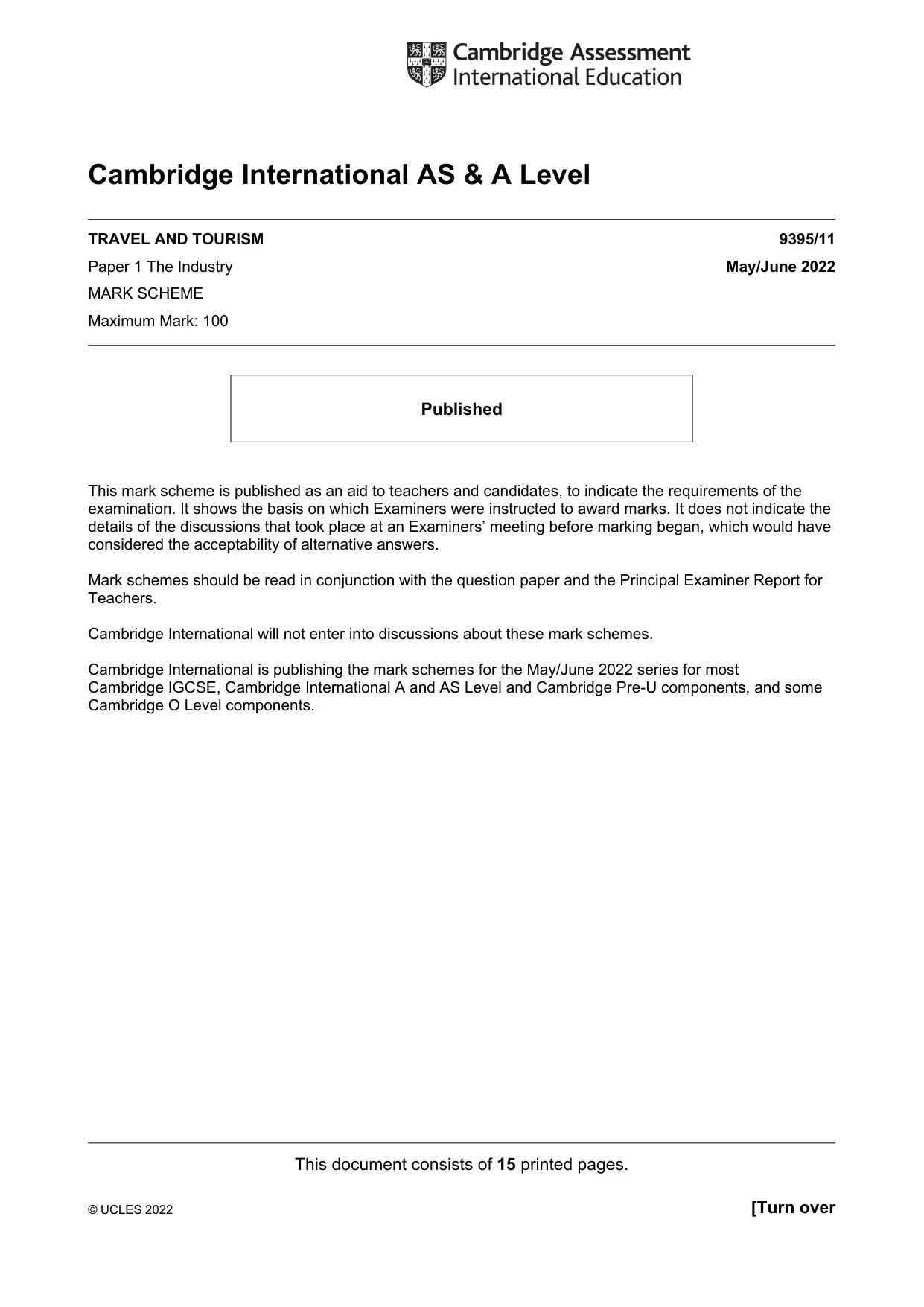
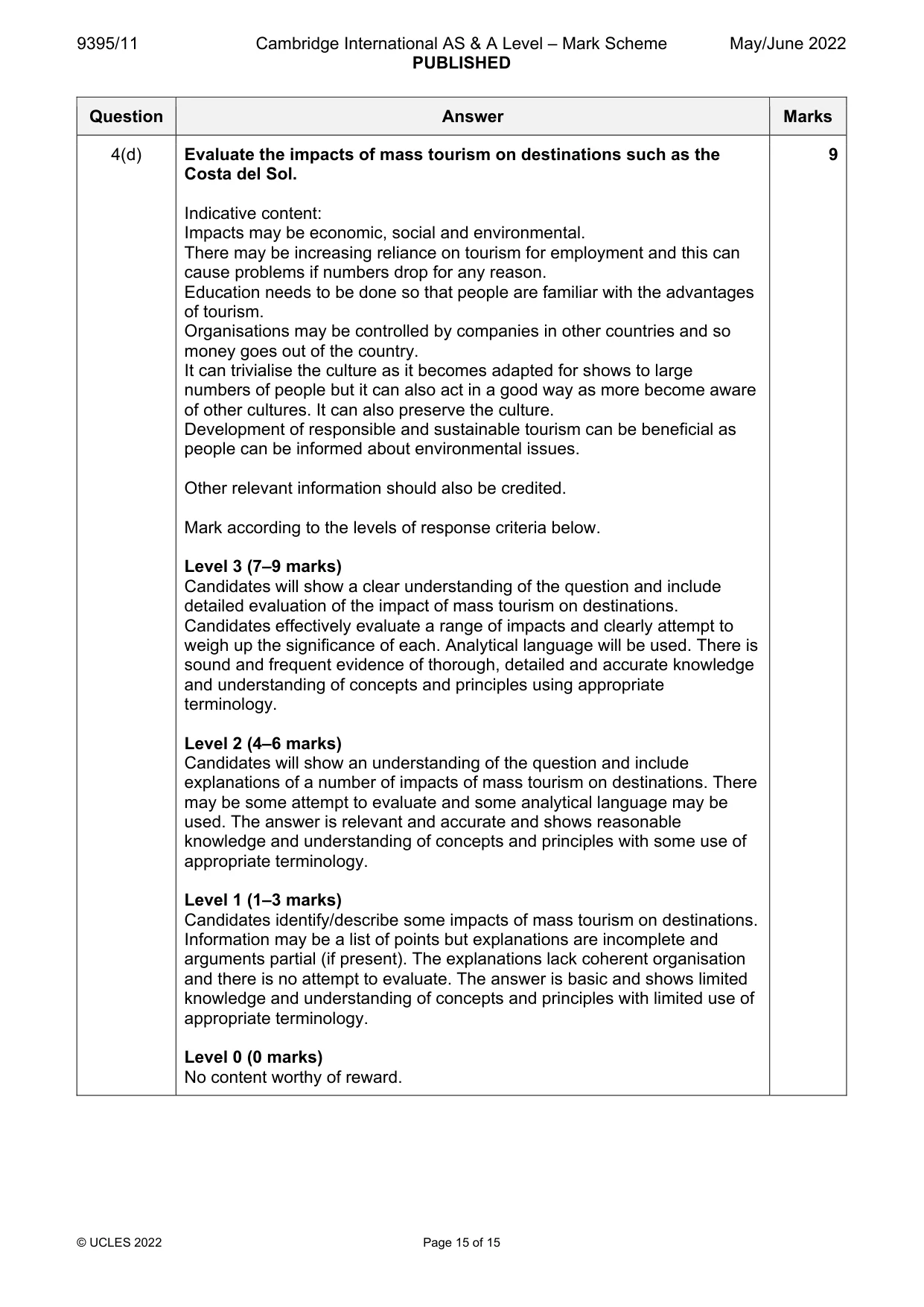
13 9395/11/M/J/22 © UCLES 2022 (d) Evaluate the impacts of mass tourism on destinations such as the Costa del Sol. … … … … … … … … … … … … … … … … … … [9] [Total: 25]
Question paper, page 14
14 9395/11/M/J/22 © UCLES 2022 BLANK PAGE
Question paper, page 15
15 9395/11/M/J/22 © UCLES 2022 BLANK PAGE
Question paper, page 16
16 9395/11/M/J/22 © UCLES 2022 The boundaries and names shown, the designations used and the presentation of material on any maps contained in this question paper/insert do not imply official endorsement or acceptance by Cambridge Assessment International Education concerning the legal status of any country, territory, or area or any of its authorities, or of the delimitation of its frontiers or boundaries. Permission to reproduce items where third‑party owned material protected by copyright is included has been sought and cleared where possible. Every reasonable effort has been made by the publisher (UCLES) to trace copyright holders, but if any items requiring clearance have unwittingly been included, the publisher will be pleased to make amends at the earliest possible opportunity. To avoid the issue of disclosure of answer‑related information to candidates, all copyright acknowledgements are reproduced online in the Cambridge Assessment International Education Copyright Acknowledgements Booklet. This is produced for each series of examinations and is freely available to download at www.cambridgeinternational.org after the live examination series. Cambridge Assessment International Education is part of Cambridge Assessment. Cambridge Assessment is the brand name of the University of Cambridge Local Examinations Syndicate (UCLES), which is a department of the University of Cambridge. BLANK PAGE
Mark scheme, page 1
This document consists of 15 printed pages. © UCLES 2022 [Turn over Cambridge International AS & A Level TRAVEL AND TOURISM 9395/11 Paper 1 The Industry May/June 2022 MARK SCHEME Maximum Mark: 100 Published This mark scheme is published as an aid to teachers and candidates, to indicate the requirements of the examination. It shows the basis on which Examiners were instructed to award marks. It does not indicate the details of the discussions that took place at an Examiners’ meeting before marking began, which would have considered the acceptability of alternative answers. Mark schemes should be read in conjunction with the question paper and the Principal Examiner Report for Teachers. Cambridge International will not enter into discussions about these mark schemes. Cambridge International is publishing the mark schemes for the May/June 2022 series for most Cambridge IGCSE, Cambridge International A and AS Level and Cambridge Pre-U components, and some Cambridge O Level components.
Mark scheme, page 2
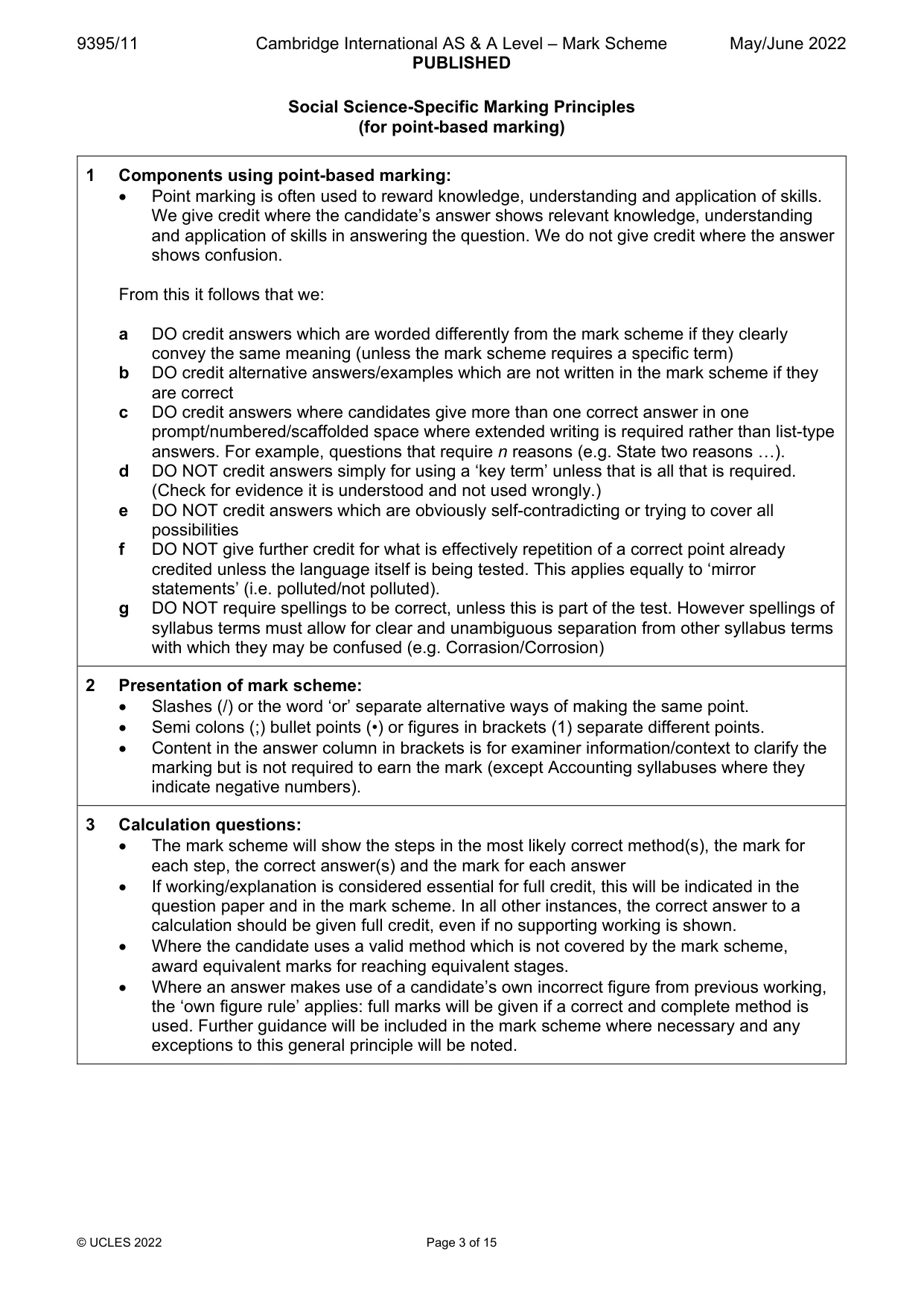
9395/11 Cambridge International AS & A Level – Mark Scheme PUBLISHED May/June 2022 © UCLES 2022 Page 2 of 15 Generic Marking Principles These general marking principles must be applied by all examiners when marking candidate answers. They should be applied alongside the specific content of the mark scheme or generic level descriptors for a question. Each question paper and mark scheme will also comply with these marking principles. GENERIC MARKING PRINCIPLE 1: Marks must be awarded in line with: the specific content of the mark scheme or the generic level descriptors for the question the specific skills defined in the mark scheme or in the generic level descriptors for the question the standard of response required by a candidate as exemplified by the standardisation scripts. GENERIC MARKING PRINCIPLE 2: Marks awarded are always whole marks (not half marks, or other fractions). GENERIC MARKING PRINCIPLE 3: Marks must be awarded positively: marks are awarded for correct/valid answers, as defined in the mark scheme. However, credit is given for valid answers which go beyond the scope of the syllabus and mark scheme, referring to your Team Leader as appropriate marks are awarded when candidates clearly demonstrate what they know and can do marks are not deducted for errors marks are not deducted for omissions answers should only be judged on the quality of spelling, punctuation and grammar when these features are specifically assessed by the question as indicated by the mark scheme. The meaning, however, should be unambiguous. GENERIC MARKING PRINCIPLE 4: Rules must be applied consistently, e.g. in situations where candidates have not followed instructions or in the application of generic level descriptors. GENERIC MARKING PRINCIPLE 5: Marks should be awarded using the full range of marks defined in the mark scheme for the question (however; the use of the full mark range may be limited according to the quality of the candidate responses seen). GENERIC MARKING PRINCIPLE 6: Marks awarded are based solely on the requirements as defined in the mark scheme. Marks should not be awarded with grade thresholds or grade descriptors in mind.
Mark scheme, page 3
9395/11 Cambridge International AS & A Level – Mark Scheme PUBLISHED May/June 2022 © UCLES 2022 Page 3 of 15 Social Science-Specific Marking Principles (for point-based marking) 1 Components using point-based marking: Point marking is often used to reward knowledge, understanding and application of skills. We give credit where the candidate’s answer shows relevant knowledge, understanding and application of skills in answering the question. We do not give credit where the answer shows confusion. From this it follows that we: a DO credit answers which are worded differently from the mark scheme if they clearly convey the same meaning (unless the mark scheme requires a specific term) b DO credit alternative answers/examples which are not written in the mark scheme if they are correct c DO credit answers where candidates give more than one correct answer in one prompt/numbered/scaffolded space where extended writing is required rather than list-type answers. For example, questions that require n reasons (e.g. State two reasons …). d DO NOT credit answers simply for using a ‘key term’ unless that is all that is required. (Check for evidence it is understood and not used wrongly.) e DO NOT credit answers which are obviously self-contradicting or trying to cover all possibilities f DO NOT give further credit for what is effectively repetition of a correct point already credited unless the language itself is being tested. This applies equally to ‘mirror statements’ (i.e. polluted/not polluted). g DO NOT require spellings to be correct, unless this is part of the test. However spellings of syllabus terms must allow for clear and unambiguous separation from other syllabus terms with which they may be confused (e.g. Corrasion/Corrosion) 2 Presentation of mark scheme: Slashes (/) or the word ‘or’ separate alternative ways of making the same point. Semi colons (;) bullet points (•) or figures in brackets (1) separate different points. Content in the answer column in brackets is for examiner information/context to clarify the marking but is not required to earn the mark (except Accounting syllabuses where they indicate negative numbers). 3 Calculation questions: The mark scheme will show the steps in the most likely correct method(s), the mark for each step, the correct answer(s) and the mark for each answer If working/explanation is considered essential for full credit, this will be indicated in the question paper and in the mark scheme. In all other instances, the correct answer to a calculation should be given full credit, even if no supporting working is shown. Where the candidate uses a valid method which is not covered by the mark scheme, award equivalent marks for reaching equivalent stages. Where an answer makes use of a candidate’s own incorrect figure from previous working, the ‘own figure rule’ applies: full marks will be given if a correct and complete method is used. Further guidance will be included in the mark scheme where necessary and any exceptions to this general principle will be noted.
Mark scheme, page 4
9395/11 Cambridge International AS & A Level – Mark Scheme PUBLISHED May/June 2022 © UCLES 2022 Page 4 of 15 4 Annotation: For point marking, ticks can be used to indicate correct answers and crosses can be used to indicate wrong answers. There is no direct relationship between ticks and marks. Ticks have no defined meaning for levels of response marking. For levels of response marking, the level awarded should be annotated on the script. Other annotations will be used by examiners as agreed during standardisation, and the meaning will be understood by all examiners who marked that paper.
Mark scheme, page 5
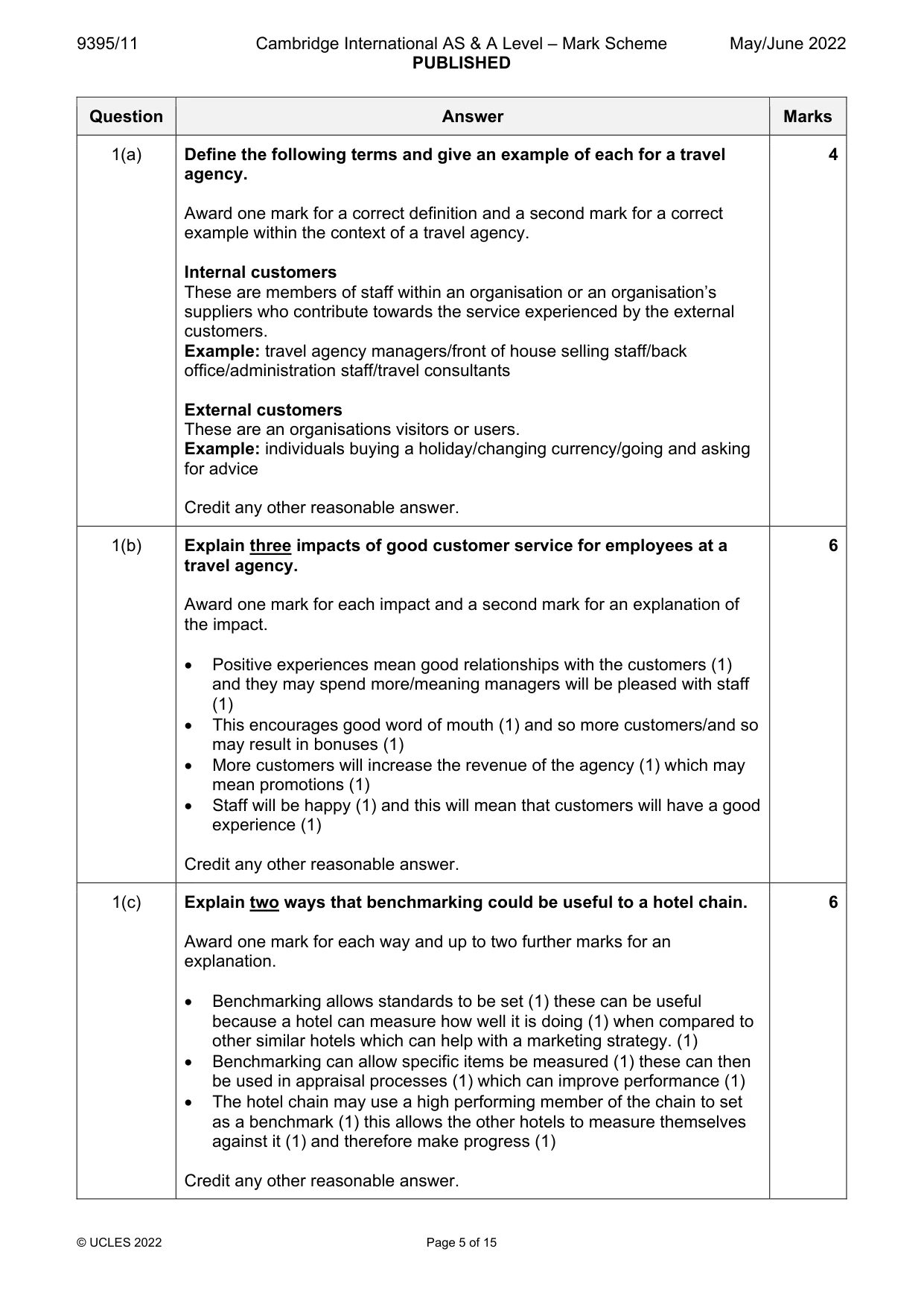
9395/11 Cambridge International AS & A Level – Mark Scheme PUBLISHED May/June 2022 © UCLES 2022 Page 5 of 15 Question Answer Marks 1(a) Define the following terms and give an example of each for a travel agency. Award one mark for a correct definition and a second mark for a correct example within the context of a travel agency. Internal customers These are members of staff within an organisation or an organisation’s suppliers who contribute towards the service experienced by the external customers. Example: travel agency managers/front of house selling staff/back office/administration staff/travel consultants External customers These are an organisations visitors or users. Example: individuals buying a holiday/changing currency/going and asking for advice Credit any other reasonable answer. 4 1(b) Explain three impacts of good customer service for employees at a travel agency. Award one mark for each impact and a second mark for an explanation of the impact. Positive experiences mean good relationships with the customers (1) and they may spend more/meaning managers will be pleased with staff (1) This encourages good word of mouth (1) and so more customers/and so may result in bonuses (1) More customers will increase the revenue of the agency (1) which may mean promotions (1) Staff will be happy (1) and this will mean that customers will have a good experience (1) Credit any other reasonable answer. 6 1(c) Explain two ways that benchmarking could be useful to a hotel chain. Award one mark for each way and up to two further marks for an explanation. Benchmarking allows standards to be set (1) these can be useful because a hotel can measure how well it is doing (1) when compared to other similar hotels which can help with a marketing strategy. (1) Benchmarking can allow specific items be measured (1) these can then be used in appraisal processes (1) which can improve performance (1) The hotel chain may use a high performing member of the chain to set as a benchmark (1) this allows the other hotels to measure themselves against it (1) and therefore make progress (1) Credit any other reasonable answer. 6
Mark scheme, page 6
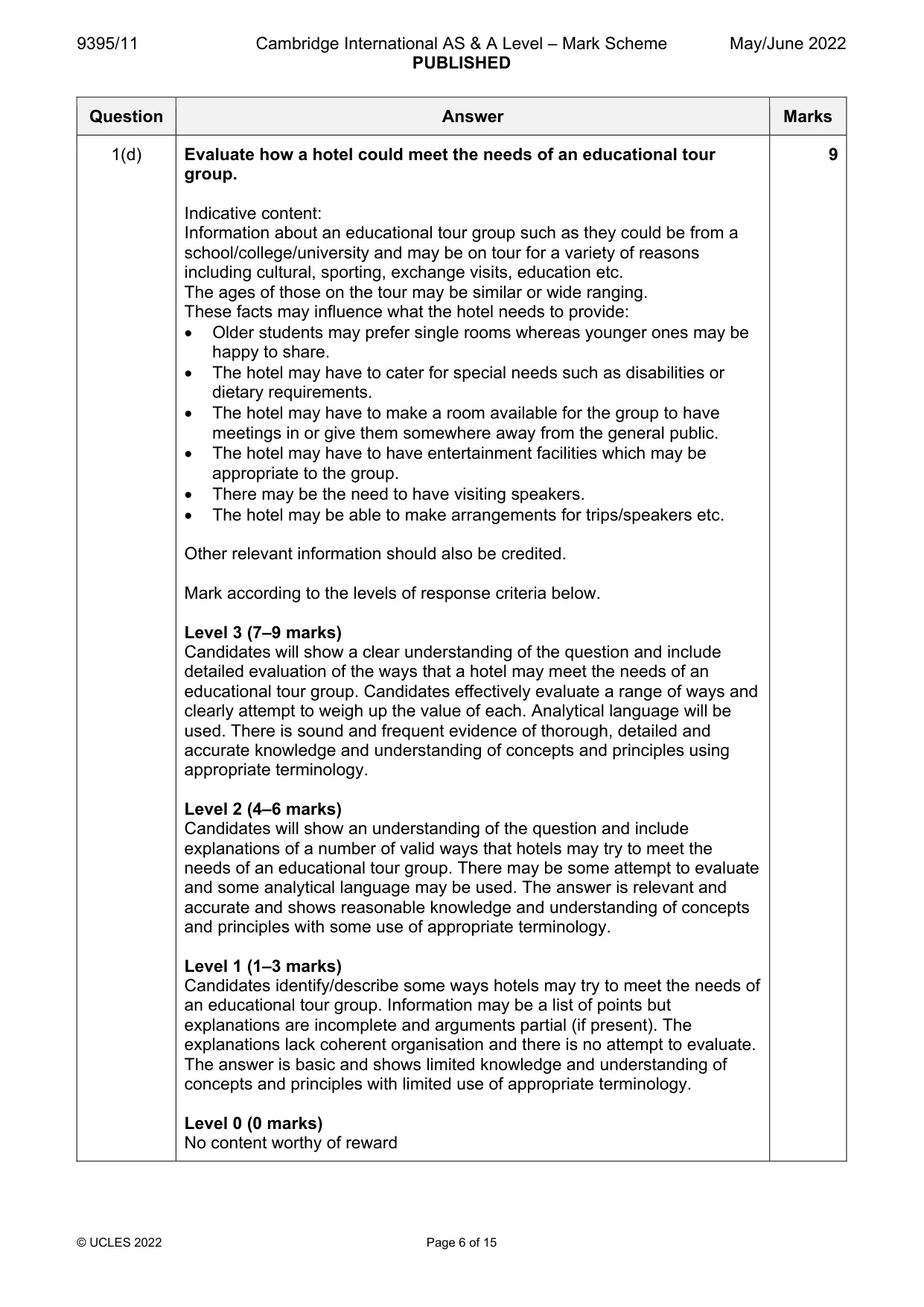
9395/11 Cambridge International AS & A Level – Mark Scheme PUBLISHED May/June 2022 © UCLES 2022 Page 6 of 15 Question Answer Marks 1(d) Evaluate how a hotel could meet the needs of an educational tour group. Indicative content: Information about an educational tour group such as they could be from a school/college/university and may be on tour for a variety of reasons including cultural, sporting, exchange visits, education etc. The ages of those on the tour may be similar or wide ranging. These facts may influence what the hotel needs to provide: Older students may prefer single rooms whereas younger ones may be happy to share. The hotel may have to cater for special needs such as disabilities or dietary requirements. The hotel may have to make a room available for the group to have meetings in or give them somewhere away from the general public. The hotel may have to have entertainment facilities which may be appropriate to the group. There may be the need to have visiting speakers. The hotel may be able to make arrangements for trips/speakers etc. Other relevant information should also be credited. Mark according to the levels of response criteria below. Level 3 (7–9 marks) Candidates will show a clear understanding of the question and include detailed evaluation of the ways that a hotel may meet the needs of an educational tour group. Candidates effectively evaluate a range of ways and clearly attempt to weigh up the value of each. Analytical language will be used. There is sound and frequent evidence of thorough, detailed and accurate knowledge and understanding of concepts and principles using appropriate terminology. Level 2 (4–6 marks) Candidates will show an understanding of the question and include explanations of a number of valid ways that hotels may try to meet the needs of an educational tour group. There may be some attempt to evaluate and some analytical language may be used. The answer is relevant and accurate and shows reasonable knowledge and understanding of concepts and principles with some use of appropriate terminology. Level 1 (1–3 marks) Candidates identify/describe some ways hotels may try to meet the needs of an educational tour group. Information may be a list of points but explanations are incomplete and arguments partial (if present). The explanations lack coherent organisation and there is no attempt to evaluate. The answer is basic and shows limited knowledge and understanding of concepts and principles with limited use of appropriate terminology. Level 0 (0 marks) No content worthy of reward 9
Mark scheme, page 7
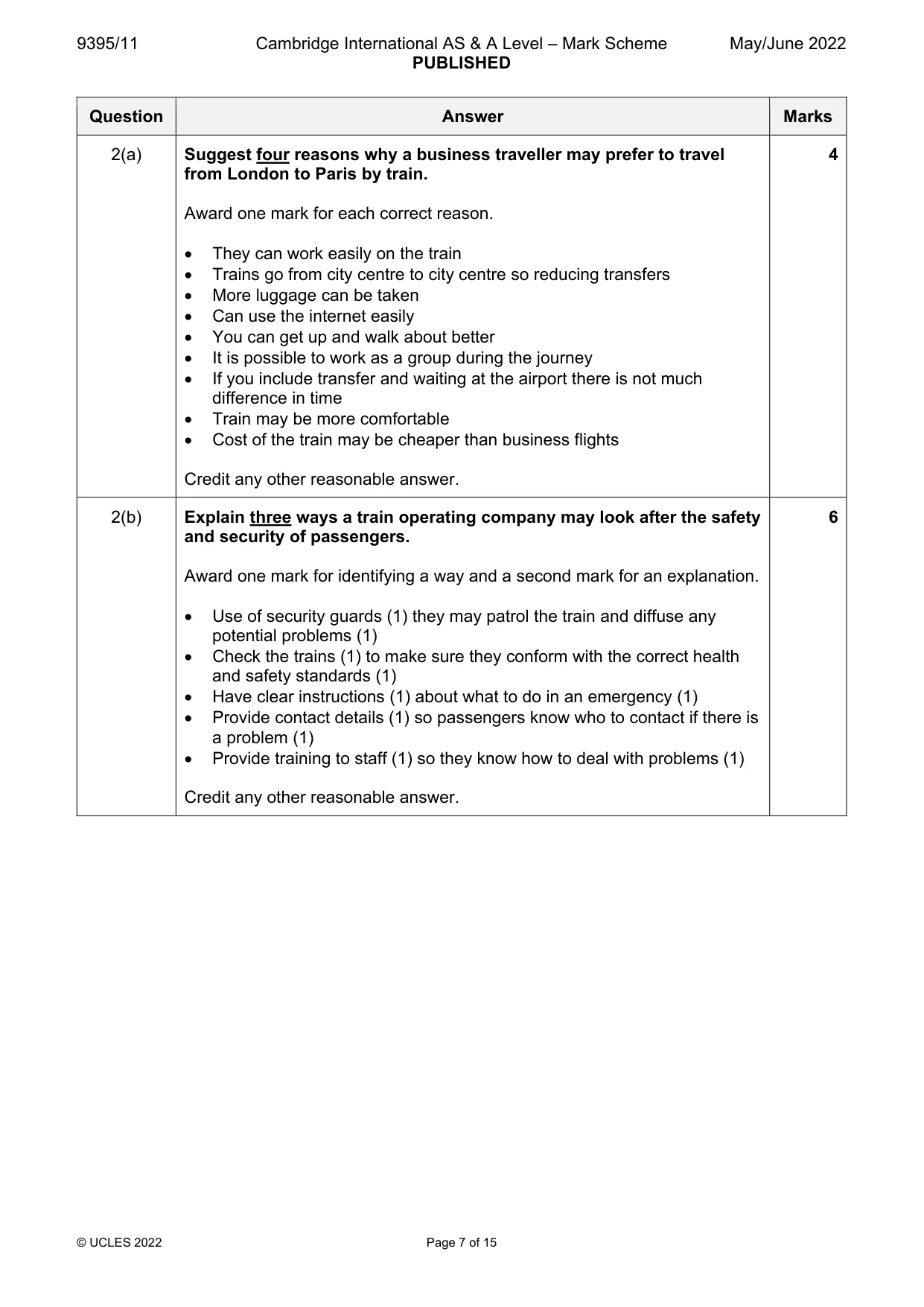
9395/11 Cambridge International AS & A Level – Mark Scheme PUBLISHED May/June 2022 © UCLES 2022 Page 7 of 15 Question Answer Marks 2(a) Suggest four reasons why a business traveller may prefer to travel from London to Paris by train. Award one mark for each correct reason. They can work easily on the train Trains go from city centre to city centre so reducing transfers More luggage can be taken Can use the internet easily You can get up and walk about better It is possible to work as a group during the journey If you include transfer and waiting at the airport there is not much difference in time Train may be more comfortable Cost of the train may be cheaper than business flights Credit any other reasonable answer. 4 2(b) Explain three ways a train operating company may look after the safety and security of passengers. Award one mark for identifying a way and a second mark for an explanation. Use of security guards (1) they may patrol the train and diffuse any potential problems (1) Check the trains (1) to make sure they conform with the correct health and safety standards (1) Have clear instructions (1) about what to do in an emergency (1) Provide contact details (1) so passengers know who to contact if there is a problem (1) Provide training to staff (1) so they know how to deal with problems (1) Credit any other reasonable answer. 6
Mark scheme, page 8
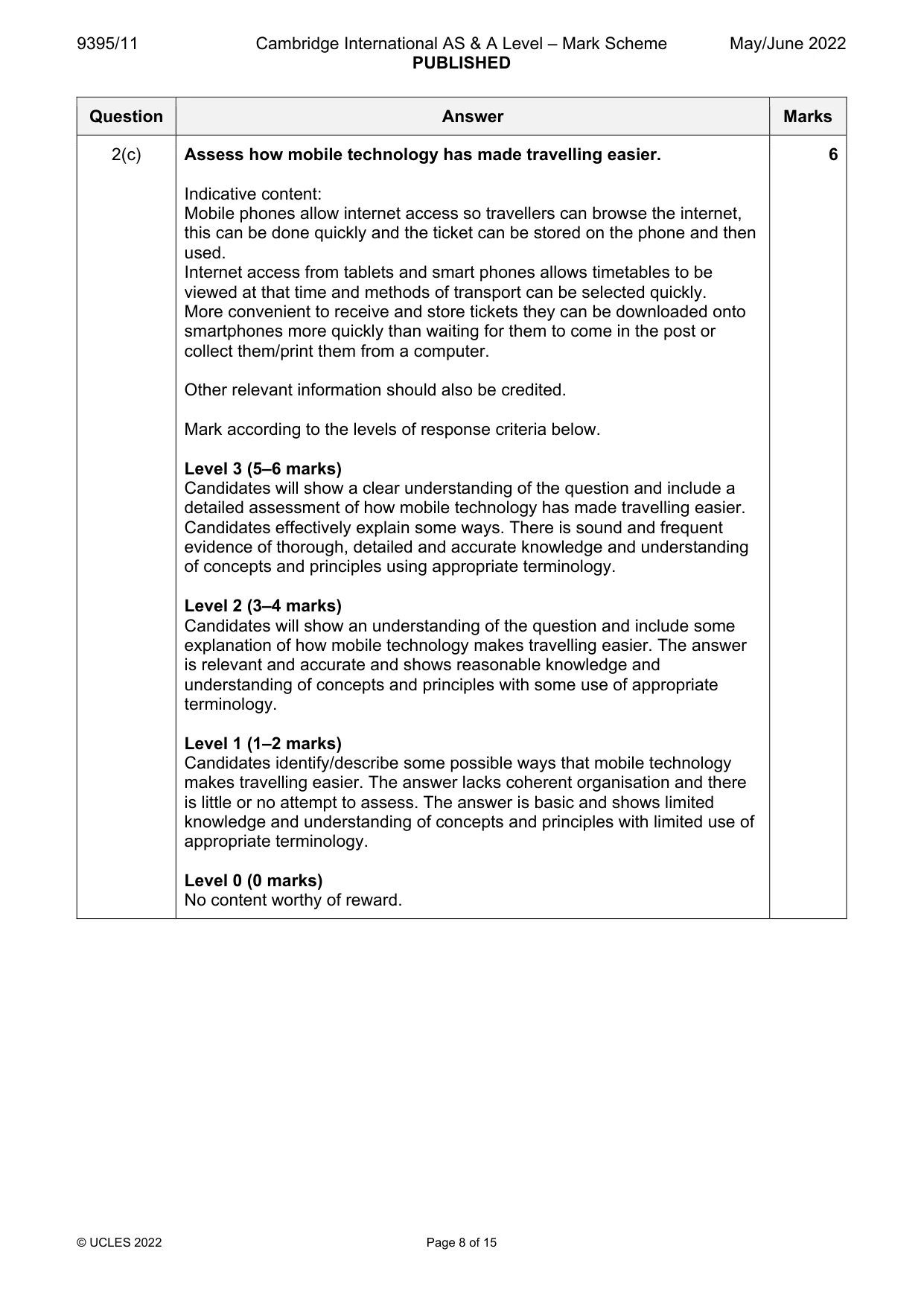
9395/11 Cambridge International AS & A Level – Mark Scheme PUBLISHED May/June 2022 © UCLES 2022 Page 8 of 15 Question Answer Marks 2(c) Assess how mobile technology has made travelling easier. Indicative content: Mobile phones allow internet access so travellers can browse the internet, this can be done quickly and the ticket can be stored on the phone and then used. Internet access from tablets and smart phones allows timetables to be viewed at that time and methods of transport can be selected quickly. More convenient to receive and store tickets they can be downloaded onto smartphones more quickly than waiting for them to come in the post or collect them/print them from a computer. Other relevant information should also be credited. Mark according to the levels of response criteria below. Level 3 (5–6 marks) Candidates will show a clear understanding of the question and include a detailed assessment of how mobile technology has made travelling easier. Candidates effectively explain some ways. There is sound and frequent evidence of thorough, detailed and accurate knowledge and understanding of concepts and principles using appropriate terminology. Level 2 (3–4 marks) Candidates will show an understanding of the question and include some explanation of how mobile technology makes travelling easier. The answer is relevant and accurate and shows reasonable knowledge and understanding of concepts and principles with some use of appropriate terminology. Level 1 (1–2 marks) Candidates identify/describe some possible ways that mobile technology makes travelling easier. The answer lacks coherent organisation and there is little or no attempt to assess. The answer is basic and shows limited knowledge and understanding of concepts and principles with limited use of appropriate terminology. Level 0 (0 marks) No content worthy of reward. 6
Mark scheme, page 9
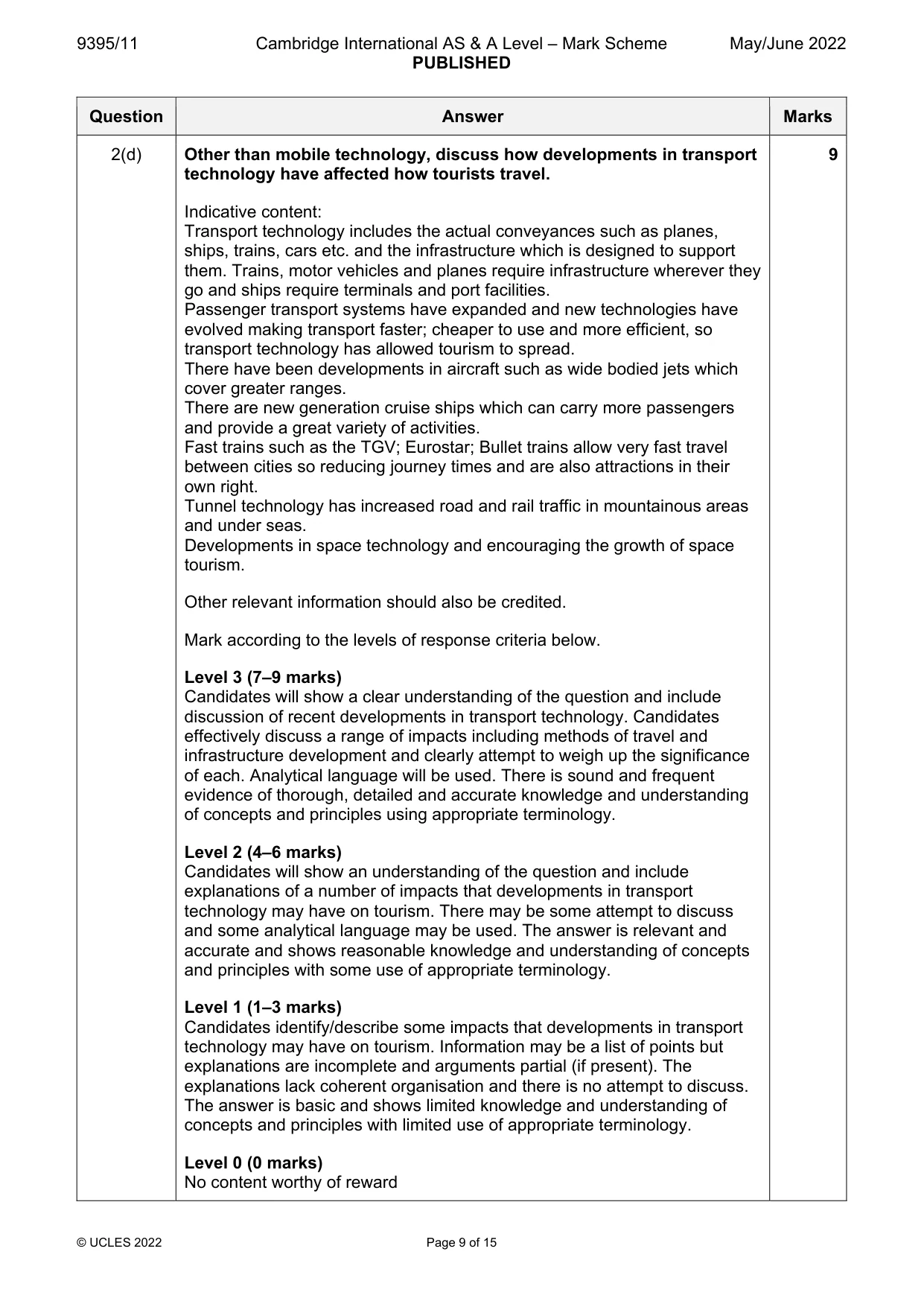
9395/11 Cambridge International AS & A Level – Mark Scheme PUBLISHED May/June 2022 © UCLES 2022 Page 9 of 15 Question Answer Marks 2(d) Other than mobile technology, discuss how developments in transport technology have affected how tourists travel. Indicative content: Transport technology includes the actual conveyances such as planes, ships, trains, cars etc. and the infrastructure which is designed to support them. Trains, motor vehicles and planes require infrastructure wherever they go and ships require terminals and port facilities. Passenger transport systems have expanded and new technologies have evolved making transport faster; cheaper to use and more efficient, so transport technology has allowed tourism to spread. There have been developments in aircraft such as wide bodied jets which cover greater ranges. There are new generation cruise ships which can carry more passengers and provide a great variety of activities. Fast trains such as the TGV; Eurostar; Bullet trains allow very fast travel between cities so reducing journey times and are also attractions in their own right. Tunnel technology has increased road and rail traffic in mountainous areas and under seas. Developments in space technology and encouraging the growth of space tourism. Other relevant information should also be credited. Mark according to the levels of response criteria below. Level 3 (7–9 marks) Candidates will show a clear understanding of the question and include discussion of recent developments in transport technology. Candidates effectively discuss a range of impacts including methods of travel and infrastructure development and clearly attempt to weigh up the significance of each. Analytical language will be used. There is sound and frequent evidence of thorough, detailed and accurate knowledge and understanding of concepts and principles using appropriate terminology. Level 2 (4–6 marks) Candidates will show an understanding of the question and include explanations of a number of impacts that developments in transport technology may have on tourism. There may be some attempt to discuss and some analytical language may be used. The answer is relevant and accurate and shows reasonable knowledge and understanding of concepts and principles with some use of appropriate terminology. Level 1 (1–3 marks) Candidates identify/describe some impacts that developments in transport technology may have on tourism. Information may be a list of points but explanations are incomplete and arguments partial (if present). The explanations lack coherent organisation and there is no attempt to discuss. The answer is basic and shows limited knowledge and understanding of concepts and principles with limited use of appropriate terminology. Level 0 (0 marks) No content worthy of reward 9
Mark scheme, page 10
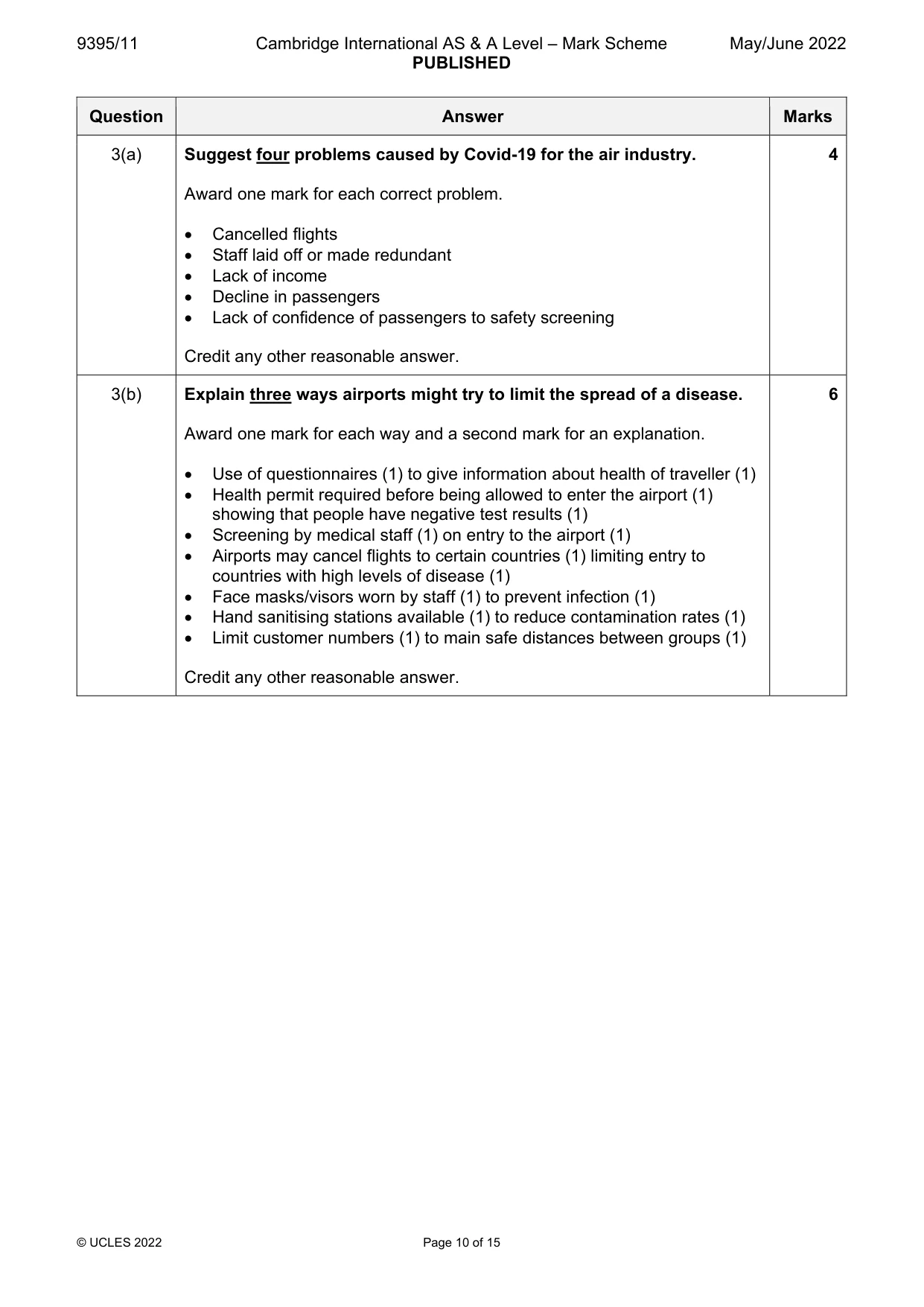
9395/11 Cambridge International AS & A Level – Mark Scheme PUBLISHED May/June 2022 © UCLES 2022 Page 10 of 15 Question Answer Marks 3(a) Suggest four problems caused by Covid-19 for the air industry. Award one mark for each correct problem. Cancelled flights Staff laid off or made redundant Lack of income Decline in passengers Lack of confidence of passengers to safety screening Credit any other reasonable answer. 4 3(b) Explain three ways airports might try to limit the spread of a disease. Award one mark for each way and a second mark for an explanation. Use of questionnaires (1) to give information about health of traveller (1) Health permit required before being allowed to enter the airport (1) showing that people have negative test results (1) Screening by medical staff (1) on entry to the airport (1) Airports may cancel flights to certain countries (1) limiting entry to countries with high levels of disease (1) Face masks/visors worn by staff (1) to prevent infection (1) Hand sanitising stations available (1) to reduce contamination rates (1) Limit customer numbers (1) to main safe distances between groups (1) Credit any other reasonable answer. 6
Mark scheme, page 11
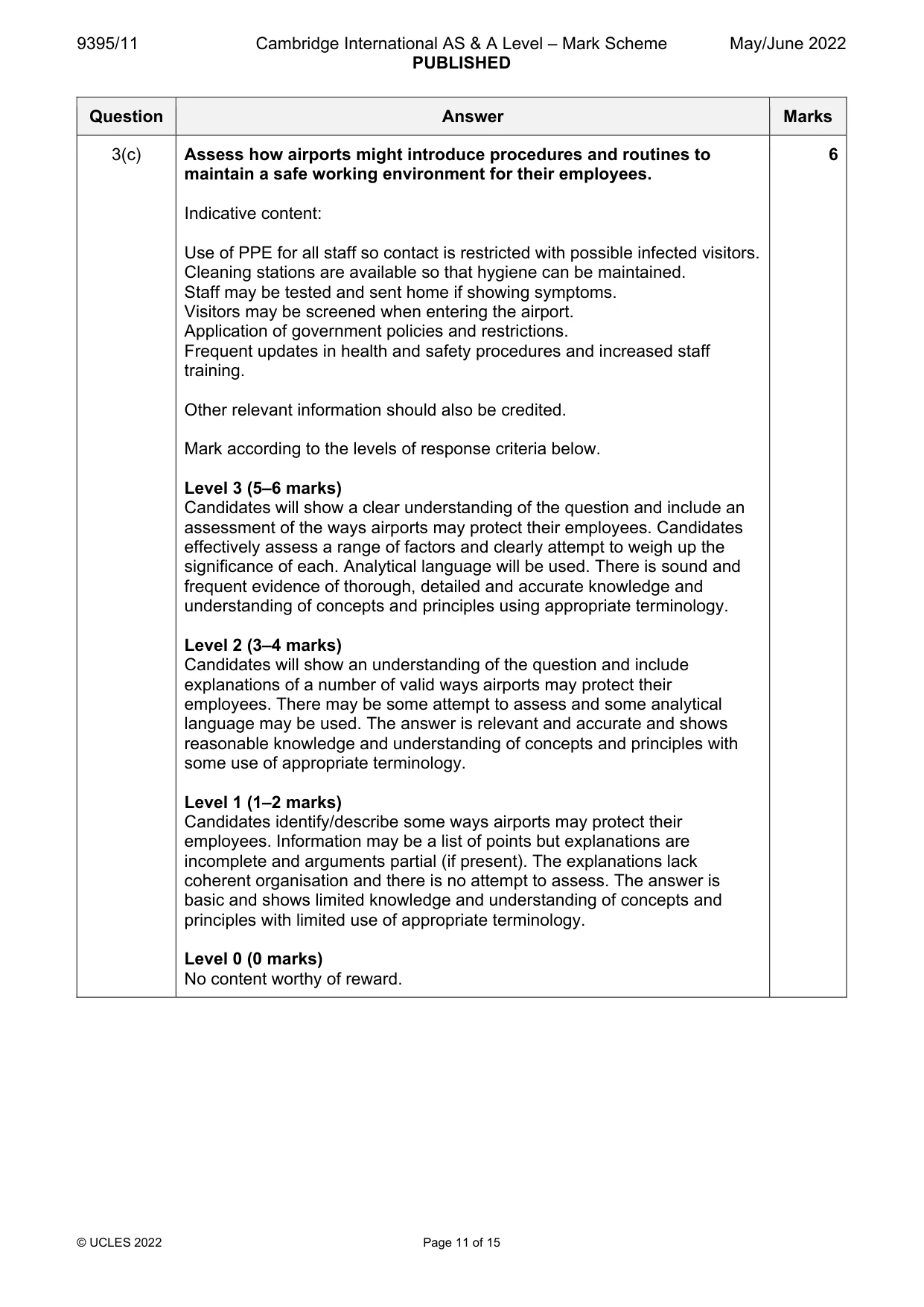
9395/11 Cambridge International AS & A Level – Mark Scheme PUBLISHED May/June 2022 © UCLES 2022 Page 11 of 15 Question Answer Marks 3(c) Assess how airports might introduce procedures and routines to maintain a safe working environment for their employees. Indicative content: Use of PPE for all staff so contact is restricted with possible infected visitors. Cleaning stations are available so that hygiene can be maintained. Staff may be tested and sent home if showing symptoms. Visitors may be screened when entering the airport. Application of government policies and restrictions. Frequent updates in health and safety procedures and increased staff training. Other relevant information should also be credited. Mark according to the levels of response criteria below. Level 3 (5–6 marks) Candidates will show a clear understanding of the question and include an assessment of the ways airports may protect their employees. Candidates effectively assess a range of factors and clearly attempt to weigh up the significance of each. Analytical language will be used. There is sound and frequent evidence of thorough, detailed and accurate knowledge and understanding of concepts and principles using appropriate terminology. Level 2 (3–4 marks) Candidates will show an understanding of the question and include explanations of a number of valid ways airports may protect their employees. There may be some attempt to assess and some analytical language may be used. The answer is relevant and accurate and shows reasonable knowledge and understanding of concepts and principles with some use of appropriate terminology. Level 1 (1–2 marks) Candidates identify/describe some ways airports may protect their employees. Information may be a list of points but explanations are incomplete and arguments partial (if present). The explanations lack coherent organisation and there is no attempt to assess. The answer is basic and shows limited knowledge and understanding of concepts and principles with limited use of appropriate terminology. Level 0 (0 marks) No content worthy of reward. 6
Mark scheme, page 12
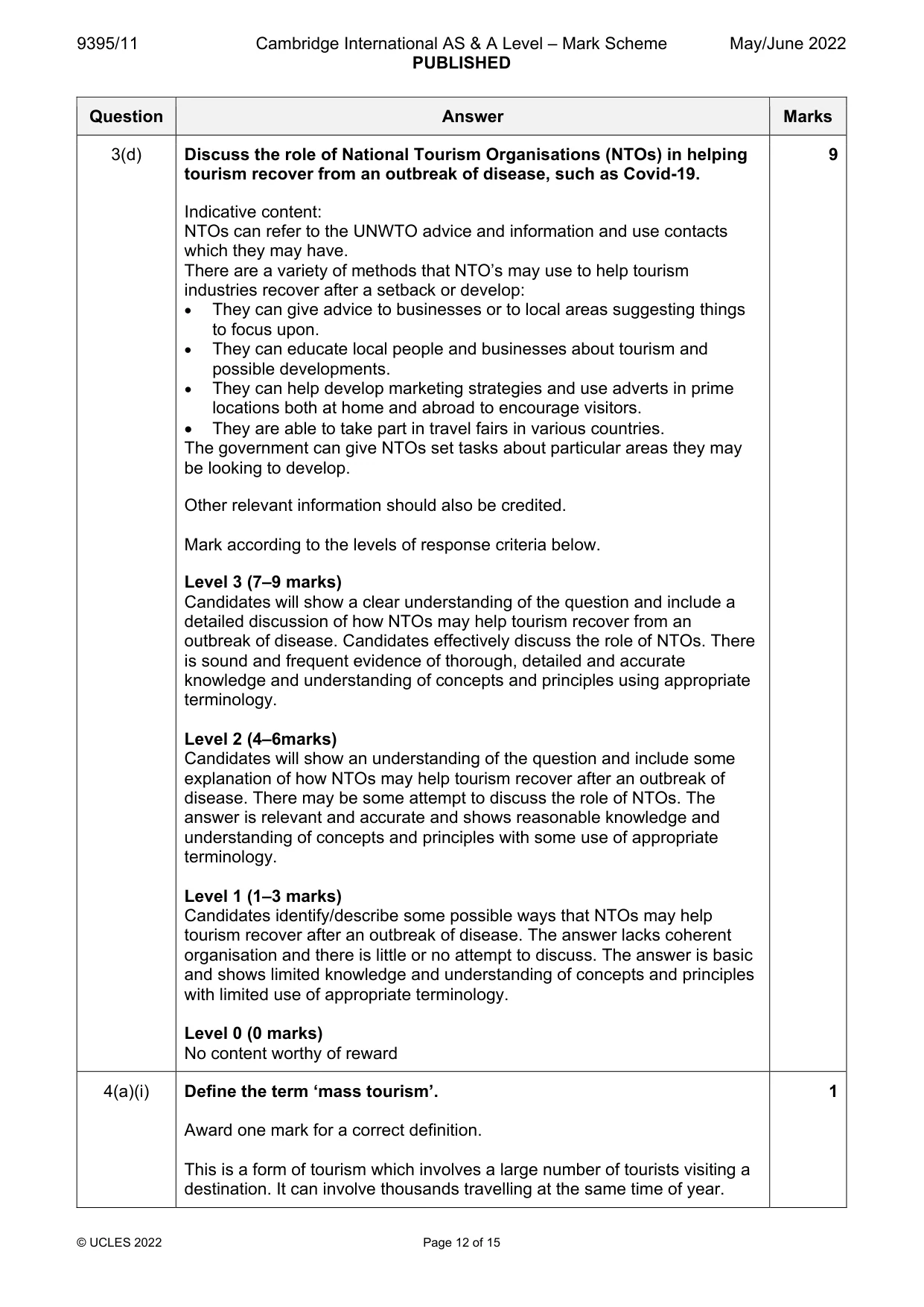
9395/11 Cambridge International AS & A Level – Mark Scheme PUBLISHED May/June 2022 © UCLES 2022 Page 12 of 15 Question Answer Marks 3(d) Discuss the role of National Tourism Organisations (NTOs) in helping tourism recover from an outbreak of disease, such as Covid-19. Indicative content: NTOs can refer to the UNWTO advice and information and use contacts which they may have. There are a variety of methods that NTO’s may use to help tourism industries recover after a setback or develop: They can give advice to businesses or to local areas suggesting things to focus upon. They can educate local people and businesses about tourism and possible developments. They can help develop marketing strategies and use adverts in prime locations both at home and abroad to encourage visitors. They are able to take part in travel fairs in various countries. The government can give NTOs set tasks about particular areas they may be looking to develop. Other relevant information should also be credited. Mark according to the levels of response criteria below. Level 3 (7–9 marks) Candidates will show a clear understanding of the question and include a detailed discussion of how NTOs may help tourism recover from an outbreak of disease. Candidates effectively discuss the role of NTOs. There is sound and frequent evidence of thorough, detailed and accurate knowledge and understanding of concepts and principles using appropriate terminology. Level 2 (4–6marks) Candidates will show an understanding of the question and include some explanation of how NTOs may help tourism recover after an outbreak of disease. There may be some attempt to discuss the role of NTOs. The answer is relevant and accurate and shows reasonable knowledge and understanding of concepts and principles with some use of appropriate terminology. Level 1 (1–3 marks) Candidates identify/describe some possible ways that NTOs may help tourism recover after an outbreak of disease. The answer lacks coherent organisation and there is little or no attempt to discuss. The answer is basic and shows limited knowledge and understanding of concepts and principles with limited use of appropriate terminology. Level 0 (0 marks) No content worthy of reward 9 4(a)(i) Define the term ‘mass tourism’. Award one mark for a correct definition. This is a form of tourism which involves a large number of tourists visiting a destination. It can involve thousands travelling at the same time of year. 1
Mark scheme, page 13
9395/11 Cambridge International AS & A Level – Mark Scheme PUBLISHED May/June 2022 © UCLES 2022 Page 13 of 15 Question Answer Marks 4(a)(ii) Suggest three problems that seasonality may cause to a destination, such as the Costa del Sol. Award one mark for each problem. Lack of income during some months as there are fewer travellers Unemployment Areas become rundown Lack of income for the local area Credit any other reasonable answer. 3 4(b) Explain three factors that have encouraged the growth of mass tourism. Award one mark for each factor and a second mark for an explanation of how it has encouraged mass tourism. Cheap flights (1) make international travel very easy and accessible to many people (1) Paid holiday (1) allows people time and money to spend on holidays (1) Fast flight times (1) mean that many international destinations are easy to reach (1) Destinations have plenty to do (1) which encourages people to visit them as there is something for all (1) Social media (1) allows large numbers to be informed about destinations and will attract larger numbers (1) Credit any other reasonable answer. 6
Mark scheme, page 14
9395/11 Cambridge International AS & A Level – Mark Scheme PUBLISHED May/June 2022 © UCLES 2022 Page 14 of 15 Question Answer Marks 4(c) Explain how tour operators may overcome the issue of seasonality. Indicative content: Tour operators may put into operation several methods that may impact on seasonality including: Special offers to encourage people to go at unpopular times Discounts on holidays or trips. They can use themes to encourage travellers at certain times Targeted marketing may encourage some visitors Other relevant information should also be credited. Mark according to the levels of response criteria below. Level 3 (5 – 6 marks) Candidates will show a clear understanding of the question and include a detailed explanation of how tour operators may overcome seasonality. Candidates effectively explain some methods. There is sound and frequent evidence of thorough, detailed and accurate knowledge and understanding of concepts and principles using appropriate terminology. Level 2 (3 – 4 marks) Candidates will show an understanding of the question and include some explanation of the ways tour operators may overcome seasonality. The answer is relevant and accurate and shows reasonable knowledge and understanding of concepts and principles with some use of appropriate terminology. Level 1 (1–2 marks) Candidates identify/describe some possible ways that tour operators may overcome seasonality. The answer lacks coherent organisation and there is little or no attempt to explain. The answer is basic and shows limited knowledge and understanding of concepts and principles with limited use of appropriate terminology. Level 0 (0 marks) No content worthy of reward 6
Mark scheme, page 15
9395/11 Cambridge International AS & A Level – Mark Scheme PUBLISHED May/June 2022 © UCLES 2022 Page 15 of 15 Question Answer Marks 4(d) Evaluate the impacts of mass tourism on destinations such as the Costa del Sol. Indicative content: Impacts may be economic, social and environmental. There may be increasing reliance on tourism for employment and this can cause problems if numbers drop for any reason. Education needs to be done so that people are familiar with the advantages of tourism. Organisations may be controlled by companies in other countries and so money goes out of the country. It can trivialise the culture as it becomes adapted for shows to large numbers of people but it can also act in a good way as more become aware of other cultures. It can also preserve the culture. Development of responsible and sustainable tourism can be beneficial as people can be informed about environmental issues. Other relevant information should also be credited. Mark according to the levels of response criteria below. Level 3 (7–9 marks) Candidates will show a clear understanding of the question and include detailed evaluation of the impact of mass tourism on destinations. Candidates effectively evaluate a range of impacts and clearly attempt to weigh up the significance of each. Analytical language will be used. There is sound and frequent evidence of thorough, detailed and accurate knowledge and understanding of concepts and principles using appropriate terminology. Level 2 (4–6 marks) Candidates will show an understanding of the question and include explanations of a number of impacts of mass tourism on destinations. There may be some attempt to evaluate and some analytical language may be used. The answer is relevant and accurate and shows reasonable knowledge and understanding of concepts and principles with some use of appropriate terminology. Level 1 (1–3 marks) Candidates identify/describe some impacts of mass tourism on destinations. Information may be a list of points but explanations are incomplete and arguments partial (if present). The explanations lack coherent organisation and there is no attempt to evaluate. The answer is basic and shows limited knowledge and understanding of concepts and principles with limited use of appropriate terminology. Level 0 (0 marks) No content worthy of reward. 9
What you needed in this session
Cambridge’s own grade thresholds for 2022 May/June, Paper 1 · Variant 1. A higher threshold means an easier paper — the bar moves with how the cohort did.