Cambridge A Level Travel and Tourism 9395 — 2021 May/June Paper 3 · Variant 2
9395/32/M/J/21 · 50 marks · ≈56 min
The question paper and its mark scheme, free to read here and free to download. This is Cambridge’s own paper, exactly as it was sat.
Question paper12 pages









Mark scheme9 pages
Answers below. Sit the paper first if you are practising.
Paper as text
Question paper, page 1
Cambridge International AS & A Level DC (LEG) 200425/1 © UCLES 2021 [Turn over This document has 12 pages. Any blank pages are indicated. * 1 5 6 1 7 9 2 2 1 9 * TRAVEL & TOURISM 9395/32 Paper 3 Destination Marketing May/June 2021 1 hour 30 minutes You must answer on the question paper. You will need: Insert (enclosed) INSTRUCTIONS ● Answer all questions. ● Use a black or dark blue pen. ● Write your name, centre number and candidate number in the boxes at the top of the page. ● Write your answer to each question in the space provided. ● Do not use an erasable pen or correction fluid. ● Do not write on any bar codes. INFORMATION ● The total mark for this paper is 50. ● The number of marks for each question or part question is shown in brackets [ ]. ● The insert contains all the figures referred to in the questions.
Question paper, page 2
2 9395/32/M/J/21 © UCLES 2021 Question 1 Refer to Fig. 1.1 (Insert), information about the ‘Bhutan: Happiness is a place’ tourism brand. Bhutan is a country in Asia. (a) Explain two ways the Tourism Council of Bhutan might use the visitor arrival figures as part of the destination marketing process for Bhutan. 1 … … … … 2 … … … … [4] (b) Evaluate the claim that Bhutan’s destination brand ‘Bhutan: Happiness is a place’ is reflective of customers’ actual experiences of the country. … … … … … … … … … … … … … …
Question paper, page 3
3 9395/32/M/J/21 © UCLES 2021 [Turn over … … … … … … … … … … … … … … … … … … … … … … … … … … … … [9]
Question paper, page 4
4 9395/32/M/J/21 © UCLES 2021 (c) To what extent do you agree Bhutan is at the development stage of the Butler ‘Destination Lifecycle’ model? Justify the reasons for your answer. … … … … … … … … … … … … … … … … … … … … … … … … … … …
Question paper, page 5
5 9395/32/M/J/21 © UCLES 2021 [Turn over … … … … … … … … … … … … … … … … … … … … … … … … … … … [12] [Total: 25]
Question paper, page 6
6 9395/32/M/J/21 © UCLES 2021 Question 2 Refer to Fig. 2.1 (Insert), information about the Pearls of Uganda tourism project, which is supported by Tourism Uganda. (a) Explain the likely role of each of the following stakeholders in maintaining the Pearls of Uganda destination brand: Tourism Uganda … … … … the local community … … … … [4] (b) Assess whether hosting an annual trade fair is an effective communication method in raising awareness of Uganda’s destination brand. … … … … … … … … … … … … … …
Question paper, page 7
7 9395/32/M/J/21 © UCLES 2021 [Turn over … … … … … … … … … … … … … … … … … … … … … … … … … … … … [9]
Question paper, page 8
8 9395/32/M/J/21 © UCLES 2021 (c) Discuss why it is important Tourism Uganda creates a common vision for the future of the community and its potential as a tourist destination. … … … … … … … … … … … … … … … … … … … … … … … … … … …
Question paper, page 9
9 9395/32/M/J/21 © UCLES 2021 … … … … … … … … … … … … … … … … … … … … … … … … … … … [12] [Total: 25]
Question paper, page 10
10 9395/32/M/J/21 © UCLES 2021 BLANK PAGE
Question paper, page 11
11 9395/32/M/J/21 © UCLES 2021 BLANK PAGE
Question paper, page 12
12 9395/32/M/J/21 © UCLES 2021 BLANK PAGE The boundaries and names shown, the designations used and the presentation of material on any maps contained in this question paper/insert do not imply official endorsement or acceptance by Cambridge Assessment International Education concerning the legal status of any country, territory, or area or any of its authorities, or of the delimitation of its frontiers or boundaries. Permission to reproduce items where third-party owned material protected by copyright is included has been sought and cleared where possible. Every reasonable effort has been made by the publisher (UCLES) to trace copyright holders, but if any items requiring clearance have unwittingly been included, the publisher will be pleased to make amends at the earliest possible opportunity. To avoid the issue of disclosure of answer-related information to candidates, all copyright acknowledgements are reproduced online in the Cambridge Assessment International Education Copyright Acknowledgements Booklet. This is produced for each series of examinations and is freely available to download at www.cambridgeinternational.org after the live examination series. Cambridge Assessment International Education is part of the Cambridge Assessment Group. Cambridge Assessment is the brand name of the University of Cambridge Local Examinations Syndicate (UCLES), which itself is a department of the University of Cambridge.
Mark scheme, page 1
This document consists of 9 printed pages. © UCLES 2021 [Turn over Cambridge International A Level TRAVEL & TOURISM 9395/32 Paper 3 Destination Marketing May/June 2021 MARK SCHEME Maximum Mark: 50 Published This mark scheme is published as an aid to teachers and candidates, to indicate the requirements of the examination. It shows the basis on which Examiners were instructed to award marks. It does not indicate the details of the discussions that took place at an Examiners’ meeting before marking began, which would have considered the acceptability of alternative answers. Mark schemes should be read in conjunction with the question paper and the Principal Examiner Report for Teachers. Cambridge International will not enter into discussions about these mark schemes. Cambridge International is publishing the mark schemes for the May/June 2021 series for most Cambridge IGCSE™, Cambridge International A and AS Level components and some Cambridge O Level components.
Mark scheme, page 2
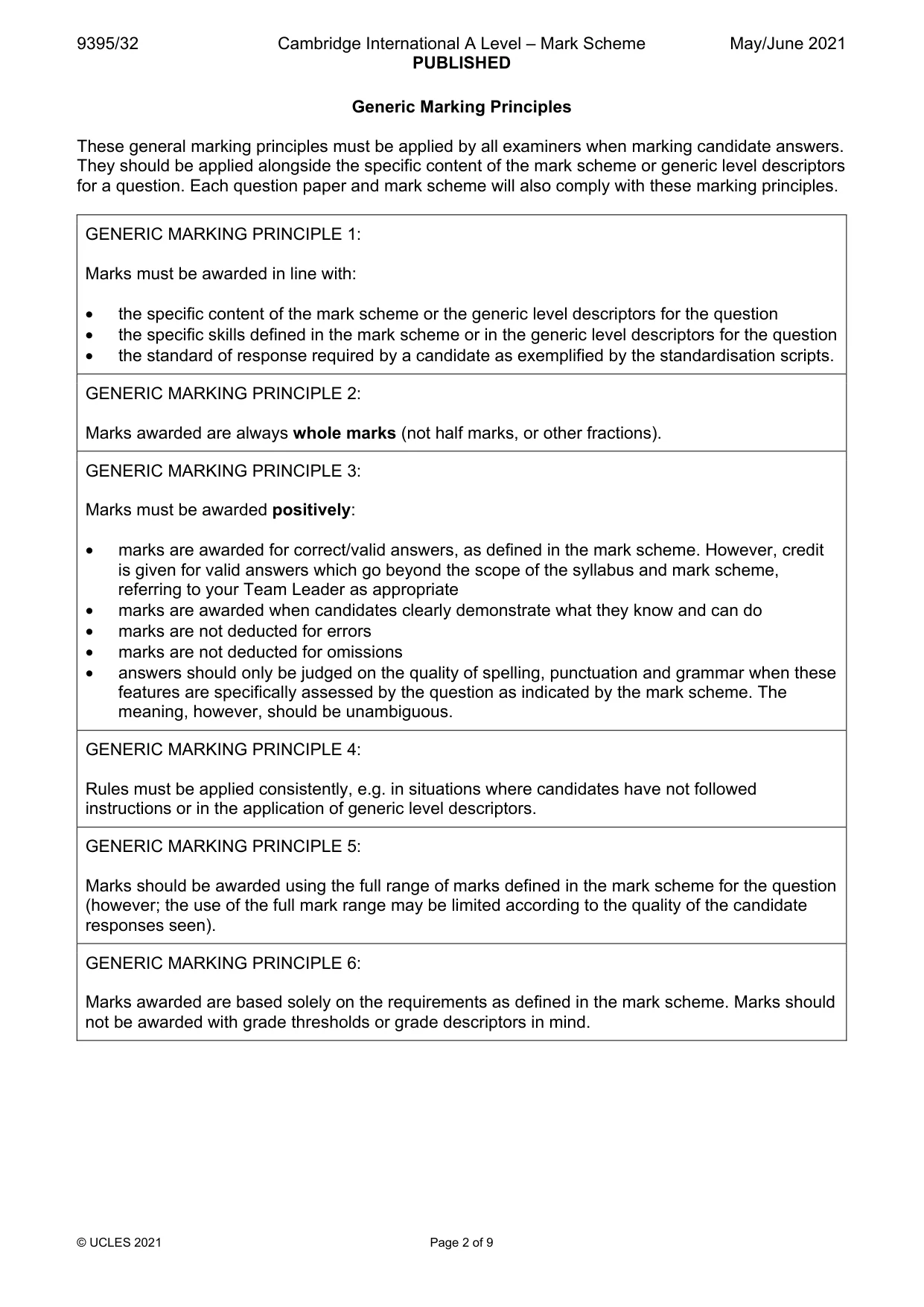
9395/32 Cambridge International A Level – Mark Scheme PUBLISHED May/June 2021 © UCLES 2021 Page 2 of 9 Generic Marking Principles These general marking principles must be applied by all examiners when marking candidate answers. They should be applied alongside the specific content of the mark scheme or generic level descriptors for a question. Each question paper and mark scheme will also comply with these marking principles. GENERIC MARKING PRINCIPLE 1: Marks must be awarded in line with: • the specific content of the mark scheme or the generic level descriptors for the question • the specific skills defined in the mark scheme or in the generic level descriptors for the question • the standard of response required by a candidate as exemplified by the standardisation scripts. GENERIC MARKING PRINCIPLE 2: Marks awarded are always whole marks (not half marks, or other fractions). GENERIC MARKING PRINCIPLE 3: Marks must be awarded positively: • marks are awarded for correct/valid answers, as defined in the mark scheme. However, credit is given for valid answers which go beyond the scope of the syllabus and mark scheme, referring to your Team Leader as appropriate • marks are awarded when candidates clearly demonstrate what they know and can do • marks are not deducted for errors • marks are not deducted for omissions • answers should only be judged on the quality of spelling, punctuation and grammar when these features are specifically assessed by the question as indicated by the mark scheme. The meaning, however, should be unambiguous. GENERIC MARKING PRINCIPLE 4: Rules must be applied consistently, e.g. in situations where candidates have not followed instructions or in the application of generic level descriptors. GENERIC MARKING PRINCIPLE 5: Marks should be awarded using the full range of marks defined in the mark scheme for the question (however; the use of the full mark range may be limited according to the quality of the candidate responses seen). GENERIC MARKING PRINCIPLE 6: Marks awarded are based solely on the requirements as defined in the mark scheme. Marks should not be awarded with grade thresholds or grade descriptors in mind.
Mark scheme, page 3
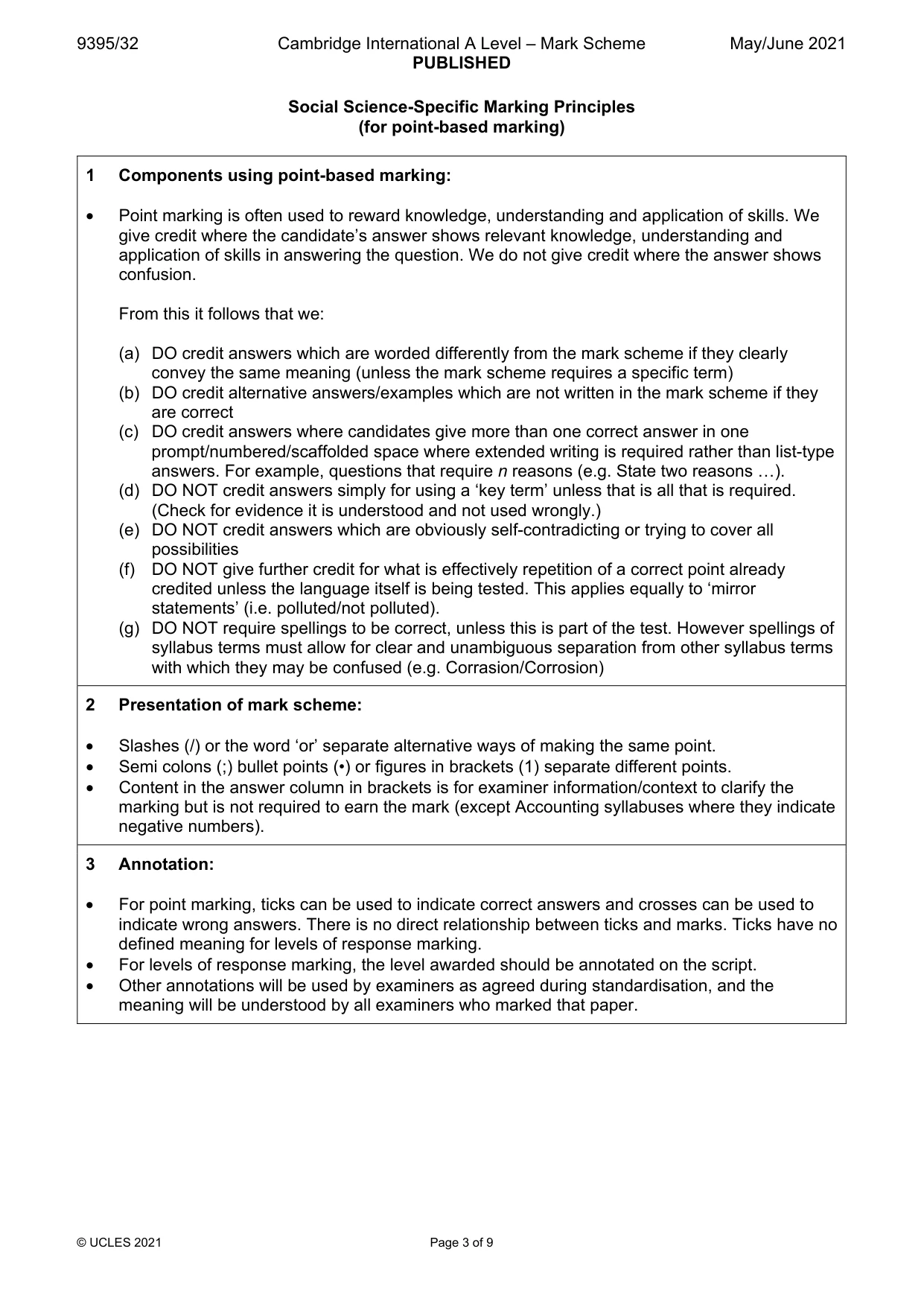
9395/32 Cambridge International A Level – Mark Scheme PUBLISHED May/June 2021 © UCLES 2021 Page 3 of 9 Social Science-Specific Marking Principles (for point-based marking) 1 Components using point-based marking: • Point marking is often used to reward knowledge, understanding and application of skills. We give credit where the candidate’s answer shows relevant knowledge, understanding and application of skills in answering the question. We do not give credit where the answer shows confusion. From this it follows that we: (a) DO credit answers which are worded differently from the mark scheme if they clearly convey the same meaning (unless the mark scheme requires a specific term) (b) DO credit alternative answers/examples which are not written in the mark scheme if they are correct (c) DO credit answers where candidates give more than one correct answer in one prompt/numbered/scaffolded space where extended writing is required rather than list-type answers. For example, questions that require n reasons (e.g. State two reasons …). (d) DO NOT credit answers simply for using a ‘key term’ unless that is all that is required. (Check for evidence it is understood and not used wrongly.) (e) DO NOT credit answers which are obviously self-contradicting or trying to cover all possibilities (f) DO NOT give further credit for what is effectively repetition of a correct point already credited unless the language itself is being tested. This applies equally to ‘mirror statements’ (i.e. polluted/not polluted). (g) DO NOT require spellings to be correct, unless this is part of the test. However spellings of syllabus terms must allow for clear and unambiguous separation from other syllabus terms with which they may be confused (e.g. Corrasion/Corrosion) 2 Presentation of mark scheme: • Slashes (/) or the word ‘or’ separate alternative ways of making the same point. • Semi colons (;) bullet points (•) or figures in brackets (1) separate different points. • Content in the answer column in brackets is for examiner information/context to clarify the marking but is not required to earn the mark (except Accounting syllabuses where they indicate negative numbers). 3 Annotation: • For point marking, ticks can be used to indicate correct answers and crosses can be used to indicate wrong answers. There is no direct relationship between ticks and marks. Ticks have no defined meaning for levels of response marking. • For levels of response marking, the level awarded should be annotated on the script. • Other annotations will be used by examiners as agreed during standardisation, and the meaning will be understood by all examiners who marked that paper.
Mark scheme, page 4
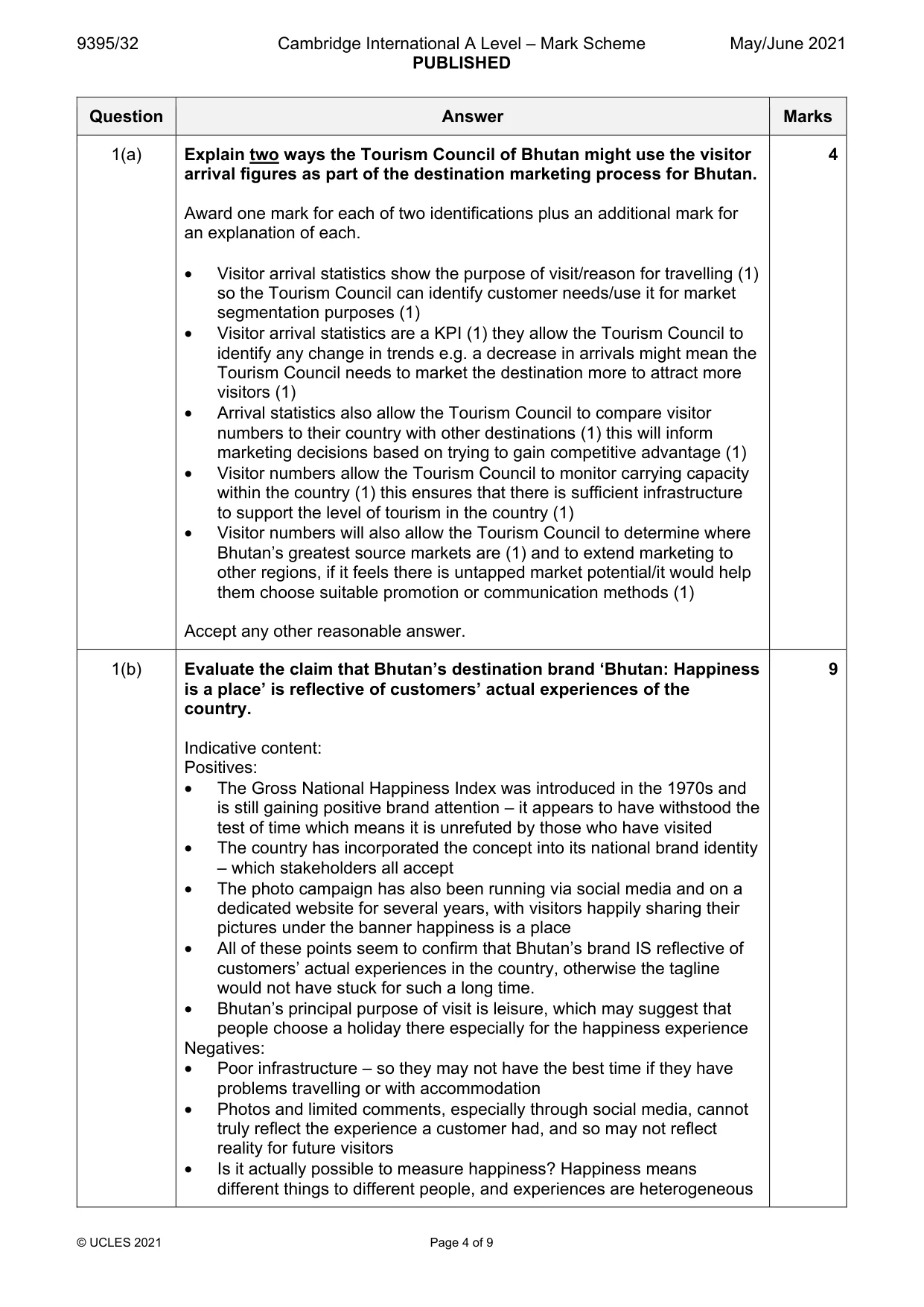
9395/32 Cambridge International A Level – Mark Scheme PUBLISHED May/June 2021 © UCLES 2021 Page 4 of 9 Question Answer Marks 1(a) Explain two ways the Tourism Council of Bhutan might use the visitor arrival figures as part of the destination marketing process for Bhutan. Award one mark for each of two identifications plus an additional mark for an explanation of each. • Visitor arrival statistics show the purpose of visit/reason for travelling (1) so the Tourism Council can identify customer needs/use it for market segmentation purposes (1) • Visitor arrival statistics are a KPI (1) they allow the Tourism Council to identify any change in trends e.g. a decrease in arrivals might mean the Tourism Council needs to market the destination more to attract more visitors (1) • Arrival statistics also allow the Tourism Council to compare visitor numbers to their country with other destinations (1) this will inform marketing decisions based on trying to gain competitive advantage (1) • Visitor numbers allow the Tourism Council to monitor carrying capacity within the country (1) this ensures that there is sufficient infrastructure to support the level of tourism in the country (1) • Visitor numbers will also allow the Tourism Council to determine where Bhutan’s greatest source markets are (1) and to extend marketing to other regions, if it feels there is untapped market potential/it would help them choose suitable promotion or communication methods (1) Accept any other reasonable answer. 4 1(b) Evaluate the claim that Bhutan’s destination brand ‘Bhutan: Happiness is a place’ is reflective of customers’ actual experiences of the country. Indicative content: Positives: • The Gross National Happiness Index was introduced in the 1970s and is still gaining positive brand attention – it appears to have withstood the test of time which means it is unrefuted by those who have visited • The country has incorporated the concept into its national brand identity – which stakeholders all accept • The photo campaign has also been running via social media and on a dedicated website for several years, with visitors happily sharing their pictures under the banner happiness is a place • All of these points seem to confirm that Bhutan’s brand IS reflective of customers’ actual experiences in the country, otherwise the tagline would not have stuck for such a long time. • Bhutan’s principal purpose of visit is leisure, which may suggest that people choose a holiday there especially for the happiness experience Negatives: • Poor infrastructure – so they may not have the best time if they have problems travelling or with accommodation • Photos and limited comments, especially through social media, cannot truly reflect the experience a customer had, and so may not reflect reality for future visitors • Is it actually possible to measure happiness? Happiness means different things to different people, and experiences are heterogeneous 9
Mark scheme, page 5
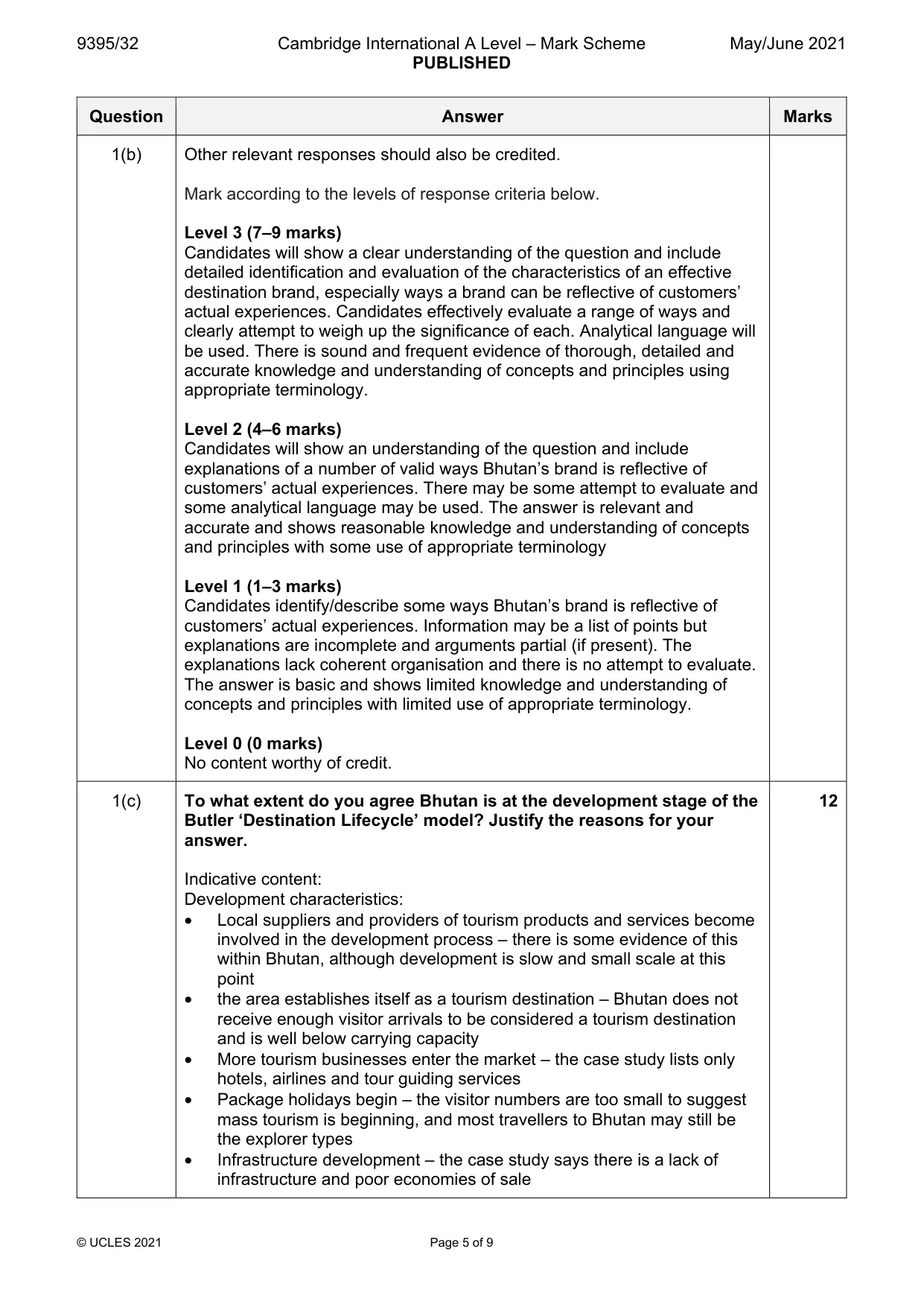
9395/32 Cambridge International A Level – Mark Scheme PUBLISHED May/June 2021 © UCLES 2021 Page 5 of 9 Question Answer Marks 1(b) Other relevant responses should also be credited. Mark according to the levels of response criteria below. Level 3 (7–9 marks) Candidates will show a clear understanding of the question and include detailed identification and evaluation of the characteristics of an effective destination brand, especially ways a brand can be reflective of customers’ actual experiences. Candidates effectively evaluate a range of ways and clearly attempt to weigh up the significance of each. Analytical language will be used. There is sound and frequent evidence of thorough, detailed and accurate knowledge and understanding of concepts and principles using appropriate terminology. Level 2 (4–6 marks) Candidates will show an understanding of the question and include explanations of a number of valid ways Bhutan’s brand is reflective of customers’ actual experiences. There may be some attempt to evaluate and some analytical language may be used. The answer is relevant and accurate and shows reasonable knowledge and understanding of concepts and principles with some use of appropriate terminology Level 1 (1–3 marks) Candidates identify/describe some ways Bhutan’s brand is reflective of customers’ actual experiences. Information may be a list of points but explanations are incomplete and arguments partial (if present). The explanations lack coherent organisation and there is no attempt to evaluate. The answer is basic and shows limited knowledge and understanding of concepts and principles with limited use of appropriate terminology. Level 0 (0 marks) No content worthy of credit. 1(c) To what extent do you agree Bhutan is at the development stage of the Butler ‘Destination Lifecycle’ model? Justify the reasons for your answer. Indicative content: Development characteristics: • Local suppliers and providers of tourism products and services become involved in the development process – there is some evidence of this within Bhutan, although development is slow and small scale at this point • the area establishes itself as a tourism destination – Bhutan does not receive enough visitor arrivals to be considered a tourism destination and is well below carrying capacity • More tourism businesses enter the market – the case study lists only hotels, airlines and tour guiding services • Package holidays begin – the visitor numbers are too small to suggest mass tourism is beginning, and most travellers to Bhutan may still be the explorer types • Infrastructure development – the case study says there is a lack of infrastructure and poor economies of sale 12
Mark scheme, page 6
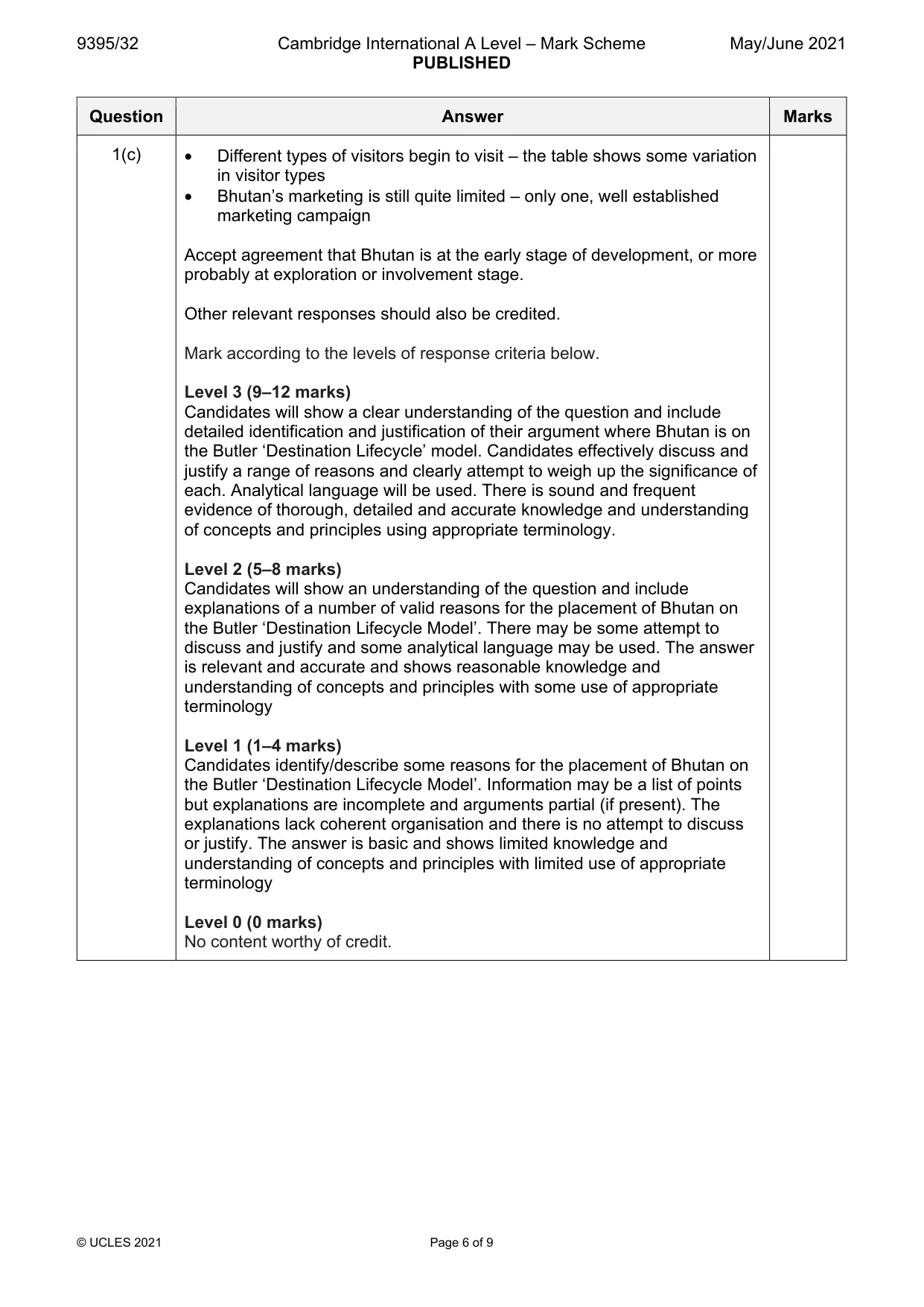
9395/32 Cambridge International A Level – Mark Scheme PUBLISHED May/June 2021 © UCLES 2021 Page 6 of 9 Question Answer Marks 1(c) • Different types of visitors begin to visit – the table shows some variation in visitor types • Bhutan’s marketing is still quite limited – only one, well established marketing campaign Accept agreement that Bhutan is at the early stage of development, or more probably at exploration or involvement stage. Other relevant responses should also be credited. Mark according to the levels of response criteria below. Level 3 (9–12 marks) Candidates will show a clear understanding of the question and include detailed identification and justification of their argument where Bhutan is on the Butler ‘Destination Lifecycle’ model. Candidates effectively discuss and justify a range of reasons and clearly attempt to weigh up the significance of each. Analytical language will be used. There is sound and frequent evidence of thorough, detailed and accurate knowledge and understanding of concepts and principles using appropriate terminology. Level 2 (5–8 marks) Candidates will show an understanding of the question and include explanations of a number of valid reasons for the placement of Bhutan on the Butler ‘Destination Lifecycle Model’. There may be some attempt to discuss and justify and some analytical language may be used. The answer is relevant and accurate and shows reasonable knowledge and understanding of concepts and principles with some use of appropriate terminology Level 1 (1–4 marks) Candidates identify/describe some reasons for the placement of Bhutan on the Butler ‘Destination Lifecycle Model’. Information may be a list of points but explanations are incomplete and arguments partial (if present). The explanations lack coherent organisation and there is no attempt to discuss or justify. The answer is basic and shows limited knowledge and understanding of concepts and principles with limited use of appropriate terminology Level 0 (0 marks) No content worthy of credit.
Mark scheme, page 7
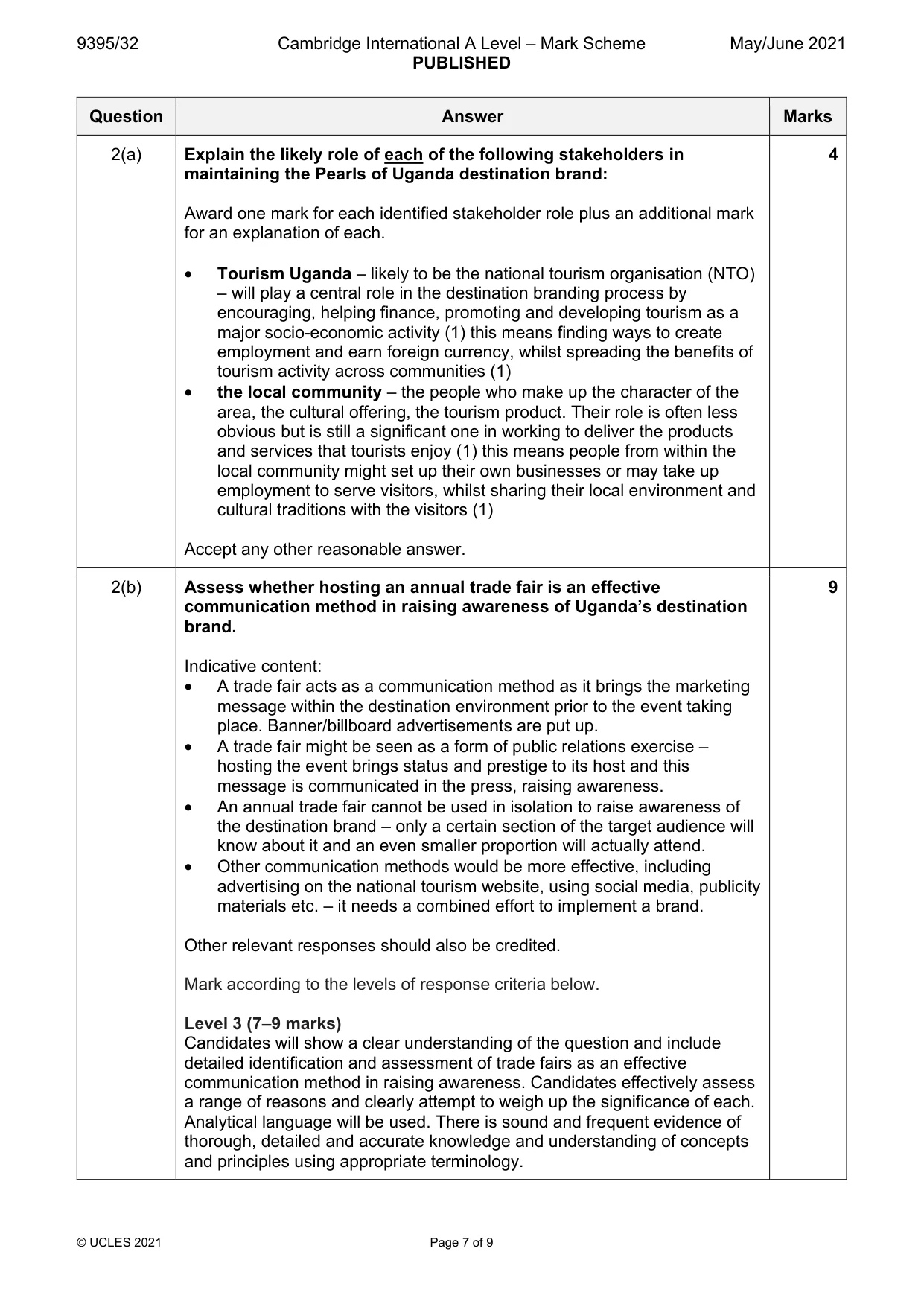
9395/32 Cambridge International A Level – Mark Scheme PUBLISHED May/June 2021 © UCLES 2021 Page 7 of 9 Question Answer Marks 2(a) Explain the likely role of each of the following stakeholders in maintaining the Pearls of Uganda destination brand: Award one mark for each identified stakeholder role plus an additional mark for an explanation of each. • Tourism Uganda – likely to be the national tourism organisation (NTO) – will play a central role in the destination branding process by encouraging, helping finance, promoting and developing tourism as a major socio-economic activity (1) this means finding ways to create employment and earn foreign currency, whilst spreading the benefits of tourism activity across communities (1) • the local community – the people who make up the character of the area, the cultural offering, the tourism product. Their role is often less obvious but is still a significant one in working to deliver the products and services that tourists enjoy (1) this means people from within the local community might set up their own businesses or may take up employment to serve visitors, whilst sharing their local environment and cultural traditions with the visitors (1) Accept any other reasonable answer. 4 2(b) Assess whether hosting an annual trade fair is an effective communication method in raising awareness of Uganda’s destination brand. Indicative content: • A trade fair acts as a communication method as it brings the marketing message within the destination environment prior to the event taking place. Banner/billboard advertisements are put up. • A trade fair might be seen as a form of public relations exercise – hosting the event brings status and prestige to its host and this message is communicated in the press, raising awareness. • An annual trade fair cannot be used in isolation to raise awareness of the destination brand – only a certain section of the target audience will know about it and an even smaller proportion will actually attend. • Other communication methods would be more effective, including advertising on the national tourism website, using social media, publicity materials etc. – it needs a combined effort to implement a brand. Other relevant responses should also be credited. Mark according to the levels of response criteria below. Level 3 (7–9 marks) Candidates will show a clear understanding of the question and include detailed identification and assessment of trade fairs as an effective communication method in raising awareness. Candidates effectively assess a range of reasons and clearly attempt to weigh up the significance of each. Analytical language will be used. There is sound and frequent evidence of thorough, detailed and accurate knowledge and understanding of concepts and principles using appropriate terminology. 9
Mark scheme, page 8
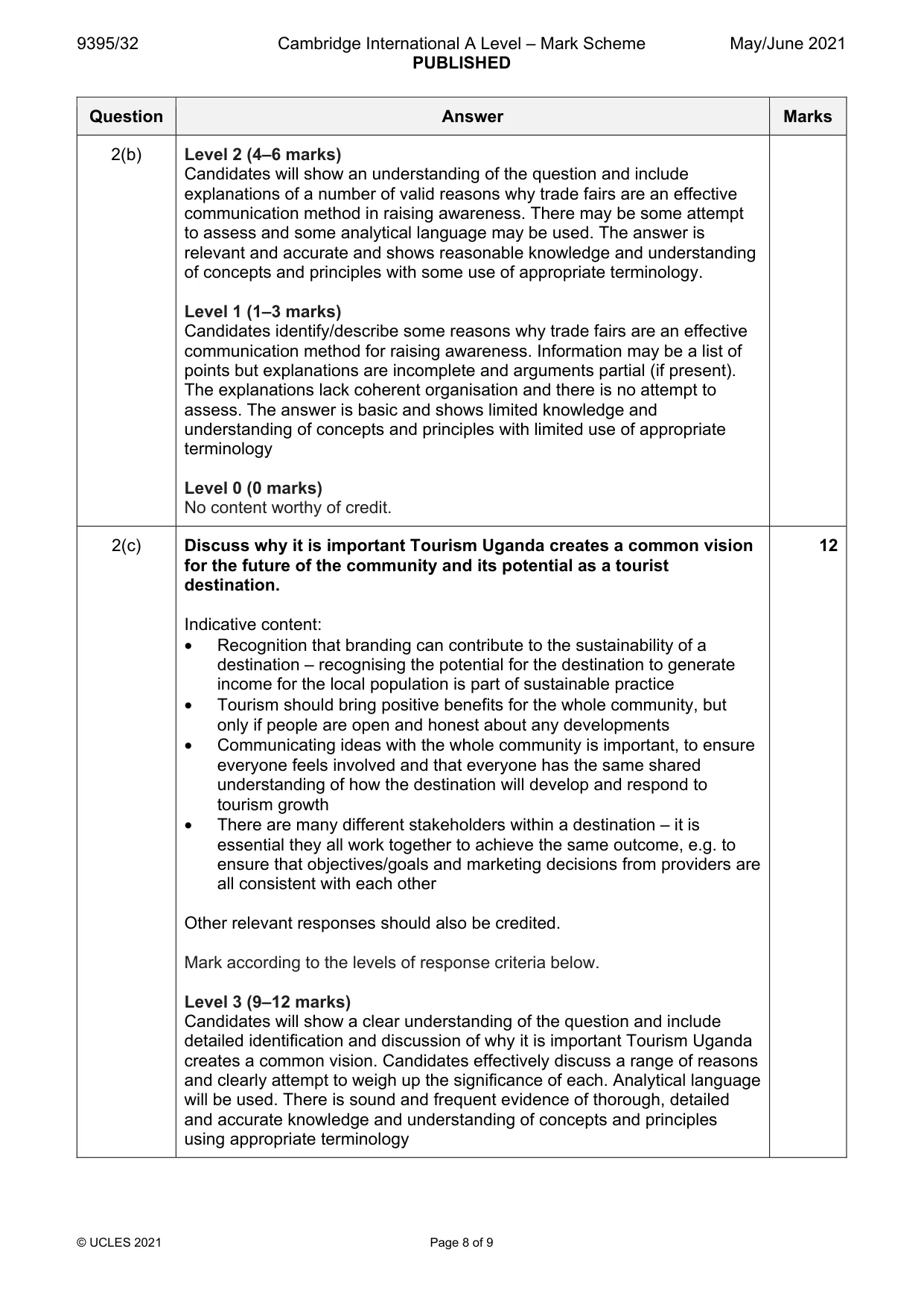
9395/32 Cambridge International A Level – Mark Scheme PUBLISHED May/June 2021 © UCLES 2021 Page 8 of 9 Question Answer Marks 2(b) Level 2 (4–6 marks) Candidates will show an understanding of the question and include explanations of a number of valid reasons why trade fairs are an effective communication method in raising awareness. There may be some attempt to assess and some analytical language may be used. The answer is relevant and accurate and shows reasonable knowledge and understanding of concepts and principles with some use of appropriate terminology. Level 1 (1–3 marks) Candidates identify/describe some reasons why trade fairs are an effective communication method for raising awareness. Information may be a list of points but explanations are incomplete and arguments partial (if present). The explanations lack coherent organisation and there is no attempt to assess. The answer is basic and shows limited knowledge and understanding of concepts and principles with limited use of appropriate terminology Level 0 (0 marks) No content worthy of credit. 2(c) Discuss why it is important Tourism Uganda creates a common vision for the future of the community and its potential as a tourist destination. Indicative content: • Recognition that branding can contribute to the sustainability of a destination – recognising the potential for the destination to generate income for the local population is part of sustainable practice • Tourism should bring positive benefits for the whole community, but only if people are open and honest about any developments • Communicating ideas with the whole community is important, to ensure everyone feels involved and that everyone has the same shared understanding of how the destination will develop and respond to tourism growth • There are many different stakeholders within a destination – it is essential they all work together to achieve the same outcome, e.g. to ensure that objectives/goals and marketing decisions from providers are all consistent with each other Other relevant responses should also be credited. Mark according to the levels of response criteria below. Level 3 (9–12 marks) Candidates will show a clear understanding of the question and include detailed identification and discussion of why it is important Tourism Uganda creates a common vision. Candidates effectively discuss a range of reasons and clearly attempt to weigh up the significance of each. Analytical language will be used. There is sound and frequent evidence of thorough, detailed and accurate knowledge and understanding of concepts and principles using appropriate terminology 12
Mark scheme, page 9
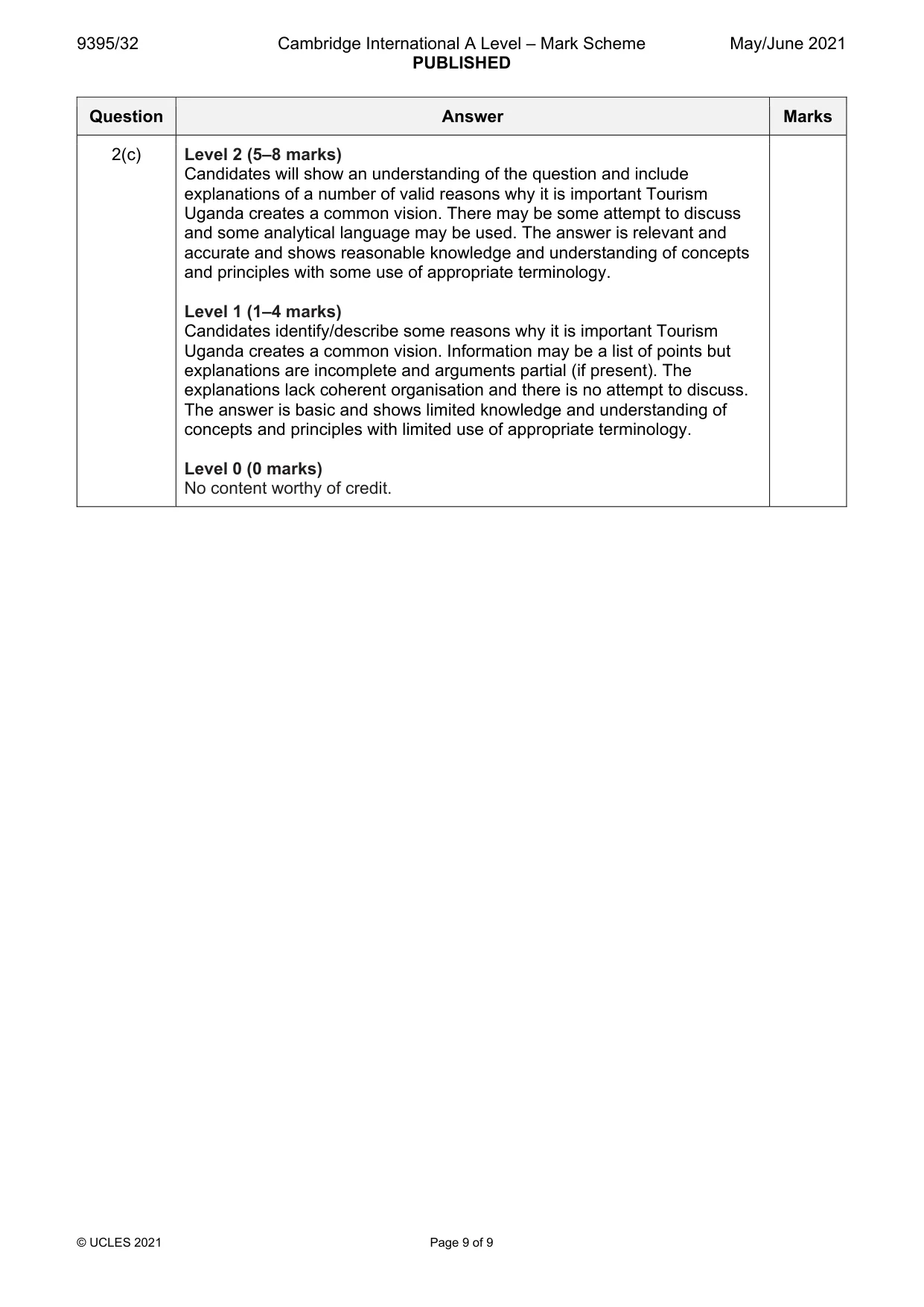
9395/32 Cambridge International A Level – Mark Scheme PUBLISHED May/June 2021 © UCLES 2021 Page 9 of 9 Question Answer Marks 2(c) Level 2 (5–8 marks) Candidates will show an understanding of the question and include explanations of a number of valid reasons why it is important Tourism Uganda creates a common vision. There may be some attempt to discuss and some analytical language may be used. The answer is relevant and accurate and shows reasonable knowledge and understanding of concepts and principles with some use of appropriate terminology. Level 1 (1–4 marks) Candidates identify/describe some reasons why it is important Tourism Uganda creates a common vision. Information may be a list of points but explanations are incomplete and arguments partial (if present). The explanations lack coherent organisation and there is no attempt to discuss. The answer is basic and shows limited knowledge and understanding of concepts and principles with limited use of appropriate terminology. Level 0 (0 marks) No content worthy of credit.
What you needed in this session
Cambridge’s own grade thresholds for 2021 May/June, Paper 3 · Variant 2. A higher threshold means an easier paper — the bar moves with how the cohort did.