Cambridge A Level Travel and Tourism 9395 — 2020 May/June Paper 4 · Variant 1
9395/41/M/J/20
The question paper and its mark scheme, free to read here and free to download. This is Cambridge’s own paper, exactly as it was sat.
Question paper12 pages







Mark scheme8 pages
Answers below. Sit the paper first if you are practising.

Paper as text
Question paper, page 1
Cambridge International AS & A Level TRAVEL & TOURISM 9395/41 Paper 4 Destination Management May/June 2020 1 hour 30 minutes You must answer on the question paper. You will need: Insert (enclosed) INSTRUCTIONS ● Answer all questions. ● Use a black or dark blue pen. ● Write your name, centre number and candidate number in the boxes at the top of the page. ● Write your answer to each question in the space provided. ● Do not use an erasable pen or correction fluid. ● Do not write on any bar codes. INFORMATION ● The total mark for this paper is 50. ● The number of marks for each question or part question is shown in brackets [ ]. ● The insert contains all the figures referred to in the questions. This document has 12 pages. Blank pages are indicated. * 7 4 9 9 9 1 0 2 1 2 * DC (LK) 179234/1 © UCLES 2020 [Turn over
Question paper, page 2
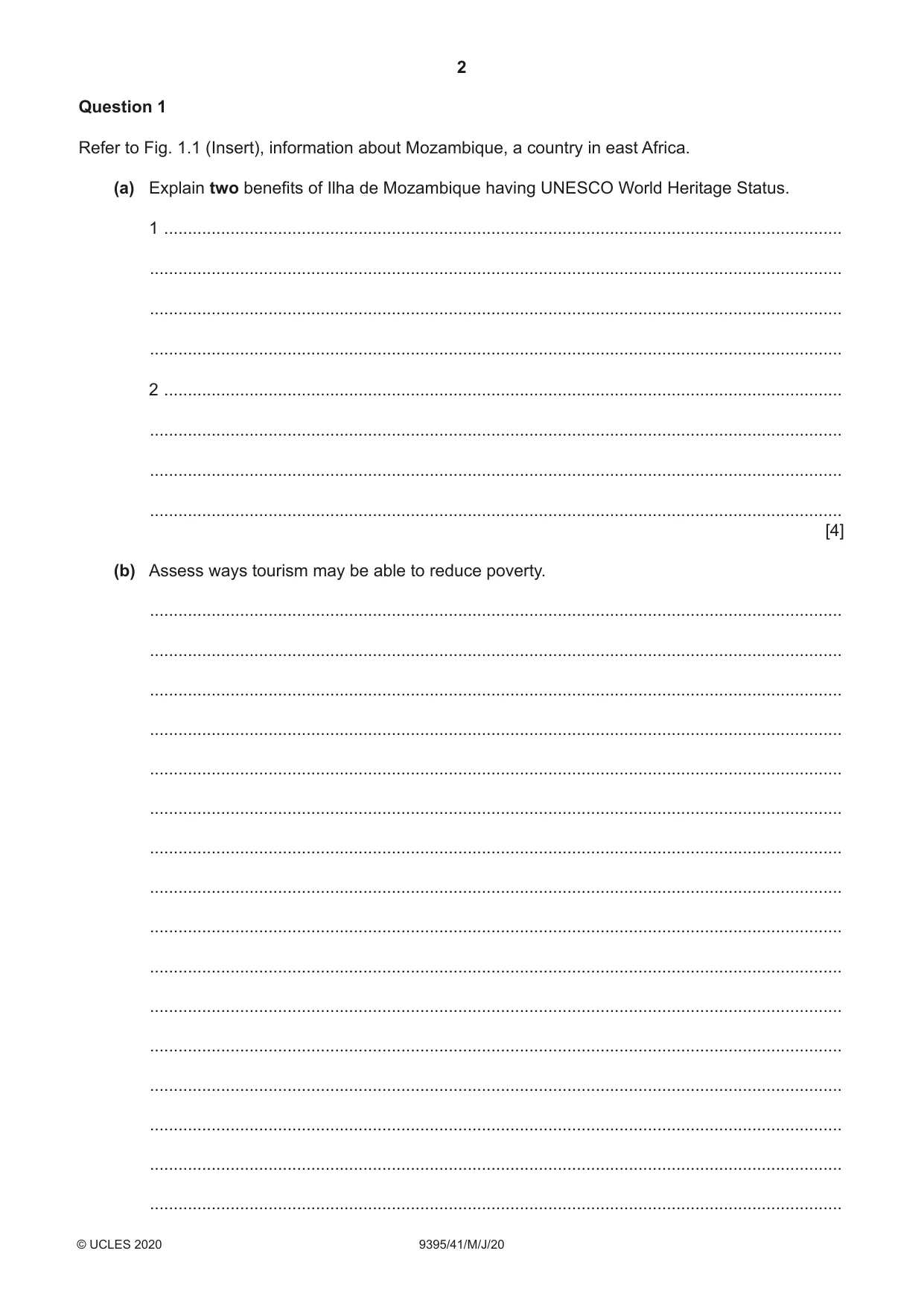
2 9395/41/M/J/20 © UCLES 2020 Question 1 Refer to Fig. 1.1 (Insert), information about Mozambique, a country in east Africa. (a) Explain two benefits of Ilha de Mozambique having UNESCO World Heritage Status. 1 … … … … 2 … … … … [4] (b) Assess ways tourism may be able to reduce poverty. … … … … … … … … … … … … … … … …
Question paper, page 3
3 9395/41/M/J/20 © UCLES 2020 [Turn over … … … … … … … … … … … … … … … … … … … … … … … … … … … … [9]
Question paper, page 4
4 9395/41/M/J/20 © UCLES 2020 (c) Evaluate the importance to Mozambique of having a strong cultural identity as a destination. … … … … … … … … … … … … … … … … … … … … … … … … … … …
Question paper, page 5
5 9395/41/M/J/20 © UCLES 2020 [Turn over … … … … … … … … … … … … … … … … … … … … … … … … … … … [12] [Total: 25]
Question paper, page 6
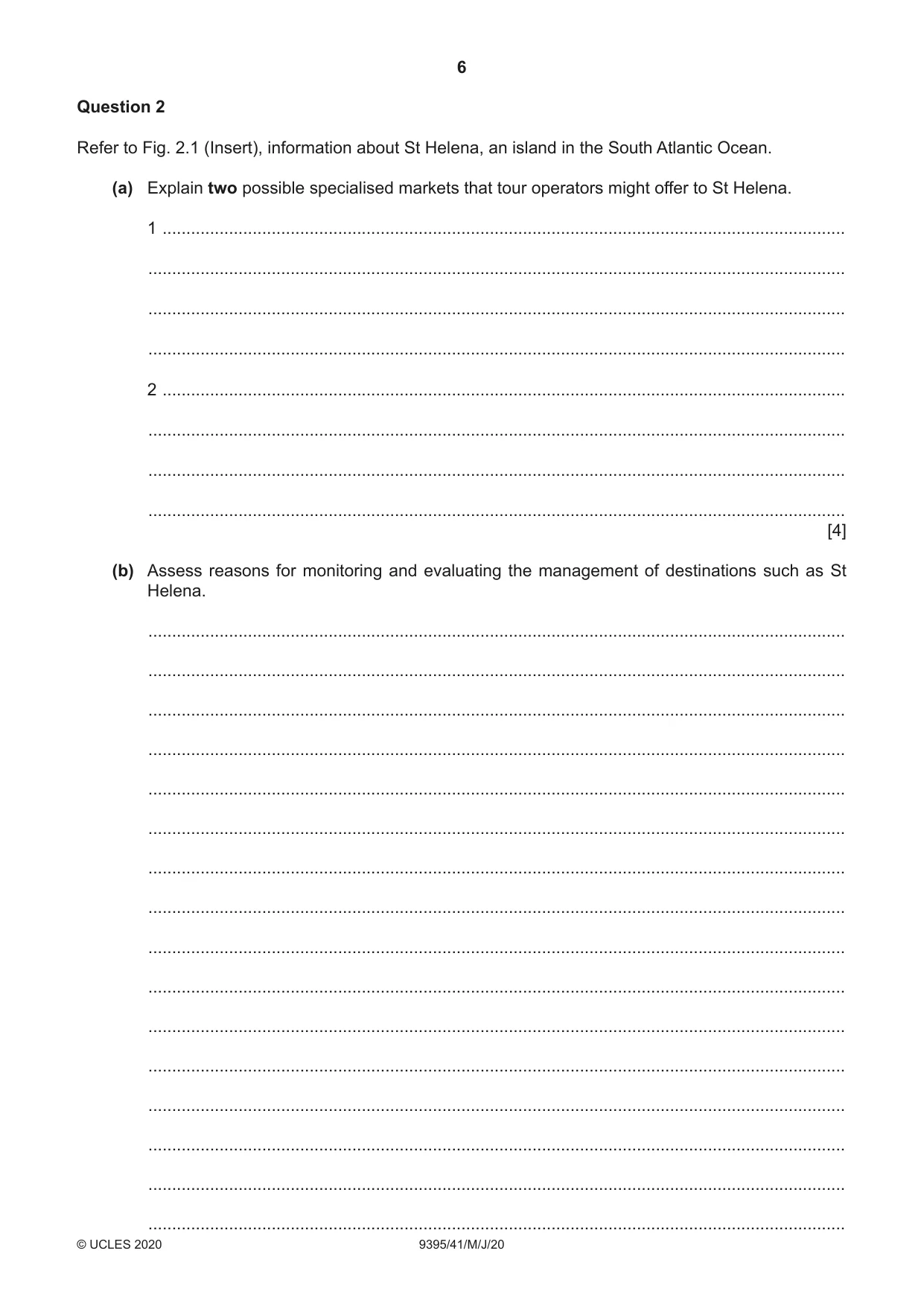
6 9395/41/M/J/20 © UCLES 2020 Question 2 Refer to Fig. 2.1 (Insert), information about St Helena, an island in the South Atlantic Ocean. (a) Explain two possible specialised markets that tour operators might offer to St Helena. 1 … … … … 2 … … … … [4] (b) Assess reasons for monitoring and evaluating the management of destinations such as St Helena. … … … … … … … … … … … … … … … …
Question paper, page 7
7 9395/41/M/J/20 © UCLES 2020 [Turn over … … … … … … … … … … … … … … … … … … … … … … … … … … … … [9]
Question paper, page 8
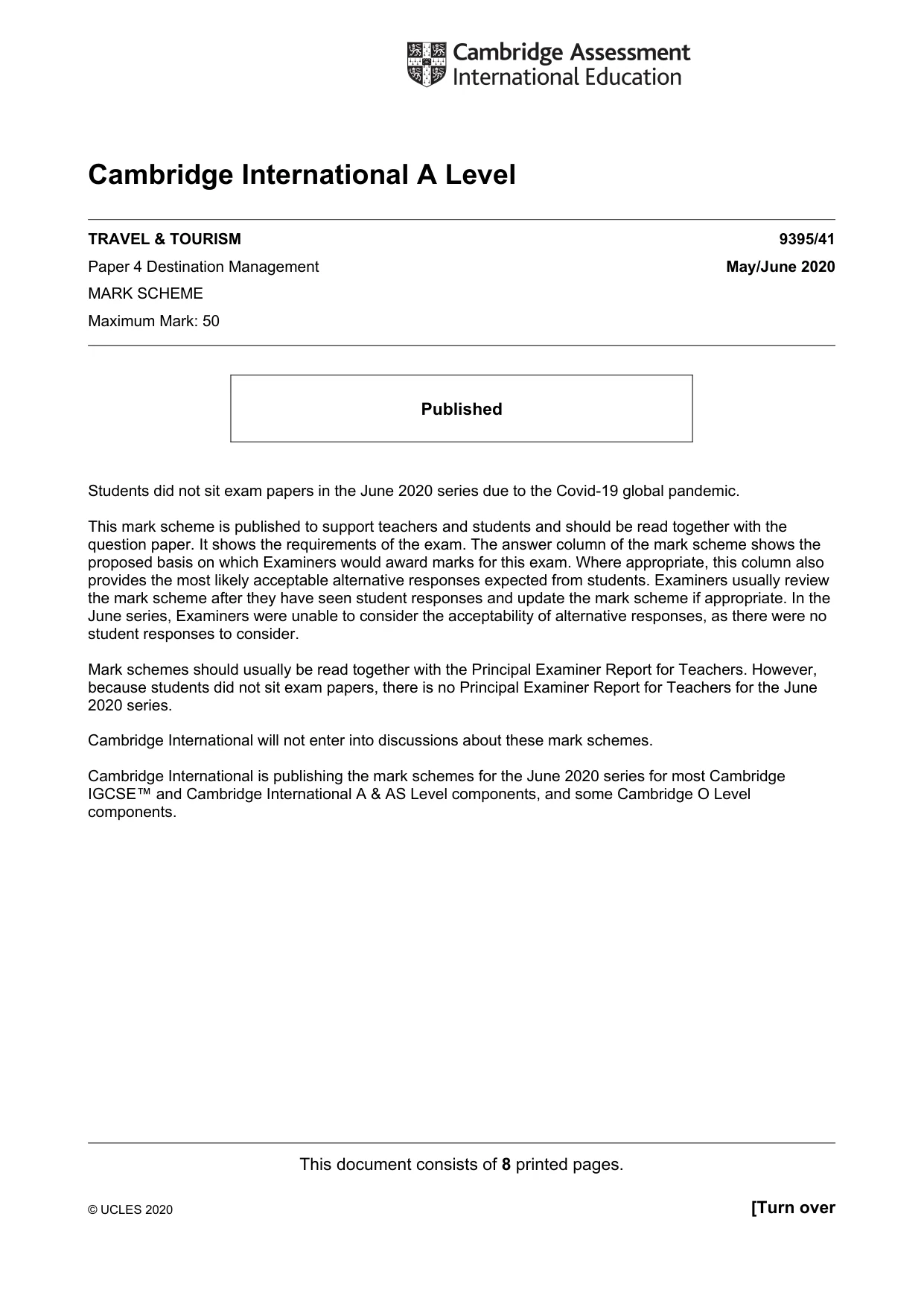
8 9395/41/M/J/20 © UCLES 2020 (c) Evaluate measures to prevent negative environmental impacts of tourism on St Helena. … … … … … … … … … … … … … … … … … … … … … … … … … … …
Question paper, page 9
9 9395/41/M/J/20 © UCLES 2020 … … … … … … … … … … … … … … … … … … … … … … … … … … … [12] [Total: 25]
Question paper, page 10
10 9395/41/M/J/20 © UCLES 2020 BLANK PAGE
Question paper, page 11
11 9395/41/M/J/20 © UCLES 2020 BLANK PAGE
Question paper, page 12
12 9395/41/M/J/20 © UCLES 2020 Permission to reproduce items where third-party owned material protected by copyright is included has been sought and cleared where possible. Every reasonable effort has been made by the publisher (UCLES) to trace copyright holders, but if any items requiring clearance have unwittingly been included, the publisher will be pleased to make amends at the earliest possible opportunity. To avoid the issue of disclosure of answer-related information to candidates, all copyright acknowledgements are reproduced online in the Cambridge Assessment International Education Copyright Acknowledgements Booklet. This is produced for each series of examinations and is freely available to download at www.cambridgeinternational.org after the live examination series. Cambridge Assessment International Education is part of the Cambridge Assessment Group. Cambridge Assessment is the brand name of the University of Cambridge Local Examinations Syndicate (UCLES), which itself is a department of the University of Cambridge. BLANK PAGE
Mark scheme, page 1
This document consists of 8 printed pages. © UCLES 2020 [Turn over Cambridge International A Level TRAVEL & TOURISM 9395/41 Paper 4 Destination Management May/June 2020 MARK SCHEME Maximum Mark: 50 Published Students did not sit exam papers in the June 2020 series due to the Covid-19 global pandemic. This mark scheme is published to support teachers and students and should be read together with the question paper. It shows the requirements of the exam. The answer column of the mark scheme shows the proposed basis on which Examiners would award marks for this exam. Where appropriate, this column also provides the most likely acceptable alternative responses expected from students. Examiners usually review the mark scheme after they have seen student responses and update the mark scheme if appropriate. In the June series, Examiners were unable to consider the acceptability of alternative responses, as there were no student responses to consider. Mark schemes should usually be read together with the Principal Examiner Report for Teachers. However, because students did not sit exam papers, there is no Principal Examiner Report for Teachers for the June 2020 series. Cambridge International will not enter into discussions about these mark schemes. Cambridge International is publishing the mark schemes for the June 2020 series for most Cambridge IGCSE™ and Cambridge International A & AS Level components, and some Cambridge O Level components.
Mark scheme, page 2
9395/41 Cambridge International A Level – Mark Scheme PUBLISHED May/June 2020 © UCLES 2020 Page 2 of 8 Generic Marking Principles These general marking principles must be applied by all examiners when marking candidate answers. They should be applied alongside the specific content of the mark scheme or generic level descriptors for a question. Each question paper and mark scheme will also comply with these marking principles. GENERIC MARKING PRINCIPLE 1: Marks must be awarded in line with: • the specific content of the mark scheme or the generic level descriptors for the question • the specific skills defined in the mark scheme or in the generic level descriptors for the question • the standard of response required by a candidate as exemplified by the standardisation scripts. GENERIC MARKING PRINCIPLE 2: Marks awarded are always whole marks (not half marks, or other fractions). GENERIC MARKING PRINCIPLE 3: Marks must be awarded positively: • marks are awarded for correct/valid answers, as defined in the mark scheme. However, credit is given for valid answers which go beyond the scope of the syllabus and mark scheme, referring to your Team Leader as appropriate • marks are awarded when candidates clearly demonstrate what they know and can do • marks are not deducted for errors • marks are not deducted for omissions • answers should only be judged on the quality of spelling, punctuation and grammar when these features are specifically assessed by the question as indicated by the mark scheme. The meaning, however, should be unambiguous. GENERIC MARKING PRINCIPLE 4: Rules must be applied consistently e.g. in situations where candidates have not followed instructions or in the application of generic level descriptors. GENERIC MARKING PRINCIPLE 5: Marks should be awarded using the full range of marks defined in the mark scheme for the question (however; the use of the full mark range may be limited according to the quality of the candidate responses seen). GENERIC MARKING PRINCIPLE 6: Marks awarded are based solely on the requirements as defined in the mark scheme. Marks should not be awarded with grade thresholds or grade descriptors in mind.
Mark scheme, page 3
9395/41 Cambridge International A Level – Mark Scheme PUBLISHED May/June 2020 © UCLES 2020 Page 3 of 8 Question Answer Marks 1(a) Explain two benefits of Ilha de Mozambique having UNESCO World Heritage Status. Award one mark for each of two identified reasons for offering the ways, plus an additional mark for explanation. The recognised designation as a whs gets an established identity [1] this can be advertised globally [1] UNESCO aids with funding [1] the site gets funds from a global body for its protection and conservation [1] More tourists will visit [1] as once listed, it brings international attention to the site which has potential to raise profits [1] Accept any reasonable interpretation from Fig. 1.1. 4
Mark scheme, page 4
9395/41 Cambridge International A Level – Mark Scheme PUBLISHED May/June 2020 © UCLES 2020 Page 4 of 8 Question Answer Marks 1(b) Assess ways tourism may be able to reduce poverty. Candidates are expected to be aware of the objectives of development and management (4.2(a)) investment of tourism income in public and social projects for local communities. They should be able to combine their knowledge with information provided from Fig. 1.1. Indicative content: Positive: Nkwichi Lodge in Mozambique is a good example. Investments to the projects created 75 jobs for locals supporting over 1000 community members. It also established a community trust that built five local schools, a maternity clinic and a maize mill that provided nutrition and education to more than 350 farmers and their families. This is having a positive impact on poverty reduction and improvements in the quality of life of some of the world’s poorest. Investing funds from tourism for the local community through increased foreign exchange, income generation, economic development and multiplier effect. Negative: Abuse of funds Jobs provided will be seasonal, low paid and possibly low skilled. If tourism numbers decline, funding will drop and there may be a loss in support. Leakages Increased taxes Credit all valid reasoning in context. Level 3 (7–9 marks) can be awarded for analytical comments about ways that tourism may reduce poverty. Candidates effectively assess a range of ways and clearly attempt to weigh up their significance. There should be sound and frequent evidence of thorough, detailed and accurate knowledge and understanding of concepts and principles using appropriate terminology. Level 2 (4–6 marks) can be awarded for an explanation of a number of possible ways tourism may be able to reduce poverty. The answer is relevant and accurate shows reasonable knowledge and understanding of concepts and principles with some use of specialist vocabulary. Level 1 (1- 3 marks) will identify/describe some possible ways tourism may be able to reduce poverty. Information may be in the form of a list, explanations are incomplete and arguments partial (if present). The answer lacks coherent organisation and there is little or no attempt to assess. The answer is basic and shows limited knowledge and understanding of concepts and principles and answers may be generic in their description with limited use of appropriate terminology. Level 0 (0 marks) No content worthy of credit. 9
Mark scheme, page 5
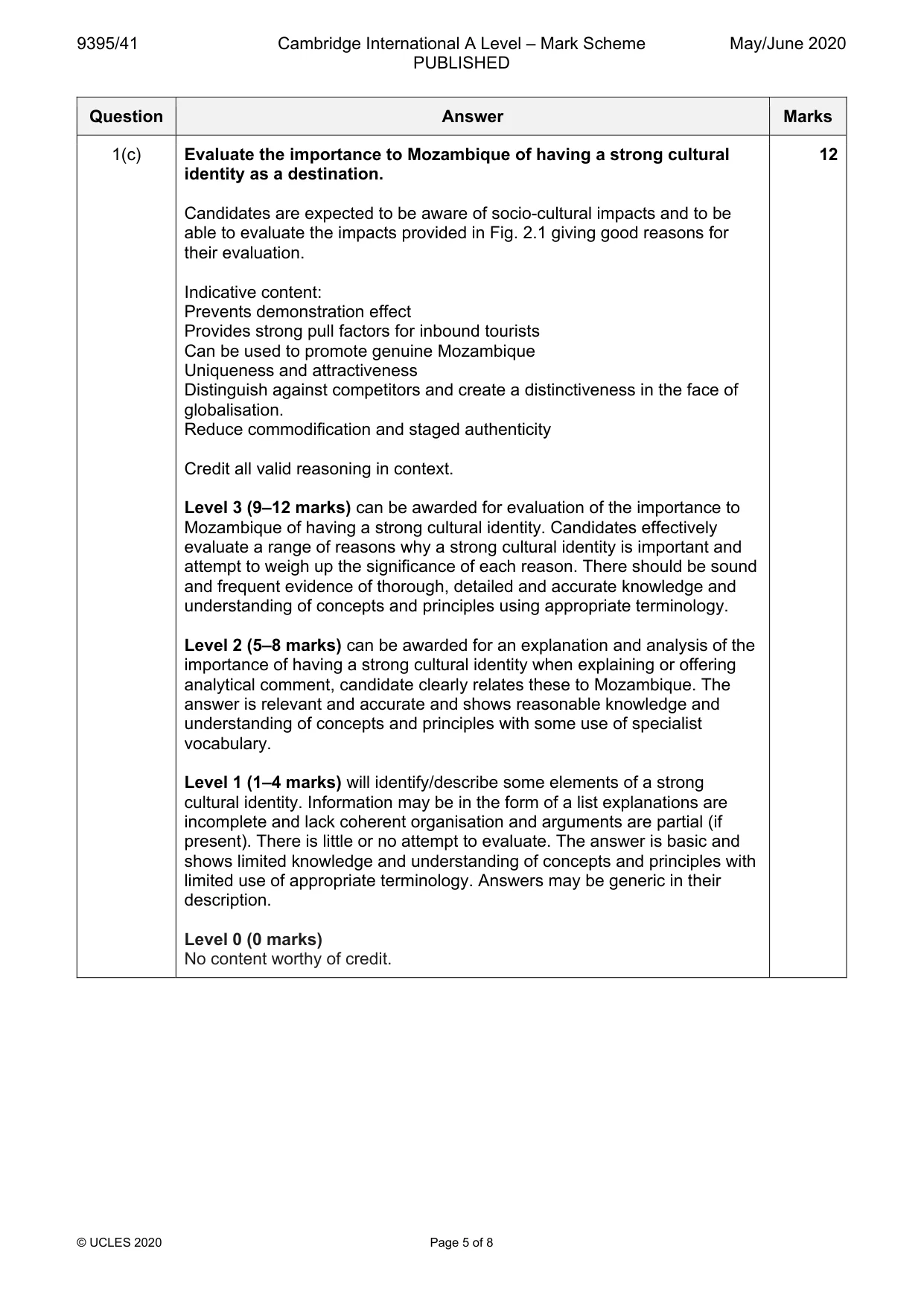
9395/41 Cambridge International A Level – Mark Scheme PUBLISHED May/June 2020 © UCLES 2020 Page 5 of 8 Question Answer Marks 1(c) Evaluate the importance to Mozambique of having a strong cultural identity as a destination. Candidates are expected to be aware of socio-cultural impacts and to be able to evaluate the impacts provided in Fig. 2.1 giving good reasons for their evaluation. Indicative content: Prevents demonstration effect Provides strong pull factors for inbound tourists Can be used to promote genuine Mozambique Uniqueness and attractiveness Distinguish against competitors and create a distinctiveness in the face of globalisation. Reduce commodification and staged authenticity Credit all valid reasoning in context. Level 3 (9–12 marks) can be awarded for evaluation of the importance to Mozambique of having a strong cultural identity. Candidates effectively evaluate a range of reasons why a strong cultural identity is important and attempt to weigh up the significance of each reason. There should be sound and frequent evidence of thorough, detailed and accurate knowledge and understanding of concepts and principles using appropriate terminology. Level 2 (5–8 marks) can be awarded for an explanation and analysis of the importance of having a strong cultural identity when explaining or offering analytical comment, candidate clearly relates these to Mozambique. The answer is relevant and accurate and shows reasonable knowledge and understanding of concepts and principles with some use of specialist vocabulary. Level 1 (1–4 marks) will identify/describe some elements of a strong cultural identity. Information may be in the form of a list explanations are incomplete and lack coherent organisation and arguments are partial (if present). There is little or no attempt to evaluate. The answer is basic and shows limited knowledge and understanding of concepts and principles with limited use of appropriate terminology. Answers may be generic in their description. Level 0 (0 marks) No content worthy of credit. 12
Mark scheme, page 6
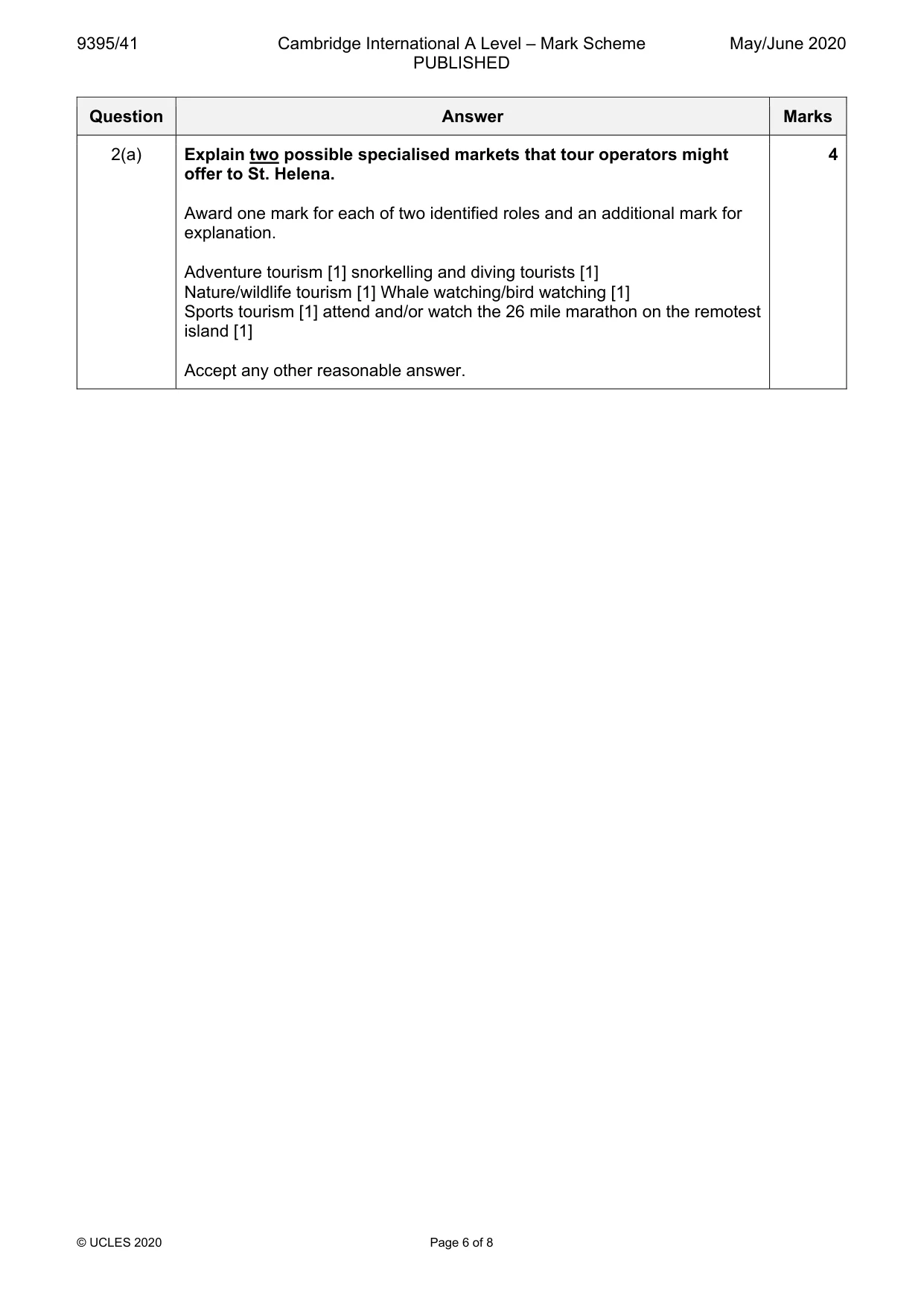
9395/41 Cambridge International A Level – Mark Scheme PUBLISHED May/June 2020 © UCLES 2020 Page 6 of 8 Question Answer Marks 2(a) Explain two possible specialised markets that tour operators might offer to St. Helena. Award one mark for each of two identified roles and an additional mark for explanation. Adventure tourism [1] snorkelling and diving tourists [1] Nature/wildlife tourism [1] Whale watching/bird watching [1] Sports tourism [1] attend and/or watch the 26 mile marathon on the remotest island [1] Accept any other reasonable answer. 4
Mark scheme, page 7
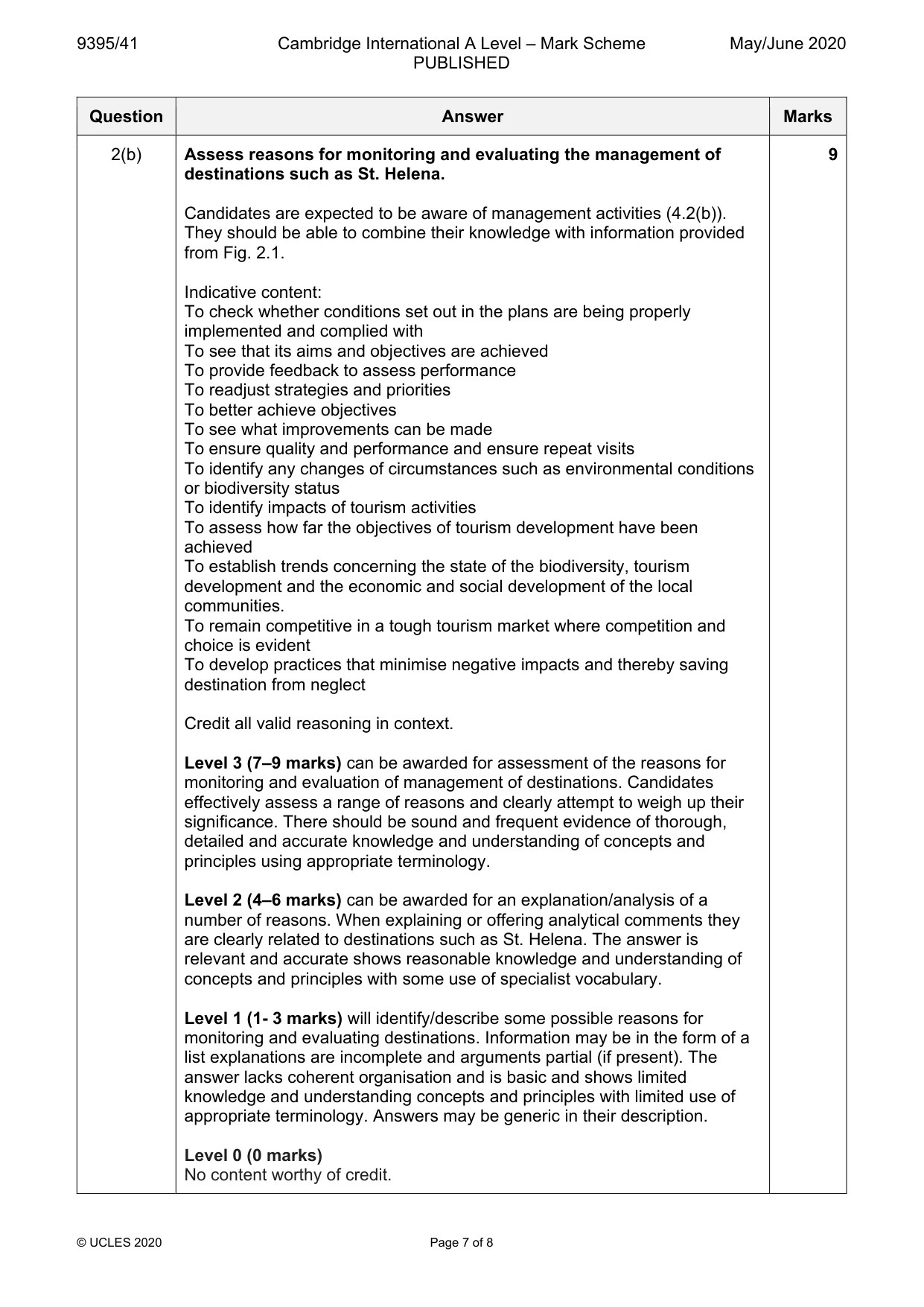
9395/41 Cambridge International A Level – Mark Scheme PUBLISHED May/June 2020 © UCLES 2020 Page 7 of 8 Question Answer Marks 2(b) Assess reasons for monitoring and evaluating the management of destinations such as St. Helena. Candidates are expected to be aware of management activities (4.2(b)). They should be able to combine their knowledge with information provided from Fig. 2.1. Indicative content: To check whether conditions set out in the plans are being properly implemented and complied with To see that its aims and objectives are achieved To provide feedback to assess performance To readjust strategies and priorities To better achieve objectives To see what improvements can be made To ensure quality and performance and ensure repeat visits To identify any changes of circumstances such as environmental conditions or biodiversity status To identify impacts of tourism activities To assess how far the objectives of tourism development have been achieved To establish trends concerning the state of the biodiversity, tourism development and the economic and social development of the local communities. To remain competitive in a tough tourism market where competition and choice is evident To develop practices that minimise negative impacts and thereby saving destination from neglect Credit all valid reasoning in context. Level 3 (7–9 marks) can be awarded for assessment of the reasons for monitoring and evaluation of management of destinations. Candidates effectively assess a range of reasons and clearly attempt to weigh up their significance. There should be sound and frequent evidence of thorough, detailed and accurate knowledge and understanding of concepts and principles using appropriate terminology. Level 2 (4–6 marks) can be awarded for an explanation/analysis of a number of reasons. When explaining or offering analytical comments they are clearly related to destinations such as St. Helena. The answer is relevant and accurate shows reasonable knowledge and understanding of concepts and principles with some use of specialist vocabulary. Level 1 (1- 3 marks) will identify/describe some possible reasons for monitoring and evaluating destinations. Information may be in the form of a list explanations are incomplete and arguments partial (if present). The answer lacks coherent organisation and is basic and shows limited knowledge and understanding concepts and principles with limited use of appropriate terminology. Answers may be generic in their description. Level 0 (0 marks) No content worthy of credit. 9
Mark scheme, page 8
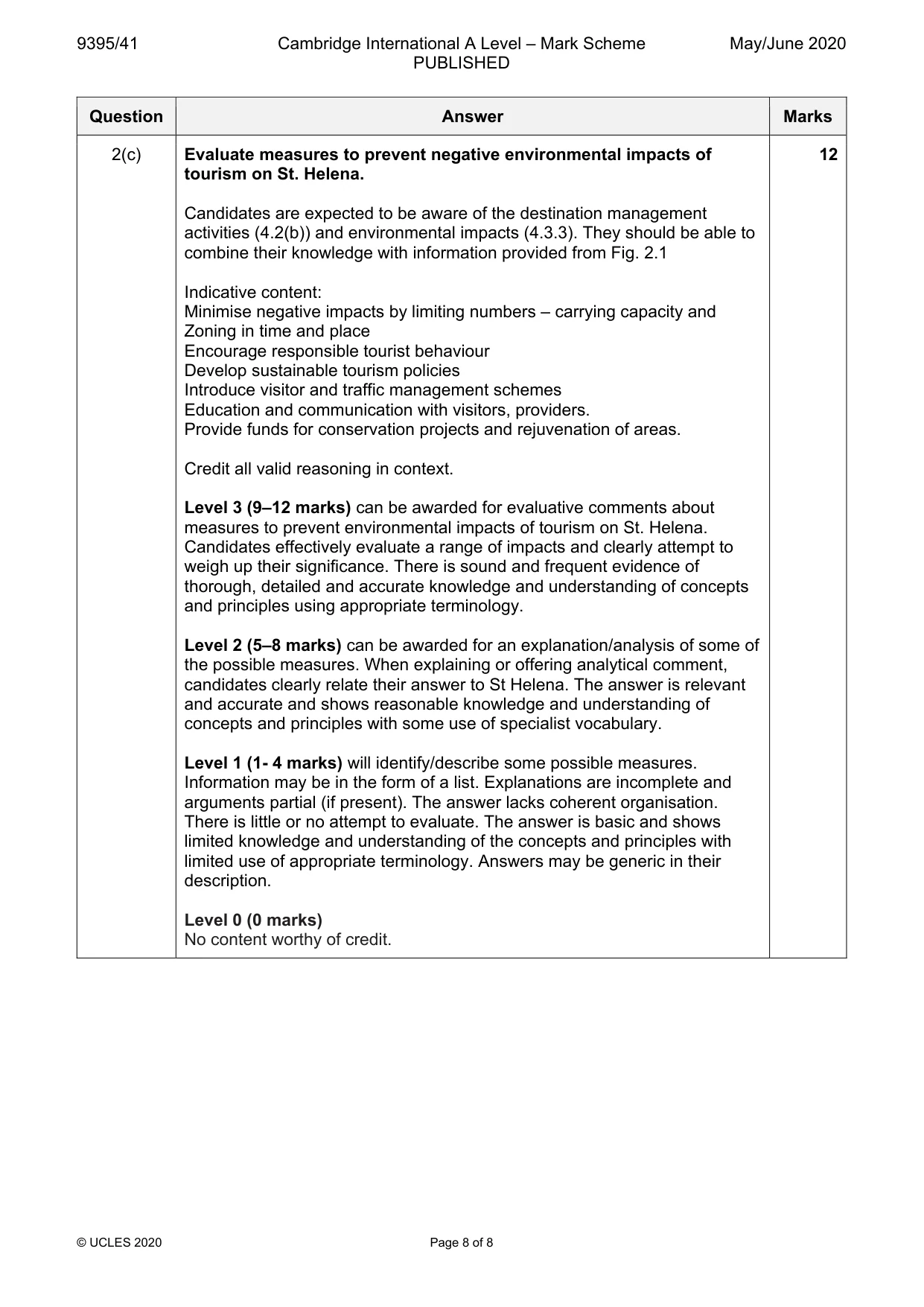
9395/41 Cambridge International A Level – Mark Scheme PUBLISHED May/June 2020 © UCLES 2020 Page 8 of 8 Question Answer Marks 2(c) Evaluate measures to prevent negative environmental impacts of tourism on St. Helena. Candidates are expected to be aware of the destination management activities (4.2(b)) and environmental impacts (4.3.3). They should be able to combine their knowledge with information provided from Fig. 2.1 Indicative content: Minimise negative impacts by limiting numbers – carrying capacity and Zoning in time and place Encourage responsible tourist behaviour Develop sustainable tourism policies Introduce visitor and traffic management schemes Education and communication with visitors, providers. Provide funds for conservation projects and rejuvenation of areas. Credit all valid reasoning in context. Level 3 (9–12 marks) can be awarded for evaluative comments about measures to prevent environmental impacts of tourism on St. Helena. Candidates effectively evaluate a range of impacts and clearly attempt to weigh up their significance. There is sound and frequent evidence of thorough, detailed and accurate knowledge and understanding of concepts and principles using appropriate terminology. Level 2 (5–8 marks) can be awarded for an explanation/analysis of some of the possible measures. When explaining or offering analytical comment, candidates clearly relate their answer to St Helena. The answer is relevant and accurate and shows reasonable knowledge and understanding of concepts and principles with some use of specialist vocabulary. Level 1 (1- 4 marks) will identify/describe some possible measures. Information may be in the form of a list. Explanations are incomplete and arguments partial (if present). The answer lacks coherent organisation. There is little or no attempt to evaluate. The answer is basic and shows limited knowledge and understanding of the concepts and principles with limited use of appropriate terminology. Answers may be generic in their description. Level 0 (0 marks) No content worthy of credit. 12