Cambridge A Level Travel and Tourism 9395 — 2024 May/June Paper 4 · Variant 1
9395/41/M/J/24 · 50 marks · 90 min
The question paper and its mark scheme, free to read here and free to download. This is Cambridge’s own paper, exactly as it was sat.
Question paper12 pages







Mark scheme14 pages
Answers below. Sit the paper first if you are practising.
Paper as text
Question paper, page 1
This document has 12 pages. Any blank pages are indicated. [Turn over Cambridge International AS & A Level * 4 5 8 7 9 6 1 9 4 1 * DC (PQ) 329048/1 © UCLES 2024 TRAVEL & TOURISM 9395/41 Paper 4 Destination Development and Management May/June 2024 1 hour 30 minutes You must answer on the question paper. You will need: Insert (enclosed) INSTRUCTIONS ● Answer all questions. ● Use a black or dark blue pen. ● Write your name, centre number and candidate number in the boxes at the top of the page. ● Write your answer to each question in the space provided. ● Do not use an erasable pen or correction fluid. ● Do not write on any bar codes. INFORMATION ● The total mark for this paper is 50. ● The number of marks for each question or part question is shown in brackets [ ]. ● The insert contains all the figures referred to in the questions.
Question paper, page 2
2 9395/41/M/J/24 © UCLES 2024 1 Refer to Fig. 1.1 (Insert), information about the Panamanian Alliance for Community Tourism (PACT). (a) Explain two roles of an NGO. 1 … … … … 2 … … … … [4] (b) Assess the benefits of preserving cultural activities in destinations such as Panama. … … … … … … … … … … … … … … … … …
Question paper, page 3
3 9395/41/M/J/24 © UCLES 2024 [Turn over … … … … … … … … … … … … … … … … … … … … … … … … … … … … [9]
Question paper, page 4
4 9395/41/M/J/24 © UCLES 2024 (c) Discuss reasons why sustainable use of resources is an important strategy for PACT. … … … … … … … … … … … … … … … … … … … … … … … … … … …
Question paper, page 5
5 9395/41/M/J/24 © UCLES 2024 [Turn over … … … … … … … … … … … … … … … … … … … … … … … … … … … [12] [Total: 25]
Question paper, page 6
6 9395/41/M/J/24 © UCLES 2024 2 Refer to Fig. 2.1 (Insert), information about Dedication DMC, a Destination Management Company. (a) Explain two benefits to customers of using Dedication DMC. 1 … … … … 2 … … … … [4] (b) Assess the ways that Dedication DMC can encourage responsible and ethical tourist behaviour. … … … … … … … … … … … … … … … … …
Question paper, page 7
7 9395/41/M/J/24 © UCLES 2024 [Turn over … … … … … … … … … … … … … … … … … … … … … … … … … … … … [9]
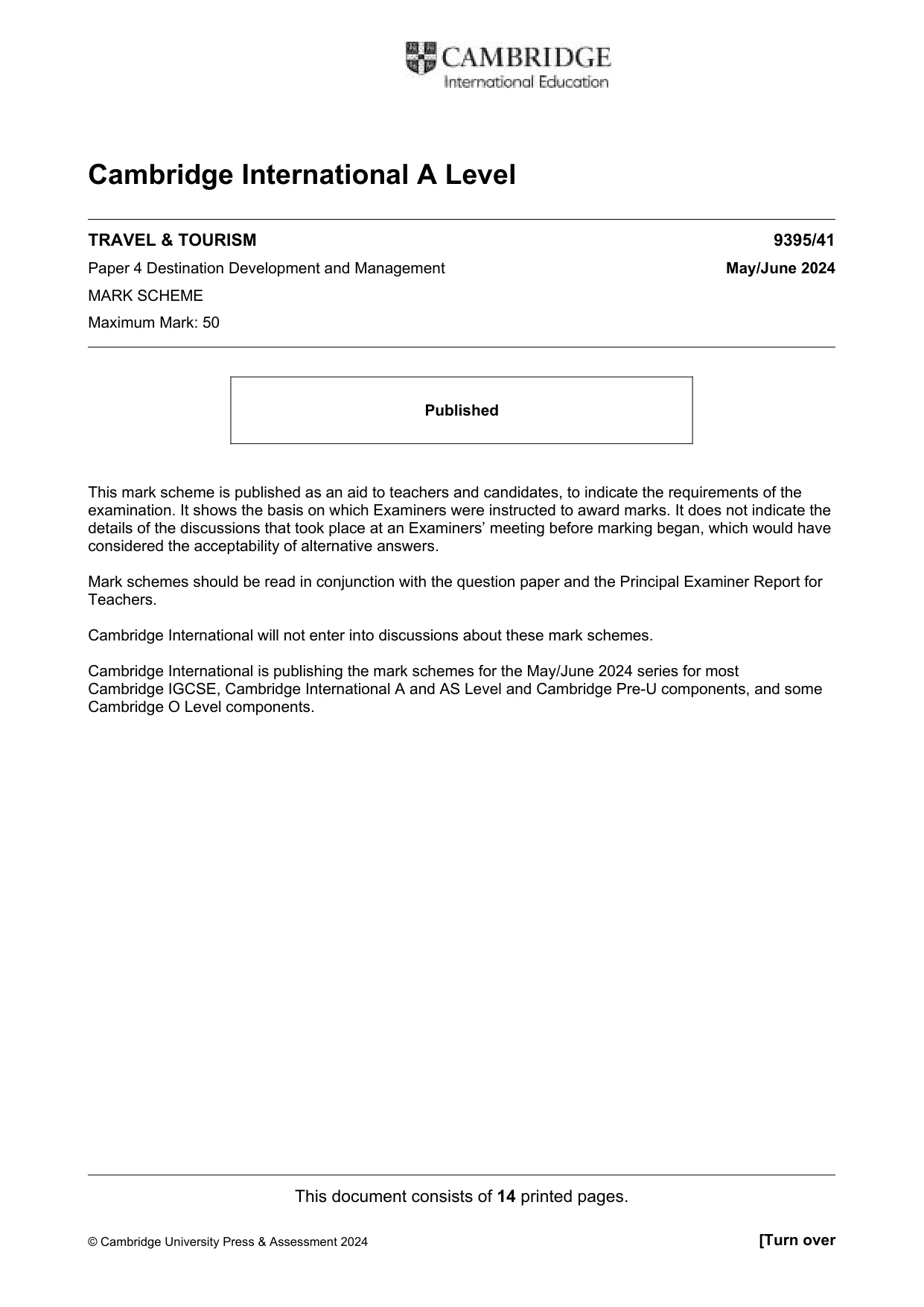
Question paper, page 8
8 9395/41/M/J/24 © UCLES 2024 (c) Discuss the economic benefits of tourism for an LDC. … … … … … … … … … … … … … … … … … … … … … … … … … … …
Question paper, page 9
9 9395/41/M/J/24 © UCLES 2024 … … … … … … … … … … … … … … … … … … … … … … … … … … … [12] [Total: 25]
Question paper, page 10
10 9395/41/M/J/24 © UCLES 2024 BLANK PAGE
Question paper, page 11
11 9395/41/M/J/24 © UCLES 2024 BLANK PAGE
Question paper, page 12
12 9395/41/M/J/24 © UCLES 2024 The boundaries and names shown, the designations used and the presentation of material on any maps contained in this question paper/insert do not imply official endorsement or acceptance by Cambridge Assessment International Education concerning the legal status of any country, territory, or area or any of its authorities, or of the delimitation of its frontiers or boundaries. Permission to reproduce items where third-party owned material protected by copyright is included has been sought and cleared where possible. Every reasonable effort has been made by the publisher (UCLES) to trace copyright holders, but if any items requiring clearance have unwittingly been included, the publisher will be pleased to make amends at the earliest possible opportunity. To avoid the issue of disclosure of answer-related information to candidates, all copyright acknowledgements are reproduced online in the Cambridge Assessment International Education Copyright Acknowledgements Booklet. This is produced for each series of examinations and is freely available to download at www.cambridgeinternational.org after the live examination series. Cambridge Assessment International Education is part of Cambridge Assessment. Cambridge Assessment is the brand name of the University of Cambridge Local Examinations Syndicate (UCLES), which is a department of the University of Cambridge. BLANK PAGE
Mark scheme, page 1
This document consists of 14 printed pages. © Cambridge University Press & Assessment 2024 [Turn over Cambridge International A Level TRAVEL & TOURISM 9395/41 Paper 4 Destination Development and Management May/June 2024 MARK SCHEME Maximum Mark: 50 Published This mark scheme is published as an aid to teachers and candidates, to indicate the requirements of the examination. It shows the basis on which Examiners were instructed to award marks. It does not indicate the details of the discussions that took place at an Examiners’ meeting before marking began, which would have considered the acceptability of alternative answers. Mark schemes should be read in conjunction with the question paper and the Principal Examiner Report for Teachers. Cambridge International will not enter into discussions about these mark schemes. Cambridge International is publishing the mark schemes for the May/June 2024 series for most Cambridge IGCSE, Cambridge International A and AS Level and Cambridge Pre-U components, and some Cambridge O Level components.
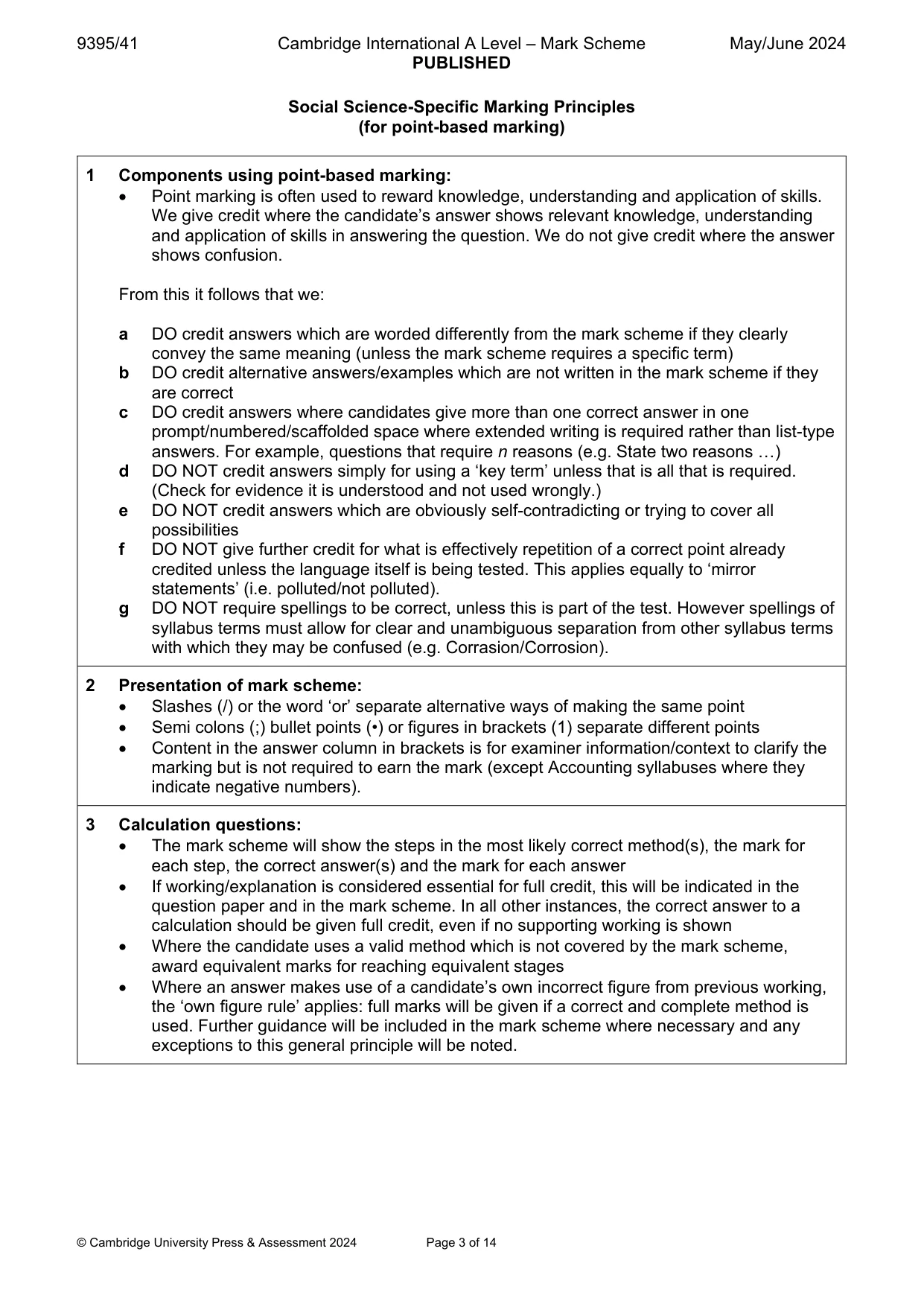
Mark scheme, page 2
9395/41 Cambridge International A Level – Mark Scheme PUBLISHED May/June 2024 © Cambridge University Press & Assessment 2024 Page 2 of 14 Generic Marking Principles These general marking principles must be applied by all examiners when marking candidate answers. They should be applied alongside the specific content of the mark scheme or generic level descriptions for a question. Each question paper and mark scheme will also comply with these marking principles. GENERIC MARKING PRINCIPLE 1: Marks must be awarded in line with: the specific content of the mark scheme or the generic level descriptors for the question the specific skills defined in the mark scheme or in the generic level descriptors for the question the standard of response required by a candidate as exemplified by the standardisation scripts. GENERIC MARKING PRINCIPLE 2: Marks awarded are always whole marks (not half marks, or other fractions). GENERIC MARKING PRINCIPLE 3: Marks must be awarded positively: marks are awarded for correct/valid answers, as defined in the mark scheme. However, credit is given for valid answers which go beyond the scope of the syllabus and mark scheme, referring to your Team Leader as appropriate marks are awarded when candidates clearly demonstrate what they know and can do marks are not deducted for errors marks are not deducted for omissions answers should only be judged on the quality of spelling, punctuation and grammar when these features are specifically assessed by the question as indicated by the mark scheme. The meaning, however, should be unambiguous. GENERIC MARKING PRINCIPLE 4: Rules must be applied consistently, e.g. in situations where candidates have not followed instructions or in the application of generic level descriptors. GENERIC MARKING PRINCIPLE 5: Marks should be awarded using the full range of marks defined in the mark scheme for the question (however; the use of the full mark range may be limited according to the quality of the candidate responses seen). GENERIC MARKING PRINCIPLE 6: Marks awarded are based solely on the requirements as defined in the mark scheme. Marks should not be awarded with grade thresholds or grade descriptors in mind.
Mark scheme, page 3
9395/41 Cambridge International A Level – Mark Scheme PUBLISHED May/June 2024 © Cambridge University Press & Assessment 2024 Page 3 of 14 Social Science-Specific Marking Principles (for point-based marking) 1 Components using point-based marking: Point marking is often used to reward knowledge, understanding and application of skills. We give credit where the candidate’s answer shows relevant knowledge, understanding and application of skills in answering the question. We do not give credit where the answer shows confusion. From this it follows that we: a DO credit answers which are worded differently from the mark scheme if they clearly convey the same meaning (unless the mark scheme requires a specific term) b DO credit alternative answers/examples which are not written in the mark scheme if they are correct c DO credit answers where candidates give more than one correct answer in one prompt/numbered/scaffolded space where extended writing is required rather than list-type answers. For example, questions that require n reasons (e.g. State two reasons …) d DO NOT credit answers simply for using a ‘key term’ unless that is all that is required. (Check for evidence it is understood and not used wrongly.) e DO NOT credit answers which are obviously self-contradicting or trying to cover all possibilities f DO NOT give further credit for what is effectively repetition of a correct point already credited unless the language itself is being tested. This applies equally to ‘mirror statements’ (i.e. polluted/not polluted). g DO NOT require spellings to be correct, unless this is part of the test. However spellings of syllabus terms must allow for clear and unambiguous separation from other syllabus terms with which they may be confused (e.g. Corrasion/Corrosion). 2 Presentation of mark scheme: Slashes (/) or the word ‘or’ separate alternative ways of making the same point Semi colons (;) bullet points (•) or figures in brackets (1) separate different points Content in the answer column in brackets is for examiner information/context to clarify the marking but is not required to earn the mark (except Accounting syllabuses where they indicate negative numbers). 3 Calculation questions: The mark scheme will show the steps in the most likely correct method(s), the mark for each step, the correct answer(s) and the mark for each answer If working/explanation is considered essential for full credit, this will be indicated in the question paper and in the mark scheme. In all other instances, the correct answer to a calculation should be given full credit, even if no supporting working is shown Where the candidate uses a valid method which is not covered by the mark scheme, award equivalent marks for reaching equivalent stages Where an answer makes use of a candidate’s own incorrect figure from previous working, the ‘own figure rule’ applies: full marks will be given if a correct and complete method is used. Further guidance will be included in the mark scheme where necessary and any exceptions to this general principle will be noted.
Mark scheme, page 4
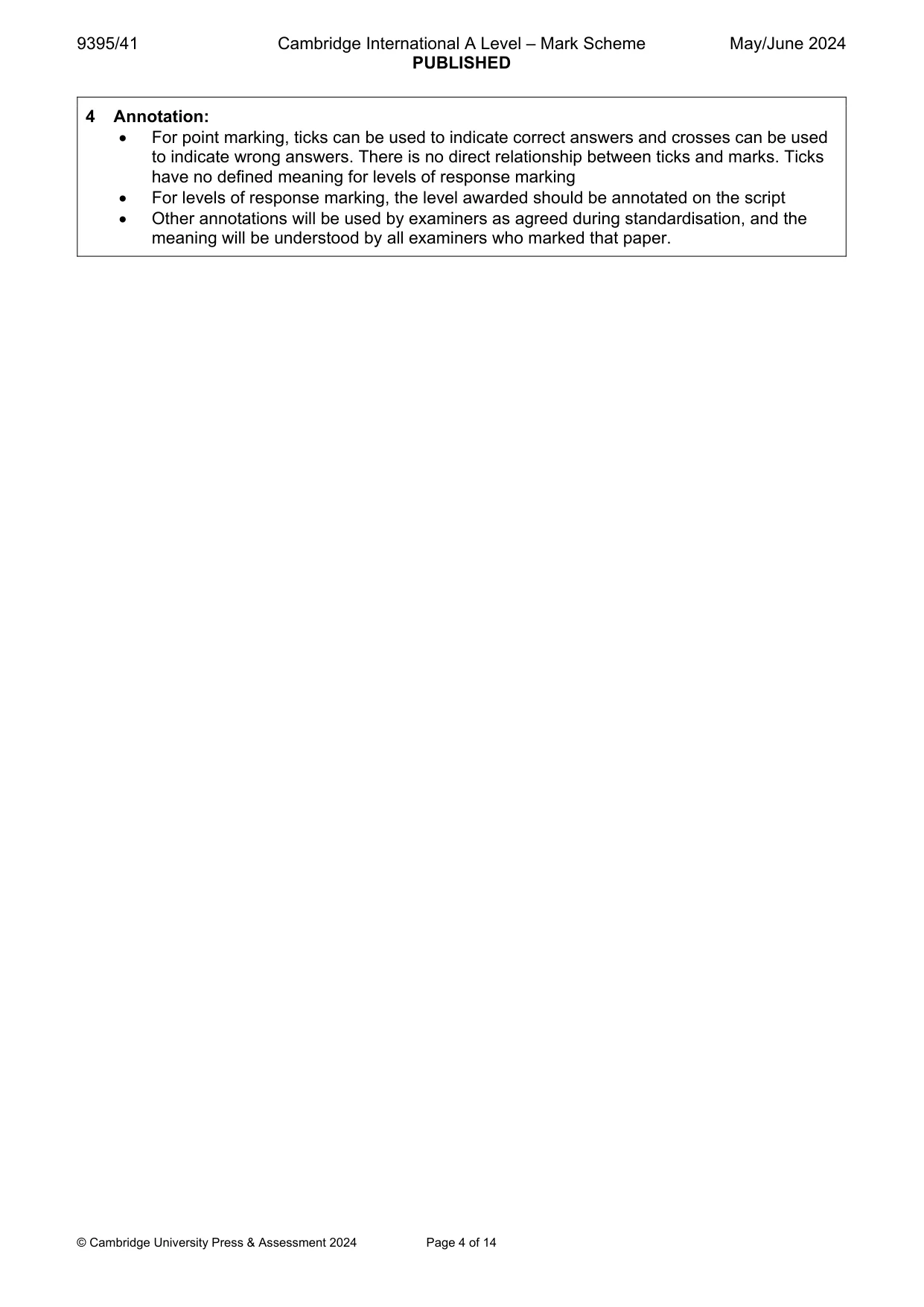
9395/41 Cambridge International A Level – Mark Scheme PUBLISHED May/June 2024 © Cambridge University Press & Assessment 2024 Page 4 of 14 4 Annotation: For point marking, ticks can be used to indicate correct answers and crosses can be used to indicate wrong answers. There is no direct relationship between ticks and marks. Ticks have no defined meaning for levels of response marking For levels of response marking, the level awarded should be annotated on the script Other annotations will be used by examiners as agreed during standardisation, and the meaning will be understood by all examiners who marked that paper.
Mark scheme, page 5
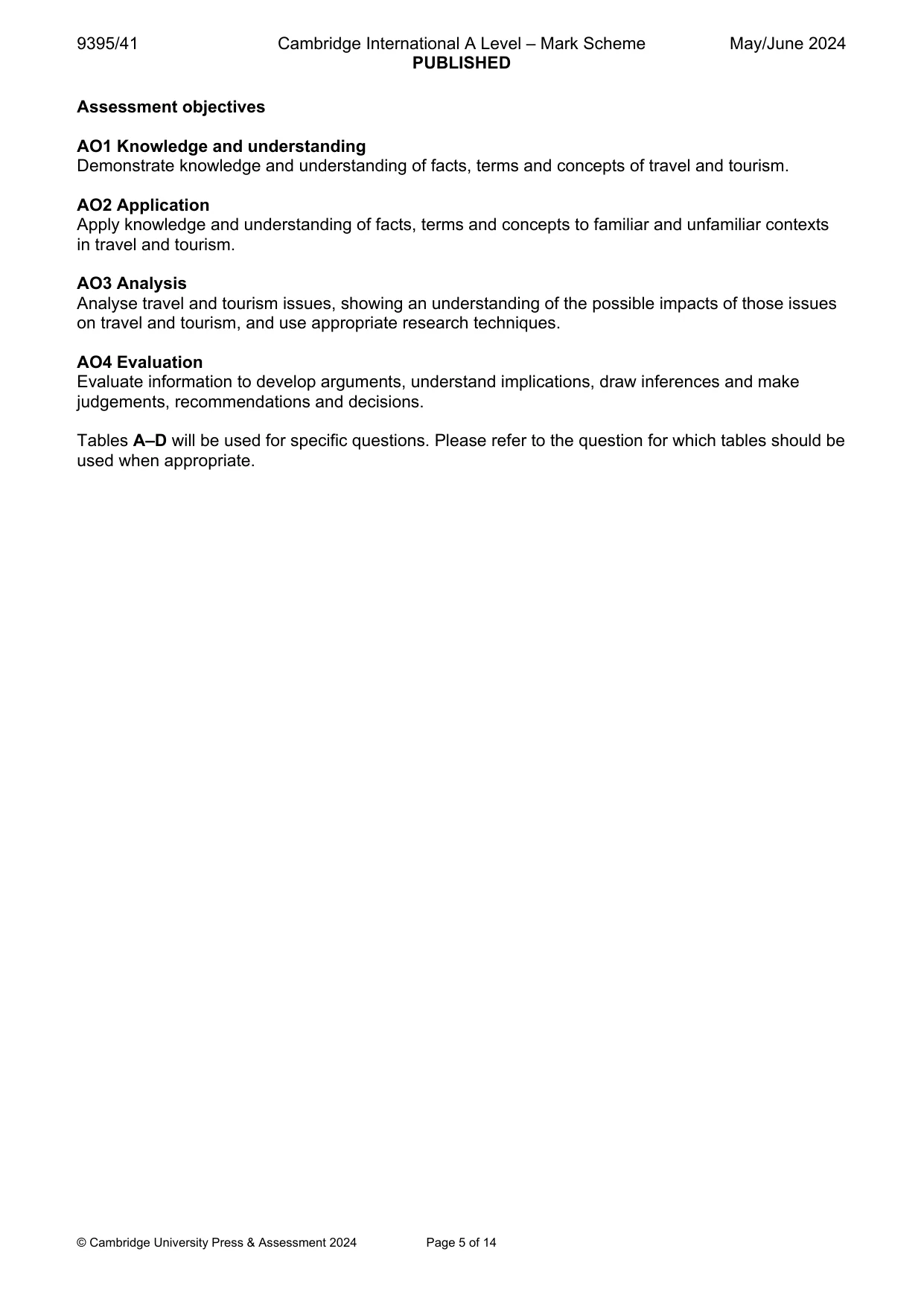
9395/41 Cambridge International A Level – Mark Scheme PUBLISHED May/June 2024 © Cambridge University Press & Assessment 2024 Page 5 of 14 Assessment objectives AO1 Knowledge and understanding Demonstrate knowledge and understanding of facts, terms and concepts of travel and tourism. AO2 Application Apply knowledge and understanding of facts, terms and concepts to familiar and unfamiliar contexts in travel and tourism. AO3 Analysis Analyse travel and tourism issues, showing an understanding of the possible impacts of those issues on travel and tourism, and use appropriate research techniques. AO4 Evaluation Evaluate information to develop arguments, understand implications, draw inferences and make judgements, recommendations and decisions. Tables A–D will be used for specific questions. Please refer to the question for which tables should be used when appropriate.
Mark scheme, page 6
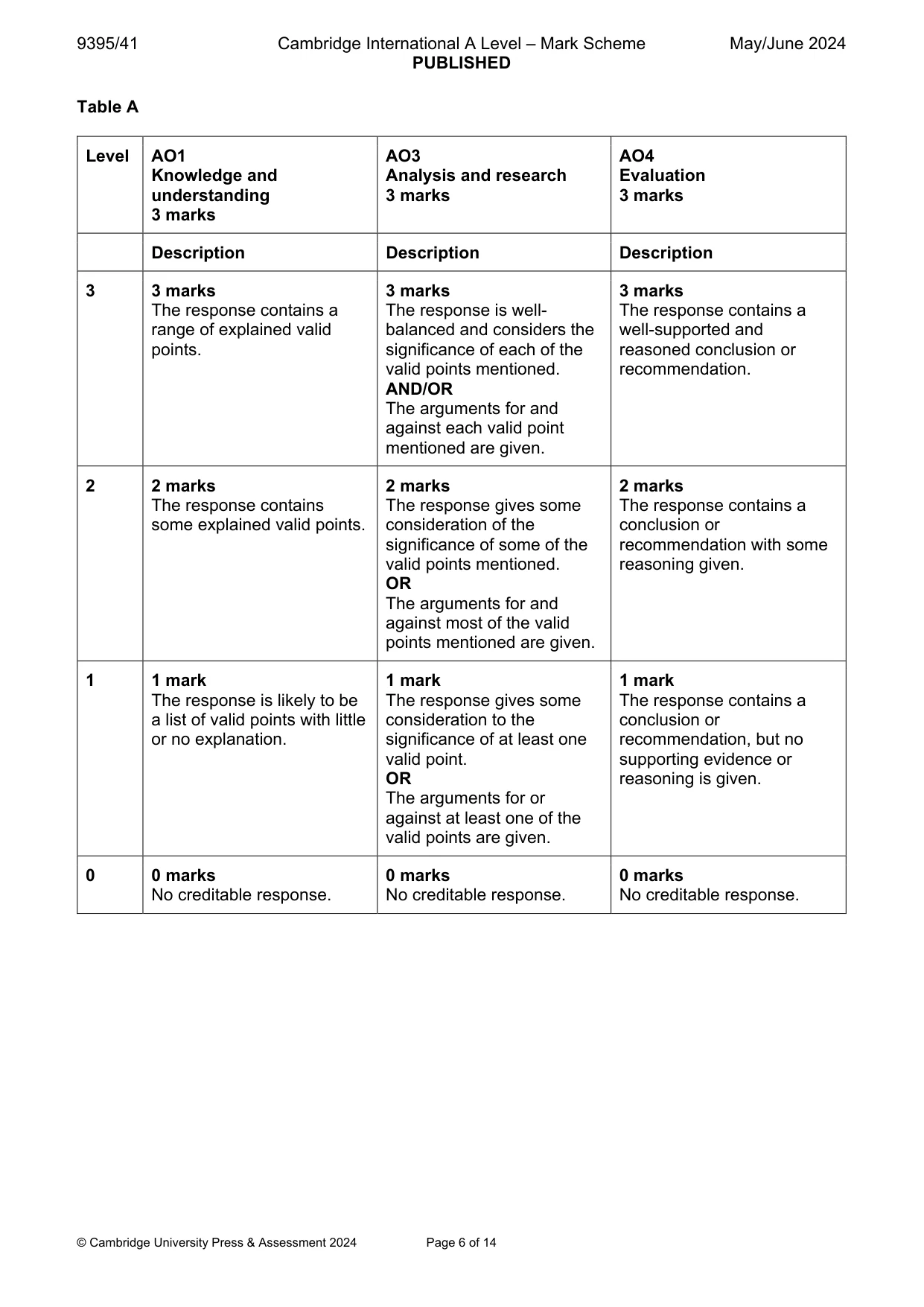
9395/41 Cambridge International A Level – Mark Scheme PUBLISHED May/June 2024 © Cambridge University Press & Assessment 2024 Page 6 of 14 Table A Level AO1 Knowledge and understanding 3 marks AO3 Analysis and research 3 marks AO4 Evaluation 3 marks Description Description Description 3 3 marks The response contains a range of explained valid points. 3 marks The response is well- balanced and considers the significance of each of the valid points mentioned. AND/OR The arguments for and against each valid point mentioned are given. 3 marks The response contains a well-supported and reasoned conclusion or recommendation. 2 2 marks The response contains some explained valid points. 2 marks The response gives some consideration of the significance of some of the valid points mentioned. OR The arguments for and against most of the valid points mentioned are given. 2 marks The response contains a conclusion or recommendation with some reasoning given. 1 1 mark The response is likely to be a list of valid points with little or no explanation. 1 mark The response gives some consideration to the significance of at least one valid point. OR The arguments for or against at least one of the valid points are given. 1 mark The response contains a conclusion or recommendation, but no supporting evidence or reasoning is given. 0 0 marks No creditable response. 0 marks No creditable response. 0 marks No creditable response.
Mark scheme, page 7
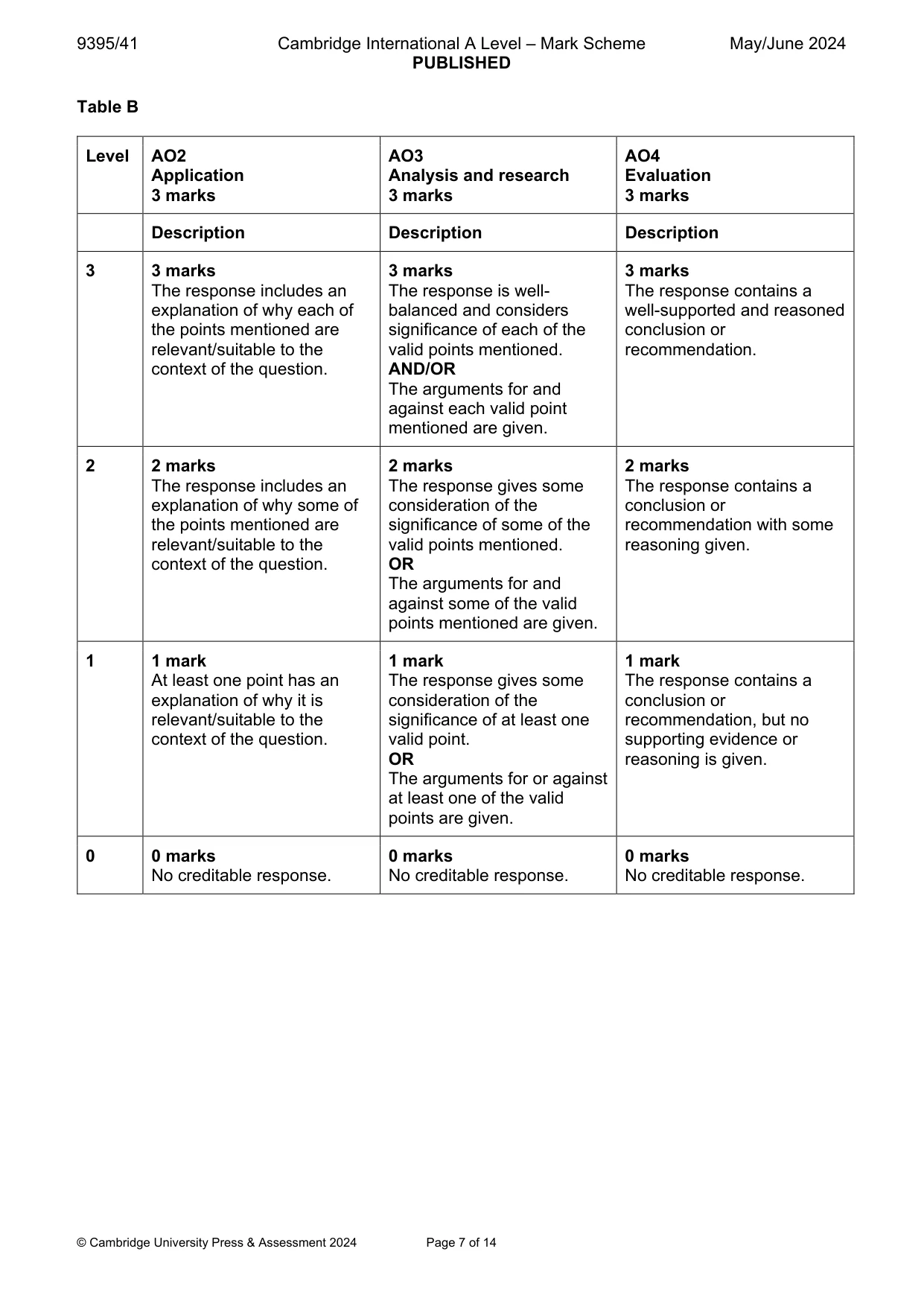
9395/41 Cambridge International A Level – Mark Scheme PUBLISHED May/June 2024 © Cambridge University Press & Assessment 2024 Page 7 of 14 Table B Level AO2 Application 3 marks AO3 Analysis and research 3 marks AO4 Evaluation 3 marks Description Description Description 3 3 marks The response includes an explanation of why each of the points mentioned are relevant/suitable to the context of the question. 3 marks The response is well- balanced and considers significance of each of the valid points mentioned. AND/OR The arguments for and against each valid point mentioned are given. 3 marks The response contains a well-supported and reasoned conclusion or recommendation. 2 2 marks The response includes an explanation of why some of the points mentioned are relevant/suitable to the context of the question. 2 marks The response gives some consideration of the significance of some of the valid points mentioned. OR The arguments for and against some of the valid points mentioned are given. 2 marks The response contains a conclusion or recommendation with some reasoning given. 1 1 mark At least one point has an explanation of why it is relevant/suitable to the context of the question. 1 mark The response gives some consideration of the significance of at least one valid point. OR The arguments for or against at least one of the valid points are given. 1 mark The response contains a conclusion or recommendation, but no supporting evidence or reasoning is given. 0 0 marks No creditable response. 0 marks No creditable response. 0 marks No creditable response.
Mark scheme, page 8
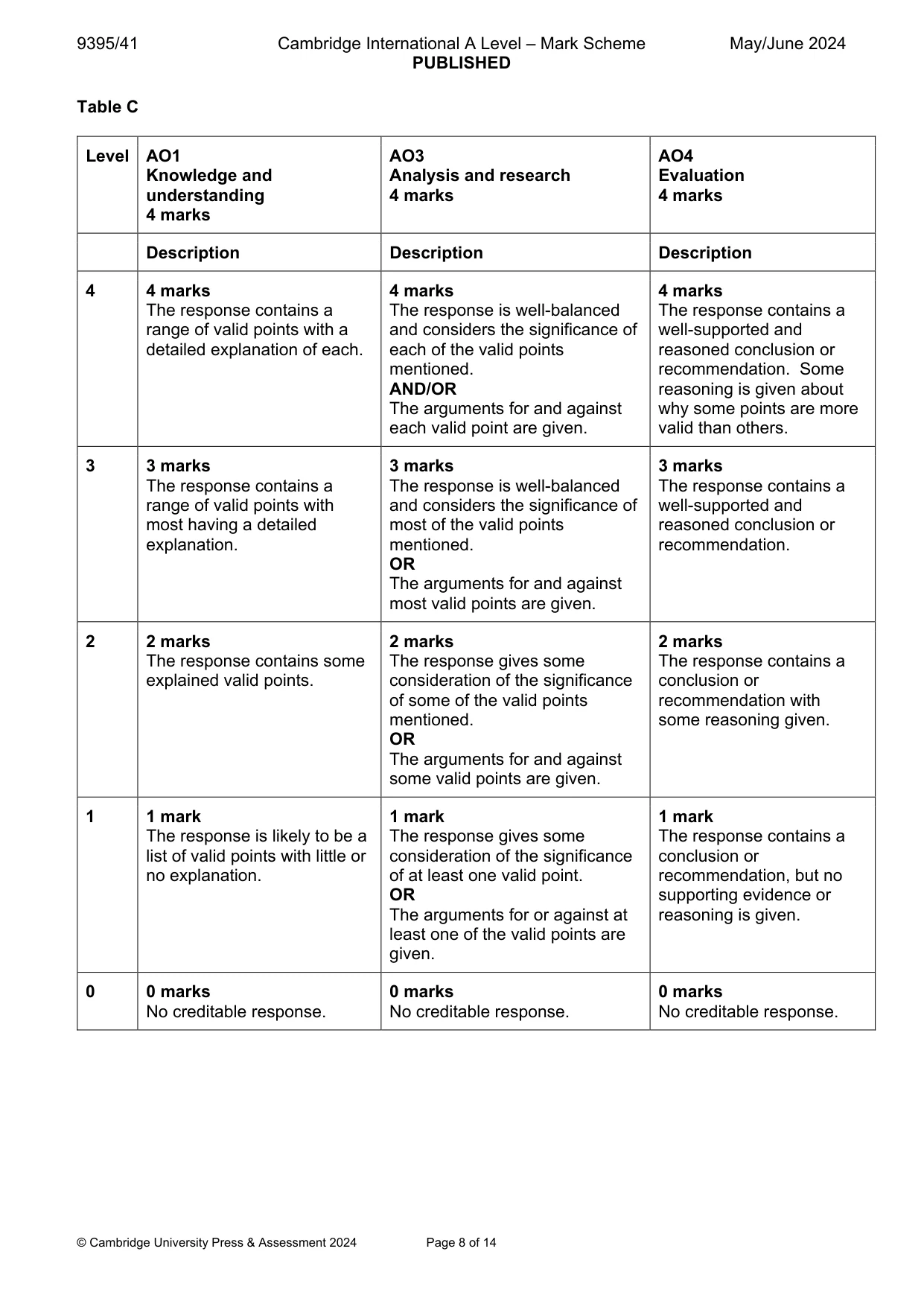
9395/41 Cambridge International A Level – Mark Scheme PUBLISHED May/June 2024 © Cambridge University Press & Assessment 2024 Page 8 of 14 Table C Level AO1 Knowledge and understanding 4 marks AO3 Analysis and research 4 marks AO4 Evaluation 4 marks Description Description Description 4 4 marks The response contains a range of valid points with a detailed explanation of each. 4 marks The response is well-balanced and considers the significance of each of the valid points mentioned. AND/OR The arguments for and against each valid point are given. 4 marks The response contains a well-supported and reasoned conclusion or recommendation. Some reasoning is given about why some points are more valid than others. 3 3 marks The response contains a range of valid points with most having a detailed explanation. 3 marks The response is well-balanced and considers the significance of most of the valid points mentioned. OR The arguments for and against most valid points are given. 3 marks The response contains a well-supported and reasoned conclusion or recommendation. 2 2 marks The response contains some explained valid points. 2 marks The response gives some consideration of the significance of some of the valid points mentioned. OR The arguments for and against some valid points are given. 2 marks The response contains a conclusion or recommendation with some reasoning given. 1 1 mark The response is likely to be a list of valid points with little or no explanation. 1 mark The response gives some consideration of the significance of at least one valid point. OR The arguments for or against at least one of the valid points are given. 1 mark The response contains a conclusion or recommendation, but no supporting evidence or reasoning is given. 0 0 marks No creditable response. 0 marks No creditable response. 0 marks No creditable response.
Mark scheme, page 9
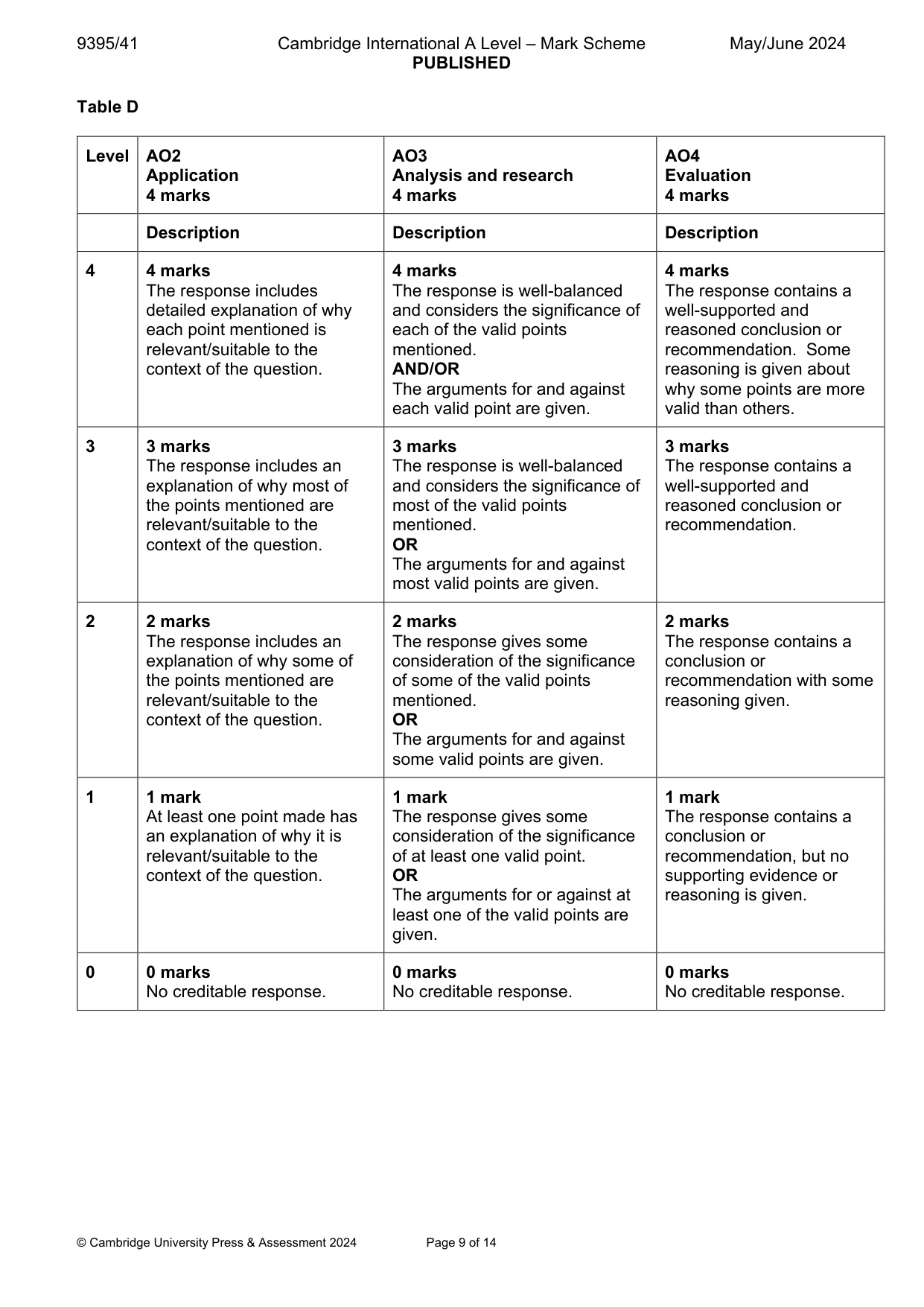
9395/41 Cambridge International A Level – Mark Scheme PUBLISHED May/June 2024 © Cambridge University Press & Assessment 2024 Page 9 of 14 Table D Level AO2 Application 4 marks AO3 Analysis and research 4 marks AO4 Evaluation 4 marks Description Description Description 4 4 marks The response includes detailed explanation of why each point mentioned is relevant/suitable to the context of the question. 4 marks The response is well-balanced and considers the significance of each of the valid points mentioned. AND/OR The arguments for and against each valid point are given. 4 marks The response contains a well-supported and reasoned conclusion or recommendation. Some reasoning is given about why some points are more valid than others. 3 3 marks The response includes an explanation of why most of the points mentioned are relevant/suitable to the context of the question. 3 marks The response is well-balanced and considers the significance of most of the valid points mentioned. OR The arguments for and against most valid points are given. 3 marks The response contains a well-supported and reasoned conclusion or recommendation. 2 2 marks The response includes an explanation of why some of the points mentioned are relevant/suitable to the context of the question. 2 marks The response gives some consideration of the significance of some of the valid points mentioned. OR The arguments for and against some valid points are given. 2 marks The response contains a conclusion or recommendation with some reasoning given. 1 1 mark At least one point made has an explanation of why it is relevant/suitable to the context of the question. 1 mark The response gives some consideration of the significance of at least one valid point. OR The arguments for or against at least one of the valid points are given. 1 mark The response contains a conclusion or recommendation, but no supporting evidence or reasoning is given. 0 0 marks No creditable response. 0 marks No creditable response. 0 marks No creditable response.
Mark scheme, page 10
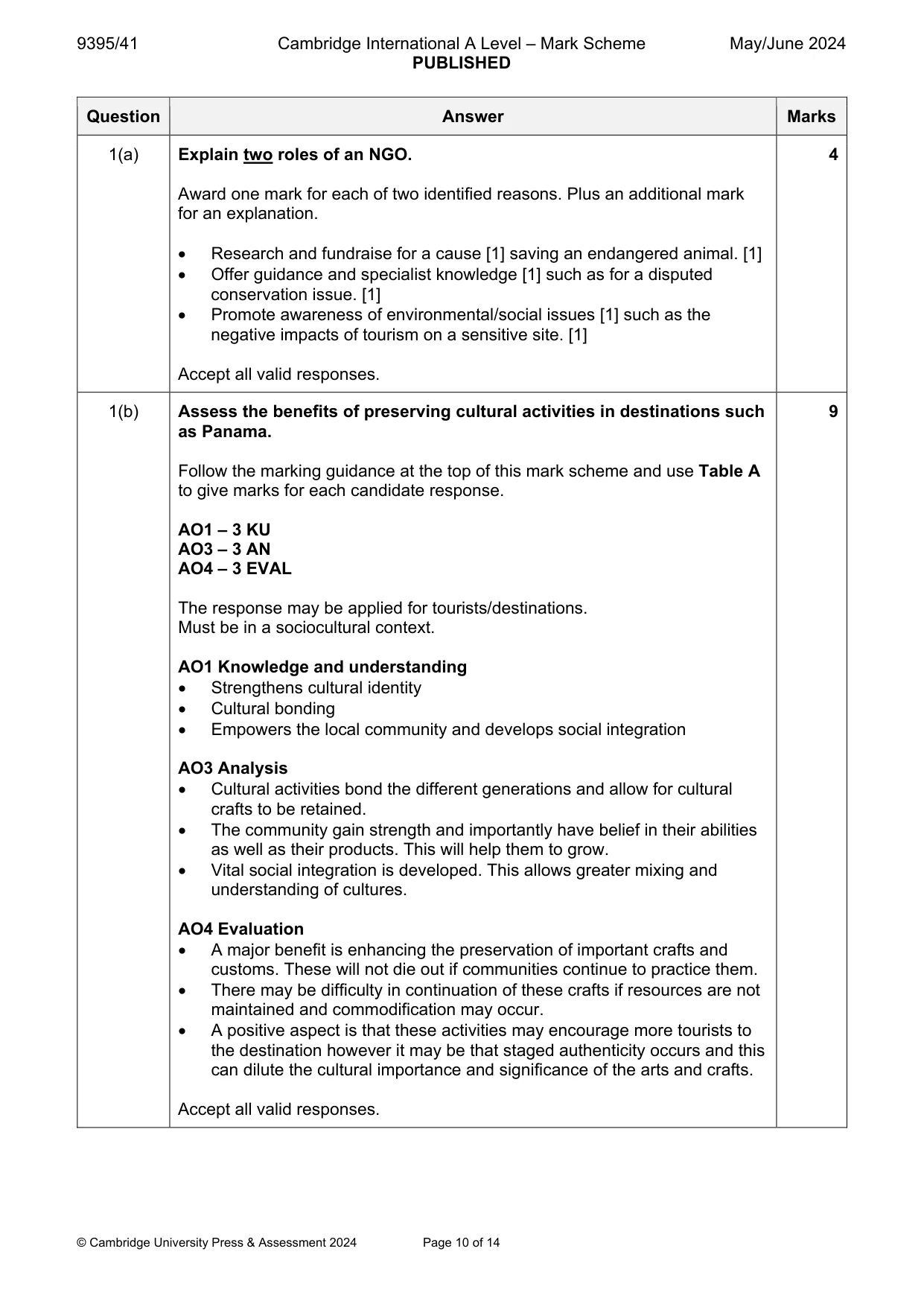
9395/41 Cambridge International A Level – Mark Scheme PUBLISHED May/June 2024 © Cambridge University Press & Assessment 2024 Page 10 of 14 Question Answer Marks 1(a) Explain two roles of an NGO. Award one mark for each of two identified reasons. Plus an additional mark for an explanation. Research and fundraise for a cause [1] saving an endangered animal. [1] Offer guidance and specialist knowledge [1] such as for a disputed conservation issue. [1] Promote awareness of environmental/social issues [1] such as the negative impacts of tourism on a sensitive site. [1] Accept all valid responses. 4 1(b) Assess the benefits of preserving cultural activities in destinations such as Panama. Follow the marking guidance at the top of this mark scheme and use Table A to give marks for each candidate response. AO1 – 3 KU AO3 – 3 AN AO4 – 3 EVAL The response may be applied for tourists/destinations. Must be in a sociocultural context. AO1 Knowledge and understanding Strengthens cultural identity Cultural bonding Empowers the local community and develops social integration AO3 Analysis Cultural activities bond the different generations and allow for cultural crafts to be retained. The community gain strength and importantly have belief in their abilities as well as their products. This will help them to grow. Vital social integration is developed. This allows greater mixing and understanding of cultures. AO4 Evaluation A major benefit is enhancing the preservation of important crafts and customs. These will not die out if communities continue to practice them. There may be difficulty in continuation of these crafts if resources are not maintained and commodification may occur. A positive aspect is that these activities may encourage more tourists to the destination however it may be that staged authenticity occurs and this can dilute the cultural importance and significance of the arts and crafts. Accept all valid responses. 9
Mark scheme, page 11
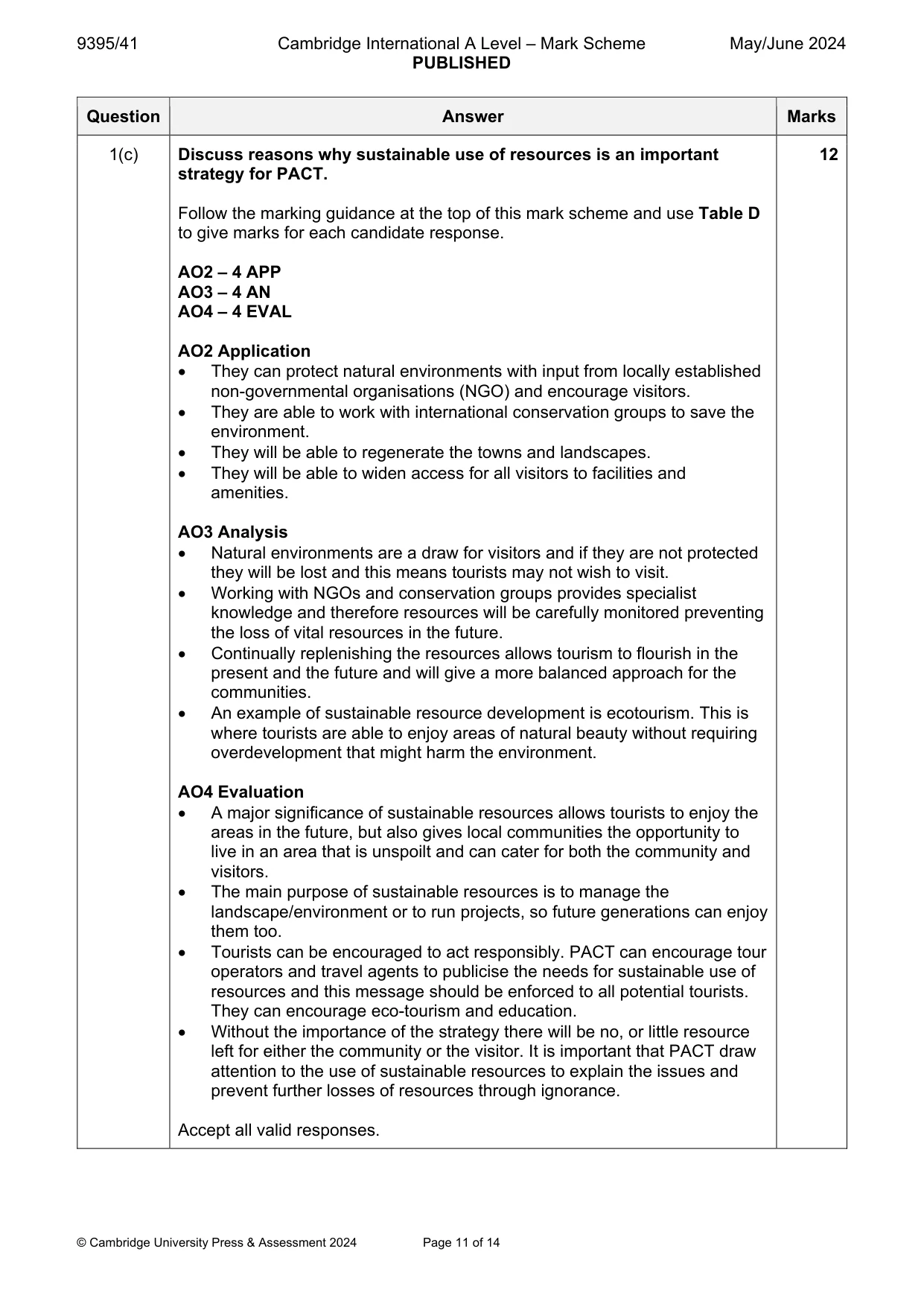
9395/41 Cambridge International A Level – Mark Scheme PUBLISHED May/June 2024 © Cambridge University Press & Assessment 2024 Page 11 of 14 Question Answer Marks 1(c) Discuss reasons why sustainable use of resources is an important strategy for PACT. Follow the marking guidance at the top of this mark scheme and use Table D to give marks for each candidate response. AO2 – 4 APP AO3 – 4 AN AO4 – 4 EVAL AO2 Application They can protect natural environments with input from locally established non-governmental organisations (NGO) and encourage visitors. They are able to work with international conservation groups to save the environment. They will be able to regenerate the towns and landscapes. They will be able to widen access for all visitors to facilities and amenities. AO3 Analysis Natural environments are a draw for visitors and if they are not protected they will be lost and this means tourists may not wish to visit. Working with NGOs and conservation groups provides specialist knowledge and therefore resources will be carefully monitored preventing the loss of vital resources in the future. Continually replenishing the resources allows tourism to flourish in the present and the future and will give a more balanced approach for the communities. An example of sustainable resource development is ecotourism. This is where tourists are able to enjoy areas of natural beauty without requiring overdevelopment that might harm the environment. AO4 Evaluation A major significance of sustainable resources allows tourists to enjoy the areas in the future, but also gives local communities the opportunity to live in an area that is unspoilt and can cater for both the community and visitors. The main purpose of sustainable resources is to manage the landscape/environment or to run projects, so future generations can enjoy them too. Tourists can be encouraged to act responsibly. PACT can encourage tour operators and travel agents to publicise the needs for sustainable use of resources and this message should be enforced to all potential tourists. They can encourage eco-tourism and education. Without the importance of the strategy there will be no, or little resource left for either the community or the visitor. It is important that PACT draw attention to the use of sustainable resources to explain the issues and prevent further losses of resources through ignorance. Accept all valid responses. 12
Mark scheme, page 12
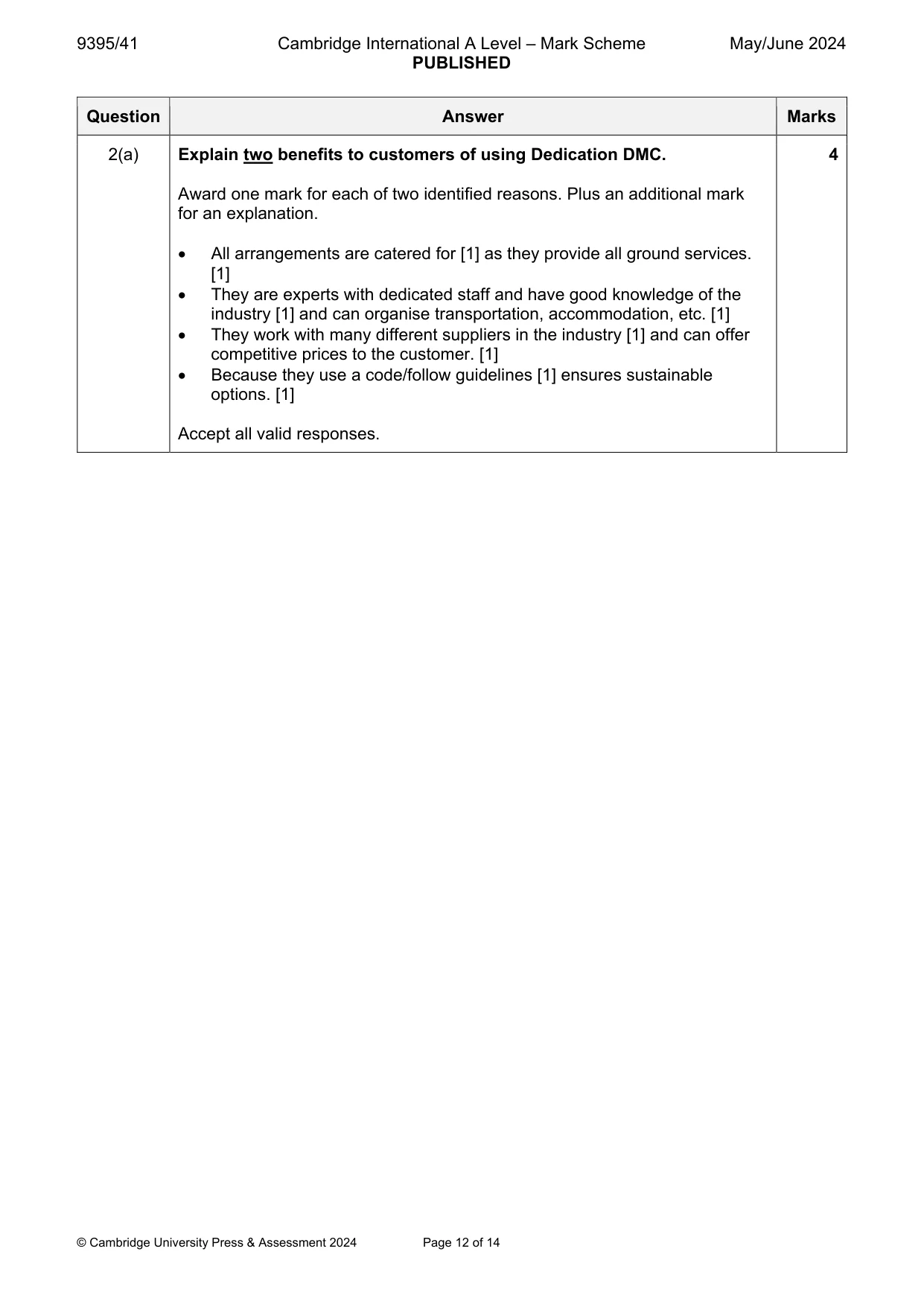
9395/41 Cambridge International A Level – Mark Scheme PUBLISHED May/June 2024 © Cambridge University Press & Assessment 2024 Page 12 of 14 Question Answer Marks 2(a) Explain two benefits to customers of using Dedication DMC. Award one mark for each of two identified reasons. Plus an additional mark for an explanation. All arrangements are catered for [1] as they provide all ground services. [1] They are experts with dedicated staff and have good knowledge of the industry [1] and can organise transportation, accommodation, etc. [1] They work with many different suppliers in the industry [1] and can offer competitive prices to the customer. [1] Because they use a code/follow guidelines [1] ensures sustainable options. [1] Accept all valid responses. 4
Mark scheme, page 13
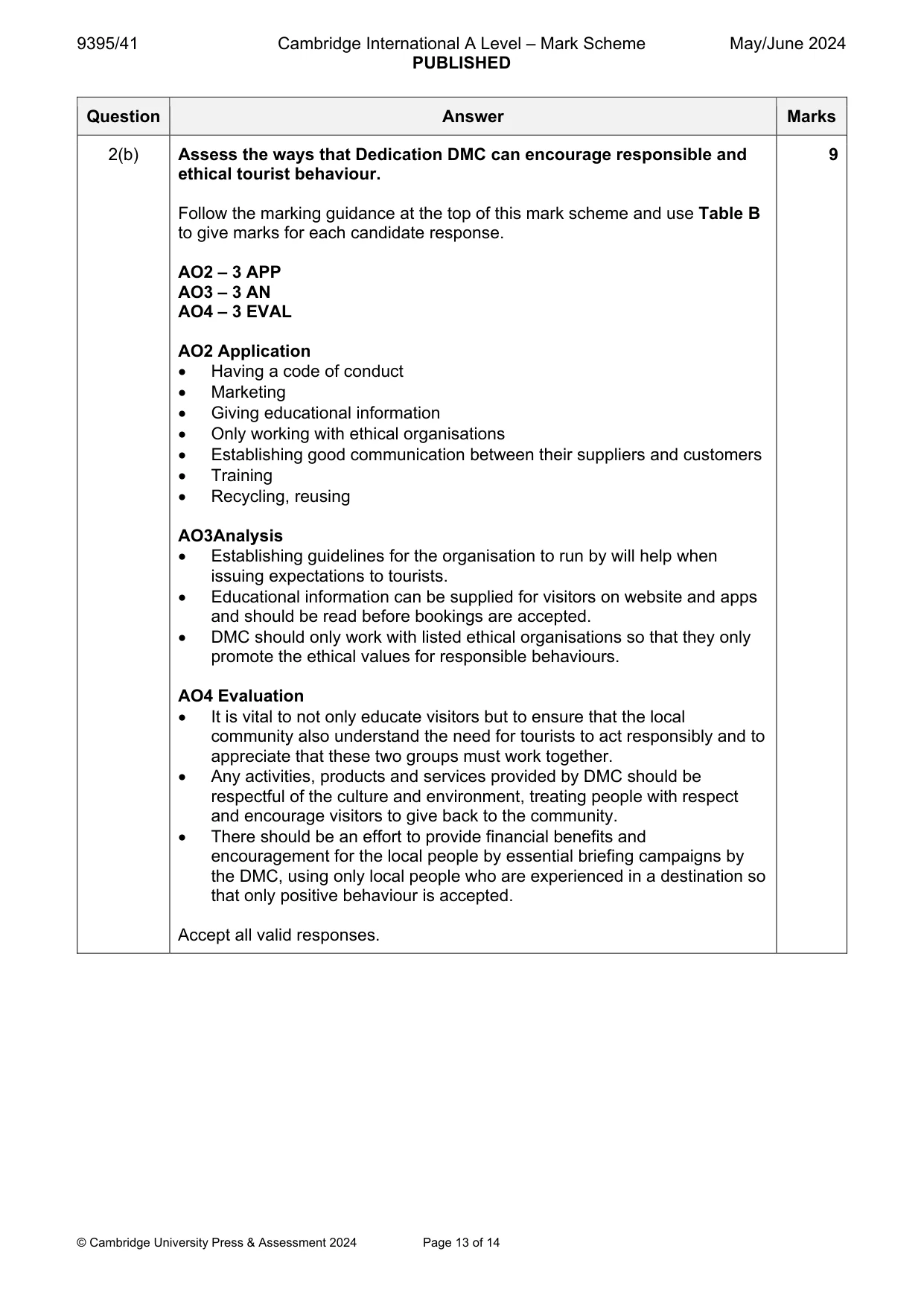
9395/41 Cambridge International A Level – Mark Scheme PUBLISHED May/June 2024 © Cambridge University Press & Assessment 2024 Page 13 of 14 Question Answer Marks 2(b) Assess the ways that Dedication DMC can encourage responsible and ethical tourist behaviour. Follow the marking guidance at the top of this mark scheme and use Table B to give marks for each candidate response. AO2 – 3 APP AO3 – 3 AN AO4 – 3 EVAL AO2 Application Having a code of conduct Marketing Giving educational information Only working with ethical organisations Establishing good communication between their suppliers and customers Training Recycling, reusing AO3Analysis Establishing guidelines for the organisation to run by will help when issuing expectations to tourists. Educational information can be supplied for visitors on website and apps and should be read before bookings are accepted. DMC should only work with listed ethical organisations so that they only promote the ethical values for responsible behaviours. AO4 Evaluation It is vital to not only educate visitors but to ensure that the local community also understand the need for tourists to act responsibly and to appreciate that these two groups must work together. Any activities, products and services provided by DMC should be respectful of the culture and environment, treating people with respect and encourage visitors to give back to the community. There should be an effort to provide financial benefits and encouragement for the local people by essential briefing campaigns by the DMC, using only local people who are experienced in a destination so that only positive behaviour is accepted. Accept all valid responses. 9
Mark scheme, page 14
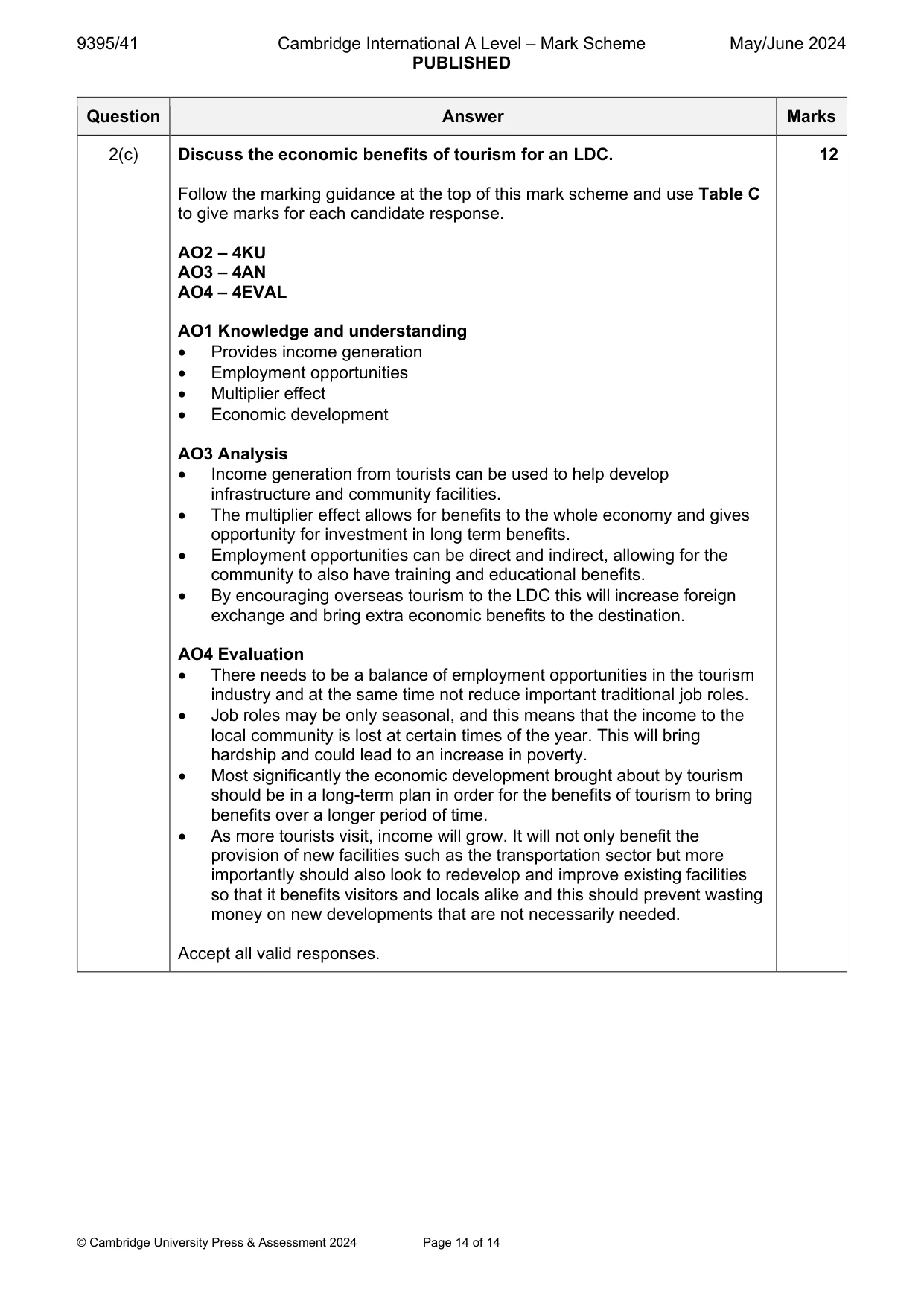
9395/41 Cambridge International A Level – Mark Scheme PUBLISHED May/June 2024 © Cambridge University Press & Assessment 2024 Page 14 of 14 Question Answer Marks 2(c) Discuss the economic benefits of tourism for an LDC. Follow the marking guidance at the top of this mark scheme and use Table C to give marks for each candidate response. AO2 – 4KU AO3 – 4AN AO4 – 4EVAL AO1 Knowledge and understanding Provides income generation Employment opportunities Multiplier effect Economic development AO3 Analysis Income generation from tourists can be used to help develop infrastructure and community facilities. The multiplier effect allows for benefits to the whole economy and gives opportunity for investment in long term benefits. Employment opportunities can be direct and indirect, allowing for the community to also have training and educational benefits. By encouraging overseas tourism to the LDC this will increase foreign exchange and bring extra economic benefits to the destination. AO4 Evaluation There needs to be a balance of employment opportunities in the tourism industry and at the same time not reduce important traditional job roles. Job roles may be only seasonal, and this means that the income to the local community is lost at certain times of the year. This will bring hardship and could lead to an increase in poverty. Most significantly the economic development brought about by tourism should be in a long-term plan in order for the benefits of tourism to bring benefits over a longer period of time. As more tourists visit, income will grow. It will not only benefit the provision of new facilities such as the transportation sector but more importantly should also look to redevelop and improve existing facilities so that it benefits visitors and locals alike and this should prevent wasting money on new developments that are not necessarily needed. Accept all valid responses. 12
What you needed in this session
Cambridge’s own grade thresholds for 2024 May/June, Paper 4 · Variant 1. A higher threshold means an easier paper — the bar moves with how the cohort did.