Cambridge A Level Travel and Tourism 9395 — 2020 May/June Paper 4 · Variant 2
9395/42/M/J/20
The question paper and its mark scheme, free to read here and free to download. This is Cambridge’s own paper, exactly as it was sat.
Question paper12 pages






Mark scheme8 pages
Answers below. Sit the paper first if you are practising.
Paper as text
Question paper, page 1
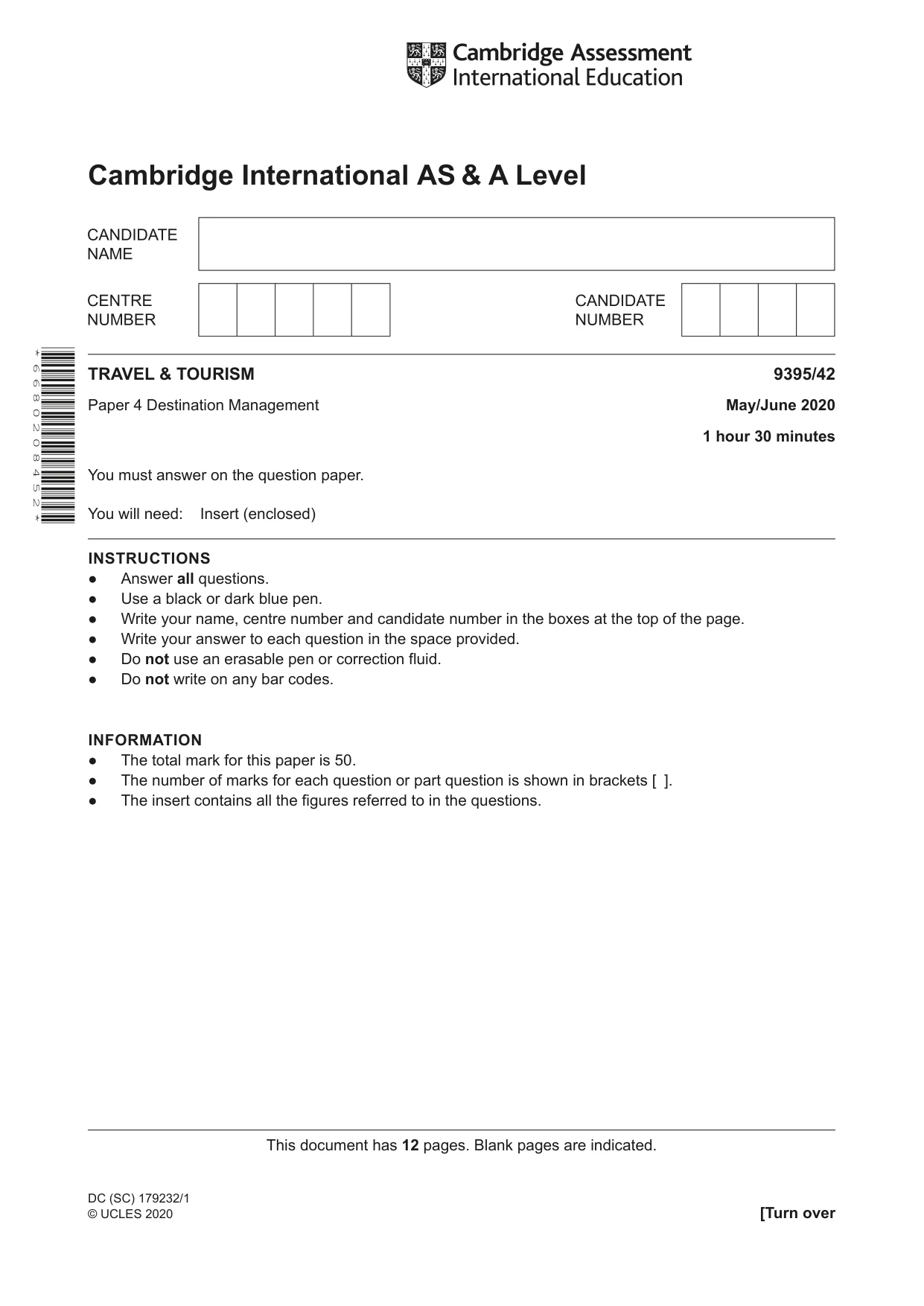
Cambridge International AS & A Level * 6 6 8 0 2 0 8 4 5 2 * This document has 12 pages. Blank pages are indicated. DC (SC) 179232/1 © UCLES 2020 [Turn over TRAVEL & TOURISM 9395/42 Paper 4 Destination Management May/June 2020 1 hour 30 minutes You must answer on the question paper. You will need: Insert (enclosed) INSTRUCTIONS ● Answer all questions. ● Use a black or dark blue pen. ● Write your name, centre number and candidate number in the boxes at the top of the page. ● Write your answer to each question in the space provided. ● Do not use an erasable pen or correction fluid. ● Do not write on any bar codes. INFORMATION ● The total mark for this paper is 50. ● The number of marks for each question or part question is shown in brackets [ ]. ● The insert contains all the figures referred to in the questions.
Question paper, page 2
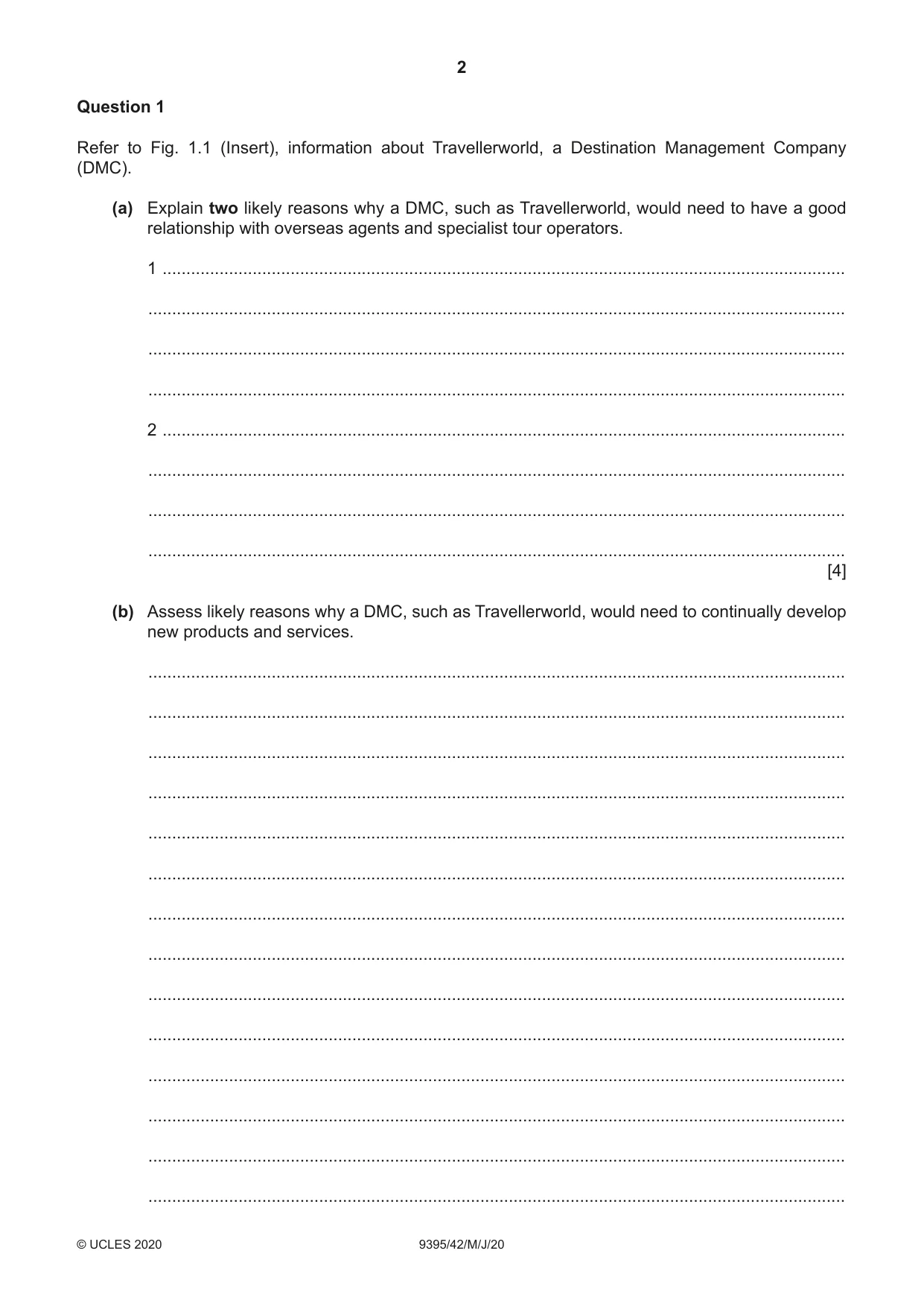
2 9395/42/M/J/20 © UCLES 2020 Question 1 Refer to Fig. 1.1 (Insert), information about Travellerworld, a Destination Management Company (DMC). (a) Explain two likely reasons why a DMC, such as Travellerworld, would need to have a good relationship with overseas agents and specialist tour operators. 1 … … … … 2 … … … … [4] (b) Assess likely reasons why a DMC, such as Travellerworld, would need to continually develop new products and services. … … … … … … … … … … … … … …
Question paper, page 3
3 9395/42/M/J/20 © UCLES 2020 [Turn over … … … … … … … … … … … … … … … … … … … … … … … … … … … … [9]
Question paper, page 4
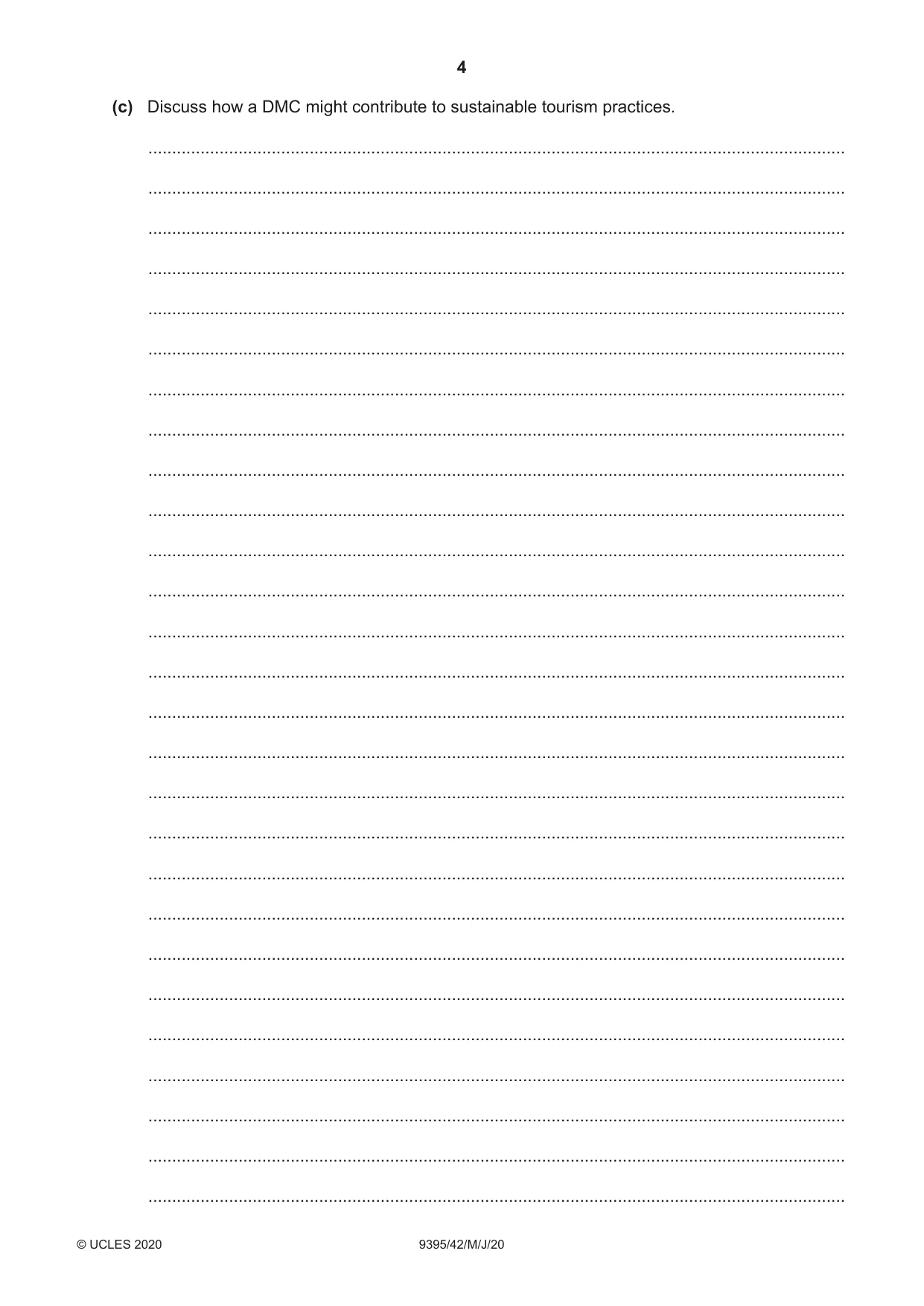
4 9395/42/M/J/20 © UCLES 2020 (c) Discuss how a DMC might contribute to sustainable tourism practices. … … … … … … … … … … … … … … … … … … … … … … … … … … …
Question paper, page 5
5 9395/42/M/J/20 © UCLES 2020 [Turn over … … … … … … … … … … … … … … … … … … … … … … … … … … … [12] [Total: 25]
Question paper, page 6
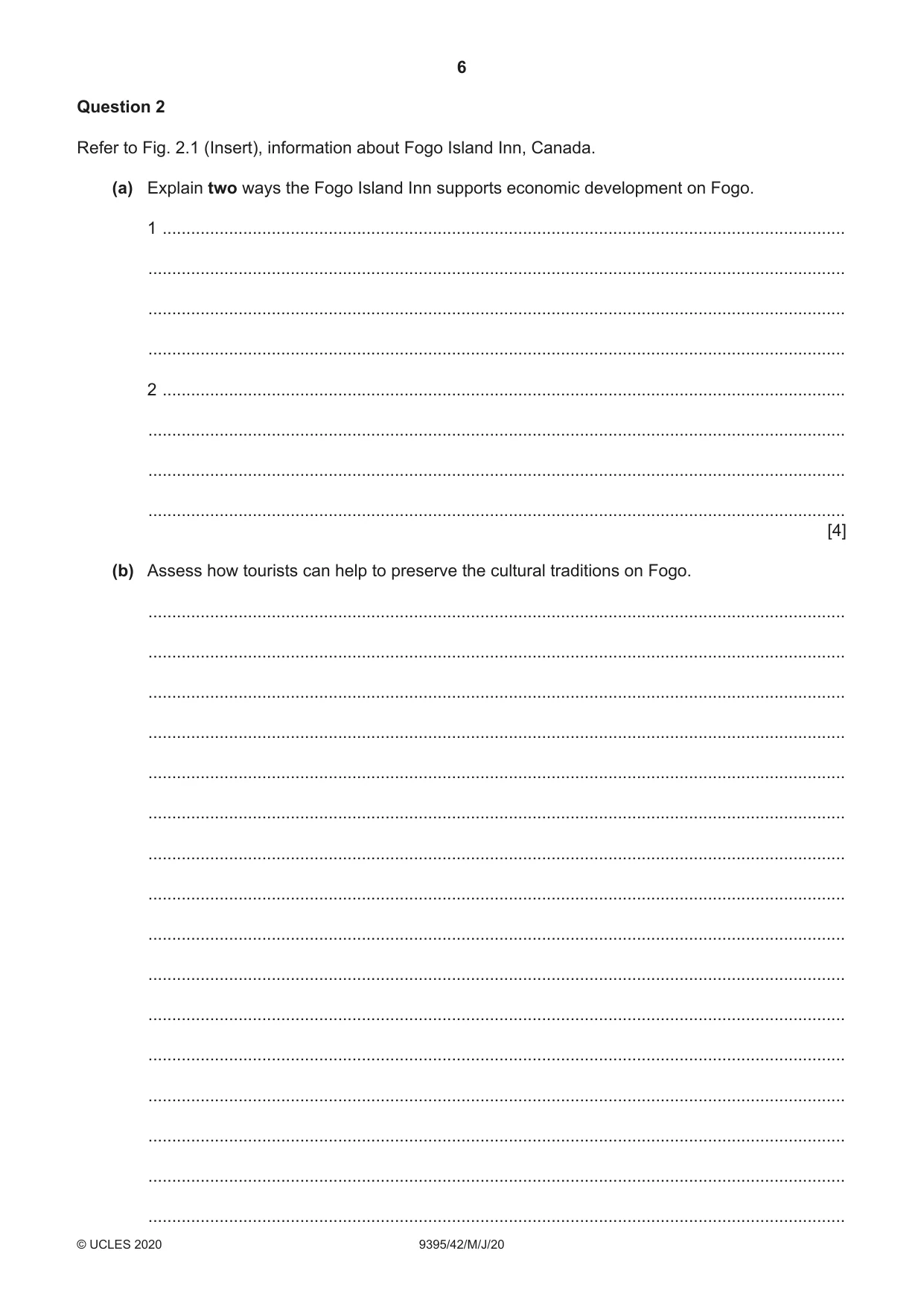
6 9395/42/M/J/20 © UCLES 2020 Question 2 Refer to Fig. 2.1 (Insert), information about Fogo Island Inn, Canada. (a) Explain two ways the Fogo Island Inn supports economic development on Fogo. 1 … … … … 2 … … … … [4] (b) Assess how tourists can help to preserve the cultural traditions on Fogo. … … … … … … … … … … … … … … … …
Question paper, page 7
7 9395/42/M/J/20 © UCLES 2020 [Turn over … … … … … … … … … … … … … … … … … … … … … … … … … … … … [9]
Question paper, page 8
8 9395/42/M/J/20 © UCLES 2020 (c) Discuss how working in partnerships helps the Fogo Island Inn to succeed. … … … … … … … … … … … … … … … … … … … … … … … … … … …
Question paper, page 9
9 9395/42/M/J/20 © UCLES 2020 … … … … … … … … … … … … … … … … … … … … … … … … … … … [12] [Total: 25]
Question paper, page 10
10 9395/42/M/J/20 © UCLES 2020 BLANK PAGE
Question paper, page 11
11 9395/42/M/J/20 © UCLES 2020 BLANK PAGE
Question paper, page 12
12 9395/42/M/J/20 © UCLES 2020 Permission to reproduce items where third-party owned material protected by copyright is included has been sought and cleared where possible. Every reasonable effort has been made by the publisher (UCLES) to trace copyright holders, but if any items requiring clearance have unwittingly been included, the publisher will be pleased to make amends at the earliest possible opportunity. To avoid the issue of disclosure of answer-related information to candidates, all copyright acknowledgements are reproduced online in the Cambridge Assessment International Education Copyright Acknowledgements Booklet. This is produced for each series of examinations and is freely available to download at www.cambridgeinternational.org after the live examination series. Cambridge Assessment International Education is part of the Cambridge Assessment Group. Cambridge Assessment is the brand name of the University of Cambridge Local Examinations Syndicate (UCLES), which itself is a department of the University of Cambridge. BLANK PAGE
Mark scheme, page 1
This document consists of 8 printed pages. © UCLES 2020 [Turn over Cambridge International A Level TRAVEL & TOURISM 9395/42 Paper 4 Destination Management May/June 2020 MARK SCHEME Maximum Mark: 50 Published Students did not sit exam papers in the June 2020 series due to the Covid-19 global pandemic. This mark scheme is published to support teachers and students and should be read together with the question paper. It shows the requirements of the exam. The answer column of the mark scheme shows the proposed basis on which Examiners would award marks for this exam. Where appropriate, this column also provides the most likely acceptable alternative responses expected from students. Examiners usually review the mark scheme after they have seen student responses and update the mark scheme if appropriate. In the June series, Examiners were unable to consider the acceptability of alternative responses, as there were no student responses to consider. Mark schemes should usually be read together with the Principal Examiner Report for Teachers. However, because students did not sit exam papers, there is no Principal Examiner Report for Teachers for the June 2020 series. Cambridge International will not enter into discussions about these mark schemes. Cambridge International is publishing the mark schemes for the June 2020 series for most Cambridge IGCSE™ and Cambridge International A & AS Level components, and some Cambridge O Level components.
Mark scheme, page 2
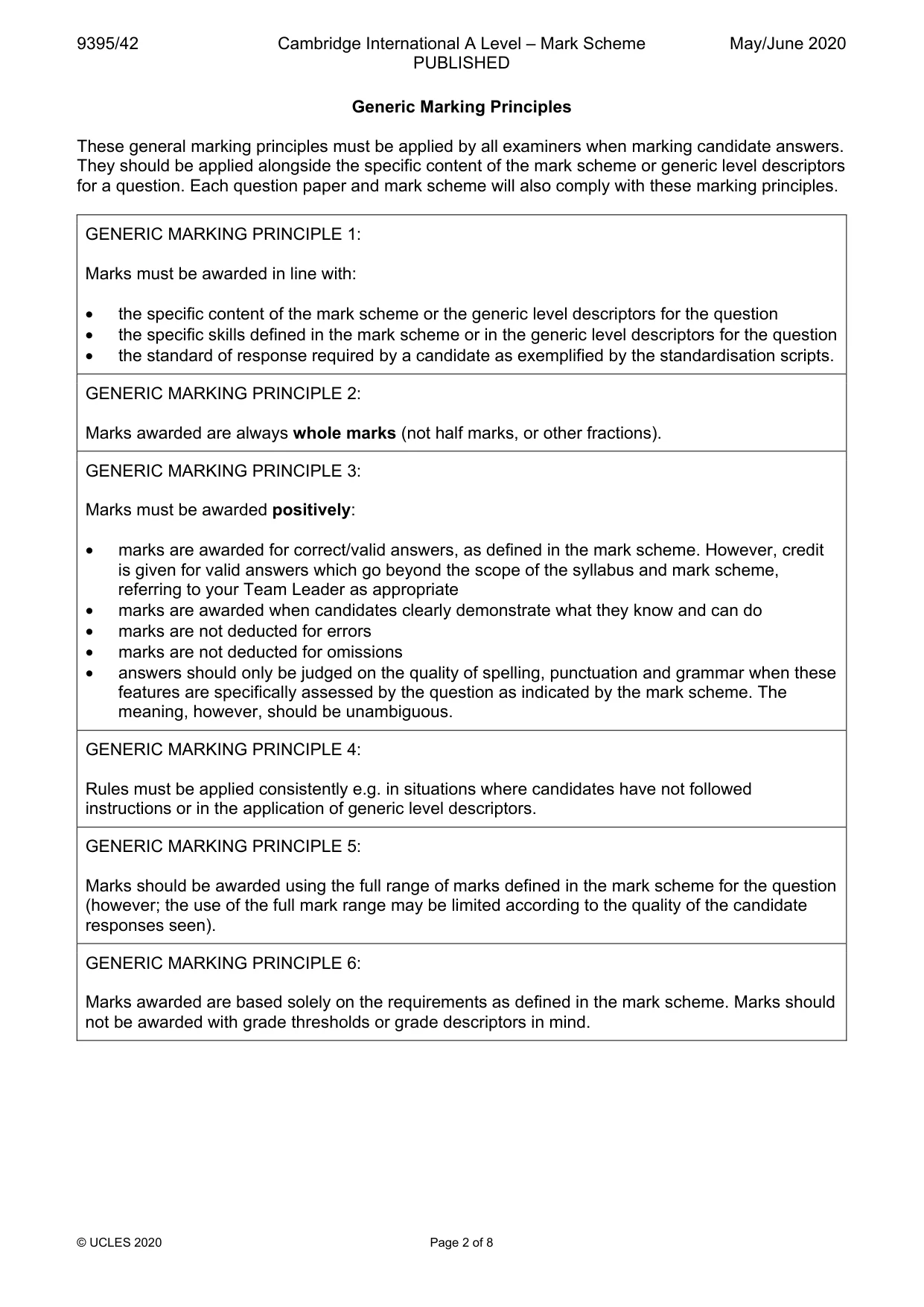
9395/42 Cambridge International A Level – Mark Scheme PUBLISHED May/June 2020 © UCLES 2020 Page 2 of 8 Generic Marking Principles These general marking principles must be applied by all examiners when marking candidate answers. They should be applied alongside the specific content of the mark scheme or generic level descriptors for a question. Each question paper and mark scheme will also comply with these marking principles. GENERIC MARKING PRINCIPLE 1: Marks must be awarded in line with: • the specific content of the mark scheme or the generic level descriptors for the question • the specific skills defined in the mark scheme or in the generic level descriptors for the question • the standard of response required by a candidate as exemplified by the standardisation scripts. GENERIC MARKING PRINCIPLE 2: Marks awarded are always whole marks (not half marks, or other fractions). GENERIC MARKING PRINCIPLE 3: Marks must be awarded positively: • marks are awarded for correct/valid answers, as defined in the mark scheme. However, credit is given for valid answers which go beyond the scope of the syllabus and mark scheme, referring to your Team Leader as appropriate • marks are awarded when candidates clearly demonstrate what they know and can do • marks are not deducted for errors • marks are not deducted for omissions • answers should only be judged on the quality of spelling, punctuation and grammar when these features are specifically assessed by the question as indicated by the mark scheme. The meaning, however, should be unambiguous. GENERIC MARKING PRINCIPLE 4: Rules must be applied consistently e.g. in situations where candidates have not followed instructions or in the application of generic level descriptors. GENERIC MARKING PRINCIPLE 5: Marks should be awarded using the full range of marks defined in the mark scheme for the question (however; the use of the full mark range may be limited according to the quality of the candidate responses seen). GENERIC MARKING PRINCIPLE 6: Marks awarded are based solely on the requirements as defined in the mark scheme. Marks should not be awarded with grade thresholds or grade descriptors in mind.
Mark scheme, page 3
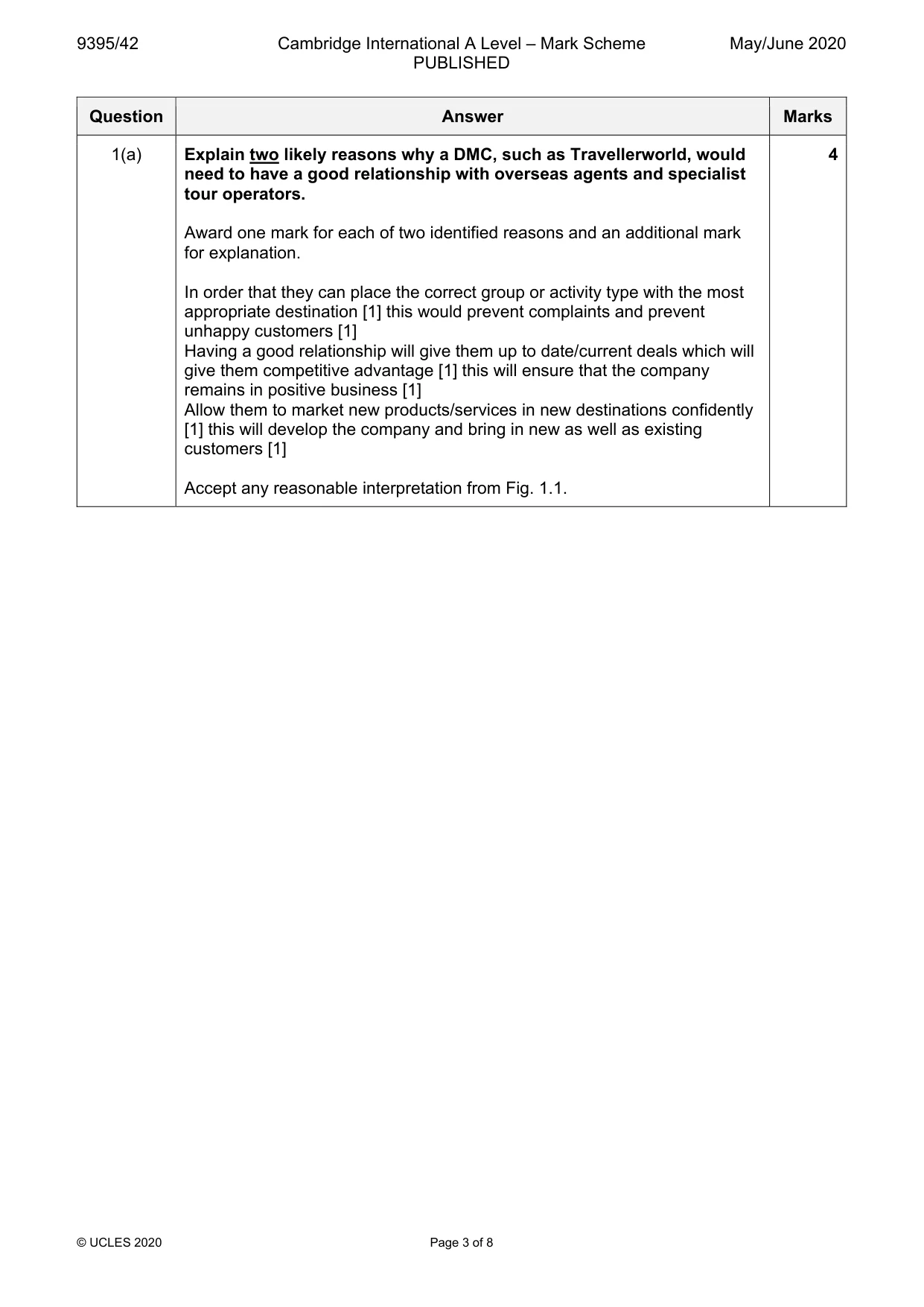
9395/42 Cambridge International A Level – Mark Scheme PUBLISHED May/June 2020 © UCLES 2020 Page 3 of 8 Question Answer Marks 1(a) Explain two likely reasons why a DMC, such as Travellerworld, would need to have a good relationship with overseas agents and specialist tour operators. Award one mark for each of two identified reasons and an additional mark for explanation. In order that they can place the correct group or activity type with the most appropriate destination [1] this would prevent complaints and prevent unhappy customers [1] Having a good relationship will give them up to date/current deals which will give them competitive advantage [1] this will ensure that the company remains in positive business [1] Allow them to market new products/services in new destinations confidently [1] this will develop the company and bring in new as well as existing customers [1] Accept any reasonable interpretation from Fig. 1.1. 4
Mark scheme, page 4
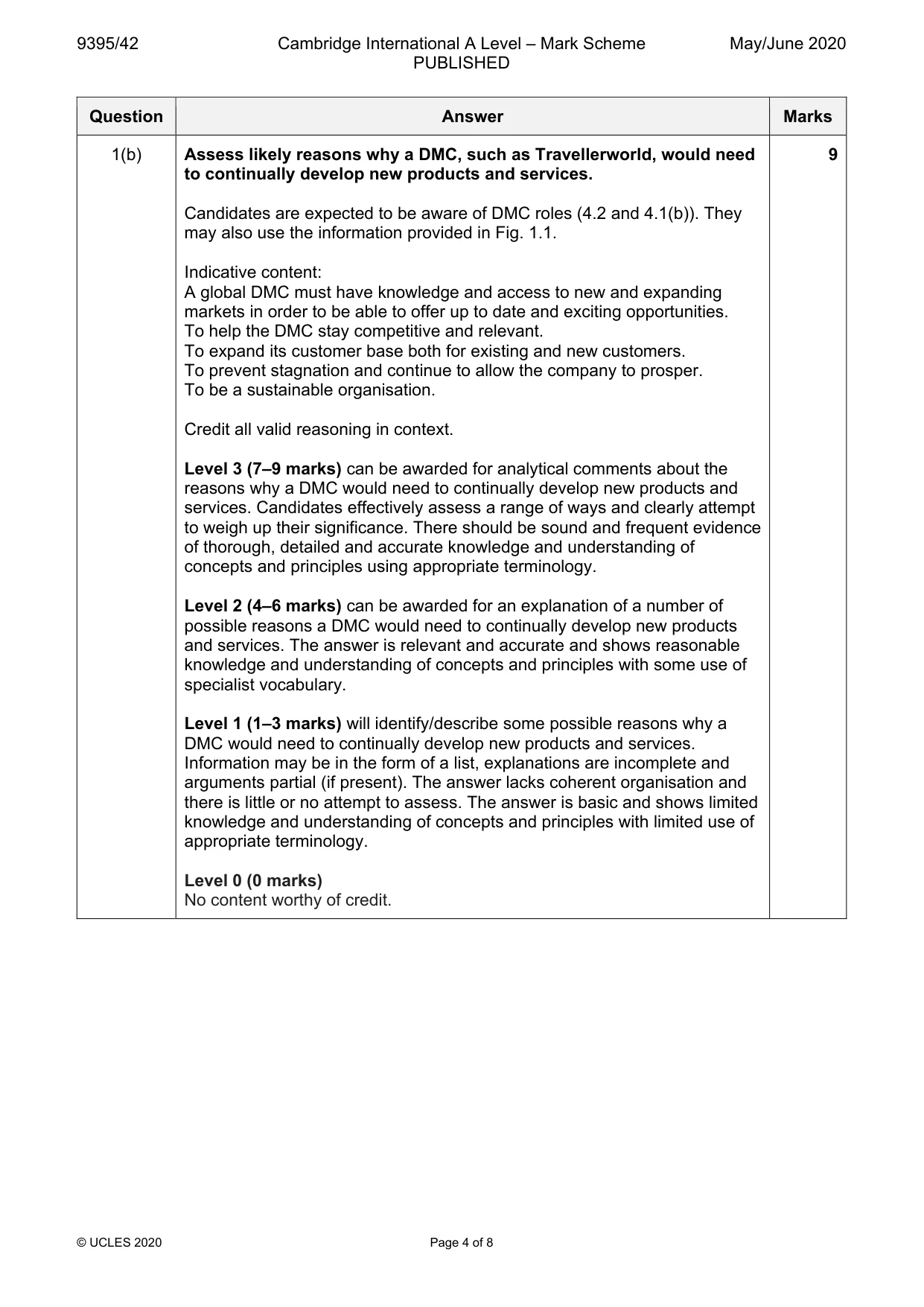
9395/42 Cambridge International A Level – Mark Scheme PUBLISHED May/June 2020 © UCLES 2020 Page 4 of 8 Question Answer Marks 1(b) Assess likely reasons why a DMC, such as Travellerworld, would need to continually develop new products and services. Candidates are expected to be aware of DMC roles (4.2 and 4.1(b)). They may also use the information provided in Fig. 1.1. Indicative content: A global DMC must have knowledge and access to new and expanding markets in order to be able to offer up to date and exciting opportunities. To help the DMC stay competitive and relevant. To expand its customer base both for existing and new customers. To prevent stagnation and continue to allow the company to prosper. To be a sustainable organisation. Credit all valid reasoning in context. Level 3 (7–9 marks) can be awarded for analytical comments about the reasons why a DMC would need to continually develop new products and services. Candidates effectively assess a range of ways and clearly attempt to weigh up their significance. There should be sound and frequent evidence of thorough, detailed and accurate knowledge and understanding of concepts and principles using appropriate terminology. Level 2 (4–6 marks) can be awarded for an explanation of a number of possible reasons a DMC would need to continually develop new products and services. The answer is relevant and accurate and shows reasonable knowledge and understanding of concepts and principles with some use of specialist vocabulary. Level 1 (1–3 marks) will identify/describe some possible reasons why a DMC would need to continually develop new products and services. Information may be in the form of a list, explanations are incomplete and arguments partial (if present). The answer lacks coherent organisation and there is little or no attempt to assess. The answer is basic and shows limited knowledge and understanding of concepts and principles with limited use of appropriate terminology. Level 0 (0 marks) No content worthy of credit. 9
Mark scheme, page 5
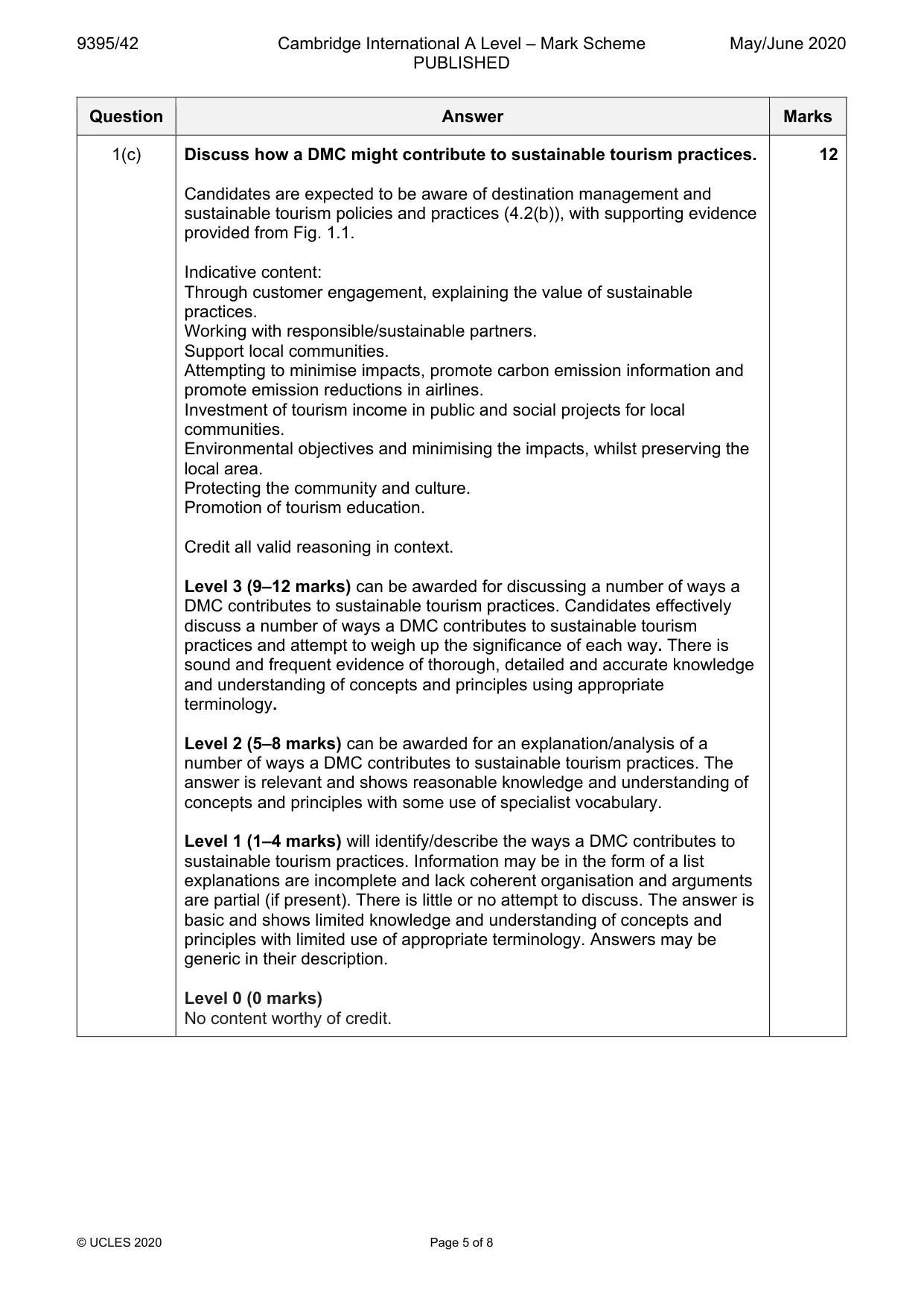
9395/42 Cambridge International A Level – Mark Scheme PUBLISHED May/June 2020 © UCLES 2020 Page 5 of 8 Question Answer Marks 1(c) Discuss how a DMC might contribute to sustainable tourism practices. Candidates are expected to be aware of destination management and sustainable tourism policies and practices (4.2(b)), with supporting evidence provided from Fig. 1.1. Indicative content: Through customer engagement, explaining the value of sustainable practices. Working with responsible/sustainable partners. Support local communities. Attempting to minimise impacts, promote carbon emission information and promote emission reductions in airlines. Investment of tourism income in public and social projects for local communities. Environmental objectives and minimising the impacts, whilst preserving the local area. Protecting the community and culture. Promotion of tourism education. Credit all valid reasoning in context. Level 3 (9–12 marks) can be awarded for discussing a number of ways a DMC contributes to sustainable tourism practices. Candidates effectively discuss a number of ways a DMC contributes to sustainable tourism practices and attempt to weigh up the significance of each way. There is sound and frequent evidence of thorough, detailed and accurate knowledge and understanding of concepts and principles using appropriate terminology. Level 2 (5–8 marks) can be awarded for an explanation/analysis of a number of ways a DMC contributes to sustainable tourism practices. The answer is relevant and shows reasonable knowledge and understanding of concepts and principles with some use of specialist vocabulary. Level 1 (1–4 marks) will identify/describe the ways a DMC contributes to sustainable tourism practices. Information may be in the form of a list explanations are incomplete and lack coherent organisation and arguments are partial (if present). There is little or no attempt to discuss. The answer is basic and shows limited knowledge and understanding of concepts and principles with limited use of appropriate terminology. Answers may be generic in their description. Level 0 (0 marks) No content worthy of credit. 12
Mark scheme, page 6
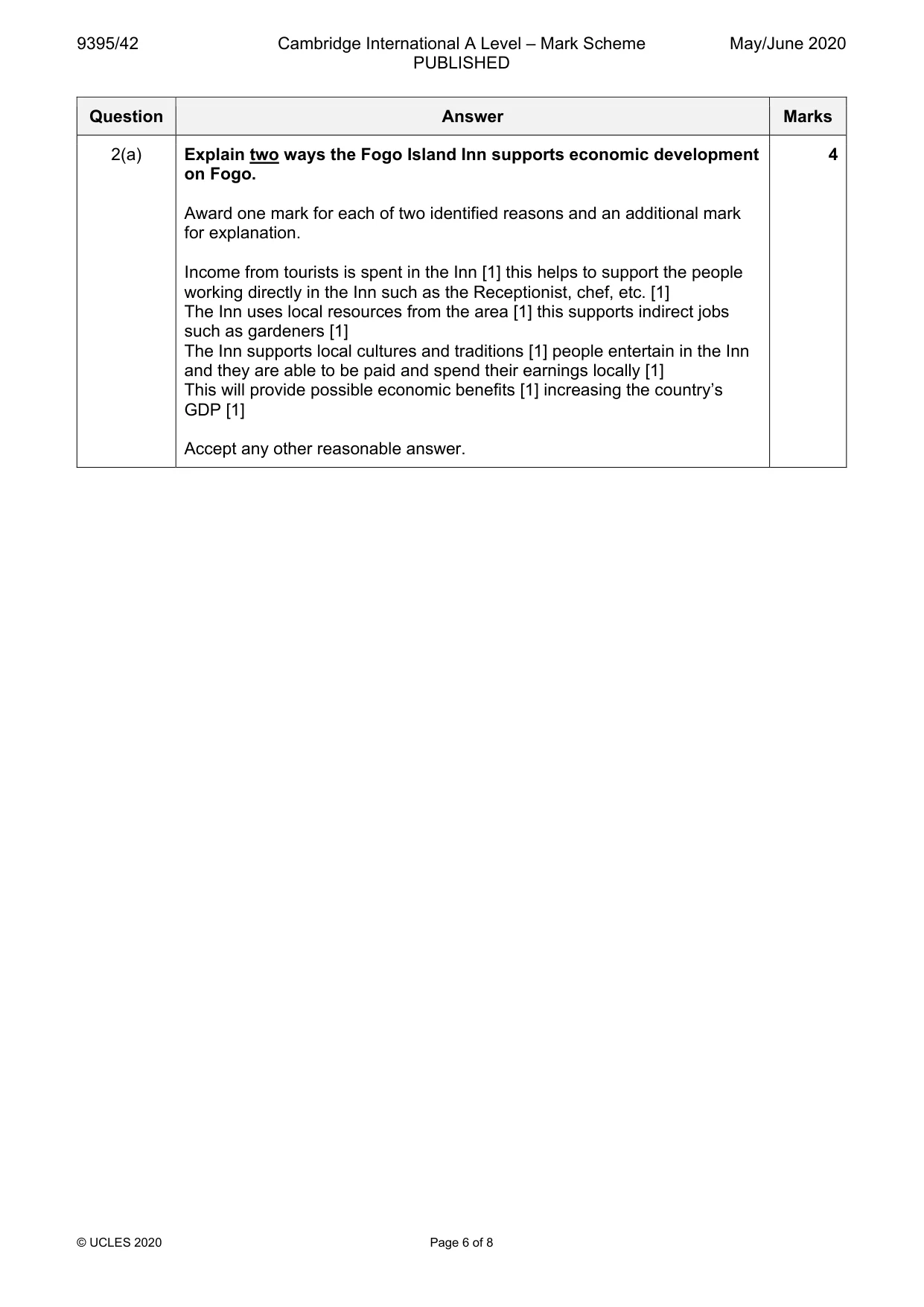
9395/42 Cambridge International A Level – Mark Scheme PUBLISHED May/June 2020 © UCLES 2020 Page 6 of 8 Question Answer Marks 2(a) Explain two ways the Fogo Island Inn supports economic development on Fogo. Award one mark for each of two identified reasons and an additional mark for explanation. Income from tourists is spent in the Inn [1] this helps to support the people working directly in the Inn such as the Receptionist, chef, etc. [1] The Inn uses local resources from the area [1] this supports indirect jobs such as gardeners [1] The Inn supports local cultures and traditions [1] people entertain in the Inn and they are able to be paid and spend their earnings locally [1] This will provide possible economic benefits [1] increasing the country’s GDP [1] Accept any other reasonable answer. 4
Mark scheme, page 7
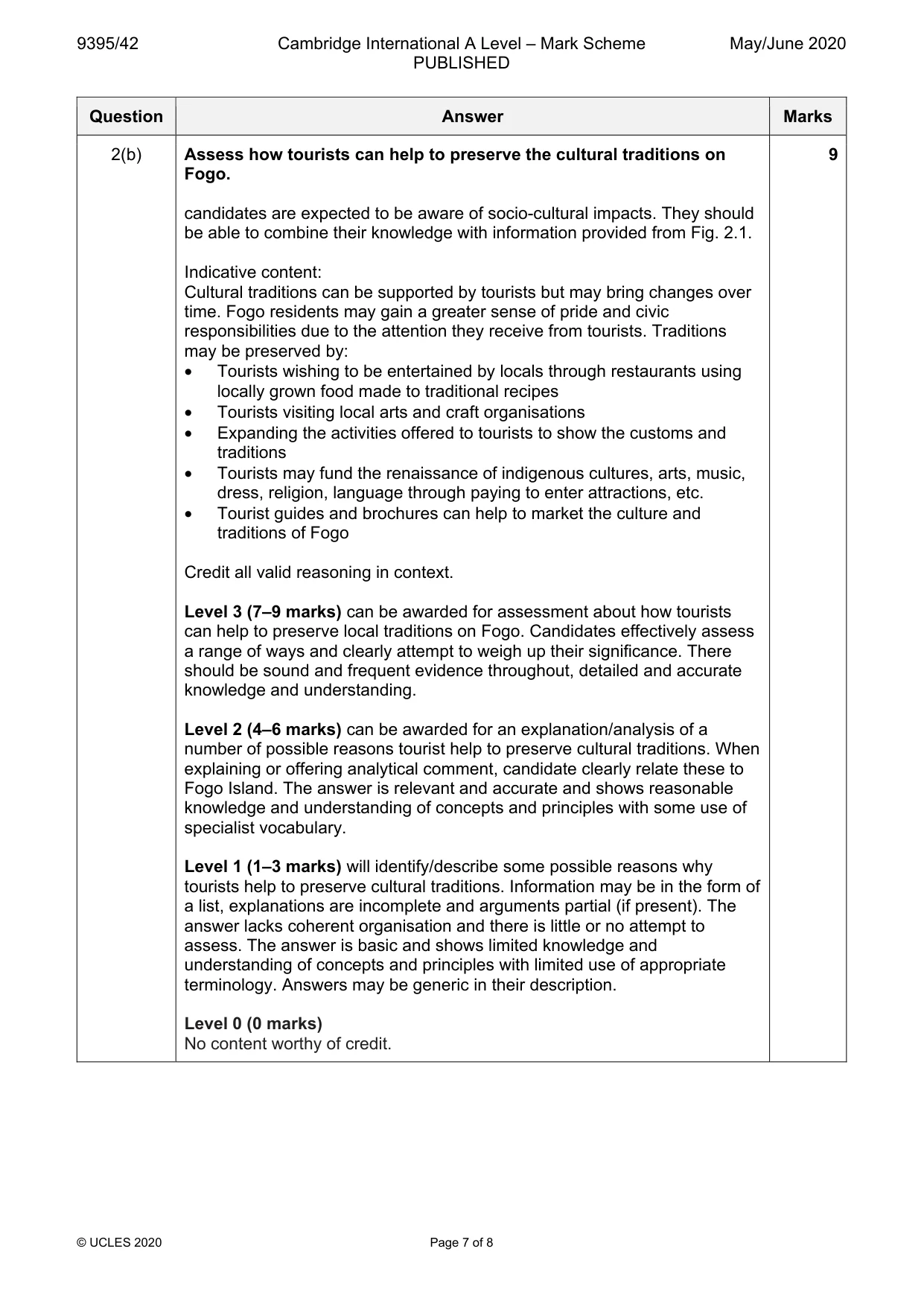
9395/42 Cambridge International A Level – Mark Scheme PUBLISHED May/June 2020 © UCLES 2020 Page 7 of 8 Question Answer Marks 2(b) Assess how tourists can help to preserve the cultural traditions on Fogo. candidates are expected to be aware of socio-cultural impacts. They should be able to combine their knowledge with information provided from Fig. 2.1. Indicative content: Cultural traditions can be supported by tourists but may bring changes over time. Fogo residents may gain a greater sense of pride and civic responsibilities due to the attention they receive from tourists. Traditions may be preserved by: • Tourists wishing to be entertained by locals through restaurants using locally grown food made to traditional recipes • Tourists visiting local arts and craft organisations • Expanding the activities offered to tourists to show the customs and traditions • Tourists may fund the renaissance of indigenous cultures, arts, music, dress, religion, language through paying to enter attractions, etc. • Tourist guides and brochures can help to market the culture and traditions of Fogo Credit all valid reasoning in context. Level 3 (7–9 marks) can be awarded for assessment about how tourists can help to preserve local traditions on Fogo. Candidates effectively assess a range of ways and clearly attempt to weigh up their significance. There should be sound and frequent evidence throughout, detailed and accurate knowledge and understanding. Level 2 (4–6 marks) can be awarded for an explanation/analysis of a number of possible reasons tourist help to preserve cultural traditions. When explaining or offering analytical comment, candidate clearly relate these to Fogo Island. The answer is relevant and accurate and shows reasonable knowledge and understanding of concepts and principles with some use of specialist vocabulary. Level 1 (1–3 marks) will identify/describe some possible reasons why tourists help to preserve cultural traditions. Information may be in the form of a list, explanations are incomplete and arguments partial (if present). The answer lacks coherent organisation and there is little or no attempt to assess. The answer is basic and shows limited knowledge and understanding of concepts and principles with limited use of appropriate terminology. Answers may be generic in their description. Level 0 (0 marks) No content worthy of credit. 9
Mark scheme, page 8
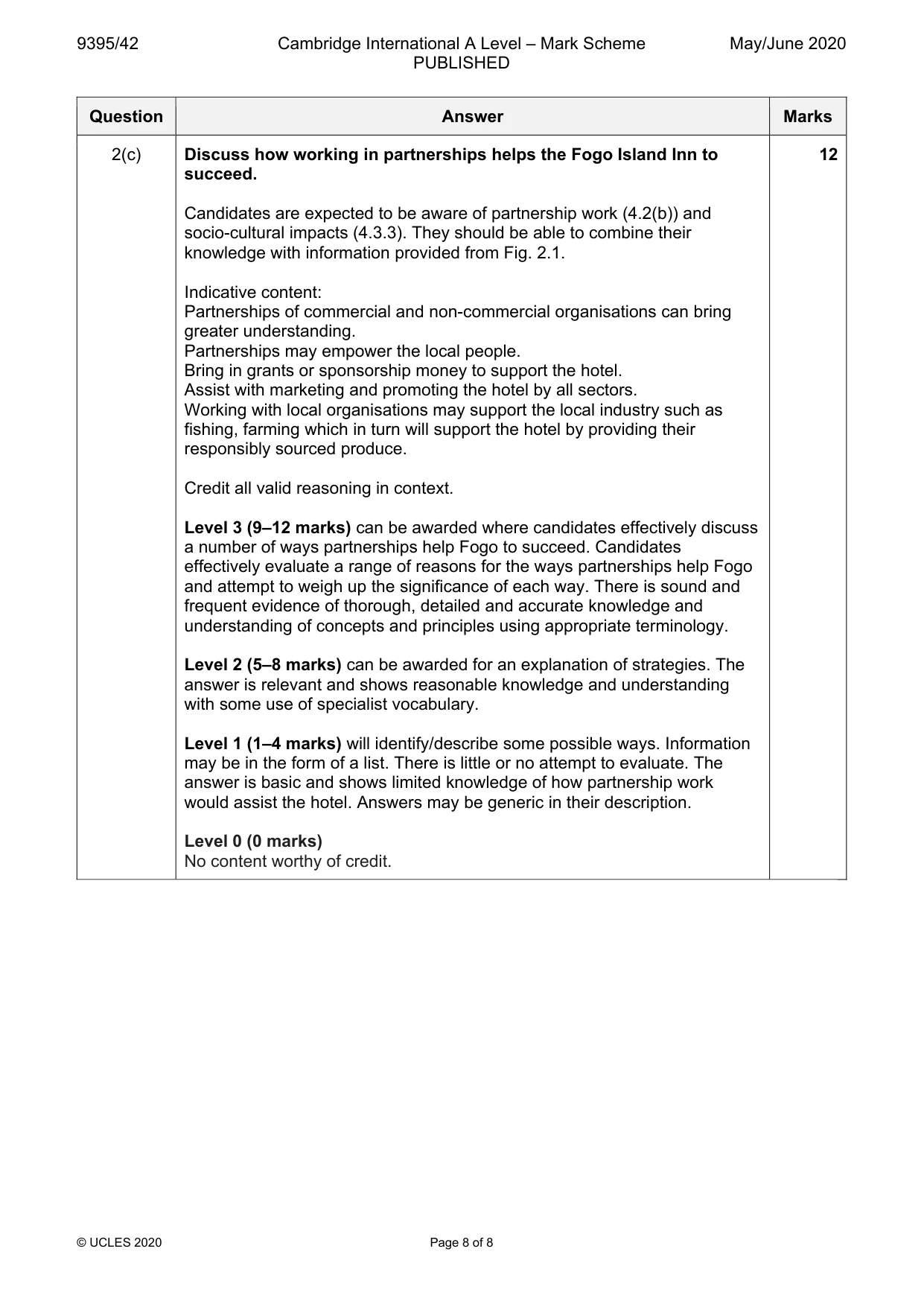
9395/42 Cambridge International A Level – Mark Scheme PUBLISHED May/June 2020 © UCLES 2020 Page 8 of 8 Question Answer Marks 2(c) Discuss how working in partnerships helps the Fogo Island Inn to succeed. Candidates are expected to be aware of partnership work (4.2(b)) and socio-cultural impacts (4.3.3). They should be able to combine their knowledge with information provided from Fig. 2.1. Indicative content: Partnerships of commercial and non-commercial organisations can bring greater understanding. Partnerships may empower the local people. Bring in grants or sponsorship money to support the hotel. Assist with marketing and promoting the hotel by all sectors. Working with local organisations may support the local industry such as fishing, farming which in turn will support the hotel by providing their responsibly sourced produce. Credit all valid reasoning in context. Level 3 (9–12 marks) can be awarded where candidates effectively discuss a number of ways partnerships help Fogo to succeed. Candidates effectively evaluate a range of reasons for the ways partnerships help Fogo and attempt to weigh up the significance of each way. There is sound and frequent evidence of thorough, detailed and accurate knowledge and understanding of concepts and principles using appropriate terminology. Level 2 (5–8 marks) can be awarded for an explanation of strategies. The answer is relevant and shows reasonable knowledge and understanding with some use of specialist vocabulary. Level 1 (1–4 marks) will identify/describe some possible ways. Information may be in the form of a list. There is little or no attempt to evaluate. The answer is basic and shows limited knowledge of how partnership work would assist the hotel. Answers may be generic in their description. Level 0 (0 marks) No content worthy of credit. 12